Category: housing

  • City of Villages

    Los Angeles is unique among the big, world-class American cities. Unlike New York, Boston, or Chicago, L.A. lacks a clearly defined core. It is instead a sprawling region made up of numerous poly-ethnic neighborhoods, few exhibiting the style and grace of a Paris arrondissement, Greenwich Village, or southwest London. In the 1920s, the region’s huge dispersion was contemptuously described—in a quotation alternately attributed to Dorothy Parker, Aldous Huxley, or H. L. Mencken—as “72 suburbs in search of a city.” Los Angeles’s lack of urbane charm led William Faulkner to dub it “the plastic asshole of the world.” But to those of us who inhabit this expansive and varied place, the lack of conventional urbanity is exactly what makes Los Angeles so interesting. My adopted hometown is the exemplar of the modern multipolar metropolis: less a conscious city than a series of alternatives created by its climate, its diversity, and a congested but still-functional system of freeways that historian Kevin Starr calls “absolute masterpieces of engineering.”

    PHOTOGRAPHS BY TED SOQUI


    Transplants from the East Coast make great sport of belittling Los Angeles as an adolescent New York or a second-rate Chicago. Developers and city boosters, eager to counter that image, placed their hopes on big projects such as the region’s ultraexpensive rail system. Yet billions of investment dollars have done almost nothing to increase the L.A. Metro’s ridership, which remains stuck at 6 percent of city population. By contrast, a majority of New Yorkers and about a quarter of Chicagoans use their cities’ public transportation. Critics also (rightly) depict the downtown residential revival as a misguided attempt to create a mini-Manhattan. That’s not in the cards: downtown L.A.’s 50,000 or so residents—about on par with San Fernando Valley neighborhoods such as Sherman Oaks and suburban areas such as San Bernardino County’s Eastvale—are a drop in the bucket for a region of some 18 million people. And despite billions in direct and indirect public subsidies, downtown boasts barely 3 percent of the region’s jobs. In the minds of most Angelenos, the only reason to go downtown is for jury duty or the occasional sporting or cultural event.


    626 Night Market, at the Santa Anita track

    The “real” L.A., as experienced by most residents, exists at the neighborhood level. Spread across the region, a multiplicity of neighborhoods offers an unusual variety of housing options in a great global city. Gardener Aurelio Rodriguez and his family choose to live in Sylmar, where he keeps a lush half-acre filled with fruit trees, tropical plants, and aging farm equipment, while remaining within the Los Angeles city limits. It’s the kind of place where pedestrians need to keep an eye out for more than just cars. Like Juan, some residents amble through the narrow streets on horseback.


    Juan on horseback in Sylmar

    Los Angeles’s myriad little villages are enjoying a new surge of interest. City politics are at a low ebb—with voter turnout in 2013 the tiniest ever for a contested citywide election—yet neighborhood groups proliferate, including some 90 neighborhood councils. People may not be passionate about what goes on at City Hall, but they care deeply about where they live.

    I live in Valley Village, a tree-lined corner of Los Angeles made up of single-family houses built on lots that range from 5,000 to 20,000 square feet. Enclosed between four major thoroughfares, my part of Valley Village manages to be both diverse and highly cohesive—a city within a city. Crime tends to be limited to petty thefts from cars. Monthly neighborhood-watch meetings draw middle-class families as well as gay and childless couples. Armenians and orthodox Jews live side by side. The local markets have an ethnic flavor. At the Cambridge Farms supermarket on Burbank Boulevard, signs are posted in English and in Hebrew. Oxnard Boulevard has an Armenian feel, with a functioning lavash bakery and restaurants selling kabobs.

    “We fell in love with the neighborhood once we got settled in,” says Grettel Cortes, who lives in a modest house several doors down with her husband, Efraim, and her three young children, Gaea, Eva, and Benjamin. “There’s a great family feeling here. If I need something, I ask Patty across the street. It’s a great place for kids to grow up.” Cortes manages the neighborhood’s heavily trafficked Shutterfly site. A recent article about a coyote devouring a local cat was big news for weeks.

    The hot topic in Valley Village these days is the rise of the McMansions. New homes are going up on a scale that feels out of sync with the neighborhood’s low-rise character. One of the larger parcels has sprouted a gigantic, two-and-a-half-story monstrosity that neighbors have christened “the hotel.” During construction, the property’s owner chopped down several trees, some of which may have been protected by city ordinances. Only relentless protests from the locals kept him from further destruction.

    “We love the neighborhood but hate the mansionization,” notes Tim Coffey, a 30-year resident whose wife, Chary, led the fight to save the trees. “To us, chopping down trees ruins what this place is all about.”

    Despite the McMansions, Valley Village has remained mostly unchanged since I moved here over a decade ago. The area’s appeal lies in the quality of its private spaces—backyards, front yards, gardens—and its neighborliness: people actually say hello to strangers on the street. The many trees also provide an ecosystem for a vast array of birds, from hawks to hummingbirds, as well as various mammals, including raccoons, opossums, and, as we now know, the occasional coyote.

    As neighbors, we share a fierce determination to protect and preserve our shaded enclave. Yet the people here are not your stereotypical suburbanites. Chary, for example, sells her own line of lingerie. Grettel is a website developer. Many others work in the entertainment industry. Studios such as Disney, CBS Radford (where Seinfeld was produced), NBC, Universal, and Warner Brothers are all a ten- to 15-minute drive away. Many of my neighbors work from home, including a voice-over artist, a scriptwriter, several actors and musicians, and even a magician. It turns out that Hollywood people want many of the same things from a neighborhood that the rest of us do.


    Grettel Cortes’s neighbor Patty


    Blind Melon guitarist Brad Smith


    Native Mississippian Brad Smith, a successful songwriter and performer with the band Blind Melon, sees Valley Village as a refuge from the insanity of the entertainment business. Brad and his wife, Kim, a Michigan native, like the homey and familiar feel. They have lived here since 2000 and are raising a young daughter, Frankie. They have a dog and a trampoline out back. “In L.A., a lot of places seem like you can live there but never leave the car,” he says as he strums a tune in his backyard. “But here, it’s different. You come home from tour, and you come to a neighborhood with dogs, cats, and kids. It makes living in the big city far more palatable, even for someone from a small town.” This is one of L.A.’s enduring charms: the option to live in a quiet neighborhood in the heart of an important city.

    Los Angeles is constantly reinventing itself, combining and recombining people and neighborhoods from the ground up. Out of its crazy quilt of ethnic enclaves, new districts arise all the time, often spontaneously, notes Thomas Tseng, a native of the suburban San Gabriel Valley and a student of urban planning. Take the neighborhood now known as “Little Osaka,” which follows along Sawtelle Boulevard in West Los Angeles. Forty years ago, when I lived there, the area was home mostly to working-class Japanese and Mexican families. The few modest restaurants were far from fashionable, mostly offering ethnic home-style cuisine. But over the past few years, Tseng says, many of the old families—as well as investors from Korea, Taiwan, and China—have opened new restaurants, bars, and clubs in the neighborhood. Far from the downtown hotspots and the Hollywood scene, Little Osaka’s streets bustle with young people, a majority of them Asian. Many live in the area or attend nearby UCLA. “There was nothing planned,” says Tseng, who has been getting his hair cut and belly filled in the area for years. “It just happened.”


    Little Osaka


    Little Osaka


    Even more impressive is the 626 Night Market in the parking lot of the Santa Anita Track. Every month, some 160 food vendors descend on the place. You can get everything from preserved fertilized eggs to sea-urchin rice balls (my favorite), lamb skewers, stinky tofu, and grilled squid. Up to 40,000 people gather in this monthly celebration of L.A.’s entrepreneurial grassroots food scene. After all, Los Angeles invented the food truck—the perfect analogy for a city perpetually on the road and spanning hundreds of neighborhoods.

    Los Angeles may lack the kind of dynamic urban core that we associate with traditional great cities. But to most of its residents, the city is an urban feast on a gourmet scale. We wouldn’t trade it for the world.

    This story originally appeared at The City Journal.

    Joel Kotkin is executive editor of NewGeography.com and Distinguished Presidential Fellow in Urban Futures at Chapman University, and a member of the editorial board of the Orange County Register. He is author of The City: A Global History and The Next Hundred Million: America in 2050. His most recent study, The Rise of Postfamilialism, has been widely discussed and distributed internationally. He lives in Los Angeles, CA.
  • ‘Lone Eagle’ Cities: Where The Most People Work From Home

    In an era of high unemployment and limited opportunity, more Americans are taking matters into their own hands and going to work for themselves out of their homes.

    Normally small businesses have led the way during economic recoveries, but this time around they’re not creating many jobs. Instead much of the growth we are now seeing is in “lone eagle” businesses, to borrow a phrase from Phil Burgess, often operating out of the worker’s residence. This reverses the trend from 1960 to 1980, when there were steady reductions in the number of people who worked at home. Indeed, despite all the talk of increased mass transit usage, the percentage of Americans working at home has grown 1.5 times faster over the past decade; there are now more telecommuters than people who take mass transit to work in 38 out of the 52 U.S. metropolitan areas with more than 1,000,000 residents.

    One clear driver of this trend is technology, particularly the growing ubiquity of high-speed Internet. A consultant in New York can now serve customers in Fargo, and vice versa, greatly expanding the range of places where people can live. This is particularly true for aging boomers, as well as younger workers having problems finding a full-time job in this tough economy.

    Not surprisingly, of America’s 52 largest metro areas, the ones with the highest proportions of home-based workers are generally those with high-tech, information-based economies. Tops is San Diego, a major center for digital and biomedical businesses, where 6.6% of workers are based at home.

    The next five metro areas, which have home worker concentrations ranging from 6.1% to 6.4%, all boast a high number of STEM workers and tech firms: Austin, Portland, Denver, Raleigh and San Francisco-Oakland. They all also have another thing in common: They tend to be popular destinations for millennials, who seem far more comfortable with unconventional work arrangements than older generations.

    High real estate costs may be accelerating the trend in San Francisco, San Diego and Portland —  if office space isn’t affordable, why not stay at home? All are also plagued by traffic congestion, most notably the Bay Area, which has among the longest commute times in the country. Rather than drive down snarled freeways, or take slow mass transit, individuals may do better working from home and heading into the traffic maelstrom only when absolutely necessary.

    College Towns, Suburbs And Exurbs

    Many metro areas, of course, are huge, and have many different kinds of geographies. But when we looked at the percentage of home-based workers in all municipalities with populations above 25,000, two types dominated the top of the table: college towns and tech-oriented exurbs. Boulder, Colo., for example, has the third highest proportion of people who work at home, at 11.6%, almost three times the national average. Other college towns with large proportions of telecommuters and one-person businesses include Berkeley, Calf. (tied for fifth, 10.6%), and Columbia, S.C. (12th, 9.9%), home to the University of South Carolina.

    But the bulk of our leading work-at-home locales are tech-oriented suburbs or exurbs. These include several communities around the often traffic-clogged greater Atlanta area, including No. 2 John’s Creek (13.1%) and No. 6 Alpharetta (10.6%).

    There are even more in the sprawl of Southern California. As many  longtime Southland residents can attest, the best workday is one that does not involve either driving or taking transit. The top municipalities on our list in the region tend to be more affluent communities, including two suburbs of our top-ranked metro area, San Diego: Carlsbad (16th, 9.4%) and Encinitas (fourth, 10.7%).

    The Codger Economy

    Yet it would be a mistake to think cities with large home-based workforces are necessarily youthful ones. Nor are they all in large metropolitan areas. Although still slightly below the average for metropolitan areas, the pace of new telecommuter growth is now much faster outside the major metro areas.

    More than 5 million Americans aged 55 or older run their own businesses or are otherwise self-employed, according to the Small Business Administration, and their numbers soared 52% from 2000 to 2007. As research from the Kauffmann Foundation suggests, many of these aging workers are not ready to hang up their workboots.

    This entrepreneurial push could correlate with  the movement of aging boomers to more rural communities, and sleepier outer suburbs. Contrary to the much-hyped notion of a “back to the city” movement among boomers, Census research suggests that if they move at all, most head further to the periphery. At the top of our list of communities over 25,000 is the coastal North Carolina city of Jacksonville, home to the Marine Corps’ Camp Lejeune and a good number of military retirees. A remarkable 13.8% of the people in this highly affordable, scenic community of 70,000 work out of their homes, roughly three times the national average. The median home price in Jacksonville: $141,000.

    Other retirement hot spots with high telecommuter shares include Boca Raton, Fla. (9.8%), Scottsdale, Ariz. (9.8%), and Bend, Ore. (9.0%). These communities tend to attract well-educated boomers, many of whom have kept their business connections and work as consultants. In many cases, telecommuting allows people to continue their careers, but in an atmosphere of comfort, without the burden of commuting and, in many cases, sans the high income taxes of places like California and New York.

    We can expect the wired economy to expand to other smaller communities. Already numerous smaller towns in the Midwest, such as Albert Lea, an hour and a half from Minneapolis, Brainerd, Minn., and Hastings Neb., all have home worker shares well above the national average. Many of the areas with the fastest growth in the number of self-employed people, notes EMSI is in small, somewhat isolated communities.

    Many analysts who follow these trends expect stay-at-home workers to become more common in the future. According to research by Kate Lister and Tom Harnish of the Telework Research Network, the typical teleworker is a 49-year-old, college-educated, salaried, non-union employee in a management or professional role, earning $58,000 a year at a company with more than 100 employees.

    This suggests that, as more workers enter their 50s, the telework population will expand further.  These numbers will continue to be buttressed by both economic and social factors. The shift towards outsourcing by companies seems unlikely to slow in the years ahead, with more work going to subcontractors who can often work at home. At the same time more boomers, particularly those with skills and connections, will continue to move to places that offer more attractive lifestyles — a process that Joel Garreau has labeled “the Santa Fe-ization of the world,” which he links to people with enough money to have choices.

    In the future, however, less well-heeled workers can also be expected to increasingly shift to affordable locales that appeal to them. This can be almost anywhere — a beach community, a rural hamlet, an exurb or even a dense urban location, as we can see by the geographic diversity in these rankings. As USC grad student Jeff Khau writes, this should encourage the development of wired coffee shops and casual restaurants in smaller communities and exurbs.

    Finally, there are both familial and environmental reasons for this trend to expand. With more two-worker households, it has become more attractive to have at least one person working from home, part-time or full-time. And then there is the environmental desire to reduce carbon admissions. Compared to being forced to live in dense cities, or taking mass transit, the best way by far to reduce energy use – not to mention stress – is to not leave home at all.

    Top Places Where Residents Work at Home

    No. 1: Jacksonville, NC – 13.8%

    No. 2. Johns Creek, GA – 13.1%

    No. 3: Boulder, CO – 11.6%

    No. 4: Encinitas, CA – 10.7%

    No. 5 (tie): Berkeley, CA – 10.6%

    No. 5 (tie): Alpharetta, GA -10.6%

    No. 5 (tie): Santa Monica, CA -10.6%

    No. 8: Frisco, TX – 10.2%

    No. 9 (tie): San Clemente, CA – 10.1%

    No. 9 (tie): Columbus, GA – 10.1%

    No. 11: Bethesda CDP, MD – 10.0%

    No. 12: Columbia, SC – 9.9%

    No. 13 (tie): Boca Raton, FL – 9.8%

    No. 13 (tie): Scottsdale, AZ – 9.8%

    No. 15: Newport Beach, CA – 9.5%

    Journey to Work Market Share by Mode (2012 ACS.1 & Year)
      Total Drive Alone Car Pool Transit Cycle Walk Other  @ Home
    United States 100% 76.3% 9.7% 5.0% 0.6% 2.8% 1.2% 4.4%
    Outside Major Metropolitan Areas 100% 79.9% 10.2% 1.2% 0.6% 2.8% 1.2% 4.1%
    Major Metropolitan Areas (52) 100% 73.5% 9.3% 7.9% 0.7% 2.8% 1.2% 4.6%
                     
    Atlanta, GA 100% 78.0% 10.5% 2.9% 0.1% 1.4% 1.1% 5.9%
    Austin, TX 100% 76.0% 11.0% 2.3% 0.9% 2.0% 1.4% 6.4%
    Baltimore, MD 100% 76.5% 8.9% 6.5% 0.3% 2.7% 1.0% 4.1%
    Birmingham, AL 100% 85.7% 9.1% 0.6% 0.1% 1.0% 0.5% 2.9%
    Boston, MA-NH 100% 68.6% 7.5% 12.2% 1.0% 5.4% 1.0% 4.4%
    Buffalo, NY 100% 82.9% 7.5% 3.0% 0.5% 2.9% 0.8% 2.3%
    Charlotte, NC-SC 100% 78.8% 10.3% 2.1% 0.2% 1.6% 1.2% 5.9%
    Chicago, IL-IN-WI 100% 70.9% 8.8% 11.1% 0.7% 3.2% 1.1% 4.2%
    Cincinnati, OH-KY-IN 100% 83.5% 8.3% 1.8% 0.1% 2.0% 0.7% 3.5%
    Cleveland, OH 100% 82.3% 7.4% 3.2% 0.3% 2.3% 0.9% 3.6%
    Columbus, OH 100% 82.1% 8.4% 1.6% 0.5% 2.0% 1.1% 4.3%
    Dallas-Fort Worth, TX 100% 80.9% 10.2% 1.5% 0.2% 1.2% 1.5% 4.6%
    Denver, CO 100% 75.6% 9.1% 4.4% 1.1% 2.4% 1.1% 6.3%
    Detroit,  MI 100% 83.7% 8.9% 1.6% 0.3% 1.3% 0.8% 3.4%
    Grand Rapids, MI 100% 82.7% 9.2% 1.2% 0.5% 1.8% 0.6% 4.0%
    Hartford, CT 100% 81.4% 7.6% 3.4% 0.2% 2.7% 0.9% 3.7%
    Houston, TX 100% 79.6% 11.1% 2.6% 0.3% 1.4% 1.5% 3.5%
    Indianapolis. IN 100% 82.6% 9.4% 1.2% 0.3% 1.6% 0.9% 4.0%
    Jacksonville, FL 100% 80.7% 9.9% 1.3% 0.7% 1.3% 1.3% 4.7%
    Kansas City, MO-KS 100% 83.2% 8.9% 1.1% 0.2% 1.3% 1.1% 4.2%
    Las Vegas, NV 100% 78.5% 10.7% 3.8% 0.3% 2.0% 1.6% 2.9%
    Los Angeles, CA 100% 74.1% 10.1% 6.0% 0.9% 2.6% 1.2% 5.1%
    Louisville, KY-IN 100% 82.9% 9.3% 1.8% 0.2% 1.8% 0.8% 3.2%
    Memphis, TN-MS-AR 100% 83.0% 10.5% 1.2% 0.1% 1.2% 0.9% 3.0%
    Miami, FL 100% 77.6% 9.5% 4.2% 0.6% 1.8% 1.3% 5.0%
    Milwaukee,WI 100% 80.2% 8.6% 3.7% 0.6% 2.9% 0.7% 3.2%
    Minneapolis-St. Paul, MN-WI 100% 78.2% 8.6% 4.3% 1.0% 2.2% 0.7% 5.0%
    Nashville, TN 100% 82.4% 9.6% 1.1% 0.1% 1.2% 1.0% 4.7%
    New Orleans. LA 100% 79.2% 10.4% 2.7% 1.0% 2.5% 1.6% 2.6%
    New York, NY-NJ-PA 100% 49.8% 6.7% 31.0% 0.6% 6.1% 1.6% 4.1%
    Oklahoma City, OK 100% 82.9% 10.2% 0.4% 0.3% 1.7% 1.2% 3.3%
    Orlando, FL 100% 80.8% 9.2% 2.0% 0.6% 1.2% 1.7% 4.6%
    Philadelphia, PA-NJ-DE-MD 100% 73.3% 7.9% 9.4% 0.7% 3.8% 0.7% 4.2%
    Phoenix, AZ 100% 77.3% 11.0% 2.1% 0.8% 1.4% 1.8% 5.6%
    Pittsburgh, PA 100% 77.3% 9.0% 5.5% 0.3% 3.4% 0.9% 3.6%
    Portland, OR-WA 100% 70.8% 9.7% 6.0% 2.3% 3.8% 1.0% 6.4%
    Providence, RI-MA 100% 80.4% 8.8% 2.9% 0.3% 3.2% 1.1% 3.2%
    Raleigh, NC 100% 80.3% 9.8% 1.0% 0.4% 1.1% 1.2% 6.2%
    Richmond, VA 100% 81.5% 9.3% 1.6% 0.5% 1.5% 0.9% 4.7%
    Riverside-San Bernardino, CA 100% 77.7% 13.4% 1.5% 0.4% 1.6% 1.0% 4.4%
    Rochester, NY 100% 82.4% 7.9% 1.9% 0.3% 3.6% 0.7% 3.2%
    Sacramento, CA 100% 75.5% 11.2% 2.3% 1.9% 2.2% 0.9% 6.0%
    Salt Lake City, UT 100% 75.0% 12.1% 3.9% 0.9% 2.0% 1.3% 4.7%
    San Antonio, TX 100% 79.7% 11.1% 2.3% 0.1% 1.7% 1.0% 4.1%
    San Diego, CA 100% 76.2% 9.9% 2.8% 0.7% 2.7% 1.2% 6.6%
    San Francisco-Oakland, CA 100% 60.4% 10.1% 15.6% 1.8% 4.3% 1.6% 6.1%
    San Jose, CA 100% 76.5% 10.6% 3.4% 1.9% 1.6% 1.4% 4.6%
    Seattle, WA 100% 69.6% 10.5% 8.5% 1.2% 3.6% 1.1% 5.5%
    St. Louis,, MO-IL 100% 82.4% 8.1% 2.3% 0.3% 1.7% 0.9% 4.2%
    Tampa-St. Petersburg, FL 100% 80.0% 9.6% 1.2% 0.8% 1.7% 1.3% 5.4%
    Virginia Beach-Norfolk, VA-NC 100% 80.9% 8.9% 1.9% 0.4% 2.7% 0.9% 4.3%
    Washington, DC-VA-MD-WV 100% 65.8% 10.2% 14.1% 0.8% 3.2% 0.9% 5.0%

    This story originally appeared at Forbes.com.

    Joel Kotkin is executive editor of NewGeography.com and Distinguished Presidential Fellow in Urban Futures at Chapman University, and a member of the editorial board of the Orange County Register. He is author of The City: A Global History and The Next Hundred Million: America in 2050. His most recent study, The Rise of Postfamilialism, has been widely discussed and distributed internationally. He lives in Los Angeles, CA.
    Wendell Cox is a Visiting Professor, Conservatoire National des Arts et Metiers, Paris and the author of “War on the Dream: How Anti-Sprawl Policy Threatens the Quality of Life.

    Photo by By Rae Allen, “My portable home office on the back deck”

  • We Had To Destroy the City In Order to Save It

    As housing prices and rents soar out of control in tightly regulated cities like San Francisco and New York, many people have called for a significant loosening of zoning rules to permit greater densification. Many policies contribute to unaffordable housing, including rent control, historic districts, eminent domain abuse, and building codes, but zoning puts an absolute cap on dwelling units per acre thus is generally part of any solution to the supply problem. What’s more, as recent commentators have started to notice, even many of America’s most dense cities are predominantly zoned for single family homes, calling into question the need to dedicate so much space to a single housing typology.

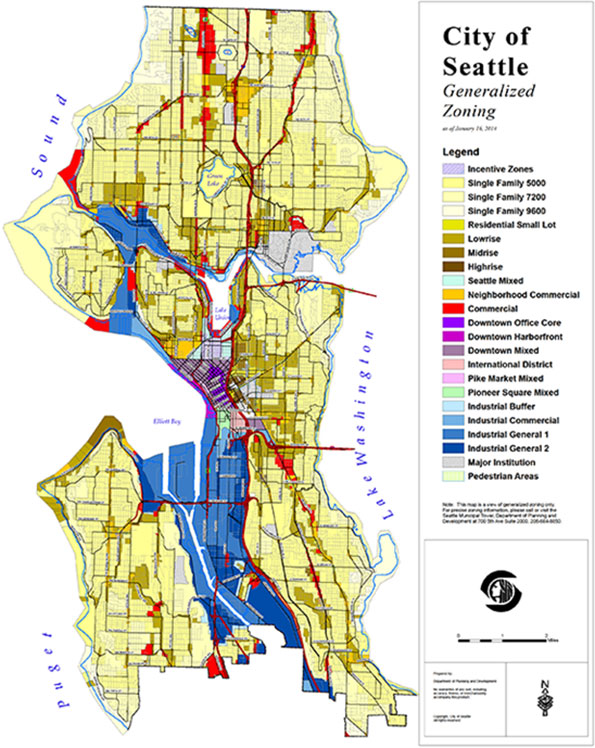
    For example, a web site called Better Institutions posted this map of Seattle, in which all of the yellow districts are zoned exclusively for single family homes:

    The poster lets his feelings be known by using scare quotes to denote single family “character” and blaming the zoning for Seattle’s high rents.

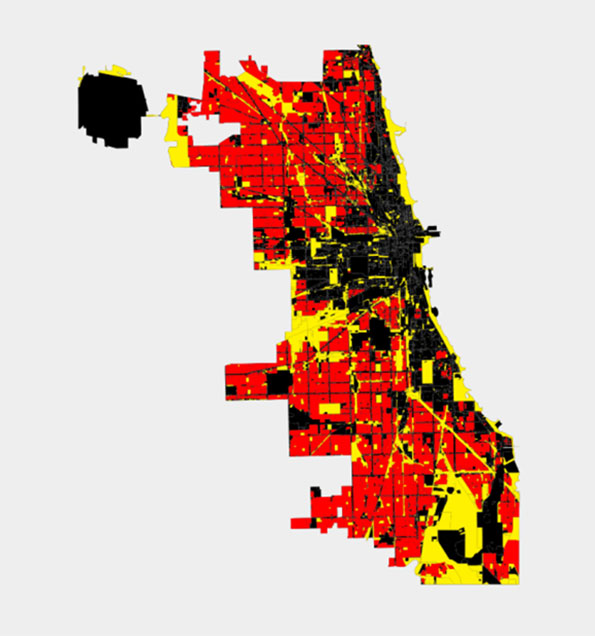
    And Daniel Hertz posted a similar map of Chicago in which the red is single family homes only and yellow is industrial space unavailable for any residential use:

    Some go beyond affordability, saying that we also need to significantly increase densities in central cities in order to reduce greenhouse gas emissions.  Harvard professor Ed Glaeser wrote an article advocating this subtitled, “To save the planet, build more skyscrapers—especially in California.”  He says, “A better path would be to ease restrictions in the urban cores of San Francisco, San Jose, Los Angeles, and San Diego. More building there would reduce average commute lengths and improve per-capita emissions” and “Similarly, limiting the height or growth of New York City skyscrapers incurs environmental costs. Building more apartments in Gotham will not only make the city more affordable; it will also reduce global warming.” He claims that, “The best thing that we can do for the planet is build more skyscrapers.”

    These complaints and the proposed solution of more dense multi-family development may be true in a technical sense, but what would carrying that out mean for people who actually live in our cities?

    Some critics may disdain the character of single family districts but few of these pundits ask the question of what eliminating lower-density housing actually means to the survival of the urban middle class.  Districts, like the Portage Park example Daniel Hertz gave in Chicago, are some of the last bastions of middle class family life in the city.  It’s clear that some densification can be implemented without radically changing the appearance or functioning of the built environment. Allowing 2-flats and coach houses, or even the corner apartment building or townhouse development, wouldn’t ruin Portage Park. There’s no reason such things should not be allowed. But nor would they make a major dent in affordability in places where a tidal wave of global demand is washing over the city such as in San Francisco.

    To materially boost the number of units in an era in a manner that moderates prices in a highly desirable place like San Francisco would require massive changes in the built environment of its neighborhoods.  This would radically transform the character and nature of the city in question.  If San Francisco were really covered in skyscrapers, it would cease to be San Francisco— a city of low-rise buildings framed by hills that would be obscured by high rises. There may well be the same geography on the map labeled as such, but it would be a completely different place. We would have to destroy the city in order to save it.

    One person who gets that is Alex Steffan. He’s angry about prices, saying that the “criminal lack of housing is a global scandal.”  He’s also honest enough to forthrightly acknowledge that a sufficient scale of new homes to bend the cost curve would fundamentally change many of our cities:

    We can build some housing incrementally, without changing the skyline or cityscape, but not anything like enough. To produce enough homes to matter, fast enough, we’re going to have to fundamentally alter parts of our cities. That, of course, demands a local government willing and able to plan and permit such widespread change. It also takes an array of homebuilders doing the actual work, often in more innovative and low-cost ways, like more collaborative housing, manufactured buildings and flexible living spaces. Most of all, it takes broader public insight into how large-scale development can improve our cities.

    In other words, it’s a major change in communities that requires selling the public on the idea. He believes that young people will be the agents of change here. This shows perhaps one of the signature affects such changes would have. They would displace families by eliminating their preferred housing typologies in favor of forms more amenable to predominantly younger singles or the childless for  whom living in an apartment with no backyard is more likely a relief than an imposition. But it’s hard to imagine cities as places for solving the problem of climate change if they are, like San Francisco, increasingly places devoid of families with children.

    Steffan also says affordable housing is a social justice issue. Yet is it really social justice to require everyone to have equal access to San Francisco, population 825,000?  I think not. Especially not when America is replete with urban centers whose biggest problems are depopulation and worthless houses that you can’t give away. There are plenty of options of places for people to live; we should look at making our now failing cities more attractive to people who may like the housing and neighborhood, if not for issues such as crime and poor schools. There’s no guarantee in America that you can afford to live in the place you might most want to choose. That’s long been true of suburbanites and city dwellers alike.

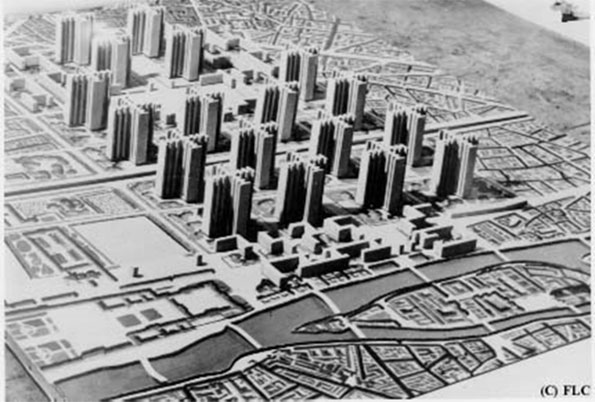
    Also, the willingness to fundamentally reshape cities is odd in light of the fact that such previous attempts are uniformly viewed in the urbanist community as disasters. The idea of Manhattanizing San Francisco brings to mind nothing so much as Le Corbusier’s Plan Voisin for Paris, in which the historical cityscape is replaced with towers in the park.

    Of course no one is actually saying to take it this far, although Glaeser’s vision gets close it. But once we enshrine the rule that a certain threshold of unaffordability means more density and building regardless of neighborhood character, it’s hard to see what the limiting principle would be. Also, high rises or even buildings above 4-5 stories in height usually require expensive construction techniques, and thus are inherently costly.

    It’s true, however, that cities are not static entities. Every downtown skyscraper in America is built on a site that was once used for something else. Yet we see this densification overall as a good thing. Had Manhattan been preserved as of its pre-skyscraper era, it’s not clear the city would have benefitted.

    Clearly the zoning and building regulations in our cities are often too strict. Yet the disasters of previous generations’ radical change suggests that incrementalism is a better course.  By all means allow two-unit houses, corner stores with upper story apartments, etc. into currently all-single family zones. Add areas where high rises are allowed the peripheries of districts currently zoned for such; warehouse districts as well as office buildings that are not well occupied.  But don’t bring out the bulldozer wholesale.  Additionally, a healthy city should make sure to embrace the entire palette of housing types – including single family homes. There’s more to making cities attractive to middle class families than just cost, and things like the prospect of a backyard for the kids to play in are among them.

    And given the relatively few intact and attractive urban cores in America, prices are going to continue to go up. That’s true even with radical new building. As mentioned, San Francisco only has a bit over 800,000 people. Boston and DC have only about 600,000 each. How many people can you plausibly put into these places? Realistically, not all of us who would like to live in San Francisco or lower Manhattan are going to be able to do so.  That’s true no matter how many skyscrapers we build.

    Aaron M. Renn is an independent writer on urban affairs and the founder of Telestrian, a data analysis and mapping tool. He writes at The Urbanophile.

    Lead Photo: More density in Los Angeles

  • The Evolving Urban Form: Suburbanizing Mexico

    There is an increasing recognition – at least outside the academy, planning organization and urban core developer groups – that the spatial expansion of cities or suburbanization represents the evolving urban form of not only the United States and virtually all of the high income world but also across the developing world, whether middle income or third world.

    In recent years, Mexico has made substantial economic progress. Per capita income (purchasing power parity) in Mexico exceeds that of all the "BRIC" nations (Brazil, Russia, India, and China) except resource-rich Russia.

    In Mexico, as almost everywhere, cities continue to expand to provide more living space for an emerging suburban middle-class. This is obvious in the new townhouse (attached house) and detached house developments that ring the urban areas (photograph above). Some of the best evidence of this can be observed on and beyond the southern edge of the nation’s second-largest urban area, Guadalajara (for example on Google Earth).

    The Valley of Mexico

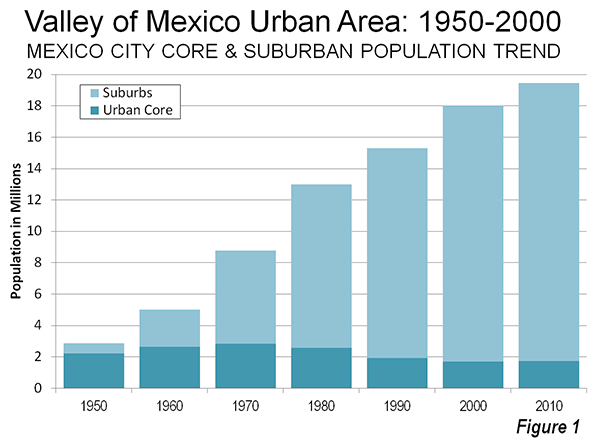
    Nearly 3 years ago, one of the first Evolving Urban Form articles highlighted the Valley of Mexico metropolitan area, which is Mexico City in its functional (economic) manifestation. That article noted that the core municipality of Mexico City in 1950 had 2.23 million residents out of the urban area’s fewer than 3 million and comprised only 54 square miles (139 square kilometers). By 1970, the city’s population had risen to 2.85 million. However, as has happened in Paris, Copenhagen, Milan, Osaka, Glasgow, Detroit, and many others, the urban core population plummeted. By 2000, the former city had a population of only 1.69 million, a 40 percent loss from 1970. There was a modest population increase between the 2000 and 2010 censuses, but its population seems unlikely to ever be restored to near their previous peak, which mirrors the experience of Paris and Copenhagen.

    Instead all population growth in the Valley of Mexico metropolitan area has been outside the 1950 area of Mexico City and in the post-World War II suburbs. While comparable metropolitan area data is not available, the Mexico City urban area added more than 10 million residents between 1970 and 2010. The same period, the suburban areas added more than 11 million residents (Figure 1). The Valley of Mexico metropolitan area is located not only in the Distrito Federal, but also in the states of Mexico and Hidalgo.

    The Other Major Metropolitan Areas

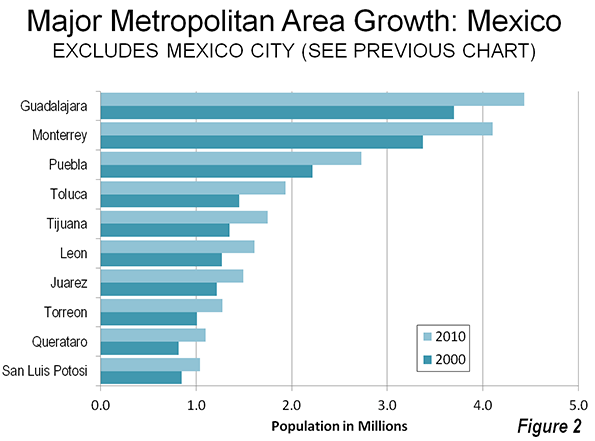
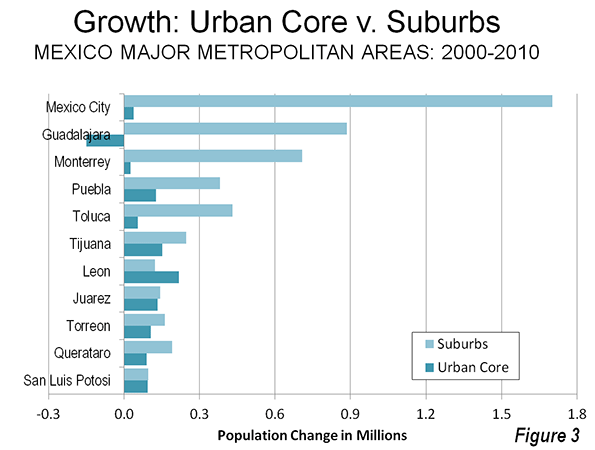
    While the scale of urbanization in the Valley of Mexico dwarfs that of the rest of the nation, similar dispersion is evident in the nation’s other 11 metropolitan areas with more than 1,000,000 population (Figures 2 and 3).

    Guadalajara

    Guadalajara, capital of state of Jalisco, is Mexico’s second largest metropolitan area. Between 2000 and 2010, the metropolitan area grew nearly 20 per cent, from 3.7 million residents to 4.4 million. The core city (locality) of Guadalajara lost 150,000 residents, registering a population of just under 1.5 million in 2010. Suburbs accounted for approximately all the metropolitan area’s population growth.

    Monterey

    Monterey, capital of the state of Nuevo Leon, is currently the third largest metropolitan area in Mexico and is growing slightly more rapidly than Guadalajara. Between 2000 and 2010, Monterey added 22 per cent to its population, which increased from 3.4 million residents to 4.1 million. The central locality grew modestly, but 97 per cent of the metropolitan area growth was in the suburbs.

    Central Mexico

    The Valley of Mexico metropolitan area is encircled by smaller, but major metropolitan areas that are among the fastest-growing in the nation.

    Queretaro, the capital of the state of Queretaro, is located 130 miles (220 kilometers) north of Mexico City by freeway. Queretaro is the fastest-growing major metropolitan area in Mexico, having added 34 per cent to its population over the last census period, to reach 1.1 million. More than two thirds of the growth was in the suburbs.

    Toluca, capital of the state of Mexico (Note), is located across a mountain range only 40 miles (65 kilometers) west of Mexico City. Toluca grew 33 percent to 1.9 million residents in 2010. Nearly 90 per cent of Toluca’s population growth was in the suburbs between 2000 and 2010.

    Pueblo, capital of the state of Puebla, is located across mountain range 130 miles (80 kilometers) to the east of Mexico City. Puebla is located in a valley surrounded by some of the most spectacular volcanoes in the world, including Popocateptl and Iztaccihuatl (both more than 17,000 feet, or 5,100 meters), toward Mexico City, La Malinche (14,600 feet or 4,500 meters), only 17 miles from the city center and Orizaba (18,500 feet or 5,600 meters). The three tallest of these reach elevations higher than any in North America outside of the Yukon and Alaska. Puebla was the slowest growing of the Central Mexico metropolitan areas, adding 23 percent to its population, and reaching 2.9 million residents in 2010. Three quarters of Puebla’s growth was in the suburbs. The Puebla metropolitan area extends into the state of Tlaxcala.

    Border Metropolitan Areas

    In comparison,   the large metropolitan areas on the United States border expanded outwards but not as rapidly. Tijuana, which is adjacent to the San Diego metropolitan area now has 1.75 million residents. More than 60 percent of its growth over the preceding 10 years was suburban. Juarez (located in the state of Chihuahua), is across the border from the El Paso metropolitan area and reached a population of 1.5 million, with slightly more than one half of its growth being in the suburbs. Neither San Diego-Tijuana area nor Juarez -El Paso qualify as metropolitan areas because they are not labor markets – there are significant limitations on the movement of labor (employees).

    Other Interior Metropolitan Areas

    Three other major metropolitan areas are located in the interior. In Torreon (states of Coahuila and Durango), more than 60 percent of the population growth was in the suburbs. A smaller 51 percent of the growth in San Luis Potosi (state of San Luis Potosi) was in the suburbs. The significant exception was Leon (state of Guanajuato), where only 36 percent of the growth was outside the core urban core.

    Continuing Dispersion

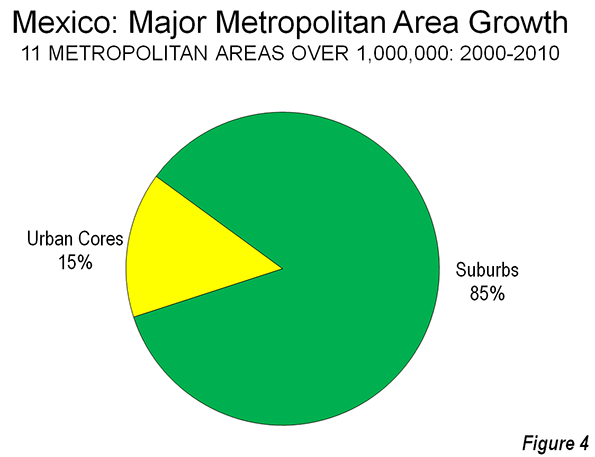
    Overall, 5.1 million of the 6.0 residents added to Mexico’s major metropolitan areas between 2000 and 2010 were outside the urban cores (Figure 4). Most of the growth was in the three largest metropolitan areas (Mexico City, Guadalajara and Monterrey), which added 3.2 million residents. The urban cores of these three metropolitan areas together declined approximately 100,000, while the suburbs attracted more than all of the metropolitan area growth. Mexico seems well positioned for continued economic growth and a populace that seeks better standards of living, more often than not in dispersed settings.

    Wendell Cox is a Visiting Professor, Conservatoire National des Arts et Metiers, Paris and the author of “War on the Dream: How Anti-Sprawl Policy Threatens the Quality of Life.

    —————-

    Note: The state of Mexico has the largest population in the nation, at 15.2 million (2010). This is 70 percent more than the second largest federal division, the Distrito Federal. This state of Mexico borders the Distrito Federal (Mexico City) on three sides and it outer suburban areas constitute more than one-half of the Valley of Mexico metropolitan area population (11 million of 21 million). Another 2 million are located in the even more distant state of Hidalgo. This state of Mexico also includes Toluca, another major metropolitan area (see above).

    ————

    Photograph: Southern suburbs of Guadalajara (by author)

    Correction: This version removes reference to Tijuana as the capital of Baja California. Mexicali is the state capital.

  • San Francisco Photo Essay: I Used to Live Here

    This is my old apartment in SF’s Mission District from way back when Mrs. UpintheValley and I were just dating.  My waystation before cohabitation and matrimony. I notice the curtains haven’t changed.  Flea market bedspreads and pillowcases were the order of the day then, and apparently still are.  Which means P. has kept the lease on the place and presumably lived in uninterrupted squalor with a revolving cast of characters from Roommate Finders all these years.  At the prices we were paying then, why would you ever leave?  The rest of the neighborhood has…evolved, beginning with the ground floor. Man, has it ever.

    DSCN2226

    For example, the launderia, where I once had a load of jeans stolen, is now a yoga studio…

    DSCN2227

    …and is buttressed by a vegan restaurant.  The corner liquor store beneath my old bedroom is now a supper club with gilt lettering in the window.  The dive bar at the other corner, where day laborers used to drink their wages beneath the deathly pallor of fluorescent tube lighting and stagger out to the alley to relieve themselves against the wall, is now a pretentious cocktail lounge with velvet curtains.

    DSCN2228

    The New Mission:  High end condos where the old $1 dollar movie palace used to be, but the marquee remains to satisfy the historic preservationists.

    DSCN2261

    Dogs and bikes are ubiquitous in the new SF.

    DSCN2267

    Unlike LA, the bike is king in the new social arrangement.  Bike lanes are everywhere.  Bicyclists are entitled to use the full lane if they choose, and they do so. You may not squeeze them to the side as you pass.   There are reasons for this. One of them is: people who write programming code like to ride bikes, and the people who write code are making it rain in San Francisco.

    DSCN2331

    Construction is everywhere….

    DSCN2346

    They’ve just built the two tallest apartment buildings on the West Coast.

    DSCN2315

    Way out in the Avenues, 3BR starter homes sell for $1 million+ sight unseen, all cash, to Chinese investors, the other group making it rain. No one in the neighborhood seems to know who the buyers are, but everything goes in multiple offers.  You see a guy like this at a cake shop on Taraval, yakking away in Mandarin, and you find yourself inordinately interested in someone else’s mundane conversation.   I’ll say this for the Asians: not a spec of trash or tagging to be found West of Twin Peaks and I only saw one house in disrepair in three days of strenuous walking.

    DSCN2317

    Trails, trails, trails, everywhere…with plenty of parking.   For a city drowning in New Money, San Francisco, unlike LA, has managed to retain at least one bedrock principle of the social contract.

    DSCN2253

    But back to the Mission.  One still encounters the old army of derelicts and panhandlers, but you just don’t find as many Latinos there anymore. Its identity as a landing place for working class immigrants to get a toehold in the economy is rapidly being eclipsed by the brute facts of New Money.  If people of the Twitterverse are willing to spend a million dollars to share a block with schizophrenic crack addicts then there is a diminished geography remaining for line cooks and seamstresses to occupy.   Or drywall installers. Or yoga instructors.   Or maintenance men.  The Latino working class is abundant in Van Nuys.  In San Francisco, it is memorialized in murals.

    DSCN2255


    DSCN2338

    Last image on the way out of town….a concise acknowledgement of the obvious:  the laptop has replaced the pickaxe in the digital Gold Rush.  Unlike their 19th century counterparts, the gold miners are actually making the money.  The dry goods dealers and shopkeepers work for them.  How long can this last? What happens when Apple stops selling 400, 000 iPhones a day?  Social media and gaming and on-line retail are built on code.  Code can be written anywhere. Angry Birds was designed in Finland.  Tell me how this movie ends.

    Andreas Samson lives and works in Van Nuys and blogs about the San Fernando Valley at upinthevalley.org.

  • The Illusions of Charles Montgomery’s Happy City (Part 2)

    This is the second of a two-part series discussing Charles Mongomery’s Happy City. Read part one here.

    ‘The system that built sprawl’

    Montgomery faces the hurdle of explaining why, if low-density suburbs cause unhappiness, so many millions of people, over so many decades, across several countries, flocked to that way of life. As he writes, ‘since 1940, almost all urban growth has actually been suburban.’ He must account for this fact, even though it means little to him personally. For the green-tinged intelligentsia, working and middle-class people are pawns who rarely think for themselves.      

    Still, in Montgomery’s case the hurdle is high, since his objections to dispersion go much further than conventional gripes about fragile economic foundations. Happy City does peddle the myth, in passing, that the financial crisis brought suburbanisation to a crashing halt. There’s an assertion that ‘census data in 2010/2011 showed that major American cities showed more growth than their suburbs’, and a hope this points to forces ‘systemic and powerful enough to permanently alter the course of urban history’. Montgomery even compares buying a detached home on the urban edge to ‘gambling on oil futures and global geopolitics’. As it turns out, he misconstrues the available data. Suburbanisation barely missed a beat in the United States and continues in earnest. 

    Montgomery’s essential point, though, is that suburban life is contrary to deep-seated human yearnings. This endows him with an even more patronising attitude to working people than his forerunners Richard Florida – who endorses the book – and Edward Glaeser. One line of argument in Happy City, which also features in Glaeser’s Triumph of the City, claims dispersion was forced on people by greedy land owners and property developers in cahoots with weak-kneed or compromised politicians and officials.

    He puts it his way: ‘sprawl, as an urban form, was laid-out, massively subsidized and legally mandated long before anyone actually decided to buy a house there … it is as much the result of zoning, legislation and lobbying as a crowded city block.’ In another chapter, Montgomery warns of the challenge for pro-density New Urbanism: ‘the system that built sprawl – huge state subsidies, financial incentives and powerful laws – is still in place.’ Popular preferences don’t even rate a mention. Similar comments appear throughout the book, adding up to an audacious feat of historical revisionism.

    The standard interpretation of urban evolution, from the walking city to the monocentric and then polycentric metropolis, places breakthroughs in transport technologies first, most notably railways, streetcars (trams) and affordable motor vehicles, followed by mass shifts in transportation modes and population movements second, with land owners and politicians ready to exploit the new conditions. Of course, transportation technologies have such a powerful impact because of pent up demand for space and lower densities.

    Essentially, Montgomery reverses the causative sequence, claiming government and business interests dragged people to the fringes and this induced a transformation of transportation modes, which may or may not have been viable under prevailing technologies. This anomalous theory puts him at odds with some of the most recognised urban thinkers:  

    • Lewis Mumford in The City in History: ‘what has happened to the suburb is now a matter of historic record … as soon as the motor car became common, the pedestrian scale of the suburb disappeared …’
    • Peter Hall in Cities in Civilization, discussing Los Angeles: ‘the car was doing more than decentralize; it was decentralizing in a new way’.
    • Robert Bruegmann in Sprawl: A Compact History: ‘families wishing to live at lower densities could be seen as the primary cause of the growth in … the railroad, public transportation and finally the automobile industry … each of these means of transportation did, in fact, give families increased mobility.’
    • Joel Kotkin in The City: A Global History: ‘as automobile registrations soared in the 1920s, suburbanization across the rest of [the United States] also picked up speed, with suburbs growing at twice the rate of cities.’
    • Shlomo Angel in Planet of Cities: ‘a third and more radical transformation, from the monocentric to the polycentric city, began in the middle decades of the twentieth century with the rapid increase in the use of cars, buses, and trucks.’

    Such quotes can be piled up all day long.    

    Happy City is open to the same criticism as Glaeser’s book, namely that as a matter of chronology, urban dispersion took off before the interstate highway system, tax deductibility of home mortgage interest, the relative decline of inner-city schools, many development controls, and other factors cited by both as having pushed Americans to the periphery. In Downtown: Its Rise and Fall 1880-1950, Robert Fogelson explains that ‘by the mid and late 1920s, however, some Americans had come to the conclusion that the centrifugal forces were beginning to overpower the centripetal forces – or, in other words, that the dispersal of residences might well lead in time to the decentralization of business.’ And suburbs have been popular in countries other than the US, like Australia, where these sorts of factors are absent.

    Blinded by science

    For his part, Montgomery envisages an alternative past, in which demands for space and mobility hardly figure. ‘Well, the path that led … to today’s sprawl was not straight’, he writes, ‘it meandered back and forth between pragmatism, greed, racism and fear.’ Rewriting history may be audacious, but that’s just the beginning. The book doesn’t stop at denouncing suburbanisation as a form of organised compulsion. Montgomery’s ultimate purpose, drawing on ‘happiness science’, is to expose suburban life as a mass delusion. ‘We need to identify the unseen systems that influence our health and control our behaviour’, he writes.     

    Much of Happy City is devoted to a succession of studies and experiments by a range of neuroscientists, psychologists and behavioural economists on the conditions that stimulate feelings of well-being and contentment. Montgomery focuses on research into different spatial environments: densely or sparsely populated, high-rise or street-level, crowded or uncrowded, mixed-use or homogenous, auto-dependent or walkable, near or far from nature, and so on.

    Many people have no clue that their deeper inclinations are out of synch with their surroundings, he maintains, painting a less than flattering portrait of human nature. ‘The more psychologists and [behavioural] economists examine the relationship between decision-making and happiness,’ he repeats in various ways, ‘the more they realize … we make bad choices all the time … in fact we screw up so systematically …’

    Building a case that most of us are hobbled by delusions, Montgomery delights in claiming ‘we are far less rational in our decisions than we sometimes like to believe …’, and ‘we regularly respond to our environment in ways that seem to bear little relation to conscious thought or logic.’ Personal motives can be reduced to a stew of physiological and chemical stimuli, all summed up in a single paragraph:  

    Neuroscientists have found that environmental cues trigger immediate responses in the human brain even before we are aware of them. As you move into a space, the hippocampus, the brain’s memory librarian, is put to work immediately … it also sends messages to the brain’s fear and reward centres … it’s neighbour, the hypothalamus, pumps out a hormonal response … before most of us have decided if a place is safe or dangerous … places that seem too sterile or too confusing can trigger the release of adrenaline and cortisol, the hormones associated with fear and anxiety … places that seem familiar … are more likely to activate hits of feel-good serotonin, as well as the hormone that … promotes feelings of interpersonal trust: oxytocin.

    Nowhere is it acknowledged that if rational choice is devalued, people might end up being treated less like autonomous citizens and more like laboratory rats. Happiness ‘can’t be summed up by the number of things we produce or buy’, the book insists, ‘but the firing synapses of our brains, the chemistry of our blood …’

    Montgomery proceeds to grab hold of anything that discredits the real-life choices of suburbia’s teeming millions. One of many concepts he takes from neuroscience is ‘information propagation’. By operation of the hippocampus and other parts of the brain, we are told, our ‘concept of the right house, car or neighbourhood might be as much a result of happy moments from our past or images that flood us in popular media as of any rational analysis.’ From psychology he borrows the concept of ‘adaptation’, described as a ‘characteristic that exacerbates such bad decision-making [namely] the uneven process by which we get used to things.’

    He considers these important explanations for the appeal of suburban lifestyles when denser neighbourhoods are better for physical and mental health, at least according to his interpretation of studies and experiments on walking, cycling, social encounters, community activities, public space, streetscapes, grid planning, on-street parking and traffic velocity.  

    But his method of selecting a body of research, cobbling the results together, and equating this to the preconditions for a happy life, suffers from a fallacy of composition ─ the error of inferring that something is true of the whole from the fact that it is true of some part of the whole. Although Montgomery claims ‘most people, in most places, have the same basic needs and most of the same desires’, it doesn’t follow that research findings on parts of life should add up to a real whole life.

    Kirk Schneider, a prominent American psychologist, writes in Psychology Today that ‘prevailing studies of happiness … represent but a circumscribed range of how such phenomena are actually experienced on the ground, so to speak, in people’s everyday worlds.’ Schneider cautions that ‘those things represent only slices of life, not life itself.’

    There’s no reason why urban planning should start from abstract assumptions drawn from a bunch of controlled experiments, rather than from masses of people weighing up their full, lived experience.   

    In this and other ways, the book succumbs to a disturbing strain of authoritarianism. History teaches us to beware a state that deals with people through the prism of theories which second-guess their inner thoughts and feelings, rather than according to their outward conduct. Freedoms are at risk whenever powerful functionaries claim to know what people are thinking, because of ‘false consciousness,’ ethnic stereotypes, biological determinism, or whatever. And Montgomery is no freedom-fighter: ‘we are pushed and pulled according to the systems in which we find ourselves, and certain geometries ensure that none of us are as free as we might think.’  

    ‘Make them feel rich’

    In the end, Happy City fails to prove the assertions trumpeted in its opening pages. It fails to produce any direct evidence connecting flatlining assessments of well-being or rising rates of depressive illness to ‘sprawl’. Nor is there any indirect evidence from which a connection can be inferred. Just as research on parts of life don’t add up to a whole real life, neither can studies and experiments finding discontent in particular conditions translate to generalised disenchantment with a whole way of life.

    Montgomery’s style is to fill the gaps with a series of conveniently chosen anecdotes and vignettes, some designed to trash suburbia and others to wrap a glowing aura around transit-oriented density. Randy Straussner’s super-commuting horror story, which never goes away, is an example of the former. But the star of the book, and prominent case of the latter, is ‘The Mayor of Happy’.

    At the helm of impoverished Bogota between 1998 and 2001, Enrique Penalosa cancelled a highway expansion plan, used the funds for hundreds of miles of cycle paths, hiked fuel taxes by 40 per cent, banned drivers from commuting by car more than three times a week, introduced car-free days, dedicated a new chain of parks and pedestrian plazas, and built the city’s first rapid transit system. This made him a guru to green urbanists like Montgomery, who was inspired to write Happy City.

    ‘We might not be able to fix the economy’, Penalosa is quoted as saying in the book, ‘we might not be able to make everyone as rich as Americans … but we can design the city to give people dignity, to make them feel rich.’ Confronting an unemployment rate of 18 per cent when Penalosa left office, however, many Bogotans would have longed for the real thing. 

    John Muscat is a co-editor of The New City, where this piece first appeared.

  • The Evolving Urban Form: The San Francisco Bay Area

    Despite planning efforts to restrict it, the Bay Area  continues to disperse. For decades, nearly all population and employment growth in the San Jose-San Francisco Combined Statistical Area has been in the suburbs, rather than in the core cities of San Francisco and Oakland. The CSA (Note) is composed of seven adjacent metropolitan areas (San Francisco, San Jose, Santa Cruz, Santa Rosa, Vallejo, Napa, and Stockton). A similar expansion also occurred in the New York CSA.

    The San Francisco Bay Area is home to two of the three most dense built-up urban areas in the United States, the San Francisco urban area, (6,266 residents per square mile or 2,419 per square kilometer) with the core cities of San Francisco and Oakland and the all-suburban San Jose urban area (5,820 residents per square mile or 2,247 per square kilometer), according to US Census 2010 data. Only the Los Angeles urban area is denser (6,999 per square mile or 2.702 per square kilometer). The more spread out New York urban area trails at 5,319 per square mile (2,054 per square kilometer).

    The San Francisco Bay & Central Valley Area

    The continuing dispersion was reflected in commuting patterns that developed between 2000 and 2010, with the addition of the Stockton metropolitan area, which is composed of San Joaquin County, with more than 700,000 residents. San Joaquin County is located in the Central Valley and is so far removed from San Francisco Bay that it may be appropriate in the long run to think of the area as the "San Francisco Bay & Central Valley Area." The distance from Stockton to the closest point shore of San Francisco Bay is 60 miles, and it is nearly another 25 miles to the city of San Francisco.

    Ironically, this continued dispersion of jobs and residences is, at least in part, driven by the San Francisco Bay Area’s urban containment land use policies designed to prevent it. What the planners have ignored is the impact on house prices associated with highly restrictive land use planning. The San Francisco metropolitan area and the San Jose metropolitan area are the third and fourth most unaffordable major housing markets out of 85 rated in the recent 10th Annual Demographia International Housing Affordability Survey, trailing only Hong Kong and Vancouver.

    Historical Core Cities: San Francisco and Oakland

    The historical core municipalities (cities) of the San Francisco Bay Area, San Francisco and Oakland have held their population very well. Each essentially retains it 1950 borders. Among the 40 US cities with more than 250,000 residents in 1950, only San Francisco and Oakland managed population increases by 2000 without substantial annexations and substantial non-urban (rural) territory within their city limits. For example, New York and Los Angeles, both of which have grown, have nearly the same city limits as in 1950 and 2000, yet much of New York’s Staten Island was rural in 1950 as was much of the San Fernando Valley in Los Angeles.

    Yet both San Francisco and Oakland have had difficult times. Between 1950 and 1980, both San Francisco and Oakland suffered 12 percent population losses, which were followed by recoveries. The losses were modest compared to the emptying out of municipalities like St. Louis. Detroit, Chicago, Copenhagen, and Paris, which remain one quarter to nearly two-thirds below their 1950s figures. Further, population gains from annexations masked losses within the 1950 boundaries of many cities, such as Portland, Seattle, and Indianapolis, etc.

    San Jose: Now the Largest City

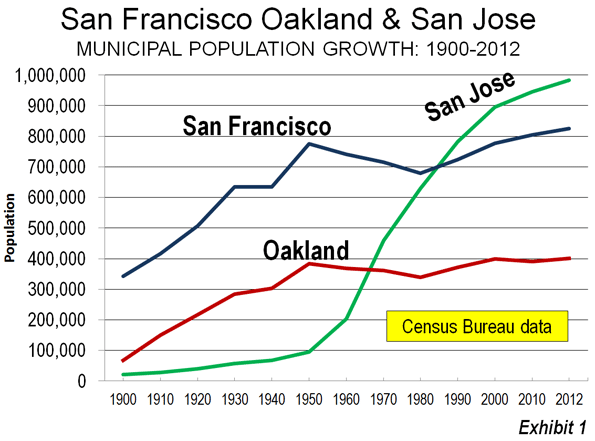
    San Jose is now the Bay Area’s largest city. San Jose has grown spectacularly, from a population of 95,000 in 1950 to nearly 1,000,000 today. San Jose passed San Francisco by the 1990 census and Oakland by the 1970 census (Figure 1). Virtually all of San Jose’s population growth has occurred during the postwar period of automobile suburbanization. The pre-automobile urban form familiar in San Francisco and central Oakland simply does not exist in San Jose. Even attempts to pretend the pre-war urban form has returned have been famously unsuccessful. Even after building an extensive light rail system, San Jose’s transit work trip market share is barely one quarter that of the adjacent San Francisco metropolitan area.

    Nonetheless, suburban San Jose has become a dominant force in the "Silicon Valley", which stretches through San Mateo County in the San Francisco metropolitan area and into Santa Clara County, which includes San Jose. The Silicon Valley has been the capital of the international information technology business for at least a half century. The highly suburbanized region has done more than its share to elevate the San Francisco Bay Area to its high standard of living (According to Brookings Institution data), a phenomenon that has spread also the urban core of San Francisco. At the same time, San Jose is the second most affluent major metropolitan in the world and San Francisco ranks seventh. The Silicon Valley, which includes much of San Mateo County (adjacent to Santa Clara County in the San Francisco metropolitan area), is clearly the economic engine of the region with twice as many jobs as San Francisco (which is both a city and a county).

    Metropolitan Growth

    Overall, the San Francisco Bay Area has grown approximately 180 percent since 1950, considerably more than the national average from 1950 to 2012 of 107 percent. The Bay Area’s growth was strong, but well behind the 280 percent growth achieved in the Los Angeles CSA (Los Angeles, Riverside-San Bernardino, and Oxnard MSAs).

    However, growth has since moderated substantially. Between 1950 and 2000, the Bay Area grew at an annual rate of 1.9 percent but since 2000, the annual growth rate has dropped to 0.7 percent annually. Even so, in recent years, the Bay Area has nearly equaled the much slowed growth of the Los Angeles CSA, adding 23.6 percent to its population since 1990, compared to 25.5 percent in Los Angeles. Both areas, however, grew at less than the national population increase rate (25.8 percent), and slowing, in the 2000s to the slowest growth rates since California became a state in 1850.

    Suburban Growth

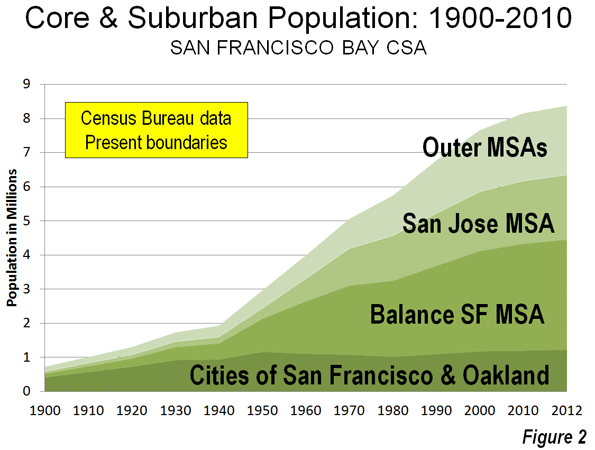
    Despite the decent demographic performance of the cities of San Francisco and Oakland since 1950, nearly all Bay Area growth occurred in the suburbs. Between 1950 and 2012, only one percent of population growth in the CSA occurred in the two historical core municipalities and 99 percent in suburban areas. Things have been somewhat better for the two cities since 2000, with seven percent of the growth in the historical core municipalities and 93 percent of the growth in suburban areas (Figure 2).

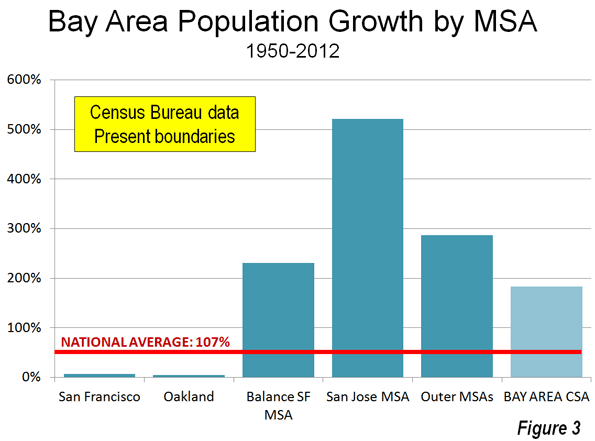
    Since 1950, the San Jose metropolitan area has grown by far the fastest in the CSA, with the more than 500 percent increase in population. The outer metropolitan areas (Santa Cruz, Santa Rosa, Vallejo, Napa, and Stockton) have grown nearly 300 percent, while the parts of the San Francisco metropolitan area outside the two core cities grew more than 200 percent. San Francisco and Oakland grew approximately 5 percent (Figure 3).

    Domestic Migration

    As house prices increased before the subprime crisis, the Bay Area lost more than 600,000 domestic migrants, a rate of more than 85,000 per year. Since 2008, however, with substantially lower house prices, and a renewed tech boom, there has been an annual gain of approximately 4,000 to the Bay Area in domestic migration. However, if the substantial house price increases since 2012 continue, the area could again become a net exporter of people.

    Future Urban Evolution

    Like much of California, San Francisco Bay CSA exhibits much slower population growth than before. How much of this is tied to the regional and state policies constricting suburban housing remains an open question, but it seems much growth that might have occurred in the original San Francisco metropolitan area or the later developing San Jose metropolitan area will instead occur in the Vallejo or Stockton metropolitan areas, where housing prices  tend to be much lower, particularly for larger homes that are increasingly unaffordable closer to the urban core. Indeed, it is not impossible that Modesto (Stanislaus County) could be added  to the San Francisco Bay CSA by 2020, which is even farther away from the historical core than the Stockton metropolitan area.

    At the same time, many potential new residents may find either the high prices near the core nor the long commutes associated with Central Valley residence unappealing. Many households may instead seek their aspirations in Utah, Colorado, Texas, and even Oklahoma, not least because the "California Dream" has been made affordable.

    Wendell Cox is a Visiting Professor, Conservatoire National des Arts et Metiers, Paris and the author of “War on the Dream: How Anti-Sprawl Policy Threatens the Quality of Life.

    —–

    Note: Metropolitan areas are labor markets. Their building blocks in the United States are complete counties. Metropolitan statistical areas are organized around built up urban areas with counties reaching a threshold of the urban area population being considered central counties and included in the metropolitan area. In addition, any county with an employment interchange of 25 percent or more with the core counties is also included in the metropolitan area. Adjacent metropolitan areas are added together to form Combined Statistical Areas if there is a 15 percent or more employment interchange. This is a simplified definition. Complete details are available from the US Office of Management and the Budget.

    Photo: Market Street, San Francisco (by author)

  • Correcting Priorities: The 10th Annual Demographia Housing Affordability Survey

    Alain Bertaud of the Stern School of Business at New York University and former principal planner of the World Bank introduces the 10th Annual  Demographia International Housing Affordability Survey by urging planners to abandon:

    "…abstract objectives and to focus their efforts on two measurable outcomes that have always mattered since the growth of large cities during the 19th century’s industrial revolution: workers’ spatial mobility and housing affordability".

    This year’s edition has been expanded to nine geographies, including Australia, Canada, Hong Kong, Ireland, Japan, New Zealand, Singapore, the United Kingdom, and the United States. A total of 85 major metropolitan areas (of over 1,000,000 population) are covered, including five of the six largest metropolitan areas in the high income world (Tokyo-Yokohama, New York, Osaka-Kobe-Kyoto, London, and Los Angeles). Overall, 360 metropolitan markets are included.

    View the map with housing data for all markets created by the New Zealand Herald.

    The Affordability Standard

    The Demographia International Housing Affordability Survey uses a price-to-income ratio called the "median multiple," calculated by dividing the median house price by the median household income. Following World War II, virtually all metropolitan areas in Australia, Canada, Ireland, New Zealand, the United Kingdom, and the United States had median multiples of 3.0 or below. However, as urban containment policies have been implemented in some metropolitan areas, house prices have escalated well above the increase in household incomes. This is exactly the effect that economics predicts to occur where the supply of a good or service is rationed, all things being equal.

    Even a decade ago, there was considerable evidence of the rapidly deteriorating housing affordability in markets with urban containment policy. Yet, governments implementing these policies were largely ignoring not only the trends, but also any reference to the extent of the losses in historic context. Co-author Hugh Pavletich of Performance Urban Planning and I established the Demographia International Housing Affordability Survey to draw attention to this policy driven attack on the standard of living.

    The Demographia Survey rates housing affordability as follows:

    Demographia Housing Affordability Rating Categories

    Rating

    Median Multiple

    Severely Unaffordable

    5.1 & Over

    Seriously Unaffordable

    4.1 to 5.0

    Moderately Unaffordable

    3.1 to 4.0

    Affordable

    3.0 & Under

    Affordability in the 9 Geographies

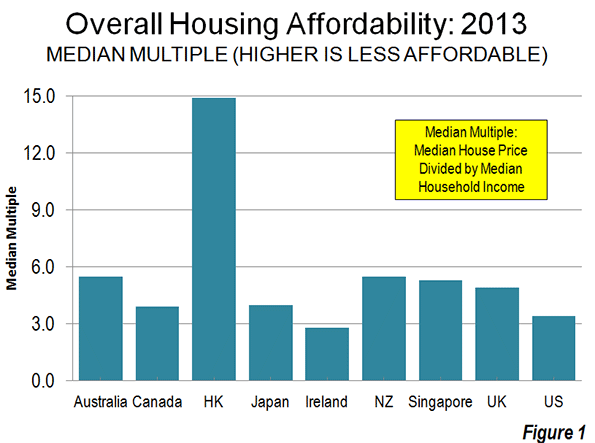
    Among the nine geographies and all 360 markets, Ireland emerges has the most affordable, with a median market multiple of 2.8. The United States follows at 3.4, and Canada at 3.9. Japan’s median market multiple is 4.0, while the United Kingdom is at 4.9 and Singapore at 5.1 The other geographies are all well into the severely unaffordable category, including Australia and New Zealand, at 5.5, and far worse Hong Kong, at 14.9 (Figure 1).

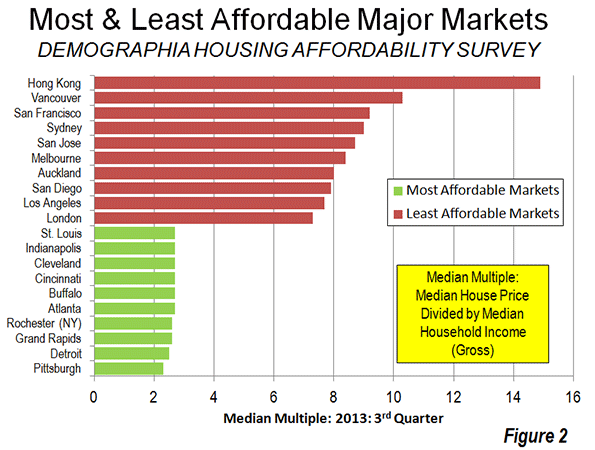
    Costly Hong Kong & Vancouver, Affordable Pittsburgh and Atlanta

    For the fourth year in a row, Hong Kong is the least affordable major metropolitan area, with a median multiple of 14.9, three times its early 2000s ratio. Vancouver is again the second most unaffordable major market, with a median multiple of 10.3, three times its pre-urban containment level. Housing affordability in coastal California is well on the way to the stress of the 2000s. San Francisco ranks third most unaffordable at 9.2 and nearby San Jose is at 8.7, with San Diego (7.9) and Los Angeles (7.7) following closely. Sydney, at 9.0, ranks fourth with Melbourne at 8.4 and Auckland at 8.0.All of these metropolitan areas have had serious deterioration of housing affordability since adopting urban containment policy.

    All of the affordable major metropolitan areas are all in the United States. Pittsburgh is the most affordable, at 2.3. There are 13 additional major affordable housing markets, which include growing and over-5 million Atlanta as well as Indianapolis and Columbus, with their strong economies (Figure 2).

    Japan

    Notably, Japan’s two largest metropolitan areas, Tokyo-Yokohama and Osaka-Kobe-Kyoto have avoided the severely unaffordable territory occupied by the other three megacities (New York, Los Angeles, and London). Osaka-Kobe-Kyoto has the best housing affordability of any megacity, at 3.5 (moderately unaffordable) and Tokyo-Yokohama is at 4.4 (seriously unaffordable).

    House Size

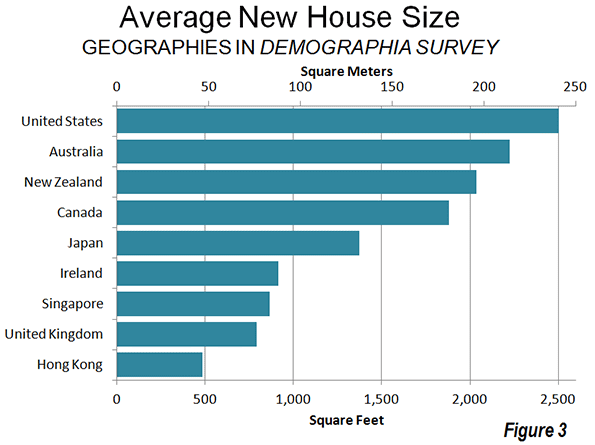
    This year’s Demographia Survey also provides information on average new house size in the nine geographies (Figure 3). The largest houses are in the United States, which is second only to Ireland in affordability. The smallest houses are in Hong Kong, which also has the least affordable housing. In living space those who pay the most get the least, while those who pay the least get the most.

    The Imperative for Reform

    Housing is the largest element of household budgets, and its cost varies the most between metropolitan areas. Where households pay more than necessary for housing, they have less dicsretionary income and lower standards of living and there is more poverty. This is a natural consequence of planning policies that place the urban form above the well-being of people. One of the principal justifications is environmental, but the gains from urban containment policy are scant and exorbitantly expensive.

    Virtually all of the geographies covered in the Demographia Survey are facing more uncertain economic futures than in the past. As is always the case in such situations, lower income households tend to be at greatest risk, while younger households have much less chance of living as well as their parents (except those fortunate enough to inherit their wealth or housing).

    There is no more imperative domestic policy imperative than improving the standard of living and minimizing poverty. Planning must facilitate that, not get in the way. Bertaud is hopeful:

    "But if planners abandoned abstracts and unmeasurable objectives like smart growth, liveability and sustainability to focus on what really matters –  mobility and affordability – we could see a rapidly improving situation in many cities.  I am not implying that planners should not be concerned with urban environmental issues.  To the contrary, those issues are extremely important, but they should be considered a constraint to be solved not an end in itself."

    Download the full report (pdf):  10th Annual  Demographia International Housing Affordability Survey

    Photo: Suburban Tokyo (by author)

  • Britain’s Planning Laws: Of Houses, Chickens and Poverty

    Perhaps for the first time in nearly seven decades a serious debate on housing affordability appears to be developing in the United Kingdom. There is no more appropriate location for such an exchange, given that it was the urban containment policies of the Town and Country Planning Act of 1947 that helped drive Britain’s prices through the roof. Further, massive damage has been done in countries where these polices were adopted, such as in Australia and New Zealand (now scurrying to reverse things) as well as metropolitan areas from Vancouver to San Francisco, Dublin, and Seoul.

    A healthy competition has developed between the Conservative-Liberal Democrat coalition and the Labour Party to finally address the problem of the resulting land and housing shortage that has driven prices up so much relative to incomes.

    It probably helps that public opinion seems to be changing. A recent MORI poll found that 57 percent of respondents considered rising house prices to be a bad thing for Britain, compared to only 20 percent who though it a good thing.

    It has been more than a decade since Kate Barker, then a member of the Monetary Policy Committee of the Bank of England (the central bank) was commissioned by the Blair Labor government to examine the issues. Her conclusions were clear. Britain has a serious housing affordability problem and its restrictive land use policies were the cause. These higher housing costs, the largest element or household expenditure have reduced the standard of living and increased poverty beyond what would have occurred if urban containment regulation had not destabilized house prices. The Economist notes that home ownership is falling and that the number of couples with children who are renting has tripled since the late 1990s.

    Planning and Chickens

    This week, The Economist weighed into the debate (Britain’s planning laws: An Englishman’s home):

    "Now that the economy is at last growing again, the burning issue in Britain is the cost of living. Prices have outstripped wages for the past six years. Politicians have duly harried energy companies to cut their bills, and flirted with raising the minimum wage. But the thing that is really out of control is the cost of housing. In the past year wages have risen by 1%; property prices are up by 8.4%. This is merely the latest in a long surge. If since 1971 the price of groceries had risen as steeply as the cost of housing, a chicken would cost £51 ($83)."

    For those of us unfamiliar with the cost of chicken in British hypermarkets, The Daily Mail says it is about £2 ($3). Indeed, even the chicken industry suffers, as planning restrictions  are getting in the way of adding the chicken farms Britain requires.

    Moreover, the high costs cited by The Economist are after the house prices increases that had already occurred by 1970. Even then, before such inflationary pressures were seen elsewhere, Sir Peter Hall characterized soaring land and house prices as the biggest failure of the 1947 Act. Hall had led a major research effort on the subject, which produced a two-volume work, The  Containment of Urban England (See The Costs of Smart Growth Revisited: A 40 Year Perspective).

    From Affordable to Unaffordable

    While the historic relationship between household incomes and house prices (the "median multiple") was under 3.0 across the United Kingdom as late as the 1990s, it has now deteriorated to more than 7.0 inside the London Greenbelt. Unbelievably it has risen to elevated levels even in the less prosperous the north of England. For example, depressed Liverpool has a median multiple over 5.0, which is 60 percent above the maximum historic range and making the metropolitan area "severely unaffordable." Liverpool is probably best compared to Cleveland in the United States for its economic distress.

    The shortage of housing in Britain has become acute. There are additional concerns that the globalization of housing markets has hit London particularly hard and is driving households out of the housing market.

    More Money, Less House

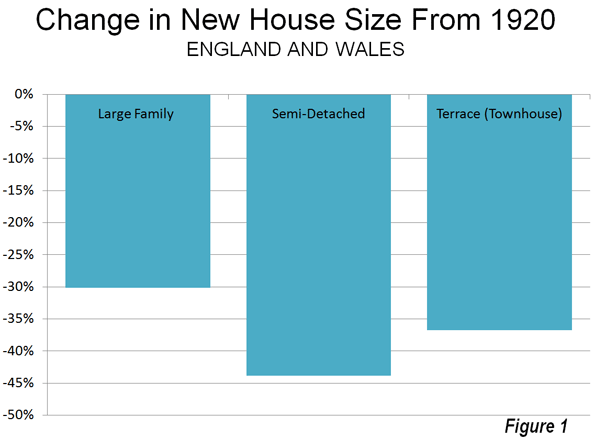
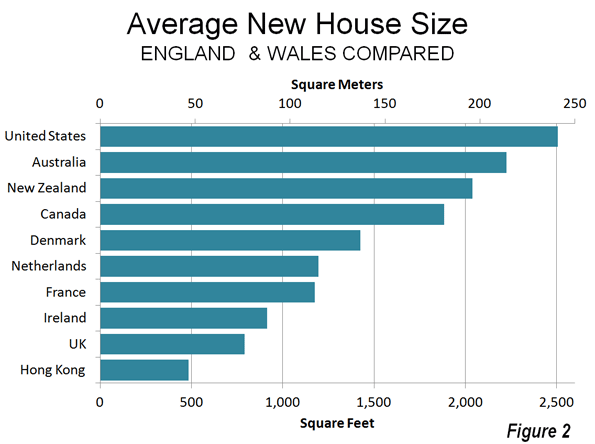
    Through all of this, Briton’s are getting less for their money. Since 1920, the average size of a new large family house has been reduced 30 percent. Semi-detached houses are 44 percent smaller and townhouses (terrace housing) is 37 percent smaller (Figure 1). Britain now has some of the smallest new housing in the world. The average new house in continental Europe is 50% or more larger than in England and Wales. New houses are two to three times as large in Canada, New Zealand, Australia and the United States (Note 1). In some US cities, residents can build "granny flats" which are larger than new houses in Britain. For example, San Diego’s limit for granny flats of 850 square feet exceeds Britain’s average new house size of 818 square feet.

    Paving Over Ohio?

    Of course, those who see urban expansion (the theological term is "sprawl") as ultimate evil imagine an England and Wales being literally paved over by allowing people to live as they prefer. They need not worry.

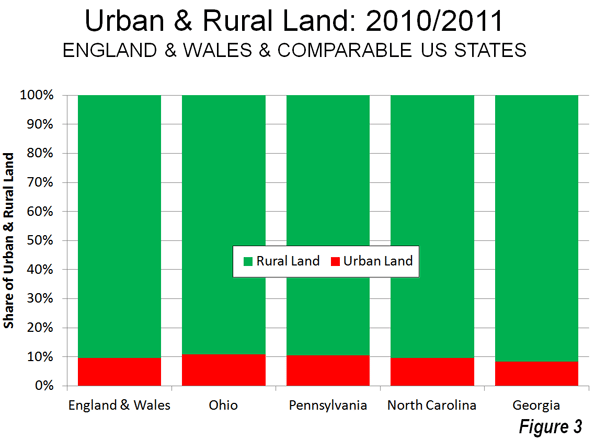
    For example, England and Wales is less crowded than spacious Ohio, with its rolling hills and extensive farmland. According to the 2011 census, only 9.6% of the land in England and Wales is urban, the other 90.4% is rural. In Ohio, on the other hand, 10.8% of the land is urban and only 89.2% of the land is rural. Even the state of Georgia, with the least dense large urban area in the world, Atlanta, has roughly as much rural land (91.7 percent) as England and Wales (Figure 3).

    Every Gram is Sacred?

    Originally, urban containment was justified on social and aesthetic grounds. However, curbing greenhouse gases is now used as the raison d’etre for highly restrictive housing policies. Urban policy in England and Wales and elsewhere has been hijacked by a philosophy that any gram of greenhouse gas that can be reduced must be, regardless of its impact on society, the economy, the standard of living or poverty.

    One of the worst conceivable strategies for reducing greenhouse gas emissions is to waste money on costly and ineffective measures. The Intergovernmental Panel on Climate Change (IPCC) has indicated that sufficient reductions in greenhouse gas emissions can be achieved for a range of from $20 to $50 per ton. Urban containment policy cannot deliver for this price. In contrast, improving automobile fuel efficiency is forecast improve greenhouse gas emissions, even as driving continues to rise with a growing population (see Urban Planning for People). In addition, the higher house prices associated with urban containment policy are well beyond the IPCC range.

    No program can produce substantial greenhouse gas emission reductions that does not focus on higher value strategies. Urban containment has no high value strategies.

    Planning, People and Poverty

    Britain’s land policy competition between the political parties is long overdue. Coalition Communities Secretary Eric Pickles, decries "the way families are trapped in ‘rabbit hutch homes’." The Labour Party opposition has promised that, if elected in 2015, steps will be taken to increase land supply and housing affordability, so that "working people and their children" have the "decent homes they deserve."

    The Economist states the issue squarely:

    "Building on fields in a country that is as crowded as England will always rile some people, however well-designed the system. But the alternative is worse: a nation of renters and rentiers, where only the rich own houses."

    —————–

    Note 1: As Figure 2 indicates, Hong Kong housing is considerably smaller than that of England and Wales. Hong Kong really is the ultimate smart growth or urban containment city. It has the highest urban population density in the high income world. It has the highest share of its commuters using mass transit to get to work. Its traffic congestion is intense. And, predictably, it has the highest house prices relative to incomes yet documented in the high income world.

    We need to be spared the "sun rises in the west" economic studies claiming that somehow the laws of economics, that work so relentlessly to drive up prices where supplies are constrained in other industries (such as petroleum, corn, etc.) have no effect on land and housing.

    Wendell Cox is a Visiting Professor, Conservatoire National des Arts et Metiers, Paris and the author of “War on the Dream: How Anti-Sprawl Policy Threatens the Quality of Life.

    Photo: St. Pancras Station (London), by author

  • Build It, Even Though They Won’t Come

    The recent decision by Los Angeles County Superior Court Judge Allan J. Goodman to reject as “fatally flawed” the densification plans for downtown Hollywood could shake the foundations of California’s “smart growth” planning clerisy. By dismissing Los Angeles’ Hollywood plan, the judge also assaulted the logic behind plans throughout the region to construct substantial high-rise development in “transit-oriented developments” adjacent to rail stations.

    In particular, the judge excoriated the buoyant population-growth projections used to justify the plan, a rationalization for major densification elsewhere in the state. The mythology is that people are still flocking to Los Angeles, and particularly, to dense urban areas, creating a demand for high-end, high-rise housing.

    The Hollywood plan rested on city estimates provided by the Southern California Association of Governments, which estimated that Hollywood’s population was 200,000 in 2000 and 224,000 in 2005, and would thus rise to 250,000 by 2030. All this despite the fact that, according to the census, Hollywood’s population over the past decade has actually declined, from 213,000 in 1990 to 198,000 today. Not one to mince words, Judge Goodman described SCAG’s estimates as “entirely discredited.”

    This discrepancy is not just a problem in the case of Hollywood; SCAG has been producing fanciful figures for years. In 1993, SCAG projected that the city of Los Angeles would reach a population of 4.3 million by 2010. SCAG’s predicted increase of more than 800,000 residents materialized as a little more than 300,000. For the entire region, the 2008 estimates were off by an astounding 1.4 million people.

    Similar erroneous estimates run through the state planning process. In 2007, California’s official population projection agency, the Department of Finance, forecast that Los Angeles County would reach 10.5 million residents in just three years. But the 2010 U.S. Census counted 9.8 million residents.

    Such inflated estimates, however, do serve as the basis for pushing through densification strategies favored by planners and their developer allies. In fact, SCAG’s brethren at the Association of Bay Area Governments, seeking to justify their ultradense development plan, recently went beyond even population estimates issued by the Department of Finance.

    The problem here is not that some developers may lose money on projects for which there is inadequate demand, but that this densification approach has replaced business development as an economic strategy. Equally bad, these policies often threaten the character of classic, already-dense urban neighborhoods, like Hollywood. Indeed, the Los Angeles urban area is already the densest in the United States, and a major increase in density is sure to further worsen congestion.

    Not surprisingly, some 40 neighborhood associations and six neighborhood councils organized against the city’s Hollywood plan. Their case against the preoccupation with “transit-oriented development” rests solidly on historical patterns. Unlike in New York City, much of which was built primarily before the automobile age, Los Angeles has remained a car-dominated city, with roughly one-fifth Gotham’s level of mass-transit use. Despite $8 billion invested in rail lines the past two decades, there has been no significant increase in L.A.’s transit ridership share since before the rail expansion began.

    The Hollywood plan is part of yet another effort to reshape Los Angeles into a West Coast version of New York, replacing a largely low-rise environment with something former Mayor Antonio Villaraigosa liked to call “elegant density.” As a councilman, new Mayor Eric Garcetti proclaimed a high-rise Hollywood as “a template for a new Los Angeles,” even if many Angelenos, as evidenced by the opposition of the neighborhood councils, seem less than thrilled with the prospect.

    If the “smart growth” advocates get their way, Hollywood’s predicament will become a citywide, even regional, norm. The city has unveiled plans to strip many single-family districts of their present zoning status, as part of “a wholesale revision” of the city’s planning code. Newly proposed regulations may allow construction of rental units in what are now back yards and high-density housing close to what are now quiet residential neighborhoods.

    “They want to turn this into something like East Germany; it has nothing to do with the market,” suggests Richard Abrams, a 40-year resident of Hollywood and a leader of Savehollywood.org. “This is all part of an attempt to worsen the quality of life – to leave us without back yards and with monumental traffic.”

    Of course, it is easy to dismiss community groups as NIMBYs, particularly when it’s not your neighborhood being affected. But here, the economics, too, make little sense. New, massive “luxury” high-rise residential buildings were not a material factor in the huge density increases that made the Los Angeles urban area more dense than anywhere else in the nation during the second half of the 20th century. Even in New York City, the high-rise residential buildings where the most affluent live are concentrated in the lower half of Manhattan; they house not even 20 percent of the city’s population.

    Under any circumstances, the era of rapid growth is well behind us. In the 1980s, the population of Los Angeles grew by 18 percent; in the past decade, growth was only one-fifth as high. Growth in the core areas, including downtown, overall was barely 0.7 percent, while the population continued to expand more rapidly on the city’s periphery. Overall, the city of Los Angeles grew during the past decade at one-third the national rate. This stems both from sustained domestic outmigration losses of 1.1 million in Los Angeles County and immigration rates that have fallen from roughly 70,000 annually in the previous decade to 40,000 a year at present.

    Nor can L.A. expect much of a huge infusion of the urban young talent, a cohort said to prefer high-density locales. In a recent study of demographic trends since 2007, L.A. ranked 31st as a place for people aged 20-34, behind such hot spots as Milwaukee, Oklahoma City and Philadelphia. It does even worse, 47th among metro areas, with people ages 35-49, the group with the highest earnings.

    In reality, there is no crying need for more ultradense luxury housing – what this area needs more is housing for its huge poor and working-class populations. More important, we should look, instead, at why our demographics are sagging so badly. The answer here, to borrow the famous Clinton campaign slogan: It’s the economy, stupid. In contrast with areas like Houston, where dense development is flourishing along with that on the city’s periphery, Southern California consistently lands near the bottom of the list for GDP, income and job growth, barely above places like Detroit, Cleveland or, for that matter, Las Vegas.

    Despite many assertions to the contrary, densification alone does not solve these fundamental problems. The heavily subsidized resurgence of downtown Los Angeles, for example, has hardly stemmed the region’s relative decline.

    Instead of pushing dense housing as an economic panacea, perhaps Mayor Garcetti should focus on why the regional economy is steadily falling so far behind other parts of the nation. One place to start that examination would be with removing the regulatory restraints that chase potential jobs and businesses – particularly better-paying, middle class ones – out of the region. It should also reconsider how the “smart growth” planning policies have helped increase the price of housing, particularly for single-family homes, preferred by most families.

    At the same time, the mayor and other regional leaders should realize that L.A.’s revival depends on retaining the very attributes – trees, low-rise density, sunshine, as well as entrepreneurial opportunity – that long have attracted people. People generally do not migrate to Los Angeles to live as they would in New York or Chicago. Indeed, Illinois’ Cook County (Chicago) and three New York City boroughs – Manhattan, Queens and Brooklyn – are among the few areas from which L.A. County is gaining population. Where are Angelinos headed? To relatively lower-density places, such as Riverside-San Bernardino, Phoenix and Houston.

    Under these circumstances, pushing for more luxury high-rises seems akin to creating structures for which there is little discernible market. Once demographic and economic growth has been restored broadly, it is possible that a stronger demand for higher-density housing may emerge naturally. Until then, the higher density associated with “smart growth” neither addresses our fundamental problems, nor turns out to be very smart at all.

    This story originally appeared at The Orange County Register.

    Joel Kotkin is executive editor of NewGeography.com and Distinguished Presidential Fellow in Urban Futures at Chapman University, and a member of the editorial board of the Orange County Register. He is author of The City: A Global History and The Next Hundred Million: America in 2050. His most recent study, The Rise of Postfamilialism, has been widely discussed and distributed internationally. He lives in Los Angeles, CA.