Category: housing

  • America’s Emerging Housing Crisis

    The current housing recovery may be like manna to homeowners, but it may do little to ease a growing shortage of affordable residences, and could even make it worse. After a recession-generated drought, household formation is on the rise, notes a recent study by the Harvard Joint Center on Housing Studies, and in many markets there isn’t an adequate supply of housing for the working and middle classes.

    Given problems with regulations in some states, particularly restrictions on new single-family home development, the uptick in housing prices threatens both prospective owners and renters, forcing people who would otherwise buy into the rental market. Ownership levels continue to drop, most notably for minorities, particularly African Americans. Last year, according to the Harvard study, the number of renters in the U.S. rose by a million, accompanied by a net loss of 161,000 homeowners.

    This is bad news not only for middle-income Americans but even more so for the poor and renters. The number of renters now paying upward of 50% of their income for housing has risen by 2.5 million since the recession and 6.7 million over the decade. Roughly one in four renters, notes Harvard, are now in this perilous situation. The number of poor renters is growing, but the supply of new affordable housing has dropped over the past year.

    So while the housing recovery — and the prospect of higher prices — does offer some relief to existing homeowners, it’s having a negative impact further down the economic ladder. For the poorest Americans, nearly eight decades of extensive public subsidies have failed to solve their housing crisis. Given the financial straits of most American cities — particularly those like Detroit that need it the most — it’s unlikely the government can rescue households stressed by the cost of shelter.

    As one might suspect, the problem is greatest in New York, New Jersey and California, say the Harvard researchers .In those three states 22% of households are paying more than 50% of pre-tax income for housing, while median home values and rents in these states are among the highest in the country. According to the Center for Housing Policy and National Housing Conference, 39% of working households in the Los Angeles metropolitan area spend more than half their income on housing, 35% in the San Francisco metro area and 31% in the New York area. All of these figures are much higher than the national rate of 24%, which itself is far from tolerable.

    Other, poorer cities also suffer high rates of housing poverty not because they are so expensive but because their economies are bad. In the most distressed neighborhoods of Baltimore, Chicago, Cleveland and Detroit, where vacancy rates top 20%, about 60% of vacant units are held off market, indicating they are in poor condition and likely a source of blight.

    America’s emerging housing crisis is creating widespread hardship. This can be seen in the rise of families doubling up. Moving to flee high costs has emerged as a major trend, particularly among working-class families. For those who remain behind, it’s also a return to the kind of overcrowding we associate with early 20th century tenement living.

    As was the case then, overcrowded conditions create poor outcomes for neighborhoods and, most particularly, for children. Overcrowding has been associated with negative consequences in multiple studies, including greater health problems. The lack of safe outside play areas is one contributing factor. Academic achievement was found to suffer in overcrowded conditions in studies by American and French researchers. Another study found a higher rate of psychological problems among children living in overcrowded housing.

    This is occurring as a generation of middle-class people — weighed down by a poor economy, inflated housing prices and often high student debt — are being pushed to the margins of the ownership market. There will be some 8 million people entering their 30s in the next decade. Those struggling to move up face rising rents and dismal job prospects. It’s not surprising that a growing number of Americans now believe life will be worse for their children.

    How do we meet this problem? How about with a sense of urgency? Not that government can solve the problem, but we should consider trying to encourage the kind of entrepreneurs who in the past created affordable “start up” middle- and working-class housing in places like Levittown (Long Island), Lakewood (Los Angeles) and the Woodlands (Houston). Government policy should look at opportunities to create housing attractive to young families, which includes some intelligent planning around open space, parks and schools.

    There’s certainly much that government can stop doing. The drive for “smart growth” is increasingly hostile to the very idea of single-family housing. Instead the emphasis, for example in the newly adopted Bay Area plan, is on high-density housing around transit links and virtual prohibition on single-family housing on the urban fringe, without which much higher housing prices — owned and rental — are inevitable. This may appeal to some — especially those in what historian Robert Bruegmann calls “the incumbent’s club: who are already comfortably housed and benefit financially from policy-induced housing shortages. But for the majority of Americans, including immigrants, who would prefer a single-family home, this is bad news indeed.

    The situation is worst in high-regulation states with out-of-whack rent and housing cost inflation. Until the 1970s, housing costs were only a little higher relative to income in metropolitan areas like San Francisco and New York compared to elsewhere in the country, staying within the same ratio of roughly 3 to 1. Then came the anti-growth regulatory regime that has doubled house prices relative to incomes, and even more so in San Francisco and San Jose.

    But this is not just a California issue. Other states — Oregon, Washington, Maryland — have adopted similar policies. According to Brookings Institution economist Anthony Downs, the housing affordability problem is rooted in the failure to maintain a “competitive land supply.” Downs notes that more urban growth boundaries can convey monopolistic pricing power on sellers of land if sufficient supply is not available, which, all things being equal, is likely to raise the price of land and housing that is built on it.

    Generally speaking, as prices rise, single-family homes become scarcer and rents also rise. The people at the bottom, of course, suffer the most, since the lack of new construction, and the inflated prices for houses, also impacts the rental market. Since 1980, the average house price as reported by the National Association of Realtors has moved in near-lockstep with rents, as reported in the Consumer Price Index, except for the worst years of the housing bubble.

    To be sure, this does not mean we should build more of the classic suburbs of the 1980s. There needs to be thought as to how to provide housing for people who live near work, or encourage more peopleto work at least part-time at home. It is also imperative that policy provides greater opportunity for people to purchase the housing they prefer and that is also affordable. Technology allows for most jobs to disperse, for tremendous opportunity for overall savings for households. Long linear parks — and even some smaller farms — could provide the critical link to nature and recreation that many households seek.

    More than anything we need to recognize that we are not building a reasonable future for the next generation by forcing them to work to pay someone else’s mortgage, that of the landlord. This is the opposite of the American dream and certainly doesn’t reflect the future our parents sought, nor is it one we should bequeath to our children.

    Joel Kotkin is executive editor of NewGeography.com and Distinguished Presidential Fellow in Urban Futures at Chapman University, and a member of the editorial board of the Orange County Register. He is author of The City: A Global History and The Next Hundred Million: America in 2050. His most recent study, The Rise of Postfamilialism, has been widely discussed and distributed internationally. He lives in Los Angeles, CA.

    This piece originally appeared at Forbes.

    Creative Commons photo “Signs of the Times” by Flickr user coffeego

  • The Persistence of Failed History: “White Infill” as the New “White Flight”?

    “There is a secret at the core of our nation. And those who dare expose it must be condemned, must be shamed, must be driven from polite society. But the truth stalks us like bad credit.” – Writer Ta-Nehisi Coates

    ***

    With the recent Supreme Courts strike down of the 1965 Voting Rights Act, which was created to protect minority representation, the headline in the Huffington Post read “Back to 1964?” While some contend the title hyperbolic, the HuffPost lead, if not the strike down itself, reflects the reality of a country still tethered to its discriminatory past.

    This reality is reflected in all facets of American society, including urbanism. Specifically, is the “back-to-the-city” movement destined to become 1968 inverted; that is, instead of “white flight” there’s “white infill”? If so, the so-called “game-changing” societal movement will be a process of switching out the window dressing, with the style du jour less lace curtains, more exposed brick.

    While debatable, there appears to be a back-to-the-city trend, particularly the inner-core areas of America’s largest and most powerful cities. For instance, according to a recent report by the Census Bureau, Chicago’s core exhibited a 36% boom in its population from 2000 to 2010—a gain of nearly 50,000. Rounding out the top five core-growth gainers were the cities New York, Philadelphia, San Francisco, and Washington D.C. The report finds that, on average, “[T]he largest metro areas—those with 5.0 million or more population—experienced double-digit percentage growth within 2 miles of their largest city’s city hall…”

    Who is moving into these “spiky” urban cores?

    Whites largely. For example, much of Chicago’s core gains comes from the downtown zip code 60654, in which 11,499 (77%) of the area’s 14,868 incoming residents were white, and where the median family income is $151,000. Other zip codes in Chicago’s core share similar proportions of growth, such as 60605, with 70% of its 12,423 new residents being white. Contrast this with a 5% growth rate for blacks.

    As well, according to research by the Thomas B. Fordham Institute examining the zip codes with the largest growth in the share of white population from 2000 to 2010, 15 of the top 50 were located in Philadelphia, New York, and Washington D.C. Philadelphia’s downtown zip code 19123 grew its population by nearly 40%, and its proportion of whites increased from 25% to almost 50%.  In D.C., the growing core zip code of 20001 increased its white share from 6% to 33% in a mere 10 years. While in Brooklyn, the zip codes 11205 and 11206 showed similar growth dynamics, with overall gains of 15% and 18% respectively, and corresponding increases in the white share of approximately 30%. Also on the Institute’s list are zip codes in not-quite-global cities such as Chattanooga, Austin, Atlanta, St. Paul, Indianapolis, Tampa, and Portland, with the vast majority of the “whitening” areas located in, or besides, the downtown core.

    Now, why does it matter if whites are leading the charge into those cores frequently championed as evidence of a new social order? After all, it is a step forward, right? Or, as urbanist Kaid Benfield recently wrote:

    Inner cities are growing again.  People of means, especially young people, want to be in cities today.  While that carries its own set of challenges, I would submit that addressing the challenges of gentrification is a far better problem to have than coping with massive abandonment and rampant crime.

    While that line of argument has merit, what’s missing is a deeper examination about those “people of means”. Specifically, a recent study out of Brandeis University showed the wealth gap between blacks and whites has nearly tripled over the past 25 years. That said, the people of means wanting to be in cities is largely the same people who always had means, and they are simply taking their means from one geography to the next; that is, from the suburban development to the urban enclave.

    Gap


    Of course many argue that infusing affluence into an area will create broad spillover effects. Tweeted urban planner Jeff Speck:

    “A beautiful and vibrant downtown can be the rising tide that lifts all ships. #walkablecity”.

    Yet there is little evidence of a “trickle down” effect within “rejuvenated” space. For instance, in his piece examining the aforementioned D.C. zip code of 20001, Dax-Devlon Ross writes:

    In 2011 alone, condos accounted for 57 percent of total home sales (276), most at triple the 2000 median price. The zip code now boasts an Ann Taylor, a Brooks Brothers, an Urban Outfitters, enough bars to serve several university populations at once and a mind-boggling 10 Starbucks…

    …What’s telling about the zip code’s “new build” makeover is that it did not move the poverty needle. The zip code’s poverty rate is exactly what it was in 1980, 1990 and 2000 — 28 percent — and the child poverty rate is nearly twice what it was in 1990 (45 percent).

    In other words, such developmental strategy is a game of whack-a-mole in which the raison d’être for the mole won’t stop until real economic restructuring happens, or until equity truly starts entering into the lexicon of our shared language. Instead, we get the apologia of the status quo that is shifting the same affluence to the same pockets, switch out the spatial aesthetics of the parking lot for the parklet.


    Trump Towers Chicago. Courtesy of Northwestern Univ.

    That said, there is real doubt the country has the stomach for such discourse, let alone for policy that can affect the prioritization of human and community capital. From the article “Separate, Unequal, and Ignored”, the author suggests that “[r]acial segregation remains Chicago’s most fundamental problem”, and he questions why the issue remained muted during the recent mayor’s race. Answered Princeton sociologist Douglas Massey:

    “[Segregation] is a very difficult and intractable problem. Politicians don’t like to face up to difficult and intractable problems, whatever their nature”.

    Unfortunately for city proponents, this same inability to face the issue by leading urban thinkers is making the “new urbanism” movement look really old. Asked about the risk of racial and economic homogeneity at the hands of the “back-to-the-city” movement, Alan Ehrenhalt, author of “The Great Inversion and the Future of the American City”, answered this way:

    I think you’re going to have class segregation no matter what you do. It would be nice to have people of all classes living right next to each other in gentrified downtowns. That’s probably not going to happen. It is true that a gentrified area tends to become less diverse. Cities can’t solve all problems.

    No, cities can’t solve all problems. But neither should cities be used to make existing problems worse. Re-urbanism, or specifically the opportunities it creates for equitable reinvestment, should be respected for what it is: a chance to move forward from a divided, destructive past.

    Yet such will take collective will and reflective honesty. Or the ability to look deep in the mirror at the American face and know that behind us is a persistence of failed history.

    Richey Piiparinen is a writer and policy researcher based in Cleveland. He is co-editor of Rust Belt Chic: The Cleveland Anthology. Read more from him at his blog and at Rust Belt Chic.

    Lead photo courtesy of Columbus Underground.

  • A Million New Housing Units: The Limits of Good Intentions

    In May 2013, the district of Husby in suburban Stockholm, Sweden was shaken by “angry young men” engaging in destructive behavior for about 72 hours,1 including the burning of automobiles and other properties and attacks on police officers (over 30 officers were injured). The violence spread to the nearby districts of Rinkeby and Tensta as well as to other parts of Sweden.

    Husby, Rinkeby, and Tensta are located within the corporate limits of Sweden’s capital city,2 but a considerable distance from the waterfront and medieval beauty of downtown Stockholm frequented by visitors and tourists. All three communities were planned in the 1960s and completed in the mid-1970s as part of the Swedish Million Programme.  According to official Stockholm municipal statistics, resident populations in 2012 were 12,203, 15,968, and 18,494 respectively.3

    This ambitious program was approved by Sweden’s Parliament in 1965 to remedy what was then considered an acute shortage of housing. Its goal was to rapidly produce a large number of affordable housing units for the Swedish middle class while preserving nearby open space, improving traffic safety and encouraging residents to walk, ride bicycles and use transit. Planners and architects felt that in order to achieve the desired suburban “new town” environment, development and densities were to be as concentrated as possible, and all units were to be within 500 meters of the transit station.4

    The first new homes in Tensta were delivered to their initial residents in 1967, only two years after the program was approved, but the subway line, so important to the design and development of these communities, was not to be opened to traffic until 1975.

    By the 1970s, the Swedish economy had slowed considerably from its 1960s boom, and as the economy cooled, some areas outside of Stockholm where new Million Programme communities had been built suddenly had a surplus of housing. In Stockholm, production of the Million Programme units continued well into the 1970s until all planned units were completed, even though the population of Stockholm was to decline from 787,182 in 1965 to a modern low of 647,115 in 1981.

    Yet in the end, most of the residents who ended up in these units were neither middle class or of Swedish descent. In part because the Million Programme had eliminated Sweden’s shortage of housing and many of its communities were considered unsightly and undesirable by Swedes, the newly constructed units became places where waves of new immigrants to the country found a place to live. Over time these communities have become suburban ghettos for newly-arrived families and individuals, with persons of an “immigrant background” (either immigrants or the child of immigrants making up between 85% and 90% of resident population in these districts according to official statistics for 2012).  

    These areas soon became isolated from the mainstream of Swedish society. The new communities were designed to make open space accessible to their residents (ordinarily a desirable goal), but this by design disconnected from nearby older (and lower-density) subdivisions. Planners and architects for the Million Programme apparently never anticipated that their creations would become segregated to such an extent that a member of Parliament and government minister would call for some of them to be razed. Sweden’s Minister of Integration, Nyamko Sabuni, did just that in a 2009 op-ed column, when she charged that they led to “exclusion” of their residents and since many of them are badly in need of thorough renovation, some should be torn down instead.5 Indeed some Million Programme complexes outside of Stockholm have met their demise with the use of a wrecking ball.6

    Swedish planners and elected officials did learn from these mistakes. The new high-tech employment center of Kista, located adjacent to Husby, has a base of employment that never developed in the Million Programme districts, and a significantly lower percentage of immigrants (though still higher than 50%). 

    Planners and elected officials in other nations (including North America) should take notice of the Million Programme – and more-recent Smart Growth proposals – as an example of what can go badly wrong.

    The aftermath of Million Programme demonstrates the inability of elected officials and the planners and architects on their staffs to anticipate the future needs and even the demographic makeup of their constituent populations, even in a democratic nation such as Sweden. Though it was approved with wide agreement by the Parliament in 1965, it is unlikely that members of that body anticipated that Swedish middle-class families would reject the densely-developed large-scale apartment developments that the effort produced, nor that much of the wave of immigration that was to arrive on Swedish shores starting in the late 1960s and continuing for many years would end up seemingly confined and segregated in the newly-constructed communities. The problems resulting from the cheap construction methods used and a resulting need for extensive and expensive renovations in order to bring the units up to contemporary standards will require large amounts of money. The source of that funding to make those repairs has not been identified.

    Finally, the role of rail transit in these projects deserves a mention. The construction of the Stockholm subway’s Blue Line (a radial line linking all three communities with downtown Stockholm) was significantly delayed, and did not open for traffic until 1975, well after most of the new homes were occupied, even though a transit station was always intended as an integral part of each of them (prior to 1975, residents had to take buses to get downtown, or get themselves to regional rail stations some distance away).  While the subway system in general (and the Blue Line in particular) are rightly called the “world’s longest art exhibit” because of the extraordinary and diverse beauty of its underground stations, it has not prevented the isolation and economic disadvantage that the minorities living along the line have always experienced. 

    C. P. Zilliacus is a transportation engineer residing in the eastern United States.

    Translations from Swedish by the author.

    Tensta housing photo by Wikimedia Commons user Holger.Ellgaard.

    ——————–

    1           Dagens Nyheter, 2013-05-22, ”Det har blivit värre I Husby de senaste åren” (translates to “It Has Gotten Worse in Husby in Recent Years”)  http://www.dn.se/sthlm/det-har-blivit-varre-i-husby-de-senaste-aren/
    Dagens Nyheter (“The Daily News”) is the largest daily newspaper in Sweden.

    2           Like some U.S. cities, including Houston and Los Angeles, Stockholm annexed significant areas of mostly vacant land during the 20th Century that are now generally considered suburban due to distance from downtown and land use characteristics. 

    3           Municipal statistics for Stockholm obtained online from http://www.statistikomstockholm.se.

    4           A Swedish-language overview of the Million Programme was written by Michael Lindqvist, 2000-05-15 “Miljonprogrammet – planeringen och uppförandet” (“Million Programme – Planning and Construction”), available online http://www.micral.se/miljonprogrammet/Miljonprogrammet.pdf

    5           Dagens Nyheter, 2009-03-20, "Riv i miljonprogrammen för integrationens skull" (translates to "Tear Down the Million Programme Units for the Sake of Integration") http://www.dn.se/debatt/riv-i-miljonprogrammen-for-integrationens-skull/

    6           For an example, see Jan Jörnmark’s photo essay of abandoned Million Programme apartment buildings in the municipality of Laxå, located about 240 kilometers (150 miles) by highway west of Husby: http://www.jornmark.se/places_photo.aspx?placeid=29&Photonumber=001&lang=

  • Suburbia’s Sacred Spaces

    From the earliest times, cities have revolved around three basic concepts – security, the marketplace and what I call "the sacred space." In contemporary America, everyone wants safe streets and a thriving economy, but what about the ethereal side, the places that makes us take note of a place and feel, in some way, a connection with its history?

    What makes up sacred space in our time is debatable. Certainly, the great churches of Europe and the mosques in the Islamic world are the most obvious symbols. In America, we have relatively few such places, but there’s also the sanctity of a war memorial, a monument to a revered leader, concert hall, cherished parks or a sports facility.

    For its part, suburbia is not good at being venerable. It’s not just a matter of age, notes urban analyst Aaron Renn, but also "a lack of transcendent scale." Ceremonial locations, such as New York’s Times Square or Indianapolis’ War Memorial, make "a statement of the permanence of this community, its people, and their values" for an entire region or even state, he notes. Such spaces tend almost always to be built in core cities.

    There is also another factor impinging on the sanctity of suburbia: its lack of permanent establishments. In most suburbs, even the most iconic businesses, notes Renn, tend to go in and out of business. Visit the suburban town that you grew up in, and many of the most cherished spots have gone. This happens in cities, too, but the presence of historic buildings, including old churches, does lend them a greater sense of permanence.

    The very notion of sacred space in suburbia has long seemed absurd to urban theorists, who have regarded suburbia as a hellish place with little in the way of permanency or transcendence. In 1921, Lewis Mumford described the emerging suburbia around New York as a "dissolute landscape … a no-man’s land which was neither town or country." Decades later, architect Peter Blake intemperately declared in "God’s Own Junkyard" that the suburban pattern developing in the United States is "making life there only slightly less tolerable than on tenement streets."

    Yet, ironically, if the greatest "sacred spaces" are in the core cities, those who seek the transcendent are increasingly found far from the dense urban centers, particularly on the East Coast. The most religious cities, according to one recent study, are lower-density areas such as Salt Lake City, Birmingham, Ala., Memphis, Tenn., and Oklahoma City.

    Overall, suburbs tend to be not only where the megachurches are, but increasingly also where the new mosques, Hindu temples and ethnic Christian churches tend to cluster. In contrast, many urban churches in cities such as Philadelphia, New York and Minneapolis often are empty, or even abandoned.

    One trend-setter here is San Francisco – perhaps the ultimate mecca of the secularized "creative class" – where a large former Catholic church, now shuttered, is being turned into an art academy. In many cities, such as ultra-secular Seattle, religious structures are being routinely refashioned into high-end condos and loft spaces.

    So, if religious folks cluster in suburbs, where there is insufficient "sacred space," urbanites live amidst spiritual and symbolic splendor, but feel very little attachment to the religions that inspired them. Indeed, the places idolized as pillars of successful urbanism – think of places like Seattle, Boston, San Francisco or Manhattan – tend to be less religious, while cities with more of a strong spiritual commitment, such as many in the South, are seen as somewhat backward.

    As the urban booster Richard Florida puts it, the shift from religious to secular values is “one part of the transition to more economically advanced societies.”

    Whether one accepts this thesis, it’s pretty clear that most urbanists today have little or no use for religion. This even has crept into discussion of the urban past. Britain’s Peter Hall, for example, wrote a thousand-page history, “Cities in Civilization,” with hardly any reference to religion. Religious institutions rarely appear in the writings of new urbanists, smart-growth advocates and others who tend to also disdain suburbs.

    So perhaps we need to look elsewhere than even grand church buildings or old synagogues for “sacred space.” Emphasis on historic and grand places should be supplanted with greater attention on the activities of those who worship and perform charity, even operating out of more prosaic places. When I worked in Houston after the Hurricane Katrina disaster, the leading institutions helping the evacuees were not the established mainline churches, but the often vast evangelical ones, many of them housed in uninspiring barn-like structures on the suburban frontier.

    In other words, rather than focus on buildings, perhaps we should look at function. What is the most sacred thing in our lives? This could easily be a place where children can play; the parks in places like Irvine or the new Riverside County community of Eastvale, outside Ontario, serve as a kind of sacred space amidst prosaic buildings, malls and strip shopping centers. Perhaps we need to redefine continuity to be less about stylish brick and mortar and more about what animates peoples’ feelings about place and their connections to it.

    This may be, in particular, the essence of suburban “sacred space.” Suburban community has its own unique iconography of recreation centers, parks and smaller religious bodies; yet, these places also constitute the connective tissue of suburbia. When UC Irvine’s Jan Brueckner and Ann Largey conducted 15,000 interviews across the country, they found that, for every 10 percent drop in population density, the likelihood of people talking to their neighbors once a week goes up 10 percent, regardless of race, income, education, marital status or age.

    This is something I see every day in my own San Fernando Valley suburban community. Not only are there strong ties here among neighbors, but many belong to various faith communities, ranging from African-American evangelical churches, to Armenian orthodox as well as every variety of Judaism, from reform to the ultra-religious “black hats.” For many of us, the “holy places” include the trees, which grow luxuriously here, and the many birds, small mammals and variety of insects that share space with us.

    In the end, I would argue that “sacred space” in the current context is basically about home – those places where one has lived, children have played, pets have lived out their lives and where holidays, religious or not, are shared with neighbors. Suburbia not only does not negate this kind of sacred space but, in a surprising way, nurtures it.

    In his brilliant book, “Holyland: A Suburban Memoir,” author D.J. Waldie writes about growing up in the Orange County-adjacent, suburban tract development of Lakewood. He still lives there, and believes that, for millions of Americans – like his parents – these modest communities represented something very inspiring, a place to raise children, go to church, know the neighbors.

    “I actually believe that the place where I live is, in the words of the Californian philosopher Josiah Royce, a ‘beloved community,’” Waldie said last week. “The strength of that regard, Royce thought, might be enough to form what he called an ‘intentional community’ – a community of shared loyalties – even if the community is as synthetic as a tract-house suburb.”

    Lakewood, he notes, is a place that urban planners would like to have seen “bulldozed away years ago to make room for something better,” yet the people there, increasingly Latino and Asian, do not feel their suburb is the invidious thing reviled in urban-studies program or criticized by advocates of forced densification. These are places that people adhere to, Waldie says, even if the appeal is difficult for outsiders to appreciate.

    “I believe that places acquire their sacredness through this giving and taking. And with that ever-returning touch, we acquire something sacred from the place where we live. What we acquire, of course, is a home,” he suggests. “It’s a question of falling in love … falling in love with the place where you are; even a place like mine … so ordinary, so commonplace, and my home.”

    Joel Kotkin is executive editor of NewGeography.com and a distinguished presidential fellow in urban futures at Chapman University, and a member of the editorial board of the Orange County Register. He is author of The City: A Global History and The Next Hundred Million: America in 2050. His most recent study, The Rise of Postfamilialism, has been widely discussed and distributed internationally. He lives in Los Angeles, CA.

    This piece originally appeared at The Orange County Register.

    Suburbs photo by Bigstock.

  • Little Housing Boom on the Prairie

    The great North Dakota boom, driven by oil development and strong agricultural markets, has continued to put the state at the top of economic growth rankings. The state can now add “housing growth” to the list.

    As the region’s oil industry expands and matures, the market for more permanent housing solutions has heated up. According to recently released Census data, North Dakota led the nation in housing growth in 2012, increasing its supply of housing by 2.3% in just one year. Overall national growth was 0.3%.

    While much of this growth has been focused on the oil patch, the entire state has seen strong economic growth, job creation, and accompanying strength in the housing market. Cities located hours outside the oilfield are reporting shortages of housing and tight markets for existing housing. Shortages of housing have also been reported in small towns throughout the state, as job-seekers move to the region looking to find work in the state’s growing oil and ag industries. A review of the new Census data bears out such reports. North Dakota is home to 8 of the top 100 counties nationwide for housing growth, including 4 of the top 10. Williams and McKenzie County, in the heart of the Bakken development, placed number one and two nationally, respectively, but counties far outside the oil patch also showed strong rates of growth.

    The new shift towards more permanent housing construction will probably come as a relief to communities and officials throughout the state, who have been scrambling to find solutions to shortages. While temporary housing for oil workers has boomed throughout the oilfield, local officials have begun to explore limits on such “man camps”, citing their negative effects on local communities, impact on permanent development, strain on infrastructure, and safety concerns. The state has also seen rising rates of homelessness, and faced challenges finding enough workers to fill job openings- often due to lack of places for those interested in moving to the region to work. As estimates of the amount of recoverable oil in the Bakken continue to climb, larger, out of state developers have begun to enter the region, looking to take advantage of what may be a longer, more sustained expansion. With 21,000 job openings currently unfilled statewide and the potential for tens of thousands of wells remaining to be drilled over the next three decades, the pressure for more housing growth to meet the needs of expanding businesses is likely to continue.

  • US Sets New House Size Record in 2012

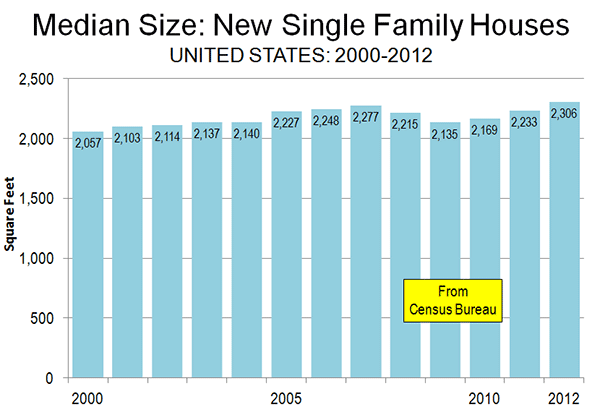
    There have been numerous press reports about the expansion of micro housing, and expectations that Americans will be reducing the size of their houses. As the nation trepidatiously seeks to emerge from the deepest economic decline since the 1930s, normalcy seems to be returning to US house sizes.

    According to the latest new single-family house size data from the US Census Bureau, the median house size rose to an all-time record of 2306 square feet in 2012. This is slightly above the 2277 square feet median that was reached at the height of the housing bubble in 2007 (Figure). The average new house size (2,505 square feet) remains slightly below the 2007 peak of 2,521 square feet.

    There was little coverage in the media, with the notable exception of Atlantic Cities, in which Emily Badger repeated the expectation of many:

    “It appeared after the housing crash that the American appetite for ever-larger homes was finally waning. And this would seem a logical lesson learned from a recession when hundreds of thousands of households found themselves stuck in cavernous houses they neither needed nor could afford.”

    But she concluded “Perhaps we have not changed our minds after all.” Well stated.

  • An Economics Lesson from The New York Times

    The New York Times restates basic economics in a June 9 editorial that should be required reading for planners and public officials who fail to comprehend how restrictions on housing raise prices. The Times expressed concern about the extent to which investor involvement in some markets has raised the price of houses for new homebuyers and others who actually plan to live in the houses that they purchase. The price increasing impact of excess demand on housing markets from institutional investors is no different what occurs when urban planning policies restrict housing supply, as occurs with urban containment policy.

    Referring to the recent house price increases, The Times said “Those gains, in turn, have propelled rising home prices nationwide, in part by reducing supply and in part by fostering a shift in perceptions about the housing market that has drawn some potential home buyers off the sidelines.” In this, The Times simply expresses the economic reality that when demand exceeds supply, house prices (or any other prices), other things being equal, will tend to rise. The cause of the imbalance is of no account.

    But The Times did not limit its analysis to economics. Venturing into the social dimension, The Times went so far as to endorse home ownership: “Given the traditional role of homeownership in building wealth, fostering communities and driving the economy forward, a lower rate of homeownership is a troubling development.”

    The Times editorial board has taken a position challenging the agendas of some of the most prominent retro-urbanist theorists, who favor more renting and less home ownership, clinging to the fantasy that, somehow housing markets constrained by excessive planning regulations are exempt from the laws of supply and demand.

  • Housing Boom Is The Best Chance For A Recovery For The Rest Of Us

    Our tepid economic recovery has been profoundly undemocratic in nature. Between the “too big to fail” banks and Ben Bernanke’s policy of dropping free money from helicopters on the investor class, there have been two recoveries, one for the rich, and another less rewarding one for the middle class.

    Viewed in this light, the recent run-up in home prices, the biggest in seven years, offers some relief from this dreary picture. Home equity accounts for almost two-thirds of a “typical” family’s wealth (those in the middle fifth of U.S. wealth distribution); there is no other investment by which middle-class families can so easily grow their nest eggs.

    But the housing recovery’s benefit extend beyond owners. The housing industry drives a significant portion of the nation’s economy, accounting for millions of jobs. According to the National Association of Home Builders, the average single-family detached house under construction results in an additional three jobs for one year. This includes the employees working on the house, and those employed in producing products to build the house.

    Overall, residential construction and upkeep generates between 15% and 18% of GDP. If the economy is to expand in a sustainable way that helps a broad section of Americans, suggests Roger Altman, a Clinton administration deputy Treasury secretary, “a housing boom will be the biggest driver.”

    Perhaps even more important, the growth of housing sales also revives something many have written off as obsolete: “the American dream” of owning a home. Since the great recession, some economists have argued that the future of America will be a “rentership” society.

    Others such as Richard Florida have argued forcibly that home ownership is “over-rated,” maintaining that America’s fixation on it has fostered “countless forms of over-consumption that have a horribly distorting affect on the economy.” Workers, he argues, are better off as renters since this allows them to change jobs more nimbly. If anything, he suggests, the government would be better off encouraging “renting, not buying.”

    Greens have also embraced this downscaled future, with people living cheek to jowl in some urbanized form of ecological harmony. They envision a new generation that will reject materialism, suburbs, single-family homes and other expressions of acquisition. In other words, forget ambition and save the whales. One writer at Grist argues, the fact the millennial generation can’t afford homes is a good thing, since it will lead to “a rejection of the mindset that got us into this mess.”  Welcome back to the green Age of Aquarius: “we’re looking for ways to avoid that ladder altogether — maybe by climbing a tree instead.”

    Perhaps this is true for some, but overall the desire to own a home is far from dead. A 2012 study by the Woodrow Wilson Center found that over 80% of Americans associated homeownership with the American dream. A 2012 study by the Joint Center for Housing Studies at Harvard, found “little evidence to suggest that individuals‘ preferences for owning versus renting a home have been fundamentally altered by their exposure to house price declines and loan delinquency rates, or by knowing others in their neighborhood who have defaulted on their mortgages.”

    Some predict that changing demographics — and attitudes — will erode such sentiments. Yet homeownership seems to be embraced by two groups who will dominate our future: the emerging millennial generation and immigrants . Between 2000 and 2011, there has been a net increase of 9.3 million in the foreign-born (immigrant) population, largely from Asia and Latin America. These newcomers have accounted for roughly two out of every five new homeowners.

    What about millennials? Despite the hopes of the counter-culture enthusiasts, a full 82% of adult millennials surveyed said it was “important” to have an opportunity to own their home. This rose to 90% among married millennials, who generally represent the first cohort of their generation to start settling down. Another survey, by TD Bank, found that 84% of renters aged 18 to 34 intend to purchase a home in the future. Still another, this one from Better Homes and Gardens, found that three in four saw homeownership as “a key indicator of success.”

    Over time, these demographics could provide the basis for a new and more widely distributed economic boom hopefully healthier than that which accompanied the last housing boom. For one thing, there are far fewer dubious loans, and lending standards are somewhat stricter. And building activity, although bouncing back, is not as fevered as last time, except perhaps in the somewhat over-hyped multi-family sector. Two-thirds of all housing starts, now at the highest level since June 2008, are single-family homes, a sure sign that the traditional buyer is back.

    Yet there are some disturbing aspects of the current housing boom. In much of the country, much of the activity has been fueled by investors; in states such as California they account for roughly one-third of buyers. Large players such as Blackstone and Colony Capital have been particularly active in buying distressed properties in places like Tampa, the Inland Empire and Phoenix, in the process boosting prices.

    This has set up what could become a potential conflict between prospective middle-income homeowners and the very deep-pocketed investors who have been the primary beneficiaries of the age of Obama. Although investors have indeed set a “floor” that has prevented a further deterioration of prices, their investment appear to be threatening to push homes out of the reach of middle-income buyers. Some local officials also worry that when the investors tire of their new properties, they may leave them to languish on the market.

    This can be seen even in California, which has experienced a weak recovery in jobs and income, but a decisive and escalating increase in housing prices, largely due to the prescence of investors, domestic and foreign, as well as the resurgent flippers. Over the past five years inventory has dwindled from 16 months supply to less than three months. Prices are up over 30% from 2008 in San Francisco and over 17% in the Los Angeles area, driving down affordability.

    But, still, the housing recovery is the best news to hit the American middle class in at least half a decade. Some investors seem to be realizing there are limits to rental income and might be persuaded to start selling homes to individuals. Already in Phoenix, a hotbed of investor interest, the percentage of homes sold to investors dropped to about 25% in March from a high of 36% last summer.

    If this trend takes hold, investors, rather than undermining the market, could be seen as having played a critical role in maintaining housing during a very hard time. If they start an orderly withdrawal, or start selling their homes to families, the speculators, not always a lovable group, could end up being among the unlikely saviors of the American dream, particularly for the next generation.

    Joel Kotkin is executive editor of NewGeography.com and a distinguished presidential fellow in urban futures at Chapman University, and a member of the editorial board of the Orange County Register. He is author of The City: A Global History and The Next Hundred Million: America in 2050. His most recent study, The Rise of Postfamilialism, has been widely discussed and distributed internationally. He lives in Los Angeles, CA.

    This piece originally appeared at Forbes.com.

  • Retrofitting the Dream: Housing in the 21st Century, A New Report

    This is the introduction to "Retrofitting the Dream: Housing in the 21st Century," a new report by Joel Kotkin. To read the entire report, download the .pdf attachment below.

    In recent years a powerful current of academic, business, and political opinion has suggested the demise of the classic American dream of home ownership. The basis for this conclusion rests upon a series of demographic, economic and environmental assumptions that, it is widely suggested, make the single-family house and homeownership increasingly irrelevant for most Americans.

    These opinions — which we refer to as ‘retro-urbanist’ — gained public credence with the collapse of the housing bubble in 2007. The widespread media reports of foreclosed housing in suburban tracts, particularly in the exurban reaches of major metropolitan areas, led to widespread reports of the “death of suburbia” and the imminent rise of a new, urban-centric “generation rent.”

    Yet despite this growing “consensus” about the future of housing and home ownership, our analysis of longer-term demographic trends and consumer preferences suggests that the “dream,” although often deferred, remains relevant. We see this in the strength of suburbs, as well as in the growth of the post-war “suburbanized cities” that generally have been the fastest growing regions of the country. These trends are notable in the three key demographic groups that will largely define the American future: aging boomers, immigrants, and the emerging millennial generation.

    This does not mean that suburbia, or home construction patterns, will not change in the coming decades. Higher energy prices, for example, could necessitate shorter commutes, even with automobile fuel efficiency improvements. The emerging concentration of employment centers could help bring this about by improving job housing balance. There is a need to fully make use of the high speed digital communication that can promote both dispersed and home-based work.

    For these and other reasons McKinsey & Company, among others, has noted that meeting environmental challenges does not require the kind of radical alteration of lifestyles and aspirations so widely promoted in the media, academia, and among some real estate interests. Equally important, there has been little consideration of the profound economic and social benefits of both home ownership and low to medium density living. These include, on the economic side, the huge impact on employment from home construction and the ancillary industries associated with household upkeep and improvement.

    More important still may be the social benefits. Most serious studies have shown that lower-density, homeowner-oriented communities are more socially cohesive in terms of volunteerism, neighborly relations, and church attendance, than denser, renter-oriented communities. Suburban and lower density urban neighborhoods are particularly critical for the growth of families and the raising of children, an increasingly important factor in a ‘post-familial’ era of plunging birthrates.

    To be sure, housing has been changing rapidly from the model developed in the 50s, and this process will continue over the next generation. Houses today are more energy efficient, and look to accommodate home-based work, as well as extended, multigenerational families. Similarly, the suburbs and low/mid density urban communities are already far more diverse, in terms of ethnicity and age profile, than the homogeneous communities often portrayed in media and academic accounts. This trend is also likely to accelerate.

    Ultimately, we believe that the dream is not at all dead, but is simply evolving. America’s tradition of property ownership, privacy, and the primacy of the family has constituted a critical aspect of our society since before the nation’s founding. It will need to remain so in the decades ahead if the country is to prove true to the aspirations of its people and the sustainability of its demographics.

    Joel Kotkin is executive editor of NewGeography.com and a distinguished presidential fellow in urban futures at Chapman University, and a member of the editorial board of the Orange County Register. He is author of The City: A Global History and The Next Hundred Million: America in 2050. His most recent study, The Rise of Postfamilialism, has been widely discussed and distributed internationally. He lives in Los Angeles, CA.

  • Market Surge Confirms Preference for Homeowning

    Ever since the housing bubble burst in 2007, retro-urbanists, such as Richard Florida, have taken aim at homeownership itself, and its “long-privileged place” at the center of the U.S. economy. If anything, he suggested, the government would be better off encouraging “renting, not buying.”

    Similar thinking has gained currency with some high-rise (or multi-unit) builders, speculators and Wall Street financiers, who would profit by keeping Americans permanent renters, with encouragement from former Morgan Stanley financial analyst Oliver Chang, who predicted we were headed toward a “rentership society.”

    Some support comes from research suggesting that higher ownership rates actually create unemployment. A study by the proausterity Peterson Institute for International Economics, cited recently both by Florida and the New York Times’ Floyd Norris, lays out an econometric case against homeownership.

    The authors justified their findings by pointing to larger unemployment-rate changes from 1950-2010 in states, mostly in the South, such as Alabama, Georgia, Mississippi, South Carolina and West Virginia, compared with California, North Dakota, Oregon, Washington and Wisconsin. They then noted that, in the states with the larger unemployment rate increases, homeownership had increased more. Hence, the connection between higher homeownership and higher unemployment rates.

    This analysis is staggeringly ahistorical. It fails to correct for the massive labor market changes that have occurred in the Southern states, as the agricultural and domestic employment common in 1950 has largely disappeared. The analysis begins with a year in which three of the states cited to prove that lower homeownership is associated with lower unemployment had unusually high unemployment in 1950 (California was No. 1, Oregon, No. 4, and Washington, No. 6); unemployment in these three West Coast states averaged nearly double that of the Southern examples.

    Another ahistorical implication is that that the South experienced a huge increase in homeownership since 1950, as economically disadvantaged African-Americans began to buy their residences. An analysis by demographer Wendell Cox indicates that, even as labor markets were being radically altered, per capita incomes in relatively underdeveloped Alabama, Georgia, Mississippi, South Carolina and West Virginia rose during 1950-2010 at more than double the rate experienced in California, North Dakota, Oregon, Washington and Wisconsin (more than 140 percent, adjusted for inflation, compared with approximately 65 percent).

    The Peterson thesis is also undermined by a close examination of county homeownership and unemployment rates, which finds, generally, that large counties with higher rates of homeownership have lower unemployment rates. For example, among the nation’s approximately 260 counties with more than 250,000 residents, those with homeownership rates above 70 percent have average unemployment rates of 8.1 percent. Among the counties with homeownership rates below 50 percent, unemployment rates average 9.6 percent. This is exactly the opposite relationship that would be expected from the Peterson Institute research.

    Finally, many large urban counties with the lowest homeownership rates – Los Angeles, Kings County (Brooklyn), New York County (Manhattan), Queens, Cook County (Chicago) and Philadelphia – also suffer well-above-average levels of unemployment and high levels of poverty. In contrast, suburban counties with high homeownership rates, like Nassau County, N.Y., Chester County (in the Philadelphia area), or Fairfax County, Va., boast considerably lower unemployment than their urban neighbors, and higher per-capita incomes. Most of the cities with the highest ownership rates, like Fort Worth and Austin, Texas, Indianapolis, Denver and Columbus, Ohio, all did very well in the most recent Forbes “Best Cities for Jobs” study.

    It is also alleged that countries with high ownership rates do worse than those with lower ones. And to be sure, troubled countries like Portugal and Spain have high levels of homeownership, while Germany, Sweden and Denmark have somewhat lower ones. Yet, many successful countries – Taiwan, Singapore, Norway, Australia, Canada and Israel – actually do quite well with higher ownership rates than in America.

    Dream that refuses to die.

    From a historic perspective, the present U.S. homeownership rate, 65.4 percent, does not represent a structural decline from the middle 2000s, as is often argued, but remains consistent with the virtual equilibrium achieved over the past half century. As recently as 1940, only 40 percent of Americans owned their homes, a share that reached 60 percent by 1960s. Since then, it has remained fairly stable. The modest decline from the middle 2000s was from an artificially high level that resulted from the virtual suspension of mortgage credit standards – egged on by Wall Street and government agencies – which was followed by a deep recession and a weak recovery.

    The housing bust changed the market, but not because of some fundamental shift in buyer preferences, as is sometimes alleged. Indeed, the recent spike in home sales confirms that Americans continue to aspire to homeownership. Research at the Woodrow Wilson Center indicated that 91 percent of respondents identified it as essential to the American Dream, and most favored steering government policy to spur homeownership.

    Much has been written about how the under-30 population is either living at home or cannot buy a house. Yet, surveys by generational chroniclers Morley Winograd and Mike Hais found that a full 82 percent of adult millennials surveyed said it was “important” to own their own home, which rose to 90 percent among married millennials. Another survey, this one by TD Bank, found that 84 percent of renters ages 18-34 intend to purchase a home in the future.

    Homeownership achieves almost cultish status among immigrants, who account for some 40 percent of all new owner households over the past decade. Among Asians who entered the country before 1974, a remarkable 81 percent own their home, while Latino homeownership is projected to rise to 61 percent by 2020.

    Societal advantages of owning

    Critics of homeownership often point out that renters have far more flexibility to move; that’s true and important particularly for people in their 20s. But, as people age, get married and, especially, have children, they seek to become involved in their communities on a more permanent basis. Pundits and economists often fail to recognize that people are more than simply profit-maximization machines ready to cross the country for an income increase of a few thousand dollars; they also seek out friends, stable neighbors, familial comfort, community and privacy.

    Homeowners reap the financial gains of any appreciation in the value of their property, so they tend to spend more time and money maintaining their residence, which also contributes to the overall quality of the surrounding community. The right to pass property to an heir or to another person also provides motivation for proper maintenance.

    Given their stake, homeowners participate in elections much more frequently than renters. One study found that 77 percent of homeowners had, at some point, voted in local elections, compared with 52 percent of renters. The study also found a greater awareness of the political process among homeowners. About 38 percent of homeowners knew the name of their local school board representative, compared with 20 percent of renters. The study also showed a higher incidence of church attendance among homeowners.

    People who own their homes also tend to volunteer more in their community, notes the National Association of Realtors. This applies to the owners of both expensive and modest properties. One 2011 Georgetown study suggests that homeownership increases volunteering hours by 22 percent.

    Perhaps the largest social benefits relate to children. Owners remain in their homes longer than do renters, providing a degree of stability valuable for children. Research published by Habitat for Humanity identifies a number of other advantages for children associated with homeownership versus renting, ranging from higher academic achievement, fewer behavioral problems and lower incidence of teenage pregnancy.

    ‘A share in their land’

    Even before the American Revolution, the notion of ownership, usually of a farmstead, was a critical lure. Even after the yeoman utopia of the early 19th century faded, Americans continued to yearn for their own homes, something that led them in two great waves, first in the 1920s and again in the 1950s and 1960s, to the suburban periphery.

    In contrast to today’s progressives, many traditional liberals embraced the old American ideal of dispersed land ownership. “A nation of homeowners,” President Franklin D. Roosevelt believed, “of people who own a real share in their land, is unconquerable.”

    Legislation under Roosevelt and successor presidents supported this ideal. More than a response to the market, governments embraced homeownership as a positive societal and economic good for the majority of Americans. This policy – brilliantly exploited by entrepreneurs – worked for both people and the economy. Almost half of suburban housing, notes historian Alan Wolfe, depended on some form of federal financing.

    Road to serfdom?

    The suggestion that we need to abandon what the New York Times denounces as the “dogma on owning a home” has grown deeply entrenched among retro-urbanists. Rather than facilitate the broad dispersion of property ownership across economic classes, the new orthodoxy suggests we would be better off as a nation of renters, living cheek-to-jowl in apartments. This works to the advantage of the Wall Streeters and other investors, who profit from our paying off their mortgages rather than our own. The assault on homeownership also pleases some advocates of austerity, such as Pete Peterson, who would like to eliminate the mortgage interest deduction as a way to raise revenue at the expense of the middle class.

    Turning against homeownership undermines the very promise of American life and the culture of independence critical to our identity as a people. Housing accounts for about two-thirds of a family’s wealth and the vast majority of the property owned by middle- and working-class households. The house represents for the middle class, devastated by the weak recovery, both a chance to make a long-term investment as well as a place to raise a family; a Wall Street portfolio, for all but the very affluent, who can afford the best advice, provides no reasonable alternative.

    We have to consider what kind society we wish to have. The nomadic model now in fashion suggests Americans should simply move from place to place, untethered to any one spot, seeking personal fulfillment and the best financial deal for themselves. Such a model fits with current planning dogma and facilitates a source of profit for some, but undermines the dispersion of property that can sustain our society, and our families, over the long run.

    Joel Kotkin is executive editor of NewGeography.com and a distinguished presidential fellow in urban futures at Chapman University, and a member of the editorial board of the Orange County Register. He is author of The City: A Global History and The Next Hundred Million: America in 2050. His most recent study, The Rise of Postfamilialism, has been widely discussed and distributed internationally. He lives in Los Angeles, CA.

    This piece originally appeared in the Orange County Register.

    Home illustration by Bigstock.
    Update: The Pete Peterson referred to here is not the Pete Peterson running for office in California.