Category: housing

  • A Planet of People: Angel’s Planet of Cities

    Professor Shlomo Angel’s new book, Planet of Cities, seems likely to command a place on the authoritative bookshelf of urbanization between Tertius Chandler’s Four Thousand Years of Urban Growthand Sir Peter Hall’s Cities and Civilization and The Containment of Urban England. Chandler produced the definitive volume of gross population figures for urban areas (cities) over millennia. Angel, takes the subject much further, describing detail how urban areas have grown over the last two centuries, both in population and continuous urban land area. The book focuses principally on population growth,  urban spatial expanse, and density. Moreover, Professor Angel develops both a statistical and analytic framework that complements the voluminous work of Peter Hall. Planet of Cities is liberally illustrated, which greatly aids understanding the trends.

    Urban Population, Land Area & Density Evolution from 1800

    Planet of Cities looks at the urbanization trend from various dimensions. A sample of 30 urban areas was used to gauge urban expansion and density changes from 1800 to 2000.

    At the same time, he describes the well documented urban density declines in the United States as well as the similar trends in Western European urban areas  often been missed by analysts who imagine that spatial expansion is limited to America.

    He goes further, showing that the rapidly growing urban areas of the developing world are also declining in urban density, with spatial expansion rates far exceeding those of population growth. This has been evident in New Geography’s  Evolving Urban Areas series (such as Mumbai, Jakarta, Manila, Ho Chi Minh City and others).

    Angel uses examples, such as Cairo and Accra, Ghana to illustrate both longer term and recent expansions of urban land area and the consequent drastic declines in urban density. In Cairo, the urban land area increased 16 times from 1938 to 2000, well in excess of the approximately 10 times population increase. In Accra, a 50 percent population increase from 1985 to 2000 was dwarfed by a 150 percent increase in urban land area.

    The analysis also includes a larger number (3600) with populations greater than 100,000. He estimates that all of the world’s urbanization covers no more than 0.5 percent of the world’s land. Angel suggests that the world the urban footprint could double or triple in the next few decades. However, he concludes that, even with this expansion, there are "adequate reserves of cultivatable land sufficient to feed the planet in perpetuity."

    Taking note of the slow growth or even population declines in the more developed world, he reminds readers that that nearly all of future population growth will occur in the urban areas of the less developed world. Angel strongly contends that this urban expansion is necessary. This, of course, places him "swimming upstream" against the prevailing doctrines of urban planning. The title of his first chapter "Coming to Terms with Urban Expansion" gives fair warning of his challenge to current planning doctrines. Throughout the volume, Angel expresses the view that declining urban densities are "inevitable," based upon his historic analysis, review of current trends and perceptions of the future.


    A Mumbai slum

    The Prime Concern: Housing

    Angel’s "primary policy concern" as "that in the absence of ample and accessible land for expansion on the urban periphery, artificial shortages of residential land will quickly extinguish any hope that housing will remain affordable, especially for the urban poor…"

    Angel expresses concern that the urban containment policies that so dominate American and Western European planning could be damaging to less developed nations, cancelling out much of the economic rewards of rapid urbanization. He expresses surprise that the attempt to impose Western planning models on the developing world raises so little objection (see China Should Send the Western Planners Home).

    Consistent with his "primary policy concern," Angel offers a "decent housing proposition," countering the present one-dimensional focus on environmental issues. In contrast, Angel suggests a more rounded approach to urban planning. He surmises \ the very purpose of cities:  to improve the economic lot of those who are attracted there. People are not generally attracted to cities because of the quality of their planning or the uniqueness of their architecture. In short, as he puts it, "few move to the city for its fountains." Unless they perform their economic task, cities stagnate or die, as so often happened before the modern age. The near exclusive draw of cities is household economics. Beyond the unprecedented value of the quantitative data and analysis provided, Planet of Cities is rooted in the reality of that   measure.

    At the same time, Angel is himself is unabashedly a planner. He is an adjunct professor of urban planning at the Robert F. Wagner School of Public Service at New York University, a lecturer at the Woodrow Wilson School at Princeton University and a senior research scholar at the urbanization project at the Stern School of Business at New York University.

    Restoring a Genuine Focus to Planning

    Angel expresses a strong interest in the most fundamental of planning issues: the provision of infrastructure that allows the urban area to better serve its residents and those it attracts. He is thus simultaneously for both more and less planning. He would curb the excesses of intervention in land markets that are now rife because they compromise the ability of cities to perform their primary function of improving affluence. He would expand the focus of planning to facilitate the organic urban expansion associated with growing cities.  This means that sufficient available land must be available for development without materially increasing land and house prices. It also requires making provision for the basic infrastructure such as an arterial grid of dirt roads on the expanding fringes of developing world cities.

    Abandoning Destructive Planning Doctrines

    Angel calls for abandonment of artificial limits on urban expansion and population growth (such as urban growth boundaries and housing moratoria) and instead seeks economic development and improvements in the quality of life.

    Professor Angel does not mince words about the consequences of relying of urban containment policy ("smart growth," "growth management," "compact cities,") as a strategy for reducing greenhouse gas emissions. The consequence would be that the "protection of our planet would likely come at the expense of the poor." He adds that strict measures to protect the natural environment by blocking urban expansion   could "choke the supplies of affordable lands on the fringes of cities and limit the abilities of ordinary people the house themselves."  He decries the notion that "cities should simply be contained and enclosed by greenbelts or impenetrable urban growth boundaries as "uninformed and utopian" because it makes sustainability "an absolute end that justifies all means to attain it." This policy approach sacrifices such imperatives as the quality of life and full employment.  

    A Planet of People

    Angel’s treatment is consistent with the urban scaling research of West et al at the Santa Fe Institute, which found that as cities increased in population they become more productive (As we indicated in a previous article, the Santa Fe Institute research did not deal with urban densities, despite misconceptions of some analysts).

    Angel’s concern about the impact on low income households is consistent with the focus of the international sustainability movement, which , declared at the recent Rio +20 conference:

    Eradicating poverty is the greatest global challenge facing the world today and an
    indispensable requirement for sustainable development. In this regard we are committed to
    free humanity from poverty and hunger as a matter of urgency.

    Angel’s Planet of Cities is about urban areas that serve their residents instead of theoretical, often utopian notions.

    Wendell Cox is a Visiting Professor, Conservatoire National des Arts et Metiers, Paris and the author of “War on the Dream: How Anti-Sprawl Policy Threatens the Quality of Life.”

    —–

    Publication information:
    Shlomo Angel, Planet of Cities (2012) Lincoln Institute of Land Policy

    Photo: Cover: Planet of Cities.  http://www.lincolninst.edu/pubs/images/2094_Planet_of_Cities_Cover_web.jpg

  • Florida: When Your Best (Place) Just Ain’t Good Enough

    Real estate broker Coldwell Banker handles corporate relocations for a large portion of our middle class. It recently released a survey of Suburbanite Best Places to Live. While it’s easy to dismiss as a sales tool for their realtors, the survey provides a fascinating glimpse of middle class, suburban preferences, influenced by our current economy. Coldwell Banker’s top honors go to Cherry Hills Village, Colorado, a suburb of Denver. Suburbs of Seattle, New York City, Washington, DC, and other prominent cities feature strongly on Coldwell Banker’s list, which highlights places that are sprinkled evenly throughout the United States. Notably missing are any communities in Florida.

    For a state with sunshine, beaches, and low taxes, Florida just doesn’t have the chops to get even one community onto the top 100 list.

    Weather, evidently, has little to do with our middle class’s desirable locations. Frigid Whitefish Bay, just south of Milwaukee, captured spot #100. Situated along the shore of Lake Michigan, this suburb of 14,000 doesn’t exactly have the kind of weather that makes people flock to the beach. Instead, it offers residents a strong sense of community, heritage, and a culture that values education and family. If you move here, you’ll find yourself within a suburban community with a high homeownership ratio, an educated population, and a quality of life that includes short commutes, low crime rates, close conveniences, and a tendency to eat at home.

    Suburban living has maintained a strong appeal for middle-class Americans due to the popularity of many of the factors on which Coldwell Banker based its rankings. While socialites prefer more urban, dense lifestyles (which is another list that Banker recently produced), suburbanites prefer backyards and quieter neighborhoods away from the hustle and bustle of the city; they don’t need to be near the action. Florida has all these things in abundance, except when compared to… almost everywhere else.

    Windermere, Florida’s top ranked suburb, came closest, ranking just below Whitefish Bay and a couple of others. Like most suburbs on the list, Windermere is on the periphery of a large metropolitan area (Orlando), and contains conveniences, good schools, parks, and recreation facilities.

    For much of its history, Florida represented the suburban American dream. The net benefits included an affordable cost of living and upward mobility, and Florida’s growth has consisted almost entirely of suburban densities. No one can accuse Florida developers of building communities that people didn’t want – the product was carefully researched to fit the market.

    In the late period of the boom, urban options were also developed, in the belief that a new demand for socialite “downtown” style living would emerge. Townhomes and condominiums rose in Florida’s primary and secondary urban markets. Even tertiary cities like Sanford, a historic agricultural town north of Orlando, begot a six-story condo. Those who migrated from Chicago and the dense Northeast now had a diverse set of choices, from rural to urban, with something to please everybody.

    It is perhaps this dilution of the market that has made Florida’s star fade a bit in relation to the national constellation of suburbs. If East Grand Rapids, Michigan (Coldwell Banker’s #8) can outrank the hundreds of suburbs around Tampa, Miami, Jacksonville, Tallahassee, and Orlando, there’s something else going on besides beauty.

    One thing that many of the top 100 have in common is a strong public education system. Florida, which has refused to invest in education, may now be harvesting the bitter fruit of this stubborn negligence. The state’s primary growth today continues to be in retirees who are uninterested in supporting education, and who control a large part of the state’s political power.

    Another aspect that the top 100 suburbs offer is safety. “Safety is a priority,” states the opening page of this survey, but it simply isn’t something that most people associate with the Sunshine State. A state that doesn’t offer a strong sense of personal safety isn’t going to rank highly, no matter what else is being offered. With two out of the ten most dangerous cities in the country, Florida seems more like the wild West than a suburbanite’s dream come true.

    Increasing public safety and public education are two efforts that government can do best, most people agree. Florida has spiraled downward on both fronts. The state’s leadership, by cutting taxes during the worst part of the recession, haven’t exactly helped the situation. With Florida’s new home sales up, the state’s economists are whistling a happy tune, convinced that the worst is over. But what Coldwell Banker is telling Florida is a different, darker story.

    Florida’s best offerings are attracting a population less interested in the core values stated in the Coldwell Banker survey – safety, good education, a sense of community – and so we continue to get more of the same. More population that reinforces Florida’s lack of investment in community, more population reluctant to put money into education, and more population that is quick to move somewhere else at the earliest opportunity seem to be Florida’s fate. This represents a lost opportunity to those who wish to see Florida make gains in these spheres – education, community, and safety. And it represents a lost opportunity to match up a truly beautiful place with truly involved people.

    Corporations seeking to relocate and recruit good people pay attention to these surveys. Florida’s low taxes may lure a few more down south, but if corporations need to attract and retain top talent, this survey points to where they are likely to go, regardless of the incentives our state has to offer.

    Places like Whitefish Bay, Wisconsin; Rossmoor, California; and Haworth, New Jersey will continue to gain in the type of population that share these same values. The middle class, fighting its way back from a threatened extinction, isn’t likely to take a chance on a place that has a rapidly degrading quality of life. Until Florida’s culture starts caring about the quality of its community, safety, and education, our state will continue to grow without flourishing as a place where people desire to be.

    Richard Reep is an architect and artist who lives in Winter Park, Florida. His practice has centered around hospitality-driven mixed use, and he has contributed in various capacities to urban mixed-use projects, both nationally and internationally, for the last 25 years.

    Bigstock photo: Florida Housing

  • Even After the Housing Bust, Americans Still Love the Suburbs

    For decades, Americans have chosen to live in suburbs rather than in cities. Suburban growth has outpaced urban growth, and many big cities have even lost population. But in recent years, some experts have said it’s time for cities to make a comeback. Why? Urban crime rates have fallen; many baby boomers want to live near restaurants, shops, and all the other good things that cities offer; and the housing bust has caused more people to rent instead of buy – sometimes by choice and sometimes out of necessity. Moreover, cities offer shorter commutes, a big draw given today’s higher gas prices and growing concerns about the environment.

    So is there evidence that cities are really making a comeback? Earlier this year, a widely-reported Brookings analysis using 2011 Census estimates suggested that they were, reversing the long-term trend of faster suburban growth. However, it later became clear that those 2011 Census estimates should not be used for areas smaller than counties, which includes most cities and suburbs (see “the fine print” at the end of this post).

    Knowing that we couldn’t use these Census data, we decided to tackle this question another way. Using U.S. Postal Service data on occupied addresses receiving mail, we calculated household growth in every ZIP code from September 2011 to September 2012. (A previous Trulia Trends post explains in more detail how these data are collected.) Consistent with earlier studies of city versus suburb growth, we compared the growth in a metro area’s biggest city with the growth in the rest of the metropolitan area, across America’s 50 largest metros.

    By this measure, there was essentially no difference between city and suburban growth. When we looked at all 50 metros together, household growth was 0.536% in the metros’ biggest cities and 0.546% in the rest of the metro area over the past year – which means that suburbs grew ever so slightly faster than big cities. The biggest city grew faster than the suburbs in 24 of those metros, including New York, Los Angeles, Chicago, Miami and Philadelphia; the suburbs grew faster than the biggest city in the other 26 metros, including Dallas, Houston, Atlanta, Detroit and Phoenix.

    But comparing the biggest city with the rest of the metro area misses some of the action. In most metros, there are neighborhoods outside the biggest city that are more urban than some neighborhoods in the biggest city (as measured by density). For example, Hoboken NJ, just across the river from New York City, is denser and feels more urban than much of Staten Island, which is part of New York City. Central Square in Cambridge, next to Boston, feels more urban than West Roxbury and Hyde Park, two quiet neighborhoods within the City of Boston. In southern California, Santa Monica and Pasadena – which are outside the Los Angeles city boundary – feel more urban than Sylmar, Chatsworth and other outlying neighborhoods in the San Fernando Valley that are technically part of the City of Los Angeles.

    Therefore, we took a new approach. We compared growth in neighborhoods based on whether they actually are more urban or suburban based on their density, regardless of whether those neighborhoods happen to be inside or outside the boundary of a metro area’s biggest city. Within each metro area, we ranked every neighborhood – as defined by ZIP codes — by household density. Neighborhoods with higher density than the metro area average are “more urban”; neighborhoods with lower density than the metro area average are “more suburban.” (See “the fine print” at end of this post.)

    By defining “urban” and “suburban” in this way, suburban growth is clearly outpacing urban growth. Growth in the “more suburban” neighborhoods was 0.73% in the past year, more than twice as high as in the “more urban” neighborhoods, where growth was just 0.35%. In fact, urban neighborhoods grew faster than suburban neighborhoods in only 5 of the 50 largest metros: Memphis, New York, Chicago, San Jose and Pittsburgh – and often by a really small margin. In the other 45 large metros, the suburbs grew faster than the more urban neighborhoods.

    Top 5 Metros Where Urban Growth Outpaced Suburban Growth
    U.S. Metro

    Urban Growth

    Suburban Growth

    Difference: Urban minus Suburban

    Memphis, TN

    0.92%

    0.42%

    0.50%

    New York, NY

    0.58%

    0.27%

    0.31%

    Chicago, IL

    0.31%

    0.26%

    0.06%

    San Jose, CA

    0.73%

    0.71%

    0.02%

    Pittsburgh, PA

    0.44%

    0.43%

    0.01%

    Note: among largest 50 metros.

    Top 5 Metros Where Suburban Growth Most Outpaced Urban Growth
    U.S. Metro

    Urban Growth

    Suburban Growth

    Difference: Urban minus Suburban

    San Antonio, TX

    0.40%

    2.46%

    -2.07%

    Oklahoma City, OK

    0.38%

    1.87%

    -1.49%

    Houston, TX

    0.44%

    1.91%

    -1.48%

    Austin, TX

    0.88%

    2.13%

    -1.25%

    Detroit, MI

    -0.94%

    0.20%

    -1.14%

    Note: among largest 50 metros.

    Looking more closely: what happened to growth in not just in the “more urban” neighborhoods, but in the MOST urban? Within each metro, we split neighborhoods into ten categories, based on their density. The highest-density category covers just the “most urban” parts of big cities (much of Manhattan, for instance, but none of Brooklyn) including a few neighborhoods that are technically outside the metro’s biggest city (parts of Cambridge MA, Arlington VA and Scottsdale AZ, for instance). On the other end of the spectrum, the lowest-density neighborhoods are the “most suburban” (in fact, in some metros, the lowest-density neighborhoods feel downright rural). Now the pattern gets interesting:

    Trulia City vs. Suburban Growth Bar Chart

    In general, the “more suburban” neighborhoods grew faster than the “more urban” neighborhoods. But the “most urban” neighborhoods actually had solid growth, as the leftmost bar in the graph shows. Household growth was 0.54% in these “most urban” neighborhoods,” which matched the overall growth rate for the metro areas examined. Furthermore, among only the largest 10 metros, household growth was 0.65% in the “most urban” neighborhoods, compared with 0.48% growth in these metros overall.

    That’s the punchline: America’s suburban areas are continuing to grow faster than America’s urban areas. Despite falling homeownership, rising gas prices, downsizing baby boomers and improvements to city living, American suburbanization hasn’t reversed. Even though the highest-density neighborhoods, particularly in the largest metros, have grown in the past year, the suburbanization of America marches on.

    We’ve provided the full data set of urban and suburban growth in the 50 largest U.S. metro areas below.

    The fine print:

    • This Brookings analysis showed cities growing faster than their suburbs between 2010 and 2011, based on 2011 Census estimates. Posts at newgeography.com here and here criticized the 2011 Census estimates and questioned research based on those estimates, including the Brookings analysis. The problem with the 2011 Census estimates is that the 2010-2011 growth rates for subcounty areas – which includes most cities and suburbs — were assumed to be the same as the growth rate for the whole county (with the exception of population in “group quarters”).
    • We used the largest 50 metro areas. In this report, the “San Francisco” metro area includes Oakland; “Dallas” includes Fort Worth; “Washington DC” includes the Bethesda metro division; “New York” includes Long Island; and so on. (Most Trulia Trends posts use the smaller “metropolitan division” where they exist for consistency with other housing data reports.)
    • The U.S. Postal Service reports delivery statistics by ZIP codes. We calculated density using 2010 Census data for ZCTA’s, a Census approximation of ZIP codes. 

    Jed Kolko is Trulia’s Chief Economist, leading the company’s housing research and providing insight on market trends and public policy to major media outlets including TIME magazine, CNN, and numerous others. Read more of his work at Trulia Trends blog.

    This piece originally appeared at the Trulia blog.

    Suburban neighborhood photo by Bigstock.

  • Housing: How Capitalism and Planning Can Co-Habit

    Did Britain’s New Labour party conspire against land development? Is it responsible for outdated, “socialist” land planning policies?

    The British Conservative Party’s favourite think tank, Policy Exchange, would have us think so. Its latest report aims to demonstrate that the British planning system is socialist rather than capitalist. Why Aren’t We Building Enough Attractive Homes? – Myths, misunderstandings and solutions, by Alex Morton takes on the British planning system that dates from the 1947 Town and Country Planning Act.

    That law was enacted in 1948, when farmers gave up their right to build on their own land in exchange for a continuation of guaranteed food prices. In a genuine legal innovation, government cancelled the right of landowners to build freely on their own property, without nationalising the property itself. By 1954, Prime Minister Winston Churchill had made sure that the owners of land given permission to build by the State, through the agency of a Local Planning Authority, would be able to profit from the “betterment” or planning gain in land value. While land limited to agricultural uses was of low value, the artificial scarcity of land that was granted permission for development was then worth many times that value. Local Planning Authorities negotiated a share of that gain.

    It is significant that this post-war measure survives today. The negotiation over planning gain between landowner, developer, and Local Planning Authority is big business still. Farmland in proximity to urban areas can be turned from £4,047 an acre (£10,000 a hectare) to be worth 100 times that in a development deal. Much land within the planning-approved area of Britain is worth over 1000 times the value of land without any planning approval prospect.

    Nevertheless, for Alex Morton, the Senior Research Fellow for Housing and Planning at Policy Exchange, ‘… the 1940s system is “socialist” as it requires councils create a “socially optimal” plan then impose it on everyone. But we know in reality such changes impose clear costs and benefits on specific individual existing residents.’ Seeing this as a misunderstanding of Churchill’s creation of an artificial scarcity of land that could be selectively inflated in value for profitable development after a negiotiation over the share of the gain, I wrote to Morton and suggested the obvious: that the existing planning system was capitalist rather than socialist. He wrote back, a bit huffed:

    ‘The current system is nothing to do with capitalism. Possibly corporatism (the use of state power to enrich a small business elite through involuntary confiscation of property rights), definitely socialism (at least in original intent given how land uplift was originally to be taken by the state).’

    “Nothing to do with capitalism” … This is a myth from the self-proclaimed “myth-buster” think-tank. The 1947 Act made an entirely new beginning for post-war capitalism by repealing all previous town planning legislation, re-enacting some important provisions salvaged from previous law, and innovating significant legal principles.

    His is a propagandist’s mistake, made before in his 2011 report, Cities for Growth – Solutions to our Planning Problems. At no point does Morton on behalf of Policy Exchange call for the repeal of the 1947 planning law. He knows that no British Planning Minister in any government will argue for repeal of the 1947 law. The Treasury could never allow it, and the members of the Council of Mortgage Lenders would probably have such a Minister hung over the Thames under Westminster Bridge for even thinking about it. To repeal the Churchillian planning law would mean financial disturbance on a scale far more disturbing than events in 2008.

    Fresh-faced Nicholas Edward Coleridge Boles was appointed Planning Minister on September 6th, 2012, and was expected to tear up the planning law. Nick Boles knows the planning system through his time with and close links to Policy Exchange, but he will no doubt conclude that the 1947 planning law must be sustained. He has the Planning Minister’s job now. In contrast, Morton’s inspiration and predecessor, Oliver Marc Hartwich, has imagined a New Labour conspiracy against development:

    ‘The planning system in the UK has been intended to restrict physical development, reducing economic growth as a result. In particular, Labour have made it a matter of policy that 60% of any new housing should be built on so-called “brown field sites”. This policy depends on, and results in, both high house prices and higher land prices.’

    New Labour did not conspire against development. Yes they rejected “sprawl” and planned to contain development. Urban compaction reinforces the effect of the planning law. However, it is the law that planning relies upon that is having unintended consequences since it was innovated in 1947.

    Planning facilitated the New Labour expansion of the fund of mortgage lending up to 2008, so that even in 2012 there is £1,200,000,000,000 of live mortgage debt generating interest. This is a volume of lending made possible by, rather than causing, house price inflation. Inflation caused by the fact that the planning system explicitly prevents people from buying a field cheaply and building a house on it, with a rate of planned new house building lower than at any time since the First World War, not the Second. The effect, by Morton’s own measure, is that in England a median priced home now costs seven times the median salary. Averages conceal other realities, but the general trend is clear. House price inflation, highest in the South and deflating unevenly in parts of the North, is inextricably linked to the planning law. Planning equals mortgage security in housing equity. For that £1.2 trillion of debt there is at least £2.4 trillion of equity variously distributed among households.

    Rather than question how the planning system intersects with the contemporary character of the desperate attempt to augment low household income, or look closely at the capitalist activities of a development sector consolidated around Local Planning Authorities, Morton sees only “socialism”. In our view, the British predicament is a triangulation, characterised as:

    A) Social dependence on substantial house price inflation in Britain’s political economy
    B) Securitisation of mortgage lending by government through the planning system
    C) Public acceptance of the low quality of an ageing and dilapidated housing stock

    Capitalism in Britain depends on this being a stable triangulation, what we have called the Housing Trilemma. It is not a socialist conspiracy, as Policy Exchange imagines. It is a predicament for British capitalism that is having serious consequences for the population.

    Ian Abley is a Project Manager for audacity, an experienced site Architect. He has produced a discussion paper for the 250 New Towns Club to argue the obvious: that planning is capitalist. It can be downloaded from www.audacity.org/IA-20-09-12.htm. He is also co-author of Why is construction so backward? (2004) and co-editor of Manmade Modular Megastructures (2006). He is planning 250 new British towns.
    Flickr Photo by Green Alliance: Nick Boles, Conservative Party MP and brand new Planning Minister

  • The Hollow Boom Of Brooklyn: Behind Veneer Of Gentrification, Life Gets Worse For Many

    After a decade of increasingly celebrated gentrification, many believe Brooklyn — the native borough of both my parents — finally has risen from the shadows that were cast when it became part of New York City over a century ago.  Brooklyn has gotten “its groove back” as a “post-industrial hotspot,” the well-informed conservative writer Kay Hymowitz writes, a perception that is echoed regularly by elements of a Manhattan media that for decades would not have sullied their fingers writing about the place.

    And to be sure, few parts of urban America have enjoyed a greater public facelift — at least in prominent places — than New York’s County of Kings, home to some 2.5 million people. The borough is home to four of the nation’s 25 most rapidly gentrifying ZIP codes, notes a recent Fordham study. When you get a call from the 718 area code these days, it’s as likely to be from your editor’s or investment bankers’ cell as from your grandmother.

    Yet there’s a darker side to the story. This became clear to me not long ago when driving with my wife and youngest daughter to a friend’s house in the Ditmas Park section of Flatbush, one of the finest exemplars of urban renaissance in the country. We encountered a huge traffic jam on the Belt Parkway, so we exited on Linden Boulevard. For the next half hour we drove through an expanse of poverty, public housing and general destitution that hardly jibes with the “hip, cool” image Brooklyn now projects around the world.

    A look at the numbers shows this was not an isolated experience. Despite the influx of hipsters and high-income sophisto professionals, Brooklyn is home to one of New York State’s poorest populations, with over one in five residents under the official poverty line, roughly 50 percent above the state average. This likely understates the problem since the cost of living in the borough is now the second-highest in the nation to Manhattan, surpassing even high-tone San Francisco.

    Overall, despite some job gains, the borough’s unemployment rate stood at 11 percent this summer, up from 9.7 percent a year ago and well above the national average. Much of recent job growth has been in lower-wage industries, notes Martin Kohli, chief regional economist with the Bureau of Labor Statistics in New York City. Despite a much celebrated start-up scene, some 30,000 of the 50,000 jobs created since the recession have been in the generally low-wage health care and social assistance sector, with another 9,000 in the hospitality industry.

    Poverty citywide, meanwhile, has been rising for three years running and the real Brooklyn, roughly half non-white, remains surprisingly poor. Brooklyn’s median per capita income in 2009 was just under $23,000, almost $10,000 below the national average.

    So what’s going on here? Urban historian Fred Siegel, a longtime Brooklyn resident, sees a classic tale of two cities. “Brownstone and Victorian Brooklyn is booming,” he says, due in part to uncle Ben Bernanke‘s inflationary policies, which have bailed out the Wall Street banks whose profits are the bedrock of New York City’s prosperity. This money has now spread to those parts of “Manhattanized” Brooklyn closest to the core of the Big Apple, with bankers, lawyers and the like opting to settle in more human-scale neighborhoods.

    But lower middle-class Brooklyn “is pockmarked with empty stores,” Siegel notes. With its once robust industrial- and port-based economy shrunken to vestigial levels, opportunities for Brooklynites who lack high-end skills or nice inheritances are shrinking. Some other areas, like Bensonhurst and Sheepshead Bay, have been revived through immigration.

    Jonathan Bowles, president of the New York-based Center for an Urban Future, sees a divide between, on the one hand, “the creative class” and some immigrant neighborhoods, and on the other, “the concentrated poverty” in many other struggling areas like Brownsville (where my mother grew up) and East New York. “There are clearly huge swaths of Brooklyn where you don’t see gentrification and there won’t be anytime soon,” Bowles observes.

    Part of the problem is structural. Many of Brooklyn’s working-class commuters — particularly in the eastern end of the borough — depend on a transit system designed to funnel people into the giant office clusters of Manhattan. Those left looking for work in the borough, often in low-paid service jobs, face long commutes or have to get a car, a big expense in a city with ultra-high rents, taxes and insurance costs.

    Mayor Michael Bloomberg’s administration identifies itself closely with Manhattan’s “luxury city” economy. Focused on finance, media and high-end business services, this approach does not offer much to blue-collar Brooklyn. New York over the past decade has suffered among the worst erosions of its industrial base of any major metropolitan area. Brooklyn alone has lost 23,000 manufacturing jobs during that time.

    Inequality in the Bloombergian “luxury city” is growing even faster than in the nation as whole. In fact, the gap between rich and poor is now the worst in a decade. New York’s wealthiest one percent earn a third of the entire city’s personal income — almost twice the proportion for the rest of the country.

    So while artisanal cheese shops serve the hipsters and high-end shops thrive, one in four Brooklynites receives food stamps.

    We see similar patterns across even the most vibrant of the nation’s urban regions. San Francisco gets richer with trustifarians, hedge fund managers and, for now at least, social media firms. Yet Oakland, just across the bay, suffers severe unemployment, rising crime and high vacancies. The cool bars and restaurants frequented by the creatives get the media attention, but as demographer Wendell Cox notes, roughly 80 percent of the population growth in the nation’s largest cities over the past decade consisted of people living below the poverty line.

    High costs and regulatory burdens make changing this reality ever more difficult; what can be borne by Manhattan or an upscale Brooklyn neighborhood like Park Slope can devastate a grittier locale like East New York. A well-heeled banker or trust-funder may find the costs of higher taxes and regulation burdensome but still relatively trivial; such factors more strongly impact a struggling immigrant entrepreneur, or a small manufacturer, construction firm or warehouse operation. Upzonings and subsidies for real estate developers — such as those around the new Nets arena — tend to work to the benefit of high-end chains, rather than smaller, often minority-owned businesses.

    Finally for all the talk, in Brooklyn and elsewhere, of a “great inversion” sending the well-to-do to cities, and what my mother would call shleppers to the suburbs, this is not the reality. Immigration and new births have supported Brooklyn’s population numbers, up 40,000 over the past decade, but as rapid outflow of Brooklynites has continued: over 460,000 more residents left than other New Yorkers or Americans moved in between 2001 and 2009, the largest loss of any borough.

    These phenomena can be seen in almost every American city; anyone traveling from west Los Angeles to the east side can see the divide between the posh shops and restaurants nearer the beach and greater commercial vacancies, abandoned factories and empty offices further inland. That this is happening as well in “booming” Brooklyn is rarely acknowledged, but worth confronting. We need to learn not only how to hype “hip” cities, but think about how to restore them as aspirational places for those who aren’t members of the privileged and cool set.

    Joel Kotkin is executive editor of NewGeography.com and is a distinguished presidential fellow in urban futures at Chapman University, and contributing editor to the City Journal in New York. He is author of The City: A Global History. His newest book is The Next Hundred Million: America in 2050, released in February, 2010.

    This piece originally appeared in Forbes.

    Brooklyn row houses photo by Bigstock.

  • The Rise of Telework and What it Means

    Teleworking (also known as telecommuting) has taken flight as a global trend. During July of 2002, European Union collectively decided on a shared framework agreement on telework, which regulates issues such as employment and working conditions, health and safety, training, and the collective rights of teleworkers. Following suit, the American the Telework Enhancement Act of 2010 served as a rallying call for federal agencies to encourage “work-at-home” employees. In the same year officials in China, eager to reduce gross national carbon emissions, chose the province of Hubei to undergo the country’s first telecommuting pilot program  

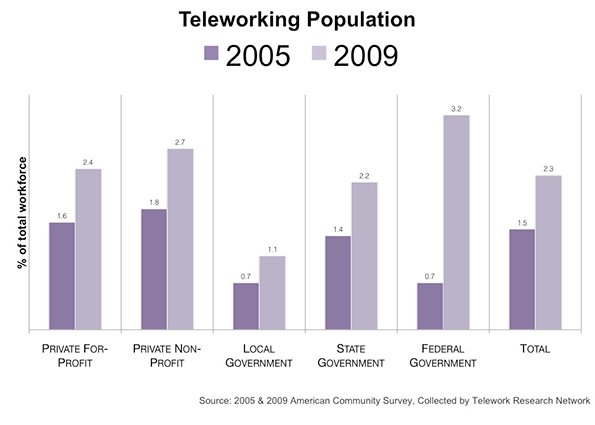
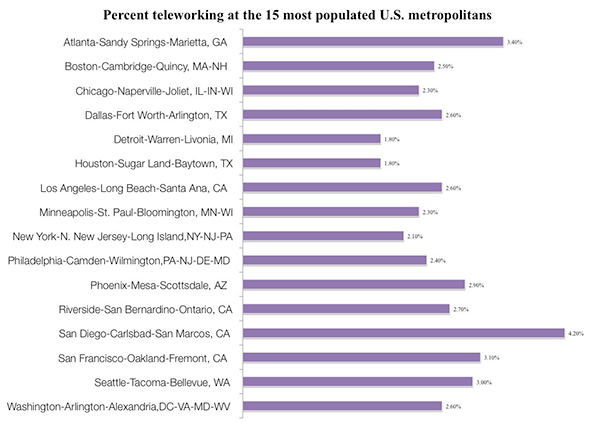
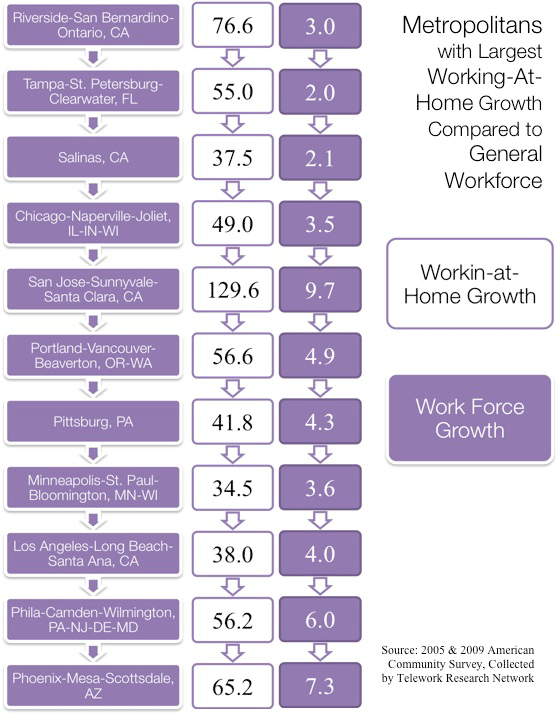
    In the United States, telecommuting is   on the clear increase.  Data from the American Community Survey estimate that the working at home population grew 61% between 2005 and 2009. The biggest increases in teleworking population compared to workforce was in Riverside-San Bernardino-Ontario, CA while the metro with the highest growth in teleworking was San Jose-Sunnyvale-Santa Clara, CA.


    Is the trend to telecommuting comparable between the private and public sectors? The 2009 American Community Survey gives a snapshot of the work-at-home population by class of worker in the years 2005 and 2009. Although the rise of teleworkers is across both sectors, a surge in government teleworkers indicates the public sector, notably the federal government, has made a huge effort keep staff at home to cut administrative costs.

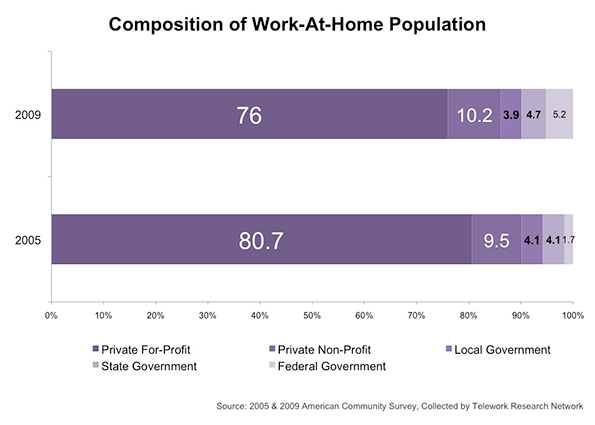
    After the federal government, the next largest increase in ratio of teleworkers is at the state level. Municipal government teleworkers showed the most modest growth and represent only 3.9% among those working at home. Though only 2.4% of private for-profit sector employees consider themselves teleworkers, by size alone they represent about three-fourths of the working-at-home population.

    Still, understanding of telework remains incomplete.   First, as President Obama’s Council of Economic Advisors stated in 2010, there remains a persistent “lack of data on the prevalence of workplace flexibility and arrangements which makes policy-making more difficult.” There are often ambiguities such as the issue of how to distinguish between part-time and full-time teleworkers. One also must separate paid work telework (such as an official flex-time work arrangement) from non-paid telework (such as a teacher grading papers at home during the weekend).   Telework’s definition is so broad that perceptions   can vary dramatically.

    New research attempts to bring clarity into whether employers should allow their employees to have a work-at-home option. Results from a recent study at Stanford partnered with Ctrip, an online travel-booking agency based in China, presented strong evidence to support the causal relationship between telework and productivity. With a turnover rate among Ctrip call center representatives hovering at around 50% per year (typical of the industry in China), retaining workers was a core objective of the experiment. Estimates by management say the typical costs of hiring and training a new representative is $2000, approximately 6 months of salary for an average employee.

    Despite initial doubt, the research provides stark insight on efficiency gains from telecommuting gains. An article from Slate summarizes the findings:

    Over the duration of the experiment, home workers answered 15 percent more calls, partly because each hour was 4 percent more productive, and partly because home office employees spent 11 percent more time answering phone calls. (Home workers took fewer breaks and sick days, rarely arrived late to their desks, and had fewer distractions.) … distractions of home life had no impact on the quality of service: The home-work group converted phone calls into sales at exactly the same rate as those in the office. And employees themselves liked the arrangement better… [and] reported less “work exhaustion,” a more positive attitude towards their jobs, and were nearly 50 percent less likely to say they were planning to quit at the end of the eight months.

    In the long run, telecommuting could generate massive changes in urban geography. As benefits of telework manifest in new research, city planners ought to observe how its impact on the geography of American cities.

    Teleworkers are more likely than not to live in the suburbs. Since teleworkers are often required to be tech-savvy with the latest mobile devices, one could expect a disproportionately high percentage of them working in hi-tech industries in sprawled tech hubs like the Silicon Valley. Most teleworkers choose to commute for a very practical reason: it would save them time and money. According to research by Kate Lister and Tom Harnish of the Telework Research Network, aside from housing preference the typical teleworker is a 49-year-old, college-educated, salaried, non-union employee in a management or professional role, earning $58,000 a year at a company with more than 100 employees. As of 2009, 76% of the total working-at-home population consists of the for-profit workers.

    Some industries will stay clustered around the city center but more jobs, especially service-oriented ones, will continue to migrate towards the suburbs.  

    Teleworking will increase the total amount of hours Americans work annually. Americans, infamous for overwork, can easily translate telework as “more work.” Data from the United Nations reports 86% of American males and 67% of American females working more than 40 hours a week. While technology has often been accused as a job-killer, it has also made jobs easier and, in some ways, more social. Employers using Cloud technology are utilizing personalized social networks in hopes of creating a more connected community in the work place. The point at which work begins and leisure ends is becoming increasingly hard to distinguish as hours spent “on the job” are elusive, and thus harder to limit.

    For urban planners, this signals new types of urban development to provide for a population of Americans that work longer hours but do so closer to home.  Food and retail establishments will be one of the first to address this trend. Coffee shops with Wi-Fi and casual dining franchises like Panera and Corner Bakery will become commonplace in middle-to-upper class suburban neighborhoods.

    These general locales could generate a privatized version of the Third Place, a milieu distinct from the two usual social environments of home and the workplace. Other urban innovations to anticipate include co-working offices, such as those offered by BLANKSPACES, and pay-as-you-go meeting services, like Liquidspace.

    The availability of affordable mobile technology has been the main contributor to the "any time, any place" lifestyle. Still, the trend is limited to a small percentage of American workers, mainly those that tend to work in service-oriented positions and, as the numbers in Silicon Valley suggest, in the service sector. As more interest and funding is directed towards nanotechnology and cloud networking, perhaps this lifestyle will propagate to become the new normal. If so, telework may someday be just a common way that people work that may change forever the urban landscape.

    Jeff Khau graduated from Chapman University with a degree in business entrepreneurship. Currently, he resides in Los Angeles where he is pursing his dual-masters in urban planning and public policy at the University of Southern California.

    Office or home signpost photo by Bigstock.

  • The Answer Is Urban Consolidation – What Was The Question?

    The New Zealand Green Party is perpetuating the claim that development beyond Auckland’s “city limits” imposes a high cost on ratepayers.  A spokesperson claims that the current Auckland plan, which allows for some new development outside the current urban area, “will cost ratepayers $42b billion to 2042, an annual levy of $200 per ratepayer” according to a report in the New Zealand Herald.   

    But is just so happens that study on which these calculations are based is a flawed commissioned report[1] rather than a peer reviewed academic study. 

    Oops – Contradictory Claims
    The authors of the Curtin report acknowledged at the outset that

    "The challenge …  is that infrastructure costs are so heavily dependent on area-specific values.  For instance, road costs among different prospective development areas may vary based on the necessity for major arterial roads, costs for sewerage and water infrastructure could vary immensely depending on terrain and trenching conditions, and many infrastructure components will differ depending on the level and degree of excess capacity” (p.4)

    So why did they try to develop a generic tool for estimating the cost of urban development in Australiancities based on a mishmash of evidence from different cities and suburbs in Australia and the United States?  And why would anyone even contemplate applying such “findings” to Auckland with its distinctive physical geography, so different from its Australian counterparts? 

    A Quick Critique
    The Productivity Commission actually considered the study, among others, in a brief review of housing costs and urban form (Appendix B of the final report).  It noted substantive differences in the physical and social settings behind the data assembled to support the study’s claim to some sort of universal cost relationship between development and distance from the city centre.

    And there are glaring methodological deficiencies:

    An obvious one is mixing discount rates (zero for infrastructure capital costs, 7% for transport-related costs, and 3% for health and emission costs), and omitting operating costs for some items (non-transport infrastructure) and not others (pp. 295-296)

    To these flaws can added the assumption of a cost of Aus$170/tonne for carbon emissions when the carbon floor price set by the Australian government (of $15) has since been rescinded and figures at or below $10.00 may be more appropriate based on today’s European prices.  So the environmental argument is seriously overstated.

    And the analysis fails to deal with the costs of expanding the capacity of ageing infrastructure in long-established urban areas, of remediating services designed for far lower loadings than they are now expected to sustain, of the health impacts of apartment living in an increasingly brown – not green – environment, and of reductions in the physical and social resilience of high density and often congested urban areas in the face of possible natural disasters or infrastructure failures.

    Penalizing the Household – is that Socially Sustainable, or Politically Justified? 
    Even if it can be proven that the balance of public benefits favours medium or high density living, is there any evidence that such savings will not be offset by the better affordability of traditional suburban housing and the benefits residents derive from living into it?

    Putting aside the flawed data and methodology for the moment, the results indicate that 70% of the differences in costs between decentralized and central locations is attributable to travel and transport.  Over half of these comprise travel costs and time carried by households.  If we take these private costs out of the equation the authors’ estimate of the difference between centralized and decentralized development falls by 40%.  

    The resulting "present cost" for the average household (whatever that might be) of A$22,000 is easily  justified by savings on land and housing in “outer” areas, the benefits households get  from  additional space, greater choice over housing style, and the security and community benefits of suburban environments.

    So who pays if we deny people the choice of living in medium to low density housing?  It’s new households due to exclusion from household ownership, or commitment to punitive mortgages, or through the insidious extension of housing poverty through ever higher income brackets. 

    So what about the Auckland case: where does the evidence really lie?
    Surprisingly, given the obstinacy of the planners and politicians pushing the consolidation barrow, no-one has actually done the analysis required to determine the relative economic benefits of different urban development paths for Auckland.  

    A technical analysis of the gaps in the Auckland Regional Growth Strategy made the point that the planning model that informed it was hardly up to the task.  The principal conclusion that came from using the Regional Councils land use and transport model was that there is “little [identified] economic difference between growth options”.[2]  

    The failure of the model to demonstrate economic differences between alternative urban forms was used to suggest that intensification imposes no additional costs than traditional decentralized development.  Of course, the converse is true – although it has been conveniently ignored – there were no demonstrable economic benefits from consolidation or net cost penalties to decentralization.  This suggests that it would make most sense to let the market prevail, subject to broad environmental standards and fiscal constraints.   

    The conclusion  that consolidation was the best option for Auckland ignores other shortcomings  in the  model that could  tip the balance  in favour of strategic decentralisation:

    • The failure to actually define realistic alternatives that would  clearly demonstrate economic differences;
    • A failure to the marginal rather than average impacts of differences in urban form;
    • Ambiguous measurement (both omissions and double counting);
    • The failure to identify the costs of implementation.

    To this list we can add underestimation of the high infrastructure and development costs associated with brownfield development and urban consolidation.  These are turning up today in high financial and development contributions for inner city projects.

    Calling for Consolidation – a Case of Artificial Intelligence
    So why is the Auckland Spatial Plan so fixated on consolidation –despite the begrudging lip service the final version pays to decentralization (and even that appears to have  upset so upsets the Green spokesperson)?

    I can only think it is "artificial intelligence": if enough people say the same thing, it must be right.  Consensus becomes an excuse for lack of evidence, critical analysis, or even common sense.  Groupthink prevails: a phenomenon defined by psychologist Irving Janis as:
    A mode of thinking that people engage in when they are deeply involved in a cohesive in-group, when the members’ strivings for unanimity override their motivation to realistically appraise alternative courses of action [3]

    Contrary evidence is dismissed while reports favouring an emerging consensus, such as the Curtin one, obtain a degree of currency which, while unjustified,  plays into the hands of policy makers looking for easy (or ideologically comfortable) answers to difficult problems.

    And so we blunder on, potentially building our cities on myth and misconception and reinforcing the gap between generations as we do it.

    Phil McDermott is a Director of CityScope Consultants in Auckland, New Zealand, and Adjunct Professor of Regional and Urban Development at Auckland University of Technology.  He works in urban, economic and transport development throughout New Zealand and in Australia, Asia, and the Pacific.  He was formerly Head of the School of Resource and Environmental Planning at Massey University and General Manager of the Centre for Asia Pacific Aviation in Sydney. This piece originally appeared at is blog: Cities Matter.

    Aukland harbour photo by Bigstockphoto.com.


    [1]         Roman Trubka, Peter Newman and Darren Bilsborough  (2008) Assessing the Costs of Alternative Development Paths in Australian Cities, Curtin University Sustainability Policy Institute, Fremantle, Report commissioned by Parsons Brinckerhoff Australia
    [2]         McDermott Fairgray Ltd (1999) Gap Analysis, Review and Recommendations: Auckland Regional Growth Strategy, Technical Report, Auckland Regional Growth Forum

    [3]        Janis, I L (1972). Victims of Groupthink Houghton Mifflin p.  9

  • How Marketing Could Boost Land Development

    Zoning ordinances, land use maps and comprehensive plans used by cities to guide growth rarely provide the kind of insight required to make informed decisions about what will truly be best for the city and its residents in the long run. Unfortunately, by failing to incorporate market analysis and financial modeling in the beginning stages of the planning process, too many cities find themselves facing the results of misallocated resources and fiscal difficulties that could have been easily prevented.

    For the past 22 years I have been involved in the market analysis of land development from the private developer’s perspective. The public sector could benefit greatly from utilizing the same sort of informed decision making tools currently used by much of the private land development industry.

    Comments from urban planners and city officials seem to indicate that it is rare for city officials to actually consider market data in their decision making on issues such as transportation thoroughfares, land-use determination, building code changes, and comprehensive city planning.

    As the owner’s representative, or as a market consultant in numerous design charrettes for master planned communities and urban infill projects, I’ve often observed an air of tension between those oriented toward design (urban planners and architects), and those who believed good design pays for itself through the value it creates for the end-user (the property owner and/or property developer).
    In all of the situations where this tension was detected, no one considered including someone in the process to relay market information to the designers who were attempting to provide a product. Using readily available market data and a flexible, accurate financial model, input could have been given to the design consultants so that they could focus on land uses and products that would truly serve the local market, and to assure the success of the project.

    It’s difficult to design profitable private development projects in a vacuum. The same principle applies to cities. The proper planning of cities — plans that meet the needs of both present and future inhabitants in a fiscally responsible manner — cannot be done properly without considering the needs of the market, and the impact that serving those needs will have on the fiscal health of the city.

    Typically, land uses are based upon residents’ comments, the planning commission and/or council vision, and the planning consultant or staff leading the meetings. All of these suggestions stem more from emotion, or from the ease of finding a boiler-plate solution, than from an analysis of what the market wants or needs. Using market data, city leaders could be provided with reasonable projections concerning the near-term and long-term demand for different types of uses for property within their communities.

    This projected data could then be compared to the existing supply and quality of these property types, and a reasonable projection for demand could be provided to the community. Community leaders could then decide how to proceed, based upon the values of the community. Once the initial decision was made, a framework could be put into place to evaluate future decisions on zoning, transportation, and infrastructure improvements.

    However, this process would only address current and future levels of demand. The real issue is the likelihood of whether or not the projected demand will actually be met. This is where financial modeling techniques very similar to those created for large-scale development can be modified for use by the city.

    In projecting future results, the trick is to not get caught up in trying to be exactly right. It’s not necessary, and any attempt to be exactly “right” leads to what I refer to as a deceptive level of precision, since you can’t possibly know exactly what is going to happen anyway. Using projected demand, market pricing and cost estimates, though, a model can be developed that can test the reasonableness of municipal policies and plans. Examples?

    • A market study performed for a rapidly growing city reveals that affordable housing will be an even greater issue in the near future than it is currently, but the local school district needs additional funding. A per-lot impact fee to pay for new school construction seems like a reasonable idea, until the financial model proves that it will eliminate all hope of affordable housing being constructed.

    • Street ordinances written long ago were originally intended to allow two fire trucks to pass each other while going in opposite directions. Even though the premise has now been proven to be absurd (how often are fire trucks assigned to different fires on the same street!), and, even though the rules produce large, ugly residential streets, the rules are not changed for years…until the long-term cost of maintaining those streets is accounted for in the city financial model. Once the high cost of the future maintenance and repair of the oversized streets is quantified and then compared to their “benefits,” the street ordinance is immediately amended.

    • The opportunity to acquire water rights presents itself, with significant upfront costs involved. City leaders are understandably concerned, even though there will be long-term revenues from water sales. But the city market data and financial model indicates that the real benefit to the city is tax revenue generated as a result of having a stable, diverse source of potable water. After considering both the direct and indirect benefits of acquiring the water, the city decides to make the purchase. And the analysis of the economic benefits proved invaluable in selling the bond program to the voters in order to build the required infrastructure to utilize the water rights.

    Consideration of market demand — and the intersection of that demand with public policy decisions — should be an integral part of the decision making process for the public sector. When used to provide input for financial projections, it can be an invaluable tool in land use planning for communities.

    Skip Preble, MAI, CCIM is a real estate analyst and land development consultant specializing in market analysis, feasibility studies, project value optimization and market value opinions. He can be reached through his website at landanlytics.com

    Flickr Photo by Toban Black: Prime Development Site, Oshawa, Ontario.

  • Let L.A. Be L.A.

    Victor’s Restaurant, a nondescript coffee shop on a Hollywood side street, seems an odd place to meet for a movement challenging many of Los Angeles’s most powerful, well-heeled forces. Yet amid the uniformed service workers, budding actors, and retirees enjoying coffee and French toast, unlikely revolutionaries plot the next major battle over the city’s future. Driving their rebellion is a proposal from the L.A. planning department that would allow greater density in the heart of Hollywood, a scruffy district that includes swaths of classic California bungalows and charming 1930s-era garden apartments. The proposal—which calls for residential towers of 50 stories or more along Hollywood Boulevard, where no building currently tops 20 stories—has been approved unanimously by the city council and will now probably be challenged in court.

    That proposal isn’t the only densification plan making its way through city hall. Another is a “wholesale revision” of L.A.’s planning code that would strip single-family districts of their present status and approve the construction of rental units in backyards and of high-density housing close to what are now quiet residential neighborhoods. “We are going to remake what the city looks like,” Mayor Antonio Villaraigosa told the New York Times in March. Richard Abrams, a 40-year Hollywood resident and a leader of SaveHollywood.Org, puts it differently: “They want to turn this into something like East Germany. This is all part of an attempt to worsen the quality of life—to leave us without backyards and with monumental traffic.” The rebels gathered at Victor’s note that many of the density scheme’s most tenacious advocates, such as councilman and mayoral aspirant Eric Garcetti, live in leafy residential areas removed from the traffic nightmare that the new development would bring.

    Despite public outcry, Los Angeles’s political, labor, and real-estate elites almost unanimously support what Villaraigosa calls “elegant density,” pushing for the transformation of the city’s low-rise, multipolar, and moderate urban form into something more like vertical, transit-oriented New York. Dissenters from this view are often called “antiurban.” But to activists like Susan Swan, who leads the Hollywood Neighborhood Council, it’s really about letting L.A. remain L.A. As she notes, New York and Los Angeles have evolved in radically different ways. New York, particularly its urban core, was built largely before the automobile age. Manhattan and the surrounding boroughs are transit-dependent: 56 percent of commuters take public transportation. By contrast, L.A. remains overwhelmingly car-oriented, with only 11 percent of commuters using public transit, despite the $8 billion invested in rail lines over the past two decades. Los Angeles’s downtown is nowhere near as important as New York’s; just over 2 percent of L.A. metropolitan-area employment is downtown, compared with about 20 percent in greater New York. Instead of revolving around one mega-center, L.A. boasts commercial centers in each of its major neighborhoods, many of which are close to single-family homes and low-rise apartments.

    This dispersion creates an aesthetic rarely appreciated by density boosters, enabling residents to enjoy fully L.A.’s unique ambience—its superb Mediterranean climate, lush foliage, tall trees, and, most of all, magnificent light. Even when you walk down Hollywood Boulevard, what’s most striking is not the skyline but the steep hills, framed by palms, rising toward a clear blue sky. For a glimpse of the Hollywood imagined by Villaraigosa and his confederates, take a look at the much-reviled Hollywood and Highland Center, home of the Dolby Theatre, which hosts the Academy Awards. Instead of brilliant light and blue sky, visitors confront a boxy hulk that obscures the hillside views.

    Swan and other activists deny that opposing mass densification is synonymous with opposing development. With many nearly abandoned blocks and downscale businesses around its core, Hollywood certainly could use a face-lift. But local community activists want development to be congruent with the area’s architectural traditions. “There is real dismay in our community that the opportunity to make Hollywood a world-class destination is slipping away to these ‘Manhattanization’ fantasies,” says Swan, a retired bookbinder. “We have always said that we love Manhattan—in New York.”

    Demographics also make a mockery of the densification argument. With the exception of downtown, most of the central parts of Los Angeles have either stagnated or lost population over the last 20 years. Hollywood, for example, shrank from 213,000 residents in 1990 to 198,000 today. Within the last decade, Los Angeles County’s growth slowed to barely 3 percent—roughly one-fifth the rate that it enjoyed during the go-go 1980s, a period of extraordinary prosperity in the region. Yet Garcetti, Villaraigosa, and their allies continue to base their grands projets, as the French would call them, on outmoded assumptions of exploding economic and population growth. Particularly revealing is the experience of the Residences at W Hollywood, a luxury-condo project located a stone’s throw from the proposed new high-rise towers in Hollywood. According to recent reports, only 29 out of 143 units have sold since the project opened in May 2010, despite prices that have been slashed by more than half. The market, in short, is unwilling to embrace density here, “elegant” or otherwise.

    Yet the city keeps planning big, as though hordes of the well-heeled were eager to move to L.A. It has offered massive subsidies, accounting for nearly $640 million in tax breaks, to three hotel projects. Public bonds are also underwriting expansion of L.A.’s convention center and a new football stadium, which received unheard-of exemptions from state and local environmental laws even though the city currently has no football team. “Everything we are doing, like the mass build-out of transit and density, provides an excuse for creating things people don’t want,” says Cary Brazeman, founder and president of L.A. Neighbors, a citywide alliance of neighborhoods, and a candidate for city controller in 2013. “To build this city back, you have to approach things in ways that enhance the gloriousness of L.A. Sunshine, it’s transcendental. You take away the sun, hell, I’m leaving my condo.”

    Without backing from rent-seekers or unions, Brazeman’s campaign runs on a shoestring. His better-funded opponent, former police officer Dennis Zine, epitomizes L.A.’s dysfunctional political system, drawing both his generous police pension and a city council salary of $178,000, the highest in the nation. Though he represents a largely residential area in the San Fernando Valley, Zine has proved a reliable vote for the elaborate “incentives” that encourage large, often uneconomic, building and ever-greater spending on transit projects. A more serious challenge to the existing order could come from Zev Yaroslavsky, a member of the Los Angeles County Board of Supervisors. Yaroslavsky hasn’t declared his candidacy for mayor yet, but he is known to be skeptical of the proposed remake of L.A. The question is whether he’s too comfortable with the status quo to take on the “elegant density” agenda.

    For now, the best hope for Los Angeles resides with the activists who meet at Victor’s. They may not scare the political incumbents or the real-estate developers, but they do represent a motivated opposition to the effort to recast the city. “Los Angeles started because people want to live here,” Abrams says. “We are not a cut-rate New York and don’t want to be. The developers and the politicians want to take away all that makes us unique and get rid of us tomorrow. It won’t be so easy.”

    Joel Kotkin is executive editor of NewGeography.com and is a distinguished presidential fellow in urban futures at Chapman University, and contributing editor to the City Journal in New York. He is author of The City: A Global History. His newest book is The Next Hundred Million: America in 2050, released in February, 2010.

    This piece originally appeared in The City Journal.

  • America’s Future Is Taking Shape In The Suburbs

    For nearly a generation, pundits, academics and journalists have written off suburbia. They predict that the future lies in the cities, with more Americans living in smaller spaces such as the micro-apartments of 300 square feet or less that New York and San Francisco are considering changing their building laws to allow. Even traditionally spread out cities, such as Los Angeles, are laying out plans to create greater population density, threatening the continued existence of some neighborhoods of single-family homes.

    Yet wishing something dead does not make it so. Indeed, the suburbanization of America is likely to continue over the next decade. The 2010 Census — by far the most accurate recent accounting — showed that over 90% of all metropolitan growth over the past decade took place in the suburbs.

    Some central cities, notably New York, enjoyed decent population growth, but their increases were still below the national average. The Joint Center for Housing at Harvard notes that, only five metro areas —Boston, San Diego, San Jose, Calif., and the Florida cities of Cape Coral and Palm Bay — saw an increase in the share of households living in core cities relative to their suburbs and exurbs.

    To be sure, the Great Recession slowed the growth of suburbs, as many Americans lost the ability to achieve their dream of owning a single-family house. “Back to the city” advocates have seized on Census estimates for the past year that suggested that urban core growth has actually been a tad faster than that of suburbs.

    However, the Census Bureau numbers may be less accurate, and certainly less predictive, than many suggest. University of Pittsburgh urban analyst Chris Briem points out that in the last decade, some Census Bureau city estimates turned out to be vastly exaggerated compared to the actual 2010 Census. This was particularly true in Chicago and New York, where constant lobbying by city officials — after all, federal aid is distributed based on population estimates — meant that optimistic urban estimates turned out to be hundreds of thousands of people off.

    More amazing still, the Census Bureau essentially assumed that growth was even in all municipalities in a county. This bizarre practice projects that growth, say, in the city of Los Angeles, is equal to that of newer communities like Santa Clarita, or that suburbs of Alleghany County grew at the same rate as the city of Pittsburgh. This surely can’t be the case.

    Reporters concentrated in Manhattan and the District of Columbia didn’t look seriously at these numbers. They repeated the assumption that this was the result of mass migration, particularly among the young, out of suburbs and into cities.

    Yet in reality, there was no evidence of that trend. In fact, the Census Bureau’s core county estimates (which are demonstrably more accurate than the municipal estimates) showed a slight core county loss in domestic migration over the past year. The real story of the estimates has to do with the recession, which has led to record-low levels of mobility. Inter-county migration has fallen almost half from its 2006 level. Essentially, a historically weak economy has boosted the city share of population growth.

    So what can we expect in the future? Some cities will grow, but the vast majority of metropolitan growth will continue to take place in what are still car-dominated suburbs like areas areas. This can occur only the economy again get on a full-fledged growth cycle. Here some basic reasons not to write off suburbia.

    Inter-Regional Growth Patterns

    All 15 of the fastest-growing metropolitan areas of the past decade — led by places like Las Vegas, Raleigh, Phoenix, Houston and Dallas-Fort Worth — are sprawling and have low-density cores. Metropolitan areas with far denser cores, such as New York, Boston, Chicago, and San Francisco, tended to display below-average growth.

    These fast-growing cities tend to be suburban in form, dominated by single-family homes, automobile commuters and with dispersed economic centers. The growing central cities of Phoenix or Houston look more like places such as Long Island or Santa Clara than Manhattan or Chicago.

    Economic Shifts

    Many urban boosters cite a Santa Fe Institute study claiming that density creates productivity and economic growth. However, the study clearly dissociated itself from this argument, claiming that it did not matter if a region was shaped like Los Angeles, Atlanta or Houston, or New York or Boston. The source of productivity lay simply in a growing metropolitan population, the authors claimed.

    Overall, it’s questionable whether city economies perform better over time than the suburbs. Indeed, over the last decade, 81 percent of the population growth of core cities was among the poor, compared to 32 percent in suburbs. Poverty anywhere is a bad thing, but the claim, made repeatedly by some pundits that it is worsening more in suburbs turns out to be, well, just another urban legend. Overall poverty accounts for nearly one in four urban residents, twice the rate for suburbs.

    Energy Costs

    Ever since the energy crisis of the 1970s, pundits have predicted suburbanites would be forced to give up their cars. But higher energy prices have not slowed the suburban trend. With the current growth in new energy finds both here and abroad, the much heralded dawn of “peak oil” appears to be about as imminent as a balanced federal budget.

    Some terrified urbanists, like Bruce Fisher, director of the Center for Economic and Policy Studies at Buffalo State College, fear the new oil rush means “suburban real estate development will once again enjoy a comparative advantage over center city development.” In what some see as a catastrophe for both planet and urbanity, the car will remain dominant for the foreseeable future, despite three decades of massive spending on new transit systems across the country.

    Demographic Trends

    The advocates of a dense urban future usually point to demographics. Yet the formerly fashionable theory that retiring boomers would head en masse to cities turned out to be largely false. The last census showed the vast majority of aging boomers remained in the suburbs or moved further out into the periphery. “Back to the country” actually far outweighed “back to the city” in terms of boomer migration.

    Then there’s the other large generation of Americans, millennials, who are said to prefer an urban lifestyle. Yet surveys of millennials show a strong, often even more marked, preference for homeownership and suburban living than their parents.

    This will prove critical as many now urban millennials begin to enter their 30s and 40s over the next decade. Once they marry and start to have families, they will emerge, as the Harvard housing study notes as “the primary driver of new household formations over the next two decades.” Along with the other powerful force, immigrants, most seem likely to end up in suburban locales, if they can.

    Preferences Matter

    This does not counteract the fact that many young people will chose to settle in dense urban areas for their 20s and early 30s. Some urban cores, notably New York, Boston and San Francisco, will likely grow and get denser. But most others will see only modest, often fitful growth; despite massive public investment, for example, downtown Los Angeles, according to Zillow.com, has foreclosure rates worse than virtually anywhere else in the region.

    Preferences are the key here, particularly paying attention to what people want as they age. The 2011 Community Preference Survey, commissioned jointly by the National Association of Realtors and Smart Growth America, found that only a small minority — less than 10 percent — favored a dense urban location. Some 80 percent expressed preference for a single-family home.

    Over time, in a market-based economy, consumer preferences matter far more than those of pundits, professors or, for that matter, rent-seeking real estate developers. The only things that can kill off future suburban development would be forced densification by government edict or a continued miserable economy that entraps millions of the unwilling in dense urban areas.

    Joel Kotkin is executive editor of NewGeography.com and is a distinguished presidential fellow in urban futures at Chapman University, and contributing editor to the City Journal in New York. He is author of The City: A Global History. His newest book is The Next Hundred Million: America in 2050, released in February, 2010.

    This piece originally appeared in Forbes.

    Suburbs photo courtesy of BigStockPhoto.com.