Category: housing

  • New Jersey: Still Suburbanizing

    The state of New Jersey virtually defines suburbanization in the United States.  New Jersey is not home to the core of any major metropolitan area but, major portions of the nation’s largest metropolitan area (New York) and the fifth largest metropolitan area (Philadelphia) are in the state (See map). These two metropolitan areas comprise 17 of the state’s 21 counties. Another county (Warren) is in the Allentown, Pennsylvania metropolitan area, while Atlantic (Atlantic City), Cumberland and Cape May are single-county metropolitan areas. No one, however, should make the mistake of imagining that New Jersey is wall to wall suburbanization. In the 2000 census, more than 60 percent of the state’s land area was rural, with urban areas (areas of continuous urban development) making up less than 40 percent of the state’s land area, while 94 percent of the 2000 population was urban (which includes suburban).
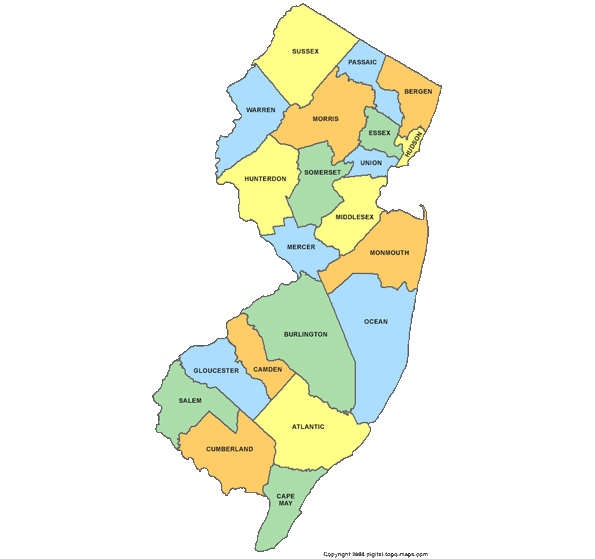
    Map courtesy of Passaic Public Library

    The recently released 2010 census data indicates that the dispersion of New Jersey population, which was underway by 1900 and continued apace in the last decade.

    New Jersey’s Larger Municipalities: This is not to suggest that it was a bad decade for the larger municipalities in the state. However, the 20th century was not kind to New Jersey’s largest municipalities. At some point during the century, six municipalities reached a population of 100,000 or more. Four of these municipalities were near the city of New York and were eventually engulfed by its suburbanization (Newark, Jersey City, Paterson and Elizabeth). Another, Camden, was engulfed by Philadelphia’s expansion and the last, the state capital Trenton, is midway between the cores of the two metropolitan areas and has more recently become a part of the New York metropolitan area.

    The new decade started out better for these municipalities. Newark, Jersey City, Elizabeth and Camden gained population between 2000 and 2010. However, even after the population gains, Newark’s population remains 165,000 (37 percent) below its 1930 peak. Jersey City remains 70,000 (22 percent) below its 1930 peak, despite the growth of a new financial district just across the Hudson River from lower Manhattan. Camden remains approximately 35,000 (37 percent) below its 1950 peak. Of the four municipalities gaining population, Camden did the best, adding 6.9 percent to its population, a full 50 percent above the statewide increase of 4.5 percent.

    Paterson and Trenton posted small population losses. Trenton remains nearly 45,000 (33 percent) below its 1950 peak (Table 1).

    Table 1
    New Jersey Municipalities Achieving 100,000 Population
    Census Population Peak
    Municipality 2000 2010 Change % Change Population Year
    Newark      273,946    277,140       3,194 1.2%     442,337 1930
    Jersey City      240,055    247,597       7,542 3.1%     316,715 1930
    Paterson      149,222    146,199      (3,023) -2.0%     149,227 2000
    Elizabeth      120,568    124,969       4,401 3.7%     124,969 2010
    Trenton        85,403      84,913         (490) -0.6%     128,009 1950
    Camden        78,672      84,136       5,464 6.9%     124,555 1950
    Total      947,866    964,954     17,088 1.8%   1,285,812
    Balance of State   7,466,484  7,826,940    360,456 4.8%
    New Jersey   8,414,350  8,791,894    377,544 4.5%   8,791,894 2010


    Elizabeth and Paterson however have been far more successful in retaining their population than other older municipalities, both in New Jersey and around the nation. Both Elizabeth and Paterson have become majority Hispanic and have a sizeable African American community. They also have a large immigrant community.  In Elizabeth, 45 percent of the population is foreign born, almost four times the national rate. Paterson has an immigrant population of 25 percent.  

    The Older Suburban Counties: Nonetheless, even with the modest population reversals in four of the five municipalities in the Philadelphia and New York metropolitan areas, their corresponding older suburban counties grew slower than the rest of the state in the 2000s. Combined, Camden, Essex, Hudson, Passaic and Union counties – fast growing suburbs of the early 1900s – grew at a rate of 1.6 percent, compared to the statewide growth rate of 4.5 percent, capturing 12 percent of the statewide growth.  (Table 2).

    Table 2
    New Jersey County Population Growth by Area
    Area 2000 2010 Change % Change Share of Growth
    5 Older Suburban Counties  2,923,130  2,969,617    46,487 1.6% 12.3%
    Balance of NY & Phila Metropolitan Counties  4,887,467  5,184,873  297,406 6.1% 78.8%
    Outside NY & Phila Metropolitan Area     603,753     637,404    33,651 5.6% 8.9%
    Total  8,414,350  8,791,894  377,544 4.5% 100.0%
    Note: 5 Older Suburban Counties Include Camden, Essex, Hudson, Passaic and Union


    The Newer Suburban Counties: The bulk of New Jersey’s growth has taken place, as in the rest of the country, in more newly suburbanizing counties of the Philadelphia and New York metropolitan areas (Note 1). The growth rate in these counties was 6.0 percent, well above the statewide growth rate of 4.5 percent. Overall, the outer suburban counties accounted for 73 percent of the state’s population growth during the 2000s. The strongest growth was in Ocean County, which is at the furthest distance (fifty to one hundred miles) from New York City.  Ocean County grew 13 percent, adding 66,000 people to its population, nearly one-fifth of the state population gain. Gloucester County, in the Philadelphia area also grew 13 percent, adding 33,000 to its population. Ocean and Gloucester accounted for more than one-quarter of New Jersey’s population growth. Only one other county added more than 50,000 people, Middlesex, which is adjacent to the New York City borough of Staten Island in New York, much of which is made up of postwar suburbanization.

    Counties Outside the Large Metropolitan Areas: The counties outside the New York and Philadelphia metropolitan area, Atlantic, Cape May, Cumberland and Warren added 5.6 percent to their population and nine percent of the state’s population gain. The largest growth was in Atlantic County (8.7 percent) and Cumberland County (6.1 percent), both adjacent to counties of the Philadelphia metropolitan area. Cape May County had the largest population loss in the state, at 4.9 percent (Essex County, where Newark is located, lost 1.2 percent, the only other county to lose population).

    Small Area Analysis: The dispersion of the population is also illustrated by "place" data, which includes incorporated municipalities (Note 2) and "census designated places."

    Generally, newer housing reflects the distance of suburbs from the urban core. Gaining a larger share of population growth, this demonstrates a primarily  suburban, rather than urban core oriented, expansion.  An analysis of the more than 500 places (municipalities and "census designated places") indicates that the greatest share of New Jersey’s growth is in new suburban areas.

    Among places in which housing has a median construction date of 1945 or earlier, there was a 0.8 percent reduction in population. The growth rate then rises with each 10 year increment, reaching 4.0 percent in places with a median construction date of 1976 to 1985 and 11.1 percent for places with a median construction date of later (though this is the smallest category).
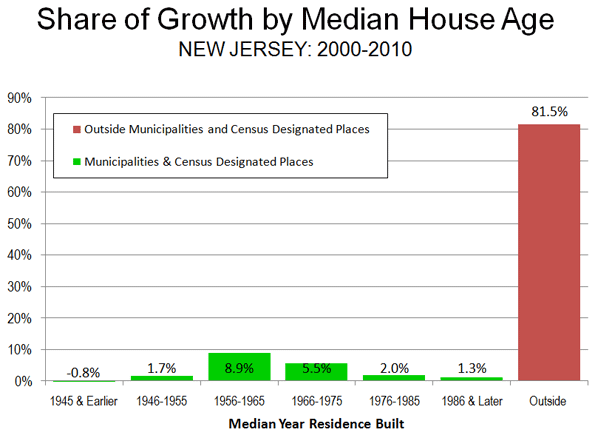
    However, the growth in these places accounts for only 18.5 percent of the state’s population gain. The other 81.5 percent was outside the incorporated municipalities and the census designated places. This population is generally in the state’s townships, some of which are older (such as North Bergen or Woodbridge), but most of which are much newer.  However, much of the growth in the townships was in newer areas, with 84 percent in areas with median construction dates of 1966 or later (Note 3)

    Thus, all-metropolitan New Jersey is becoming more suburban, while older, major municipalities such as Newark, Jersey City and Camden are enjoying a welcome respite from their generally steep declines.

    Note 1: These counties include Bergen, Burlington, Cumberland, Hunterdon, Mercer, Middlesex, Monmouth, Morris, Ocean, Salem, Somerset and Sussex.

    Note 2: New Jersey township officials have been engaged with the Census Bureau in a dispute over whether New Jersey townships should be considered incorporated. This analysis uses the "non-incorporated" status as defined by the Census Bureau, without taking a position on the nature of the disagreement.

    Note 3: The Census Bureau routinely makes changes to "census designated places" between censuses. As a result it is not possible to reconcile the township and place totals to the state total. There is a discrepancy of approximately 1.5 percent. This discrepancy is small enough to make the township figures generally reflective of the median construction dates.

    Wendell Cox is a Visiting Professor, Conservatoire National des Arts et Metiers, Paris and the author of “War on the Dream: How Anti-Sprawl Policy Threatens the Quality of Life
  • The MERS Mess

    In 1995, seeking to streamline mortgage processing, Fannie Mae, Freddie Mac, and a group of banks came together to create a new company to register and assign mortgages. The company, Mortgage Electronic Registration Systems, Inc. (MERS), served as a way for mortgage originators to quickly process new mortgages, centralizing files and cutting down on the need to deal with local government record keepers. With banks increasingly focused on bundling, securitizing, and selling off mortgages they had originated, MERS was designed to move mortgages more rapidly off their hands and into the booming mortgage-backed securities market. The goal of the process, as stated by MERS, was to simplify “the way mortgage ownership and servicing rights are originated, sold and tracked” while also eliminating “the need to prepare and record assignments when trading residential and commercial mortgage loans.”

    The business model proved wildly successful. According to the New York Times MERS now “claims to hold title to roughly half of all the home mortgages in the nation — an astonishing 60 million loans.” However, as the system boomed in an era of rampant mortgage speculation and securitization, criticism arose. Detractors, such as Professor Christopher L. Peterson of the University of Utah School of Law, argue that MERS is based on a “problematic legal doctrine,” and that by “adopting such a radical shift in how mortgages are recorded and foreclosed, without legislative change, the mortgage finance companies have rebuilt their industry on a legal foundation of sand.” According to Peterson,

    “The shift away from recording loans in the name of actual mortgagees and assignees represents an important policy change that erodes not only the tax base of local governments, but also the usefulness of the public land title information infrastructure. MERS did not, by itself, cause the mortgage finance crisis and its ensuing aftermath. But it was an important cog in the machine that churned out the millions of unsuitable, poorly underwritten, and incompletely documented mortgages that were destined for foreclosure.”

    As foreclosure rates have risen, so have legal challenges to the role of MERS in the process. Such cases have, among other issues, questioned the right of MERS to act as the “mortgagee of record,” and to initiate foreclosure proceedings. Results have been mixed. Judges in California, Massachusetts, and Kansas have ruled that MERS “has the authority to initiate home foreclosure proceedings.” MERS itself points to rulings in several other states that it claims show it stands on solid legal ground. However, courts in New York, Florida and Oregon have ruled otherwise, with multiple rulings in Oregon throwing a wrench into the foreclosure market in the state. MERS, in an apparent attempt to clear up issues of standing in foreclosure proceedings,recently began encouraging its members to stop making foreclosures in its name, and is now proposing new rules to curtail the practice.

    Some local governments are also exploring potential legal and legislative investigatory proceedings against MERS, upset at the banking industry’s use of MERS to avoid paying local recording fees for mortgages. Given the dire state of state and local budgets, and the unpopularity of the financial industry, it bears watching to see if more local governments follow their lead in an attempt to recoup a source of funding that was previously theirs. MERS and its financial industry backers appear to be girding themselves for coming legislative battles, launching “an aggressive campaign on Capitol Hill to bolster the legality of the way companies have turned mortgages into securities.” With housing markets already on shaky ground, and talk of a double dip in prices beginning to surface, the uncertain future of MERS and the mortgages it holds is yet more potentially bad news for areas struggling to recover from the housing bust.

  • Census 2010: A Texas Perspective

    If you want to get a glimpse of the future of the U.S., check out Fort Worth, TX. Never mind the cowboy boots, but you might want to practice your Spanish.

    Texas is growing explosively and much of that growth is among Latinos.   The latest Census Bureau figures show the Lone Star State grew by 20%, to over 25 million people, recording about a quarter of the nation’s overall growth. The rate of growth was twice the national average. The implications are huge politically, as Texas stands to gain 4 new Congressional seats from this expansion, and Hispanic leaders want in.

    A majority of the Hispanic growth came from births to families already living here. While migration from other states and countries contributed about 45%.  

    The Texas story stands in contrast to the Rust Belt states and the Northeast, where overall growth is minimal.   Texas’s Hispanic-fueled growth spurt out-paced the entire countries, helped brace our housing market and our economy.

    A close look at Texas growth reveals much about   American’s home-buying habits. Rural areas got smaller – few want to live in the boonies of far west Texas while it appears suburban areas won over the most transplants.

    But arguably the biggest winner was Ft. Worth, or Cow Town as we call it. Fort Worth grew by a whopping 38.6%, the largest increase in the state, followed by Laredo’s 33%, Austin at 20.4%, and San Antonio at 16%. In contrast the city of Dallas, my home, grew by a scant .8% – a bit deflating to a city all puffed up about a $354 million arts center, a downtown park and greenway, and the $185 million Perot Museum of Nature & Science underway.

    Houston remains the state’s largest metropolitan area but sustained growth of only 7.5%, though Harris County – mostly due to growth in the suburbs – grew by 20%. As in Ft. Worth and elsewhere, Hispanics have been the driver, and now comprise 41% of the Harris County population. The biggest growth took place in formerly rural towns just outside the big cities, one-shop stop farmer’s crossings or granaries.  

    Curtis Tally shakes his head at how fast little Justin, north of Fort Worth, has grown. Subdivisions sprouted up on what was once farmland around his Justin Feed Co. in southern Denton County. From 1891 residents in 2000, Justin has 3,246 today.  

    "We were selling seed for pastures; now we’re selling seeds for lawns," Tally, 74, who has been in business in Justin since 1958, told the Fort Worth Star Telegram.

    If you think that’s amazing, wait ‘till you get to Fate, Texas, 25 minutes east of Dallas on Interstate 30. Ten years ago you would have missed Fate, a town of 500 so small the utility invoicing was done on postcards if you blinked while driving. Today, Fate is the fastest-growing town in the state, with 6,357 residents – an increase of 1,179%!  Residents who live there say it’s far enough away from Dallas to be in the country, but still close to the big city. Fate draws many first time homebuyers who are starting families (home prices range from $50,000 to $300,000) Here’s what Fate resident Tina Nelson told The Dallas Morning News:

    “My kids can go ride bikes all day long and I don’t have to worry too much about where they are,” said Tina. “It’s like the 1950s (here) the sun goes down and everyone’s porch light comes on.”

    On the western side of Lake Ray Hubbard, a few minutes from Fate and slightly closer to Dallas is Sunnyvale, another fast-growing little hick town where professionals are building $2 million dollar homes on a 124 acre family ranch turned into home sites called St James Park. They send their children to a two-year old, $50 million public school with the highest ratings in the state.

    The young man building homes on the 49 two acre estate sites is Jojy Koshy of Atrium Fine Homes. At 31, Jojy holds a masters in business from the University of Texas and tells me, with pride, how his parents immigrated to the Dallas suburb of Plano in 1986 from India.

    “My parents instilled a strong work ethic in us,” he says. “I know this market is challenging, but I believe that if I work longer, harder, and keep our clients completely satisfied, we will have a great business.”  

    It’s the same story across the state. The Interstate 35 corridor between Austin and San Antonio filled in with development as the cities merged closer to becoming one big schizophrenic metropolis. The string of counties along the Rio Grande, anchored by Brownsville and McAllen have been growing, and may be beneficiaries of the crime wave south of the border.   A sharp Dallas Realtor took out an ad in the Monterrey newspaper advertising homes for sale in Dallas and snagged several buyers. Even the wife of the Monterrey mayor moved to a Dallas suburb, escaping the cartel and seeking to be closer to her family here.

    Aside from escaping death in Mexico, what is driving people to Texas? Start with our rising star, Fort Worth. The city has both a cowboy pizzazz personality and a lower crime rate than Dallas. Fort Worth’s arts district has overshadowed Dallas’s for years, and the neighborhoods offer true community – places where the kids can still walk, not be bussed, to school. Rose Bowl winner Texas Christian University is on the upswing, downtown is charmingly vibrant, and an urban renaissance is taking hold on the city’s western edge called West 7th.   

    What are people seeking in Texas? I’d call it quality of life with room for upward mobility: affordable homes with mortgage payments that leave some money for recreation, good public schools for their kids and generally less onerous tax regime.

    Yet with our many gains, Texas faces great challenges. The state has the third-highest teenage pregnancy rate in the nation, which is actually an improvement from last year, when we were number two. There are a rising number of children are living in poverty in Texas. Many of these children may be anchor babies born to illegal immigrants who cross the border to ensure their children and ultimately, themselves, citizenship. In 2006, 70% of the women who gave birth at Dallas County’s Parkland Memorial Hospital were illegal immigrants.  

    Increasingly, Latinos, illegal or not, take those babies home to the suburbs. Texas suburbs are no longer lily-white.  This is true in working class places like Bedford, Texas, outside Fort Worth, where the black population has almost doubled. In affluent Southlake, the population this decade shifted from 95 percent Anglo down to 88 percent.   Looking for a great selection of Asian food? You’ll starve (or go broke) in downtown Dallas. Go north to Carrollton, Texas where you’ll find a 78,000 square foot Super H Mart in what was once a Mervyns department store. Inside you’ll find seven types of gray, fuzzy, Chinese long, acorn, spaghetti, butternut, and kombucha squash eight food stalls said to rival any of those found in Seoul and Singapore, two cities known for their gourmet street food. Manduguk, anyone?

    The new Texans are coming here not just to live, but to dig in economically.  

    In the end, we are seeing the birth of a Texas that is neither the white bread, big hair idyll of the cultural conservatives or the free market dystopia imagined by liberals. It is becoming more diverse, without losing its capitalist energy. With all its blemishes,  the emerging Texas may well become the model for how America evolves in the coming decades.

    Candy Evans is an independent journalist based in Dallas, Texas, She covers Texas for AOL’s HousingWatch and blogs at secondshelters.com.

    Photo by Rick

  • Hong Kong Response to High Housing Prices: Expand Land Supply

    Hong Kong financial chief John Tsang has promised to expand the city’s land supply for residential housing, "in response to rising public anger over soaring property prices and repeated warnings of a looming real estate bubble." Channel News Asia’s Hong Kong bureau indicated that the move was precipitated by the "sky-high" housing cost that have been drive by insufficient land for development and speculation (which routinely is intensified where demand for housing is permitted to outstrip supply.

    Buggle Lau, chief analyst at property firm Midland Holdings told Channel News Asia that he supported the expansion of the land supply "as a way to bring down house prices," adding "It’s simple economics – lower demand and higher supply will bring prices down." Channel News Asia noted that Hong Kong had been shown to be the most unaffordable metropolitan market in the recent (7th Annual) Demographia International Housing Affordability Survey.

  • Britain’s Housing Crisis: Causes and Solutions

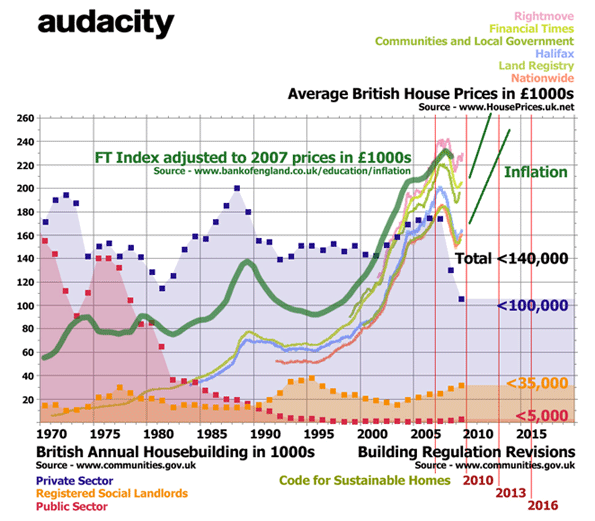
    British house construction has remained at a low level for a decade.   Total new house and flat completions for all tenures last year were 113,670 for England, 17,470 for Scotland, and 6,170 for Wales. Excluding Northern Ireland that is 137,310 for Britain. Under 140,000 homes a year is low for a nation of 60 million.

    We are nearly at the lowest level of housing production since reliable records began in the 1920s. (Note 1)  

    Anyone expecting British house building to pick up soon will be disappointed, even as the housing market inflates into another bubble. Grant Shapps,  the Coalition government’s Housing and Local Government Minister, is also hoping that house price inflation will not return to make the present housing predicament worse.  

    He will be disappointed, too. Shapps wants modest deflation and more houses to be built. However, he is powerless to make that happen while his government sustains the national denial of Freehold development rights that in Britain defines the planning system. By denying landowners the right to build on any land they own, the system works against significant levels of housing production.

    The renewal of house price inflation

    The low level of production all but guarantees renewed house price inflation. According to estate agency Savills, inflation-adjusted house prices grew by 68 per cent in the decade up to 2010, even after the British housing market finished wobbling during the sub-prime mortgage finance crisis. Savills told readers of The Telegraph that house prices will inflate by 40 per cent in real terms over the next decade.  

    Britain’s vast majority of home owners will be relieved. Most people have felt uneasy with financial dependency on the debt and equity in their home. For most British households wages and pensions are insufficient.

    At the root of the problem lies the peculiar nature of Freehold in Britain. The government enjoys an effective national instrument in their effort to protect the housing market. An old innovation of the post-war planning system, this ensures cheap farm land can never come onto the market to allow the building of low cost homes in great volume, sufficient to precipitate a housing market crash worth having. Planning as a denial of development rights works very well to protect the members of the Council of Mortgage Lenders.

    This keeps house building volume low.   Britain’s former volume house builders have begun to make the painful adjustment to work within the Coalition’s planning system. It will not be easy for them.

    The national denial of development rights is sustained, and in many ways the problem is worse under the Conservative-led coalition than under New Labour.

    The house builders have been stripped of New Labour’s national target of 240,000 net additional homes a year, but that was an unmet and inadequate target.   Even more troubled are plans to develop 50 proposed “eco towns” also proposed by Labour, itself a small, even deluded, enterprise that is pathetic compared to development elsewhere in the world.

    Urban expansion and new settlements – whether in Britain or elsewhere – require land. And Britain, contrary to popular belief has land aplenty. The restraints placed on builders can best to described in the words of Sir Peter Hall, as a “Land Fetish”.   

    The planning system also is host to an eco-fetish that the Coalition appears willing to sustain regardless of housing need.

    Inevitably some house builders will have subscribed to the idea that the environment is too precious to allow much land to be developed, but not all.  This leaves no centralised attempt to satisfy the demand for new household formation following from population growth, the needs of immigrants, or to encourage the replacement of the worst housing stock. For greens of the more misanthropic persuasion, opposition to both population and production makes sense. They don’t want humanity to reproduce either biologically or industrially. They don’t want a world that is always about advancing human interests through industry.

    Yet the need for new homes won’t so easily go away.

    A three sided predicament

    This contemporary British housing trilemma will not be easily resolved. The country seems to accept expensive, inadequate housing and mortgage debt as a fact of life.  

    Yet this leaves us with no solution for future needs.

    Something needs to change.  Hugh Pavletich and Wendell Cox publish as Demographia have found – for the seventh year running – increasing unaffordability of British housing.  

    The Solution: 250 New Towns

    The only reasonable solution is to tear down the current planning structure. What we need is an audacious move to build some 250 new towns.

    This movement would try to replicate past successes. In the brief inter-war period, 1918 to 1938, popular owner occupation flourished, with economically struggling farmers keen to sell their Freehold land to house builders.  

    How long will Britain live with low levels of construction, increasingly higher prices and consistently low levels of affordability? The increasing drag of house price inflation on household incomes and the acceptance of poor quality British housing in short supply cannot be sustained indefinitely.  

    How long will Britain sustain housing unaffordability as a financial opportunity, protected by a weak government?  

    The British collective obsession with inflating house prices must end sometime, unless we are to lose all sense of housing primarily as somewhere useful to live.  

    The freedom to build on your own land will deflate the housing market, dramatically in some locations.  Giving all landowners their Freehold right to build will liberate the commercial construction industry from the burden of inflated land prices, allowing disruptive advances in industrial production.  

    If Britain faces the house price inflation projected by Savills in the next 10 years there are many home owners dependent on housing equity who will not object. Neither will the house builders object too much as they build a low number of luxury eco-homes, to the undoubted applause of the architectural press. They may enjoy the praise for their greenness. Farmers might subsist as environmentalists. Greens will be sufficiently deluded to imagine there was some point to all this. The City will make a healthy return.

    The green zealots are conspicuous, and need to be confronted by industrialists with a sense of humanity. Now is no time to let them get away with their anti-humanism.

    Britain certainly is capable of more than is currently being discussed. National housing output had peaked in 1968 at 413,714, more than twice the current rate.

    We have to answer the question: Who will organise to better explain and end the housing predicament in low wage industrial Britain? We are hoping the 250 new towns club can start the ball rolling.

    —-

    Note 1 – Marian Bowley, ‘Table 2, Numbers of Houses Built in England and Wales between January 1, 1919 and March 31, 1939’, in Housing and the State 1919-1944, London, George Allen & Unwin, 1945, p 271

    Ian Abley, Project Manager for audacity, an experienced site Architect, and a Research Engineer at the Centre for Innovative and Collaborative Engineering, Loughborough University. He is co-author of Why is construction so backward? (2004) and co-editor of Manmade Modular Megastructures. (2006) He is planning 250 new British towns.

  • Mortgage Meltdown: How Underwriting Went Under

    The White House remedies for the mortgage meltdown were presented on Friday. Congress will debate the life extension, death, or rebirth of federal mortgage entities Fannie Mae and Freddie Mac during the coming weeks.

    When the noise has died down, don’t expect substantial change. But those who hope for genuine financial reform should, nonetheless, listen carefully not only to what Washington says, but to whom it says it. Will the new guidelines call on traditional home-loan bankers to make traditional loans? Or will we hear a shout-out to the investment bankers/mortgage traders who designed the mess?

    In any new financial structure for home loans, the single most important issue will be the ratio of debt to assets that the government will expect lenders to show.

    During the real estate boom, lenders were willing — and able — to provide mortgage brokers with financing for 100 percent or more of the value of a property with the expectation that real estate prices would rise. We witnessed the triumph of the trader over the banker: Profit relied on the sale or refinancing of the asset. For a mortgage originator or securitizer with no plans to hold on to the mortgage, what really matters has been the ability to place it, not the depth of the underwriting or the long-term financial prospects of the home resident.

    A traditional banker, on the other hand, might feel safe with a capital leverage ratio of twelve to one, with careful underwriting to ensure that the borrower would be able to make payments. With equity at risk, something close to that level of underwriting would be essential.

    The trader-think model virtually eliminated mortgage underwriting. What we saw instead has been succinctly described by L. Randall Wray in a Levy Institute Brief: “Property valuation by assessors who were paid to overvalue real estate, credit ratings agencies who were paid to overrate securities, accountants who were paid to ignore problems, and monoline insurers whose promises were not backed by sufficient loss reserves…” Much of the activity didn’t even appear on the balance sheets. Mortgage brokers arranged for finance, investment banks packaged the securities, and the shadow banks — the managed money — held the securities.

    The debt to assets ratios for mortgages climbed. Investment bankers consolidated their liabilities into a single financial market that could have been called the Mortgages & More Shoppe. Mortgage-backed securities were included with commercial banking, and with other financial services where acceptable capital leverage ratios are much higher than for traditional home loans. (For money managers, capital leverage ratios can be 30 to 1 and up to several hundred, with even higher unknown and unquantifiable risk exposures.)

    Income flows took a backseat. Except for the home resident, that is. Because ultimately, all of these financial instruments came to rest on the shoulders of some homeowner trying to service her mortgage out of annual income flows which boiled down to, on average, five dollars worth of debt and only one dollar of income to service it.

    “In an ideal world,” Wray added, “A lot of the debts will cancel, the homeowner will not lose her job, and the FIRE (finance, insurance, and real estate) sector can continue to force 40 percent of… profits in its direction. But that is not the world in which we live. In our little slice of the blue planet, the homeowner missed some payments, the securities issued against her mortgage got downgraded, the monoline insurers went bust, the credit default swaps went bad when AIG failed, the economy slowed, the homeowner lost her job and then her house, real estate prices collapsed, and, in spite of its best efforts to save [the system], the federal government has not yet found a way out of the morass.”

    Whatever the fate of Fannie Mae and Freddie Mac, the coming federal recommendations need to lift underwriting standards up from that morass and back onto solid ground. According to January’s Financial Crisis Inquiry Commission report, about 13 million US homes have already or will soon face foreclosure. The investment bank traders who securitized those mortgages, with a few notable exceptions, have overwhelmingly escaped such suffering. Financial reform should change that equation by demanding a traditional, appropriate ratio of assets to debts in the real estate markets.

    Dimitri B. Papadimitriou is President of The Levy Economics Institute of Bard College. He recently co-edited, with L. Randall Wray, The Elgar Companion to Hyman Minsky. He blogs at Multiplier Effect.

    Photo by Foxtongue

  • China Housing Market More Stable Than You May Think

    The sensationalist reporting of rising China tends to celebrate the country’s ascent. But there is one area where both economists and casual observers see a potential disaster: the real estate market.  Media reports of skyrocketing housing prices in first tier cities like Beijing and Shanghai and photo essays of Chinese ‘ghost cities’ inject sober skepticism into the otherwise bewildering reality of rapid growth.

    The claims about real estate, however, are as exaggerated as the breathless accounts of the country’s path towards world economic domination. It is absurd to argue that all it will take for China to fall would be a bust in the housing market. In reality, the country has too many economic fundamentals working for this one sector to wreak too much havoc.   

    Above everything, China remains a manufacturing powerhouse, providing the developed world with everything from children’s toys and athletic shoes to iPads and other electronic devices. Yes, the Great Recession did have a negative impact on China’s export business; this is why the Central Government took steps to direct massive amounts stimulus money towards infrastructure and real estate development.

    Far from being limited by exports, China is just beginning to unleash the power of its domestic consumer market. Imported goods (in reality, foreign brands, even if they are manufactured within China) are highly taxed, encouraging Chinese consumers to spend money on cheaper, local brands, thus keeping the money supply circulating through the domestic market.

    Yet this does leave China somewhat subject to real estate speculation. With   limited channels for investment, a risky domestic stock market, and little-to-no interest accrued by holding money in Chinese bank savings accounts, there is, for many individuals, nowhere else to spend their money but in the housing market.

    There are a few other forces at work here as well. Since the Chinese government still technically owns all of the land in the country, real estate developers are given the right to develop land based on a bidding process, with the rights going to the highest bidder. Auctioning of land for development typically happens at the municipal level. Once a developer is awarded the right to develop a piece of land, there is a time limit (usually no more than a few years) before it returns to the hands of the government.

    The purpose of this is two-fold: one is to manage the urban influx of new migrants and also to discourage land speculation by developers. As you can imagine, savvy developers often wait until the last minute to build a project to get the maximum profits from their projects.

    Since income taxes are low by international standards (and easily evaded through the preponderance of ‘grey money’ or hidden income) and property taxes are virtually nonexistent (up until recently at least), land auctioning is by far the largest source of income for local governments. This becomes the main way these governments fund infrastructure and public works projects.

    This same process is happening in cities across China. Why? Quite simply, the demand is there. The booming housing market is a revolution of sorts. This is really the reflection of the emergence of a true Chinese middle-class. The U.S. media, on the other hand, tends to remain focused on a massive China real estate bubble, perhaps as a projection of America’s own recent experience of real estate exuberance.

    Yet there are some major differences. For example, few Chinese purchase homes with little or no money down. Banks are not lending ‘creative mortgages’ such as ARMs to homebuyers. Government measures seek to discourage speculation.

    For instance, Chinese home buyers are limited to purchasing 2 homes and must put at least 30% down for the first home and 60% down for the second home. Investment by foreigners into the real estate market is strictly regulated in order to reduce the amount of ‘hot money’ coming into the country. Non-Chinese citizens are limited to purchase one home only and must hold onto it for 5 years before being allowed to resell it.

    Due to the massive size of China’s population, the majority of homes being purchased are flats in newly-built residential high-rise compounds. The size of these units might be a little too cozy for Americans or even Europeans, but to young Chinese homebuyers (of which most are first-time buyers), it represents an aspiration unimaginable only a few years ago.

    Take 26 year old Mei Li for example: late last year she, an administrative assistant at a construction company, and her husband, an IT professional, bought a home in the fast growing western district of Chengdu, between the 2nd and 3rd Ring Roads. The young couple put a 30% down payment on a 2-bedroom, 80 m² (860 ft²) flat on the 23rd floor of a tower that is part of a brand new residential development.

    At RMB 7,500/m², the total cost of their flat was RMB 600,000 (about $91,000 USD). As required, and with some help from their parents, Ms. Li and her husband put a down payment of 30%, or RMB 180,000, and qualified for a 30-year, 6% fixed-interest home loan from Bank of China. With a combined income ranging from about RMB 8,000-10,000 ($1,200 USD – $1,500 USD) per month, their monthly mortgage payment of RMB 2,500 ($380 USD) is easily manageable.

    Ms. Li and her husband are glad they got in when they did. Even though their new unit won’t be ready for move-in until the end of this year, they have already seen the value of their investment increase by 10%. Located adjacent to a planned stop for an underground metro line currently under construction, the value of their investment is bound to further increase due to its convenient access to public transportation. In the future, taking the subway will be just one of their transportation options as Ms. Li and her husband plan to buy their first car by the end of this year.

    Multiply Mei Li and her husband’s story by the millions and you have a better idea of what is really behind the China housing boom. To be sure, speculation certainly exists, but predominately it is middle-class aspiration that is fueling urbanization.

    In Chinese, the word for ‘family’ and ‘home’ are the same: jia (家). The family is the critical unit of Chinese culture, making ownership of a home a critical priority. For the world, middle-class home-ownership also promotes peace and stability in China, providing the basis for the evolution of a more consumer oriented, less predatory Chinese economy.

    Adam Nathaniel Mayer is an American architectural design professional currently living in China. In addition to his job designing buildings he writes the China Urban Development Blog.

  • Why Duany is Wrong About the Importance of Public Participation

    One of the news stories circling lately is an interview with Andres Duany where he asserts that public participation requirements are too onerous to enable great work to be done.   Early in my career I worked as a public historian and historic preservation specialist, so rather than launch immediately into my opinion, let me tell you a true story.

    In the 1950s, business owners in downtowns across the country became agitated over the fact that their central business districts were facing a double challenge: increasing amounts of traffic congestion and increasing competition from new suburban shopping centers.  One of the towns feeling these challenges was Green Bay, Wisconsin, which had a very energetic and forward-thinking business leadership circle. 

    The good men of Green Bay did what most forward-thinking leaders do when faced with a fearful challenge on the horizon: they hired a consultant.  The consultant they chose was Victor Gruen, an architect who had recently gained fame designing the nation’s first enclosed shopping mall, in Edina, Minnesota.  In the couple of years that had lapsed since the Southland Mall plans hit the streets, Gruen had become a celebrity – the Andres Duany of his day. 

    In a 2006 article for the New Yorker, Malcolm Gladwell described Gruen as “short, stout, and unstoppable, with a wild head of hair and eyebrows like unpruned hedgerows.” Gladwell summed up Gruen’s impact pretty succinctly:

    Victor Gruen didn’t design a building; he designed an archetype. For a decade, he gave speeches about it and wrote books and met with one developer after another and waved his hands in the air excitedly, and over the past half century that archetype has been reproduced so faithfully on so many thousands of occasions that today virtually every suburban American goes shopping or wanders around or hangs out in a Southdale facsimile at least once or twice a month. Victor Gruen may well have been the most influential architect of the twentieth century. He invented the mall.

    Gruen asserted in Green Bay, as he did in dozens of other cities in the 1950s and 1960s, that the key to solving downtown’s competition challenge was to completely separate vehicular traffic from pedestrians.  By massively widening Main Street at the north end of the commercial district and completely enclosing the core of the existing commercial district, all of downtown’s problems would be solved.  All the plan required was money and a willingness to be unsentimental and practical.

    You don’t have to be Duany to understand what happened.  It took 20 years for Gruen’s vision to become some form of reality, and during that time the City’s business and political leadership –and its planning staff – stuck to Gruen’s plan as diligently as the real world constraints of financing and private development would allow.  

    By the time it opened in 1977, the new Port Plaza Mall and associated parking lots and garages had obliterated acres of downtown buildings, dislocated a hundred residents.  It sent dozens of businesses to liquidation or to the far edges of the newly-sprawling city where many of them are located today.  If Gruen considered the collateral damage of grand ideas at all, I wager he simply viewed them as the price of progress. 

    All of this might be tolerable from a strict economic standpoint if Gruen’s grand plan had worked.  It didn’t.  Port Plaza Mall was a money-loser from virtually day one.  By the early 1980s, Port Plaza was doing so poorly that the City took the advice of another consultant and bulldozed another full block of buildings to add the magic third anchor, which they were assured was the way to fix the mall’s ails.  By the early 2000s, that anchor was gone. 

    Green Bay, like many other cities that drank the downtown mall Kool-Aid, continues to struggle with a downtown that is dominated by a windowless, dispiriting, too-vacant hulk where its heart should be.  Meanwhile, the region’s former skid row, right across the Fox River within eyesight of the mall, has become the hottest urban neighborhood in the region, and the winner of a Great American Main Street Award. 

    This isn’t simply a story about the virtues of historic preservation.  Gruen’s idea didn’t fail because Green Bay wanted old buildings or because the people who lived and worked in those old downtown buildings did something to undermine the plan.  Like most people of that era, the majority of the City’s leadership and residents placed their faith in the expert and in the concept of progress.  Any gut misgivings they may have had were pushed aside.  The plan was made by a national expert, right?

    Gruen’s mall failed because he envisioned and sold an ideal solution without giving any attention to economic realities, and without consideration of the myriad of unforeseen factors and unintended consequences that could, and did, develop.  Gruen stood at the beginning of an era, and there was no way anyone could anticipate how the world would change in a few short decades.

    The greatest failure of Gruen’s plan was that he did not recognize or acknowledge that his Grand Vision could very well turn out all wrong.     

    We should have learned by now that our Grand Visionary Designers are not infallible. Our landscapes are littered with Grand Visionary Architecture that was supposed to fix something, or create Something Big. And so few of those grand visions ever came out the way they were promised, or managed not to create a new set of problems.  Never heard of Port Plaza?  That’s because there are Port Plazas of one flavor or another in virtually every city in the country.  Some are malls, some are stadiums, some are brutalistic, forsaken parks.  You can pick them out easily by their Grand Design ambitions and their total lack of life. 

    Our failure to learn this lesson is a blot on architecture and planning.

    This history is exactly why Duany is wrong about the importance of public participation.  Public participation is important not just to try to get people to go along with our vision, to give us a chance to yell loud enough to drown them out, or to allow us to demonstrate the superiority of our Grand Vision over their piddling little concerns.  When residents resist a new development  – even when they supposedly “don’t like change” – it doesn’t take many questions or much effort to develop a real understanding of their concerns and their point of view.   

    We fail consistently to realize that the locals are there every day and we are not. Local residents have a level of detail and a critical perspective that can make the difference between whether a proposed project supports the health of the community or creates a new burden.   Much of the time, the real concerns of the residents of an area have to do with nuts and bolts issues that can be fixed with relatively little effort or accommodation.  It’s possible that local resistors might have good reasons why the proposed change is a bad idea.  If we don’t enable and empower them to speak, we have made the same mistake as Gruen and we are likely to create a similar legacy.

    Understanding the real reasons why people oppose a project requires the willingness to do so, the humility to listen, and the internal fortitude and self-assurance to admit that possibly, oh just possibly, we don’t know everything that there is to know.   That is the real mark of wisdom.

    Duany and other marquee designer types have the privilege of maintaining a distance from the dirty work of making a project functional in real life. Don’t overlook the work of the nameless landscape architects and architects who are hired by the developers after the big name architects are paid, have gathered their glory, taken their big checks and left.  It is those highly competent, highly talented professionals who deal with the Grand Architect’s ignored steep slope under that proposed building or those planting beds that will block other drivers’ vision of the charming landscaped driveway emptying out onto a major intersection.  

    Ah, little stuff. Who cares?

    If the people who live around a proposed development oppose a development, chances are those people know something that is important to the health of their neighborhood and the larger community. If we think that we know more than to have to listen to them, then we are no better than little Napoleons in big capes, creating monuments to our hubris that our children and grandchildren will have to clean up. The lessons of the damage caused by our ignorance are all around us.