Category: housing

  • Asia’s Go-to Cities: Moving Between Mumbai and Singapore

    As someone who has lived in both Singapore and Mumbai, I can appreciate both in their uniqueness. Each city has its own unique place in the world, neither lesser than the other.

    In 2006, I left behind a slightly laid back, well run Singapore, a city trying to come to terms with its boring and over-regulated image. The Singapore of 2010 that I returned to, as a newspaper put it recently, has “grown up‟. It is a speeding, futuristic looking city. You can see signs of progress everywhere and among the people an almost obsessive desire to get ahead. The famed fines and traffic rules are still there, but you can see that the police force has its hands busy with issues that come with a fast pace of growth.

    Surprisingly Mumbai has much in common with Singapore. The India I had left behind was resigned to accept its second rate status in the developing world. Today’s Mumbai has become a city proud of its bustling economy, rearing to get ahead and much like the country, confident of its emergence on the world stage.

    The Immigration issue

    Although very different in their level of development both Mumbai and Singapore are very much ”go-to” cities, places where people believe ”things will get better.”.

    In Mumbai, there is an alluring aura that notwithstanding your education or background, if you were hardworking, you could get lucky. It was an “equal opportunity” city. This attracts opportunity seekers who migrate to the city from other parts of India. They are often seen as undercutting existing employment. This has led to widespread discontent and unrest among the existing unskilled population who have so far been enjoying the fruits of no competition.

    This has long been an issue in Mumbai, but the numbers of immigrants are so large politicians can no longer ignore the issue. Attacks on immigrants are now part and parcel of daily life in Mumbai, directed against fellow countrymen from poorer parts of North India.

    Singapore also faces an immense immigration issue. Many “locals” worry about the growing number of immigrants who have been accepted by the government as either Singaporeans or as permanent residents. The target of discontent could be anyone: the handymen or construction workers brought in from neighboring countries to cater to the booming construction industry or the highly paid executives brought in for their expertise. Of course, unlike Mumbai things never get too out of control. Most of it discontent is spoken quietly among individuals or discussed muted in few newspaper columns.

    Immigrants are a necessity for Singapore, perhaps even more essential than for Mumbai. Inviting foreigners was their way of coping with one of the world’s lowest birthrates and most rapidly aging populations.

    Bread and Butter

    Singapore has never been known for ”cheap food.” The small nation imports almost all of its fresh food produce from neighboring countries driving up prices significantly.

    As a result, food costs are a significant part of my household expenses here in Singapore, much more so than in Mumbai. The tropical temperatures do not allow long storage of fresh produce, enabling frequent trips to the supermarket or wet markets. Food is a very important part of life and a large part of the appropriately named ”cost of living.” Our family of four spends a lot to keep a regular, non-fancy table.

    The fact that I had just moved from Mumbai didn’t help. The diverse income segments and the need to woo them all in a democracy has led to a long tradition of government controlled, subsidized food pricing. Unprecedented inflation has toppled governments. Most importantly, unlike Singapore, the double digit wage inflation is quite ahead of the growth in cost of living, enabling more disposable income. In other words, even with lower tax rates of Singapore, I am outside my home country and poorer for it!

    On the topic of disposable income, families thirty years ago saved bit by bit to get their children married off. A lavish wedding, where you invited all to pay off your social debts was the one dream celebration of an Indian household. A wedding was the social antenna, the marriage bellwether, the occasion to be one up on your entire fraternity. They were occasions to savor and discuss for years to come. Everyone desired to hold/create a wedding for their children/close family that would henceforth be the new standard for weddings to come.

    Increasing affluence has given people the opportunity to make the ”lifetime celebration“ a more frequent affair and what could be a better occasion to show off that income than a birthday party for your little ones? Recently, my six year old was invited to a classmate’s birthday party. Everything about the party, starting from the invite and box of custom made chocolates tells you that no expense had been spared. The bash was at a swanky five star hotel in the suburbs, with two hundred invitees. There were chocolate fountains, different kinds of cuisine and professional entertainment: all elements that are by now mandatory parts of any self respecting birthday party. However, it was the custom labeled return gift, an I-Pod shuffle, which lifted the commonplace ”return gift” to a level significantly above the Joneses.

    Social pressures are similar in Singapore but they manifest themselves differently. The bar is always what you don’t have:,the latest BMW coupe, a condominium at the swankiest address in town, or the latest Louis Vuitton bag. Birthday parties are not the highlights but these acquisitions are.

    Condo-mania

    Every weekend, all Singaporeans indulge in property-porn, poring over newspaper advertisements on new construction openings, walking through the show flats, and marveling at the impressive fittings.

    Four years back, I lived within striking distance of the famous Orchard Road, near enough to walk to it, far enough to breathe. It had several condominiums but was punctuated nicely with green stretches of land. Come 2010, much of the greenery has vanished and been replaced by tall and narrow sky scrapers, most of them glass monstrosities. Many more are similarly taking up every inch of green space.

    Mumbai, like Singapore, is a growing island city where space is at premium. Growth is all vertical. Property prices are high and rising, albeit for completely different reasons.

    Mumbai’s population density of 22,000 people per sq km exceeds that of small Singapore by a factor of three. But the mentality is similar. Owning a place of your own in Mumbai is as much a dream as it is in Singapore. Your “own space“ could be just a small hovel or shanty or a flat in any suburb of Mumbai. The desire to own a place in any part of the city in a market tightly controlled by builders and ineffectively regulated by politicians, ensuring that prices will stay high. A 600 sq ft size of condo, in a distant suburb is priced at between USD$100-120,000.

    Of course, this is out of reach for most of the city’s residents. So most of them plod on, spending a significant part of their incomes squeezed into tiny rented spaces dreaming of a day when they can afford a roof of their own. More than the rentals, most landlords demand a fat lump sum equivalent to a year’s rent, ubiquitously termed ”deposit.” In the absence of any regulation, this safeguards the owner from renters who might refuse to vacate units or destroy and mutilate them. It also benefits the renter, as it sits in the bank for a year and earns interest which – given India’s comparatively high interest rates – is not insignificant.

    On the other hand, 82% of Singaporeans stay in state-provided Housing Development Board flats. What keeps the real estate market fanned and growing is the desire to upgrade; from a rented property to an owned one, from a HDB flat to an executive condominium and from there to a private condominium with its own swimming pool and gymnasium.

    Wherever you turn you can see signs of show flat enticing you to invest more than USD 1 million for a mere 600 sq ft of private condominium space. Since space is at a premium, the buildings get narrower, the units get smaller and prices only go north. Builders try to outdo each other on the concept; enticing buyers with high end kitchen fittings like wine chillers and coffee machines from aspirational European brand names like “Kupperbusch” and “Gaggenau”.

    Most of the investors – Singaporeans and outsiders – have bought property for its appreciation, not to create a source of rental income. Therefore rent is high, averaging USD 3-4 for every sq ft. And you if plan to be here for the long haul, that is a significant part of your income.

    In Conclusion

    Moving between countries is always an enlightening experience. Among other things, it also teaches you to appreciate things about the country you have left behind. When I left Singapore for Mumbai, I took with me an appreciation of systems that work, roads clean enough to eat off and a daily routine that largely remained unchanged for four years.

    On my return to Singapore, I have brought with me memories of a dynamic city, confident that it will only offer a better life to its citizens. I have come from one a growing, global city to another, still unsure of what the implications of that term will be in how people can live.

    Vatsala Pant is a management graduate with several years of business leadership experience and a connoisseur of people, places and cultures. She currently lives in Singapore.

    Photo by a-n-d-y-l-e-o-s-s
  • New Index Estimates New House Cost Impact of Land Regulation

    In recent decades, an unprecedented variation has developed in the price of new tract housing on the fringe of US metropolitan markets. Nearly all of this difference is in costs other than site preparation and construction, which indicates rising land and regulation costs.

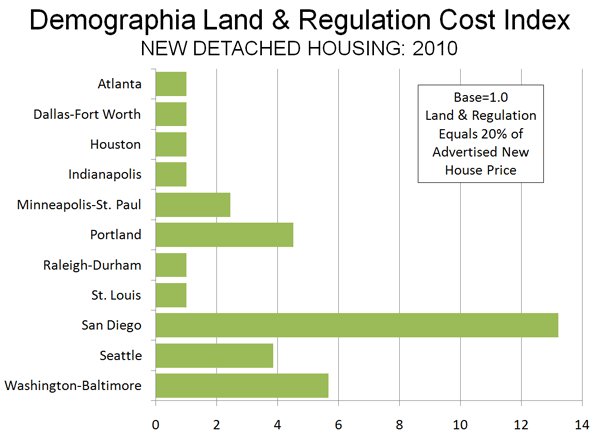
    Our first annual Demographia Residential Land & Regulation Cost Index estimates the price of land and regulation for new entry level houses compared to the historic norm in 11 metropolitan regions (Note 1). Metropolitan regions in which land and regulation costs remain at or below normal have an Index of 1.0 while those with land and regulation costs above normal will have an Index above 1.0 (Figure 1).

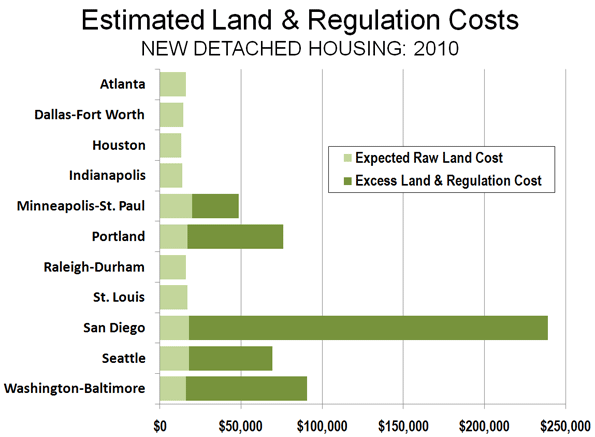
    More restrictive land use regulation is variously referred to as “smart growth,” “growth management” and other terms. More restrictive land use regulation is estimated to have added from nearly $30,000 (in Minneapolis-St. Paul) to more than $220,000 (In San Diego) to the price of a new home.

    Economic research has associated rising residential land costs with more restrictive land use regulations. The table indicates some of the more important price increasing impacts of more restrictive land use regulation.


    More Restrictive Land Use Regulation:

    Factors that Can Drive House Prices Higher

    1.. Increases underlying land costs

    2.. Increases planning and development costs

    3.. Raises financing costs

    4.. Encourages more expensive houses.

    5.. Increases construction costs

    6.. Encourages concentration of market power and land banking

    7.. Encourages land and housing speculation

    The Land and Regulation Ratio

    For decades, construction costs of tract house on the urban fringe in the United States have represented 80% or more of the advertised house price. The balance of 20% or less has been for land and regulation costs and will be referred to as the “land and regulation cost ratio.” In metropolitan markets with less restrictive land use regulation, the historic 20% or less land price ratio remains in place. The Demographia Residential Land & Regulation Cost Index assumes a 20% expected land and regulation ratio.

    In some metropolitan markets, however, house prices have increased far more rapidly than in the rest of the nation. The greater increase in house prices and escalation of land costs above the historic 20% land and regulation cost ratio has occurred in metropolitan markets burdened by more restrictive land use regulations. Urban growth boundaries, limits on the number of houses that can be built, large lot zoning and excessive development impact fees and the like are regulation strategies that increase the cost of land for building houses. These land cost increases are not the result of more rapidly rising construction costs or underlying market forces such as consumer demand.

    More restrictive land use land use regulation also creates obstacles to people buying houses, requiring them to devote more money to housing than necessary and increases their vulnerability to losses in the event of a financial downturn. This exposes mortgage lenders to increased risks of loan defaults. Finally, more restrictive land use regulation makes residential land development more dependent on politics, with the potential for greater influence through campaign contributions.

    The first annual Demographia Residential Land & Regulation Cost Index estimates cost of land and regulation for new entry level houses compared to the historic norm in 11 metropolitan markets. Each of the metropolitan regions in which house prices have risen above normal have adopted more restrictive land use regulations. Conversely, in each of the metropolitan regions in which house prices have not risen above normal levels, there is less restrictive land use regulation. During much of the Post-World War II era, all metropolitan markets had less restrictive land use regulations.

    Results

    The overwhelming majority of new housing in the United States continues to be detached and is built near or on the urban fringe (Note 2). For new detached homes, the Index is 1.0 in six metropolitan markets (Atlanta, Dallas-Fort Worth, Houston, Indianapolis, Raleigh-Durham and St. Louis). This indicates that land use regulation is less restrictive and does not add more than normal to the price of new homes (Note 3).

    In the other five metropolitan markets, the land and regulation cost ratio has risen above 20%, resulting in a higher Index. The Index is 2.4 in Minneapolis-St. Paul, 3.9 in Seattle, 4.5 in Portland, 5.7 in Washington-Baltimore and 13.2 in San Diego. It is estimated that more restrictive land use regulation raises the price of the least expensive detached houses from nearly $30,000 (in Minneapolis-St. Paul) to more than $220,000 (in San Diego) than would be expected if these metropolitan markets had retained less restrictive land use regulation (Figure 2).

    The metropolitan markets with more restrictive regulation have an average Demographia Residential Land & Regulation Cost Index of 5.9 for detached housing, while the metropolitan markets with less restrictive regulation average 1.0.

    Housing Affordability: Through the Bubble and Bust

    There is increasing concern about declining housing affordability across the nation. Even after the deflation of the housing bubble, house prices in some metropolitan markets remain well above pre-bubble prices and historic affordability standards. The housing affordability of the included metropolitan markets is illustrated by land use regulatory category in Figure 3. The Figure indicates the National Association of Home Builders-Wells Fargo Housing Opportunity Index for 1995, the peak of the bubble and early 2010, showing the percentage of households able to afford the median priced house. Similar affordability measures can be reviewed in the Annual Demographia International Housing Affordability Survey.

    Future Editions

    The 11 metropolitan regions included in the initial Demographia Residential Land & Regulation Cost Index were selected to provide a geographical and regulatory balance and because they had sufficient data from which to develop the Index. Additional areas will be added in future editions, with the intention of including all metropolitan regions with more than 1,000,000 population.

    ——-

    Note 1: The Index was derived from a database developed of new house offerings by national, regional and local builders, using internet sites and published metropolitan home guides. The period covered is January through June 2010.

    Note 2: In 2006, more than 85% of new single family houses sold in the United States were detached, according to Bureau of the Census data. Detached housing represents approximately 62% of all US housing units (including multi-unit dwellings).

    Note 3: In each of the metropolitan markets with less restrictive regulation, the estimated construction costs were more than 80% of the house price. By using a 20% land and regulation ratio, the house construction cost was capped at 80% of the house price. In each of the metropolitan markets with more restrictive regulation, the estimated construction cost was less than 80% of the house price.

    Wendell Cox is a Visiting Professor, Conservatoire National des Arts et Metiers, Paris and the author of “War on the Dream: How Anti-Sprawl Policy Threatens the Quality of Life

    Photo: Will County, Chicago urban fringe (By author)

  • The EPA: Leading Into A Rain Garden?

    Newly-installed solar Panels on the White House are an obvious signal that this administration wants to lead by example. Conservatives will no doubt find ways to ridicule the panels, and liberals will praise them as a display to the world that we are a green nation. About one year ago, on Oct. 5, 2009, the President signed Executive Order (EO) 13514, “Federal Leadership in Environmental, Energy, and Economic Performance.” Like the white house solar panels, this EO also is intended to urge federal agencies to lead by example. It sets as policy that federal agencies shall “…conserve and protect water resources through efficiency, reuse, and storm water management.”

    How far have we come… and how far are we likely to be able to go in achieving these goals?

    For federal facilities, the EPA’s green infrastructure solutions , biological systems and engineered systems include, but are not necessarily limited to:

    • Rain gardens, bioretention, and infiltration planters
    • Porous pavements
    • Vegetated swales and bioswales
    • Green roofs
    • Trees and tree boxes
    • Pocket wetlands
    • Reforestation/revegetation
    • Protection and enhancement of riparian buffers and floodplains
    • Rainwater harvesting for use (e.g., irrigation, HVAC make‐up, non‐potable indoor uses)

    For new facilities, these would be good moves. For many years, our design firm has been planning new developments with very low environmental impacts, using approaches that have been either volunteered by the developer or mandated by the local regulations. We accomplish low impact designs by reducing the infrastructure needed for new development, which reduces both economic and environmental impact. Land development can be more efficient, when designed properly, than conventional or Smart Growth design methods; it can allow lower development costs while still complying with EPA mandates. It can be done by harnessing new design methods made possible by the development of new technologies. While “green” brings an image to builders’ minds of expensive, problematic development, being “green” can be less expensive if done right.

    Speaking from my experience in designing 700 neighborhoods in 46 States (and 13 countries), all with innovative design methods, and building a Net-Zero home in 1983, as well as a dual-certified Green home in 2009, here’s how I evaluate the likelihood of success of the current EPA options:

    Rain gardens, bioretention, and infiltration planters: These organic methods are possibly the most economically viable, but they do come with constant maintenance costs that the building facility owner must be aware of. A bio-retention that is not designed properly or maintained constantly will quickly fail. Unlike concrete pipes and iron sewer grates along curbs which can be left alone for decades, an organic solution to storm water must be installed by an experienced expert with a proven track record, and maintained by personnel that know what they are doing. If built correctly and maintained constantly, this can be the lowest cost solution IF there is enough land area and proper topography (flow of the land) to design the system properly in the first place. Typically, these systems rely on surface flow with no curbing or special curbing to allow drainage off paved areas. On newly developed sites, this could mean a significant cost saving. On existing development, replacing curb may be expensive.

    Porous pavements: Sounds simple – install a pavement that allows rain to flow through to the ground. The big problem and huge expense comes from making sure that the ground under the pavement also porous. In other words, if you were to remove an asphalt parking lot and replace it with porous asphalt, the environmental impact would not change. Why? Because under the original asphalt is likely a non-porous class 5 (or similar) base. In a genuinely porous paved surface, the storm water moving through the pavement must continue through the ground below. This means a base that allows storm water to be held and filtered slowly to the ground below, or directed elsewhere. Sounds expensive? You betcha! Two other major problems: heavy vehicles used at federal facilities could damage these systems, and, if the ground freezes, expansion could be a problem. Long term lifespan of porous pavements may be less than that of solid surfaces.

    Vegetated swales and bioswales: See rain gardens, above.

    Green roofs: Retrofit Green Roofs on to buildings not originally designed for them? Green roofs did not work well in 1983 when I built my Net-Zero home during the first (failed, somehow forgotten) green movement, so I’m not sure what has changed to make them feasible. Green roofs can absorb the sun’s energy to solve the heat island problem of large facilities, but simply coating a dark roof with a light or white color solves the heat island problem with little expense.

    Trees and tree boxes: Trees and tree boxes will have little impact on reducing storm water impacts. Of course there are other benefits for planting trees, so, while a good thing, this does little to comply with the mandate.

    Pocket wetlands: See rain gardens, above.

    Reforestation/revegetation: Assumes the federal facility has plenty of space to allow such a thing.

    Protection and enhancement of riparian buffers and floodplains: Assumes there are riparian buffers and flood plains on the site, or adjacent to the site, that can be altered.

    Rainwater harvesting for use (e.g., irrigation, HVAC make‐up, non‐potable indoor uses): Also a good solution when possible. For example, when 90% of the surface is paving and rooftop, the resulting storage of rainfall could be tremendous, depending upon where in the country the facilities are located, and ample to irrigate the remaining small surface.

    Nobody is an expert on all issues, so there may be new factors that I’m not aware of that would make a method more feasible than what we have experienced.

    What is completely missing from the EPA options here are ways to make an existing facility more efficient by removing excessive paved areas. When an existing facility was originally designed, was it efficient in the first place? Keep in mind that being efficient is not necessarily profitable. If the original consulting engineer and architectural firm fees were based upon a percentage of construction costs, then creating excessive construction costs meant larger fees. Paving contractors maximize profit by covering the most land possible with asphalt or concrete.

    The EPA order can be an opportunity to help design solutions that are cost effective to comply with the mandate. For my firm, the mandate could leverage our low impact software system sales, a technology that can be used to reduce wasteful construction while in redevelopment, so we may directly benefit from this mandate. But before that can happen — and before we can know how successful the EPA directives will be — many questions remain to be answered.

    Photo: Pigeons in front of the EPA building by benchilada

    Rick Harrison is President of Rick Harrison Site Design Studio and Neighborhood Innovations, LLC. He is author of Prefurbia: Reinventing The Suburbs From Disdainable To Sustainable and creator of Performance Planning System. His websites are rhsdplanning.com and performanceplanningsystem.com.

  • Modifying Loans and the Decision-Makers

    A recent editorial in The New York Times lamented the latest housing market woes, this time resulting from various banks’ disregard for, or inattentiveness to, a legal foreclosure process. As the article correctly states, “It is hard to be shocked.”

    Further fueling uncertainty is of immediate concern, adding another layer of doubt to what may end up proving to be a formerly nascent recovery. While President Obama is calling for more thorough analysis to determine if foreclosure or modification is more prudent, and a provision in the Dodd-Frank bill authorizes government aid for troubled homeowners to assist with legal services, neither gets to the heart of the problem.

    Homeownership is not an inalienable right, and should be reserved for those who are in the financial position to shoulder the burdens that come with the supposed pride. The banks reviewing loan applications should be the final bastion of culpability in assessing prospective buyers’ financial wherewithal.

    This creates a moral conflict in many cases, as banks make money by lending money. In the interest of financial stamina, however, the banks have overlooked the simple fact that they only make money by lending money if the borrowers can pay them back. While there will always be some percentage of borrowers that fail to pay back their loans, it is all too well documented now that those levels are excessively high in today’s economic environment.

    Most troubling is the realization that many bank REO departments (for “real estate owned,” the class of property that goes back to lenders upon unsuccessful foreclosure auctions) are not staffed by real estate minds. While it is not fair to make a wholesale categorization of REO departments nationwide as real estate deficient, there are multiple cases where simple real estate fundamentals are unknown.

    Examples here include law firms, architecture firms and real estate advisory firms being engaged to teach real estate 101 to national banks’ REO departments. There have been cases where those making the decisions between lending or not lending, or foreclosure or modification, are unable to effectively comprehend sale and purchase agreements, site plans and floor plans, inspection reports or market analysis documents. This is not to suggest that these are bad people. But, as clerks, statisticians and analysts who are not educated or trained in the intricacies, or even general principles of real estate, they simply do not get it. How can such fragile issues with widespread economic and social ramifications be addressed by anything less than experts?

    In other words, these last bastions of culpability are unable to perform the simple tasks that even a reasonably responsible borrower should comprehend. Banks are in the business of making money, and that, in and of itself, is not a crime in a capitalist economy. But they should at the very least properly train those who are making decisions on lending millions upon millions of dollars to aspiring, whether ready or not, homeowners.

  • Aussie Urban Myths

    Urban planning in Australia is lost in a dense fog of presumption and theory. What’s needed is to toss out the hype and to illuminate some of the common planning myths for what they really are: impediments to progress.

    An example of planning hype occurred not long ago when ten urban academics loudly criticised the Victorian government’s decision to develop about 40,000 hectares of new land on Melbourne’s fringe, calling the decision short-sighted and unsustainable.

    The best way to development Melbourne, they said, is to intensify redevelopment along tram and train lines and around existing activity centres, with such developments being more dense than the surrounding suburbs, but not necessarily high-rise. Their modelling suggests that the 600,000 new dwellings required by 2030 could be accommodated under four stories within the existing built-up area.

    They did confess that not everyone wants or needs to live in an activity centre or on a rail/tramline, but were adamant that a sustainable city is “one where you can get there without a car”. The future, according to them, will be “fitter rather than fatter”; where we will “live with more amenity” and have more “choice of housing type”.

    They concluded that this is a national issue because when we finally commit to a low-carbon economy, we will have these extra 40,000 undeveloped hectares which, one assumes, will act as some form of carbon sink.

    Under normal circumstances, one might be tempted to dismiss the more extreme machinations of latte-left academia, but unfortunately, some serious decision makers are starting to listen to this type of questionable commentary.

    Without doubt, a key challenge facing Australia’s major capitals is how to redevelop the middle-ring suburbs, but placing all of one’s development eggs in this basket is lunacy and is based on misguided presumptions and poor theory. In this light, it is pertinent to consider several urban myths.

    But before our myth busting, it is worth stating that infill development is more expensive than many realise, in terms of site acquisition, approval processes, infrastructure provision, and combating NIMBYism. This is reflected in the high end prices of infill stock which, in short, costs more than twice as much as broadhectare product.

    For example, the cost of a new infill dwelling (which is two bedroom/two bathroom and one car space) within five kilometres of the Brisbane CBD is $650,000. But a new detached house (around 20 kilometres from the GPO, comprises three bedrooms, study, two bathrooms, double garage and on a 500 sqm allotment) can cost $325,000. On a rate per square metre basis the infill product (including any land) is $8,000, the detached house (again including land) is around $2,000, sometimes less depending on who the builder is.

    Low affordability makes the sale of infill product often slow, even in stronger economic times. In addition, there is often a large mismatch between the product type (and size) offered in infill locations and household demographics and, importantly, the market’s aspirations.

    Our urban academics were somewhat correct on one point – not everyone wants to live in an infill development. Our experience is that demand for such product – and assuming the dwellings can be delivered at an economic price point – varies between 25% and 40% of overall demand, depending on the urban location in question. Under current conditions, the real demand, however, is around 15% at best. So from the get-go, delivering such an ambitious infill development target is extremely unlikely. In fact, it is impossible.

    Myth – higher densities will mean less traffic
    The theory is that higher densities around existing public transport networks will see a lift in public transport use and fewer cars on the road. Public transport accounts for about 10% of total trips in our major cities. Most urban metropolitan strategies aim to increase this to 20%. So, four-fifths of the trips will, at best, still be via private vehicle. Why? Because the car is much more convenient.

    Without serious infrastructure commitments to repair and upgrade the public transport networks in our cities, cars will continue to dominate. In fact, under current conditions, and somewhat ironically, infill development would lead to more traffic congestion.

    Most infill product built within Australian cities will not sell without a car space. The quality of our public infrastructure, especially outside of Melbourne, is not good enough for infill owners (or their tenants) to forgo the security of their cars. So, new infill development is increasing the number of cars on the road and often in areas which are already congested and are hard to improve from a traffic management perspective.

    One could argue that it would be better to further decentralise employment and settlement around the edges of the metropolitan area, and most obviously upgrade the existing road network.

    Academia, obviously, have never tried to sell a dwelling without a dedicated car parking space.

    Myth – urban consolidation is better for the environment
    This implicit assumption is now widespread among the media, the planning community, government agencies and in political circles. Yet the available evidence suggests the opposite.

    • Comparison between suburban houses and infill product often overlooks the number of persons per household, which is much higher in the traditional suburban detached house.
    • In traditional suburban detached homes, larger household numbers share various facilities – the refrigerator; television; washing machine; dishwasher etc., and even the lighting needed to light a room. The per capita energy, and even water consumption, is more efficient in suburbia than in more central urban locations. The “average” household size within an infill development across Australia is around 1.6 people, in detached housing it is 3.2. In most cases infill product have as many appliances as are in a detached house, yet the number of occupants living in infill product is about half that living in detached suburban homes.
    • The nature of infill housing is, in itself, prejudicial to positive environmental outcomes due to things like clothes driers (lack of outdoor drying areas), air conditioners, lifts and the need to service (lights and air-conditioning) common areas. Also, suburban development allows for wider footpaths and private yards, which in turn provide space for trees to grow. There is less opportunity for greenery – a key producer of carbon offsets – in higher density urban development.

    Not withstanding anything about the actual built form, the greatest correlation between energy and water use (and hence, environmental impact) is based on per capita income. Wealthy people consume more energy/water and thus have a bigger environmental impact. The better off are the only ones who can afford to live in infill housing.

    Research in 2007 by the Australian Conservation Foundation found that in almost all Australian cities, higher-density, infill housing produced higher per capita greenhouse emissions and had larger eco footprints than outer suburbs, notwithstanding the greater access to public transport.

    Myth – most jobs are downtown
    There is also a widespread presumption that central business districts and their immediate fringes contain the majority of jobs in a city’s economy, and are therefore the major generators of traffic. Developing housing further from the downtown area, the argument goes will only mean more congestion as commuters try to get into and out off the downtown area.

    It is easy to understand how this myth developed: the CBD/fringe holds the tallest buildings; the seat of government is often located there; so, too, are many cultural facilities; they are the hub of train/tram networks and the focus of much of our angst about traffic congestion.

    But downtown is home to around 20% of all jobs in a city’s metropolitan area (just 10%, when looking at the CBD alone. According to the latest Australian census (2006) the proportion of employment in our major CBDs (Sydney, Melbourne, Brisbane, Perth and Adelaide) ranges from 9% to 11% – thus 10% is pretty consistent). So 80% of our jobs are actually outside of the downtown area. The implications of this are profound. Our ten friends from academia are proposing a policy based on a myth: that urban dispersal of housing will mean longer commutes to work.

    The facts are that most commutes (over 90%) within a city are across suburbs and not downtown. Unfortunately, this type of travel (and the nature of the work involved) makes it impossible to service efficiently via public transport.

    So in truth, more housing on the urban fringe will not in itself lead to more inner-city congestion, but will produce more suburb-to-suburb work trips. Perhaps as a priority (and in concert with more decentralisation and suburban development), we should build better ring-road systems (and more river crossings in a city like Brisbane, for example), rather than advocating mostly infill redevelopment and heavy urban infrastructure spending.

    Michael Matusik is a qualified town planner and director of independent residential development advisory firm, Matusik Property Insights, based in the Brisbane region in Australia.

    Photo by Onlygoneanddoneit – Suziflooze & Stuart

  • Latino Dems Should Rethink Loyalty

    Given the awful state of the economy, it’s no surprise that Democrats are losing some support among Latinos. But they can still consider the ethnic group to be in their pocket. Though Latinos have not displayed the lock-step party loyalty of African-Americans, they still favor President Barack Obama by 57 percent, according to one Gallup Poll — down just 10 percentage points from his high number early in the administration.

    This support is particularly unusual, given that probably no large ethnic group in America has suffered more than Latinos from the Great Recession. This is true, in large part, because Latino employment is heavily concentrated in manufacturing, and even more so in construction.

    A half-million Latino workers in the construction sector — in which their share of the work force is double what it is in the broader economy — have lost their jobs since the start of the recession.

    Unfortunately, the Obama stimulus plan was light on physical infrastructure. It favored Wall Street, public-sector unions and large research universities. Big winners included education and health services — in which Latinos are under-represented.

    Not surprisingly, Latino communities across the country are in trouble. Today, of the 10 most economically “stressed” counties, seven are majority or heavily Latino, according to The Associated Press.

    Theoretically, Republicans should be able to take advantage of this situation. But not with the party’s increasing embrace of its noisy nativist right — evident not only in support of the controversial Arizona immigration law but also in the strong move against “birthright citizenship.” This makes the prospect of earning back President George W. Bush’s 40-plus-percentage-point support difficult at best.

    Thus, Latinos remain allied with Democrats whose policies inhibit the growth of construction and manufacturing jobs. This dichotomy puzzles many in the business community.

    “You have all these job losses in Latino districts represented by Latino legislators who don’t realize what they are doing to their own people,” said Larry Kosmont, a California business consultant. “They have forgotten there’s an economy to think about.”

    Despite that economic logic, Latino Democrats mindlessly follow liberal Democrats such as House Speaker Nancy Pelosi and Rep. Henry Waxman of California and Sen. John Kerry of Massachusetts, who represent largely white, affluent white-collar constituencies on issues such as cap and trade and federal regulation of greenhouse gases. Whatever the intent, these policies are likely to further decimate blue-collar employment in Latino districts.

    If they had independent thoughts, Latino Democratic politicians would be advocating positions that create new opportunities for their districts — particularly among young people. They could push, for example, a Works Progress Administration-like public works program that could provide new opportunities and skills training.

    One possible reason for not doing so is the opposition of public employee unions, which dominate Democratic politics, particularly in urban districts, and would see such a program as competing against their special interests.

    In contrast, Obama administration policies favor Ivy League schools, high-speed rail and light-rail service — issues with predominantly well-to-do, Anglo constituencies.

    This disjunction between interests and politics is particularly evident in California, the state with the largest Latino population. Latino Democrats have generally embraced the state’s draconian environmental and planning policies.

    The state’s fertile Central Valley offers one example. A green-inspired diversion of water from farms to save an obscure species of fish has forced more than 450,000 acres to lie fallow. Thousands of agricultural jobs — held mostly by Latinos — have been lost, perhaps permanently. Unemployment, which stands at 17 percent across the valley, reaches upward of 40 percent in towns like Mendota.

    These policy positions speak to the limits of the current Latino leadership. Latino political power has waxed in Sacramento since 1999 — the state Assembly has had three Latino speakers. But on the ground, things have waned for the state’s Latino working class. During the past decade, according to research from California Lutheran University, the state has experienced one of the nation’s most dramatic drops in household earnings — between $35,000 and $75,000 in lost income.

    The pain at the bottom of the economic ladder is even greater. Indeed, according to Deborah Reed of the left-leaning Public Policy Institute of California, when housing and other costs are factored in, three heavily Latino counties — Los Angeles, Fresno and Monterey — rank among the 10 poorest metropolitan areas in the United States. Increasing numbers of working- and middle-class Latinos have been migrating to more job-friendly areas such as Texas and the Plains states.

    Latino Democratic politics are equally dysfunctional at the local level. In the largely Hispanic industrial belt south of downtown Los Angeles, for example, a sprawling Latino machine, marked by near Chicago-scale corruption, now controls most elective posts. Many of its leaders — most outrageously in the city of Bell — have proved far more adept at feathering their own nests than at reviving local economies.

    A similar disconnect can be seen in the City of Los Angeles, where corruption and inefficiency have led some local entrepreneurs to invest in other regions. “It’s extremely difficult to do business in Los Angeles,” said retail developer Jose de Jesus Legaspi. “The regulations are difficult to manage. … Everyone has to kiss the rings of the [City Hall politicians].”

    L.A. Mayor Antonio Villaraigosa epitomizes this self-defeating ethnic politics. Last year, for example, Cecilia Estolano, executive director of the Los Angeles Community Redevelopment Agency, supported shifting resources from building high-end housing and amenities downtown to rejuvenating the large industrial district, a major employer of blue-collar Latinos.

    Her efforts quickly ran afoul of Villaraigosa, whose staff favors pouring more money into downtown amenities — even if doing so drives out industrial jobs. Estolano, who now works for a local nonprofit, says the lack of interest in manufacturing and the blue-collar economy is easy to explain: campaign contributions.

    “The problem is manufacturers in L.A. are mostly small and don’t contribute to campaigns,” Estolano said. “L.A.’s politics are controlled by real estate interests, their lawyers and consultants.”

    As Latinos become a critical part of our emerging economy, they need to develop a policy agenda that focuses less on old-style, machine ethnic politics and more on the critical issue of upward mobility.

    Latino voters might also consider avoiding the African-American one-party model by embracing both growth-oriented Democrats and enlightened Republicans. This is most likely to increase their political leverage, while creating a politics that supports their most fundamental interests.

    This article originally appeared at Politico.

    Joel Kotkin is executive editor of NewGeography.com and is a distinguished presidential fellow in urban futures at Chapman University. He is author of The City: A Global History. His newest book is The Next Hundred Million: America in 2050, released in February, 2010.

    Photo by chadlewis76

  • Why We Have to Learn to Love the Subdivision – Again

    When did anyone last hear officials and professionals talking enthusiastically about the social and economic benefits resulting from the subdivision of land to create secure, clean and tradable title?

    Indeed, any planning document is likely to include a long list of potential problems caused by the subdivision, but will mention few, if any, of the benefits. Maybe it’s time to rethink this conventional planning wisdom. In Peru, during the eighties, Hernando De Soto and the Institute for Liberty and Democracy promoted land reforms that led to more than 1.2 million rural families being given titles to the land they worked. One major grant of titles to a whole village was celebrated on television. When the reporter asked a woman “Why is having title important for your family?” she replied “Having secure title means I can now go out to work.” She went on to explain that the family’s past “customary settlement” required continual occupancy and eternal vigilance. Some member of the family had to be on the property at all times, or else someone else could move in.

    During a recent BBC television news bulletin on the floods in Pakistan, reporter Orla Guerin said “Many here are bound to their land and their livestock, and will live or die with them. We spotted one young boy, clinging to the top of an electricity pylon. He climbed down to collect a bag food aid, but refused to be removed from the waters.”

    I suspect he was also concerned with the need to help maintain his family’s right to occupy.

    City officials and urban planners in particular are always claiming that their cities are “running out of land”. Of course they are not running out of land. They are surrounded with it, as any air traveler knows, just from looking out the window.

    However, they are short of land with a certificate of title that allows the landowner to develop the property for housing or anything else. One reason for this shortage lies with the costs and often onerous conditions of compliance are simply too high. The French Revolutionaries learned that when they fixed the price of bread at less than it cost to bake a loaf, the bakers simply stopped baking bread. When it costs more to gain a title than the lot can be sold for, we should not be surprised if people stop creating lots.

    Suburban residential development creates many jobs and the residents who move continue to create new employment opportunities for decades. Every home owner becomes a property developer as they add rooms, sleepouts, new decks and swimming pools and upgrade their kitchens, and so on. I should have emphasized that it’s the land around the dwelling that enables so many of these projects to take place over the decades and to create so many jobs.

    If Smart Growth policies force people to live in apartments, their opportunities to improve their dwellings become seriously limited.

    City governments appear to overlook the economic and employment impact of rejecting large-scale developments, but the cumulative effect of a multitude of prohibitions of smaller proposals is equally serious – especially in a small economy like New Zealand or a relatively unpopulated place like Montana.

    During the nineteenth century the key function of governments in the New World was to churn out titles as quickly as possible.

    Surveyors served as the true frontiersmen, enabling the migrants to arrive, put down their roots, and build. The post-war suburban boom repeated this experience, supported by an equal enthusiasm for creating a property owning democracy.

    Then during the 1990s, “The Age of Environmentalism” arrived and activists persuaded decision-makers in the developed world that the creation of titles enabled polluting humans to possess the Earth Mother and must be stopped, or be made as difficult as possible. These constraints on land supply created the short-term property boom, and the inevitable bust that led to the greatest financial crisis in recent history.

    The developing nations and their economists continue to recognize the value of title. The works of Hernando de Soto, the Peruvian economist, emphasize that the major problem facing people in poor countries has been their lack of secure title to land, which constrains their ability to borrow significant sums of money and put down secure roots. As he says, the family with title builds a dwelling; the family that squats invests in furniture. This has led to his founding leadership of The Institute for Liberty and Democracy in Peru.

    At the recent conference of international surveyors in Sydney it was quite exhilarating to hear surveyors and officials from Peru talking of targets of 150,000 new titles per year. They knew full well that titles generate wealth. Maybe it’s time for New World cities to set similar targets and share de Soto’s enthusiasm for the contribution of subdivision to ongoing liberty and the pursuit of happiness.

    Bankers have long recognized that many families’ main means of saving is paying off their mortgage. Equally, many aging citizens fund their retirement by subdividing their large lots to create a nest egg for the future. Most university-indoctrinated central planners regard this as an “inappropriate” activity.

    Unexpected Super Large-Lot zoning in rural areas can suddenly deprive thousands of people of a secure and active retirement. Of course the planners claim the landowners are still able to subdivide, but just have to go through an approval process. Then the same planners make sure the costs and uncertainties render the exercise prohibitive. Their environmental cost benefit analysis ignores this destruction of individual wealth – and dreams.

    I wonder if any advanced developed country planning school has Hernando de Soto on its reading list?

    Instead of encouraging the creation of titles, as history suggests we should, the Smart Growth central planners have persuaded our governments to penalise the creation of new lots by imposing highly expensive and highly regressive fines called “development contributions” – which are actually anti-development levies.

    We tax cigarette smokers to discourage smoking, and we fine speedsters to discourage speeding. Should we be fining the creators of legal title if our aim is to encourage development, promote employment growth, increase savings and promote personal well-being?

    Some politicians, like Maurice Williamson, New Zealand’s Minister for Building and Construction ARE determined to reduce the costs of building consents and inspections. But these are trivial compared to the costs of subdivision and land use consents.

    And there is something of an international movement away from rule based management of development and a return towards broader concerns of society and the people who inhabit it.

    But before any legislative reforms can be effective we need to learn to once again celebrate secure, tradable, private title. This remains one of Western Civilisation’s greatest contributions to our wealth, health and general well-being.

    Owen McShane is Director of the Centre for Resource Management Studies, New Zealand.

    Photo by Brenda Anderson

  • The Commonwealth Bank of Australia/UBS-Demographia Data Dispute

    The Age (Melbourne) headlined a story “CBA Accused of Choosing its Facts.” CBA is the Commonwealth Bank of Australia, while UBS is the Swiss investment house. Commonwealth produced a report comparing housing affordability in Australian metropolitan areas to international metropolitan areas (Australian Housing and Mortgages: CBA Mortgage Book Secure). According to The Age:

    Investment forums and housing blogs were alive with talk yesterday that an 18-page presentation used by the bank had replaced unfavourable housing affordability figures with data showing housing costs were not out of step with other cities in the world.

    One slide compared Australian housing affordability to several cities, citing figures from a combination of the US urban planning research house Demographia and the investment bank UBS.
    The slide showed housing in Sydney and Melbourne was more affordable than cities such as San Francisco, New York and Vancouver. But it used UBS data exclusively for the Australian cities, and Demographia data for the overseas cities.

    The data were not comparable. Commonwealth relied upon Median Multiple data (median house price divided by median household income) from the 6th Annual Demographia Housing Affordability Survey for international metropolitan areas. However, Commonwealth used a median/average multiple (median house price divided by average household income) calculated by UBS, the Swiss investment house, for Australian metropolitan areas. These are very different indicators.

    There would have been nothing wrong with having used the median/average multiple, had it been shown for all metropolitan areas, Australian and international. However, comparing the median/average multiple to the Median Multiple is invalid. Average household incomes are routinely higher than median household incomes and the use of an average income figure inappropriately biases Australian housing affordability relative to international metropolitan areas.

    For example, the UBS median/average multiple for Sydney is reported by Commonwealth to be 6.2. Commonwealth finds Sydney to be more affordable than San Francisco’s, which it indicates at 7.0. However, the San Francisco figure is the Median Multiple and the comparable figure for Sydney is 9.1, making Sydney less affordable than San Francisco

    In fact, had the UBS median/average multiple been used for all metropolitan areas, including the international metropolitan areas, it is likely that the gap between Australian metropolitan areas and international metropolitan areas would be of similar magnitude to that shown in the Demographia International Housing Affordability Survey.

    From time to time, various interests have suggested alternate measures of housing affordability for Australia and then compared or suggested comparison to our Median Multiple data. Of course, that is invalid.

    The Age article by Eric Johnston was carried in other Fairfax Media outlets such asThe Sydney Morning Herald and the Brisbane Times, and the subject has been covered by financial blogs.

    Note: Author Wendell Cox of Demographia.com and Hugh Pavletich of PerformanceUrbanPlanning.com are co-authors of the Demographia International Housing Affordability Survey.

  • Why Housing Will Come Back

    Few icons of the American way of life have suffered more in recent years than  homeownership. Since the bursting of the housing bubble, there has been a steady drumbeat from the factories of futurist punditry that the notion of owning a home will, and, more importantly, should become out of reach for most Americans.

    Before jumping on this bandwagon, perhaps we would do well to understand the role that homeownership and the diffusion of property plays in a democracy. From Madison and Jefferson through Lincoln’s Homestead Act, the most enduring and radical notion of American political economy has been the diffusion of property.

    Like small farmers in the 19th century, homeowners–and equally important, aspiring homeowners–now represent the core of our economy without which a strong recovery is likely impossible.  Houses remain as a financial bulwark for a large percentage of families, the anchor of communities, and, increasingly, home-based businesses.

    The reasons given for abandoning the homeownership ideal are diverse.  Conservatives rightfully look to diminish the outsized role of government in promoting homeownership.  Some suggest  that Americans would be better off  putting their money into things like the stock market or boosting consumer purchases.

    New-urbanist intellectuals like the University of Utah’s  Chris Nelson predict  aging demographics will lead masses to abandon their homes for retiree communities and nursing homes.   The respected futurist Paul Saffo predicts that as skilled laborers move from Singapore to San Francisco to New York and London, there is little need to “own” a permanent place. In the brave new future, he suggests, we will prefer time-sharing residences  as we flit from job to job across the global economy.

    Some of the greatest hostility towards homeownership increasingly comes from the progressive left, some of whom are calling for the total elimination of the homeowner mortgage interest deduction.  “The Case Against Homeownership,” recently published in Time,  encapsulates the current establishment’s  conventional wisdom: that homeownership is by nature exclusionist, “sprawl” promoting and responsible for “America’s overuse of energy and oil.”

    Yet for all the problems facing the housing market, homeownership–not exclusively single-family houses–is not likely to fade dramatically for the foreseeable future. The most compelling reason has to do with continued public preference for single-family homes, suburbs and the notion of owning a “piece” of the American dream.   This is why that four out of every five homes built in America over the past few decades, notes urban historian Witold Rybczynski, have less to do with government policy than “with buyers’ preferences, that is, What People Want.”

    What we are going through now is not a sea change but a correction from insane government and business practices.   The rise in homeownership from 44% in 1944 to nearly 70% at the height of the bubble reflected a great social democratic achievement. But by the mid-2000s government attempts to expand ownership–eagerly embraced by Wall Street speculators–brought in buyers who would have historically been disqualified.

    In some markets, prices exploded as people moved up too quickly into ever more expensive housing. Housing inflation was further exacerbated by “smart growth” policies, which limited new home construction in suburban areas and instead promoted dense, “transit oriented” housing with limited market appeal and economic logic.

    Rather than artificially constraining supply and protecting irresponsible borrowers,   we should let nature take its course. Home values need to readjust historic balance between incomes and prices. Over the past 60 years, notes demographer Wendell Cox, it took two to three years or less of median household income to purchase a median-priced home. At the peak of the boom, that ratio had ballooned to 4.6.

    The disequilibrium was the worst in regions like Los Angeles, Las Vegas, San Bernardino-Riverside and Miami. At the peak of the bubble, between 2006 and 2008, according to the National Homebuilders Association- Wells Fargo “Housing Opportunity Index,” barely 2% of families with a median income households in Los Angeles could afford to buy a median priced home; even in the traditionally affordable Riverside area, the number was roughly 7%. In Miami, barely 10% could afford such a purchase; in Las Vegas, often seen as one of the cheaper markets, only 15%.

    What a difference a market correction makes. The affordability number for Los Angeles is now 34%, 17 times better than two years ago, while Riverside is now near 70%. Miami’s affordability picture has improved to over 60% while in Las Vegas, it’s back over 80%.

    These lower prices–not Wall Street or federal gimmickry–will lure new buyers to the places that some new urbanists   have predicted will be “the next slums.” Already there’s evidence in places like Miami of a renewed interest in now-affordable suburban single-family homes while condos stay empty  or become rentals.

    Of course without a return to robust job growth, particularly in the private sector, the home market– and pretty much all mainstream consumer purchases–will remain weak. No matter how low prices get, people worried about losing employment do not constitute a promising new market for homes.

    But over the longer run most Americans will seek to purchase homes –whatever the geography. Increasingly this will be less a casino gamble, and more  a long-term lifestyle choice.  As America adds upwards of 100 million more Americans by 2050, the demand will stare us in the face.

    As boomers age, the two big groups that will drive housing will be the young Millenial generation born after 1983 as well as immigrants and their offspring. Sixty million strong, the millenials are just now entering their late 20s. They are just beginning to start hunting for houses and places to establish roots. Generational chroniclers  Morley Winograd and Mike Hais, describe millenials in their surveys as family-oriented young people who value homeownership even more than their boomer parents. They also are somewhat more likely to choose suburbia as their “ideal place to live” than the previous generation.

    These tendencies are even more marked among immigrants and their children. Already a majority of immigrants live in suburbia, up from 40% in the 1970s. They are attracted in many cases by both jobs and the opportunity to buy a single-family home. For an immigrant from Mumbai, Hong Kong or Mexico City, the “American dream” is rarely living in high density surrounded by concrete; if they wanted that, they could have stayed home.

    Over coming generations, changes in family and work life will make single-family homes, townhouses and other moderate-to-low density housing more attractive.  Contrary to the anonymity predicted by most futurists, your chosen place is becoming more important, as evidenced by numerous suburban and small town downtown revivals as well as growing local volunteerism.

    Equally important, multi-generational households are on the rise back to 1950s levels–in part due to immigrant lifestyle preferences. People are staying put; even before the bubble burst, mobility had dropped to the lowest level in over a half century. With the rise of new technologies allowing for dispersed work, the single family home increasingly houses not only residents, but part and full-time offices.

    Barring a long-term permanent recession or a national planning regime aimed at curbing single-family home construction, these factors should lead to a new surge in home buying starting later this decade. It may be too late to save many who overextended themselves in the bubble, but this resurgence could do much to propel our anemic economy, restoring the home to its rightful place one of the cornerstone not only of the American dream, but of our democracy.

    This article originally appeared at Forbes.com.

    Joel Kotkin is executive editor of NewGeography.com and is a distinguished presidential fellow in urban futures at Chapman University. He is author of The City: A Global History. His newest book is The Next Hundred Million: America in 2050, released in February, 2010.

    Photo by Wootang01

  • Fortress Australia: Groundhog Day

    A decade ago, politics in Australia lurched to embrace all things rural, happily demonizing urban interests. This happened in response to a renegade Politician – Pauline Hanson – who for a time captured public sympathy with populist anti-immigration sentiments, threatening to unseat entire governments in the process.

    Now the result of the recent National Election in Australia has seen not only the return of anti immigration sentiments, but the ascendency of anti-growth statements in mainstream politics. For a large country with only 24 million people, it’s a dangerous development.

    Two things are shaping in the aftermath of the 2010 Federal Election as portents of things to come for our economic future. One is the rise of an increasingly orthodox view that Australia at 24 million people is reaching its maximum sustainable population. The second is toward appeasing the agrarian socialism and social conservatism of rural politics. Together, this could mean we are about to usher in an era of low growth, high protection policies. Fortress Australia could easily become a reality no matter which side ultimately claims the keys to the Government benches.

    Prior to the recent Federal Election (August 2010) both major political parties have become shy of the country’s long term population growth patterns. In September 2009, Federal Treasurer Wayne Swan released some early findings of the Intergenerational Report, which predicted Australia could reach 35 million by 2050. Although this rate of growth was pretty much the same as the preceding 40 years, the figure was greeted with alarm by media, the community, and much of the political herd. ‘Australia Explodes’ went the headlines and the lemmings followed over an ideological cliff. (See this blog post from a year ago).

    A month later, then Prime Minister Kevin Rudd was proclaiming that he believed in ‘a big Australia’ but by mid 2010 his later nemesis Deputy Prime Minister Julia Gillard was proclaiming she ‘did not believe in a big Australia.’ Gillard replaced Rudd in a Labor Party coup, and then as Prime Minister declared we shouldn’t ‘hurtle’ toward 36 million but instead plan for a ‘sustainable’ population, renaming the recently created portfolio of ‘Population Minister’ the ‘Sustainable Population Minister’ in the process. The word ‘sustainable’ in this context stands for ‘slow down or stop.’

    Then came the election campaign with Opposition Leader Tony Abbot promising to ‘slash’ the ‘unsustainable’ immigration numbers (that his mentor John Howard had been responsible for as conservative Prime Minister for over a decade) and to ‘turn back the boats’ of illegal immigrants and asylum seekers, mainly from south east Asia or Afghanistan. Population growth was to be cut to 1.4% (a long term trend anyway) and migrants potentially forced to settle in rural areas (some dodgy form of zipcode migration policy).

    The message from both political leaders was clear: support for a ‘big Australia’ (35 million population by 2050 or the same rate of growth we’d seen in the last 40 years) was gone.

    Add to that the quixotic Australian entrepreneur Dick Smith and his population TV documentary ‘The Population Puzzle’ where he alleged Australia was at risk of running out of food, out of space and out of control, comparing us (oddly) with places like tiny Bangladesh (population 160 million). Smith might be mad but you can’t discount the impact he has on Australian popular opinion. People believe him, politicians included.

    Could it get any worse for the prospects of maintaining even modest levels of population growth in Australia? The last election outcome means the answer is yes. The balance of power in the Senate of the Australian Parliament will now be controlled by ‘The Greens’ (a left wing environmental party). The Greens’ view on population growth is clear: they don’t support it (unless oddly if you’ve arrived illegally, by boat). “This population boom is not economic wisdom, it is a recipe for planetary exhaustion and great human tragedy” said Greens leader Bob Brown when the Intergenerational Report was released last year.

    In the House of Representatives, the balance of power is now held by a handful of independents, representing rural seats. Socially conservative but economically protectionist, the independents’ views on population suggest they would lean toward the Abbot view: turn back the boats, and slow the overall rate of growth. They are quite likely to also push for a redistribution of economic riches to a range of projects for rural and regional areas. The irony that the election result hinged on big swings in urban seats but that a handful of rural independents are now trying to call the shots shouldn’t be lost on anyone.

    Joining the growing chorus of slow or no growth chants is municipal government. The Local Government Association of Queensland’s annual conference this year talked of limits on population growth unless bountiful riches are showered on local governments to cope with ‘unsustainable’ rates of growth. Association President Paul Bell says “councils cannot let population growth exceed infrastructure needs.”

    “Where we find water supplies no longer match the size of the community, where we find roads are congested, where we’re seeing other infrastructure whether it be health or education are falling behind,” he said, population growth was by implication to blame.

    The bottom line? Population growth is now a dirty word in politics and for any business which relies on growth for its prosperity, this is not good news. Everything from airports to property to construction to farming to retailers, manufacturers and tourism will be affected by slowing growth.

    Even social services could suffer if growth is deliberately slowed. Why? Because in 50 years time, without migration or natural growth, the ageing bubble of post-war baby boomers may mean there are two working adults for every five retired. You wouldn’t want to be one of those two and paying their tax bill in 50 years’ time or dependent on the kindness of those workers.

    How has this come about? The answer is simple: growth itself has never been the problem. Instead, it’s been a notoriously inefficient planning approach which has misdirected precious infrastructure spending, pushed up housing prices through artificial restraint on supply combined with usurious upfront levies, which now average $50,000 per dwelling in Queensland (often more) and considerably more in NSW.

    In the last decade, can anyone honestly claim that our planning schemes are now more efficient and quicker, or more easily understood, or better targeted, than a decade ago? I doubt it.

    Would it be too much to ask for a sensible, evidence-based approach that ties population growth to urban and regional strategies, which emphasises economic progress while maintaining lifestyle and environmental standards? How about some decent plans to link regional urban centres to major cities, based not on pork barrels to influential independents but based only on the business case and community mutual benefit? Or how about putting the ‘growth’ back into smart growth, with policies that allow our urban areas to expand in line with demand matched to infrastructure spending, rather than policy dogma?

    Those same questions were being asked a decade ago. Welcome to ground hog day.

    For those interested, here’s a couple of yarns from 10 years ago:
    Slicker Cities for City Slickers. October 1999.
    Nation Building and a National Urban Strategy. May 2001.

    Ross Elliott has more than 20 years experience in property and public policy. His past roles have included stints in urban economics, national and state roles with the Property Council, and in destination marketing. He has written extensively on a range of public policy issues centering around urban issues, and continues to maintain his recreational interest in public policy through ongoing contributions such as this or via his monthly blog The Pulse.

    Photo by Linh_rOm