Category: housing

  • Time to Hate Those HOAs (again).

    The foreclosure crisis has been devastating for millions of Americans, but it has also impacted many still working as before and holding on to their homes. Even a couple of empty dwellings on a street can very quickly deteriorate and become a negative presence in the neighborhood, at the least driving down prices further, sometimes attracting crime. Untended pools can allow pests to breed. Many animals have been abandoned and shelters report overflowing traffic. The resulting impacts on local governments have been particularly visible, as property tax assessments have fallen and revenues have also gone south.

    Less obvious is the impacts on home owner associations [HOAs], whose revenues have also taken a hit, albeit for rather different reasons. For the most part, HOA dues are not a function of the value of the home but rather the need to cover the costs of maintaining the common interests of the association: landscaping, security and so forth. These tend to be fixed, even if the values of the homes collapse, and may even rise if dwellings are empty and untended.

    Many HOAs, especially in the newer metropolitan areas like Phoenix and Las Vegas where foreclosures have been most concentrated, have taken a beating because the number of households paying into the association has been depleted, quite badly in some instances. The problem seems, from press reports, to cover the economic spectrum. Low-income first-time buyers may stop paying their dues as an economy measure, while more affluent owners are more likely to have pulled cash from their home and are walking away from their debts. There are also thousands of empty homes that were purchased as investments at the height of the boom and may have never even been occupied.

    The foreclosure debacle is now old news, but the HOA situation is receiving attention because association boards are now aggressively trying to recoup their debts, even from those who have walked away from their mortgages. The debt, they argue, is attached to the individual, not to the dwelling, and is being turned over to collection agencies. Now, this is hardly a novelty. Municipalities have been turning household utility debts over to third parties for years, often with some success, and without a murmur of protest. So why is it different if HOAs do it?

    The answer is that HOAs are extremely unpopular with two vocal constituencies. The first is the academic community, and its hostility is part of the professional opprobrium that is heaped on gated communities, privatization and pretty much anything connected with suburban development. Interestingly, while the design aspects of gated communities have caught the attention of planners and urbanists, relatively few have focused on the dimension of governance. Those that have written on the topic have tended to be critical of private clubs that are seen to exist at the expense of the municipal collective. For what its worth, I don’t think I’ve ever known of an academic colleague who lived in an HOA, in contrast to the bulk of my students, who live in one or grew up there.

    The second constituency is more rowdy. Academics just disdain HOAs, but this group is committed to exposing them as a vast conspiracy to subvert the American way of life. This may sound like another version of contemporary “Teamania” but it is has been around for at least the past decade, during which time I’ve been monitoring Internet posts and the like. To this group, any restriction on personal freedom — from the color of one’s drapes or exterior paintwork through the display of the national flag — is clearly anathema.

    Early this year, my research on neighborliness in HOAs was covered in the local paper, and by the end of the day there were dozens of online posts. In response to the basic finding — that there is little fundamental difference between HOA and traditional neighborhoods — we received a torrent of angry responses. With a single exception, they all dismissed the findings out of hand, using an example of someone’s experience (rarely their own) to prove the point, at least to their satisfaction. One reader even tracked down my email address in order to demand an assurance that no public funds were used to promote this nonsense.

    Like much in contemporary American politics, this leaves me confused. I don’t understand why an exclusive residential association, freely entered into, with explicit rules that are presented at the outset, offering services-for-cash, is un-American. After all, this is in contrast to a municipality that levies taxes for services from which one cannot opt out (if one has no children in the schools, for instance) and which may not be available to all (such as public transport), and which could easily be seen as a redistributive institution, an example of that socialism we keep hearing so much about.

    For the record, I am happy to pay my property taxes for services I don’t receive — its just part of the social contract. Nor do I live in an HOA. But I can understand why our research indicates that most people who live in them do prefer them (and, for example, often move from one HOA to another). Rather than displaying the angst of those who seem to get nervous if anyone tries to step on their toes, these residents embrace belonging to a small polity in which they have a voice. And we should remember that rules, like fences, make good neighbors. As these neighborhoods become more diverse, traditional and non-traditional households alike can find reassurance in the behavioral conformity demanded of neighbors by an HOA.

    This brings us back to the recent stories about management boards ‘hounding’ those who have not paid their dues. Similar accounts have shown up for years, and the thrust is always the same: punitive, out-of-control boards attack those already in financial distress. There is clearly a lot of the latter to go round, but it’s hard to see why HOAs are much different than any other organization that is looking at a handful of bad debts. Are the HOAs the victims here? Absolutely not. Many embraced the housing bubble, and permitted speculators to buy in, even though they had no intention of living in the properties. At the height of the madness, up to one third of all housing transactions in Phoenix were initiated by out-of-state buyers who drove up home prices precipitately, and eventually caused the median house price to double. This has since corrected. All CC&Rs (the rules of the HOA) that I have seen dictate however that the purchaser must live in the property and that rental units are not permissible. So, like all the other players, the HOA boards liked the price increases so much that they ignored their own rules and looked the other way, a lapse for which they are now paying the price.

    Still, it would be a mistake compounding a mistake to climb on the anti-HOA bandwagon, now joined by the ACLU, which has recently joined the fray over a fight about a homeowner’s right to fly the Gadsden flag (motto: “Don’t step on me”). Libertarians should recognize that no-one has ever been forced to live in an association and that whipping up the wrath of state legislatures to control HOAs is a bad idea: it encourages even more government intervention, and it messes with the neighborhood, a form of governance that the vast majority rightly supports, even in HOAs.

    Andrew Kirby has written about HOAs on several occasions, including the 2003 edited volume “Spaces of Hate”. He most recently wrote about ‘The Suburban Question’ on this site in February.

    Photo by monkiemag

  • The Livable Communities Act: A Report Card

    With much fanfare, the Banking Committee of the United States Senate approved the Livable Communities Act (S. 1619, introduced by Democratic Senator Dodd of Connecticut). A purpose of the act is expressed as:

    …to make the combined costs of housing and transportation more affordable to families.

    The Livable Communities Act would provide financial incentives for metropolitan areas to adopt “livability” policies, which are otherwise known as “smart growth,” “growth management” or “compact city” polices.

    “Livability” is the latest rallying cry for planners who want to draw lines around urban areas and force people out of their cars and into denser housing. Secretary of Transportation Ray LaHood has defined livability as “if you don’t want an automobile, you don’t have to have one.” This meaningless slogan presumes that people are forced to have cars. If you are rich enough, you can live without a car on the Upper East Side of Manhattan or Chicago’s Gold Coast. If you are poor enough, you cannot afford a car, which means fewer job prospects and higher retail prices from merchants serving a captive market.

    Perhaps someday we will be beamed from place to place as in Star Trek. However, in the interim, a serious alternative to the car – hopefully a far cleaner, more efficient version – does not loom on the horizon. For all but a privileged few, cars and the quality of life and cars will remain “joined at the hip”. This is why research shows a strong correlation between the automobile access in an urban area and economic growth.

    The Report Card

    It is not premature to issue a report card on the Livable Communities Act, since the effect of its favored policy prescriptions are already well known. Metropolitan areas more inclined toward the act’s menu of livability policies (such as Los Angeles, San Francisco, Portland, Washington and others) are compared to other metropolitan areas (such as Dallas-Fort Worth, Atlanta, Indianapolis, Kansas City and others). Our analysis shows that, for most people, livability policies produce less livability, in terms of higher costs and a lesser quality of life, especially in greater traffic congestion, longer travel times and more exposure to air pollution (Note 1). They will therefore be referred to as “so-called” livability policies.

    Housing Affordability: The Livable Communities Act seeks to make housing more affordable. Sadly, the record associated with such policies in terms of affordability is nothing short of dismal.


    The Livable Communities Act receives an “F” for home ownership affordability


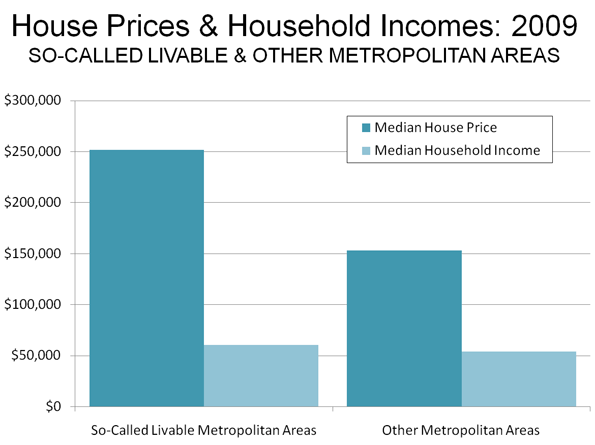
    House prices are considerably higher in the metropolitan areas more inclined toward so-called livability policies. The so-called livable metropolitan areas have nearly 50% higher house prices, after adjustment for incomes (Figure 1). If house prices were at the same level relative to incomes as in the other metropolitan areas, the median price would be $80,000 less. This would mean about $5,000 less in annual mortgage payments. In the least affordable so-called livable metropolitan areas, fewer than 40% of households can afford the median priced house (Los Angeles, New York and San Jose). In all the other metropolitan areas, more than 70% of households can afford the median priced house (Note 2). It takes a lot of gasoline to equal that difference.

    The Livable Communities Act receives an “F” for rental affordability.

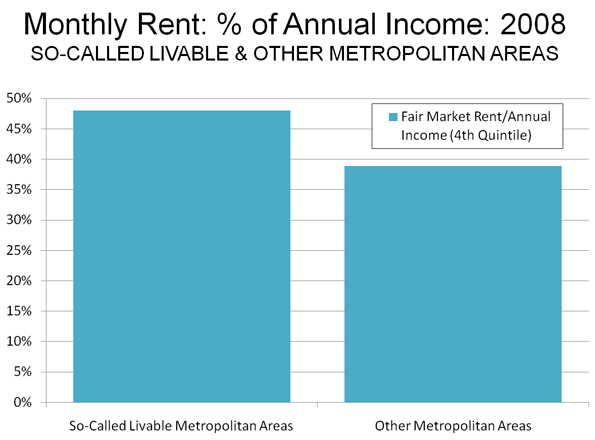
    Rents are also higher in the so-called livable metropolitan areas (Figure 2). The US Department of Housing and Urban Development “fair market rents,” (estimated at the 40th percentile of the rental market, including utilities) for a two bedroom apartment was 25% higher in the so-called livable metropolitan areas in relation to the fourth household income quintile (top of the bottom 25%).

    Why Housing is More Expensive in Livable Metropolitan Areas: The land use regulations typical of the so-called livable metropolitan areas force house prices up by prohibiting development on most available land (urban growth boundaries), imposing building moratoria or, in some cases, by requiring excessively large suburban lot sizes, making it impossible to build housing that is affordable to middle income households. All things being equal, prices increase where supply is restricted, as indicated by a broad economic literature.

    Transportation

    According to the findings in the Livable Communities Act the nation wastes 4.2 billion hours in traffic congestion and loses $87 billion annually from the costs of congestion. The congestion cost is principally the cost of time.

    Transportation Costs: Since commuting by transit nearly always takes longer than commuting by car (twice as long in 2007), any switch to transit is likely to increase costs (lost time is lost time, whether in a train or in a car). The balance of congestion costs are in excess fuel consumption, which would likely also increase under the so-called livability policies, because higher densities produce greater traffic intensities (this from Sierra Club based research), which means more congestion and slower travel speeds, which reduces fuel economy.

    The Livable Communities Act receives an “F” for transportation affordability

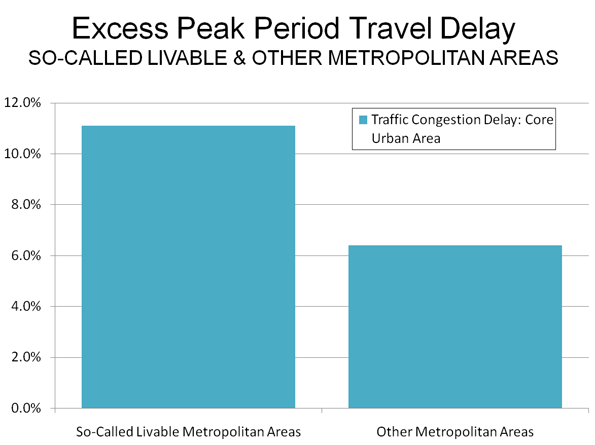
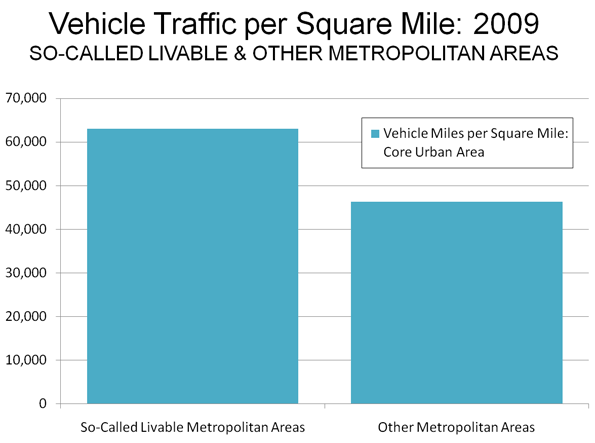
    Transportation Quality of Life: So-called livability policies worsen traffic congestion and air pollution. This is indicated by the latest INRIX traffic scorecard showing that average travel delays during peak travel periods are nearly 75% greater in the so-called livable metropolitan areas (Figure 3). Federal Highway Administration data indicates that the intensity of traffic is more than one-third higher in the so-called livable metropolitan areas (Figure 4)


    The greater traffic intensity also has negative health impacts. The American Heart Association noted that being close to congested roadways increases the likelihood of heart attack and stroke. The American Heart Association cites a study indicating that “a person’s exposure to toxic components of air pollution may vary as much within one city as across different cities.” Obviously, such exposure will be greater where traffic densities are higher.

    The Livable Communities Act receives an “F” on transportation related quality of life issues.

    Consumer Preferences

    In its findings, the Livable Communities Act says that the demand of new housing in dense, walkable (so-called “livable”) areas is 15 times the supply. This misses the extensive overbuilding of dense, walkable communities that ended in the huge condominium bust in Portland, Seattle, Los Angeles, Miami, Atlanta, Chicago and elsewhere. The supply of such housing exceeds the demand, particularly at the current price points.

    Consumer preferences are not revealed by planners’ delusions from surveys people answer in the abstract. For example, most people want shorter commutes, but they vastly prefer single family houses to apartments. In the real context of issues like costs, living space, or schools, people express their priorities.

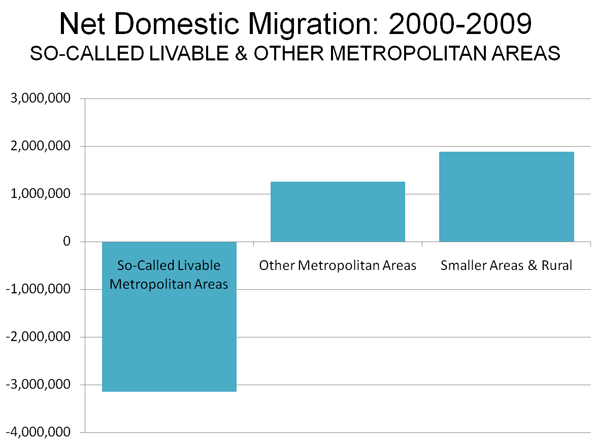
    The “litmus” test of so-called livability is what people do, not what they say they might do. Households continue to vote with their cars and are moving away from so-called “livable” areas. According to 2009 domestic migration data compiled by the Bureau of the Census:

    • The so-called livable metropolitan areas lost more than a net 3,140,000 residents to other areas of the nation, while other metropolitan areas gained more than 1,000,000 and smaller areas gained nearly 2,000,000 (Figure 5).
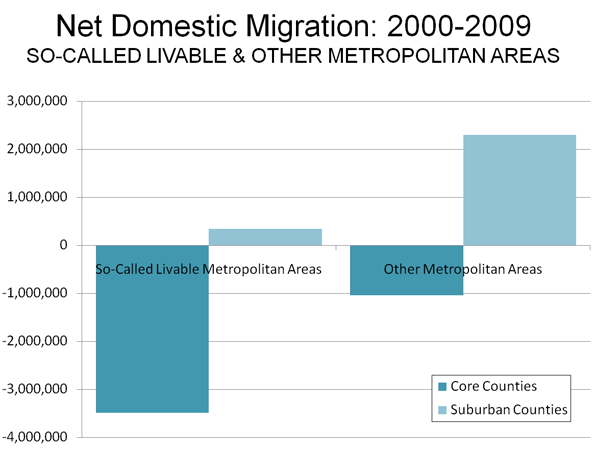
    • Nearly 3,500,000 residents left the core counties of the so-called livable metropolitan areas for other parts of the nation, while the suburbs gained 340,000 residents.
    • In the other metropolitan areas, more than 1,000,000 residents left the denser core counties, while the suburbs gained 2,300,000 (Figure 6).


    The Livable Communities Act receives an “F” for consistency with consumer preferences

    The Report Card: Not Livable at All

    The Livable Communities Act report card is shown below. In other words, if enacted, it is likely to produce a failing grade for families even if it wins straights A’s with planners, academics and inner city developers.

                                     Report Card

    Livable Communities Act

    Subject

    Grade

    Home Ownership Affordability

    F

    Rental Affordability

    F

    Transportation Affordability

    F

    Transportation Quality of Life

    F

    Consistency with Consumer Preferences

    F

    Overall Grade

    F

    Additional Comments: The favored policies would reduce mobility to major parts of the metropolitan area, which would reduce access to potential employment opportunities and retail establishments with lower prices.

    Note 1: The analysis covers metropolitan areas with more than 1,000,000 population. The “so-called” livable metropolitan areas are classified as those with “more restrictive” land use regulation by Demographia. The other metropolitan areas have less restrictive land use regulation. See note 7 of http://www.demographia.com/db-overhang.pdf.

    Note 2: Calculated from the National Association of Homebuilders-Wells Fargo Housing Opportunity Index.

    Wendell Cox is a Visiting Professor, Conservatoire National des Arts et Metiers, Paris and the author of “War on the Dream: How Anti-Sprawl Policy Threatens the Quality of Life

    Photo: Overbuilding Dense Walkability in Miami (photograph by author)

  • City of Austin Approves Big Greenfield Development

    Despite its smart growth policies, the city of Austin has approved a new development on the urban fringe that will include new detached housing starting at $115,000.

    Austin is the third fastest growing metropolitan area with more than 1,000,000 residents in the United States, following Raleigh, North Carolina and Las Vegas. The city of Austin accounted for 53% (672,000) of the metropolitan area’s 1.27 million population in 2000, but has seen more than 70% of the growth since that time go to the suburbs. Now the metropolitan area has 1.65 million people, and the city has 785,000.

    The Austin metropolitan area managed to experience only modest house price increases during the housing bubble, though other metropolitan areas in Texas (Dallas-Fort Worth, Houston and San Antonio) did even better (see the Demographia International Housing Affordability Survey). Austin’s Median Multiple (median house price divided by median household income) peaked at 3.3, slightly above the historic maximum norm of 3.0. Like other Texas markets, there has been little price decline during the housing bust, illustrating the lower level of price volatility and speculation identified by Glaeser and Gyourko with less restrictive land use regulation. This stability has helped Texas weather the Great Recession better than its principal competition, the more intensely regulated states of California and Florida.

    The city of Austin, however, is rare in Texas for generally favoring the more restrictive (smart growth) land use policy devices that have been associated with the extreme house price escalation in California, Florida, Portland, and many other metropolitan areas. The city’s freedom, however, to implement the most draconian policies and drive house prices up is severely limited by far less restrictive land use policies in the balance of its home county (Travis), neighboring Williamson County (usually among the fastest growing in the nation), Hayes County and the other counties in the metropolitan area.

    Austin is competing. This is illustrated by the recent Austin city council action to approve a new “mega” development on the urban area’s eastern fringe that could eventually add 5,000 new houses, town houses and apartments. The first phase will be 350 detached houses that the developer indicates will be priced from $115,000 to $120,000 (including land), an amount less than a building lot San Diego, Los Angeles, Vancouver and Australia.

    By comparison with other developments in the Austin area, however, these houses may be expensive. One home builder is currently advertising new detached houses, only 7 miles from downtown Austin for $90,000. These are not the least expensive in Texas. Detached houses in Houston are being advertised for $79,000.

    A case study in the 3rd Annual Demographia International Housing Affordability Survey showed that the median income Austin household could purchase the median priced house for 11 years less income than in Perth, Australia (this includes mortgage interest). While both Austin and Perth have been growing rapidly, Austin’s faster growth is evidence of stronger demand, which, all things being equal, would have been expected to drive house prices up more than in Perth. But, with more restrictive land use regulation, all things are never equal.

  • Summer in the Hamptons: UnReal Estate

    If you are looking for a place where you can, in your day dreams, ride out the recession, might I suggest one of the Hamptons? These are the celebrity-drenched villages that stretch for thirty miles across the sand dunes and potato fields of Long Island’s South Fork, which ends at Montauk Point and its lighthouse.

    Why the Hamptons for a depression-era exile? For starters, if you’re a seller, the Hamptons remain Paradise. Fishermen’s cottages start at $1 million, oceanfront property goes for about $7 million an acre, and the street value of guacamole rivals that of cocaine.

    When I was growing up on Long Island (although closer to New York City than the East End), the Hamptons were popular, but not in the league of Newport, Malibu, or Key Biscayne. Southampton was notable for the childhood home of Carl Yastrzemski, the Boston Red Sox star. Montauk had a few old inns associated with railroad developments, and party fishing boats with names like the “The Codfather.”

    Then as now, the beaches and the surf were invigorating. To spend time in the Hamptons, however, it wasn’t necessary to have the wealth of Stephen Spielberg, Jerry Seinfeld, or Martha Stewart (whose Hampton Style mansions I have passed when out biking).

    Now, however, the Hamptons have become as mythical as Camelot, a place where for $26.7 million you can buy an oceanfront “cottage” that looks like a departure lounge at Raleigh-Durham Airport.

    Part of the reason for this North Atlantic bubble is that the Hamptons allow tourists and residents to imagine themselves as extras in a romantic comedy.

    If you have never been, it’s best to imagine the towns, once fishing and potato farming villages, as Hollywood backlots, although to play a leading role it helps to cultivate eccentricity. For example:

    When Jerry Seinfeld bought his estate off Further Lane in East Hampton, he put in a baseball diamond, prompting his neighbors to insist that he screen the backstop, less someone think it was a public park.

    In one of her piques of anger or carelessness, Martha Stewart apparently ran over her neighbor’s gardener.

    The writer George Plimpton was arrested for shooting off fireworks.

    As told in the documentary film Grey Gardens, in the 1970s East Hampton authorities and the ASPCA raided the house belonging to Jacqueline Kennedy Onassis’s aunt, who lived in a 28-room beachfront mansion with stray cats, broken windows, and unpaid electricity bills.

    The house now belongs to the former Washington Post editor, Ben Bradlee, and his wife, Sally Quinn. I have puzzled over the connection between an East Hampton estate and Richard Nixon’s Watergate scandal, which Bradlee broke. Was one a reward for the other?

    Even in World War II, the Hamptons had a make-believe aura. The local newspaper ran ads for “War Damage Insurance…resulting from enemy attack,” just in case your infinity pool got taken in some crossfire.

    According to the popular legend (well packaged by J. Edgar Hoover’s FBI), on a foggy night in June 1942, a German U-boat landed four spies on Amagansett beach, plus enough money, weapons and explosives to make a dent in Pennsylvania’s Horseshoe Curve and New York’s Hell Gate Bridge.

    A Coast Guardsman patrolling the beach came across the bumbling Germans, who claimed (in slightly accented English) to be local “Fischermenn” but then offered a $300 bribe to the officer to forget about the encounter.

    The spies-like-us buried their stash in the sand, including a hat with a Nazi insignia (now that’s covering your tracks), and walked to the train station, where they bantered with the ticket agent, presumably about the weather in Berlin. Some days later in New York, Hoover’s G-men busted the ring. It’s impossible not to wonder whether the FBI scripted such turgid summer theater from the beginning.

    Technically, Montauk is not part of the Hamptons. Traditionally a fishing village, it is responsible for many East End legends, including the rumor that Howard Hughes was secluded here in one of his darkened rooms.

    In 1792 President George Washington authorized the construction of the Montauk Lighthouse. Now it’s part of a state park, which charges $8 for parking and $9 per person for admission, and where bicycles and picnickers are treated as public nuisances.

    In the Spanish-American war, Teddy Roosevelt and the Rough Riders were stationed at Montauk, although with so few rations that they had to live off food baskets from local housewives. Later, Montauk harbor became the preserve of bootleggers, who would land hooch and drive it to the Hamptons .

    Through much of the early twentieth century, speculators traded land around Montauk, on the theory that it would become the “Miami of the North” or a commercial port for transatlantic shipping. Neither ever happened, although the Pennsylvania and Long Island railroads ran sleeping car service to the end of the island. Clearest proof of the Great Depression was the news in 1932 that the Pennsylvania had suspended its parlor cars from Pittsburgh to Montauk.

    What do people “do” in the Hamptons? The beach and the surf are the main attractions, and near them are tennis courts and golf courses, not to mention all sorts of boutiques, including those selling skimpy $3,000 cocktail dresses.

    What many visitors like to do is drive up and down Route 27, the only east-west corridor through the Hamptons. At all hours it is clogged with black SUVs, with tinted windows, that give the Hamptons the air of a parking lot at a Russian night club.

    Full-time residents have an additional burden: their vacations are spent at various “benefits” to support libraries, whales, wetlands, and rain forests, all of which can be saved for about $1,000 a table.

    The East Hampton Star, the local newspaper, and a great one at that, chronicles the summer charitable works with celebrity pictures and half-page invitations, all of which, as best as I can determine, promise to deliver the presence of Alec Baldwin.

    Leaving aside the $100 guacamole and the multi-million dollar cottages, there is still a lot to love about the real-world in the Hamptons. The beach is glorious, and the sea breezes deal with most New York City heat waves. The view of the ocean and the dunes at sunset is timeless. I still like biking to the Montauk lighthouse, despite the Route 27 traffic and gruff staff.

    One reason I return to the Hamptons is that it reminds me of childhood summers, which involved trips to the same beaches, sometimes by train. On still nights, lying in bed, I can hear the engine whistles of the Long Island Railroad, echoing at grade crossings in distant cornfields. They remind me of F. Scott Fitzgerald’s boats, those that “beat on, against the current, borne back ceaselessly into the past.”

    Photo By Jeff Pearce, Montauk Lighthouse

    Matthew Stevenson is the author of Remembering the Twentieth Century Limited, winner of Foreword’s bronze award for best travel essays at this year’s BEA. He is also editor of Rules of the Game: The Best Sports Writing from Harper’s Magazine. He lives in Switzerland.

  • The Housing Bubble: The Economists Should Have Known

    Paul Krugman got it right. But it should not have taken a Nobel Laureate to note that the emperor’s nakedness with respect to the connection between the housing bubble and more restrictive land use regulation.

    A just published piece by the Federal Reserve Bank of Boston, however, shows that much of the economics fraternity still does not “get it.” In Reasonable People Did Disagree: Optimism and Pessimism About the U.S. Housing Market Before the Crash, Kristopher S. Gerardi, Christopher L. Foote and Paul S. Willen conclude that it was reasonable for economists to have missed the bubble.

    Misconstruing Las Vegas and Phoenix: They fault Krugman for making the bubble/land regulation connection by noting that the “places in the United States where the housing market most resembled a bubble were Phoenix and Las Vegas,” noting that both urban areas have “an abundance of surrounding land on which to accommodate new construction” (Note 1).

    An abundance of land is of little use when it cannot be built upon. This is illustrated by Portland, Oregon, which is surrounded by such an “abundance of land.” Yet over a decade planning authorities have been content to preside over a 60 percent increase in house prices relative to incomes, while severely limiting the land that could have been used to maintain housing affordability. The impact is clearly illustrated by the 90 percent drop in unimproved land value that occurs virtually across the street at Portland’s urban growth boundary.

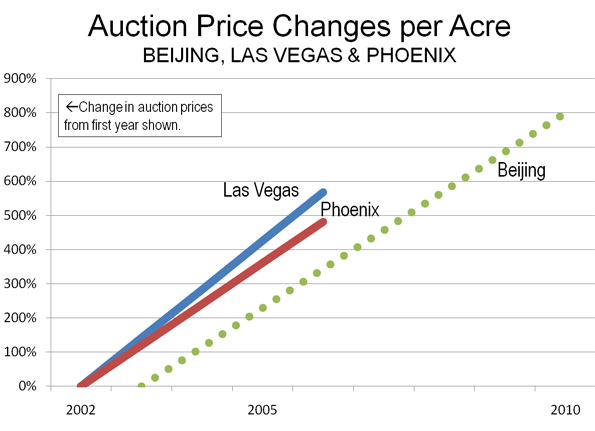
    Building is largely impossible on the “abundance of land” surrounding Las Vegas and Phoenix. Las Vegas and Phoenix have virtual urban growth boundaries, formed by encircling federal and state lands. These are fairly tight boundaries, especially in view of the huge growth these areas have experienced. There are programs to auction off some of this land to developers and the price escalation during the bubble in the two metropolitan areas shows how a scarcity of land from government ownership produces the same higher prices as an urban growth boundary

    Like Paul Krugman, banker Doug French got it right. In a late 2002 article for the Nevada Policy Research Institute, French noted the huge increases auction prices, characterized the federal government as hording its land and suggested that median house prices could reach $280,000 by the end of the decade. Actually, they reached $320,000 well before that (and then collapsed).

    In Las Vegas, house prices escalated approximately 85% relative to incomes between 2002 and 2006. Coincidentally, over the same period, federal government land auctions prices for urban fringe land rose from a modest $50,000 per acre in 2001-2, to $229,000 in 2003-4 and $284,000 at the peak of the housing bubble (2005-6). Similarly, Phoenix house prices rose nearly as much as Las Vegas, while the rate of increase per acre in Phoenix land auctions rose nearly as much as in Las Vegas.

    In both cases, prices per acre rose at approximately the same annual rate as in Beijing, which some consider to have the world’s largest housing bubble. According to Joseph Gyourko of Wharton, along with Jing Wu and Yongheng Deng Beijing prices rose 800 percent from 2003 to 2008 (Figure). This is true even thought we are not experiencing the epochal shift to big urban areas now going on in China.

    The Issue is Land Supply: The escalation of new house prices during the bubble occurred virtually all in non-construction costs such as the costs of land and any additional regulatory costs. It is not sufficient to look at a large supply of new housing (as the Boston Fed researchers do) and conclude that regulation has not taken its toll. The principal damage done by more restrictive land regulation comes from limiting the supply of land, which drives its price up and thereby the price of houses. In some places where there was substantial building, restrictive land use regulations also skewed the market strongly in favor of sellers. This dampening of supply in the face of demand drove land prices up hugely, even before the speculators descended to drive the prices even higher. Florida and interior California metropolitan areas (such as Sacramento and Riverside-San Bernardino) are examples of this.

    Missing Obvious Signs: There are at least two reasons why much of the economics profession missed the bubble.

    (1) Unlike Paul Krugman, many economists failed to look below the national data. As Krugman showed, there were huge variations in house price trends between the nation’s metropolitan areas. National averages mean little unless there is little variation. Yet most of the economists couldn’t be bothered to look below the national averages.

    (2) Most economists failed to note the huge structural imbalances that had occurred in the distorted housing markets relative to historic norms. Since World War II, the Median Multiple, the median house price divided by the median household income, has been 3.0 or less in most US metropolitan markets. Between 1950 and 2000, the Median Multiple reached as high as 6.1 in a single metropolitan area among today’s 50 largest, in a single year (San Jose in 1990, see Note 2). In 2001, however, two metropolitan areas reached that level, a figure that rose to 9 in 2006 and 2007. The Median Multiple reached unprecedented and stratospheric levels in of 10 or more in Los Angeles, San Francisco, San Diego and San Jose- all of which have very restrictive land use and have had relatively little building. This historical anomaly should have been a very large red flag.

    In contrast, the Median Multiple remained at or below 3.0 in a number of high growth markets, such as Atlanta, Dallas-Fort Worth and Houston and other markets throughout the bubble.. Even with strong housing growth, prices remained affordable where there was less restrictive land use regulation.

    Seeing the Signs: Krugman, for his part, takes a well deserved victory lap in a New York Times blog entitled “Wrong to be Right,” deferring to Yves Smith at nakedcapitalism.com who had this to say about the Federal Reserve Bank of Boston research:

    It is truly astonishing to watch how determined the economics orthodoxy is to defend its inexcusable, economy-wrecking performance in the run up to the financial crisis. Most people who preside over disasters, say from a boating accident or the failure of a venture, spend considerable amounts of time in review of what happened and self-recrimination. Yet policy-making economists have not only seemed constitutionally unable to recognize that their programs resulted in widespread damage, but to add insult to injury, they insist that they really didn’t do anything wrong.

    Maybe we should have known better: beware economists bearing the moment’s conventional wisdom.

    ——

    Note 1: The authors cite work by Albert Saiz of Wharton to suggest an association between geographical constraints and house price increases in metropolitan areas. The Saiz constraint, however, looks at a potential development area 50 kilometers from the metropolitan center (7,850 square kilometers). This seems to be a far too large area to have a material price impact in most metropolitan areas. For example, in Portland, the strongly enforced urban growth boundary (which would have a similar theoretical impact on prices) was associated with virtually no increase in house prices until the developable land inside the boundary fell to less than 100 square kilometers (early 1990s). A far more remote geographical barrier, such as the foothills of Mount Hood, can have no meaningful impact in this environment.

    Note 2: William Fischel of Dartmouth has shown how the implementation of land use controls in California metropolitan areas coincided with the rise of house prices beyond historic national levels. As late as 1970, house prices in California were little different than in the rest of the nation.
    Wendell Cox is a Visiting Professor, Conservatoire National des Arts et Metiers, Paris and the author of “War on the Dream: How Anti-Sprawl Policy Threatens the Quality of Life

    Photograph: $575,000 house in Los Angeles (2006), Photograph by author

  • Strategic Diminshment at the Heart of New Housing Policy

    Robert Samuelson in the Washington Post takes on the role of homeownership in our society. I’m generally a fan of Samuelson’s writing, a normally sober, cold-eyed analysis of issues without favor to one ideology over another, so imagine my disappointment when reading him say, “The relentless promotion of homeownership as the embodiment of the American dream has outlived its usefulness.”

    Of course, there’s more to his column. He goes on to say:

    Unfortunately, we let a sensible goal become a foolish fetish. Not everyone can become a homeowner. Some are too young and footloose; some are too old and dependent; some are too poor or irresponsible. Some don’t want a home.

    This is different that saying homeownership is not a worthy goal for our nation and is quite distinct from the ideas of Richard Florida, who has previously written that homeownership is overrated and who’s recent “Roadmap” to recovery focuses on de-emphasizing homeownership. Where Florida is right is in acknowledging that this would “blow up” the fundamentals of our economy.

    He’s also engaging in what I call strategic diminishment – that is, consciously pursuing a future that is less than our current state. Many elite progressives think we have it too good and that our lifestyle choices are harmful to ourselves and our planet. It’s not enough that they want to be scolds; they want to use the power of government to change America into a place where our quality of life is diminished.

    And progressives also glorify this reduction with a “less is more” attitude. The Washington Post recently presented the case against air conditioning, and USA Today reported on the banning of drive-throughs in the city that pioneered them sixty years ago. I’ve addressed strategic diminishment as it relates to the mobility and the Obama administration’s “Livable Communities Act,” but this is also true for homeowners and covers not just the percentage of homeowners but even the size of homes. Ron Utt of the Heritage Foundation warns how even the President has adopted a worrisome narrative on homeownership.

    Before we go off the deep end, let’s clear up two points. First, the crisis we’ve gotten ourselves into is not because people own homes. It’s because of the flawed policies promoting homeownership. We know about the role of the Community Reinvestment Act and Fannie Mae and Freddie Mac, but also contributing were various land-use planning schemes collectively known as Smart Growth.

    Second, homeownership has many benefits. Homeownership is more than a lifestyle choice; it’s a source of wealth and stability. And when homeowners take out a second mortgage on their homes, it’s often as a source for financing their own small businesses – another ideal we associate with the American Dream.

    There are countries with equal or greater rates of homeownership that do not have government intervention policies that skew the market. But as we consider housing policy at the local, state, and federal levels, what should be the principles on which it is based?

    • Owning a home is a laudable goal held by millions of Americans.
    • Homeownership is positive good that should never be discouraged by government policy.
    • Everyone should have the right to pursue homeownership, but not everyone is ready to be a homeowner.
    • Government’s role is not to determine who should be a homeowner or when and where they should buy a home.
    • Markets are better than mandates at creating the environment in which people pursue renting or owning homes according to their ability.

    Before we adopt A Nation of Renters as our new creed, let’s fix the broken policies that got us here.

    Ed Braddy is executive director of the American Dream Coalition, a non-profit grassroots and public policy organization that promotes freedom, mobility, and affordable homeownership. The ADC’s annual conference takes place September 23-25 in Orlando, Florida. For more information, visit americandreamcoalition.org or email Ed at ed@americandreamcoalition.org.

  • The Disappearance of the Next Middle Class

    Every week we read that yet another major housing project has been turned down by the Courts here in New Zealand because of the need to protect “rural character” or “natural landscapes”. This may well have profound short and long-term consequences for the future of our middle class, as it does for the same class in countries around the advanced world.

    Every week a multitude of smaller developers abandon their projects because Councils’ compliance costs and development contributions make the projects unviable – even if the land were free. And it’s not.

    The New Zealand Institute of Economic Research says the ten-year norm for New Zealand is 26,000 new dwellings built per year. Statistics New Zealand reported only 16,000 dwelling consents issued in 2009. The NZ Property Investors Federation says we are building only 7,000 dwellings a year.

    Some say the Property Investors Federation figures are too low given that Statistics New Zealand’s figures for the year to date suggest we shall issue between 13,000 and 11,000 consents this year, and that the “slippage” between consents and finished dwellings cannot be that great.

    However, this is rather like wondering whether you are driving towards a concrete wall at 100 mph or only 80 mph.

    Any current year estimates confirm we are on a slippery slope to catastrophe.

    Unemployment, especially among young unskilled males is on the rise. Given these dreadful build-rates, should we be surprised, since these workers depend on construction for economic opportunity?

    And why don’t we recognize the cause and do something about it?

    First let’s look at the statistics. A Google search under “construction multipliers” turns up statements such as “building 1,000 houses generates 2,300 permanent full time jobs”. Another will say “Every dollar spent in the sector has a multiplier effect between 2.1 and 2.8.” These “low multiplier” statistics seldom spell out what is meant by “the construction sector”, and most are annual figures, and focus on “permanent full time jobs”. But the construction sector generates a multitude of short-term contracts that presumably slip through the net.

    These low “construction” multipliers are reinforced by a post-modernist ideology that tries to persuade us that housing is an unproductive activity that takes productive rural land out of production and hence undermines the economy. This is the old “primary” industry myth, further reinforced by the quaint animist notion that subdivision causes “death by a thousand cuts”. The surveyors are out there wielding their long knives and watching the Earth Mother bleed to death.

    Smart Growth planners claim the “urban sprawl” that grew around our cities during the post-war decades was the terrible price paid for housing the baby boomers and must be replaced with Smart Growth (or perhaps more accurately, Dense Thinking).

    We have lost sight of the fact that those prosperous decades were actually in large part the result of those large-scale suburban developments.

    US economists generally explain the post-war boom as being driven by the work force switching from weapons to washing machines.

    In New Zealand we used to attribute those golden years to micro-management of the economy, and to import licensing in particular. In reality, our real genius was probably introducing the capitalized family benefit which led to our own “Levittown builders” such as Fletcher Construction and Neil Housing.

    Back in the late sixties, while reading for my thesis in urban development economics, I read a report on the drivers of the post-war boom in America, during the twenty years from 1945 – 1965. Wildavsky’s Oakland Project focused on behavioural analysis rather than econometrics.

    The authors concluded that the suburban development boom laid the foundations for the long-term development of the post-war American middle class.

    An equivalent thought experiment would now read something like this:

    • We begin with a clean greenfields site, presumably being farmed, or just open space of some kind.
    • A developer decides the land is well located for a new 1,000 lot residential development and hires consultants or staff to prepare an application. The process alone takes five to six years and provides unproductive employment for a host of highly paid professionals.
    • The project is then killed off by either the Council or the Courts.

    In a sensible world, as prevailed in the post war years, the project would move on to the next stage:

    • The land development teams move onto the site and start the final surveys, road-building, drainage and stormwater schemes, landscaping, and street-crossings, all required before the builders drive their first profile-pegs into the ground.
    • Then teams of contractors start building the houses, which will have been designed by architects, draughtsmen or architectural designers, and then processed through a simple consenting procedure.
    • The teams of carpenters, glaziers, plumbers, painters, roofers, stoppers, electricians and plumbers all move in to finish the houses ready for occupancy. A gang of maybe ten drain-layers could lay the drains for the 1,000 houses over a five year sales-and-build period – say 20 contracts a year.
    • These teams use products and materials cut from forests, mined from quarries, processed in mills, or produced in factories, or recycled products, all requiring employed labour.

    So after a few years the 1,000 homes may be built and occupied. The analysts in the sixties suggested the 1,000 houses would generate say 5,000 direct contract-jobs over those early years.

    However, they recognized that the real economic activity would continue for another fifteen years or more. The same happens today.

    • As the families move into the houses they buy kitchen equipment, drapes and light fittings, bookshelves, plasma TVs, computers, artworks and wine cellars and so on.
    • The owners lay paving, build decks, plant gardens, and landscape the property.
    • The gardens require lawn mowers, chain saws, hedge trimmers, nursery plants, and barbecues.
    • Then up go the Gazebos, the dog kennels, the play houses, the extra rooms, and so on.
    • And then come the swimming pools, spa pools, home offices, sleep-outs, and solar heaters.

    Many of these improvements are produced by the “sweat-equity” of the DIY owners and are a major means of increasing household wealth and well-being. They arealso a potent form of saving, provided the owners are investing in tangible improvements and not over-priced land.

    These suburban on-site improvements go on forever. Consequently, even today there are about 80,000 certified “alterations” a year in New Zealand – and many more that don’t get near a permit.

    All these activities create jobs for the people who make the spa pools, the plasma TVs, the gardening tools, the cars, and the Gazebos.

    After several years from start up the properties are likely to require a gardener once a week, and maybe a housekeeper one or two days a week, and baby sitters, and whatever else the modern family needs to manage its work-life balance. These are the on-site ‘jobs’, but the families also need teachers, doctors, day-care providers, retail staff and so on and so on.

    The sixties report concluded that every 1000 houses would generate a total of 40,000 contracts and jobs. Which seems outrageous until you divide the 40,000 by the fifteen to twenty years, which comes back to the multipliers of 2.0 to 2.6.

    The sixties thought-experiment reminds us that by driving our residential build-rate from 24,000 a year to a no more than 13,000 a year, and probably much fewer, we are turning off the boiler that regenerates our middle class.

    It also explains why an economy with a low “build-rate” is unlikely to enjoy full employment.
    Those suburbs were not “a sad price to pay for our post war housing” but were the economic driver of “the long summer of content” so well described by Bill Bryson in “The Thunderbird Kid.”

    So why are we allowing our institutions to destroy the ability to regenerate our own suburban middle class?

    Whatever happened to genuine sustainable development? Sustainable for middle class people and families too.

    Owen McShane is Director of the Centre for Resource Management Studies, New Zealand.

    Photo by pie4dan

  • China’s Sliver of a Housing Bubble

    Few finance issues have received such a wide range of opinions among financial experts than the “housing bubble” in China. This is an issue of international importance because what happens in what is now the world’s 2nd largest economy affects the rest of the world.

    Differing Views: There are frequent reports of excessively high purchase prices on new housing, which when compared with measures of average household income make it appear that China has the highest house price to income ratios in history. Andy Xie, a Shanghai economist formerly with Morgan Stanley sees a huge housing bubble, which he expects to burst. Stephen Roach, chairman of Morgan Stanley Asia denies there is a bubble, claiming that there is sufficient demand from the continuing migration to the cities for the housing market to be healthy.

    I have been reluctant to weigh in on the debate, simply because there has been insufficient data available to calculate inferior housing affordability measures (such as average price to average income), much less the data that would permit Median Multiples to be calculated. (The Median Multiple is the “middle” house price divided by the “middle” household income and is optimal for measuring middle income housing affordability).

    The problems in assessing China’s housing affordability have been manifold:

    • There has been virtually no median household income data.
    • There appears to be no data available on the median house price

    This means that it is impossible to calculate the Median Multiple.

    Housing Occupancy in Urban China

    Having visited all but two of China’s 20 largest urban areas and traversed them, east to west and north to south from the countryside to the countryside (as I do in obtaining photos and impressions for my “Rental Car Tours“), however, two things are obvious.

    • New high-rise housing is being built at a furious pace in the largest urban areas.
    • Nonetheless, the volume of this new housing pales by comparison to the lower rise, older housing that was built before the present boom (which appears to have started in the 1990s). It is clear that the vast majority of people do not live in the new high rise buildings.

    Nonetheless the press has been filled with absurd reports to the effect that there are 65 million empty housing units in China. The absurdity of this now discredited number is illustrated by the following.

    (1) All of China’s urban areas with more than 500,000 population, where much of the new high rise housing has been built, have less than 300 million people. At the average household size, this means there are no more than 100 million households. In such an environment, 65 million empty units would stick out like a sore thumb. They do not.

    (3) 65 million vacant units is more houses than have been constructed since 1990.

    The New National Economic Research Institute Data: Finally, however, some clarity may be being brought to the issue. Credit Suisse sponsored groundbreaking research by National Economic Research Institute (NERI) of the China Reform Foundation in Beijing, which was led by Deputy Director Dr. Wang Xiaolu. Dr. Wang’s principal contribution is to show that household incomes are considerably higher in China than official statistics indicate. This “grey income” or “hidden income” includes bonuses paid by local governments, payments to public officials, revenues from land development and other sources of income that are not reported in official data and amounts to 90% more than reported figures (report (Analyzing Chinese Grey Income, published by Credit Suisse). In the top decile (top 90-100% of household incomes), grey income added 200% to reported incomes, while in the second decile (80%-90%), grey income more than doubled reported incomes. Buried in the NERI report is median household income data and average multiple housing affordability indicators that are the best information yet made available.

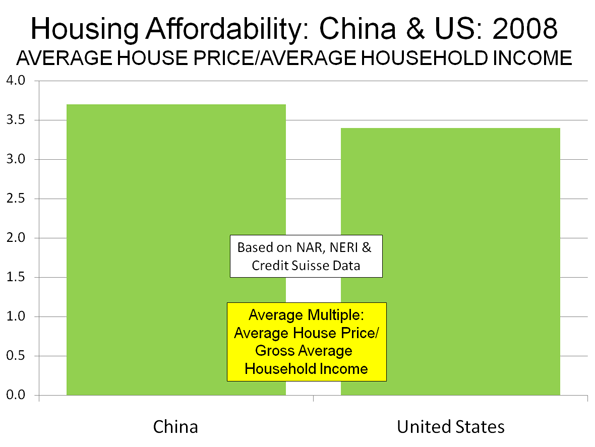
    China’s Average Multiple: Credit Suisse analyst Jinsong Du takes the NERI further to calculate housing affordability indicators that are far below the claims about the Chinese housing bubble. The average (mean) house price was 4.0 times the average disposable household income in 2008, after accounting for “grey income.” Based upon the national ratio of gross income to disposable income (from the China Yearbook), this would indicate an “average multiple” (average house price divided by gross average household income) of 3.7. This is similar to the US average multiple figure of 3.4 (Figure 1) in the same year (2008).

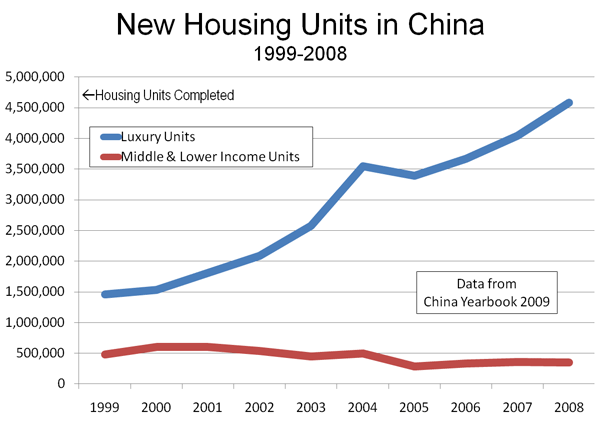
    China’s Median Multiple? This leaves the question of the Median Multiple. There is still no available median house price data. However, it is clear that the new housing is largely irrelevant to median house prices. According to data in the China Yearbook (Table 5-42), only 13% of the 31 million new houses were affordable to lower and middle income people (Figure 2). The new luxury units, with their widely touted prices, remain a minority of the houses, and, as a result, none of these can be the “middle” or median price

    In fact, the median priced house could be of a design similar to a Danwei (live-work unit) type design built before 1990. This is the type of housing that any walk or drive through a Chinese urban area will demonstrate to be dominant (and which is illustrated in the photograph above). There are huge disparities in both house prices and incomes in China. It would not be surprising for China’s Median Multiple to be similar to its average multiple, as is the case in the United States.

    Further, there is a huge difference between the US bubble and the Chinese bubble. In the United States the bubble drove up prices across all income spectrums in the impacted metropolitan areas. It burst largely because middle income households had taken on debt they could not afford. In China, the bubble may be limited to the top of the income scale, the very households that NERI finds are making two to three times as much as the official reports indicate.

    China’s Sliver of a Bubble: None of this is to suggest that house prices at the top of the market are not high. One of America’s leading housing economists, Joseph Gyourko of Wharton, along with Jing Wu and Yongheng Deng found that residential real estate auction prices rose 800% from 2003 to 2008 in Beijing (Note). Recently the government has taken action to cool the high end of the market and to encourage development of more housing for middle and lower income households. At the same time, the Gyourko research team found that new house prices had fallen relative to household incomes in Chengdu, Wuhan, Tianjin and Xi’an, all urban areas with more than 4,000,000 population.

    To accurately assess housing affordability it is necessary to have complete data. Housing affordability cannot be assessed in London using data from Belgravia, nor will Upper East Side data tell an accurate story about New York. The same is true in China. Stephen Roach said that China has a “sliver of a bubble.” That’s what the data seems to show.

    ——————

    Note: This annual rate of increase is approximately the same as was experienced in per acre government land sales in Las Vegas and Phoenix before the peak of the bubble (both urban areas are tightly ringed by “virtual” urban growth boundaries composed of government owned land).

    Wendell Cox is a Visiting Professor, Conservatoire National des Arts et Metiers, Paris and the author of “War on the Dream: How Anti-Sprawl Policy Threatens the Quality of Life

    Photograph: Median priced (?) flats in Fushun, Liaoning (photograph by the author)

  • Affordable Housing Leads to Economic Growth

    Logic suggests that a lack of affordable housing in a region will dissuade people from living there, and employment levels will suffer as a result. However, until recently, no one had readily tested this theory and simply relied on this logic to substantiate this assumption. Ritashree Chakrabati and Junfu Zhang of the New England Public Policy Center published a report looking empirically at this theory in the United States. In doing so, they have found a substantial correlation between a lack of affordable housing and suppressed job growth.

    While Chakrabati and Zhang analyzed data from many US metropolitan areas and counties, they first used California as a state case study to cut down on the number of unaccounted-for heterogeneities created by state policies. California epitomizes the problem of a dearth of affordable housing suppressing an economy. The increased cost of doing business has driven companies out of expensive California, exacerbating the unemployment problem, while the recipients of this flight (mainly in the Midwest and Pacific Northwest) are finding some growth in this recession. These days, people aren’t prioritizing culture and lifestyle; they simply don’t have the budget for it. In order to grow, states must assure residents and businesses that they can sustain themselves during this difficult time.

    The findings of this study should also alert countries such as Australia, now in the midst of a major land and housing crisis, about creating more affordable conditions around their urban core cities to maintain economic growth, much less stimulate it. Just as businesses are reluctant to stay in California, business will be reluctant to find a home in these expensive core cities. Almost every country depends on global ties to support itself, and it will be those that can strike a balance between affordable housing and standard of living that thrive.

  • Vancouver: Planner’s Dream, Middle Class Nightmare

    Vancouver is consistently rated among the most desirable places to live in the Economist’s annual ranking of cities. In fact, this year it topped the list. Of course, it also topped another list. Vancouver was ranked as the city with the most unaffordable housing in the English speaking world by Demographia’s annual survey. According to the survey criteria, housing prices in an affordable market should have an “median multiple” of no higher than 3.0 (meaning that median housing price should cost no more than 3 times the median annual gross household income). Vancouver came in at a staggering 9.3. The second most expensive major Canadian city, Toronto, has an index of only 5.2. Even legendarily unaffordable London and New York were significantly lower, coming in at 7.1 and 7.0 respectively. While there are many factors that make Vancouver a naturally expensive market, there are a number of land use regulations that contribute to the high housing costs.

    Vancouver is a unique real estate market: it’s the only major Canadian city that doesn’t experience frigid winters. This makes it a major draw for high skilled, high salary employees. It is also a major destination for wealthy Canadian retirees, who choose to actually spend their winters in Canada. There is little doubt that it is a naturally expensive real estate market. As with coastal California cities, people pay a premium for (in this case relatively) hospitable weather. The proximity to world class skiing, fishing, and hiking are no doubt another factor in the city’s high real estate costs. There is certainly a premium to be paid for living less than two hours away from the world’s best ski resort.

    Moreover, Vancouver has become an appealing real estate market for overseas investors, particularly Chinese nationals. There has been a good deal of news recently about how many of the nouveau riche in China are now looking to Vancouver, rather than Los Angeles or New York as an immigration destination. In absolute dollar terms, Vancouver is still cheaper than either city. This, combined with the more hospitable Canadian immigration system, has made Vancouver so attractive to overseas investors that real estate agents are now organizing house hunting tours for potential Chinese buyers.

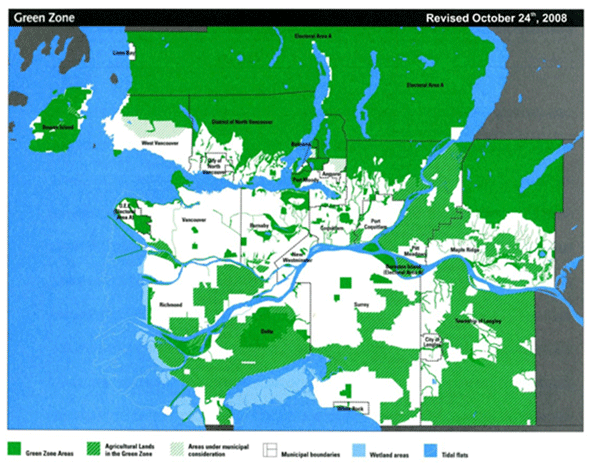
    To be sure, geography deserves much of the blame for Vancouver’s high housing costs. But a large chunk of the blame lies with restrictive municipal and provincial land use policies. Since the introduction of the city’s first comprehensive plan in 1929, Vancouver has used various land use regulations to create dense mixed use development in order to protect green space surrounding the city. In 1972, the provincial government passed legislation aimed at protecting BC farmland. This left less than half of the already scarce land in Greater Vancouver off limits to developers. As a result, the city is circled by undeveloped land, referred to as the Green Zone. The Green Zone acts as a de facto urban growth boundary, largely designed to prevent sprawl.

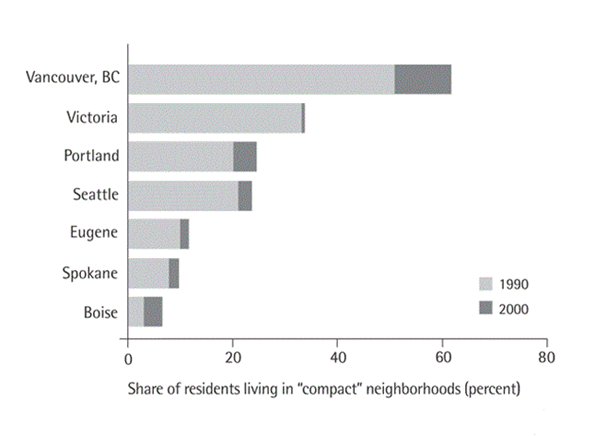
    As a result, Vancouver is one of the few North American cities that have been growing almost exclusively upwards, rather than outwards for the last century. Its narrow streets and lack of a major highway running through the city make it one of the least automobile friendly cities on the continent. Unsurprisingly, Vancouver was ranked the most smart growth oriented city in the Pacific Northwest by the Sightline Institute. Roughly three times more Vancouver residents live in compact neighborhoods as a percentage of the population compared than Portland or Seattle. This arguably makes Vancouver the most smart growth oriented city in North America.

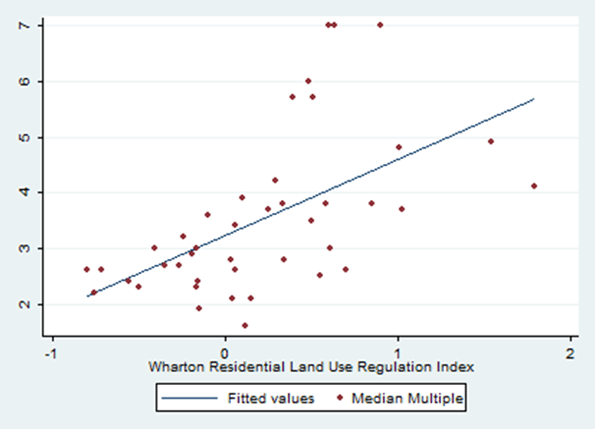
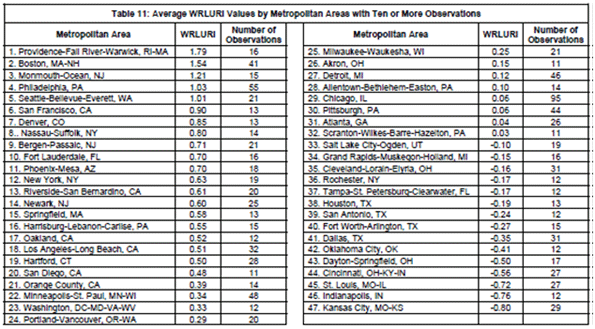
    Smart growth has become a truism for urban planners. Walkable communities with a mix of commercial and residential units combined with strict zoning regulations to encourage transit usage is a formula increasingly prescribed for North American cities. Though many smart growth principles are attractive, there is an strong correlation between heavy land use regulations and housing costs. Using data from the Wharton Residential Land Use Regulation Index (WRLURI), and Demographia’s International Housing Affordability Survey, a simple scatter plot diagram has been included to illustrate this correlation.

    The WRLURI measures the stringency of land use controls imposed on various US jurisdictions by state and local governments. There is a clear correlation between high regulations, and low housing affordability. Though the index does not include Canadian cities, it does include neighboring Seattle. Seattle ranks fifth of 47 cities on the Wharton Index. According to a recent study in Boston College International & Comparative Law Review by David Fox, Vancouver is decades ahead of Seattle in terms of smart growth policies. This means that Vancouver would rank at least fifth in North America on the index, though it is more realistic to assume it would most certainly top the index.

    In addition to smart growth policies, Vancouver also has very stringent inclusionary zoning laws. Inclusionary zoning requires developers to provide a certain number of affordable housing units in any given development. This policy might seem to make the city more affordable, but it functions exactly like rent control. Those fortunate enough to find spaces in the affordable housing units pay less, but the subsidized rent is made up for by higher rent in adjacent units. In a study of inclusionary zoning in California cities, Benjamin Powell and Edward Stringham from the Department of Economics at San Jose State University found that inclusionary zoning imposes an additional $33,000-$66,000 cost on adjacent market rate units.

    There have been some recent policy initiatives that may reduce the cost of housing marginally. In 2004, the city amended its zoning code to permit secondary suites throughout the city. Secondary suites are subdivided units of owner occupied homes that are used as rental units. This zoning change brought tens of thousands of relatively low cost units into the market. There are currently 120,000 secondary suites in the province. The city recently went one step further to allow homeowners to convert laneway garages into rental units. These units have a maximum of 500 square feet. There are 70,000 homes in Vancouver that are eligible for conversion, though it is unclear how many will take up the offer. This will add to the stock of relatively affordable rental housing in the city, but may not significantly reduce housing costs. In fact, by increasing the revenue generating potential of houses, it may actually increase the cost of purchasing a single dwelling home. After all, if the potential rental income of a single dwelling unit increases, the market price of the unit is likely to do the same. This isn’t necessarily an argument against the policy, though it does underscore the fact that housing costs in Vancouver will never decrease without liberalizing municipal and provincial land use policies.

    In short, the City of Vancouver and Province of British Columbia have chosen to favor compact growth over affordable housing costs. This likely makes the city more attractive to affluents from both the rest of Canada and abroad, but increasingly makes it unaffordable for middle class families. There is certainly some substance to the Economist’s claim that Vancouver is the most livable city on earth. It is a very attractive place for those who can afford it. Nevertheless, creating a city fit only for the wealthiest segments of society and non-families is hardly something to be proud of.

    Downtown Vancouver photo by runningclouds

    Steve Lafleur is a public policy analyst and political consultant based out of Calgary, Alberta. For more detail, see his blog.