Category: housing

  • Follow The Money On Development Deals

    “Follow the money” became a household phrase after the 1976 movie that told the story of Watergate, All the Presidents Men. Personal experiences over four decades in the consulting industry, working to create sustainable developments, often bring the phrase to mind.

    In a meeting a few weeks ago concerning a potential collaboration between our planning company and large engineering consulting firm, I was coached to tone down the fact that the design methods we invented and utilize reduce infrastructure. You might ask, why would reduced infrastructure (one key to a more sustainable world) be a negative condition for an engineering firm whose main purpose is to design the infrastructure that society must rely upon?

    Follow the money… Large engineering projects, as well as many architectural structures, are often quoted as a percentage of construction costs. The incentive is to increase, not decrease construction costs. We have the ability today to reduce the world’s infrastructure possibly up to 30%, which would be a major step towards reducing initial costs of commercial building and residential housing. It would have massive environmental benefits, and reduce the continual maintenance costs to the governmental authorities (forever) up to 30%.

    Follow the money… If the income of consulting firms is based upon construction costs, the consultants’ gross dollar billings would also be reduced by 30%. Firms that supply concrete, steel, pipes, etc would also have their gross income slashed by 30%. Does our world have a chance of becoming sustainable? Dream on!

    Follow the money… A decade ago I met with the president of one of the largest engineering firms in Minnesota. He wanted to know how our firm can produce so much work with so few people (I personally design all of the developments and had a drafting staff of two people). In ten minutes I designed a development of about 15 lots that showed homes, driveways, and all the final geometry, using the commercially available technology we had developed. “Oh my,” he said, and paused. I thought he would say, “We could reduce our staff by half,” but instead said , “You must put the plans on the shelf a few weeks, to justify the billing hours”. Then the enlightenment came to me. I had developed a software technology used in my own consulting business to produce engineering-accurate layouts in a fraction of the time of a CAD (Computer Aided Drafting)-based technology, but started to understand that this might be a hard sell.

    Follow the money… Large consultants often look at the floor of employees as a multiplier, meaning that each workstation will bring some multiple of profit. Suppose a technician costs $50,000 a year, and the multiplier is 3.5. After overhead, that technician represents $100,000 in potential profit. At a 150 person company, replacing one third of the staff by using more efficient technology and methods in the above example reduces the potential consulting income by five million dollars!

    Follow the money… Liability is another roadblock to sustainability. Why try something new when the old tried and true has worked for decades or centuries? In the consulting industry, licensed professionals risk their careers if a new concept causes a major failure, so they’re more likely to discourage anything without a proven history. The loss of a license to certify plans would have a devastating effect on a consultant’s personal finances. It is far safer to claim that the new method cannot work and talk the developer or municipality out of the idea.

    Follow the money… Today, few consultants are making any. Most are either hanging on (barely) or have shut their doors. The unemployment rate among architects, engineers, draftsmen, technicians, planners, and related occupations is very high. The exceptions are those lucky few that have won lucrative government contracts and are holding their own, or even thriving.

    Follow the money… The market reacts to design, innovation and value. The first Toyota Prius was an ugly miniscule car based upon the Echo, but it was highly efficient. Gas was cheap when it was first introduced, and sales were dismal. The first generation Prius had innovation, but lacked design. The next generation Prius came out as gas prices soared. When an attractive interior and exterior design was combined with innovation, it quickly became a symbol for a new era of green thinkers. Rising fuel prices turned the hybrid technology into an increasing value which fueled — so to speak — its success. Before the I-Pod there were many digital music players that were innovative. When players were combined with an attractive package design and the ability to download from the same vendor, the overall value created its success. Like the Prius and the I-Pod, land development itself is a “product”.

    Follow the money… The housing market crashed and many believe the commercial real estate crash to come will also be devastating. Funding for infrastructure keeps many consultants employed when the private development and building industry flounder.

    Those of us in the consulting industry must make some significant foundational changes if we are going to have a sustainable future, and claiming “Sustainability!” on the corporate web site is not enough. Unlike building construction, where being “green” typically increases costs, in land development, environmentally sound design and construction can cost significantly less if done right. That said, it does require more design effort with a greater attention to detail. It is possible to decrease both construction costs and environmental impacts say, 30%, but it could mean the consultant doubling his or her design efforts to do so. Not only does the firm lose 30% of its gross income if billing is based upon a percentage of construction costs, it must make a huge increase in effort to do so.

    Follow the money… In this new age of engineering and designing sustainable development, it is no longer possible to get the best result by simply using an off-the-shelf software to calculate the hydrology of the site (the drainage) within sewer pipes. Using surface flow along with natural materials that can filter pollutants from the run-off before drainage leaves the site requires a botanical engineering solution that blends knowledge of natural and manmade engineering. This requires a specialist, and the complexity that’s required to successfully design these systems with fail-safe methods goes far beyond pressing a software button. Small errors could have devastating results, and the consultant will be liable.

    For example, I installed a no-mow – low watering – fescue lawn, instead of sod, when my home was built last year. This landscaping worked great during the first year, giving us the look of a lawn look without having to mow it. We were told to water twice daily to get it established by the landscaping firm that claimed to be experts on this exciting new low impact landscaping. Well, watering fescue twice daily, it turns out, is the worst thing you can do, according to the prairie restoration consultants. We inadvertently turned our lawn into a fast growing prairie that needs more mowing than sod! But this is just one example of what can go wrong in this new era of sustainability. I was willing to invest, and I believe mistakes can be corrected and documented to reduce future errors. My landscape contractor installed something quite new in the industry, and took on a risk compared to suggesting safe sod. After the bugs are worked out the company will have a market edge and an example to show (but maybe not this year).

    So how can we force an industry to change?

    Lead with Money… Cities and developers hire firms assuming that they are going to use the latest techniques available to get the most efficient design possible. If the bidding process changed from seeking the lowest bidder to looking for the most advanced and efficient bidder, the industry would be rewarding innovation, competition, great design, and risk. Give priority to solutions that exceed the specifications. Contractors and consultants could be rewarded for coming up with revolutionary solutions.

    Lead with Money… The reward could be in the form of a bonus for innovation: For example if a plan saves 100 million in right-of-way purchasing, give half of the savings to the winning contractor and consultant. If the consultant is being paid a percentage of the construction costs (lets use 5% as an example) on a 100 million dollar project, then he or she would gross five million dollars. If they could win the consulting (engineering) contract by demonstrating the most efficient design instead of being the lowest bidder (or the most politically connected), and be paid a percentage of the demonstrated benefit, they would be making more for providing a higher degree of effort and perhaps taking on more risk. In the above example, if 30 million dollars is demonstrated to be a savings or increase in functionality, and 20% of the savings is rewarded back to the consultant, then the consultant would make 5% on the 70 million dollars (3.5 million dollars) and 20% on the 30 million in savings (6 million dollars). The gross revenue to the consultant would almost double.

    Lead with Money… Our military often awards bids for those projects that exceed the specifications. Vendors should compete not just on price, but to demonstrate how they exceeded the specifications. Governments as well as private developers could pick and choose based upon innovation, design, and value. Those taking the extra effort would flourish, and eventually the new higher standards would become the norm.

    How about forcing change through regulations? Regulations can only control minimum standards, pretty much guaranteeing monotony and stagnation. Instead, follow the money: To create a sustainable world, we need to exceed minimums, and foster innovation by rewarding risk, effort, and investment.

    Flickr photo, “George Is Keeping An Eye On You,” by We Love Costa Rica

    Rick Harrison is President of Rick Harrison Site Design Studio and Neighborhood Innovations, LLC. He is author of Prefurbia: Reinventing The Suburbs From Disdainable To Sustainable and creator of Performance Planning System. His websites are rhsdplanning.com and performanceplanningsystem.com.

  • Salt Lake City’s Sacred Space

    Amid a devastating condo crash and high office vacancies across the U.S., one of the country’s largest downtown development projects is taking shape in Salt Lake City. The city’s center displays a landscape of cranes, cement-mixers and hard-hats–something all too rare in these tough times.

    Over the next few years, with an investment estimated locally at $2 billion, developers hope to transform a 20-acre swath of the city’s now-uninspired central core. By 2012 they hope to create a model downtown district with a whole new array of retail shops and residential towers accommodating some 700 units.

    On the surface, Salt Lake City , America’s 38th largest central business district , would seem an unlikely place for such an ambitious development. The city’s population growth–it is home to fewer than 200,000 of the region’s 1.2 million people–has been meager, particularly compared with the surrounding suburbs. The central business district represents less than ten percent of the region’s total employment.

    The driving force here is not economics, but the desire of Salt Lake’s most powerful institution, the Church of Jesus Christ of Latter Day Saints, to salvage its immediate neighborhoods. “The church’s primary notion is to protect the Temple Square and the headquarters of the Church,” explains Mark Gibbons, president of City Creek Reserve, the church’s development arm. “That’s first and foremost. This development would not have been done just on a financial basis, I can tell you that.”

    This motivation deviates from what we see now in most cities. For one thing, this does not reflect rent-seeking by real estate interests–there are no public subsidies, for example. Instead the City Creek project represents the ultimate in back-to-the-future city planning, a reversion to the ancient ideal of building a city around its essential “sacred space.”

    It’s all the more remarkable at a time when churches being converted into yuppie housing, discos or carpet stores is celebrated by the decidedly secular caste of urbanists. Of course, not everyone loves this approach. One former Salt Lake City planning official, a non-Mormon, has expressed fears about the “Vaticanization” of the area.

    Yet to date the traditional urban approach–museums, light rail development, downtown malls–has been far from a shining success. Salt Lake’s greatest remaining asset remains the Church, its great central Temple and the surrounding infrastructure of office, museums and genealogical agencies .

    Mormonism, in a sense, has to be thought of as a growth industry for downtown. Since 1960, church membership has surged from 2 million worldwide to nearly 14 million. Although Utah remains the church’s central base–over 70% of the state population is Mormon–the biggest increase has been outside the U.S., predominately in Latin America and parts of east Asia. This reality is reflected in Salt Lake itself; once overwhelmingly white, its population is now some 30% minority, much of it Latino.

    As an anchor tenant, the Church provides the ultimate raison d’etre for the surrounding area. The Temple Square remains the state’s largest tourist attraction. Church members from around the world come to the city for conferences and to consult with church records and officials.

    Of course, the fundamentally ecclesiastical logic diverges wildly from urbanist conventional wisdom. In most cities, planners embrace the idea of building the city core around singles, or “empty nesters.” The nurturing of a “bohemian” culture–hopefully of the free-spending bourgeois variety–is seen as providing a spur to art galleries, bars, clubs and high-end restaurants.

    Salt Lake’s developers wish to improve the amenity structure too, but in ways that would appeal to the middle-class families who dominate the region. Mormons, who make up half of the city population and the vast majority of those in the surrounding suburbs, average three to four children per family. Overall, the area has one of the youngest populations of any metropolitan region in the country.

    “The idea of having a sacred center is to create a space–like a campus–that’s decent, clean and upscale in a design sense, but accessible to families, ” observes Joe Cannon, editor of the church-owned local paper, The Deseret News. Without drawing in people from the predominately family-oriented suburbs, he says, the downtown would lack the base to rebound from a generation of neglect and decline.

    The church focus also makes sense, Cannon notes, when you take into account the unique history of the place. Unlike most American cities, Salt Lake was born primarily through the religious vision of the Mormon Church and in particular its great visionary leader, Brigham Young.

    The Mormons came to Salt Lake as part of their search for a sacred space. Such ideas led some to regard the Mormon as cult-like sect, dangerous to the nation. They came to Salt Lake only after attempting to settle down in Ohio, Illinois and Missouri–an action that often led. They often were booted out courtesy of bloodshed inflicted on them by more-traditional Christians.

    Although successful in a capitalist sense, Salt Lake’s urban culture reflected what Mormon historian Leonard Arrington describes as “Jacksonian communalism.” For many years, the Church controlled Zion’s Bank, the largest in the region, and promoted commercial development. Critically, Mormon charities and organizations brought in new settlers, mostly from England and Scandinavia.

    By the 1960s the downtown began to decay as Mormons, as well as non-Mormon “Gentiles,” moved en masse to the suburbs. The area around the Temple became increasingly seedy and rundown. This has led to the current effort to revive the city through the efforts of the Church–the institution with the greatest stake in the central core.

    Over the next decade, the Church’s effort could represent something unique in an urban America increasingly obsessed with the ephemeral. “We are not trying to build a ‘faux city,’” notes Mark Gibbons. “We are trying to build something that will last a hundred years or more.”

    In following that strategy, Salt Lake is trying to recover some of the very things that have sustained cities over time. It will be fascinating to see how their approach–based on the most ancient of city-building strategies–fares compared with those applied by their more decidedly secular rivals.

    This article originally appeared in Forbes.com.

    Joel Kotkin is executive editor of NewGeography.com and is a distinguished presidential fellow in urban futures at Chapman University. He is author of The City: A Global History. His newest book is The Next Hundred Million: America in 2050, released in Febuary, 2010.

    Photo by Edgar Zuniga Jr.

  • The Urbanist’s Guide to Kevin Rudd’s Downfall

    The political execution of Prime Minister Kevin Rudd by his own Australian Labor Party colleagues was extraordinary, the first time a prime minister has been denied a second chance to face the voters.

    According to the consensus in Australia’s mostly progressive media establishment, Rudd fell victim to his “poor communication skills”, a somewhat Orwellian take since until recently he was hailed as a brilliant communicator. What went wrong?

    Certainly, Rudd’s style of communication was a factor. Yet the media’s disjointed interpretations avoid what, for them, is an inconvenient truth. As much as any defects in the man himself, Rudd’s linguistic meltdown can be traced to deep socio-economic divisions wracking today’s Australian Labor Party.

    Australia has its own version of the American red and blue state dichotomy. But with a much smaller, highly urbanised population, and only six states, the social fault line runs through major metropolitan regions rather than state boundaries. Left with a fractured support base, federal Labor often struggles to hold onto majority support. Rudd clearly underestimated the persisting social divide, and his obsession with a media driven solution was disastrous.

    In Australia, post-war suburbanisation and gentrification played out differently than in the US. Since in the 1970s, Australian cities have experienced a broad geographic sorting along class lines. On the one hand, rising land values and car ownership dispersed the old industrial core, and its working class population, to the middle and outer suburbs. On the other, a booming generation of university graduates, many immersed in the counter-culture, and employed in expanding government agencies, flooded into inner-city tenements.

    Lacking the racial frictions of some American cities, and typically adjacent to attractive harbour foreshores (Australia’s major cities are all coastal), these nineteenth century streetscapes were ripe for gentrification. Before long, all remnants of the old working class gave way to restaurants, upscale bars, coffee shops, cinemas, bookshops, art galleries and other favourite amenities of a new upper middle class.

    Over time, urban polarisation has far-reaching political consequences. While the new professional class voted Labor, and transformed the Labor Party in their own image, they dominated only a handful of electorates (electoral districts). Most of these are in the inner precincts of Sydney and Melbourne. The overwhelming majority of electorates are suburban or regional, populated by blue-collar, routine white-collar and self-employed private sector workers. Whether former inner-city residents, or newly arrived migrants, they embraced the suburban ideal of reward for work, free-standing homes on a quarter acre block and the prospect of upward mobility, particularly for their children. Later, social commentators labelled them “aspirationals”.

    Increasingly, inner-city elites and suburban aspirationals inhabited different worlds. By 1996, many aspirationals felt Labor had lost touch with their priorities. Apart from his poor record on inflation and interest rates, sensitive issues in the mortgage-belt, then Prime Minister Paul Keating became a champion of the elite’s obsession with race and gender. Having infiltrated Labor’s apparatus, progressives now seized control of the party’s policy agenda.

    Ultimately, Labor’s historic bond with working people was severed at the 1996 election, when masses of aspirational voters defected to the conservative John Howard. Howard retained their support over four terms in office. During this time they acquired another label – “Howard Battlers” (an antipodean variant of Reagan Democrats).

    Labor spent these years wavering between elite and aspirational programs, failing to reconcile their deep-seated differences. Successive leadership changes were a flop. Not until 2006, when Howard showed signs of running out of steam, was victory finally in sight. Leaving nothing to chance, the popular Rudd was installed as leader, and handed the task of herding both progressive and aspirational voters into Labor’s camp. Rudd’s strategy may have won him the election, but it bore the seeds of his destruction.

    On sensitive issues, Rudd resorted to an elaborate form of doublespeak: headline rhetoric crafted for aspirationals with policy small print pitched at progressives. He was confident enough in his mastery over the media cycle to pull this off. And he assumed aspirationals were too unsophisticated to catch on. He was proved wrong on both counts, but only after winning office.

    Take his handling of housing, transport and urban development. Housing affordability and traffic congestion loomed as hot topics in the 2007 election. Before the late 1990s, Australian cities had generally liberal approaches to land release and suburbanisation, and the motor vehicle was supreme. Urban planning was the province of state governments, which had long considered motorways the wave of the future, given the country’s increasingly dispersed patterns of residential, commercial and industrial development.

    As the century drew to a close, however, sentiment in the planning profession, including state officials, many now religiously green, shifted from growth to consolidation (“smart growth“) and the revival of rail transport. More recently, the climate panic accelerated this trend. On the whole, state governments, mostly Labor in the decade to 2007, proved compliant. Considering that Australian cities were experiencing high rates of population growth, in part due to very high levels of immigration, land values and house prices soared and roads, particularly in the middle to outer suburbs, couldn’t cope with traffic volumes. These problems were especially bad in Sydney. For the first time, many Australians feared that their children would never achieve the dream of home ownership.

    Leading up to the election, Rudd took to calling housing affordability “the ultimate barbeque stopper”, a subject on everyone’s lips. He convened a Housing Affordability Summit, and released a strategy paper. His campaign launch speech, weeks out from polling day, reminded voters that Labor had “put forward a national housing affordability strategy – so that we can keep alive the great Australian dream of one day owning your own home”. Rudd’s rhetoric on “infrastructure bottlenecks” was just as high-blown. “For 11 years”, he said repeatedly, “Mr Howard’s government has failed to provide leadership in developing our nation’s infrastructure”. References to traffic congestion were made in this context.

    But the policies didn’t match the rhetoric. Since elite sentiment was, by this stage, in the grip of climate alarmism, there was little way Rudd would address the root causes of these problems. Restricted land supply and urban growth boundaries, to contain Australia’s “ecological footprint”, combined with population growth, were driving up land values and inducing developers to bank their land holdings rather than release them. Rudd’s plan just tinkered around the edges. There were to be tax breaks on capped home saver bank accounts, subsidised rental accommodation for low income earners, and a massive boost in social housing stock. Conceived by activists who saw housing as a welfare issue, these measures did little for the mass of aspirationals or their children. A later boost to the existing “first home buyer grant” probably inflated prices further. Far from saving the great Australian dream, Rudd cast it into the dustbin.

    After the election, the small number of infrastructure projects selected for funding had limited potential to ease traffic congestion. In his landmark October 2009 speech on urban policy, Rudd had more to say on shifting motorists out of cars and onto trains than upgrading roads to improve traffic flows. For Sydney’s long-suffering commuters, there was no sign that “missing links” in the Orbital Motorway Network ring road would be completed.

    Well into 2010, house prices had been escalating for over a year, and mortgage interest rates began to creep up again, having been slashed during the financial crisis. More and more Australians thought Rudd’s performance, on a broad range of policy fronts, was falling short of his elevated rhetoric. He was “all talk and no action”. When his opinion poll ratings plummeted, with no revival in sight, Labor Party power-brokers feared their government would be thrown out after just one term, a first since 1932. Either Rudd or the Labor government had to go. They chose Rudd.

    John Muscat is a Sydney lawyer and co-editor of The New City (www.thenewcityjournal.net), a web journal of urban and political affairs.

    Photo by London Summit

  • Aspiring to The Russian Dream

    Bloomberg Business Week reports that the Russian government wants to move urban residents from their “cramped” high rise apartments to new suburban developments. Single family houses would be built in joint ventures with private developers. Present plans are to develop 2.5 million acres of suburban homes. This is a very large program. At Los Angeles densities, this amount of land would be sufficient to house about 28,000,000 people, roughly double the present population of the Moscow urban area.

    As occurred before in the United States, expanding suburban home ownership could generate a democratization of prosperity that brings far better living conditions to middle income households. Already, more affluent households have built European and American style detached houses outside Moscow’s 8-lane ring road (see photograph).
    Photograph: New detached housing, northern Moscow suburbs (Veshki).

  • Millennial Surprise

    The boomer’s long domination of American politics, culture and economics will one day come to an end. A new generation–the so-called millennials–will be shaping the outlines of our society, but the shape of their coming reign could prove more complex than many have imagined.

    Conventional wisdom, particularly among boomer “progressives,” paints millennials–those born after 1983–as the instruments for fulfilling the promise of the 1960s cultural revolt. In 2008 the left-leaning Center for American Progress dubbed them “The Progressive Generation.” The center contrasted them favorably to the Xers, a cohort of 20 million fewer, and their “conservative views.”

    The case for the millennials’ left-leaning views can be traced to when the oldest millennials started to vote, in 2004. That year big loser John Kerry took the 18 to 29 vote by nearly 10 points. In the last election millennials supported Barack Obama over John McCain by a staggering 30 points. He outperformed McCain in every ethnic group, winning 54% of young white voters and a remarkable 76% of young Hispanics. Obama may still have won without millennial support, but only narrowly.

    This vote was shaped by important and perhaps lasting attitudes. Authors Morley Winograd and Michael Hais identified among these young voters a strong communitarian ethos, generally liberal social views and somewhat of a “green” agenda. They wrote that millennials’ embrace of the Democratic Party in 2008 could foreshadow a long-awaited leftward realignment paralleling that which occurred in the 1930s.

    Yet there are signs that millennial voters, if not shifting to the right, may have lost some of their progressive ardor. Recent polls suggest that younger voters are far less likely to vote this year than in 2008. Gallup reports that nearly half of voters ages 18 to 29 are not enthusiastic about turning up at the polls this November, a far higher number than senior or boomer voters.

    One reason for such a dramatic shift is likely the economy. The current recession has been very hard on younger workers–unemployment hits around 20% for workers between 16 and 24. The brunt of the recession has hit blue-collar, high school educated youths, but even the college crowd, the core of the Obama constituency, faces what appears to be dismal prospects in the years ahead.

    Not too surprisingly, a May Allstate-National Journal Heartland Monitor survey of voters 18 to 29 found only 45% of millennials still solidly behind the president’s economic agenda. This could have a depressing impact on the leftward lurch among millennials. Indeed one recent Harvard survey found only half of all young voters planned to vote Democratic for Congress this year, compared with 60% in 2006.

    If the downturn persists, we could see some changes in generational politics. In the 1970s a similarly dismal economy accompanied the boomers as they were entering the workforce in huge numbers. Then, as now, long-term unemployment and underemployment seemed the wave of the future.

    The hard times of the 1970s changed the politics of the boomers. The bungled presidency of Jimmy Carter did not do much for the credit of the Democratic Party. Boomers, who sided with Carter in 1976, ended up voting for Ronald Reagan in large numbers four years later. The relative prosperity of the Reagan years painted a basically conservative tinge to boomer voters, something that benefited both Republicans and more centrist Democrats like Bill Clinton.

    This change could occur again, but other factors may slow a rightward shift among millenials. Republican nativism–exemplified by the Arizona immigration law–may be a boon with boomer voters, who are overwhelmingly white (only one in four are non-white). In contrast, roughly two in five millennials are minority group members. The age group 18 and under is already majority “minority.”

    Another big factor will be social liberalism. On a host of critical issues–from interracial dating to gay marriage–millennials tend to be far more “progressive” than earlier generations. According to a recent Pew study, 63% of millennials believed society should accept homosexuality compared with only 48% of boomers.

    Millennials also tend to disapprove of such things as prayer in school compared with boomers or older generations. Although most express some religious commitment, there are more unaffiliated and basic non-believers than in previous generations. The GOP’s long-term embrace of a hard religious right positions will not pay off among millennial voters.

    Perhaps most troubling for Republicans–and this is a point emphasized by Winograd and Hais–are millennial views on government. Two-thirds, according to Pew, currently favor an expanded government role in the economy compared with roughly 40% of boomers. Not surprisingly, tea partiers, at least for now, are more likely to come from the older set than younger voters.

    Yet there is no lock for the Democrats. For one thing, expansive government is likely to be more attractive to those who are not yet paying taxes. As millenials head into their late 20s and early 30s, they may adopt different somewhat views. If the current public sector expansion proves ineffectual in creating jobs–after all not everyone can work for Uncle Sam–they could, like their boomer forebears, embrace a more private-sector oriented approach.

    More than anything else, both liberals and conservatives need to understand that this emerging generation may prove far less predictable than either side expects. Many “progressive” urbanists, for example, expect that most millenials will be happy to live in dense multifamily housing–largely as renters–as they enter their 30s. This is probably not altogether the case.

    Hais and Winograd argue that millenials may be more attracted to urban settings–as is often the case for younger, unmarried and childless people–than boomers and older generation. Yet their research also shows that more than twice as many–some 43%–identify suburbs as their “ideal place to live.” They embrace suburbs even more than boomers.

    Similarly, this generation also shares with the boomers a strong interest in homeownership–refuting the claim of some urban boosters that renting is the wave of the future. Instead they appear surprisingly traditional in terms of wanting marriage, kids and believing in following the rules. They may change things up, but still very much embrace the desire to achieve the “American dream.”

    In these and many ways, millennials are likely to continue redefining our society in ways that neither currently boomer dominated party will appreciate. Given the mess the boomers have left them, that may prove a difference worth celebrating.

    This article originally appeared in Forbes.com.

    Joel Kotkin is executive editor of NewGeography.com and is a distinguished presidential fellow in urban futures at Chapman University. He is author of The City: A Global History. His newest book is The Next Hundred Million: America in 2050, released in Febuary, 2010.

    Photo by rjason13

  • China’s Urban Challenge: Balancing Sustainable Economic Growth and Soaring Property Prices

    Today, Beijing seeks to balance strong economic growth and soaring prices amidst a severe global crisis and debt turmoil in advanced economies. The challenge is colossal – to provide urban space for more than 600 million people in the coming decades.

    For months, the famous hedge fund wizard, James Chanos, has been predicting a severe Chinese property slump. As he puts it, “Dubai times 1,000 – or worse,” with the “potential to be a similar watershed event for world markets as the reversal of the U.S. subprime and housing boom.”

    The contrarian investor Chanos made his fortune on Wall Street by foreseeing the collapse of Enron and other high flying companies whose stories were “too good to be true.” He is not the only skeptic on China, but certainly one of the most prominent and articulate. And yet, China’s real estate market is very different from those of the U.S. or Dubai.

    In Dubai, the problem had to do with too much leverage. In China, consumers buying residential properties are required to put down 30 percent before taking out a mortgage. For a second home, the down payment is 50 percent, irrespective of their net worth. Home purchase is predicated on affordability.

    In the pre-crisis U.S., perverse incentives were magnified by low interest rates, sometimes minimal down payment and loans to those with poor credit histories. Excessive debt was sliced, repackaged and securitized into mortgages. Banks and ratings agencies engaged in unethical conduct. Appropriate regulatory oversight was absent.

    In the long-run, the containment of rapid price increases is vital for China’s economic growth and social cohesion. In the short-run, volatile price fluctuations are difficult to avoid in the large urban centers. These large agglomerations are evolving into “global cities”, which are driven not just by local conditions, but by global trade and investment.

    Soaring prices
    In “China bubble” predictions, Chinese property markets are typically portrayed as unitary or homogeneous. Yet, there is huge variation among cities and regions. In 2009, the urban GDP per capita was highest in Shenzhen reaching almost US$13,800 USD, whereas in Hefei it was about US$6,100.

    Until recently, the concern for the soaring prices in the property markets has been focused primarily on the high-end segment of the first-tier cities. Since the 1980s, the economic ripple effect of the successful first-tier cities – such as Shenzhen, Beijing, and Shanghai – has been spreading into new generations of Chinese cities.

    By the early 2000s, second-tier cities – from Suzhou and Shenyang to Chengdu and Chongqing – attracted significant attention with investments from global corporate giants. Third-tier cities – from Ningbo and Fuzhou to Wuxi and Harbin – have been following in the footprints, while inspiring still others, such as Kunming and Hefei.

    Yet for the most part soaring prices characterize primarily residential properties – almost exclusively the high-end segment of the most prosperous first-tier cities.

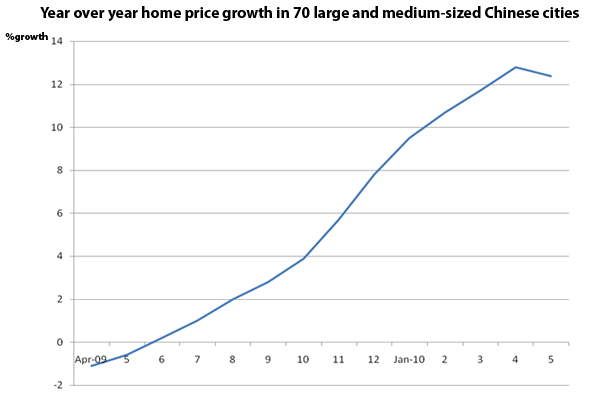
    In March, property prices in 70 Chinese cities soared by a record 11.7 percent from the previous year. In response, the government rolled out a series of measures to curb the domestic housing market amid concerns over asset bubbles.

    In early May, the People’s Bank of China raised the reserve requirement ratio for major banks by half a percentage point. Property stocks were expected to face further decline. Following Beijing and Shenzhen, the Shanghai municipal government released regulations for the property sector to curb housing speculation and soaring prices.

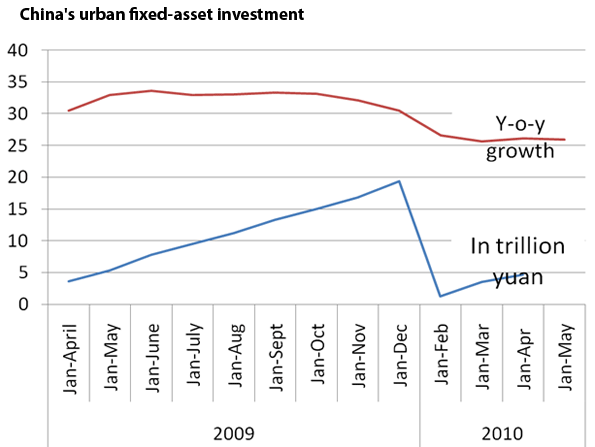
    Some observers worried that tightening policies may deter property developers from starting new projects and purchasing land, thereby cutting the supply and pushing up prices next year. And yet, despite these measures, housing prices rose 12.8 percent in April from a year earlier. At the same time, China’s urban fixed-asset investment increased by 26.1 percent year-on-year to $684.63 billion. The growth rate was 4.4 percentage points lower from the same period of 2009.

    As public concern over “skyrocketing housing prices” continued to simmer, the real estate tycoon Ren Zhiqiang was hit by a shoe at a forum in Dalian. The attacker was fuming over soaring housing prices.

    Last month, home prices in 70 Chinese cities rose by 12.4 percent year-on-year. The growth rate was 0.4 percentage points lower than in April, as property sales in first-tier cities (including Beijing, Shanghai and Shenzhen) contracted following the string of government measures. New home prices rose 15.1 percent year-on-year, down 0.3 percentage points from April.


    In a bid to curb soaring prices, the government has tightened scrutiny of developers’ financing, curbed loans for third-home purchase, raised minimum mortgage rates and tightened down-payment requirements for second-home purchases.

    By early summer, new home sales in Beijing were down 70 percent. Property transactions in Shanghai slumped around 70 percent and in Shenzhen by 62 percent month-on-month in May.

    Why have prices soared so frantically and what could be done about it?

    Toward new developments and new business models
    In the West, the great urban centers – from Paris to New York City and Tokyo – evolved into great metropolises in a century or two. In China, the first-tier cities – such as Shenzhen, Beijing, and Shanghai – are morphing into global cities in barely decades.

    Understandably, the residents of the first-tier cities would like to own an apartment in their home city. However, these cities also attract the wealthy across China, prosperous investors in East Asia and multinational property companies worldwide.

    Additionally, the high price-to-rent ratios have been driven by speculation, the desire for long-term investment, and few investment instruments.

    Even buyers contribute to soaring prices. To facilitate the marriage of their son or daughter, parents are often willing to devote their savings to real estate. As the young couple and their parents put income and savings into a purchase of a single apartment, excessive prices are driven even higher.

    In addition to great demand, the soaring prices reflect supply dilemmas. Currently, residential real estate development is geared to high-end and high-margin properties, which ensure a significant cash flow for cities. In the leading cities, the direct and indirect GDP contribution by real estate can amount to some 25-35 percent of the GDP; in other cities, this contribution is relatively higher. Ironically, luxury developments support local incomes, which maintain economic growth nationwide.

    As long as high-end real estate offers high margins where affordable housing does not, regional governments, which possess the land rights, have an incentive to prioritize luxury projects.

    The government seeks to sustain real estate market development and thus to support growth critical for China’s economy. It also seeks to ensure affordable housing vital to Chinese people. As debt problems are escalating in the West, reconciling these goals – economic growth and affordable housing – poses a difficult challenge.

    A shift towards affordable mass-market – reportedly only 10 percent of total residential sales – is critical. In the current business model, high margins come from a very narrow high-end segment of the market. This made sense in the early days of Chinese real estate when only few wealthy people could afford a home.

    Today, far more Chinese are able and willing to acquire a home. A new era requires a new business model, which can be based on the broad middle-class segment of the market.

    Conclusion: China is not Japan déjà vu
    In China’s property markets, some argue that the risks are now so great that a decade of little or no growth, as Japan experienced in the 1990s, can no longer be dismissed. They see parallels with Japan in the late 1980s, when authorities responded to the export slump caused by the revaluation of the yen after the 1985 Plaza Accord. As Tokyo adopted a low interest rate policy to boost an expansion in domestic demand, it also created conditions for a massive economic bubble.

    Yet, contemporary China’s situation is very different. First of all, in China, there remains a large shortage of residential property that meets new living standards.

    In Japan, property price increases were more than 30 percent in the latter half of the 1990s. In China’s prosperous coastal cities, they have been around 12 percent in 2003-2009.

    In Japan, the health of the banks deteriorated rapidly with the asset bubble. In China, the share of non-performing loans declined from almost 20 percent to less than 2 percent in the 2000s.

    In Japan, the asset bubble occurred after the eclipse of the high-growth era. Instead of a potential growth rate of 3-4 percent, China, assuming stability in the international and domestic operating environment, may enjoy relatively high growth for another decade or two. In such circumstances, even rapid price fluctuations in the first-tier cities can be tolerable, even if they are not preferable.

    Ultimately the difference between Japan and China is reflected by demand. Japan in the 1980s was already highly urbanized and its city population was plateauing. In China, the situation is very, very different.

    Today, there are some 360 million urban residents in China. In the next three decades, the figure is expected to grow to 970 million. What Beijing is trying to achieve is unique in history – to create urban space to more than 610 million people, within a single generation.

    In such an environment, periods of overheating will occasionally be accompanied by dramatic price increases.

    China, the urbanization rate is about 45 percent, whereas in Japan and other advanced countries it is more than 80 percent. As these nations reflect very different levels of economic development and different levels of individual prosperity, their real estate markets are different as well.

    Despite its rapid pace of expansion, China’s real estate is still at a very preliminary stage. The marketplace is so colossal that there are no precedents, no simple models.

    Yet the prospects for a robust growth remain intact. The key will be not to allow that growth to become threatened by a property bubble – while providing affordable housing for the rapidly-expanding new middle-class.

    Dr. Dan Steinbock is Research Director of International Business at India, China and America Institute (USA) and Senior Fellow at Shanghai Institutes for International Studies (China). The brief is part of the author’s ongoing project on emerging megapolises worldwide. A highly abbreviated version of the brief has been published by China Daily, China’s leading English-language daily in May.

    Photos and Illustrations: Dan Steinbock and China’s National Bureau of Statistics

  • Planning’s Cultural Cringe?

    First it was Portland, Oregon, touted as a poster child for urban planning in Australia. Now, Vancouver, Canada, is the comparison, and are we seeing another incarnation of Australia’s infamous cultural cringe?

    Advocates of higher density and the “brawl against sprawl” in Australia frequently cite overseas cities as model case studies. Portland, Oregon, was for a long time cited as a good example of pro-density housing strategies which sought to limit ‘sprawl’, to promote public transport by investing in things like light rail, and to promote cycling and a range of other planning ‘solutions’ that would sound remarkably familiar in Australia.

    The truth about Portland, however, didn’t match the hype of its city planners. Much of the boosterism focused on the mostly downtown area of Portland. Like Melbourne, or Sydney, this is its own municipality, with its own Mayor and its own planning officials. As they aggressively sold a story about the virtues of their planning strategy for the city core, they omitted the inconvenient broader metropolitan facts as they went.

    The story of the real Portland, including the surrounding suburban areas, is different than what these policy promoters would have you believe. Portland today, despite hundreds of millions invested in a new light rail system and the promotion of inner city housing density, has fewer public transport trips as a percentage of total travel than in 1980. Urban Growth Boundaries introduced by Oregon State in the 1970s led to housing price pressures which eventually excluded the middle and working class. Leading US city demographer Joel Kotkin describes it as an ‘elite city’ which is ‘remarkably white, young and childless.’ And as international housing market expert Wendell Cox has pointed out, the suggestion that Portland has much to crow about in terms of urban consolidation doesn’t match the official statistics. Portland is as guilty of ‘sprawl’ as Los Angeles.

    The same can be said of Vancouver. Touted by its city officials as a paragon of virtue in planning policy, the Vancouver story is almost entirely limited to its geographically confined downtown. Here, in the wake of overbuilding of office properties in the downtown core, city officials rezoned excess commercial capacity to permit high density residential housing in what we would call the CBD. This ‘living first’ strategy produced a wave of new residential development which saw the core population grow by 20,000 people to around 60,000, and to potentially 90,000 by 2015. Redundant waterside areas have been coverted into residential precincts, and commuting by public transport, cycling or walking are favoured over private vehicles.

    Taken in isolation, the Vancouver story could start to sound convincing. But there are some glaring omissions. The City of Vancouver is home to around 600,000 people. The downtown area – the subject of much of the planning hype – is home to 60,000 people. The broader metro region, based on the same sorts of urban definitions we might use for Brisbane, or Sydney or Melbourne, is home to 2 million people. There is precious little said about the lives of the 1.4 million people who aren’t residents of the City of Vancouver, or the more than 1.9 million who don’t live in the revitalized urban core.

    For these Vancouverites, life isn’t a rosy as the planning hype would have you believe. The most glaring omission about life in Vancouver is that it also happens to be one of the world’s least affordable cities in which to live. According to both the Reserve Bank of Canada and Demographia, Vancouver’s housing rates as severely unaffordable, eating up some three quarters of the region’s median pre-tax household incomes. The problem is so chronic that it has prompted an online game “Crack Shack or Mansion” where visitors are asked: “Can you tell the difference between a crack shack and a Vancouver, BC mansion, listed for one or two million dollars?” Play the game yourself, it’s an eye opener. [A Crack Shack, for the uninitiated, is a den of inequity where illegal drugs are produced].

    That’s hardly the sort of model city you’d want to tout as a planning example we could learn from. The other glaring omission from the planning fairy tale of Vancouver is that life in the city core is vastly different from the overwhelmingly suburban conditions of the vast majority. To the south of Vancouver’s downtown lies an endless suburban grid of detached housing, with limited parklands or open space. Check it out for yourself on Google Maps or Google Earth. Jump into Google Street View and take a walk down a typical Vancouver street. Do that with a housing price list from “Crack Shack or Mansion” in hand and then convince me this is a model for any Australian city.

    A final glaring omission is the climate. This from the official Living in Canada website: “Snow depths of greater than 1 cm are seen on about 10 days each year in Vancouver compared with about 65 days in Toronto. Vancouver has one of the wettest and foggiest climates of Canada’s cities. At times, in winter, it can seem that the rain will never stop.” Summers aren’t so bad though: for two months of the year, the average daily maximum even exceeds 20’c!

    So Vancouver as the next poster child of planning for any Australian city is looking shaky. It’s hopelessly unaffordable (and we have enough problems of our own in that regard), the quality of its majority suburban environment is lower than the standards we already enjoy, and the climate could not be less similar.

    The same can be said of other city-regions often described as examples of how Australian cities could develop. Copenhagen, Paris, or Venice have all in their time been selectively extolled as models for Australian urban planning.

    Maybe this fascination with irrelevant urban models stems from a form of cultural cringe? Whatever the reason, the analogies can be dangerous, especially when they omit the more essential economic or lifestyle based criteria such as housing affordability, share of economic wealth amongst a city/region’s residents, or climate and lifestyle factors.

    It might instead be more helpful if Australian planners referring to overseas examples also kept in mind some of these pragmatic metrics. For example, benchmarking cities with more affordable housing markets than ours and with strong local economies where wealth and standards of living are enjoyed across a wide spectrum of society would produce some very different case studies. Factor in similar climate patterns (which largely dictate recreational and lifestyle behavior) to our own and the choice of comparable cities reduces further.

    We might even start to find that our own cities offer plenty of examples of ‘getting it right.’ Instead of this cultural groveling we could start to define the things we like most about our own existence and plan ways of replicating that, rather than imposing on our cities forms of existence that, appealing as elements might be, are incapable of replication in the Australian context.

    Ross Elliott is a 20 year veteran of property and real estate in Australia, and has held leading roles with national advocacy organizations. He was written and spoken extensively on housing and urban growth issues in Australia and maintains a blog devoted to public policy discussion: The Pulse.

    Photo by ecstaticist

  • Florida: Amendment 4 Pushes the Reset Button on Development

    by Richard Reep

    Like a heroin addict going cold turkey, Florida appears poised to get off the growth drug this coming fall. If massive overbuilding, unemployment, depopulation, and a tourist-chasing oil slick weren’t enough, Florida’s voters are in the mood to vote yes on a referendum called Amendment 4, which would make every future change to the state’s comprehensive plan subject to voter approval, rather than be reviewed through a representative public process. The referendum capitalizes on short-term voter outrage over everything. But in the long term, Florida will likely languish in the twilight of missed opportunities as businesses relocate elsewhere to avoid risky, lengthy public campaigns to build their presence in this state.

    Between 1845 and 2009 Florida became the fourth most populous state in the nation. Because of its immense desirability, land developers have become legitimate partners in Florida politics, and have dictated much of its growth management legislation in the modern era. A byproduct of this process, however, has been increasing resentment among those who came for affordability and a low-density lifestyle, as cow pastures and orange groves got mowed down for subdivisions and malls.

    Traffic and congestion, which many migrants thought they would magically leave behind up north, came with them. Since before the 1980s, the popular press has published article after article about citizens who came for the good life, only to see nature replaced by concrete. Many who came seemed genuinely puzzled about this transformation, as if they expected that human activity would have no noticeable impact.

    Laissez-faire politicians kept the debate from becoming a serious topic, for the land seemed limitless, and the state’s leadership preferred not to dignify this seeming selfishness with a response. The response to those who wanted to lock the door after they had arrived was silence. This time around, emotions have acquired a larger momentum in the form of Amendment 4. Those who support it, such as writer Dori Sutter of the Orlando Sentinel, claim that Florida is overbuilt and has the ability “to create jobs and revenue and to accommodate population growth of more than 80 million people.”. In other words, Sutter’s point is that the current growth management model will accommodate an additional 60 million people over Florida’s current population – if the future immigrants are content to use this model exactly as it is drawn today, with no exceptions.

    Right now is an opportune moment for Florida to clean up its act. Voters might be more likely to approve housekeeping moves to repurpose abandoned properties and improve the aesthetics of the built environment. This kind of activity, however, depends upon businesses moving in, and most business owners handle enough risk without adding a political campaign to their plates. If Florida resembled, say, Europe in its sense of place, then Amendment 4 would be a stroke of genius.

    As it is, Amendment 4 would be the mother of all reset buttons, and voters who push this button in November would freeze the state’s built environment at its worst, not its best. This pause would bifurcate the state’s economic pathway away from the previous course of growth for growth’s sake, and set the stage to diversify the economy and allow Floridians to discover their own destiny through direct democracy. As such, it represents a grand experiment in process, replicating New England-style town hall debates over the nature and the future of the community.

    In the long term, however, this new pathway is far from guaranteed to make for a better process. For one thing, rational facts and figures hold little stock compared to emotional appeals during an election campaign, and every change to the built environment will face as many detractors as it will supporters. Decision-making will likely result in as many bad calls as the process does now.
    Property development is a complex, high-stakes game involving many public and private players. Emotional appeals to voters will tend to reduce this process to matters of style and aesthetic appeal, glossing over technical issues. And, when these matters are put to broad votes, safe pathways will likely win over innovative pathways and inventive ideas, further miring the state in the past. This is why property development has historically been left to the government to handle, with representative democracy in the form of public development commissions, and limited participation by way of public hearings.

    Those who want to put every 7-11 and office building to the vote recognize the change that it would make to Florida’s growth management process, as well as to the state itself. This season of voter outrage seems to be the moment to punish Florida’s favorite villain, the evil developer, as well. Florida seems to have hit an impasse where the current process has yielded an unfavorable product. While citizen input has largely gotten the state where it is today, the results are widely viewed as unsatisfactory.
    Currently, no compelling argument has been put forth against Amendment 4. Homebuilders and developers protest that the process is fine as it stands. Citizen boards, administrative review boards, and public hearing stakeholders are made up of Floridians who approve a Comprehensive Plan every five years, and then review changes to the Comprehensive Plan when landowners request these changes to suit their needs. Sophisticated and complex, this process already involves environmental protection, detailed technical work, and deep pockets.

    Those put in charge of growth management find it hard to say “no” when the state’s property tax coffers, (along with sales taxes) fund much of the public realm. Since growth — development — funds much of the state government’s activities, growth management acts as a financial conduit, one hardly likely to be restricted by those in charge of it. Saying “no” is just not part of the process.

    If the process represents a public conversation about how a city or a region should grow, disgust with the conversation has risen to new levels. Floridians are in the mood for grand solutions: witness last October’s vote in Miami for Miami 21, a form-based zoning code that replaces the zoning process with a product, a Master Plan, of sorts, for the city. Miami 21 appears to be stopping the conversation by limiting future generations’ ability to influence the pathways on which the city may economically develop.

    Amendment 4, rather than reforming the process, also tries for a grand solution. Public debate will be characterized by posturing and politicizing, hardly conducive to rational discussion of complex, technical issues. Where growth is already been well-managed, this might be acceptable, as these regions will organically fine-tune their infrastructure. Where growth has been poorly managed, however, lack of services, traffic congestion, and patchwork development patterns will punish residents and governments alike with declining property values and reduced quality of life.
    The long-term consequences will inexorably reshape Florida’s future, and income from activities other than real estate development will have to be considered for the very first time in Florida’s history. Gaming – already looming large in Florida’s future – is one possibility. A state income tax is a distant possibility, although a state with a large, low-wage service population will likely be unsatisfied with this kind of shot in the arm.

    Thomas Jefferson said, “The government you elect is the government you deserve,” and Florida’s government managed growth in a way that Floridians deserve. Today, with profound disgust at the result, voters appear poised to start over, this time without the government’s help. If growth is no longer Florida’s favorite drug, then with Amendment 4 the state will suffer through cold turkey as businesses relocate elsewhere. A diverse, robust economy may or may not result from this dramatic change. If it does, then Florida will truly get the state that it deserves, and emerge stronger from the depths to which it has sunk. If, however, this move cripples the state’s recovery, then politicians will have some hard work ahead to reestablish trust among voters, and adapt the state’s revenue system and growth management system to a new, no-growth public mentality.

    Flickr photo of a vintage Florida postcard by Mary-Lynn

    Richard Reep is an Architect and artist living in Winter Park, Florida. His practice has centered around hospitality-driven mixed use, and has contributed in various capacities to urban mixed-use projects, both nationally and internationally, for the last 25 years.

  • The Suburban Exodus: Are We There Yet?

    For many years, critics of the suburban lifestyles that most Americans (not to mention Europeans, Japanese, Canadians and Australians) prefer have claimed that high-density housing is under-supplied by the market. This based on an implication that the people increasingly seek to abandon detached suburban housing for higher density multi-family housing.

    The Suburbs: Slums of the Future?

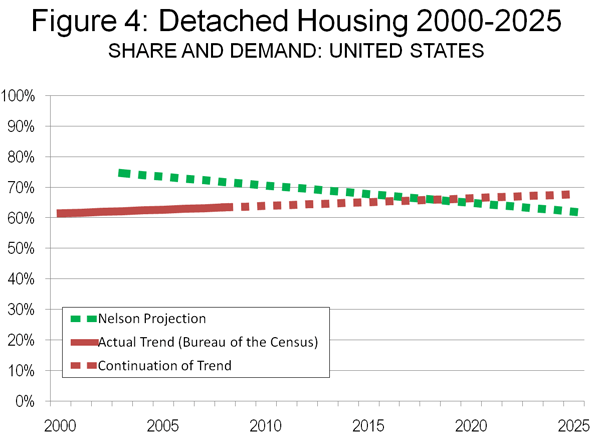
    The University of Utah’s Arthur C. (Chris) Nelson, indicated in an article (entitled “Leadership in a New Era“) in the Journal of the American Planning Association. that in 2003, 75% of the housing stock was detached and 25% was attached, including townhouses, apartments, and condominiums. By 2025 he predicts that only 62% of consumer will favor detached homes, (Note 1). He also predicts a major shift in consumer preferences from housing on large lots (defined as greater than 1/6th of an acre) to smaller lots (Note 2). This, he suggests, would create a surplus of 22 million detached houses on large lots.

    This predication is largely made on the basis of “stated preference” surveys which the author, Dr. Emil Malizia of the University of North Carolina (commenting on the article in the same issue), and others indicate may not accurately reflect the choices that consumers will actually make. Dr. Nelson’s article has been widely quoted, both in the popular press and in academic circles. It has led some well-respected figures such as urbanist and developer Christopher Leinberger to suggest in an Atlantic Monthly article that “many low-density suburbs and McMansion subdivisions, including some that are lovely and affluent today, may become what inner cities became in the 1960s and ’70s—slums characterized by poverty, crime, and decay.”

    The Condo Market Goes Crazy

    Misleading ideas sometimes have bad consequences. The notion that suburbanites were afflicted with urban envy led many developers to throw up high-rise condominiums in urban districts across the country. Sadly for these developers, the Suburban Exodus never materialized, never occurred. As a result, developers have lost hundreds of millions, if not billions of dollars and taxpayers or holders of publicly issued bonds could be left “holding the bag” (see discussion of Portland, below).

    This weakness has been seen even in the nation’s strongest condominium market, New York City, where one developer offered to pay purchaser’s mortgages, condominium fees and real estate taxes for a year as well as closing costs.

    But the damage is arguably worse in other major markets which lack the amenities and advantages of New York.

    Take, for example, Raleigh (North Carolina), where low density living is the rule (the Raleigh urban area is less dense than Atlanta). The News and Observer reports that the largest downtown condominium building (the Hue) “considered a bold symbol of downtown Raleigh’s revitalization,” has closed its sales office and halted all marketing efforts. The development’s offer of a free washing machine, dryer, refrigerator, and parking space were not enough to entice suburbanites away from the neighborhoods they were said to be so eager to leave.

    This is not an isolated instance. Around the nation, condominium prices have been reduced steeply to attract buyers. New buildings have gone rental, because no one wanted to buy them. Other buildings have been foreclosed upon by banks; and units have been auctioned. Planned developments have been put on indefinite hold or cancelled.

    Miami: Of Little Dubai and Cadavers

    Miami’s core neighborhood (downtown and Brickell, immediately to the south) has experienced one of the nation’s most robust condominium building booms. More than 22,000 condominium high rise units were built between 2003 and 2008. Miami could well have more 50-plus story condominium towers than any place outside Dubai.

    As a result, Miami has suffered perhaps the most severe condominium bust in the nation. According to National Association of Realtors data, the median condominium price in the Miami metropolitan area has dropped 75% from peak levels (2007, 2nd Quarter). By comparison, the detached housing decline in the metropolitan area was 50%; the greatest detached housing price decreases among major metropolitan areas were from 52% to 58% (Riverside-San Bernardino, Sacramento, San Francisco and Phoenix).

    The most recent report by the Miami Downtown Development Authority indicates that 7,000 units still remain unsold. The Brickell area is home to the greatest concentration and largest buildings and has the highest ratio of unsold units at 40%.

    Icon Brickell (see photograph above) may be the largest development in the core. Icon Brickell consists of three towers, at 58, 58 and 50 floors and a total of nearly 1,800 units. Despite opening in 2008 and offering discounts of up to 50%, barely one-third (approximately 620) of the units have been sold, according to the Daily Business Review, which also reported on May 13 that the developer had transferred control of two of the towers to construction lenders.

    One building, Paramount Bay, was referred to by The New York Times as a “47-story steel and glass cadaver” with a lobby “like a mortuary.” A real estate site indicates that only one of the buildings 350 units has been sold.

    More recently sales have inched up in the core but due not to any suburban exodus. According to The Miami Herald, huge discounts that have lured Europeans, Canadians, and Latin Americans to the core. The real estate and consulting firm Condo Vultures notes that more than 1,000 of the sales are to a few bulk buyers, a market segment some might refer to as “speculators.”

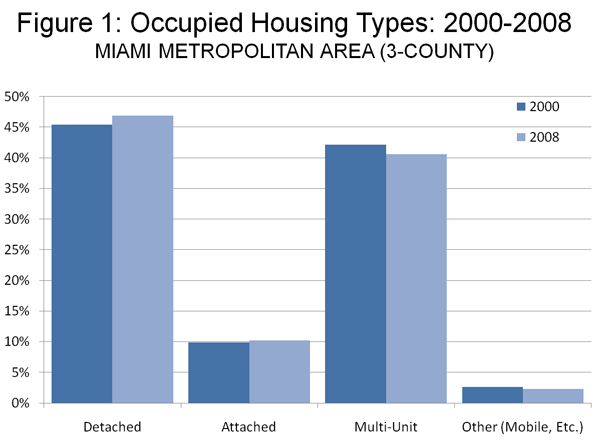
    The latest data from the US Bureau of the Census confirms that there is no fundamental shift away from detached housing in the Miami area, as housing trends point toward more detached housing. In 2000, 48.1% of residents in the Miami metropolitan area lived in detached housing. By 2008, the figure had risen to 49.2% (Figure 1). Essentially, the Suburban Exodus remains a mirage.

    Portland: Gift Certificates for Distressed Developers

    If developer greed was the motive in Miami, government subsidies have been the driving force in Portland. The city of Portland will soon have issued nearly $450 million in urban renewal bonds, provides 10-year tax property tax forgiveness, and reduced development fees, which the Portland Development Commission (PDC) has called “gift certificates” for developers (Note 3).

    Gift certificates have not been enough to cure Portland’s sickly downtown condominium market. The Oregonian reported that prices were down, on average, 30% over the year ended the first quarter of 2010. Remarkably prices in the much ballyhooed Pearl District are plummeting even more than those in the rest of the Portland area. According to DQ News, the median sale price of a house in the Pearl District dropped four times the average in Multnomah County and an even greater six times decline relative to suburban counties over the past year.

    There is more. Just this year, the Pearl District has seen its Eddie Bauer, Adidas, and Puma stores close.

    One condominium building the Encore, is reported to have sold only 17 of 177 units. A recent auction of units at the largest building in the city, the John Ross brought prices “far below the replacement cost” according to The Oregonian’s Ryan Frank, who noted that “it will likely be years before there’s a new high-rise condo built.” Late last year, the Pearl District’s Waterfront Pearl was reported to have sold only 31% of its units and had not sold a unit for a year.

    The Portland Development Commission itself has become part of the condominium bust story. PDC had indicated it was considering relocating its offices to a new 32-story mixed use tower (Park Avenue West), which was to have included condominiums, offices, and retail stores. For more than a year, the proposed 32-story tower has been an unsightly hole in the ground, with construction suspended. PDC decided to stay put in its older, less expensive offices. Even before PDC decided not to locate in Park Avenue West, the developers eliminated the plans for 10 floors of condominiums, doubtless because it made no economic sense to add to an already flooded market.

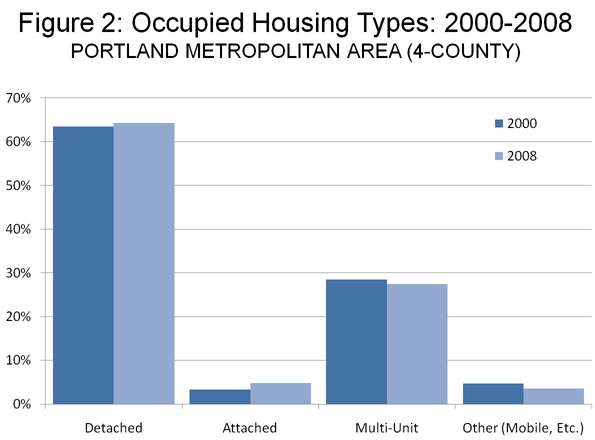
    In Portland, like in Miami, the fact remains that suburbia has not been abandoned. Despite the high density over-building in the Pearl District and elsewhere in the core, detached housing has become even more popular in the region. According to data from the Bureau of the Census, the share of households living in detached housing in the Portland metropolitan area rose from 63.7% in 2000 to 64.5% in 2008 (Figure 2).

    High-Rise Condos: Slums of the Future?

    To say that the high-rise condominium market has fallen on hard times would be an understatement. The condo bust in New York has become so acute that Right to the City, a coalition of community organizations has called upon “the City to acquire the tax delinquent buildings through tax foreclosure and convert vacant units into permanently affordable housing for low-income New Yorkers.” In a report entitled People without Homes and Homes without People: A Count of Vacant Condos in Select NYC Neighborhoods, Right to the City points out that there are more than 4,000 empty condo units in 138 buildings, with owners delinquent on nearly $4 million in taxes to the city.

    Owners of new condominiums around the nation who paid pre-bust prices for their units may not be inclined to stay around if they are surrounded by less affluent renters who have been attracted by desperate building owners and lenders.

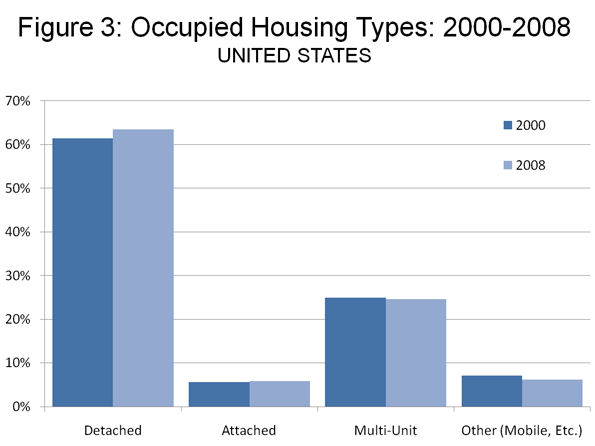
    Are these dark towers of discounting the slums of tomorrow? Only the data and time will tell and it’s too early to know, but preliminary findings show little of the predicted shift toward higher density living (Figure 3). Certainly national data indicates, if anything, a slightly strengthening market for detached, rather than attached housing (Figure 4).

    • Between 2000 and 2008, the share of households living in detached housing rose from 61.4% to 63.5%.

    • A similar trend is shown by the national building permits data. Between 2000 and 2009, 75.2% of residential building permits in the United States were for detached housing. This is up strongly from 69.6% in the 1990s and nearly equals the highest on record (the 1960s), when 77.7% of residential building permits (housing units) were detached houses.


    Looking at the data, there remains little evidence that the stated preferences on which the predictions relied have been translated into the reality of a shift in preferences toward smaller lots in cores or inner ring suburbs. Domestic migration continues to be strongly away from core counties to more suburban counties. Core cities are growing less quickly than suburban areas. Exurban areas are growing faster than central areas, including inner suburbs.

    Clearly, the Suburban Exodus has not begun and there is little reason to believe that it will anytime soon.


    Note 1: In estimating the 2003 share of detached housing (75%), Dr. Nelson uses “one-unit structures” data from the 2003 American Housing Survey Table 2-3. US Bureau of the Census American Housing Survey personnel responded to my request for clarification, indicating that “one-unit structures” includes … single detached housing units, mobile homes, and single attached housing units (such as a townhouse).” Thus the 75% detached estimate is high because it includes mobile homes and single attached housing. As is indicated above, data from the US Bureau of the Census data indicates that the share of detached housing of detached plus attached housing in 2000 was 61.4%. This figure, coincidentally, is virtually the same as the 62% Dr. Nelson predicts for 2025.

    Note 2: The assumption that consumers prefer small lot detached housing may not be sufficiently robust and may even be exaggerated. Dr. Nelson appears to principally rely on research by Myers and Gearin (2001) (in the journal Housing Policy Debate) for concluding that consumers prefer small lot rather than larger lot detached housing, defining small lot development as 1/6th of an acre or less or less than 7,000 square feet. Yet neither figure appears in Myers and Gearin. Moreover, a National Association of Home Builders commenter (also in Housing Policy Debate) questions how its data was characterized by Myers and Gearin in justifying a finding of preference for smaller lots (the survey is unpublished). Without access to the original surveys referenced in Myers and Gearin, it is impossible to judge what respondents may have had in mind as the dividing line between large lots and small lots.

    Note 3: This characterization was on the Portland Development Commission website (accessed January 2, 2007). It was cited in our report, Zero Sum Game: The Austin Streetcar and Development and subsequently removed from the website. A large share of Portland’s urban renewal bonds are insured by Ambac Financial Corporation, which has reported losses exceeding $1 billion in the last two quarters. Ambac indicated that it has “insufficient capital to finance its debt service and operating expense requirements beyond the second quarter of 2011 and may need to seek bankruptcy protection.” Ambac was the insurer of State of Nevada bonds to build the Las Vegas Monorail, which has already entered bankruptcy and is unable to pay its bonds.

    Wendell Cox is a Visiting Professor, Conservatoire National des Arts et Metiers, Paris. He was born in Los Angeles and was appointed to three terms on the Los Angeles County Transportation Commission by Mayor Tom Bradley. He is the author of “War on the Dream: How Anti-Sprawl Policy Threatens the Quality of Life.

    Photo: Icon Brickell, Miami

  • China’s Housing Bubble: Quality Research Required

    It is extremely difficult to find reliable reporting on the intensity of the housing bubbles across China, but this article from the China Post of June 1, 2010 “Economist sees housing market bubble”, appears to be realistic.

    It states that in 2009 the average house price to average annual household income in China was 9.1 times earnings and that it rose to 11.15 during the first two months of 2010. Beijing and Shanghai are reported to have exceeded 20 times average household earnings during early 2010. These figures are from Yao Shujie, head of the School of Contemporary Chinese Studies at the University of Nottingham.

    The article noted that last week, Chinese real estate services company E House China released figures suggesting that house prices to incomes nationwide in 2009 were 8.03 times incomes, but those in Beijing, Shanghai, Hangzhou and Shenzhen were over 14 times household incomes.

    Recently, Wendell Cox of Demographia, working with the South China Post, estimated that the Median Multiple (median house price divided by median household income) for Hong Kong was 10.4 – as reported in this New Geography article Unaffordable Housing in Hong Kong. Because sufficiently reliable data is now available from Hong Kong, it will be included within the Annual Demographia International Housing Affordability Surveys going forward.

    As the Annual Demographia International Housing Affordability Surveys clearly illustrate, house prices do not exceed three times gross annual household incomes in normal markets.

    Rather remarkably, in researching and reporting on the China Housing Bubble, there has been no discussion of the land ownership differences of China and western countries.

    Freehold land is not available in China. The land is leased for a remarkably short term of 70 years. Instead of conventional ground leases in the west where ground rentals are paid, Chinese Local Governments demand an upfront payment of capitalized rental. On this basis, the land interest should be a wasting asset over the term of the lease.

    Rather remarkably – this appears not to be the case in China, where the buying public have convinced themselves (no doubt with encouragement from real estate agents and developers) that at the end of the term of the ground lease, Local Government will simply “gift” the land to home owners!

    On the sound income to house price measure, China’s housing bubble is clearly the worst in the world. When the unsatisfactory and uncertain land ownership issue is factored in as well, it is particularly concerning.