Category: housing

  • Subdivisions: The Lots-Per-Minute Race

    When you get that morning cup of Java, do you desire the minimal flavor? How about your career, do you desire the most minimal pay check or profits or the most mundane of positions? Let’s assume for some reason that you said ‘No, you would always want to strive for something better than the minimum’.

    You now have three hats in front of you, one says “planner” on it, one says “engineer,” and the last one says “developer”. When you put on the “planner” hat, your job is to develop and enforce a set of rules that will guide the development of a city. You suggest to the council a set of standards that recommend the minimum dimensions and areas for residential or commercial projects that are brought in for approvals. Council and planning commission members will argue a bit, but eventually they will decide on what the minimum controls will be within the regulations you will be writing…

    Under the “developer” hat, you just bought 100 acres from the bank at a steal, yet it still cost over two million dollars, and that monthly interest payment is going to be painful. You cannot begin to sell any lots until you get preliminary plat approval, so until then, money bleeds out, not in. You cannot form a business plan until someone lays out your site. You look at the local engineering firm and see they offer “land planning” as one of their areas of expertise. They have a large impressive office with lots of computer screens flickering away. Obviously, they must be experts on land planning who can deliver a unique land development that will provide a market edge that makes your development as successful as possible. So you just sign here on their contract for services…

    Wearing that “engineer” hat, you look over your production floor. It was once bustling with activity, but now those screens are flickering with employees trying to look busy in fear that a layoff is coming. Luckily, you have a developer coming in with that 100 acre project. You really like laying out subdivisions, and you look forward to using that new software you just bought to automate the process. Next week, you’re scheduled to meet with the developer, who is going to present a sketch plan on the site. You’re ready, with your new software that promises an LPM (lots per minute) ratio of up to 250 lots per minute. With this new tool you can easily lay out that new development in just an hour. Since this is only a sketch plan meeting, you just need a quick picture to get things started.

    To make sure you are up to date on the latest regulations, you check the web site of the city for the latest minimums to enter into the software. You use Google Earth to trace in the boundary of the site, because you do not have the time to survey the land, nor does the developer want to spend any money at this point until he knows the city will give him sketch plan approvals. Besides, you threw the initial planning in for free to lure in the developer and get those lucrative engineering fees.

    After obtaining a rough estimation of the site from Google Earth, you use your latest technology to generate streets and lots almost as fast as you can move the mouse across the screen. Something that used to take days is now virtually instant. Each lot appears at the exact minimum setback, with the exact minimum side yard, and at the exact minimum square footage. Wow! You are quite happy to tell the developer that he’s got 400 lots on his site.

    Slapping on the developer’s hat you use the sketch plan to create your financial projections, cautiously of course, because you have not been given sketch plan approval yet. But clearly you are about to make a ton of money.

    Wearing the planner’s hat, at the planning commission meeting you present “Oak Ridge”, the proposal for the 100 acres. After hearing complaints about the monotonous design, you explain that Oak Ridge follows the regulations that the planning commission had agreed upon: every minimum has been met. Reluctantly they approve the sketch plan for Oak Ridge.

    Wearing the developer hat you could not be more pleased. Imagine the profits that the lot sales will bring, especially because you got the land so cheap! Never in your wildest dreams had you thought you could get 400 lots approved. The next day you put down a deposit to order that Bentley you always dreamed about.

    A few weeks later— wearing the engineer’s hat — you sit down with the actual boundary survey, which is much more accurate than the Google Earth data you used for the sketch plan. You find that the boundary was not even close to what you traced. The surveyor points out the wetlands that will take up about a quarter of the land. He also explains that there is evidence of the pipeline easement. What the ^%$#… ? What pipeline easement? Oh, yes, you remember that Google Earth does not show easements, an honest mistake.

    You explain to your staff that the developer wants to explore a low impact development with surface flow. They tell you that the software only automates pipe networks; surface flow calculations are not automated. You direct them to forget the low impact stuff, too much liability and it will add too much manual labor time.

    Wearing the developer’s hat you sit down, ready to be presented with the preliminary plat of Oak Ridge. It is a wise choice to be sitting down, because the 240 lot preliminary plat comes as a bit of a shock! What happened to the 160 extra lots we got approved? The engineer explains that was just a quick sketch. By the time the actual boundary was provided, and what with the wetlands and the steep slopes, well, it just had to be made to work.

    The engineers explain to you they held every lot to the absolute allowed minimum and that 240 lots is not bad at all. Your vision of the plan blurs and an image of your financial partners and lenders appear, along with thoughts how you are going to pay for that Bentley you picked up last week.

    No more need of hats. You now have a picture of a scenario that repeats itself all too often in the land development process. We live in a world dictated solely by minimums. The new buzz-phrase is “a forms based regulatory process”. Is this not just another way to assure that there is a minimum relationship between manmade structures? Notice how architecture did not enter this story… That will not be a factor until later on, as the lots are sold – why worry at the onset of the development?

    There are a variety of software packages that automate land development and are used by virtually every engineer in the world. These packages have been developed by firms whose main purpose is to automate engineering. It is so simple to throw in automation for lot geometry. Some of the firms that provide this automation are quite large – billion dollar corporations, that earn profits by using those minimum dimensions allowed by regulations and providing tools that cut the process of producing land developments and engineering drawings from months to minutes.

    In this process of progress, we got lost. To have the concept of an LPM ratio of 250 lots per minute is like saying we will layout 250 homes at $200,000 each in 60 seconds. This equates to $833,333 in housing for each second. The development is likely to sit for a few centuries or more, and each home is likely to have 3 people living in it. The average home sells every 6 years, so the living standards of 25,000 people will be set in those 60 precious seconds. How much thought do you think someone laying out 4.16 homes per second will give towards reducing housing costs, eliminating monotony, views from the homes, curb appeal, low impact drainage, long term values, ecology, preserving natural contours and vegetation?

    If you want to speed towards a completely unsustainable world, join virtually everyone involved in the land development process. They are already doing that quite well, thank you. We need a complete overhaul of the land development process. Smart Growth is a solution for a limited envelope of development. It will make an impact, but the impact will only be a small ripple in a very large pond. A prescribed set of stringent rules cannot apply to every development situation, thus a monolithic strict set of rules is not a fix for both urban and suburban living.

    If you do not seek minimum taste, nor minimum income potential or a minimum position in life, then why would you be remotely satisfied living in the minimal development pattern that creates a minimal city?

    When we lay out and build new cities and rebuild existing ones, let’s take the time, thought, and consideration to maximize living standards and assure the successful placement of all businesses that will thrive in the developed future. Perhaps then, we could call this maximized future “sustainable”.

    Rick Harrison is President of Rick Harrison Site Design Studio and Neighborhood Innovations, LLC. He is author of Prefurbia: Reinventing The Suburbs From Disdainable To Sustainable and creator of Performance Planning System. His websites are rhsdplanning.com and performanceplanningsystem.com.

  • The Future Of America’s Working Class

    Watford, England, sits at the end of a spur on the London tube’s Metropolitan line, a somewhat dreary city of some 80,000 rising amid the pleasant green Hertfordshire countryside. Although not utterly destitute like parts of south or east London, its shabby High Street reflects a now-diminished British dream of class mobility. It also stands as a potential warning to the U.S., where working-class, blue-collar white Americans have been among the biggest losers in the country’s deep, persistent recession.

    As you walk through Watford, midday drinkers linger outside the One Bell pub near the center of town. Many of these might be considered “yobs,” a term applied to youthful, largely white, working-class youths, many of whom work only occasionally or not at all. In the British press yobs are frequently linked to petty crime and violent behavior–including a recent stabbing outside another Watford pub, and soccer-related hooliganism.

    In Britain alcoholism among the disaffected youth has reached epidemic proportions. Britain now suffers among the highest rates of alcohol consumption in the advanced industrial world, and unlike in most countries, boozing is on the upswing.

    Some in the media, particularly on the left, decry unflattering descriptions of Britain’s young white working class as “demonizing a whole generation.” But many others see yobism as the natural product of decades of neglect from the country’s three main political parties.

    In Britain today white, working-class children now seem to do worse in school than immigrants. A 2003 Home Office study found white men more likely to admit breaking the law than racial minorities; they are also more likely to take dangerous drugs. London School of Economics scholar Dick Hobbs, who grew in a hardscabble section of east London, traces yobism in large part to the decline of blue-collar opportunities throughout Britain. “The social capital that was there went [away],” he suggests. “And so did the power of the labor force. People lost their confidence and never got it back.”

    Over the past decade, job gains in Britain, like those in the United States, have been concentrated at the top and bottom of the wage profile. The growth in real earnings for blue-collar professions–industry, warehousing and construction–have generally lagged those of white-collar workers.

    Tony Blair’s “cool Britannia,”epitomized by hedge fund managers, Russian oligarchs and media stars, offered little to the working and middle classes. Despite its proletarian roots, New Labour, as London Mayor Boris Johnson acidly notes, has presided over that which has become the most socially immobile society in Europe.

    This occurred despite a huge expansion of Britain’s welfare state, which now accounts for nearly one-third of government spending. For one thing the expansion of the welfare state apparatus may have done more for high-skilled professionals, who ended up nearly twice as likely to benefit from public employment than the average worker. Nearly one-fifth of young people ages 16 to 24 were out of education, work or training in 1997; after a decade of economic growth that proportion remained the same.

    Some people, such as The Times’ Camilla Cavendish, even blame the expanding welfare state for helping to create an overlooked generation of “useless, jobless men–the social blight of our age.” These males generally do not include immigrants, who by some estimates took more than 70% of the jobs created between 1997 and 2007 in the U.K.

    Immigrants, notes Steve Norris, a former member of Parliament from northeastern London and onetime chairman of the Conservative Party, tend to be more economically active than working-class white Britons, who often fear employment might cut into their benefits. “It is mainly U.K. citizens who sit at home watching daytime television complaining about immigrants doing their jobs,” asserts Norris, a native of Liverpool.

    The results can be seen in places like Watford and throughout large, unfashionable swaths of Essex, south and east London, as well as in perpetually depressed Scotland, the Midlands and north country. Rising housing prices, driven in part by “green” restrictions on new suburban developments, have further depressed the prospects for upward mobility. The gap between the average London house and the ability of a Londoner to afford it now stands among the highest in the advanced world.

    Indeed, according to the most recent survey by demographia.com, it takes nearly 7.1 years at the median income to afford a median family home in greater London. Prices in the inner-ring communities often are even higher. According to estimates by the Centre for Social Justice, unaffordability for first-time London home buyers doubled between 1997 and 2007. This has led to a surge in waiting lists for “social housing”; soon there are expected by to be some 2 million households–5 million people–on the waiting list for such housing.

    With better-paid jobs disappearing and the prospects for home ownership diminished, the traditional culture of hard work has been replaced increasingly by what Dick Hobbs describes as the “violent potential and instrumental physicality.” Urban progress, he notes, has been confused with the apparent vitality of a rollicking night scene: “There are parts of London where the pubs are the only economy.”

    London, notes the LSE’s Tony Travers, is becoming “a First World core surrounded by what seems to be going from a second to a Third World population.” This bifurcation appears to be a reversion back to the class conflicts that initially drove so many to traditionally more mobile societies, such as the U.S., Australia and Canada.

    Over the past decade, according to a survey by IPSOS Mori, the percentage of people who identify with a particular class has grown from 31% to 38%. Looking into the future, IPSOS Mori concludes, “social class may become more rather than less salient to people’s future.”

    Britain’s present situation should represent a warning about America’s future as well. Of course there have always been pockets of white poverty in the U.S., particularly in places like Appalachia, but generally the country has been shaped by a belief in class mobility.

    But the current recession, and the lack of effective political response addressing the working class’ needs, threatens to reverse this trend.

    More recently middle- and working-class family incomes, stagnant since the 1970s, have been further depressed by a downturn that has been particularly brutal to the warehousing, construction and manufacturing economies. White unemployment has now edged to 9%, higher among those with less than a college education. And poverty is actually rising among whites more rapidly than among blacks, according to the left-leaning Economic Policy Institute.

    You can see the repeat here of some of the factors paralleling the development of British yobism: longer-term unemployment; the growing threat of meth labs in hard-hit cities and small towns; and, most particularly, a 20% unemployment rate for workers under age 25. Amazingly barely one in three white teenagers, according to a recent Hamilton College poll, thinks his standard of living will be better than his parents’.

    It’s no surprise then that Democrats are losing support among working-class whites, much like the now-destitute British Labour Party. But the potential yobization of the American working class represents far more than a political issue. It threatens the very essence of what has made the U.S. unique and different from its mother country.

    This article originally appeared in Forbes.com.

    Joel Kotkin is executive editor of NewGeography.com and is a distinguished presidential fellow in urban futures at Chapman University. He is author of The City: A Global History. His newest book is The Next Hundred Million: America in 2050, released in Febuary, 2010.

    Photo by MonkeyBoy69

  • Racing China: The Australia Housing Bubble

    “The writing is on the wall for the Australian dream,” according to Professor Joe Flood at the Flinders University Institute for Housing, Urban and Regional Research. That was before recent predictions that Australia’s overheated housing market may be headed for even higher prices. Real estate experts have recently predicted a doubling of house prices in all five of the largest metropolitan areas over the next decade.

    Sydney, the largest metropolitan area, according to Australian Property Monitors (APM), can be expected by 2019 to experience a median house price increase to $1.124 million in 2019. This would double the 2009 figure of $569,000 (Note). Sydney is already the second most unaffordable metropolitan area in the English speaking world , according to our Demographia International Housing Affordability Survey, with a Median Multiple (median house price divided by median household income) of 9.1, trailing only Vancouver. Sydney’s higher priced housing has been blamed for stunting economic growth and job creation and appears to be a major factor in the continuing migration out of the state of New South Wales. One of Australia’s leading demographers, Bernard Salt, has projected that Sydney could fall to second largest in the nation, behind Melbourne in less than 20 years.

    Melbourne median house prices are also expected to rise above $1.1 million according to projections by property expert Michael Yardney. This would represent more than twice the $480,000 price in 2009.

    Brisbane, which has generally been less unaffordable than Sydney, would have a median house price equal to that of Sydney by 2019. This is more than double the 2009 price of $430,000.

    Perth would experience the greatest house price inflation, also rising to above $1 million, compared to the 2009 figure of $460,000.

    Adelaide would also see house prices rise to more than $1.2 million, according to APM. In 2009, the median house price in Adelaide was $370,000.

    Australia’s Race with China: Recent data indicates that prices are rising furiously toward the doubling the experts have projected. The Australian Bureau of Statistics (ABS) House Price Index indicates that prices have risen 20% over the past year. This is more than 1.5 times the 12% annual rate posted in China’s house price bubble that has its government and so many of the world’s leading economists so concerned.

    As of the 1st quarter, the greatest annual price inflation was in Melbourne, at 28%, a rate that would place it 3rd out of 70 metropolitan areas if it were in China. Prices in Sydney were up 21% from a year ago, which would also rank it 3rd out of 70 in China. At this rate, Sydney could become less affordable than Vancouver within six months and could even surpass high-priced Hong Kong. Brisbane, Adelaide and Perth all experienced price increases between 10% and 15%, and would all place in the top 20 out of 70 Chinese metropolitan areas.

    ABS indicated that the house prices increased more than in any other annual period in the 8 year history of its House Price Index. According to the Wall Street Journal’s Marketwatch, Economist Glenn Maguire of SocGen Asia Pacific in Hong Kong said “These are bubble like numbers … It’s the type of return that basically encourages speculation.” Marketwatch also predicted, on the basis of the house price trend, that the Reserve Bank of Australia (RBA) would raise interest rates, which it did a day later.

    Working for the Mortgage: Meanwhile, because variable rate mortgage loans predominate in Australia, the interest rate increase places an immediate burden on thousands of Australian households. The Housing Industry Association indicates that interest rate increases over the past six months will result in a first-home buyer mortgage payment increase of more than $300 per month.

    This is not good news for the large numbers of households already in mortgage stress, defined by the government when 35% or more of the budget goes to housing expenses. Just six months ago, a median income household purchasing the median income house in Sydney or Melbourne would have had mortgage payments that consumed 50% to 57% of their gross income. Now, the figure would be 60% to 67%. Needless to say, the median priced house is well beyond the means of the median income household. By contrast, if Melbourne and Sydney had the same housing affordability as faster growing Atlanta and Dallas-Fort Worth, the median income household would pay at least $25,000 less in annual mortgage payments for the median priced house.

    Rigging the Market: The housing affordability crisis is the direct result of excessive land use regulations that have artificially limited the supply of land, driving up house prices and fostering speculation. Before these regulations (called “urban consolidation” or “smart growth”) were adopted, housing was as affordable in Australia as in Atlanta or Dallas-Fort Worth. Median Multiples across the nation were 3.0 or below. Now the Median Multiple is between 6.7 and 9.1 in the five largest metropolitan areas. Analysts often suggest that Australia’s population growth rate is driving up prices. While Australia is growing, it grew faster over the 20 years following World War II, and still accommodated a quickly increasing home ownership share. Further, much faster population growth in Dallas-Fort Worth and Atlanta has not driven prices up. Since 2000, these two American metropolitan areas added 40% more population than the five largest Australian metropolitan regions, despite having a smaller combined population.

    This also impacts the other side of the housing equation, the ability of consumers to afford mortgages. The Urban Task Force says that Sydney’s especially onerous regulations have driven up the price of consumer goods while dampening income and employment growth. Australian Property Monitors economist Matthew Bell says that the answer to the housing affordability problem is to increase the supply of housing, a view shared by the Reserve Bank of Australia. The political reality, however, suggests that “The shortages are going to get much, much worse in Sydney” as Jason Anderson, a senior economist with BIS Shrapnel told Agence France-Presse.

    Professor Flood noted that “The country that promised limitless land, cheap housing and near universal home ownership to all comers now has the most expensive housing in the world amid very tight housing and land markets and little prospect of restoring the balance.” Flood’s research indicates a dramatic decrease in home ownership among younger households over the past 20 years.

    Alternate Futures

    Not everyone thinks that house prices can continue their stratospheric rise. US investment expert Edward Chancellor believes that the housing market is overdue for a price collapse, noting that house prices are well above historic measures. Chancellor won the George Polk award for his 2007 article Ponzi Nation, which warned of the housing collapse in the United States and the international damage that could follow. Of course, a housing collapse in Australia would have much less impact on international markets than the one that rocked the much larger US economy, but could do great damage at home.

    The good news is that house prices could be brought under control if there was a change in policy. The state government of Victoria (Melbourne is the capital) is about to significantly expand its “urban growth boundary, allowing more house construction and lower new house prices. Policies such as these could provide a preferable soft landing for the housing market. But this would require state and local governments finally to turn their backs on 20 years of devastating social engineering.


    Note: The Australian dollar is currently worth about US$0.90. The latest (2008) data indicates that Australia had a gross domestic product of $37,400 per capita (purchasing power parity), which compares to $46,500 in the United States, according to the OECD.

    Wendell Cox is a Visiting Professor, Conservatoire National des Arts et Metiers, Paris. He was born in Los Angeles and was appointed to three terms on the Los Angeles County Transportation Commission by Mayor Tom Bradley. He is the author of “War on the Dream: How Anti-Sprawl Policy Threatens the Quality of Life.

    Photograph: Detached housing conforming to plan in suburban Perth

  • Twenty-first Century Electorate’s Heart is in the Suburbs

    Even as the nation conducts its critically important decennial census, a demographic picture of the rapidly changing population of the United States is emerging. It underlines how suburban living has become the dominant experience for all key groups in America’s 21st Century Electorate.

    While suburban living was once seen as the almost exclusive preserve of the white upper-middle class, a majority of all major American racial and ethnic groups now live in suburbia, according to the newest report on the state of metropolitan America from the Brookings Institute. Slightly more than half of African-Americans now live in large metropolitan suburbs, as do 59% of Hispanics, almost 62% of Asian-Americans, and 78% of whites. As a result the country is closer than ever to achieving a goal that many thought would never be achieved: city/suburban racial/ethnic integration. This is particularly so in the faster growing metropolitan areas of the South and West.

    The trend is likely to continue for the foreseeable future. A majority of Millennials live in the suburbs and 43% of them, a portion higher than for any other generation, describe suburbs as their “ideal place to live.”

    The nation’s one hundred largest metropolitan areas have grown twice as fast as the rest of the country in the last decade. That growth was heavily concentrated in lower density suburbs, which grew at three times the rate of cities or inner ring suburbs. At the same time, one third of the nation’s overall population growth was due to immigration. As a result about one-quarter of all children in the United States have at least one immigrant parent. In 2008, non whites became a majority of Americans less than eighteen years old, a demographic milestone that underlines just how fast and how dramatically the country is changing. Any political party that wants to build a lasting electoral majority must align its policy prescriptions with these new demographic realities to attract the votes of a younger, more ethnically diverse population, most of which now lives in the suburbs.

    Economic opportunity continues to be the major driver in determining where people want to live and work. Five of the six fastest growing metropolitan areas in the last decade were also among the top six in job growth according to data from the Census and the Bureau of Labor Statistics analyzed by the Praxis Strategy Group. The same five metropolitan areas – Phoenix, Riverside (CA), Dallas, Houston and Washington, D.C – also ranked high in the diversity of their population, differing only in the degree of educational attainment their residents have achieved.

    With America experiencing the first decade since the 1930s in which inflation adjusted median income declined and job creation slowed to levels not seen in decades, this movement to where the jobs are located is likely to intensify, as current migration to economically buoyant Texas cities and Washington, DC suggests. This crucial factor is often overlooked by urban planners who argue that cultural amenities and sport complexes are the key to attracting new residents. In fact, metropolitan areas that focus on job creation for Millennials (young Americans born 1982-2003) and minorities have the best chance of gaining population in the next decade.

    Clearly providing higher quality public education experiences is a key part of any such economic strategy. The arrival of stealth fighter parents at local school district meetings across the country only reflects the passion among young families about the quality of education their children receive. They are unwilling to allow Boomer ideological debates to delay the changes needed to properly prepare their children for a higher educational experience that increases the odds of economic success. The traditional separation between municipal partisan politics and nominally non-partisan schools is increasingly outdated when so much of a city’s economic success depends on the quality of the education its residents receive.

    Safe neighborhoods of single family dwellings with a surrounding patch of land continue to attract families of every background to the nation’s suburbs. Metropolitan areas that provide such an environment to all of their residents are the furthest along in achieving a more integrated society. Los Angeles, for instance, which is often decried by non-residents as simply an aggregation of suburbs with no central core, has a suburban population whose demographic profile almost exactly matches the city’s population. The fact that most of its housing reflects the tract developments of the 50s and 60s, as well as the city’s low crime rates – down to levels not seen in five decades – are two key reasons for this polyglot profile.

    Rather than fighting this desire on the part of America’s 21st Century Electorate to live comfortably in the suburbs, politicians of all stripes should find ways to embrace it and advocate policies that reflect our new economic realities. For instance, rather than insisting on higher density housing and light rail systems as the only answer to the nation’s appetite for foreign oil, the federal government should adopt tax incentives that encourage telecommuting and continue policies to foster more energy efficient automobiles. If all Americans worked from home, as many Millennials prefer to do, just two days a week, it would cut that portion of our nation’s gas consumption by more than a third. The FCC’s recently announced broadband policy will help put in place the infrastructure required to make such a lifestyle possible and even more productive.

    Three out of four commuting trips involve a single individual driving their car to work and this isn’t likely to change in the foreseeable future. But putting as much emphasis on making our nation’s highways “smart” as in creating a smart electrical grid would make it possible for the existing highway system to shorten commuting time and reduce the quantity of fuel used in such trips. Recent developments in mobile technology makes this a practical, near term solution if state and local governments are prepared to invest in upgrading an infrastructure that is already designed and deployed to connect people’s homes to their workplace.

    Aligning the message at the heart of a party’s programs with the values and behaviors of America’s 21st Century Electorate is the best road towards achieving political victory –for either party – or years to come.

    Morley Winograd and Michael D. Hais are fellows of the New Democrat Network and the New Policy Institute and co-authors of Millennial Makeover: MySpace, YouTube, and the Future of American Politics (Rutgers University Press: 2008), named one of the 10 favorite books by the New York Times in 2008.

    Photo by delbz

  • The Limits Of The Green Machine

    Environmentalism is strangely detached from the public’s economic goals.

    The awful oil spill in the Gulf–as well as the recent coal mine disaster in West Virginia–has added spring to the step of America’s hugely influential environmental lobby. After years of hand-wringing over global warming (aka climate change), the greens now have an issue that will play to legitimate public concerns for weeks and months ahead.

    This is as it should be. Strong support for environmental regulation–starting particularly under our original “green president,” Richard Nixon–has been based on the protection of public health and safety, as well as the preservation of America’s wild spaces. In this respect, environmentalists enjoy widespread support from the public and even more so from the emerging millennial generation.

    Conservatives who fail to address this concern will pay a price, even more so in the future. The Bush administration’s apparent clubbiness with conventional energy interests has undermined the GOP’s once-proud legacy on environmental causes. The oil spill could prove a great campaign issue for Democrats assigning blame for the disaster on lax Republican regulators and their oil company chums.

    But there’s also a danger for Democrats who tilt uncritically toward “green” policies. Instead of following the environmentalists’ party line, they should adopt a balanced approach adding both economic and social needs to their concept of “sustainability.”

    Sadly, many in the administration seem anxious to extend environmental regulation into virtually every aspect of life. Legitimate concerns over pollution and open space preservation, for example, have now been conflated with a renewed drive to strangle suburbia in favor of forced densification.

    The administration’s “livability” agenda, as suggested by Transportation Secretary Ray LaHood, for example, proposes policies that favor dense urban development over the dispersed living preferred by most Americans. This, notes analyst Ken Orski, represents an unprecedented federal intrusion over traditional local zoning and local decisions.

    This centralizing tendency supports a wide array of interests, notably big city mayors and urban land speculators, and also is eagerly promoted by many architects, the media and planning professors. Not surprisingly, less intrusive ways to reduce energy use, such as telecommuting or the dispersion of worksites closer to people’s homes, have elicited very little administration support.

    Herein lies the Achilles heel of environmentalism–its profound disconnect from public preferences and aspirations. By embracing such a radical social engineering agenda, the greens may end up undermining their own long-term effectiveness.

    The first sign of this pushback, notes analyst Walter Russell Mead, can be seen in growing skepticism about climate change policies both here and in Europe. At a time of severe economic challenges, greens and their political allies need to consider how specific environmental costs threaten an already beleaguered middle and working class.

    Voters, for example, may support strong penalties and stricter controls of energy giants such as British Petroleum or Massey Energy, but roughly six in 10, according to a post-spill NBC/Wall Street Journal poll, continue to back the idea of expanded offshore oil drilling. Voters may embrace new environmental improvements but they also want to keep their jobs.

    This conflict will be on display in the coming struggle over the “cap and trade” proposals in the Senate. Strongest opposition comes from those states and regions most adversely impacted by strict limits on carbon, clustered in the south and Midwest.

    Mitch Daniels, governor of coal-dependent Indiana, even has denounced such proposals as Washington “imperialism.” But Daniels’ opposition also is shared by many Democrats from fossil-fuel-rich states such as North Dakota, West Virginia and Louisiana. Cap and trade even manages to offend many on the left, who see it as yet another opportunity for Wall Street to profit from complex federal regulation.

    On the state level, more draconian mandates on shifting to renewable fuels, such as those in place in California, could also cause future power shortages, as the state auditor warned recently. Such concerns are routinely brushed aside by environmentalist and their prodigious PR machines who prattle on about our coming economic salvation through the creation of “green jobs.”

    In reality, given their dependence on massive subsidies from both taxpayers and rate-payer, it’s unlikely that renewables, as opposed to relatively clean alternatives such as plentiful natural gas, will produce a net positive impact on the economy for years or even decades. Certainly highly aggressive subsidies for wind and solar have not proved any kind of elixir in countries like Spain, where such policies have been long in place but now are being scaled back due to their drain on both the economy and the public budget.

    To some extent, the hype over “green jobs” sometimes appears as something of a PR smokescreen. Prominent greens have long been opposed to the very idea of economic growth and wealth creation, particularly in advanced industrial countries. For decades John Holdren, President Obama’s science advisor, has favored what he calls “de-development” of Western countries in order to preserve natural resources and reduce pollution.

    This approach appears to be gaining support even as the pain of economic dislocation has devastated the advanced countries of the West. Boston University sociologist Juliet Schor, writing in the influential left-leaning The Nation, even attacks “progressive economists”- such as those calling for a second New Deal- for focusing on “climate destabilizing growth” as a way to create new jobs and raise middle class incomes.

    In the Huffington Post one-time investment banker Ann Lee, now an economics professor at NYU, has called for “a new economic ideology” that focuses on “human dignity, creative and degrees of freedom” instead of following traditional measurements of material well-being. This “new” economy, she argues, would provide greater returns to favored groups like artists and, of course, teachers, who she considers severely underpaid.

    This kind of low-carbon academic “esteem” economy appeals to people who already enjoy considerable material wealth and can count on the support of the state. It is not so promising on the West’s aspirational middle and working classes, particularly those employed in the private sector, whose individual strivings would now be compensated by a deadly combination of high taxes and slow growth.

    Until the issues of growth are tackled honestly, the green movement will continue to depend on tragic events such as the Gulf oil spill to maintain its public support. But in the long run, environmentalism will not remain politically “sustainable” if it fails to balance a green future with the economic aspirations of current and future generations.

    This article originally appeared in Forbes.com.

    Joel Kotkin is executive editor of NewGeography.com and is a distinguished presidential fellow in urban futures at Chapman University. He is author of The City: A Global History. His newest book is The Next Hundred Million: America in 2050, released in Febuary, 2010.

    Photo by just.Luc

  • Santa Fe-ing of the World

    This is part one of a two-part piece. Read Part two.

    Human settlements are always shaped by whatever is the state of the art transportation device of the time. Shoe-leather and donkeys enabled the Jerusalem known by Jesus. Sixteen centuries later, when critical transportation has become horse-drawn wagons and ocean-going sail, you get places like Boston. Railroads yield Chicago – both the area around the “L” (intraurban rail) and the area that processed wealth from the hinterlands (the stockyards). The automobile results in places with multiple urban cores like Los Angeles. The jet passenger plane allows more places with such “edge cities” to rise in such hitherto inconvenient locations as Dallas, Houston, Seattle and Atlanta and now Sydney, Lagos, Cairo, Bangkok, Djakarta, and Kuala Lumpur.

    The dominant forms of transportation today are the automobile, the jet plane, and the networked computer. What does adding the networked computer get you? I think the answer is “the Santa-Fe-ing of the World.” This means the rise of places where the entire point of which is face-to-face contact. These places are concentrated and walkable, like villages. Some are embedded in the old downtowns – such as Adams Morgan in Washington, or The Left Bank of Paris, or the charming portions of what in London is referred to, somewhat narcissistically, as “The City.” Some are part of what have traditionally been regarded as suburbs or edge cities, such as Reston, Virginia, or Emeryville/Berkeley, California.

    Santa Fe, New Mexico, is a remarkable example of this trend. Home to a world-renowned opera, charming architecture, distinguished restaurants, great places to buy used boots, quirky bookstores, sensational desert and mountain vistas and major diversity, it is also little more than a village of 62,000, far from the nearest major metropolis.

    This “Santa-Fe-ing” means urbane well beyond the current definition of urban. It means aggregation and dispersal. As with all innovation, its impact is first seen among people with enough money to have choices.

    The logic of this hypothesis starts with the question: “In the 21st century, is there any future for cities of any kind?”

    After all, some would have us believe that with enough bandwidth, each of us can wind up on his or her own personal mountaintop in Montana, being lured down into the flatlands only to breed.

    That’s a preposterous view of human nature, of course. There’s a reason solitary confinement is a punishment. We are social animals. But still, many of the historic reasons for human concentration are gone. It’s been a century since you’ve had to live within walking distance of your factory. Today, you often don’t even need be within driving distance of your office – as anyone with a cell phone knows. You certainly don’t need a metropolis to acquire anything a dot-com is willing to sell – which is a very big deal now and growing exponentially.

    Absent a cataclysm of biblical proportions, I think this means the one and only reason for congregation in the near future is face-to-face contact. Period. Full stop. The places that are good at providing this will thrive – think Oxford, England. The ones that are not will die. Cities are not forever. You have not heard much lately from the Babylon chamber of commerce.

    There are nearly 100 classes of real estate out of which you build cities, according to William J. Mitchell, the former head of the architecture and planning department at MIT. They are all being transfigured. The classic example is bookstores. If all you want to do is exchange money for a commodity, the path with least friction is often Amazon. In backwaters where, just ten years ago, buying or even borrowing a non-best-seller was a chore that took weeks, hundreds of thousands of titles are now within one click. Does this mean bookstores have disappeared? Of course not. The half of them that have survived and even grown since the ‘90s, however, have morphed. The critical elements are no longer the shelves. They are the couches, cappuccino machines, and cafes. Bookstores have become places to loiter, face-to-face, among like-minded people.

    What about grocery stores? What happens when it becomes cheaper for the supermarket to deliver your toilet paper to you than it is to heat, light and pay rent and taxes on its store? Under what circumstances would you ever again get in your car to drive to market again? For me, the answer is that I want to have face-to-face contact with my tomatoes – or anything else you might find in a social setting like a farmers’ market. I’m not sure I’d trust the kid at the dot com to pick out my spare ribs. If the grocer wants to ship me my barbecue sauce, however, I won’t mind. Ninety-five percent of everything one finds in a supermarket is flash-frozen, shrink-wrapped, and nationally advertised. We are in the midst of a burgeoning freight revolution, in which the stuff is coming to us, rather than us going to the stuff – as anybody who has Christmas shopped lately may have noted. In fact, I can’t think of anything in an entire Wal-Mart that I would regret having delivered to me in a big brown van. Visiting a Wal-Mart doesn’t give me enough of a psychic boost to justify a drive now. Of course, if big-box retail migrates into the digital ether tomorrow, we’ll have an enormous challenge figuring out the adaptive re-use of their buildings. What will we make of them? Roller skating rinks? Greenhouses? Non-denominational evangelical churches? Artists lofts? Whatever the answer, I doubt their passing will be mourned.

    What about college campuses? Is there any future for those? After all, the University of Phoenix, the online learning establishment, became one of the hottest growth stocks of the early 21st century. Internet MBAs abound from some of the world’s most distinguished schools. Why bother ever getting out of your pajamas to learn?

    Again, the answer is face-to-face contact. After all, distance learning is nothing new. Benjamin Franklin engaged in correspondence classes. The United States military is awash in senior officers with advanced degrees from the University of Maryland, which has pioneered its outreach programs to people in remote locations.

    However, distance learning will always be everyone’s second choice. It works best for people who do not have the time or money for the conventional academic experience. First choice remains the traditional universities. Getting into them has become insanely competitive and expensive. Why are they so desirable? Because sitting in class absorbing information from a lecturer is only a tiny part of the college experience. College is where many people meet their first spouse. It’s where they develop a network of friends that they’ll likely maintain for life. It’s an entertainment center and an athletic center. Oh, and as for learning – most of the stuff that has stuck with me came out of dorm sessions at one in the morning, engaging in face-to-face contact with smart people.

    As we shall see, the impact of face-to-face on urban calculations includes office space, and even home locations. But why is this transformation occurring now?

    It all starts with Moore’s Law, first stated by Intel co-founder Gordon Moore As the core faith of the entire global computer industry, it has come to be stated this way: The power of a dollar’s worth of information technology will double every 18 months, for as far as the eye can see. Sure enough, in 2002, with a billion-transistor chip, the 27th doubling occurred right on schedule. The 30 consecutive doublings of anything man-made that we have achieved at this writing – an increase of well over 500 million times in so short a time — is unprecedented in human history. This is exponential change. It’s a curve that goes straight up.

    For sure, railroads also changed everything they touched. They transformed Europe. North America was converted from being a struggling, backward, rural civilization mostly hugging the East Coast into a continent-spanning, world-challenging, urban behemoth. New York went from a collection of villages to a world capital. Chicago went from a frontier outpost to a brawny goliath. The trip to San Francisco went from four months to six days. Distance was marked in minutes. Suddenly, every farm boy needed a pocket watch. For many of them, catching the train meant riding the crest of a new era that was mobile and national. A voyage to a new life cost 25 cents.

    Of course, as railroad expansion ran out of critical fuel – including money and demand for the services – things leveled off, and society tried to adjust to the astounding changes seen during the rise of this curve. The last transcontinental railroad completed in the United States was the Milwaukee Road in 1909. In part, that was because of the rise of a new transformative technology: The one millionth Model T rolled off the assembly line in 1915.

    In contrast, the curve predicted by Moore’s Law did not stop. The computer industry still regularly beats its clockwork-like 18-month schedule for price-performance doubling.

    The effect of Moore’s Law on the built environment is and will become ever more profound.

    For example, will we ever need offices outside our homes? After all, haven’t we all heard plenty about telecommuting?

    Sure, but how many of us have discovered with some chagrin that the most productive five minutes of our work day has occurred around the shared printer? Somebody asks what we’re working on. Conversations ensue. “Oh really? Did you know that Jane was working on something like that?” “There’s this guy you’ve got to talk to; I’ll send you his phone number as soon as I get back to my desk.” “I was just reading about that very subject; I’ll ship you the name of the book.”

    This kind of casual face-to-face contact is irreplaceable no matter how cheap or immersive video technology gets. Humans always default to the highest available bandwidth that does the job, and face-to-face is the gold standard. Some tasks require maximum connection to all senses. When you’re trying to build trust, or engage in high-stress, high-value negotiation, or determine intent, or fall in love, or even have fun, face-to-face is hard to beat.

    This would seem to argue that some old patterns endure, and that’s true. But think of the twists suggested by this new premium on human basics. Suppose you decided that you could get all the face-to-face you needed two days a week. Would that influence where you lived? Would the mountains or the shore start looking good to you? Suppose you decided that you could get all the face-to-face you needed three days a month. Would the Caribbean start looking good to you?

    Residential real estate is being transformed for these reasons. In the U.S., the explosive growth is in places far beyond any metropolitan area, like the Big Sky Country of Montana, the Gold Country of the California Sierras, the Piedmont of Virginia and the mountains and coasts of New England. For eons, when we’ve visited a nice place on vacation, we’ve asked ourselves, “Why am I going back?” Now, however, we have a new question: “Why am I going back?” Santa Fe is more than 800 miles from Los Angeles, yet it is only semi-jokingly referred to as L.A.’s easternmost suburb. To find out why, check out the nearest airport – in this case Albuquerque – any Monday morning.

    Joel Garreau is Lincoln Professor of Law, Culture and Values at the Sandra Day O’Connor College of Law and the Lincoln Center for Applied Ethics at Arizona State University. He is a fellow at The New America Foundation in Washington, D.C., and author of several best-selling books including Radical Evolution, Edge City and The Nine Nations of North America.

  • $300,000-$400,000 for a Levittowner?

    An article in The Wall Street Journal details the difficulties that were faced by home owners caught in the Goldman Sachs/John Paulson finance scheme (“The Busted Homes Behind a Big Bet“). The article calls the situation a “dizzyingly complex transaction, involving 90 bonds and a 65-page deal sheet. But it all boiled down to whether people … could pay their mortgages.” There is plenty of blame to go around, but surely there were both big winners and big losers is these deals. The big winners were Goldman Sachs and John Paulson. The big losers were the homeowners, though they were not without blame, since they were not forced to take out the excessively large mortgages.

    The striking thing about this story, however, is the photograph of a Levittown style house in Aberdeen township, New Jersey, a distant suburb nearly 40 miles from New York City. The picture in the article cannot be directly linked, and the best view is on an interactive slide show linked to the article. We have provided a photograph of a near somewhat smaller house in Levittown (see photo).

    In 2006, the owner had refinanced the house with a $308,750 loan, indicating a value more than triple that of comparable housing in much of metropolitan America.
    Levittown, of course, was the late 1940s housing development on Long Island that set the stage for the automobile oriented suburban expansion that did so much to create the largest and most affluent middle class in the world. The Levittown houses were very small, starting at about 750 square feet, though many have been expanded. It was not long before suburban housing became larger, eventually rising to the present 2,250 square foot median. The Wall Street Journal’s Aberdeen township house is under 1,500 square feet, according to Zillow and was built in 1953.

    The Wall Street Journal article misses a significant point. How could such a modest (and doubtless comfortable) house have become so valuable that it could justify refinancing for more than $300,000? The answer is simple. During the real estate bubble, house prices in New Jersey exploded. The state’s restrictive land use regulation largely prohibit new housing on the suburban fringe, leaving prices nowhere to go but up and up strongly. Between 2000 and 2006, the median house value in Monmouth County, where Aberdeen Township is located, rose 125% (according to US Bureau of the Census data). 2006 data for Aberdeen township is not readily available.

    By the peak of the bubble, the median value house in Monmouth County was 5.8 times the median household income, up from 3.0 times in 2000. In 2000, prices were even lower in Aberdeen township, at 2.3 times incomes – well within the 3.0 standard that defined housing affordability for at least one-half century.

    While owners were borrowing $300,000 or more on their modest early 1950s houses in Aberdeen township, households were buying brand new houses of the same size for under $120,000 in Dallas-Fort Worth, Atlanta, Houston, Indianapolis and a host of other metropolitan areas where the American Dream had not been outlawed. Expansion of the housing supply was allowed, and prices stayed within historic norms. For example, in Indianapolis, house prices were less than one-half that of Monmouth County, after adjusting for income levels.

    Meanwhile, a judgment of $370,000 has been entered against the owner of the Aberdeen township Levittowner. The auction in late April by the Monmouth County Sheriff for a price that is probably closer to its real value if it had been in a rationally regulated jurisdiction: $100.

  • Is It Game Over for Atlanta?

    With growth slowing, a lack of infrastructure investment catching up with it, and rising competition in the neighborhood, the Capital of the New South is looking vulnerable.

    Atlanta is arguably the greatest American urban growth story of the 20th century. In 1950, it was a sleepy state capital in a region of about a million people, not much different from Indianapolis or Columbus, Ohio. Today, it’s a teeming region of 5.5 million, the 9th largest in America, home to the world’s busiest airport, a major subway system, and numerous corporations. Critically, it also has established itself as the country’s premier African American hub at a time of black empowerment.

    Though famous for its sprawl, Atlanta has also quietly become one of America’s top urban success stories. The city of Atlanta has added nearly 120,000 new residents since 2000, a population increase of 28% representing fully 10% of the region’s growth during that period. None of America’s traditional premier urban centers can make that claim. As a Chicago city-dweller who did multiple consulting stints in Atlanta, I can tell you the city is much better than its reputation in urbanists circles suggests, and it is a place I could happily live.

    Yet the Great Recession has exposed some troubling cracks in the foundations of Atlanta’s success. Though perhaps it is too early to declare “game over” for Atlanta, converging trends point to a possible plateauing of Atlanta remarkable rise, and the end of its great growth phase.

    Growth Is Slowing

    As with many other boomtowns, in Atlanta growth itself has been among the biggest industries. Construction particularly played a big role in its economy. The housing crisis cut the legs from under Atlanta’s real estate machine. Though prices didn’t collapse, new home building did. From 2005 to 2009 Atlanta’s number of annual building permits fell by 66,352, the biggest decline of any metro area.

    Atlanta grew strongly in the 2000s, with growth of over 1.2 million people, a 29% rise that beat peer cities like Dallas and Houston. But look at the recent past and see a very different dynamic. Domestic in-migration has cratered, only reaching 17,479 last year, or 0.32%. While migration did slow nationally last year due to the economy, Dallas and Houston continued to power ahead. Dallas added 45,241 people (0.72%) and Houston added 49,662 (0.87%). Even Indianapolis added 7,034, but that’s 0.42% on a smaller base, meaning Atlanta is actually getting beat on net migration by a Midwest city; its in-migration rate is about on par with Columbus, Ohio, another healthy Midwest metropolis..

    The collapse in in-migration should be very worrying to Atlanta’s leadership. No new people, no new housing demand, thus no construction jobs. It should come as no surprise that Atlanta’s 10.8% unemployment rate is well ahead of the 9.7% national rate.

    The Infrastructure Brick Wall

    Last July, Judge Paul Magnuson ruled that Atlanta had been illegally taking water from Lake Lanier, the principal source of the region’s water supply. The ruling may not stick but it nevertheless has brought into focus the long term insufficiency of the water supply for Atlanta. Lake Lanier almost ran dry during a recent drought, but has since recovered in the recent wet years. The problem is more political than environmental. Atlanta has not appreciably expanded its water sources in 50 years despite all that growth.

    Atlanta has a myriad of infrastructure problems. It suffers some of the highest water and sewer rates in the nation, double those of New York City. And these are only going to get worse as the city embarks on a multi-billion dollar Clean Water Act Compliance program. This is an ominous sign for a city whose attractiveness is in large part due to its low costs. As Councilwoman Clair Muller put it, “I’m not sure being No. 1 in the country for water and sewer rates is a good selling feature for Atlanta.”

    But the biggest infrastructure issue for Atlanta is transportation. Atlanta is famous for its bad traffic and attendant pollution. Its freeways are among the world’s widest, but this disguises the extent to which the roadway infrastructure is woefully insufficient. Atlanta has a simple beltway and spoke system similar akin to Indianapolis and Columbus, much smaller cities. Other big cities like Houston, Dallas, Minneapolis, and Detroit have much more elaborate systems. In particular, rather than relying on a single ring road, these cities have webs of freeway with multiple “crosstown” routes.

    But Atlanta’s greatest road problem lies in the lack of arterial street capacity. Atlanta’s suburban arterial network is mostly former winding country roads, many of which have never been upgraded to handle the traffic demands on them. Most upgraded streets are radial routes, not crosstown ones, which forces even more traffic onto the overloaded freeway network.

    For those who prefer transit, Atlanta hasn’t invested there either. It built the MARTA heavy rail system as an extremely forward looking transportation investment, mostly in the 1970s and early 80s. This was built before Portland’s system and is far better than light rail to boot. But there has been almost no expansion of the network. The state of public transport has been largely frozen for some time. Meanwhile, Dallas, Houston, Phoenix, and others have invested billions.

    Competition Is Here

    Bad traffic congestion and other infrastructure ills didn’t matter much when Atlanta was the only game in town. For a long time, anyone who needed a presence in the Southeast found Atlanta the easy default answer. In many cases it was the only real possibility.

    That’s no longer true. Atlanta is now surrounded by upstart, much faster growing cities such as Charlotte and Raleigh-Durham in North Carolina, Nashville, Tennessee and Charleston, South Carolina – all in many ways now have the ambitions once characteristic of Atlanta.

    Atlanta’s problem lies in its insufficient differentiation from these other places. Other than the airport, a clear major asset to Atlanta, what do you actually lose by moving to Charlotte or Nashville? Your commute is likely to be less. Except for certain groups – African Americans or gays – the city seems to be losing allure.

    These other cities also have the talent to compete for a lot of the business Atlanta used to pick up without working for it. The new head of the Atlanta Regional Commission declared Atlanta’s love affair with the edge city high rises all but over. Planners always talk like this, but it is still a startling sentiment to hear in Atlanta, formerly the most boosterish of cities. That’s the sound of a city losing its mojo. Meanwhile, Charlotte chamber of commerce chief Bob Morgan says, “To understand Charlotte, you have to understand our ambition. We have a serious chip on our shoulder. We don’t want to be No. 2 to anybody.” That’s the way Atlanta used to talk.

    Caught in the Middle

    Atlanta does seem to realize it’s in a different competitive world. It must elevate its game and upgrade its product. Like Chicago and other growth stories before it, as Atlanta got big and rich, it decided it needed to get classier as well. To go for quality, not just quantity. And to embrace a more urban future for its core.

    But it might be too little, too late. Atlanta is urbanizing, but despite the huge influx of people into the city, it’s not there yet. Atlantic Station got built and attracted lots of press, but numerous other mixed use projects were killed by the poor economy. Ambitious projects like the Beltline park and transit project lack funding.

    Atlanta is left as a sort of “quarter way house” caught between its traditional sprawling self and a more upscale urban metropolis. It offers neither the low traffic quality of life of its upstart competition, nor the sophisticated urban living of a Chicago or Boston.

    Here too, Dallas and Houston continue to power ahead of Atlanta. Both are seeing significant urban infill and are also making major investments in cultural infrastructure that far outstrip those of Atlanta. For example, Dallas just opened a showplace performing arts complex, with buildings by the likes of Norman Foster and Rem Koolhaas. Houston has emerged as a dynamic multi-cultural city. Both have a long way to go, but are in a much stronger growth position to pull it off.

    Atlanta at Maturity

    Cities, like companies, go through a life cycle. There’s the youthful founding, the explosive growth phase, then maturity and, for some, decline. Chicago and Detroit were two of the huge growth stories of the industrial era, for example. Atlanta, Houston, and Dallas have been three of the boomtowns of the current age. Like other cities before them, that growth will come to an end one day. It is then that we’ll see if, like Chicago and New York, they will succeed as mature regions and truly take their place in the pantheon of great American cities, or, like Detroit or to a lesser extent Philadelphia, will decline or stagnate.

    Atlanta is far from dead, but it may be facing the beginning of the end of its growth cycle. If so, this will be the true test and measure of the greatness of that city. Will Atlanta make the grade? And how?

    Aaron M. Renn is an independent writer on urban affairs based in the Midwest. His writings appear at The Urbanophile.

    Photo by james.rintamaki

  • Australia: Housing Soars Down Under

    Finally, an important turning point has been reached for Australians in the housing market: on 22 April 2010 the Council of Australian Governments endorsed a new housing supply and affordability agenda.

    The shift in attitude is long overdue. The population of Australia has passed the 22 million mark and is growing at 2.1 per cent per annum. Until now, planning policies based on higher densities have been seen as the solution for this population increase. Such policies are variously euphemistically termed “smart growth”, “urban consolidation” or, more recently, “urban renewal”.

    The deleterious results of high-density policies on both people and the environment are becoming more and more apparent. Australian cities, especially Sydney, are starting to exhibit the downside effects of what might be the most aggressive high-density policies in the world. The general public has not yet comprehended how tight the link is between these restrictive planning policies and the increasing prevalence of community problems.

    The Australian strategy of high-density has had two components. The first has been to artificially strangle the land supply. Residential land release in Sydney has been reduced from a historic average of 10,000 lots per year to less than 2,000, thereby radically reducing the number of dwellings available from greenfield sites.

    The second component of the high-density strategy has required each municipal council to submit a rezoning plan that increases population density to government satisfaction; otherwise, that municipality is adversely impacted. These tactics force high-density onto communities originally designed for low densities.

    Smart-growthers claim a plethora of benefits resulting from high-densities. But any clear-headed examination shows that high-density is detrimental to the public good. Greenhouse gas emissions per person are greater in high-density. The policy overloads infrastructure; choking traffic congestion and longer travel times result. Sewers overflow, electricity supply reaches a breaking point, and there are chronic water shortages. Concrete, tiles and bitumen replace trees, gardens and public open space. Sustainability is adversely affected.

    And, of course, high-density policies create land shortages that result in unaffordable housing. This is the darkest side to the impetus for Smart Growth. The resulting increase in the overall cost of housing is sobering. Even the global financial crisis had very little effect on house prices in Australia. Prices continue to rise, and the Australian Federal Government has become concerned about the impact of increasing housing costs on the economy. The Governor of the Australian Reserve Bank has said that the price of a marginal block of land is too high for a time when interest rates are low and credit is available , and similar sentiments have been expressed by other officials.

    Time series data for Australian cities shows a strong correlation between inadequate land release and excessive housing cost. The land component of the price of a dwelling in Sydney has increased from 30% to 70%. It is apparent that strangling the release of land on the outskirts in order to force high-density has resulted in a shortage and, in the face of ever-increasing demand, the price of land has risen dramatically.

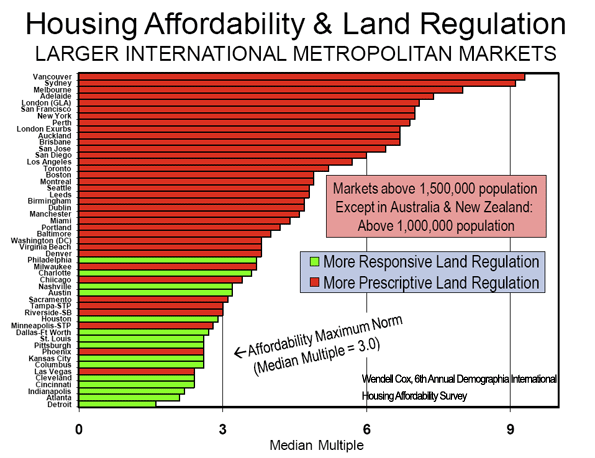
    The 6th Annual Demographia Housing Affordability Survey of six countries portrays a widespread relationship between high housing cost and overly restrictive planning. In the chart below, housing cost is measured as years of family income needed to purchase a house. This year the picture is somewhat complicated by the collapse of the housing bubble in some prescriptive jurisdictions resulting in a substantial reduction of previous high prices.


    Median house price divided by gross annual median household income.

    Only about seven per cent of Australians wish to live in apartments. In spite of this, smart growth policies have resulted in apartments being the only type of housing available to most new entrants to the housing market. These apartments command higher prices than otherwise would be the case, due to an inadequate supply of competing single-residential housing resulting from the scarcity of available sites. This provides the potential for apartment developers to make large profits. Such profits provide the resources for developers to make large donations to the political parties.

    Over the previous five years, the ruling New South Wales Labor Party received donations from the development industry of $9 million, while the Liberal opposition party netted $5 million. These donations exceeded the total contributions to all political parties over the same period from the gambling, tobacco, alcohol, hotel, pharmaceutical and armaments industries combined.

    Numerous documented cases show a large donation being made shortly before permission is granted for a particular development. In response to long-term escalating public anger, the New South Wales Government in December 2009 passed legislation to prohibit donations from property developers. However, the public cynically consider this will not solve the problem and that “donations” will be given in other ways.

    In the face of criticism, state governments maintain that recent land releases have been sufficient. The New South Wales Minister of Housing has stated that land for 131,000 homes has been released in Sydney. Yet the shortage continues to get worse. One reason is the tortoise-like progression of the rezoning process.

    Another is market manipulation. As the Demographia survey points out, governments flag well in advance which greenfield areas will be zoned for developments. Sellers then realise they are cushioned from competition and can command higher prices for their land. Purchasers – developers — know they can pay substantial premiums compared to what would be the case if land release were not so predictable.

    It appears that developers (both government and private) then carefully control the rate at which these greenfield sites are made available to home buyers. It has been reported that the Melbourne government development agency is sitting on a stockpile of 25,000 house blocks that have been zoned for residential approval, but is selling just 700 per year. Private developers and landholders currently hold almost 70,000 house blocks, yet only 1400 of these are available to the market . In the current situation of high demand, it is evident that housing land is being drip fed onto the market, thus keeping prices high.

    The Council of Australian Governments seems to have taken cognisance of this situation, as the review will examine large parcels of land “to assess the scope for increasing competition and bringing land quickly to the market”.

    The Council’s review indicates a welcome change in thinking. Up to now it has not been generally recognised that planning policies are a significant factor in excessive housing cost. Other adverse effects of these policies still need to be acknowledged. One hopes that this review will represent the beginning of a broader appreciation of the downside of high-density policies.

    Photo: A strip of ‘Sydney Lace’in Balmain, Sydney, New South Wales

    (Dr) Tony Recsei has a background in chemistry and is an environmental consultant. Since retiring he has taken an interest in community affairs and is president of the Save Our Suburbs community group which opposes over-development forced onto communities by the New South Wales State Government.

  • The New E.D. — Environmental Density

    Developers often have an E.D. problem and are not even aware of it. No, not the type of E.D. temporarily cured with Viagra. Environmental Density — E.D. — is the measurement of the impact of man made construction on a site. In simple terms, E.D. is the average per acre volume of impervious surface due to land development construction. It has two very important impacts, one environmental, and one financial. One acre of land is 43,560 square feet. The lower the E.D. — square foot of impervious surface area divided by 43,560 — the lower the surface area of manmade structures that divert rain run-off, and the less environmental damage.

    Some municipalities have impervious surface limitations in their regulations. These limitations can be counter to human benefits. For example, a developer faced with the limits of allowed impervious surface area would rather not propose a walking system; the regulations could mean a choice between walkways and homes. E.D., on the other hand, is not an imposed limit, but a way to measure the efficiency of the neighborhood design.

    Don’t bother searching the internet for opposing articles on E.D., because we invented the term’s use in relationship to modern land development right here at www.newgeography.com.

    From a financial perspective, the lower the volume of manmade stuff, the lower the development cost. The savings translate into more money that can be spent on higher quality development and/or a drop in the cost of housing and commercial construction. In other words higher quality development at more affordable prices. This affects everyone, worldwide.

    It doesn’t matter if the site is a New Urban “Smart Growth” design, a subdivision in “Garage Grove Acres”, or a Prefurbia neighborhood. E.D. is the number that can easily indicate the direct environmental impact of land development. The E.D. is essentially the Efficiency of Development.

    Assuming that New Geography readers are not all engineers, I’ll use some simple examples of E.D.:

    If the design is wasteful (eliminating waste in design is NOT a subject taught in land planning schools – but it should be), then costs and environmental impacts increase. Nobody but the paving and earthwork contractors being paid to build excessive infrastructure gain from wasteful development. The developer’s profit decreases and the city’s maintenance cost escalates from having to maintain excessive infrastructure… forever. We all pay for this!

    In an urban high density development which has a very large ratio of hard surface area to organic ground (sometimes the E.D. reaches 100%), there are often opportunities to lower the inorganic percentage. Green roofs (landscaped rooftops) have an impact on E.D. because, in theory, the rainfall is held in soils that water landscaping. However, this assumes existing building structures can handle the additional weight and can be modified to properly maintain an organic area. Organic space on ground level benefits 100% of the population, as opposed to a green roof many stories above the pedestrian ways. So for the purposes of this article we will define all rooftops (urban or suburban) as negative impact square footage. Walks, streets, and driveways are all hard surface areas that divert rain. Organic areas absorb rain. Run-off from hard surface area negatively affects the environment.

    Velocity is another problem. Run-off travels on hard surfaces at a much higher rate than it does on landscaped ground. The worst rates are found where there are long runs of straight street with rain traveling along gutters; curved design slows it a bit . Velocity builds momentum as more rain collects in gutters, inlets and sewer pipes. Eventually this wall of water reaches the end of developed land and spills into a natural system, carrying pollutants into major bodies of water. That oil slick on your driveway can be carried to environmentally sensitive areas hundreds or thousands of miles away in a heavy downpour.

    Lower the E.D. ratio and some magnificent things happen.

    A gain in organic space can reduce the disruption of the earth — the moving of dirt — which can significantly lower development costs, as well as provide surface run-off conduits which cost much less than sewer pipe. The designer must learn how to identify waste, and then take the steps to reduce it. This adds an additional element in the initial planning stages, but an extra day or two in design could reduce development costs by hundreds of thousands of dollars.
    Rooftop surface can be reduced by building up, not out. The trend to build single level housing for the empty-nester market results in sprawling homes with terrible E.D. ratios, and it adds to the costs of the structures; roofs and foundations certainly are not cheap. Sprawling homes require longer streets to be reached, another increase in costs and environmental damage. A residential elevator is about $14,000 (installed) for a two story home, and $22,000 for three floors . By using them, builders can construct compact structures and plummet the E.D. ratio.

    Paved areas can be reduced by changing regulations to allow vast, commercial parking areas, shared. by users that have different peak times. Some cities use progressive thinking, and allow this simple technique to lower the E.D. ratio of a region. Paved areas built to municipal standards are incredibly expensive, making the E.D. ratio even more critical.

    When we developed Performance Planning Systems we wanted to create the tools to easily determine E.D. while still in the initial design phases, as well as to provide the education to recognize waste and teach how it can be reduced. E.D. relies on this new technology; tracing accurate space for the calculations would have been too tedious and time consuming in the past. Environmental Density, unlike impervious surface limits, does not impede efforts to create great neighborhoods. It’s not a restriction on what can be built, but a measure of a design’s efficiency that can benefit builders, developers, and environmentalists.

    Rick Harrison is President of Rick Harrison Site Design Studio and Neighborhood Innovations, LLC. He is author of Prefurbia: Reinventing The Suburbs From Disdainable To Sustainable and creator of Performance Planning System. His websites are rhsdplanning.com and performanceplanningsystem.com.