Category: housing

  • Growing America: Demographics and Destiny

    Over the next four decades, American governments will oversee a much larger and far more diverse population. As we gain upward of 100 million people, America will inevitably become a more complex, crowded and competitive place, but it will continue to remain highly dependent on its people’s innovative and entrepreneurial spirit.

    In 2050, the U.S. will look very different from the country in 2000, at the dawn of the new millennium. By mid-century, the U.S. will no longer be a “white country,” but rather a staggering amalgam of racial, ethnic and religious groups, all participants in the construction of a new civilization whose roots lie not in any one country or continent, but across the entirety of human cultures and racial types. No other advanced, populous country will enjoy such ethnic diversity.

    The implications of this change will be profound for governments-perhaps in ways not now commonly anticipated. Many “progressives” believe a more diverse, populous nation will need more guidance from Washington, D.C., but a more complex and varied country will increasingly not fit well into a one-size-fits-all approach.

    Although the economic crisis of 2008 led to a rapid rise of federal power, there has been a stunning and largely unexpected push-back reflected, in part, by the tea party movement. Some states have passed laws that seek to restrict federal prerogatives on a host of issues. More importantly, public opinion, measured in numerous surveys, seems to be drifting away from major expansions of government power.

    Of course, most Americans would accede to the federal government an important role in developing public works, national defense and regulations for health and safety. But generally speaking, they also tend to believe that local communities, neighborhoods and parents should possess the power to craft appropriate solutions on many other problems.

    This also reflects our historical experience. From its origins, American democracy has been largely self-created and fostered a dispersion of power; in many European countries, and more recently in parts of Asia, democracy was forged by central authorities.

    Other periods of massive government intervention, most notably after the New Deal and the Great Society, also elicited reactions against centralization. But the current push-back’s speed and ferocity has been remarkable. Yet the often polarizing debate about the scope of federal power largely has ignored the longer-term trends that will promote the efficacy of an increasingly decentralized approach to governance.

    Perhaps the most important factor here is the trajectory of greater growth and increasing diversity of who we are and how we live. Not only are Americans becoming more racially diverse, but they inhabit a host of different environments, ranging from dense cities to urbanized suburbs, to smaller cities and towns, that have different needs and aspirations.

    Americans also are more settled than any time in our history-partially a function of an aging population-and thus more concerned with local developments. As recently as the 1970s, one in five Americans moved annually; in 2004 that number was 14 percent, the lowest rate since 1950. In 2008, barely one in 10 moved, a fraction of the rate in the 1960s. Workers are increasingly unwilling to move even for a promotion due to family and other concerns. The recession accelerated this process, but the pattern appears likely to persist even in good times.

    Americans also prefer to live in decentralized environments. There are more than 65,000 general-purpose governments; the average local jurisdiction population in the United States is 6,200-small enough that nonprofessional politicians can have a serious impact on local issues. This contrasts with the vast preference among academic planners, policy gurus and the national media for larger government units as the best way to regulate and plan for the future.

    Short of a draconian expansion of federal power, this dispersion is likely to continue. Roughly 80 to 90 percent of all metropolitan growth in the last decade took place on the periphery; at the same time, the patterns of domestic migration have seen a shift away from the biggest cities and toward smaller ones. As Joel Garreau noted in his classic Edge City, “planners drool” over high-density development, but most residents in suburbia “hate a lot of this stuff.” They might enjoy a town center, a paseo or a walking district, but they usually resent the proliferation of high-rises or condo complexes. If they wanted to live in buildings like them, they would have stayed in the city.

    Attempts to force major densification in these areas will be fiercely resisted, even in the most liberal communities. Some of the strongest anti-growth hotbeds in the nation are areas like Fairfax County, Va., with high concentrations of progressives-well educated people who might seem amenable to environmentally correct “smart growth”-advocating denser development along transit corridors. As one planning director in a well-to-do suburban Maryland county put it, “Smart growth is something people want. They just don’t want it in their own neighborhood.”

    The great long-term spur to successful dispersion will come from technology, as James Martin first saw in his pioneering 1978 book, The Wired Society. A former software designer for IBM, Martin foresaw the emergence of mass telecommunications that would allow a massive reduction in commuting, greater deconcentration of workplaces and a “localization of physical activities … centered in local communities.”

    Technology would allow skilled people to congregate in communities of their choice or at home. Today not only knowledge workers but also those in construction trades, agriculture and other professions are home-based, conducting their operations out of trucks, vans or home offices.

    Many leading-edge companies now recognize this trend. As much as 40 percent of IBM’s work force operates full time at home or remotely at clients’ businesses. Siemens, Hewlett-Packard, Cisco, Merrill Lynch and American Express have expanded their use of telecommuting, with noted increases in productivity.

    At the same time, employment is shifting away from mega-corporations to smaller units and individuals; between 1980 and 2000, self-employed individuals expanded tenfold to include 16 percent of the work force. The smallest businesses, the microenterprises, have enjoyed the fastest rate of growth, far more than any other business category. By 2006 there were some 20 million such businesses, one for every six private-sector workers.

    Hard economic times could slow this trend, but recessions have historically served as incubators of innovation and entrepreneurship. Many individuals starting new firms will have recently left or been laid off by bigger companies, particularly during a severe economic downturn. Whether they form a new bank, energy company or design firm, they will do it more efficiently-with less overhead, more efficient Internet use and less emphasis on pretentious office settings. In addition, they will do it primarily in places that can scale themselves to economic realities.

    Simultaneously the Internet’s rise allows every business-indeed every family-unprecedented access to information, something that militates against centralized power. Given Internet access, many lay people aren’t easily intimidated into accepting the ability of “experts” to dictate solutions based on exclusive knowledge since the hoi polloi now possess the ability to gather and analyze information. Even the powerful media companies are rapidly losing their ability to define agendas; there are too many sources of information to mobilize mass opinion. The widespread breakdown of support for climate change is a recent example of this phenomenon.

    Once the current drive for centralization falters, support for decentralization will grow, including progressive communities that now favor a heavy-handed expansion of federal power. Attempts to impose solutions from a central point will be increasingly regarded as obtrusive and oppressive to them, just as they would to many more conservative places like South Dakota. In the coming era, in many cases, only locally based solutions-agreed to at the community, municipal or state level-can possibly gather strong support.

    This drive toward dispersing power will prove critical if we hope to meet the needs of an unprecedentedly diverse and complex nation of 400 million. New forms of association-from local electronic newsletters to a proliferation of local farmers markets, festivals and a host of ad hoc social service groups-are already growing. Indeed, after a generation-long decline, volunteerism has spiked among Millennials and seems likely to surge among downshifting baby boomers. In 2008, some 61 million Americans volunteered, representing more than one-quarter of the population older than 16.

    It’s these more intimate units-the family, the neighborhood association, the church or local farmers market-that constitute what Thomas Jefferson called our “little republics,” which are most critical to helping mid-21st-century America. Here, our nation of 400 million souls will find its fundamental sustenance and its best hope for the brightest future.

    This article originally appeared in GOVERNING Magazine.

    Joel Kotkin is executive editor of NewGeography.com and is a distinguished presidential fellow in urban futures at Chapman University. He is author of The City: A Global History. His newest book is The Next Hundred Million: America in 2050, released in Febuary, 2010.

    Photo by slynkycat

  • Can David Cameron Close the Deal?

    With the Labour Government exhausted and its supporters dismayed, why isn’t the Conservative Party leader David Cameron sailing home to victory?

    Under the leadership of Prime Minister Gordon Brown, all the weaknesses of the Labour Party have been painfully exposed. British Prime Ministers are elected by the House of Commons, and the Members of that Parliament by the people; so when Brown’s predecessor Tony Blair resigned, his replacement as Labour Party leader became Prime Minister without a general election. In the country, Brown had been a popular figure – if only because he seemed to be the more trustworthy next to the mercurial Blair. But once he took office, Brown’s weaknesses were on view.

    Just as much as Blair, Brown was the architect of the ‘New Labour’ project that shed the party’s welfare state socialist image for a ‘Third Way’. Modelled on Bill Clinton’s revamp of the Democratic Party, the programme demanded that Labour stop using government to provide for its urban poor and trade union constituencies – supporters who would frighten away more aspiring middle class voters.

    But clearing the old-school socialists out of Labour’s policy-making bodies left an ideological vacuum that was filled by environmentalists, the culturati and NGO-enthusiasts for action over the third world. New Labour had freed itself of its traditional socialism only to become beholden to the enthusiasms of the educated political classes. Attention-grabbing ‘humanitarian interventions’ into third world countries were avowedly not in Britain’s national interests, but in pursuit of an ethical foreign policy. Money was directed into subsidising arts centres and other cultural projects.

    Government took on policies that protected the environment, but damaged industry: ‘traffic-calming’ measures – bus and cycle lanes, speed restrictions, congestion charge zones – were put in place with the express purpose of dissuading people from using the roads. Meanwhile road building was put on hold; licenses for new power stations were withheld, so that the country is facing blackouts in six years’ time; bans were put in place on use of GM crops.

    Labour did listen to the City of London’s financial lobby – Goldman Sachs’ Gavyn Davies was a close advisor, as was ‘Shrieky’ Shriti Vadera of UBS Warburg. Labour kept the Conservatives’ banking deregulation but retained Britain’s extraordinary legal controls on land development, so that credit to buy homes was readily available, but very few were built. Anyone sentient could have predicted the result: prices went sky-high putting home ownership beyond the reach of working class people.

    Given his subservience to the City, it was not surprising that when British banks over-extended position led to collapse in late 2008, Brown bailed them pushing public debt into the trillions. Labour’s traditional working class supporters were asking why their party was subsidising million pound bailouts to banks, while their own jobs were disappearing. Most Britons are proud of their armed services, but they had to ask why they were losing their lives in Afghanistan and Iraq. And they wondered how it was that the income gap between rich and poor was getting so much worse under Labour.

    Public disaffection with the political class reached fever pitch when newspapers published details of the Members of Parliament’s own expense claims. MPs were seen to have lied about their addresses to get the taxpayer to pay the mortgage, just as they put their relatives down as researchers and assistants.

    David Cameron ought to have been in the best possible place to take advantage of the government’s difficulties. But Cameron has proven for too much in the same mould as Gordon Brown, and Tony Blair.

    Cameron got to be Tory Party leader after three successive general election defeats. The lesson that the party drew from its experiences in 1997, 2001 and 2005 was that it was the Tory Party’s core brand that was at fault. Cameron was chosen largely by saying that the party should imitate Blair’s ideology-lite, environmentally-conscious, caring, dash for the ‘middle ground’. The Conservatives had to get over their ‘nasty party’ image.

    Cameron dropped a lot of the party’s traditional MPs, and invited people who were not mainstream Tories on board. Cameron’s remodelling of the Conservative Party followed the Brown-Blair model of pushing the core constituency aside to let in new faces. But the new faces that rushed in had the same gentry-liberal preoccupations as those that had taken over the Labour Party in 1997.

    Here’s an example of the new Conservative. As well as running an organic hobby farm, Zac Goldsmith is Cameron’s dashing prospective Tory Party candidate for Richmond Upon Thames. For the last ten years he has been proprietor and editor of The Ecologist magazine, Britain’s foremost green media voice. Zac inherited £300 million from his father, asset-stripping financier Sir James Goldsmith, using the proceeds to finance his pet causes through his own grant-making bodies, the JMG Foundation and the Isvara Foundation. He gives money to his own small-farmers groups FARM, which is committed to stopping private housing developments, has underwritten the Ecologist’s debts of £864,675. He has financed his own web-site SpinWatch to ‘expose’ corporate lobbying – though as Private Eye pointed out, its attack on the nuclear industry was curiously selective, mentioning no Tories, only Labour-backing investors (26 May 2006).

    Well-heeled voters in Richmond might not be too bothered that Zac has written a book The Constant Economy saying we need an end to growth, because they are already enjoying theirs.

    Another key Cameron supporter is advisor Philip Blond whose manifesto Red Tory bemoans the loss of England’s traditional charm under the twin evils of state socialism and the free market ideologies he blames upon the (conveniently foreign-sounding) Milton Friedman. Blond’s traditionalist fantasy of Merrie England is drawn from the backward-looking dreams of G.K. Chesterton and Hilaire Belloc, who railed against modernity back in the early twentieth century.

    Blond’s call for people to rely less on the state is well-made, but his anti-capitalism must have alarmed the party’s core supporters: ‘economic liberalism has often been a cover for monopoly capitalism and is therefore just as socially damaging as left-wing statism.’ Blond’s solution, though, is some state-enforced localism, with legal controls to redirect investment into municipal authorities – what he calls a ‘distributist state’. If this is David Cameron’s big idea, redistributing wealth through local government, it is not surprising that he has not made a great deal of headway in the polls given that everyone understands the real issue is the penurious state of the country’s finances.

    Throughout the election, Cameron has led in the opinion polls, but not by enough to guarantee a majority in parliament. When the country held its first ever televised leaders debate, something that the Tory leader had demanded, he was up-staged by Nick Clegg, leader of Britain’s third party, the Liberal Democrats. In truth Clegg’s appeal is not programmatic – he is pretty much more of the same as the other two. But what he did very effectively was to position himself as the outsider, not a part of the old two party system, a kind of younger, more attractive Ross Perot.

    Clegg’s appeal to the politically disaffected ought to have worked for David Cameron. But Cameron’s failing lies in the fact that he simply has replicated the New Labour project, just as the public were falling out of love with it. Environmentalism, stopping urban sprawl, and ‘restoring communities’ are the preoccupations of a narrow strand of British society: the kind of people who occupy the lower rungs of government service. It is not that most Britons want to trash the environment, or concrete over the countryide, nor indeed support community breakdown. It is just that they do not understand why their own self-betterment always has to give way to those concerns.

    Tragically, the only party that has made an issue of Britain’s chronic housing shortage is the far-right British National Party. Neither the Tories, nor Labour, less still the Liberal Democrats, have the courage to face down the NIMBY opponents of new building. The Tories’ own supporters (like the Lib Dems) have made it to the suburbs and do not want to share or expand them. Labour cannot give up its grip on government planning laws. With no-one willing to free up land for development, the BNP’s call to drive immigrants out is the loathsome conclusion of anti-growth sentiment.

    When they look at the Eton-educated front bench team that Cameron is putting up, voters see the kind of people who have made (or inherited) their stash, and now are pulling up a drawbridge behind them. All of the pious talk about looking after the poor sounds like parish charity, not giving people a chance to help themselves.

    David Cameron’s Conservatives are still the favourite to win the General Election, the only puzzle is why are they finding it so hard to close the deal – a puzzle until you look at their policies, that is.

    James Heartfield works for the Audacity.org think tank, and most recently wrote Green Capitalism: Manufacturing Scarcity in an Age of Abundance (Mute, 2009). His website is at www.heartfield.org

    Photo by: conservativeparty

  • Finding the Good in This Bad Time

    This year’s best places rankings held few great surprises. In a nation that shed nearly 6.7 million jobs since 2007, the winners were places that maintained or had limited employment declines. These places typically had high levels of government spending (including major military installation or large blocs of federal jobs) or major educational institutions. Nor was the continued importance of the energy economy surprising in a nation where a gallon of gas is still about $3 a gallon.

    Even including part of 2010, only 13 cities (out of 397) showed growth, reflecting the breadth and depth of the downturn. In an economy where the most promising statistic is a “limited” decline in the number of new job losses from month to month, where is the proverbial silver lining?

    It is found in two places: (1) areas that show some resilience in this dour economy; and (2) a newly retooled American economy positioned to compete more strongly in the future.

    Regions of Current Hope
    With disaster as a backdrop, the early signs of buoyancy in the economies of the Intermountain West, the Great Plains, and even parts of the Midwest are quite impressive. Many predicted these areas would mirror the collapse of their larger, high-growth counterparts in California, Florida, Arizona and Nevada. To the contrary, these relatively rural locations are emerging as beacons of hope.

    In the big cities, there have been across-the-board declines in most sectors led by the collapse of construction and financial services. Thousands of small businesses have disappeared in addition to huge layoffs by large employers. You see many “For lease” signs now at what were once your favorite shops and watering holes.

    In a business climate like this, a lot can be said for slow and steady. Comparatively, slower-growing cities across the middle parts of the country are recovering more easily and more quickly.

    Perhaps the most important lesson is that the economies of the future are not all about the “knowledge class” and that “too-good-to-be-true” high wage jobs may be just that. As seen in the dot-com bubble and in this real estate bubble, those fancy, high-wage finance and tech jobs are highly vulnerable to swings in the economy and high-paying construction jobs are only as good as the housing market.

    This is simply because markets eventually adjust. In the case of overheated stock and real estate markets, the losses are felt by the knowledge class, financiers and construction workers. In the case of manufacturing, as the price is bid up through labor costs, other places become more competitive.

    During volatile times, places with the broad-based growth strategies — like Texas and Utah — do best. Cities that are heavily dependent on a narrow set of industries leave themselves vulnerable, paying back the gains of good years in poor years.

    Part of the success of Texas is not just energy (as the modest performance of Midland and Odessa shows), but rather to the state’s adjustments to a past crisis, the savings and loan crisis of the 1980s. The state instituted new laws that imposed a range of disciplines on financial markets — such as limiting home equity lines — thereby minimizing the damage to the state’s economy as those markets went topsy-turvy.

    Regions of Future Hope
    There remains hope for the future in the story of this recession. One of the defining aspects of this recession was not just that certain sectors were hit hard, but that it was also broadly distributed across the economy. This pervasiveness extended deeply enough to cause every enterprise in America to seriously reconsider their business model and re-engineer how they served their customers.

    Consequently, the American economy is leaner and cleaner than it was three years ago. Businesses are more in touch with what makes them successful. While growth will be slower, it will be focused on areas that will bring about quick increases in productivity across the economy and bring new, real wealth to the local economies.

    Where will this happen most quickly? In those places where businesses survived best. Expect the Intermountain West and smaller manufacturing hubs across the United States to lead the charge (because of their lower costs), but large metros like Los Angeles, Chicago, Houston, Minneapolis, and Dallas, with their deep inventories of manufacturers and large labor pools, should see these returns before too long.

    Similar stories can be told for nearly every sector although the beneficiaries will be different. Much of the growth in information sector, for example, will continue to take place outside Silicon Valley. Business services will grow most rapidly where there is growth in business overall, initially outside the core hubs. Midsized and small communities will lead this recovery, and the big cities will eventually follow.

    Economies open to a wide array of occupations will do better than those that are less diversified. Places like Portland and Atlanta, so deeply focused on attracting high-wage, knowledge-based jobs are likely to miss out on the “basic” job growth that will fuel the first stage of the American recovery. Venture capital is still tight across the nation and capital markets are uncertain, especially with new government regulations up in the air. Consequently, high-end, white collar, and high tech jobs, with their insatiable need for investment capital, will develop more slowly. Even among the high-tech superstars, high profits will not lead to huge surges in hiring.

    Why Government Holds the Key
    Government’s actions over the next six to 12 months will define potential and the pace of this recovery. With an election looming, all sides will be jockeying for electoral advantages in November. They will cater legislation to many competing constituencies, fostering tremendous uncertainty in the private sector.

    One thing is certain, however. The current pace of government spending is unsustainable. Not even the US economy can support ongoing deficits in excess of $1.5 trillion per year. Either government spending must slow or someone must pay a lot more. The only alternative — high inflation — will have its own negative effect. One way or another some combination of the three MUST happen.

    Additionally, current regulatory initiatives will change the dynamics and employment patterns within some important sectors. Whether it is the complete restructuring of the health care industry (part of one of the only bright spots in the current economy), or the prospective new regulation in the financial services sector, potentially destabilizing change is coming.

    And the feds are not the only destabilizing government actors. California’s aggressive climate legislation, for example, and the mixed signals it is sending businesses across the state’s 28 MSAs will certainly shape their near and midterm economic futures.

    So what should the federal and state governments be doing at this time? Most importantly, they need to ensure stability: stable capital and lending markets, a consistent and stable tax code, focusing interventions on broad-based, low-shock actions, and developing a plan for moderating and containing the national deficits and mounting national debt. The key to continued prosperity in these times is a growing private job base, not a growing government sector.

    Moreover, government needs to learn the lessons of the private sector. Even as private firms retrench, governments at all levels need to reduce their cost structures. This is happening in many localities, at least on a temporary basis, as even unionized local employees are accepting wage and benefit reductions to retain jobs. Localities and states must recognize the true cost of the services they provide. They must either find consistent ways of providing funding for them, or eliminate them to preserve more critical services.

    Finally, public and private sectors alike must learn that this has been a transformational recession. Unlike downturns in the past, business and government cannot expect things will return to the way they were. Markets and banks will not be printing imaginary value increases in real property for consumers to spend any time soon and capital markets are cautious about financial good news,,preferring the old tried and true winners to novelties.

    Government and government employees are behind the curve understanding this transformation. Wage and benefit concessions given up during this recession are not likely to reappear. The concepts of furlough and unpaid time off are here to stay. Even as the private sector has been forced to reconsider its baseline practices, so, too, the political pressure now will be on government to retain savings obtained during the recession.

    Michael Shires, Ph.D. is a professor at Pepperdine University School of Public Policy.

  • Unaffordable Housing in Hong Kong

    For the past six years, Hugh Pavletich of Performance Urban Planning (Christchurch, New Zealand) and I have authored the Demographia International Housing Affordability Survey. The Survey assesses structural housing affordability by the use of the Median Multiple (median house price divided by the median household income). This measure is in wide use and has been recommended by the United Nations and the World Bank.

    Six nations are routinely covered, including the United States, the United Kingdom, Canada, Australia, Ireland and New Zealand. In each of these nations, the Median Multiple has been astonishingly similar, at least until recent years, with all six nations having had a Median Multiple of 3.0 or less until the last decade, or at the worst, the late 1980s. Of course, as Demographia and a world-class collection of economists have shown, house prices have risen substantially relative to incomes as a result of growth management (also called smart growth, urban consolidation) that ration land for development.

    For the first four years of the Survey, California markets were the most unaffordable, with Los Angeles exceeding 11 at one point, while San Francisco, Honolulu and San Diego exceeded 10. That all changed with the US housing bust, which was the most severe in California. As a result, Vancouver has become the most unaffordable major metropolitan area in the six nations, with a Median Multiple of 9.3 in the 2010 Survey. Sydney was a close second at 9.3.

    The South China Morning Post, Hong Kong’s leading English language newspaper, approached Demographia to estimate a Median Multiple for Hong Kong. This we were pleased to comply, given our interest in expanding the scope of the Survey to more than the six nations.

    It took a considerable amount of “digging” to develop the data, and a number of emails back and forth with The South China Morning Post. The result was an estimated Median Multiple for Hong Kong (the entire Special Economic Region) of 10.4. This makes Hong Kong the least affordable metropolitan area of the 273 Demographia has reported upon. The South China Morning Post illustrated this in an attractive graphic.

    At least temporarily, however, home purchasers in Hong Kong have been able to arrange financing packages that mute these high costs. Currently, mortgage interest rates are from 0.8% to 2.1%, which is far below the lowest levels reached in the six nations. As a result, such homeowners find their housing more affordable that some metropolitan areas with higher Median Multiples (such as Vancouver and Sydney).

    However, things could soon change. Professor Chau Kwong-wing of the University of Hong Kong calls the present situation: “… just a short-term illusion,” adding that “People think they can afford an expensive flat with a reasonably cheap mortgage. Their dreams will burst and the flat will become unaffordable when the interest rate rises.” The professor has a point. Variations in interest rates can mask or magnify structural affordability, which is measured by the Median Multiple. This is because interest rates are subject to fluctuation, while buyers and sellers do not renegotiate sales prices after the deal is concluded.

    Professor Chau echoed the land regulation views of the economists, indicating that the need for “increasing land supply for sales.”

    We look forward to routinely reporting on Hong Kong in future editions of the Demographia International Housing Affordability Survey.


    Hong Kong has grown fast in recent decades, not only in population but also in income. International Monetary Fund placed Hong Kong’s 2009 gross domestic product per capita (adjusted for purchasing power) only 10% below that of the United States, and 15% above its former colonial administrator, the United Kingdom. Hong Kong was even further ahead of other major European Union nations and Japan.

  • The Muddled CNT Housing and Transportation Index

    The Center for Neighborhood Technology (CNT) has produced a housing and transportation index (the “H&T Index”), something that has been advocated by Secretary of Housing and Urban Development (HUD) Shaun Donovan and Secretary of Transportation Ray LaHood. The concept is certainly worth support. Affordable housing and mobility are crucial to the well-being of everyone, which translates into a better quality of life, more jobs and economic growth. Surely, much of the internationally comparatively high standard of living enjoyed by so many middle and lower income households in the United States has resulted from inexpensive housing (often on the urban fringe) and the ability to access virtually all of the urban area by quick and affordable personal transportation.

    CNT has developed an impressive website, with “tons” of data and maps that are both impressive and attractive. Maps can be adjusted to look at approximately 40 demographic indictors for “block groups” in the nation’s metropolitan areas. Block groups are neighborhoods (smaller than census tracts) defined by the Bureau of the Census and have an average population of approximately 1,500.

    CNT uses the HUD “housing burden” at 30% of household income as a maximum for affordability and further says that housing and transportation should not exceed 45%. The maps show neighborhoods that CNT finds to be affordable and not affordable by these criteria.

    But for all of its superficial impressiveness, the H&T Index is subject to serious misinterpretation and suffers from methodological flaws that neutralize the usefulness of its affordability indices.

    The H&T Index: Potential for Misinterpretation

    The H&T Index: Not a Neighborhood Index: The H&T Index is particularly susceptible to misinterpretation by ideological interests contemptuous of America’s suburban lifestyle, who would use public policy to force people to live in higher densities. While the H&T Index reports data at the neighborhood level, it is not a neighborhood index. However, the H&T Index does not compare neighborhood housing and transportation costs with neighborhood incomes. Rather, the H&T Index uses the metropolitan median household income.

    As a result, low income neighborhoods appear to be affordable, because their less costly housing is compared to the higher metropolitan area median income. Higher income neighborhoods appear unaffordable, because their higher housing costs are compared to the lower metropolitan area median income.

    Press reports, such as in the Washington Post have failed to clearly describe this issue. Without clear reporting, the H&T Index is could play into the popular fiction that suburbs are filled with households unable to cannot afford their housing and transportation. In fact, the vast majority of suburban homeowners can afford their transportation and housing and an appropriate portrayal of neighborhood data (with the corrections noted below) would illustrate this. The high level of recent foreclosures that have occurred in some suburbs are simply a reflection of the fact that “easy money” enticed some people to take on obligations that were beyond their means (just as central city developers built condominium towers that have been foreclosed upon or offered as rentals, with unit prices discounted 50% and more).

    The potential for misinterpretation is illustrated by examining three neighborhoods in Dallas County (Table 1), one low income, one middle income and one high income (2000 data).

    • The H&T Index indicates that housing costs are 8% of incomes in the low-income West Dallas neighborhood when compared to median metropolitan income. However, when the neighborhood income is used, the share of income required for housing is 57%, nearly twice the HUD maximum standard.

    It might be thought that people should move to West Dallas from the suburbs to take advantage of the low housing prices. However, any such migration would quickly escalate land prices up to eliminate any advantage (and to force the low income residents to move, as happens in “gentrifying” neighborhoods).

    • In the middle income (Garland) neighborhood, housing costs as a share of income are 24%, whether measured by the metropolitan or neighborhood income, both within the HUD 30% maximum
    • In the high income (University Park) neighborhood, CNT finds housing costs to be 102% of median metropolitan incomes. When neighborhood income is used instead, housing costs drop to 25% of incomes, well within the HUD 30% maximum.
    Metropolitan & Neighborhood Housing & Transportation Indices: 2000
    Factor Low Income Neighborhood: West Dallas Middle Income Neighborhood: Garland High Income Neighborhood: University Park
    Median Household Income: Metropolitan (PMSA) $48,364 $48,364 $48,364
    Housing Cost Share 8% 24% 102%
    Median Household Income: Neighborhood $6,989 $48,594 $200,001
    Housing Cost Share 57% 24% 25%
    Base data from H&T Index

    The H&T Index: Criticisms of the Methodology

    (1) Missing the Housing Bubble? CNT places more emphasis on transportation costs than on housing costs. This is evident in the H&T Index attention to rising transportation costs from 2000 to 2008. The housing bubble and its impact on household costs appears nowhere among the 40 indicators (Note).

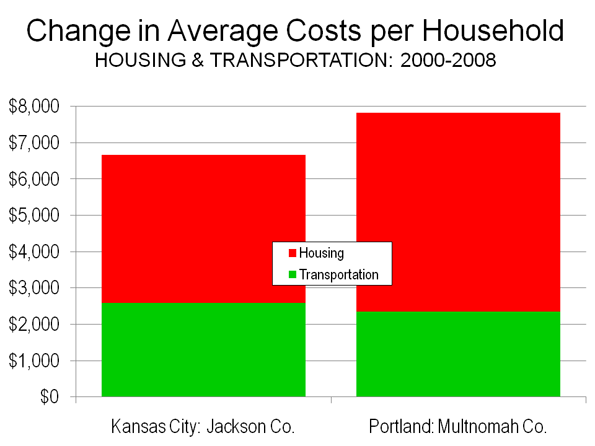
    Yet, there is every indication that housing costs have risen substantially more than transportation costs since 2000. For example, in Kansas City’s core Jackson County, the Census Bureau’s American Community Survey data indicates that the increase in average housing costs was nearly 60% greater than CNT’s transportation cost increase. In Portland’s core Multnomah County, the increase in average housing costs was more 125% greater than CNT’s estimated increase in transportation costs (Figure).

    (2) Exaggerating by Mixing Averages and Medians: The H&T Index compares average housing and transportation costs with the median household income. Averages and means are not the same things. Median income data is “middle” score, with one half of households having incomes above the median and one-half having incomes below the median. On the other hand, “average” housing costs and transportation costs are the total housing and transportation costs divided by the total number of households. High incomes and high priced housing skews averages up. Mixing medians and averages is inherently invalid. For example, in 2008, average housing costs were 19% higher than median housing costs. This means that, on average, where the H&T Index reports a 30% housing affordability figure, it is really substantially lower, at 25% (30% reduced by 19%).

    Thus, the net effect of comparing average housing costs to median incomes makes the housing element of the H&T Index worse than it really is.

    (3) Exaggerating by Leaving Some Households Out: The H&T Index excludes home owning households without a mortgage. The average housing expenditures of households without mortgages are smaller than those of households with mortgages. However, this is a material omission, since housing costs include utility payments. In Multnomah County, excluding households without mortgages raises average housing expenditures by nearly 10% (in 2008). Households without mortgages are households too. The net effect of excluding households without mortgages is to increase housing costs, making the housing portion of the index higher than it would otherwise be.

    (4) Exaggerating by Mixing Data from Different Years: The H&T Index provides 2008 estimates for neighborhood transportation costs, using modeled data. Transportation costs have surely increased since 2000, reaching their peak in 2008 due to the highest ever gasoline prices. CNT again compares these average costs to median household income, but not for 2008. CNT uses 2000 income data. In Jackson County and Multnomah counties, the use of 2000 instead of 2008 data exaggerates transportation’s share of household income between 20% and 25%.

    Each of the above methodological issues is sufficient to render H&T Index outputs to be unreliable.

    Housing’s Role in Housing & Transportation Affordability

    While both transportation and housing costs are important, housing costs have dented household budgets far more than the increase in transportation costs. Even after the house price declines of the last few years, house prices remain well above their historic ratio to household incomes. This will only get worse, if, as many expect, mortgage interest rates rise from their present lows and as rents rise to follow higher house prices.

    In contrast, transportation costs are more susceptible to reduction than housing costs. Once the mortgage is signed, the cost of the house will not be reduced. Once the lease is signed, there is little chance that the rent will be lowered. But transportation costs will be reduced in the future by the far more fuel efficient vehicles being required by Washington. Some people can work at home part of the time. People also change cars more frequently than they change houses. If costs become an issue, perhaps the next car is a compact rather than an SUV.

    CNT’s focus on trends in transportation costs rather than housing costs is consistent with its related study, Penny Wise Pound Fuelish, which advocates expansion of prescriptive land use (smart growth) policies to encourage core urban development and make much suburban development illegal. Yet, these very policies played a dominant role in driving house prices up three times as fast relative to incomes as in metropolitan areas that did not adopt them.

    Genuine advocacy for affordability requires addressing both transportation and housing costs. It also requires recognition of the significant damage done to affordability by prescriptive land use policies. An extra dollar that a household must pay for housing is just as valuable as one spent on transportation.

    All of which leaves us where we started. The nation could still use a reliable housing and transportation index.


    Note: CNT provides no 2008 data for housing costs. Such costs will not be available at the neighborhood level from the American Community Survey until 2012 or 2013. However, it would likely have been no more difficult for CNT to model updated housing data by neighborhood than it was to model 2008 data for transportation costs at the neighborhood level.

    Wendell Cox is a Visiting Professor, Conservatoire National des Arts et Metiers, Paris. He was born in Los Angeles and was appointed to three terms on the Los Angeles County Transportation Commission by Mayor Tom Bradley. He is the author of “War on the Dream: How Anti-Sprawl Policy Threatens the Quality of Life.

    Photograph: Hartford Suburbs

  • The Millennial Metropolis

    Back in the 1950s and 60s when Baby Boomers were young, places like Los Angeles led the nation’s explosive growth in suburban living that has defined the American Dream ever since. As Kevin Roderick observed, the San Fernando Valley became, by extension, “America’s suburb” – a model which would be repeated in virtually every community across the country.

    These suburbs – perfectly suited to the sun-washed car culture of Southern California – have remained the ideal for most Americans. And they remain so for the children of Boomer and Generation X parents, Millennials,(born 1982-2003), who express the same strong interest in raising their families in suburban settings.

    According to the most recent generational survey research, done for Washington-based think tank, NDN, by Frank N. Magid Associates, 43 percent of Millennials describe suburbs as their “ideal place to live,” compared to just 31 percent of older generations. In the same survey, a majority of older generations (56%) expressed a preference for either small town or rural living. This may reflect the roots of many older Americans, who are more likely to have grown up outside of a major metropolis, or it may indicate a desire of older people for a presumably simpler lifestyle.

    By contrast, these locations were cited by only 34 percent of Millennials as their
    preferred place to live. A majority (54%) of Millennials live in suburban America and most of those who do express a preference for raising their own families in similar settings. Even though big cities are often thought of as the place where young people prefer to live and work, only 17 percent of Millennials say they want to live in one, less than a third of those expressing a preference for suburban living. Nor are they particularly anxious to spend their lives as renters in dense, urban locations. A full 64 percent of Millennials surveyed, said it was “very important” to have an opportunity to own their own home. Twenty percent of adult Millennials named owning a home as one of their most important priorities in life, right behind being a good parent and having a successful marriage.

    This suggests that some of the greatest opportunities in housing will be in those metropolitan areas that can provide the same amenities of suburban life that Los Angeles did sixty years ago. In this Millennials are just like their parents who moved to the suburbs in order to buy their own home, with a front and back yard, however small, in a safe neighborhood with good schools.

    Given the fact that nearly four in five Millennials express a desire to have children, cities that wish to attract Millennials for the long-term will have to offer these same benefits. These Millennial metropolises also will need to be built with the active participation of their citizens, using the most modern communication technologies, to create a community that reflects this generation’s community-oriented values and beliefs. Metropolises that wish to attract Millennials, will also need to include them in their governing institutions. Such cities will have a leg up on those run by closed, good old boy networks that don’t reflect the tolerance and transparency Millennials believe in.

    The passion of Millennials for social networking and smart phones reflects their need to stay in touch with their wide circle of friends every moment of the day and night. In fact, 83 percent of this generation say that they go to sleep with their cell phone. This group-oriented behavior is reflected in the efforts of Millennials to find win-win solutions to any problem and their strong desire to strengthen civic institutions. Seventy percent of college age Millennials have performed some sort of community service and virtually every member of the generation (94%) considers volunteer service as an effective way to deal with challenges in their local community.

    The other key characteristic of the Millenial metropolis will be how it carves out a safe place for children. The Boomer parents of Millennials took intense interest in every aspect of their children’s lives, earning them the sobriquet “helicopter parents” because of their constant hovering. Now the Generation X “stealth fighter parents” of younger Millennials are turning the Boomer desire to hover and talk into a push for action and better bottom line results.

    This can already be seen in cities like Los Angeles where a parent revolution is successfully challenging the entrenched interests in the Los Angeles Unified School District (LAUSD).

    The idea began with a website, www.parentrevolution.org, that offered a bargain to parents willing to participate in a grass roots effort to improve individual schools. The organizers, led by Ben Austin, a long time advocate on behalf of Los Angeles’s kids, promised that if half of the parents in a school attendance district signed an online petition indicating their willingness to participate in improving their local school, they would “give you a great school for your child to attend.”

    This process has worked both in working class areas like East Los Angeles’ Garfield High School and the Mark Twain Middle School in affluent West LA. With the backing of the parents, Austin went to the Los Angeles school district and demanded that they either put the management of the school “out to bid,” or his organization would be forced to respond to the parent’s demands by starting a charter school in competition with the LAUSD school. Since each child has seven thousand dollars of potential state funding in their back pack, a newly enlightened LAUSD agreed to these demands. When 3000 parents showed up to demonstrate their support of the concept, the school district voted 6-1 to adopt a policy mandating competitive bids eventually be issued for the management of all 250 “demonstrably failing schools” as defined by federal education law.

    The key to building the Millenial metropolis will be to accommodate such changes. Places like Dallas, Houston, Austin, or Raleigh-Durham that have survived the Great Recession reasonably well now are focusing on producing open, accessible communities with good schools and safe streets. These communities appear best positioned to take advantage of the next bloom of urban growth. Of course the ability to provide America’s next great generation with good jobs and a growing economy will also be required if any metropolis wants to attract Millennials. But with the right leadership and a sustained effort to focus on the basics of family living, almost any city has the opportunity to become a leader in the rebirth of America’s Millennial Era metropolises.

    Morley Winograd and Michael D. Hais are fellows of the New Democrat Network and the New Policy Institute and co-authors of Millennial Makeover: MySpace, YouTube, and the Future of American Politics (Rutgers University Press: 2008), named one of the 10 favorite books by the New York Times in 2008.

    Photo: Papalars

  • Denver Relocation: The Search for Higher Ground

    In 2003 our family relocated to Folsom, California from Carson City, Nevada, after my father-in-law was diagnosed with Parkinson’s disease, to help with his care. In many ways the transition felt like an immersion into what Joel Kotkin calls the “city of aspiration.” Folsom, a Sacramento region suburb of 50,000, was notable for its robust economy, impressive K-12 schools, world-class bike paths, and low crime. It offered a favorable environment for families and upwardly mobile professionals.

    Seven years later, the landscape has certainly changed. My father-in-law has passed on, and California’s high cost of living continues to have a profound impact on our personal finances. This scenario, coupled with the currently dire economic picture, gave my wife and I pause to again rethink our future path. After many long nights of thoughtful dialogue, we came to the realization that it was time to break ties with the Golden State. In early summer, Denver will become our next home.

    This pending relocation offers our family an opportunity to embrace what I call “the geography of place”— the merging of what one wants to do with where one wants to live. As a process, it embodies a deep exploration into our values and upbringing, hopes and fears, past and future. And while a move of any distance can be daunting, it’s this deeper journey of self that makes the experience rich and meaningful.

    Our plans come at a time of decline in nationwide domestic relocation. Prominent demographer William Frey, in conjunction with the Brookings Institution, led a recent study on migration trends. He found that in 2007-08, the overall U.S. migration rate reached its lowest point since World War II, particularly for long-distance moves and renters. His study also indicated that migrations to exurban and newer suburban counties dropped substantially, simultaneously bringing unanticipated population “windfalls” to many large urban centers. The overall rate of decline is largely attributed to the economic slowdown crippling many parts of the nation, leading to job and income loss as well as upside down mortgages.

    Deciding where to settle down during these uncertain times required a well-thought-out process grounded in a clear set of criteria. After much discussion, we developed the five-C approach to classify our optimum home locale:

    1. Culture: Our ideal environment should have a rich, culturally diverse set of demographics. As a biracial family, social acceptance in our community is paramount.

    2. Charm: Our perfect residential picture is a neighborhood that represents a hybrid of walkable urbanism, housing affordability, safety, and community, which are often found in more suburban environs.

    3. Community: We both enjoy opportunities for civic connection. Proximity to hubs of social connection – such as coffee houses and universities – is a must.

    4. Convenience: By choice we are a one-car household, which makes bicycle, light-rail and walkable accessibility to centers of city activity and conveniences key.

    5. Climate: As a native Midwesterner married to a Southern Californian, we found common ground in a locale offering a change of seasons with generally moderate temperature.

    The upshot of our vetting process had some correspondence with a recent Best Cities for a Fresh Start list compiled by relocation.com. Topping that list is Austin, Texas, an impressive city that I recently visited as a part of my urban research study tour. The Dallas/Ft. Worth area came in second, followed by Charlotte, North Carolina. Denver was fourth, with Columbus, Ohio (my hometown) and Indianapolis tying for fifth on the list.

    Our personal list yielded five locations:

    Portland, Oregon: This Pacific Northwest jewel has received much media attention for its progressive urban practices. And for good reason. It boasts strong community and civic vibes, great neighborhoods, a transportation system ranked among the best in the nation, and a hip, urbane population base. In the end, though, the overcast, rainy climate was too much to overcome in a transition from ever-sunny California.

    Ft. Worth, Texas: For economic vibrancy Ft. Worth, with its sister-city, Dallas, tops the list. It also has good reputation for housing options, schools, civic pride, and decent weather. On the downside, property taxes are a bit high (we estimate 6 to 10 times higher than Denver). And as a bi-racial couple we had some reservations since, as one area resident put it, “Texas is still the South.”

    Boise, Idaho: Despite concerns about Boise’s diversity, the area has extremely low housing costs. Its strong university presence (Boise State) and vibrant downtown were also appealing. On the downside, the airport would have posed some travel limitations. Moreover, the area lacks the depth of social and cultural options common in more urbanized settings.

    Indianapolis, Indiana: Having lived in the Indianapolis area in the early ‘90s, this state capital has always held a special place in my heart, with its strong African-American communities, myriad array of spectator sports, and low cost of living. While I’ll always be a Hoosier at heart, the advantages of this Midwestern city were outweighed by its bleak winter climate. My wife’s need for sunshine booted it out of contention.

    And then there was Denver.

    Denver, our city of choice, impressed us with its myriad quality-of-life intangibles. While not on the order of California, it is culturally diverse with a strong sense of civic vibrancy. The area offers a wealth of housing options that fit our parameters: semi-urban, walkable, affordable, and safe.

    Culturally, the city has a young, active vibe to it. People are involved in varied outdoor activities and events, which underscore the recognition of Denver as one of the most physically fit cities in the U.S. Many have also described it as unpretentious. It has a progressive political structure, as well as a strong economic development platform for the future.

    With a population of nearly 600,000, Denver is the 24th most populous city in the U.S. and the 16th most populous metropolitan area in the nation. Geographically, it’s located in the center of the U.S., nestled in a mountain range that makes harsh cold weather and winds a rarity. While the city gets its fair share of snow, the winter months are rarely bleak. In fact, a draw for many residents is the 300-plus days of sunshine the city receives each year.

    We stand to gain immeasurably moving from über-expensive California. And in terms of intangibles, several are prominent. We’re looking to capitalize on Denver’s new urbanist-influenced walkability. The city has lots of options, from the hip and trendy Lo Do District to the established community of Capitol Hill. A key requirement of our ultimate housing choice will be a quality school district, along with proximity to transportation, coffee houses, grocery stores, fine dining venues, and even co-working sites. In our current residence in Folsom, California, it’s a challenge to stroll by foot to area amenities.

    As intellectually inclined individuals, it was also exciting to find that Denver holds the distinction of being the most educated city in the U.S. with the highest percentage of high school and college graduates of any U.S. metropolitan area. According to census estimates, 92% of the metro area population has a high school diploma, and 35% has at least a bachelor’s degree, compared to the national average of 81.7% for high school diplomas and 23% with a college degree.

    And finally, as a former resident of Indianapolis, a city that fed my obsession for spectator sports, Denver’s robust athletics scene certainly raised my heart rate. The hub of professional franchises in football, basketball, baseball, and hockey, it is one of the nation’s top sports meccas. It has certainly sparked a picture in my mind of hanging out at sporting events, beer in hand, enjoying the scene.

    In the end, relocating to a new geographical locale is never smooth. It requires a great deal of thoughtfulness, conversation and patience. My family views it as the ultimate “Mile High” climb for higher ground amid the economic unsettledness currently affecting California. If well-orchestrated, the payoff will be significant: a better quality of life and a rich existence. That’s our hope; that’s our goal for 2010.

    Photo of Denver’s Lo Do district by Michael Scott

    Michael P. Scott is a Northern California urban journalist, demographic researcher and technical writer. He can be reached at michael@vdowntownamerica.com.

  • All In The Family

    For over a generation pundits, policymakers and futurists have predicted the decline of the American family. Yet in reality, the family, although changing rapidly, is becoming not less but more important.

    This can be traced to demographic shifts, including immigration and extended life spans, as well as to changes of attitudes among our increasingly diverse population. Furthermore, severe economic pressures are transforming the family–as they have throughout much of history–into the ultimate “safety net” for millions of people.

    Those who argue the family is less important note that barely one in five households–although more than one-third of the total population–consists of a married couple with children living at home. Yet family relations are more complex than that; people remain tied to one another well after they first move away. My mother, at 87, is still my mother, after all, as well as the grandmother to my daughters. Those ties still dominate her actions and attitudes.

    Critically, marriage, the basis of the family, is also far from a dying institution. Sociologist Andrew Cherlin notes that over 80% of Americans eventually get married, often after a period of cohabitation. Later marriages are also reflected in later childrearing. Younger women today may be less likely to have children, but far more older women are giving birth; since 1982 the number of those over 35 who give birth has more than tripled. This trend has accelerated and will continue to do so given advances in natal science.

    More important, people continue to value the stability and cohesion that only families can provide. According to social historian Stephanie Coontz, Americans today are more likely to be in regular contact with their parents than in the past. Some 90% consider their parental relations close, and far more children are likely to live with at least one parent now than they were as recently as the 1940s.

    To be sure, as Coontz makes clear, the 21st-century family will not reprise the Ozzie-and-Harriet norms of the 1950s. Everything from divorce to immigration and gay marriage is reshaping family relations. While Americans may “swing back” to a more family-oriented society, social historian Alan Wolfe notes, “it will be with a difference.”

    But family will remain the central force that informs our communities and economy. For example, when people move, a 2008 Pew study reveals, they tend to go to areas where they have relatives. Family, as one Pew researcher notes, “trumps money when people make decisions about where to live.”

    Perhaps nothing better illustrates this trend than the increase in multigenerational households. As people live longer and produce offspring later, family ties are strengthening. A recent Pew survey reveals that the number of households accommodating at least two adult generations has grown in recent years. Today the percentage of such multigenerational households–some 16%–is higher than any time since the 1950s and swelled by some 7 million since 2000. At the same time, the once rapid growth of single-person households, which nearly tripled since the 1950s, has begun to slow and, among those over 65, has declined in recent years.

    Rather than be hived off in isolation, grandparents are playing a larger role in family life, both as financial supporters and as sources of reliable child care. Living with or being close to grandparents is particularly important for younger Americans, many of whom are struggling to raise families in expensive regions such as New York or Los Angeles. As Queens resident and real estate agent Judy Markowitz puts it, “In Manhattan, people with kids have nannies. In Queens, we have grandparents.”

    As these caregivers age, in turn, they will require help for themselves. One welcome change, already evolving, is the number of older adults moving in with their children. Institutionalized care for people over 75, once seen as inevitable, has dropped since the mid-1980s, as more families hire part-time help or have aging parents move in with them.

    Today as many as 6 million grandparents live with their offspring, allowing, by one estimate, as many as half a million people to avoid nursing homes. Between 2000 and 2007, according to the Census Bureau, the number of people over 65 living with adult children increased by more than 50%. One California builder reports that one third of new home buyers want a “granny flat,” an addition to accommodate an aging parent. Roughly one third of American homes have the potential to create such units. In the coming decades homes that can be adapted to the changing needs of families will become an increasingly desirable commodity.

    Arguably the strongest force for continued importance of family comes from the two groups, ethnic minorities and millennials, who will shape the next few decades. Immigrants, particularly Latinos and Asians, are also far more likely to live in married households with children than are other Americans. They are also more than twice as likely, according to Pew, to live in households with at least two adult generations.

    The other key group will be the millennials, those Americans born since 1982. As noted generational researchers Morley Winograd and Mike Hais suggest in their landmark book Millennial Makeover, the rising “millennial” or “echo boom” generation–those born after 1983–enjoy more favorable relations with their parents: Half stay in daily touch, and almost all are in weekly contact.

    The millennials, Winograd and Hais suggest, generally do not share the generational angst that defined many boomers. Indeed three-quarters of 13-to-24-year-olds, according to one 2007 survey, consider time spent with family the greatest source of happiness, rating it even higher than time spent with friends or a significant other. And they seem determined to start families of their own: More than 80% think getting married will make them happy, and some 77% say they definitely or probably will want children, while less than 12% say they likely will not.

    The current tough economic conditions may be slowing family formation but is clearly bolstering close, long-term ties between children and parents. One quarter of Gen Xers, for example, still receive financial help from their parents, as do nearly a third of those under 25.This trend has been mounting since well before the recession. Ten percent of all adults younger than 35 told Pew researchers last year that they had moved in with their parents over the past year.

    Higher college debts, high home prices and a less-than-vibrant job market could all extend this virtual adolescence in which children maintain strong ties of dependence into adulthood. Although these conditions may increase support for more governmental assistance among some, young people are finding out there’s one institution that, despite political shifts, really can be counted on: the family.

    This article originally appeared at Forbes.com.

    Joel Kotkin is executive editor of NewGeography.com and is a distinguished presidential fellow in urban futures at Chapman University. He is author of The City: A Global History. His newest book is The Next Hundred Million: America in 2050, released in Febuary, 2010.

    Photo: driki

  • Queensland: Housing Relief on the Horizon?

    Queensland might be thought of as the Florida of Australia. Like Florida, Queensland is the “Sunshine state.” For years, Queensland has been the fastest growing state in the nation, just as Florida has been the fastest growing large state in the United States. The Gold Coast in Southeast Queensland might be characterized as Miami Beach on steroids.

    Both states have also faced housing difficulties. With its smart growth land rationing policies, house prices escalated wildly in Florida and then collapsed as America’s “drunken sailor” lending policies came home to roost. Queensland has had similar “urban consolidation” land rationing policies and the same house price escalation has occurred. However, the price bust did not follow, because lending standards were more strict. This is because adults were in charge of finance in Australia instead of the cartoon characters that drove policy in the United States. Australian lenders at least asked borrowers if they had a job and checked their pulse.

    But there are still housing problems in Queensland. The Urban Development Institute of Australia Queensland has just released its two Richardson reports that, among other things, suggest that restrictions on housing are increasing household sizes. In recent years, only one new house has been produced for each new resident, which compares to an average household size of 2.5. Presumably younger people are living longer with their parents and perhaps, with the strong foreign immigration to Australia, there is substantial “doubling up,” as houses are shared by people who would not otherwise live together, such as multiple families (internationally, census authorities define a household as all of the people living in a single house).

    Median lot prices and median house prices have risen strongly in Queensland, which has led to a decline in housing construction and a loss of construction jobs. The report recommends allowing more housing development on greenfield sites and developing additional infrastructure on the urban fringe where more housing would be developed. Finally, the report urges that the state establish benchmarks for the time it takes to approve and build greenfield developments.

    The Richardson reports are just another indication that the severity of the housing crisis and its causes is more broadly understood in Australia. Queensland would do well to follow its recommendations.

    Photo: Gold Coast

  • The Great Deconstruction – First in a New Series

    History imparts labels on moments of great significance; The Civil War, The Great Depression, World War II. We are entering such an epoch. The coming transformation of America and the world may be known as The Great Deconstruction. Credit restrictions will force spending cuts and a re-prioritization of interests. Our world will be dramatically changed. There will be winners and losers. This series will explore the winners and losers of The Great Deconstruction.

    ***

    The phrase, The Great Depression, was coined by British economist Lionel Robbins in a 1934 book of the same name. Its unexpected onset followed years of speculative growth during which economist Irving Fisher famously proclaimed, “Stock prices have reached what looks like a permanently high plateau.” The depression can be traced to the stock market crash of Black Tuesday, October 29, 1929, when stocks lost $14 billion in a single day. During the Great Depression that, followed, unemployment soared to 25%, a drought turned the farm belt into a dust bowl and international trade plummeted by two-thirds. The worldwide slump did not end until the advent of World War II.

    A similar, albeit less catastrophic, stock market collapse occurred in 2008. Following the speculative rise of a housing bubble, trillions of dollars in home equity and stock value were wiped out and 15 million Americans were left looking for work. Paul Krugman, columnist for the New York Times, labeled the worst downturn in nearly a century, The Great Recession. The Dow fell from a peak of 14,093 in October of 2007 to 6,626 in March of 2009. While Wall Street recovered half of its losses thanks to TARP, an $800 billion financial rescue package for the banks, Main Street has lagged behind. Home equity fell by $5.9 trillion. Housing starts plummeted from 2,075,000 in 2005 to 306,000 in 2009 decimating the construction industry. Foreclosure notices went out to 2.8 million homeowners in 2009 and 4,000,000 are projected for 2010. Eight million jobs have been lost and despite an $800 billion stimulus package, unemployment remains at 9.7%. Under-employment, the real jobless number, has reached 17%. Diversion of agricultural water to protect an endangered species in California and a severe drought has brought bread lines to the famously fertile Imperial Valley.

    Like the Great Depression before it, this recession will leave permanent scars on the people. The depression experience made our parents forever frugal. The Greatest Generation became savers, amassing trillions in home equity, stocks and savings accounts. In contrast, their spoiled and coddled children, the Baby Boomers, became the generation of instant gratification. Easy credit and home equity credit lines meant flat screen TVs, vacations, jewelry and jet-skis could be acquired instantly and paid for later. The Baby Boomers entered Congress, the state house and local government with the same attitude: buy now and pay later. Their largesse was fueled by a bubble mentality. Even though the Dot-Com Bubble burst in the late 90s, it was followed by the Housing Bubble of the 00s and a seemingly endless stream of revenue. A spending frenzy ensued with equity rich homeowners offered home equity lines of credit and credit cards with $100,000 limits.

    It wasn’t just consumers who went wild. In many states, such as California, so did the Legislature. In 1999, California rewarded its public employees with generous pensions (SB 400) that allowed retirement at age 50 with 90% of salary – for life. The California Legislative Analyst’s Office estimated the cost of SB 400 at $400 million per year. In 2009, the actual cost was $3 billion. The pension drain contributed to the $20 billion state deficit that California now faces. A Stanford Institute for Economic Policy Research report estimates California’s unfunded pension obligation at $500 billion.

    Cities in California matched SB 400, as did counties and municipal agencies, and it led to similar economic results. On April 6th, the City of Los Angeles announced furloughs for public employees, a 40% pay cut, effective immediately to help plug a $500 million deficit. Vallejo, a small city of 120,000 that generously paid its City Manager $600,000 per year and its firemen, $175,000, was forced to file for Chapter 9 Municipal Bankruptcy once the Great Recession dried up their honey pot.

    The problem has consumed municipal government across the nation. The Center on Budget and Policy Priorities recently estimated budget deficits for cities and counties would reach $200 billion this year. Detroit, with a $300 million deficit, has proposed leveling and returning huge sections of the decaying city to farmland.

    At the Federal level, the Obama Administration projects deficits of $1 trillion per year as far as the eye can see. The unfunded obligations for Social Security and Medicare are a staggering $107 trillion. Congressional Budget Office Director Douglas Elmendorf said, “U.S. fiscal policy is unsustainable, and unsustainable to an extent that it can’t be solved through minor changes. It’s a matter of arithmetic.”

    Elmendorf said fixing the problem will require fundamental changes and government would need to make changes in the large programs, Medicare, Medicaid and Social Security and the tax code, to get the deficit under control.

    When the Credit Card is Denied …

    Such deficits simply cannot be ignored. There will be an intervention. It may come from outside if China, Japan and the Saudis stop buying our debt. It could come from our children who may object to being forced to repay debt they did not spend. It will more likely come from our parents, The Greatest Generation, in the form of a credit intervention. Our parents may intervene, like they did back in the 60s when the Boomers experimented with sex, drugs and rock n roll. When some of us lost control, it was our parents who intervened and straightened us out. They may be forced to intervene once again. this time at the ballot box in November 2010. The Greatest Generation may send the politicians packing, impose order where chaos has reigned, and cut up the credit cards used by their spoiled and coddled Baby Boomer children. Have you noticed who attends the Tea Party rallies? They are retired, educated, tax paying middle class Americans – they look a lot like our parents.

    Deconstruction will take many forms and will encompass all that we know. Private industry has already shed 8 million jobs. The firing of private employees was low hanging fruit. Once untouchable social programs will be forced to disappear. Sacred cows will be slaughtered. Pet programs will be defunded. Even the military may have to learn to live with less. Further changes imposed will cut deep, reaching the union protected public employees and their constitutionally protected pensions. Just as General Motors was forced to abandon its venerable Pontiac brand along with Saturn, Saab and Hummer, unions will lose many of the benefits they obtained the last ten years. There will have to be changes to Medicare, Medicaid and even Social Security.

    We learned something from the health care fiasco. If we treat seniors, our parents, fairly and honestly, they will make the sacrifice. They were upset with the unfairness of the Cornhusker Kickback and the Louisiana Purchase. They became furious when Cadillac health care plans of union members received different treatment than theirs. Treated fairly, our parents will be part of the solution.

    Fifteen million Americans are looking for work. The jobs will not return soon. Thirty-three states have deficits that must be resolved by law. It will not happen without major sacrifice and draconian job lay-offs of public employees at the national, state, and local levels. The furloughs in Los Angeles only portend things to come. The Great Deconstruction has already begun.

    ***************************************

    The Great Deconstruction is a series written exclusively for New Geography. Future articles will address the impact of The Great Deconstruction at the national, state, county and local levels.

    Robert J Cristiano PhD is the Real Estate Professional in Residence at Chapman University and Director of Special Projects at the Hoag Center for Real Estate & Finance. He has been a successful real estate developer in Newport Beach California for twenty-nine years.