Category: housing

  • Doing What Actually Works

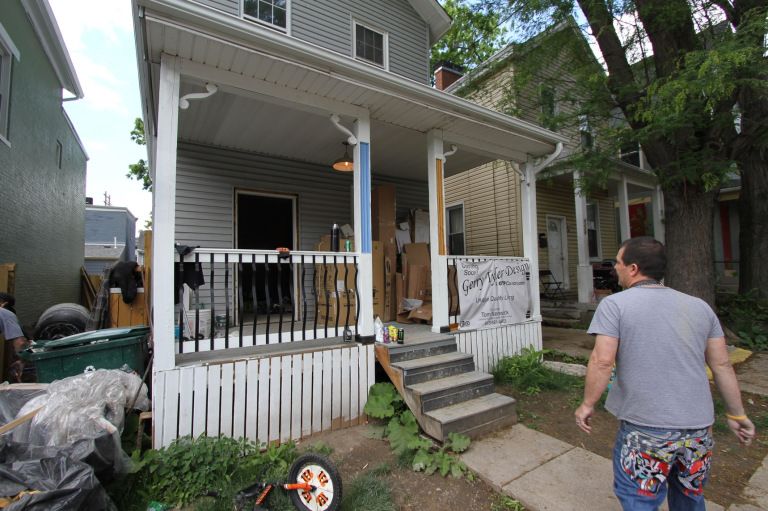
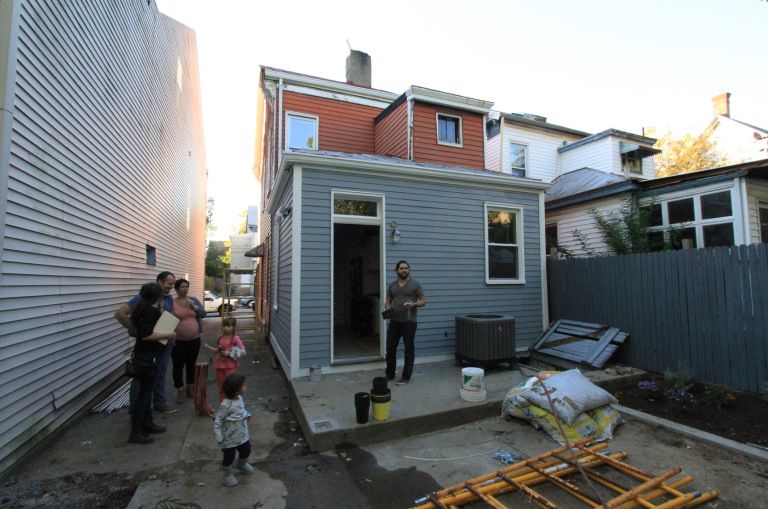
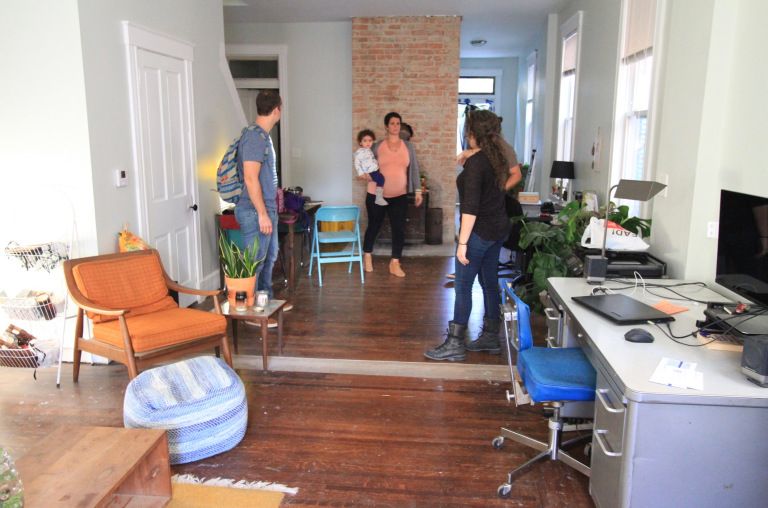
    Last year I engaged in a failed attempt to renovate and expand an old house in an 1890’s era neighborhood in Ohio. It ended badly. So I thought I’d do a follow up on what actually does work given the legal parameters and cultural context.


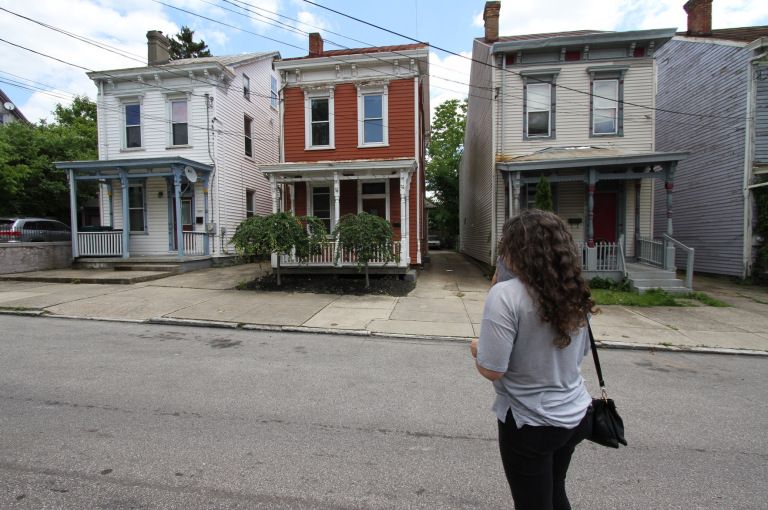
    I sold the house to a smart young local guy who bought eight similarly run down properties on the same block within a short period of time. He gathered private funds from a group of personal investors to finance the venture. Then he hired a family owned contracting company from across the river in Kentucky to renovate all the homes. He’s selling the properties as they become ready for market and distributing the profits to his investors, keeping a percentage for himself. It’s a really good economic model with a fast lucrative turn around.

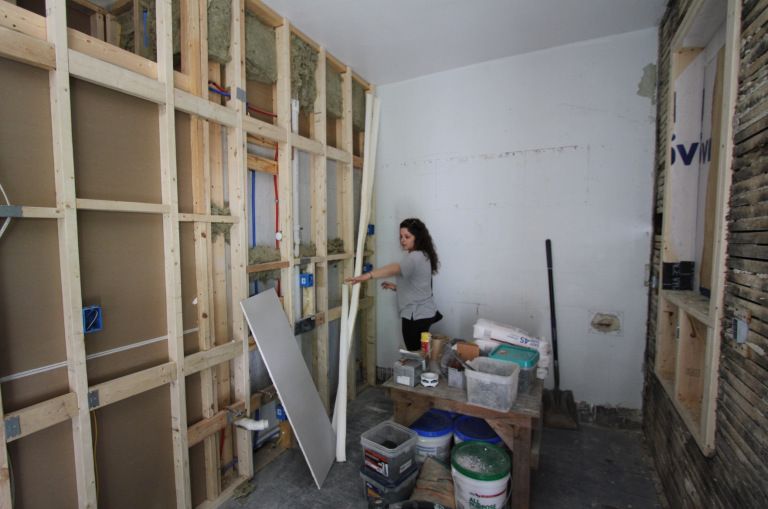
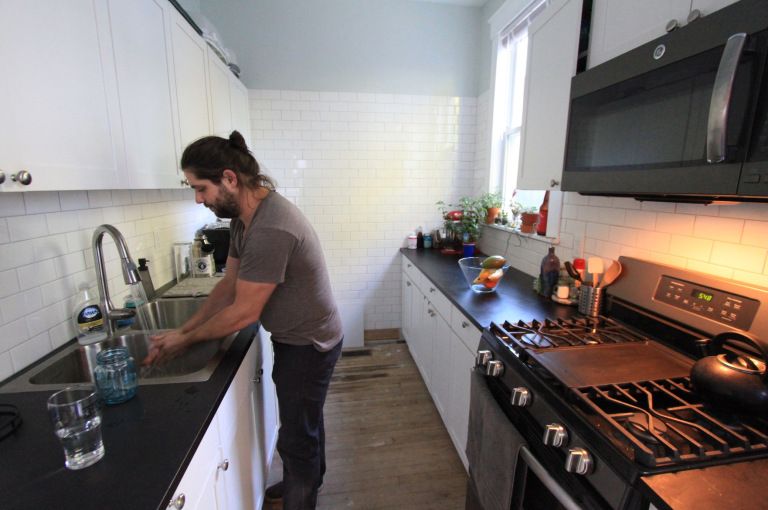
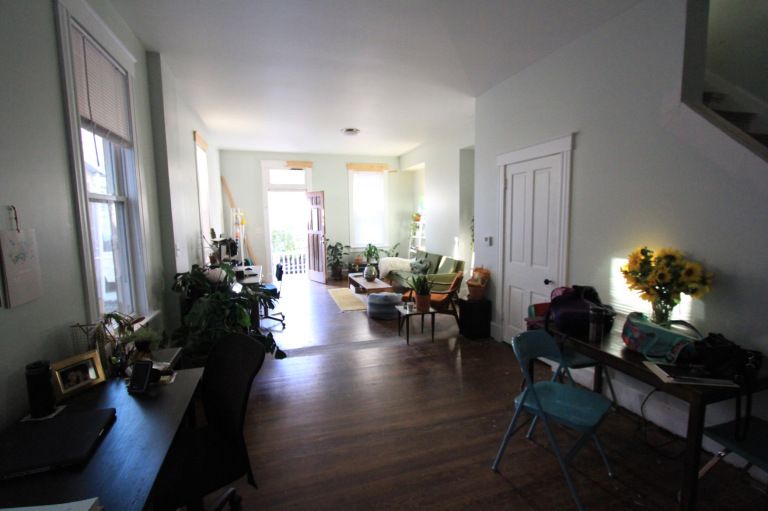
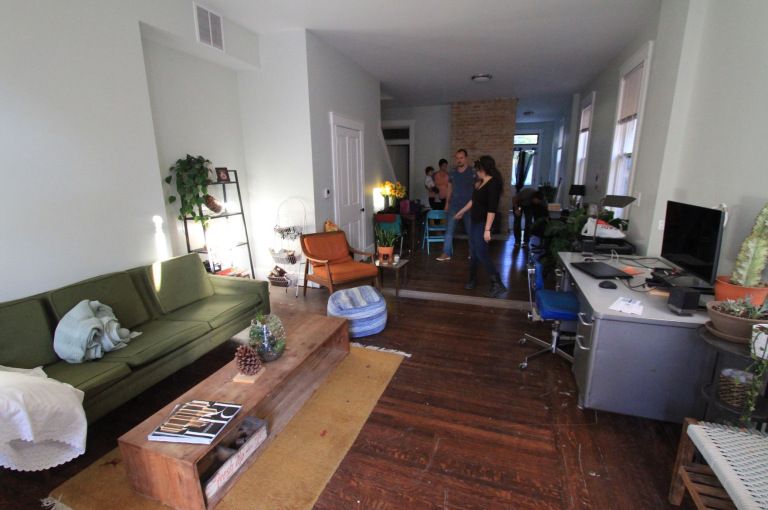
    The new owner and his contractor never dreamed of changing any of these buildings in a way that would have required any kind of special permission or variances from the city authorities. That way lies ruin. This smart team of savvy professionals brought these abused and neglected husks up to respectable middle class standards quickly and efficiently in a way that only marginally involved municipal officials with plain vanilla over-the-counter permits and ho-hum inspections. Once the new kitchen cabinets and fancy appliances go in along with the new windows and flooring these homes have instant market appeal. They’ve been selling very well, particularly because the collective renovations of multiple buildings at the same time in the same concentrated area feeds a palpable sense that the neighborhood is rapidly gaining value.

    It helps that the new owner went to high school in the area. In a provincial town like Cincinnati these things really matter to the locals. And he’s selling single family homes, presumably to future owner/occupants. In contrast, I was reviled in social media as both a carpetbagging gentrifier who was driving out long time working class residents and an absentee slumlord who would dump “the wrong element” on to the neighborhood and degrade property values and the quality of life for nearby homeowners.

    The end result is that the house I paid $15,000 for will ultimate sell for six figures even though it’s still exactly the same size and shape – give or take a nice cosmetic skin job – after it’s flipped at a generous profit. So the folks who worry about gentrification will experience the same resultant condition relative to what I had in mind for the place. And there’s no guarantee that it won’t eventually be purchased by someone who will choose to rent the property rather than live in it themselves. But all that is beside the point. The regulatory environment and cultural perceptions are the defining constraints. The new owner is just a whole lot better at effectively piloting his way around those shoals. I have to respect his business acumen.

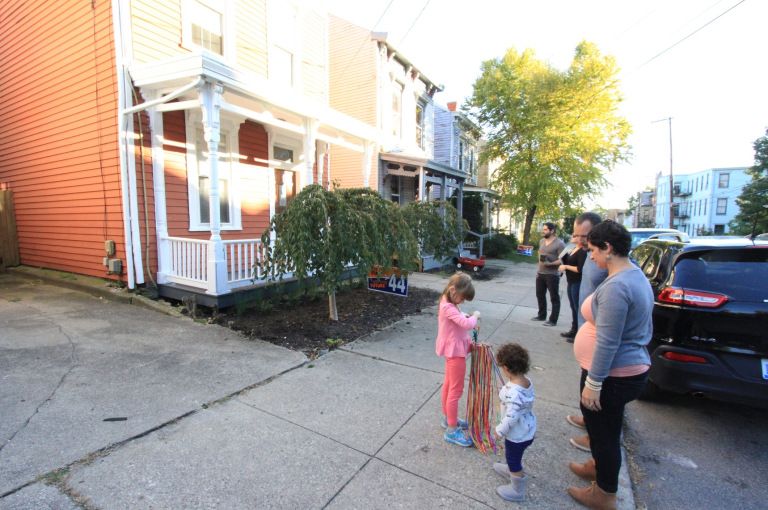
    Over the past five years I’ve followed a variety of young talented industrious people in the neighborhood. One couple has been engaged in another business model that works beautifully. They buy a distressed property at a reasonable price point. They move in and occupy the space themselves for about a year while they renovate it. Then they buy their next property, move in, and rent the one they just completed. Instead of flipping properties they’re steadily building a long term portfolio with positive cash flow and equity. They’re currently managing a dozen units and filling them with good quality people from the community.

    The crucial point is that they never buy a property that requires special permission to upgrade or needs extraordinary amounts of structural work to bring it up to code. They buy a solid shell and clean it up. Full stop. If they encounter an otherwise great building that happens to need fire sprinklers, or an elevator, or a zoning variance they steer well clear of it. Let some other poor bastard kill themselves in the meat grinder of endless bureaucracy and public outrage. (That was me…)

    To do absolutely anything else is technically possible, but hideously time consuming, difficult, and untenably expensive – and your neighbors will call you all sorts of terrible names and project all their fears on to you. For folks who believe in building great new places that mirror the charming old compact mixed use walkable neighborhoods of a century ago… Let it go. We have the dregs we inherited from previous generations and they can be shined up. But that’s it.

    John Sanphillippo lives in San Francisco and blogs about urbanism, adaptation, and resilience at granolashotgun.com. He’s a member of the Congress for New Urbanism, films videos for faircompanies.com, and is a regular contributor to Strongtowns.org. He earns his living by buying, renovating, and renting undervalued properties in places that have good long term prospects. He is a graduate of Rutgers University.

    All photos by Johnny Sanphillippo

  • Them that’s got shall have. Them that’s not shall lose.

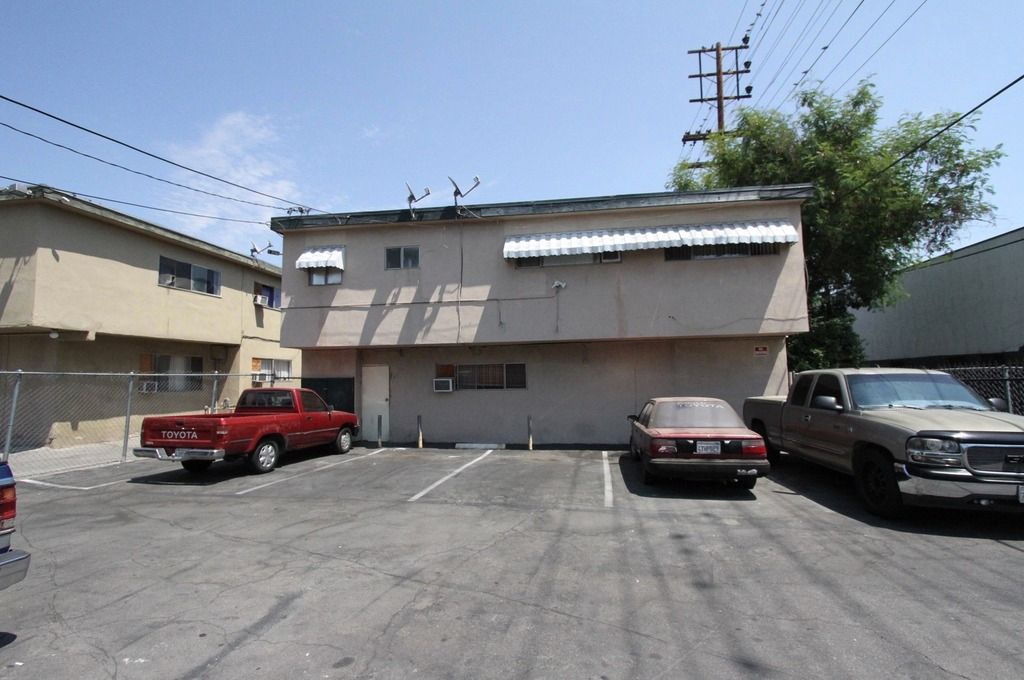
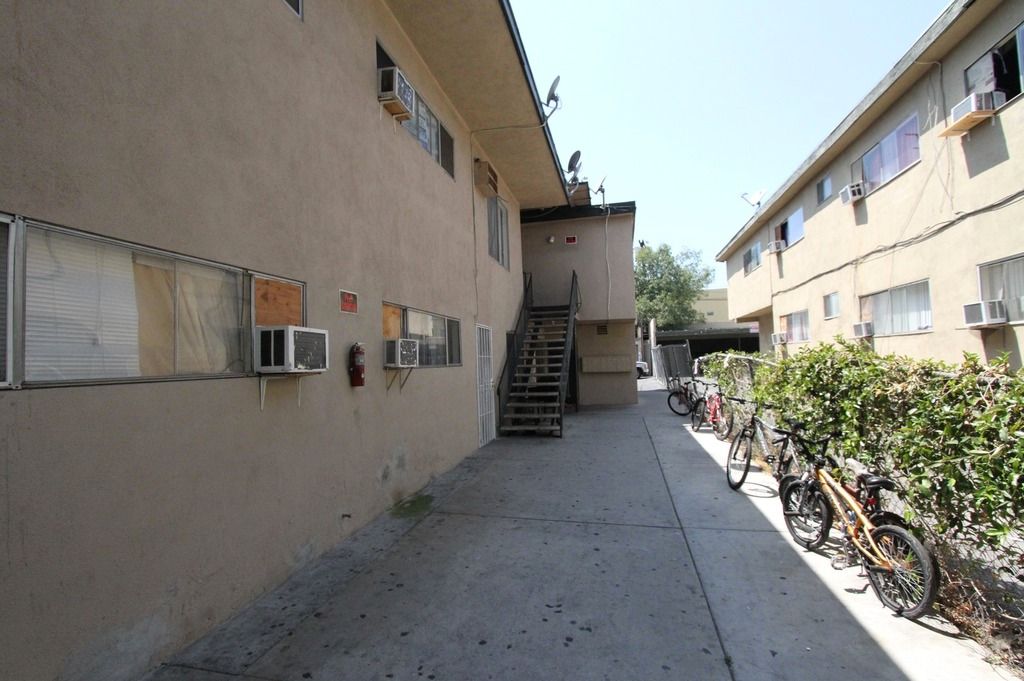
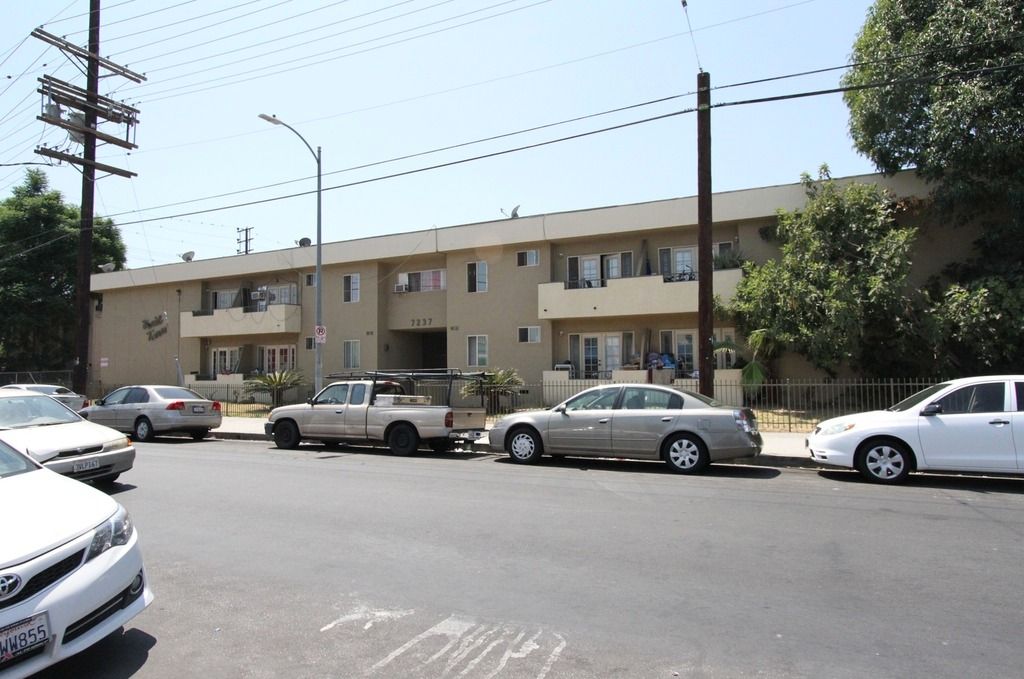
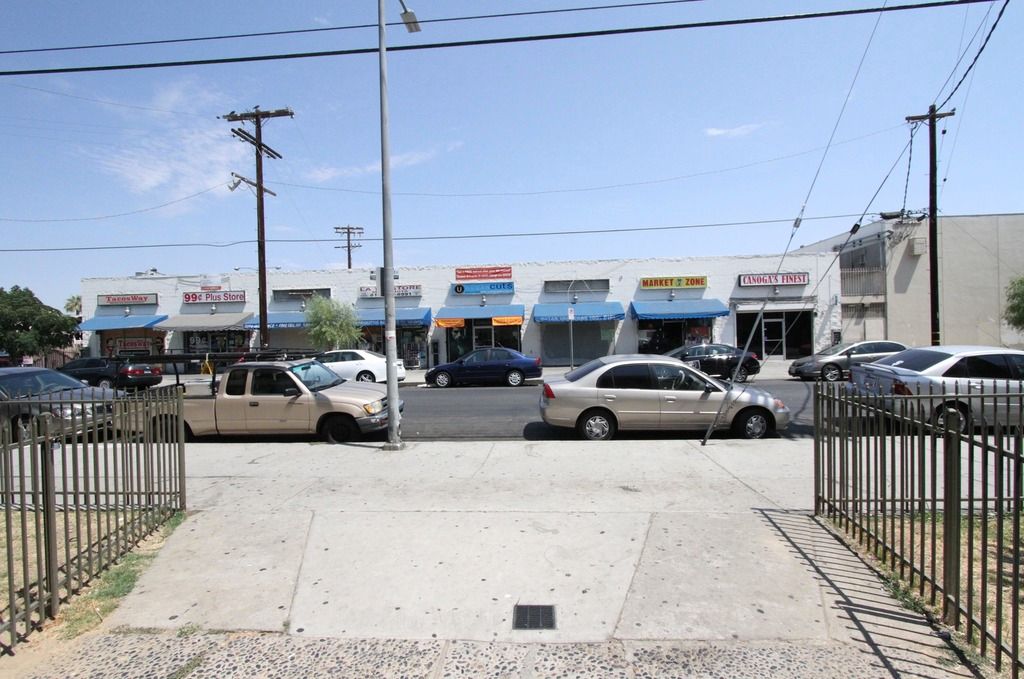
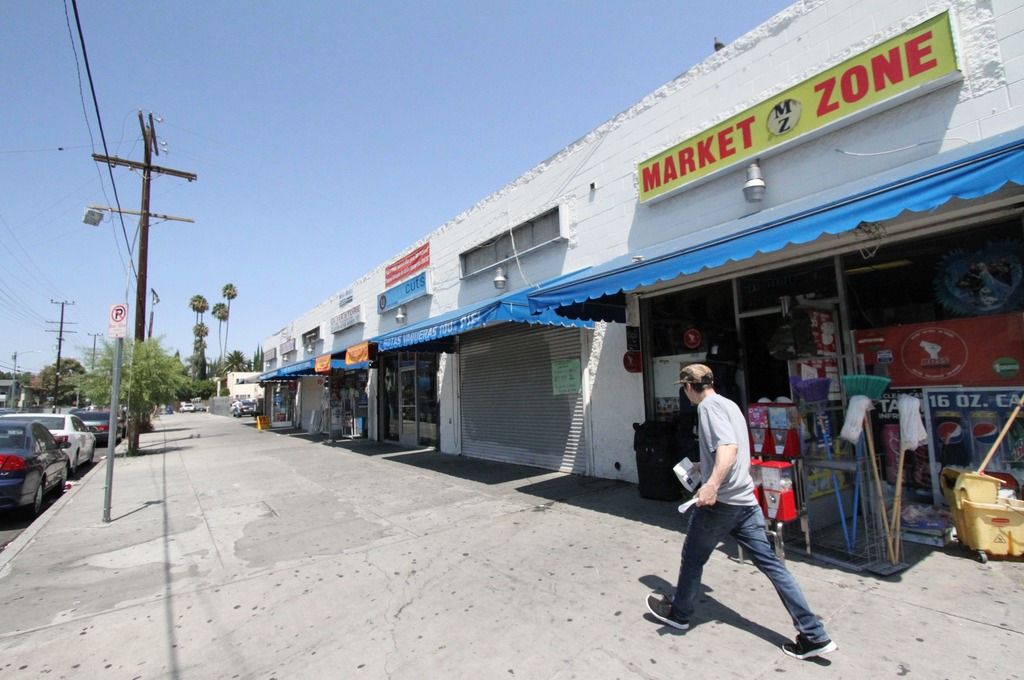
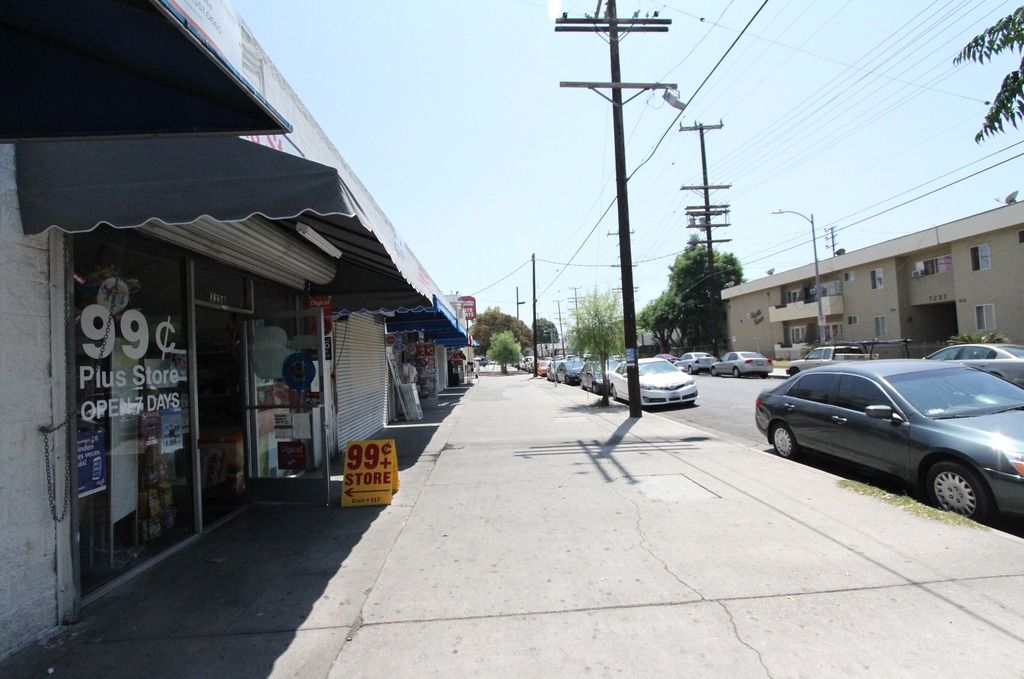
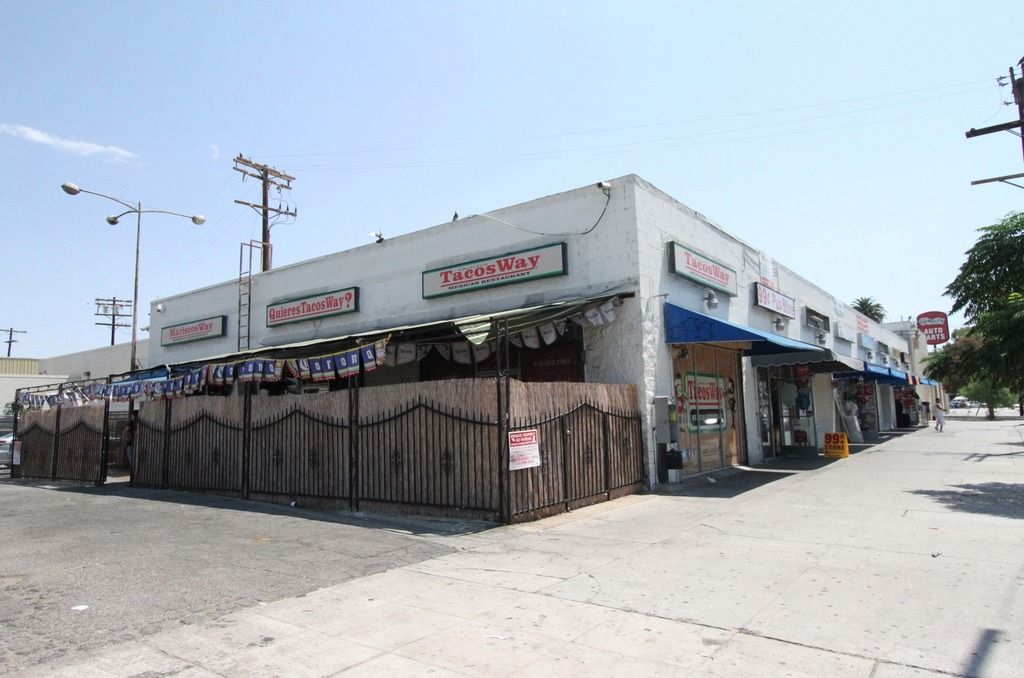
    My family lived in this building when I was a kid in the 1970’s. This was the door to our old apartment. It’s in a nondescript part of the San Fernando Valley in Los Angeles. There are a million places just like this all over the Southland. These beige stucco boxes are the workhorses of semi-affordable market rate housing in California. The place hasn’t changed in forty years other than the on-going deferred maintenance.

    I walked around the block to see the buildings where my friends used to live and the shops where we bought groceries and such. I can’t say I felt nostalgia. These weren’t happy times. But I was aware of the fact that the people who live here now are the same as my family was then – basically good people who are scraping by with almost no money doing the best they can with what they have. These are the minimum wage workers who do all the invisible dirty work of the city. Real incomes for these folks haven’t changed since I was a kid. But the cost of everything important from owning a home to health care to a proper education has skyrocketed.

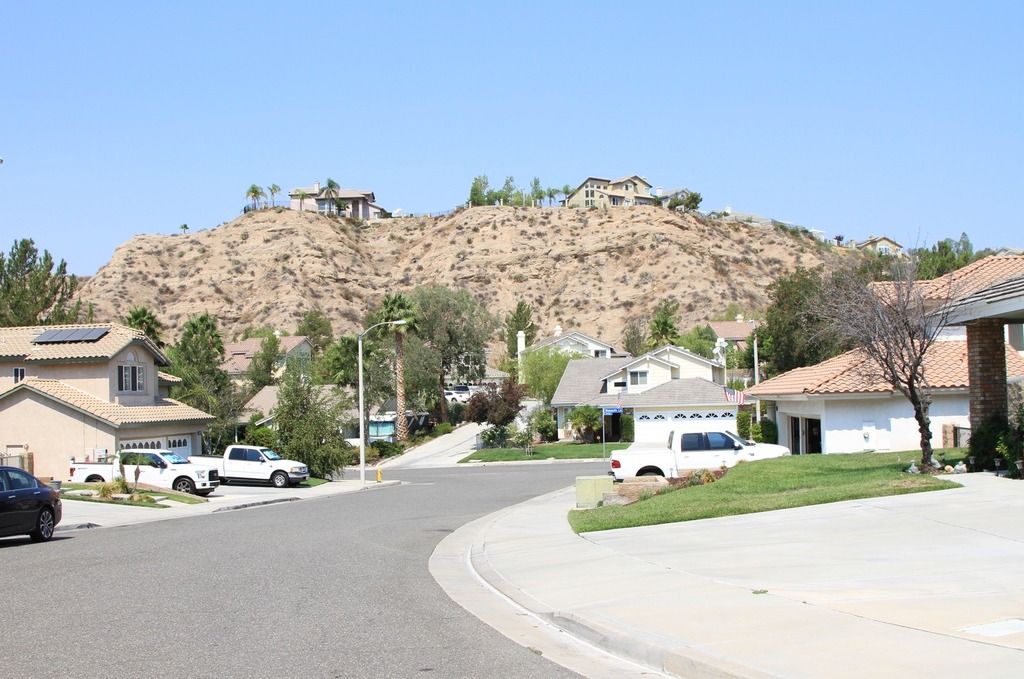
    I want to go back to my last post about the exclusive homes in the fringe suburbs. The people who can afford to live here do so in large part so they can distance themselves from the people in my old neighborhood. Fair enough. I completely understand. I don’t want to live in my old neighborhood again either.

    But there’s that lingering problem of public infrastructure vs. the tax base of various forms of development. The city has spent almost nothing on my old block for decades. Yet those sad buildings keep spinning off revenue year after year. And there are a lot of them. Collectively they generate enough excess cash that the authorities can siphon it off to fund other activities. When it comes time to allocate resources who do you think has the most likely chance of getting what they need? The people who live in my old apartment, or the folks who live in the $700,000 homes up on the hill?

    As a society we want to believe that the poor are draining the public coffers dry. We need to blame the lower end of the working class for whatever we don’t like about the country. We want it to be true that they are undeserving compared to the better people who begrudgingly support them from a distance. Welfare. Food stamps. Section 8. But the reality – if you look at the budget and the actual numbers – is that without the poor packed tightly in their crappy apartments all working for crumbs in underfunded sections of town there could be no exclusive enclaves.

    Billie Holiday said it best. Them that’s got shall have. Them that’s not shall lose.

    John Sanphillippo lives in San Francisco and blogs about urbanism, adaptation, and resilience at granolashotgun.com. He’s a member of the Congress for New Urbanism, films videos for faircompanies.com, and is a regular contributor to Strongtowns.org. He earns his living by buying, renovating, and renting undervalued properties in places that have good long term prospects. He is a graduate of Rutgers University.

    All photos by Johnny Sanphillippo

  • Globalization’s Winner-Take-All Economy

    “If you are a very talented person, you have a choice: You either go to New York or you go to Silicon Valley.”

    This statement by Peter Thiel, the PayPal founder and venture capitalist, unsurprisingly caused a stir, given that he made it in Chicago. Simon Kuper had made a similar observation in the Financial Times when he described how young Dutch up-and-comers had their sights set on London, not Amsterdam. “Many ambitious Dutch people no longer want to join the Dutch elite,” Kuper wrote. “They want to join the global elite.”

    Populist movements in Europe and the United States have fueled talk of social and economic division, of a small class of winners at the top and a far larger group of increasingly disaffected lower-skilled workers at the bottom. This attitude seems to flow through to places as well, with global city winners like London and post-industrial losers like Flint, Mich.

    Because these divides cleave along social class, educational and cultural lines, they are clear and easy to see. But there’s another — less visible — divide cutting across the seemingly monolithic group of the successful. This one separates those who are indisputably winners from those whose success is ambiguous, more qualified and more contingent. This difference is the one between the hedge fund principal, raking in wealth seemingly effortlessly, and the young adult struggling to pay urban rent despite possessing an excellent degree and professional employment. It’s the difference between New York and Cincinnati — or even Chicago.

    The same forces of globalization that  have pulled top Midwest talent into Chicago from below are also acting on the city from above, drawing its talent further up the global city hierarchy. The knowledge economy favors the college degreed over the less educated, but those with the highest and most differentiated skills are most favored, while those whose skills are second tier — less perfectly in tune with the emerging economy — are more vulnerable to competitive pressures.

    It’s easy to see that the Flints of this world have struggled. Less visible are the stresses put on second-tier cities — the Chicagos and Cincinnatis — from a system that is disproportionately giving the greatest rewards to those at the very top of the hierarchy while threatening even the seemingly successful cities with being left behind.

    Economist Richard Florida calls this phenomenon “winner-take-all urbanism.” It’s the superstar athlete or celebrity effect transposed into the urban world. Just as A-list stars earn far more than the merely famous, the top business talent and the top cities are reaping disproportionate riches over the merely prosperous.

    This divide is harder to spot because the people and places involved are often superficially similar. The people in both possess university degrees. They share similar cultural norms, aspirations and politics. The places they live in all have their farm-to-table restaurants, tech startups, artisanal coffee roasters and bicycle commuter infrastructure. As with a sports team, they all wear the same uniform. But some are all-stars while others are role players who are more easily replaced.

    When young workers or artists struggle to find an affordable apartment in a global capital, this isn’t just proof of a failure to deregulate housing development. It’s also a marketplace sending a powerful signal that their position among the winners of society is much more precarious than they might imagine. Most would agree that there are some businesses and people who shouldn’t be in New York or San Francisco. We shouldn’t expect a peanut butter spread of talent and economic activity across the country. The nature of the industries concentrated in these places produces a higher-end specialization. So there will be some economic value line below which it isn’t viable to be there.

    There’s an argument to be made that building more housing to reduce rents can draw the line lower. But that still presumes a line. When aspirational millennials — or even older people like me — can’t afford the current rent, that’s a signal that they are near or below that line. In a time in which rewards seem to be skewed to the top, that should be worrisome to them personally, not just to the poor or working classes.

    Similarly, cities that remain a notch below the top tier should be worried. Chicago’s financial crisis, population loss, violent crime spike and other problems suggest fundamental structural challenges facing the city. And if even Chicago is not fully achieving the global-city status it craves, shouldn’t other cities be worried?

    Yet the leaders of these cities, and the ambiguously successful people who live in them, have tended to identify themselves as among the winners. They haven’t really grappled with the fact that the global economy puts them at risk. It’s not just people in Flint or Youngstown, Ohio, who are being buffeted by globalization. If these people and cities ever came to view themselves as at risk, they could become a powerful voice for reforming the system to be more equitable while retaining its fundamentally open character. They are the exact potential champions for change in a system that badly needs it so that we can broaden the pool of success.

    Unfortunately, those among the ranks of the second-tier successful have instead sided with the global capitals and the global elite to defend the economic status quo, leaving the reform fight to the populists who prefer an overly closed system. They may yet discover to their chagrin that the very system they so vigorously supported will ultimately become their own undoing.

    This piece originally appeared in Governing Magazine.

    Aaron M. Renn is a senior fellow at the Manhattan Institute, a contributing editor of City Journal, and an economic development columnist for Governing magazine. He focuses on ways to help America’s cities thrive in an ever more complex, competitive, globalized, and diverse twenty-first century. During Renn’s 15-year career in management and technology consulting, he was a partner at Accenture and held several technology strategy roles and directed multimillion-dollar global technology implementations. He has contributed to The Guardian, Forbes.com, and numerous other publications. Renn holds a B.S. from Indiana University, where he coauthored an early social-networking platform in 1991.

    Photo: Kevin D. Hartnell (Own work) [CC BY-SA 3.0 or GFDL], via Wikimedia Commons

  • The Demographics of Poverty in Santa Clara County

    Tucked away in the bottom corner of the San Francisco Bay, tech royalty make themselves at home in their silicon castles. Santa Clara County is the wealthiest county in California, and 14th in the nation, boasting an average median household income of $96,310. However, where there are kings, there must be subjects. Despite its affluence, Santa Clara remains one of the most unequal counties in the United States. The combined forces of enormous wage gaps, exorbitant housing prices, and shifts in the regional economy have compounded over recent years, resulting in a shrunken middle class and increased poverty levels.

    Santa Clara County contains just over 1.9 million people and is home to much of the Silicon Valley. The relatively recent explosion of growth in the high-wage technology industry has generated a new rank of upper-middle class to fabulously wealthy individuals. But, even in the economic miracle that is Silicon Valley, poverty remains a prevalent force and affects a disturbing number of lives in the region. Although, according to the Census Bureau, only 8.3% of Santa Clara County residents live at or below the Federal Poverty Level (FPL), this number drastically underestimates the true number of people that are experiencing financial hardship in the region. In a study conducted by United Way, it was found that the real cost budget for a family of four residing in Santa Clara County stands at $65,380 per year, or 281% of the FPL.

    High regional housing costs account for much of the discrepancy in poverty levels between the county and the nation. A study out of the California Budget and Policy Center calculated that the poverty rate in Santa Clara County soars to 18% when factoring in housing costs, meaning nearly one in five residents live in poverty.

    It is for this reason that the region has one of the largest homelessness populations in the nation, with around 7,600 homeless individuals residing within Santa Clara County. When local homeless individuals were surveyed regarding obstacles to securing housing, the top four answers were as follows: No job/income, no money for moving costs, bad credit, and lack of available housing. Of course, poverty is cyclical, and these answers affect one another to some extent: a lack of income means no money for moving costs, which may lead to bad credit and which could then lead to an inability to secure permanent housing. Around 56% of survey respondents also reported being homeless for over a year, up significantly from 47% just two years prior, indicating that the homeless in Santa Clara County continue to face significant obstacles to securing housing. High homelessness rates are symptoms of a greater trend: the fact that gross income inequalities in Santa Clara County have created a society of have’s and have not’s, separated by an income gap that shows no sign of closing.

    Housing Trends

    The most significant impediment to financial security in the county is the volatile housing market and the exorbitant cost of owning a home. According to a report conducted by the U.S. Department of Housing and Urban Development on the South Bay Area, the average price of houses sold in 2014 stood at $788,500 for an existing home and $828,000 for a new home. This is over four times the median value of homes nationally, which stands at $178,600. The disparity is even more prevalent in the areas of the region closer to large technology firms, such as Palo Alto, where the average home costs $2.43 million. San Jose also has the 7th largest share of renters in major U.S. cities, 56 percent, a rate that only continues to increase as housing costs do the same. The median gross rent in Santa Clara County stands at $1705 per month, nearly double the national average.

    Current trends indicate that the increasing housing costs show no signs of reversing, which does not bode well for residents that are already struggling financially. A study from the California Budget and Policy Center found that, in 2013, over 50% of households classified as low-income were at risk of moving out of the area due to increased housing costs.

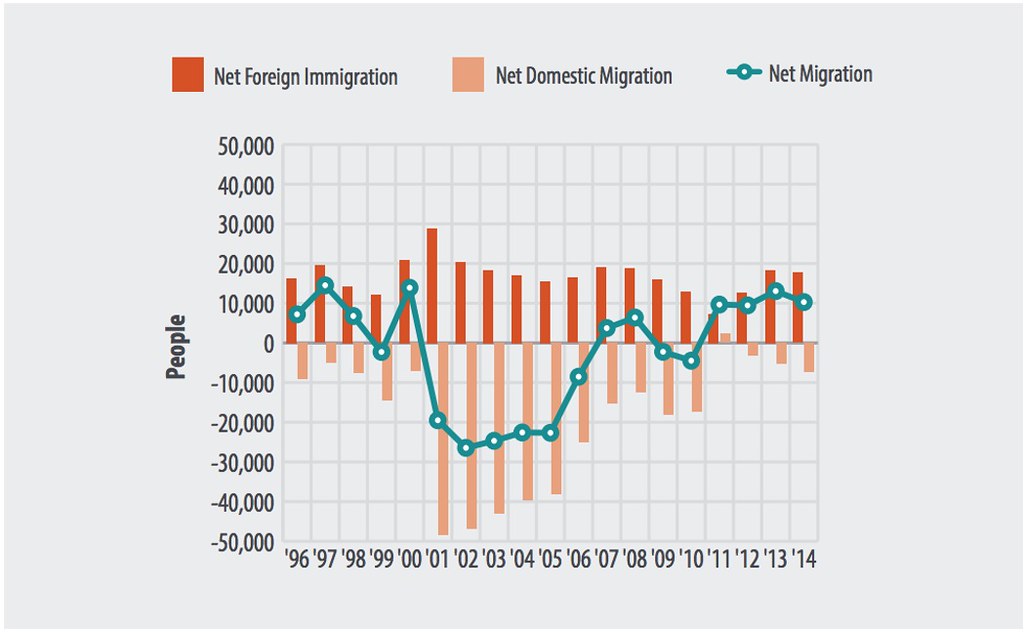
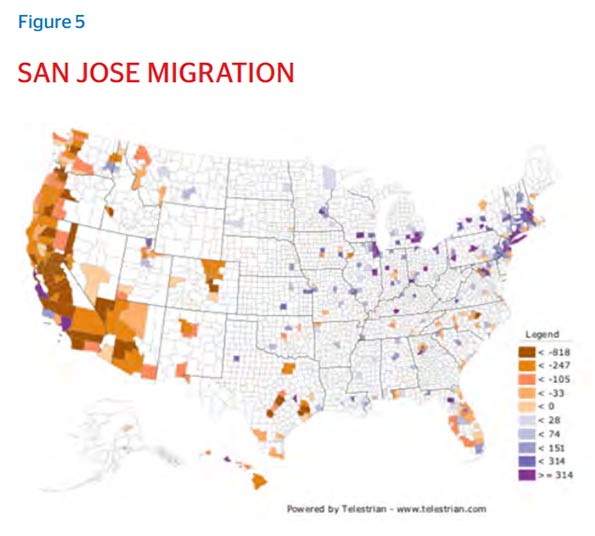
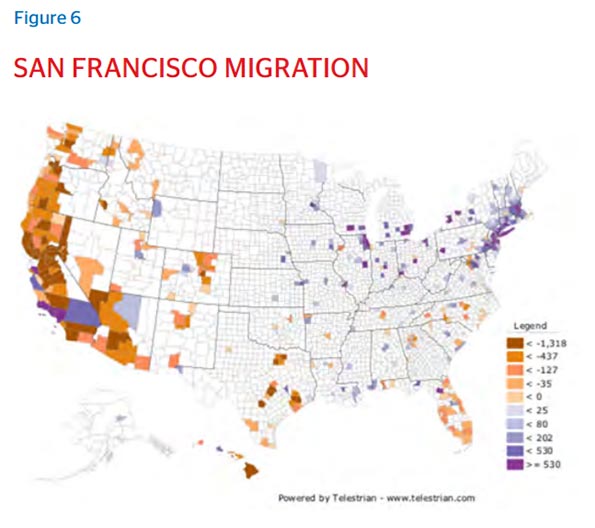
    Net domestic migration in Santa Clara County is overwhelmingly negative.

    The result of high housing costs? Net domestic migration has been negative every year since 1996, except 2011, and appears to be dipping further, despite the fact that the population of Silicon Valley has grown continually in recent years. This can be attributed to a combination of natural births and massive foreign immigration rather than domestic migration. Therefore, negative net domestic migration suggests that a large portion of residents are leaving the area due to a lack of an income that cannot keep up with rising costs of living.

    However, for those who stay, high housing prices lead to a plethora of other disadvantages, creating a cycle of poverty that decreases social mobility in the region. A search for cheaper housing has led many to seek living arrangements in the southern and eastern parts of San Jose, where housing is cheaper, but comes at the cost of higher crime rates and worse school districts. Additionally, job growth has been concentrated in the western parts of the county. The search for cheap housing has led to an increase in overcrowded households, as residents move in with one another in order to share the costs of rent. The Santa Clara County Department of Public Health concluded in 2014 that 14% of residents were living in overcrowded households, with 5% living in severely overcrowded households. Latinos in the region are disproportionately affected, with 31% living in overcrowded households and 12% living in severely overcrowded households.

    The combination of these factors limits social mobility by undermining each individual’s access to economic opportunity. Moving into an overcrowded house in an underfunded public school district limits potential to obtain a quality education that may provide access to high-skilled, high-wage jobs.

    The Income Gap

    Inequality in the region is perpetuated by a growing income gap, and the ardent hunt for afford-able housing may be explained by the gross income disparities among residents. As housing prices have skyrocketed over recent years, incomes simply have not kept up with costs of living, particularly at the lower end of the spectrum.

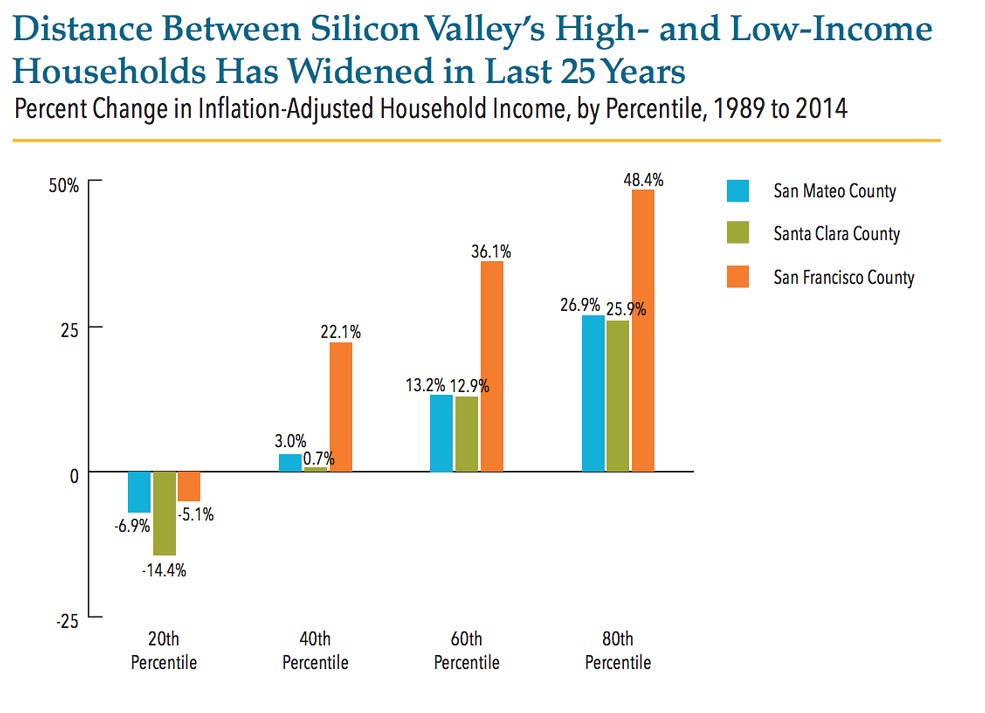
    Santa Clara County’s income gap has widened considerably since 1989.

    Economic gains in the region have flowed overwhelmingly to the top quintile of income-earners, who have seen their wages increase by over 25% over the past 25 years. In a shocking comparison, income levels have declined for low-income households since 1989, a clear sign of a widening wealth gap in the region. Those at the bottom also find themselves working harder for less money: the average income for those living above the previously described real cost of living in Santa Clara County stands around $27 per hour, whereas the average income for those living below the real cost of living comes in at a bit over $10, around the current California minimum wage.

    To make matters worse, government efforts have proven relatively ineffective in remedying regional inequality. A recent study has shown that even when a family is a recipient of CalWORKS and CalFresh benefits, government-funded initiatives to provide benefits to needy families, an average family of four is still tens of thousands of dollars away from comfortably subsisting in Santa Clara County. Additionally, government benefits are not reaching populations that would benefit from them the most: a United Way study found that less than 19% of single mothers and less than 5% of immigrants statewide subscribe to these programs.

    Shifts in the Regional Economy

    Efforts to increase wages of low-paying jobs may alleviate financial hardship to a certain degree, but these actions fail to consider an underlying trend in Santa Clara County: low-skilled, blue collar jobs are disappearing. Wage increases in industries heavily populated by lower income earners matter little if those jobs do not exist. Historically, Santa Clara County was a manufacturing hub, famous for producing semi-conductors along with other components vital to the burgeoning technology industry. However, recent years have seen manufacturing jobs leaving the area in droves, either to other parts of the country or abroad.

    Sector growth in the region, percentage change, 2000-2014.

    The chart above shows that job growth in Santa Clara County has only been observed in a few sectors of the local economy. Despite this growth, total nonfarm payroll employment has decreased in the past 15 years, and the impact of this job loss may be observed across the economy. The most significant reductions of the workforce have occurred in sectors referred to as “blue-collar,” typically middle income jobs that may or may not require higher education. These types of jobs cover many of those within the goods-producing sectors, comprised here of the mining, logging, construction, and manufacturing industries.

    The rapid decline of “blue collar” jobs in the region may be attributed at least in part to the explosive growth of Silicon Valley. As the region attracts more skilled workers, increases the region’s desirability, and pays workers competitive wages capable of keeping up with costs of living, those very expenses will continue to drive upwards. As a result, workers across all economic sectors have demanded higher wages, a sentiment exemplified in the recent minimum wage hikes. Unfortunately, this drives lower-paying blue-collar industries to relocate, often out of the state, so they can lower their input costs, creating a polarized society of high-wage earners in the information sector along with low-wage earners in a service sector dedicated to the needs of the technocrats.

    Santa Clara County is a place of immense, but heavily-concentrated wealth. Multi-billion-dollar technology campuses dot the landscape like behemoths, yet the wealth and progress that accompanied the growth of the Silicon Valley has also left a significant proportion of its population behind. The environment is increasingly hostile to social mobility, the manufacturing sector has skipped town, and government efforts to mitigate the effects of these changes have proven relatively unsuccessful. Trends have shown that the region’s poor are increasingly confined to specific industries and geographies, and their freedoms restricted as they are subject to a degree of economic violence that shows no immediate signs of relenting. Significant shifts in local policy are needed to reverse the current social and economic trends and ameliorate the situation in an increasingly polarized Santa Clara County.

    Alex Thomas is currently a sophomore at Chapman University pursuing a major in Political Science. He is originally from San Jose, California, and has worked extensively within the city and surrounding areas. He hopes to further his interest in local politics through continued study and community involvement in the upcoming years.

    Photo: Coolcaesar [CC BY-SA 3.0], via Wikimedia Commons

  • Our Most Popular Stories of 2016

    2016 is gone, 2017 is here. Here’s a look back at the most popular stories at New Geography in 2016. Happy New Year, and thanks for reading.

    12. This is Why You Can’t Afford a House. Back in February, Joel Kotkin made the case that housing costs are a huge burden on America’s middle class and argued for more discussion on the topic at the national level. This piece was also published by The Daily Beast.

    11. Super Bowl: Super Subsidy Sunday. Just in time for last year’s Super Bowl, Matthew Stevenson outlined the massive public subsides enjoyed by pro sports franchises.

    10. The New War Between States. In this Real Clear Politics Essay, Joel points out the variation in economic DNA across different regions of the country and the need to adjust policy to leverage those differences as a national competitive advantage.

    9. What Happens When Wal-Mart Dumps You. Joel breaks down the future of the retail industry and its potential impacts on communities of all types: urban areas, suburbs, and small towns. This piece was also published by The Daily Beast.

    8. Farewell Grand Old Party. From his weekly Orange County Register column, Joel notes how the rise of Trump signals a turning point for the Republican Party.

    7. America’s Next Boom Towns: Regions to Watch in 2016. One year ago Joel and I created an index to identify some of the best-performing large U.S. metropolitan areas. This piece appeared in Forbes.

    6. Best Cities for Jobs 2016. Our annual Best Cities for Jobs index ranks all of America’s metropolitan areas according to short- and longer-term job growth performance. Follow the link to see the various topical rankings.

    5. New York’s Incredible Subway. In this piece Wendell Cox describes New York City’s subway system, unlike any other transit system in the United States.

    4. Best and Worst: 2015 International Housing Affordability Survey. Wendell’s Annual Demographia International Housing Affordability Survey is a critical comprehensive reference on worldwide housing affordability by urban area. Here’s the highlights of the report.

    3. Today’s Tech Oligarch’s are Worse than the Robber Barons. Joel argues that the political influence of high-tech business leaders are worse than the robber barons of the last century because today’s tech firms offer little to improve the lives of the middle class.

    2. An Open Letter to the Democratic National Committee from a Rural Democrat. Former North Dakota State Senator Tyler Axness offers his advice to Democratic Party leaders from the perspective of rural America.

    1. Largest Cities in the World: 2016. Wendell’s annual World Urban Areas report is perhaps the most comprehensive resource for worldwide urban population data. This April 2016 article summarizes the report.

    Mark Schill is a community and corporate strategy consultant with Praxis Strategy Group and Managing Editor of New Geography.

  • How Post-Familialism Will Shape the New Asia

    Surprisingly, the modern focal point for postfamilial urbanism comes from eastern Asia, where family traditionally exercised a powerful, even dominant influence over society. The shift toward post-familialism arose first in Japan, the region’s most economically and technologically advanced country. As early as the 1990s sociologist Muriel Jolivet unearthed a trend of growing hostility toward motherhood in her book Japan: The Childless Society? –a trend that stemmed in part from male reluctance to take responsibility for raising children.

    The trend has only accelerated since then. By 2010 a third of Japanese women entering their 30s were single, as were roughly one in five of those entering their 40s – that is roughly eight times the percentage seen in 1960 and twice that seen in 2000. By 2030, according to sociologist Mika Toyota, almost one in three Japanese males may be unmarried by age 50.

    In Japan, the direct tie between low birth rates and dense urbanization is most expressed in Tokyo, which now has a fertility rate of around one child per family, below the already depressed national average. Some of the lowest rates on earth can be seen elsewhere in eastern Asia, including those in Seoul, Singapore and Hong Kong, which are now roughly the same as the rate in Tokyo.

    As more of Asia becomes highly urbanized like Japan, this kind of ultra-low fertility will spread to other parts of the continent. Most critically, this dynamic has already spread to mainland China, or at least to its larger cities, where fertility rates have dropped well below 1.0. In 2013, Shanghai’s fertility rate of 0.7 was among the lowest ever reported – well below the “one child” mandate removed in 2015 and only one-third the rate required to simply replace the current population. Beijing and Tianjin suffer similarly dismal fertility rates.

    This pattern of low fertility, notes demographer Gavin Jones, suggests that rapid urbanization has already made the notion of the one-child policy antiquated. Now, even with fertility policies being loosened, many Chinese families are opting not to take advantage, largely due to the same reasons cited in other parts of the world: the high cost of living and high housing costs.

    Perhaps no city better reflects Asia’s emerging urban paradigm than Seoul, the densest of the high-income world’s megacities outside of Hong Kong. The Korean capital is more than 2.5 times as crowded as Tokyo, twice as dense as London and 5 times as crowded as New York. No surprise then that self-styled urban pundits love the place, as epitomized by a glowing report in Smithsonian magazine that painted Seoul as “the city of the future.” Architects, naturally, joined the chorus. In 2010 the International Council of Societies of Industrial Design named Seoul the “world design capital.”

    Ultimately, Seoul epitomizes the retro-urbanist fantasy: a city that is dense and dominating, rapidly turning the rest of the country into depopulating backwaters. Seoul has monopolized population growth in Korea, accounting for nearly 90% of total growth since 1970. Seoul also currently holds nearly 50% of the country’s population, up from 20% in 1960.

    Seoul’s development has come at the expense of not just its own hinterlands but also its own humanity. Its formerly human-scaled form of housing, known as a hanok , which was one story tall and featured an interior courtyard, has been largely replaced with tall, often repetitive towers that stretch even into the suburbs. While architects and planners celebrate this shift, they rarely consider whether this form of urbanization creates a good place for people, particularly families.

    When you consider the trends in similar cities, it’s unsurprising that Korean sociologists have noted the shift to high-density housing as being unsuitable for families with children.

    Over time the impact of these housing policies will be profound. By 2040 Korea’s population will join those of Japan and Germany as one of the world’s oldest. This will occur despite determined government efforts to encourage childbearing, efforts that may well be doomed by the government’s similar commitment to a dense, centralized urban form.

    What will happen to societies that are likely to retain extremely low rates of fertility? Japan, notes Canadian demographer Vaclav Smil, represents “an involuntary global pioneer of a new society.” Japan certainly exemplifies one way societies may evolve under diminishing birth rates.

    Projecting population and fertility rates is difficult, but the trajectory for Japan is unprecedented. The UN projects Japan’s 2100 population to be 91 million, down from 2015′s 127 million, but Japan’s own National Institute of Population & Social Security Research projects a population of 48 million, nearly 50% lower than the UN’s projection.

    Japan’s urban centralization both feeds and accelerates this trend. Rather than disperse, Japan’s population is “recentralizing.” A country with a great tradition of regional rivalries, home to an impressive archipelago of venerable cities, is becoming, in effect, a city-nation, with an increased concentration on just one massive urban agglomeration: Tokyo. This has, for the time being, allowed Tokyo to escape the worst of Japan’s demographic decline, drawing heavily on the countryside and smaller cities, both of which are losing population. From 2000 to 2013 the Tokyo metropolitan area added 2.4 million residents, while the rest of the nation declined by 2 million.

    Tokyo is now home to almost one in three Japanese. But its growth is likely to be constrained, as the last reservoir of rural and small-city residents seems certain to dry up dramatically. A projection for the core prefecture of Tokyo indicates a 50% population cut by 2100 to a number smaller than it was at the beginning of World War II; 46% of that reduced population will be over 65.

    This suggests it is time, in high-income countries at least, to shift our focus from concerns about overpopulation to a set of new and quite unique challenges presented by rapid aging and a steadily diminishing workforce. Even birth rates in developing countries are tumbling toward those of wealthy countries. As British environmental journalist Fred Pearce puts it, “the population bomb’ is being defused over the medium and long term.”

    Some, like Pearce, see the Japanese model as an exemplar of a world dominated by seniors – with very slow and even negative population growth – that will be “older, wiser, greener.” Following the adolescent ferment of the 20th century, Pearce looks forward to “the age of the old” that he claims “could be the salvation of the planet.”

    Yet, if the environmental benefits of a smaller, older and less consumptive population may be positive, there may be other negative ramifications of a rapidly aging society. For one thing, there will be increasingly fewer children to take care of elderly parents. This has led to a rising incidence of what the Japanese call kodokushi , or “lonely death,” among the aged, unmarried and childless. In Korea, Kyung-sook Shin’s highly praised bestseller, Please Look After Mom, which sold 2 million copies, focused on “filial guilt” in children who fail to look after their aging parents and hit a particular nerve in the highly competitive eastern Asian society that seems to be drifting from its familial roots.

    Additionally, an aging population will certainly diminish demand for both goods and services and likely would not promote a vibrant entrepreneurial economy.

    China will face its own version of “demographic winter,” although sometime later than Japan or the Asian Tiger states. The U.S. Census Bureau estimates that China’s population will peak in 2026 and then will age faster than any country in the world besides Japan. Its rapid urbanization, expansion of education and rising housing costs all will contribute to this trend. China’s population of children and young workers between 15 and 19 will decline 20% from 2015 to 2050, while that of the world will increase nearly 10%.

    In China the consequences of the rising number of elderly will be profound. Demographer Nicholas Eberstadt, for example, sees the prospect of a fiscal crisis caused by an aging and ultimately diminishing population. China, he notes, faces “this coming tsunami of senior citizens” with a smaller workforce, greater pension obligations and generally slower economic growth.

    It seems likely, as has occurred in Japan already, that rising costs associated with an aging population, and a dearth of new workers and consumers, will hamper wealth creation and income growth. Societies dominated by the old likely will become inherently backward-looking, seeking to preserve the existing wealth of seniors as opposed to creating new opportunities for the increasingly politically marginalized younger population.

    The shift to an aging population also creates, particularly in Asia where urbanization is most rapid, the segregation of generations, with the elderly in rural areas and the younger people in cities. Around the world, the results of this shift are likely to resemble those seen in Japan, with cities becoming home to an ever expanding part of the population, while people in the countryside are destined to grow older and ever more isolated. It is not clear how the expanding senior population, which was traditionally cared for by younger generations, will fare with fewer children to support them and in the absence of a well-developed welfare state.

    Later this century these same challenges will even be felt in many parts of the developing world. In rapidly urbanizing, relatively poor countries such as Vietnam, the fertility rate is already below replacement levels, and it is rapidly declining in other poorer countries such as Myanmar, Indonesia and even Bangladesh. In parts of Latin America, especially Brazil, fertility rates are plunging to below those seen in the United States. Brazil’s birth rate (4.3 in the late 1970s and now 1.9) has dropped not only among the professional classes but also in the countryside and among those living in the favelas. As one account reports, women in Brazil now say, “Afábrica está fechada”–the factory is closed.

    Excerpted from The Human City: Urbanism for the Rest of Us, by Joel Kotkin (B2 Books, 2016)

    This piece first appeared in Forbes.

    Joel Kotkin is executive editor of NewGeography.com. He is the Roger Hobbs Distinguished Fellow in Urban Studies at Chapman University and executive director of the Houston-based Center for Opportunity Urbanism. His newest book, The Human City: Urbanism for the rest of us, was published in April by Agate. He is also author of The New Class ConflictThe City: A Global History, and The Next Hundred Million: America in 2050. He lives in Orange County, CA.

    Photo: John Gillespie, CC License

  • The ABC of Making Housing Unaffordable

    On 12 December, ABC Radio National’s Breakfast Program aired another group discussion on “Australia’s housing market”. Presenter Hamish Macdonald was joined by an “expert panel” made up of Ken Morrison, CEO of the Property Council, John Daley, CEO of progressive think tank the Grattan Institute, and Tom Whitty, managing editor of The Project, a television show pitched to the youth demographic. The conversation ran along predictable lines.

    All three panelists agreed that housing affordability was a real problem, especially in Sydney. But they took up positions on various sides of the issue. Generally speaking, Morrison argued for a supply-solution and dismissed demand-management or tax reform. Daley supported a supply-solution, but insisted that some demand-management and tax reform was essential. Whitty rejected a supply-solution altogether, and thought it was all about demand-management in the form of abolishing the tax concessions for negative gearing and capital gains. “We’re manipuating demand”, he said.

    Neither Morrison nor Daley acknowledged that greenfield development offered any advantages relative to inner-ring infill. Daley repeated his blinkered point that jobs growth is all in the centre. There was no mention of the land value impacts of limiting peripheral supply, a near universal policy across the country. Daley seemed to think all new housing should be concentrated within a few kilometres of the CBD. Bizarrely, he held up Vancouver and Portland (Oregon) as cities that got their housing location right, failing to mention that they are amongst the least affordable places on earth. Morrison made no objection to any of this.

    In terms of the system of interests set out in our last article, “Sydney lurches to housing affordability disaster”, Morrison expressed the position commonly held by the Big Projects coalition, while Daley and Whitty repeated views popular with the knowledge-welfare elite. Typically for the ABC, nobody argued for suburbanisation and greenfield expansion, policies of particular benefit to the worker-trader class of industrial and routine service workers and small traders.

    A striking feature of the discussion was how the demand-management crowd are utterly impervious to evidence. Morrison cited estimates by Grattan and the McKell Institute that abolishing the tax concessions would lower prices a puny 0.49 or 2 percent. Despite failing to offer any counter-evidence, Daley and Whitty were unmoved. Daley shifted onto the different point of whether the cost to the federal budget is equitable, and then started talking about the rental market. Whitty just fell back on anecdotes about the type of bidders succeeding at auction sales. Macdonald’s sympathies were clear all along, at one point becoming testy with Morrison for refusing to concede that the concessions are central.

    This feeds into the false narrative being built up by the ABC and other media outlets, particularly catering to a younger audience. It’s all the fault of greedy oldies or wealthy investors with their snouts in the trough. The impulse is to slap taxes on the scapegoats. In the meantime, the real causes go undiscussed and the problem keeps getting worse.

    This piece originally appeared at The New City Journal.

  • Sydney Lurches to Housing Affordability Disaster

    Now and again Australia erupts in controversy about housing affordability. Each time it follows the same course. Some new statistic or media story confirms that prices are out of control. A senior politician is prompted to call for deregulation and more supply, and is backed-up by the property industry. Then come progressive policy wonks saying no, the issue is high investor demand stimulated by tax concessions. Next emerge the welfare lobby, calling for tax reform as well as more social housing and “inclusionary zoning”. After a round of claims and counter-claims, it all fizzles out.

    From the surveyed general public to the Reserve Bank, almost everyone agrees Sydney has a critical problem. The wrangling isn’t over whether to reduce prices, but how. And that depends on where you fit in the city’s system of interests with a stake in property development and construction.

    Conflict of interests

    Generally, these fall into three groups, with their distinct agendas.

    First, the producers and beneficiaries of Big Projects; large-scale housing and urban renewal schemes, particularly high-end apartment developers, top-tier architectural practices, urban planners, rail transport engineers and “sustainability” consultants. Joining them are governments levying value-based property charges, financial institutions with large home mortgage books, and media groups dependent on luxury apartment advertising. “Three of the biggest forces pushing up dwelling prices (the banks, state governments and councils) are like drug addicts”, writes Robert Gottliebsen, “they are hooked on keeping dwelling prices at the current levels or increasing them further”.

    The high-land-value coalition’s agenda encompasses residential densification, preferably on infill or brownfield sites, transit-oriented-development (TOD), and a tendency to CBD-centrism. On the whole, they are supply-solution advocates and support tax concessions.  

    Second, progressive policy analysts and welfare advocates, closely aligned with the university system and highly educated knowledge-worker elite. They, too, promote inner-urban infill development, higher core and middle-ring densities, and public amenities associated with TOD. While the Big Project coalition is mostly driven by finances, cultural-lifestyle factors loom large for knowledge-welfare types. Hence their demands for more housing near “consumer city” localities crammed with trendy bars, pubs, nightclubs, restaurants, cafes, art galleries, theaters, museums and cinemas. This plays into “creative-class” perspectives on economic growth and an aversion to suburbanization as “unsustainable”. Some of them are supply-solution sceptics, leaning toward demand-management, and most are aggressive critics of tax concessions. They urge more social housing schemes and inclusionary zoning, which Big Project lobbies oppose (with good reason; the evidence suggests it reduces supply and raises prices).  

    Third, fringe or greenfield detached house builders, the mass of low-to-middle income industrial or routine service workers, low-level government employees, marginal small traders, in industries like retail, wholesale, logistics, transport, distribution, manufacturing, construction and trades. This worker-trader class is particularly sensitive to input costs, including the impact of high land values on commercial rents. Many rely on real estate as security for financing and gravitate to homes, offices and plant in low-cost, peripheral, auto-oriented regions like Greater Western Sydney.

    There is some overlap between the groups, with elements of the Big Projects coalition, architects, urban planners, sustainability consultants and engineers, crossing over to the knowledge-welfare elite. Apartment developers routinely deploy creative-class and green arguments for proposals which are integrated into broader densification—TOD zoning and infrastructure arrangements.

    Past affordability eruptions were blown off course by the tax issue. Eventually, Labor embraced reform of negative gearing and CGT concessions as policy, urged on by think tanks like Grattan Institute and McKell Institute, prominent knowledge-welfare voices. Yet according to their own estimates, prices would fall by a measly 2 and 0.49 per cent respectively.

    Considering that Sydney prices have escalated by a staggering 64 per cent since 2012, the focus on tax reform is a distraction. Economists like Judith Sloan and Stephen Koukoulas maintain that if there are any tax impacts at all, they are secondary to supply constraints rather than vice versa.

    Most of the Big Projects coalition and worker-trader class subscribe to a supply-solution in principle. But there are differences on what this means in practice. An explicit apportionment of new housing between brownfield-infill sites and greenfield development was dropped from the NSW Government’s A Plan For Growing Sydney. An outcome is achieved by focusing on 14 Priority Growth Areas and Precincts, only 5 of which contain substantial greenfield potential.

    Growth Areas inside established built-up localities are Rhodes East, St Leonards and Crows Nest, Greater Parramatta to Olympic Peninsula, Sydney Metro Northwest, Sydenham to Bankstown Corridor, Western Sydney Employment Area, Epping and Macquarie Park, Arncliffe and Banksia, and Ingleside Precinct. The outer, peripheral areas with most capacity for new land release or greenfield development are North West Growth Area, South West Growth Area, Greater Macarthur Growth Area, Western Sydney Growth Area and Wilton New Town, which lie within seven Local Government Areas (LGAs); Blacktown, The Hills, Camden, Campbelltown, Liverpool, Penrith and Wollondilly Shire.  

    Under A Plan for Growing Sydney, the authorities are planning for an additional 1.6 million people and 664,000 dwellings across the Sydney metropolitan region by 2031. According to NSW Department of Planning “state and local government area household and implied dwelling projections” to 2031, Blacktown LGA will have 48,300 new dwellings, The Hills LGA 28,650, Camden LGA 38,250, Campbelltown LGA 19,450, Liverpool LGA 32,400, Penrith LGA 20,900 and Wilton New Town, in Wollondilly Shire, 16,000 dwellings. In other words, these fringe priority areas are to accommodate an additional 203,950 dwellings, or around 30 per cent of the extra 664,000 dwellings across metropolitan Sydney.

    Of course, not all construction in the 7 peripheral LGAs will be on new land, so the share of total dwellings on greenfield sites will be even lower. The Urban Development Institute of Australia (UDIA) estimates that Sydney greenfield lot production is running at 11,600 a year and will reach 12,355 a year in 2017/18. If achieved, that translates to 185,325 or 27 per cent of the 2031 metropolitan dwelling forecast (equating a fringe lot to a single dwelling). 

    This month, the Department of Planning released accelerated forecasts totaling 184,300 new houses and apartments across the 33 metropolitan LGAs by 2021. Of these, 8,350 are assigned to The Hills LGA, 13,600 to Blacktown LGA, 11,800 to Camden LGA, 6,700 to Campbelltown LGA, 8,050 to Liverpool LGA, 6,600 to Penrith LGA and 1,450 to Wollondilly Shire. Together, these represent 30 per cent of the metropolitan total. Large increases are channeled into established areas, including 21,450 in Parramatta LGA, 18,250 in Sydney LGA (covering the CBD and surrounds), 12,200 in Canterbury-Bankstown LGA and 10,000 in Bayside LGA. NSW Planning Minister Rob Stokes boasted “we are getting the balance better … getting over the greenfield issue was the biggest thing that needed to be done”. The targets were to be fleshed out in Draft District Plans administered by a new planning politburo, the Greater Sydney Commission (GSC).  

    Within days, however, the GSC announced its own strategy and targets. The total housing target is distributed to 6 Districts across the city, Central, North, West Central, West, South West and South, rather than Priority Growth Areas. Based on a metropolitan total target of 725,000 dwellings for 2 million more people, each Draft District Plan nominates a 20 year target to 2036. The South West District contains 4 of the peripheral LGAs with most potential for greenfield construction, Camden, Campbelltown, Liverpool and Wollondilly. Its 20 year housing target is 143,000 dwellings, or 19 per cent of the metropolitan total. Of the other 3 LGAs with most greenfield potential, Penrith accounts for just part of West District’s target of 41,500 dwellings or 5 per cent of the metropolitan total, while Blacktown and The Hills are in West Central District, which is dominated by Parramatta LGA with minimal new land release capacity.

    Higher the density, higher the prices

    Suppression of greenfield development reflects a view that location and density don’t condition the benefits of supply. Yet this is contrary to a body of economic analysis on the land value impacts of urban containment. Citing LSE economist Paul Cheshire, commentator Phil Hayward gives a cogent account of this in “The Myth of Affordable Intensification”.

    Hayward explains that the more density allowed, the higher the average housing unit price becomes. Cheshire put this down to a bidding-war at the margins of each income-level cohort of society for slightly more space. The less average space available per household, the more intense is the bidding-war effect. Site development potential in an urban land market with a regulatory limit on land supply, writes Hayward, seems to capitalise into site values. When the market allows people to consume as much space as they want, the bidding-war effect is absent.

    Urban land economists like Cheshire and Alan Evans at Reading University consider housing a complex good … consisting of many attributes bundled into one composite good. The land base is a particularly important attribute. With rising population and incomes, restrictions on the quantity of land at the periphery ratchet up values across the whole urban region. The evidence that fixed urban growth boundaries put upward pressure on land and thus house prices is clear. While no formal boundary is proposed for Sydney, delimited Priority Growth Areas and GSC Districts have the same effect, operating as land value traps. Between 2009 and 2014, the Sydney median greenfield lot price ballooned from $269,000 to $339,750, reports the UDIA, even though lots released per annum rose from 2503 to 8597.

    To subdue prices, Cheshire argues in a 2009 paper, it isn’t enough to rezone and release enough residential land to meet anticipated demand:

    If we are to provide stable prices … what we need to predict is the effective demand for housing and garden space given that it is the quantity of land that the system allocates. Then we have to allocate not just the quantity of land predicted as being compatible with price stability but more. Not all the land allocated as available for development will actually be developed. One rule of thumb suggested is that this implies allocating 40 per cent more land than the estimated demand indicates is needed.

    In Sydney’s case, the authorities aren’t just failing to supply a buffer of land above population and demand projections. Worse, their targets and greenfield-infill ratio are shaped by bureaucratic value judgements on where people should settle, rather than land markets.

    On top of this, proximity to amenities is another housing attribute which capitalises into prices. Advocates of TOD demand more housing near public transport hubs, or, better coordination of land use and transport infrastructure, as they put it. But evidence from the US suggests that land values within 800 metres of mass transit can rise by up to 120 per cent. Adjacent property prices can rise by 32 to 45 per cent. 

    Opponents of fringe development object that the housing will be too far from jobs, assuming monocentricity or concentration of jobs in the urban core. Yet the Long-Term Public Transport Plan For Sydney found that of the jobs supposedly in centres, 37.1 per cent were actually spread over 33 dispersed locations. Only the CBD with 12 per cent and South Sydney with 2.5 per cent had more than two per cent of the total. The other 62.9 per cent were scattered randomly.  

    Investigating whether outer suburban workers have extra long commutes, in fact, Alan Davies concluded average commute times don’t vary a lot geographically within large Australian cities. Peter Gordon of the University of Southern California has researched commute times in American cities over decades, reporting remarkable stability of travel times across inner and outer metropolitan sectors despite population growth. Many individual households and firms ‘co-locate’ to reduce commute time, he explains, and this spatial adjustment [is easier] in dispersed metropolitan space.

    One advocate of inner-ring densification denied that it relies on price-hiking growth boundaries, claiming that relaxing floor space regulations in an Alonso-type model will give the same [densification] effect, with infinite city size. However, the Alonso model incorporates an artificial assumption of monocentricity. Higher paying professional jobs may locate closer to the core, on average, than lower paying jobs. But it’s lower paid workers who are most in need of cheaper housing. Recently, Grattan Institute’s John Daley wrote “it’s important that new supply is focused on the inner and middle rings – 2-20km out of the CBD – of our large cities … new developments on the edge tend to be a long way from where additional jobs are being created”.

    In other words, he propagates the myth of monocentricity and implies that worker-trader jobs don’t count.

    NSW Treasurer Gladys Berejiklian has announced that residential construction activity in NSW has hit an all-time high. But if that construction is funneled into increasingly expensive sites, Sydneysiders face a recurring home ownership nightmare.

    This is an edited version of an article first published on The New City.

    John Muscat is a co-editor, along with Jeremy Gilling, of The New City, a web journal of urban and political affairs.

    Photo: Photograph by Gnangarra [CC BY 2.5 au], via Wikimedia Commons

  • San Antonio: Growth and Success in the Mexican-American Capital

    This essay is part of a new report from the Center for Opportunity Urbanism titled “The Texas Way of Urbanism“. Download the entire report here.

    For decades, as many U.S. cities declined, and others became overly exclusive, cities in Texas evolved into places of opportunity. Due in large part to liberalized economic policies, the state’s “Big Four” metro areas — Houston, Dallas, Austin and San Antonio — consistently rank among the nation’s leaders in population growth and job growth, experiencing the rapid urbanization once common among America’s legacy cities. In a state once defined by cowboy towns, these metros have become intense human and business agglomerations, growing more global and ethnically diverse in the process.

    In many ways, the newcomer to these ranks of opportunity cities is Texas’ oldest urban area, San Antonio. In recent decades, San Antonio has been considered the underdog of the foursome, able to outshine other Texas cities in professional basketball, but not in economic or cultural reputation. Houston, a mega wealthy oil town, has reached remarkable heights in health care, luxury shopping and housing development. Dallas has emerged as a mid-American banking center. Austin has become Texas’ yuppie capital, full of educated techies who are turning the city into “Silicon Hills.” But San Antonio, as America’s northernmost gateway with Mexico, has been viewed as a magnet for poor immigrants and thus a place of low incomes and education levels.

    “There has been a long perception of San Antonio as a poor city with a nice river area,” says Rogelio Sáenz, dean of the public policy school at the University of Texas-San Antonio. “Even today, despite being the seventh-largest city in the country, many people outside Texas have little information about our city.”

    But as I discovered while living in San Antonio for six weeks this spring, these negative stereotypes are outdated. Thanks to a commitment toward growth by the city’s political and business establishment, San Antonio in 2016 offers a much more diverse urban profile, catching up to some degree with Texas’ other major cities and surpassing many in other states.

    The leading cause has been a good economy. San Antonio first grew thanks to a few key sectors, most notably its voluminous military presence, which earned it the nickname “Military City USA.” But its economy has diversified recently, seeing growth in sectors that benefit both from proximity to the military and from the broader Texas growth machine. The city’s financial industry has been propelled by providing banking for service members. The tech industry, which had overlooked San Antonio for trendier cities like Austin and San Francisco, now has a presence here; since 2010, San Antonio’s information sector has expanded by over 15 percent, placing the city 17th among the 70 largest U.S. metros in a 2016 Forbes magazine survey. The city has even seen manufacturing growth, as corporations take advantage of Texas’ corporate welfare and proximity to Mexico’s supply chains. Along with San Antonio’s more traditional economic drivers, such as health care and tourism, this expanding private sector has turned the city into a jobs engine.

    And this is impelling people to move here, creating a more interesting demographic mix. The city’s historic ties to Mexico have long cemented it as the Mexican-American capital, viewed as much a part of “northern Mexico” as of the United States. It remains a majority-Hispanic city, but this, rather than being a liability, has infused San Antonio with a young, energetic population, making it a case study for how an increasingly diverse America can function. This includes “Tejanos” — native Texans of Mexican descent — and the more recent increase in Mexican nationals, professional-class immigrants escaping the violence in their homeland. Meanwhile, people throughout the U.S. seeking well-paying jobs and low living costs — including young white professionals, African Americans, Asian Americans and immigrants of every variety — are flooding into San Antonio.

    This explosive job and population growth has bred all the familiar elements underpinning an urban renaissance. Indeed, just like in other rapidly growing Texas cities, there is a certain buzz about San Antonio, as it has become denser, more global and more cosmopolitan than when I previously visited in 2007. The new developments emerging in and around downtown fuel restaurants and bars that are slammed during weekends with everybody from international jet-setters to Tejano ranchers in cowboy hats. This imprint has extended to outlying areas, where new country clubs and luxury shops spring up on formerly virgin land.

    Yet amid this new shine sits a more traditional culture. Just as parts of modern-day San Antonio were built during the first stirrings of civilization within Texas, the city is dominated by families who have lived here for generations, instilling a small-town, community feel. This combination of old and new — which extends across a landscape largely built by, and for, people of Mexican descent — is what makes San Antonio the most compelling of Texas’ urban success stories.

    Evolution into the Mexican-American Capital

    San Antonio’s Hispanic ties date to the late 1600s, when Spanish explorers mixed with the native Yanaguana population.115 The Spanish founded the city in 1718, built several missions, including the Alamo, and by 1773 made San Antonio de Bexar the capital of Spanish Texas.

    By the 19th century, these religious structures were transformed into forts, as San Antonio became a prime battleground for Spain’s imperial ambitions. The city suffered from numerous battles in the early 1800s, with Spain defending its territory against ragtag armies of Anglos and natives. In 1821, Spain granted independence to Mexico,relinquishing much of modern Mexico and the U.S. Southwest, and San Antonio became the new nation’s foremost northern entryway.116 Several years later, Mexico adopted a constitution, but leaders soon violated it by forming a centralized government even more oppressive than Spain’s.

    In response, many Texas towns, which were peripheral Mexican territory anyway, revolted, and San Antonio became ground zero in the Texas war for independence. This climaxed in February and March 1836, when 200 defenders encamped inside the Alamo held out nearly two weeks against a several-thousand-man Mexican militia that ultimately overwhelmed and killed them. Texas seceded soon after and became a republic, before the U.S. annexed it in 1845.

    In following decades, rail connections made San Antonio an industrial crossroads. Culturally, it enjoyed influences from European and American frontiersmen and indigenous people from Mexico. By 1900, San Antonio had 53,000 residents, making it Texas’ largest city.
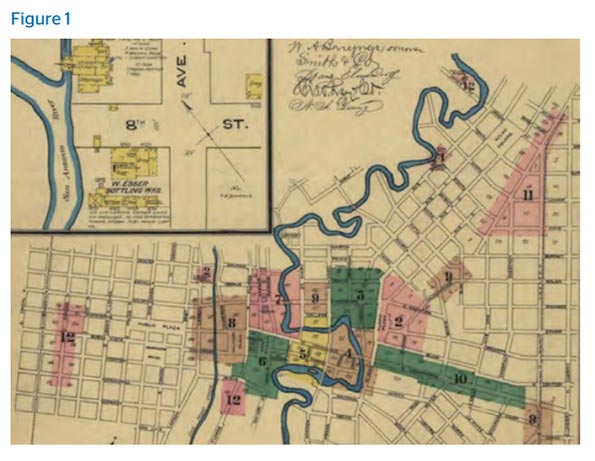
    San Antonio’s major step forward, however, came during the Mexican revolution of 1910, an event supported by city residents. In 1876, Porfirio Diaz became Mexico’s president, overseeing a multi-decade dictatorship. In 1910, a popular dissident candidate named Francisco Madero ran for president and was imprisoned. After his family posted bail, Madero fled to San Antonio, joining other expats fomenting revolution. They organized an armed struggle that lasted for decades within Mexico, causing a refugee surge. From 1900-30, the Mexican population in the U.S. grew from 100,000 to 1.5 million, and San Antonio’s total population more than quadrupled, with refugees viewing it as a safe and culturally familiar city.

    “At that time, San Antonio was the center, not Los Angeles,” T.R. Fehrenbach , a Texas-based historian, told the San Antonio Express-News in 2010. “San Antonio was the capital of the Latin American world outside of Latin America.”

    Newcomers consisted largely of Mexico’s business elite. For example, the grandparents of former San Antonio mayor Henry Cisneros, and the parents of famed former local congressman Henry Gonzalez, came to San Antonio during this period. The influx of Mexican business savvy helped make San Antonio a modern city.

    After slowing during the Great Depression, San Antonio resumed growth during World War II. From its inception, San Antonio was a military city, the linchpin in the defenses of Texas. This continued following statehood, as San Antonio became a prime location for military installations. Fort Sam Houston, which still sits on the city’s east side, was founded in 1845. Kelly Air Force Base opened during World War I. Other military functions would follow, and by World War II they were running on all cylinders.

    The large civilian workforce that flooded into San Antonio during this time created severe labor shortages in rural areas. The federal government responded with the Bracero Program. From 1942-64, 4.6 million Mexican agricultural guest workers entered the U.S.121 Like with past Mexican migrations, many gravitated to San Antonio, and by 1970 the dusty old Spanish colonial outpost had become a 654,000 person city.

    Postwar Economic Growth and Political Equality

    Since then, the region has added an average of approximately 300,000 new residents per decade. Much of the influx has resulted from the organic movement between America’s colder and warmer climes. But much also stemmed from local sources and initiatives.

    Economic growth and job creation are enhanced by transportation systems that allow people to reach employment and other destinations throughout the metropolitan area. Metro San Antonio has a highly ranked roadway system, with comparatively light traffic congestion. San Antonio ranks 10th in per-capita freeway capacity among the 53 U.S. metropolitan areas with 1-million-plus populations. This contributed to San Antonio’s ranking of 22nd best in overall traffic congestion delay among 172 urban areas in 30 nations, according to the 2015 Tom Tom Traffic Index. The metropolitan area has two freeway beltways (ring roads), like a number of other cities.

    Like Texas’ other cities, San Antonio has also benefited from pro-growth state policies. Texas has no income tax and has the fifth-lowest overall state tax burden. Texas routinely ranks near the top in surveys tracking ease of doing business. Such liberalization has produced statewide in-migration of people and businesses, mostly to the major metros.

    But the city’s establishment has also embraced the growth agenda. This is because San Antonio, says Cisneros, who in 1981 became the first Hispanic mayor of a large U.S. city, perceives itself as an opportunity zone for Hispanics.

    “For a good part of its history, San Antonio was a poor city,” he suggests. The establishment has responded by making economic development “the central current of San Antonio’s political discourse and electoral politics … [giving] us the basis on which we decide other questions.”

    This has meant, on one hand, subsidizing a number of flashy projects. San Antonio’s famed River Walk, first restored in 1941, has been serially expanded to connect key downtown tourist spots. San Antonio hosted the World’s Fair in 1968, rebranding itself as the northernmost Latin American gateway into the United States. And public money was used to retain the San Antonio Spurs, who proceeded to win five NBA titles, putting the city on the map perhaps more than anything else.

    But growth has mainly occurred because local and regional officials embraced the unsexy projects needed to enhance San Antonio’s infrastructural footprint. For example, the city pumps water from the vast Edwards Aquifer that spans central Texas. Thus San Antonio has more reliable water access — and cheaper water rates — than other cities, who rely on surface-level infrastructure and are more subject to droughts.

    In the 1970s, San Antonio joined its municipal energy company — CPS Energy — with a south Texas regional nuclear power network. Unlike other cities that joined, CPS entered the partnership to generate its own power, rather than renting it from a third party, making it the nation’s largest city-owned utility for gas and electricity. This has helped the company eradicate the middle man, selling energy to San Antonio residents and businesses at 10 percent to 20 percent less than in Dallas and Houston.

    Another area has been key to San Antonio’s political development and the rise of Hispanics. From 1955-75, San Antonio’s City Council was controlled by the Good Government League, a mostly white group that endorsed pro-business candidates. The group fought patronage politics, but was exclusionary in nature. In the early 1970s, San Antonio became ground zero for La Raza Unida, a national movement dedicated to increasing Hispanic representation within government. Working against the GGL, the movement organized voter drives throughout the early 1970s, and by 1977 had helped inspire council elections by district, rather than at-large. This meant that following the 1977 election, the majority-minority city had filled five of 10 council seats with Hispanics and another seat with an African American. This diversity at City Hall has continued.

    But, according to Michael Cary, a writer for the San Antonio Current, the political establishment has still championed the pro-growth leanings of the GGL, thus merging two constituencies that otherwise remain divided. This merger was embodied by Cisneros, who was elected to council in 1975 and later served four terms as mayor.

    “Cisneros broke with the liberal Chicano ranks and ran on the West Side Good Government League ticket,” wrote Cary, serving “as a bridge between Anglos and Hispanics.”

    The former mayor agreed that this unity remains intact, thanks to the citywide “political consensus” favoring growth.

    “We’re not going to do it with welfare, we’re not going to do it with income maintenance, we’re not going to do it remaining contentious and divided,” Cisneros said, summarizing the Latino and Anglo establishments’ attitudes. “We’re going to do it if we come around a single theme — jobs.”

    Diversifying Economy

    This approach has powered San Antonio near the top on various growth and prosperity metrics. Since 2000, San Antonio has been No. 8 among the 50 major U.S. metro areas in population growth rate.
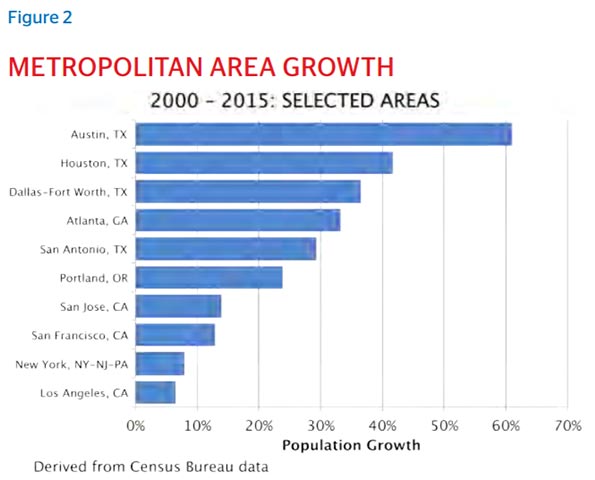
    Critically, this growth has been due largely to Latinos. Since 2000, the area has been among the leaders in net Hispanic population growth, adding over 400,000 residents. Economic prosperity explains much about why people are coming. Over this time, San Antonio has been No. 6 in job growth rate among these metros, and the highest income growth among major metropolitan areas since 2005, according to Forbes magazine. When comparing Hispanic populations in the 53 largest metros, San Antonio has been one of only four to see median household income gains since 2000 and has the 15th-highest median household income for Hispanics when adjusted for living costs. According to the Kauffman Foundation, San Antonio is No.10 in startup activity, and the area unemployment rate is nearly two percentage points below the national average. The Milken Institute ranked San Antonio No. 12 among its best-performing major metros, although it has ranked higher in previous years.
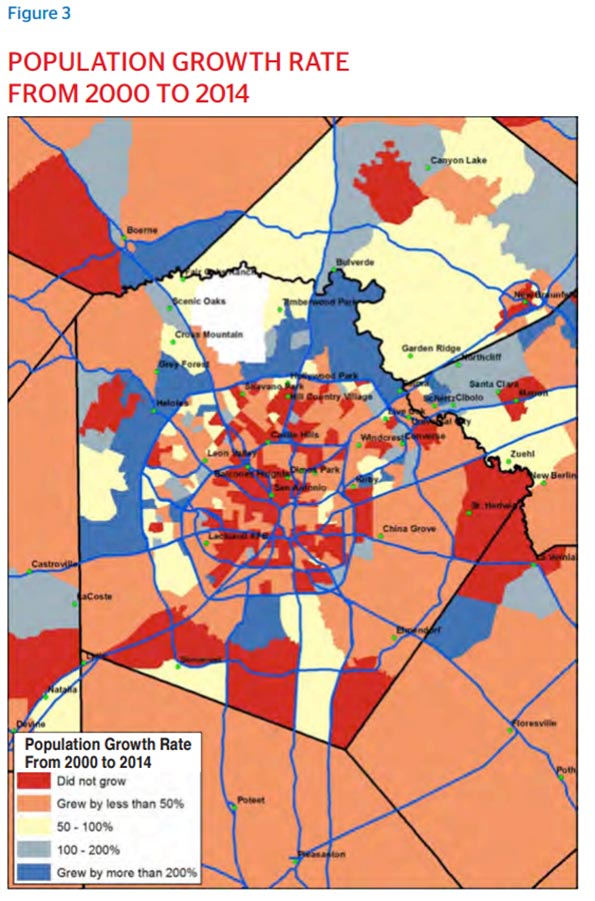
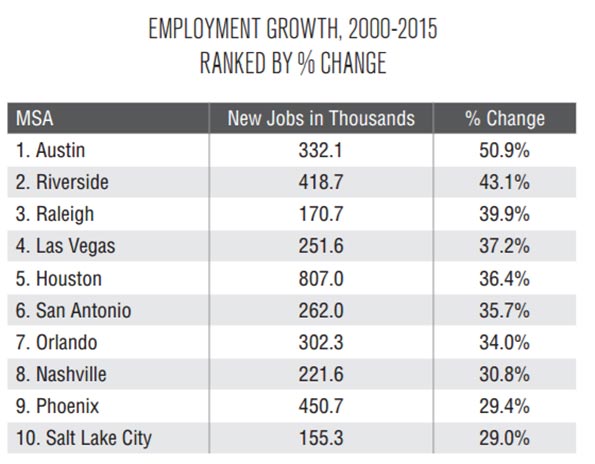
    The backbone of this growth is an economy that has strengthened and diversified. In 2011, Mario Hernandez, former CEO of the San Antonio Economic Development Foundation, wrote about how San Antonio was evolving beyond its “big three” industry sectors — tourism, military and health care. His points have only strengthened since.

    Among the original big three, military remains the strongest. According to a study by the city government, San Antonio “is home to more Department of Defense students and active runways than any other military installation.” The metro area also includes 55,000 military retirees. The military has a $27.7 billion economic impact and employs 189,148 people. Lackland Air Force Base and Fort Sam Houston are by far the area’s largest employers, at 37,000 and 32,000 workers, respectively, while other significant installations include Randolph Air Force Base and Camp Bullis (the names of all four begin with the moniker “Joint Base San Antonio”). There is also a special relationship between the military and the city’s Hispanics, who have historically viewed military service as an opportunity for well-paying jobs, free educations and integration into mainstream American society.

    Bioscience and health care is another vast sector, having grown from $12 billion to $30.6 billion in annual economic impact since 2003.136 The industry employs 164,000, or one of six San Antonians.137 In many ways, the sector is an outgrowth of the military, as medical workers receive training for — and often operate on — personnel preparing for, or returning from, battle. Following the federal Base Realignment and Closure Commission’s report in 2005, many of the Pentagon’s medical functions were concentrated in San Antonio, infusing billions of dollars into the city. This was highlighted by the new Medical Education and Training Campus built at Fort Sam Houston, the world’s largest facility for military medical education, research and training. The center’s students often apply their knowledge at nearby Camp Bullis, a site that specializes in combat training. Just down the block within Fort Sam Houston, meanwhile, is Brooke Army Medical Center, an inpatient hospital that is the military’s largest health care organization.

    Yet the military’s medical functions only scratch the surface of San Antonio’s health care sector, with much of the private and nonprofit institutions located on the northwest side. The city benefits from the South Texas Medical Center, the Baptist, Methodist and University Health Systems, the University of Texas Health Science Center, the Children’s Hospital of San Antonio, and numerous other hospitals, research labs and medical startups.

    Tourism has been the city’s third economic staple, employing one in eight San Antonians. This is centered on traditional attractions like the Alamo and the River Walk, and outlying lures like Six Flags and SeaWorld. The impact will surely expand, because last year San Antonio’s five former Spanish missions were given UNESCO World Heritage status.

    Aside from the big three economic drivers, San Antonio is expanding into manufacturing, aviation, finance, technology and education, all tied somewhat to the military. While not traditionally a manufacturing city, San Antonio is now Texas’ fourth-largest manufacturing market, with the industry accounting for 57,000 jobs. One notable coup came when San Antonio, thriving on the corporate relocation momentum throughout Texas, compelled Toyota to build its largest manufacturing plant on the city’s south side in 2003. There was a combination of factors involved — the state offered $133 million in corporate welfare; the city government made infrastructure upgrades; local entrepreneurs stepped up to create a supply chain; and the city is proximate to the strong truck-buying markets in Texas and Mexico. As The Rivard Report, a local news website, noted 10 years later, “the company’s total direct investment in the plant has reached $2.1 billion, with $1.5 billion or more invested by the supplier community.”

    The aviation industry, an offshoot of both the military and manufacturing, has also grown exponentially in recent decades. Key to this has been Port San Antonio. In 1995, following the Cold War’s end, Kelly Air Force Base was closed. A government entity was created to repair and lease out the vast space to private companies, and the port has become a profitable facility, avoiding the graft and waste endemic in other American ports. Port San Antonio, which is located not near water but near heavily trafficked I-35, is dedicated to heavy industrial and aerospace uses and includes tenants like Boeing, Lockheed Martin and StandardAero, although it also houses cybersecurity and IT companies.

    The military has also brought growth to San Antonio’s financial industry, specifically through the rise of niche companies that loan to military members, who are traditionally seen as higher risk. The granddaddy of them all is USAA, a Fortune 500 firm headquartered in northwest San Antonio that employs 17,000. Significant mainstream banking institutions include JP Morgan Chase, which employs 5,000 locals, and Frost Bank, based in San Antonio. By year’s end, the latter company will break ground on a new 23-story downtown headquarters.

    The military has driven tech growth, as well. Some of this $10 billion impact is generated by federal agencies that contract with local IT and cybersecurity firms, making San Antonio No. 2 in the country in concentration of data centers. Much of the rest comes from a more subdued private startup scene, which has benefited from the city establishment’s focus on tech, and the energy of one man, city native Graham Weston. In 1998, Weston co-founded Rackspace, a cloud computing company in northeastern San Antonio that employs 3,300 and is valued at $3.29 billion. Weston has since made it his mission to grow a tech scene downtown, renting out incubator space and filling it with small organizations that collaborate on ideas, including Weston Urban, the 80/20 Foundation, Geekdom, Techstars and Tech Bloc.

    Lastly, the military — and San Antonio’s wider network of STEM enterprises — is inspiring educational growth. While San Antonio has historically enjoyed several small, renowned liberal arts schools, it more recently strengthened its public higher education. A University of Texas branch opened in 1969, and a Texas A&M branch followed in 2009. UT San Antonio, has an enrollment of 28,000. Its cyber security program is ranked first in the nation by tech industry professionals, meaning that graduates can plug into the region’s tech and military scene. The local community college system, Alamo Colleges, has partnered with Port San Antonio to establish workforce development programs, and the general focus for its roughly 60,000 students is on aerospace, manufacturing and IT.

    One industry in San Antonio that has not been particularly strong — likely to the benefit of the others — is local government. In many major U.S. cities, the largest employers are some combination of city governments, county governments and various civil service authorities. In San Antonio, the city government is the ninth-largest employer at 9,145.

    But perhaps the biggest economic driver has been population growth itself, with the city proper adding 325,000, and the metro area growing by 673,000 since 2000, creating a greater demand for housing, cars, services and food. San Antonio’s most inspiring private-sector story provides a window into that growing consumption. The region’s largest private employer, at 20,000 people, is H-E-B, a San Antonio-headquartered supermarket chain. Founded in 1905 by Florence Butt, who opened a small shop in nearby Kerrville, it has skyrocketed under her grandson Charles’ leadership, largely by remaining based in one of America’s consistently fastest-growing states. H-E-B has 316 stores in Texas and 52 in Mexico, and is one of America’s most highly
    valued companies, at $22 billion.

    Demographic Momentum

    So which groups are driving this population increase? The San Antonio area , at 63.2 percent, is the most Hispanic major MSA in the country, well ahead of Miami MSA at 43.8 percent. San Antonio’s Hispanic population largely consists of Tejanos, a south Texas term describing native Texans of Mexican descent. According to Pew Research Center data, 89.6 percent of San Antonio’s Hispanic population is Mexican. This is the largest share among Texas’ Big Four cities. But, notably, San Antonio has by far the lowest percentage of Hispanics who were foreign-born. While the share of foreign-born Hispanics is 32.4 percent in Austin and around 45 percent in Houston and Dallas — not to mention 42 percent in Los Angeles and New York City, 54 percent in Washington, D.C., and 66 percent in Miami — it is only 17 percent in San Antonio. This is because many of them have lived in San Antonio for generations.

    Additional Mexican-American influxes originate from Texas border towns like Laredo, Brownsville, McAllen, and other parts of the Rio Grande Valley. Tejanos have traditionally viewed San Antonio as a destination for jobs, education and entertainment. At the same time, the city is a short drive from their families. This proximity is important, explains Stephanie Reyes, a public-affairs staffer at the San Antonio Chamber of Commerce and a Brownsville native.

    “In most Hispanic cultures, [families] want you to stick around, they want to see you grow, especially if there’s that possibility of you raising a family elsewhere that they’re not going to get to take part in, seeing them grow up or seeing them every weekend. Here in San Antonio, [south Texas Tejanos] have that opportunity.”

    Nonetheless, there is still a lot of Mexican immigration into San Antonio, although the profile has changed. The stereotypical Mexican entering the city postwar was the poor agricultural worker. More recently, San Antonio has seen an explosion of professional-class Mexican migrants from major cities like Monterrey, five hours south on I-35. This group’s wealth has made them targets for kidnappings in their homeland. So they have moved to the U.S., with over 50,000, according to a Los Angeles Times report, coming to San Antonio, thanks to its proximity and ingrained Mexican culture. They have worked in white-collar professions and inhabited north-side gated communities, becoming known for lavish consumption. This is evident on any weekend in the upscale north-side mall of La Cantera, where parking lots are jammed with luxury cars and the walkways with Spanish-speaking shoppers in designer clothing.

    Javier Paredes, a local architect who grew up in Morelia, Mexico, epitomizes some of these trends. Eight years ago, his mother, an influential mining broker, was kidnapped and forced to reveal company secrets. After her release, the family settled together near downtown San Antonio, because of the city’s cultural familiarity.

    There has also been substantial in-migration from many races and places throughout America. San Antonio has become, like the other Texas cities, a major lure for domestic migrants. This is in stark contrast with major ocean coastal cities such as New York, Los Angeles and Chicago.
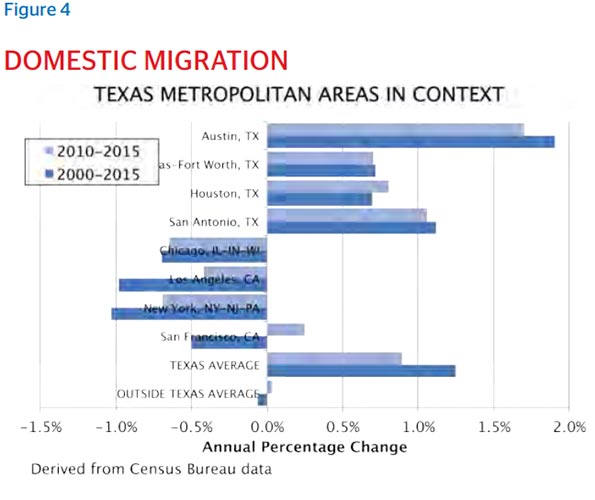
    This domestic growth was displayed in a map by Manhattan Institute senior fellow Aaron Renn, showing which parts of America people net are leaving for San Antonio. There are only a handful of areas that had positive net migration from San Antonio, most notably Austin, 80 miles to the northeast. Meanwhile, whole swaths of the country — including much of California, Cascadia, Florida, the Southwest, the Northeast and the Rust Belt — are pushing people out and into San Antonio.
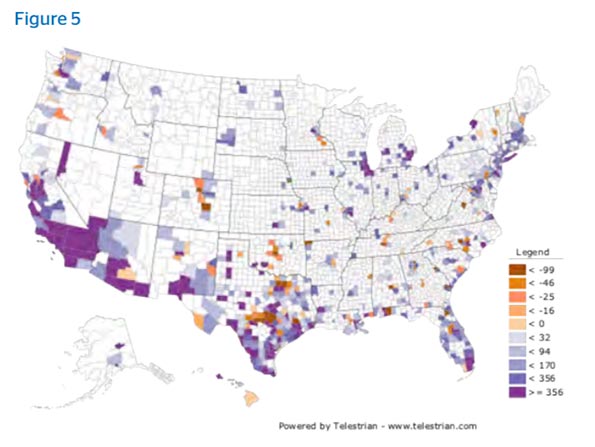
    This is particularly true for the young. Once an area that had trouble holding onto younger educated people, the region has now emerged as one of the fastest-growing destinations for them, outpacing in terms of growth such traditional “brain gain” centers as New York City, Boston and San Francisco. From 2010-13, San Antonio had the second-highest percentage growth among college-educated persons ages 25-34, and the fastest growth rates over that period for 20-to-29–year-olds of all education levels.
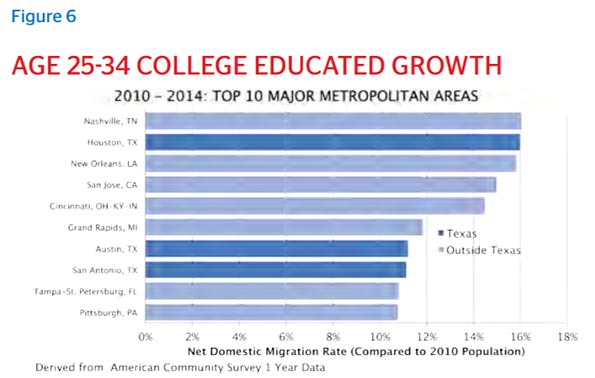
    The reasons are multifaceted: Some people may be seeking warmer weather, better amenities or a historical setting. More likely, migrants are drawn to San Antonio for pragmatic reasons. The cost of living is relatively low, highlighted by median home prices that, at $131,000, are $55,000 below the national median. San Antonio also has strong employment opportunities and companies desperate to hire, explaining the wage growth.
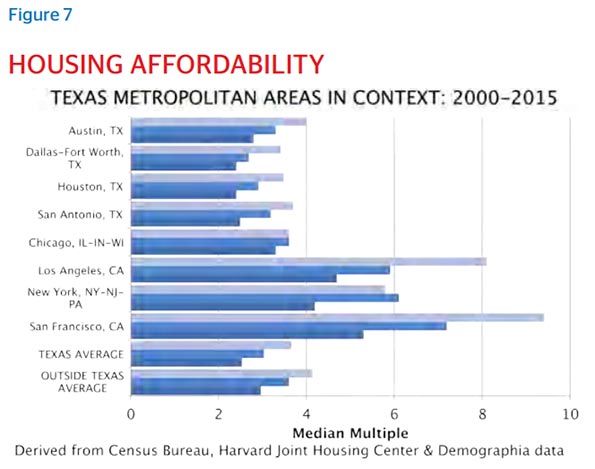
    These low housing prices explain much of San Antonio’s relatively low cost of living. According to the Council For Community and Economic Research, San Antonio’s living costs are less than half those of New York or San Francisco, and considerably less even than sunbelt boom towns such as Houston, Dallas-Ft. Worth, Austin, and Phoenix.
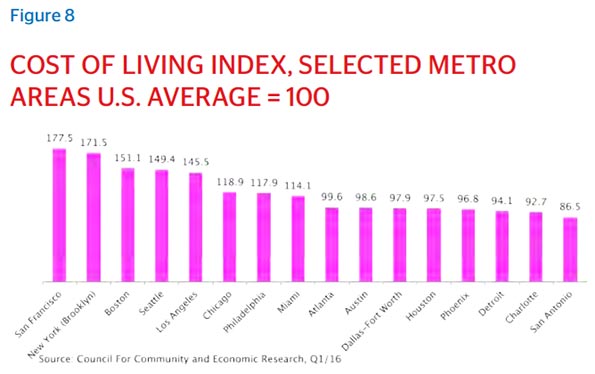
    “We don’t have enough people,” says Tony Quesada, editor-in-chief of the San Antonio Business Journal, “so we wind up importing talent from other parts of the country.”

    Then there are quality-of-life factors: Average one-way commute times are several minutes below the U.S. average, at 22 minutes. And, once drivers get off the city’s highways, they will likely be strolling through any number of quiet, secluded neighborhoods.
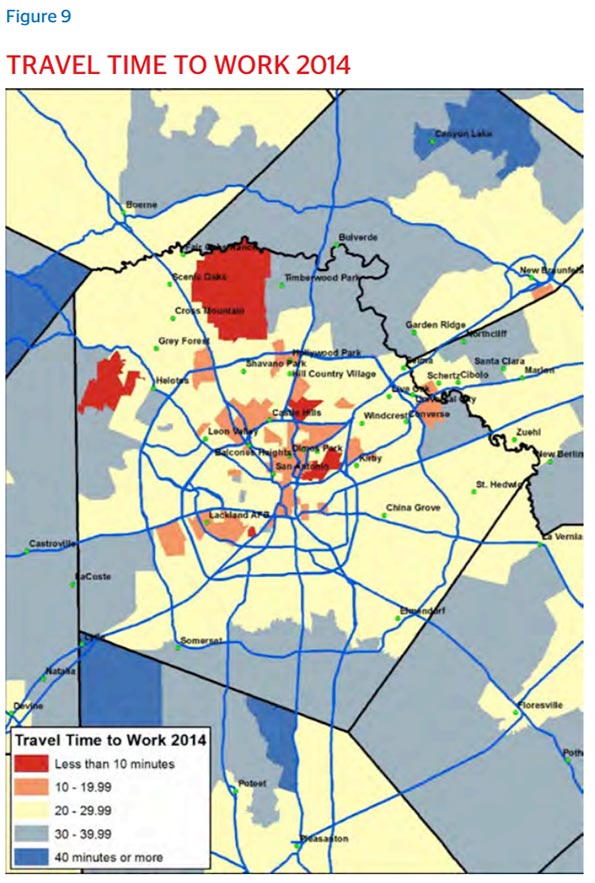
    But complementing these factors is an attraction that you hear repeatedly during interviews and will find anecdotally while navigating the streets — “comfort.” San Antonio is a big city with a small-town feel, where people are friendly, and community relations are tight. This was reaffirmed in July, when Travel + Leisure magazine named San Antonio America’s Friendliest City, based on reader surveys.

    Former mayor Cisneros called this dynamic the city’s “secret sauce,” claiming that it has helped unify whites and Hispanics, as well as competing factions of the business and political communities. The sentiment was echoed by outsiders, including 31-year-old real estate developer Juan Cano. By his mid-twenties, he’d grown frustrated with San Diego’s traffic, high costs and mediocre job market. So he studied what city he should relocate to, and, after combining several economic and quality-of-life factors, chose San Antonio.

    He said the best thing he’s encountered in his seven years here is the city’s homey atmosphere.

    “What San Antonio beats people out on is not weather, is not number of activities or amenities; but what they beat out other cities and states on is congeniality,” he said. “People here really care about how your day is going.”

    Cano agrees with Cisneros that this openness also bolsters the business climate, including for small entrepreneurs like him, looking to make connections.

    Formation of a New Kind of City

    Of course, growth doesn’t occur in a bubble; when various factors drive lots of people into an area, there will be tangible changes at street level. A traditional urban commentator might guess that such growth would produce infill densification, as it did for the coastal cities that boomed during America’s industrial era.

    And to some degree, such “buzz” is now felt in Texas’ opportunity cities, including San Antonio. While its downtown remains largely for tourists, adjacent areas are growing more vibrant and cultured, thanks to millennial population growth and city-funded enhancements. The River Walk has been extended north and south of downtown, sparking mid- and high-rise development. Along the “Southtown” portion of the route, new condos mix with historic homes and mostly unpretentious nightlife. Along the route’s northern portion, the city pursued a public-private partnership to create the Pearl District, a mixed-use, master-planned development that has become one of America’s leading warehouse revitalization stories. Other interior neighborhoods — North St. Mary’s, Tobin Hill and the Market Square area in west downtown — are slowly filling in.
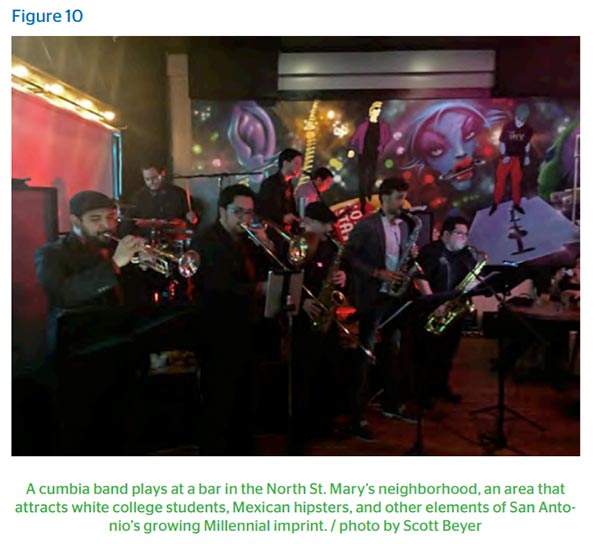
    But if San Antonio is showing some welcome growth in its inner ring, the city’s trajectory continues further outward, primarily to the north. This section of town long was the exclusive white area, while lower-income Mexican-American families dominated the west and south sides, and African Americans the east side. This segregated pattern still defines San Antonio, although things are changing.
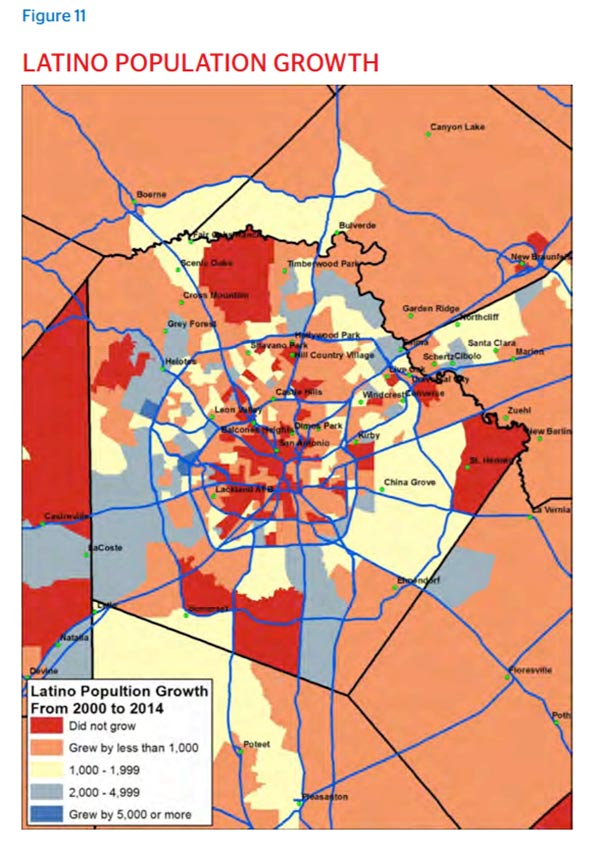
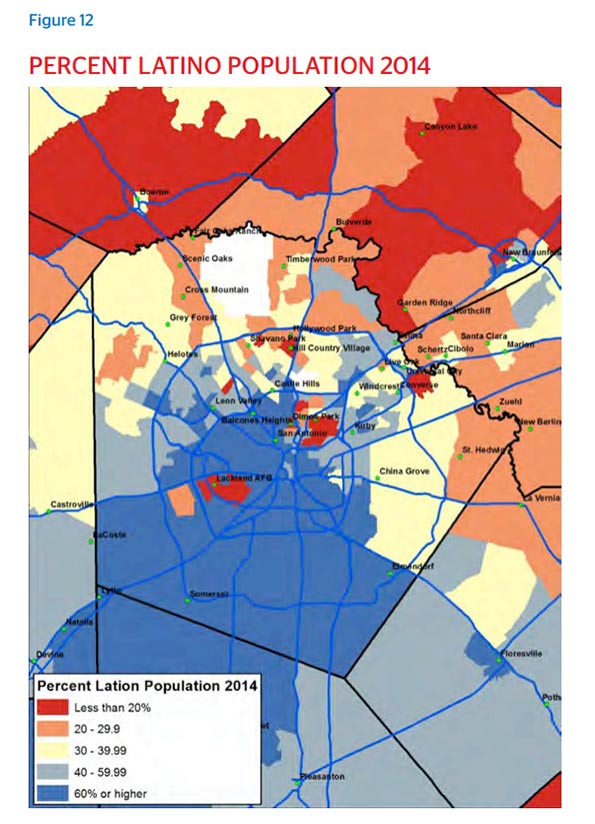
    Stone Oak is the prototypical example: Once a stretch of undeveloped Texas Hill Country extending north from the state Highway 1604 loop circling the central city, it has become a gargantuan master-planned community of 31,000 residents in just two decades.159 It features densely packed single- and multifamily housing and retail rolling for miles.

    Stone Oak accommodates much of San Antonio’s new money, which is to say that it is one-third Hispanic. The community is populated by health workers, techies, staffers at nearby UTSA and most notably, Mexican nationals.

    Growth is even occurring in the historically hyper exclusive suburbs carved out within San Antonio’s city boundaries, like Alamo Heights and Terrell Hills. According to Sáenz, these areas were once forbidden to minorities. Today, there is a Hispanic presence in both suburbs, and generally throughout San Antonio’s north side. This suggests that the city is providing upward mobility for large portions of its Hispanic population.
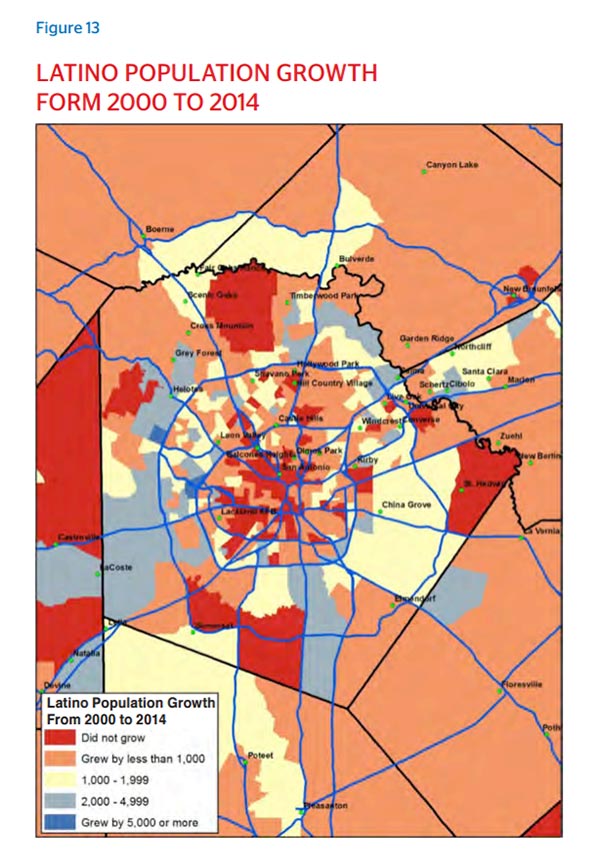
    Future Challenges

    Cities that enjoyed the rapid growth now experienced by San Antonio have also suffered the downsides. New York, San Francisco and Los Angeles, among others, are economically dynamic and culturally interesting, yet overwhelmed by overloaded infrastructure, service failures, growth-killing regulations and patronage-ridden political machines that only worsen these problems. When I asked community leaders how San Antonio could avoid this fate in coming decades, two answers surfaced.

    The first was that San Antonio needed to continue expanding infrastructure, a point emphasized by local billionaire and Spurs owner Red McCombs. This could mean everything from doubling down on housing and highway construction to exploring 21st-century solutions like green energy. While there have been recent expansions, the San Antonio-Austin corridor lacks a top-notch airport, which may explain why neither city has had the same success attracting corporations as had Houston and Dallas. In other cases, however, the city is taking the initiative in infrastructure growth. In May, the San Antonio Water System board approved the takeover of the Vista Ridge Pipeline, a new project that will diversify the water supply. San Antonio also recently launched SA2020, a plan designed to improve the city on 58 quality-of-life indicators.

    Fortunately, San Antonio is in a financial position for such expansion; while other U.S. cities’ pension debts have prevented them from even providing well-paved streets. San Antonio has among the lowest per capita unfunded pension liabilities of any major city. For six consecutive years, the city has received a perfect bond rating. It also has a population, said McCombs, while overlooking the downtown skyline from his north-central office, that understands intuitively the connection between capital investment and prosperity.

    “You give Texans a good reason for paying taxes,” he said, “and they’ll pay them.”

    Secondly and perhaps even more critically, San Antonio needs to continue mobilizing its minority population, mainly by improving its K-12 education system. While there are countless success stories here, there are also Mexican-Americans and African Americans who have lived in multigenerational poverty on the city’s west, south and east sides, and low-skilled, non-English-speaking immigrants are still arriving. Many of their neighborhoods, while certainly nicer than most urban American slums, are nonetheless rundown and have lower-performing public schools than those in outlying areas. The city and the state have taken several recent measures to address the problem, including a city voter-approved sales tax increase for Pre-K schooling, and charter school expansion.

    Other K-12 measures have been more innovative. The SA Works program, for example, is a partnership between the city and the Chamber of Commerce to connect high school and college students with local companies and other supporting agencies, who then offer internships and job-shadowing opportunities.

    In June, a partnership was launched between the San Antonio Independent School District and H.E.B. to open five specialty schools that will plug students into the local employment scene.

    If San Antonio continues embracing new ideas to address its infrastructure and education challenges, it will remain a regional growth engine, and an example for other cities. America, after all, is slated to become 23 percent Hispanic by 2035. San Antonio represents an extreme early version of this demographic shift, and an example of how it can work.

    “San Antonio,” concluded Cisneros, is “driven by the understanding that jobs and incomes are the way we’re going to progress, and, in fact, we have. I see it in the quality of restaurants, the [more diverse] crowd at the Spurs [games], in the retail mix of the city, the integration in neighborhoods, with Latinos and African Americans moving into neighborhoods once beyond their reach. Intermarriage. It’s almost as if a new culture has emerged. … It’s one culture adapting the things that it likes about another culture.”

    These same economic and cultural improvements can be observed in other big Texas cities, suggesting that they are the outcome of liberalized polices. San Antonio, as the Mexican-American capital, has long been the underdog of the four great Texas cities. But today its Latino character is proving to be yet another asset, contributing a unique wrinkle within Texas’ broader urban growth story.

    Scott Beyer is a Forbes columnist and cross-country traveler who covers U.S. urban issues. For three years, he’s circling America to live for a month each in 30 cities, starting from Miami and ending in New York City. The point is to write a book about revitalizing cities through Market Urbanism — which is the intersection of classical liberal economics with urban issues. But he also writes articles on multiple other city subjects.

    Top photo: Zereshk [GFDLCC-BY-SA-3.0 or CC BY 2.5], via Wikimedia Commons
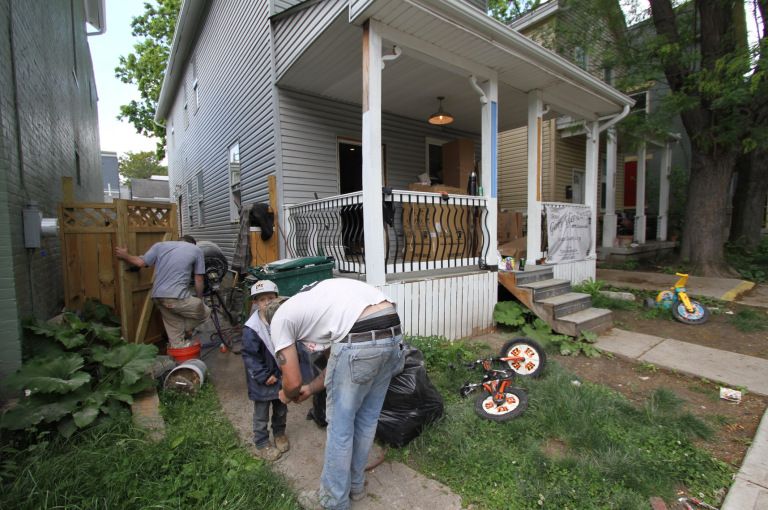
  • Opportunity Urbanism: The Tech Edition

    This essay is part of a new report from the Center for Opportunity Urbanism titled “The Texas Way of Urbanism“. Download the entire report here.

    Any observer of urbanism in America knows that Austin tops numerous rankings of urban dynamism. Austin — defined as a metropolitan area, not just the city — is consistently atop Forbes’ annual list of Best Cities for Jobs in America over the past five years, which is why so many people move there in the first place.

    In other surveys Austin has been ranked the number one city for young entrepreneurs, small businesses, jobs, millennial homebuyers, singles, dog owners, and food trucks. Its central downtown ZIP code has more bars per capita than any other ZIP code in the country by a long shot. Last year, Savills ranked Austin over San Francisco as the nation’s best technology city, and college information aggregator Niche ranked the University of Texas, situated on the north end of downtown, as the top public university in America. And, of course, Austin has long claimed the title of “live music capital of the world.”

    No surprise then that a visitor to a gathering of technology entrepreneurs in any mid-size to large American city will hear someone talking about how we need to be more like Austin. And Austin is indeed a success story, but one that on examination does not look exactly how outsiders may expect.

    Our conclusion here is that although Austin’s urban vibe is critical, its success has more to do with some distinctly Texan features, including development on the periphery, low taxes, affordable housing (particularly in comparison with coastal California) and less stringent regulation. It is the culture of opportunity, as much as anything else, that defines the Texas capital, and makes it so distinct from its other “hip and cool” rivals.

    The New Dynamism

    When George W. Bush was watching the 2000 presidential election results from the governor’s residence in Austin, Texas, he was sitting in a city of 1.2 million people. Since then, Austin has grown 60 percent to over 2 million residents. Only Raleigh, NC, has come close to matching that rate of growth over 15 years. Austin and Raleigh are 20 percentage points ahead of fifth place Houston. Perhaps most remarkable, however, is Austin’s growth since 2010, the worst financial meltdown since the Great Depression. The city grew by 16.6 percent, while Raleigh grew 12.7 percent. Austin has largely defied gravity since the economic collapse.

    Among the nation’s 53 metro areas with populations over 1 million, the fifteen that have experienced double-digit growth since 2000 are all located in the south and west, including Texas’s four largest metros. And of the top 25 fastest-growing cities since 2010, the only city not in the south, west, or northwest is Columbus, Ohio, in 24th position. Columbus is the only city east of the Mississippi River and north of the Mason-Dixon line growing at a rate above six percent.
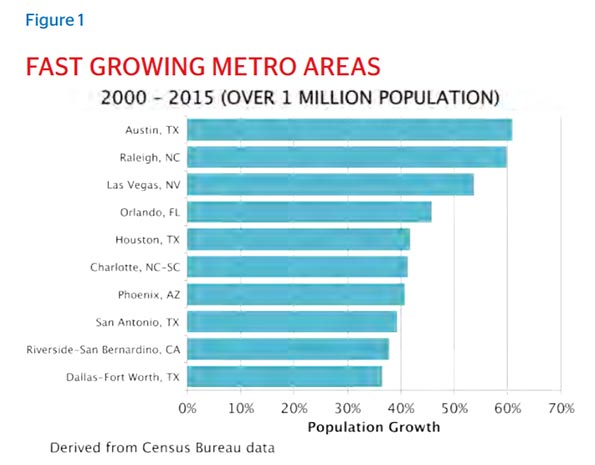
    Weather is a factor but America’s fast-growing cities attract aspiring workers and business owners through a blend of favorable economic conditions, new infrastructure, and increasingly, proximity to talent. Political sclerosis and economic elitism in coastal and northern cities have served as a helping hand, pushing workers away from a toxic blend of rising expenses and falling quality of life. Using a mix of Census data, cross-metro moving requests on moving.com, and cross-metro searches on realtor.com, a recent Realtors study found New York, Chicago, San Jose, and Los Angeles are among the top five cities losing the most domestic migrants to mostly smaller, newer Sun Belt cities. In the same study the top ten gainers are Sun Belt cities, with the exception of Portland, Oregon, all who offer newer, more affordable housing stock than in the prime metro areas of New York, Illinois, and California.

    Arguably no city in the country has taken advantage of these conditions more than Austin. Since 2009, the low point of the Great Recession, its metro area GDP has grown 31 percent. By comparison, San Francisco and Boston each grew by 13 percent during the same period. The national average for U.S. metro areas was 11 percent.
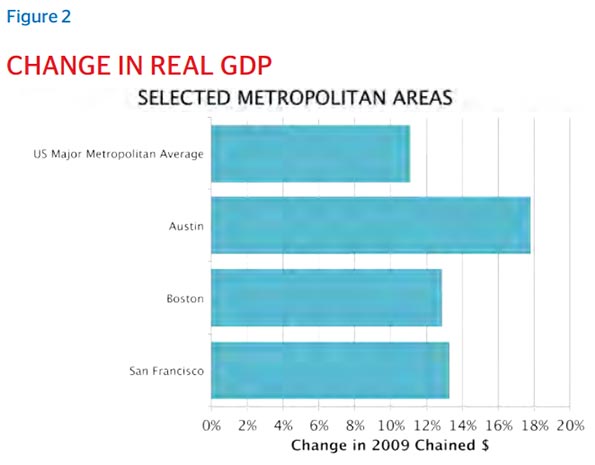
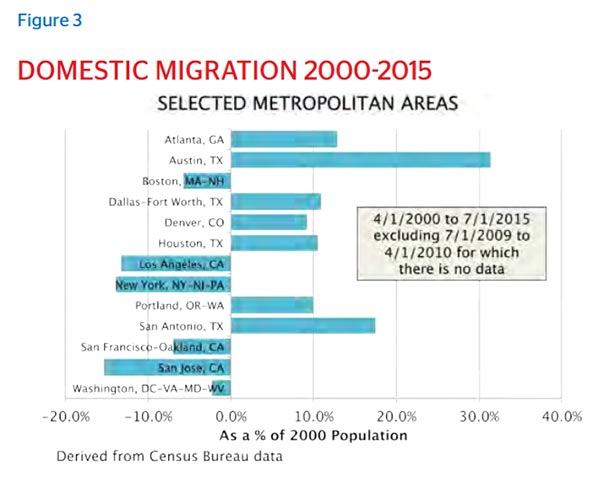
    Demographically, domestic migration drives Austin’s economy. Austin has had to innovate and import a lot of talent. Austin has become a quintessential knowledge economy that thrives not so much by cultivating natural and historical resources, but by absorbing ideas, innovation and talent from elsewhere and selling them as products back to the world.

    Anyone who has spent any time in Austin understands the tension that exists in the city between the defenders of its erstwhile charm as an unconventional music and college town and boosters of its high-growth technology cosmopolitanism. Whatever the community’s gatekeepers contend, however, Austinites themselves think that the massive influx of people is inextricably bound to its economic growth.

    An annual survey of Austin residents casts this phenomenon in clear relief. When asked what they think Austin has gained by its population growth over the past five years, residents cite a stronger economy as their top pick. Compared to the 22 percent of Austinites who cite “more diversity” and 7 percent who say “more creativity,” 42 percent say Austin’s explosive population growth has been a boon to the city’s economy. Even those who have lived in Austin for more than 20 years believe the economy has benefited from great migration to the city.

    An openness to newness, strangers, and change are hallmarks of Austin’s economic culture. Perhaps rooted in the city’s past as a music-centric, indie-friendly college town, these hallmarks have translated well economically for the city.

    The Great Migration Game

    Austin’s migration story can perhaps be understood best in contrast with Silicon Valley. No metro area in America can compare to the Bay Area in terms of the sheer size and force of its technology community, Austin’s attractiveness has grown, in large part , unlike in San Francisco and San Jose, tech workers in Austin are able to afford housing close to the office, raise kids close to good school options, and enjoy a variety of cultural amenities in close proximity.

    Between 1991 and 2013, people moved between Austin and 304 MSAs. Of these, Austin only experienced a net loss to eleven. Compare that to San Francisco. The gem of the Bay Area lost population to 133 of the 242 MSAs with which it “traded” population. For San Jose, the figures are 127 out of 253. In other words, while the Bay Area lost population to well over half of the MSAs it has traded with across the country, Austin’s loss was just 3.6 percent.

    Figures 5 and 6 show clearly how the Bay Area has dispatched population to a number of western and southern boomtowns, whereas Austin has pulled in workers and families from every population centers all across the country.

    Silicon Valley is renowned for its high-level talent pool. It attracts the best and the brightest from around the world to work in the most vibrant technology ecosystem in the world. However, when one looks at where U.S. cities export most of their talent, the numbers tell a slightly different story.

    First, Austin is more of a regional talent destination than Silicon Valley. Since 1991, Austin has seen a net population increase of more than 33,000 people from Houston and 21,000 from Dallas. San Jose has lost thousands of people to both Texas cities over the same period of time. So has San Francisco. Perhaps that is expected, given Austin’s proximity to its fellow Texan metropolitan areas.

    But the pull is much greater from California than one would suspect. During the same period, Austin attracted nearly 20,000 migrants from the Los Angeles metropolitan area, which sent only 15,000 to San Jose. Austin also saw thousands of arrivals from San Diego during the same period.

    The other tech-heavy, talent-centric cities in the Northwest also prefer Austin. Net migration from Seattle to Austin has been positive since 1991, while San Francisco and San Jose have lost a combined 25,500 people to Seattle in the same time period. Portland tells an even more dramatic story. A city frequently compared to Austin, Oregon’s commercial capital has lost more people to its Texas peer than it has gained, while Silicon Valley has lost tens of thousands of residents to their northern neighbor. In contrast, since 1991, San Jose and San Francisco have exported nearly 51,000 people to Portland and Austin combined.

    Second, looking at talent centers nationwide, Austin outperforms the Bay Area quite decisively as cities with a high proportion of college-educated residents have consistently chosen the Texas capital as an ultimate destination over Silicon Valley. Raleigh, for example, the only other American city to come close to matching Austin’s rate of growth over the past five years, has lost more people to Austin than it has gained since 1991, but both San Francisco and San Jose have lost population to Raleigh over the same period. In other words, plenty of people are choosing to leave the Bay Area for North Carolina, but the talent base in North Carolina has a fonder eye for Austin.

    Other talent centers display a bias for Austin as well. The three largest cities on Wallet Hub’s 2015 list of the educated cities in America — New York, Los Angeles, and Chicago — have all sent more people to Austin than to the Bay Area, despite an enormous tech-led boom in the area. Washington, D.C. has become a talent boomtown in its own right, owing to the stability of employment for the knowledge workers the federal industrial complex increasingly needs and rewards. Yet it has exported more workers to Austin than to San Jose and San Francisco combined over the past twenty years. Provo and Colorado Springs, the mountain West’s talent hubs, have also lost people to Austin but gained people from San Jose and San
    Francisco.

    Opportunity Cities Win

    For cities aspiring to grow as Austin has grown, the first order of business is to understand Austin as an opportunity city, not just a technology center or music capital. So what are the hallmarks of an opportunity city?

    First, Austin, like other Texas cities, is friendly to those who want to start and grow a business. These are cities in which small businesses not only participate in, but also drive economic growth. A recent study conducted by the American City Business Journals ranked cities with 500,000 or more residents according to 16 indicators constructed to measure the vitality of the small business sectors in American cities. Austin ranked number one on the list because of the relationship between small business job growth and overall economic growth. San Francisco and San Jose ranked sixth and ninth, respectively, bested by nimbler hot spots such as Miami and Provo. Austin has also made other high-level appearances over the past few years on similar rankings, such as CNBC’s “Friendliest Cities for Small Business” list.

    Small businesses are woven into the fabric of Austin’s economic ecosystem. Austin’s small businesses are ahead of the national average and a significant source of the tireless job creation engine for which Austin has earned a national reputation. Companies in Austin with fewer than 100 workers account for 35 percent of the area’s workforce, and yet they created enough jobs in 2009-2011 to offset the job losses caused by Austin’s largest employers after the Great Recession.

    Second, an opportunity city is a jobs city. Small businesses by themselves do not necessarily guarantee that a city will have a healthy jobs environment, but a critical mass of new small companies typically does, especially if a significant minority grow into larger companies.

    Austin reflects the growing body of academic literature on the impact of new firms on the labor market. Startups and other young companies generate the vast majority of net new jobs in America and spur income growth, especially for younger workers. New companies in Austin are the fuel that powers the creation of new jobs at a rate impressively above the national average.

    New firm formation in Austin tracks with general national trends, but it does so at a consistently higher rate. As figure 7 shows, Austin has produced a significantly greater share of new firms per capita compared to the rest of country over the past 20 years, and it rebounded faster post-recession than the nation as a whole. The tech centers of Raleigh, San Francisco, and San Jose have all had lower startup rates than Austin since 2010.

    Austin is the only major metro in Texas creating as many or more new firms than it was pre-recession. Just three years after the nation’s economic nadir, Austin created more new firms in absolute terms than it ever had. It also produces a disproportionately high number of startups for its size. In the Kauffman Foundation’s Index of Startup Activity, Austin has been in the top two spots for a few years running.

    In addition to its startup culture, Austin is a premier relocation destination, especially for companies looking to expand operations in a business-friendly atmosphere with an abundance of talent. Since 2004, nearly one-third of all high-tech company relocations and expansions to Austin from elsewhere have come from California. Among these are household name giants such as Apple, Google, eBay, Oracle, PayPal, and Facebook.

    A churning startup culture drives a dynamic job-creation ecosystem. Austinites work more hours per week than the national average, enjoy the lowest unemployment rate among the nation’s top 50 metro areas and experienced non-farm payroll growth at the 3rd fastest rate last year.

    This has a lot to do with a healthy balance between job growth in all sectors of the economy with particularly strong performances in higher-growth sectors of the economy. Between 2014 and 2016, every sector of Austin’s economy added jobs, except manufacturing, which only declined by less than a percentage point. Since 2010, job growth in professional business services has grown 42 percent and information jobs by 34 percent, and over the past two years Austin has outperformed growth rates nationally in sectors diverse as wholesale trade, construction, leisure and hospitality, and retail.

    Third, an opportunity city attracts professionals on the front end of their careers. One of the best ways to test the dynamism of a region is to look at the degree to which young professionals in their 30s are moving there. Immediately after college, 20-somethings will often move to big cities to get their professional footing and enjoy the fruits of cosmopolitan living. As they approach their thirties, they begin to think about affordability more seriously and consider other opportunity-related factors such as the quality of neighborhoods and schools if they are in the marriage and-kids market. Looked at this way, Austin is the preferred destination for upwardly mobile, aspirational 30-somethings looking to make a life for themselves.

    A recent Niche.com ranking of the 25 best cities for millennials used as its key metric the percentage of 25-34 year olds living in each city. Austin, which ranked second overall on the list, had the highest percentage of 25-34 year olds among the top 25 cities.

    When we compare 25-34 year olds moving to the Bay Area versus Austin, we see several sharp contrasts. Between 2000 and 2014, this group grew by 49 percent in Austin but declined by nearly 4 percent in Silicon Valley. There are now more 25-34 year olds living in Austin than in the San Jose metro area.

    A greater share of 25-34 year-olds in Silicon Valley have a bachelors degree than in Austin, but Austin has been growing its educated young population at a much faster rate. The 25-34 year-old population with at least a bachelors degree has grown in Austin by nearly 61 percent since 2000, compared to 18 percent in San Jose.

    Balancing the Basics: Why Austin Works

    Austin’s success as an opportunity city differs from what has occurred in the Bay Area’s anchor metros, San Francisco and San Jose. These places have led the nation in job creation and startups in recent years and are growing their share of highly-educated young professionals. Yet they are losing population — and company relocations — to Austin. Why is Austin succeeding where San Francisco and San Jose, at some level, are not?

    The answer lies somewhere in the answers provided by those who have made the move from the Bay Area to Austin.

    Vasili Triant, CEO of LiveOps, moved his company from Silicon Valley to Austin after concluding that quality of life and cost issues would keep his company from achieving its growth objectives. Before assuming the helm of LiveOps, Triant moved to the company’s Austin office to direct sales. He and his family were able to buy a home and attend schools in the kind of district that would be utterly uaffordable in the Bay Area. The easy-going yet ambitious nature of Austin’s workforce provided a solid talent pool.

    Meanwhile, back in Silicon Valley, employees at Triant’s company were constantly pushing for pay raises to accommodate the cost of housing, complaining about the multiple hours a day they spent commuting, and worrying about the schools their kids would have to attend. Employees earning over $200,000 were in debt and not contributing to their 401ks.

    Once he was elevated to CEO, Triant confronted his board with the built-in costs of doing business in the Bay Area. He proposed moving the company to Austin, to which the board agreed after reviewing the numbers. Triant likens the difference between the Bay Area and Austin to a difference in premise about what makes a good life worth living in each place. In Silicon Valley one gambles that he or she will make it big, has family money, or just wants to be near the ocean and the mountains. “If your premise about a good life involves saving money for the future and having a good community and school for your kids, then Austin is for you – and the Bay Area won’t be unless you’re phenomenally wealthy,” Triant says.

    Pradeep Vancheeswaran, a Senior Vice President of Global Business Operations at VMWare, lived in California for his entire U.S. professional career, including seven years in the Bay Area, before moving to Austin. The cost of living and the rat-race culture of the Bay Area prompted him and his wife to reconsider whether it was the best place to raise their kids and make a life. On a scouting trip to Austin he saw the kind of home his money could buy, the kind of neighborhood he could live in, and the quality of the schools, and the decision was made. Friends said he was committing career suicide. The opposite has happened, and the family is flourishing in Austin. “Texas gets a bad rap in the Bay Area,” he says. “But the truth is Austin is an inclusive place. We have great neighbors, people are friendly, and I have been able to hire talent here with no problems. In fact, Austin ranks at the top of our global talent assessment and has been a great place to hire for our company.”

    Triant’s and Vancheeswaran’s stories are not uncommon in Austin and exemplify the fundamental pillars supporting Austin’s sustained growth.

    More for Your Money

    Underneath the vibrant regional economy, Austin’s bedrock, not often mentioned in the hype about the city, has been its affordability.

    As Triant and Vancheeswaran’s personal accounts attest, Austin’s diverse and affordable housing stock is a key lure for upwardly mobile professionals. Housing in Austin is growing more expensive but still remains a reasonably good deal, particularly in comparison with the Bay Area, Los Angeles and San Diego, where housing costs more than double that of Austin, adjusted for income.

    The key to maintaining housing affordability is to allow supply to keep up with demand. This requires avoiding the restrictions on suburban housing development that have been adopted in places like California, Portland and Seattle, and avoiding the high development charges typical of more restrictively regulated markets. As Figure 8 shows, affordability was nearly identical in Austin, Portland, and Denver in 1990. Since then, unaffordability has grown faster in the latter two markets, which place more restrictions on housing than Austin does. And in the Bay Area, of course, California’s notorious penchant for restricting housing is breaking records for unaffordability.

    Using Demographia’s International Housing Affordability Survey, we find that single-family homes in Austin remain more affordable than rival talent centers such as Portland, Denver, Seattle, and Washington, DC. When compared to San Jose, which is the United States’ most unaffordable housing market, it is not hard to see the appeal for Bay Area technology transplants. The median house price in San Jose and San Francisco is nearly ten times the area’s median income, compared to four times in Austin. Technology executives in the Bay Area cite housing costs as the biggest threat to their continued success.

    Still, at four times median income, Austin is facing the beginning of affordability problems. It has grown from an affordable to moderately unaffordable housing market since 2000 and is presently on the cusp of becoming severely unaffordable according to Demographia’s calculations. Trulia’s chief economist agrees, arguing that Austin is on the verge of denting its continued growth trajectory should housing prices climb much farther relative to income.

    When it comes to total cost of living advantages, though, the story improves somewhat for Austin. According to BEA data, between 2008 and 2013 the overall cost of living actually decreased slightly in Austin even as it rose in New York and Washington, DC. Austin’s workforce enjoys a 20 percent cost advantage over residents of New York, who labor under the highest cost of living standards in the nation. Austin costs about the same as Phoenix or Orlando. The Bay Area, by contrast, is an indistinguishable percentage point more affordable than New York. Therefore, it is not surprising that San Francisco and San Jose have seen positive net migration from New York in recent years. If life must cost an unbearable amount, the weather and scenery might as well be better.

    Follow the Money

    Austin’s real median income is the highest of Texas’s four largest metros and even surpasses the New York metro area. Of the nation’s 53 cities with more than one million residents, Austin’s median household income is the tenth highest adjusted for cost of living. African American and Asian median incomes in Austin are fourth and fifth respectively among the largest U.S. cities, and salaries in Austin typically track slightly above the national average for most job categories.

    Given Austin’s emergence as a technology center , the region now has twice as many high-tech jobs as a percentage of all jobs than the national average. Nearly one-quarter of all payrolls in Austin are in the high-tech sector, with an average salary greater than $100,000, nearly double the average salary for all other industries. Though high tech salary growth has slowed in Austin in the past few years compared to the rest of the nation, the average high tech worker in Austin still earns more than the national average. Before the Great Recession, there were more high-tech manufacturing than IT jobs in Austin, but the past five years have seen an explosion of information and other IT-related high tech jobs. The number of IT jobs in Austin has nearly doubled in the past ten years, totaling more than 56,000.

    High-tech manufacturing jobs remain the highest-paying, though, with an average annual salary fetching $122,000. Income growth outside of high tech jobs has grown at a faster rate than tech jobs. Between 2010 and 2015, Austin had the second-highest annual job growth across all industries at 3.7 percent, just a click behind San Francisco’s 3.8 percent growth rate. Austin’s high tech job growth rate of 5.7 percent was also the second-highest nationally, once again behind San Francisco’s peerless 10.7 percent growth rate. These rates of growth have been matched by healthy income growth that makes Austin a premier opportunity city.

    Good Place for the Kids

    Austin’s relative affordability and earning power is buttressed by two additional factors that are especially important to families and young people planning to have children: safety and schools. As Austin has grown, the sheer influx of families with children has placed a premium on the availability of strong educational options and a safe environment.

    Between 2000 and 2014, the number of households in Austin with children under the age of 18 grew 35 percent. By contrast, such households grew 4 percent in San Jose. This does not mean that Austin is necessarily more pro-family or pro-marriage in the sense of cultural norms. The percentage of married adults in Austin has declined just as it has across most urban areas in the past 15 years, as has the percentage of young couples with children.

    But, as sheer volume of families with children moving to Austin in absolute terms shows, the overall environment is very family-friendly. Austin’s schools fare better on most assessments of public school quality than Texas’s other large cities, and families have public school options all across the metro area. For instance, consumer-oriented data analysis sites such as FindtheHome.com rate Austin’s city schools ten points or more ahead of Dallas, Houston, and San Antonio, and the State of Texas’s overall rankings show a substantial percentage of high-performing schools in the metro area. Whether a family chooses to live downtown or the suburbs, there are strong public school options unlike ones one would normally find in large urban areas.

    An annual survey of residents shows that Austinites value choices in education as well. A majority of adults believe the public schools in Austin are a good value for their tax dollars. Yet 59 percent of 18-34-year-olds support school vouchers, as do 50 percent of adults over 35. Fifty-nine percent of all adults either send their kids to charter schools or would consider doing so. Sixty percent of respondents say they chose where to live based on school options.

    Austin is also one of the safest cities in Texas. According to the FBI’s Uniform Crime Reports, Austin ranks 21 out of Texas’s 24 metro areas in the report in crime incidents, well below the other larger metros.106 As a state capital and university town Austin’s growth has “skipped over” the debasements that accompany deindustrialization and largescale losses within working-class economies. But Austin’s growth patterns, variegated and multi-nodal as they are across the metro area, have also created diverse economic centers that have prevented large swaths of the city from falling into decline.

    Option Urbanism: Austin’s Polycentric Character

    The thing that ultimately makes Austin’s population and economic growth work is the multi-nodal quality of the metro area’s growth. Despite its reputation as a “hip” and dense urban area, in reality Austin is a city of districts that balances and disperses urban-style amenities across its urban and suburban landscape.

    Austin’s reputation as an urban hotspot is well-deserved. The Austin City Limits concert venue and annual festival are in or immediately across the Colorado River from downtown. South By Southwest, the global technology, film, and music festival, occurs mostly in venues spread across Austin’s urban core. The heart of the Austin music scene along 6th Street downtown is only a short walk from the Texas state capitol and a mere 13 blocks from the University of Texas at Austin, the state’s flagship university whose iconic tower is a fixture along the Austin skyline. Visitors to Austin over the past decade are always greeted by construction cranes that dot the downtown landscape, as high rises compete with one another to make a new mark on the skyline.

    Suburban Austin

    Demand for downtown living has never been higher in Austin, and yet the cranes and construction zones tend to hide the true locus of Austin’s dynamism—the area’s lively suburbs. This is where the vast majority of the region’s population growth in the past 15 years has occurred. Not merely appendages to downtown, Austin’s suburban communities have done a notable job of incorporating elements of the city’s urban identity into the quality of life its suburban residents experience. One can find food trucks, coffee shops, new restaurants, indie shops of various kinds, music, and festivals dispersed across the metro area. The Barton Creek Greenbelt that stretches southwest off the Colorado River downtown spreads outdoor recreational opportunities, for which Austin is also well-known, across multiple access points through a variety of neighborhoods.

    In 1990, when Austin metro’s population was less than one million, 45 percent of residents lived in the suburbs. Today, 53 percent of Austinites live in the suburbs. The city grew 47 percent between 1990 and 2000, and then another 37 percent between 2000 and 2010. The vast majority of this growth has been suburban in nature.

    Using Demographia’s City Sector Model, we see the urban core and urban core’s ring, defined as the central business district and original downtown ring pre-dating World War II, experienced healthy rates of growth but added little in absolute terms between 2000 and 2012. What most people think of as today’s booming downtown Austin only accounted for 1.6 percent to the metro area’s entire growth during this period. Of the 588,000 new residents to Austin during this period, 564,700 of them moved into suburban neighborhoods.

    Figure 11 shows how this growth looks geographically. Central Austin grew very little between 2000 and 2014. The fastest growth, depicted by the grey and blue areas, is largely suburban.

    Homeownership in Austin follows this suburban trajectory. Compared to 30 percent among the nation’s 52 largest metro areas, 62 percent of the owned housing stock in Austin can be found in suburbs in which the median home construction year was after 1980. That figure is less than 10 percent in Silicon Valley. By contrast, 77 percent of owned housing in Silicon Valley is in older suburbs with a median home construction year before 1980, compared to 14 percent in Austin and 41 percent nationally. Another 23 percent of Austin’s owned housing is located in exurban communities, compared to 19 percent nationally and 13 percent in Silicon Valley.

    Austin’s success as an urban model is closely tied to its ability to meet population demand with new housing in new communities. The increasing difficulty to build and afford housing in the Bay Area is effectively making homeownership a phenomenon of aging suburban communities, as greater shares of aspiring homeowners leave the area altogether, as seen earlier.

    Multi-Nodal Tech City

    Austin’s suburban expansion also dominates much of the economy. Nearly half – 43 percent – of tech jobs are in the suburbs and much of the rest in areas outside downtown. Local markets for urban-style amenities such as bars, cafes, and events have arose to meet the demand of a highly-educated, relatively young workforce that nonetheless prefers lower-density suburban living. This creates a district effect that has worked relatively well with Austin’s zoning codes and allowed for either mixed-use, or regional mixes of uses, in various points across the metro area.

    Figure 12, an Austin Chamber of Commerce map of the city’s 100 largest high-tech companies, paints a picture of a multi-nodal tech community that is both urban and suburban. Since 2014, 37 percent of high-tech companies that have moved to Austin have relocated downtown, while the rest are dispersed across the various hubs.

    The heavily concentrated hub downtown and the corridor stretching southwest of downtown offer a diverse array of living options. South Austin interweaves leafy residential neighborhoods around its three north-south district roadways: South Congress, South First, and South Lamar. To the west are rolling, leafy suburban-style communities that offer proximity to downtown. Downtown increasingly offers dense, high-rise living with ample amenities. The Bartin Creek Greenbelt and trails around Lady Bird Lake (created by two dams in the Colorado River) are the centerpieces of Austin’s esteemed outdoor fitness culture.

    Between downtown and the concentration of tech firms along and north of route 183 are patchworks of neighborhoods and districts that blend homes, apartments, restaurants, shops and bars, once again creating options for families and single workers. The Domain, the mixed use complex near the intersection of Routes 1 (Mopac) and 183, is beginning to serve as a kind of “city center” north of downtown. Suburban neighborhoods west, north, and east of the northern tech hub offer an array of suburban options for families and workers. Apple is completing its second-largest campus outside of its California headquarters in the community, and other tech giants such as Google and Oracle have nearby offices.

    Dell anchors the tech community in Round Rock to the north, which effectively functions as a separate city center. Round Rock, with a population of more than 100,000, has more than tripled in size since 1990. Dell employs more than 13,000.

    Austin’s rapid growth, coupled with lagging investments in transportation infrastructure, accounts for why Austinites frequently rank traffic congestion as the biggest problem facing the city. Viewed comparatively, however, average work commute times in Austin match the national average at 25.5 minutes one way, compared to 31.2 minutes in San Francisco and 28.1 minutes in San Jose. Atlanta’s car commute times take a full five minutes longer than Austin’s, and in Washington, DC, an extra ten. Overall, Austin’s average commute times – whether by car, transit, bike or foot – is on part with Indianapolis or Charlotte. For transplants from New York or the Bay Area, commutes are likely to contribute to Austin’s appeal rather than the other way around. Car commute times are lower in Austin than either of those areas, as one might expect, but so are walk-to-work times.

    Despite this relatively good performance, over time traffic congestion along with housing affordability could begin to chip away at the city’s magnetic appeal. But for now, despite the frequent grousing one hears from locals about the traffic, Austinites on average are not worse off than other Americans living in cities larger than 1 million people.

    Austin’s still reasonable commute times reflect the polycentric quality of its economic geography. With commercial and cultural locations spread across the metro area, together with an array of single- and multi-family housing options nearby, Austin offers choices. If a young professional couple wants a single family home with a yard, proximity to restaurants and shops and good schools, they have options. If they want to live in more of a mixed-use apartment community close to work, they have options. Downtown living is increasingly becoming harder for people not commanding top salaries, but it still remains an option for young workers that other cities do not offer.

    Conclusion

    Austin is well-known as a talent center, but students of urbanism would do well to study the geographic nature of the talent economy in Texas’s capital. It is a dispersed talent pool, spread across a relatively affordable metro area with proximity to urban-style amenities.

    Austin has managed to encourage and allow the concurrent development of its central core and inner and outer rings in a way that has made variety a central feature of the Austin model. People, young and old, have options in Austin. Good schools can be found across the metro area meaning people rarely have to sacrifice amenity preferences in order to live close to a good school, which is a conventional understanding of what “moving to the ‘burbs” often entails in most cities.

    Austinites have work options, too, in two ways. The diverse economy, with a high proportion of high tech and other educated workers, offers opportunities in the job market for workers who decide what they are doing is not the right fit for them. Workers also have choices where they work. The polycentric nature of Austin’s commercial hubs makes this possible.

    And even as affordability problems present unprecedented challenges to Austin, the city still offers alternatives for where people want to live. Because of the timing and trajectory of Austin’s population growth, a lot of new housing is available, as well.

    The key to the Austin model’s continued success will be to preserve its core features as an opportunity city and the fundamentals that have made it work until now. Over-planning or limiting growth, concentrating economic strength in too few places, allowing school quality to erode – these are precisely the things that have done significant damage to other previously successful cities in America. Austin’s strength has been in going in the other direction. Its continued success depends upon continuing along the same path it has traveled until now, but with a vision to accommodate what seems as inevitable greater growth.

    Ryan Streeter is the Executive Director of the Center for Politics and Governance at the University of Texas at Austin and Clinical Professor of Public Policy at the LBJ School of Public Affairs. Streeter has conducted policy research projects for think tanks, institutional nonprofits, and public agencies at the federal, state, and local levels. He served as a Special Assistant for Domestic Policy to President George W. Bush, Deputy Chief of Staff for Policy and Strategy to Indiana Governor Mike Pence, and Policy Advisor to Indianapolis Mayor Stephen Goldsmith. He was a Senior Fellow at the Legatum Institute in London, has served as a Transatlantic Fellow with the German Marshall Fund, and was a Research Fellow at the Hudson Institute.

    Top photo: Photo by jdeeringdavis, Licensed under CC License