Category: housing

  • California: The Housing Bubble Returns?

    To read the periodic house price reports out of California, it would be easy to form the impression that house prices are continuing to decline. Most press reports highlight the fact that house prices are lower this year than they were at the same time last year. This masks the reality of robust house price increases that have been underway for nearly half a year. The state may have forfeited seven years of artificially induced house price escalation in just two years but has recovered about one-fifth of it since March.

    California Housing Market Since 2000: In 2000, the average median house price among California markets with more than 1,000,000 population was $291,000. The Median Multiple (median house price divided by median household income) was 4.5, making houses in California approximately 50% more costly relative to incomes than in the rest of the nation.

    According to the California Association of Realtors, the average median price peaked at $644,000 between 2005 and 2007, depending upon the particular market. This nearly 140% price increase translated into a more than doubling of the Median Multiple, to 9.2.

    Median prices fell rapidly from the peak, dropping at their low point to an average of $315,000. The average Median Multiple fell to 4.4, slightly below the 2000 level, but still well above the national level. All markets reached their low points in the first part of 2009.

    It is at this point that the business press lost track of what was going on. Of course, year on year price declines continued, but only because the price declines had been so severe early 2008. Since the bottoming out of house prices, there have been strong gains. As of September, the average median house price among the major metropolitan areas was $383,000, a nearly 20% increase from the low point. Moreover, in dollar terms, median house prices recovered nearly 20% of their loss from the peak to the low point.

    Major California Markets: Median House Prices: 2000 to Present
    Metropolitan Area (MSA) 2000 Peak Low Point 2009/09 Loss: Peak to Low Pt Change from Low-Pt
    Los Angeles: Los Ang. County  $ 215,900  $ 605,300  $  295,100  $  351,700 -51.2% 19.2%
    Los Angeles: Orange County  $ 316,200  $ 747,300  $  423,100  $  496,800 -43.4% 17.4%
    Riverside-San Bernardino  $ 144,000  $ 415,200  $  156,800  $  172,400 -62.2% 9.9%
    Sacramento  $ 172,000  $ 394,500  $  167,300  $  184,200 -57.6% 10.1%
    San Diego  $ 231,000  $ 622,400  $  321,000  $  386,100 -48.4% 20.3%
    San Francisco  $ 508,000  $ 853,900  $  399,000  $  536,100 -53.3% 34.3%
    San Jose  $ 448,000  $ 868,400  $  445,000  $  553,000 -48.8% 24.3%
    Average  $ 290,700  $ 643,800  $  315,300  $  382,900 -52.1% 19.4%
    Exhibit: Median Multiple            4.5            9.2            4.4            5.2
    Above Historic Norm (3.0) 50% 208% 46% 73%
    Derived from California Association of Realtors and National Association of Realtors data
    Note: California Association of Realtors divides the Los Angeles MSA into Los Angeles and Orange counties

    Profligate Lending: It is critical to note that the inflated house prices that existed two to three years ago were wholly artificial. Prices had been driven up by the special and hopefully never to be repeated conditions of profligate lending, which increased demand.

    California: Regulating Away Housing Affordability: But the increase in demand alone would not have been enough to produce the unprecedented house price increases had public officials and voters not established a veritable mish-mash of housing supply regulations. The house price increases were driven ever higher by these severe land use restrictions, which prevented housing markets state from meeting demand.

    Supply restrictions, which go under various names, such as compact development, urban containment and “smart growth,” have been a feature of California housing for some time. Examples of such policies are urban growth boundaries, building moratoria and expensive development impact fees which disproportionately tax new homes for the expanded community infrastructure a rising population requires.

    As more loose lending practices increased the demand for home ownership, the inability (and unwillingness) of the state’s land use regulations prevented the housing supply from increasing in a corresponding manner. With demand for housing far outstripping supply, prices had nowhere to go but up. The result was short term house price escalation that may have never occurred before in a first-world nation.

    Contrast with Healthy Housing Supply Markets: There was a stark contrast with house price increases in the liberally regulated markets around the nation. For example, in Atlanta, Dallas-Fort Worth and Houston, house prices remained near or below the historic Median Multiple norm of 3.0, as the supply vent was allowed to operate. This is despite the fact that there was a strong underlying increase in demand for home ownership (measured by domestic migration) in these and other liberally regulated markets. In the California markets, on the other hand, there was overall negative underlying demand, with significant domestic out-migration. Of course, speculation ran rampant in California, as could be expected in any market where asset values are responding to a severe shortage of supply relative to demand.

    By the 1990s, Dartmouth’s William Fischel had associated California’s high house prices relative to the nation with the intensity of its land use regulation. In 1970, as the more severe regulations were beginning, house prices in California were at approximately the same level relative to incomes as in metropolitan areas in the rest of the nation.

    California’s disproportionate losses are illustrated by the fact that its major metropolitan areas have less than twice as many total owned houses as those in Texas (Dallas-Fort Worth, Houston, San Antonio and Austin), yet experienced gross value losses 85 times as great as the Texas metropolitan areas by Meltdown Monday (September 15, 2008, when Lehman Brothers failed).

    Recent Price Increase Rate Exceeds the Bubble: While widely unnoticed, the post-bottom median house price has increased 20%. In six months or less, the average median price increase among California metropolitan areas exceeded the annual price increase for all of the bubble years except one, which was 22% in 2004. The 2009 price increase rate, annualized, is nearly double that. As a result, despite the widely reported bubble collapse, California’s housing affordability now is worsening relative to the rest of the nation. The prospect could be for further inflation of the bubble, with the passage of Senate Bill 375, which is likely to lead to even more intensive land use restrictions, on the false premise that higher densities will materially reduce greenhouse emissions. As governments increasingly force development to occur only where it prefers, the property owning winners can extract much higher prices than would occur if there were more competition.

    This of course will mean that the more dense housing units built will be even more expensive, even as the market is prohibited from supplying the larger detached homes that households overwhelmingly prefer. All this will make California less competitive, something the increasingly uncompetitive Golden State could do without.

    Another View: The recent price escalation, however, may be illusory. The widely read California real estate blog, Dr. Housing Bubble suggests that the first wave of “sub-prime” loan failures that constituted the bubble burst could be followed by a second wave over the next few years, driven by “option arm” mortgage resets. The Doctor notes that these loans are concentrated in California and other ground zero states (Florida, Arizona and Nevada), unlike the previous wave, which was more evenly spread around the nation.

    In the End: Regulation Will Lose the Day: Thus, the “jury is still out.” The bubble may be re-inflating in California, or another bust could be on the horizon. However, in a state that has given new meaning to regulatory excess, the longer run prospects call for artificially higher housing prices, unaffordable to much of the state’s middle class. This means that California will continue to become an ever-more bifurcated state, between an aging, largely affluent coastal homeowning population and, well, just about everyone else.

    Photograph: Los Angeles (Porter Ranch in the San Fernando Valley)

    Wendell Cox is a Visiting Professor, Conservatoire National des Arts et Metiers, Paris. He was born in Los Angeles and was appointed to three terms on the Los Angeles County Transportation Commission by Mayor Tom Bradley. He is the author of “War on the Dream: How Anti-Sprawl Policy Threatens the Quality of Life.
  • Predicting the Future of British House Building

    People are expecting British house building to pick up. Sadly they will be disappointed, even as the housing market inflates into another bubble.

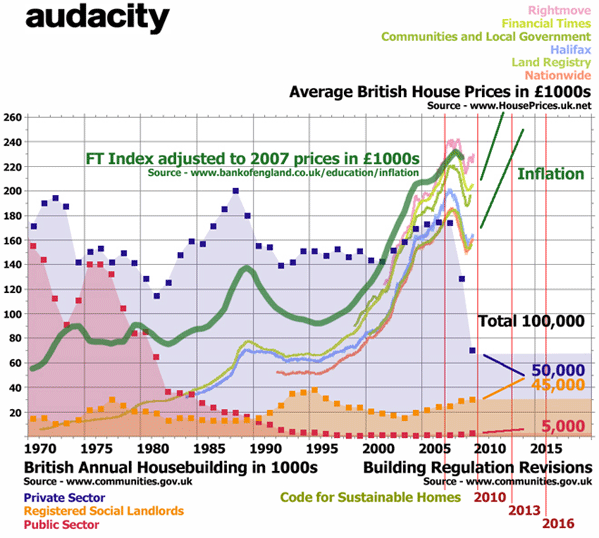
    There have been declines and recoveries in British house building before the 2007 collapse in construction activity. Data is in abundance. The total number of homes built annually has more than halved since the late 1960s, as successive governments withdrew from publicly funding the post-war welfare programme of council house building. There have been ups and downs in the volume of private housing built. After building 175,000 private homes in 2007 many expected that the market for new private housing would eventually recover from the financial crisis. The pent up demographic demand for new private housing would surely lead to a recovery of building if financing were made available. It seems irrational to suggest that the supply of housing will not recover to meet demand.

    In July 2008 audacity argued that British house builders would be collectively reduced in the planning regulated market to building 100,000 homes in 2009. They would shift from aspiring to build in “volume” to making their money from planning approved “eco-homes” for a luxury market. This has already occurred and there will be no necessary recovery of volume in a few years. Production may even decline from that level of inactivity.

    There seems little demand for new housing from the Public. Instead, we seem to be most concerned that housing continues to inflate in value as an asset. Most see obvious advantages in housing asset inflation, while complaining of the unaffordability of better housing. Britain is experiencing house price inflation again, but home owners know that the worsening gap between household income and the cost of buying a home, even on very low rates of interest, is frustrating new buyers, and the young in particular.

    Gordon Brown knows that playing the housing market is a mainstream activity for the electoral majority. New Labour is doing what is necessary to revive housing asset inflation. Some had hoped that the bursting of the bubble in 2007 would reconnect house prices with household income. Young people were understandably most hopeful of that prospect. Now prices are drifting upwards again to unaffordable highs. This is happening nationally, but is particularly true in greater London, where average house prices have recovered to nearly £270,000, which is where they were before the collapse of Lehman Brothers in September 2008. This makes an average house “affordable” to those earning more than £90,000 a year. That is a very small percentage of the region’s home buying public.

    Here’s what the restoration of higher prices means nationally, and in London in particular. There will be greater social immobility, expressed in more commuting, an extension of families, and several households living in the same home. Overcrowding will be more likely. Homelessness may slightly increase, but most housing difficulty will be accommodated within the existing stock.

    The mainstream majority of the electorate – those already owning homes – is likely to be grateful that the burst bubble did not turn into a crash. New Labour will try to take the credit for averting any further financial disaster. What will be ignored is that house price inflation suits Britain’s politicians, and the lending institutions in The City. The British economy is too weak to pay higher wages, and the mainstream majority are too politically weak to challenge that predicament. What other future is there for Britain except another asset inflation bubble?

    The problem then with restoring the Brown bubble is it solves none of our fundamental problems: notably a weak economy, low wages and lack of decent housing. David Cameron’s Conservative opposition will not make any difference to that predicament. They want to get rid of regional tiers of planners and to return control to local authorities, as was the intention of the 1947 Town and Country Planning Act. That is the legislation that stops the British public from building housing on cheap farmland.

    But it’s doubtful they will try to break the back of housing inflation and our country’s dependence on it. The British economy depends greatly on The City, which needs to expand the £1.2 trillion of mortgage lending in a secure way for lenders in the global financial system. This only happens when existing house prices are maintained well above the cost of constructing new ones, and best in a period of asset inflation. The trickle of new homes onto the market could reduce, and while any demographic demands of a growing population for the utility of housing would not be met, the political and economic demand for asset inflation and loan security will be satisfied.

    The way in which existing homes are made more expensive than the cost of building new ones is to inflate the price of land and keep it inflated. It is the high price of land approved for development within the 1947 legislation that is unaffordable. That is why government and house builders recognise there is “planning gain” to be negotiated over, as the uplift in land value that follows an approval to develop.

    Yet this stands in the way of a clear public interest. Government housing experts argue we need at least 240,000 new homes a year to meet demographic demand. Our inability, or even unwillingness, to tackle this issue would have shocked either the Conservatives or the Socialists of the last Century.

    What matters is to make materialist sense of the future. Society can’t live off asset inflation and debt. We must build new housing.

    We face a serious predicament today. Small quantities of highly subsidised and high density “eco-homes” are to be built by socially motivated architects, some working with the former “volume” house builders. How can building an insufficient number of homes be called “sustainable”? Instead of building new replacement homes Britain is also looking to finance a greener and endlessly refurbished housing stock, while producing too few “eco-homes” even to accommodate yearly household growth.

    The finance obsessed Green Capitalists of today are worse than their counterparts from a century ago. At least the Capitalists of the past were materialists, who believed in building more, and developing a construction industry based on materials manufacture and the skills of the workers they exploited. Those Capitalists were progressive materialists.

    The new capitalists in housing are not even interested in meeting the needs of the working and middle classes, but in pleasing environmentalists. Unsurprisingly, they also will not have to hire too many workers to build their meagre product. Today Capitalists are abandoning industrial production in favour of finance, and this is nowhere more evident than in housing. Hiding behind the moral claims of environmentalism the Capitalists of twenty-first century Britain have clearly abandoned any idea of social progress, when once they could claim to be materialists. What is noticeable is that they have so many moralistic Greens cheering them on.

    Sadly, there is no political association today to oppose Green Capitalists operating a nationalised planning system, in their effort to realise asset inflation in the form of a housing market. New Labour under Gordon Brown will not change this – indeed he clearly favours housing inflation and the City over the needs of aspiring families. So do the Conservatives under David Cameron. At the same time, they can play to a green constituency, which now dominates the media.

    Given the current planning regime and the moral imperative for building “eco-homes”, British house builders will be reduced to building around 100,000 homes for a very long time. They will aspire not to build in “volume” but instead take pride that their homes are “sustainable”.

    Only a political challenge will improve the situation. Gordon Brown faces no political challenge from David Cameron. He never will. Under New Labour or the Conservatives the only future for house builders will be to offer highly differentiated luxury “eco-homes” for the equity rich, or the top quintile of earners, supported with high subsidies in some form to build affordable “eco-homes”. Architects will particularly benefit from this shift in the market.

    New Labour will build a few council homes more as a publicity stunt to keep their middle class Old Labour supporters amused. Conservatives will not bother about such nonsense. They will both insist on “zero carbon” new housing by 2016. Both will focus on refurbishment of the existing stock, not replacement. Both will exclude more land from the planning system.

    The only people who will challenge this predicament, this retreat of Capitalism from population growth and industrial productivity, will be the working mainstream middle. Brown thinks he has bought off the majority of home owners with asset inflation, and temporarily he might have relieved many. Cameron thinks he can further mobilise established local residents attempting to extract more “gain” from the planning system. He imagines local opposition to development aggregating to a general protection of house price inflation nationally.

    These Red/Green and Blue/Green political leaders might be proved wrong. The construction industry matters, and with argumentative organisation materialists might push for house building against the greens of Britain. Most of all there is the new generation of British people – those entering their 20s and 30s – who will demand something other than over-priced, undersized and often miserably maintained housing for themselves and their families.

    A longer version of this article originally appeared at www.audacity.org/IA-07-11-09.htm

    Ian Abley, Project Manager for audacity, an experienced site Architect, and a Research Engineer at the Centre for Innovative and Collaborative Engineering, Loughborough University. He is co-author of Why is construction so backward? (2004) and co-editor of Manmade Modular Megastructures. (2006) He is planning 250 new British towns.

  • Honest Services From Bankers? Increasingly Not Likely

    Once you understand what financial services are, you’ll quickly come to realize that American consumers are not getting the honest services that they have come to expect from banks. A bank is a business. They offer financial services for profit. Their primary function is to keep money for individual people or companies and to make loans. Banks – and all the Wall Street firms are banks now – play an important role in the virtuous circle of savings and investment. When households have excess earnings – more money than they need for their expenses – they can make savings deposits at banks. Banks channel savings from households to entrepreneurs and businesses in the form of loans. Entrepreneurs can use the loans to create new businesses which will employee more labor, thus increasing the earnings that households have available to more savings deposits – which brings the process fully around the virtuous circle.

    As U.S. households deal with unemployment above 10% as a direct result of the financial crises caused by excessive risk-taking at banks, one bank, Goldman Sachs, posted the biggest profit in its 140-year history. According to Nobel laureate economist Joseph Stiglitz at Columbia University, Goldman’s 65% increase in profits is like gambling – the largest growth came from its own investments and not from providing financial services to households and businesses.

    Under fraud statutes created in 1988, Congress criminalized actions that deprive us of the right to “honest services.” The law has been used generally to prosecute fraudsters and potential fraudsters – from Jack Abramoff to Rod Blagojevich – whenever the public does not get the honest, faithful service we have a right to expect.

    The theory of “honest services” was used in one of the best known U.S. cases of financial misbehavior – Jeff Skilling of Enron – who has been granted a hearing early next year with the U.S. Supreme Court on the subject. Prosecutors won the original 2006 conviction on the strategy “that Skilling robbed Enron of his ‘honest services’ by setting corporate goals that were met by fraudulent means amid a widespread conspiracy to lie to investors about the company’s financial health.” The U.S. Attorney argued that CEO Skilling set the agenda at Enron. In this case, the fraud and conspiracy were means by which corporate ends were met.

    Skilling’s defense attorney admitted in his appeal before the 5th Circuit in April that his client “might have only bent the rules for the company’s benefit.” The appeal was not granted – a move by the court that is viewed as an overwhelming success for the prosecution. The application of the theory of “honest services” to the Skilling case – targeting corporate CEOs instead of elected officials – has been the subject of debate which may explain why the Supreme Court agreed to hear the arguments.

    Regardless of the outcome of that or other cases on the subject, the fact remains that bankers are doing better for themselves than they are for American households. This is the number one complaint we have about banks today. If I had to summarize the rest of what bothers us about banks, I would start with the fact that they are secretive. They take advantage of a very common fear of finance to convince consumers that they know what’s good for you better then you do.

    Next in line is the fact that they have purchased Congress. Banks have access to the halls of power that – despite 234 years of egalitarian rhetoric – ordinary voters can never achieve. Finally, we resent banks because we are required to use their services, like a utility, to gain access to the American Dream.

    Financial services contribute about 6 percent to the U.S. economy. Manufacturing and information industries use financial services, but the industry increasingly depends on itself: recall the portion of Goldman’s earnings growth coming from using its own investment services. According to the latest data from the Bureau of Economic Analysis, the financial services industry requires $1.27 of its own output to deliver a dollar of its final product to users. Despite the fact that our economic reliance on financial services has been creeping up steadily since 2001, they remain one of the least required inputs for U.S. economic output – only wholesale and retail trade have less input to the output of other industries.

    So, why did Congress vote them nearly a trillion dollars worth of life-support bailout money at the expense of taxpayers? Why did Wall Street get swine flu vaccine ahead of rural hospitals and health care workers? Why did they get the bailout without accountability? By making banks account for what they did with the money, congress could have 1) prohibited spending on bonuses and lavish retreats; 2) ensured improved access to credit for small and medium enterprises; and 3) provided transparency to taxpayers on who got how much and what they did with it. Need more reasons to demand honest services from a banker? Try this list:

    1. Congress raised the FDIC insurance to $200,000 to make depositors comfortable leaving money in banks; then the banks passed the insurance premium on to customers – including those that never had $200,000 cash in the bank in their lives and probably never will. Seriously, how much money do you have to have before it makes sense to have $200,000 in cash in a savings account earning 0.25%?
    2. Banks can borrow at 0% from the Fed yet they raise the interest rates they charge even their best customers. The bank I use for my company willingly lent me $10,000 last year to open a new office and approved a $7,000 credit card limit. Last month they sent me a letter saying they are raising the interest rate by +1.9 percentage point – though I have never missed a payment deadline.
    3. The banks can use our deposits to purchase securities issued by the Federal government, which are yielding better than 3 percent. They pay us about 0.25 percent yet still find it necessary to tack on a multitude of fees – which amount to 53 percent of banks’ income today, up from 35 percent in 1995.

    For now, Brother Banker skips along as lively as a cricket in the embers. But remember this: Marie Antoinette didn’t know anything about the French revolution until they cut off her head. Matt Taibbi, in a recent Rolling Stone article called Goldman Sachs a “great vampire squid wrapped around the face of humanity, relentlessly jamming its blood funnel into anything that smells like money.” We are at risk for leaving the virtuous circle behind and entering a vicious circle of spiraling inflation. A massive increase in government debt is being paid down by printing more money. Between July 2008 and November 2008, the Federal Reserve more than doubled its balance sheet from $0.9 trillion to $2.5 trillion. A year later, there is no evidence that they are trying to rein it in. As Brother Banker fails to provide honest services, a briar patch of a different kind may be waiting around the corner.

    Susanne Trimbath, Ph.D. is CEO and Chief Economist of STP Advisory Services. Her training in finance and economics began with editing briefing documents for the Economic Research Department of the Federal Reserve Bank of San Francisco. She worked in operations at depository trust and clearing corporations in San Francisco and New York, including Depository Trust Company, a subsidiary of DTCC; formerly, she was a Senior Research Economist studying capital markets at the Milken Institute. Her PhD in economics is from New York University. In addition to teaching economics and finance at New York University and University of Southern California (Marshall School of Business), Trimbath is co-author of Beyond Junk Bonds: Expanding High Yield Markets.

  • Congress and the Administration Take Aim at Local Democracy

    Local democracy has been a mainstay of the US political system. This is evident from the town hall governments in New England to the small towns that the majority of Americans choose to live in today.

    In most states and metropolitan areas, substantial policy issues – such as zoning and land use decisions – are largely under the control of those who have a principal interest: local voters who actually live in the nation’s cities, towns, villages, townships and unincorporated county areas. This may be about to change. Two congressional initiatives – the Boxer-Kerry Cap and Trade Bill and the Oberstar Transportation Reauthorization Bill – and the Administration’s “Livability Partnership” take direct aim at local democracy as we know it.

    The Boxer-Kerry Bill: The first threat is the proposed Senate version of the “cap and trade” bill authored by Senator Barbara Boxer-Kerry (D-California) and Senator John Kerry (D-Massachusetts). This bill, the Clean Energy Jobs and American Power Act (S. 1733), would require metropolitan planning organizations (MPOs) to develop greenhouse gas emission reduction plans. In these plans, the legislation would require consideration of issues such as increasing transit service, improvements to intercity rail service and “implementation of zoning and other land use regulations and plans to support infill, transit-oriented development or mixed use development.” This represents a significant step toward federal adoption of much of the “smart growth” or “compact development” agenda.

    At first glance, it may seem that merely requiring MPOs to consider such zoning and land use regulations seems innocent enough. However, the incentives that are created by this language could well spell the end of local control over zoning and land use decisions in the local area.

    True enough, the bill includes language to indicate that the bill does not intend to infringe “on the existing authority of local governments to plan or control land use.” Experience suggests, however, that this would provide precious little comfort in the behind-the-scenes negotiations that occur when a metropolitan area runs afoul of Washington bureaucrats.

    The federal housing, transportation and environmental bureaucracies have also been supportive of compact development policies. As these agencies develop regulations to implement the legislation, they could well be emboldened to make it far more difficult for local voters to retain control over land use decisions. There could be multiple repeats of the heavy-handedness exercised by the EPA when it singled out Atlanta for punishment over air quality issues. In response, the Georgia legislature was, in effect, coerced into enacting planning and oversight legislation more consistent with the planning theology endorsed by EPA’s bureaucrats. No federal legislation granted EPA the authority to seek such legislative changes, yet they were sought and obtained.

    There is also considerable support for the compact development agenda at the metropolitan area level. The proclivity of metropolitan and urban planners toward compact development is so strong as to require no encouragement by federal law. The emerging clear intent of federal policy to move land use development to the regional level and to densify existing communities could encourage MPOs to propose plans that pressure local governments to conform their zoning to central plans (or overarching “visions”) developed at the regional level. Along the way, smaller local jurisdictions could well be influenced, if not coerced into actions by over-zealous MPO staff claiming that federal law and regulation require more than the reality. It would not be the first time. Further, MPOs and organizations with similar views can be expected to lobby state legislatures to impose compact development policies that strip effective control of zoning and land use decisions from local governments.

    Surface Transportation Reauthorization: The second threat is the Surface Transportation Authorization Act (STAA or reauthorization) draft that has been released by Chairman James Oberstar (D-Minnesota) of the House Transportation and Infrastructure Committee. This bill is riddled with requirements regarding consideration of land use restrictions by MPOs and states. Unlike the Boxer-Kerry bill, the proposed STAA includes no language denying any intention to interfere with local land use regulation authority.

    Like the Boxer-Kerry Bill, the Oberstar bill significantly empowers the Department of Transportation and the Environmental Protection Agency and poses similar longer term risks.

    The Administration’s “Livability Agenda:” These legislative initiatives are reinforced by the Administration’s “Livability Agenda,” which is a partnership between the EPA, the Department of Housing and Urban Development and the Department of Transportation. Among other things, this program is principally composed of compact development strategies, including directing development to certain areas, which would materially reduce the choices available to local government. Elements such as these could be included in an eventual STAA bill by the Obama Administration.

    The Livability Agenda: Regrettably, the Boxer-Kerry bill, the Oberstar bill and the “Livability Agenda” will make virtually nothing more livable. If they are successful in materially densifying the nation’s urban areas, communities will be faced with greater traffic congestion, higher congestion costs and greater air pollution. Despite the ideology to the contrary, higher densities increase traffic volumes within areas and produce more health hazards through more intense local air pollution. As federal data indicates, slower, more congested traffic congestion produces more pollution than more freely flowing traffic, and the resulting higher traffic volumes make this intensification even greater.

    There are also devastating impacts on housing affordability that occur when “development is directed.” This tends to increase land prices, which makes houses more expensive. This hurts all future home buyers and renters, particularly low income and minority households, since rent increases tend to follow housing prices. It is particularly injurious to low income households, which are disproportionately minority. The large gap between majority and minority home ownership rates likely widen further. So much for the American Dream for many who have not attained it already.

    The Marginal Returns of Compact Development Policies: These compact development initiatives continue to be pursued even in the face of research requested by the Congress indicating that such policies have precious little potential. The congressionally mandated Driving and the Built Environment report indicates that driving and greenhouse gas emissions could be higher in 2050 than in 2000 even under the maximum deployment of compact development strategies.

    Local Governments at the Table? The nation’s local governments should “weigh in” on these issues now, while the legislation is being developed. If they wait, they could find bullied by EPA and MPOs to follow not what the local voters want, but what the planners prefer. Local democracy will be largely dead, a product of a system that concentrates authority – and perceived wisdom – in the hands of the central governments, at the regional and national level.

    Even more, local citizens and voters need to be aware of the risk. It will be too late when MPOs or other organizations, whether at their own behest or that of a federal agency, force the character of neighborhoods to be radically changed, as Tony Recsei pointed out is
    already occurring in Australia.

    Wendell Cox is a Visiting Professor, Conservatoire National des Arts et Metiers, Paris. He was born in Los Angeles and was appointed to three terms on the Los Angeles County Transportation Commission by Mayor Tom Bradley. He is the author of “War on the Dream: How Anti-Sprawl Policy Threatens the Quality of Life.

  • Detroit: Urban Laboratory and the New American Frontier

    The troubles of Detroit are well-publicized. Its economy is in free fall, people are streaming for the exits, it has the worst racial polarization and city-suburb divide in America, its government is feckless and corrupt (though I should hasten to add that new Mayor Bing seems like a basically good guy and we ought to give him a chance), and its civic boosters, even ones that are extremely knowledgeable, refuse to acknowledge the depth of the problems, instead ginning up stats and anecdotes to prove all is not so bad.

    But as with Youngstown, one thing this massive failure has made possible is ability to come up with radical ideas for the city, and potentially to even implement some of them. Places like Flint and Youngstown might be attracting new ideas and moving forward, but it is big cities that inspire the big, audacious dreams. And that is Detroit. Its size, scale, and powerful brand image are attracting not just the region’s but the world’s attention. It may just be that some of the most important urban innovations in 21st century America end up coming not from Portland or New York, but places like Youngstown and, yes, Detroit.

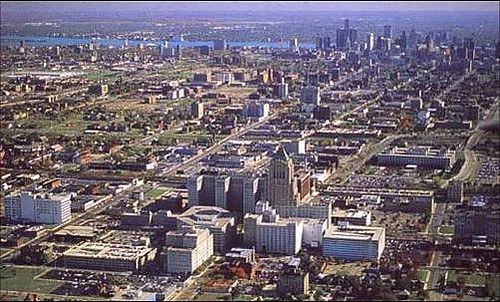
    Let’s refresh with this image showing the scale of the challenge in the city of Detroit proper:


    There are zillions of pictures to illustrate the vast emptiness in Detroit. Kaid Benfield at NRDC posted these:


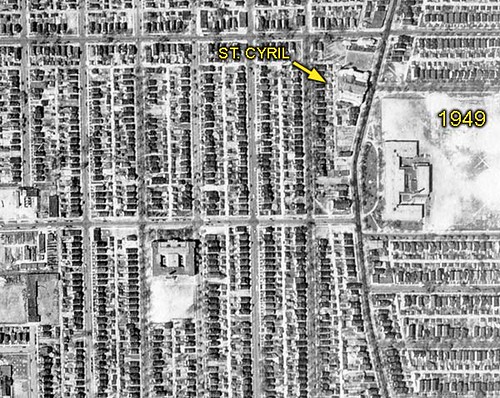
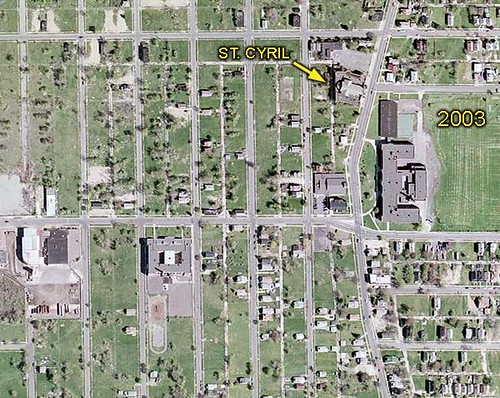
    This phenomenon prompted someone to coin the term “urban prairie” to capture the idea of vast tracts of formerly urbanized land returning to nature. The folks at Detroit’s best discussion site, DetroitYES, posted this before and after of the St. Cyril neighborhood. Before:


    After:


    A site named “Sweet Juniper” recently had a fantastic photo of the spontaneous creation of “desire line” paths across all this vacant land. You should click to enlarge this photo.


    One natural response is the “shrinking cities” movement. While this has gotten traction in Youngstown and Flint, as well as in places like Germany, it is Detroit that provides the most large scale canvas on which to see this play out, as well as the place where some of the most comprehensive and radical thinking is taking place. For example, the American Institute of Architects produced a study that called for Detroit to shrink back to its urban core and a selection of urban villages, surrounded by greenbelts and banked land. Here’s a picture of their concept:


    It seems likely that this will get some form of traction from officialdom, as this article suggests, though implementation is likely to be difficult.

    Detroit is also attracting dreams of large scale renewal through agriculture, as Mark Dowie writes in Guernica (hat tip @archizoo).

    Were I an aspiring farmer in search of fertile land to buy and plow, I would seriously consider moving to Detroit. There is open land, fertile soil, ample water, willing labor, and a desperate demand for decent food. And there is plenty of community will behind the idea of turning the capital of American industry into an agrarian paradise. In fact, of all the cities in the world, Detroit may be best positioned to become the world’s first one hundred percent food self-sufficient city.

    This isn’t just a crazy idea from some guy who lives in California. He documents several examples of people right now, today growing food in Detroit. It wouldn’t surprise me, frankly, if Detroit produces more food inside its borders today than any other traditional American city.

    About five hundred small plots have been created by an international organization called Urban Farming, founded by acclaimed songwriter Taja Sevelle. Realizing that Detroit was the most agriculturally promising of the fourteen cities in five countries where Urban Farming now exists, Sevelle moved herself and her organization’s headquarters there last year. Her goal is to triple the amount of land under cultivation in Detroit every year. All food grown by Urban Farming is given free to the poor. According to Urban Farming’s Detroit manager, Michael Travis, that won’t change.

    The fact that Urban Farming moved to Detroit is exactly the effect I’m talking about. To anyone with aspirations in this area, it is Detroit that offers the greatest opportunity to make your mark. It is the ultimate blank canvas. For urban agriculture and many other alternative urban dreams, it is Detroit, not New York City that is the ultimate arena in which to prove yourself.

    It’s not just farmers; intellectuals and artists of various types are drawn to Detroit, both to study it and pursue ideas about the remaking of the city:

    Detroit has achieved something unique. It has become the test case for all sorts of theories on urban decay and all sorts of promising ideas about reviving shrinking cities.

    “It’s unbelievable,” said Sue Mosey, president of the University Cultural Center Association, who has been interviewed recently by two separate PBS crews and an Austrian journalist writing about Detroit.

    “All of us have been inundated with all of these people who somehow think that because we’re so bottomed out and so weak-market, that this is this incredible opportunity,” Mosey said.

    Robin Boyle, a professor of urban planning at Wayne State University who has been interviewed by numerous visitors, echoed that sentiment.

    “They realize that there is an interesting story to tell, that has real characters, but even more, they discover a place that is simply not like everywhere else,” he said.

    Toby Barlow wrote in the New York Times about out of towners buying up $100 houses, moving to Detroit, and doing all sorts of interesting things with them:

    Recently, at a dinner party, a friend mentioned that he’d never seen so many outsiders moving into town…Two other guests that night, a couple in from Chicago, had also just invested in some Detroit real estate. That weekend Jon and Sara Brumit bought a house for $100.
    ….
    A local couple, Mitch Cope and Gina Reichert, started the ball rolling. An artist and an architect, they recently became the proud owners of a one-bedroom house in East Detroit for just $1,900. Buying it wasn’t the craziest idea. The neighborhood is almost, sort of, half-decent. Yes, the occasional crack addict still commutes in from the suburbs but a large, stable Bangladeshi community has also been moving in.

    So what did $1,900 buy? The run-down bungalow had already been stripped of its appliances and wiring by the city’s voracious scrappers. But for Mitch that only added to its appeal, because he now had the opportunity to renovate it with solar heating, solar electricity and low-cost, high-efficiency appliances.

    Buying that first house had a snowball effect. Almost immediately, Mitch and Gina bought two adjacent lots for even less and, with the help of friends and local youngsters, dug in a garden. Then they bought the house next door for $500, reselling it to a pair of local artists for a $50 profit. When they heard about the $100 place down the street, they called their friends Jon and Sarah.
    ….

    But the city offers a much greater attraction for artists than $100 houses. Detroit right now is just this vast, enormous canvas where anything imaginable can be accomplished. From Tyree Guyton’s Heidelberg Project (think of a neighborhood covered in shoes and stuffed animals and you’re close) to Matthew Barney’s “Ancient Evenings” project (think Egyptian gods reincarnated as Ford Mustangs and you’re kind of close), local and international artists are already leveraging Detroit’s complex textures and landscapes to their own surreal ends.

    In a way, a strange, new American dream can be found here, amid the crumbling, semi-majestic ruins of a half-century’s industrial decline. The good news is that, almost magically, dreamers are already showing up. Mitch and Gina have already been approached by some Germans who want to build a giant two-story-tall beehive. Mitch thinks he knows just the spot for it.

    It’s what Jim Russell likes to call “Rust Belt chic”, and Detroit has it in spades.

    This piece also highlights the absolutely crucial advantage of Detroit. It’s possible to do things there. In Detroit, the incapacity of the government is actually an advantage in many cases. There’s not much chance a strong city government could really turn the place around, but it could stop the grass roots revival in its tracks.

    Can you imagine a two-story beehive in Chicago? In many cities where strong city government still functions effectively, citizens are tied down by an array of regulations and permits that are actually enforced in most cases. Much of the South Side of Chicago has Detroit like characteristics, but the techniques of renewal in Detroit won’t work because they are likely against code and would be shut down the minute someone complained. Just as one quick example, my corner ice cream stand dared to put out a few chairs for patrons to sit on while enjoying a frozen treat on a hot day. The city cited them for not having a license. So they took them away and put up a “bring your own chair” sign. The city then cited them for that too. You can’t do anything in Chicago without a Byzantine array of licenses, permits, and inspections.

    In central Indianapolis, which is in desperate need of investment, where the city can’t fill the potholes in the street, etc., the minute a few yuppies buy houses in an area and fix them up, they immediately petition for a historic district, a request that has never been refused, ensuring that anyone who ever wants to do anything will be forced to run a costly and grueling gauntlet of variances, permits, hearings, etc. Only the most determined are willing to put up with that.

    In most cities, municipal government can’t stop drug dealing and violence, but it can keep people with creative ideas out. Not in Detroit. In Detroit, if you want to do something, you just go do it. Maybe someone will eventually get around to shutting you down, or maybe not. It’s a sort of anarchy in a good way as well as a bad one. Perhaps that overstates the case. You can’t do anything, but it is certainly easier to make things happen there than in most places because the hand of government weighs less heavily.

    What’s more, the fact that government is so weak has provoked some amazing reactions from the people who live there. In Chicago, every day there is some protest at City Hall by a group from some area of the city demanding something. Not in Detroit. The people in Detroit know that they are on their own, and if they want something done they have to do it themselves. Nobody from the city is coming to help them. And they’ve found some very creative ways to deal with the challenges that result. Consider this from the Dowie piece:

    About 80 percent of the residents of Detroit buy their food at the one thousand convenience stores, party stores, liquor stores, and gas stations in the city. There is such a dire shortage of protein in the city that Glemie Dean Beasley, a seventy-year-old retired truck driver, is able to augment his Social Security by selling raccoon carcasses (twelve dollars a piece, serves a family of four) from animals he has treed and shot at undisclosed hunting grounds around the city. Pelts are ten dollars each. Pheasants are also abundant in the city and are occasionally harvested for dinner.

    This might sound awful, and indeed it is. But it is also an inspiration and a testament to the human spirit and defiant self-reliance of the American people. I grew up in a poor rural area where, while hunting is primarily recreational, there are still many people supplementing their family diet with wild game. Many a freezer is full of deer meat, for example. And of course, rural residents have long gardened, freezing and canning the results to help get them through the winter. So this doesn’t sound quite so strange to me as it might to you. The fate of the urban poor and the rural poor are more similar than is often credited. And contrary to stereotypes the urban poor often display amazing grit and ingenuity, and perform amazing feats to sustain themselves, their families and communities.

    As the focus on agriculture and even hunting show, in Detroit people are almost literally hearkening back to the formative days of the Midwest frontier, when pioneer settlers faced horrible conditions, tough odds, and often severe deprivation, but nevertheless built the foundation of the Midwest we know, and the culture that powered the industrial age. No doubt in the 19th century many of those sitting secure in their eastern citadels thought these homesteaders, hustlers, and fortune seekers crazy for leaving the comforts of civilization to head to places like Iowa and Chicago. But some saw the possibilities of what could be and heeded the call to “Go West, young man.” We’ve come full circle.

    More Detroit

    Detroit: Do the Collapse
    Detroit: Not the Future of the American City
    For talent – good jobs, cools places, new narrative (Crain’s Detroit Business – featuring Yours Truly)

    Aaron M. Renn is an independent writer on urban affairs based in the Midwest. His writings appear at The Urbanophile.

  • Housing Design: Create The Next Classic

    I often compare home marketing to automotive marketing, not because I was raised in Detroit and am somewhat of a motor head, but because these are two very big ticket items that have been developed and marketed in very different ways. You may think that auto companies are huge corporate conglomerates, and builders are mostly small, local companies selling a home or two, but the major builders certainly are not small concerns. A major builder selling 50,000 homes at $250,000 each would generate the same total income as a small auto company selling 500,000 cars at $25,000 each. Yet, there has been much more product research, development, testing, and marketing on cars, SUVs or trucks than on homes.

    To “drive” this comparison home consider the following: Compare the specifications on a $140,000 (adjusted for inflation) 30 year old Ferrari 308 which was state of the art in 1980, and even the most basic car, for example a Hyundai Genesis Coupe. The two passenger 300 horsepower Ferrari would do 0-60 in 6.8 seconds with a top speed of 142 HPH, slower than the $25,000 Hyundai ‘s 0-60 in 5.5 seconds, top speed at 149 MPH. The Hyundai would actually make that hairpin turn with a computer assisted 0.90g lateral acceleration, while the Ferrari would slide into the roadside ditch at only 0.81g.

    And the list goes on. The Hyundai adds 10 more highway MPG to the Ferrari’s 16 MPG. Watch out for deer? At an emergency stop from 60 MPH the Hyundai takes only 111 feet, a whopping 42 feet less than the Ferrari which plows right through Bambi. After adjusting for inflation, the specifications of the Hyundai blow past the Ferrari for 80% less money. Reliability? Not even close. The Ferrari 308 owner will be on a first name basis with his or her mechanic, and probably even know his family.

    So… while it seems stagnant at times, the auto industry has still made tremendous progress. From a style, materials, and overall design standpoint, any of today’s cars and trucks render those built in the early 1980s obsolete. The industry offers an astonishingly better product than it did twenty-five years ago. This is despite a few moments when auto manufacturers lost their way. Remember 1981 — a recession with car showrooms in shambles and the government rescuing Chrysler — and Lee Iacocca touting the “K” Car? My, auto makers have come a long way!

    Now let’s compare the 1980 suburban single family home to the 2006 (the height of the housing market) suburban single family home.

    From National Association of Home Builders data we see that the average 1980 house was just over $76,000 and averaged about 1,800 square feet. Adjusted for inflation, that 1980 home would be approximately $190,000 in 2006 dollars. This equates to approximately $105 a square foot. The 1980s were also the age of large sprawling suburban lots; 10,000 sq.ft would have been considered, in some areas, too small. Suburban densities of two units per acre were typical in the north, with higher densities in the three to four unit per acre range as one traveled south. The 1980’s home price included a spacious lot.

    Fast forward through 26 years (of evolution?). Homes gradually increased in size to an average of 2,414 sq.ft. (again, NAHB data). The typical home in 2006 cost $264,000, or $109 a square foot. Essentially, the home built at the peak of the market cost only slightly more than the home built in 1980. Lot areas generally have come down in size. In the south where densities were already higher, the lot size reduction was minimal, but in the north that 1980 10,000 sq.ft. lot that was once considered small would today be considered quite large.

    The 1980s home would have been built to a lower standard with little in energy conservation; it was wasteful. The home built 25 years later — at the height of the market in 2006 — would have been built to much higher standards, both in construction and in energy efficiency.

    Today’s consumer may favor the older, 1980s suburban home. It is likely built in an area with mature landscaping, local conveniences, and established schools, and it is probably located closer to town (employment), on a larger lot. Yes the home is slightly older, but not significantly visually different than the more recent home, at least to the naked eye. The transition from the previous three decades, 1950 to 1980, was drastic. But it was not so in the past 30 years.

    The new suburban home in today’s market is typically on the outer edge of urbanization. The confidence level that services and schools will be developed in a timely manner is much lower. There simply has not been a significant change in housing during the past three decades. The garage-forward 1980s home that proudly displays massive garage doors that define the streetscape is similar to the suburban homes built today, except the home built today might also include the obligatory porch sitting next to the garage.

    Three decades ago Chrysler responded to market changes with the K car, a cheap car that was commercially successful. Notice how many K cars you see on the road today? Longevity, reliability and quality were not its strong points. Cars are temporary. They are disposable and recyclable. Today’s home builders are largely responding to the housing market with a K car attitude of scrimping that will only make the homes built on yesterday’s developments seem even more attractive.

    But housing stock cannot survive on temporary solutions that respond to short trends. The lot that is sold today is likely to be around for many centuries. The home will likely be remodeled over time, but its foundation may last as long as the lot. There are no junk yards for houses…well there are, and they’re called slums.

    Builders rely on suppliers to develop products that improve the housing stock. For example, the vinyl cladding era of the 1980s has been (somewhat) replaced by more attractive concrete based products and wood alternatives. The problem is that these vinyl alternatives are often more expensive – in some cases, much more.

    It’s time for builders to respond by following the automotive industry. That means offering enough of a design revolution to attract new customers. Investing in research and development at a time when banks turn away builders and developers might seem an impossible task. As a design and technology company, we know that first hand. We have a huge investment in future technologies that will not be available until the beginning of 2010.

    Before the recession, we typically invested 10% of our gross income (designing new developments) in new technologies. Planning and architecture is not exactly a thriving industry today. Banks are not interested in funding anything related to land development, sustainability, or software. To keep development on track, our investment now represents over 50% of our total income.

    Getting through this period has been tough, but at the end of the day we will have a revolutionary product with a new range of services that will benefit development-related industries. Architects can respond to a down market by investing their down time in experimentation and development of better design methods to increase the value of housing, instead of sitting around waiting for a client to call.

    During this past decade people got used to making a new home purchase to supplement their income, assuming that home values would rise several thousands of dollars annually. Those days are gone. Give consumers a new reason to buy: a better product. When future housing customers have the opportunity to significantly increase their living standards by purchasing new homes vs. staying where they are, they will want to buy new again.

    Rick Harrison is President of Rick Harrison Site Design Studio and author of Prefurbia: Reinventing The Suburbs From Disdainable To Sustainable. His website is rhsdplanning.com.

  • The Week New Urbanism Died?

    It has been a bad media week for New Urbanism.

    The day that New Urbanism Died?” was the headline of the St. Louis Urban Workshop blog that detailed the Chapter 11 bankruptcy of Whittaker Builders, developer of the “New Town at St. Charles,” a premier New Urbanist community located in the St. Louis exurbs (beyond the suburbs).

    The author notes that “New Town will not disappear, plenty of people are happy to live there, but its promise is gone. It’s become just another suburban enclave and will face the same challenges as other suburban developments; lack of retail, long commutes, etc.” The blog’s headline is a play on a characterization by postmodern architect Charles Jenks, who referred to the demolition of the infamous Pruitt-Igoe public housing project as “The Day Modern Architecture Died.”

    The Northwest Indiana Times detailed the failure of a new urbanist community (Coffee Creek) in an October 23 article. The article noted that the planned 2,000 home mixed use development, located in the exurbs 45 miles from Chicago’s Loop had attracted only 12 homes and an apartment building. Much of the empty land has been purchased by another developer, who indicated an affection for the new urbanism concept, noting however that it probably would not work here. The article notes that a more modest New Urbanist development is doing better, in nearby Burns Harbor, with 75 homes occupied out of a planned 300.

    Perhaps the unkindest cut of all was a survey, reported by the Oregonian, to the effect that residents of Orenco Station travel by car to work nearly as much as people who live in the unremarkably conventional and sprawling suburbs of Portland.

    Despite these unhappy stories, the death of New Urbanism is not imminent. True, to the extent that New Urbanism requires subsidies it is likely to prove unsustainable in the longer term, like its Pruitt-Igoe type predecessors. On the other hand, to the extent that New Urbanism represents a genuine response of architects, builders and developers to actual, rather than imagined demand, New Urbanism could be with us for some time to come.

  • Fixing the Mortgage Mess: Why Treasury’s Efforts at both Ends of the Spectrum Are Failing

    To get a better idea why the Obama Administration’s efforts to stem the home foreclosure crisis have failed at both ends of the problem, you need only go back to that great scene in Frank Capra’s classic, “It’s A Wonderful Life,” where protagonist George Bailey (Jimmy Stewart) is on his way out of Bedford Falls with his new bride and high school crush, the former Meg Hatch (Donna Reed). The newlyweds are heading toward the train station to leave on their honeymoon when Meg notices a commotion outside the Bailey Bros. Building & Loan Association, founded by George’s revered but now deceased father, Henry, and Henry’s bumbling brother, Billie.

    The “commotion” is actually a run on the bank. George – bless his heart, and with the full encouragement of the new Mrs. Bailey – hops out of Ernie’s cab to see if he can quell the growing crowd assembling outside the locked doors of the Building & Loan. With his usual calm George assesses the situation, asks Uncle Billie to unlock the doors to let the gathering mob into the Building & Loan, and then proceeds to talk (most of) them out of closing their accounts and being refunded the value of their shares.

    George patiently explains to his anxious Association members that he can’t give each of them 100% of the value of their Bailey Brothers Building & Loan Association shares because the funds from those shares have already been loaned out to worthy borrowers so they can afford to build or buy houses in the community. States George from behind the teller counter:

    “…you’re thinking of this place all wrong. As if I had the money back in a safe. The, the moneys not here. Well, your money’s in Joe’s house…that’s right next to yours. And in the Kennedy’s House, and Mrs. Macklin’s house, and a hundred others. Why, you’re lending them the money to build, and then, they’re going to pay you back as best they can. Now what are you going do? Foreclose on them?”

    Just as George appears to be making progress, however, a now former Association member comes running into the Building & Loan pronouncing that Old Man Potter (Lionel Barrymore), who owns the bank and every other business in Bedford Falls, is offering to buy Bailey Brothers Building & Loan shares at 50 cents on the dollar (in an obvious effort to take advantage of the situation by running George Bailey out of business). Saving the day, and confirming that George has indeed made a life-changing decision in his choice of mates, the new Mrs. Bailey, with $2,000 in cash in her purse for their honeymoon, offers the money to the anxious Association members filling the building lobby. George then adroitly parses out their honeymoon money in the smallest increments he can persuade folks to accept under the circumstances.

    The scene tells us much about what went wrong with the residential real estate market nationwide. It is more than merely nostalgic to long for such elegant simplicity in the manner in which deposited funds were invested in things such as home mortgages. However, the only thing quainter than that scene in “It’s a Wonderful Life” is the idea of a bank or other financial institution originating, owning, and servicing the same mortgage. And therein lies the rub for efforts by the Treasury Department to help right the residential mortgage ship of state through the Making Home Affordable mortgage modification program and the Legacy Asset Recovery program.

    The root the problem lies with the complete disconnect between those who actually own the notes secured by the vast majority of residential mortgages in this country and those who “service ” those mortgages. Right now there is little if any incentive for those servicers to participate in the Treasury Department’s mortgage modification initiative (the Making Home Affordable mortgage modification program or “MHAP”), originally projected to foster the modification of 2.5 million mortgages but having resulted in only a fraction of that number in modified mortgages. This is at least in part because the fee structure under the existing servicing agreements does not adequately compensate the servicer for the amount of effort required to accomplish a mortgage modification. Further, there’s no clearly and easily identifiable “owner” of the notes that are secured by the underlying mortgages putting pressure on the servicers to modify these mortgage

    The national mega-banks that have received the lion’s share of Treasury’s multi-trillion bail-out of the banking industry have been, by far, the worst offenders in not embracing and implementing this program. And the problem can’t easily be fixed because it is structural in nature, the by-product of a system ironically intended to keep credit flowing into the residential sales market. For example, in Treasury’s recently released Servicer Performance Report through September 2009, Bank of America had modified under the MHAP only 11% of its approximately 876,000 home mortgages delinquent by 60 days or more (thereby making them eligible for modification under MHAP).

    The structural problems prevail at the investor-end of this morass as well. After much Congressional rhetoric and even more Wall Street teeth-gnashing over mark-to-market legislation late in 2008 that would have forced the holders of mortgage-backed securities (“MBS”) to mark down the value of their mortgage loan portfolios based on reductions in the underlying collateral value, Congress declined to take such action. The Legacy Asset Recovery program (so-called by Treasury because, quite honestly, who wants to invest in “toxic” assets), the investment component of Treasury’s Public-Private Investment Program or “PPIP,” pairs private capital with Treasury capital and then makes up the difference with federal low-cost debt. This program is intended to mitigate potential risks and rewards for these new equity participants by halving the amount of private equity that must be raised (since half of the total equity is provided by the government) and providing all of the required debt. As with any program whose purpose is to encourage private investments in bad debts – recalling the RTC program from the early 90s – potential profit is directly correlated to discounting the Legacy Asset purchasing entity can achieve in negotiations with the MBS holders.

    Regrettably, the assumptions underpinning the theory quickly prove not to be reasonable. At its core, the problem is that, in order for this initiative to work, the MBS holders need to do that one thing they’ve absolutely refused to do thus far: Take any losses.

    MBS holders are betting on their ability to hold onto their mortgage pools for as long as it takes for the excess housing inventory in the marketplace to get absorbed. They are also waiting for the end of the recession (perhaps around the corner but perhaps not) to turn into a full-fledged economic recovery, so that underlying real estate values start to catch up to portfolio values.

    Will this strategy work? Likely not if there’s a slow, largely jobless recovery that doesn’t support the housing market. As of now, the most recent projections for economic recovery in the real estate sector are looking to 2013. In the meantime, Treasury’s programs at both ends of the mortgage crisis will have done very little to stem foreclosures or stabilize capital flows to the housing market.

    Compounding the structural infirmities of these two “recovery” programs is that job growth is most likely to come first in states that have relatively few problems (Washington, D.C.-Metro Area; Great Plains; Texas) and will be far slower in many of the most troubled states, notably California, Michigan and Ohio, and parts of the Northeast. Hindsight being 20/20, rather than focusing so much attention and so many resources on helping the financial industry, which has been by far the largest recipient of Washington’s largess, the focus should have been on job preservation and job creation. The links, after all, between mortgage performance, housing values, and employment are undeniable.

    Peter Smirniotopoulos, Vice President – Development of UniDev, LLC, is based in the company’s headquarters in Bethesda, Maryland, and works throughout the U.S. He is on the faculty of the Masters in Science in Real Estate program at Johns Hopkins University. The views expressed herein are solely his own.

  • Home-Based Businesses: Residential Zoning and The Cyber Village

    Currently in the United States about 27% of all homes have some form of a home based business. These businesses can be key to conservation efforts that lower our carbon footprint by reducing transportation needs, eliminating redundant facilities, and consolidating equipment. They provide significant opportunities for two solutions to problems that face today’s growth issues.

    My software company was founded in Dallas, where I worked from the dining room table in an apartment. I yearned for the day my business could operate out of a real office. After the business started generating a positive cash flow the apartment was left behind, and my office moved to a location in the newly built Dallas Galleria. My 104 square feet of office space was complimented with a separate meeting room, receptionist, and a parking space in the garage. All this cost me $600 a month. After the initial six month lease was up the rent skyrocketed and parking was no longer free; however, the 104 square feet remained the same.

    Oh, how I yearned for a nice dining room table to work from!

    Soon I decided that the money spent on rent — both apartment and Galleria office — could build a really nice home. In 1982 I built a home specifically designed for a residence and my business. With about 4,000 square feet, of which about one third was dedicated business space with a separate office entrance, we had a viable base from which to live and work.

    The IRS allowed us to write-off one third of the total housing expenses without question. By not having to pay office rent we could double the home payments, and the 30 year mortgage was paid in full in less than 10 years.

    Maple Grove, the lakefront suburban Minnesota community where we had built, allowed a home business occupation via ordinance limited to one non-family employee. At first we complied, but the business grew. At times there were up to 6 employees at the home, but neighbors did not complain.

    I was not the only lake front home operating a big business. Across the lake, a major manufacturer of car radar warning units operated out of the basement of a house. This was a husband-and-wife business, but it was no small operation. The company had full page ads in leading automotive magazines. I sometimes visited; I’d hear the phone ring with an order, and the wife would say ‘I’ll see if we have any in stock at the warehouse, can you hold?’ She would then call down to the basement and ask if they could make an A-50 unit for shipping. Nobody but the UPS man would know the truth!

    Solution #1: The Residential/Business
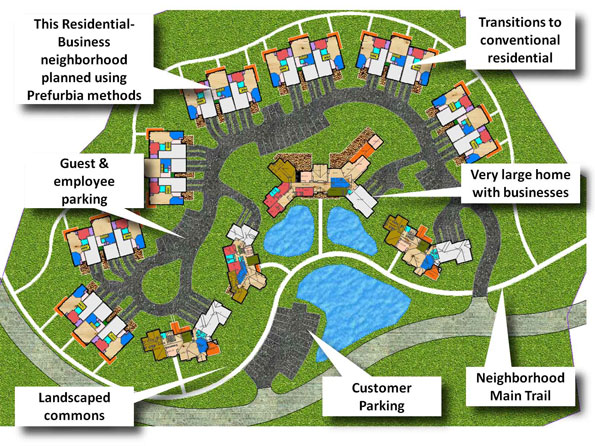
    The Residential/Business (RB zoning) would be an entirely new land use, sort of a morphing of an office center and a neighborhood of luxury single family homes. Office complexes typically have a higher degree of landscaping and architectural detail than single family developments. In the RB neighborhood, homes would be large and impressive with heavily landscaped commons that serve as pedestrian access to the businesses that are located within the home structure.

    Family members and employees would park in the rear, with multiple garage spaces and outside parking for the employees. From the arterial streets abutting these developments it would be an impressive sight, giving a sense of wealth to the neighborhood and municipality. The types of businesses would be restricted to low traffic professional services, including medical services, but also could include very light manufacturing. The RB zones would be an excellent transition (buffer) from commercial centers to residential ones. The RB residential structures would house the entire business and home, serving as the main hub for all of the business needs.

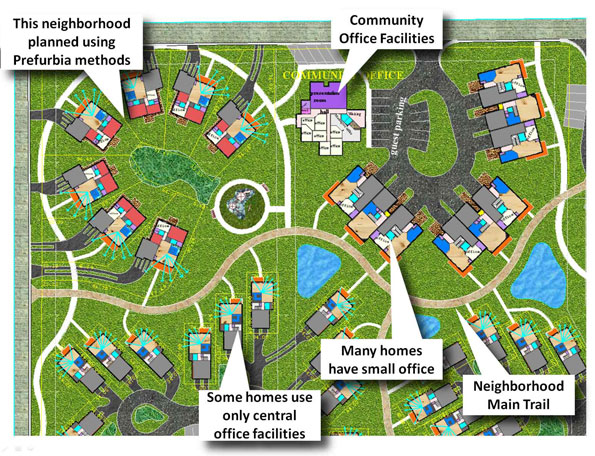
    Below, a Residential/Business community

    There could be some overlap of business functions into the residential elements of the home. For example, a conference center with an 80 inch screen for presentations could be used for Monday night football on occasion. From a financial standpoint, for a small to medium sized business owner this is a win-win situation. It delivers the advantages that I had experienced in my own situation in a comprehensive, specifically designed development plan.

    Solution #2: The Cyber Village
    George E. Van Hoesen, of Global Green Building, LLC, has developed an alternative solution, the Cyber Village.

    The proliferation of computers and cell phones, as well as video conferencing and express delivery, has made the notion of the at-home cyber office an excellent solution for growth issues. New definitions of work, recreation, and education have brought the family home again. Residential design and community planning can begin to address the increasing needs of these new households while keeping the neighborhood’s primarily residential character.

    Unlike the Residential/Business solution, homes in the Cyber Village need not be as business intensive or change the character of a neighborhood. A main component of the Cyber Village is the Cyber Office, serving as the community foundation for business activity. This facility, complete with offices, reception services, mail services, meeting rooms, board rooms, reference libraries and office equipment, would serve subscribers (businesses within the neighborhood) for their out-of-office and administrative needs. This Cyber Office location could serve as the hub for deliveries, recycling, storm shelter, resource center, rideshare, and other community resource needs. Subscribers would choose the level of access to the facility based on their own individual business needs. The features of the cyber office would lend credibility and added professionalism to a residence-based business without breaking the bank.

    Below, a Cyber Village

    The neighborhood Cyber Office could be managed as a for-profit business, providing services for a fee. Communities could also manage a Cyber Office as a part of the homeowners association. A mix of services could be provided, depending on the needs of the community. The overall concept reduces the carbon footprint of the home-based business and addresses the needs of the changing work place.

    Zoning Both Solutions
    Both solutions fall outside the scope of conventional zoning. The Cyber Village may comply more easily with existing regulations, especially those that allow a home to operate a business with a few employees. If a city’s regulations are flexible enough, it may be possible to design and implement a Cyber Village that complies with city code now. The Residential/Business solution, with its more aggressive business size, would compete with — or make obsolete — office complexes. Office “use” is often taxed at a higher rate than residential use. Since cities do not like to lose tax revenue, it is likely that municipalities would require a new basis to tax the RB residents.

    Creating a new zoning class and tax classification is not difficult, but it might be time consuming. The current slow market allows cities to restructure their zoning and tax codes, so now is the time to act.

    Both solutions would have a significant reduction on the carbon footprint of land development. They offer alternatives to the Smart Growth solutions in which shop owners are encouraged to live over their stores in high density developments. Both the Residential/Business and the Cyber Village alternatives curb traffic and sprawl…and at the same time, provide residential settings with enough space for family enjoyment.

    Rick Harrison is President of Rick Harrison Site Design Studio and author of Prefurbia: Reinventing The Suburbs From Disdainable To Sustainable. His website is rhsdplanning.com.

  • There’s No Place Like Home, Americans are Returning to Localism

    On almost any night of the week, Churchill’s Restaurant is hopping. The 10-year-old hot spot in Rockville Centre, Long Island, is packed with locals drinking beer and eating burgers, with some customers spilling over onto the street. “We have lots of regulars—people who are recognized when they come in,” says co-owner Kevin Culhane. In fact, regulars make up more than 80 percent of the restaurant’s customers. “People feel comfortable and safe here,” Culhane says. “This is their place.”

    Thriving neighborhood restaurants are one small data point in a larger trend I call the new localism. The basic premise: the longer people stay in their homes and communities, the more they identify with those places, and the greater their commitment to helping local businesses and institutions thrive, even in a downturn. Several factors are driving this process, including an aging population, suburbanization, the Internet, and an increased focus on family life. And even as the recession has begun to yield to recovery, our commitment to our local roots is only going to grow more profound. Evident before the recession, the new localism will shape how we live and work in the coming decades, and may even influence the course of our future politics.

    Perhaps nothing will be as surprising about 21st-century America as its settledness. For more than a generation Americans have believed that “spatial mobility” would increase, and, as it did, feed an inexorable trend toward rootlessness and anomie. This vision of social disintegration was perhaps best epitomized in Vance Packard’s 1972 bestseller A Nation of Strangers, with its vision of America becoming “a society coming apart at the seams.” In 2000, Harvard’s Robert Putnam made a similar point, albeit less hyperbolically, in Bowling Alone, in which he wrote about the “civic malaise” he saw gripping the country. In Putnam’s view, society was being undermined, largely due to suburbanization and what he called “the growth of mobility.”

    Yet in reality Americans actually are becoming less nomadic. As recently as the 1970s as many as one in five people moved annually; by 2006, long before the current recession took hold, that number was 14 percent, the lowest rate since the census starting following movement in 1940. Since then tougher times have accelerated these trends, in large part because opportunities to sell houses and find new employment have dried up. In 2008, the total number of people changing residences was less than those who did so in 1962, when the country had 120 million fewer people. The stay-at-home trend appears particularly strong among aging boomers, who are largely eschewing Sunbelt retirement condos to stay tethered to their suburban homes—close to family, friends, clubs, churches, and familiar surroundings.

    The trend will not bring back the corner grocery stores and the declining organizations—bowling leagues, Boy Scouts, and such—cited by Putnam and others as the traditional glue of American communities. Nor will our car-oriented suburbs replicate the close neighborhood feel so celebrated by romantic urbanists like the late Jane Jacobs. Instead, we’re evolving in ways congruent with a postindustrial society. It will not spell the demise of Wal-Mart or Costco, but will express itself in scores of alternative institutions, such as thriving local weekly newspapers, a niche that has withstood the shift to the Internet far better than big-city dailies.

    Our less mobile nature is already reshaping the corporate world. The kind of corporate nomadism described in Peter Kilborn’s recent book, Next Stop, Reloville: Life Inside America’s Rootless Professional Class, in which families relocate every couple of years so the breadwinner can reach the next rung on the managerial ladder, will become less common in years ahead. A smaller cadre of corporate executives may still move from place to place, but surveys reveal many executives are now unwilling to move even for a good promotion. Why? Family and technology are two key factors working against nomadism, in the workplace and elsewhere.

    Family, as one Pew researcher notes, “trumps money when people make decisions about where to live.” Interdependence is replacing independence. More parents are helping their children financially well into their 30s and 40s; the numbers of “boomerang kids” moving back home with their parents, has also been growing as job options and the ability to buy houses has decreased for the young. Recent surveys of the emerging millennial generation suggest this family-centric focus will last well into the coming decades.

    Nothing allows for geographic choice more than the ability to work at home. By 2015, suggests demographer Wendell Cox, there will be more people working electronically at home full time than taking mass transit, making it the largest potential source of energy savings on transportation. In the San Francisco Bay Area and Los Angeles, almost one in 10 workers is a part-time telecommuter. Some studies indicate that more than one quarter of the U.S. workforce could eventually participate in this new work pattern. Even IBM, whose initials were once jokingly said to stand for “I’ve Been Moved,” has changed its approach. Roughly 40 percent of the company’s workers now labor at home or remotely from a client’s location.

    These home-based workers become critical to the localist economy. They will eat in local restaurants, attend fairs and festivals, take their kids to soccer practices, ballet lessons, or religious youth-group meetings. This is not merely a suburban phenomenon; localism also means a stronger sense of identity for urban neighborhoods as well as smaller towns.

    Could the new localism also affect our future politics? Ever greater concentration of power in Washington may now be all the rage as the federal government intervenes, albeit often ineffectively, to revive the economy. But throughout our history, we have always preferred our politics more on the home-cooked side. On his visit to America in the early 1830s, Alexis de Tocqueville was struck by the de-centralized nature of the country. “The intelligence and the power are dispersed abroad,” he wrote, “and instead of radiating from a point, they cross each other in every direction.”

    This is much the same today. The majority of Americans still live in a patchwork of smaller towns and cities, including many suburban towns within large metropolitan regions. There are well over 65,000 general-purpose governments, and with so many “small towns,” the average local jurisdiction population in the United States is 6,200, small enough to allow nonprofessional politicians to have a serious impact.

    After decades of frantic mobility and homogenization, we are seeing a return to placeness, along with more choices for individuals, families, and communities. For entrepreneurs like Kevin Culhane and his workers at Churchill’s, it’s a phenomenon that may also offer a lease on years of new profits. “We’re holding our own in these times because we appeal to the people around here,” Culhane says. And as places like Long Island become less bedroom community and more round-the-clock locale for work and play, he’s likely to have plenty of hungry customers.

    This article originally appeared in Newsweek.

    Joel Kotkin is executive editor of NewGeography.com and is a distinguished presidential fellow in urban futures at Chapman University. He is author of The City: A Global History. His next book, The Next Hundred Million: America in 2050, will be published by Penguin Press early next year.