Category: housing

  • Crash in High-end Real Estate or a Roller Coaster Recession? :

    During the first ten days of October 2008, the Dow Jones dropped 2,399.47 points, losing trillions of investor equity. The Federal Government pushed TARP, a $700 billion bail-out, through Congress to rescue the beleaguered financial institutions. The collapse of the financial system was likened to an earthquake. In reality, what happened was more like a shift of tectonic plates.

    *******************************************

    In September 2009 the Fed proclaimed “The Recession is Over.” President Obama said his Stimulus Package saved the US economy and his international actions have “brought the global economy back from the brink.” Vice-President Biden declared, “The Stimulus Package worked beyond my wildest dreams.” I feel so much better. Living in California, I must have missed these events.

    If the recession is over, why is unemployment in California 12.2%? (Functional unemployment, the real number, is closer to 16%). In decimated areas like the Central Valley, unemployment is at Great Depression levels of 26%. If the economy was saved, why do our homes continue to lose value? And it is not just “our homes” that are impacted. Treasury Secretary Timothy Geithner was forced to rent out his Larchmont, N.Y., home after it failed to sell. President Obama’s Chicago home, purchased for $1.65 million with a $1.3 million jumbo mortgage at the height of the real-estate bubble is now worth less than $1.2 million according to an estimate by Zillow.

    The recession may be over but Americans are now experiencing The Roller Coaster Recession. Like a roller coaster chugging its way up to the top, home values climbed between 2002 and 2007. Beginning in the fall of 2007, home values declined, first slowly but inexorably until they bottom out and began to climb again. Have we bottomed out? The Atlantic screamed, “Home sales soared 11% in June”.

    Not so fast. Like the cars in a roller coaster, the first cars will begin to climb out while the last cars are still screaming downward at top speed. The Commerce Department reported sales in August rose a tepid .07% in August. What they did not highlight is that new home sales of 429,000 are at historical off the chart low compared to the last 50 years (see chart below).
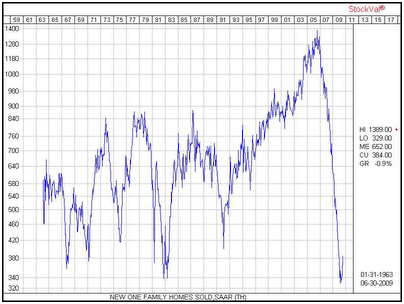
    Such is the case with the Roller Coaster Recession. In California’s roller coaster ride the first car, The Inland Empire, crested the top in 2007. When pink slips were issued, these homeowners did not have deep pockets to sweat it out. All of their savings had been plowed into their down payment. When values declined, they had no staying power. They were gone in the first wave of foreclosures.

    Meanwhile, the rear car, Coastal California, continued to climb in value seemingly immune to the problems inland. The reason was staying power. The residents of tony Corona Del Mar were able to dump their third car, the Range Rover to keep solvent. When that ran out, Coastal California tapped their savings and finally used their equity lines to maintain their high mortgage payments while they waited for a buyer. But it is 2009 and the buyers have not materialized. More Jumbo Loans are falling behind in their payments. Watch the 60-day delinquency rate on prime Jumbo Loans. According to First American Core Logic, Jumbos in default jumped to 7.4% in May versus 4.9% for conforming loans
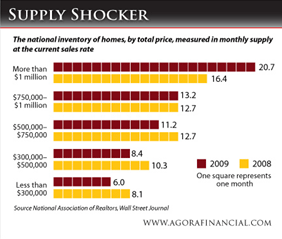
    Like our proverbial roller coaster, now it’s the turn for the first cars to rise. As the Inland Empire seems to have bottomed, Coastal California is still racing downward. There are 200 homes for sale between $1.5 and $3 million in ritzy Corona Del Mar. Even with a hefty 25% down payment, a $2 million property will require a $1,500,000 mortgage. Today’s lenders will require proof that the borrower can afford the $7,500 per month mortgage payment. They will demand a W-2 or 2008 tax return showing at least $22,500 per month in income to support a 30% housing expense ratio.

    The reality is there simply are not enough buyers earning $250,000 per year to buy up the 200 homes in Corona Del Mar. The current inventory will take 17 months to sell out but, as the recession continues, more homes are posting For Sale signs each month. Coastal California has not yet seen their bottom and they are still heading down at a rapid pace.

    Our national leaders may proclaim the end of the recession, but Californians have no reason to party. The Stimulus Package that shipped $50 billion to California was a one-time windfall that delayed but did not end California’s structural $26 billion budget deficit.
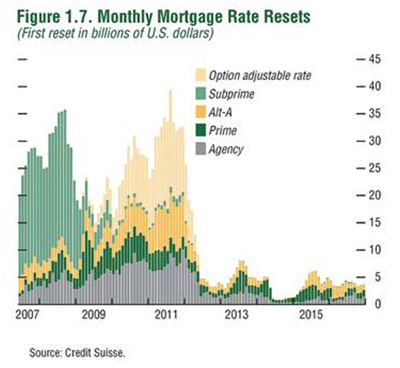
    Add to that the “Mortgage Armageddon” that is scheduled to hit next February. As the sub-prime mortgage defaults subside, the Option ARMS (adjustable rate mortgages) and Prime ARMs will begin to reset in early 2010 (see chart). This is not a working class but primarily a middle and upper-class problem. It is more a coastal than inland crisis; in New York terms, more Larchmont and less exurbia.

    There is a problem, however, with dinging the rich. They are the very folks expected to spend in our consumer-driven economy and invest in new ventures. If they have to re-route more dollars to mortgage payments, they not going to be able to help the economy.

    The Roller Coaster Recession will see more rises and dips before a sustainable recovery comes to California and other high-priced marekts. Those in the first car, like The Inland Empire, have nearly completed their ride. Any remaining dips will be minor in drop and brief in duration. But the genteel folks in the last car, in places like Coastal California, have another precipitous drop in front of them. This may come as a surprise to those believing the headlines that the recession was over. The wild ride for many is hardly over yet.

    ***********************************

    This is the fourth in a series on The Changing Landscape of America. Future articles will discuss real estate, politics, healthcare and other aspects of our economy and our society.

    Robert J. Cristiano PhD is a successful real estate developer and the Real Estate Professional in Residence at Chapman University in Orange, CA.

    PART ONE – THE AUTOMOBILE INDUSTRY (May 2009)
    PART TWO – THE HOME BUILDING INDUSTRY (June 2009)
    PART THREE – THE ENERGY INDUSTRY (July 2009)
  • Homebuilding Rebound… Or Boredom in the Burbs?

    The economy might come back – but will the housing market return? And in what form?

    Right now, builders are jumping into the low end of the market because of the $8,000 first time home buyer tax credit. This tax credit cannot survive indefinitely. Compared to homes sold in 2006, today’s are bare bones in size, materials and finishes in response to current, temporary market conditions. But the scrimping only makes the homes built in yesterday’s developments more attractive to potential buyers. The next wave of home buyers will have a choice: stay where they are, move to a more recently built (devalued) home, or buy new.

    Here’s a rundown on the major factors — and the forces on them — that will guide home buyers in their decisions. It’s also a rundown for any community, planner or developer — government or private sector — who would like to see the market rebound.

    Lot Size: Will buyers want to be shoehorned into new compressed development, or will they prefer to remain in the larger lot suburbs, where there are plenty of bargains today with usable yards and at least some views?

    The administration is pushing for compact (very dense) development, something the home buying market historically finds less desirable. If one hundred residents of a subdivision were asked the square footage of their lot, few would know the answer (more would be aware of their house’s square footage). Homes placed close to the street guarantee a claustrophobic feeling of space. Space is defined by that object that stops viewshed – typically a home, wall (fence) or low vegetation.

    Density is increased by the creation of narrower lots (and homes). When the lot narrows either the square footage of the house must plummet, or the home must get deeper. Assuming that facing directly into the home next door is not a quality view, the percentage of wall space that allows windows with a good view becomes very small as the home narrows.

    To illustrate, take a business card and look especially at the long edges. The shape emulates the rectangular perimeter of a typical suburban home built in the past few decades. Now imagine nice front and rear yard spaces with plenty of wall surface for windows, even with a garage taking up a portion of the front.

    Along comes the anti-sprawl movement pushing narrower lots, and making those on City Councils and Planning Commissions feel guilty about destroying the planet. Across America over the past two decades lots have been getting smaller – in some cases much smaller. Now take that business card and rotate it 90 degrees. This would represent the shape of a typical suburban home today.

    Huh. Wouldn’t all those side windows now look into the neighbors home? Well, windows now are placed along the short side of the home. What about the garage? Well, typically that’s still along the front, but since cars did not suddenly get 33% narrower, occupants just lost quite a bit of precious viewing area. Density went up by 33% but useable yards went down by 33%.

    Today we are building with much less width than we did during the past few decades. Yet the environmentalists and press do not seem to have taken notice.

    What is most likely coming down the road?

    Miniscule, very narrow lots combined with vertical growth. To illustrate, cut that business card in half. OK, so there goes the square footage right? Take one half and place it on top of the other. Well, it’s likely that the home was already two story, so that means three stories right? How much do you like climbing stairs? Better buy stock in residential elevator companies. So how do you park cars in this very narrow lot? If you do not want the street to appear as a solid wall of garage doors, then the only way to provide garage space is a single width garage, two stalls deep — another inconvenience — or a two car garage in the rear… but there goes any attempt for quality rear yard space.

    Architecture: Suburban homes have been looking pretty bland for the past few decades. Slapping on a front porch (most are the size of a stoop) really doesn’t make that much difference.

    Blame architects? An AIA registered, certified, artistically talented architect was not likely involved in the design process of the mass market home. It’s far cheaper to let Harry down the street (nephew of what’s his name) to draw up plans. How do you think many small home builders get financed? If they go to a lumber yard and select from a series of home plans, they can get a package deal; materials and financing furnished by the same source, standard packages from which to choose. Any wonder why 30 home builders in the same town seem to all build the same character-free house?
    Did the lumber yard hire a talented architect to gain advantage in the local market? What incentive do you think the supplier of the materials would have to actually be efficient in the drafting of the home? Excess material means increased profits!

    Homes in suburbia lack character and devalue a community as a general rule, but it’s not always the case. For example, in many areas in Texas, housing is affordable and full of architectural character with great landscaping. Builders in the major Texas markets know that if they shortcut curb appeal, nobody will clamor to their door. The local home buying market is astute… and today’s strongest home market.

    National large home builders? Most of the nationals expand into an area by buying out a local builder that showed signs of success (see above).

    Green: Ask your banker how much green means to the value of a home. Ask the appraisal company, does green add any value? Green certification is commonly messy and difficult, requiring builders to chase points instead of building wisely. Most green standards were inspired by a social engineering agenda. My own certified green home earns me lots of points because I’m near a bus stop and walking distance to a coffee shop. No wonder the financial people don’t take the movement seriously. My residential elevator? Not listed on the “points” system. Home designed to maximize quality viewsheds? No points! We had intended to place a 1 ½ inch foam insulation fill around the entire foundation surface, but a 2 inch minimum was required to earn points . That increased the cost of construction by $900. I’m not an expert in insulation, but it seems I spent 30% more to get a 0.1% benefit on my utility bill – hell of a deal! That $900 extra added to my payments – let’s see with interest, that cost me $5.25 every month… got my point though.

    Will the home market flourish when the economy returns?

    In the last few weeks I was Keynote Speaker at the Western States Planning Association Annual Meeting and at the North Dakota American Institute of Architects.

    Planners and Architects are very different groups. Ever wonder why the neighborhood plan and the architecture of the homes within it rarely seem related to each other? Nobody looks at mass market housing from a perspective of combined architectural spaces as a main component of the overall neighborhood design. The merging of planning and architecture on housing for the masses was well received by both groups.

    How will we bring the housing market back?

    Not by scrimping and reducing value, but by increasing value through a combined effort of architects, planners, and engineers to create a new era of sustainable communities that increase living standards affordably. Density is not a solution. A revolution in design is.

    Rick Harrison is President of Rick Harrison Site Design Studio and author of Prefurbia: Reinventing The Suburbs From Disdainable To Sustainable. His website is rhsdplanning.com.

  • How Smart Growth Disadvantages African-Americans & Hispanics

    It was more than 45 years ago that Dr. Martin Luther King, Jr. enunciated his “Dream” to a huge throng on the Capitol Mall. There is no doubt that substantial progress toward ethnic equality has been achieved since that time, even to the point of having elected a Black US President.

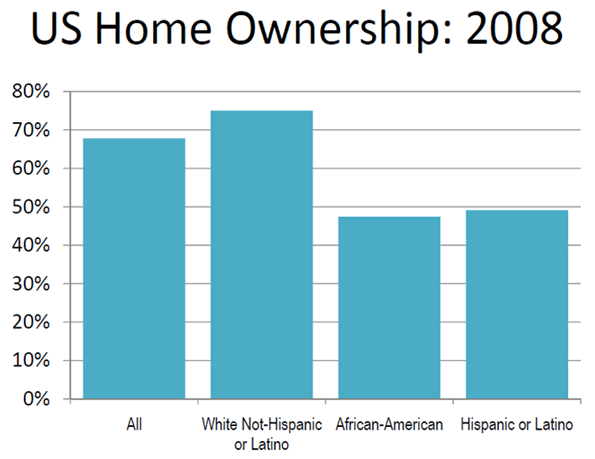
    The Minority Home Ownership Gap: But there is some way to go. Home ownership represents the core of the “American Dream” that was certainly a part of Dr. King’s vision. Yet, there remain significant gap in homeownership by ethnicity. Rather than a matter of discrimination, this largely reflects differing income levels between White-Non-Hispanics, African-Americans and Hispanics or Latinos. Today, approximately 75% of white households own their own homes. Whites have a home ownership rate fully one-half higher than that of African-Americans and Hispanics or Latinos at 47% and 49% (See Figure).

    Setting the Gap in Stone: A key to redressing this difficulty will be convergence of minority household incomes with those of whites, and that is surely likely to happen. However, there is another important dynamic in operation: house prices in some areas have risen well in advance of incomes, so that convergence alone can not narrow the home ownership gap in a corresponding manner. It is an outrage for public policy to force housing prices materially higher so long as home ownership remains beyond the incomes of so many, especially minorities.

    The Problem: Land Use Regulation: The problem is land use regulation. The economic evidence is clear: more restrictive land use regulation raises house prices relative to household incomes. This can be seen with a vengeance in the house price increases that occurred during the housing bubble. As we have previously described, metropolitan markets with more restrictive land use regulation (principally the more radical “smart growth” policies) experienced house price escalation out of all proportion to other areas in the nation. In some cases, they topped out at nearly four times historical norms. On the other hand, in the one-half of major metropolitan area markets where land use regulations were less severe, house prices tended to increase to little more than historic norms, at the most.

    How Smart Growth Destroys Housing Affordability: This difference is principally due to the price of land, which is forced upward when the amount of land available for building is artificially limited, as is the case in smart growth markets. At the peak of the bubble, there was comparatively little difference in house construction costs per square foot in either smart growth or less restrictive markets. However, the far higher land prices drove house prices in smart growth markets far above those in less restrictively regulated markets. Where house prices rise faster than incomes, housing affordability drops as prices rise at escalated rates.

    Wishing Away Reality: It is not surprising that the proponents of smart growth undertake Herculean efforts to deflect attention away from this issue. Usually they pretend there is no problem. Sometimes they produce studies to indicate that limiting the supply of land and housing does not impact housing affordability, which is akin to arguing that the sun rises in the West. Even the proponents, however, cannot “walk a straight line” on this issue, noting in their most important advocacy piece (Costs of Sprawl – 2000) that their more important strategies have the potential to increase the cost of housing.

    The Assault on Home Ownership: Worse, well connected Washington interest groups (such as the Moving Cooler coalition) and some members of Congress seek to universalize smart growth land rationing throughout the nation, which would cause massive supply problems and housing price inflation that occurred in some markets between 2000 and 2007. Even after the crash, these markets experienced generally higher house prices relative to incomes in smart growth markets than in traditionally regulated markets.

    House Price Increases and Minorities: House price increases relative to incomes weigh most heavily on ethnic minority households, because their incomes tend to be lower. This is illustrated by an examination of the 2007 data from the American Community Survey, in our special report entitled US Metropolitan Area Housing Affordability Indicators by Ethnicity: 2007. The year 2007 was the peak of the housing bubble, but represents a useful point of reference for when future “smart growth” policies were imposed nationwide.

    Median Priced Housing: The data (Table) indicates that median house prices were 75% or more higher for African-Americans than Whites, however that African-Americans in smart growth markets require 84% more to buy the median priced house. The situation was slightly better for Hispanics or Latinos with median house prices at least 50% more relative to incomes than for Whites. House prices relative to Hispanic or Latino median household incomes were 86% higher in smart growth markets than in less restrictively regulated markets.

    SUMMARY OF HOUSING INDICATORS BY
    LAND USE REGULATION CATEGORY
    Metropolitan Areas over 1,000,000 Population: 2007
    HOUSING INDICATOR Less Restrictive Land Use Regulation Markets More Restrictive Land Use Regulation Markets All Markets More Restrictive Markets Compared to Less Restrictive Markets
    MEDIAN VALUE MULTIPLE        
    All 3.1 5.8 4.5 1.89
    White Non-Hispanic or Latino 2.7 5.1 3.9 1.90
    African-American 4.9 8.9 6.9 1.84
    Hispanic or Latino 4.2 7.9 6.1 1.86
    LOWEST QUARTILE VALUE MULTIPLE      
    All 2.1 4.2 3.2 2.01
    White Non-Hispanic or Latino 1.8 3.7 2.8 2.01
    African-American 3.3 6.5 5.0 1.95
    Hispanic or Latino 2.9 5.7 4.4 1.98
    MEDIAN RENT/MEDIAN HOUSEHOLD INCOME      
    All 13.8% 17.1% 15.5% 1.24
    White Non-Hispanic or Latino 12.1% 15.1% 13.6% 1.25
    African-American 21.9% 26.1% 24.0% 1.19
    Hispanic or Latino 19.1% 23.0% 21.1% 1.20
    LOWER QUARTILE RENT/MEDIAN HOUSEHOLD INCOME    
    All 10.8% 13.1% 12.0% 1.22
    White Non-Hispanic or Latino 9.4% 11.6% 10.5% 1.23
    African-American 17.0% 20.0% 18.5% 1.17
    Hispanic or Latino 14.9% 17.5% 16.2% 1.18
    NOTES        
    Median Value Multiple: Median House Value divided by Median Household Income
    Low Quartile Value Multiple: Low Quartile House Value divided by Median Household Income
    2007 Data
    Calculated from American Community Survey (US Bureau of the Census) Data
    “More restrictive” land use regulation markets (generally "smart growth") include those classified as "growth management," "growth control," "containment" and "contain-lite" and "exclusions: in "From Traditional to Reformed A Review of the Land Use Regulations in the Nation’s 50 largest Metropolitan Areas" (Brookings Institution, 2006) and markets with significant large lot zoning and land preservation restrictions (New York, Chicago, Hartford, Milwaukee, Minneapolis-St. Paul, and Virginia Beach). Less restrictive" land use regulation markets (generally "traditional") include all others, except for Memphis, where urban growth boundaries have been drawn far enough from the urban area to have no perceivable impact on land prices and Nashville, where the core county is exempt from the urban growth boundary requirement in state law.

    Lower Priced Housing (Lowest Quartile): I recall being told by a participant at a University of California–Santa Barbara economic forum organized by newgeography.com contributor Bill Watkins that, yes, smart growth increases house prices, but not for lower income residents. My challenger went so far as to say that lower income households were aided economically by smart growth. The facts are precisely the opposite. Comparing the lowest quintile (lowest 25%) house price to median household incomes indicates that minorities pay even a higher portion of their incomes for lowest quintile priced houses than the median priced house. African-Americans in smart growth markets needed 95% more relative to incomes to afford the lowest quartile house. Hispanics or Latinos needed 98% more.

    Rental Housing: The problem carries through to rental housing. There is a general relationship between rental prices and house prices, though rental prices tend to “lag” house price increases. In the smart growth markets, minorities must pay approximately 20% more of their income for the median contract rental in smart growth metropolitan areas than in less restrictively regulated markets. Similar results are obtained when comparing minority household median incomes with lowest quintile contract rents, with African-Americans paying 17% more of their incomes in smart growth markets and Hispanics or Latinos paying 18% more.

    Moreover, it is important to recognize that all of the above data is relative, based on shares or percentages of incomes. Varying income levels are thus factored out. Minority and other households in smart growth markets face costs of living that are approximately 30% higher than in less restrictively regulated markets, according to analysis by US Department of Commerce Bureau of Economic Analysis economists. Some, but not all of the difference is in higher housing costs.

    Social Costs of Smart Growth: In 2004, the Tomas Rivera Policy Institute, which focuses on Latino issues, noted concern about the homeownership gap in California, which has been ground zero for land use regulation driven house price increases for decades:

    Whether the Latino homeownership gap can be closed, or projected demand for homeownership in 2020 be met, will depend not only on the growth of incomes and availability of mortgage money, but also on how decisively California moves to dismantle regulatory barriers that hinder the production of affordable housing. Far from helping, they are making it particularly difficult for Latino and African American households to own a home.

    Examples of the restrictions cited by the Tomas Rivera Policy Institute are restrictions on the supply of land, high development impact fees and growth controls.

    California has acted decisively, but against the interests of African-Americans and Hispanics or Latinos. The state enacted Senate Bill 375 in 2008, which will impose far stronger state regulations on residential development, increasing the likelihood that minorities in California will always be disadvantaged relative to White-Non-Hispanics. At the same time, State Attorney General Jerry Brown has forced some counties to adopt more restrictive land use regulations through legal actions. California, which had for decades been considered a state of opportunity, is making home ownership and the pursuit of the “American Dream” far more difficult, particularly for its ever more diverse population.

    Stopping the Plague: In California, the hope to increase African-American and Latino home ownership rates to match those of white-non-Hispanics may already be beyond reach due to the that state’s every intensifying radical smart growth policies. However, the “Dream” continues to “hang on” in many metropolitan markets. Hopefully Washington will not put a barrier in the way of African-Americans and Hispanics or Latinos that live elsewhere in the nation.

    US Metropolitan Area Housing Affordability Indicators by Ethnicity: 2007 includes tables with data for each major metropolitan area in the United States

    Photo: Starter house in Atlanta suburbs (by the author)

    Wendell Cox is a Visiting Professor, Conservatoire National des Arts et Metiers, Paris. He was born in Los Angeles and was appointed to three terms on the Los Angeles County Transportation Commission by Mayor Tom Bradley. He is the author of “War on the Dream: How Anti-Sprawl Policy Threatens the Quality of Life.

  • Hard Times In The High Desert

    The High Desert region north and east of Los Angeles sits 3,000 feet above sea level. A rough, often starkly beautiful region of scrubby trees, wide vistas and brooding brown mountains, the region seems like a perfect setting for an old Western shoot ’em up.

    Today, it’s the stage for a different kind of battle, one that involves a struggle over preserving the American dream. For years, the towns of the High Desert–places like Victorville, Adelanto, Hesperia, Barstow and Apple Valley–have lured thousands of working- and middle-class Californians looking for affordable homes.

    Now, like other exurbs in the U.S., the area suffers from sky-high foreclosure and unemployment rates. Rather than elicit sympathy, however, these hardships have delighted a growing chorus of planners, environmentalists and urbanists who believe that such far outer-ring communities are doomed to becoming America’s “next slums.”

    Such dismal future prospects have gained an air of plausibility with devastating speed. For much of the past century, the High Desert was a rough-hewn region of small farms and mines, its economy largely dependent on military bases.

    But since the 1980s, the area has flourished, adding over 120,000 people in the first seven years of the decade. Most people came because of housing costs–as much as a third less than those closer to the coast. Today the largely middle and working class population stands at over 350,000.

    You don’t hear much good about people in places like the High Desert. Like many exurbanites, they do not fit the hip categories of “knowledge workers” or “creative class.” They work with their hands–in construction, driving trucks, in factories and mines–or run small retail businesses. In the High Desert, 60% of residents have never attended college. Many commute over the 4,100-foot Cajon Pass to blue- and pink-collar jobs as far as Los Angeles, more than an hour and a half away.

    “This is one of those places where the women have more tattoos than the men,” joked one long-time resident over drinks at Chateau Chang, a well-appointed local hangout owned by Chinese immigrants.

    For many, the rapid decline of housing prices since 2007 has been devastating. Newcomers bought homes at the top of the market, when median prices scaled over $300,000. Some did so with adjustable-rate mortgages. Today, the median price is closer to $100,000, leaving a large percentage of homes underwater.

    The real estate collapse has also hurt employment. Construction, warehousing and manufacturing–linchpins of the local economy–all have been pummeled by the recession. Unemployment now stands over 16%.

    Similarly bleak conditions plague exurbs throughout the country–from central Florida to the outskirts of Phoenix, Las Vegas, Sacramento and scores of other onetime boomtowns. Shuttered factories, empty stores and abandoned lots contribute to an often depressing landscape.

    These reverses have led some pundits to assert it’s time to let such places die–and the sooner the better. Greensheet Grist recently held a competition about what to do with dying suburbs that included ideas such as turning them into farms, bio-fuel generators and water treatment plants.

    Such post-apocalyptic views are popular with architects, planners and environmentalists, as well as in the mainstream media. But these people never liked conventional suburbs much; many considered exurbs atrocities whose residents indulged in unspeakable acts of overconsumption.

    Yet what about the residents of these places–and the many who likely would care to join them? The fact is exurbs are popular: Between 2000 and 2007, 3 million Americans moved to exurbs, and while the recession has slowed this growth, it has not stopped it. Indeed, now that housing prices have fallen, home sales have skyrocketed in some areas. In the High Desert, for example, existing-home sales more than tripled in the past year, to the highest level ever.

    Most demographic estimates suggest this exurban population growth will continue; the High Desert is expected to receive another 200,000 residents by 2025. The key driving force, notes Redlands, Calif.-based economist John Husing, remains the deep-seated desire to own a small piece of ground and enjoy some privacy and a middle-class way of life that is no longer affordable closer to the urban center.

    For most exurbanites, moving back to the city–the preferred option of planners and urban boosters–is not an attractive option. These people could never afford a charming townhouse in Portland’s Pearl District or a loft in New York’s SoHo. For them, the “urban option” means the prospect of a dreary blocky apartment complex in a noisy, crowded, less-than-genteel section of Los Angeles or another large city.

    This preference should not be confused with racism, as is sometimes alleged. Like many exurbs, the High Desert has become increasingly multi-racial. Over half of the 23,000 students at the sprawling Victor Valley College, for example, are minorities–nearly 30% are Hispanic. Cruise the shopping center, and you are as likely to find a family-owned Mexican, Vietnamese or Korean restaurant as you would a hamburger chain or pizza shop.

    To my mind, harboring ill will toward the aspirations of exurbanites is hardly “progressive,” at least from a social democratic point of view. Yet many on the so-called left feel that what is generally considered upward mobility needs to be curbed so that the hoi polloi can better live according to the prescriptions of their more enlightened, usually higher-educated and more affluent “betters.”

    In contrast, a more humane, and fundamentally democratic, approach would be to find ways to help these communities thrive. The first step: local job creation. Even without the excessive prices associated with “peak oil” theories, gas prices and car expenses do place a considerable burden on many exurbanites. Developing more economic opportunities closer to these communities would relieve this financial burden, while also cutting energy consumption.

    Experience shows that suburbs that develop their own economies have suffered far less from the recession than those that depend on long-distance commuters. Ontario, a suburb 40 miles east of Los Angeles where I have worked as a consultant, for example, has developed a strong airport, industrial and office economy and a thriving locally based retail sector. Average commutes there are roughly parallel to those in neighborhoods close to downtown Los Angeles.

    Although hit hard by the recession, Ontario suffers a foreclosure rate that is one-third of the High Desert’s. It continues to attract businesses from Los Angeles and the rest of the world by offering a more enterprise-friendly environment and a well-maintained infrastructure.

    Places like Ontario could provide something of a role model for places like the High Desert, notes local real estate investor Joe Brady. Like many other local leaders, he recognizes that basic job creation–not real estate speculation–holds the key to the region’s future.

    But it’s not all doom and gloom for the High Desert. Some prospective new industrial investment has come to the area. And Husing believes the High Desert will play an expanding role as a warehouse area for products shipped from the massive Los Angeles port complex. The converted former George Air Force Base, now the Southern California Logistics Airport, has created 2,500 jobs and could generate another 35,000 within the decade.

    Yet creating many more jobs in the High Desert will not be easy. Though most local cities are pro-business, business consultant Larry Kosmont notes they are still saddled with regulations imposed by the state of California. These could discourage business attraction and development.

    There’s a bit of an irony here. Local job growth would save energy and cut emissions by reducing commutes and making these communities more environmentally sustainable. But some coastal “progressives” may discourage new industrial or warehouse facilities for emitting too much greenhouse-gas.

    In the end, only fostering a strong locally based economy can make these places economically viable. Whatever their aesthetic and design problems, exurbs will continue to appeal to millions of Americans searching for what they define as a better way of life. That alone should make them intrinsically valuable, and definitively worth saving.

    This article originally appeared at Forbes.

    Joel Kotkin is executive editor of NewGeography.com and is a distinguished presidential fellow in urban futures at Chapman University. He is author of The City: A Global History. His next book, The Next Hundred Million: America in 2050, will be published by Penguin Press early next year.
  • American Hobbit Houses

    Soon after President Obama took office, a proposed plan to “develop federal policies to induce states and local communities to embrace ‘smart growth’ land use strategies” was announced.

    This “Livable Communities Program” is intended to save land and clean up the environment. It is seen as encouraging denser housing arrangements to deter automobile use and accommodate the transit industry, according to goals set by the Secretaries of HUD, EPA and Transportation.

    One potential downside to this plan comes from the transit industry’s Moving Cooler study, which argues that the Administration’s greenhouse gas reduction proposals “may result in higher housing prices, and some people might need to live in smaller homes or smaller lots than they would prefer.”

    If you want to see how this might work, look at the U.K., which imposed strict land regulations in the Town and Country Planning Act in 1947. This effectively froze the supply of land for a growing population, leading to soaring house prices, particularly in the area around London.

    With the land available for development frozen, house size decreased as well, leading to new British homes garnering the nickname of “Hobbit houses.” New British homes are a little more than a third as big as new U.S. homes (818 sq. feet compared the U.S.’s 2,303 sq. feet).

    The question is whether or not the Federal government should be granted the ability to limit housing standards. Currently, this responsibility lands in the lap of state and local governments.

    Can President Obama afford to add the President of the (Hobbit) Homeowner’s Association of the United States to his title?

  • Cookie Cutter Housing: Wrong Mix For Subdivisions

    Nobody likes the taste of “cookie cutter” development. In the forty years that I’ve been in the land planning industry, at meeting after meeting I hear planning commissioners and city council members complain about the same thing: That developers submit the same recipes to cook up bland subdivisions over and over.

    But while the developers are the scapegoat, it’s those who sit on the council and planning commissions that are as much, if not more to blame. They are also the ones with the power to change the status quo.

    Communities have a cookbook that tells the developer and the design consultant the ingredients that must be used; this is called “The Ordinance”. Just as one might bake cookies using clearly defined amounts of flour and sugar, the cook looks to the ordinance to see that he will need exactly 10 feet between homes, at precisely a 20 foot setback from the curb, served up on a lot no greater than 5,600 square feet.

    Thus, 100 cookies baked from the same recipe have about as much in common as the 100 lots built on “Pleasant Acres”. The developer presents the plan to the council. The scrumptious, pastel-colored rendering promises a tasteful development. But the council and planning members remember the aftertaste of the promises of past submittals.

    Developers do not design land developments. They hire consultants who design them. The consultants are likely to be engineers and land surveyors, who also act as land planners. A cookie cutter development is called a “Subdivision”. A really large cookie-cutter development is called a “Master Planned Community”. In the end, no matter what its size, when you look down the street on which people live, both Subdivision and Master Planned Community have the exact same feel.

    Why? Because the ordinance says so.

    Yes, it’s true that the ordinance does not say anything about how to make creative, wonderful, sustainable communities; it only demands certain minimum dimensions and area restraints. But the key problem is that the developer, the engineer, the surveyor, and the planners think that the term “minimum” means the “absolute” dimensions.
    So who cooked up these ordinances? Who determined that 5,600 square feet was the ideal lot size for the zoning in a particular city? Why does the fire department demand the public streets be 40 feet wide, when in a nearby city the public streets are just 26 feet wide? Are the buildings burning down over there, and not here?

    Citizens who have the power to create the changes that are needed – the councils, the planning commission members, and the Mayors — unquestionably embrace these recipes that enforce the absence of taste in their cities. Those who write regulations are actually often being paid to boilerplate these nauseating formulas from neighboring towns, when they should be looking to create entirely new recipes for tasteful development.

    It’s time to throw out the systems that don’t work. Ordinances should be more reward-based and less minimum-based. A town’s regulations should ask developers to explain each element of the design and tell how it benefits the developer, the resident or business owner, and the city.

    For example, most ordinances simply state: ’10 foot side yard minimum (20 feet between buildings)’. What if the ordinance was written as ’10 foot side yard’, then went on to explain that staggering the homes could offer a better streetscape. It might go on to mention that, with windows placed along the staggered side, living areas would have better views, making the homes more marketable. In this scenario, side yards could be reduced, to, say, 5 feet (10 feet between buildings). This type of regulation guides developers by rewarding better design with denser development. Virtually every aspect of the regulations could be written in such a manner. Nobody loses – everyone wins!

    The developer’s consultants also deserve some of the blame. The developer will always hope for a project that will sell better than other developments in the area…always. Yet somehow, the developer trusts that the same consulting firm that designs all the other developments in town will have some special brainstorm that will somehow set this particular Subdivision apart.

    This is one reason that nothing really changes. Another is that consultants who design Subdivisions (mostly licensed engineers and surveyors) are not likely to go against the rules. To a licensed individual who places his or her reputation and stamp on a plan, challenging a rule is very uncomfortable. Conflict between the consultant and the council and planning commission is highly feared: what if the change fails? The city’s representatives might view the consultant negatively on the next project. It’s far simpler to use one cup of flour and a tablespoon of sugar.

    Until only six years ago I felt as if I was the only one challenging convention. At every meeting I would present plans that went beyond ordinance minimums to make sustainable and functional communities. At every meeting, typically in the back row, was the developer’s engineer, paid to attend. I had to defend against every question regarding engineering that was done outside of the recipe, and offer reasons for the benefits. Never once did an engineer who was paid to back me up offer support.

    Then, in 2003 at a council meeting in the small town of Amery, Wisconsin, the impossible happened. On an engineering question, the developer’s consultant, Steve Sletner, owner of TEC Design, of Eau Claire, Wisconsin jumped right in and actually defended the changes we were challenging. A Licensed Civil Engineer became my instant hero (still is).

    If every engineer thought more about the quality of life of those living in the developments that they engineer, this would be a much better world. Since then, Steve and I have been winning the war against the cookie-cutters in an enjoyable, relaxed atmosphere with councils and planning commissions everywhere.

    Outside of the US, I’ve also found similar roadblocks to successful design. While in the Middle East, I met with the young head of sales for an extremely large developer. He complained about home designs that customers simply did not care for. I asked if he let his superiors know about the problems. Fear came across his face. Fear of confrontation is perhaps the biggest problem holding us back. Confrontation should not be an issue if there is supporting proof that the new solution offers less environmental impact and higher value, or is safer, etc.

    An advantage we have in the US is that the citizens who sit on planning commissions and councils have more common sense than consultants give them credit for. When they don’t like the taste of what they are getting, they spit out negative comments at public meetings.

    I wish that every planning commissioner and council member in this country could get this one message: If you don’t like the taste of what you are getting, hire a different cook to write a new cookbook for your community. President Obama recently stated that we must rely on the American spirit of innovation. A rewards-based regulatory system would be a major step in innovating the way our cities operate.

    The planning industry needs a massive overhaul to replace our obsolete system with one that results in sustainable development. Minimum-based regulations are recipes that guarantee that only minimal cities will be built. Cities are the foundation of our society. And remember: You are what you eat.

    Rick Harrison is President of Rick Harrison Site Design Studio and author of Prefurbia: Reinventing The Suburbs From Disdainable To Sustainable. His website is rhsdplanning.com.

  • Florida Drifts Into the Morass

    By Richard Reep

    Regarding Florida’s new outmigration, “A lot of people are glad the merry-go-round has finally stopped. It was exhausting trying to keep up with 900 new people a day. Really, there is now some breathing room,” stated Carol Westmorland, Executive Director of the Florida Redevelopment Association at the Florida League of Cities. Now that surf and sand are officially unpopular, the urban vs. suburban development debate has caught developers and legislators in a freeze frame of ugly and embarrassing poses at local, regional, and state levels.

    In South Florida, Miami’s city commissioners narrowly defeated a move to institute a form-based code on August 7, which would have increased regulation in the most populous city in the state. This code would have rigidly set Miami’s density levels and regulated building form all the way down to the location of the front door. It constituted a surprising hometown defeat for Andres Duany and Elizabeth Plater-Zyberg, originators of the New Urbanism movement and the prime consultants hired to create the code. Commission Chairman Joe Sanchez, worried about restricting people’s use of property, stated that Miami 21 “exposes us to tens of millions of dollars in lawsuits from loss of property value.” Not ready to throw in the towel, however, the New Urbanists are appealing the vote in two public hearings. “We’re confident that the issues can be resolved,” stated Maria Mercer, who works for DPZ. The commissioners may be worried about lawsuits. The people seem to be even more concerned about Big Brother fussing about their property, judging from the public input on the code’s website.

    Of course, the press has decried this as a vote for “sprawl,” rather than a vote for common sense. By now, the language of growth management has become so riddled with red-baiting words such as “sprawl” posed against lofty ideals such “smart growth” that the public can make no real sense of development proposals anymore. It is easy to see why New Urbanism was so seductive, for it seems to solve every problem once and for all – this goes here, that goes there – and there would be no more debate…unless, of course, the Master Planner made an error somewhere. But, like most consultants, the Master Planner has moved on to the next job and isn’t in charge of living with his plan. If he labels low-cost development “sprawl”, then so be it. And if he deems high-cost development “smart growth,” then so be it. Just like Ramses in The Ten Commandments, “So let it be said – so let it be done.”

    Blackballing suburbs with words such as “sprawl” is dissonant to most voters who, after all, live in these supposedly awful places; likewise words like “walkable urban cores” often conjure up the reality of parking and traffic nightmares. Then there’s something called the marketplace. Florida is becoming less about retirees, and more about families. The much ballyhooed flurry of high-density urban projects doesn’t seem to fit the lifestyle of cars and kids and soccer practice too well.

    Then there’s the other downside of new urbanist growth, which is its cost. Young, single service workers and retirees – a natural market for these urban villages – cannot afford either the pricey real estate or the stiff maintenance fees. On the other hand, Florida’s upwards of about 300,000 empty single-family homes, by the Orlando Sentinel’s count, could provide a natural lure to families, more so than the 65,000 or so condominium units on the market in the state. This so-called “overhang” of 3 to 5 years of unsold inventory only serves to terrify homeowners who remain in the state and have to deal with depreciating property values for some time in the future.

    Clearly more density has been no more successful than the most mindless sprawl. The New Urbanists’ often shrill rhetoric has frightened many planners into pushing density on Florida’s fleeing population. The disaster that is Miami’s downtown and beachfront may be the best known, but throughout the state Florida’s high density developers and landowners are facing foreclosures, fading credit, and loss of business on an unprecedented scale. Those who came late to the party – witness poor Hollywood, Florida, a city which finally got its act together and aggressively redeveloped its downtown – look like empty movie lots. Elsewhere in cities across the state, vast tracts have been razed, rezoned for high density and now lie fallow or unfinished, giving the face of Florida a remarkably post-apocalyptic quality.

    Neil Fritz, Hollywood’s Economic Development Director, is sanguine about the dire straits of his town. “Oh, the urban areas will come back before the suburbs,” he stated recently. But in reality, downtown condominiums are a latecomer to the Florida scene, and are a forced market. They were viable largely because they compared favorably to single family detached dwellings in terms of price and convenience.

    In fact, quite the opposite is likely to occur, with the single family suburb – particularly those located near jobs – rebounding first as people’s natural preference, as it has been for over a hundred years. This might chagrin the New Urbanists, who spent a great deal of effort inventing such earnest fantasies as a “sprawl repair kit”, even though safety, mobility and open space remain deeply ingrained in the American lifestyle. Also, the high-density movement was fed by investors and owners of second homes – rare commodities in this post-crash world.

    Overdevelopment is easy to blame on poor government, which allowed developers to overbuild on credit, but as with the financial crisis in general, there is enough blame to go around. What municipality would not like dense urban cores full of affluent taxpayers enjoying lattes on the boulevard? This dream sadly has turned to the reality of empty storefronts, condos being converted into low-income rentals, or worse yet, empty lots being assessed at their lowest possible taxable value. The fringes of most urban areas continued to be developed at low density, and while they are suffering the same fate as the denser areas now, the effect is less profound since it is more spread out.

    Florida’s government just has no place to turn for more revenue, and relies mostly on property taxes and fees. Its main economic engine is development. Local governments, increasingly unable to pay for services, naturally encouraged density as a way to levy more and more property taxes, largely ignoring the long-term economic viability of specific developments. So-called “smart growth” indeed seemed pretty smart to cities and counties needing the taxes that they believed dense urban cores might someday generate.

    The best hope for Florida lies neither in the God-like precepts of the New Urbanist movement, nor in the hands of the developers, but rather in the hands of intelligent, humanistic conversation revolving around a sense of shared community and deeper values. With the internet as a tool, cities could be encouraging citizen input in advance of a proposal, rather than the old, 20th century tool of public meetings. This conversation is necessary as our legislators and developers dance their kabuki dance around imagined future prosperity. Florida seems to be drifting aimlessly, as no one at the state level seems to be concerned about the loss of population, instead congratulating themselves on creating the next boom.

    The cities and counties of Florida would do well to use this interregnum to retool their public process to give people more access to the right information up front. By allowing internet-based review and participation, people can provide intelligent input into development proposals. Armed with the right information, Americans historically have made excellent decisions, and Florida can become an example in how to better manage its single most important industry. In the meantime, the leadership of Florida would do well to examine the negative connotations of “sprawl” when describing the native habitat of their voters and taxpayers, and examine the consequences of encouraging density for a market that has yet to exist, and may not exist for some time to come.

    Richard Reep is an Architect and artist living in Winter Park, Florida. His practice has centered around hospitality-driven mixed use, and has contributed in various capacities to urban mixed-use projects, both nationally and internationally, for the last 25 years.

  • New Feudalism: Does Home Ownership Have a Future?

    In mid August, as we were beginning to feel a pulse in the nation’s housing market, an academician and housing expert from the University of Pennsylvania named Thomas J. Sugrue wrote an article in the Wall Street Journal proposing that, for many people, the new American Dream should be renting.

    Sugrue is writing a book on the history of real estate in America, a tome I cannot wait to read because it will apparently illustrate how epic events in our nation’s history have shaped and molded our real estate market, hence our lives. He quotes builder William Levitt, considered the father of affordable suburban mass housing, saying “no man who owns his own house and lot can be a Communist.”

    That was said during the Cold War and McCarthy era: Levitt was marketing his wares, playing off the public’s fears like any good salesman. And for many politicians – from Herbert Hoover to Bill Clinton and George W. Bush – expanding ownership of homes remained critical to the nation’s identity.
    But is all this changing? The Obama Administration seems at best ambivalent about homeownership. It seems determined to put more resources into rental housing while promulgating policies that may coerce Americans out of the suburban single family homes and back into dense, multifamily urban housing.

    This would mark a major change in what we usually consider the American dream. Enabling home ownership is like crack cocaine for politicians: the impetus for the Great Recession of 2008 may well have been formed on the day President Bill Clinton launched National Homeownership Day in 1995. And I remember sitting terrified in front of the television post 9/11 when President George W. Bush reassured us that America was strong and would recover. Our housing market is strong, he said, a theme that would echo throughout his presidency. Seeing two by fours go up and mortar flying gave Americans a sense of calm, of rebuilding.

    The attacks of 9/11 almost brought down our economy. The housing market helped prop it up.

    Most of us still love our homes. Sugrue quotes a Pew survey that faintly echoes the national health care debate: nine out of ten homeowners view their homes as a comfort in their lives. He seems to argue we should change everything for ten percent. To be sure, as he suggests, for some home ownership has become a source of panic and despair: 53,000 people packing a Save the Dream fair at Atlanta’s World Congress Center. Georgia’s housing market has been hit hard – 338,411 homes went into foreclosure in May and June, 2009.

    But it’s not just Georgia. Since the second quarter of 2006, housing values across the nation have plummeted to values roughly equivalent to post 9/11. We are not immune even here in Texas, with one of the nation’s strongest large state economies: our prices are soft, down anywhere from five to 20%, and buyers want deals. Go north to Little Elm; you might think you are in Atlanta. Homes may not be selling for thirty cents on the dollar as they are in Phoenix, but a house in the trophy community of University Park listed for $999,000 recently, sold in the mid $800s. The owner of a Preston Hollow mansion not too far from George W. Bush turned down a $38 million dollar offer two years ago, insulted. He recently sold his nine-plus acre property for $28 million.

    And just one week ago I spoke with an Allen, Texas home builder who told me that current tough love lending standards were keeping a lot of people out of the jumbo market – that is, halting them from buying million dollar homes. When you have to put down 30%, he said, that’s $300,000 on a million dollar home. If homes are not appreciating, he said, smart people say, why do we want to tie up that much money in our homestead?

    Yet we have been here before. Half of all U.S. mortgages were in default during The Great Depression, although it’s true far fewer people owned homes. This is when Herbert Hoover and Franklin Roosevelt created government programs to help save homeowners from foreclosure. I remember my grandmother telling me how Mr. Roosevelt saved her home in 1932 – she voted Democratic in every election because of it until the day she died in 1966. In 1938, Fannie Mae was created to buy mortgages on the secondary market, an effort to stimulate credit.

    After World War II, when the government made home loans accessible for thousands of GIs returning from the wars, home ownership rates climbed like the staircases in a suburban colonial. Now more than two-thirds of Americans own their homes.

    The government’s role in shaping this industry has been pretty explicit. Government programs gave us those first FHA loans that got many of us on the housing track, out to the suburbs, allowing people to leave more congested, and often dangerous, inner cities. Government is the hand that keeps the mortgage industry in motion, like a giant conveyor belt of money. But the hand might be pushing us where we shouldn’t go.

    This is certainly true for many in the communities traditionally underserved in the housing market. The government tried to fix this through creation of the Department of Housing and Urban Development, and by pushing Fannie Mae to underwrite loans to “riskier” buyers. The result: in 2006, Sugrue writes, almost 53% of blacks and more than 47% of Hispanics got sub-prime mortgages.

    Those were the loans that were packaged to spread the risk, and sold off as securities. Very lucrative for banks, who always make out like bandits either way, our federal government stood in the background as a silent backer. An appraiser I interviewed recently told me that Fannie Mae will now be ordering appraisals on loans before they buy them.

    You mean, I said, they weren’t doing this before?

    Then there’s the former sub-prime mortgage lender, now turned real estate agent. You, I scolded, how could you approve a school teacher for a loan on a $400,000 house? Shame on you. Well, he told me, if I would have denied her the loan, she could have come back at me for discrimination, or she would have just gone to someone else. So I made the loan and took my commission.

    Yet for all this, I am bullish on home ownership. I think it gives homeowners a sense of security, a blanket of protection that may or may not be a mirage. Economists, who see the world in a “cash nexus”, do not understand this; planners, believing they know a better way, don’t realize that a rental apartment in a dense development does not usually provide our peaceful havens from the cruel world like a single family home or a townhouse that we have a stake in.

    Homeownership may be precarious, but it does provide a greater sense of permanency for families and communities. Home ownership also stimulates the economy. Consumers never buy as much as they do the first few days in a new home – countless trips to Lowes, Home Depot, Bed, Bath & Beyond, the Container Store. A tenant or landlord may buy for their place, but perhaps never with the care and fervor that comes with homeownership. Apartments are built with, at the most, 30 year life spans. I’ve seen enough Section 8 housing to tell you – you don’t want to live in them at the end of their life-cycle. Apartments are considered temporary, places for people who are in transition or not really sure they are going to stay, one reason why they drive higher crime rates.

    Homes are more permanent. Children thrive with structure and feel more secure coming home to a familiar place day after day. Children who live in homes score higher on standardized tests. They may eventually move from one home to another, but will always come back to it and show a friend – that is the house where I grew up.

    Home ownership also forges financial security. Mortgages are like forced savings accounts. Pay your mortgage and in 30 years you’ll have an asset that could cushion your retirement. Either you will own your home outright, or you will have equity to supplement your income when you sell and downsize. The problems came when we started using our homes as slot machines or banks. Home equity lines of credit were illegal in Texas until 1997 as a consumer protection, and the banking industry led the charge to loosen that law with a constitutional amendment. In Texas, the total of all mortgage debt on your home (including HELOCs) is limited to 80% of the home’s fair market value, among other stipulations.

    What we need now is not to move against homeownership but return to more basic fundamentals that seemed to work just fine for 50-plus years. The cost of a house should reflect more of people’s ability to pay. But do we want to be a nation of renters? My bet is no.

    Candace Evans is the Editor of DallasDirt, a Dallas-based real estate blog for D Magazine Media Partners.

  • Do Home Energy Credits Need A Remodel?

    With the home building industry in peril, you would think that legislators would come up with immediate solutions to help foster new home construction. And there are now two well known Federal programs regarding housing: one is the $8,000 tax credit for first time home buyers, and the other is the 30% energy tax credit for a select few components of home remodeling.

    The $8,000 credit for first time home buyers is a good idea, and seems to have helped at least a few buyers purchase homes. Of course, it’ s not clear how many purchased bargains on previously owned homes and how many actually purchased new homes.

    The 30% energy tax credits are a different matter. I’m against the current incarnation of the program for a host of reasons:

    Problem No. 1: The 30% tax credit applies to only a few select items that somehow qualified, and there’s no (simple) way to get on the approved list. In addition, Energy Star certification assures that the “product” has gone through some scrutiny on performance and reliability. But what of the equally important installers?

    Problem No. 2: New construction gets very limited tax credits. When retrofitting existing houses, tax credits apply to the installation of efficient windows and insulation. But new construction (along with remodels) is not eligible unless it includes Geothermal, Solar Hot Water, or Solar Electricity. These benefits are meaningful only to those with enough income to make a credit of this size enticing. The middle and upper class homeowners who are willing to finance these upgrades hope that the after-tax benefits will make the investment worthwhile.

    In theory, of course, the ticky-tacky downtrodden neighborhoods built after World War II can also be upgraded…to become energy efficient ticky-tacky downtrodden neighborhoods. But the energy credit will not benefit those that need it the most: those in the lower income strata that find it difficult to survive from pay check to pay check. A 30% tax credit does them no good at all. Even if the tax credit made sense for downtrodden neighborhoods, none of the older homes would ever become nearly as energy efficient as new construction.

    As an example, let’s say 50 homes in a low income neighborhood did take advantage of the tax credits and upgraded their windows and insulation, and added geothermal design because that was the only option approved for the benefits. This would easily add up to well over $50,000 per home – at least $2,500,000 – of which almost a million dollars is funded by you, the tax payer.

    As an alternative, the 50 houses could be leveled, and excess streets abandoned to create a large developable contiguous tract of land. New home builders on the verge of bankruptcy, and even corporate national builders, could easily reinvent their business to build new urban neighborhoods using more efficient development patterns. To upgrade a new affordable home with more energy efficient windows would cost $2,000, an inch of foam insulation added to exterior walls would be another $2,000, and a high efficiency heating and cooling design just another $2,000. This highly efficient new home would use a fraction of the energy of an upgraded old home, and would add only $300,000 for all 50 homes. New neighborhoods could also have a fraction of the environmental impact of older ones, if planned using newer techniques. Low income families can live in new green neighborhoods, and the home building industry can find a new market while curbing sprawl at the same time…

    Any politicians reading this? (see study).

    Problem No. 3: The current tax credits promote overkill. Almost all the recent Green Certified Homes sold in the Minneapolis area had geothermal design as part of their package. Certainly a home builder increases profits by including a complex geothermal system instead of a simple, highly efficient and low cost conventional heating and cooling system. Building a new, well insulated home results in a significant reduction of heating and cooling energy needs, and the upgrade to a highly efficient system on a new home costs as little as $3,000 extra. But if the home design is not geothermal it will not get tax credits. A passive solar designed home gets free heat on sunny days — also not eligible for tax credits — but a $50,000 geothermal system is.

    Problem No. 4: The current tax credits are creating a false economy for the very few businesses that manufacture approved items. Without the tax credits, these suppliers and manufacturers would need to come in at a reasonable price point/payback ratio to generate the volume of sales necessary to be profitable. In other words, they would have to invent, innovate, and deliver systems that make sense or fail in the marketplace. As soon as the tax credit ends many will not survive. An article on energy tax programs of the 1980s and the “tin men” that sold under-performing systems shows how 95% of the manufacturers of that era went out of business when the Carter era tax benefits ended. What happens to the warranty and guarantees when the company is no longer around?

    So what’s the solution to the problems? Either fix the tax credit program, or do away with it.

    Make the program flexible enough so that new innovations can be accommodated, and make the system itself easy to access. This would encourage companies to be competitive, and give hope to start-ups that cannot right now get financing. The current application system favors well-funded, big corporations, and is far too restrictive in its scope. Have the tax credit apply to window and insulation upgrades above the “standard for code”, and include all heating and cooling systems that are above the 90% efficiency typically included in new construction. Even a tax credit limited to the price difference created by the upgrade would jump start both the green industry and new home construction.

    And while we’re jumpstarting…let’s not forget a little history. During the dot-com crash earlier this decade, unscrupulous promoters bilked investors out of billions of dollars on false promises. These promoters did not disappear, they simply moved to the next opportunity: mortgage and real estate. Quick profits from flipping real estate created an economy that was un-policed and unsustainable. Let’s not permit energy upgrades supported with a 30% tax credit to become the next unsustainable wave.

    Rick Harrison is President of Rick Harrison Site Design Studio and author of Prefurbia: Reinventing The Suburbs From Disdainable To Sustainable. His website is rhsdplanning.com.

  • Nice Houses for Ducks

    During the long hot summer of the expenses scandal in British politics, one of the most bizarre stories concerned a Conservative MP who claimed from the public purse for a second home: a place for his ducks. It wasn’t any old duck house, however, but a ‘Stockholm’ floating model, valued at over £1,500. It is over 5 feet high.

    If only two ducks lived in the duck house, with its prime waterside location and spectacular views of the gardens beyond, their living space would be on a more generous specification – measured by their weight – than the hundreds of thousands of new homes that have been built in Britain in recent years. For one of the lesser-commented upon hypocrisies of the expenses scandal has been the chasm between those with two or more houses, and the many thousands who have just bought a home to find they couldn’t swing a duck around in it, let alone a cat.

    The BBC recently reported some of the new homes are so small that they have been rejected by the housing associations: these are the agencies that have taken over a great deal of the rented housing in Britain since the Conservatives abolished council house building in 1980. Housing associations are empowered to purchase some homes from the private market for rent to their tenants, or for shared ownership schemes.

    Good housing for those who cannot afford private ownership should be welcomed, and the housing associations congratulated for dismissing the smallest new dwellings. But the key question is: why should so much of the new housing seem to be built for birds, not people?

    British new housing today is rapidly becoming a scandal, at least for those who have to live in it. The BBC report found that in some new dwellings valued at over £200,000 ($326,000), rooms were tiny, and many basic construction faults were to be found. And Britain is now building the smallest new homes in the developed world: in Holland the average size of a new build home is 115 square metres, and in Japan it is 92.5 square metres. In Britain a paltry 76 square metres is common. (BBC News, New Homes Rejected for Social Housing (16 May 2009))

    The causes of this cramped and unhappy state of affairs cannot completely be laid at the door of New Labour. During the 1980s the Conservative government of Margaret Thatcher terminated the obligation of private builders to construct new homes according to the Parker Morris standards set out in the report of the same name in 1961. The Toryism of Thatcher may have been more stridently in favour of the aspirational home owner than the more ‘one-nation’ Conservatism of Harold Macmillan, who legislated them, but these guidelines should not have been revoked. Whatever their faults, those standards laid down decent room sizes, and allowed for more generous interpretations of internal uses of space. Council tenants and private home owners benefited from both.

    Now, following the abolition of Parker Morris, it was possible to build new dwellings with a double bedroom that was marginally bigger than a double bed. This tendency to cram became commonplace, however, under Labour, whose housing policies mindlessly follow the idea that, when it comes to housing, tiniest is next to godliness.

    This brilliant approach arose in the 1990s as part the notion that creating higher densities in British cities would stimulate urban renewal. The formula was simple, or rather simplistic, and was best articulated by the leading architect Lord Rogers of Riverside. ‘Let’s cram our city centres’ he wrote provocatively. Of course, this was not for his usual clients for whom he designed spacious office blocks and sizeable swanky houses.

    Rogers was appointed as Head of the Urban Task Force, commissioned by the New Labour government. Its report entitled Towards an Urban Renaissance (1999), called for flats to populate the city centres at high densities. And as for those sprawling suburbs around the outskirts of town, so popular with English home owners, they were to be retro-fitted to utilise existing green spaces for housing.

    So much for verdant England. Even little parks and large private gardens are now vulnerable to development. Interestingly, the first illustration in Towards an Urban Renaissance is a photograph of the then Deputy Prime Minister John Prescott, who, of course, has two homes and more than one car. Needless to say, he welcomed the recommendations in the report since he likely never saw it applying to him or his friends.

    Environmentalism has further accelerated the trend for the shrinking of the British home. The emphasis upon the Rogers-style compact city has been trumpeted by the Green Party and other environmental lobby groups because higher densities and small build theoretically cause less carbon emissions and use up less non-renewable sources of energy.

    Yet let the obstreperous commoner be a bit put off by the high priests of cramming. Some of the most outspoken advocates of environmentalism come from wealthy patrician backgrounds, for example Jonathan Porrit and Prince Charles. Buckingham Palace and High grove House are hardly exercises in low-density living.

    All this leads to some doubts about the democratic future under the influence of our feudalist betters. A recent article in Regeneration and Renewal magazine by Sir Peter Hall draws attention to research led by Marcial Echenique at Cambridge University. Echenique and his team compared the ‘Richard Rogers-style compact city’ with ‘market-led dispersal, US fashion’. Their findings raise some profound questions in an urban democracy:

    The compact city cut carbon emissions by just 1 percent; but there were higher economic costs in outer areas where people still want to live, and where demand was greatest. Also, any social aspects of the compact city were to some extent undermined by crowding, exposure to noise and the crush on facilities.

    American style sprawl by contrast raised energy use and CO2 emissions by almost 2 percent, but engendered lower house prices, less crowding and less road congestion. (Hall, Sir Peter ‘Planners may be wasting their time’, Regeneration and Renewal, 6 July, 2009)

    None of this has yet created the momentum for a radical push back on housing policies, but it should. Conservative, Liberal and Labour MPs are now guiltily paying back their sums for using their expenses to buy their own often lavish second homes. It is striking how they have enjoyed a privileged access to accommodation which they, through legislation, would make all but unaffordable to millions outside the wealthiest classes.

    Once upon a time our political class understood that they ignored the hopes of less-well-off owner occupiers at their peril. Labour’s spectacular victories in 1997 and 2001 owed much to the votes of those who wanted to get on the housing ladder, or who had just clambered onto it, and naturally wanted the best home for their money. Before then, under Thatcher, the Conservatives successfully garnered the support of the same class.

    Now lamentably all the parties display little interest in the aspirations of working-class, lower middle-class and immigrant wannabe homeowners for a decent space. Instead they are to be treated like water fowl by those who generally have access to one or more homes. Some may do it in the name of being “green” but there’s a better term for what they are doing: hypocrisy and class privilege.

    Mark Clapson is a social historian, with interests in suburbanisation and social change, new communities in England and the USA, and war and the built environment.