Category: housing

  • Enviro-wimps: L.A.’s Big Green Groups Get Comfy, Leaving the Street Fighting to the Little Guys

    So far, 2009 has not been a banner year for greens in Los Angeles. As the area’s mainstream enviros buddy up with self-described green politicians and deep-pocketed land speculators and unions who have seemingly joined the “sustainability” cause, an odd thing is happening: Environmentalists are turning into servants for more powerful, politically-connected masters.

    On March 3, voters shot down Measure B, a controversial solar energy initiative pushed by Mayor Antonio Villaraigosa and endorsed heartily by many prominent environmentalists. The stunning defeat in this liberal city came after critics accused the mayor and his friends of secret deals that rushed the measure onto the ballot as a favor to a city union whose workers be guaranteed almost all of the resulting solar jobs.

    Then, on April 29, U.S. District Judge Christina Snyder placed a temporary injunction on part of the “clean trucks” program at the Port of Los Angeles, whose air pollution is so foul that the EPA warns its emissions cause cancer in suburbs like Cerritos, miles upwind of the port. Judge Snyder rejected efforts by Villaraigosa and the Teamsters to force port truckers to give up their independence and work for companies – spun as a green rule, but ridiculed as a move to pressure the truckers to become Teamsters.

    Today, labor unions, big businesses, and politicians are embracing a green economy to solve their own political and financial woes. And the green agenda – repairing a damaged planet and protecting the local environment in which we live – is at risk of ending up an after-thought.

    “I don’t think the traditional environmental organizations are up to speed,” says Miguel Luna of Urban Semillas, a grassroots environmental group. Alberto B. Mendoza, president of the Coalition for Clean Air, concurs: “If we don’t become more modern in our approach, we’ll become obsolete.”

    In Los Angeles, developers now market, or “green wash,” big new buildings as “sustainable” – meaning healthy for the planet over the long term. The city of Los Angeles requires large buildings to follow “LEED” rules – low flush toilets, on-site renewable energy and the like. But do these projects cause more congested streets filled with idling cars, for example, than the energy they claim to save? In truth, nobody knows. “If you have a project that would normally be four stories high and now it has 20 stories,” says Hollywood activist Bob Blue, there’s a “net increase in power, water, sewer, traffic, pollution – and impact.”

    Yet among many greens, LEED is a closed debate – and represents a profound shift. In the 1990s, greens like Marcia Hanscom, Rex Frankel, Bruce Robertson, Cathy Knight, Sabrina Venskus, and Patricia McPherson took on Los Angeles City Hall, preventing it from wiping out the Ballona Wetlands to erect a vast housing development, Playa Vista. Those greens publicly trounced the pols and their speculator friends over absurd “sustainability” claims — including an effort to count the grassy median strips as “open space.”

    Nowadays, though, Los Angeles enviros are sliding toward the argument that big development is good for the air, land and water – and small bits of green are enough. Environmentalists rarely engage in the city’s intense development hearings. “Maybe one time an environmentalist showed up,” Blue says, “but it was on the behalf of the developer.”

    Within the green movement, Andy Lipkis, the founder of Tree People, and Mark Gold, executive director of Heal the Bay, have reputations as heavyweights with access to Villaraigosa and other politicians. Neither of them, though, wants to jump into rough-and-tumble politics. Lipkis, a likeable and dedicated activist, proudly says he is politically “naive.” Gold, a smart and equally dedicated environmentalist, says he is not “even a little” worried that politicians, labor unions or speculators are hijacking the greens’ issues.

    But today, developers regularly peddle their proposed apartments near L.A. freeways as “sustainable” – claiming they bring workers closer to jobs. The developments are backed by Villaraigosa and the L.A. City Council – to the horror of health experts. Researchers now know, for certain, that children living in these projects are burdened with often lifelong lung disease. “They are putting individuals at risk,” says USC professor Jim Gauderman, whose 2007 study confirmed it.

    Heavily focused on lowering emissions region-wide to fight global warming, greens now praise freeway-adjacent housing projects, utterly forgetting about the young humans involved. Incredibly, city Planning Commissioner Michael Woo, a Villaraigosa-appointee, hasn’t heard a word of opposition from them. Two years after USC’s study, he says, “I’m not sure there’s a political will to stop housing projects at these locations.”

    Grassroots activist Marcia Hanscom, who has never gotten anything by staying quiet, worked for years with other environmentalists to save the Ballona Wetlands. In 2003, that relentless effort paid off – the state bought more than 600 acres to protect and restore. But now, she says, the environmental movement in L.A. has lost its way. It’s time to talk openly about a “mid-course correction.”

    L.A. politicians “sometimes call me as if I’m one of their staff members,” she notes, “and I’m supposed to do what they say. They have their roles mixed up. I’m here to advocate for the environment, not to advocate for them.”

    Pro-green politicians control the office of mayor, almost every Los Angeles City Council seat, every Los Angeles Unified School Board seat, and, for years, have controlled the legislature. Yet the greens seem oddly incapable of asserting power. Mark Gold of Heal the Bay, for example, went out of his way to endorse solar power Measure B, even though Villaraigosa clearly dissed him by dreaming it up utterly without Gold’s input. What L.A. union boss would stand for that?

    Stefanie Taylor, interim managing director interim of the Green L.A. Coalition, a group of over 100 organizations, says, “We have to make sure we’re at the table when these decisions are made about the new green economy.” But right now, says enviro-lobbyist John White, environmentalists are “more like the menu.”

    The stark difference between the daily work of Hanscom, the grassroots environmentalist, and Jonathan Parfrey, the political insider and mainstream environmentalist, is instructive. When the Weekly talked with Hanscom, she was in the middle of an almost surreal battle to keep glaring, Vegas-style digital billboards, made up of 480,000 piercingly bright LED light bulbs, from being allowed adjacent to the blue herons and wildflowers of the Ballona Wetlands.

    Says Hanscom, “The city has the Ballona Wetlands as a part of a billboard ‘sign district?’ It’s outrageous! I even had [developer] lobbyists and lawyers ask me what they were thinking.”

    As Hanscom aimed her firepower at City Hall, environmentalist Parfrey, one of Antonio Villaraigosa’s newest political appointees, was getting ready to visit a Department of Water and Power wind farm way out of town, with the idea of creating “educational tours” for environmentalists. Nothing wrong with that, but it sounded like a public relations campaign for the big utility.

    It’s hard to escape the fact that Los Angeles power brokers regard the environmental movement not as a passionate force they can tap to improve the quality of life and to clean the air, water, and open spaces, but, increasingly, as just another jobs program. And some of the greenest greens have begun to wonder if their own leaders are taking part in the movement’s demise.

    Patrick Range McDonald is a staff writer at L.A. Weekly, and this piece appears in full at www.laweekly.com. Contact Patrick Range McDonald at pmcdonald@laweekly.com.

  • Lessons from the Left: When Radicals Rule – For Thirty Years

    Contrary to popular notions held even here in southern California, Santa Monica was never really a beach town or bedroom community. It was a blue-collar industrial town, home to the famed Douglas Aircraft from before World War II until the 1970s.

    When I first lived there in the early ’70s, the city was pretty dilapidated, decaying and declining (except for the attractive neighborhoods of large expensive homes in the city’s northern sections). I remember a lot of retirees, students, and like me and my wife, renters of small apartments in old buildings. The tiredness of the place was incongruous with its great location and weather. But then the first of several spectacular rises in real estate values took off. Rents started rising precipitously as well, and in a city where 80% of residents were renters, a political earthquake shook the establishment: in 1979 voters passed rent control and soon after that elected a slate of politicians backed by the SMRR – Santa Monicans for Renter Rights – to a majority on the city council. It has now been 30 years that the city of Santa Monica has been dominated by the politics and politicians of SMRR. What have they wrought?

    There have been some momentous battles. Property owners, denied the full use and fair value of their property, came to calling the place “the People’s Republic of Santa Monica.” As economists would predict, rent control resulted in the loss of rental units (and therefore the number of renters), slowed construction of new units, led to the deterioration of existing units as landlords deferred maintenance, decreased the city’s diversity, and increased its exclusivity. These were all opposite effects the original intentions of the new radical rulers.

    But rent control was not the only “social justice” concern on the SMRR agenda; “homeless friendly” policies led to an explosion of homeless people in the city, which comedian Harry Shearer reminds the nation every week on his NPR radio show is “The Home of the Homeless.”

    Other battles fought over the years have involved traffic issues, a living wage ordinance, preferential parking zones, McMansions, development and redevelopment, planning, zoning, schools, affordable housing requirements, and the height of fences and hedges – a thousand things big and small one would expect in a city of 85,000 residents and an annual budget of over $500 million. At some point in the 1980s, the SMRR-dominated City Council, once anti-development, realized that development could generate millions of dollars for city government necessary for funding its political agenda. Massive rezoning and redevelopment were approved.

    One might think that inconsistent policies often causing opposite effect of their intentions would have weakened the left. But two large factors have come into play over time. First, SMRR does not rule without consent and consensus – many, perhaps more than half, of home owners have supported the progressive politics and policies of the SMRR-controlled city council. Secondly, despite the concerns of some property owners and economists, Santa Monica has prospered. Despite powerful regulation, hotels, arts, jobs, and restaurants continue to flow into the city. Opponents on both sides concede most of the population is content and satisfied with the status quo.

    This has been accomplished with pragmatism and a willingness to change policies that were not working. The worst effects of rent control are in the past due to a state law that allowed vacancy decontrol. Same with homelessness: residents wanted to be “progressive” but realized that being kind to the homeless only increased their numbers. The city still overdoes it on permits, regulations, etc., but homeowners and business want to be “progressive,” so they go along with it (and they like regulation when it benefits their interests).

    The city decided to make itself a tourist destination, and it is, but when it looked like nothing but hotels would be built, voters passed a proposition to halt hotel development. On the other hand, last November voters defeated Prop T, which would have limited most commercial development in the city to 75,000 square feet a year for the next 15 years.

    Santa Monica Place, a huge indoor shopping mall, outlived its usefulness, so now it’s being rebuilt as an outdoor mixed-use development. A living wage law was passed by the City Council, and then repealed by voters.

    SMRR is a political machine that has dominated the city for 30 years, using money, favors, jobs for the connected (and bupkis for those not) to build voting blocs for power and control. It inserts its people onto all the boards and commissions with input into policymaking. Their power ultimately comes from persuading renters, who are still a big majority of the city’s inhabitants, that they need SMRR for protection from “greedy landlords.”

    So SMRR dominates political life in the city of Santa Monica, but it does so with the consent of many homeowners, property and business owners, as well as renters. Santa Monica is green, PC, insufferably “tolerant,” self-satisfied, etc., but still doing well for itself. Taxes, rules, regulations and restrictions are onerous, but people and businesses still want to be there.

    I have lived through and observed the political battles of the last 30 years as a renter, homeowner and briefly as a landlord (never again, thanks). The transformation of Santa Monica reflects an interesting story: left-leaning activists who realize they can bend the establishment by controlling it from the inside. They then become the new establishment, but like in today’s left-leaning academia, work to make sure they themselves are never similarly deposed. And yes, I wonder if it holds lessons for the nation, with President Obama and the Democrats now in control and looking to implement a left-leaning agenda.

    What might those lessons be? One, particularly difficult for conservatives to accept, is that the time-tested machinations of leftist political machines sometimes work. They work for the powerful and the connected (who get to have their cake and eat it too: financial reward with a patina of progressivism), and they are perceived to work for the powerless and unconnected (however deleterious in reality). And that the left can come to power and rule with the consent of the governed, if it doesn’t “push the envelope” beyond a certain point, changes course when warranted, rewards cronies and allies, co-opts opponents where possible (and freezes them out where not). It worked for Tammany Hall, it has worked for Mayor Daley, and it seems to be working for Obama. Saul Alinsky would be proud of his protégé.

    Perhaps at the heart of its success is that like all successful political machines, SMRR “fixes potholes.” Frank Gruber, who writes a weekly column about life and politics in Santa Monica for The Lookout News, calls this “squeaky wheel government.” SMRR council members try to turn every complaining resident – and there are many – into happy SMRR voters. Whatever the aims of SMRR, they have created a popular government.

    Gruber, who considers himself an “old leftie” of the “jobs, housing, education, environment” school, takes SMRR to task for putting the needs of comfortable voters (traffic, for instance) ahead of the needs of the larger community (such as jobs for minority youth). (A collection of Gruber’s columns has recently been published in a book called, fittingly, Urban Worrier: Making Politics Personal.)

    In the 2008 elections, in which Santa Monicans voted overwhelmingly for Barack Obama, all four incumbents of the City Council won easily. SMRR seems as entrenched as always. In at least this paradisiacal portion of Southern California, left-wing government appears to be working – even if sometimes at odds with its own old radical objectives.

    Dr. Roger Selbert is a trend analyst, researcher, writer and speaker. Growth Strategies is his newsletter on economic, social and demographic trends; IntegratedRetailing.com is his web site on retail trends. Roger is US economic analyst for the Institute for Business Cycle Analysis and its US Consumer Demand Index, a monthly survey of American households’ buying intentions.

  • Shrinking the Rust Belt

    An article in the London Daily Telegraph suggesting that President Obama might back a major program of bulldozing parts of cities in the Rust Belt has put so-called “shrinking cities” back in the spotlight. Many cities around the country, especially in the Rust Belt have experienced major population loss in their urban cores which has sometimes spilled into their entire metro area. They have thousands of abandoned homes, decayed infrastructure, environmental challenges, and no growth to justify a belief that many districts will ever be repopulated.

    Cities in the Rust Belt grew in an era when large scale manufacturing required large amounts of labor. Today, productivity improvements mean that the United States can set new industrial production records with a fraction of the workforce of yesteryear. With much of its traditional labor force no longer as in demand in the modern economy, many Rust Belt cities lack an economic raison d’etre. Some may transform themselves for the modern economy, but many will be forced to accept the reality of a significantly diminished stature in the 21st century.

    In this world, size can prove a liability. One of the biggest problems in turning around Detroit is the sheer size of the region. The metro area has a population of 4.5 million – not including nearby Ann Arbor or Windsor, Canada. Is there really any need in the modern day for a city the size of Detroit in Southeastern Michigan? It seems doubtful. As I’ve argued before, transforming that city’s economy would be much easier if the region were smaller.

    One challenge is that a decline in population, which is already occurring naturally, doesn’t shrink the area of urbanization or the accompanying infrastructure that needs to be maintained. Indeed, although it is losing population and can’t support the infrastructure it has, Detroit still wants to build more, such a new regional rail transit system. And legacy debts such as pension liabilities don’t get smaller just because people leave. As with leverage, scale economics works in declining places as well as on the growing ones. The people who operate new transit systems or police who secure expanded areas must be paid. Roads, sewers, and water lines need to be maintained. In many places that are losing people, jobs, and tax base, such fixed costs could prove ruinous over the long run.

    Under such conditions, Rust Belt cities require both outside help and a program of managed shrinkage. The first challenge will be getting these cities, especially larger ones like Detroit, to admit that they need to do it on a regional basis. Medium sized cities like Flint and Youngstown have been more willing to face up to challenges. In contrast, places like Detroit, Cleveland, and Buffalo still see themselves as important national cities. Pride is blocking the effort to undertake a major managed shrinkage program. Instead of adjusting to reality, these cities continue to pour hundreds of millions into projects that vainly attempt to restart growth. .

    What would a federally assisted managed shrinkage program look like? No one can say for sure since this is a new field in America. Clearly, study of what has happened in Europe, particularly in Germany, where managed shrinkage has long been on the agenda, is warranted. But these ideas can’t just be transplanted via lift and drop. We need to create a distinctly American program informed by the best practices of elsewhere. That program should include the following elements:

    1. Education. Raising educational attainment not only makes people more employable in the new economy, it makes them more mobile.
    2. Relocation Assistance. Many people in the Rust Belt might want to move but be unable to do so because they are upside down on a mortgage or can’t sell their house. As more people leave, that will put downward pressure on the housing market. Hence, some government relocation assistance to help buy out people who want to move might be helpful.
    3. Shrinking the Urban Footprint. The quantity of urbanized land needs to be reduced so that the excess housing and infrastructure can be retired and the cost of servicing it eliminated. This means painfully identifying areas which will not receive reinvestment, and encouraging and assisting the people and businesses that remain to relocate. This will be difficult as these neighborhoods are still the locales for people’s homes and they have a strong emotional sense of ownership. Sensitivity is clearly called for. We need to increase localized density in areas targeted for redevelopment and convert other areas to non-urbanized uses such as nature preserves or agriculture. This will be a long process.
    4. Financial Restructuring. Older cities are often hobbled by mountains of debt, underfunded pensions, overstaffed payrolls, and too many municipal fixed assets. The government needs to be right-sized. Federal assistance may be needed to take over pensions and to give cities some tools to restructure unsustainable debt loads outside of bankruptcy.
    5. Development Restrictions. In return for federal assistance, there ought to be a real insistence that these cities sign up to the shrinkage programs. This might include enforceable restrictions on their ability to adopt policies that are oriented towards servicing growth such as restrictions on the ability to use federal funding for net new infrastructure. For example, if Detroit wants to build a federally funded rail system, it should retire an equivalent amount of other infrastructure elsewhere to offset it.

    Participation would be voluntary, but the federal government should make it clear that it will not finance futile attempts by these cities to try to recapture the glory of their pasts.

    This is of course only a conceptual outline of a program. Significant thought, analysis, and research would be needed to develop a program. Given our lack of experience in the field, experiments should be encouraged, flexibility granted within broad parameters, and real world feedback continuously incorporated back into the program. Clearly, we will not get everything right the first time around. We need to have the courage to learn from our mistakes and not forge headlong into failure simply because it would look like a political retreat.

    This won’t be pleasant or easy. It is not a path anyone wants to take. But given the condition of much of the Rust Belt, the only viable options appear to be painful ones. As local blogger Tom Jones recently said, “Too often, dealing with urban problems in Memphis is like the stages of grief. Just this once, maybe we can move past denial, anger, bargaining and depression, and unabashedly move to acceptance and develop the kinds of bold plans that can truly make a difference in the trajectory of our city.”

    Aaron M. Renn is an independent writer on urban affairs based in the Midwest. His writings appear at The Urbanophile.

  • Did Homeowners Cause The Great Recession?

    The person who caused the current world recession can be found not on Wall Street or the city of London, but instead could be you, and your next-door neighbor–the people who put so much of their savings and credit to buy a house.

    Increasingly, conventional wisdom places the fundamental blame for the worldwide downturn on people’s desire–particularly in places like the U.K., the U.S. and Spain–to own their own home. Acceptance of the long-term serfdom of renting, the logic increasingly goes, could help restore order and the rightful balance of nature.

    Once considered sacrosanct by conservatives and social democrats alike, homeownership is increasingly seen as a form of economic derangement. The critics of the small owner include economists like Paul Krugman and Ed Glaeser, who identify the over-hot pursuit of homes as one critical cause for the recession. Others suggest it would be perhaps nobler to put money into something more consequential, like stocks.

    Homeowners also get spanked by leading new urbanists, like Brookings scholar and urban real estate developer Chris Leinberger. He lays blame for the downturn not on unscrupulous financiers but squarely on aspiring suburban home buyers. “Sprawl,” he intones, “is the root cause of the financial crisis.”

    If only we built more high-density, transit-oriented housing–which, incidentally, is not exactly thriving–the crisis could be happily resolved, he believes. This approach is echoed by big-city theoreticians like Richard Florida, who believes that both homeownership and the single-family house “has outlived its usefulness.” In his “creative age,” we won’t have much room for either single-family homes or owners. Instead, we will be leasing our ever-more-tiny cribs–just like yuppies with their BMWs–as we wander from job to job.

    To be sure, many people who bought homes in the last few years should not have qualified. Weak lending standards, promoted by both unscrupulous industry figures like Countrywide’s Angelo Mozillo as well as Congress–including the many “friends” receiving cut-rate loans from the disgraced mortgage firm–clearly made things worse.

    Yet the recent real estate debacles should not obscure the tremendous positives associated with homeownership. Widespread and diffuse ownership of property has been a critical element in successful republics, from early Rome and the Dutch Republic to the foundation of the United States. Jefferson held that “small land holders are the most precious part of a state.” In the ensuing generation, progressives embraced widespread ownership of property as central to democratic aims. Lincoln’s Homestead Act stands out as a prime example.

    Even by the 1940s, this model was only partially realized. Barely 40% of the population owned their homes. Homeownership remained confined largely to small-town denizens and the urban upper classes. No one in my mother’s family–growing up in the tenements of Brownsville, Brooklyn–even considered homeownership an achievable goal. It was hard enough simply to pay the rent and put food on the table.

    Yet by the 1960s, rising prosperity and government-subsidized loans helped most of my numerous aunts and uncles own their residence.

    Presidents from Roosevelt to Clinton all identified homeownership as a critical social goal. Government loan programs exploded as housing starts doubled in the post-war era. By 2005, the homeownership rate was approaching 70%.

    This trend also took place in other advanced countries, from the U.K. and Australia to Canada and Spain. It reflected what the Italian urbanist Edgardo Contini once referred to as “the universal aspiration.” In some cases, such as Japan, societies that had been divided between landlords and peasants for millennia now boasted a huge, and growing, cadre of small owners.

    In virtually every country, this was largely a suburban phenomenon. People bought houses where land was cheaper, stores and schools newer. Here, too, people could transcend the often confining social limits of the old neighborhood. It was also, as the novelist Ralph G. Martin, noted “a paradise for children.”

    Through all this, the chattering class never lost its contempt for homeowners and their suburban refuges. Old gentry long disliked the idea of dispersed ownership of property–even if many got rich selling their own estates to developers. Aesthetes disliked the seemingly banal housing tracts “rising hideously,” as Robert Caro put it, from the urban periphery. This critique was applied not only to Queens and Long Island but also to places like Milton Keynes or Basildon outside London, and greater Tokyo’s Chiba prefecture.

    Along with the fashion police, the new owners also took criticism from their urban betters, many of them also owners of country homes, for deserting the city. Some on the left feared the homeowners as a bastion of conservative politics. Architects, planners and developers identified them as opponents of their grand plans to refashion suburbia into a denser, more rental-oriented environment.

    Yet, despite the disdain, the dream of homeownership survived. Many boomers, who in their 1960s radical phase denounced suburban tracts as sterile and racist, meekly ended up buying homes there. So, increasingly, did middle-class minorities, whose rates of homeownership rose faster after 1994 than that of whites.

    To be sure, the financial crisis has led to a sharp drop in levels of homeownership, as occurred in the last big recession of the early 1990s. In the future, some suggest that aging boomers will force the home market to collapse even more due both to the current mortgage meltdown and changing demographics.

    Yet there are limits to how far homeownership will drop. Urban boosters, apartment-builders and greens–all advocates of expanding the renter class–tend to ignore several key facts. For one thing, the vast majority of boomers are holding onto their mostly suburban homes far longer than ever suspected. Many will remain there until forced into assisted living, nursing homes or the cemetery.

    Then we have the X generation, who, if anything, has favored large homes and exurbs in large numbers. In addition, behind them lie the large cohorts of millenials, who according to surveys conducted by generational chroniclers Morley Winograd and Mike Hais, prioritize the ownership idea even more than their boomer parents do.

    No doubt, the weak economy will slow this generation’s push into the home market. However, by the next decade, as this generation enters the late 20s and early 30s, they will find their economic footing and be ready to enter the market for houses in a big way.

    The real question then will become which companies and regions will meet the expanding demand. Over the past decade, we saw the demand for housing push middle-class families toward destinations as varied as Las Vegas and Phoenix, Austin, Houston, Dallas and Atlanta. Others have started heading to more affordable markets in the nation’s heartland, to the metropolitan areas like Kansas City, Des Moines and Sioux Falls.

    Rather than a source of economic weakness, this renewed quest for homeownership could underpin a sustainable recovery. As prices fall to reasonable levels, more people will qualify for reasonable loans. First, the empty houses and somewhat later, the condominiums now on the market will find buyers, in most places in a matter of a few years.

    This shift will create huge opportunities for a diverse set of geographies. For urban areas like New York or Los Angeles, there will be a unique–perhaps once in a generation–chance to induce middle-class people to settle down in big-city homes or condominiums. If they become homeowners, they will be more likely to stay than move elsewhere to the suburbs or other regions when the time comes to buy a home.

    Other, more affordable, less regulated and often more economically dynamic places like Texas and the Great Plains may realize even greater gains. Over time, we will likely see a recovery in some now-suffering parts of the Sunbelt. The renewal of home demand could also help revitalize many of our hardest-hit sectors, including construction and manufacturing.

    Sadly, some policymakers in Washington seem less than enthusiastic about this prospect. Many close to President Obama seem to dislike single-family homes and suburbs. Some embrace the policy which the British called “cramming,” essentially forcing people into ever smaller, denser units. Energy Secretary Steven Chu recently praised the notion of small apartments with numerous people. “You know, body heat keeps a lot of the apartment warm,” he suggested. You can’t do this in a big apartment with a few people.”

    My suspicion is that most Americans are not quite ready to become their own heaters, any more than modern farm families like having farm animals live with them–although they, too, generate warmth. Instead, we should explore less unpleasant ways to cut energy use though such things as incentives for decentralizing work, promoting home-based labor, more tree planning and effective insulation.

    An administration that places itself at odds with the “universal aspiration” that has driven growth in the advanced world for over a half-century could delay a full recovery unnecessarily. Advocacy of what amounts to declining living standards and a return to feudalism might also prove a less than successful political strategy.

    This article originally appeared at Forbes.

    Joel Kotkin is executive editor of NewGeography.com and is a presidential fellow in urban futures at Chapman University. He is author of The City: A Global History. His next book, The Next Hundred Million: America in 2050, will be published by Penguin early next year.
  • NGVideo: Reviving Plotlands

    Everybody knows we urgently need to build more homes in Britain, but how, when and where will this happen? WORLDbytes interviewed Ian Abley, an architect and manager of Audacity at the plotlands in Dunton, Essex where from the 1920s East End working class couples built cheap homes themselves. Could we do this now? Ian Abley argues we should collectively break the Town & Country Planning law of 1947 which made buying and building on redundant farmland, like the plotlands, illegal.

    More information and related resources are available here.

    This video and its description are derived from original content by WORLDbytes.org with the express permission of their authors. To see the original full-length video, visit this page.

  • How Phoenix Will Come Back

    I have heard Paul Krugman say that ‘the end is nigh’ so many times that it seemed like the only sensible way to think about the housing market. It was identified as a bubble, and that could only mean that it would eventually burst. A steady diet of NYT editorials and Economist charts leave you with one conclusion — this is not going to end well.

    This certainly seems to be true in Phoenix. Even though I’ve lectured for years about ‘the growth machine’, how the economy in a city like Phoenix depends on building more homes, I did not expect the whole thing to collapse quite so precipitately, and with so many repercussions. The number of passengers going through the airport here is down 10% from last year; numerous restaurants, stores and other services have gone out of business, the State is trying to stare down a $3 billion deficit, the universities have fired hundreds of people—so the cycle keeps spreading like a slow motion disaster.

    Also predictable is the response. Local politicians are planning to slash the State budget and get government off people’s backs, once and for all. If we used foreign phrases such as ‘chutzpah’ around here, that would have to qualify. After all, it takes balls to watch the market behave like a bunch of drunks kicking Humpty Dumpty about, and then blame government for trying to put him back together again.

    Yet, at least here in Phoenix, it turns out that Professor Krugman hadn’t really got it figured out after all. As a rational man, he was distracted by the irrational exuberance of the market, the unsupportable ramping up of property prices, the NINJA loans, and the cynical exploitation of those arriving late to the party, those doomed to buy at the top of the market and be left holding fake mortgages on homes with phony values. The solutions seem simple. More oversight from Big Brother and everything can be fixed. Or, if you prefer to listen to the bizarro-world script over on AM radio, the black helicopters are about to start landing on Wall Street as the UN takes over to install European-style socialism.

    Yet much of this commentary is laughably wrong. The housing market debacle was not just predictable but actually utterly unavoidable. Some of this is simply a matter of money circulating around, which as Niall Ferguson’s book The Ascent of Money makes clear, this is as old as capitalism itself. The difference now is that digital technologies have made the speed of trading and transfer shift. The same rules apply, except that everyone must work harder to keep that cash flowing.

    What I now realize is that the entire economic system is based upon finding more risk. Without more risk in which to invest, the economy can’t keep moving. In other words, this wasn’t a series of calamities or errors or criminal mistakes — it is the market at work, no more, no less. And that is not going to change.

    What I thought I knew is not really so. I thought a bigger banking sector was not just more mysterious but was somehow more efficient and therefore safer; after all, health insurance works best if the risks are spread across larger and larger groups. Yet in reality finance is more like a vast Ponzi scheme. We should, in fact, let Mr. Madoff out of jail, as he was doing nothing particularly wrong — his only crime was that he wasn’t being clever enough in hiding his scheme in sufficiently obscure mathematics.

    What happens to the cities, towns and suburbs left devasted by the financial schemers? As James Surowiecki recently observed in the New Yorker, “banking grew bigger and more profitable but all we got in exchange was acres of empty houses in Phoenix.” So? Isn’t that a small price to pay? Given a choice, what would we rather have: a buoyant capital market and a few distant suburbs and downtown condos without any residents, or what we have today in some cities — double digit unemployment?

    There are real policy issues at work here. We were taught years ago, by the Marxists no less, that the purpose of a capitalist economy is to reproduce itself and the purpose of governments is to make sure that happens. So we make credit available to people; first to buy Model Ts, then to live in Levittown, then to play golf in Cancun, and so forth. And for this to work there has to be more risk in which to invest, an endless supply of new things. Housing has served us well in this regard; people live in condos and McMansions, people sell them, people build them, people manufacture the fixtures and fittings. This is how the growth machine, particularly in places like Phoenix, works.

    An economy like Phoenix is like a shark – it can’t stop, it can’t even run slow. We have to find more buyers — or perhaps we just build the homes now and fill them in the future when the population increases. Or, in line with a previous posting, we should have solved the immigration problem, and the need to sell more homes, by legalizing the Latino population and making them creditworthy.

    In this sense, maybe all this focus on the Valley’s 65,000 foreclosures is a mistake. As I argued last year, perhaps they should just be turned over to rentals and let the market sort it all out; predictably, rents are now coming down in apartment complexes as more families find affordable homes to rent.

    What we need is not to stop the market from repairing itself but we need to do it in a more creative way. Some of those suburbs are looking a bit down at heel, and the homes weren’t that sturdy to begin with — so let’s bulldoze them and do some serious brownfield redevelopment. Perhaps build them right, more sustainably, and less dependent on distant employment centers

    We can all get back to work, we can all feel virtuous as no new desert is being bladed, the infrastructure is already paid for, the journey to work costs will be less, the density perhaps a little higher with more jobs, offices and retail located closer to the houses.

    This approach will let us build more homes and get some more risk back into that market. Let’s repurpose the land. Then we can go back to business as usual, and if I was a betting man, that’s exactly what we are going to do.

    Andrew Kirby is the editor of the interdisciplinary Elsevier journal “Cities.”This is his 20th year as a resident of Arizona.

  • On Our Knees: Prince Charles vs. Lord Rogers

    It is no wonder that architect Richard Rogers is feeling a bit peeved at Prince Charles. This month, the heir to the British throne scuppered plans for a £1 billion development putting 552 apartments on the 12.8-acre site of the old Chelsea Barracks. Rogers was most offended that the Prince used his Royalty to by-pass the usual planning law consultation, by speaking direct to the Qatari royalty who owned the site.

    This is not the first time the heir to the throne has acted as Lord High Planner. Twenty five years ago, he threw a hissy fit about a modernist, hi-tech tower development planned on the national gallery. It was created by the firm Ahrends, Burton and Koralek – but inspired by a Rogers’ design. His sub-majesty called it a ‘monstrous carbuncle’ on the face of a much loved and elegant friend (his ancestor predecessor William IV had a lower opinion of William Wilkins late classical design – ‘a nasty pokey little hole’). He got his way, then, and a pseudo-classical outgrowth was manufactured by Robert Venturi.

    Just a month ago, Charles was asked back to the Royal Institute of British Architects, where he first made the ‘carbuncle’ attack, and even apologised, half-jokingly, promising not to set off another debate about modernist versus traditional architecture. But word had already got out that he was going to sabotage the Chelsea Barracks development.

    Charles’ has been dogged, or perhaps the word is better dogmatic, in his interest in architecture and planning. Out in Dorchester, on land owned by the Duchy of Lancaster (that’s Prince Charles, to you and me) he constructed a weird dreamscape of a village called Poundbury, wholly built according to the Prince’s own ideals, of tradition, community and high density dwellings, designed by the new urbanist Leon Krier. It is full of desperately traditional motifs, like a film set, and it is supposed to be built to dissuade car use (though according to a recent survey, resident are above average car users).

    Richard Rogers has dared break ranks with the Prince publicly over his busy bodying. Rogers makes some excellent points. The Prince is but a man, amongst many: why should he have more say so than anyone else? The Prince will not debate his views, so why should he be allowed this influence on political choices? Even moderate constitutionalists agree that the Royalty enjoys its formal position as head of state (which Charles will become, if his mother Queen Elizabeth dies) on the condition that they keep out of day-to-day politics.

    One person who put some real flesh on the bones of Rogers’ complaints has been Vicky Richardson, the editor of the architecture magazine Blueprint. When Charles stood to address the Royal Institute of British Architects, she shouted out ‘abolish the monarchy’, a cry that was perhaps a bit too plebeian for Richard Rogers.

    Rogers is the last person to be telling us that we should not fawn to established authority. Let me spell it out for you. This is no plebe; it’s Sir Richard Rogers, Baron Rogers of Riverside, a peer of the realm. In 1991, Rogers, in an act of fealty, bent down on one knee before the Queen, to be made a knight. In 1996, he was made a Baron, and sits in the unelected House of Lords (on the Labour benches). Quite why Rogers thinks he is free of the oaths he made to protect the Queen – and consequently her progeny – is not clear.

    Richard Rogers’ leaning on the Royal brand when it suits him is not the end of his fixation with authority over the common people. Though he pressed a few demotic buttons when he turned on Prince Charles, there was a weird undercurrent of superiority in his complaints. Prince Charles is not an expert he was keen to say. Charles has no expertise in architecture … unlike Richard Rogers. It was quite a snooty put down to place on a soon-to-be King.

    Rogers went further, asking whether things ought to be changed, so that the unspoken rule that the monarchy stay out of everyday politics might be shored up. Indeed, Richard Rogers called for a panel of constitutional experts to re-examine the Prince’s powers. ‘A panel of constitutional experts’? Who are these ‘experts’ that know better than the rest of us how the United Kingdom ought to be run? A committee of the House of Lords, perhaps?

    At the heart of Richard Rogers case against the monarchy is not an argument for the people against entrenched authority. Rather, it is an argument for a new elite to take over – ‘experts’ (so-called), technocrats, people like Rogers himself, who know better than the rest of us how we should live.

    In real fact, Rogers may be even more a throwback to medievalism than the Prince. Rogers’s Chelsea Barracks development has been attacked for being too ‘modern’. But the row is cast in terms of traditional versus modern, because in many ways, Rogers plans are more backward looking that Charles’s.

    One feature that lies behind the many complaints that preceded Charles’ intervention is the density of the development. Originally planned for 638 flats, the developers were persuaded to reduce the number and increase the open space from two to 6.2 acres.

    Local people resent more bodies being crammed into an already overcrowded, teeming and increasingly dehumanized London. In this process, Rogers is far more a villain than the unlikable Prince. In 1998 his government appointed Urban Task Force saddled planning authorities with the principle that most new development would take place on ‘brownfield’, that is previously built-upon land, not newer greenfield sites out in the country.

    This is almost something out of apartheid or the 19th Century enclosure acts. The policy is to keep Londoners kettled up behind the Green Belt, telling local authorities to keep filling in every patch of land that becomes available with extra housing, densifying the city. Ironically, the Prince entirely agrees with Rogers on the need for densification – but at least he prefers something more humane, like a nice cottagey feel, and some old stonework.

    The ‘urban nimbys’ who objected to the Chelsea barrack development are a new thing. In north London, residents protested against an apartment block squeezed into a space that used to be garages at Pilgrims Way. Under the regional plan, drawn up on rules laid out by Baron Rogers, local objections have no purchase, because the overriding goal is cramming: forcing ever more people in a fixed amount of space. That is why Rogers is so angry with the Prince. Rogers has the planning approval all sewn up. Because his development offers the highest density, it ticks all the right boxes as far as the planners are concerned. But for residents, looking at results of cramming on their already limited space, 500 new flats squeezed in does not look so good. They have a right to object, but the plan – blessed by the experts, knighted and not – trumps their objections.

    Rogers objects that the Prince is using his hereditary power. But what makes Rogers so cross is that he is accustomed to exercising unchecked and undemocratic power to get his own way. He cannot quite believe that there might be a greater unelected power in the land than his own.

    The fact is the so-called great are only great because we are on our knees, said the Irish rebel James Connolly. It is time the British stood up and kicked both of these unelected overlords out, whether to the manor born or entitled by their “expertise”.

    James Heartfield is author of Let’s Build! Why we need five million homes in the next ten years, and a director of www.Audacity.org.

    Image courtesy of Henry Bloomfield

  • How Can Cities with Unaffordable Housing be Ranked Among the Most Livable Cities in the World?

    The Economist magazine’s “Economic Intelligence Unit” (EIU) has published its most recent survey of the most livable cities in the world.

    Vancouver, Canada, ranks number one, Vienna, Austria number two, Perth, Australia number five, Geneva number 8, Zurich, number 9, (both in Switzerland) and Auckland, New Zealand, number twelve.

    The comments on the EIU web page are plentiful and outspoken, most of them from people living in the ‘top-ranked’ cities explaining why the survey has got things ‘so wrong’ – or ‘so absolutely right’. Many point out that Vancouver, like so many of the top-rated cities, has severely unaffordable housing.

    Many also have high taxes, and some, like Auckland, have low wages by world standards. For most people, high wages, low taxes and affordable housing make a major contribution to livability.

    Anyone familiar with Zurich and Geneva knows that one has to be very wealthy to live there. For most of us, such cities are quite ‘unlivable’.

    However, the EIU is probably providing its customers with the right answers (or as right as such surveys can be) because their experts are ranking these cities according to their attractiveness to expatriate executives.

    Executives posted from New York to Vancouver or Sydney are unlikely to be concerned with the cost of housing because their housing will be provided free of charge, or subsidized by accommodation allowances. These rankings are not established by interviewing a random sample of residents, but are generated by a team of experts trying to assess these cities through the eyes of transferred executives setting up homes in new countries.

    This introduces another set of biases because even expert visitors have different priorities and preferences to long-term residents.

    Visitors to cities use public transport – especially shuttles, taxis and trains – if only because they do not carry their cars in their suitcase. Again, the comments on the EIU web page demonstrate that the public transport that serves visitors well may not be so impressive to the long term residents.

    Similarly, the Mercer Consulting’s Quality of Living survey ranks Auckland fourth, equal with Vancouver. Vienna, Zurich and Geneva are their top three, with Vancouver and Auckland fourth equal. Again, the Mercer ranking is designed “to help governments and major companies place employees on international assignments”. So housing affordability is not an issue. These are the best cities for ‘top’ people – and for government officials in particular.

    So, when pondering the rankings of these cities, we should understand they have been ranked according to the preferences of a high income, highly mobile, urban elite. This probably reduces their utility as a guide to overall public policy.

    Once we understand this perspective the rankings make much more sense. Whether this makes sense to people starting a career, or trying to raise a family on a middle or even upper middle class income, is dubious at best.

    Of course some will no doubt hail such surveys because they emphasize such things as physical beauty or cultural offerings. Yet they have precious little to do with what matters most, notably affordability of decent housing. For most migrants to these cities, the prospects of upward mobility – something not discussed or even considered – are probably less optimal than in places like Houston, Atlanta, and even New York.

    After all, for most people, the cost of housing is important in making location decisions, whether within their own countries or when considering migration to other lands.

    The 5th Annual Demographia International Housing Affordability Survey (2009) surveyed the Metropolitan Housing Markets of Australia, Canada, the Republic of Ireland, New Zealand, the United Kingdom, and the United States, so does not include the housing markets the EIU ranked in Europe, and elsewhere in the world.

    Even so, the list below shows that six of the ‘top twelve’ most livable cities prove to be ‘severely unaffordable’ as measured by Demographia’s Median Multiple Index. (Median house price divided by median household income.) A further two of the twelve, Toronto, ranked 4th, and Calgary, ranked fifth equal with Perth, are both ‘seriously unaffordable’.

    Most of us would expect housing affordability to be a key ingredient of livability. The list below included the eight EIU ranked cities (from top ranking Vancouver to 12th ranking Auckland) which were also surveyed for housing affordability by Demographia.

    1. Vancouver – 4th least affordable of all the severely unaffordable markets with a Median Multiple Index (MMI) of 8.4.
    3. Melbourne – Severely unaffordable; MMI of 7.1
    4. Toronto – Seriously unaffordable; MMI of 4.8.
    5. Perth – Severely unaffordable; MMI of 6.4
    5. Calgary – Seriously unaffordable; MMI of 4.8
    9. Sydney – 5th least affordable of all severely unaffordable markets; MMI of 8.3
    11. Adelaide – Severely unaffordable; MMI of 7.1
    12. Auckland – Severely unaffordable; MMI of 6.4.

    A survey that included housing affordability, per capita income, tax rates (central and local), and average drive-time to work, would almost certainly generate quite different rankings. Perhaps what has been missing is this acknowledgement that different factors motivate different kinds of people. The urban elite is very different from the middle class in its concerns. Pundits and planners would be well-served to note these differences before using such surveys as the basis for sound public policy.

    Owen McShane is Director of the Centre for Resource Management Studies, New Zealand.

  • The Geography of Class in Greater Seattle

    Most readers may not be initially very interested in the detailed geography of “class” in Seattle, but it actually matters not only for our area but for the whole debate over the shape of the urban future. Academics, perhaps Americans in general, are loath to admit to class differences, yet they remain very crucial to the understanding of how cities and regions evolve.

    Seattle is a great example of the transformation of a 20th century model of the American metropolis to a 21st century-cum-19th century “old World” model of metropolis. It is often held up as one of the role models for other cities, so its experiences should be considered seriously not only for American cities but for regions throughout the advanced world.

    Many readers, including those afflicted with political correctness, probably many upper and lower class folk uncomfortable with their home areas being labeled as of a particular class, or others, might feel that class is an obsolete Marxist term. They may prefer I use the safer term “socio-economic status” rather than “class.” Let’s admit it: “class” is used widely, as in “the middle class is getting squeezed” or the “tax burden on the lower classes.” As it has been for hundreds of years, class remains a meaningful descriptor of areas of obviously differing well-being.

    We should understand by identifying upper or middle or lower classes this does not imply “better than.” Class simply reflects the mix of inheritance, education, biology, experience, discrimination, and life events that lead to variability in economic well-being. Class is real. But there is certainly a legitimate concern with the identification of heterogeneous areas like census tracts as of a particular class, based on average or median values for the in fact diverse households in a tract. This method is far from perfect but nevertheless we and others find such generalization common, meaningful and useful.

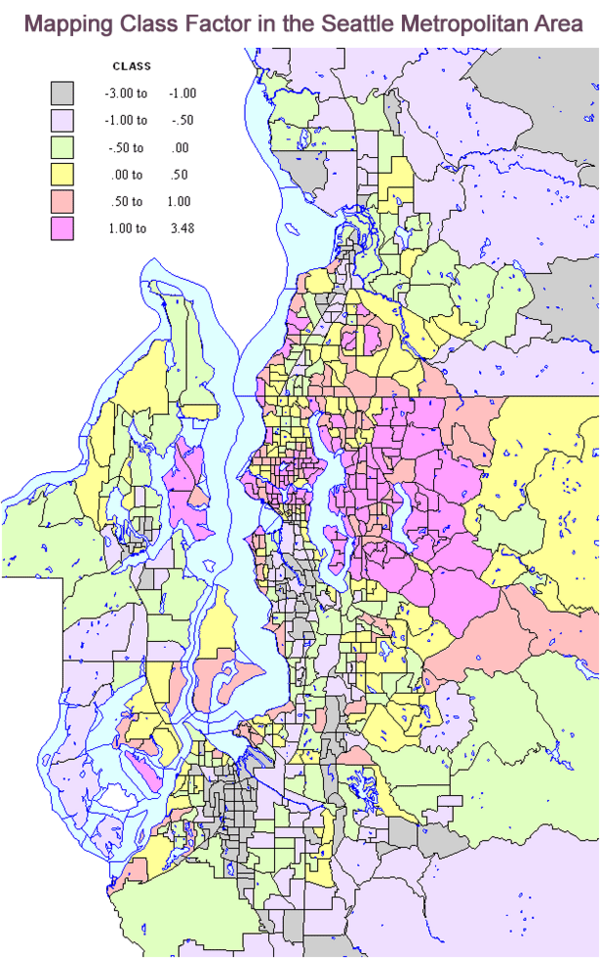
    This map plots “factor scores,” a statistically constructed variable or index divided into six levels of “class:” two upper, two middle and two lower. It is timely to do this, since it was 50 years ago when Calvin Schmid, demographer in Sociology at the University of Washington, and my early mentor, performed a pioneering factor analysis of crime in Seattle – and this was before modern computers! The derived scores most reflect high weighting of the variables: percent of adults with a BA or more, percent in professional versus laboring occupations, median house value and median household income.

    As you look at the map, it’s clear how Seattle reflects very strongly what is generally described as gentrification. This means the reclaiming of the central core by the highly educated and professional, eschewing the suburban metaphorical desert. In the case of Seattle, this process occurring between 1985-2005 resulted in the displacement of over 50,000 less affluent and often minority households to south King county. The city begins to resemble the historic pattern of the rich and important occupying the vibrant core of the city, relegating the working poor to the suburbs, with poor access and inadequate services. Indeed, even now I am involved in a project to assess the lack of access of poor children, often minority or foreign born, to health care in south King county.

    The dominant “upper class” area is the Eastside, east of Lake Washington, and location of the affluent “edge city” of Bellevue, home of the Microsoft campus. A second set of upper class areas are waterfront and view neighborhoods, taking advantage of the Seattle area’s broken topography. The third is simply the University of Washington immediate hinterland. I suspect the location of a large research university with 42,000 students and 22,000 staff increasingly propels Seattle’s unusually high status, income and popularity. I think this is increasingly more important a factor than the presence of an increasingly less important downtown Seattle business center.

    Conversely, lower class areas include traditional zones of mixed housing, industry and transport, such as south Seattle, the older satellite cities of Everett (north), Bremerton (west), and especially Tacoma (south). The largest area of lower class neighborhoods extends from south Seattle through south King county to Tacoma, marked by historical development, displacement from Seattle and high minority population. The second large zone of lower class settlement is the rural fringe, especially in Pierce (south) and Snohomish (north) counties, and may surprise those who think all rural areas are the home of rich estates.

    Then there is the middle class. This is where the suburbs matter most. On the map, middle class areas (yellow and green) are intermediate in location as well and dominate the outer suburban areas as well as some older inner neighborhoods of Seattle and Tacoma. It is unfortunately true that race, ethnicity and class remain highly correlated especially within the core cities of Seattle and Tacoma, reflecting the continuing history of unequal education and job preparation and prospects.

    This analysis suggests one possible future of urban development following something of a European model, with most middle class people in the suburbs, while the rich and poor concentrate either in the urban core or in selected locales in the periphery. As for the city itself, it’s clear that the total landscape is not simply becoming wealthier but increasingly bifurcated between the affluent and the long-term poverty population. And suburbia, home to the vast majority of the region’s population remains the predominant home of the middle and working classes, with pockets of both wealth and poverty.

    Richard Morrill is Professor Emeritus of Geography and Environmental Studies, University of Washington. His research interests include: political geography (voting behavior, redistricting, local governance), population/demography/settlement/migration, urban geography and planning, urban transportation (i.e., old fashioned generalist)

  • Farmland Prices: The Cost of Growing A Suburb

    Summer in Minnesota – land of 10,000 lakes — is, for many families, about boating, with the Harley the preferred mode of ground transportation. In winter, snow mobiles are popular. Hunting and fishing replace the corner coffee shops as hangouts. Three car garages are considered a minimum – four even better!

    So how did it come to pass that out-of-control land prices would destroy the economics of housing in this small-town region? And why was the pattern repeated in markets like Las Vegas and Phoenix?

    In the 1980’s the Metropolitan Council in Minneapolis became concerned with sprawl. The MET Council thought Portland, Oregon’s policies to control sprawl by creating an Urban Boundary would be beneficial to the Twin City area, a seven county region. This area is topographically simple: no ocean boundary, and, unlike Portland’s region, no mountain ranges. The MET Council did not anticipate that their attempt to control growth would end up contributing to it.

    Farmers who owned land with sewer capacity outside the boundary knew that its value had just skyrocketed. When a supply — land — is limited, those that control it can name their own price. Within the boundary land was too expensive to develop affordable housing. So cities outside the MET Council’s control began to attract developers. Places that nobody had heard of much: Otsego, Albertville, Elk River, and Hugo are all a very long drive from the Twin City core. These towns had two important components for builders: city sewer and cheap land.

    As the tiny towns outside the Urban Boundary attracted more development, they also attracted the national developers. All of the nation’s Top Ten Home Builders discovered this region. Each year 25,000 or so new homes were built and quickly sold to suburbanites who preferred a 30 to 40 mile commute over living near the city core. (Keep in mind that Minneapolis / St Paul has one of the nicest core areas of a major US city. Even downtrodden sections look pretty nice. And Minneapolis stays alive in the evenings and becomes a social Mecca that is also relatively safe.)

    Much of the escalation in home pricing was due to a bidding war over developable farmland. National builders, using their Wall Street dollars, competed for desirable acreage. If Farmer Fred was able to sell his property for $50,000 an acre, when Roy next door put his farm up, the starting price was $50,000 and the final fee was likely to be $60,000, the starting point of the next site for sale. By 2005 the outer small town land that could have been bought for $12,000 an acre a decade earlier was worth more than 10 times that amount.

    In the past, builders would look at the price of a finished lot, and assume that the house they built on it would cost a maximum of four times the finished lot price; a sort of “one-quarter” rule for land costs. If the lot cost $30,000, they would not build a home that ultimately cost more than $120,000.

    By 2005, if outer suburban land sold for $150,000 an acre and the density (after required park areas, wetlands, buffers, and shoreline zones) was two homes per acre, that meant that $75,000 of a new suburban home was in raw land costs. Add to that $25,000 in construction of roads, utilities, fees, etc, and the lot price skyrocketed to $100,000. Using the one-quarter rule, this meant the builder would need to get $400,000 for the finished home.

    At the 2006 Land Development Today Breakthroughs conference I spoke about our research into the impending market crash and its basis. The market had just begun to show signs of slowdown, and nobody was predicting a big fall.

    Our “study” was based on a comparison of our local housing market in the Minneapolis region with markets where we were working in about 40 States. It involved a simple search of major builders in the top markets. We looked at areas where land prices were escalating much faster than inflation in order to see the common elements. The National Association of Home Builders average national price for a 2,400 square foot average home was $264,000. It should be no surprise that impromptu results indicated the average price of a 2,400 square foot home in Phoenix was $331,000 (20% above average), in Las Vegas $442,000 (40% high), and in the Minneapolis suburbs $349,000 (25% high).

    Weather was not one of the common elements. But all three areas — Las Vegas, Phoenix, and the Twin Cities — had explosive growth for two decades until 2007 (2006 for the Twin Cities), and all three had most, if not all, of the nation’s Top Ten Home Builders selling and building.

    In March of 2005 one of my clients made me an offer. If I convinced a certain farmer to sell, I would receive not just the planning fees, but also 5% of the profits. The land in question was about an hour’s drive from the urban core during rush hour traffic. I looked at the site and took out the slope restriction, the Department of Natural Resources tiers, the wetlands, the buffers, and the land that was otherwise not buildable, including the rolling surface areas that resembled more Moto-Cross course than residential developable land.

    The cost for the remaining buildable area would have been about $300,000 an acre. The numbers simply did not work out. Land prices had reached the breaking point. Since there was no possible way to profit, my 5% of zero would still be zero. I suggested that my client not do the deal, and saved him from financial ruin.

    It’s easy to make Government the scapegoat. Even though the MET Council set in motion policies that likely caused sprawl by trying to curb it, it was not the cause of land prices going out of control. All the major developers with their deep pockets outbidding each other for over a decade was what did the economics in. Today, housing prices in the Twin City market have plummeted to a more realistic point that is about what the national average was in 2005.

    Five years before the crash many actually believed that high land prices were a sign of a great economy. Well guess what? They were wrong.

    Rick Harrison is President of Rick Harrison Site Design Studio and author of Prefurbia: Reinventing The Suburbs From Disdainable To Sustainable. His websites are rhsdplanning and prefurbia.com.