Category: housing

  • One Fundamental Problem: Too Many People Own Homes

    Ben Bernanke made the following statement as he attempted to justify bailing out bad borrowers:

    “…from a policy point of view, the large amount of foreclosures are detrimental not just to the borrower and lender but to the broader system. In many of these situations we have to trade off the moral hazard issue against the greater good.” – Ben Bernanke, February 25, 2009

    I think he is wrong on this, and the moral hazard issue is only a small part of my objections.

    One of the fundamental problems we have right now is that too many people own homes. It sounds harsh, but please bear with me a few sentences. I think we can agree that 100 percent home ownership is not possible, or even desirable. Most of us can remember a time when our income and our jobs were such that home ownership was a bad idea. Home ownership is a commitment that requires a significant amount of stability and discipline. Not everyone is so stable or has the discipline to keep up with the payments.

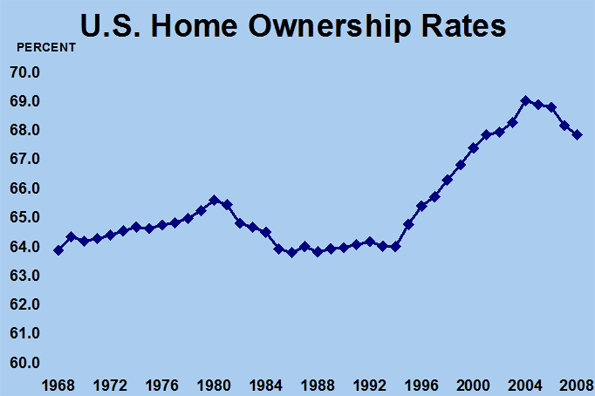
    What is an appropriate national homeownership rate? Theory gives us no answer. We look to the data for a clue. Here’s a chart of home ownership rates since 1968:

    It seems pretty clear that a homeownership rate between 63 percent and 65 percent works pretty well. When we get above that range, problems seem to crop up. This was true in 1980 – the worst recession of the past 30 years – and it is true now.

    In light of these data, let’s think about what Bernanke is saying. He’s arguing that to execute the foreclosures required to move the rate back to that 63 percent to 65 percent range are bad for the economy. So bad in fact, that we’re better off not going there.

    The problem with that argument lies in a lack of historic understanding of the proper levels of homeownership. Financial and real estate markets can’t stabilize until we get closer to that equilibrium. Until we lower the home ownership rate, financial institutions will have a cloud around them, and residential real estate markets will be lifeless. It may not be politically popular, but those are the realities.

    This is a critical issue. For years, economists have believed that the failure of banks to recognize and remove bad assets contributed to Japan’s long period of economic malaise. I agree. Forbearance on bad real estate loans here in the states constitutes much the same thing. Our financial institutions are holding a bunch of bad assets; these are homes that are owned by people who can not afford them – never did, and likely never will. Until the financial institutions recognize those bad assets and get them off their books, our financial institutions won’t have the resources to fund, stabilize and then drive a broader economic recovery.

    What we need is not more mindless beneficence to everyone from Wall Street to Detroit and Main Street. The more we bailout failed financial institutions, automobile manufactures, or any business, the longer we postpone our recovery.

    Recessions are periods when assets are reallocated from less productive to more productive uses. That requires processes like repossession, foreclosure, mergers, and bankruptcy. These processes have been developed over centuries. They are the most efficient methods to restore an economy.

    Why are we suddenly abandoning these processes that have proved themselves in many business cycles? I suppose part of it is the desire to eliminate the business cycle. This is the same thinking that had many – including conservatives – arguing that stocks could not fall during the dot.com bubble or that housing prices would also move up.

    In reality the business cycle can not be eliminated. It can’t be done and it is pure hubris to try. One of the fundamental insights to come out of Real Business Cycle research is that recessions constitute the most efficient response to a negative shock.

    We need to stop wasting resources trying to stem the tide. Instead, let us allow the recession to work for us. In the meantime we can provide a backstop through unemployment benefits and some reasonable fiscal stimulus. But we have to experience some pain and let our processes and institutions work for us. The sooner we get these foreclosures, repossessions, mergers, and bankruptcies behind us, the sooner we will see a return to the only sure cure for a sick economy: real economic growth.

    Bill Watkins, Ph.D. is the Executive Director of the Economic Forecast Project at the University of California, Santa Barbara. He is also a former economist at the Board of Governors of the Federal Reserve System in Washington D.C. in the Monetary Affairs Division.

  • Why Homeownership Is Falling – Despite Lower Prices: Look to the Job Market

    By Susanne Trimbath and Juan Montoya

    There’s something about “Housing Affordability” that makes it very popular: Presidents past and present set goals around it. The popularity of this perennial policy goal rests on the feel-good idea that everyone would live in a home that they own if only they could afford it. Owning your own home is declared near and far to be the American Dream.

    Recently, however, it seems that Americans’ aren’t all having the same dream. Despite improving conditions of affordability, home sales continue to decline. Affordability is balanced on a tripod of prices, incomes and interest rates. As incomes become unstable because of mounting job losses, housing falls further out of balance – no change in price or mortgage interest rates will be enough to rebalance the tripod within the next twelve to eighteen months,

    In a new study on Homeownership Affordability we identify two anomalies in the data: home sales are falling as housing affordability is rising; and the rate of homeownership since 2004 has fallen despite the apparent “boom” in housing.

    Rising Affordability with Falling Sales

    In the last three years, the average mortgage interest rate was 6.14%. Such historically low rates should improve affordability compared to, say, the time of the 1990s credit crunch when mortgage rates averaged 9.3%. Leading up to 2007, median income in the US rose by 0.6% and median home prices fell by 3.1% – also a positive indicator for affordability. The mortgage payment to income ratio at the median has fallen to about 23%. Compared to 32% in 2002 and even 40% in 1988, just before the 1990s credit crunch, this should be a very positive indicator for homeowner affordability. Yet, new home sales have plummeted from a rate of about 1.4 million per year in the summer of 2005 to less than 500,000 by the end of 2008.

    In 2007, for every 1% improvement in affordability, home prices fell by 2%. There clearly has been a breakdown in the fundamental relationship between supply and demand. Why? It appears potential buyers are concerned that homes are over-priced and, worse yet, that home price declines will increase in the future. There are indications that some households think that homes are over-priced regardless of affordability and, furthermore, not everyone who can afford a home is interested in buying one. Some communities, some jobs and some lifestyles are better suited to renting.

    Ownership Policies with Falling Ownership

    All this has occurred in the face of conscious federal policy. Expanding homeownership opportunities, especially for minorities, was a fundamental aim of the Bush Administration’s housing policy – one strongly supported by Democrats in Congress. In June 2002, HUD announced a new goal to increase minority homeownership by 5.5 million by the end 2010. Hispanics were the only minorities to have clear gains in homeownership through 2008: a 4.1 percentage point increase compared to the end of the last decade. The gains in homeownership for black Americans was about the same as for the nation as a whole. Yet the ownership rate for the nation as a whole declined by almost 1 percent during the more recent “housing bust” years.

    Some regions saw bigger losses in homeownership than others, especially those outside the urban areas and particularly in the Midwest.

    Where do we go from here?

    We believe the analytical focus needs to shift to employment when analyzing housing for individual states, regions or cities. The accompanying table shows where, at the state level, the workforce is shrinking as unemployment is rising. These are the areas, much like Southern California at the end of the Cold War or Houston after the 1980s bust in oil prices, that will suffer potentially devastating drops in home prices as a result of forced sales by departing labor.

    Supply, demand and pricing, the cost of financing, household income and home prices – all are critical factors in the equation of homeownership. But more than anything we believe that mounting job losses, in addition to a declining stock market, will now play the critical role. Over time, the current credit crisis will not only make funds more scarce – which must eventually drive up the price of credit – but also drive up the risk premium demanded by lenders. Growing job uncertainty will increase the price of credit even further.

    These factors alone will negatively impact affordability in the future. Keeping mortgage rates artificially low (for example, as the Federal Reserve buys up mortgage-backed securities as proposed in Congress) will create upward pressure on prices, which in turn will hurt affordability. Additionally, we see continued imbalances in the supply-demand equation as foreclosures add inventory to the market.

    In the coming 12 to 18 months, we believe that interest rates will rise and incomes will, at best, remain flat in the face of the global recession. More importantly, as job losses mount, “affordability” will be less important and “maintainability” – the ability of homeowners to keep their homes in the face of unemployment – will emerge as a major factor. In the meantime, housing affordability will hang precariously out of balance due to falling incomes and decreasing jobs as well as surging real interest rates.

    State Change in Total Workforce and Unemployed
    State
    %change in number of workforce
    %change in number of unemployed
    Unemployment rate as of Dec. 2008
    Michigan -1.9% 39.7% 10.6%
    Rhode Island -1.8% 88.1% 10.0%
    Alabama -1.8% 75.3% 6.7%
    Illinois -1.5% 40.3% 7.6%
    West Virginia -1.3% 4.6% 4.9%
    Mississippi -1.1% 25.6% 8.0%
    Missouri -0.8% 37.6% 7.3%
    Tennessee -0.4% 59.4% 7.9%
    Ohio -0.3% 33.8% 7.8%
    Arkansas -0.1% 12.7% 6.2%
    New Hampshire -0.1% 33.6% 4.6%
    Utah -0.1% 51.8% 4.3%
    Delaware 0.0% 75.3% 6.2%
    Wisconsin 0.1% 27.8% 6.2%
    Maryland 0.1% 63.4% 5.8%
    Kentucky 0.3% 48.4% 7.8%
    Iowa 0.3% 20.7% 4.6%
    Massachusetts 0.4% 61.1% 6.9%
    Idaho 0.4% 142.6% 6.4%
    Colorado 0.4% 53.8% 6.1%
    Georgia 0.5% 78.3% 8.1%
    Montana 0.5% 68.9% 5.4%
    Maine 0.6% 44.5% 7.0%
    Minnesota 0.6% 47.6% 6.9%
    South Dakota 0.6% 35.4% 3.9%
    North Carolina 0.7% 87.4% 8.7%
    Indiana 0.7% 86.0% 8.2%
    Connecticut 0.7% 48.0% 7.1%
    Florida 0.8% 80.9% 8.1%
    New York 1.0% 51.9% 7.0%
    North Dakota 1.0% 8.5% 3.5%
    Vermont 1.1% 66.9% 6.4%
    Nebraska 1.2% 46.0% 4.0%
    Wyoming 1.3% 12.4% 3.4%
    New York City 1.4% 47.2% 7.4%
    Kansas 1.5% 27.4% 5.2%
    South Carolina 1.6% 55.3% 9.5%
    California 1.8% 60.4% 9.3%
    Virginia 1.8% 69.2% 5.4%
    New Jersey 1.9% 72.8% 7.1%
    Hawaii 2.0% 82.9% 5.5%
    Oklahoma 2.1% 21.7% 4.9%
    Louisiana 2.2% 52.6% 5.9%
    New Mexico 2.2% 56.2% 4.9%
    Alaska 2.4% 22.4% 7.5%
    Pennsylvania 2.4% 55.7% 6.7%
    Washington 2.6% 60.0% 7.1%
    Texas 2.6% 45.9% 6.0%
    Oregon 2.8% 70.4% 9.0%
    Arizona 3.4% 72.0% 6.9%
    Nevada 4.9% 84.6% 9.1%
    Average 0.8% 53.2% 6.7%
    Median 0.7% 52.6% 6.9%

    Dr. Trimbath is a former manager of depository trust and clearing corporations in San Francisco and New York. She is co-author of Beyond Junk Bonds: Expanding High Yield Markets (Oxford University Press, 2003), a review of the post-Drexel world of non-investment grade bond markets. Dr. Trimbath is also co-editor of and a contributor to The Savings and Loan Crisis: Lessons from a Regulatory Failure (Kluwer Academic Press, 2004)

    Mr. Montoya obtained his MBA from Babson College (Wellesley, MA) and is a former research analyst at the Milken Institute (Santa Monica, CA) where he coauthored Housing Affordability in Three Dimensions with Dr. Trimbath. He currently works in the foodservice industry.

  • The Panic of 2008: How Bad Is It?

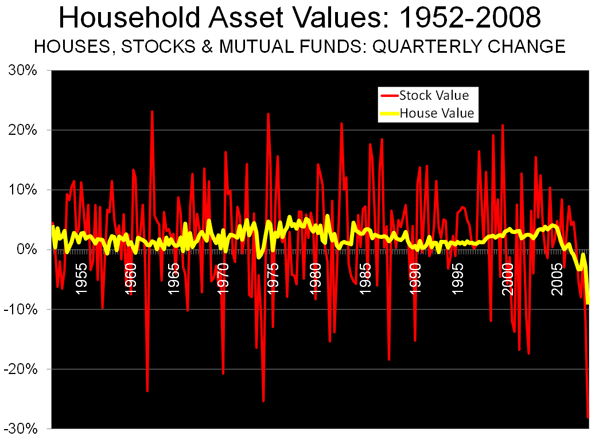
    Just how bad is the current economic downturn? It is frequently claimed that the crash of 2008 is the worst economic downturn since the Great Depression. There is plenty of reason to accept this characterization, though we clearly are not suffering the widespread hardship of the Depression era. Looking principally at historical household wealth data from the Federal Reserve Board’s Flow of Funds Accounts of the United States, summarized in our Value of Household Residences, Stocks & Mutual Funds: 1952-2008, we can conclude it’s pretty bad, but nothing yet like the early 1930s.

    But this Panic of 2008 is no picnic. And in some key areas, notably housing, it could be even worse than what was experienced in the Great Depression.

    Housing: It all started with the housing bubble that saw prices in some markets rise to unheard of levels, principally in California, Florida, Phoenix, Las Vegas and the Washington, DC area. Mortgage lenders, unable to withstand the intensity of losses in these markets caused by declining prices, collapsed like a house of cards. This precipitated the Lehman Brothers bankruptcy on Meltdown Monday (September 15, 2008) and a far broader economic crisis since that time.

    Before the bubble, housing had been a stable store of wealth (equity or savings) for Americans. According to federal data, the value of the US owned housing stock increased in every year since 1935. The bursting of the housing bubble, however, brought declines in both 2007 and 2008, the longest period of housing value decline since between 1929 and 1933. The value of the housing stock was down 20 percent from its peak at the end of 2008. In some markets the losses amounted to more than double this amount. By comparison, the 1929 to 1933 house value decline was 27 percent. However, only one Great Depression year (1932) had a larger single-year decrease than 2008.

    Indeed, between 1952 and 2006, the value of the housing stock never declined for more than a three month period. The bubble changed all that. The value of the housing stock has now fallen eight straight quarters. An investment that has been safe for most middle class Americans – the house in the suburbs – suddenly experienced the price volatility usually associated with the stock market, as is indicated in the chart below.
    The resulting losses have been substantial. By the end of 2008, the value of the housing stock has fallen $4.5 trillion. In Phase I of the housing downturn, before Meltdown Monday, the largest losses were concentrated in the markets with the biggest “bubbles,”. But since that time the market has entered a Phase II decline, while a more general decline has characterized housing markets around the country in the fourth quarter of 2008. The decline continues.

    California, the largest of all the states, has been particularly hard hit. New data for both the San Francisco and Los Angeles areas show price drops of approximately 10 percent in January, 2009 alone, as prices fall like the value of a tin-pot dictatorship’s currency. This decline, it should be noted, has spread from the outer ring of these areas – places like the much maligned Inland Empire region and the Central Valley – into the formerly more stable, and established, areas closer to the larger urban cores, which some imagined would be safe from such declines.

    Sadly, there may well be some time before house price stability can be achieved. To restore the historic relationship between house prices and household incomes to a Median Multiple (median house price divided by median household income) of 3.0 would require another $3 trillion in losses, equating to a more than 15 percent additional loss. Losses are likely to be greater, however, not only in the “ground zero” markets of California and Florida but also other hugely over-valued markets, such as Portland, Seattle, New York and Boston. Of course, these are not normal times, and an intransigent economic downturn could lead to even lower house values than the historical norm would suggest.

    Stocks and Mutual Funds: As noted above, stocks and mutual funds have been inherently more volatile than housing values. According to Federal Reserve data, the value of these holdings fell 24 percent over the year ended September 30. Based upon later data from the World Federation of Exchanges, we estimate that the value declined sharply after September 15, and at December 31 stood at 45 percent below the peak.

    The household value of stocks and mutual funds has declined for five consecutive quarters, as of December 2008. There was a more sustained drop over six quarters in 1969-1970, although the decline in value was less than the present loss, at 37 percent. A larger decline (47 percent) was associated with the four quarter decline of 1973-1974. Comparable data is not available for household stocks and mutual fund holdings before 1952. The less complete data available indicates that the gross value of common and preferred stocks fell 45 percent from 1929 to 1933. As late as 1939, a decade after the crash, the loss had risen to 46 percent, indicating both the depth and length of the Great Depression.

    The present downturn seems on course at a minimum to break the post-depression loss record with an overall decline at 55 percent as of February 20. This would correspond to a household loss of $8 trillion from the peak.

    Consumer Confidence: The Conference Board’s Consumer Confidence Index reached an all time low of 25.0 in February, down a full one-third in a month. Even with its gasoline rationing, the mid-1970s downturn saw a minimum Consumer Confidence Index of 43.2. Normal would be 100; as late as August of 2007, consumer confidence was above 100. Consumer confidence is important. Where it is low, as it is today, there is fear and even people with financial resources are disinclined to spend. Confidence is a major contributor to economic downturns, which is why they used to be called “panics.” Restoring confidence is a requirement for recovery.

    Government Confidence: If there were a federal government index of confidence, it would probably be near zero. This is demonstrated by the trillions that both parties in Washington have or intend to throw at banks, private companies and distressed home owners to stop the downturn. Never since the Great Depression have things become so bad that Washington has opened taxpayer’s checkbooks for massive financial bailouts.

    How Much Wealth has been Lost: The net worth of all US households peaked at $64.6 trillion in the third quarter of 2007, according to the Federal Reserve Board. Since that time, it seems likely that the housing, stock and mutual fund losses by the nation’s households could be as high as $12 trillion – $4 trillion in housing and $8 trillion in stocks and mutual funds. This is a major loss and is unlikely to be recovered soon. Yet it makes sense to consider these losses in context. Unemployment is far lower than in the 1930s, when it reached 25 percent, and the Dust Bowl is not emptying into California (indeed, more than 1,000,000 people have migrated from California to other states this decade).

    Born Yesterday Jeremiahs: It is fashionable to suggest that the current economic crisis is the result of over-consumption and an unsustainable lifestyle. The narrative goes that the supposed excesses of the 1980s and 1990s have finally caught up with us. In fact, however, even with the huge losses, the net worth of the average household is no lower than in 2003 and stands at 70 percent above the 1980 figure (inflation adjusted). This may be a surprise to “born yesterday” economic analysts.

    The reality is that the country achieved astounding economic and social progress since World War II. The reality remains that even after the losses we are not, objectively speaking, experiencing Depression-like conditions. Critically, the answer to the question, “Are you better off today?” in 1950, 1960, 1970, 1980, 1990 and even 2000 is “yes”. This is a critical difference with the situation in the 1930s when the country overall was much poorer, and far less able to withstand such punishing losses.

    Beware the Panglossians: Even so, it seems premature to predict that the economy will turn around soon. Some Panglossian analysts predict recovery later in the year or in 2010 seem likely to miss the mark by years. Remember analysts – particularly those tied to both the real estate and stock sectors – who have discredited themselves with their past cheerleading. In addition, the international breadth and depth of this crisis cannot possibly be fully comprehended at this time. Last week the Federal Reserve predicted a declining economy over the next year.

    And even when the recovery starts, it is likely to be slow because of the public debt run up to stop the bleeding. When the recovery begins, the nation and the world will have to repay the many trillions in bailouts one way or the other. This can take the form of higher taxes, inflation, rising real interest rates or, if you can imagine, all three.

    How Bad Is It? Bad Enough. The present downturn is not as serious as the Great Depression. Nonetheless, the Panic of 2008 is without question, the most serious economic downturn since the Great Depression. The real question is whether the government will react as ineffectively as it did back then, and prolong the downturn well into the next decade.

    Wendell Cox is a Visiting Professor, Conservatoire National des Arts et Metiers, Paris. He was born in Los Angeles and was appointed to three terms on the Los Angeles County Transportation Commission by Mayor Tom Bradley. He is the author of “War on the Dream: How Anti-Sprawl Policy Threatens the Quality of Life.

  • Case-Shiller Housing Price Index Chart, December 2008 – The Free Fall Continues

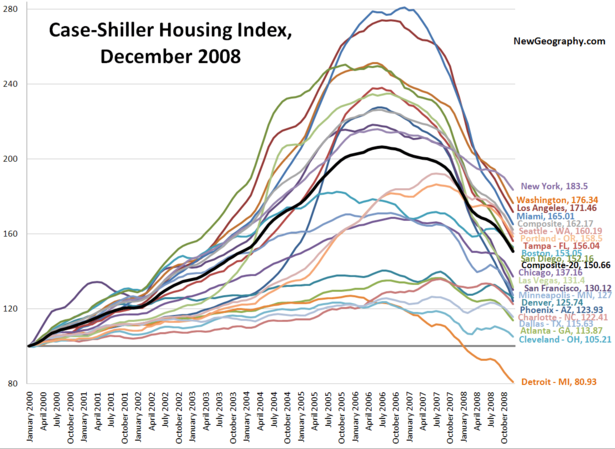
    S&P released the December Case-Shiller Housing Price Index data this morning: no market has been spared from the free fall. Steep price declines continue in ultra-bubble regions Las Vegas, Miami, San Diego, Phoenix, and Las Vegas. Even the relatively healthy markets of Charlotte, Dallas, and Atlanta have been sliding since mid-2008. Here’s the line chart:

    Cleveland is seeing the slowest decline, but that isn’t saying much. My pick for healthiest markets? Denver, where prices are still up 25% from the 2000 baseline but still down 5.2% from the most recent upswing in July 2008. And Dallas, down 6.1% from the July 2008 peak and down 8.6% from June 2007. Dallas is up 22.9% since the Jan 2000 baseline.

    Follow this link for a bigger version of the chart.

  • Housing Bail Out Part Deux: Just Another Financial Con Job

    Last night I wrote about the Obama Administration’s housing bail out. But, I hate to say, there’s more to tell you – and it’s actually worse. In addition to the giveaways to mortgage holders, we also have to consider the federal government effectively offering to give a credit default swap (CDS, remember those?) to the banks. If one of the lucky homeowners that get a loan modification defaults on their mortgage because home prices fall again in the future, the federal government will make good to the bank for them. There are some differences between this and a real CDS, though – the banks won’t have to pay a premium for the insurance. The federal government is selling CDS for $0. Nice. We taxpayers are putting up $10 billion for this piece.

    Then there are the plans to “Support Low Mortgage Rates by Strengthening Confidence in Fannie Mae and Freddie Mac.” There’s that word again: confidence. In a con game, the con man isn’t the one who is confident; he is the one who gives you confidence. You are so confident that you are making a good decision that you give him all your money to be part of his scheme. If you still have any questions about confidence schemes, watch “The Music Man” again.

    The Treasury nationalized Fannie and Freddie (F&F) last year – they are now owned by the federal government. If you need more “confidence” than that in the strength of F&F then you should consider moving to another country. Under the assumption that “too big to fail” makes sense, the new Bailout plan is increasing the size of F&F’s mortgage portfolios by $50 billion – along with corresponding increases in their allowable debt outstanding. This part of the Homeowner Affordability and Stability Plan will cost $200 billion, an amount that goes beyond the $2.5 trillion cost of the Financial Stability Plan and the $700 billion in the Emergency Economic Stabilization Act/TARP and the $800 billion Stimulus Plan. The new $200 billion in funding, according to the Treasury’s plan, is being made under the Housing and Economic Recovery Act.

    If you can remember back that far, the Housing and Economic Recovery Act was signed into law by the former and largely unmissed resident of the White House back in July 2008 to clean up the subprime mortgage crisis before any of the other bailout money was committed to clean up the subprime mortgage crisis. This legislation established the HOPE for Homeowners Act of 2008 which spent $300 billion to (1) insure refinanced loans for distressed borrowers, (2) reduce principle balances and interest charges to avoid foreclosure, (3) provide confidence in mortgage markets with greater transparency for home values, (4) be used for homeowners and not home flippers or speculators (5) increase the budget at the Federal Housing Administration so they can monitor that all this happens, (6) end when the housing market is stabilized and (7) provide banks with more ways and means to stop foreclosing on delinquent homeowners. Three million homes were foreclosed last year despite this legislation or any of the other bills that passed before and after it.

    Each new bill carries with it an increase in the limit on the national debt. The most recent Stimulus Package increased it from $11.315 trillion to $12.104 trillion effective February 17, 2009. The actual debt is currently at $10.8 trillion and rising. With only $1.3 trillion between the actual debt and the limit, Timmy Geithner’s pals back at the Federal Reserve will have to keep the printing presses running overtime.

    The “new” Homeowner Affordability and Stability Plan is just a rehash of every old financial sector bailout plan. The definition of insanity, according to a quote attributed to Albert Einstein, is doing the same thing over and over again and expecting different results. Here we go again.

    Susanne Trimbath, Ph.D. is CEO and Chief Economist of STP Advisory Services. Her training in finance and economics began with editing briefing documents for the Economic Research Department of the Federal Reserve Bank of San Francisco. She worked in operations at depository trust and clearing corporations in San Francisco and New York, including Depository Trust Company, a subsidiary of DTCC; formerly, she was a Senior Research Economist studying capital markets at the Milken Institute. Her PhD in economics is from New York University. In addition to teaching economics and finance at New York University and University of Southern California (Marshall School of Business), Trimbath is co-author of Beyond Junk Bonds: Expanding High Yield Markets.

  • Housing Downturn Moves Into Phase II

    The great housing turndown, which started as early as 2007, has entered a second and more difficult phase. We can trace this to Monday, September 15, 2008 just as October 29, 1929 – “Black Tuesday” – marked the start of the Great Depression. September 15 does not yet have a name and the name “Black Monday” has already been taken by the 1987 stock market crash. The 1987 crash looks in historical perspective like a slight downturn compared to what the world faces today.

    On September 15 – let’s call it “Meltdown Monday” – the housing downturn ended its Phase I and burst into financial markets leading to the most serious global recession since the Great Depression. Indeed, International Monetary Fund head Dominique Strauss-Kahn now classifies it a depression.

    Phase I claimed its own share of victims; Phase II seems likely to hit many more.

    Phase I of the Housing Downturn

    Whether in depression or recession, parts of the United States housing market were already in a deep downturn well before September 15. Phase I of the housing downturn started when house prices reached an unprecedented peak in some markets and began fell into decline. By September of 2008, house prices in the “ground zero” markets of California, Florida Las Vegas, Phoenix and Washington, DC had dropped from 25 percent to 45 percent from their peaks. These markets represented 75 percent of the overall lost value among the major metropolitan areas (those with more than 1,000,000 population).

    The Varieties of House Price Escalation Experience: In Phase I, the house price escalation and subsequent losses were far less severe in other major metropolitan areas. This depended in large part to the degree of land use controls – such as land rationing (urban growth boundaries and urban service limits), building moratoria, large lot zoning and other restrictions on building routinely – that helped drive prices up to unsustainable levels. This effect, cited by a number of the world’s most respected economists, was exacerbated by the easy money policies adopted by mortgage lenders.

    On the other hand, in the “responsive” land use regulation areas, the market (people’s preferences) was allowed to determine where and what kind of housing could be built. In these areas housing prices rose far less during the housing bubble and fell far less during Phase I of the housing downturn.

    Leading to the International Financial Crisis: These radically differing house price trends set up world financial markets for ”Meltdown Monday.” The easy money led to a strong increase in foreclosure rates, an inevitable consequence of households having sought or been enticed into mortgage loans that they simply could not afford. Yet it was not foreclosure rates that doomed the market. It was rather the unprecedented intensity of those losses in particular markets.

    Foreclosures were not the problem: Foreclosures happened all over. Foreclosure rates rose drastically in California and the prescriptive markets, but had relatively less impact in the responsive markets of the South and Midwest, where house prices changed little relative to incomes.

    Intensity of the losses was the problem. The problem lay largely in the scale of house value losses in some markets, particularly the most prescriptive ones. Lenders faced foreclosure and short sales losses on houses that had lost an average of $170,000 in value in the ground zero markets. In the responsive markets, on the other hand, average house value losses were less than one-tenth that, at $12,000 per house (http://www.demographia.com/db-hloss.pdf).

    By the end of Phase I of the housing downturn, house value losses in the prescriptive markets had reached nearly $2.3 trillion, accounting for 94 percent of the total losses in major metropolitan markets (those with more than 1,000,000 population). If the market had been allowed to operate in these markets, the losses in the prescriptive markets could easily have been one-fifth this amount. Most likely the mortgage industry and the international economy might have been able to handle such losses, sparing the world the current deep financial crisis.

    True, the housing bust would not have happened without the easy money. Neither easy money nor prescriptive land use regulation were sufficient in themselves to send the world economy into a tailspin. But together they conspired to create the conditions for “Meltdown Monday”.

    Phase II of the Housing Downturn

    The Panic of 2008: By September 15, the “die had been cast.” The holders of mortgage debt could no longer sustain the losses that were occurring in the ground zero markets. This led to the Lehman Brothers bankruptcy and then to a financial sector that seems to be accelerating faster than the taxpayers can pick up the pieces. The ensuing “panic” – a 19th century synonym for a severe economic downturn – has led to millions of layoffs, decreases in demand across the economy and taxpayer financed bailouts around the world. Many have seen their retirement funds wiped out. Others have lost their jobs. American icons, such as General Motors and Bank of America have been relegated to begging on Washington’s K Street.

    Housing Downturn Broadens and Deepens: The panic has now brought about a new phase in the housing downturn – what I label Phase II. In Phase II, a deteriorating economy starts to kick the bottom out of the rest of the housing market. With evaporating confidence in the economy and the drying up of demand, house prices have begun a free-fall in virtually all markets, regardless of the extent to which their prices had bloated.

    Our analysis of National Association of Realtors data shows this. In almost all markets house price declines accelerated during the fourth quarter of 2008 (the first quarter following Meltdown Monday). In just three months, median house prices fell an average of more than 12 percent in the major metropolitan markets. In the ground zero markets, house prices dropped 14 percent, with the average loss from the peak exceeding 40 percent. In the responsive markets, prices fell 11 percent, approximately double the previous reduction from the peak (See Table).

    Thus, the difference is that in Phase I, house price declines were in proportion to the previous price escalation. In Phase II, the percentage declines are generally similar without regard to the house price increases.

    House Price Deflation from Peak
    By Phase of the Housing Downturn
    PRESCRIPTIVE LAND USE MARKETS
    RESPONSIVE LAND USE MARKETS
    Factor
    Ground Zero
    Other
    All
    ALL MARKETS
       
    Prices: To Phase I
    -31.70%
    -11.10%
    -20.80%
    -5.90%
    -17.90%
    Prices: To Phase II
    -41.40%
    -21.40%
    -30.80%
    -16.60%
    -28.00%
     
    Prices in Phase II
    -14.20%
    -11.60%
    -12.60%
    -12.40%
    -14.20%
     
    Loss per House: To Phase I
    ($193,800)
    ($42,400)
    ($96,300)
    ($12,200)
    ($66,900)
    Loss per House: To Phase II
    ($253,000)
    ($81,800)
    ($142,700)
    ($34,200)
    ($104,800)
     
    Loss per House in Phase II
    ($59,200)
    ($39,400)
    ($46,400)
    ($37,900)
    ($59,200)
     
    Gross Losses (Trillions): To Phase I
    ($1.82)
    ($0.46)
    ($2.29)
    ($0.16)
    ($2.44)
    Gross Losses (Trillions): To Phase II
    ($2.40)
    ($0.99)
    ($3.39)
    ($0.44)
    ($3.82)
     
    Gross Losses (Trillions): in Phase II
    ($0.58)
    ($0.52)
    ($1.10)
    ($0.28)
    ($1.38)
       
    Phase I: To September 2008          
    Phase II: To December 2008          
    Major Metropolitan Markets (over 1,000,000 population)      
    For markets by classification see: http://www.demographia.com/db-hloss.pdf    

    Recession or Depression?

    It’s critical to note that the decline is by no means as deep as in the 1930s. On the other hand, there is no indication that conditions are going to improve markedly in the short run. Millions of households who saw their retirement accounts devastated are likely to curb consumption for years to come. The key question is whether we are in the equivalent of 1933, in the pit of the downturn, or in the equivalent of the late 1930s, soon to begin a long, slow climb out.

    For housing though, this is a depression. Never before over the last half-century have house prices fallen as they have in the prescriptive markets during Phase I of the housing downturn. And since the bust, during Phase II, overall price declines are on a par with the worst years of the Great Depression. “Meltdown Monday” has incited a downward spiral whose course will be the topic of future commentaries on this site.

    The classifications of the major metropolitan markets and price declines for each market are shown in http://www.demographia.com/db-hloss.pdf.

    Also see: Mortgage Meltdown Graphic: http://www.demographia.com/db-meltdowngraphic.pdf

    Wendell Cox is a Visiting Professor, Conservatoire National des Arts et Metiers, Paris. He was born in Los Angeles and was appointed to three terms on the Los Angeles County Transportation Commission by Mayor Tom Bradley. He is the author of “War on the Dream: How Anti-Sprawl Policy Threatens the Quality of Life.

  • Housing Price Bubble: Learning from California

    In a letter to The Wall Street Journal (February 6) defending California’s greenhouse gas (GHG) emissions policies, Governor Arnold Shwarzenegger’s Senior Economic Advisor David Crane noted that California’s high unemployment is the result of “a bust of the housing bubble fueled by easy money.” He is, at best, half right.

    The “bust of the housing bubble” occurred not only because of “easy money,” but also because of the very policies California has implemented for decades and is extending in its battle against GHG emissions.

    The nation has never had a housing bubble like occurred in California. The Median Multiple (median house price divided by median household income) in California’s coastal metropolitan areas had doubled and nearly tripled over a decade. Housing costs relative to incomes reached levels twice as high as those experienced in the early 1990s housing bubble, which was bad enough.

    This is all the more remarkable because even before the bubble the Median Multiple in the Los Angeles, San Francisco, San Diego and San Jose metropolitan areas was already elevated at 1.5 times the historic norm.

    “Easy money,” by itself, does not explain what caused the unprecedented housing bubble in California. If “easy money” were the sole cause, then similar house price escalation relative to incomes would have occurred throughout the country.

    Take, for example, Atlanta, Dallas-Fort Worth and Houston. These are the three fastest growing metropolitan areas in the developed world with more than 5,000,000 population. Since 2000, these metropolitan areas have grown from three to 15 times as fast as Los Angeles, San Francisco, San Diego and San Jose. While 1,800,000 people have moved out of the four coastal California metropolitan areas to other parts of the country, 700,000 have moved to Atlanta, Dallas-Fort Worth and Houston from other parts of the country. This is where the demand would have been expected to produce the bubble. But it did not. House prices remained at or near historic norms and average house prices rose one-tenth that of the California coastal metropolitan areas.

    These three metropolitan areas were not alone. Throughout much of the nation, in metropolitan areas growing both faster and slower in population than coastal California, house prices simply did not explode relative to household incomes.

    In touting “smart land use” as a strategy for greenhouse gas emissions, Crane misses the other half of the equation. Indeed, it is so-called “smart land use” (“smart growth”) that intensified the housing bubble in California. “Smart land use” involves planners telling the market where development will and will not occur. In the process it ignores the price signals of the market. Owners of land on which development is permitted naturally and rationally raise their asking prices, while owners of land not so favored can expect little more than agricultural value when they sell. The result is that the land element of housing prices exploded, fueling the unprecedented bubble. Restrictions on supply naturally lead to higher prices, whether in gasoline, housing or anything else.

    California has placed restrictions on development with a vengeance. For nearly four decades, California has woven a tangled web of land use restrictions that have made the state unaffordable. When the demand rose in response to the “easy money” the land use planning systems were unable to respond and a rapid escalation in housing prices followed. The same thing occurred in other areas with excessive land use regulation, such as Las Vegas, Phoenix, Seattle, Portland, New York, Washington and Miami, though the house price escalation was not so extreme as in coastal California.

    On the other hand, where land use still allowed a free interplay of buyers and seller (consistent with rational environmental requirements), the housing bubble was largely avoided. Average house prices in Atlanta, Dallas-Fort Worth and Houston rose only one-tenth that of Los Angeles, San Francisco, San Diego and San Jose.

    When the bubble burst, the far higher house prices naturally tumbled more than in other areas. The price was paid well beyond California and the other “smart land use” markets around the nation. From Washington to Wall Street to Vladimir Putin and Chinese Premier Wen at Davos, everyone knows that the international finance crisis was precipitated by the US mortgage meltdown.

    It all might not have occurred if there had been no “smart land use” markets with their exorbitant and concentrated losses. Overall, the “smart land use” markets represent little more than 30 percent of the nation’s owned housing stock, yet produce more than 85 percent of the housing bubble values at their peak. California style “smart land use” intensified the overall mortgage losses by more than five times. If the losses had been more modest, there might not have been anything like the current mortgage meltdown. With more modest losses, the world financial system might have been able to handle the damage without catastrophe, just as it did with the “dot-com” bubble earlier in the decade. The many households that have lost much of their life savings or retirement income would not be facing the future with fear. And even personally frugal taxpayers of the world would not be the principal stockholders in failing banks.

    California needs to wake up and face the reality. The intensity of the housing bubble was of its own making. More “smart land use” is just what California does not need. This is the lesson the rest of the nation needs to learn rather than repeat.

    Sources:
    David Crane letter to the editor: http://online.wsj.com/article/SB123381050690451313.html
    Domestic migration data: http://www.demographia.com/db-metmic2004.pdf
    Analysis of the housing bubble: http://www.heritage.org/Research/Economy/wm1906.cfm
    House price losses by peak Median Multiple: http://www.demographia.com/db-usahs2008y.pdf
    Las Vegas Land Market Analysis: http://www.demographia.com/db-lvland.pdf
    Phoenix Land Market Analysis: http://www.demographia.com/db-phxland.pdf

    Wendell Cox is a Visiting Professor, Conservatoire National des Arts et Metiers, Paris. He was born in Los Angeles and was appointed to three terms on the Los Angeles County Transportation Commission by Mayor Tom Bradley. He is the author of “War on the Dream: How Anti-Sprawl Policy Threatens the Quality of Life.

  • Housing Prices Will Continue to Fall, Especially in California

    The latest house price data indicates no respite in the continuing price declines, especially where the declines have been the most severe. But no place has seen the devastation that has occurred in California. As median house prices climbed to an unheard-of level – 10 or more times median household incomes – a sense of euphoria developed among many purchasers, analysts and business reporters who deluded themselves into believing that metaphysics or some such cause would propel prices into a more remote orbit.

    Yet gravity still held. A long-term supply of owned housing for a large population cannot be sustained at prices people cannot afford. Since World War II, median house prices in the United States have tended to be 3.0 times or less median household incomes. This fact should have been kept in mind before – and now as well.

    By abandoning this standard, California’s coastal markets skidded towards disaster. Just over the past year, house prices in the Los Angeles, San Francisco, San Diego and San Jose metropolitan areas have declined at more than three times the greatest national annual loss rate during the Great Depression as reported by economist Robert Schiller.

    But the re-entry into earthly prices is just beginning. In the four coastal markets, the Median Multiple has plummeted since our third quarter 2008 data just reported in our 5th Annual Demographia International Housing Affordability Survey. The most recent data from the California Association of Realtors would suggest that the Median Multiple has fallen from 8.0 to 6.7 in San Francisco, in just three months. In San Jose, the drop has been from 7.4 to 6.3. Los Angeles has fallen from 7.2 to 6.2 and San Diego has slipped from 5.9 to 5.2.

    Yet history suggests that there is a good distance yet to go. California’s prices will have to fall much further, particularly along the coast. Due largely to restrictive land use policies, California house prices had risen to well above the national Median Multiple by the early 1990s, an association identified by Dartmouth’s William Fischel. During the last trough, after the early 1990s bubble and before the 2000s bubble, the Median Multiple in the four coastal California markets fell to between 4.0 and 4.5. It would not be surprising for those levels to be seen again before there is price stability.

    Using this standard, I expect median house prices could fall another $150,000 to $200,000 in the San Francisco and San Jose metropolitan areas. The Los Angeles area could see another $100,000 to $125,000 drop, while the San Diego area could be in store for a further decline of $50,000 to $75,000.

    Is there anything that can stop this? Yes there is – the government. This is the same force that caused much of the problem at the onset. Now with the passage of Senate Bill 375 and an over-zealous state Attorney General more intent on engaging in a misconceived anti-greenhouse gas jihad, it may become all but impossible to build the single-family homes that, according to a Public Policy Institute of California survey, are preferred by more than 80% of California. Instead we may see ever more dense housing adjacent to new transit stops – exactly the kind of housing that has flooded the market in recent years. Many of these units, once meant for sale, have been turned into rentals. Many others lay empty.

    In the short run, however, even Jerry Brown’s lunacy will have limited impact. The continuing recession will continue to reduce prices even though the supply remains steady. The surplus of dense condominium units will expand the swelling inventory of rentals, as prices continue to drop towards a 4.0 to 4.5 Median Multiple or below.

    The one place which may benefit from this will be some of the less glamorous inland markets, that are suddenly becoming far more affordable. Sacramento earns the honor of being the first major metropolitan area to reach a Median Multiple of 3.0, as a result of continuing declines. Riverside-San Bernardino is close behind, and should be in this territory within the next year.

    But many other overpriced markets have yet to experience this kind of pain. Prime candidates for big reductions include New York, Miami, Portland (Oregon), Boston and Seattle. These areas may not have suffered the extreme disequilibrium seen in California, but their prices have soared. As the economies of these regions – New York and Portland in particular – begin to unravel, prices will certainly fall, perhaps precipitously.

    This may not make Manhattan or Portland’s Pearl District affordable for the middle class but could drive prices to reasonable levels in the outer boroughs, Long Island or the Portland suburbs. This may be a disaster for the speculators, architects, developers and some local governments, but for many middle class families it may seem like the dawning of a new age of reason.

    HOUSING AFFORDABILITY RATINGS UNITED STATES METROPOLITAN MARKETS OVER 1,000,000
    Rank Metropolitan Area Median Multiple
    AFFORDABLE  
    1 Indianapolis 2.2
    2 Cleveland 2.3
    2 Detroit 2.3
    4 Rochester 2.4
    5 Buffalo 2.5
    5 Cincinnati 2.5
    7 Atlanta 2.6
    7 Pittsburgh 2.6
    7 St. Louis 2.6
    10 Columbus 2.7
    10 Dallas-Fort Worth 2.7
    10 Kansas City 2.7
    10 Mem[hios 2.7
    14 Oklahoma City 2.8
    15 Houston 2.9
    15 Louisville 2.9
    15 Nashville 2.9
    MODERATELY UNAFFORDABLE  
    18 Minneapolis-St. Paul 3.1
    18 New Orleans 3.1
    20 Birmingham 3.2
    20 San Antonio 3.2
    22 Austin 3.3
    22 Jacksonville 3.3
    24 Phoenix 3.4
    25 Sacramento 3.5
    26 Tampa-St. Petersburg 3.6
    27 Denver 3.7
    27 Hartford 3.7
    27 Las Vegas 3.7
    27 Raleigh 3.7
    27 Richmond 3.7
    32 Salt Lake City 3.8
    33 Charlotte 3.9
    33 Riverside-San Bernardino 3.9
    33 Washington (DC) 3.9
    36 Milwaukee 4.0
    36 Philadelphia 4.0
    SERIOUSLY UNAFFORDABLE  
    38 Chicago 4.1
    38 Orlando 4.1
    40 Baltimore 4.2
    41 Virginia Beach-Norfolk 4.3
    42 Providence 4.4
    43 Portland (OR) 4.9
    SEVERELY UNAFFORDABLE  
    44 Seattle 5.2
    45 Boston 5.3
    46 Miami-West Palm Beach 5.6
    47 San Diego 5.9
    48 New York 7.0
    49 Los Angeles 7.2
    50 San Jose 7.4
    51 San Francisco 8.0
    2008: 3rd Quarter  
    Median Multiple: Median House Price divided by Median Household Income
    Source: http://www.demographia.com/dhi.pdf

    Note: The Demographia International Housing Affordability Survey is a joint effort of Wendell Cox of Demographia (United States) and Hugh Pavletich of Performance Urban Planning (New Zealand).

    Wendell Cox is a Visiting Professor, Conservatoire National des Arts et Metiers, Paris. He was born in Los Angeles and was appointed to three terms on the Los Angeles County Transportation Commission by Mayor Tom Bradley. He is the author of “War on the Dream: How Anti-Sprawl Policy Threatens the Quality of Life.

  • New Survey: Improving Housing Affordability – But Still a Way to Go

    The 5th Annual Demographia International Housing Affordability Survey covers 265 metropolitan markets in six nations (US, UK, Canada, Australia, Ireland and New Zealand), up from 88 in 4 nations in the first edition (see note below). This year’s edition includes a preface by Dr. Shlomo Angel of Princeton University and New York University, one of the world’s leading urban planning experts. Needless to say, there have been significant developments in housing affordability and house prices over the past year. In some parts of the United States, the landscape has been radically changed by rapidly dropping house prices.

    Our measure of housing affordability is the “Median Multiple,” which is the annual pre-tax median house price divided by the median household income. Over the decades since World War II, this measure has typically been 3.0 or below in all of the surveyed nations and virtually all of their metropolitan areas, until at least the mid-1990s. There were bubbles before that time in some markets, but during the “troughs” most markets returned to the 3.0 or below norm.

    Unfortunately, the most recent bubble was and continues to be the most severe since records have been kept. The Demographia International Housing Affordability Survey rates housing affordability using five categories, indicated in the table below.

    Demographia
    Housing Affordability Ratings

    Rating

    Median Multiple

    Severely Unaffordable

    5.1 & Over

    Seriously Unaffordable

    4.1 to 5.0

    Moderately Unaffordable

    3.1 to 4.0

    Affordable

    3.0 or Less

    Median Multiple: Median House Price divided by Median Household Income

    At the height of the current bubble, some markets saw remarkable declines in housing affordability. In some Median Multiples exceeded three times the historic norm. Among major markets (metropolitan markets with more than 1,000,000 population), Los Angeles, San Francisco, San Jose and San Diego all reached or exceeded a Median Multiple of 10. Many other markets saw their Median Multiples rise to double the historic norm and beyond, such as New York, Miami, Boston, Seattle, Sacramento and Riverside-San Bernardino. Other major US markets – such as Portland, Orlando, Las Vegas, Providence and Washington, DC – rose to above 5, a figure rarely seen in any market before the currently deflating bubble.

    America has hardly been an exception. Outside the United States, virtually all major markets in Australia were well over 6.0, as well as London and Auckland in New Zealand. Vancouver was the most unaffordable major market, with a Median Multiple of 8.4. Of particular note is barely growing Adelaide, which nonetheless has seen its Median Multiple rise to 7.1.
    But, at least in the US, the unaffordability wave has crested. Generally, the house prices peaked in the United States in mid-2007. Since then the markets with the biggest bubbles took the lead in bursting. By the third quarter of 2008 (the Survey reports on the third quarter each year), the Median Multiple in San Francisco had dropped to 8.0, San Jose to 7.4, Los Angeles to 7.2 and San Diego to 5.9. Of course, even at these levels, housing affordability in these metropolitan areas remained worse than ever before. History would suggest that housing prices in these markets have a long way to go before they hit bottom.

    Other markets have improved affordability more substantially. Inland California markets like Sacramento and Riverside-San Bernardino have gone from the “seriously” to only the “moderately unaffordable” category, with rates now in the mid-3.0s. Data for the fourth quarter is likely to indicate that Sacramento will be the first major housing market in California to return to a Median Multiple of 3.0, a rather large fall from its peak of 6.6 in 2005.

    Outside California, other markets have experienced significant price declines. But some, like Miami still at 5.6, have a long way to go before they reach the historic norm of 3.0. Las Vegas and Phoenix (which nearly reached 5) may be closer, falling to the “moderately unaffordable ” category with Median Multiples of between 3.1 and 4.0. Seattle and Portland have fallen 10 percent or more as of the third quarter but remain severely overpriced, suggesting they, like Miami, have more price declines in the offing.

    Much of the blame for the bubble has been placed at the feet of a mortgage finance industry that passed out money as if it was not its own. Not surprisingly, the ready availability of money had its effect on the market. Demand rose sharply and included many who couldn’t afford to pay.

    But profligate lending practices represent only a relatively minor cause of the bubble. This was missed by all but a few economists, notably Dr. Angel’s Princeton colleague and Nobel Laureate Paul Krugmann. He could see that there was not one “national bubble” but a series of localized ones. The real villain, he noted, lay in land use regulations.

    In reality the bubble missed much of the country – from Atlanta to El Paso to Omaha and Albany. There were house price increases, of course, but they were generally within the Median Multiple ceiling norm of 3.0. There were a few exceptions, but even they did not exceed 3.0 by much.

    Rising demand was not the big problem. Housing affordability remained at virtually the same Median Multiple level in Atlanta, Dallas-Fort Worth and Houston, the three fastest growing metropolitan areas of more than 5,000,000 population in the developed world. Many other major markets across the South and Midwest experienced little price increase and maintained their affordability. Indianapolis, which has a Median Multiple of 2.2, continued to gain domestic migration from other areas and has a near Sun Belt growth rate. Kansas City, Louisville and Columbus remain affordable and are attracting people from elsewhere.

    Although there are signs of a correction in parts of California, Nevada and Arizona, some bubbles in high-regulation markets are still in the early stage of deflating. New York, Boston, Portland and Seattle particularly may be in danger; the worst consequences of their bubbles lie ahead.

    The longer-term question remains whether these and other still highly over-valued markets in California, the Pacific Northwest, Florida and the Northeast will return to affordability, at or near a Median Multiple of 3.0. The necessary price drops would be bad news for regional economies because of the losses homeowners and financial institutions would sustain.

    At the same time maintenance of the currently elevated prices would also be bad news. In the past 7 years, 4.5 million people have moved from higher-cost markets to lower-cost markets in the United States. The formerly attractive markets of the California coast alone have seen more than two million people depart for other places since 2000. For these areas, a return to historic levels of housing affordability may be a prime pre-requisite to restoring economic health.

    HOUSING AFFORDABILITY RATINGS UNITED STATES METROPOLITAN MARKETS OVER 1,000,000
    Rank Metropolitan Area Median Multiple
    AFFORDABLE  
    1 Indianapolis 2.2
    2 Cleveland 2.3
    2 Detroit 2.3
    4 Rochester 2.4
    5 Buffalo 2.5
    5 Cincinnati 2.5
    7 Atlanta 2.6
    7 Pittsburgh 2.6
    7 St. Louis 2.6
    10 Columbus 2.7
    10 Dallas-Fort Worth 2.7
    10 Kansas City 2.7
    10 Mem[hios 2.7
    14 Oklahoma City 2.8
    15 Houston 2.9
    15 Louisville 2.9
    15 Nashville 2.9
    MODERATELY UNAFFORDABLE  
    18 Minneapolis-St. Paul 3.1
    18 New Orleans 3.1
    20 Birmingham 3.2
    20 San Antonio 3.2
    22 Austin 3.3
    22 Jacksonville 3.3
    24 Phoenix 3.4
    25 Sacramento 3.5
    26 Tampa-St. Petersburg 3.6
    27 Denver 3.7
    27 Hartford 3.7
    27 Las Vegas 3.7
    27 Raleigh 3.7
    27 Richmond 3.7
    32 Salt Lake City 3.8
    33 Charlotte 3.9
    33 Riverside-San Bernardino 3.9
    33 Washington (DC) 3.9
    36 Milwaukee 4.0
    36 Philadelphia 4.0
    SERIOUSLY UNAFFORDABLE  
    38 Chicago 4.1
    38 Orlando 4.1
    40 Baltimore 4.2
    41 Virginia Beach-Norfolk 4.3
    42 Providence 4.4
    43 Portland (OR) 4.9
    SEVERELY UNAFFORDABLE  
    44 Seattle 5.2
    45 Boston 5.3
    46 Miami-West Palm Beach 5.6
    47 San Diego 5.9
    48 New York 7.0
    49 Los Angeles 7.2
    50 San Jose 7.4
    51 San Francisco 8.0
    2008: 3rd Quarter  
    Median Multiple: Median House Price divided by Median Household Income
    Source: http://www.demographia.com/dhi.pdf

    Note: The Demographia International Housing Affordability Survey is a joint effort of Wendell Cox of Demographia (United States) and Hugh Pavletich of Performance Urban Planning (New Zealand).

    Wendell Cox is a Visiting Professor, Conservatoire National des Arts et Metiers, Paris. He was born in Los Angeles and was appointed to three terms on the Los Angeles County Transportation Commission by Mayor Tom Bradley. He is the author of “War on the Dream: How Anti-Sprawl Policy Threatens the Quality of Life.

  • Case-Shiller Index, Housing Price Correction Continues

    Today’s latest release of the Standard and Poor’s Case-Shiller Housing Price Index indicates a continued price free fall across the board. Hyper-inflated markets such as Miami, Los Angeles, Washington, DC, San Diego, and Las Vegas continue to come back to earth. Check out the chart.

    Even Charlotte, Denver, Dallas, and Atlanta, which seemed to be holding their own after never seeing a huge price escalation, seem to be sliding again since July. Cleveland seems to have stabilized, but Detroit continues its drop into a black hole. Home prices in Detroit have fallen to almost 14% below levels in early 2000.

    Follow this link for a bigger version of the chart.