Category: housing

  • The House Prices are Too Damned High

    In recent years, the plight of renters in a stagnant economy has been covered extensively. A book title incorporated the phrase “the rent is too damn high” (by Matthew Iglesias). The “Rent is Too Damn High Party” ran candidates in both city and state of New York elections. However, as bad as rent increases have been, more serious has been the escalation of house prices in the major metropolitan areas of the United States.

    The Expected Nexus

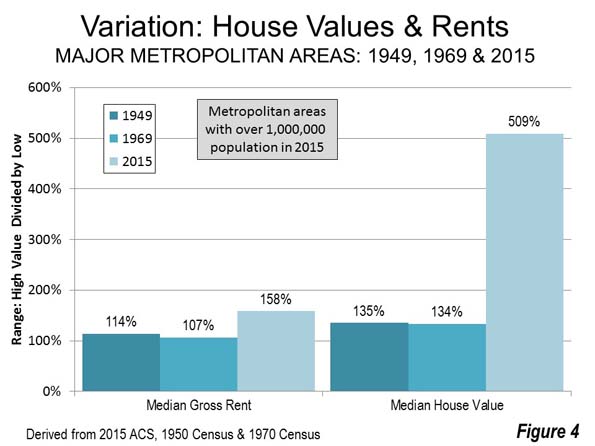
    Generally, a closely aligned relationship between trends in owner occupied and rented housing costs would be expected . This was certainly true until 1970 (Note 1).  In 1949 there was a 135 percent difference between the lowest median household value and the highest in the major metropolitan areas (Note 2). There was a similar 114 percent difference between the lowest gross rent and the highest (Figure 1). The house value variation was 18 percent higher than the rent variation.

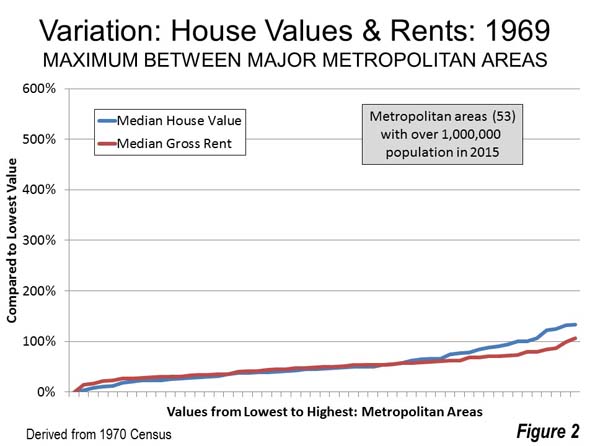
    By 1969 median house values varied a maximum of 134 percent from the lowest figure to the highest, a slight reduction from the 135 percent difference across the United States in 1949. Median gross rents varied a maximum of 107 percent among the same metropolitan areas, down modestly from 1949’s 114 percent (Figure 2). The house value variation was 25 percent higher than the rent variation.

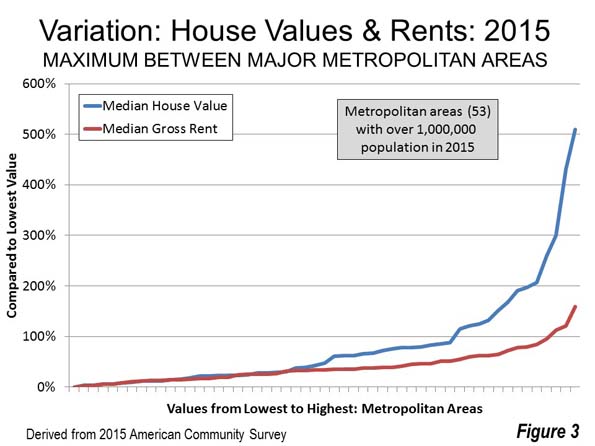
    The close relationship between the variations in house value and rent   was substantially broken in more recent decades. The 2015 American Community Survey shows that the variation among the major metropolitan areas in median house values is now a staggering 509 percent. The range between the least expensive and most expensive rental markets is a much smaller 158 percent (Figure 3). The difference in the variations between house value and rents across the nation rose to 222 percent, nearly nine times the 1969 figure.

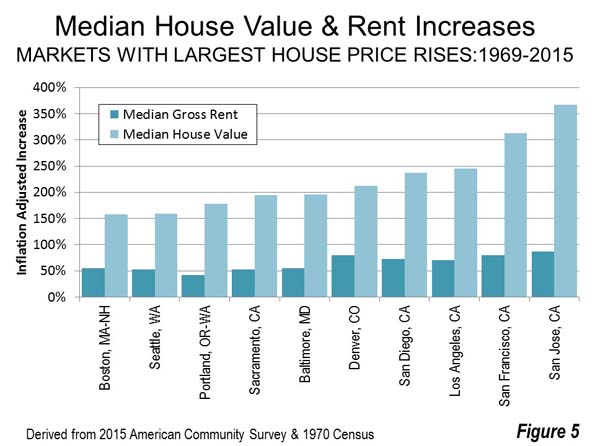
    Among the 10 metropolitan areas with the largest house price increases between 1969 and 2015, house values increases averaged 226 percent, nearly 350 percent more than the 65 increase in median rents, both figures inflation adjusted (Figure 4).

    Of course, the hideously expensive California metropolitan areas are well represented, such as San Jose, San Francisco, Los Angeles and San Diego, among the most impacted. Even inland Sacramento, with significant housing affordability problems often over-shadowed by the Bay Area, is included. However, the huge differences extend to metropolitan areas outside California, such as Denver, Baltimore, Portland, Seattle and Boston.

    The broken relationship between rent and house value could imply severe distortion in either the rental market or the owned housing market.

    If the Rent is Too Damn Low

    Distortions in the market could have prevented rents to retain their relationship with rising house values.

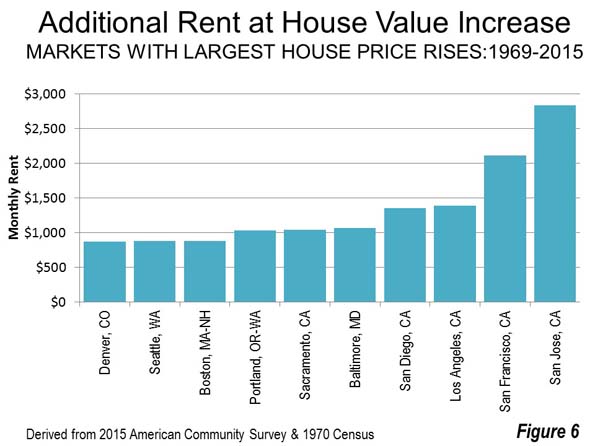
    The implications are ominous. If the increase in rents had kept up with the increase in house values, the median gross rent in the San Francisco metropolitan area would have been approximately $3,700 per month, compared to the actual $1,600 per month in 2015. This would suggest that rents in 2015 were $2,100 below market in San Francisco. If this is true, then the rent is too damn low in San Francisco. The situation would be even worse down the road in San Jose where to keep up with house prices rents need to be $4,700 per month, $2,800 per month higher than market.

    If the rental market is distorted, then rents are far too low in other metropolitan areas. In Los Angeles, San Diego, Baltimore, Sacramento and Portland rents are between $1,000 and $1,400 too low. Rents would be at least $800 below market in Boston, Seattle and Denver (Figure 5).

    If House Prices are Too Damn High

    If the owned housing market became distorted relative to the rental market between 1969 and 2015, then it is the rents that are too damn high.  If house values had risen at the same rate as rents, none of the 53 markets would have exceeded a price to income ratio of 5.0, which denotes is denoted as “severely unaffordable” in the Demographia International Housing Affordability Survey. This would be a substantial improvement, given that 11 major markets actually were severely unaffordable in 2015.

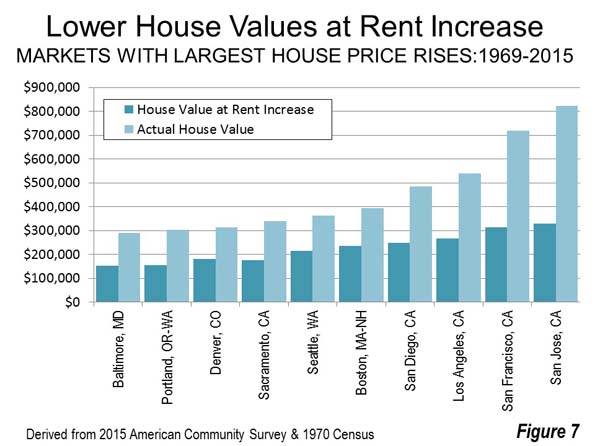
    The 10 major metropolitan areas with the largest house value increases would have had hugely lower house prices. In San Jose, the median house value would have been equal to 3.2 years of median household income in 2015. This is considerably better than the actual 8.1 years, representing a 55 percent improvement. In San Francisco the median house value would have been equal to 3.5 years of median household income. This would be a 60 percent improvement on the actual 8.1 ratio in 2015 (Note 3). 

    In Los Angeles, Portland, Sacramento and San Diego, house values would have been about 50 percent less if they had risen at the same rate as rents. In Boston, Denver and Seattle, house prices would have been between 40 percent and 45 percent less (Figure 6).

    It’s the House Prices that are Too Damned High

    Rents have risen faster than incomes, but nothing compared to the increase in house prices. Clearly, house prices are too damn high. The huge increase between 1969 and 2015 in house prices is an anomaly that has become extreme in recent decades. The ranges in rents (1949, 1969 and 2015) and the ranges in house values in 1949 and 1969 were far more similar and reflected a reality more in line with the stability that would be expected in non-distorted markets (Figure 7). Indeed, the large increase in the 1969-2015 rent range could well have been influenced upward by the virulent house price increase (reflected in land prices).

    It seems likely that rents across the country are much more reflective of an efficiently operating market, while there are serious distortions in the owned housing market.

    Finally, owner-occupied housing, especially detached housing, has been under assault by restrictive urban planning regulations since 1970. House prices are most out of alignment in markets where this has occurred, especially in California, Oregon, Washington, and the Denver, Baltimore and Washington, DC metropolitan areas. More often than not, these regulations have evolved into urban containment policy (Note 4), which draws arbitrary lines around cities beyond which detached housing tracts are not permitted (See: Urban Containment, Endangered Working Families and Beleaguered Minorities). Obviously, as in goods and services generally, this regulatory over-reach makes housing less affordable (See: People Rather than Places, Ends Rather than Means: LSE Economists on Urban Containment).

    There has been no such assault on multi-family building, which represents the bulk of rentals. This is not to suggest that rental regulation is perfect, only that the market distortions have been far more severe in reference to the owned housing market in some metropolitan areas, such as those identified above.

    All of this has serious consequences for the nation and its threatened middle income households. With median household incomes below nearly two decades ago (perhaps for the first time in US history), economic stagnation and younger people burdened by rising college debt, lower house prices are a necessity in the over-regulated metropolitan areas. Yet there seems little desire on the part of most governments, particularly in the most severely impacted markets, to do much about it.

    Note 1: These censuses collected house value and rent data for the previous year, 1949 and 1969 respectively. The rent and house value data referenced in this article was first available in the 1950 census.

    Note 2: The 53 metropolitan areas with more than 1,000,000 population in 2015 (in 1950, only 51 of these had achieved metropolitan area status). The rent ranges cited in this article are calculated by dividing the highest major metropolitan area rent by the lowest major metropolitan area rent in the particular year. The house value ranges cited in this article are calculated by dividing the highest major metropolitan area house value by the lowest major metropolitan area house value in the particular year.

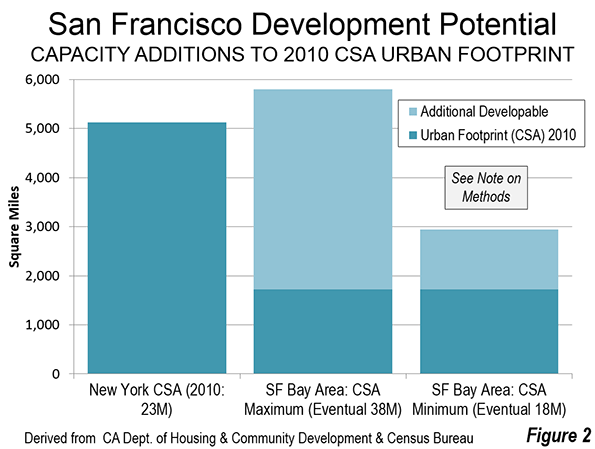
    Note 3: Some analysts cite topographic barriers for creating the scarcity of land that has driven house price up so much in the San Francisco Bay Area (which includes both the San Francisco and San Jose metropolitan areas). As indicated in a previous article, there is far more land available for greenfield residential development in the Bay Area than would be required by even the strongest population growth.

    Note 4: With respect to urban containment policy, Boston is an exception, which is the only seriously unaffordable major metropolitan area in the Demographia International Housing Affordability Survey that does not have urban containment policy. Boston has large lot zoning so expansive that it has created a severe shortage of land for development, with urban containment-like effects on house prices. Boston’s urbanization covers more land area than all urban areas in the world except New York and Tokyo, despite having only a fraction of their populations (See: The Evolving Urban Form: Sprawling Boston).

    Photo: Sacramento: An inland California unaffordable housing market (by author)

    Wendell Cox is principal of Demographia, an international public policy and demographics firm. He is a Senior Fellow of the Center for Opportunity Urbanism (US), Senior Fellow for Housing Affordability and Municipal Policy for the Frontier Centre for Public Policy (Canada), and a member of the Board of Advisors of the Center for Demographics and Policy at Chapman University (California). He is co-author of the "Demographia International Housing Affordability Survey" and author of "Demographia World Urban Areas" and "War on the Dream: How Anti-Sprawl Policy Threatens the Quality of Life." He was appointed to three terms on the Los Angeles County Transportation Commission, where he served with the leading city and county leadership as the only non-elected member. He served as a visiting professor at the Conservatoire National des Arts et Metiers, a national university in Paris.

  • Two Cheers for NIMBYism

    Politicians, housing advocates, planners and developers often blame the NIMBY — “not in my backyard” — lobby for the state’s housing crisis. And it’s true that some locals overreact with unrealistic growth limits that cut off any new housing supply and have blocked reasonable ways to boost supply.

    But the biggest impediment to solving our housing crisis lies not principally with neighbors protecting their local neighborhoods, but rather with central governments determined to limit, and make ever more expensive, single-family housing. Economist Issi Romem notes that, based on the past, “failing to expand cities [to allow sprawl] will come at a cost” to the housing market.

    A density-only policy tends to raise prices, turning California into the burial ground for the aspirations of the young and minorities. This reflects an utter disregard for most people’s preferences for a single-family home — including millennials, particularly as they enter their 30s.

    In California, these policies are pushed as penance for climate change, although analyses from McKinsey & Company and others suggest that the connection between “sprawl” and global warming is dubious at best, and could be could be mitigated much more cost-effectively through increased work at home, tough fuel standards and the dispersion of employment.

    Read the entire piece at The Orange County Register.

    Joel Kotkin is executive editor of NewGeography.com. He is the Roger Hobbs Distinguished Fellow in Urban Studies at Chapman University and executive director of the Houston-based Center for Opportunity Urbanism. His newest book, The Human City: Urbanism for the rest of us, will be published in April by Agate. He is also author of The New Class ConflictThe City: A Global History, and The Next Hundred Million: America in 2050. He lives in Orange County, CA.

  • How to Make Post-Suburbanism Work

    Are you ready to become a “real” city yet, Southern California? Being “truly livable,” our betters suggest, means being “infatuated” with spending more billions of dollars on outdated streetcars (trolleys) and other rail lines, packing people into ever small spaces and looking toward downtown Los Angeles as our regional center.

    Our cognitive elites dislike the very idea that Los Angeles, as Dorothy Parker once supposedly described, has long been “72 suburbs in search of a city.” Yet, Southern California, as I discuss in a new Chapman University report, has from its early emergence grown around a “post-suburban” model of dynamic, smaller clusters. This urban form has become common in many major metropolitan areas as automobiles have replaced transit as the primary means of getting around.

    This model worked here brilliantly for most of the last half century — until planners, real estate speculators and California bureaucrats decided that we needed to emulate New York City and other older monocentric core cities. Like the provincials they consistently prove themselves to be, our leaders have generally complied.

    So, after nearly 15 years spent in pushing this direction, what have we accomplished? A transit system that barely serves as many people as it did before we started building trains, housing prices among the highest in the nation, super-high poverty rates and a population that continues to seek to go somewhere else, including some 1.6 million net domestic migrants who have left the L.A. and Orange County area since 2000.

    The density mirage

    Some see densification as necessary to meet the demands of an expanding population. Yet, both L.A. and O.C.’s populations are growing slower than both the state and national average. Nor has the pro-density regime relieved any of the pressure on housing and rent. For one thing, high-density housing is far more expensive on a per-square-foot basis, either for townhouses or detached housing. It can only accommodate the poor at the cost of massive subsidies.

    The drive to re-engineer our post-suburban form assumes that downtown Los Angeles can become like the more historic central business districts of New York, Chicago and San Francisco. These CBDs have from nearly double to 10 times the employment levels as downtown L.A. Suffice it to say, downtowns in New York, Chicago and San Francisco have retained regional significance, as others, including Los Angles, have declined in relative influence, with little growth in their share of regional employment. Even the most generous definition of downtown Los Angeles encompasses considerably less than 5 percent of the metropolitan area’s employment, and that share has not grown appreciably since 2000. All the net job growth has been in newer suburbs and exurbs.

    Fundamentally, in “post suburban” regions like southern California, the “sell” is a different one than in places like New York. It is based on a largely suburban quality of life. This does not mean we need to lag economically. Many of the most successful high-tech regions — notably, Silicon Valley; Austin, Texas; Raleigh-Durham, N.C., and the northern reaches of Dallas —– are largely suburban and less dense than the L.A. area. Certainly, densification policies so far have not turned Los Angeles County into a high-tech haven. The county suffers from below-average tech employment, while more suburban Orange County remains 20 percent above average. The fastest increases, albeit from a low base, are occurring in the Inland Empire.

    Read the entire piece at The Orange County Register.

    Joel Kotkin is executive editor of NewGeography.com. He is the Roger Hobbs Distinguished Fellow in Urban Studies at Chapman University and executive director of the Houston-based Center for Opportunity Urbanism. His newest book, The Human City: Urbanism for the rest of us, will be published in April by Agate. He is also author of The New Class ConflictThe City: A Global History, and The Next Hundred Million: America in 2050. He lives in Orange County, CA.

    Photo by Thomas Pintaric (Pintaric) [GFDL or CC-BY-SA-3.0], via Wikimedia Commons

  • A Better Way

    My recent post at Granola Shotgun described how a town in Georgia spent an enormous amount of public money on a new civic center and road expansions, but somehow managed to devalue nearby private property in the process. Here’s an example of a neighborhood in Nashville, Tennessee that took a different approach that cost a lot less and achieved a radically better set of outcomes.


    Screen Shot 2016-08-25 at 6.01.50 PM

    Screen Shot 2016-08-25 at 5.49.18 PM

    The McCabe Park Community Center was designed by a local firm rather than an international starchitect. Municipal funds were recirculated right in town and used to foster native talent and professional employment. And while the facilities are available to everyone in Nashville this center is scaled and programmed primarily to serve the immediate neighborhood.

    Screen Shot 2016-08-25 at 9.25.20 PMGoogle

    Screen Shot 2016-08-25 at 6.41.04 PM

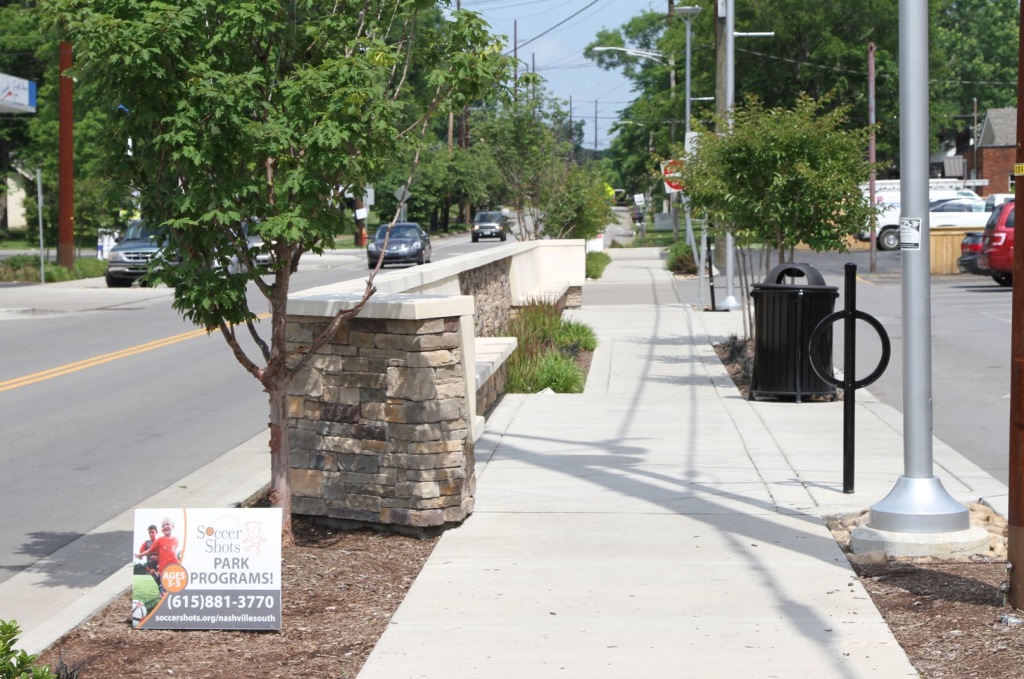
    A conscious decision was made to accommodate pedestrians rather than provide the usual endless automobile infrastructure. There are the required handicap accessible parking spaces close to the entrance at the rear. There are a few dozen off street parking spots along the baseball diamond. But that’s it. It’s absolutely possible to arrive by motor vehicle, but the cars don’t dominate the landscape.

    Screen Shot 2016-08-25 at 11.08.02 PM

    Screen Shot 2016-08-25 at 5.48.42 PM

    Screen Shot 2016-08-25 at 6.01.06 PM

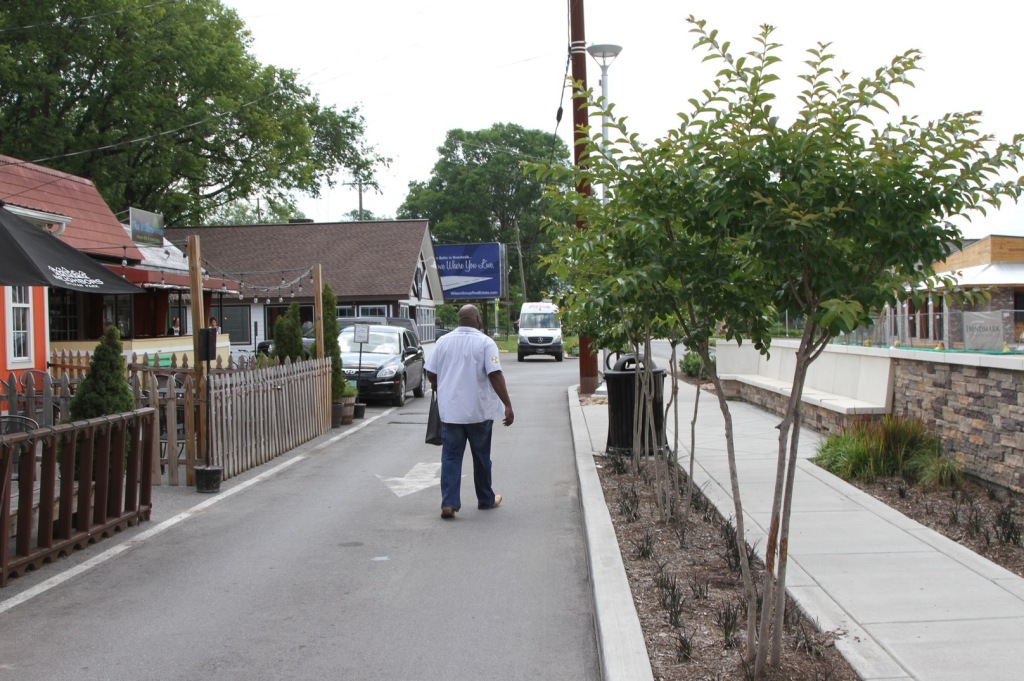
    Bicycle and pedestrian infrastructure make it clear that it’s safe, pleasant, convenient, and dignified to arrive without a car. One of the goals of this community center is to facilitate a more active and healthy lifestyle.

    Screen Shot 2016-08-25 at 11.40.11 PMGoogle from 2009

    Screen Shot 2016-08-26 at 1.07.16 AMGoogle Street View from 2009

    Screen Shot 2016-08-26 at 1.05.07 AMGoogle Street View from 2009

    Screen Shot 2016-08-26 at 1.06.32 AMGoogle Street View form 2009

    Screen Shot 2016-08-26 at 1.48.03 AMGoogle Street View form 2009

    The road out front was a standard suburban affair of wide lanes, fast moving vehicles, no distinction between the road surface and adjacent parking lots, and no sidewalks. This landscape made it very clear that if you weren’t in a car you just weren’t important. It was also brutally ugly and lined with aging low value buildings and struggling businesses.

    Screen Shot 2016-08-26 at 1.29.53 AM


    Screen Shot 2016-08-25 at 5.46.54 PM

    Screen Shot 2016-08-25 at 6.00.19 PM

    Screen Shot 2016-08-25 at 5.49.32 PM

    Screen Shot 2016-08-25 at 5.59.23 PM

    Screen Shot 2016-08-26 at 2.04.37 AM

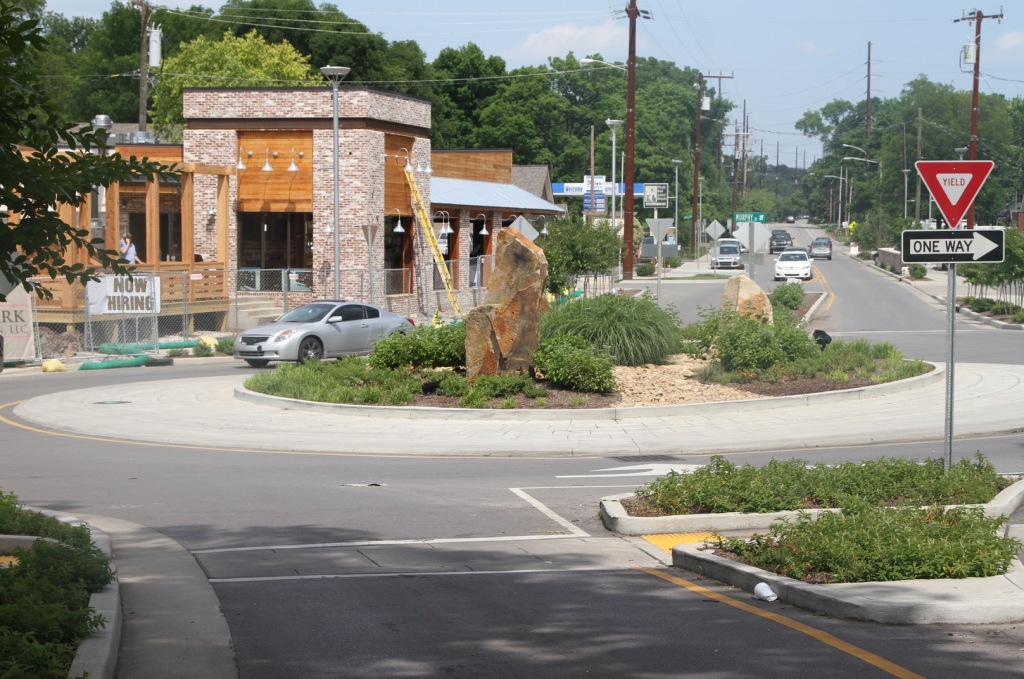
    The new traffic roundabout has transformed the intersection in several crucial ways. First, instead of stopping at a light cars now slow down a bit, but continue on. This means more cars move through the space in less time so traffic congestion has actually been reduced.

    Screen Shot 2016-08-26 at 1.35.08 AM

    Screen Shot 2016-08-26 at 1.35.18 AM

    Screen Shot 2016-08-26 at 1.35.55 AM

    Second, there are significantly fewer accidents because cars are moving at slower speeds and drivers are made to pay more attention to their surroundings as the street narrows. Cars are still welcomed here, but they’ve been disciplined to share the space with humans.

    Screen Shot 2016-08-26 at 1.36.39 AM

    Screen Shot 2016-08-26 at 2.04.12 AM

    Screen Shot 2016-08-26 at 1.39.18 AM

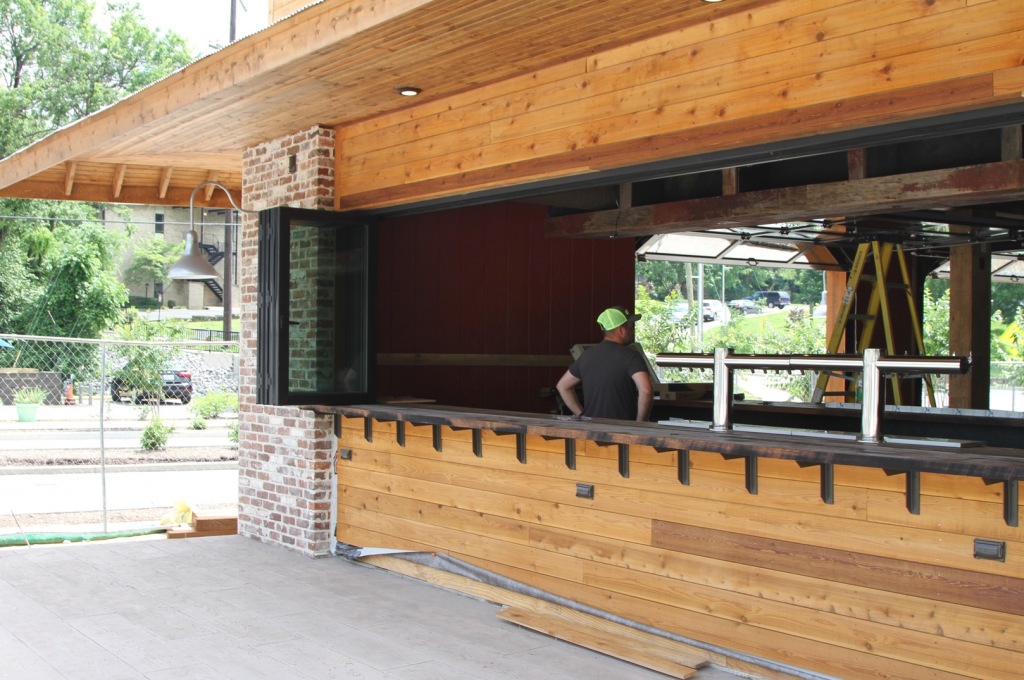
    Third, pedestrians and cyclists can now traverse the area safely so more people are willing to arrive without a car. With more foot traffic shops are able to repurpose some of the asphalt in front for outdoor seating. That translates to more sales, more employment, more profit, and more tax revenue.

    Screen Shot 2016-08-26 at 1.53.49 AM

    Screen Shot 2016-08-26 at 1.52.05 AM

    Screen Shot 2016-08-26 at 2.01.46 AM

    Screen Shot 2016-08-26 at 2.02.54 AM

    Screen Shot 2016-08-26 at 1.52.51 AM

    Screen Shot 2016-08-26 at 1.59.23 AM

    Screen Shot 2016-08-26 at 2.00.44 AM

    Fourth, land values have improved and older buildings are now seeing major improvements that also boost employment and generate new tax revenue. People don’t like paying taxes, but that money is what funds everything people expect the city to provide. The alternative is the slow death of deferred maintenance, budget cuts, and even higher fees and stealth charges on existing low value properties.

    Screen Shot 2016-08-26 at 2.58.33 AM

    Screen Shot 2016-08-25 at 11.07.40 PM

    Parking hasn’t been eliminated as much as redistributed. As sidewalks were installed on-street parking was added. The parked cars create a physical as well as emotional buffer between pedestrians and moving vehicles.

    Screen Shot 2016-08-25 at 5.50.59 PM

    Screen Shot 2016-08-25 at 5.51.14 PM

    Screen Shot 2016-08-25 at 5.52.40 PM

    Screen Shot 2016-08-25 at 5.52.56 PM

    Screen Shot 2016-08-25 at 5.51.36 PM

    The reorganized street supports smaller locally owned shops that keep money circulating in the community. This is the opposite of typical road widening projects that devalue small businesses in older neighborhoods while subsidizing big box corporate chains way out on the edge of town.

    Screen Shot 2016-08-26 at 3.16.43 AM

    Screen Shot 2016-08-26 at 3.17.03 AM

    Screen Shot 2016-08-26 at 3.16.12 AM

    Screen Shot 2016-08-26 at 3.16.26 AM

    Screen Shot 2016-08-26 at 3.15.58 AM

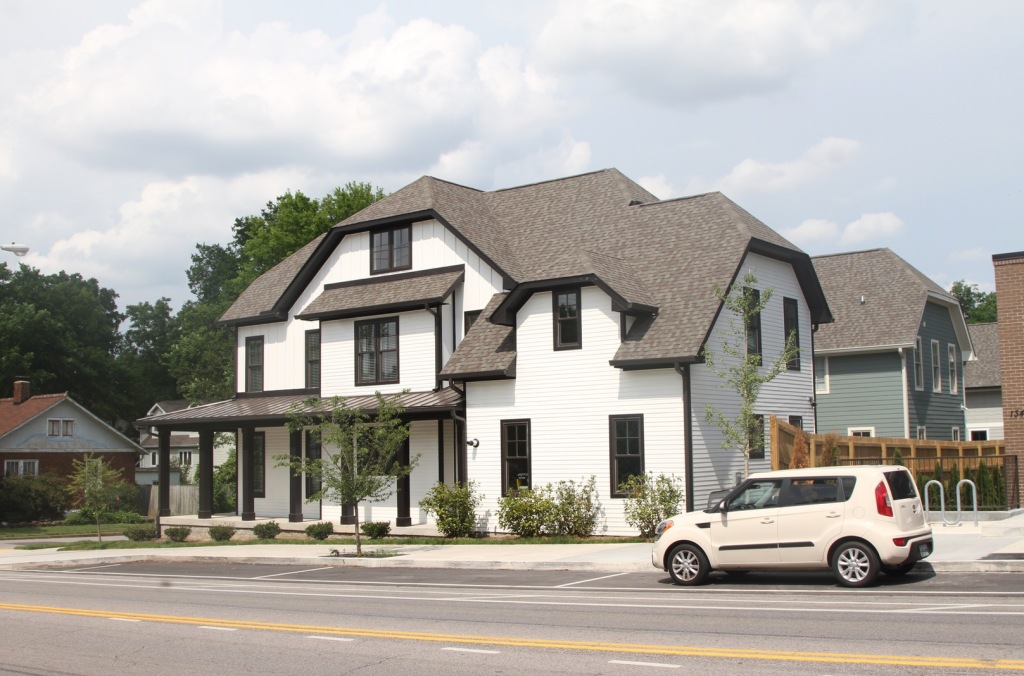
    Here’s something that breaks all the rules of suburban development. It’s supposed to be the kiss of death to have a business situated right next to a fully detached single family home. Yet in this location the shops and the properly designed street actually make these houses more desirable. The usual amenity of residential isolation has been exchanged for the amenity of good walkable urbanism. This kind of arrangement is so incredibly rare in America today that people are willing to pay a premium for such properties.

    Screen Shot 2016-08-25 at 6.02.46 PM

    Screen Shot 2016-08-25 at 6.03.00 PM

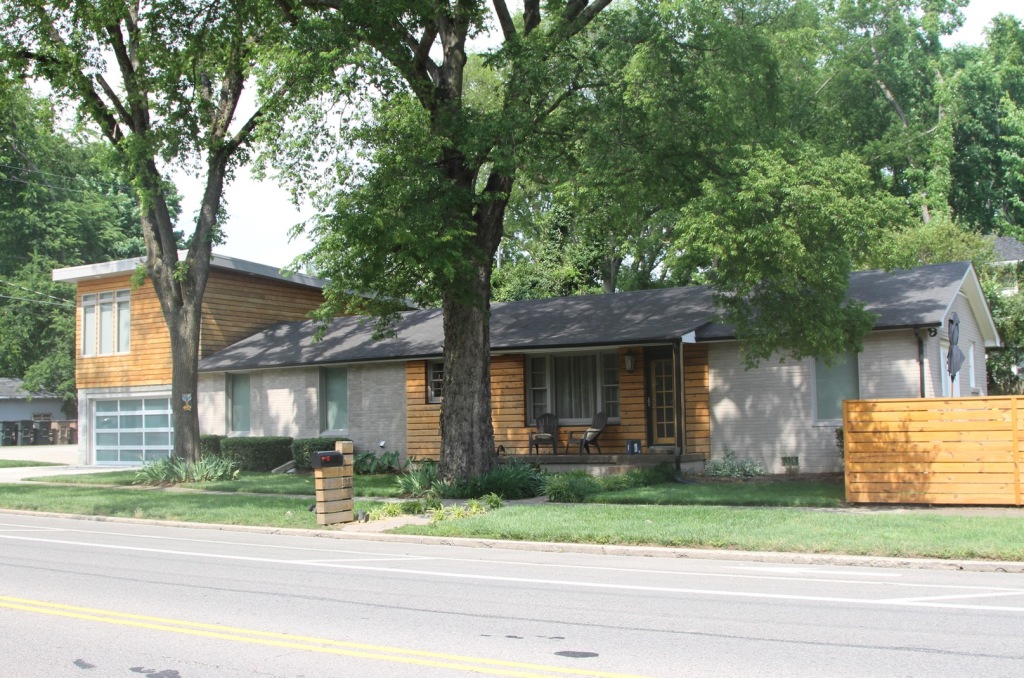
    Finally, we have the 1950’s tract homes that could have started the long slide into low rent crappiness as is so often the case when suburban roads are widened in a hopeless attempt to ease traffic congestion. Here, the road diet and nearby improved commercial district  have inspired property owners to invest in substantial renovations and improvements to otherwise outdated homes.

    The future of most suburbs is to change from what they are now to something else. That “something” could be relentless decline or steady incremental rejuvenation. I don’t believe most places understand how to reinvent themselves in a cost effective yet culturally acceptable manner. The politics of inertia, fear, and vested interests are awfully powerful. That means the few places that can successfully pull it off will be miles ahead of the competition. Look around wherever you live. Then think long and hard about how your town will manage in the years ahead.

    John Sanphillippo lives in San Francisco and blogs about urbanism, adaptation, and resilience at granolashotgun.com. He’s a member of the Congress for New Urbanism, films videos for faircompanies.com, and is a regular contributor to Strongtowns.org. He earns his living by buying, renovating, and renting undervalued properties in places that have good long term prospects. He is a graduate of Rutgers University.

  • Urban Containment, Endangered Working Families and Beleaguered Minorities

    Working families and the middle class are becoming an increasingly endangered species in   many parts of United States. Median household income remains below its 1999 peak (inflation adjusted). But the problem is not just stagnant incomes. Expenses are also rising, especially the costs of housing in some cities. As a result, it is becoming more and more difficult to make ends meet.

    Much of this has to do, as explained below, with attempts to stop development on the urban periphery which is indispensable to keeping housing affordable. Such prohibitions have been widely advocated by the  planning establishment. Moreover, a new White House Housing Development Toolkit,  rightly identifies housing unaffordability as an important issue but does not mention the important role of greenfield development in keeping costs down.

    Housing Affordability Problem

    Housing costs are generally responsible for the difference in cost of living between US cities (metropolitan areas). The range between cities in the Bureau of Economic Analysis (BEA) cost of living index (Regional Price Parities) in housing cost is far greater than that of its other two elements — 13 times goods and eight times services other than rents. It is no wonder that households are moving to affordable markets.

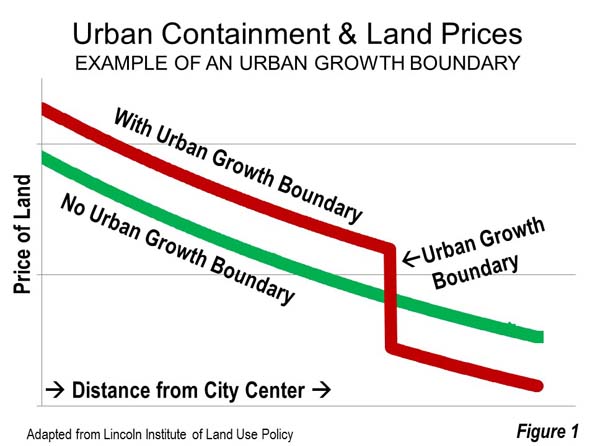
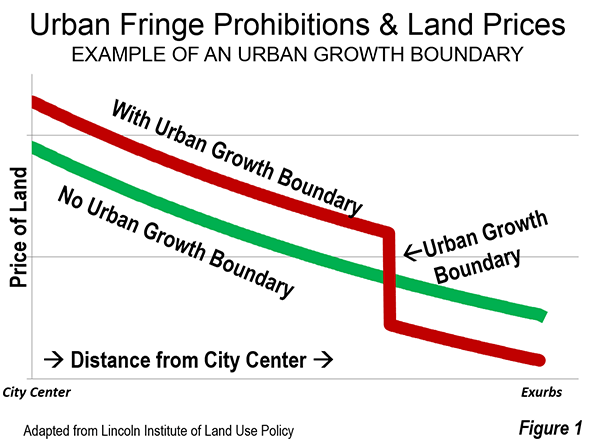
    Excessive land use regulation is a major cause of seriously unaffordable housing. Usually, these regulations include urban containment policy, which restricts or even prohibits building middle income detached housing on the urban fringe. As sure as OPEC cutbacks drive up the price of gasoline, urban planning land cutbacks drive up house prices. There is plenty of evidence that the law of supply and demand operates in urban land markets — that restricting the availability of land for development pushes land (Figure 1) and house prices up (See: A Question of Values: Middle-Income Housing Affordability).

    By definition, housing affordability must be measured in relation to incomes. It should also be compared to trends over time both within the metropolitan area (housing market) and between metropolitan areas (See Canada’s Middle-Income Housing Affordability Crisis).

    The most acute problem is in California, where house prices are up to four times those in liberally regulated US metropolitan areas. Before excessive land use regulations were imposed, housing affordability in California, prices relative to incomes, were similar to the rest of the nation, rarely exceeding 3.0 (measured by the “median multiple,” the median house price divided by the median household income).

    There is little comprehension of the seriousness of the housing affordability problem. With serious concerns being raised about income inequality, housing affordability represents one of the most important threats both to the well-being of middle-income households and poverty reduction. More than anywhere in the country, the price of middle income housing is beyond the reach of most middle income California households, including  those who would easily qualify in liberally regulated markets.

    At the same time, middle-income households in other excessively regulated markets, like Seattle, Portland, Denver, Miami, Boston and New York have seen their house prices double (or more) as regulations have been stiffened.  Finally, all of this increases the demand for subsidized housing. While there is plenty of rhetoric about affordable housing for lower income households, there is not and there is not likely to ever be enough money.

    The key issue is the cost of residential land under the house. Average residential land values are at least 75 percent of the house and land value in San Jose and San Francisco (Note 1), 70 percent in Los Angeles and 65 percent in San Diego. Our analysis of Lincoln Institute of Land Policy data indicates that the average house structure in the four California metropolitan areas had an average value is only 25 percent higher than that of the other major metropolitan areas. By contrast, the land value was more than 650 percent higher. It would be too expensive for middle income households to buy vacant residential lots, even if they intended living in tents.

    With such expensive land, there is virtually no hope to restore housing affordability without tackling the issue of land head on. In the meantime, house prices weigh heavily on all households, and many are leaving California, particularly in their mid-thirties and above.

    Lower Income Minorities: African Americans and Hispanics

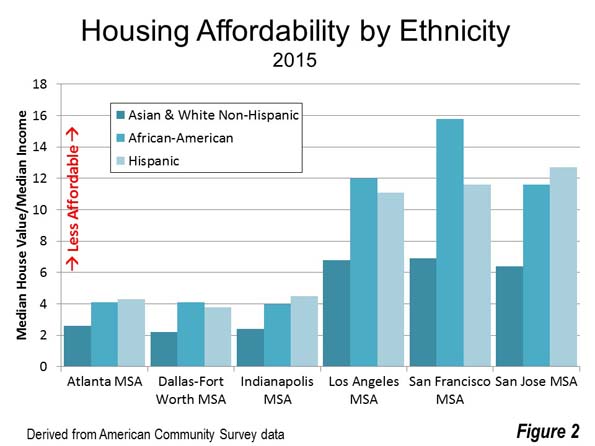
    The situation for housing is far worse for ethnic groups with lower incomes. The maximum housing affordability disadvantage faced by African Americans and Hispanics is illustrated in the following examples. In the San Francisco MSA, the median value house would cost the equivalent of 9 more years of median African-American income than for Asian or White-Non-Hispanics. This has escalated from 1.3 years before regulations were strengthened. An Hispanic household would need six more years of median income to pay for the median valued house in the San Jose MSA. There also large spreads, both for African-American and Hispanic households in other highly regulated metropolitan areas, such as Los Angeles, San Diego, Portland, Boston and New York (See Figure 2 and Table: Housing Affordability: Overall and by Ethnicity).

    Planning’s “Killer App”

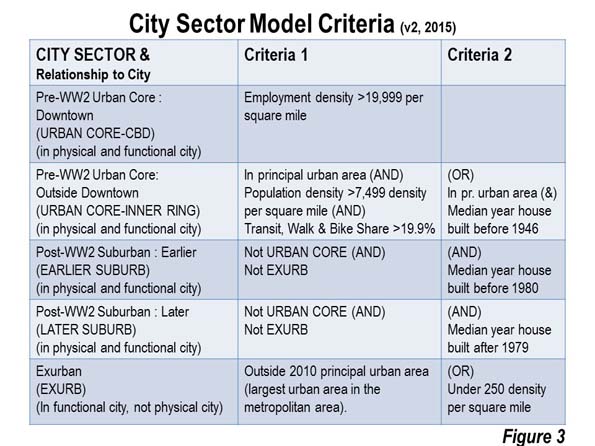
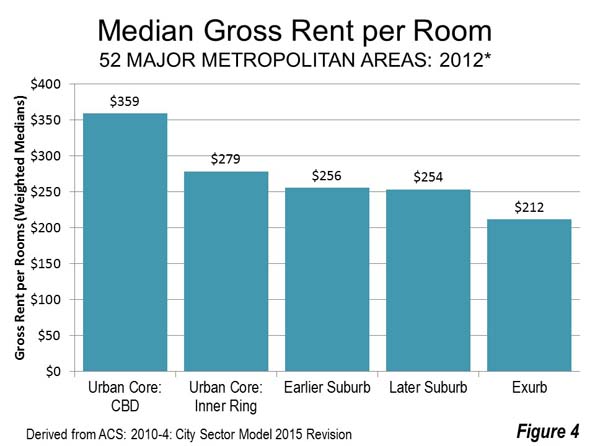
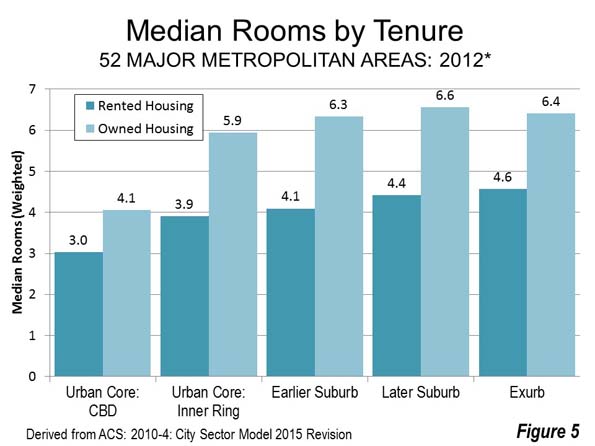
    It is popular to contend that housing affordability can be restored through   building higher densities. There are no examples of restoring metropolitan area housing affordability through intensification. A principal problem is higher prices. A City Sector Model (Figure 3) analysis indicates that the urban core rents per room are well above that of the suburbs (Figure 4). The differences are even greater in cities with the more aggressive intensification programs, such as Portland, Seattle and Los Angeles (Note 3).  Housing units are also smaller (Figure 5). “Granny flats,” basements and apartments are too small for many middle-income households. Forced intensification impairs the quality of life for many people, particularly families (Note 4)

    These policies also have the effect of widening economic divisions. Matthew Rognlie of the Massachusetts Institute of Technology examined French economist Thomas Piketty’s research on rising inequality and concluded that much of the observed inequality stems from housing. He went on to suggest re-examining the land use regulations that create scarcity, toward the end of increasing housing supply. My colleague Hugh Pavletich, co-author of Demographia International Housing Affordability Survey argues that without the “safety valve” of greenfield development, because housing cannot be kept affordable since urban containment destroys the competitive market for land.

    New Zealand consultant Phil Hayward observes: “There might be other policy mixes by which housing supply within a growth boundary could be made the means of keeping housing affordable, but publicly and politically, the debate is nowhere near tackling the complexities involved” (See The Myth of Affordable Intensification).

    Further, large lot or rural zoning is frequently cited as an impediment to housing affordability. This is consistent with economic theory, but its influence is miniscule compared to urban containment (Note 5). The metropolitan areas with substantial large lot zoning had an average price-to-income ratio of 3.0 in 2014, at the upper bound of affordability. This is in contrast with the seriously unaffordable price-to-income ratios (from 5.1 to 9.7) that have urban containment policy . The highest price-to-income ratios are in California’s large metropolitan areas, where there are smaller lot sizes.

    Based on the unparalleled damage they do to housing affordability, urban containment boundaries may be planning’s “killer app.” A principal objective of urban containment policy is to curb the outward expansion of cities (“urban sprawl”). But the “medicine” is far worse than the “cure” — lower standards of living and greater poverty, inflicting particular harm to lower income minorities.

    Necessary Reforms

    Unfortunately, housing affordability has not become an issue in this election year. Yet, policy reforms are appropriate:

    1. Urban containment policy should not be implemented where it has not been adopted.
    2. In urban containment metropolitan areas, improved housing affordability targets should be adopted (price to income ratios), with “event triggered” liberalization of urban fringe land use if the targets are not met. Similar reforms have been proposed in New Zealand and by Paul C. Cheshire, Max Nathan and Henry G. Overman of the London School of Economics.
    Housing Affordability: Overall and By Ethnicity
    Major Metropolitan Areas
    Median Multiple (Years of Median Income Needed to Buy the Median Priced House)
    Additional Years Requried
    All Asians and White Non-Hispanics African Americans Hispanic African Americans Hispanic
    United States 3.5 3.1 5.3 4.3 2.2 1.2
    Atlanta, GA 3.1 2.6 4.1 4.3 1.5 1.8
    Austin, TX 3.6 3.0 4.9 5.0 1.9 2.0
    Baltimore, MD 4.0 3.4 5.7 4.3 2.3 1.0
    Birmingham, AL 3.0 2.6 4.6 3.8 2.0 1.2
    Boston, MA-NH 5.0 4.5 9.3 9.2 4.8 4.7
    Buffalo, NY 2.6 2.3 5.1 5.3 2.8 3.0
    Charlotte, NC-SC 3.2 2.7 4.8 4.3 2.1 1.5
    Chicago, IL-IN-WI 3.6 2.9 6.4 4.5 3.5 1.6
    Cincinnati, OH-KY-IN 2.8 2.6 5.3 3.7 2.8 1.2
    Cleveland, OH 2.8 2.4 4.9 3.9 2.5 1.5
    Columbus, OH 2.9 2.6 4.6 3.7 2.0 1.1
    Dallas-Fort Worth, TX 2.8 2.2 4.1 3.8 1.8 1.5
    Denver, CO 4.5 4.0 7.4 6.3 3.3 2.3
    Detroit,  MI 2.8 2.4 4.7 3.6 2.3 1.2
    Grand Rapids, MI 2.7 2.6 5.2 3.7 2.7 1.1
    Hartford, CT 3.4 3.0 5.4 6.5 2.4 3.6
    Houston, TX 2.7 2.0 4.0 3.6 2.0 1.6
    Indianapolis. IN 2.7 2.4 4.5 4.0 2.1 1.6
    Jacksonville, FL 3.2 2.9 4.8 3.7 2.0 0.9
    Kansas City, MO-KS 2.7 2.5 4.5 3.7 2.0 1.2
    Las Vegas, NV 4.2 3.7 6.0 4.9 2.3 1.2
    Los Angeles, CA 8.6 6.8 12.0 11.1 5.2 4.2
    Louisville, KY-IN 2.9 2.7 4.9 3.4 2.3 0.7
    Memphis, TN-MS-AR 2.9 2.1 4.1 3.5 2.0 1.4
    Miami, FL 4.8 3.8 6.2 5.5 2.4 1.8
    Milwaukee,WI 3.5 3.0 6.9 5.0 3.9 2.0
    Minneapolis-St. Paul, MN-WI 3.3 3.0 7.3 5.1 4.3 2.1
    Nashville, TN 3.3 3.0 5.2 4.2 2.2 1.2
    New Orleans. LA 3.9 3.1 6.0 4.5 3.0 1.5
    New York, NY-NJ-PA 6.0 4.8 8.8 9.2 4.0 4.4
    Oklahoma City, OK 2.8 2.5 4.5 3.4 2.0 0.9
    Orlando, FL 3.4 2.9 4.4 4.3 1.5 1.4
    Philadelphia, PA-NJ-DE-MD 3.7 3.1 6.2 5.8 3.1 2.8
    Phoenix, AZ 3.9 3.5 5.4 5.2 1.9 1.7
    Pittsburgh, PA 2.6 2.5 5.4 3.4 2.9 0.9
    Portland, OR-WA 4.7 4.5 8.7 6.0 4.2 1.5
    Providence, RI-MA 4.3 4.0 6.7 7.6 2.7 3.7
    Raleigh, NC 3.4 2.9 5.1 5.7 2.1 2.7
    Richmond, VA 3.6 3.0 5.4 4.1 2.4 1.1
    Riverside-San Bernardino, CA 5.3 4.7 6.6 6.0 1.8 1.3
    Rochester, NY 2.6 2.3 4.6 4.5 2.3 2.2
    Sacramento, CA 5.4 4.9 8.4 6.8 3.6 1.9
    St. Louis,, MO-IL 2.9 2.6 4.9 3.5 2.3 0.9
    Salt Lake City, UT 3.8 3.6 6.2 5.3 2.6 1.7
    San Antonio, TX 2.7 2.2 3.1 3.3 0.9 1.1
    San Diego, CA 7.2 6.2 9.3 9.5 3.1 3.3
    San Francisco, CA 8.1 6.9 15.8 11.6 8.8 4.7
    San Jose, CA 8.1 6.9 11.6 12.7 4.7 5.8
    Seattle, WA 4.8 4.4 7.8 7.0 3.4 2.6
    Tampa-St. Petersburg, FL 3.4 3.2 4.7 4.0 1.5 0.8
    Tucson, AZ 3.5 3.1 5.0 4.2 1.8 1.1
    Virginia Beach-Norfolk, VA-NC 3.9 3.4 5.7 4.7 2.3 1.3
    Washington, DC-VA-MD-WV 4.3 3.6 5.9 5.8 2.3 2.2
    Data from American Community Survey: 2015
    AFFORDABILITY RATINGS    
    Affordable 3.0 or below
    Moderately Unaffordable 3.1 to 4.0
    Seriously Unaffordable 4.1 to 5.0
    Severely Unaffordable   5.1 and over


    Note 1: Commentators sometimes suggest the high housing prices in the San Francisco Bay Area are the result of land shortages created by topographic constraints, such as bodies of water and mountains. In fact, there is plenty of developable land in the Bay Area, which includes both the San Francisco and San Jose MSAs (See: The Incompatibility of Forced Densification and Housing Affordability).

    Note 2: This is without considering subsidies and tax breaks that can reduce some rents below market levels.

    Note 3: African American 1969 median household is estimated based on the variation in African American median family income from the overall median in that year. Median household income data was not published for ethnicities in the 1970 census. 

    Note 4: The planning establishment sometimes glosses over the reduced quality of life entailed in its efforts to discourage detached housing and force people into higher density housing. This is not their job. The quality of life can only be judged by households themselves.

    Note 5: Boston is an exception, which is the only seriously unaffordable major metropolitan area without urban containment policy. Boston has large lot zoning so expansive that it has created a severe shortage of land for development, with urban containment-like effects on house prices. Boston’s urbanization covers nearly as much land area as the Tokyo urban area, despite having only one-seventh the population. (See: The Evolving Urban Form: Sprawling Boston).

    Photo: Market Street, San Francisco, looking toward the Ferry Building (by author)

    Wendell Cox is principal of Demographia, an international pubilc policy and demographics firm. He is a Senior Fellow of the Center for Opportunity Urbanism (US), Senior Fellow for Housing Affordability and Municipal Policy for the Frontier Centre for Public Policy (Canada), and a member of the Board of Advisors of the Center for Demographics and Policy at Chapman University (California). He is co-author of the “Demographia International Housing Affordability Survey” and author of “Demographia World Urban Areas” and “War on the Dream: How Anti-Sprawl Policy Threatens the Quality of Life.” He was appointed to three terms on the Los Angeles County Transportation Commission, where he served with the leading city and county leadership as the only non-elected member. He served as a visiting professor at the Conservatoire National des Arts et Metiers, a national university in Paris.

  • Solidarity, not Division: Understanding London’s East End

    The East End of London has a long history of working-class community. It has been a place of industry, where the river Thames and the river Lea have provided work for many people. The area attracted many immigrants, including workers from Africa since Tudor times, sailors from China, former slaves from America, French Protestants facing religious persecution in the 1600s and Irish weavers working in the textile industries. There have been Jewish communities in the East End for centuries, too. The twentieth century saw an increase in immigrants from the former British colonies, including South Asia, particularly Bangladesh. Not only has it been a place to seek a livelihood, but it has also been a place of refuge.

    One side of my family hails from the East End and North East London, so I have a strong personal connection to this part of London. My ancestors worked in the local industries and on the river. We might not technically be ‘Cockneys’ (in that we weren’t all born within earshot of Bow Bells), but we are Cockney by nature. Family gatherings would include a raucous ‘knees-up’ (dancing and singing) and traditional local fare of jellied eels. We’re a working-class family who have lived in East London for generations.

    So I was interested when I came across a recent short BBC documentary called Last Whites of the East End. I was disturbed by the title, which suggested that white people in the area are somehow endangered – an odd idea and potentially a racist one. This racism was confirmed when I watched the show. The documentary focused on residents of Newham, one of the poorest working-class boroughs in England. The filmmakers interviewed a number of working-class residents about their experiences of living in the East End and the decisions of some of them to leave the area. The majority of the subjects were white, though they also included one man of Bangladeshi background and one man of white and Afro-Caribbean heritage.

    The narration of the documentary presented a racist agenda, describing the neighbourhood as at ‘tipping point’ with the ‘lowest white population in the UK’. It also noted a ‘dwindling cockney community’ who were in danger of disappearing in the face of increased immigration. Some of those interviewed were moving outside of London, to places like Essex, so they could live in areas with larger white populations. Some described themselves as ‘traditional East Enders’ and lamented the loss of the old community. They spoke of local services being shut down and the closure of the local pub. The film presented the interviewees as embodying white racism and a fear of the other, highlighting their reluctance to build bridges due to perceived differences. As one young white woman explained, they wanted to ‘stay with their own’.

    But there were many contradictions in the documentary, too. It included an elderly white woman, who was preparing to leave her home and move out of London, not due to her fear of her Muslim neighbours (as implied by the narration, despite the fact that she was obviously upset to say goodbye to her Somali neighbour), but because she was elderly and alone and wanted to move closer to her daughter. Like many of her neighbours, she had once been a new arrival to the neighbourhood, moving there from the north of England. The two people of colour in the film both spoke of their connections to the local area and their identification as East Enders. Like their white neighbours, they pointed to the changing environment, but I’d suggest that the changes they were criticising were not tied to the latest influx of new immigrants.

    Instead, they are matters of class. Gentrification and austerity are disrupting the lives of the working-class residents of the East End, not immigration. Housing has become too expensive, and government funding cuts are squeezing local schools and health services. Interviewees complained about the closure of a club which wasn’t just a local pub but also a community centre that elderly residents relied on for social events and to reduce isolation. Some white people are leaving, but, as I’ve seen with some friends and family members, that’s for financial reasons. They can purchase bigger properties if they sell their London homes, or they can pay less rent by moving to areas outside of London with smaller populations and less pressure on local services. And of course, not all of those leaving London are white.

    The documentary downplays this part of the story. It also downplays the working-class solidarity that connects residents despite their differences. Residents of the East End share the experience of hardship and struggle, and this shared struggle has a very long history. The East End has a tradition of political radicalism and collective action. East Enders have looked after each other during tough times and shown a united front against hostile external forces. Famously, in 1936, the local community stood up against a group of anti-Semitic fascists who wanted to march through a Jewish area. The confrontation, known as the Battle of Cable Street, was won because the community put their bodies on the line to keep the fascists out. The same community rallied during the Second World War and looked after each other during the bombing raids of the Blitz. More recently, local people have been supporting each other and engaging in collective action in the face of forced evictions as local public housing is sold and redeveloped for private profit.

    If the ‘traditional East End’ is disappearing, that isn’t because some working-class white are moving out of London. Working-class communities are not made up of just white people, and I’ve certainly never known a London that was mono-cultural. Yes, there are racist white working-class people. But the East End of London is a diverse and dynamic place, and always has been. It has also been a place of solidarity and struggle. The filmmakers chose to emphasize division instead of showing how East Enders act collectively, and it cast immigrants as a threat, when the real threats facing this community are austerity and gentrification.

    This piece first appeared at Working-Class Perspectives.

    Photo Credit: Daryl Hutchison, @daryldactyl

  • Why Intensification Will Not Solve the Housing Affordability Crisis

    Analyst Phil Hayward of Wellington, New Zealand provides a provocative perspective on why urban intensification (densification in the urban cores) is incapable of compensating for the huge house price increases attributable to urban containment boundaries. Writing on Making New Zealand for Urban Planning that Works, he notes that “planners and advocates and politicians and even economists, are making an assumption that urban intensification is a potential route to housing affordability.”

    The assumption involves changing zoning so that “X number of housing units” can be constructed in existing urban locations “instead of X number of housing units” on pristine ex-urban land. The latter is assumed to be an evil to be avoided, and that the former is a perfect substitute in terms of “sufficient housing supply to enable affordability.

    Hayward continues:

    Common sense tells us that there are quite a few potential problems with this assumption. For example, NIMBYs will obstruct the intensification and reduce the rate of housing supply so the policy will fail. Therefore, what we need is the removal of NIMBY rights of protest and appeal, and the policy will then work.

    Hayward’s analysis suggests that:

    And generally, the data runs in that direction – not only does intensification within a regulatory boundary "not restore affordability", it seems that the more density you “allow”, the higher your average housing unit price gets. The correlation runs the opposite way to the assumption.

    Indeed, “Paul Cheshire and his colleagues at the London School of Economics believe this is due to the ‘bidding war’ at the margins of each income-level cohort of society, for ‘slightly more space,’" according to Hayward. “But when a market is allowing people to consume "as much space as they want", which has only really occurred in the automobile era, the “bidding war” effect is absent.”

    Boston and Atlanta provide powerful examples.

    …(The) difference is that Boston has de facto growth boundaries / green belts while Atlanta does not. The ironic implication is that fringe growth containment pushes median multiples up less, when there are severe restrictions against density – otherwise Boston should be the most expensive city in the data, not Hong Kong. The evidence suggests that this is because there is a total absence of “bidding war for slightly more space” – everyone has "more than they want" already. The median multiple of 6 rather than 3, represents the effect of demand for "living in Boston", period, and they simply don’t provide enough houses to keep the median multiple down like Atlanta does (in the face of staggering population growth in Atlanta, by the way).

    Perhaps the most important conclusion is that “there is no evidence that any city anywhere in the world has ‘freed up intensification processes’ enough to result in floor space being built faster than site values inflate.

    The bottom line is a mistaken impression that high density housing “will remain available as a substitutable option to suburban family housing even if the latter is forced up in price deliberately by central planner’s policies. The lesson that needs to be learned urgently, is that this is impossible; the two things are inter-related.”    

    But when a market is allowing people to consume "as much space as they want", which has only really occurred in the automobile era, the “bidding war” effect is absent. The evidence supports this, with most median-multiple-3 cities being from 600 to 2500 people per square km. Another interesting case study would be Liverpool; it lost approximately 50% of its population from the 1950’s to the 2000’s (similar to Detroit) – yet its median multiple is over 7. And its density is still 4,400 per square km (presumably it would have been double this, or more, in 1950). This is prima facie evidence that 4,400 people per square km within a growth boundary, are still going to be dissatisfied with their living space, to the extent that they will be engaging in an unwitting bidding war against each other for a little more of it. Of course under these conditions, the lowest socio-economic cohort is denied all options other than crowding tighter and tighter in rented accommodation or even illegal “living space”. In UK cities, rental advertisements include options like a ¼ share in 2 rooms, with communal access to kitchen and bathroom shared by even more tenants in further rooms. In median-multiple-3 housing cities, the same real rent would apply to a whole house of reasonable size and standard. 

    There might be other policy mixes by which housing supply within a growth boundary could be made the means of keeping housing affordable, but publicly and politically, the debate is nowhere near tackling the complexities involved.

  • Palo Alto and the Tech Shop of Horrors

    This piece by Zelda Bronstein (original to 48hills.org) goes behind the story of the Peninsula planning commissioner who made national news by saying she had to leave town to buy a house for her family.

    On August 10, Kate Vershov Downing, a 31-year-old intellectual-property lawyer, set the media aflutter when she posted on Medium a letter to the Palo Alto City Council stating that she was resigning from the city’s Planning Commission because she was moving to Santa Cruz. The reason for her move: She and her 33-year-old husband Steven, a software engineer, couldn’t find a house they could afford to buy in Palo Alto. Downing said that they currently rented a place with another couple for $6,200 a month, and that if they “wanted to buy the same house and share it with children and not roommates, it would cost $2M.”

    She reasoned that “if professionals like me cannot raise a family here, then all of our teachers, first responders, and service workers are in dire straits.” The fault, Downing wrote, lies with the Palo Alto council, which “ignores the majority of residents,” who have asked that housing be the city’s “top priority.” Instead, the council approves “more offices” and “a nominal amount of housing,” while paying “lip service to preserving retail that simply has no reason to keep serving the average Joe when the city is affordable only to Joe Millionaires.”

    The upshot is a place “where young families have no hope of ever putting down roots” and civic culture is on the decline, thanks to the onslaught of “middle-aged jet-setting executives and investors who are hardly the sort to be personally volunteering for neighborhood block parties, earthquake preparedness responsibilities, and neighborhood watch.”

    Downing’s post went viral. Within a week, her story had been picked up by media ranging from the San Francisco Business Times, the Huffington Post, and Curbed to the Washington Post, the L.A. Times, and the Guardian (UK). Thomas Fuller, the San Francisco bureau chief of the New York Times, did an extensive video interview of the Downings in front of their about-to-be-former Palo Alto residence followed by a driving tour of the town. Last week she appeared live on Bloomberg News.

    I’d hoped to talk to Kate Downing myself. We’d exchanged emails in February 2015, when I was working on a story about the inaugural forum of SFBARF (San Francisco Bay Area Renters Federation), in which she’d participated as a panelist representing Palo Alto Forward, the pro-development, smart-growth group she co-founded in August 2014.

    This time Downing she failed to respond to my repeated requests for an interview. I wonder if her reticence indicated an expectation that I would ask some hard questions.

    If so, she was right. Her statements to a generally credulous press and her posts on Medium contain a few good points buried in a jumble of obfuscation, neoliberal dogma, and startling ignorance.

    Far more troubling is the generally credulous reception she’s gotten from the media. Only Curbed, the Stanford Political Journal, and the New York Times bothered to interview a member of the Palo Alto council, Mayor Pat Burt. With the Times’ Fuller, Burt rated only a two-sentence quote (no driving tour). Bloomberg News displayed a quotation from Burt stating that the city was “looking to increase the rate of housing growth but decrease the rate of job growth” and then asked Downing if that was “reasonable.” None of her interviewers contacted members of the community who hold opposing views, in particular representatives of the slow-growth group Palo Altans for Sensible Zoning.

    Given that Downing appears to have become a prominent spokesperson for millenial market fundamentalism, her ideas and her actions deserve scrutiny. Here’s a start.

    Are four bedrooms and two-plus baths necessary to raise a family?

    Citing the price of housing, Downing asserted that “professionals like me cannot raise a family” in Palo Alto.

    Curbed reporter Adam Brinklow asked: “Why not buy a cheaper place? There are some cheaper places.”

    Downing dodged the question. “Sure,” she said, “we could move half an hour away. But if I can afford to move half an hour away to San Mateo, what happens to the people who have to move out of San Mateo?”

    Brinklow tried again: “I don’t mean half an hour away, I mean right in Palo Alto. There are cheaper homes. Not very cheap, but not $2.7 million either?

    Another dodge: “Well, that comment about the price of the house was really just an anchor for reference. But even if I found a cheaper home, even $2 million is more than I have to spend, and anything less is usually a project. Remember, you can’t take out a loan for construction.”

    Okay, but there are non-fixer-uppers with two bedrooms in Palo Alto, presumably large enough for a budding family, that the Downings could afford—which is to say, places selling for what they paid for their new home in Santa Cruz: $1,550,000. The difference is that those places are condos and townhouses.

    What Downing didn’t tell Brinklow (and he didn’t ask) is that she and her husband wanted the same kind of house that they were renting in Palo Alto: a 4-bedroom, 3-bath detached house measuring 2,338 square feet.

    That’s what she got in Santa Cruz: a 2,751-square-foot, detached, single-family home with four bedrooms, two-and-a-half baths, and a two-car garage. In Palo Alto, that kind of house is indeed selling for over $2 million dollars. (Zillow suggests that it’s selling for the same price in Santa Cruz: the listing for the Downings’ new place said it was “$700-845k below active comparables.” Apparently they got a deal.)

    The irony is that Downing disparages Palo Altans who, she says, want to maintain the city’s suburban character, while she’s chosen to move to a suburb and to a house whose Walkscore is a “car-dependent” 39 out of 100.

    When a commenter on the Palo Alto Forward blog questioned her purchase of the Santa Cruz house, Downing dodged his question, too: “I’m making choices and trade-offs for my family, that I’m very privileged to be able to make,” she bristled. “The fact that we can afford to buy anything at all and that we have jobs that allow us flexibility is a giant privilege most working class people don’t have.”

    Nobody is questioning Downing’s privilege. It’s the discrepancy between her stated and evident motives for leaving Palo Alto that rankles.

    “Abusive” cities

    Downing’s disconnect aside, housing prices in Palo Alto really are insane. In July theaverage rent for a two-bedroom apartment was $3,806. The median home value is $2.486 million.

    Downing blames the eye-popping prices on the city’s gross jobs-housing imbalance, which she in turn attributes to the council’s having approved tons of office development but not the housing for all the people who would be working in those offices. As of 2014, Palo Alto had almost three times as many jobs (95,460) as employed residents (31,165).

    The upshot, she writes, is “the bizarre reverse commute in the Bay Area where more people live in San Francisco but work in Palo Alto or Mountain View.” In her view, the fault isn’t the companies that came to Silicon Valley.

    [T]hey were invited with open arms. Part of the reason it happened that way is that in the 70s [sic] San Francisco created a stringent cap on office expansion, and it’s one of the reasons why it’s the Peninsula that became Silicon Valley and not the city of San Francisco until maybe the last 7 years or so. Companies went to where they were wanted. It’s the cities which are abusive because they take all that tax revenue from those companies but then don’t shoulder any of the burden of housing the people that work there—claiming…that other cities should bear that burden instead.

    A good point (local jobs-housing imbalances stink)…

    Yes, Silicon Valley cities have been encouraging massive development without permitting housing commensurate with the number of new workers.

    The latest poster child for this sort of reckless behavior is not Palo Alto but rather the city of Santa Clara, which on June 29 approved Related Companies’ $6.5 billion, 9.7 million square-feet CityPlace project. To be built just north of Levi’s Stadium on 240 acres of city-owned land (a former landfill), CityPlace will include up to 5.7 million square feet of offices, 1.1 million square feet of retail, 700 hotel rooms, a 35-acre park, and up to a paltry 1,360 apartment units. It will create 25,000 new jobs.

    As reported in the Silicon Valley Business Journal by Nathan Donato-Weinstein:

    “This project, looking at the real estate side of it, and the fact that we own it, it’s whipped cream with a cherry on top,” said Mayor Lisa Gillmor prior to the vote. “Not only will we get the development that services our community, but also we’ll reap the financial benefits of having a cash flow into our general fund for generations to come.”

    On July 29 San Jose, where housing far outnumbers jobs, sued Santa Clara over the project, alleging that the huge gap between the number of new jobs City would generate and the housing it would provide contradicted Santa Clara’s General Plan and would have profound and unnecessary environmental impacts in the region. Land use anarchy, anyone?

    …and bad history (letting Stanford off the hook)

    San Francisco voters passed the city’s office cap in the mid-80s, not the 70s, a good two decades after the Peninsula became Silicon Valley. And the impetus for the Peninsula’s transformation did not come just from local governments but from the ambitions of a giant private landowner and developer: Stanford University.

    “Palo Alto city government,” Downing avers,

    openly and decisively created and embraced the Stanford Research Park which now houses many of the biggest technology companies in the world (VMware, Tesla, SAP, HP, etc.) and more than 100,000 workers. Stanford Research Park LONG predates the likes of Google and Facebook and Page and Zuckerberg — it was created in 1951.The city had to re-zone that space and specifically entice tech companies to come there.

    Palo Alto did not create the Stanford Research Park; Stanford did.

    University of Washington history professor Margaret O’Mara tells the story in her fascinating 2005 book Cities of Knowledge: Cold War Science and the Search for the Next Silicon Valley. Originally called Stanford Industrial Park, the project was the postwar brainchild of Stanford administrators, notably Provost Frederick Terman and President Wallace Sterling. They remade their rich but undistinguished school into a scientific research powerhouse and a vehicle of regional economic development by leveraging federal R&D monies, shrewdly exploiting Stanford’s extraordinary land holdings, and capitalizing on the area’s beauty and fine climate and California’s booming militarized economy. It was Stanford that enticed high-tech companies to come to the park, and the park’s 1960 expansion “grew out of the demands of its tenants for more space.”

    Nor, as Downing indicates, did the city of Palo Alto and its residents view Stanford’s development of its land with unconditional enthusiasm. Though encouraging high-tech industrial production was the major thrust of the university’s economic agenda, its to-do list also included building a mall, the Stanford Shopping Center. Palo Alto elected officials initially opposed the mall, fearing that it would drain revenue from the city’s downtown retail, and threatened “not to provide sewer service to the site.”

    They soon dropped their opposition. “Palo Alto readily agreed to incoporate the land developments into the city, thereby providing Stanford with public utilities and road upkeep (and providing the city with tax revenues.” Stanford doesn’t pay taxes, but the companies at Stanford Research Park and the Stanford Shopping Center do. The city “made no further efforts to control the path of development.”

    The city’s residents were not so easily pacified. When Stanford announced in 1960 that the Industrial Park would be expanded into the foothills, “neighborhood opposition…led to a fiercely fought ballot referendum campaign that President Sterling called ‘the Battle of the Hills.’” The university won that battle and proceeded with the expansion. In a public relations gesture, it replaced “Industrial” in the park’s name with “Research.”

    What Stanford did not do is change its suburban model of land use.

    A 1962 survey showed that the majority of the Park’s 10,500 employees did not live in the immediate area but commuted from communities south of Palo Alto (56 percent). Seven percent lived outside the ‘regional area’ of the Peninsula altogether. Palo Alto residents made up 21 percent of the workforce. Employees overwhelmingly depended on cars to get to work.

    And, O’Mara writes, Stanford came to be regarded as a “model city,” a prototype for regional economic development around the world—and on the Peninsula.

    [B]ecause of developments like the Industrial Park, the Peninsula was on the leading edge of the trend toward living in one suburb and working in another. The residential and commuting patterns seen in the Park in 1962 also presaged the later housing shortages that would face the Bay Area, particularly Palo Alto, where by the end of the twentieth century few professionals could find available and affordable places to live.

    In a post-resignation-announcement interview, Stanford Political Journal reporter Andrew Granato asked Downing, “What do you see as Stanford’s role in housing politics, and do you think it can or should do anything?”

    Downing equivocated, praising the university for “trying to add a certain amount of housing for its employees or students or faculty,” but subtly criticizing the school for not doing more:

    I think that Stanford has always tried very hard to be a good neighbor to Palo Alto. They’ve tried to be very friendly and supportive….[A]t the same time, Stanford has been relatively quiet about what’s going on in Palo Alto and the Bay Area in general with respect to housing.

    Far from being a good neighbor, Stanford has long been a major source of the jobs-housing imbalance that Downing deplores. Now, in its largest-ever off-campus expansion, the university is planning to build a $568 million office park that will accommodate 2,400 university employees on a 35-acre site in Redwood City. Stanford considered putting the project in Palo Alto but couldn’t find enough space.

    To be sure, as per Downing’s argument, like Palo Alto, Redwood City has given Stanford a go-ahead. The university got it in 2013, when Redwood City approved Stanford’s plan for the property in return for more than $15 million in public benefits, including bike lanes, a business boot camp for Redwood City residents, a free speakers series from the Graduate School of Business, and a free shuttle for its employees and members of the public from the Redwood City Caltrain station to the offices. In keeping with Stanford’s suburban commuter model, the complex will include a gym with a pool, cafes and a small park—but no new housing.

    “After the construction is completed,” wrote Chronicle reporter Wendy Lee, “Stanford is expected to become one of Redwood City’s largest employers.” Redwood City Economic Development Manager Catherine Ralston enthused: “ ‘It’s a really great opportunity for Redwood City. It’s going to bring a lots of jobs to the area.’”

    Redwood City Councilmember Jeff Gee told Chronicle reporter Wendy Lee that a Stanford survey found only 8 percent of its employees living in or near Redwood City. “The Redwood City council considered and rejected allowing housing on the site,” wrote Lee, stoking some residents’ fears that an influx of Stanford employees would further inflate already high rents.

    The Prop. 13 factor

    Why do cities pursue jobs and not housing? One reason is that new housing, especially housing for families with school-age children, requires many more municipal services than commercial development.

    Another is that Prop. 13 severely constrains property taxes by limiting annual increases to 2%; only when a parcel is sold or new construction occurs can a property’s value be re-assessed. The law favors parties that hold on to their property for a long time, above all big corporate landholders. It disproportionately burdens most homeowners, especially new ones, and new businesses. One study found that enacting a split-roll initiative that taxed corporations on the market value of their property would generate $8.2 to $10.2 billion in annual revenues for California.

    Downing’s position is confusing. She stands with the Evolve campaign to maintain current Prop. 13 protections for all residential property, provide an exemption for small businesses, and establish a regular, yearly reassessment of all non-residential property in California. “Corporations used to pay the bulk of property taxes, she writes, “but now 75% are paid by residential properties, and places like Disney literally pay as much in property taxes as a reasonably sized single-family home.”

    But she also embraces the argument that eliminating Prop.13 and allowing all property to be assessed every year would discourage Nimbyism and encourage development. As one of her correspondents on Medium, Eric Kingsburgy, wrote:

    NIMBYism is able to take hold in places like Palo Alto because [in a system where property taxes don’t change,] more development provides absolutely no benefit to incumbent property owners….More people only means more traffic, busier parks, and more crowded schools….

    A California without Proposition 13 would still face hurdles to development, and the abuse of land use regulations—no one likes crowded parks or traffic—but to a much lesser extent….Residential that bought $100,000 homes in Palo alto in the 1980s would have seen their property taxes skyrocket along with their property values, leaving them with two options: move to a lower cost area or push for measures that would make their property less valuable.

    Downing responds: “Agree with everything you’ve written!” And then she refers “folks who are interested in Prop. 13 reform” to the Evolve campaign. Go figure.

    The numbers game: how much of Palo Alto is zoned for single-family homes?

    By contrast, when it comes to property values, the housing crisis, and zoning, Downing is unequivocal: the way to lower housing prices is to loosen zoning laws that restrict development by imposing “an artificial constraint on supply.”

    Her reiterated example is Palo Alto’s zoning. “Only something like three percent of the city,” she told Brinklow, “is zoned for any sort of multi-family use. For most places it’s illegal to build a duplex.”

    Brinklow asked Mayor Burt: “Is it true that 97 percent of the city is zoned R-1?”

    Burt: “That is a misrepresentation.”

    Correct. According to the city’s Comprehensive Plan, 4% of Palo Alto’s 26 square miles is zoned for multiple-family dwellings, and 25% is zoned for single-family dwellings. (Forty percent of the city is zoned for parks and preserves, another fifteen percent is dedicated to agriculture and other open space.)

    But zoning doesn’t tell the entire story. The Plan also says that 38% of the housing stock is multiple-family units, and 62% is single-family. So single-family predominates, but not to the extent that Downing has implied.

    Downing supported Jerry Brown’s anti-democratic giveaway to the real estate industry

    In an interview with Los Angeles Times reporter Michael Hiltzik, Downing praised Jerry Brown’s controversial by-right housing legislation, Trailer Bill 707, declaring that it “does everything that needs to happen.”

    It’s a curious endorsement, because one thing Brown’s proposal doesn’t, or more precisely, didn’t—since it just died in the Legislature—do is the thing that, Downing thinks, needs to happen: relax residential zoning standards in Palo Alto or anywhere else in California.

    Trailer Bill 707 specified that if a project conformed to local zoning and contained 5-20% affordable housing, it would be permitted by right, meaning without any environmental or other public review. A draconian giveaway to the real estate industry, the measure was defeated by a statewide coalition of affordable housing advocates, environmentalists, and labor organizations.

    Given her concern about the lack of civic engagement in Palo Alto—in her words: “there’s maybe one thousand people who pay attention to city government….A minority of wealthy homeowners can create a network to get candidates elected very easily”—you might think Downing would have been put off by Trailer Bill 707’s hostility to local democracy.

    Instead, Downing shares that hostility. She favors a strong, centralized state. “Countries like Germany and Japan,” she writes,

    do not make planning decisions at the local level. They make them at the national level….They do what’s best for all the people, not just the people in one small city[,] and they do what’s best for the country’s economy as a whole…

    In good neoliberal fashion, she thinks planning is all about economics, and that what’s best for the economy is a state that vigorously intervenes in behalf of market freedom. At her last Planning Commission meeting, on July 27, she voted against raising the affordable housing development impact fee from $20.37 per square foot to $60, stating that the “massive and aggressive” increase would discourage the construction of affordable housing.

    I’m guessing, then, that Brown’s bill appealed to Downing because it drastically curtailed local say in development, to the fulsome benefit of property capital. “Capitalism and property ownership,” she writes,

    are enshrined in literally hundreds of thousands of laws on [sic] this country, including our constitution. For so long as the U.S. constitution still stands, this is the only system that we have and understanding its rules remains a critical element of making policy for the future.

    Perhaps Downing skipped constitutional law class; the U.S. constitution says nothing about capitalism.

    Given Downing’s outrage at the “astronomical” cost of housing in Palo Alto’s and her professed solicitude for “the average Joe,” you might also think that she would have deplored a bill that greased the permit process for projects with as much as 95% market-rate housing.

    Market-rate housing, however, is all that Downing wants to see built. Responding on Medium to a correspondent who doubted the superiority of “national zoning decision-making” and “centrally created affordable housing,” Downing wrote:

    I’m only talking about lifting zoning restrictions so that more market-rate housing is legally allowed to be built in the city. So I’m most definitely not talking about “centrally created affordable housing.” My goal and belief is that housing growth (market-rate) must keep up with job growth.

    She points to “places like Texas which have far fewer zoning restrictions (none at all in Houston).”

    [E]ven though they’re experiencing an unprecedented population boom, their prices aren’t soaring like California’s. And it’s because they have something much closer to a free market where people can supply enough housing to actually meet demand.

    Ahem. Prices in Texas, including Houston, have been soaring—not to the Bay Area’s catastrophic levels, but soaring (50% leap in 2010-15) nonetheless.

    But let’s talk about California, and specifically our region. Here the textbook theory of supply-and-demand—prices fall as supply increases—doesn’t apply. As I wrote in 48 hills last December:

    What’s making home prices soar in our region is the simultaneous incursion of hundreds of thousands of highly-paid tech workers and a flood of foreign investment. In June the Contra Costa Times reported that “[h]igh-tech employees make a yearly average of $124,000 in Santa Clara County, $107,000 in the San Francisco-San Mateo area, and $101,000 in the East Bay.” By contrast, wrote George Avalos, tech workers nationwide average about $84,000 a year. “This is a very, very hot area to live and work,” [demographer] Steve Levy told Avalos, “and the wage growth is pushing up housing prices.”

    (Levy, by the way, sits on the board of Downing’s Palo Alto Forward.)

    Downing presumably thinks that if enough market-rate housing were produced, housing prices would fall to affordable levels. I always like to ask someone who holds that view:  how much housing would it take? So far, the answer has been: I don’t really know. That’s what former Trulia Chief Economist Jed Kolko told me. Ditto for George Mason University Law Professor Ilya Somin, who wrote a Washington Post op-edpraising Downing’s attack on “restrictive land use regulations.” I bet Downing has no idea, either.

    In her case, further questions seem to be in order: how much and what kind of new housing would it take to lower the price of four-bedroom, two-plus bath single-family homes in Palo Alto from $2.6 to $1.55 million dollars?

    The Palantirization of downtown Palo Alto

    In Palo Alto, the tech tsunami hasn’t just driven up housing prices; it’s also decimated the city’s retail sector, which has been colonized by tech offices. Things got so bad that in May 2015 the council passed a 45-day urgency interim ordinance that prohibited the conversion of existing ground-floor retail to offices. A month later it extended the ban to April 30, 2017.

    As an employee of Peter Thiel’s Palantir Technologies who works in downtown Palo Alto, Downing’s husband Steven is implicated in the tech displacement of the city’s retail businesses.

    Palantir, wrote San Jose Mercury reporter Marisa Kendall in April, is “taking over” downtown Palo Alto. The secretive company rents at least nineteen properties comprising 250,000 square feet, or about 12 percent of all downtown’s commercial space downtown. Office rents have climbed accordingly. Now tech start-ups are having a hard time finding space that they can afford.

    Can a city have too many (tech) jobs?

    To Downing, only a maniac would entertain this question. Responding on Medium to an unnamed correspondent who apparently asked whether Palo Alto would try to shed some tech businesses, Downing wrote:

    I don’t think Palo Alto is going to choose to get rid of the companies. If they do, their tax base will shrivel and they’ll have a hard time paying city employees and paying off all the pensions they’re already obligated to fulfill…

    And…what kind of insanity is it to be trying to kill high paying jobs and forcing companies out of town when the rest of America is bending over backwards trying to attract those companies?….Everyone else in the world is looking at Palo Alto and scratching their heads at the thought of a city that thinks its grand solution is to slaughter the golden goose.

    Actually, the golden goose metaphor doesn’t work for the tech industry in the Bay Area today. As depicted by Aesop and other fabulists, that bird was killed by the greed of its owners, who forced it to lay more than its customary single egg a day.

    A better analogy is Audrey II, the man-and-woman-eating plant in film The Little Shop of Horrors, whose exponential growth drew customers to the shop but whose insatiable appetite threatened to destroy everything around it. When its owner, the unprepossessing Seymour, realizes that it cannot be appeased or controlled—indeed, that it’s about to eat him—he kills it.

    Like all metaphors, this one has its limitations. Unlike Audrey II (but like zoning), the tech industry is a human artifact and thus susceptible to human control. Accordingly, some Palo Altans are contemplating additional curbs on tech’s growth in their city—for example, Mayor Burt.

    “Palo Alto’s greatest problem right now,” the mayor told Brinklow,

    is the Bay Area’s massive job growth. Cities are still embracing huge commercial development with millions of square feet of office space they can’t support….[W]e have to do away with this notion that Silicon Valley must capture every job available to it….We’re looking to increase the rate of housing growth, but decrease the rate of job growth.

    Brinklow was incredulous: “You want fewer jobs?” [italics in original]

    Burt: “I know, it’s a strange idea to contend with. But this doesn’t mean we want no job growth….We want metered job growth and metered housing growth, in places where it will have the least impact on things like our transit infrastructure.”

    For a city official to espouse less job growth in his town is beyond strange; it’s unheard-of. As a challenge to the prevailing growth ideology, it’s on par with 48 hills editor Tim Redmond’s recent piece welcoming the drop in San Francisco land values that, according to the city’s Controller, would result from requiring twenty percent of the units in new apartment buildings to be below-market-rate. But you expect such radical pronouncements from Redmond, not from a mayor, especially the mayor of a Silicon Valley city who’s a tech executive to boot.

    Burt’s stated goal is to accommodate some growth and still maintain Palo Alto’s distinctive character. That means going slow, because, he contends, the rate of the region’s job growth

    is just not sustainable, if we’re going to keep [Palo Alto] similar to what it’s been historically. Of course we know that the community is going to evolve. But we don’t want it to be a radical departure….[W]e balance things….[W]e’re looking at increasing our developer fees and investing more in affordable housing. We have 2,500 units of BMR [below-market-rate] housing over the last decades, and a lot of hard work went into that.

    Improving transit, said Burt, is key: “The community would be more willing to embrace new development, even commercial development, if we could solve the transit problem….[J]ust in the last year, for the first time ever, I’ve become really confident that things will get better.”

    Brinklow: “Why?”

    Burt: “The single biggest thing is probably electrifying Caltrain.” He’s also encouraged by the extension of BART to San Jose, Palo Alto’s rideshare app, Scoop; the Palo Alto Transportation Management Association; and the advent of  “shared, autonomous vehicles powered by carbon-free electricity.”

    The real culprit: baby boomers “aging in place”

    To Downing, Burt epitomizes the chief culprit in the affordability crisis—not the “middle-aged, jet-setting executives and investors” named in her resignation letter but rather “older homeowners,” boomers who got into the housing market when the middle class could still buy a house in Palo Alto, and who are now, in her indelicate phrase, “aging in place.” She attributes their slow- or in her view, no-growth agenda—“they just plain don’t want to see more people in the city”—to two motives: maintaining or, better yet, increasing the values of their property; and preserving Palo Alto’s suburban character.

    What’s worse, she says, they’re elitist hypocrites. When Brinklow noted that the slow-growthers argue that the city’s transit infrastructure and water use should be limiting factors in development, Downing interjected:

    The exact same people who complain about infill housing will show up to complain when you want to expand transit….These people will say anything, but they don’t really care about congestion or water use. They care about keeping the town looking exactly the way it is….They think public transit is for the poor and apartments are for people on welfare.

    Brinklow: “You allege that all of these policy objections are just a cover for a personal agenda?”

    Downing: “Well, we know that.”

    Slow growth vs. smart growth

    I emailed Cheryl Lilienstein, the president of Palo Altans for Sensible Zoning, and another “older homeowner,” asking if her group opposed expanding transit in town. Lilienstein replied that it depended on the kind of transit.

    “For years and years,” Lilienstein emailed, “we’ve been asking for cross-town shuttles to take us to schools, large job centers, hospitals, and community services nowhere near El Camino.”

    Regarding high-density development around mass transit—for example, at the Caltrain stations, being pushed by Palo Alto Forward, the Santa Clara Valley Transportation Authority (VTA), the Silicon Valley Leadership Group, and ABAG—she wrote:

    We oppose it. VERY few residents now living in high density housing near transit use it. They live there because they want to live in Palo Alto, and they still use cars to get where they need to go, so it’s unrealistic to assert new high density development will be car-free. It won’t.

    By common consent, traffic congestion in Palo Alto is horrendous, due to the huge number of commuters driving into town. The question is, what to do about it? The issue is front and center in the current public process to update the Comprehensive Plan.

    PASZ’s basic position, set forth in its comments on the Draft EIR for the update, is that before increasing population, the city needs to do what it can to decrease traffic and the associated air pollution in accordance with “a set goal.” Only then, should the city “proceed with a slow housing program that prioritizes housing for those whose presence would provide diversity for an economy that serves all residents”—specifically:

    • People who under present conditions will never be able to buy here, typically defined as the middle class: clerical workers, city staff, middle management, tradespeople, low income workers, service workers, small business owners
    • Seniors living here who don’t own their houses or still have mortgages and want to retire
    • The homeless

    TKPASZ wants to maintain Palo Alto’s suburban character and still build housing that’s affordable to low-income people. From their Platform:

    Reduce the maximum development volume in certain zoning districts so that when state-mandated density bonuses are applied, the resulting volume matches what current zoning maximums would allow. In other words, state density bonuses for low income housing should not be used to produce buildings that are massive and out of scale with the surrounding neighborhoods.

    ….

    Development should be compatible with existing neighborhoods and take into account school impacts.

    I also asked Lilienstein what she thought of the transportation innovations that give the mayor hope.

    Burt,” she replied, ‘is overly confident, in my view, yet I wish his vision was possible.” Her top priority is “increas[ing] ease of movement INSIDE the city.” To that end, she wrote,

    I don’t see how electrifying CalTrain and increasing the ridership (both are good things) will do anything but increase crosstown gridlock for Palo Alto, since there is no grade separation” for the train tracks. The single greatest transformative investment would be to trench the tracks so there can be an increase in cross-town flow. Without, even the future promised technology improvements will be insignificant.

    If  BART is ever extended to San Jose, down the east side of the bay, how would that help us? The Transportation Management Association might put a dent in the traffic problem, but it’s basically underfunded and complicated/expensive to enforce. Scoop is a good idea, a good use of public money, but do Palo Alto worker actually use it?

    Downing, by contrast, thinks that “adding housing…is going to relieve a lot of the congestion we’re seeing” by allowing people “to live in the same community where they work. If you look at the people who actually live and work in Palo Alto,” she told Brinklow, “a substantial number…are walking or biking to work, so they’re not part of the traffic.” Now most of the in-commuters live far away.

    Palo Alto Forward’s website lists “five common-sense reforms that could remove barriers to housing”:

    • Encourage studio apartments and smaller units
    • Encourage residential units over ground-floor retail
    • Make it easier for homeowners to build second units
    • Allow car-light and car-free housing in walkable areas near transit
    • Facilitate new senior housing, including alternative models

    The underlying assumption is that growth is essential to economic health and hence must be accommodated. From its platform:

    On its current course, Palo Alto will continue to experience traffic and parking issues from denser uses of existing buildings, but it will have turned away new businesses and new workers who no longer have appropriate housing. The very economic growth that makes Silicon Valley a gem in America’s economic crown will slowly be chipped away, hurting local businesses, school funding, and employment rates alike.

    Dancing around the growth issue

    What the PAF platform never quite makes clear is whether the group can thinks the city should seek to accommodate as much growth as possible.

    Brinklow asked Downing: “What about people who argue that a city like Palo Alto just can’t ever build enough housing to really satisfy demand?”

    Downing: “I think it’s a misconception that you can never build up to demand. We have a pretty good idea what demand is: Every day, the effective population of the city [66,000] doubles from the number of people who come in just for work. That tells us something about how much housing we need. It’s not infinite.”

    But elsewhere, she indicates that growth per se is advantageous.  A member of the Bloomberg News team asked her if she thought “it’s fair for a community to collectively say, we don’t want to get any bigger, we don’t want to increase our population, we don’t want to live in a more dense area.” She replied: not if it’s a job hub. “As for these companies getting big,” she wrote in one of her Medium posts,

    —that’s something to celebrate and be happy about, not to lament. It means you live in a prosperous area with lots of high paying jobs and that your city is getting tons of tax revenue to support the sort of services and programs residents want to see. The response is to build out the necessary infrastructure to make sure your city can handle the growth and plan thoughtfully about how to grow in a way that will be beautiful and convenient. The response isn’t to murder the golden goose which is making your city so desirable in the first place.

    One of the qualities that made Palo Alto so “desirable in the first place” to the tech industry was the very thing that Downing would readily dispose of: the town’s suburban character. Paradoxically, that character is now jeopardized by the industry’s rampant growth. For Downing, however, nurturing that growth is paramount. Constraining it, she says, will lead to the decline of Silicon Valley.

    “[I]f [what Palo Alto is doing],” she tells Granato,

    continues this way, eventually we really are going to drive businesses and young people away. I mean it’s driving me away, right? And at that point, the locus of organization and development is going to shift; it’s going to go somewhere else. And I think that will be an extraordinarily painful thing for Stanford. It means less opportunities for its students, it means less collaboration between businesses and professors. I don’t think Stanford wants to be in a place that used to be the innovation capital of the world, but that’s kind of where we’re headed.

    Forbidden questions

    I’m no fan of Kate Vershov Downing—that’s been clear since the start of this story. I confess, however, that until recently, I shared Downing’s view that cities should strive to house the people who work in the businesses within their city limits, and that those who don’t should be judged harshly. Downing calls Palo Alto and other tech towns with jumbo job-housing imbalances “abusive,” referring to their unwillingness to house their tech workers. To me, the abusiveness involved dumping their housing and traffic issues on other cities—the sight of a “Google bus” parked in a Muni bus stop makes me scowl—and clogging the roads with long-distance commuters: when I left Palo Alto at 4 p.m. one afternoon last February, it took me two and a half hours to reach my north Berkeley home in my car, lurching forward in stop-and-go traffic all the way.

    Contemplating the fight over growth in Palo Alto has made me rethink my position. Pace Downing, the Bay Area’s tech sector seeks infinite expansion. A report released by the Silicon Valley Competitiveness and Innovation project last February found that for the first time since 2011, more residents—7,600—left Silicon Valley for other parts of the U.S.—Seattle, Austin, southern California—than arrived from other parts of the country. The area still had a positive net migration, but many of the new arrivals came from abroad. The American-born workers are headed to places where the cost of living is lower; the competition for jobs, space, and venture capital less intense; single-family homes more affordable; and traffic less daunting.

    In the report’s introduction, the sponsors of the project, the Silicon Valley Leadership Group and the Silicon Valley Community Foundation, called these numbers “warning signs” that “skyrocketing housing costs and increasing traffic congestion are eroding our quality of life” and making it hard to draw and retain sought-after employees.

    In response, the SVLG and the SVCF lay out much the same agenda as Kate Downing: sustain the local tech industry’s warp-speed job growth by building a commensurate amount of housing and expanding the region’s transit infrastructure accordingly. Just so, SVLG supported Brown’s by-right housing bill, though, in a move that I suspect Downing, with her opposition to “centrally controlled affordable housing,” would criticize, it also cheered the California Supreme Court’s decision that upheld San Jose’s inclusionary housing ordinance.

    Concentrated power undermines democracy. I’m talking about the economy, of course. Right now about a fifth of total jobs in the region—746,100—are in tech. The Bay Area’s appalling income inequality and its associated housing affordability crisis exist not in spite of but largely because of the high-rolling tech cataclysm.

    But democracy entails more than economic equality; it also involves political freedom. Money talks, and these days tech oligarchs are speaking much too loudly in our public life—think, for starters, Ron Conway and Airbnb.

    This quest for endless growth needs to be put on hold and replaced with a debate over the region’s carrying capacity and relevant public policy. How many jobs and people can the Bay Area support without further degrading the region’s quality of life, its cities’ distinctive characters, and the stability of their neighborhoods? Is it worth sacrificing these things for the sake of competitiveness? Who really benefits from the competitiveness race? Should a city’s receipt of a company’s taxes obligate that city to approve housing for the company’s workers? Do people have a right to live wherever they want? Barring prospective residents from your town on the basis of race or ethnicity or gender is wrong—and illegal. What about setting a limit on density or the size of a city’s population? And where’s the proof that people living in dense, transit-oriented development drive significantly less?

    For the region as a whole, the best thing that could come out of the Downing imbroglio is the expansion of the debate that’s roiling Palo Alto—not just to every city hall, but to every state and regional planning agency and legislative body. One point of universal agreement is that neither Palo Alto nor any other city can resolve the jobs-housing conundrum on its own. But today the growth ideology reigns supreme; no questions allowed. As long as that’s the case, the conundrum will persist and worsen.

    This piece originally appeared at 48hills.org.

    Zelda Bronstein, a journalist and a former chair of the Berkeley Planning Commission, writes about politics and culture in the Bay Area and beyond.

    For ongoing, in-depth coverage of Palo Alto’s land-use politics, see the reporting of Gennady Sheyner in the city’s alternative newspaper, the Palo Alto Weekly.
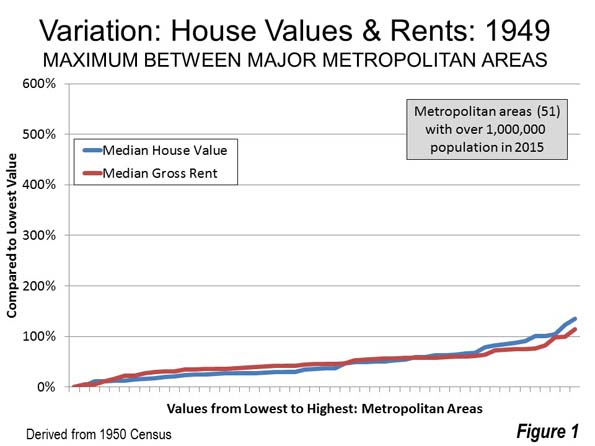
  • The Incompatibility of Forced Density and Housing Affordability

    New research supports the conclusion that anti-sprawl policy (urban containment policy) is incompatible with housing affordability. Build-zoom.com economist Issi Romem finds that: “Cities that have curbed their expansion have – with limited exception – failed to compensate with densification. As a result they have produced far less housing than they would otherwise, with severe national implications for housing affordability, geographic mobility and access to opportunity, all of which are keenly felt today as we approach the top of housing cycle.”

    Romem had previously produced stunningly innovative research, estimating the extent of urbanization in US cities every decade from 1940 to 2010. He provides maps that show the changing urban expanses in each census. Romem uses the larger metropolitan areas, the currently defined Combined Statistical Areas (CSAs). This combines metropolitan areas that are adjacent and significantly economically connected, such as San Francisco and San Jose, New York , southeastern Connecticut and Allentown, and Los Angeles and Riverside-San Bernardino.

    The new research is a similarly important addition to urban policy. Like most in urban planners, Romem strongly believes that the "ills of the urban sprawl must be curbed." However, importantly, Romem’s research is driven by data, rather than urban planning principles often disconnected from the aspirations of households. This article examines Romem’s most recent research in the context of middle-income housing affordability.

    Middle-Income Housing Affordability

    Housing affordability is much broader than “affordable housing” for lower income households. In markets regulated by urban containment, middle-income housing usually becomes too expensive for many middle-income households. In such markets, there is considerable discussion of housing affordability, but little that gets to the heart of the matter.

    Housing affordability is appropriately compared both between housing markets and  within markets over time. Perhaps the most effective tools are price-to-income ratios, such as the median multiple (median house price divided by median household income) used in the Demographia International Housing Affordability Survey. Now in its 12th edition, the Survey shows virtually all major metropolitan areas with seriously unaffordable housing to have urban containment policy.

    Development Limits: More Politics than Mountains or Water

    In covering Romem’s research, Richard Florida acknowledges describes the crucial role of role of land markets in maintaining housing affordability. Of course, housing affordability is a casualty of urban containment policy because it destroys the competitive market for land on the urban fringe. As a result house prices rise substantially relative to incomes (Figure 1).

    Romem and Florida, to their credit, have proposed means they think can preserve housing affordability within a framework of urban containment, such as by land use regulation that permits higher densities, including redevelopment of lower density areas. While wishing them luck, there is little cause for optimism. Near 50 years ago, legendary urbanologist Sir Peter Hall suggested that “soaring land prices …. certainly represent the biggest single failure of the system of planning introduced with the 1947 [Town and Country Planning] Act” (see: The Costs of Smart Growth Revisited: A 40 Year Perspective). Urban containment policy, the principal strategy of forced densification, cannot repeal the law of supply and demand. Seventy years of experience prove that.

    Florida and others have noted the challenges of cities running up against their development limits. However, in the United States, only the artificial political limits of regulation have been approached, rather than the natural barriers of topography or geography (see: A Question of Values: Middle-Income Housing Affordability and Urban Containment Policy). Where a binding urban growth boundary is imposed between the city and an impassible mountain range, the scarcity induced price increases result from the boundary, not the mountain.

    Politics, Topography & Geography in the San Francisco Bay Area

    Take, for example, the San Francisco Bay Area, which has often been cited as a place where natural barriers have left little land for development. This is an impression easily obtained observing the fairly narrow strips of urbanization on both sides of San Francisco Bay, hemmed in by hills.

    However the Bay Area’s urbanization long ago leapt over the most important water bodies and then the Berkeley Hills to the east. Not only is the San Francisco Bay Area CSA high density, but it is also spatially small. In 2016, the San Francisco built-up urban area was only the 23rd largest in land area in the world. New York, the world’s largest built-up urban area in geographical expanse is more than four times as large.

    There is plenty of developable land in the San Francisco Bay Area. Data in a 1997 state analysis indicated that another 1,500 to 4,300 square miles (3,900 to 11,000 square kilometers) could be developed in the Bay Area CSA. The lower bound assumed no farmland conversion and stringent environmental regulation. The report also found that in recent years, residential development had become marginally denser, yet not incompatible with the detached housing remains the preference in California (Figure 2). The state has more than enough developable land for future housing needs.

    Updating the data to account for the development that occurred through 2010, the developable land supply could support an urbanization of between 18 million and 37 million population, well above the 2010 urban population (Note on Method). At the most, there is capacity to accommodate the population of Tokyo – Yokohama, the world’s largest urban area. At a minimum, use of the available land would catapult the Bay Area CSA ahead of the Los Angeles-Riverside CSA, more than double its present population.

    Of course, the Bay Area is simply not growing fast enough to reach even the lower population figure any time soon. Even with its slower growth, however, the competitive market for land no longer works, in large measure because of land use regulation. The San Jose metropolitan area has the fourth worst housing affordability in the Demographia International Housing Affordability Survey and the San Francisco metropolitan area is 7th worst (both metropolitan areas are in the CSA).

    The decades old Bay Area housing affordability crisis, and that of other metropolitan areas seeking to force higher densities, is more the result of policy than nature.

    Urban Containment: Negative Externalities

    Moreover, planning authoritarianism cannot tell everyone where and how to live. For many, high density apartments (owned or rented) are not a substitute for the detached house. Indeed the substitute for the detached housing the Bay Area for many is often a detached house in Nashville or Kansas City or any of many other major metropolitan areas where housing is much less expensive. Last year’s (2014) IRS migration data shows that California is losing both younger households and middle income households.

    Higher than necessary house prices are, of course, an even greater problem for low-income households, who not only are excluded from homeownership but most pay unaffordable rents. The latest data shows that California again has the worst housing cost adjusted poverty rate among the 50 states. Even Mississippi, with its reputation for poverty, cannot compete with that.

    Romem expressed concern to The Wall Street Journal: “What you’ll get there is an exacerbation of the problems we already have in expensive cities. The distinction between homeowners and renters will become less and less a stage of life and more and more if your parents can help you.”

    The Economist came to a similar conclusion: “Suburbs rarely cease growing of their own accord. The only reliable way to stop them, it turns out, is to stop them forcefully. But the consequences of doing that are severe" (See: Cities: Better for the Great Suburbanization).

    Note on Method: Some of the CSA urban population is not in the continuous urbanization of San Francisco-San Jose built-up urban area, such as in the Santa Rosa, Stockton and Santa Cruz urban areas. This analysis is based on data from the California Department of Housing and Community Development and the U.S. Census Bureau. It is based on an estimate of additional development occurring from 1996 to 2010 and the land remaining after deduction of recently developed land. The population capacity assumes the “marginally higher” densities used by the California Department of Housing and Community Development, which it notes would not require substantial changes in the “current form of housing development” (1997).

    Wendell Cox is principal of Demographia, an international public policy and demographics firm. He is a Senior Fellow of the Center for Opportunity Urbanism (US), Senior Fellow for Housing Affordability and Municipal Policy for the Frontier Centre for Public Policy (Canada), and a member of the Board of Advisors of the Center for Demographics and Policy at Chapman University (California). He is co-author of the "Demographia International Housing Affordability Survey" and author of "Demographia World Urban Areas" and "War on the Dream: How Anti-Sprawl Policy Threatens the Quality of Life." He was appointed to three terms on the Los Angeles County Transportation Commission, where he served with the leading city and county leadership as the only non-elected member. He served as a visiting professor at the Conservatoire National des Arts et Metiers, a national university in Paris.

    Photo: San Mateo County on the San Francisco Peninsula (by author)

  • Center for Opportunity Urbanism: America’s Housing Crisis

    This video from Center for Opportunity Urbanism (COU) explores America’s housing crisis — focusing on the new generation. COU is a non-profit dedicated to preserving the American dream and promoting upward mobility for all Americans. Check out the video and let us know what you think.