Category: housing

  • Jerry Brown’s Housing Hypocrisy

    Jerry Brown worrying about the California housing crisis is akin to the French policeman played by Claude Rains in “Casablanca” being “shocked, shocked” about gambling at the bar where he himself collects his winnings.

    Brown has long been at the forefront on drafting and enforcing regulations that make building housing both difficult and very expensive. And now he has pushed new legislation, which seems certain to be passed by the Legislature and signed by the governor, that makes it worse by imposing even more stringent regulations on greenhouse gas emissions, mandating a 40 percent cut from 1990 levels by 2030.

    The press and activists may cheer the new bill, which will require massively expensive and intrusive measures likely to further raise housing costs. A 2012 study by the California Council on Science and Technology found that, given existing and potentially feasible technology, cutting back carbon emissions by 60 percent, roughly comparable with the new legal mandate, would require that “all buildings … either have to be demolished, retrofitted or built new to very high efficiency standards.” Needless to say, this won’t do much for housing affordability.

    Brown’s bona fides in promoting housing inflation goes back, at least to his days as attorney general. Throughout his career, Brown has fostered policies that have contributed to the regulatory quagmire largely responsible for helping drive house values in California up more than three times the national rate in the last half century. Over that period, a dense mesh of regional and local regulations have seriously restricted land for urban development, adding significant costs for housing developers.

    Some have seen Brown’s recent suggestions to loosen up some regulations and add to housing subsidies as positive, although they have little chance of making it through Sacramento due to environmental, labor and municipal opposition.

    Read the entire piece at The Orange County Register.

    Joel Kotkin is executive editor of NewGeography.com. He is the Roger Hobbs Distinguished Fellow in Urban Studies at Chapman University and executive director of the Houston-based Center for Opportunity Urbanism. His newest book, The Human City: Urbanism for the rest of us, will be published in April by Agate. He is also author of The New Class ConflictThe City: A Global History, and The Next Hundred Million: America in 2050. He lives in Orange County, CA.

  • Why Most Cities Will Never Be All They Used to Be

    Recently I published a piece on my Forbes site that discusses the disparate impact that demographic and social shifts had on larger, older U.S. cities over the second half of the 20th century.  Basically, the smaller American household size, generated by later marriages, rising divorce rates, lower fertility rates and rising life expectancy, among other things, has meant that unless cities were adding housing, they simply weren’t growing.  Yeah, I know I’m quoting myself, but here’s a sample:

    “Most people intuitively understand the economic underpinnings of urban decline, and the economic advantages that have led to their rebound. The loss of manufacturing destroyed the economic base; the spread of globalization and the new economy has created new opportunity in cities. But far less well understood are the far-reaching cultural and social changes that impacted the demographic makeup of cities — and would have caused population loss, even without economic restructuring.”

    I encourage you to check it out.

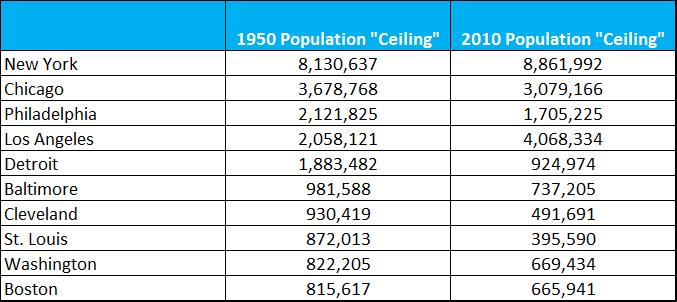
    I go on to suggest that population loss was inevitable for the most of the largest cities of mid-century America, and point out that today’s cities may never reach their previous population peaks.  I put together a cool table that demonstrates this:

    However, in putting this piece together I left quite a bit on the table, both in terms of graphics and additional content.  So consider this an addendum to the Forbes piece.

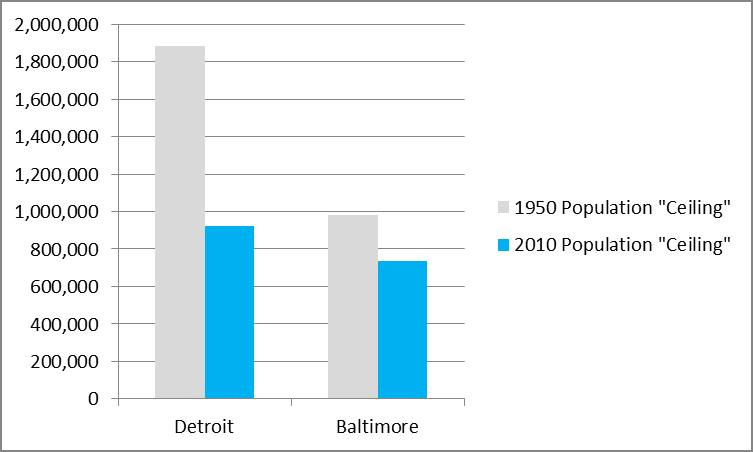
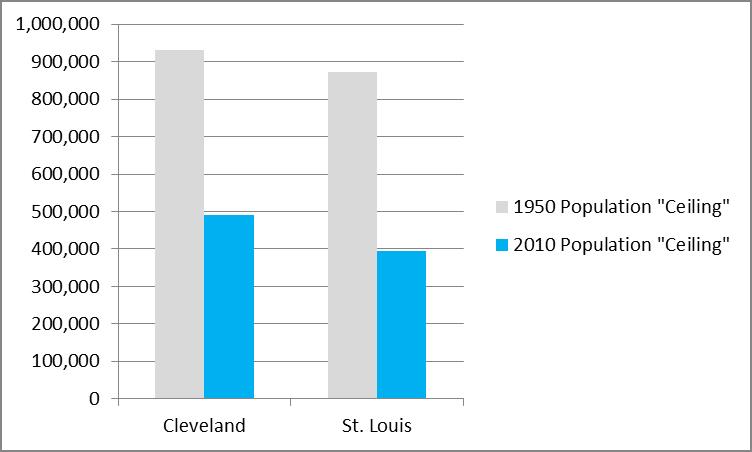
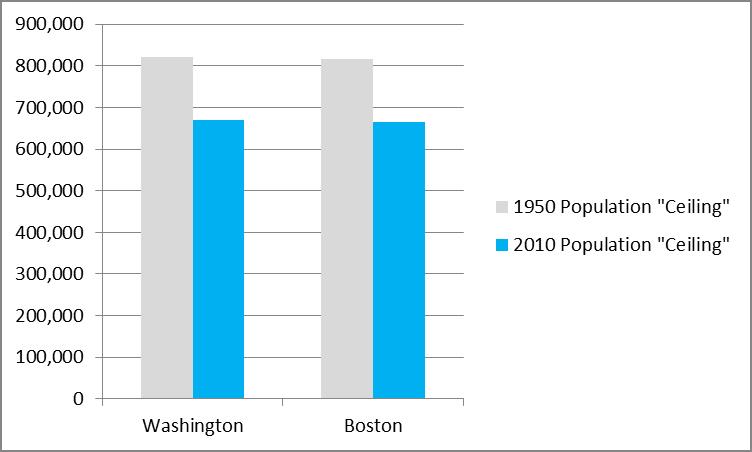
    First, I think it’s stunning to see a visual that illustrates the differences in a 1950 and 2010 population ceiling for the ten cities examined.  Check these out, shown two cities at a time:

    I think it is absolutely stunning to see that cities like Cleveland, Detroit and St. Louis could at best (at least right now) attain maybe half of their population in 1950.  And a case could be made that smaller household size may be the most significant factor in their decline.

    Three points I was unable to expand on in the Forbes piece.  First, now that the pendulum is swinging back in favor of cities, their influence is ascending faster than their population growth.  Cities are leading discussions now the economy, on infrastructure, on energy, on housing.  For the latter third of the 20th century the suburbs led that discussion.  But today, cities have reclaimed that role.  Their actual size, in terms of population, matters less today than it did 60 years ago.  

    Second, the American preference for new over old has nearly as much to do with this shift as shrinking household size.  For nearly 50 years the suburbs (and by extension, the Sun Belt) was new, and that was a main feature of their attraction.  But there’s also that saying, “everything old is new again.”  Cities are the new thing, and while they’re not everyone’s cup of tea, they are doing better than at any time in the last 50 years.

    Third, it’s conceivable that many suburbs and/or Sun Belt cities may find themselves impacted by emerging demographic or social shifts.  Having a huge inventory of single family homes in a world that is asking for multifamily options?  A strong auto-oriented landscape when more people are looking for walkable environments?  

    I’m not suggesting that all older cities are ascendant, and the suburbs and Sun Belt are doomed.  But staying ahead of trends may be the lesson all need to heed.

    Pete Saunders is a Detroit native who has worked as a public and private sector urban planner in the Chicago area for more than twenty years.  He is also the author of “The Corner Side Yard,” an urban planning blog that focuses on the redevelopment and revitalization of Rust Belt cities.

    Top photo: Vacant homes in Philadelphia, awaiting their revitalization.  Source: smartgrowthamerica.org

  • Notes From An Upzoning Heretic

    I recently got into a discussion on Twitter about the soundness of upzoning, or the increase in the allowance of residential units in cities, as a rational and reasonable response to the lack of affordable housing in our nation’s large cities.  Anyone who’s been reading my writing knows that I’ve disagreed with this for quite some time, and tried many ways to articulate my views and reach some understanding. From the discussion I learned two things: 1) Twitter is a really poor vehicle for debate when nuance is critical (OK, I really knew that already), and 2) the orthodoxy of the upzoners is so strong that my views on this might put me on the pariah end of the urbanism spectrum. 

    It started innocently enough.  Ramsin Canon suggested upzoning major streets in Chicago for more residential units.  That brought several supporters, including City Observatory writer and fellow Chicago blogger Daniel Kay Hertz, who (gracefully, I might add) noted my objections.  I then chimed in, and shortly thereafter I found myself swimming against the tide of upzoners hoping to prove that upzoning helps improve housing affordability. 

    Look, upzoners, I understand the problem and the sentiment.  I understand the desire to find the right policy response to address the issue.  But I remain unconvinced that upzoning will help any more than a handful of American cities.  Here’s why.

    An Abstract Argument

    Surely a big part of the appeal of upzoning is its abstract simplicity.  Increasing the supply of housing units in extremely tight housing markets can unleash market forces that drive home prices and rents downward, making cities more affordable to affluent and poor alike.  And in housing markets that have an almost even distribution of high priced housing within them, like San Francisco or New York, this makes sense.  Allowing more units will have the effect of bringing prices down.  (I’d also add parenthetically that the tightest and most expensive housing markets nationally also tend to be the most geographically constrained, by either water or mountains, and that constraint does not hold for all cities nationwide.  This escapes many people.)

    The reality, however, is that nationally gentrification is just a pittance compared to the expansion of urban poverty.  As Carol Coletta of the Knight Foundation put it in a speech last month at the Congress of the New Urbanism:

    “In 1970, about eleven hundred urban Census tracts were classified as high poverty.

    By 2010—40 years later—the number of high poverty Census tracts in urban America had increased from 1100 to more than 3,000. (3165)

    The number of people living in those high poverty Census tracts had increased from 5 million to almost 11 million. And the number of poor people in high poverty Census tracts had increased from 2 million to more than 4 million.

    So over a 40-year period, the number of high poverty Census tracts in America’s core cities had tripled, their population had doubled, and the number of poor people in those neighborhoods had doubled.

    Given that record, I’ll bet a lot of people are hoping for a little gentrification– if gentrification means new investment, new housing, new shops without displacement.

    The idea that places might benefit from gentrification runs against the popular narrative. But here’s the really startling fact: only 105 of the eleven hundred Census tracts that were high poverty in 1970 had rebounded to below poverty status by 2010. That’s only ten percent! Over 40 years!”

    Most American cities are not like San Francisco or New York, where the high prices and rents cannot be avoided and the return-to-the-city demand remains very high.  Most cities have greater variance in prices and rents, from very high to very low.  This takes away the first layer of abstraction for prices and rents and allows those with money to rationally widen their consideration when choosing to live in cities.  On the surface this sounds great. 

    But — and this is where the second layer of abstraction is shed — people don’t make housing decisions or neighborhood decisions rationally.  They take in all sorts of information and put it to subjective use, and justify its rationality later.  Historical perceptions of neighborhoods linger far longer than their reality.  Media perceptions can distort the reality of neighborhoods.  Egos can get involved and people select neighborhoods that have a certain cache or brand.  For urban neighborhoods in most cities, we find that affluence clusters in certain areas and moves outward slowly.  Poverty expands quickly, as those who have the ability to escape it do so, and further destabilize a neighborhood in the process.  The end result, again for cities that do not have the same strong return-to-the-city demand or the uniformly high home prices and rents, is affluent enclaves surrounded by expansive and increasingly impoverished neighborhoods.

    Upzoning can accelerate this process.  If a major city undergoes an upzoning process and allows a substantial increase in the number of housing units, what do you think the development community’s response to that will be?  My guess is that they will work hard to fulfill the market demand where the demand is strongest — in the most desirable neighborhoods or in the areas immediately adjacent to them.  Only after that demand is tapped out will developers move into other areas, and most will elect to build in areas that are adjacent to the newly saturated neighborhood.  Those who live in the path of development will see prices and rents remain high; those away from the path of development will likely see  prices and rents crater, and lament the lack of investment in their community. 

    The Need for Investment

    TAt one point in the Twitter discussion.  Daniel Kay Hertz asked me, “Would there be more or fewer Latinos in Logan Square if there was more new housing in Lincoln Park?”  For non-Chicagoans, Logan Square is the rapidly gentrifying neighborhood immediately west of the quite-gentrified Lincoln Park neighborhood on the lakefront.  My response was that Logan Square would indeed have more Latinos in that scenario and that it would have no discernible impact on other neighborhoods outside of the “hot zone” as well.  But that sets up the scenario I cite above — an affluent neighborhood next to an eternally poor/working class one, possibly lamenting the lack of investment in their midst.  And the further one’s home or neighborhood is from the “hot zone”, the more that lament turns into angst, frustration and resentment.

    It’s worth bringing back a portion of the quote above from Carol Coletta:

    Given that record, I’ll bet a lot of people are hoping for a little gentrification– if gentrification means new investment, new housing, new shops without displacement.The idea that places might benefit from gentrification runs against the popular narrative.

    Despite the growing problems of affordability in select neighborhoods in major cities across the nation, there are many more neighborhoods that wish they had that problem.  Many people rue the fact that maybe one-quarter or one-third of a city is priced beyond their means.  That leaves two-thirds to three-quarters of a city to explore and find a place worthy of investment.  Upzoning can have the impact of further concentrating development within the “hot zone” and drive a deeper inequality wedge between urban haves and have-nots.

    Upzoners are not doing cities a favor more broadly by addressing an issue that helps them directly.

    Ultimately I see high prices and rents as being demand-driven and not supply-driven.  Prices and rents are high because there are too many people focusing on too few neighborhoods — and squandering the opportunity to take some of that investment to other neighborhoods that could use it.

    Pete Saunders is a Detroit native who has worked as a public and private sector urban planner in the Chicago area for more than twenty years.  He is also the author of “The Corner Side Yard,” an urban planning blog that focuses on the redevelopment and revitalization of Rust Belt cities.

  • California: The Economics of Delusion

    In Sacramento, and much of the media, California is enjoying a “comeback” that puts a lie to the argument that regulations and high taxes actually matter. The hero of this recovery, Gov. Jerry Brown, in Bill Maher’s assessment, “took a broken state and fixed it.”

    Yet, if you look at the long-term employment trends, housing affordability, inequality and the state’s long-term fiscal health, the comeback seems far less miraculous. Silicon Valley flacks may insist that the “landscape now has been altered,” so prosperity is now permanent, but this view is both not sustainable and deeply flawed.

    Jobs: The long view

    Since 2010, California has begun to generate jobs at a rate somewhat faster than the nation, but this still has just barely made up for the deep recession in 2007. The celebratory notion that true-blue California is outperforming red states like Texas is valid only in a very short-term perspective. Indeed, even since 2010, the job growth in Austin and Dallas has been higher than that in the Bay Area, while Los Angeles has lagged well behind.

    If you go back to 2000, the gap is even more marked. Between 2000 and 2015, Austin has increased its jobs by 50 percent, while Raleigh, Houston, San Antonio, Dallas, Nashville, Orlando, Charlotte, Phoenix and Salt Lake City – all in lower-tax, regulation-light states – have seen job growth of 24 percent or above. In contrast, since 2000, Los Angeles and San Francisco expanded jobs by barely 10 percent. San Jose, the home of Silicon Valley, has seen only a 6 percent expansion over that period.

    Regional concentration

    As Chapman University economist and forecaster Jim Doti recently suggested, the California boom is exceedingly concentrated in one region. “It’s not a California miracle, but really should be called a Silicon Valley miracle,” Doti noted in his latest forecast. “The rest of the state really isn’t doing well.”

    Read the entire piece at The Orange County Register.

    Joel Kotkin is executive editor of NewGeography.com. He is the Roger Hobbs Distinguished Fellow in Urban Studies at Chapman University and executive director of the Houston-based Center for Opportunity Urbanism. His newest book, The Human City: Urbanism for the rest of us, will be published in April by Agate. He is also author of The New Class ConflictThe City: A Global History, and The Next Hundred Million: America in 2050. He lives in Orange County, CA.

    Bill Watkins is a professor at California Lutheran University and runs the Center for Economic Research and Forecasting, which can be found at clucerf.org.

  • Commie Skin Jobs

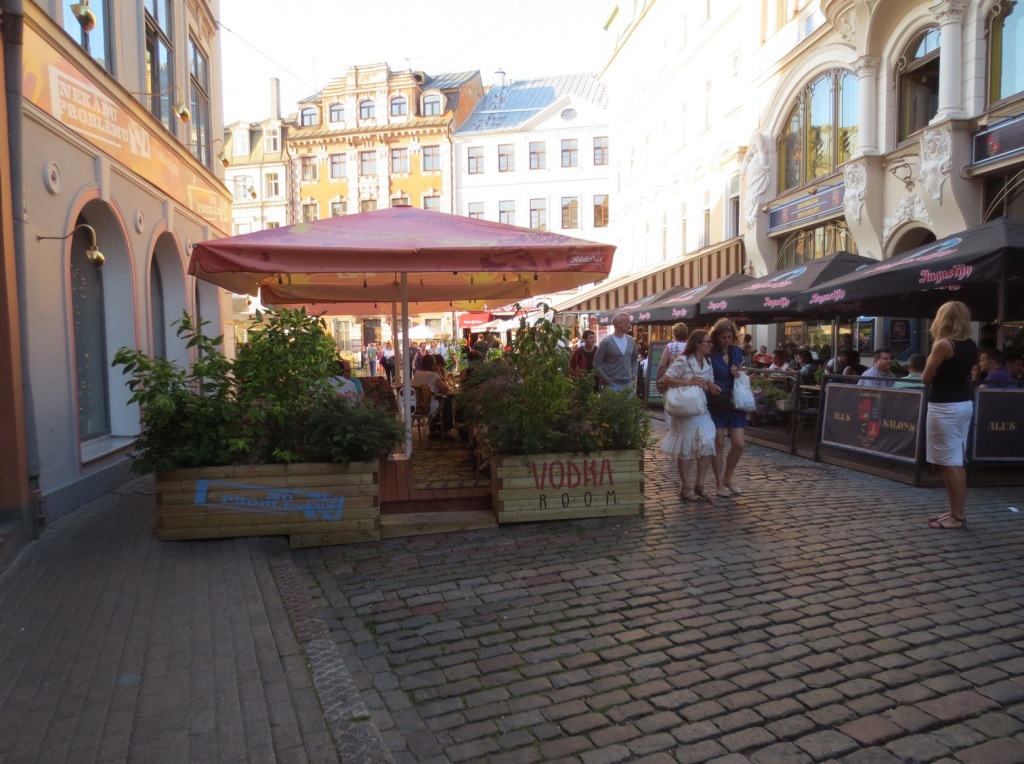
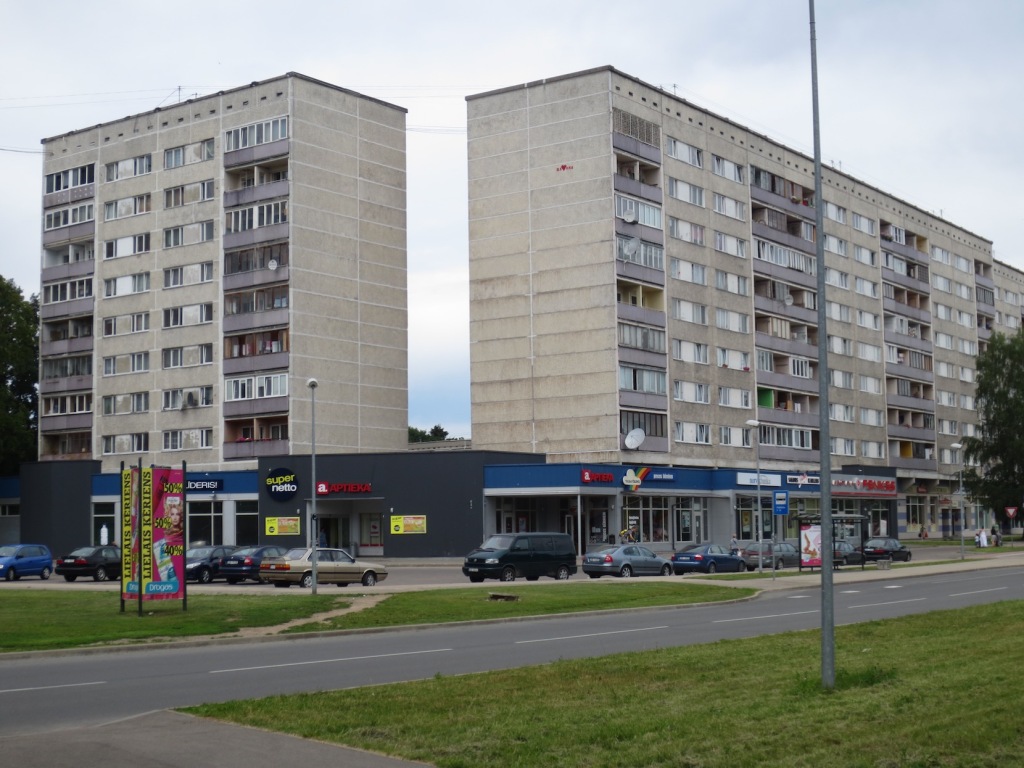
    This is Riga, Latvia. The Baltic Republics had a particularly difficult time during the twentieth century with Nazi Germany invading in 1941 and Soviet Russia occupying them until 1991. What had been a prosperous group of small Scandinavian style countries became relatively impoverished and isolated.


    Screen Shot 2016-04-15 at 1.23.01 PM

    Screen Shot 2016-04-15 at 12.43.07 PM

    Screen Shot 2016-04-15 at 12.38.34 PM

    Screen Shot 2016-07-25 at 12.20.40 PM

    This is Riga, Latvia. The Baltic Republics had a particularly difficult time during the twentieth century with Nazi Germany invading in 1941 and Soviet Russia occupying them until 1991. What had been a prosperous group of small Scandinavian style countries became relatively impoverished and isolated.

    Screen Shot 2016-07-26 at 1.52.14 AM

    Screen Shot 2016-07-26 at 1.45.59 AM

    Screen Shot 2016-07-25 at 8.57.20 PM

    Screen Shot 2016-07-25 at 10.38.32 AM

    Screen Shot 2016-07-25 at 10.37.13 AM

    Screen Shot 2016-07-25 at 8.52.43 PM

    This is nothing new. The Baltic has been repeatedly dominated by larger nations since the 1200’s. Riga is equidistant from both Berlin and Moscow. It’s a rough neighborhood and it seems likely there will be more such impositions in the future. The region is too important to left alone. But the people will adapt as they always have.

    Screen Shot 2016-04-15 at 12.43.47 PM

    Screen Shot 2016-07-25 at 8.57.48 PM

    Screen Shot 2016-07-25 at 8.58.01 PM

    Screen Shot 2016-04-15 at 12.44.00 PM

    Between the various wars and occupations when the country was allowed to flourish on its own Latvia proved to be industrious and highly cultured. The buildings that survived the tumults of history attest to the quality of the people, economy, and place.

    Screen Shot 2016-07-25 at 9.22.34 PM

    Screen Shot 2016-07-25 at 9.23.13 PM

    Screen Shot 2016-07-25 at 9.22.03 PM

    Screen Shot 2016-07-25 at 9.49.04 PM

    Screen Shot 2016-04-15 at 1.26.03 PM

    Screen Shot 2016-04-15 at 1.23.58 PM

    Screen Shot 2016-07-25 at 9.49.21 PM

    It was a matter of national pride for the Latvian people to completely restore the historic core of Riga after the Soviets left things in Havana style dishevelment. This is their homeland and the repository of their culture, language, music, and history. It was also an excellent business model. The city is a dynamic and highly profitable venue for foreign investment, trade, and tourism. Every inch of the old city is productive.

    Screen Shot 2016-04-15 at 1.06.58 PM

    Screen Shot 2016-07-25 at 10.33.44 AM

    Screen Shot 2016-07-26 at 12.44.15 AM

    But then there’s all that left over communist stuff ringing the city. What exactly do you do with it all? Pulling it down and replacing it is too expensive. And many of these buildings are occupied by ethnic Russians not Latvians. (Latvia is a quarter Russian as a result of the Soviet occupation, but the city of Riga is closer to half Russian.)

    Screen Shot 2016-07-26 at 1.38.49 AM

    Screen Shot 2016-07-26 at 1.39.50 AM

    Screen Shot 2016-07-26 at 1.33.09 AM

    Screen Shot 2016-07-26 at 12.44.29 AM

    This was top down bureaucratic central planning at its finest. Residential buildings were isolated from industry and from each other for health and safety. Operating a business of any kind in these apartment buildings was strictly forbidden. Tightly regulated shops were provided at convenient but segregated locations. Highly consolidated schools and isolated office and manufacturing parks were constructed in their own little pods at some distance.

    Screen Shot 2016-07-25 at 9.47.26 PM

    Screen Shot 2016-07-25 at 12.24.22 PM

    The preservation of green open space was a hallmark of Soviet design. Grass and trees were necessary for recreation, health, and social tranquility. There’s also a coincidental side effect of this kind of land use planning that worked in favor of central authority. Where exactly would people organize a protest rally in this environment? There is no prominent central square or iconic rallying point. What exactly would the rebel cry be here? Rise up and storm the shrubbery!

    Screen Shot 2016-07-25 at 12.25.50 PM

    Screen Shot 2016-07-26 at 1.37.09 AM

    Screen Shot 2016-07-26 at 1.42.37 AM

    Honestly it’s not that different from American suburbia. Communists just preferred concrete tower blocks to wood framed tract homes. If you’ve ever been inside an original 1947 Levittown house then you’ve essentially been inside one of these Soviet apartments. I spent a chunk of my childhood in a beige stucco apartment in Los Angeles that was nearly identical on the inside. The kitchens are small, there’s only one bath, the ceilings are low, there’s no craft or workmanship in the architecture. It’s utilitarian. It’s not terrible. People can and do live perfectly comfortable lives in these places. It’s just bland and there’s never anything to do in the neighborhood. It’s the precise opposite of the historic city center. No tourist ever ventures out to this part of town and you’ll never see photos of these neighborhoods in brochures.

    Screen Shot 2016-07-25 at 10.35.31 AM

    Screen Shot 2016-07-25 at 10.34.48 AM

    Screen Shot 2016-07-25 at 10.40.09 AM

    Screen Shot 2016-07-26 at 1.39.07 AM

    Screen Shot 2016-07-26 at 1.35.13 AM

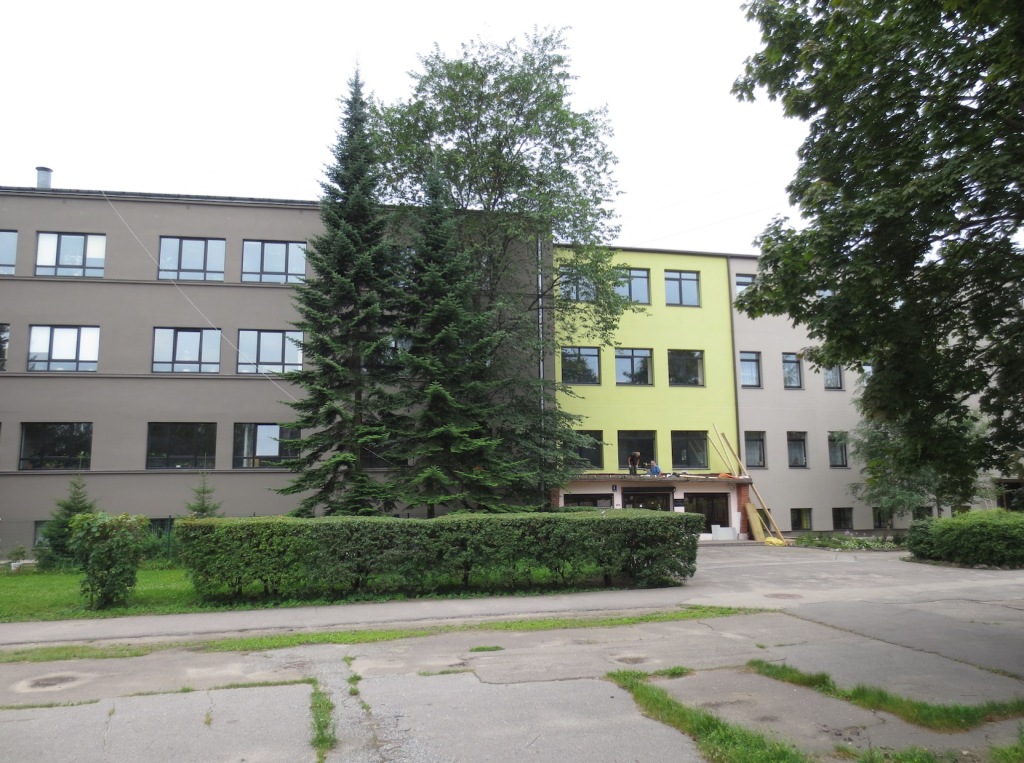
    So here’s what the pragmatic Latvians are doing. First, these inherited communist buildings are given a quick skin job. They’re scrubbed clean, fitted with new cupboards and fixtures, painted, given new windows and doors, and generally made to feel fresh. If you squint these buildings look like the lesser offerings of 1960s Sweden or Germany. There are worse places to live in the world. A tidy apartment in a boring suburb of Riga is what some people genuinely prefer. There’s plenty on offer here for them. And there isn’t much else that can be done with these places.

    John Sanphillippo lives in San Francisco and blogs about urbanism, adaptation, and resilience at granolashotgun.com. He’s a member of the Congress for New Urbanism, films videos for faircompanies.com, and is a regular contributor to Strongtowns.org. He earns his living by buying, renovating, and renting undervalued properties in places that have good long term prospects. He is a graduate of Rutgers University.

  • Ireland Adopts Plan to Increase Housing Supply and Improve Housing Affordability

    The government of Ireland has adopted a new policy (Rebuilding Ireland: Action Plan for Housing and Homelessness) intended to improve the quality of life and the national economy by making housing more affordable. In this regard, Ireland joins New Zealand (and Florida) in having recognized the disadvantages of overpriced housing and signaling reforms to alleviate the problem.

    Background: The Great Recession in Ireland

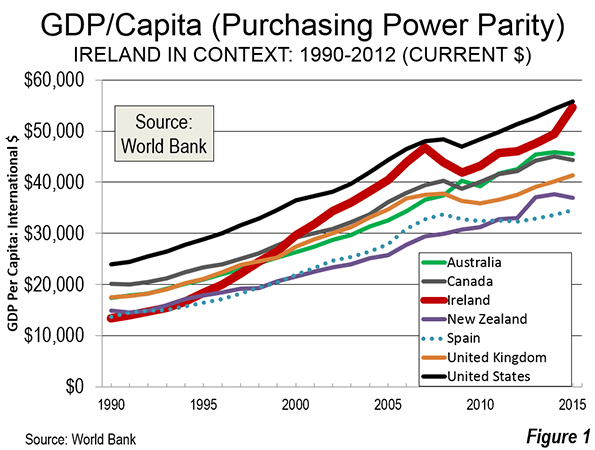
    Probably no nation suffered more during the housing bust induced Great Recession than Ireland. By 2007, the Irish economy had reached its peak, having achieved a gross domestic product (GDP) per capita, purchasing power adjusted, only 2.8 percent below that of the United States. This was an incredible accomplishment, given that as late as 1990 Ireland’s GDP per capita was approximately 45 percent below that of the United States, Australia, Canada, the United Kingdom, New Zealand and Spain, which are shown on Figure 1.  .

    However, as the overheated housing market tanked, Ireland’s GDP per capita dropped 8.4 percent relative to that of the United States, despite own housing bust economic losses. Things were so bad that Ireland was forced to take a large loan from the European Union and the International Monetary Fund to help stabilize its economy.

    Ireland’s economic losses were even greater than that of Spain, which had a particularly severe housing bust and whose economy continues to languish. But Ireland has done much better. The EU loan has been repaid. According to World Bank data, Ireland has reached a new peak, reaching within 2.1 percent of the US GDP per capita (Figure 1).

    The Housing Bubble and Bust

    During the housing bubble,   Dublin and Cork became severely unaffordable, where the median multiples (median house price divided by median household income) reached 6.0 and 5.4, respectively. This was to be expected as demand increased, well beyond the supply permitted by Ireland’s urban containment land-use regulations. As Dublin economist Colm McCarthy of  University College, put it: "Ireland passed its first major piece of land-use planning legislation in 1963, modeled on the UK’s Town and Country Planning Act of 1947. The intentions were laudable, to restrict the construction of unwelcome developments and to empower local authorities to take a more active role in shaping the built environment. There was no desire to screw up the residential housing market, but that is eventually what happened."

    As the economy get began to recover, house prices again began their rise simply because the reforms in   that would have prevented it were not implemented.

    Rebuilding Ireland

    The new housing policy announced July 20  is comprehensive, with strategies to reduce homelessness, improve the rental market and supply sufficient owned housing at affordable prices. Ireland has a high homeownership rate, at 68.6 percent and is important to the national economy.

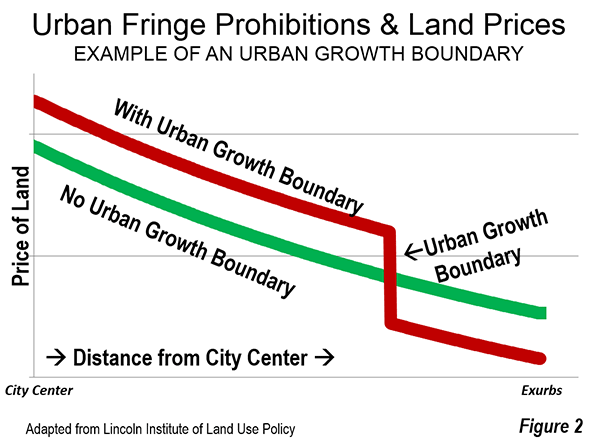
    As has occurred in the United Kingdom, Australia, New Zealand and some markets in Canada and the United States, large  house price increases relative to incomes were   experienced where urban containment policies were in effect. This is because urban fringe development prohibitions are associated with higher land prices inside urban containment boundaries (Figure 2). Indeed, this type of urban fringe regulation is present in virtually all major markets rated as severely unaffordable in the Demographia International Housing Affordability Survey, which rates 87 such markets in nine nations.

    Rebuilding Ireland policy acknowledges the importance of the housing market the national economy. As has been typical under urban containment planning regimes, house construction has fallen significantly short of demand. Under this policy, the government intends to accelerate the release of land for new development, especially in making government owned land available for development.

    Rebuilding Ireland is intended to double the rate of home building in Ireland over the period of 2017 to 2021. This will be aided by "Opening up land supply and low-cost State lands." This is important not only to meet the needs of Irish households, but also to diminish the potential for a highly volatile housing market that led to Ireland’s financial distress in the Great Recession.

    The government also intends to take action to support infrastructure development for new housing projects. A €200 million "Local Infrastructure Housing Activation Fund" will assist in "enabling infrastructure that opens up large sites for early development."

    As in California, virtually all large new housing projects today are appealed on various grounds. In recognition of this, Ireland intends to speed up the development process by allowing larger developments to proceed directly to the national planning appeals board ("An Bord Pleanála") for approval. The intention is to "jumpstart" the development of new housing.

    Defining Affordability

    Unlike most governments, the government of Ireland has supplied a definition of housing affordability. Rebuilding Ireland will hold a competition to develop new housing that can be delivered for than €200,000 in construction costs.

    Rebuilding Ireland also notes that land costs must be kept affordable and should add no more than €30,000 to €50,000 to the price of a new home. This would result in a "development ratio" of 15 percent to 20 percent (land price divided by total price including land). This development ratio is similar to US development ratios where urban containment policy has not been implemented and similar to development ratios in Australia and New Zealand before urban containment policy was adopted across those nations.

    Moreover, based on Irish household incomes, housing that costs between €230,000 and €250,000 would be generally consistent with the median multiple of 3.0 or less that is rated by the Demographia International Housing Affordability Survey as affordable (new house prices are generally more expensive than those of existing housing).

    Enforcement

    The government is signaling the seriousness of its intentions, indicating that local authorities must strive in their statutory development plans for “affordable prices to meet the housing needs of each local authority area, across tenures and types as well as the social housing requirement."

    This is a unique requirement in view of the fact that there has been virtually no serious attention to the issue of delivering housing affordability in other markets that have had strong urban containment policies.

    Implementation will not be without challenges. In the longer run, the inertia of currently in vogue planning philosophy could well prevent achievement of the housing affordability goals of Rebuilding Ireland. Yet, as Rebuilding Ireland indicates, the stakes are high. Rebuilding Ireland notes that "Excessive housing costs have demographic impacts, including a tendency for households to defer important lifecycle choices in order to prioritise home purchase" (such as having children).

    Further, as Rebuilding Ireland indicates: "Rising prices for residential accommodation impact adversely on competitiveness. The attractiveness of Ireland as a potential investment location and, of course, the cost base for existing businesses will be impaired should price inflation continue, as rising prices place upward pressure on wages, deter inward migration and impede the labour market."

    This could be particularly important in light of Brexit (the exit of the United Kingdom from the European Union). To the extent that international businesses may decide to leave the United Kingdom to stay within the European Union, Ireland and especially Dublin could be attractive for relocation because of the dominance in the nation of the English language, which would be made more attractive by improved housing affordability.

    Wendell Cox is principal of Demographia, an international pubilc policy and demographics firm. He is a Senior Fellow of the Center for Opportunity Urbanism (US), Senior Fellow for Housing Affordability and Municipal Policy for the Frontier Centre for Public Policy (Canada), and a member of the Board of Advisors of the Center for Demographics and Policy at Chapman University (California). He is co-author of the "Demographia International Housing Affordability Survey" and author of "Demographia World Urban Areas" and "War on the Dream: How Anti-Sprawl Policy Threatens the Quality of Life." He was appointed to three terms on the Los Angeles County Transportation Commission, where he served with the leading city and county leadership as the only non-elected member. He served as a visiting professor at the Conservatoire National des Arts et Metiers, a national university in Paris.

    Photo: Custom House, Dublin by Peter Brown from Dublin, Ireland (The Custom House, Dublin) [CC BY 2.0], via Wikimedia Commons

  • A Different Approach to Redevelopment

    As part of a thought experiment I examined one specific neighborhood in a typical small city in Georgia. I’m using this town not because it’s unique, but because it’s absolutely normative. I could do the same analysis on the town where my mom, sisters, and brother live in southern New Jersey and it would be nearly identical. This is Everytown, USA.


    Screen Shot 2016-07-11 at 1.25.14 AMGoogle

    This particular neighborhood is halfway between the historic town center and the newer suburbs. It’s been completely skipped over and neglected in recent decades. What might be possible given the prevailing political and economic reality? The goal here is to improve the quality of life for existing residents, attract new residents, increase employment and economic activity, raise property values, and expand the tax base. The trick is to do all these things while keeping public spending and infrastructure to an absolute minimum and not use subsidies or tax abatements. I’ve rejected all the usual suspects that take too long, cost too much, and often make things worse.

    Screen Shot 2016-07-06 at 2.33.05 AMGoogle

    Screen Shot 2016-07-11 at 1.34.55 AMGoogle

    This neighborhood can’t compete with newer suburbs for folks looking for the usual quiet leafy environment. It shouldn’t even try. Instead it could offer the one thing the new suburbs don’t – a walkable human scaled place with some modicum of vitality and street life. There’s pent up market demand for such places and almost no supply. My first suggestion is for this business district to turn its back on the main road. Call it what it is – a sewer for cars. It serves its purpose and keeps things flowing, but no one wants to sit and watch the material drift by. Ignore it.

    Instead, the parallel secondary street should become the focus of attention. That’s the more appropriate Main Street location. Next, sort out local businesses that are “in” or “out.” The national chains won’t be interested. Let them continue doing what they do. Many of the independent merchants and landlords may not be so inclined either. That’s fine. Work with the folks who are. Baby steps.

    Screen Shot 2016-06-24 at 9.06.53 AMGoogle

    Screen Shot 2016-06-24 at 8.17.07 AM

    Screen Shot 2016-07-11 at 11.29.13 AM

    Here’s an interstitial space formed by the back of a generic aging strip mall and an adjacent one story professional building. It’s a parking lot that doesn’t appear to get much use, but it’s an excellent outdoor room with good proportions that faces a quiet side street. If the city regulators and fire marshal could see their way to make it legal this is an ideal spot for a great gathering space.

    Screen Shot 2016-07-06 at 10.11.40 AM

    Screen Shot 2016-07-06 at 10.14.03 AM

    Screen Shot 2016-07-12 at 1.02.23 AM

    Screen Shot 2016-07-06 at 10.14.15 AM

    Plants, inexpensive outdoor furniture, and simple food and drink (most likely served by existing merchants from the rear of their shops) would be a fast cheap method of making the area worth frequenting. Only the locals know exactly what would provide the best draw. Coffee? Beer? Ice cream? Barbecue? Or maybe this is the perfect spot for outdoor movies served with popcorn and lemonade on weekend nights. Total cost to the city? Some paperwork. Total cost to the property owners? Lawn furniture, plants, and Christmas lights. The “product” on offer is spontaneous conviviality. Effective management is more powerful than pouring concrete and laying asphalt.

    Screen Shot 2016-07-11 at 11.29.25 AM

    Screen Shot 2016-06-24 at 8.38.04 AM

    Screen Shot 2016-06-24 at 8.51.49 AM

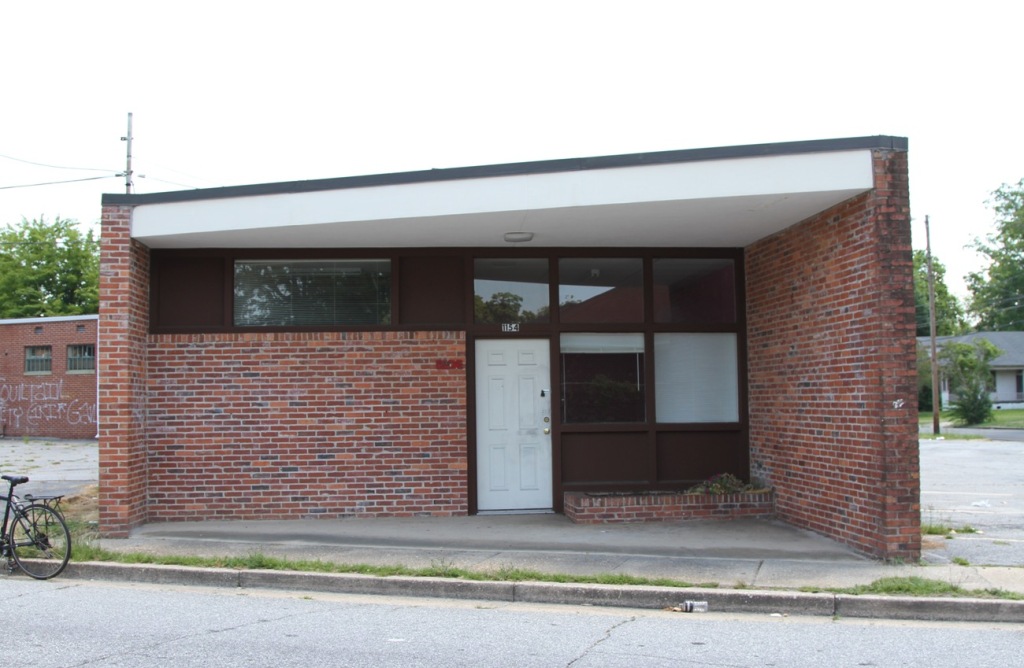
    The professional building appears to be vacant or less productive than it could be. The property owner may be happy with the current arrangement, but if not this could be a fantastic live/work space. There are a lot of people who find this sort of place appealing since it’s a blank slate and extremely flexible. It’s no doubt illegal to live in a commercial space due to zoning regulations. But those rules could be changed or quietly ignored by the authorities. Who’s to say what happens behind those brick walls? Live/work is the perfect in-between use for a building that sits halfway between a busy road and a calm residential street.

    Screen Shot 2016-07-06 at 2.49.45 AMGoogle

    Screen Shot 2016-07-11 at 11.30.17 AM

    Screen Shot 2016-06-25 at 8.19.44 AM

    Screen Shot 2016-06-25 at 8.20.30 AM

    All the ice cream parlors, outdoor cafes, and beer gardens in the world won’t help if there aren’t enough people nearby to fill the seats. This building appears to be some kind of Class C office building. I walked around in the middle of the afternoon on a weekday and didn’t see a soul. I didn’t even hear the hum of an air conditioner. It may be a thriving hub of business activity for all I know, but it looks like a storage facility for old paperwork. I could see someone from a local neighborhood improvement organization brokering a deal between the landlord and the local orchestra, film and video school, or art museum to convert this place into studio space.

    Screen Shot 2016-03-07 at 5.05.26 PM

    Screen Shot 2016-03-07 at 5.03.25 PM

    Screen Shot 2016-03-03 at 3.40.33 PM

    Actually, I’d love to see it as residential space for such people. It’s probably hard to practice the French horn in a garden apartment complex without people complaining. If the building were populated with a self selecting group of folks with an established affinity it might be a value added proposition.

    If you’re horrified by the idea of living in a place like this… Great! You’ve self selected out. Perfect. Now move over and make room for the people who love it. The Mad Men era architecture could be celebrated just as it is. Howard Johnson’s meets Denny’s with a hint of 1960’s car wash. A little turquoise and orange paint and some Malibu lighting would work wonders.

    Screen Shot 2016-07-11 at 1.16.49 AM

    Screen Shot 2016-07-11 at 1.17.18 AM

    Screen Shot 2016-07-11 at 1.13.23 AM

    Screen Shot 2016-06-25 at 8.06.20 AM

    Screen Shot 2016-06-25 at 8.07.23 AM

    Screen Shot 2016-07-11 at 1.18.56 AM

    There’s an abundance of commercial buildings that are simply not performing as intended. There’s no market demand for this kind of space in this location – and it’s been this way for a very long time.

    Screen Shot 2016-01-31 at 2.34.04 AM

    Screen Shot 2016-01-31 at 2.34.57 AM

    Screen Shot 2016-01-31 at 2.34.36 AM

    Why not make these living spaces? Again, I need to belabor the point. This isn’t about attracting suburban families. Instead, these places are perfect for a subset of the population that actually likes cheap ugly spaces. Cheap and ugly are the primary amenities for some people. They value other things and enjoy the freedom that comes with such accommodations.

    Screen Shot 2016-07-08 at 4.27.16 PM

    Screen Shot 2016-07-08 at 5.20.08 PM

    Screen Shot 2016-07-08 at 1.27.57 PM

    This is the secondary street that’s more suited to humans than the primary road full of vehicular traffic. It’s lifeless at the moment, but it could be transformed on the cheap with weekly pop up events organized around food trucks and a farmers market.

    Screen Shot 2016-07-12 at 12.24.08 AM

    Screen Shot 2016-07-12 at 12.24.33 AM

    Screen Shot 2016-07-12 at 12.23.53 AM

    Screen Shot 2016-07-12 at 12.22.40 AM

    Screen Shot 2016-07-12 at 12.27.16 AM

    Screen Shot 2016-07-12 at 12.26.45 AM

    Over time the empty parking lots and food trucks could mature with brick and mortar infill development that make the arrangement permanent. The food trucks are incubators for small scale entrepreneurs on a tight budget. You need a million dollars to open a franchise doughnut shop. A food truck comes at a much lower price point.

    Screen Shot 2016-07-03 at 2.57.15 PMGoogle

    Screen Shot 2016-07-11 at 5.42.57 PMGoogle

    Screen Shot 2016-07-02 at 4.31.19 AM

    Screen Shot 2016-06-25 at 8.14.03 AM

    Screen Shot 2016-07-03 at 5.50.29 PM

    Screen Shot 2016-07-03 at 5.51.16 PM

    Screen Shot 2016-07-03 at 5.51.35 PM

    Here’s a dead strip mall on the other side of the neighborhood that’s facing another busy commuter road. Again, the sweet spot is in the back that faces the residential side streets. Both the shops and the homes have seen better days. What can be done with this space?

    Screen Shot 2016-03-02 at 1.02.53 PM

    Screen Shot 2016-06-28 at 12.41.51 AM

    Screen Shot 2016-06-28 at 12.41.30 AM

    Screen Shot 2016-07-11 at 2.12.00 PM

    Screen Shot 2016-07-11 at 2.11.46 PM

    Screen Shot 2016-03-02 at 1.06.22 PM

    Screen Shot 2016-03-02 at 1.05.07 PM

    Screen Shot 2016-03-02 at 1.04.08 PM

    Screen Shot 2016-03-02 at 1.06.48 PM

    This is an example of a non profit organization that specializes in the often neglected industrial arts. Welding, glass blowing, carpentry, neon arts, enameling, stone cutting, fashion, ceramics, and so on. Thousands of people – particularly young people – are trained in useful skills each year. People rent space and pay a modest tuition for instruction. This isn’t a government facility. It was established and continues to be maintained by locals who are passionate about the place. This is the kind of thing that could draw in precisely the variety of people who might look favorably on living in one of the fantastically affordable nearby homes. And they’d actually have the skills to fix them up.

    Screen Shot 2016-06-25 at 8.13.39 AM

    I’m well aware of the arguments against this sort of thing. It will attract the wrong element. People will cook meth in spaces like that. People will have wild parties all night long and disturb the peace. This is just a bunch of Hipster nonsense.We can’t have people drinking beer outdoors near a church or school. I totally understand. From my perspective there are ways of managing those concerns, but I personally won’t invest ten minutes of my time attempting to change anyone’s opinion. Instead I’ll wait another ten or fifteen years for the current decline to continue. This place may not be ripe for reinvention yet. The local culture may not be receptive. Honestly, the neighborhood may not be miserable enough just yet. Let’s wait until these places start to burn down one by one. Or let them be bulldozed to make room for more parking or a heavily subsidized garden apartment complex next to the newly widened commuter road. That’s absolutely an option.

    John Sanphillippo lives in San Francisco and blogs about urbanism, adaptation, and resilience at granolashotgun.com. He’s a member of the Congress for New Urbanism, films videos for faircompanies.com, and is a regular contributor to Strongtowns.org. He earns his living by buying, renovating, and renting undervalued properties in places that have good long term prospects. He is a graduate of Rutgers University.

  • Adding Space to Suburbia

    Space has value. Even the mere perception of space has value. As land becomes more scarce, space becomes more valuable, and has a direct impact on housing costs and a developer’s profit (or loss). Both developers and the New Urbanists who preach that dense cities are good places know this, even as they pressure town councils and planning commissions to authorize reduced lot sizes. Where they have succeeded, the resulting compressed lots sacrifice quality organic space — green space — to the point of oblivion.

    Less than a half century ago, Phoenix was a sleepy retirement town with vast openness and desert character. A few years ago, my wife Adrienne and I visited the city. Today’s Phoenix, like Las Vegas, Albuquerque, etc., is a blanket of rooftop and pavement with a few strip malls spattered about. We met with developers to demonstrate a new way to design that increases lot size (value), while reducing infrastructure (costs). Without exception, developers responded: “People move to Phoenix to have a smaller lot. They do not want space.” So we visited the new, compressed developments, and asked residents about their new homes. Without exception, all the residents we interviewed loved their new places, but wished they had more space, especially between themselves and their neighbors.

    Simply put, a larger lot with more space is likely to be more valuable to residents, but builders are interested more in selling ‘product’ — homes. The more, the better.

    A buyer will pay more for a large home than a small one; for a large lot than a small one. They will pay a premium for a home with a view of space over that what they would pay for a view into a neighbor’s adjacent yard.

    Space has value, and value translates to an increased tax base.

    The social engineer will argue that it’s OK to sacrifice space because there will be a small park a five or ten minute ‘walk’ away. Reality check: A very small percentage of residents will actually walk to that park, but the homes that can view that space will be priced at a premium, costing well above the homes in a sardine-like placement far from the park. In denser suburbs or new urban communities, the haves will enjoy space; the have-nots, not so much.

    If space does not have value, as the proponents of dense neighborhoods claim, then why is it so heavily featured in home builders’ sales and marketing materials? When a home builder uses a marketing photograph, it is taken at a wide angle to make the lot appear larger than it actually is. When a builder uses a rendering on their web site or sales materials, it’s never shown with adjacent homes compressing the visual space.

    How can we feed the hunger for space? The conventional design methods that have been used since the dawn of civilization can’t work. To achieve increased space while preserving a higher density standard, the housing industry needs to take an approach that incorporates innovation and attractive value.

    That begins with the recognition that space is something that you feel, even though it is limited by non-transparent objects that form a physical barrier in our three dimensional world. When we are inside a structure, it’s the walls around us in reference to the flat floor; when we are outside, it’s the distance we perceive between homes. We might estimate a distance as longer or shorter, depending on whether the terrain was hilly or flat.

    Does five acres within a neighborhood park constitute open space? It sounds like it will, but if it’s along steep slopes or thickly wooded land with natural underbrush it won’t feel open. If it’s a park that residents must stroll to from their homes, the space has less value than if it can be viewed through their windows.

    As for conventional interior space, the perimeter of a home is often determined by the lot size, depending on local zoning. In the case of a Phoenix lot that is 50 feet wide by 100 feet deep, with a 5 foot side yard setback and a 20 foot front and rear yard setback, the home would be allowed to be 40 feet wide and 60 feet deep. Assuming a 20 foot by 20 foot garage and 6 inch exterior wall, that leaves 1,880 square feet of living space within the home.

    But— that only would result if the home were expanded to the largest possible perimeter. Included in that perimeter would be 145 feet of side yard, the entry door, and two car spaces in the garage, leaving only 55 feet for possible window locations that would overlook the front and rear yards. Within that footprint, the architect must lay out the bedrooms, closets, bathrooms, kitchen, living and family rooms, and any other living space.

    A great architect will make the resident ‘feel’ the most of the available space. A bad designer will make the home feel smaller than it actually is. Neither the good nor the bad architect (especially when the project is created by production builders) will consider the views from within the home, because, simply put, with New Urban and suburban cookie cutter subdividing, there are none. In most southern cities the rear view overlooks a wall or fence 20 feet away, and the next house structure is at a 40 foot distance. The front view (if any windows exist at all from front-placed living space) will be the garage door across the street, 90 feet away, along with driveways, the street, and parked cars. This is why modern home living spaces are rear, not front, oriented. Not much to look at. That is, unless you pay more – much more – to be in a neighborhood with larger lots.

    Conventional exterior space is also dictated by city regulations. Local zoning ordinances determine the allowed width and depth, to limit density with the promise of more space and a larger home footprint. In conventionally subdivided developments, side yard space is not a quality area, since the sides of homes typically are void of windows, and even if there were views, those windows would look directly into the neighboring wall just 10 to 20 feet in the distance.

    The image below shows two streets:
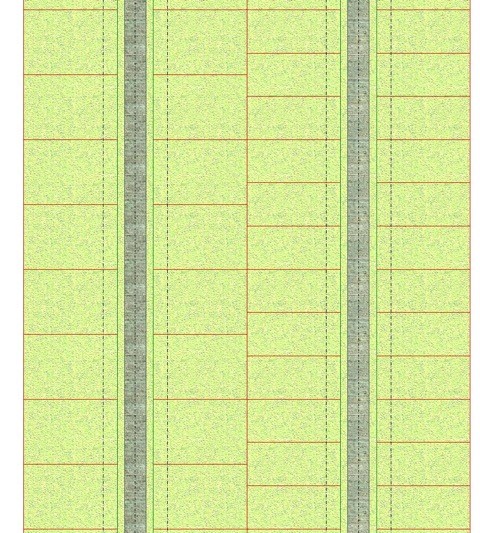

    The left one has a 90 foot wide lot; the right one has a 60’ foot wide lot. Both use the same 25 foot front yard setback. From a ‘human’ perspective, looking down the street, both have the same 100 foot wide swath of open space, yet the smaller lot achieves 33 percent more homes with the exact same infrastructure (street) expense. Because the street covers the same land area in both cases, the actual density gain on the smaller lot would be about 25 percent, while providing the very same ‘feel’ of space as the larger lot. Assuming that the intention of suburban zoning is to set both space and value, the typical ordinance does a terrible job on providing extra actual perceived space.

    Considering that space has real value, educators at colleges, and at design conferences, and all teachers of architecture and of urban and/or suburban design, should be concentrating more on how interior and exterior spaces can merge in more meaningful ways than on the trim of a front porch. Craftsman trim on a porch railing may add a wee bit of value, but living spaces coordinated with views of open space add a huge increase in value. A park may add overall neighborhood value, but living on a street that has park-like space adds tremendous value.

    Cookie-cutter Computer Aided Drafting (CAD) plans generated specifically to build to the regulatory minimums will never satisfy the hunger for space. These two videos demonstrate my solutions. Along with other innovative approaches that merge planning and architecture, they show the paths we need to follow if we are to achieve sustainable housing, and sustainable zoning.

    Rick Harrison is President of Rick Harrison Site Design Studio and Neighborhood Innovations, LLC. He is author of Prefurbia: Reinventing The Suburbs From Disdainable To Sustainable and creator of LandMentor. His websites are rhsdplanning.com and LandMentor.com.

    Flickr photo by Joan of cat in a suburban yard
  • Compactness and Canadians

    The May, 2016 New Geography feature, Are Compact Cities More Affordable? questioned whether the Vancouver region supplies evidence that Housing-Plus-Transportation (H+T) creates affordable living climates. Todd Litman responded with a critique; here’s a partial response to Todd Litman’s comments, which are rich in assertions and advice but poor on science. Our full response can be viewed in the attached pdf. The central issue of whether there is evidence that the Vancouver Region as a whole offers the advantage of H+T affordability to its residents is bypassed. Hence, there is no research news.

    Litman’s criticism centers on issues that undermine his thesis or on speculative data that would prove a point, if available, for example, bias in our data. Almost certainly, the data is “managed,” incomplete, erroneous and biased — but at the source: the Metro Vancouver report that advocates H+T affordability. A missed observation? The absence of figures on compactness makes it impossible to draw the sought-after correlation between affordability and density, the indispensable evidence for H+T. Yet the critique ventures to do exactly that.

    Attempts to “prove” an association rest entirely on incidental observations of certain sub-regional districts based on personal “knowledge” of them without including density numbers, and by dismissing some as outliers or “special cases,” an unproductive attempt at science.

    A track to demonstrate how alternative data could show that homeowners are not as well off as they seem leads to the unusual idea of limiting the sample to an improbable and undefinable set. Curiously, the source data is arbitrarily curtailed in a similar manner. Another missed observation?

    Litman has previously cited as evidence the subject correlation for US metro-regions produced by scholars, a clear, scientific result. The sub-regional level correlation remains an open research task; incidental observations cannot fill that gap. New research windows open in our full response, which can be viewed in the attached pdf

  • Urban Future: The Revolt Against Central Planning

    In Milton Keynes, perhaps the most radical of Britain’s post-Second World War “New Towns,” the battle over Brexit and the culture war that it represents is raging hard. There, the consequences of EU immigration policy, of planning instituted by national authority, and of the grassroots yearning to preserve local character have clashed together to shape a platform that may set a precedent for whether central planners or local residents will determine the urban future.

    Milton Keynes is unusual for planned cities. Founded in 1967 and having matured in the last few decades, it defies virtually every tenet of contemporary planning orthodoxy. In its day it was a product of Britain’s national planners; despite that, today Milton Keynes drives the country’s national planners crazy. Instead of a mixed-use, dense, transit-oriented bastion of urbanism – the predictable and commonly reiterated goals of many British town planning leaders today – Milton Keynes is exactly the opposite, intentionally.

    A modernist experiment, Milton Keynes was planned to be low-density. It was also planned to be auto-oriented, and suburban. Its houses are large, its buildings do not front streets, and its transportation modes are separated by grade: that is, they are at different heights, with different means of transport often moving at different speeds. This is the antithesis of the now-favored idea of “complete” streets. The town’s downtown shopping enclave is an inward-facing mall – the largest in Britain – with downtown as a whole designed as a business and commercial center rather than a mixed-use playground. Mixed-use development is clustered in the city’s low-density neighborhoods and villages, all on a grid, rather than scattered with the UK’s more favored randomness.

    Milton Keynes was designed to be livable and functional, family-friendly, job-friendly and conducive to convenient mobility. The daily grind, by design, was to bear a closer resemblance to a rural experience than to an urban one. Original advertisements promoted a healthy, carefree lifestyle sheathed in nature, away from the nuisances of the big city. Even the logic of its location, equidistant from Britain’s other large cities, sought convenience over traditional planning rationales.

    To those with a one-track view of what a city should be, Milton Keynes is unrecognizable. To these people, the city is bland, sterile, and without the day-to-day vibrancy that defines cities. In many planning texts it has been written off as a failure, and to many residents of Britain, Milton Keynes is not a preferred destination.

    But in many of the most important metrics that define urban success, Milton Keynes shines. It has virtually no traffic, it attracts lots of families, and it has the highest job growth in the country. Its population has swelled over 20 percent since 2001, over twice the national average, to 255,000 , and its residents ardently defend it. It has built out nearly identically to the original vision, with its millions of trees and lush, anti-urban character earning it the affectionate moniker “Urban Eden”.

    Today, however, Milton Keynes faces ever-mounting threats to the integrity of its original character. Thanks to the consequences of EU immigration policy, which spurred population growth in the UK to a level that exceeded housing construction to the tune of 70,000 units a year, or roughly 50 percent, cities like Milton Keynes are under fire to take up their “fair share” of the difference. Although Milton Keynes was originally developed independently through a long-range loan to the Milton Keynes Development Corporation, the nation’s housing issue led Britain’s deputy prime minister to effectively lift the city’s self-rule in 2004 in a sweeping authoritarian central takeover.

    That move transferred planning authority from local government to a national regeneration authority. The authority promptly set a housing quota for the city based on national targets, and began the task of systematically increasing density, narrowing roads, reducing unit sizes, instilling a transit-oriented ethos, discontinuing the grid, and concocting plans to build new development that directly fronted the street, all at odds with the city’s original masterplan.

    The new ideas reflect tenets frequently promoted by the Royal Town Planning Institute, Britain’s central planning body. The moves reflect what has become a familiar narrative of planner as a high-minded savior and opposition as selfish NIMBY (“not in my backyard”) residents, who lack regard for the broader picture. That Milton Keynes’ defenders are arguing on behalf of a thoughtful vision – one shaped decades ago and misaligned with contemporary planners’ aspirations – is a complicating wrinkle. In contrast to the narrative that the suburbs were an unfortunate accident that have destroyed communities, Milton Keynes’ defenders are trying to save a city that was planned to be suburban and that is successful today, and are defending it by citing affection for its character and sense of community.

    Because of Milton Keynes’ unusual design, traditional NIMBY dynamics have been inverted. In a rare twist on the oft-repeated Jane Jacobs narrative of residents against the planners, Milton Keynes’ defenders are fighting for the planned suburban character of their town: a primary complaint is that the central planners promoting density and mixed-use development lack creativity or an understanding of the bigger picture vision that shapes their sense of place, even though the tactics the planners are employing are often advocated using the same argument in reverse. Far from being ad-hoc selfish obstructionists, the Milton Keynes defenders are well-organized and thoughtful: a group called “Urban Eden” offers a well-composed six-point vision as the baseline for alternatives to the central plans.

    Milton Keynes belies the narrative of a lack of intentionality as a disqualifier for suburbia. More importantly, its future will tell us much about whether creativity and self-determination can continue to exist in Britain at the local scale, and whether the forces that induced Brexit can topple an internal bureaucracy, in addition to an external one.

    While local freedoms may ultimately help cities like Milton Keynes preserve their unique character, additional bureaucracy in the UK must be lifted to solve the larger national issue of housing affordability. In particular, Britain should free the private land development market, which has been effectively nationalized since 1947. Britain’s self-imposed shortage of developable land is the primary reason British housing production is well under half what it was when Milton Keyes was originally conceived. In an ironic twist, if it maintains such strict centralized planning strategies, Britain may continue to choke the character of its cities over the issue of housing production, wielding a national-scale bully pulpit to try to solve a crisis that could perhaps best be solved by eliminating the nationalization of property development altogether.

    Brexit offers a lesson to planners world-wide, with Milton Keynes a creative case study of an alternative to the hegemony of contemporary urban planning. While many planners loathe Milton Keynes, many residents like it, and its demonstrable successes suggest it should be a worthy case study. So many planning bodies are dominated by a singular ideology. Instead, a new era of open-mindedness to local creativity should be embraced… lest Britain and the world rise up to circumvent the planners behind a movement with a nickname as catchy as Brexit.

    Roger Weber is a city planner specializing in global urban and industrial strategy, urban design, zoning, and real estate. He holds a Master’s degree from the Harvard Graduate School of Design. Research interests include fiscal policy, demographics, architecture, housing, and land use.

    Flickr photo by Sarah Joy: Double Rainbow, Milton Keynes