Category: planning

  • How Cities Can Show Resilience

    Resilient: Strong. Healthy. Successful again. But how does a city become resilient? Here are five ways that city leaders can help:

    Designing for resilience requires systems thinking: Cities are complex, interconnected systems. Think of a city as being like a human body – a harmonious balance of cardiovascular, skeletal, respiratory, and cognitive functions. Each system is dependent on the next, and is easily stressed when unbalanced or shocked after trauma. An obvious example is PTSD, once known as “shell shock,” affecting so many military veterans today.

    Health experts have known the value of systems thinking in global health efforts for years. The same logic has grown popular in urban planning. Dr. Timon McPhearson, an Assistant Professor of Urban Ecology at The New School in New York City puts it this way:

    “Systems thinking is crucial to problem solving including for urban planning and policy, because no problem exists in isolation, all are part of a larger system of interacting networks; social networks, bio geophysical networks, political networks, and economic networks. Interestingly, it turns out that you can’t understand the behavior of a system by studying its parts; you need to study the whole thing.”

    California is an example. It may be easy to understand how the state’s drought is impacting its ability to produce food. However, you may be unaware that the drought is also having tremendous impacts on energy production. Energy and water are inextricably linked, with energy required to pump, treat, transport and cool water. Conversely, the force of falling water turns turbines that generate hydroelectricity, and most thermal power plants depend on H2O for cooling.

    The smartest cities create resilience from shocks and stresses: When your body has a weakened immune system, it will often lose the fight against viruses and disease. Cities also bounce back much more quickly from earthquakes, hurricanes, and floods if the core components of their social fabric are strong – things like education, health, general prosperity and community cohesion.

    There is also a strong connection between resilience and social networks. Disconnected communities have weak resilience. Transportation systems, entertainment venues and open spaces that bring communities together can have extraordinarily positive effects on their bounce-back capabilities.

    Only diverse teams can create epic resilience ideas: The strongest resilience solutions generally come from large, multi-disciplinary teams of engineers, architects, designers, social scientists, and economists. Masterfully crafted city projects are both beautiful and functional. They stimulate the economy and improve quality of life for the community.

    They also require diverse teams. Recent research reported by NPR found that diverse teams generally perform better, especially in idea rich fields like research, urban planning, and science. In the world of research, paper citations are a metric of effectiveness. Diverse teams lead to more citations. According to Harvard economist Richard Freeman, “People who are more alike are likely to think more alike and one of the things that gives a kick to science is that you get people with somewhat different views.”

    Creating resilience solutions requires input from many, and an open mind to diverse perspectives.
    Resilience solutions can have dual benefits: When Superstorm Sandy’s 14-foot storm tide nailed Hoboken on October 29, 2012, the streets, according to Mayor Dawn Zimmer, filled with water “like a bathtub.” The storm caused more than $250 million in damage.

    The initial reaction was to erect giant sea walls around Hoboken, but citizens cringed at the thought of giving up their magnificent views of New York harbor and Manhattan skyline. Perspectives changed when the city began working with a winning team from Rebuild By Design, a competition created in the wake of the storm to pioneer ways of designing, funding and implementing a resilient future. Instead of erecting big, ugly sea walls, the team created a system of parks, buildings and greenways as barriers against flooding, as well as a park around the city to serve as a rainwater storage site.

    The Hoboken example shows how resilience projects following a disaster don’t have to be a drag. They can protect cities and their citizens, and improve quality of life.

    Cooler heads design the best resilience strategies: Mayor Lianne Dalziel, of Christchurch, New Zealand, knows something about resilience. Christchurch was hit by a magnitude 7.1 earthquake in September, 2010. It devastated the city and aftershocks that followed were equally grim, including a 6.3 aftershock the following February that killed 185 people. A thousand buildings were damaged or destroyed in the city center alone, and rebuilding continues to this day. The financial impacts have been estimated to be $40 billion. Some economists have projected that it will take New Zealand’s economy 50 to 100 years to completely recover.

    As I listened to Mayor Danziel speak to an audience of experts and city officials last year, I was deeply moved by her warnings to communities about rushed decisions following a disaster – decisions that could ultimately do more harm than good. She even suggested that a “national cooling-off period” should be observed to prevent communities from major policy decisions fueled by emotion and sadness. It was a joke, but she might just be on to something. How do you avoid making rush decisions? Plan ahead.

    Most of the best resilience ideas are borrowed. Salvador Dali once said, “Those who do not want to imitate anything, produce nothing.” Every city in the world is different, but the problems they face are often similar. Good solutions should be shared.

    According to the World Bank, almost half a billion of the world’s urban residents live in coastal areas prone to storm surges and rising sea levels. This includes New York City, Miami, New Orleans, Mumbai, Ho Chi Minh City and Shenzhen, China; those are six of the ten cities projected to have the highest annual flood costs by 2050, according to Tim McDonnell of Climate Desk.

    The United States, Colombia, Pakistan, Somalia, Australia, Guatemala, China, and Kenya are all also losing billions to drought. The World Economic Forum reports that since 1900, global droughts have affected two billion people, leading to more than 11 million deaths. Organizations like Rockefeller’s 100 Resilient Cities Challenge (100RC) recognize commonalities between urban areas, and are working hard to facilitate information sharing. In the networked age of information, sharing ideas is easier than ever.

    Hire resilience experts: Are you leading a community development or critical infrastructure improvement project? Hire advisors, engineers, and urban designers that understand how to design for resilience. The community is where resilience starts and ends. It is the grass roots where the best-laid plans are hatched, and it’s also where the suffering begins when things go bad.

    City leaders must engage with all levels of the socio-economic ladder, particularly the lower rungs. That’s where the people who are hit the hardest when disaster strikes are, and where to find those who are usually the most receptive to new ideas, especially if they can see how it will help them in the short run. The key is connecting with them in meaningful ways. And giving them real, open pathways to you.

    Charles Rath is President & CEO of Resilient Solutions 21, or RS21. RS21 pulls from a wide array of disciplines to create solutions for cities, countries, agencies and businesses challenged by the physical, social and economic forces that will drive our world in the 21st century. For more information, contact charles@resilientsolutions21.com.

    Flickr photo by superkimbo: Viewpoint from Hoboken… a new perspective on rebuilding after disaster.

  • Land Use Regulations and “Social Engineering”

    All forms of land use regulation are explicitly “social engineering”. Full stop. Let’s acknowledge that reality as we move forward. The question is never whether we’ll be engaging in manipulating society through land use regulations, but how and why.

     Screen Shot 2015-03-30 at 1.59.06 AM


    The typical pejorative reference to “social engineering” includes things like government built subsidized low income housing or rent control imposed on private property. There are large numbers of people who find this sort of thing distasteful. I understand the objections, particularly since so much public housing has been so bad and rent control distorts the rental market. Then again, lots of for-profit housing is really bad and all sorts of other things distort rental markets.

    Screen Shot 2015-04-26 at 3.22.22 AM
    Screen Shot 2015-04-26 at 3.20.47 AM

    How about a municipality that dictates all new construction must be single family detached homes with a minimum 2,800 square feet on a lot that’s at least a quarter acre? What exactly is the logic behind that kind of land use control? Well… a particular town might want to “socially engineer” a middle class demographic in and a lower class demographic out. If only large expensive homes are available then the “wrong” kinds of people can’t live there. And their “undesirable” children can’t attend the local schools, etc.

    It’s also possible to “socially engineer” a private community so that it only includes people of a certain age… say, 55 and over. Municipal governments love retirement communities because they pay property tax, but don’t burden the town’s budget with school aged children. And most of the social services for retirement age folks are paid for by federal and state programs rather than local government. This sort of thing certainly distorts the local property market as well. So let’s be honest and say that some people like certain kinds of “social engineering” but not others.

    Screen Shot 2015-04-26 at 2.23.01 AM screen-shot-2014-10-08-at-11-12-33-am

    Screen Shot 2015-04-26 at 3.39.35 PM

    Voters in some areas value the rural agricultural quality of the landscape and don’t want to see the place paved over with new subdivisions, gas stations, and strip malls. Land use regulations are put in place with restrictions like zoning that requires new homes to be built on no less than forty acres. In addition, there are procedures that restrict new construction based on water availability, flood hazards, soil percolation, and so on. These policies work together to keep most of the land unavailable for development. These policies do in fact preserve the beauty of the open landscape, but they also restrict the supply of buildings and drive up the cost of property in the area. “Social engineering.”

    Screen Shot 2015-03-28 at 4.28.34 PM

    Screen Shot 2015-03-28 at 6.14.03 PM

    Screen Shot 2015-03-28 at 8.22.21 PM

    Screen Shot 2015-03-28 at 4.26.34 PM

    Screen Shot 2015-03-28 at 4.25.28 PM

    Other areas have pro growth policies that encourage development. Each new shopping mall, housing tract, and car dealership represents tax revenue and progress. There are a host of professional organizations that relentlessly lobby for new growth in order to promote full employment, affordable middle class homes, and a continuation of the suburban lifestyle. As property taxes rise the cost of having land sit idle becomes prohibitive just as potential profits rise. Owners are pressured into selling or developing whether they necessarily want to or not. Individual buildings sell well and bring many immediate benefits, but the long term consequences often destroy the landscape and reduce the quality of life. “Social engineering.”

    Screen Shot 2015-04-28 at 2.52.11 AM

    Screen Shot 2015-04-28 at 2.54.35 AM

    Screen Shot 2015-04-14 at 6.50.45 PM

    Screen Shot 2015-04-15 at 12.12.45 AM

    These photos show a form of development that is illegal almost everywhere in North America. The buildings all touch. That’s illegal. Some buildings have both commercial and residential uses. That’s illegal. All of these buildings have little or no parking. That’s illegal. Even at just three or four stories there’s still far too much density. That’s illegal. There’s a long list of handicap accessibility inadequacies in these buildings. That’s illegal. The streets between these buildings are much too narrow. That’s illegal. And yet these are highly desirable places to live and command premium prices on the open market in large part because they are so rare. So much so, in fact, that voters introduced rent control and other measures to help keep at least some working class people in the neighborhood. “Social engineering.”

    “Social engineering.” Use the term if you wish. But apply it evenly across the physical and political landscape.

    John Sanphillippo lives in San Francisco and blogs about urbanism, adaptation, and resilience at granolashotgun.com. He’s a member of the Congress for New Urbanism, films videos for faircompanies.com, and is a regular contributor to Strongtowns.org. He earns his living by buying, renovating, and renting undervalued properties in places that have good long term prospects. He is a graduate of Rutgers University

  • Driving Farther to Qualify in Portland

    Portland has been among the world leaders in urban containment policy. And, as would be predicted by basic economics, Portland has also suffered from serious housing cost escalation, as its median multiple (median house price divided by median household income) has risen from a normal 3.0 in 1995 to 4.8 in 2014.

    One of the all too predictable effects of urban containment policy is at least some households will drive even farther to "qualify" for mortgages than before. Single-family detached houses have been the national preference in housing in the United States (and a number of other nations) for decades. Significant "leakage" can occur as people skip over the urban growth boundaries, inside of which housing has become unaffordable. For example, after the 2010 census, San Joaquin County, with its seat of Stockton, was added to the San Francisco Bay combined statistical area (CSA). Combined statistical areas are combinations of metropolitan areas have a somewhat weaker economic connection, as defined by commuting patterns than within metropolitan areas (Note 1).

    As in the San Francisco Bay Area, more Portlanders are now commuting from outside the metropolitan area in large enough numbers that four additional, metropolitan areas are now included in the Portland CSA.

    Driving to Qualify from Corvallis and Albany

    Perhaps most notable addition is Corvallis, seat of Benton County and home of Oregon State University. Corvallis is rather exurban to Portland, even though it is now officially in Portland’s commuting belt. At least 15 percent of resident workers in Benton County travel to one of the central counties of the Portland metropolitan area (Clackamas, Multnomah and Washington in Oregon and Clark in Washington) or vice versa. This is no 30 minute commute. Corvallis is 85 miles from downtown Portland. It is 65 miles from the nearest potential Portland MSA employment in southern Clackamas County. Further, the Corvallis metropolitan area is not adjacent to the Portland metropolitan area. To get to the Portland metropolitan area by the most direct route, a Benton County commuter passes through two other metropolitan areas Albany and Salem.

    This would be a very long commute, even by comparison to the nation’s largest metropolitan regions. Take New York, for example. The New York CSA extends from outside of New Haven, Connecticut, to beyond Allentown, Pennsylvania, to beyond Toms River, New Jersey and includes all of Long Island. Yet some of the farthest reaches of New York are no closer to Manhattan than Corvallis to Portland. These include Bethlehem, Pennsylvania, New Haven, Connecticut, and Port Jervis, New York. Philadelphia, beyond the New York CSA, is only slightly farther away (90 miles).

    Or, consider Los Angeles, which its undeserved reputation for sprawl. The Los Angeles CSA is the second largest in the nation. Yet, Banning, which sits on the mountain pass leading to Palm Springs is 85 miles from Los Angeles. San Clemente, the southernmost point in the CSA is only 60 miles from downtown. The expansive Portland commuter shed suggests that, in some ways, Portland, already far less dense, is also more sprawling.

    Expansions for Linn, Marion, Polk and Cowlitz Counties

    The Portland CSA added two more metropolitan areas in the Willamette Valley. Albany (Linn County), only about 15 miles closer than Corvallis is one. Salem, the state capital, was also added. Salem includes Marion and Polk counties and is 45 miles from Portland. To the north, Longview, Washington (Cowlitz County) was also added. By comparison with Corvallis, Longview seems close, at less than 50 miles from Portland.

    The Portland CSA now stretches 175 miles from the southern Linn County border to the northern Cowlitz County border. There it has collided with the southerly expanding Seattle CSA, which now includes Lewis County (Centralia-Chehalis), 85 miles from downtown Seattle.

    However, this does not imply 175 miles of continuous urbanization. Like all metropolitan areas, combined statistical areas, including Portland, have far more rural land than urban land.

    Dispersing in the Metropolitan Area

    Perhaps the greatest irony is that an “urban containment” policy designed to prevent sprawl could well be accelerating it. Higher prices, in part due to this policy, have forced more people to look ever further for housing that is affordable.

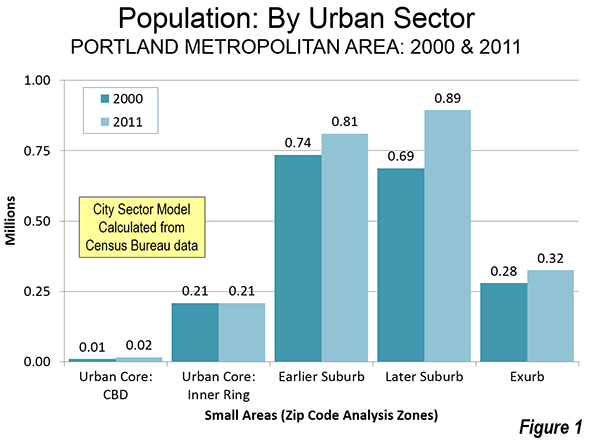
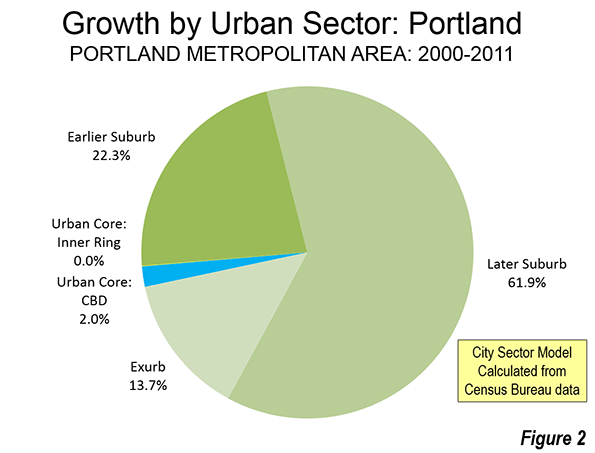
    Approximately 98 percent of Portland’s population growth between 2000 and 2011 occurred in the suburbs (Note). There was a small, but significant percentage growth around the central business district, but its addition of fewer than 7,000 residents paled by comparison to the more than 325,000 added to the suburbs and exurbs. The balance of the urban core, (the inner ring) grew by little more than 100, which is glacial for an urban sector with more than 200,000 residents (less than 0.1 percent).

    None of this should be surprising. The attractive inner city developments, especially the Pearl District, do not provide for the economic needs or wants of most people, as the population trend data indicates. Few households are drawn to buy less than one-half the space they want at nearly three times the price per square foot they would pay in outer suburbs like Forest Grove, Wilsonville or Hazel Dell.

    Job Dispersion

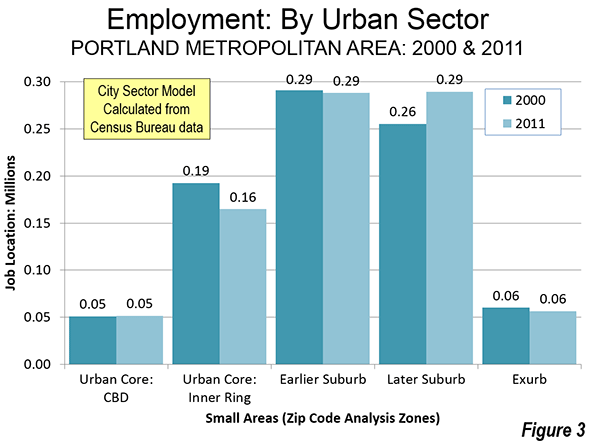
    Fortunately for both the suburbanites and an exurbanites, Portland’s job market also dispersed between 2000 and 2011, meaning that a smaller percentage of commuting was to downtown or the balance of the urban core (Figure 3). That makes it easier to drive to qualify. It turns out that while planners plan, people usually make choices that suit their basic needs rather than those of a particular urban ideology.

    Note 1: Metropolitan areas are defined by commuting patterns. Oversimplifying, metropolitan areas are organized around central counties that contain all or part of large urban areas ("built-up" urban areas). All such counties are included in the metropolitan area as well as any counties that have a strong commuting interchange with the central counties. For example, in the case of Portland, the central counties are Multnomah, Washington and Clackamas in Oregon and Clark in Washington. Columbia and Yamhill in Oregon are outlying counties as well as Skamania in Washington. Combined statistical areas are created from combinations of metropolitan areas that meet a weaker commuting interchange threshold. A complete description of the commuting thresholds that apply to metropolitan areas and combined statistical areas is found here.

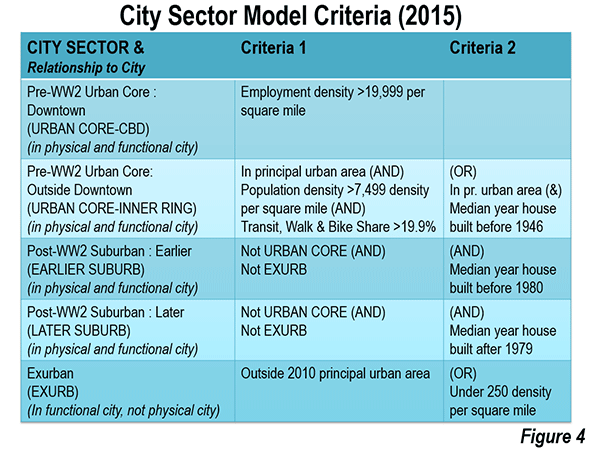
    Note 2: Based on the City Sector Model (Figure 4), which classifies small areas (ZIP codes, more formally, ZIP Code Tabulation Areas, or ZCTAs) in metropolitan area in the nation based upon their behavioral functions as urban cores, suburbs or exurbs. The criteria used are generally employment and population densities and the extent of transit, versus car use. The purpose of the urban core sectors is to replicate, to the best extent possible, the urban form as it existed before World War II, when urban densities were much higher and when a far larger percentage of urban travel was on transit. The suburban and exurban sectors replicate automobile oriented suburbanization that began in the 1920s and escalated strongly following World War II. The data from 2000 is from the 2000 census. The 2011 data is from the 2009-2013 American Community Survey (mid-year 2011).

    Photo: Benton County Courthouse, Corvallis (in the Portland commuter shed) by Gregkeene (Own work) [CC BY 3.0 us or CC BY-SA 3.0], via Wikimedia Commons

    Wendell Cox is principal of Demographia, an international public policy and demographics firm. He is co-author of the "Demographia International Housing Affordability Survey" and author of "Demographia World Urban Areas" and "War on the Dream: How Anti-Sprawl Policy Threatens the Quality of Life." He was appointed to three terms on the Los Angeles County Transportation Commission, where he served with the leading city and county leadership as the only non-elected member. He served as a visiting professor at the Conservatoire National des Arts et Metiers, a national university in Paris. Wendell Cox is Chair, Housing Affordability and Municipal Policy for the Frontier Centre for Public Policy (Canada), is a Senior Fellow of the Center for Opportunity Urbanism and is a member of the Board of Advisors of the Center for Demographics and Policy at Chapman University.

  • Silicon Valley: Jelly in the Jam

    My last post was about how Silicon Valley is evolving into an urban form that’s not quite leafy and open enough to be a suburb anymore, but not really vibrant and compact enough to be a proper city either. “Too thin to be jelly. Too thick to be jam.” The story got an unusually large number of visits. I received some well informed comments that touched on the reality that Silicon Valley is a big place and I shouldn’t generalize. Palo Alto is very different from Fremont and so on. It’s not all isolated corporate enclaves. Fair enough. So here’s a quick follow up that explores the jelly in the jam.

    Screen Shot 2015-04-16 at 2.29.01 PM
    Google


    Screen Shot 2015-04-15 at 10.26.37 PM Screen Shot 2015-04-15 at 10.25.31 PM Screen Shot 2015-04-15 at 10.30.58 PM Screen Shot 2015-04-15 at 10.27.11 PM Screen Shot 2015-04-15 at 10.25.01 PM

    This is the town of San Carlos twenty five miles south of San Francisco and an equal distance north of San Jose. We all have our biases. I’m partial to the kind of walkable Main Street small town that was common everywhere a century ago. I like a place with mom and pop shops and a mix of modest cottages and grand stately homes a few blocks in each direction. For me that’s the perfect balance of city and suburb. A Main Street provides a broad range of activities while accommodating pedestrians, cyclists, and cars without prejudice. These places can also be well served by public transit – not so much to get around town, but to efficiently connect people to other towns that are also walkable. If these small towns are then surrounded by working farms and a bit of nature all the better. Toss in a nearby city for access to culture and jobs and I’m in heaven. But such places are hard to come by in America these days. Fortunately, Silicon Valley has a string of such places along the historic rail line like little gems imbedded in the post WWII sprawl.

    Screen Shot 2015-04-17 at 4.55.51 AM
    Google Screen Shot 2015-04-17 at 4.57.12 AM
    Google   Screen Shot 2015-04-15 at 10.14.31 PM Screen Shot 2015-04-15 at 10.16.33 PM Screen Shot 2015-04-15 at 10.16.08 PM Screen Shot 2015-04-15 at 10.17.11 PM

    San Carlos sits between two major freeways and right on El Camino Real and the CalTrain line that serves the entire peninsula. It’s possible to navigate most parts of San Carlos as a pedestrian, hop on a train or a bus, or drive to just about everything in the Bay Area. You have a lot of transportation choices that are equally good. What’s more important to me personally is that being a pedestrian or cyclist is actually pleasant in San Carlos. Transit within most of the town itself is entirely unnecessary. There are areas up in the hills with a lot of twisting cul-de-sacs that are more manageable in a car, but there’s at least a continuum of housing options including small apartment buildings next to shops downtown. People can select their own personal sweet spot.

    Screen Shot 2015-04-15 at 10.12.50 PM Screen Shot 2015-04-15 at 10.13.14 PM Screen Shot 2015-04-15 at 10.13.31 PM Screen Shot 2015-04-15 at 10.13.43 PM Screen Shot 2015-04-15 at 10.14.00 PM Screen Shot 2015-04-15 at 10.14.16 PM

    There are relatively “affordable” $950,000 bungalows (this is the Bay Area) while the big fancy homes up on the hill with water views sell for $7,000,000. I understand these numbers seem ridiculous to people in other parts of the country, but San Carlos has immediate access to very well paid jobs so these prices are justified based on local incomes. If you have the money it’s a great place to raise a family with excellent public schools and a safe clean environment. It’s also a pretty fabulous retirement spot if you decide to age in place. And it isn’t terrible to be a young single person in San Carlos either. That little downtown and the train station make all the difference. You’ll find the same basic arrangements in similar older towns along the train line: Burlingame, San Mateo, Menlo Park, Mountain View, and so on.

    Screen Shot 2015-04-18 at 4.09.16 PM Screen Shot 2015-04-18 at 4.08.41 PM Screen Shot 2015-04-18 at 4.08.13 PM Screen Shot 2015-04-18 at 4.09.02 PM

    Here’s another point that’s often overlooked by city planners obsessed with making everything pretty or attracting the right demographic to their town. Every town needs some ugly utilitarian stuff. Even in a place where schmaltzy tract homes sell for a million bucks people still need plumbers, electricians, and low grade warehouses. If a town zones or redevelops these areas out of existence they induce more people to get into their cars and trucks to commute to distant industrial parks in a region where freeway traffic already comes to a complete halt during most business hours. And these suburban warehouse districts are also excellent buffers from the ugliness and noise of freeways and rail lines. No one wants to live pressed up against a diesel train or freeway interchange full of tractor trailers. It’s often a mistake to see these light industrial areas as redevelopment opportunities for dense infill housing.

    Screen Shot 2015-04-17 at 7.03.28 AM
    Google

    Some of the comments I received from my last post mentioned recent projects that brought transit and density to some Silicon Valley suburbs. This is San Bruno, home to tech companies like YouTube. It has all the same advantages of San Carlos: immediate access to good jobs and nearby culture, the same freeways, El Camino Real, a BART rail station, similar single family housing stock, and so on. But the two towns are very different. I would love to live in San Carlos, but I could never live in San Bruno. Here’s why.

    Screen Shot 2015-04-17 at 7.16.22 AM Screen Shot 2015-04-17 at 7.22.27 AM Screen Shot 2015-04-17 at 7.17.37 AM Screen Shot 2015-04-17 at 7.11.50 AM 

    San Bruno was built after cars had come to dominate the landscape. There never was much of a town and everything built over the last sixty or seventy years has been organized around the freeways. A rail station in a shopping mall parking lot that’s cut off by massive twelve lane roads is just miserable for pedestrians and of little use to people in cars. There are plenty of people on foot in San Bruno, but they’re very poorly served in this environment.

    Screen Shot 2015-04-17 at 5.16.41 AM
    GoogleScreen Shot 2015-04-17 at 7.11.21 AM Screen Shot 2015-04-17 at 7.14.03 AM Screen Shot 2015-04-17 at 7.15.51 AM Screen Shot 2015-04-17 at 7.11.09 AM Screen Shot 2015-04-17 at 7.13.45 AM

    Density and transit all by themselves do nothing for a town if the public realm is completely car oriented. These new infill apartment buildings are perfectly respectable and I’m sure they’re very comfortable on the inside. But once you step outdoors you find yourself in the left over space between parking lots and highways. You can physically walk to the supermarket and the dentist and the train station so it checks off a lot of boxes on the “Smart Growth” list, but you feel like a social outcast as you schlep around the edge of speeding vehicles. The scale is out of whack with human needs because the needs of cars always come first. Adding apartments and giant parking garages to a suburban environment also adds that many more cars to the already congested roads. This kind of development bothers people who want a traditional suburb and it falls short for people who want a genuine urban experience. As I walked around this cluster of apartments I thought about how it could have been done better. What if the ground floors had shops in them? What if the sidewalks were wider? What if the roads were more narrow? What if the buildings were organized around outdoor public space instead of having the greenery sprinkled around the edges in useless landscaped berms and highway medians?

    Screen Shot 2015-04-17 at 5.19.18 AM
    Google Screen Shot 2015-04-18 at 12.36.51 PMScreen Shot 2015-04-18 at 12.26.02 PMScreen Shot 2015-04-18 at 12.25.06 PM Screen Shot 2015-04-18 at 12.42.29 PM

    As I made my way from one suburban train station to the next I discovered another infill project that actually made an effort to do many of the things on my list. Wide sidewalks? Check. Meaningful public space? Check. Shops on the ground floor? Check. At least a few narrow side streets? Check. Train station around the corner? Check. This place was significantly better. But… context is important.

    Screen Shot 2015-04-17 at 9.24.59 PM
    Google

    Here’s a Google Earth view of the area in which I colored the roads, surface parking lots, and multi-story parking garages blue. What would you call that building to pavement ratio? It looks like 60/40 to me in favor of pavement. The largest garage is owned by BART and is designed to collect suburban drivers and funnel them into the city by train for the last little stretch of the commute. This kind of train station is a highway patch to relieve traffic congestion in the city. It has nothing at all to do with “transit” or any kind of urbanism. It’s a clumsy and expensive prosthetic limb for cars and highways.

    Screen Shot 2015-04-18 at 12.36.19 PM Screen Shot 2015-04-18 at 12.35.53 PM Screen Shot 2015-04-18 at 12.34.29 PM Screen Shot 2015-04-18 at 12.20.32 PM

    Here’s what it looks like on the ground. This well intentioned mixed use infill project is an island in the middle of the usual suburban sprawl. I’m quite certain that the people who live in the single family homes across the street drive to the Trader Joe’s market even though it’s only a block away. If I had to choose a spot to live this place is marginally better than San Bruno, but still an order of magnitude worse than San Carlos. And I should point out that San Carlos has a downtown of mostly one story buildings surrounded by much smaller apartment buildings than these and a majority of detached single family homes. “Density” has nothing to do with the success or failure of good urbanism.

    Screen Shot 2015-04-18 at 12.37.48 PM Screen Shot 2015-04-18 at 12.41.36 PM Screen Shot 2015-04-18 at 12.33.46 PM Screen Shot 2015-04-18 at 1.50.29 PM Screen Shot 2015-04-18 at 1.51.16 PM

    Here’s the sad part. Even after what must have been an heroic effort on the part of everyone involved in getting this project built it still fails to cultivate enough foot or vehicular traffic to support small shops. The Trader Joe’s and the Starbucks are doing well enough, no doubt feeding off the morning and evening commuter flows from the BART station. And there is a small dry cleaner that’s managing to get by so far. But the rest of the storefronts are empty and have been so from the get go. Too thick to be jam. Too thin to be jelly. I keep wanting suburban retrofits to work, but they rarely do. The typical suburban chassis makes incremental urbanism a hit or miss affair. Mostly miss. The question is… what are the alternatives? Do we just let the cost of the existing single family homes rise until people and businesses pick up and move to Scottsdale or Orlando in search of economic relief? Do we let taxes rise on all the strip malls and gas stations until the necessary funds appear to repave all the twelve lane roads out in front of them? Or is mediocre the best we can expect from half assed infill projects that do the best they can under the circumstances?

    John Sanphillippo lives in San Francisco and blogs about urbanism, adaptation, and resilience at granolashotgun.com. He’s a member of the Congress for New Urbanism, films videos for faircompanies.com, and is a regular contributor to Strongtowns.org. He earns his living by buying, renovating, and renting undervalued properties in places that have good long term prospects. He is a graduate of Rutgers University.

  • The Simulated City Vs The Urban Downtown

    While the city’s star is rising in popular literature, it has fallen in popular usage. Where have our sidewalks gone—and why is sidewalk activity disappearing? Sidewalk life has declined in urbanized areas, while population has swelled. Here in Florida, the third most populated state in the country, the average town’s sidewalks should be teeming with colorful crowds of businessmen, shoppers, and people on errands going to and fro. We should see sidewalks full of people happy to be out in the sunshine, and even happier to have escaped the gray cold and the snow. Instead, on weekdays, a trickle of lunch-goers emerges from towers. On weekends, there’s a brief crush of crowds before events. This seems to be all that our downtowns can manage anymore.

    The simulated city is the new place to be. It’s a manufactured copy of our downtowns, and can be found in theme parks and places where throngs congregate to experience the sidewalk in its current incarnation.

    The simulated city carries none of urbanity’s institutional hardware: no visible governmental facilities, religious institutions, schools or civic centers clutter the street wall. The simulated city eschews manufacturing and offices, instead making itself the chief enterprise: a mecca of retail, dining, and entertainment. It has cherry-picked the good stuff from the old urban form, presenting a cosmetically perfect face without blemish or quirk, redolent in its synthetic beauty.

    In Florida, with few natural resources and scant manufacturing, the simulated city takes advantage of tourism and growth. With the number of annual visitors approximately four and a half times its permanent population, Florida is a natural place for simulated cities to sprout. The earliest was the Magic Kingdom’s Main Street at Walt Disney World. This ancestor of the simulated city engendered replicants in other theme parks, each one topping the other in surprise and delight.

    This spring, Orlando’s Downtown Disney reopened as Disney Springs, a retail, dining, and entertainment district that is themed to resemble a lost small town. Nearby, Universal’s Citywalk incrementally reinvents itself, restaurant by restaurant. Further south, Miami’s South Beach has enjoyed an upsurge as well. With some of the highest real estate prices in Florida, South Beach has jumped species to become a simulated city too, enjoying a sidewalk life that is the envy of downtown Miami and, frankly, of the rest of Florida’s beach communities. There is magic on Ocean Boulevard’s pavement that is not found anywhere else in the state.

    What groups these together is simple: sidewalks full of people. Unlike the shadow-world of Florida’s urban downtowns, riverwalks, boardwalks, and Main Streets, throngs of people crowd these places every day and every night. For all the hoopla about the reinvigorated city, Florida’s urban scene fails to deliver even a fraction of the sidewalk life that these places have. The simulated city is the powerhouse of the future.

    Once going out meant heading to Main Street, and then, briefly, it was to the mall. Today, in the simulated cities one must carefully navigate between families, stepping between neon sneakers and wheeled strollers, flip-flops and brogans. This delicate ballet occurs while eye contact flickers between faces and facades; the traffic and the sky. The sum of such casual contact gives people a feeling for their public identity, and the simulated city is a tool to deliver this identity in the best possible light. The simulated city has become the choice for people to display their social selves.

    Dry cleaners, dentists, and others who provide services that imply an unclean recipient are banished completely from the synthetic city. In South Beach, the providers are in the less expensive real estate many blocks from the beach. The city is an unabashed celebration of sybaritic pleasure, the frosting on the urban experience without any of the cake.

    It is a city where your expectations as an urban connoisseur are completely fulfilled; decrepitude, blight, and eyesores are disallowed. Even better, a simulated city’s employees are rigorously trained to be cheerful and bright. No homeless people lounge on park benches, and there’s no visible crime, since there is no apparent indigence, want, or fear. Although it would not be turned away, the riskiest tranche of society seems to shun the simulated city. Its design reflects mainstream success, and discourages subversion, by having no alleys, no trashy areas, and no low income community adjacent to it.

    South Beach was able to jump species from being a regular city and evolve into a simulated city partly because of this last feature, what with being an island. No low-income edge rankles its visitors, or exposes them to a broad cross section of society. It is unique among Florida’s simulated cities because it does have housing (upscale, of course) in its mix.

    Urban boosters vaunt the ancient metropolitan core as if it still mattered. While urbanists are still fighting against the influences of the car, under their noses a new mobility trend threatens, one that will dwarf the damage done by the automobile.

    This, of course, is the internet, that global marketplace of goods and services that makes nearly everything but a haircut available online. Downtowns and suburban commercial clusters alike are fighting for their lives, and between telecommuting, online shopping, and social media, fewer and fewer folk find reasons to step out onto the sidewalk. Soon, if we go online to vote, even our civic duty can be done without stepping on pavement.

    Disney Springs presents a heady abundance of experiences to visitors along a lakeside walkway near Orlando. Families cluster together, friends walk in groups or split apart for different adventures. No obligation exists for greater social contact, since you are a visitor among visitors, and your anonymous bubble is preserved. This is a different state of mind than when you are in your own city where you may run into an acquaintance. As in a theme park, you are unlikely to run into someone you know.

    And because people are in a place that is made especially for pleasure, the sense of self tends to magnify, as evidenced by ubiquitous and annoying selfie sticks. Without the glowering facades of authoritarian institutions like churches, police stations, or city halls, the sense of place is completely recreational and mildly celebratory, inducing a temporary state of pleasant expansiveness.

    To see solid evidence for the simulated city’s high desirability, look at its twin conditions: Huge crowds coupled with high barriers to entry. South Beach requires visitors to take a slow crawl over a traffic-choked bridge onto the island, and pay stiff parking fees. Theme parks also charge parking fees, and entry requires a long, hot trudge through a parking lot. Driving, paying for parking, and then walking? Simulated cities must deliver high perceived value in exchange for this effort.

    As the twenty-first century lifestyle migrates from the urban-centric past into the online and suburbanized future, the sidewalk seems destined to become a playground. Florida’s three or four simulated cities, enormously successful places, tell us that people will overcome hurdles to seek out urban experiences, including light social contact as a recreational activity, while shunning their own urban core back home. This paradox, particularly easy to see here in Florida, may point to a future where people prefer to sip the urban water, rather than swim in it.

    Richard Reep is an architect with VOA Associates, Inc. who has designed award-winning urban mixed-use and hospitality projects. His work has been featured domestically and internationally for the last thirty years. An Adjunct Professor for the Environmental and Growth Studies Department at Rollins College, he teaches urban design and sustainable development; he is also president of the Orlando Foundation for Architecture. Reep resides in Winter Park, Florida with his family.

    Photograph by the author: Downtown Disney, a simulated small town, around lunchtime on a recent Sunday.

  • Growth and the Suburban Chassis

    I tend to explore what happens to suburbs as they age and begin to decline. But this time I’m going to explore what happens to suburbs that thrive and continue to grow and work their way up the value chain. It isn’t exactly what many people expect. “Be careful what you wish for.”

    A friend moved from San Francisco to San Jose this winter. Now that I’ve been visiting her on a regular basis I have an excuse to poke around. It’s actually pretty fascinating.

     Screen Shot 2015-04-08 at 1.35.48 AM Screen Shot 2015-04-08 at 1.36.12 AM

    A friend moved from San Francisco to San Jose this winter. Now that I’ve been visiting her on a regular basis I have an excuse to poke around. It’s actually pretty fascinating. Her tract home was built in 1947 on land that had previously been orchards. By the 1960’s the area had become home to military and aerospace firms that then spun off civilian electronics companies in little low rise office parks. By the 1980’s the area had officially emerged as Silicon Valley. Oracle, Apple, Facebook, Hewlett-Packard, Microsoft, Google, eBay, Juniper Network, PayPal… these companies stretch out for miles in every direction. It’s an economic development dream for local governments. While there are a dozen separate municipalities (Redwood City, Cupertino, Mountain View, Palo Alto, Santa Clara, Fremont, Los Gatos, and so on) the entire southern end of San Francisco Bay is essentially one giant suburban corporate office park blur.

    Screen Shot 2015-04-11 at 3.49.19 PM Google Screen Shot 2015-04-08 at 1.09.30 AM Screen Shot 2015-04-08 at 1.06.01 AM Screen Shot 2015-04-08 at 1.10.00 AM

    Here are three examples of the kinds of commercial buildings that served earlier waves of businesses in Silicon Valley. They were probably built between the 1970’s and 1990’s. This office park happens to be in the town of Sunnyvale, but nearly identical arrangements can be found all over the Bay Area. In fact, I bet there are buildings just like these in whatever town you live in too whether it’s in Florida, Michigan, or Utah.

    Screen Shot 2015-04-11 at 4.25.53 PM GoogleScreen Shot 2015-04-08 at 1.52.00 AM   Screen Shot 2015-04-08 at 1.09.00 AM

    Here’s what’s happening to these office parks as the economy heats up. The land has become very valuable and it makes good economic sense to build new eight or ten story office blocks on vacant land and surface parking lots. It’s good for the tech companies who want to expand their existing operations. It’s good for the land owners who can cash in on the sale. It’s good for the city since it brings increased tax revenue to the municipal coffers. And it’s good for people looking for high paying jobs, both in the initial construction phase and later office workers and support staff. There are, of course, also problems associated with this kind of redevelopment, which I’ll get to in a minute.

    Screen Shot 2015-04-11 at 6.33.25 PM Google Screen Shot 2015-04-11 at 6.32.52 PM  Screen Shot 2015-04-08 at 1.52.32 AM

    Here’s another construction site directly across the street. The old one story buildings were scraped and are being replaced by parking decks and office blocks. These are all part of the same company that is experiencing rapid expansion and doubling their corporate campus that already has over a million square feet of space. These few buildings alone will ultimately house another eight hundred well paid workers. Part of the long term plan for this site is to include a two hundred room hotel for business travelers associated with the company. Perhaps that new hotel will replace the existing one story motel.

    Screen Shot 2015-04-11 at 5.26.01 PM Google   Screen Shot 2015-04-11 at 8.04.09 PM Screen Shot 2015-04-11 at 8.04.26 PM Screen Shot 2015-04-11 at 7.27.03 PM Screen Shot 2015-04-11 at 7.26.05 PM

    Here’s the bigger picture. Zooming out on Google Earth you can see how multiple older office parks are being absorbed and folded in to much larger more unified corporate complexes. The scale of the construction is too large to capture even with a macro lens on the ground. These tech workers were walking between buildings at lunchtime and it was quite a trek. This kind of land use intensification is actually very similar to how old orchards were converted to residential subdivisions. Land values increased and property was pressed into service for tract homes which were much more lucrative than apricots or prunes. The same process is now unfolding at the next higher economic level with office parks. If I hadn’t taken these photos myself I would swear some of them were computer generated. The buildings have such a generic AutoCAD look about them. And there are dozens of them at this one site alone.

    Screen Shot 2015-04-11 at 7.44.08 PM Google   Screen Shot 2015-04-11 at 8.14.31 PM  Screen Shot 2015-04-08 at 3.40.10 AM Screen Shot 2015-04-13 at 5.58.20 PM 

    Here’s another corporate campus. This one is in Redwood City. Everywhere you look the old one and two story buildings are being razed and replaced with significantly larger buildings. The schmaltzy motels, strip malls, and office parks of previous decades have been upscaled both physically and economically. This was once open water and marshland that was filled, dredged and contoured in the 1960’s, but has since been redeveloped to a higher value use.

    Screen Shot 2015-04-13 at 5.42.01 PM Google Screen Shot 2015-04-13 at 5.43.28 PM Google

    Companies are fond of the “theme park” suburban campus where the environment is akin to an all inclusive resort destination for workers. These are islands – sometime literal islands – in the suburban landscape. From the air these corporate campuses look a lot like Epcot Center at Disney World or a regional shopping mall off the side of a highway.

    Screen Shot 2015-04-14 at 9.24.20 AM Google Screen Shot 2015-04-14 at 9.12.06 AM Google

    Screen Shot 2015-04-14 at 9.22.14 AM Google  Screen Shot 2015-04-14 at 9.13.02 AM Google

    This inward looking mega block form of development is common in suburbia. The images above show a college, an amusement park, and a corporate office park. When you’re inside one of these bubbles it’s actually very pleasant. But getting to and from these locations is pretty much impossible without a car. Even if you live directly across the street walking wouldn’t work all that well. Add in the fact that many of the nearby residential subdivisions are gated communities and that each of these bubbles are separated by highways, walls, and drainage canals… a car becomes essential. That loads the road network with an insane amount of traffic. If the one story buildings incrementally ramp up to eight story buildings you have a very big transportation problem on your hands.

    Screen Shot 2015-04-11 at 9.05.27 PM Google Screen Shot 2015-04-08 at 2.00.16 AM Screen Shot 2015-04-11 at 9.15.54 PM Screen Shot 2015-04-08 at 1.56.54 AM

    Here’s an intersection halfway between my friend’s house and the corporate campus where she works. It’s a typical suburban commercial corridor lined with standard one story buildings of the office park and light industrial variety that were built anytime from the 1960’s to the 1990’s.

    Screen Shot 2015-04-11 at 9.16.34 PM Screen Shot 2015-04-08 at 1.59.10 AM Screen Shot 2015-04-11 at 9.17.10 PM Screen Shot 2015-04-13 at 8.24.15 PM Screen Shot 2015-04-08 at 1.58.53 AM Screen Shot 2015-04-08 at 2.00.03 AM

    Here’s what’s happening all around Silicon Valley. The small old buildings are being replaced with much larger ones. These aren’t exactly skyscrapers, but they’re significantly more substantial than what was there before.

    Screen Shot 2015-04-13 at 7.26.36 PM Google Screen Shot 2015-04-12 at 11.56.58 AM Screen Shot 2015-04-12 at 11.31.13 AM

    The same thing is happening with residential property. The old suburban roads lined with gas stations and Kwickie Marts are giving way to multi-story apartment buildings with underground parking decks. These two photos show two sides of the same street. This spot is immediately adjacent to a 1950’s residential subdivision of single family homes. The apartment building fills a need for workforce housing at a high, but tolerable price. One bedroom apartments in this neighborhood rent for about $2,000 a month. Two bedroom units rent for closer to $3,000. If you want to buy an actual house the bargain basement fixer uppers start at $600,000. There are a lot of people in the area who can afford to carry a mortgage of that size, but the problem is often the down payment. Twenty per cent of $600,000 is $120,000. That’s a hurdle many people struggle with. I’ve seen some very nice double wide trailers for sale in the $320,000 range, but that doesn’t include the land under the trailer which you would still need to rent. So rental apartments and condo complexes are in fact necessary in this area if many workers are to live anywhere near where the jobs are.

    Screen Shot 2015-04-13 at 5.16.11 PM Google

    That brings us to some of the serious problems with an economically successful suburb. Silicon Valley, as the name suggests, is hemmed in by mountains and water. All the flat, easily developed land has already been built on in the standard suburban fashion. Over the decades highways have been built through mountain passes to access new land on the other side of these mountains and many people and businesses have expanded outward to the far edges where possible. But the resulting transportation bottlenecks and commute times are severe. Driving to and from Silicon Valley to the outer outer outer suburbs is like pouring molasses through a funnel. People are willing to pay a lot extra to not have to endure that schlep every day. In theory public transportation could ease the commute for many people, but the dispersed development pattern guaranties that transit will never be efficient or cost effective since most people need to drive from their house to a transit center and then take a shuttle bus to the office at the other end of the train line. Living closer to work is a better option for many people. If you have a million dollars on hand you can buy a nice big home with a front lawn and swimming pool in the back yard. Many people in the area do. The median income in Silicon Valley for people with a bachelor’s degree is $95,000 a year. That’s the median, so half the working population earns more than that. A million dollar house is within reason, particularly if there are two incomes per household to carry the mortgage. If not, living in a condo or apartment complex is the next best option.

    Screen Shot 2015-04-08 at 3.41.17 AM Screen Shot 2015-04-08 at 3.41.49 AM Screen Shot 2015-04-13 at 8.29.38 PMScreen Shot 2015-04-13 at 8.28.45 PMScreen Shot 2015-04-13 at 8.29.00 PM 

    From my perspective these intensifying suburbs are in an adolescent phase of development. They are rapidly losing the qualities that people like about the suburbs: open space, privacy, convenience, quiet, lower cost, ample free parking, and so on. But they aren’t yet delivering the things people like about cities: culture, vibrant street life, walkability, convenient public transportation, night life, and such. I stopped and took photos of large numbers of tech workers walking along the side of the eight lane highways at lunchtime. There isn’t anyplace for these folks to walk to. There’s nothing but parking lots, highway fly-overs, gas stations, landscaped berms, and convenience stores as far as the eye can see. When I ask the workers where they’re going they say they’re just stretching their legs and getting some air. They eat lunch (and very often breakfast and dinner) inside their office compounds in subsidized cafeterias. Perhaps in another thirty years the transformation from suburb to something more vital may be complete. Given the suburban chassis these places inherited I don’t see how the underlaying infrastructure will ever support anything other than a bad compromise.

    Joel Garreau calls places like this Edge City: a place that has a suburban form but at an urban density. Driving private cars is no longer convenient here anymore, but transit will never function well either. Jobs are plentiful, but housing is too expensive. It lacks the privacy and peace of a good suburb, but is deficient in the vibrancy and culture available in a real city. It’s too thick to be jam, but too thin to be jelly. 

    John Sanphillippo lives in San Francisco and blogs about urbanism, adaptation, and resilience at granolashotgun.com. He’s a member of the Congress for New Urbanism, films videos for faircompanies.com, and is a regular contributor to Strongtowns.org. He earns his living by buying, renovating, and renting undervalued properties in places that have good long term prospects. He is a graduate of Rutgers University.

  • The French housing Bubble also has Roots in Excessive Land Use Regulations

    Despite the claim to uniqueness that is quintessentially French, the housing bubble shares the same root as we see in the Anglo-Saxon world. To be sure, some analysts blame it only on low interest rates: they made the households more solvent, and thus drove home prices up. This rise in purchasing power might have been enhanced by some specific subsidies to new rental units. Some also y point to normative constraints on new buildings have added to production costs.

    These facts are undisputed, but a demand-only driven bubble can’t happen in a really free market where price signals provide incentives to supply more units, moderating price escalation, and eventually revert the price curve. After all, there hasn’t been anything like a “car price bubble”. So there has to be a supply side factor constraining the building of new homes. And since building itself doesn’t require scarce skills, the constraint has to come from land. These analysts observe that in middle America booming cities like Texas’ Houston and Dallas, or others in Kansas, Georgia, Oklahoma, and elsewhere didn’t experience such a price bubble despite identical credit conditions, despite in some cases, as in Texas, an even greater surge in demand.

    Numbers

    Let’s take a look at official French statistics.

    Professor Joseph Comby (From Institut d’Urbanisme de Paris) summarizes essential data in an exhaustive article (not available online) published in the very specialized peer reviewed "Revue Foncière" (n°3, January 2015), dedicated to land and housing issues. His graphs can be accessed from data provided by our national institute of statistics (INSEE).

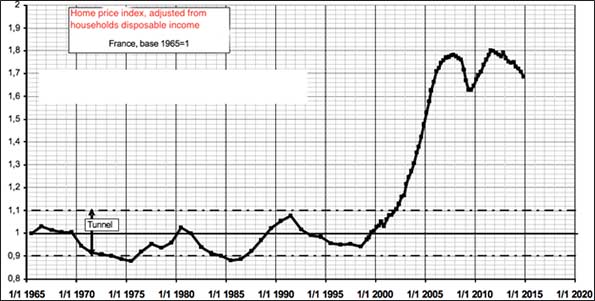
    The first graph shows that home prices surged between 1997 and 2007, and that the prices didn’t really slump then, despite worldwide economic crisis. Average home price rose by a whopping 150% in 11 years, and rose 86% faster than households’ disposable income.


    Fig 1. Home price Index, adjusted from households’ disposable income – Base 1, 1965.
    Source: French Ministry of Sustainable Development (
    doc format)

    In this period, the median multiple in France (Average Home price / Average Household disposable income) rose from a stunningly low 2.25 to 4.21, and these average figures hide numerous regional discrepancies.

    Home prices can be truncated between land costs and building costs, including the home and the infrastructure costs (road access, sewage, water and energy adduction, and so on). Had this price hike uniquely "credit and demand" driven, we should have seen a relatively parallel evolution between land and building components in home prices.

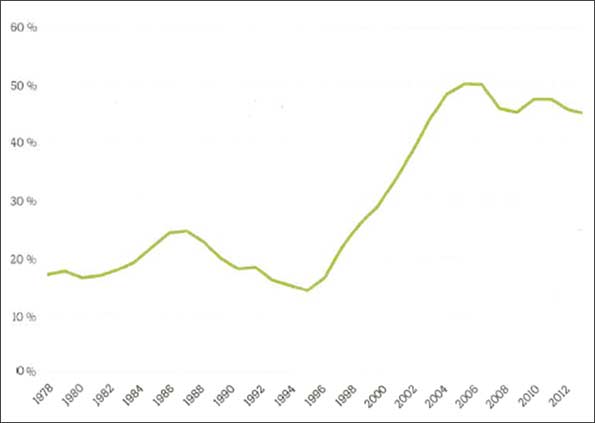
    Our national statistics institute conducts regular wealth inquiries on the total wealth of French households. These studies show that the  share of aggregate land value in  homes value rose from 15% in 1996, to 50% in 2007, and slowly decreased then to 45% in 2013.


    Fig 2. France – Share of land in aggregate real estate value
    Source: J. Comby, computed from
    INSEE Annual wealth surveys

    So, from these data, let’s compute how the prices of land and building components evolved between the 1996 low and 2007 peak, relatively to households revenue. The following table summarizes it all:


     1996

    2007

    Price Increase

    Existing homes, average price – (current prices, €) (INSEE)

    77 100

    192 800

    +150%

    Average disposable income per household (current values, €)

    34 149

    45 800

    • 33%

    Ratio Home price / disposable income

    2.25

    4.21

    +86 %

    Land, % of home value

    15

    50


    Land, average value in existing homes (€)

    11 565
    (15% of 77100)

    96 400
    (50% of 192800)

    + 733 %

    Land price appreciation, adjusted from household disposable income appreciation

    + 520 %

    Building, average value in existing homes (€)


    65 535

    96 400

    + 47 %

    As has been seen in the Anglo-Saxon regulated markets, land appreciation overwhelms construction costs appreciation. Figures show clearly that the 1996-2007 real estate bubble is driven by land prices appreciation.

    As a confirmation pattern, INSEE figures from its annual wealth studies show that the total value of built land plots went from 67% of GDP in 1998 (no figures for 1996) to 308% in 2007. So owning developable land in the end of the 90s provided returns that no other asset class could offer, despite creating absolutely no new added value for society. On the contrary, high home prices have been harmful to modest households, with 6% of people experiencing very bad housing conditions (obsolete and/or overcrowded units), 9% other having tough times financing their housing needs (1).  And according to INSEE, there were 112 000 homeless people in 2012, a 44% increase from 2001 (2).

    Since there is no physical shortage of land in France (most of the country is rather flat, and only 7% of land is developed), this suggests loudly to look at our land use regulations to understand how they fed the monster.

    Our regulation of land belongs to the “prescriptive” family, according to Wendell Cox and Hugh Pavletich classification (3). It means that land is, by default, limited for natural or agricultural usage, and turning it into developable land must endure a long and politically complex zoning process. Worst of all, not only each city is zoned, but every local zoning has to comply, since the new millennium, with “territorial coherence schemes” which tend to cap the maximal amount of land available for development through years. Prescriptive regulations can be opposed to “responsive” ones, which can be seen in central parts of America and Canada. In a responsive regulatory frame, default status of land is let to the free choice of the owner, and only limitations for some collective purpose have to pass through a political process, and open a right   for owners to be compensated for the loss of land value resulting of limitations. As Cox and Pavletich as well as the Brookings institution showed, places with prescriptive regulations experienced a much tougher bubble than responsive ones during the years of wild credit expansion. France is not different and the same phenomenon happened.

    The idea of a bubble driven by strong regulatory constraints put on land meets a lot of resistance among several groups familiar in other countries: Local politicians, who get power from a population prone to NIMBY attitudes, and feeling richer through home value appreciation, are the first of them; most farmers, 70% of whom are renters, have an interest in preserving legal interdiction to turn  plots at the fringe of cities into housing developments; and there are about 40,000 employees in public and private jobs who make a living from elaborating and implementing these regulations. 

    So we can see that in France, like other countries, the role of artificial restriction of land supply for new development can’t be dismissed. The costs and benefits of these regulations should be publicly questioned. Can their advocates still deny that that this price bubble is largely an unintended outcome of regulations. Nor can they acknowledge that this  results in increasing levels of “housing poverty” and drives so much resources from more productive investments. Is this  more desirable than “sprawl containment”, “farmland preservation” and other pretenses which provided justifications for these regulations in first place ?

    Vincent Benard is senior economic analyst for the Turgot Insitute (www.turgot.org), a french classical liberal think tank. His principal interests are housing, land use and infrastructure policies, and the study of the unintended consequences of regulations.  Since 2006, he authored one book and many articles about the French housing crisis. " 

    (FYI: The book : https://www.scribd.com/mobile/doc/80163334 – Free, PDF, in French) 

    ———

    Notes: (1) Figures from the annual report of the “Abbe Pierre” Foundation, dedicated to homelessness and poverty assistance  www.fondation-abbe-pierre.fr/
    (2) Source: “L’express”, November 2014 – http://www.lexpress.fr/actualite/societe/le-nombre-de-sdf-en-france-a-explose-en-dix-ans_1623371.html
    (3) See Annual Housing affordability report, by Cox and Pavletich, www.demographia.com

    Photo by Benh LIEU SONG (Own work) [GFDL or CC BY-SA 4.0-3.0-2.5-2.0-1.0], via Wikimedia Commons

  • Southern California Housing Figures to Get Tighter, Pricier

    What kind of urban future is in the offing for Southern California? Well, if you look at both what planners want and current market trends, here’s the best forecast: congested, with higher prices and an ever more degraded quality of life. As the acerbic author of the “Dr. Housing Bubble” blog puts it, we are looking at becoming “los sardines” with a future marked by both relentless cramming and out-of-sight prices.

    This can be seen in the recent surge of housing prices, particularly in the areas of the region dominated by single-family homes. You can get a house in San Francisco – a shack, really – for what it costs to buy a mansion outside Houston, or even a nice home in Irvine or Villa Park. Choice single-family locations like Irvine, Manhattan Beach and Santa Monica have also experienced soaring prices.

    Market forces – overseas investment, a strong buyer preference for single-family homes and a limited number of well-performing school districts – are part of, but hardly all, the story. More important may be the increasingly heavy hand of California’s planning regime, which favors ever-denser development at the expense of single-family housing in the state’s interior.

    Read the entire piece at The Orange County Register.

    Joel Kotkin is executive editor of NewGeography.com and Roger Hobbs Distinguished Fellow in Urban Studies at Chapman University, and a member of the editorial board of the Orange County Register. He is also executive director of the Houston-based Center for Opportunity Urbanism. His newest book, The New Class Conflict is now available at Amazon and Telos Press. He is also author of The City: A Global History and The Next Hundred Million: America in 2050.  He lives in Los Angeles, CA.

    Photo by Downtowngal (Own work) [CC BY-SA 3.0 or GFDL], via Wikimedia Commons

  • How the California Dream Became a Nightmare

    Important attention has been drawn to the shameful condition of middle income housing affordability in California. The state that had earlier earned its own "California Dream" label now limits the dream of homeownership principally to people either fortunate enough to have purchased their homes years ago and to the more affluent. Many middle income residents may have to face the choice of renting permanently or moving away.

    However, finally, an important organ of the state has now called attention to the housing affordability problem. The Legislative Analyst’s Office (LAO) has published "California’s High Housing Costs: Causes and Consequences," which provides a compelling overview of how California’s housing costs have risen to be by far the most unaffordable in the nation. It also sets out the serious consequences.

    The LAO says that:

    Today, an average California home costs $440,000, about two-and-a-half times the average national home price ($180,000). Also, California’s average monthly rent is about $1,240, 50 percent higher than the rest of the country ($840 per month).

    LAO describes the evolution:

    Beginning in about 1970, however, the gap between California’s home prices and those in the rest country started to widen. Between 1970 and 1980, California home prices went from 30 percent above U.S. levels to more than 80 percent higher. This trend has continued.

    Much of the LAO focus is on California’s coastal counties, where:

    ….community resistance to housing, environmental policies, lack of fiscal incentives for local governments to approve housing, and limited land constrains new housing construction.

    These causes result from conscious political decisions. While California’s coastal counties do not have the vast stretches of flat, appropriately developable land that existed 50 years ago, building is increasingly  prohibited on that which remains (for example, Ventura County, northern Los Angeles county and the southern San Jose metropolitan area).

    Demonstrating an understanding of economic basics not generally shared by California policymakers or the urban planning community, LAO squarely places the blame on the public policy limits to new housing construction:

    This competition bids up home prices and rents.

    In other words, where the supply of a demanded good is limited, prices can be expected to rise, other things being equal. LAO describes the impact of so-called "growth control" policies, which are also called "urban containment" or "smart growth:"

    Many Coastal Communities Have Growth Controls. Over two-thirds of cities and counties in California’s coastal metros have adopted policies (known as growth controls) explicitly aimed at limiting housing growth. Many policies directly limit growth—for example, by capping the number of new homes that may be built in a given year or limiting building heights and densities. Other policies indirectly limit growth—for example, by requiring a supermajority of local boards to approve housing projects. Research has found that these policies have been effective at limiting growth and consequently increasing housing costs.

    According to LAO, the problem is exacerbated by voter initiatives: "More often than not, voters in California’s coastal communities vote to limit housing development when given the option." It is hard to imagine a more sinister disincentive to aspiration, under which voters can deny equality of opportunity in housing to others by artificially driving up the price.  Because new housing further from coast is also limited, options for a middle income living standard are also diminished.

    These public policies have consequences.

    Notable and widespread trade-offs include (1) spending a greater share of their income on housing, (2) postponing or foregoing homeownership, (3) living in more crowded housing, (4) commuting further to work each day, and (5) in some cases, choosing to work and live elsewhere

    Each of these consequences is described below.

    LAO Consequence #1: Spending a Greater Share of Income on Housing

    LAO models the market situation from 1980 to 2010 to estimate the prices that would have prevailed if the regulatory environment had permitted building sufficient to satisfy customer demand at previous lower price levels. In both years, LAO estimates that the median priced house would have cost 80% more than in the rest of the nation (actual data in 1980, modeled data in 2010). This would have kept California house price increases at the national level. I think it would have been better to have modeled from 1970, before the huge house prices before 1980 described by Dartmouth economist William Fischel.

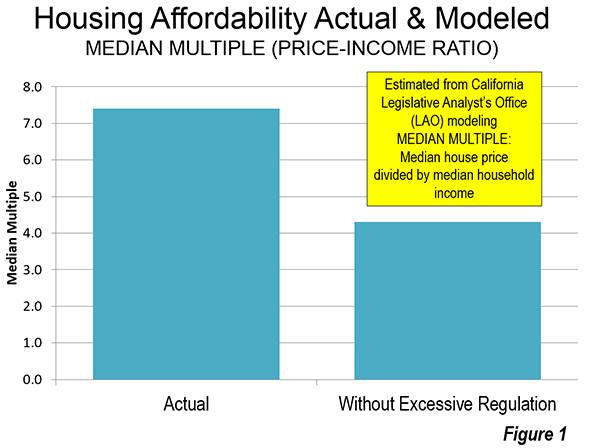
    I have applied this LAO model estimate to the median multiple for California’s six major metropolitan areas (Los Angeles, San Francisco-Oakland, Riverside-San Bernardino, San Diego, Sacramento, and San Jose) to identify how much better middle income housing affordability would be without California’s excessive regulation. Using the LAO estimates the median multiple (median house price divided by median household income) in 2014 would have been at least 40% lower than the actual level in each of the metropolitan areas (Figure 1).
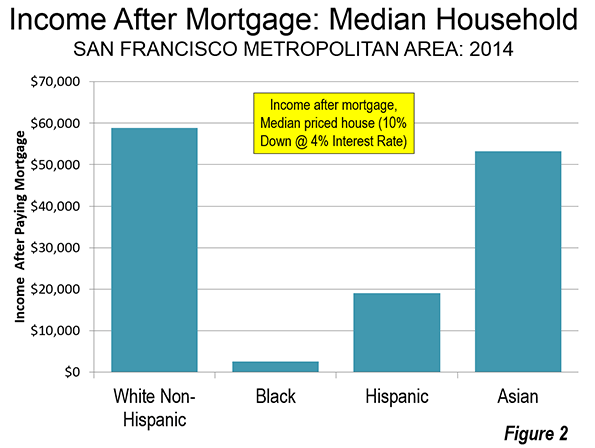
    Many California households already have been priced out of the market. In the worst case, it is estimated that in the San Francisco metropolitan area, a median income White Non-Hispanic household will have nearly $60,000 annually left over after paying the mortgage on the median priced house. This is less than they would have if house prices had remained reasonable, but it’s enough to live on. The median income Asian household would do almost as well, with about $50,000 left over. The median income Hispanic household would have less than $20,000 left, which is considerably less than is likely to be needed for other essentials. The median income Black household would have less than $3,000 left over (Figure 2). If the price ratios of 1980 were controlling, that amount would rise by $16,000.
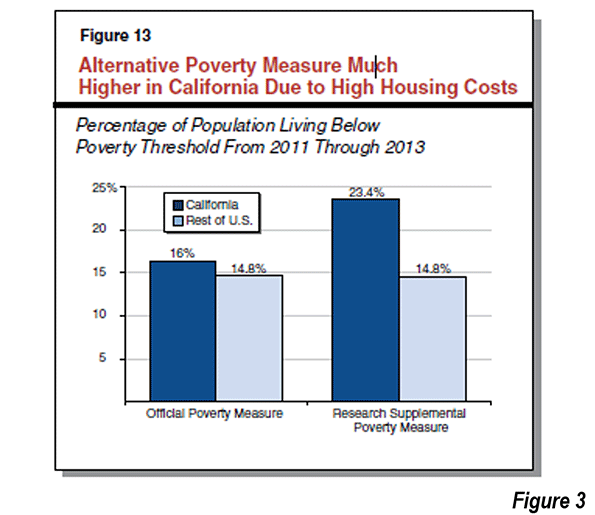
    LAO also points out that the Golden State has the highest housing cost adjusted poverty rate in the nation. The latest data shows housing-adjusted poverty rate is far higher even than that in states with a reputation for grinding poverty. California’s housing adjusted poverty rate is more than 50% higher than that of Mississippi and approaches double that of West Virginia (Figure 3, LAO Figure 13)
    LAO Consequence #2:  Postponing or Forgoing Homeownership

    LAO indicates that California ranks 48th in homeownership percentage, behind only New York and Nevada. LAO emphasizes the value of home ownership:

    Homeownership helps households build wealth, requiring them to amass assets over time. Among homeowners, saving is automatic: every month, part of the mortgage payment reduces the total amount owed and thus becomes the homeowner’s equity. For renters, savings requires voluntarily foregoing near-term spending. Due to this and other economic factors, renter median net worth totaled $5,400 in 2013, a small fraction of the $195,400 median homeowner’s net worth.

    Californians are buying their first houses later. LAO indicates that the average first home buyer in California is three years older than the national average.

    LAO Consequence #3:  Living in More Crowded Housing

    The nation’s worst overcrowding is an unfortunate result of California’s housing policies.

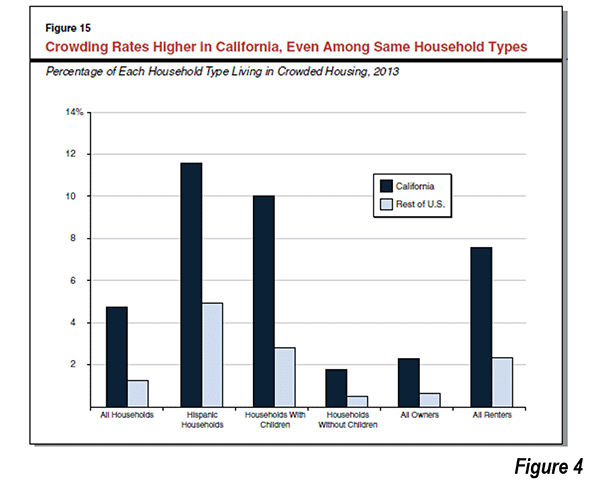
    LAO indicates that California’s overcrowding rate is well above that of the rest of the nation’s rate. Among Hispanics, which were expected to exceed the White-Non-Hispanic population in 2014, to become the state’s largest ethnic group, California overcrowding is more than 2.5 times the Hispanic rate elsewhere. Among households with children, overcrowding in California is four times the national households with children rate. Among renters, overcrowding in California is more than three times the national renter rate (Figure 4, LAO Figure 15).
    This has important negative social consequences. According to LAO, research indicates that overcrowding retards well-being and educational achievement:

    Individuals who live in crowded housing generally have worse educational and behavioral health outcomes than people that do not live in crowded housing. Among adults, crowding has been shown to increase stress and aggression, lead to social isolation, and weaken relationships between parents and their children. Crowding also has particularly notable effects on children. Researchers have found that children in crowded housing score lower on standardized math and reading exams. A lack of available and distraction-free studying space appears to affect educational achievement. Crowding may also result in sleep interruptions that affect mood and behavior. As a result, children in crowded housing also displayed more behavioral problems at school.

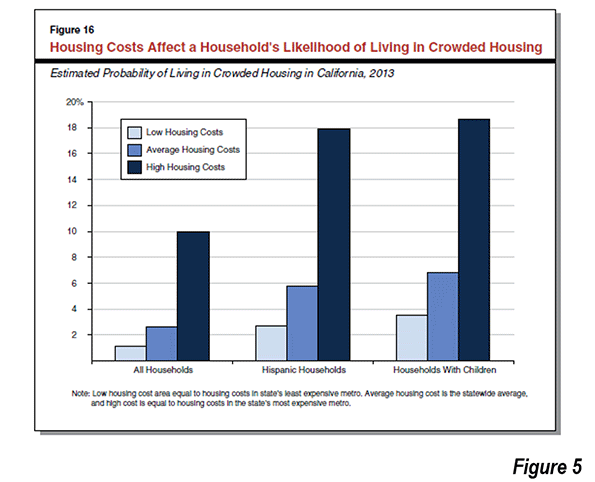
    Overcrowding is particularly acute in the higher cost coastal metropolitan areas of Los Angeles, San Francisco, San Diego, and San Jose. There, overcrowding among households with children reaches 10%, and among Hispanic households, overcrowding reaches 18%. Among households with children the figure is slightly higher (Figure 5, LAO Figure 16). Overcrowded housing is generally worse, according to LAO, in areas with higher house prices.
    In a state with a political establishment that prides itself in watching out for low income citizens and ethnic minorities, the need to reform the responsible policies could not be clearer.

    LAO Consequence #4: Commuting Farther to Work

    LAO finds that California’s average work trip commuting times are only moderately above the national average. However, LAO suggests that the commute lengthening impact of higher house prices may be reduced by California’s widespread (I call it dispersed) development pattern, its freeway system and the "above-average share of commuters who drive to work. (Driving commutes are generally fast, and therefore metros with higher shares of driving commuters tend to have shorter commute times.)"

    Nonetheless, according to LAO:

    …our analysis suggests that California’s high housing costs cause workers to live further from where they work, likely because reasonably priced housing options are unavailable in locations nearer to where they work.

    LAO Consequence #5:  Choosing to Work and Live Elsewhere

    LAO also indicates that California’s high housing prices are likely to have reduced its population (and economic) growth. LAO sites the strong net outmigration of California households to other states. LAO also finds in its national metropolitan area analysis that counties with higher growth rates tend to have better housing affordability than counties with lower growth rates.

    There has also been strong net outmigration from the coastal counties to inland counties. This is most evident in the growth of the Riverside-San Bernardino metropolitan area (the Inland Empire) between 2000 and 2010. The Inland Empire captured more than two thirds of the population growth of the Los Angeles Combined Statistical Area (Los Angeles, Orange, Riverside, San Bernardino and Ventura counties). LAO notes the impact of the excess of demand in the coastal counties, again recognizing the nexus between overzealous regulation and the loss of housing affordability:

    This competition bids up home prices and rents. Some people who find California’s coast unaffordable turn instead to California’s inland communities, causing prices there to rise as well.

    LAO also refers to the difficulty that employers have in retaining and recruiting staff. LAO cited survey data from the Silicon Valley, which has for years been California’s economic "Golden Goose" in recent years:

    In a 2014 survey of more than 200 business executives conducted by the Silicon Valley Leadership Group, 72 percent of them cited “housing costs for employees” as the most important challenge facing Silicon Valley businesses.

    In addition, there has been a strong movement of California companies to other parts of the nation, where more liberal regulations foster a better business climate.

    Restoring Housing Affordability

    LAO indicates the importance of fundamental reform and calls for putting "all policy options on the table."

    Major changes to local government land use authority, local finance, CEQA (California Environmental Quality Act), and other major polices would be necessary to address California’s high housing costs.

    In addition:

    The greatest need for additional housing is in California’s coastal urban areas. We therefore recommend the Legislature focus on what changes are necessary to promote additional housing construction in these areas.

    Perhaps the only weakness of the report deals with densification, particularly in coastal counties. For example, LAO suggests that without the housing restrictions the city of San Francisco is population would be 1.7 million, rather than the approximately 800,000 who live there today. In fact that would be unprecedented beyond belief. No core city that had become fully developed and reached 500,000 people by 1950 has achieved growth of this magnitude. The greatest growth was less than 10%, in this category of 60 core cities (which includes the city of San Francisco). Even less likely would be public support for such huge population growth in the second densest major municipality in the nation.

    While LAO does not indicate the additional population that its estimates would have placed in the core of Los Angeles, given the scale of the San Francisco increase, this could be a number of up to 3 million. This area, the broadest expanse of over 10,000 population per square mile density in the nation outside New York City is in the middle of the urban area with the nation’s worst traffic congestion, according to the Texas A&M Transportation Institute. It is doubtful that residents would have the "stomach" to expand roadway capacity to keep the traffic moving. Transit could not have made much difference. Even with its now extensive rail network that has opened since the early 1990s, driving alone accounted for 85% of the additional travel to work from 2000 to 2013 in the city of Los Angeles. Yet, the city of Los Angeles has the most extensive transit in the metropolitan area, including service by all rail lines.

    In reality, core densification is likely to be modest. Keeping housing affordability from getting worse requires regulatory liberalization throughout California, including coastal and inland areas
    The reality is that if California had permitted growth, it would naturally occurred mostly on the periphery. Even with the restrictions on building, the preference for suburban living (largely in detached housing) could not be repressed between 2000 and 2010. Less than 10% of the population growth in the Los Angeles and San Francisco Bay areas occurred in the cores.

    The Challenge

    Should the state of California begin to seriously discuss housing affordability, it will be important to ease restrictions throughout the state, not just in the coastal counties. There are serious barriers to placing the appropriate priority on improving the standard of living and minimizing poverty rates among California’s diverse population. Perhaps the biggest impediment is Senate Bill 375, which is being interpreted by the state and its regional planning agencies to require even more stringent land-use regulation.

    In this environment, LAO rightly raises this concern:

    If California continues on its current path, the state’s housing costs will remain high and likely will continue to grow faster than the nation’s. This, in turn, will place substantial burdens on Californians—requiring them to spend more on housing, take on more debt, commute further to work, and live in crowded conditions. Growing housing costs also will place a drag on the state’s economy.

    It is to be hoped that California’s distorted policy priorities will be righted to restore the California Dream.

    Photograph: Dense suburban development: Inland Empire (San Bernardino Freeway with Uplard toward the top and Ontario toward the bottom) – By author

    Wendell Cox is an international public policy consultant and principal of Demographia in St. Louis. He is a native Los Angelino, having been born within two miles of City Hall. He was appointed to three terms on the Los Angeles County Transportation Commission by Mayor Tom Bradley. Full biography is here.

  • Inside the Bubble

    I was recently asked by a neighbor to write a blog post about greed in the super heated economic bubble here in San Francisco. I told her I think the problems that vex her are more complicated than pure greed, but I’d give it a shot. Keep in mind, where a person stands on any of these issues depends a great deal on their particular circumstances. The point of this post isn’t to argue in favor of one thing or another, but to illustrate how some people experience the city at this moment in time.

    So… my friend has lived in the same spacious rent controlled flat in an old Victorian for many years. Her tenure predates the current tech culture by decades. Chatting over lunch in her kitchen and dining room is like visiting a bygone version of San Francisco where everything is more relaxed and comfortable and perhaps a bit less glossy. Over the last several years she’s seen half the buildings on her block transformed by the tsunami of money that has washed over the neighborhood. The elderly Chinese couple who own her building will eventually pass and when they do she knows their adult children will sell the place and she’ll be forced out. For her it’s not just a matter of leaving the building or even the neighborhood, but leaving the city altogether. There’s simply no possible financial scenario that will allow her to stay in the Bay Area on her income as a freelance graphic designer. That world is gone and she doesn’t have a Plan B.

     unnamed-4

    Her preoccupation with the new money culture in the city has been especially stirred up by the activities of the building directly next door. Back in 2010 the owner of the building had a structural engineer certify that the building was unstable and therefore uninhabitable. This could be seen as a landlord who was deeply concerned for the health and safety of his tenants, or a legal tactic to remove them. A series of challenges ensued, but at the end of the day the building was emptied, fully gutted, and renovated. The apartments were then sold off as condos. The average sale price in 2014 was just shy of a million dollars for each of the one bedroom apartments. Some of the people who purchased the units were investors who then rented them at the current market rate of $4,950 a month.

    Screen Shot 2015-02-27 at 12.57.29 AM Screen Shot 2015-02-27 at 12.57.00 AM Screen Shot 2015-02-27 at 12.55.48 AM

    One of those renovated condos was bought by a young Russian DJ. I’ve met him and he’s actually a perfectly nice guy. I’m listening to his audio stream right now – house trance techno electronica… Evidently he’s a big deal in international music circles. (I’m more of a Billy Holiday Ella Fitzgerald kind of guy, but I digress.) Shortly after he moved in he decided to take six months off and travel to Thailand. While he was gone he left the apartment in the hands of a popular home hosting service that arranges short term rentals to tourists and business travelers. In theory the service was completely turnkey with booking, cleaning and so on. But in reality the apartment needed a bit more care over such a long period of time than the company was able to provide. The Russian asked my friend next door if she could help out. “Could you” this and “Would you mind” that. Individually none of these favors was particularly onerous, but collectively it became a lot of work as the months dragged on. The Russian was having such a good time in Thailand he decided to extend his stay. At a certain point my friend let it be known that her services had gone beyond merely being a helpful neighbor and it was time she was paid for her work. An e-mail exchange ensued with a list of time that had been spent on various projects. The Russian felt that he had been misled. “That seems like a lot of money.” This was coming from someone who just spent nearly a million dollars on an apartment and can afford to spend half a year on vacation in Asia. You can see how this might rub my friend the wrong way. Hence her frustration with the freakish economic situation in the city.

    On the other hand, there are a fair number of people who are living in tiny run down apartments with multiple room mates paying outrageously high rents who feel that a massive rent controlled apartment is a seriously sweet deal. Sure, it will come to an end someday, but dude! Really? You’re bitching that it doesn’t come with a lifetime guarantee? Suck it up cupcake.  Like I said. Where you stand on these issues depends a lot on your particular situation.

    6 EasterDinner(12)2007 IMG_0120 (640x480) 

    For those of you who aren’t intimately familiar with the local dynamics I’ll give you some context. On most nights friends and family gather around our kitchen table for dinner and we discuss the events of the day. Over the last few years we’ve hardly had a month go by where someone hasn’t had to pack up and leave the city because of eviction, unreasonably high rents, or a lack of available housing at any price. Other folks who already owned property decided to cash out and took their substantial profits to more affordable towns.

    Screen Shot 2015-02-28 at 5.21.13 AM

    Last week we had a couple over who had rented a charming house with a back garden in Bernal Heights for nearly twenty years with the enormous benefit of rent control that kept their expenses well below the market rate all that time. The landlord sold the home a few months ago and the new owners evicted them in order to live in the house themselves.

    Screen Shot 2015-02-28 at 5.23.47 AM

    They reluctantly moved to an apartment in Oakland. They don’t hate the apartment or Oakland per se, but it’s definitely a transitional space for them. They’re looking to move as soon as they decide what exactly they want and can afford. There was a lot of talk about how San Francisco has become inhospitable to people with normal budgets. At a certain point I asked them why they hadn’t prepared for the eventuality of the big move. They knew what the real estate market was like. Their eviction couldn’t have come as a surprise. They’re both professionals with solid incomes. They could have pulled together a downpayment and bought property at any point during the last twenty years when prices were more reasonable. Instead they enjoyed the benefits of a great rent controlled place. It was a perfectly reasonable economic decision and it served them very well for two decades. But there were trade offs. Now it’s time to come up with a new plan. Let’s just say they didn’t appreciate my interpretation of their situation.

    Screen Shot 2015-02-28 at 5.40.17 AM

    A couple of months ago we noticed one of the longterm tenants of a nearby building packing up and loading his furniture into a moving van. We were shocked. He had lived in that apartment with rent control for forever. We all thought he’d eventually leave feet first. It turns out that the landlord paid him $30,000 to go voluntarily and he agreed to take the money. Once the landlord gets new tenants he’ll likely receive $3,800 or more per month for that unit so his $30,000 “investment” in freeing up the apartment will be repaid in eight months. $30,000 won’t buy you anything at all in San Francisco, but it’s pretty good seed money in many parts of the country. If this guy is smart he’ll use the cash to put a downpayment on a house in a less expensive town.

    Now, here’s something else to consider. San Francisco is in an enormous economic bubble. It won’t last. These things never do. And when the bubble pops there are going to be a whole lot of folks who paid top dollar for real estate that’s going to be worth infinitely less. Any number of things could puncture the balloon: another Wall Street crash, an earthquake, a shift in foreign investors, or the inevitable maturation of the tech sector and its associated stock options and super sized bonuses… When that day arrives everyone’s situation may change and the general perception of who’s a winner and who’s a loser may flip as well. And we’ll all have to suck it up. That’s life.

    John Sanphillippo lives in San Francisco and blogs about urbanism, adaptation, and resilience at granolashotgun.com. He’s a member of the Congress for New Urbanism, films videos for faircompanies.com, and is a regular contributor to Strongtowns.org. He earns his living by buying, renovating, and renting undervalued properties in places that have good long term prospects. He is a graduate of Rutgers University.