Category: planning

  • Behind the Driving Increase

    The Federal Highway Administration reported that driving increased 1.7 percent between 2013 and 2014 in the United States. This compares to virtually no increase over the period from 2004 to 2013. The 2014 increase will come as a disappointment to those who have perceived that the flat driving volumes of recent years signaled a shift in preferences away from driving. It had even been suggested that America had reached "peak car."

    Despite the congruity of such sentiments with urban planning orthodoxy, it’s somewhat risky to divine future economic trends from the perspective of a weak economy. It is rather like predicting future employment trends from realities of the late 1930s, when the world had still not climbed out of the Great Depression

    The problem for those who seek to replace the car is that the current form of cities, from Phoenix to Paris, requires cars to support the millions with middle-class standard of living. Of course, with a sufficient decline in the standard of living, cars could become less essential. After all, you don’t need a car to not go to work when you are unemployed.

    Nor is “peak oil” coming to rescue; we now live in something more like an oil glut. Even when prices were soaring, the amount of driving barely changed. People may have shifted to more efficient cars, they didn’t give up their cars, they just drove a little bit less.  

    The latest driving data may indicate that even the somewhat tepid recovery is speeding up in the United States. This combined with falling gasoline prices is likely to be why driving is increasing again.

    Employment Exceeds 2008 Level

    Employment is probably the most important factor in the recent recovery of car use

    According to data at the St. Louis Federal Reserve Bank "FRED" website, national employment peaked at 138.3 million in January 2008. By early 2010, employment had dropped to under 130 million. It took until April 2014 to restore the employment level that had been previously achieved more than six years earlier. This was the longest employment trough since before World War I, except for the period of 1929 to 1936, during the Great Depression.

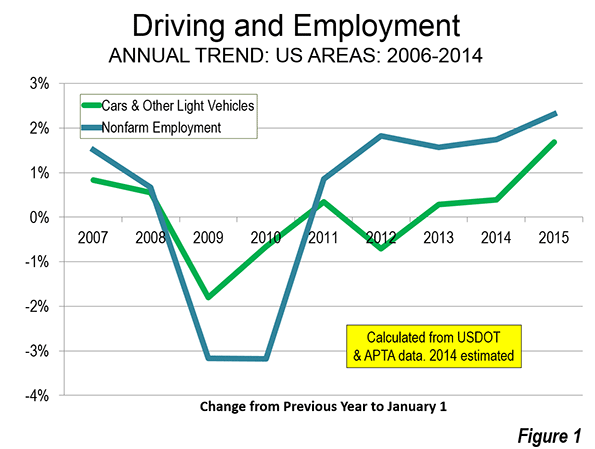
    As more people return to employment and incomes rise, driving can be expected to increase. During 2014, the nation’s nonfarm employment rose to the highest level in history. As the year progressed and employment increased, so did driving (Figure 1).

    But there is still a long way to go for the economy. The civilian labor force participation rate continues depressed. If early 2008 levels of labor participation were restored, there would be at least 10 million additional jobs.

    Falling Gasoline Prices

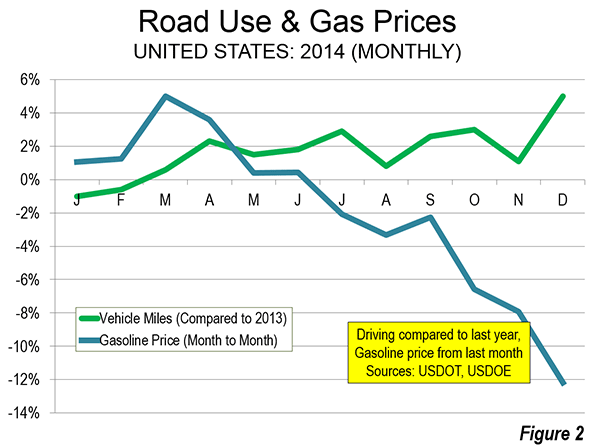
    US Department of Energy data indicates that the average price per gallon of gasoline rose by more than one half between 2005 and 2011. Until the middle for 2014, gasoline prices fluctuated around this level until early summer of 2014. Then the gas price reductions began. By the end of 2014, gasoline prices had dropped to near 2005 levels, which they actually reached in early 2015. Much of the 2014 increase in driving was concentrated since the decline in gasoline prices started in the last half of the year (Figure 2).

    Driving and Transit

    Ridership and road travel data also shows that there has been little relationship between the annual changes in driving and transit use over the period of the gas price increases and the subsequent decrease. Advocates of greater transit funding have claimed for decades that transit can be effective in attracting drivers from their cars. This was transit’s time.

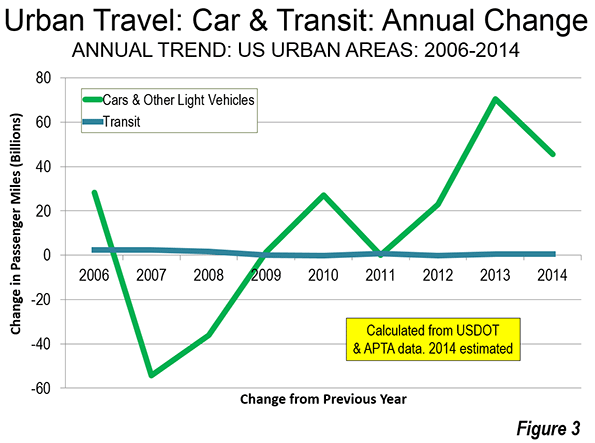
    However, the highly publicized transit ridership increases have been small in context and have shown virtually no relationship to the changes in automobile use in urban areas. This is illustrated in Figure 3. Driving volumes have risen and fallen, with little response in transit ridership. If there were a significant relationship between transit ridership and travel by car, the two lines on the chart would nearly follow one another. However, the lines show virtually no relationship. In relation to the actual changes in travel by car and light vehicle, the changes in transit are imperceivable. Transit ridership remains relatively small, at approximately two percent of all trips and five percent of work trips. An American Public Transportation Association (APTA) press release confirms the weak nexus between driving trends and transit for the most recent period. APTA notes that transit ridership late in the year increased despite the significant reduction in gasoline prices.

    Transit does not provide rapid mobility for most urban trips, which is why it has so little potential to attract people from cars. As higher prices force people to cut back on driving, they simply travel less, rather than getting on transit that cannot take them where they need to go in a reasonable time. That would be different if transit provided mobility competitive throughout the metropolitan area. Indeed, transit’s percentage of urban travel would be far above its current two percent. But to build out a system that reaches most jobs, of course, that would be financially prohibitive.

    Transit’s strength is downtown (the central business district, or CBD). The largest CBDs have employment densities are 100 times the urban average, and are well served by rapid, radial transit routes. In four of the nation’s largest CBDs — New York, Chicago, Boston and San Francisco — transit carries more than half of workers to their job, 77 percent in Manhattan alone. Americans use transit where it is competitive or superior to travel by car, which should dispel any notion that there is a national aversion to transit.

    But the city is much more than downtown. According to research by Lee and Gordon only eight percent of employment in the 48 largest metropolitan areas was in CBDs. This is despite the presence of impressive office towers that convey a sense of CBD dominance.

    Lee and Gordon also show that about 13 percent of jobs are in employment centers centers outside the CBDs, which are often called "edge cities." Because these centers do not have the radial networks of direct transit, even their high densities produce little in transit ridership.  My analysis of more than 80 post-World War II form suburban employment centers (mainly edge cities) indicated a transit work trip percentage of only 4.9 percent, which is approximately the national average for all areas. Transit’s share to the remaining nearly 80 percent of jobs dispersed throughout the metropolitan areas is just 4.6 percent.

    The basic problem is access. Outside of downtowns, few jobs can be conveniently reached by transit. This means transit takes about twice as long as driving alone and often is either not within walking distance of home or does not drop the passenger off within walking distance of work. This is illustrated by research at the University of Minnesota Accessibility Laboratory, which has shown that in 45 large metropolitan areas, only 10 percent of jobs can be reached by the average employee in 60 minutes by transit. By comparison, American Community Survey data indicates that nearly 65 percent of employees who drive alone in the same metropolitan areas actually reach work — and in half the time (30 minutes).

    Even low income workers, whose constrained budgets should make transit more attractive largely use cars to get to work.

    Driving and a Middle-Income Lifestyles

    I have referred before to the research that equates better economic performance with better mobility for people throughout the labor market (metropolitan area).

    Driving is not based on the shallow, arbitrary preference expressed in the threadbare cliché of a "love affair with the automobile." Cars are essential to realizing the aspirations of a majority of people, not only in the United States but in Europe and beyond.

    Wendell Cox is an international public policy consultant. He was appointed to three terms on the Los Angeles County Transportation Commission and chaired two American Public Transit Association (APTA) national committees (Policy & Planning and Governing Boards). Full biography is here.

  • Two Sides of the Same Coin: Decline and Gentrification

    Recently I attended a presentation at Mission Dolores Church sponsored by the San Francisco Chronicle called “A Changing Mission”. The discussion was based on a newspaper article and associated short film about the neighborhood. It’s well worth a quick look here.

    Screen Shot 2015-02-25 at 5.35.26 PM Screen Shot 2015-02-25 at 5.34.23 PM   unnamed-3


    Lancaster, Palmdale 039 (800x600) Screen Shot 2014-11-29 at 2.58.26 AM Screen Shot 2014-11-29 at 2.58.59 AM Screen Shot 2015-02-25 at 6.24.53 PM

    A week later I was in Lancaster, California to attend a similar meeting sponsored by the local city planning authority and the Strong Towns organization here. Lancaster is also changing, but in a different way than the Mission.

    If I were to boil down the two situations into crude cartoon blurbs they might go something like this. “The Mission is being overrun with rich white people who are screwing up the place.” And “Lancaster is being overrun with poor brown people who are screwing up the place.” Like I said… crude. Obviously the reality is far more nuanced and complicated than that. But that’s pretty much the gist of things. Gentrification and economic decline are two sides of the same coin and a lot of folks don’t like any of it. The irony is both sides seem to want the same things even if they don’t know it.

    Screen Shot 2015-02-25 at 5.51.18 PM Screen Shot 2015-02-25 at 8.00.33 PM Screen Shot 2015-02-25 at 5.49.56 PM Screen Shot 2015-02-25 at 5.49.29 PM Screen Shot 2015-02-25 at 4.54.25 PM

    There’s a scene in Alfred Hitchcock’s classic 1958 film “Vertigo” where James Stewart mentions an appointment he has with a shady character in the Mission. Kim Novak looks concerned and comments, “That’s Skid Row”. That always gets a laugh from San Franciscans in the audience at the revival theaters. Many people who don’t know San Francisco well assume it’s all tourist spots, internet millionaires, and gay bars. If you walk around the Mission you’ll quickly discover a neighborhood full of families with young children, elderly pensioners, and lots of small mom and pop shops. Until the 1950’s the Mission was a working class neighborhood dominated by German, Irish, Italian, and Greek stock. After World War II white flight to the suburbs left behind a great deal of inexpensive real estate that was eventually filled by Central American and Asian immigrants, as well as various bohemian types. The neighborhood and its low wage workers were quietly ignored by city authorities as well as the more prosperous residents in more fashionable neighborhoods. This was a part of the city no one ever saw on a postcard.

    Screen Shot 2015-02-25 at 5.52.02 PM Screen Shot 2015-02-20 at 12.51.35 AM Screen Shot 2015-02-26 at 1.14.57 AM

    The Mission deteriorated and served as a repository for the low rent light industrial activities that every city needs but are generally kept out of pricier neighborhoods: auto body shops, carpentry shops, iron and steel fabricators, glass cutting shops, upholsters, discount fabric warehouses, plumbing and electrical supply companies… But it was also the perfect place for nightclubs and after hours establishments since there were no hostile neighbors to complain. The Mission was noisy and ugly, but it was that unseemly quality along with the cheap rent that made it possible for a lot of people to scrape by while pursuing other activities that didn’t necessarily pay well. It’s no coincidence the Burning Man and other such movements emerged from the Mission rather than exclusive Pacific Heights or Sea Cliff. You might have to tolerate the occasional drug dealer or prostitute, but there was no HOA regulating your every move. The Mission was all about slack and that’s what made it interesting and vibrant, if a bit rough around the edges.

    unnamed-3 Google Bus 002 Screen Shot 2015-02-25 at 9.30.23 PM  Screen Shot 2014-11-03 at 10.52.50 AM Screen Shot 2014-11-05 at 11.57.26 PM

    As the tech economy out in the distant suburbs heated up over the last twenty years more and more of the smart young IT professionals chose not to live in the dull suburban cul-de-sacs of Silicon Valley. They were looking for a grittier more dynamic environment and found it in the Mission. Tech workers endured a lengthy reverse commute in order to achieve a higher quality of life in their off hours at home in the city. In order to attract talent tech companies in the suburbs created the private so-called “Google Bus” system to shuttle workers from the Mission to corporate campuses an hour and a half outside the city. Tech workers had unlimited budgets compared to the existing Guatemalans, Vietnamese, and artists. Rents and property values rose considerably year after year. Today a one bedroom apartment in the Mission typically rents for $3,800 a month – if you can find a vacancy. If you want to buy that same place it will set you back well north of $850,000 and there is precious little on the market to satisfy the endless demand. If you want a single family home with a little patch of back yard you can buy the ruined shell of an old Victorian for a couple of million dollars and then spend at least as much to renovate it. Evictions and property conversions have skyrocketed. Bodegas and pho noodle shops are being replaced by boutiques and fine dining establishments. Hence all the fuss about gentrification driving out the working class. For the city’s coffers it’s a nice problem to have. The city is flush and is on a prolonged capital improvement spree that is transforming the local infrastructure and public spaces from parks, to school buildings, to libraries, to fire and police stations. Everything is getting a massive face lift and city workers have all been given substantial raises. But for the displaced residents it often means leaving the city altogether.

    Screen Shot 2015-02-25 at 8.25.25 PM Screen Shot 2015-02-25 at 8.27.11 PM Screen Shot 2015-02-25 at 6.25.16 PM Screen Shot 2015-02-25 at 8.23.43 PM Screen Shot 2015-02-25 at 8.23.11 PM

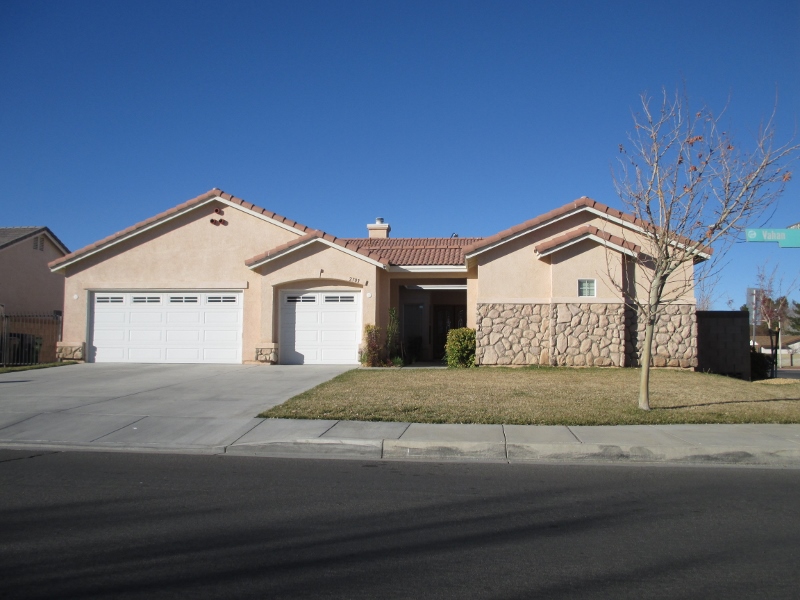
    Now let’s get back to Lancaster which is in the Antelope Valley of far eastern Los Angeles County in southern California. Lancaster was a small agricultural community until in was discovered by the aerospace industry in the 1950’s. The high desert location not too far from Los Angeles made it the perfect place to develop and test rockets, fighter jets, and ultimately the Space Shuttle and Stealth Bomber. Along the way it attracted people from the city who were looking for a more relaxed environment at a lower price point. The area sprouted endless white middle class subdivisions and accompanying shopping centers. For most residents work and culture remained “Down Below” in Los Angeles proper. That became increasingly true as the aerospace industry ramped down and was phased out. What remained of the local economy was based primarily in building and servicing more suburban development.

    Palmdale, Lancaster 056 (800x600)unnamed-5 Lancaster, Palmdale B roll 038 (800x600) unnamed-8 unnamed-6 IMG_0005

    The entire Antelope Valley, including Lancaster, was hit especially hard by the crash of 2008. Homes lost half their value overnight. Foreclosure and unemployment rates shot way up just as tax revenues plummeted and city services were cut. What was once a solidly middle class community became economically insecure and especially sensitive to further downward mobility – real or perceived. Both private developers and the City of Lancaster worked hard to deliver a better more up-to-date “product” incorporating the latest bells and whistles to jump start the resumption of growth after the crash. New homes boasted renewable energy packages and gray water recycling systems. The city began installing bicycle lanes. LEED certified office parks were promoted. And Lancaster’s economic development plan included inducements to battery and electric bus manufacturers for the growing market for clean energy and transportation. So far these measures have been too little too late. The solar and wind farms are great for generating clean power, but they don’t employ very many locals. New homes aren’t selling well and profit margins are down to a couple of thousand dollars per home which just isn’t enough to keep developers interested in building any more. The market for far flung exurban living has simply dried up. The bike paths that are all the rage in reviving city centers are effectively useless out in the distant sprawl. It isn’t the paths that are attracting prosperous new residents – it’s the urbanism the paths encounter along the way. Putting green lipstick on a sick pig hasn’t helped.

    Lancaster, Palmdale 513 (800x600) Screen Shot 2014-11-29 at 1.24.25 AM Lancaster, Palmdale 526 (800x600) Lancaster, Palmdale 533 (800x600) Screen Shot 2014-11-29 at 2.30.56 AM 

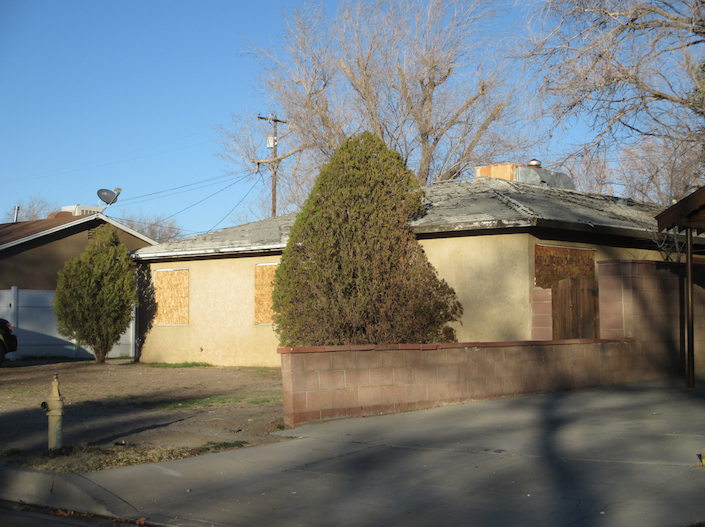
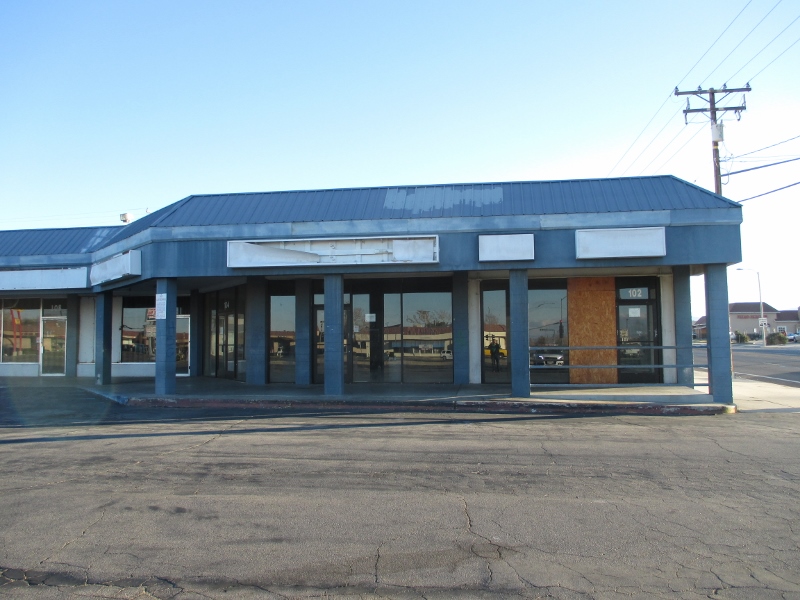
    While Lancaster has concentrated most of its efforts on inducing new construction it has ignored its older building stock. Each new home and commercial complex built out on the edge of town only cheapens the older existing suburban fabric. There’s no economic justification for buying, maintaining, or improving a fifty year old home or thirty year old strip mall when brand new homes and shops sit unsold and half vacant. Unfortunately for old timers in Lancaster all that cheap property has proven very appealing to many of the lower income residents from down below in Los Angeles who are rapidly being displaced. Like the Mission in San Francisco many previously impoverished neighborhoods in central Los Angeles are experiencing serious gentrification and all those poor folks who are getting squeezed out have to move and live somewhere else. The last several years have been a perfect storm delivering a massive wave of new arrivals to Lancaster who are not only poorer than the existing population, but overwhelmingly black and brown. This has set off alarm bells with the already stressed locals with vocal demands for government policies to prevent “Them” from moving in. (I’ll refrain from commenting on the whole race thing here. It is what it is.) In the end these are powerful market forces that the city has very little control over. For those people who are financially able their first choice is to sell and move. For those who are trapped in a home that is worth less than they owe the choice is to tough it out and hope for a market rebound or to walk away and take a big loss.

    So there you have it. Gentrification in one community and economic decline in another. These are two sides of the same coin. In the end I suspect the freakish bubble in places like San Francisco will eventually cool while the decline in outer suburbs like Lancaster will level off and stabilize. In the meantime it’s all pretty bumpy for the folks caught in the middle.

    John Sanphillippo lives in San Francisco and blogs about urbanism, adaptation, and resilience at granolashotgun.com. He’s a member of the Congress for New Urbanism, films videos for faircompanies.com, and is a regular contributor to Strongtowns.org. He earns his living by buying, renovating, and renting undervalued properties in places that have good long term prospects. He is a graduate of Rutgers University.

  • High Density Housing’s Biggest Myth

    Advocates of higher density housing development in Australia’s major cities – inner city areas in particular – are fond of pointing to a range of statistics as evidence of rising demand. Dwelling approvals, dwelling commencements, tower crane counts and various other sources, both reputable and dodgy, are referenced and then highly leveraged to support claims that our housing preferences have fundamentally changed in favour of high density apartments. But what’s the one inescapable fact that these advocates are missing?

    “Higher density living on the rise” is typical of the light weight PR puffery that passes for market analysis these days.  This piece is typical of the boosterism: 

    “Since 2008/09 multi-unit housings’ share of dwelling approvals in Queensland has jumped from 31% to 46%. Much of the increase can be attributed to an increase in approvals for high-rise apartments, with the sector’s share of dwelling approvals doubling between 2008/09 and 2013/14, from about 12% to approximately 24%.” So far, correct.

    But it goes on to draw this unjustified but widely supported conclusion: “the popularity of apartment living in the larger capital cities had been driven by a number of factors including decreasing housing affordability and the changing lifestyle of baby boomers and young professionals.”

    Or how about this piece of PR chasing nonsense pumped out by a bank no less: “Australians are favouring smaller, more affordable homes, with approvals for the construction of flats, townhouses and semi-detached houses nearing their highest level in 20 years.”

    What’s wrong with these conclusions? Simply this: rising dwelling starts for apartments in inner city areas do not necessarily reflect ‘changing lifestyles’ or any ‘popularity’ for this product by home buyers. What it does reflect is a (so far) ravenous investor appetite for the product. This is entirely different to an owner occupier appetite. If owner occupiers were buying these apartments in large numbers, you could then conclude that inner city apartment living was becoming more and more popular. But speculative investors have no intention of living in the product they’re buying.

    Owner occupiers in the main aren’t looking for tiny one or two bedroom units. Some developers have targeted the owner occupier unit market, and their designs feature more three and even four bedroom units, spacious in design and with features designed for living in as adults or families. The price points are vastly different. This is so far a niche market which is performing strongly, but it’s completely different to the cookie-cutter apartment stock which is driving the stats.

    What is happening in Australia now, and which is being reflected in the dwelling stats for apartment construction, is a nation-wide frenzy of speculative investment in inner city apartments, fuelled by negative gearing, SMSFs, foreign buyers and the search for returns in a very low yielding market. For many apartment projects, more than 80% or 90% of the stock is sold to investors, not to people with the intention of living there. This includes a significant proportion of first home buyers as investors, as Michael Pascoe recently pointed out. 

    To meet the investor market, apartments are getting smaller and smaller – to meet the price points demanded by investors. Typically, most projects offer a mix of one and two bedroom units only – and these are designed to squeeze every square inch of efficiency out of them. Construction economics and pricing is all about size, features and finishes and every dynamic is put under the microscope and cut from the project if it means the unit offering can be sold for less without sacrificing margin. Many continue to be offered through project selling agencies or “investment channels” in order to achieve a certain level of pre-sales. ‘Rental guarantees’ from developers provide investors with some certainty that their investment will perform predictably for the first year or two. A successful project is one that is sold out, preferably pre-sold. Actually being occupied is another thing altogether.

    What this is doing is creating a large pool of rental units of similar size and design and in similar locations. And contrary to the sort of froth and bubble many commentators attach to the ‘rising popularity’ of apartments, many are vacant: simply locked up and not used by their owners (often overseas buyers). Others are looking for tenants, but can’t rent for what investors need to get. Inner city apartment vacancy rates are rising, and rents are starting to fall: a sure sign of market where supply is beginning to exceed demand. 

    ‘Official’ vacancy stats produced by Real Estate Institutes only count the properties actively being marketed for rent. The ones that are simply unoccupied and not available for rent don’t form part of the figures. A recent study in Melbourne reviewed water consumption in a number of Docklands Towers and concluded that those apartments with next to no water consumption were effectively empty. They put the vacancy at nearly one in four. Or you can simply look at these towers at night, and count the lights that are on, and draw your own conclusion. Or maybe ask some restaurant or shop owners who took leases in new projects on the promise of “a bustling inner city café society” what the trade is really like.

    Increasingly, smart developers are selling sites with approvals in place but before a sod has been turned. In some cases they’re selling even before the approval has been obtained. Why go through the grief of developing something when someone else is happy to pay you a premium many times what the site cost you? 

    I don’t actually see anything wrong with any of this. Property markets going through booms and busts are not a new thing. Just ask industry people on the Gold Coast. Or have a look at CBD office markets. Plus, if it weren’t for the frenzy of activity we’re seeing in the apartment market now, there’d be precious little else going on. So it’s keeping an industry alive, and all those whose jobs depend on it. Investors are entitled to take risks and they are just as entitled to lose money as make it. There are no guarantees. 

    But please, stop suggesting that what we’re seeing is anything but a case of investor-fueled activity. Investors are buying a financial product, not a lifestyle choice. To suggest it means Australian society is surrendering a three or four bedroom home in favour of a one bedroom apartment is stretching the conclusions that can be drawn from the stats way way way too far.

    Ross Elliott has more than 20 years experience in property and public policy. His past roles have included stints in urban economics, national and state roles with the Property Council, and in destination marketing. He has written extensively on a range of public policy issues centering around urban issues, and continues to maintain his recreational interest in public policy through ongoing contributions such as this or via his monthly blog The Pulse.

  • Misunderstanding the Millennials

    The millennial generation has had much to endure – a still-poor job market, high housing prices and a generally sour political atmosphere. But perhaps the final indignity has been the tendency for millennials to be spoken for by older generations, notably, well-placed boomers, who often seem to impose their own ideological fantasies, without actually finding out what the younger cohort really wants. The reality, in this case, turns out far different than what is bespoken by others.

    Nowhere is this tendency clearer than in the perception of what kind of life – and what places – will millennials find attractive. Generally, the narrative goes like this: Millennials are different, they don’t care about owning homes, detest the suburbs and would prefer to spend their lives in dense apartment blocks, riding the rails or buses to whatever work they might be able to find.

    Urban theorists, such as Peter Katz, insist that millennials (the generation born after 1983) have little interest in “returning to the cul-de-sacs of their teenage years.” Manhattanite Leigh Gallagher, author of “The Death of Suburbs,” asserts with certitude that “millennials hate the suburbs” and prefer more eco-friendly, singleton-dominated urban environments.

    Such assessments thrill the likes of real estate speculators, such as Sam Zell, who welcomes “reurbanization” as an opportunity to cash in by housing a generation of Peter Pans in high-cost, tiny spaces unfit for couples and unthinkable for families. Others of a less-capitalistic mindset see in millennials a post-material generation, not buying homes and cars and, perhaps, not establishing families. Millennials, for example, are portrayed by the green magazine Gris as “a hero generation” – one that will march, willingly, even enthusiastically, to a downscaled and, theoretically, greener future.

    Read the entire piece at The Orange County Register.

    Joel Kotkin is executive editor of NewGeography.com and Roger Hobbs Distinguished Fellow in Urban Studies at Chapman University, and a member of the editorial board of the Orange County Register. He is also executive director of the Houston-based Center for Opportunity Urbanism. His newest book, The New Class Conflict is now available at Amazon and Telos Press. He is also author of The City: A Global History and The Next Hundred Million: America in 2050.  He lives in Los Angeles, CA.

    New home photo by BigStockPhoto.com.

  • What’s This Place For?

    I was recently asked by Gracen Johnson (check out her site here) to elaborate on the possible future of suburbia. How are the suburbs likely to fare over time? This coincided with a city planner friend of mine who asked a more poignant question about the suburban community he helps manage. “What’s this place for?” If we can answer that question we might be able to get a handle on the possible trajectories of various suburbs.

    unnamed-2 unnamed-1 unnamed-5 unnamed-3

    For example, we all understand what a farm town is for. Small rural towns produce food. The people who live in the countryside are actively engaged in the business of feeding society. They take soil, water, plants and animals and convert it all into breakfast, lunch and dinner. For the people who want to live this way there are tremendous benefits: fresh air, open space, privacy, independence, a direct connection to nature, strong family bonds, tradition, and so on. Whatever else we might say about farm country we can be certain that it will carry on one way or another or else civilization will grind to a halt pretty quickly.

    IMG_0126 (800x533) IMG_0085 (800x533) IMG_0093 (800x533)

    We also know what industrial cities are for. They take the raw materials from the surrounding countryside and transform them into finished goods. Grain becomes flour and bread. Timber becomes lumber, then homes and furniture. Iron ore and coal become machinery and power. Crude oil becomes gasoline, petrochemicals, and plastics. There are obvious trade offs for industrial workers, but for many people it’s a pretty good arrangement. If we expect to have manufactured goods in the future these cities will have to continue somehow.

    Screen Shot 2015-01-31 at 6.49.37 AM Screen Shot 2015-01-31 at 6.54.26 AM Screen Shot 2015-01-31 at 6.56.05 AM Screen Shot 2015-01-31 at 6.55.40 AM

    The new post-industrial locus is a bit trickier to pin down. The service economy doesn’t actually produce any “thing” so the workforce is liberated to live just about anywhere in a way that farmers and factory workers can’t. Oddly, well educated highly paid people don’t actually spread out and inhabit a million cabins in the woods as you might expect. Instead they clump up in a handful of regions that provide abundant cultural amenities. At the same time the post-industrial economy exists in a physical world and all those people and electronic components rely on the underlaying farms, factories, and raw resources that support them. The so-called dematerialization of the economy still requires a serious amount of real “stuff” to function.

    Screen Shot 2015-01-29 at 6.18.31 AM Screen Shot 2015-01-29 at 6.05.55 AM Screen Shot 2015-01-29 at 6.06.18 AM

    So what does this all mean for the suburbs? The nature of suburbia has always been consumptive rather than productive. People move to the suburbs in order to purchase and enjoy things: a spacious home, a good school district, security, a clean environment, more respectable neighbors, and so on. The majority of the commercial activity is actually in service to suburbia itself. The mortgage brokers, insurers, real estate agents, landscapers, school teachers, firefighters, orthodontists, pancake houses, and auto body shops are all there to help keep the suburbs humming along. But they’re all consumptive in nature. No one is making the tennis shoes sold at the mall or growing the oranges at the supermarket. This is compounded by the fact that the suburbs are maintained largely through debt. Private debt is required for all the mortgages, car loans, credit cards, student loans, and business loans while municipal bonds prop up many essential suburban government functions. The fact that many people don’t understand the difference between production and consumption is one of the big problems the suburbs are going to have to sort out in the future.


    Screen Shot 2015-01-28 at 9.22.31 PM Screen Shot 2015-02-03 at 2.12.50 AM

    I’m going to get a lot of push back on this concept. I’m sure many of you think that your suburb is full of productive enterprises: the Krispy Kreme, the Jiffy Lube, the dozen Shell and Exxon stations, the Applebee’s, the Foot Locker, the Honda dealership, and the Kroger’s. But these are merely outlets for things that were produced elsewhere. Let me offer another example from my own life. I spent a chunk of my childhood in the San Fernando Valley in Los Angeles. Back in the 1960’s and 1970’s nearly everyone had some connection to companies like Rocketdyne, Litton, and General Dynamics. Those were the engines of the local economy for decades. And they did in fact produce real physical things. But they were all funded entirely by the federal government. Tax money was skimmed off the national productive economy (all those farms and factories) and then spent on missile guidance systems, satellites, and fighter jets. The same was true in Huntsville, Alabama and Marietta, Georgia. Remember what happened to all those places when the feds turn off the spigot during budget cuts? Money flowed in, not out. There’s a reason Peru doesn’t have a space program. The underlying national economy isn’t productive enough to support such extravagant government spending.

    As the material abundance we enjoyed in the Twentieth Century tightens up suburbs will have to become much more efficient places that provide things the outside world needs and is willing to pay for. At the same time internal consumption and debt are going to have to be pulled back. That doesn’t necessarily mean a lower quality of life, but it does demand that suburbs retool and ask themselves, “What’s this place for?”

    John Sanphillippo lives in San Francisco and blogs about urbanism, adaptation, and resilience at granolashotgun.com. He’s a member of the Congress for New Urbanism, films videos for faircompanies.com, and is a regular contributor to Strongtowns.org. He earns his living by buying, renovating, and renting undervalued properties in places that have good long term prospects. He is a graduate of Rutgers University.

  • The New New Thing: Suburban Bunker Buildings

    I have a theory about where the next culturally dynamic neighborhoods are likely to emerge and which building types will be the engine of that transformation. It may not be exactly what most people expect.

    As American industry receded in the later half of the Twentieth Century it left behind an alluvial delta of redundant buildings that sat vacant for years, no longer useful or productive. All effort was focused on building the new suburbs. These abandoned inner city warehouse districts became so cheap and run down that they were eventually colonized by artists, immigrants, and bohemians seeking cheap rent and an environment where landlords and municipal authorities looked the other way. They weren’t necessarily safe, or clean, or attractive, but they provided a kind of freedom for the people who lived there.

     Screen Shot 2015-02-10 at 8.38.05 PM  Screen Shot 2015-02-10 at 8.39.46 PM Screen Shot 2015-02-10 at 8.40.07 PM  unnamed-2 unnamed
     unnamed-3 unnamed-1 

    The photos above are of friends in their 8,000 square foot live/work space in Philadelphia. The general dismissive attitude of many suburbanites is that such people exist outside the mainstream and are irrelevant to the lives of “real” people. Contrary to this common misconception all the creative types I know are highly skilled and hold down jobs as welders, carpenters, accountants, and technicians of various kinds. I know a couple who spend half the year in video production making car commercials and then pursue their art during the long hiatus. I know another guy who worked like a dog for a few years after college at a prototype lab for the pharmaceutical industry in order to pay off all his student loans and other debts. Now he’s free to do what he really wants without the burden of debt. These folks simply choose not to spend their money on a mortgage on a suburban home with multiple car payments, but their lives and economic productivity are very real.

    Technically, living in an old warehouse involves breaking a hundred different rules and regulations, but they’ve been there for years and no one cares. It’s that kind of space and that kind of neighborhood. Unfortunately, the area is rapidly gentrifying and they may be priced out of the space soon as nearby warehouses are being converted to luxury lofts. That begs the question – where are the cheap funky emerging neighborhoods these days? You can’t live and work this way in a suburban tract home. Neither the physical space nor the local culture will allow it.

    unnamed-1 unnamed

    A couple of years ago I was in Salt Lake City having lunch with a prominent well-connected real estate agent. She’s the kind of charming knowledgable person I always seek out so it was a pleasure to see her again. I had explored various parts of Salt Lake from the downtown core all the way out to Daybreak in the distant suburbs. She spoke of the urban renaissance, the new streetcar system, and the many new developments in previously blighted areas. But I explained that the part of town that really interested me was the neglected and undervalued areas in the lackluster middle distance just beyond downtown that were neither sophisticated and urbane nor verdant and domestic. These semi-commercial, vaguely industrial, half-assed residential zones were neither fish, nor flesh, nor fowl. But they had the two qualities that fascinate me: they’re relatively inexpensive and generally ignored by the Upright Citizens Brigade. They’re close enough to downtown and the university that you could still ride a bicycle to access culture and employment, but just a short drive to suburban conveniences farther out. It’s the wrong combination for people with conventional tastes, but the perfect sweet spot for a certain kind of subculture that needs to be left alone in order to thrive. They need wiggle room that doesn’t exist in the highly supervised downtown or manicured suburbs. And many of these brick and concrete buildings are little bunkers where you could do just about anything within the raw space. They offer the one thing that’s in terribly short supply. Slack. 

    unnamed-2 unnamed-3 unnamed-1

    I sent these photos over to her and explained that these nondescript aging suburban bunker buildings were the next great building type. She was gracious and polite, but she obviously thought I was insane. Now granted, she isn’t the only person to come into contact with me to come to this conclusion – and not just because of my irregular taste in property.

    Screen Shot 2015-02-09 at 5.01.50 PM  Screen Shot 2015-02-09 at 5.05.02 PM Screen Shot 2015-02-09 at 5.04.39 PM

    This conversation came back to me this afternoon as I walked past a building that used to house a discount bakery outlet. As a much younger and poorer person twenty years ago I used to frequent this establishment myself to buy day old bread and not-quite-expired donuts. This month the bunker building was transformed into an upscale furniture store with in-house designer services. I poked around and explored the shop. I had no particular interest in the furniture itself and don’t think this kind of business could succeed anyplace other than a prosperous part of town. But it was the bones of the building itself that fascinated me.

    Screen Shot 2015-02-09 at 5.01.18 PM Screen Shot 2015-02-09 at 5.01.02 PM Screen Shot 2015-02-09 at 4.54.42 PM Screen Shot 2015-02-09 at 5.02.40 PM Screen Shot 2015-02-09 at 4.55.46 PM

    It’s a big flexible durable space like the old inner city industrial buildings. The walls and floor are concrete and the ceilings are exposed wood and steel. The former loading docks make perfectly segmented rooms with high ceilings and the ability to adapt to many uses including indoor/outdoor applications. Paint and some inexpensive drywall partitions transform the space very quickly. The front room was mostly glass and open to the parking lot, but the vast majority of the building was entirely private. This is a perfect example of the new new thing. This is where the starving bohemians will end up if they want to continue doing their work in a big, affordable, mostly unregulated spot. In an expensive real estate market people will colonize any vacant building and make their luxury furniture showroom work. But in depressed suburban markets these buildings are ripe for economically displaced artists. Gather enough interesting and entrepreneurial types in one such neighborhood and it could be the social and cultural engine that pulls up an entire dying suburban strip.

    John Sanphillippo lives in San Francisco and blogs about urbanism, adaptation, and resilience at granolashotgun.com. He’s a member of the Congress for New Urbanism, films videos for faircompanies.com, and is a regular contributor to Strongtowns.org. He earns his living by buying, renovating, and renting undervalued properties in places that have good long term prospects. He is a graduate of Rutgers University.

  • The Emerging New Aspirational Suburb

    Urban form in American cities is in a constant state of evolution. Until recent years, American suburbia was often built without an appreciation for future evolution. This has left many older suburbs in a deteriorated state, and has accelerated claims of a more generalized suburban decline.

    The Indianapolis suburb of Carmel represents a response to this historic pattern. While responding to today’s market demands with a new aspiration level designed to make it nationally competitive, it’s also trying to position itself for success tomorrow and over the longer term.

    This is a critical issue for many suburbs. Like big cities before them, many older suburbs have now aged, and no longer necessarily meet the requirements of the marketplace.  

    There are many reasons for this.  The early, usually small-scale Cape Cod-style housing common to many 50s vintage suburbs is not what today’s market is demanding. It’s the same for older enclosed malls – today “lifestyle centers” and other formats are preferred – many of which are now vacant, their grim remains featured on web sites such as DeadMalls.com. Many suburban areas were also built out with “infrastructure light” without upgraded streets, sidewalks, etc. leaving a big backlog of infrastructure need.

    Across the country many of these older districts have fallen into decay and become increasingly poor, taking on many of the characteristics of the inner city. As the Brookings Institution noted  over a decade ago, they “are experiencing some signs of distress—aging infrastructure, deteriorating schools and commercial corridors, and inadequate housing stock.”1 Today, the public is more aware of the trend, and events in Ferguson, MO recently gave a wakeup call to newer and still-thriving suburbs that they too may be troubled at some point.

    Like other American cities, Indianapolis has many of these older, struggling suburban areas. In its case, many of them are within the core city limits due to a 1970 city-county merger. As regional growth continues to expand outside the central urban county, newer generation suburbs have a chance to learn from the struggles of many of their predecessors.

    Carmel – pronounced like the Biblical Carmel – is the first suburb directly north of the city of Indianapolis. It is an upscale residential and business suburb similar to many others around the country such as Dublin, OH; Naperville, IL; and the Cool Springs, TN area.  Its 2013 population of 83,573 made it the 5th largest municipality in the state. While not monolithically wealthy, its 2013 median household income of $100,358 is the 14th highest in the United States among communities of 65,000 people or more.2 It’s a preferred area for the estate homes of wealthy Indianapolis area residents, such as Indianapolis Colts owner Jim Irsay. But it’s not just a bedroom suburb; real estate brokerage Cassidy Turley reports that the Carmel submarket has over six million square feet of office space.3

    Being located in the center of the favored quarter of the Indianapolis region, Carmel grew as an upscale area. This gives it a leg up in long term sustainability out of the gate.  

    Yet Carmel has not relied just on its wealth to insure against decline. Rather, it has embarked on a transformation program now nearly 20 years old from which three major themes emerge:

    1. Responding to current market forces to build a “state of the art” community that is competitive globally, not just within the Indianapolis region.

    2. Building a full spectrum of amenities and infrastructure to create a “complete city” with a high quality of life and intrinsic appeal that is a) not based solely on newness or low costs, and b) which has broad demographic appeal.

    3. Attempting to create unique cultural and regional attractions  to turn Carmel into a destination in its own right, as much city as suburb.

    The primary driver of this transformation has been Mayor Jim Brainard, a Republican currently in his fifth term.  Carmel long had top performing schools – it’s the top rated district in the state   – houses with generous yards, low taxes, and other standard attractors of suburbia. Previous administrations had put in place key policies such as reserving the Meridian St. corridor for high end office space and banning billboards. But Brainard brought numerous changes in Carmel during his tenure including:

    Annexation. Carmel has undertaken a series of annexations – nearly 20,000 acres since 2001 alone.4 With over 47 square miles of territory, Carmel has now largely achieved its desired geographic scale.

    Parks. Carmel’s park acreage increased from 50 to 1000 acres and it has spent heavily on building out its parks. This includes building a $55 million Central Park, which includes a showplace community and fitness facility called the Monon Center.5 And the popular Monon Trail, a rail-trail through the length of the city that extended a previous project built by the City of Indianapolis.
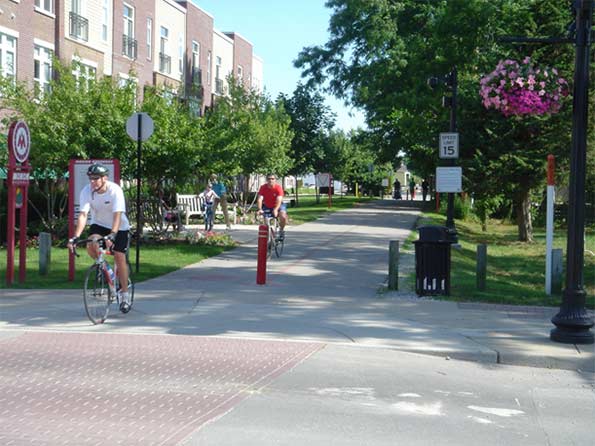

    Monon Trail at Main St.

    Road Infrastructure. Carmel has invested heavily in upgrading the legacy network of county roads that it overgrew. This includes an aggressive deployment of modern roundabouts. Carmel now has over 80 of these, more than any community in the United States.6 It has upgraded miles of collector roads to urban standards with enclosed drainage, curbs, extra-wide travel lanes, landscaped medians, eight foot multi-use side paths on both sides of the street protected by a landscaped buffer zone, and decorative street signs and other detailing.
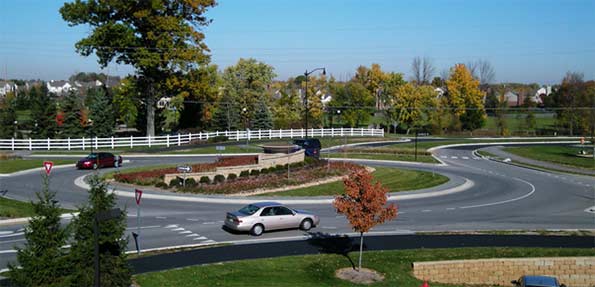
    Roundabout at Main St. and Illinois St. in the fall
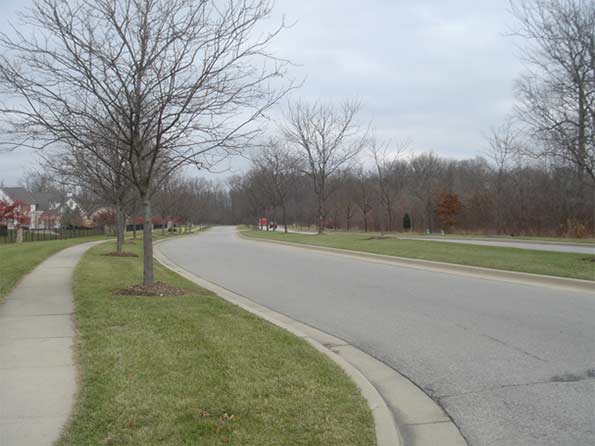

    An upgraded segment of River Rd. in early winter

    Two major state highways passed through the town, Meridian St. (US 31) and Keystone Ave. (SR 431). These were designed as rural style divided surface highways as is common in Indiana. Carmel convinced the state to relinquish Keystone Ave. to the city and give it $90 million for upgrades and future maintenance. Carmel converted this into a mostly free flowing parkway by spending $108 million to replace stoplight intersections with roundabout interchanges. These not only dramatically improved traffic flow, the bridges over the busy highway provided a high quality, safe connection – especially for pedestrians and bicyclists – connecting eastern and central Carmel, which had previously been separated by this “great wall” of a road. The state is currently performing a similar freeway upgrade on Meridian St., the principal office corridor.
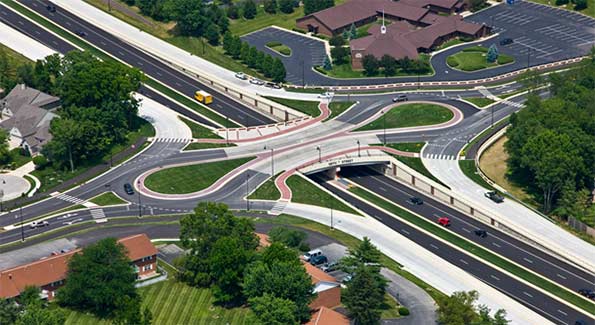

    Roundabout interchange at 126th St. and Keystone Parkway.

    Water and Sewer Upgrades. Part of Carmel previously received water from the Indianapolis water utility. The City of Indianapolis had privatized this utility but sought to repurchase it. Carmel intervened in the process to pressure Indianapolis into selling it the water lines inside Carmel. Carmel has since undertaken significant infrastructure upgrades such as new wells and pumping stations. During a recent summer drought, Carmel, unlike Indianapolis, did not put in place a mandatory restriction on lawn watering.7

    New Urbanism. Beyond core infrastructure, Carmel under Brainard has sought to change its style of development to embrace some of the more positive aspects of New Urbanism such as creating more urban nodes and walkability.

    Unlike some traditional railroad suburbs or county seats, the historic center of Carmel was very tiny, and its Main Street populated mostly with one story buildings and empty lots. This was the first focus area, and started with fixing the physical infrastructure.  

    The city rebranded the area as the “Arts and Design District” and utilized Tax Increment Financing to promote multi-story, mixed use development. The result is a mostly occupied and often well-patronized Main Street district. The surrounding historic residential blocks have seen significant redevelopment activity as well.
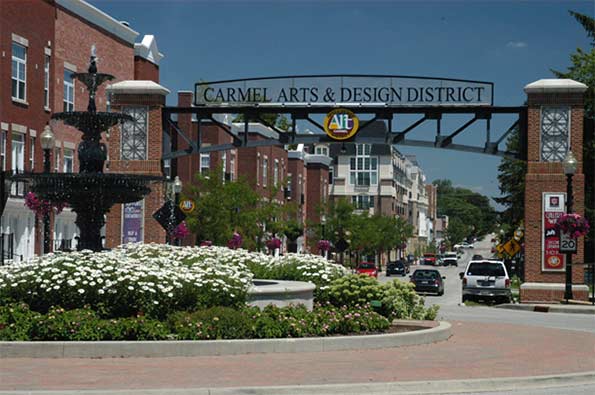

    Main St. at western fountain and gateway arch entryway to rebranded “Arts and Design Distrct.”

    Beyond the historic downtown, Carmel has also implemented multiple New Urbanist style zoning overlays, including on Old Meridian St. and Range Line Rd. (the city’s original suburban commercial strip). These promote mixed use development, buildings that front the street, and multi-story structures. Infrastructure improvements and TIF have been used in these areas as well. There’s also a major New Urbanist type subdivision in western Carmel called the Village of West Clay.
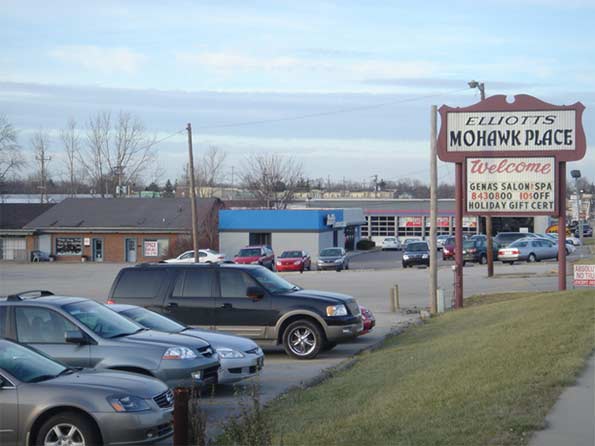
    Strip mall and traditional suburban development along Range Line Rd.
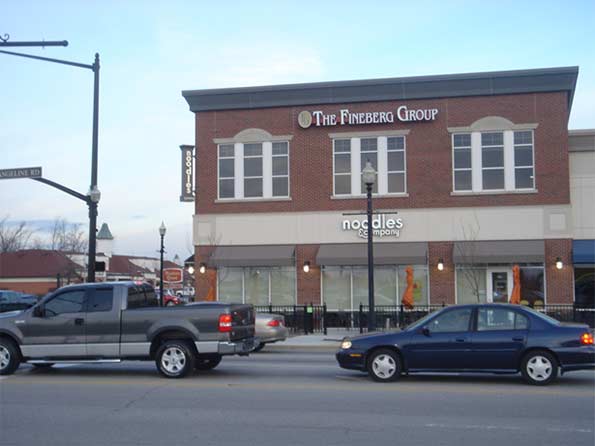

    New Urbanist style development along Range Line Rd.
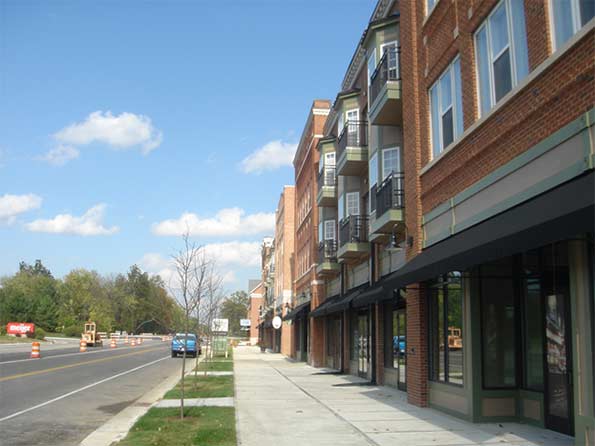

    New Urbanist development and street improvements under construction on Old Meridian St.

    The historic downtown was deemed too small to function effectively as the downtown of a city the size of Carmel today. The city thus decided to create a new downtown area called City Center. The location for this is an area south of the historic downtown area in an older suburban industrial zone that had fallen into a blight pattern. Much of it was vacant and what’s now the principal City Center development was built on the site of a failed strip mall. TIF was aggressively used here as well to redevelop the area.

    The City Center development is only partially complete. A veterans memorial and other civic spaces are complete, as are several small office buildings, apartments, and a large mixed use complex. The anchor is a publicly funded $175 million concert hall called the Palladium and an associated theater complex with three stages.8 While these are complete, significant development remains to complete the City Center vision. The city also wants to redevelop the area between City Center and the old downtown, which they now label Midtown, but very little has been done to date.
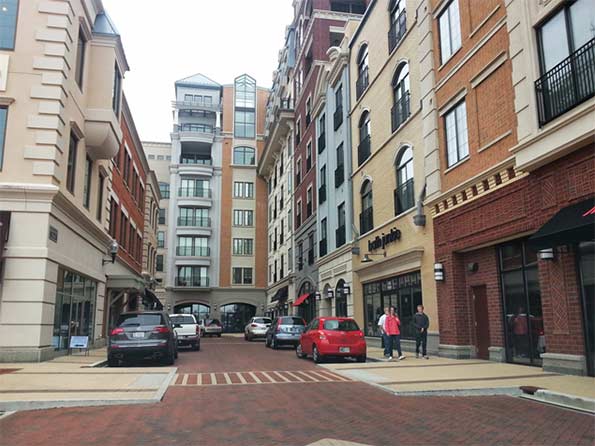

    Interior street of City Center development.

    The goal of all this development is not the full urbanization of Carmel; this city does not aspire to be dense metropolis, or even Indianapolis. It’s rather about creating more town center type districts with the walkable feel that’s increasingly in favor, but without compromising the fundamental suburban character of the city. It’s also designed to create a city with options. Having a diversity of development styles within the city is part of a strategy of appealing to a more diverse demographic base, including singles and retirees, not just the stereotypical younger family with kids. Traffic flow has been improved, but short trips are now easier to undertake by foot or bicycle, not just by car.

    Retro Architecture. Carmel has de facto mandated traditional architectural styles. There’s no one consistent style. Major buildings have been done in Georgian, Second Empire, and Neoclassical type designs. But modernism has been rejected, further differentiating suburban Carmel from urban areas that frequently elect for starchitecture that is unapologetically “of the now.”

    The city has also attempted to prevent large corporations from building their standard architectural templates. Brick is effectively mandated, even for big box retailers like Lowes. Retailers like CVS and Kentucky Fried Chicken were forced to build second stories on their structures to locate in certain areas. Another Carmel CVS has an art deco façade.

    The city wants high quality aesthetics and a unique sense of place. They also want “timeless” design, though like much New Urbanism architecture it can sometimes come across as pastiche.

    Arts and Culture. As part of the attempt to appeal to more arts minded middle aged consumers, as well as members of the  so-called “Creative Class,” Carmel has heavily invested in the arts. The City Center performing arts center was paid for almost entirely with public funds (TIF), an investment in the arts dwarfing even that of Indianapolis. The city has also paid for an extensive public art program, mostly statues by Seward Johnson. And it makes operating grants to local arts organizations such as the Carmel Symphony Orchestra.
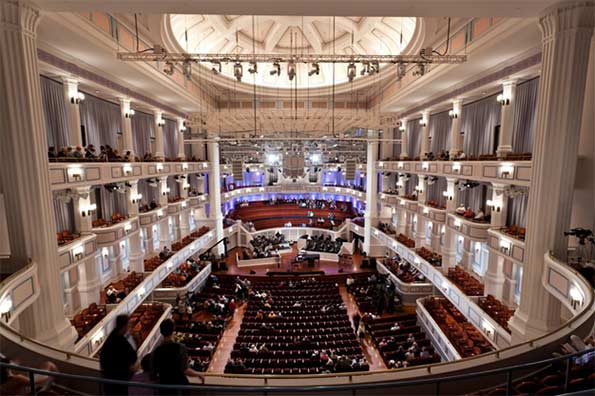

    Interior of the Palladium concert hall. Photo by Zach Dobson.

    Seward Johnson is not a favorite of urban sophisticates. His statutes illustrate the type of play it safe art generally featured by Carmel. More sophisticated or cutting edge fare is not as prevalent. And there have even been some complaints by a limited number of citizens about items such as the classical nudes featured on the door handles of the Evan Lurie Gallery.

    Brainard is thinking about the long term when Carmel is no longer the shiny new thing. As he put it, “Because we are designing a new city that will be in place for hundreds of years, the responsibility of doing it right falls to this generation…Carmel is a young city – we are still building our parks, trails, roads and sanitary sewer and water systems that will be here for centuries.”9

    He’s also keenly aware of global economic competition and the fact that Indiana lacks the type of geographic and weather amenities of other places. He frequently uses slides to illustrate this point. In one talk he said, “Now this picture, guess what, that’s not Carmel; but this picture is the picture of some of our competition. Mountains – that’s San Diego of course, mountains, beautiful weather, you know I think they have sunshine what, 362 days out of the 365…. What we’ve tried to do is to design a city that can compete with the most beautiful places on earth. We’ve tried to do it through the built environment because we don’t have the natural amenities.”10  While the claims to want to equal the most beautiful places in the world may be grandiose, the key is that mayor believes Carmel’s undistinguished natural setting and climate requires a focus on creating aesthetics through the built environment.

    What have the results been to date?  Economically and demographically, the city has performed well. It has managed to create an environment that is proving competitive for business opportunities that might have previously bypassed Indiana. For example, American Specialty Health relocated its headquarters to Carmel from San Diego, with the CEO of the company personally making the move from La Jolla to Carmel.11 Geico also recently expanded. Numerous other corporations are either based in Carmel or have major white collar facilities there. The income levels are very strong, as noted above.

    The city’s demographics have also expanded to become much more diverse. The minority population grew 295% between 2000 and 2010, adding 9,630 people and growing minority population share from 8.7% to 16.3%.12 12% of the city’s households speak a language other than English at home.13 Many of these are highly skilled Chinese and Indian immigrants working for companies like pharmaceutical giant Lilly. Even black professionals are increasingly moving to Carmel, with the black population growing 324% in the 2000s and black population share doubling to 3%.14 Carmel is not a polyglot city today, but it’s far more diverse than in the past.

    Carmel has also attracted both national press and national awards. Money magazine ranked Carmel as the #1 best small city to live in 201215, and it’s scored highly in other surveys as well. Drew Klacik of the Indiana University Public Policy Institute notes that in an echo of the transformation of the city of Indianapolis since the 1970s, “Carmel has transformed itself from a desirable community within Indiana to a desirable and competitive community nationally.”16

    However, it’s hard to argue that Carmel’s results materially outperform peer cities in other regions. Places like Dublin, OH and Cool Springs, TN have significantly more office space, for example. Many of those places are, however, implementing policies similar to those in Carmel . Most Carmel New Urbanist development continues to require TIF subsidies and is not yet sustainable at market rates. The city has obtained better financial terms in some recent deals, however.  And despite major public investment and construction in the central city, many central area census tracts lost population during the 2000s.

    The changes have also attracted significant criticism and opposition in some quarters.  While the public remains largely positive on the results, there have been many critiques of the way they were done, some of them legitimate.  A number of the projects had significant cost overruns. The mayor originally said that the Keystone project could be completed for the $90 million the state gave it. The actual cost was nearly $20 million higher.17 The Palladium was originally sold as an $80 million facility, but ended up costing $175 million. The city also said it planned to pay for ongoing operations by raising a $40 million endowment, but was unable to raise the funds, leaving it on the hook for $2 million in annual operating costs. These are not small misses.

    Critics also pointed to state figures showing Carmel with nearly $900 million in total debt.18 While it is a wealthy community that can afford the payments, in a conservative state like Indiana, a suburb accumulating nearly a billion dollars in debt raises eyebrows. Carmel’s tax rates remain among the lowest the state, however.

    The way the debt was accumulated has been criticized as well. The Palladium was paid for with TIF funds. Rather than bonds, the Carmel Redevelopment Commission – the authority that manages the TIF program and which was controlled by mayoral appointees – structured the Palladium debt as Certificates of Participation to circumvented the need for city council approval, incurring higher interest rates in the process. The city council later refinanced the debt at a lower rate using a general taxing power guarantee in what some called a bailout. In return for the refinancing, the council obtained more oversight over TIF activity.19

    Though some controversy is inevitable and some criticisms are legitimate, ultimately the change program in Carmel has proven popular with the public and the city is booming, a boom that’s lending an increasingly bitter tone to the longstanding hostility Carmel has enjoyed from the region due to its status as the highest profile “rich suburb” in the region.

    Yet for all the controversy, many regional suburbs are copying some aspects of Carmel’s approach, with roundabouts now a regular feature in area communities and major park programs and New Urbanist style town center developments as well. This includes the massive sports-oriented Grand Park in Westfield and the Nickel Plate District in next door Fishers’ town center.20

    It’s also clear that peer type suburbs around the country are adopting similar strategies, such as Dubin, OH’s Bridge Street Corridor proposal21 or Sugar Land, TX’s $84 million performing arts center.22 Imitation, they say, is the sincerest form of flattery. Carmel represents the leading edge of the emergence of a new type of post-Edge City aspirational suburb. It’s something we may be seeing a lot more of in the future.

    Aaron M. Renn is a senior fellow at the Manhattan Institute and a Contributing Editor at City Journal. He writes at The Urbanophile.

    ————————————-

    1 Robert Puentes and Myron Orfield. “Valuing America’s First Suburbs: A Policy Agenda For Older Suburbs in the Midwest,” Brookings Institution, 2002.

    2 U.S. Census Bureau, “American Community Survey 2013 1-yr”, Table B19013.

    3 Cassidy Turley, Indianapolis Office Market Snapshot (Third Quarter 2014), 3.

    4 Ellen Cutter. “Explaining the annexation process,” Greater Fort Wayne Business Weekly, June 12, 2014. Accessed January 8, 2015. http://www.fwbusiness.com/opinions/columnist/businessweekly/article_f42da036-6182-575a-8445-274cd82ca296.html

    5 Matthew VanTryon. “Carmel then and now: World’s Apart,” IndianapolisNewsBeat.com, December 16, 2014. Accessed January 8, 2015. http://blogs.butler.edu/multimedia-journalism/2014/12/16/carmel-worlds/

    6 James Brainard, transcript of speech at 2014 International Making Cities Livable Conference, June 23-27, 2013.

    7 “Why no watering ban in Carmel,” WISH-TV News, July 12, 2012. Accessed January 8, 2015. https://www.youtube.com/watch?v=y51BJYM4Fgc

    8 David Hoppe. “The Palladium’s boffo budget,” Nuvo Newsweekly, June 20, 2011. Accessed on January 8, 2015. http://www.nuvo.net/indianapolis/the-palladiums-boffo-budget/Content?oid=2275080

    9 James Brainard, notes for 2014 State of the City Address.

    10 James Brainard, transcript of speech at 2014 International Making Cities Livable Conference, June 23-27, 2013.

    11 Andrea Muirragui Davis. “Wellness provider beefing up new Carmel office,” Indianapolis Business Journal, October 29, 2014. Accessed on January 8, 2015. http://www.ibj.com/blogs/11-north-of-96th/post/50241-wellness-provider-beefing-up-new-carmel-office?id=11-north-of-96th

    12 U.S. Census Bureau, calculations by author from Census 2000 and Census 2010.

    13 U.S. Census Bureau, “American Community Survey 2013 1-yr”, Table B05007.

    14 U.S. Census Bureau, calculations by author from Census 2000 and Census 2010.

    15 “CNNMoney Ranks Americas Best Places to Live,” Daily Finance, August 20, 2012. Accessed January 8, 2015. http://www.dailyfinance.com/2012/08/20/cnn-money-ranks-americas-20-best-places-to-live/

    16 Drew Klacik, telephone interview with author, December 29, 2014.

    17 “Brainard seeks bonds to finish Keystone,” The Indianapolis Star, October 18, 2009. Accessed January 8, 2015. http://archive.indystar.com/article/20091018/LOCAL/910180409/Brainard-seeks-bond-finish-Keystone

    18 Indiana Department of Local Government Finance. “Local Government Debt Report,” September 21, 2012, 15.

    19 Kathleen McLaughlin. “Brainard seeks deal on maxed-out TIF,” Indianapolis Business Journal, March 31, 2012. Accessed January 8, 2015. http://www.ibj.com/articles/33569-brainard-seeks-deal-on-maxed-out-tif

    20 Cara Anthony. “New look for the Nickel Plate District in Fishers,” The Indianapolis Star, June 28, 2014. Accessed January 16, 2015. http://www.indystar.com/story/news/local/hamilton-county/fishers/2014/06/27/new-look-nickel-plate-district-fishers/11537251/

    21 Brent Warren. “Dublin Moves Ahead With Bridge Street Corridor Plans, Connecting Across River,” Columbus Underground, March 23, 2013. Accessed January 8, 2015. http://www.columbusunderground.com/dublin-moves-ahead-with-bridge-street-corridor-plans-looks-to-connect-across-river-bw1

    22 Rebecca Elliott. “Sugar Land breaks ground on $84 million performing arts center,” Houston Chronicle, December 9, 2014. Accessed January 12, 2015. http://www.houstonchronicle.com/neighborhood/fortbend/news/article/Sugar-Land-breaks-ground-on-84M-performing-arts-5946247.php
  • Go East, Young Southern California Workers

    Do the middle class and working class have a future in the Southland? If they do, that future will be largely determined in the Inland Empire, the one corner of Southern California that seems able to accommodate large-scale growth in population and jobs. If Southern California’s economy is going to grow, it will need a strong Inland Empire.

    The calculation starts with the basics of the labor market. Simply put, Los Angeles and Orange counties mostly have become too expensive for many middle-skilled workers. The Riverside-San Bernardino area has emerged as a key labor supplier to the coastal counties, with upward of 15 percent to 25 percent of workers commuting to the coastal counties.

    In a new report recently released by National Core, a Rancho Cucamonga nonprofit that develops low-income housing, I and my colleagues, demographer Wendell Cox and analyst Mark Schill, explored the challenges facing the region. Although we found many reasons for concern, the region’s overall condition and its long-term prospects may be better than many might suspect.

    Population trends

    The region’s once-explosive growth has slowed considerably. From 1945-2010, the area’s population soared from 265,000 to 4.25 million. Already the nation’s 12th-largest metropolitan area, the I.E. could pass San Francisco and Boston by 2020 (unless faster-growing Phoenix does so first).

    Yet, contrary to expectations (and, perhaps, hope among anti-sprawl campaigners), the area continues to be a beacon for people from the rest of the region. There is a notion, widely expressed in the mainstream media, that Southern California’s growth will now focus more on the urban core around Downtown Los Angeles. Yet, as is often the case, what planners and pundits desire is not widely shared by the vast majority of people.

    People continue to vote for the Inland Empire – and other peripheral areas – with their feet. Census Bureau data indicates that, from 2007-11, nearly 35,000 more residents moved from Los Angeles County to the Inland Empire than moved in the other direction. There was also a net movement of more than 9,000 from Orange County and more than 4,000 net migration from San Diego County.

    Several long-standing demographic trends favor a continued shift to the Inland region, according to Cox and Schill. Immigrants and their offspring may prove the critical factor. Over the past decade, the Inland region dramatically increased its population of foreign-born residents, more than three times the number and at nearly 18 times the rate of the coastal counties.

    The influx of immigrants and their children is largely responsible for the region’s relatively young population, compared with the rest of Southern California. As recently as 2000, the proportion of population ages 5-14 in Los Angeles and Orange counties stood at 16 percent, the sixth-highest level among the nation’s 52 largest metropolitan areas. Thirteen years later, that proportion had dropped to 12.8 percent, 33rd among the 52 largest metropolitan areas. In terms of a dropping share of youngsters, the area experienced a 20 percent reduction, the largest in the nation.

    In contrast, the Inland Empire remains a bastion of familialism, with 15.3 percent of the population aged 5-14, among the highest levels in the nation. This follows a general pattern; according to recent analysis of Census data, high-cost areas tend to repel families. Of the nation’s most expensive areas, such as the Bay Area, New York and Boston, all tend to have well below national norms in terms of families among their populations.

    Perhaps more surprising, younger educated workers also are heading to the region. In fact, from 2011-13, according to American Community Survey data, Riverside-San Bernardino witnessed the 12th-largest increase among the 52 major metro areas in the share of college-educated residents ages 25-34. No major California metro area, including Silicon Valley, could match it. From 2000-13, the Inland region experienced a 91 percent jump in population with bachelor or higher degrees, just less than twice the increase for either Orange or Los Angeles counties.
    Overall, the I.E. has become something of a growth area for millennials – basically, adults ages 20-29. San Bernardino-Riverside ranked second among 52 metro areas, adding 50,000 millennials, an 8.3 percent increase since 2010. Los Angeles and Orange counties – older, settled areas with far lower population growth – together registered 18th.

    Economic Restructuring

    These trends also may reflect improving prospects for the region’s economic recovery. The area remains some 30,000 jobs below its 2007 level, notes California Lutheran University economist Dan Hamilton, but is now growing faster than the rest of the Southland. The region created jobs over the past year at a 2.2 percent rate, well above the 2.0 percent increase in Orange County and almost twice that of L.A.’s 1.3 percent. Foreclosures have diminished to the lowest levels since 2007 and appear back to something resembling normalcy.

    One important source of new employment is grass-roots entrepreneurship. Overall, the Inland Empire accounted for a large proportion of the new businesses created statewide from 2012-13 – despite hosting only 7.4 percent of the total businesses in California. A recent report by Beacon Economics suggested that growth will accelerate over the next five years.

    At the same time, some of the core industries – such as manufacturing and warehousing – have shown signs of recovery. Industrial vacancy rates have fallen from nearly 12 percent in 2009 to roughly half that level today.

    Much of the growth has been for “middle-skilled jobs,” paying $14 to $21 per hour, including positions in medical services, trucking and customer service. Overall, according to one recent survey, the Inland Empire ranked 13th among the nation’s large metropolitan areas in creating such positions. These jobs, notes economist John Husing, are critical to a region where almost half the workforce has a high school education or less.

    Even the housing sector, the driver of the post-crash employment decline, has improved considerably. Today, the Inland Empire is experiencing a far greater increase in construction permits than either Los Angeles or Orange counties. This has also helped boost construction employment, although not to anything like the levels experienced a decade before. Construction employment, although up recently, still totals barely half the people it did in 2006.

    Some, such as University of Redlands economist Johannes Moenius, express concern that important industries, like warehousing and manufacturing, are increasingly using part-time workers. Positions paying $15,000 to $30,000 annually constitute nearly half of all new jobs.

    The ambiguity in the recovery is reflected in a recent survey by Cal State San Bernardino, which found the percentage of those saying the economy was excellent or good had almost doubled since 2010, from 9 percent to 17 percent, but this was considerably below the 40-plus percent seen before the crash.

    The Path Ahead

    The fate of the Inland Empire remains in the balance. The recovery of the region depends largely on continued widespread population growth, largely stimulated by the production of affordable housing. Yet, at the same time, state regulations, spurred on by the environmental lobby, which seeks to slow, or even eliminate, single-family construction, threaten to force up prices and drive young families outside the state.

    Many other core industries of the area – such as warehousing and manufacturing – also face growing regulatory barriers. High taxes and energy costs originating from Sacramento are particularly difficult for industries that require power to operate. Southern California Edison’s rates, for example, are almost twice those found in Salt Lake City, Seattle or Albuquerque.

    Some may celebrate these policies that encourage people to say “good riddance” to a region too sprawling and insufficiently cultured. Yet, it’s hard to see how Southern California can continue to add workers – notably, younger middle-class families – without a vibrant Inland Empire. It remains the one Southern California region with the land, and the housing cost structure, to accommodate much of the hard-pressed middle class. Without growth inland, Southern California will be largely relegated to a torpid economy and rapidly aging demographics, a fate that would compromise the aspirations of future generations.

    This piece originally appeared in The Orange County Register.

    Joel Kotkin is executive editor of NewGeography.com and Roger Hobbs Distinguished Fellow in Urban Studies at Chapman University, and a member of the editorial board of the Orange County Register. He is also executive director of the Houston-based Center for Opportunity Urbanism. His newest book, The New Class Conflict is now available at Amazon and Telos Press. He is also author of The City: A Global History and The Next Hundred Million: America in 2050.  He lives in Los Angeles, CA.

  • Praying in the Streets: Ritual as an Urban Design Problem

    “[T]he city as World icon is being destroyed, not by being secularized (it was always secular at base with some sacral potencies shooting through it from every angle) but by being radically profaned. The city has become the playground not of Wisdom but the battleground of savages, as in Belfast and Beirut. The city’s sacral potentialities have been removed and invested in the sovereign individual. Its central workshop, where radical transactions with reality used to summon a citizenry to meet in peace, was given notice that its lease was up. The center gave way to parking lots and bus stops; discourse fractured, politics increasingly issued from the mouths of ideological gurus, and the sovereign individual was relegated to suburban sprawls focused on the centers of consumption called shopping malls. Here anxiety and frustration mounted as identity waned.”

    – Aidan Kavanagh, o.s.b., On Liturgical Theology, New York: Pueblo Publishing Company, 1984, p. 26.

    The church and the city

    The Benedictine monk Aidan Kavanagh, who straddled two worlds as both a monk and a Yale divinity professor, proposes that we understand the Church as originally and centrally an urban phenomenon. He translates civitas as “workshop” and “playground,” the space in which social, philosophical, and even scientific questions are worked out by humans in contact with their God, “the locale of human endeavor par excellence.”

    By the fifth century A.D., Christian worship in the great cities of Jerusalem, Antioch, Alexandria, Rome, and Constantinople had become not just one service, but an “interlocking series of services” that began at daybreak with laudes and ended at dusk with lamp-lighting and vespers. Only the most pious participated in all the services, but everyone participated in some. The rites “gave form not only to the day itself but to the entire week, the year, and time itself,” says Kavanagh.

    Perhaps just as important as the transformation of time was the transformation of space, for the mid-morning assemblages and processions appropriated the entire neighborhood as space for worship. Participants met in a designated place in some neighborhood or open space, and proceeded to the church designated for the day, picking up more participants as they went, and “pausing here and there for rest, prayer, and more readings from the Bible.” The Eucharist itself was a “rather rowdy affair of considerable proportions,” kinetic and free of stationary pews.

    Kavanagh contrasts this with modern worship, which he characterizes as “a pastel endeavor shrunk to only forty-five minutes and consisting of some organ music, a choral offering, a few lines of scripture, a short talk on religion, a collection, and perhaps a quick consumption of disks or pellets and a beverage.”

    The American urban design pattern

    Kavanagh identifies several influences weakening the urban Church as civitas. The many churches developed many different liturgies, resulting in what he calls “liturgical hypertrophy.” These were flattened and standardized, shrunk to centrally-manageable size and legible doctrinal authority, by the English Act of Uniformity of 1549 and the Council of Trent by 1614. At the same time, printed books ushered in the new literary consciousness, eroding the power of community ritual consciousness for European Christians.

    But ancient religious practices (and their modern elaborations) are still performed in Europe; processions may still be seen winding through the streets of cities and small towns. Except for the occasional Palm Sunday procession, they are all but absent in the United States. The American urban design pattern — increasingly spreading even to small towns — is forbidding to the kind of religious practice that transforms space and time.

    The American urban design pattern is characterized by, first, an orientation toward the automobile above all else; second, toward consumption as the main activity besides work; and third, toward efficient human storage. Human activities other than consumption and “being stored” – as in day cares, schools, prisons, offices, nursing homes, and “housing units” themselves – are made difficult and uncomfortable by the physical built environment itself. Religious activity and social activity, two main components of human flourishing that transform local environments, are increasingly rare and emptied of transformative power.

    A Pattern Language (Christopher Alexander, Sara Ishikawa, and Murray Silverstein, New York: Oxford University Press, 1977) is a humane vision of urban and architectural design, focused on the activities of human flourishing. The authors present 253 interlocking patterns, from macro (Pattern 8, Mosaic of Subcultures) to micro (Pattern 251, Different Chairs — because people come in different sizes!), demonstrating how physical space constrains or facilitates the activities of peopling.

    A secular book, it does not offer any patterns for churches, though it offers Sacred Space and Holy Ground. Alexander et al. hope that merely offering conducive space will allow proper ritual to spontaneously develop. Certainly, the absence of such space precludes such rituals.

    A typical pattern is Pattern 88, the Street Café: “The street café provides a unique setting, special to cities: a place where people can sit lazily, legitimately, be on view, and watch the world go by.” These occur all over Europe, but are rare in the United States. In my old neighborhood in Hollywood, California, there were sidewalk cafés, but people drove from distant neighborhoods, parked their cars, and sat mostly watching automobile traffic. An analogy can be drawn to the city church with a parking lot: its ability to transform space, to claim the city as its own for its own activities, is limited. This kind of café becomes more a place of human storage than for the positive activity of being on view and watching the world go by. Churches, and the religious activity centered on them, may face the same constraint.

    Praying in the streets

    One of Alexander et al.’s patterns is Pattern 63: Dancing in the Street, a poignant pattern given center stage in Barbara Ehrenreich’s book Dancing in the Streets: A History of Collective Joy. When the physical pathways of connection are reserved for driving, they are closed off from normal, healthy human activities. Much fearful (and regulatory) attention has been paid in recent years to the Muslim practice of praying in the streets in European cities such as Paris and Nice; we can respectfully observe, at least, that faith allows them to transform profane space into space for ritual observance. Still, this practice has not been translatable into the United States; it occurs in New York City, only once a year, with proper permits acquired beforehand.

    American streets are not places where ritual, either religious or secular, is easily performed. Only in cloistered communities, set apart from the flows of American life, is this possible, as in the Orthodox Jewish communities of New York and Los Angeles. There, people (importantly) walk to temple, and participate in an “interlocking series” of rituals throughout the Sabbath. During the numerous Great Awakenings in the United States, open space was transformed into religious space through its key ritual, the revival; but this was a temporary transformation, and has not survived in contemporary ritual.

    The reinvigoration of religious and social ritual — allowing people to flourish, rather than merely consume and be stored — is as much an urban design problem as a social problem. But there is another characteristic of American civic life, other than its distinctive urban design pattern, that makes praying in the streets so rare: our studied indifference and polite disattention, our lack of perceptible solidarity, summarized by Randall Collins thus:

    “Public interaction is an equality without much solidarity, an enactment of personal distance mitigated by a tinge of mutual politeness and shared casualness. Goffman calls it the order of civil disattention. As Goffman notes, this is not merely a matter of sheer indifference, since one needs to monitor others at a distance to avoid contact with them when they are close, ranging from little maneuverings of sidewalk traffic to avoid physical collision, to averting eyes and controlling micro-gestures in order not to intrude into the privacy of their personal space.”

    – Randall Collins, Interaction Ritual Chains, Princeton University Press, 2005, at p. 280. Citation removed, emphasis mine.

    Waiting for builders and designers to provide good spaces for social and religious ritual is unlikely to be an effective strategy. What would it take for Americans to simply, impolitely use what space there is for these purposes? Americans flood the streets over sports team victories; I saw a crowd of young people pour into a busy street in Hollywood on the night the Obama victory was announced in 2008, out of pure tribal joy. The sustained occupations of public space in recent years (e.g. Occupy Wall Street) have been ugly and unsustainable, but demonstrate a willingness to break through politeness to use public space in new ways. Rather than permanent squatting, imagine a beautiful, rhythmic occupation, one of weekly repetition, of mass praying in the streets with no political goals at all.

    This piece was first published by Front Porch Republic.

    Sarah Perry studied urban planning at MIT and is a housewife in San Antonio, Texas. She is currently a guest blogger-in-residence at Ribbonfarm.

    Trinity Church in Manhattan photo by Wikimedia Commons user Griffindor.

  • Bicycles and Race in Portland

    The flashpoint for the gentrification conversation along Portland’s North Williams revolves around the bicycle. The cultural appetite for what the creative class likes and enjoys is in stark contrast to that of the African-American community. “North Williams Avenue wasn’t hip back in the late 1970s. There was no Tasty n Sons. No Ristretto Roasters. No 5th Quadrant. Back then, it was the heart of the African American community. It was wonderfully colorful and gritty.” As the black community saw their own businesses close down through economic disinvestment, they weren’t replaced with new businesses that they regarded as desirable. In the several hours I spent today at Ristretto I have seen roughly a hundred patrons come in and go out, plus others sitting outside on the patios of one of several nearby restaurants. Only three were African-American. As I mentioned earlier, the buildings that surround this coffee shop are home to many African-American families. And yet these new businesses do not appeal to their cultural tastes.

    This all came to a head over a road project to reconfigure North Williams and Vancouver Avenue. Both are one-way roads a block apart that carry a high volume of bicycle traffic. Vancouver’s southbound traffic flows carry cyclists towards the Lloyd Center and downtown Portland and so sees its heaviest usage in the mornings. Williams on the other hand carries northbound traffic away from the city center which means its highest use is in the afternoons and evenings when bicycle commuters are heading away from the city center. But the focal point of all of this controversy is specifically tied to North Williams Avenue because this is where most of the new businesses are coming in.

    A New York Times article featured this stretch of road including one of the business owners who opened up the beloved Hopworks BikeBar. “North Williams Avenue [is] one of the most-used commuter cycling corridors in a city already mad for all things two-wheeled. Some 3,000 riders a day pass by Mr. Ettinger’s new brewpub, which he calls the Hopworks BikeBar. It has racks for 75 bicycles and free locks, to-go entrees that fit in bicycle water bottle cages, and dozens of handmade bicycle frames suspended over the bar areas. Portland is nationally recognized as a leader in the movement to create bicycle-friendly cities.” Other national newspapers and magazines have also picked up on all of the buzz happening along North Williams. In Via Magazine, Liz Crain writes, “With 3,000 commuters pedaling it every day, North Williams Avenue is Portland’s premier bike corridor. Visitors, too, find plenty worth braking for on two blocks of this arterial, including two James Beard Award–nominated chef-owned restaurants and a slew of hip shops and cafés.” Sunset Magazine has several features on North Williams including: “Go green on Portland’s North Williams Avenue: Enjoy a low-key urban vibe thanks to yoga studios, indie shops, and cafes.”

    With images of happy (white) hipsters pedaling bicycles, doing yoga, and eating gourmet food, the nation is given a taste of inner N/NE Portland that is not reflective of the reality of the neighborhood nor the tension surrounding gentrification. These magazines showcase things to see, do, and eat along North Williams with helpful hints like, “Scene: A low-key urban vibe, courtesy of yoga studios and green indie shops and cafes … Dress code: waterproof jacket and jeans with right leg rolled up … Native chic: A waterproof Lemolo bike bag … The Waypost: Creative types come to this coffeehouse for locally produced wine and beer, as well as live music, lectures, and classic-movie screenings.”

    However, not all of the residents are necessarily in favor of these changes taking place. And there are certainly other national media outlets who have picked up on the “other side” of the North Williams story. “Located in a historic African-American community, the North Williams businesses are almost exclusively white-owned, and many residents see bicycles as a symbol of the gentrification taking place in the neighborhood.”

    The tensions of racism and gentrification have culminated in ongoing debates over North Williams’ status as a major bicycle thoroughfare. Sarah Goodyear of The Atlantic Cities (CityLab) writes, “Sharon Maxwell-Hendricks, a black business owner who grew up in the neighborhood, has been one of the most vocal opponents to the city’s plan for a wider, protected bike lane. She can’t help but feel that the city seems only to care about traffic safety now that white people are living in the area. ‘We as human beings deserved to have the same right to safer streets years ago,’ she says. ‘Why wasn’t there any concern about people living here then?’” This picks us on the tension surrounding the North Williams project in general, and in particular the controversy surrounding repainting the traffic lanes to incorporate new designs which cater to the growing number of bicyclists who use this corridor.

    Goodyear goes on to lay out both sides of the controversy:

    Jonathan Maus, who runs the Bike Portland blog and has reported extensively on the North Williams controversy, thinks the city should have stood its ground and gone forward with the project, but wasn’t willing to do so in part because of the political weakness of scandal-plagued Mayor Sam Adams, who has been a strong biking advocate and is closely identified with the biking community.

    “There’s been too much emphasis on consensus,” said Maus. “I’m all for public process, but I also want the smartest transportation engineers in the country on bicycling to have their ideas prevail.”

    Maus, who is white, says the history of North Williams shouldn’t be dictating current policy, and that safety issues for the many people who bike on the street are urgent. “At some point as a city, you have to start planning to serve the existing population,” he said. “The remaining black community is holding traffic justice hostage. It’s allowing injustice in the present because of injustice in the past.”

    In light of this, why is North Williams the flashpoint for controversy? The tension and angst is about more than simply repainting a roadway; it embodies the most visual representation of gentrification in inner N/NE Portland. For longtime African-American residents, as expressed above by Maxwell-Hendricks, she and others felt that they had simply been neglected for decades. This negligence took the form of economics, housing, and general concerns of safety. Their frustration is that it wasn’t until middle-class whites began moving into the neighborhood that these issues began to be addressed and rectified. This notion of systemic racism helped created this area and these same forces are at play in gentrifying this once predominantly black neighborhood.

    The African-American community feels it has been slighted once again. The initial citizen advisory committee revealed the imbalance: “Despite North Williams running through a historically African American neighborhood, the citizen advisory committee formed for the project included 18 white members and only 4 non-white members.” This is why the push for safety along the North Williams corridor has caused such an uproar. “The current debate about North Williams Avenue––once the heart of Albina’s business district––is only the latest chapter in a long story of development and redevelopment.”

    For many in the African-American community the current debate over bike lanes along North Williams is simply one more example in a long line of injustices that have been forced upon their neighborhood. Beginning in 1956, 450 African-American homes and business were torn down to make way for the Memorial Coliseum. “It was also the year federal officials approved highway construction funds that would pave Interstates 5 and 99 right through hundreds of homes and storefronts, destroying more than 1,100 housing units in South Albina.” Then came the clearance of even more houses to make way for Emanuel Hospital. For more than 60 years, racism has been imbedded in the storyline of what has taken place along North Williams.

    For many, the North Williams project is more than repainting lines. As Maus reported, “A meeting last night that was meant to discuss a new outreach campaign on N. Williams Avenue turned into a raw and emotional exchange between community members and project staff about racism and gentrification.” In his article, Maus noted the painful history of Albina as the primary catalyst for the tension today.

    Lower Albina—the area of Portland just north and across the river from downtown through—was a thriving African-American community in the 1950s. Williams Avenue was at the heart of booming jazz clubs and home to a thriving black middle class. But history has not been kind to this area and through decades of institutional racism (through unfair development and lending practices), combined with the forces of gentrification, have led to a dramatic shift in the demographics of the neighborhood. The history of the neighborhood surrounding Williams now looms large over this project.

    It was at this meeting that a comment from one of those in attendance changed the entire trajectory of the evening as the conversation quickly moved away from the proposed agenda. One woman said, “We have an issue of racism and of the history of this neighborhood. I think if we’re trying to skirt around that we’re not going to get very far. We really need to address some of the underlying, systemic issues that have happened over last 60 years. I’ve seen it happen from a front row seat in this neighborhood. It’s going to be very difficult to move forward and do a plan that suits all of these stakeholders until we address the history that has happened. Until we address that history and … the cultural differences we have in terms of respect, we are not going to move very far.”

    The crux of the conflict is not about bicycles nor bike lanes nor even new businesses and amenities. It is about racism. The push for creating a more bikeable and bike-friendly commuter corridor has raised the ire of longstanding residents who had felt neglected and voiceless for decades. “The North Williams case study is an example of the City inadequately identifying, engaging and communicating with stakeholders.”

    Now that more whites are moving in are changes taking place. “Some question why the city now has $370,000 to pour into a project they say favors the bike community while residents for decades asked for resources to improve safety in those same neighborhoods. To the community, the conversation has polarized the issue: white bicyclists versus the black community.” But is this issue completely race-related? Portland has been and continues to expand its bicycle infrastructure throughout the city, not just in N/NE Portland. There are also several other main bicycle corridors that receive a high volume of bicycle commuters, but since they do not go through any ethnic neighborhoods they have not created this much controversy. This does not minimize the tension and angst over the North Williams project; nor does it downplay the role that racism has played throughout the history of that community.

    Note: Footnotes in the original text have been removed. Some hyperlinks have been added.

    This is a condensed chapter excerpt from The Bohemian Guide to Urban Cycling.

    Coffee and bicycles define Sean’s urban existence who believes the best way for exploring cities is on the seat of a bicycle as well as hanging out in third wave coffee shops. Sean is an urban missiologist who works in a creative partnership between TEAM as the Developer of Urban Strategy and Training and the Upstream Collective leading the PDX Loft.