Category: planning

  • Urbanists Need to Face the Full Implications of Peak Car

    As traffic levels decline nationally in defiance of the usual state DOT forecasts projecting major increases, a number of commentators have claimed that we’ve reached “peak car” – the point at which the seemingly inexorable rise in vehicle miles traveled in America finally comes to an end.   But while this has been celebrated, with some justification in the urbanist world as vitiating plans for more roads, the implications for public policy haven’t been fully faced up to.

    Indeed, the “peak car” is antithetical to the reigning urbanist paradigm of highways known as “induced demand.”  Induced demand is Say’s Law for roads: supply of lanes creates its own demand by drivers to fill them. Hence building more roads to reduce congestion is pointless. But if we’ve really reached peak car, maybe we really can build our way out of congestion after all.

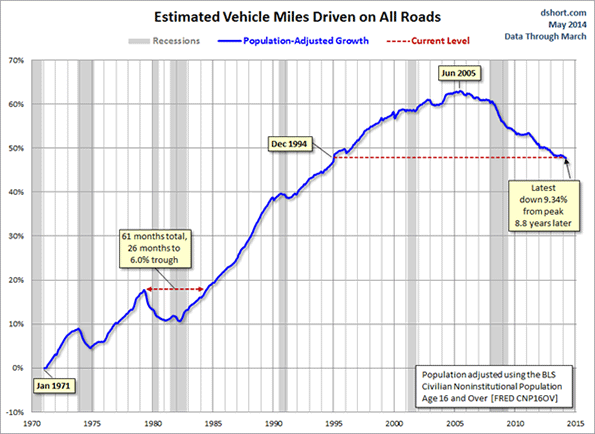
    Traffic levels have stabilized or even fallen in recent years. According to analysis by economist Doug Short featured in Streetsblog, aggregate auto travel peaked on a per capita basis in 2005 and has fallen since. Per capita traffic levels are now back to 1994 levels, a two decade rollback in traffic increases.


    Population adjusted traffic growth. Image via Doug Short
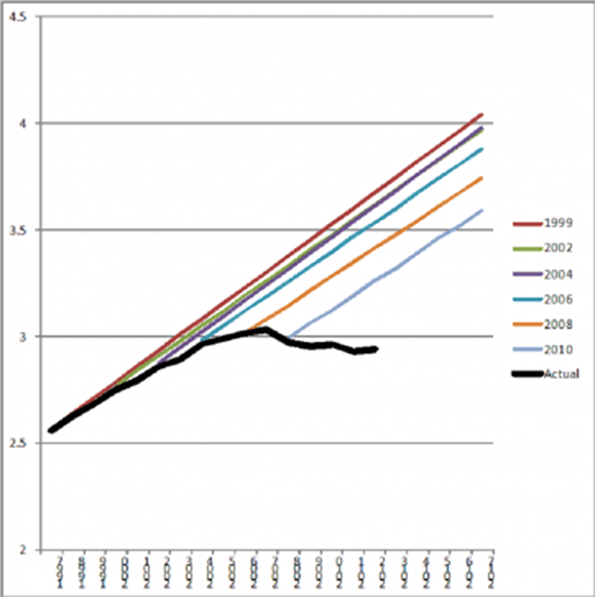
    Even looking at total, not per capita travel shows a marked reversal.  The State Smart Transportation Initiative, a pro-environmental research center, put together a graph showing how high the US DOT’s traffic projections have turned out to be:

    VMT forecasts vs. actual. Source: SSTI

    This data is complemented by a slew of recent stories about the poor financial performance of toll roads, resulting in part from traffic falling far below projections.  For example, the concessionaire operating the Indiana Toll Road recently went bankrupt. Streetsblog reported that while projections forecasted traffic level increase of 22% in the first seven years, traffic actually fell 11% in the first eight.

    Recent traffic declines are a reversal of a long running trend of Vehicle Miles Traveled (VMT) increases at above growth in population. Some of this is no doubt due to the poor macro-economy. But there are reasons to believe we may be in a new era of traffic growth or lack thereof.  Many of the trends that drove high growth have largely been played out: household size declines, suburbanization, the entry of women into the workforce, one car per driver, etc. That’s not to say these will necessarily reverse. But we’ve reached the point of diminishing returns in terms of how many more women, for example, will join the labor force given that there’s already 57% female participation and their labor force participation rate is projected to decline in the future.

    This is potentially very good fiscal news, especially given tight budgets. Clearly many of the freeway expansion projects on the books that have been driven by speculative demand should be revisited.  For example, the state of Wisconsin has massive investments planned in Milwaukee area freeway system even though the metro area is very slow growth in population.  Are these really necessary?  Projects in more rapidly growing boomtown regions in places like Dallas, Houston or Charlotte may well continue to make sense. From top to bottom, engineers need to recalibrate their forecasting models to better correspond to reality. And to revisit highway plans accordingly.

    So the idea that we need to build fewer roads than we thought is sound. But less attention has been paid to the flip side implications of this.  To repeat, the induced demand theory says that there is a more or less infinite supply of traffic, thus any new roadway capacity will be used up shortly, leaving congestion as bad as the status quo ante.  Despite peak car, articles touting induced demand as a reason not to build roads continue unabated, including recent ones in Wired (“What’s Up With That: Building Bigger Roads Actually Makes Traffic Worse”) and Vox (“The ‘fundamental rule’ of traffic: building new roads just makes people drive more”).  In a world of peak car, where traffic levels are flat to declining on a per capita basis, induced demand no longer holds court, certainly not to the level claimed by those who believe it’s pointless to build roads.

    In fact, what peak car means is that while speculative projects may be dubious, there many be good reasons now to build projects designed to alleviate already exiting congestion.  Places like Los Angeles remain chronically congested, which has great economic and social consequences, not the least of which is the value of untold hours lost sitting in traffic.  While individual projects there might indeed be boondoggles, maybe it’s worth building some of the planned freeway expansions there in light of peak car. In short, in some cases peak car strengthens the argument for building or expanding roads.

    On the other hands, many of the regional development plans designed to promote compact central city development and transit may be predicated on an analysis that assumes large future traffic increases in a “business as usual” scenario.  Not just highways but all aspects of regional planning are dependent on traffic forecasts.  That’s not to say that such plans are necessarily wrong, but clearly revised traffic reality needs to be reflected in all plans, not just highway building ones.

    It’s not clear how this will all play out, but urbanists and policy makers of all stripes need to think about the full implications of peak car. At a minimum, the traditional “you can’t build your way out of congestion” rhetoric should be  supplanted, at least in most areas, by a more nuanced approach that neither overestimates demand, nor ignores the problems caused by rapid growth in some regions and pockets of congestion in others.

    Aaron M. Renn is an independent writer on urban affairs and the founder of Telestrian, a data analysis and mapping tool. He writes at The Urbanophile.

  • The Other Side of the Tracks

    I tend to fixate on certain places – sometimes because I love them, other times because I can’t help but stare at twisted wreckage. Lancaster, California has always been 30/70 leaning toward wreckage, although it does show signs of ongoing reinvention so I keep going back. Lancaster is highly representative of most places in suburban America. If Lancaster can successfully adapt to changing circumstances then there’s hope for the rest of the country. I’ve already written several blog posts about the place hereherehere, and here.

    Screen Shot 2014-11-04 at 6.47.50 PM unnamed

    OLYMPUS DIGITAL CAMERA Screen Shot 2014-11-05 at 12.38.35 PMScreen Shot 2014-11-05 at 12.35.09 PM

    Recently Mayor Rex Parris has been in the news suggesting that the MetroLink commuter rail station should either be shut down or moved to the far edge of the city limits. Why? Well… Lancaster is a typical suburb. In fact it’s a far flung exurb with a self-selecting population who left the city in order to escape certain things and particular kinds of people. You know where I’m going with this right? The proverbial “wrong element” whispered by terrified white people who are nervous about their property values and crime. I have no idea what Mr. Parris himself believes one way or another, but he’s genuinely good at representing the concerns of his constituency. In this instance the electorate felt that the wrong kinds of folks were taking the train from downtown Los Angeles and showing up in Lancaster where they proceed to loiter in a disagreeable manner. These weren’t “our kind of people”. After a period of review between the mayor and various agencies it was announced that the MetroLink station would remain, although there were hints at new procedures and assurances of an unspecified nature.

    Screen Shot 2014-11-03 at 11.54.57 AM Photo Credit: Google Earth

    This got me thinking about the neighborhoods immediately around the train station. To the west of the tracks is an eight block commercial strip referred to as The BLVD. It was once a floundering half dead Main Street that was completely revamped by the local planning department in 2010 and has enjoyed remarkable success on multiple levels. The adjacent streets of single family homes have gotten a boost in popularity and higher property value while the rest of the Antelope Valley is still struggling unsuccessfully to recover from the 2008 crash.

    Screen Shot 2014-11-03 at 12.15.35 PM Screen Shot 2014-11-03 at 12.32.29 PM Screen Shot 2014-11-03 at 12.15.50 PM Screen Shot 2014-11-03 at 12.30.11 PMScreen Shot 2014-11-03 at 12.28.30 PM Screen Shot 2014-11-03 at 12.26.14 PM   Screen Shot 2014-11-03 at 12.27.32 PM

    But then there’s the east side of the tracks… These photos look like an Edward Hopper retrospective: bleak, empty, soulless, and unloved. No one has spent ten cents on this part of town in decades and it shows, yet it’s only a block from the beginning of The BLVD. and it’s pressed up against the back side of the train station. In another kind of town this might constitute prime real estate, or at least a place that had a little something going on. After all, the commuter train gives you direct convenient access to everything greater Los Angeles has to offer from jobs to culture. But in Lancaster it’s mostly vacant land, underutilized parking lots, semi-occupied warehouses, and marginal low value businesses. That’s not to say that people don’t live, work, attend church, and go to school in the nearby blocks. They’re just doing so without the benefit of any viable civic infrastructure.

    There may be good reasons why extending The BLVD east to the other side of the tracks won’t work. Aside from any physical or political limitations Lancaster may not be able to absorb much more in the way of upscale dining and discretionary shopping. I’ve had conversations with locals who say they can’t afford a $25 Italian dinner or a $6 beer at a trendy brew pub. Maybe eight blocks of good quality brick and mortar establishments is all Lancaster can handle at the moment. I’ve also heard that developers think the local real estate market might be able to absorb another fifty urban style condo/apartments near The BLVD. But five hundred? They just don’t know since this is terra incognita for them and their traditional business model. But the east side of the tracks might be the perfect place to establish an entirely different kind of environment at a lower price point that actually works for the people who already live nearby. Yucca Ave. runs parallel to the railroad tracks rather than perpendicular like The BLVD. More importantly, it’s an area the theater and chardonnay crowd never sees and doesn’t care about so it’s a great place to do some low cost, low risk, potentially high return experimenting to see what works and what doesn’t.

    Screen Shot 2014-11-03 at 12.32.12 PM Screen Shot 2014-11-05 at 12.36.41 PM 

    The city of Lancaster spent $10.5 million on the redevelopment of The BLVD, plus some state and federal funds. Personally, I can’t see the city mustering the political will to scrape together that kind of money to transform Yucca Ave. in a similar fashion. Instead, I see the back alleys and vacant parking lots as incubators for local micro-entrepreneurs who will interact with the people who live next door and down the street. It’s less about making everything “pretty” and more about making the place vibrant and productive at a scale that works on a tight budget. Yucca is just too big and wide and needs too much major help to be saved at the moment. But the backs and sides of these commercial buildings actually have a human scale and can be connected to the smaller more domestic streets and buildings they face across the alley.

    Screen Shot 2014-11-04 at 11.20.38 PM Screen Shot 2014-11-04 at 11.21.53 PMScreen Shot 2014-11-04 at 11.22.41 PMScreen Shot 2014-11-04 at 11.20.48 PMScreen Shot 2014-11-04 at 11.21.37 PM 

    Here’s one possible model that Lancaster might try along Yucca. This is a crappy triangular parking lot in San Francisco sandwiched between a double decker freeway and a Costco. I can’t imagine a worse location for anything. But a clever entrepreneur decided to rent the parking lot, install a few port-a-potties and hand washing stations, set up some inexpensive outdoor furniture, and then charge a modest rent for parking spaces to a rotating cast of local food trucks. It’s been fantastically successful and unlike The BLVD it costs almost nothing to install. This kind of operation does best in a marginal location with no NIMBYs or brick and mortar competition. Food trucks are infinitely less expensive to buy and operate than a traditional restaurant so the bar to entry is much lower for small business people. If the bank says no to a modest loan it’s possible to get start up capital from an aunt or cousin. In fact, these are most likely to be collaborative family businesses. The food these trucks serve is radically more affordable and can represent the specific tastes of the community in a way that McDonald’s or Domino’s may not – and the profits stay local rather than being sucked out to corporate headquarters. All the city of Lancaster would need to do is keep out of the way and let small business people do their thing without an endless amount of code enforcement to gum up the works.

    Screen Shot 2014-11-05 at 10.09.50 AM Screen Shot 2014-11-05 at 10.10.46 AM Screen Shot 2014-11-05 at 10.11.14 AM

    Here’s a different approach that might work even better since I’ve never actually seen a food truck anywhere in the Antelope Valley. My guess is that they’re illegal and/or can’t find a hospitable spot to park given the relentless and pervasive “mall security” guarding the Taco Bells and Applebees. This is the Underground Food Market in Oakland. This is a pop up market that appears quickly and then melts away in a single day. Both the vendors and the customers are told the date of the next event, but only alerted to the exact location at the last moment in order to keep code enforcement people unaware long enough to actually conduct business for an afternoon. None of these people use anything more elaborate than folding tables and barbecue equipment and it all fits in the trunk of a car or a pick up truck. Does this sort of thing violate a dozen health, safety, and zoning regulations? Yep. Has anyone ever gotten sick or died? Nope. If Lancaster could find a way to legitimize this sort of activity they might discover a ready supply of people in the neighborhood who would bring their talents to bear.

    Screen Shot 2014-11-03 at 12.30.23 PM  Screen Shot 2014-11-05 at 10.19.51 AM Screen Shot 2014-11-05 at 10.22.38 AM  Screen Shot 2014-11-05 at 10.20.45 AM pontocho_night  2662771

    I want to get back to the idea of human scale and how the best parts of Yucca are the little spaces between and around the buildings instead of the big parking lots and super wide street frontage. Everywhere I go in the world I find some of the best streets are barely wide enough for a car to pass through – and that’s part of the magic. I could see stretching some sun shades over the top of these alleys in Lancaster and lining the blank walls with shallow market stalls. This is an economic incubator that costs pennies and could lead to bigger and more permanent local businesses. The trick is to get the entry cost for experimentation down low enough to engage people without much capital or credit. Will this sort of thing terrify suburban homeowners out in the gated communities? Yep. Will they care if it happens in the “bad” part of town that they never visit? Maybe not…

    Screen Shot 2014-11-05 at 12.36.33 PM Screen Shot 2014-11-05 at 3.33.00 PM Screen Shot 2014-11-03 at 10.53.21 AM Screen Shot 2014-11-03 at 10.53.35 AM Screen Shot 2014-11-03 at 11.51.43 AM Screen Shot 2014-11-03 at 11.52.16 AM

    Here’s another example of a reuse of an existing space with very little actual construction. Property values are so high and vacancies are so low in places like San Francisco that every crappy building in every marginal location is being pressed into service for things that no one would have envisioned twenty years ago. Lancaster could do exactly the same thing at a much lower price point. I don’t imagine the wine and cheese crowd being interested in Yucca anytime soon, but there are all sorts of other subcultures that would love this much space to tinker with for their legitimate enterprises so long as the local authorities cut them some slack. What most of these empty warehouses in Lancaster need is fresh paint and the right people to colonize them. The trouble with lone mom and pop operations in this sort of desolate location is that without community and other active participants they tend to wither. Lancaster desperately needs a well organized group to adopt this place. Koreans, Mormons, Armenians, Hasidic Jews, Guatemalans… it needs a La Raza, a Chinatown, or a respectable gay population – any cohesive subculture that can reimagine the place and add vitality in a focussed and concentrated manner. Would it kill city officials to hang out the welcome mat instead of freaking out when “They” appear at the train station?

    Screen Shot 2014-11-05 at 12.34.20 PM Screen Shot 2014-11-05 at 12.33.29 PM unnamed unnamed-1 unnamed-2 unnamed-3 Screen Shot 2014-11-03 at 11.23.59 AM Screen Shot 2014-11-03 at 11.26.16 AM Screen Shot 2014-11-03 at 11.27.26 AM unnamed-4 unnamed-5 unnamed-6 unnamed-7

    Here’s one last example of a seriously bad location that is starting to be transformed in a way that cost the city almost nothing. Flora Grubb was a successful business woman who rented a vacant lot in San Francisco’s Mission District back when The Mission was cheap and considered a bad neighborhood. Renting a vacant lot was one of the few affordable options back when she was younger and just starting out. She didn’t need a building or much infrastructure since she sold plants, garden supplies, and outdoor furniture. As The Mission gradually became fashionable (largely due to lots of cool people like Flora doing their thing) property values rose so high that she was asked to leave so her landlord could put up luxury condos on the site. But the landlord was a clever guy. He had another vacant lot in a different miserable part of town half a block from the sewage treatment plant. He arranged for Flora to set up shop there. She had enough of a loyal following by then that people were willing to follow her to the new location. Her current shop is an open air industrial shed and a former parking lot. The landlord owns other nearby properties and is leveraging Flora’s activities to boost those values. Flora is the catalyst for the transformation of an entire block.

    Don’t get me wrong. I’m not saying Lancaster needs to become a mini San Francisco. That isn’t going to happen. But there are cost-effective techniques for jumpstarting a revival that Lancaster might consider in one of its least loved neighborhoods.

    John Sanphillippo lives in San Francisco and blogs about urbanism, adaptation, and resilience at granolashotgun.com. He’s a member of the Congress for New Urbanism, films videos for faircompanies.com, and is a regular contributor to Strongtowns.org. He earns his living by buying, renovating, and renting undervalued properties in places that have good long term prospects. He is a graduate of Rutgers University.

  • Opportunity Urbanism: Creating Cities for Upward Mobility

    This is the introduction to a new report commissioned by the Greater Houston Parnership and HRG and authored by Joel Kotkin with help from Tory Gattis, Wendell Cox, and Mark Schill. Download the full report (pdf) here.

    Over the past decade, we have witnessed the emergence of a new urban paradigm that both maximizes growth and provides greater upward mobility. We call this opportunity urbanism, an approach that focuses largely on providing the best policy environment for both businesses and individuals to pursue their aspirations.

    Although contrary to much of the conventional wisdom about cities and regions, this is not a break with traditional urbanism, but instead a reinforcement of old traditions. Long ago, Aristotle reminded us that the city was a place where people came to live, and they remained there in order to live better. “A city comes into being for the sake of life, but exists for the sake of living well.”  In the end, opportunity urbanism rests on the notion that cities serve, first and foremost, as engines to create better lives for its residents.

    The Houston and Luxury Models

    We have focused on the Houston metropolitan area because in many ways it reflects the idea of opportunity urbanism more closely than any major metropolitan area. Across a broad spectrum—income growth, new jobs, housing starts, population growth and migration—no other major metropolitan region in the country has performed as well over the past decade. This was among the first major metropolitan regions to replace the jobs lost in the recession, and has experienced by far the largest percentage job growth since, with Dallas-Ft. Worth second.

    In many ways, opportunity urbanism contrasts with the prevailing urban planning paradigm—variously called new urbanism or smart growth—which seeks to replicate the dense, highly concentrated mono-centric city of the past. At the core of this approach is the notion that policies of forced density, through regulatory mandates and often subsidies, are critical to attracting both young, educated people and the global business elite.4 This approach describes the successful city, in the words of former New York Mayor Michael Bloomberg, as “a luxury product.”

    This notion of the “luxury city” can be seen to have worked, at least for some, in well-appointed older cities such as New York, San Francisco and Boston. Unlike most American cities, these boast long-established dense cores and transit-oriented commuter sheds. They possess great amenities tied to their past, from world class art museums and universities, to charming historic districts, parks and public structures.

    But this model of urbanism does not fit the profile of most American metropolitan regions, which tend to be far more recent in their development, more dispersed and overwhelmingly auto-dominated in terms of commuting. Indeed, most of the fastest growing regions in this country—Houston, Dallas-Ft. Worth, Oklahoma City or Atlanta—function in a highly multi-polar model, that contrasts sharply with that of cities like New York, Boston or Chicago.

    Prospects for Upward Mobility

    The luxury paradigm has worked for some in some cities, but has failed, to a large extent, in providing ample opportunities for the middle and working classes, much less the poor. Indeed, many of the cities most closely identified with luxury urbanism tend to suffer the most extreme disparities of both class and race.

    If Manhattan were a country, it would rank sixth highest in income inequality in the world out of more than 130 countries for which the World Bank reports data. New York’s wealthiest one percent earn a third of the entire municipality’s personal income-almost twice the proportion for the rest of the country.

    Indeed, increasingly, New York, as well as San Francisco, London, Paris and other cities where cost of living has skyrocketed—are no longer places of opportunity for those who lack financial resources. Instead they thrive largely by attracting people who are already successful or living on inherited largesse.

    They are becoming, as journalist Simon Kuper puts it, “the vast gated communities where the one percent reproduces itself.”  

    Not surprisingly, the middle class is shrinking rapidly in most luxury cities. A recent analysis of 2010 Census data by the Brookings Institution found that the percentage of middle incomes in metropolitan regions such as New York, Los Angeles and Chicago has been in a precipitous decline for the last thirty years, due in part to high housing and business costs. A more recent 2014 Brookings study found that these generally high-cost luxury cities—with the exception of Atlanta—tend to suffer the most pronounced inequality: San Francisco, Miami, Boston, Washington DC, New York, Chicago and Los Angeles. Income inequality has risen most rapidly in the very mecca of luxury progressivism, San Francisco, where the wages of the poorest 20 percent of all households have actually declined amid the dot com billions.

    Like other large cities, Houston also suffers a high level of inequality, but its lower costs have helped its middle and working class populations to enjoy a higher standard of living than their luxury city counterparts. The promise of the opportunity urbanism model also can be demonstrated by lower income disparities between racial groups, higher GDP growth, less expansion of poverty and the greater production of high-paying mid-skilled jobs. In these aspects, opportunity cities like Houston greatly out-performed their often more celebrated rivals.

    How to Measure “Living Well”

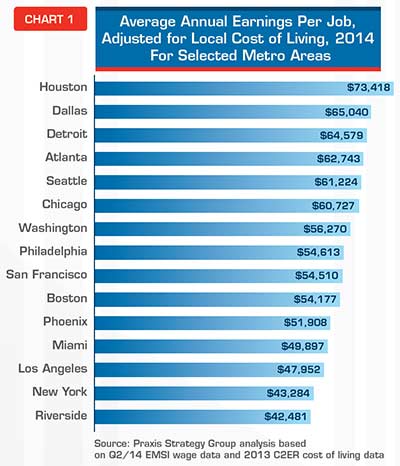
    We leave this introduction with one statistic that most encompasses the success of the Houston opportunity model and exposes the weakness of smart growth: the cost-of-living adjusted average paycheck.

    Despite the assertions of Paul Krugman, among others, that the Texas urban economy is based on low wages, the fact is Harris County’s average household income is above the national average; close to that of Boston. But once the cost of living is factored in, Houston does far better for its citizens compared to any of the legacy cities. Houston, with Dallas-Ft. Worth a strong second, is able to provide its citizens the highest standard of living, as measured by average annual adjusted wages, of any major metro in America. This is different than subjective “quality of life,” but includes such basics as jobs, housing and overall cost of living.

    Download the full report (pdf) here.

    Joel Kotkin is executive editor of NewGeography.com and Roger Hobbs Distinguished Fellow in Urban Studies at Chapman University, and a member of the editorial board of the Orange County Register. His newest book, The New Class Conflict is now available at Amazon and Telos Press. He is author of The City: A Global History and The Next Hundred Million: America in 2050. His most recent study, The Rise of Postfamilialism, has been widely discussed and distributed internationally. He lives in Los Angeles, CA.

  • Metropolitan Housing: More Space, Large Lots

    Americans continue to favor large houses on large lots. The vast majority of new occupied housing in the major metropolitan areas of the United States was detached between 2000 and 2010 and was located in geographical sectors associated with larger lot sizes. Moreover, houses became bigger, as the median number of rooms increased (both detached and multi-family), and the median new detached house size increased.

    These conclusions are based on an analysis of small area data for major metropolitan areas using the City Sector Model. City Sector Model analysis avoids the exaggeration of urban core data that necessarily occurs from reliance on the municipal boundaries of core cities (which are themselves nearly 60 percent suburban or exurban, ranging from as little as three percent to virtually 100 percent). It also avoids the use of the newer "principal cities" designation of larger employment centers within metropolitan areas, nearly all of which are suburbs, but are inappropriately joined with core municipalities in some analyses. The City Sector Model" small area analysis method is described in greater detail in the Note below.

    Increase in Detached Housing

    America’s preference for detached housing was evident across the spectrum of functional city sectors between 2000 and 2010. Overall, there was a 14% increase in detached housing in the major metropolitan areas. Among the major metropolitan areas (over 1 million population), the number of occupied detached houses rose the most (35%) in the later or generally outer suburbs and exurban areas (24%). Detached houses increased 2.8 million in the later suburbs and 2.5 million in the exurban areas. A smaller 50,000 increase was registered in the earlier or generally inner suburban areas. Most surprisingly, there was also a small increase (20,000) in the number of detached houses in the functional urban cores (Figure 1).

    Smaller Increase in Multi-Family Housing

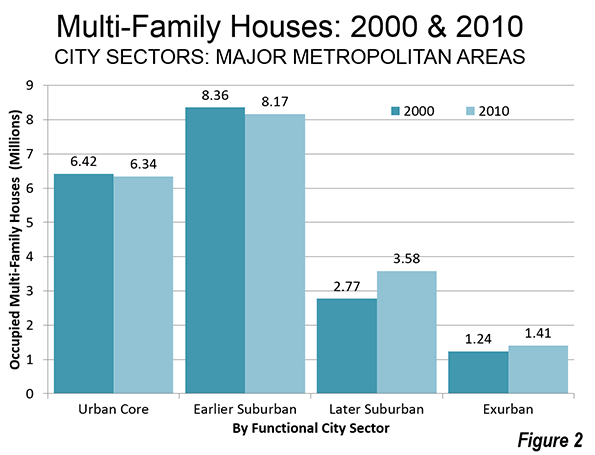
    The increase in detached housing dwarfed that of new multi-family housing (owned and rented apartments). The increase in detached housing in the major metropolitan areas was six times that of multi-family housing. Overall, there was a four percent increase in multi-family housing in the major metropolitan areas, less than one-third the increase in detached housing.  There were slight decreases in the number of multi-family houses in both the urban cores and the earlier (generally inner) suburbs. At the same time, there has been a healthy increases in the number of multi-family houses in the later suburbs and exurbs, where the growth rates exceeded the increase in major metropolitan population (11%). In the later suburbs, multi-family housing increased 29% and in the exurbs the increase was 14% (Figure 2).

    Larger Houses, Larger Lots

    Yet overall, houses were getting bigger. The median number of rooms per house rose from 5.3 in 2000 to 5.6 in 2010. Increases in median rooms were registered in each of the city sectors (Figure 3). Nationally, the median size of new detached housing edged up five percent between 2000 and 2010. (By 2013, median new house size had increased another 17 percent to a record 2,384 square feet).

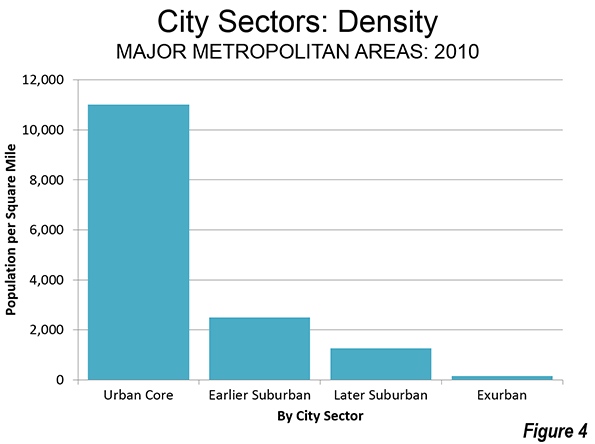
    Lots also were getting bigger. Nearly all of the population growth (99 %) was in the later suburbs and exurbs between 2000 and 2010, where population densities are much lower and lots are larger than in the earlier suburbs and the urban core (Figure 4).

    The preponderance of  urban planning theory over the past decade has been based on the notion that people would increasingly seek houses on smaller lots. For example, Arthur C. Nelson of the University of Utah predicted that the demand for housing on conventional-sized lots (which Professor Nelson defines as more than 1/8 acre, which is smaller than the smallest lot size reported by the Census Bureau) would be only 16% in the major metropolitan areas of California by 2010, relying in part on stated preference survey data. In fact the revealed preferences — in other words what people actually did — was four times the predicted demand (64%) in the conventional-lot-dominated later suburbs and exurbs of California’s largest metropolitan areas between 2000 and 2010. This is despite California’s regulatory and legal bias against detached housing on conventional lots (See: California’s War Against the Suburbs). Outside California, later suburban and exurban detached housing represented 77% of new housing demand over the period.

    Planning and Preferences

    Urban cores and multi-family housing are favored by urban planning policy. Yet, large functional urban cores (high density and high transit market share, as defined in the City Sector Model, Note below) are few and far between, with only seven exceeding 500,000 population, a modest number equaled or exceeded by approximately 100 metropolitan areas. Overall, the functional urban cores of major metropolitan areas lost more than 100,000 residents between 2000 and 2010, while suburban and exurban areas gained more than 16.5 million. Predictably, the housing forms typical of the later suburbs and exurbs made strong gains. The preferences of planning are not those of people and households.

    ————-

    Note: The City Sector Model allows a more representative functional analysis of urban core, suburban and exurban areas, by the use of smaller areas, rather than municipal boundaries. The more than 30,000 zip code tabulation areas (ZCTA) of major metropolitan areas and the rest of the nation are categorized by functional characteristics, including urban form, density and travel behavior. There are four functional classifications, the urban core, earlier suburban areas, later suburban areas and exurban areas. The urban cores have higher densities, older housing and substantially greater reliance on transit, similar to the urban cores that preceded the great automobile oriented suburbanization that followed World War II. Exurban areas are beyond the built up urban areas. The suburban areas constitute the balance of the major metropolitan areas. Earlier suburbs include areas with a median house construction date before 1980. Later suburban areas have later median house construction dates.

    Urban cores are defined as areas (ZCTAs) that have high population densities (7,500 or more per square mile or 2,900 per square kilometer or more) and high transit, walking and cycling work trip market shares (20 percent or more). Urban cores also include non-exurban sectors with median house construction dates of 1945 or before.

    ————-

    Wendell Cox is principal of Demographia, an international public policy and demographics firm. He is co-author of the “Demographia International Housing Affordability Survey” and author of “Demographia World Urban Areas” and “War on the Dream: How Anti-Sprawl Policy Threatens the Quality of Life.” He was appointed to three terms on the Los Angeles County Transportation Commission, where he served with the leading city and county leadership as the only non-elected member. He was appointed to the Amtrak Reform Council to fill the unexpired term of Governor Christine Todd Whitman and has served as a visiting professor at the Conservatoire National des Arts et Metiers, a national university in Paris.

    Photo: Northern Suburbs of Minneapolis-St. Paul (by author)

  • The New Donut

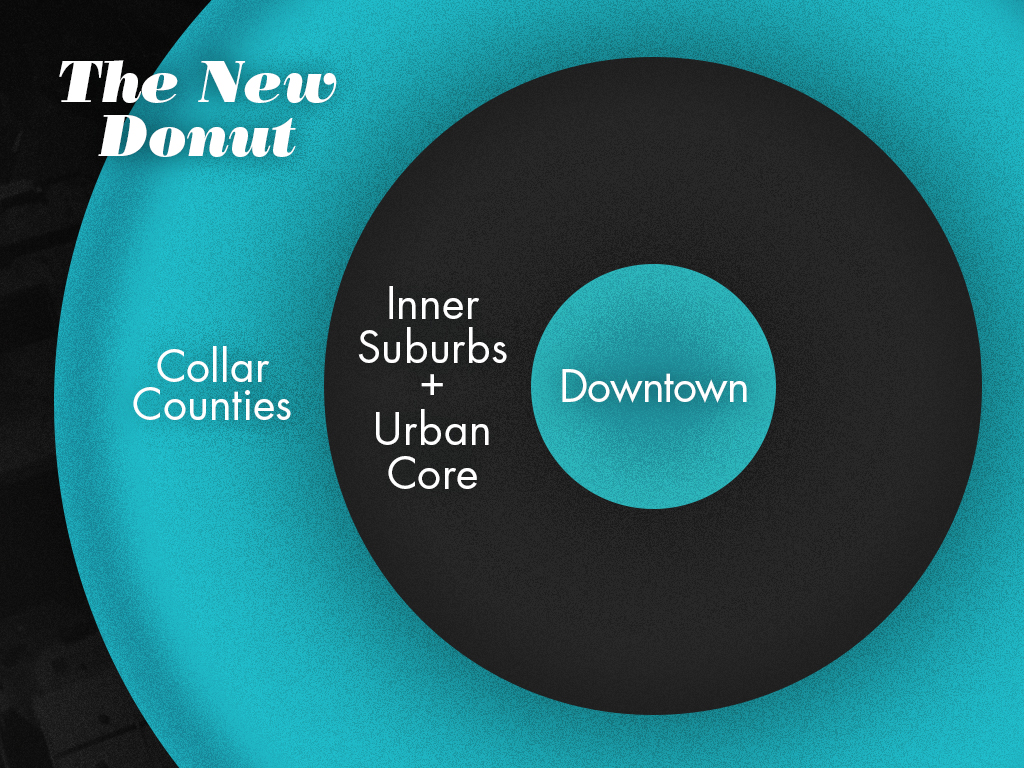
    Former Indianapolis Mayor Bill Hudnut used to like to say that “you can’t be a suburb of nowhere.” This is the oft-repeated notion has been a rallying cry for investments to revitalize downtowns in America for three decades or so now. The idea being that you can’t have a smoking hole in your region where your downtown is supposed to be. This created a mental based on a donut. You can’t let downtown become an empty hole. For reason that will become apparent soon, I call this model “the old donut”.

    Filling in the hole became every city’s mission. Pretty much any city or metro region of any size has pumped literally billions of dollars into its downtown in an attempt to revitalize them. This took many forms ranging from stadiums to convention centers to hotels to parking garages to streetcars to museums and more. It’s popular today to subsidize mixed use development with a heavy residential component.

    These efforts have paid off to a certain degree. Most big city downtowns have done very well as entertainment and visitor districts, eds and meds centers, etc. More recently we’ve seen an influx of residents, even in places where the overall city or even region has struggled or declined. Cleveland added about 4,000 net new downtown residents in the 2000s. St. Louis added 3,000. With most cities in some stage of an apartment building spree consisting of a few thousand units, these numbers should only improve.

    Key weaknesses remain in private sector employment (declining in most places) and retail (not enough high income residents yet). And other than the tier one types of cities like Chicago, few places seem to have reached a sustainable market rate development level yet – pretty much everything is getting public assistance. Yet its pretty evident that most larger downtowns have made huge strides and are experiencing overall reasonable health.

    In short, the donut hole has been filled in. Where does that leave us? I’d argue with a paradigm I call “the new donut”:


    In this model, the old donut is inverted. What used to be the ring of health – the outer areas of the city and the inner suburban regions – are now struggling. Whereas the downtown is in pretty good shape, and the newer suburban areas are booming. (You might add in a fourth outer ring with troubles – these were the exurbs where very low-end housing proliferated because development standards were very low).

    You see this in the population figures. Wendell Cox cranked the numbers and found that major metro areas gained 206,000 residents in the two mile radius from the center, but lost 272,000 residents from the 2-5 mile ring. Growth picked up strongly beyond that arc. This is the new donut area, though the start and end of it vary by metro and some have thicker rings of challenge than others.

    We’ve got three decades of experience in downtown revitalization, but much less in dealing with this newer challenge zone. I’ve said that suburban revitalization may prove to be the big 21st century “urban” challenge. This is where it is happening in many cases. These areas have an inferior housing stock (often small post-war worker cottages or ranches), sometimes poor basic infrastructure, and are sometimes independent municipalities that, like Ferguson, MO, are often overlooked unless something really bad happens. Unlike the major downtown, they are often “out of sight, out of mind” for most regional movers and shakers.

    What’s more, while downtown provides a concentrated location for massive public investment, this more spread out area is too big to fix by throwing money at it. And how many stadiums and convention centers does a region need in any event?

    This is where we need to be doing a lot of thinking about how to bring these places back, look at what’s being done, etc. And also, given the inequality in the country, to try to think about ideas that don’t involve gentrification. One project that appears to be in this kind of zone, for example, is Atlanta’s Beltline project, though there’s a gentrifying aspect to this one. Regions that figure this one out will be at a big advantage going forward.

    Aaron M. Renn is an independent writer on urban affairs and the founder of Telestrian, a data analysis and mapping tool. He writes at The Urbanophile, where this piece originally appeared.

  • Seniors Dispersing Away from Urban Cores

    Senior citizens (age 65 and over) are dispersing throughout major metropolitan areas, and specifically away from the urban cores. This is the opposite of the trend suggested by some planners and media sources who claim than seniors are moving to the urban cores. For example, one headline, "Millions of Seniors Moving Back to Big Cities" is at the top of a story with no data and anecdotes ranging that are at least as much suburban (Auburn Hills, in the Detroit area) and college towns (Oxford, Mississippi and Lawrence, Kansas), as they are big city. Another article, "Why Seniors are Moving to the Urban Core and Why It’s Good for Everyone," is also anecdote based, and gave prominence to a solitary housing development in downtown Phoenix (more about Phoenix below).

    Senior Metropolitan Growth Trails National

    Between 2000 and 2010, the nation’s senior population increased approximately 5.4 million, an increase of 15 percent. Major metropolitan areas accounted for approximately 50 percent of the increase (2.7 million) and also saw their senior population increase 15 percent. By contrast, these same metropolitan areas accounted for 60 percent of overall growth between 2000 and 2010, indicating that most senior growth is in smaller metropolitan areas and rural areas.

    Senior Metropolitan Population Dispersing

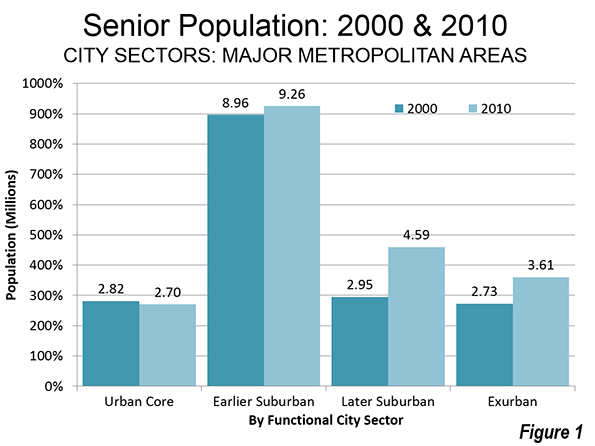
    The number of senior citizens living in suburbs and exurbs of major metropolitan areas (over 1,000,000 population) increased between 2000 and 2010, according to census data. The senior increases were strongly skewed away from the urban cores. Suburbs and exurbs gained 2.82 million senior residents over the period, while functional urban cores lost 112,000. The later suburbs added 1.64 million seniors. The second largest increase was in exurban areas, with a gain of 0.88 million seniors. The earlier suburbs (generally inner suburbs) added just under 300,000 seniors (Figure 1).

    During that period, the share of senior citizens living in the later suburbs increased 35 percent. The senior citizen population share in the exurbs rose nearly 15 percent. By contrast, the share of seniors living in the functional urban cores declined 17 percent. Their share in the earlier suburbs declined 11 percent.

    This is based on an analysis of small area data for major metropolitan areas using the City Sector Model.
    City Sector Model analysis avoids the exaggeration of urban core data that necessarily occurs from reliance on the municipal boundaries of core cities (which are themselves nearly 60 percent suburban or exurban, ranging from as little as three percent to virtually 100 percent). It also avoids the use of the newer "principal cities" designation of larger employment centers within metropolitan areas, nearly all of which are suburbs, but are inappropriately joined with core municipalities in some analyses. The City Sector Model" small area analysis method is described in greater detail in the Note below.

    Pervasive Suburban and Exurban Senior Gains

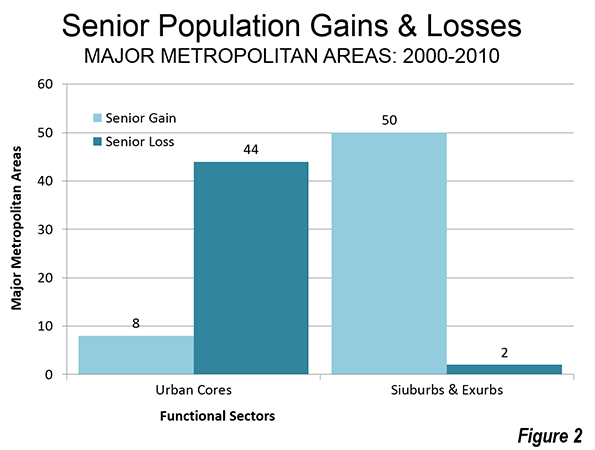
    The gains in functional suburban and exurban senior population were pervasive. Among the 52 major metropolitan areas, there were gains in 50. In two areas (New Orleans and Pittsburgh), there were losses. However, in each of these cases there was an even greater senior loss in the functional urban cores. In no case did urban cores gain more or lose fewer seniors than the suburbs and exurbs. Eight of the functional urban cores experienced gains in senior population, while 44 experienced losses (Figure 2)

    Largest Urban Cores

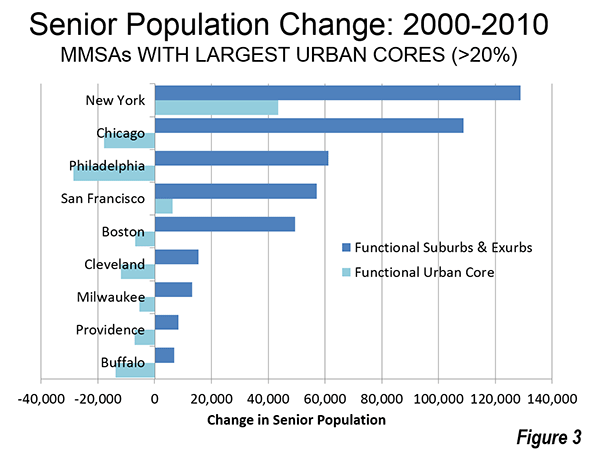
    The major metropolitan areas with the largest urban cores (more than 20 percent of the population in the functional urban cores),  would tend to be the most attractive to seniors seeking an urban core lifestyle. But they  still saw their seniors heading  to the suburbs and exurbs (Figure 3). Senior populations declined in the functional urban cores of all but two of these nine areas, New York and San Francisco. However, in both of these metropolitan areas, the increases in suburban and exurban senior populations overwhelmed the increases in the urban cores. All of these nine major metropolitan areas experienced increases in their suburban and exurban senior populations.

    Moreover, the Phoenix anecdote cited above is at odds with the reality that the later suburbs and exurbs gained 165,000 seniors between 2000 and 2010. The earlier suburbs lost 7,000 seniors (No part of Phoenix has sufficient density or transit market share to be classified as functional urban core).

    Consistency of Seniors Trend with Other Metropolitan Indicators

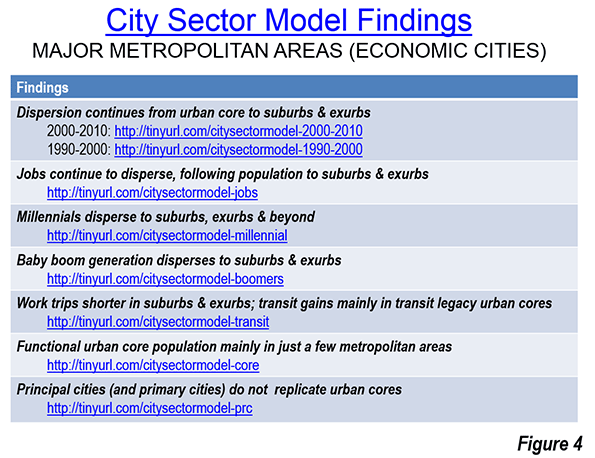
    As has been indicated in previous articles, there continues to be a trend toward dispersal and decentralization in US major metropolitan areas. There was an overall population dispersion from 1990 to 2000 and 2000 to 2010, which continued trends that have been evident since World War II and even before, as pre-automobile era urban cores have lost their dominance. Jobs continued to follow the suburbanization and exurbanization of the population over the past decade away as cities became less monocentric, less polycentric and more "non-centric." As a result, work trip travel times are generally shorter for residents where population densities are lower. Baby boomers and Millennials have been shown to be dispersing as well, despite anecdotes to the contrary (Figure 4). The same applies to seniors.

    Note: The City Sector Model allows a more representative functional analysis of urban core, suburban and exurban areas, by the use of smaller areas, rather than municipal boundaries. The more than 30,000 zip code tabulation areas (ZCTA) of major metropolitan areas and the rest of the nation are categorized by functional characteristics, including urban form, density and travel behavior. There are four functional classifications, the urban core, earlier suburban areas, later suburban areas and exurban areas. The urban cores have higher densities, older housing and substantially greater reliance on transit, similar to the urban cores that preceded the great automobile oriented suburbanization that followed World War II. Exurban areas are beyond the built up urban areas. The suburban areas constitute the balance of the major metropolitan areas. Earlier suburbs include areas with a median house construction date before 1980. Later suburban areas have later median house construction dates.

    Urban cores are defined as areas (ZCTAs) that have high population densities (7,500 or more per square mile or 2,900 per square kilometer or more) and high transit, walking and cycling work trip market shares (20 percent or more). Urban cores also include non-exurban sectors with median house construction dates of 1945 or before. All of these areas are defined at the zip code tabulation area (ZCTA) level.

    —-

    Wendell Cox is principal of Demographia, an international public policy and demographics firm. He is co-author of the "Demographia International Housing Affordability Survey" and author of "Demographia World Urban Areas" and "War on the Dream: How Anti-Sprawl Policy Threatens the Quality of Life." He was appointed to three terms on the Los Angeles County Transportation Commission, where he served with the leading city and county leadership as the only non-elected member. He was appointed to the Amtrak Reform Council to fill the unexpired term of Governor Christine Todd Whitman and has served as a visiting professor at the Conservatoire National des Arts et Metiers, a national university in Paris.

    Photo: Later Suburbs of Cincinnati (where most senior growth occurred from 2000 to 2010). By Author

  • The Death of Nassau Coliseum: A Harbinger of Suburban Decline?

    Nassau Veterans Memorial Coliseum is one of the last remaining old time hockey rinks. But this will be the last year that the New York Islanders play there. The old barn has long been slated for replacement. It is an old building that requires expensive repairs. Many attempts were made to reach an agreement for a new arena with Nassau County. Sadly, the team’s new location will be at the Barclay’s Center in Brooklyn; on Long Island physically, but not a part of the island’s suburban tradition. The team will retain the name, but Long Island effectively is losing its team.

    Suburban Decline, Urban Ascent?

    Some observers, like Mark Byrnes in CityLab, see this shift as further evidence of suburban life and the elevation of the urban core.1 But instead it is another frustrating case of a small, highly visible not in my backyard (NIMBY) movement in suburbia on one hand, and, on the other, an unwanted development foisted upon urban residents without due process through eminent domain.

    Two Arenas

    The New York Islanders haven’t been very newsworthy for the last decade – save for their volatile ownership situation, but their transition from one of the National Hockey League’s oldest buildings in Long Island to a new building in Brooklyn has been a very public ordeal. It’s a story that involves local politicians thwarting construction of a new arena that would have cost taxpayers nothing, a failed referendum to finance an alternative proposal that would have required public funding, and ends with the Islanders moving out of Long Island into the controversial Barclay Centre. Even if the Barclay Centre proves to be a viable and enjoyable venue for the Islanders, it will forever remain one of the most disastrous developments in the history of professional sports.

    The Old Barn

    Nassau Coliseum is the second oldest active building in the National Hockey League. The arena was built on the site of decommissioned Army/Air force base Mitchell Field.2 Nassau County acquired the land in 1960, a year after closure. Nassau Coliseum officially opened on February 11, 1972.3 The cost of the project was $32 million ($179 million, adjusted for inflation).4 The Coliseum sits on 5 acres of a 77-acre plot in Uniondale, the rest of which is mainly surface parking.5

    The site is intersected by two major roadways, and is across the street from Hofstra University and a golf course. It is right down the street from Levittown, the prototypical post-war American suburb. It is the type of place where one might assume that building large scale projects should be relatively simple.

    The Lighthouse Project

    In 2000, software billionaire Charles Wang bought the Islanders for $190 million.6  High end estimates suggest that Wang might have lost as much as $208 million between 2000 and 2009 on the team in large part due to   having one of the least favourable lease agreements in professional sports.7.8 “The need to refurbish the ageing building provided a perfect opportunity to put the team on a solid financial footing.

    Wang proposed a plan to develop the area surrounding the arena. The Lighthouse Project was expected to take 8-10 years to complete at a cost of roughly $3.74 billion.9 The plan included a renovation of the Coliseum, a 60-story tower designed to look like a lighthouse, housing, athletic facilities, a new minor league baseball stadium, restaurants, and a new hotel.10 The transformation of the Coliseum would have entailed lowering the floor of the ice rink to accommodate additional seats, increasing capacity from 16,300 to 17,500 during hockey games, 18,500 for basketball games and 20,000 for concerts, while adding 50 luxury boxes.11

    The proposal would also have brought a 125,000-square-foot athletic complex including two ice rinks (a practice rink for the Islanders, and another for the public), a basketball court, and a fitness club where the Islanders and the Arena Football League’s New York Dragons (also owned by Wang) would have trained.12

    The project would also have included moderately priced housing, which is lacking in Long Island. Long Island County was also exploring enhanced public transportation to the future development, including bus rapid transit.13

    Phase two of the project would have included a conference center, a sports technology building, residences, and the 60-story lighthouse (including a 500 room luxury hotel).14

    Building a new arena on such a large parcel of land surrounded by sparse, low density development should have theoretically faced few obstacles, given that the owner was willing to finance the entire project. Unfortunately, the project drew the ire of some local residents. Robert Zafonte, president of the 3500 member East Meadow Civic and Community Association, had this to say:

    ”The high-rise disturbs me,” he said. ”It seems to be totally out of character with the nature of the suburban area here. It is not consistent with what Long Island is all about – residential, small homes. I don’t think it belongs here.15

    The Lighthouse Project was approved by the county in 2006, but stalled when Wang was unable to secure zoning approvals from the Town of Hempstead.16 Republican Town of Hempstead Supervisor Kate Murray, lobbied intensely by a small group of local residents, decided that the project would result in too much traffic.

    Not in My Backyard

    In an attempt to salvage the project, Charles Wang and the Lighthouse Development Group partnered with Rexcorp to create a scaled down version of the project. The most notable change was that the Lighthouse would now be 30 stories, rather than 60.17

    But as Pearl M. Kamer, chief economist of the Long Island Association pointed out, “When you cut density on any project, you cut revenue.” He argued that under the proposal, scaled back to meet Murray’s demands, it would be difficult if not impossible to generate enough revenue to finance the project.18 This meant that the new proposal would likely require public funding, in contrast to the original proposal which would have been entirely privately funded.

    Wang eventually reached an agreement with Nassau County to build a scaled down version of the Lighthouse Project, pending an August 2011 referendum. Since the stripped down project would have yielded less revenue than the original proposal, the project would only have been viable with $400 million in public financing.19 The funding would have necessitated a 4 percent property tax increase. Voters rejected the proposal by a 57-43 margin.20

    The End of the Lighthouse Project

    With the end of the Lighthouse Project, Wang entered into a 25 year lease with the Barclay Centre soon after. The Islanders will begin playing at the building in 201521, though they already played their first exhibition game at the arena on September 21st, 2013.

    Losing the Islanders will result in significant economic losses to the county. Nassau County’s comptroller estimated that had last year’s NHL lockout lasted a full season, the county would have lost $62.2 million in economic activity, and the Nassau County treasury would have lost $1.1 million in  of ticket taxes, as well as a share of concessions and parking fees.22  Those are substantial loses for a county of less than 1.4 million residents.

    While Charles Wang has frequently been blamed for the relocation, NHL Commissioner Gary Bettman lays the blame squarely at the feet of local politicians.

    "This is a situation that is not of the Islanders’ making,” he said. “The responsibility for what’s happened really lies with Nassau County and the Town of Hempstead. For the fans in Nassau, not just of the Islanders, but of circuses and rock concerts and the like, it’s a shame.23

    The Uncertain Future of the Coliseum

    Though this seems like the end of the Nassau Coliseum saga, the future of the arena is still up for debate. Barclay Centre part-owner Bruce Ratner has proposed a $229 redevelopment plan for the arena. The project would include renovating the Coliseum, building restaurants, an ice rink, bowling alley, movie theater and other facilities.24  

    The Ratner proposal faces many hurdles, including luring an American Hockey League (NHL farm team) club to replace the Islanders. The Islanders AHL affiliate, the Bridgeport Sound Tigers (also owned by Wang), could potentially move from Connecticut to fill that void. Additionally, the Islanders are still slated to play 6 home games (out of 41) per year at the Coliseum.25 One columnist at Forbes has speculated that Ratner, who would own both the Nassau Coliseum and part of the Barclay Centre, might well decide to keep the Islanders in Long Island after all if he can secure approval for the new project.26  

    Imposing an Arena on Brooklyn

    The Barclay Centre differs dramatically from the failed Lighthouse Project. The Barclay Centre was part of the $4.9 billion Atlantic Yards project built in run down commercial area of Brooklyn, despite local opposition. Mayor Bloomberg used eminent domain to seize the “blighted” land to allow for construction.

    Brooklyn had been without a sports franchise since 1957, when the Brooklyn Dodgers moved to Los Angeles.  

    The Barclay Centre was initially proposed in 2004 when real estate developer Bruce Ratner purchased the New Jersey Nets for $300 million. Ratner planned to move the franchise out of New Jersey and into the lucrative Brooklyn market. The project was initially projected to open in 2006.

    The attempt to use eminent domain to seize the land was brought before the New York Supreme Court, delaying the process. The court eventually ruled in Ratner’s favour.

    Ratner’s years of frustration with the project lead him to sell a majority share of the Nets to Russian businessman Mikhail Prokhorov for $200 million.

    Due to construction delays, the Nets signed a deal to play in Newark at the Prudential Centre until the Barclay’s Centre was complete.

    Construction of the $1 billion arena began in January of 2010. The Barclay’s Centre was open to the public on September 21, 2012. Just over a month later, the Islanders announced their agreement to play at the Barclay’s Centre.

    The Barclay Compromise

    The Barclay’s Centre wasn’t a bad solution to the stalemate in Nassau County. The arena is new, and Brooklyn is a lucrative sports market. The Long Island Railroad provides direct service to Atlantic Terminal, meaning it will be more convenient for many Long Island residents to access the Barclay’s Centre than Nassau Coliseum. However, the 15,813 seating capacity is far short of most modern NHL arenas, and many seats have partially obstructed views.

    At the same time, the failed Lighthouse Project was a missed opportunity for Nassau County. The community still hasn’t rebounded to its 1970 population, which fell by 100,000 during the 1970s. Estimates suggest that the $4.4 billion of private investment into the Lighthouse project would have created 75,000 construction jobs and 19,000 permanent jobs thereafter.27 Moreover, it would have resulted in expanded public transit options on Long Island. Lawrence Levy, executive director of the National Centre for Suburban Studies at Hofstra University in a 2009 interview described the project as “potentially a game-changer.”

    Even ignoring the direct economic losses, the failure of the Lighthouse Project sent a clear message to businesses that Long Island will only accept investment on its own terms. The fallout is impossible to measure.

    Wither Suburbia?

    There is an ongoing dialogue between observers over whether suburbia is a “market outcome”, or whether it is an artificial creation of government policy. The truth is likely in the middle. Suburban communities are regulated, subsidized, and taxed in many different ways. Zoning restricts the ability to build corner stores and cafes in residential neighbourhoods. Wasteful road projects connect many uneconomic housing developments to cities. Land-use regulations drive up land prices, which are passed on to homebuyers. Suburbia is certainly a market outcome in the sense that decreased transportation costs, dispersed entertainment and communications options, and preferences for larger backyards mean that many people would happily pay the market cost of suburban housing. But its particular shape is not a market outcome. Neither, for that matter, is the shape of any geographical area.  

    There are good reasons for regulating land-use. Separating factories that emit noxious odours from residential communities makes sense. The trouble is that land-use planning has gone from a health and safety measure to an economic tool. In Uniondale it was used to ensure that additional traffic didn’t impose costs on drivers, who would prefer not to bear the costs of congestion. In Brooklyn, it was used to ensure that developers and the municipal government could extract value from property that wasn’t on the market. The market outcome would have been allowing the Lighthouse Project to proceed, and the New Jersey Nets to remain in New Jersey (or perhaps to move to Uniondale). The Barclay’s Centre doesn’t represent a triumph of the city. It is the net result of contrasting political meddling in two different jurisdictions.

    Perhaps There Are No Real Lessons Here

    While we shouldn’t read too much into isolated incidents, there does seem to be an increasing propensity for suburban communities to prevent dense development – from the Bay Area to suburban Toronto –  and for cities to use eminent domain to ram through those same types of developments.  

    This is a story about politics, not economics. And sometimes politics leads to some really bad outcomes. That may well be all there is to it. Either way, the Islanders will be moving to Brooklyn next year. Fans should enjoy the old barn while it lasts. It is the last of a dying breed.

    Steve Lafleur is a public policy analyst with the Frontier Centre for Public Policy, an independent think tank based in Winnipeg, Manitoba. His primary research interests are housing and land use policies, transportation and infrastructure, criminal justice policy, immigration, inter-governmental fiscal relations, and municipal finances. His work has been featured in most Canadian newspapers including the Toronto Star and the National Post.

    1 http://www.citylab.com/politics/2012/11/islanders-move-harbinger-suburban-decline/3826/

    2 http://nysea.bizland.com/nysea/publications/proceed/2012/Proceed_2012_p221.pdf

    3 http://nysea.bizland.com/nysea/publications/proceed/2012/Proceed_2012_p221.pdf

    4 http://nysea.bizland.com/nysea/publications/proceed/2012/Proceed_2012_p221.pdf

    5 http://query.nytimes.com/gst/fullpage.html?res=9D01E5DD1538F930A35753C1A9629C8B63

    6 http://nysea.bizland.com/nysea/publications/proceed/2012/Proceed_2012_p221.pdf

    7 http://nysea.bizland.com/nysea/publications/proceed/2012/Proceed_2012_p221.pdf

    8 http://sports.espn.go.com/nhl/news/story?id=4129484

    9 http://en.wikipedia.org/wiki/The_Lighthouse_Project

    10 http://en.wikipedia.org/wiki/The_Lighthouse_Project

    11 http://query.nytimes.com/gst/fullpage.html?res=9D01E5DD1538F930A35753C1A9629C8B63

    12 http://query.nytimes.com/gst/fullpage.html?res=9D01E5DD1538F930A35753C1A9629C8B63&pagewanted=2

    13 http://query.nytimes.com/gst/fullpage.html?res=9D01E5DD1538F930A35753C1A9629C8B63&pagewanted=2

    14 http://query.nytimes.com/gst/fullpage.html?res=9D01E5DD1538F930A35753C1A9629C8B63&pagewanted=2

    15 http://query.nytimes.com/gst/fullpage.html?res=9D01E5DD1538F930A35753C1A9629C8B63

    16 http://www.newsday.com/long-island/nassau/inside-the-deal-to-remake-nassau-coliseum-1.6115950?utm_medium=twitter&utm_source=twitterfeed

    17 http://en.wikipedia.org/wiki/The_Lighthouse_Project

    18 http://www.nytimes.com/2010/07/25/realestate/25lizo.html?adxnnl=1&adxnnlx=1379883639-wcQ7dfnu7u1PMJZCGW8k9g

    19 http://www.nytimes.com/2011/08/02/nyregion/nassau-voters-reject-proposal-to-overhaul-coliseum.html?_r=0

    20 http://www.nytimes.com/2011/08/02/nyregion/nassau-voters-reject-proposal-to-overhaul-coliseum.html?_r=0

    21 http://www.nydailynews.com/sports/hockey/ice-job-brooklyn-nhl-islanders-leave-15-article-1.1191783

    22 http://nysea.bizland.com/nysea/publications/proceed/2012/Proceed_2012_p221.pdf

    23 http://www.newsday.com/sports/hockey/islanders/gary-bettman-says-he-likes-future-islanders-owners-1.9230790

    24 http://www.newsday.com/long-island/nassau/inside-the-deal-to-remake-nassau-coliseum-1.6115950?utm_medium=twitter&utm_source=twitterfeed

    25 http://www.lighthousehockey.com/2013/5/2/4293850/ratner-brooklyn-islanders-games-nassau-coliseum

    26 http://www.forbes.com/sites/tomvanriper/2013/08/16/brooklyn-islanders-not-so-fast/

    27 http://www.nytimes.com/2009/06/18/nyregion/18towns.html?_r=0
  • Paving Over Hunan? The Portland Model for China

    For two centuries, people have crowded into urban areas, seeking higher standards of living than prevail in the rural areas they abandoned. Nowhere is this truer than in China. In just four decades, it has risen from 17.4 percent to 55.6 percent urban, adding nearly 600 million city residents. This has been accomplished while lifting an unprecedented number of people out of poverty.  

    Yet in the future, China faces tough urbanization challenges. The United Nations forecasts that another 200 million residents will be added to the cities by 2035, increasing the urban population by nearly another one-third.

    Los Angeles Style Suburbs in China?

    For years, western planners have sought to impose their visions of the future on China’s cities (see: China Should Send the Western Planners Home). There are more recent rumblings from Britain. Writing in The Guardian, Bianca Bosker finds considerable fault with Chinese cities. In criticizing China’s perceived copying of US and European models, her article conveys an impression that detached housing (called "villas in China) makes up a large part of China’s suburbs, as in the United States ("Why Haven’t China’s Cities Learned from America’s Mistakes?" with an intriguing subtitle "Faceless estates. Sprawling suburbs. Soulless financial districts … are in vogue in China").

    Having traveled widely within all but two of China’s 25 largest cities, I would have to disagree. You have to look hard to find detached housing in China. This is quite unlike the case in US suburbs, as well as those of Japan, Britain, France, Germany, Canada, Australia and elsewhere.

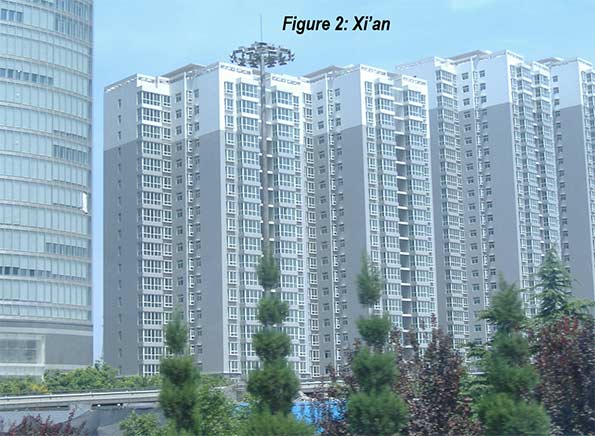
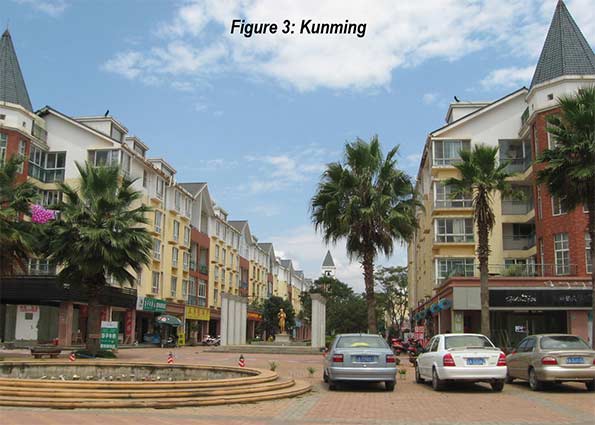
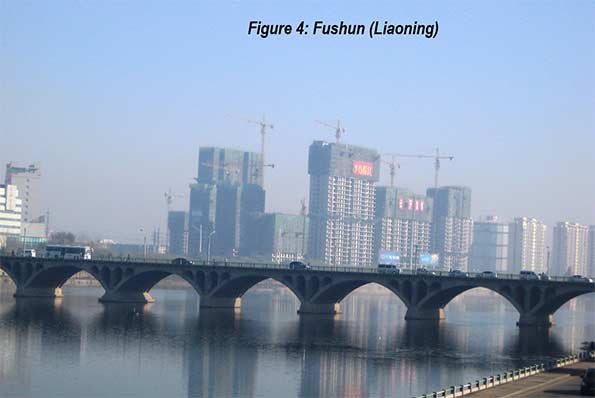
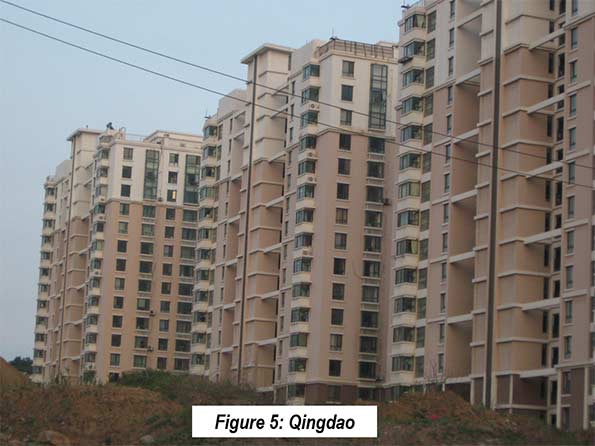
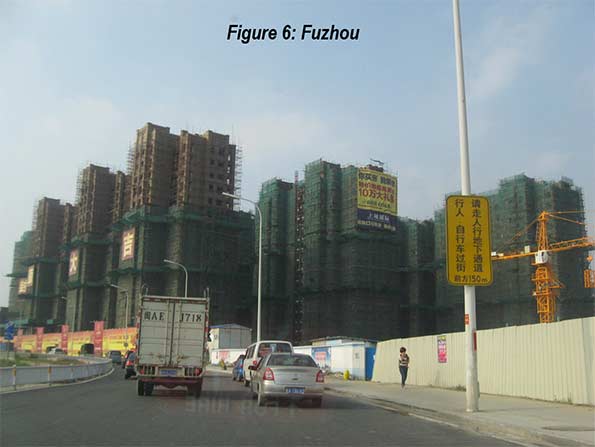
    In fact, the suburban areas of Chinese cities are largely high-rise and mid-rise multi-family buildings, with their attendant high densities. Detached housing has accounted for between 4 and 6 percent of new housing floor space. The actual percentage of detached units is probably smaller, since their average floor space of detached housing is greater. The type of housing in the photographs at the bottom of the article (Figures 2 through 6) is typical of China’s suburbs.

    Bosker also criticizes about China’s "towers in the park" high-rise development, noting that "The desire to escape sardine conditions in these superblocks, where greenery often consists of sickly shrubs gasping between six-lane roads, has in turn multiplied the number of land-devouring compounds like Rancho Santa Fe." In fact, villa developments like Rancho Santa Fe, nearby Shanghai’s Honquiao Airport, are very high income enclaves, and small. Rancho Santa Fe itself occupies less than 90 acres and the gross average lot size is approximately one-quarter acre (1/10 hectare), smaller than the average middle income suburban lot in the United States. No ordinary “tower in the park" resident can afford to move to the pricey villa developments.

    California’s High Urban Densities

    The article also condemns the "urban sprawl" of Los Angeles and California (this is nothing new).  However, the reality is that Los Angeles is the most dense major urban area in the United States (and thus the least sprawling) and nearly as dense as Toronto. Further, California has the highest urban density of any state, leading even New York. The average urban density of the state and even that of smaller California cities, such as Fresno, Stockton, Modesto and Salinas, is more than that of urban planning Nirvana Portland (below).

    Los Angeles: Land of Gridlock?

    The article calls Los Angeles the "land of gridlock," and there is no doubt that its traffic is intense. Yet, Los Angeles ranks only in a 20th place tie with Paris out of 125 cities in the latest Tom Tom Traffic Index. Traffic is worse in Brussels and Rome, almost as bad in London and far worse in places like Moscow, Istanbul, Rio de Janeiro, Mexico City and Sao Paulo. In spite of the traffic congestion, Los Angeles has the shortest work trip travel times of any world megacity for which there is data, the result of its dispersed residential and employment pattern (call it "sprawl" if you like).

    In Los Angeles, suburban residents have shorter work travel times than people living in the urban cores, which is the general situation among US major metropolitan areas (more than 1,000,000 population). This is to be expected, since lower densities are associated with less traffic congestion and shorter travel times.

    Paving Over Hunan?

    Ms. Bosker suggests that China may be poised to follow the "Portland model." A planner is quoted: “Portland is a really great model.” That, I would suggest, depends on your perspective.

    The Portland model has its philosophical roots in the British Town and Country Planning Act of 1947. As early as 1973, Sir Peter Hall and his colleagues characterized the Act having had the "reverse effect" an important policy goal, to benefit less affluent households, by virtue of the house price escalation that ensued.

    Portland has drawn an urban growth boundary around the city beyond which development is generally prohibited, and within which there is insufficient space to maintain competitive land prices. Portland has also has sought to attract people out of their cars by both building an extensive light rail system and   loath to provide new highway capacity to meet demand.

    After more than 30 years of its urban containment ("smart growth") policy, Portland’s urban density remains at only 1,350 per square kilometer (3,500 per square mile), less than one-quarter that of China’s cities with more than 500,000 population (5,750 per square kilometer/14,900 per square mile). Los Angeles is twice as dense as Portland. Portland’s urban density is closer to that of the world’s most sprawling large urban area, Atlanta, than it is to that of Los Angeles. Planning whipping boy Houston is only 15 percent less dense than Portland.

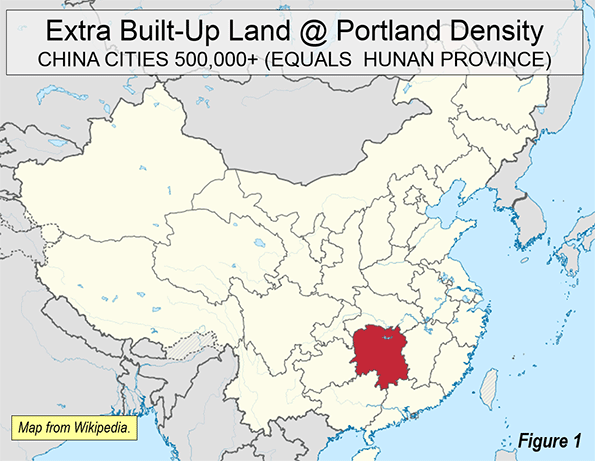
    To equal Portland’s density, Chinese cities would need to expand their footprints by 210,000 square kilometers (80,000 square miles). This would require the equivalent of paving over Hunan province (Figure 1), the state of Minnesota or the combination of England and Scotland.

    Portland is no model to copy, unless all you care about is inputs (like light rail and not building freeways and suburban housing). The outputs tell a completely different story. In 1980 (the last data before the first light rail line was opened) 65.1 percent of commuters drove alone to work. By 2012, that figure had increased to 70.8 percent. Transit was down from 8.4 percent to 6.0 percent. Approximately one-quarter as many people worked at home as commuted by transit in 1980 (2.2 percent). By 2012, more people in the Portland metropolitan area worked at home than rode transit (6.4 percent).

    This is not surprising. Portland’s "model" transit system (now with five light rail lines) can get the average commuter to only 8 percent of the jobs in 45 minutes. This is not very attractive in contrast to travel by automobiles, which provides access to virtually 100 percent of the jobs in less time (30 minutes).

    Meanwhile, Portland’s anti-highway policies have been rewarded with some of the most rapidly increasing traffic congestion in the United States. In the early 1980s, Portland ranked 47th worst out of the 101 US urban areas ranked by the Texas A&M Transportation Institute. By 2011, Portland’s traffic congestion had deteriorated to sixth worst, a stunning failure for a city with a population that doesn’t even rank the top 20. Meanwhile, Houston, castigated for its wide freeways, has improved from the worst traffic congestion in the middle 1980s to four positions better than Portland (10th), despite adding having added three times as many new residents as Portland.

    American Cities

    If outputs are more important than inputs (which I suggest is true), then US cities do very well. They have the highest incomes in the world, occupying 36 of the top 50 positions in gross domestic product per capita. They have some of the most affordable housing in the world, if cities following the Portland model are excluded. They have shorter work trip commutes and less traffic congestion than their peers in other high income world nations. And, they are poised for huge progress in environmental protection. The US Department of Energy forecasts large reductions in gross greenhouse gas emission from the national automobile fleet in the coming decades.

    Overwhelmingly, the growth of cities happened because rural residents sought higher standards of living and an escape from lower incomes and poverty, in rural areas. Few, if any moved to cities for wise urban planning, for "soulful financial districts" or to commute by light rail. Overall, US city outputs correspond very well with the purpose of cities — which is why they attracted residents.

    China: Setting its Own Course

    No one could have predicted China’s urban progress that was to follow in the decades following Deng Xiao Ping’s assumption of power. China’s cities have provided for their growing number of citizens. By that standard, both Chinese and American cities have done very well. China has charted its own urbanization course and seems likely to do so in the future. It is unlikely to seek to follow the advice of western critics whose plans fail the needs of their own citizens, much those in a complex, rapidly changing place like China.

    Top photograph: Suburban development, Changsha, Hunan. (All photographs by author).

    Wendell Cox is principal of Demographia, an international public policy and demographics firm. He is co-author of the “Demographia International Housing Affordability Survey” and author of “Demographia World Urban Areas” and “War on the Dream: How Anti-Sprawl Policy Threatens the Quality of Life.” He was appointed to three terms on the Los Angeles County Transportation Commission, where he served with the leading city and county leadership as the only non-elected member. He was appointed to the Amtrak Reform Council to fill the unexpired term of Governor Christine Todd Whitman and has served as a visiting professor at the Conservatoire National des Arts et Metiers, a national university in Paris.

  • The Rise of Urban Riverfronts

    I recently moved from Cincinnati to Providence, Rhode Island, although I still think of the Detroit area as my hometown. All of these cities are based on their access to water. Providence, despite its location at the mouth of an Atlantic bay, is still a river-town at heart. Chicago mayor Rahm Emanuel has plans for a new and improved riverwalk, too. What can these cities learn from each other?

    In the ’80s, downtown Providence was a much less vibrant and destination-worthy place than it is now. Its urban rivers were buried beneath cement, rail-lines, and acres of concrete until a public-private revitalization effort gained enough traction. Today, in its place, the 11-acre Waterplace Park hosts numerous attractions, including the well-loved Waterfire events, and is a long, winding string of paths and bridges that sprawls through Providence’s downtown.

    What’s best about its place-making design is its versatility. The riverfront offers commutable routes between destinations, areas to picnic or socialize during lunch breaks, and event space throughout the seasons. Gondola rides, kayaking, and even viral pop-up installations all thrive here, making it multi-functional and inviting to a range of citizens.

    Chicago, much like Providence, has revealed renderings of parks that show multi-functional, inviting public spaces for rest, socializing, jogging, and enjoying attractive outdoor landscapes. Chicago is also poised to offer kayak rentals, which would allow visitors to interact with the water’s surface, rather than simply admire it. Mayor Emanuel has plans for the riverwalk to stretch “from Lake Michigan to the confluence of the three branches,” or about 1.3 miles.

    That would add a key element: in addition to being multi-functional and inviting, the riverwalk, at least within its blueprints, will be interconnected and able to serve as a pathway between all types of destinations within the city, much like Boston’s incredible Emerald Necklace. The Mayor also recognizes the huge potential for retail expansion along this stretch, something that Providence can certainly attest to.

    Detroit, too, has been actively improving its waterfront. The shores of the Detroit River now include a long, inviting path for walking, jogging, or biking, with parks and features along the way. The transformation from its earlier state is reminiscent of Providence’s overhaul efforts of the ’80s, pushing the space from neglected and utilitarian to a pedestrian-focused destination for anyone in the downtown area. A Great Lakes-themed waterpark has recently been put into place, making the riverfront even more attractive to families and young people. In addition to being a long-time hub for local fishermen, the riverfront is now a destination for joggers, dog-walkers, families, and those on their lunch break in a newly recovering downtown business district.

    What Chicago should strive to institute is a core of riverfront events and attractions. Like Providence’s Waterfire, Detroit hosts events on its riverfront during the summer — even given that it only uses one side of a river it shares with Windsor, Ontario — including the hugely popular River Days concert series and festival.

    Many cities have access to only one side of a major river, including Cincinnati. But Chicago, like Providence, has the full body of its rivers. This asset is huge, considering how big a draw water-based or focused events can clearly be for visitors, and how great a reason for locals to meet up and enjoy their city together. This is part of what Chicago can learn from Detroit and Providence.

    Still, Providence has a great deal of room for improvement. What Chicago and Detroit have realized is that a river’s waterfront isn’t exactly a connector for separate parks. It can be one space where different areas bloom larger than the others. That is, that the entire riverfront can be a destination, even between established attractions.

    Currently, Providence is preparing for the development of what’s being called The Link, an area of open land where I-195 used to cut through the downtown, Jewelry District, and Fox Point neighborhoods. Part of the grassy scar has been designated to become a riverfront park with a pedestrian bridge, and is expected to connect by bike/walk path to the nearby Roger Williams Park and Zoo. This is a big step toward a holistic riverfront that can be accessed from a several neighborhoods.

    Providence also offers the vaguely inviting Promenade, with a bike lanes on each side and a pedestrian bridge/plaza. But the Promenade is cut off from Waterplace Park by the mall and the interstate rumbling overhead. From there, looking west, the river is largely ignored before reemerging as the Woonasquatucket River Greenway, which offers a newly installed boat launch and a winding bike path. Utilizing the riverfront along this entire span, not just at certain hotspots, is a key task and goal for Providence and cities like it.

    During the blossoming years of metropolises, a river waterfront meant shipping and transportation opportunities. Today, with competition for dynamic downtown areas, the riverfront offers something else, too. Locals gain opportunities and reasons to come together as a community, and visitors, find places to enter and connect with a place… as long as riverfront cities use what they’ve got.

    Flickr photo by yuan2003: WaterFire Panorama1; Waterplace Park, Providence, Rhode Island, June, 2014.

    C.J. Opperthauser is a poet and urban thinker who blogs here.

  • Wrong Way Cities

    In a New York Times column entitled "Wrong Way America," Nobel laureate Paul Krugman again reminds us of the high cost of overzealous land-use regulations. Krugman cites the work of Harvard economist Ed Glaeser and others in noting that "high housing prices in slow-growing states also owe a lot to policies that sharply limit construction." He observes that "looser regulation in the South has kept the supply of housing elastic and the cost of living low" (Note 1).

    Supply is the Issue

    Krugman specifically cites Houston, Atlanta and the Sunbelt for their lower house prices and less restrictive housing regulation. In contrast, he points to New York and California as having high house prices and greater housing regulation. Krugman further observes that the secret of growth is "not getting in the way of middle- and working-class housing supply." 

    This concern about housing supply is echoed by former World Bank principal planner Alain Bertaud who notes that the solution to the housing affordability problem "is to increase the supply of land" (Note 2). Bertaud further points out that "Restricting land supply and imposing too many controls also stifles business growth."

    Wrong Way Cities

    However, the real problem is not a "Wrong Way America" that "gets in the way of middle- and working-class housing supply, but "Wrong Way Cities" (metropolitan areas) that have adopted land use regulations severely restrict the supply of land for urban development. The price increasing policies are often referred to as "smart growth" or "urban containment" and routinely involve restricting the supply of land for development through urban growth boundaries, large lot suburban, and exurban zoning and other strategies.

    This destroys what Brookings Institution economist Anthony Downs (p. 36) calls the "competitive supply of land." The result is higher house prices, because, all things being equal, the price of a good or service is likely to increase if its supply is severely limited. Otherwise, OPEC oil supply restrictions would never have raised concern.

    Where more traditional, liberal land use policies remain, housing remains affordable. For example, during the housing bubble, an analysis by the Federal Reserve Bank of Dallas attributed the lower, and still affordable house prices in Atlanta, Dallas-Fort Worth, and Houston to avoiding more restrictive land use polices: "… these markets have weathered the increased demand largely with new construction rather than price appreciation because of the ease of building new homes."

    Housing and the Standard of Living

    Housing is the largest category of household expenditure. Moreover, housing costs vary far more between metropolitan areas than other expenditure categories, such as transportation, food and apparel. As a result, housing is the most important driver of the standard of living, especially for middle and lower income households. Where house prices are higher compared to incomes, households have less in discretionary income — the amount left over after taxes and necessities. With less left over, a lower standard of living and greater poverty is inevitable.

    The differences are even greater for young households moving to metropolitan areas with restrictive land use policies. These households must pay elevated house prices, not having benefited from the lower housing costs that longer-term residents were able to lock in by purchasing years ago.

    The higher housing costs prices can more than offset higher wages. Thus, a prospective domestic migrant may choose to move to Houston rather than New York, because Houston’s wages, although lower, translate into higher discretionary incomes and a higher standard of living.

    These price increases create a "double hit" to the standard of living. Not only do households have to pay higher house prices, but they usually get less, as house size and lots are reduced in size as a result of the more restrictive regulations. Indeed, regulations in California are being interpreted to make it difficult, if not impossible to build the detached housing most Americans prefer (See: California Declares War on Suburbia). The irony is that smart growth advocates claim this increases "housing choice," an Orwellian turn of phrase if there ever was one.

    It is no wonder that young and aspiring households are drawn to metropolitan areas where housing is more affordable. Meanwhile, house prices have escalated strongly in the restrictively regulated metropolitan areas of California and the Northeast despite low demand. This has much to do with the significant domestic migration loss, as Paul Ganong and Daniel Shoag of Harvard have indicated. Between 2000 and 2013, more than 4,000,000 loss in net domestic migrants between 2000 and 2013, according to Census Bureau data.

    The problem is acute for lower income households, which are disproportionately minority. The Thomas Rivera Institute, a Latino oriented research organization, found that California’s land regulations "are making it particularly difficult for Latino and African American households to own a home."

    The Consensus

    There is virtual agreement that more restrictive policies are associated with higher house prices. The only issue in dispute is the extent of the impact. But even seemingly small differences can be important. Downs (p. 36) characterizes a modest 10 percent differential to be socially significant, because of the number of households that the higher prices made ineligible for home purchase.

    In fact, the differences in house prices relative to incomes are substantial, ranging up to a nearly 250 percent difference between Atlanta and San Francisco. The differences are so significant as to attract the attention of economists like Krugman, Glaeser and others for their influence on domestic migration.  This is socially significant.

    The Risks

    No city in the United States can expect immunity from low housing affordability due to overly restrictive land use regulation, even in more depressed areas with lower housing demand. This is illustrated by Liverpool, in the United Kingdom, where smart growth policies are well entrenched. Liverpool has lost a larger percentage of its population since 1950 than any of the other 1,700 urban areas in the world with more than 300,000 population. Yet Liverpool has seen its housing affordability deteriorate to among the worst in the UK, US, Canada, Australia or New Zealand.

    The smart growth planning philosophy now pervades virtually all of the urban planning community, which seeks its spread to virtually everywhere (Note 3). Current targets include Minneapolis-St. Paul (see Thrive 2040: Toward a Less Competitive Minneapolis-St. Paul), and San Antonio and the rest are on the list. The research is clear, where there is more restrictive land use policy, house prices can be expected to rise relative to incomes.

    Cities for People

    Current urban policy is misdirected and needs correction. Fundamentally, urban policies should be aligned with the purpose of cities. Cities are for people. People have moved to cities principally for economic reasons, as they aspire to better standards of living. Public policies that raise the price of housing substantially interfere with the reason that cities exist.

    There is a need for a paradigm shift. Currently in-vogue urban policy focuses on tactics, such as urban form, legally mandated higher densities, mode of transport and urban design ("place-making"). Economist Glaeser writes that "Bad policy puts place-making above helping people…" Bad policy should be discarded. The focus should instead be on the fundamental objectives of improving the standard of living and reducing poverty. At a minimum, this requires housing that is affordable (See Toward More Prosperous Cities).

    —–

    Note 1: In the column, Krugman suggests that differences in housing regulation are more important than business regulation and taxation in explaining the migration patterns that have people generally moving from higher cost areas with higher housing costs to lower cost areas. There is strong research on both issues, and both issues are important.

    Note 2: Housing affordability refers to the price of houses across the entire spectrum of income, not just low income housing.

    Note 3: Perhaps the most frequently cited justification for restrictive land use policies is greenhouse gas (GHG) emission reduction. A growing body of research indicates that urban land use policies are a generally minor and expensive means to that objective and that technological improvements are far more effective. Smaller scale strategies are also better than "one-size-fits-all" land use regulation. It is notable that the most comprehensive US review (Jones and Kammen at the University of California, Berkeley) of GHG emissions at the local level (zip codes) found: "Generally … no evidence for net GHG benefits of population density in urban cores or suburbs when considering effects on entire metropolitan areas." They suggest "an entirely new approach of highly tailored community strategies."

    —-

    Wendell Cox is principal of Demographia, an international public policy and demographics firm. He is co-author of the "Demographia International Housing Affordability Survey" and author of "Demographia World Urban Areas" and "War on the Dream: How Anti-Sprawl Policy Threatens the Quality of Life." He was appointed to three terms on the Los Angeles County Transportation Commission, where he served with the leading city and county leadership as the only non-elected member. He was appointed to the Amtrak Reform Council to fill the unexpired term of Governor Christine Todd Whitman and has served as a visiting professor at the Conservatoire National des Arts et Metiers, a national university in Paris.

    Photo: Minneapolis-St. Paul, by author