Category: planning

  • Chicago’s Planning Strategy: Hot or Not?

    The City of Broad Shoulders may have two faces, but how will it age?

    This was the essence of the question that the Chicago Tribune was asking in October of 2013 when it urged readers to re-envision the city’s original 1909 plan in a modern context. In the 115 years since, and especially recently, Chicago has become a glitzy glass and steel mecca for Midwest yuppies. It’s also become an unfortunate poster child for corruption, financial struggles, urban violence, and poor schools. It’s a city whose two reputations could hardly be more different.

    To many in the Windy City, the opportunity was a chance to envision a bold new future for the region. In their eyes, the future of Chicago today depends on it becoming a vibrant bastion of international excitement, with a growing population and tourism as key ingredients of new fiscal health.

    Their hopes are based on optimism garnered from a real estate scene in which Chicago’s north side has become one of the hottest locations in the country, and formerly blighted neighborhoods have turned into battlegrounds for gentrification.

    Along with that, through a variety of initiatives, the fiscally strapped city has invested in many white-collar neighborhoods and international attractions, which some have argued come at the expense of the city’s lower-income areas, as well as the city’s older industrial, manufacturing, and infrastructural assets. Arguably the most visible investment – Millennium Park – has been a story of success that is inspiring the subsequent transformation of the Chicago River from a primarily industrial channel into a tourist experience unto itself. It’s part of an approach by Mayor Rahm Emmanuel to up tourism and generate tourist industry jobs.

    The strategy of investing deeply in white-collar cultural successes with the hope that the resulting momentum will offset the city’s grimmer challenges is a daring game. There are some reasons to think that parts of it may be working. Over the last decade, for instance, Chicago attracted a rapid in-migration of new residents – by some estimates Cook county gained over 100,000 in-migrants per year.

    But the bigger demographic picture doesn’t inspire optimism. While Chicago gained a substantial numbers of Millennials in their 20s and folks in their 50s and 60s between 2000 and 2010, it was also the only one of the nation’s ten largest cities that lost population overall during the same time period.

    And between 2005 and 2010, despite substantial in-migration, Cook County lost as many as 185,000 residents a year to out-migration according to IRS data, including negative net-migration among nearly every age group, including 20-somethings, a statistic that is particularly eye-popping given the city’s perceived success at attracting people in exactly that age bracket.

    At the same time that Chicago’s Loop experienced a sudden burst as the hottest urban center in the US, the city as a whole still lost considerable ground to the nation’s growing cities. It’s been predicted that in another 30 years the Chicago region will be surpassed in size by at least two different metropolitan areas in the Texas triangle, and, nationally, possibly by more. That’s assuming that Chicago doesn’t lose ground faster than it already has. Moving forward, it may have a tougher time attracting large numbers of Midwestern Millennials, as Rust Belt cities like Cleveland work to keep their talent at home.

    There are additional reasons to doubt Chicago’s long-term ambitions to become a global mecca. For one, the city is a lonely snowman in the age of air conditioning. Between 2000 and 2012 nearly every city in the southern US grew its metropolitan region by at least 30 percent. Even hot growth cities in the North like Columbus and Indianapolis couldn’t match that pace. Since air conditioning became a norm rather than an exception, growth has overwhelmingly trended toward warmer climates. In the last 50 years, half of the population growth in the US went to the eight states with the warmest climates, while the eight coolest states attracted just 3% of that total.

    A second area of concern is that the exponential power of a centralized city has diminished. The city of Chicago is now home to just seven of the region’s 28 Fortune 500 companies. The city of a dominant core and residential periphery is being squashed by the realities of preferences.

    Rather than settle on being the bland and livable capital of the Midwest, Chicago has instead opted to try to wage battle with the likes of London and Rome, and it may have a tough time winning. It’s clear that such worldly ambitions are contingent on growing both residents and tourists.

    The city might do well to begin with a humbler approach that focuses on serving its current residents. The primary things Chicago has going for it are its comparative affordability to other large cities, and the perception that it’s composed of friendly people. These traits are largely antithetical to most megacities. Rather than pursue a path on which it could lose these unique assets, Chicago should capitalize on them.
    In addition to remaining affordable, the city should take easy steps to be more family friendly, a quality it currently lacks because of horrifically high crime and subpar schools.

    Of the city’s out-migration in the last decade, an overwhelming amount was by families, especially from its African American community. If Chicago invested in creating average schools out of its failing ones, rather than closing the bad ones while expanding the great ones, it might retain some of the people who are fleeing the city. Generating even passable middle and high schools alone might be enough to convince companies that adequate talent exists to launch the kinds of job training and manufacturing centers that could start to revitalize neighborhoods in the city’s job-depleted areas.

    It could also zone parts of the city with declining populations more in the way that suburbs do. High density development need not be the only considered path forward. Chicago’s geographic constraints already make it difficult to find spacious low-density housing within a reasonable distance of the center city, so it might help revitalize neighborhoods if low density development were permitted on the city’s struggling south and west sides.

    The city should also consider decentralizing its public transportation infrastructure. Chicago’s core transit system is designed around an outdated jobs model that focuses all lines toward the center of the city. The result is that while overall commute times are fairly low, just 6.3% of jobs can be reached within 45 minutes on public transit.

    Finally, the city shouldn’t lose sight of its manufacturing legacy just because yuppies are moving in. Chicago’s greatest assets include its positioning as an infrastructural crossroads, and this is of great value to industry.

    If it did these few things better, the city might find itself losing far fewer residents, and not relying so heavily on narrow groups of in-migrants. If not, existing preoccupations with international fame may cause Chicago to lose its appeal, while other American cities accelerate faster.

    Roger Weber is a city planner specializing in global urban and industrial strategy, urban design, zoning, and real estate. He holds a Master’s degree from the Harvard Graduate School of Design. Research interests include fiscal policy, demographics, architecture, housing, and land use.

    Flickr photo by Chris Smith: Pritzker Pavilion, Millennium Park
  • A Typology of Gentrification

    Patterns of gentrification vary by city, and the spread of gentrified areas is partly determined by the city’s predominant development form and the historic levels of African-American populations within them. Gentrification is a nuanced phenomenon along these characteristics, but most people engaged in any gentrification fail to acknowledge the nuances.

    Spurred on by the recent debate on the impact of limited housing supply on home prices and rents, thereby “capping” gentrification, (taken on fantastically by geographer Jim Russell in posts like this), I decided to do a quick analysis of large cities and see how things added up. The analysis was premised on a couple observations of gentrification, one often spoken and one not. One, gentrification seems to be occurring most and most quickly in cities that have an older development form, offering the walkable orientation that is growing in favor. Two, gentrification seems to be occurring most and most quickly in areas that have lower levels of historic black populations. This less noted observation was the thrust of a study by Harvard sociology professor Robert Sampson and doctoral student Jackelyn Hwang, recently described here. Here’s what they said, after conducting an exhaustive study of gentrification patterns in Chicago:

    After controlling for a host of other factors, they found that neighborhoods an earlier study had identified as showing early signs of gentrification continued the process only if they were at least 35 percent white. In neighborhoods that were 40 percent or more black, the process slowed or stopped altogether.

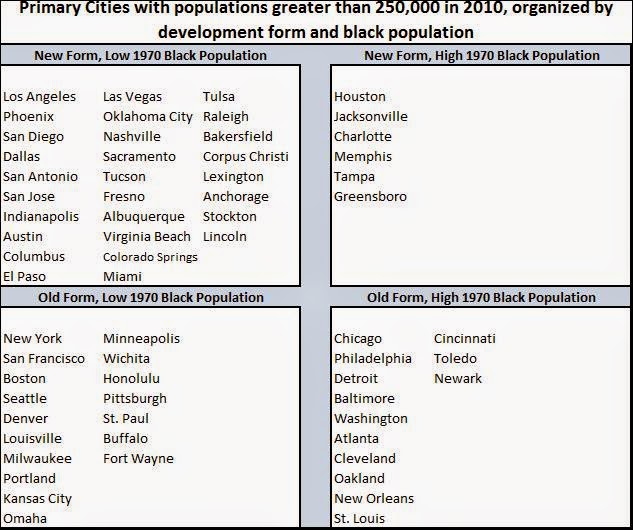
    That prompted my quick study. I wanted to categorize cities by old and new development forms, and low and high historic levels of black population. To do that I came up with an arbitrary proxy for the age of development form. Using decennial Census data, if a city reached 50 percent of its peak population by 1940, it was deemed to have an old development form; if a city reached 50 percent of its peak population in 1950 or later, it was deemed to have a new development form. Here’s a quick example of how this works. Baltimore, currently with a population of a little over 600,000, reached its peak of 949,000 in 1950. Baltimore reached half its peak, or about 475,000, by 1890, a time at which it could be said that Baltimore’s form as a city had been firmly established. Similarly, Austin reached its peak of 790,000 in 2010. The fast-growing Texas city was half that size in only 1990, a year in which it could be said that its development form was established and the city began to see itself as a major city. Imprecise, yes, but a decent proxy for examining old and new city development forms.

    The second piece of analysis was gathering Census data on central city black populations in 1970. This decade was chosen largely because it represents the end of the Great Migration, when millions of African-Americans left the rural South for cities across the nation. By that time the cities which are generally recognized as having large black populations had already been identified, and it’s possible to explore the impact of the migration on them. I arbitrarily said cities with black populations lower than 25 percent of the total in 1970 had a low black population, and those above 25 percent had a high black population.

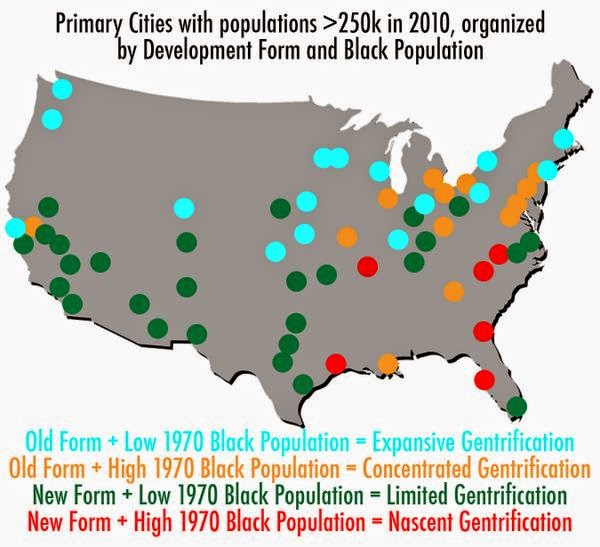
    Using those two factors, I put together this table of the 64 primary cities over 250,000 in the U.S.:


    There are more than a few cities that are exceptions, largely because recent consolidations or large-scale annexations have boosted them into more unfamiliar boxes. But some patterns are evident, and if you think of these in terms of gentrification, you might be able to make the following general assumptions:

    Old Form + Low Black Population = Expansive Gentrification (OFLB)
    Old Form + High Black Population = Concentrated Gentrification (OFHB)
    New Form + Low Black Population = Limited Gentrification (NFLB)
    New Form + High Black Population = Nascent Gentrification (NFHB)

    Identifying the examples might be the best way to explain what I mean. New York, San Francisco and Boston are the prototypical OFLB cities, and gentrification has made its widest impact in these three cities. Chicago, Washington and Atlanta are the classic OFHB cities, where gentrification is concentrated in certain areas of the city (or region), and eludes the heavily African-American parts of the city. Phoenix, San Diego and Las Vegas might be the prototypical NFLB cities, all of which came of age with the car as the dominant mode of transport and with few African-Americans. NFLB cities may also be the leaders and innovators in seeking ways to catalyze their inner cities, with greater tangible investments in public transit and mixed use development. The relatively few NFHB cities are a distinctly Southern phenomenon, and by all appearances gentrification activity lags behind other cities, with sprawl still the dominant development engine.


    Cities by gentrification type. Special thanks to Adam Carstens for producing this map.

    Why would any of this matter? Nationally, the gentrification debate is defined by the experiences of the OFLB types like New York, San Francisco and Boston. There, the issues are rapidly growing unaffordability, concerns with displacement and growing inequality. But the gentrification debate is quite different in OFHB cities like Philadelphia and Atlanta, where seeking ways to more equitably spread the positive benefits of revitalization might lead such discussions.

    In other words, it’s not exactly correct to look at what’s happening in Los Angeles or San Diego, or Baltimore or St. Louis, in the New York-San Francisco-Boston context. Different forces and different experiences are creating different outcomes in each city, and if we want to understand how to look at gentrification’s impact, we need to understand its foundations.

    This post originally appeared in Corner Side Yard on August 15, 2014.

    Pete Saunders is a Detroit native who has worked as a public and private sector urban planner in the Chicago area for more than twenty years.  He is also the author of “The Corner Side Yard,” an urban planning blog that focuses on the redevelopment and revitalization of Rust Belt cities.

  • What College Gowns Bring to Towns

    The college town, one of America’s most appealing and unique features, grew out of the Age of Reason, and the concept of a regional, liberal-arts college nurtured by a small town has been intertwined with American history. Today, with enrollment dropping, the small, private college seems to be going the same way as the typewriter, the newspaper and the independent bookstore. While some colleges struggle to survive, the institution of the college town lives in suspended animation, ready to support whatever form its major employer may take. One thing’s for sure: the reinvention of the post-college town is coming.

    Here in Central Florida, the tradition of a liberal-arts college entwined with a small or medium-sized municipality is alive and well, for the moment. But trouble is brewing. While private institutions in Central Florida may not advertise their funding problems, the truth is plain to see. Rapid expansion of athletic programs, sure-fire profit centers for most schools, is underway at Rollins College, Stetson, and University of Tampa, and all are exploring other ways to reach more students, as well.

    Florida’s public universities are not immune to budget problems, either. And their response to the financial crisis says much about the future of college towns everywhere.

    Reinvention of the liberal arts college itself has been a cottage industry for the last several years. Student body diversification into “lifelong learning” (read: the lucrative retiree demographic), extensions, outreach campuses, and summer programs for primary and secondary schools has surged, as colleges try to open new markets. Bloated administrative costs have given rise to urgent fundraising and athletic programs, while an army of poorly paid adjunct professors shoulder an increasing burden of responsibility for the actual work of teaching. But, as Moody’s analyst Susan Fitzgerald has said about small, tuition-dependent colleges, they are in “a death spiral – this continuing downward momentum for some institutions [means] we’ll see more closures than in the past.”

    The Economist magazine has compared colleges to newspapers. If their analogy were to hold true, of the 4,700 colleges and universities in the world, “more than 700 institutions would shut their doors.” Citing the rise of massive, open, online courses or MOOCS, the magazine suggested that the idea of a professor interacting face-to-face with students will become a luxury. Colleges seem destined to end up in the same tiresome boat as the rest of the digital world, where everything, ultimately, becomes a product on Amazon.

    Uncertainty about the future has hastened the liberal arts school’s demise. In the darkest days of the recession we were told there was a STEM crisis: science, technology, engineering and mathematics were the fields that would get you a job. People ditched their liberal arts pursuits for more practical, employable ones, swearing off the indulgent frivolity of a philosophy course for a computer programming class. Panicking parents and students stampeded out of the gothic halls of the English department as fast as they could.

    Here in Florida, to pay for a new state campus in Lakeland, the Governor gutted the operational budget of Florida’s 11 other institutions of higher education. The new campus, located on rural land adjacent to Interstate 4, is far from any sort of population center. It’s a soulless commuter school; any form of a college town to accompany it lies far, far in the future.

    USF Polytechnic is being billed as a “destination campus”. Its showy new structure nearly complete, it lies naked to the Florida scrub and Interstate 4, with a few lonely stucco buildings and portable classrooms marking a kind of desperate, treeless sense of place in the hot Florida sun. No flip-flop-shod students strumming guitars, debating the meaning of Proust or the relevance of Marx will ever be found under its oak trees or in front of its bohemian coffee shops, because there aren’t any. Instead, there’s a harsh, asphalt parking lot and a long, hot trudge to the endpoint, another signal that one’s college years are just like a shopping trip to Wal-mart.

    If the one-in-seven death rate holds true, then one of the seven college towns in Central Florida will not have a future either. Gainesville, DeLand, Winter Park, St. Augustine, Tampa, Lakeland, and St. Petersburg are seven places with streets, residences, and businesses that each have grown up around colleges, public and private, and that enjoy a thriving sidewalk life.

    Ironically, at least two of these colleges were born in another desperate time, the Great Depression. The University of Tampa, across the Hillsborough River from downtown Tampa, started in a failed hotel when the city took it over from owner Henry Plant’s railroad empire. Likewise, Flagler College in St. Augustine began in a resort hotel built by New York railroad magnate Henry Flagler. The small, private, liberal-arts college was a perfect solution. A grand old structure was re-inhabited, and a struggling city was bolstered.

    Towns that grew up around these places have different, more informal qualities than other towns. In Gainesville, for example, churches, temples, student centers, and other non-profit institutions occupy prominent positions within the urban core. There’s a diversity of old houses with garage apartments, lean-tos, and enclosed porches. Wood apartment buildings have side stairs, outdoor beer kegs, and bicycle racks. They sit under huge, mature trees, clad in subtropical philodendron vines, and are connected by narrow dirt pathways carved independent of sidewalks. A sense of grown-over-time pervades within and around campus, its boundaries softened by sneaker and bicycle traffic, concert posters and poetry reading notices.

    Gainesville, with nearly fifty thousand students, will probably survive, but other, smaller towns may struggle. As conversion to digital learning reduces costs, the college town may disappear. Anonymous reviews, posted online, replace conversations in bookstores. University Avenue may be deleted, just like yesterday’s term paper.

    Our bookshelves are crowded with titles about the urban future, but in all of this furious scribbling it seems no one has noticed that sidewalks have all but emptied out in many of our cities. Chicago, New York, San Francisco, and a few more still march to the pedestrian beat. But a fairly thorough survey of peninsular Florida yields few sidewalks with any kind of street life — and the few that still operate as shared, social space all belong to our college towns.

    Students, with one foot in childhood and one in adulthood, still walk on sidewalks. They shop online, too, but they still patronize businesses for the sake of the social interaction, and still have use for the physicality of the street… for a street life that seems to be endangered.

    College towns, living on today in a shadow of their former bohemian selves, will be reinvented, just as education systems will. But for now, deprived of street life, we breed a different sort of citizen and thinker than an old college town once did. This new digital citizen will construct social space in ways yet to be foreseen.

    Richard Reep is an architect with VOA Associates, Inc. who has designed award-winning urban mixed-use and hospitality projects. His work has been featured domestically and internationally for the last thirty years. An Adjunct Professor for the Environmental and Growth Studies Department at Rollins College, he teaches urban design and sustainable development; he is also president of the Orlando Foundation for Architecture. Reep resides in Winter Park, Florida with his family.

    Photo of downtown Gainesville by the author. This scene is typical of the streets surrounding the campus of the University of Florida.

  • Urban Cores, Core Cities and Principal Cities

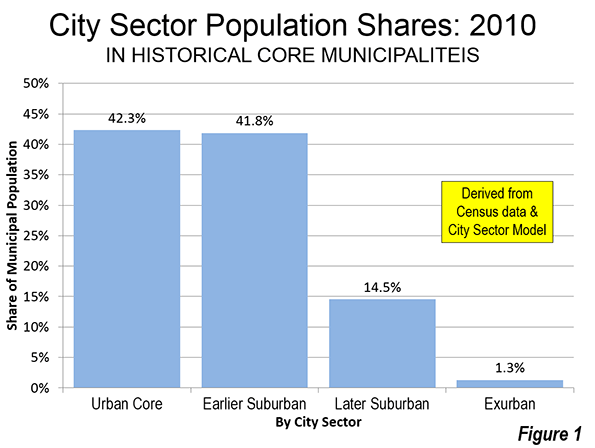
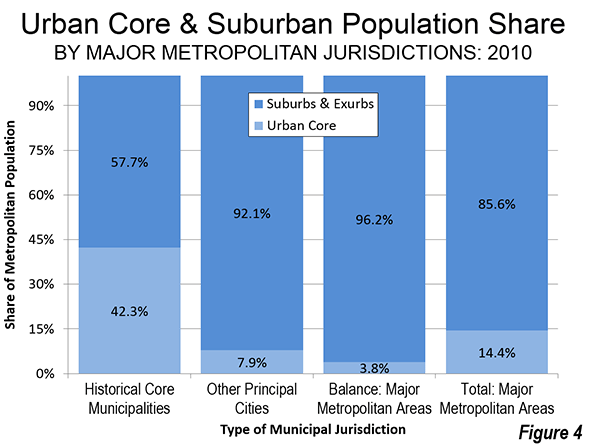
    Many American cities, described commonly as urban cores, are functionally more suburban and exurban, based on urban form, density, and travel behavior characteristics. Data from the 2010 census shows that 42.3 percent of the population of the historical core municipalities was functionally urban core (Figure 1). By comparison, 56.3 of the population lived in functional suburbs and another 1.3 percent in functionally exurban areas (generally outside the urban areas). Urban cores are defined as areas that have high population densities (7,500 or per square mile or 2,900 per square kilometer or more) and high transit, walking and cycling work trip market shares (20 percent or more). Urban cores also include non-exurban sectors with median house construction dates of 1945 or before. All of these areas are defined at the zip code tabulation area (ZCTA) level, rather than by municipal jurisdiction. This is described in further detail in the "City Sector Model" note below.

    The Varieties of Central Cities

    Of course the “urbaneness” of central cities vary greatly. Some, like New York, Boston, Chicago, and San Francisco experienced much of their growth before the 20th century, well before the great automobile oriented suburbanization that occurred after World War II. Others, that experienced early growth, such as Milwaukee and Seattle, annexed substantial areas of suburbanization after World War II, so that their comparatively large functional urban cores have been overwhelmed by suburbs within the city limits. Los Angeles, with a large functional urban core, annexed huge swaths of agricultural land that later became suburban. Finally, a number of other central cities, such as Phoenix and San Jose, have developed since World War II and are virtually all suburban,

    Moreover, central cities comprise very different proportions of their respective metropolitan areas (the functional or economic definition of "city"). For example, the central city of San Antonio comprises 62 percent of the San Antonio metropolitan area population. Conversely, the city of Atlanta comprises only 8 percent of the Atlanta metropolitan area population. Obviously, with such a large differential, the term central city describes jurisdictions that are radically different.

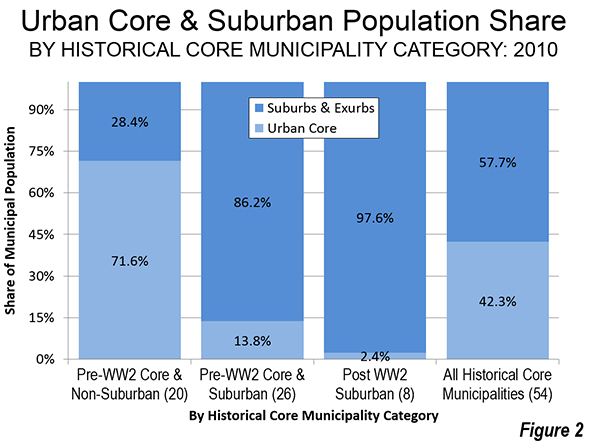
    This difference is caught by examining the functional urban cores by historical core municipality classifications. The Pre-World War II Core & Non-Suburban central cities have functional urban cores comprising 72 percent of their population. The Pre-World War II Core & Suburban central cities have functional urban cores that are only 14 percent of their populations. The Post-World War II Suburban central cities have very small urban cores, representing only 2 percent of their population (Figure 2).

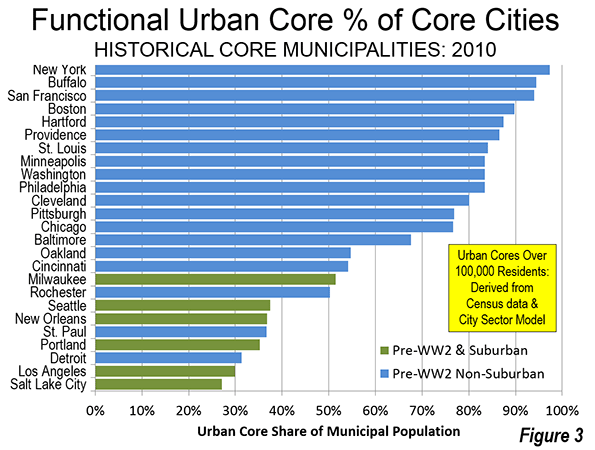
    Among the 54 historical core municipalities, the share of central city population in the functional urban cores varies from a high of more than 97 percent (New York) to virtually zero (Birmingham, Charlotte, Dallas, Jacksonville, Orlando, Phoenix, Raleigh, San Bernardino, San Jose, and Tampa).

    Core Cities with the Strongest Urban Cores

    It is not surprising that the central cities with the largest share of their populations in the functional urban cores are in the older, established are concentrated in the Northeast Corridor (Washington to Boston) and the Midwest. Only one of the 14 central cities with the highest population share in functional urban cores is outside these areas is San Francisco, the first large city to be built on the American West Coast Among the 25 central cities with the highest functional urban core share, only seven are outside the Northeast Corridor or the Midwest (San Francisco, Oakland, Seattle, New Orleans, Portland, Los Angeles and Salt Lake City).

    It is not surprising that the city of New York has the largest function urban core population share, at 97.3 percent. Nearly one-third of the total urban core population in the 52 major metropolitan areas lives in the city of New York (nearly 8,000,000 residents).

    Two other central cities have functional urban core population percentages above 90 percent. Buffalo ranks second, at 94.5 percent. San Francisco is third at 94.0 percent.

    The next three highest ranking cities are in New England. Boston has an 89.7 percent functional urban core population, followed by Hartford (87.4 percent), and Providence (86.5 percent). These are all of the major metropolitan areas in New England.

    Three Midwestern central cities have more than 80 percent of their populations in functional urban cores, including St. Louis (84.1 percent), Minneapolis (83.5 percent), and Cleveland (80.1 percent). Washington (83.4 percent) and Philadelphia (83.4 percent), in the Northeast Corridor also have greater than 80 percent functional urban core shares.

    Pittsburgh (76.9 percent) and Chicago (76.6 percent) have functional urban core population shares between 70 percent and 80 percent. At 67.7 percent, Baltimore (67.7 percent) is the only central city in the Northeast Corridor that with less than 70 percent of its population in the functional urban core.

    Oakland (54.7 percent), at 15th, is the highest ranking central city outside the Northeast Corridor and the Midwest other than San Francisco. Cincinnati, Rochester, and Milwaukee also have more than 50 percent of their population in functional urban cores.

    The top 25 is rounded out by Seattle (37.5 percent), New Orleans (36.8 percent), St. Paul (36.7 percent), Portland (35.2 percent), Detroit (31.3 percent), Los Angeles (29.9 percent) and, somewhat unexpectedly, Salt Lake City (27.1 percent).

    The central cities with the largest functional urban core percentages have overwhelmingly suffered large population losses. Among the 25 with the largest urban core shares, only seven were at their peak populations at the 2010 census, and only two of the top 18 (New York and San Francisco). Overall the cities with large functional cores lost more than 35 percent of their population and 8 million residents.

    "Other" Principal Cities

    Starting in 2003, the Office of Management and Budget (OMB) retired the term "central city" and replaced it with "principal city," which includes the 54 former historical core municipalities and approximately 160 additional cities. The adoption of principal city terminology recognized as OMB described it, that metropolitan areas were no longer monocentric, but had become polycentric. OMB specifically rejected the use of geographical terms other than "principal city" within metropolitan areas, including "suburb." Indeed, the very employment of polycentricity that justified abandonment of the central city designation was the suburbanization of employment. Yet some popular usage (even in some Census Bureau documents), considers any area that is not a principal city as suburban. The more appropriate term would be "not principal city."

    Some principal cities that are not historical core municipalities ("other" principal cities) have strong urban cores, especially in metropolitan areas where the urban core stretches well beyond the core municipality’s city limits, especially in New York and Boston. Four such principal cities have urban cores larger than 100,000 and urban core population shares exceeding 90 percent, including Cambridge in the Boston area (97.0 percent, and the New York area’s Newark (94.7 percent) and Jersey City (100.0 percent), which is higher even than New York City itself. None of these cities was at its population peak in 2010.

    Even so the vast majority of the "other" principal cities are overwhelmingly suburban, comprising less of the functional urban core population than areas that are not principal cities (1.5 million compared to 4.1 million outside the principal cities). Overall, the other principal cities are 7.9 percent urban core (compared to 42.3 percent for the historical core municipalities). If the 11 municipalities with cores larger than 50,000 are excluded, the share living in functional urban cores for the remaining more than 150 cities is 1.5 percent. (Figure 4).

    Crude Measurement

    The perhaps stunning conclusion is that the average difference between the historical core municipality population and the functional urban core population is 73 percent. Core cities — themselves 57 percent suburban and exurban — are a crude basis for classifying urban cores and suburbs. Principal cities — 92 percent functionally suburban or exurban — are even worse. The bottom line: America is fundamentally more suburban in nature than commonly believed.

    —–

    City Sector Model Note: The City Sector Model allows a more representative functional analysis of urban core, suburban and exurban areas, by the use of smaller areas, rather than municipal boundaries. The nearly 9,000 zip code tabulation areas (ZCTA) of major metropolitan areas are categorized by functional characteristics, including urban form, density and travel behavior. There are four functional classifications, the urban core, earlier suburban areas, later suburban areas and exurban areas. The urban cores have higher densities, older housing and substantially greater reliance on transit, similar to the urban cores that preceded the great automobile oriented suburbanization that followed World War II. Exurban areas are beyond the built up urban areas. The suburban areas constitute the balance of the major metropolitan areas. Earlier suburbs include areas with a median house construction date before 1980. Later suburban areas have later median house construction dates.

    —–

    Wendell Cox is principal of Demographia, an international public policy and demographics firm. He is co-author of the "Demographia International Housing Affordability Survey" and author of "Demographia World Urban Areas" and "War on the Dream: How Anti-Sprawl Policy Threatens the Quality of Life." He was appointed to three terms on the Los Angeles County Transportation Commission, where he served with the leading city and county leadership as the only non-elected member. He was appointed to the Amtrak Reform Council to fill the unexpired term of Governor Christine Todd Whitman and has served as a visiting professor at the Conservatoire National des Arts et Metiers, a national university in Paris.

    Photo: Downtown Houston (by author)

  • Don’t be so Dense About Housing

    Southern California faces a crisis of confidence. A region that once imagined itself as a new model of urbanity – what the early 20th century minister and writer Dana Bartlett called “the better city” – is increasingly being told that, to succeed, it must abandon its old model and become something more akin to dense Eastern cities, or to Portland or San Francisco.

    This has touched off a “density craze,” in which developers and regulators work overtime to create a future dramatically different from the region’s past. This kind of social engineering appeals to many pundits, planners and developers, but may scare the dickens out of many residents. They may also be concerned that the political class, rather than investing in improving our neighborhoods, seems determined to use our dollars to subsidize densification and support vanity projects, like a new Downtown Los Angeles football stadium. At same time, policymakers seek to all but ban suburban building, a misguided and extraordinarily costly extension of their climate-change agenda.

    This effort works against the region’s basic DNA. Our Downtown, for all its promotion, is not a dominant business or cultural center. It accounts for barely 1/10th the share of regional employment that Manhattan – at more than 20 percent – provides for its region and less than one-sixth the share of regional jobs accounted for by San Francisco, less than one-third that of much-maligned, spread-out Houston.

    Some people contend that, by investing heavily in mass transit, we can re-engineer our region towards a more-19th century model, which Los Angeles, as a 20th century city, never had. Some, like economics and political blogger Matt Yglesias, suggest Los Angeles’ $8 billion-plus investment in rail is making it the “the next great transit city.”

    Well, after 30 years of relentless spending on subways and light rail, the share of transit commuters in the region (comprising Los Angeles and Orange counties, the Inland Empire and Ventura County) is about where it was in 1980 – roughly 5 percent – compared with greater New York’s 27 percent or Chicago’s 11 percent.

    Village people

    Transit has limited effect in Southern California because this region functions best as a network of “villages,” some more urban than others, connected primarily by freeways and an enviable arterial street system. Inside our villages, we can find the human scale and comfort that can be so elusive in a megacity. This arrangement allows many Southern Californians to live in a quiet neighborhood that also is within one of the world’s most diverse – and important – cities.

    These villages span all the vast diversity of Southern California. Some areas, like Downtown Los Angeles, increasingly appeal to young professionals who seek a version of dense urban living. They share a universe with cohorts found in many older cities: young hipsters, a small sample of empty nesters and a sizable population of homeless who live on the edges of the gentrification zone.

    But Downtown hardly provides a template for the rest of the region. Mostly we live in lower-density villages, many of which – in the San Gabriel Valley, East Los Angeles, Santa Ana, Westminster and L.A.’s Leimart Park, for example – reflect largely ethnic cultures with deeply established roots.

    Even newer areas, like Irvine – which still ranks among America’s fastest-growing cities – are now majority Asian and Latino. Irvine’s appeal is largely the much- dissed suburban virtues of clean streets, good parks and excellent schools.

    Some areas are almost insanely eclectic. My neighborhood in the San Fernando Valley – sometimes referred to as Valley Village or Valley Glen – includes many people in the film and television business, but is increasingly dominated by Orthodox Jews, Armenians and Israelis. In summer, barely clad acting folk pass Orthodox haredim dressed in impossibly warm black suits and hats.

    Walk one direction from my house, and you run into Armenian businesses, including alavash bakery and several kabob restaurants. Walk the other direction, and you enter akashrut world, with signs in both English and Hebrew; you even can get panhandled by an odd Jewish beggar, something you encounter in Israel and parts of Brooklyn but not too often in California.

    Outdoor living

    What holds these neighborhoods together is a desire for a particular quality of life, usually associated with the single-family home. These, along with modestly sized garden apartments, long have been the primary choice of Southern Californians. Such housing facilitates enjoying this region’s arguably greatest asset: its weather. Residents value a place for backyard barbecues, swimming pools, small soccer pitches for the kids and an element of seclusion.

    Unable to afford the pricier L.A. or O.C. neighborhoods, many Southern Californians, to the consternation of the urban planners and some developers, head for a newer village on the regional periphery. Indeed, more than 99 percent of the region’s growth has taken place far from central L.A. For every yuppie who moves Downtown, or into now-fashionable closer-in neighborhoods, a hundred or more move out to Rancho Cucamonga, Valencia, Mission Viejo or scores of other outlying communities.

    This article first appeared in the Orange County Register.

    Joel Kotkin is executive editor of NewGeography.com and Distinguished Presidential Fellow in Urban Futures at Chapman University, and a member of the editorial board of the Orange County Register. He is author of The City: A Global History and The Next Hundred Million: America in 2050. His most recent study, The Rise of Postfamilialism, has been widely discussed and distributed internationally. He lives in Los Angeles, CA.

  • Long Island Needs Regionalism

    Eric Alexander, the Executive Director of Vision Long Island, seems to be popping up everywhere on Long Island these days. He was recently quoted in The Corridor Magazine’s transportation and infrastructure issue as saying: “Academic conversations about regionalism is a 90s thing.” Similar to his condemnation on “academic” commentary concerning the downtown redevelopment trend, Alexander made it clear in the piece that he feels a local, downtown-centric approach is the way to go.

    Whether we like it or not, Long Island is a singular region.

    If Long Island’s developmental future is divided and segmented municipality-by-municipality, we, as a collective whole, will fail. The Village of Rockville Centre, one of Long Island’s much-touted “cool” downtown areas, shares the same aquifer system as Rocky Point. If a company abandons their corporate headquarters in Lake Success, residents in Suffolk feel the economic blow. Despite claims to the contrary by special interests and stakeholders, we are one Island. Our social, economic and environmental policies must reflect that fact.

    It is in the interest of builders, developers and stakeholders for Long Island’s developmental future to remain both segmented and divided under the guise of “localism”. Divide, and conquer, as the saying goes. When projects are looked at a regional level, they are more heavily scrutinized, and their impacts are more thoroughly explored.

    Here is a scenario:  A small village on Long Island is welcoming the economic windfall a particular development is slated to bring, while five miles north to the village, an unincorporated area fears their shops will wither thanks to the influx of shops proposed.  The Village does as they please, approving the development.  Now, the businesses in the unincorporated area lay stagnant thanks to the over-saturation of retail usage that the new development brought to the area.

    It’s Urban Planning 101: You don’t build what you don’t need. Much of the debate concerning Heartland, whose future lays with the Town of Islip, is that its impacts will resonate far beyond Islip.

    That’s the trouble with localism – it only benefits the locality, and often at the cost of other areas. Unfortunately for Mr. Alexander, some of Long Island’s issues are too big for the “locals know best” model he advocates for. Our fragile aquifer system transcends all geo-political borders, with poor land use decisions in one town impacting water quality in the next.

    Our Island is small enough for economic development policies to resonate far beyond the Village or Town level. While the Town of Babylon IDA and Town of Islip IDA squabble over wooing a manufacturing business, a lucky county in North Caroline will reap the rewards when they eventually steal them away from Long Island.  It’s one thing for a village to build more housing options, but successfully raising a new multifamily development isn’t the same thing as quantifying and addressing our marked regional need for different types of housing.

    Is it too “academic” to quantify our problems before taking the steps of addressing them? Is a protected aquifer system which supplies our region’s drinking water outdated like Zach Morris’ blocky cellphone or the Macarena?

    Localism at its worst puts immediate needs first, and Long Islanders as a collective second. Part of the challenge we face as a region is the segmented and fractured governmental systems that prevent us from significantly making any progress. The biggest public works and sweeping acts of environmental preservation in this region’s history were executed thanks to a solid foundation of regional thought. The Long Island Parkway System, LIRR and LIE weren’t built on the local scale. The preservation of 100,000 acres of Pine Barrens forest needed state legislation that trumped local zoning to be adequately protected. Suffolk County’s open space, water protection and farmland preservation programs weren’t locally-sourced, homegrown policies, but rather models emulated nationally thanks to their breadth and regional scale. 

    Regionalism at its worst is characterized by monolithic bureaucrats making decisions without any local input. This is why a balance must be struck between both approaches that blend our local sensibilities with a comprehensive regional approach. The commonalities between Long Island’s various towns, villages and even counties warrant regionalism with a local twist. Our common aquifer is the largest common tie, while our surface bodies of water constrain our physical space. Economically, Long Islanders in both counties work and commute to the Island’s employment centers, which are concentrated in a few distinct locations, while all municipalities share neighborhoods that span the socio-economic spectrum. Given the common traits, a regional approach undertaken by municipalities, helmed by non-biased professional planners would serve both the local and regional good. For too long, Long Island’s development future has been staked out by stakeholders and policymakers with something to gain by swaying in one direction or another.

    The best community planning efforts stem from public input, assessment of public needs and ample participation by the people who live and work in the area. The best environmental planning efforts use data and scientific study to advance the goals selected. A regional approach takes the best of both these approaches, and balances the needs of a region in a comprehensive manner. A local approach works under certain circumstances. When a neighborhood needs a community center, or seeks to improve their quality of life, the approach to development should be local. However, if the locality proposes development whose impacts resonate far beyond their municipal borders, a regional approach must be taken.

    There is a reason why conversations concerning Long Island’s future must be academic Mr. Alexander. We all feel the impacts of poor development choices. Sound regional planning isn’t something to dismiss as a “90s thing”, but rather, should be embraced for the betterment of Long Island’s future.  

    Richard Murdocco writes regularly on land use, planning and development issues for various publications. He has his BA in both Political Science and Urban Studies from Fordham University, and his MA in Public Policy from Stony Brook University, and studied planning under Dr. Lee Koppelman, Long Island’s veteran planner. You can follow Murdocco on Twitter @TheFoggiestIdea, Like The Foggiest Idea on Facebook, and read his collection of work on urban planning at TheFoggiestIdea.org.

    Long Island illustration by Wiki commons user Duffman.

  • Urban Renewal Needs More than ‘Garden City’ Stamp to Take Root

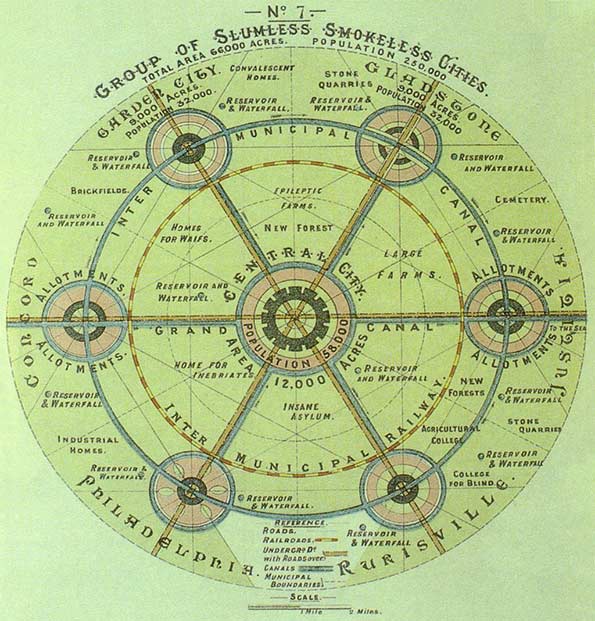
    Every few years the ideals of Ebenezer Howard’s garden city utopia are resurrected in an attempt by the UK government to create new communities, and address the country’s housing crisis. Sometimes this takes the form of new towns or eco-towns, and sometimes proposals for an actual garden city are put forward – as in the last budget.

    Rather than just rolling out this romantic terminology, we should take a closer look at garden city ideals and how they can be adopted to make the proposed Ebbsfleet development a success.

    Several years ago my colleague Michael Edwards presciently forecast the current problems in the Thames Gateway where Ebbsfleet falls, with a dominance of private development that does little to provide for local employment and walkable communities.


    Ebenezer Howard’s utopian vision

    He outlined the need to return to funding principles similar to the garden city model, where development trusts retain freeholds on the land. This model, based on investment in infrastructure and services, is a fundamental principle that shifts from short-term returns to a long-term relationship created between the collective or public landowner and local inhabitants.

    Lessons From History

    Despite the fact that the garden city was a highly influential model throughout the first half of the 20th century, ultimately leading to the establishment of some key settlements in the UK, US and elsewhere in the world, it has had few genuine successes. After World War II, similar utopian dreams of creating model communities, with decent housing surrounding a well-designed centre, met with the reality. British reformer William Beveridge famously summed them up for having “no gardens, few roads, no shops and a sea of mud”.

    You’d be forgiven for thinking that past lessons would be applied to the next generation of housing. But, even the post-war housing plans – though inspired by the garden city movement of the interwar periods – failed to plan the new housing in relation to transport, employment and public services such as shops and schools. While UK government reports have tried to draw lessons from both their positive and negative aspects, they have also been criticised in more recent reports, for lacking a sense of community – although it should also be said that “community” takes time to develop and cannot be “designed” as such.

    Many of the challenges of creating new communities are bound up in the spatial separation between newcomers and older inhabitants, a lack of social infrastructure, such as doctor’s surgeries and schools, and difficulties that stem from long commutes, such as lower net income and the strain this has on families. Ruth Durant found this in her 1939 study of Burnt Oak on the outskirts of London.

    Early post-war new towns were similarly criticised for their very slow build-up of health services, higher schooling, cultural facilities and decent shopping facilities, although some did better with the provision of local employment, due to many people moving to the towns with a local job linked to their housing. With shifts in the industrial economy, such beneficial connections between home and work (one of the tenets of the garden city) reduced over time.

    Modern Twist

    The challenges today are slightly different, however. People live more mobile and fragmented lives and are arguably less likely to be tied to place as was the case for the primarily working-class (and manual labouring) communities of the past. This poses the risk that community will be lost because of how transient people can be.

    But increased mobility and social interaction don’t have to be mutually exclusive. Indeed, a lack of mobility is the worst problem that can be imposed on a community: both work and leisure must be accessible to people. Plus, with the advent of the internet and grass-roots activism, connections can traverse space more easily. This has allowed movements such as the Transition Network, which brings communities together around sustainable issues, to blossom.

    Adapting to Change

    UCL’s EPSRC funded Adaptable Suburbs project has studied the evolution of London’s outer suburban towns over the past 150 years, providing some clues on what has made for the relative success of the original garden cities over other planned settlements. It is clear that their success has been dependent on excellent transport connections, coupled with the provision of local employment and access to employment at a commutable distance.

    Also important is the provision of a mixed-use town centre, giving a destination for a wide variety of activities in addition to retail: community activities, schools, leisure and cultural uses. Centres work well when connected to the street network, accessible by foot, bicycle, public and private transport. This multi-functional design has helped even the smallest of centres to sustain themselves through the most recent economic recession.

    A recent government report, “Understanding High Street Performance”, also found that successful town centres are “characterised by considerable diversity and complexity, in terms of scale, geography and catchment, function and form … [as] a result, the way in which they are affected by and respond to change is diverse and varied”.

    It is almost impossible to predict how society will change in the future, particularly as new technologies have the power to change how people connect and build community. But what is evident is that here lies another essential aspect of building successful communities: in allowing for places to adapt to change.

    This needs to be a foundational aspect of the government’s new cities – simply invoking the phrase “garden city” is not enough. By building places with sufficient flexibility of buildings, infrastructure and uses, coupled with links that allow for local and wider-scale trips to take place, with the necessary long-term financial investment, we can start to create places that will successfully weather the future.

    This article was originally published on The Conversation.

    Dr Laura Vaughan is Professor of Urban Form and Society at the Bartlett, University College London. She has been researching poverty and prosperity in cities, suburbs and the space between them for the past dozen years using space syntax – a mathematical method for modelling social and economic outcomes. Her edited book ‘Suburban Urbanities’ is due to come out in UCL Press in 2015.

    Photo: Which way are the flower beds? Matt BuckCC BY-SA

  • Dallas: A City in Transition

    I was in Dallas this recently for the New Cities Summit, so it’s a good time to post an update on the city.

    I don’t think many of us realize the scale to which Sunbelt mega-boomtowns like Dallas have grown. The Dallas-Ft. Worth metro area is now the fourth largest in the United States with 6.8 million people, and it continues to pile on people and jobs at a fiendish clip.

    Many urbanists are not fans of DFW, and it’s easy to understand why. But I think it’s unfair to judge the quality of a city without considering where it is at in its lifecycle. Dallas has been around since the 1800s, but the metroplex is only just now starting to come into its own as a region. It is still in the hypergrowth and wealth building stage, similar to where a place like Chicago was back in the late 19th century. Unsurprisingly, filthy, crass, money-grubbing, unsophisticated Chicago did not appeal to the sophisticates of its day either. But once Chicago got rich, it decided to get classy. Its business booster class endowed first rate cultural institutions like the Art Institute, and tremendous efforts were made to upgrade the quality of the city and deal with the congestion, pollution, substandard housing, and fallout from rapid growth, which threatened to choke off the city’s future success. At some point in its journey, Chicago reached an inflection point where it transitioned to a more mature state. One can perhaps see the 1909 Burnham Plan as the best symbol of this. In addition to addressing practical concerns like street congestion, the Burnham Plan also sought to create a city that could hold its own among the world’s elite. And you’d have to argue the city largely succeeded in that vision.

    The DFW area is now at that transition point. They realize that as a city they need to be about more than just growth and money making. They need to have quality and they need to address issues in the system. Much like Burnham Plan era Chicago, this perhaps makes DFW a potentially very exciting place to be. It’s not everyday when you can be part of building a new aspirational future for a city that’s already been a successful boomtown. The locals I talked to were pretty pumped about their city and where it’s going.

    How true this is I don’t know, but some people have attributed a change in mindset to the loss in the competition to land Boeing’s headquarters. Boeing ended up choosing Chicago over Dallas. In part this was because Chicago bought the business with lavish subsidies that far outclassed what Dallas put on the table. But it was also because Boeing saw Chicago as a more congenial environment for global company C-suite and other top executives to be, both from a lifestyle perspective and that of access to other globally elite firms and workers available in Chicago.

    Meanwhile, the cracks in the DFW growth model were becoming apparent, especially in the core city of Dallas. Ten years ago the Dallas Morning News ran a series called “Dallas at a Tipping Point: A Roadmap For Renewal.” This series was underpinned by a report prepared by the consulting firm Booz Allen. This report is well worth reading by almost anyone today as it is a rare example of a city that was able to get insight and recommendations from the type of tier one strategy firm used by major corporations. Booz Allen was direct in their findings, though perhaps with a bit of hyperbole in the Detroit comparison:

    Dallas stands at the verge of entering a cycle of decline…On its current path, Dallas will, in the next 20 years, go the way of declining cities like Detroit – a hollow core abandoned by the middle class and surrounded by suburbs that outperform the city but inevitably are dragged down by it.
    ….
    If the City of Dallas were a corporate client, we would note that it has fallen significantly behind its competitors. We would warn that its product offering is becoming less and less compelling to its core group of target customers…We would further caution the management that they are in an especially dangerous position because overall growth in the market…is masking the depth of its underlying problems. We would explain that in our experience, companies in fast growing markets are often those most at risk because they frequently do not realize they are falling behind until the situation is irreversible.

    Put into the language of business, we would note that Dallas is under-investing in its core product, has not embraced best practices throughout its management or operations, and is fast becoming burdened by long term liabilities that could bankrupt the company if the market takes a downturn.

    The city responded in a number of ways, some of which were similar to Chicago at its inflection point. Many of these involve various urbanist “best practices” or conventional wisdom type trends.

    By far the most important of these was adopting modern statistically driven policing approaches. As crime plummeted in places like New York during the 1990s, Dallas did not see a decline of its own. But with the expansion of police headcount and adoption of new strategies by new police chief David Kunkle in 2004 – and no doubt some help from national trends – crime fell steeply during the 2000s. The Dallas Morning News says that the city’s violent and property crime rates fell by a greater percentage than any other city with over one million residents over the last decade. In 2013, Dallas had its overall lowest crime rate in 47 years.

    This is critical because nothing else matters without safe streets. I’ve had many a jousting match with other urbanists on discussion boards about where crime falls on the list of priorities. In my view it’s clearly #1 – even more so than education. It’s simply a prerequisite to almost any other systemic good happening in your cities. Students can’t learn effectively if they live and attend school in dangerous environments, for example. NYU economist Paul Romer made this point forcefully in his New Cities keynote, saying that fighting crime is the most important function of government and that if you don’t deliver on crime control your city will go into decline. Fortunately, Dallas seems to have gotten the message.

    But there’s been attention to physical infrastructure as well. The area has built America’s largest light rail system (which was in the works since the early 1980s).


    Dallas Area Rapid Transit (DART) light rail train. Source: Wikipedia

    Both the city and region remain fundamentally auto-centric, however, and this is unlikely to change.

    There’s been a significant investment in quality green spaces. A major initiative called theTrinity River Project is designed to reclaim the Trinity River corridor through the city as a recreational amenity. This is underway but proceeding slowing. Among the aspects of the project is a series of three planned signature bridges designed by Santiago Calatrava. The only one completed is the Margaret Hunt Hill Bridge.


    The Margaret Hunt Hill Bridge in Downtown Dallas. Designed by Santiago Calatrava. Source: Wikipedia

    The single bridge tower is quite an imposing presence on the skyline. However, the size of the bridge creates an awkward contrast with the glorified creek that is the Trinity River. It looks to me like they significantly over-engineered what should have been a fairly straightforward flood plain to span just so they could create a major structure.

    Another green space project – and the best thing I saw in my trip to Dallas – is Klyde Warren Park, which is built on a freeway cap. About half the cost came from $50 million donations. I’ll be going into more detail on this in my next installment, but here’s a teaser photo:


    Klyde Warren Park. Source: Wikipedia

    The Calatrava bridge shows that Dallas has embraced the starchitect trend. This was also on display in the creation of the Dallas Arts District. Complementing the Dallas Museum of Art are a billion dollars worth of starchitect designed facilities including Renzo Piano’s Nasher Sculpture Center, IM Pei’s symphony center, Norman Foster’s Winspear Opera House, and OMA’s Wyly Theatre.


    Dee and Charles Wyly Theatre. Designed by OMA’s Joshua Prince-Ramus (partner in charge) and Rem Koolhaas

    This arts district – which naturally Dallas boasts is the world’s largest – along with the other major investments that were funded with significant private contributions show a major advantage Texas metros like DFW and Houston have: philanthropy. These are new money towns on their way up and local billionaires are willing to open their wallets bigtime in an attempt to realize world class ambitions, exactly the way Chicago’s did all those decades back.

    By contrast many northern tier cities are dependent on legacy philanthropy, such as foundations set up in an era when they were industrial power houses. This is a dwindling inheritance. What’s more, what wealthy residents they do have are as likely to be taking money out of their cities through cash for cronies projects than they are to be putting it in. Thus they can be a negative not positive influence.

    This shows the importance of wealth building in cities. Commercial endeavors can appear crass or greedy at times, and deservedly so. But without wealth, you can’t afford to do anything. There’s a reason Dallas could build America’s largest light rail system – it had the money to do so. Similarly with this performing arts district. To be a city of ambition requires that a place also be an engine of wealth generation.

    I’m sure that Dallas’ moneyed elite are well taken care of locally and exert outsized influence on decision making. I don’t want to make them out to be puristic altruists. But they’ve shown they are willing to open their wallets in a serious way, something that’s not true everywhere.

    This is a flavor of what Dallas has been up to. It’s too early to say whether the city will make the same transition Chicago did. Its greatest challenge also awaits some time in the future. When DFW’s hypergrowth phase ends and the city must, like New York and Chicago before it, reinvent itself for a new age, that’s when we will find out if DFW has what it takes to join the world’s elite, or whether it will fade like a flower as Detroit and so many other places did.

    Toyota did just announce it’s moving 3,500 jobs to north suburban Plano. But corporations have long seen Dallas a place for large white collar operations. Boeing was what I call an “executive headquarters” – a fairly small operation consisting of only the most senior people. I haven’t seen Dallas win any of these as of yet.

    The Dallas Morning News takes a somewhat mixed view on the city itself. They just did a special section called “Future Dallas: Making Strides, Facing Challenges,” the title of which sums it up. Dallas has put a lot of pieces on the board and made major progress on areas like crime, but it’s failed to make a dent in others, such as Booz Allen’s call to make the city more attractive to middle class families. Poverty is actually up since then, and the city is increasingly unequal in its income distribution. Dallas is not unique in that, but that’s cold comfort.

    Despite gigantic regional growth, the city’s population has been nearly flat. Despite the vaunted Texas and DFW jobs engine, Dallas County has lost about 100,000 jobs since 2000. The core is clearly continuing in relative decline, and the Dallas County job losses are particularly troubling. I’m no believer in this idea that everybody is going to abandon the suburbs and head back to the city. But as former Indianapolis Mayor Bill Hudnut put it, you can’t be a suburb of nowhere. If the core loses economic vitality, the entire DFW regional will take a hit to its growth.

    Aaron M. Renn is an independent writer on urban affairs and the founder of Telestrian, a data analysis and mapping tool. He writes at The Urbanophile, where this piece originally appeared.

    Dallas photo by Bigstock.

  • Circling the Brain Drain

    It seems that Destination LI, “a nonprofit community building and educational organization dedicated to helping people create and sustain vibrant centers” on Long Island, has been quietly busy in recent months.

    Recently, the group released a survey, which, to nobody’s surprise, shows that millennials are not exactly thrilled with Long Island’s housing options.

    The solution? Those “vibrant” walkable communities that have been pitched so many times before. The survey also touched upon Long Island’s need for jobs that match millennial skillsets and salary expectations, two critical issues that policymakers must address.

    In a nutshell, “the survey, conducted on social media web forums between Feb. 27 and March 24, drew 413 respondents.” To solicit responses, the group used sites such as Facebook, Twitter, LinkedIn, Reddit and others. Seventy-five percent of those who participated said that they either “agree” or “strongly agree” that Long Island’s housing options limit their ability to stay, with 58.7 percent saying they currently live with parents or relatives.

    For perspective, consider this: According to U.S. Census data from 2010, there were 478,988 millennials in the Nassau-Suffolk region. Destination LI’s survey of 413 represents 0.08 percent of the sample size – far from a representative sample of that segment of population. Given the large gap between population and those surveyed online (which, by surveying standards, is a poor solicitation method), it’s important to take the results for what they are – anecdotal, but still an important commentary. Long Island clearly has issues with providing housing, but we’re going about it the wrong way.

    The survey brings to light significant questions concerning Long Island. Is regional housing availability holding millennials back, or is it Long Island’s stagnant economy? The survey infers that walkable apartments keep millennials here, but what about affordable single-family homes? Are apartments the only housing option for this age group? Is more development the answer to our regional woes? Are the survey’s findings legitimate given the methodology?
    Finally, the big question remains: Should developers be driving the regional conversation on housing needs?

    The answer to any of these questions is up for debate, but the last one should resonate. Have Long Islanders become so apathetic that they now are reliant upon stakeholders to conduct surveys that not only get ample press coverage, but are sure to influence policy decisions on the regional level? Shouldn’t planners be conducting these studies, with their recommendations being based off appropriate methodology and professionalism?

    Our policy solutions are only as good as the data that informs them. With land-use, the cost of failure is too expensive and repercussions too severe and far reaching to rely on stakeholder-driven solutions. We all are leaders in that we have the power to collectively shape our community. Let’s take back the reins and give our problems the thoughtful analysis they deserve.

  • Florida: When Density is Destructive

    Brick streets, mature old oaks, and a sense of history imbue Winter Park, Florida with a sense of place that is the envy of many small cities and towns. The tony Park Avenue brings shoppers and visitors, who soak up its ambience and enjoy the street life of this quaint southern town. On the east side, bounded by blue lakes, lie gentrified historical mansions, while the west side is a neighborhood of smaller, affordable homes with multigenerational Winter Parkers. This community of little single-family homes is now endangered by developers that are gobbling up parcels two and three at a time, increasing the density threefold, and squeezing out residents in a new, “zoning for dollars” economic climate.

    Affluence and affordability have always maintained an uneasy truce, and the balance between them has historically been protected by cities through planning policies and an understanding that the mission of a city is to be workable for all of its residents, not just the wealthiest. Unfortunately, this balance tilts when the density imperative drives land values up, and tips the scales in favor of half-million dollar townhomes. High density has become fashionable in Winter Park these days, as it has in many cities, and there are some benefits to this new style. The costs? Well, those will be counted later.

    Density’s benefits look great on paper: a higher tax base, expensive new housing, walkable urbanity. When implemented well, these can make for positive changes. Advocates preach careful, sensitive ways to develop: don’t smash large and small buildings together; don’t mix uses on a street, and ramp up from low to high density across a gradient of a block or two. Advocates also preach a consensus-building process to avoid neighborhood clashes over growth issues. In places where this has happened, like Coral Gables in Miami, the story has mostly been a good one.

    The west side of Winter Park, with its cottages and modest residences for families, dates back to the 1920s. Within the neighborhood are many small churches to which residents walk on Sundays. Playgrounds, parks, and a community center characterize the West Side’s tree-shaded streets, and its proximity to the downtown area means jobs for many of its residents. For the last ninety years, the city has evolved around this neighborhood, and many families go back several generations. Its diversity includes many African American families, mixing with whites. It carved out a niche in the city.

    Today, the West Side is an older and less affluent neighborhood that happens to be close to a desirable address. The West Siders have already chosen their preferred building pattern and rhythm, infilling their blocks with new homes of similar size and scale, enlarging the tax base. They already live a walkable urban lifestyle, use mass transit, and evolve with slow and organic growth. In short, every urbanist’s dream.

    Like many cities that have a working class enclave that butts up against a newly trendy one, Winter Park has encouraged dense, mixed-use development, while nominally protecting its existing neighborhoods. And this is where the density equation seems to fall apart. The residents who leave the area will no longer participate in the economy of Winter Park. The new residents of half-million-dollar townhomes probably won’t ride the bus, walk to the churches, or otherwise activate the local streets. So a natural piece of the city is lost forever. Urbanism, for all that has been written in favor of this ideology, is diminished for the sake of density.

    West Siders protested in City Hall, asking the city not to upzone their neighborhood. While City Hall nodded to its citizens, it had already quietly allowed upzoning to take place, taking advantage of tired homeowners who decided to cash in. Half-million-dollar townhomes, which could be built in other areas, are instead being built here, to take advantage of low land values. Parking garages and midrise apartments now cast shadows on the adjacent small houses. Land values may rise on those parcels with new townhomes and midrise apartments, but immediately next door, the remaining adjacent little one-story cottages become particularly undesirable; the value of those homes becomes depressed. The owners’ only hope is to sell off to a high-density developer. Step by step, high density becomes more and more inevitable as the only solution left.

    The market forces at work in Winter Park have played out elsewhere across the country, with old neighborhoods eroding. This time around, with density all but institutionalized as the only acceptable way to grow, the deck seems to be stacked against entrenched locals. Cities are re-writing their development codes in favor of shiny new mid-rises and high-rises, ignoring existing residents who won’t be missed till they are gone.

    When the market, an amoral institution without sentiment, threatens neighborhoods, it is the job of City Hall to provide a hedge that ensures balance and fair play. But citizens have to shout over the money in order to be heard, so local groups like the Friends of Casa Feliz have stepped in on their side. If “zoning for dollars” can work against this section of the city, groups fear, then no one is safe, and people are reminding City Hall of its duty as a guardian of its residents.

    Density, on its own, is neither a good nor a bad thing. It can make a city more efficient and connected, and proponents tout its reputed health benefits and contribution to a thriving social life. When, in the process of allowing density, a city destroys the very values that it is supposed to promote, then the city ends up cannibalizing its neighborhoods for little benefit other than the one-time gain that the developers will realize from the sale of these newly built products. Income streams are put into mortgage-holders’ pockets, and, bit by bit, one more highly localized economy disintegrates.

    City halls, so obsessed with petty regulations, would do well to recall their basic functions as protectors of their residents. If there were a “back to basics” movement for government, many ordinances written to benefit the few would be shed, and there would be a refocus of attention back to the public good. The current infatuation with density, like many fashionable ideas, may come and go, but if a multigenerational neighborhood goes, it won’t be replaced in our lifetime.

    Richard Reep is an architect with VOA Associates, Inc. who has designed award-winning urban mixed-use and hospitality projects. His work has been featured domestically and internationally for the last thirty years. An Adjunct Professor for the Environmental and Growth Studies Department at Rollins College, he teaches urban design and sustainable development; he is also president of the Orlando Foundation for Architecture. Reep resides in Winter Park, Florida with his family.

    Photo by Betsy Owens of the Friends of Casa Feliz: “Preserved 1920s Cottage on Lyman Street”, Winter Park, Florida.