Category: planning

  • NewGeography’s Top Stories of 2013

    A new year is upon us, here’s a look back at a handful of the most popular pieces on NewGeography from 2013. Thanks for reading, and happy New Year.

    12. Gentrification as an End Game, and the Rise of “Sub-Urbanity” In January Richey Piiparinen points out that gentrification driven by affluent young people moving back to the city might be creating “a ‘sub-urbanity’ that is emerging when the generalization of gentrification meets the gentrification of the mind.”

    11. The Cities Winning the Battle for the Biggest Growth Sector in the U.S. Joel and I put this index together to measure growth and concentration of the professional, technical, and scientific services sector among the nation’s largest metropolitan areas. As high-end services become easier to export, this sector is becoming a critical region-sustaining sector in many parts of the country. This piece also ran at Forbes.com.

    10. A Map of America’s Future: Where Growth will be Over the Next Decade Working with Forbes Magazine in September, Joel and I laid out seven regions and three city-states across the nation. Regional economic diversity is one of America’s most critical attributes.

    9.  The Dutch Rethink the Welfare State Nima Sanandaji outlines the trajectory of the social services culture in the Netherlands.

    8.  Suburb Hating is Anti-Child In this provocative, widely-discussed piece, Mike Lanza takes it to politicians and commentators who advocate against suburbs, pointing out that “we need to fix suburbs and the way families utilize them,” but “what we shouldn’t do is try to force families to live in dense city centers.”

    7.  Fixing California: The Green Gentry’s Class Warfare Joel Kotkin points out that many green policies are pro-gentry and anti-middle class, particularly in California. This piece originally appeared at U-T San Diego.

    6.  How Can We Be So Dense? Anti-Sprawl Policies Threaten America’s Future In this piece from Forbes, Joel Kotkin argues that high-density housing advocates should be open to a broader range of housing options because policies pushing high density often favor real estate investors over the middle class and the concept of upward mobility.

    5.  Class Warfare for Republicans Joel takes the Republican Party to task for ignoring the issue of class and small business growth in favor of rhetoric about social conservatism, gun control, and free market idealism. This piece originally ran in the Orange County Register.

    4.  Houston Rising: Why the Next Great American Cities Aren’t What you Think In this piece from The Daily Beast, Joel argues that a city’s most important quality is its ability to foster upward mobility and to sustain a middle class, not its urban form.

    3.  The New Power Class Who Will Profit from Obama’s Second Term Who stands to benefit most from the second Obama administration? Joel argues that it’s the plutocrats of Silicon Valley and new media industries and the clerisy of academia. This piece originally appeared at Forbes.com.

    2.  Why are there so Many Murders in Chicago? Aaron Renn lays out seven possible reasons contributing to violent crime in Chicago and calls for an adjustment in strategy to fight it.

    1.  Gentrification and its Discontents: Notes from New Orleans The most read piece of the year is this excellent expose of gentrification and its impact on the culture and age demographics of New Orleans by local geographer Richard Campanella.

    Mark Schill is a community strategist and analyst with Praxis Strategy Group and New Geography’s Managing Editor.

  • Street Furniture for ‘Sitable’ Cities

    How can street furniture improve not only the walkability, but the sustainability of a city?

    The completely self-sustaining city may seem like a pipe-dream to some, but as with all outwardly impossible tasks, it all starts with the first step. Urban planners have focused on making communities more walkable by improving public spaces and sidewalks. Large, pedestrian-only areas inspire people to shop, interact with others, and simply enjoy spending time in their community. Wider, safer sidewalks encourage pedestrians to walk, rather than drive from place to place.

    The walkability of city can be largely impacted by street furniture. If you’ve just envisioned a living room set sitting haphazardly in the middle of a sidewalk, you’re actually not that far off. Street furniture is a broad term that encompasses everything from benches to traffic signals, and you’ve likely encountered many examples without even realizing it.

    Seating placed in prime locations – where people work, shop, and eat – encourages pedestrians to linger, benefitting both the economics and the feeling of community. “Sitting, in order to rest, converse, beg and sell is what people have always done, and captures a major part of urban life. Sitting with style, grace, safety and reflection is a major element of “place capital”—an increasing buzzword for urban success,” points out Chuck Wolfe, who has written about “sit-able” cities.

    Building benches and other public seating out of green resources such as rapidly renewable plant material (bamboo and straw), recycled materials, and other reusable products adds to sustainability goals.

    Both walkability and ‘sitability’ are dependent on a safe atmosphere. If a sidewalk isn’t safe, pedestrians aren’t going to use it. Proper maintenance and lighting are incredibly important. Sidewalk safety features include curb extensions, striped crosswalks, and pedestrian rails.

    Also helpful: planting strips, areas of grass or vegetation between the street and the sidewalk that make pedestrians feel less exposed. Besides being a sustainable safety feature, planting strips benefit the environment by absorbing carbon dioxide from automobile emissions. They also assist with water drainage, helping both overtaxed storm drains and the natural aquifer.

    Bollards direct foot traffic and maintain a barrier between pedestrians and motorized vehicles. Sustainable metal bollards — like the ones we create at Reliance Foundry — are designed using an environmentally safe powder-coating that reduces peeling and chipping. Sustainable bollards can also be made from wood or recycled plastics. Bollards are commonly used in community areas to create pedestrian only zones, limiting vehicle use and carbon emissions.

    Streets that foster relaxation also benefit from recycling. Many large cities have implemented curbside recycling services, making it easier for householders to reduce their ecological footprint. The same progress that led to curbside recycling is now leading to recycling bins in public areas. The purpose is to reduce street and sidewalk litter, and to help people recycle when they’re out on the town.

    Street furniture is a funny thing; sometimes you only notice it by its absence.

    Robert Dalton is a writer and green-freak from Portland, Oregon (go Ducks!). He writes on behalf of Reliance Foundry, a supplier of innovative bollards and other site furnishings.

    Flickr photo by Diane Duane: Longhorn Bench, Freiburg-in-Breisgau, Germany

  • The Law’s No Ass: Rejecting Hollywood Densification

    The city of Los Angeles received a stunning rebuke, when California Superior Court Judge Alan J. Goodman invalidated the Hollywood Community Plan. The Hollywood district, well known for its entertainment focus, contains approximately 5% of the city of Los Angeles’ population. The Hollywood Plan was the basis of the city’s vision for a far more dense Hollywood, with substantial high rise development in "transit oriented developments" adjacent to transit rail stations (Note 1).

    The Hollywood Plan had been challenged by three community groups (Savehollywood.org, La Mirada Avenue Neighborhood Association of Hollywood, and Fix the City), which argued that the approval process had violated provisions of California law, and most particularly had relied on population projections that were both obsolete and inaccurate.

    Judge Goodman called the Hollywood Plan "fatally flawed," and noted that it relied on errors of both "fact and law." He ordered the City to:

    (1) Rescind, set aside and vacate all actions approving the Hollywood Plan and prepare a replacement that is lawful and consistent with the City’s general plan.

    (2) Grant no permits or entitlements from the Hollywood Plan until it has been replaced with a lawful substitute.

    An "Entirely Discredited" Population Baseline

    The principal issue in the case revolved around out-of-date and erroneous population estimates (Note 2). The city based its densification plan on an assumption that the population of Hollywood would rise from 200,000 in 2000 to 224,000 in
    2005. This estimate was produced by the Southern California Association of Governments (SCAG), which is the metropolitan planning organization for all of Southern California outside San Diego County. SCAG had further projected that Hollywood’s population would rise to 250,000 by 2030.

    To house these additional residents, the city reasoned that higher density development was necessary. In a related matter, the Los Angeles City Council approved Millennium Hollywood, a pair of 35 and 39 story mixed use towers. This was in spite of warnings from the State Geologist that the property was bisected by a dangerous earthquake "rupture" fault (Note 3). Litigation is pending.

    But there’s a fly in this planning ointment, rather than gaining population, Hollywood is losing people.   Before the Hollywood Plan was finally approved, 2010 United States Census data was released that indicated the population had dropped to 198,000. This revealed both the SCAG estimate of the actual population and its 2030 projection to be highly inaccurate. Judge Goodman referred to the SCAG 2005 estimate as "entirely discredited."

    Elementary Questions Raised

    Nonetheless, the city proceeded based upon the incorrect population data. This led the Judge to raise elementary questions about the process (paraphrased below).

    (1) Why was the SCAG population estimate used as a baseline by the city of Los Angeles if the US Census count, readily available before the environmental process was completed, had shown a significantly smaller population?

    (2) Why was the 2030 projection (from SCAG) not adjusted in the Plan based on the new, lower 2010 US Census population count?

    The City defended using the stale and erroneous population data. Judge Goodman commented: "That clearly is a post-hoc rationalization of City’s failure to recognize that the HCPU (Hollywood Plan) was unsupported by anything other than wishful thinking" (parentheses and emphasis by author). The Judge continued that this resulted in a "manifest failure to comply with statutory requirements."

    The Judge set out the burden faced by the City to achieve a legal (and rational outcome):

    …if the population estimate for 2030 were to be adjusted based on what the 2010 Census data had shown, then all of the several  analyses which are based on population would need to be adjusted, such as housing, commercial building, traffic, water demand, waste produced -as well as all other factors analyzed in these key planning documents.

    To its discredit, the city incredibly argued that "it was entitled by law to rely on the SCAG 2005 population estimate." The Judge disagreed. Any other conclusion would have proven "the law to be an ass" (Note 4).

    Abuse of Discretion

    The La Mirada Avenue Neighborhood Association argued that the city of Los Angeles had failed to exercise "good faith effort at full disclosure," contrary to the requirements of California environmental law. Judge Goodman appeared to agree, finding that the city of Los Angeles had abused its discretion, noting "A prejudicial abuse of discretion occurs if the failure to include relevant information precludes informed decision-making and informed public participation, thereby thwarting the goals of" the environmental process.

    Inaccurate Population Estimates and Projections

    This is not the first time that Southern California population projections have been so wrong. With more than a century of explosive population growth, more recent trends may have eluded some of the planning agencies. In 1993, SCAG projected that the city of Los Angeles would reach a population of 4.3 million by 2010. SCAG’s predicted increase of more than 800,000 materialized into little more than 300,000. This is not to suggest that projecting population is an exact science, nor that SCAG has been alone in its inaccuracy.

    In 2007, the state’s official population projection agency, the Department of Finance projected that Los Angeles County would reach 10.5 million residents in just three years. But the 2010 US Census counted only 9.8 million residents (See 60 Million Californians? Don’t Bet on It). In contrast with the previously accustomed growth from other parts of the country, Los Angeles County lost a net 1.2 million residents to other parts of the nation while the rate of immigration fell.  

    Not a Unique Problem

    This instance of overinflated and inaccurate projections is not unique to Los Angeles. The use of out-of-date or erroneous information is increasingly being used in regional planning. Recently, the Association of Bay Area Governments and the Metropolitan Transportation Commission approved the San Francisco Plan Area Plan, which used population projections substantially higher even than those of the Department of Finance (despite that agency’s previous over-optimism).

    As in Los Angeles, Plan Bay Area also used outdated data for automobile greenhouse gas emission factors that have long since been rendered obsolete by technological advancements. Other planning agencies around the nation have engaged in similar practices.

    Planners in the Bay Area, SCAG and elsewhere in California are using similarly flawed projections that presume a substantial change in housing preferences toward multifamily and smaller lots. Yet, years later, the projected trends have not emerged in any significant way (See: A Housing Preference Sea-Change: Not in California).

    Wishful Thinking: No Basis for Action

    Judge Goodman’s decision could have relevance well beyond Los Angeles and the state of California. Regional plans must be based upon current and reliable data, no matter how late received.  To proceed based on faulty data is no different than not changing course when an iceberg appears in the navigation path. Wishful thinking has no place in rational planning.

    ——–

    Note 1: The Hollywood rail stations are on the Red Line subway, which was projected to carry 300,000 daily riders by 2000. The Red Line is carrying approximately 170,000 daily riders and would need three-quarters more to reach the projection for more than a decade ago (see: Report on Funding Levels and Allocations of Funds, Urban Mass Transportation Administration, 1991, page B-49)

    Note 2: The plaintiffs also argued that the Hollywood Plan’s densification would result in additional traffic congestion. This is a serious concern, given Hollywood’s central location in the second most congested metropolitan area in North America (following Vancouver, which recently ended the decades long reign of Los Angeles). Greater traffic congestion is associated with higher population densities.

    Note 3: LA Weekly said that the fault might be capable "of opening the Earth, splitting buildings in half" (See: How the Hollywood Fault Made Millennium’s Future Uncertain, and L.A. a Laughingstock).

    Note 4:  "The law is an ass" (as in a donkey) refers to cases in which the law is at odds with common sense. This phrase was used by Charles Dickens, but appears to have first been used in a play as early as 1620.

    Wendell Cox is a Visiting Professor, Conservatoire National des Arts et Metiers, Paris and the author of “War on the Dream: How Anti-Sprawl Policy Threatens the Quality of Life.

    Photograph: Los Angeles City Hall (by author)

  • Suburban Corporate Wasteland

    I was a guest on the show “Where We Live” on WNPR radio in Connecticut this week. The theme was “Suburban Corporate Wasteland” – the increasing numbers of white elephant office campuses in suburbs. Apparently Connecticut has several of these and some buildings are actually being demolished because there’s no demand for them.

    The entire program is worth a listen, particularly if you are someone trying to figure out how to redevelop one of these things. Several local officials join to talk about efforts to do that in their towns. If you want to just hear Yours Truly, I’m on for about 10 minutes starting at 38:30. Follow this link to listen to the show.

    There are a number of challenges converging to put pressure on suburban office campuses in some places:

    1. Decentralization has run its course. There was a massive wave of suburbanization in the post-War era that has finished. That’s not to say things are going to be re-centralizing. Rather, the massive move from the core to the periphery is largely complete. The development pattern of the United States will continue to be decentralized, but it will largely be driven by organic growth rather than relocations. I think something similar happened with driving. The factors driving VMT growth above the rate of inflation – more cars per household, women entering the workforce, and such – are pretty much played out in terms of driving huge additional travel miles.

    2. Corporate M&A and industry restructurings have dampened demand in some areas. In Connecticut specifically, a number of the complexes in question were from pharmaceutical and insurance companies. There has been a lot of consolidation in the pharma industry, for example. And with a challenging environment for new drug development, pharma companies are now really focusing on cost cutting and reducing overhead, not building massive new office parks.

    3. The nature of work is changing. There was a popular trend for a while towards massive suburban office HQ campuses. For example, Sears moved from its namesake tower in downtown Chicago to a big campus in Hoffman Estates. These campuses had tons of free parking and lots of onsite amenities like gyms, dry cleaners, cafeterias, day care, etc. They also offered an idyllic, almost pastoral setting in some respects. Workers could spend their days cocooned inside the campus. Today’s firms are less vertical integrated and more networked. They are heavily globalized and collaborative. They’ve also figured out that people who don’t get out and engage with the world around them end up cut off from information flows, leaving them a step behind. Workers are also demanding more flexible working conditions. And of course there’s cost cutting pressures. This leads to things like hoteling, co-working, and telecommuting – no massive suburban office park needed.

    4. In select industries and cities, there has been a resurgence in the fortunes of downtown offices. This has particularly been the case in high tech. Google’s second largest office is in Manhattan. Salesforce.com’s Exact Target unit employs a thousand people in downtown Indianapolis. Amazon is building a large urban campus is Seattle. Many companies in Chicago have relocated downtown from the suburbs. I’ve probably seen more announcement of these types of moves in Chicago than anywhere else. I’d caution that in most downtowns the trends in private sector employment have remained negative. But in select locales and industries, things have been looking up. In industries where there’s a need for proximity to high end business services or where there are unique clustering or labor force issues, downtowns will retain an appeal.

    Put it all together and it’s clear office space demand is weaker than it used to be. Joel Kotkin recently surveyed the same trends and suggests that the US may have hit “peak office”. The idea is not that office space will actually decline, rather that it won’t be growing at the same rates as in the past. This will affect both urban and suburban markets.

    It’s easy to see how these trends combined to pound a place like Connecticut. It’s next to NYC, the premier central business district zone in America. But it is also far enough to make commuting to most of it a pain (even the express train to Stamford takes about an hour). And it’s an expensive and business hostile environment to boot. Large scale employers who want a suburban footprint can find many better places.

    We are in fact seeing this happen in finance. Goldman Sachs is booming in Manhattan, but has what I believe is their second largest US office in Salt Lake City, presumably housing back office functions. Deutsche Bank is building a big facility in Jacksonville. JP Morgan Chase has a huge presence in Columbus, Ohio, where its former Bank One unit was based. A place like Connecticut is the odd man out. Suburban Chicago is probably set to be another loser. But in smaller cities the suburbs will do much better.

    Also, don’t be too quick to write the eulogy for the suburban office campus, even in the tech industry. A recent article in Der Spiegel featured Silicon Valley’s new “monuments to digital domination” – including Apple’s $5 billion Norman Foster designed campus, Frank Gehry’s campus for Facebook, and others for Google, NVidia, and Samsung. In Houston, Exxon Mobil is putting the finishing touches on a three million square foot campus that will employ 10,000 people. But unlike Google moving 2,500 people to downtown Chicago, projects like that don’t make national headlines.

    I don’t think there will be a massive back to downtown wave, and the suburban office park is not dead. But there are headwinds facing suburban office space, particularly in expensive, mature markets.

    Aaron M. Renn is an independent writer on urban affairs and the founder of Telestrian, a data analysis and mapping tool. He writes at The Urbanophile, where this piece originally appeared.

  • Suburban End Games

    Are America’s suburbs facing end times? That’s what a host of recent authors would have you believe.  The declaration comes in variety of guises, from Alan Ehrenhalt’s The Great Inversion (2012), to “the peaking of sprawl” pronounced by urban planner  Christopher Leinberger to, most recently, to Leigh Gallagher’s The End of Suburbs(2013).  Suburbs and sprawl have joined the ranks of “history” and “nature” as fixtures of our lives that teeter on the verge of demise—if we’re to lend credence to this latest clamor from journalists, planners, and academics. 

    When you declare the “ending” of a place where you acknowledge over half of Americans now live, just what does that mean?  One sure bet is that their demise won’t prove nearly as definitive or thorough-going as advertised. Looking around the Long Island neighborhood and town where I’ve lived for the last twenty years, I don’t see them vanishing any time soon. Moreover, from my own perspective as a long-time resident as well as historian of such places, the particulars grounding this narrative point to something very different: the rise of conditions, as yet only starting to be realized, for a new suburban progressivism. 

    This media wave of talk about suburbs or sprawl “ending” mirrors an earlier one in the decades after World War II, which fleshed out a rise of “mass suburbia.” That earlier wave turned out to be well-nigh mythological in its selectivity, its choice of emphases and its silences.  Embellishing the idea of suburbs as more than just a place, as an entire, distinctive way of life, it built upon age-old notions of suburbs as simply the edges of cities, also a change commencing over two hundred years ago among cities in the industrial West.  Cities began to grow less through the spread of a discrete and distinct rim than via a widening transition zone between city and countryside.  But only after World War II did the idea of “suburbia” congeal into a solid stereotype: those subdivisions of lawns and single family homes occupied by a white middle class.    

    Among the earliest discoverers was 1950s Fortune correspondent William Whyte, who found in the suburbs an entire generation of upwardly mobile, affluent, younger families, in search of the American dream.  Journalists concentrated mainly on places that fit this story line, the very largest and newest housing developments around the very largest of cities.   Early coverage celebrating these suburbs classless-ness was quickly followed by more critical accounts.  Commentators such as Whyte and Frederick L. Allen distinguished this “new suburbia” from an older one they preferred, quieter and smaller and more securely elitist.  Sociologists taking a more even-handed approach, such as Herbert Gans and Bennett Berger, also questioned the “myth” of these places’ classlessness, by highlighting more working class homeowners and communities.  The great majority of those moving into such places had also been white, and as the racial imagery of a white “donut” surrounding a black core consolidated with the urban and busing crises over the 1960s and 70s, an ambivalent imagery of postwar “suburbia” stuck.  At once affluent, middle class, and white, but also vaguely declassé, suburbs were self-satisfied and reactionary places that deserved the progressive city-dweller’s disdain. 

    As current-day Fortune correspondent and professed “city girl” Leigh Gallagher, makes clear, such attitudes are alive and well, for instance, at cocktail parties where those hearing her book title offer “high fives and hurrahs.”   Today’s literature on suburbia’s end has the distinct ring of wish fulfillment for a long tradition of city-bound suburb-bashers, of a piece with their eagerness finally to declare downtowns “resurgent [as] centers of wealth and culture.”  But just as most characterizations of “suburbia” in the 1950s ignored the pockets of poverty and minority enclaves in its midst, so even the most balanced of today’s expositors of suburbs’ end can be quite selective.  For instance, even though the Charlotte metro area’s 42% growth between 2000 and 2013 came through a momentous build-out of subdivisions and malls, even though the city itself has eagerly annexed nearly 25% more suburban land since 2000, Ehrenhalt dwells solely upon its reconstruction of the downtown.  We hear nothing about how, even with its expanded limits, this city still contains only 31% of the population of this urban region.

    While these authors do leaven their arguments with a lot more demographic yeast than their 1950s predecessors, they still leap to generalizations that, in an era of soaring income inequality, bear more scrutiny than they get.   When Gallagher refers to how “we rebuild once or twice a century in this country,” just who is this “we” she means? It is not hard to draw some unsettling answers. As an editor at Fortune, as avowed resident of Greenwich Village, whose one-bedroom rentals are the most expensive in Manhattan, she seems heavily identified with affluent, especially the movers and shakers in the development community.  Whether singling out recent failures of building projects in outer suburbs or exurbs, concentrating on suburban malls that have been abandoned or are being retrofitted, or homing in on downtown reconstructions, “end of suburbs” authors often tacitly adopt a financial standard for future promise: where the most real-estate money is to be made. 

    By the same token, this literature of suburbia’s end offers astonishing little reflection on the implications of its favored trends for the ways in which our cities divide the wealthy from the rest.   Today’s declarations of an “end of suburbs” come just as rents in places like Manhattan are hiking out of reach of the merely middle class, generating anxieties tilled, most recently, by Bill de Blasio’s successful campaign for mayor. Yet when Gallagher sweepingly contends that “millenials hate the suburbs,” she doesn’t even ask how many young people are actually going to be able to afford living in cities. And at this point, as well, her definition of “suburbs” itself suddenly narrows: just the subdivisions and malls, not the new “planned community” or the “urbanized small town or suburb” that may lie nearby.

    The trend of urbanizing suburbs offers the most compelling angle of this reputed “end” for us actual suburbanites. For a good while in suburbs like my own Long Island, proponents of smart growth and the New Urbanism have pushed for multiuse, for bringing apartments into old town centers, for recreating walkability there.  Having watched and participated in the political rows stirred by such projects, like Avalon Bay’s plan to build an apartment complex near the Huntington train station, I can say this: those people most likely to see these projects as an “end of suburbs” are their opponents.  For the rest of us, their supporters, they look more like diversifying: taking us away from the old “suburbia” stereotypes, but not by leaving subdivisions behind.  All those stores, restaurants, and events available in walkable downtowns have the virtue of enhancing the suburban experience for those of us who remain homeowners, even as they furnish living quarters for renters who might otherwise leave: twenty-somethings, singles, and the elderly.  

    That suburbs are also becoming societal repositories for newly arriving immigrants, blacks and other minorities, as well as poverty, does undermine that old “suburbia” imagery, but in ways that stir hopes for suburbs’ future. Largely because of these trends, indexes measuring metropolitan segregation have been gradually declining—and that’s a good thing.  Of course, suburbanites’ reputation for racial animosity is still plenty justified:  just look at Atlanta’s Gwinnett County as depicted by Ehrenhalt, or the hostility found on Long Island to undocumented immigrants. But there’s an as yet little-told story of how suburban opposition to these attitudes has also emerged. When a homeless camp of mostly immigrant workers was discovered in Huntington Station in the early 2000s, a remarkable coalition of social service agencies and churches cobbled together a program for housing and feeding them over the winter that involved over a thousand volunteers. This outpouring crossed lines of class and race, drawing many from the suburban church I attend, which itself is pretty evenly split between blacks and whites.  I don’t think my fellow travelers there, or in pro-immigrant groups like Long Island Wins, would surmise as Gallagher does that ours is some “suburban experiment” that has “failed.”

    “The end of suburbs”—it’s a dramatic claim, and as mythological as that old “myth of suburbia,” especially for those of us living in the places that are supposed to be ending. I prefer another narrative, with a more positive spin. The demographic and other changes underway in our suburbs may well wind up breaking the old stereotype in another way, by building the basis for a newly inclusive and forward-looking politics in the suburbs. 

    Christopher Sellers is a Professor of History at Stony Brook University and author of Crabgrass Crucible; Suburban Nature and the Rise of Environmentalism in Twentieth-Century America (2012), He is now writing on, among other things, the historical relationship between suburbanizing, race, and environmentalism around Atlanta. 

    Home illustration by Bigstock.

  • The Private Business of Public Art

    Like many cities coming out of the downturn, Orlando is jonesing for a recovery. To promote a sense of new prosperity, City Hall leaders recently added eight works of art to its downtown core, amidst much fanfare. Before we start whistling “Happy Days Are Here Again,” however, we would do well to examine the circumstances of this renewed interest in public art. Its surprising return was trumpeted as a new way to enrich the city and benefit its residents; many, including this author, applauded the effort. This has certainly happened. But has the result been a barrier, as much as a connection, to its citizenry?

    Public art, always controversial, became a battleground in the sixties and seventies, with cries of “waste of taxpayer money” heard in cities across the land. Artists, always exploring new frontiers, were victims of decency committees and moralizing mayors when their visions strayed much beyond a famous figure astride a horse. Public art placed politicians in yet one more hot seat they didn’t especially need. Yet these programs brought us great beauty, as well. Anish Kapoor’s Cloud Gate in Chicago’s Millennium Park, and Maya Lin’s Vietnam War Memorial in Washington, DC, for example, have proved to be enduring. In the right hands, art creates wondrous public space. Battlegrounds, yes; but many battles are worth fighting.

    Private sponsorship, too, has had a place in the city: corporations, and sometimes even individuals, have commissioned works for their prominent institutions. While the state usually plays it safe with taxpayer money, the private commission was a place where an artist could dare. Good cities have a combination of both. Here in Orlando, the combination was alive and well, until spending on art ceased sometime early in the downturn.

    Public investment in art is suddenly in vogue, and while City Hall takes the kudos for the $1.5 million that has been spent in Orlando, a careful reading of the script shows that no taxpayer money was actually used. Private donors commissioned the art; City Hall merely placed it, mostly on public property. The public/ private partnership seems to have resulted in a collaboration, and a sense of unity between the corporate world, high net worth individuals, and the state, with the public getting the spillover effect of some new art to view.

    All seems to be great, suddenly, in our newfound prosperous era. The state and its richest citizens so often are adversaries who struggle over tax policy, and find little common ground over something as uneconomical as art. But out of nowhere, a collegial atmosphere has sprung forth, with participants rallying around ethereal values such as aesthetics and an inspiring sidewalk. Private interests and public officials are now holding hands round their new treasures, exhorting the public to share in this festival of new art. We seem to be awash in original works of great creative import, thanks to our visionary politicians and our benevolent corporate chieftains.

    And now, a closer look. Of the eight pieces chosen by a jury that reviewed many entries, nearly all are modifications of public art pieces installed elsewhere. Kentucky-based artist Meg White’s “Muse of Discovery” is very similar to her “Awaking Muse” in Schaumburg, Illinois, for example, and others follow suit. There is nothing wrong with this, and the works are all quite good. Yet taken together, the multiple pieces speak of safety and security. Sure-fire crowd pleasers similar to those that already adorn malls and parks in other cities were chosen here. Orlando, where the current t-shirt slogan sadly seems to be Orlando Doesn’t Suck, did not merit much originality , judging by the artworks chosen by a volunteer jury.

    Public art programs were born in an era when public works brought us bland, uninspiring buildings and infrastructure, and the intent was to force cities to inject some originality and creativity into government projects. Today, the municipal art budget has been turned over to private donors, and City Hall has successfully escaped its obligation to pay its percent – a parsimonious proportion to begin with – and zeroed out its budget for creativity and originality. Other people’s art and other people’s money are cleverly passed off as an enhancement to the city’s public realm, with politicians taking credit for this coup.

    Orlando’s current public art situation is emblematic of our new era of the blurred lines between public and private interests. Pre-recession, a few individuals and a few corporations placed art of their own choosing in the public realm as an expression of taste. Today, they are reticent to do so, except through a complicated nonprofit agency. Are our high net worth individuals and our corporate citizens so afraid of their capitalist peers that they can no longer put public art on their own property at their own discretion, without being accused of soft-hearted sentimentality and a lack of interest in profit?

    And are politicians so battle-scarred that they no longer wish to suggest that the taxpayer deserves to have his or her money spent on art? The original motive to elevate the public realm and visibly set a level of taste and sophistication is no longer sufficient for state-sponsored art. Neither does this new private sponsorship seem to rely much on site-specific commissions, preferring to adapt art that has been focus-group tested elsewhere, like any good consumer product.

    Studies that correlate a rich public realm with cities that are chosen for corporate relocations seem to justify the move into art by Orlando, a city desperate for more jobs. So, in the end, it is about money after all. In Florida, home to Art Basel Miami, we may be experiencing an arms race of sorts, as cities compete for the hip and the cool on an absurd stage to win over the creative class. This should be no surprise to anyone who is involved in the arts, a group that has become increasingly cynical about diminished funding from public and private donors alike. Artists, of course, lose out; as craftsmen who labor for the sake of attracting more jobs to the region, they have less and less impact on the city’s public face.

    The result is a public/private partnership that is carefully orchestrated to eliminate controversy, squelch accusations of taxpayer waste, and to provide a safe and secure support group for those rare capitalists who are still soft-hearted enough to care about arts funding. These motives insulate the city from its people, damping down all but a sure-fire applause reaction. In this twilight of public art, the face of the city is painted in a perfunctory way to please everyone yet no one, leaving a hollow and unsatisfying result. Of the new pieces selected by a committee, only Jacob Harmeling of Orlando created an original work, “The Cedar of Lebanon”. Artists who come anywhere from Zurich to Oregon have installed other magnificent pieces, and even if they reference other art, these beautiful works can be considered in a new context. Central Florida, home to the great pool of creative talent, including many who service world-class theme parks, will appreciate the gesture regardless of the mechanics behind it.

    This new era, like other times, will ultimately be judged by the quality of the stuff that it leaves behind. Timeless art that says something specific and intense will ultimately contribute to Orlando’s place in the future of the city as a global entity. Let’s hope the new artwork is respected and honored, that it takes on its own sense of place, and that it revives a conversation about what our cities mean to us.

    Richard Reep is an architect and artist who lives in Winter Park, Florida. His practice has centered around hospitality-driven mixed use, and he has contributed in various capacities to urban mixed-use projects, both nationally and internationally, for the last 25 years.

    Photo by Richard Reep: “Cedar of Lebanon” by Jacob Harmeling

  • Affordable Housing in Suburbia

    Like many older suburbs in high priced regions, Long Island faces two great crises: a loss of younger residents and a lack of affordable housing for the local workforce, including those employed as nurses, teachers and other professionals.

    Often, proposed developments on Long Island are tailored to be geared towards “luxury” or are age-restricted for residents 55 or older. These proposals serve to almost completely ignore the middle class or the region’s young professionals. While the depth of the "Brain Drain", or flight of the young from Nassau and Suffolk Counties is debatable, the fact remains that housing stock for the area’s younger families is woefully deficient. Thanks to limited job opportunities and affordable housing, Long Island isn’t the attractive bedroom to Manhattan that it once was.  

    Long Island’s housing woes have been in the public eye for the last few months and it’s critical for residents and policymakers alike to understand the issues. The Town of Huntington recently issued a press release announcing that applications are being accepted for 43 affordable rental apartments that are part of the 379-unit Avalon at Huntington Station development. The rents range from $932 a month for a one-bedroom to $1,148 for a two-bedroom to $1,646 for a three-bedroom.

    “Affordable” vs. “Attainable”

    For once, the rents being billed as “affordable” seem aligned with the term. Hypothetically, a Young Islander making $45,000 and renting the single-bedroom option would pay roughly 24.8 percent of his or her salary toward housing, far less than the 35 percent threshold that is considered by the Long Island Index as a “high housing cost burden.”

    Compare these rents to the “attainable” 300- to 400-square-foot micro-unit options that were presented by a group recently, which, when rented at $1,400 a month, would account for about 37 percent of someone’s $45,000 salary (both examples are calculated without utilities, Internet, cable, etc.).

    The Avalon project contains a total of 303 rentals and 76 for-sale townhouses. Forty-three apartments and 11 townhouses will be affordable, while the remaining 260 apartments and 65 townhouses will be market-rate. The project site is a 26.6-acre parcel roughly half a mile from the Huntington Long Island Rail Road station.

    A drop in the bucket

    The Avalon Huntington Station project has rents that seem affordable, but the total amount of units are a drop in the larger bucket when it comes to addressing the Long Island’s greater affordable housing need of 41,429 units. After Avalon is constructed, there will be 41,375 units to go. Is that progress?

    Compare both projects: The microunit approach is “attainable” at $1,400 a month, while Avalon is “affordable” at $932-$1,646 a month. Both terms lack the standardization and definite boundaries necessary to legitimize them in the minds of the public. Is attainable really worth $500 more than the term affordable? Where does “workforce” fall into this ever-sliding scale?

    Our patchwork approach to affordable housing needs to change. For every press release issued touting two affordable units here or 11 workforce homes shoehorned there, the elephant in the room is tackling the monumental demand in the face of our paltry, undefined supply.

    Some big questions

    The issue of overall demand is a very big question that our region has faced for the last 50 years and will continue to face in the immediate future. What Long Islanders must move toward is first quantifying the issue. How many truly affordable units do we have? How many can we reasonably build? What is the true market demand for housing in Nassau and Suffolk counties? Are municipalities able to successfully increase density while preserving land elsewhere?

    Countless times, important planning terms like “sustainable,” “smart growth,” “walkable,” “green” and now “affordable” and “attainable” are cheapened by misuse. These terms once represented important and innovative planning techniques that were once progressive tools in crafting a better community. When the terms are misused by stakeholders and industry insiders the result is a volatile cocktail of higher density suburban sprawl and poor urban design that further leads to suburban blight, and the public’s broken faith in the system.

    A democracy gets the policy it deserves. Currently, Long Islanders are disengaged with the land-use process, and have allowed it to become dominated by biased stakeholders who have much to gain by allowing those important terms to become shallow. It’s easy to sell a project as “green” or “smart” when few, if any, people know what the term means.

    The beauty of it all is that a democracy also can create the policy it needs. This is why it’s so important to take the time to give these critical issues the attention they deserve, and work towards a better Long Island.

    Why do we issue press releases celebrating the creation of 54 affordable units, or 0.13 percent of our regional need? It is because, at this point, not much else is or can be done to tackle this massive problem until we fully understand it.

    Richard Murdocco is a digital marketing analyst for Teachers Federal Credit Union, although the views expressed in this post are Murdocco’s alone and not shared by TFCU. Follow him on Twitter @TheFoggiestIdea, visit thefoggiestidea.org or email him at Rich@TheFoggiestIdea.org.

    Photo from Avalon Communities

  • Fighting the Vacant Property Plague

    The term ‘walking away from the property’ usually refers to owners who leave a home when they can’t make the mortgage payments. In Youngstown, Ohio, it may gain a new meaning: to describe banks that abandon a vacant property in foreclosure, and leave neighbors to cope with the blight. Now banks that walk away from their properties are being reigned in by a local community organization. This year, thanks to the efforts of the Mahoning Valley Organizing Collaborative (MVOC), Youngstown, Ohio became the first city in the nation to require banks to pay a $10,000 cash bond to the city when a house is both vacant and foreclosed.

    As a result of the code’s passage in January, the city now has a bond fund of over $870,000. Youngstown can use the funds for upkeep of the vacant properties.

    MVOC organizer Gary Davenport has said of the code, “It’s preventative and not punitive…the goal is to make banks recognize that it’s their responsibility to maintain vacant properties in foreclosure.” More strongly, Claudia Sturtz, a member of the Rocky Ridge Neighborhood Association commented, “I spent over 20 hours a month fighting an imminent foreclosure that boiled down to Chase being irresponsible, losing paperwork, and being inflexible. Big banks abuse foreclosure and destroy lives and communities. We need accountability and education for foreclosure.”

    The innovative move by a shrinking city to help keep neighborhoods livable may end up serving as a model for industrial cities across the nation that are faced with smaller populations and high foreclosure and vacancy rates. In Ohio, nearby Warren is now following a similar path.

    Because of the increased number of abandoned properties across the country, many cities are now seeing widespread demolitions. One result has been a vacant property movement by community organizations to build political pressure and stabilize neighborhoods, especially in shrinking cities.

    In the deindustrialized Youngstown-Warren area, vacant and foreclosed housing is now an MVOC priority. For MVOC Executive Director Heather McMahon, this was a no-brainer. “It’s almost anti-American to say our city is shrinking. But with 62,000 residents living in a city built for 250,000, a declining tax base, and approximately 5,000 blighted vacant structures in need of demolition, we were in desperate need of serious, proactive remediation that addresses vacancy before it begins. If Youngstown is going to survive as a city and not go bankrupt like Detroit, we’re going to have to figure something out.”

    The MVOC developed a “listening campaign,” and started walking the neighborhoods to identify vacant properties. MVOC also began working with the Youngstown State University Center for Urban and Regional Studies to develop surveys and analyze and map results. The new data and new public involvement made visible how bad the situation had become. Since 2004, 5,186 properties have been foreclosed on in Youngstown.

    The community group also pressured Youngstown to hire a city official to oversee the largely independent and dysfunctional municipal departments concerned with vacant properties. It pushed the city to set up plans, timelines, and commitments for implementation of new legislation through a series of “public engagements” with a new mayor.

    To assure city accountability, it created a “Demolition Team” composed of local residents that demanded demolition contractors post start and stop dates at job sites. The transparency helped residents to understand demolition workflow and code enforcement more clearly. Because of these efforts, thousands of rental and vacant properties have been inspected and registered, a property maintenance appeals board has been created, and the city prosecutor has held appeal hearings.

    On a state level, vacant property campaigns have pressured the Ohio Attorney General Michael DeWine to develop Moving Ohio Forward, which established a demolition grant program to remove blighted residential structures. DeWine became the only Attorney General in the country to set aside funding ($75 million) from the banks’ robo-signing settlement for needed demolition in disinvested communities.

    Most recently, the MVOC is now trying to introduce statewide legislation that would protect neighbors who seek access to vacant properties without fear of trespass. It is also working with local legislators to introduce a new statewide homeowner’s Bill of Rights. Although neither of these initiatives will easily pass in the Republican-dominated Ohio legislature, they may end up providing a model for communities elsewhere.

    As Joseph Schilling, Director of the Metropolitan Institute and founder of the Vacant Properties Research Network at Virginia Tech says, “Recent case study research by the VPRN shows that community based organizations, such as MVOC in Youngstown, NPI in Cleveland or PACDC in Philadelphia, are often the major catalysts in making vacant property reclamation a top policy priority for local communities.”

    John Russo is a visiting research fellow at the Metropolitan Institute of Virginia Tech, a former co-director of the Center for Working-Class Studies, and professor (emeritus) in the Williamson College of Business Administration at Youngstown State University. He is a board member of the Mahoning Valley Organizing Collaborative (MVOC) (Youngstown-Warren), and the co-author, with Sherry Linkon, of Steeltown U.S.A.: Work and Memory in Youngstown.

    Flickr photo by Jinjian Liang of a vacant house near Columbus, Ohio.

  • Urban Containment and the Housing Bubble in Ireland

    Economist Colm McCarthy says that urban containment policy played a major role in the formation of the housing bubble. In a commentary in the Sunday Independent, Ireland’s leading weekend newspaper, McCarthy relates how urban planning regulations led to higher house prices in the Dublin area (Note 1).

    “Ireland passed its first major piece of land-use planning legislation in 1963, modelled on the UK’s Town and Country Planning Act of 1947. The intentions were laudable, to restrict the construction of unwelcome developments and to empower local authorities to take a more active role in shaping the built environment. There was no desire to screw up the residential housing market, but that is eventually what happened.”

    The Great Financial Crisis in Ireland

    The bursting of the housing bubble led to an economic decline in Ireland that was among the most devastating of any nation during the Great Financial Crisis. Household incomes dropped, unemployment rose to above 15 percent and Ireland was eventually forced into a bailout loan of €67.5 billion (approximately $90 billion) from the European Union and the International Monetary Fund. Ireland’s economy (gross domestic product) declined nine percent, nearly four times the decline suffered by the United States, according to World Bank data.

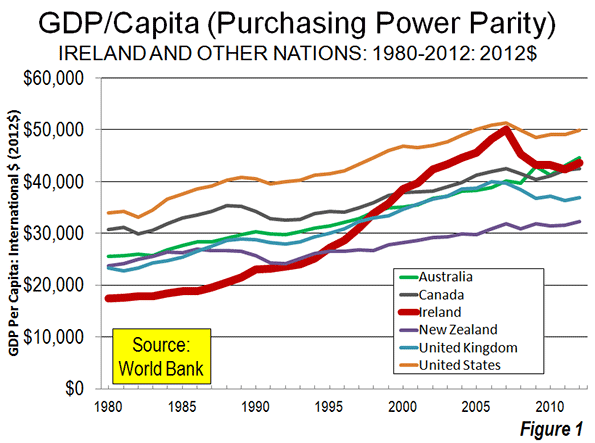
    This is a sharp contrast to Ireland’s image as the “Celtic tiger”. In 1980, Ireland’s gross domestic product per capita (purchasing power adjusted) trailed those of the United Kingdom and the four strong new world economies (United States, Canada, Australia and New Zealand) by approximately 25 percent to 50 percent. By its 2007 peak, Ireland had passed all but the United States, which it nearly caught. By 2012, however, Ireland’s GDP per capita had fallen behind that of Australia (Figure 1).

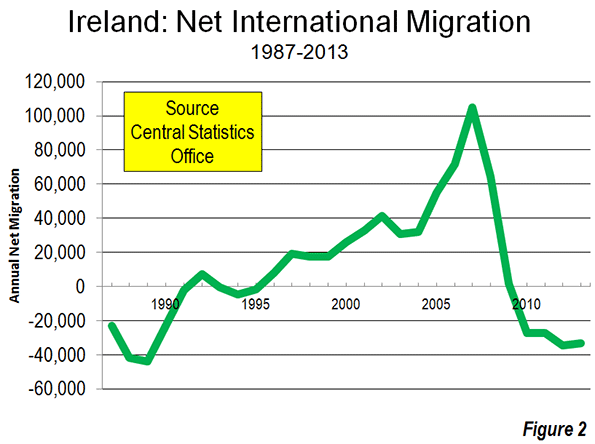
    Migration trends reflect the result of this decline. Net in-migration reached 105,000 in 2007, when the economy peaked when, a notable number for a nation with only 4.5 million residents with a long history of sending its denizens out to the rest of the world (Note 2). In the less robust economy of the last four years, a net 125,000 migrants have left Ireland (Figure 2).

    McCarthy, of University College, Dublin and one of the nation’s most respected economists was called in by the government to lead the “Special Group on Public Service Numbers and Expenditure Programs,” which published the McCarthy Report, detailing recommendations for public expenditure reductions to help Ireland “weather” the financial storm.

    The Housing Bubble in the Dublin Area

    As in the United States, a housing price bubble (centered in the Dublin area) precipitated an economic downturn, which was the greatest since the Great Depression. Our annual Demographia International Housing Affordability Surveys had shown house prices in the Dublin area to peak at a “severely unaffordable” median multiple (median house price divided by median household income) of 6.0, well above the normal 3.0 relationship between prices and incomes. Paying more for housing reduces household discretionary incomes and lowers the standard of living.

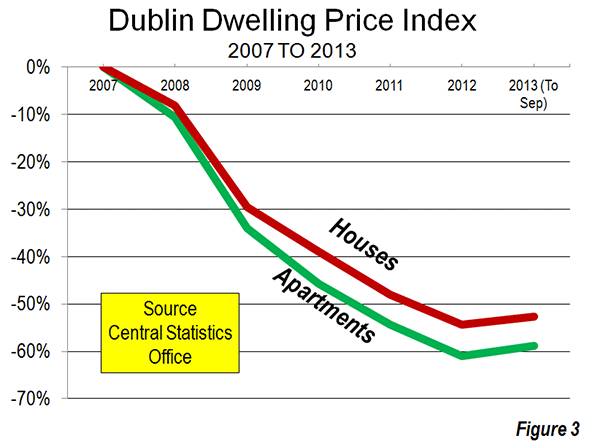
    After peaking in 2007, Dublin house prices plummeted. Single family house prices fell 53 percent from 2007 to 2012, while apartment prices dropped 61 percent, according to the Central Statistics Office property price index (Figure 3). This year, finally, prices have begun to trend upward.

    Decoupling from the Fundamentals

    Like in Dublin, this decoupling of housing from the fundamentals occurred not only in Dublin, but also in both vibrant other markets   such as Sydney, Vancouver, and the San Francisco Bay area, as well as severely depressed markets like Liverpool, Glasgow. In each case, the decoupling has been accompanied by strictly enforced enforcement urban containment policies that prohibit development on considerable suburban and exurban land, through the use of such devices as urban growth boundaries and the priority growth areas (a euphemism for the only places that development is permitted).  As is commonly the case, with these strategies upset the balance between the demand and supply for land, forcing house costs up substantially, just as oil embargoes lead to higher prices at the gas pump.

    McCarthy places the blame squarely on urban containment policies.

    “…there was and still is no shortage of land in the greater Dublin area, one of the lowest-density urban areas in Europe. There is, however, a shortage of planning permission – an entirely man-made creature of the planning legislation and its restrictive implementation by the Dublin-area councillors and planning officials.”

    He describes how artificial scarcity raises prices (other things being equal), a process anyone who listened in Economics 101 would understand. McCarthy says:

    “Before land-use zoning came along, house-builders extended the city by buying up farms on the city’s edge and building at whatever densities the market would support. But as more and more lands were withdrawn from the buildable stock by the planners, prices began to rise and the house-builders moved further away from the city proper.”

    With new house building consents so rigidly controlled, a Dublin area house prices escalated well beyond incomes and prices in the rest of the nation. As McCarthy puts it:

    “In the principal residential suburbs of Dublin an artificial scarcity (of planning permission, not of buildable land) was allowed to develop and prices rose, from the mid-Seventies onwards, to a 50 per cent or 60 per cent premium over comparable homes outside Dublin.”

    In addition to the houses for commuters that were further from Dublin, a government encouraged rural building boom led to over-building in more remote areas (Note 3).

    Economics and Urban Containment

    The consequences of urban containment policy have been known for a long time. More than four decades ago, Sir Peter Hall and his colleagues documented the extent to which house prices have been driven upward in England as a result of the land-use policies that have been copied in Ireland and elsewhere (See: The Costs of Smart Growth: A 40-Year Perspective).

    More recently, Brian N. Jansen and urban economist Edwin S. Mills (Northwestern University) took the argument further (See: The Consequences of Urban Containment) and tied the Great Recession directly at the foot of smart growth policies. They noted that “…. it is difficult to imagine another plausible cause of the 2008–2009 financial crisis,” and concluded:  “In the absence of excessive controls, housing construction would quickly deflate a speculative housing price bubble.”

    My analysis of metropolitan markets for the National Center for Policy Analysis showed that 73 percent of the house price value losses from the peak of the US housing bubble to the housing bust precipitated Lehman Brothers bankruptcy occurred in just 11 markets in California, Florida, Arizona and Nevada, all of them with severe land restrictions (see The Housing Crash and Smart Growth). Had those losses been smaller (as they would have been if prices had not risen so high), the Great Financial Crisis might have been less severe or even avoided.

    Ireland’s Challenge

    More recently, there is good news out of Ireland. The government has announced that it will no longer need the EU/IMF line of credit and will exit the bailout program. The 2012 gross domestic product nudged above the 2007 peak. But that does not mean that those who suffered economic losses during the downturn were made whole. Economic downturns massively redistribute wealth, and there is good reason to not repeat history on this score.

    McCarthy comments that: “It is quite remarkable that the contribution of restrictive zoning to the house price bubble has been so little acknowledged.” He stresses the importance of avoiding “Bubble Mark II,” and urges planning system reform:

    “The key policy measure required is the zoning for residential development of the very large volume of derelict and undeveloped land in the Dublin area.”

    Failing that, a another shock to the standard of living could face the Irish, who have already suffered one, at least partly due to urban containment policy. It could be time, again, for the government to follow Colm McCarthy’s advice. The only housing bubble that cannot burst is one that never forms.

    Wendell Cox is a Visiting Professor, Conservatoire National des Arts et Metiers, Paris and the author of “War on the Dream: How Anti-Sprawl Policy Threatens the Quality of Life.

    Dublin Bay photo by Colm MacCárthaigh.

    —-

    Note 1: Leith van Onselen of Macrobusinessprovides additional analysis on the Irish housing bubble in How Planning Exacerbated Ireland’s Housing Bust.

    Note 2: President John F. Kennedy referred to people as Ireland’s only export as people, on an Irish visit in 1963. The 1961 census had shown a population of 2.8 million, down from an 1841 6.5 million in the present area of the Republic of Ireland (before the pre-potato famine). This loss of 57 percent may be unprecedented in recent world history.

    Note 3: This was due to the combination of “easy money” for building from the financial sector and generous central government tax credits for building in remote Ireland (since repealed). Nearly all of this vacant housing is beyond commuting distance from Dublin, according to the 2011 census (much of it in the northwest and in the counties the west coast). This also fed into the Irish financial reversals.

  • American Cities May Have Hit ‘Peak Office’

    Despite some hype and a few regional exceptions, the construction of office towers and suburban office parks has not made a significant resurgence in the current recovery. After a century in which office space expanded nationally with every uptick in the economy, we may have reached something close to “peak office” in most markets.

    The amount of new office space in development is extraordinarily low by historical standards, outside of a handful of markets. Back in the mid-1980s, according to the commercial real-estate research firm CoStar, upward of 200 million square feet of office space was built annually. After dropping precipitously in the early 1990s, construction rose again to 200 million square feet a year in the early 2000s before dropping well under 150 million square feet in 2006, and lower after that. This year, in what is purported to be the middle of an economic recovery,  we will add barely 30 million square feet,according to Reis Inc.

    Even with this paltry construction, vacancy rates nationwide have barely moved, hovering around 17%. This is nowhere near low enough to justify much more construction in the vast majority of markets, where office rents remain well below 2007 levels.

    Indeed, the trend in real estate remains to convert office spaces to other uses,particularly residential. Large-scale office construction is happening in just a handful of markets; New York and Houston are the only ones with 10 million square feet being built, with smaller amounts in the works in Boston, Washington, Dallas-Ft. Worth and the San Francisco Bay Area.

    Most of the current anemic growth is happening outside downtown areas. Silicon Valley, which is essentially a sprawling suburb, currently has about as much construction as San Francisco. In Houston, another big metro area with robust job growth, there is a new 47-story high-rise being developed downtown, but much of the action is taking place on the periphery, notably in the Energy Corridor. ExxonMobil’s massive new campus, at 3 million square feet, ranks with One World Trade Center in Manhattan as the nation’s largest new office projects.

    Through the third quarter this year, the amount of new office space under construction in suburban areas was roughly double the amount being built in central business districts, by CoStar’s count. Furthermore, only 7.1 million square feet of office space was absorbed downtown in the first nine months of 2013, compared to 51.5 million in suburban areas, CoStar says. But overall there is still 100 million square feet less space being used today than in 2007, and at current absorption rates, it could take six or seven years just to get back to where we were before the recession.

    The Weak Economy

    The key question here is not the geography of office space but why so little is being built. As long as economic growth is modest, don’t expect much change in the skyline in most downtowns, or suburbs. Job growth has been mediocre at best, and much of that has been in the low-wage and part-time category. McJobs and part-time workers do not generally fill office towers.

    The dirty little secret of this recovery is that labor participation rates are at the lowest level since 1978. Underemployment is rife, at around 18% to 20%, and much of that likely includes large numbers of people who used to work in offices.

    This is true even in New York City, where the rate of “office-using employment” has been dropping since the late 1960s and even in the recovery, has yet to rebound to the levels of 2000.

    Changing Use of Space

    Just as we have gotten used to more fuel-efficient cars, companies now utilize space more efficiently than before, largely through information technology. This is a trend many companies plan to accelerate. In the past, for example, your average mid-level executive had his own secretary; now it’s more common to have perhaps one aide for several managers. Historically office developers assumed that each worker would require 250 square feet of space; by the end of the decade this could drop to 100 to 125 square feet.

    Even the most notoriously bureaucratic of professions, law, is scaling back. A recent Cushman and Wakefield survey  found that most firms — many already downsizing — were working to reduce their office footprint per attorney from 800 to 500 square feet. Almost two out of five expect to use “hoteling,” or the sharing of offices among attorneys, something very rare a decade ago.

    At the same time, some of the sectors that are the best bets for expansion, such as information technology and media, are increasingly seeking out unconventional office space. Mayor Mike Bloomberg’s drive to upzone large parts of Midtown Manhattan to create ever-taller towers works operates on the assumption that new users will be much like the old ones. But some experts, such as New York-based architect Robert Stern, suggest that ultra high-rise development does not appeal to either creative businesses and tourists, while preserving older districts, with already developed buildings, does.

    Self-Employment and Home-Based Businesses

    Perhaps the biggest long-term threat lies in the shift from corporate to self-employment. From 2001 to 2012, the number of self-employed workers grew by 14%, according to a recent study by Economic Modeling Specialists. This is occurring not only in the metro areas that suffered the worst during the recession, such as Phoenix, Los Angeles and Riverside-San Bernardino, but also in the healthiest economies such as Houston and Seattle.

    Some of these now self-employed workers may end up in small offices, but many don’t leave home at all. Working at home is growing far faster than commuting by either car or transit, and in most U.S. metro areas, far exceeds those who get to work by public conveyance, most often to downtown areas. Over the past decade the number of U.S. telecommuters expanded 41% to some 1.7 million, almost double the much-ballyhooed increase of 900,000 transit riders.

    Are We Blowing Another Bubble?

    In some specialized, fast-growing markets, new office construction may well be justified. Raleigh is seeing some new construction in its small downtown, as are hot job markets such as Austin and oil-rich Midland, Texas, where a proposed 53-story office tower would be the tallest building between Dallas and Los Angeles.

    But in New York, plans for massive new office tower construction seem to contradict an unemployment rate considerably above the national average. Financial services, the primary driver of the Manhattan market, is showing signs of economic distress, with firms moving middle-management jobs to more affordable places such as Richmond, Va.; Pittsburgh; St. Louis; and Jacksonville, Fla.

    Perhaps even more worrisome, less than half of the space in new buildings in Manhattan is preleased, compared to over 70% in both Houston and Boston, and a remarkable 92% in San Jose/Silicon Valley. This reflects an apparent dearth of large employers in New York who could conceivably afford and fill ultra-expensive office space in the coming years, a recent article in Crain’s New York points out. Tech companies might be expected to help fill the gap, but we have to remember that after the last boomlet Silicon Alley suffered asteep contraction; it has since recovered, but could be hit hard again if the current bubble pops.

    San Francisco, the other current darling of office developers, is even more dependent on the current dot-com boom. The IPOs of Frisco-based firms such as Twitter appear to suggest the prospect of a whole new generation of office occupants. By one account, there is as much as 12 million square feet of new office space in the pipeline in the city, enough to satisfy historical demand for the next 16 years.

    Yet past experience shows many of these companies will likely dissolve or merge in the next few years. They may be fewer in numbers and longer established than last time around, as some local boosters eagerly suggest, but most are still unprofitable and many may never be truly viable. Following the 2000 dot-com crash, San Francisco office occupancy dropped roughly 10 million square feet, while tech employment crashed from a high of 34,000 in 2000 to barely 18,000 four years later.  As one real-estate executive put it at the time, “The office-space market here ”reminds me of the Road Runner cartoon where the Coyote runs into the wall.”

    Observers also point out that more traditional businesses, such as banks, continue to ship jobs elsewhere, in large part due to extraordinarily high costs. The fact that pre-leasing for SF’s new office buildings is barely 33% should add to the caution.

    None of this suggests there are not some good opportunities for new construction, but the office building’s role as a key indicator of the strength of the U.S. economy has faded. In great cities, rather than a ballyhooed era of new office skyscrapers we will see more conversions and the construction of residential high-rises, as well as medical buildings. The secular trend is for the dispersion of business service employment to smaller markets, and into people’s homes. The glory days of the American office tower are over, and not likely to return soon, given technological trends and a persistently tepid economy.

    This story originally appeared at Forbes.

    Joel Kotkin is executive editor of NewGeography.com and Distinguished Presidential Fellow in Urban Futures at Chapman University, and a member of the editorial board of the Orange County Register. He is author of The City: A Global History and The Next Hundred Million: America in 2050. His most recent study, The Rise of Postfamilialism, has been widely discussed and distributed internationally. He lives in Los Angeles, CA.

    Photo by Mark Lyon — Full Floor For Rent.