Category: planning

  • Bridges Boondoggle, Portland Edition

    A couple weeks ago I outlined how the Ohio River Bridges Project in Louisville had gone from tragedy to farce. Basically none of the traffic assumptions from the Environmental Impact Statements that got the project approved are true anymore. According to the investment grade toll study recently performed to set toll rates and sell bonds, total cross river traffic will be 78,000 cars (21.5%) less than projected in the original FEIS. What’s more, tolls badly distort the distribution of traffic that will come such that the I-65 downtown bridge, which is being doubled in capacity, will never carry just what the existing bridge carries right now anytime during the study period, and won’t exceed the design capacity even slightly until 2050. Meanwhile, the I-64 bridge that will remain free will grow in traffic by 55% by 2030, when it will be 34% over capacity.

    A nearly identical scenario is playing out in Portland with the $2.75 billion I-5 Columbia River Crossing. Joe Cortright of Impresa consulting unearthed the information through freedom of information requests looking into the investment grade toll study on that is being conducted for that bridge. You can see his report here (there’s also a summary available).

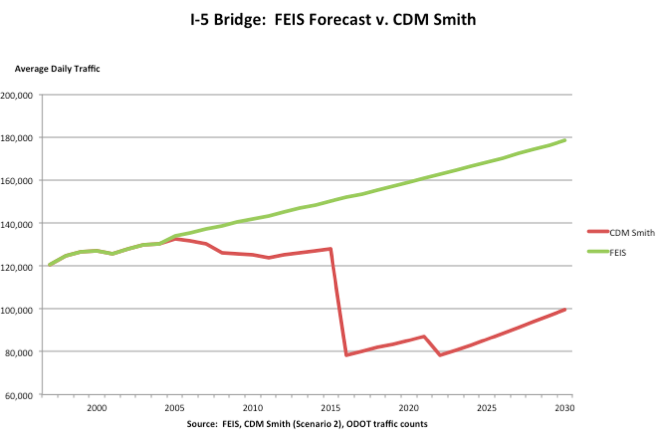
    I’ll highlight some of his truly eye-popping findings. Traffic forecasts are inflated, of course. The toll study is suggesting traffic increases of 1.1% to 1.2% per year when over the last decade traffic has actually declined by 0.2% per year on average even though there are no tolls. But it’s the addition of tolls that badly distort cross-river traffic and make a mockery out of the EIS. Here’s the money chart for the I-5 bridge itself:


    How is it possible that after building a gigantic multi-billion dollar bridge traffic declines? For the same reason as Louisville: tolling will cause huge amounts of traffic to divert to the I-205 free bridge. By 2016 traffic on I-205 would rise from 140,000 per day to 188,000 – and up to 210,000 by 2022 (full capacity).

    This is so eerily similar to the Louisville situation, that someone suggested, only half in jest I suspect, that they must be having “how to” training sessions on this stuff over at AASHTO HQ.

    Unlike Louisville, where a docile press is basically in cahoots with the state DOTs pushing the project, Portland’s media started asking questions. And one local paper even caught a civil engineering professor from Georgia serving on the independent review board for the project labeling the tolling scheme “stupid.” (Louisvillians take note).

    Oregon DOT director Matt Garrett released a letter in response in which he says, “This work is fundamentally different than the traffic analysis completed for the Final Environmental Impact Statement, and with very different goals in mind.” I agree. The FEIS was performed with the goal of getting this bridge the DOT wanted built approved. The toll study was designed to withstand financial scrutiny on Wall Street and be relied on in selling securities. I’ll let you be the judge of which is more likely to be closer to the truth. What’s more, Cortright addresses this very issue by saying in his report, “Neither federal highway regulations nor federal environmental regulations authorize or direct using multiple, conflicting forecasts for a single project, or using one set of traffic numbers for one purpose, and a different set for another.” I might also add that the DOTs in Louisville have not to the best of my knowledge made similar claims to explain away an identical discrepancy there. Nevertheless, the rest of Garrett’s letter acknowledges that I-5 will see a big traffic drop and there will be diversion from tolling. So he appears to just be doing the bureaucratic equivalent of “pay no attention to that man behind the curtain.”

    Again, want to know how it is that we spend so much money on transport infrastructure and get so little value? It’s because far too many of our highway dollars go into boondoggle mega-projects ginned up through political pressure (watch this space as I have another example coming soon) instead of into projects that make transportation sense. It may well be that there are legitimate problems with the existing I-5 river crossing, but these numbers give no confidence that the Oregon DOT has come up with a good or cost-effective plan for dealing with them. Unlike some, I do think we need to build more roads in America. Unfortunately our system is set up to ensure the survival of the unfittest instead of projects that make actual transportation and economic sense.

    Aaron M. Renn is an independent writer on urban affairs and the founder of Telestrian, a data analysis and mapping tool. He writes at The Urbanophile, where this piece originally appeared.

    Photo of current Columbia River crossing by Jonathan Caves.

  • Cities and Sustainability: Is Intensification Good Policy?

    This post examines the idea that we can promote sustainability by increasing the densities of large cities around their centres.  This compact city paradigm presumes that we can reshape the consumption of citizens in environmentally benign ways by reshaping the cities they live in.  

    The sustainability challenge is the challenge of consumption: how much and what we consume drives our impact on the planet.  But presuming that by enforcing urban intensification we will transform ingrained patterns of consumption in favour of the environment may be a step too far.  Will obliging more citizens to live at higher densities in smaller dwellings around city centres really pave the way to environmental salvation?

    Some evidence of urban impacts

    The Australian Conservation Foundation is committed to ecological sustainability, tackling the social and economic causes of environmental problems.  Among other things, the Foundation publishes the onlineAustralian Consumption Atlas. This is a useful source for addressing the role of urbanisation and urban form.

    The Atlas is based on methodology which traces the direct and indirect demands on the environment of different goods and services.  Consumption patterns from Household Expenditure Surveys are related to household size and type, members’ age structure, incomes and education, and the statistical areas they live in. Using this information the environmental impacts of individuals living in different areas can be mapped. 

    Three indicators of impact are displayed in the atlas: tonnes of greenhouse gas emitted, litres of water consumed, and ecological footprint.  The latter estimates the area of resources required to support a person’s lifestyle.  You can read more about the methodology here.

    The data underlying the atlas is dated – based on the 2001 Census and 1999 Household Expenditure Survey, among other things.  But I do not expect the relativities it demonstrates, or the conclusions it supports, to have changed much.

    Cities don’t consume; people do

    Here is the authors’ key conclusion. Our urban planners, designers, and politicians should consider carefully:

    despite the lower environmental impacts associated with less car use, inner city households outstrip the rest of Australia in every other category of consumption. Even in the area of housing, the opportunities for relatively efficient, compact living appear to be overwhelmed by the energy and water demands of modern urban living, such as air conditioning, spa baths, down lighting and luxury electronics and appliances, as well as by a higher proportion of individuals living alone or in small households.

    In each state and territory, the centre of the capital city is the area with the highest environmental impacts, followed by the inner suburban areas. Rural and regional areas tend to have noticeably lower levels of consumption.

    (Consuming Australia: Main Findings, 2007, Australian Conservation Foundation, p.10)

    Looking inside Sydney

    I explored the indicators for different parts of Sydney.  Here are some results.

    Indicators of Environmental Impacts: Sydney Centre and Suburbs

    People in Inner Sydney generate 92% more greenhouse gas than the New South Wales Average, and well over twice as much as people in the lower income western suburbs, like Penrith and Blacktown. The levels are a bit higher for people in the more prosperous northern suburbs. Despite proximity to major employment centres, and an efficient commuter rail service, the consumption patterns of Willoughby and Ku-ring-gai residents generate high levels of air pollution. 

    Looking East to Sydney CBD
    (Source: www:freeaussiestock.com)

    A similar pattern is evident for water consumption – residents of the hot, dry, western suburbs account for the least consumption, Inner and North Sydney residents the most.  They also have the biggest ecological footprint.

    So what does this tell us?

    The lesson is not necessarily that location in the CBD is less sustainable; but that the lifestyle associated with it is. 

    I have discussed the potential inefficiency of small, multi-unit dwellings elsewhere.  Over and above that, the high cost of redevelopment in central locations calls for housing construction strategies that add little to sustainability.  

    One strategy is to build to modest standards.  This keeps the price down and rental yield up for investors; or creates opportunities for ownership by low income earners.  Another strategy is to adopt high standards of fit-out and install luxury appliances in favoured locations to make multi-unit dwellings attractive to wealthier households. 

    Neither option is particularly environmentally sympathetic.  

    Smaller is still better

    I also reviewed the indicators for smaller cities and towns in New South Wales.  (In some cases these included surrounding rural settlement).  

    Indicators of Environmental Impacts: New South Wales Towns and Small Cities

    This suggests that smaller towns hold the key to environmentally sustainable lifestyles, even more than city suburbs.  For example,  Coffs Harbour’s 73,000 residents generate greenhouse emissions at 88% of the state average, and just 46% of inner Sydney residents.  They consume water at 81% of the State rate (and 60% of North Sydney), and have an ecological footprint just 60% of their inner Sydney counterparts.  Similar patterns are evident in coastal settlements like Byron Bay (33,000 residents), Ballina (42,000), and Port Macquarie (77,000) and inland towns such as Griffith (26,000), Tamworth (60,000), and Wagga Wagga (64,000).

    What does it all add up to?

    A simple overview can be derived by summing the percentage deviations of each area from the New South Wales average across the three measures. Admittedly this is a course approach: it weights each indicator equally, and ignores differences in how much centres vary across each individually.  Nevertheless, it provides a sufficiently meaningful overview to confirm that towns and small cities are generally more sustainable than a large city, and that the suburbs perform better than the inner city. 

    Summary Index of the Environmental Impact of Urbanisation

    Explaining the sustainability dividend of small towns

    There can be any number of explanations for this, the obvious one being that it is all about income.  Perhaps the advantages of lifestyles outside Sydney simply reflect lower average incomes in smaller cities and towns.  As people become more affluent or seek more income, they migrate into the main cities taking their high consumption expectations with them; or by living in large cities they are more likely to earn – and consume – more. 

    Conversely, living in smaller cities and settlements may reflect lifestyle preferences which are intrinsically less environmentally intrusive.  At the same time. small settlements make less travel demands given the greater proximity to work, shopping, service, and recreation opportunities.  In addition, lower density housing may provide more opportunities for passive energy efficiency, directly reducing resource consumption for comparable activities.  

    Flawed policy

    Until we know more, however, we need to avoid the trap of determinism.  It would be short-sighted simply to invert the current paradigm, for example, and decide that policies to encourage people to live outside large cities and city centres will somehow enhance sustainability. 

    Ultimately, how we live is more important than where we live.  What the evidence here confirms, though, is that under current patterns of consumption promoting large scale urban consolidation is flawed as environmental as well as urban policy. 

    Phil McDermott is a Director of CityScope Consultants in Auckland, New Zealand, and Adjunct Professor of Regional and Urban Development at Auckland University of Technology.  He works in urban, economic and transport development throughout New Zealand and in Australia, Asia, and the Pacific.  He was formerly Head of the School of Resource and Environmental Planning at Massey University and General Manager of the Centre for Asia Pacific Aviation in Sydney. This piece originally appeared at is blog: Cities Matter.

    Aukland harbour photo by Bigstockphoto.com.

  • You Say You Want A (Metropolitan) Revolution?

    [Book Review] The Metropolitan Revolution: How Cities and Metros Are Fixing Our Broken Politics and Fragile Economy, by Bruce Katz and Jennifer Bradley. 2013, Brookings Focus Book

    It’s now decades after deindustrialization, and several years since the Great Recession supposedly ended. Yet too many American cities are still struggling to recover from the losses of jobs, population, taxes, and identities. Detroit’s declaration of bankruptcy in July drew new attention to the problem, and it helped fuel the extensive marketing campaign for The Metropolitan Revolution: How Cities and Metros Are Fixing Our Broken Politics and Fragile Economy by Bruce Katz and Jennifer Bradley of the Brookings Institution, published just a few weeks earlier. The book quickly became a cause célèbre garnering high praise from various media outlets.

    Katz and Bradley highlight the emergence of “trading metros” with “innovation districts,” clusters of universities and local businesses, hospitals, museums, and advanced technology and manufacturing industries held together regionally with housing, retail and transit networks that seem to promise a better economic future. The book’s strength lies in its attention to metros, rather than cities, as the unit of urban settlement and economics. The authors encourage planners and government officials to develop new strategies based on “Emergent Metros” rather than “Legacy Cities.”

    This attention to metropolitan areas is welcome, but the book’s outline of the future is overly optimistic. Describing deindustrialization and disinvestment as part of an evolutionary process and a “revolution unleashed” is hyperbole reminiscent of Atlas Shrugged. More critically, The Metropolitan Revolution can be read as a neoliberal sales pitch. In fact, Katz and Bradley have “doubled down” on an approach that has not only dominated economic thought since the 1980s, but that has actually contributed to the urban crisis today.

    Neoliberal theory hypothesizes that small government, deregulation, global production networks, free trade agreements, labor market flexibility, abandonment of full employment policy, cost shifting, and capital mobility improve corporate competitiveness and unleash the entrepreneurial spirit, and increase productivity. These ideas have been applied to corporate restructuring over the last 30 years, informing changes like downsizing, outsourcing, and rightsizing. In another example, neoliberals argued that the housing bubble and the subsequent Great Recession resulted from federal government intervention in the housing market, which encouraged home ownership for the unqualified, and from a national liberal monetary policy. Even when neoliberal economic policies have failed, proponents have continued their unwavering critique of “big government” and regulations.

    Using the language of neoliberalism and corporate restructuring, Katz and Bradley write that the metropolitan revolution is “exploding the tired construct” about the role of the federal government. Now, they say, it is the cities and metro areas that “are becoming the leaders in the nation: experimenting, taking risks, making hard choices and asking for forgiveness not permission.” Their metropolitan revolution sees power relations being restructured, as metros and cities take greater responsibility for their economic growth, and as federal government power devolves: “The metropolitan revolution has only one logical conclusion: the inversion of the hierarchy of power in the US.” But, we should ask, inversion for whom? Their examples all seem to suggest shifts from elected government officials to unelected business and economic leaders and non-governmental organizations.

    Katz and Bradley borrow heavily from neoliberal architects who claimed that, in the corporate world, restructuring would result in greater local and regional cooperation and in independence for the new businesses on which future growth would be based. But corporate restructuring promised more than it delivered, as corporations were downsized, outsourced, and resource starved. Instead of cooperation, restructuring often led to an increase in internal predatory activity and greater control by corporate headquarters, under the rubric of the ‘survival of the fittest’.

    Much like the early supporters of corporate restructuring, Katz and Bradley make an overly optimistic case, citing cherry-picked metros that seem to have accepted current conditions and neoliberal strategies as part of the natural economic order. But, constrained by state and federal neoliberal defunding policy, cities that lie within metros, especially in the Rust Belt, are hoarding or fighting for resources in a zero sum game of economic and regional development. Just as in the corporate sector, local and regional collaborations are largely ineffective. As Harvard economist Stephan Marlin has suggested, it may be that thinking like an economist can undermine a real sense of community.

    Rather than Katz and Bradley’s view of metro areas as collaborative communities on which future growth could be based, we might better see them as urban archipelagos, autonomous islands of self-interest, and rational calculators in a neoliberal sea.

    Northeast Ohio, for example, is an area optimistically viewed by Katz and Bradley. It’s a place where community officials have historically ignored regional economic plans unless they were directly impacted by them. Instead, they pursued localized development efforts, often competing rather than cooperating within a metropolitan region. Greg LeRoy, director of the public policy group Good Jobs First, found that between 1996 and 2005 many small and medium sized firms received lucrative tax breaks to move to new locations… all within the Cleveland metro area. The average distance moved in this metro cannibalization was five miles. A new regional sustainability plan for Northeast Ohio has now been funded by a $4.25 million grant from the US Department of Housing and Urban Development and a consortium of regional foundations. But the plan has garnered only limited support among the 375 cities, townships, and regional agencies in the metro area. Most observers see little chance of the plan being adopted on any meaningful scale.

    Katz and Bradley’s book may end up being more of a distraction than a revolution for many metros. It dilutes the distinctly urban crisis. Racial and class polarization, and growing inequities in education, housing, health care, and infrastructure mark this urban crisis. The book essentially offers platitudes about economic growth for cities and first rings suburbs that have suffered from the neoliberal crisis, rather than offering suggestions for how to rebuild and reclaim urban neighborhoods and schools and prevent further decline. While praising sympathetic NGOs, Katz and Bradley fail to acknowledge the populist revolt in many metros, cities, and neighborhoods. In fact, they are contemptuous of grass-roots efforts such as the Occupy Movement. Their census-defined metropolitan revolution is “reasoned rather than emotional, leader driven rather than leaderless, born of pragmatism and optimism rather than despair or anger.” Despite claims to the contrary, the book is another indicator the economic divergence between Main Street and Wall Street.

    John Russo is a visiting research fellow at the Metropolitan Institute of Virginia Tech, a former co-director of the Center for Working-Class Studies, and professor (emeritus) in the Williamson College of Business Administration at Youngstown State University. He is a board member of the Mahoning Valley Organizing Collaborative (Youngstown-Warren), and the co-author, with Sherry Linkon, of Steeltown U.S.A.: Work and Memory in Youngstown.

  • “Unblocking Constipated Planning” in New Zealand

    One of the National Party’s principal objectives since coming to power in New Zealand has been to address that nation’s terribly deteriorated housing affordability problem.  Deputy Prime Minister Bill English explained the problem in his Introduction to the 9th Annual Demographia International Housing Affordability Survey:

    “It costs too much and takes too long to build a house in New Zealand. Land has been made artificially scarce by regulation that locks up land for development. This regulation has made land supply unresponsive to demand. When demand shocks occur, as they did in the mid-2000s in New Zealand and around the world, much of that shock translates to higher prices rather than more houses.”

    In the largest markets (Auckland, Christchurch and Wellington), house prices had doubled relative to incomes over the past two decades, as land prices were driven up by urban containment land-use policies (Note), that severely restrict the supply of land available for new housing. Across New Zealand, this rationing of land has led to the destruction of the competitive supply of land the Brookings Institution economist Anthony Downs says is essential to maintaining housing affordability. The relationship between urban containment policy and higher house prices is documented in a large body of international research. Economists Richard Green and Stephen Malpezzi succinctly summarized the issue:

    “When the supply of any commodity is restricted, the commodity’s price rises. To the extent that land – use, building codes, housing finance, or any other type of regulation is binding, it will worsen housing affordability.”

    On September 5, the government took an important step toward improving housing affordability, with the enactment of ground-breaking land use regulation reform. In the Parliamentary debate, Housing Minister Dr. Nick Smith expressed the imperative for passage by describing the regulatory situation in Auckland, the nation’s largest city (metropolitan area):

    Auckland has just 1,300 sections (lots) currently available for housing. That’s a third of what it had 10 years ago.

    We need 13,000 each year just to keep up with population growth.

    We’ve got a rigid Metropolitan Urban Limit (urban growth boundary) prohibiting any new housing developments beyond the artificial line drawn 15 years ago.

    We’ve got a few lucky land owners sitting on the last few parcels of developable residential land holding prospective homebuyers to ransom.

    Section (lot) prices have trebled and gone up by more than any other part of the housing cost equation.

    We’ve got a convoluted RMA (Resource Management Act) planning system where it takes an average of seven years to get a plan changed by the time you get through all the consultation and appeal processes.

    And even when you get a plan change, it takes an average of another three years to get a consent for a greenfields development and a year for a brownfields development.

    We’ve got a constipated planning system blocking new residential construction and this bill is a laxative to get new houses flowing.

    The passage represents an important step in the campaign by Dr. Smith and the National Party government to improve New Zealand’s housing affordability.

    According to Dr. Smith: “The increased land supply will help take the pressure off the over-heated Auckland housing market and help the economic recovery. It will enable tens of thousands of kiwi families to realise the dream of owning their own home.”

    Housing Accords and Special Housing Areas Act

    The new Housing Accords and Special Housing Areas Act permits the government to establish special housing districts that permit bypassing expensive planning regulations. Initially, the Act will be applied in Auckland, where an urban growth boundary (the “Metropolitan Urban Limit”) has been blamed for driving house prices to more than double their historic relationship to household incomes. Smith indicated that the Act would “over-ride Auckland’s Metropolitan Urban Limit” and that  ”…it would enable low-rise greenfield developments to be consented in six months, when they previously took three years, and low-rise brownfield developments to be consented in three months, when they previously took a year.”

    Smith also noted that support for the act was based on advice from the New Zealand Productivity Commission, the Reserve Bank of New Zealand (the central bank), the Organization for Economic Cooperation and Development (OECD) and the International Monetary Fund (IMF), which have indicated that “increasing supply is crucial to addressing housing affordability.”

    The government intends to move quickly, according to Minister Smith:

    “The main initial focus of the new law would be to enact the Auckland Housing Accord through which it is planned to build 39,000 new houses in a three year period in the Auckland region. Housing Minister Nick Smith says he expects the Auckland Council to approve the accord next Tuesday and is talking about having special housing areas approved by Christmas that would be able to cater for 5000 houses.”

    Housing Affordability in New Zealand

    The housing affordability crisis problem is the most severe in Auckland. The most recent Demographia International Housing Affordability Survey reported that median house prices were 6.7 times median household incomes in 2012 (this is the “median multiple”). This price to income ratio has more than doubled since the early 1990s. This is a particular problem because housing cost is by far the largest element of household budgets in New Zealand (as well as in Australia, Canada and the United States).

    The extent of the problem in Auckland is illustrated by the fact that across the urban growth boundary, values are one-tenth per acre for comparable land, according to research by Dr. Arthur Grimes, Chairman of the Board of Reserve Bank of New Zealand. In a competently governed market, there would be little difference.

    The higher land prices of urban containment also encourages builder “up-market,” to achieve competitive returns on the required larger investments. This is illustrated in New Zealand Productivity Commission research by Guanyu Zheng for the New Zealand Productivity Commission found that the higher prices generated by Auckland’s urban growth boundary were more severe for lower cost housing: “…when the supply of land on the urban periphery is restricted, the price of available residential land rises and new builds tend to be larger and more expensive houses.”

    High house prices are not limited to Auckland. Like in the United Kingdom, where exorbitant house prices occur from depressed Glasgow and Liverpool to dynamic London, house prices are high from the top of North Island to Invercargill in the South, irrespective of the economy.

    The provisions of the Act will also be applied in other more expensive markets in New Zealand. The Minister said: “The Government is also having discussions with other councils in high cost housing areas on how the tools in this law can assist in addressing the housing supply and affordability issues in their communities.”

    The Campaign

    The extent of New Zealand’s housing affordability problem has been known for some time and has been cause for serious concern.

    The long-time Governor of the Reserve Bank, Donald Brash wrote in 2008 that “the one clear factor that separates all of the” affordable and unaffordable housing markets “is the severity of the artificial restraints on the availability of land for residential building.” Later, Brash zeroed in on the cause., which he characterized as the extent to which urban containment policy “has pushed the price of residential land well beyond the reach of far too many New Zealanders.”

    For the last decade, Christchurch’s Hugh Pavletich (co-author of the Demographia International Housing Affordability Surveys) has been drawing attention to the problem: “We are currently paying near double per square metre build costs because of this…”

    More recently, Governor Graeme Wheeler of the Reserve Bank of New Zealand raised concerns about house price increases and implemented stronger loan qualification requirements to cool the market. Similar action was taken by the Bank of Canada last year, though monetary policy is severely limited in reigning in bubbles in the face of regional policies that drive up land prices.

    Moreover, urban containment is a poor strategy for reducing greenhouse gas emissions, because of its exorbitant costs per ton and its meager results.

    Getting Priorities Right

    By these reforms, the New Zealand government has given priority to the quality of life of its households over the more peripheral issues of city form and how people travel. In an increasingly globalized and competitive world, this sends an important signal.

    Wendell Cox is a Visiting Professor, Conservatoire National des Arts et Metiers, Paris and the author of “War on the Dream: How Anti-Sprawl Policy Threatens the Quality of Life.

    —–

    Note: Urban containment is also referred to as “smart growth,” growth management,” “compact cities” and other terms.

    —-

    Photograph: Downtown Auckland (by author)

  • Health, Happiness, and Density

    The proponents of currently fashionable planning doctrines favouring density promulgate a variety of baseless assertions to support their beliefs. These doctrines, which they group under the label of “Smart Growth”, claim, among other things, that from a health and sustainability perspective, the need to increase population densities is imperative.

    With regard to health these high-density advocates have seized upon the obesity epidemic as a reason to advocate squeezing the population into high-density. This is based on a supposition that living in higher densities promotes greater physical activity and thus lower levels of obesity.  They quote studies that show associations between suburban living and higher weight with its adverse health implications. But the weight differences found are minor – in the region of 1 to 3 pounds. Nor do the studies show it is suburban living that has caused this.

    The suburbs, after all, have been with us for 70 years and reached its mature development over 40 years ago. Obesity, on the other hand, is a much more recent phenomenon and is primarily due to people eating too much fattening food.

    Less discussed, however, are other facets to human health and it is important to consider the results of research on the association with high-density living of mental illness, children’s health, respiratory disease, heart attacks, cancer and human happiness.

    A significant health issue relates to the scourge of Mental Illness. There is convincing evidence showing adverse mental health consequences from increasing density.

    A monumental Swedish study of over four million Swedes examined whether a high level of urbanisation (which correlates with density) is associated with an increased risk of developing psychosis and depression. Adjustments were made to cater for individual demographic and socio-economic characteristics. It was found that the rates for psychosis (such as the major brain disorder schizophrenia) were 70% greater for the denser areas. There was also a 16% greater risk of developing depression. The paper discusses various reasons for this finding but the conclusion states: "A high level of urbanisation is associated with increased risk of psychosis and depression".

    Another analysis, in the prestigious journal Nature, discusses urban neural social stress. It states that the incidence of schizophrenia is twice as high in cities. Brain area activity differences associated with urbanisation have been found. There is evidence of a dose-response relationship that probably reflects causation.

    There are adverse mental (and other) health consequences resulting from an absence of green space. After allowing for demographic and socio-economic characteristics, a study of three hundred and fifty thousand people in Holland found that the prevalence of depression and anxiety was significantly greater for those living in areas with only 10% green space in their surroundings compared to those with 90% green space.

    High-density advocates seem most oblivious to the needs of children. Living in high-density restricts children’s physical activity, independent mobility and active play. Many studies find that child development, mental health and physical health are affected. They also find a likely association of high-rise living with behavioural problems.

    An Australian study of bringing up young children in apartments emphasizes resulting activities that are sedentary. It notes there is a lack of safe active play space outside the home – many parks and other public open spaces offer poor security. Frustrated young children falling out of apartment windows can be a tragic consequence. Children enter school with poorly developed social and motor skills. Girls living in high-rise buildings are prone to increased levels of overweight and obesity.

    A British study found that 93% of children living in centrally located high-rise flats had behavioural problems and that this percentage was higher than for children living
    in lower density dwellings. Anti-social behaviour often results. An Austrian study showed disturbances in classroom behaviour higher for children living in multiple-dwelling units compared to those living in lower densities. 

    There is also evidence of other potential health impacts on children living in higher density housing. These include short-sightedness due to restricted length of vision, and diminished auditory discrimination and reading ability due to exposure to noise.

    Air pollution increases with density. This results from higher traffic densities together with less volume of air being available for dilution and dispersion. Nitrogen oxides in this pollution have adverse respiratory effects including airway inflammation in healthy people and increased respiratory symptoms in people with asthma. There is consistent evidence that proximity to busy roads, high traffic density and increased exposure to pollution are linked to a range of respiratory conditions. These can range from severe conditions (such as a higher incidence of death) to minor irritations. Moreover, these respiratory health impacts affect all age groups.

    Several studies relate low birth weight to air pollution. A South Korean report, for example, found the pollutants carbon monoxide, nitrogen dioxide, sulfur dioxide, and total suspended particle concentrations in the first trimester of pregnancy pose significant risk factors for low birth weight.

    Air pollution particulates are associated with killing more people than traffic accidents. Pollutants such as those emitted by vehicles are significantly associated with an increase in the risk of heart attacks and early death.

    Cancer is a major health scourge and a relationship between increased colon cancer, breast cancer and total cancer mortality with population density has been found.

    There is an association between overall Human Happiness and density. Professor Cummins’ Australian Unity Wellbeing Index reports that the happiest electorates have a lower population density. A United States study finds the satisfaction of older adults living in higher density social housing reduces as building height increases and as the number of units increases. By contrast, in lower densities there are higher friendship scores, greater housing satisfaction, and more active participation. This does not apply only to single family houses: Residents of garden apartments have a greater sense of community than residents of high-rise dwellings.

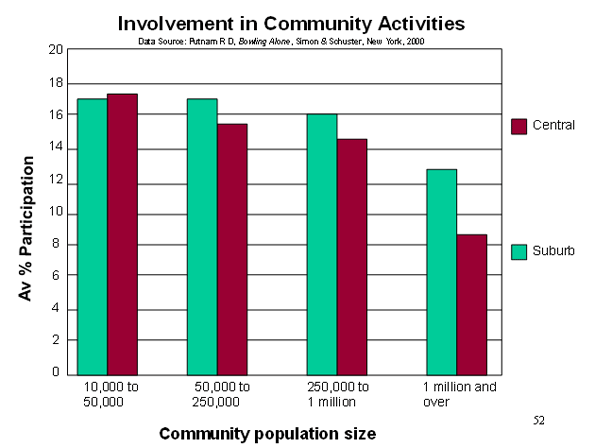
    An example of misinformation on this issue can be found in R.D. Putnam’s famous book “Bowling Alone”.  Putnam states that "suburbanisation, commuting and sprawl" have contributed to the decline in social engagement and social capital.  However I have shown that data from charts in his book indicate quite the opposite:

    Adapted from Figure 50, Putnam R D, Bowling Alone, Simon & Schuster, New York, 2000

    This shows that involvement in these social activities are more common in the suburbs than in the denser centres of cities (and that they become more common as the community size and density decreases).

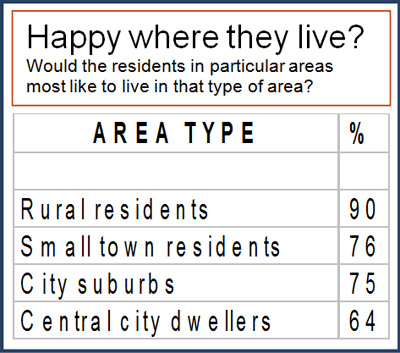
    Community contentment relating to the density of surroundings is revealed by a study in New Zealand that asked people if the type of area they would most prefer to live in is similar to the area they currently live in. The responses are shown in this table.


    So 90% of rural residents would prefer an area similar to their current area but only 64% of central city dwellers would prefer an area similar to their current surroundings.  It can be seen that satisfaction decreases as density increases.

    Thus evidence from a variety of sources points to greater human happiness and better health in lower densities — the exact opposite of the theories of the advocates for “cramming” people into ever small places.

    (Dr) Tony Recsei has a background in chemistry and is an environmental consultant. Since retiring he has taken an interest in community affairs and is president of the Save Our Suburbs community group which opposes over-development forced onto communities by the New South Wales State Government.

    Sydney suburb photo by BigStockPhoto.com.

  • City Leaders Are in Love With Density but Most City Dwellers Disagree

    People care deeply about where they live. If you ever doubt that, remember this: they staged massive protests over a park in Istanbul. Gezi Park near Taksim Square is one of that ancient city’s most beloved spots. So in June, when Prime Minister Recep Tayyip Erdogan threatened to demolish the park to make room for his grandiose vision of the city as “the financial center of the world,” the park’s neighbors and supporters took to the streets. The protests were directed against what has been described as “authoritarian building”—the demolition of older, more-human-scaled neighborhoods in favor of denser high-rise construction, massive malls, and other iconic projects.

    Other protests, usually more peaceful, but sparked by a similar revulsion against gigantism, have erupted in cities as various as Sao Paolo, Singapore, and Los Angeles. But what is most striking are the eerily similar reactions of mayors, city planners, architects, and developers, all of whom seem remarkably tone deaf to the wishes of their constituents.

    New York’s Mayor Michael Bloomberg, for example, is a tireless advocate for more density in the Big Apple. Along with many of the world’s leading academic, media, and real estate leaders, Bloomberg dreams of a future where urban dwellers live cheek by jowl in ever-closer proximity. Bloomberg’s notions are supported not only by developers but also a large cadre of academics, such as Columbia University’s Kenneth Jackson, who considers dissent from the mayor’s plans an affront to “Gotham’s towering ambitions” by reactionary “opponents of change.”

    There’s just one problem with this brave new condensed world: most urban residents aren’t crazy about it. In the United States and elsewhere, people, when asked, generally say they prefer less dense, less congested places to live. The grandiose vision of high-rise, high-density cities manifestly does not respond to the actual needs and desires of most people, who continue to migrate to the usually less congested, and often less expensive, periphery. And as the people’s desires continue to run counter to what those in power dictate, the urban future is likely to become increasingly contentious.

    Protests over urban development priorities similar to Istanbul’s occurred earlier this year in São Paulo, where the government is accused of putting mega-projects ahead of basic services such as public transport, education, and health care, particularly in the run-up to the 2014 World Cup and the 2016 Olympics.

    Singapore, often held up as a role model for densification, has seen growing concern about the destruction of historic structures, ever-more crowded subways, escalating house prices, and lack of open space. Similarly in Los Angeles, neighborhood councils have rallied against attempts to build denser buildings, which generate more congestion and erode local character. In London, too, attempts to build what the Independent describes as “the tall, the ostentatious, the showy and ‘iconic’” have been widely criticized for undermining the human-scaled nature ofLondon. Densification may be revealed religion to British planners, but this faith is not well accepted by citizens who live nearby. Novelist Will Self noted the “Wizard of Oz–hollowness” of these structures that seek to inspire but also “belittle us” with the mass, scale, and stand against this great city’s historic grain.

    Even in Manhattan, the red-hot center of American ultra-density, eight of the island’s 10 community boards oppose Mayor Bloomberg’s attempts to densify midtown. The midtown project has prompted Yale architect Robert Stern, a devoted urbanist and no opponent of density, to warn that too much high-rise development creates a dehumanized aesthetic that chases away creative businesses and tourists, while preserving older districts attracts them.

    Voting With Their Feet

    The growing disconnect between people and planners is illustrated by the oft-ignored fact that around the world the great majority of growth continues to occur on the suburban and exurban frontier, including the fringes of 23 out of 28 of the world’s megacities. This, notes NYU professor Shlomo Angel in his landmark book A Planet of Cities, is true both in developing and developed countries.

    In Europe, immigration has slightly boosted populations in urban cores, but the flow of domestic migration still heads towards the periphery. The evidence is even more telling in the U.S. In the last decade, nearly 90 percent of all metropolitan growth in this country took place in suburban locations, up from the previous decade. At the same time, a net 3.5 million people left our largest metropolitan areas—those over 10 million—while the majority of growth took place in cities under 2.5 million. Between 2000 and 2010, a net 1.9 million left New York, 1.3 million left Los Angeles, 340,000 left San Francisco, and 230,000 left both San Jose and Boston.       

    This is not what you read regularly in the New York Times or the Wall Street Journal. Young reporters, virtually all of whom live in dense, expensive places like New York or Washington, believe the world is the one they know first-hand, the one in which they and their friends reside. Yet most Americans are not young, highly educated Manhattan residents. Many downtown areas may have experienced a substantial boost in numbers over the last decade, but this accounted for less than 1 percent of the 27 million in population growth experienced by the nation between 2000 and 2010. The total population increase in counties with under 500 people per square mile was more than 30 times that of the increase in counties with densities of 10,000 and greater.

    All of this flies in the face of the argument, made by a well-funded density-boosting industry, that people want more density, not less. Lobbies to force people back into cities enjoy generous funding provided by urban land interests and powerfulmultinationals that build subways and other city infrastructure to bolster the cause of ever greater density.

    These interests speak about cities as if they were giant Lego constructions to be toyed with at the whim of planners or developers. But they neglect the things that matter to people in their daily lives: privacy, room to raise children, the desire for a backyard, decent schools, and safe streets. Roughly four in five home buyers, according to a 2011 study conducted by the National Association of Realtors and Smart Growth America, for example, prefer a single-family home, something that is anathema to the densifiers.

    The Political Economy of Density

    In the Obama era, the cause of densification has gained strong support at HUD, EPA, and other agencies. Yet this is hardly an issue any sane politician—outside New York anyway—wants to run with. People pretty much everywhere naturally resist increasing densification and gigantism—and favor what the Taksim Squareprotesters call a drive for “healthy urbanization and livable city.” 

    Densifiers also claim their work makes cities richer, yet the nation’s greatest wealth-creator—Silicon Valley—is essentially suburban, and the world’s wealthiest metropolitan area—greater Hartford, Connecticut—is largely a collection of bucolic towns and suburbs with a density nearly as low as Atlanta’s. In addition, nearly all urban cores, including New York and Chicago, have considerably higher unemployment rates than their much-dissed suburban rivals. Overall, notes demographer Wendell Cox, 80 percent of the last decade’s urban population growthcame from people below the poverty line, compared with one third in suburbs.

    The new urban densification also shifts the role of the city from an aspirational model to what might be called the geography of inequality. Economists such as Ed Glaeser speak about density as an unalloyed factor in wealth creation, but they rarely factor in such things as cost of living, or in how such factors affect the middle and working classes.  

    Glaeser’s favorite city, New York, is also America’s most unequal metropolis, where the 1 percent earn roughly twice as much of the local GDP than is earned in the rest of country, and where the average paycheck, when controlled for costs, is among the lowest among the nation’s 51 largest metro areas, behind not only San Jose, but Houston, Raleigh, and a host of less celebrated burgs. These inequalities are precisely what opened the door for the previously obscure leftist Bill de Blasio to make his impressive mayoral run. And Gotham’s great rival, London, according to one recent study, now may be the most unequal major city in the Western world.

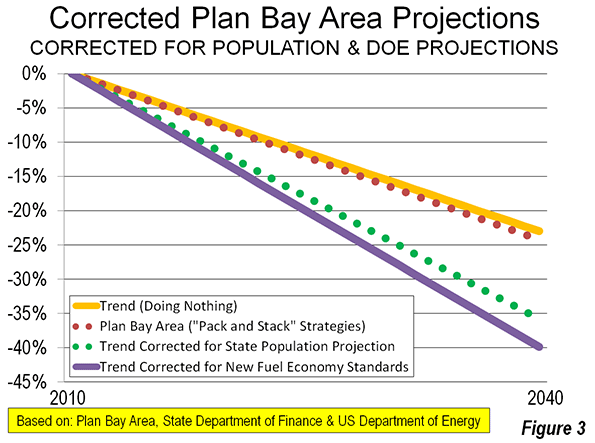
    Yet rather than re-think density, planners and powerful urban land interests continue to force ever higher-density development down the throats of urban dwellers. In the already pricey San Francisco Bay Area, for example, municipal planners have embraced what is known as a “pack and stack” strategy that will essentially prohibit construction of all but the most expensive single-family homes, prompting one Bay Area blogger to charge that “suburb hating is anti-child,” because it seeks to undermine single-family neighborhoods.

    Unsustainable Post-Familial Cities of Asia

    Perhaps the key measurement of social sustainability is the willingness of people to have children. Historically we fear overpopulation, but increasingly, at least in high-income countries, the real challenges may be over rapid aging and a diminished workforce. There is a countries, the real issue is now below replacement birthrates and rapid aging. High-density environments such as Manhattan, San Francisco, Seattle, Washington, D.C., or Boston invariably have the lowest percentages of children in the country, with Japan-like fertility rates (by 2050 there may well be more Japanese over 80 than under 15).

    The negative impacts of densification are even more evident in the fast-rising cities of the developing world, where most of new high-rise office and residential towers are being erected. In 1980 the world’s 10 tallest buildings were found in New York, Chicago, Houston, and Toronto. Today, only one building in North America—the Sears Tower in Chicago, built in 1973—ranks among the world’s tallest. The rest are located in Dubai, Mecca, Kuala Lumpur, Shenzen, Nanjing, Taipei, Hong Kong, and Shanghai, where the world’s second-tallest building is nearing completion.

    These towers symbolize Asia’s economic ascendency, but they also seem to diminish grassroots economies and discourage family formation. The ultradense cities of East Asia—Hong Kong, Singapore, and Seoul—have among the lowest fertility rates on the planet. Tokyo and Seoul now have fertility rates around one child per family while Shanghai’s has fallen to 0.7, among the lowest ever reported, well below the “one child” mandate and barely one-third the number required simply to replace the current population. Due largely to crowding and high housing prices, 45 percent of couples in Hong Kong say they have given up having children.

    Some Asian urban residents, if they can, now seek to leave these cities—among the most widely praised by urbanists—for more affordable and lower density locales. This is evident in rising emigration from China’s citiesHong Kong, and Singapore, where roughly one in 10 citizens now chooses to settle abroad, mostly in lower density countries like Australia, Canada and the United States.

    To some, this boils down to an issue of health. Dense urbanization, notes a recent Chinese study, engenders more obesity, particularly among the young, who get less exercise, and spend more time desk-bound. Stroke and heart disease have become leading causes of death. These concerns have led, even in authoritarian China, to growing grassroots protests, many of them targeted at new industrial plants located near cities, including Shanghai.

    Perhaps no developing city better reflects the brutalism of Asia’s emerging urban paradigm than Seoul, the densest of the high-income world’s urban areas over 10 million (megacities). The Korean capital is more than 2.5 times as crowded as Tokyo, twice as dense as London and five times as crowded as New York. No surprise then that urban pundits love the place, as epitomized by a glowing report in Smithsonianon Seoul as “the city of the future.” Architects, naturally, join the chorus. In 2010, the International Council of Societies of Industrial Design named the Seoul the “world design capital.”

    Rarely considered, however, is whether this form of urbanization creates a good place for people, particularly families. Korea is already among the unhappiest places on earth, according to a recent  study by the Organization for Economic Cooperation and Development (OECD) and, not surprisingly, suffers a birthrate even lower than Singapore’s.   

    Seoul is, as its boosters claim, fully modern but also both highly congested and aesthetically barren. The result, notes one recent Korean newspaper article is one of the most dehumanized and aesthetically unappealing cities on the planet. MIT architecture professor Lee Kwanghyun charges that over the past decade, development has effectively replaced Seoul’s once unique neighborhoods with seemingly endless blocks of 200-foot high white concrete boxes.     

    Public opposition to this approach has been mounting, and Seoul’s city government recently suspended a “new towns” proposal that sought to knock down the city’s last remaining low-density areas. Not surprisingly, Koreans have been rejecting the hyper-dense core of Seoul, which has lost nearly 1 million residents (10 percent) in 20 years, with residents and migrants from elsewhere in the country heading for the relatively less dense suburbs.

    The City of Disappointment

    The damage done to people by megacity urbanism is most pronounced in poorer countries. My colleague Ali Modarres calls places like Tehran “cities of disappointment.” There, he notes, high housing prices and lack of space have already reduced the birthrate to well below the replacement level, a phenomena he also sees in such unlikely places as urban Tunis, Istanbul, and many otherdeveloping cities in the Islamic world. As in Asia, Modarres says, marriage rates are dropping and increasingly many women are choosing to remain single—heretofore something rare in these countries.

    In cities like Tehran, Modarres says, housing has become equated with living in a small apartment/condominium in a residential building. Rarely does the younger population think about housing in terms of a detached single-story building. And the exorbitant cost of housing in such a high-density city in turn creates constant worries about money and housing—having even one child is prohibitively expensive.

    Gigantism’s effects in the developing world—where much of the most rapid urban growth is now taking place—is even more profound. In Mumbai, home to 20 million people, life expectancy for city residents is at least 10 years below the life expectancy of their country cousins, even though urban residents have much better access to health care. And nearly four of five urban households complain about contaminated water. In 1971, slum dwellers accounted for one in six Mumbai residents. Today, they constitute an absolute majority.

    Indeed, much of the population of most developing country cities—such as Mexico City, Cairo, Jakarta, Manila, Lagos, Mumbai, and Kolkata, megacities all—continue to live in “informal” housing that is often unhygienic, dangerous, and subject to all kinds of disasters, natural or man-made. Moreover, many of these unmanageable megacities—most notably Karachi—offer ideal conditions for gang-led rule and unceasing ethnic conflict.

    Remarkably, many Western pundits find much to celebrate in megacities mushrooming in low-income countries. To them, the growth of megacities is justified because it offers something more than unremitting rural poverty. But surely there’s a better alternative than celebrating slums, as one prominent author did recently inForeign Policy.

    In the mainstream press, there’s even a tendency to engage in what one critic has labeled “slumdog tourism.” A recent National Geographic article, for example, celebrated the entrepreneurial spirit of Kinshasa’s slum dwellers, which is understandable, but underplayed the miserable conditions in which the majority of Kinshasa’s eight million residents are forced to live. That city, which Belgian researchers described as an example of “aborted urban development,” suffers from high crime, poor drinking water, and pervasive informal housing. Similar conditions exist in virtually all of Africa’s largest cities, which are growing as fast as any in the world.

    Toward a Human City

    Rather than concocting sophisticated odes to misery, perhaps we might consider a different approach to urban growth. Perhaps we factor in what exactly we are inflicting on people with “pack and stack” strategies. Planners often link density with community, notes British social critic James Heartfield, but maintaining that “physical proximity that is essential to community is to confuse animal warmth with civilization.” When University of California at Irvine’s Jan Brueckner and Ann Largey conducted 15,000 interviews across the country, they found that for every 10 percent drop in population density, the likelihood of people talking to their neighbors once a week goes up 10 percent, regardless of race, income, education, marital status, or age.  In 2009, Pew recently issued a report that found suburbanites to be the group far more engaged with their communities than those living in core cities.

    A market—or simply human—approach would permit a natural  shift towards smaller, less dense cities and, yes, the suburbs, where more people end up wanting to live. Those who prefer high-density living would still have their opportunity if they so desire. In the developing world, we might to find ways of making villages and smaller cities more attractive, perhaps through the development of local industries, farm-to-market agriculture, and even high-tech development. “We are copying the Western experience in our own stupid and silly way,” says Ashok R. Datar, chairman of the Mumbai Environmental Social Network. “For every tech geek, we have two to three servants. The villages pour out and the city gets more crowded.”

    The primary goal of a city should not be to make wealthy landlords and construction companies ever richer, or politicians more powerful. Instead, we should look for alternatives that conform to human needs and desires, particularly those of families. Urbanism should not be defined by the egos of planners, architects, politicians, or the über-rich, who can cherry-pick the best locales in gigantic cities. Urbanism should be driven above all by what works best for the most people.

    This story originally appeared at The Daily Beast.

    Joel Kotkin is executive editor of NewGeography.com and Distinguished Presidential Fellow in Urban Futures at Chapman University, and a member of the editorial board of the Orange County Register. He is author of The City: A Global History and The Next Hundred Million: America in 2050. His most recent study, The Rise of Postfamilialism, has been widely discussed and distributed internationally. He lives in Los Angeles, CA.

    Skyline photo by Bigstock.
  • The Consequences of Urban Containment

    Recently published research by Brian N. Jansen and Edwin S. Mills represents notable addition to the already rich academic literature that associates more stringent land use regulation with higher house prices. The analysis is unusually comprehensive and its conclusions indicate greater consequences than is usually cited. Mills is Professor Emeritus of Real Estate and Finance at Northwestern University and is renowned for his contributions to urban economics over more than five decades.

    The Research

    The comprehensiveness of the research is indicated by the fact that it covers all of the 268 metropolitan areas in the United States for which complete data was available. The focus was on the trend of house prices leading up to 2006, the peak of the housing bubble. Their econometric analysis showed that "stringent land use controls raise house prices."

    They also found that more stringent land use controls were associated with greater house price losses following the peak.

    “The strong conclusion of this paper is that stringent residential land use controls were a primary cause of the massive house price inflation from about 1992 two 2006 and possibly of the deflation that started in 2007.”

    Overall, this finding is consistent with the work of others (such as in Glaeser and Gyourko) who have associated more stringent land use controls with greater house price instability.

    Consistency with Economic Principle & Previous Research

    The Jansen and Mills findings reiterate those of a large body of research. Economists Richard Green and Stephen Malpezzi summarized the issue a decade ago:

    “When the supply of any commodity is restricted, the commodity’s price rises. To the extent that land – use, building codes, housing finance, or any other type of regulation is binding, it will worsen housing affordability.”

    This relationship is even acknowledged by proponents of more stringent land use policies. A Brookings Institution team led by University of Utah Professor Arthur C. Nelson indicated that “If … policies serve to restrict land supplies, then housing price increases are expected.”

    Needless to say, any other effect would be the equivalent of “sun rising in the West” economics.”

    The more stringent land use regulations include blunt tools like the urban growth boundaries of Vancouver, Sydney, Portland or the San Francisco Bay Area but also the large-lot suburban lots that have rendered Boston’s urban densities nearly as low as Atlanta. Artificial limits on development lead to higher house prices, other things being equal.

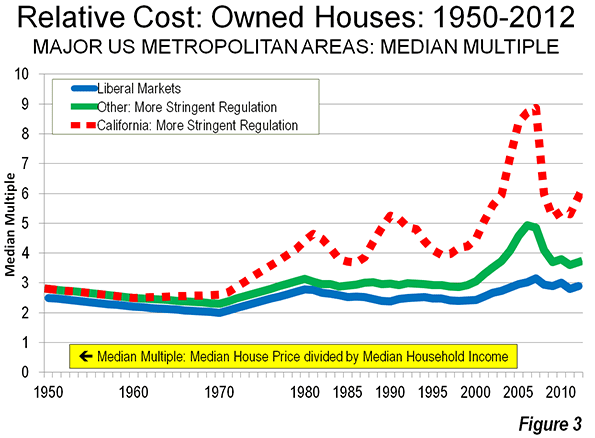
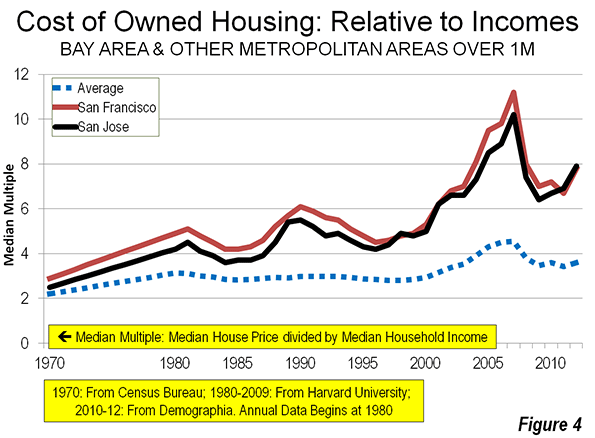
    This will come as no surprise to those familiar with the work of Dartmouth economist William Fischel who attributed California’s high house prices to stringent land use regulation. He noted that until around 1970, California house prices had been nearly the same, relative to incomes as the rest of the nation, before more stringent land use regulation began. Now house prices in coastal California markets are double those in liberally regulated markets, measured by the median multiple (median house price divided by median household income).

    Unintended Consequences: Portland and California

    The Jansen and Mills findings will disappoint urban containment (smart growth or growth management) advocates who have often denied the economic reality of its influence on house prices. Some had hoped that the house price increasing effects of stringent land use regulation would be neutralized by more affordable housing costs in the cores of metropolitan areas, where more dense housing would be permitted. A principle source of this view is an analysis of early 1990s Portland (Oregon) house prices by Justin Phillips and Eban Goodstein, who said that such an effect “should” occur.

    Yet in the 15 years since the period covered by this research, Portland house prices have risen with a vengeance (see The Evolving Urban Form: Portland), with the median multiple rising more than 40 percent, from 3.0 in 1995 to 4.3 in 2012. Obviously, with such an increase, the price increasing impacts of Portland’s urban growth boundary have not been negated.

    Further, housing costs rose in Portland’s densifying areas at virtually the same rate as in the rest of the metropolitan area over the period from 1999 to 2009. Census and American Community Survey data indicates that densifying zip code areas (housing unit density increases of 5 percent or more) experienced median multiple increases of 37 percent, compared to 36 percent for the balance of the metropolitan area (Note). Rents in the densifying areas rose 9 percent, compared to 8 percent in the rest of the area.

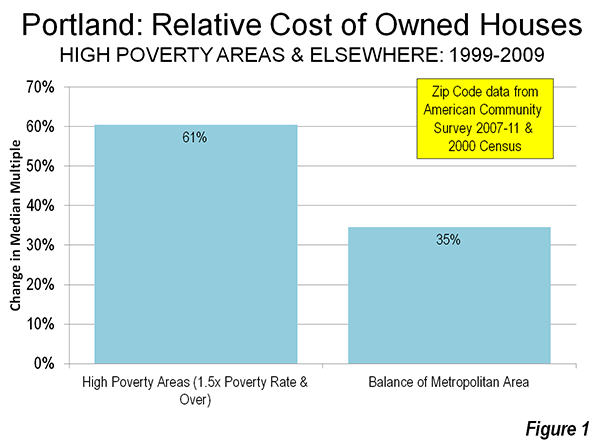
    The impact on Portland’s low income population, however, was less than equitable. The cost of owned housing rose 75 percent more in areas of higher poverty (areas with poverty rates 50 percent or more than the average rate) than in the balance of the metropolitan area. The median multiple (value) rose 61 percent in the high poverty areas and only 35 percent elsewhere (Figure 1).

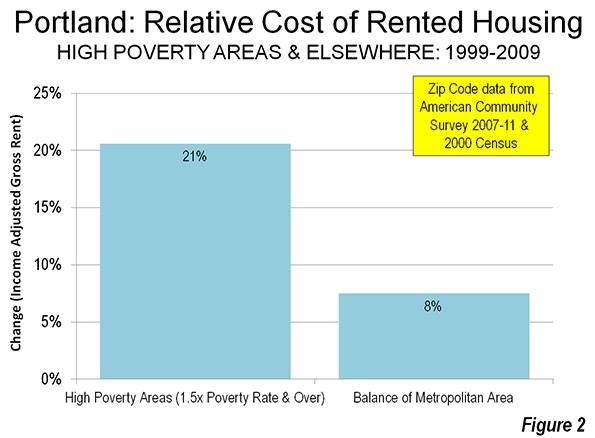
    The difference was even starker in rentals, where low income households are concentrated. Income adjusted median gross rents in the high poverty areas rose more than 2.5 times the increase in the rest of the metropolitan area. In the high poverty areas, the increase was 21 percent and only 8 percent elsewhere (Figure 2).

    The housing cost increases in the higher poverty areas appears to be at least partially from gentrification as well as Portland’s efforts to improve neighborhoods through urban renewal. In assessing the results of the 2010 census, The Oregonian noted that the core city of Portland had become less diverse and that many African-American households were driven out of their neighborhoods by “gentrification.”

    This greater housing cost burden on lower income households belies the noble intentions expressed in much of the urban containment and smart growth literature. Results are more important than intentions.

    Portland is not alone. Nelson, et al, were uncritical of Portland a decade ago (before the evidence of house price increases was so clear), but did not mince words in characterizing the already evident higher prices from stringent land use policies in California, saying: “This is arguably what happened in parts of California where growth boundaries were drawn so tightly without accommodating other housing needs that housing supply fell relative to demand.”

    The Broader Consequences of Stringent Land Use Regulation

    Jansen and Mills took the research farther than most others. In their econometrics, they found more stringent land use regulation negatively impacted metropolitan area population, employment and per capita real income.

    They also considered the role of stringent land use controls in the Great Financial Crisis. This issue had also been a subject of inquiry of the congressionally established United States Financial Crisis Inquiry Commission, which documented much larger than national housing bubbles in the so-called “sand states” of California, Florida, Arizona and Nevada. Three of the
    10 members issued a minority opinion citing land use controls as one of the causes of the housing bubble (which is widely considered to have sparked the Great Financial Crisis). The major metropolitan areas in the “sand states” all had strong land use restrictions.

    “Land use restrictions. In some areas, local zoning rules and other land use restrictions, as well as natural barriers to building, made it hard to build new houses to meet increased demand resulting from population growth. When supply is constrained and demand increases, prices go up.”

    My analysis of metropolitan markets for the National Center for Policy Analysis suggested a similar relationship (see The Housing Crash and Smart Growth).

    Jansen and Mills squarely place blame for the Great Financial Crisis on stringent land use controls.

    “Indeed, it is difficult to imagine another plausible cause of the 2008–2009 financial crisis. Popular accounts simply refer to a speculative housing price bubble. But productivity growth in housing construction is faster than in the economy as a whole and the US has an aggressive and competitive housing construction sector. In the absence of excessive controls, housing construction would quickly deflate a speculative housing price bubble.”

    The absence of excessive controls would have defused the housing bubble, they suggested. This notion is supported by the experience of metropolitan areas with liberal land use regulation (Figure 3) where median multiple remained near or below 3.0 in liberally regulated markets. This standard has typified affordable markets since World War II, as well as California markets to the early 1970s and Portland until 1995. The retention of housing affordability is especially significant in Atlanta, Dallas-Fort Worth and Houston, which experienced some of the largest rates of domestic in-migration during the bubble. This is in contrast to the more stringently regulated high cost markets of coastal California, which experienced huge out-migration during the same period.

    The Imperative for Job Creation and Economic Growth

    All of this is particularly important because housing is the most expensive element of household budgets, and unlike transportation and most consumer goods, is extremely sensitive to varying local and regional public policies. Where households have to pay more for housing, they have less discretionary income and necessarily have a lower standard of living. This is deleterious to virtually all households and is especially burdensome on lower income households.

    Many young adults are “doubling up” with their parents, deferring their own independence, facing huge student loan debts and inadequate employment prospects in what may become the Great Malaise. Taxpayers in many jurisdictions face unprecedented burdens in funding unsustainable government employee pension benefits. Only job creation and economic growth can solve these problems. The last thing the economy needs is stringent land use policies that reduce employment, economic growth and per capita real incomes.

    Wendell Cox is a Visiting Professor, Conservatoire National des Arts et Metiers, Paris and the author of “War on the Dream: How Anti-Sprawl Policy Threatens the Quality of Life.

    —–

    Note: Median multiple data from the Census Bureau (and the American Community Survey) are reported using median house values, instead of the more common median house price.

    —–

    Photo: 1,700 square foot house in exurban Los Angeles priced at $575,000 at the peak of the housing bubble (by author).

    CORRECTION

    Land use regulation as a cause of the housing bubble should have been should have been attributed to a dissenting opinion in the United States Financial Crisis Inquiry Commission, rather to the Commission itself.

  • Book Review: ‘The End of the Suburbs,’ by Leigh Gallagher

    Suburbia has been a favorite whipping boy of urbane intellectuals, who have foretold its decline for decades. Leigh Gallagher’s “The End of the Suburbs” is the latest addition to this tired but tireless genre. The book lacks the sparkling prose and original insights one could find in the works of, say, Jane Jacobs or Lewis Mumford. Indeed, Ms. Gallagher’s book is little more than a distillation of the conventional wisdom that prevails at Sunday brunch in Manhattan.

    The author restages many of the old anti-suburban claims, and her introduction’s section headings easily give away the gist of the argument: “Millennials hate the burbs”; “Our households are shrinking”; “We are eco-obsessed”; “The suburbs are poorly designed to begin with”; and so on.

    Ms. Gallagher, an editor at Fortune magazine, fails to persuade. For starters, her focus on the recent past distorts her argument. She starts with reporting about a dismal home-building conference in Orlando in early 2012, when the housing market was still close to its post-bubble nadir. She portrays those dark times as the harbinger of a new reality that will see suburban living fade away. She quotes real-estate economist Robert Schiller saying that suburban home prices won’t recover “in our lifetime.” But given that prices have indeed risen, and are now reaching precrash levels in some markets, such predictions should be viewed skeptically.

    There isn’t much room for contrarian viewpoints here. All the usual anti-suburbanite suspects are marshaled to support the book’s thesis: Al Gore suggests suburbs will die because they aren’t green enough; the critic James Howard Kunstler makes exaggerated claims about how “peak oil”—the notion that we are running out of fossil fuels and that their cost will skyrocket—will bankrupt suburbanites; other experts claim that young people will desert suburbia for their entire lifetimes and that empty-nesters will abandon their stale suburban lives in favor of urban density.

    Today barely 11% of Americans live in densities of more than 10,000 people per square mile, which is about the level of an inner-ring San Fernando Valley suburb, one-seventh of the Manhattan level and almost one-third of the five boroughs. Four out of five prospective home buyers in the U.S. prefer single-family houses, according to a 2011 survey conducted by the National Association of Realtors and the advocacy group Smart Growth America. In short, most of America isn’t about to densify itself along Gothamite, or even Los Angeles, lines.

    The author ignores most of these findings. She believes cities are poised to become the main beneficiaries of the suburban decline she projects. “To see that cities are resurgent centers of wealth and culture, all you need to do is set foot in one,” she writes. To be sure, some American urban centers, most notably New York, San Francisco and Washington, have experienced modest population growth over the past decade or two, although still well below the national average. And even in these cities, there are many neighborhoods that sophisticated urbanites wouldn’t really want to “set foot in.” In newly hip, and now increasingly expensive, Brooklyn, nearly a quarter of residents live below the poverty line. The borough’s artisanal cheese shops and trendy restaurants are charming, but one in four Brooklynites receives food stamps. The urban renaissance is even less obvious in places like St. Louis, Cleveland and Detroit, which have lost residents in significant numbers over the past decade and whose gentrified zones are tiny.

    Having misunderstood the past, Ms. Gallagher is likely off in her predictions of a high-density future. She insists that young people overwhelmingly want to live “in urban areas and don’t want to own a car.” But most millennials entering their 30s, according to surveys, are likely to get married and eventually have children. That is when they will start to seek out single-family houses in lower-density areas. They may well experience suburbia differently than their parents. More of them will work at home or close to home, or drive fuel-efficient cars on their commutes. Even so, most aging millennials can be expected to seek out homes in affordable areas with decent schools, meaning either the suburbs of older cities or lower-cost, economically vibrant regions like the Southeast, the Gulf Coast or the Mountain West.

    Much the same can be said about the other key emerging demographic group, immigrants and their offspring. Nationwide over the past decade, the Asian population in suburbs grew by almost 2.8 million, or 53%, while that of core cities grew 770,000, or 28%. In Los Angeles, the region with the nation’s largest Asian population, the suburbs added roughly five times as many Asians as the core city.

    One reason: Immigrants are more likely to have families than the native-born. They don’t share the conviction, held by many anti-suburbanites such as Ms. Gallagher, that we are seeing “the end of the nuclear family.” The family, like suburbia, has been written off numerous times. But as Margaret Mead once observed, it “always comes back.” High-density cities generally repel families, and they aren’t conducive to middle-class aspirations. In New York City and Los Angeles, for example, the homeownership rate is 20% less than the national figure of 65%. Things are even worse for working-class and minority households. Metropolitan Atlanta’s African-American homeownership rate is approximately 40% above those of San Jose and Los Angeles, approximately 50% higher than Boston’s, San Francisco’s and Portland’s, and nearly 60% higher than New York’s.

    Many of those migrating to Atlanta, Houston, Dallas-Fort Worth and other low-density, lower-cost cities come from denser, more expensive areas. Between 2000 and 2010, 1.9 million net domestic migrants left the New York area, 1.3 million left Los Angeles and 340,000 left San Francisco, while 230,000 left San Jose and Boston, according to Census Bureau data. The death of the suburbs may suggest a pleasant prospect for the New York and D.C. urbanist crowd, but for most, the American dream remains a suburban one. As long as the American family and the national aspiration for a better life persist, the suburbs are likely to retain their pre-eminent role.

    Joel Kotkin is executive editor of NewGeography.com and Distinguished Presidential Fellow in Urban Futures at Chapman University, and a member of the editorial board of the Orange County Register. He is author of The City: A Global History and The Next Hundred Million: America in 2050. His most recent study, The Rise of Postfamilialism, has been widely discussed and distributed internationally. He lives in Los Angeles, CA.

    This piece originally appeared at The Wall Street Journal.

  • Cities Don’t Consume Resources, People Do

    Urban form or urban consumers? If we want to reduce the environmental impacts of modern society let’s prioritize consumption, not city form.  The evidence suggests that large cities (and especially city centres) are associated with a bigger environmental footprint than modest cities or suburbs. 

    This post looks at incomes and consumption, especially the consumption of housing and transport services, asking how far can local regulation really influence environmental impacts?

    What can local governments do about the environment?
    Local governments have two core roles.  One is to ensure that the infrastructure and services necessary to sustain everyday life and commerce are in place and working well.  In fulfilling this role they should aim to enhance the quality of the urban environment and limit any environmental impacts of infrastructure. 

    The other role is to plan and manage development in a way that reduces conflict among land uses. In doing that they should aim to contain or control adverse spill-over impacts. 

    However, for councils to use their investment in infrastructure and land use regulation to determine in detail how and where people should live and consume pushes the boundaries of these roles, particularly when they try indirectly to reshape household behavior by reshaping the city.

    The key to understanding the environmental impacts of urbanized society is not urban form but household consumption, a function of income, not city plans.

    Urbanization and environmental impacts
    In a recent piece I showed how policies to increase residential densities around city and town centres assume a relationship between urban form and environmental impacts that is not supported by the evidence. In Australia, for example, residents of the New South Wales state capital, Sydney, particularly central Sydney, have by far the largest environmental impact per head.  Much lower levels are recorded in suburbs, smaller cities, and towns. (The same pattern is evident in all Australian states: have a look using the Australian Consumption Atlas).

    The environmental impacts of intensive urban living outweigh any advantages of increasing scale and density. This means that policies that push agglomeration and intensification will increase rather than lower the impacts of urban living.

    Household spending is the issue
    The Australian study confirms that a city’s environmental impacts simply comprise the collective impacts of its residents.  Income is the driver of their consumption and thereby their demands on the environment. 

    If we really believe city form can in some way over-ride income- and consumption-driven environmental impacts, then we should heed the evidence and plan for modest, small scale, dispersed urban settlement. 

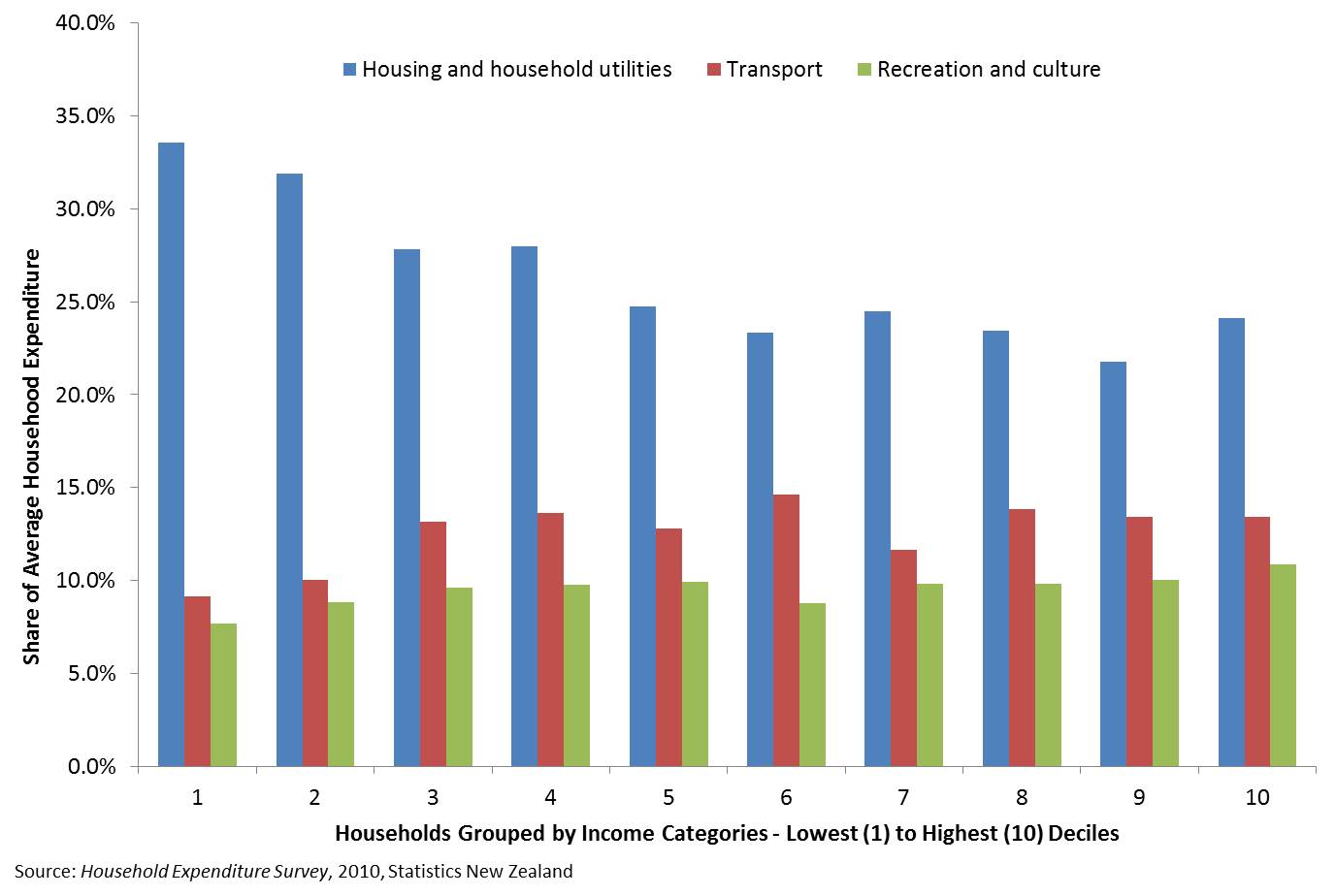
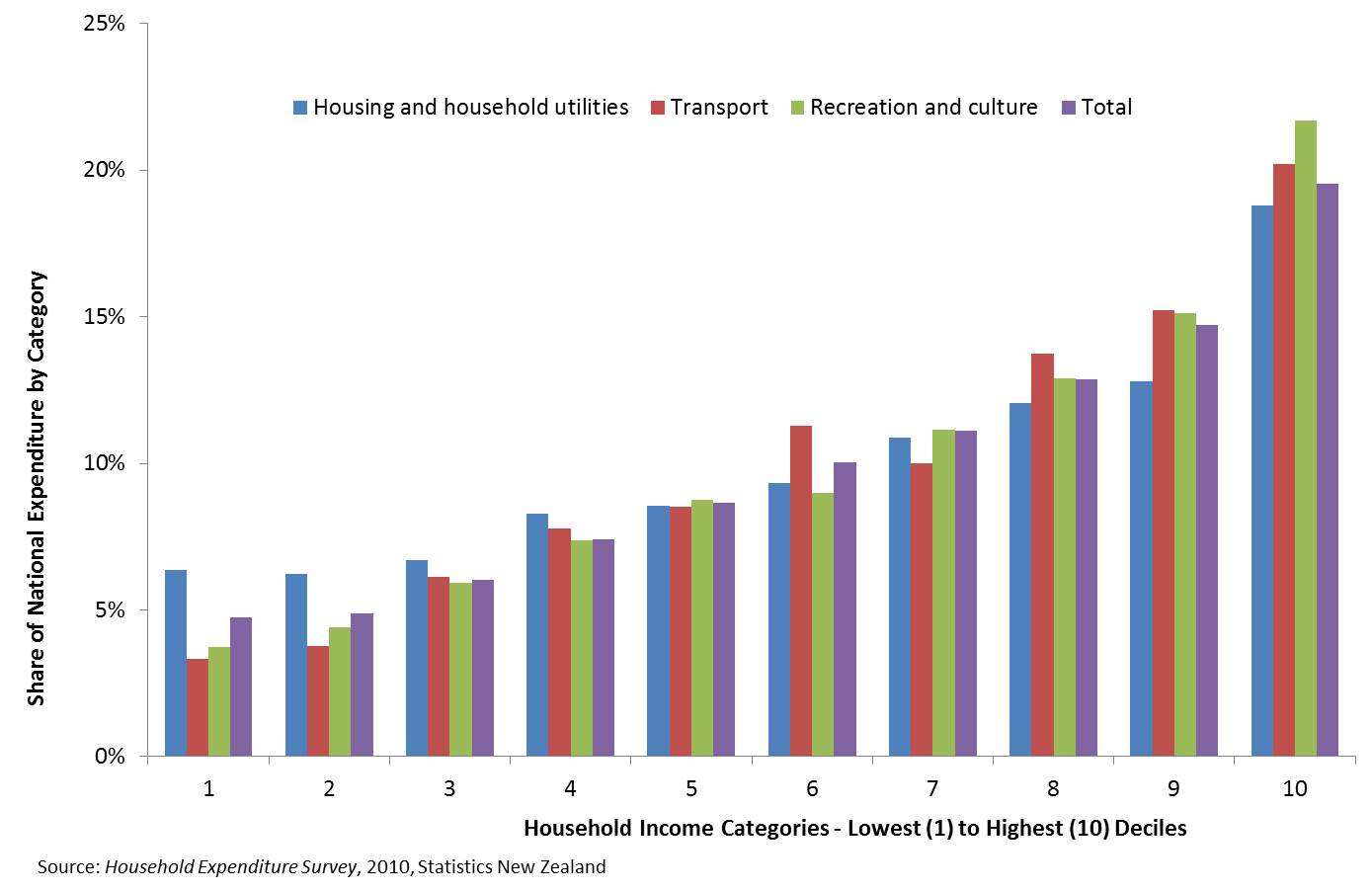
    Spending on housing and transport in New Zealand
    Household Expenditure Survey data for New Zealand (and elsewhere) provide an opportunity to explore the role of income in consumption generally. 

    First, take a look at the distribution of spending on housing, transport, and discretionary goods (recreation and cultural services is used to represent the latter category) according to household incomes in 2010. Average spending levels have been organized by income decile for this purpose, each group containing 10% of households. Average incomes increase from decile 1 (the lowest earning 10% of households) to decile 10 (the highest earning 10%).

    The pattern is pretty predictable.  Housing dominates the spending of low decile households.  It accounts for 34% in the lowest decile, falling to 22% in the ninth.  It rises again (to 24%) in the highest earning decile (10). This lift between decile 9 and 10 households no doubt reflects higher discretionary spending in the latter group by way of additional space, the quality of fit-outs, and second homes. 

    Shares of Household Spending to Selected Categories, by Income Band
    http://3.bp.blogspot.com/-9RfoZrWOqJk/UdklonCl_xI/AAAAAAAAAY0/AX1r49MtdJE/s640/Share+of+hhold+spend+by+category.jpg

    Do lower housing costs lead to higher transport spending?
    Rent theory suggests that lower household spending is offset by higher transport spending.  This is because low income households can only afford cheaper, less accessible properties and so end up commuting further at a higher cost than high income households. 

    It turns out that it’s not that simple.  Contrary to the theory, higher income households actually spend more of their income on transport.  That makes sense when we realize that commuting accounts for only around 25% of time spent travelling by New Zealanders.  The capacity to take discretionary trips is a bigger determinant of transport consumption than non-discretionary commuting and work-based trips.

    The Relationship Between Spending on Housing and Transport

    http://4.bp.blogspot.com/-8sGLN4_gTfo/UdyUskoSpgI/AAAAAAAAAZk/WEqMSQNRZM4/s640/Transport+Housing+Relationship.jpg


    Lower incomes leave a lot less to spend on discretionary goods and services once housing and essential transport spending are covered. [1] Higher income households can and do travel more and consume more.  Their behavior is unlikely to be significantly influenced by changing city form. 

    Who spends how much?
    Not surprisingly total consumption in New Zealand is dominated by higher income households: the 20% highest earning households (deciles 9 and 10) account for 35% of total spending on goods and services, while the lowest earning 20% (deciles 1 and 2) account for just 20%.

    And decile 10 households account for 7 times more spending on transport than decile 1 households.  They spend 5.5 times more on recreation and cultural services, and 3.5 times as much on food.


    The Contribution of Household Total Expenditure by Income Band, Selected Categories
    http://2.bp.blogspot.com/-OXL5hMRRw-Q/UdklqCO8CjI/AAAAAAAAAZA/o2GweAb3nTc/s640/Contributinm+to+totalmspoend+by+decile.jpg

     
    The highest income households spend three times more on housing than low income households, an average of $476 per week compared with $161.
    If refurbished housing in high amenity inner city living is expensive, guess which income groups will be living there?  The high consumers, obviously.  And in Auckland, at least, it seems that city planners and policy-makers are keen to deliver them the high order consumer services that will promote ever-more discretionary spending around the CBD(although much of central city resident travel may be taken up with recreational and social trip-making away from there).  

    A high social cost for little environmental benefit?
    The conclusion is straightforward: higher incomes mean more expenditure on additional housing, transport, and discretionary goods and services with correspondingly high environmental impacts.  If incomes are higher in cities, then their collective impacts will be high too.

    Planning policies won’t change that much – except to the extent that they erode consumption by inflating the basic costs of living, something that impacts most heavily on lower income households.  

    Fiddling with city form is unlikely to significantly reduce the impact of higher incomes and associated spending on the environment.  Increasing dwelling and living costs by promoting larger cities, higher residential densities, and uneconomic transit systems simply penalizes low income households already committing substantial shares of their spending to housing and transport.  And this is the group that, by dint of constrained consumption, has the lowest impact on the environment. 

    Better to address environment issues directly
    From a policy perspective, environmental issues are better tackled directly.  This may mean promoting environmentally friendly goods and services, promoting low impact technologies (including low impact housing, fuel efficient vehicles, and the like), and encouraging responsible consumption. If we are really serious about environmental threats, we need to examine the efficiency of current pricing practices and even taxation measures, rather than leaning so heavily on clumsy, indirect, and ultimately spurious urban planning policies. 

    Phil McDermott is a Director of CityScope Consultants in Auckland, New Zealand, and Adjunct Professor of Regional and Urban Development at Auckland University of Technology.  He works in urban, economic and transport development throughout New Zealand and in Australia, Asia, and the Pacific. He was formerly Head of the School of Resource and Environmental Planning at Massey University and General Manager of the Centre for Asia Pacific Aviation in Sydney. This piece originally appeared at is blog: Cities Matter.

    Photo by Pat Scullion

  • Plan Bay Area: Telling People What to Do

    The San Francisco area’s recently adopted Plan Bay Area may set a new standard for urban planning excess. Plan Bay Area, which covers nearly all of the San Francisco, San Jose, Santa Rosa, Vallejo and Napa metropolitan areas, was recently adopted by the Metropolitan Transportation Commission (MTC) and the Association of Bay Area Governments (ABAG). This article summarizes the difficulties with Plan Bay Area, which are described more fully in my policy report prepared for the Pacific Research Institute (Evaluation of Plan Bay Area).

    Plan Bay Area would produce only modest greenhouse gas emissions reductions, while imposing substantial economic costs and intruding in an unprecedented manner into the lives of residents. The Plan would require more than three quarters of new residences and one third of net additional employment to be located in confined "priority development areas." These measures have been referred to as “pack and stack” by critics. The net effect would be to virtually ban development on the urban fringe, where the organic expansion of cities has occurred since the beginning of time.

    Irrational Planning

    Violating perhaps the most fundamental requirement of a rational plan, Plan Bay Area begins with a situation that no longer exists. Further, it is based on exaggeration, systematic disregard of official federal government projections and overly optimistic planning assumptions.

    Exaggerated Population Projection: The Plan assumes that the Bay Area will grow 55 percent more rapidly between 2010 and 2040 than official California state Department of Finance population projections indicate. These state-produced estimates have tended themselves to be on the high side (Figure 1). The planners scurried about to resolve these differences, but there is no indication that the state will be revising its projections. Plan Bay Area’s population projection would require growth in the Bay Area to increase by more than one-half from the 2000-2010 annual rate. The exaggeration of population growth has its uses: it leads to a higher greenhouse gas emissions projection for 2040, providing a rationale for stronger policy interventions.

    Ignoring Current Greenhouse Gas Emissions Projections: The Plan also ignores the new, more favorable DOE fuel economy projections (Figure 2). These projections were issued in December, well before the publication of the draft plan in April and the adoption of the final plan in July. Indeed, if the new DOE projections had been published the day before, Plan Bay Area should have been placed on hold and revised. In short, Plan Bay Area was out of date when adopted.

    Overly Optimistic Planning Assumptions: The Plan assumes that travel by light vehicle (automobiles, sport utility vehicles and pickups) would be reduced by substantial increases in transit ridership. Plan Bay Area presumes that expanding transit service 27 percent over the next 30 years will lead to a near doubling of transit ridership. This is stupefying, since over the last 30 years, transit ridership remained virtually the same, while service was expanded nearly twice as much as would be planned from 2010 to 2040.

    The plan also assumes that residents forced into the priority development areas will use transit and walking much more, materially reducing their use of light vehicles. This research behind this assumption is skewed toward transit oriented developments located on rail lines with good access to downtown. But nearly nine out of 10 employees in the Bay Area work outside the downtowns of San Francisco and Oakland, and that number is increasing (according to Plan Bay Area).

    Given recent history, it seems wishful thinking to believe that small transit service expansions and downtown oriented transit development can do much to attract drivers from cars. The modest gains greenhouse gas emissions reductions projected in Plan Bay Area are likely exaggerations.

    Plan Bay Area’s “pack and stack” densification is likely to produce even less than the modest substitution of transit and walking for driving (see The Transit-Density Disconnect). Traffic congestion, in this already highly congested area, is likely to be worsened, which could nullify part or all of the greenhouse gas emission reductions expected from reduced vehicle use.

    Correcting Plan Bay Area Forecasts

    Plan Bay Area would only modestly reduce light vehicle travel and greenhouse gas emissions. This is illustrated in Figure 3, which shows that the “pack and stack” strategies that would force most new residents and jobs into priority development areas, Plan Bay Area would reduce greenhouse gas emissions by 2 percent (“Plan Bay Area” line compared to the “Trend” or “doing nothing” line).

    By contrast, correcting the Plan Bay Area 2040 population estimates to reflect the state population projections would reduce greenhouse gas emissions more than eight times as much (17 percent), without the “pack and stack” strategies. A further correction of the Plan Bay Area 2040 estimates to reflect the latest DOE fuel economy projections, would reduce greenhouse gas emissions 22 percent, 11 times as much as the “pack and stack” strategies.

    Heavy Costs for Households and Businesses

    The Plan’s “pack and stack” strategies seem likely to exacerbate the Bay Area’s already high cost of living. Currently, the San Francisco and San Jose metropolitan areas have the worst housing affordability among the nation’s 52 metropolitan areas with more than 1 million residents. San Jose’s median house price relative to its median household income was 7.9 last year, according to the Demographia International Housing Affordability Survey. San Francisco’s median multiple was 7.8. This severely unaffordable housing results from recent decades of urban containment or smart growth policies, which have severely restricted the land on which development can occur. This drives up prices (other things being equal), consistent with economic principle. This has been made worse by house and apartment impact fees imposed on developers that are far above the national average.

    By comparison, in major metropolitan areas that have not implemented strong urban containment policies, the median multiple has typically been 3.0 or less since World War II, including the Bay Area before its adoption (Figure 4). The “pack and stack” strategies would largely limit new development to small parts of the Bay Area, an even more draconian prohibition than the long standing restrictions on urban fringe development. This further rationing of land could be expected to drive land prices even higher, making it even more difficult for households and businesses to live within their means.

    The problem is already acute. The new US Census Bureau housing cost adjusted data shows California to have the highest poverty rate among the states and the District of Columbia (metropolitan area data is not available). An early 2000s Public Policy Institute of California report showed Bay Area poverty to be nearly double the official rate, adjusted for the cost of living. Ultra pricey San Francisco had among the ten highest poverty rates – over twenty percent – of any urban county in the country.

    Unaffordable housing has also fueled an exodus to the San Joaquin Valley (Central Valley). Now more than 15 percent of the workers in the Stockton metropolitan area commute to the Bay Area, which led the Federal Office of Management and Budget adding Stockton to the San Jose-San Francisco combined metropolitan area (combined statistical area). In addition, the greater traffic congestion is likely to lengthen work trip travel times. This is likely to further increase emission while also burdening job creation and economic growth (see Traffic Congestion, Time and Money).

    Ignoring the Economy and Poverty

    Plan Bay Area effectively ignores these costs (despite rhetoric to the contrary), by failing to subject its strategies to a cost per ton metric. According to the United Nation’s Intergovernment Panel on Climate Change (IPCC), sufficient greenhouse gas emissions reductions can be achieved at a cost between a range of $20 to $50 per ton. The previous regional plan (through 2035) included such estimates. Only highway strategies achieved the IPCC range. Transit and land use strategies cost from four to more than 100 times the top of the IPCC range. Even those estimates did not include the prohibitively higher housing costs that result from urban containment policies. The cost metric is crucial, because spending more than necessary to reduce greenhouse gas emissions limits job creation and economic growth, which leads to reduced household affluence and greater poverty. This is the very opposite of the economic objectives of public policy. Virtually all political jurisdictions around the world seek greater prosperity for their residents and less poverty. A legitimate regional plan requires subjecting its strategies to economic metrics.

    Opposition

    There is opposition to Plan Bay Area. A citizen movement worked for rejection and has now filed suit claiming that the Plan violates the California Environmental Quality Act. The suit also alleges that MTC and ABAG used a questionable interpretation of state law and regulation to justify the irrational Plan outcomes.

    Recorded Votes

    Opponents were also successful in obtaining a rare recorded vote at ABAG. The governing board (General Assembly) is composed of selected elected officials from cities and counties who are not elected to their ABAG positions. ABAG adopts virtually all of its actions by consensus, rather by recorded votes, as occurs in many of the nation’s regional planning boards.

    Consensus decision making seem especially odd in California, where inability to obtain sufficient votes in the legislature for the state budget required a constitutional amendment. Neither do city councils and county commissions operate on a consensus basis on controversial issues.

    There is no shortage of controversial issues, at ABAG or other regional planning agencies. A good first reform would be for recorded votes to be the rule, rather than the exception. Consensus decision making may be appropriate for clubs, but it is not for representative bodies in a democracy.

    Impeding the Quality of Life

    Plan Bay Area was outdated when approved and reflects a world that no longer exists. Drafters have insisted on extravagantly expensive and intrusive policies that produce only minimal greenhouse gas reductions, and at great cost, using, among other things, unreasonably bloated population forecasts to bolster their approach. Unless changed, the Plan will likely be more successful in driving up housing prices, limiting options for households, and further congesting traffic than meeting its stated goal of reducing   greenhouse gas emissions.

    Wendell Cox is a Visiting Professor, Conservatoire National des Arts et Metiers, Paris and the author of “War on the Dream: How Anti-Sprawl Policy Threatens the Quality of Life.

    Photo: San Francisco (by author)