Category: planning

  • Mobility for the Poor: Car-Sharing, Car Loans, and the Limits of Public Transit

    Public transit systems intend to enhance local economies by linking people to their occupations. This presents problems for many  low-income families  dependent on transit for commuting. With rising prices at the gas pump, much hope has been placed on an influx of investment into public transit to help low-income households. But does public transit really help the poor? While the effect of transit access on job attainment is murky, several alternatives such as car loans and car-sharing programs have seen real results in closing the income gap. For Christina Hubbert, emancipation from public transit has been a change for the better. NBC News reports:

    A car means Hubbert no longer spends two hours each way to and from work in suburban Atlanta. It means spending more time with her 3-year-old daughter — and no longer having to wake her up at 5 every morning so she can be in the office by 8. It also means saving hundreds of dollars each week in day care late fees she incurred when she couldn’t get to the center before its 6:30 p.m. closing time.

    Research finds that car-ownership is positively correlated with job opportunities while no such relationship exists with access to transit stations. Furthermore, increased transit mobility has been proven to have no effect on employment outcomes for welfare recipients. The notion that newer and nearer public transit creates benefits for all is inaccurate; it only creates opportunities for those who live near the transit stations, and those opportunities are limited. A study by the Brookings Institute finds that, among the ten leading metropolitan areas in the US, less than 10% of jobs in a metropolitan area are within 45 minutes of travel by transit modes. Moreover, 36% of the entry-level jobs are completely inaccessible by public transit. This is not surprising given the fact that suburbia houses two-thirds of all new jobs.

    The mismatch between people and jobs can be reconciled in two ways: car loans and car-sharing services. Basic car-sharing involves several people using the same car or a fleet of cars, as with the ZipCar. The concept has branched out to on-demand car sharing services, such as Lyft, mobile apps which link riders with drivers.

    Car loans on the other hand have been around for a while and offer affordable financing for a car without a required down payment. Ways to Work, one of the largest loan providers in the U.S., includes courses on personal finance and credit counseling. By making vehicle travel more attractive, these two disruptive innovations threaten the expansion of public transit – and its powerful associated lobbies – in three ways:

    1. It’s more cost-efficient and time-efficient.

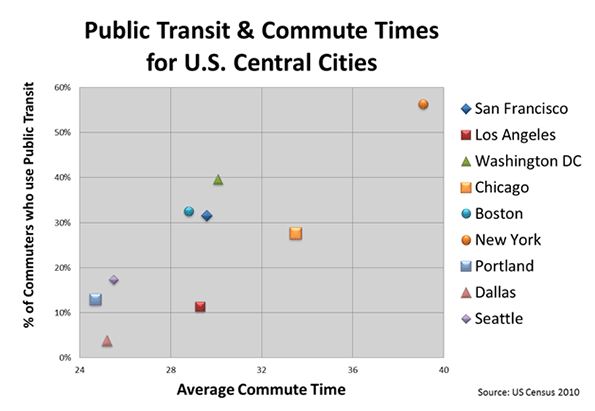
    To improve the way we move people, transit developments must save both time and money. Sadly, transit lines are notorious for their extraordinary costs and long delays. Data from the 2010 Census reveals that people living in central cities with a higher proportion of transit riders experience longer commutes. And since transit riders have more cumbersome commutes, they are much more likely to be tardy or absent from work.

    The hefty price tag of transit projects also triggers concern. For example, the cost per new passenger of the Washington Metro line to Dulles Airport was estimated at $15,000 annually. That’s about the same as the current poverty threshold for a household of two.

    Car-loan programs on the other hand are largely cost-efficient, producing real fiscal benefits to borrowers, employers, and taxpayers. A survey of 4,771 borrowers and their employers finds that borrowers have greater job security as a result of access to vehicles. With access to credit, borrowers increase their purchasing power by an average of $2,900 each year and save about $250 by avoiding payday loans and checks-for-cash outlets. Employers gain as well through cost savings due to increase retention and reduced absenteeism and tardiness, which amount to $817 and $1130 per borrower respectively. In large part, providing vehicle financing is a smart investment since it reduces the number of low-income families on social welfare – an annual cost savings of $2,900 for each borrower coming off public assistance.

    Given its clear advantages, car sharing is increasing. Recent reports find that shared-use vehicle organizations have been lucrative. Between August 2012 and July 2013, car-sharing ridership grew by 112 percent and the number of vehicles increased by 52 percent. And although car-sharing is not typically used to transport the poor, having on-demand car service makes it so that door-to-door access is more available and affordable. If car-sharing continues to grow at its current rate, it’s reasonable then to assume that these pseudo-taxi services will be eventually be affordable enough so that people would choose to be chauffeured rather than drive their own vehicles.

    2. Vehicle ownership provides greater access to jobs and economic opportunities.

    Instead of being limited to a few areas that are transit-oriented, families with cars have access to more jobs and economic opportunities. Public transit lines are limited in their geographical coverage and take time to make often numerous stops.  Transfers are inefficient and time-consuming, making much of that coverage impractical. Also regular transit riders have limited employment options since they’re only able to consider jobs in the vicinity of transit stops and stations.

    3. Travel by car  is responsive to current travel patterns

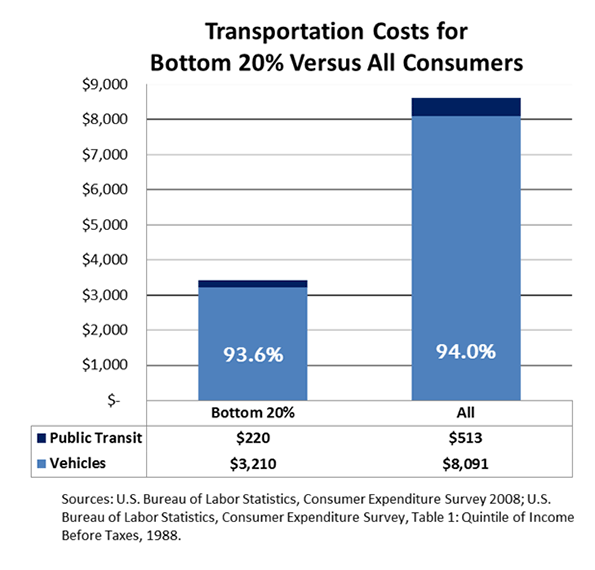
  • A common misperception is that low-income people do not have cars. In reality, 86% of the poor have cars, compared to 95% of the entire population. The high percentage of poor families with cars reveals how automobile culture has become fixed into American ideals of economic well-being and prosperity. And contrary to stereotypes, the poor and the rich similarly spend about 94% of their transportation costs on vehicle travel versus public transit, challenging the notion that low-income travel behavior is unlike that of the rest of the population. As such, providing the poor with cars dramatically levels the playing field as they are the ones who would gain the most from increased access to employment destinations and education facilities.

    A strong argument posited by public transit advocates is that as more cars use the road, congestion and pollution will intensify. And to be sure, public transit is more environmentally friendly than motor vehicles. The Amalgamated Transit Union (ATU), the largest union representing transit workers in North America, reports that one full bus eases the road of thirty-five cars, and that existing transit usage cuts national gasoline consumption by 1.4 billion gallons annually. Yet, on average, this result can only   be achieved if buses were always full, which they are not – authorities from the Los Angeles Metro estimate that their buses run at an average of 42% capacity.

    But is it equitable to ask the poor to forgo mobility and economic gain for the environment? Considering that most Americans experience some degree of social mobility via vehicle ownership, it’s far more reasonable to allow  low-income families greater access to opportunity. In addition, new fuel efficiency standards for cars set by the Obama administration will decrease overall GHG emissions substantially; according to forecasts by the Department of Energy, carbon emissions from light-duty vehicles will drop 21% between 2010 and 2040 in spite of a 40% increase in driving. This shows that, even with more cars on the road, environmental goals can be accomplished.

    Although the eligibility requirements are stricter in some areas than others, every state in the U.S. has a program for low-income residents to have access to car loans. Car-sharing is also rapidly expanding, but  marketing now is geared towards millennials on a budget rather than low-income families. Both innovations, however, respond to new demands faced by future workers, who are likely to find employment in dispersed locations and may make more trips per workday since many may have multiple part-time jobs. With more efficient ways of getting people to work, it’s time to challenge the assumption that the expansion of public transit is the best way to meet the needs of America’s hard-pressed working class.

    Jeff Khau graduated from Chapman University with a degree in business entrepreneurship. Currently, he resides in Los Angeles where he is pursuing his dual-masters in urban planning and public policy at the University of Southern California.

    Photo by Romana Klee, #113 zipcar.

  • The Persistence of Failed History: “White Infill” as the New “White Flight”?

    “There is a secret at the core of our nation. And those who dare expose it must be condemned, must be shamed, must be driven from polite society. But the truth stalks us like bad credit.” – Writer Ta-Nehisi Coates

    ***

    With the recent Supreme Courts strike down of the 1965 Voting Rights Act, which was created to protect minority representation, the headline in the Huffington Post read “Back to 1964?” While some contend the title hyperbolic, the HuffPost lead, if not the strike down itself, reflects the reality of a country still tethered to its discriminatory past.

    This reality is reflected in all facets of American society, including urbanism. Specifically, is the “back-to-the-city” movement destined to become 1968 inverted; that is, instead of “white flight” there’s “white infill”? If so, the so-called “game-changing” societal movement will be a process of switching out the window dressing, with the style du jour less lace curtains, more exposed brick.

    While debatable, there appears to be a back-to-the-city trend, particularly the inner-core areas of America’s largest and most powerful cities. For instance, according to a recent report by the Census Bureau, Chicago’s core exhibited a 36% boom in its population from 2000 to 2010—a gain of nearly 50,000. Rounding out the top five core-growth gainers were the cities New York, Philadelphia, San Francisco, and Washington D.C. The report finds that, on average, “[T]he largest metro areas—those with 5.0 million or more population—experienced double-digit percentage growth within 2 miles of their largest city’s city hall…”

    Who is moving into these “spiky” urban cores?

    Whites largely. For example, much of Chicago’s core gains comes from the downtown zip code 60654, in which 11,499 (77%) of the area’s 14,868 incoming residents were white, and where the median family income is $151,000. Other zip codes in Chicago’s core share similar proportions of growth, such as 60605, with 70% of its 12,423 new residents being white. Contrast this with a 5% growth rate for blacks.

    As well, according to research by the Thomas B. Fordham Institute examining the zip codes with the largest growth in the share of white population from 2000 to 2010, 15 of the top 50 were located in Philadelphia, New York, and Washington D.C. Philadelphia’s downtown zip code 19123 grew its population by nearly 40%, and its proportion of whites increased from 25% to almost 50%.  In D.C., the growing core zip code of 20001 increased its white share from 6% to 33% in a mere 10 years. While in Brooklyn, the zip codes 11205 and 11206 showed similar growth dynamics, with overall gains of 15% and 18% respectively, and corresponding increases in the white share of approximately 30%. Also on the Institute’s list are zip codes in not-quite-global cities such as Chattanooga, Austin, Atlanta, St. Paul, Indianapolis, Tampa, and Portland, with the vast majority of the “whitening” areas located in, or besides, the downtown core.

    Now, why does it matter if whites are leading the charge into those cores frequently championed as evidence of a new social order? After all, it is a step forward, right? Or, as urbanist Kaid Benfield recently wrote:

    Inner cities are growing again.  People of means, especially young people, want to be in cities today.  While that carries its own set of challenges, I would submit that addressing the challenges of gentrification is a far better problem to have than coping with massive abandonment and rampant crime.

    While that line of argument has merit, what’s missing is a deeper examination about those “people of means”. Specifically, a recent study out of Brandeis University showed the wealth gap between blacks and whites has nearly tripled over the past 25 years. That said, the people of means wanting to be in cities is largely the same people who always had means, and they are simply taking their means from one geography to the next; that is, from the suburban development to the urban enclave.

    Gap


    Of course many argue that infusing affluence into an area will create broad spillover effects. Tweeted urban planner Jeff Speck:

    “A beautiful and vibrant downtown can be the rising tide that lifts all ships. #walkablecity”.

    Yet there is little evidence of a “trickle down” effect within “rejuvenated” space. For instance, in his piece examining the aforementioned D.C. zip code of 20001, Dax-Devlon Ross writes:

    In 2011 alone, condos accounted for 57 percent of total home sales (276), most at triple the 2000 median price. The zip code now boasts an Ann Taylor, a Brooks Brothers, an Urban Outfitters, enough bars to serve several university populations at once and a mind-boggling 10 Starbucks…

    …What’s telling about the zip code’s “new build” makeover is that it did not move the poverty needle. The zip code’s poverty rate is exactly what it was in 1980, 1990 and 2000 — 28 percent — and the child poverty rate is nearly twice what it was in 1990 (45 percent).

    In other words, such developmental strategy is a game of whack-a-mole in which the raison d’être for the mole won’t stop until real economic restructuring happens, or until equity truly starts entering into the lexicon of our shared language. Instead, we get the apologia of the status quo that is shifting the same affluence to the same pockets, switch out the spatial aesthetics of the parking lot for the parklet.


    Trump Towers Chicago. Courtesy of Northwestern Univ.

    That said, there is real doubt the country has the stomach for such discourse, let alone for policy that can affect the prioritization of human and community capital. From the article “Separate, Unequal, and Ignored”, the author suggests that “[r]acial segregation remains Chicago’s most fundamental problem”, and he questions why the issue remained muted during the recent mayor’s race. Answered Princeton sociologist Douglas Massey:

    “[Segregation] is a very difficult and intractable problem. Politicians don’t like to face up to difficult and intractable problems, whatever their nature”.

    Unfortunately for city proponents, this same inability to face the issue by leading urban thinkers is making the “new urbanism” movement look really old. Asked about the risk of racial and economic homogeneity at the hands of the “back-to-the-city” movement, Alan Ehrenhalt, author of “The Great Inversion and the Future of the American City”, answered this way:

    I think you’re going to have class segregation no matter what you do. It would be nice to have people of all classes living right next to each other in gentrified downtowns. That’s probably not going to happen. It is true that a gentrified area tends to become less diverse. Cities can’t solve all problems.

    No, cities can’t solve all problems. But neither should cities be used to make existing problems worse. Re-urbanism, or specifically the opportunities it creates for equitable reinvestment, should be respected for what it is: a chance to move forward from a divided, destructive past.

    Yet such will take collective will and reflective honesty. Or the ability to look deep in the mirror at the American face and know that behind us is a persistence of failed history.

    Richey Piiparinen is a writer and policy researcher based in Cleveland. He is co-editor of Rust Belt Chic: The Cleveland Anthology. Read more from him at his blog and at Rust Belt Chic.

    Lead photo courtesy of Columbus Underground.

  • A Million New Housing Units: The Limits of Good Intentions

    In May 2013, the district of Husby in suburban Stockholm, Sweden was shaken by “angry young men” engaging in destructive behavior for about 72 hours,1 including the burning of automobiles and other properties and attacks on police officers (over 30 officers were injured). The violence spread to the nearby districts of Rinkeby and Tensta as well as to other parts of Sweden.

    Husby, Rinkeby, and Tensta are located within the corporate limits of Sweden’s capital city,2 but a considerable distance from the waterfront and medieval beauty of downtown Stockholm frequented by visitors and tourists. All three communities were planned in the 1960s and completed in the mid-1970s as part of the Swedish Million Programme.  According to official Stockholm municipal statistics, resident populations in 2012 were 12,203, 15,968, and 18,494 respectively.3

    This ambitious program was approved by Sweden’s Parliament in 1965 to remedy what was then considered an acute shortage of housing. Its goal was to rapidly produce a large number of affordable housing units for the Swedish middle class while preserving nearby open space, improving traffic safety and encouraging residents to walk, ride bicycles and use transit. Planners and architects felt that in order to achieve the desired suburban “new town” environment, development and densities were to be as concentrated as possible, and all units were to be within 500 meters of the transit station.4

    The first new homes in Tensta were delivered to their initial residents in 1967, only two years after the program was approved, but the subway line, so important to the design and development of these communities, was not to be opened to traffic until 1975.

    By the 1970s, the Swedish economy had slowed considerably from its 1960s boom, and as the economy cooled, some areas outside of Stockholm where new Million Programme communities had been built suddenly had a surplus of housing. In Stockholm, production of the Million Programme units continued well into the 1970s until all planned units were completed, even though the population of Stockholm was to decline from 787,182 in 1965 to a modern low of 647,115 in 1981.

    Yet in the end, most of the residents who ended up in these units were neither middle class or of Swedish descent. In part because the Million Programme had eliminated Sweden’s shortage of housing and many of its communities were considered unsightly and undesirable by Swedes, the newly constructed units became places where waves of new immigrants to the country found a place to live. Over time these communities have become suburban ghettos for newly-arrived families and individuals, with persons of an “immigrant background” (either immigrants or the child of immigrants making up between 85% and 90% of resident population in these districts according to official statistics for 2012).  

    These areas soon became isolated from the mainstream of Swedish society. The new communities were designed to make open space accessible to their residents (ordinarily a desirable goal), but this by design disconnected from nearby older (and lower-density) subdivisions. Planners and architects for the Million Programme apparently never anticipated that their creations would become segregated to such an extent that a member of Parliament and government minister would call for some of them to be razed. Sweden’s Minister of Integration, Nyamko Sabuni, did just that in a 2009 op-ed column, when she charged that they led to “exclusion” of their residents and since many of them are badly in need of thorough renovation, some should be torn down instead.5 Indeed some Million Programme complexes outside of Stockholm have met their demise with the use of a wrecking ball.6

    Swedish planners and elected officials did learn from these mistakes. The new high-tech employment center of Kista, located adjacent to Husby, has a base of employment that never developed in the Million Programme districts, and a significantly lower percentage of immigrants (though still higher than 50%). 

    Planners and elected officials in other nations (including North America) should take notice of the Million Programme – and more-recent Smart Growth proposals – as an example of what can go badly wrong.

    The aftermath of Million Programme demonstrates the inability of elected officials and the planners and architects on their staffs to anticipate the future needs and even the demographic makeup of their constituent populations, even in a democratic nation such as Sweden. Though it was approved with wide agreement by the Parliament in 1965, it is unlikely that members of that body anticipated that Swedish middle-class families would reject the densely-developed large-scale apartment developments that the effort produced, nor that much of the wave of immigration that was to arrive on Swedish shores starting in the late 1960s and continuing for many years would end up seemingly confined and segregated in the newly-constructed communities. The problems resulting from the cheap construction methods used and a resulting need for extensive and expensive renovations in order to bring the units up to contemporary standards will require large amounts of money. The source of that funding to make those repairs has not been identified.

    Finally, the role of rail transit in these projects deserves a mention. The construction of the Stockholm subway’s Blue Line (a radial line linking all three communities with downtown Stockholm) was significantly delayed, and did not open for traffic until 1975, well after most of the new homes were occupied, even though a transit station was always intended as an integral part of each of them (prior to 1975, residents had to take buses to get downtown, or get themselves to regional rail stations some distance away).  While the subway system in general (and the Blue Line in particular) are rightly called the “world’s longest art exhibit” because of the extraordinary and diverse beauty of its underground stations, it has not prevented the isolation and economic disadvantage that the minorities living along the line have always experienced. 

    C. P. Zilliacus is a transportation engineer residing in the eastern United States.

    Translations from Swedish by the author.

    Tensta housing photo by Wikimedia Commons user Holger.Ellgaard.

    ——————–

    1           Dagens Nyheter, 2013-05-22, ”Det har blivit värre I Husby de senaste åren” (translates to “It Has Gotten Worse in Husby in Recent Years”)  http://www.dn.se/sthlm/det-har-blivit-varre-i-husby-de-senaste-aren/
    Dagens Nyheter (“The Daily News”) is the largest daily newspaper in Sweden.

    2           Like some U.S. cities, including Houston and Los Angeles, Stockholm annexed significant areas of mostly vacant land during the 20th Century that are now generally considered suburban due to distance from downtown and land use characteristics. 

    3           Municipal statistics for Stockholm obtained online from http://www.statistikomstockholm.se.

    4           A Swedish-language overview of the Million Programme was written by Michael Lindqvist, 2000-05-15 “Miljonprogrammet – planeringen och uppförandet” (“Million Programme – Planning and Construction”), available online http://www.micral.se/miljonprogrammet/Miljonprogrammet.pdf

    5           Dagens Nyheter, 2009-03-20, "Riv i miljonprogrammen för integrationens skull" (translates to "Tear Down the Million Programme Units for the Sake of Integration") http://www.dn.se/debatt/riv-i-miljonprogrammen-for-integrationens-skull/

    6           For an example, see Jan Jörnmark’s photo essay of abandoned Million Programme apartment buildings in the municipality of Laxå, located about 240 kilometers (150 miles) by highway west of Husby: http://www.jornmark.se/places_photo.aspx?placeid=29&Photonumber=001&lang=

  • Kid-Friendly Neighborhoods: Takin’ It To The Streets

    Planners and parents have been concerned about two widely reported, and most likely related, trends: the increasing percentage of overweight children, and the growing number of hours that kids spend looking at a screen, be it a television or a laptop. These two activities take up most of the free time kids have after school. Add on the tendency for kids to be driven or bussed to school, and the result is what has been called a “nature deficit” — a disconnect to natural surroundings. Over the long run, the outcome could be a generation of physically unfit and socially maladjusted young adults. The warning statistics are all around us. Is there a way out of this unhealthy cycle? One answer may rest with our planning decisions. Can neighbourhoods be laid out so as to avoid these unwelcome results?

    Evidence from research pronounces an unequivocal ‘yes’. Many pieces shape the puzzle that forms the complete answer. The first element of a community friendly to outdoor childhood activity is its ability to draw people — adults as well as kids — out of their houses and prompt them to socialize with neighbours. Since 1980, several studies have shown that the great inhibitor to socializing on a street is traffic. The heavier the traffic, the less the socializing. When there’s not much socializing, adults and kids make fewer the friends, and the motivation to get out of the house goes down. A 2008 study on this showed that people who lived on cul-de-sacs had four times as many friends and two times the number of acquaintances as residents on through streets with heavy traffic did. It seems intuitive, and research confirms it.

    A second clue can be found by looking at the kinds of streets young kids play on most often. You may have guessed that research shows it’s the cul-de-sac. Kids on cul-de-sacs spent 50 percent more time playing actively than kids on other streets. Importantly, the benefits to kids who play on the street continue. Other studies have shown that play and exercise in the early years build an affinity for activity that can last a lifetime, and that, through friendships, these kids also develop the spirit of a beehive at work.

    The third puzzle piece needed to create a kid-friendly place is the presence of magnets in the surroundings. These are factors that pull kids out of their homes and send them walking to school, the corner store and other destinations. And one study found that of all the elements that would attract kids of all ages, the strongest common force was the presence of open space.

    How parents feel about letting kids play on the street, walk to school, or ride their bicycles plays into the result, too. Justified or not, parental fear and unease limits the range of activities that kids engage in, and builds unhealthy habits.

    This knowledge from the field provides a sketch of the essential elements of a kid-friendly neighbourhood and, beyond that, a child-friendly district. Which elements are most essential?

    There shouldn’t be any through streets in an area about the size of about ten city blocks. That feature gives kids plenty of room to move around in a low-traffic, low-speed environment. Parents socialize and kids play; parental insecurity fades. The easiest way to create this is by using connected cul-de-sacs and crescents.

    Every kid-friendly neighbourhood area should have at least one open space, whatever its size. That grants a safe haven for play — a magnet. Its land value will be recovered through higher values for the homes around it. Real estate research shows that homes near cul-de-sacs and open spaces command higher prices. And where there are bike and foot paths separated from the road, with few road crossings, parents are more likely to let their kids walk or bike ride.

    Can all this be achieved with a layout? Yes, by selectively fusing well known elements of available community plans. A number of examples of this fusion exist, and plenty of advice is accessible; check out, for example, Taking the Guesswork Out of Designing for Walkability.

    These techniques are not just for planning new neighbourhoods. Existing places can also be transformed to create child-friendly environments. Initiatives in many cities have changed neighbourhoods with positive results.

    How can you know when a neighbourhood has succeeded at incorporating these creative elements? One of the sure tell signs is chalk hopscotch marks left on the pavement! It signals that the kids have taken possession of a street, and are having fun. Every new family that moves into the neighbourhood will be heir to its physical and social benefits.

    Fanis Grammenos is the founder of Urban Pattern Associates (UPA), and was a Senior Researcher at Canada Mortgage and Housing Corporation for over 20 years, focused on housing affordability, building adaptability, municipal regulations and sustainable planning. Research on street network patterns produced the innovative Fused Grid. He holds a degree in Architecture from the U of Waterloo. For additional references on the studies mentioned here, please e-mail the author at fanis.grammenos@gmail.com.

    Flickr Photo by Joe Duty, Little Kid Down the Road chalking the sidewalk.

  • An Economics Lesson from The New York Times

    The New York Times restates basic economics in a June 9 editorial that should be required reading for planners and public officials who fail to comprehend how restrictions on housing raise prices. The Times expressed concern about the extent to which investor involvement in some markets has raised the price of houses for new homebuyers and others who actually plan to live in the houses that they purchase. The price increasing impact of excess demand on housing markets from institutional investors is no different what occurs when urban planning policies restrict housing supply, as occurs with urban containment policy.

    Referring to the recent house price increases, The Times said “Those gains, in turn, have propelled rising home prices nationwide, in part by reducing supply and in part by fostering a shift in perceptions about the housing market that has drawn some potential home buyers off the sidelines.” In this, The Times simply expresses the economic reality that when demand exceeds supply, house prices (or any other prices), other things being equal, will tend to rise. The cause of the imbalance is of no account.

    But The Times did not limit its analysis to economics. Venturing into the social dimension, The Times went so far as to endorse home ownership: “Given the traditional role of homeownership in building wealth, fostering communities and driving the economy forward, a lower rate of homeownership is a troubling development.”

    The Times editorial board has taken a position challenging the agendas of some of the most prominent retro-urbanist theorists, who favor more renting and less home ownership, clinging to the fantasy that, somehow housing markets constrained by excessive planning regulations are exempt from the laws of supply and demand.

  • Florida’s Pinellas County: Growth Gone Wild

    In the seventeen years since my last visit, Florida’s Pinellas County hasn’t much changed. It’s still a low-grade carpet of commercial junk space from coast to coast, and the edges – where the value really lies – aren’t very different than they were in the 1990s. There’s more, but not better. A county that has consistently avoided growth regulation, Pinellas could have been a model for cooperative public/private real estate development, unimpeded by pesky government regulations. Instead, it is a living example of the atrocious results when leaders focus on quantity, not quality.

    Situated midway down Florida’s west coast, Pinellas County has become a kind of garbage can for America; a place where trash culture and trash capitalism trickles down, finally pooling in this subtropical peninsula. The people of Pinellas, like many other Americans, aren’t dancing in the festival of urban triumphalism. Instead, they’re largely left out of the hip, cool class of places celebrated by the rich. Pinellas’ population largely serves as service workers for wealthier coastal tourists and local financial operations, struggling on low income and unsteady work. The residents seem to have passively accepted the traffic-choked commercial strips, poorly planned subdivisions, and low-performing schools without asking for more. And this is a shame.

    The peninsula’s tragedy is that man replaced nature with something considerably worse. Since its discovery in 1528 by Panfilo de Narvaez, man has graced this natural environment with enough paving, concrete blocks, chemicals and steel to completely cover it up, but none of this handiwork is particularly good, or even well thought out, as most all the county’s residents will grumble when asked.

    Raising their living standards isn’t about adding urban lofts and coffeehouses; instead, the average resident would like safer neighborhoods and roads, and better jobs and schools. These are the important struggles on the suburban frontier, and Pinellas is emblematic of much of America’s population today, left out of the luxury star system to which so many of our urban centers aspire. The hotels and condos erected on the coastline have added quantity, but not any overall quality to the waterfront. The peninsula’s interior remains a patchwork of squabbling municipalities, unable to unite. America’s parade of brand names dominates the Pinellas County experience, with few independent businesses and few distinct, legible places.

    Pinellas County produces nothing whatsoever. It offers some moderately valuable beachfront real estate. It has no natural resources and no endemic industry, and thus it remains about 280 square miles of cannibalistic economy that contributes little to the overall net productivity of Tampa Bay, Florida, or America.

    At the peninsula’s tip, St. Petersburg — “God’s Waiting Room” — sits like a grinning old grandmother, Florida’s original retiree community. This ephemeral location offers a quality of life, and a place to just be. Unlike most of the peninsula, St. Petersburg has art museums, shuffleboard stadiums, and a gorgeous waterfront park. Around Tampa Bay, its superb set of commons is widely acknowledged. All of this was OK for a few generations, as we gratefully acknowledged and respected those who endured the Depression and fought the war. But this Sybaris of the South may no longer be able to feed off of itself.

    As a retirement community, St. Pete led the pack with an economy that fabricated its identity out of balmy sea breezes, and it has slowly diversified its demographic to include families and young couples; it’s also created a sports-oriented industry out of its baseball team, the Rays. Yet age, class and race divisions still underlie this city, and its economy seems tenuous, with little to go on but distinguished good looks.

    Is it time to call Pinellas County a failed experiment in laissez-faire government? A lost cause that would be best returned to nature? Nothing man has done has made it better, and the sooner this is recognized, the sooner Pinellas residents can begin the process of resculpting the county into something worthwhile.

    Blaming government for over-regulating us into mediocrity is certainly in vogue, but that is decidedly not the problem. Here, the built environment fails to deliver an uplifting quality of life, and this failure must be laid at the feet of the private interests, not the public guardians.

    For the government consistently turned its back when private companies wanted to build more and more and more. In a sad, multigenerational litany of subverted growth management rules, unregulated development approvals, and corporate relocations, one town off of another in a quest for the least-costly, least-regulated place to put a low-wage, back-office workplace. Firms got exactly what they wanted in Pinellas. We must now all live with the result.

    One possibility is for Pinellas County to start buying up the substandard, stucco-smeared construction that litters the landscape, grind it up, and sell it for fill. City-building requires copious amounts of gravel and sand, both in abundance in Pinellas County’s vertical material, much of it unmaintained, underused, or abandoned. The land that is uncovered beneath all this hardscape might then be ritually cleansed, and, as in some parts of Detroit, returned to a more naturalized state.

    Where seawalls haven’t destroyed coastlines, Pinellas’ soft edges are blurred. Estuaries vary by inches in elevation, and the whole of the land is a complex, marshy mosaic. Like a miniature Florida, freshwater sheets flow over some parts. Salt water from the warm Gulf of Mexico undoubtedly has shaken hands with briny Old Tampa Bay more than once during hurricanes and floods. The indistinct boundaries — not quite solid ground, not quite wetland, not quite navigable water — has begotten a human-made environment that is not quite city, not quite country, and not quite suburb.

    The lost potential makes one shudder: the beauty of beaches tragically wasted by cheap condos and crappy hotels; the miserably hot and humid interior beaten into submission by a million buzzing air conditioners, separated by tiny, seared lawns and cracked pavement. Ordinarily, the hum of a city — street traffic, planes taking off, and other forces marking its rhythm — inspires a sort of thrill, a localized dance beat. In Pinellas, the beat is an annoying headache. The coastal communities aren’t quaint or attractive. In comparison, even the junky mess of Venice, California qualifies as a higher-order vernacular made of cheap cloth. Here, the architectural character has lower aspirations, a charmless sea of mobile homes, apartments, and small houses.

    The people elected leaders who rallied for a higher quality of life, only to give in too easily to quantity. Once that trend began, there was no turning back, and the result is an urban form that looks like everybody threw in the towel and just quit. As the next generation begins to take hold, some big questions can be considered for its future.

    Pinellas County could try to stand up on its own two feet, and actually produce something of value. Geriatric medicine might be a good start. Such coordinated effort, however, has eluded Pinellas in the past, and it is not likely in the future. A tech hub might attract a new industry, but there is not much to lure people here, especially when competitors can offer beaches and sun without the high crime rate and poor schools. Tampa has long used Pinellas County as a dumping-ground to house its low-wage service sector, and like much of metropolitan Florida, it suffers as a peripheral zone around the higher-income financial center. Its multiple small towns remain weak and tribal, benefitting Tampa the most.

    But, suggestions aside, it’s high time for the tribes to get together and create their own future. This could take the form of some kind of super-council to re-establish their rights. Other places, such as Minneapolis-St. Paul, formed a multi-town metropolitan council to break the stalemate between feuding municipal entities, and take control of growth. The Metro Council has been credited by writers such as Anthony Orum for redefining the Twin cities during an era when Milwaukee, Cleveland, and Detroit failed miserably at reinventing themselves.

    Such a council would need extraordinary power to succeed. In Minnesota, the Governor nominates council members to provide authority over the small towns and county politics. Whether this would work in Florida is questionable, but some kind of direct, participatory democracy must be considered if the county’s destiny is to be something other than a garbage can.

    Could any of this happen? Ultimately, compassion is in order. Until Pinellas begins rejecting growth in favor of quality development, all we can do is treat it like a terminally ill patient: make it comfortable, give it the low-quality growth that it wants, and let it slide. Perhaps Pinellas County can become a better place, but it is more likely that it will evolve into a kind of Dark Ages suburban favela…and share the fate of so much of America’s sad, confused landscape.

    Richard Reep is an architect and artist who lives in Winter Park, Florida. His practice has centered around hospitality-driven mixed use, and he has contributed in various capacities to urban mixed-use projects, both nationally and internationally, for the last 25 years.

    Flickr photo by JM Barxtux: In Northern St Petersburg.

  • Retrofitting the Dream: Housing in the 21st Century, A New Report

    This is the introduction to "Retrofitting the Dream: Housing in the 21st Century," a new report by Joel Kotkin. To read the entire report, download the .pdf attachment below.

    In recent years a powerful current of academic, business, and political opinion has suggested the demise of the classic American dream of home ownership. The basis for this conclusion rests upon a series of demographic, economic and environmental assumptions that, it is widely suggested, make the single-family house and homeownership increasingly irrelevant for most Americans.

    These opinions — which we refer to as ‘retro-urbanist’ — gained public credence with the collapse of the housing bubble in 2007. The widespread media reports of foreclosed housing in suburban tracts, particularly in the exurban reaches of major metropolitan areas, led to widespread reports of the “death of suburbia” and the imminent rise of a new, urban-centric “generation rent.”

    Yet despite this growing “consensus” about the future of housing and home ownership, our analysis of longer-term demographic trends and consumer preferences suggests that the “dream,” although often deferred, remains relevant. We see this in the strength of suburbs, as well as in the growth of the post-war “suburbanized cities” that generally have been the fastest growing regions of the country. These trends are notable in the three key demographic groups that will largely define the American future: aging boomers, immigrants, and the emerging millennial generation.

    This does not mean that suburbia, or home construction patterns, will not change in the coming decades. Higher energy prices, for example, could necessitate shorter commutes, even with automobile fuel efficiency improvements. The emerging concentration of employment centers could help bring this about by improving job housing balance. There is a need to fully make use of the high speed digital communication that can promote both dispersed and home-based work.

    For these and other reasons McKinsey & Company, among others, has noted that meeting environmental challenges does not require the kind of radical alteration of lifestyles and aspirations so widely promoted in the media, academia, and among some real estate interests. Equally important, there has been little consideration of the profound economic and social benefits of both home ownership and low to medium density living. These include, on the economic side, the huge impact on employment from home construction and the ancillary industries associated with household upkeep and improvement.

    More important still may be the social benefits. Most serious studies have shown that lower-density, homeowner-oriented communities are more socially cohesive in terms of volunteerism, neighborly relations, and church attendance, than denser, renter-oriented communities. Suburban and lower density urban neighborhoods are particularly critical for the growth of families and the raising of children, an increasingly important factor in a ‘post-familial’ era of plunging birthrates.

    To be sure, housing has been changing rapidly from the model developed in the 50s, and this process will continue over the next generation. Houses today are more energy efficient, and look to accommodate home-based work, as well as extended, multigenerational families. Similarly, the suburbs and low/mid density urban communities are already far more diverse, in terms of ethnicity and age profile, than the homogeneous communities often portrayed in media and academic accounts. This trend is also likely to accelerate.

    Ultimately, we believe that the dream is not at all dead, but is simply evolving. America’s tradition of property ownership, privacy, and the primacy of the family has constituted a critical aspect of our society since before the nation’s founding. It will need to remain so in the decades ahead if the country is to prove true to the aspirations of its people and the sustainability of its demographics.

    Joel Kotkin is executive editor of NewGeography.com and a distinguished presidential fellow in urban futures at Chapman University, and a member of the editorial board of the Orange County Register. He is author of The City: A Global History and The Next Hundred Million: America in 2050. His most recent study, The Rise of Postfamilialism, has been widely discussed and distributed internationally. He lives in Los Angeles, CA.

  • Driving Trends in Context

    There are grains of reality, misreporting and exaggeration in the press treatment of a report on driving trends by USPIRG. The report generated the usual press reports suggesting that the millennial generation (ages 16 to 35) is driving less, moving to urban cores, and that with a decline in driving per capita, people are switching to transit. These included the usual, but not representative anecdotes about people whose lifestyles and mobility needs are sufficiently served by the severe geographical and travel time limitations of transit.

    Further, in an important contribution, the USPIRG report provides driving trend forecasts that are lower than other projections. If accurate, these would result in materially greater greenhouse gas emissions reductions to 2040 than projected by the Department of Energy, further undermining the justification for anti-mobility policies as well as urban containment.

    Millennials and More Urban and Walkable Living

    It is again reported that millennials "like to live in the city center." Last year, a report by USPIRG cited a poll indicating that 77 percent of millennials plan to live in urban cores. Their actual choices have been radically different.

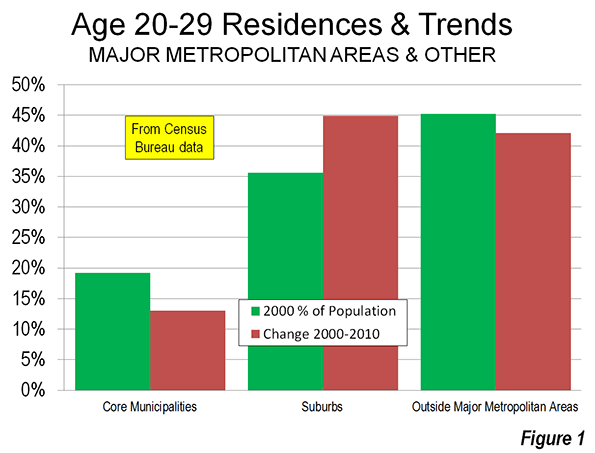
    In fact, 2010 census data indicates that people between 20 and 29 years old were less inclined to live in more urban and walkable neighborhoods than their predecessors. In 2000, 19 percent of people aged 20 to 29 lived in the core municipalities of major metropolitan areas, where transit service and walkable neighborhoods are concentrated. Only 13 percent of the increase in 20 to 29-year-old population between 2000 and 2010 was in the core municipalities. By contrast, the share of the age 20 to 29 living  in the suburbs of major metropolitan areas was 45 percent, higher than the 36 percent living there in 2000 (Figure 1).

    The Decline in Driving

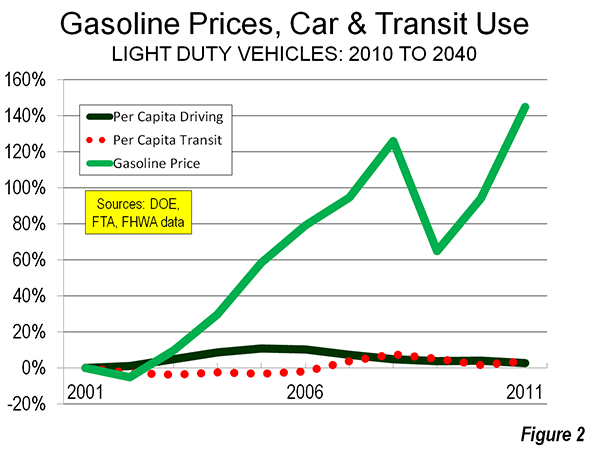
    Driving per capita in urban areas peaked in 2005. Between 2005 and 2011, driving declined seven percent. In the context of rising gasoline prices, and economic trends, the real news is not how much driving has fallen, but rather how little. A seven percent reduction is slight compared to the one and one-half times increase in gas prices over the past decade (Figure 2). Per capita travel by car and light truck has fallen back only to 2002 levels, which remained above the driving rates of previous years.

    Drivers: Not Switching to Transit

    The USPIRG report gives the impression that instead of driving, Americans are switching to other modes of transport, principally transit. In discussing the report, Nick Turner, of the Rockefeller Foundation said: "Americans are making very different transportation choices than they did in years past."

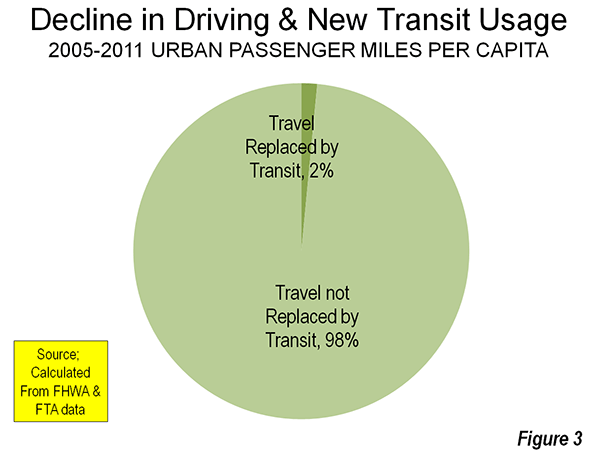
    Actually not. The data shows that as people drove less, they did not switch to transit. The driving reduction was approximately 900 miles per capita from 2005 to 2011. At the same time, transit ridership per capita was up approximately 15 miles – a small change compared to the reduction in driving (Figure 3). People just traveled a less (perhaps fewer trips to the store or to the beach, not to mention the fewer work trips in a depressed economy).

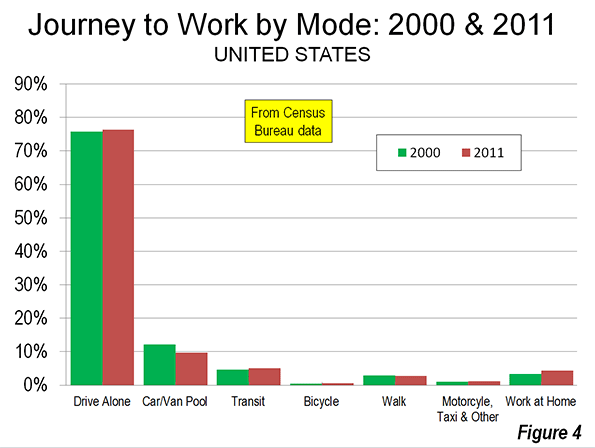
    Work trip travel trends are little changed over the past decade. Driving alone and transit were up marginally between 2000 and 2011. Working at home increased the most, while car pooling declined the most (Figure 4).

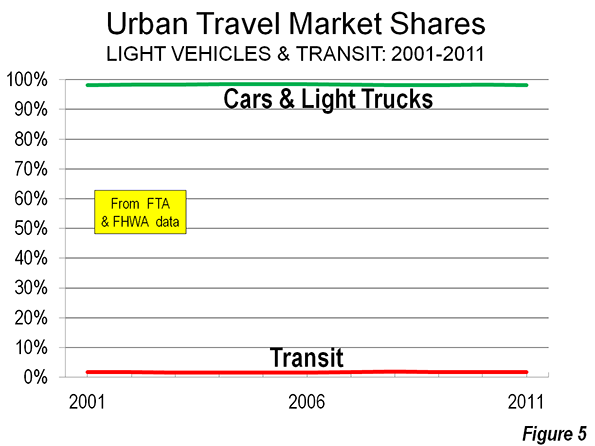
    This raises the issue of context. While driving was declining about seven percent per capita from 2005 to 2011, transit use was increasing about seven percent. The percentages were similar, but the amount of travel was radically different, because of transit’s much smaller base. Transit usage would need to increase nearly 400 percent to equal the mileage of a seven percent loss in travel by car. For all of the impressive transit ridership increase claims, transit’s share of urban travel has changed little (Figure 5).

    Transit’s failure to capture much of the decline in driving simply reflects the limitation of its effectiveness in taking people where they need to go. Transit is very effective in providing mobility to the nation’s largest downtown areas, where it provides half to three quarters of the trips. Approximately 55 percent of all US transit commuting is to six transit legacy cities (municipalities), including New York, Chicago, Philadelphia, Boston, San Francisco, and Washington. Most of this commuting is to the compact and dense downtown areas.

    Outside the transit legacy cities, transit’s impact is slight, because of the "last mile" problem.  Transit service is not close enough (or fast enough) to be practical for most trips in metropolitan areas. For example, Brookings Institution data indicates that the average worker can reach fewer than 10 percent of of jobs in major metropolitan areas within 45 minutes. By contrast, the average solo driver reaches work in approximately 25 minutes. There is no solving this problem, because the infrastructure that would be required is far from affordable, as Professor Jean-Claude Ziv and I showed in a WCTRS paper (See: Megacities and Affluence).

    Millennial Driving in Context

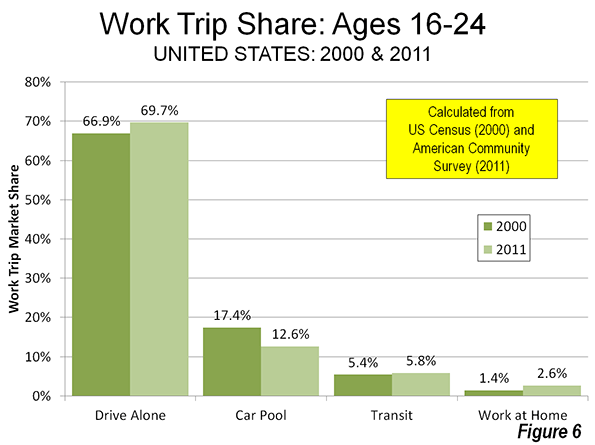
    Survey data does indicate a decline in driving among millennials, but those with jobs are not flocking to transit. Single occupant commuting in this age group increased between 2000 and 2011, from 66.9 percent to 69.7 percent. Transit use and working at home also increased (5.4 percent to 5.8 percent and 1.4 percent to 2.6 percent respectively. There was, however, a substantial decline in car pool use among millennials, from 17.4 percent to 12.6 percent (Figure 6).

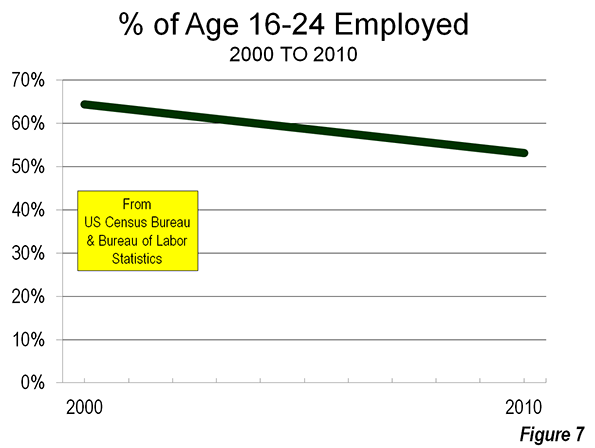
    Younger workers have suffered disproportionately from the economic decline. There has been a substantial reduction in the percentage of people aged 16 to 24 who have jobs (Figure 7). These lost work trips have contributed more than any perceived preference for urban living to the decline in driving. Transportation expert Alan Pisarski has attributed much of the decline in demand in this age group to such economic factors.

    At the same time, and as USPIRG indicates, the increase in social media use may well have contributed to the declining demand for discretionary travel.

    Driving Less in the Future and the GHG Emissions Implications

    The decline in per capita driving is not surprising. Back in 1999, Pisarski predicted that per capita driving would soon peak ("Cars, Women and Minorities: The Democratization of Mobility in America"), because automobile availability had now spread to most all segments of society.

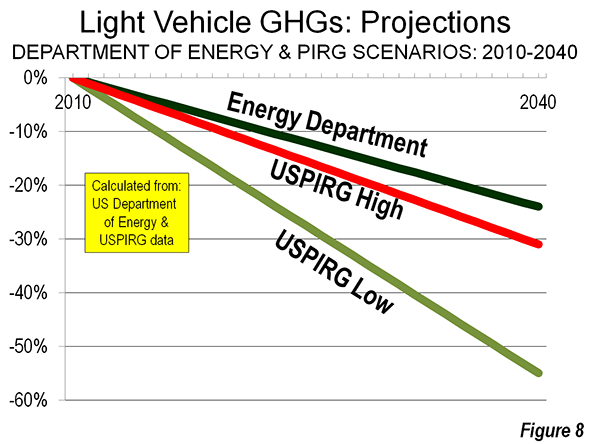
    USPIRG forecasts driving volumes below US Department of Energy predictions. According to USPIRG:  "Coupled with improvements in fuel efficiency, reduced driving means Americans will use about half as much gasoline and other fuels in 2040 than they use today." This means an even greater reduction in GHG emissions than currently forecast. Department of Energy forecasts a 21 percent decline in total (not per mile) GHG emissions from light vehicles between 2010 and 2040, despite a 40 percent increase in driving. The more modest driving levels in USPIRG scenarios would result in GHG emissions reductions of between 31 percent and 55 percent between 2010 and 2040 (Figure 8). These projections provide further evidence that of the "greening" of the automobile and the needlessness of urban containment policies.

    Reality

    Regardless, however, of the future trend, it is important to minimize the time that people spend traveling in metropolitan areas, because of the strong association between effective mobility, job access, and economic growth. Modern metropolitan areas require the quickest possible access between all origins and destinations to facilitate greater household affluence (measured in discretionary income) and lower levels of poverty. The objective should be the greatest reduction in travel delay per dollar spent on transportation.

    Dug Begley accurately characterized the situation in the Houston Chronicle:

    "We spend a lot of transportation money in the Houston region on roads, and for good reason: That’s how most people travel. Houston is a growing place, and there aren’t two or three job centers, there are about eight. Getting people between them … is going to take roads."

    Outside the municipal boundaries of the six legacy cities and especially their downtown enclaves, Houston (despite its reputation) is little different than the rest of metropolitan America. From the suburbs of New York, to the entire Portland and Phoenix metropolitan areas, the automobile carries the overwhelming share of travel (see Table 1, here). It cannot be any other way, since no planning agency in the New World or Western Europe has a plan, much less the resources, to construct a transit system that would duplicate the mobility of the automobile throughout its metropolitan area.

    Wendell Cox is a Visiting Professor, Conservatoire National des Arts et Metiers, Paris and the author of “War on the Dream: How Anti-Sprawl Policy Threatens the Quality of Life.

    —–

    Methodology: This article is based on data from the Federal Highway Administration, the Federal Transit Administration, Census Bureau, Department of Energy and USPIRG.

    Photo: Roadways, Fort Lauderdale (Miami metropolitan area)

  • Why Gentrification?

    The mostly commonly chosen means, or at least attempted means, of revitalizing central cities that have fallen on hard times is gentrification.  Gentrification is the process of replacing the poor population of a neighborhood with the affluent and reorienting the district along upscale lines.  This has seen enormous success in large swaths of New York and Chicago, but even traditionally struggling cities like Cleveland have seen pockets of this type of development downtown.

    What makes gentrification so attractive as a redevelopment strategy? There are many reasons.

    The first and most easily understandable is that is works, at least in a given geographic area. There’s a proven track record and model for redeveloping cities on an upscale basis. It may do very little for the rest of the city, but it does work for those who live, work, and, perhaps most importantly, invest in them.

    But perhaps the best question is: are there any other success models? It’s hard to point to many other successful models for redeveloping urban cores. The only alternative, and one that cities generally pursue in parallel, is attracting immigrants who seek out and revitalize out of fashion districts, often in outlying precincts of the city or the inner ring suburbs. Where there are successful working class districts in cities today, most of them are older neighborhoods that have hung on, not new ones birthed out of decline.

    In a modern America where income equality and class divisions are a huge problem, it’s definitely mission critical for America to restart the middle class jobs engine and renew our metro regions as engines of upward mobility. But that’s easy to say and hard to do, at least from an inner city perspective.

    The manufacturing jobs that previously supported a middle and comfortable working class lifestyle are gone and likely are not coming back. Public sector employment, traditionally another way to a middle class life in the city, is under extreme pressure due to fiscal mismanagement. Key services like the public schools remain intractably broken in most places. Segregation remains entrenched. What is the basis on which a middle or working class life will be re-established in the city? It isn’t clear.  Untold billions pumped into various Great Society type programs accomplished little that was sustainable. Indeed, many programs like urban renewal, yesterday’s urban planning conventional wisdom, turned out to be disasters for cities. Community organizing may have launched the career of President Obama, but it’s not clear how it has helped Chicago’s marginalized communities.  Given the paucity of models other than gentrification, it’s easy to see the attraction.

    Other reasons also drive cities toward gentrification. Clearly with a fiscal crisis, attracting more high income taxpayers (even where local taxes are predominantly on property) is clearly attractive. And the existing affluent residents need to have some assurance that they are being taken seriously by the city and aren’t just being used as ATM machines for redistribution.

    The change in the macro-economy that led to the income gap, including national policies that favor finance and technology rather than traditional manufacturing and energy type sectors, plays a huge role as well. These elite industries require a highly educated, highly skilled workforce and they are subject to clustering economics. Theories like “Creative Class” that describe this phenomenon suggest that this is a fickle group of people who seek out a gentrified neighborhood consisting largely of people like themselves. This has been glommed onto by the elite themselves – the various politicians, the wealthy, business executives, cultural leaders, academics and others. They hold power in cities  and use this to justify further investment in gentrification related programs – that is, their own class interest – although these programs do little for anyone who is not elite.

    Lastly, changes in the composition of local elites favor the publicly subsidized luxury real estate projects aimed at gentrification. In previous generations the CEOs of local operating businesses like banks and utilities were major power players. These tended to be fragmented industries and predominantly local in focus, so the overall civic health – in everything from education to infrastructure – was critical to the health of their core business. The interests of the community and CEOs were aligned.

    Today, most large-scale, and even many smaller, businesses have been nationalized or globalized, and the local power players are increasingly people like lawyers, real estate developers, and construction magnates who make money by the hour or project. The shift from locally focused operating businesses to national or global operating businesses, with remaining locally owned and focused businesses tending to be of the transactional type, produced a local elite who prefers doing deals than building broad community success. Unsurprisingly, they’ve doubled down on high end luxury developments, often subsidized by the government. 

    Lastly, once the ball gets rolling on gentrification, market forces can sustain it provided that the overall policy set remains favorable to elite type development. And having a lot of high end, swanky type development generates buzz for a city, something more prosaic, and more broadly based, working class success never does.

    Given the lack of proven alternative models and the alignment of multiple incentives behind it, there’s no surprise gentrification is the almost universal aspirational choice for cities in redevelopment.  But the gentrification model in most places is simply too narrow to move the needle or produce any benefits down the economic ladder. It is imperative that urban thinkers and leaders try harder to find models that provide more inclusive and broadly-based and socially sustainable benefits.

    Aaron M. Renn is an independent writer on urban affairs and the founder of Telestrian, a data analysis and mapping tool. He writes at The Urbanophile.

    Photo by Dom Dada.

  • The Triumph of Suburbia

    The “silver lining” in our five-years-and-running Great Recession, we’re told, is that Americans have finally taken heed of their betters and are finally rejecting the empty allure of suburban space and returning to the urban core.

    “We’ve reached the limits of suburban development,” HUD Secretary Shaun Donovan declared in 2010. “People are beginning to vote with their feet and come back to the central cities.” Ed Glaeser’s Triumph of the City and Alan Ehrenhalt’s The Great Inversion—widely praised and accepted by the highest echelons of academia, press, business, and government—have advanced much the same claim, and just last week a report on jobs during the downturn garnered headlines like “City Centers in U.S. Gain Share of Jobs as Suburbs Lose.”

    There’s just one problem with this narrative: none of it is true. A funny thing happened on the way to the long-trumpeted triumph of the city: the suburbs not only survived but have begun to regain their allure as Americans have continued aspiring to single-family homes.

    Read the actual Brookings report that led to the “Suburbs Lose” headline: it shows that in 91 of America’s 100 biggest metro areas, the share of jobs located within three miles of downtown declined over the 2000s. Only Washington, D.C., saw significant growth.

    To be sure, our ongoing Great Recession slowed the rate of outward expansion but it didn’t stop it—and it certainly didn’t lead to a jobs boom in the urban core.

    “Absent policy changes as the economy starts to gain steam,” report author and urban booster Elizabeth Kneebone warned Bloomberg, “there’s every reason to believe that trend [of what she calls “jobs sprawl”] will continue.”

    The Hate Affair With Suburbia

    Suburbs have never been popular with the chattering classes, whose members tend to cluster in a handful of denser, urban communities—and who tend to assume that place shapes behavior, so that if others are pushed to live in these communities they will also behave in a more enlightened fashion, like the chatterers. This is a fallacy with a long pedigree in planning circles, going back to the housing projects of the 1940s, which were built in no small part on the evidently absurd, and eventually discredited, assumption that if the poor had the same sort of housing stock as the rich, they would behave in the same ways.

    Today’s planning class has adopted what I call a retro-urbanist position, essentially identifying city life with the dense, highly centralized and transit-dependent form that emerged with the industrial revolution. When the city—a protean form that is always changing, and usually expands as it grows—takes a different form, they simply can’t see it as urban growth.

    In his masterwork A Planet of Cities, NYU economist Solly Angel explains that virtually all major cities in the U.S. and the world grow outward and become less dense in the process. Suburbs are expanding relative to urban cores in every one of the world’s 28 megacities, including New York and Los Angeles.  Far from a perversion of urbanism, Angel suggests, this is the process by which cities have grown since men first established them.

    In the U.S., the hate affair with suburbs and single-family housing, even in the city, dates to their rapid growth in the American boom after the first World War. In 1921 historian and literary criticic Lewis Mumford described the expansion of New York’s outer boroughs as a “dissolute landscape,” “a no-man’s land which was neither town or country.” Decades later, Robert Caro described the new rows of small, mostly attached houses—still the heart of the city’s housing stock—built in the post-war years as “blossoming hideously” as New Yorkers fled venerable, and congested, parts of Brooklyn and Manhattan for more spacious, tree-lined streets farther east, south, and north.

    In the 1950s, the rise of mass-produced suburbs like Levittown, New York, and Lakewood, California, sparked even more extreme criticism. Not everyone benefited from the innovation that allowed the Levitts to pioneer homes costing on average just $8,000—African-Americans were excluded from the original development—but for many middle- and working-class American whites, the housing and suburban booms represented an enormous step forward. The new low-cost suburbia, wrote Robert Bruegmann in his compact history of sprawl, “provided the surest way to obtain some of the privacy, mobility and choice that once were available only to the wealthiest and most powerful members of society.”

    The urban gentry and intelligentsia, though, disdained this voluntary migration. Perhaps the most bitter critic was the great urbanist Jane Jacobs. An aficionado of the old, highly diverse urban districts of Manhattan, Jacobs not only hated trendsetter Los Angeles but dismissed the bedroom communities of Queens and Staten Island with the memorable phrase, “The Great Blight of Dullness.” The 1960s social critic William Whyte, who, unlike Jacobs, at least bothered to study suburbs close up, denounced them as hopelessly conformist and stultifying. Like many later critics, he predicted in Fortune that people and companies would tire of them and return to the city core.

    More recent critiques of suburbia have focused as well on their alleged vulnerability in an energy-constrained era. “The American way of life—which is now virtually synonymous with suburbia—can only run on reliable supplies of cheap oil and gas,” declares James Howard Kunstler in his 2005 peak oil jeremiad, The Long Emergency. “Even mild to moderate deviations in either price or supply will crush our economy and make the logistics of daily life impossible.”

    Too often, the anti-surbanites seem to take a certain perverse comfort in any development, no matter how grim, that “helps” protect Americans from the “wrong choice” of aspiring to space of their own. The housing crash of 2007 was cheered on in some circles as the death knell of the suburban dream, as when theorist Chris Leinberger declared in the Atlantic that soon, poor families would be crowding into dilapidated McMansions in the “suburban wastelands.

    For retro-urbanists such as Richard Florida the reports, however premature, of the death of the suburbs, confirmed deeply held notions about the superiority of dense, urban living.  He summarily declared the single-family house archaic, and the quest for homeownership one of the “countless forms of over-consumption that have a horribly distorting affect on the economy."

    The Real Geography of America

    But the simple fact remains that the single-family home has remained the American dream, with sales outpacing those of condominiums  and co-ops despite the downturn.

    Florida has suggested that simply stating the numbers makes me a sprawl lover While he and other urban nostalgists see the city only in its dense urban core, and the city’s role as intimately tied with the amenities that are supposed to attract the relatively wealthy members of the so-called “creative class,” I see the urban form as ever changing, and consider a city’s primary mission not aesthetic or simply economic but to serve the interests and aspirations of all of its residents.

    Clearly the data supports a long-term preference for suburbs. Even as some core cities rebounded from the nadir of the 1970s, the suburban share of overall share of growth in America’s 51 major metropolitan areas (those with populations  of at least one million) has accelerated—rising from 85 percent in the ’90s to 91 percent in the ’00s. There’s more than a tinge of elitism animating the urban theorists who think that urban destiny rides mostly with the remaining nine percent matters. Overall, over 70 percent of residents in the major metropolitan areas now live in suburbs.

    Surveys, including those sponsored by the National Association of Realtors, suggest roughly 80 percent of Americans prefer a single family house to an apartment or a townhouse. Only 8 percent would prefer to live in an apartment. Yet just 70 percent of households live in a single-family house, while 17 percent live in apartments—suggesting the demand for single-family houses is still not being met. Such housing may be unaffordable, particularly in high-cost urban cores, but there is a fundamental market demand for it.

    To be sure, the Great Recession did slow the growth of suburbs and particularly exurbs—but recent indicators suggest a resurgence. An analysis last October by Jed Kolko, chief economist at the real estate website Trulia, reports that between 2011 and 2012 less-dense-than-average ZIP codes grew at double the rate of more-dense-than-average ZIP codes in the 50 largest metropolitan areas. Americans, he wrote, “still love the suburbs.”

    The Future Demographics of Suburbia

    Ultimately the question of growth revolves around the preferences of consumers. Despite predictions that the rise of singles, an aging population and the changing preferences of millennials will create a glut of 22 million unwanted large-lot homes by 2025, it seems more likely that three critical groups will fuel demand for more suburban housing.

    Between 2000 and 2011, there has been a net increase of 9.3 million in the foreign born population, largely from Asia and Latin America, with these newcomers accounting for about two out of every five new residents of the nation’s 51 largest metropolitan areas. And these immigrants show a growing preference for more “suburbanized” cities such as Nashville, Charlotte, Houston and Dallas-Fort Worth. An analysis of census data shows only New York—with nearly four times the population—drew (barely) more foreign-born arrivals over the past decade than sprawling Houston. Overwhelmingly suburban Riverside–San Bernardino expanded its immigrant population by nearly three times as many people as the much larger and denser Los Angeles–Orange County metropolitan area.

    Clearly, immigrants aren’t looking for the density and crowding of Mexico City, Seoul, Shanghai, or Mumbai. Since 2000, about two-thirds of Hispanic household growth was in detached housing. The share of Asian arrivals in detached housing is up 20 percent over the same span. Nearly half of all Hispanics and Asians now live in single-family homes, even in traditionally urban places like New York City, according to the census’s American Community Survey.

    Nowhere are these changes more marked than among Asians, who now make up the nation’s largest wave of new immigrants. Over the last decade, the Asian population in suburbs grew by about 2.8 million, or 53 percent, while that of core cities grew by 770,000, or 28 percent.

    Aging boomers, too, continue to show a preference for space, despite the persistent urban legend that they will migrate back to the core city. Again, the numbers tell a very different story.

    A National Association of Realtors survey last year of buyers over 65 found that the vast majority looked for suburban homes. Of the remaining seniors, only one in 10 looked for a place in the city—less than the share that wanted a rural home. When demographer Wendell Cox examined the cohort that was 54 to 65 in 2000 to see where they were a decade later, the share that lived in the suburbs was stable, while many had left the city—the real growth was people moving to the countryside. Within metropolitan areas, more than 99 percent of the increase in population among people aged 65 and over between 2000 and 2010 was in low-density counties with less than 2,500 people per square mile.

    With the over-65 population expected to double by 2050, making it by far America’s fastest-growing age group, they appear poised to be a significant source of demand for suburban housing.

    But arguably the most critical element to future housing demand is the rising millennial generation. It has been widely asserted by retro-urbanists that young people prefer urban living. Urban theorists such as Peter Katz have maintained that millennials (the generation born after 1983) have little interest in “returning to the cul-de-sacs of their teenage years.” 

    To bolster their assertions, retro-urbanist point to stated-preference research showing that more than three quarters of millennials say they “want to live in urban cores.” But looking at where millenials actually live now—and where they see themselves living in the future—shows a very different story. In the nation’s major metropolitan areas, only 8 percent of residents aged 20 to 24 (the only millennial adult age group for which census data is available) live in the highest-density counties—and that share has declined from a decade earlier. What’s more, 43 percent of millenials describe the suburbs as their “ideal place to live”—a greater share than their older peers—and 82 percent of adult millenials say it’s “important” to them to have an opportunity to own their home.

    And, of course, as people get older and take on commitments and start families, they tend to look for more settled, and less dense, environments. A 2009 Pew study found that 45 percent of Americans 18 to 34 would like to live in New York City, compared with just 14 percent of those over 35. As about 7 million more millenials—a group the Pew surveys show desire children and place a premium on being good parents—hit their 30s by 2020, expect their remaining attachment to the city to wane.

    This family connection has always eluded the retro-urbanists. “Suburbs,” Jane Jacobs once wrote, “must be difficult places to raise children.” Yet suburbs have served for three generation now as the nation’s nurseries. Jacobs’s treatment of the old core city—particularly her Greenwich Village in the early 1960s—lovingly portrayed these places as they once were, characterized by class, age, and some ethnic diversity along with strong parental networks, often based on ethnic solidarity.

    To say the least, this is not what characterizes Greenwich Village or in Manhattan today. In fact, many of the most vibrant, and high-priced urban cores—including Manhattan, San Francisco, Chicago, and Seattle—have remarkably few children living there. Certainly, the the 300-square-foot “micro-units” now all the rage among the retro-urbanist set seem unlikely to attract more families, or even married couples.

    The Persistence of the Suburban Economy

    As Americans have voted with their feet for the suburbs, employers have followed.

    Despite the attention heaped on a handful of companies like United Airlines and Quicken Loans that have moved “back to the city,” the suburbanization of the overall American economy has continued apace. Historically, suburbs served largely as residential areas, so-called bedroom communities, but their share of steadily.

    Job dispersion is now a reality in virtually every metropolitan area, with twice as many jobs located 10 miles from city centers as in those centers. Between 1998 and 2006, as 95 out of 98 metro areas saw a decrease in the share of jobs located within three miles of downtown, according to a Brookings report. The outermost parts of these metro areas saw employment increase by 17 percent, compared to a gain of less than 1 percent in the urban core. Overall, the report found, only 21 percent of employees in the top 98 metros in America live within three miles of the center of their city.

    This decentralization of jobs was slowed somewhat by the Great Recession, which hit more dispersed industries like construction, manufacturing and retail particularly hard. Yet an analysis of jobs in 2010 by the Rudin Center for Transport Policy and Management found that dispersion had continued. Between 2002 and 2010 only two of the top 10 metropolitan regions (New York and San Francisco) saw a significant increase in employment in their urban core.

    Some observers claim that job growth is coming to the urban core in response to the changing preferences of younger workers, particularly in high-tech fields and as much media attention has been given to a few prominent social media start ups in New York and San Francisco. Similar pronouncements were  made during the great dot-com boom of the late 1990s, and burst along with the bubble. In fact, the number of urban core country tech jobs actually shrank over the past decade, according to an analysis of Science, Technology, Engineering and Management (STEM) jobs by Praxis Strategy Group.

    While companies in walking distance of big-city reporters make news out of all proportion to their importance, virtually all the major tech concentrations in the country—including Silicon Valley—are suburban. San Jose is a postwar suburban core municipality, having experienced the vast bulk of its growth since 1940. Virtually all the nation’s top tech companies—Apple, Google, Hewlett-Packard, Intel, Oracle and even Facebook—are located in suburban settings 45 minutes or more from San Francisco. Apple’s recent plans to construct its new corporate campus in bucolic Cupertino elicited anger from the Environment Defense Fund and other smart-growth advocates, but reflects the fact that the vast majority of the tech industry is located, along with the bulk of its workforce, in the suburbs.

    Apple employs many experienced engineers, many of whom have families and prefer to live in suburbs. In 2012 San Francisco had a significantly lower share of STEM jobs per capita than Santa Clara County. And the new rising stars of the tech world—Austin and Raleigh-Cary—are even more dispersed and car-dependent than San Jose. 

    What Really Matters

    While they’ve weaved a compelling narrative, the numbers make it clear that the retro-urbanists only chance of prevailing is a disaster, say if the dynamics associated with the Great Recession—a rise in renting, declining home ownership and plunging birthrates—become our new, ongoing normal. Left to their own devices, Americans will continue to make the “wrong” choices about how to live.

    And in the end, it boils down to where people choose to live. Despite the dystopian portrays of suburbs, suburbanites seem to win the argument over place and geography, with far higher percentages rating their communities as “excellent” compared to urban core dwellers.

    Today’s suburban families, it should be stressed, are hardly replicas of 1950s normality; as Stephanie Coontz has noted, that period was itself an anomaly. But however they are constituted—as blended families, ones headed up by single parents or gay couples—they still tend to congregate in these kinds of dispersed cities, or in the suburban hinterlands of traditional cities. Ultimately life style, affordability and preference seem to trump social views when people decide where they would like to live.

    We already see these preferences establishing themselves, again, among   Generation X and even millennials as some move, according to The New York Times,toward “hipsturbia,” with former Brooklynites migrating to places along the Hudson River. The Times, as could be expected, drew a picture of hipsters “re-creating urban core life” in the suburbs. While it may be seems incomprehensible to the paper’s Manhattan-centric world view by moving out, these new suburbanites are opting not to re-create the high-density city but to leave it for single-family homes, lawns, good schools, and spacious environments—things rarely available in places such as Brooklyn except to the very wealthiest. Like the original settlers of places like Levittown, they migrated to suburbia from the urban core as they get married, start families and otherwise find themselves staked in life. In an insightful critique, the New York Observerskewered the pretensions of these new suburbanites, pointing out that “despite their tattoos and gluten-free baked goods and their farm-to-table restaurants, they are following in the exact same footsteps as their forebears.”

    So, rather than the “back to the cities” movement that’s been heralded for decades but never arrived, we’ve gone “back to the future,” as people age and arrive in America and opt for updated versions of the same lifestyle that have drawn previous generations to the much detested yet still-thriving peripheries of the metropolis.

    Joel Kotkin is executive editor of NewGeography.com and a distinguished presidential fellow in urban futures at Chapman University, and a member of the editorial board of the Orange County Register. He is author of The City: A Global History and The Next Hundred Million: America in 2050. His most recent study, The Rise of Postfamilialism, has been widely discussed and distributed internationally. He lives in Los Angeles, CA.

    This piece originally appeared in the The Daily Beast.

    Suburbs photo by BigStock.