Category: planning

  • Stuck in the Station: The High-Speed Rail “Low Ball Express”

    You know that something is up when a Washington Post editorial advises that the Obama Administration do a “reality check” on its plans for high speed rail. From the beginning, there was more slow-speed than high speed rail, however both components of the plan could be in trouble. The Onion joined the issue with a satirical video announcing a federal “high-speed bus” program that would replace the high-speed rail plans.

    The Post criticized Secretary of Transportation Ray LaHood for not allowing Wisconsin and Ohio to use the federal money to make needed highway improvements instead:

    “This blunt refusal to heed the fresh mandate of Ohio and Wisconsin’s voters seems hard to justify – especially since using the money for other infrastructure would have created jobs, just as building trains would have.”

    Wisconsin and Ohio: This is vividly illustrated by recent election results, when successful gubernatorial candidates in two states vowed to kill two of the slower lines that had already received substantial federal funding. Wisconsin’s Scott Walker took aim at the Milwaukee to Madison line, which would average less than 60 miles per hour, despite reaching speeds of 110. Ohio’s John Kasich says that Ohio’s Cincinnati to Cleveland train is “dead” It could have been named the “Ohio Fast Mail,” because it would have averaged 50 miles per hour, about the same as the Fast Mail over the longer New York and Niagara Falls route — in 1877! These trains would have operated at average speeds from one-third to one-fourth those achieved by the Wuhan to Guangzhou trains in China.

    Illinois: There are also problems in Illinois. That state received $1.1 billion from the federal government to ramp up Chicago to St. Louis speeds to 110 miles per hour and to make the trip in four hours. Yet, the state received only about one-third of the requested $3 billion from the federal government for this project. It is a fair question where the rest of the money is coming from. Illinois had proposed to contribute only one percent of the cost ($4 million), leaving the project still nearly $2 billion short, before the seemingly inevitable cost overruns (which are already an inflation adjusted 8 times earlier projections). Illinois, which by some accounts is in as bad shape fiscally as California, simply does not have the money to complete the job.

    Incremental High Speed Rail? One of the most cynical myths about slower speed rail is that it is a “stepping stone” to genuine high speed rail, which is now being built in some countries to operate from 200 to 220 miles per hour. Such claims are patently misleading. The slower speed 110 mile per hour trains will run on tracks shared with freight trains and there will be some grade crossings (intersections with roads where trains, trucks and cars could conceivably collide). Genuine high speed rail requires starting all over.

    Illinois provides an example. The unfunded $3 billion slower speed line is not enough. The state has also sought federal funding to plan a genuine high speed rail line that would cost an additional $12 billion, according to a Midwest High Speed Association report. However, this amount would rise substantially, since it does not include rail-cars, maintenance facilities, stations and, of course, cost overruns. There is nothing incremental about building one line and then abandoning it to build another.

    California and Genuine High Speed Rail? Maybe Not: Meanwhile, the news is not encouraging to proponents of the nation’s two genuine high speed rail lines, in California and Florida.

    For two years, the California High Speed Rail Authority has been concentrating its attention on planning for the two most expensive sections of its proposed $43 billion (before cost-overruns) line from Los Angeles (Anaheim) to San Francisco. Plans that some claim would create a Berlin Wall across the largely affluent cites of the Peninsula led to a “boondoggle rally” attended by 500 people in Palo Alto. Community concerns have also been raised about the line through Orange County and southeastern Los Angeles County.

    Now, however, the federal government has virtually steered all of promised money to the San Joaquin Valley, requiring that it be spent between Merced and Bakersfield. The provisions of the high speed bond issue will require that state funding to be spent where the federal money is spent.

    The federal department of transportation has not indicated its rationale for this decision, but the new strategy could indicate that a modicum of sanity may be at work. Clearly the state of California does not have the money to build the system. Joe Vranich and I raised this issue in our Due Diligence report on the system, published by the Reason Foundation. We noted that the proposed 2:40 travel time from San Francisco to Los Angeles Union Station would more likely erode to 3:40, because the trains will not be able to travel as fast as planned in the urban areas, and they are not likely to attain their aggressive planned speeds on other portions of the route. We also suggested the likelihood that only part of the system would be built, with trains operating at conventional speeds over conventional tracks for the final 60 or more miles into San Francisco and Los Angeles. With insufficient money, there could be pressure to cut the genuine high speed rail portion of the system back even more than that, given the federal requirement for confining construction to the San Joaquin Valley, which now barely supports minimal air service and has largely traffic-free freeways.

    Proponents have been mouthing fairy tales about French, Chinese or Japanese investment in the system. Can they be so naive to believe that French or Japanese taxpayers will pay for high speed rail system in California? In fact, any such “investment” would be loans and would have to be paid back. Around the world, virtually all private investment for high speed rail has been either lost or bailed out by taxpayers.

    Perhaps the best that proponents can hope for is that some 220 mile per hour track will be built on the flat-as-Kansas agricultural land in the San Joaquin Valley. Trains could continue from the northern terminus (Merced) to San Francisco and from the southern terminus (Bakersfield) to Los Angeles and Anaheim on upgraded conventional rail tracks. This would bring the now discarded slower speed rail vision of Ohio and Wisconsin to California. Trains might well average 70 miles per hour or somewhat more.

    It could be even worse. Californians Advocating Responsible Rail Design (CARRD) reveals that the California High Speed Rail Authority has revealed “Plan B.” Its October 2009 application to the US Department of Transportation indicated that “In the event of significant delays or abandonment of the HST program, the Merced/Fresno Program would have created rail crossing benefits, as well as provided the potential for significant improvement to the existing San Joaquin intercity passenger service operated by Amtrak and underwritten in part by the state.”

    Florida: People were also having second thoughts about the genuine high-speed line between Orlando and Tampa. The two cities are so close together than even if the train reached the speed of light, given waiting in a rental car line and driving to and from the stations, car travel could be faster.

    Congressman John Mica, who seems likely to be Chair of the House Infrastructure and Public Works Committee in the next congress, has suggested that the line be truncated to a local operation between Orlando International Airport and Disneyworld. Governor Elect Rick Scott is now reviewing the project.

    International: The international news is barely any better. The Chinese government is now reviewing the wisdom of its huge expenditures on high speed rail, as a result of a critical report from the Chinese Academy of Sciences. And, as in California, communities are resisting along a proposed high speed rail line in England. Moreover, cost overruns have been routine, as have been revenue and ridership shortfalls relative to the always rosy projections.

    At least in the United States, the high-speed rail “low-ball express” remains stuck in the station. The actual costs, however, will certainly rise well above the low-ball estimates.

    Photo: The Fast Mail (1877 Average Speed Equal to Cancelled Ohio High Speed Rail Train): Harper’s Weekly, 1877.

    Wendell Cox is a Visiting Professor, Conservatoire National des Arts et Metiers, Paris and the author of “War on the Dream: How Anti-Sprawl Policy Threatens the Quality of Life

  • Love and the City

    It has been said that the modern city is soulless, that it is heartless, and that it is brutal. The modern city represents in its scale and complexity one of the most extraordinary of human inventions, but there is also no doubt that everywhere in the world it is also one of our biggest failures.

    The dysfunction of a city in the past was an inconvenience. The dysfunction of a city in the future will be a profound disaster for that city and, ironically, a profound opportunity for another city, of a smarter city. It will be an opportunity for a city that has found out how to position itself better in the world of cities, but more importantly in the eyes and hearts of its citizens.

    All over the world, there is a growing recognition that this brutality must stop; we have to imagine a different kind of city which addresses human needs and that puts the soul back into the city. This is essential to the survival of the city. Put another way, there is a growing understanding that it is actually “love” that will be the prime force in the future economy of successful 21st century cities.

    Who would have thought in the last generation that “love” might become a meaningful topic in a discussion about urban economies, much less a prime force of those economies?

    One important reason for creating a love-based city grows from the struggle today among cities for hegemony. We read all the time about “alpha-cities” and “delta-cities”: the “alphas” enjoy the fruits of labour and the “deltas” just do the labour – they just exist. And why is this?

    Well, it’s because the dynamics of urban growth and competition have fundamentally changed in the last quarter century. The world has become footloose, with people and capital moving at will: business can be done anywhere. Other aspects of life are more important than one’s livelihood and where people choose to settle is not tied down the way it used to be. We can do and be almost anything anywhere.

    The result is a new kind of economic base for our cities, augmenting the traditional economic activities holding our cities together. This is the ideas and service economy and it opens up the imperative to create a city of beauty and quality liveability and style. This is an economy driven by people, their direct needs, their preferences and their day-to-day experiences.

    This ideas and service economy quickly becomes an economy involving almost everyone. If you live in a core city, have you ever tried to get a gardener or a plumber? But, even beyond that, you have to think about all of the professions and vocations that can now demand an enjoyable as well as functioning city.

    We’re not just talking about the service sector or the ‘creatives’, we’re talking about almost everybody. We have to focus the discussion on a city that is liveable for a broad array of its population.

    I worry that in all our creative thinking about sustainable technologies and sustainable urban forms, there may be some strong denial going on about people and their inclinations, denial that will block the way towards sustainability.

    Take the fashion that insists on the primacy of density and mixed use and diversity and sustainable transportation. Sadly, most consumers in the English speaking world, except in a very few of our older gracious places, have shown very little interest in being a part of that kind of city. In my country, two-thirds of Canadians live in auto-dominated suburbs that boast none of these qualities – and that proportion is even higher in America.

    Let’s be blunt: most people hate density because most of it has been so bad; they think of mixed use as probably hitting them negatively and transit is not even in most people’s vocabulary. The ideal of most people is some sort of rural “garden of Eden” that they want to escape to from the city – even if that ends up being an illusory goal.

    I sympathize. The cities we have been building since the War have very seldom offered anything very appealing at almost any density. Who can really fall in love with brutal concrete canyons or anonymous strip malls or wind-swept roads?

    If cities want to offer an alternative, they must change and bring back the human touch – we have to bring placemaking to the very heart of the civic agenda. We have to stop trading away the urban qualities we care about for the urgencies of the moment of modern life.

    We must start to build places that truly appeal to people – yes, places that are sustainable, but also places that are so good that people will choose them. These cities have to have all the human services and they have to have beauty and they have to be gentle. Only then will they become attractive to a wide range of people.

    I call this “Experiential Planning” – learning about and then carefully making the city deliver the experiences people tell us they want in their lives for their families and children.

    Experiential planning looks beyond land-use and transportation patterns to things like character and comfort and health and convenience and the visceral response of the senses and caprice: things that simply make people happy. Happiness is the applied side of love.

    People want all of the efficiencies and choices but they also want more. They want to feel the unique, special spirit of a place as a real thing, not a marketing gimmick. They want their habitat to have a “buzz” that makes them feel good. They want their day-to-day living environment to foster social engagement and neighbourliness not isolation. That is what the contemporary city has often been missing.

    For as long as anyone can remember, modern cities, with very few exceptions, have been shaped by economic activity and politics and the shifting of social groups: the city exploited as a commodity. But that doesn’t have to be the case. We can actually design our cities as an explicit act of creation – grand civic design with the whole city as a canvas. And every city has to find its own way: they should not accept cookie-cutter replications of what’s being done everywhere else.

    To start, every city needs to perform a ritual burning of these outdated and single-purpose rules. Now I am not talking about de-regulation. The city of the future will have to have strong regulations because the possibilities out there for development are just too diverse and the private interests in development too strong. There must be a clear expression of the public interest and public needs to match that of the private sector.

    Also, I want to be clear that this is not a “top-down” agenda. Experiential planning requires an aggressive and diverse engagement of the public at every step along the way to articulate the public perspective and to insure public buy-in and ownership. The general public needs to discuss and debate an overall civic vision and all aspects of urban design.

    In this experiential-based city there will be an alignment of profitability and community building. We will also see people coming back to live in the core city and to suburbs transformed through natural choice and preference. There will be an alignment of consumer selection and sustainable practice. This will include all kinds of people but especially families with children.

    But none of this will happen by accident. We have to make it happen and bring along individual values through a careful process of reconciliation.

    Tomorrow’s city must meet the environmental test and the economic test but it must also meet the experiential test; and that is the test of love; that is the test of soul. It must be beautiful and joyful and sociable and humane and offer a complete rich community life – with all the subtleties of human occupation. That is the real power of an urban love affair.

    Larry Beasley is the retired Director of Planning for the City of Vancouver in Canada. He is now the “Distinguished Practice Professor of Planning” at the University of British Columbia and the founding principal of Beasley and Associates, an international planning consultancy. He chairs the ‘National Advisory Committee on Planning, Design and Realty’ of Ottawa’s National Capital Commission; he is the Chief Advisor on Urban Design for the City of Dallas, Texas; he is on the International Economic Development Advisory Board of Rotterdam in The Netherlands; and he is the Special Advisor on City Planning to the Government of Abu Dhabi in the United Arab Emirates.

    Photo by ecstaticist

  • The Overdue Debate: Smart Growth Versus Housing Affordability

    American households face daunting financial challenges. Even those lucky enough not to have suffered huge savings and retirement fund losses in the Great Recession seem likely to pay more of their incomes in taxes in the years to come, as governments attempt pay bills beyond their reasonable financial ability. Beyond that, America’s declining international competitiveness and the easy money policies of the Federal Reserve Board could well set off inflation that could discount further the wealth of households.

    In this environment, the last thing governments need do is to raise the cost of anything. It is bad enough that taxes may have to rise and that a dollar will probably buy less. America’s standard of living could stagnate or it could even decline.

    The Choice: Smart Growth or Affordability

    The Washington Examiner, however, succinctly put the choices that face the nation, states and localities with respect to the largest element of household expenditure — housing. In an editorial entitled “Take Your Pick: Smart Growth or Affordable Housing,” the Examiner noted:

    “No matter how much local politicians yammer about how much they support affordable housing, they are the principal cause of the problem via their land use restrictions, such as the urban growth boundary in Montgomery County and large-lot zoning in Loudoun County.”

    The editorial was in response to our Demographia Residential Land & Regulation Cost Index, which estimated the extent to which the land to construction ratio had risen in metropolitan regions. The principal finding was that the share of land and regulatory costs to new house prices had risen only with the impostion of more restrictive land use policies. This is principally because strategies such as urban growth boundaries, suburban large lot zoning and geographical growth steering (such as allowing state financial assistance only in areas meeting smart growth criteria) makes land for housing unnecessarily scarce, raising its price just as surely as OPEC’s oil rationing raises the price of gasoline.

    Urban planner and mayor of Ventura, California Bill Fulton objected to our attributing these increases to land and regulation, instead suggesting that smart growth increases homes prices much less than we claimed although, he admits, “at least a little“ . The pro-smart growth study Costs of Sprawl — 2000 concedes that a number of smart growth strategies can increase house prices (See Table 15-4). Thus, the debate is not about whether more restrictive land use policies raise the price of housing, but rather by how much.

    More often, however, proponents of more restrictive land use regulations have avoided and even denied that the inconvenient truth linking their policies with higher housing costs. Rarely, if ever, have proponents of such policies fully disclosed to elected or appointed officials that more restrictive land use policies would lead to higher house prices. It is doubtful that any urban planning department ever sent representatives to an NAACP chapter to explain how fewer African-Americans would be able to own their own homes, despite already having a one-third lower home ownership rate than non-Hispanic whites. Similarly, the planners probably never told La Raza chapters that Hispanic households, also with a one third less home ownership rate, would find home ownership more costly. Nor was the message delivered to the religious organizations concerned with improving the standard of living for lower income households.

    Pervasive Evidence

    Yet the evidence that smart growth boost prices substantially seems incontrovertible. An early 1970s research effort led by renowned urbanologist Peter Hall quantified the impacts of the restrictive Town and Country Planning Act of 1947, which brought smart growth measures to England. The result, The Containment of Urban England revealed how strict regulations on development had driven the price of land for development from five to ten times the value of comparable on which development was not permitted, but might be permitted in the future. More recently, Bank of England Monetary Policy Committee member Kate Barker, was commissioned by the Blair Labour government to review housing affordability and land regulation. She attributed England’s more steeply rising house prices relative to continental Europe to its more restrictive land use regulations.

    The same effect is evident in the United States. Dartmouth’s William Fischel noted that California house prices were similar to those in the rest of the nation as late as 1970. By 1990, however, California house prices had escalated well ahead of the nation. Fischel found that the higher prices could not be explained by higher construction cost increases, demand, the quality of life, amenities, the property tax reform initiative (Proposition 13), land supply or water issues. His conclusion was that the expansion of land use restrictions were the culprit.
    Let Them Eat Cake?

    The disregard at least some smart growth proponents show about house prices may be characterized, for example, in a comment on the Planetizen website:

    “… smart growth can lead to more expensive housing. So what? At least it’s REAL value, generated by a higher quality of life, easier commutes, more transit options, walkability and a more enriched cultural experience…” (emphasis in original)

    Perhaps it never occurred to the proponents of more restrictive land use policies that not all households have the benefit of incomes typical of urban planners or new urbanist architects. One has to question the “REAL values” of smart growth since most housing consumers place their highest emphasis on things like privacy, security and good schools, not always available at a decent price in urban areas.

    In fact, higher priced housing reduces the discretionary income that is crucial to an acceptable standard of living to many households. Millions of households will not be in the market for “a more enriched cultural experience” until they can afford the housing they desire.

    Housing Affordability and the Cost of Living

    It is not accidental that the cost of living is higher (both in nominal terms and relative to incomes) in metropolitan regions where land use regulation is the strongest, such as San Diego, Washington-Baltimore, Seattle or Boston. Nor is it accidental that house prices have escalated to 40 percent above historic norms in Portland, Oregon, where planners have skimped on geographical urban growth boundary expansions, choosing instead to look skyward, seeking higher densities. California’s aspiration under Senate Bill 375 for new housing at 20 units to the acre offers a more than Jakarta level of density (residential densities above 30,000 per square mile) that could escalate the unprecedented exodus of people and businesses.

    Higher Housing Costs: The Poverty Connection

    The acknowledged relationship between more restrictive land use regulation and higher house prices also applies to standards of living, which are sent lower, and poverty rates, which must inevitably be pushed higher. This constitutes a second inconvenient truth: as discretionary income drops, more households fall into poverty. This creates a difficulty for proponents of more restrictive land use regulation, because there is no constituency for increasing poverty. It is no wonder they have generally discounted, ignored or even denied the nexus between smart growth and higher housing costs.

    Considering the financial uncertainty American households face, it is long past time that the choice between smart growth and housing affordability be seriously debated.

    —-

    Photograph: “Low density” smart growth development adjacent to the urban growth boundary (Hillsboro) in suburban Portland (by author)

    Wendell Cox is a Visiting Professor, Conservatoire National des Arts et Metiers, Paris and the author of “War on the Dream: How Anti-Sprawl Policy Threatens the Quality of Life

  • Car Wars: Should Autos Rule The Road? Part II

    We have a severe drug problem, we’ve been told, that mostly affects suburbanites. The dangerous drug is not taken by mouth, nor by injection, yet it is used daily by every family member and must be stopped before we, as a nation, are utterly destroyed. According to many experts, our “dependence” on cars must stop.

    Internet rumors abound that we are about to be legislated out of our stupor, and be taxed into high density, inner core cities. Should this rumor become fact, let’s look at what effect it will have on our economy, and, quite frankly, on the American Dream of home ownership.

    Today, the housing market is still dealing with the disaster of plummeted prices. Since 80% of the new home market this past decade has been suburban, it would be safe to say that 80% of Americans that bought in this century are the hardest hit, because these new homes have dropped to pre-boom pricing. It has been young families, generally, that have driven out to the suburbs to find new homes, the promise of lower density, and newer safe schools. In addition, many (most) of these families believed that their homes were a source of income; after all, values were increasing 10% or more annually, and that equity could be tapped in loans, (both suburban and urban).

    While many think of the suburbs as pure white, that is no longer true. The suburbs today, in general, are intermixed with all races. But the new race being ridiculed by many is the “suburbanite”. The suburbanite yearning for his or her daily fix of the car, consuming our fuel, and spewing carbon into our atmosphere must be eradicated at all costs.

    So how do we eradicate this vermin? There are rumors of a carbon tax that will place a financial burden on those vehicular junkies. Who cares that this major portion of America’s population is under the most financial pressure since the depression. If we tax these infidels, that will surely bring them to their senses , and we can cure their dependence on Chevys, Fords, and Mini-vans. Let’s break their backs once and for all, so that these families will abandon what is left of the suburbs and be forced back to the inner core. If reason does not work, we can just legislate it.

    Let’s imagine this new future filled with promise of a new America. In this fantasy, we visit the Smith family, who moved from their 10,000 foot suburban lot into the urban core. Adam Smith, the father, now must take the bus to the train station for the new light rail line that goes to Edenville, his job out in the suburb as a plant manager (it seems that his place of employment did not make the move). With connections, he can make it to work within an hour, whereas his 10 mile commute from suburb to suburb took 20 minutes.

    Lilly Smith (his new wife, as the old one refused to move into a 20 story inner city high-rise) works at Bester Buy on the edge of the city. She needs two bus connections to get there Having a car is not an option, since parking costs are prohibitive in the city. Luckily, the kids are old enough to be left alone; Josh is 8 years old, Jane is 12, and Joey, who is 15, watches over the siblings. Today is a holiday and they are home from school, but the cold rainy day keeps them inside, along with hundreds of other kids who play in the vast corridors.

    Lilly arrives at work, only to remember that Jane had a dentist appointment which she forgot about. She shivers, thinking about the old days, and the warm comfort of the Mini-van she once relied on to take her kids to appointments. She breaks out into a sweat and falls into a stupor. Her fellow workers recognize the symptoms, as they too have been weaned of their dependence upon personal vehicles. Her manager, Ralph, lets her take a week of sick leave to get help.

    Ralph is lucky. He lives in a single family neighborhood on the edge of the city. He has his own large lot, a spacious 35 feet wide and 90 feet long. He and his wife each posses a car. His luxury two story home, setback five feet from the sidewalk, is 25 feet wide and 50 feet deep; the house itself is a massive 2,500 square feet, over twice as large as the Smiths inner city apartment. He also has three children who enjoy the privacy of their back yard. The garage adjacent to the 12 foot wide alley consumes 440 square feet of their remaining 1,200 square foot rear yard. Still, with 760 square feet of green space, the kids are lucky.

    Ralph and his wife, Mary, both drive electric cars. Mary has the larger vehicle, with a 50 mile range per charge on a warm day. Their daughter wants to play with a cousin who still lives in the suburbs, 20 miles away. This is a cold day, which reduces the range of the vehicle to 35 miles, and their cousins do not have a charging station, so their 11 years old daughter is driven to the Light Rail station, a mile away.

    A week later, back at the Smith apartment, an argument starts between Adam and Lilly about her desire to get out of the city. Even if they did move out to near Adam’s plant, they would need Lilly’s paycheck to make ends meet, so she would need the light rail and two bus connections to get to work. Lilly begins to sweat and shake again… When Josh asks what is wrong with Mommy, Adam explains about the days when Americans were drugged out on their cars, the days when people were free to go when and where they wanted. As he describes those terrible times, he too yearns for those days. Adam and Lilly dream of moving out to a place with space, if only the carbon tax on moving out of the city could allow it, but alas, it’s only a dream that only the wealthy can now afford.

    A fantasy? Here is what I’m experiencing as a planner. When I met with a city official a few weeks ago I was admonished for a proposal that included attached garages. I explained that attaching the garage reduces 40 feet of exterior wall to be built, and here in Minnesota, an attached garage means you do not have to shovel snow between the home and the garage, nor slip on the ice. Why would I detach a garage, I asked? The city official explained that according to his planning staff, the space between the garage and the home is a social gathering spot where neighbors can stop and talk about their day. I had thought that’s what that large front porch we are proposing on the homes was for.

    There is a movement to prevent the toxic drug — the car — from infecting our lives. For me, no way you are taking me off my ERPT — Extremely Rapid Personal Transport — dependence.

    This is the second of a two-part series in which different authors examined the centrality of the autombile in urban and suburban life.

    Photo by Rick Harrison of the author’s ERPT — his Porsche.

    Rick Harrison is President of Rick Harrison Site Design Studio and Neighborhood Innovations, LLC. He is author of Prefurbia: Reinventing The Suburbs From Disdainable To Sustainable and creator of Performance Planning System. His websites are rhsdplanning.com and performanceplanningsystem.com.

  • Car Wars: Should Autos Rule The Road? Part I

    We’ve decided to become a one car family. Denver has proven to be the ideal locale for this experiment, of sorts. The “Mile High City,” and particularly our new neighborhood, provide a range of mobility options beyond the four-wheel variety for trekking from place to place.

    The metropolitan area is naturally blessed with a mobility-favorable landscape. It is approximately 10 miles by 10 miles. More importantly, our neighborhood possesses what I affectionately refer to as “accessible proximity” to local amenities such as grocery stores, coffee houses, parks, and specialty shopping centers. The immediate area is not only safe, it’s engaging in its physical and social makeup, with stately homes and troves of dog-walkers along suburban style streets.

    Recently, our daughter, who is eight, remarked “Ya know, at our old home it seemed like we always needed a car to go places, while here in Denver, we can actually walk places and enjoy the clean air.”

    The website Walkscore, an online index, which ranks communities nationwide based on access by foot to restaurants, coffee houses, schools, businesses and other frequent destinations. Denver’s score provides tangible evidence of my daughter’s contention: According to the site’s analytics, our Denver address registers a whopping 88 out of 100, defined as ‘very walkable,’ meaning that “one is able to accomplish most errands by foot. Our residence in Folsom, California — from which we recently relocated — stumbled in at a paltry 48 out of 100, defined by Walkscore as ‘car dependent’.

    Why is this such a big deal to us, as well as to growing numbers of Americans? I would contend that it is affordability. As Americans continue to struggle financially amid the worst economic times since the great depression, the argument could be made that location efficient neighborhoods offer a cost effective alternative to those that are exclusively auto-centric. In an era where expenses associated with automobile ownership, maintenance and fuel represent a significant slice of our household budgets, policy makers would be wise to expand options that encourage alternative forms of mobility.

    Automobiles are still the transportation mode of choice for most working commuters, and for good reason, as most Americans still live a reasonable distance from where they work. But alternative forms of transportation are gaining momentum, as many struggle with insurance and other automotive related expenses.

    According to the U.S. Census Bureau’s recently released American Community Survey (ACS), bicycling is becoming a viable option for Americans willing to pump the pedal on their way to work. Portland leads the U.S. in terms of the most bike commuters, with almost six percent of its residents using a bicycle as their primary mode of transportation to work in 2009. Minneapolis (3.86%), Seattle (2.99%), San Francisco (2.98%), and Oakland (2.53%) round out the top five.

    Denver is one of a handful of cities that is actively promoting the use of bicycles as a viable short-run commute option. This year, the city introduced the first large-scale bike-sharing program in the U.S. A partnership between Humana, Trek Bicycle and the advertising agency Crispin Porter + Bogusky, this initiative flows from the shared belief that bicycles should serve as vehicles for positive health and environmental change, as well as important parts of a community’s transportation ecosystem. It’s this latter point that has gained the attention of Denver hotels and the convention center, which are seeking to provide visitors with mobility tools that compliment the downtown’s free bus system and walkable grid.

    The dilemma continues to be how to efficiently travel short distances that are too far to walk. Like Pavlovian dogs, many of us are conditioned to reach for the car keys, even for the shortest of trips. This behavior is deeply embedded in our consciousness;, an auto-centric mindset that has been nurtured in us for years.

    Chris Wiggins of the Folsom, California based Glide Electric Cruiser believes that a huge demand exists for short-range transportation options. His invention is ideal for short commutes and has virtually no impact on the environment. What is it? A series of motorized electric scooters with top speeds of up to 38 miles per hour. Currently in a first production run stage, these “cruisers” have attracted a wide swath of interest, from law enforcement agencies to senior groups. “I personally believe they have the potential to revolutionize short-range commuting in the U.S. and beyond,” says Wiggins. “My greatest hope in developing them is that they will have a meaningful impact on the quality of life, as well as improve the environment.”

    Recognizing that car-based travel will continue to be a reality for most Americans, innovative companies like Zip Car and Car2Go have adroitly positioned themselves for where I believe the auto market is headed: Short-term, just-in-time rentals that eliminate the expense of owning a car. And since my family has only one car, I personally am exploring these and other options to assist with those commutes beyond my immediate, local area.

    There are many factors affect the viability of a mobility option. Density currently receives the greatest amount of air-time. I’m often reminded of a business trip several years ago to the wonderful island community of Bermuda. I was intrigued to discover that because of its dense configuration and its size, cars weren’t allowed on the island until 1946. Today, only residents are permitted to drive cars on the island, and only one car is allowed per household. As Bermuda is a heavily trafficked tourist destination, I wondered what forms of transportation were available. An amused hotel bellman directed me to a lot full of mopeds and scooters.I discovered that these low-power transporters were the predominant form of transportation for residents as well as visitors to the island.

    While it could be argued that population density is the raison d’etre for alternative mobility options, there are other factors that should be taken into consideration. Much talk of late has centered around a concept called “intersection density,” which refers to the number of intersections in an area. The greater the intersection density, the shorter the blocks, and it is these short blocks that are the main contributing factor to neighborhood walkability. In Travel and the Built Environment: A Meta Analysis, which appeared in the summer 2010 issue of the Journal of the American Planning Association, Reid Ewing and Robert Cervero, urban planning academics at University of Utah and U.C. Berkeley respectively, found that of all the built environment measurements, intersection density has the largest effect on walking — more than population density, or distance to a store or to a transit stop, or jobs within one mile. According to the authors, it’s this ease of accessibility that spurs walkable foot-traffic to high destination nodes such as shopping and recreation.

    Density, unfortunately, is often associated exclusively with large urban environments that possess tightly packed, downtown center-cities. This undermines the enormous advantages of many suburban style cities such as Naperville, Illinois; Traverse City, Michigan; and Glenwood Springs, Colorado, all of which offer a plethora of local amenities within walking distance of their adjacent neighborhoods.

    Our deeply ingrained auto-centric habit makes it hard to say if any of these lessons in metropolitan mobility will gain traction, and if so, where they are likely to lead us. But one thing is for certain: A new narrative for how to approach short-distance trips is fostering a debate that is, at the very least, a carbon footprint in the right direction.

    This is the first of a two-part series in which different writers examine the centrality of the automobile in urban and suburban life. Tomorrow, read a very different viewpoint in Part Two.

    Photo by Michael Scott of the author’s Denver neighborhood.

    Michael P. Scott is an associate with Centro, Inc, a Denver-based consulting firm focused on the future of our city centers. He can be reached at michael@becentro.com

  • Livability and All That

    Livability is one of those once innocuous words, like sustainability, that now receive almost unquestioned acceptance in the bureaucracy, academia and the media. After all, words like sustainability and livability have no acceptable negative form. Who could be in favor of anything unlivable, insensitive, unhealthy or unsustainable?

    Back in the late seventies, when I served as Special Assistant for Information Policy in the Office of the Secretary, our shibboleth was “balanced”. Can anyone be in favor of unbalanced transportation? It didn’t matter that the word had no meaning and we couldn’t explain it to others, it still became standard in the rhetoric of secretarial officers. In an unkind moment a reporter asked the present DOT Secretary Ray LaHood what he meant by livable, given that the department had just added it to its criteria for giving away money. He replied vaguely it was something about being able to walk to work and the park and a restaurant, to a doctor and a few more things.

    Well it turns out I was living the livable life style when I was growing up in Queens, New York in the fifties and didn’t know it. Here all along I just thought we were poor.

    Aside from seeking to have the same modal shares of America in 1910, or Tajikistan today, this idea fails on both theoretical and practical grounds. Theoretically, whatever merit the idea might have, livability means very different things in a tenement in Brooklyn, or a place in Billings, Des Moines, or Peoria. I can recall being sent to the store for milk or lettuce by my Mom after school. If I didn’t get there in time the four heads of iceberg lettuce (I was 16 before I found out that there were other kinds) were gone. The milk was “milk”. Today in a supermarket the milk section is bigger than the grocery store I went to as a kid. There’s skim, 1%, 2%, whole, lactaid, acidophilus in quarts, half-gallons, and gallons and 86 kinds of lettuce. The typical market today has above 50,000 items. That means that the market shed for such stores is far broader than it was back in the day.

    We were three generations of the family in the same household and we all had the same doctor who lived two blocks away. Today I don’t have a doctor – I have half a dozen – none of them selected on the basis of distance. When one selects doctors, best, not closest, matters. Hospitals are growing in size but declining in the number of facilities per thousand population. All of this is simply representative of the immense trend towards specialization in our society – an increasing division of labor in all activities and an accompanying division of tastes and preferences in an increasingly affluent society. If you want a loaf of wonder bread there’s a 7-11 down the street; if its ciabatta with sun-dried tomatoes there’s this really great place I know a few miles off of exit 29 on the freeway.

    In today’s job market don’t we expect that people will be willing to go farther to find the job they want or can get? If the average travel time is about 25 minutes and a half-hour commute is acceptable, how long is one unemployed before the acceptable becomes 45 minutes or an hour? In this period of housing constraint in which people are even more locked into their homes by underwater mortgages, the commute will grow as people get desperate.

    In my town of College Point, Queens when the factory whistle blew a few thousand walked in the gate and out again when the whistle blew in the evening. People don’t live outside the factory gate anymore and haven’t for awhile. Again, specialization and division of labor are the main factor. Job groupings are far smaller today, and the rate of job turnover means more people won’t/can’t move every time they change jobs. Moreover, about 70% of workers live in a household with other workers – whose job will they live next to?

    More importantly, the great competitive strength of America lies in access to skilled workers. Employers will be reaching out farther and farther to find the specializations and skills they require. We should expect work trip lengths to grow not become walking trips. It won’t be inner city oriented either. The metropolis of today is of immense size because many employers need a market of hundreds of thousands of potential workers to reach the ones they need. The Atlanta region with 26 counties is not a great economic engine because it is 26 charming adjacent hamlets, but rather because the market reach of employers, suppliers, customers and job seekers spreads over several million residents.

    In this environment it takes massive transportation capability to assure that market shed. The questions are how many potential employees can I reach in half an hour; how many suppliers, how many customers? In the future more of us will be free to live where we want and work where we want. Most will not be willing to trade living floor space for a close-by sidewalk café. Americans will drive to where they want to walk.

    There remains, of course, lots of room now within the existing land use distribution to make it easier for those who wish to live closer to shops, jobs or entertainment. People also are free to go to the nearest store or nearest doctor. The fact that so few do so reflects the oft-forgotten fact that people have their own notions of what is most important. Trying to coerce them to live the way government – particularly the upper bureaucracy – thinks they should live holds many perils. The American people have no obligation to live in ways that make it convenient for government to serve them. Government isn’t smart enough to know how people should live or to order their lives in more “convenient” arrangements.

    On the practical side:

    It’s on the practical side that the concepts of livability really fail. The central failure inheres in what the Europeans call subsidiarity, proposes that any necessary activity of an authority should be conducted by that level of governance closest to the problem that can effectively address it. Having livability rise to become central principle of federal transportation investment planning is an egregious failure in our historical system of decentralized government. If sidewalks and bike paths are federal then everything is federal.

    The mayors of our cities love it. Why not? It is the closest they have come to being able to lay claim to direct federal funding, getting those pesky states and suburban communities where the majority of Americans live out of the way. They see it as finally being their turn at the money from Washington. In these times, when every government level is broke, livability and sustainability can prove a potential lifeline, and a bonanza as well to developers – often themselves subsidized – who focus on the inner city.

    The livability criterion is ultimately centralist: fed-centric. It is not up to local people if they want to densify or not, but real power will rest with a really “smart” guy behind a desk in Washington. Proposals for federal “performance measurement” degenerate into a charade that produces pre-ordained results. Now I can fund my friends, who are as right-thinking as I am!

    The problem here is a total disconnect between what people in a diverse democracy want, and what the central bureaucracy, and their academic allies, wish to impose. The livability agenda may be popular in the press and among pundits, but for most communities and people it’s neither popular nor remotely democratic.

    Alan E. Pisarski is the author of the long running Commuting in America series. A consultant in travel behavior issues and public policy, he frequently testifies before the Houses of the Congress and advises States on their investment and policy requirements.

    Photo by Mastery of Maps

  • New Index Estimates New House Cost Impact of Land Regulation

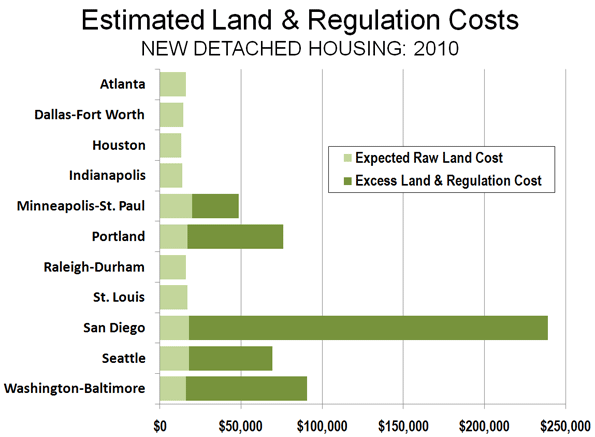
    In recent decades, an unprecedented variation has developed in the price of new tract housing on the fringe of US metropolitan markets. Nearly all of this difference is in costs other than site preparation and construction, which indicates rising land and regulation costs.

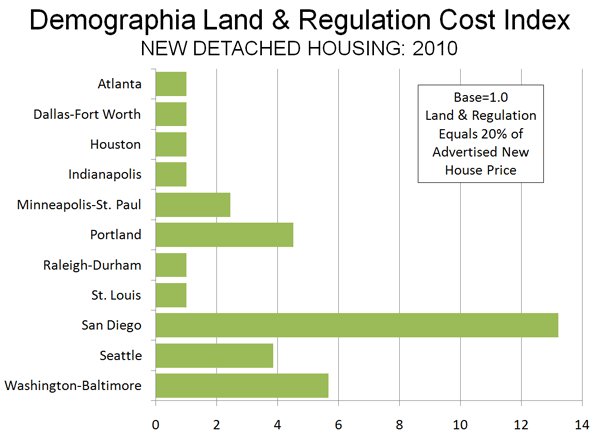
    Our first annual Demographia Residential Land & Regulation Cost Index estimates the price of land and regulation for new entry level houses compared to the historic norm in 11 metropolitan regions (Note 1). Metropolitan regions in which land and regulation costs remain at or below normal have an Index of 1.0 while those with land and regulation costs above normal will have an Index above 1.0 (Figure 1).

    More restrictive land use regulation is variously referred to as “smart growth,” “growth management” and other terms. More restrictive land use regulation is estimated to have added from nearly $30,000 (in Minneapolis-St. Paul) to more than $220,000 (In San Diego) to the price of a new home.

    Economic research has associated rising residential land costs with more restrictive land use regulations. The table indicates some of the more important price increasing impacts of more restrictive land use regulation.


    More Restrictive Land Use Regulation:

    Factors that Can Drive House Prices Higher

    1.. Increases underlying land costs

    2.. Increases planning and development costs

    3.. Raises financing costs

    4.. Encourages more expensive houses.

    5.. Increases construction costs

    6.. Encourages concentration of market power and land banking

    7.. Encourages land and housing speculation

    The Land and Regulation Ratio

    For decades, construction costs of tract house on the urban fringe in the United States have represented 80% or more of the advertised house price. The balance of 20% or less has been for land and regulation costs and will be referred to as the “land and regulation cost ratio.” In metropolitan markets with less restrictive land use regulation, the historic 20% or less land price ratio remains in place. The Demographia Residential Land & Regulation Cost Index assumes a 20% expected land and regulation ratio.

    In some metropolitan markets, however, house prices have increased far more rapidly than in the rest of the nation. The greater increase in house prices and escalation of land costs above the historic 20% land and regulation cost ratio has occurred in metropolitan markets burdened by more restrictive land use regulations. Urban growth boundaries, limits on the number of houses that can be built, large lot zoning and excessive development impact fees and the like are regulation strategies that increase the cost of land for building houses. These land cost increases are not the result of more rapidly rising construction costs or underlying market forces such as consumer demand.

    More restrictive land use land use regulation also creates obstacles to people buying houses, requiring them to devote more money to housing than necessary and increases their vulnerability to losses in the event of a financial downturn. This exposes mortgage lenders to increased risks of loan defaults. Finally, more restrictive land use regulation makes residential land development more dependent on politics, with the potential for greater influence through campaign contributions.

    The first annual Demographia Residential Land & Regulation Cost Index estimates cost of land and regulation for new entry level houses compared to the historic norm in 11 metropolitan markets. Each of the metropolitan regions in which house prices have risen above normal have adopted more restrictive land use regulations. Conversely, in each of the metropolitan regions in which house prices have not risen above normal levels, there is less restrictive land use regulation. During much of the Post-World War II era, all metropolitan markets had less restrictive land use regulations.

    Results

    The overwhelming majority of new housing in the United States continues to be detached and is built near or on the urban fringe (Note 2). For new detached homes, the Index is 1.0 in six metropolitan markets (Atlanta, Dallas-Fort Worth, Houston, Indianapolis, Raleigh-Durham and St. Louis). This indicates that land use regulation is less restrictive and does not add more than normal to the price of new homes (Note 3).

    In the other five metropolitan markets, the land and regulation cost ratio has risen above 20%, resulting in a higher Index. The Index is 2.4 in Minneapolis-St. Paul, 3.9 in Seattle, 4.5 in Portland, 5.7 in Washington-Baltimore and 13.2 in San Diego. It is estimated that more restrictive land use regulation raises the price of the least expensive detached houses from nearly $30,000 (in Minneapolis-St. Paul) to more than $220,000 (in San Diego) than would be expected if these metropolitan markets had retained less restrictive land use regulation (Figure 2).

    The metropolitan markets with more restrictive regulation have an average Demographia Residential Land & Regulation Cost Index of 5.9 for detached housing, while the metropolitan markets with less restrictive regulation average 1.0.

    Housing Affordability: Through the Bubble and Bust

    There is increasing concern about declining housing affordability across the nation. Even after the deflation of the housing bubble, house prices in some metropolitan markets remain well above pre-bubble prices and historic affordability standards. The housing affordability of the included metropolitan markets is illustrated by land use regulatory category in Figure 3. The Figure indicates the National Association of Home Builders-Wells Fargo Housing Opportunity Index for 1995, the peak of the bubble and early 2010, showing the percentage of households able to afford the median priced house. Similar affordability measures can be reviewed in the Annual Demographia International Housing Affordability Survey.

    Future Editions

    The 11 metropolitan regions included in the initial Demographia Residential Land & Regulation Cost Index were selected to provide a geographical and regulatory balance and because they had sufficient data from which to develop the Index. Additional areas will be added in future editions, with the intention of including all metropolitan regions with more than 1,000,000 population.

    ——-

    Note 1: The Index was derived from a database developed of new house offerings by national, regional and local builders, using internet sites and published metropolitan home guides. The period covered is January through June 2010.

    Note 2: In 2006, more than 85% of new single family houses sold in the United States were detached, according to Bureau of the Census data. Detached housing represents approximately 62% of all US housing units (including multi-unit dwellings).

    Note 3: In each of the metropolitan markets with less restrictive regulation, the estimated construction costs were more than 80% of the house price. By using a 20% land and regulation ratio, the house construction cost was capped at 80% of the house price. In each of the metropolitan markets with more restrictive regulation, the estimated construction cost was less than 80% of the house price.

    Wendell Cox is a Visiting Professor, Conservatoire National des Arts et Metiers, Paris and the author of “War on the Dream: How Anti-Sprawl Policy Threatens the Quality of Life

    Photo: Will County, Chicago urban fringe (By author)

  • The Privatization-Industrial Complex

    “I think this is just the latest way for people to make money off state and local governments. This is the new way the investment banks, their lawyers, and consultants squeeze the taxpayers….They’re going around making these deals, and it’s very lucrative. It’s like a circus coming to town.” – Clint Krislov

    Privatization has long been advocated by many conservatives as a good government measure. Traditionally, privatization was used a tool that subjects government monopolies to competition from the marketplace, driving down costs and improving quality of service. Privatization pioneer Steve Goldsmith, former mayor of Indianapolis and now deputy mayor of New York City, used to apply what he called the “Yellow Pages test.” If he could open the Yellow Pages and find several companies providing a service, he wondered why government should be in that business.

    As Mayor, Goldsmith privatized dozens of city services in Indianapolis, saving the city an estimated $120 million the process. This ranged from contracting out services, to forming a public/private partnership to implement a $500 million infrastructure improvement plan to hiring private managers to run – but not own or lease – the airport and water utility.

    Today, sadly, privatization is less about Goldsmith style operational effectiveness and more about providing jackpots for financiers who stand at the core of a growing privatization-industrial complex. Cities and states salivate over ways to sell or lease off underperforming public asset for large payouts. With local governments cash-strapped and the public unwilling to pay more in taxes, it is politically difficult to even bring user fees to a market rate. Combined with the potential billions in payoffs – Indiana received $3.9 billion for its toll road and Chicago $1.1 billion for its parking meter system – the appeal is obvious.

    But these transactions differ markedly from the Goldsmith-style privatization. They are driven not by efficiencies but by an investment banker mindset focus on money and narrow parameters of the asset operations. They also provide enormous temptation to elected officials to grab the money now even at the expense of future generations. They are also rife with potential conflicts of interest and incentive problems.

    One major source of conflict comes with the professional advisors that drive the deals. Since long term leases involve so much money and are so complex, they require millions of dollars of services from investment banks, lawyers, financial advisors, etc. Unlike for typical government transactions such as issuing bonds or contracting out services like printing, building maintenance, or call centers, for which cities have some experience, the vast majority of cities have little in house expertise for complex financial transactions.

    Thus local officials are at the mercy of these out of town experts to give them the best advice they need to defend the public’s interest. But what advice can we expect from these firms, who have a stake on highly leveraged deals? The people in the firm may be technically competent and possess the highest levels of personal integrity, but still are prisoners of a structural conflict of interest in promoting privatization transactions.

    Consider Morgan Stanley. An arm of Morgan Stanley was the winning bidder on the Chicago parking meter lease. That deal is widely seen as a disaster, giving the idea privatizing meters a black eye, and engendering such headlines as “Morgan Stanley’s $11 billion makes Chicago taxpayers cry (Bloomberg) and “Company [Morgan Stanley] Piles Up Profits from City’s Parking Meter Deal” (NY Times).

    Now Morgan Stanley is back, this time advising Pittsburgh and Indianapolis on potential parking meter privatizations. Morgan Stanley has a huge structural incentive to want those deals to go through. It would restart the market for parking meter privatization, and position the firm as the preferred advisor to cities. Even where they were not the city’s advisor, a restarted parking meter market means they could potentially bid on many more assets.

    If you make money on privatization transactions, then no deals means no money. So obviously these firms have every reason in the world to promote privatization and see deals go through regardless of whether any particular deal is good or not. This doesn’t mean they are crooks, it’s just the reality. These firms now form of the core of the “privatization-industrial complex” with an incentive to cheerlead for leading public assets because that’s how they make their money. They need deal flow, the more transactions the better.

    This was picked up on by Harrisburg, PA. Facing bankruptcy, the state offered an $850K grant to hire Scott Balice Strategies of Chicago, one of the nation’s top privatization financial advisors. The city council turned it down. As one city councilor noted, “Their recommendation is always the same: ‘sell assets’”.

    Many of these investment banks, operators, financial advisers, and law firms also have tight links with each other, and participate on deals together, often as partners, other times as opponents. The Pittsburgh Post-Gazette noted how many of these firms have ties to Chicago’s earlier round of privatization. “When Pittsburgh proposed leasing its public parking facilities, the city became a magnet for a passel of firms – many of them connected to Chicago by blood, politics or business – that pursues similar deals around the country. The firms may be partners in one city, rivals or referees in the next.” The winning bidder on the Pittsburgh parking transaction is actually Morgan Stanley’s partner in the Chicago deal, for example.

    These potential conflicts make it very difficult for cities to know they are making a good deal, especially since they lack the experience necessary to independently judge it. Right now, they often are at the mercy of their advisors. And ask yourself this: when was the last time a city or state looked seriously at one of these deals and their advisors told them not to do it?

    This is frequently combined with traditional clout driven contracting. Many of the Chicago parking meter firms had tight links to the Daley administration. Similarly, in Indianapolis a city-paid chief advisor to the office of the mayor is conveniently also a registered lobbyist for the winning bidder. This combination is a recipe for disaster, resulting in very long term deals that could be very bad for the public.

    Long term lease deals can still make sense – if they are done right. The Chicago Skyway and Indiana Toll Road deals were both home runs, for example. But given the enormous risks if something goes wrong, governments must put into a place a robust process for protecting the public, with a full airing and mitigation plan for the bad incentives that populate so many areas of this field.

    Aaron M. Renn is an independent writer on urban affairs based in the Midwest. His writings appear at The Urbanophile.

    Photo by ehfisher

  • Living In Denial About Transportation Funding

    The reaction of various advocacy groups to President Obama’s recent call for a $50 billion stimulus spending plan for transportation infrastructure was predictable. They applauded the President’s initiative and thought that Congress should promptly approve the spending request. The benefits of investing in infrastructure are undisputable and the need for funds is urgent and compelling, they (or their press releases) proclaimed.

    But convincing the next Congress of the need to act, whether to fund the infrastructure “down payment” of $50 billion or to authorize a proposed $500 billion multi-year surface transportation program, will not be easy. Most congressional lawmakers do not perceive infrastructure as an urgent priority. They see no signs of a popular outcry about the stalled transportation reauthorization, nor do they perceive a groundswell of grassroots support for massive transportation investments.

    Indeed, what the lawmakers see is just the opposite. They witness New Jersey voters strongly approving Governor Chris Christie’s decision to cancel work on the long-planned rail tunnel under the Hudson River because, says the Governor, “the state simply doesn’t have the money” to pay for overruns in the potential $9-14 billion project. Mr. Christie, no doubt, has in mind the experience of Boston’s Big Dig which was projected in 1982 to cost $2.8 billion and ended up costing $15 billion.

    The lawmakers also see Republican candidates for governor in California (Meg Whitman), Florida (Rick Scott), Ohio (John Kasich) and Wisconsin (Scott Walker) pledging to cancel high-speed rail projects in their states if elected — and running ahead of their Democratic opponents who unanimously support President Obama’s $8 billion high-speed rail initiative. They see the public greeting with a yawn a bold and visionary Amtrak proposal to link Boston and Washington with a dedicated high-speed rail line. They read in a much noticed Sunday Times Magazine article “Education of a President,” (October 12) that the President himself thinks “there’s no such thing as ‘shovel-ready projects’ when it comes to public works.” And they hear an Administration unable to explain how the $50 billion infrastructure initiative will be paid for. When asked, a top administration official could only lamely reply “Stay tuned, we’ll let you know.”

    More evidence of public reluctance to spend on infrastructure comes from the findings of a new October 2010 survey by the Pew Center on the States and the Public Institute of California titled “Facing the Facts: Public Attitudes and Fiscal Realities in Five Stressed States.” By a large margin, respondents in five states (California, Arizona, Florida, Illinois and New York) showed a strong unwillingness to support additional transportation funding and offered to put transportation on the chopping block when asked which of their state’s biggest expenses they would least protect from budget cuts.

    It may be impolitic to suggest it, but dire warnings about the sorry state of the nation’s infrastructure seem to come largely from organized interests — stakeholders and advocacy groups. That is not to say that the nation’s transportation infrastructure has not been neglected or that America does not need better roads and transit systems. But rightly or wrongly, congressional lawmakers often discount cries about “crumbling infrastructure” as self-serving demands for more government money, often for projects that yield small economic return.

    Moreover, many lawmakers come from rural districts that experience little traffic congestion, whose roads are well maintained and which never hope to benefit from high-speed rail service. Their reluctance to spend more money on public works also has been fueled by what they see as disappointing results from the stimulus initiative. As Rep. John Mica (R-FL), ranking member of the House Transportation and Infrastructure Committee and potential future T&I Committee chairman in the 112th Congress likes to point out, more than 60 percent of the stimulus infrastructure dollars still remain unspent, while unemployment in the construction industries remains high. All this adds weight to the legislative reluctance to tackle an ambitious infrastructure spending bill any time soon.

    As one of our colleagues, a sincere and lifelong transportation advocate, put it, “the transportation community is mostly talking to itself and living in denial about the changing political mood.” That mood—in the nation at large as well as in the next Congress— is unmistakably becoming more conservative and skeptical of big government. An overwhelming 70 percent of Americans think the government does not spend taxpayers’ money wisely, according to a recent Rasmussen poll. Newly elected members of Congress will be marching to the drum of fiscal discipline and looking for ways to curb out-of-control spending, a GOP aide told us. Congress will be closely questioning costly new federal initiatives no matter how well intentioned, he added. The expansive federal-aid surface transportation program as we have known it in the past may no longer be thought politically acceptable or fiscally affordable.

    And who knows, the new mood of fiscal restraint may even infect the White House. As one senior White House adviser, quoted in the Sunday Times Magazine story, put it, “there’s going to be very little incentive for big things over the next two years unless there’s some sort of crisis.” And we doubt that by this he meant “infrastructure crisis.”

    Ken Orski has worked professionally in the field of transportation for over 30 years.

    Photo by woodleywonderworks

  • The EPA: Leading Into A Rain Garden?

    Newly-installed solar Panels on the White House are an obvious signal that this administration wants to lead by example. Conservatives will no doubt find ways to ridicule the panels, and liberals will praise them as a display to the world that we are a green nation. About one year ago, on Oct. 5, 2009, the President signed Executive Order (EO) 13514, “Federal Leadership in Environmental, Energy, and Economic Performance.” Like the white house solar panels, this EO also is intended to urge federal agencies to lead by example. It sets as policy that federal agencies shall “…conserve and protect water resources through efficiency, reuse, and storm water management.”

    How far have we come… and how far are we likely to be able to go in achieving these goals?

    For federal facilities, the EPA’s green infrastructure solutions , biological systems and engineered systems include, but are not necessarily limited to:

    • Rain gardens, bioretention, and infiltration planters
    • Porous pavements
    • Vegetated swales and bioswales
    • Green roofs
    • Trees and tree boxes
    • Pocket wetlands
    • Reforestation/revegetation
    • Protection and enhancement of riparian buffers and floodplains
    • Rainwater harvesting for use (e.g., irrigation, HVAC make‐up, non‐potable indoor uses)

    For new facilities, these would be good moves. For many years, our design firm has been planning new developments with very low environmental impacts, using approaches that have been either volunteered by the developer or mandated by the local regulations. We accomplish low impact designs by reducing the infrastructure needed for new development, which reduces both economic and environmental impact. Land development can be more efficient, when designed properly, than conventional or Smart Growth design methods; it can allow lower development costs while still complying with EPA mandates. It can be done by harnessing new design methods made possible by the development of new technologies. While “green” brings an image to builders’ minds of expensive, problematic development, being “green” can be less expensive if done right.

    Speaking from my experience in designing 700 neighborhoods in 46 States (and 13 countries), all with innovative design methods, and building a Net-Zero home in 1983, as well as a dual-certified Green home in 2009, here’s how I evaluate the likelihood of success of the current EPA options:

    Rain gardens, bioretention, and infiltration planters: These organic methods are possibly the most economically viable, but they do come with constant maintenance costs that the building facility owner must be aware of. A bio-retention that is not designed properly or maintained constantly will quickly fail. Unlike concrete pipes and iron sewer grates along curbs which can be left alone for decades, an organic solution to storm water must be installed by an experienced expert with a proven track record, and maintained by personnel that know what they are doing. If built correctly and maintained constantly, this can be the lowest cost solution IF there is enough land area and proper topography (flow of the land) to design the system properly in the first place. Typically, these systems rely on surface flow with no curbing or special curbing to allow drainage off paved areas. On newly developed sites, this could mean a significant cost saving. On existing development, replacing curb may be expensive.

    Porous pavements: Sounds simple – install a pavement that allows rain to flow through to the ground. The big problem and huge expense comes from making sure that the ground under the pavement also porous. In other words, if you were to remove an asphalt parking lot and replace it with porous asphalt, the environmental impact would not change. Why? Because under the original asphalt is likely a non-porous class 5 (or similar) base. In a genuinely porous paved surface, the storm water moving through the pavement must continue through the ground below. This means a base that allows storm water to be held and filtered slowly to the ground below, or directed elsewhere. Sounds expensive? You betcha! Two other major problems: heavy vehicles used at federal facilities could damage these systems, and, if the ground freezes, expansion could be a problem. Long term lifespan of porous pavements may be less than that of solid surfaces.

    Vegetated swales and bioswales: See rain gardens, above.

    Green roofs: Retrofit Green Roofs on to buildings not originally designed for them? Green roofs did not work well in 1983 when I built my Net-Zero home during the first (failed, somehow forgotten) green movement, so I’m not sure what has changed to make them feasible. Green roofs can absorb the sun’s energy to solve the heat island problem of large facilities, but simply coating a dark roof with a light or white color solves the heat island problem with little expense.

    Trees and tree boxes: Trees and tree boxes will have little impact on reducing storm water impacts. Of course there are other benefits for planting trees, so, while a good thing, this does little to comply with the mandate.

    Pocket wetlands: See rain gardens, above.

    Reforestation/revegetation: Assumes the federal facility has plenty of space to allow such a thing.

    Protection and enhancement of riparian buffers and floodplains: Assumes there are riparian buffers and flood plains on the site, or adjacent to the site, that can be altered.

    Rainwater harvesting for use (e.g., irrigation, HVAC make‐up, non‐potable indoor uses): Also a good solution when possible. For example, when 90% of the surface is paving and rooftop, the resulting storage of rainfall could be tremendous, depending upon where in the country the facilities are located, and ample to irrigate the remaining small surface.

    Nobody is an expert on all issues, so there may be new factors that I’m not aware of that would make a method more feasible than what we have experienced.

    What is completely missing from the EPA options here are ways to make an existing facility more efficient by removing excessive paved areas. When an existing facility was originally designed, was it efficient in the first place? Keep in mind that being efficient is not necessarily profitable. If the original consulting engineer and architectural firm fees were based upon a percentage of construction costs, then creating excessive construction costs meant larger fees. Paving contractors maximize profit by covering the most land possible with asphalt or concrete.

    The EPA order can be an opportunity to help design solutions that are cost effective to comply with the mandate. For my firm, the mandate could leverage our low impact software system sales, a technology that can be used to reduce wasteful construction while in redevelopment, so we may directly benefit from this mandate. But before that can happen — and before we can know how successful the EPA directives will be — many questions remain to be answered.

    Photo: Pigeons in front of the EPA building by benchilada

    Rick Harrison is President of Rick Harrison Site Design Studio and Neighborhood Innovations, LLC. He is author of Prefurbia: Reinventing The Suburbs From Disdainable To Sustainable and creator of Performance Planning System. His websites are rhsdplanning.com and performanceplanningsystem.com.