Category: planning

  • Satellite Cities for Beijing? Yes, But….

    China Daily ran an article on the continuing urbanization of Beijing. In Build upward or outward: City’s growth dilemma, Daniel Garst notes that Beijing is not as centralized as other urban areas, with its multiple business districts and comparatively low density in its inner areas. He indicates a preference for the urbanization of Shanghai, with its stronger center (both Pudong and Puxi), but suggests that it would be a mistake to replace the historic low density development with the high rises that would be necessary to change Beijing’s urban form.

    Actually, Beijing’s form is not that unusual for Asian urban areas. Tokyo has multiple office centers rather than a single dominant center and has comparatively low residential densities, even within the Yamanote Loop. Bangkok, Manila and Jakarta are similarly multi-centric. Chinese urban areas like Shenyang, Xi’an, Wuhan, Suzhou and Changsha are closer (but smaller) replicas of Beijing than Shanghai. Garst also misunderstands the dynamics of traffic congestion in his belief that roads and metros (subways) would be less congested with a more centralized form. In fact, higher densities routinely produce more intense congestion, not only on the roads but also on the rails and buses, a point recently made by Michael Matusik on this site.

    However, Garst may be onto something with respect to a suggestion that Beijing’s growth should be directed to new satellite towns, in which residents work rather than commuting to Beijing. This is good theory, but there is an important caveat, which we outlined in a comment at China Daily on the article.

    Satellite cities are not a reasonable answer unless they are so far from the Beijing urban area that commuting to Beijing is not possible. The idea of self-contained satellite cities, where people live and work in them has not worked anywhere. There are good examples of failure in London, Cairo, Stockholm, etc. So long as the large urban area can be reached, people will commute there.

    Cairo provides a useful example. Egyptian planners have long decried the continuing commute pattern into the urban area from the new towns of 6th of October and 10th of Ramadan, which are within commuting distance. On the other hand, the new town of Anwar Sadat, more remote from the urban area, has been more successful in keeping its residents in its labor market.

    Locating new satellite towns far enough to make commuting infeasible will be a real problem for Beijing. There just is not enough territory in the provincial level municipality. That means the new towns would have to be in the province Hebei, which along with the province level municipality of Tianjin surrounds Beijing.

    Short of remote new towns and forcing population and economic growth away from Beijing, the key to minimizing traffic congestion will be to minimize work trip distances by achieving a dispersion of comparatively lower density employment to match the lower density suburban dispersion. Economists Peter Gordon and Harry W. Richardson have found that “suburbanization has been the dominant and successful mechanism for reducing congestion.” in the United States. This applies no less to Beijing.

    Photograph: Forbidden City, Beijing (by author)

  • London Special Report: Britain Drifts South – and Why Not?

    The British Broadcasting Corporation wants 1500 of its staff to move to its new ”MediaCity” headquarters in Salford, near Manchester in northwest England. The Corporation, they say with some justification, is too southern, too much part of the metropolitan elite. The move ”addresses concerns that the organisation is not fully representative of the peoples of the UK.”

    On the surface it looks like a good deal. On top of a £5000 payment, they have been offered £350 for each house-hunting journey as well as removal costs, a guaranteed house purchase scheme and and even £3,000 for new carpets and curtains. Other benefits include help securing jobs for spouses or partners jobs in the area and specialist help with children’s schooling. For all that, take up for the scheme has been slow, and the Corporation’s grunts were unhappy to hear that the head of BBC North, Peter Salmon ”is the latest exec to announce that he would rather hack off his own face than move his family anywhere remotely near the north,” as ex-BBC producer Rod Liddle puts it.

    The BBC’s difficulties in persuading its staff of the benefits of the North of England reflects a broader British predicament. Since the 1930s British governments have tried to use grants boost Britain’s depressed regions in the North of England, Wales and Scotland. None of this has stopped the long-term trend of population movement. Demographers Daniel Dorling and Bethan Thomas of Sheffield University point out that outside of London, all major cities are declining in population, and that ”the population of the UK is slowly moving to the South.”

    Dorling and Thomas’s analysis of the 2001 Census drew criticism from regional dignitaries. Bob Kerslake, chief executive of Sheffield City council, and a champion of the lobbying group Core Cities insisted that ”there is already evidence of a turnaround in the last five years and every prospect of things getting better.” Denton and Reddish MP Andrew Bennet, Labour chairman of the Commons local government, housing and planning committee also claimed that ”in the regeneration of cities, the government’s proposals are working well,” while admitting that there were ”horrendous” problems.

    Looking at what Dorling and Thomas say, it is not hard to see why the census should be so problematic for champions of a Northern resurgence.

    At the start of the 21st Century, the human geography of the UK can most simply be summarised as a tale of one metropolis and its provincial hinterland… On each side of the divide there is a great city structure with a central dense urban core, suburbs, parks and a rural fringe. However, to the south these areas are converging as a great metropolis, while to the north is a provincial archipelago of city islands.

    In recent years the decline of the North has at least been mollified by a relatively buoyant economy in contrast to the disaster of de-industrialisation that it was in the 1980s. Yet even still, the divergence is difficult to wish away. Most disturbing, much of the growth taking place in the North owes more to government spending that it does to private initiative. The public spending share in output is 52.6 per cent in the North West, 61.5 per cent in the North East, and 54.9 per cent in Scotland.

    For housing, the importance is clear. With the provinces suffering greater or lesser degrees of depopulation, houses have to be cleared. In 2002 government plans to demolish up to 880,000 homes in northern England and the Midlands were announced. Gateshead, Newcastle, Blackburn, Manchester, Hull, Sheffield, Liverpool, Stoke-on-Trent and Birmingham are all earmarked for substantial demolitions. In Liverpool alone, the council has to cope with 28,000 derelict homes. Long-standing development critic Simon Jenkins bemoaned the plans to knock down 100,000 Victorian terrace houses in the Welsh Streets area of Liverpool as they constitute precisely the “sort of buildings” over which yuppies “would purr” if they were in London.’.

    The contrast between empty homes in the North of the country and the prospect of new building in the South offends people like Green Party’s London leader Darren Johnson who says that it is ”particularly ludicrous to have every single scrap of land in London and the South East being eyed up by developers, when the populations of other regions, such as the North West and the North East, are actually declining.”

    Ros Coward, columnist for the liberal Guardian newspaper, protests that ”In the North-West, vast tracts of urban land lie derelict, while in the South-East … our countryside is under ever-increasing threat.” Uber-architect Richard Rogers takes a similar view, arguing that ”regional balance is critical to achieving a sustainable economy”. This is in the context of bemoaning the ”divided country” of the North and the Midlands with the ”bulk of redundant industrial land” and the South-East’ where the ”greatest pressure for new housing development” is felt.

    Though he is cautious to spell it out, Rogers’s ”regional balance” could only achieved by relocating people up North. No doubt the chaotic workings of the economy do create unplanned waste and blight, but does anyone suggest people should be forced to move up North? Infamously Westminster Council housed its homeless out of borough, paying more outlying regions to take on the social problem. More recently the government imposed resettlement schemes on asylum seekers, forcing them into unwelcoming estates in Glasgow and elsewhere. Surely, everybody understands that in a free society you cannot direct people where to live, like Stalin did the Chechens in 1944 – or do they, particularly if the case can be made on ideological grounds, this time green instead of red.

    It’s undoubtedly true that there is indeed a London-centric bias among British policy makers and media professionals. Deeply rooted in the gentrified boroughs of inner London, opinion-formers often treat the rest of the country with disdain. But it would be a mistake to see the population’s southern drift as the ascendance of the metropolitan chattering classes.

    As important as London is to Britain’s economy, the more interesting area of growth is the south east region around London. The South East has the second highest GDP, and the second highest GDP per head of any region. London has the highest GDP, but it also has more of the very poorest people than the South East.

    This is the heartland of Britain’s middle classes, first in the percentage of the population economically active and the fastest growing demographically. Coastal Brighton, 60 miles from London’s centre, is Britain’s fastest growing town. If the BBC offered its relocation package to move staff to Southampton or Brighton, there would be many more takers.

    We cannot keep holding like Canute and wish away the shifting economic geography of Britain. It is something that has to be worked with. For cities and towns outside of the southeast that can mean some profound challenges. It is not easy to manage a downsizing without it appearing to be a rout.

    But the demolition of old houses ought not to be seen as a disaster, so much as an opportunity. Britain’s ageing housing stock needs renewing. Simon Jenkins presumed to speak up for the “local community” of the Welsh Streets area of Liverpool, but Irene Milson and Mary Huxham of the local tenants and residents association saw things differently:

    Far from it being “wrought” on them, residents in this neighbourhood have been campaigning to be included within the Housing Market Renewal Pathfinders plan for over four years. The decision was supported in a survey of all Welsh Street residents, with a 72 per cent majority in favour of a clearance. … The campaigners, conservationists and critics don’t have to deal with 125-year old properties that are damp, decaying and expensive to heat – let alone with collapsed Victorian sewage systems now over-ridden with rats.

    In principle, there is nothing wrong with the population concentrating itself more densely in one part of the country than another. It is not as if it will tip up and sink. No doubt a perfectly planned society would achieve things less chaotically, but in a democratic society it is better to manage change,rather have planners reshape our society from above.

    James Heartfield is the author of Let’s Build: Why we need five million new homes, a director of Audacity.org, and a member of the 250 New Towns Club.

    Photo by Feuillu

  • Property Values 11 Times Higher Across Portland’s Urban Growth Boundary

    One of the starkest impacts of smart growth policies is the huge differentials in property prices that occur on virtually adjacent properties on either side of an urban growth boundary.

    The extent to which regulatory restrictions can drive up prices is illustrated by the differences between the values of undeveloped lands just a few steps from each other, but across the urban growth boundary. Research from more than a decade ago in Portland indicated that land on which development is permitted inside the urban growth boundary tended to be 10 times as valuable per acre as land immediately outside the urban growth boundary, on which development was not permitted. In Auckland, New Zealand, recent research found virtually adjoining undeveloped land value differences at 10 times or more as well. Research in the London area by Dr. Timothy Leunig of the London School of Economics indicates that this difference can be as much as 500 times.

    Recently (February), I examined tax assessment records for all parcels in Portland’s Washington County that abut the urban growth boundary to see if value differences exist. The properties had to be 5 or more acres and be undeveloped. Research was conducted based upon Internet information in February 2010. Property along 25 miles of the urban growth boundary from Cedar Hills to Hillsboro to southwest Beaverton was included in the analysis.

    • The land adjacent to, but outside the urban growth boundary (on which development is prohibited) was assessed at approximately $16,000 per acre.
    • The land adjacent to, but inside the urban growth boundary (on which development is permitted) was assessed at approximately $180,000 per acre, approximately 11 times the price of land that is virtually across the street (across the urban growth boundary)

    A sample was also taken of more remote developable parcels of more than 5 acres, on which development would not be permitted. These parcels, which were from one to five miles outside the urban growth boundary, had a value of approximately $8,500. Thus, the developable land inside the urban growth boundary was 21 times as expensive as the more remote land.

    These data indicate the impact of urban growth boundaries on the price of raw land, which is inevitably passed on to buyers of new housing. Without an urban growth boundary, it would be expected that land on both sides of an urban growth boundary would have similar values. Further, land would be expected to drop in value beyond the urban fringe, but not by the drastic amounts indicated in Portland, Auckland and London.

    —-

    Photograph: (By Author)

  • The Hudson Tunnel: Issues for New Jersey

    New Jersey Governor Chris Christie sent shockwaves through the transportation industry on last Thursday when he cancelled the under-construction ARC (Access to the Regional Core) rail tunnel under the Hudson River from New Jersey to New York (Manhattan).

    The Governor accepted the Access the Regional Core (ARC) Executive Committee’s recommendation to “pull the plug” on the expensive project because of cost overruns. The project was to have cost $8.7 billion, but could escalate up to $14 billion according to the Governor’s office. All of any such cost overrun would have to be absorbed by the state of New Jersey, which like many other states is in dire financial straits.

    Christie said:

    “I have made a pledge to the people of New Jersey that on my watch I will not allow taxpayers to fund projects that run over budget with no clear way of how these costs will be paid for. Considering the unprecedented fiscal and economic climate our State is facing, it is completely unthinkable to borrow more money and leave taxpayers responsible for billions in cost overruns. The ARC project costs far more than New Jersey taxpayers can afford and the only prudent move is to end this project.”

    Governor Christie indicated that the project could become New Jersey’s “Big Dig,” referring to the Boston highway project that he said escalated in cost by 10 times (that is not a typo).
    Yet supporters of the tunnel were unanimous in their condemnation of Christie’s move, from Paul Krugman of The New York Times to the Regional Plan Association.

    New Jersey Senator Frank Lautenberg announced that Christie had backed down, noting his “reversal of yesterday’s decision to kill” the tunnel project. Referring to a meeting between US Secretary of Transportation Ray LaHood and Governor Christie, Lautenberg said “The Secretary was clear with Governor Christie: if this tunnel doesn’t get built, the three billion dollars will go to other states. We can’t allow that to happen.” Lautenberg listed a litany of benefits such as a reduction of greenhouse gas emissions by 70,000 tons annually. He also noted that New Jersey would have to reimburse the federal government the $300 million it had received for the tunnel. Senator Robert Menendez added that “New Jersey taxpayers don’t want to own a $600 million hole to nowhere.”

    However, under examination, it is unclear whether Christie had “reversed” his position. Christie agreed to consider “options to potentially salvage” a tunnel project based upon options (not made public) offered by LaHood. New Jersey and Federal officials will be meeting on the matter over the next two weeks. Christie, however, reaffirmed his concern about project finances, stating that” the ARC project is not financially viable “ and its expectation “to dramatically exceed its current budget remains unchanged. ” The Newark Star-Ledger cited state officials as saying that the decision does not represent a reversal of Christie’s original decision.

    Thus, everything may be up in the air. Given that, here are a few issues the state of New Jersey may like to consider as it finalizes its decision:

    1. Exaggerating the Need for the Project The new rail tunnel is to serve a purported increase in commuter rail ridership to Manhattan jobs in the future. The project’s Final Environmental Impact Statement says that Midtown Manhattan’s employment will grow from its present 2.6 million by another 500,000 by 2030. This is unlikely. Manhattan’s entire employment (not just Midtown) peaked at 2.4 million in 2008. One might expect the planners could have gotten something so simple correct. Manhattan employment remains below 2001 levels and never rose more than 35,000 even at the peak of the last boom (annual figure, from 2001). The consultants also are projecting a 1.6 million population increase west of the Hudson River (New Jersey suburbs along with the New York counties of Rockland and Orange) by 2030. However, the New Jersey and New York metropolitan counties to the west of the Hudson are more likely to grow only 1.1 million, based upon official state projections (Note). The questionable population and employment projections reveal that the “need” for the new tunnel may have been grossly overstated.

    2. Exporting New Jersey Jobs to New York Why should New Jersey pay to build more capacity so that its people can work across the state line? Why should they not work in New Jersey? New Jersey is often thought of an economic afterthought in Manhattan centric media and business interests (such as by The New York Times). In fact only a small share of New Jersey commuters travel to Manhattan for work. Even in the New Jersey counties that border New York, only 12% of commuters work in Manhattan. In the other New York metropolitan area counties in the metropolitan area, the figure drops to 5%.

    The trends here are also important. Since 1956, every new job in the New York metropolitan area has been created outside Manhattan (Manhattan’s employment is 400,000 lower now than back then). New Jersey depends on New Jersey far more than it does New York. New Jersey has developed successful new office complexes in Jersey City, New Brunswick, along the I-287 Belt Route and elsewhere. Perhaps New Jersey should seek to minimize work trip lengths and encourage the next 500,000 jobs to be created in the state rather than in New York. Downtown Newark, for example, has excellent transit access and could use substantial new employment investment. This might prove more beneficial for New Jersey and its taxpayers.

    3. Costs Could Rise Even Higher The tunnel could easily climb in cost beyond the now feared $14 billion. Big Dig cost escalation continued almost to the project’s opening. There is no reason to expect it will be different with the Hudson tunnel. It has been reported that one of LaHood’s options is simply to lower cost projections. New Jersey should buy that option only if the federal government underwrites all of the cost overruns. However, such a deviation from federal policy would bring stiff opposition from other parts of the country.

    4. The Cost of Reducing Greenhouse Gas Emissions Like so many transit projects, the reduction of greenhouse gas (GHG) emissions is raised as a benefit of the tunnel. But at what cost? Each of the 70,000 annual tons of greenhouse gas emissions removed would require a capital expenditure of $16,000. The present market price for greenhouse gases is $20 per ton. New Jersey could accomplish the same objective for just $1.4 million annually.

    The Decision Much rides on Governor Christie’s decision. It may be better for the state to have a $600 million tunnel to nowhere than a $14, $20 or $25 billion tunnel that may not really be needed. Moreover, frustration is building with Washington’s “plunder” philosophy that encourages wasting money at home, so that another state doesn’t get the chance. Digging the nation out of its present (and future) malaise seems likely to require fresher thinking than this.

    If Governor Christie musters the courage to stop this project now, it could be a shot across the bow of an international vendor and consulting engineering community that has routinely low-balled costs only to later jack them up, confident that no project would be canceled once started.

    ——–

    Note: This figure is derived using New York 2030 projections and New Jersey 2025 projections, increased by the 2020-2025 growth rate to project 2030 population.

    Wendell Cox is a Visiting Professor, Conservatoire National des Arts et Metiers, Paris and the author of “War on the Dream: How Anti-Sprawl Policy Threatens the Quality of Life

    Photo: Hudson River looking south between Lower Manhattan and Jersey City (photo by author)

  • Aussie Urban Myths

    Urban planning in Australia is lost in a dense fog of presumption and theory. What’s needed is to toss out the hype and to illuminate some of the common planning myths for what they really are: impediments to progress.

    An example of planning hype occurred not long ago when ten urban academics loudly criticised the Victorian government’s decision to develop about 40,000 hectares of new land on Melbourne’s fringe, calling the decision short-sighted and unsustainable.

    The best way to development Melbourne, they said, is to intensify redevelopment along tram and train lines and around existing activity centres, with such developments being more dense than the surrounding suburbs, but not necessarily high-rise. Their modelling suggests that the 600,000 new dwellings required by 2030 could be accommodated under four stories within the existing built-up area.

    They did confess that not everyone wants or needs to live in an activity centre or on a rail/tramline, but were adamant that a sustainable city is “one where you can get there without a car”. The future, according to them, will be “fitter rather than fatter”; where we will “live with more amenity” and have more “choice of housing type”.

    They concluded that this is a national issue because when we finally commit to a low-carbon economy, we will have these extra 40,000 undeveloped hectares which, one assumes, will act as some form of carbon sink.

    Under normal circumstances, one might be tempted to dismiss the more extreme machinations of latte-left academia, but unfortunately, some serious decision makers are starting to listen to this type of questionable commentary.

    Without doubt, a key challenge facing Australia’s major capitals is how to redevelop the middle-ring suburbs, but placing all of one’s development eggs in this basket is lunacy and is based on misguided presumptions and poor theory. In this light, it is pertinent to consider several urban myths.

    But before our myth busting, it is worth stating that infill development is more expensive than many realise, in terms of site acquisition, approval processes, infrastructure provision, and combating NIMBYism. This is reflected in the high end prices of infill stock which, in short, costs more than twice as much as broadhectare product.

    For example, the cost of a new infill dwelling (which is two bedroom/two bathroom and one car space) within five kilometres of the Brisbane CBD is $650,000. But a new detached house (around 20 kilometres from the GPO, comprises three bedrooms, study, two bathrooms, double garage and on a 500 sqm allotment) can cost $325,000. On a rate per square metre basis the infill product (including any land) is $8,000, the detached house (again including land) is around $2,000, sometimes less depending on who the builder is.

    Low affordability makes the sale of infill product often slow, even in stronger economic times. In addition, there is often a large mismatch between the product type (and size) offered in infill locations and household demographics and, importantly, the market’s aspirations.

    Our urban academics were somewhat correct on one point – not everyone wants to live in an infill development. Our experience is that demand for such product – and assuming the dwellings can be delivered at an economic price point – varies between 25% and 40% of overall demand, depending on the urban location in question. Under current conditions, the real demand, however, is around 15% at best. So from the get-go, delivering such an ambitious infill development target is extremely unlikely. In fact, it is impossible.

    Myth – higher densities will mean less traffic
    The theory is that higher densities around existing public transport networks will see a lift in public transport use and fewer cars on the road. Public transport accounts for about 10% of total trips in our major cities. Most urban metropolitan strategies aim to increase this to 20%. So, four-fifths of the trips will, at best, still be via private vehicle. Why? Because the car is much more convenient.

    Without serious infrastructure commitments to repair and upgrade the public transport networks in our cities, cars will continue to dominate. In fact, under current conditions, and somewhat ironically, infill development would lead to more traffic congestion.

    Most infill product built within Australian cities will not sell without a car space. The quality of our public infrastructure, especially outside of Melbourne, is not good enough for infill owners (or their tenants) to forgo the security of their cars. So, new infill development is increasing the number of cars on the road and often in areas which are already congested and are hard to improve from a traffic management perspective.

    One could argue that it would be better to further decentralise employment and settlement around the edges of the metropolitan area, and most obviously upgrade the existing road network.

    Academia, obviously, have never tried to sell a dwelling without a dedicated car parking space.

    Myth – urban consolidation is better for the environment
    This implicit assumption is now widespread among the media, the planning community, government agencies and in political circles. Yet the available evidence suggests the opposite.

    • Comparison between suburban houses and infill product often overlooks the number of persons per household, which is much higher in the traditional suburban detached house.
    • In traditional suburban detached homes, larger household numbers share various facilities – the refrigerator; television; washing machine; dishwasher etc., and even the lighting needed to light a room. The per capita energy, and even water consumption, is more efficient in suburbia than in more central urban locations. The “average” household size within an infill development across Australia is around 1.6 people, in detached housing it is 3.2. In most cases infill product have as many appliances as are in a detached house, yet the number of occupants living in infill product is about half that living in detached suburban homes.
    • The nature of infill housing is, in itself, prejudicial to positive environmental outcomes due to things like clothes driers (lack of outdoor drying areas), air conditioners, lifts and the need to service (lights and air-conditioning) common areas. Also, suburban development allows for wider footpaths and private yards, which in turn provide space for trees to grow. There is less opportunity for greenery – a key producer of carbon offsets – in higher density urban development.

    Not withstanding anything about the actual built form, the greatest correlation between energy and water use (and hence, environmental impact) is based on per capita income. Wealthy people consume more energy/water and thus have a bigger environmental impact. The better off are the only ones who can afford to live in infill housing.

    Research in 2007 by the Australian Conservation Foundation found that in almost all Australian cities, higher-density, infill housing produced higher per capita greenhouse emissions and had larger eco footprints than outer suburbs, notwithstanding the greater access to public transport.

    Myth – most jobs are downtown
    There is also a widespread presumption that central business districts and their immediate fringes contain the majority of jobs in a city’s economy, and are therefore the major generators of traffic. Developing housing further from the downtown area, the argument goes will only mean more congestion as commuters try to get into and out off the downtown area.

    It is easy to understand how this myth developed: the CBD/fringe holds the tallest buildings; the seat of government is often located there; so, too, are many cultural facilities; they are the hub of train/tram networks and the focus of much of our angst about traffic congestion.

    But downtown is home to around 20% of all jobs in a city’s metropolitan area (just 10%, when looking at the CBD alone. According to the latest Australian census (2006) the proportion of employment in our major CBDs (Sydney, Melbourne, Brisbane, Perth and Adelaide) ranges from 9% to 11% – thus 10% is pretty consistent). So 80% of our jobs are actually outside of the downtown area. The implications of this are profound. Our ten friends from academia are proposing a policy based on a myth: that urban dispersal of housing will mean longer commutes to work.

    The facts are that most commutes (over 90%) within a city are across suburbs and not downtown. Unfortunately, this type of travel (and the nature of the work involved) makes it impossible to service efficiently via public transport.

    So in truth, more housing on the urban fringe will not in itself lead to more inner-city congestion, but will produce more suburb-to-suburb work trips. Perhaps as a priority (and in concert with more decentralisation and suburban development), we should build better ring-road systems (and more river crossings in a city like Brisbane, for example), rather than advocating mostly infill redevelopment and heavy urban infrastructure spending.

    Michael Matusik is a qualified town planner and director of independent residential development advisory firm, Matusik Property Insights, based in the Brisbane region in Australia.

    Photo by Onlygoneanddoneit – Suziflooze & Stuart

  • Portland Metro’s Competitiveness Problem

    Portland Metro’s president, David Bragdon, recently resigned to take a position with New York’s Bloomberg administration. Bragdon was nearing the end of his second elected term and ineligible for another term. Metro is the three county (Clackamas, Multnomah and Washington counties) planning agency that oversees Portland’s land use planning and transportation policies, among the most stringent and pro-transit in the nation.

    Metro’s jurisdiction includes most of the bi-state (Washington and Oregon) Portland area metropolitan area, which also includes the core municipality of Portland and the core Multnomah County.

    Local television station KGW (Channel 8) featured Bragdon in its Straight Talk program before he left Portland. Some of his comments may have been surprising, such as his strong criticism of the two state (Washington and Oregon) planning effort to replace the aging Interstate Bridge (I-5) and even more so, his comments on job creation in Portland. He noted “alarming trends below the surface,” including the failure to create jobs in the core of Portland “for a long time.”

    Bragdon was on to something. Metro’s three county area suffers growing competitive difficulties, even in contrast to the larger metropolitan area (which includes Clark and Skamania counties in Washington, along with Yamhill and Columbia counties in Oregon). This is despite the fact that one of the most important objectives of Metro’s land use and transportation policies is to strengthen the urban core and to discourage suburbanization (a phenomenon urban planning theologians call “sprawl”).

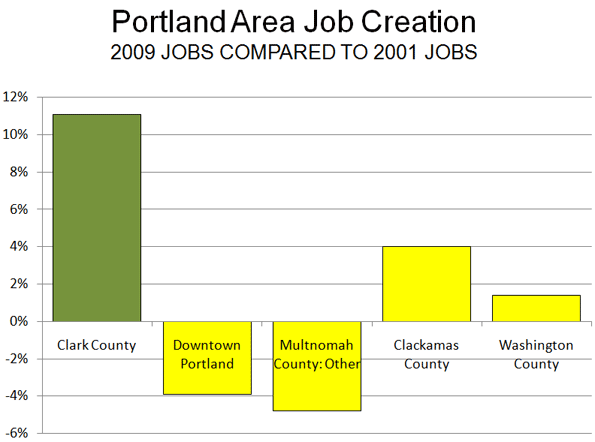
    Anemic Job Creation: Jobs have simply not been created in Portland’s core. Since 2001, downtown employment has declined by 3,000 jobs, according to the Portland Business Alliance. In Multnomah County, Portland’s urban core and close-by surrounding communities, 20,000 jobs were lost between 2001 and 2009. Even during the prosperous years of 2000 to 2006, Multnomah County lost jobs. Suburban Washington and Clackamas counties gained jobs, but their contribution fell 12,000 jobs short of making up for Multnomah County’s loss. The real story has been Clark County (the county seat is Vancouver), across the I-5 Interstate Bridge in neighboring Washington and outside Metro’s jurisdiction. Clark County generated 13,000 net new jobs between 2001 and 2009 (Figure 1).

    Domestic Migration: Not only are companies not creating jobs in the three county area, but people are choosing to locate in other parts of the metropolitan area.

    Between 2000 and 2009, the three counties – roughly 75% of the region’s total population in 2000 – attracted just one-half of net domestic migration into the metropolitan area. Washington’s suburban Clark County, across the Interstate Bridge, added a net 48,000 by domestic migration and has accounted for 40% of the metropolitan area’s figure all by itself.

    Core Multnomah County, which had nearly double Clark County’s 2000 population, added only 4,000 net domestic migrants, at a rate less than 1/20th that of Clark County. Suburban Clackamas and Washington counties did better, but between them achieved barely one-half of the Clark County rate.

    Exurban Columbia and Yamhill counties, outside the jurisdiction of Metro but inside the metropolitan area, added nearly 13,000 domestic migrants, more than three times that of Multnomah County, despite their combined population less than one-fifth that of Multnomah’s in 2000.

    Effects of Pro-Transit Policies: Portland’s unintended decentralization has even damaged the much promoted, and subsidized, public transit agencies. Despite Portland’s pro-transit policies, the three county transit work trip market share fell from 9.7% in 1980, before the first light rail line was opened, to 7.4% in 2000, after two light rail lines had opened. Two more light rail lines and 9 years later, (2009) the three county transit work trip market share had fallen to 7.4%, despite the boost of higher gasoline prices. The three county transit work trip market share loss from 9.7% in 1980 to 7.4% in 2009 calculates to a near one-quarter market share loss. By contrast, Seattle’s three county metropolitan area, without light rail until 2009, experienced a 5% increase in transit work trip market share from 1980 to 2009 (8.3% to 8.7%).

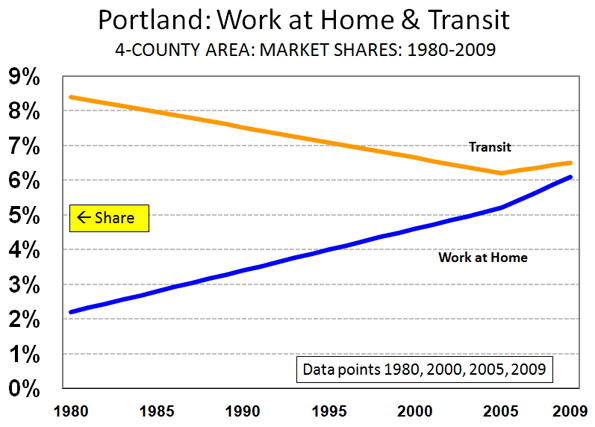
    While taxpayer funded transit was attracting less than its share of new commuters out of cars, one mode –unsupported by public funds – was doing very well. Between 1980 and 2009, working at home rose from 2.2% of employment to 6.2%. in the four county area (including Clark County). Thus, nearly as many people worked at home as rode transit to work in 2009 (Note). Already, working at home accounts for a larger share of employment than transit in the larger 7 county metropolitan area. All of this is despite Portland’s having spent an extra $5 billion on transit in the last 25 years on light rail expansions and more bus service. (Figure 2).

    Why is the Three County Area Doing Less Well? Why have Portland’s policies that are designed to help the core failed to draw jobs and people? People who move to the Portland area from other parts of the nation are probably drawn by the lower house prices in Clark County, where less stringent land use regulation has kept houses more affordable. New housing in Clark County is also built on average sized lots, rather than the much smaller lots that have been required by Metro’s land use policies. House prices are also lower in the exurban counties outside Metro’s jurisdiction.

    As Metro has forced urban densities up in the three county area and failed to provide sufficient new roadway capacity, traffic congestion has become much worse. A long segment of Interstate 5 in north Portland seems in a perpetual peak hour gridlock unusual for a medium sized metropolitan area, which is obvious from Google traffic maps that show average conditions by time and day of week. Even more unusual is the gridlock on a long stretch of the US-26 Sunset Highway that serves the suburban Silicon Forest of Washington County. A long overdue expansion will soon provide some relief on US-26. However transportation officials seem in no hurry to provide the additional capacity necessary to reduce both greenhouse gas emissions and excessive travel delays on Interstate 5 in north Portland. People who move to Clark or the exurban counties can avoid these bottlenecks by working closer to home or even in the periphery of the three county area.

    Portland has important competitive advantages, such as a temperate climate and marvelous scenery. It also helps to be close to hyper- uncompetitive California, which keeps exporting households to neighboring states. But a higher cost of living driven by policies that have kept prices 40% higher than before the housing bubble (adjusted for household incomes), and increasing traffic congestion make Portland’s three county area less competitive and nearby alternatives more attractive.

    This is not surprising. More intense regulation deters business attraction and expansion. An economic study by Raven Saks of the Federal Reserve Board concluded that … metropolitan areas with stringent development regulations generate less employment growth. At least part of the reason the Metro region’s diminished competitiveness lies with a failed strategy that appears to be having the exact opposite effect to what has been advertised – and widely celebrated – among planners from coast to coast.

    Note: 1980 three county data not available on-line.

    Wendell Cox is a Visiting Professor, Conservatoire National des Arts et Metiers, Paris and the author of “War on the Dream: How Anti-Sprawl Policy Threatens the Quality of Life

    Photograph: South Waterfront Condominiums, Portland. Photo by author

  • Why We Have to Learn to Love the Subdivision – Again

    When did anyone last hear officials and professionals talking enthusiastically about the social and economic benefits resulting from the subdivision of land to create secure, clean and tradable title?

    Indeed, any planning document is likely to include a long list of potential problems caused by the subdivision, but will mention few, if any, of the benefits. Maybe it’s time to rethink this conventional planning wisdom. In Peru, during the eighties, Hernando De Soto and the Institute for Liberty and Democracy promoted land reforms that led to more than 1.2 million rural families being given titles to the land they worked. One major grant of titles to a whole village was celebrated on television. When the reporter asked a woman “Why is having title important for your family?” she replied “Having secure title means I can now go out to work.” She went on to explain that the family’s past “customary settlement” required continual occupancy and eternal vigilance. Some member of the family had to be on the property at all times, or else someone else could move in.

    During a recent BBC television news bulletin on the floods in Pakistan, reporter Orla Guerin said “Many here are bound to their land and their livestock, and will live or die with them. We spotted one young boy, clinging to the top of an electricity pylon. He climbed down to collect a bag food aid, but refused to be removed from the waters.”

    I suspect he was also concerned with the need to help maintain his family’s right to occupy.

    City officials and urban planners in particular are always claiming that their cities are “running out of land”. Of course they are not running out of land. They are surrounded with it, as any air traveler knows, just from looking out the window.

    However, they are short of land with a certificate of title that allows the landowner to develop the property for housing or anything else. One reason for this shortage lies with the costs and often onerous conditions of compliance are simply too high. The French Revolutionaries learned that when they fixed the price of bread at less than it cost to bake a loaf, the bakers simply stopped baking bread. When it costs more to gain a title than the lot can be sold for, we should not be surprised if people stop creating lots.

    Suburban residential development creates many jobs and the residents who move continue to create new employment opportunities for decades. Every home owner becomes a property developer as they add rooms, sleepouts, new decks and swimming pools and upgrade their kitchens, and so on. I should have emphasized that it’s the land around the dwelling that enables so many of these projects to take place over the decades and to create so many jobs.

    If Smart Growth policies force people to live in apartments, their opportunities to improve their dwellings become seriously limited.

    City governments appear to overlook the economic and employment impact of rejecting large-scale developments, but the cumulative effect of a multitude of prohibitions of smaller proposals is equally serious – especially in a small economy like New Zealand or a relatively unpopulated place like Montana.

    During the nineteenth century the key function of governments in the New World was to churn out titles as quickly as possible.

    Surveyors served as the true frontiersmen, enabling the migrants to arrive, put down their roots, and build. The post-war suburban boom repeated this experience, supported by an equal enthusiasm for creating a property owning democracy.

    Then during the 1990s, “The Age of Environmentalism” arrived and activists persuaded decision-makers in the developed world that the creation of titles enabled polluting humans to possess the Earth Mother and must be stopped, or be made as difficult as possible. These constraints on land supply created the short-term property boom, and the inevitable bust that led to the greatest financial crisis in recent history.

    The developing nations and their economists continue to recognize the value of title. The works of Hernando de Soto, the Peruvian economist, emphasize that the major problem facing people in poor countries has been their lack of secure title to land, which constrains their ability to borrow significant sums of money and put down secure roots. As he says, the family with title builds a dwelling; the family that squats invests in furniture. This has led to his founding leadership of The Institute for Liberty and Democracy in Peru.

    At the recent conference of international surveyors in Sydney it was quite exhilarating to hear surveyors and officials from Peru talking of targets of 150,000 new titles per year. They knew full well that titles generate wealth. Maybe it’s time for New World cities to set similar targets and share de Soto’s enthusiasm for the contribution of subdivision to ongoing liberty and the pursuit of happiness.

    Bankers have long recognized that many families’ main means of saving is paying off their mortgage. Equally, many aging citizens fund their retirement by subdividing their large lots to create a nest egg for the future. Most university-indoctrinated central planners regard this as an “inappropriate” activity.

    Unexpected Super Large-Lot zoning in rural areas can suddenly deprive thousands of people of a secure and active retirement. Of course the planners claim the landowners are still able to subdivide, but just have to go through an approval process. Then the same planners make sure the costs and uncertainties render the exercise prohibitive. Their environmental cost benefit analysis ignores this destruction of individual wealth – and dreams.

    I wonder if any advanced developed country planning school has Hernando de Soto on its reading list?

    Instead of encouraging the creation of titles, as history suggests we should, the Smart Growth central planners have persuaded our governments to penalise the creation of new lots by imposing highly expensive and highly regressive fines called “development contributions” – which are actually anti-development levies.

    We tax cigarette smokers to discourage smoking, and we fine speedsters to discourage speeding. Should we be fining the creators of legal title if our aim is to encourage development, promote employment growth, increase savings and promote personal well-being?

    Some politicians, like Maurice Williamson, New Zealand’s Minister for Building and Construction ARE determined to reduce the costs of building consents and inspections. But these are trivial compared to the costs of subdivision and land use consents.

    And there is something of an international movement away from rule based management of development and a return towards broader concerns of society and the people who inhabit it.

    But before any legislative reforms can be effective we need to learn to once again celebrate secure, tradable, private title. This remains one of Western Civilisation’s greatest contributions to our wealth, health and general well-being.

    Owen McShane is Director of the Centre for Resource Management Studies, New Zealand.

    Photo by Brenda Anderson

  • Health Care: Booster Shot for Jobs?

    As a former health care human resources executive, I’m often drawn to the local hospital in whatever city I’m visiting. A city’s health care environment reflects its social, cultural and economic state. Because the local medical center complex is often the largest employer in town, it would seem that strong fiscal returns would be rewarded to those cities that strategically aligned their economic development efforts to capitalize on growing this sector. Unfortunately, the health industry has historically been viewed as a local disaster, replete with quality of care issues, bureaucratic inefficiencies and high costs.

    While the spiraling costs, the inefficiencies, and the future of reform are often talked about, little attention is given to health care jobs as springboards to enliven local and regional economies. The steady parade of doctors, nurses, technicians and support staff at our medical establishments provide cities with a huge multiplier effect on nearby housing, restaurants and retail businesses. The trickle-down effect spreads outward to hospital manufacturers, suppliers, pharmaceutical companies, and other ancillary firms that serve as the lifeblood of a functioning health care system. The economic activity of the medical business extends well beyond hospital walls; it’s a high-octane job engine, with the buying power of health professionals helping to sustain struggling communities.

    With current U.S. unemployment rates stagnating at high levels, the robust quantity of workforce activity resonating through hospital corridors is good news for our nation’s cities and regions. According to the U.S. Department of Labor, 1.7 million new jobs have been added to the health care sector since 2001. This figure includes employment gains in health insurance, construction, pharmaceuticals, biotech, the life sciences and other complementary fields. More impressively, the DOL estimates that by 2018 there will be a 21% employment increase in health practitioners (1.6 million jobs) and a 29% increase in health care support roles (1.1 million jobs). Health care also currently boasts the lowest unemployment rate of any industry, and salaries average a respectable $43,700.

    Cleveland, Ohio, is a prime example of a city that has undermined its economic potential by permitting dubious redevelopment efforts – centered on sports complexes and museums – to overshadow assets such as the Cleveland Clinic and the University Hospitals Health System, which together encompass 51,000 employees.

    Like most Rust Belt cities, Cleveland sorely needs an infusion of jobs outside of the long diminished blue collar sector. It could build collaboratively on its health care niche, creating complementary clusters of medically related firms in the life sciences and health information systems that would bring new opportunities and life to the area. The city’s world-class medical establishments could supply the ideal springboard for branding Cleveland as a global medical hub, rather than as the home of the Cleveland Cavaliers and the Rock and Roll Hall of Fame museum.

    One Cleveland-area organization, BioEnterprise, is taking the lead in fueling the growth and commercialization of health care companies in the bioscience sector. A collaborative effort between top medical and higher education institutions in the region, BioEnterprise is a promising attempt to alleviate Cleveland’s persistent difficulties in generating jobs and economic growth.

    The potential economic impact of new health related establishments is also gaining attention in Shawnee, Kansas, where the Economic Development Council is pursuing plans for a Biosciences Development District to attract high-paying job opportunities. And in Solano County, California, local leaders have made savvy use of existing infrastructure, new capital investments and local tax policies to fuel growth in the emerging medical sciences corridor between Sacramento and San Francisco.

    To build a successful future around health care jobs, cities must make creative use of their local and regional assets. For example, a four-year medical school in Spokane, Washington, according to a recent report entitled “America’s Next Great Academic Health Center,” would support more than 9,000 new jobs by 2030 and generate nearly 1.6 billion in new economic activity for the area.

    Here’s a concept of a model for job creation and economic growth: the Medical District Oriented Development (MDOD). These multidisciplinary districts would consist of a cluster of complementary stakeholders: health care entities (hospitals and medical centers, imaging facilities, community health centers, and private and specialty clinics); durable equipment manufacturers and providers, and pharmaceutical and life science research institutions. Livable communities, these districts would include housing, retail, and transportation options operating on the fringe of the medical campus setting.

    Unlike the much discussed Transportation Oriented Development paradigm, MDODs would not be faced with the “cart before the horse” issue; there wouldn’t be a question of whether to create demand before building the infrastructure or vice-versa. The magic behind MDODs would be a health care sector that already possesses a mature yet growing cadre of physicians, nurses, technicians and researchers who would serve as a captive audience for new development initiatives.

    In Sacramento, the U.C. Davis Medical Center campus possesses many of the building blocks of a successful medical district. As the flagship safety-net hospital for Northern California, the Medical Center has successfully collaborated with local task forces and associations to support the redevelopment of nearby neighborhoods, bringing new jobs to the immediate area. It has also spawned new workforce housing, restaurants and other amenities in an area that has faced hard times.

    In addition to collaboration between municipalities and medical institutions, and leveraging a region’s local assets, what else can cities do to manifest economic prosperity through health care centers? Chip and Dan Heath, the bestselling authors of Switch: How to Change Things When Change Is Hard, note that successful transformations begin when this question is asked: What’s working now and how can we do more of it? For city leaders, the question becomes: How can we capitalize on the booming health care sector through new investments in multidisciplinary medical districts, including housing and transportation options?

    When cities and regions choose to create synergies between their communities and their medical campuses, the prognosis is promising for an economic cure.

    Photo: Christiana Care health workers submit Magnet Recognition Program documents to the American Nursing Credentialing Center.

    Michael P. Scott is an associate with Centro, Inc, a Denver-based consulting firm focused on the future of our city centers. He can be reached at michael@becentro.com

  • Light Rail & Left Turns

    Imagine that you own a service station that supplies fuel to the surrounding community, and you specialize in automotive repair. You’re proud that your reputation for service attracts vintage Corvette owners. You worked hard all of your life, and your shop is your equity for retirement. Your business is entirely dependent on customers who enter via a left turn from Boone Avenue, a low traffic street, because drivers cannot get direct access to you from Highway 55, just south of your business.

    One fateful day, a traffic engineer decides that the street serving as access to your station is to be cut off with a concrete median. This leaves no convenient access to your business; no left turn for your customers. Perhaps it was not intentional, but a lower level draftsman at a highway department, or an engineering consultant who never met you and only saw your business from a MapQuest image, decided that this concrete barrier was needed for some unknown-to-you reason. In what seemed like a blink of an eye, the business that you worked so hard all of your life to build was cut off.

    Your income, as well as the value of your business, plummets. Traffic engineers who have never met you have essentially destroyed your life’s earnings, as they drew a squiggle on a plan. Meanwhile the BP Station across the street is maintaining convenient access and flourishing.
    This is a true story. The barrier was installed, and what has remained for years since the business failed and was bull-dozed. It’s a vacant field in what would have otherwise been considered prime real estate.

    This video is an extremely well done representation of the new light rail that connects downtown Minneapolis with downtown St. Paul, right in the center of University Avenue, which is currently lined with hundreds of small businesses, including many small restaurants that are easily accessible from University Avenue by a left turn from half of the passing vehicles. While watching the video, did you notice that the light-rail in the street center eliminates left turns into businesses that are not at the few major intersections between Minneapolis and St. Paul?

    I admit that I’m no traffic engineer, and perhaps I’m not seeing the big picture, so please bear with my opinions, which I hope are based on common sense; you be the judge.

    Opinion #1: Build the light-rail and people will walk instead of driving their cars? Yes, in theory, people may use this new light-rail (based on old technology), and those people will surely choose walking over driving. But theory often conflicts with common sense. This “walkable” theory might work well in San Diego where every day has heaven sent weather. But in this region, there could be a month where 10 degrees below zero is the normal high temperature. Anyone ready for a leisurely stroll in that weather? Yes, there are many Minnesotans who do weather the weather, but many cannot. Going from a warm cozy home to the garage and leaving in the comfort of a car that heats up to toasty within minutes, and then parking close to a destination (in the cold winter or the sweltering summer) is hard to compete with.

    Opinion #2: Building a barrier down the center of a street cannot be good for business. When driving, the only way to access the vast majority of the businesses on the opposite side of the street is to drive a distance to the next major intersection, then make a (probably illegal) u-turn and drive all the way back. Given this choice, most potential customers will bypass the business, and some may choose to stop at the competition on the convenient side of the street.

    Opinion #3: The light rail will result in a considerable increase in fuel usage. Let’s not touch on the logic, argued by some, that the light rail saves energy because people are not in their cars, but instead concentrate just on how residents will get to and from their homes when they are driving. Assuming that the route by car will use University Avenue, which is based in a tight old urbanist (just like new urbanist) grid pattern, it is quite easy and convenient to get home, which is possibly a reason that so many like to live in these areas. Alas, no more of that convenience after the light rail bisects University Avenue. The likely scenario is that you make the left turn and then continue on the high density grid streets to your home. If you live closer to the next intersection, you are likely to continue at a higher speed along University Avenue and then make two left turns to get home. Ultimately, in both cases you will encounter more intersections, which means more accelerate-slow-stop cycles that consume energy and time, and increased distances, which also mean more time and energy. Whatever savings result from the light-rail in the middle of the street are not close to the extra energy consumed by the newly inconvenient vehicle routes.

    Opinion #4: Pedestrians are more endangered by the newly-complex train and traffic scenario. Do all drivers on busy streets stop for the pedestrian in the cross-walk? This one comes close to home. We have a cross-walk between our home in St. Louis Park the coffee shop on Minnetonka Boulevard, a street with much less traffic than University Avenue. My wife insists that we should simply walk across when cars are zooming past, telling me that it’s the law, they must stop. Well, they don’t always. Sometimes a driver in a left lane stops, but the right lane drivers do not see the pedestrian until it’s too late. The video (linked above), shows cars slowing down and stopping at the cross-walks for pedestrians to enter the train station. I’m not so sure that will work out as well on a busy street that’s been made slightly more complex by the light-rail smack in the middle.

    Opinion #5: Pedestrians are about to have a much longer walk. Let’s say you live south of the Light Rail line, between two major intersections, and want to walk across University Avenue to a restaurant on the north side for that delicious Pad Thai you have enjoyed so much for the past 15 years, just a block away. It is a typical January evening, dark, and 25 degrees BELOW zero. Huh, that Light Rail line does not allow you to cross the street, so you go that one block to University, and just 150 feet away is the restaurant – you can taste the Pad Thai! You venture ¼ mile to the next cross walk, cross University, and tread another ¼ mile back to the restaurant. You stop shivering about the time dinner is served. After the meal the wind picks up and the wind chill is 40 below zero. By the time you get home, you cross your favorite restaurant off your list of regular visits. You no longer even think about that side of the street if it is icy; one slip and brittle bones shatter. While this can happen anywhere, creating longer walking distances instead of shorter ones will surely increase the risk.

    A related problem: If you Google Map University Avenue today you will notice parallel parking along both sides of University Avenue in much of its business district. In the video, those spaces are eliminated. This means that all drivers will become pedestrians, trekking longer distances to the businesses. The driving customers must park somewhere… how does that work?

    Opinion #6: Eliminate the light-rail and replace it with a PRT (Personal Rapid Transit) or elevated rail. An elevated PRT or rail system would not require the current vehicular system to change much, it might be able to be built with little interruption to businesses, and certainly the business along both sides of University Avenue will continue apace. Snow? No problem with an elevated system . Of course an elevated system does not interfere with vehicular traffic, and as such would still promote driving. Was the “driving” force behind the ground-based design for the light-rail intended to disrupt cars? Logic suggests that this might be the case.
    Why do we still, in 2010, continue to build transportation systems that have their basis in century old technology? If Dr. Spock from StarTrek was in charge at the DOT, he would certainly find this illogical. And Captain Kirk would surely want elevated systems to zip us off to our destinations at warp speed – don’t you think?

    I’m not convinced that our traffic engineers are as dedicated to a roundabout (see http://www.rhsdplanning.com/roundabout/roundabouts.swf) and light- rail path as our politicians are. I have talked to many engineers over the years that do not seem to be “all on board”.

    If the vision in the video is an accurate representation of how our future will look, Ford Motor Company will be the major winner in this deal. Check it out: It sure looks like the vast majority of cars driving along University Avenue in the future will be new Silver Mustangs – better buy yours today!

    Photo: ‘Go West Young Man’ by TheeErin

    Rick Harrison is President of Rick Harrison Site Design Studio and Neighborhood Innovations, LLC. He is author of Prefurbia: Reinventing The Suburbs From Disdainable To Sustainable and creator of Performance Planning System. His websites are rhsdplanning.com and performanceplanningsystem.com.

  • Fortress Australia: Groundhog Day

    A decade ago, politics in Australia lurched to embrace all things rural, happily demonizing urban interests. This happened in response to a renegade Politician – Pauline Hanson – who for a time captured public sympathy with populist anti-immigration sentiments, threatening to unseat entire governments in the process.

    Now the result of the recent National Election in Australia has seen not only the return of anti immigration sentiments, but the ascendency of anti-growth statements in mainstream politics. For a large country with only 24 million people, it’s a dangerous development.

    Two things are shaping in the aftermath of the 2010 Federal Election as portents of things to come for our economic future. One is the rise of an increasingly orthodox view that Australia at 24 million people is reaching its maximum sustainable population. The second is toward appeasing the agrarian socialism and social conservatism of rural politics. Together, this could mean we are about to usher in an era of low growth, high protection policies. Fortress Australia could easily become a reality no matter which side ultimately claims the keys to the Government benches.

    Prior to the recent Federal Election (August 2010) both major political parties have become shy of the country’s long term population growth patterns. In September 2009, Federal Treasurer Wayne Swan released some early findings of the Intergenerational Report, which predicted Australia could reach 35 million by 2050. Although this rate of growth was pretty much the same as the preceding 40 years, the figure was greeted with alarm by media, the community, and much of the political herd. ‘Australia Explodes’ went the headlines and the lemmings followed over an ideological cliff. (See this blog post from a year ago).

    A month later, then Prime Minister Kevin Rudd was proclaiming that he believed in ‘a big Australia’ but by mid 2010 his later nemesis Deputy Prime Minister Julia Gillard was proclaiming she ‘did not believe in a big Australia.’ Gillard replaced Rudd in a Labor Party coup, and then as Prime Minister declared we shouldn’t ‘hurtle’ toward 36 million but instead plan for a ‘sustainable’ population, renaming the recently created portfolio of ‘Population Minister’ the ‘Sustainable Population Minister’ in the process. The word ‘sustainable’ in this context stands for ‘slow down or stop.’

    Then came the election campaign with Opposition Leader Tony Abbot promising to ‘slash’ the ‘unsustainable’ immigration numbers (that his mentor John Howard had been responsible for as conservative Prime Minister for over a decade) and to ‘turn back the boats’ of illegal immigrants and asylum seekers, mainly from south east Asia or Afghanistan. Population growth was to be cut to 1.4% (a long term trend anyway) and migrants potentially forced to settle in rural areas (some dodgy form of zipcode migration policy).

    The message from both political leaders was clear: support for a ‘big Australia’ (35 million population by 2050 or the same rate of growth we’d seen in the last 40 years) was gone.

    Add to that the quixotic Australian entrepreneur Dick Smith and his population TV documentary ‘The Population Puzzle’ where he alleged Australia was at risk of running out of food, out of space and out of control, comparing us (oddly) with places like tiny Bangladesh (population 160 million). Smith might be mad but you can’t discount the impact he has on Australian popular opinion. People believe him, politicians included.

    Could it get any worse for the prospects of maintaining even modest levels of population growth in Australia? The last election outcome means the answer is yes. The balance of power in the Senate of the Australian Parliament will now be controlled by ‘The Greens’ (a left wing environmental party). The Greens’ view on population growth is clear: they don’t support it (unless oddly if you’ve arrived illegally, by boat). “This population boom is not economic wisdom, it is a recipe for planetary exhaustion and great human tragedy” said Greens leader Bob Brown when the Intergenerational Report was released last year.

    In the House of Representatives, the balance of power is now held by a handful of independents, representing rural seats. Socially conservative but economically protectionist, the independents’ views on population suggest they would lean toward the Abbot view: turn back the boats, and slow the overall rate of growth. They are quite likely to also push for a redistribution of economic riches to a range of projects for rural and regional areas. The irony that the election result hinged on big swings in urban seats but that a handful of rural independents are now trying to call the shots shouldn’t be lost on anyone.

    Joining the growing chorus of slow or no growth chants is municipal government. The Local Government Association of Queensland’s annual conference this year talked of limits on population growth unless bountiful riches are showered on local governments to cope with ‘unsustainable’ rates of growth. Association President Paul Bell says “councils cannot let population growth exceed infrastructure needs.”

    “Where we find water supplies no longer match the size of the community, where we find roads are congested, where we’re seeing other infrastructure whether it be health or education are falling behind,” he said, population growth was by implication to blame.

    The bottom line? Population growth is now a dirty word in politics and for any business which relies on growth for its prosperity, this is not good news. Everything from airports to property to construction to farming to retailers, manufacturers and tourism will be affected by slowing growth.

    Even social services could suffer if growth is deliberately slowed. Why? Because in 50 years time, without migration or natural growth, the ageing bubble of post-war baby boomers may mean there are two working adults for every five retired. You wouldn’t want to be one of those two and paying their tax bill in 50 years’ time or dependent on the kindness of those workers.

    How has this come about? The answer is simple: growth itself has never been the problem. Instead, it’s been a notoriously inefficient planning approach which has misdirected precious infrastructure spending, pushed up housing prices through artificial restraint on supply combined with usurious upfront levies, which now average $50,000 per dwelling in Queensland (often more) and considerably more in NSW.

    In the last decade, can anyone honestly claim that our planning schemes are now more efficient and quicker, or more easily understood, or better targeted, than a decade ago? I doubt it.

    Would it be too much to ask for a sensible, evidence-based approach that ties population growth to urban and regional strategies, which emphasises economic progress while maintaining lifestyle and environmental standards? How about some decent plans to link regional urban centres to major cities, based not on pork barrels to influential independents but based only on the business case and community mutual benefit? Or how about putting the ‘growth’ back into smart growth, with policies that allow our urban areas to expand in line with demand matched to infrastructure spending, rather than policy dogma?

    Those same questions were being asked a decade ago. Welcome to ground hog day.

    For those interested, here’s a couple of yarns from 10 years ago:
    Slicker Cities for City Slickers. October 1999.
    Nation Building and a National Urban Strategy. May 2001.

    Ross Elliott has more than 20 years experience in property and public policy. His past roles have included stints in urban economics, national and state roles with the Property Council, and in destination marketing. He has written extensively on a range of public policy issues centering around urban issues, and continues to maintain his recreational interest in public policy through ongoing contributions such as this or via his monthly blog The Pulse.

    Photo by Linh_rOm