Category: planning

  • A Localist Solution

    By Richard Reep

    “There is a great deal of historical evidence to suggest that a society which loses its identity with posterity and which loses its positive image of the future loses also its capacity to deal with present problems, and soon falls apart.”
    –Kenneth Boulding, economist and philosopher (1966)

    Written in the depths of the Cold War, when nuclear annihilation appeared imminent, if not inevitable to some, Boulding’s words remain applicable to today’s popular culture. Increasingly unable to imagine a positive future since the 1990s, we have largely replaced the end of the nuclear threat with the beginning of global warming, among other environmental threats. Others have raised the spectre of Chinese global domination or a prolonged and destructive jihad from the Islamic world.

    Fatigued by perpetual threat, our society appears today to have largely lost its capacity to deal with present problems. Government, media and academia all have largely adopted, and even sought to expand their own power, by exacerbating this sense of omnipresent threat. Pick your thesis and line up your dialectical arguments, and you can almost hear the politicians and business leaders talking past each other already. And so goes our contemporary cultural conversation.

    In this circumstance, the task of rebuilding a sense of optimism and resilience has fallen on a number of local community groups seeking to find an alternative pathway out of the current zeitgeist. As the politicians turn up the volume, individuals are simply turning them off, and inventing solutions that address tomorrow’s needs. From these efforts come the most significant optimism for the future.

    Nondialectical change seems to be the only hope in a society where progress, particularly for the hard-pressed middle class, seems increasingly dubious. Small, isolated, cumulative efforts that begin on the grassroots level – localism – are our best, most positive pathway out of the seemingly intractable argument engaging western scientific society.

    Based in communities, families and churches, these groups are very different from those – on both sides of the political aisle, in the corporate world, the media, the scientific and academic communities – who hope to benefit from a climate of gloom and hopelessness. These are people who are thinking not how to gain more power or influence, but to make lives better for themselves, their neighbors and their children.

    Intentional communities. People creating a community around the intention of responsible environmental stewardship began this movement in Vermont in the 1990s. They represent a vehicle for a community to take responsibility for its environmental impact, wherein homeowners’ dues go towards an engineer’s time to monitor the community’s own wastewater treatment system, electrical power generation, and other needs defined by the community. It has parted company with conventional towns and cities, and today this movement represents any groupings of like-minded individuals around ecological concerns, religious affiliations, and other niche interests as a way of dropping out of the mainstream. Coping with stress by removing oneself from the city helps the individual, but leaves the city behind.

    The transition movement, begun in the United Kingdom, may be another pathway, based on the notion of peak oil. Encouraging bicycle riding, walking, and preparation for a low-hydrocarbon future, transition at least increases everyone’s exercise level. It is spreading quickly across America with local organizers creating visioning meetings and action plans, hoping that community strength will be a force multiplier. These movements are building in cities, where the hard work needs to be done. In Central Florida, Transition Orlando leader Jim Belcher facilitates community workshops focused on creating a shared vision for the future of this region. By July, its third gathering attracted over 60 people coming to realize that the future starts here, not in Washington or New York.

    The Living Building Challenge, begun in the Pacific Northwest, is yet another pathway, based on the notion that buildings can actually produce energy and clean water while cleaning pollution. Turning the conventional model on its head, building owners engaging in this process have already produced a few examples that appear to meet their self-imposed requirements to be restorative in character. This initiative takes the existing real estate development industry, sorely in need of reform, down a new road as well. With over 70 buildings being analyzed for compliance with this very new standard, four are close to meeting this challenge: a residence in Victoria, British Columbia; the Tyson Living Learning Center in Eureka, Missouri; the Omega Center for Sustainable Living in Rhinebeck, New York; the Hawaii Preparatory Academy Energy Laboratory in Waimea, Hawaii and the EcoCenter at Heron’s Head Park in San Francisco, California. More projects like these will have an impact on how people think about the role of buildings in society.

    In all these movements, the emphasis is on the process rather than the product. No leadership claims to have all the answers. The importance of this cannot be overstated. With a sense of desperation, communities seem too quick to turn solutions – often concocted from the outside by groups with distinct national or global agendas – that closes off all future dialogue and process, as if the future cannot be trusted to meet its own needs. These approaches may appear to address this generation’s anxiety over the future, but zips the lips of the future generation. A more open, indeterminate vision allows inconsistencies and conflicts to be solved as they arise. Teleological fantasies can only go so far.

    Due to their small size these micro-movements and others mean little if considered individually, and they are easy to dismiss as experiments. They are also reactions to the dialectic, whether peak oil or global warming. The important thing about them is not which side they react to, but rather what they are doing about it, and the gradual, step-by-step basis through which individuals and communities can act.

    These developments should be watched carefully if a positive image of the future is yet to be regained. Enough destruction has occurred, and rather than bemoan the loss of our past lifestyles and bemoan a future of scarcity, the middle class might look at it rather as a freedom to change and grow stronger, more resilient, and less dependent upon the oligarchy of organized interest groups, academic influence, media money and power.

    Richard Reep is an Architect and artist living in Winter Park, Florida. His practice has centered around hospitality-driven mixed use, and has contributed in various capacities to urban mixed-use projects, both nationally and internationally, for the last 25 years.

    Photo by photobunny

  • Mass Transit: The Great Train Robbery

    Last month promoters of the Metropolitan Transit Authority’s Los Angeles rail projects, both past and future, held a party to celebrate their “success.” Although this may well have been justified for transit-builders and urban land speculators, there may be far less call for celebration among L.A.’s beleaguered commuters.

    Despite promises that the $8 billion invested in rail lines over the past two decades would lessen L.A.’s traffic congestion and reshape how Angelenos get to work, the sad reality is that there has been no increase in MTA transit ridership since before the rail expansion began in 1985.

    Much of the problem, notes Tom Rubin, a former chief financial officers for the MTA’s predecessor agency, stems from the shift of funding priorities to trains from the city’s more affordable and flexible bus network. Meanwhile, traffic has gotten worse, with delay hours growing from 44 hours a year in 1982 to 70 hours in 2007.

    Sadly, this situation is not unique to Los Angeles. In cities across the country where there have been massive investments in light rail–from the Portland area to Dallas and Charlotte, N.C., and a host of others–the percentage of people taking transit has stagnated or even declined. Nationwide, the percentage of people taking transit to work is now lower than it was in 1980.

    None of this is to argue that we should not invest in transit. It even makes sense if the subsidy required for each transit trip is far higher than for a motorist on the streets or highways. Transit should be considered a public good, particularly for those without access to a car–notably young people, the disabled, the poor and the elderly. Policy should focus on how we invest, at what cost and, ultimately, for whose benefit.

    In some regions with large concentrations of employment, downtown major rail systems often attract many riders (although virtually all lose lots of money). The primary example would be the New York City area, which is one of only two regions (the other being Washington, D.C.) with over one-fifth of total employment in the urban core. In the country as a whole barely 10% of employment is in the city; and in many cities that grew most in the 20th century, such as Dallas, Miami, Los Angeles and Phoenix, the central business district’s share falls well under 5%.

    Some other urban routes–for example between Houston’s relatively buoyant downtown and the massive, ever expanding Texas Medical Center–could potentially prove suitable for trains. But most transit investments would be far more financially sustainable if focused on more cost-efficient methods such as rapid bus lanes, which, according to the Government Accountability Office, is roughly one-third the cost of light rail.

    Making the right choices has become more crucial during the economic downturn, even in New York City. The city and the federal government continue to pour billions into a gold-plated Second Avenue subway but now plan to cut back drastically on the bus service that serves large numbers of commuters from the outer boroughs and more remote parts of Manhattan.

    Ultimately the choice to invest in new subways and light rail as opposed to buses reflects both a class bias and the agenda of what may best described as the “density lobby.” The people who will ride the eight-mile long Second Avenue subway, now under construction for what New York magazine reports may be a total cost of over $17 billion, are largely a very affluent group. The new subway line will also provide opportunity for big developers to build high-density residential towers along the route. In contrast, the bus-riders, as the left-of-center City Limits points out, tend to be working- and middle-class residents from more unfashionable, lower-density districts in the Bronx, Queens, Brooklyn and Staten Island.

    The proposals for High Speed Rail–a favorite boondoggle of the Obama administration and some state administrators–reveals some of the same misplaced fiscal priorities. California’s State Treasurer, Democrat Bill Lockyer, has lambasted the proposed HSR line between Los Angeles and the Bay Area, suggesting the state may not be able to sell private investors on between $10 billion and $12 billion in bonds without additional public subsidies.

    Other prominent Democrats as well as the State Auditor’s office have challenged the promoters’ claims about the viability of the system and its potential drain on more reasonable priced transit project.

    This issue funding priorities was raised recently by the current administrator of the Federal Transportation Authority, Peter Rogoff, who questioned the wisdom of expanding expensive rail and other transit projects when many districts “can’t afford to operate” their own systems. He noted that already almost 30% of all existing “transit assets” are in “poor or marginal condition.”

    Ultimately we need to ask what constitutes transit’s primary mission: to carry more people to work or to reshape our metropolitan areas for ever denser development. As opposed to buses, which largely serve those without access to cars, light rail lines are often aimed at middle-class residents who would also be potential buyers of high-density luxury housing. In this sense, light rail constitutes a critical element in an expanded effort to reshape the metropolis in a way preferred by many new urbanists, planners and urban land speculators.

    The problem facing these so-called visionaries lies in the evolving nature of the workplace in most parts of the country, where jobs, outside of government employment, are increasingly dispersed. Given these realities, transit agencies should be looking at innovative ways to reach farther to the periphery, in part to provide access to inner-city residents to a wider range of employment options. Considering more than 80% of all commuter trips are between areas outside downtown, priority should be given to more flexible, less costly systems such as rapid commuter bus lines, bus rapid transit, as well as subsidized dial-a-ride and jitney services that can work between suburban centers.

    If reducing energy use and carbon emissions remains the goal, much more emphasis should be placed as well on telecommuting. In many cities that have invested heavily in rail transit–Dallas, Denver and Salt Lake City, for example–the percentage of people working from home is now markedly larger than those taking any form of mass transit. Since the approval of the Dallas light rail system in the 1980s, for example, the transit share of work trips has dropped from 4.3% to 2.1%; the work-at-home share has grown from 2.3% to 4.3%.

    In fact, people who work from home now surpass transit users in 36 out of 52 metropolitan areas with populations over 1 million–and receive virtually no financial backing from governments. Yet if New York, home to roughly 40% of the nation’s transit commuters, was taken out of the calculations, at-home workers already outnumber the number of people taking transit to work; and since 2000 their numbers have been growing roughly twice as fast as those of transit riders.

    Clearly we should not spend our ever more scarce transit resources on a nostalgia crusade to make our cities function much the way they did in the late 1800s. Instead, we need to construct systems reflecting the technology and geographic realities of the 21st century and place our primary focus on helping people, particularly those in need, find efficient, economically sustainable ways to get around.

    This article originally appeared at Forbes.com.

    Joel Kotkin is executive editor of NewGeography.com and is a distinguished presidential fellow in urban futures at Chapman University. He is author of The City: A Global History. His newest book is The Next Hundred Million: America in 2050, released in February, 2010.

    Photo: Michael | Ruiz

  • Melbourne: Government Seeking Housing Affordability

    Once a country known as “lucky” for its affordable quality of life, Australia has achieved legendary status as a place where public policies have destroyed housing affordability for the middle class. Draconian land rationing policies (called “urban consolidation” in Australia and more generally “compact city” policy or “smart growth”), have made it virtually illegal to build houses outside tightly drawn urban growth boundaries that leave virtually no room for new construction beyond the urban fringe. As a result, house prices have increased to the point that Australia now suffers one of the most unaffordable markets in the world.

    The consequences of this may finally be dawning on some governments. The state of Victoria, for example, is expanding its urban growth boundary around Melbourne.

    Severely Unaffordable Australia: The Reserve Bank of Australia (the central bank) has described the considerable extent to which house prices have increased relative to incomes since the 1980s. The annual Demographia International Housing Affordability Survey makes similar findings, showing that the price of housing has doubled or tripled relative to household incomes over the past quarter century. All major markets in Australia are “severely unaffordable.” This has occurred in a country that has long boasted one of the largest home ownership shares in the world, which epitomized the “Great Australian Dream.” Until urban consolidation policies were widely adopted and strictly enforced, Australia’s housing affordability (measured by the Median Multiple, which is the median house price divided by median household income) was virtually the same as that of the United States.

    That has changed radically. Over the past two years, the median house price in Melbourne, has risen by 30%.

    Expanding Melbourne’s Urban Growth Boundary: In this environment, it comes as welcome news that the Brumby Labor government has enacted an expansion of the Melbourne urban growth boundary. The initiative attracted broad based support, including that of the Liberal-National opposition in the Victoria (state) parliament. The government expects that the expansion will “maintain” housing affordability.

    There was, not surprisingly, the kind of hysteria that has become typical of Australian land use debates. Suburban Casey Mayor Lorraine Wreford expressed concern that the expansion would consume agricultural land and increase food costs. In fact, the higher costs that Melburnians are paying for housing as a result of the urban growth boundary is more than enough to pay grocery bills for the neighbors on both sides.

    The “loss of agricultural land” argument is even more daft in Australia than in the United States. Australia’s agricultural production continues to improve, which has permitted huge amounts of land to be abandoned and returned to its natural state. Since 1981, an area nearly the size of New South Wales has been taken out of agricultural production. Lest anyone think that urbanization is a factor, this is more than 50 times the land area of all the urbanization that has developed in Australia since western colonization began.

    Will it be Enough? The risk, however, is that the urban growth boundary expansion may not be enough to materially improve housing affordability. The expansion is modest, at less than 170 square miles (440 square kilometers*). Worryingly, the government indicates that this will be the last urban growth boundary expansion in this generation.

    How Much Land is Needed for Housing Affordability? However, US experience indicates that a surprisingly small amount of developable land beyond the urban fringe may be enough to keep land and house prices from escalating.

    For example, Portland’s urban growth boundary appears to have had little cost escalation impact on house prices until the 1990s, when urban fringe developable land within the urban ground boundary fell to less than 10% compared in relation to the already developed urban footprint (Note). This is the equivalent of a developable ring around Portland of less than one/half mile (0.8 kilometers in Portland).

    As the developable land became more scarce, house prices escalated. Now, Portland house prices are more than one-third above the historic Median Multiple norm of 3.0 and they peaked at more than 60% above during the housing bubble.

    Similarly, there are virtual urban growth boundaries in Las Vegas and Phoenix. These development constraints are defined by circumferential government owned land, which has been released to the market at rates intended to maximize revenues, which means they minimize housing affordability. Yet these constraints appear to have had little impact on prices until developable fringe land dropped to below 20% relative to the urban footprint.

    Strengthening Melbourne’s Competitive Position? The Victorian action may have been impelled by a recognition that the affordability-driven economic stagnation already existent in Sydney could well spread. This could help to restore Melbourne to its role as Australia’s principal urban area, more than a century after having been dethroned by Sydney. Bernard Salt, one of the nation’s leading demographers, has predicted that Melbourne’s population will exceed that of Sydney by in less than 20 years.

    Offering Australia’s future generations the chance to live out the Great Australian Dream by improving housing affordability could not only expand Melbourne’s competitive edge over Sydney, but could even neutralize fast-growing Brisbane’s trajectory. Ross Elliot has suggested that the new Southeast Queensland Regional plan could seriously retard growth in that vibrant area.

    Are Australian House Prices in a Bubble?

    There is a raging debate over whether Australia’s housing price boom is an asset bubble. International financial analysts Edward Chancellor, who correctly predicted the Great Recession, believes that Australian housing is a bubble that will burst before long. Others disagree. Either way, Australia loses.

    • If Australia’s price boom is a bubble, history says it will burst (as virtually all do), likely inflicting serious damage to the economy. In this regard, Australia could be more at risk than the United States was in its housing bubble burst, since housing in virtually every market, large and small, has been driven up to unsustainable levels. In the United States, the bubble was contained within markets accounting for about one-half of housing, where Australian-type planning policies were in operation. Other markets, such as Houston, Dallas-Fort Worth, Atlanta and much the Great Plains did not experience the bubble.
    • If Australia’s planners have simply succeeded in raising the long term price of housing and there is no bubble (as many Australian analysts suggest), then future generations of Australians will have much less money to spend and their standard of living will lower than it would otherwise have been.

    Regrettably, the spirited debate over an Australian “bubble” is far different that the public deliberations that preceded the adoption of urban consolidation policies in Australia. For the most part, state governments and planning academics carefully avoided any discussion of the housing affordability consequences. Perhaps this was out of ignorance. But whatever the intentions, the smart growthers have imposed great costs on both present and future generations of Australians.

    —–

    Note: This is a far smaller area than recent research suggesting a relationship between geographic constraints (mountains and other undevelopable land) and higher house prices. Research by Albert Saiz at Wharton uses a 50 kilometer (30 mile) radius from the urban core to identify the share of land that can be developed. The data in the research would indicate that more than 1,750 square miles are developable, yet Portland is among the more geographically constrained according to this analysis. This seems to be an unreasonably large area for measuring the impact of geographical constraints. It is nearly 4 times the urban footprint of Portland and is nearly 60 times the developable land area that exhibited virtually no impact on housing affordability in Portland in the early 1990s and is more land area than covered by all but 8 of the world’s largest urban areas. It is to be expected that that politically imposed development constraints (strongly enforced as in Portland and Australia) render any more remote geographical constraints irrelevant.

    Photo: Inside the expanded urban growth boundary: Western Freeway toward Melton (photography by author)

    *The original version of this essay read 17 square miles and 44 square kilometers.

  • Health Care Development in Central Florida

    By Richard Reep

    In this still cooling economy, Florida seems to be continually buffeted by a perfect storm of unemployment, record foreclosures, and stagnant population growth. As the state continues to suffer, the health care industry has unfolded two planning efforts aimed at building some economic momentum.

    Florida Hospital’s Health Village, an urban revitalization of one of Orlando’s older core neighborhoods, is one planning effort to watch. The other, Lake Nona, is a classic suburban mixed-use campus planned around R&D facilities gilded with stellar names like Scripps and Nemours, occurring in the southeast periphery of Orlando. The vastly different values of their developers underscore the striking contrasts between the development strategies of Health Village and Lake Nona.

    Lake Nona, a small lake just east of Orlando’s airport, is a new development centered around six major research facilities, four of which are under construction. Financing came from a 2006 program, the Florida Capital Formation Act, that has contributed millions to start up biomedical research in the state. Florida’s state venture capital fund lured Scripps, Nemours, Burnham, and M. D. Anderson. Two state universities are also participating, as well as the Veterans Administration with a new facility. This taxpayer investment was supplemented by Tavistock, the master developer of Isleworth fame, and smaller contributions by city, county, and other private investors all creating the impetus to develop this campus.

    Lake Nona’s Robert Adams described his “model” as San Diego’s biomedical cluster, which combines commercial, clinical, research, and educational facilities forming. Employment, in the form of the research facilities, was preceded by a country club and an indistinct mix of Florida residential building types – estate homes, smaller single family homes, and multifamily clusters that are sprinkled amongst golf courses, pretty lakes, and remnant pockets of old Florida wilderness. It’s obvious upon visiting the campus that this is first and foremost a real estate development scheme. Like most developers, Tavistock programmed the uses and zones as if all the land, being flat, were relatively equal in nature except for the slightly more lucrative edges of lakes and the even more lucrative engineered waterways. Currently, the Town Center is an open, flat D-shaped parcel conveniently accessed from Orlando’s beltway, the 417. A comfortable, safe land development scheme with all the usual regulatory battles is underway, and eventually Orlando will find a new, attractive community themed around medical research competing with other new developments for market share.

    In contrast, Florida Hospital selected, among its multiple sites in the state, about 96 acres squeezed between two close, parallel roads (Orange Avenue and Interstate 4) in a dense part of the city where the Adventist Health System quietly bought up dozens of individual parcels of 1930s era Orlando. Like most neighborhoods still suffering in the shadow of Eisenhower’s grand interstate system, this one has languished, and Florida Hospital intends to convert this neighborhood into a Health Village campus anchored by its adjacent hospital campus in a slow, organically grown and financed process.

    Orange Avenue bisects this Health Village, with towering hospital facilities on one side and an aged, mostly 2-story commercial neighborhood on the other. Much of the older residential stock is past its useful life, and owners, grateful for a buyer to release them from the ragged edge of Interstate 4, quickly sold out and left. Inserting the Burnham Institute’s Clinical Research Institute for Diabetes will be the latest revitalization project, and the interior land is intended for residential development catering to hospital professionals and staff within walking distance.

    With 17 hospital locations in Florida alone (the Adventist Health System operates medical facilities throughout the South and Midwest), the choice to locate a health village in a congested urban site is an interesting one. The city deal-making involved in such a move is reminiscent of the negotiations for New York’s Lincoln Center near Columbus Circle in the 1960s, and is rare in Florida where land is cheap. At first glance, it seems like Florida Hospital willingly hamstrung itself with this strategy, as compared to the huge blank slate being developed by Tavistock in Lake Nona.

    Tavistock also has eyes firmly watching the global health care market, and hopes to compete with San Diego, Research Triangle, Dubai’s Medical City, Singapore’s Biopolis, and other stellar research clusters. Lake Nona’s growth potential is relatively large, assuming a smooth flow of funding and continuation of markets. The science-themed real estate development brochures for Lake Nona exude a breezy, hip confidence, putting biomedical research in the background and projecting an alluring lifestyle in the foreground.

    Instead of amping up its marketing campaign to overcome its vastly smaller size, Florida Hospital’s Health Village eschews marketing altogether, as if it is too busy developing it to talk about it. The Adventist Health System is not visibly interested in the temporal nature of global markets, and its stated position as a Christian health care institution quietly suggests that reviving a struggling neighborhood – an exercise most developers would shy away from – is worth the effort. Florida Hospital’s ultimate end appears to be planned on a much longer timescale.

    Both projects are refreshing pathways for Florida, as they represent an attempt to develop future jobs away from the dependence on tourism and second home development. Of the two, right now Lake
    Nona seems much more poised for growth. With a vision for 16,000 jobs at maturity, Lake Nona hopes to capture a substantial portion of the real estate growth attached to those jobs, which is the tried-and-true Old Florida model. Shopping areas, recreational activities, and lifestyle creation will add one more new neighborhood cluster to a multipolar, decentralized region at the expense of 7,000 acres of Florida’s natural environment.

    In contrast, Florida Hospital’s urban build out will benefit existing neighborhoods, certainly a new concept for Floridians. In this respect, Florida Hospital’s tiny contribution to growth (some 800 new residential units are proposed to replace the 150 existing homes) is more than offset by its larger contribution to Orlando’s development as a city. And it delivers this at no expense to Florida’s natural environment.

    Each model offers something to a revived Florida. Florida Hospital’s campus in congested Orlando is instructive as a model for economic activity in the urban future. Religious institutions may become a more important force in the community, given the lack of wealth creation by the standard players in Wall Street and real estate speculation.

    Tavistock could contribute as well, particularly as a move towards a new modality of wealth creation that transcends the traditional Florida focus on consumption activities: shopping malls, hotels, and theme parks. Placing the region on the world stage as a contender in health research can move Florida away from its failed model and towards a future shaped by important diversifications of its employment base.

    Richard Reep is an Architect and artist living in Winter Park, Florida. His practice has centered around hospitality-driven mixed use, and has contributed in various capacities to urban mixed-use projects, both nationally and internationally, for the last 25 years.

    Photo pf Lake Nona development by saikofish

  • Going Underground in Australia

    Just over a decade ago, governments in Australia were immune to calls for accelerated infrastructure investment in our major urban centres. Plans for strategic reinvestment were rare. Much has changed in that time, maybe too much. It seems that enthusiasm for major urban infrastructure now runs ahead of impartial assessment of the cost, versus the claimed benefits. A proposed $8.2 billion underground rail loop for Brisbane, along with a new underground station for its busy downtown, provides one example of an over exuberant propensity to spend.

    The idea of new underground heavy rail lines to connect with the commuter rail system of southeast Queensland isn’t new. I can recall some 15 years ago proposing just that in a policy paper for the Property Council. The paper identified new stations in the CBD as a critical element in making use of rail transit more user friendly. The existing downtown stations, we argued, were barely downtown anymore, because the modern downtown (of close to 2 million square metres of office space, major retail, and entertainment hubs) had shifted toward the river and away from the stations.

    This large concentration of office workers should prove prime candidates for public transit, since they typically work regular hours (which helps with service schedules) and are concentrated at the centre of a hub and spoke system. But the walk from their workplace to the nearest stations, in summer heat or rain, represents (among other things) a disincentive to rail transit. So logically a new underground station (or even two) which brings the convenience of commuter rail closer to the workplace should encourage more people to make use public transport. Clearly, if you owned office buildings anywhere along the river edge of the ‘Golden Triangle’, you’d welcome this initiative with open arms and beg the Government to fast track the proposal.

    So it could indeed be a great idea. But first there are few unanswered questions about the economics of heavy rail commuter transport. The latest State Government figures show that every trip, by each and every commuter on the City Train network, is now subsidized to the tune of $10. That’s per trip, so for every daily return trip, the taxpayer is forking over $20 per commuter. And that’s after commuters have paid their fare – remember it’s only the subsidy. Even worse, the numbers of patrons are falling, from 60.7 million to 57 million in a year. (Worth reading the article “Taxpayers’ share of rail fares increases, while CityTrain passengers continue to decline” in The Courier Mail, June 15, 2010).

    The concern here is that under this failed pricing model, more commuters may also mean more subsidies and a greater tax burden on the taxpayer. In short, there doesn’t seem to be an economy of scale: if more people caught the train under the present system, it could cost more in subsidies, not less.

    Ironically, an online poll taken in connection with the above story revealed that 79% of respondents (out of 824) claimed that train fares are already too high. This is especially ironic for two reasons: commuters with jobs in the CBD market are, on average, paid more than their suburban counterparts and commuters who use the rail service are increasingly drawn from more affluent inner city and middle ring suburbs. The proportion of public transport users who begin their journey in lower income, outer suburbs, is relatively small.

    The evidence for this is found in papers by people such as Dr Paul Rees, School of Global Studies, Social Science & Planning at RMIT, and others. Various studies increasingly point to a rising correlation between rail (and tram in the case of Melbourne) use and proximity to central city workplaces. Put crudely, big chunks of that $10 each way subsidy are being paid for by low and middle income taxpayers in the outer suburbs (far from convenient train stations) so higher paid central city workers can have access to a convenient form of transport from their inner city or middle ring home, to work.
    As for the mooted new underground rail network, according to the Queensland Premier Anna Bligh, the network will service “Toowong, West End, the city, Newstead, Bowen Hills, Bulimba and Hamilton North Shore.” In Brisbane’s case, these are inner city areas which enjoy some of the highest real estate prices in the region. In short, this is where the rich people live and will also be subsidized.

    A further question needs to be raised about the potential growth in commuter rail traffic, notwithstanding the convenience of a new CBD station. With the exception of the new line to Springfield, there are no new lines being laid and no new stations proposed. The catchment populations around the various train stations that form the City Train network are variously touted as ‘TOD’ (transit oriented development) zones but … there’s been precious little development activity to show for a decade of discussion.

    In the end, simply building more housing around train stations won’t mean more commuters to the CBD because most of the jobs are in the suburbs in the first place, and getting more so. I am unaware of any State Planning Policy which aims to concentrate more office and retail workers in the CBD (indeed the pressure is on to decentralize). And without more workers in the CBD, there are simply not going to be more commuters wanting to go there. So you can have more housing around train stations but this won’t mean more people working in the city – unless there’s also going to be more jobs in the city (or the mode share rises).

    An additional brake on increasing patronage of the heavy rail network is the inability to get to a suburban train station in order to easily catch the train. If you live more than a kilometre from a train station (the overwhelmingly majority of all residents), you would need to drive your car to a station to ride. But stations have precious little in the way of parking for these commuters, and nearby residents justifiably object to having their streets turned into kerbside carparks for daily rail commuters. This is one of many practical realities holding back increases in mode share of rail as a percentage of all commuter trips. That proportion has remained stubbornly fixed at under 10% of all trips for Brisbane (rail and bus and ferry combined) while for the CBD the mode share sits at some 45% of all commuter trips (bus, rail and ferry combined).

    So while the notion of a new underground rail line with a new CBD station sounds like a terrific idea, you’d hope that those who are responsible for spending our money will be running some hard numbers on the feasibility. This cross river rail project is mooted to cost something like $8.2 billion dollars in today’s terms. By the time they get around to building it, it will no doubt cost more.

    Even if the cross river rail and new station managed to achieve the result of 100,000 new rail commuters, that still works out to $82,000 per extra commuter. And if those commuters are to continue to be further subsidised to the tune of $10 per trip, each way, every day, this could be the sort of infrastructure initiative which ends up costing the community a great deal.

    You’d hope the numbers are being compiled rationally, dispassionately and independently, and the proper questions asked. Quality, strategic infrastructure investment in our urban areas is an economic necessity. But irrationally conceived projects of dubious economic merit are not the way forward.

    Ross Elliott is a 20 year veteran of property and real estate in Australia, and has held leading roles with national advocacy organizations. He was written and spoken extensively on housing and urban growth issues in Australia and maintains a blog devoted to public policy discussion: The Pulse.

    Photo by monkeyc.net

  • Locals Flee from New South Wales

    A newspaper headline “Fleeing locals ease population pressure on New South Wales” highlights a trend over the last few years. Since 2002 the Australian state of New South Wales, the country’s most populous with over seven million residents, has been losing its residents to other states at some 20,000 per year.

    During the year ended December 2009, 0.2 per cent of the New South Wales population moved to other Australian states. By contrast the State of Queensland, gained 0.3 per cent. Total population growth (consisting of net immigration, natural increase and net interstate movement) in the states of Victoria, Queensland and Western Australia was 2.13, 2.44 and 2.65 per cent respectively. By contrast New South Wales grew a desultory 1.64 per cent.

    The main reason ascribed to the exodus from New South Wales is the cost of housing in Sydney. The 6th Annual Demographia Housing Affordability Survey shows that its capital city Sydney has the second highest housing costs of the cities in the six countries surveyed, behind only Vancouver, Canada. For many people, 9.1 years of median family income required to purchase a median family home Sydney is becoming too expensive to live in.

    The Demographia Survey indicates that a price/income ratio of 3.0 can be considered affordable and 9.1 severely unaffordable. As a result many people, especially the young, will never be able to aspire to the Great Australian Dream of owning their own home. For those who can afford a home, the average wait time to save for the required deposit is 6.2 years. The newly appointed Federal Sustainable Population Minister recently is quoted as saying “people have said all I can see for my kids is they’re never going to be able to afford to live in this suburb because of what’s happening with housing prices”.

    The high cost of housing has significant social impacts. The Demographia Survey estimates that in Sydney 57% of median gross family income would be required to make mortgage repayments for a current median priced house. This may be compared with the 20 per cent figure applicable in Atlanta or Dallas-Fort Worth. There are already some 11,000 homeless persons in New South Wales and some 4,000 sleeping rough.

    Why is the cost of housing in Sydney so high? The Demographia Survey portrays a widespread relationship among the cities studied between high housing cost and overly restrictive planning regimes. New South Wales is among the most restrictive. In order to implement a high-density policy it has restricted the release of greenfield housing sites from an historic average of 10,000 lots per year to an average over the last five years of only 2,250. This is in the face of a annual state population increase of some 115,000. It is staggering to consider this constraint in a continent-sized country of which only some 0.3 per cent is urbanised.

    The scarcity resulting from the miserable allocation of greenfield lots has been most notable in land price, whose share of housing costs has increased from 30 per cent to 70 per cent of the total cost. The result has been an increase of overall prices some three times what it was ten years ago.
    Only seven per cent of people, wish to live in apartments. However, in order to implement its high-density policy the State Government intends to force this lifestyle on reluctant consumers. It plans 460,000 extra dwellings within the existing footprint of Sydney by 2031. In practice the production rate of these high density units has fallen well short of that planned.

    These high-density planning policies result in a dwelling scarcity which enables developers to make large profits on apartments. Developers now comprise by far the largest group (29.5 percent) among Australia’s 200 richest people. They have the resources to make sizable donations to both major political parties. Donations help fund election campaigns and in the past have helped keep the politicians who promote these policies in power. Numerous cases have been documented that show a large donation being made to a governing party shortly before permission was granted for a particular development.

    The shortage of land also impacts commerce and industry. Higher housing costs result in higher rentals or mortgage costs. Workers have to make ends meet and so businesses have to pay higher wages. Additionally employers must shell out for higher commercial rentals. The cost of industrial land in Sydney is roughly 70 per cent greater than in the other Australian large cities. Recently there have been a number of well publicised instances of industries closing their factories in Sydney and moving to Victoria, the state located to the south.

    Communities in Sydney are now paying the price for misguided state planning policies. Concrete, bitumen and tiles dominate vast areas where streetscapes of flowers and foliage once reigned supreme. There is a rising consciousness of disasters resulting from the government’s high-density planning policies. as Along with the topic of unaffordable housing, traffic gridlock, disintegrating public transport, frequent power blackouts and a city running out of water hit the headlines with increasing frequency. Dissatisfaction is escalating.

    The latest Newspoll puts the primary vote for New South Wale’s ruling Labor Party at 25 per cent, the lowest ever recorded. It faces a devastating defeat in the forthcoming March 2011 election. There can be little doubt that ill-advised planning policies are a major factor underlying this pending electoral calamity. But will politicians ever learn?

    (Dr) Tony Recsei has a background in chemistry and is an environmental consultant. Since retiring he has taken an interest in community affairs and is president of the Save Our Suburbs community group which opposes over-development forced onto communities by the New South Wales State Government.

    Photo by Nelson Minar

  • SPECIAL REPORT: Move to Suburbs (and Beyond) Continues

    Anyone who challenges the notion that the long predicted exodus of people from the suburbs to the city has been wildly overstated is sure to generate some backlash from urban boosters. Alan Berube of the Brookings Institution contends in a New Republic column that “head counts” better reveal city trends than property trends or the massive condo bust. He points to a Brookings Institution analysis by Bill Frey, entitled “Texas Gains, Suburbs Lose in 2010 Census Review,” which compares trends in major cities and suburbs, but offers not a sentence demonstrating any actual population “loss” in suburbs (his point is that their growth rates have declined).

    However, Berube has a point. Head counts are the issue. The annual Bureau of the Census “head count” of domestic migration reveals that the suburban to urban core exodus is as elusive as it has ever been. Gross population totals reveal nothing with respect to movements between the suburbs and the core. There is no doubt that core city population trends have improved, and this is a good thing. However, there is not a shred of evidence that suburbanites are picking up and moving to the cores.

    Domestic Migration: This is indicated by a “head count” of migration trends during the decade and during the last year. Each year, the Bureau of the Census estimates the number of people who move between counties (domestic migration) and the number of people who move into metropolitan areas from outside the nation (international migration). The data is estimated at the county (equivalent) level, which means that, except where cities are counties (such as Baltimore, San Francisco and others), individual core city data is not available. Thus, the analysis has to rely on core versus suburban counties in metropolitan areas (Note 1).

    In short, the nation’s urban cores continue to lose domestic migrants with a vengeance, however are doing quite well at attracting international migration. Thus, core growth is not resulting from migration from suburbs or any other part of the nation, but is driven by international migration.

    The following analysis covers all but four (48) metropolitan areas with more than 1,000,000 population as of 2009. San Diego, Las Vegas and Tucson are excluded because they include only one county, so there is only a core county and no suburban county. New Orleans is excluded due to the special circumstances of the huge population losses from Hurricane Katrina.

    Generally, domestic migrants are leaving the nation’s largest metropolitan areas. Between 2000 and 2009, a net 1,900,000 domestic migrants moved to areas of the nation outside the largest metropolitan areas (Table 1). Domestic migration losses occurred 24 of the 48 metropolitan areas. In the last year (2008-2009), the net domestic out-migration for all 48 regions in total was 22,000, 90% below the 2000-2008 annual rate. A somewhat smaller number of metropolitan areas, 22, experienced domestic migration losses in the last year. Most observers, including Berube, trace this diminishing loss to the recession, which has made movement in any direction more difficult over the past two years.

    Table 1
    Domestic Migration: Major Metropolitan Areas
    2000-2009
    2008-2009
    Core County Classification
    Metropolitan Area
    Metropolitan Area
    Core
    Suburban
    Metropolitan Area
    Core
    Suburban
    1
    New York   (1,920,745)   (1,222,290)     (698,455)       (110,278)     (77,381)    (32,897)
    3
    Los Angeles   (1,337,522)   (1,102,202)     (235,320)         (79,900)     (76,674)      (3,226)
    2
    Chicago       (547,430)      (705,403)      157,973         (40,389)     (31,114)      (9,275)
    4
    Dallas-Fort Worth        307,907      (262,982)      570,889           45,241       (7,494)      52,735
    1
    Philadelphia       (112,071)      (154,338)         42,267           (7,577)       (5,496)      (2,081)
    4
    Houston        242,573        (69,736)      312,309           49,662       19,002      30,660
    4
    Miami-West Palm Beach       (284,860)      (297,637)         12,777         (29,321)     (25,142)      (4,179)
    1
    Washington       (110,775)        (39,814)       (70,961)           18,189         4,454      13,735
    3
    Atlanta        412,832            3,243      409,589           17,479         7,579        9,900
    1
    Boston       (232,984)      (100,485)     (132,499)             6,813             (32)        6,845
    2
    Detroit       (361,632)      (306,467)       (55,165)         (45,488)     (34,794)    (10,694)
    4
    Phoenix        530,579        404,840      125,739           12,441         4,651        7,790
    2
    San Francisco-Oakland       (343,834)      (245,796)       (98,038)             7,977           (207)        8,184
    4
    Riverside-San Bernardino        457,430        375,055         82,375               (616)       13,174    (13,790)
    3
    Seattle           42,424        (27,407)         69,831           17,035       11,053        5,982
    2
    Minneapolis-St. Paul         (22,865)      (138,395)      115,530           (2,503)       (1,989)          (514)
    1
    St. Louis         (42,151)        (62,990)         20,839           (4,532)       (3,197)      (1,335)
    4
    Tampa-St. Petersburg        254,650          89,385      165,265             4,663         2,630        2,033
    1
    Baltimore         (35,938)        (74,328)         38,390           (3,687)       (4,883)        1,196
    2
    Denver           61,108        (44,839)      105,947           19,831         6,369      13,462
    2
    Pittsburgh         (49,438)        (57,532)           8,094             1,144            401           743
    2
    Portland        120,437            3,811      116,626           16,320         7,053        9,267
    2
    Cincinnati         (18,313)        (87,976)         69,663               (384)       (2,833)        2,449
    4
    Sacramento        135,038          32,369      102,669             4,733       (1,185)        5,918
    2
    Cleveland       (133,679)      (151,448)         17,769         (10,191)     (10,875)           684
    4
    Orlando        218,108          46,341      171,767           (4,279)       (6,275)        1,996
    4
    San Antonio        175,552          96,856         78,696           18,984       10,797        8,187
    3
    Kansas City           30,181        (33,910)         64,091             3,929           (417)        4,346
    4
    San Jose       (233,133)      (226,545)         (6,588)           (5,361)       (4,829)          (532)
    3
    Columbus           32,087        (36,024)         68,111             5,018         1,907        3,111
    4
    Charlotte        243,399        104,402      138,997           19,211         8,299      10,912
    3
    Indianapolis           70,271        (53,039)      123,310             7,034       (1,209)        8,243
    4
    Austin        224,227          52,842      171,385           25,654       10,484      15,170
    2
    Norfolk-Virginia Beach         (19,172)        (19,391)              219           (8,052)       (3,559)      (4,493)
    2
    Providence         (50,151)        (38,129)       (12,022)           (6,736)       (4,939)      (1,797)
    3
    Nashville        120,684        (20,101)      140,785           10,826            128      10,698
    2
    Milwaukee         (72,668)        (89,476)         16,808           (2,336)       (3,585)        1,249
    4
    Jacksonville        125,881          17,866      108,015             1,758       (3,415)        5,173
    4
    Memphis           (8,834)        (61,325)         52,491           (5,276)       (7,867)        2,591
    3
    Louisville           33,700           (7,692)         41,392             2,122            262        1,860
    2
    Richmond           74,650           (4,839)         79,489             2,751                 3        2,748
    3
    Oklahoma City           41,523           (8,164)         49,687             8,798         3,236        5,562
    3
    Hartford           (9,385)        (22,089)         12,704           (1,847)       (1,949)           102
    3
    Birmingham           26,420        (26,550)         52,970             2,418       (1,424)        3,842
    3
    Salt Lake City         (32,760)        (43,779)         11,019               (164)           (911)           747
    4
    Raleigh        190,438        150,583         39,855           20,095       16,070        4,025
    2
    Buffalo         (53,191)        (47,780)         (5,411)           (1,711)       (1,806)              95
    2
    Rochester         (42,163)        (35,354)         (6,809)           (1,937)       (1,224)          (713)
    Total   (1,903,595)   (4,548,659)   2,645,064         (22,439)   (199,153)   176,714
    Major metropolitan areas: Population over 1,000,000 in 2009
    Core county classifications: See Table 2

    The core counties lost domestic migrants, often at very high rates. Between 2000 and 2009, more than 4,500,000 people moved out of the core counties. This is more people than live in the cities of Los Angeles and Washington, DC combined. The suburban counties did substantially better gaining more than 2,600,000 domestic migrants (nearly as many people as live in the city of Chicago), but not enough to negate the core losses. Over the past year, the core counties lost 200,000 domestic migrants, an annual rate approximately two-thirds less than the rate from 2000 to 2008. Suburban counties gained 175,000, a more than 40% reduction from the 2000-2008 annual rate. All of these rate changes are consistent with expectations in a recession, as fewer people move.

    If anything, the trends of the past decade indicate a further dispersal of America’s metropolitan population, with an additional 200,000 domestic migrants moving to the exurban counties adjacent to and beyond the major metropolitan areas (Note 2). Reflecting the effects of the recession, exurban areas lost 4,000 domestic migrants in the last year. This one year loss rate is less than 1/10th of the core county domestic migration loss rate over the same period. Another nearly 1.7 million domestic migrants left the major metropolitan areas and their exurbs altogether, moving to smaller metropolitan areas, smaller urban areas and rural areas.

    Between 2000 and 2008, 36 cores experienced domestic migration losses, compared to 10 suburban areas. The cores did better in the last year, with 29 losing domestic migrants, while 13 suburban areas lost domestic migrants. Further, more people moved into (or fewer moved out of) the suburbs from other parts of the country than to the cores in 42 of the 48 metropolitan areas between 2000 and 2009 and in 2008-2009.

    Moreover, not all urban cores are the same. Some, including most of the fast growing areas, are far more suburban than others. This is illustrated by a classification of core counties (Table 2) based upon the share of owner occupant housing built after 1949 (For for statistical purposes the beginning of automobile oriented suburbanization was with the census of 1950).

    Table 2
    Core County Classifications (Extent of Suburbanization)
    Core County Classification
    Share of Owner-Occupied Houses Built After 1949
      Dominant Urban Cores
    Less than 50%
      Moderately Suburban
    50% = <75%
      Substantially Suburban
    70% = <85%
      Predominantly Suburban
    85% & Over
    Data from 2000 US Census

    For example, in the core counties of the St. Louis and Boston metropolitan areas, there is little suburbanization, with more than 70% of houses having been built before 1950. Their growth truly reflects the attractiveness of traditional, relatively dense urban living. On the other hand, in the core county of the Austin metropolitan area, less than 10% of the houses were built before 1950, while in Phoenix, the figure is 3%. In these and other core counties that encompass large suburban areas, the vast majority of “urban” growth follows a highly suburbanized, auto-oriented model.

    The domestic migration results by core county classification are as follows:

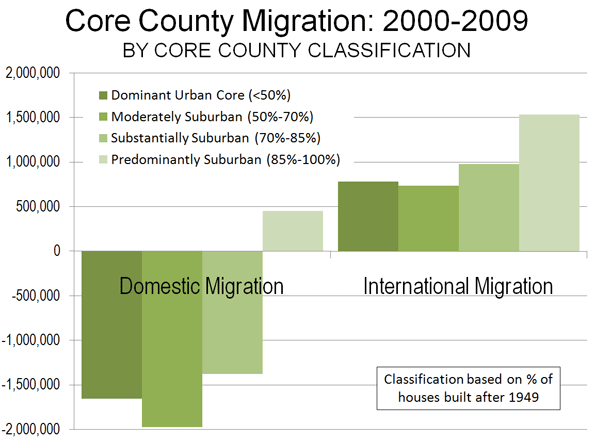
    • Dominant Urban Core Central Counties (less than 50% of the housing stock built after 1949) lost 1.650 million domestic migrants, or 14.0% of their 2000 population. In the last year, the loss was 87,000.
    • Moderately Suburban Core Central Counties (50% to 69% of the housing stock built after 1949) lost 1.970 million domestic migrants, or 10.0% of their 2000 population. In the last year, the loss was 83,000.
    • Substantially Suburban Core Central Counties (70% to 84% of the housing stock built after 1949) lost 1.380 million domestic migrants, or 7.2% of their 2000 population. In the last year, the loss was 58,000.
    • Predominantly Suburban Core Central Counties (85% and more of the housing stock built after 1949) gained 450 thousand domestic migrants, or 2.0% of their 2000 population. In the last year, the gain was 29,000.

    By no stretch of the imagination, then, can it be validly claimed that the overall trend is people moving from the suburbs to the core. The evidence suggests that the more urban the core county, the greater are the domestic migration losses.
    International Migration: The real story with respect to core growth is international migration. The 48 metropolitan areas gained 6.4 million international migrants from 2000 to 2009 and 620,000 in 2008-2009. International migration, also impacted by recession, dropped by nearly a 15% drop from the 2000-2008 annual rate (Table 3).

    Table 3
    International Migration: Major Metropolitan Areas
    2000-2009
    2008-2009
    Core County Classification
    Metropolitan Area
    Metropolitan Area
    Core
    Suburban
    Metropolitan Area
    Core
    Suburban
    1
    New York     1,075,016      622,538      452,478        100,669     57,674      42,995
    3
    Los Angeles        803,614      628,303      175,311           75,062     58,557      16,505
    2
    Chicago        363,134      265,156         97,978           33,363     24,236        9,127
    4
    Dallas-Fort Worth        323,941      203,732      120,209           31,571     19,785      11,786
    1
    Philadelphia        122,733         50,761         71,972           12,944        5,560        7,384
    4
    Houston        289,648      252,098         37,550           27,996     24,371        3,625
    4
    Miami-West Palm Beach        506,423      318,888      187,535           51,548     32,380      19,168
    1
    Washington        310,222         23,112      287,110           31,904        2,096      29,808
    3
    Atlanta        207,238         42,082      165,156           20,288        4,093      16,195
    1
    Boston        191,014         64,359      126,655           19,250        6,522      12,728
    2
    Detroit           93,625         44,177         49,448             8,723        4,132        4,591
    4
    Phoenix        214,067      209,326           4,741           21,833     21,364           469
    2
    San Francisco-Oakland        257,318      161,324         95,994           24,376     15,373        9,003
    4
    Riverside-San Bernardino           90,652         46,829         43,823             8,464        4,313        4,151
    3
    Seattle        126,973         98,983         27,990           12,919        9,971        2,948
    2
    Minneapolis-St. Paul           84,440         69,262         15,178             8,234        6,756        1,478
    1
    St. Louis           29,782         11,794         17,988             2,928        1,112        1,816
    4
    Tampa-St. Petersburg           74,173         42,568         31,605             8,045        4,762        3,283
    1
    Baltimore           43,949         10,852         33,097             4,604        1,125        3,479
    2
    Denver           93,916         45,338         48,578             8,738        4,251        4,487
    2
    Pittsburgh           19,225         16,326           2,899             1,901        1,596           305
    2
    Portland           70,901         28,755         42,146             6,680        2,677        4,003
    2
    Cincinnati           22,364         12,754           9,610             2,245        1,260           985
    4
    Sacramento           64,275         47,169         17,106             6,056        4,420        1,636
    2
    Cleveland           28,002         20,168           7,834             2,826        1,987           839
    4
    Orlando           95,500         61,171         34,329           11,720        7,381        4,339
    4
    San Antonio           31,595         28,157           3,438             3,303        2,940           363
    3
    Kansas City           34,339         12,613         21,726             3,404        1,262        2,142
    4
    San Jose        170,452      168,009           2,443           16,347     16,116           231
    3
    Columbus           39,755         38,261           1,494             4,063        3,915           148
    4
    Charlotte           48,176         34,522         13,654             4,678        3,332        1,346
    3
    Indianapolis           27,676         22,058           5,618             2,809        2,239           570
    4
    Austin           65,958         56,828           9,130             6,406        5,516           890
    2
    Norfolk-Virginia Beach                421         (1,546)           1,967                867             81           786
    2
    Providence           34,926         25,547           9,379             3,753        2,741        1,012
    3
    Nashville           36,570         26,208         10,362             3,850        2,760        1,090
    2
    Milwaukee           26,814         22,612           4,202             2,706        2,292           414
    4
    Jacksonville           15,066         12,046           3,020             1,760        1,397           363
    4
    Memphis           19,845         17,801           2,044             2,093        1,874           219
    3
    Louisville           16,437         12,778           3,659             1,685        1,291           394
    2
    Richmond           17,061           4,161         12,900             1,805           440        1,365
    3
    Oklahoma City           23,717         18,698           5,019             2,394        1,878           516
    3
    Hartford           30,266         25,871           4,395             3,230        2,784           446
    3
    Birmingham           14,485         10,644           3,841             1,557        1,151           406
    3
    Salt Lake City           41,216         39,416           1,800             3,855        3,684           171
    4
    Raleigh           36,923         32,141           4,782             3,560        3,103           457
    2
    Buffalo             9,671           8,387           1,284                940           814           126
    2
    Rochester           12,796         11,657           1,139             1,243        1,123           120
    Total     6,356,310   4,024,694   2,331,616        621,195   390,487   230,708
    Major metropolitan areas: Population over 1,000,000 in 2009
    Core county classifications: See Table 2

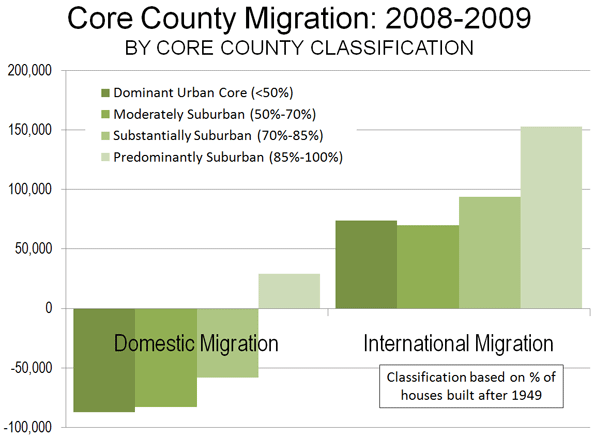
    The core counties gained 4.0 million net international migrants between 2000 and 2009. The international migration gains in the dominant urban and moderately suburban core counties were not sufficient to compensate for the domestic migration losses (Figure 3). Surprisingly, the strongest gain in international migration from 2000 to 2009 was not in the more urban core counties, but rather was in the predominantly suburban core counties, at a 6.8% rate compared to 2000 populations.
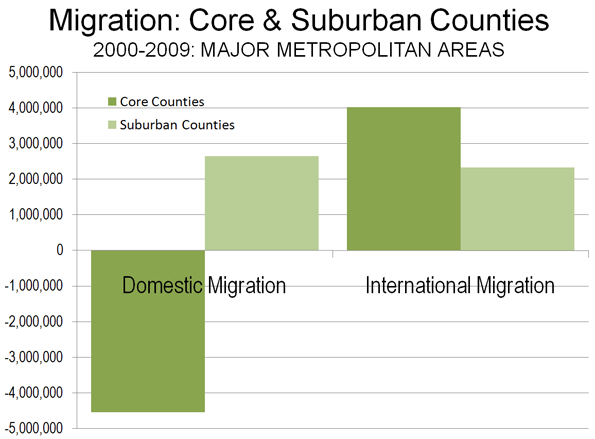
    In 2008-2009, the core county gain was 390,000, approximately 15% below the 2000-2008 annual rate (Figure 4). The suburban counties gained international migrants, though fewer than the cores, adding a net 2.3 million between 2000 and 2009. Between 2008 and 2009, the suburbs added a net 230,000 international migrants, a 12% decline from the 2000-2008 annual rate.
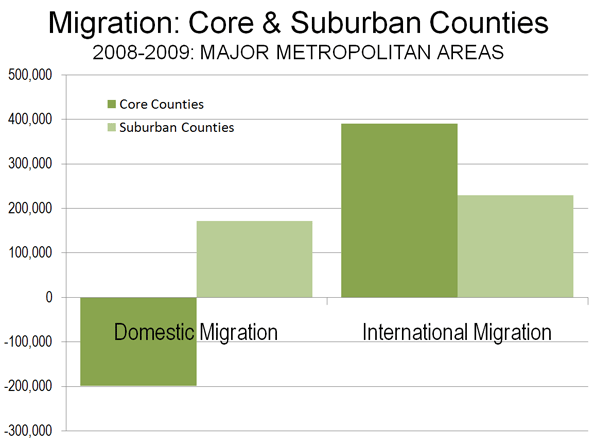
    This of course measures only initial international migration. Over time many immigrants likely will head for the suburbs, which now are home to a majority. Core cities may be playing more of a “revolving door” role where they take in immigrants (and young people) for several years, then lose them, but replace the loss with newcomers.

    The Exodus: Elusive as Ever: The much ballyhooed suburban hegira has not begun, despite it having been announced repeatedly (Table 4). There is no doubt that the cores are doing better than in recent decades, particularly since the deep recession began. But the relative better urban performance may have more to do with stagnation than anything endlessly alluring about inner city life.

    Table 4
    Domestic, International & Total Migration: Major Metropolitan Areas
    PERSONS
    Net Domestic Migration: 2000-2009
    Net Domestic Migration: 2008-2009
    Net International Migration: 2000-2009
    Net International Migration: 2008-2009
    Net Total Migration: 2000-2009
    Net Total Migration: 2008-2009
    Core Counties (Share of Post-1949 Housing)   (4,548,659)     (199,153)      4,024,694         390,487        (523,965)     191,334
      Dominant Urban Core (Less than 50%)  (1,654,245)      (86,535)        783,416          74,089       (870,829)     (12,446)
      Moderately Suburban (50%-69%  (1,969,014)      (83,099)        734,078          69,759    (1,234,936)     (13,340)
      Substantially Suburban (70%-84%)  (1,377,714)      (58,419)        975,915          93,585       (401,799)       35,166
      Predominantly Suburban (85% & Over)       452,314        28,900     1,531,285        153,054     1,983,599    181,954
    Suburban Counties     2,645,064       176,714      2,331,616         230,708      4,976,680     407,422
    48 Major Metropolitan Areas   (1,903,595)       (22,439)      6,356,310         621,195      4,452,715     598,756
    Exurban Counties        198,294          (4,053)         364,498           36,740          562,792        32,687
    48 Metropolitan Areas & All Exurban Counties   (1,705,301)       (26,492)      6,720,808         657,935      5,015,507     631,443
    4 Excluded Metropolitan Areas          19,958         14,553         225,767           23,400          245,725        37,953
    All (52) Major Metropolitan Areas & Exurban Counties   (1,685,343)       (11,939)      6,946,575         681,335      5,261,232     669,396
    Smaller Metropolitan & Rural     1,685,343         11,939      1,678,369         173,570      3,363,712     185,509
    United States 0 0      8,624,944         854,905      8,624,944     854,905
    Major metropolitan areas: Population over 1,000,000 in 2009
    Excluded metropolitan areas: San Diego, Las Vegas & Tucson (no suburban county) and New Orleans (due to Hurricane Katrina)
    Exurban counties of excluded metropolitan areas are included (Las Vegas and New Orleans)

    As in Europe, people are moving to the urban cores. But also, as in Europe, they are moving there from across national borders, rather than from the suburbs (Figures 3 & 4). This will surprise urbanites who cannot imagine meaningful lives in the suburbs, but will not shock the many millions more suburban residents content enough not to move. The exodus from the suburbs to the core will not have begun until more moving vans head away from the suburbs than to them. To this point, this is simply not occurring. And when the economy recovers, history suggests that the gap between suburban and core growth rates may begin expanding again.


    Note: There is one core county in each metropolitan area, which is the county containing the first named city, except for in New York, where all five counties (boroughs) are included, in San Francisco-Oakland, where Alameda County (Oakland) is also included and in Minneapolis-St. Paul, where Ramsey County (St. Paul) is also included.

    Note: The exurban counties are those included in combined statistical areas (as designated by the Bureau of the Census), which have major metropolitan areas as their core.

    Photo: Suburban Minneapolis-St. Paul

    Wendell Cox is a Visiting Professor, Conservatoire National des Arts et Metiers, Paris. He was born in Los Angeles and was appointed to three terms on the Los Angeles County Transportation Commission by Mayor Tom Bradley. He is the author of “War on the Dream: How Anti-Sprawl Policy Threatens the Quality of Life.

  • The Need to Expand Personal Mobility

    Few books in recent memory have started from as optimistic or solid a foundation as Reinventing the Automobile: Personal Urban Mobility for the 21st Century. Reinventing the Automobile conveys a strong message that improved personal mobility is necessary and desirable:

    “Have we reached the point where we now must seriously consider trading off the personal mobility and economic prosperity enabled by automobile transportation to mitigate its negative side effects? Or, can we take advantage of converging 21st century technologies and fresh design approaches to diminish those side effects sufficiently while preserving and enhancing our freedom to move about and interact? This book concludes the latter.”

    The authors include William J. Mitchell, Professor of Architecture, and Media Arts and Sciences at the Massachusetts Institute of Technology directs the Smart Cities research group at the MIT Media Lab, Christopher Boroni-Bird, Director of Advance technology Vehicle Concepts at General Motors and Lawrence D. Burns, who consults on transportation, energy and communications systems and technology. The book is published by the MIT Press.

    Getting Urban Economics Right

    The authors start with getting the urban economics right. They recognize that the “freedom and prosperity benefits” of the automobile “have been substantial.” They note that the automobile industry “set the stage for the growth of the middle class,” something that has been labeled the “democratization of prosperity.” The authors say that the car “enabled modern suburbia” and “powered a century of economic prosperity.” This refreshing treatment is consistent with the overwhelming economic evidence that links personal mobility with prosperity, such as by Remy Prud’homme and Chang-Wong Lee, David Hartgen and M. Gregory Fields and others. It is also at considerable odds with the widely accepted, somewhat nostalgic planning orthodoxy that rejects private automotive transport as “unsustainable”, unaesthetic and anti-social. This ideology embraces the illusion that forcing people to travel longer, with less personal flexibility somehow will improve the economy and raise the standard of living.

    The Future of the Automobile?

    The authors envision a automobile characterized by a new “DNA.” It starts with smaller cars, fueled by electricity and hydrogen (fuel cell technology). It also begins with an understanding that the cars used in many mundane urban operations today – for example getting to the market or pick up the kids at school – are over-engineered. They are far larger than is needed for most trips, their capacity for speed exceeds urban requirements and their range between refueling is also more than needed.

    The authors would re-engineer urban vehicle to the needs of metropolitan dwellers, an “ultra-small vehicle” (USV). The designs proposed include far lighter cars that can be easily “folded” up to minimize parking space requirements. Cars would be connected to one another by wireless technology, all but eliminating the possibility of collisions. The cars would be small enough that they could be assigned special dedicated lanes on current freeways and streets. Travel would be less congested because the dedicated lanes would have a far higher vehicle capacity, while the interconnectedness would allow cars to safely operate closer to one another.

    The combination of electricity, hydrogen, wireless technology and the USV would bring additional benefits. This would permit improved vehicle routing, as drivers would be advised take alternate less congested routes. This would also, in time, lead to self-drive cars, about which Randal O’Toole has recently written, made possible by the use of wireless technology and that dedicated lanes would make possible.

    Empowering Transit Riders through Car Sharing

    Car sharing is an important part of this future, for dwellers of dense urban cores, according to Reinventing the Automobile. The author’s note that car sharing can solve the “first mile-last mile” problem making it possible for transit users to speed up their trips by not having to walk long distances to and from transit stops. Indeed, car sharing programs are set to be adopted in urban cores with some of the world’s best transit systems, such as Paris, and London. Privately operated car sharing systems have been established in a number of US metropolitan areas, such as Atlanta, Denver and San Francisco.

    Progress with Conventional Strategies

    The longer term vision of the MIT Press authors may take a while to unfold, but we can already see potential for progress. Just this week, “super-car” developer Gordon Murray announced development of an urban car (the T25), smaller than the “Smart,” which would achieve nearly 60 miles per gallon, with plans for marketing within two years. Volkswagen has developed a “1-litre” car, which would achieve 235 miles per gallon on diesel fuel. All of this makes the 51 mile per gallon Toyota Prius seem gluttonous by comparison

    These developments and the Reinventing the Automobile vision show that it is unnecessary to tell people in America (or Europe or the developiung world) that they must give up their automobiles. That is good news. The social engineering approaches requiring people to move from the suburbs to dense urban cores and travel by slower, less frequent transit are incapable of achieving serious environmental gains (see below) and can not seriously be considered progress or desirable by most people in advanced countries.

    The Superiority of Technology

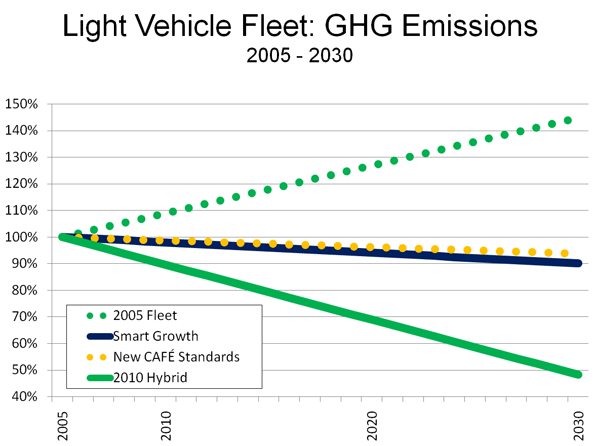
    This is illustrated by recent developments in automobile technology and research (Figure).

    • Before the adoption of the new 2020 and 2016 new car fuel economy standards, the US light vehicle fleet was on track to increase its greenhouse gas (GHG) emissions nearly 50% from 2005 to 2030 (the green dotted line in the figure).
    • As a result of the new fuel economy standards, Department of Energy projections indicate that greenhouse gas emissions from light vehicles will be one-third less by 2030 compared to the 2005 fleet (the yellow dotted line), and this is at the standard projected driving increase rates that could well be high.
    • The smart growth strategies of land rationing, densification and discouraging driving would produce, at best, a marginal reduction in GHG emissions, using the mid-point of the recent proponent research (Moving Cooler), indicated by the solid blue line. Actually, this overstates the impact of smart growth, since it discounts the substantial GHG emissions gains that result from higher fuel consumption in more congested traffic produced by densification.
    • The potential for technological advance is illustrated by the green solid line, which estimates the GHG emissions from light vehicles in 2030 if the average fuel economy were equal to today’s best hybrid technology.

    Overall auto-centered technology-based strategies – such as the improved fuel economy standards and the hybrid fuel economy – would each produce about 15 times as much benefit as the smart growth strategies proposed by such studies as Moving Cooler. This approach would not only be far more productive in terms of environmental improvement but would not require interfering with people’s lives in ways that would require longer trips times, less convenience, seriously retarded job access and, inevitably, fewer jobs and lower levels of economic growth.

    Technology: The Only Way

    It would be a mistake – and likely political folly – to force a re-engineering our way of life in order to enact strategies with dubious environmental benefits. In the final analysis, personal mobility must be retained and expanded, because there is no alternative that is acceptable to people, whatever system of government they happen to live under. Reinventing the Automobile paints the most optimistic picture to date and, if given due serious treatment, could prove a debate changer.

    Photograph: Manila suburbs

    Wendell Cox is a Visiting Professor, Conservatoire National des Arts et Metiers, Paris. He was born in Los Angeles and was appointed to three terms on the Los Angeles County Transportation Commission by Mayor Tom Bradley. He is the author of “War on the Dream: How Anti-Sprawl Policy Threatens the Quality of Life.

  • The Economic Significance of Village Markets

    Flea markets and garage sales have been around for years. But for most New Zealanders, produce markets have been associated with old European villages, or the ethnic markets of Hong Kong and other exotic locations. Village markets focus on locally made crafts, while Flea Markets are essentially centralized garage sales.

    At the true Farmers’ Market vendors may sell only what they grow, farm, pickle, preserve, bake, smoke, or catch themselves from a defined area. There are now over 50 “official” Farmers’ Markets in New Zealand. But when all the flea markets, village markets, and less formal markets are tallied up there must be hundreds throughout New Zealand.

    When I grew up they simply didn’t exist – unless we count the school “Bring and Buy” and Church fétes. We simply shopped in shops. Why is this? Why did my parents feel no need for such markets? I suspect my parents would have regarded such markets as somewhat old-fashioned and even primitive. This was the sort of thing our forebears left behind in Ireland in the 1830s.

    However, they are now a part of our lives. For the last few years I have routinely – effectively every Saturday Morning – shopped at our local market at Mangawhai, a nearby coastal village in Northland. It’s where people sell their own produce, but also sell books, bric-a-brac, power-tools, and other bits and pieces. The market works for me because it is just across the road from my excellent butcher, and next door to the local lending library.

    So what’s the new appeal? The conventional theory is that the rise of these markets reflects a desire for fresh healthy food, and fruit and vegetables grown locally, and in-season rather than imported from far away. It’s also considered green to buy local and support local cultivars, and growers of eco-sourced native plants and so on.

    These markets are also a good place to meet for a chat, and they also provide a convenient means of selling off numerous “priceless objects” now growing mould in the garage.

    Indeed, last weekend, my wife and I decided to win back some space and earn some ready cash. Setting up a stall at the Mangawhai market was easy. We simply phoned the market organizer (from the local Cheese Shop) and booked a trestle table.

    We thought our real cash-cow would be the plants and seedlings but the biggest and most regular seller was our collection of vinyl records dating from US pressings of jazz giants from the sixties. Our first major sale was a high-quality Akai turntable. It was fun to see grandmotherly types shuffle up to the table and enthuse over early discs by Oscar Peterson, Miles Davis, and Billie Holliday. As a bonus we gave the turntable buyer a 1950s 10 inch LP of Bill Hayley and his Comets – Don’t Knock the Rock.

    The last time I thought about these markets was two weeks ago when I wrote the sad story of the urban Onehunga Market that had to close because Auckland City demanded a resource consent that would have cost maybe $30,000 dollars.

    I presume our Mangawhai market operates without such costs because it is housed in the Village Hall, on public ground, shared with the Library and the Museum. Consequently our stall space and trestle cost us only $10 for the morning. But if the Council had demanded say $30,000 for a land use consent, then a twenty-trestle market at $10 a trestle would take 150 weeks to recover just the consenting cost. Obviously, there would have to be many more spaces, or the rental would have to be much higher.

    On our first morning we netted only about $80. (Being newcomers, we were outside and it rained) But even this represented about $20 dollars an hour – not huge but better than the minimum wage. On the other hand it was an $80 dollar return on our $10 dollar capital investment (using simple “homespun” economics). Remember the stuff we were selling had negative value, and I drive back and forth from the village every Saturday anyhow.
    And it was fun. But could such markets become an endangered species? As in so many areas, the culprit is heavy-handed regulation. The high costs of land and development, and the burden of consenting and development contributions already make it nearly impossible for small corner stores to make any return on capital.

    Yet, the stall renter’s capital-productivity is massive. But many regulators cannot stand to see such an opportunity slip from their grasp. So the Onehunga market had to close.

    These village markets remind us of the “power of markets”. As the heavy-handed regulators drive down capital productivity, entrepreneurs have responded by rediscovering the outdoor markets of much earlier times when capital was scarce and labour was plentiful. Market economies are like water-beds – push down on one corner and they bounce up in another.

    We are beginning to see similarly ad hoc responses in the residential and commercial property markets. The regulators have so severely constrained the supply of coastal land in New Zealand that people like my parents, who bought a batch at on the coast at Tairua out of their working class income, no longer have a hope of enjoying the sprint from the Kiwi bach straight into the sea.

    Those who have generated this scarcity then complain that only foreigners can afford to buy our coastal land. But many of us really do want to occupy a beach side property for the best weeks of summer, and then return home to our rural dwellings in the regional towns and villages. Enter the motor home.

    As farmers become more and more regulated by central planners who know nothing about agricultural economics but instead are determined to ‘save the planet’, enterprising farmers will look for new ways to supplement their incomes.

    Well, here’s one way we can solve our mutual problem. First, buy a quality self-contained motor home. Then use Google Maps to find what looks like an ideal bay, with a farm track connecting the main road to the beach.

    Then approach the farmer and negotiate a “right to occupy” this little patch of heaven. It could be no more than the right to park on the spot for perhaps eight weeks a year, but could include an obligation to fence off the area to contain any children or pets. No resource consent, no title, no lease – just a right to drive on to the farm, park on the spot, and drive away if it rains.

    Farmers supplement their income and Kiwis reclaim the low cost beach. The Environmental Puritans will gnash their teeth at the prospect of so many people having fun – but this time we might be ready for them. Markets and human ingenuity can still win in the long run.

    Owen McShane is Director of the Centre for Resource Management Studies, New Zealand.

    Photo of Mangawhai Village Saturday Market by Sids1

  • Follow The Money On Development Deals

    “Follow the money” became a household phrase after the 1976 movie that told the story of Watergate, All the Presidents Men. Personal experiences over four decades in the consulting industry, working to create sustainable developments, often bring the phrase to mind.

    In a meeting a few weeks ago concerning a potential collaboration between our planning company and large engineering consulting firm, I was coached to tone down the fact that the design methods we invented and utilize reduce infrastructure. You might ask, why would reduced infrastructure (one key to a more sustainable world) be a negative condition for an engineering firm whose main purpose is to design the infrastructure that society must rely upon?

    Follow the money… Large engineering projects, as well as many architectural structures, are often quoted as a percentage of construction costs. The incentive is to increase, not decrease construction costs. We have the ability today to reduce the world’s infrastructure possibly up to 30%, which would be a major step towards reducing initial costs of commercial building and residential housing. It would have massive environmental benefits, and reduce the continual maintenance costs to the governmental authorities (forever) up to 30%.

    Follow the money… If the income of consulting firms is based upon construction costs, the consultants’ gross dollar billings would also be reduced by 30%. Firms that supply concrete, steel, pipes, etc would also have their gross income slashed by 30%. Does our world have a chance of becoming sustainable? Dream on!

    Follow the money… A decade ago I met with the president of one of the largest engineering firms in Minnesota. He wanted to know how our firm can produce so much work with so few people (I personally design all of the developments and had a drafting staff of two people). In ten minutes I designed a development of about 15 lots that showed homes, driveways, and all the final geometry, using the commercially available technology we had developed. “Oh my,” he said, and paused. I thought he would say, “We could reduce our staff by half,” but instead said , “You must put the plans on the shelf a few weeks, to justify the billing hours”. Then the enlightenment came to me. I had developed a software technology used in my own consulting business to produce engineering-accurate layouts in a fraction of the time of a CAD (Computer Aided Drafting)-based technology, but started to understand that this might be a hard sell.

    Follow the money… Large consultants often look at the floor of employees as a multiplier, meaning that each workstation will bring some multiple of profit. Suppose a technician costs $50,000 a year, and the multiplier is 3.5. After overhead, that technician represents $100,000 in potential profit. At a 150 person company, replacing one third of the staff by using more efficient technology and methods in the above example reduces the potential consulting income by five million dollars!

    Follow the money… Liability is another roadblock to sustainability. Why try something new when the old tried and true has worked for decades or centuries? In the consulting industry, licensed professionals risk their careers if a new concept causes a major failure, so they’re more likely to discourage anything without a proven history. The loss of a license to certify plans would have a devastating effect on a consultant’s personal finances. It is far safer to claim that the new method cannot work and talk the developer or municipality out of the idea.

    Follow the money… Today, few consultants are making any. Most are either hanging on (barely) or have shut their doors. The unemployment rate among architects, engineers, draftsmen, technicians, planners, and related occupations is very high. The exceptions are those lucky few that have won lucrative government contracts and are holding their own, or even thriving.

    Follow the money… The market reacts to design, innovation and value. The first Toyota Prius was an ugly miniscule car based upon the Echo, but it was highly efficient. Gas was cheap when it was first introduced, and sales were dismal. The first generation Prius had innovation, but lacked design. The next generation Prius came out as gas prices soared. When an attractive interior and exterior design was combined with innovation, it quickly became a symbol for a new era of green thinkers. Rising fuel prices turned the hybrid technology into an increasing value which fueled — so to speak — its success. Before the I-Pod there were many digital music players that were innovative. When players were combined with an attractive package design and the ability to download from the same vendor, the overall value created its success. Like the Prius and the I-Pod, land development itself is a “product”.

    Follow the money… The housing market crashed and many believe the commercial real estate crash to come will also be devastating. Funding for infrastructure keeps many consultants employed when the private development and building industry flounder.

    Those of us in the consulting industry must make some significant foundational changes if we are going to have a sustainable future, and claiming “Sustainability!” on the corporate web site is not enough. Unlike building construction, where being “green” typically increases costs, in land development, environmentally sound design and construction can cost significantly less if done right. That said, it does require more design effort with a greater attention to detail. It is possible to decrease both construction costs and environmental impacts say, 30%, but it could mean the consultant doubling his or her design efforts to do so. Not only does the firm lose 30% of its gross income if billing is based upon a percentage of construction costs, it must make a huge increase in effort to do so.

    Follow the money… In this new age of engineering and designing sustainable development, it is no longer possible to get the best result by simply using an off-the-shelf software to calculate the hydrology of the site (the drainage) within sewer pipes. Using surface flow along with natural materials that can filter pollutants from the run-off before drainage leaves the site requires a botanical engineering solution that blends knowledge of natural and manmade engineering. This requires a specialist, and the complexity that’s required to successfully design these systems with fail-safe methods goes far beyond pressing a software button. Small errors could have devastating results, and the consultant will be liable.

    For example, I installed a no-mow – low watering – fescue lawn, instead of sod, when my home was built last year. This landscaping worked great during the first year, giving us the look of a lawn look without having to mow it. We were told to water twice daily to get it established by the landscaping firm that claimed to be experts on this exciting new low impact landscaping. Well, watering fescue twice daily, it turns out, is the worst thing you can do, according to the prairie restoration consultants. We inadvertently turned our lawn into a fast growing prairie that needs more mowing than sod! But this is just one example of what can go wrong in this new era of sustainability. I was willing to invest, and I believe mistakes can be corrected and documented to reduce future errors. My landscape contractor installed something quite new in the industry, and took on a risk compared to suggesting safe sod. After the bugs are worked out the company will have a market edge and an example to show (but maybe not this year).

    So how can we force an industry to change?

    Lead with Money… Cities and developers hire firms assuming that they are going to use the latest techniques available to get the most efficient design possible. If the bidding process changed from seeking the lowest bidder to looking for the most advanced and efficient bidder, the industry would be rewarding innovation, competition, great design, and risk. Give priority to solutions that exceed the specifications. Contractors and consultants could be rewarded for coming up with revolutionary solutions.

    Lead with Money… The reward could be in the form of a bonus for innovation: For example if a plan saves 100 million in right-of-way purchasing, give half of the savings to the winning contractor and consultant. If the consultant is being paid a percentage of the construction costs (lets use 5% as an example) on a 100 million dollar project, then he or she would gross five million dollars. If they could win the consulting (engineering) contract by demonstrating the most efficient design instead of being the lowest bidder (or the most politically connected), and be paid a percentage of the demonstrated benefit, they would be making more for providing a higher degree of effort and perhaps taking on more risk. In the above example, if 30 million dollars is demonstrated to be a savings or increase in functionality, and 20% of the savings is rewarded back to the consultant, then the consultant would make 5% on the 70 million dollars (3.5 million dollars) and 20% on the 30 million in savings (6 million dollars). The gross revenue to the consultant would almost double.

    Lead with Money… Our military often awards bids for those projects that exceed the specifications. Vendors should compete not just on price, but to demonstrate how they exceeded the specifications. Governments as well as private developers could pick and choose based upon innovation, design, and value. Those taking the extra effort would flourish, and eventually the new higher standards would become the norm.

    How about forcing change through regulations? Regulations can only control minimum standards, pretty much guaranteeing monotony and stagnation. Instead, follow the money: To create a sustainable world, we need to exceed minimums, and foster innovation by rewarding risk, effort, and investment.

    Flickr photo, “George Is Keeping An Eye On You,” by We Love Costa Rica

    Rick Harrison is President of Rick Harrison Site Design Studio and Neighborhood Innovations, LLC. He is author of Prefurbia: Reinventing The Suburbs From Disdainable To Sustainable and creator of Performance Planning System. His websites are rhsdplanning.com and performanceplanningsystem.com.