Category: planning

  • The Good News in Florida’s Bad Times

    By Richard Reep

    2009 was ugly. A swirl of dispiriting events stalled over much of the world this year, and Florida was no exception: state depopulation and tourism decline hit the state’s only two legitimate growth industries.

    Yet the bad times contain within them some good news. This end of an era meant that economic planners might finally turn to productive industries to generate jobs and revenue, just like the rest of the nation.

    First the bad news. For the first time since Florida became a state in 1845, more people moved out of the state than in, as reported by the University of Florida Bureau of Economic Research in August. In other states, this might not be news, but in Florida this has been viewed as nothing short of catastrophic. Growth is one of the state’s two primary industries, and with the last 163 years, growth was taken for granted (1945 saw depopulation as military personnel went home).

    Florida’s other traditional support, tourism, collapsed in 2009, as jittery tourists stayed close to home or went elsewhere in search of vacation. Since growth and tourism were the state’s only economic activity, this pretty much tanked it for the year; without a state income tax, the government is starved for tax money and is taking a hatchet to basic services in an effort to stay afloat. Meanwhile, it’s easy to get a parking space at the beach, hotel rooms are cheap and plentiful for a change, and the weather is as beautiful as ever.

    With private development dead, government desperate for income, and the professional class seeking jobs elsewhere, it will be easy for outsiders to write off the future prospects for the Sunshine State’s towns and cities. On the ground, however, a slightly different story emerges, a stoic sort of acceptance and the glimmerings of a change or two in the individual outlooks of citizens who stay. A few foreboding trends also cloud the horizon.

    Miami, a city not known to shy away from risks, this year replaced its Euclidean zoning code with a form-based code in a grand experiment with the public process. Voters who had enough of corruption and greed decided to endorse a visually appealing future of their city. Whether or not the outcome produces a better city, the 500+ public meetings did spark a badly needed public/private dialogue that should help Miami reshape itself into its new vision.

    Those who do stay in Florida and stick it out are getting more involved. As the outside world stopped supplying capital and residents, a sense of new localism sprang up almost overnight, with people gravitating away from the big brands and status symbols of a once-proud consumerist lifestyle. Sure, many turned to global brands like Wal-mart, but many more are supporting local food co-ops, farmer’s markets, independent eateries, and home industries in an effort to beat the system.

    If restlessness and discontent are the first necessities of progress (as stated by Thomas Edison), citizens of Florida cities like Tampa, Jacksonville, Orlando and Miami are ripe for progress. Consumer culture took a pause, but people still need to eat. Like the rest of the nation, this rediscovery of local goods and services has flowered, upon which a newfound sense of identity is being built through face-to-face exchange without the invisible army of middlemen that our commercial culture has spawned.

    With earnest public debate about the urban future in one of our nation’s largest cities, we can be assured that Florida citizens do care about the quality of life in their community. With neighborhoods spawning local markets and co-ops, we can be assured that urbanites do care about their local producers – and know a bargain when they see one. Both factors will contribute to a citizenry emerging stronger out of the state’s economic turmoil.

    Left to its own devices, Florida may sort itself out. Agriculture and manufacturing, two key industries faintly alive in Florida, have a chance to come back. Affordability and quality of life could lure the right kind of talent and encourage local entrepreneurs. Florida is poised to develop industries with health research and digital media where our lower costs and attractive climate could prove decisive.

    Yet this localist trend and greater attention to fundamentals could be altered by more meddling from Washington. The state returned Washington’s check for a train set not once, but twice, causing a concerned Secretary Ray LaHood to make a personal visit to see what was wrong. After some gentle persuasion – after all, Obama’s nationwide high speed rail vision could easily bypass this state with jobs and cash – Florida’s elected officials quickly jumped back to the politically correct side of the fence, and passed a bill to bring commuter rail to Central Florida. Now LaHood must deliver on the promise to prioritize Florida’s high speed rail construction.

    For the future, if the past is any guide, the upcoming war with Afghanistan could prove a boon to Florida. World War 2 saw an influx of servicemen and women, and the opening of multiple military bases, supply depots, and runways, partly due to its mild weather and partly due to its political stature. By adding this industry to offset its growth and tourism losses, Florida can benefit from the fulfillment of arguably President Obama’s most dangerous campaign promise.

    Doubts about these guns and trains leave more than a few Floridians worried about the strings attached to big brother’s largesse. It would be far more constructive to place more faith on the citizen’s renewed interest in the public process and the individual’s support of localism, two trends that seem destined to stay and become ingrained in our lifestyles. If Florida must accept Washington’s command economy for now, then at least the state will be left with increased transportation options and more exposure to service personnel who just might want to come back to stay after the war is over.

    But the more important work will, in the end, be done locally. If Floridians can capitalize on genuine public/private dialogue, such as happened in Miami 21, then there is a chance the state can pull from behind and surge ahead as a place where the future can still be sunny.

    Richard Reep is an Architect and artist living in Winter Park, Florida. His practice has centered around hospitality-driven mixed use, and has contributed in various capacities to urban mixed-use projects, both nationally and internationally, for the last 25 years.

    Photo:

  • The Suburbs are Sexy

    The Administration’s Anti-Suburban Agenda: Nearly since inauguration, the Administration has embarked upon a campaign against suburban development, seeking to force most future urban development into far more dense areas. The President set the stage early, telling a Florida town hall meeting that the days of building “sprawl” (pejorative for “suburbanization”) forever were over. Further, a number of bills have been introduced in the Congress that would attempt to discourage suburban development, some under the moniker of “livability,” which promises to improve people’s lives by enforcing planner-preferred density. The war against the suburbs is by no means new, but the Administration and some members of Congress have proposed their own “surge” in hopes of suppressing them permanently.

    The Mythical “Demise” of the Suburbs: Nearly since the pace of suburbanization increased, following World War II, critics have been foretelling the demise of the suburbs. During the 1950s and 1960s, some planning “visionaries” such as Peter Blake were predicting widespread municipal bankruptcies in the suburbs and for residents. This was occurring even as other urban planners were tearing up cities with urban renewal projects and freeways, setting the stage for “block-busting” and an ever-widening racial divide. The early criticisms have been repeated through the years, justifying a paraphrase of the old saw about Brazil (“Brazil is the country of the future and always will be”): “The suburbs are the wasteland of tomorrow and always will be.”
    The Real Decline of the Cities: In fact, it has more generally been the central cities that nearly went bankrupt, not the suburbs. Examples include New York, Philadelphia, Pittsburgh, Cleveland and that jewel of municipal consolidation, Indianapolis, rescued last year by $1 billion in state taxpayer funds. There are hopeful signs of a renaissance in most central cities, however their financial difficulties remain intractable and large swaths of their land area remain desolate. Meanwhile, the lawns were mowed in the suburbs, the houses painted and a strong sense of community developed among residents that was far too subtle for the prophets of suburban doom to perceive.

    Greenhouse Gas Emissions: More recently, the effort to reduce greenhouse gas (GHG) emissions has given suburban critics new ammunition. A simple mantra was dictated by “planning common sense.” Cars produce greenhouse gases, therefore people must get out of cars and live in more dense conditions, where they will not need to drive as much. Further, they will live in smaller, multi-family dwellings, which planning common sense teaches are more GHG friendly than the despised – except by those who choose to live in them – detached housing in the suburbs.

    But a funny thing happened on the way toward GHG inspired desurburbanization. Some academics actually began looking at data. The reality of the suburbs turned out to be rather different from that portrayed by the conventional wisdom of the planners. The most comprehensive research comes from Australia, some of which has been previously covered here.

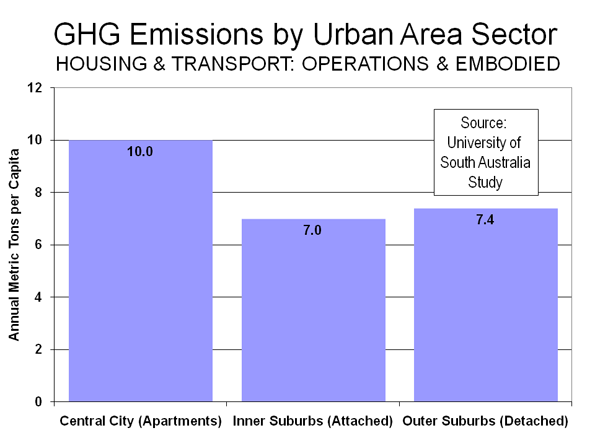
    University of South Australia: The most recent (and new) offering comes from a University of South Australia report thatallocates transportation and residential energy produced GHGs by location and housing type in the Adelaide area. The researchers found that the most GHG friendly sector of the urban area was the inner suburbs, which are dominated by single-family attached housing. GHG emissions per capita from housing and transportation were estimated at 7.0 metric tons of GHG emissions per capita annually.

    However, the outer suburbs, principally with detached housing, were not far behind at 7.4 tons GHG emissions per capita. The highest GHG emissions per capita, by far, were in the central area, with its predominance of multi-unit housing. There the annual GHG emissions were estimated at 10.0 tons per capita (See Figure). The University of South Australia study includes an element missing from virtually all other examinations of transportation and residential GHG emissions: “embodied emissions.” Embodied emissions are the GHGs from construction or manufacturing materials, and from building cars, transit vehicles and buildings. Embodied GHG emissions are ignored by much research, but are a significant factor in GHG emissions. For example, multi-unit housing, with higher use of concrete and more complex construction methods, tends to be substantially more GHG intensive than building detached housing or townhouses.

    GHGs from Common Energy: Previous work by Sydney researchers reached similar results – townhouse development was the most GHG friendly, followed closely by detached housing. Both were substantially less GHG intensive than high-rise condominium development. A principal reason for this conclusion stems in part from the fact that this research included GHGs from common energy, such as the electricity used to power elevators, parking lot and common area lighting, building-provided heating, air conditioning and water heating. American and Canadian research attempting to quantify GHG emissions by residential building type generally has not accounted for common energy and its GHG emission. Yet a gram of GHG from a residential elevator has the same impact as one produced by driving to the local Target store.

    GHG Friendly Suburbs: The most comprehensive research was conducted by the Australian Conservation Foundation. This was not the typical, incomplete or theoretical study of greenhouse gas emissions. The study included virtually every gram of greenhouse gas emissions in Australia and allocated them to consuming households in small residential zones within urban areas and around the nation. Suburban locations, with their greater use of cars and higher percentage of low density detached housing, had lower GHG emissions per capita than the core areas, with their greater use of transit and walking and their high-rise multi-unit housing.

    Compact Development: These findings provided the impetus to review the potential impact of compact development policies. Compact development policies (also called “smart growth” or “growth management”) generally seek to densify urban areas, by drawing urban growth boundaries, outside of which development is prohibited, and by trying to force people to drive less and to use transit more. Again, “planning common sense” clearly indicated to planners that compact development would yield substantial benefits in GHG emissions, principally because people would drive less.

    Yet the more recent research on compact development finds something much different. Densification scenarios from two recent reports, the congressionally mandated Driving and the Built Environment and a smart growth coalition’s Moving Cooler, showed that by 2050, compact development could reduce GHG emissions from driving by only 1% to 9%. At the high end of the range, the most new development would be directed to only a small part of present urban footprints, a policy outcome less believable than a balanced federal budget next year.

    Moreover, these projections have to be considered overly optimistic, because they make no allowance for the higher GHG emissions that occur as traffic slows and stops more in higher density conditions.

    The President Discovers the Suburbs? Meanwhile, on December 15, President Obama took the opportunity to visit a suburban Washington Home Depot, a chain that is a very symbol of American suburbanization. The President could have taken the opportunity to orate further against the suburbs in the insulation aisle, urging households to abandon the suburbs and move to high rise condominiums in the city.

    That was not to be. The President instead proposed providing incentives to people to make their houses more energy efficient, which would reduce greenhouse gas emissions and save money on consumer energy bills. In particular, he cited insulation, saying that “insulation is sexy”. It is worth noting that the Home Depot’s insulation is principally sold to suburban homeowners who can readily arrange for its installation. Residents of high-rise condominiums must rely on their building managers, who tend to purchase their insulation from wholesalers, rather than retailers like Home Depot and Lowes.

    The President explained why insulation was sexy, noting that saving money is sexy. Indeed, saving money is what the suburbs are about. The economic research is clear that housing costs are far less where suburban development is not limited by the compact development strategies that artificially create land scarcity. That’s why places like Dallas-Fort Worth, Atlanta and Houston, without compact development, had little, if any housing bubble, while housing bubbles of economy-wrecking proportions occurred in California and Florida, with their compact development.

    Yes, Mr. President, insulation is sexy. Saving money is sexy. And, the suburbs are sexy.

    Wendell Cox is a Visiting Professor, Conservatoire National des Arts et Metiers, Paris. He was born in Los Angeles and was appointed to three terms on the Los Angeles County Transportation Commission by Mayor Tom Bradley. He is the author of “War on the Dream: How Anti-Sprawl Policy Threatens the Quality of Life.

  • The Green Movement’s People Problem

    The once unstoppable green machine lost its mojo at the Climate Change Conference in Copenhagen. After all its laboring and cajoling, the movement at the end resembled not a powerful juggernaut but a forlorn lover wondering why his date never showed up.

    One problem is that the people of earth and their representatives don’t much fancy the notion of a centrally dictated, slow-growth world. They proved unwilling to abandon either national interest or material aspirations for promises of a greener world.

    The other problem is that divisions are now developing within the green camp. There are members, like Michael Shellenger and Ted Nordhaus, who recognize the serious fall out from the “Climategate” scandal, while others, including large parts of the media claque, dismiss any such possibility. There are the corporatists aligned with big business–who will live with any agreement that allows them to exact monopoly profits–and the zealots–like Greenpeace, Friends of the Earth and Bill McKibben–who see Copenhagen as an affront to themselves and to our endangered planet.

    But the main, fundamental problem facing the movement after Copenhagen–which none of the green factions have yet addressed–is its people problem. The movement needs to break with the deep-seated misanthropy that dominates green politics and has brought it to this woeful state. Its leaders have defined our species as everything from a “cancer” to the “AIDs of the earth.” They wail in horror at the thought that by the year 2050 there will likely be another 2 or 3 billion of these inconvenient bipeds. Leading green figures such as Britain’s Jonathan Porritt, Richard Attenborough and Lester Brown even consider baby-making a grievous carbon crime–especially, notes Australian activist Robert Short, in those “highly consumptive, greenhouse-producing nations.”

    Yet a slower population growth–while beneficial for poor, developing countries–can lead to a dismal, geriatric future in already low-birthrate nations like Germany, Italy, Spain, Japan, South Korea and Russia. And although birth rates are dropping in most developing countries, particularly those experiencing rapid economic growth, it will likely be decades before population stops increasing in most of the developing world.

    Besides, people in developing countries have much more important things to worry about–such as earning a living and getting ahead. Fighting climate change ranks low on the list of Third World priorities. The sprawling slums of Mumbai need more energy, not less; they want better roads, not fewer. More economic development would produce the money to help clean the now foul water and air, but also provide access to better education, one of the best ways to assure more manageable birth rates.

    Instead of looking to make developing countries even more dependent on Western largesse, greens should focus on ways to help improve the day-to-day lives of their people. Rather than prattle on about the coming apocalypse, they could work to replace treeless, dense slums with shaded low-lying clean houses that are easier to heat or cool. Those interested in nature might purchase land and rebuild natural areas. The children of cities like Mumbai should have the opportunity to experience wildlife other than crows, pigeons and rats.

    The environmental movement also might as well forget fighting the aspirations of the burgeoning middle class in India, or other developing countries. No developing world politician, whether from democratic India or Brazil or authoritarian China will embrace an agenda that stifles such aspirations.

    Post-Copenhagen greens need to reassess their relations with people in the developed countries as well. The popular call to transfer hundreds of billions of dollars from the so-called “rich” countries to combat the potential effects of climate change will not be very popular with the vast majority of the middle or working classes in these places.

    Much of the problem revolves around the loaded term “rich.” To be sure, many top climate-change scolds–Richard Branson, Al Gore, Arnold Schwarzenegger, Michael Bloomberg and, of course, his royal highness, Prince Charles–qualify easily. After all, no sweat off their well-massaged backs. The rock stars of the green millennium can buy their environmental indulgences so they can gorge good conscience on their carbon-rich world of private jets and lush estates.

    For them, going green means minimal sacrifice.

    Instead, the “rich” who will suffer the most will be the middle and working class of the developed countries. For them, carbon “sacrifice” may mean more than giving up needless luxuries like gas-guzzlers or monster plasma televisions. A green regime of enforced slow growth and ever greater regulation over carbon could threaten whole industries while environmental-planning policies will make purchasing a decent suburban house even more difficult.

    Such calls for sacrifice seem particularly ill-timed when 4 in 10 U.S. residents fear they could lose their jobs, with many rightly worried about holding onto their homes. With unemployment at 10%, few may be willing to wait around until the promised “green jobs” miraculously appear to save both them and the planet.

    But there’s an obvious way out of this dilemma: Start shifting away from fear-mongering and look to ways to achieve green goals without catastrophic economic losses. One clear way to start this process is through land-use policy. Right now many activists and their allies in the climate-industrial complex–which includes urban land interests–want to force suburban home dwellers into dense urban areas. They also want to coerce people to give up their individual mobility for trains, even if this means longer commutes and less convenience.

    Proposing a radical re-engineering of society does not constitute a winning political program. Environmentalists would do better to embrace a vision of “greenurbia,” allowing for dispersed living but in a environmentally responsible way. This could be done with practical steps–increased telecommuting, more tree-planting and flexible work arrangements–that would enhance not only the environment but also day-to-day life for hundreds of millions of people.

    Similarly, environmentalists should redouble their efforts to provide more access to open space for millions of people through expanded purchases of land throughout the country. America’s highly productive agricultural sector has jettisoned millions of acres of land from cultivation, providing an excellent opportunity for purchases for public use. In some areas, abandoned industrial or mining properties could be rehabilitated as natural areas.

    Such changes, however, require a re-evaluation of the values that now drive the green movement. Whether in California or Calcutta, it boils down to the existential question: Do humans matter?

    Frederick Law Olmsted explained his plan for New York’s Central as an attempt “to supply to the hundreds of thousands of tired workers … a specimen of God’s handiwork.” This represents the kind of sensibility that could transform the green movement from an obstacle to people’s aspiration to a force for greater human happiness.

    This article originally appeared at Forbes.com.

    Joel Kotkin is executive editor of NewGeography.com and is a distinguished presidential fellow in urban futures at Chapman University. He is author of The City: A Global History. His next book, The Next Hundred Million: America in 2050, will be published by Penguin Press early next year.
  • Personal Rapid Transit: Twenty-First Century Transport?

    Recently I had the chance to visit Taxi 2000. This Personal Rapid Transit (PRT) company is based just minutes from my office in Minneapolis. I’m no expert on rail systems, but I’ve always believed that an elevated system that can run freely over existing right-of-ways makes more sense than an antiquated system based on nearly 200 hundred year old technology.

    Since we plan new neighborhoods and cities, I saw a great opportunity to design a new town with an elevated PRT system as a major design influence, not as an afterthought. A perfect combination: a new age city based upon the latest methods, with a convenient way to access most of the region, based on a 21st century design, not an 18th century one.

    I typically investigate the products and companies that I’m about to meet. I’d heard about PRT solutions for well over a decade and assumed there were many examples of installations. After searching the internet I found not a single installed PRT system serving a city.

    I’ve never been a fan of light rail for a variety of reasons. Human beings are smart enough to explore space, extend life spans for decades, and remodel genetics. Yet all we can come up with is a slow (and often unsightly) train that runs on tracks conceived in the 1800s that now cost billions of dollars to implement? We are told that building a light rail line spurs economic growth. Even if true, typically only a minor portion of a town benefits because the system is linear. Most are designed to be functional, not beautiful, and most light rail trains are not inspiring.

    I used to drive in Minneapolis, but now train tracks intermix with the driving lanes in some areas of town. I avoid those sections, and now do my spending in the suburbs. I’m sure I’m not the only one. This brings me to my final opposition to light rail: Because it’s typically ground-based, it’s obstructive to implement, and often requires the demolition of buildings and the acquisition of right-of-ways. All of this costs plenty.

    On top of this, many businesses suffer during the construction of light rail, while it interferes with their access. Sure, they might ultimately get additional business, but first they must survive a period with reduced access.

    Mike Lester, CEO of Taxi 2000 demonstrated the prototype of SkyWeb Express along with its technologies to us. Over a period of three hours, Mike proudly showed us what they have accomplished.

    First, this is an on-call system. This means that you do not have to wait for the next train. Cars located only a minute or so away await your command. No more missed connections while waiting an hour for the next ride.

    It is elevated far above ground — 5 meters — using existing right-of-way on posts spread far apart. In an urban area such as Minneapolis which already has a skyway system, this could coincide with existing access points on the second or third floors. It’s non-linear, and able to easily turn corners and access much of a city, not just points along a single route.

    It maintains a constant rate of speed; no stops needed until you reach the destination. About 30+ miles per hour might not seem fast, but a mile every two minutes in an urban environment is indeed impressive. It’s limited to 3 persons per vehicle with plenty of extra space for luggage, boxes, or even a bicycle. No more crowding. It goes where you want, not only on a preset route. In theory it’s safer because you can access it alone, not with strangers. And one car needing maintenance does not shut down the system.

    The big issue that all transit needs to address is the cost. The light rail transit in Minneapolis costs somewhere around a billion dollars. PRT cost studies show a savings of 60 to 70 percent could have been realized along the same line. Even if the estimates are wrong by double, that’s over $200 million that could have been spent elsewhere, or to make a quite comprehensive PRT system for the same dollars.

    I’m not easily convinced when someone tries to “sell” me on new technologies, but that common sense meter in my brain was at 100% as I learned about the PRT possibilities. I was not sold that this will get everyone out of their cars, but it’s a solution that would be more effective than a rail system.

    So why no installations?

    PRT companies have been around for a while, continually upgrading and perfecting their systems. While I’m not sure how they get funded, I can tell you that cities have a hard time spending hundreds of million dollars on systems developed by small firms. As a software developer of Geographic Information Systems in the 1990’s we constantly lost sales to larger companies, even though our product was superior. It appeared that cities were more comfortable buying from companies with hundreds of employees working in tall impressive buildings than from smaller firms. It was natural to think a firm that appeared quite large had staying power compared to small companies with a handful of employees. But in the dot-com bust we learned that size does not guarantee longevity.

    I’ve written this before, but it bears repeating: On August 1st, 2009 President Obama addressed the nation with: “Future economic prosperity depends on building a new, stronger foundation and recapturing the spirit of innovation …. Innovation has been essential to our prosperity in the past, and it will be essential to our prosperity in the future”.

    Small PRT firms have risked everything, adhering to a belief that it is a viable solution for urban transportation problems today and in the future. How have we rewarded these innovators who certainly have the spirit? We continually invest in the most non-innovative, obtrusive, and expensive solution: Light Rail. We reward large corporations who take no risk… What happened to us? Let’s see if this new Administration can stand by the President’s words and invest in the pioneers who can create that strong American foundation.

    Rick Harrison is President of Rick Harrison Site Design Studio and author of Prefurbia: Reinventing The Suburbs From Disdainable To Sustainable. His website is rhsdplanning.com.

  • The Urbanophile Plan for Detroit

    If Brookings’ plan for Detroit isn’t enough to get the job done, what is?

    Turning around Detroit means facing head on the core problems that hobble the region, notably:

    • America’s worst big city race relations
    • A population that is too big for current economic reality
    • A management and labor culture rooted in an era that no longer exists and is unsuited to the modern economy
    • A tax, regulatory, and political system toxic to business

    A robust plan for renewal in Detroit will tackle these problems, recognizing that matters like improving race relations and cultural change need indigenous solutions from courageous local leaders. Then mix this with best practices from elsewhere and innovative, unique to Detroit solutions. And be patient, knowing the turnaround won’t be a short journey.

    1. Repair race relations. The city-suburb divide in Detroit, to an extent far greater than elsewhere, is a matter of black and white. Bringing racial rapprochement won’t be easy, but it is an absolute imperative for future regional success. Perhaps a newly shared sense of economic pain can foster this, along with grass roots connections such as white urban gardeners making common cause with black ones seeking better access to fresh foods.

    2. Active shrinkage. Many recognize the need for Detroit to “right size” to its reduced population and for federal help doing so. But beyond adjusting to the city’s decline, the region remains too big. Detroit no longer needs large armies of unskilled and even skilled laborers in its factories. There is simply no economic raison d’etre for a region the size of Detroit in that location today. A lot more people need to leave Detroit. Many already would like to but can’t because they can’t sell their house or afford to move. Serious consideration should be given to a federally assisted voluntary relocation program when the national economy recovers to help Detroiters move to Texas or other places with strong jobs growth if they want to. Detroit should also engage with those who did move away to create an urban alumni network. In a globalized economy, those Michigan expatriates can serve as a sort of field sales force for the city.

    3. Improve the Business Climate. Michigan’s government needs to be downsized to match a downsized state. Dubious programs of all types, from film industry subsidies to “cool cities” initiatives need to be scaled back or eliminated. The criminal justice system should be reformed to stop over-incarcerating non-violent offenders. Streamline or eliminate regulation wherever possible, and make those that remain operate swiftly and predictably. Eliminate or merge overlapping jurisdictions, and especially non-general purpose entities that are too often patronage dumps operating out of the public eye. Reduce taxes on business, especially small business.

    4. Change the culture. Michigan’s social and business approach, its labor and management culture and business practices were designed for a stable industrial age dominated by a limited number of large and vertically integrated corporations. Today’s economy is based around smaller, more innovative, nimble firms, virtual networks of people and collaborative business relationships, rapid change, and a competitive global environment. This sort of change has to come from the inside. No one can just tell Detroit how to do it.

    5. Renew Brand Detroit. How does Detroit want to be known in the world and how can it make itself known? Within a framework of shrinkage, Detroit needs to become attractive to the right new talent and new businesses. It needs an aspirational narrative that is authentically Detroit in a way “cool cities” will never be. Cool, No – but edgy? Definitely. Think of Detroit as the new American frontier, a blank canvas where anything is possible, and the ultimate arena in which to pursue alternative visions of urban life. A place where you can pursue a personal urban vision without getting tortured by a Byzantine blizzard of bureaucracy. This should be nourished – and preserved – by maintaining a “light touch” approach to regulation in the city proper. The region is well positioned to attract new urban pioneers and homesteaders, and to leverage its reputation as both a black city and large Arab population center. Detroit should stand proud as “Detroit”. It shouldn’t hide behind euphemisms like “Southeastern Michigan” or “The Big D” – as if that fools anybody. Detroit is a name with international recognition and resonance. Wear it with pride.

    6. Pursue Targeted Industry Clusters. The auto industry will remain a mainstay in Detroit, particularly management and R&D, though a lot smaller after a federally assisted restructuring. But the city should be wary of overly pursuing “me-too” industries like life sciences without distinctive advantages. Instead, Detroit should look to get its “fair share” of those, then look for where it is positioned to uniquely excel and try to create the environment favorable for investment. Potential targets include:

    • A lead role in international trade with Canada.
    • Dominating and expanding non-energy/non-financial trade and relations with the Middle East and Muslim world. With America’s largest Arab population, Detroit is positioned to be the American gateway to that ever more important part of the globe the way Miami is to Latin America.
    • Music. Detroit has one of America’s richest and most innovative musical legacies, from Motown to electronica to hip hop. But it hasn’t profited from it. Detroit needs to take a page from Nashville and figure out how.
    • Realize the Detroit Aerotropolis plan.
    • Alternative urban visions. The recipe for grass roots neighborhood renewal in the city, and a potential innovation cluster for any new Detroit ideas that gain widespread adoption.

    7. Rationalize Regional Governance and Infrastructure Investment. Detroit should seriously question any expansion of infrastructure when shrinking in regional population. All subsidized infrastructure expansion outside of currently fully urbanized areas should be terminated. It makes no sense to be widening streets on the fringes when you are ripping them out in the city. In this context, the kind of fixed rail investments advocated by Brookings and other “me too” urban boosters should be avoided in this highly decentralized region. Rather, the central city should start with a quality bus network, with rail added later if and only if existing ridership justifies it.

    8. Secure Irreplaceable Assets. Detroit built amazing treasures during its golden age, many of them lost or threatened. Detroit has one of the largest collection of pre-War high rises in America. Yet many of them stand vacant. Another gem, the Lafayette Building, is about to be demolished because it is so badly deteriorated, with trees growing on the roof. Some funds need to be earmarked for securing and and supporting basic maintenance such as roof integrity. While there may not be demand to reuse these structures now, they are irreplaceable and should be saved for future generations. On the cultural side, Detroit needs to ask itself tough questions about institutions like the Detroit Institute of the Arts and the Detroit Symphony Orchestra that are bleeding red ink.

    The road back for Detroit won’t be short or easy. It will certainly not be back as the colossus of its past. But Detroit can grasp a more successful future if it finds the courage and the leadership to change, and to find a unique path forward for a city that is simply not like anyplace else in the world. Conventional wisdom solutions are just not enough. It will take radical change, new attitudes and an ability to think independently about what’s best for the region.


    The Brookings Plan

    The Urbanophile Plan

    Race Relations

    Segregation is acknowledged

    Improving race relations is a top imperative

    Regional Governance

    Strong Regionalism Featuring:
    – Council of Mayors
    – Regional transportation and land use management
    – Potential tax sharing
    – Receivership for failed government entities

    Adopt Brookings Plan

    Brand Positioning

    N/A

    – “The New American Frontier”, the land of possibility, a blank canvas, and the ultimate arena in which to realize alternative and new visions of urban life.
    – “Detroit”, NOT “Southeast Michigan”, “The D”, etc.

    Economic Development Paradigm

    Government industrial policy

    Improve the business climate

    Fiscal Policy

    N/A

    – Downsize all level of government to match a downsized Michigan and Detroit
    – Eliminate dubious programs (e.g., film industry subsidies and “cool cities” initiatives)
    – Merge or eliminate overlapping obsolete jurisdictions
    – Cut taxes on business, especially small businesses

    Regulatory Reform

    N/A

    – Seek out and eliminate rules without a clear rationale and net benefits, esp. ones that negatively affect the business climate
    – Make remaining regulations operate swiftly and predictably
    – Reform a criminal justice system that over-incarcerates for non-violent offenses
    – Maintain “Light Touch” Regulation in the City of Detroit to Sustain Frontier Appeal

    Target Economic Sectors

    – Advanced Manufacturing / Auto-Related R&D
    – Green Industry
    – Life Sciences
    – University Spin-Offs

    – Advanced Manufacturing / Auto-Related R&D
    – International Trade with Canada
    – Non-Energy/Non-Financial Trade with the Arab and Muslim World.
    – Music-Related Development
    – Aerotropolis Industry
    – Alternative Urban Visions (e.g., urban agriculture, urban decay tourism)
    – “Fair Share” of Green Industry, Life Sciences, and University Spin-Offs

    Auto Industry Future

    Federally assisted restructuring

    Adopt Brookings Plan

    Management & Labor Culture; Regional Business Practices

    N/A

    Urgent change is prerequisite to success

    Human Capital Targets

    N/A

    – New Urban Pioneers
    – African Americans
    – People of Middle Eastern or Muslim Origin
    – Musicians and Musical Acts

    Adjusting to Population Loss

    – Government sponsored footprint shrinkage
    – Brownfield remediation

    Adopt Brookings Plan and Supplement With
    – A federally-assisted voluntary relocation program
    – Creation of a “Detroit Alumni Network”

    Transportation

    Rail transit

    – Terminate highway and other infrastructure expansion outside of fully developed areas
    – Build privately funded Woodward light rail, then avoid further rail investments
    – Improve the urban bus network
    – Build new bridge crossings to Canada
    – Support improvements to entire 401/I-75 corridor for freight growth

    Historic Preservation

    N/A

    – Inventory and invest to secure and “mothball” key historic structures, esp. pre-War downtown high rises

    Aaron M. Renn is an independent writer on urban affairs based in the Midwest. His writings appear at The Urbanophile.

  • Detroit Needs a Bolder Plan

    The Brookings Institution recently unveiled “The Detroit Project”, a plan to revive Detroit, in the New Republic. Brookings’ plan has good elements and recognizes some important realities, but also has key gaps. It relies excessively on industrial policy and conventional approaches that are unlikely to drive a real turnaround in America’s most troubled big city.

    On the plus side, Brookings does a great job stating why Detroit’s fortunes will take a long time to reverse, possibly a generation or more. As they note, “Detroit’s leaders must manage expectations. It took half a century for the city to get this low. It won’t turn around in a four-year political cycle.” Authors as prescient as Jane Jacobs and as conventional as Time were talking about Detroit’s decline as far back as the early 60s. Turnaround won’t happen in six months or even six years. Given the political preference for election-cycle results, this means strong and courageous leadership will be needed, a point they also stress. Sadly, that’s a commodity that has long been in short supply in Detroit.

    Brookings is known for their promotion of regionalism, and this plan predictably follows that prescription. Clearly, rationalization of investment policy on a regional basis is needed. The Detroit region is losing population, yet the long range transportation plan calls for huge amounts of spending to widen roads on the fringes. That makes no sense. People and businesses in Detroit keep moving out as the cities and suburbs they once inhabited fall into ruin under a regime of failed stewardship and the endless search for new greenfields to exploit. It’s like prospectors skipping from one clapped out mining town to the next. If they want to do that, they shouldn’t expect the rest of us to pay for it via federal funds – either to build the new or to clean up the mess in the ghost towns they leave behind.

    They also recognize the need for improved governance, including potentially state receivership for failed institutions. (They did not, however, give due credit to new Mayor Bing for the change and new leadership attitude he has already brought to the table). Suggestions like a focus on brownfield remediation and managed shrinkage were on point, as was the recognition that significant federal assistance will be required. Given the depths of the problems in Detroit and Michigan, the city and state are not going to be able to do it alone.

    The plan also rightly notes that “Detroit will have to become a different kind of city, one that challenges our idea of what a city is supposed to look like, and what happens within its boundaries.” Very true. Unfortunately, much of the rest of the Brookings prescription failed to meet that challenge.

    Brookings’ plan relies heavily on analogy to other post-industrial cities, especially in Europe, which makes it difficult to be sure exactly what they are recommending at times. Even to casual observers, these cities are far different from Detroit. For one thing, Detroit is huge. The region, if one includes Ann Arbor and Windsor, Canada, is over five million in population – more than double the size of Brookings comparison areas.

    Places like Turin and Bilbao also have radically different built forms, history, culture, and are virtually racially and ethnically homogeneous compared to Detroit. Even the measurements of European success need to be redone. Neither Italy nor Spain represent role models since both have fared worse than America in the current downturn. These countries (and cities) are aging rapidly, with some of the world’s lowest birthrates.

    Their US examples of Toledo and Akron (i.e., greater Cleveland) are hardly bright and shining lights of economic or demographic success. Since 2000, Akron has lost nearly 10,000 people and Toledo over 20,000. Toledo’s 11.4% unemployment rate exceeds the nation’s. These aren’t even Ohio’s biggest cities, much less dominating the state’s economy the way Detroit does Michigan.

    Brookings also all but ignores a lot of the root issues of Detroit’s problem. Firstly, they fail to make a point about healing America’s most poisoned race relations, arguably the signature issue of Detroit. Racial tensions and inequity have perpetually bedeviled America. Making progress in Detroit won’t be easy, but is an absolute prerequisite to progress. Perhaps shared economic struggles will finally provide a common interest around which to build some form of racial rapprochement.

    Most glaringly, Brookings has nothing at all to say about Detroit and Michigan’s tax and regulatory regime, its failed management and labor cultures, or its dysfunctional state politics. Brookings’ desire to stay on good terms with the establishment might inhibit their ability to speak freely, but these problems must be confronted.

    It is impossible to ignore this witch’s brew of policies and attitudes that is totally toxic to economic development. It’s a classic case of ignoring the elephant in the room. Until these blocking and tackling matters are addressed, Detroit is going to remain kryptonite to business expansion. In Forbes 2009 list of the best states for business, Michigan ranked 49th.

    Instead of improving the terrible business climate, Brookings proposes a top-down industrial policy, explicitly stating “local government (or NGOs, even) can play the role of industrial planner. That is, they can look across the map and find instances where research institutions and manufacturers should collaborate on new ventures.” And they say “public money” is needed to retool old industries and advance new ones. The government in Detroit can’t even manage the delivery of basic city services. None of the region’s levels of government have performed well on their core competency, so why would we believe these entities would be effective venture capitalists or industrial planners? This is a recipe for epic rent seeking and an economic Waterloo on a grand scale.

    Their suggested industries for Detroit are a tired looking roster of the same ones everyplace else is chasing: green industry, life sciences, advanced manufacturing, and university technology spin-offs. With such a crowded playing field – 49 out of 50 states are chasing life sciences, for example – it is hard to discern the Detroit region’s distinctive capabilities in any of these areas apart from automotive related R&D and manufacturing. Sure, they’ll get some slice of the pie in these growing markets, but unlikely enough to turn the ship around or create a true innovation cluster.

    Public-private partnerships do have a strong role to play in Detroit’s economic development. This includes looking for sectors where it can realistically compete and win, and looking to create the infrastructure and conditions necessary for them to flourish in terms of facilities, talent attraction, legal and regulatory frameworks, regional business culture and practices, and more. It’s about creating fertile soil, not picking winners.

    However, assistance to the restructuring auto industry was clearly required. Without federal aid, GM and Chrysler would have been liquidated. They still might, but given the importance of that industry to our economy, it is probably worth doing what we have to do for now. But we should recognize that getting in was a lot easier than getting out will be, and that the end result might still be failure or Soviet style zombie companies that survive only as wards of the state.

    Lastly, the praise of rail transit by Brookings – the cook book solution du jour for cities – is puzzling. Again, Detroit is shrinking and needs to shrink more. Trains work best when people are commuting to a central point, but jobs have been disappearing from the core of Detroit for generations. Today barely 4.5 percent of area employment takes place in the urban core, among the lowest percentages among the nation’s top 50 cities.

    As with fringe highway expansion, the last thing Detroit needs is even more infrastructure. It has too much already that it can’t afford to maintain. Taking on a costly new rail transit system with both high capital expenditures and significant ongoing operations and maintenance costs is a dubious proposition – particularly when the existing bus network is on the verge of a near shutdown. The biggest game changer from an infrastructure perspective – new highway crossings to Canada to strengthen Detroit as the premier gateway to Canadian international trade – is not mentioned.

    So while Brookings gets a few key pieces of the puzzle right, ultimately their solution is too standard issue and lacks the boldness and innovative thinking needed to tackle the core problems and create a realistic prospect for renewal.

    In the next installment tomorrow: a better plan for Detroit.

    Aaron M. Renn is an independent writer on urban affairs based in the Midwest. His writings appear at The Urbanophile.

  • There is no “Free Market” Housing Solution

    The common line used by advocates of housing affordability has been that the solution lies in “free markets”. Yet this “free market” solution does not address the fundamental problem which is really a political one.

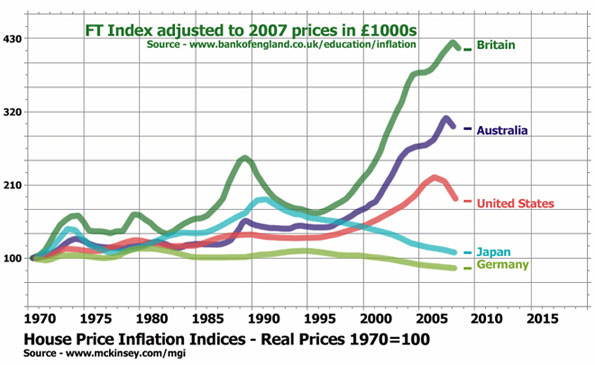
    This true fundamental problem is particularly evident here in Britain, the leader in house price inflation and housing financial bubbles since the 1970s. In their recent report Global capital markets, the McKinsey Global Institute has confirmed what has been shown in recent Demographia surveys.

    The root of this problem lies with an elite agenda that is highly ideological. The ideology at work is environmentalism, making a moral virtue of the retreat of political and commercial elites from the industrial production of housing.

    The preference is for interest payments on a fund of mortgage debt rather than the effort of turning a profit from development, let alone construction. Professionals like estate agents, planners, architects, and bankers are certainly in collusion with that elite ideology.

    That is not to say there is a conspiracy to plan a housing bubble. That is too crude. There is clearly regulation and legislation. On 24 November 2009 the Housing Minister John Healey confirmed that Britain will be the first country in the world to require zero carbon homes as a matter of law from 2016. Britain is the world leader in green ideology.

    John Healey
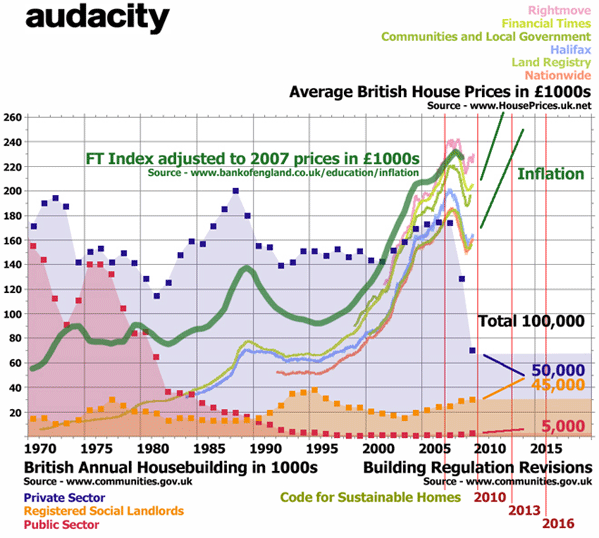
    All of the newly built British housing will have much better insulated walls, windows, roofs and floors. The clear aim of the government is to keep reducing the energy consumption of all new homes to be measured in kilowatt-hours per square metre of floor area per year. New Labour hope to make it law that total energy consumption is no more than 46 kWh/m2/year for semi-detached and detached homes, and then no more than 39 kWh/m2/year for all other homes. The energy efficiency standards will be applied from 2016, subject to yet another consultation on the Code for Sustainable Homes, announced at the end of 2006, and technically published for use on a voluntary basis in 2007. The building regulations get revised in 2010, 2013, and 2016 leading to this legal requirement for maximum energy consumption in all new homes.

    Healey says that “zero carbon” is a concept that will apply to a new home at the “point of build”. ‘We are not going to regulate through this policy how occupants live in them,’ he says. However the Code for Sustainable Homes assumes patterns of behaviour. Environmentalists within and without government will argue that behaviour needs to change. They will be suggesting all sorts of intrusions into daily life.

    British environmentalism couldn’t be more ideological, and more of a barrier to the production of affordable housing. The planning system has been “greened”. The mood is against development, and planning approvals for new land for new housing are hard to obtain. The zero carbon requirement will only apply to around the 100,000 new homes that will be built annually, while the existing stock is around 26 million homes. Healey is also going to regulate existing housing, and is not just looking at the residential sector.

    I am sure politicians like Healey don’t want their pursuit of “zero carbon” buildings to mean that fewer buildings are built. I am sure there are some environmentalists who will be pleased that building activity is in decline. The logic of green thinking entails that the most energy efficient thing to do is not to build more buildings at all.

    It is green not to build new homes to meet demographic demand. Let people modify their behaviour, say the environmentalists, and live together in as much of the existing stock as can be refurbished. It also happens that the existing stock is highly mortgaged, and the vast majority doesn’t want their homes to fall in value. An indefinite policy of green refurbishment of the homes that already exist and a future of house price inflation are highly compatible. That suits the mortgage lenders and the government. The commitment to “zero carbon” allows government to appear virtuous in its legislation for the new build sector.

    This suits the financial markets as well, since it guarantees house price inflation by making it difficult to meet the demographic demand for homes. Environmentalism offers more and more reasons not to build. Green thinking ensures that house price inflation can be sustained through a bubble, and projected beyond the bursting of that period of financialisation into the next.

    As capitalism ”greens” itself, capitalists continue to profit, while not meeting the fundamental demands of the people for housing. But simply restoring “the free market” will not solve the problem. In an old industrial country like Britain, there are ever more people who don’t earn enough to buy a home even at the “affordable” price of two and a half times their gross annual household income, which is the Demographia measure of affordability.

    This reality has a great appeal to what Robert Bruegmann refers to as “the incumbents club” – established homeowners, increasingly older, and those with inherited money. That majority want homes to be an appreciating asset, not a depreciating utility, like a pair of trousers, or a car. They want their home to appreciate in value, and they want to be green. Most people want to be greener and better off.

    Being anti-development for green reasons allows the incumbents to preserve their wealth, while making mundane opposition to new house building, or the attempt to constrain “sprawl”, seem virtuous. People don’t wake up thinking that they will inflate the value of their home by resisting sprawl in principle. Instead they oppose new development in the mistaken belief that Climate Change is caused by sprawling development. It is common for people to think that sprawl is bad for the planet, even while living, mostly with a mistaken sense of guilt, in the sprawl.

    By hoping for a “free market” solution to the problem of unaffordability, Hugh Pavletich of Demographia assumes that it is politicians, businessmen, and professionals who have distorted the market for reasons of narrow and immediate self-interest. Yet that is not how people think: they believe their environmentalism is morally above self-interest. They are saving the planet in their minds by blocking new building, and by their opposition to sprawl. The incumbents’ club members can feel virtuous at little cost to themselves and don’t worry too much about house price inflation. Of course there is no actual Club. There is no conspiracy. Homeowners simply share a self-interest in raising the value of their home, and tend to also want to show how selflessly green they are.

    This all has had the effect of making the lending of mortgages on inflated land values a much larger business than the construction of homes. No-one planned to cause a sequence of bubbles, but Britain’s desperate social dependence on sustained house price inflation can’t be brought to an end easily.

    The only way to stop national or regional housing bubbles recurring is the establishment of the freedom for everyone to build a home on cheap agricultural land without any government or professional hindrance except in matters of technical building regulations. Fire should not spread, and buildings should not fall down. But even building regulations can become ideological rather than technical. The British building regulations, as Healey has made clear, will also push energy efficiency standards to illogical extremes of peak performance in an attempt to address Climate Change. Even while the supply of new homes reduces

    The political freedom to build wouldn’t be a “free market” because not everyone is able to raise the finance to buy cheap land and pay for construction. The idea of a “free market” is a long running ideological myth. But the universal freedom to build would mean people are free to attempt to raise the finance to buy land and build.

    More importantly, the freedom to build would undermine the financialisation of the housing market. If everyone was free to build on cheap land the incumbents’ club would have to compare the value of their existing home to the cost of building a new one. Mortgage lenders would not be able to lend over the cost of construction unless they felt secure in doing so. The security of the 1947 Town and Country Planning Act would be removed for financiers. Government, the finance system, planners, or the incumbents’ club will be ideologically opposed to that for a host of environmental reasons. Britains mostly want to be greener but with renewed house price inflation, while no-one wants to make an argument explicitly for un-affordability. This may be confused and deluded, but it is an ideology promoted by the British government.

    However, ideas can be challenged and changed. One step is to understand that there is no “free market” housing solution. Getting rid of the 1947 denial of the freedom to build doesn’t mean an end to planning. Homes will still need to be planned, just as they were before 1947. But planners will not have the power to stop people from building. There is a need to politically end the environmentalist denial of the freedom to build in an industrial democracy. With a population free to build the finance system would be more interested in cheapening new construction on lower cost land, and not preoccupied with securing the financialisation of periodic but persistent house price inflation. A freedom to build is very much not a right to a home. It is a freedom from the obstructions of planners, with the weight of government legislation behind them. A freedom that is denied to protect the environment, a denial that sustains house price inflation.

    The market is not capable of being a “free market”. Capitalism is a system of control by political and commercial elites, and their professional employees. British capitalists tend to be less interested in industry, which is held to have caused Climate Change, and more interested in finance these days. What is precisely missing in the face of the morally selfless capitalist ideology of environmentalism is an ideology in favour of raising the productive capacity of the construction industry based on a universal sense of immediate and material self-interest. Getting rid of the 1947 planning legislation is a limited attempt to reconnect house building with the cost of construction and household incomes by removing the means by which house price inflation is sustained. Homes would be more of a utility than an investment in Britain, and we would cease to be world leaders in housing based financial bubbles.

    To do that requires us to oppose those who would be world leaders in the environmental ideology that industrial production is a problem for the planet. In Britain we need to set people free to build housing to the best of their abilities within a capitalist planning system stripped of the legal powers it gained in 1947. Innovative in their day, British planning now only sustains housing bubbles and restricts people’s opportunity for decent housing.

    Ian Abley, Project Manager for audacity, an experienced site Architect, and a Research Engineer at the Centre for Innovative and Collaborative Engineering, Loughborough University. He is co-author of Why is construction so backward? (2004) and co-editor of Manmade Modular Megastructures. (2006) He is planning 250 new British towns.

  • Will New Urbanists Deliver A Home-Win With Miami 21?

    By Richard Reep

    “A walkable city, more like… Manhattan, Chicago, or San Francisco,” is how The Miami Herald characterizes the future of Miami under Miami 21, the new form-based code adopted on October 22nd by the Miami City Commission. This seems to be the hot new dream not just of Miami, but of all cities struggling under corruption and greed, codes and regulations, with an imagined underground urbanity, yearning to breathe free. Citizens may now expect to see Miami remodeled after cities that grew before the car came, but the lyrics to The Who’s “Won’t Get Fooled Again” echo in the minds of some: “Meet the new boss…same as the old boss.”

    Miami 21, controversial for nearly four years and over 500 public meetings, met a critical need for citizens who were tired of the corruption and greed that seemed to result in an increasingly ugly, congested quasi-urban nightmare. Planning and zoning regulations, which were originally designed to protect property values, could be reinvented when enough power and money was at stake, and the code enforcers allowed more and more bizarre juxtapositions of high rises among low-scale residential neighborhoods. During the recent condo boom, variances became business as usual for the Miami City Commission and the Mayor. Now that the condo boom is over, it appears that both are rushing in to make amends to voters by passing this new form-based code.

    The code places height limits on neighborhoods similar to the old, Euclidean code, ominously named 11000. But this time around, uses are not segregated; instead, a mix of retail and other uses is intended to encourage increased pedestrian activity and a taking back of some of the city from the car. For citizens, there has been much to like about the arguments in favor of this code. As a result of the change, the pleasant weather that drew so many to the city will now perhaps be enjoyed on the boulevard; fear of shadows from looming high-rises will, according to the plan, now recede a bit. And a more organized, easy-to-understand building pattern should replace the Rube Goldberg-like zoning code full of special exceptions, arcane “bonus” rules, and a process all too easily subverted by tax-hungry politicians.

    With private development comatose, it is a perfect time for many jurisdictions to perform a much-needed overhaul of their development regulations. In the boom-bust atmosphere of Florida, most of the development industry sees this cease-fire as simply a pause to reload, and the Department of Community Affairs – Tallahassee’s growth management gatekeeper – is busy helping developers get ready for the next boom by making the Rural Land Stewardship Areas, a regulation designed to protect rural areas from development, officially optional.

    The American Institute of Architects chapter in Miami proposed to reform the old code, rather than start from scratch, arguing that the new code is complicated, fussy, and inhibiting. Reform of the existing 11000 code never seemed to be an option, and instead the Miami 21 code, written by New Urbanist gurus Andres Duany and Elizabeth Plater-Zyberg of DPZ, replaces the old code. Citizens of Miami, when presented with this new code, seemed ready for a change.

    This was an important home-win for DPZ and for New Urbanism in general. Increasingly associated with greenfield prettyboys like Celebration and Seaside, New Urbanism seemed to be losing ground and losing relevance at solving real-city problems. With the support of a massive public relations campaign, New Urbanism has now been given a chance to deliver on its promises of a “a clear vision for the City that will be supported by specific guidelines and regulations so that future generations will reap the benefits of well-balanced neighborhoods and rich quality of life.”

    Arcane spreadsheets, full of formulae and footnotes, have been replaced by transects. These silhouettes of buildings and streets – a sort of cross-section through the city – begin with the way a natural, un-built environment might look, progress to how a rural road looks, and go all the way up to how high-rise canyons might look. Patterning a city on a consensual, pre-approved notion of order is what New Urbanism is all about. There are no surprises – no high-rises in your backyard – but, as some local architects worry, there’s no spontaneity either.

    Walkability is another promise of the new code. Ideas such as transforming blank walls, promoting urban infill development, and lining parking garages with retailers, are all illustrated with magical dissolve images that change ugly parking garages into charming shopping districts. If it were only that easy.

    Transit-oriented development is a strategic goal of the code, creating density clusters that get people out of their cars and into alternative forms of transportation. Buses, bicycles, vanpools, and Miami’s Metrorail are closely interlinked with Miami 21.

    The marketing website for Miami 21 makes it impossible to be against the code. Opposing Miami 21 would be like opposing lifesaving drugs or opposing the blue sky. New Urbanism won this victory because there weren’t any compelling counter-arguments to their basic argument for urban hygiene. And Miami 21 comes at a time when the city has been egregiously abused at the hands of the free market; its citizens disenfranchised and suffering from an environment of ugliness, traffic and congestion.

    As noble as Miami 21’s goals are, however, they are only as good as the politicians in whose hands they will be used. Making new laws, rather than enforcing the old laws, is a favorite activity of politicians who, backed against the wall by irate voters, seek a grand solution. Much harder work will come when developers try to seek waivers against Miami 21, and if the history of Florida is any guide, it is not likely things will change much. For Miami 21 has some inherent costs that will split the haves and the have-nots of Miami-Dade County even further apart than they are now.

    For the haves, the higher cost of development under Miami 21 is already a concerning factor. The code promises increased regulation, and the density transects favor already high-value districts. At the last minute, for example, City Commissioner Marc Sarnoff switched his support to be in favor of a 35-foot height limit in Miami’s MiMo historic district, to the chagrin of property owners seeking higher buildings. Whether he stays on one side of the fence, or switches back at the behest of a developer, remains to be seen.

    In Miami, the validity of New Urbanism’s principles of how cities are regulated will finally be put to the test. By spelling out the city’s form in detail, through technical images, watercolor perspectives, and mock-historical drawings, Miami 21 is illustrating a preordained vision of itself. The public’s trust in its elected officials has been so broken by the recent capitalistic building frenzy that, by consensus, an agreed-upon “ideal city” has been created on paper. Now it is up to the building officials to deliver this vision when the next building boom hits.

    Instead of exploring how to improve the planning process, as AIA Miami suggested, Miami 21 seems to have avoided confronting the planning and process issues that no one seems to know how to solve. Have our cities become so complex that we are unable to manage their growth through the traditional public planning process? An even bigger question is whether the village-planning model at the core of New Urbanism is a valid model? Will it achieve the lofty goals that have been promised?

    Miami 21 will be a fascinating experiment to watch during the coming years. Miami is already known for taking risks: it built an elevated rail system in a suburban, multipolar city and encouraged an international development binge that resulted in a dozen or two empty skyscrapers. Now it has added formal prototyping to its use regulations. As Miami 21 is implemented and tested, other cities like St. Petersburg, Denver, and Philadelphia are following suit, hoping that the increased regulations will be the quick fix needed to assure the public that the civic realm is being cared for.

    Richard Reep is an Architect and artist living in Winter Park, Florida. His practice has centered around hospitality-driven mixed use, and has contributed in various capacities to urban mixed-use projects, both nationally and internationally, for the last 25 years.

  • DUBAI: A High Stakes Bet on the Future

    I picked up a copy of The Wall Street Journal-Europe on the concourse while boarding my Emirates Air flight from Paris to Dubai. The lead story provided an unexpected relevance to the trip – my first to Dubai. Dubai World, owned by the Dubai government, had announced a 6-month moratorium on payments of some of its $60 billion in debt. Since the announcement, stock markets have been dropping and recovering, company officials have attempted to calm borrowers and government officials have provided considerably less assurance than Dubai’s investors would have preferred.

    Here’s a brief guide to Dubai and some thoughts about its future.

    The United Arab Emirates: Dubai is one of the seven emirates of the United Arab Emirates (UAE), which like the United States and Canada is a federation. Broadly speaking, the emirates represent states or provinces. By far the richest is Abu Dhabi, with something like 10% of the world’s oil reserves. Just 100 miles up the eight-lane freeway is Dubai, with little in oil reserves, but which has used its previous income and massive borrowings to create one of the most spectacular urban environments in the world.

    An Architectural Feast: Dubai is a feast of modern high-rise architecture on shore, off shore and in man-made islands shaped like palms and a map of the world. A tour of the world’s most spectacular modern high-rise architecture could take many trips to China, including Shanghai’s Pudong, the developing western downtown of Beijing, the transforming core of Nanjing, around north station in Shenyang and the world’s largest boom-town, Shenzhen. But Dubai provides nearly as impressive a list of attractions within a comparatively few square miles.

    The Burj: Soon, the new world’s tallest building will open in Dubai. The Burj is virtually complete, with 160 floors and rising nearly 2,700 feet or more than 800 meters. The Burj is more than twice the height of the Empire State Building and a full 60% higher than the previous world record holder, Taipei 101. Adjacent to the Burj is Dubai Mall, which when completed will be the largest in the world. Another Mall, Emirates Mall, has an indoor ski area, a rather unique feature for the desert.

    The Main Street Freeway: The main thoroughfare in Dubai is Sheikh Zayad Road, a 12-14 lane freeway, with additional service lanes on both sides. On either side, there is a row of some of the world’s tallest buildings, often not more than a few feet apart. Except in the Burj area, the tall buildings tend to be in single rows, with low rise development beginning virtually at the rear lot lines.

    Dubai’s Upper North and South Sides: Manhattan has its upper east and west sides, while Dubai has its upper north and south sides. It is an open question which is more impressive, but if all of the planned construction is completed, Dubai’s skyline will overshadow that of New York. On the north side of Sheikh Zayed Road, there is the Dubai Marina, which played prominently in press reports expressing concern about the debt moratorium. Much of the Dubai Marina is still under construction. On the north side of Sheikh Zayed Road there is another development that appears to be at least as large as Dubai Marina, Jumeirah Towers, with many buildings still under construction. These two developments line the freeway for two miles and stretch at least 0.5 miles in each direction from the freeway. There are twin towers that appear to be generally modeled on New York’s classic Chrysler Building just to the east of the Marina on Sheikh Zayed Road. However, uncharacteristically for Dubai, they are not as tall.

    The Palms and the World: Some of the most spectacular architecture is just to the west of the Marina, in and around the Palm Jumeirah Island (actually four islands). The Palm Jumeirah is home to the Atlantis Hotel, which would be the talk of any town in the world, except Dubai, that is. The Jumerirah Palm island includes single family housing on its “fronds” and high rise condominiums at the entrance. A monorail operates, largely empty, to the Atlantis Hotel from the mainland, though does not connect to the Dubai Metro.

    The developer of the Palms and a group of islands called “The World” (in a shape somewhat like the world) is Nakheel, a subsidiary of Dubai World. This subsidiary was the unit that first indicated it would not be able to meet its financial obligations on time

    Burj Al Arab Hotel: Just to the east of Jumeirah Palm is one of Dubai’s oldest and best known architectural masterpieces, the Burj Al Arab Hotel, which sits offshore, though not at the distance many of the publicity photos suggest. This is a prehistoric structure by Dubai standards, having opened in 1999.

    Ring Roads and the Silicon Oasis: Dubai has two incomplete ring roads. The inner ring (Route 311 or “Emirates Road”), 12 lanes, runs through partially developed desert. The outer ring (Route 611), which is up to 10 lanes, runs through even less developed desert. There are, nonetheless, interesting projects along both roads. Dubai’s Silicon Oasis contains massive commercial buildings, still under construction, high rise condominium buildings and single family housing, which is behind security. This impressive development would be illegal in virtually all Australian urban areas, all of the UK and some US urban areas, because it would lie outside the urban growth boundaries that have been imposed by planners in those places.

    Academic City: On the edge of Silicon Oasis lies the Academic City, which contains branches of universities such as Murdoch (Perth, Australia) and Michigan State. Perhaps someday there will be an annual gridiron or soccer match played between the two in the nearby new Cricket Stadium nearby the Academic City.

    The Urban Area: The Emriate of Sharjah is to the immediate east of Dubai and continues the urbanization for many miles. The urban area (containing both Dubai and Sharjah) has approximately 2 million people. This is a very small population (less than that of Sacramento or Portland) for an urban area of such world significance and monumental architecture.

    The Dominant Ethnic Minority: The native or citizen population of “Emiratis” is much smaller, estimated at under 20%. The balance of the population is primarily expatriate workers who are in Dubai on temporary visas. So long as the hundreds of thousands of Indians, Pakistanis and others have employment, they can stay.

    Future Plans: Dubai has every intention of continuing its building binge. Already, a huge new international airport is under construction, which will have an annual capacity as much as 50% greater than the world’s largest airport (Atlanta). Unbelievably, the present airport, which has had significant recent expansion, would remain open. The two airports together would provide Dubai with more passenger capacity than the five airports of Los Angeles (with its 18 million consolidated metropolitan area population). There are many more hotels, large condominium and residential projects on the drawing boards. There are plans for a luxury hotel under water.

    Projects on Hold: However, Dubai may not be the master of its own fate. The UAE and the Emirate of Abu Dhabi, both with much more in financial resources, are expected to provide Dubai some relief. However, any assistance will come at a price. Control of crown jewel “Emirates Airlines” could be lost. The new international airport could be put off, particularly with nearby Abu Dhabi also expanding its airport

    The question is whether Dubai can rebound. There are plenty of uncompleted projects like the “City of Arabia” development along the Emirates Ring Road, far from the core. The project’s website says it will be completed in 2008. It is nearly 2010, and to put it mildly, from Emirates Road, the project appears to be a bit behind schedule.

    The undersea hotel project also appears to be on hold. The proposed Nakheel Tower could rise to over 4,000 feet and would be located just to the east of Jumeirah Towers. It was, however, put on hold in early 2009. Nakheel, of course, is at the heart of the Dubai financial crisis. Construction has apparently stopped on Nakheel’s Deira Palm (the largest of the palms) and the World.

    Of course, Dubai is not the only place where financial difficulties have put buildings on hold. Chicago’s “Spire” is little more than a circular hole next to Lake Shore Drive, rather than a rapidly rising edifice that would have been the world’s second tallest tower, after Dubai’s Burj.

    Whither Dubai? It seems fair to ask what Dubai was seeking to accomplish. On one hand, there was an interest in developing a strong tourism base, and tourism has increased over the past decade. Yet, Dubai attracts only 1/10th of tourism of Las Vegas, while having more than one-half the hotel rooms. One challenge is that what has been built may already be too large to be supported by the permanent population, Emirati or expatriate.

    But the real question is where Dubai goes from here. Late reports indicate that Dubai World intends to restructure nearly one-half of its debt. Creditors had hoped that the richer Emirate of Abu Dhabi would bail out Dubai, not much different from Texas bailing out a virtually bankrupt California. The more likely possibility could be that the UAE federal government itself might guarantee some debts but neither seem in any hurry to provide blanket relief. This could be reflective of the growing revulsion to the massive government bailouts from the Great Recession.

    At this point, the international repercussions appear unlikely to be large enough to start phase II of the Great Recession. Yet the notion of providing a safe “haven” in a tough neighborhood could still pay off in the long run as it has for cities like Singapore. It may not be conventional wisdom to say this, but the Emiratis could end up with the last laugh.

    Top photograph: Dubai Silicon Oasis
    Second Photograph: The Burj (November 27, 2009)

    Wendell Cox is a Visiting Professor, Conservatoire National des Arts et Metiers, Paris. He was born in Los Angeles and was appointed to three terms on the Los Angeles County Transportation Commission by Mayor Tom Bradley. He is the author of “War on the Dream: How Anti-Sprawl Policy Threatens the Quality of Life.

  • Capping Emissions, Trading On The Future

    Whatever the results of the Copenhagen conference on climate change, one thing is for sure: Draconian reductions on carbon emissions will be tacitly accepted by the most developed economies and sloughed off by many developing ones. In essence, emerging economies get to cut their “carbon” intensity–a natural product of their economic evolution–while we get to cut our throats.

    The logic behind this prediction goes something like this. Since the West created the industrial revolution and the greenhouse gases that supposedly caused this “crisis,” it’s our obligation to take much of the burden for cleaning them up.

    Plagued by self-doubt and even self-loathing, many in the West will no doubt consider this an appropriate mea culpa. Our leaders will dutifully accept cuts in our carbon emissions–up to 80% by 2050–while developing countries increase theirs, albeit at a lower rate. Oh, we also pledge to send billions in aid to help them achieve this goal.

    The media shills, scientists, bureaucrats and corporate rent-seekers gathered at Copenhagen won’t give much thought to what this means to the industrialized world’s middle and working class. For many of them the new carbon regime means a gradual decline in living standards. Huge increases in energy costs, taxes and a spate of regulatory mandates will restrict their access to everything from single-family housing and personal mobility to employment in carbon-intensive industries like construction, manufacturing, warehousing and agriculture.

    You can get a glimpse of this future in high-unemployment California. Here a burgeoning regulatory regime tied to global warming threatens to turn the state into a total “no go” economic development zone. Not only do companies have to deal with high taxes, cascading energy prices and regulations, they now face audits of their impact on global warming. Far easier to move your project to Texas–or if necessary, China.

    The notion that the hoi polloi must be sacrificed to save the earth is not a new one. Paul Ehrlich, who was the mentor of President Obama’s science advisor, John Holdren, laid out the defining logic in his 1968 best-seller, The Population Bomb. In this influential work, Ehrlich predicted mass starvation by the 1970s and “an age of scarcity” in key metals by the mid-1980s. Similar views were echoed by a 1972 “Limits to Growth” report issued by the Club of Rome, a global confab that enjoyed a cache similar to that of the United Nations’ Intergovernmental Panel on Climate Change.

    To deal with this looming crisis, Holdren in the 1977 book Ecoscience (co-authored with Anne and Paul Ehrlich) developed the notion of “de-development.” According to Holdren, poorer countries like India and China could not be expected to work their way out of poverty since they were “foredoomed by enormous if not insurmountable economic and environmental obstacles.” The only way to close “the prosperity gap” was to lower the living standards of what he labeled “over-developed” nations.

    These predictions were less than accurate. World-wide systemic mass starvation did not take place as population escalated. Rather those many millions wallowing in poverty in the developing world, particularly in Asia, lifted themselves into the global middle class. Far more efficient ways to use energy have been developed, and unexpected caches of new resources continue to be discovered all over the planet.

    Yet however wrong-headed, Holdren’s world view now has jumped from the dustbin of history into the craniums of presidents and prime ministers. President Obama’s pledge to “restore science to its rightful place” has morphed into state-sponsored scientific ideology.

    The blind acceptance of this agenda threatens the credibility of Obama and other Western leaders. For one, if the crisis is by its nature global why should we allow massive increases in carbon emissions in developing countries–China will soon surpass us in greenhouse gas emissions, if it hasn’t already–while we draconically cut ours? Does the planet really care if it’s turned to toast by American- vs. Chinese-made gas?

    Then there’s the specious historical narrative that insists we pay for creating the industrial revolution since it brought on global warming. Should the West pay for the sins of the British who brought electricity and railroads to India? Does America owe carbon penance for making the technology transfers critical to East Asia’s remarkable rise? Maybe we should start by making Wal-Mart cancel its China orders. That might help de-carbonize the planet a bit.

    There’s also growing skepticism about the whole warmist narrative. Climate change now ranks last among 20 top issues in a recent Pew report. There’s been a similar rise in skepticism in the U.K., once a hot bed of warmist sentiment.

    The reasons for the shift may vary. First, there’s a controversy over the temperatures of the past decade, with even some concerned about climate change admitting that there has not been the expected warming. Or perhaps a deep recession has made many “rich” countries feel a trifle less “overdeveloped.”

    And now we have Climate-gate–where leading warmist pedagogues are trying to suppress unsuitably conformist scientists and perhaps even cook the numbers a bit. Although you won’t see too much tough coverage in the mainstream press, the tawdry details have poured out over the Internet and diminished the aura of scientific objectivity of some leading global warming researchers. One recent poll shows that a large majority of Americans believe scientists may have indeed falsified their research data. By well over 4 to 1, they also believe stimulating the economy is a bigger priority than stopping global warming.

    Clearly the political risks of giving first priority to the carbon agenda are on the rise. Australia’s Senate just voted down that country’s proposed cap and trade scheme. The Western center-right, once intimidated by the well-financed greens and their media claque, has become bolder in challenging climate change alarmism.

    There’s also something of a rebellion brewing, at least toward emissions trading schemes, among some liberals from the South and Midwest, notably Wisconsin’s Russ Feingold and North Dakota’s Byron Dorgan. As analyst Aaron Renn has pointed out, these areas are most likely to be negatively affected by the current climate change legislation. Feingold recently stated that he was “not signing onto any bill that rips off Wisconsin.”

    So why do leaders like Barack Obama and British Prime Minister Gordon Brown continue identifying themselves with the climate change agenda and policies like cap and trade? Perhaps it’s best to see this as a clash of classes. Today’s environmental movement reflects the values of a large portion of the post-industrial upper class. The big money behind the warming industry includes many powerful corporate interests that would benefit from a super-regulated environment that would all but eliminate potential upstarts.

    These people generally also do not fear the loss of millions of factory, truck, construction and agriculture-related jobs slated to be “de-developed.” These tasks can shift to China, India or Vietnam–where the net emissions would no doubt be higher–at little immediate cost to tenured professors, nonprofit executives or investment bankers. The endowments and the investment funds can just as happily mint their profits in Chongqing as in Chicago.

    Global warming-driven land-use legislation possesses a similarly pro-gentry slant. Suburban single family homes need to be sacrificed in the name of climate change, but this will not threaten the large Park Avenue apartments and private retreats of media superstars, financial tycoons and the scions of former carbon-spewing fortunes. After all, you can always pay for your pleasure with “carbon offsets.”

    So who benefits from this collective ritual seppuku? Hegemony-seeking communist capitalists in China might fancy seeing America and the West decline to the point that they can no longer compete or fund their militaries. A weakened European Union or U.S. also won’t be able provide a model of a more democratic version of capitalism to counter China’s ultra-authoritarian version.

    The Chinese may win a victory in Copenhagen greater than anything accomplished so far in the marketplace–and our leaders will likely thank them for it. Forget bowing to the emperor in Tokyo; like vassal states at the height of the old Middle Kingdom, the new requisite diplomatic skill for Westerners will be kow-towing to Beijing.

    Yet most people in the developing world will not benefit from the suicide of the West. The warmists’ vision is not one of growing prosperity, but of capping wealth at a comparatively low level. De-industrialization means the West falls back while emerging economies grow a bit. The “prosperity gap” may close, but ultimately everyone is left with less prosperity.

    In the long run developing countries gain less from harvesting guilt than enjoying a bounty of customers, capital and expertise. The West’s experience and technology can assist developing nations in improving their far more greatly threatened environment. Turning the West into a spent force will leave the world poorer, dirtier and ultimately less hopeful.

    This article originally appeared at Forbes.com.

    Joel Kotkin is executive editor of NewGeography.com and is a distinguished presidential fellow in urban futures at Chapman University. He is author of The City: A Global History. His next book, The Next Hundred Million: America in 2050, will be published by Penguin Press early next year.