Category: planning

  • Police Pensions and Voodoo Actuarials

    A key argument that public-safety officials use to justify their absurdly high pension benefits –- i.e., “3 percent at 50” retirements that allow them to retire with 90 percent or more of their final year’s pay as early as age 50 — is this: We die soon after retirement because of all the stresses and difficulties of our jobs. This is such a common urban legend that virtually every officer who contacts me mentions this “fact.” They never provide back-up evidence.

    Here is one article I’ve been sent by police to make their point. It was written in 1999 by Thomas Aveni of the Police Policy Council, a police advocacy organization. Here is the key segment: “Turning our attention back towards the forgotten police shift worker, sleep deprivation must be considered a serious component of another potential killer: job stress. The cumulative effect of sleep deprivation upon the shift-working policeman appears to aggravate job stress, and/or his ability to cope with it.

    “Even more troubling is the prospect that the synergy of job stress and chronic sleep indebtedness contributes mightily to a diminished life expectancy. In the U.S., non-police males have a life-expectancy of 73 years. Policemen in the U.S. have a life expectancy of 53-66 years, depending on which research one decides to embrace. In addition, police submit workman’s compensation claims six times higher than the rate of other employees …”

    I don’t doubt that police work can be very stressful, but many jobs are stressful, many have long hours, many are more dangerous, many involve sleep deprivation. As intelligent adults, we all need to weigh the risk and benefits of any career choice. Aveni uses the high amount of workers compensation claims as evidence of the dangers of the job, but given the tendency of police and firefighters to abuse the disability system – miraculously discovering a disabling injury exactly a year from retirement, thus getting an extra year off and protecting half the pension from taxes – I’m not convinced this proves anything. Given the number of officers who are retired based on knee injuries, back aches, irritable bowel syndrome, acid reflux, etc., this suggests that police game the system and know their fellows on the retirement board will approve virtually any disability claim.

    There are so many legal presumptions (if an officer develops various conditions or diseases it is legally presumed to be work related, whether or not it actually is work related) that bolster the scam. “Disabled” officers often go right out and get similar law enforcement jobs, which calls into question how disabling the injury really is. Regarding sleep deprivation, police and firefighters have secured schedules that minimize the long hours; then the officers often choose to work overtime for double salary, which perhaps is the real cause of sleep problems.

    The big whopper in the Aveni article, however, is the claim that officers live to be 53-66. If that were so, there would be no unfunded liability problem because of pension benefits. Police officers would retire at 50-55, then live a few years at best.

    But, for example, according to the state of California pubic employees’ retirement system (CalPERS) actuary, police actually live longer than average these days, which isn’t surprising given that the earlier people retire and the wealthier they are, the longer they tend to live. And according to a 2006 report to the Oregon Public Employees Retirement System, these are the age-60 life expectancies for the system’s workers (meaning how many years after 60 they will live):

    — Police and fire males: 22.6
    — General service males: 23.4
    — Police and fire females: 25.7
    — General service females: 25.7

    So we see that police and firefighters who retire at age 60 live, on average, well into their 80s. That’s real data and not the hearsay used by apologists for enormous police pensions.

    CalPERS actuary David Lamoureux sent me a CalPERS presentation called “Preparing for Tomorrow,” from the retirement fund’s 2008 educational forum. The presentation features various “pension myth busters.”

    Here is Myth #4 (presented as part of a Power Point presentation): “Safety members do not live as long as miscellaneous members.” CalPERS officials explain that “rumor has it that safety members only live a few years after retirement.” Actuarial data answers the question: “Do they actually live for a shorter time?” The presentation considers the competing facts: “Safety members tend to have a more physically demanding job, this could lead to a shorter life expectancy. However, miscellaneous members sit at their desk and might be more at risk to accumulating table muscle!” Fire officials, by the way, make identical claims about dying as early as police officials.

    For answers, CalPERS looked at an experience study conducted by its actuarial office in 2004. It looked at post-retirement mortality data for public safety officials and compared it to mortality rates for miscellaneous government workers covered by the CalPERS system.

    Here are the CalPERS life expectancy data for miscellaneous members:

    — If the current age is 55, the retiree is expected to live to be 81.4 if male, and 85 if female.
    — If the current age is 60, the retiree is expected to live to be age 82 if male, and 85.5 if female.
    — If the current age is 65, the retiree is expected to live to be age 82.9 if male, and 86.1 if female.

    Here is the CalPERS life expectancy data for public safety members (police and fire, which are grouped together by the pension fund):

    — If the current age is 55, the retiree is expected to live to be 81.4 if male, and 85 if female.
    — If the current age is 60, the retiree is expected to live to be age 82 if male, and 85.5 if female.
    — If the current age is 65, the retiree is expected to live to be age 82.9 if male, and 86.1 if female.

    That’s no mistake. The numbers for public safety retirees are identical to those of other government workers. As CalPERS notes, average public safety officials retiree earlier than average miscellaneous members, so they receive their higher level of benefits for a much longer time.

    Here is CalPERS again: “Verdict: Myth #4 Busted! Safety members do live as long as miscellaneous members.”

    The next time you hear this “we die early” misinformation from a cop, firefighter or other public-safety union member (most of them probably believe it to be true, given how often they have read this in their union newsletters), send them to CalPERS for the truth!

    I expected these numbers for the recently retired, given the pension enhancements and earlier retirement ages, but it seemed plausible that police in particular might have had a point about mortality rates in earlier days. But even that’s not true. A 1987 federal report from the National Criminal Justice Reference Center, “Police Officers Retirement: The Beginning of a Long Life,” makes the following point:

    “’The average police officer dies within five years after retirement and reportedly has a life expectancy of twelve years less than that of other people.’ Still another author states, ‘police officers do not retire well.’ This fact is widely known within police departments. These statements (which are without supporting evidence) reflect a commonly held assumption among police officers.

    “Yet, a search of the literature does not provide published studies in support. Two suggested sources, the Los Angeles City Police and Massachusetts State Police, have provided data which also appears to contradict these assumptions. Reported in this paper are results from a mortality study of retired Illinois State Police (ISP) officers. It suggests that ISP officers have as long, if not longer, life expectancy than the population as a whole. Similar results also arise when examining retirees from the Ohio Highway Patrol, Arizona Highway Patrol, and Kentucky State Police.”

    The report also casts doubt on the commonly repeated statistic that police have higher rates of suicide and divorce than other people. The federal report found the divorce rates to be average and suicide rates to be below average. This is important information because it debunks a key rationale for the retirement expansions, although more recent data need to be examined on divorce/suicide rates.

    Police have an oftentimes tough job, but many Americans have oftentimes tough and sometimes dangerous jobs. This needs to be kept in perspective. Public officials need to deal in reality rather than in emotionally laden fantasy when considering the public policy ramifications of pensions.

    This article was excerpted from Greenhut’s forthcoming book, “Plunder! How Public Employee Unions Are Raiding Treasuries, Controlling Our Lives And Bankrupting The Nation” to be published by The Forum Press in November.

  • Congress and the Administration Take Aim at Local Democracy

    Local democracy has been a mainstay of the US political system. This is evident from the town hall governments in New England to the small towns that the majority of Americans choose to live in today.

    In most states and metropolitan areas, substantial policy issues – such as zoning and land use decisions – are largely under the control of those who have a principal interest: local voters who actually live in the nation’s cities, towns, villages, townships and unincorporated county areas. This may be about to change. Two congressional initiatives – the Boxer-Kerry Cap and Trade Bill and the Oberstar Transportation Reauthorization Bill – and the Administration’s “Livability Partnership” take direct aim at local democracy as we know it.

    The Boxer-Kerry Bill: The first threat is the proposed Senate version of the “cap and trade” bill authored by Senator Barbara Boxer-Kerry (D-California) and Senator John Kerry (D-Massachusetts). This bill, the Clean Energy Jobs and American Power Act (S. 1733), would require metropolitan planning organizations (MPOs) to develop greenhouse gas emission reduction plans. In these plans, the legislation would require consideration of issues such as increasing transit service, improvements to intercity rail service and “implementation of zoning and other land use regulations and plans to support infill, transit-oriented development or mixed use development.” This represents a significant step toward federal adoption of much of the “smart growth” or “compact development” agenda.

    At first glance, it may seem that merely requiring MPOs to consider such zoning and land use regulations seems innocent enough. However, the incentives that are created by this language could well spell the end of local control over zoning and land use decisions in the local area.

    True enough, the bill includes language to indicate that the bill does not intend to infringe “on the existing authority of local governments to plan or control land use.” Experience suggests, however, that this would provide precious little comfort in the behind-the-scenes negotiations that occur when a metropolitan area runs afoul of Washington bureaucrats.

    The federal housing, transportation and environmental bureaucracies have also been supportive of compact development policies. As these agencies develop regulations to implement the legislation, they could well be emboldened to make it far more difficult for local voters to retain control over land use decisions. There could be multiple repeats of the heavy-handedness exercised by the EPA when it singled out Atlanta for punishment over air quality issues. In response, the Georgia legislature was, in effect, coerced into enacting planning and oversight legislation more consistent with the planning theology endorsed by EPA’s bureaucrats. No federal legislation granted EPA the authority to seek such legislative changes, yet they were sought and obtained.

    There is also considerable support for the compact development agenda at the metropolitan area level. The proclivity of metropolitan and urban planners toward compact development is so strong as to require no encouragement by federal law. The emerging clear intent of federal policy to move land use development to the regional level and to densify existing communities could encourage MPOs to propose plans that pressure local governments to conform their zoning to central plans (or overarching “visions”) developed at the regional level. Along the way, smaller local jurisdictions could well be influenced, if not coerced into actions by over-zealous MPO staff claiming that federal law and regulation require more than the reality. It would not be the first time. Further, MPOs and organizations with similar views can be expected to lobby state legislatures to impose compact development policies that strip effective control of zoning and land use decisions from local governments.

    Surface Transportation Reauthorization: The second threat is the Surface Transportation Authorization Act (STAA or reauthorization) draft that has been released by Chairman James Oberstar (D-Minnesota) of the House Transportation and Infrastructure Committee. This bill is riddled with requirements regarding consideration of land use restrictions by MPOs and states. Unlike the Boxer-Kerry bill, the proposed STAA includes no language denying any intention to interfere with local land use regulation authority.

    Like the Boxer-Kerry Bill, the Oberstar bill significantly empowers the Department of Transportation and the Environmental Protection Agency and poses similar longer term risks.

    The Administration’s “Livability Agenda:” These legislative initiatives are reinforced by the Administration’s “Livability Agenda,” which is a partnership between the EPA, the Department of Housing and Urban Development and the Department of Transportation. Among other things, this program is principally composed of compact development strategies, including directing development to certain areas, which would materially reduce the choices available to local government. Elements such as these could be included in an eventual STAA bill by the Obama Administration.

    The Livability Agenda: Regrettably, the Boxer-Kerry bill, the Oberstar bill and the “Livability Agenda” will make virtually nothing more livable. If they are successful in materially densifying the nation’s urban areas, communities will be faced with greater traffic congestion, higher congestion costs and greater air pollution. Despite the ideology to the contrary, higher densities increase traffic volumes within areas and produce more health hazards through more intense local air pollution. As federal data indicates, slower, more congested traffic congestion produces more pollution than more freely flowing traffic, and the resulting higher traffic volumes make this intensification even greater.

    There are also devastating impacts on housing affordability that occur when “development is directed.” This tends to increase land prices, which makes houses more expensive. This hurts all future home buyers and renters, particularly low income and minority households, since rent increases tend to follow housing prices. It is particularly injurious to low income households, which are disproportionately minority. The large gap between majority and minority home ownership rates likely widen further. So much for the American Dream for many who have not attained it already.

    The Marginal Returns of Compact Development Policies: These compact development initiatives continue to be pursued even in the face of research requested by the Congress indicating that such policies have precious little potential. The congressionally mandated Driving and the Built Environment report indicates that driving and greenhouse gas emissions could be higher in 2050 than in 2000 even under the maximum deployment of compact development strategies.

    Local Governments at the Table? The nation’s local governments should “weigh in” on these issues now, while the legislation is being developed. If they wait, they could find bullied by EPA and MPOs to follow not what the local voters want, but what the planners prefer. Local democracy will be largely dead, a product of a system that concentrates authority – and perceived wisdom – in the hands of the central governments, at the regional and national level.

    Even more, local citizens and voters need to be aware of the risk. It will be too late when MPOs or other organizations, whether at their own behest or that of a federal agency, force the character of neighborhoods to be radically changed, as Tony Recsei pointed out is
    already occurring in Australia.

    Wendell Cox is a Visiting Professor, Conservatoire National des Arts et Metiers, Paris. He was born in Los Angeles and was appointed to three terms on the Los Angeles County Transportation Commission by Mayor Tom Bradley. He is the author of “War on the Dream: How Anti-Sprawl Policy Threatens the Quality of Life.

  • Smart Growth Places 3rd in Houston Mayor’s Race

    Houston city councilman Peter Brown, unique as a devotee of smart growth (compact development) in this city of light land use regulation, placed third in the mayoral election yesterday. Brown had long advocated Portland-style smart growth land use and development policies for the city of Houston and looked likely to garner the most votes in the four-way race. Brown, an architect and urban planner, spent more than $3 million of his own money in the election.

    The Houston metropolitan area distinguished itself by not experiencing the profligate credit and smart growth related house price bubble and, as a result experienced little decline in house prices and largely avoided the Great Recession. Houston is the largest municipality in the nation without zoning, however, with land regulation being principally limited to private covenants between land owners. Other Texas metropolitan areas also averted the housing bubble and the Great Recession, because their generally more liberal approaches to land regulation did not produce the price distortions that occurred in more highly regulated metropolitan areas as in California, Florida, Arizona, Nevada, the Pacific Northwest and the Northeast.

  • Detroit: Urban Laboratory and the New American Frontier

    The troubles of Detroit are well-publicized. Its economy is in free fall, people are streaming for the exits, it has the worst racial polarization and city-suburb divide in America, its government is feckless and corrupt (though I should hasten to add that new Mayor Bing seems like a basically good guy and we ought to give him a chance), and its civic boosters, even ones that are extremely knowledgeable, refuse to acknowledge the depth of the problems, instead ginning up stats and anecdotes to prove all is not so bad.

    But as with Youngstown, one thing this massive failure has made possible is ability to come up with radical ideas for the city, and potentially to even implement some of them. Places like Flint and Youngstown might be attracting new ideas and moving forward, but it is big cities that inspire the big, audacious dreams. And that is Detroit. Its size, scale, and powerful brand image are attracting not just the region’s but the world’s attention. It may just be that some of the most important urban innovations in 21st century America end up coming not from Portland or New York, but places like Youngstown and, yes, Detroit.

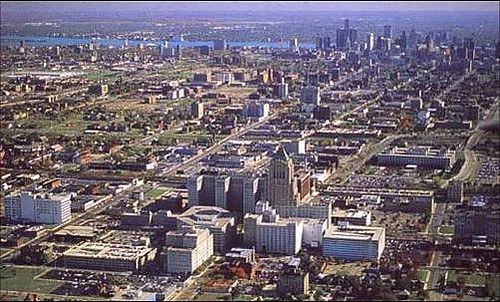
    Let’s refresh with this image showing the scale of the challenge in the city of Detroit proper:


    There are zillions of pictures to illustrate the vast emptiness in Detroit. Kaid Benfield at NRDC posted these:


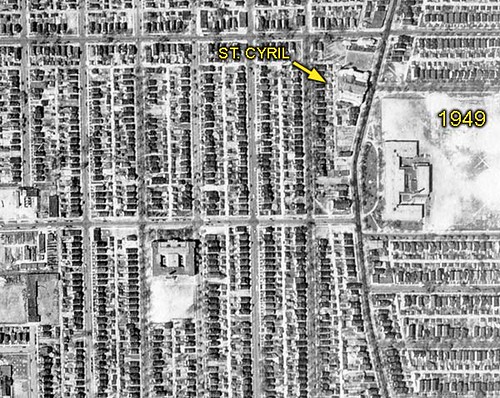
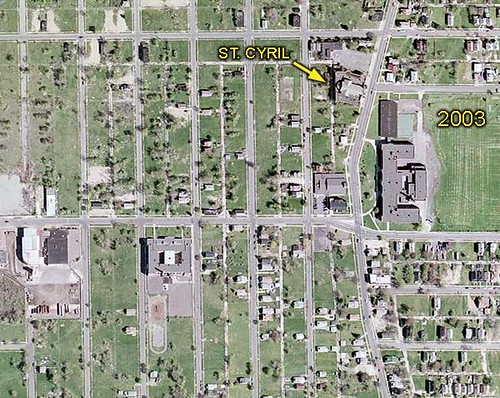
    This phenomenon prompted someone to coin the term “urban prairie” to capture the idea of vast tracts of formerly urbanized land returning to nature. The folks at Detroit’s best discussion site, DetroitYES, posted this before and after of the St. Cyril neighborhood. Before:


    After:


    A site named “Sweet Juniper” recently had a fantastic photo of the spontaneous creation of “desire line” paths across all this vacant land. You should click to enlarge this photo.


    One natural response is the “shrinking cities” movement. While this has gotten traction in Youngstown and Flint, as well as in places like Germany, it is Detroit that provides the most large scale canvas on which to see this play out, as well as the place where some of the most comprehensive and radical thinking is taking place. For example, the American Institute of Architects produced a study that called for Detroit to shrink back to its urban core and a selection of urban villages, surrounded by greenbelts and banked land. Here’s a picture of their concept:


    It seems likely that this will get some form of traction from officialdom, as this article suggests, though implementation is likely to be difficult.

    Detroit is also attracting dreams of large scale renewal through agriculture, as Mark Dowie writes in Guernica (hat tip @archizoo).

    Were I an aspiring farmer in search of fertile land to buy and plow, I would seriously consider moving to Detroit. There is open land, fertile soil, ample water, willing labor, and a desperate demand for decent food. And there is plenty of community will behind the idea of turning the capital of American industry into an agrarian paradise. In fact, of all the cities in the world, Detroit may be best positioned to become the world’s first one hundred percent food self-sufficient city.

    This isn’t just a crazy idea from some guy who lives in California. He documents several examples of people right now, today growing food in Detroit. It wouldn’t surprise me, frankly, if Detroit produces more food inside its borders today than any other traditional American city.

    About five hundred small plots have been created by an international organization called Urban Farming, founded by acclaimed songwriter Taja Sevelle. Realizing that Detroit was the most agriculturally promising of the fourteen cities in five countries where Urban Farming now exists, Sevelle moved herself and her organization’s headquarters there last year. Her goal is to triple the amount of land under cultivation in Detroit every year. All food grown by Urban Farming is given free to the poor. According to Urban Farming’s Detroit manager, Michael Travis, that won’t change.

    The fact that Urban Farming moved to Detroit is exactly the effect I’m talking about. To anyone with aspirations in this area, it is Detroit that offers the greatest opportunity to make your mark. It is the ultimate blank canvas. For urban agriculture and many other alternative urban dreams, it is Detroit, not New York City that is the ultimate arena in which to prove yourself.

    It’s not just farmers; intellectuals and artists of various types are drawn to Detroit, both to study it and pursue ideas about the remaking of the city:

    Detroit has achieved something unique. It has become the test case for all sorts of theories on urban decay and all sorts of promising ideas about reviving shrinking cities.

    “It’s unbelievable,” said Sue Mosey, president of the University Cultural Center Association, who has been interviewed recently by two separate PBS crews and an Austrian journalist writing about Detroit.

    “All of us have been inundated with all of these people who somehow think that because we’re so bottomed out and so weak-market, that this is this incredible opportunity,” Mosey said.

    Robin Boyle, a professor of urban planning at Wayne State University who has been interviewed by numerous visitors, echoed that sentiment.

    “They realize that there is an interesting story to tell, that has real characters, but even more, they discover a place that is simply not like everywhere else,” he said.

    Toby Barlow wrote in the New York Times about out of towners buying up $100 houses, moving to Detroit, and doing all sorts of interesting things with them:

    Recently, at a dinner party, a friend mentioned that he’d never seen so many outsiders moving into town…Two other guests that night, a couple in from Chicago, had also just invested in some Detroit real estate. That weekend Jon and Sara Brumit bought a house for $100.
    ….
    A local couple, Mitch Cope and Gina Reichert, started the ball rolling. An artist and an architect, they recently became the proud owners of a one-bedroom house in East Detroit for just $1,900. Buying it wasn’t the craziest idea. The neighborhood is almost, sort of, half-decent. Yes, the occasional crack addict still commutes in from the suburbs but a large, stable Bangladeshi community has also been moving in.

    So what did $1,900 buy? The run-down bungalow had already been stripped of its appliances and wiring by the city’s voracious scrappers. But for Mitch that only added to its appeal, because he now had the opportunity to renovate it with solar heating, solar electricity and low-cost, high-efficiency appliances.

    Buying that first house had a snowball effect. Almost immediately, Mitch and Gina bought two adjacent lots for even less and, with the help of friends and local youngsters, dug in a garden. Then they bought the house next door for $500, reselling it to a pair of local artists for a $50 profit. When they heard about the $100 place down the street, they called their friends Jon and Sarah.
    ….

    But the city offers a much greater attraction for artists than $100 houses. Detroit right now is just this vast, enormous canvas where anything imaginable can be accomplished. From Tyree Guyton’s Heidelberg Project (think of a neighborhood covered in shoes and stuffed animals and you’re close) to Matthew Barney’s “Ancient Evenings” project (think Egyptian gods reincarnated as Ford Mustangs and you’re kind of close), local and international artists are already leveraging Detroit’s complex textures and landscapes to their own surreal ends.

    In a way, a strange, new American dream can be found here, amid the crumbling, semi-majestic ruins of a half-century’s industrial decline. The good news is that, almost magically, dreamers are already showing up. Mitch and Gina have already been approached by some Germans who want to build a giant two-story-tall beehive. Mitch thinks he knows just the spot for it.

    It’s what Jim Russell likes to call “Rust Belt chic”, and Detroit has it in spades.

    This piece also highlights the absolutely crucial advantage of Detroit. It’s possible to do things there. In Detroit, the incapacity of the government is actually an advantage in many cases. There’s not much chance a strong city government could really turn the place around, but it could stop the grass roots revival in its tracks.

    Can you imagine a two-story beehive in Chicago? In many cities where strong city government still functions effectively, citizens are tied down by an array of regulations and permits that are actually enforced in most cases. Much of the South Side of Chicago has Detroit like characteristics, but the techniques of renewal in Detroit won’t work because they are likely against code and would be shut down the minute someone complained. Just as one quick example, my corner ice cream stand dared to put out a few chairs for patrons to sit on while enjoying a frozen treat on a hot day. The city cited them for not having a license. So they took them away and put up a “bring your own chair” sign. The city then cited them for that too. You can’t do anything in Chicago without a Byzantine array of licenses, permits, and inspections.

    In central Indianapolis, which is in desperate need of investment, where the city can’t fill the potholes in the street, etc., the minute a few yuppies buy houses in an area and fix them up, they immediately petition for a historic district, a request that has never been refused, ensuring that anyone who ever wants to do anything will be forced to run a costly and grueling gauntlet of variances, permits, hearings, etc. Only the most determined are willing to put up with that.

    In most cities, municipal government can’t stop drug dealing and violence, but it can keep people with creative ideas out. Not in Detroit. In Detroit, if you want to do something, you just go do it. Maybe someone will eventually get around to shutting you down, or maybe not. It’s a sort of anarchy in a good way as well as a bad one. Perhaps that overstates the case. You can’t do anything, but it is certainly easier to make things happen there than in most places because the hand of government weighs less heavily.

    What’s more, the fact that government is so weak has provoked some amazing reactions from the people who live there. In Chicago, every day there is some protest at City Hall by a group from some area of the city demanding something. Not in Detroit. The people in Detroit know that they are on their own, and if they want something done they have to do it themselves. Nobody from the city is coming to help them. And they’ve found some very creative ways to deal with the challenges that result. Consider this from the Dowie piece:

    About 80 percent of the residents of Detroit buy their food at the one thousand convenience stores, party stores, liquor stores, and gas stations in the city. There is such a dire shortage of protein in the city that Glemie Dean Beasley, a seventy-year-old retired truck driver, is able to augment his Social Security by selling raccoon carcasses (twelve dollars a piece, serves a family of four) from animals he has treed and shot at undisclosed hunting grounds around the city. Pelts are ten dollars each. Pheasants are also abundant in the city and are occasionally harvested for dinner.

    This might sound awful, and indeed it is. But it is also an inspiration and a testament to the human spirit and defiant self-reliance of the American people. I grew up in a poor rural area where, while hunting is primarily recreational, there are still many people supplementing their family diet with wild game. Many a freezer is full of deer meat, for example. And of course, rural residents have long gardened, freezing and canning the results to help get them through the winter. So this doesn’t sound quite so strange to me as it might to you. The fate of the urban poor and the rural poor are more similar than is often credited. And contrary to stereotypes the urban poor often display amazing grit and ingenuity, and perform amazing feats to sustain themselves, their families and communities.

    As the focus on agriculture and even hunting show, in Detroit people are almost literally hearkening back to the formative days of the Midwest frontier, when pioneer settlers faced horrible conditions, tough odds, and often severe deprivation, but nevertheless built the foundation of the Midwest we know, and the culture that powered the industrial age. No doubt in the 19th century many of those sitting secure in their eastern citadels thought these homesteaders, hustlers, and fortune seekers crazy for leaving the comforts of civilization to head to places like Iowa and Chicago. But some saw the possibilities of what could be and heeded the call to “Go West, young man.” We’ve come full circle.

    More Detroit

    Detroit: Do the Collapse
    Detroit: Not the Future of the American City
    For talent – good jobs, cools places, new narrative (Crain’s Detroit Business – featuring Yours Truly)

    Aaron M. Renn is an independent writer on urban affairs based in the Midwest. His writings appear at The Urbanophile.

  • Report from Orlando: The Spirit Rocks On

    By Richard Reep

    “In hard times, people turn to God or alcohol” jokes Bud Johnson of Constructwire, a database that tracks planning and construction projects nationwide. Johnson, 50, is an industry veteran and has never seen a recession like this in his career. “This is an exceptionally broad-based downturn,” he says, “and Orlando has been hit harder than most in the South, what with your only real industries being housing and tourism.” Both industries have been trapped like mammoths in a glacier as the credit market stays stubbornly frozen in a modern banking Ice Age.

    At the bottom of the glacier, however, the meltwater continues to flow, and bars and liquor stores seem to be thriving. With 10 new ABC stores open this year, this privately held Orlando-based liquor retailer is doing just fine, enabling many of us to stay sane, if not sober, while waiting for The Recovery. The alchoholic spirits are not the only mood-shifting business doing well in these hard times. Sacred space may not be exactly booming, but religious buildings are being built at a more comfortable pace than nearly any other building type in Central Florida.

    “Ecclesiastical architecture is falling at a rate close to that of a paper airplane, while my other building types have the glide ratio of a rock,” says Peter Kosinski, the architect responsible for the renovation of St. James Cathedral in downtown Orlando. With most other projects on hold, including a share of churches, Kosinski Architecture has still seen most of his religious work proceed, despite the Great Recession. Funding largely comes from donations, and for secular not-for-profits cultural outfits like United Arts, giving has evaporated. Spiritual needs, however, seem to be drawing a steady stream of money to expand or add to temples, churches, synagogues, and other sacred spaces to meet a growing demand in the Central Florida area.

    If the credit Ice Age is a part of a great karmatic rebalancing, it was long overdue and has hit especially hard in our overheated, consumer-driven culture. The cynics, who knew the cost of everything and the value of nothing, drove sacred space largely underground as new subdivisions engorged Orlando with not a square inch reserved for community worship. Religious uses simply don’t fit the profit model of late capitalism, and while our older neighborhoods are dotted with small, walk-to churches, not a cross can be found in the landscape of most newer developments. To the development industry, collective religious worship represents someone else’s unprofitable land sale.

    Cobbling together 15 or 20 acres therefore became a new art form for many evangelical pastors as the late 20th century saw the rise of the megachurch. These huge, Sunday-traffic-nightmares offer sophisticated audio/visual Christian themed entertainment in an arena setting, a perfect way for many to fulfill their spiritual needs. Others, stuck in these vast residential tracts devoid of sacred space, use the house-church method, gathering in groups of 8 or 10 at a member’s residence, taking heart in what Pope Gregory the Great (an early leader) stated: “The real altar of God is the mind and the heart of the just.” And some do both.

    Either way, the religious needs of the people of Central Florida are expanding, and the sanctuaries, temples, synagogues, and mosques are noticeably busier. The 2-year-old Guang Ming Temple, housing the local Renzai Humanist Buddhists, is experiencing a surge in attendance locally. Temple Director Chueh Fan confirms that there is a strong need for a communal spiritual facility. “We feel the hardship of people right now,” she states. “Although the Asian community here is stable, we have been growing over the last 2 years. And we are a middle-sized temple; there are some much bigger in other states.” Guang Ming offers Dharma classes in Spanish, English, Vietnamese and Chinese, and class enrolment is growing quickly.

    Other clerics, such as Reverend Reginald Dunston, also see a need for more religious-based education, and are planning new schools as well as sanctuaries. “Agape Word Ministry is planning a bible-based school,” he explains, “as an alternative to the schools in the area.” Other pastors, such as Jeff Cox of Salem Lutheran Church in Bay Hill, agree that it is important to expand their offerings to include a religious-based education. Education is the one tangible asset that a community is willing to purchase from a house of worship, and while most religions in America struggle for relevance, their schools remain in demand.

    Christianity, exploding in a pluralism not seen since the Reformation, is especially sensitive to its status as the dominant American religion. While over 4,000 new churches open nationwide annually, another 3,700 close, according to David T. Olson in his 2008 book “The American Church in Crisis.” This is near status quo, despite population growth, suggesting a shift away from collective religious worship for many. Hispanics, traditionally more observant, are building megachurches at a far faster clip than non-Hispanics, pointing to a loss of interest in collective Christianity for the majority of the population.

    Locally then, the house of worship is entering a phase of experimentation as new forms, such as megachurches, are tried; it is discarded altogether by the house-church movement; and it is growing in some religions such as Buddhism, with their new temple, and Judaism, with the construction of the new JCC South Campus on Apopka Vineland Road. The mainline Christian denominations that dominate downtown’s skyline serve less and less as a model for new buildings as malls are repurposed, warehouse buildings are adapted, and more novel programs and designs are tried.

    Hindu, Jain, and Muslim traditions are also represented in Orlando, and generally playing to full houses. The Masjid Al-Haqq mosque on West Central Boulevard on a Friday afternoon was brimming full, with more worshippers arriving by car and by foot. Collective spiritual worship of all forms is clearly a rising force within Orlando, and space on pews, benches, chairs and prayer mats are at a premium.

    Missing from many lives, crucial to others, religion is at an odd crossing in Central Florida’s history. To balance empty pocketbooks, some people are filling their cups with booze but others are also imbibing a perhaps long-delayed return to spirituality. This return, however, is marked by a mosaic of multiple religions, rather than a return to the few mainstream denominations that characterized early Orlando’s growth. If Bud Johnson is right, and this surge in spirituality lasts through The Recovery, Orlando will see a boom in new religious architecture that might make up for lost time, creating a revival in sacred space in the Central Florida landscape.

    Richard Reep is an Architect and artist living in Winter Park, Florida. His practice has centered around hospitality-driven mixed use, and has contributed in various capacities to urban mixed-use projects, both nationally and internationally, for the last 25 years.

  • The Week New Urbanism Died?

    It has been a bad media week for New Urbanism.

    The day that New Urbanism Died?” was the headline of the St. Louis Urban Workshop blog that detailed the Chapter 11 bankruptcy of Whittaker Builders, developer of the “New Town at St. Charles,” a premier New Urbanist community located in the St. Louis exurbs (beyond the suburbs).

    The author notes that “New Town will not disappear, plenty of people are happy to live there, but its promise is gone. It’s become just another suburban enclave and will face the same challenges as other suburban developments; lack of retail, long commutes, etc.” The blog’s headline is a play on a characterization by postmodern architect Charles Jenks, who referred to the demolition of the infamous Pruitt-Igoe public housing project as “The Day Modern Architecture Died.”

    The Northwest Indiana Times detailed the failure of a new urbanist community (Coffee Creek) in an October 23 article. The article noted that the planned 2,000 home mixed use development, located in the exurbs 45 miles from Chicago’s Loop had attracted only 12 homes and an apartment building. Much of the empty land has been purchased by another developer, who indicated an affection for the new urbanism concept, noting however that it probably would not work here. The article notes that a more modest New Urbanist development is doing better, in nearby Burns Harbor, with 75 homes occupied out of a planned 300.

    Perhaps the unkindest cut of all was a survey, reported by the Oregonian, to the effect that residents of Orenco Station travel by car to work nearly as much as people who live in the unremarkably conventional and sprawling suburbs of Portland.

    Despite these unhappy stories, the death of New Urbanism is not imminent. True, to the extent that New Urbanism requires subsidies it is likely to prove unsustainable in the longer term, like its Pruitt-Igoe type predecessors. On the other hand, to the extent that New Urbanism represents a genuine response of architects, builders and developers to actual, rather than imagined demand, New Urbanism could be with us for some time to come.

  • Home-Based Businesses: Residential Zoning and The Cyber Village

    Currently in the United States about 27% of all homes have some form of a home based business. These businesses can be key to conservation efforts that lower our carbon footprint by reducing transportation needs, eliminating redundant facilities, and consolidating equipment. They provide significant opportunities for two solutions to problems that face today’s growth issues.

    My software company was founded in Dallas, where I worked from the dining room table in an apartment. I yearned for the day my business could operate out of a real office. After the business started generating a positive cash flow the apartment was left behind, and my office moved to a location in the newly built Dallas Galleria. My 104 square feet of office space was complimented with a separate meeting room, receptionist, and a parking space in the garage. All this cost me $600 a month. After the initial six month lease was up the rent skyrocketed and parking was no longer free; however, the 104 square feet remained the same.

    Oh, how I yearned for a nice dining room table to work from!

    Soon I decided that the money spent on rent — both apartment and Galleria office — could build a really nice home. In 1982 I built a home specifically designed for a residence and my business. With about 4,000 square feet, of which about one third was dedicated business space with a separate office entrance, we had a viable base from which to live and work.

    The IRS allowed us to write-off one third of the total housing expenses without question. By not having to pay office rent we could double the home payments, and the 30 year mortgage was paid in full in less than 10 years.

    Maple Grove, the lakefront suburban Minnesota community where we had built, allowed a home business occupation via ordinance limited to one non-family employee. At first we complied, but the business grew. At times there were up to 6 employees at the home, but neighbors did not complain.

    I was not the only lake front home operating a big business. Across the lake, a major manufacturer of car radar warning units operated out of the basement of a house. This was a husband-and-wife business, but it was no small operation. The company had full page ads in leading automotive magazines. I sometimes visited; I’d hear the phone ring with an order, and the wife would say ‘I’ll see if we have any in stock at the warehouse, can you hold?’ She would then call down to the basement and ask if they could make an A-50 unit for shipping. Nobody but the UPS man would know the truth!

    Solution #1: The Residential/Business
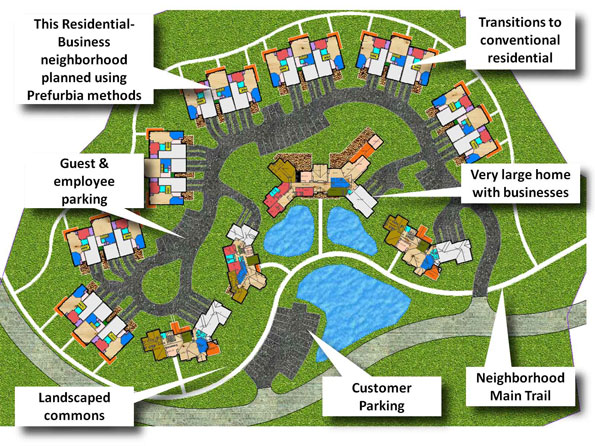
    The Residential/Business (RB zoning) would be an entirely new land use, sort of a morphing of an office center and a neighborhood of luxury single family homes. Office complexes typically have a higher degree of landscaping and architectural detail than single family developments. In the RB neighborhood, homes would be large and impressive with heavily landscaped commons that serve as pedestrian access to the businesses that are located within the home structure.

    Family members and employees would park in the rear, with multiple garage spaces and outside parking for the employees. From the arterial streets abutting these developments it would be an impressive sight, giving a sense of wealth to the neighborhood and municipality. The types of businesses would be restricted to low traffic professional services, including medical services, but also could include very light manufacturing. The RB zones would be an excellent transition (buffer) from commercial centers to residential ones. The RB residential structures would house the entire business and home, serving as the main hub for all of the business needs.

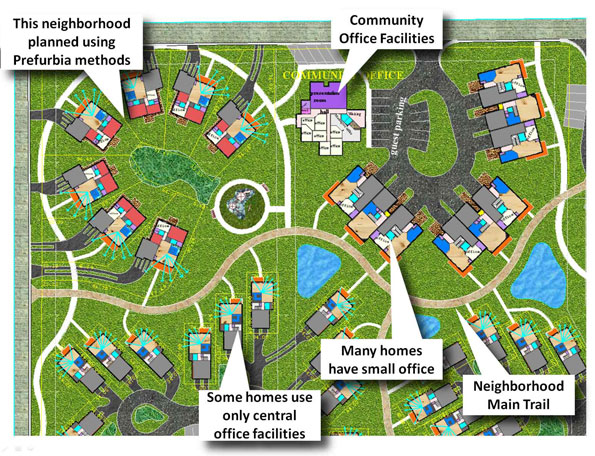
    Below, a Residential/Business community

    There could be some overlap of business functions into the residential elements of the home. For example, a conference center with an 80 inch screen for presentations could be used for Monday night football on occasion. From a financial standpoint, for a small to medium sized business owner this is a win-win situation. It delivers the advantages that I had experienced in my own situation in a comprehensive, specifically designed development plan.

    Solution #2: The Cyber Village
    George E. Van Hoesen, of Global Green Building, LLC, has developed an alternative solution, the Cyber Village.

    The proliferation of computers and cell phones, as well as video conferencing and express delivery, has made the notion of the at-home cyber office an excellent solution for growth issues. New definitions of work, recreation, and education have brought the family home again. Residential design and community planning can begin to address the increasing needs of these new households while keeping the neighborhood’s primarily residential character.

    Unlike the Residential/Business solution, homes in the Cyber Village need not be as business intensive or change the character of a neighborhood. A main component of the Cyber Village is the Cyber Office, serving as the community foundation for business activity. This facility, complete with offices, reception services, mail services, meeting rooms, board rooms, reference libraries and office equipment, would serve subscribers (businesses within the neighborhood) for their out-of-office and administrative needs. This Cyber Office location could serve as the hub for deliveries, recycling, storm shelter, resource center, rideshare, and other community resource needs. Subscribers would choose the level of access to the facility based on their own individual business needs. The features of the cyber office would lend credibility and added professionalism to a residence-based business without breaking the bank.

    Below, a Cyber Village

    The neighborhood Cyber Office could be managed as a for-profit business, providing services for a fee. Communities could also manage a Cyber Office as a part of the homeowners association. A mix of services could be provided, depending on the needs of the community. The overall concept reduces the carbon footprint of the home-based business and addresses the needs of the changing work place.

    Zoning Both Solutions
    Both solutions fall outside the scope of conventional zoning. The Cyber Village may comply more easily with existing regulations, especially those that allow a home to operate a business with a few employees. If a city’s regulations are flexible enough, it may be possible to design and implement a Cyber Village that complies with city code now. The Residential/Business solution, with its more aggressive business size, would compete with — or make obsolete — office complexes. Office “use” is often taxed at a higher rate than residential use. Since cities do not like to lose tax revenue, it is likely that municipalities would require a new basis to tax the RB residents.

    Creating a new zoning class and tax classification is not difficult, but it might be time consuming. The current slow market allows cities to restructure their zoning and tax codes, so now is the time to act.

    Both solutions would have a significant reduction on the carbon footprint of land development. They offer alternatives to the Smart Growth solutions in which shop owners are encouraged to live over their stores in high density developments. Both the Residential/Business and the Cyber Village alternatives curb traffic and sprawl…and at the same time, provide residential settings with enough space for family enjoyment.

    Rick Harrison is President of Rick Harrison Site Design Studio and author of Prefurbia: Reinventing The Suburbs From Disdainable To Sustainable. His website is rhsdplanning.com.

  • The White City

    Among the media, academia and within planning circles, there’s a generally standing answer to the question of what cities are the best, the most progressive and best role models for small and mid-sized cities. The standard list includes Portland, Seattle, Austin, Minneapolis, and Denver. In particular, Portland is held up as a paradigm, with its urban growth boundary, extensive transit system, excellent cycling culture, and a pro-density policy. These cities are frequently contrasted with those of the Rust Belt and South, which are found wanting, often even by locals, as “cool” urban places.

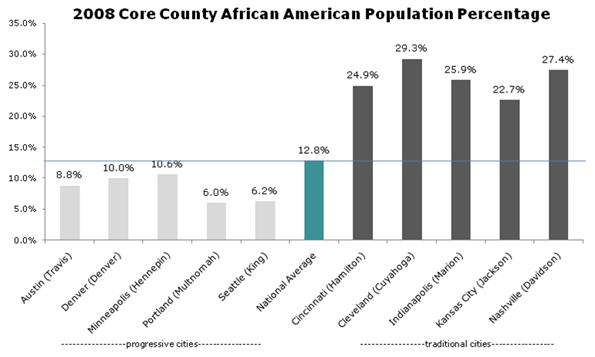
    But look closely at these exemplars and a curious fact emerges. If you take away the dominant Tier One cities like New York, Chicago and Los Angeles you will find that the “progressive” cities aren’t red or blue, but another color entirely: white.

    In fact, not one of these “progressive” cities even reaches the national average for African American percentage population in its core county. Perhaps not progressiveness but whiteness is the defining characteristic of the group.

    The progressive paragon of Portland is the whitest on the list, with an African American population less than half the national average. It is America’s ultimate White City. The contrast with other, supposedly less advanced cities is stark.

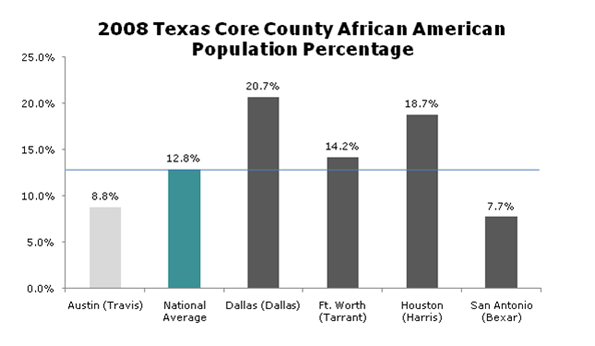
    It is not just a regional thing, either. Even look just within the state of Texas, where Austin is held up as a bastion of right thinking urbanism next to sprawlvilles like Dallas-Ft. Worth and Houston.

    Again, we see that Austin is far whiter than either Dallas-Ft. Worth or Houston.

    This raises troubling questions about these cities. Why is it that progressivism in smaller metros is so often associated with low numbers of African Americans? Can you have a progressive city properly so-called with only a disproportionate handful of African Americans in it? In addition, why has no one called these cities on it?

    As the college educated flock to these progressive El Dorados, many factors are cited as reasons: transit systems, density, bike lanes, walkable communities, robust art and cultural scenes. But another way to look at it is simply as White Flight writ large. Why move to the suburbs of your stodgy Midwest city to escape African Americans and get criticized for it when you can move to Portland and actually be praised as progressive, urban and hip? Many of the policies of Portland are not that dissimilar from those of upscale suburbs in their effects. Urban growth boundaries and other mechanisms raise land prices and render housing less affordable exactly the same as large lot zoning and building codes that mandate brick and other expensive materials do. They both contribute to reducing housing affordability for historically disadvantaged communities. Just like the most exclusive suburbs.

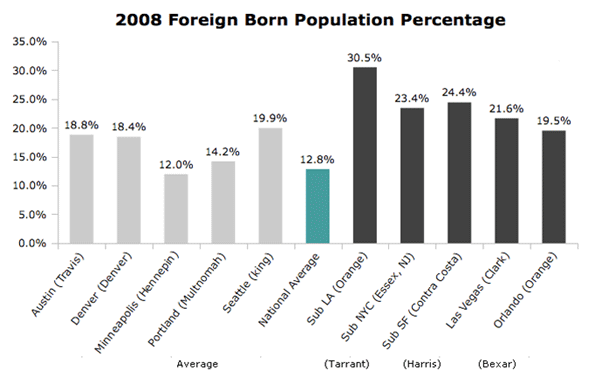
    This lack of racial diversity helps explain why urban boosters focus increasingly on international immigration as a diversity measure. Minneapolis, Portland and Austin do have more foreign born than African Americans, and do better than Rust Belt cities on that metric, but that’s a low hurdle to jump. They lack the diversity of a Miami, Houston, Los Angeles or a host of other unheralded towns from the Texas border to Las Vegas and Orlando. They even have far fewer foreign born residents than many suburban counties of America’s major cities.

    The relative lack of diversity in places like Portland raises some tough questions the perennially PC urban boosters might not want to answer. For example, how can a city define itself as diverse or progressive while lacking in African Americans, the traditional sine qua non of diversity, and often in immigrants as well?

    Imagine a large corporation with a workforce whose African American percentage far lagged its industry peers, sans any apparent concern, and without a credible action plan to remediate it. Would such a corporation be viewed as a progressive firm and employer? The answer is obvious. Yet the same situation in major cities yields a different answer. Curious.

    In fact, lack of ethnic diversity may have much to do with what allows these places to be “progressive”. It’s easy to have Scandinavian policies if you have Scandinavian demographics. Minneapolis-St. Paul, of course, is notable in its Scandinavian heritage; Seattle and Portland received much of their initial migrants from the northern tier of America, which has always been heavily Germanic and Scandinavian.

    In comparison to the great cities of the Rust Belt, the Northeast, California and Texas, these cities have relatively homogenous populations. Lack of diversity in culture makes it far easier to implement “progressive” policies that cater to populations with similar values; much the same can be seen in such celebrated urban model cultures in the Netherlands and Scandinavia. Their relative wealth also leads to a natural adoption of the default strategy of the upscale suburb: the nicest stuff for the people with the most money. It is much more difficult when you have more racially and economically diverse populations with different needs, interests, and desires to reconcile.

    In contrast, the starker part of racial history in America has been one of the defining elements of the history of the cities of the Northeast, Midwest, and South. Slavery and Jim Crow led to the Great Migration to the industrial North, which broke the old ethnic machine urban consensus there. Civil rights struggles, fair housing, affirmative action, school integration and busing, riots, red lining, block busting, public housing, the emergence of black political leaders – especially mayors – prompted white flight and the associated disinvestment, leading to the decline of urban schools and neighborhoods.

    There’s a long, depressing history here.

    In Texas, California, and south Florida a somewhat similar, if less stark, pattern has occurred with largely Latino immigration. This can be seen in the evolution of Miami, Los Angeles, and increasingly Houston, San Antonio and Dallas. Just like African-Americans, Latino immigrants also are disproportionately poor and often have different site priorities and sensibilities than upscale whites.

    This may explain why most of the smaller cities of the Midwest and South have not proven amenable to replicating the policies of Portland. Most Midwest advocates of, for example, rail transit, have tried to simply transplant the Portland solution to their city without thinking about the local context in terms of system goals and design, and how to sell it. Civic leaders in city after city duly make their pilgrimage to Denver or Portland to check out shiny new transit systems, but the resulting videos of smiling yuppies and happy hipsters are not likely to impress anyone over at the local NAACP or in the barrios.

    We are seeing this script played out in Cincinnati presently, where an odd coalition of African Americans and anti-tax Republicans has formed to try to stop a streetcar system. Streetcar advocates imported Portland’s solution and arguments to Cincinnati without thinking hard enough to make the case for how it would benefit the whole community.

    That’s not to let these other cities off the hook. Most of them have let their urban cores decay. Almost without exception, they have done nothing to engage with their African American populations. If people really believe what they say about diversity being a source of strength, why not act like it? I believe that cities that start taking their African American and other minority communities seriously, seeing them as a pillar of civic growth, will reap big dividends and distinguish themselves in the marketplace.

    This trail has been blazed not by the “progressive” paragons but by places like Atlanta, Dallas and Houston. Atlanta, long known as one of America’s premier African American cities, has boomed to become the capital of the New South. It should come as no surprise that good for African Americans has meant good for whites too. Similarly, Houston took in tens of thousands of mostly poor and overwhelmingly African American refugees from Hurricane Katrina. Houston, a booming metro and emerging world city, rolled out the welcome mat for them – and for Latinos, Asians and other newcomers. They see these people as possessing talent worth having.

    This history and resulting political dynamic could not be more different from what happened in Portland and its “progressive” brethren. These cities have never been black, and may never be predominately Latino. Perhaps they cannot be blamed for this but they certainly should not be self-congratulatory about it or feel superior about the urban policies a lack of diversity has enabled.

    Aaron M. Renn is an independent writer on urban affairs based in the Midwest. His writings appear at The Urbanophile.

  • The Compromise by the Lake

    Toronto is a nice city.

    If that seems like faint praise, then so be it; I’m not a great Toronto fan. Don’t get me wrong. It is a wonderful city for the tourist, and temporary residents I know swear by the place. But it’s not my kind of town.

    I spent much time in Toronto in the 1980s and 90s. My first visit must have been in 1970 or so, and I was last there on a very cold, January day in 2003.

    The city used to be known as “Tidy Toronto.” Indeed, that was the impression I got from my first visit – it all seemed very British, very clean, very orderly. In the 1970’s the Blue Laws were strict – it wasn’t possible to buy a cup of coffee on a Sunday morning. For the tourist (as I was then) it made for an unpleasant stay. These rules have weakened over the years, but as far as I know, many shopping malls and large stores are still closed on Sunday.

    In contrast to the United States (Life, Liberty & the Pursuit of Happiness), Canada was founded as British North America on the principles of Good Government & Good Order. The Blue Laws are of a piece. There are some nice things about this: Canadian parks, including Toronto city parks, are much nicer and better maintained than their American counterparts. Toronto supports one of the largest public library systems in North America (an expensive anachronism?). They have street cars. The streets are (or at least were) cleaner. Canadian hotels and motels are fantastic – and apart from boring Sundays, Canada surely is one of the best countries in the world for the tourist. By all means, visit Toronto.

    But compared to American cities of comparable size – Boston, Atlanta, Seattle – Toronto is stifling, provincial, and culturally unimportant. This, I believe, is why.

    The city is situated on the northwest shore of Lake Ontario. The street system is oriented by the lake, which means E-W streets roughly parallel the shore. Thus, going east on Bloor will put you on a 75 degree heading. North-south streets are perpendicular – Yonge Street heads north at 345 degrees.

    The lake is the city’s geographical feature of note, and serves as a transportation artery. Both the railroad and the Gardiner Expressway run right along the lakefront, thus cutting the city off from the water. City planners have tried mightily to rectify this fundamental error in design: they have built as many urban attractions as they can on the water side of the tracks, beginning with Queen’s Quay. This is nice enough, but is not easily accessible for pedestrians (one has to cross both the expressway and the tracks to get there). And then it is a synthetic cityscape, such as Manhattan’s South Street Seaport or Chicago’s Navy Pier: seen one, you’ve seen them all. Off shore are the Toronto Islands, now mostly used as park space. I’m ashamed to admit I’ve never been there.

    I’ve always thought of the center of town being the corner of Yonge and Bloor Streets, for that surely is the busiest subway stop. It is an impressive corner, similar to Chicago’s Michigan Ave (though on a much smaller scale).

    South of Bloor, Yonge Street is the city’s major promenade, where young people go to see and be seen. They strut by on wheels and on foot, in hot rods and hot clothes. It’s a great place to walk on a Summer evening.

    A half mile (Toronto’s streets were designed long before Canada went metric) south of Bloor is Dundas Street, a street that doesn’t follow the grid (probably an old Indian trail). Yet another half mile south is Queen Street, the main E-W pedestrian thoroughfare and location of Eaton Centre – a huge, indoor shopping mall (apparently now open on Sunday). Further south are King Street, Front Street, Union Station, and then the Gardiner Expressway at the foot of Yonge Street. Yonge St. becomes less lively south of Queen St.

    Walking west on Queen Street (highly recommended) one comes first to Nathan Phillips Square, location of the justly famous Toronto City Hall. The old city Hall, a beautiful red brick building to the east, is just as impressive. In the summer there are fountains, and in the winter ice skating. Beyond this is Osgood Hall, a judicial institution and a lovely building surrounded by a marvelous garden. Go inside if you can. En route you will cross Bay Street, Canada’s financial center. The heart of the financial district is Bay & King Streets.

    Continuing west brings one to University Avenue, a broad, visually spectacular boulevard. It is full of institutions: Ontario Hydro has its headquarters here, as do large insurance companies. It is not a shopping street. About a mile north, University Ave. divides to surround Queen’s Park, the location of the Ontario Provincial Legislature. It is a beautiful park and an interesting building. “At Queen’s Park today,” begins many a news cast, “Premier McGuinty announced…” North of Queen’s Park, University Avenue turns into the redundantly named Avenue Road.

    Continuing west on Queen brings one to Spadina Avenue, a major N-S traffic thoroughfare. Spadina and Dundas is the center of the traditional Chinatown. North of that, between Spadina and Queen’s Park, is the University of Toronto – the center of the campus is surrounded by King’s College Circle, and a pleasant walk.

    Beyond Spadina, Queen Street is Toronto’s version of Greenwich Village, known as the Gallery District. Here are nice cafes, bookstores, small shops. I believe this used to be the center of the Italian district, and Italians still live on the West End and in Etobicoke. But West Queen St. has outgrown the ethnic identity.

    Bathhurst, about a mile west of Spadina, forms the outer edge of the city center. Beyond this Queen Street looked like a slum, at least when I was last there.

    East Queen Street, east of Jarvis, is skid row.

    North of Bloor, between Yonge and Avenue Road, is an area called Yorktown – a mostly pedestrian area with narrow streets, small shops, and sidewalk cafes. Just to the east of Yorktown is Rosedale, a very elegant neighborhood of beautiful homes. Both are worth exploring on foot.

    So that brings us back to the corner of Yonge & Bloor. Next time we’ll start again from there.

    And what happens if you go east on Bloor?

    Daniel Jelski is Dean of Science & Engineering State University of New York at New Paltz.

  • E-Government: City Management Faces Facebook

    Does a City Manager belong on Facebook?

    Erasmus, the Dutch theologian and scholar, in 1500 wrote, “In the country of the blind the one-eyed man is king.” I feel this way in the land of social media — at least among city and county managers. Inspired by the first city manager blog in the nation, started by Wally Bobkiewicz in Santa Paula, California, I began posting back in 2006. Although most bloggers strive for frequent, short blurbs, I’ve employed blogging to provide a place to get beyond the sound bites (and out of context quotes) in the local press. I seek to provide background, explanation, and context for the stories in the news, along with the trends that don’t make the news.

    I tried MySpace and Facebook initially out of curiosity. For my first six months, I had only six friends on Facebook. Now I have more than 400, and few days go by when I don’t review requests for more. I post at least once a day, usually links to intriguing articles on public policy and photos of my three kids.

    While I was finding my way as a boomer in cyberspace, I resisted Twitter…until an invitation arrived from a friend 30 years older than I. If someone in his 80s was interested in tweets from me, I figured the time had come to join the crowd. And although I’ve never made a YouTube video, several videos of me are floating in cyberspace.

    For local managers, all of these social media offer new tools to work on one of democracy’s oldest challenges: promoting the common good. What local governments can’t do is fall hopelessly behind. The fate of railroads, automakers, and newspapers shows what happens to the complacent. It’s time to get online — and reach far beyond the initial step of a city website with links — to lead the effort to build stronger communities and a healthier democracy for the 21st century.

    Civic Engagement and Social Media: The Ventura Case Study

    Ventura has a civic engagement manager position, but civic engagement is considered a citywide core competency, like tech savvy and customer service. It’s not something we do periodically; it’s how we strive to do everything.

    One of our key citywide performance measures is the level of volunteerism in the community. We look not just at the 40,000 volunteer hours logged by city government last year, but at the percentage of the population that volunteer for any cause or organization: 50 percent versus 26 percent nationally. We strive to raise awareness, commitment, and participation by citizens in local government and their community.

    Reports by Council staff not only list fiscal impacts and alternatives, but document citizen outreach and involvement in each recommendation. There are obviously different levels; they recently ranged from a stakeholder committee that held four facilitated sessions to produce rules governing vacation rentals, to a citywide economic summit cosponsored with the chamber of commerce that drew 300 businesspeople and residents to develop 54 action steps unanimously endorsed by the city council at the conclusion.

    Effective engagement requires aggressive, fine-tuned, and immediate communication. We address traditional media with a weekly interdepartmental round table that reviews what stories are likely to surface and identifies other stories we’d like to see covered. We encourage city staff to quickly post comments to online newspaper postings to set the record straight, respond to legitimate queries, and direct citizens to additional information on our website.

    We have two public access channels — one for government, one for the community — and actively provide both with programming. Our most direct access comes from a biweekly e-newsletter that goes out to 5,000 addresses, linking directly to website resources, including the city manager’s latest blog post.

    Slow at first to embrace Facebook, Twitter, and YouTube, we’re closing the gap. One councilmember is a prolific blogger, and another uses Facebook for interactive community dialogue. We make judicious use of reverse 911 to get public safety information out quickly to residents. We’ve also pioneered “My Ventura Access”, a one-stop portal for all citizen questions, complaints, compliments, and opinions, whether they come by phone, Internet, mail, or in person.

    Not Your Grandfather’s Democracy

    Twitter, which allows just 140 characters – including spaces and punctuation – per “tweet”, gets a disproportionate share of the social media chatter. After a Republican member of Congress was ridiculed for tweeting during the State of the Union address this past February, Twitter usage exploded 3,700 percent in less than a year. By the time you read this, U.S. Twitter users will outnumber the population of Texas, or possibly California. In just five years, techcrunch.com reports, Facebook users have zoomed past 250 million. A Nielsen study estimates that usage has increased by seven times in the past year alone.

    Yet as blogs, tweets, Facebook, YouTube, and text blasts reshape how America communicates, few local governments — and even fewer city and county managers — are keeping pace. E-government remains largely focused on websites and online services. This communication gap leaves local government vulnerable in a changing world. “Business as usual” is not a comforting crutch; it’s foolish complacency. Just look at the sudden implosion of General Motors, the Boston Globe, and the state of California.

    It would be equally shortsighted to thoughtlessly embrace these new communication media as virtual substitutes for thoroughgoing civic engagement. We’re part of a 2,500-year-old experiment in local democracy, launched in Athens long before Twitter and YouTube. Local democracy operated long before the newspapers, broadcast media, public hearings, and community workshops familiar to today’s local government managers.

    We may live in a hi-tech world, but the basis of what we do remains “high touch,” involving what some of the most thoughtful International City/County Management practitioners call “building community.” Social media offer new tools to build community, although they aren’t a magic shortcut.

    This is part one of a two-part series. A slightly different version of this article appeared in Public Management, the magazine of the International City/County Management Association; icma.org/pm.

    Rick Cole is city manager of Ventura, California, and this year’s recipient of the Municipal Management Association of Southern California’s Excellence in Government Award. He can be reached at RCole@ci.ventura.ca.us