Category: planning

  • There’s No Place Like Home, Americans are Returning to Localism

    On almost any night of the week, Churchill’s Restaurant is hopping. The 10-year-old hot spot in Rockville Centre, Long Island, is packed with locals drinking beer and eating burgers, with some customers spilling over onto the street. “We have lots of regulars—people who are recognized when they come in,” says co-owner Kevin Culhane. In fact, regulars make up more than 80 percent of the restaurant’s customers. “People feel comfortable and safe here,” Culhane says. “This is their place.”

    Thriving neighborhood restaurants are one small data point in a larger trend I call the new localism. The basic premise: the longer people stay in their homes and communities, the more they identify with those places, and the greater their commitment to helping local businesses and institutions thrive, even in a downturn. Several factors are driving this process, including an aging population, suburbanization, the Internet, and an increased focus on family life. And even as the recession has begun to yield to recovery, our commitment to our local roots is only going to grow more profound. Evident before the recession, the new localism will shape how we live and work in the coming decades, and may even influence the course of our future politics.

    Perhaps nothing will be as surprising about 21st-century America as its settledness. For more than a generation Americans have believed that “spatial mobility” would increase, and, as it did, feed an inexorable trend toward rootlessness and anomie. This vision of social disintegration was perhaps best epitomized in Vance Packard’s 1972 bestseller A Nation of Strangers, with its vision of America becoming “a society coming apart at the seams.” In 2000, Harvard’s Robert Putnam made a similar point, albeit less hyperbolically, in Bowling Alone, in which he wrote about the “civic malaise” he saw gripping the country. In Putnam’s view, society was being undermined, largely due to suburbanization and what he called “the growth of mobility.”

    Yet in reality Americans actually are becoming less nomadic. As recently as the 1970s as many as one in five people moved annually; by 2006, long before the current recession took hold, that number was 14 percent, the lowest rate since the census starting following movement in 1940. Since then tougher times have accelerated these trends, in large part because opportunities to sell houses and find new employment have dried up. In 2008, the total number of people changing residences was less than those who did so in 1962, when the country had 120 million fewer people. The stay-at-home trend appears particularly strong among aging boomers, who are largely eschewing Sunbelt retirement condos to stay tethered to their suburban homes—close to family, friends, clubs, churches, and familiar surroundings.

    The trend will not bring back the corner grocery stores and the declining organizations—bowling leagues, Boy Scouts, and such—cited by Putnam and others as the traditional glue of American communities. Nor will our car-oriented suburbs replicate the close neighborhood feel so celebrated by romantic urbanists like the late Jane Jacobs. Instead, we’re evolving in ways congruent with a postindustrial society. It will not spell the demise of Wal-Mart or Costco, but will express itself in scores of alternative institutions, such as thriving local weekly newspapers, a niche that has withstood the shift to the Internet far better than big-city dailies.

    Our less mobile nature is already reshaping the corporate world. The kind of corporate nomadism described in Peter Kilborn’s recent book, Next Stop, Reloville: Life Inside America’s Rootless Professional Class, in which families relocate every couple of years so the breadwinner can reach the next rung on the managerial ladder, will become less common in years ahead. A smaller cadre of corporate executives may still move from place to place, but surveys reveal many executives are now unwilling to move even for a good promotion. Why? Family and technology are two key factors working against nomadism, in the workplace and elsewhere.

    Family, as one Pew researcher notes, “trumps money when people make decisions about where to live.” Interdependence is replacing independence. More parents are helping their children financially well into their 30s and 40s; the numbers of “boomerang kids” moving back home with their parents, has also been growing as job options and the ability to buy houses has decreased for the young. Recent surveys of the emerging millennial generation suggest this family-centric focus will last well into the coming decades.

    Nothing allows for geographic choice more than the ability to work at home. By 2015, suggests demographer Wendell Cox, there will be more people working electronically at home full time than taking mass transit, making it the largest potential source of energy savings on transportation. In the San Francisco Bay Area and Los Angeles, almost one in 10 workers is a part-time telecommuter. Some studies indicate that more than one quarter of the U.S. workforce could eventually participate in this new work pattern. Even IBM, whose initials were once jokingly said to stand for “I’ve Been Moved,” has changed its approach. Roughly 40 percent of the company’s workers now labor at home or remotely from a client’s location.

    These home-based workers become critical to the localist economy. They will eat in local restaurants, attend fairs and festivals, take their kids to soccer practices, ballet lessons, or religious youth-group meetings. This is not merely a suburban phenomenon; localism also means a stronger sense of identity for urban neighborhoods as well as smaller towns.

    Could the new localism also affect our future politics? Ever greater concentration of power in Washington may now be all the rage as the federal government intervenes, albeit often ineffectively, to revive the economy. But throughout our history, we have always preferred our politics more on the home-cooked side. On his visit to America in the early 1830s, Alexis de Tocqueville was struck by the de-centralized nature of the country. “The intelligence and the power are dispersed abroad,” he wrote, “and instead of radiating from a point, they cross each other in every direction.”

    This is much the same today. The majority of Americans still live in a patchwork of smaller towns and cities, including many suburban towns within large metropolitan regions. There are well over 65,000 general-purpose governments, and with so many “small towns,” the average local jurisdiction population in the United States is 6,200, small enough to allow nonprofessional politicians to have a serious impact.

    After decades of frantic mobility and homogenization, we are seeing a return to placeness, along with more choices for individuals, families, and communities. For entrepreneurs like Kevin Culhane and his workers at Churchill’s, it’s a phenomenon that may also offer a lease on years of new profits. “We’re holding our own in these times because we appeal to the people around here,” Culhane says. And as places like Long Island become less bedroom community and more round-the-clock locale for work and play, he’s likely to have plenty of hungry customers.

    This article originally appeared in Newsweek.

    Joel Kotkin is executive editor of NewGeography.com and is a distinguished presidential fellow in urban futures at Chapman University. He is author of The City: A Global History. His next book, The Next Hundred Million: America in 2050, will be published by Penguin Press early next year.

  • On Cities, GHG Emissions, Apples & Oranges

    Every day or so a new greenhouse gas emission report crosses my desk. Often these reports are very useful, other times they add little of value to the subject. The problem is separating the “wheat” from the “chaff.”

    This dilemma is well illustrated by a paper called “Greenhouse Gas Emissions from Global Cities,” authored by 10 academics. I had received notification of the paper from Science Daily, a useful website that provides notification of new research on a wide range of scientific subjects.

    The Science Daily article indicated that Denver produces the most greenhouse gases per capita annually, while Barcelona produces the least. I am always interested in reports that compare the performance of “cities,” both out of general interest and because of the gross errors that often are the result of invalid comparisons. So, immediately I ran down the report, and to my surprise the report dealt with only 10 “cities.” This seems rather a small number, since the smallest in the sample, Geneva, is not even among the top 700 urban areas in the world. This seems to be a rather incomplete sample: 10 out of more than 700.

    That was just the beginning. There were serious problems of comparison between the 10 “cities.” Whenever someone starts talking about “cities,” it is best to ask what they mean. The word “cities” has so many meanings and is subject to such confusion that I generally avoid using it.

    “Cities” might be municipalities, such as the city of New York or the ville de Paris.

    Cities could be urban areas (urbanized areas or urban agglomerations), which are the urban footprints one observes from an airplane on a clear night.

    “Cities” could be metropolitan areas, which are labor markets and are generally larger than urban areas, because people commute from rural areas (outside the urban footprint) to work in the urban area.

    In nearly the entire world, with the exception of China, urban areas and metropolitan areas are larger than municipalities.

    Or, “cities” could be used in the sense of Chinese prefectural, sub-provincial or provincial level cities, which tend to be far larger than any reasonable definition of a metropolitan area. Nearly all of China is divided into cities, in the same way that most of the United States is divided into counties.

    These Chinese “cities” themselves often contain county level “cities” that are separate from the principal urban areas.

    These differing definitions of municipalities make any international comparison of these entities difficult and often misleading. The ville de Paris represents barely 20 percent of the Paris region. The “city” of Atlanta represents barely 10 percent of its metropolitan area. The “city” of Melbourne represents only 5 percent of its metropolitan area. Yet, other “cities” are larger than their metropolitan areas, such as Chongqing, China, which has at least five times the population of its genuine metropolitan area (the “city” covers an area the size of Austria or Indiana). The city of San Antonio, with its vast stretches of suburbanization is surely not comparable to the city of Hartford, which is dominated by an urban core.

    Any genuine comparison of “cities” must be at the metropolitan area or urban area level. These definitions both represent the city as the organism it is, rather than simply the happenstance of municipal boundaries. Of course, comparisons must be either between metropolitan areas or urban areas to be valid. It will not do to compare metropolitan areas with urban areas; they are as apples and oranges. Moreover, there are no international standards for delineation of metropolitan areas, which makes metropolitan comparisons more complex.

    All of this raises the principal problem with the “Global Cities” paper. There is no consistency to the city definitions the paper uses and its results are thus meaningless (though “headline grabbing”). For example, “Global Cities” uses the geographic areas of the following barely comparable “cities”:

    The municipality of Barcelona, which represents less than one half of the urban area and excludes the expansive suburbs that stretch in every direction but the Mediterranean.

    The municipalities of Bangkok, Denver and New York, which are only parts of their respective metropolitan or urban areas.

    The municipality of Cape Town, which could be considered a metropolitan area because of the large expanse of rural area under its jurisdiction.

    The canton (province) of Geneva might probably qualify as a metropolitan area, except that it excludes the suburbs in France, from which virtually free movement of labor is permitted.

    The Greater London Authority which is nearly co-existent with the London urban area, while Prague as the report defines it is somewhat larger than its urban area.

    The Greater Toronto Area which meets none of the “city” definitions above and is larger than both the metropolitan area and the urban area as defined by Statistics Canada.

    Los Angeles County, which meets none of the “city” definitions and is part of the larger Los Angeles-Orange County metropolitan area.

    All in all, as charitably as it can be put, the “Global City” compares four municipalities, three metropolitan areas, two urban areas, one area larger than a metropolitan area and one that is part of a metropolitan area. Put another way, it tries to make comparisons between four apples, three oranges, two peaches, one banana and one sweet potato.

    Granted, the paper indicates the geographical definitions it uses. That, does not, however, change the fact that treating apples and oranges as comparable is simply invalid.

    There are other problems with the “Global Cities” paper, but one more is enough. In the obligatory fashion, the authors stress how important it is to adopt “smart growth” policies in North America. They cite a US Department of Transportation study to indicate that a doubling of density reduces vehicle miles traveled by 40 percent.

    A bit closer reading would have indicated that the study says doubling density would reduce new vehicle miles by 40 percent, where population densities are already 6,000 to 7,000 per square mile. Only two large urban areas in the United States have densities that high, San Francisco and Los Angeles (which the authors characterize as having urban densities at least 40 percent below the US Bureau of the Census number for the Los Angeles urban area). A 40 percent reduction in “new” vehicle miles means that overall vehicle miles traveled increase 60 percent when the population is doubled, rather than 100 percent. Thus, even with the high density qualification in the US Department of Transportation study, vehicle miles would increase 60 percent as population densities double.

    Maybe tomorrow will bring a better report. One can always hope.

    Photograph: The “city” of Chongqing (part of its vast rural countryside)

    Wendell Cox is a Visiting Professor, Conservatoire National des Arts et Metiers, Paris. He was born in Los Angeles and was appointed to three terms on the Los Angeles County Transportation Commission by Mayor Tom Bradley. He is the author of “War on the Dream: How Anti-Sprawl Policy Threatens the Quality of Life.

  • Homebuilding Rebound… Or Boredom in the Burbs?

    The economy might come back – but will the housing market return? And in what form?

    Right now, builders are jumping into the low end of the market because of the $8,000 first time home buyer tax credit. This tax credit cannot survive indefinitely. Compared to homes sold in 2006, today’s are bare bones in size, materials and finishes in response to current, temporary market conditions. But the scrimping only makes the homes built in yesterday’s developments more attractive to potential buyers. The next wave of home buyers will have a choice: stay where they are, move to a more recently built (devalued) home, or buy new.

    Here’s a rundown on the major factors — and the forces on them — that will guide home buyers in their decisions. It’s also a rundown for any community, planner or developer — government or private sector — who would like to see the market rebound.

    Lot Size: Will buyers want to be shoehorned into new compressed development, or will they prefer to remain in the larger lot suburbs, where there are plenty of bargains today with usable yards and at least some views?

    The administration is pushing for compact (very dense) development, something the home buying market historically finds less desirable. If one hundred residents of a subdivision were asked the square footage of their lot, few would know the answer (more would be aware of their house’s square footage). Homes placed close to the street guarantee a claustrophobic feeling of space. Space is defined by that object that stops viewshed – typically a home, wall (fence) or low vegetation.

    Density is increased by the creation of narrower lots (and homes). When the lot narrows either the square footage of the house must plummet, or the home must get deeper. Assuming that facing directly into the home next door is not a quality view, the percentage of wall space that allows windows with a good view becomes very small as the home narrows.

    To illustrate, take a business card and look especially at the long edges. The shape emulates the rectangular perimeter of a typical suburban home built in the past few decades. Now imagine nice front and rear yard spaces with plenty of wall surface for windows, even with a garage taking up a portion of the front.

    Along comes the anti-sprawl movement pushing narrower lots, and making those on City Councils and Planning Commissions feel guilty about destroying the planet. Across America over the past two decades lots have been getting smaller – in some cases much smaller. Now take that business card and rotate it 90 degrees. This would represent the shape of a typical suburban home today.

    Huh. Wouldn’t all those side windows now look into the neighbors home? Well, windows now are placed along the short side of the home. What about the garage? Well, typically that’s still along the front, but since cars did not suddenly get 33% narrower, occupants just lost quite a bit of precious viewing area. Density went up by 33% but useable yards went down by 33%.

    Today we are building with much less width than we did during the past few decades. Yet the environmentalists and press do not seem to have taken notice.

    What is most likely coming down the road?

    Miniscule, very narrow lots combined with vertical growth. To illustrate, cut that business card in half. OK, so there goes the square footage right? Take one half and place it on top of the other. Well, it’s likely that the home was already two story, so that means three stories right? How much do you like climbing stairs? Better buy stock in residential elevator companies. So how do you park cars in this very narrow lot? If you do not want the street to appear as a solid wall of garage doors, then the only way to provide garage space is a single width garage, two stalls deep — another inconvenience — or a two car garage in the rear… but there goes any attempt for quality rear yard space.

    Architecture: Suburban homes have been looking pretty bland for the past few decades. Slapping on a front porch (most are the size of a stoop) really doesn’t make that much difference.

    Blame architects? An AIA registered, certified, artistically talented architect was not likely involved in the design process of the mass market home. It’s far cheaper to let Harry down the street (nephew of what’s his name) to draw up plans. How do you think many small home builders get financed? If they go to a lumber yard and select from a series of home plans, they can get a package deal; materials and financing furnished by the same source, standard packages from which to choose. Any wonder why 30 home builders in the same town seem to all build the same character-free house?
    Did the lumber yard hire a talented architect to gain advantage in the local market? What incentive do you think the supplier of the materials would have to actually be efficient in the drafting of the home? Excess material means increased profits!

    Homes in suburbia lack character and devalue a community as a general rule, but it’s not always the case. For example, in many areas in Texas, housing is affordable and full of architectural character with great landscaping. Builders in the major Texas markets know that if they shortcut curb appeal, nobody will clamor to their door. The local home buying market is astute… and today’s strongest home market.

    National large home builders? Most of the nationals expand into an area by buying out a local builder that showed signs of success (see above).

    Green: Ask your banker how much green means to the value of a home. Ask the appraisal company, does green add any value? Green certification is commonly messy and difficult, requiring builders to chase points instead of building wisely. Most green standards were inspired by a social engineering agenda. My own certified green home earns me lots of points because I’m near a bus stop and walking distance to a coffee shop. No wonder the financial people don’t take the movement seriously. My residential elevator? Not listed on the “points” system. Home designed to maximize quality viewsheds? No points! We had intended to place a 1 ½ inch foam insulation fill around the entire foundation surface, but a 2 inch minimum was required to earn points . That increased the cost of construction by $900. I’m not an expert in insulation, but it seems I spent 30% more to get a 0.1% benefit on my utility bill – hell of a deal! That $900 extra added to my payments – let’s see with interest, that cost me $5.25 every month… got my point though.

    Will the home market flourish when the economy returns?

    In the last few weeks I was Keynote Speaker at the Western States Planning Association Annual Meeting and at the North Dakota American Institute of Architects.

    Planners and Architects are very different groups. Ever wonder why the neighborhood plan and the architecture of the homes within it rarely seem related to each other? Nobody looks at mass market housing from a perspective of combined architectural spaces as a main component of the overall neighborhood design. The merging of planning and architecture on housing for the masses was well received by both groups.

    How will we bring the housing market back?

    Not by scrimping and reducing value, but by increasing value through a combined effort of architects, planners, and engineers to create a new era of sustainable communities that increase living standards affordably. Density is not a solution. A revolution in design is.

    Rick Harrison is President of Rick Harrison Site Design Studio and author of Prefurbia: Reinventing The Suburbs From Disdainable To Sustainable. His website is rhsdplanning.com.

  • How Smart Growth Disadvantages African-Americans & Hispanics

    It was more than 45 years ago that Dr. Martin Luther King, Jr. enunciated his “Dream” to a huge throng on the Capitol Mall. There is no doubt that substantial progress toward ethnic equality has been achieved since that time, even to the point of having elected a Black US President.

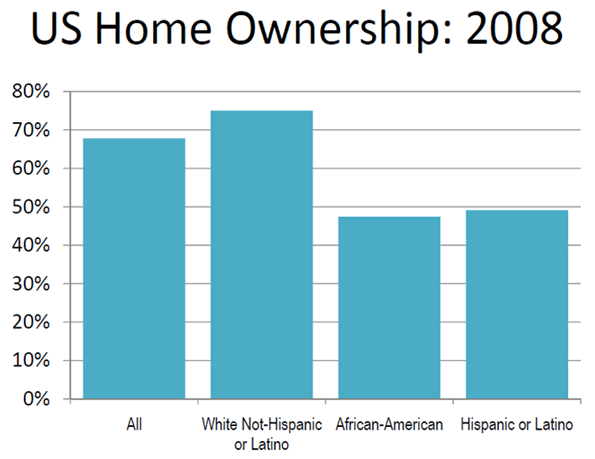
    The Minority Home Ownership Gap: But there is some way to go. Home ownership represents the core of the “American Dream” that was certainly a part of Dr. King’s vision. Yet, there remain significant gap in homeownership by ethnicity. Rather than a matter of discrimination, this largely reflects differing income levels between White-Non-Hispanics, African-Americans and Hispanics or Latinos. Today, approximately 75% of white households own their own homes. Whites have a home ownership rate fully one-half higher than that of African-Americans and Hispanics or Latinos at 47% and 49% (See Figure).

    Setting the Gap in Stone: A key to redressing this difficulty will be convergence of minority household incomes with those of whites, and that is surely likely to happen. However, there is another important dynamic in operation: house prices in some areas have risen well in advance of incomes, so that convergence alone can not narrow the home ownership gap in a corresponding manner. It is an outrage for public policy to force housing prices materially higher so long as home ownership remains beyond the incomes of so many, especially minorities.

    The Problem: Land Use Regulation: The problem is land use regulation. The economic evidence is clear: more restrictive land use regulation raises house prices relative to household incomes. This can be seen with a vengeance in the house price increases that occurred during the housing bubble. As we have previously described, metropolitan markets with more restrictive land use regulation (principally the more radical “smart growth” policies) experienced house price escalation out of all proportion to other areas in the nation. In some cases, they topped out at nearly four times historical norms. On the other hand, in the one-half of major metropolitan area markets where land use regulations were less severe, house prices tended to increase to little more than historic norms, at the most.

    How Smart Growth Destroys Housing Affordability: This difference is principally due to the price of land, which is forced upward when the amount of land available for building is artificially limited, as is the case in smart growth markets. At the peak of the bubble, there was comparatively little difference in house construction costs per square foot in either smart growth or less restrictive markets. However, the far higher land prices drove house prices in smart growth markets far above those in less restrictively regulated markets. Where house prices rise faster than incomes, housing affordability drops as prices rise at escalated rates.

    Wishing Away Reality: It is not surprising that the proponents of smart growth undertake Herculean efforts to deflect attention away from this issue. Usually they pretend there is no problem. Sometimes they produce studies to indicate that limiting the supply of land and housing does not impact housing affordability, which is akin to arguing that the sun rises in the West. Even the proponents, however, cannot “walk a straight line” on this issue, noting in their most important advocacy piece (Costs of Sprawl – 2000) that their more important strategies have the potential to increase the cost of housing.

    The Assault on Home Ownership: Worse, well connected Washington interest groups (such as the Moving Cooler coalition) and some members of Congress seek to universalize smart growth land rationing throughout the nation, which would cause massive supply problems and housing price inflation that occurred in some markets between 2000 and 2007. Even after the crash, these markets experienced generally higher house prices relative to incomes in smart growth markets than in traditionally regulated markets.

    House Price Increases and Minorities: House price increases relative to incomes weigh most heavily on ethnic minority households, because their incomes tend to be lower. This is illustrated by an examination of the 2007 data from the American Community Survey, in our special report entitled US Metropolitan Area Housing Affordability Indicators by Ethnicity: 2007. The year 2007 was the peak of the housing bubble, but represents a useful point of reference for when future “smart growth” policies were imposed nationwide.

    Median Priced Housing: The data (Table) indicates that median house prices were 75% or more higher for African-Americans than Whites, however that African-Americans in smart growth markets require 84% more to buy the median priced house. The situation was slightly better for Hispanics or Latinos with median house prices at least 50% more relative to incomes than for Whites. House prices relative to Hispanic or Latino median household incomes were 86% higher in smart growth markets than in less restrictively regulated markets.

    SUMMARY OF HOUSING INDICATORS BY
    LAND USE REGULATION CATEGORY
    Metropolitan Areas over 1,000,000 Population: 2007
    HOUSING INDICATOR Less Restrictive Land Use Regulation Markets More Restrictive Land Use Regulation Markets All Markets More Restrictive Markets Compared to Less Restrictive Markets
    MEDIAN VALUE MULTIPLE        
    All 3.1 5.8 4.5 1.89
    White Non-Hispanic or Latino 2.7 5.1 3.9 1.90
    African-American 4.9 8.9 6.9 1.84
    Hispanic or Latino 4.2 7.9 6.1 1.86
    LOWEST QUARTILE VALUE MULTIPLE      
    All 2.1 4.2 3.2 2.01
    White Non-Hispanic or Latino 1.8 3.7 2.8 2.01
    African-American 3.3 6.5 5.0 1.95
    Hispanic or Latino 2.9 5.7 4.4 1.98
    MEDIAN RENT/MEDIAN HOUSEHOLD INCOME      
    All 13.8% 17.1% 15.5% 1.24
    White Non-Hispanic or Latino 12.1% 15.1% 13.6% 1.25
    African-American 21.9% 26.1% 24.0% 1.19
    Hispanic or Latino 19.1% 23.0% 21.1% 1.20
    LOWER QUARTILE RENT/MEDIAN HOUSEHOLD INCOME    
    All 10.8% 13.1% 12.0% 1.22
    White Non-Hispanic or Latino 9.4% 11.6% 10.5% 1.23
    African-American 17.0% 20.0% 18.5% 1.17
    Hispanic or Latino 14.9% 17.5% 16.2% 1.18
    NOTES        
    Median Value Multiple: Median House Value divided by Median Household Income
    Low Quartile Value Multiple: Low Quartile House Value divided by Median Household Income
    2007 Data
    Calculated from American Community Survey (US Bureau of the Census) Data
    “More restrictive” land use regulation markets (generally "smart growth") include those classified as "growth management," "growth control," "containment" and "contain-lite" and "exclusions: in "From Traditional to Reformed A Review of the Land Use Regulations in the Nation’s 50 largest Metropolitan Areas" (Brookings Institution, 2006) and markets with significant large lot zoning and land preservation restrictions (New York, Chicago, Hartford, Milwaukee, Minneapolis-St. Paul, and Virginia Beach). Less restrictive" land use regulation markets (generally "traditional") include all others, except for Memphis, where urban growth boundaries have been drawn far enough from the urban area to have no perceivable impact on land prices and Nashville, where the core county is exempt from the urban growth boundary requirement in state law.

    Lower Priced Housing (Lowest Quartile): I recall being told by a participant at a University of California–Santa Barbara economic forum organized by newgeography.com contributor Bill Watkins that, yes, smart growth increases house prices, but not for lower income residents. My challenger went so far as to say that lower income households were aided economically by smart growth. The facts are precisely the opposite. Comparing the lowest quintile (lowest 25%) house price to median household incomes indicates that minorities pay even a higher portion of their incomes for lowest quintile priced houses than the median priced house. African-Americans in smart growth markets needed 95% more relative to incomes to afford the lowest quartile house. Hispanics or Latinos needed 98% more.

    Rental Housing: The problem carries through to rental housing. There is a general relationship between rental prices and house prices, though rental prices tend to “lag” house price increases. In the smart growth markets, minorities must pay approximately 20% more of their income for the median contract rental in smart growth metropolitan areas than in less restrictively regulated markets. Similar results are obtained when comparing minority household median incomes with lowest quintile contract rents, with African-Americans paying 17% more of their incomes in smart growth markets and Hispanics or Latinos paying 18% more.

    Moreover, it is important to recognize that all of the above data is relative, based on shares or percentages of incomes. Varying income levels are thus factored out. Minority and other households in smart growth markets face costs of living that are approximately 30% higher than in less restrictively regulated markets, according to analysis by US Department of Commerce Bureau of Economic Analysis economists. Some, but not all of the difference is in higher housing costs.

    Social Costs of Smart Growth: In 2004, the Tomas Rivera Policy Institute, which focuses on Latino issues, noted concern about the homeownership gap in California, which has been ground zero for land use regulation driven house price increases for decades:

    Whether the Latino homeownership gap can be closed, or projected demand for homeownership in 2020 be met, will depend not only on the growth of incomes and availability of mortgage money, but also on how decisively California moves to dismantle regulatory barriers that hinder the production of affordable housing. Far from helping, they are making it particularly difficult for Latino and African American households to own a home.

    Examples of the restrictions cited by the Tomas Rivera Policy Institute are restrictions on the supply of land, high development impact fees and growth controls.

    California has acted decisively, but against the interests of African-Americans and Hispanics or Latinos. The state enacted Senate Bill 375 in 2008, which will impose far stronger state regulations on residential development, increasing the likelihood that minorities in California will always be disadvantaged relative to White-Non-Hispanics. At the same time, State Attorney General Jerry Brown has forced some counties to adopt more restrictive land use regulations through legal actions. California, which had for decades been considered a state of opportunity, is making home ownership and the pursuit of the “American Dream” far more difficult, particularly for its ever more diverse population.

    Stopping the Plague: In California, the hope to increase African-American and Latino home ownership rates to match those of white-non-Hispanics may already be beyond reach due to the that state’s every intensifying radical smart growth policies. However, the “Dream” continues to “hang on” in many metropolitan markets. Hopefully Washington will not put a barrier in the way of African-Americans and Hispanics or Latinos that live elsewhere in the nation.

    US Metropolitan Area Housing Affordability Indicators by Ethnicity: 2007 includes tables with data for each major metropolitan area in the United States

    Photo: Starter house in Atlanta suburbs (by the author)

    Wendell Cox is a Visiting Professor, Conservatoire National des Arts et Metiers, Paris. He was born in Los Angeles and was appointed to three terms on the Los Angeles County Transportation Commission by Mayor Tom Bradley. He is the author of “War on the Dream: How Anti-Sprawl Policy Threatens the Quality of Life.

  • The Crisis of Academic Urban Planning

    A wide gulf has opened up between mainstream Australian values and the prescriptions of our urban planning academics. So much so that the latter are at risk of degenerating into a cult. While it’s usually unfair to criticise a group in generalised terms, there are ample grounds in this case. Anyone who doubts the existence of an urban planning “establishment” in and around the Australian university system, and that it’s in thrall to ultra-green groupthink, should revisit some recent correspondence to our newspapers.

    A perfect example appeared in the Australian Financial Review of 31 July 2009. On that day, the paper carried a joint missive penned by no less than eight leading-lights from various urban and planning related faculties, along with two others from like-minded institutions.

    Stirred by the perennial bugbear of residential development on the urban fringe, the authors wrote to denounce the Victorian Government’s plans to develop 40,000 hectares of new suburbs.

    The signatories included the Dean and the Chair of Melbourne University’s architecture faculty, leaders of the university’s Nossal Institute for Global Health and Eco-Innovation Lab, the Director of Curtin University’s Sustainability Policy Institute, a Professor of Planning and the Dean of Global Studies at Royal Melbourne Institute of Technology (RMIT), and the Director of Urban Research at Griffith University.

    They were joined by two holders of non-academic posts, one in the City of Melbourne’s Design and Urban Environment Department, the other at the Melbourne Sustainable Society Institute.

    Since they’re all attracted to some variant of the command economy, let’s call them “the ten commandants”.

    Their letter opens with the standard formula of green urbanism. The Victorian Government’s plans are “unsustainable – environmentally, economically and socially”. This highly abstract phrase, a mainstay of the urban planning literature, implies a seamless and mutually reinforcing compatibility amongst the three dimensions of sustainability. In the real world things aren’t so simple.

    The formula conceals far more than it reveals. It’s not at all clear that environmental sustainability, as conceived by the commandants, is compatible with economic sustainability. More than likely, it isn’t. As most prescriptions for environmental sustainability include measures to suppress economic activity, including regulations and cost imposts, the more likely outcome is economic stagnation.

    Economic stagnation may well be compatible with environmental sustainability, at least in the eyes of ultra-green academics, but it’s hardly compatible with social sustainability. A society without economic opportunities will descend into division and conflict.

    In this regard the commandants’ agenda is ominous. “[W]e will have these [new fringe suburbs] to deal with”, they complain, “when we finally commit to a low carbon economy”.

    This paternalistic tone pervades the whole letter, even when the public are offered apparent choices. Having spilt a lot of ink on how, in the sustainable future, “developments will be denser than the surrounding suburbs”, the commandants still claim “we will live with … more choice of housing type”. And the false choices keep coming. Consider this intriguing paragraph: “Not everyone wants or needs to live in an activity centre or on the tramline, but a sustainable city is one where you can get there without a car”. You can live wherever you like, as long as you don’t need a car. Plenty of choice there.

    “This is a future”, they say of their vision, “where we will be fitter rather than fatter”. This is a future, more accurately, where intellectuals treat people like laboratory rats.

    What it all means, of course, is that the public won’t have a say, let alone a choice. “The fear of a suburban backlash is unfounded”, say the commandants, “and attitudes will become more supportive when imaginative design visions and construction projects demonstrate what is possible”. Behind the condescending verbiage lurks a strategy of imposing a fait accompli. Indeed, they end up hoping that the federal government will intervene.

    There’s one good thing about the letter. It concedes that releasing more land does improve housing affordability. Planners have tended to argue that it doesn’t work, since nobody wants to live on the fringe. Still, the commandants question the benefits, arguing these are “short term” and “outweighed by the long-term costs in capital expenditure and car-dependency”. Such criticisms underestimate the substantial and positive ripple effects of affordable housing on disposable incomes, consumer demand, job creation and ultimately state revenues.

    Green platitudes usually get a pass in the media, but on 3 August the AFR published a valiant letter in reply from Alan Moran of the Institute of Public Affairs, aptly titled “Planners’ patrician arrogance”.

    Moran makes two powerful points. First, had the commandants bothered to canvass public opinion, they would have discovered that “consumers around the world overwhelmingly prefer [separate houses to apartments] … One United Kingdom survey showed that only 2 per cent of people prefer to live in apartments”. Second, despite all the guff about the “sustainability” of denser development, the Australian Conservation Foundation found that “emissions from inner city households are a third greater than those on the fringe”.

    Leading up to the global financial crisis, demand for residential property was subdued, especially in Sydney. Buyers baulked at the combination of rising interest rates and developer costs, together with inflated prices linked to stymied land supply. Commentators speculated about a cultural shift away from outer suburbia. But things changed.

    Since the crisis, plummeting interest rates and government incentives have unleashed a new wave of demand. Buyers, including a substantial proportion of first home buyers, have flocked to new fringe suburbs. According to one report “[p]roject-home builders are reporting a boom in new house sales in parts of Sydney that were until recently green pasture.” NSW Department of Planning figures show that in the current financial year building on Sydney’s fringe made up just under 20 per cent of all construction, compared with 10 per cent in 2005-06.

    Things are no different in Melbourne. The city’s fastest growing area is the outer western suburb of Werribee.

    Where does that leave the commandants? They would agree that urban planning should alleviate socio-economic disadvantage. If so, they and the planning establishment need to acknowledge that most low to middle income Australians reject their vision of a compact ecopolis. These Australians cherish their lifestyle, and sense that the social and economic costs of planning fetters will far outweigh the environmental benefits.

    The suburbs have spoken. Unless planners ditch their utopian dreams and integrate academic research with social reality, they face increasing alienation from the policymaking process.

    This article first apeared at The New City Journal

  • Losing Touch With the Changing Definition of “Community”

    Mathew Taunton opens his review of “The Future of Community – Reports of a Death Greatly Exaggerated” (Note 1) with the observation that:

    “Community is one of the most powerful words in the language, and perhaps because of this it is frequently misused. A profoundly emotive word, it is also a coercive one, and a key political buzzword in modern times. That community is being eroded in modern Britain is a matter of cross-party consensus, and it is also widely agreed that one of the state’s roles is to devise means of counteracting the decline of communities.”

    It is refreshing to see a writer prepared to use ‘community’ and ‘coercive’ in the same sentence. Taunton reminds us that practically all urban architecture now attempts to force social solidarity into existence, and, by definition, condemns those who do not conform for daring to exercise their choice.

    Unfortunately many of these attempts to coerce community into existence tend to repress or subvert the informal processes through which people interact of their own free will.

    So why do so many influential people in the UK, the United States, and other countries of the New World, hold this ‘consensus’ that communities, like morality, are in decline, requiring government interventions to restore them to good health, within some reborn urban village?

    In the past, communities were primarily place-based, if only because people could not travel very far or communicate over any great distance. But as civilizations have developed, this interaction between transport and communication has reshaped the prevailing structure and meaning of communities, as each reacts with each other. The printing presses of Renaissance Europe enabled the development of scientific and religious communities, as well as a host of “communities of ideas” both conservative and revolutionary.

    Last century the establishment of national broadcast networks and television helped constitute national communities of listeners or viewers, which in turn reinforced the communities of “us” and “them” through the great global conflicts of that century.

    The Internet has now created a whole new class of virtual communities or tribes. Many wage their tribal wars with considerable venom.

    However, these internet tribes, too, simply build on the superior transportation technologies that have enabled us to physically flee to find more friendly groupings of associates, or to avoid the ‘neighbours from hell’. Of course, place remains important to communities based on activity – people continue to visit their golf course, football field, church, beach, or shopping mall. Modern transport has gifted us with ready access to them all.

    Similarly, communications technology plays an important role in communities of shared interests or ideas – the blog site, the book club, talk-back radio, and the specialist channels on cable TV or YouTube.

    However, rigidly place-based communities can also be coercive traps.

    In the late sixties I wrote a paper at U.C Berkeley drawing on surveys that showed that “neighboring” was more intensive in mobile-home parks than in most suburbs or inner city areas, precisely because the residents felt that if they fell out with their neighbors they could always move on. Neighboring is not without risk.

    Similarly, people in camping grounds felt free to share coffee, drinks and dinners around the barbecue, precisely because they know they need not meet again.

    Many retirees have discovered the pleasures of the summer nomadic lifestyle spent driving from location to location in a well-appointed motor-home.

    One retired couple (my American god-parents) were keen “rock-hounds” during the seventies and spent their summers driving their motor-home from one rock-rich territory to another, attending gatherings of rock-hounds along the way. They combined technological mobility, with place-based communities, and communities of common interests within the one retirement experience.

    However, these contemporary communities, no matter how plentiful and rewarding, fail to meet the expectations of urban planners trapped within their general theory of architectural or spatial determinism. They remain convinced that urban form and places determine our behaviour. Yet in reality, our behaviour and preferences actually determine how and where we chose to live, work and play.

    They may also be responding, in their reflexive way, to a genuine loss of sense of political community, a loss that may be more deeply felt that we think.

    For the last forty or fifty years, through most of the New World jurisdictions, ‘reform’ of Local Government has meant ‘amalgamation’ on the presumption that ‘bigger is better’, probably because this coincided with the management theories of the sixties, which presumed conglomerates were the way of the future, and that all corporate mergers would benefit the shareholders and customers alike.

    The track record of such local government ‘reform’ has given scant support to the theory. Forced amalgamations in particular have proved to be disastrous. And many of the voluntary ones – i.e. those driven from the bottom up – have fared little better.

    These reform programs have generally been prepared to dilute or even ignore the traditional emphasis on ‘community of interest’ in favor of ‘economies of scale’ or the benefits of ‘regional integrated planning.’ In the end citizens have generally, and genuinely, lost contact with their Mayors and Councilors. They used to meet the Mayor in the street and have a chat about their concerns. Now they have to phone, leave voice messages and wait for the return call that never comes.

    Political authority, now often housed in some distant place, is more remote than ever. You can’t meet it, let alone beat it.

    Citizens may know their ward councilor but their ward councilors explain they are always outvoted by a majority who has no interest in any ward but their own. This is why large councils are actually less effective at delivering satisfaction than small ones. A small council is likely to be serving a single community of interest. But if one neighborhood wants to build a municipal swimming pool, all those who live more than an hour’s drive away understandably wonder why they should pay for a pool they will never use.

    This bias towards larger and larger local bodies – enhanced by the rapid population growth in many peripheral areas and regional towns – has been given a massive boost in recent times by ‘Smart Growth’ planning theory. This approach necessitates large areas of regional governance so that people cannot escape from the planned densification that most independent areas would likely reject.

    The Metro planners also often seek to extend their boundaries into the rural areas so as to prevent people and businesses locating where they prefer. Instead it is all determined by where the planners say people and business should go – for their own good, of course.

    It may well be that when the central planners try to create “place-based communities” they are responding to a genuine problem, but have chosen the wrong tool-box to fix it. Community can not be imposed from above and large government is clearly the wrong way to nurture it.

    A better approach may be to create a new system of local governance controlled by smaller, truly local councils, based on identifiable communities of interest, which are able to freely associate with other organizations if they believe it will provide services and infrastructure beyond their financial means.

    We should learn to define the services we need, and then match them to the appropriate organization, rather than trying to find the one or two magic sizes that can cope with all our needs.

    We no longer need to accept being re-organized from above; the internet allows even smaller units access to sophisticated information. We have a wonderful opportunity to take control of our destiny through a new world of local government in which the people themselves decide on their common communities of interest and set up novel and innovative joint-management entities where economic efficiency and common sense demand such arrangements.


    Note 1: The Times Literary Supplement, July 31, Mathew Taunton’s review of a collection of essays “The Future of Community – Reports of a Death Greatly Exaggerated”, by Clements, Donald, Earnshaw and Williams, Editors.


    Owen McShane is Director of the Centre for Resource Management Studies, New Zealand.

  • Traffic Congestion, Time, Money & Productivity

    It is an old saying, but true as ever: “Time is money.” A company that can produce quality products in less time than its competitors is likely to be more profitable and productive. An urban area where employees travel less time to get to work is likely to be more productive than one where travel times are longer, all things being equal. Productivity is a principal aim of economic policy. Productivity means greater economic growth, greater job creation and less poverty.

    Congestion Costs: This is why such serious attention is paid to the Texas Transportation Institute’s (TTI) Annual Mobility Report, which estimates the costs of traffic congestion, principally the value of lost time as well as excess fuel costs. The fundamental premise, long a principle of transportation planning and policy, holds that more time spent traveling costs money, to employers, employees and shippers.

    Mobility & Productivity: Groundbreaking Research: Yet, until fairly recently, very little research was available to document the connection between travel times and the productivity of urban areas. The pioneering work has now been done by Remy Prud’homme and Chang-Woon Lee at the University of Paris. From reviewing French and Korean urban areas, they showed that productivity improves as the number of jobs that can be reached by employees in a particular period of time (such as 30 minutes) increases.

    Focused US Research: US reports on mobility’s role in reducing poverty came to similar conclusions. A middle 1990s report for the Federal Transit Administration found that low income households in inner city Boston were at a particular disadvantage in obtaining jobs in the fast growing suburbs because transit service was either spotty or non-existent. Margy Waller and Mark Allen Hughes noted in a report for the Progressive Policy Institute that “In most cases, the shortest distance between a poor person and a job is along a line driven in a car”. Steven Raphael and Michael Stoll at the University of California found that access to an automobile nearly halved the difference between African American unemployment and that of non-Hispanic Whites.

    New, Comprehensive US Research: But it was only last month that the Prud’homme-Chang research was broadly replicated in the United States. The Reason Foundation published “Gridlock and Growth: The Effect of Traffic Congestion on Regional Economic Performance” by David Hartgen and M. Gregory Fields, which looked at job accessibility in 8 US urban areas (Atlanta, Charlotte, Dallas, Denver, Detroit, Salt Lake City, San Francisco and Seattle, ). Hartgen and Fields chose a 25 minute commute period (the approximate national average one-way work trip) to evaluate accessibility and found, generally, that each 10 percent increase in the number of jobs accessible in that period resulted in a 1 percent increase in productivity, as measured by the Gross Domestic Product of the urban area. They also found that if free-flow traffic conditions could be established, considerable improvements in urban productivity would be achieved, because employees could get to more jobs in less time. At the same time, they show that traffic congestion will worsen considerably by 2030 under present plans as adopted by metropolitan planning organizations.

    Hartgen and Lee looked at five sample work destinations in each urban area, the central business district, the airport, a university, a mall and a major suburb. The results by sub region were surprising:

    “Contrary to conventional planning wisdom, the research suggests that regional economies might be more dependent on access to major suburbs, malls and universities than on access to downtowns or airports. Not only are models of productivity somewhat stronger for these sites than for CBD accessibility, but access to them has a stronger effect on regional productivity.”

    The research indicates that achieving free flow traffic conditions to major suburbs, universities and malls would increase gross domestic products by from 6 to 30 percent. The gain in central business districts would be between 4 and 10 percent, while airports showed the least potential for adding to urban productivity, at 2 to 8 percent. These productivity gains are far from unachievable. Hartgen and Fields find that there is more than enough transportation funding in each of the urban areas to remove severe traffic congestion by 2030. These conclusions find fault with the growing emphasis by many in Washington to force people out of cars and into transit. Transit is simply not viable for the non-downtown markets, which have the greatest potential for improving job creation and economic growth.

    Hartgen and Fields also show that achieving free flow operations in the studied urban areas would generally produce more in increased tax revenues by 2030 than the costs associated with reducing it.

    American Urban Areas: Superior Productivity and Mobility: American urban areas are among the most mobile in the world. When compared to international urban areas of similar size, work trip travel times in the United States tend to be less. That is one of the reasons that US metropolitan areas are the most productive in the world.

    For example, the Japanese megacity of Osaka-Kobe-Kyoto has somewhat fewer people than the New York consolidated (metropolitan) area and slightly more than the Los Angeles-Riverside consolidated area. Osaka-Kobe-Kyoto has perhaps the world’s second most heavily patronized transit system (after Tokyo), which carries at least 50% as many riders on its rail lines alone as all of the transit systems in the United States. Yet, in Osaka-Kobe-Kyoto, workers spend 20 percent more time traveling between work and home each year as New Yorkers. They spend 40 percent more time commuting than workers in Los Angeles, despite its having the worst traffic congestion in the nation. The difference between Osaka-Kobe-Kyoto and New York and Los Angeles lies in the fact that in the two American metropolitan areas, most workers travel to work by car, to destinations throughout the areas (Note 1).

    Naïve Proponents of Poverty: However, not everyone understands that time is money. Some members of the US Senate and House of Representatives and Washington special interests would seek to restrict highway funding, making traffic congestion even worse. They would seek to reduce the number of miles that Americans travel by car in an attempt to achieve marginal greenhouse gas emission reductions (that is before the higher greenhouse gas emissions that occur in slower, more congested traffic is factored in). Secretary of Transportation Ray LaHood has indicated a desire to coerce people out of their cars.

    Transit: Inherently Less Productive and Expensive: One common claim is that transit will provide alternative mobility. However, transit trips tend to be twice as long as car trips and no transit vision has ever been put forward that would replicate the efficiency of the automobile. There is good reason for this, since such a transit system would cost on the order of a metropolitan area’s entire income, each year, to operate and amortize. And, transit is expensive. The recent compact cities policy lobbying paper, Moving Cooler, shows that transit is far from a cost effective means for reducing greenhouse gas emissions, costing 20 times the maximum $50 per ton guideline as established by the United Nations Intergovernmental Panel on Climate Change.

    None of this is to deny the inestimable value of transit in serving the nation’s largest downtown areas (such as Manhattan, Brooklyn, Boston, Philadelphia, Chicago and San Francisco). However these locations are commercial hyper-density aberrations in much larger low-density seas and are exceptional among America’s more diffuse metropolitan areas. Rather, the problem is overselling transit in markets that it cannot competitively serve. Disinvesting in highways (forcing people into transit) makes no more sense than to require the injection of blood clots into the bloodstreams of patients under the guise of improving the health and livability of patients.

    It’s the Economy, Stupid: The United States has had enough recent experience with rising unemployment and falling economic performance. It hardly needs public policies that would increase travel time, reduce productivity and increase poverty, no matter how fervently and sincerely held are the misconceptions of the proponents. Hartgen and Fields have provided an invaluable work that could not have come at a better time.


    Note 1: Calculated from United States Bureau of the Census American Community Survey and Japan Statistics Bureau data.


    Wendell Cox is a Visiting Professor, Conservatoire National des Arts et Metiers, Paris. He was born in Los Angeles and was appointed to three terms on the Los Angeles County Transportation Commission by Mayor Tom Bradley. He is the author of “War on the Dream: How Anti-Sprawl Policy Threatens the Quality of Life.

  • California Golden Dreams

    California may yet be a civilization that is too young to have produced its Thucydides or Edward Gibbon, but if it has, the leading candidate would be Kevin Starr. His eight-part “Dream” series on the evolution of the Golden State stands alone as the basic comprehensive work on California. Nothing else comes remotely close.

    His most recent volume, “Golden Dreams: California in an Age of Abundance, 1950-1963,” covers what might be seen as the state’s true Golden Age. To be sure, there is some intriguing history before—the evolution of Hollywood in the 1920s, the reaction to the Depression and the fevered buildup during the Second World War—but this was California’s great moment, its Periclean peak or Augustan age.

    “It was a time of growth and abundance,” Starr writes in his preface, and provides the numbers to prove it. In 1950, California was home to 10.7 million, making it a large state to be sure, but hardly a dominant one. By the early 1960s, the population passed 16 million, slipping by New York state in population.

    Yet it was not a mere matter of numbers that made California so appealing or important. It was the idea of California as not only a part of America, but also something more. To millions in America and around the world, California grew to mean opportunity, sunshine and innovation.

    The state’s business elite, for example, did not identify with the button-down hierarchy that sat atop teeming New York, and its second-tier competitors like Chicago. The leaders of Los Angeles would never consider it a second city, but simply a different, and generally, better one. There was no need for the excessive Manhattan penis envy that led Chicago to keep trying to build higher buildings than Gotham.

    In a different way, San Francisco’s top executives also did not crave that their city be New York—it was always more beautiful, nuttier, freer and more creative than Gotham. What they shared with their downstate rivals was a sense of superiority over the old part of the country. If anything, they felt a mixture of contempt—particularly the conservatives—and condescension about an older, decaying society that fixated on tradition, order and breeding.

    “California,” Cyril Magnin, scion of one of San Francisco’s great families, told me back in the late 1970s, “has recaptured what America once had—the spirit of pioneering. People in business out here are creative; they’re willing to take risks.”

    Geography also plays a role here. Leaders in California, starting at least by the turn of the last century, looked out across the Pacific and saw themselves as part of an emerging shift from Europe to Asia, a process that continues and will dominate the rest of this century. This connection, suggested Pete Hannaford, a public relations executive and partner of Ronald Reagan’s Svengali, Michael Deaver, took on an almost Spenglerian inevitability. “Out here there’s a sense of being where the action is,” Hannaford believed, “with Japan and the Pacific.”

    Starr captures these attitudes, which already had become deeply entrenched by the late 1950s and early 1960s. There was, as he writes, “a conviction that California was the best place to seek and attain a better American life.” However, it was more than money or power. It was about the quality of life. Success in California was not a matter of living by the rules, sheltered in a dark Manhattan apartment, but about the seduction of the physical world. In California, Starr writes, “Eros vanquished Thanatos.”

    Yet Starr’s book is not merely about the rich, the powerful, and even the culturally influential. He finds his primary muse not in the Bohemian realms of San Francisco or the mansions of Beverly Hills, but in that most democratic of everyman’s places, the San Fernando Valley, the place author Kevin Roderick aptly dubbed “America’s Suburb.”

    To see long excerpts from “Golden Dreams,” click here.

    “The Valley” lies over the Santa Monica Mountains from the Los Angeles Basin. As late as the 1930s, it was largely an arid district of ranches, citrus orchards and chicken farms. The area’s postwar expansion was rapid, even by California standards. Between 1945 and 1950 alone, the Valley’s population more than doubled to nearly 500,000. By 1960, it had doubled again.

    This growth was far more than the mindless bedroom sprawl often depicted by aesthetes and urban intellectuals. People in the Valley did not depend largely on the old part of Los Angeles the way, for example, Long Island lived off Manhattan. Most of the Valley’s growth was homegrown—driven by local industry such as aerospace, entertainment, electronics and until the 1960s automobiles.

    Even today, the Valley has very much its own economy and sense of separation from Los Angeles. However, more important, the Valley was, first, a middle-class phenomenon. A cosmopolitan of the first order, Starr manages to chronicle California’s artistic and literary elites, but does not see in them the essence of the state’s appeal. Instead, he explores the everyday wonders of the Valley’s families, single-family homes and swimming pools—6,000 permitted in one year, between 1959 and 1960!

    As a Valley resident myself, I can still see the basic imprint of that culture, what Starr calls its “way of life.” Compared to the tony Westside and hardscrabble east and southside of Los Angeles, the Valley has remained a relatively safe “child-oriented” society, with a big emphasis on restaurants, malls, ball fields, churches and synagogues.

    The single-family tracts, of course, have changed hands, and the majority of the owners have changed. The primarily WASP and second-generation Eastern European Jews are still there, but they have steadily been augmented, and sometimes outnumbered, by others—Armenians, Orthodox Jews, Israelis, Persians, Thais, Chinese, Mexicans, Salvadorans, African-Americans and at least 10 groups I somehow will neglect and no doubt offend.

    Yet the essential way of life forged in the 1950s and 1960s has remained a constant, and that remains the source of California’s attraction. Of course, it is no longer just a “Valley” phenomenon. As California has grown, there are many such places, outside San Diego, in Orange County, the Inland Empire, outside Sacramento, Fresno and scores of other towns. Almost all have the same imprint—an auto-dominated culture, dispersed workplaces, pools and a culture of aspiration.

    In the ensuing decades, perhaps to be covered in Starr’s next book, this archetype evolved mightily. The San Gabriel Valley, once a plain vanilla suburban appendage, has morphed into the country’s largest Asian suburbia, complete with a shopping center jokingly referred to as “the Great Mall of China.” The often-monotonous housing tracts between San Jose and Palo Alto, on the San Francisco Peninsula, also attracted hundreds of thousands of Asians but also produced something equally astounding—the Silicon Valley, the world’s leading center for technology.

    These suburban developments long ago surpassed in importance the urban roots of California metropolises. A serious corporate center during the time covered by Starr’s volume, San Francisco has devolved in a ultra-politically correct, hip and cool urban Disneyland for Silicon Valley, providing good restaurants and housing for those still too young to crave a house on the Peninsula. The San Gabriel Chinatown long ago replaced the older one in downtown Los Angeles as the center of Asian culture and cuisine.

    These places grew before the current malaise infected the state. As Starr points out, California based its ascendancy on two seemingly contradictory principles: entrepreneurship and activist government. Under Gov. Earl Warren, but also Goodwin Knight and finally Pat Brown, the state made a commitment both to basic infrastructure—energy, water, roads, schools, parks—and expanding its economy.

    By the early 1960s, this system was hitting on all cylinders. New roads, power plants and water systems opened lands for development for farms, subdivisions, factories. Ever expanding and improving schools produced a work force capable of performing higher-end tasks, and capable of earning higher wages. New parks preserved at least some of the landscape, and gave families a place to recreate.

    For Pat Brown, arguably the greatest governor in American history, this was all part of California’s “destiny.” Starr describes Brown’s California as “a modernist commonwealth, a triumph of engineering, a megastate committed to growth as its first premise.” Yet within this great modernist project was also stirring opposition, on both left and right, that would soon place this Golden Age at its end.

    Many of the objections were legitimate. The Sierra Club and its many spinoffs rightfully saw the Brown development machine as threatening California’s landscape, wildlife and, in important ways, the appeal of its way of life. More careful controls on growth clearly were needed. The battle over the nature of those controls continues to this day.

    Some more angry voices, then as now, targeted the very existence of suburbia, the dominant form of the state’s growth, and eventually sought its eradication. This struggle goes on to this day with a religious fervor, led, ironically, by the former and perhaps future governor, Jerry Brown, currently attorney general and leading Torquemada of the greens.

    Minorities also began to stir amid the celebrations of the 1950s and early 1960s. Woefully underrepresented in the halls of power and the corridors of business, Asians and Latinos remained largely passive politically. However, by the early 1960s acceptance of exclusion was giving way to more assertive attitudes. Ultimately the massive immigration that swelled both their numbers in the 1970s and beyond would ensure these groups far more influence both on the politics and in the economy of the state.

    Yet it was the African-American who would really upset the balance of the golden era. Never discriminated against as in the South, black Californians felt the lash of a thousand, often-informal exclusions. As the civil rights movement grew, with it less deferential attitudes, particularly toward the police, a powder keg was building. In 1964, the first year after the era chronicled in “Golden Dreams,” Watts blew up, shattering the comfortable assumptions of a progressive, post-racial state.

    Finally, as Starr reports, there was mounting thunder on the right. The business elite and the middle class were financing the ever-expanding California state. They saw their money go to the poor, to minorities and state employees. Particularly annoying were the university students, many of whom were in open revolt against the state, in the mind of much of the public that had nurtured them.

    By the early 1960s many of these latter Californians also were angry, but their rage would express itself not in riots, but at the ballot box, ushering in the age of Ronald Reagan. The period that follows “Golden Dreams” emerges as one of conflicting visions, between greens, students and minorities, on the one hand, and largely suburban middle-class workers and business owners on the other.

    These two groups would battle over the next generation, with the advantage oscillating over time. Today the heirs of the protesters—greens, minority activists and former ’60s radicals—hold the political advantage, although the state they dominate has fallen on parlous times.

    In retrospect, the golden era before these conflicts does indeed seem like a high point. The question now is whether California, down on its luck, will find a way to rebound, much as imperial Rome did after the demise of the Julian dynasty, or fall, like Athens, into ever more squalid decline. Does the state have a bright “destiny” ahead or only more ruin?

    This, of course, will be the basis for another historical epoch. Let us hope Kevin Starr be around to chronicle it for the rest of us.

    This piece originally appeared at Truthdig.com

    Golden Dreams: California in an Age of Abundance, 1950-1963 at Amazon.com.

    Joel Kotkin is executive editor of NewGeography.com and is a distinguished presidential fellow in urban futures at Chapman University. He is author of The City: A Global History. His next book, The Next Hundred Million: America in 2050, will be published by Penguin Press early next year.

  • Hard Times In The High Desert

    The High Desert region north and east of Los Angeles sits 3,000 feet above sea level. A rough, often starkly beautiful region of scrubby trees, wide vistas and brooding brown mountains, the region seems like a perfect setting for an old Western shoot ’em up.

    Today, it’s the stage for a different kind of battle, one that involves a struggle over preserving the American dream. For years, the towns of the High Desert–places like Victorville, Adelanto, Hesperia, Barstow and Apple Valley–have lured thousands of working- and middle-class Californians looking for affordable homes.

    Now, like other exurbs in the U.S., the area suffers from sky-high foreclosure and unemployment rates. Rather than elicit sympathy, however, these hardships have delighted a growing chorus of planners, environmentalists and urbanists who believe that such far outer-ring communities are doomed to becoming America’s “next slums.”

    Such dismal future prospects have gained an air of plausibility with devastating speed. For much of the past century, the High Desert was a rough-hewn region of small farms and mines, its economy largely dependent on military bases.

    But since the 1980s, the area has flourished, adding over 120,000 people in the first seven years of the decade. Most people came because of housing costs–as much as a third less than those closer to the coast. Today the largely middle and working class population stands at over 350,000.

    You don’t hear much good about people in places like the High Desert. Like many exurbanites, they do not fit the hip categories of “knowledge workers” or “creative class.” They work with their hands–in construction, driving trucks, in factories and mines–or run small retail businesses. In the High Desert, 60% of residents have never attended college. Many commute over the 4,100-foot Cajon Pass to blue- and pink-collar jobs as far as Los Angeles, more than an hour and a half away.

    “This is one of those places where the women have more tattoos than the men,” joked one long-time resident over drinks at Chateau Chang, a well-appointed local hangout owned by Chinese immigrants.

    For many, the rapid decline of housing prices since 2007 has been devastating. Newcomers bought homes at the top of the market, when median prices scaled over $300,000. Some did so with adjustable-rate mortgages. Today, the median price is closer to $100,000, leaving a large percentage of homes underwater.

    The real estate collapse has also hurt employment. Construction, warehousing and manufacturing–linchpins of the local economy–all have been pummeled by the recession. Unemployment now stands over 16%.

    Similarly bleak conditions plague exurbs throughout the country–from central Florida to the outskirts of Phoenix, Las Vegas, Sacramento and scores of other onetime boomtowns. Shuttered factories, empty stores and abandoned lots contribute to an often depressing landscape.

    These reverses have led some pundits to assert it’s time to let such places die–and the sooner the better. Greensheet Grist recently held a competition about what to do with dying suburbs that included ideas such as turning them into farms, bio-fuel generators and water treatment plants.

    Such post-apocalyptic views are popular with architects, planners and environmentalists, as well as in the mainstream media. But these people never liked conventional suburbs much; many considered exurbs atrocities whose residents indulged in unspeakable acts of overconsumption.

    Yet what about the residents of these places–and the many who likely would care to join them? The fact is exurbs are popular: Between 2000 and 2007, 3 million Americans moved to exurbs, and while the recession has slowed this growth, it has not stopped it. Indeed, now that housing prices have fallen, home sales have skyrocketed in some areas. In the High Desert, for example, existing-home sales more than tripled in the past year, to the highest level ever.

    Most demographic estimates suggest this exurban population growth will continue; the High Desert is expected to receive another 200,000 residents by 2025. The key driving force, notes Redlands, Calif.-based economist John Husing, remains the deep-seated desire to own a small piece of ground and enjoy some privacy and a middle-class way of life that is no longer affordable closer to the urban center.

    For most exurbanites, moving back to the city–the preferred option of planners and urban boosters–is not an attractive option. These people could never afford a charming townhouse in Portland’s Pearl District or a loft in New York’s SoHo. For them, the “urban option” means the prospect of a dreary blocky apartment complex in a noisy, crowded, less-than-genteel section of Los Angeles or another large city.

    This preference should not be confused with racism, as is sometimes alleged. Like many exurbs, the High Desert has become increasingly multi-racial. Over half of the 23,000 students at the sprawling Victor Valley College, for example, are minorities–nearly 30% are Hispanic. Cruise the shopping center, and you are as likely to find a family-owned Mexican, Vietnamese or Korean restaurant as you would a hamburger chain or pizza shop.

    To my mind, harboring ill will toward the aspirations of exurbanites is hardly “progressive,” at least from a social democratic point of view. Yet many on the so-called left feel that what is generally considered upward mobility needs to be curbed so that the hoi polloi can better live according to the prescriptions of their more enlightened, usually higher-educated and more affluent “betters.”

    In contrast, a more humane, and fundamentally democratic, approach would be to find ways to help these communities thrive. The first step: local job creation. Even without the excessive prices associated with “peak oil” theories, gas prices and car expenses do place a considerable burden on many exurbanites. Developing more economic opportunities closer to these communities would relieve this financial burden, while also cutting energy consumption.

    Experience shows that suburbs that develop their own economies have suffered far less from the recession than those that depend on long-distance commuters. Ontario, a suburb 40 miles east of Los Angeles where I have worked as a consultant, for example, has developed a strong airport, industrial and office economy and a thriving locally based retail sector. Average commutes there are roughly parallel to those in neighborhoods close to downtown Los Angeles.

    Although hit hard by the recession, Ontario suffers a foreclosure rate that is one-third of the High Desert’s. It continues to attract businesses from Los Angeles and the rest of the world by offering a more enterprise-friendly environment and a well-maintained infrastructure.

    Places like Ontario could provide something of a role model for places like the High Desert, notes local real estate investor Joe Brady. Like many other local leaders, he recognizes that basic job creation–not real estate speculation–holds the key to the region’s future.

    But it’s not all doom and gloom for the High Desert. Some prospective new industrial investment has come to the area. And Husing believes the High Desert will play an expanding role as a warehouse area for products shipped from the massive Los Angeles port complex. The converted former George Air Force Base, now the Southern California Logistics Airport, has created 2,500 jobs and could generate another 35,000 within the decade.

    Yet creating many more jobs in the High Desert will not be easy. Though most local cities are pro-business, business consultant Larry Kosmont notes they are still saddled with regulations imposed by the state of California. These could discourage business attraction and development.

    There’s a bit of an irony here. Local job growth would save energy and cut emissions by reducing commutes and making these communities more environmentally sustainable. But some coastal “progressives” may discourage new industrial or warehouse facilities for emitting too much greenhouse-gas.

    In the end, only fostering a strong locally based economy can make these places economically viable. Whatever their aesthetic and design problems, exurbs will continue to appeal to millions of Americans searching for what they define as a better way of life. That alone should make them intrinsically valuable, and definitively worth saving.

    This article originally appeared at Forbes.

    Joel Kotkin is executive editor of NewGeography.com and is a distinguished presidential fellow in urban futures at Chapman University. He is author of The City: A Global History. His next book, The Next Hundred Million: America in 2050, will be published by Penguin Press early next year.

  • Cookie Cutter Housing: Wrong Mix For Subdivisions

    Nobody likes the taste of “cookie cutter” development. In the forty years that I’ve been in the land planning industry, at meeting after meeting I hear planning commissioners and city council members complain about the same thing: That developers submit the same recipes to cook up bland subdivisions over and over.

    But while the developers are the scapegoat, it’s those who sit on the council and planning commissions that are as much, if not more to blame. They are also the ones with the power to change the status quo.

    Communities have a cookbook that tells the developer and the design consultant the ingredients that must be used; this is called “The Ordinance”. Just as one might bake cookies using clearly defined amounts of flour and sugar, the cook looks to the ordinance to see that he will need exactly 10 feet between homes, at precisely a 20 foot setback from the curb, served up on a lot no greater than 5,600 square feet.

    Thus, 100 cookies baked from the same recipe have about as much in common as the 100 lots built on “Pleasant Acres”. The developer presents the plan to the council. The scrumptious, pastel-colored rendering promises a tasteful development. But the council and planning members remember the aftertaste of the promises of past submittals.

    Developers do not design land developments. They hire consultants who design them. The consultants are likely to be engineers and land surveyors, who also act as land planners. A cookie cutter development is called a “Subdivision”. A really large cookie-cutter development is called a “Master Planned Community”. In the end, no matter what its size, when you look down the street on which people live, both Subdivision and Master Planned Community have the exact same feel.

    Why? Because the ordinance says so.

    Yes, it’s true that the ordinance does not say anything about how to make creative, wonderful, sustainable communities; it only demands certain minimum dimensions and area restraints. But the key problem is that the developer, the engineer, the surveyor, and the planners think that the term “minimum” means the “absolute” dimensions.
    So who cooked up these ordinances? Who determined that 5,600 square feet was the ideal lot size for the zoning in a particular city? Why does the fire department demand the public streets be 40 feet wide, when in a nearby city the public streets are just 26 feet wide? Are the buildings burning down over there, and not here?

    Citizens who have the power to create the changes that are needed – the councils, the planning commission members, and the Mayors — unquestionably embrace these recipes that enforce the absence of taste in their cities. Those who write regulations are actually often being paid to boilerplate these nauseating formulas from neighboring towns, when they should be looking to create entirely new recipes for tasteful development.

    It’s time to throw out the systems that don’t work. Ordinances should be more reward-based and less minimum-based. A town’s regulations should ask developers to explain each element of the design and tell how it benefits the developer, the resident or business owner, and the city.

    For example, most ordinances simply state: ’10 foot side yard minimum (20 feet between buildings)’. What if the ordinance was written as ’10 foot side yard’, then went on to explain that staggering the homes could offer a better streetscape. It might go on to mention that, with windows placed along the staggered side, living areas would have better views, making the homes more marketable. In this scenario, side yards could be reduced, to, say, 5 feet (10 feet between buildings). This type of regulation guides developers by rewarding better design with denser development. Virtually every aspect of the regulations could be written in such a manner. Nobody loses – everyone wins!

    The developer’s consultants also deserve some of the blame. The developer will always hope for a project that will sell better than other developments in the area…always. Yet somehow, the developer trusts that the same consulting firm that designs all the other developments in town will have some special brainstorm that will somehow set this particular Subdivision apart.

    This is one reason that nothing really changes. Another is that consultants who design Subdivisions (mostly licensed engineers and surveyors) are not likely to go against the rules. To a licensed individual who places his or her reputation and stamp on a plan, challenging a rule is very uncomfortable. Conflict between the consultant and the council and planning commission is highly feared: what if the change fails? The city’s representatives might view the consultant negatively on the next project. It’s far simpler to use one cup of flour and a tablespoon of sugar.

    Until only six years ago I felt as if I was the only one challenging convention. At every meeting I would present plans that went beyond ordinance minimums to make sustainable and functional communities. At every meeting, typically in the back row, was the developer’s engineer, paid to attend. I had to defend against every question regarding engineering that was done outside of the recipe, and offer reasons for the benefits. Never once did an engineer who was paid to back me up offer support.

    Then, in 2003 at a council meeting in the small town of Amery, Wisconsin, the impossible happened. On an engineering question, the developer’s consultant, Steve Sletner, owner of TEC Design, of Eau Claire, Wisconsin jumped right in and actually defended the changes we were challenging. A Licensed Civil Engineer became my instant hero (still is).

    If every engineer thought more about the quality of life of those living in the developments that they engineer, this would be a much better world. Since then, Steve and I have been winning the war against the cookie-cutters in an enjoyable, relaxed atmosphere with councils and planning commissions everywhere.

    Outside of the US, I’ve also found similar roadblocks to successful design. While in the Middle East, I met with the young head of sales for an extremely large developer. He complained about home designs that customers simply did not care for. I asked if he let his superiors know about the problems. Fear came across his face. Fear of confrontation is perhaps the biggest problem holding us back. Confrontation should not be an issue if there is supporting proof that the new solution offers less environmental impact and higher value, or is safer, etc.

    An advantage we have in the US is that the citizens who sit on planning commissions and councils have more common sense than consultants give them credit for. When they don’t like the taste of what they are getting, they spit out negative comments at public meetings.

    I wish that every planning commissioner and council member in this country could get this one message: If you don’t like the taste of what you are getting, hire a different cook to write a new cookbook for your community. President Obama recently stated that we must rely on the American spirit of innovation. A rewards-based regulatory system would be a major step in innovating the way our cities operate.

    The planning industry needs a massive overhaul to replace our obsolete system with one that results in sustainable development. Minimum-based regulations are recipes that guarantee that only minimal cities will be built. Cities are the foundation of our society. And remember: You are what you eat.

    Rick Harrison is President of Rick Harrison Site Design Studio and author of Prefurbia: Reinventing The Suburbs From Disdainable To Sustainable. His website is rhsdplanning.com.