Category: Policy

  • Memo to the Next President: Don’t Forget the Working Class

    At the end of most US presidential elections, most Americans are ready to see the last of campaign ads, social media commentaries and tension-fraught news coverage. That’s even more true this year. But more than in most recent elections, we shouldn’t expect the frustrations and divisions that have surfaced over the past 18 months to disappear after the ballots have been counted. Tensions over class and race, especially, may die down, but they aren’t going away. If a new president will take them on, something good might yet emerge from this ugly election.

    Although it’s true that working-class voters are declining in number, they have drawn increasing attention over the past several elections, in part because, as Ruy Teixeira and his colleagues at The Democratic Strategist have been arguing for a while, they remain a crucial demographic. And this year, the white working class has not only been recognized as a key voting bloc, it has been an active player, demanding that the country and its leaders recognize the economy does not work for many Americans.

    Amid far too many reports that have pinned Donald Trump’s success on the white working class, this year’s election coverage also has drawn attention to real problems, many of them rooted in class and racial inequalities. If the next president wants to succeed she (or he) must address what design experts call “wicked problems” — big, complex issues that resist simple explanations or one-dimensional solutions. It won’t be easy.

    The election has created the conditions for addressing the first of those: class resentment. I don’t mean the resentment poor and working-class people feel toward the wealthy. I mean the resentment they feel toward a government that doesn’t seem to care about them or have the will to address economic inequality. I’m also talking about resentment toward a public discourse that denigrates and blames working-class people for not being more like the middle class. WNYC’s On the Media provided a terrific overview of that discourse in a series of reports about common and problematic assumptions that shape reporting on poverty. As host Brooke Gladstone explained, reliance on these assumptions generates media that reinforces the idea that people are poor because they don’t work hard or because they make bad choices. No matter how much we might deplore some of the behavior and attitudes that have surfaced in the election, we can’t address the class-based cultural divide by dismissing poor and working-class people as “deplorables” who lack the critical thinking skills that college education provides.

    Good leadership could address class resentment not only with better policies — more on that below — but also by taking it seriously. While claims that Trump’s support comes primarily from the white working class are problematic, both he and Bernie Sanders won votes this year because they addressed working-class people’s sense of being left behind by the economy and put down by the media. Both also recognized a simple truth about American culture: Class is a central and increasingly important divide. A good president will acknowledge that, but also will lead the way in fostering deeper and more critical conversations about the economic, social and cultural roots of those divisions.

    Of course, the cultural divide reflects a very real and serious economic gap, and a good leader must be willing to talk about its sources and consequences — including the way contemporary global capitalism, neoliberal ideology and technology drive economic changes that deepen inequality. We need to create more jobs through infrastructure projects among other strategies. But we also need policies that address not only the quantity of jobs but also their quality — what they pay, how they are structured and how workers are protected from exploitation as well as physical and psychological injuries. Raising the minimum wage is just a start. American economic leaders need to look critically at the effects of the “gig economy” and rising precarity, a term some scholars have coined to describe the uncertainty facing many workers who can’t count on a regular paycheck. Instead of pushing for everyone to go to college, we need to focus on ensuring that the thousands of working-class jobs that our economy will continue to produce are good jobs. This doesn’t necessarily mean bringing back manufacturing. It probably does mean bringing back the labor movement, with a broader and more inclusive social unionism.

    Inequality doesn’t stem only from employment, however. As Jack Metzgar has argued, we need tax policies that focus less on the persistent fantasy of trickle-down economics and instead put cash into the pockets of the working class, who will spend it. We could expand the earned income tax credit and increase credits to help families pay for child care, housing or college. We also need to take another look at health care. The Affordable Care Act was a step in the right direction, with in its emphasis on providing insurance to those who hadn’t had it previously, but it still relies on the private insurance industry. It’s time to develop a single-payer system that puts first the needs of ordinary people, not those of a profit-based industry.

    Perhaps the most troubling problem that has surfaced in this year’s election is racism. While some have challenged stories that present racism as a white working-class problem, we also know that racism and racial divisions are real problems for working-class people. Racism is a class issue, in multiple ways. First, racial division undermines the class solidarity that could generate social change movements. It also distracts people from the real source of their problems — not other poor and working-class people, but the economic and political system that, as Guy Standing has suggested, is rigged against workers and what, in today’s economy, he has named the “precariat.”

    At the same time, racism presents a threat to working-class people. While the profiling and anxieties that underlie police violence toward black people sometimes target middle-class (and upper-middle-class) African-Americans, working-class black men are probably at greater risk. Here, too, we need policies that more forcefully address racial injustice and divisions, to ensure that citizens are protected by the police rather than needing protection from them. But we also need policies that facilitate more racial interaction. Among the most interesting insights on this year’s election was Jonathan Rothwell’s analysis of Gallup poll data, which revealed that Trump’s strongest support came from white people living in highly segregated areas. Racism is a structural issue, not just a matter of morality or attitudes, and we need to address it with policies that challenge housing and education segregation and inequities.

    None of this is easy, and these “solutions” are as limited as they are idealistic. I’m sure there are better ideas out there. Our next president needs to find them. She (or he) must pay attention — not only to the anger and frustration of working-class people but also to the complex nature of the problems that generate those feelings.

    In 2008, Barack Obama’s campaign tried to keep his supporters’ momentum going by creating Organizing for America, which became Organizing for Action, a network of community organizing groups that largely faded from the national picture. This year, we need more.

    Whatever the result of Tuesday’s election, neither the media nor the new president should stop talking about and listening to the working class. It’s time to move from campaign mode to action, from courting working-class voters to addressing the conditions of their lives.

    Note: This essay was first published by Moyers & Company.

    Sherry Linkon is a Professor of English and Director of the Writing Program at Georgetown University.  She is co-author, with John Russo, of Steeltown USA: Work and Memory in Youngstown (Kansas 2002) and is working on a book-length study of contemporary American literature about deindustrialization.

    Photo by: By Michael Vadon [CC BY-SA 2.0], via Wikimedia Commons

  • The Improbable Demographics Behind Donald Trump’s Shocking Presidential Victory

    n an election so ugly and so close, one is reluctant to proclaim winners. But it’s clear that there’s a loser — the very notion of the United States of America.

    Instead we have populations and geographies that barely seem to belong in the same country, if not on the same planet. The electorate is so divided that many states went for either Donald Trump or Hillary Clinton by lopsided margins. The Northeast was solidly Democratic, with Clinton winning New York, Massachusetts and Vermont with three-fifths of the vote or more. Washington, D.C., heavily black and the seat of the bureaucracy and pundit class, delivered an almost Soviet-style 93% to 4% margin.

    On the other side were a series of states where Trump won just as easily, including Tennessee and Kentucky, with three-fifths of the vote, and West Virginia, by a margin of two-to-one  – higher than those attained by 2012 GOP presidential candidate Mitt Romney.

    Much of the rest of the map has followed the usual patterns: Democratic domination of Illinois and the West Coast, while Republicans held the South. Where the election was decided was in previous battleground states: Florida, North Carolina and Ohio.

    The Revolt of Middle America

    America is a nation of many economies, but those that produce real, tangible things — food, fiber, energy and manufactured goods — went overwhelmingly for Trump. He won virtually every state from Appalachia to the Rockies, with the exceptions of heavily Hispanic Colorado, Nevada and New Mexico, and President Obama’s home base of Illinois.

    Some of his biggest margins were in energy states — Texas, Oklahoma, West Virginia, Wyoming, North Dakota — where the fracking revolution created a burst of prosperity. Generally speaking, the more carbon-intensive the economy, the better the Republicans did. Many of his biggest wins took place across the energy-producing regions of the country, including Ohio, Texas, Louisiana, Wyoming, Idaho, and especially West Virginia, where he won by a remarkable margin of 68% to 27%. The energy industry could well be the biggest financial winner in the election.

    The Green Trap

    Clinton’s support for climate change legislation, a lower priority among the electorate than other concerns, was seen as necessary to shore up support from greens threatening to attack her from the left. Yet the issue never caught on the heartland, which tends to see climate change mitigation as injurious to them.

    This may have proven a major miscalculation, as the energy economy is also tied closely to manufacturing. Besides climate change, the heartland had many reasons to fear a continuation of Obama policies, particularly related to regulation and global trade, which seems to have been a big factor in Trump’s upset win in normally moderate to liberal Wisconsin.

    Trump either won, or closely contested all the traditional manufacturing states — Ohio, Wisconsin, Indiana, Iowa and even Michigan, where union voters did not support Clinton as they had Obama and where trade was also a big issue. Trump did consistently better than Romney in all these states, even though Romney was a native of Michigan. Perhaps the most significant turnaround was in Ohio, which Obama won with barely 51%  of the vote in 2012. This year Trump reversed this loss and won by over seven points.

    Agricultural states, reeling from the decline of commodity prices, not surprisingly, also went for the New Yorker.

    Premature Epitaphs For The White Voter

    Race, as is often the case, played a major role in the election. For much of the election, commentators, particularly in the dominant Eastern media, seemed to be openly celebrating what CNN heralded as “the decline of the white voter.” The “new America,” they suggested, would be a coalition of minorities, educated workers and millennials.

    To be sure, the minority share of the electorate is only going to grow — from less than 30% today to over 40% in 2032 — as more white Americans continue to die than be born. Just between 2012 and 2016, the Latino and Asian electorate grew 17% and 16%, respectively; the white electorate expanded barely 2%.

    In Colorado the new minority math was seen, with a strong showing among Latinos, the educated suburbs around Denver and millennials.

    That may be the future, but now is now. Exit polling nationwide showed Trump won two-to-one among people without a college degree, matched Clinton among college graduates, losing only those with graduate degrees, a group that has voted for the Democrats since 1988.

    But there’s simply more high school graduates then those with graduate degrees. And for now there are a lot more whites than minorities. As we look into the future, these groups will fade somewhat but right now they can still determine elections. Nowhere is this clearer than in Trump’s decisive win in Florida, a state that is home to many white retirees, including from the old industrial states.

    Latinos may be the one group in the “new America” that made a difference for Clinton, not only in Colorado, but also in Nevada. Republicans paid a price for Trump’s intemperate comments on immigration and about Mexico.

    They also made states like Texas and North Carolina closer, and may have helped secure Clinton’s win in Virginia. In contrast, neither African-Americans or millennials seem to have turned out as heavily, both in numbers and percentage terms, as they did for President Obama. Trump appears to have made some modest gains with both groups, contrary to the conventional wisdom.

    Class Warrior

    Class has been a bigger factor in this election than in any election since the New Deal era. Trump’s insurgency rode largely on middle- and working-class fears about globalization, immigration and the cultural arrogance of the “progressive” cultural elite. This is something Bill Clinton understandsbetter than his wife.

    Trump owes his election to what one writer has called “the leftover people.” These may be “deplorables” to the pundits but their grievances are real – their incomes and their lifespans have been decreasing. They have noticed, as Thomas Frank has written, that the Democrats have gone “from being the party of Decatur to the party of Martha’s Vineyard.”

    Many of these voters were once Democrats, and feel they have been betrayed. And they include a large swath of the middle class, whose fury explains much of what happened tonight. Trump has connected better with these voters than Romney, who won those making between $50,000 and $90,000 by a narrow 52 percent margin. Early analysis of this year’s election shows Trump doing better among these kind of voters.

    At the same time, however, affluent voters — those making $100,000 and above — seem to have tilted over to the Democrats this year. This is the first time the “rich” have gone against the GOP since the 1964 Goldwater debacle. Obama did better among the wealthy, winning eight of the 10 richest counties in 2012. In virtually all these counties, Clinton did even better.

    What does this mean for America’s traditional middle class, whose numbers have been fading for a generation? Long the majority, notes Pew, they are no longer, outnumbered by the lower and upper classes combined. Yet like the Anglo population, in this election what’s left of America’s middle class has shown itself not ready to face the sunset.

    Now What?

    Given the unpredictable nature of Trump, it’s hard to see what he will do. Although himself a businessman, he was opposed overwhelmingly by his own class. Clinton won more support from big business and the business elite. If you had a billionaire primary, Clinton would have won by as much as 20 to 1.

    Initially many of those business interests closest to both Obama and Clinton — Wall Street, Silicon Valley, Hollywood — will be on the outside looking in. Their advantages from tax avoidance could be lessened. Merger-mania, yet another form of asset inflation, will continue unabated, particularly in the tech and media space.

    The clear challenge for (I can’t believe I am writing these words) President Trump will not be so much to punish these enemies, but to embrace those people — largely middle class, suburban, small town and white — who are not part of his world, but made him President. If he embraces his role as a radical reformer, he could do much good, for example with a flatter tax system, restoring federalism, seizing the advantage of the energy revolution and reviving military preparedness.

    The question is whether he will, or is capable, of doing these things. A Hillary Clinton administration would have been safer, and predictable, but it would not have addressed the very things that made Americans turn to this bizarre political poseur. Now it’s up to Trump to live up to his promise to restore the country’s self-confidence, and, for the rest of us, to make sure he does it in accordance with the Constitution and basic decency.

    This piece first appeared at Forbes.

    Joel Kotkin is executive editor of NewGeography.com. He is the Roger Hobbs Distinguished Fellow in Urban Studies at Chapman University and executive director of the Houston-based Center for Opportunity Urbanism. His newest book, The Human City: Urbanism for the rest of us, will be published in April by Agate. He is also author of The New Class ConflictThe City: A Global History, and The Next Hundred Million: America in 2050. He lives in Orange County, CA.

    Photo by Gage Skidmore [CC BY-SA 3.0], via Wikimedia Commons
  • Cat and Mouse in Frogtown

    A friend recently expressed an interest in how some cities are reforming their land use regulations. “I mean, there are places like LA that say they’ve thrown out the code books and are rewriting their zoning.” My short response was… No. The reality is that the city plays an expensive and byzantine game of cat and mouse with each individual neighborhood.

    screen-shot-2016-09-20-at-12-46-43-am


    There’s a little sliver of brassiere shaped land wedged between the Los Angeles River and the Golden State Freeway that sums up a lot of what constitutes the land use regulation process in LA. When poor Mexicans were forcibly removed in order to build Dodger Stadium in the late 1950’s they resettled in this inexpensive semi-industrial zone called the Elysian Valley, which is also commonly known as Frogtown.

    screen-shot-2016-09-24-at-5-53-58-pm

    screen-shot-2016-09-24-at-5-54-44-pm

    screen-shot-2016-09-25-at-5-12-11-pm

    screen-shot-2016-10-01-at-4-30-10-pm

    It’s been a solid working class neighborhood for decades. Families have long managed to own modest homes and live in respectable obscurity among the auto body shops, plumbing supply warehouses, and municipal maintenance facilities.

    screen-shot-2016-10-01-at-8-26-31-pm

    screen-shot-2016-10-02-at-2-15-09-pm

    screen-shot-2016-09-25-at-5-35-22-pm

    screen-shot-2016-09-25-at-5-35-49-pm

    screen-shot-2016-09-25-at-5-49-55-pm

    screen-shot-2016-09-25-at-6-00-20-pm

    In recent years the adjacent neighborhoods of downtown Los Angeles, Echo Park, Silver Lake, Atwater Village, and Glassell Park (all previously ignored and undervalued) have become newly fashionable and prohibitively expensive. Pent up market demand acts like a balloon – if you squeeze the middle the ends bulge. In this case home buyers, renters, and businesses have scoured the area looking for alternatives. Frogtown is a centrally located and relatively affordable compromise.

    screen-shot-2016-10-02-at-9-02-47-pm

    screen-shot-2016-10-02-at-9-20-26-pm

    screen-shot-2016-10-02-at-9-21-04-pm

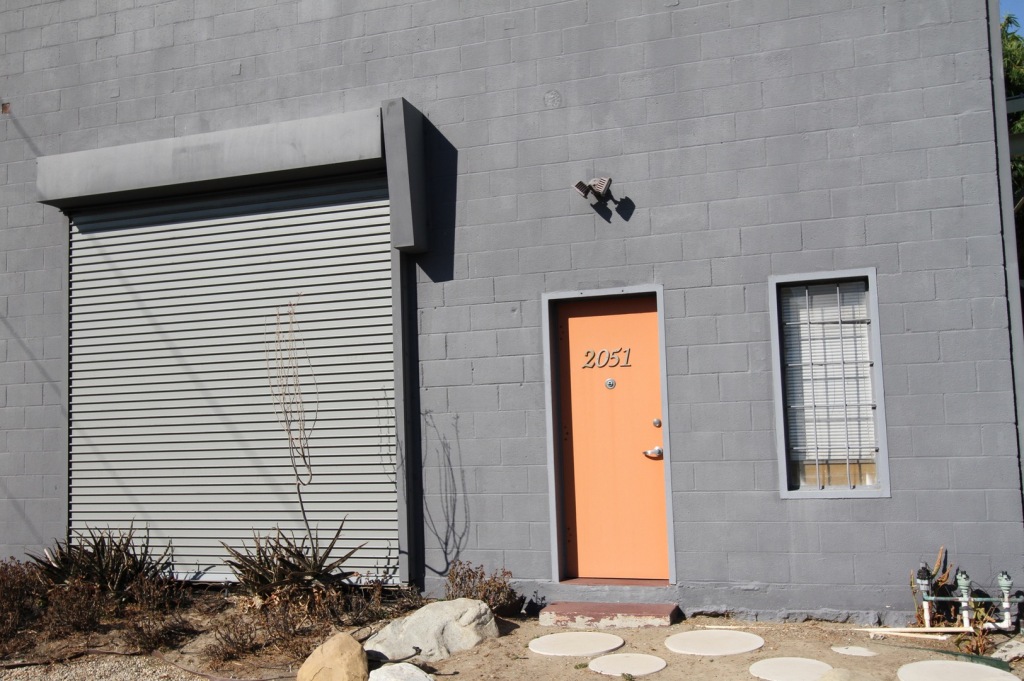
    Design firms, architects, photographers, tech incubators, high end specialty fabricators, and other such enterprises have moved in to the nondescript buildings of Frogtown. If you’re willing to celebrate concrete block walls and corrugated steel as honest industrial materials you can create the trendy Dwell look with paint and landscaping on the cheap. Compare this process with the expense of restoring a more exotic historic property in a tony neighborhood.

    screen-shot-2016-10-02-at-9-13-11-pm

    screen-shot-2016-10-02-at-9-09-21-pm

    screen-shot-2016-10-02-at-9-08-32-pm

    screen-shot-2016-10-02-at-9-07-54-pm

    screen-shot-2016-10-02-at-9-07-03-pm

    screen-shot-2016-10-02-at-9-06-32-pm

    Art Yanez is a Los Angeles native and the son of immigrants. He’s also the principal of FSY Architects. He purchased three contiguous parcels in Frogtown and created a campus for his firm.

    screen-shot-2016-10-17-at-5-18-27-pm

    screen-shot-2016-10-02-at-9-15-37-pm

    screen-shot-2016-10-02-at-9-15-50-pm

    screen-shot-2016-10-02-at-9-19-49-pm

    screen-shot-2016-10-02-at-9-06-02-pm

    screen-shot-2016-10-02-at-9-05-53-pm

    screen-shot-2016-10-02-at-9-12-49-pm

    screen-shot-2016-10-02-at-9-04-15-pm

    The space incorporates pre-existing industrial warehouses as well as new construction with shops and offices that are now rented for supplemental income. The architecture firm’s own offices are currently oversized to accommodate anticipated expansion as business continues to ramp up. But construction is a cyclical industry, so the space can be subdivided and rented during future downturns.

    screen-shot-2016-10-02-at-9-12-41-pm

    screen-shot-2016-10-02-at-9-16-58-pm

    screen-shot-2016-10-02-at-9-11-58-pm

    screen-shot-2016-10-02-at-9-12-06-pm

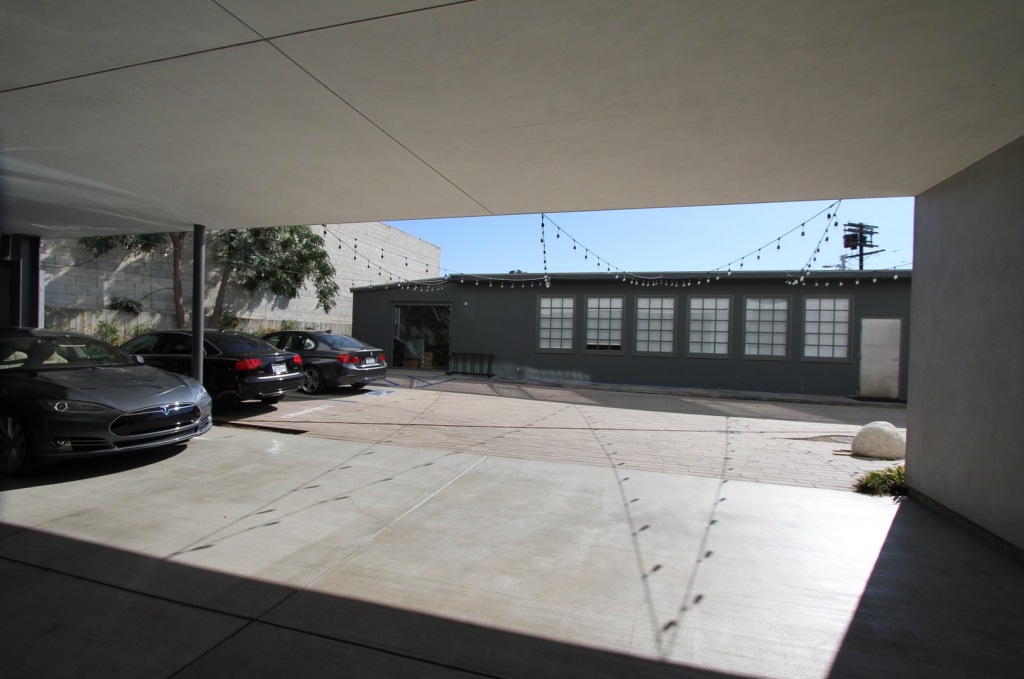
    The new building achieves the legally required off street parking standard as well as the fire marshal’s demand that a full size fire engine be able to drive around the entire structure in an emergency. The parking is convenient (this is Los Angeles after all), but the outdoor space does double duty as a plaza for human activities on occasion. Strings of cafe lights, movable furniture, potted plants, and people transform the place quickly and easily.

    screen-shot-2016-10-02-at-9-21-21-pm

    screen-shot-2016-10-02-at-9-03-00-pm

    screen-shot-2016-10-02-at-9-16-40-pm

    screen-shot-2016-10-02-at-9-14-17-pm

    screen-shot-2016-10-02-at-9-02-32-pm

    screen-shot-2016-10-02-at-8-02-41-pm

    screen-shot-2016-10-02-at-8-02-50-pm

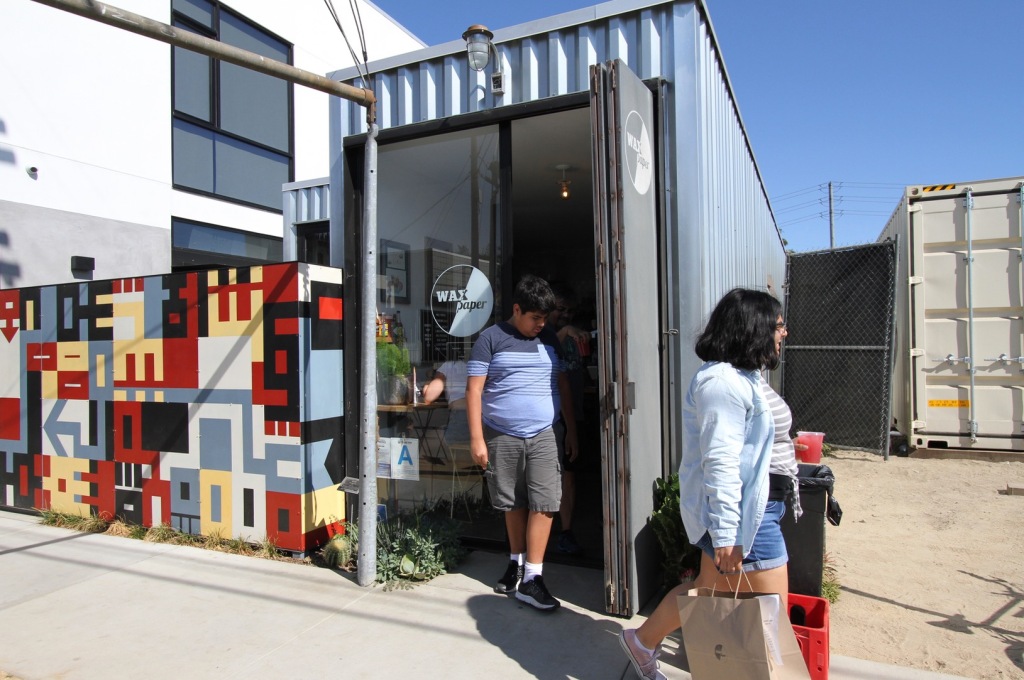
    Part of FSY’s strategy was to create a place that would activate the entire community, not just a building containing offices. The initial concept involved repurposing shipping containers and pressing them into service as small shops. The building code wouldn’t permit that so a stick built version mimics the container look and scale. Actual containers are parked in back and are used for low cost storage. Local artists were invited to install distinctive motifs for the exterior of the corner cafe. All of this was as-of-right construction within the established city code.

    screen-shot-2016-10-01-at-4-30-34-pm

    screen-shot-2016-10-01-at-8-24-41-pm

    screen-shot-2016-10-01-at-4-30-58-pm

    screen-shot-2016-10-01-at-8-27-09-pmscreen-shot-2016-10-01-at-8-25-40-pm

    screen-shot-2016-10-01-at-8-23-39-pm

    For the last century the Los Angeles River has been a concrete industrial drainage canal sealed off by barbed wire fences and cinder block walls. Most people in LA have no particular relationship to the “riverfront.” But that’s changing as city officials have announced a billion dollar program to transform the river into a ribbon of green and blue public amenities lead by none other than starchitect Frank Gehry.

    screen-shot-2016-09-24-at-5-55-16-pm

    screen-shot-2016-09-24-at-5-55-37-pm

    screen-shot-2016-09-24-at-5-55-51-pm

    The success of small infill developments in Frogtown along with the city’s plans to transform the river have attracted large scale production developers. Previously ignored sites began to sprout upscale apartment buildings and condo complexes on dead end streets at the river’s edge.

    This process was viewed with scorn by existing property owners and community organizers who haven’t forgotten how their families were bulldozed to make way for Dodgers Stadium. So they lobbied for new regulations to make it harder to build anything new and to work around the perception that political figures are corrupt and on the take for developer’s money. The new regulations now make projects like Art Yanez’s building non-conforming and subject to special review processes for height, bulk, and so on.

    The result is that now only very small projects can be built as-of-right, and only very large and expensive projects can overcome the newly implemented regulatory hurdles. All the incremental in-between projects that might have been built are now much less viable and far more expensive to push through. This is what land use policy actually looks like on the ground.

    John Sanphillippo lives in San Francisco and blogs about urbanism, adaptation, and resilience at granolashotgun.com. He’s a member of the Congress for New Urbanism, films videos for faircompanies.com, and is a regular contributor to Strongtowns.org. He earns his living by buying, renovating, and renting undervalued properties in places that have good long term prospects. He is a graduate of Rutgers University.

    Top photo: John Sanphillippo

  • Were Urban Freeways a Good Idea?

    It’s almost a truism in urbanist circles that construction of urban freeways was a bad idea.

    Indianapolis Monthly magazine takes a somewhat more charitable view in its retrospective on the 40th anniversary of the completion of the downtown “inner loop” freeway.

    “But even before its grand opening, the inner loop—31 miles of interstate within I-465, built at a cost of nearly $300 million—had begun paying downtown dividends. Real estate values around the superhighway increased in the early 1970s, reversing a 35-year decline, and Mayor Hudnut also credited the road with stimulating such projects as the Hilton Hotel, the Indiana National Bank building, and the $150 million expansion of Eli Lilly & Co.

    Hudnut predicted the new freeway would spur 20,000 new jobs, and state legislators embraced the spirit: In 1973, when a federal reimbursement slowdown threatened to add 10 years to its completion date, they fronted the money for the last leg of I-65/I-70.”

    The conventional wisdom is that downtown freeways were unmitigated disasters. It says they destroyed vast tracts of urban neighborhoods, with a racist targeting of black ones, then remained as huge barriers to redevelopment.

    The Indy Monthly article acknowledges the downsides of the construction:

    “But little relief awaited the neighborhoods that were carved up for the inner loop. The project displaced a total of 17,000 residents, including 6,000 from Fountain Square (one-fourth of the population).

    Linda Osborne, owner of Arthur’s Music Store, remembers Fountain Square as a vibrant full-service community during the 1950s and early ’60s. “There were theaters, grocery stores, shoe stores—all the things you have in a small town,” says Osborne, whose family business opened in 1952. Interstate construction, however, dug a wide channel that isolated Fountain Square from downtown. Then as now, a Virginia Avenue bridge carried traffic over the chasm, but the commercial district soon tanked, Osborne says.”

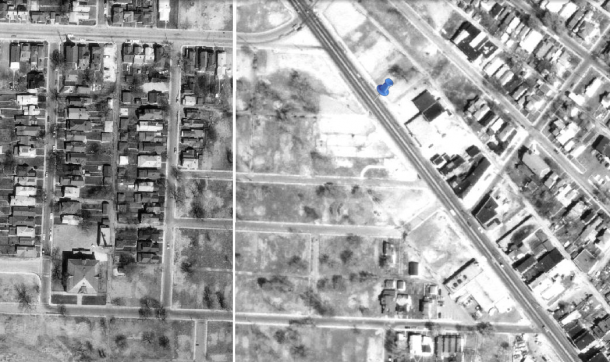
    I previously posted an article documenting the destruction in Fountain Square. It features pictures from Historic Indianapolis, including this one showing the scale of the destruction.

    historic indianpolis

    I don’t have Fountain Square’s demographics at the time, but what evidence I do have suggests it was a largely white community, which it remains to this day. So in this case the place with the most destruction wasn’t a minority area.

    Indy Monthly also points out the example of downtown Ft. Wayne. That city decided to go with a bypass option rather than a downtown alignment. The result was that they did indeed prevent neighborhoods from being destroyed, but those neighborhoods and the city’s downtown severely declined anyway. While there are some interesting things going on downtown Ft. Wayne to be sure, it’s unarguable that Indy’s downtown is on a completely different plane of development, though to be sure Indy is a much larger city.

    In fact, this is the pattern we see. Urban decline happened pretty much everywhere, urban freeway or no. When there’s a downtown freeway to blame, people do that. Where there’s not, people blame the bypass. Hence most attributing of blame for decline to urban freeways is simply incorrect.

    Indy Monthly argues that the freeway system provided for convenient access to downtown. Without that access. businesses would have fled, it would be impossible to host large events, etc.

    There is something to this, I think. If there were no freeway access to downtown Indianapolis, it seems likely it would be a much diminished urban center. Keep in mind, there was limited transit access and no real prospect of creating it.

    But we should separate two things, the freeways that provide access to downtown and the ones that run through it. It’s certainly possible that freeway spurs could have been built into the center of the city without building them as through-routes. This is the idea behind much of the boulevarding advocacy movement.

    Twice within the last decade, the state implemented multi-month closures of the Indianapolis inner loop to through traffic. This was a good real world test of whether it was needed at all.

    I wasn’t living there at the time but did do some driving around rush hour during one of the closures. The best alternate route for through traffic is to use I-465 to the south. This did get heavily congested, suggesting that this road would need to be widened prior to removing the inner loop. Some folks did say some surface routes near downtown were more congested during rush hour. But there didn’t seem to be any show-stoppers to permanent closure.

    In my view, removal of the inner loop is feasible, though highly unlikely to ever occur. But it goes to show that the benefits of freeway access to downtown could have been implemented in ways that were less invasive, using freeway spurs and boulevard distributors. In this scenario, the inner loop itself would no longer be a barrier, and the demolition associated with its construction could have been largely avoided. The freeway spurs could have been build with lower capacity, since no through traffic need be designed for. Some interchange complexes would have been eliminated.

    Removing or never building the inner loop would indeed likely add to peak of the peak congestion. The extent to which this dominates local thinking is hard to overstate. It’s revealing that the biggest source Indy Monthly used for quotes was Bill Benner, a sports columnist, and sports and events loom large.

    “To fully appreciate Indy’s middle-aged expressway, imagine 65,000-plus NFL fans spilling out of Lucas Oil Stadium and heading home on the stoplight-laden likes of Meridian Street, Washington Street, Kentucky Avenue, and other prime thoroughfares of yesteryear. Or don’t imagine it—because without this key piece of infrastructure, there might never have been a Lucas Oil Stadium.

    “It was a series of dominoes,” Benner recalls. “Without the interstate, it would have really held back downtown development. So maybe you don’t have the Hoosier Dome, or the Indianapolis Colts, or the Super Bowl. And maybe you don’t have Circle Centre or Victory Field.”

    Designing a transport system around sports event peaks, particularly low-frequency ones like NFL home games, illustrates the Faustian bargain Indianapolis made to revive its downtown.

    Indianapolis made its downtown America’s most friendly to major events. So you can get people to and from the Super Bowl the one time the city hosts it. (I would suspect getting people to and from the Indianapolis Motor Speedway for so many decades powerfully shaped this mode of thinking).

    But the design of the transport system is very hostile to almost everything else, whether that be residential uses or pedestrian access. This has changed somewhat with the Cultural Trail, Georgia St. and others. But to truly change the game would require a major change in psychological orientation to be able to care less about peak of the peak congestion after Colts games and more about the average ordinary experience of the city. I suspect a similar dynamic is at play in many other places.

    Aaron M. Renn is a senior fellow at the Manhattan Institute, a contributing editor of City Journal, and an economic development columnist for Governing magazine. He focuses on ways to help America’s cities thrive in an ever more complex, competitive, globalized, and diverse twenty-first century. During Renn’s 15-year career in management and technology consulting, he was a partner at Accenture and held several technology strategy roles and directed multimillion-dollar global technology implementations. He has contributed to The Guardian, Forbes.com, and numerous other publications. Renn holds a B.S. from Indiana University, where he coauthored an early social-networking platform in 1991.

    Photo: By reddit user MikeSanborn. Cf. https://www.reddit.com/r/indianapolis/comments/3jx7n5/my_favorite_view_of_indianapolis/cut6n4k?context=3 (https://imgur.com/oJLlvTS) [CC BY 4.0], via Wikimedia Commons

  • Job Creation Under the Next President

    Retraining the employed and the unemployed for higher value-added skills is now more important than simply adding to the number of jobs.

    Coal and steel magnate Wilbur Ross, a senior policy advisor to the Trump campaign, has just made in the pages of the Wall Street Journal an economic prediction that looks mathematically unattainable.

    Writing with Professor Navarro of UC – Irvine, Mr. Ross forecast that policies enacted by a President Trump would lead to the creation of 25 million new jobs, ostensibly over an eight year period:

    Donald Trump will cut taxes, reduce regulation, unleash our abundant energy and eliminate our trade deficit through muscular trade negotiations that increase exports, reduce imports and eliminate cheating. These policies will double our economic growth rate, create 25 million new jobs, boost labor and capital incomes, generate trillions of additional tax revenues and reduce debt as a percentage of GDP.

    To evaluate the 25 million figure, remember that new job creation during the booming Ronald Reagan and Bill Clinton two-term presidencies amounted to 16.1 million and 22.5 million, respectively. Given the growth of the population, you could say that a 25 million target compares reasonably to these figures. It is optimistic but, on the face of it, not outlandish.

    That is, until you scrutinize the underlying demographics. A new job requires not only an open paid position but also a person to occupy this position. In order to have 25 million new jobs, we need 25 million people to fill these jobs. So does the US even have 25 million people who would be available in the next eight years? It doesn’t seem like we do.

    job numbers

    Now as at any time, there are three main sources of new workers:

    Increase in working-age population: During the 1980s decade (which includes the two Reagan terms), the population aged 20 to 64 grew by 18.5 million. During the 1990s (including the two Clinton terms), it grew by 19.1 million. In the coming decade ending in 2025 by contrast, it will only grow by a much smaller 2.6 million.

    What explains this decline in growth for this segment? Simply put, there were many more new babies in the 1960s than in the 1910s, resulting in strong growth in the 1980s. But there were only a few more babies in the 2000s than in the 1950s, resulting in lower growth in the 2016-25 decade. Put another way, a rising number of boomers are turning 65 every year and exiting the 20-64 age bracket. This means that, unlike in the 1980s and 1990s, a large percentage of people going into these 25 million jobs will have to come from other sources.

    Immigration: Assuming an annual influx of one million immigrants (green card holders), we estimate another 7 new million workers for the decade, and a prorated 5.6 million over eight years.

    The idle and unemployed: The current official unemployment rate is hovering around 5%. However, the U6 measure of unemployment now stands at 9.7%, not far from its historical average. If we assume generously that U6 will drop by 3% towards its low of October 2000, there would be an additional 4.8 million people available for work.

    Adding all these figures (and making adjustments from 10 to 8 years where needed), we see that there is still a shortfall of 12.5 million people, or half the 25 million needed to meet the new supply of jobs.

    Keeping an open mind, we could speculate that an additional 12 or 13 million people, counting for example a large number of women and elderly, could decide to join or remain in the labor force. But this seems unlikely within the big economic boom described by Mr. Ross and Professor Navarro. If the economy will be doing that well, fewer spouses may choose to work and more people will retire early.

    Finally, the next President could increase the number of immigrants to address the labor force shortfall. This decision would require doubling or tripling the number of visas and green cards awarded annually, a policy that runs against the grain of Trump campaign pledges.

    To sum up, an optimistic level of job creation under the next President, whether Trump or Clinton, would be 12 to 15 million. But even this lower target will prove to be too ambitious if, as is widely anticipated, automation and the internet of things take over more job functions.

    Further, because the marginal demand for jobs will be less than in the past, an effort to boost the supply looks not only ill-fated but also misdirected, like that of a general preparing to fight the last war. At this juncture of changing demographics and increased automation, it will be more important to upgrade jobs to higher value-added functions than to simply count the number of net new jobs. Bringing the old jobs back would in theory provide much needed relief to households that are struggling, but retraining these same workers for better jobs will ultimately lead to more favorable outcomes.

    In this vein, investments in education and retraining seem more critical now than in the past. Rather than merely adding jobs, a more promising employment strategy for the next President would be to facilitate retraining programs for people who have not kept up with the economy because of outsourcing or other factors.

    All this will probably be unconvincing to Mr. Ross and Professor Navarro who downplay the role of demographics in the economy and who believe that a sufficient amount of can-do spirit will overcome the facts of a hard-nosed analysis:

    Some falsely assert that the U.S. and other developed countries have settled into a “new normal” of slower economic growth due to greater competition from developing countries and demographic changes beyond our control.

    But to quote Mr. Trump’s running mate, Gov. Mike Pence, “People in Scranton know different. People in Fort Wayne know different.”

    We shall see.

    One clear fact remains however: the golden decades ending in 2005 were in part powered by a fast-growing population and a declining dependency ratio, two conditions that are now fading.

    Sami Karam is the founder and editor of populyst.net and the creator of the populyst index™. populyst is about innovation, demography and society. Before populyst, he was the founder and manager of the Seven Global funds and a fund manager at leading asset managers in Boston and New York. In addition to a finance MBA from the Wharton School, he holds a Master’s in Civil Engineering from Cornell and a Bachelor of Architecture from UT Austin.

    Photo: neetalparekh

  • Erasing Anglo cultural heritage risks what makes our republic diverse

    It’s increasingly unfashionable to celebrate those who made this republic and established its core values. On college campuses, the media and, increasingly, in corporate circles, the embrace of “diversity” extends to demeaning the founding designers who arose from a white population that was 80 percent British.

    In this American version of Mao’s “Cultural Revolution,” which tried to eviscerate traces of China’s past, venerable buildings are being renamed, athletes refuse to stand for the national anthem and, on some campuses, waving the American flag is now considered a “microaggression,” while English students at Yale want to avoid reading the likes of Milton, Shakespeare and Chaucer.

    Of course, some changes are justified. Asking anyone, particularly African Americans, to revere the Confederate flag or attend schools named after the founder of the Ku Klux Klan is, indeed, offensive. But in our zeal to address old wrongs, we may also be sacrificing the very things that have made this republic so attractive to millions from distinctly different backgrounds for the last two centuries.

    Why we come here

    Just to clear the air, I have not a single drop of British blood in me. The closest ties I have to what I consider my cultural and political home country come from my great uncle Simon, who served in Gen. Allenby’s Jewish brigade in World War I, and that my wife, born in Montreal, came into the world a subject of Her Majesty, Queen Elizabeth. Career wise, I did work for a think tank in London for several years.

    But what ties most Americans to the founders is not race, but our embrace of a political and legal culture based on distinctly Anglo-Saxon ideas about due process, representative government, property rights and free speech. These proved infinitely superior to the divine right of czars, kaisers, emperors and other hereditary autocrats for generations of non-Anglo-Americans.

    This system, always capable of amendment, has allowed waves of traditional outsider groups — African Americans, Latinos, women, Mormons, Jews and Muslims — to join the economic, political and cultural mainstream. In some cases, as in the case of President Obama, they have also secured the highest reaches in the national firmament.

    Read the entire piece at the Orange County Register.

    Joel Kotkin is executive editor of NewGeography.com. He is the Roger Hobbs Distinguished Fellow in Urban Studies at Chapman University and executive director of the Houston-based Center for Opportunity Urbanism. His newest book, The Human City: Urbanism for the rest of us, will be published in April by Agate. He is also author of The New Class ConflictThe City: A Global History, and The Next Hundred Million: America in 2050. He lives in Orange County, CA.

    Photo: William Robert Shepherd [Public domain], via Wikimedia Commons

  • Unsustainable solutions in the name of sustainability

    The other day when I was riding my bike in Minneapolis crossing I-94 near Riverside I encountered a small townhome project built during the first (failed) green era under the Carter administration. It was built to showcase the future. One thing I’ve learned over the years building my own green homes is to not listen blindly to the experts who parrot others’ ideas without thinking of the ramifications.

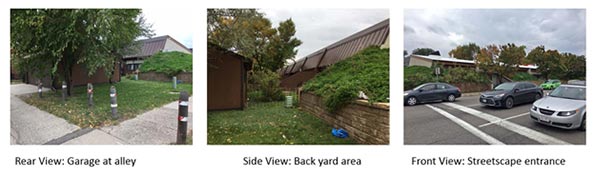
    The world’s first solar and earth-berm grass-roof townhome projects look like this today:

    image of townhome

    The original townhomes were built with earth covered roofs, with south facing solar panels for heating, and stored the heat collected over a long period of time in a room full of boulders. In 1983, I also owned an earth-berm solar heated home overlooking a lake in another part of town. Back then we thought, as the world freezes over (no global warming at that time), we would be nice and toasty in our ‘energy-independent’ homes powered by the sun itself. I went even further with a 10kW Bergey Wind Generator on a 100′ tall tower. Heated by the sun and powered by the wind.

    As you see in the above pictures, this experiment, which had the University of Minnesota involved (from what I remember), did not age well, nor did it work – at all! Gone are the solar panels that used to collect the heat positioned along the bare brown steel roof panels, and gone is grass roof that leaked. Banished is the room full of boulders to store the heat, which got so hot often windows needed to be opened to let in cold winter air, a problem my own solar home had also.

    In 1983, my 4,000 square foot lake front solar home cost $120,000 and after tax credits, my Wind Generator cost $12,000. These smaller townhome units cost $80,000 at the time. One of the original residents who stayed over the decades experienced failed systems and lawsuits. They eventually sold their home – for $80,000! Quite the investment these fancy schmancy trendy homes. A Nigerian investment scheme via an E-Mail might have been less risky. You would think the first home owners would have been the architects and professors who were behind this project – but they themselves didn’t buy in, so there’s an indication that maybe the idea was not so terrific. This is the lesson I’ve learned, never take advice from anyone who is not willing to personally invest and take the same risk as they suggest to others in a new concept.

    The Carter era was a troubled one, with energy widely predicted to be running out, and home mortgage rates as high as 18%. It’s hard to imagine there was any new housing being built, but some were. The initial residents of these townhomes (including myself) believed we were the smart ones, preparing for the energy costs skyrocketing and never having to worry. Hell could freeze over – but we wouldn’t.

    That was then, but how does this apply to now, especially with an election just days away?

    Hillary Clinton was promising half a billion solar panels on rooftops. OK, now picture the above bare rooftops – that’s how the roofs will look when the lifespan of those half billion heavily subsidized solar panels reach the end of their usefulness – in two decades. Where do you think most solar panels are made today? If you answered China, you deserve a star! And if a roof needs repair or replacement prior to the end of the panels’ lifespan, will the government subsidize the extra cost of repairs? Who will pay for cutting down the mature trees along the streets so that the sun can reach these panels? Oh, wait, you are supposed to keep those mature, beautiful, and value increasing shade trees? My bad. You think Obama Care was a terrible idea… just wait for the Hillary program, and the social engineering sure to follow, and sure to fail.

    Trump? I imagine he’d be politically incorrect of course, calling those solar townhomes: ugly, hideously, awful useless, fat, blemished, blight… only unlike comments about women, he’d have a lot who would agree. I don’t know what a Trump administration would look like, but I’m pretty confident that it would not involve social engineering, nor have subsidies go to China or Mexico. I hope that if he had a wind or solar agenda, the panels would be produced here with a fair and proper competition to award the vendors with the best price/performance ratio and make them bond a 20 or 30-year fund if the mechanisms wear prematurely.

    I hope that Trump or Clinton look into creating new programs that encourage private new developments or large scale redevelopment to have their own ground based solar gardens instead of the current wave of public investments of solar farms which have federal tax advantages but seem, at least to me, a questionable investment at best. They are even promoting these solar investments at the Best Buy store in Minnetonka, Minnesota with the promise of a consistent energy cost, but they require a 20-year commitment, even though the average home sells once every 6 years.

    These are heavily subsidized by you, the tax payers. Some of these solar fields are supposed to supply the power companies themselves, for example Ivanpah in the California desert which was to supply power for PG&E. Ivanpah was a solar system using mirrors heating up over 170,000 panels to create steam, but failed to deliver the power the ‘experts’ promised. Besides killing thousands of birds, the 1.5 billion dollars of your tax money was pretty much a really bad investment – oopsie! A more viable alternative is to create a more localized system as part of new developments or large scale redevelopments.

    Having a solar garden in a subdivision eliminates the problem with roof-top application, cleaning ice and snow off the panels, and streets could still have those shade trees. Each resident in the subdivision would have their share of the power and as technology improves, every resident would benefit from the latest technologies – be it solar, wind, or both. Such a Federal program does not exist – but should.

    Top photo by https://pixabay.com/en/users/Kenueone-2397379/ [CC0], via Wikimedia Commons

    Rick Harrison is President of Rick Harrison Site Design Studio and Neighborhood Innovations, LLC. He is author of Prefurbia: Reinventing The Suburbs From Disdainable To Sustainable and creator of LandMentor. His websites are rhsdplanning.com and LandMentor.com

  • The New War Between the States

    In this disgusting election, dominated by the personal and the petty, the importance of the nation’s economic geography has been widely ignored. Yet if you look at the Electoral College map, the correlation between politics and economics is quite stark, with one economy tilting decisively toward Trump and more generally to Republicans, the other toward Hillary Clinton and her Democratic allies.

    This reflects an increasingly stark conflict between two very different American economies. One, the “Ephemeral Zone” concentrated on the coasts, runs largely on digits and images, the movement of software, media and financial transactions. It produces increasingly little in the way of food, fiber, energy and fewer and fewer manufactured goods. The Ephemeral sectors dominate ultra-blue states such as New York, California, Oregon, Washington, Massachusetts, Maryland, and Connecticut.

    The other America constitutes, as economic historian Michael Lind notes in a forthcoming paper for the Center for Opportunity Urbanism, the “New Heartland.” Extending from the Appalachians to the Rockies, this heartland economy relies on tangible goods production. It now encompasses both the traditional Midwest manufacturing regions, and the new industrial areas of Texas, the Southeast and the Intermountain West. 

    Contrary to the notions of the Ephemerals, the New Heartland is not populated by Neanderthals. This region employs much of the nation’s engineering talent, but does so in conjunction with the creation of real goods rather than clicks. Its industries have achieved  generally more rapid productivity gains than their rivals in the services sector. To some extent,  energy  and food producers may have outdone themselves and, since they operate in a globally competitive market, their prices and profits are suffering.

    Despite deep misgivings about the character of Donald Trump, these economic interests have led most Heartland voters  somewhat toward the New York poseur, and they are aligning themselves even more to down-ticket GOP candidates. In generally purple states like Missouri, Ohio and Iowa, where manufacturing is key, Trump still leads—at least he was before the latest spate of Trump crudeness was revealed, this time regarding women.

    The Republicans’ strongest base is in the energy belt where Trump has suggested policies that call for greater domestic production. This naturally resonates with businesses and working people in states ranging from Texas, Oklahoma and Louisiana to West Virginia, Wyoming and Alaska, which have borne the brunt of nearly 100,000 layoffs so far this year. It’s no surprise that all of these states constitute increasingly a lock for the GOP.

    Historical Precedents

    The conflict of economic interests has long defined American politics. America’s revolution was largely started by New England merchants rebelling against colonialist policies that sought to strangle our nascent capitalism in its infancy. The great economic tensions of the early 19th century centered on a struggle between the Jeffersonian and Jacksonian yeomanry and the powerful merchant class in the great Northeastern cities. A major point of contention was around such issues as the establishment of a national bank and high tariffs, bitterly opposed in the nation’s interior and the South.

    The biggest national crisis in our history underscored this clash of competing economic interests. Although the galvanizing issue on both sides of the Mason-Dixon line was slavery, the Civil War was also a war, as Karl Marx suggested, of competing economic visions: the agrarian, slave-fueled economy of the South vs. the rapidly industrializing Northeast and Midwest. 

    Post-war conflicts revolved about hostility between the urbanizing North and the more rural South and West. Finance and industrial capital, usually in cities like New York and Chicago, was largely Republican and protectionist. Democrats tried to cobble a coalition of Southern agriculturalists and the big city, ethnic working class. With the onset of the Great Depression, Democrats gained primacy by melding this coalition to a rising and increasingly progressive professional class.

    In the past, Democrats competed in the Heartland and backed its key industries. Lyndon Johnson was a proud promoter of oil interests; Robert Byrd never saw a coal mine he didn’t like for all but the end of his career. Powerful industrial unions tied the Democrats to the production economy. Now those voters feel abandoned by their own party, and even are dismissed as “deplorables”  

    Increasingly few Heartland Democrats, outside of some Great Lakes states, win local elections. In the vast territory between Northeast and the West Coast, Democrats control just one state legislature, the financial basket case known as Illinois.

    For their part, Republicans are becoming extinct in the Ephemeral states, a process hastened by the growing concentration of media on the true-blue coasts. Wall Street, Silicon Valley and Hollywood have been drifting leftward for a generation, and Trump has accelerated this movement. Joined by the largely minority urban working and dependent classes, progressives now have a lock on   the Northeast and the West Coast.

    The New Battle Lines

    The new conflict between regions reflects a conflict between different ways of making money. Ephemeral America’s media and academic adjuncts generally portray the New Heartland’s economy as exploitative and environmentally harmful. A massive oil discovery in Alaska may be welcome news there, but a horrific prospect in places like Seattle, New York, or San Francisco.

    Climate change increasingly marks a distinct dividing line. Manufacturing, moving goods, industrial scale agriculture, fossil fuel energy all consume resources in ways many progressives see as harming the planet. Progressives threaten these industries with increasingly draconian schemes to reduce greenhouse gas emissions. Gone are the days of supporting moderate shifts — which could work with some Heartland economies — from coal to gas and improving mileage efficiency.

    Instead the demand from the left is for a radically rapid de-carbonization, which will reduce jobs in the Heartland and lower living standards everywhere. In California, Jerry Brown  is fretting about ways to curb cow flatulence, an obsession that is unlikely to be popular in Kansas, Nebraska or Iowa.

    These divergent politics between states are accelerating the gap between the two economies. Since 2010, as the recovery kicked off, the big industrial job growth took place mostly in the Heartland — in Detroit, Charlotte, Atlanta, Phoenix and Houston. New York, Los Angeles, Philadelphia and Boston all managed to lose jobs. Since 2000, Los Angeles and New York together have lost over 600,000 manufacturing positions.

    As industry weakens in an area, opposition to radical climate mitigation declines. Someone representing an increasingly de-industrialized east Los Angeles or Brooklyn feels no pressing reason to advocate for industry. High energy and housing prices, both connected to draconian climate change policies, gradually empty out the middle-class families, the demographic bulwark of the GOP. Meanwhile, in their coastal bastions, the grandees of Silicon Valley and Wall Street increasingly disdain anything reliant on fossil fuels.

    The New Heartland has reason to resist such policies, which could turn what have been burgeoning economies back into backwaters. Regulatory regimes that radically boost energy costs, as in California and New York, hasten de-industrialization. The  rapid decline of areas such as interior California and upstate New York testifies what may be in store for the Heartland under a Hillary Clinton administration and a Congress controlled by the Democratic Party.

    This conflict will deepen in light of the ongoing gradual decline of key tangible industries — durable goods like heavy equipment and car manufacturing, fossil fuel energy, agribusiness. Back in 2012, all these sectors were doing well, something that helped President Obama win much of the old Rust Belt. In the current economic climate Republicans could still make significant progress, even with Trump at the top of the ticket. 

    In the process, the GOP, to the horror of many of its grandees and most entrenched interests, is becoming transformed. It is becoming something of a de facto populist party, based in the New Heartland, while the Democrats remain the voice of the coastal oligarchies who almost without exception back Hillary

    In the immediate future, given the likely trajectory of a Clinton presidency, things may get tougher times for the New Heartland and its industries. Federal regulators will ape their California counterparts, extending controls that seem sensible in San Francisco into dramatically different geographies.

    But don’t count the New Heartland, or the GOP, out. Once Trump is gone, there will be enough political will and money to mount a counter-offensive against the Ephemerals. The new War Between the States will not end in November. It will have hardly just begun.

    This piece first appeared in Real Clear Politics.

    Joel Kotkin is executive editor of NewGeography.com. He is the Roger Hobbs Distinguished Fellow in Urban Studies at Chapman University and executive director of the Houston-based Center for Opportunity Urbanism. His newest book, The Human City: Urbanism for the rest of us, will be published in April by Agate. He is also author of The New Class ConflictThe City: A Global History, and The Next Hundred Million: America in 2050. He lives in Orange County, CA.

  • How to Make Post-Suburbanism Work

    Are you ready to become a “real” city yet, Southern California? Being “truly livable,” our betters suggest, means being “infatuated” with spending more billions of dollars on outdated streetcars (trolleys) and other rail lines, packing people into ever small spaces and looking toward downtown Los Angeles as our regional center.

    Our cognitive elites dislike the very idea that Los Angeles, as Dorothy Parker once supposedly described, has long been “72 suburbs in search of a city.” Yet, Southern California, as I discuss in a new Chapman University report, has from its early emergence grown around a “post-suburban” model of dynamic, smaller clusters. This urban form has become common in many major metropolitan areas as automobiles have replaced transit as the primary means of getting around.

    This model worked here brilliantly for most of the last half century — until planners, real estate speculators and California bureaucrats decided that we needed to emulate New York City and other older monocentric core cities. Like the provincials they consistently prove themselves to be, our leaders have generally complied.

    So, after nearly 15 years spent in pushing this direction, what have we accomplished? A transit system that barely serves as many people as it did before we started building trains, housing prices among the highest in the nation, super-high poverty rates and a population that continues to seek to go somewhere else, including some 1.6 million net domestic migrants who have left the L.A. and Orange County area since 2000.

    The density mirage

    Some see densification as necessary to meet the demands of an expanding population. Yet, both L.A. and O.C.’s populations are growing slower than both the state and national average. Nor has the pro-density regime relieved any of the pressure on housing and rent. For one thing, high-density housing is far more expensive on a per-square-foot basis, either for townhouses or detached housing. It can only accommodate the poor at the cost of massive subsidies.

    The drive to re-engineer our post-suburban form assumes that downtown Los Angeles can become like the more historic central business districts of New York, Chicago and San Francisco. These CBDs have from nearly double to 10 times the employment levels as downtown L.A. Suffice it to say, downtowns in New York, Chicago and San Francisco have retained regional significance, as others, including Los Angles, have declined in relative influence, with little growth in their share of regional employment. Even the most generous definition of downtown Los Angeles encompasses considerably less than 5 percent of the metropolitan area’s employment, and that share has not grown appreciably since 2000. All the net job growth has been in newer suburbs and exurbs.

    Fundamentally, in “post suburban” regions like southern California, the “sell” is a different one than in places like New York. It is based on a largely suburban quality of life. This does not mean we need to lag economically. Many of the most successful high-tech regions — notably, Silicon Valley; Austin, Texas; Raleigh-Durham, N.C., and the northern reaches of Dallas —– are largely suburban and less dense than the L.A. area. Certainly, densification policies so far have not turned Los Angeles County into a high-tech haven. The county suffers from below-average tech employment, while more suburban Orange County remains 20 percent above average. The fastest increases, albeit from a low base, are occurring in the Inland Empire.

    Read the entire piece at The Orange County Register.

    Joel Kotkin is executive editor of NewGeography.com. He is the Roger Hobbs Distinguished Fellow in Urban Studies at Chapman University and executive director of the Houston-based Center for Opportunity Urbanism. His newest book, The Human City: Urbanism for the rest of us, will be published in April by Agate. He is also author of The New Class ConflictThe City: A Global History, and The Next Hundred Million: America in 2050. He lives in Orange County, CA.

    Photo by Thomas Pintaric (Pintaric) [GFDL or CC-BY-SA-3.0], via Wikimedia Commons

  • A Better Way

    My recent post at Granola Shotgun described how a town in Georgia spent an enormous amount of public money on a new civic center and road expansions, but somehow managed to devalue nearby private property in the process. Here’s an example of a neighborhood in Nashville, Tennessee that took a different approach that cost a lot less and achieved a radically better set of outcomes.


    Screen Shot 2016-08-25 at 6.01.50 PM

    Screen Shot 2016-08-25 at 5.49.18 PM

    The McCabe Park Community Center was designed by a local firm rather than an international starchitect. Municipal funds were recirculated right in town and used to foster native talent and professional employment. And while the facilities are available to everyone in Nashville this center is scaled and programmed primarily to serve the immediate neighborhood.

    Screen Shot 2016-08-25 at 9.25.20 PMGoogle

    Screen Shot 2016-08-25 at 6.41.04 PM

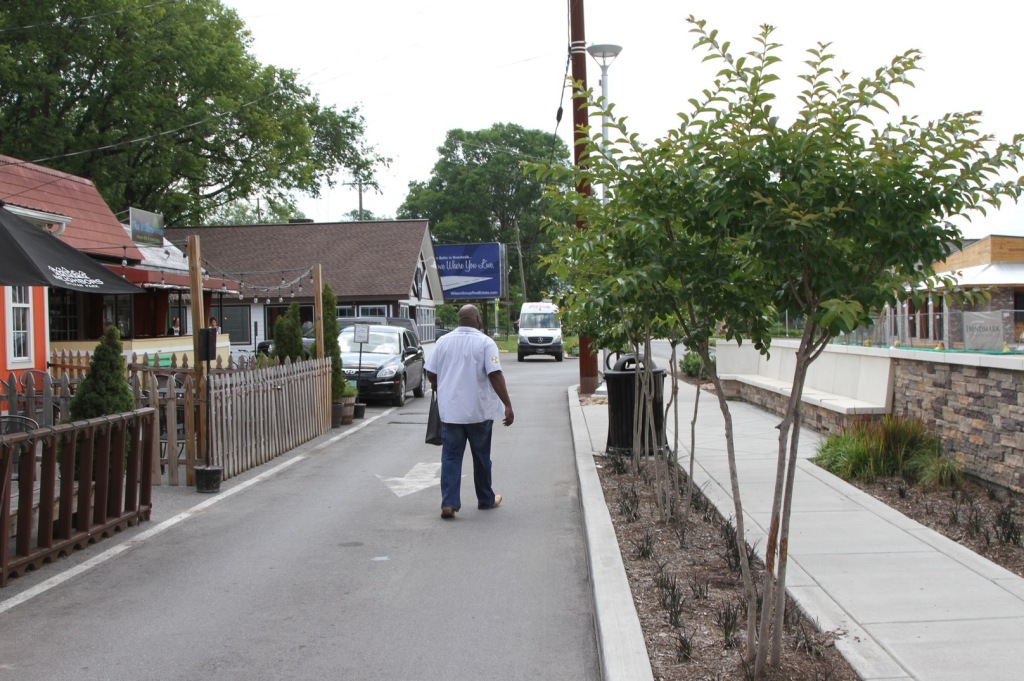
    A conscious decision was made to accommodate pedestrians rather than provide the usual endless automobile infrastructure. There are the required handicap accessible parking spaces close to the entrance at the rear. There are a few dozen off street parking spots along the baseball diamond. But that’s it. It’s absolutely possible to arrive by motor vehicle, but the cars don’t dominate the landscape.

    Screen Shot 2016-08-25 at 11.08.02 PM

    Screen Shot 2016-08-25 at 5.48.42 PM

    Screen Shot 2016-08-25 at 6.01.06 PM

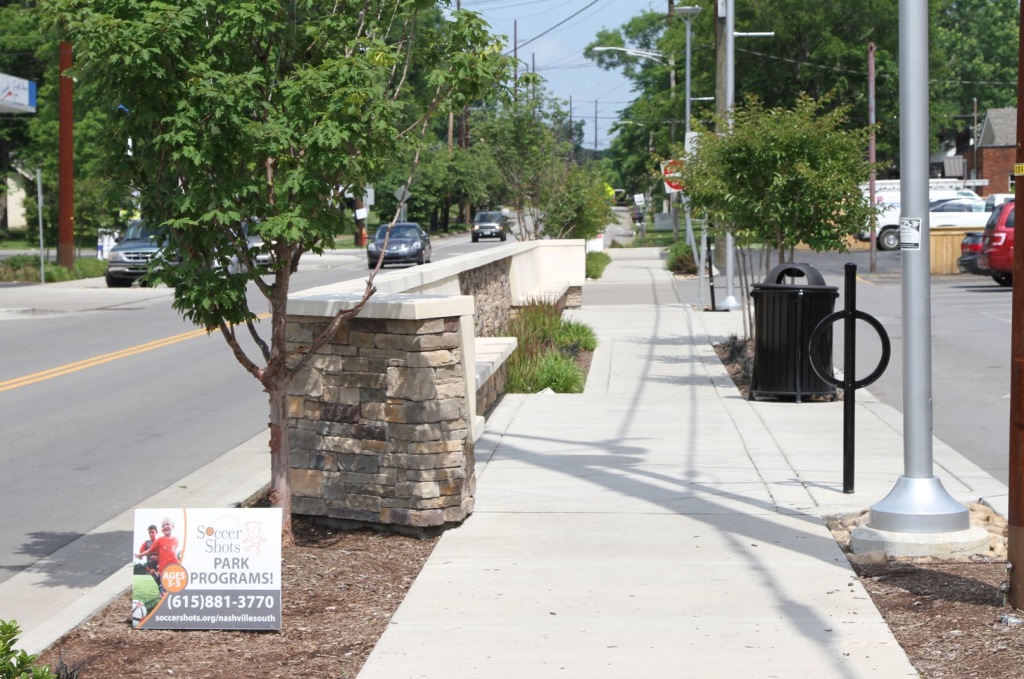
    Bicycle and pedestrian infrastructure make it clear that it’s safe, pleasant, convenient, and dignified to arrive without a car. One of the goals of this community center is to facilitate a more active and healthy lifestyle.

    Screen Shot 2016-08-25 at 11.40.11 PMGoogle from 2009

    Screen Shot 2016-08-26 at 1.07.16 AMGoogle Street View from 2009

    Screen Shot 2016-08-26 at 1.05.07 AMGoogle Street View from 2009

    Screen Shot 2016-08-26 at 1.06.32 AMGoogle Street View form 2009

    Screen Shot 2016-08-26 at 1.48.03 AMGoogle Street View form 2009

    The road out front was a standard suburban affair of wide lanes, fast moving vehicles, no distinction between the road surface and adjacent parking lots, and no sidewalks. This landscape made it very clear that if you weren’t in a car you just weren’t important. It was also brutally ugly and lined with aging low value buildings and struggling businesses.

    Screen Shot 2016-08-26 at 1.29.53 AM


    Screen Shot 2016-08-25 at 5.46.54 PM

    Screen Shot 2016-08-25 at 6.00.19 PM

    Screen Shot 2016-08-25 at 5.49.32 PM

    Screen Shot 2016-08-25 at 5.59.23 PM

    Screen Shot 2016-08-26 at 2.04.37 AM

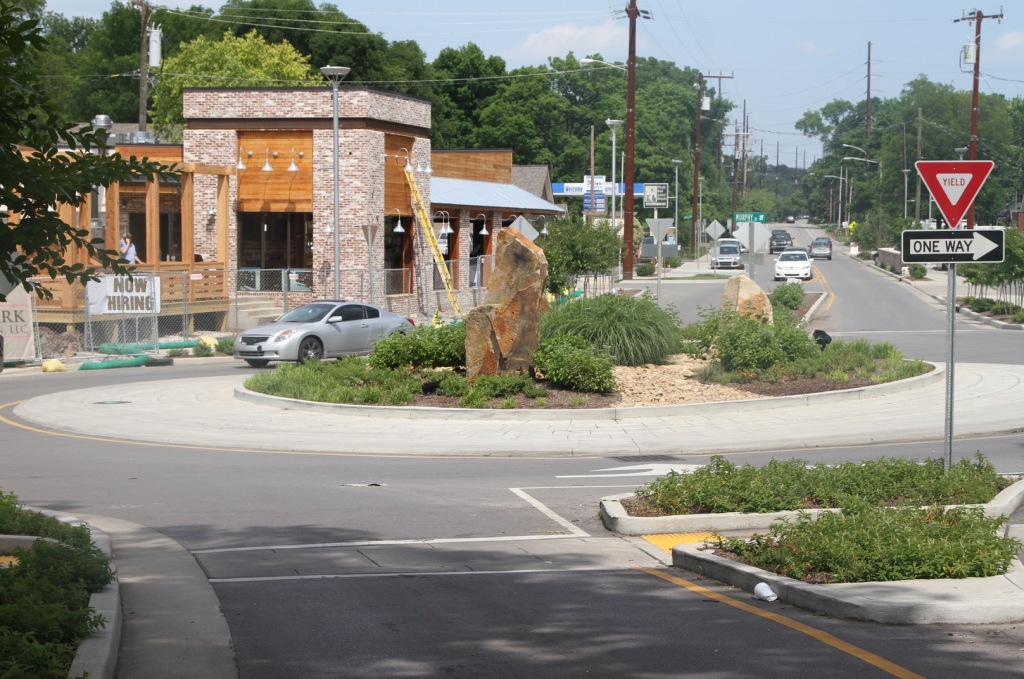
    The new traffic roundabout has transformed the intersection in several crucial ways. First, instead of stopping at a light cars now slow down a bit, but continue on. This means more cars move through the space in less time so traffic congestion has actually been reduced.

    Screen Shot 2016-08-26 at 1.35.08 AM

    Screen Shot 2016-08-26 at 1.35.18 AM

    Screen Shot 2016-08-26 at 1.35.55 AM

    Second, there are significantly fewer accidents because cars are moving at slower speeds and drivers are made to pay more attention to their surroundings as the street narrows. Cars are still welcomed here, but they’ve been disciplined to share the space with humans.

    Screen Shot 2016-08-26 at 1.36.39 AM

    Screen Shot 2016-08-26 at 2.04.12 AM

    Screen Shot 2016-08-26 at 1.39.18 AM

    Third, pedestrians and cyclists can now traverse the area safely so more people are willing to arrive without a car. With more foot traffic shops are able to repurpose some of the asphalt in front for outdoor seating. That translates to more sales, more employment, more profit, and more tax revenue.

    Screen Shot 2016-08-26 at 1.53.49 AM

    Screen Shot 2016-08-26 at 1.52.05 AM

    Screen Shot 2016-08-26 at 2.01.46 AM

    Screen Shot 2016-08-26 at 2.02.54 AM

    Screen Shot 2016-08-26 at 1.52.51 AM

    Screen Shot 2016-08-26 at 1.59.23 AM

    Screen Shot 2016-08-26 at 2.00.44 AM

    Fourth, land values have improved and older buildings are now seeing major improvements that also boost employment and generate new tax revenue. People don’t like paying taxes, but that money is what funds everything people expect the city to provide. The alternative is the slow death of deferred maintenance, budget cuts, and even higher fees and stealth charges on existing low value properties.

    Screen Shot 2016-08-26 at 2.58.33 AM

    Screen Shot 2016-08-25 at 11.07.40 PM

    Parking hasn’t been eliminated as much as redistributed. As sidewalks were installed on-street parking was added. The parked cars create a physical as well as emotional buffer between pedestrians and moving vehicles.

    Screen Shot 2016-08-25 at 5.50.59 PM

    Screen Shot 2016-08-25 at 5.51.14 PM

    Screen Shot 2016-08-25 at 5.52.40 PM

    Screen Shot 2016-08-25 at 5.52.56 PM

    Screen Shot 2016-08-25 at 5.51.36 PM

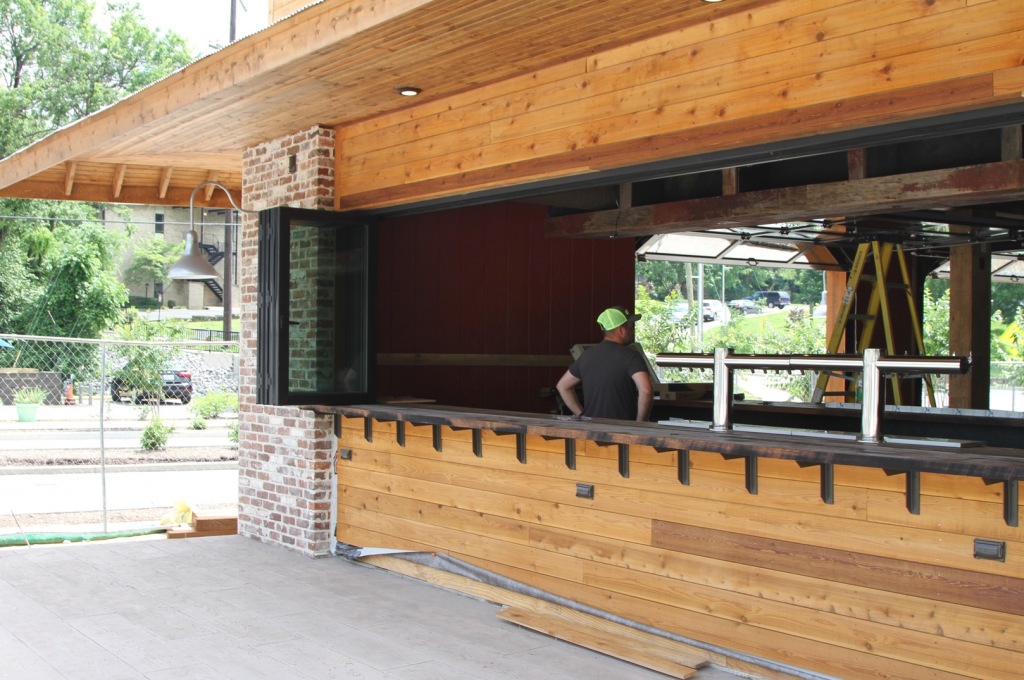
    The reorganized street supports smaller locally owned shops that keep money circulating in the community. This is the opposite of typical road widening projects that devalue small businesses in older neighborhoods while subsidizing big box corporate chains way out on the edge of town.

    Screen Shot 2016-08-26 at 3.16.43 AM

    Screen Shot 2016-08-26 at 3.17.03 AM

    Screen Shot 2016-08-26 at 3.16.12 AM

    Screen Shot 2016-08-26 at 3.16.26 AM

    Screen Shot 2016-08-26 at 3.15.58 AM

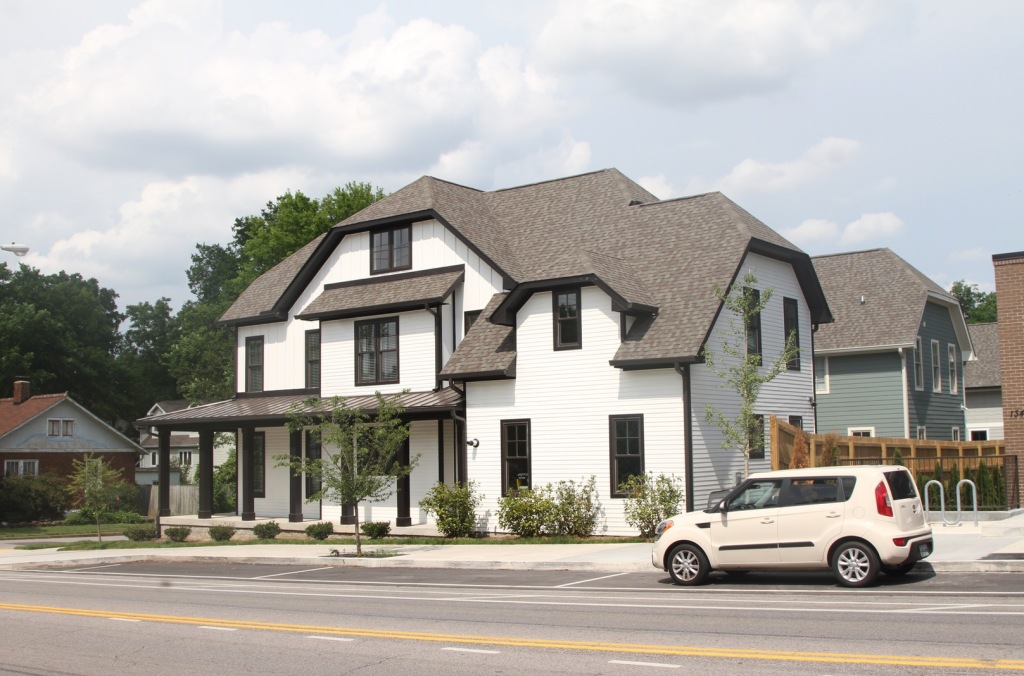
    Here’s something that breaks all the rules of suburban development. It’s supposed to be the kiss of death to have a business situated right next to a fully detached single family home. Yet in this location the shops and the properly designed street actually make these houses more desirable. The usual amenity of residential isolation has been exchanged for the amenity of good walkable urbanism. This kind of arrangement is so incredibly rare in America today that people are willing to pay a premium for such properties.

    Screen Shot 2016-08-25 at 6.02.46 PM

    Screen Shot 2016-08-25 at 6.03.00 PM

    Finally, we have the 1950’s tract homes that could have started the long slide into low rent crappiness as is so often the case when suburban roads are widened in a hopeless attempt to ease traffic congestion. Here, the road diet and nearby improved commercial district  have inspired property owners to invest in substantial renovations and improvements to otherwise outdated homes.
    The future of most suburbs is to change from what they are now to something else. That “something” could be relentless decline or steady incremental rejuvenation. I don’t believe most places understand how to reinvent themselves in a cost effective yet culturally acceptable manner. The politics of inertia, fear, and vested interests are awfully powerful. That means the few places that can successfully pull it off will be miles ahead of the competition. Look around wherever you live. Then think long and hard about how your town will manage in the years ahead.

    John Sanphillippo lives in San Francisco and blogs about urbanism, adaptation, and resilience at granolashotgun.com. He’s a member of the Congress for New Urbanism, films videos for faircompanies.com, and is a regular contributor to Strongtowns.org. He earns his living by buying, renovating, and renting undervalued properties in places that have good long term prospects. He is a graduate of Rutgers University.