Category: Policy

  • California’s Boom Is Poised To Go Bust — And Liberals’ Dream Of Scandinavia On The Pacific

    As its economy started to recover in 2010, progressives began to hail California as a kind of Scandinavia on the Pacific — a place where liberal programs also produce prosperity. The state’s recovery has won plaudits from such respected figures as The American Prospect’s Harold Meyerson and the New York Times’ Paul Krugman.

    Gov. Jerry Brown, in Bill Maher’s assessment, “took a broken state and fixed it.” There’s a political lesson being injected here, as well, as blue organs like The New Yorker describe California as doing far better economically than nasty red-state Texas.

    But if you take a look at long-term economic trends, or drive around the state with your eyes open, the picture is far less convincing. To be sure, since 2010 California’s job growth has outperformed the national average, propelled largely by the tech-driven Bay Area; its 14% employment expansion over the past six years is just a shade below Texas’. But dial back to 2001, and California’s job growth rate is 12%, less than half that of Texas’ 27%. With roughly 10 million fewer residents, Texas has created almost 2.8 million jobs since the turn of the millennium, compared to 2.0 million in California.

    Even in the Bay Area, the picture is less than ideal. Since 2001, total employment in the San Francisco area has grown barely 12% compared to 52% in Austin, 37.8% in Dallas-Ft. Worth, 36.5% in Houston and 31.1% in San Antonio. Los Angeles, by far California’s largest metro area, scratched out pedestrian job growth of 10.3%, slightly above the national increase of 9.3% over that time span.

    Remarkably, despite the recent tech boom, California’s employment growth in science, technology, engineering and mathematics-related fields (aka STEM) since 2001 is just 11%, compared to 25% in Texas. Both Austin and San Antonio have increased their STEM employment faster than the Bay Area while Los Angeles, California’s dominant urban region and one-time tech powerhouse, has achieved virtually no growth. This pattern also holds for the largest high-wage sector in the U.S., business and professional services.

    Geographic Disparity: Relying On Facebook

    “It’s not a California miracle, but really should be called a Silicon Valley miracle,” says Chapman University forecaster Jim Doti. “The rest of the state really isn’t doing well.”

    This dependence on one region has its dangers. Silicon Valley has only recently topped its pre-dot-com boom jobs total, confirming the fundamental volatility of the tech sector. And there are clear signs of slowing, with layoffs increasing earlier in the year and more companies looking for space in less expensive, highly regulated areas.

    Consolidation and dominance by a few giants like Google, Facebook, Apple threaten to make Silicon Valley less competitive and innovative, as promising start-ups are swallowed at an alarming rate. Even Sergei Brin, a co-founder of Google, recently suggested that start-ups would be better off launching somewhere else.

    Housing poses perhaps the most existential threat to the Bay Area, particularly among millennials entering their 30s. Only 13% of San Franciscans could purchase the county’s median home at standard rates and term. For San Mateo, the number is 16%. No surprise that as many as one in three Bay Area residents are now contemplating an exit, according to an opinion poll this past spring.

    Outside the Bay Area, where tech is weaker, the situation is much grimmer. In Orange County, the strongest Southern California economy, tech and information employment is lower today than in 2000. In Los Angeles, employment has declined in higher-wage sectors like tech, durable goods manufacturing and construction, to be replaced by lower-wage jobs in hospitality, health and education. A recent analysis by the Los Angeles Economic Development Corp. predicts this trend will continue for the foreseeable future.

    Expanding Inequality

    Perhaps nothing undermines the narrative of the California “comeback” more than the state’s rising inequality. A recent Pew study found California’s urban areas over-represented among the metro area where the middle class is shrinking most rapidly. California now is home of over 30%  of United States’ welfare recipients, and almost 25% of Californians are in poverty when the cost of living is factored in, the highest rate in the country.

    Even in Silicon Valley, the share of the population in the middle class has dropped from 56% of all households to 45.7%, according to a recent report by the California Budget Center. Both the lower and upper income portions grew significantly; today lower-income residents represent 34.8% of the population compared to 19.5% affluent.

    Such disparities are, if anything, greater in Los Angeles, where high rents and home prices, coupled with meager income growth, is deepening a potentially disastrous social divide. Renters in the L.A. metro area are paying 48% of their monthly income to keep a roof above their heads, one reason why the Los Angeles area is now the poorest big metro area in the country, according to American Community Survey data. Overall California is home to a remarkable 77 of the country’s 297 most “economically challenged” cities, based on levels of poverty and employment, according to a recent study; altogether these cities have a population of more than 12 million.

    One critical sign of failure: As the “boom” has matured, the number of homeless has risen to 115,000, roughly 20% of the national total. They are found not only in infamous encampments such as downtown Los Angeles “skid row” or San Jose’s “the Jungle” but also more traditionally middle class areas as Pacific Palisades and through central parts of Orange County.

    The Fiscal Crisis

    California’s “comeback” has been bolstered by assertions that the state has returned fiscal health. True, California’s short-term budgetary issues have been somewhat relieved, largely due to soaring capital gains from the tech and high end real estate booms; just 5,745 taxpayers earning $5 million or more generated more than $10 billion of income taxes in 2013, or about 19% of the state’s total, according to state officials.

    Most likely this state deficit will balloon once asset inflation deflates. Brown is already forecasting budget deficits as high as $4 billion by the time he leaves office in 2019. The Mercatus Center ranks California 44th out of the 50 states in terms of fiscal condition, 46th in long-run solvency and 47th in terms of cash needed to cover short-run liabilities.

    Despite this, the public employee-dominated state government continues to increase spending, with outlays having grown dramatically since the 2011-12 fiscal year, averaging 7.8% per year growth. No surprise that Moody’s ranked California second from the bottom among the states in its preparedness to withstand the next recession. Brown’s own Department of Finance predicts that a recession of “average magnitude” would cut revenues by $55 billion.

    The Cost Of The Climate Jihad

    Relieved over concerns in the short run budget, the rise in revenues has provided a pretext for Brown to push his campaign to fight climate change to extremes. New legislation backed by the governor would impose more stringent regulations on greenhouse gas emissions, mandating a 40% cut from 1990 levels by 2030.

    Brown has no qualms about the economic impact of his policies since he tends to prioritize one sin — greenhouse gas emissions — even above such things as alleviating poverty. Brown’s moves will, by themselves, have no demonstrable impact on climate change given California’s size, temperate climate and loss of industry, as one recent study found. Brown knows this: he’s counting on setting an example that other states and countries will follow. Perhaps less recognized, California’s efforts to reduce emissions may account for naught, since the industry and people who have moved elsewhere have simply taken their carbon footprint elsewhere, usually to places where climate and less stringent regulation allow for greater emissions.

    California’s climate policies, however, are succeeding in further damaging the middle and working class. Environmental regulations, particularly a virtual ban on suburban homes, are driving housing prices up; mandates for renewables are doing the same for energy prices. This hits hardest at traditionally higher-paying blue-collar employment in housing, manufacturing, warehousing and even agriculture.

    California’s climate agenda has accelerated the state’s continued bifurcation — by region, by race and ethnicity, and even by age. Of course the green non-profit advocacy groups and the media will celebrate California’s comeback as proof that strict regulations and high taxes work. They seem not to recognize that that human societies also need to be sustainable, something that California’s trajectory certainly seems unlikely to accomplish.

    This piece first appeared in Forbes.

    Joel Kotkin is executive editor of NewGeography.com. He is the Roger Hobbs Distinguished Fellow in Urban Studies at Chapman University and executive director of the Houston-based Center for Opportunity Urbanism. His newest book, The Human City: Urbanism for the rest of us, will be published in April by Agate. He is also author of The New Class ConflictThe City: A Global History, and The Next Hundred Million: America in 2050. He lives in Orange County, CA.

    Photo: Troy Holden

  • Cities Need Connectivity in the Global Economy

    My latest column is now online in the September issue of Governing magazine. It’s about the criticality of connectivity to success in the global economy.

    One of the most important ways for cities to get connected is through migration. Jim Russell and his collaborator Richey Piiparinen at Cleveland State University’s Center for Population Dynamics have been documenting how Cleveland has been getting more connected to the global world through this process. This includes foreign immigration but isn’t limited to that. A key part of it is the influx into places like Cleveland of people who have lived in major global cities like New York, then cycled out.

    There are many reasons for this kind of migration, but living costs are certainly one of them. America’s major global urban centers have become extraordinarily expensive to live in. Life in a “microapartment” in New York is less attractive when you are in your 30s and married with kids than it is when you are 22, single and fresh out of college.

    What Rust Belt cities like Cleveland can offer is an authentic urban experience in a genuinely historic place at a price that can’t be beat. No one will mistake it for life in Brooklyn, but these cities’ price/performance ratio has a growing appeal, as their downtown population growth shows.

    Click through to read the whole thing.

    Aaron M. Renn is a senior fellow at the Manhattan Institute, a contributing editor of City Journal, and an economic development columnist for Governing magazine. He focuses on ways to help America’s cities thrive in an ever more complex, competitive, globalized, and diverse twenty-first century. During Renn’s 15-year career in management and technology consulting, he was a partner at Accenture and held several technology strategy roles and directed multimillion-dollar global technology implementations. He has contributed to The Guardian, Forbes.com, and numerous other publications. Renn holds a B.S. from Indiana University, where he coauthored an early social-networking platform in 1991.

    Photo by wzefri

  • Our Town: Restoring Localism

    This is an introduction to a new report from the Center for Opportunity Urbanism, "Our Town: Restoring Localism." Download the full report here.

    America is facing a critical moment in its evolution, one that threatens both its future prosperity and the integrity of its institutions. Over the past several decades, government has become increasingly centralized, with power shifting from local communities to the federal level. This has been accompanied by a decline in non-governmental institutions, a matter of concern to thinkers on both the right and the left.

    The issue here is not the irrelevance or intrinsic evil of government itself, nor is it a debate of liberalism vs conservatism. Rather, it is a question of how to meet society’s primary challenges. Is it most effective to try and solve our myriad problems from a central federal, state or regional authority, or from a more local one?

    We believe the right answer, in many cases, is to make a shift back towards local governing agencies, to neighborhoods, and to families. This change in direction would be a return to the roots of our current federal system, which allows different levels of government to make their own decisions, providing a market- place for various ideas and approaches.

    To be sure, local governments also make mistakes, and they can be authoritarian, corrupt, and short-sighted in meeting the needs of residents. But for the most part, locally generated negatives remain contained to local jurisdictions, and can be fixed through the democratic process at the more accessible local level.

    Download the full report here.

  • Is it Time for MagLev?

    Maryland officials have announced that a proposal to build a maglev line from Washington to Baltimore has received a commitment for the feasibility study of $2 million from Japanese government. This is in addition to a much larger involvement by the Japanese government, which would include a $5 billion commitment from the government Japan Bank for International Cooperation. The private Central Japan Railway Company has also agreed to waive any licensing fees for using its maglev technology.

    The loan would finance one-half of the “somewhat north of “$10 billion cost, as characterized by Northeast Maglev, the developer of the proposed system.

    Surely that is a far better alternative than digging deeper into U.S. taxpayer pockets if combined with sufficient private investment. Otherwise any such system could require huge federal grants, or low interest loans through the Federal Railroad Administration Railroad Rehabilitation and Improvement (RRIF) loan guarantee program.  An RRIF loan could potentially expose taxpayers to a 100% loss, should the maglev system fail to pay for its capital and operating costs, as occurred with what the Washington Post characterized as the “Solyndra Scandal,” which cost taxpayers more than half a billion dollars due to a federal loan guarantee.

    The history of private investment in high speed rail around the world is considerably less than encouraging in this regard.

    What is Maglev?

    Maglev is magnetic levitation, a process by which magnetic forces are used to elevate and propel trains, without friction, at very high speed. The technology has long been favored by futurists and some transport professionals, but there is only one high-speed system in operation (Shanghai). That line has only been partially completed and the rest of the line has been suspended.

    “North of” Cost Estimates

    The evidence seems to be that the costs of maglev are “north of” high speed rail costs. This is of particular concern for taxpayers, since only two high speed rail lines of the many built in the world have “broken even.” There are recent reports that a third, Shanghai to Beijing is now making a profit Generally large rail project costs have been notoriously underestimated, as the Oxford University work led by Professor Bent Flyvbjerg has shown.

    As a result, there is always the risk that a venture proposed as commercial could run out of money during the construction phase, or generate insufficient revenues to its operating and capital costs. In either case, government subsidies would likely be sought by the operator.

     “North of” cost projections, such as suggested by Northeast Maglev, seem to be the rule in high speed rail, given that original cost projections for similar projects have been so routinely unreliable.

    The current $10 billion estimate for the Washington to Baltimore line is already well north of an earlier $8 billion estimate.

    The currently under construction Tokyo to Nagoya and later Osaka (Chuo Shinkansen maglev) has a construction cost in excess of ¥9 trillion (approximately $90 million). With 90 percent of the Tokyo to Nagoya section underground or in tunnels, cost escalation seems likely.

    Similarly, the cost of the California high-speed rail line, in its original full he high-speed configuration from Los Angeles San Francisco tripled (inflation adjusted)  to well “north of” its 1999 cost projection made. Officials cut the system back from full high-speed rail operation in the Los Angeles and San Francisco areas to reduce costs to a more politically acceptable level.

    High Speed Maglev: The One Partial Line

    Currently, the only partial high-speed maglev line in the world takes passengers only two-thirds of the way from its Pudong International Airport terminus to central Shanghai.

    It was planned to extend the Shanghai maglev line to the center and eventually to Hangzhou, an urban area of 7.6 million residents approximately 180 kilometers (110 miles) to the southwest. However, those extensions have been suspended and high-speed rail service is now available to Hangzhou.

    The developers of the Shanghai maglev hoped that China would adopt the technology for its high-speed intercity rail system. China, however, opted for conventional high-speed rail technology and will soon be operating at speeds of up to 350 kilometers per hour (220 miles per hour), the fastest in the world. The train sets are already operating in Manchuria.

    A Real Head Scratcher

    Significantly, the long and disappointing startup pains of maglev may be coming to an end.

    The Central Japan Railway has begun building the Tokyo to Nagoya and eventually Osaka Chuo Shinkansen maglev line. The currently planned completion date for the Nagoya section is 2027, with a package of financial incentives worth and a ¥3 trillion loan from the Japanese government intended to advance the completion date for the new going to Osaka section from 2045 to 2037. Thus, Japanese taxpayers are already potentially “on the hook” financially.

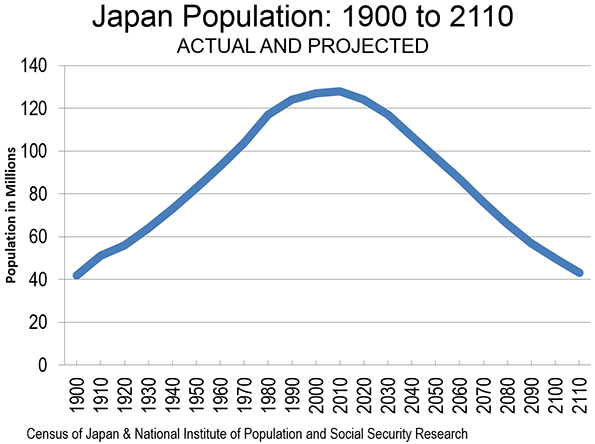
    There’s an element of the bizarre here.  How much additional transport infrastructure is required in the nation that is losing population at a faster rate than anywhere else in the world? By the earliest date the Osaka extension opens (2037), Japan’s population will have fallen 14 million (more than 10 percent) from today, according to projections of the National Institute for Population and Social Security Research. A quarter of a century later (2062), the population will have dropped another 27 million, to 85 million. That is 10 million fewer people than the 95 million who lived in Japan when the first high speed rail line opened just before the 1964 Olympics. In 2089, Japan is projected to have only 58 million people, fewer than almost 170 years (Figure).

    One economic development report noted that the line would “help alleviate the population overcrowding concentration in the Tokyo metropolitan area. Yet, by 2110, the entire country is projected to have not many more people than the Tokyo metropolitan region today.  

    The Chuo Shinkansen maglev is a part of Prime Minister Abe’s financial stimulus program, which has both supporters and critics. The government talks of the economic development the line will induce. Others, such as Edwin Merner of Atlantis Investment Research called the maglev line a misallocation of resources and that passenger demand will be limited.

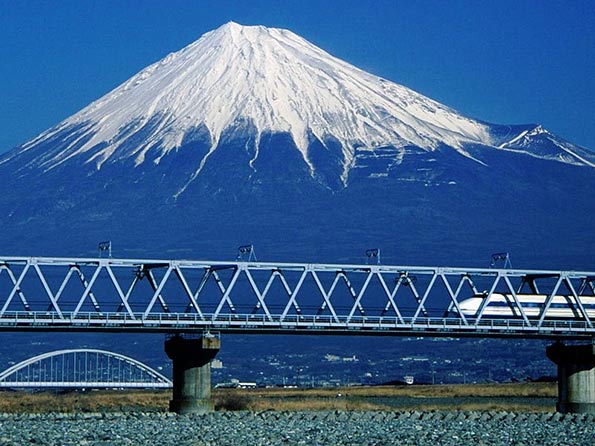
    The line has also been justified as a means to promote tourism. Yet, the average tourist may find the scenery — much of it very appealing — from the above ground 1 hour 40 minute ride to Nagoya or the 2 hour 30 minute to Osaka on the conventional high speed rail line more satisfying  (such as Mount Fuji) than the hundreds of miles of tunnel on the faster maglev line (Photo).


    By Alpsdake (Own work) [CC BY-SA 3.0], via Wikimedia Commons

    Protecting US and Northeastern Taxpayers

    But, back to the Washington to Baltimore maglev line. A privately financed and commercially viable maglev line would improve transportation in both the Washington to Baltimore corridor and the extension to New York. However, taxpayers need guarantees to ensure that they are not left “holding the bag.”

    For example, before any permits for proceeding are issued, the investors should be required to post a bond to ensure that the private funding will be sufficient to complete the system, thus avoiding public subsidy. Further, a performance bond should guarantee that no operating subsidies are required for at least a minimum number of years (perhaps 10 or 25).

    A Chance for Success?

    With sufficient taxpayer safeguards, there may be a chance for it to succeed. And surely, we wish Japan, the Japan Bank for International Development, the Central of Japan Railway and Northeast Maglev the best, hoping that they can provide a fully commercial venture. On the other hand, like Ford’s “Nucleon” nuclear powered automobile (proposed in the 1950s), the time for maglev may never come.

    Wendell Cox is principal of Demographia, an international public policy and demographics firm. He is a Senior Fellow of the Center for Opportunity Urbanism (US), Senior Fellow for Housing Affordability and Municipal Policy for the Frontier Centre for Public Policy (Canada), and a member of the Board of Advisors of the Center for Demographics and Policy at Chapman University (California). He is co-author of the "Demographia International Housing Affordability Survey" and author of "Demographia World Urban Areas" and "War on the Dream: How Anti-Sprawl Policy Threatens the Quality of Life." He was appointed to three terms on the Los Angeles County Transportation Commission, where he served with the leading city and county leadership as the only non-elected member. He served as a visiting professor at the Conservatoire National des Arts et Metiers, a national university in Paris.

    Lead photo: Chuo Shinkansen maglev by Saruno HirobanoOwn work, CC BY-SA 3.0, https://commons.wikimedia.org/w/index.php?curid=30917648

  • The Bridge from Laissez-Faire to Socialism

    Cronyism remains unchecked in the world’s largest economy.

    We might object to the phrase crony capitalism for two reasons:

    First, because cronyism is in some ways the antithesis of capitalism. The freedom to compete and the freedom to fail that are central tenets of capitalism are severely compromised by cronyism when in the former case powerful politicians intervene to shield their friends in business and finance from competition, and in the latter intervene again to save them from bankruptcy or occasionally from criminal prosecution. Of course, these friends in turn are no disloyal slouches and they later show themselves to be supremely appreciative by underwriting, financially and otherwise, those same politicians who had all but guaranteed their continued dominance in normal times and their survival against bad odds in times of distress.

    Second, because cronyism is just as prevalent, or arguably more prevalent, in a socialist system than in a capitalist one. Socialism is made popular by charismatic figures appealing to the idealism of some voters but wherever it succeeds in establishing itself, its anonymous toiling bureaucrats turn out to be expert cronies of the very first order, if we are to judge by the experience of many countries in the past century.

    Laissez-faire to cronyism to socialism

    This experience suggests the following chronology of events: cronyism gradually creeps into and takes over the laissez-faire economy. After some time, its extractive practices and excesses make socialism appear desirable and reasonable to an increasing number of voters. Finally if socialists manage to take control of government, they trumpet the victory of the people and the dawn of an egalitarian era but in their actions simply replace one set of cronies with another. If this is accurate, socialism then would not be the system that replaces capitalism, but rather the culmination of cronyism. Cronyism is a disease on the body of laissez-faire and socialism is an ultimate manifestation of that disease, investing all the organs of the body and bringing about its final demise.

    For evidence, see Venezuela. Did the downward spiral start with the socialist Hugo Chavez? Or did it start with the cronyism that preceded Chavez and that made Chavez attractive to an increasing number of people? A case can be made for the latter, even if Chavez in the end played a key role in precipitating the downfall.

    The hypothesis is that when laissez-faire is compromised by cronyism, the entire social and economic architecture becomes more vulnerable to the siren call of socialism. This may be because lower income people instinctively understand and accept that a Henry Ford or a Steve Jobs would earn a large fortune as a just reward for his innovations and business genius and large contributions to the advancement of mankind. The same people also understand and accept that lesser Fords and Jobses would earn smaller fortunes that are commensurate with their own lesser contributions, and so on. But these same people have a more difficult time accepting the vast sums extracted from the economy by people who take few risks, contribute little, and owe their advancement and wealth mainly to the lottery of birth or to the connections they have made in the higher circles of learning, politics or business. To say so is not a refutation of capitalism, but of cronyism.

    It makes sense then to decouple the words crony and capitalism and to not let the spread of cronyism be used as a pretext to abandon laissez-faire. The Economist recently acknowledged this difference by identifying some industries where cronyism is rampant:

    Some industries are prone to “rent seeking”. This is the term economists use when the owners of an input of production—land, labour, machines, capital—extract more profit than they would get in a competitive market. Cartels, monopolies and lobbying are common ways to extract rents. Industries that are vulnerable often involve a lot of interaction with the state, or are licensed by it: for example telecoms, natural resources, real estate, construction and defence. (For a full list of the industries we include, see article.) Rent-seeking can involve corruption, but very often it is legal.

    More on this later but note in passing that the term capitalism itself has a tenuous pedigree since its use did not become widespread until the mid 19th century mainly as an antonym to socialism or communism. It has little other reason to exist and proponents of freedom in commerce may be well advised to use the term laissez-faire instead, or an English equivalent, and not let themselves be ensnared in a futile debate of one -ism against another. People who engage in a free and mutually beneficial exchange of goods and services don’t cast about looking for an -ism to describe their activity, just as breathing comes to us naturally and we are not looking to encode a complex ideology to justify its benefits. We need breathing to support life, and we need laissez-faire for the very same reason.

    Cronyism around the world

    Until about two decades ago, the problem of cronyism was mainly present in smaller economies in the developing world where the governing elite was small and dominated by local business interests. In each of these places, politicians and business leaders were closely related by class or clan or blood or marriage, and they successfully perpetuated a system that preserved their wealth and power.

    More recently, cronyism has been on the rise in the United States. Indeed it has become one of the objects of our fascination but, as with the weather, everyone talks about it and no one does anything about it. That can be in part because cronyism is difficult to identify and to expose. Often it is not illegal, a fact that gives moral comfort to its practitioners and ensures its continued advance. Most cronies probably don’t see themselves as cronies but merely as savvy business people trying to do good by influencing policy, or as members of an intelligentsia who have a duty to get involved in government.

    The zero hour of cronyism may have been in 2008 when the financial crisis was so severe that cronyism came into full public view, like a bad family feud normally played out behind closed curtains suddenly erupting in the town square. The depredations of 2008 look like a textbook script of how cronyism works. Failed capitalists did not fail but were given by their powerful friends another chance and they later employed this new chance not only to cement their own positions and to weaken their competitors, but to also cement the positions of the powerful friends who bailed them out. Everything seems to have worked out just fine so long as not too many people asked questions as to how and why it all happened in the way that it did.

    But our understanding of this phenomenon has only grown since then. Some of the general workings of cronyism were described in the 2012 book Why Nations Fail: The Origins of Power, Prosperity and Poverty by Daron Acemoglu and James Robinson in which the authors differentiate between extractive and inclusive economies. Extractive economies are dominated by cronyism while inclusive economies are closer to a competitive laissez-faire model.

    It was alleged and accepted that extractive economies were most often in emerging markets, and that inclusive ones were generally in developed nations. Yet shortly after the publication of Acemoglu and Robinson’s book, this separation came under increased scrutiny. For example, The Economist in 2012 took the “extractive” label and stuck it on the financial industry of the West. In an article titled The Question of Extractive Elites, it wrote:

    There are two potential candidates for extractive elites in Western economies. The first is the banking sector. The wealth of the financial industry gives it enormous lobbying power, including as contributors to American presidential campaigns or to Britain’s ruling parties. By making themselves “too big to fail”, banks ensured that they had to be rescued in 2008.

    If it is true that banking is “extractive”, no one should be surprised that eight years after the 2008 bailouts, the socialism of Bernie Sanders and the populism of Donald Trump have reached a very ripe and receptive audience of disgruntled voters. On our thesis, the success of these two candidates is a natural result of the decades-old drift from laissez-faire to cronyism.

    The problem with cronyism is that it is a form of corruption, albeit one that is nebulous and often legal. A very large sum paid to a former or future government official for consulting or lobbying or for a speech may not technically rise to the level of a bribe but it does look like an attempt to capture that individual and to secure his loyalty before he returns to government where he would then be most appreciative towards his financial patrons. Perhaps then we may think of cronyism as a form of corruption that has thrived temporarily in the absence of the laws and regulations needed to fight it. Or perhaps no new laws are needed and instead a more vigorous judiciary is needed to implement existing laws, that is a judiciary whose independence is not already corroded by the spread of cronyism.

    Corruption Perceptions Index

    Among the many watchdog organizations that study corruption around the world, Berlin-based Transparency International (TI) publishes an annual ranking of countries in itsCorruption Perceptions Index. In 2015, TI ranked the United States 16th of 167 countries. Except for Canada, Singapore, Australia and New Zealand, all of the countries that ranked ahead of the US were in Western and Northern Europe, with Denmark, Finland and Sweden achieving the top scores.

    Large emerging countries fared poorly in the index. Brazil now in the throes of an impeachment battle and several corruption scandals ranked 76th. India was also 76th and Mexico was 95th. China was 83rd and Russia 119th. At the bottom were socialist countries and countries beset by war and internal strife.

    Overall therefore the US score was not as good as those of small relatively homogeneous European nations, but it was far above those of countries with large populations and growing economies.

    Yet with the vast amounts of money sloshing around the US economy, courtesy of the Federal Reserve’s zero interest rate policy, and given the rise of cronyism for over a decade, it is fair to wonder aloud whether Transparency International is being too kind with its US ranking.

    In order to answer this question, we try to estimate the size of the crony economy in the US. This is a difficult endeavor because there are few sources that can be helpful in measuring and quantifying cronyism. The Economist gave it a good try by developing acrony-capitalism index in 2014 and by updating it in 2016.

    In the US, the wealth of billionaires in crony industries adds up to a relatively small percentage of GDP, 2.2% in 2014 and 1.8% in 2016. According to the Economist, this measure of cronyism is a much bigger issue in other countries such as Russia (18% in 2016), Malaysia (13%) and even Singapore (1o.7%).

    Screen Shot 2016-08-18 at 4.25.43 PM

    On the other hand, measured in actual dollars, the wealth controlled by crony billionaires in the United States comes to $334 billion and is second only to that of their counterparts in China. This amount is about ten times the amount of crony wealth in more corrupt (per TI’s estimation) countries such as Brazil and others. So, in raw numbers, the US could be by far one of the largest theaters of cronyism in the world.

    The Economist writes that, because of the crash in commodity prices, the size of the global crony economy is smaller now than it was in 2014:

    Our newly updated [2016] index shows a steady shrinking of crony billionaire wealth to $1.75 trillion, a fall of 16% since 2014. In rich countries, crony wealth remains steadyish, at about 1.5% of GDP. In the emerging world it has fallen to 4% of GDP, from a peak of 7% in 2008. And the mix of wealth has been shifting away from crony industries and towards cleaner sectors, such as consumer goods

    but The Economist still sees cronyism as a significant factor in the 2016 US presidential election. Regarding Donald Trump:

    Despite this slowdown, it is too soon to say that the era of cronyism is over—and not just because America could elect as president a billionaire whose dealings in Atlantic City’s casinos and Manhattan’s property jungle earn him the 104th spot on our individual crony ranking.

    and Hillary Clinton, via some of her donors:

    The rich world has lots of billionaires but fewer cronies. Only 14% of billionaire wealth is from rent-heavy industries. Wall Street continues to be controversial in America but its tycoons feature more prominently in populist politicians’ stump speeches than in the billionaire rankings. We classify deposit-taking banking as a crony industry because of its implicit state guarantee, but if we lumped in hedge-fund billionaires and other financiers too, the share of American billionaire wealth from crony industries would rise from 14% to 28%.

    This lumping together of commercial/retail banks and investment banks/hedge funds under the crony banner would have been largely unjustified before 2008, notwithstanding the controversial rescue of Long Term Capital in 1998, but it does not look as far-fetched after the 2008 bailout of banks of all stripes.

    After the election, we may see a continued advance of cronyism or we may see a retreat. A trend often turns on itself after it reaches a new apex. In order to dial away from socialism and populism and move back towards laissez-faire, we could step up our efforts to limit and roll back cronyism. Otherwise we may see an even stronger drive towards populism or socialism at the next election.

    See also The Economist Daily Chart: Comparing Crony Capitalism Around the World.

    This piece first appeared at Populyst.net.

    Sami Karam is the founder and editor of populyst.net and the creator of the populyst index™. populyst is about innovation, demography and society. Before populyst, he was the founder and manager of the Seven Global funds and a fund manager at leading asset managers in Boston and New York. In addition to a finance MBA from the Wharton School, he holds a Master’s in Civil Engineering from Cornell and a Bachelor of Architecture from UT Austin.

    Photo of Hugo Chavez by Victor Soares/AgenciaBrasil via Wikipedia.

  • Are Baby Boomers Turning Out to be the Worst Generation?

    I have seen the best minds of my generation, to steal a phrase from the late Allen Ginsberg, driven to heights of self-absorption, advocating policies that assure the failure of the next. Nothing so suggests the failure of my generation — the boomers — than its two representatives running for president.

    What Hillary Clinton and Donald Trump reflect are two sides of the same nasty boomer coin.

    On one side, there are aging boomers embracing Trump, an icon of materialistic obsession and a lack of concern for “losers.” On the other is a control-freak determination to tell everyone how to live, with instructions coming from entitled boomer politicians and bureaucrats.

    Boomers benefited from the strongest economy in American history — they account for 44 percent of the population but 70 percent of the wealth, and have enjoyed far better income growth than later generations. Yet, despite their good fortune, many seem determined to pull ever more out of the economy as they age, while those stuck with the bills for their profligacy and indebtedness — the next generation — will have to do with less.

    The ‘I’ve got mine’ crowd

    Trumpian boomerism is easily evidenced in my own neighborhood of Villa Park in Orange County. Our lovely, well-maintained and aging little enclave is friendly, civic-minded and civil. But it also is the center of opposition to such things as school bonds that would improve local schools now in a shocking state of disrepair. Villa Park residents helped defeat the last school bond, and it’s a former (thank heaven) City Council member who seeks to lead the effort to overturn the one on the ballot this year.

    Read the entire piece at The Orange County Register.

    Joel Kotkin is executive editor of NewGeography.com. He is the Roger Hobbs Distinguished Fellow in Urban Studies at Chapman University and executive director of the Houston-based Center for Opportunity Urbanism. His newest book, The Human City: Urbanism for the rest of us, will be published in April by Agate. He is also author of The New Class ConflictThe City: A Global History, and The Next Hundred Million: America in 2050. He lives in Orange County, CA.

  • Jerry Brown’s Housing Hypocrisy

    Jerry Brown worrying about the California housing crisis is akin to the French policeman played by Claude Rains in “Casablanca” being “shocked, shocked” about gambling at the bar where he himself collects his winnings.

    Brown has long been at the forefront on drafting and enforcing regulations that make building housing both difficult and very expensive. And now he has pushed new legislation, which seems certain to be passed by the Legislature and signed by the governor, that makes it worse by imposing even more stringent regulations on greenhouse gas emissions, mandating a 40 percent cut from 1990 levels by 2030.

    The press and activists may cheer the new bill, which will require massively expensive and intrusive measures likely to further raise housing costs. A 2012 study by the California Council on Science and Technology found that, given existing and potentially feasible technology, cutting back carbon emissions by 60 percent, roughly comparable with the new legal mandate, would require that “all buildings … either have to be demolished, retrofitted or built new to very high efficiency standards.” Needless to say, this won’t do much for housing affordability.

    Brown’s bona fides in promoting housing inflation goes back, at least to his days as attorney general. Throughout his career, Brown has fostered policies that have contributed to the regulatory quagmire largely responsible for helping drive house values in California up more than three times the national rate in the last half century. Over that period, a dense mesh of regional and local regulations have seriously restricted land for urban development, adding significant costs for housing developers.

    Some have seen Brown’s recent suggestions to loosen up some regulations and add to housing subsidies as positive, although they have little chance of making it through Sacramento due to environmental, labor and municipal opposition.

    Read the entire piece at The Orange County Register.

    Joel Kotkin is executive editor of NewGeography.com. He is the Roger Hobbs Distinguished Fellow in Urban Studies at Chapman University and executive director of the Houston-based Center for Opportunity Urbanism. His newest book, The Human City: Urbanism for the rest of us, will be published in April by Agate. He is also author of The New Class ConflictThe City: A Global History, and The Next Hundred Million: America in 2050. He lives in Orange County, CA.

  • Culture, Circumstance, and Agency: Reflections on Hillbilly Elegy

    The intractability of poverty has been recognized since at least the time the Deuteronomist wrote, “The poor will never cease to be in the land.” Explanations vary: ill favor of the gods, deficient natural endowments, personal defects, the culture of the poor, external circumstances such as a lack of economic opportunity, some type of oppression—all have been popular options.

    In his bestselling new memoir Hillbilly Elegy, J.D. Vance takes a blended view, recognizing the role of economic and personal circumstances in poverty and life dysfunction but also stressing the way that the culture of his own working-class Appalachian tribe has crippled its response to life’s challenges. He comes down firmly on the side of individual agency and the ability of people to overcome obstacles through hard work and adopting the cultural habits of successful groups. He writes, “This book is about something else: what goes on in the lives of real people when the industrial economy goes south. It’s about reacting to bad circumstances in the worst way possible. It’s about a culture that encourages social decay instead of counteracting it.” And: “The truth is hard, and the hardest truths for hill people are the ones they must tell about themselves.”

    Vance’s book has hit a nerve by providing a compelling lens through which those appalled by the popularity of Donald Trump in working-class circles can understand his improbable rise. Who are these Trump voters? Hillbilly Elegyoffers an answer.

    Vance is a 31-year-old graduate from Yale Law School. Happily married to his wife Usha, whom he met there, he appears to be the perfect embodiment of upper-middle-class success. As it happens, though, he started out in the world of the deeply troubled working class. Vance was raised in Middletown, Ohio, today part of suburban Cincinnati, but his heritage is Appalachian Scots-Irish, and his family originated in Breathitt County, Kentucky—so-called Bloody Breathitt for its history of violent feuds and its military tradition—and is related to the Hatfields of Hatfield-McCoy feud fame. So he really is a legitimate hillbilly, not a pretender.

    It’s ordinarily presumptuous for a 31-year-old to write a memoir, but Hillbilly Elegy justifies the exception. Vance provides an honest and powerful account of his toxic upbringing and the long history of Appalachian dysfunction that produced it. His book also positions Vance, a conservative who has contributed to National Review and describes former Indiana governor Mitch Daniels as his “political hero,” as a potential post-Trumpian political figure. In that respect,Hillbilly Elegy is perhaps an aspirational analogue of Dreams From My Father. Vance’s story forms a bridge between the upper middle class, whose values he fully embraces, and the alienated white working class, with which he still claims tribal identity.

    Papaw and Mamaw, Vance’s maternal grandparents, moved to Ohio as teenagers after a pregnancy and shotgun wedding. Papaw got a good union job at Armco Steel, and the family was in theory financially prosperous and upwardly mobile. But the problems of Appalachia followed them to Ohio. They were poor money managers, with Papaw buying new cars on impulse. He was also a violent drunkard. Mamaw, with her own reputation for violence, once threatened to kill him if he ever came home drunk again, and, after he promptly transgressed, doused him with gasoline and set him on fire (he survived with only minor burns). At times she was a hoarder. Papaw and Mamaw ultimately separated but remained close.

    Their behavior came in part from the values they brought with them and in part from the many Appalachians who followed them along the “Hillbilly Highway” north, looking for work in booming Midwest factories. Though this migration has since radically slowed, cities like Indianapolis retain Appalachian “immigrant” neighborhoods today, some still being restocked with new arrivals.

    Vance’s mother Bev fared much worse than her parents, unable to maintain even the semblance of a steady romantic relationship. Vance barely knew his biological father until he was 12. He was adopted by one of his mother’s many husbands, but that fatherly bond proved no more durable than the biological one. He told conservative writer Rod Dreher that his mother had 15 husbands and boyfriends. None of his many brothers and sisters was full-blooded. Indeed, Vance’s family relationships boggle the mind:

    One of the questions I loathed, and that adults always asked, was whether I had any brothers or sisters. When you’re a kid, you can’t wave your hand, say, “It’s complicated,” and move on. And unless you’re a particularly capable sociopath, dishonesty can only take you so far. So, for a time, I dutifully answered, walking people through the tangled web of familial relationships that I’d grown accustomed to. I had a biological half brother and half sister whom I never saw because my biological father had given me up for adoption. I had many stepbrothers and stepsisters by one measure, but only two if you limited the tally to the offspring of Mom’s husband of the moment. Then there was my biological dad’s wife, and she had at least one kid, so maybe I should count him, too. Sometimes I’d wax philosophical about the meaning of the word “sibling”: Are the children of your mom’s previous husbands still related to you? If so, what about the future children of your mom’s previous husbands? By some metrics, I probably had about a dozen stepsiblings.

    Only his older half-sister Lindsay was a consistent presence. He cried when he learned that she was not his full sister.

    Bev continued to spiral downward, attempting suicide at least once, becoming abusive toward Vance, and ultimately falling into severe drug addiction. Vance shuttled between homes, sometimes with his mother, sometimes with his Mamaw, whom he credits as a positive influence. In an underexplored episode of his life, Vance meets and for a time lives with his biological father, who has embraced Pentecostal Christianity and turned his life around. “Dad had built a home with an almost jarring serenity,” Vance writes. “In some ways, I loved living with Dad. His life was normal in precisely the way I’d always wanted mine to be.” He prefers his Mamaw’s folk theology to his father’s intense religion, but recognizes the role that the latter, extreme though he perceives it to be, played in improving his father’s life.

    Yet he never feels fully comfortable living with his father. When Mamaw calls and asks him to move back, he abandons this healthy home to return to his previous life of chaos. Throughout the book, Vance displays an obvious and strong matriarchal orientation. He’s emotionally bonded to his deeply flawed Mamaw, whose family name he and his wife adopt when they marry. He idealizes his sister Lindsay and his wife Usha. But he seems unwilling to reflect on this female dependency or understand how it shaped decisions like leaving his father.

    Things get better for Vance later in high school, in part because he lives full-time with his Mamaw instead of shuttling back and forth between her and his drug-addicted mother’s various abodes. After graduation, he thinks seriously about going to college. Lacking the funds and recognizing he wasn’t ready, he wisely enlists in the Marines, which proves a transformative experience. Newly fashioned into a stable, functioning adult courtesy of the Corps, Vance enrolls in Ohio State, where he excels while working two or three jobs simultaneously to avoid taking on debt.

    He then applies to and is accepted at Yale Law School, where the cultural gulf between his hillbilly upbringing and the American elite first comes into full relief. He discovers the role that social capital, mentors, and connections play in success. One of his professors at Yale, Amy Chua, of Tiger Mom fame, becomes a key advisor and advocate for him. He struggles in settings upper middle-class students would navigate with ease. He spits out sparkling water in disgust and surprise the first time he drinks it. When a law firm takes him to an upscale restaurant for dinner, he has to call Usha, then his girlfriend, to ask how to use the silverware. At Yale, he discovers that he must not just reject the toxic elements of his old culture but also embrace this new one to get anywhere.

    The social deficiencies of the working class are under-appreciated by those who never suffered them. I also came from a working-class background. After flying to a job interview in Chicago in college, I didn’t know how to take a taxi and was too ashamed to ask. I tried getting in a cab dropping off passengers; the driver was kind enough to tell me where the cabstand was without humiliating me. I didn’t know how to use chopsticks. I didn’t know the way much of the professional world functioned. And a lot of those things I didn’t know that I didn’t know. I estimate that I started out five to ten years behind those who came from upper middle-class homes in important ways. I’ve heard the same from others of similar origins.

    E.D. Hirsch talks about the “core knowledge” every kid must learn. For those with above-average intelligence, knowledge is relatively easy to acquire if you don’t have it. But there’s also a set of core social knowledge and experiences needed to function effectively in educated society. This can be more challenging to obtain, especially without a mentor. Vance illuminates this oft-overlooked aspect of upward mobility.

    Hillbilly Elegy has received nearly universal praise on both the left and right, much of it well-deserved. Though Vance may be a conservative, his book has something for everyone.

    For the Right, Vance questions the efficacy of war-on-poverty solutions, which he sees as enabling the worst aspects of Appalachian culture. Upscale liberals find it difficult to comprehend why the white working class often despises the welfare programs from which their own communities would purportedly benefit. Vance helps them understand this rejection by describing the challenges of working-class life and how working-class communities can be easily undermined by government benefits. He worked for a time in a tile warehouse, earning $13 an hour for physically demanding labor. That’s a viable if modest living in a low-cost town, but it’s hard to motivate oneself to take such a backbreaking but low-wage job if benefits, even if less in cash value, can be had without working at all.

    Another aspect of the book that appeals to non-Trumpian conservatives is also what powerfully attracts it to the Left: its placing of the locus of responsibility for white working-class malaise in its own culture. Intellectuals on the left and right have been aghast at support for Trump from the white working class. Vance tells them what they want to hear: that the travails of this class stem in large part from their dysfunctional and self-destructive culture. Vance acknowledges that the white working class faces legitimate hurdles, such as the decline of union manufacturing jobs, an analysis that resonates with the Left. But ultimately he sees this demographic’s failure to overcome obstacles—as he did, and as President Obama, one of his examples, also did—as stemming from personal and cultural flaws, notably a lack of a sense of agency:

    Too many young men immune to hard work. Good jobs impossible to fill for any length of time. And a young man with every reason to work—a wife-to-be to support and a baby on the way—carelessly tossing aside a good job with excellent health insurance. More troublingly, when it was all over, he thought something had been done to him. There is a lack of agency here—a feeling that you have little control over your life and a willingness to blame everyone but yourself.

    Rather than seeing the working class as victims of, say, current economic policies, which would require addressing underlying structural inequities, Vance says that these people are in large part the authors of their own demise. Their predicament thus requires no fundamental change of course economically—a great relief to those prospering under the current regime. This flattering of audience sensibilities, combined with Vance’s immensely compelling life story, helps explain why Hillbilly Elegy has received so much praise and so little substantive criticism, despite some limitations.

    As someone who came of age 15 years before Vance, in a very different white working-class milieu, I see problems in the book that deserve more attention. The most significant is Vance’s conflating of his Appalachian Scots-Irish hillbilly world with the white working class generally. Appalachia has been a byword for poverty and dysfunction for generations. Vance’s culture has no living memory of anything else, so it’s natural for him to see the culture of his people as overwhelmingly influential in their fate. But this is not the case for the majority of the white working class. For example, sociologist Robert Putnam had a different experience in his hometown of Port Clinton, Ohio. The Port Clinton of his 1950s upbringing, as related in his book Our Kids, certainly had its share of working class poverty, but it was socially intact and functional—a world away from that experienced by Vance’s family.

    I grew up in white, working-class, rural Southern Indiana during the 1970s and 1980s. While it had some Appalachian cultural influence, its demographic and social conditions were different. German was the dominant ethnic background of the area. My family is of mostly German Catholic stock, with one Sicilian grandfather added to the mix. My recently divorced mother, brother, and I moved to Harrison County in 1976, when I was seven. We lived in a trailer on a gravel road. We soon built a house, but our water came from a cistern, we had a party-line telephone, and we burned our trash in a 55-gallon drum. I was a classic case of “poor but didn’t know it.” There was certainly a lot of poverty around. Yet I, too, recall a functional and socially intact, if hardly idyllic, community.

    Today, however, both Putnam’s Port Clinton and my Southern Indiana are a lot more like Vance’s Appalachian world than Putnam or I would have believed possible, even after allowing for nostalgia. We face a different question from the ones that confront Vance. We must ask what changed in only a generation or two to damage communities that once did broadly sustain healthy working-class marriages, families, and community life. It’s harder to blame culture entirely here when that same culture was producing respectable if unglamorous success as recently as 30 years ago.

    Some answers are easy. Hard drugs are available now in a way they weren’t before. Working-class communities were almost always hard-drinking ones. But the potential for destruction has been greatly magnified by meth, heroin, and prescription opioids—dangers that Putnam and I never had to face growing up. These drugs are devastating many working-class communities today.

    Other answers require facing up to unpleasant truths. For the Right, that means acknowledging that the economy has changed in ways that have badly disadvantaged the working class, offering lower pay and less job security than the solid base of union manufacturing jobs that previously anchored these communities. “Creative destruction” is not so great when you’re on the receiving end of the destruction, and when it’s human lives rather than widgets or corporate profits at stake. The scope of this displacement has been far larger than originally anticipated, with the prospect of more to come, thanks to rapidly advancing technology. Trade deals and tax cuts won’t fix the problem.

    For the Left, the unpleasant truth is what Vance makes clear if not explicit: the sexual revolution has been a disaster for the working class. No-fault divorce and the diminishment of the stigmas attached to casual sex and single or divorced motherhood have been a liberating dream—or at least a manageable reality—for educated urbanites. But these changes have been a nightmare for the children growing up in a white working-class world, where broken homes and a string of romantic and sexual partners for Mom is the new normal. “Of all the things that I hated about my childhood,” Vance writes, “nothing compared to the revolving door of father figures.”

    My own childhood was an early harbinger of bad things to come. I was a child of the first generation of no-fault divorce. But both sets of my grandparents were in lifelong marriages, and my community was mostly shaped by a culture of intact homes. My mother’s Pentecostal faith—similar to that of Vance’s father—shaped her conservative behavior with men after her divorce; I was spared the revolving door of boyfriends that Vance had to endure. Without these advantages, who knows where I would have wound up?

    Today, after 40 more years of broken marriages and out-of-wedlock births, far fewer people in my hometown come from intact families. I now see grandmothers, even great-grandmothers, sometimes single and, like Vance’s Mamaw, belatedly trying to make up for major life problems they themselves only recently emerged from, raising children of drug-addicted mothers. There remain some successful, intact families back home, but this new reality exerts a powerful influence on the local culture.

    Vance overcame his domestic instability. Many others don’t. Harvard economist Raj Chetty found that when it comes to explaining the variance in upward social mobility across so-called commuting zones, “the strongest and most robust predictor is the fraction of children with single parents.” That observation is likely to prove about as popular among liberals as the Moynihan Report.

    By Vance’s own account, the confidence, discipline, and work ethic he acquired in the Marine Corps enabled him to overcome a difficult background. But the Marines don’t instill order into the disordered lives of recruits by inspiration or encouragement; they impose it by force. Historically, de facto legal and social controls limited personally and socially destructive choices in many working-class communities (if not Appalachian ones). These norms were undoubtedly repressive and often cruel, but so are drill sergeants. The elimination of these norms—at the behest of the educated, not working, classes—has corrosively undermined the supports that once sustained functional working class communities, particularly when combined with the rise in college attendance that has sucked out the most talented, like Vance, and routed them to metro or neighborhood enclaves of the similarly successful. (Vance currently lives in San Francisco.)  

    The major form of social control that we have retained with full vigor is the criminal justice system. So today, problems previously handled through other means now fall into the lap of police and judges, with predictable challenges. We have continued to use traditional social-control mechanisms for some purposes: promulgating gay rights, reducing the use of the Confederate flag, and so on. Until we’re willing to re-embrace similar means to restore a semblance of family stability in poor and working-class communities—white or otherwise—too many children will never stand a chance.

    Vance also lacks self-awareness in some areas, especially in his rejection of the idea that talent—that is to say, good fortune—played a major role in his success. He instead attributes it to the character and work ethic he developed in the Marines, and explicitly rejects innate talent as a factor. “Today people look at me, at my job and my Ivy League credentials, and assume that I’m some sort of genius, that only a truly extraordinary person could have made it to where I am today,” he writes. “With all due respect to those people, I think that theory is a load of bullshit.”

    But undoubtedly Vance won the genetic lottery for IQ. He got into Yale Law School. Based on the LSAT scores needed for admission there, his IQ is likely north of 140—probably genius-level. No wonder he didn’t think that the people there were any smarter than he was. No amount of hard work can substitute for this. Untold numbers of people have worked extraordinarily hard and yet failed to gain admission to the Ivy League.

    Vance even concedes his good intelligence genes. His mother was also the salutatorian of her high school. “Mom was, everyone told me, the smartest person they knew,” he writes. “And I believed it. She was definitely the smartest person I knew.” He describes his cousin Amber as an “academic star” and tells legends of his Uncle Jimmy’s precociousness. But he doesn’t connect the dots.

    That’s not to say that his hard work was irrelevant or unimportant. I, too, went to a Big Ten state school, in my case Indiana University. Yet unlike Vance, who emerged from the Marine Corps driven and focused, I initially drifted through life, taking what success offered without much effort, though I was valedictorian of my high school and had a successful corporate consulting career. But while it’s purely speculative as to whether I could have gotten into Yale Law, it’s indisputable that I underperformed my potential, because I was lazy. Vance’s hard work was important, then, but the idea that he could have gone to Yale Law without unearned, innate intellectual talents is highly dubious.

    Thus, Vance falls into the trap of too many of today’s winners in a “meritocratic” (his term) system: he believes, in effect, that he morally merits his outsize success because he earned it through hard work. This is the flip side of his cultural condemnation. He understands that he benefitted from encouragement from Mamaw and others, which many kids in his milieu don’t receive: “Whatever talents I have, I almost squandered until a handful of loving people rescued me.” But he fails to recognize the role that unearned merit, in the form of those talent endowments, played in his success. This position is deeply unfair to the half of the population with below-average intelligence—tens of millions of them with significantly below-average intelligence—in a knowledge economy that greatly privileges brainpower over brawn. Someone born into a poor, chaotic community with an IQ below 100 can’t just solve his problems by bootstrapping himself into Yale, not even after a tour in the Marines.

    Hillbilly Elegy nevertheless remains remarkable for its first-person portrayal of Appalachian culture from someone who has affection for its people—indeed, still sees them as his people—but also the courage to admit its flaws. The larger problems come less from the book itself than from the way in which educated readers have seized on it to confirm their own negative impressions of the white working class—and, by extension, to flatter the superiority of their own cultural values and their sense of moral entitlement to the success they enjoy.

    At the heart of the matter, Vance is right. It’s not a question of either circumstances or culture, but “both-and.” The poor and working class do face challenging, sometimes horrific circumstances. They also have agency in choosing how to respond. Too often, their culture produces bad responses, even when the opportunity exists to choose otherwise. This culture itself may be an inheritance that individuals did not choose. But people can have disabilities for which they are not to blame. That doesn’t change their real-world effect. Unless both the external circumstances and the culture of the working class, of all races, are ameliorated, broad-based change is unlikely.

    This piece was originally published by the City Journal.

    Aaron M. Renn is a senior fellow at the Manhattan Institute, a contributing editor of City Journal, and an economic development columnist for Governing magazine. He focuses on ways to help America’s cities thrive in an ever more complex, competitive, globalized, and diverse twenty-first century. During Renn’s 15-year career in management and technology consulting, he was a partner at Accenture and held several technology strategy roles and directed multimillion-dollar global technology implementations. He has contributed to The Guardian, Forbes.com, and numerous other publications. Renn holds a B.S. from Indiana University, where he coauthored an early social-networking platform in 1991.

    Lead photo courtesy of The City Journal.
  • The Perils of Public Capital

    Most discussions of our slow economic growth includes a seemingly compulsory demand for increased public capital spending, so-called infrastructure spending or simply “roads and bridges.”  Both Donald Trump and Hillary Clinton promise increased public capital spending on their websites.   Larry Summers made perhaps the best case for public spending when he claimed that our failure to invest in public capital creates the “worst and most toxic debts.”

    I’m not buying it.

    Interest rates are low as is investment, by all types of entities.  This implies that the return on investments is low.  Why should government investments be any different?

    There are many reasons to believe that government investment provides a low return in the best of times.  Government investment decisions are the outcome of a political process.  One result of the political process is that one senator’s low-return project is funded in order to obtain concurrence for funding another senator’s high-return project. 

    The Bridge to Nowhere is an excellent example of the political process forcing low-return investments.  Fortunately, that project was abandoned due to widespread ridicule, but just as worthless projects are funded.  I just Googled “wasteful government projects” and had 538,000 results in 0.45 seconds.  You find things like spending hundreds of thousands of dollars on running shrimp and mountain lions on treadmills, $387,000 for Swedish massages for rabbits, and $18 million to renovate the airport for Sun Valley Ski Resort’s airport, and $800,000 to develop a food-fight video game.  These are hardly our most pressing issues.    

    The existence of low-return projects leads to a higher required return on the profitable projects in order for the average project to be profitable.

    Then, there is the problem of fads.  Governments tend to make popular investments and popular doesn’t mean profitable.  After the success of the Erie Canal in 1825, other states started building canals.  Eventually eight states defaulted on their debt because of those canals.

    More recently, Californians voted in 2004 to provide $3 billion they didn’t have to support stem cell research that private industry was already pursuing. 

    Government investment may be appropriate for projects where the return can’t be realized by the investor, or for investments that private firms won’t make because they lack information.  Neither condition applied to the stem cell research.  Stem cell research’s potential was a well-discussed topic in 2004.  The many private firms that are investing in stem cell research will have no problem capturing the returns.

    Any project well known enough to carry an election fails to meet the second condition for government investment.  If it’s well known enough to carry an election, private firms know all about it.

    Government projects have other costs because of the approval process.  These include the costs of lobbying, selling the project to the public, and sometimes elections.  These costs, and the uncertainty associated with them, increase the required return for profitability.  It may be that costs of approval are so high that a net-positive return is impossible.

    Consider harbor expansion.  California’s ports are major import-export facilities.  Huge amounts of goods are imported through these ports, with final destinations throughout the United States.  Large amounts of goods from throughout the United States are exported through these ports.

    Because of a lack of investment, California’s ports are destined to become increasingly less important.  It’s been consensus for years that these ports need larger and more efficient breakdown and distribution centers, but serious hurdles may prevent any significant improvement.  

    More importantly, California’s ports cannot accept the largest tankers or container ships, and there is no will to expand the ports to accept these very large vessels.  Canadian and Mexican Pacific port expansions and a widened Panama Canal will handle traffic that traditionally would go through California’s ports, if the ports could accommodate the ships.

    At this point, I believe that the political costs of significant harbor expansion, and in fact any large infrastructure project in California, are so high that profitable investments are impossible.  

    There is also the question of government competency.  Can government still build things efficiently?  There are lots of examples that suggest maybe not: 

    • The American Recovery and Reinvestment Act of 2009 was to fund almost a Trillion dollars of “shovel ready” projects.  Some roads were repaved, but nothing of real significance was built.
    • In August 2015, the EPA released three million gallons of toxic waste into the Animus River while trying to clean the site of the Gold King Mine near Silverton Colorado.
    • The eastern span of California’s San Francisco-Oakland Bay Bridge was damaged in the 1989 Loma Prieta earthquake.  Reconstruction was originally expected to cost $250 million and be completed by 2007.  It finally opened in September 2013 at a cost of $6.5 billion, and it’s still plagued with very serious problems.
    • Solyndra received a $535 million federal loan in September 2009.  It filed bankruptcy in August 2011.

    There was the I35 Bridge collapse in Minneapolis.  California’s High Speed Train is an ongoing disaster.  Americas publicly run, once very successful, manned space program has been abandoned because of accidents.  We built an airport security system after 9/11 that is ineffective, hugely disruptive, and very expensive.  The list could go on and on.  Even public capital’s most prominent proponent, Larry Summers, has come to see this as a challenge to public capital.

    Even if government was efficient and competent at building capital, it’s not clear what to build.  Proponents of more government capital look longingly back to the 1930s.  They talk about bridges, roads and dams.

    Good luck building a major dam today.  Environmentally motivated resistance makes it impossible, which is good.  Dams are not an appropriate investment today.  Dam building in the 1930s was critical in bringing electricity to millions of Americans and reducing the frequency of major floods, but those gains have mostly been realized.  The return on future dams is far less. 

    Most of the gains from new roads have also been exploited.  Slowing population growth implies that fewer new lane miles will be needed, while drone technology and autonomous vehicles may increase efficiency of existing roads.

    Dams and roads are the technology of the 20th Century.  We don’t know what the technology will drive the 21st Century, but it appears that private industry will provide it.  There have been attempts to make wireless internet service a government-supplied good, but markets seem to be providing it just fine.  Is there a coffee shop in America that doesn’t provide free wireless?

    Perhaps worse, governments are essentially prohibited, because of political pressures, from some potentially very profitable projects.  Call them taboo projects.  Taboo projects cannot be built no matter how profitable they may be.  These include nuclear facilities, coal or oil based energy projects, and canals.

    So.  Governments are self-prohibited from some profitable projects.  The political process requires the funding of worthless projects.  And when they have a good project, governments appear incompetent at actually building it.  I’d ask why more government projects are in the platforms of the two major presidential candidates, but I’m still trying to figure out why the two major parties selected such flawed presidential candidates.  Still, those candidates provide an excellent example of how our political process leads to far-from-optimal decisions.

    Bill Watkins is a professor at California Lutheran University and runs the Center for Economic Research and Forecasting, which can be found at clucerf.org.

  • Geographies of Inequality

    Joel Kotkin’s new report, “Geographies of Inequality,” is the latest in a series of ahead-of-the-curve, groundbreaking pieces published through Third Way’s NEXT initiative. NEXT is made up of in-depth, commissioned academic research papers that look at trends that will shape policy over the coming decades. In particular, we are aiming to unpack some of the prevailing assumptions that routinely define, and often constrain, Democratic and progressive economic and social policy debates.

    Dowload the .pdf report or read it on the web here.


    EXECUTIVE SUMMARY

    There’s little argument that inequality, and the depressed prospects for the middle class, will be a dominant issue in this year’s election, and beyond. Yet the class divide is not monolithic in its nature, causes, or geography. To paraphrase George Orwell’s Animal Farm, some places are more unequal than others.

    Housing represents a central, if not dominant, factor in the rise of inequality. Although the cost of food, fuel, electricity, and tax burdens vary, the largest variation tends to be in terms of housing prices. Even adjusted for income, the price differentials for houses in places like the San Francisco Bay Area or Los Angeles are commonly two to three times as much as in most of the country, including the prosperous cities of Texas, the mid-south and the Intermountain West.

    These housing differences also apply to rents, which follow the trajectory of home prices. In many markets, particularly along the coast, upwards of 40% of renters and new buyers spend close to half their income on housing. This has a particularly powerful impact on the poor, the working class, younger people, and middle class families, all of whom find their upward trajectory blocked by steadily rising housing costs.

    In response to higher prices, many Americans, now including educated Millennials, are heading to parts of the country where housing is more affordable. Jobs too have been moving to such places, particularly in Texas, the southeast and the Intermountain West. As middle income people head for more affordable places, the high-priced coastal areas are becoming ever more sharply bifurcated, between a well-educated, older, and affluent population and a growing rank of people with little chance to ever buy a house or move solidly into the middle class. 

    Ironically, these divergences are taking place precisely in those places where political rhetoric over inequality is often most heated and strident. Progressive attempts, such as raising minimum wages, attempt to address the problem, but often other policies, notably strict land-use regulation, exacerbate inequality.

    The other major divide is not so much between regions but within them. Even in expensive regions, middle class families tend to cluster in suburban and exurban areas, which are once again growing faster than areas closer to the core. Progressive policies in some states, such as Oregon and California, have been calculated to slow suburban growth and force density onto often unwilling communities. By shutting down the production of family-friendly housing, these areas are driving prices up and, to some extent, driving middle and working class people out of whole regions.

    To address the rise of ever more bifurcated regions, we may need to return to policies reminiscent of President Franklin Roosevelt, but supported by both parties, to encourage dispersion and home ownership. Without allowing for greater options for the middle class and ways to accumulate assets, the country could be headed not toward some imagined social democratic paradise but to something that more accurately prefigures a new feudalism.

    Dowload the .pdf report or read it on the web here.

    Joel Kotkin is executive editor of NewGeography.com. He is the Roger Hobbs Distinguished Fellow in Urban Studies at Chapman University and executive director of the Houston-based Center for Opportunity Urbanism. His newest book, The Human City: Urbanism for the rest of us, will be published in April by Agate. He is also author of The New Class ConflictThe City: A Global History, and The Next Hundred Million: America in 2050. He lives in Orange County, CA.