Category: Policy

  • Two Views of West’s Decline

    Summer is usually a time for light reading, and for the most part, I indulged the usual array of historical novels, science fiction as well as my passion for ancient history. But two compelling books out this year led me to more somber thoughts about the prospects for the decline and devolution of western society.

    One, “Submission” by the incendiary French writer Michel Houellebecq, traces the life of a rather dissolute French literature professor as he confronts a rapidly Islamifying France. The main character, Francois, drinks heavily, sleeps with his students and focuses on the writing of the now obscure French writer, J.K. Huysmans. Detached from politics, he watches as his native country divides between Muslims and the traditional French right led by the National Front’s Marine Le Pen.

    Ultimately, fear of Le Pen leads the French left into an alliance with the Muslim Brotherhood, handing power over to an attractive, clever Islamist politician. With all teaching posts requiring conversion to Islam, Francois in the end “submits” to Allah. Francois motives for conversion merge opportunism and attraction, including to the notion that, in an Islamic society, high prestige people like himself get to choose not only one wife, but several, including those barely past puberty.

    The other declinist novel, “The Family Mandible” by Lionel Shriver, is, if anything more dystopic. The author covers a once illustrious family through the projected dismal decades from 2029 to 2047. Like the Muslim tide that overwhelms Francois’ France, the Brooklyn-based Mandibles are overwhelmed in an increasingly Latino-dominated America; due to their higher birthrate and an essentially “open border” policy, “Lats” as they call them, now dominate the political system. The president, Dante Alvarado, is himself an immigrant from Mexico, due to a constitutional amendment — initially pushed to place Arnold Schwarzenegger in the White House — that allows non-natives to assume the White House.

    Collapse is from within

    Some critics have lambasted author Shriver as being something of a Fox style right-wing revisionist while others have labeled Houellebecq as an “Islamophobe.”

    But these books are far more nuanced than orthodox Muslims or progressives might assume. For one thing, neither book blames the newcomers for the crisis of their respective societies. The collapse, they suggest, is largely self-inflicted.

    Read the entire piece at The Orange County Register.

    Joel Kotkin is executive editor of NewGeography.com. He is the Roger Hobbs Distinguished Fellow in Urban Studies at Chapman University and executive director of the Houston-based Center for Opportunity Urbanism. His newest book, The Human City: Urbanism for the rest of us, will be published in April by Agate. He is also author of The New Class ConflictThe City: A Global History, and The Next Hundred Million: America in 2050. He lives in Orange County, CA.

  • California for Whom?

    “Old in error,” writes historian Kevin Starr, “California remains an American hope.” Historically, our state has been a beacon to outsiders seeking a main chance: from gold miners and former Confederates to Midwesterners displaced by hardship, Jews seeking opportunity denied elsewhere, African Americans escaping southern apartheid, Asians fleeing communism and societal repression, Mexicans looking for a way out of poverty, counter-culture émigrés looking for a place where creation can overcome repression.

    Yet, this notion of California as a land of outsiders is being turned on its head, our state’s dream repackaged — often with the approval of its ruling hegemons — as something more like a medieval city, expelling the poor and the young, while keeping the state’s blessings to the well-educated, well-heeled, and generally older population.

    Some boosters of the current order, such Gov. Jerry Brown, contend that the affluent and the educated are still coming, while the less educated and well-heeled, are leaving. They cite this as evidence that the “declinists” are wrong. Yet, the reality remains that California is losing its allure as a place of opportunity for most.

    COMING AND GOING

    California has been “bleeding” people to other states for more than two decades. Even after the state’s “comeback,” net domestic out-migration since 2010 has exceeded 250,000. Moreover, the latest Internal Revenue Service migration data, for 2013-2014, does not support the view that those who leave are so dominated by the flight of younger and poorer people. Of course, younger people tend to move more than older people, and people seeking better job opportunities are more likely to move than those who have made it. But, according to the IRS, nearly 60,000 more Californians left the state than moved in between 2013 and 2014. In each of the seven income categories and each of the five age categories, the IRS found California lost net domestic migrants.

    Nor, viewed over the long term, is California getting “smarter” than its rivals. Since 2000, California’s cache of 25- to 34-year-olds with college, postgraduate and professional degrees grew by 36 percent, below the national average of 42 percent, and Texas’ 47 percent. If we look at the metropolitan regions, the growth of 25- to 34-year-olds with college degrees since 2000 has been more than 1.5 to nearly 3 times as fast in Houston and Austin as in Silicon Valley, Los Angeles, or San Francisco. Even New York, with its high costs, is doing better.

    In fact, the only large California metropolitan area which has seen anything like Texas growth has been the most unlikely, the Inland Empire. The coastal areas, so alluring to the media and venture capitalists, are losing out in terms of growing their educated workforces, most likely a product of high housing prices and, outside of the Bay Area, weak high-wage job growth.

    The location of migrants tells us something about where the allure of California remains the strongest, and where it has been supplanted. Almost all of the leading states sending net migrants here are also high-tax, high-regulation places that have been losing domestic migrants for years — New York, Illinois, Michigan and New Jersey. In contrast, the net outflow has been largely to lower-cost states, notably Texas, as well as neighboring Western states, all of which have lower housing prices.

    And, finally, there is the issue of age. Historically, California has been a youth magnet, but that appeal is fading. In 2014, according to the IRS data, more than two-thirds of the net domestic out-migrants were reported on returns filed by persons aged from 35 to 64. These are the people who are most likely to be in the workforce and be parents.

    CLASS AND ETHNIC PATTERNS

    Upward mobility has long been a signature of California society. Yet, 22 of the state’s large metro areas have seen a decline in their middle class, according to a recent Pew Research Center study. Los Angeles, in particular, has suffered among the largest hollowing out of the middle-income population in the country. In places like the Bay Area, there’s a growing upper class, while in less glamorous places like Sacramento, it’s the low end that is expanding at the expense of the middle echelons.

    The economy, too, has been tending toward ever more bifurcation, with some growth in tech and business services, largely in the Bay Area. Elsewhere, the overwhelming majority of jobs created since 2007 have come from lower-paying professions, such as health and education and hospitality, or, recently, from real estate-related activities. Overall, traditional, higher-paying, blue-collar jobs – such as construction and durable goods manufacturing – have continued to lose ground. Most California metropolitan areas, most notably Los Angeles, lag most key national competitors — including Texas metro areas, Phoenix, Nashville, Tenn., Charlotte, N.C., and Orlando, Fla. — in higher-paid new jobs in business services and finance.

    But the biggest losers of egalitarian aspirations have been the constituencies most loudly embraced by the state’s progressive establishment: black and brown Californians. Nowhere is this disparity greater than in home ownership, the signature measure of upward mobility and entrance into the middle class. Overall, Latino homeownership in California is 41.9 percent; nationally, it’s 45 percent, and in Texas it’s 55 percent. Similarly, among African Americans, homeownership is down to 34 percent in California, compared to 41 percent nationally and 40.8 percent in Texas. In Los Angeles, which has the lowest overall homeownership percentage among the nation’s largest metro areas, only 37 percent of Hispanics own their own homes, compared to 50 percent in Dallas-Fort Worth.

    CALIFORNIA’S ROAD FORWARD

    One popular progressive theory for how to address the economy lies in trying to emulate places like Massachusetts, a state whose per-capita income ranks among the highest in the country. Yet, this approach fails to confront the huge demographic differences between the states.

    Let’s start with ethnicity. Eighty percent of Massachusetts’ population is comprised of non-Hispanic whites or Asians, who traditionally have higher incomes, while in California whites and Asians constitute only 52 percent. Some 80 percent of the Boston metropolitan area is non-Hispanic white or Asian, compared to only 46 percent the population in the Los Angeles-Orange County area, and 40 percent in the Inland Empire. California has a poverty rate, adjusted for housing costs, of 23.4 percent, while Massachusetts, with its lower share of more heavily disadvantaged minority populations, registers just 13.8 percent.

    California could only resemble Massachusetts if it successfully unloaded much of its disadvantaged minority and working-class population. Although some might celebrate the movement of poorer people out of the state, our poverty rate is unlikely to decrease, since historically disadvantaged ethnicities (African Americans and Hispanics) account for 58 percent of the under-18 population in California, and only 25 percent in Massachusetts.

    Simply put, California faces a gargantuan challenge of generating a better standard of living for a huge proportion of its population. To be sure, both the San Francisco and San Jose metropolitan areas can thrive, like Massachusetts, in a highly education-driven economy. But states like California, Texas and Florida are too diverse, in class and race, to follow the “Massachusetts model.” We need good blue-collar and white-collar, middle-income jobs to keep a more diverse, and somewhat less well-educated, population adequately housed and fed.

    This should be the primary concern of our state. But the governor and legislators seem more interested today in re-engineering our way of life than improving outcomes. True, if you drive up housing and energy prices, some of the poor will leave, but so, too, will young people, the future middle class. Though our largest coastal metropolitan counties — Los Angeles, Orange, San Diego, Alameda, Contra Costa, San Mateo and San Francisco — have long been younger than the rest of country, soon they will be more gray than the nation.

    The demographic future of California seems increasingly at odds with the broad “dream” that Starr and others evoke so powerfully. We are headed ever more toward a state of divided realities, of poorer, downwardly mobile people, largely in the interior and in inner-city Los Angeles or Oakland, and a rapidly aging, wealthier, whiter enclave hugging the coast. For those with the right education, inheritance and a large enough salary, the California dream still shines bright, but for the majority it seems like a dying light.

    This piece first appeared in the Los Angeles Daily News.

    Joel Kotkin is executive editor of NewGeography.com. He is the Roger Hobbs Distinguished Fellow in Urban Studies at Chapman University and executive director of the Houston-based Center for Opportunity Urbanism. His newest book, The Human City: Urbanism for the rest of us, will be published in April by Agate. He is also author of The New Class ConflictThe City: A Global History, and The Next Hundred Million: America in 2050. He lives in Orange County, CA.

    Wendell Cox is principal of Demographia, an international pubilc policy and demographics firm. He is a Senior Fellow of the Center for Opportunity Urbanism (US), Senior Fellow for Housing Affordability and Municipal Policy for the Frontier Centre for Public Policy (Canada), and a member of the Board of Advisors of the Center for Demographics and Policy at Chapman University (California). He is co-author of the “Demographia International Housing Affordability Survey” and author of “Demographia World Urban Areas” and “War on the Dream: How Anti-Sprawl Policy Threatens the Quality of Life.” He was appointed to three terms on the Los Angeles County Transportation Commission, where he served with the leading city and county leadership as the only non-elected member. He served as a visiting professor at the Conservatoire National des Arts et Metiers, a national university in Paris.

    Photograph: Great Seal of the State of California by Zscout370 at en.wikipedia [CC BY-SA 3.0],from Wikimedia Commons

  • Intellectuals Are Freaks

    Intellectuals — a category that includes academics, opinion journalists, and think tank experts — are freaks. I do not mean that in a disrespectful way. I myself have spent most of my life in one of the three roles mentioned above. I have even been accused of being a “public intellectual,” which sounds too much like “public nuisance” or even “public enemy” for my taste.

    My point is that people who specialize in the life of ideas tend to be extremely atypical of their societies. They — we — are freaks in a statistical sense. For generations, populists of various kinds have argued that intellectuals are unworldly individuals out of touch with the experiences and values of most of  their fellow citizens. While anti-intellectual populists have often been wrong about the gold standard or the single tax or other issues, by and large they have been right about intellectuals.

    The terms “intellectual” and “intelligentsia” arose around the same time in the 19th century. Before the industrial revolution, the few people in advanced civilizations paid to read, write, and debate were mostly either clerics like medieval Christian priests, monks, or secular scribes like Confucian mandarins who worked for kings or aristocrats, or, as in the city-states of ancient Greece, teachers whose students were mostly young men of the upper classes.

    The replacement of agrarian civilization by industrial capitalism created two new homes for thinkers, both funded directly or indirectly by the newly enriched capitalist elite. One was the nonprofit sector — the university and the nonprofit think tank — founded chiefly by gifts from the tycoons who lent these institutions their names:  Stanford University, the Ford Foundation. Then there was bohemia, populated largely by the downwardly-mobile sons and daughters of the rich, spending down inherited bourgeois family fortunes while dabbling in the arts and philosophy and politics and denouncing the evils of the bourgeoisie.

    Whether they are institutionalized professors and policy wonks or free-spirited bohemians, the intellectuals of the industrial era are as different from the mass of people in contemporary industrial societies as the clerics, scribes, mandarins, and itinerant philosophers of old were from the peasant or slave majorities in their societies.

    To begin with, there is the matter of higher education. Only about 30 percent of American adults have a four-year undergraduate degree. The number of those with advanced graduate or professional degrees is around one in ten. As a BA is a minimal requirement for employment in most intellectual occupations, the pool from which scholars, writers, and policy experts is drawn is already a small one. It is even more exclusive in practice, because the children of the rich and affluent are over-represented among those who go to college.

    Then there is location. There have only been a few world capitals of bohemia, generally in big, expensive cities that appeal to bohemian rich kids, like the Left Bank of the Seine and Greenwich Village and Haight-Ashbury. In the U.S., the geographic options for think tank scholars also tend to be limited to a few expensive cities, like Washington, D.C. and New York. Of the different breeds of the American intellectual, professors have the most diverse habitat, given the number and geographic distribution of universities across the American continent.

    Whether they are professors, journalists, or technocratic experts, contemporary intellectuals are unlikely to live and work in the places where they are born.  In contrast, the average American lives about 18 miles from his or her mother. Like college education, geographic mobility in the service of personal career ambitions is common only within a highly atypical social and economic elite.

    In their lifestyles, too, intellectuals tend to be unusually individualistic, by the standards of the larger society. I am aware of no studies of this sensitive topic, but to judge from my experience the number of single individuals and childless married couples among what might be called the American intelligentsia appears to be much higher than in the population at large. The postponement of marriage in order to accumulate credentials or job experience, the willingness to move to further career goals, and — in the case of bohemians — the willingness to accept incomes too low to support children in order to be an avant-garde writer or artist or revolutionary sets intellectuals and other elite professionals apart from the working-class majority whose education ends with high school and who rely on extended family networks for economic support and child care.

    The fact that we members of the intellectual professions are quite atypical of the societies in which we live tends to distort our judgment, when we forget that we belong to a tiny and rather bizarre minority. This is not a problem with the hard sciences.  But in the social sciences, intellectuals — be they professors, pundits, or policy wonks — tend to be both biased and unaware of their own bias.

    This can be seen in the cosmopolitanism of the average intellectual. I was the guest of honor at an Ivy League law school dinner some years ago, when, in response to my question, the academics present — U.S. citizens, except for one — unanimously said they did not consider themselves American patriots, but rather “citizens of the world.”  The only patriot present, apart from yours truly, was an Israeli visiting professor.

    Paranoid populists no doubt would see this as confirmation of their fear intellectuals are part of a global conspiracy directed by the UN or the Bilderbergers.  I see it rather as a deformation professionelle.  Scholarship, by its nature, is borderless.  The mere phrases “Aryan science” and “Jewish science” or “socialist scholarship” and “bourgeois scholarship” should send chills down the spine. Furthermore,  many successful academics study, teach, and live in different countries in the course of their careers.

    So it is natural for academics to view a borderless world as the moral and political ideal — natural, but still stupid and lazy. Make-believe cosmopolitanism is particularly stupid and lazy in the case of academics who fancy themselves progressives. In the absence of a global government that could raise taxes to fund a global welfare state, the free movement of people among countries would overburden and destroy existing national welfare states, or else empower right-wing populists to defend welfare states for natives against immigrants, as is happening both in the U.S. and Europe.

    The views of intellectuals about social reform tend to be warped by professional and personal biases, as well. In the U.S. the default prescription for inequality and other social problems among professors, pundits, and policy wonks alike tends to be:  More education! Successful intellectuals get where they are by being good at taking tests and by going to good schools. It is only natural for them to generalize from their own highly atypical life experiences and propose that society would be better off if everyone went to college — natural, but still stupid and lazy. Most of the jobs in advanced economies — a majority of them in the service sector — do not require higher education beyond a little vocational training. Notwithstanding automation, for the foreseeable future janitors will vastly outnumber professors, and if the wages of janitors are too low then other methods — unionization, the restriction of low-wage immigration, a higher minimum wage — make much more sense than enabling janitors to acquire BAs, much less MAs and Ph.Ds.

    The social isolation of intellectuals, I think, is worsened by their concentration in a few big metro areas close to individual and institutional donors like New York, San Francisco, and Washington, D.C. (where I live) or in equally atypical college towns. It was never possible for Chinese mandarins or medieval Christian monks in Europe to imagine that their lifestyles could be adopted by the highly visible peasantry that surrounded them. But it is possible for people to go from upper middle class suburbs to selective schools to big-city bohemias or campuses with only the vaguest idea of how the 70 percent of their fellow citizens whose education ends with high school actually live.

    Universal national service would be a bad idea; the working class majority is hard-pressed enough without being required to perform unpaid labor. But it might not hurt if every professor, opinion journalist, and foundation expert, as a condition of career advancement, had to spend a year or two working in a shopping mall, hotel, hospital, or warehouse. Our out-of-touch intelligentsia might learn some lessons that cannot be obtained from books and seminars alone.

    This piece first appeared at The Smart Set, an online magazine covering culture and ideas.

    Michael Lind is a contributing writer of The Smart Set, a fellow at New America in Washington, D.C., and author of Land of Promise: An Economic History of the United States.

    Image courtesy of  simpleinsomnia via Flickr (Creative Commons).

  • A Partnership-Driven Process to Promote Entrepreneurship in Ghana

    In Ghana, about 80 percent of the working-age population is self-employed in an economy of improvisation and self-reliance where the quest to make a living is played out daily. The complexity of operating in the business environment — characterized sometimes as fetching water with a basket — has deterred many entrepreneurs from upgrading their business skills, raising capital and taking risks to grow. So many remain in the informal sector — a fluctuating medley of businesses that are agile enough to navigate the ever-changing jumble of economic headwinds but unable to scale up in any meaningful way.

    The hope and promise of local development is that people will be empowered to achieve a higher standard of living in terms of economic prosperity and quality of life. With the advent of Ghana’s formal decentralization policy, the nation’s 216 district assemblies are now the designated champions of local development, which depends considerably on strengthening small and medium-sized enterprises by improving local competitiveness.

    In May, 300 representatives of Ghana’s metro and rural districts assembled in Kumasi, a sprawling city of more than 2 million people, for the second annual Conference on Local Government. Praxis Africa organized the conference on behalf of the Ministry of Local Government and Rural Development, which focused on the United Nations sustainable development goals. Agreed to by 193 countries to mark out a roadmap for global prosperity, the SDGs have a goal of 7 percent growth per year in the world’s least developed countries. Ghanaian President John Mahama has been appointed co-chair of a group of SDG advocates by UN Secretary-General Ban Ki-moon, making the SDGs a prominent dimension of Ghana’s development plans.

    Ghana’s ministers of Local Government and Rural Development, Chieftaincy and Traditional Affairs, and Fisheries and Aquaculture Development, plus the deputy minister of Communication and the regional Ashanti minister all highlighted the need for sustainable, inclusive growth that creates employment and prosperity. Multi-stakeholder partnerships involving government, the private sector and civil society were hailed as the glue that holds the development process together. Collins Dauda, minister of Local Government and Rural Development, affirmed that public/private partnerships are a new way of dealing with the traditional Ghanaian way of doing things, which is known as the “do-and-share” principle.

    Partnership-driven development is essential in an age where many successful enterprises are less the product of an individual entrepreneur than of the assembled resources, knowledge, and other inputs and capabilities that can be mobilized in a local entrepreneurial ecosystem. In Ghana, formalization and growth of micro, small and medium-sized enterprises is essential for development. There is wide agreement that lack of access to finance and markets, low levels of education, poor business skills and an absence of suitable mentors are among the biggest obstacles that entrepreneurs face. Praxis Africa’s guidance to the districts in working with entrepreneurs is to help them by:

    • Understanding the area’s economic advantages and opportunities.
    • Connecting with the business and financial resources that are available locally, regionally and nationally.
    • Navigating the local business environment, including permitting and regulations.
    • Championing infrastructure development that is essential for conducting business.

    Decentralization of economic development is not unique to Ghana, as a confluence of potent forces is creating an era of localism and decentralization across the planet — driven in part by increasing global connectedness. There is no single formula for success for any community in the 21st century. Nonetheless, to foster and sustain a robust local economy, a community must take full advantage of its unique combination of resources, culture, infrastructure, core competencies in industry and agriculture and the skills of entrepreneurs and workers. 

    Delore Zimmerman, president of Praxis Strategy Group in Fargo, N.D., and co-founder of Praxis Africa.

    Photo: a panel discussion as part of the second annual Conference on Local Government, held in may in Kumasi, Ghana. IMAGE: PRAXIS AFRICA

  • California: The Economics of Delusion

    In Sacramento, and much of the media, California is enjoying a “comeback” that puts a lie to the argument that regulations and high taxes actually matter. The hero of this recovery, Gov. Jerry Brown, in Bill Maher’s assessment, “took a broken state and fixed it.”

    Yet, if you look at the long-term employment trends, housing affordability, inequality and the state’s long-term fiscal health, the comeback seems far less miraculous. Silicon Valley flacks may insist that the “landscape now has been altered,” so prosperity is now permanent, but this view is both not sustainable and deeply flawed.

    Jobs: The long view

    Since 2010, California has begun to generate jobs at a rate somewhat faster than the nation, but this still has just barely made up for the deep recession in 2007. The celebratory notion that true-blue California is outperforming red states like Texas is valid only in a very short-term perspective. Indeed, even since 2010, the job growth in Austin and Dallas has been higher than that in the Bay Area, while Los Angeles has lagged well behind.

    If you go back to 2000, the gap is even more marked. Between 2000 and 2015, Austin has increased its jobs by 50 percent, while Raleigh, Houston, San Antonio, Dallas, Nashville, Orlando, Charlotte, Phoenix and Salt Lake City – all in lower-tax, regulation-light states – have seen job growth of 24 percent or above. In contrast, since 2000, Los Angeles and San Francisco expanded jobs by barely 10 percent. San Jose, the home of Silicon Valley, has seen only a 6 percent expansion over that period.

    Regional concentration

    As Chapman University economist and forecaster Jim Doti recently suggested, the California boom is exceedingly concentrated in one region. “It’s not a California miracle, but really should be called a Silicon Valley miracle,” Doti noted in his latest forecast. “The rest of the state really isn’t doing well.”

    Read the entire piece at The Orange County Register.

    Joel Kotkin is executive editor of NewGeography.com. He is the Roger Hobbs Distinguished Fellow in Urban Studies at Chapman University and executive director of the Houston-based Center for Opportunity Urbanism. His newest book, The Human City: Urbanism for the rest of us, will be published in April by Agate. He is also author of The New Class ConflictThe City: A Global History, and The Next Hundred Million: America in 2050. He lives in Orange County, CA.

    Bill Watkins is a professor at California Lutheran University and runs the Center for Economic Research and Forecasting, which can be found at clucerf.org.

  • America Without Immigration 2015-50

    Be careful what you wish for, if that is what you wish for.

    Except for the oil shocks of the 1970s and a few other recessionary years, the US economy has generally been strong in the postwar era since 1945. Huge advances in technology and trade, a favorable business environment and strong demographics combined to create tens of trillions of dollars of new wealth in the US and around the world.

    The demographic component played an important supporting role. During the baby boom years, the number of Americans grew at an average annualized rate of 1.6% (see chart). In subsequent years starting in the mid 1960s, this growth faded to about 1% where it remained until 2007-08. Since then, it has fallen to 0.7% and, on current UN projections, it will continue to fall through 2050 when it may dip under 0.4%.

    Screen Shot 2016-08-01 at 11.00.53 AM

    Put another way, the population grew 1% per year on average in the years 1950-2015 and is expected to grow at half this rate, or 0.5% per year, from today to 2050. As a result, the US population will be at 356 million in 2030 and 389 million in 2050, equivalent to 18 million and 67 million fewer Americans in those years than if the growth rate had remained on its historic 1% trajectory.

    (In the charts below, ‘At 1% CAGR’ refers to the (not expected) continuation of the historic 1% trend; ‘Medium’ refers to current projections, including continued immigration; ‘Zero Migration’ refers to a scenario with no new immigrants starting in 2005-10.)

    Screen Shot 2016-07-30 at 7.36.15 AM

    Screen Shot 2016-07-30 at 7.37.01 AM

    What accounts for this slowdown? Mainly the boomer phenomenon. First, baby boomers had fewer children than their parents. The Total Fertility Rate (TFR = average children per woman) stood at near 2.0 in the 1980s and 1990s, compared to near 3.5 in the 1950s and early 1960s. Second, the number of US deaths will surge in 2025-45, echoing eighty years later the surge in births in 1945-65. Barring a leap in life expectancy, this death boom will put the brakes on demographic growth.

    So even before we start talking about immigration, the US population will be slowing down and slowing down by a big number, recording a shortfall or “deficit” of 67 million vs. the historic trend by 2050.

    Version 2

    Version 2

    In addition, the aging of the population will create another challenge with a rising dependency ratio (number of dependents per worker) reducing discretionary spending and investing, and straining pensions and entitlements. On current trends, the dependency ratio is expected to rise from 50.9 in 2015 to 65.8 in 2050. This ratio was at 66.5 in 1960 and its subsequent decline in four consecutive decades provided a big boost to the US economy.

    Screen Shot 2016-07-30 at 7.36.23 AM

    Adding immigration to the discussion further complicates the picture. If America had taken in no more immigrants starting in 2005-10, its population would be 48 million smaller (114.9 minus 66.9 in the table above) in 2050 than if it had remained on the present course and 115 million smaller than if it had remained on its historic trajectory. Further, the dependency ratio would climb to 69.6 in 2050. Note how the population would stop growing around 2035 because the number of deaths would roughly equal the number of births. (See also America Heading Towards Zero Population Growth?)

    It is important to highlight the demographic shortfall vs. the historic trajectory because some of today’s more extreme anti-immigration rhetoric is being presented as a promised return to the better economic conditions of the past. These conditions can be recovered through other paths but not through measures that exacerbate the population slowdown. Indeed if we judge by the figures above, it is clear that returning to the past is not in the realm of the possible, at least as far as demographics are concerned.

    In order for the US population to grow at 1% again without immigration, the birth rate would have to jump to levels not seen since the baby boom or higher. Even then, the dependency ratio would climb more steeply for two decades because of the millions of new babies.

    The US economy can and most likely will have a bright future but it cannot count on population growth to fulfill its historic supportive role. The economy benefited for decades from the demographic sweet spot of a rising population and a declining dependency ratio. Neither of these measures will be as supportive in the future. Instead greater gains will have to come from technology and automation and from investments in productivity and education.

    Related:

    This chart shows the number of Americans aged 20-64 and 30-59 under the Medium scenario. The working age population (20-64) is expected to remain flat for fifteen years and then to grow at a lower rate than in the past. This population would decline under a Zero Migration scenario. While it is true that automation will take over a number of functions and would dampen the impact of a stagnant or falling work force, demand for goods and services would certainly take a hit unless new export markets are opened up.

    Screen Shot 2016-03-10 at 2.58.14 PM (1)

    For more on the role of demographics in the economy, we suggest that you listen to this podcast.

    It should also be remembered that world demographics are far from standing still. See here and here or consult the Populyst demography archive.

    Sami Karam is the founder and editor of populyst.net and the creator of the populyst index™. populyst is about innovation, demography and society. Before populyst, he was the founder and manager of the Seven Global funds and a fund manager at leading asset managers in Boston and New York. In addition to a finance MBA from the Wharton School, he holds a Master’s in Civil Engineering from Cornell and a Bachelor of Architecture from UT Austin.

    Statue of Liberty photo, Public Domain via Wikimedia Commons

  • Zika, Rio And The Rising Health Hazards Of Megacities

    In 2009, when Rio de Janeiro was awarded the Summer Games, many saw it as a validation of Brazil’s ascension on the world stage. Yet seven years later, this estimation seems to have been a bit premature, as Rio and other Brazilian cities struggle to meet the basic needs of the Olympians.

    The biggest problem facing the Rio Games may not be the filthy venues for aquatic events, or even security concerns in one of the world’s highest crime cities, but basic public health. The fears of transmission of Zika virus may be overblown, given that it’s the winter in Brazil and mosquito populations will be lower, but travelers run a real risk of contracting food-borne illnesses and influenza, according to the European Center for Disease Prevention and Control.

    Rio, covering an urban area of over 11 million, belongs to a class of developing world megacities that, in too many cases, have become “a breeding ground for infectious diseases,” according to researcher Carl-Johan Neiderud, including another feared mosquito-born scourge, dengue.

    Dr. Seth Berkley, CEO of the vaccine alliance Gavi, points to the recent increase in the scale of densely populated urban areas, many without adequate sanitation, as turning containable illnesses like Zika and Ebola into pandemics. Dense urbanization may not have created Zika, which causes newborns to have unusually small heads, he notes, but it has accelerated its spread from a mere handful to a current tally of 1.5 million cases this year.

    Outbreaks of new pandemics have become increasingly common in the developing world, where urban growth is now three times faster in low-income countries than in their higher-income counterparts. Developing country megacities already represent the majority of the world’s 29 urban areas with over 10 million residents. The United Nations predicts 16 more megacities could emerge by 2030, all but one in the developing world.

    This is a problem not only for developing countries, but the health of the world. Zika, like dengue, may have proliferated in unsanitary, dense cities in the developing world, but it’s spreading to the United States. The FDA just called for Miami and Fort Lauderdale to halt blood donations due to cases discovered locally. The number of those infected is climbing in Puerto Rico as well. How long before other wet, hot parts of America — say east Texas and Louisiana – also report infections?

    Why is this happening? David Heymann, head of the center on global health security at Chatham House and a professor at the London School of Hygiene and Tropical Medicine, blames our interconnected world. Even megacities in the most impoverished countriesare just an airline trip away from the rest of the world. Once a disease starts in a developing country, he says, it’s likely to find its way into more prosperous ones as well.

    Historic Precedents

    Cities afflicted by massive poverty have long been primary breeders of disease. Plagues and pestilences were commonplace in the earliest urban centers, from ancient Greece and Rome to Baghdad, Beijing and Cairo. Cut off often from clean water, living cheek to jowl, large cities were often assaulted, and sometimes all but emptied, by waves of infectious diseases. Rome’s sewer system may have been well ahead of its time, but the higher floors in buildings lacked plumbing hookups, which made this system less than effective in stemming disease.

    Conditions got, if anything, worse when the Empire’s capital shifted to Constantinople. The largest city in the Mediterranean at the time, and one of greatest in the world, nearly half the population died from plague in the middle of the sixth century.

     Much the same process occurred in the great cities of the Muslim world. Cairo, which in the 14th century had a population of 400,000, or eight times that of contemporary London, was racked by repeated epidemics that forced rulers and high officials to escape to the countryside. So great were these plagues, the Arab historian Ibn Khaldun noted, buildings and even palaces were abandoned, and “the entire inhabited world changed.”

    Arguably, the industrial cities of the West provide the most compelling precursor of what is occurring in megacities today. London, in the 19th century the world’s largest city, suffered mortality rates higher than the countryside until the 1920s. Raw sewage ran down the streets of Berlin as late as the 1870s; only 8 percent of housing had toilets. Not surprisingly, as Berliners dumped their sewage into the river, there were recurrent outbreaks of cholera, typhus, and other devastating diseases. In St. Petersburg, at the dawn of the Russian Revolution, living conditions were even worse than Berlin’s; nearly half of all deaths in the city were traceable to infectious diseases.

    Time To Rethink Megacities?

    This sad history is repeating itself, in certain respects. We might think that city residents with access to healthcare would be healthier. In many places, that’s not the case. The average lifespan in Mumbai is 57 years, seven years short shorter then the Indian average. Gaps in life expectancy can be found in other developing world megacities, including Tehran and Cairo. “Megacity life,” notes Dr. Marc Reidl, a specialist in respiratory disease at UCLA, “is an unprecedented insult to the immune system.”

    Yet despite this, some Western pundits embrace “the inexorable logic of the mega-city” as a blessing for both their residents and the planet. A recent article in Foreign Policy was bizarrely titled “In Praise of Slums,” arguing that megacities are “a force for good” because they provide more opportunities than villages.

    Yet rather than accept misery common to such places, perhaps Westerners might think how to apply their past experience to solve megacities’ worst problems. It can be done. After all, Paris cleaned itself and became much healthier after Georges-Eugène Haussman’s renovation of Paris, commissioned by Napoléon III in the mid-1800s. Much can be accomplished by improving basic sanitation; in Dhaka for example, the sewer system covers barely 25 percent of the city, something that would seem strange to a denizen of imperial Rome, much less modern London or New York.

    In many countries, including in the United States and Great Britain, particularly in the 20th century, health conditions improved as inner cities depopulated and more people moved to the periphery. This was one of the prime objectives of Ebenezer Howard’s bold vision for the growth of “garden cities,” which greatly influenced town planning in many parts of the high-income world.

    Following Howard’s admonitions for the filthy cities of Edwardian England, perhaps we should be encouraging developing countries not to concentrate their people in megacities, but spread them out into more healthful environments. These ideas are not far-fetched. An impressive 2014 study by the McKinsey Global Institute, called “Mapping the Economic Power of Cities,” found that growth is already shifting to smaller cities.

    This decentralizing process, notes Singapore-based scholar Kris Hartley, could take advantage of a growing shift of industrial and even service businesses to more rural locales, particularly in Asia. As megacities become more crowded, congested and difficult to manage, Hartley suggests, companies are finding it more convenient, less costly and, critically, better for the families to locate farther from the giant cities.

    India, where some of the most impoverished megacities are located, is already experiencing a slowdown in megacity growth. The government of Prime Minister Narendra Modi has targeted small cities and villages for growth, rather than concentrating more people in larger cities.

    Rather than foster the creation of unhealthy cities that incubate diseases like Zika, we in the high-income world should be looking for ways to slow the spread of pandemics that threaten millions of people, not only in the poorer countries, but also, as is plainly clear, closer to home.

    This piece originally appeared in Forbes.

    Joel Kotkin is executive editor of NewGeography.com. He is the Roger Hobbs Distinguished Fellow in Urban Studies at Chapman University and executive director of the Houston-based Center for Opportunity Urbanism. His newest book, The Human City: Urbanism for the rest of us, will be published in April by Agate. He is also author of The New Class ConflictThe City: A Global History, and The Next Hundred Million: America in 2050. He lives in Orange County, CA.

    Photo of eco-barrier designed to prevent trash flow into Guanabara Bay in Rio de Janeiro prior to the 2016 Olympics, by Tomaz Silva/Agência Brasil [CC BY 3.0 br], via Wikimedia Commons

  • Ireland Adopts Plan to Increase Housing Supply and Improve Housing Affordability

    The government of Ireland has adopted a new policy (Rebuilding Ireland: Action Plan for Housing and Homelessness) intended to improve the quality of life and the national economy by making housing more affordable. In this regard, Ireland joins New Zealand (and Florida) in having recognized the disadvantages of overpriced housing and signaling reforms to alleviate the problem.

    Background: The Great Recession in Ireland

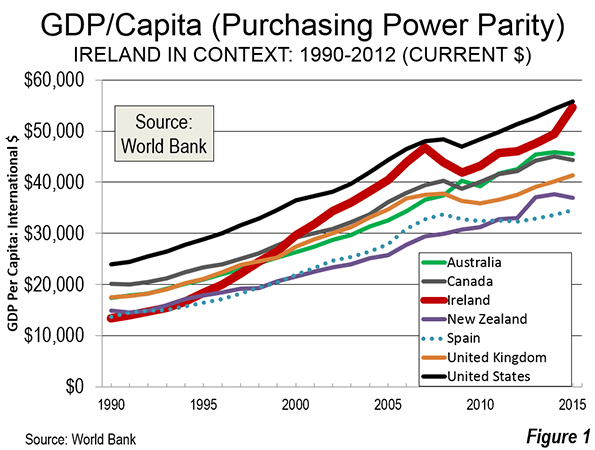
    Probably no nation suffered more during the housing bust induced Great Recession than Ireland. By 2007, the Irish economy had reached its peak, having achieved a gross domestic product (GDP) per capita, purchasing power adjusted, only 2.8 percent below that of the United States. This was an incredible accomplishment, given that as late as 1990 Ireland’s GDP per capita was approximately 45 percent below that of the United States, Australia, Canada, the United Kingdom, New Zealand and Spain, which are shown on Figure 1.  .

    However, as the overheated housing market tanked, Ireland’s GDP per capita dropped 8.4 percent relative to that of the United States, despite own housing bust economic losses. Things were so bad that Ireland was forced to take a large loan from the European Union and the International Monetary Fund to help stabilize its economy.

    Ireland’s economic losses were even greater than that of Spain, which had a particularly severe housing bust and whose economy continues to languish. But Ireland has done much better. The EU loan has been repaid. According to World Bank data, Ireland has reached a new peak, reaching within 2.1 percent of the US GDP per capita (Figure 1).

    The Housing Bubble and Bust

    During the housing bubble,   Dublin and Cork became severely unaffordable, where the median multiples (median house price divided by median household income) reached 6.0 and 5.4, respectively. This was to be expected as demand increased, well beyond the supply permitted by Ireland’s urban containment land-use regulations. As Dublin economist Colm McCarthy of  University College, put it: "Ireland passed its first major piece of land-use planning legislation in 1963, modeled on the UK’s Town and Country Planning Act of 1947. The intentions were laudable, to restrict the construction of unwelcome developments and to empower local authorities to take a more active role in shaping the built environment. There was no desire to screw up the residential housing market, but that is eventually what happened."

    As the economy get began to recover, house prices again began their rise simply because the reforms in   that would have prevented it were not implemented.

    Rebuilding Ireland

    The new housing policy announced July 20  is comprehensive, with strategies to reduce homelessness, improve the rental market and supply sufficient owned housing at affordable prices. Ireland has a high homeownership rate, at 68.6 percent and is important to the national economy.

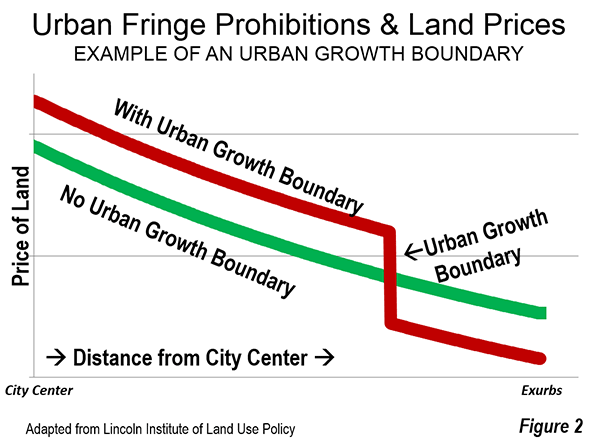
    As has occurred in the United Kingdom, Australia, New Zealand and some markets in Canada and the United States, large  house price increases relative to incomes were   experienced where urban containment policies were in effect. This is because urban fringe development prohibitions are associated with higher land prices inside urban containment boundaries (Figure 2). Indeed, this type of urban fringe regulation is present in virtually all major markets rated as severely unaffordable in the Demographia International Housing Affordability Survey, which rates 87 such markets in nine nations.

    Rebuilding Ireland policy acknowledges the importance of the housing market the national economy. As has been typical under urban containment planning regimes, house construction has fallen significantly short of demand. Under this policy, the government intends to accelerate the release of land for new development, especially in making government owned land available for development.

    Rebuilding Ireland is intended to double the rate of home building in Ireland over the period of 2017 to 2021. This will be aided by "Opening up land supply and low-cost State lands." This is important not only to meet the needs of Irish households, but also to diminish the potential for a highly volatile housing market that led to Ireland’s financial distress in the Great Recession.

    The government also intends to take action to support infrastructure development for new housing projects. A €200 million "Local Infrastructure Housing Activation Fund" will assist in "enabling infrastructure that opens up large sites for early development."

    As in California, virtually all large new housing projects today are appealed on various grounds. In recognition of this, Ireland intends to speed up the development process by allowing larger developments to proceed directly to the national planning appeals board ("An Bord Pleanála") for approval. The intention is to "jumpstart" the development of new housing.

    Defining Affordability

    Unlike most governments, the government of Ireland has supplied a definition of housing affordability. Rebuilding Ireland will hold a competition to develop new housing that can be delivered for than €200,000 in construction costs.

    Rebuilding Ireland also notes that land costs must be kept affordable and should add no more than €30,000 to €50,000 to the price of a new home. This would result in a "development ratio" of 15 percent to 20 percent (land price divided by total price including land). This development ratio is similar to US development ratios where urban containment policy has not been implemented and similar to development ratios in Australia and New Zealand before urban containment policy was adopted across those nations.

    Moreover, based on Irish household incomes, housing that costs between €230,000 and €250,000 would be generally consistent with the median multiple of 3.0 or less that is rated by the Demographia International Housing Affordability Survey as affordable (new house prices are generally more expensive than those of existing housing).

    Enforcement

    The government is signaling the seriousness of its intentions, indicating that local authorities must strive in their statutory development plans for “affordable prices to meet the housing needs of each local authority area, across tenures and types as well as the social housing requirement."

    This is a unique requirement in view of the fact that there has been virtually no serious attention to the issue of delivering housing affordability in other markets that have had strong urban containment policies.

    Implementation will not be without challenges. In the longer run, the inertia of currently in vogue planning philosophy could well prevent achievement of the housing affordability goals of Rebuilding Ireland. Yet, as Rebuilding Ireland indicates, the stakes are high. Rebuilding Ireland notes that "Excessive housing costs have demographic impacts, including a tendency for households to defer important lifecycle choices in order to prioritise home purchase" (such as having children).

    Further, as Rebuilding Ireland indicates: "Rising prices for residential accommodation impact adversely on competitiveness. The attractiveness of Ireland as a potential investment location and, of course, the cost base for existing businesses will be impaired should price inflation continue, as rising prices place upward pressure on wages, deter inward migration and impede the labour market."

    This could be particularly important in light of Brexit (the exit of the United Kingdom from the European Union). To the extent that international businesses may decide to leave the United Kingdom to stay within the European Union, Ireland and especially Dublin could be attractive for relocation because of the dominance in the nation of the English language, which would be made more attractive by improved housing affordability.

    Wendell Cox is principal of Demographia, an international pubilc policy and demographics firm. He is a Senior Fellow of the Center for Opportunity Urbanism (US), Senior Fellow for Housing Affordability and Municipal Policy for the Frontier Centre for Public Policy (Canada), and a member of the Board of Advisors of the Center for Demographics and Policy at Chapman University (California). He is co-author of the "Demographia International Housing Affordability Survey" and author of "Demographia World Urban Areas" and "War on the Dream: How Anti-Sprawl Policy Threatens the Quality of Life." He was appointed to three terms on the Los Angeles County Transportation Commission, where he served with the leading city and county leadership as the only non-elected member. He served as a visiting professor at the Conservatoire National des Arts et Metiers, a national university in Paris.

    Photo: Custom House, Dublin by Peter Brown from Dublin, Ireland (The Custom House, Dublin) [CC BY 2.0], via Wikimedia Commons

  • Lessons Learned from Long-Term Privatizations

    Is long term privatization of government assets in the form of leases or concessions a good idea?

    The answer is not Yes or No but rather What and How.

    Done right, long-term privatization can be a great thing to the public. But given the multi-decade nature of some of these deals, the risk of getting it wrong is high.

    My new Manhattan Institute research paper The Lessons of Long-Term Privatizations: Why Chicago Got It Wrong and Indiana Got It Right looks at two privatization deals, the Chicago parking meter lease and the Indiana toll road lease, and draws lessons about the right kinds of assets to lease and the things you need to get right while leasing them.

    I identify several flaws in the Chicago parking meter lease as compared to the Indiana Toll Road one, grouped into two categories:

    • Things Chicago managed poorly in the transaction (how items). These include the public review process, the transition to the private vendor, squandering the proceeds, and impairing future revenue streams. None of these invalidates the idea of privatization, but rather are areas where governments need to focus to get it right.
    • Reasons why parking meters are a bad kind of asset for long term leases (what items). These include regular, recurring compensation events and the dynamic and close interaction of on street parking with neighborhood health and other public policy considerations.

    Note that I do not critique the amount of money Chicago got for leasing its parking meters. This is a debatable item at best.

    I also do not criticize privatization of parking meter operations. Nobody cares who takes the quarters out of the meter.

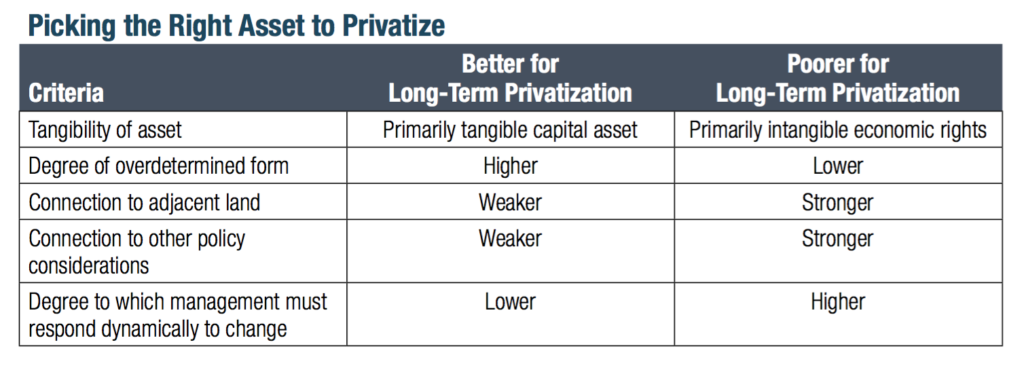
    Contrasting toll roads with parking meters, I created a matrix of characteristics to help determine whether or not an asset is a good candidate for privatization.

    privatization-asset-matrix

    Items that would appear to be better candidates for long term privatizations would be toll roads and bridges, airports, ports, and hospitals.

    Click through to read the entire report.

    Greg Hinz at Crain’s Chicago Business kindly posted some of his thoughts about the study.

    Aaron M. Renn is a senior fellow at the Manhattan Institute, a contributing editor of City Journal, and an economic development columnist for Governing magazine. He focuses on ways to help America’s cities thrive in an ever more complex, competitive, globalized, and diverse twenty-first century. During Renn’s 15-year career in management and technology consulting, he was a partner at Accenture and held several technology strategy roles and directed multimillion-dollar global technology implementations. He has contributed to The Guardian, Forbes.com, and numerous other publications. Renn holds a B.S. from Indiana University, where he coauthored an early social-networking platform in 1991.

  • A Different Approach to Redevelopment

    As part of a thought experiment I examined one specific neighborhood in a typical small city in Georgia. I’m using this town not because it’s unique, but because it’s absolutely normative. I could do the same analysis on the town where my mom, sisters, and brother live in southern New Jersey and it would be nearly identical. This is Everytown, USA.


    Screen Shot 2016-07-11 at 1.25.14 AMGoogle

    This particular neighborhood is halfway between the historic town center and the newer suburbs. It’s been completely skipped over and neglected in recent decades. What might be possible given the prevailing political and economic reality? The goal here is to improve the quality of life for existing residents, attract new residents, increase employment and economic activity, raise property values, and expand the tax base. The trick is to do all these things while keeping public spending and infrastructure to an absolute minimum and not use subsidies or tax abatements. I’ve rejected all the usual suspects that take too long, cost too much, and often make things worse.

    Screen Shot 2016-07-06 at 2.33.05 AMGoogle

    Screen Shot 2016-07-11 at 1.34.55 AMGoogle

    This neighborhood can’t compete with newer suburbs for folks looking for the usual quiet leafy environment. It shouldn’t even try. Instead it could offer the one thing the new suburbs don’t – a walkable human scaled place with some modicum of vitality and street life. There’s pent up market demand for such places and almost no supply. My first suggestion is for this business district to turn its back on the main road. Call it what it is – a sewer for cars. It serves its purpose and keeps things flowing, but no one wants to sit and watch the material drift by. Ignore it.

    Instead, the parallel secondary street should become the focus of attention. That’s the more appropriate Main Street location. Next, sort out local businesses that are “in” or “out.” The national chains won’t be interested. Let them continue doing what they do. Many of the independent merchants and landlords may not be so inclined either. That’s fine. Work with the folks who are. Baby steps.

    Screen Shot 2016-06-24 at 9.06.53 AMGoogle

    Screen Shot 2016-06-24 at 8.17.07 AM

    Screen Shot 2016-07-11 at 11.29.13 AM

    Here’s an interstitial space formed by the back of a generic aging strip mall and an adjacent one story professional building. It’s a parking lot that doesn’t appear to get much use, but it’s an excellent outdoor room with good proportions that faces a quiet side street. If the city regulators and fire marshal could see their way to make it legal this is an ideal spot for a great gathering space.

    Screen Shot 2016-07-06 at 10.11.40 AM

    Screen Shot 2016-07-06 at 10.14.03 AM

    Screen Shot 2016-07-12 at 1.02.23 AM

    Screen Shot 2016-07-06 at 10.14.15 AM

    Plants, inexpensive outdoor furniture, and simple food and drink (most likely served by existing merchants from the rear of their shops) would be a fast cheap method of making the area worth frequenting. Only the locals know exactly what would provide the best draw. Coffee? Beer? Ice cream? Barbecue? Or maybe this is the perfect spot for outdoor movies served with popcorn and lemonade on weekend nights. Total cost to the city? Some paperwork. Total cost to the property owners? Lawn furniture, plants, and Christmas lights. The “product” on offer is spontaneous conviviality. Effective management is more powerful than pouring concrete and laying asphalt.

    Screen Shot 2016-07-11 at 11.29.25 AM

    Screen Shot 2016-06-24 at 8.38.04 AM

    Screen Shot 2016-06-24 at 8.51.49 AM

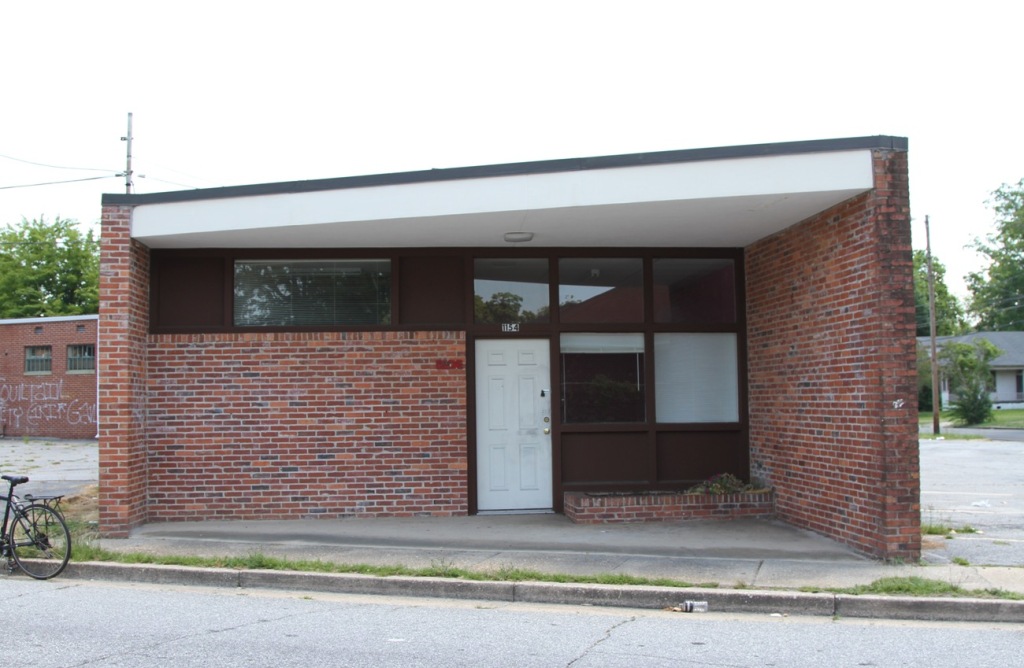
    The professional building appears to be vacant or less productive than it could be. The property owner may be happy with the current arrangement, but if not this could be a fantastic live/work space. There are a lot of people who find this sort of place appealing since it’s a blank slate and extremely flexible. It’s no doubt illegal to live in a commercial space due to zoning regulations. But those rules could be changed or quietly ignored by the authorities. Who’s to say what happens behind those brick walls? Live/work is the perfect in-between use for a building that sits halfway between a busy road and a calm residential street.

    Screen Shot 2016-07-06 at 2.49.45 AMGoogle

    Screen Shot 2016-07-11 at 11.30.17 AM

    Screen Shot 2016-06-25 at 8.19.44 AM

    Screen Shot 2016-06-25 at 8.20.30 AM

    All the ice cream parlors, outdoor cafes, and beer gardens in the world won’t help if there aren’t enough people nearby to fill the seats. This building appears to be some kind of Class C office building. I walked around in the middle of the afternoon on a weekday and didn’t see a soul. I didn’t even hear the hum of an air conditioner. It may be a thriving hub of business activity for all I know, but it looks like a storage facility for old paperwork. I could see someone from a local neighborhood improvement organization brokering a deal between the landlord and the local orchestra, film and video school, or art museum to convert this place into studio space.

    Screen Shot 2016-03-07 at 5.05.26 PM

    Screen Shot 2016-03-07 at 5.03.25 PM

    Screen Shot 2016-03-03 at 3.40.33 PM

    Actually, I’d love to see it as residential space for such people. It’s probably hard to practice the French horn in a garden apartment complex without people complaining. If the building were populated with a self selecting group of folks with an established affinity it might be a value added proposition.

    If you’re horrified by the idea of living in a place like this… Great! You’ve self selected out. Perfect. Now move over and make room for the people who love it. The Mad Men era architecture could be celebrated just as it is. Howard Johnson’s meets Denny’s with a hint of 1960’s car wash. A little turquoise and orange paint and some Malibu lighting would work wonders.

    Screen Shot 2016-07-11 at 1.16.49 AM

    Screen Shot 2016-07-11 at 1.17.18 AM

    Screen Shot 2016-07-11 at 1.13.23 AM

    Screen Shot 2016-06-25 at 8.06.20 AM

    Screen Shot 2016-06-25 at 8.07.23 AM

    Screen Shot 2016-07-11 at 1.18.56 AM

    There’s an abundance of commercial buildings that are simply not performing as intended. There’s no market demand for this kind of space in this location – and it’s been this way for a very long time.

    Screen Shot 2016-01-31 at 2.34.04 AM

    Screen Shot 2016-01-31 at 2.34.57 AM

    Screen Shot 2016-01-31 at 2.34.36 AM

    Why not make these living spaces? Again, I need to belabor the point. This isn’t about attracting suburban families. Instead, these places are perfect for a subset of the population that actually likes cheap ugly spaces. Cheap and ugly are the primary amenities for some people. They value other things and enjoy the freedom that comes with such accommodations.

    Screen Shot 2016-07-08 at 4.27.16 PM

    Screen Shot 2016-07-08 at 5.20.08 PM

    Screen Shot 2016-07-08 at 1.27.57 PM

    This is the secondary street that’s more suited to humans than the primary road full of vehicular traffic. It’s lifeless at the moment, but it could be transformed on the cheap with weekly pop up events organized around food trucks and a farmers market.

    Screen Shot 2016-07-12 at 12.24.08 AM

    Screen Shot 2016-07-12 at 12.24.33 AM

    Screen Shot 2016-07-12 at 12.23.53 AM

    Screen Shot 2016-07-12 at 12.22.40 AM

    Screen Shot 2016-07-12 at 12.27.16 AM

    Screen Shot 2016-07-12 at 12.26.45 AM

    Over time the empty parking lots and food trucks could mature with brick and mortar infill development that make the arrangement permanent. The food trucks are incubators for small scale entrepreneurs on a tight budget. You need a million dollars to open a franchise doughnut shop. A food truck comes at a much lower price point.

    Screen Shot 2016-07-03 at 2.57.15 PMGoogle

    Screen Shot 2016-07-11 at 5.42.57 PMGoogle

    Screen Shot 2016-07-02 at 4.31.19 AM

    Screen Shot 2016-06-25 at 8.14.03 AM

    Screen Shot 2016-07-03 at 5.50.29 PM

    Screen Shot 2016-07-03 at 5.51.16 PM

    Screen Shot 2016-07-03 at 5.51.35 PM

    Here’s a dead strip mall on the other side of the neighborhood that’s facing another busy commuter road. Again, the sweet spot is in the back that faces the residential side streets. Both the shops and the homes have seen better days. What can be done with this space?

    Screen Shot 2016-03-02 at 1.02.53 PM

    Screen Shot 2016-06-28 at 12.41.51 AM

    Screen Shot 2016-06-28 at 12.41.30 AM

    Screen Shot 2016-07-11 at 2.12.00 PM

    Screen Shot 2016-07-11 at 2.11.46 PM

    Screen Shot 2016-03-02 at 1.06.22 PM

    Screen Shot 2016-03-02 at 1.05.07 PM

    Screen Shot 2016-03-02 at 1.04.08 PM

    Screen Shot 2016-03-02 at 1.06.48 PM

    This is an example of a non profit organization that specializes in the often neglected industrial arts. Welding, glass blowing, carpentry, neon arts, enameling, stone cutting, fashion, ceramics, and so on. Thousands of people – particularly young people – are trained in useful skills each year. People rent space and pay a modest tuition for instruction. This isn’t a government facility. It was established and continues to be maintained by locals who are passionate about the place. This is the kind of thing that could draw in precisely the variety of people who might look favorably on living in one of the fantastically affordable nearby homes. And they’d actually have the skills to fix them up.

    Screen Shot 2016-06-25 at 8.13.39 AM

    I’m well aware of the arguments against this sort of thing. It will attract the wrong element. People will cook meth in spaces like that. People will have wild parties all night long and disturb the peace. This is just a bunch of Hipster nonsense.We can’t have people drinking beer outdoors near a church or school. I totally understand. From my perspective there are ways of managing those concerns, but I personally won’t invest ten minutes of my time attempting to change anyone’s opinion. Instead I’ll wait another ten or fifteen years for the current decline to continue. This place may not be ripe for reinvention yet. The local culture may not be receptive. Honestly, the neighborhood may not be miserable enough just yet. Let’s wait until these places start to burn down one by one. Or let them be bulldozed to make room for more parking or a heavily subsidized garden apartment complex next to the newly widened commuter road. That’s absolutely an option.

    John Sanphillippo lives in San Francisco and blogs about urbanism, adaptation, and resilience at granolashotgun.com. He’s a member of the Congress for New Urbanism, films videos for faircompanies.com, and is a regular contributor to Strongtowns.org. He earns his living by buying, renovating, and renting undervalued properties in places that have good long term prospects. He is a graduate of Rutgers University.