Category: Policy

  • How Land Use Regulations Hurt the Poor

    Sandy Ikeda and I have published a new Mercatus paper on the regressive effects of land use regulation. We review the empirical literature on how the effects of rules such as maximum density, parking requirements, urban growth boundaries, and historic preservation affect housing prices. Nearly all of the studies on the price effects of land use regulations find that — as supply and demand analysis would predict — these rules increase the price of housing. While the broad consensus on the price effects of land use regulations is probably to no surprise to Market Urbanism readers, some policy analysts continue to insist that in fact rules requiring detached, single family homes help cities maintain housing affordability.

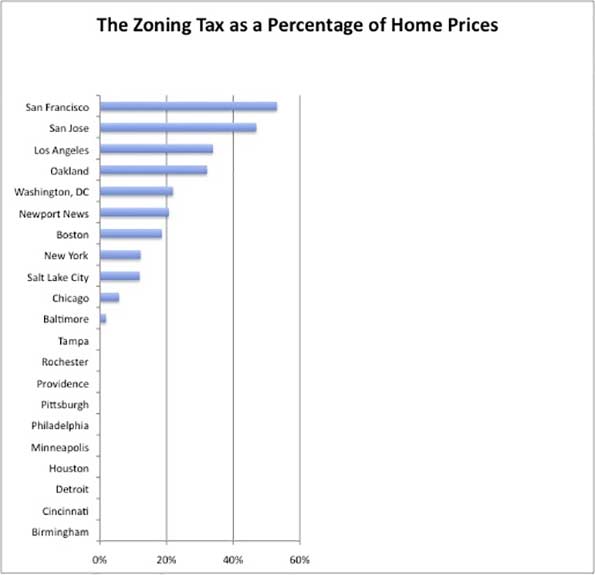
    Ed Glaeser, Joseph Gyourko, and Raven Saks estimate the effects of regulations on house prices in their paper “Why Is Manhattan So Expensive? Regulation and the Rise in Housing Prices.” They estimate what they call the “zoning tax” in 21 cities. The zoning tax indicates the proportion of housing costs that are due to land use regulations. The chart below shows the percentage of housing costs that this “tax” accounts for:

    The zoning tax as calculated by Edward Glaeser, Joseph Gyourko, and Raven Saks in 'Why Is Manhattan So Expensive? Regulation and the Rise in House Prices' (2003).

    The zoning tax as calculated by Edward Glaeser, Joseph Gyourko, and Raven Saks in “Why Is Manhattan So Expensive? Regulation and the Rise in House Prices” (2003).

    Policies that increase housing costs have a clear constituency in all homeowners, but they hurt renters and anyone who is hoping to move to an expensive city. The burden of land use regulations are borne disproportionately by low-income people who spend a larger proportion of their income on housing relative to higher income people. These regressive effects of land use policy extend beyond reducing welfare if the least-advantaged Americans. Additionally, rules that increase the cost of housing in the country’s most productive cities reduce income mobility and economic growth.

    In our paper Sandy and I also discuss proposals for reducing the inefficiency of cities’ current land use regulation practices. David Schleicher has proposed some of innovative policy improvements, including a zoning budget that a city can implement to commit itself to permitting a certain amount of new development. A zoning budget would create a situation in which local policymakers are forced to make tradeoffs between different land use restrictions, as opposed to the current situation in which there is no limit to policies restricting building. Another proposal that Schleicher suggests is a tax increment local transfer, or a TILT. With TILTs, homeowners who live near new development would receive some portion of the additional property taxes that the city raises by allowing the development. The purpose of TILTs is to reduce NIMBY opposition to development.

    We hope that our paper will be a helpful resource to those looking for an accessible overview of this area of research and point to future research opportunities for institutional reforms to allow for the construction of affordable housing.

    This piece first appeared at Market Urbanism.

    Emily Washington is a policy research manager for the Mercatus Center at George Mason University. She manages the Spending and Budget Initiative and State and Local Policy Project portfolios. Her writing has appeared in USA Today, The Christian Science Monitor, Economic Affairs, and The Daily Caller. She contributes to the blogs Neighborhood Effects and Market Urbanism.

  • A Question of Values: Middle-Income Housing Affordability

    This is the Executive Summary from a new report “A Question of Values: Middle-Income Housing Affordability and Urban Containment Policy" authored by Wendell Cox and published by the Frontier Centre for Public Policy. Ailin He, a PhD doctoral candidate in economics at McGill University served as research assistant.

    The "report is a public policy narrative on the relationships between urban containment policy, housing affordability and national economies. It is a synthesis of economic and urban planning analysis that is offered as a policy evaluation of urban containment. The analysis is presented in the context of higher-order objectives of domestic policy: improving the standard of living and eradicating poverty" (Page 9). The research focuses on the international experience, especially in Canada, Australia, New Zealand, the United Kingdom and the United States. Download the full report (pdf) here.

    Middle-income housing affordability is important to people and the economy: Canada’s house prices have risen more than house prices in most other high-income nations. This is of concern, because higher house prices reduce discretionary incomes, which defines the standard of living and poverty. If discretionary incomes are reduced, households will have less to spend on other goods and services, which can retard job creation and economic growth. Improving the standard of living and eradicating poverty are among the highest-order domestic priorities.

    Urban containment policy can lead to higher house prices: Urban land-use regulation has become stronger in many metropolitan areas and often includes urban containment policy. Urban containment severely restricts or bans development in urban fringe areas. Consistent with basic economics, this increases land values and house prices (all else equal). The planning intention and expectation is that higher housing densities will offset the land-price increases and that housing affordability will be maintained.

    Severe losses in housing affordability have been experienced in urban containment markets: Top housing and economic experts attribute much of the loss in housing affordability to stronger land-use policy.

    Housing affordability losses have been sustained in the five nations this report focuses upon: Across the United Kingdom, Australia, New Zealand and some markets in Canada and the United States, house prices have nearly doubled or tripled compared with household incomes as measured by price to income ratios. Much of this has been associated with urban containment policy.

    Demand and supply: Some research suggests that the huge house-price increases have occurred due to higher demand and the greater attractiveness of metropolitan areas that have urban containment policy. However, the interaction of supply and demand sets house prices. Claims that metropolitan areas with urban containment policy are more attractive are countered by their net internal out-migration and diminished amenities for some households.

    An intrinsic urban containment amenity seems doubtful: Some urban containment advocates claim that urban containment policy intrinsically improves amenities (such as a dense urban lifestyle). However, whether a feature is an amenity depends on individual preferences. Moreover, the strong net internal migration away from many metropolitan areas with urban containment policy is an indication that there is no urban containment amenity for most households.

    Higher densities have not prevented huge losses in housing affordability: In contrast with planning expectations, the land-value increases expected from urban containment have not been nullified by higher densities within urban containment boundaries.

    Intervening urban containment boundaries are more influential than topographic barriers: It has been suggested that topographic barriers such as mountains and the ocean cause higher house prices. However, in urban containment metropolitan areas, urban containment boundaries are usually placed between the built-up urban areas and the topographic barriers. As a result, house-price increase associated with the land shortage will be principally associated with the urban containment boundary, not the topographic barrier.

    A competitive land supply is required for housing affordability: A risk with urban containment policy is that by limiting the land for sale, large landholders will seek to buy up virtually all of the land for future gain. Without urban containment, there will not be a land shortage, and there will not be an incentive to monopolize the land supply. A sufficient land supply can be judged to exist only if prices relative to incomes are not higher than before the urban containment policy came into effect.

    Urban containment policy has been associated with reduced economic growth: Evidence suggests that urban containment policy reduces job creation and economic growth. The increased inequality noted by French economist Thomas Piketty is largely attributed to the housing sector and is likely related to strong regulation. Other research estimated a US$2-trillion loss to the U.S. economy, much of it related to strong land-use regulation, and called this “a large negative externality.”

    Urban containment policy has important social consequences: There are also important social consequences such as wealth transfers from younger to older generations and from the less-affluent to the more-affluent households.

    Urban containment policy has failed to preserve housing affordability: Some have expressed concern that urban containment policy might not have been implemented if there had been the expectation of losses in housing affordability. In fact, the administration of urban containment policy has been deficient, with corrective actions largely not taken despite the considerable evidence of losses in housing affordability. In urban containment markets, programs should be undertaken to stop the further loss of housing affordability and transition toward restoring housing affordability. Further, urban containment should not be implemented where it has not already been adopted.

    Canada could be at risk: Canada could be at greater risk in the future. Already, huge losses in housing affordability have been sustained in Vancouver and Toronto. Other metropolitan areas are strengthening land-use regulations. This could lead to severe consequences such as lowering middle-income standards of living and greater poverty with less job creation and less economic growth.

    The urban containment debate is fundamentally a question of values: Ultimately, the choice is between the planning values of urban design or urban form and the domestic policy values of improving the standard of living and reducing poverty. Urban containment policy appears to be irreconcilable with housing affordability. Proper prioritization requires that the higher-order values of a better standard of living and less poverty take precedence.

    Download the full report (pdf) here.

    Wendell Cox is Chair, Housing Affordability and Municipal Policy for the Frontier Centre for Public Policy (Canada), is a Senior Fellow of the Center for Opportunity Urbanism (US), a member of the Board of Advisors of the Center for Demographics and Policy at Chapman University (California) and principal of Demographia, an international public policy and demographics firm.He is co-author of the “Demographia International Housing Affordability Survey” and author of “Demographia World Urban Areas” and “War on the Dream: How Anti-Sprawl Policy Threatens the Quality of Life.” He was appointed to three terms on the Los Angeles County Transportation Commission, where he served with the leading city and county leadership as the only non-elected member. He served as a visiting professor at the Conservatoire National des Arts et Metiers, a national university in Paris.

  • Are We Heading for An Economic Civil War?

    When we speak about the ever-expanding chasm that defines modern American politics, we usually focus on cultural issues such as gay marriage, race, or religion. But as often has been the case throughout our history, the biggest source of division may be largely economic.

    Today we see a growing conflict between the economy that produces consumable, tangible goods and another economy, now ascendant, that deals largely in the intangible world of media, software, and entertainment. Like the old divide between the agrarian South and the industrial North before the Civil War, this threatens to become what President Lincoln’s Secretary of State, William Seward, defined as an “irrepressible conflict.”

    Other major economic divides—between capital and labor, Wall Street versus Main Street—defined politics for much of the 20th century. But today’s tangible-intangible divide is particularly tragic because it undermines America’s peculiar advantage in being a powerhouse in both the material and non-material worlds. No other large country can say that, certainly not China, Japan, or Germany, industrial powerhouses short on resources, while our closest cousins, such as Canada, Australia, and New Zealand, remain, for the most part, dependent on commodity trade.

    The China syndrome and the shape of the next slowdown

    Over the past decade, the United States has enjoyed two parallel booms that combined to propel the economy out of recession. One was centered in places like Houston, Dallas-Ft. Worth, Oklahoma City, and across much of the Great Plains. These areas were all located in the first states to emerge from the recession, and benefited massively from a gusher in energy jobs due largely to fracking.

    At the same time, another part of the economy, centered in Silicon Valley as well as Seattle, Austin, and Raleigh/Durham, has also been booming. Though far more restricted than their counterparts in the “tangible” economy in terms of both geography and jobs, the tech/digital economy did not lag when it came to minting fortunes. By 2014, the media-tech sector accounted for six of the nation’swealthiest people. Perhaps more important, 12 of the nation’s 17 billionaires under 40 also hail from the tech sector.

    Until China’s economy hit a wall this fall, these two sectors were humming along, maybe not enough to restore the economy to its ’90s trim robustly enough to improve conditions in many parts of the country. But as China begins to cut back on commodity purchases, many key raw material prices—copper and iron to oil and gas as well as food stuffs—have fallen precipitously, devastating many developing economies in South America, Africa, the Middle East, and Southeast Asia.

    Plunging prices are also beginning to hurt many local economies in the U.S., particularly in the “oil patch” that spreads from west Texas to North Dakota. This is one reason why overall economic growth has fallen, and is unlikely to revive strongly in the months ahead. Overall, according to the most recent numbers, job growth remains slow and long-term unemployment stubbornly high while labor participation is stuck at historically low levels. Much of this loss is felt by the kind of middle and working class people who tend to work in tangible industries.

    But it’s not just the much maligned energy economy that is in danger. The recovery of manufacturing was one of the most heartening “feel good” stories of the recession. Every Great Lakes state except Illinois now enjoys an unemployment rate below the national average, and several, led by the Dakotas, Minnesota, Nebraska, and Iowa, boast unemployment that is among the lowest in the nation. Now a combination of a too-strong dollar, declining demand for heavy equipment, and falling food prices threaten economies throughout the Great Lakes and the Great Plains.

    Waging war on the tangible economy

    President Obama’s emphasis on battling climate change—aimed largely at the energy and manufacturing sectors—in his last year in office will only exacerbate these conflicts. For one thing, the administration’s directive to all but ban coal could prove problematic for many Midwest states, including several—Iowa, Kansas, Ohio, Illinois, Minnesota, and Indiana—that rely the most on coal for electricity. Not surprisingly, much of the opposition to the Environmental Protection Agency’s decrees come from heartland states such as Oklahoma, Indiana, and Michigan. The President’s belated rejection of the Keystone Pipeline is also intensely unpopular, including among traditionally Democratic-leaning construction unions.

    These policies have also succeeded to pushing the energy industry, in particular, to the right. In 1990 energy firms contributed almost as much to Democrats as to Republicans; last year they gave more than three times as much to the GOP.

    In contrast, the tech oligarchs and their media allies largely embrace the campaign against fossil fuels. Environmental icon Bill McKibben, for example, has won strong backing in Silicon Valley for his drive to marginalize oil much like the tobacco industry was ostracized earlier. Meanwhile the onetime pragmatic interest in natural gas as a cleaner replacement for coal is fading, as the green lobby demands not just the reduction of fossil fuel but its rapid extermination.

    Embracing the green agenda costs Silicon Valley little. High electricity prices may take away blue collar jobs, but they don’t bother the affluent, well-educated, Telsa-driving denizens of the Bay Area, who also pay less for power. But those rates are devastating to the less glamorous people who live in California interior. As one recent study found, the average summer electrical bill in rich, liberal andtemperate Marin County was $250 a month, while in impoverished , hotter Madera, the average bill was twice as high.

    Many Silicon Valley and Wall Street supporters also see business opportunities in the assault on fossil fuels. Cash-rich firms like Google and Apple, along with many high-tech financiers and venture capitalist, have invested in subsidized green energy firms. Some of these tech oligarchs, like Elon Musk, exist largely as creatures of subsidies. Neither SolarCity nor Tesla would be so attractive—might not even exist—without generous handouts.

    In this way California already shows us something of what an economy dominated by the intangible sectors might look like. Driven by the “brains” of the tech culture, the ingenuity of the “creative class,” and, most of all, by piles of cash from Wall Street, hedge funds, and venture capitalists, the tech oligarchs have shaped a new kind of post-industrial political economy.

    It is really now a state of two realities, one the glamorous software and media-based economy concentrated in certain coastal areas, surrounded by a rotting, and increasingly impoverished, interior. Far from the glamour zones of San Francisco, the detritus of the fading tangible economy is shockingly evident. Overall nearly a quarter of Californians live in poverty, the highest percentage of any state. According to a recent United Way study, almost one in three Californians is barely able to pay his or her bills.

    Silicon Valley’s political agenda

    For the time being, with the rest of the economy limping along, the tech oligarchs seem, if anything, ever more arrogant and sure that they will define the future of the country’s politics. At a time when most small business owners hold Obama in low regard, the Democratic Party can consider the tech sector as an intrinsic part of its core political coalition. In 2000 the communications and electronics sectorwas basically even in its donations; by 2012 it was better than two to one democratic.

    Once largely apolitical or non-partisan in their approach, firms like Microsoft, Apple and Google now overwhelmingly lean to the Democrats. President Obama has even enlisted several tech giants—including venture capitalist John Doerr, Linked In billionaire Reid Hoffman, and Sun cofounder Vinod Khosla—to help plan his no doubt lavish and highly political retirement.

    The love-fest between Obama and Silicon Valley grows from a common belief in being extraordinary. The same media that has marveled at Obama’s celebrated brilliance also hails Silicon Valley’s ascendency as a triumph of brains over brawn.

    Yet in reality many traditional industries such as energy and manufacturing still depend on skilled engineers. Indeed, after Silicon Valley, the biggest concentration of engineers per capita (PDF) can be found in brawny metros like Houston and Detroit. New York and Los Angeles, which like to parade as tech hotbeds, rank far behind.

    In contrast to engineers laboring in Houston or Detroit, those who work in Silicon Valley focus largely on the intangible economy based on media and software. The denizens of the various social media, and big data firms have little appreciation of the difficulties faced by those who build their products, create their energy, and grow their food. Unlike the factory or port economies of the past, those with jobs in the new “creative” economy also have little meaningful interaction with working class labor, even as they finance politicians who claim to speak for those blue collar voters.

    This may explain the extraordinary gap between the economies—and the expectations—of coastal and interior California. The higher energy prices and often draconian regulations that prevented California from participating in the industrial renaissance are hardly issues to companies that keep their servers in cheap energy areas of the Southwest or Pacific Northwest and (think Apple) manufacture most if not all of their products in Asia.

    In the process the Democrats, once closely allied with industry, are morphing into a post-industrial party. Manufacturing in strongholds like Los Angeles, long the industrial center of the country, continues to erode. In a slide that started with the end of the Cold War, Southern California’s once-diverse industrial base has eroded rapidly, from 900,000 jobs just a decade ago to 364,000 today. New York City, which in 1950 boasted 1 million manufacturing jobs, now has fewer than 100,000. Overall, manufacturing accounts for barely 5 percent of state domestic product in New York and 8 percent in California, compared to 30 percent in Indiana and 19 percent in Michigan.

    This divide could become decisive in the election. In contrast to advances in energy, autos, and homebuilding, which produced good blue collar and middle-skilled jobs, the benefits of the current tech boom have been limited, both in terms of job creation (outside of the Bay Area) and increased productivity, for the vast majority of voters.

    This underlying economic conflict is redefining our politics less along lines of ideology and more in terms of interests. Increasingly states that follow the Obama line on energy, such as New York and California, are not contestable for Republicans. But elsewhere—beyond the coasts—there may be greater resistance.

    Among those who are likely to revolt are those workers and entrepreneurs in the oil patch, those who build heavy machinery, and those who grow large quantities of food. The recent Republican win in Kentucky was in part based on opposition to anti-coal regulations coming from the Obama administration. As the EPA ramps up its regulatory onslaught, one can expect energy-dependent industries and regions to recoil, particularly at a time when their industries are headed into a recession. Republicans claims that regulatory policies hurt the tangible economies will gain traction if car factories and steel mills start shutting down again, while farmers plant fewer soybeans and developers build fewer suburban homes.

    The emergence of an economic civil war?

    Hillary Clinton may praise the economic progress under President Obama, and win the nods of those in the tech, media, and financial community who have done very well on his watch. There’s enough momentum from these industries to guarantee that the entire West Coast and the Northeast will fold comfortably, and predictably, into the Clinton column, despite rising concern about crime, homelessness, and loss of middle class jobs. But the very same policies that attract the tech world voter to Clinton will just as certainly alienate many working class and middle class Democrats in places like Appalachia, the Gulf Coast, and particularly the politically pivotal Great Lakes.

    The stakes could be huge. If the Republicans can convince most voters in the middle of the country that the coastal-driven policy agenda is a direct threat to their interests, the GOP will likely carry the day. But if the Democrats can convince the country that coastal California and New York City represent the best future for us all, then get ready for Hillary, because nothing else—certainly not the old social issues—will stop her.

    This piece first appeared at The Daily Beast.

    Joel Kotkin is executive editor of NewGeography.com and Roger Hobbs Distinguished Fellow in Urban Studies at Chapman University, and a member of the editorial board of the Orange County Register. He is also executive director of the Houston-based Center for Opportunity Urbanism. His newest book, The New Class Conflict is now available at Amazon and Telos Press. He is also author of The City: A Global History and The Next Hundred Million: America in 2050. He lives in Orange County, CA.
  • So Much For The Death Of Sprawl: America’s Exurbs Are Booming

    It’s time to put an end to the urban legend of the impending death of America’s suburbs. With the aging of the millennial generation, and growing interest from minorities and immigrants, these communities are getting a fresh infusion of residents looking for child-friendly, affordable, lower-density living.

    We first noticed a takeoff in suburban growth in 2013, following a stall-out in the Great Recession. This year research from Brookings confirms that peripheral communities — the newly minted suburbs of the 1990s and early 2000s — are growing more rapidly than denser, inner ring areas.

    Peripheral, recent suburbs accounted for roughly 43% of all U.S. residences in 2010. Between July 2013 and July 2014, core urban communities lost a net 363,000 people overall, Brookings demographer Bill Frey reports, as migration increased to suburban and exurban counties. The biggest growth was in exurban areas, or the “suburbiest” places on the periphery.

    How could this be? If you read most major newspapers, or listened to NPR or PBS, you would think that the bulk of American job and housing growth was occurring closer to the inner core. Yet more than 80% of employment growth from 2007 to 2013 was in the newer suburbs and exurbs. Between 2012 and 2015, as the economy improved, occupied suburban office space rose from 75% of the market to 76.7%, according to the real estate consultancy Costar.

    These same trends can be seen in older cities as well as the Sun Belt. Cities such as Indianapolis and Kansas City have seen stronger growth in the suburbs than in the core.

    This pattern can even be seen in California, where suburban growth is discouraged by state planning policy but seems to be proceeding nevertheless. After getting shellacked in the recession, since 2012 the Inland Empire — long described as a basket case by urbanist pundits — has logged more rapid population growth  than either Los Angeles and even generally healthy Orange County. Last year the metro area ranked third in California for job growth, behind suburban Silicon Valley and San Francisco.

    To those who have been confidently promoting a massive “return to the city,” the resurgence of outer suburbs must be a bitter pill. In 2011, new urbanist pundit Chris Leinberger suggested outer ring suburbs were destined to become “wastelands” or, as another cheerily described them, “slumburbs” inhabited by the poor and struggling minorities chased out of the gentrifying city.

    In this worldview, “peak oil” was among the things destined to drive people out of the exurbs . So convinced of the exurbs decline that some new urbanists were already fantasizing that suburban three-car garages would be “subdivided into rental units with street front cafés, shops, and other local businesses,” while abandoned pools would become skateboard parks.

    This perspective naturally appeals to people who write most of our urban coverage from such high-density hot spots as Brooklyn, Manhattan, Washington, D.C., or San Francisco. And to be sure, all these places continue to attract bright people and money from around the world. Yet for the vast majority, particularly families, such places are too expensive, congested and often lack decent public schools. For those who can’t afford super-expensive houses and the cost of private education, the suburbs, particularly the exurbs, remain a better alternative.

    Even as Houston, like other Sun Belt cities, has enjoyed something of a renaissance in its inner core, nearly 80% of the metro area’s new homebuyers last year purchased residences outside Beltway 8, which is far to west of the core city.

    If you want to know why people move to such places, you can always ask them. On reporting trips to places like Irvine, California, Valencia, north of Los Angeles, or Katy, out on the flat Texas prairie 31 miles west of Houston, you get familiar answers: low crime, good schools and excellent access to jobs. Take Katy’s Cinco Ranch. Since 1990, the planned community has grown to 18,000 residents amid a fourfold expansion in the population of the Katy area to 305,000.

    To some, places like Cinco Ranch represents everything that is bad about suburban sprawl, with leapfrogging development that swallows rural lands and leaves inner city communities behind. Yet to many residents, these exurban communities represent something else: an opportunity to enjoy the American dream, with good schools, nice parks and a thriving town center.

    Nor is this a story of white flight. Roughly 40% of the area’s residents are non-Hispanic white; one in five is foreign born, well above the Texas average. Barely half of the students at the local high school are Caucasian and Asian students have been the fastest-growing group in recent years, with their parents attracted to the high-performing schools.

    “We have lived in other places since we came to America 10 years ago,” says Pria Kothari, who moved to Cinco with her husband and two children in 2013. “We lived in apartments elsewhere in big cities, but here we found a place where we could put our roots down. It has a community feel. You walk around and see all the families. There’s room for bikes –that’s great for the kids.”

    Here Come The Millennials

    Potentially, the greatest source of exurban and peripheral revival lies with the maturation of the millennial generation. Millennials — born between 1982 and 2002 — are widely portrayed as dedicated city dwellers. That a cohort of young educated, affluent people should gravitate to urban living is nothing new. The roughly 20% who, according to an analysis by demographer Wendell Cox, live in urban cores may be brighter, and certainly more loquacious, than their smaller town counterparts, dominating media coverage of millennials. But the vast majority of millennials live elsewhere — and roughly 90% of communities’ population growth that can be attributed to millennials since 2000 has taken place outside of the urban core.

    To be sure, millennials are moving to the suburbs from the city at a lower rate than past generations , but this is more a reflection of slower maturation and wealth accumulation.

    According to U.S. Census Bureau data released last month, 529,000 Americans ages 25 to 29 moved from cities out to the suburbs in 2014 while 426,000 moved in the other direction. Among younger millennials, those in their early 20s, the trend was even starker: 721,000 moved out of the city, compared with 554,000 who moved in.

    This may well reflect rising cost pressures, as well as lower priced housing many millennials can afford. Three-quarters, according to one recent survey, want a single-family house, which is affordable most often in the further out periphery.

    Future trends are likely to be shaped by an overlooked fact: as people age, they change their priorities. As the economist Jed Kolko has pointed out, the proclivity for urban living peaks in the mid to late 20s and drops notably later. Over 25% of people in their mid-20s, he found, live in urban neighborhoods; but by the time they move into their mid-30s, it drops to 18% or lower. In 2018, according to Census estimates, the number of millennials entering their 30s will be larger than those in their 20s, and the trend will only get stronger as the generation ages.

    Some might argue that millennials will be attracted to more urban suburbs, places like Bethesda, Md.; Montclair, N.J.; or the West University or Bellaire areas of Houston, all of them located near major employment centers with many amenities. These suburban areas are also among the most expensive areas in the country, with home prices often in the millions. And a number of older inner ring suburbs, as we saw in the case of Ferguson, are troubled and have lost population — even as the number of residents in downtown areas have grown.

    So when millennials move they seem likely to not move to the nice old suburbs, or the deteriorating one, but those more far-flung suburban communities that offer larger and more affordable housing, good schools, parks and lower crime rates.

    Among the research that confirms this is a study released this year by the Urban Land Institute, historically hostile to suburbs, which found that some 80% of current millennial homeowners live in single-family houses and 70% of the entire generation expects to be living in one by 2020.

    The Future Of Exurbia

    Far from being doomed, exurbia is turning into something very different from the homogeneous and boring places portrayed in media accounts. For one thing exurbs are becoming increasingly ethnically diverse. In the decade that ended in 2010 the percentage of suburbanites living in “traditional” largely white suburbs fell from 51% to 39%.  According to a 2014 University of Minnesota report, in the 50 largest U.S. metropolitan areas, 44% of residents live in racially and ethnically diverse suburbs, defined as between 20% and 60% non-white.

    And how about the seniors, a group that pundits consistently claim to be heading back to the city? In reality, according to an analysis of Census data, as seniors age they’re increasingly unlikely to move, but if they do, they tend to move out of urban cores as they reach their 60s, and to less congested, often more affordable areas out in the periphery. Seniors are seven times more likely to buy a suburban house than move to a more urban location. A National Association of Realtors survey found that the vast majority of buyers over 65 looked in suburban areas, followed by rural locales.

    Trends among millennials, seniors and minorities suggest that demographics are in the exurbs’ favor. The movement to these areas might be accelerated by their growing sophistication, as they build amenities long associated with older cities, such as town centers, good ethnic restaurants and shops, diverse religious institutions and cultural centers. At the same time, the growth of home-based business — already larger than transit ridership in two-thirds of American metropolitan areas and growing much faster — increases the need for larger homes of the sort found most often in the outer rings.

    Rather than regard these communities as outrages to the urban form, planners and developers need to appreciate that peripheral developments remain a necessary part of our evolving metropolitan areas. With a new generation looking for affordable homes, good schools and low crime, it seems logical that many will eventually leave core cities that offer none of the above. The future of exurbia is far from dead; it’s barely begun.

    This piece first appeared at Forbes.

    Joel Kotkin is executive editor of NewGeography.com and Roger Hobbs Distinguished Fellow in Urban Studies at Chapman University, and a member of the editorial board of the Orange County Register. He is also executive director of the Houston-based Center for Opportunity Urbanism. His newest book, The New Class Conflict is now available at Amazon and Telos Press. He is also author of The City: A Global History and The Next Hundred Million: America in 2050. He lives in Orange County, CA.
  • Auckland Tackles Housing Affordability Crisis

    City of Auckland Chief Economist Chris Parker has called for establishment of a house price to income ratio objective of 5.0, to be achieved by 2030. The recommendation was included in a report commissioned by Auckland Mayor Len Brown and Deputy Mayor Penny Hulse.

    Housing Affordability and Urban Containment Policy

    The recommendation has been brought about in response to Auckland’s severely unaffordable housing. Recent reports indicate a price to income ratio over 9.0, at least triple that of New Zealand to the early 1990s.

    Like a number of metropolitan areas, Auckland has had urban containment land-use policy for some time. Auckland has drawn an urban growth boundary around development, largely banning new greenfield housing outside the boundary. As economics would predict, with a continuation of strong housing demand and the significant supply reduction, house prices have been shot skyward. The latest Demographia International Housing Affordability Survey showed Auckland to have a median multiple of 8.2 (the median multiple is the median house price divided by the median household income), though later data indicates a further deterioration (above).

    Avoiding the Consequences of Urban Containment

    House price volatility has been a growing concern in urban containment markets where house prices have escalated so strongly relative to incomes and economic productivity. The bursting of the US housing bubble in the last decade indicates the damage that can be inflicted on people and their finances when exorbitantly high house prices collapse. This is a fate governments seek to avoid not only in Auckland, but at the national level.

    According to Parker’s report, the city of Auckland is expected to add 1 million additional residents over the next 30 years. Parker indicated that: "If high house prices are sustained or continue to rise relative to incomes then … consequences and risks will become more significant:" He cited:

    "-loss of social cohesion — an increasingly socially divided city with a line drawn between those in the housing market and those outside

    -macroeconomic instability via rapid house price deflation.

    -Increased unemployment as businesses relocate activities to other more competitive cites locally (e.g. Christchurch, Hamilton, Tauranga) and internationally (e.g. Melbourne and Sydney)

    -Increased household crowding and related social ills."

    City Councilor Dick Quad echoed similar concerns in an email: "It’s staggering that Auckland’s homeownership is now down to 50% from 64% just 9 years ago. The social chaos we are creating can be seen on a daily basis with overcrowding, third world diseases (resulting from overcrowding) poor educational outcomes, and a city in which the landed gentry have grabbed all the wealth. We are engaged in a social experiment which is destined to end in disaster.”

    Councilor Quax applauded Parker’s work, but had concerns about implementation, indicating that the policy "flies in the face of what many of our politicians believe."

    According to Parker, reaching that the objective will include a number of both supply and demand side strategies. Most, importantly, Parker’s list includes opening greenfield land for development. Even urban containment (smart growth) theorists agree that the imposition of urban containment boundaries, such as in Auckland, is associated with higher land prices within the urban area. Their hopes that higher density housing would cancel out the housing affordability losses have been dashed, due to the massive increase in land costs. For example, comparable land on either side of Auckland’s urban containment boundary varies by a minimum of 8 times. Without the boundary, the expected difference would be virtually nil. In addition, high density housing is considerably more expensive to build than the detached housing people prefer.

    Yet, only in a few places have policymakers taken the important step from failed intentions to the reforms necessary to reverse the housing affordability losses. Among the major metropolitan areas with the most severe urban containment policies, house prices have risen to two to three times the rate of household incomes.

    The "Good:" Better than an Unattainable "Perfect"

    Even if the 5.0 price to income multiple were achieved by 2030, housing would remain seriously unaffordable in Auckland. Parker argues that a lower target (such as the 3.0 Demographia International Housing Affordability Survey standard) would not likely be achievable:

    "It is doubtful that a 5.0 median price multiple could be achieved considerably earlier than 2030. (Unless there was a substantial bust, which should be avoided, given that so much is now at stake with existing high prices and the macroeconomic risks that would result.) The types of changes needed are structural (and change at a glacial pace), and will take many years to compound."

    His point is well taken. The "perfect" strategy of a 3.0 objective could well be the enemy of the good.
    Reaching a 5.0 price to income multiple by 2030 would be a great improvement. Two decades of housing market distortion cannot be erased overnight.

    The alternative could be continued house price increases in a policy environment that continues to outlaw building the new housing that people prefer.

    As the city continues to examine options for improving housing affordability, it will be important to set interim objectives, such as annual improvements or perhaps improvements on a three year basis. Further, it will be important for the city to continually review its policies and liberalize regulation even further if the targets are not reached.

    Setting an Example

    Auckland could be taking a significant step by seeking to reverse the damage done by out-of-control house prices. Certainly, the prodding it has received from the New Zealand government has helped. Just a couple of weeks ago, Deputy Prime Minister Bill English told a university audience: "… while the justification for planning is to deal with externalities, what has actually happened is that planning in New Zealand has become the externality." Research commissioned by the Productivity Commission of New Zealand may have also been influential.

    The city’s Auckland Development Committee recently endorsed Parker’s proposal and agreed "in principle" to include the objective in the next update of Auckland’s metropolitan plan. By lowering  housing costs, the city  would improve standards of living and reduce poverty. Auckland could also become an example for metropolitan areas as diverse as Vancouver, San Francisco, Portland, and London, where all of the talk about improving housing affordability has remained just that, while prices continue to soar beyond the means of the middle class, particularly young families

    Wendell Cox is Chair, Housing Affordability and Municipal Policy for the Frontier Centre for Public Policy (Canada), is a Senior Fellow of the Center for Opportunity Urbanism (US), a member of the Board of Advisors of the Center for Demographics and Policy at Chapman University (California) and principal of Demographia, an international public policy and demographics firm.He is co-author of the “Demographia International Housing Affordability Survey” and author of “Demographia World Urban Areas” and “War on the Dream: How Anti-Sprawl Policy Threatens the Quality of Life.” He was appointed to three terms on the Los Angeles County Transportation Commission, where he served with the leading city and county leadership as the only non-elected member. He served as a visiting professor at the Conservatoire National des Arts et Metiers, a national university in Paris.

    Lead photo: City of Auckland Coat of Arms by Jayswipe (Heraldry photos) [Public domain], via Wikimedia Commons

  • How Big Government and Big Business Stick It to Small U.S. Businesses

    From the inception of the Soviet Union, transformation was built, quite consciously, on eliminating those forces that could impede radical change. In many ways, the true enemy was not the large foreign capitalists (some of whom were welcomed from abroad to aid modernization) but the small firm, the independent property owner.

    “Small scale commercial production is, every moment of every day, giving birth spontaneously to capitalism and the bourgeoisie … Wherever there is business and freedom of trade, capitalism appears,” noted the state’s founder Vladimir Lenin. He understood that while larger firms could be manipulated to serve the state, “capitalism begins in the village marketplace.”

    Later on, this drive to eliminate grassroots capitalists—notably the “rich peasants” or kulaks—took on a particularly deadly form. In 1929 Stalin decided on the “liquidation of the kulaks as a class.” Millions of small rural entrepreneurs were imprisoned, murdered, or starved to death, until by the end of the ’30s independent business in the Soviet Union was largely eliminated, giving the state free rein.

    Who are America’s Kulaks?

    The United States, fortunately, is not the Soviet Union and even the most “transformation” oriented politician does not—at least yet—have power to create a gulag or openly appropriate the wealth or lives of citizens. Yet lately there is nevertheless a powerful trend to limit and largely disempower the country’s small business community—our kulaks—from a host of antagonists, including the Obama administration, the large financial institutions, and the ever-expanding regulatory apparat.

    In the 19th century, the small farmer epitomized the national ideal: independent, hard-working, frugal and engaged in his community. Later, as agriculture’s share of the economy dropped, the “yeoman” farmer gave way to the Main Street business owner, whose conflicts, particularly in the late 19th and early 20th centuries, were more with oligopolistic corporations—notably utilities, oil companies, and railroads—than the government.

    Kulaks are not just people with some money and capital. They tend to be engaged in the private sector, where risk is an everyday concern. There are other parts of the affluent middle class who are not Kulaks but actually beneficiaries of the intrusive state, such as academics, parts of big business and, of course, elite members of the ever-expanding governmental nomenklatura. These professionals, as well as corporate executives, have helped make the Democratic Party, as the New York Times’ Tom Edsall suggests, the “favorites of the rich.”

    The Decline of a Class

    In the ascendance during the Reagan and Clinton booms, our kulaks—the roughly 10 million businesses under 500 employees that employ 40 million people—are clearly in secular decline, with grave implications for the economy, employment, and the future of democracy.

    Rather than a new age of democratic capitalism imagined by Reagan era conservatives, we increasingly live in a world dominated by large companies. The overall revenues of Fortune 500 companies have risen from 58 percent of nominal GDP in 1994 to 73 percent in 2013. At the same time, small business start-ups have declined as a portion of all business growth, from 50 percent in the early ’80s to 35 percent in 2010. Indeed, a 2014 Brookings report (PDF) revealed that small business “dynamism,” measured by the growth of new firms compared with the closing of older ones, has declined significantly over the past decade, with more firms closing than starting for the first time in a quarter century. Only 35 percent of small business owners, according to a recent survey by the National Small Business Association, express optimism about the economy.

    This decline in entrepreneurial activity marks a historic turnaround. Start up rateshave fallen for young people in particular, dropping to the lowest levels in a quarter century. At the same time the welfare state has expanded dramatically to the point that nearly half of all Americans now get payments from the federal governmentnotably through Medicare and Social Security. At the same time, the lack of grassroots economic activity may contribute to labor participation rates, now the lowest in almost four decades.

    The Obama administration’s progressive-sounding rhetoricmay offend some of the thinner-skinned members of the oligarchy, but his economic policies—the bank bailouts, super-low interest rates, and growing federal power—have also improved the balance sheets of the corporate hegemons and the super-rich. In contrast, these policies do little, or less than little, for the yeoman class. Money today is made far more easily today by playing games with the market than making or selling on Main Street.

    High business costs, some related to the rising tide of regulation under President Obama—including Obamacare—have become a huge burden to smaller firms. Indeed, according to a 2010 report (PDF) by the Small Business Administration, federal regulations cost firms with fewer than 20 employees more than $10,000 each year per employee, while bigger firms paid roughly $7,500 per employee. The biggest hit to small business comes in the form of environmental regulations, which cost 364 percent more per employee for small firms than it does for larger ones. Small companies spend $4,101 per employee, compared to $1,294 at medium-sized companies (20 to 499 employees) and $883 at the largest companies, to meet these requirements.

    Nowhere has consolidation of power under the current regime been more obvious than in the financial sector. Goldman Sachs’ Lloyd Blankfein has described his firm as “among the biggest beneficiaries of reform.” The new regulatory environment has created huge barriers to any potential competitors and places smaller firms at a distinct disadvantage.

    In contrast these regulations have hastened the rapid decline of community banks, for example, down by half since 1990, particularly hurts small businesspeople who depended on loans from these institutions, leaving them, as even Ben Bernanke admits, with major obstacles at achieving credit.

    The large banks also benefited from the Obama administration’s steady refusal to prosecute any Wall Street grandees. Their get-out-of-jail-free card is a testament to the pilfering lobbyists of Washington’s K Street and the greed of politicians in both parties.

    Resisting the New Duopoly: Big Government and Big Business

    Under Lenin and Stalin, the threat to the kulaks was explicit, and in the end genocidal. Here in America, to be sure, the process is far less extreme. And not all the assault on Kulaks can be traced to government.

    Technology and globalization often work against small firms. In the past, technology promoted competition whereas now it increasingly works to foster the consolidation of a new oligarchy dominated by such quasi-monopolies as Microsoft, Amazon, Apple, Google, and Facebook.

    Indeed, the future being envisioned in the media and by the oligarchs is one dominated by automated factories and computer-empowered service industries. This will reduce opportunity for both middle-class jobs and small business in the future. To some, the American middle and working classes are becoming economically passé. Steve Case, founder of America Online, has even suggested that future labor needs can be filled not by current residents but by some 30 million immigrants. In this he reflects the cosmopolitan notions favored by the oligarchs. But likely not so much by the Kulaks and the bulk of the populace.

    Rather than a republic of yeoman, we could evolve instead, as one left-wing writer put it, to live at the sufferance of our “robot overlords,” as well as those who program and manufacture them, likely using other robots to do so. The financial community seems to have little problem with this tendency, as we can see in its support for companies such as Uber, which, however convenient, is growing at the expense of what had been thousands of full time workers. And former top Obama aides are leading Uber’s defense against threatened taxi drivers.

    Politicians on both the right and left seek to appeal to middle class voters and small business owners, but neither party can be said to have the interests of these groups at heart. The large corporations and banks have enjoyed an unprecedented surge in profits, but few small business have crashed that party. Republicans and their leading lobbyists generally have no interest in doing anything, such as equalizing capital gains and income rates, that would offend those who support their campaigns and fund their ongoing political activities.

    In the past, Democrats may have appealed to Kulaks, but that seems to have died with the end of Bill Clinton’s second term. Whereas the first Clinton accepted limits on government largesse, the newly emboldened progressives, citing inequality, are calling for more transfers to the poorer parts of society. They even plan to hit the kulaks where they live—largely suburbia—as part of an effort to social engineer American communities.

    This trend has almost universal support in the mainstream media, the campuses, and some corporations, who can better manipulate the regulatory and tax system. There is even a role model: to become like Europe. As The New York Times’ Roger Cohen suggests, we reject our traditional individualist “excess” and embrace instead continental levels of modesty, social control, and, of course, ever higher taxes.

    Trump, Sanders, and the future of the Kulaks

    The assault on the kulaks has had significant political consequences, although the endgame remains very much in question. Certainly there’s widespread dissatisfaction towards the Obama administration: in 2012, small business ownersranked as the least approving group for the current regime.

    Yet it is not just Republicans or Tea Partiers who are upset with the rising plutocracy. Americans, according to Gallup, greatly favor small companies over big business. Indeed most large institutions—government and media as well as large corporations—now suffer some of the lowest rankings in recent history, with only small business and the military doing well.

    Given these attitudes, it’s not surprising that the rising candidates of 2015 were those—Trump, Carson, Sanders , and even Fiorina—who have tried to position themselves in opposition to the status quo. The candidate most feared by Wall Street isn’t the folksy socialist Bernie Sanders but Donald Trump, whose candidacy, reports Politico, is setting off “a wave of fear” among the investor class. This is not just concern over Trump’s xenophobia, but his essential populism.

    Both Trump’s support and that of Ben Carson come from Republicans who do not oppose higher taxes on the ultra-rich; they might not be far right culturally but they tend to the left on issues of economic security. These issues are critical toboomers, the group that dominates the small property owning class and the largest share of voters, and have been turning more conservative.

    The kulaks may agree with Bernie Sanders on the dangers of corporate power, but they are likely no fans of redistribution. They also may suspect, rightly, that they, and not the grandees at Apple or Goldman Sachs, will be the ones to pay for the Democrats’ increasingly extravagant redistributionist demands.

    Overall the kulaks do not seem impressed with candidates, such as Hillary Clinton and Jeb Bush, who are essentially creatures of dueling oligarchies. The kind of acceptance of corporate leadership that dominated Republican politics through much of the past half century is now fading, and the results are a GOP fractured not only by ideology but also by class. The big money may be on the corporate side, but there are a lot more Kulaks than grandees when it comes to voting.

    In Russia, the forces of the state managed to destroy the kulaks, cementing a legacy of economic stagnation, particularly in the countryside, that remains today. America’s war on the kulaks may be less bloody-minded, but if it is not somehow halted, both our economy and the country’s intrinsic entrepreneurial spirit will fade. We may end up looking all too much like contemporary Russia, an oligarch-dominated kleptocracy that holds out increasingly little promise to its own people, and provides no real role model to the rest of the world.

    This piece first appeared at The Daily Beast.

    Joel Kotkin is executive editor of NewGeography.com and Roger Hobbs Distinguished Fellow in Urban Studies at Chapman University, and a member of the editorial board of the Orange County Register. He is also executive director of the Houston-based Center for Opportunity Urbanism. His newest book, The New Class Conflict is now available at Amazon and Telos Press. He is also author of The City: A Global History and The Next Hundred Million: America in 2050. He lives in Orange County, CA.
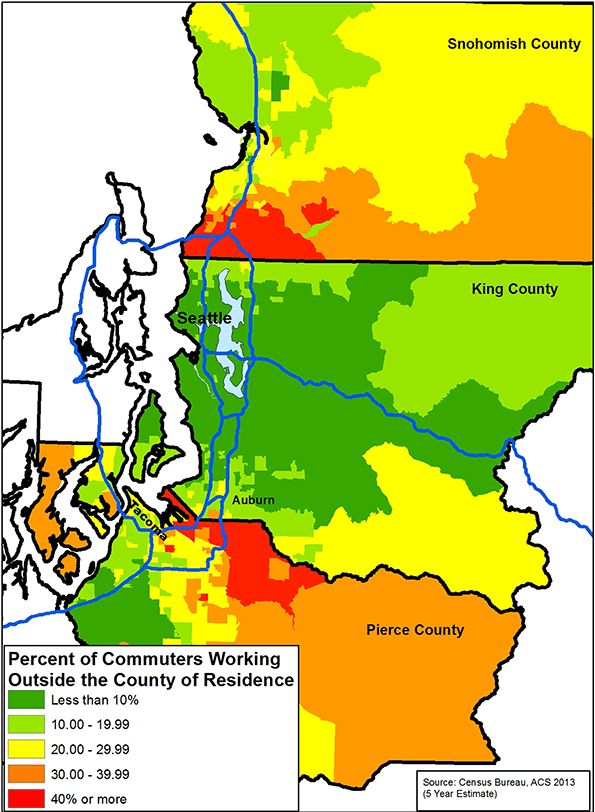
    Photo: Main Street America Russell, Kansas by http://www.cgpgrey.com [CC BY 2.0], via Wikimedia Commons

  • Conferences and Progress

    Californians attend innumerable conferences on housing and economic growth.  Year after year, in counties across California, the same people show up to say and hear the same things.  Mostly what they say and hear is naive, and nothing ever changes.

    I was reminded of this when I saw a report on what appears to have been a typical conference at the Harris Ranch on Growing the Central Valley Economy.

    There is no doubt that the Central Valley economy could use some economic growth.  After years of paying a disproportionate share of the costs of California’s coastal-driven energy, environmental and water regulations, the Valley’s economy is suffering.  Poverty is rampant, as California leads the nation with a three-year average poverty rate of 23.4 percent according the Census Bureau’s most recent comprehensive poverty measure.

    The Valley and some other inland areas are the primary reason California leads the nation in poverty and inequality.  Throughout the Valley, economic growth is anemic.  It’s negative in some areas.  Some counties are seeing declining populations.

    Conferences, at least the typical California conference, won’t help.  They only serve to provide a low-cost means to salve the participants’ consciences, allowing them to feel that they are doing something.

    Consider the recommendations that came through the report:

    Creative thinking from the public policy sector

    You can bet your net worth that you will hear about creative thinking or thinking outside the box at every California housing or economic development conference. At best, it doesn’t mean anything. If it does mean anything, creative thinking from the public policy sector is the worst thing that could happen.

    Public policy sector creative thinking is what has created the San Joaquin Valley’s stagnant economy and California’s poverty and inequality in the first place. California’s ruling elite are proud of California’s regulatory quagmire. No one could have imagined 20 years ago how successful they would be in putting it in place. Today, it remains unduplicated by any state, but Oregon is trying.

    The public sector does not create jobs or wealth, although it can provide preconditions through infrastructure development or contracts. But government is not the source of innovation or wealth creation. That comes from entrepreneurs, whether in the once-dominant aerospace industry or the early days Silicon Valley’s world-leading tech sector.  It won’t create any in the future.

    The best that government can do is to get out of the way of innovators—that means stream-lining the regulatory process and protecting property rights, in order to provide a predictable business environment.

    Let’s hope we don’t see more creative thinking from the public policy folks.

    Putting a “face” on the Valley and individual lives affected, emphasizing the continuing drought, pending fracking legislation, and burgeoning trade and logistic sectors in the seven-county region known as the San Joaquin Valley

    I think the idea is that if the coastal elite could just see the impacts of their policies, they would change those policies to allow more economic vigor in the Valley. The naivety is touching, and shockingly naive.

    Let’s face it, California’s coastal elite likely care more about some Minnesota dentist’s shooting a lion than they care about the lives of Valley residents. Their policies are there to save the world. If they cause some inconvenience for people in the Valley, well that’s just the cost of progress.

    It might be different if they thought their policies would impact their own incomes. Their policies don’t. Tech sector people know their incomes come from all over the world, and they just relocate plants, call centers, tech support and even development outside of California if costs become too high. There is a reason that the Silicon Valley no longer is building more of the chip factories for which it was named.

    The retired coastal elite’s income is mostly independent of California’s economy. Once again, the checks come from someplace else.

    Accessing and employing the most effective tools from science, engineering and technology to responsibly advance technological applications

    Yep, and motherhood is a wonderful thing. Technology and applications will advance, regardless of what happens in the San Joaquin Valley. How is this supposed to help the Valley? California has priced itself out of competitive tradable goods production. That’s why Intel, Apple, Facebook and others are spending billions expanding outside of California.

    Technology will benefit Valley residents, but it won’t be a source of economic growth until the Valley has a competitive cost structure. And that cannot happen until the state takes its foot off the valley’s neck.

    Building coalitions to ensure adequate resources and investment in the Central Valley during what is likely to be a dramatic transition period

    Coalitions are another topic that comes up in every California conference. We’ve heard this for decades, and nothing has happened.

    All that coalitions, at least as they materialize in California, can do is advocate. Most often, they advocate to the government. Since governments are the source of the problem and not the source of economic growth and wealth, this not an effective strategy. The coalitions might extract some wealth from someone else, but they are not going to create economic vigor.

    Focusing locally on training and retaining that will help boost opportunities for employment and contribute to an improved quality of life as the region continues its transformation to a progressively more sustainable future

    This is another thing you hear constantly California conferences. Education and training are something that we have chosen to do for our young people. It can be an economic development tool. In California today, though, education is not an economic development tool.

    San Joaquin Valley graduates of high school or college can’t get jobs in the Valley. The Valley’s unemployment rates are way above the State’s even in good years. More individuals with degrees won’t change this. All it means is that Texas, Arizona, Utah, and other states will have a better pool of California workers to supply their economies. We may feel a moral obligation to educate, but it’s not a local economic development tool.

    What Could Work?

    The California Environmental Quality Act (CEQA) was originally enacted to protect California’s pristine natural environments. Since then it’s evolved into a tool which allows almost anyone to stop or delay just about any project. In fact, the threat of a CEQA case is often wielded by project opponents in order to extort concessions from companies.

    CEQA dramatically increases the uncertainty and costs associated with California projects. It needs to be rewritten to achieve its original purpose while limiting its use as a tool for maintaining the status quo.

    California’s other regulations that most hurt economic growth are either environmental or are designed to bring in “stakeholders .” All need to be evaluated on a cost-benefit basis.

    Chapman University researchers have presented compelling evidence that California’s greenhouse gas regulations have almost no impact on global carbon levels, but we know they have considerable costs.

    Regulations designed to bring in “stakeholders” effectively grant almost everyone veto power over most projects. You could hardly design a more effective method to slow or stop growth.

    Politically, there is no chance of making necessary regulatory revisions anytime soon. There is hope, though. California’s minority caucus recently stopped proposed regulation mandating a 50 percent decrease in California’s use of gasoline. The minority caucus’ constituents are California’s primary regulatory victims. It was good to see them stand up for their constituents. I hope to see more of it in coming years. That will be far more effective than another conference.

    Bill Watkins is a professor at California Lutheran University and runs the Center for Economic Research and Forecasting, which can be found at clucerf.org.

  • Environmental Activists Turn up the Rhetorical Heat

    What is the endgame of the contemporary green movement? It’s a critical question since environmentalism arguably has become the leading ideological influence in both California government and within the Obama administration. In their public pronouncements, environmental activists have been adept at portraying the green movement as reasonable, science-based and even welcoming of economic growth, often citing the much-exaggerated promise of green jobs.

    The green movement’s real agenda, however, is far more radical than generally presumed, and one that former Sierra Club President Adam Werbach said is defined by a form of “misanthropic nostalgia.” This notion extends to an essential dislike for mankind and its creations. In his book “Enough,” green icon Bill McKibben claims that “meaning has been in decline for a long time, almost since the start of civilization.”

    And you may have thought the Romans and ancient Chinese were onto something!

    Rather than incremental change aimed at preserving and improving civilization, environmental activists are inspired by books such as “Ecotopia,” the influential 1978 novel by Berkeley author Ernest Callenbach. He portrays an independent “green” republic based around San Francisco, which pretty much bans fossil fuels and cars and imposes severe limits on childbearing. These measures are enforced by a somewhat authoritarian state.

    Read the entire piece at The Orange County Register.

    Joel Kotkin is executive editor of NewGeography.com and Roger Hobbs Distinguished Fellow in Urban Studies at Chapman University, and a member of the editorial board of the Orange County Register. He is also executive director of the Houston-based Center for Opportunity Urbanism. His newest book, The New Class Conflict is now available at Amazon and Telos Press. He is also author of The City: A Global History and The Next Hundred Million: America in 2050. He lives in Orange County, CA.

  • Oil Bust? Bah — North Dakota Is Still Poised To Thrive

    Oil and gas companies have the worst public image of any industry in the United States, according to Gallup. But it’s well-loved in a swathe of the U.S. from the northern Plains to the Gulf Coast, where the boom in unconventional energy production has transformed economies, enlivened cities and reversed negative demographic trends.

    What now that the good times are over in the oil patch? In North Dakota, the epicenter of the once-hot Bakken shale play, the number of active rigs is down to 68 as of this week from 145 in June of 2014.

    Some might argue that it’s now the turn of oil patch cities to suffer, just as they did when prices plunged back in the early 1980s, setting off a decade long decline. But many of these cities have made considerable progress in economic diversification, making themselves far more attractive places for non-energy businesses.

    Perhaps no state benefited more from the energy boom than North Dakota. Long known more for its harsh weather, low population and featureless expanses than for anything positive, the massive deposits on the Bakken formation turned the state into the No. 2 energy producer in the country, trailing only Texas. The prairie state gained 45,000 energy jobs between 2007 and 2014. Now the decline in oil prices promises to eliminate quite a few of them.

    But few North Dakotans seem to believe that the energy bust will turn the state once again into a poster child for stagnation. For one thing, North Dakota’s job base has also expanded well beyond oil, with a net growth of 155,000 jobs   jobs from 2007 to 2014  — no small beer in a state with a population of 739,000. This growth started well before the oil boom, with employment surging by 50,000 jobs between 2000 and 2007.

    Transportation, logistics, wholesale trade and construction are among the industries that have added jobs, and the state’s technology industry has surged, doubling employment since 2009. The state’s engineer count has expanded 41% since 2009, almost seven times the national increase. Fargo, the state’s largest city but hundreds of miles from the Bakken, has thrived in large part due to the expansion in tech and business services. Overall Fargo has 38% more jobs than in 2000.

    In the coming years, other industries may help pick up the slack from energy. One prime candidate is aerospace, where North Dakota is touting itself as the “Silicon Valley of drones,” an outgrowth of the conversion of the Grand Forks Airforce Base from launching bombers and tankers to drones. The country’s first drone-only business park is being built on an unused portion of the base. Other industries on the upswing include biomedicine and wind turbine parts.

    Although some accounts have focused on the high costs to North Dakota communities of the oil boom, it’s difficult to find many North Dakotans who think it hasn’t been worth it. Over the past decade the state’s per capita income soared from 38th in the nation in 2004 to sixth in 2014. In this surge North Dakotans bought lots of things that once seemed unattainable, including winter homes in places like Phoenix.

    Beyond The Buffalo Commons

    But perhaps the biggest transition is demographic. A decade ago North Dakotans were being told by geographers like Rutgers’ Frank and Deborah Popper that their state would continue to lose residents and would best be transformed into a “buffalo commons,” a giant park that would be home largely to native Americans and the state’s varied wildlife .

    Yet North Dakota has enjoyed a remarkable demographic revival. After stagnating at roughly 640,000 for 15 years between 1990 and 2005, the state’s population now stands at roughly 100,000 higher.

    Once among the oldest states, it now ranks as the fourth youngest, with among the highest birthrates and the strongest in-migration per capita in the nation. More important still, the youngest residents are now much better educated, according to an analysis of Census data by Mark Schill of the Grand Forks-based Praxis Strategy group. Some 34% of North Dakotans between the ages of 25 and 34 have college degrees, and 40.8% in Fargo, well above the 31.7% rate nationally.

    Critically much of the demographic recovery in North Dakota is concentrated in Fargo and other places far from the energy belt, such as Sioux Falls, Omaha and Des Moines.

    Do The Plains Have A Future?

    Clearly the drop in price of oil, as well as of some farm commodities, will slow the Plains’ progress. Some sectors, notably the coal industry, seem destined to shrink as the EPA clamps on tighter emissions controls. North Dakota’s now low energy costs could be undermined by such steps, eliminating one competitive advantage. Iowa, Kansas and Minnesota also rank among the states most reliant on coal for electricity.

    The decline in key commodity markets could also hit the region’s resurgent manufacturing sector, which specializes in farming and earth-moving equipment; the current problems plaguing Caterpillar and are being felt across the region. The problems in key export markets, such as China and Canada, are being further exacerbated by the strong dollar.

    But younger demographics and low business costs suggest that the state will remain attractive for tech and business services companies. The state’s ability to draw businesses from higher-cost coastal areas has been bolstered by strong on the ground improvements. In Fargo there has been substantial downtown development and it boasts cultural attractions and a lively restaurant scene. The same can be said for in many Plains cities, notably Oklahoma City, Des Moines and Omaha. Anyone who had visited these place a decade or two ago would likely barely recognize them.

    To be sure with its tough climate and location far from the coasts, the Great Plains cities are not likely to challenge places like California or New York for leadership in media or software. But there’s an opportunity for these metro areas to grow in industries ranging from manufacturing and logistics to customer support that can sustain them until commodity prices once again begin to rise. When that happens, as they say out there, honey, bar the door.

    This piece first appeared in Forbes.

    Joel Kotkin is executive editor of NewGeography.com and Roger Hobbs Distinguished Fellow in Urban Studies at Chapman University, and a member of the editorial board of the Orange County Register. He is also executive director of the Houston-based Center for Opportunity Urbanism. His newest book, The New Class Conflict is now available at Amazon and Telos Press. He is also author of The City: A Global History and The Next Hundred Million: America in 2050. He lives in Orange County, CA.

    Photo “Western North Dakota” by Aaronyoung777Own work. Licensed under CC BY 4.0 via Wikimedia Commons.

  • Who Should Pay for the Transportation Infrastructure?

    Urban regions are significantly more important than any one city located within them. Housing, transportation, economy, and politics help produce uneven local geographies that shape the individual identities of places and create the social landscapes we inherit and experience. As such, decisions made within one city can ripple through the entire urban region. When affordable housing is systematically ignored by one city, neighboring cities become destinations for those who cannot afford higher housing costs. Even when the minimum wage is adjusted in one city, others cannot ignore it.

    In fact, a differential wage structure can produce diverse economic and labor geographies. Affordable housing and uneven economic development, in their turn, impact the regional transportation and infrastructure: if the cost of living and wages in one city in a particular region are high (as in San Francisco and Seattle), then low and middle-income workers will move to a more affordable neighboring city and pay a higher price, particularly in time spent, for transportation. They also pay more in fuel, and hence taxes that fund infrastructure maintenance and expansion.

    In other words, while companies and the more affluent population benefit from the agglomeration economies of alpha cities, it is the lower-wage workers and the population at large that pay for these uneven development. Therefore, a company deciding to locate in Seattle or San Francisco, or any location, does not have to bear the cost their decision imposes on urban transportation and the infrastructure needed to support their operation. Instead it’s their employees, particularly those with lower earning power, who do.

    How many LEED certified buildings and downtown redevelopment projects does it take to make up for this inequity?  Should a city be considered green, if a significant portion of its low earners has to commute to neighboring cities to afford a home? Can a city be seen as sustainable, if in a style akin to medieval cities, serfs have to leave every evening and return in the morning to make sure that the ‘creative class’ is adequately served?

    As states such as Washington engage with the old “pay as you go” policy of increasing fuel taxes to pay for the infrastructure, the question of what forces created the emergent commuting patterns remains unanswered. Was it just the commuters, acting as informed participants in the market economy, who sought to optimize their housing and transportation trade offs? Or did the locational choices of employers contribute to the growing commuting problems in the region? If commuters are subjected to “pay as you go” policies, shouldn’t employers who locate in expensive housing markets, irrespective of their employees’ income profile, be subjected to “pay as you locate” policies?

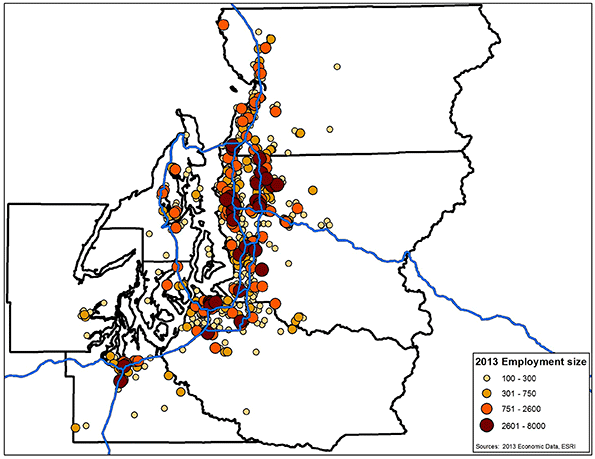
    Perhaps no metro region will make a better case study for this inequity than the area that ‘serves’ Seattle. The Puget Sound Region consists of four counties; however, to make sure that no one county that might have an economic connection with Seattle is left behind, we can look at six counties: Snohomish, King (where Seattle is located), Pierce, Kitsap, Thurston, and Mason.

    The entire urban region is served by a small number of highways, including Interstate 5. According to 2013 economic data, these six counties housed nearly 62% of all firms in the state. Furthermore, a quarter of all businesses in these counties were located within half a mile of a freeway. In terms of total employees, the six counties contained 69% of the state employment, and workplaces within half a mile of a freeway employed 37% of all employees in the counties. The inequity in the regional economic distribution is further exacerbated by the fact that the small area in West King county bounded by I-405 houses 30% of workplaces and 47% of employment, and generates a significant portion of the sales/revenue in the six counties. This area relies on I-5, I-405 and I-90 for the delivery of its employees from near and far.   

    The economic calculus of the early days of Interstate construction may have suggested that the trucking industry would benefit from this transportation infrastructure, but 1960s economists might be surprised by the type of companies now located within half a mile of freeways. In the six counties in Western Washington, the economic sectors over-represented in these geographies are: services and finance, real estate, and insurance (FIRE). Anyone driving on I-5 and I-405 (where Microsoft and other corporations are visible) can see this.  None of these workplaces require trucking. While their well-paid employees can afford to live in well-to-do places, including Bellevue and Seattle, many others reside in less expensive places such as Auburn, Tukwila, Tacoma, and Federal Way.

    A map of the region clearly suggests that neighboring counties and cities are housing those who work in West King County. Mobility has been the answer to unaffordability in this and other similar urban regions. If a city is unaffordable, is it fair to ask those who search for affordability in ‘other’ geographies pay for their so-called choices? Is this truly a choice? Are employers, current and future, asked to pay for their locational ‘choices?’ 

    Surely, we can do better than asking employees to bear the burden of a regional economic imbalance. Freeways should not be freer to some than others.  If this nation is about people paying for choices they make, then everyone should do so: employers and employees alike.

    Ali Modarres is the Director of Urban Studies at University of Washington Tacoma.  He is a geographer and landscape architect, specializing in urban planning and policy. He has written extensively about social geography, transportation planning, and urban development issues in American cities.

    Seattle photo courtesy of BigStockPhoto.com.