Category: Policy

  • A New Way Forward on Trade and Immigration

    President Donald Trump’s policy agenda may seem somewhat incoherent, but his underlying approach — developed, in large part, by now-departed chief strategist Steve Bannon — can be best summarized in one word: nationalism. This covers a range of issues from immigration and trade to cultural and ethnic identity, and generally the ones with the most polarizing impact on our political system.

    To many progressives, nationalism is, by its very nature, a dirty word, associated with fascist, Nazi or otherwise repressive regimes throughout history, and tied to violent extremists among the “alt-right,” like the small group of truly “deplorables” that recently surfaced in Charlottesville, Va. Liberal globalists detested Trump’s Poland speech defending Western values. To them, progressive theology matters more than affiliation with political tradition. Assaults on free trade also concern tech and other corporate chieftains, whatever their impact on the American working class.

    Yet, despite his consistently ill-considered rhetoric, Trump is actually about half-right on nationalism. The postindustrial, globalized economy has not worked for most Americans, as judged by their meager income growth. The West is, indeed, threatened not only by Islamic fundamentalists, but also by China, Russia, North Korea and other authoritarian states. In comparison with today’s progressives, the Roosevelts, Truman, Kennedy and Johnson would be considered rampant nationalists.

    Reassessing free trade

    Free trade, the fundamental economic dogma of the global corporate class and its neoliberal allies, has proven, in practice, to be far less benign than “global strategists” suggest. What works for Manhattan or San Francisco has had devastating impacts in more industrially oriented places like the Midwest and much of the South. Overall, notes a recent study from the labor-backed Economic Policy Institute, trade with China has cost an estimated 3.4 million jobs so far this century.

    Commerce Secretary Wilbur Ross points out — correctly — that many leading trading partners, like the EU and China, impose higher tariffs on incoming U.S. goods than what we impose on their exports. China, in particular, seeks to gain advantage over U.S. producers, embracing what William Galston, former policy adviser to President Bill Clinton, calls “technonationalism,” under which a country seeks to extort the surrender of intellectual property in exchange for market access and cold hard cash.

    In this sense, Trump’s hard-line position on trade — and his courting of foreign investors such as Toyota and Mazda — represents a justifiable throwback to the nationalist policies framed by Alexander Hamilton, which persisted until World War II. The problem here, as elsewhere, is that Trump’s pettiness and Twitter inanities allow our trading partners to divert the discussion away from the legitimate issues around international commerce.

    Read the entire piece in the Orange County Register.

    Joel Kotkin is executive editor of NewGeography.com. He is the Roger Hobbs Distinguished Fellow in Urban Studies at Chapman University and executive director of the Houston-based Center for Opportunity Urbanism. His newest book is The Human City: Urbanism for the rest of us. He is also author of The New Class ConflictThe City: A Global History, and The Next Hundred Million: America in 2050. He lives in Orange County, CA.

    Photo by Dirk Dallas, via Flickr, using CC License.

  • A Roadmap to Job-Creating Transportation Infrastructure: Doing the Right Things Right

    There is broad public concern about the status of transportation infrastructure in the United States. On election night the future President said, “We are going to fix our inner cities and rebuild our highways, bridges, tunnels, airports, schools, hospitals.” This report (“A Roadmap to Job-Creating Transportation Infrastructure: Doing the Right Things Right”) examines the condition of the nation’s infrastructure and makes recommendations to improve federal efforts in supporting ground transport.

    Infrastructure is important to the accomplishment of such important public goals as increased economic growth, long-term job creation (beyond project employment benefits), a better standard of living, and the reduction of poverty. The United States used to lead the world in infrastructure, but has fallen behind some of its competitors. At the same time, past infrastructure policy in the United States created an inertia that prevented serious prioritization of federal resources.

    All of this is made more arduous by the nation’s strained finances. The national debt is now approximately $20 trillion while budget deficits continue and could increase without significant reforms. This means it will be difficult to commit additional resources to the nation’s highways and rail systems.

    Administration Proposals

    The Administration has proposed approaches that go beyond “business as usual”. They would focus federal resources on national and regional priorities, improving both the effectiveness and efficiency of federal programs.

    Perhaps the most significant federal program is the Highway Trust Fund, which uses highway user fees to support highway and transit. In recent years, general funds have also been added to the program because revenues have risen more slowly than needs, in part because of improved fuel economy and low gas prices. The Administration proposes no highway user fee increases and proposes to phase out general fund support.

    In addition, the Administration proposes to phase out funding for “new starts,” which are usually expensive urban rail transit programs, because these programs are not of sufficient national significance.

    The Administration has proposed increasing funding through programs that attract private infrastructure development and has proposed $200 billion over the next 10 years in infrastructure expenditures, including transportation.

    Because there are sufficient travel alternatives, the Administration proposes ending support for Amtrak’s long-distance trains.

    The Administration has referred to the necessity of regulatory reform and streamlining permitting requirements, both to reduce costs and speed up project delivery.

    Analysis and Recommendations

    It is expected that the Administration will propose further initiatives, consistent with the directions it has outlined. The proposals are analyzed below and additional recommendations are offered.

    Highways and Transit: The Highway Trust Fund provides most of the federal contribution to highways and transit from user fees from drivers and commercial vehicle operators, such as the trucking industry. As expenditures have risen faster than revenues, the Highway Trust Fund has received general fund support as well.

    The highway system is the country’s most comprehensive transportation system. Autos (including light trucks) using the highway and roadway system account for the overwhelming majority of ground passenger travel, both for commuting and other trips. These roads allow people to commute to jobs throughout metropolitan areas more quickly than any other mode. The employment opportunities available by auto dwarf those by any other mode. Perhaps surprisingly, autos provide by far the largest share of commuting by low income populations. Highways provide the infrastructure for much of the freight transport and service vehicles. In the long run, improving access to employment and reducing traffic congestion will be best accomplished by improvements that involve highways.

    By contrast, transit, which has received funding from the Highway Trust Fund for more than three decades, is intensely concentrated in just a few local areas. Only two percent of motorized trips are on transit. Even in the largest metropolitan areas, transit provides far less access to jobs than autos, while new transit rail projects and additional transit funding has failed to reduce traffic congestion.

    By virtually any measure, transit is less effective and efficient than highways for passenger travel. Transit moves no freight or other commercial traffic and does not provide emergency service access. Highway Trust Fund revenues should be used only on highways.

    Private Finance: The programs the Administration has proposed for attracting private infrastructure capital include the Transportation Infrastructure Finance and Innovation Act (TIFIA) program and US Department of Transportation authorized private activity bonds. As currently designed and operated, these programs do sufficiently prioritize transportation infrastructure. Process reforms are needed to ensure the limited funding available is used for the highest priority projects. Evaluation criteria should be adopted, with traffic congestion relief, critical bridge replacement and highway system maintenance being the highest priorities. Express toll lanes, added to existing roadways, are among the most promising approaches because of their additional capacity and ability to reduce traffic congestion.

    Further, the tax exempt financing and interest subsidies of these programs have a federal budgetary impact that increases deficits and the national debt. The Administration should seek to minimize these impacts by ensuring that only the most productive projects are approved.

    Another federal credit instrument, the Railroad Rehabilitation and Investment Financing program, could impose substantial losses on taxpayers. Despite its success to date, there are now indications that privately sponsored high-speed rail projects will seek large taxpayer guaranteed loans from RRIF. Private, at risk investment has not proven profitable in high-speed rail, which suggests a potential for default, such as what occurred with Solyndra. Program reforms are needed.

    Amtrak and High-Speed Rail: It will be important to eliminate unnecessary subsidies. For example, as an Administration document puts it: “communities are served by an expansive aviation, interstate highway and interstate bus network.” In this environment, Amtrak subsidies are unnecessary. Subsidies to high-speed rail are similarly unnecessary.

    Regulatory Reform and Streamlined Permitting: The Administration has also proposed regulatory reform and streamlined permitting. Among the most important opportunities are repeal of the Davis – Bacon labor requirements, prohibition of project labor agreements, and setting up a single point of contact in the federal government for project sponsors.

    Conclusion: Improving Efficiency and Effectiveness

    It will be important to better focus private funding programs on the highest infrastructure priorities, and to minimize serious risks to taxpayers and bond buyers that could emerge from insufficiently vetted projects. The recommendations suggest doing the right things by limiting federal support to genuine needs for programs for which there is no alternative, and doing them right by spending no more than necessary. The sooner the hard choices are made, the better for future generations.

    The above is the Executive Summary to ““A Roadmap to Job-Creating Transportation Infrastructure: Doing the Right Things Right,” published by the Center for Opportunity Urbanism (author, Wendell Cox, Senior Fellow).

    Wendell Cox is principal of Demographia, an international public policy and demographics firm. He is a Senior Fellow of the Center for Opportunity Urbanism (US), Senior Fellow for Housing Affordability and Municipal Policy for the Frontier Centre for Public Policy (Canada), and a member of the Board of Advisors of the Center for Demographics and Policy at Chapman University (California). He is co-author of the “Demographia International Housing Affordability Survey” and author of “Demographia World Urban Areas” and “War on the Dream: How Anti-Sprawl Policy Threatens the Quality of Life.” He was appointed to three terms on the Los Angeles County Transportation Commission, where he served with the leading city and county leadership as the only non-elected member. He served as a visiting professor at the Conservatoire National des Arts et Metiers, a national university in Paris.

    Photograph: Intercounty Connector, Montgomery County Maryland (a TIFIA project). Photograph by Ewillison (Own work) [CC BY-SA 4.0 (http://creativecommons.org/licenses/by-sa/4.0)], via Wikimedia Commons.

  • Smaller American Cities Need to Focus on Private Sector Job Growth Downtown

    I’m back from a short break. While I was away my debut contribution to City Lab was published. In it I argue that the next frontier for smaller cities (meaning metros in the 1-3 million raise) in their downtown development efforts needs to be a focus on growing private sector jobs.

    There’s a reason it’s call the Central Business District. Commerce is the beating heart of a downtown. Here’s an excerpt:

    For downtowns in major American cities, these are boom times. The urban centers of New York and Chicago boast record high employment. In San Francisco and Seattle, there’s an explosion of residential construction, dining, and entertainment options, as well as a commercial rebirth in high-end, white-collar employment.

    But in many smaller cities, the downtown renaissance doesn’t rest on such solid ground. Look to downtown Cincinnati or St. Louis and you’ll see large growth in residential and entertainment offerings, and major investment in civic spaces and buildings. What you won’t see is the same level of success in becoming growing centers of commerce.

    For decades, jobs have been leaving downtowns and heading to the suburbs. In 2015, a City Observatory report suggested this might be turning around based on 2007-2011 data, but many downtowns were still losing jobs in that time, including Kansas City, Minneapolis, and San Antonio. A 2015 analysis by Wendell Cox found that just six cities were responsible for about three-fourths of all major-city downtown employment growth from 2010 to 2013: New York, Chicago, Boston, San Francisco, Seattle, and Houston. This shows the disparity between the major business and tech hubs and all the rest.

    Click through to read the whole thing.

    This piece originally appeared on Urbanophile.

    Aaron M. Renn is a senior fellow at the Manhattan Institute, a contributing editor of City Journal, and an economic development columnist for Governing magazine. He focuses on ways to help America’s cities thrive in an ever more complex, competitive, globalized, and diverse twenty-first century. During Renn’s 15-year career in management and technology consulting, he was a partner at Accenture and held several technology strategy roles and directed multimillion-dollar global technology implementations. He has contributed to The Guardian, Forbes.com, and numerous other publications. Renn holds a B.S. from Indiana University, where he coauthored an early social-networking platform in 1991.

    Photo: The tallest building in Indianapolis was recently renamed after tech giant Salesforce. Image via Salesforce.com.

  • Reconciling the three Democratic parties

    With President Donald Trump’s Dr. Demento impersonation undermining his own party, the road should be open for Democrats to sweep the next election cycle. And, for the first time since their horrific defeat of 2016, not only nationally but also in the states, the Democrats are slowly waking up to the reality that they need to go beyond the ritual Trump-bashing.

    No one will compare the recently released “A Better Deal: Better Skills, Better Jobs, Better Wages” slogan to Franklin D. Roosevelt’s New Deal, or even Newt Gingrich’s “Contract for America.” One Bernie Sanders supporter called it “anodyne, focus-grouped, consultant-generated pablum.” Yet, at least it attempted to identify the party with something other than Trump hatred, which is all most Americans think the Democrats are all about.

    The three Democratic parties

    Before this new approach can work, Democrats need to decide what kind of party they are, or what coalition can bring them back into power. None of the present factions is strong enough, by themselves, to win consistently on a national basis; some accommodation between often opposing tendencies must be found. Finally, there needs to be a credible message that derives not from carefully orchestrated focus groups and surveys — the Hillary Clinton approach — but rather one that resonates with the very middle- and working-class voters that the party needs to win back.

    Since the days of Franklin D. Roosevelt, the traditional Democratic Party has combined some degree of social moderation — albeit often too timid on issues related to gays and racial minorities — with a unifying message of economic growth, national security and upward mobility. Although business interests sometimes supported them, the old Democrats primarily directed their appeal to urban, and later suburban, middle- and working-class voters.

    By the 1970s, many of these voters were headed rightward, as Democrats’ positions on social issues, defense and civil rights moved sharply to the left. Seeking to make up for some of the loss of some traditional FDR voters, Bill Clinton reoriented the party to include the rising class of information workers who were often socially liberal but fiscally conservative. But Clinton’s political genius and down-home image also helped Democrats retain some New Deal working-class support, even while forging stronger ties to tech companies, the rising professional class and Wall Street.

    The third faction, the resurgent left, led by Sen. Bernie Sanders of Vermont, grew out of the clear failure of the second Democratic Party, led by its elite wing, to address the consequences of neoliberal economics, notably increased inequality, reduced social mobility and, to some extent, environmental degradation. To these activists, the Clintonian party is not much more than a light version of mainstream Republicanism.

    Read the entire piece in The Orange County Register.

    Joel Kotkin is executive editor of NewGeography.com. He is the Roger Hobbs Distinguished Fellow in Urban Studies at Chapman University and executive director of the Houston-based Center for Opportunity Urbanism. His newest book is The Human City: Urbanism for the rest of us. He is also author of The New Class ConflictThe City: A Global History, and The Next Hundred Million: America in 2050. He lives in Orange County, CA.

    Photo by The Real Cloud2013, via Flickr, using CC License.

  • State Governments Are Oppressive, Too

    Historically, the battle over the size and scale of government has been focused largely on “states’ rights.” This federalist notion also has been associated with many shameful things, such as slavery, Jim Crow laws and other abuses of personal freedom.

    Yet, increasingly, the clearest threat to democracy and minority rights today comes not just from a surfeit of central power concentrated in Washington, D.C., but also from increased centralization of authority within states, and even regional agencies. Oppressive diktats from state capitals increasingly seek to limit local control over basic issues such as education, zoning, bathroom designations, guns and energy development.

    This follows a historical trend over the past century. Ever since the Great Depression, and even before, governmental power has been shifting inexorably from the local governments to regional, state and, of course, federal jurisdictions. In 1910, the federal level accounted for 30.8 percent of all government spending, with state governments comprising 7.7 percent and the local level more than 61 percent. More than 100 years later, not only had the federal share exploded to nearly 60 percent, but, far less recognized, the state share had nearly doubled, while that of local governments has fallen to barely 25 percent, a nearly 60 percent drop. Much of what is done at the local level today is at the behest, and often with funding derived from, the statehouse or Washington.

    Diversity vs. regimentation

    This trend is particularly notable in the country’s two megastates: California and Texas. Each is increasingly controlled by ideological fanatics who see in their statehouse dominion an ideal chance to impose their agenda on dissenting communities. In California, Jerry Brown’s climate jihad is the rationale for employing “the coercive power of the central state,” in his own words, to gain control over virtually every aspect of planning and development.

    In Texas, the impetus comes from the far right, which has been working to strip localities of their traditional ability to control their own affairs, which, as two Houston scholars recently pointed out, has been critical to that state’s success. These efforts cover a host of issues, from fracking and ride-sharing to transgender bathrooms, a topic which affects very few but has, absurdly, become the key issue for a legislative special session.

    Just as Californians find themselves increasingly controlled by climate warriors and anti-suburban ideologues, diverse Texans in cities like Austin now must conform to the dictates of strident demands by a “liberty caucus” that eerily resembles their authoritarian doppelgangers in Sacramento.

    In other cases, such as in North Carolina, social conservatives, like their Texan bedfellows, seek to circumscribe progressive policies in places like Raleigh or Charlotte. Businesses, in particular, are concerned that some bills, like the state’s transgender bathroom legislation, could lead to painful boycotts by corporations and event planners. Conversely, some blue-state policies, like high mandated minimum wages and policies restricting fossil fuels, hurt disproportionately poorer areas, like upstate New York and rural California, which have lost much of their political clout.

    Read the entire piece in the Los Angeles Daily News.

    Joel Kotkin is executive editor of NewGeography.com. He is the Roger Hobbs Distinguished Fellow in Urban Studies at Chapman University and executive director of the Houston-based Center for Opportunity Urbanism. His newest book is The Human City: Urbanism for the rest of us. He is also author of The New Class ConflictThe City: A Global History, and The Next Hundred Million: America in 2050. He lives in Orange County, CA.

    Photo by LoneStarMike (Own work) [CC BY 3.0], via Wikimedia Commons

  • Postcards From the Zombie Apocalypse

    I’m regularly accused of being a doomer whenever I point out the obvious – that many aspects of how we’ve organized our affairs over the last several decades aren’t meant to last. So they won’t. The end of Jiffy Lube and Lean Cuisine isn’t The End. Civilization will carry on without them, I assure you. But when it’s suggested that our current set of arrangements won’t last forever people immediately imagine Mad Max, as if no other alternative exists. Things are going to change. They always have and they always will. The future will just be different. That’s absolutely not the same as saying the world is coming to an end. Clear eyed individuals who are paying attention can start to get a feel for who the new winners and losers are likely to be and place themselves in the best possible situation ahead of the curve. That’s a pragmatist’s view – not a doomer’s.

    It helps to explore previous versions of these regularly occurring historical shifts. Think of them as postcards from the last few rounds of the Zombie Apocalypse. Here’s a small farm town in rural Nebraska. Its population peaked in the 1920s. The period between World War I and the Great Depression was an especially prosperous time for such towns as commodity prices were high and technological innovation (the telephone, radio, automobiles, tractors, etc.) created an enormous amount of new wealth and opportunity. The 1920s was also an era of rampant unsustainable practices of all kinds that lead to the ruined soils and draughts of the Dustbowl and the collapse of speculative credit based financial institutions. The population of this town began to decline in the 1930s and is currently down to a few dozen souls.

    Remnants of some of that early twentieth century technology still litter pastures on the edge of town. One resourceful farmer organized these old car carcasses into a makeshift corral for his livestock.

    It’s possible to connect the dots from rural Nebraska to Detroit where those very same vintage vehicles were manufactured all those decades ago. Detroit peaked in population, economic power, and political influence in 1950. Today huge swaths of Motown look remarkably similar to the abandoned farms and small towns of the prairie. Entire city blocks are now cleared of people and buildings. The Zombie Apocalypse arrived there too. If small scale agriculture was made redundant by mechanization and industrial scale production, then industry itself was hammered by other equally powerful forces. Everything has a beginning, middle, and end.


    The most recent iteration of the Zombie Apocalypse has already begun to unfold in some places. Suburbia was exactly the right thing for a particular period of time. But that era is winding down. The modest tract homes and strip malls built after World War II  are not holding up well in an increasing number of marginal landscapes. I have been accused of cherry picking my photo ops, particularly by people who engage in their own cherry picking when discussing the enduring value of prosperous suburbs. But there’s too much decay in far too many places to ignore the larger trend. The best pockets of suburbia will carry on just fine. But the majority of fair-to-middling stuff on the periphery is going down hard.

    The desire to push farther out and build ever more upscale suburban developments in increasingly remote locations is palpable. That’s what a significant proportion of the population desires on some level. But in the same spots – often next to each other – is ample evidence that there’s something profoundly wrong.

    Not all farm towns died. Not all industrial cities collapsed into ruin. Not all suburbs will fail… But the external forces at work are going to favor some places much more than others moving forward. The trick is to understand what those forces are before everyone else does and position yourself to benefit instead of getting whacked by the shifts. Would you have rather sold your house in Detroit in 1958 when things were still pretty good, or wait until 1967 when the panicked herd began to stampede? Would it have been better to buy property in the desert in 1970 and take advantage of a wave of growth for a few decades, or buy now at the top of that cycle and slide down from here on out?

    The future drivers of change will be the same as the previous century – only in reverse. The great industrial cities of the early twentieth century as well as the massive suburban megaplexes that came after them were only possible because of an underlaying high tide of cheap abundant resources, easy financing, complex national infrastructure, and highly organized and cohesive organizational structures. Those are the elements of expansion.

    But once the peak has been reached there’s a relentless contraction. The marginal return on investment goes negative as the cost of maintaining all the aging structures and wildly inefficient attenuated systems becomes overwhelming. The places that do best in a prolonged retreat from complexity are the ones with the greatest underlying local resource base and most cohesive social structures relative to their populations. The most complex places with the most critical dependencies will fail first as the tide recedes.

    The next Zombie Apocalypse will relentlessly dismantle superficial decorative landscapes and highly leveraged economies of scale. Take away the twelve thousand mile just-in-time supply chains, heavy debt loads, and limitless cheap resources and you get a very different world. Over the long haul Main Street has a pretty good chance of coming back along with the family farm. But the shorter term in-between period of adjustment to contraction is going to be rough as existing institutions attempt to maintain themselves at all costs.

    This piece first appeared on Granola Shotgun.

    John Sanphillippo lives in San Francisco and blogs about urbanism, adaptation, and resilience at granolashotgun.com. He’s a member of the Congress for New Urbanism, films videos for faircompanies.com, and is a regular contributor to Strongtowns.org. He earns his living by buying, renovating, and renting undervalued properties in places that have good long term prospects. He is a graduate of Rutgers University.

  • Ontario’s Labor & Housing Policies: US Midwest Opportunities?

    The Globe and Mail, a Canadian national newspaper, reports concerns raised by Magna International, Inc. that proposed provincial labor legislation (the “Fair Workplaces Better Jobs Act”) could result in seriously reduced economic competitiveness for Ontario, Canada’s most populous province (“Magna says new Ontario labour bill threatens jobs, investment”). Ontario accounts for about 40 percent of the Canadian economy and has approximately twice the gross domestic product of second ranking Québec. Magna is Canada’s largest employer in the automotive sector, which The Globe and Mail characterizes as “one of a handful of homegrown Canadian companies that have risen to the status of global giants.”

    Magna told the provincial parliamentary standing committee on finance that “For the first time in our 60 year history, we find ourselves in the very untenable position questioning whether we will be able to operate at historical levels in this province.” Stressing the need to remain competitive, the company added: “This is especially important when our main competitor to the south is working harder than ever to reduce costs, regulatory burdens and promote business efficiency and productivity. From our perspective, the province of Ontario seems to be moving in the opposite direction.”

    The proposed legislation would increase mandatory annual vacation and personal leave requirements and increase the minimum wage. The legislation would also reduce work scheduling flexibility. This would, according to Magna, make the “just in time” production “impossible,” in a North American industry that has used the practice to compete more effectively. According to Automotive News, Magna noted the difficulty of manufacturing where it calls the cost of electricity, payroll and pension costs and the provincial “cap and trade” policy are among the highest in the G-7. Magna said that the “Fair Workplaces Fair Jobs Act” is “extremely one-sided.

    At the same time that Ontario seems poised to make business investment more difficult, some key nearby US states are doing the opposite. Michigan, Indiana and Kentucky, all on the NAFTA Highway (Interstate 69) have enacted voluntary unionism laws (called “right to work”). Ohio has reduced taxes among the most of any state over the past five years. None of these states seems inclined to follow Ontario’s example. Another nearby regulation liberalizing state, Wisconsin (where voluntary unionism was also enacted), has just won the $10 billion first US plant to be built by China’s large electronics contractor Foxconn, edging out Ohio.

    Becoming Less Competitive: Ontario’s Housing Regulation

    Ontario’s competition threatening actions are not limited to business and labor policy. Land-use and housing policies are also making Ontario less competitive, first in the Toronto metropolitan area and now spreading across the province. About a decade ago, the province imposed its “Places to Grow” program that not one, but two urban containment boundaries. The highly publicized Greenbelt designates a huge swath of land on which development is not permitted.

    Then there is the second urban containment boundary, the “settlement boundary,” which largely ensures that new development is limited to a far smaller area around the urbanization, further intensifying the price-escalating impact of the Greenbelt. In this crazy quilt of regulation, land owners operate in a sellers’ market, able to drive prices up for their scarce holdings, to the detriment of home buyers. This environment is particularly welcome to speculators. Consistent with the fundamentals of economics, urban containment boundaries lead to higher land prices where new housing is permitted, and higher house prices.

    The procedures for supplying sufficient new greenfield development land require amendments of official community plans, a slow and cumbersome bureaucratic process. It is not surprising that Mattamy Homes Founder and CEO Peter Gilgin told Bloomberg that despite his largest homebuilding firm in the Toronto area having plenty of land for new houses, the necessary approvals are very difficult to obtain.

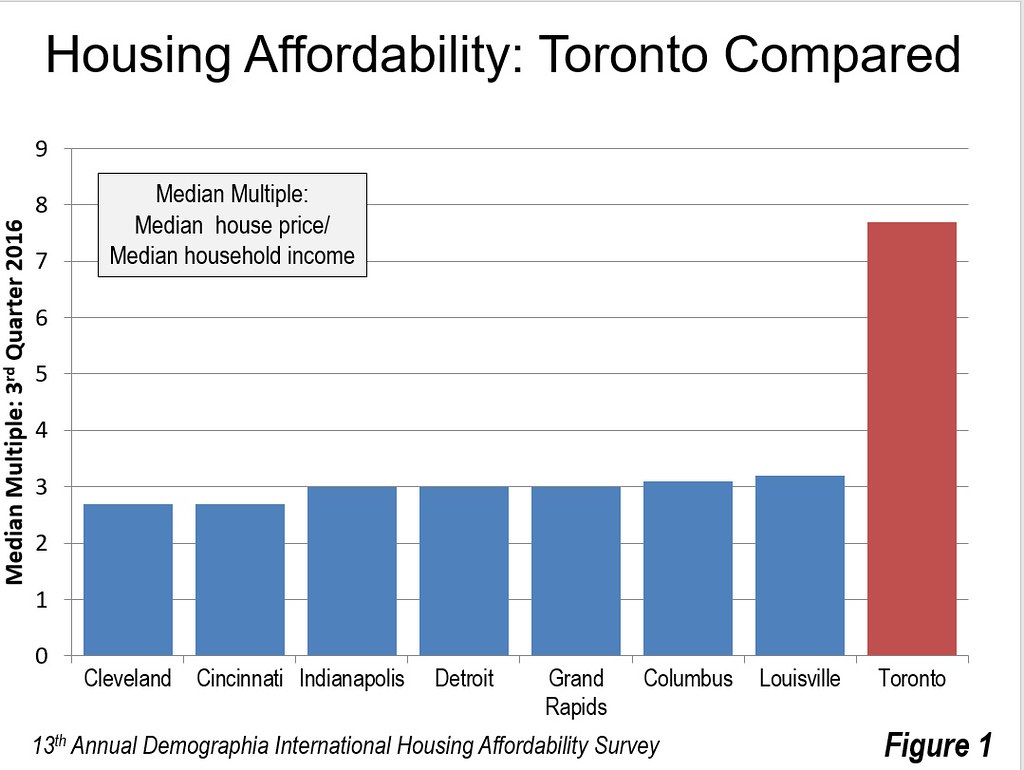
    The effects on house prices have been dramatic. In 2004, Toronto’s median house price was 3.9 times its median household income (median multiple). At that point, it had actually been reduced from 4.3 in 1971 and had hovered around 3.5 in the intervening years. According to the 13th Annual Demographia International Housing Affordability Survey, by 2016 house prices virtually doubled relative to incomes, with a median multiple of 7.7. This means a lower standard of living and greater relative poverty.

    Meanwhile, the house price increases are spreading from Toronto to nearby metropolitan areas. For example, house prices in Kitchener – Waterloo, Canada’s “Silicon Valley” rose 40 percent in the single year ended April 2017. This is nearly double the rate of Toronto that over the same period.

    The most recent domestic migration data indicates that people are moving out of the Toronto metropolitan area in droves. Since the 2011 census, more than 125,000 more people have left the Toronto area for other parts of Ontario that have moved in. This is the same dynamic apparent in the United States, where differentials in housing affordability have been cited as a principal reason for domestic migration gains and losses, as households flee from higher cost to lower-cost areas.

    A recently imposed foreign buyers tax led to somewhat lower prices in the Toronto area last year, but they are still 6.3 percent above a year ago and rising at a rate three times that of average earnings. Without restoring the competitive market for land on the periphery, it is likely that house prices will continue rising relative to incomes, to the detriment, in particular, of younger households.

    Meanwhile, house prices are substantially lower in US states nearby Ontario. As late as the mid-2000’s, there was little difference between the housing affordability across Ontario, including Toronto, and the Michigan, Ohio, Indiana and Kentucky. That is no longer the case.

    Immigration laws, however, do not permit the free movement of labor across the Canadian-US border, so there is no likelihood that Ontarians will move to the United States for lower cost housing. But capital is far more mobile. Companies that develop new business locations, especially manufacturing, often locate where they can maximize returns for their shareholders. Moreover, companies establishing new facilities are also interested in their employees being able to live close enough to commute to the plant.

    Figure 1 shows the metropolitan area housing affordability, measured by the median multiple, for Toronto, as well as major metropolitan areas in the four nearby states. Residents of Cleveland and Cincinnati pay nearly two-thirds less of their income for their houses than do residents of Toronto. In Indianapolis, Detroit, Grand Rapids, Columbus and Louisville, residents pay approximately 60 percent less for their houses than in Toronto. Meanwhile, no one should confuse the sometimes characterized as decrepit city of Detroit, reeling from decades of misgovernance, with its leafy suburbs, where 85 percent of the metropolitan area’s people live.

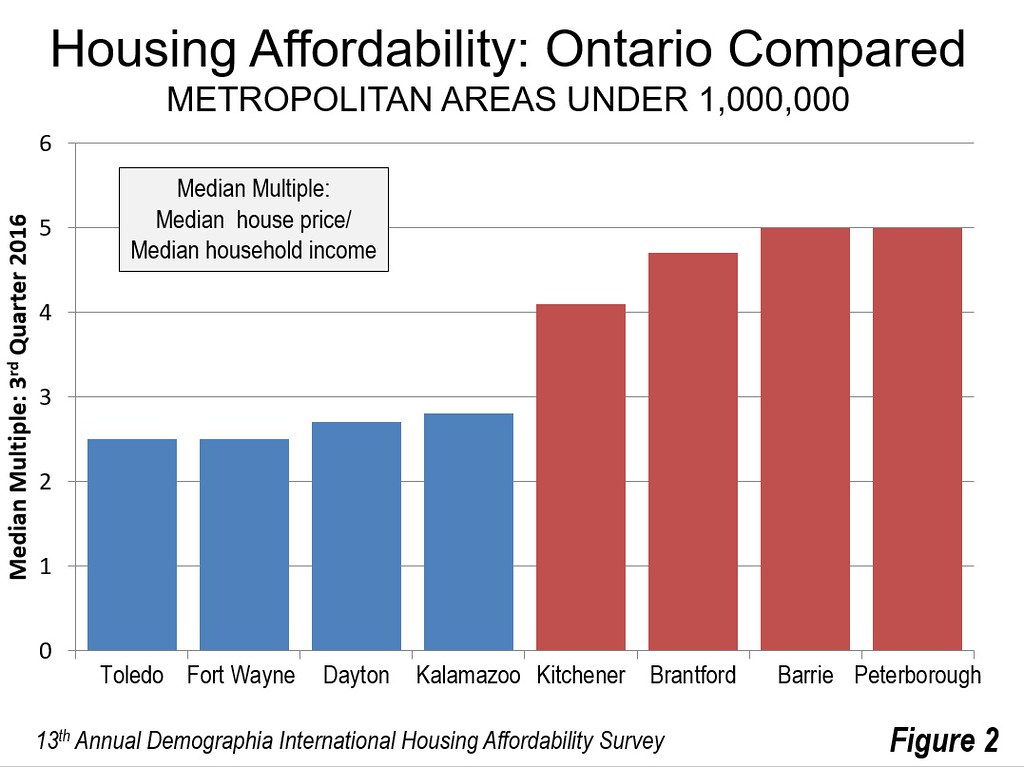
    Figure 2 indicates that things are a bit better among other Greater Golden Horseshoe metropolitan areas. Residents pay from 4.7 to 5.0 times their incomes in Brantford, Barrie and Peterborough. This is still up to double the 2.5 times incomes that residents pay in Toledo (Ohio) and Fort Wayne (Indiana). House prices are slightly higher in Dayton and Kalamazoo, but still at least than 40 percent below the three Ontario metropolitan areas.

    The Need for Competitive Policies

    Maintaining economic growth and the standard of living is important to Ontario’s 14 million people. At the same time, the world is becoming more competitive. Ontario needs to be careful, or economic development departments from across the increasingly competitive states of the Midwest could reap a harvest in business investment and jobs.

    Wendell Cox is principal of Demographia, an international public policy and demographics firm. He is a Senior Fellow of the Center for Opportunity Urbanism (US), Senior Fellow for Housing Affordability and Municipal Policy for the Frontier Centre for Public Policy (Canada), and a member of the Board of Advisors of the Center for Demographics and Policy at Chapman University (California). He is co-author of the “Demographia International Housing Affordability Survey” and author of “Demographia World Urban Areas” and “War on the Dream: How Anti-Sprawl Policy Threatens the Quality of Life.” He was appointed to three terms on the Los Angeles County Transportation Commission, where he served with the leading city and county leadership as the only non-elected member. He served as a visiting professor at the Conservatoire National des Arts et Metiers, a national university in Paris.

    Photograph: Pearson International Airport (Mississauga, Brampton and Toronto), Canada’s Largest employment centre (by author)

  • Transit’s Precipitous Decline

    Transit ridership in the first quarter of 2017 was 3.1 percent less than the same quarter in 2016, according the American Public Transportation Association’s latest ridership report. The association released the report without a press release, instead issuing a release complaining about the House Appropriations bill reducing funding for transit.

    The ridership report is devastating news for anyone who believes transit deserves more subsidies. Every heavy-rail system lost riders except the PATH trains between Newark and Manhattan and the Patco line between Camden and Philadelphia. Commuter rail did a little better, mainly because of the opening of Denver’s A line and trend-countering growth of riders on the Long Island Railroad. Most light-rail lines lost riders, though surprisingly many streetcar lines gained riders.

    In most cases where light-rail ridership grew, it did so at the expense of bus ridership. Los Angeles Metro gained 1.66 million light-rail riders but lost 8.73 million bus riders, or more than five for every new light-rail rider. Between the two modes, Phoenix’s Valley Metro lost 23,100 riders; Charlotte 20,200 lost riders; and Dallas Area Rapid Transit lost 193,100 riders. Similarly, Orlando’s commuter trains gained 22,700 riders but buses lost 98,500.

    Houston and Minneapolis-St. Paul lost bus riders but not quite as many as they gained in light-rail riders. Houston gained 192,100 light-rail riders but lost 154,200 bus riders. Minneapolis gained 337,000 light-rail riders but lost 270,000 bus riders. Only Seattle scored a large increase in light-rail riders (thanks to an expensive new line that opened March 16, 2016) without an offsetting decline in bus ridership.

    Many individual transit agencies suffered particularly catastrophic declines. Broward County (Fort Lauderdale), which wants to build a $200 million streetcar line, lost 12.8 percent of its transit riders. San Jose’s VTA, the agency I’ve sometimes called the worst-managed transit agency in the country, lost 11.9 percent. Birminghan lost 9.8 percent; Cleveland lost 7.9 percent; and San Diego lost 6.2 percent. In San Francisco, Muni lost 6.4 percent, BART lost 5.6 percent, SamTrans lost 8.9 percent, AC Transit (Oakland) lost 0.8 percent, and Central and Eastern Contra Costa County lost more than 7.0 percent.

    One factor contributing to the losses might be that 2016 was leap year, so its first quarter had 1.1 percent more days than 2017. But both quarters had exactly the same number of work days (62 or 64 depending on whether you count King’s Birthday and President’s Day as holidays or work days), so leap day counted for less than it might have.

    Many of these losses are just a continuation of trends that began in 2009 or earlier. As the Antiplanner noted last month, several major transit agencies lost 25 to 35 percent of their riders between 2009 and 2016, and most of these continued to lose in 2017. Moreover, none of the factors that led to these declines–low fuel prices, high auto ownership rates, rising costs, increasing competition from ride-hailing services–are going away, and some are only going to get worse.

    Since 1970s, the transit industry has received well over a trillion dollars in subsidies while seeing a 20 percent drop in the average number of rides urban resident take each year. All this should lead Congress and state legislatures to question why taxpayers ought to continue subsidizing this fast declining industry.

    This piece first appeared on The Antiplanner.

    Randal O’Toole is a senior fellow with the Cato Institute specializing in land use and transportation policy. He has written several books demonstrating the futility of government planning. Prior to working for Cato, he taught environmental economics at Yale, UC Berkeley, and Utah State University.

    Photo by METRO96 [CC BY-SA 3.0], via Wikimedia Commons

  • Should Transit Fares Cover Operating Costs?

    Maryland has long had a state law requiring transit systems to collect enough fares to cover at least 35 percent of their operating costs. While it is admirable to set a target, this particular target is disheartening for two reasons.

    First, 35 percent is a pretty low goal. The 2015 National Transit Database lists 48 transit operations that cover between 100 and 200 percent of their costs, including New York ferries, the Hampton Jitney, several other bus lines, and a bunch of van pooling systems. No rail lines cover 100 percent of their operating costs, but BART covers 80 percent, Caltrains covers 72 percent, New York and DC subways cover 64 percent, and New York commuter trains cover 60 percent. On average, commuter bus and commuter rail systems earn half their operating costs. So 35 percent lacks ambition.

    Even worse, most Maryland transit operations don’t come close to meeting the target. Maryland commuter trains cover 45 percent of their costs. But Baltimore’s light rail only covers 17 percent, and its heavy rail covers a pathetic 13 percent. Standard bus service also covers just 13 percent of its costs, though commuter buses come closer to the target, reaching 28 percent.

    Maryland lawmakers have figured out a solution to the second problem, if not the first. They simply passed a bill abolishing the target. Now, transit advocates hope, the state can spend even more money building obsolete transit systems that won’t be able to afford to maintain because they can’t even cover a third of their operating costs.

    Transit is “not profitable,” said one advocate, “but it’s essential for an economically competitive region.” Just how economically competitive has Baltimore been since it sunk billions of dollars into light- and heavy-rail lines that don’t cover even a fifth of their operating costs? Maryland certainly won’t make itself more economically competitive by increasing the tax burden still further so they can build more obsolete transit lines.

    Failing to cover costs isn’t a symptom that you are economically competitive. It is a symptom that you’ve failed to provide things that people need and want. The Antiplanner can understand why people think we need to subsidize food stamps or other aid to low-income people. I can’t understand why people think nothing of throwing huge amounts of money towards marketable operations like transit.

    C. Northcote Parkinson, the author of Parkinson’s Law, said that organizations that set goals low so they would be easy to meet were suffering from a disease he called injelititis. The transit industry has been suffering from this disease since the mid-1960s, when it discovered it could live off the public trough rather than actually have to provide services that people want. Once this disease reached its late stages, he said, the only cure required “a change of name, a change of site, and an entirely different staff.”

    There’s still a chance that Maryland’s governor may veto the bill. Let’s hope he does.

    This piece first appeared on The Antiplanner.

    Randal O’Toole is a senior fellow with the Cato Institute specializing in land use and transportation policy. He has written several books demonstrating the futility of government planning. Prior to working for Cato, he taught environmental economics at Yale, UC Berkeley, and Utah State University.

  • High-Flying California Charts Its Own Path — Is A Cliff Ahead?

    As its economy bounced back from the Great Recession, California emerged as a progressive role model, with New York Times columnist Paul Krugman arguing that the state’s “success” was proof of the superiority of a high tax, high regulation economy. Some have even embraced the notion that California should secede to form its own more perfect union.

    Pumped up by all the love, California’s leaders have taken it upon themselves to act essentially as if they were running their own nation. In reaction to President Trump’s abandonment of the Paris accords, Gov. Jerry Brown trekked to Beijing to show climate solidarity with President Xi, whose country is by far the world’s largest greenhouse gas emitter and still burns coal at record rates, but mouths all the right climate rhetoric.

    At the same time California’s Attorney General is spending millions to protect undocumented workers and there’s legislation being proposed to transform the entire place into a “sanctuary state.” Sacramento also recently banned travel by government workers to Texas and seven other states that fail to follow the California line on gay and transgender rights.

    Past performance and future trajectory

    When progressive journalists, including those in Texas, speak about the California model, they usually refer to the state’s economic performance since 2010, which has been well above the national average. Yet this may have been only an aberrant phenomenon. Since 2010, Texas’ job count has grown by 20.6 percent compared to 18.6 percent for California. If you pull the curtain even further, to 2000, however, the gap is even bigger, with employment growing 32.7 percent in Texas compared to 18 percent in California.

    The main problem is that California’s once remarkably varied and vital economy has become dangerously dependent on the Bay Area tech boom. Since 2010, the Silicon Valley-San Jose economy and San Francisco have been on a tear, growing their employment base by 25 percent. Job growth in the rest of the state has been a more modest 15 percent. “It’s not a California miracle, but really should be called a Silicon Valley miracle,” notes Chapman University forecaster Jim Doti. “The rest of the state really isn’t doing well.”

    Tech starts to slow

    Such dependency poses dangers. The tech economy is very volatile, and now seems overdue for a major correction. People tend to forget the depth of the tech bust at the turn of the century. If you go back to 2000, San Jose’s job growth rate is among the lowest in the state, less than half the state average.

    Now tech is clearly slowing – job growth in the information sector has slowed over the past year from almost 10 percent to under 2 percent. Particularly hard-hit is high-tech startup formation, down almost half in the first quarter from two years ago; the National Venture Capital Association reported that the number of deals in the quarter was the lowest since the third quarter of 2010.

    The growing hegemony of a few very large firms – chiefly Apple, Google and Facebook — has created a very difficult environment for upstarts. As one recent paper demonstrates, these “super platforms” depress competition, squeeze suppliers and reduce opportunities for potential rivals, much as the monopolists of the late 19th century did.

    And as we found in our recent survey of the hot spots for high wage professional business services jobs, last year’s growth rates for this critical middle class sector in Silicon Valley and San Francisco lagged considerably behind those of boomtowns such as Nashville, Dallas, Austin, Orlando, San Antonio, Salt Lake City and Charlotte. Most other California metro areas, including Los Angeles, have languished in the bottom half of the rankings. These trends suggest that the state’s job performance will at least drop to the national average over the next two years and perhaps below, says California Lutheran University forecaster Matthew Fienup.

    Rising inequality

    California is home to a large chunk of the world’s richest people and particularly dominates the list of billionaires under 40. Yet, by one new measure introduced by the Census Bureau last year, the state also suffers the nation’s highest poverty rate; while a 2015 United Way study found that close to one in three Californians were barely able to pay their bills. No surprise then that as of 2015, the state was the most unequal in the nation, according to the Social Science Research Council.

    As of 2011, nearly half of the 16 counties with the highest percentages of people earning over $190,000 annually were located in California but denizens of the state’s interior have done far worse. A 2015 report found California was home to a remarkable 77 of the country’s 297 most “economically challenged,” cities based on levels of poverty and employment. Altogether these cities had a population of more than 12 million in 2010, roughly one third of the state at the time. Six of the ten metropolitan areas in the country with the highest percentage of jobless are located in the central and eastern parts of the state.

    What is disappearing faster than any state, according to a survey last year, is California’s middle class, a pattern also seen in a recent Pew study. One clear sign of middle class decline: California’s homeownership rates now rank among the lowest in the nation and Los Angeles-Orange County, the state’s largest metropolitan area, suffers the lowest level of homeownership of any major region.

    Jerry’s Jihad and its consequences

    State policies tied to Jerry Brown’s climate jihad have widened these divides. Inland Empire economist John Husing asserts that Brown has placed California “at war“ with blue-collar industries like home building, energy, agriculture and manufacturing. These jobs are critical for regions where almost half the workforce has a high school education or less.

    Richard Chapman, President and CEO of the economic development arm of Kern County, an area dependent on these industries, complains that most polices promulgated in Sacramento — from water and energy regulations to the embrace of sanctuary status and a $15 an hour minimum wage — give little consideration given to the needs of the interior. “We don’t have seats at the table,” he laments. “We are a flyover state within a state.”

    The recent legislation to raise the minimum wage to $15 an hour will have more severe ramifications for less affluent areas than San Francisco. As for climate policies, the state no longer even assesses the economic implications. Yet the state’s costly renewable energy mandates make a lot of difference in the less temperate interior when energy prices are 50 percent rise above neighboring states. A recent study found that the average summer electric bill in rich, liberal and temperate Marin County was $250 a month, while in the impoverished, hotter Central Valley communities, where air conditioners are a necessity, the average bill was twice as high. Some one million Californians, many in the state’s hotter interior, were driven into “energy poverty,” a 2012 Manhattan Institute study stated.

    Housing has arguably emerged as the biggest force accentuating inequality. Environmental restrictions that have cramped home production of all kinds, particularly the building of affordable single-family homes on the periphery. The ever increasing restrictions have made the state among the most unaffordable in the nation, driving homeownership rates to the lowest levels since the 1940s. New “zero emissions” housing policies alone are likely to boost the already bloated cost of new construction by tens of thousands of dollars per home.

    Demographic crisis looms

    In much of California, particularly along the south coast, the number of children has dropped sharply. Since 2000, there has been a precipitous 13.6 percent drop in the number of residents under 17 in Los Angeles, while that number has remained flat in the Bay Area. In contrast, there has been 20 percent growth or better in the under 17 population in more affordable metropolitan areas such as Dallas-Fort Worth, Atlanta, Charlotte, Raleigh, Phoenix and San Antonio.

    Housing prices, in part driven by state and regional regulation, are gradually sending the seed corn — younger workers — to more affordable places. Despite claims that people leaving California are old and poor, the two most recent year’s data from the IRS shows larger net losses of people in the 35 to 54 age group. Losses were particularly marked among those making between $100,000 and $200,000 annually.

    Young people particularly are on the way out. California boomers, as we discussed in a recent Chapman University report, have a homeownership rate around the national average but the state has the third lowest home ownership rate in the nation for people 25 to 34, behind just New York and Washington. The drop among this demographic in San Jose and the Los Angeles areas since 1990 are roughly twice the national average and a recent San Jose Mercury News poll found nearly half of all Bay Area millennials planning to move, mostly motivated by housing and costs. The one population on the upswing in the state are seniors, particularly in the coastal countries, who bought their homes when they were much less expensive.

    As long as home prices stay high, and opportunities for high-wage employment highly limited, the state will continue to suffer net domestic migration outflows, as it has for the last 22 of the past 25 years. Given that the state’s birthrate is also at a historic low and immigration from abroad has slowed, there’s a looming shortage of new workers. Between 2013 and 2025 the number of California high school graduates is expected to drop by 5 percent compared to a 19 percent increase in Texas, 10 percent growth in Florida and a 9 percent increase in North Carolina.

    And for what?

    Of course, many environmental activists generally prefer smaller families to cut greenhouse gas emissions; smaller families also serve the needs of developers of high-density housing, who might prefer that younger people remain long-term adolescents.

    Sadly, many of these climate policies, which cause so much damage, won’t have much of an impact on the actual climate unless the rest of the country adopts similar measures. This stems from the state’s already low carbon footprint and the impact of people as well as firms moving elsewhere, where they usually expand their carbon footprint. Nor does densification make sense as a climate antidote, given the rising temperatures associated with “urban heat islands.”

    The tech boom has been used to justify Sacramento’s crushing regulatory and tax regime. It has also made it possible for apologists to ignore some 10,000 businesses that have left or expanded outside the state, many of them employing middle and working class people.

    Ultimately California’s growing class bifurcation will demand solutions. Hedge fund billionaire-turned green patriarch Tom Steyer now insists that, to reverse our worsening inequality, we should double down on environmental and land use regulation but make up for it by boosting subsidies for the struggling poor and middle class. Certainly the welfare state in California — home to over 30 percent of United States’ on public assistance as of 2012 — will have to expand if the state stays on its present course.

    In the coming years the state’s business leaders fear an ever more leftist, and fiscally damaging, regime after the departure of the somewhat frugal Brown. There are increased calls in Sacramento for new subsidized housing, a single payer healthcare system as well as a big boost to the minimum wage already enacted.

    Ultimately California will pay — demographically, economically and socially — from its current surfeit of good intentions. Those who already own houses will not suffer immediately, but the new generation, immigrants and minorities will face an increasingly impossible burden. With its unparalleled natural assets, and economic legacy, California may be able to survive this toxic policy mix better than most places, but even in the Golden State reality has a way of showing its ugly face.

    This piece originally appeared on Forbes.

    Joel Kotkin is executive editor of NewGeography.com. He is the Roger Hobbs Distinguished Fellow in Urban Studies at Chapman University and executive director of the Houston-based Center for Opportunity Urbanism. His newest book is The Human City: Urbanism for the rest of us. He is also author of The New Class ConflictThe City: A Global History, and The Next Hundred Million: America in 2050. He lives in Orange County, CA.

    Photo by Neon Tommy, via Flickr, using CC License.