Category: Policy

  • An Improbable And Fragile Comeback: New Orleans 10 Years After Katrina

    In the fall of 2005, many saw in postdiluvial New Orleans another example of failed urbanization, a formerly great city that was broken beyond repair.Yet 10 years after a catastrophe that drove hundreds of thousands of its citizens away, the metro area has made an impressive comeback.

    New Orleans’ resurgence since Katrina has come courtesy of $71 billion in federal funds and the determination and verve of New Orleanians themselves, as documented by Tulane geographer Rich Campanella, who provided research and direction for this article. It also benefited from the generosity of thevolunteers who worked in the recovery efforts as well as that of neighboring cities, notably Houston, which housed thousands of evacuees. Many have now returned, joined by newcomers from around the country, determined to turn around the city. “A city,” notes urban historian Kevin Lynch, “is hard to kill,” and New Orleans is proving that assertion.

    New Orleans’ comeback reflects not only improved levees and disaster management planning but a break from the region’s famously corrupt politics. Author Joel Garreau once described the city as a “marvelous collection of sleaziness and peeling paint.”  Today the metro area, and Louisiana, is earning higher marks for efficiency and business friendliness.  In Forbes’ annual ranking of the Best States For Business, Louisiana has risen from dead last in 2006 to 29th place in 2014, while Chief Executive Magazine ranks the state as having the ninth best business climate in the country, up from 45th in 2008.

    Perhaps most compelling has been the improvement in the public schools, which were  once among the worst in the country. After the storm, most of the campuses were converted to charter schools, which now educate over 80% of the parish’s schoolchildren. New Orleans now outperforms not only the rest of the state but the nation in terms of high school graduation rates, which have risen to 73% in 2014 from 54% in 2004, and the percentage of students on grade level in grades 3-11 is at 68%, up from 25% in 2000.  As Allison Plyer, executive director of the Greater New Orleans Community Data Center, put it in 2013, “Greater New Orleans is in some ways rebuilding better than before.”

    Growth, But Also A Rebound In Poverty

    The improvements in governmental institutions have, along with federal aid, sparked something of a jobs boom in New Orleans. The metro area recovered all the jobs lost in the recession by 2012 while the nation remained 3% below its pre-recession level.  The economy has expanded into some new sectors, such as digital media, while there has been a strong recovery in longtime core sectors liketourism and shipping, with an expansion of the port. After lagging the country for a generation, post-Katrina New Orleans surprised everyone by outperforming it.

    But there are signs that New Orleans’ rate of growth is leveling out, as might be expected with the tailing off of federal recovery spending. In our annual ranking of the cities creating the most jobs, themetro area has dropped from 26th place in 2013 to 43rd. This slowdown could worsen the biggest challenge facing New Orleans: its historic legacy of poverty.

    Greater New Orleans and the central city in particular have among the nation’s highest poverty rates and inequality. Even before Katrina, the city had over 26,000 blighted properties, a number that doubled after the storm.

    As more evacuees have returned, poverty rates in the city and the metro area have resurged. Between 2007 and 2013 Orleans Parrish’s poverty rate rose from 21% to 27%, just about where it was in 1999. At the same time, the gap between white and African-American incomes and poverty rates remain well above the national averages.  Incarceration rates in Orleans parish are almost four times as high as the national average, and  the rest of the metro area also has incarceration rates considerably above the national average.  New Orleans’ murder rate fell to the lowest level last year since 1971, but it was still the ninth highest among major U.S. cities.

    A Demographic Resurgence

    Yet some new demographic trends offer hope.Critically, the region finally has begun to reverse a demographic decline spanning more than a generation in which the urban core steadily lost young, educated people and families to the suburban periphery and beyond.  

     The immediate aftermath of Katrina saw an influx of “YURPS,” or Young Urban Rebuilding Professionals — urbanists, environmentalists and social workers who headed South to work in the recovery efforts, in nonprofits and government programs, seeking to be part of something important.After that came a wave of well-educated professionals, who saw personal opportunity in the region’s rebounding economy. Campanella estimate this latter group at around 15,000 to 20,000strong.   Along with them, says Campanella, have come a fair number of artists, musicians, and creative types seeking to join in what they perceived to be an undiscovered bohemia in the lower faubourgs of New Orleans.

    The New Orleans metro area’s population of college graduates increased by roughly 44,000 from 2007 to 2012, a 25% increase, double the national average of 12.2% over that span.

    These educated newcomers are widely credited not only with helping rebuild New Orleans, but also sparking an increase in start-up companies well above the national pace and boosting the city’s economic diversification. Employment in the New Orleans area’s information sector — high-paying jobs in entertainment, games, software — grew 21.2% between 2007 and 2012, more than twice the national average, according to Praxis Strategy Group.

    Is Gentrification A Threat?

    This promising development, however, brings with it a set of problems, among them concern, particularly among African-Americans, about gentrification of inner-city neighborhoods. Many African-Americans, notes city employee Lydia Cutrer, have “trust issues after many broken promises, and feel like outsiders are taking over.” Or, as former New Orleanian Sherby Guillory, a health care worker and now a Houston resident put it acidly, “They want to build a shining city on a hill, but without the people.”

    A map of the city by Campanella (below) shows where this turnover in population is the most advanced. He observes that the newcomers are attracted to a particular type of neighborhood – places with distinctive, historic housing stock, and close to areas that have already gentrified, or that never economically declined, like the Garden District. The arc of gentrification spreads through uptown New Orleans, around Audubon Park and Tulane and Loyola universities, with a curving spout along the St. Charles Avenue/Magazine Street corridor through the French Quarter and into the Faubourg Marigny and Bywater. These areas have in many cases been incubators of New Orleans’heavily African-American music and food culture, and now are losing some of those old connections.

    Courtesy of Richard Campanella

    Courtesy of Richard Campanella

    As elsewhere gentrification is widely welcomed in the real estate and business communities, but also poses dilemmas, even for newcomers. Indeed gentrification threatens to undermine one of the very reasons young people are so attracted to New Orleans — its unique local culture. Boilerplate yuppie restaurants selling beet-filled ravioli is no substitute for fried okra and other traditional specialties.

     The Physical Challenge Of Rebuilding

    As Katrina demonstrated all too well, poverty in New Orleans is deeply intertwined with  the geographic challenges of the region. Most predominately African-American neighborhoods were located in the low-lying areas of the city, easily susceptible to flooding, while more affluent, usually white neighborhoods were on higher ground.  

    Some have suggested moving the region’s entire population to higher ground, but political and fiscal realities, plus social resistance to closing down heavily damaged, far-flung neighborhoods, paved the way for resettlement patterns that have not reduced human exposure to the hazard of surge flooding.

    But there’s no question that $14.5 billion in taxpayer dollars have gone to good use in keeping thosehazard at bay — at least for the next few decades. The Army Corps of Engineers’ new Hurricane Storm Surge Risk Reduction System — composed of heightened levees, floodwalls, surge barriers, gates, and pumps — now  protects the metropolis from storms that have a 1% change of occurring in any given year. That’s much less than the city needs, but it’s a lot more than it had before Katrina, and the Risk Reduction System (note that it’s no longer called a “flood protection system”) worked well during Hurricane Isaac in 2012.

    That’s the good news. The bad news, Campanella observes, is that the coastal wetlands beyond the system, starved of sediment and freshwater, continue to subside and erode at rapid paces in the face of rising sea levels and intruding sea water.

     A Difficult Road Ahead 

    Solving New Orleans’ geophysical problems is critical for long-term growth.  “We have to approach this as a win-win proposition,” says the Nature Conservancy’s Seth Blitch. “Everyone knows if we do nothing, it’s a lose-lose for everyone.”

     In the near term obstacles include the growing disparities of race and class, the fall in oil prices, and the strengthening dollar,which could slow the recent surge in capital investment into Louisiana’s industrial economy that has come on the heels of the surge in natural gas production.  

    While challenges abound, progress over the past 10 years is undeniable, and few  would have predicted the city would have come this far so soon in addressing its long-term challenges. “None of this would have happened without Katrina,” says Loyola theologian and philosopher Michael Cowan. “It changed forever what had been an inertial environment. After Katrina, it was like operating in zero gravity. Katrina broke the pattern.”  

    This piece first appeared at Forbes.com.

    Joel Kotkin is executive editor of NewGeography.com and Roger Hobbs Distinguished Fellow in Urban Studies at Chapman University, and a member of the editorial board of the Orange County Register. He is also executive director of the Houston-based Center for Opportunity Urbanism. His newest book, The New Class Conflict is now available at Amazon and Telos Press. He is also author of The City: A Global History and The Next Hundred Million: America in 2050. He lives in Orange County, CA.

    Photo montage by Richard Campanella.
  • Urbanists Missing Strategy Gene

    Looking at the things now decried by so many urbanists, ranging from urban renewal to freeways to restrictive zoning that makes building difficult, it’s notable how many of them are well-nigh ubiquitous.  Surely some city, somewhere must have realized that these were mistakes, if mistakes they were. But very few did.

    Why is that?

    Thinking about cities takes place in a world without any concept of strategy. Harvard business professor Michael Porter, the godfather of strategy, has said, “Competitive strategy is about being different. It means deliberately choosing a different set of activities to deliver a unique matrix of value.”  This is exactly the opposite of thinking that goes into cities, in which no matter what the locale, urbanists or policy advocates of various stripes always seem to have the same solutions that they prescribe for every community, regardless of how different our places are.

    To see this in action, just look at how some urban advocates see the future in Chicago.  Today’s urbanist orthodoxy says cars bad, transit good – basically always and everywhere.  This logic has been internalized by them in Chicago. Consider a recent proposal by the city to reduce parking requirements an increase density near transit stops.  This one is actually a laudable policy that makes a lot of sense.

    But it’s worth considering the broader strategic context in Chicago. What is it, fundamentally, that sets the city apart in the marketplace? Why live in Chicago instead of say New York, San Francisco, or Boston?

    When you compare Chicago against other cities that are providing a genuine big city urban product, you see that Chicago has two killer advantages:

    1. Price. A middle management couple with children can actually afford to buy a sizeable, 2-3 bedroom, modern condo, with a parking space, in the city.  Even if taxes go up substantially to pay off its mountain of debt, Chicago will retain a big cost advantage over coastal metros. Many of the city’s neighborhoods remain very reasonably priced, even for working class households.  Unlike the way a lot of other cities are trending, Chicago is much more than micro apartments for Millennials. It’s a place you can actually afford to stay and raise a family.

    2. Car Friendliness.  Chicago gives you the best of both worlds. You can ride the L, take a bus, walk, bike, or taxi when it suits your needs, but still own and park a car affordably and use that when it makes sense.

    The latter point is one urbanists are loath to acknowledge, but is huge, particularly for families. Parents can commute by transit to the Loop, cab to dinner, walk with the kids to the corner ice cream shop, etc.  But when they want or need to, they can pile into the car and drive to a full sized supermarket, Target, Home Depot, Costco, etc. and stock up. (And their large apartments and condos mean they can actually store the stuff they buy).  They can also strap the kids into car seats and drive to Wisconsin on the weekend, or to visit family. Or have a car for reverse commuting to the suburbs.

    To see the value of this, consider this interview with a resident of New York’s Upper West Side, who cites as the best thing about a local grocery store called Fairway that, “You could find everything at Fairway.” This might seem an odd compliment in most of America, where grocery stores that carry “everything” are ubiquitous. But not in some of these places like central New York, which are dominated by bodegas and small footprint stores, you can’t drive, and there’s nowhere to put a massive supply of food anyway.

    On Saturday, for example, I, also on the Upper West Side, needed a bottle of regular light (non-extra virgin) olive oil to make mayonnaise. By the time I needed it, I knew Trader Joes would have massive lines stretching around the entire store. So I walked to the nearest (small) grocery store, which only had extra virgin olive oils. Faced with either a long walk to another grocery, which also might not have it, or trying my luck with various nearby bodegas, I ordered it on Amazon Prime Now for two hour delivery. Luckily I didn’t need it immediately. Delivery is awesome, but it should be possible to find basic things without resorting it.

    I can assure you in my old place in Chicago, one quick trip to Jewel or any of the other plentiful supermarkets would have taken care of that.  Stores like that, or like Sam’s Wine and Spirits and host of others, only exist because they are able to draw from a trade area served by the car, and because people can buy large quantities best transported by car.

    In short, the car is a bit part of what gives Chicago its livability advantage over coastal cities. So while accommodating those who don’t own a car is great, degrading the urban environment for those who do is not.

    Unfortunately, this is what many transport advocates want to do.  For example, they are backing a proposed Bus Rapid Transit (BRT) line on Ashland Ave that would reduce the number of travel lanes from four to two, and ban most left turns, for 16 miles.  Fortunately, this appears to be dying on the vine in the face of neighbor opposition, but it’s a valuable lens into urbanist thinking.

    Where Ashland Ave. BRT fails is not in its attempt to improve transit service or to accommodate those who choose not to have cars. Rather, the problem is that it is rooted in a vision, propounded mostly by coastal urbanites, that believes car use should be deliberately discouraged and minimized – ideally eliminated entirely – in the city. Thus the project is not just about making transit better, but also about actively making things worse for drivers. That might work in New York, San Francisco, or Boston, where the car is more dubious, but in Chicago this philosophy would erode one of the greatest competitive advantages the city enjoys. In Chicago, the car free strategy only works along the north lakefront and downtown, not the Ashland Ave corridor or most of the rest of the city.

    The no-car philosophy as the norm, not just an option, would undermine one of the greatest strategic advantages of Chicago. Why would you want to do that? Particularly when it would also make family life in the city more difficult for many. There is where urbanists need to start putting on their strategic thinking hat. Otherwise they may end up undermining the very places they seek to improve.

    There is certainly plenty of room to make investments in non-car travel modes in Chicago.  The North Main L clearly needs renovation, and it’s ridiculous that the CTA spent so much money on much more lightly traveled lines while ignoring its crown jewel.

    But where Chicago has the chance to really shine is in urban cycling. The city is nearly ideally suited for bicycling. It’s flat. Its citizens are hardy types who aren’t afraid of a little cold or bad weather. A grid street system combined with diagonal routes provides fast anywhere to anywhere biking in ways often even faster than transit, which often requires transfers for destinations other than the Loop.  Buffered or fully protected bike lanes are feasible in many places without major degradation of the driving experience. Plus, with the city’s financial problems, bicycle infrastructure is very attractive on a price/performance basis. Chicago has already done a lot for biking under Emanuel, and it can easily continue to do more.

    But actively degrading the ability of residents to use a car in the city is not a good idea for Chicago.

    Advocates for urban areas have a lot of good ideas that can make our cities better, but they need to think about how those ideas apply in the context of specific city or neighborhood in question. One size fits all thinking didn’t work in the past, and it’s still a bad idea today.

    Aaron M. Renn is a senior fellow at the Manhattan Institute and a Contributing Editor at City Journal. He writes at The Urbanophile.

    Chicago photo by Bigstock.

  • California: “Land of Poverty”

    For decades, California’s housing costs have been racing ahead of incomes, as counties and local governments have imposed restrictive land-use regulations that drove up the price of land and dwellings. This has been documented by both Dartmouth economist William A Fischel and the state Legislative Analyst’s Office.

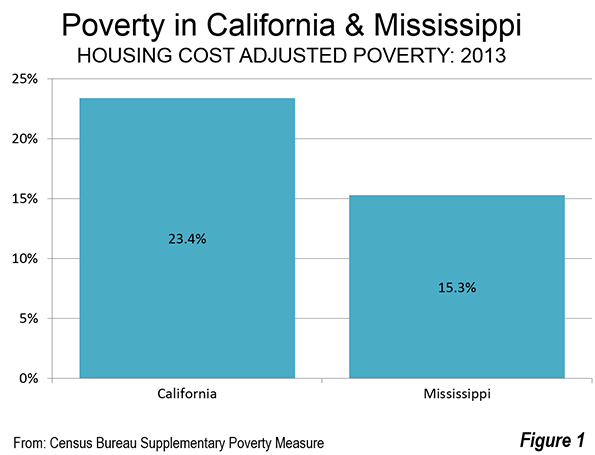
    Middle income households have been forced to accept lower standards of living while less fortunate have been driven into poverty by the high cost of housing.Housing costs have risen in some markets compared to others that the federal government now publishes alternative poverty estimates (the Supplemental Poverty Measure), because the official poverty measure used for decades does not capture the resulting differentials. The latest figures, for 2013, show California’s housing cost adjusted poverty rate to be 23.4 percent, nearly half again as high as the national average of 15.9 percent.

    Back in the years when the nation had a "California Dream," it would have been inconceivable for things to have gotten so bad — particularly amidst what is widely hailed as a spectacular recovery. The 2013 data shows California to have the worst housing cost adjusted poverty rate among the 50 states and the District of Columbia. But it gets worse. California’s poverty rate is now more than 50 percent higher than Mississippi, which long has set the standard for extreme poverty in the United States (Figure 1).

    The size of the geographic samples used to estimate the housing adjusted poverty rates are not sufficient for the Supplemental Poverty Measure to produce local, county level or metropolitan area estimates. However, a new similar measure makes that possible.

    The California Poverty Measure                           

    The Public Policy Institute of California and the Stanford Center on Poverty and Inequality have collaborated to establish the "California Poverty Measure," which is similar to the Supplemental Poverty Measure adjusted for housing costs.

    The press release announcing release of the first edition (for 2011) said that: "California, often thought of as the land of plenty" in the words Center on Poverty and Inequality director Professor David Grusky, is "in fact the land of poverty."

    The latest California Poverty Measure estimate, for 2012, shows a statewide poverty rate of 21.8 percent, somewhat below the Supplemental Poverty Measure and well above the Official Poverty Measure that does not adjust for housing costs (16.5 percent).

    The California Poverty Measure also provides data for most of California’s 58 counties, with some smaller counties combined due to statistical limitations. This makes it possible to estimate the California Poverty Measure for metropolitan areas, using American Community Survey data.

    Metropolitan Area Estimates

    By far the worst metropolitan area poverty rate was in Los Angeles, at 25.3 percent. The Los Angeles County poverty rate was the highest in the state at 26.1 percent, well above that of Orange County (22.4 percent), which constitutes the balance of the Los Angeles metropolitan area. However, the Orange County rate was higher than that of any other metropolitan area or region in the state (Figure 2). San Diego’s poverty rate was 21.7 percent. Perhaps surprisingly, Riverside-San Bernardino (the Inland Empire), which is generally perceived to have greater poverty, but with lower housing costs, had a rate of 20.9 percent. The two counties, Riverside and San Bernardino had lower poverty rates than all Southern California counties except for Ventura (Oxnard) and Imperial.

    The San Francisco metropolitan area had a poverty rate of 19.4 percent, more than one-fifth below that of Los Angeles. San Jose has a somewhat lower poverty rated 18.3 percent (Note 1). The metropolitan areas making constituting the exurbs of the San Francisco Bay Area had a poverty rate of 18.7 percent. This includes Santa Cruz, Santa Rosa, Stockton and Vallejo. Sacramento had the lowest poverty rate of any major metropolitan area, at 18.2 percent.

    The San Joaquin Valley, stretching from Bakersfield through Fresno to Modesto (Stockton is excluded because it is now a San Francisco Bay Area exurb) had a poverty rate of 21.3 percent, slightly below the state wide average of 21.8 percent. The balance of the state, not included in the metropolitan areas and regions described above had a poverty rate of 21.2 percent.

    County Poverty Rates

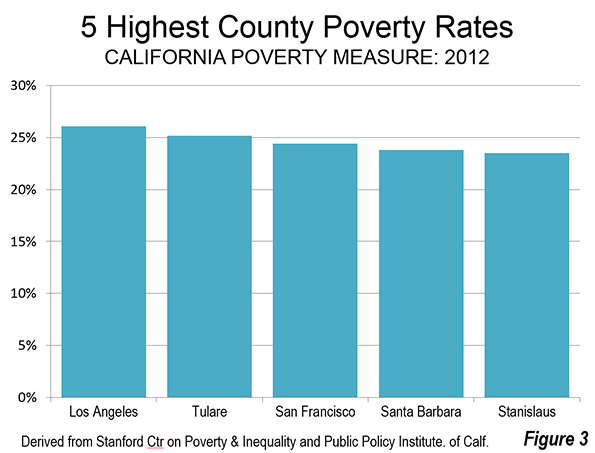
    As was noted above, Los Angeles County had the highest 2012 poverty rate in the state (Note 2), according to the California Poverty Measure (26.1 percent). Tulare County, in the San Joaquin Valley had the second-highest rate at 25.2 percent. Somewhat surprisingly, San Francisco County with its reputation for high income had the third worst poverty rate in the state at 23.4 percent. This is driven, at least in part, by San Francisco’s extraordinarily high median house price to household income ratio (median multiple). In this grisly statistic, it trails only Hong Kong, Vancouver and Sydney in the latest Demographia International Housing Affordability Survey. Wealthy Santa Barbara County has the fourth worst poverty rate in the state, at 23.8 percent. The fifth highest poverty rate is in Stanislaus County, in the San Joaquin Valley (county seat Modesto), which is already receiving housing refugees from the San Francisco Bay Area, unable to pay the high prices (Figure 3).

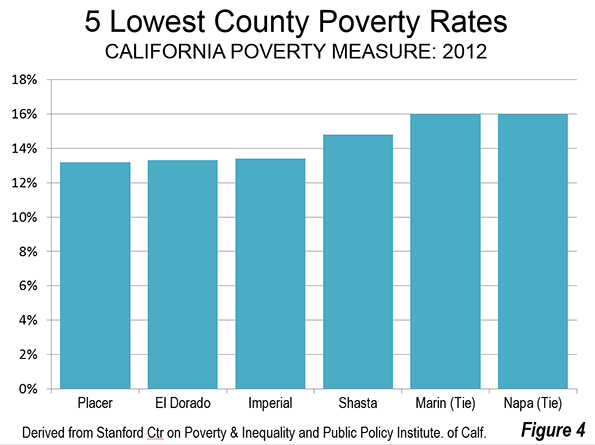
    The two lowest poverty rates were in suburban Sacramento counties (Note 2). Placer County’s rate was 13.2 percent and El Dorado County’s rate was 13.3 percent. Another surprise is Imperial County, which borders Mexico and has generally lower income. Nonetheless, Imperial County has the third lowest poverty rate at 13.4 percent. Shasta County (county seat Redding), located at the north end of the Sacramento Valley is ranked fourth at 14.8 percent. Two counties are tied for the fifth lowest poverty rate (16.0 percent), Marin County in suburban San Francisco and Napa County, in the exurban San Francisco Bay Area (Figure 4).

    Weak Labor Market and Notoriously Expensive Housing

    The original Stanford Center on Poverty and Inequality press release cited California’s dismal poverty rate as resulting from "a weak labor market and California’s notoriously expensive housing." These are problems that can be moderated starting at the top, with the Governor and legislature. The notoriously expensive housing could be addressed by loosening regulations that allow more supply to be built at lower cost. True, the new supply would not be built in Santa Monica or Palo Alto. But additional, lower cost housing on the periphery, whether in Riverside County, the High Desert exurbs of Los Angeles and San Bernardino Counties, the San Francisco Bay Area exurbs or the San Joaquin Valley could begin to remedy the situation.

    The improvement in housing affordability could help to strengthen the weak job market, by attracting both new business investment and households moving from other states.

    Regrettably, Sacramento does not seem to be paying attention. Liberalizing land use regulations is not only absent from the public agenda, but restrictions are being strengthened (especially under the requirements of Senate Bill 375). In this environment, metropolitan areas like Los Angeles, San Francisco, San Jose and San Diego could become even more grotesquely unaffordable, and the already high price to income ratios in the Inland Empire and San Joaquin Valley could worsen. All of this could lead to slower economic growth and to even greater poverty, as more lower-middle-income households fall into poverty.

    Note 1: San Benito County is excluded from the San Jose metropolitan area data. The California Poverty Measure does not report a separate poverty rate for San Benito County.

    Note 2: Among the counties for which specific poverty rates are provided.

    Wendell Cox is Chair, Housing Affordability and Municipal Policy for the Frontier Centre for Public Policy (Canada), is a Senior Fellow of the Center for Opportunity Urbanism (US), a member of the Board of Advisors of the Center for Demographics and Policy at Chapman University (California) and principal of Demographia, an international public policy and demographics firm.

    He is co-author of the "Demographia International Housing Affordability Survey" and author of "Demographia World Urban Areas" and "War on the Dream: How Anti-Sprawl Policy Threatens the Quality of Life." He was appointed to three terms on the Los Angeles County Transportation Commission, where he served with the leading city and county leadership as the only non-elected member. He served as a visiting professor at the Conservatoire National des Arts et Metiers, a national university in Paris.

    Photograph: Great Seal of the State of California by Zscout370 at en.wikipedia [CC BY-SA 3.0], from Wikimedia Commons

  • The Peril to Democrats of Left-Leaning Urban Centers

    Twenty years ago, America’s cities were making their initial move to regain some of their luster. This was largely due to the work of mayors who were middle-of-the-road pragmatists. Their ranks included Rudy Giuliani in New York, Richard Riordan in Los Angeles, and, perhaps the best of the bunch, Houston’s Bob Lanier. Even liberal San Franciscans elected Frank Jordan, a moderate former police chief who was succeeded by the decidedly pragmatic Willie Brown.   

    In contrast, a cadre of modern mayors is minting a host of ideologically new urban politics that put cities at odds with millions of traditional urban Democrats. This trend is strongest on the coasts, but is also taking place in many heartland cities. Bill de Blasio is currently its most prominent practitioner, but left-wing pundit Harold Meyerson says approvingly that many cities are busily mapping “the future of liberalism” with such policies as  the $15-an-hour minimum wage, stricter EPA greenhouse gas regulations, and housing policies intended to force people out of lower density suburbs and into cities.

    For the Democrats, this urban ascendency holds some dangers. Despite all the constant claims of a massive “return to the city,” urban populations are growing no faster than those in suburbs, and, in the past few years, far slower than those of the hated exurbs. This means we won’t see much change in the foreseeable future in the current 70 to 80 percent of people in metropolitan America who live in suburbs and beyond. University of Washington demographer Richard Morrill  notes that the vast majority of residents of regions over 500,000—roughly 153 million people—live in the lower-density suburban places, while only 60 million live in core cities.  

    This leftward shift is marked, but it’s not indicative of any tide of public enthusiasm. One-party rule, as one might expect, does not galvanize voters. The turnout  in recent city elections has plummeted across the country, with turnouts 25 percent or even lower. In Los Angeles, the 2013 turnout that elected progressive Eric Garcetti was roughly one-third that in the city’s 1970 mayoral election.

    Bolstered by this narrow electorate, liberal pundits celebrate the fact that 27 of the largest U.S. cities voted Democratic in 2012, including “red” state municipalities such as Houston — but without counting the suburbs, where voter participation tends to be higher. An overly urban-based party faces the same fundamental challenges of a largely rural-oriented one—for example, the right-wing core of the GOP—in a country where most people live in neither environment.

    Demographic and Political Transformation of American Cities

    City dwellers have historically voted more liberally than their country or suburban cousins, but demographic trends are exacerbating this polarizing impulse. Simply put, the cities that could elect a Giuliani or a Riordan no longer exist. The centrist urban surge of the 1990s was both a reaction to the perceived failures of Democratic “blue” policies as well a reflection of the makeup of white-majority, middle-class neighborhoods in places like Brooklyn, Queens and the San Fernando Valley that featured healthy numbers of politically moderate “Reagan Democrats”—or Bill Clinton Democrats, circa 1992

    Since then, these communities have been largely supplanted by groups far more likely to embrace a more progressive political stance: racial minorities, hipsters, and upper-class sophisticates. These groups have swelled, and gotten much richer, in places like brownstone Brooklyn  or lakeside Chicago, while the number of inner city middle-class neighborhoods, as Brookings  has demonstrated, have declined, to 23 percent of the central city—half the level in 1970.

    This new urban configuration, notes the University of Chicago’s Terry Nichols Clark, tend to have different needs, and values, than the traditional middle class. Since their denizens are heavily single and childless, the poor state of city schools does not hold priority over the political power of the teachers unions. The key needs for the new population, Clark suggests, are good restaurants, shops and festivals, not child-friendly parks and family-oriented stores. Sometimes even crazy notions—such as allowing people to walk through the streets of San Francisco naked—are tolerated in a way no child-centric suburb would allow.

    These tendencies underscore as well the increasingly homogeneous political culture emerging in cities. In 1984, for example, Ronald Reagan took 31 percent of the vote in San Francisco, and 37 percent in New York. He actually carried Los Angeles. By 2012, a Republican with a more moderate history could not muster 20 percent of the vote in San Francisco. And Mitt Romney lost Los Angeles by more than a 2-1 margin, while garnering barely 20 percent in all New York boroughs besides Staten Island.

    Economic Hubris

    These changes also reflect a shift in the economic role of cities. Until the 1970s, cities were centers of production, distribution and administration. Then the industrial base of urban areas, and related jobs such as logistics, began moving away from the traditional manufacturing cities  to overseas, the suburbs or the Southeast.  In 1950 New York, according to economic historian Fernand Braudel, 1 million people worked in factories, mostly for small companies. Today the city’s industrial workforce now stands at a paltry 73,000, a dramatic decline from some 400,000 as recently as the early 1980s.

    A similar, if less spectacular, decline has taken place in what are still the two largest industrial metropolitan statistical areas, Chicago and Los Angeles. The one-time “City of Big Shoulders” and its environs had 461,600 industrial jobs in 2009. Today it has fewer than 300,000. Los Angeles, in a process that started with the end of the Cold War, has seen its once-diverse industrial base erode rapidly, from 900,000 just a decade ago to 364,000 today. 

    In some cities, a new economy has emerged, one that is largely transactional and oriented to media. The upshot is that denizens of the various social media, fashion and big data firms have little appreciation of the difficulties faced by those who build their products, create their energy and food. Unlike the factory or port economies of the past, the new “creative” economy has little meaningful interaction with the working class, even as it claims to speak for that group.

    This urban economy has created many of the most unequal places  in the country. At the top are the rich and super-affluent who have rediscovered the blessings of urbanity, followed by a large cadre of young and middle-aged professionals, many of them childless. Often ignored, except after sensationalized police shootings, is a vast impoverished class that has become ever-more concentrated in particular neighborhoods. During the first decade of the current millennium, neighborhoods with entrenchedurban poverty actually grew, increasing in numbers from 1,100 to 3,100. In population, they grew from 2 million to 4 million.Some 80 percent of all population growth in American cities, since 2000, notes demographer Wendell Cox, came from these poorer people, many of them recent immigrants.

    Such social imbalances are not, as is the favored term among the trendy, sustainable. We appear to be creating the conditions for a new wave of violent crime on a scale not seen since the early 1990s. Along with poverty, public disorderlinessgang activityhomelessness and homicides are on the rise in manyAmerican core cities, including Baltimore, Milwaukee, Los Angeles and New York. Racial tensions, particularly with the police, have worsened. So even as left-leaning politicians try to rein in police, recent IRS data in Chicago reveals, the middle class appears to once again be leaving for suburban and other locales. 

    Urbanity and Politics

    These social and economic changes inform the new politics of the Democratic Party. On social policy, the strong pro-gay marriage and abortion positions of the Democrats makes sense as cities have the largest percentages of both homosexuals and single, childless women. When the party had to worry about rural voters in South Dakota or West Virginia, this shift would have been more nuanced, and less rapid.

    Yet with those battles essentially won, the new urban politics are entering into greater conflict with the suburban mainstream, which tends to be socially moderate, and even more so with the resource-dependent economies of rural America. The environmental radicalism that has its roots in places like San Francisco and Seattle  now directly seeks to destroy whole parts of middle America’s energy economy.

    Such policies tend to radically raise energy costs. In California, the green energy regime has already driven roughly 1 million people, many of them Latinos in the state’s agricultural interior, into “energy poverty”—a status in which electricity costs one-tenth of their income. Not surprisingly, those leaving California, notes Trulia, increasingly are working class; their annual incomes in the range of $20,000 to $80,000 are simply not enough to make ends meet.

    Geography seems increasingly to determine politics. Ideas on climate policy that seem wonderfully enlightened in Manhattan or San Francisco—places far removed from the dirty realities of production—can provide a crushing blow to someone working in the Gulf Coast petro-chemical sector or in the Michigan communities dependent on auto manufacturing.

    It’s more than suburban or rural jobs that are on the urban designer chopping block. Density obsessed planners have adopted rules, already well advanced in my adopted home state of California, to essentially curb  much detested suburban sprawl and lure people back to the dense inner cities. The Obama administration is sympathetic to this agenda, and has adopted its own strategies to promote “back to the city” policies in the rest of the country as well.

    But as these cities go green for the rich and impressionable, they must find ways to subsidize the growing low-paid service class—gardeners, nannies, dog walkers, restaurant servers—that they depend on daily. This makes many wealthy cities, such as Seattle or San Francisco, hotbeds for such policies as a $15-an-hour minimum wage, as well as increased subsidies for housing and health care. In San Francisco, sadly, where the median price house (usually a smallish apartment) approaches  $1 million, a higher minimum wage won’t purchase a decent standard of living. In far more diverse and poorer Los Angeles, nearly half of all workers would be covered — with unforeseen impacts on many industries, including the largegarment industry.

    These radicalizing trends are likely to be seen as a threat to Democratic prospects next year, but instead will meet with broad acclaim among city-dominated progressive media. Then again, the columnists, reporters and academics who embrace the new urban politics have little sympathy or interest in preserving middle-class suburbs, much less vital small towns. If the Republicans possess the intelligence—always an open question—to realize that their opponents are actively trying to undermine how most Americans prefer to live, they might find an opportunity far greater than many suspect.

    This piece first appeared at Real Clear Politics.

    Joel Kotkin is executive editor of NewGeography.com and Roger Hobbs Distinguished Fellow in Urban Studies at Chapman University, and a member of the editorial board of the Orange County Register. He is also executive director of the Houston-based Center for Opportunity Urbanism. His newest book, The New Class Conflict is now available at Amazon and Telos Press. He is also author of The City: A Global History and The Next Hundred Million: America in 2050. He lives in Orange County, CA.

    Photo by Kevin Case from Bronx, NY, USA (Bill de Blasio) [CC-BY-2.0], via Wikimedia Commons

  • Progressive Policies Drive More Into Poverty

    Across the nation, progressives increasingly look at California as a model state. This tendency has increased as climate change has emerged as the Democratic Party’s driving issue. To them, California’s recovery from a very tough recession is proof positive that you can impose ever greater regulation on everything from housing to electricity and still have a thriving economy.

    And to be sure, the state has finally recovered the jobs lost in the 2007-09 recession, largely a result of a boom in values of stocks and high- end real estate. Things, however, have not been so rosy in key blue-collar fields, such as construction, which is still more than 200,000 jobs below prerecession levels, or manufacturing, where the state has lost over one-third of its employment since 2000. Homelessness, which one would think should be in decline during a strong economy, is on the rise in Orange County and even more so in Los Angeles.

    The dirty secret here is that a large proportion of Californians, roughly one-third, or some 3.2 million households, as found by a recent United Way study, find it increasingly difficult to keep their heads above water. The United Way study, surprisingly, has drawn relatively little interest from a media that usually enjoys highlighting disparities, particularly racial gaps. Perhaps this reflects a need to maintain an illusion of blue state success. If Republican Pete Wilson were still governor, I suspect we might have heard much more about this study.

    Read the entire piece at The Orange County Register.

    Joel Kotkin is executive editor of NewGeography.com and Roger Hobbs Distinguished Fellow in Urban Studies at Chapman University, and a member of the editorial board of the Orange County Register. He is also executive director of the Houston-based Center for Opportunity Urbanism. His newest book, The New Class Conflict is now available at Amazon and Telos Press. He is also author of The City: A Global History and The Next Hundred Million: America in 2050. He lives in Orange County, CA.

  • The Really Big Housing Picture

    Everywhere I go it seems there’s some kind of housing crisis. In some places home values are dropping precipitously, people are unable to sell and move on, and formerly middle class homes are being abandoned or converted to poorly maintained rental properties. In other places home values and rents are obscenely high and ordinary people and essential workers are being driven out of whole cities and counties. The national economy has bifurcated and the shrinking middle class is reflected in a two tiered housing market. I’d like to explore the root causes of the situation.

    Woodstock-kidsWikipedia

    Reagan_et_ThatcherWikipedia

    Our current real estate schism is based on two forces. First, we as a society decided decades ago that we didn’t want to be shackled by the social conventions and obligations that hindered individuals in their quest for personal fulfillment and private gain.

    For liberals this took the form of women’s liberation, black liberation, gay liberation… Everyone wanted to throw off the yoke of conformity. For conservatives it took the form of tax revolts, rebellions against regulations of every kind, a search for open space, cheap labor, and new markets.

    These two groups were in no way mutually exclusive. Both the California Hippy and Evangelical Christian from South Carolina were pushing the country in the same direction for decades whether they knew it or not. Everyone was rebelling against social constraints and dismantling the old system that created the broad stable middle class in the first place.

    Screen Shot 2015-07-23 at 9.05.36 PM

    Screen Shot 2015-07-23 at 8.59.17 PM

    Screen Shot 2015-07-23 at 9.06.57 PM

    Screen Shot 2015-07-23 at 9.16.12 PM

    The second force in the housing crisis is based on physical mobility made possible by car culture, affordable commercial aviation, containerized cargo shipping, and modern telecommunications. Geography stopped being a material limitation for the last few generations. As a result, people have self segregated. The rich have congregated in a handful of premium locations and radically driven up the cost of living in those spots. The poor have been left to their own devices in economically and culturally abandoned regions. And the ever diminishing middle class has leveraged itself into a thousand little niches in an attempt to keep up as their incomes and status decline.

    Screen Shot 2015-06-12 at 1.16.04 AM

    Screen Shot 2015-06-12 at 6.52.37 PM

    I was recently at a meeting in Northern California where government officials, local business people, and community organizers all gathered to promote their various objectives. These were all incredibly kind, decent, responsible people who truly cared about their town. The difficulties on hand will be familiar if you live in one of the more expensive parts of the country.

    There’s a desperate need for affordable housing. There’s huge pressure to preserve productive farmland and the natural landscape. There’s fierce NIMBYism that stops new growth of every kind. There’s serious money pressing down on the scarce property that is available. There’s a water shortage brought on by years of drought. And there simply is no culturally or politically tolerable mechanism to reconcile any of these conflicting forces. Honestly, for the people who already own property in the area the situation is pretty sweet – so long as the authorities manage to keep the ever growing homeless camps out of sight. The default setting is to simply let things fester and muddle through.

    Screen Shot 2015-03-18 at 1.26.28 AM

    Screen Shot 2015-03-10 at 5.31.42 PM

    Screen Shot 2015-03-12 at 2.10.06 AM

    Just a month earlier I was at a different meeting in another town where the problem was reversed. A formerly prosperous town was hitting an economic wall as growth and development had come to a complete halt with unpleasant consequences. There was plenty of cheap land all around and everyone was desperate to see it covered in new homes, shopping malls, and office parks as quickly as possible. But market demand evaporated. Developers couldn’t justify building much of anything because there were no buyers on hand. Too much of the existing building stock was already sitting vacant.

    You’d think these two problems could solve each other. Why don’t all the people desperate for affordable housing in one place simply move to the place with abundant vacancies? Of course, it doesn’t work that way. Communities are more than a pile buildings. People need the right mix of employment, education, culture, and so on. You can’t live in a cheap place if you have no access to jobs. And you can’t take a job in a place where there is no available housing.

    Screen Shot 2015-07-23 at 9.05.36 PM

    Let’s go over some of the particulars again. Mass motoring allowed almost everyone to move away from the things and people they didn’t like. If your taxes went up you moved away. If “undesirables” arrived on your block you moved away. If you didn’t like the snow you moved away. Cheap private transportation on America’s highways made it possible for the vast 20th century middle class to remove itself from traditional communities and find bliss is splendid isolation.

    Screen Shot 2015-07-23 at 8.59.17 PM

    Affordable commercial aviation let people migrate to previously remote locations. A car could get you from New Jersey to Florida in a couple of days, but a plane could get you there in a couple of hours. Air transport preferentially poached the affluent, the young, the educated, and retirees from established towns and delivered them to previously obscure destinations. The ability to hop quickly and cheaply from place to place was a tremendous boon to some lucky towns, but the death knell to others.

    Screen Shot 2015-07-23 at 9.06.57 PM

    Containerized shipping brought raw materials and cheap manufactured goods in from every corner of the globe. If workers threatened to strike you moved your company away. Far away. If you found a better tax deal you moved away. If you needed the authorities to turn a blind eye to your company’s waste stream you moved away. The toaster ovens, refrigerators, and steel belted radial tires could all be made somewhere else for a lot less money.  And along with those jobs went a big chunk of the old middle class.

    Screen Shot 2015-07-23 at 9.16.12 PM

    Information technology has added a new layer of mobility to the population. It’s now possible to use your mobile phone to turn your home air conditioner on and off from six thousand miles away. On the one hand this sort of technological magic allows millions of people to earn a living remotely. An accountant from Albuquerque can live in a beach cabin in Hawaii while still drawing her livelihood from New Mexico.

    On the other hand, what happened to blue collar jobs in the past is now happening to white collar jobs. Your CT scan or X-rays can now be sent via the Internet to a technician in the Philippines who will interpret your medical condition remotely. Film editing can be done entirely online from Brazil. Computer code can be written in India. Architectural and engineering work can be done digitally in the Ukraine. If a job can be scanned, or Skyped, or pushed through a fiber optic wire somehow it will eventually be sent to a low wage region to be done by someone who is smarter, faster, and more desperate for work than you are.

    And this isn’t factoring in the jobs that will soon be done entirely by machine intelligence. That accountant in Hawaii needs to pay attention to what she’ll do when her clients all switch to the cheaper advanced computer program that can wiggle around the tax code better than she can. Then again, the guy who writes that computer code will become very rich and might be able to move to Hawaii himself.

    unnamed-5

    unnamed-3

    unnamed

    So what are the options here? First, we can allow the already stressed middle class to continue to shrink so that the U.S. becomes a two tiered society of haves and have nots – with many more losers than winners. Inevitably this will require an increase in both government police and private security to keep the wealthy protected from the pissed off impoverished masses. There are plenty of examples of what that looks like around the world.

    Or, we could tax the rich and redistribute the funds to the formerly middle class population that has trouble feeding itself and keeping a roof over their heads. We also know what that looks like.

    Or we could create a new social, political, and economic national compact that restructures absolutely everything. Some old fashioned societal constraints might be a prerequisite for equity and a renewed middle class. Rights come with responsibilities. Aging Baby Boomers will fight that sort of thing tooth and nail. But Millennials will likely grab at it with both hands. Toss in fuel supply disruptions and a break down in international trade relations and American society might find itself coalescing in very different ways.

    John Sanphillippo lives in San Francisco and blogs about urbanism, adaptation, and resilience at granolashotgun.com. He’s a member of the Congress for New Urbanism, films videos for faircompanies.com, and is a regular contributor to Strongtowns.org. He earns his living by buying, renovating, and renting undervalued properties in places that have good long term prospects. He is a graduate of Rutgers University.

  • More Local Decisions Usurped by Ideological Regulators

    In hip, and even not-so-hip, circles, markets, restaurants and cultural festivals across the country, local is in. Many embrace this ideal as an economic development tool, an environmental win and a form of resistance to ever-greater centralized big business control.

    Yet when it comes to areas being able to choose their urban form and for people to cluster naturally – localism is now being constantly undermined by planners and their ideological allies, including some who superficially embrace the notion of localism.

    In order to pursue their social and perceived environmental objectives, they have placed particular onus on middle- and upper-class suburbs, whose great crime appears to be that they tend to be the places people settle if they have the means to do so.

    Central planning

    Nothing is more basic to the American identity than leaving basic control of daily life to local communities and, as much as is practical, to individuals. The rising new regulatory regime seeks decisively to change that equation. To be sure, there is a need for some degree of regulation, notably for basic health and public safety, as well as maintaining and expanding schools, parks, bikeways and tree-planting, things done best when supported by local voters.

    Read the entire piece at The Orange County Register.

    Joel Kotkin is executive editor of NewGeography.com and Roger Hobbs Distinguished Fellow in Urban Studies at Chapman University, and a member of the editorial board of the Orange County Register. He is also executive director of the Houston-based Center for Opportunity Urbanism. His newest book, The New Class Conflict is now available at Amazon and Telos Press. He is also author of The City: A Global History and The Next Hundred Million: America in 2050. He lives in Orange County, CA.

    City Hall photo by Flickr user OZinOH.

  • Congratulations Boston!

    Congratulations Boston! Your rejection of the "honor" of representing the US as its candidate for the 2024 Summer Olympics is an inspiring example of government performing its obligation to taxpayers and their hard earned money. Those of us who think that government has a responsibility to wisely use taxpayer money sometimes forget that Massachusetts enacted Proposition 2 1/2 not long after California’s fabled Proposition 13.

    In an era of routinely wasteful government spending, Boston’s decision stands out as unusual. It rivals the courage of New Jersey Governor Chris Christie who cancelled a new Hudson River rail tunnel, mid-project, because of the consultants and builders seemed sure to take advantage of the blank check that New Jersey taxpayers were required to pledge. This, of course has been the record of major infrastructure projects all over the world and most recently one of the most grotesque examples was Boston’s own "Central Artery." But unlike “the Big Dig”. This time Boston didn’t have speaker Tip O’Neill to bring home the bacon. Then, the federal government capped its share and Boston had to pay it all. Unsurprisingly, the bill was much higher and had to be paid by Massachusetts, along with the interest on extra debt that had to be issued.

    Oxford University Professor Bent Flyvbjerg, who has become famous for his quality analysis of large infrastructure projects, especially urban rail projects, produced a report with Allison Stewart on the history of Olympics cost overruns between 1960 and 2012. The two worked under the auspices of the Said Business school of England’s at Oxford. They concluded:

    The data thus show that for a city and nation to decide to host the Olympic Games is to take on one of the most financially risky type of megaproject that exists, something that many cities and nations have learned to their peril.

    They found that every Olympic Games, summer or winter, for which complete data is available experienced cost overruns. The most recent, in London, experienced a cost overrun of 100 percent. Flyvbjerg and Steward used a very simple model that has been applied to the previous infrastructure work. They just looked at the final bill that included all the expenses.This was compared to the amount the sponsors and their funders, the taxpayers, were it was going to cost when the application was approved by the local political process.

    The principal problem was the Olympic Committee requirement that sponsors must ensure the financing of all major capital investment required and are "on the hook" for any cost overruns.

    Montréal’s legendary Mayor Jean Drupeau sold his city on an Olympics bid saying that "the Montréal Olympics and no more have a deficit that a man can have a baby." Well, men are not yet having babies, but Montréal gave birth to a world-class cost overrun in its 1976 summer Olympics.  According to Flyvbjerg and Stewart, the 1976 Montréal Olympics had a cost overrun of nearly 800 percent, nearly double the 1992 420 percent cost overrun of Barcelona. Montréal may have set a record for much more than the Olympics with its cost overrun.

    Things have been virtually as bad in Greece. The researchers reported that "Olympic cost overruns and debt have exacerbated" the Greek economic crisis.

    There has been one exception to this sorry record. Los Angeles, host of the 1984 summer Olympic Games, actually turned a profit, sending more than $300 million to the international Olympic Committee and using the local profits for the LA84 Foundation, which funds youth sports and related activities, even 30 years after the event.

    I coordinated the information program for employees at the Southern California headquarters of Crocker Bank (subsequently sold to Wells Fargo), assisting employees in getting to work during what was expected to be the high traffic from the 1984 Olympics. It turns out that the advice of local officials to encourage and vacations and working at home paid off handsomely. People who commuted during the Olympic Games had unusually light traffic.

    In addition, I was a member of the Los Angeles County Transportation Commission (LACTC), having been appointed by Mayor Bradley and confirmed by the Los Angeles City Council. Both the Mayor and the Council were committed to putting on the show without burdening the taxpayers – no public money. And Olympic Committee was established under the direction of Peter Ueberroth, who became a legend for his skillful management of the games.

    But there was some public money lost on the Olympics. The Southern California Rapid Transit district (SCRTD), the large regional transit operator announced its intention to provide bus service to Olympic venues from all over the Los Angeles area. SCRTD claimed that it would be able to do the job without public subsidy. I believed otherwise and predicted that the service would fall far short of its ridership projections and lose about $5 million. LACTC had the authority to ban the expenditure, which I tried to do. Unfortunately I was unable to obtain the necessary votes to make that happen. In the end, the ridership fell far short of projection (the kind of thing Professor Flybvjerg usually reports on urban rail projects).

    Meanwhile, the Olympics were a one-off to Los Angeles. Most infrastructure projects of this nature are financially ruinous. Maybe Massachusetts learned a lesson from the Central Artery. Boston proved itself to be a world-class city in having the courage to say "no."

    Wendell Cox is Chair, Housing Affordability and Municipal Policy for the Frontier Centre for Public Policy (Canada), is a Senior Fellow of the Center for Opportunity Urbanism (US), a member of the Board of Advisors of the Center for Demographics and Policy at Chapman University (California) and principal of Demographia, an international public policy and demographics firm.

    He is co-author of the "Demographia International Housing Affordability Survey" and author of "Demographia World Urban Areas" and "War on the Dream: How Anti-Sprawl Policy Threatens the Quality of Life." He was appointed to three terms on the Los Angeles County Transportation Commission, where he served with the leading city and county leadership as the only non-elected member. He served as a visiting professor at the Conservatoire National des Arts et Metiers, a national university in Paris. 

    Photograph: Boston, by author

  • Rethinking the Scandinavian Model

    During a tour to Paris, Bruce Springsteen explained that his dream was for the US to adapt a Swedish style welfare state. The famous musician is far from alone in idealizing Nordic policies. The four Nordic nations (Denmark, Finland, Norway and Sweden) are often regarded as prime role-models the policies to be emulated by others. Internationally, advocates of left of centre policies view these countries as examples of how high tax social democratic systems are viable and successful. Paul Krugman, for example, has said: “Every time I read someone talking about the ‘collapsing welfare states of Europe’, I have this urge to take that person on a forced walking tour of Stockholm”.

    This admiration has a long history. In the mid-1970s Time Magazine described a country that sounded much like a utopia. “It is a country whose very name has become a synonym for a materialist paradise”, the international magazine wrote and continued to report about Sweden: “No slums disfigure their cities, their air and water are largely pollution free… Neither ill‑health, unemployment nor old age pose the terror of financial hardship.” Similarly, political scientist John Logue argued in 1979: “A simple visual comparison of Scandinavian towns with American equivalents provides strong evidence that reasonably efficient welfare measures can abolish poverty as it was known in the past; economic growth alone, as the American case indicates, does not”. Logue believed that the greatest threat to the Nordic welfare states was that they were too successful; eliminating social problems to such a degree that people forgot the importance of welfare policies.

    The high regard comes as no surprise. Nordic societies are uniquely successful. Not only are they characterised by high living standards, but also by other attractive features such as low crime rates, long life expectancy,  high degrees of social cohesion and even income distributions. Various international rankings conclude that they are amongst the best, if not the best, places in the world in which to live. One example is the “Better Life Index”, complied by the OECD. In the 2014 edition of the index Norway was ranked as the nation with the second highest level of well-being in the world, followed by Sweden and Denmark in third and fourth position. Finland ranked as the eighth best country.

    The OECD “Better Life Index”


    1. Australia

    2. Norway

    3. Sweden

    4. Denmark

    5. Canada

    6. Switzerland

    7. United States

    8. Finland

    9. Netherlands

    10. New Zealand


    If one disregards the importance of thinking carefully about causality, the argument for adopting a Nordic style economic policy in other nations seems obvious. The Nordic nations – in particular Sweden, which is most often used as an international role‑model – have large welfare states and are successful in a broad array of sectors. This is often seen as proof that a ”third way” policy between socialism and capitalism works well, and that other societies can reach the same favourable social outcomes simply by expanding the size of government. If one studies Nordic history and society in‑depth, however, it quickly becomes evident that the simplistic analysis is flawed.

    To understand the Nordic experience one must bear in mind that the large welfare state is not the only thing that sets these countries apart from the rest of the world. The countries also have homogenous populations with non-governmental social institutions that are uniquely adapted to the modern world. High levels of trust, strong work ethic, civic participation, social cohesion, individual responsibility and family values are long-standing features of Nordic society that pre-date the welfare state. These deeper social institutions explain why Sweden, Denmark and Norway could so quickly grow from impoverished nations to wealthy ones as industrialisation and the market economy were introduced in the late 19th century. They also play an important role in Finland’s growing prosperity after the Second World War.

    Take Sweden as an example. In 1870 free markets were introduced in this agrarian society. During the coming 100 years Sweden combined low taxes, liberal regulations and strong working ethics to experience an unrivalled growth rate in Europe. In 1870 Sweden’s GDP per capita was 57 per cent lower than in the UK. In 1970 it had risen to become 21 per cent higher. The shift towards high taxes and state involvement actually began   occurred around 1970, resulting in a long-lasting period of stagnation that was broken through ambitious market reforms during the 1990s and onward.

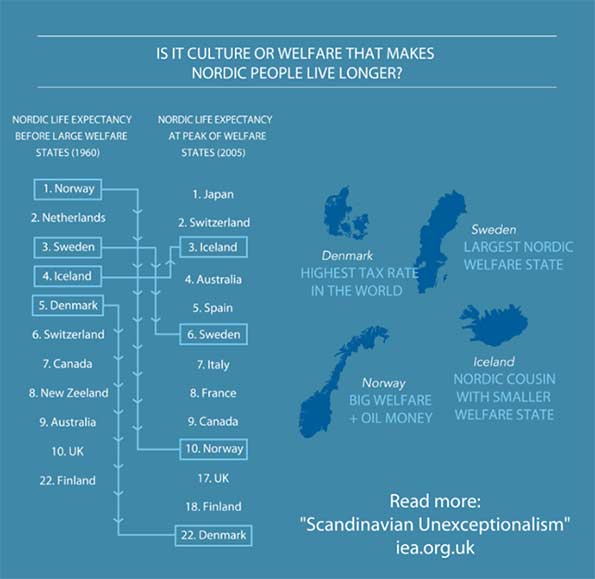
    Perhaps even more interestingly, even the social progress that Nordic countries are admired for developed during the latter part of the 19th century and the first half of the 20th century, developed not under socialism but at a time when Nordic countries combined free markets and low taxes with small (and efficient) welfare states. Researchers have for example shown that it was during this period that Sweden and Denmark developed a relatively equal income distribution. Long life expectancy is another example. In the picture below I show the life expectation at birth is shown for various OECD nations in 1960 – when Nordic nations had small welfare states – and 2005 – when Nordic welfare states were at their peak. In both periods Nordic countries were characterized by relatively long life expectancy, but if anything, this was more the case when the countries had small rather than large welfare states. The reason is simply that everything is not politics, cultural attributes such as a love for nature and healthy diets explains much of Nordic citizens good health.

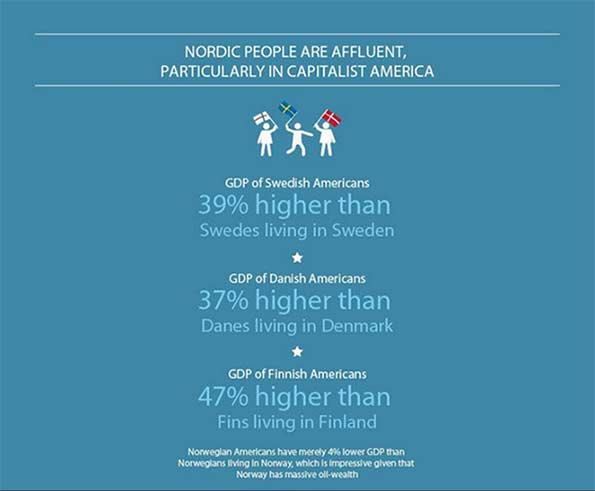
    Similarly, it comes as no surprise that descendants of the Nordics who migrated to the US in the 19th century are still characterised by favourable social outcomes, such as a low poverty rate and high incomes. In fact, as shown below, Nordic Americans have considerably higher living standard in capitalist America than their cousins in the Nordics. This is interesting, since those Nordic citizens who migrated to the United States in large groups during the 19th and 20th centuries were anything but an elite group. Rather, it was often the poor who left for the opportunities on the other side of the Atlantic.

    A key lesson from the success of Nordic society lies in what can broadly be defined as “culture matters”. We should not be surprised that it is these nations, with their historically strong work ethic and community-based social institutions, t  have had fewer adverse effects from their welfare states and are therefore used as the poster child for those wishing to extol the benefits of active welfare policies. On the other hand, Southern European countries with similar sized welfare states and size of government have had less favourable outcomes.

    Paul Krugman is right in noting that a forced walking tour of Stockholm disproves the idea of the collapsing welfare states of Europe. Nordic societies have not collapsed under the weight of welfare policies, particularly since they have lately adopted by introducing market reforms, reducing the generosity of welfare programs and cutting taxes. Such a tour may perhaps also be wise for Krugman himself, in teaching that Scandinavian countries have been rather unexceptional. The normal economic rules apply: incentives, economic freedom, a strong self-sufficient culture and a regime of good governance all matter when it comes to economic success. The question that remains is whether Scandinavian countries will continue their return to the free-market roots that have historically served them so well. If so, the Nordic culture of success can in combination with sound policies allow growth, innovation and entrepreneurship to flourish.

    Dr. Nima Sanandaji is a research fellow at CPS, and the author of “Scandinavian Unexceptionalism – Culture, Markets and the Failure of Third-Way Socialism”. The book, which was recently released is currently being translated to a number of different languages. The entire book is available through the Institute of Economic Affairs which has published it.

  • What Jane Jacobs Got Wrong About Cities

    Few people have had more influence on thinking about cities than the late Jane Jacobs.

    The onetime New Yorker turned Torontonian, Jacobs, who died in 2006, has become something of a patron saint for American urbanists, and the moral and economic case she made for urban revival has been cited by everyone frompundits and think tanks to developers.

    However, though widely celebrated for her insights and unabashed embrace of dense urbanism, Jacobs may ultimately prove more influential than relevant. Her writing was often incisive and inspiring, particularly when she opposed planning and overdevelopment and embraced the role of middle-class families in cities. But the urban revival that has actually taken place is at variance with her own romantic version of cities and how they work.

    Currently the American cities that are doing best are not those with a flourishing middle class but those have become the preferred playgrounds of the rich and famous—New York, San Francisco, even Washington, D.C. At the same time, vast portions of urban America remain cut off from society’s mainstream.

    The Nature of the New Urban Revival

    When Jacobs published her most important work, The Death and Life of Great American Cities,in 1961, America’s cities were clearly in trouble. Racial tensions and a massive flight to suburbia were undermining the promise of cities, and the only response of planners at the time seemed to be to expand freeway access, tear down old neighborhoods, construct massive apartment blocks, and subsidize big employers.

    Jacobs rightly opposed these approaches, and constructed a far more human and enduring vision of urbanism. Her appealing perspective was based on middle-class neighborhoods, families, and grassroots economic activity. Her maxim about the best role for places remains a guiding light to those who care about upward mobility: “A metropolitan economy, if it is working well, is constantly transforming many poor people into middle-class people, many illiterates into skilled people, many greenhorns into competent citizens. … Cities don’t lure the middle class. They create it.”

    Yet when cities did begin to come back—a handful in the ’80s and then again more around the time of the millennium—the revivals were in many ways the opposite of her grassroots vision. Instead of creating more family-oriented middle-class neighborhoods, the urban revival ended up being based on “luring” the affluent, the still forming young person, or the accomplished, childless professional than generating a new middle class.

    Witold Rybczynski noted in 2010 that the rise of successful urban cores increasingly has little in common with Jacobs’s romantic bottom-up organic urbanism:

    “The most successful urban neighborhoods have attracted not the blue-collar families that she celebrated, but the rich and the young. The urban vitality that she espoused—and correctly saw as a barometer of healthy city life—has found new expressions in planned commercial and residential developments whose scale rivals that of the urban renewal of which she was so critical. These developments are the work of real estate entrepreneurs, who were absent from the city described … but loom large today, having long ago replaced planners and our chief urban strategists.”

    As Rybczynski suggests, the current rise of “urban vitality” derives not from the idiosyncratic, diverse and, if you will, democratic form that Jacobs celebrated but in a more manufactured matter that at times outdoes suburbs for conformity and boredom.

    The Evisceration of the Urban Middle Class

    Jacobs’s vision failed in large part because today’s cities play a different economic role than they did in the past. The economic basis of her New York—small businesses, manufacturers, business service firms employing masses of middle-class workers—has declined while the city has evolved into what Jean Gottman called the “transactional metropolis,” dependent on the most elite financial services, high-end consumption, and the all too present media industry.

    This urban economy has many strengths but increasingly relies on the rich. A Citigroup study suggested that cities, particularly New York and London, have become “plutonomies”—economies driven largely by the wealthy class’s investment and spending. In this way the playground or luxury cores serve less as places of aspiration than geographies of inequality.

    New York, for example, is by some measurements the most unequal of American major cities: Gotham’s 1 percent earns a third of the entire city’s personal income—almost twice the proportion for the rest of the country.

    Other luxury cores exhibit similar patterns. A 2014 recent Brookings report found that virtually all the most unequal large central cities—with the exception of Atlanta and Miami—are dense, luxury-oriented cities such as San Francisco, Boston, Washington, New York, Chicago, and Los Angeles. Although high-wage jobs have increased in these metropolises, the bulk of new employment in cities like New York has been in low-wage service jobs.

    As urban studies author Stephen J.K. Walters notes, these cities tend to develop highly bifurcated economies, divided between an elite sector and large service class. He notes this is “the opposite of [Jane] Jacobs’s vision of cities” that relied on “transforming” poor people into the middle-class people

    Even diversity, often cited by Jacobs as a great asset of cities, has suffered. Among the most successful cities today are what analyst Aaron Renn has labeled “the white cities”—places like Boston, San Francisco, Seattle, and Portland, Oregon—which have historically been home to relatively small and now shrinking, minority populations. San Francisco’s black population is 35 percent lower than what it was in 1970. In the nation’s whitest major city, Portland, African-Americans are being driven out of the urban core by gentrification, partly supported by city funding. Similar phenomena can be seen inSeattle and Boston, where long existing black communities are rapidly shrinking.

    In the more diverse big cities like Los Angeles, New York, and Chicago, gentrification takes place alongside growing concentrations of poverty. It is often forgotten, according to demographer Wendell Cox, that 80 percent of the increase in urban core population in the last decade was from poor people; overall, despite the growth of poverty in suburbs, the core poverty rate remains more than twice as high.

    Nor is this situation necessarily improving. During the first 10 years of the new millennium, neighborhoods with entrenched urban poverty actually grew, increasing in numbers from 1,100 to 3,100 and in population from 2 million to 4 million. “This growing concentration of poverty,” note urban researchers Joe Cortright and Dillon Mahmoudi (PDF), “is the biggest problem confronting American cities.”

    We see this in places like Brooklyn and Chicago, two much-hyped epicenters of urban gentrification. Brooklyn’s poorer sections—a quarter of the residents are onfood stamps—have become even more so, notes analyst Daniel Hertz. Incomes between 1999 and 2001, he notes, dropped overall, falling in the poorer areas even as they soared in the more gentrified neighborhood closer to Manhattan and surrounding Prospect Park.

    Hertz found similar, if more extreme, phenomena in Chicago, which has also seen an unwelcome return to high crime rates, particularly in its poorer sections. Gentrification has indeed expanded into formerly working- and middle-class neighborhoods, but poverty and despair still characterize much of the city. As Chicago urban analyst Pete Saunders has put it: “Chicago may be better understood in thirds—one-third San Francisco, two-thirds Detroit.”

    Here Comes the Childless City

    Arguably Jacobs’s biggest miscalculation related to urban demographics. As H.G. Wells predicted well over a century ago, cities now depend in large part on affluent, childless people, living what Wells labeled a life of “luxurious extinction.” Jacobs’s contemporary, the great sociologist Herbert Gans, already identified a vast chasm between suburbanites and those who favor urban core living who he identified as “the rich, the poor, the non-white as well as the unmarried and childless middle class.”

    Jacobs never got this point, perhaps because she instinctively hated where families were in fact headed: the suburbs. Like many intellectuals in the ’50s and ’60s, she saw no need for suburbs, even as they experienced explosive growth, just dense city surrounded by traditional countryside.

    Perhaps nothing of Jacobs seems more dated than her assertion that “suburbs must be a difficult place to raise children.” She lovingly portrayed neighborhoods like her own West Village as ideal places where locals watched out for each other. She wrote about how “Mr. Lacey, the locksmith, bawls out one of my sons for running into the street, and then later reports the transgression to my husband as he passes the locksmith shop. Mr. Lacey, with whom we have no ties other than street propinquity, feels responsible for him to a degree.”

    At best, Jacobs’s compelling portrait from 1961 is something of an anachronism. Families in urban apartments today, notes Cornell researcher Gary Evans (PDF), generally have far weaker networks of neighbors than their suburban counterparts, a generally more stressful home life, and significantly less “social support.” Toronto author Phillip Preville notes, “In the years since, all the Mr. Laceys of the world have died and gone to downtown heaven,” he notes. “We can all talk Jane’s talk, but some people are pickled in Jane’s brine.”

    Certainly statistics back up Preville’s assertion. Greenwich Village today now largely consists of students, wealthy people, and pensioners. Despite the presence of many young people, children and teens between 5 and 17 account for only 6 percent of the Village’s population, far below the norms for New York City (PDF), and less than half the 13.1 percent found across the United States’s 52 largest metropolitan areas. Overall, Manhattan has among the lowest percentage of children in the country; a majority of its households are made up of singles.

    This pattern holds across the country. According to census data, in 2011 children 5-14 constitute about 7 percent in core districts across the country, roughly halfthe level seen in suburbs and exurbs. By 2011 people in their 20s constitute roughly one-quarter of the residents in urban cores, but only 14 percent or fewer of those who live in suburbs, where the bulk of people go as they start to reach the point of establishing families.

    Even in Toronto, generally seen as one of the world’s most livable cities and Jacobs’s chosen home, Statistics Canada notes that for every person who moved from the hinterlands to the city, 3.5 moved towards the periphery. The people most likely to move out are 25 to 44, people entering the stage of family formation. As one Torontonian, who recently moved to the suburbs, observed: “The big city has its uses. It served me well, and I served it back. Living in Toronto enabled me to transform my life in ways I dearly wanted: marriage, fatherhood, career advancement. That transformation has brought with it needs that Toronto cannot adequately provide: personal space, affordability, an emphasis on community over privacy. The intensity and the anonymity of the city now hinder my life more than they help. Simple as that. I’m outta here.”

    Overall, high-density cores, whether in Canada, America, or East Asia, consistently exhibit the lowest percentages of children. The far more ultra-dense cities of East Asia—Hong Kong, Singapore, and Seoul—exhibit the lowest fertility rates on the planet (PDF), sometimes less than half the number required simply to replace the current population. Due largely to crowding and high housing prices, 45 percent of couples in Hong Kong say they have given up on having children.

    In Asia people have few opportunities to move to lower-density housing. But in the United States, with abundant and often much cheaper land, super-urbanity often serves as a kind of way station in which people spend only a portion—often an exciting and career-enhancing one—of their lives. But when they grow older, and particularly when they decide to start families, they tend to leave for the periphery.

    Getting Beyond Nostalgia

    Nostalgia makes people feel good. Some still dream about a coming revival of diverse, child-friendly, dense city neighborhoods. They dream, in the words of oneauthor, of bringing us “back to the way we were, when most people lived in cities, did not own a car, walked or took the bus or train to work, and lived in much smaller residences.”

    Wishing to return to something that last predominated a half-century ago does not mean it will occur. Just as conservatives who hearken for a return to the ’50s are sure to be disappointed, urban advocates who suggest a “return to the city” for middle-class families will be as well. Both minorities and millennials, often thought of as spearheading a “back to the city” drive, are, according to most indicators, moving out to the suburbs as they enter their 30s and start families.

    Dense urbanity, of course, remains a huge contributor to the nation’s economy and culture. Urban centers are great places for the talented, the young, and childless affluent adults. But for most Americans, the central city offers at best a temporary lifestyle. It does not fit with what people can afford and where they want to live. There is a reason why 70 to 80 percent of Americans in our metropolitan areas live in suburbs, and those numbers are not likely to change appreciably in the coming decade.

    Cities, as Jacobs hoped, have indeed experienced a renaissance, but not in the form she preferred. To be sure, this revival is a hell of lot better than the urban dystopia that developed in the years after Jacobs’s Death and Life of Great American Cities first appearedBut it’s time to recognize that we are not seeing a renaissance of the kind of middle-class urbanity that she loved and championed. That city has passed into myth, and, unless society changes in very radical ways, it is never going to come back.

    This piece originally appeared at The Daily Beast.

    Joel Kotkin is executive editor of NewGeography.com and Roger Hobbs Distinguished Fellow in Urban Studies at Chapman University, and a member of the editorial board of the Orange County Register. He is also executive director of the Houston-based Center for Opportunity Urbanism. His newest book, The New Class Conflict is now available at Amazon and Telos Press. He is also author of The City: A Global History and The Next Hundred Million: America in 2050. He lives in Orange County, CA.

    By Phil Stanziola [Public domain], via Wikimedia Commons