Category: Policy

  • Southern California Housing Figures to Get Tighter, Pricier

    What kind of urban future is in the offing for Southern California? Well, if you look at both what planners want and current market trends, here’s the best forecast: congested, with higher prices and an ever more degraded quality of life. As the acerbic author of the “Dr. Housing Bubble” blog puts it, we are looking at becoming “los sardines” with a future marked by both relentless cramming and out-of-sight prices.

    This can be seen in the recent surge of housing prices, particularly in the areas of the region dominated by single-family homes. You can get a house in San Francisco – a shack, really – for what it costs to buy a mansion outside Houston, or even a nice home in Irvine or Villa Park. Choice single-family locations like Irvine, Manhattan Beach and Santa Monica have also experienced soaring prices.

    Market forces – overseas investment, a strong buyer preference for single-family homes and a limited number of well-performing school districts – are part of, but hardly all, the story. More important may be the increasingly heavy hand of California’s planning regime, which favors ever-denser development at the expense of single-family housing in the state’s interior.

    Read the entire piece at The Orange County Register.

    Joel Kotkin is executive editor of NewGeography.com and Roger Hobbs Distinguished Fellow in Urban Studies at Chapman University, and a member of the editorial board of the Orange County Register. He is also executive director of the Houston-based Center for Opportunity Urbanism. His newest book, The New Class Conflict is now available at Amazon and Telos Press. He is also author of The City: A Global History and The Next Hundred Million: America in 2050.  He lives in Los Angeles, CA.

    Photo by Downtowngal (Own work) [CC BY-SA 3.0 or GFDL], via Wikimedia Commons

  • The Big Idea: California Is So Over

    California has met the future, and it really doesn’t work. As the mounting panic surrounding the drought suggests, the Golden State, once renowned for meeting human and geographic challenges, is losing its ability to cope with crises. As a result, the great American land of opportunity is devolving into something that resembles feudalism, a society dominated by rich and poor, with little opportunity for upward mobility for the state’s middle- and working classes. 

    The water situation reflects this breakdown in the starkest way. Everyone who follows California knew it was inevitable we would suffer a long-term drought. Most of the state—including the Bay Area as well as greater Los Angeles—is semi-arid, and could barely support more than a tiny fraction of its current population. California’s response to aridity has always been primarily an engineering one that followed the old Roman model of siphoning water from the high country to service cities and farms.  

    But since the 1970s, California’s water system has become the prisoner of politics and posturing. The great aqueducts connecting the population centers with the great Sierra snowpack are all products of an earlier era—the Los Angeles aqueduct (1913), Hetch-Hetchy (1923), the Central Valley Project (1937), and the California Aqueduct (1974). The primary opposition to expansion has been the green left, which rejects water storage projects as irrelevant. 

    Yet at the same time greens and their allies in academia and the mainstream pressare those most likely to see the current drought as part of a climate change-induced reduction in snowpack. That many scientists disagree with this assessment is almost beside the point. Whether climate change will make things better or worse is certainly an important concern, but California was going to have problems meeting its water needs under any circumstances.  

    Not Meeting the Challenges. 

    It’s not like we haven’t been around this particular block before. In the 1860s, a severe drought all but destroyed LA’s once-flourishing cattle industry. This drought was followed by torrential rains that caused their own havoc. The state has suffered three major droughts since I have lived here—in the mid ’70s, the mid ’80s and again today—but long ago (even before I got there) some real whoppers occurred, including dry periods that lasted upwards of 200 years.  

    This, like the threat of earthquakes, is part of the price we pay to live in this most beautiful and usually temperate of states. The real issue is how to meet this challenge, and here the response has been slow and lacking in vision. Not all of this is to be blamed on the greens, who dominate the state politically. California agriculture, for example, was among the last in the nation to agree to monitoring of groundwater. Farmers have also been slow to adjust their crops toward less water-dependent varieties; they continue to plant alfalfa, cotton, and other crops that may be better grown in more water-rich areas. 

    Many cities, too, have been slow to meet the challenge. Some long resisted metering of water use. Other places have been slow to encourage drought-resistant landscaping, which is already pretty de rigeur in more aridity-conscious desert cities like Tucson. This process may take time, but it is already showing value in places like Los Angeles where water agencies provide incentives. 

    But ultimately the responsibility for California’s future lies with our political leadership, who need to develop the kind of typically bold approaches past generations have embraced. One step would be building new storage capacity, which Governor Jerry Brown, after opposing it for years, has begun to admit is necessary. Desalinization, widely used in the even more arid Middle East, notably Israel, has been blocked by environmental interests but could tap a virtually unlimited supply of the wet stuff, and lies close to the state’s most densely populated areas. Essentially the state could build enough desalinization facilities, and the energy plants to run them, for less money than Brown wants to spend on his high-speed choo-choo to nowhere. This piece of infrastructure is so irrelevant to the state’s needs that even many progressives, such as Mother Jones’ Kevin Drum, consider it a “ridiculous” waste of money. 

    And there needs to be, at least for the short term,an end to dumping water into San Francisco Bay for the purpose of restoring a long-gone salmon run, or to the Delta, in order to save a bait-fish, the Delta smelt, which may already be close to extinct. This dumping of water has continued even as the state has faced a potentially crippling water shortage; nothing is too good for our fish, or to salve the hyper-heated consciousness of the environmental illuminati. 

    The Political Equation 

    The biggest reason California has been so slow, and uncharacteristically feckless, in meeting this existential challenge lies with psychology and ends with political power. The generation that built the sinews of modern California—most notably the late Governor Pat Brown Sr., the current governor’s father—sprang from the old progressive spirit which saw in infrastructure development a chance not only to create new wealth, but also provide opportunity to working- and middle-class Californians. 

    Indeed, if you look at California’s greatest achievements as a society, the Pat Brown legacy stands at the core. The California Aqueduct turned vast stretches of the Central Valley into one of the most productive farming regions in the world. The freeway system, now in often shocking disrepair, allowed for the construction of mass suburbia that offered millions a quality of life never experienced by previous generations. At the same time the development of energy resources—California still boasts the nation’s third-largest oil production—helped create a huge industrial base that included aerospace, semiconductors, and a host of specialized industries, from logistics to garment manufacturing. 

    In contrast, Jerry Brown has waged a kind of Oedipal struggle against his father’s legacy. Like many Californians, he recoiled against the sometimes haphazard and even ugly form of development that plowed through much of the state. Cutting off water is arguably the most effective way to stop all development, and promote Brown’s stated goal of eliminating suburban “sprawl.” It is typical that his first target for cutbacks this year has been the “lawns” of the middleclass suburbanite, a species for which he has shown little interest or tolerance.  

    But it’s not just water that exemplifies the current “era of limits” psychology. Energy development has always been in green crosshairs and their harassment has all but succeeded in helping drive much of the oil and gas industry, including corporate headquarters, out of the state. Not building roads—arguably to be replaced by trains—has not exactly reduced traffic but given California the honor of having eight of the top 20 cities nationally with poor roads; the percentage of Los Angeles-area residents who take transit has, if anything, declined slightlysince train-building began. All we are left with are impossible freeways, crumbling streets, and ever more difficulty doing anything that requires traveling.  

    The Road to Feudalism 

    These policies have had numerous impacts, like weakening California’s industrial sector, which cannot afford energy prices that can be twice as high as in competing states. Some of those who might have worked in the factories, warehouses, and farms of California now help swell the numbers of the welfare recipients, who remarkably make up one-third of the nation’s total. As recently as the 1970s and ’80s, the percentage of people living in poverty in California wasbelow the national average; California today, based on cost of living, has thehighest poverty rate in the country.  

    Of course, the rich and entitled, particularly in Silicon Valley have achieved unprecedented riches, but those middle-class Californians once served by Pat have largely been abandoned by his son. California, long a relative beacon of equality and opportunity, now has the fourth-highest rate of inequality in the country. For those who, like me, bought their first home over 30 years ago, high housing prices, exacerbated by regulation, are a personal piggybank. But it’s doubtful either of my daughters will ever be able to buy a house here. 

    What about “green jobs”? California leads in total number of green jobs, simply by dint of size, but on a per-capita basis, a recent Brookings study notes, California is about average. In wind energy, in fact, California is not even in first place; that honor goes to, of all places, Texas, which boasts twice Californias level of production. Today even  The New York Timeshas described Governor Jerry Brown’s promise about creating a half-million green jobs as something of a “pipe dream.” Even surviving solar firms, busy in part to meet the state’s strict renewable mandates, acknowledge that they won’t be doing much of the manufacturing here, anyway. 

    The Cost of Narcissism 

    Ultimately this is a story of a state that has gotten tired, having lost its “animal spirits” for the policy equivalent of a vegan diet. Increasingly it’s all about how the elites in the state—who cluster along the expensive coastal areas—feel about themselves. Even Brown knows that his environmental agenda will do little, or nothing, to combat climate change, given the already minimal impact of the state on carbon emissions compared to escalating fossil fuel use in China, India and elsewhere. But the cosmopolitan former Jesuit gives more priority to his spiritual service to Gaia than the needs of his non-affluent constituents.  

    But progressive narcissism is, as some conservatives assert, not the main problem. California greens are, to be sure, active, articulate, well-organized, and well-financed. What they lack is an effective counterpoint from the business class, who would be expected to challenge some of their policies. But the business leadership often seems to be more concerned with how to adjust the status quo to serve privileged large businesses, including some in agriculture, than boosting the overall economy. The greens, and their public-sector allies, can dominate not because they are so effective as that their potential opposition is weak, intimidated, and self-obsessed. 

    What we are witnessing the breakdown of a once-expansive, open society into one dominated by a small group of plutocrats, largely in Silicon Valley, with an “amen” crew among the low-information donors of Hollywood, the public unions, the green lobby, and wealthy real estate developers favored by Brown’s pro-density policies. This coalition backs Brown and helps maintain the state’s essentially one-party system. No one is more adamant about reducing people’s carbon footprint than the jet set of Silicon Valley or the state’s planning elite, even if they choose not to live in a manner that they instruct all others.

    This fundamentally hypocritical regime remains in place because it works—for the powerful and well-placed. Less understandable is why many Hispanic politicians, such as Senate Leader Kevin de Leon, also prioritize “climate change” as his leading issue, without thinking much about how these policies might worsen the massive poverty in his de-industrializing L.A. district—until you realize that de Leon is bankrolled by Tom Steyer and others from the green uberclass.

    So, in the end, we are producing a California that is the polar opposite of Pat Brown’s creation. True, it has some virtues: greener, cleaner, and more “progressive” on social issues. But it’s also becoming increasingly feudal, defined by a super-affluent coastal class and an increasingly impoverished interior. As water prices rise, and farms and lawns are abandoned, there’s little thought about how to create a better future for the bulk of Californians. Like medieval peasants, millions of Californians have been force to submit to the theology of our elected high priest and his acolytes, leaving behind any aspirations that the Golden State can work for them too.

    This piece originally appeared at The Daily Beast.

    Joel Kotkin is executive editor of NewGeography.com and Roger Hobbs Distinguished Fellow in Urban Studies at Chapman University, and a member of the editorial board of the Orange County Register. He is also executive director of the Houston-based Center for Opportunity Urbanism. His newest book, The New Class Conflict is now available at Amazon and Telos Press. He is also author of The City: A Global History and The Next Hundred Million: America in 2050.  He lives in Los Angeles, CA.

    Los Angeles aqueduct photo by BigStockPhoto.com.

  • In NYC, Throwing Good Infrastructure Money After Bad

    Ten billion dollars — for a bus station. And if other projects are any guide, this price tag for a Port Authority Bus Terminal replacement is only going up from there.

    That’s after we’ve committed: $4.2 billion at the PATH World Trade Center station; $1.4 billion for the Fulton St. subway station; $11 billion for the East Side Access project; $4.5 billion for just two miles of the Second Ave. Subway, and $2.3 billion for a single station extension of the 7-train.

    Having grown numb to multi-billion price tags for building almost anything, New Yorkers might not know just how messed up all this is. In any other American city, even just one of these fiascoes might well have sunk the entire town.

    Read the entire piece at the New York Daily News.

    Photo by Metropolitan Transportation Authority of the State of New York (East Side Access: January 13, 2014) [CC BY 2.0], via Wikimedia Commons

  • Why California’s Salad Days Have Wilted

    “Science,” wrote the University of California’s first President Daniel Coit Gilman, “is the mother of California.” In making this assertion, Gilman was referring mostly to finding ways to overcoming the state’s “peculiar geographical position” so that the state could develop its “undeveloped resources.”

    Nowhere was this more true than in the case of water. Except for the far north and the Sierra, California – and that includes San Francisco as well as greater Los Angeles – is essentially a semiarid desert. The soil and the climate might be ideal, but without water, California is just a lot of sunny potential, but not much economic value.

    Yet, previous generations of Californians, following Gilman’s instructions, used technology to build new waterworks, from the Hetch Hetchy Dam to the L.A. Aqueduct and, finally, the California State Water Project and its federal counterpart, the Central Valley Project. These turned California into the richest farming area on the planet and generated opportunities for the tens of millions who came to live in the state’s cities and suburbs.

    Read the entire piece at The Orange County Register.

    Joel Kotkin is executive editor of NewGeography.com and Roger Hobbs Distinguished Fellow in Urban Studies at Chapman University, and a member of the editorial board of the Orange County Register. He is also executive director of the Houston-based Center for Opportunity Urbanism. His newest book, The New Class Conflict is now available at Amazon and Telos Press. He is also author of The City: A Global History and The Next Hundred Million: America in 2050.  He lives in Los Angeles, CA.

    Photo of Lake Palmdale California Water Project by Kfasimpaur (Own work) [Public domain], via Wikimedia Commons

  • Calling Out the High-Tech Hypocrites

    The recent brouhaha over Indiana’s religious freedom law revealed two basic things: the utter stupidity of the Republican Party and the rising power of the emerging tech oligarchy. As the Republicans were once again demonstrating their incomprehension of new social dynamics, the tech elite showed a fine hand by leading the opposition to the Indiana law.

    This positioning gained the tech industry an embarrassingly laudatory piece in the   New York Times, portraying its support for gay rights as symbolic of a “new social activism” that proves their commitment to progressive ideals.

    “So many tech companies have embraced a mission that they say is larger than profits,” Glenn Kelman, chief executive of Redfin, the online real estate firm, told the Times. “Once you wrap yourself up in a moral flag, you have to carry it to the top of other hills.”

    Yet beneath the veneer of good intentions, the world being created by the tech oligarchs   both within and outside of Silicon Valley fails in virtually every area dear to traditional liberals. On a host of issues—from the right to privacy to ethnic and feminine empowerment and social justice—the effects of the tech industry are increasingly regressive.

    The valley elite may have won its gender discrimination lawsuit against Ellen Pao, but this does not dispel the notion that it runs largely on testosterone. The share of women in the tech industry is barely half of their 47 percent share in the total workforce.  Stanford researcher Vivek Wadhwa describes Silicon Valley as still “a boys’ club that regarded women as less capable than men and subjected them to negative stereotypes and abuse.”

    Race is another hot spot for progressives, but outside of Asians, the valley’s record is nothing short of miserable. Some of this reflects the rapid de-industrialization of the industry—the valley has lost 80,000 manufacturing jobs alone since 2000—as companies shift their industrial facilities either to China or to states like Utah and Texas, where they can escape the tax and regulatory regime that they so avidly support back in California.

    So good blue-collar jobs go elsewhere, and the valley’s  own  African-Americans and Hispanics (who  make up roughly one-third of the population) now occupy  barely 5 percent of jobs in the top Silicon Valley firms.  They have not done well in the current tech “boom”: Between  2009 and 2011,  earnings dropped  18 percent for blacks and 5 percent for Latinos, according to a 2013 Joint Venture Silicon Valley eport. 

    Nor can we expect tech firms to go out of their way to train or develop too many American-born workers, of whatever race, for their jobs. Instead the industry’s elites seek to get their employees through H-1B immigrants, largely from Asia. These workers are likely to be more docile, and more limited in their job options than native born or naturalized citizens. Given that there is a surplus of American IT workers, this brings to mind not global consciousness but instead the importation of the original coolie labor force brought to California to build the railroads.

    Similarly, despite claims of a commitment to personal freedom, valley firms like Google are  renowned for their calculated violations of privacy. Support the free movement of labor? Others, notably Apple, are also leaders in seeking to restrain employees  from changing jobs.

    And what about the sensible liberal idea that the rich and corporations should pay their “fair share” of taxes?  That’s a progressive ideal paid for by your Main Street businessman or your local dentists, but don’t expect your tech oligarchs to play by the same rules.  True, Bill Gates has voiced public support for higher taxes on the rich but tech companies, including Microsoft, have bargained to evade paying their own taxes. Facebook paid no taxes in 2012, despite profits in excess of $1 billion.  Apple, which even the New York Times described as “a pioneer in tactics to avoid taxes,” has kept much of its cash hoard abroad to keep away from Uncle Sam.

    If these actions were taken by oil companies or suburban developers, the mainstream media would be up in arms. Yet by embracing “progressive” values on issues like gay rights, the tech oligarchs are trying to secure a politically correct “get out of jail free” card. Monopolistic behavior, tax avoidance, misogyny, and privacy violations are OK, as long as you mouth the right words about gay rights and climate change—and have the money and  the channels to broadcast your message.

    Like other plutocrats, the tech oligarchs seek to buy political protection, usually from the Democrats. In 2012, tech firms gave Democrats roughly twice as much  campaign money to Democrats than to Republicans.

    If anything, grassroots techies are even more left-oriented, with 91 percent  of the contributions of Apple employees in the 2012 presidential race going to President Obama.

    Yet despite these leanings, the tech oligarchs manage to get a pass from conservatives. Perhaps some have over-imbibed Ayn Rand, becoming prisoners of an ideology that suggests the valley elites reflect a  “meritocratic” ideal driven by profits. That’s an interesting take since so many leading tech firms, from Amazon to Twitter, actually earn little or no profit. They benefit instead from easy access to capital markets, from which they can extract enormous earnings through stock inflation.

    Other conservatives also seem to share the views of the most prominent tech libertarian, Paypal co-founder Peter Thiel, who claims that non-conformist business is now “increasingly rare outside of Silicon Valley.” Yet given the “me too” nature of much of what passes for tech today, and the huge advantages to those who can access venture capital,  perhaps American farmers, wildcat oil drillers and even cutting edge restaurateurs take bigger risks, and provide better bigger social rewards to the overall economy.

    Commentators on the right and much of the left  seem to have forgotten that the valley is no longer dominated by scraggly outsiders creating amazing innovative products. In most cases now they are essentially extending the power of the Internet—developed by the U.S. military and paid for by American taxpayers—into a host of fields from transportation to renting out rooms. In many cases they are simply redistributing to themselves money that once went to publishing companies, taxi drivers and hotels. That’s capitalism, but not inherently moral, or compassionate.

    In reality the valley elite is increasingly nothing more than the latest iteration of   oligopolistic crony capitalism. Firms like Google, Apple and Microsoft hold market shares in their fields upwards of 80 percent. In some cases, they do it without improving their products, as anyone using Microsoft products can certainly attest. Their control of their markets is far greater than those of  the  largest oil, automobile or home-building firms.  Tech firms, particularly in California, have also been primary beneficiaries of crony capitalism, particularly in terms of “green energy” schemes that are far from market-worthy. Despite this, Google and their ilk get subsidies to reap profits while forcing California’s middle and working classes to pay higher bills.

    As a country, it is time to understand that the tech oligarchs are not much different from, and no better than, previous business elites. Like oil companies under the Bushes, they relish their ties to the powerful, as evidenced by Google’s weekly confabs with Obama administration officials. No surprise that a host of former top  Obama aides—including former campaign manager David Plouffe (Uber) and White House press secretary Jay Carney (Amazon)—have signed up to work for tech giants.  

    None of this is to say that the tech elites need to be broken up like Standard Oil or stigmatized like the tobacco industry. But it’s certainly well past the time for people both left and right to understand that this oligarchy’s rise similarly poses a danger to our society’s future. By their very financial power, plutocratic elites — whether their names are Rockefeller, Carnegie, Page, Bezos or Zuckerberg —  need  to be closely watched for potential abuses instead of being the subjects of mindless celebration from both ends of the political spectrum.

    This piece first appeared at Real Clear Politics.

    Joel Kotkin is executive editor of NewGeography.com and Roger Hobbs Distinguished Fellow in Urban Studies at Chapman University, and a member of the editorial board of the Orange County Register. He is also executive director of the Houston-based Center for Opportunity Urbanism. His newest book, The New Class Conflict is now available at Amazon and Telos Press. He is also author of The City: A Global History and The Next Hundred Million: America in 2050.  He lives in Los Angeles, CA.

    Official White House Photo by Pete Souza.

  • Big Box Urbanism

    I’m ambivalent about big box stores. I occasionally shop at places like Walmart, Costco, and Target just like most people. I buy various packaged goods in bulk from these mega retailers to take advantage of a volume discount. I don’t moralize over these things. But when it comes to meat, dairy, and fresh produce I walk around the corner or down the street to my local mom and pop stores, farmers market, or Community Supported Agriculture plan. I’m fine with buying a pallet of inexpensive toilet paper that was manufactured on an industrial scale. Chicken? Not so much.

     Screen Shot 2015-03-08 at 3.23.46 AM

    But I’m really interested in the giant retail buildings themselves. A large proportion of the North American landscape is dominated by big box stores and the associated land use pattern that we’ve all come to recognize. They’re so ubiquitous that we tend not to question how they came into being. This blog post will explore the retail development in the Antelope Valley in California, but I use this example because it’s typical rather than unique. Whether you live in Florida, Texas, or Nebraska the same dynamics are at work.

    Screen Shot 2015-03-08 at 4.55.37 PM Google

    Screen Shot 2015-03-10 at 1.38.12 AM Google Screen Shot 2015-03-10 at 1.37.40 AM Google

    The story begins with a rivalry between the two contiguous municipalities of Lancaster and Palmdale. If you were to drive through the Antelope Valley you would have no way of knowing when you had passed through one town and into the other. Not only are they composed of identical building types, but their borders are incredibly intertwined and gerrymandered after decades of annexation in an arms race to see who could grow the fastest. The big prize is always sales tax revenue from high volume retailers: car dealerships, big box stores, department stores, chain restaurants… Anything with a cash register will do. Like most towns the property tax revenue from residential development isn’t nearly enough to cover the costs of city services such as schools, road maintenance, and police and fire protection. Sales tax receipts are desperately needed to fill the gap. The construction and service jobs associated with new retail are also welcomed by city authorities. New growth is paramount at the economic development agencies.

    Screen Shot 2015-03-09 at 1.19.09 AM Google

    With this in mind the City of Lancaster prepared a site for a regional shopping mall in the late 1980’s. The land next to the freeway was set aside, it was properly zoned, expensive infrastructure was installed, a “business friendly” package of heavy subsidies and sweeteners was put in place, and an extensive lobbying campaign was launched. Basically, Lancaster hiked up its skirt, put on a Wonder Bra and a lot of rouge and hoped a big strong regional shopping mall would come calling.

    Screen Shot 2015-03-09 at 1.22.39 AM Google

    Unfortunately for Lancaster it was Palmdale that successfully wooed the mall developer with a $20,000,000 incentive package back in 1990. The customer traffic heading to and from the new mall spawned a dozen adjacent retail sites that sprouted big box stores and a penumbra of chain restaurants and strip malls. It was a city planner’s dream for almost eighteen years.

    But then Palmdale was hammered by the economic crash of 2008. The mall lost its Gottschalk’s and Mervyn’s anchor stores. Palmdale’s economic development team felt it had no choice but to entice Macy’s and others to fill the void with multi million dollar tax deferments and business “incentives”. Remember, a big mall with no anchor stores rapidly fails as foot traffic declines. In fact, no developer can even secure bank financing to build or improve a retail complex unless they already have signed contracts with a couple of big stores. That’s why the largest stores in any mall pay the lowest proportional rent. The real cost of the mall is carried by the smaller shops and very often the tax payers. A Cinnabon pays a great deal more per square foot in rent than a big anchor like Macy’s. The Cinnabon is also far more productive and pays more tax and employs more people pound for pound. The anchors effectively take up a lot of space, negotiate with veiled threats, pay as little rent as possible, and virtually no tax. That’s standard business practice across the country.

    The idea that a town can repeatedly offer tax abatements to the same property in the short term in order to create tax revenue and prosperity over the long haul is a bad economic model. In fact, having neighboring towns race to see who can repeatedly impoverish themselves the most in an attempt to grow rich on new business is also a bad plan. Both towns know private corporations actively game the system, yet they can’t seem to help themselves. They still wet their pants at the thought that the next town over might get the new Applebee’s or Jiffy Lube instead of them. It’s a form of institutional insanity.

    Screen Shot 2015-03-09 at 1.37.09 AM Google

    Since Lancaster couldn’t have the regional mall it needed to find a new use for the land it had set aside. There aren’t that many things that can fill that kind of space. Like the mall in Palmdale it needed to be something that would serve as a catalyst for growth all around it. And it had to be something that Palmdale didn’t already have. So Lancaster built what was intended to be a regional entertainment center with a baseball stadium, hotel, multiplex movie theater, and a premium outlet mall. “Build it and they will come.”

    Screen Shot 2015-03-10 at 5.34.22 PM Screen Shot 2015-03-10 at 5.33.38 PM

    In 1995 the city of Lancaster spent $14,500,000 to build the baseball stadium in the hope that economic growth and development would spring up all around it. So a decade on what does the area look like?

    Screen Shot 2015-03-10 at 1.54.34 AM Screen Shot 2015-03-10 at 1.53.31 AM Screen Shot 2015-03-10 at 1.53.06 AM Screen Shot 2015-03-10 at 2.34.17 AM

    Near the ball park is the Lancaster Marketplace – an outlet mall. I checked the official management website and the leasing agent lists half the stores as “available”. The spaces that are occupied include a dialysis clinic, a dentist, various nail solons, a recycling center, an evangelical church, and a few outlet stores that sell sneakers and jeans. This clearly isn’t the economic engine or tax base that the city had originally envisioned. It wasn’t simply the economic crash of 2008 that brought this place down. It was the institutional over supply of retail space across the entire region. No town needs the insane number of shops that were induced into being by overly optimistic developers and tax starved municipal authorities.

    Screen Shot 2015-03-10 at 5.36.08 PM Screen Shot 2015-03-10 at 5.36.52 PM

    Here’s the movie theater with all the modern bells and whistles: 22 screens, IMAX, 3D, stadium seating, all digital, a sound system that can pull the gold fillings out of your teeth… you name it. It’s a massive stand alone building with an even bigger parking lot. In fact, the collection of reserved handicapped parking spots close to the front door is as large as many ordinary parking lots at lesser movie theaters. But here’s the problem.

    Screen Shot 2015-03-10 at 1.49.18 AM Screen Shot 2015-03-10 at 1.48.52 AM

    This is the old 12 screen movie theater half a mile away. It’s now a “second run” theater catering to the discount matinee crowd because it can’t possibly compete on anything other than price with the new super deluxe theater down the road.

    Screen Shot 2015-03-09 at 2.28.27 AM Screen Shot 2015-03-09 at 2.28.54 AM

    And here’s the old, old movie theater that used to play second run shows when the 12 screen opened up. It was eventually driven out of business. The building sat empty for a long while until someone attempted to operate a hairdressing school at the location. That business failed and now the place sits empty again. The new growth isn’t adding to the town’s economy. New bigger buildings simply replace old buildings that never get repurposed.

    Screen Shot 2015-03-08 at 3.06.38 AM Screen Shot 2015-03-10 at 1.49.40 AM 

    Across the street from the struggling outlet mall and old 12 screen movie theater is a Walmart. In fact, there are two Walmarts right next to each other. The older “small” Walmart was built in 1990. In 2006 Walmart decided it was time for a new larger super store and there was still plenty of land available in the same retail complex. Even as I stood on the far edge of the enormous parking lot with a special wide angle camera lens I still couldn’t get the two side-by-side buildings into view in a single frame. These buildings are massive.

    Screen Shot 2015-03-10 at 3.58.09 AM deccabuilders.com

    Screen Shot 2015-03-10 at 3.57.58 AM deccabuilders.comScreen Shot 2015-03-10 at 3.58.44 AM deccabuilders.com

    I found photos of the old Walmart on the building contractor’s website. They were proud of the fact that this was the very first Walmart built in the state of California and they delivered the project on time and on budget.

    Screen Shot 2015-03-09 at 4.57.04 PM Screen Shot 2015-03-09 at 4.57.31 PM Screen Shot 2015-03-09 at 4.57.54 PM Screen Shot 2015-03-10 at 1.27.47 PM

    Here’s what that same Walmart looks like today – just twenty five years later. In theory a new big box retailer would have opened up in the old Walmart building, but instead it has remained empty since 2006. There’s simply no market demand for these hulking ruins.

    Screen Shot 2015-03-09 at 2.22.47 AM

    Across the street from the two Walmarts is another strip of big and medium sized retail buildings. When the regional shopping mall fell through the idea was that the new Super Walmart would draw enough traffic to the area to support additional shops. “With thousands of folks driving to Walmart everyday the new Circuit City will thrive!” The building pictured above was once a Circuit City. Past tense. Not only was there too much retail space built in the Antelope Valley, but many of these chain stores have gone out of business entirely due to competition from on-line retailers who deliver goods directly to customers via UPS and FedEx.

    Screen Shot 2015-03-11 at 10.58.00 PM Screen Shot 2015-03-11 at 10.59.39 PM Screen Shot 2015-03-11 at 11.00.17 PM

    One of the popular urban planning strategies in vogue these days is to reuse dead retail buildings by converting them to “meds and eds”. Junior colleges and medical centers are of a suitable size that they can fill old big box stores and help reactivate the surrounding space. The above photos are of the newest medical center in Lancaster. It’s solar powered and hyper energy efficient. The native draught tolerant landscaping is irrigated with recycled gray water. High quality regionally appropriate public art is in abundance. And it’s almost exactly the same size as the old Walmart that’s been sitting empty for the last decade. But where is it?

    Screen Shot 2015-03-11 at 11.03.44 PM Screen Shot 2015-03-11 at 11.15.31 PM

    If you were to search out the least developed patch of this already sprawling hopscotch part of Lancaster… that’s where. Why? I’m sure there were all sorts of reasons having to do with the medical people, the developers, the city planners, the banks… Maybe the medical center is expected to be the engine of economic development in this patch of the desert and they want loads of extra room so they can spread out in the future. Or maybe that’s where the really cheap land was near a freeway cloverleaf. Or perhaps the medical center was too prestigious to be located in a low rent shopping plaza. Who knows?

    Screen Shot 2015-03-10 at 5.31.42 PM Screen Shot 2015-03-10 at 5.32.24 PM Screen Shot 2015-03-12 at 12.03.48 AM Google

    There was still a big chunk of the old mall site that couldn’t be filled with much of anything. Reluctantly the city rezoned it for single family residential subdivisions. Housing wouldn’t bring in tax revenue the way retail development would, but it was better than nothing. Growth was growth and Lancaster needed it badly. From Google Earth view you can see the cul-de-sacs carved into the desert. So far… no takers.

    Screen Shot 2015-03-10 at 5.32.57 PM Screen Shot 2015-03-10 at 5.34.47 PM Screen Shot 2015-03-10 at 5.36.37 PMScreen Shot 2015-03-10 at 5.35.05 PM Screen Shot 2015-03-10 at 5.34.05 PM

    Here are a few views of that old regional shopping mall site: the back of the 22 screen movie theater, the back of the outlet mall, the back of the baseball stadium, and the back of the hotel. Notice the roads that were built to accommodate all the anticipated growth.

    But they built it and they didn’t come.

    Again, this isn’t unique to the Antelope Valley. These same patterns of development play out all over the country. Some of you may dismiss this particular part of the world and assume your town is much better at managing its affairs. You may have more employers pumping money into your local economy. Or perhaps you live in a more sensible state with a pro business legislature, unlike the folks who run California. The truth is that California just did everything earlier and faster and on a grander scale than other places. Your turn is coming.

    John Sanphillippo lives in San Francisco and blogs about urbanism, adaptation, and resilience at granolashotgun.com. He’s a member of the Congress for New Urbanism, films videos for faircompanies.com, and is a regular contributor to Strongtowns.org. He earns his living by buying, renovating, and renting undervalued properties in places that have good long term prospects. He is a graduate of Rutgers University.

  • Can Singapore Thrive After Lee Kuan Yew?

    On Sunday, Singapore cremates its greatest leader, the late Lee Kuan Yew, architect of its good fortunes. Yet the flames also could extinguish the era of relentless social and economic progress that Lee ushered in during his long, amazingly productive life.

    World leaders, corporate hegemons, and much of the foreign policy establishment tend to worship Lee’s achievements. But the view from on high, not to mention across the seas, can be quite different from the reality on the ground, as I have learned over many trips to this most remarkable city-state.

    Lee is rightly celebrated for his remarkable success in transforming a poor, southeast Asian metropolis into one of the wealthiest and most productive places on the planet. At the time of its independence in the mid-’60s, Singapore was a corrupt, dirty, and divided Asian metropolis, with a GDP of roughly $2,600 per capita, which put it ahead of China and most of its southeast Asian neighbors but below such countries as the Philippines, Brazil, Yugoslavia, Bolivia, and Argentina, and several times lower than Greece, Spain, and the United Kingdom.

    Uncontestable: A Record of Economic Achievement

    Under Lee and his cadre of well-educated, thoughtful civil servants, the tiny 225 square mile island republic has created arguably the best run and most successful dense urban place on the planet. Today the city-state has a per capita GDP estimated at $55,000, according to the U.S. Bureau of Labor Statistics, above the U.S. level and well ahead of Japan, Germany, and France, as well as its old colonial master, Great Britain.

    Lee got there by having goals but being pragmatic about how to achieve them. He was what one observer called “a patient revolutionary,” a Fabian socialist whose underlying ideology can be boiled down to “what works.” This pragmatism was evident in economic policy, as the country focused first on trade and manufacturing and then towards a greater orientation to technology and high-end services.

    Education was a critical component, and from the start it was seen as the primary way to build both the state and the economy. This policy has resulted in a high proportion of technically trained professionals, leading the Center on International Education Benchmarking Education to call Singapore’s workforce “among the most technically competent in the world. Unlike many places in the developing world, Singapore knows it must compete primarily on quality, not price.”

    Perhaps the most critical aspect of Lee’s success, and that of his successors, was the ability to meet the requirements of multinational companies. Designating English as the national language  was a primary advantage. Due largely to Lee, Singapore is a primarily English-speaking country, and global business tends to go where it is understood, and where its nationals can most easily function.   

    As a result, efficient, globally focused Singapore now boasts more than twice as many regional headquarters of foreign firms than far-larger Tokyo, not to mention Asia’s less affluent megacities. They provide expats working for multinationals with sanitation, parks, trees, clean housing, an educated workforce, and low corruption not readily available in the rest of south Asia. Anyone who has spent time in India, or even Vietnam, marvels at the relative ease of life in Singapore.

    The Limits of Globalization

    Yet with wealth have come new problems that are not widely acknowledged outside the city-state. The influx of foreigners has made property owners wealthier, but many feel it also has eroded local culture. Its benefits to ordinary Singaporeans are increasingly dubious. Even as GDP growth continues to chug at somewhat close to 5 percent per annum,   real wages for ordinary Singaporeans have stagnated. From 1998 to 2008, the income of the bottom 20 percent of households dropped an average of 2.7 percent, while the salaries of the richest 20 percent rose by more than half. 

    For many Singaporeans, discontent has led them to consider a move elsewhere. Already some 300,000 citizens now live abroad, almost one of ten. As many as half of Singaporeans, according to a recent survey, would leave if they could.

    The Shrinking Family

    Arguably the biggest threat to Singapore’s future is occurring in the country’s bedrooms.     As Lee was himself aware, Chinese civilization was built around a large extended family, often with several generations under the same roof. In the Chinese tradition, “regulating the family” was seen as critical to both “ordering the state” and pacifying the world.

    As the Chinese began to spread to Southeast Asia and beyond, they carried elements of this family-centric culture with them. Kinship ties, according to the sociologist Peter Berger, constituted “the absolutely central institution” of overseas Chinese businesses in the Americas, Europe, Africa, and Australia. In Singapore this familial situation propped up the hierarchy of the state; Lee, in a sense, was the father of all Singaporeans while the bureaucracy played the role of “tiger moms,” cajoling, instructing, demanding ever better results from their charges.

    Yet this familial-based system is clearly breaking down. This is reflected by the decision of   more Singaporeans not to have offspring. Indeed today Singapore has one of the world’s lowest fertility rates; and more young people are postponing or completely avoiding marriage (children out of wedlock remain very rare). The fertility rates in Singapore have fallen almost 50 percent below the replacement rate of 2.1. Overall, Singapore-based demographer Gavin Jones estimates that up to a quarter of all East Asian women now entering their 20s—including those in Singapore—will still be single by age 50, and up to a third will remain childless. 

    “People increasingly see marriage and children as very risky, so they avoid it,” notes Singapore based demographer Gavin Jones. “Even though there’s a strong ideology in Asia to have a family, it is fading.”

    The Spiritual Crisis

    Jones and others see this trend as something of a spiritual crisis, coupled with high housing prices and an overemphasis on work. In the old Chinese world, children were seen as essential to economic stability and social status. Now those values have drowned in a tsunami of materialism and global culture.

    “My father was from the old generation,” says Singapore pastor Andrew Ong. “He came from a family of 16. Now people’s priorities have changed. They don’t really believe in sacrifice and family. They want the enjoyment of life, and children would impinge on that … they don’t value family and children the way we used to.”

    In interviews, young Singaporeans often express the decision not to have children in very pragmatic  terms. “Having kids was important to our parents,” noted one 30-something civil servant in Singapore, “but now we tend to have a cost and benefit analysis about family. The cost is tangible but the benefits are not knowable or tangible.”

    The links among housing prices, work competition, and the decision not to have families was repeatedly mention by young people in Singapore. As one young civil servant told me, “I feel Singapore is becoming more stressful—people are living in smaller spaces. There’s no room for a child. The costs are tremendous. A generation ago, it was different. My father was a bus driver and could get a big HDB [Housing Development Board] flat. For my generation, it will be harder.”

    Demographer Jones also links the low marriage and birth rates in part to extreme competition that forces people to work long hours. Despite successes over the past few decades, the degree of economic uncertainty has grown considerably in successful Asian countries, all of them faced with increased competition from the behemoths of India and China. Faced with these challenges, Singapore employers, Jones reports, remain “generally unforgiving of the divided loyalties inherent in the effort to combine child-raising with working.”

    Such pressures were repeatedly reported in interviews with younger Singaporeans. “People are consumed by their work,” one young Singaporean told me. “There’s a lack of time. You would expect nature will take care of this but it doesn’t.”

    These same phenomena can be seen in all the densest cities of Asia, from Tokyo and Seoul to Shanghai. The very work culture that is so impressive to foreign companies has had a very direct impact on family and society. “The focus in Singapore is not to enjoy life, but to keep score: in school, in jobs, in income,” noted one 30-year-old scholar at the NUS Institute for Policy Studies. “Many see getting attached as an impediment to this.”       

    The biggest impact on these change has been among  women, who are playing an increasingly critical role in the local economy. Although most senior executives in the government and outside are male, the middle ranks, and many of the fastest up and comers, are female. Demographer Wolfgang Lutz notes that while Singapore may have strong pro-natalist policies, it still operates an economic system that encourages, even insists on, long hours for employees, many of whom are women. Singapore’s labor force participation rate for women is almost 60 percent. “In Singapore,” Lutz points out, “women work an average of 53 hours a week. Of course they are not going to have children. They don’t have the time.”

    The danger of a ‘now’ society

    The tendency to put off marriage and child-bearing, as well as the focus on material gain,     works against the fundamental values of patience and persistence that animated Lee Kuan Yew’s career, and also shaped Chinese civilization. A society that is increasingly single and childless is likely to be more concerned with serving current needs than addressing the future. Like other societies, Singapore can tilt more into a “now” society, geared towards consuming or recreating today, as opposed to nurturing and sacrificing for tomorrow.

    These problems, of course, exist across the high-income world, but in Singapore, given its small space and its unfriendly neighborhood, the stakes are higher. After all, there is no suburbia for families to flee to, and there is no Texas to balance off the problems of an over-expensive New York or San Francisco. Singapore’s miracle, as Lee knew, was always a fragile one, and may become more so in the years after his passing.

    This piece first appeared at The Daily Beast.

    Joel Kotkin is executive editor of NewGeography.com and Roger Hobbs Distinguished Fellow in Urban Studies at Chapman University, and a member of the editorial board of the Orange County Register. He is also executive director of the Houston-based Center for Opportunity Urbanism. His newest book, The New Class Conflict is now available at Amazon and Telos Press. He is also author of The City: A Global History and The Next Hundred Million: America in 2050.  He lives in Los Angeles, CA.

    Photo: “Lee Kuan Yew” by Robert D. Ward – Cropped by Ranveig from defenselink.mil. Licensed under Public Domain via Wikimedia Commons.

  • California Should Make Regular People More of a Priority

    California in 1970 was the American Dream writ large. Its economy was diversified, from aerospace and tech to agriculture, construction and manufacturing, and allowed for millions to achieve a level of prosperity and well-being rarely seen in the world.

    Forty-five years later, California still is a land of dreams, but, increasingly, for a smaller group in the society. Silicon Valley, notes a recent Forbes article, is particularly productive in making billionaires’ lists and minting megafortunes faster than anywhere in the country. California’s billionaires, for the most part, epitomize American mythology – largely self-made, young and more than a little arrogant. Many older Californians, those who have held onto their houses, are mining gold of their own, as an ever-more environmentally stringent and density-mad planning regime turns even modest homes into million-dollar-plus properties.

    What about California society as a whole? The Chapman University Center for Demographics and Policy released a report this month, by attorneys David Friedman and Jennifer Hernandez, on “California’s social priorities.” It painstakingly lays out our trajectory over the past 40 years. For the most part, it’s not a pretty picture and – to use the most overused word in the planning prayer book – far from sustainable from a societal point of view.

    Read the full article at The Orange County Register.

    Joel Kotkin is executive editor of NewGeography.com and Roger Hobbs Distinguished Fellow in Urban Studies at Chapman University, and a member of the editorial board of the Orange County Register. He is also executive director of the Houston-based Center for Opportunity Urbanism. His newest book, The New Class Conflict is now available at Amazon and Telos Press. He is also author of The City: A Global History and The Next Hundred Million: America in 2050.  He lives in Los Angeles, CA.

    Photo by Thomas Pintaric (Own work) [GFDL or CC-BY-SA-3.0], via Wikimedia Commons

  • Where We Live: The Case for Suburban Renewal

    The advent of Australian ‘urban renewal’ in the 1990s has been such a blistering policy success that it’s now arguably well out of proportion to the realities of need based on where people actually live. It’s as if the magic “5 kilometre ring” around our city centres has become a policy preoccupation and an industry obsession. One look at the evidence though suggests perhaps it’s time we turned attention to the suburbs, where the vast majority of us live, to restore some balance.

    The middle and outer suburbs may not capture the interest of intellectual elites or (with some exceptions) provide the homes of the wealthiest in our society, but they do continue to house the vast majority of Australians. All the hype and excitement about “inner city café lifestyles” belies the statistics which show in stark reality that Australia is not only a nation of city dwellers, but within those cities we are overwhelmingly a nation of sub-urban, as opposed to urban, dwellers. 

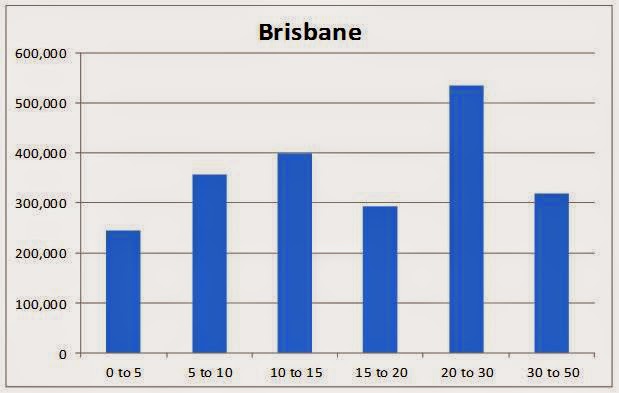
    Gushing media reports about inner city real estate markets and frantic development activity, public transport projects, parkland projects, bikeways, cultural facilities and the like fail to mention that only 10% of us, at most, live within the 5 kilometre ring. A thumping majority of 90% to 95% of Australians, in the major cities of Sydney, Melbourne and Brisbane, live outside the 5 kilometre ring of privilege. As a rule, 70% to 80% of us live further than 10 kilometres from the city centre, in outer-middle and outer suburban areas. It’s also true that the majority of us not only live beyond the inner city, but we also work outside it. Our pattern of living is not only overwhelmingly suburban, but so is our economy. (More on this next month).  

    So how do our three largest cities shape up on the evidence?

    Sydney


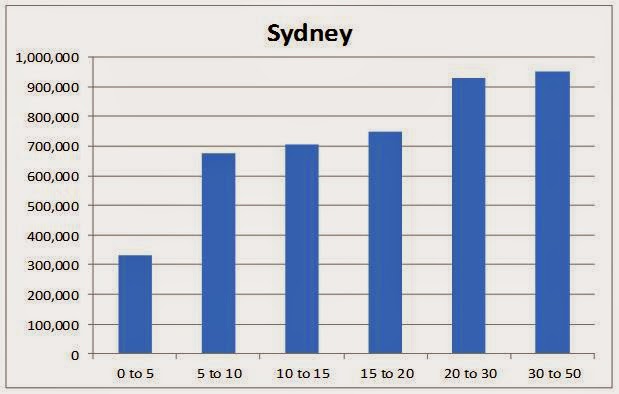
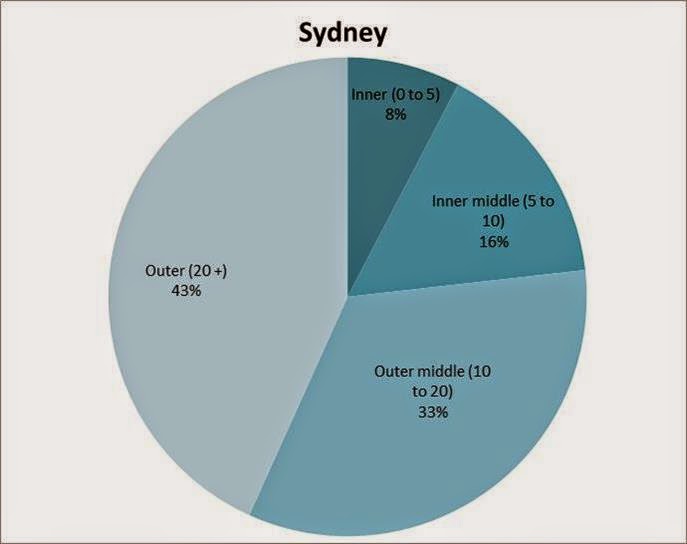
    There are just over 330,000 Sydney residents living within 5 kilometres of the city centre. There are a total of 4.34 million people living within 50 kilometres of the city centre, so that’s a fairly small 8% of the total who call the inner city home.   Twice as many people – 675,000 – live from 5 to 10 klms out and the numbers and percentages continue to rise the further out you go. They may live at lower densities in the outer suburbs but numerically they outnumber inner city residents ten to one. If we think of suburbs from 10 to 20 klms out as ‘outer middle’ areas and those over 20 klms out as ‘outer’, then 80% of the Sydney population lives further than 10 klms from the city centre. 

    Melbourne


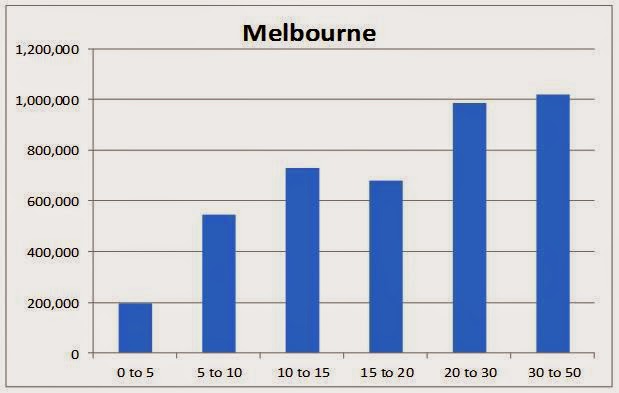
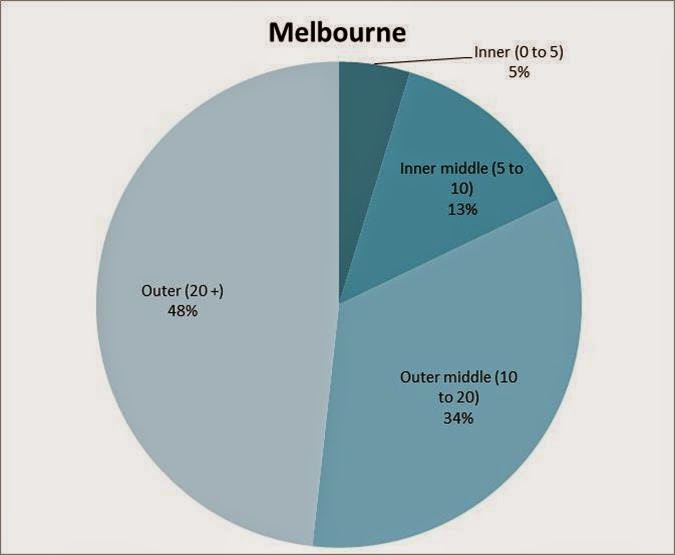
    There are fewer people living within 5 klms of the Melbourne City Centre than even Brisbane. Of the total 4.154 million people who live within 50 klms of the city centre, this is just 5% of the total. There are a further 13% of Melburnians who call the 5 to 10 klm band home, while a very substantial 82% of Melburnians call the outer-middle and outer bands home.  Even if the number of people living within the 5 klm ring of Mebourne’s CBD doubled, it would have next to no impact on the overwhelmingly suburban distribution of the population across the Melbourne metro area.

    Brisbane


    In Brisbane, there are around a quarter of a million people within 5 klms of the city centre. That represents 11% of the total 2.15 million people who live within 50 klms of the centre. A further 17% or 356,500 live from 5 to 10 klms out, which actually makes Brisbane the more centrally populated of the three cities studied. 72% of Brisbane residents live further than 10 klms out in middle-outer and outer suburbs which is still a very large majority but not quite the 80% of Sydneysiders nor the 82% of Melburnians. 

    Observations

    One observation worth making is that our governance systems aren’t well designed to deal with large metro regions. Sydney has an astonishing 38 local governments across its metro area, and Melbourne has 12. Brisbane is the exception, with one large local authority providing local government services to 1.13 million people. But even in Brisbane’s case that leaves a further 1 million people living within 50 klms of the city centre governed by a number of different local authorities.

    I am not suggesting we should have single local governments for our entire metro areas. In fact there are some good reasons for the ‘local’ in local government to focus on smaller areas. However, if we want metro wide solutions to apply policy attention and taxpayer funds equitably to suburban and urban areas, local governments may not be best vehicle. You could hardly expect, for example, the highly exclusive Sydney City Council – which at 25 square kilometres covers an area not much larger than its CBD and nothing more – to put up their hand and say “we don’t really need NSW taxpayers to subsidise our outrageously expensive light rail extension because we understand there are higher priorities for people in Bankstown or Hornsby.” 

    Which means that state governments, working with local and federal agencies, are the ones needed to adopt a broader governance approach to metro regions, with a focus on sustaining and developing the suburban economy along with the inner urban.

    The other, more glaring observation is that democracy seems to be failing the suburbs. Nine out of ten city dwellers may live in the suburbs and more eight in ten also work there, but increasingly it’s hard to shake the suspicion that it’s the people who live and work within a 5 klm ring of our city centres that are making the decisions and spending the money. 

    From politicians to heads of government departments, media organisations and industry leaders: the well off and the influential are overwhelmingly from the inner city. They live there, they work there, and primarily socialise and circulate within this hot house of privilege and influence. It may also explain why in some urban planning circles, there is an increasing sense of anti-suburban elitism creeping in. The suburbs and their ‘McMansions’ are topics of disdain for some, which is a pity. 

    The people who live in the middle-outer and outer suburbs of our cities in the main don’t live there because they have to: they live there because they want to. They don’t deserve derision, nor are they looking for sympathy. It may surprise inner city elites, but many have little interest in battling congested inner city traffic or paying excessive real estate prices or living in crowded inner urban arrangements or paying exorbitant parking fees for the privilege of working or living in or simply visiting in the inner city and what it has to offer.

    Yet while numerically superior in every way, the suburban existence remains largely shunned in policy circles. The more that the intelligentsia become isolated from the suburban heartland of our economy and way of life, the weaker we become as a nation. 

    Ross Elliott has more than 20 years experience in property and public policy. His past roles have included stints in urban economics, national and state roles with the Property Council, and in destination marketing. He has written extensively on a range of public policy issues centering around urban issues, and continues to maintain his recreational interest in public policy through ongoing contributions such as this or via his monthly blog The Pulse.

  • How the California Dream Became a Nightmare

    Important attention has been drawn to the shameful condition of middle income housing affordability in California. The state that had earlier earned its own "California Dream" label now limits the dream of homeownership principally to people either fortunate enough to have purchased their homes years ago and to the more affluent. Many middle income residents may have to face the choice of renting permanently or moving away.

    However, finally, an important organ of the state has now called attention to the housing affordability problem. The Legislative Analyst’s Office (LAO) has published "California’s High Housing Costs: Causes and Consequences," which provides a compelling overview of how California’s housing costs have risen to be by far the most unaffordable in the nation. It also sets out the serious consequences.

    The LAO says that:

    Today, an average California home costs $440,000, about two-and-a-half times the average national home price ($180,000). Also, California’s average monthly rent is about $1,240, 50 percent higher than the rest of the country ($840 per month).

    LAO describes the evolution:

    Beginning in about 1970, however, the gap between California’s home prices and those in the rest country started to widen. Between 1970 and 1980, California home prices went from 30 percent above U.S. levels to more than 80 percent higher. This trend has continued.

    Much of the LAO focus is on California’s coastal counties, where:

    ….community resistance to housing, environmental policies, lack of fiscal incentives for local governments to approve housing, and limited land constrains new housing construction.

    These causes result from conscious political decisions. While California’s coastal counties do not have the vast stretches of flat, appropriately developable land that existed 50 years ago, building is increasingly  prohibited on that which remains (for example, Ventura County, northern Los Angeles county and the southern San Jose metropolitan area).

    Demonstrating an understanding of economic basics not generally shared by California policymakers or the urban planning community, LAO squarely places the blame on the public policy limits to new housing construction:

    This competition bids up home prices and rents.

    In other words, where the supply of a demanded good is limited, prices can be expected to rise, other things being equal. LAO describes the impact of so-called "growth control" policies, which are also called "urban containment" or "smart growth:"

    Many Coastal Communities Have Growth Controls. Over two-thirds of cities and counties in California’s coastal metros have adopted policies (known as growth controls) explicitly aimed at limiting housing growth. Many policies directly limit growth—for example, by capping the number of new homes that may be built in a given year or limiting building heights and densities. Other policies indirectly limit growth—for example, by requiring a supermajority of local boards to approve housing projects. Research has found that these policies have been effective at limiting growth and consequently increasing housing costs.

    According to LAO, the problem is exacerbated by voter initiatives: "More often than not, voters in California’s coastal communities vote to limit housing development when given the option." It is hard to imagine a more sinister disincentive to aspiration, under which voters can deny equality of opportunity in housing to others by artificially driving up the price.  Because new housing further from coast is also limited, options for a middle income living standard are also diminished.

    These public policies have consequences.

    Notable and widespread trade-offs include (1) spending a greater share of their income on housing, (2) postponing or foregoing homeownership, (3) living in more crowded housing, (4) commuting further to work each day, and (5) in some cases, choosing to work and live elsewhere

    Each of these consequences is described below.

    LAO Consequence #1: Spending a Greater Share of Income on Housing

    LAO models the market situation from 1980 to 2010 to estimate the prices that would have prevailed if the regulatory environment had permitted building sufficient to satisfy customer demand at previous lower price levels. In both years, LAO estimates that the median priced house would have cost 80% more than in the rest of the nation (actual data in 1980, modeled data in 2010). This would have kept California house price increases at the national level. I think it would have been better to have modeled from 1970, before the huge house prices before 1980 described by Dartmouth economist William Fischel.

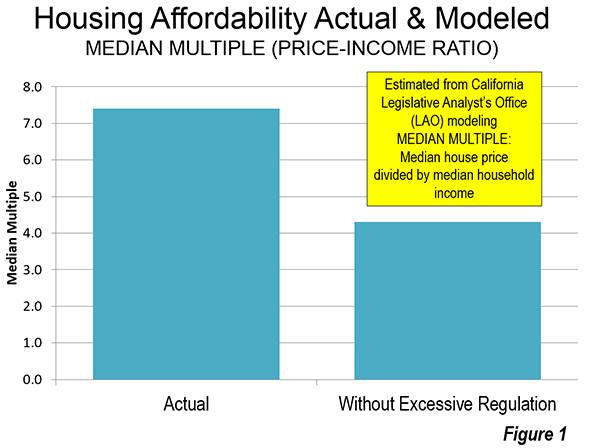
    I have applied this LAO model estimate to the median multiple for California’s six major metropolitan areas (Los Angeles, San Francisco-Oakland, Riverside-San Bernardino, San Diego, Sacramento, and San Jose) to identify how much better middle income housing affordability would be without California’s excessive regulation. Using the LAO estimates the median multiple (median house price divided by median household income) in 2014 would have been at least 40% lower than the actual level in each of the metropolitan areas (Figure 1).
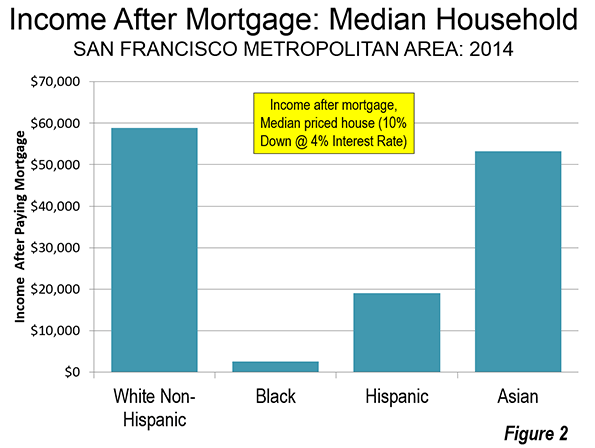
    Many California households already have been priced out of the market. In the worst case, it is estimated that in the San Francisco metropolitan area, a median income White Non-Hispanic household will have nearly $60,000 annually left over after paying the mortgage on the median priced house. This is less than they would have if house prices had remained reasonable, but it’s enough to live on. The median income Asian household would do almost as well, with about $50,000 left over. The median income Hispanic household would have less than $20,000 left, which is considerably less than is likely to be needed for other essentials. The median income Black household would have less than $3,000 left over (Figure 2). If the price ratios of 1980 were controlling, that amount would rise by $16,000.
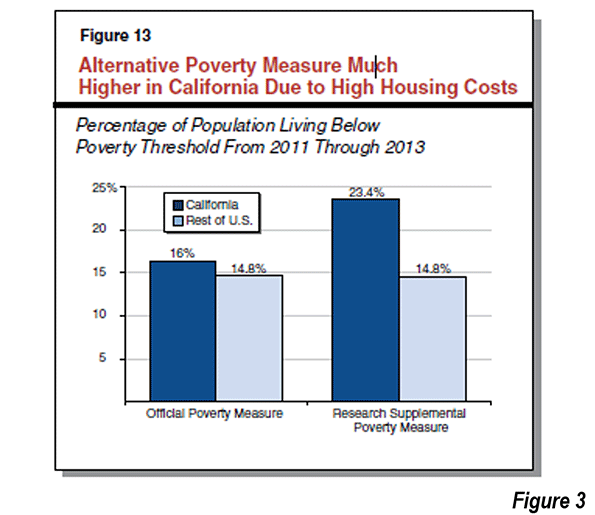
    LAO also points out that the Golden State has the highest housing cost adjusted poverty rate in the nation. The latest data shows housing-adjusted poverty rate is far higher even than that in states with a reputation for grinding poverty. California’s housing adjusted poverty rate is more than 50% higher than that of Mississippi and approaches double that of West Virginia (Figure 3, LAO Figure 13)
    LAO Consequence #2:  Postponing or Forgoing Homeownership

    LAO indicates that California ranks 48th in homeownership percentage, behind only New York and Nevada. LAO emphasizes the value of home ownership:

    Homeownership helps households build wealth, requiring them to amass assets over time. Among homeowners, saving is automatic: every month, part of the mortgage payment reduces the total amount owed and thus becomes the homeowner’s equity. For renters, savings requires voluntarily foregoing near-term spending. Due to this and other economic factors, renter median net worth totaled $5,400 in 2013, a small fraction of the $195,400 median homeowner’s net worth.

    Californians are buying their first houses later. LAO indicates that the average first home buyer in California is three years older than the national average.

    LAO Consequence #3:  Living in More Crowded Housing

    The nation’s worst overcrowding is an unfortunate result of California’s housing policies.

    LAO indicates that California’s overcrowding rate is well above that of the rest of the nation’s rate. Among Hispanics, which were expected to exceed the White-Non-Hispanic population in 2014, to become the state’s largest ethnic group, California overcrowding is more than 2.5 times the Hispanic rate elsewhere. Among households with children, overcrowding in California is four times the national households with children rate. Among renters, overcrowding in California is more than three times the national renter rate (Figure 4, LAO Figure 15).
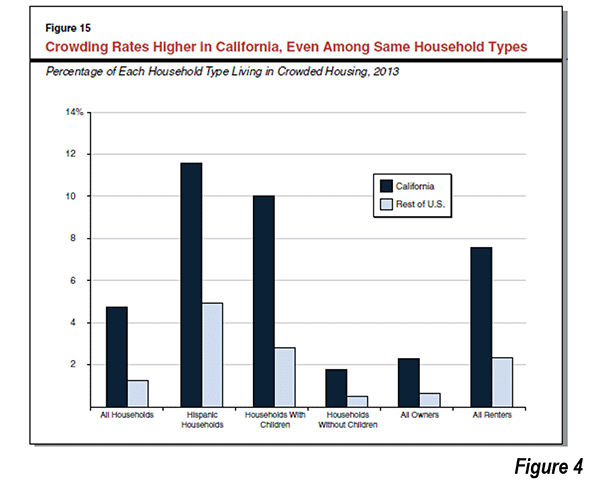
    This has important negative social consequences. According to LAO, research indicates that overcrowding retards well-being and educational achievement:

    Individuals who live in crowded housing generally have worse educational and behavioral health outcomes than people that do not live in crowded housing. Among adults, crowding has been shown to increase stress and aggression, lead to social isolation, and weaken relationships between parents and their children. Crowding also has particularly notable effects on children. Researchers have found that children in crowded housing score lower on standardized math and reading exams. A lack of available and distraction-free studying space appears to affect educational achievement. Crowding may also result in sleep interruptions that affect mood and behavior. As a result, children in crowded housing also displayed more behavioral problems at school.

    Overcrowding is particularly acute in the higher cost coastal metropolitan areas of Los Angeles, San Francisco, San Diego, and San Jose. There, overcrowding among households with children reaches 10%, and among Hispanic households, overcrowding reaches 18%. Among households with children the figure is slightly higher (Figure 5, LAO Figure 16). Overcrowded housing is generally worse, according to LAO, in areas with higher house prices.
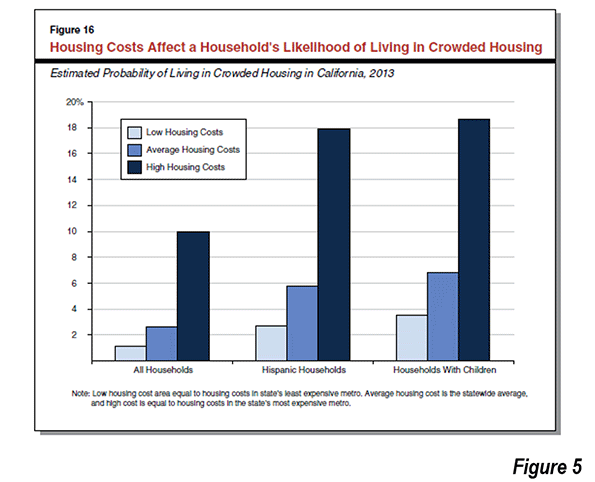
    In a state with a political establishment that prides itself in watching out for low income citizens and ethnic minorities, the need to reform the responsible policies could not be clearer.

    LAO Consequence #4: Commuting Farther to Work

    LAO finds that California’s average work trip commuting times are only moderately above the national average. However, LAO suggests that the commute lengthening impact of higher house prices may be reduced by California’s widespread (I call it dispersed) development pattern, its freeway system and the "above-average share of commuters who drive to work. (Driving commutes are generally fast, and therefore metros with higher shares of driving commuters tend to have shorter commute times.)"

    Nonetheless, according to LAO:

    …our analysis suggests that California’s high housing costs cause workers to live further from where they work, likely because reasonably priced housing options are unavailable in locations nearer to where they work.

    LAO Consequence #5:  Choosing to Work and Live Elsewhere

    LAO also indicates that California’s high housing prices are likely to have reduced its population (and economic) growth. LAO sites the strong net outmigration of California households to other states. LAO also finds in its national metropolitan area analysis that counties with higher growth rates tend to have better housing affordability than counties with lower growth rates.

    There has also been strong net outmigration from the coastal counties to inland counties. This is most evident in the growth of the Riverside-San Bernardino metropolitan area (the Inland Empire) between 2000 and 2010. The Inland Empire captured more than two thirds of the population growth of the Los Angeles Combined Statistical Area (Los Angeles, Orange, Riverside, San Bernardino and Ventura counties). LAO notes the impact of the excess of demand in the coastal counties, again recognizing the nexus between overzealous regulation and the loss of housing affordability:

    This competition bids up home prices and rents. Some people who find California’s coast unaffordable turn instead to California’s inland communities, causing prices there to rise as well.

    LAO also refers to the difficulty that employers have in retaining and recruiting staff. LAO cited survey data from the Silicon Valley, which has for years been California’s economic "Golden Goose" in recent years:

    In a 2014 survey of more than 200 business executives conducted by the Silicon Valley Leadership Group, 72 percent of them cited “housing costs for employees” as the most important challenge facing Silicon Valley businesses.

    In addition, there has been a strong movement of California companies to other parts of the nation, where more liberal regulations foster a better business climate.

    Restoring Housing Affordability

    LAO indicates the importance of fundamental reform and calls for putting "all policy options on the table."

    Major changes to local government land use authority, local finance, CEQA (California Environmental Quality Act), and other major polices would be necessary to address California’s high housing costs.

    In addition:

    The greatest need for additional housing is in California’s coastal urban areas. We therefore recommend the Legislature focus on what changes are necessary to promote additional housing construction in these areas.

    Perhaps the only weakness of the report deals with densification, particularly in coastal counties. For example, LAO suggests that without the housing restrictions the city of San Francisco is population would be 1.7 million, rather than the approximately 800,000 who live there today. In fact that would be unprecedented beyond belief. No core city that had become fully developed and reached 500,000 people by 1950 has achieved growth of this magnitude. The greatest growth was less than 10%, in this category of 60 core cities (which includes the city of San Francisco). Even less likely would be public support for such huge population growth in the second densest major municipality in the nation.

    While LAO does not indicate the additional population that its estimates would have placed in the core of Los Angeles, given the scale of the San Francisco increase, this could be a number of up to 3 million. This area, the broadest expanse of over 10,000 population per square mile density in the nation outside New York City is in the middle of the urban area with the nation’s worst traffic congestion, according to the Texas A&M Transportation Institute. It is doubtful that residents would have the "stomach" to expand roadway capacity to keep the traffic moving. Transit could not have made much difference. Even with its now extensive rail network that has opened since the early 1990s, driving alone accounted for 85% of the additional travel to work from 2000 to 2013 in the city of Los Angeles. Yet, the city of Los Angeles has the most extensive transit in the metropolitan area, including service by all rail lines.

    In reality, core densification is likely to be modest. Keeping housing affordability from getting worse requires regulatory liberalization throughout California, including coastal and inland areas
    The reality is that if California had permitted growth, it would naturally occurred mostly on the periphery. Even with the restrictions on building, the preference for suburban living (largely in detached housing) could not be repressed between 2000 and 2010. Less than 10% of the population growth in the Los Angeles and San Francisco Bay areas occurred in the cores.

    The Challenge

    Should the state of California begin to seriously discuss housing affordability, it will be important to ease restrictions throughout the state, not just in the coastal counties. There are serious barriers to placing the appropriate priority on improving the standard of living and minimizing poverty rates among California’s diverse population. Perhaps the biggest impediment is Senate Bill 375, which is being interpreted by the state and its regional planning agencies to require even more stringent land-use regulation.

    In this environment, LAO rightly raises this concern:

    If California continues on its current path, the state’s housing costs will remain high and likely will continue to grow faster than the nation’s. This, in turn, will place substantial burdens on Californians—requiring them to spend more on housing, take on more debt, commute further to work, and live in crowded conditions. Growing housing costs also will place a drag on the state’s economy.

    It is to be hoped that California’s distorted policy priorities will be righted to restore the California Dream.

    Photograph: Dense suburban development: Inland Empire (San Bernardino Freeway with Uplard toward the top and Ontario toward the bottom) – By author

    Wendell Cox is an international public policy consultant and principal of Demographia in St. Louis. He is a native Los Angelino, having been born within two miles of City Hall. He was appointed to three terms on the Los Angeles County Transportation Commission by Mayor Tom Bradley. Full biography is here.