Category: Policy

  • Towns With a Past, Towns With a Future

    Over the last fifty or sixty years most towns have been dedicated to accommodated cars in order to cultivate business and permit people to live better more convenient lives. For new developments out in a former corn field this was effortless since everything was custom built with the automobile in mind. But older towns that had been built prior to mass motoring were at a distinct disadvantage.

      Screen Shot 2014-12-04 at 12.57.53 AM Screen Shot 2014-12-05 at 1.15.13 AM Screen Shot 2014-12-05 at 1.16.43 AM

    In order to keep up with changing times older neighborhoods, particularly older Main Street business districts, did whatever possible to retrofit themselves. The roads were widened, sidewalks were narrowed, street trees were removed, obsolete buildings were torn down to make way for parking lots, new zoning regulations and building codes were introduced to ease traffic and ensure abundant free parking. Unfortunately for many historic towns there simply was no contest. New strip malls and office parks could provide endless free parking and massively wide roads. If you add in the competition from big box national chains and the politics of race and class driving people across municipal borders for lower taxes and segregated school districts… Main Street never had a chance. The irony is that the more towns tried to accommodate cars the less pleasant they became.

    Screen Shot 2014-12-03 at 10.31.41 PM Screen Shot 2014-12-03 at 7.00.56 PM Screen Shot 2014-12-05 at 1.06.03 AM
    Screen Shot 2014-12-03 at 10.33.08 PM Screen Shot 2014-12-05 at 12.31.52 AM
    Screen Shot 2014-12-05 at 12.32.11 AM
    Screen Shot 2014-12-03 at 11.14.20 PM Google Earth

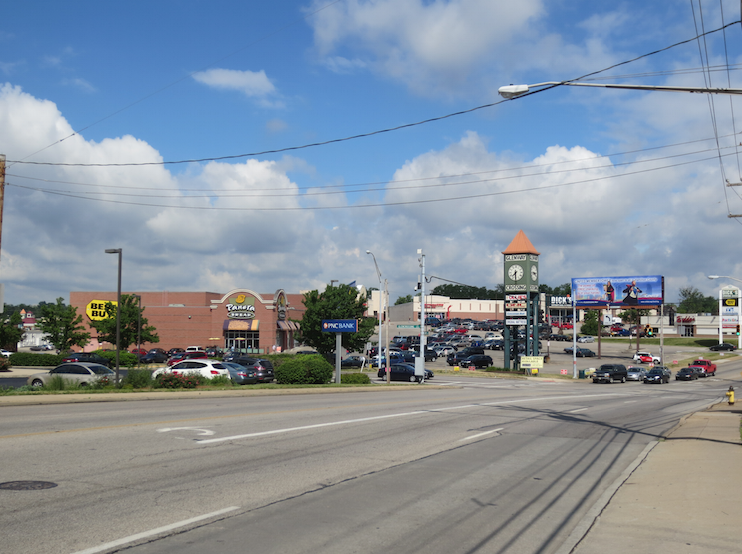
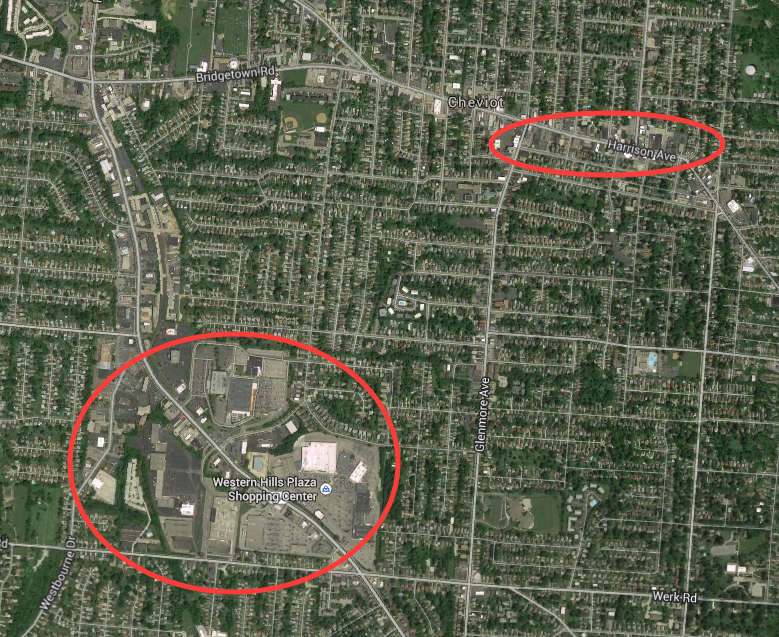
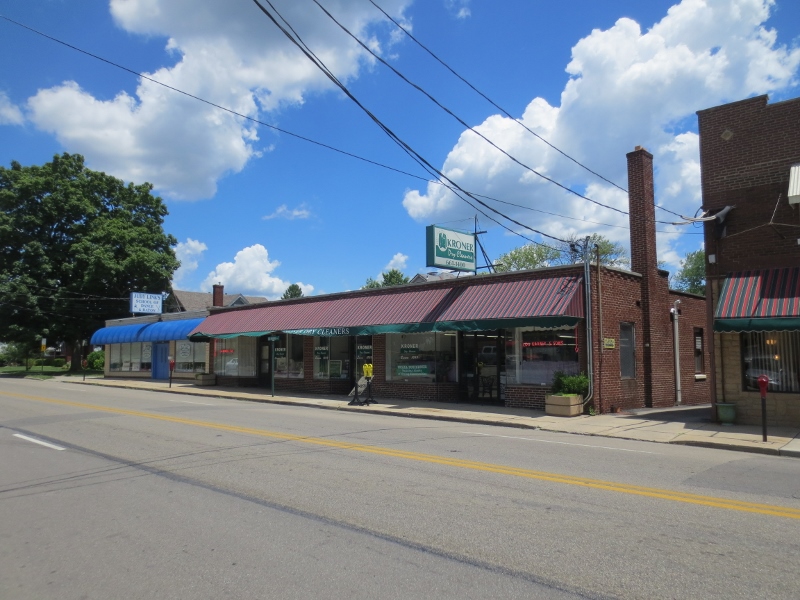
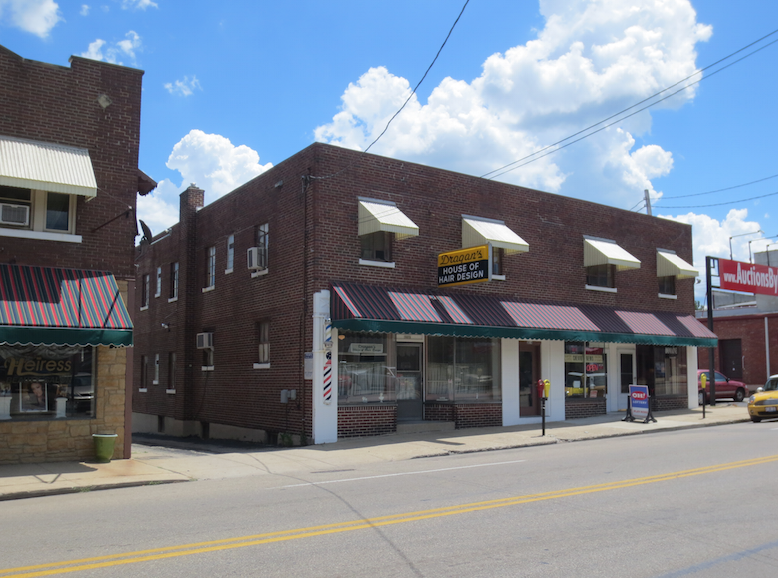
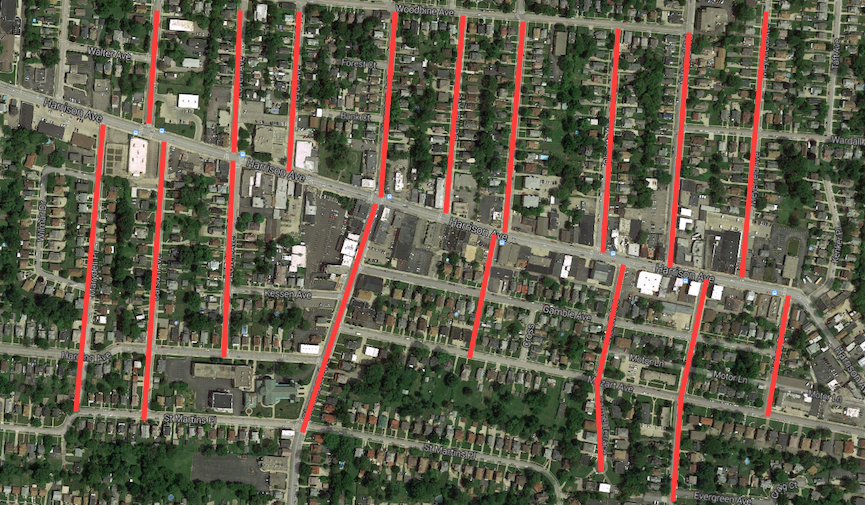
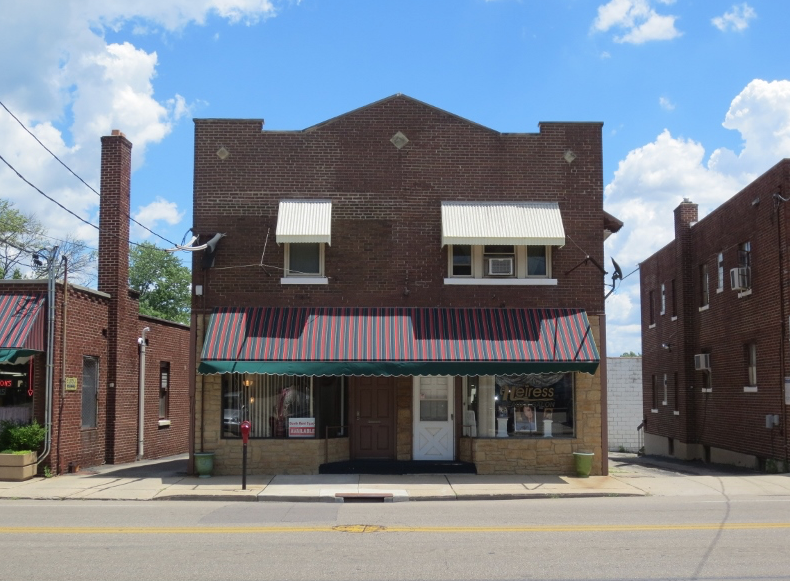
    This is a Google Earth image of the area around Cheviot, Ohio. The people of Cheviot self-identify with the fictional 1950’s TV town of Mayberry made famous by The Andy Griffith Show. It really is a lovely place, but it effectively has no business district anymore thanks to the Western Hills Plaza Shopping Center half a mile away which straddles Green Township and the Westwood district of suburban Cincinnati. Harrison Avenue, Cheviot’s century old Main Street, is circled at top right. Western Hills Plaza is circled at bottom left. The Home Depot, Target, Kroger, and Dillard’s make it impossible for mom and pop shops on Harrison Avenue in Cheviot to sustain themselves. Half the shops are empty and the others limp along. It’s a shame, because Cheviot is a charming town full of great old commercial buildings and solid housing stock. It’s a good town full of good people. The German Catholics who settled and built this part of Ohio have managed to hold on to a fair-to-middling set of arrangements through the worst years of decline, but the town is a shadow of its former self. It has excellent bones, but the flesh is sagging through no fault of its own.
    Screen Shot 2014-12-03 at 11.22.36 PM Screen Shot 2014-12-03 at 6.47.29 PM IMG_9387 (800x600) Screen Shot 2014-12-05 at 1.12.50 AM

    However, Cheviot has one thing that Western Hills Plaza doesn’t – a walkable, bikable, fine-grained pleasant neighborhood. That may not sound like much, but it’s more than nearly anyplace built after 1950 anywhere in North America can boast. Cheviot is an actual town, not just mindless suburban sprawl. That’s a rare commodity these days and a lot of people are hungry for it. Just about every home in Cheviot is within a five or ten minute walk of the old business district, local public schools, library, churches, and parks. It has become unusual in America for people to live in this kind of environment and it’s coming back in fashion with increasing demand and limited supply. There’s an opportunity here for people with the right attitude.
    Screen Shot 2014-12-04 at 1.09.07 AM Screen Shot 2014-12-04 at 1.08.19 AMGoogle Earth

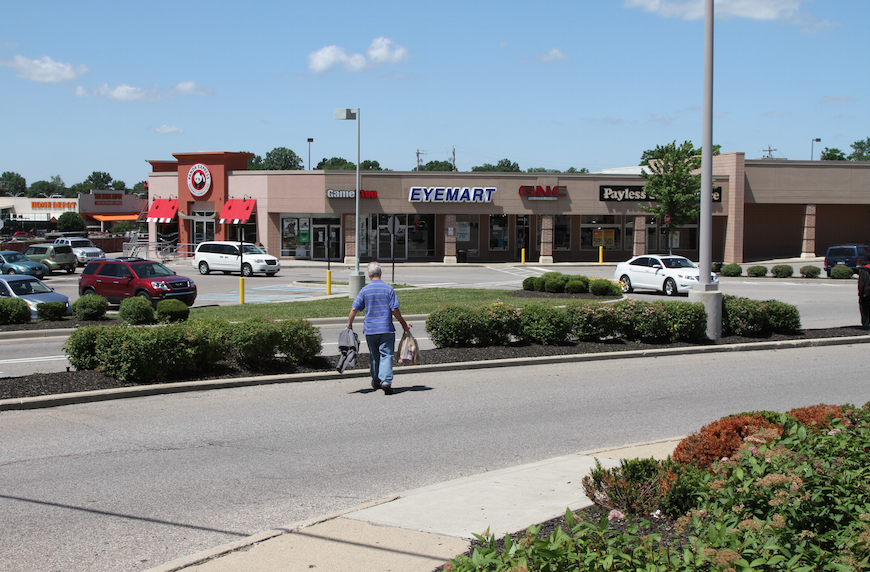
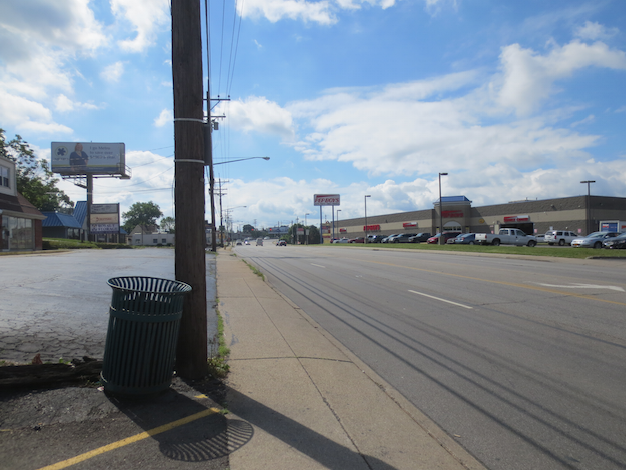
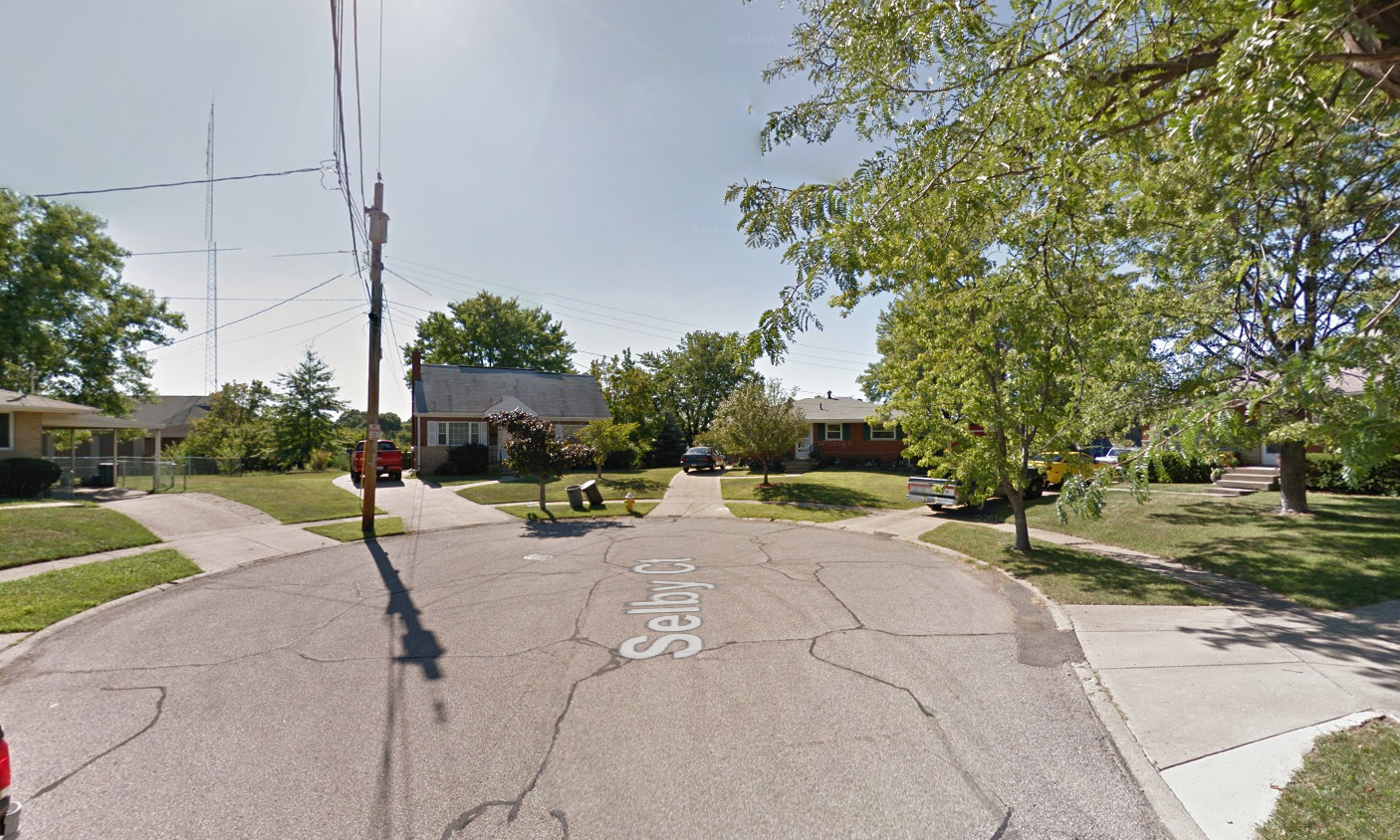
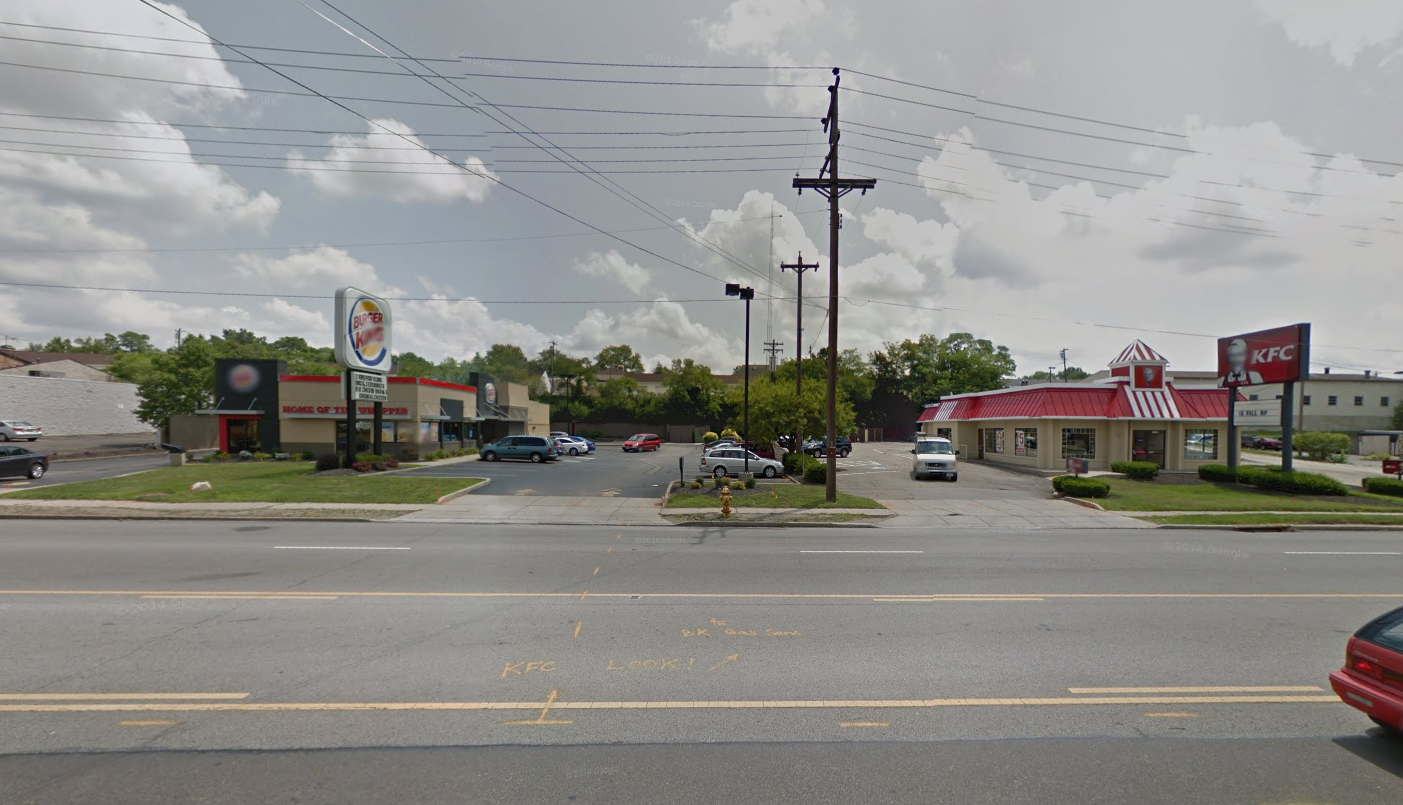
    In contrast let’s say that you lived here on this cul-de-sac in Green Township and you wanted to go to one of the fast food places directly behind your back fence. This is the route you’d need to take.

    Screen Shot 2014-12-04 at 1.10.14 AM Google Earth

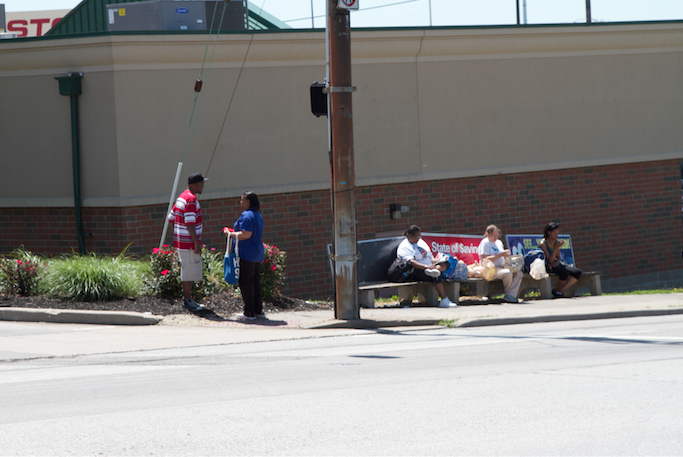
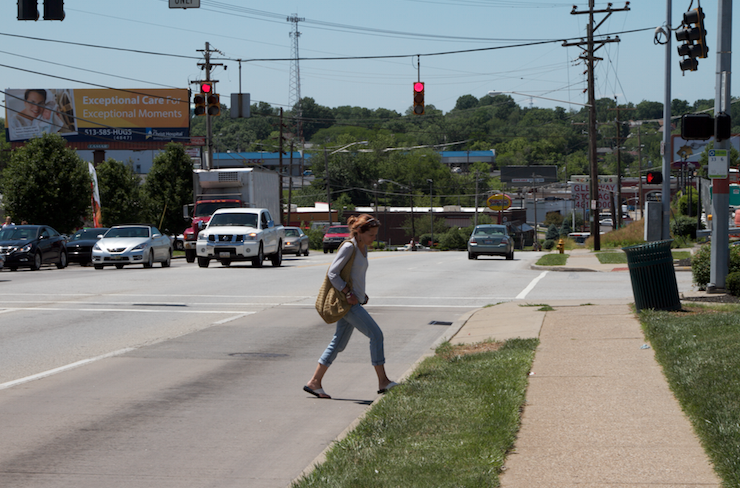
    If you’re used to driving everywhere everyday you might not think twice about hopping in the car. In fact, you might not even realize that the Burger King and KFC are so close. But if you were somehow forced to walk one day you might be surprised at how hard it would be given all the walls, fences, and drainage ditches that stand between you and your fast food. And the walk would be a miserable and potentially dangerous experience. The highway and its cavalcade of concrete and plastic bunkers is so wretched when you aren’t in a car that developers and city planners go out of their way to keep homes as isolated and buffered as possible. This radical separation of uses makes perfect sense in a car-oriented environment. Who wants to look out at a highway strip mall from the back yard? But it’s Hell on foot. And don’t even think of riding a bike. You’ll either get hit by a speeding car or attract the attention of the local police who will immediately identify you as a deviant. Being a pedestrian or cyclist in this environment constitutes “probable cause”. You must be unsavory if you lower yourself to such desperation here. Sitting at a bus stop in this setting is no joy either.

    Screen Shot 2014-12-04 at 12.51.28 AM Screen Shot 2014-12-04 at 12.53.48 AM Screen Shot 2014-12-04 at 12.23.18 AM Screen Shot 2014-12-04 at 12.55.51 AM IMG_9626 Screen Shot 2014-12-05 at 1.14.48 AM

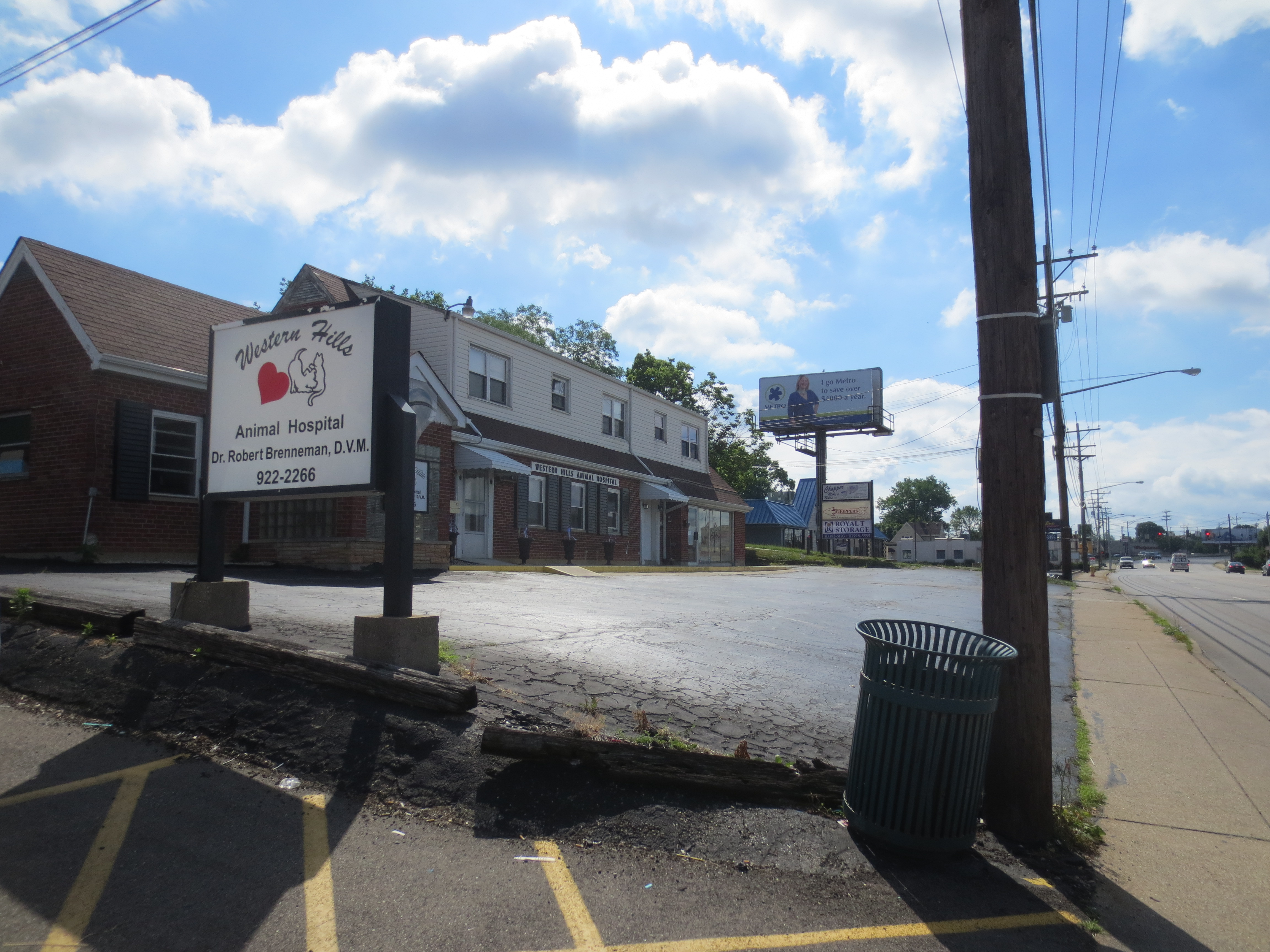
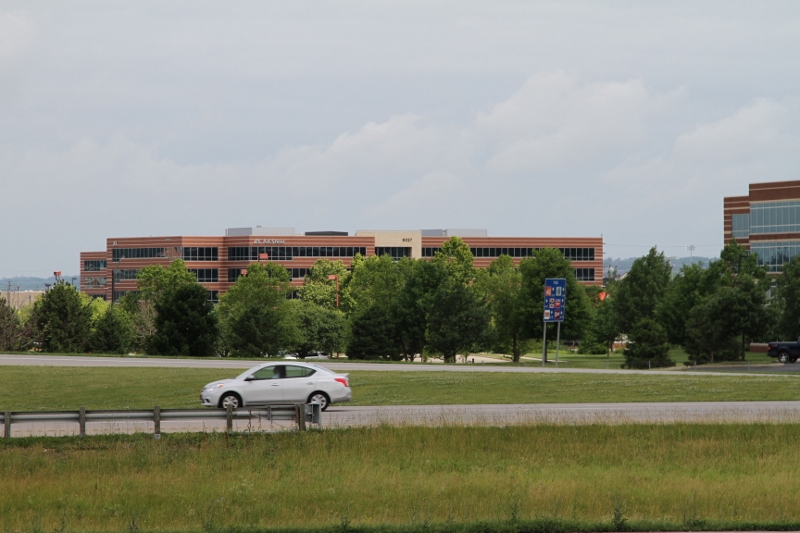
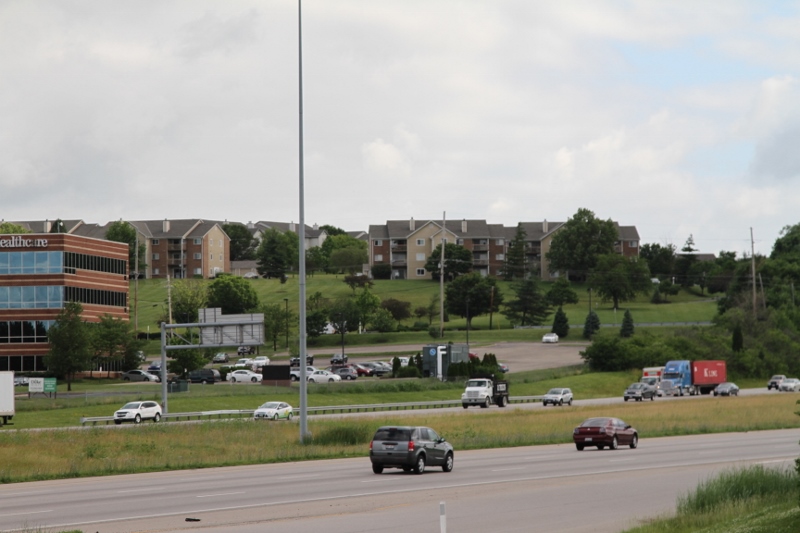
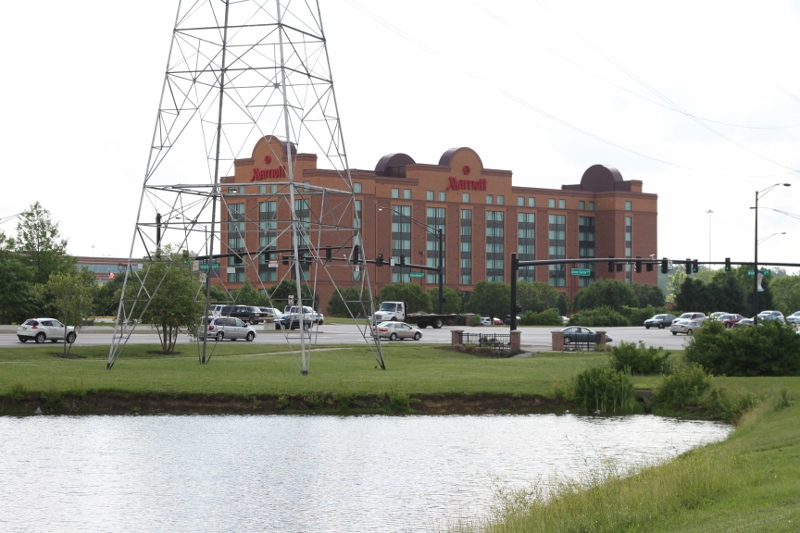
    So here’s the challenge of the next few decades. The aging sprawl in Green Township and similar nearby post war suburbs like White Oak, Sharonville, and Deer Park on the edge of Cincinnati aren’t aging well. Their roads and sewer systems are right at the point where they need complete overhauls and there’s no money for any of it. Don’t expect Columbus or Washington to send big checks because they’re broke too. The housing stock in these places is neither charming in a Norman Rockwell sort of way, nor sufficiently Mad Men modern. Their roofs, windows, kitchens, baths and furnaces all need replacing right about now and there isn’t a lick of insulation in most of them. Fifty years ago these suburbs were white middle class havens with their backs to inner city decay and race riots.
    IMG_6149 (800x533) IMG_6126 (800x533) IMG_6164 (800x533) IMG_6155 (800x533) IMG_6128 (800x533)

    Now newer more prosperous suburbs Like Mason and Beavercreek farther out attract wealthier residents looking for larger homes with all the latest bells and whistles along with premium public schools and lower taxes. Green Township has less than half the average family income of Mason. Homes in Green Township and other similar areas sell for $75,000 although many homes can be found for considerably less. Mason homes sell for north of $250,000 with many at much higher price points. Meanwhile downtown Cincinnati and Over-the-Rhine are rapidly gentrifying as people who prefer an urban environment reinvigorate long abandoned neighborhoods. The poor are being displaced in the process and they’re going to have to live somewhere. Given the trajectory of these shifts it isn’t looking good for the so-so suburbs in the middle distance. We can expect more “Fergusons” on the horizon although the particulars are unknowable at this time. This economically induced migration won’t be good for the poor either. They just spent the last few generations sucking up the desiccated crumbs of 19th Century industrialism and now they’re being shunted off to the stale left overs of 20th Century sprawl just in time for it to die.


    Screen Shot 2014-12-05 at 1.06.38 AM Screen Shot 2014-12-05 at 1.07.09 AM Screen Shot 2014-12-05 at 1.13.14 AM Screen Shot 2014-12-05 at 1.08.55 AM  IMG_9203 (800x600) IMG_9191 (800x600) IMG_9197 (1024x768) (800x600) Screen Shot 2014-12-05 at 1.14.02 AM Screen Shot 2014-12-05 at 1.11.41 AM Screen Shot 2014-12-05 at 1.05.23 AM Screen Shot 2014-12-05 at 1.09.52 AM Screen Shot 2014-12-05 at 1.11.59 AM Screen Shot 2014-12-05 at 1.11.18 AM

    But there’s hope for some of these places. Pressed up against both Cheviot and Green Township is Westwood, a former streetcar suburb that also uses Harrison Avenue (the old streetcar route) as its long-lost Main Street. Westwood was once an independent town, but was annexed by Cincinnati a hundred years ago. It fell out of favor beginning in the 1950’s when the streetcar was ripped up and shiny new subdivisions and shopping centers were built-in places like Green Township. Moving children out of Cincinnati public schools to another jurisdiction a mile away was one of the primary motivations as racial tensions in the city grew. Taxes were also lower in the new suburbs. (Is any of this ringing a bell?) Cincinnati has recently figured out that it can’t compete with Mason or Beavercreek for that particular share of the upscale suburban real estate market, but it’s looking at the success of Over-the-Rhine and wondering what the family friendly conservative Republican Catholic version of revitalization might look like in Westwood. In other words, what can parts of Cincinnati provide in the way of a value-added “product” or “experience” in their century old neighborhoods of single family homes that Mason can’t. There’s a chance that Westwood’s competitive advantage might just be walkability and historic charm. The city adopted a form based code for this part of Westwood and has been investing money in the schools and parks with plans to create a town square in what is now an awkward triangular intersection next to the Carnegie library. There are also existing businesses and subtle interdependent institutions that simply don’t exist out in new suburban locations. If you want your cello or violin repaired you’re not going to find that sort of thing at the mall between the food court and the Sunglass Hut. A more pedestrian oriented Westwood with unique family oriented destinations and activities could be an engine that pulls the area in a better direction. Sooner or later all those Hipsters downtown are going to start getting married and having kids and their going to want a house with a patch of garden. There could be an advantage to having that life three miles from downtown instead of twenty-two miles out in Mason. On the other hand, Westwood could simply languish and be dragged down by the failing sprawl that surrounds it. It could go either way. Time will tell.

    John Sanphillippo lives in San Francisco and blogs about urbanism, adaptation, and resilience at granolashotgun.com. He’s a member of the Congress for New Urbanism, films videos for faircompanies.com, and is a regular contributor to Strongtowns.org. He earns his living by buying, renovating, and renting undervalued properties in places that have good long term prospects. He is a graduate of Rutgers University.

  • Overselling America’s Infrastructure Crisis

    60 Minutes ran a segment recently called “Falling Apart” that was another alarmist take on the state of American infrastructure. I’ll embed here but if it doesn’t display for you, click to CBS News to watch (autoplay link).

    We’ve seen this story before. America’s infrastructure is falling apart and we need to spend many billions on upgrades, but politicians won’t agree because they are too craven.


    There’s some truth to this point of view. The problem is that it’s oversold using the worst examples. It also gives short shrift to the many infrastructure upgrades that we have been making. And it ignores how people and businesses make capital purchase decisions in the real world.

    First, I’m not surprised to see that 60 Minutes spent a lot of time in Pennsylvania. In my experience, Pennsylvania is in a class by itself when it comes to infrastructure. Drive something like I-70 from Washington to the Ohio state line and prepare to be appalled. Pittsburgh legitimately has a massive infrastructure maintenance overhang. Philly too. And much of the infrastructure there was under built to begin with. The Schuylkill Expressway goes down to two lanes each way, for example. Similarly, 60 Minutes is right about some of the obsolete bridges on Amtrak’s Northeast Corridor. They may have easily included other high profile embarrassments like LaGuardia Airport or Penn Station. Or they might have taken a look at state of decay of Rhode Island’s bridges.

    There are clearly some high profile legacy items that need to be addressed. But that neglects the other side of the coin, namely that there’s a ton of major infrastructure that has been upgraded.

    60 Minutes includes some footage of Chicago. Clearly there’s a need for bigtime investment there. But in the last 20 years or so IDOT reconstructed completely many of the major freeways in the area like the Kennedy and Dan Ryan. The Tollway Authority widened virtually the entire system and implemented open road tolling, vastly reducing congestion. Similarly the CTA opened the brand new Orange Line, did major work to renovate the Green and Pink Lines, just did major infrastructure upgrades on the south branch of the Red Line, and expanded capacity on the Ravenswood. They’ve also gone from tokens and cash to electronic fare collection. At least one new commuter rail line was opened (the North Central line). The O’Hare Modernization program is underway with new runways already online and a significant reduction in congestion there. A new terminal was also built and the existing terminals given some refreshes.

    Is there a lot to do in Chicago? Undoubtedly. But let’s give credit for what has already been done.

    It’s the same elsewhere. Nicole Gelinas notes that New York has invested $123 billion in the transit system in the last 30 years. That’s not chump change. The third water tunnel is now online there as well. Indianapolis built an ultra-modern airport terminal complex that’s up to international standards. Many other airports like DTW, SJC, SFO, etc. have built major new terminals or seriously upgraded their acts. There have actually been a lot of investments in port infrastructure to get ready for post-Panamax ships.

    I’m told even Pennsylvania has done a good job of starting to address its infrastructure problems. The Philadelphia airport is actually quite nice these days, for example.

    So we’ve actually done a lot already that 60 Minutes doesn’t give us credit for.

    But what’s more, the presence of infrastructure that’s at or near the end of its useful life isn’t necessarily a bad thing anyway. Would it make sense for every single car on the road to be brand new? Of course not. Most cars ultimately end up getting driven till the wheels fall off. And that makes perfect sense. Why would you junk an asset that still has lots of service life left? We reallocate ownership of a lot of those cars during their lifespan, but we try to get the max out of their useful life.

    It’s similar in our homes. How many of us replace a furnace at the first sign of rust? Yes, sometimes we do a complete upgrade or refresh of a kitchen or bathroom, but most of the time we don’t replace major household systems like furnaces or roofs until they appear to be at a point where paying for repairs when they break appears to be futile in light of the asset age. It makes sense to pay $400 to replace a starter that fails when the car has 125,000 miles. It’s more questionable when the transmission goes out at 175.

    The fact that some issues or incidents with infrastructure can cause temporary closure or disruption is exactly how most personal capital assets work. A part goes out on our car. It needs to be towed and fixed. And it’s out of commission during that period. That’s annoying, disruptive, and costly. But does it mean that we should all go out and buy a brand new car? I don’t think so. And that’s certainly not how people behave in the real world. Obviously you have to build in a margin of safety on items like bridges where a failure would be catastrophic, but the same general principle applies. We shouldn’t wait for them to fail before replacement, but we do and should get the full useful life out of them.

    Why would we expect our government to spend our money on its capital assets in a manner differently from how we spend our money on our own personal possessions? This explains why the public is much more skeptical of spending on infrastructure than the infrastructure lobby would like. It’s to be expected that some percentage of our infrastructure will perpetually be at or near end of life, as that’s the nature of the capital asset life cycle.

    What’s more, when we replace a furnace or car, most of us don’t go out and buy Cadillacs. We buy something that fits the budget. Unfortunately, this mindset doesn’t seem to penetrate the public sector, where a significant amount of infrastructure is gold plated and priced at a level far out of line with international comparisons. The big problem in New York isn’t a lack of investment in transit. It’s the fact that the region has just about the highest transit capital costs in the world. Wonder why Madrid and Calgary have nice train systems? Among other reasons, they were very cost-efficient in their design and construction. Rather than more money, maybe we should first try some reform in our broken system of building stuff that results in lengthy project timelines and out of control costs.

    So there are some things that need to be taken care of and we need to do that. But scaremongering about dangerous bridges isn’t the right answer. And where I see the biggest infrastructure needs are on local streets and bridges, where federal and state dollars are least likely to be applicable. It’s no surprise to me that most of the pothole ridden, bombed out streets we drive on are local city streets, where they are the maintenance responsibility of an entity that lacks the large, dedicated infrastructure revenue streams available to the state and federal governments. But that’s a topic I’ll have to explore in a future post.

    Aaron M. Renn is an independent writer on urban affairs and the founder of Telestrian, a data analysis and mapping tool. He writes at The Urbanophile, where this piece originally appeared.

  • Can Abe Tackle The Real Reason For Japan’s Decline? (Procreation)

    Much has been made of Japan’s latest relapse into recession. For the most part, economists have focused on the efficacy of the once much-ballyhooed “Abenomics,” the stimulus and structural reform program that was seen as the key to turning around the island nation’s torpid economy.

    While Prime Minister Shinzo Abe’s ruling coalition won a sweeping electoral victory this weekend, giving him a mandate to continue his economic policies, it is increasingly clear that the epicenter of Japan’s crisis is not its Parliament, or the factory floor, but in the bedroom. Japan has been on a procreation holiday for almost a generation now, with one of the lowest fertility rates on the planet. The damage may prove impossible to overcome.

    Japan’s working-age population (15-64) peaked in 1995, while the United States’ has grown 21% since then. The projections for Japan are alarming: its working-age population will drop from 79 million today to less than 52 million in 2050, according to the Stanford Institute on Longevity.

    Since hitting a peak of 128 million in 2010, Japan’s overall population has dropped three years in a row.

    These trends all but guarantee the long-term decline of the Japanese economy and its society. In comparison, competitors such as the United States and India are projected to continue to grow their workforces over the long term. China’s workforce, which grew rapidly over the last couple of decades, recently began to decline, as early as 2010 by one estimate, due to its one-child policy.

    Some countries, like Germany or Singapore, have tried to make up for low fertility through immigration, something that remains all but unthinkable in congenitally insular Japan. Short-term importation of workers has occurred through a “foreign trainee” program, but it has stirred controversy, with some immigrant workers claiming they are being cheated and abused.

    Aging is becoming a bigger issue, particularly due to the country’s average lifespan of 83 years, which is among the longest in the world. Perhaps if everyone would have the good sense, as one Japanese official put it, to “hurry up and die,” the shrinkage would be manageable.

    But old Japanese don’t seem to be lining up to commit suicide. So by 2020, adult diapers are projected to outsell the infant kind. By 2040, the country will have more people over 80 than under 15, according to U.N. projections. By 2060, the number of Japanese is expected to fall from 127 million today to about 87 million, of whom almost 40% will be 65 or older.

    The fiscal costs are obvious. Over the past few decades, aging has helped transform once thrifty Japan into the country with the high-income world’s highest level of government debt. The demands for more help for the elderly, notably medical care, combined with a shrinking, increasingly occasional workforce, is one reason why Abe was forced to push for a sales tax increase, one of the things that retarded Japan’s recovery.

    These trends have been developing for decades. Sociologist Muriel Jolivet noted in her 1997 work Japan: The Childless Society that many Japanese women had taken a break from motherhood, in part due to male reluctance to take responsibility for raising children. This trend accelerated in the next decade. By 2010, a third of Japanese women entering their 30s were single, as were roughly one in five of those entering their 40s. That’s roughly eight times the percentage in 1960, and twice that of 2000. By 2030, according to sociologist Mika Toyota, almost one in three Japanese males may be unmarried by age 50.

    Many young Japanese are not only eschewing marriage but a highly publicized sliver now show little sexual interest in each other. The percentage of sexually active female university students, according to the Japanese Association for Sex Education, has fallen from a high of 60% in 2005 to 47% in 2012.

    Much has been made of a subset of young Japanese men labeled as “herbivores,” who appear more interested in comics, computer games and socializing through the Internet than in seeking out the opposite sex.  And since many only work part-time, they tend to stay longer with their parents, further slowing economic growth.

    No society can thrive under such an environment, certainly not in the long run. If “animal spirits” drive entrepreneurial growth — as it did unmistakably in Japan both before and after the Second World War — those are clearly dissipating now. As prices have dropped and opportunities shriveled, fewer Japanese are interested in starting or growing families.

    In the longer run, one has to wonder what kind of country Japan may become over time, something hardly irrelevant not only due to the country’s importance, but also since other key Asian countries appear to be following the demographic path it is blazing, including including South Korea, Taiwan, Singapore and China. In China, the U.S. Census Bureau estimates, the population will peak in 2026, and will then age faster than any country in the world besides Japan.

    Of course, projecting population and fertility rates over the long run is difficult, and there remains a large margin for error. For example, the U.N. projects Japan’s 2100 population at 91 million, while Japan’s National Institute of Population and Social Security Research projects a population of 48 million, nearly one-half lower.

    Japan’s grim demography is also leading to tragic ends for some elderly. With fewer children to take care of elderly parents, there has been a rising incidence of what the Japanese call kodokushi, or “lonely deaths” among the aged, unmarried, and childless. Given the current trends, this can only become more commonplace over time.

    The Japanese “model” of low fertility still has its defenders, including those in the U.S. who point out that it allows, in the short term, for greater per capita wealth and lower carbon emissions. But most Japanese recognize that the profound morbidity of the demographic trends; 87% see an aging population as a major problem, according to a recent Pew study, compared to 57% in China and only 26% in the U.S.

    And to be sure, Japan remains a supremely civilized country, with low crime rates, a brilliant artisanal tradition, and exemplary infrastructure.But none of this can likely survive under these demographic conditions. Not surprisingly, the  Japanese government, like its counterparts in western Europe and Singapore, has attempted tomake child-rearing easier by providing cash payments for families and expanding child care.

    Yet to date, such compensation has been unable to make up for high housing costs and weaker familial bonds. As Toru Suzuki, senior researcher at the National Institute of Population and Society Security Research, put it in The Japan Times, “Under the social and economic systems of developed countries, the cost of a child outweighs the child’s usefulness.”

    Although the United States has not embarked on such a dismal course, in large part due to a greater land mass, lower housing prices and immigration, for us, too, the twin forces of lower fertility and the retirement of baby boomers is slowing our labor force growth rate.

    Ideally American fertility rates will recover with the economy, allowing us to get back to a more sustainable demography that would at least replace older people with a steady supply of young adults. What we don’t want to do is emulate Japan. There’s a price to pay for avoiding the bedroom in favor of video games, not only for individuals but societies as well.

    This piece first appeared at Forbes.com.

    Joel Kotkin is executive editor of NewGeography.com and Roger Hobbs Distinguished Fellow in Urban Studies at Chapman University, and a member of the editorial board of the Orange County Register. His newest book, The New Class Conflict is now available at Amazon and Telos Press. He is author of The City: A Global History and The Next Hundred Million: America in 2050. His most recent study, The Rise of Postfamilialism, has been widely discussed and distributed internationally. He lives in Los Angeles, CA.

    Photo by Kevin Poh: Night Life @ Shinjuku, Tokyo

  • Good Enough Urbanism: Faster, Cheaper, Smarter

    There’s plenty of blight out there. Inner city blight, failing suburban blight, long lost rural small town blight… empty storefronts, boarded up buildings, dead streets. There’s simply no government program that’s going to bring these places back to life. No Wall Street investment scheme is likely to revive these places. Developers have no economic incentive to do anything with these buildings. Banks are risk averse and will not fund investments here. However, many of these forlorn spots exist within otherwise populated and potentially healthy neighborhoods. They may have been passed over when a nearby highway was extended or bled dry by big box stores and chain restaurants. But they could be pressed into service once again if enough people colonize them in creative ways – assuming the local authorities hold back on the usual mindless code enforcement.

    Screen Shot 2014-12-02 at 2.33.40 AM Screen Shot 2014-12-02 at 2.17.26 AM Screen Shot 2014-12-02 at 2.17.11 AM

    I’ve heard many local economic development people and city planners tell me they can’t force people to do anything they don’t want to do. True enough. But, man can they shut people down in a hurry for a whole lot of ridiculous minutiae for no good reason. So towns need to ask themselves if they want to continue to deteriorate for the sake of adhering to all the accumulated and often archaic rules that may not even make sense anymore, or if they want reinvestment and vitality. Keep in mind, this sort of reinvention may not exactly look like a Gap, a Starbucks, or a Nordstrom, but that doesn’t mean it isn’t employing people and creating an environment that can start turning a neighborhood around.

    unnamed-14 unnamed-12 5 2

    Wherever I go I seek out examples of people who carve out a little business or useful community space in the midst of an otherwise uninspiring environment. Here are a few examples. Have you ever dreamed of opening up a shop of some kind? Many people do. But then you start to think about the high rent in a good part of town, and the regulations… The need for a handicap accessible public bathroom, a federally inspected commercial kitchen, insurance, a dozen pieces of paper covered in stamps from who-knows-what bureaucracies: permits, licensing fees, certifications, public notifications… Just thinking about the process stops most people cold. And then they find themselves working as an assistant manager at a chain for slightly above minimum wage.

    Screen Shot 2014-12-02 at 2.15.08 AM Screen Shot 2014-12-02 at 2.16.14 AM
    Screen Shot 2014-12-02 at 2.15.35 AM Screen Shot 2014-12-02 at 2.15.24 AM

    These folks just skipped the whole asking-for-permission part and started working on a shoestring budget. They gave the garage a fresh coat of pain, got some inexpensive second hand furniture, flung open the doors, put out a sign, and started selling flowers. If the business fails they haven’t lost much – and at least the garage is finally clean and organized. If the shop is successful they can eventually work their way up to the full ADA, OSHA, and DOT gold standard with minimum parking ratios and energy efficiency compliance. But that can come later. Towns have to choose. Do they want to tolerate this sort of thing or shut it down immediately? It tends to come down to the “property values” folks objecting to the “trashy” nature of such establishments. In the end it’s all a matter of self-selecting populations agreeing on what is acceptable in their neighborhood and what isn’t. Some places will roll with it and others won’t. Fair enough.

    Screen Shot 2014-12-02 at 2.31.03 AM Screen Shot 2014-12-02 at 2.28.41 AM Screen Shot 2014-12-02 at 2.29.41 AM 
    Screen Shot 2014-12-02 at 2.30.12 AM

    Screen Shot 2014-12-02 at 2.28.58 AM Screen Shot 2014-12-02 at 2.29.20 AM Screen Shot 2014-12-02 at 2.28.33 AM Screen Shot 2014-12-02 at 2.28.13 AM Screen Shot 2014-12-02 at 2.28.03 AM Screen Shot 2014-12-02 at 2.29.34 AM

    Here’s a small town coffee shop with a big mostly vacant gravel parking lot that’s been set up as a family gathering place. People can come here, get a sandwich, something to drink, a pastry, and linger with other people from the neighborhood. The shipping containers are both secure storage for the cafe’s supplies, as well as the walls of an outdoor play area for kids. The picnic tables, shade structures, bicycle racks… none of it is expensive. A liability lawyer and insurance adjuster could have a field day with this place. But so far there have been no deaths or mutilations – except for out on the highway in front. But those folks were in cars and had nothing to do with the coffee shop or playground. (I don’t see the county shutting down the highway.)

    Screen Shot 2014-12-07 at 3.03.59 AM Screen Shot 2014-12-07 at 3.03.12 AM Screen Shot 2014-12-07 at 2.59.01 AM Screen Shot 2014-12-07 at 2.59.31 AM Screen Shot 2014-12-07 at 3.00.52 AM

    Screen Shot 2014-12-07 at 3.01.32 AM
     Screen Shot 2014-12-07 at 2.59.11 AM

    Around the corner from my apartment there’s a German Lutheran church that puts on a beer garden in their parking lot at Christmas. There’s a mix of expatriate Germans (in jeans and T-shirts) and local German-Americans (in lederhosen and fedoras) along with the usual San Francisco Hindus, Buddhists, and seriously lapsed Catholics (that would be me), but all are welcome. The beer, bratwurst and kitsch oompah band are all pretty good.

    Screen Shot 2014-12-03 at 7.22.42 PM Screen Shot 2014-12-07 at 3.44.27 AM
     Screen Shot 2014-12-07 at 3.43.32 AM Screen Shot 2014-12-03 at 7.22.28 PM Screen Shot 2014-12-07 at 3.45.10 AM

    This is Alfonso’s Cafe. It’s basically a shed in an old parking lot in a not-so-great suburban location. He set out some patio furniture, potted plants, and a shade structure and he manages to earn a respectable living. No one will ever confuse Alfonso’s place with a Parisian cafe, but it gets the job done and truly makes his neighborhood a better place compared to a dead parking lot. It’s Good Enough Urbanism. If all goes well Alfonso may eventually graduate to something bigger and more substantial. If he had to start with the entire armature of a full scale restaurant he may never have been able to pull together the money to get started. Alfonso’s Cafe is actually an in-between step, one level above a push cart or food truck, but one step down from something bigger and fancier.

    My point is that many of the just-scraping-by locations are ripe for reinvention as incubators for small family owned mom and pop businesses if the local authorities cut folks some slack. Not everything will work, but there isn’t much to lose in trying.

    John Sanphillippo lives in San Francisco and blogs about urbanism, adaptation, and resilience at granolashotgun.com. He’s a member of the Congress for New Urbanism, films videos for faircompanies.com, and is a regular contributor to Strongtowns.org. He earns his living by buying, renovating, and renting undervalued properties in places that have good long term prospects. He is a graduate of Rutgers University.

  • Cities: Better for the Great Suburbanization

    Where Cities Grow: The Suburbs

    The massive exodus of people from rural areas to urban areas over the past 200 years has been called the "great urbanization." For more than two centuries, people have been leaving rural areas to live in cities (urban areas). The principal incentive has been economic. But most of this growth has not taken place close to city centers, but rather on or beyond the urban fringe in the suburbs (and exurbs). Appropriately, The Economist magazine refers to the urbanization trend as the "great suburbanization," in its December 6, 2014 issue (PLACES APART: The world is becoming ever more suburban, and the better for it).

    The preponderance of suburban growth is evident in high income world metropolitan areas. For decades, nearly all growth in nearly all cities has been in the suburbs. Some notable examples are London, Toronto, San Francisco, Portland, Tokyo, Zürich, and Seoul. The dominance of suburban growth is also evident in the major cities of the less developed world, from Sao Paulo and Mexico City, to Cairo, Manila, Jakarta, Beijing, and Kolkata (see the Evolving Urban Form series). The Economist describes the substantial spatial expansion of residences and jobs in Chennai (formerly Madras), a soon-to-be megacity in India.

    Growing Cities Become Less Dense

    The Economist quotes New York University geographer Shlomo Angel, whose groundbreaking work (such as in Planet of Cities) indicates that "almost every city is becoming  less dense." Angel also shows that, contrary to the popular perception of increasing densities, cities become less dense as they add more population. This extends even to the lowest income cities, such as Addis Abeba (Ethiopia), where the population has increased more than 250 percent since the middle 1970s, while the urban population density has declined more than 70 percent. The rapidly growing cities of China exhibit the same tendency, where, according to The Economist: "Mr. Angel finds that population densities tend to drop when Chinese cities knock down cheaply built walk-up apartments and replace them with high towers."

    Suburbs in the United States

    In the United States, The Economist says that more than half of Americans live in suburbs. In fact, this is an understatement, owing to the common error of classifying "principal cities" as urban core, when many are, in fact, suburban. The Office of Management and Budget established the "principal cities" designation to replace the former "central city" versus suburb classification. This was in recognition of the fact that employment patterns in US metropolitan areas had become polycentric, with suburban employment centers, which along with central cities were designated as "principal cities."

    The absurdity of using "principal cities" as a synonym for central cities is illustrated by the broad expanses of post-1950 suburbanization now classified, with genuine core cities like New York or Chicago, as principal cities such like Lakewood, New Jersey (New York metropolitan area), Hoffman Estates (Chicago), Mesa (Phoenix), Arlington (Dallas-Fort Worth), Reston (Washington) and Hillsboro (Portland). In fact more than 85 percent of major metropolitan area (over 1 million population) residents live areas that are functionally suburban or exurban according to our small area analysis ("City Sector Model").

    Urban core growth rates have improved since 2010, which is an encouraging sign. Yet, core city jurisdictions account for less than 30 percent of metropolitan area growth, as Richard Morrill has shown. The Economist points out factors that could prevent this long overdue improvement from being sustained in the future.

    • Schools are "still often dire in the middles of cities," according to The Economist. Any hope of keeping most young families as they raise children seems impossible until core cities take on the politically challenging task of school reform.
    • The Economist also notes the huge government employee pension obligations of some large core cities, suggesting the necessity of cutting services or raising taxes. "Both answers were likely to drive residents to nearby suburbs, making the problem worse. No number of trams, coffee shops or urban hipsters will save cities that slip into this whirlpool." The Economist specifically cites Chicago and New York, but could have added many more examples both in this country and outside.

    Limiting Sprawl and Limiting Opportunity

    The Economist is refreshingly direct in its characterization of attempts to stop urban spatial expansion ("urban sprawl"). "Suburbs rarely cease growing of their own accord. The only reliable way to stop them, it turns out, is to stop them forcefully. But the consequences of doing that are severe."  The Economist: chronicles the experience of London, with its "greenbelt" ("urban growth boundary"): "Because of the green belt London has almost no modern suburban houses and very high property prices."

    The social consequences have been massive. "The freezing of London’s suburbs has probably aided the revival of inner-London neighbourhoods like Brixton. It has also forced many people into undignified homes, widened the wealth gap between property owners and everyone else, and enriched rentiers." Housing is typically the largest share of household expenditures and raising its price reduces discretionary incomes, while increasing poverty. In London, The Economist says that "To provide desperately needed cheap housing, garages and sheds there are being converted into tiny houses," quoting historian John Hickman who calls them “shanty towns”.

    Higher house prices and lower discretionary incomes are not limited to London. Among the 85 major metropolitan areas covered in the 10th Annual Demographia International Housing Affordability Survey, all 24 of those with "severely unaffordable" housing have London-style land-use regulation or similar land use restrictions. These financial reverses are not limited to suburban households, since urban containment policies are associated with substantial house price increases in urban cores as much as in suburbs.

    "Doom Mongering" About the Suburbs

    Oblivious to this revealed preference for residential and often commercial suburban location, many retro – urbanists, including many well placed, have viewed the suburbs with "concern and disdain," according to The Economist. Since the Great Financial Crisis, The Economist notes that this has turned to "doom-mongering."

    The Economist summarily dismisses suburban doom doctrine: "Those who argue that suburbia is dying are wrong on the facts; those who say it is doomed by the superiority of higher-density life make a far from convincing case."

    The Future

    In the editorial leader, The Economist, suggests: A wiser policy would be to plan for huge expansion. Acquire strips of land for roads and railways, and chunks for parks, before the city sprawls into them.

    The Economist adds: This is not the dirigisme (government planning) of the new-town planner—that confident soul who believes he knows where people will want to live and work, and how they will get from one to the other. It is the realism needed to manage the inevitable.

    The Economist continues that the suburbs have worked well in the West and are spreading, concluding that: We should all look forward to the time when Chinese and Indian teenagers write sulky songs about the appalling dullness of suburbia.

    Wendell Cox is principal of Demographia, an international public policy and demographics firm. He is co-author of the "Demographia International Housing Affordability Survey" and author of "Demographia World Urban Areas" and "War on the Dream: How Anti-Sprawl Policy Threatens the Quality of Life." He was appointed to three terms on the Los Angeles County Transportation Commission, where he served with the leading city and county leadership as the only non-elected member. He was appointed to the Amtrak Reform Council to fill the unexpired term of Governor Christine Todd Whitman and has served as a visiting professor at the Conservatoire National des Arts et Metiers, a national university in Paris.

    Photo: Suburban Ho Chi Minh (Saigon), by author

  • The Rustbelt Roars Back From the Dead

    Urban America is often portrayed as a tale of two kinds of places, those that “have it” and those who do not. For the most part, the cities of the Midwest—with the exception of Chicago and Minneapolis—have been consigned to the second, and inferior, class. Cleveland, Buffalo, Detroit or a host of smaller cities are rarely assessed, except as objects of pity whose only hope is to find a way, through new urbanist alchemy, to mimic the urban patterns of “superstar cities” like New York, San Francisco, Boston, or Portland.

    Yet in reality, the rustbelt could well be on the verge of a major resurgence, one that should be welcomed not only locally but by the rest of the country. Two factors drive this change. One is the steady revival of America as a productive manufacturing country, driven in large part by new technology, rising wages abroad (notably in China), and the development of low-cost, abundant domestic energy, much of it now produced in states such as Ohio and in the western reaches of Pennsylvania.

    The second, and perhaps more surprising, is the wealth of human capital already existent in the region. After decades of decline, this is now expanding as younger educated workers move to the area in part to escape the soaring cost of living, high taxes, and regulations that now weigh so heavily on the super-star cities. In fact, more educated workers now leave Manhattan and Brooklyn for places like Cuyahoga County and Erie County, where Cleveland and Buffalo are located, than the other way around.

    The Psychological Undermining of the Rustbelt

    When attention is paid to the industrial Midwest, it often takes the form of an anthropological curiosity as to how “the other half” lives. “I’ll tell you the relationship between New York and Cleveland,” said Joyce Brabner, wife of the underground comic book legend Harvey Pekar, to a New York City radio host. Brabner talked about the “MTV people” coming to Cleveland to get pictures of Pekar emptying the garbage and going bowling. But they didn’t bowl, Brabner quipped. They went to the library. “So, that’s it,” she continued. “We’re just basically these little pulsating jugular veins waiting for you guys to leech off some of our nice, homey, backwards Cleveland stuff.”

    Urban economists, particularly those on the self-satisfied coasts, tend to envision utter hopelessness for the region. “Can Buffalo Ever Come Back?” reads the headline of a City Journal article by Harvard economist Ed Glaeser. He answers in the subtitle: “Probably not—and government should stop bribing people to stay there.” Glaeser cites Buffalo’s low levels of human capital and low housing costs as reasons to federally jump ship.

    Berkeley-based economist Enrico Moretti is also bearish on the future of the region. Moretti believes that the winners in the knowledge economy, such as Silicon Valley, Boston, and Seattle, will be winning more, and the losers—he cites Cleveland and Detroit—will be winning less. In a recent interview, Moretti hints at the prospect of federal incentives tied to unemployment benefits to motivate people to leave the Rust Belt for high-tech hot spots. “If you are a waiter, you can make twice as much in Austin relative to Flint,” remarked Moretti. Of course what’s missing from this equation is that the median rent in San Francisco is much more than double that of Flint, without considering the higher cost of energy and far higher taxes.

    Often, when national experts imbue hopelessness into the region, rustbelt leaders, no strangers to desperation, often take the bait. Perhaps nothing so illustrates the long-term acceptance of second-class status than the widespread adoption of the creative class model of urban development championed by Richard Florida. This approach—which holds up places like San Francisco and New York as exemplars par excellence—maintains that the key to growth is to develop a hip, cool scene that will attract educated, entrepreneurial people to a city.

    For instance, in a recent interview about how to turn around Detroit, Florida says, “If you want to rebuild a neighborhood, you’re a lot better off starting with stuff people eat and drink.” In other words, cities should develop the microbrewery district, the artisanal culinary scene, etc. to attract the talent; and once the talent clusters, broad economic development will follow.

    This approach was adopted in the ’90s by such politicians as former Michigan governor Jennifer Granholm, who famously proclaimed that the key to turning around rustbelt cities like Detroit lay in becoming “cool” by cultivating the “creative class” and subsidizing the arts. But as the American Prospect has noted, many down-at-the-heels burgs like Cleveland, Toledo, Hartford , Rochester, and Elmira, New York have tried but largely failed to reinvent themselves as hipster-oriented. “You can put mag wheels on a Gremlin,” commented one long time Michigan observer, “but that doesn’t make it a Mustang.”

    The Resurgence of the rustbelt as a productive region

    The rustbelt revival relies not on mimicry but on embracing the regional culture that values production of things over simply their mere consumption. Cities like San Francisco, Portland and Seattle may have started with industrial roots, but their recent success has been tied to such factors as attractive geographies and, to Midwest sensibilities at least, mild climates. These regions have been enriched for decades by the migration of people from the rustbelt—Microsoft’s former President Steve Ballmer (suburban Detroit), venture capitalist John Doerr (St. Louis), and Intel co-founder Robert Noyce (Iowa) are just a few examples.

    The cities of the heartland came into existence, first and foremost, as economic entities. Detroit, for example, grew first from timber and farming, and later autos; its location at the confluence of the Detroit River and the Great Lakes assured that its products could be exported around the nation and the world. Cleveland grew, and thrived, due to its location near such natural resources as oil (which explains Standard Oil’s founding in that city), as well as its strategic lakefront location. Pittsburgh also grew largely due to the nearby availability of cheap energy as well as the confluence of three rivers that made it an ideal place for the evolution of the steel industry.

    Today many in the economics and urban planning professions consider such factors close to irrelevant. With the certainty of old Marxists predicting the inevitable end of capitalism, the clerisy today denies that industry can ever revive. “Construction and manufacturing jobs are not coming back,” intoned Slate, suggesting not much of a future for a wide swath of the country, and millions of Americans.

    Yet a funny thing has happened on the way to oblivion: the rustbelt’s industrial base is reviving. Cheap and abundant natural gas is luring investment from manufacturers from Europe and Asia, who must otherwise depend on often unsecured and more expensive sources of energy. The current energy and industrial boom, according to Siemens President Joe Kaeser, “is a once-in-a-lifetime moment.”

    Indeed, since 2010, jobs have expanded in energy, manufacturing, logistics and, with the return of the housing market in some areas, construction. Although much of the expansion has taken place in the sunbelt, notably Texas, the rustbelt economy has also been a prime beneficiary. Of the top ten states for new plants in 2010, five were in the rustbelt—led by second place (after Texas) Ohio, Pennsylvania, Michigan, Illinois, and Indiana.

     Most impressively, there has been a revival of job growth in these areas. Between 2009 and 2013, rustbelt cities and states dominated the country’s industrial revival. At the top of the list is Michigan, which gained 88,000 industrial jobs, a performance even greater than that of Texas, which came in second. The next three leading beneficiaries are all rustbelt states: Indiana, Ohio, and Wisconsin.

    For much of the past half century, the rustbelt states suffered high levels of unemployment. But today Ohio, Indiana, Minnesota and Wisconsin have considerably lower rates of unemployment than the national average, and considerably less than California, Georgia, Nevada, New Jersey, and New York.

    Human Capital: A critical advantage for the new rustbelt

    Critically, despite generations of out-migration, the region has retained a strong base of skilled, technical workers. The Great Lakes states, for example, boast the largest concentration of engineering jobs (more than 318,000) of any major region. This is 70,000 more than northeast or the west coast. In terms of engineers per capita, both Dayton and Detroit rank among the top 12 regions in the country; they have many more, per capita, than Boston, San Francisco, New York, Los Angeles, and Chicago.

    The rustbelt’s technological strengths differ considerably those of the two leading engineer cities, San Jose/Silicon Valley and Houston. In the Silicon Valley engineers tend to be focused on the high profile digital economy, while those in Houston are generally engaged with oil and gas. In contrast, the rustbelt’s workforce is more involved in the world of production, of practical engineering. Their work conforms closest to French sociologist Marcel Mauss’s description of technology as “a traditional action made effective.”

    The revival of industry makes such engineering talent critical to regional success. It also provides a critical opportunity to expand the ranks of the middle class. The University of Washington’s Richard Morrill has found that areas with large concentrations of manufacturing—including largely non-union southern plants—and other higher-wage blue collar jobs have significantly lower levels of income inequality than areas that rely primarily on service, finance, and tech industries.

    This could create tremendous opportunity for a broad swath of the rustbelt population. There is already, notes a recent Boston Consulting Group (BCG) study, a shortfall of some 100,000 skilled manufacturing positions in the U.S. By 2020, according to BCG and the Bureau of Labor Statistics, the nation could face a shortfall of around 875,000 machinists, welders, industrial-machinery operators, and other highly skilled manufacturing professionals.

     So rather than focus on the “hip cool,” the rustbelt’s new generation, particulary the majority without Bas, needs to become reacquainted with the skills—so often deemed unfashionable and dead-end—that built the region.

    Equally critical has been the growth among younger educated workers in the region. From 2000 to 2012, the Buffalo metro area rose to seventh in the nation in the number of 25- to 34-year-olds with a college degree, a percentage gain of 34 percent. Greater Pittsburgh ranked tenth. Over the last three years, the Cleveland metro has risen to third in the nation in the percentage gain of young adults with a college degree, behind only Nashville and Orlando. Cleveland’s gain of 15,500 college-educated young adults was greater than Silicon Valley’s and seven times that of Portland.

    These young folks aren’t just arriving, but they are also employed. According to the Center for Population Dynamics at Cleveland State University, Pittsburgh and Cleveland are third and eighth in the nation respectively in the percentage of 25- to 34-year olds in the workforce with an advanced or professional degree, ahead of such high-tech hot spots as Seattle, Austin, and San Diego, and well ahead of Portland, which ranks twenty-third. One explanation for this shift lies in job prospects. For example, one recent highly-disseminated report by the Portland-based Value of Jobs Coalition found that Portland’s “brain gain” was more akin to “brain waste.” The region’s educated labor force—which the report found was oversaturated with liberal arts majors—works fewer hours and gets paid less than the national metropolitan average.

    The Comeback is not just coming, it’s already here

    What’s driving the sudden improvement in the rustbelt? Some of it has to do with the region’s legacy. Various industrialists long ago financed the universities and hospitals that pepper the region, and it is these centers of knowledge production that are driving the highly-skilled workforce demand. For example, Carnegie Mellon’s robotics and computer engineering programs are creating a two-way pipeline between Pittsburgh and Silicon Valley. Both Google and Apple are broadening their physical footprint in the Steel City, in part because of the cost advantages the rustbelt offers relative to either coast. In Cleveland, the health care service and technology industry is clustering at a fast pace, particularly along the city’s health-tech corridor. According to Jeff Epstein, director of Cleveland Health-Tech Corridor, the city has raised more than $1 billion in venture capital over the last 12 years. The city’s biotech start-ups have increased by 133 percent, to 700, over the same time period. Global firms are taking notice. “The city has become quite a hub for the healthcare industry,” said Eric Spiegel, CEO of Siemen’s USA, on a recent visit to Cleveland. “We think there’s a good talent base here. It’s a good location for a lot of our businesses.” Bowling and taking out the garbage this isn’t.

    Another major factor lies with costs. Housing prices in most rustbelt cities, adjusted for incomes, are one-third those of the Bay Area and at most one-half those seen in the Los Angeles, New York, or Boston areas. This can be seen not just in distant exurbs or suburbs, but in prime inner-city neighborhoods. Whatever dreams millennials have are likely to center around affordable single-family housing, as they begin to marry and start families. The rustbelt offers this younger generation the kind of choices, and middle class standards, that are increasingly unattainable in the superstar cities.

    These changes are beginning to be seen in hard economic numbers. The region is already experiencing some of the nation’s largest per capita income gains. From 2009 to 2012, Cleveland’s metro income, when adjusted for inflation and cost of living, increased from $44,109 to $47,631—the fifth biggest increase in the nation, behind Silicon Valley, Houston, Oklahoma City, and Nashville. Buffalo ranked tenth in the nation, while Detroit and Pittsburgh ranked twelth and thirteenth, respectively. Conversely, Portland’s metro area ranked thirty-eighth in income gains, going from $39,414 to $40,706, one spot ahead of New York, whose per capita income nudged up by only $1,200.

    Economic development, then, is not simply about adding a cornucopia of talent or cool, then shaking and stirring it like a drink. According to Buffalo native and rustbelt economic expert Sean Safford, a director at the internationally-acclaimed Parisian Sciences Po, creative classification efforts distract from the kind of basic investments that really matter. What is important, Safford found, is investing in infrastructure that will drive the evolution of the rustbelt’s knowledge networks, particularly around the anchor institutions such as industrial research labs, universities, and hospitals that can help produce products for the global market.

    Cleveland, for one, is figuring this out. Along the city’s health-tech corridor, investment is not spent sprinkling the tech corridor with art galleries and microbreweries, but rather with the world’s first commercial 100 gigabit fiber network. Cleveland increasingly knows its bread is buttered by health care expertise, and it is making the requisite infrastructure investments to further the growth of its health care industry.

    Sure, Cleveland has got a microbrew scene as well, just like Portland. But a pricey pint requires a solid paycheck, which means Cleveland has microbreweries whose products are consumed by people who know microbes, and how to fashion steel, or develop new energy resources. Those tasty brews are consumed by producers. As long as that causality stays clear—not only for Cleveland, but for other rustbelt metro areas as well—then the region’s future could be far brighter than most experts suggest. Before long, those who can only envision the rustbelt as a landscape of garbage cans and bowling pins may find that they are the people who are stuck in the past.

    This piece originally appeared in Forbes.

    Joel Kotkin is executive editor of NewGeography.com and Distinguished Presidential Fellow in Urban Futures at Chapman University, and a member of the editorial board of the Orange County Register. His newest book, The New Class Conflict is now available at Amazon and Telos Press. He is author of The City: A Global History and The Next Hundred Million: America in 2050. His most recent study, The Rise of Postfamilialism, has been widely discussed and distributed internationally. He lives in Los Angeles, CA.

    Richey Piiparinen is a Clevelander, writer, and Senior Research Associate heading the Center for Population Dynamics at Cleveland State University.

  • The Three Ages of Boss Rule

    Between roughly the Civil War and World War II, most American cities were at some point dominated by a boss and his machine. The term “boss” referred not only a powerful politician, but one who acquired, held and exercised power outside the channels dictated by law. Progressive reformers fought the bosses for control of American city government for over a century. The Progressives ultimately won, or, at least, the bosses lost.

    All this is well known. What is less well known is that the entire history of bossism is contained in three films: Martin Scorsese’s Gangs of New York (the origin), Preston Sturges’The Great McGinty (the peak), and John Ford’s The Last Hurrah (decline).

    Gangs of New York: How Tammany Hall Civilized New York City

    Gangs of New York (Gangs) takes place in New York City during the Civil War. Its plot concerns the war between Irish and nativist gangs for control of lower Manhattan. Both lose, leading to the rise of Tammany Hall, whose innovative manner of conflict resolution laid the foundation for modern New York. The ward heelers replace the warlords and the rigid identities of immigrant and nativist are dissolved. That’s how New York was tamed.

    The film’s most memorable character is Bill the Butcher (Daniel Day-Lewis), the nativist gang leader bent on keeping the Irish down. A primitive man, Bill resembles Homer’s Cyclops in that he has only one eye and maintains his political authority through the open threat of violence. He’s the sometimes ally of Boss Tweed (Jim Broadbent), who functions as Tweed’s liaison to the slums of lower Manhattan.

    In Gangs’ moral order, Boss Tweed represents progress. Tweed’s understanding of progress means thievery on a grand scale (rigging contracts for a new courthouse vs. exacting tribute from pubescent pickpockets) and bringing the Irish into the fold. Tweed tells Bill that to rely purely on violence is crude and inflexible, and he vows that Bill won’t last if he doesn’t adapt. Bill is less greedy than Tweed, and more principled in his own (bigoted) way. He’s ferociously independent, but also fatalistic. Bill knows that Tweed is right that his days are numbered. Nonetheless, he will go down fighting.

    But the debate between Bill and Tweed is really a side show. Gangs’ main action concerns the struggle between the Irish and natives. The Irish are if anything even more primitive than Bill. They live in torch-lit caves, they are vengeful and as bigoted towards blacks as Bill’s crowd, and they reject the Civil War. Unlike Bill, the Irish have a bright future, but they, too, have bitter truths to learn. They seem to think that they can be New Yorkers without also being Americans. They are wrong. Scorsese asserts this by making the film’s climax not the 1863 draft riots themselves but the Union Army’s brutal suppression of them. The Army forces the Irish to submit to the legitimacy of the Civil War, and, by extension, the unconditional obligations implied by American citizenship. (Nation-building, 19th-century style.) Becoming American means becoming an American citizen, and citizenship implies renouncing the right to pick and choose among one’s obligations, and not least during times of crisis. Scorsese is slightly less clear about what becoming less Irish and more American will mean for the Irish than he is about the nativists’ education. But, at bare minimum, it means that they too will have to become more tolerant and capable of solving their conflicts through politics instead of violence.

    Tammany did not itself vanquish the gangs (which were real by the way-see Herbert Asbury’sGangs of New York (1928), on which the film was based, and Tyler Ambinder’s Five Points(2010)). That task required guns and muscle. But, in providing a ready-at-hand political alternative to the gangs, Tammany answered the question what next?

    What is the purpose of city government? It is not only to provide basic services such as education and street-cleaning, but to manage conflict. Government is much more than just a fee-for-service arrangement. Humans tend to disagree about the true and the good, which produces conflict, which we need politicians to manage for us by means of persuasion, intimidation, flattery, deal making, and so forth. Politics will always be with us and we will always need politicians.

    The urban party machines excelled at managing conflict. If we believe that honest, rational debate will be inadequate to resolve most conflicts, then something else will be necessary to prevent government from being rendered completely impotent and to minimize the potential for violence. In most functional democracies, that “something else” has been a party system. Centuries of political experience strongly suggest that a democracy requires some form of organized mediation to recruit and vet candidates for office, and then, when in office, provide them with the support they need to be effective. “Parties are as natural to democracy as churches to religion (James Q. Wilson).”

    Scorsese seems to understand these virtues of boss rule, while remaining aware of its corruption and vulgarity. Gangs argues that boss rule was an improvement over what came before: the gangs were just as corrupt, more violent, less enlightened, and, most crucially, pettier. Modern New York for Scorsese is, above all, a great city. Tweed was not a great man, but, according to Scorsese, Tweed’s political system provided the conditions for New York’s future greatness.

    The Great McGinty: Bossism Ascendant

    The Great McGinty (McGinty) takes place in an unnamed American city sometime in the first half of the 20th century. Its plot traces the title character’s (Brian Donlevy) rise from the soup line to the governorship by means of his skills at repeat-voting, fighting, bullying, carousing, wisecracking, bid-rigging and spending public money wastefully. “The boss” (Akim Tamiroff) gives McGinty his initial break and then directs his rise. McGinty chafes under the rule of the boss, and hilarity, and McGinty’s downfall, ensue. The third major character is McGinty’s wife (Muriel Angelus), his moral guide, who bucks him up to reject the boss.

    McGinty depicts boss rule at its height, when it seemed almost the natural form of American city government. Sturges gives us the fully-developed specimen. All of the essential features of Progressive age city politics are in evidence:

    First, the boss was often not the mayor. Of the 20 municipal bosses surveyed in Harold Zink’sCity Bosses in the United States (1930), 19 held some public office of some kind, but only two were mayors. There was no reason for the boss himself to be the mayor, since it was a ceremonial position with no real power. The office now known as the “strong mayor” did not become common until well into the 20th century. Progressive reformers strengthened the office of mayor by wresting fiscal and administrative authority away from the local legislature and lengthening the term of office. This left no choice to the boss but to become mayor. What few bosses have emerged to dominate urban politics since WWII have all been mayors. Examples include Richard Daley pere, Philadelphia’s Frank Rizzo, and Newark’s Sharpe James.

    Second, Machine politics was genuinely democratic in the sense that it enabled men to rise from exceedingly humble beginnings to positions of high authority. In this respect, a real life equivalent of McGinty would be Harry Truman, who owed his career to Tom Pendergast, the notorious boss of Kansas City.

    Third, the lines between reformer and boss could be sometimes blurry. McGinty is first elected as a reform candidate (“Down with McBoodle! Up with McGinty!”). Wise bosses were highly sensitive to public opinion. They sometimes had to run candidates who were just distant enough from the machine to be considered graft-free. This practice was known as “perfuming the ticket.” Problem was, such candidates did not always stay in line when they got into office. Sometimes they chafed like McGinty did.

    Fourth, women hated grafters. The Progressive-era movements for women’s suffrage and municipal reform were practically indistinguishable. Women getting the vote dealt the bosses a grievous blow.

    McGinty is a satire and therefore anti-boss. Sturges certainly expects us to like McGinty, the boss and the gang, and McGinty does eventually redeem himself by breaking with the boss (on top of earning the love of a good woman), but to say that his deep engagement in machine politics required redemption implies that bossism was a rotten system. The audience’s proxy is McGinty’s wife. She loves him, but she certainly doesn’t love his politics.

    At the same time, Sturges depicts a world in which bossism as such is not seriously under threat. No fundamental structural reforms are at hand, just the occasional defeat at the polls and visit to the hoosegow.

    The Last Hurrah: Ciphers Ascendant

    The Last Hurrah’s protagonist Frank Skeffington (Spencer Tracy) is based on Boston’s James Michael Curley. We know this because of the many details drawn directly from Curley’s eventful life and career: Skeffington’s longstanding feuds with his city’s Cardinal and with the bluebloods, his personal dislike for FDR, his uxoriousness, his considerable charm and rhetorical skills, and the fact that he’s an old man running yet again for mayor in a predominantly Irish New England city. Skeffington’s final campaign forms the plot of Hurrah. Its events transpire in the mid-20th century, contemporaneously with the film itself (1958) and the book on which it was based (by Edwin O’Connor, published in 1956). Skeffington loses, to a young, upwardly-mobile Irish American put up by the local WASP establishment. Times have changed since Skeffington entered politics in the late 19th century. TV and radio have replaced flesh-pressing and spontaneous, street-corner oratory. The city is wealthier, and some of that wealth has reached the Irish, Skeffington’s traditional base. Their wealth has made them less resentful, rendering WASP-baiting demagoguery less effective than it used to be. Skeffington is aware of these changes, but he’s still convinced that one last victory is in his grasp. He believes that all it will take is a mix of charm, intimidation, patronage and loyalty, but events prove him wrong.

    Skeffington’s is a personal machine. Bosses created machines, not vice versa. All urban machines depended on the leadership from a strong boss. We see this in the fact that we tend to refer to most of the important machines by the names of the boss who gave them life and influence (Pendergast, Hague, Crump). Tammany Hall, which did manage to last a long time and transcend the leadership of individual bosses, was the exception, not the rule.

    And in that he controls the machine and not vice versa, Skeffington may be said to be his own man, the genuine article. He may be a bit of a grafter, but, in Hurrah, he’s not the candidate beholden to special interests. That would be McCluskey, Skeffington’s nebbish opponent. The film argues that, for all their faults, decline of Skeffington and his like heralded a more inauthentic form of politics. (The phrase used in Hurrah the novel is “a generation of ciphers.”) Politicians would thenceforth be packaged, handled and promoted like so many different brands of soap. The backlash against scriptedness and inauthenticity we see in the appeal of candidates such as Herman Cain and Ross Perot. These are not great men, but, in that authenticity is surely a condition of greatness, the decline of Skeffington’s ways portends the decline of greatness in city politics.

    That’s the bad news. The good news is that Hurrah depicts the last stages of unity and reconciliation projected by Gangs. The subtitle of The Last Hurrah could be The Revenge of the WASP. Skeffington finds himself fighting against both the new Irish middle-class and old money Protestants. His moment seems to have been a blip, a brief transition phase in American urban history. By the film’s conclusion, history has come full circle and ethnic conflicts are resolved in a way that could never have happened while blueblood-baiters like Skeffington remained in power.

    It’s somewhat difficult for the audience to appreciate how Skeffington could have lost to McCluskey. Based on what we are shown, the latter seems like a total boob. But we’re not the voters. To the increasingly affluent second and third generation Irish-Americans, Skeffington comes off as uncouth, just as he always did to the WASPs. They want a mayor that mirrors their conception of themselves: young, well-educated (in a conventional sense), nicely (not nattily) attired, and untainted by unsavory connections and loyalties.

    In their classic study City Politics (1963), Edward Banfield and James Q. Wilson argued that this trend was general among ethnic voters in the American city at mid-century. Yes, Jews still preferred to vote for Jewish candidates, Irish for Irish candidates and so on, but:

    [t]he candidates must not be too Polish, too Italian, or too Irish in the old style…[N]owadays, the nationality-minded voter prefers candidates who represent the ethnic group but at the same time display the attributes of the generally admired Anglo-Saxon model. The perfect candidate, then, is of Jewish, Polish, Italian, or Irish extraction and has the speech, dress, manner, and the public virtues-honesty, impartiality, and devotion to the public interest-of the upper-class Anglo-Saxon (p.43).

    According to Hurrah, the Progressives were far less consequential in bringing down the bosses than two other factors. First, New Deal social welfare programs devalued the soft and hard currencies with which the machines purchased the immigrant vote (this thesis is advanced more explicitly in the book than the film). Second, the rising tide of prosperity produced the lace curtain Irish, who were wealthier, younger and less angry than their parents and grandparents who had composed Skeffington’s base. There are Progressives in Hurrah, who provide important leadership and money, but this was a battle that they had been waging for decades. Why did they prove more successful at this moment? Because the Irish were ready to move on.

    Steve Eide is a Senior Fellow at the Manhattan Institute and also runs its fiscal policy oriented web site Public Sector, Inc.

  • Evaluating Urban Rail

    For more than 40 years, US cities have rushed to build new rail systems (indeed I was part of such an effort, see Los Angeles: Rail for Others). This article examines the trend in transit and driving alone work trip market share in 23 cities (metropolitan areas) that have built new rail systems that have represented material expansions of regional transit systems. These new rail systems include Metros ("heavy rail"), light rail (not streetcars) and commuter rail (suburban rail). The capital costs of these systems have been at least $90 billion (2013$), based on Thoreau Institute website information.

    A Policy Perspective

    The perspective is that of a policy board member (which I was) and a belief that more transit (generally a good thing) is better than less. Thus, from the beginning of my career on the Los Angeles County Transportation Commission (LACTC), I was interested in obtaining the highest ridership possible within the constraints of available funding. As the LACTC considered building rail, a foremost objective was the hope for reduced traffic congestion, as we were assured by consultants that rail would attract drivers out of cars and reduce traffic congestion. To do this the rail system would need to reduce automobile travel.

    Methodology

    The work trip market shares of 2013 (from the American Community Survey) are compared to those of the US Census immediately preceding the opening of the rail system, except where otherwise noted. This latest data is compared to work trip market shares for the Censuses preceding rail system openings, using current (2013) metropolitan area boundaries. This method favors transit, since metropolitan areas have grown spatially, and the more recently added areas (counties) would have had lower transit market shares in earlier censuses. The method also favors transit because in a growing metropolitan area (which excludes only Buffalo among the 23 cities) merely retaining transit work trip market share will generally not reduce traffic congestion, because highway traffic volumes tend to rise with population.

    Transit Work Trip Market Shares

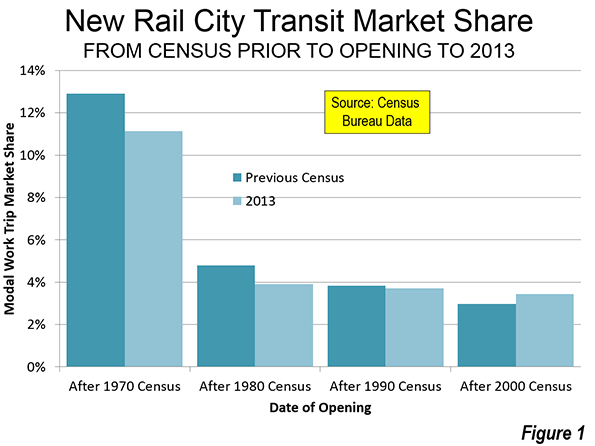
    Overall, the average transit work trip market share in the 23 cities declined from 5.0 percent to 4.6 percent from the Census year preceding opening to 2013 (Figure 1).

    • The cities with rail systems opening after the 2000 Census did by far the best. In 2000, these cities had an average transit work trip market share of 3.0 percent. By 2013, this had risen to an average of 3.4 percent. The cities in this category include Austin, Charlotte, Houston, Minneapolis-St. Paul, Nashville, Phoenix, and Seattle.
    • The cities with rail systems opening after the 1990 Census experienced a modest decline in transit work trip market share, from 3.8 percent in 1990 to 3.7 percent in 2013. The cities in this category include Baltimore, Denver, Dallas-Fort Worth, Los Angeles, Riverside-San Bernardino, Salt Lake City, and St. Louis.
    • The cities with rail systems opening after the 1980 census saw their transit work trip market shares decline more significantly, from 4.8 percent in 198to 3.9 percent in 2013. This category includes Buffalo, Miami, Portland, Sacramento, San Diego, and San Jose.
    • The largest average transit work trip market share losses occurred in the cities with new rail systems that opened following the 1970 census. These metropolitan areas experienced a decline from 12.9 percent in 1970 to 11.1 percent in 2013. The new rail systems in this category were San Francisco’s Bay Area Rapid Transit (BART), Washington’s Metrorail and Atlanta’s MARTA.

    Driving Alone Work Trip Market Shares

    Overall, the driving alone work trip market share rose from 72.3 percent to 76.0 percent (though complete data is not available for 1970), an increase of 3.7 percentage points (Figure 2). The driving alone work trip market share declined in only 4 of the 23 cities. In each of the decadal categories, the change in work trip market share was greater in driving alone than in transit (Figure 3).

    • The cities opening new rail systems after the 2000 census did the best in curbing the drive alone market share, but still experienced a loss. On average, the drive alone work trip market share increased the least in the cities, from 77.1 percent in 2000 to 77.7 percent in 2013, a rise of 0.6 percent.
    • The cities opening new rail systems after the 1990 census experienced an increase in the drive alone work trip market share from 75.2 percent in 1990 to 77.4 percent in 2013m for a loss of 2.2 percentage points.
    • The cities opening a new rail systems after the 1980 census experienced an increase in the drive alone work trip market share from 69.3 percent in 1980 76.3 percent in 2013, for a loss of 7.0 percentage points.
    • Comparable driving alone data was not obtained in the 1970 Census, which makes it impossible to directly compare the "before and after" Census work trip market share data for new rail systems opening during. However, each of the three new rail systems opened after the 1970 census added substantially to their ridership following the 1980 census (Note). Even so, the drive alone market share from 1980 was substantial, from 60.2 percent to 67.9 percent in 2013, an increase of 7.7 percentage points. The biggest drive alone gains were in Atlanta, which built MARTA and Washington, which built Metrorail. San Francisco, with its Bay Area Rapid Transit system (BART) experienced a smaller drive alone market share gain from 1980 to 2013 (Table).

    Transit & Drive Alone Work Trip Market Share: Before and After
    23 New Rail Cities
    City (Metropolitan Area) Last Census before Rail  Opening Last Census Transit Share 2013 Transit Work Trip Market Share Last Census Drive Alone Share 2013 Drive Alone Share
    Atlanta: Note 1970 7.3% 3.1% 68.3% 77.7%
    Austin 2000 2.5% 2.4% 76.5% 77.1%
    Baltimore 1990 7.7% 6.8% 70.9% 77.1%
    Buffalo 1980 6.6% 2.9% 66.6% 82.4%
    Charlotte 2000 1.2% 1.7% 80.9% 80.2%
    Denver 1990 4.3% 4.4% 75.4% 75.4%
    Dallas-Fort Worth 1990 2.3% 1.4% 78.6% 80.5%
    Houston 2000 3.2% 2.4% 77.0% 79.7%
    Los Angeles 1990 5.6% 5.8% 71.7% 74.1%
    Miami 1980 4.4% 4.1% 72.6% 77.8%
    Minneapolis-St. Paul 2000 4.2% 4.6% 78.3% 78.4%
    Nashville 2000 0.8% 1.0% 80.6% 82.8%
    Phoenix 2000 1.9% 2.6% 74.6% 76.5%
    Portland 1980 7.9% 6.4% 65.3% 70.7%
    Riverside-San Bernardino 1990 0.8% 1.5% 74.6% 76.8%
    Sacramento 1980 3.4% 2.6% 75.3% 75.1%
    San Diego 1980 3.3% 3.2% 63.8% 75.8%
    Seattle 2000 7.0% 9.3% 71.6% 69.7%
    San Francisco: Note 1970 15.9% 16.1% 57.9% 59.9%
    San Jose 1980 3.1% 4.2% 72.4% 75.9%
    Salt Lake City 1990 3.3% 3.2% 75.5% 75.0%
    St. Louis 1990 2.9% 2.9% 79.4% 83.2%
    Washington: Note 1970 15.5% 14.2% 54.2% 66.1%
    Average 5.0% 4.6% 72.3% 76.0%
    Derived from Census Bureau data
    Note: 1970 Census data not comparable for Drive Alone. 1980 data used  

    Transit Alone Metropolitan Area Gains and Losses

    Overall, the transit work trip market share declined in 13 of the 23 cities. Among the 10 cities with an increase, the change was less than one percentage point in all but two, Seattle and San Jose.

    The strongest transit market share gain was in Seattle, at 2.3 percentage points (from 7.0 percent to 9.3 percent). However, most of Seattle’s transit market share gain was related to bus and ferry service, which accounted 80 percent of the transit gain. San Jose had the second largest gain, at 1.1 percentage points (from 3.1 percent to 4.2 percent). Riverside-San Bernardino (0.8 percent to 1.5 percent) and Phoenix (1.9 percent to 2.6 percent) tied for third best transit market share increase, with 0.7 percentage point increases. Charlotte had the fifth strongest increase, rising 0.5 percentage points, from 1.2 percent to 1.7 percent.

    The largest transit market share loss was in Atlanta, which fell from 7.3 percent in 1970 to 3.1 percent in 2013, a loss of more than one-half. Buffalo suffered the second largest loss, from 6.6 percent to 2.9 percent, a decline of 3.7 percentage points. Highly touted Portland experienced the third greatest transit market share loss out of the 23 cities, falling from 7.9 percent to 6.4 percent, a 1.5 percentage point loss. Washington had the fourth largest decline, falling from a 15.5 percent transit work trip market share to 14.2 percent, a loss of 1.3 percentage points. In Washington, much of the Metrorail ridership was diverted from bus services and car pools.

    Baltimore (from 7.7 percent to 7.0 percent) and Dallas-Fort Worth (from 2.3 percent to 1.4 percent) tied for 5th largest decline, with a loss of 0.9 percentage points.

    Drive Alone Metropolitan Area Gains and Losses

    The largest drive alone gains were in Buffalo (15.3 percentage point gain from 1980) San Diego (12.0 percentage point gain from 1980), Washington (11.9 percentage point gain from 1980, due to the lack of 1970 data), Atlanta (9.4 percentage point gain  from 1980, due to the lack of 1970 data), and Baltimore (6.2 percentage point gain from 1990).

    The largest drive alone market share losses were in Seattle (1.9 percentage point loss), Charlotte (0.7 percentage point loss), Salt Lake City (0.5 percentage point loss), and Sacramento (0.2 percentage point loss) while Denver remained constant.

    New Rail Systems: Successful Simply in Being Built

    The overall transit work trip market shares in the 23 cities declined 0.4 percentage points. By comparison, in the same cities, driving alone increased by an average of 3.7 percentage points (Figure 4). These results are considerably more modest than the claims made by rail proponents. It is fair to say that the new rail systems have not changed how people travel in cities, despite costing at least $90 billion.

    It might be expected that this laggard performance would dampen the ardor for rail. Yet, many public officials and civic boosters consider virtually any system that opens a success. Tom Rubin, former Chief Financial Officer of the Southern California Rapid Transit District (a predecessor to the Los Angeles County Metropolitan Transportation Authority) wryly suggests that for many political interests, the success of urban rail is demonstrated by its getting built.

    Despite the unfortunate politics of transit, success requires carrying more passengers, as many as the available funding will permit. The test of urban rail is not how many people are on the trains, but how many drivers leave their cars at home to ride it.

    Note: BART’s ridership has more than tripled since 1980, while Washington Metrorail’s ridership is up approximately 40 percent. MARTA’s ridership has increased substantially since 1980, with the first line having opened only in mid 1979.

    This commentary is adapted from a presentation in November at an international transit conference in Shanghai.

    Wendell Cox is principal of Demographia, an international public policy and demographics firm. He is co-author of the “Demographia International Housing Affordability Survey” and author of “Demographia World Urban Areas” and “War on the Dream: How Anti-Sprawl Policy Threatens the Quality of Life.” He was appointed to three terms on the Los Angeles County Transportation Commission, where he served with the leading city and county leadership as the only non-elected member. He was appointed to the Amtrak Reform Council to fill the unexpired term of Governor Christine Todd Whitman and has served as a visiting professor at the Conservatoire National des Arts et Metiers, a national university in Paris.

    Photo: Atlanta MARTA train by RTABus (Own work) [CC-BY-SA-3.0], via Wikimedia Commons

  • Las Vegas: The Once and Future Downtown Project

    There’s been a lot in the news lately about the troubles plaguing Tony Hsieh’s Downtown Project in Las Vegas. The latest is a longish report in the Guardian, which notes:

    Yet by late September of this year, the press – especially the technology press – had begun asking some serious questions, as the Downtown Project suddenly laid off 30 people – 10% of the total it then directly employed. Alongside portentous headlines announcing this “bloodletting” appeared claims that Hsieh had “stepped down” from his position of leadership of the project. A damning open letter from the Downtown Project’s former “director of imagination”, David Gould, called the operation from which he had just resigned “a collage of decadence, greed and missing leadership … There were heroes among us,” he added, “and it is for them that my soul weeps.”

    Technology web site Re/code also ran a seven part series on the Downtown Project, some of it unflattering, including a part focused on a spate of suicides there, and other on about a prominent failed startup.

    I made the obligatory pilgrimage to the Downtown Project in 2013 and wrote up my observations in a three part series, of which you can read part onepart two and part three.

    I noted at the time the audacity of one project trying to completely transform a place like downtown Las Vegas:

    Las Vegas has the single most savagely bleak downtown of any major city I’ve ever visited. The Downtown Project is almost literally starting at zero. There are practically no assets. So anything that the Downtown Project accomplishes needs to be seen against that backdrop. Most of these other cities have been at the downtown redevelopment game for 30+ years, have massive architectural and institutional assets, and have already been the recipients of untold billions in investment, much of it public money.

    I also mentioned that the accolades the project had received in the press were disproportionate to the actual accomplishments to date:

    Honestly, it’s a bit infuriating as a guy who lived in Indy, Louisville, and Providence to see a place where so little has happened garner such massive press and accolades when most other regions the size of Vegas have done more while getting far less attention.

    Indeed, it’s hard to think of a single downtown redevelopment effort that received as much glowing coverage as the Downtown Project. Not even Dan Gilbert’s Detroit efforts received such fawning attention. This is an accomplishment I’m not sure most people fully appreciate. Tony Hsieh was very savvy in using his status as a tier one entrepreneurial superstar, along with a bank of free “crash pad” apartments for visitors, to create buzz and publicity. Other cities should definitely stand up and take notice.

    However, the very success of the project on the PR front primed it for inevitable blowback when problems arose. As the Guardian piece notes, “The story fairly demands an apocalyptic ending.” The higher a star soars in the celebrity firmament, the more knives get drawn when anything disturbs the pristine image. The Guardian reporter also said, based on a very recent trip, that reports of the project’s demise are premature.

    So the Downtown Project has run into turbulence? Film at 11. Startups are hard, risky, trouble fraught endeavors. Tony went through multiple meat grinders in the past, and if you’ve read his book it’s by no means certain that Zappos would even survive. There were many times it could have gone under. Clearly the man has a massive appetite for risk, and the Downtown Project was certainly a risky and ambitious undertaking.

    The initial puffery was overblown. Time will tell if the blowback is as well. Success was always going to be difficult. I noted last year that the project was going against the grain of the DNA of Vegas as a city, was very reliant on “best practices” type solutions vs. the innovative cultural approach of Zappos, and that “curating” a city was inherently dubious. Yet I admire the ambition and believe they’ve done a lot of things right.

    I doubt that the project will ever realize the full, audacious vision that was laid out at the beginning. The commitment of Zappos to its downtown HQ probably prevents a complete flameout. But it may turn out that Tony was unwise to have so heavily promoted the project up front. That has more or less ensured that anything less than perfection will be judged as a failure. He set the bar so high, it is almost impossible to clear. Had there been more modest ambitions, then probably even incremental progress against the backdrop of the disaster zone that was downtown Las Vegas would have been seen as a win. But perhaps in one example of how the Downtown Project did match perfectly with the Vegas DNA, Tony Hsieh elected to pile all his chips on Red 14.

    Full Disclosure: I had previous financial relationships with Downtown Project related entities and stayed for free in one of their crash pads during my stay.

    Aaron M. Renn is an independent writer on urban affairs and the founder of Telestrian, a data analysis and mapping tool. He writes at The Urbanophile, where this piece originally appeared.

    Downtown Project photo by Eddie Codel.

  • Southern California Stuck in Drive

    Southern California has long been a nurturer of dreams that, while widely anticipated, often are never quite achieved. One particularly strong fantasy involves Los Angeles abandoning what one enthusiast calls its “car habit” and converting into an ever-denser, transit-oriented region.

    An analysis of transit ridership, however, shows that the region is essentially no better off than when the the modern period of transit funding began in 1980, with the passage of Proposition A, which authorized a half-cent sales tax for transit. In 1980, approximately 5.9 percent of workers in the metropolitan area (Los Angeles and Orange counties) used transit for their commute. The latest data, for 2013, indicates the ridership figure has fallen to 5.8 percent.

    Never ones to let facts get in the way of fantasy, some retrourbanists and media types continue to insist our mass-transit transition is well on its way. Liberal blogger Matt Yglesias, writing in Slate, declared that Los Angeles is destined to become America’s “next great transit city.”

    This view is echoed throughout retrourbanist circles. “The City of Angels is noticeably transforming. Our once car-centric town is becoming less car-dependent,” suggests the local LA Streetsblog, “Public transit is having a comeback. Pedestrian and bicycle infrastructures are improving.”

    Instead of rushing to rail, Angelenos continue to rely on their cars to get to work. From 1980-2013, the market share of drive-alone commuters has risen from 70 percent to 74.1 percent. There has been an increase in driving alone of approximately 1.4 million daily commuters. Driving alone accounted for d approximately 85 percent of the region’s increase in commuters.

    Why do people stick to their cars? For one thing, transit takes longer. The average drive-alone, one-way commute in Los Angeles was 27.0 minutes in 2013, compared with an average commute of 48.7 minutes for transit.

    The other big factor is accessibility to jobs. The University of Minnesota Accessibility Observatory produced an estimate for the percentage of jobs that the average L.A. resident could reach within 30 minutes by car. In Los Angeles, the average resident can reach 60 times as many jobs in that time by car as by transit.

    Transit needs downtowns

    Transit plays an important role in America, but mostly in the urban cores of a handful of “legacy” cities. These core metros (excluding their often-sprawling, low-density suburbs) – New York City, Boston, Chicago, Philadelphia, Washington and San Francisco – account for 55 percent of all transit-work trip destinations, just 6 percent of the country’s employment. Overall, the legacy cities’ transit ridership is nearly 10 times their proportionate combined share of jobs.

    To a large extent, this reflects history and urban form. Transit remains largely a matter of downtowns. The cities with transit legacies have an average of 15 percent of their jobs downtown, three times the average for other major metropolitan areas. In contrast, Downtown Los Angeles has 2 percent of the metropolitan area’s jobs. In Orange County, Riverside and San Bernardino counties, homes to much of the regional population, there are really no substantial downtown areas.

    In contrast, the many regions sharing L.A.’s multipolar form and large-scale transit investments – Atlanta, Dallas-Fort Worth, Denver, Minneapolis-St. Paul and Portland, Ore., – have seen their transit market shares stagnate or decline, despite having built expensive rail systems.

    One problem is, like virtually all U.S. metropolitan areas (including the suburbs of legacy cities), the Los Angeles area, which pioneered the multi-polar metropolis, has been becoming more so and is even moving beyond polycentricity. The vast majority of growth in the statistical area encompassing Los Angeles, Orange, Riverside, San Bernardino and Ventura counties has taken place in precisely those areas – the Inland Empire, South Orange County or the Santa Clarita and Antelope valleys in northern Los Angeles County – that also have the lowest transit ridership. In contrast, the core’s growth barely represents a blip. From 2000-10, the functional urban core, which has the strongest concentration of transit destinations, accounted for virtually none of the region’s growth.

    Dreaming of New York?

    For many L.A. planners and urban boosters, more transit – funded from Washington – often seems to constitute an exercise of social engineering on a grand scale. The hope is that, by pushing transit, particularly rail, we will recreate the metropolis with ever-greater density. “We are going to remake what the city looks like,” then-Mayor Antonio Villaraigosa told an approving New York Times two years ago.
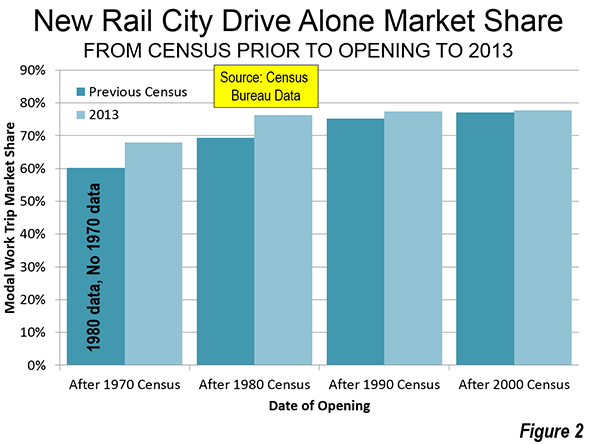
    Despite the hoopla and the subsidization of downtown Los Angeles, however, relatively few people work in, or even visit Downtown, ecept for sporting or cultural events, although many pass by it on the freeways.

    For most Angelenos, Downtown is simply not part of their day-to-day experience the way, for example, Manhattan is for many New Yorkers, or the Loop is for many residents of the Chicago region.

    Transit Class Warfare

    Developers and their planning allies tend to focus on transit as something that will get middle-class Angelenos out of their cars. But it’s difficult to see this working as long as such an overwhelming majority of jobs (98 percent) are located outside Downtown. Since 1980, driving alone, which was increasing its market share, added 15 times as many new commuters as transit, with its slipping market share.

    At the same time, there seems to be a profound unawareness of the low incomes of Los Angeles transit commuters. The latest American Community Survey data (2013) indicates that the median earnings of transit commuters at the national level is more than 85 percent higher than in Los Angeles. In the metropolitan areas around transit legacy cities, the median incomes of transit commuters is 150 percent higher than in Los Angeles.

    To some extent, poorer Angelenos, in the government’s expensive shift from buses to trains, are being sacrificed to satisfy the Utopian vision of planners, pad the profits of big urban developers, and to build the campaign war chests of the political class. Indeed, from 2008-12, the bus lines, which carry more than three times as many passengers as trains, were cut 16 percent If L.A. is experiencing a transit revolution, its most dependent riders have been largely left behind.

    So What Should Greater LA do?

    As anyone who drives the freeways knows well, L.A. has a traffic problem. But Los Angeles also has the shortest average commute time of any high-income world megacity for which data is available, despite having the highest automobile usage, the least transit and, except for New York, the lowest urban density.
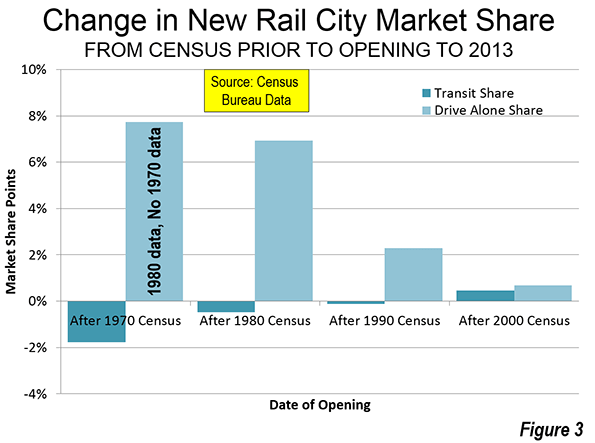
    The real question is, will more transit, at least in its current form, offer the solution? Certainly, expanding and improving roads – although politically incorrect – has helped make commuting easier for many working in Orange County. Other ways to entice people off the roads, such as telecommuting, should be encouraged. Since 1980, the number of Los Angeles residents working at home has increased by approximately 240,000. This increase – 2.5 times that of transit in total numbers – has come at virtually no cost to taxpayers.
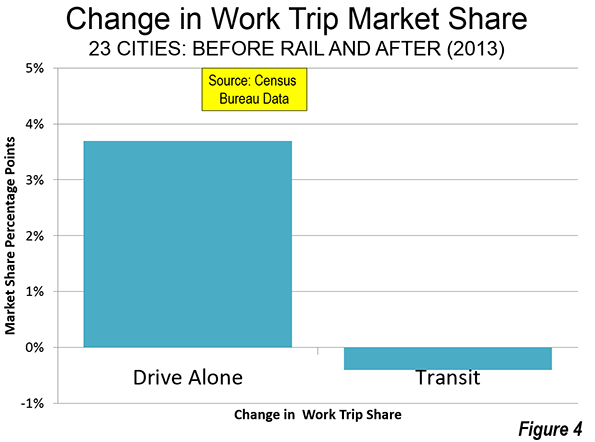
    To be sure, many Angelenos, for one reason or another, need decent transit services. Our approach would be for government to find out who these people are, and look for ways to make transit work better for them. Rather than invest huge dollars in rail megaprojects, perhaps we could reduce bus fares, a strategy attributed to the legendary Los Angeles County Supervisor Kenneth Hahn that increased bus ridership dramatically from 1982-85.

    Unlike today’s “progressives,” Hahn’s prime interest was serving his largely working-class and poor constituents. Besides cutting bus fares and increasingly service, other solutions, such as more competitively contracted service provided by regional agencies, such as Foothill Transit and the Antelope Valley Transit Authority, could provide less-expensive, more efficient and expanded service.

    Los Angeles Mayor Eric Garcetti, has also expressed interest in promoting the use of rideshare services, like Uber or Lyft, and, more importantly, self-driving cars.

    Ultimately, rather than try to recreate New York, or undertake the expensive and virtually impossible task of rebuilding Los Angeles in the image of the latest urban planning fad, we should explore a host of innovative solutions that will help transit riders here and now by developing workable, and effective, ways to help them get to the services and jobs they need.

    This piece first appeared at the Orange County Register.

    Joel Kotkin is executive editor of NewGeography.com and Roger Hobbs Distinguished Fellow in Urban Studies at Chapman University, and a member of the editorial board of the Orange County Register. His newest book, The New Class Conflict is now available at Amazon and Telos Press. He is author of The City: A Global History and The Next Hundred Million: America in 2050. His most recent study, The Rise of Postfamilialism, has been widely discussed and distributed internationally. He lives in Los Angeles, CA.

    Wendell Cox is principal of Demographia, an international public policy and demographics firm. He is co-author of the “Demographia International Housing Affordability Survey” and author of “Demographia World Urban Areas” and “War on the Dream: How Anti-Sprawl Policy Threatens the Quality of Life.” He was appointed to three terms on the Los Angeles County Transportation Commission, where he served with the leading city and county leadership as the only non-elected member. He was appointed to the Amtrak Reform Council to fill the unexpired term of Governor Christine Todd Whitman and has served as a visiting professor at the Conservatoire National des Arts et Metiers, a national university in Paris.

    Photo: Downtown Los Angeles toward the Hollywood Hills and the San Fernando Valley (by Wendell Cox)