Category: Policy

  • Is Anybody Really Listening: Pizza with Perez in Youngstown

    Ohio has long been seen as a battleground state, up for grabs in most Presidential elections. The state supported winning candidates of both parties for decades. But as the state shifted back and forth, the Mahoning Valley (Mahoning and Trumbull Counties) in Northeastern Ohio remained a Democratic stronghold. If Democratic candidates could garner more than 62% of the vote in this region – as they often did — they would win the state. In years when Republicans won, the Mahoning Valley still voted for the Democrats, but with less enthusiasm.

    Not this time. In the 2016 primaries, a number of Mahoning Valley Democrats changed their party affiliation to vote for Donald J. Trump. Last year’s big shift came from people who had sat out the past few elections but showed up to vote this year. In November, Hillary Clinton won Mahoning County but received less than 50% of the vote. She actually lost in neighboring Trumbull County. She lost Ohio by more than 8 points, the biggest loss of any candidate in the state since Michael Dukakis gave up the state to George H.W. Bush in 1988.

    That’s why political operatives and journalists are now paying even more attention to the Youngstown area. Even the Ohio Democratic Party (ODP), which has long counted on the Mahoning Valley, is taking notice of a region they didn’t think they needed to worry about.

    In what has become a familiar practice following a series of defeats in recent state-wide elections, the ODP sponsored a “Listening Tour.” On June 12, 2017, the tour came to Youngstown with National Democratic Party Chairperson Tom Perez, who reiterated that Youngstown was a political “bellwether.”

    The event was held at a local pizzeria, Wedgewood Pizza, and billed as “Pizza with Perez.” Approximately 75 attendees, mostly loyal Democratic Party supporters, including a number of local and state politicians, paid $25 to attend the midday event. I paid my $25 to find out whether Party leaders were seriously listening to the concerns of voters and to see how they would react.

    What I saw was a typical campaign event, with the audience doing the listening while Democratic operatives touted their positions. After brief introductions by state and local Party chairs David Peppers and David Betras, Perez explained his commitment to Democratic politics by recalling his father’s experience of moving to Buffalo from the Dominican Republic. Perez talked about how the community and especially the labor movement helped his family make a home there. He promised that Democrats could be counted on to speak to hopes and fears of the working class and to fight for working people.

    When someone asked about why Democrats had lost the election, Perez criticized Republican social and economic policy, but he also acknowledged several mistakes that the Democratic Party had made during the last campaign. “We could have done a better job of speaking more directly to the pocketbook issues that bring people to the ballot,” he said. Among other things, the Party should have recognized that NAFTA hurt working people and acknowledged its role in that trade bill.

    Perez noted that the Party’s “message got muddled,” but he quickly turned to typical campaign trail rhetoric: “I’m here to say very clearly that the Democratic Party is the party that’s fighting for the labor movement. The Democratic Party is the party fighting for quality public education and access to health care and the issues that matter most to the people in the Valley.” But there were very few questions and much of the time devoted to meet and greet. Clearly, no one identified themselves as crossover voters or first time Republican registrants. So much for this being a listening tour.

    The ODP’s misstep of charging admission for a fake listening tour was not lost on local Mahoning County Republican Party Chairman, Mark Munroe, who called it a “strange” event and organized a parallel gathering where he invited crossover voters to explain their positions. As Munroe commented, “If they want to find out why Democrats have become Republicans they need to talk to Republicans because the Dems who have crossed over are not going to be inclined to pay $25 contribution to a Democrat party event.” One of the speakers, Geno DiFabio, explained his party switch: “Every 2 years, every 4 years, locally they’d come around and say, ‘oh, we’ll fight for you and take care of you,’ and then they’d disappear. It was like an abusive relationship.”

    Despite what the invitation promised, the ODP’s tour didn’t involve listening to local voters or even to their leaders, but that’s a familiar pattern for Mahoning Valley Democrats. Voters here remember how the national Party leaders dismissed former Congressman James Traficant when he bitterly criticized the Democratic Party for contributing to deindustrialization, making false promises, and prophetically warned that NAFTA would harm working people. But nobody listened.

    In 2015, Ohio Congressman Tim Ryan told a reporter that “a lot of bad things happened” in 2010 and 2014, and the Party needed “a new approach—a more grounded approach—to turning out voters.” Nobody listened.

    A year ago, after the Ohio primaries, local Party leaders wrote a widely publicized letter to the Clinton campaign and the ODP warning that they should pay more attention to working-class issues. Once again, nobody listened.

    A tone-deaf, let-us-tell-you-how-much-we-care faux listening tour won’t accomplish anything, But the ODP and the DNC should pay more attention to Northeastern Ohio Democrats. They might start by heeding Ryan’s recent critique that the Democratic Party brand has become “toxic.” He has called for a wholesale change, starting with the Party’s leadership in the House of Representatives.

    The Democrats should also pay attention to Ohio Senator Sherrod Brown, who is the only statewide Democratic office holder and one of very few national Party leaders with a consistent pro-worker economic vision.

    If they don’t start actually listening to voters in places like Youngstown, the Democratic Party may well end out talking to itself.

    John Russo is the former co-director of the Center for Working-Class Studies at Youngstown State University and currently a visiting scholar at Georgetown University’s Kalmanovitz Initiative for Labor and the Working Poor.

    Photo by Lonnie Tague for the United States Department of Justice [Public domain], via Wikimedia Commons

  • Is California Anti-Family?

    In its race against rapidly aging Europe and East Asia, America’s relatively vibrant nurseries have provided some welcome demographic dynamism. Yet, in recent years, notably since the Great Recession and the weak recovery that followed, America’s birthrate has continued to drop, and is now at a record low.

    Nowhere is this decline more marked than here in California. Once a state known for rapid population growth, and above-average fecundity, the state’s birthrate is also at a historic low. The results are particularly dismal in coastal Southern California. Los Angeles’ population of people under 17 already has dropped a precipitous 13.6 percent, with drops even among Latinos and Asians, while Orange County has fallen by 6 percent since 2000. The national growth, in contrast, was up 2.2 percent. Despite claims that people leaving California are old and poor, the two most recent years of data from the IRS show larger net losses from people in the 35 to 54 age group. Net out-migration is also larger among those making between $100,000 and $200,000 annually. This is your basic child-bearing middle class.

    Why are we eating our seed corn?

    Why is this shift to an increasingly child-free population occurring more in Southern California than elsewhere? One logical source may be housing prices, particularly near the coast, which present a particular problem for middle-class, middle-aged families. In contrast, the growth in the number of children under 17 is much higher in more affordable metropolitan areas such as Dallas-Fort Worth, Atlanta, Phoenix, San Antonio, and Charlotte and Raleigh in North Carolina.

    Housing affordability certainly drives migration. Major metropolitan areas where the cost of housing is at least four times that of annual incomes have seen a net out-migration of 900,000 since 2010. This compares to a net gain of 1.1 million in the more affordable areas.

    Hardest hit of all are the groups who will dominate our future — young people, minorities and immigrants. California boomers, as we discussed in a recent Chapman University report, have a homeownership rate around the national average, but for people aged 25 to 34 the rate is the third-lowest in the nation, behind just New York and Washington, D.C. The drops among this demographic in the San Jose and Los Angeles areas since 1990 are roughly twice the national average.

    It is no surprise, then, that places like Southern California have also seen a decline in the next demographic group: people between 35 and 49, who are generally the age of parents, and also tend to be at their peak earning years. The one population group on the upswing is seniors, particularly in Orange County, who bought their homes when they were much less expensive.

    Read the entire piece at The Orange County Register.

    Joel Kotkin is executive editor of NewGeography.com. He is the Roger Hobbs Distinguished Fellow in Urban Studies at Chapman University and executive director of the Houston-based Center for Opportunity Urbanism. His newest book is The Human City: Urbanism for the rest of us. He is also author of The New Class ConflictThe City: A Global History, and The Next Hundred Million: America in 2050. He lives in Orange County, CA.

    Photo by Kat Grigg, via Flickr, using CC License.

  • Meet Marble

    I’ve lived in this neighborhood for so long that I’ve grown used to tech start ups beta testing their schemes on my doorstep. I remember the first time I saw a car drive by with a huge furry pink mustache strapped to the front grill between the headlights. That was the start of Lyft. I have a clear memory from 2008 when a friend rented her apartment out on a new internet platform. That was Airbnb. Back in the late 1990s during the dot com bubble there was a start up that would deliver everything from milk to condoms via bicycle courier.

    Meet Marble. This little pushcart size machine is launching the next generation of tech based business models. It’s using fine grained real time lidar navigation so autonomous machines can learn to negotiate the city “on foot.”

    The initial concept is for robots to deliver Chinese food to your door. My guess is that Marble’s electronic pizza boy is just the first baby step to much larger and more lucrative contracts. The postal service, private package delivery systems, and utility meter readers will ultimately save billions on labor by switching to such machines. See also city parking enforcement. Meter maids will go the way of buggy whips. Humans and their endless need for salaries, medical insurance, pensions, and workers compensation will melt away.

    New jobs will be created around the production, maintenance, and management of these new systems of course. But there’s the tricky business of getting people who are qualified to deliver pastrami sandwiches or check VIN numbers to craft algorithms – especially when a lot of this work can be done remotely from anywhere on the planet. Don’t expect the people who clean and reload these machines to get paid enough to rent a studio apartment anywhere near the Bay Area. Oh, wait. There’s an automated system that will do that too…

    We don’t have a technology problem. We have a societal distribution problem. These trends are going to make an ever larger proportion of the population redundant. Wealth has not and will not “trickle down.” Instead it will continue to concentrate into specific hands in particular geographic locations. Focusing on the technology itself is a mistake. The challenge is to create a culture and a political framework where everyone has the opportunity to enjoy the benefits of these shifts. History tells us that existing institutions don’t self reform. They fail and are replaced by entirely new systems. From where I’m looking that process has already begun and it ain’t gonna be pretty.

    This piece first appeared on Granola Shotgun.

    John Sanphillippo lives in San Francisco and blogs about urbanism, adaptation, and resilience at granolashotgun.com. He’s a member of the Congress for New Urbanism, films videos for faircompanies.com, and is a regular contributor to Strongtowns.org. He earns his living by buying, renovating, and renting undervalued properties in places that have good long term prospects. He is a graduate of Rutgers University.

  • You Can Grow Your Own Way

    A confluence of potent forces is creating an era of localism and decentralization across the planet making local decision-making and action more important than ever before. This is particularly true in the economic realm, where cities and regions must take full advantage of their unique combination of resources, culture, infrastructure, core competencies in industry and agriculture and the skills of entrepreneurs and workers.   

    There is no single formula for success for any place in the 21st century. Your economic strategy may need a shot in the arm (or a kick in the butt), a total remodel or perhaps it needs to be meaningfully modernized.

    The NewGeography Economic Opportunity & Growth Forum is a one-day strategy event that helps leaders, innovators and entrepreneurs develop strategies for grappling with challenges and seizing opportunities that will propel local growth.

    The one-day Forum addresses the basic fundamentals to propel growth including policies that stress essential physical infrastructure, investments in basic and skill-oriented education, and a favorable business environment that facilitates free enterprise and entrepreneurship.

    Joel Kotkin, an internationally recognized authority on economic and social trends and, a founder and Executive Editor of NewGeography.com, begins each forum with a high-level look at consequential trends and circumstances that affect local and regional growth. This is followed by an economic assessment of the local and regional economy and subsequent panel discussions involving key local leaders in business, government, education and the civic sectors.

    Each Forum culminates in afternoon strategy sessions that lead to the identification of priorities where enhanced collaboration is needed and action steps are identified for building support and mobilizing resources and talents to put your city or region on a solid growth trajectory.

    NewGeography anticipates doing only two to three Forums in the remainder of 2017 so contact us at your earliest convenience to get the ball moving. Download this pdf for more information about how to bring the forum to your community. For e-mail inquiries contact Delore Zimmerman at delore@praxissg.com.

  • California’s Global Warming High-Speed Train

    The California High-Speed Rail Authority promises to “achieve net zero greenhouse gas (GHG) emissions in construction” and is committed to operate the system on “100% renewable energy” by contracting for “400 to 600 megawatts of renewable power”. These promises may please environmentalists, but they cannot be kept.

    Construction Emissions

    The Authority has provided only limited information regarding GHG construction emissions. Its 2013 Emissions Report estimated 30,107 metric tons in GHG “direct emissions” for the first 29 miles of construction. “Indirect emissions” associated with the manufacture and transport of materials, primarily concrete, steel, and ballast were not reported because, according to the Authority, precise quantities, sources, and suppliers were not known. A more plausible reason is the their desire to hide from the public more than 90% of GHG emissions associated with their project. Regardless, recent testimony by the Authority’s CEO clearly indicates that indirect emissions can now be tallied.

    Speaking before the Assembly High-Speed Rail Oversight Committee on January 27, 2016, CEO Jeff Morales, spoke at length on how costs were estimated. He described the assemblage of 200,000 individual line items including concrete, steel, dirt, electrical, etc. and said each includes a unit cost which is multiplied by the units required to build the system.

    Total GHG construction emissions would still be unknown today were it not for the work of professors Mikhail V. Chester and Arpad Horvath working in UC Berkeley’s Department of Civil and Environmental Engineering. They studied this issue, published their findings in 2010, and estimated that 9.7 million metric tons of GHG would be emitted during the construction of the statewide system; primarily because of the production of massive amounts of concrete and steel. Using mid-level occupancy for the three competing modes of travel (high-speed train, auto, and airplane) the authors estimated it would take 71 years of train operation to mitigate the project’s construction emissions. California’s Legislative Analyst Office came to a similar conclusion in a 2012 report critical of using GHG reduction funds to pay for Phase 1 (Los Angeles to San Francisco) of the statewide system because “if the high-speed rail system met its ridership targets and renewable electricity commitments, construction and operation of the system would emit more GHG emissions than it would reduce for approximately the first 30 years”. Here, the LAO appears to be citing an updated Chester and Horvath study, published in July 2012, which focused on only Phase 1 of the high-speed rail project, as outlined in the Authority’s Revised 2012 Business Plan. They took into account additional highway infrastructure that could be avoided as well as claims that “a future CAHSR system will likely see improved train performance and an opportunity for increased renewable electricity usage”.

    However, the Authority promised “zero net greenhouse gas emissions in construction”. A reduction in California’s GHG emissions due to the trains’ operations was to help reduce the state’s future GHG emissions, not merely mitigate construction releases. The Authority’s zero construction emissions promise relies heavily on a tree planting program. More than 5 million trees, each more than 50 feet tall, would need to be grown and perpetually maintained to recapture the 9.7 million tons of GHG construction emission. However, one year into construction, the Authority’s CEO admitted that not a single tree had been planted. Worse, as part of their project, the Authority plans to cut down thousands of trees south of San Francisco to electrify Caltrain trackage.

    Emissions from Operation

    Chester and Horvath generously assumed the trains would run on a power mix relatively high in renewable sources. However, high-speed electric trains would replace fossil fueled propelled automobiles and airplanes. When Phase 1 is completed, the trains will place a new demand on the electric grid that must be met immediately by starting up an idle generator capacity. It may be a peaking unit in California powered by natural gas or a coal burning plant in Utah. The exact source is unknowable, but it will not be a wind or solar powered electric plant. These sources will already be generating all the power they can produce when the first trains require additional power.

    The Authority’s business plans are constantly changing as are their assumptions on energy consumption and energy cost. The 2012 Business Plan is cited, a plan that referred to paying 15.2 cents/kWh for electrical energy, inclusive of a 3 cent premium for renewable energy. Energy consumption was established at 63 kWh/mile. Train miles traveled between 2022 and 2030 was projected to be 99 million, resulting in an energy use of 6,300 million kWh. In order to make good on their claim that they will power the trains with 100% renewable energy the Authority needs to fund the construction of the necessary renewable power plants.

    California Valley Solar Ranch, a 250MW facility producing 650 million kWh/year recently built at a cost of a $1.6 billion ($1.2 billion financed at a 3.5% interest rate using a federal loan guarantee coupled with a check from the U.S. Treasury for $430 million), serves as a proxy for the needed capital. The Authority’s trains would consume 1,200 million kWh in 2030 and need the output of 1.85 Solar Ranches; 460MW of capacity costing $3.0 billion. A premium of 42 cent/kWh, fourteen times the Authority’s offer, would be needed to raise the necessary capital by 2030. More than 20% of this capacity, costing half a billion dollars, must be constructed before the first trains run. Otherwise, those trains will be totally powered by fossil fuels, meaning the GHG emissions per passenger mile will be no better than for two passengers traveling in an automobile which meets the federal fuel efficiency standards scheduled to be in place in 2022.

    The issue of global warming needs to be addressed. However, the planting of millions of trees and the spending of billions of dollars on a fossil fuel propelled train is not a practical or cost effective way to address the problem. From the climate point of view, the Authority’s project is detrimental because of its massive construction GHG emissions and because it diverts funds from other actions, such as providing financial incentives for ride-sharing and for the purchase of zero emission or low emission vehicles that could really help address the serious problem of global warming.

    Michael J. Brady has been a litigator and appellate lawyer for 50 years; he has worked on opposing California’s high speed rail for 10 years.

    Mark Powell has been assisting Mike Brady for seven years; he is a retired chemist for Union Oil Co.

    Photo by California High-Speed Rail Authority [Public domain], via Wikimedia Commons

  • The Grenfell High-Rise Fire: A Litany of Failures?

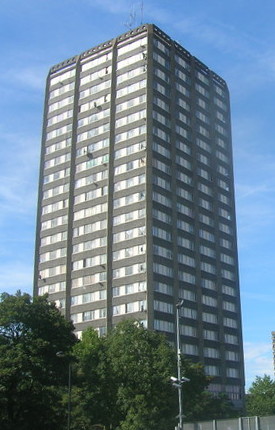
    At this writing, the London (Kensington) Grenfell high-rise fire has taken a confirmed 58 lives, with an unknown number missing and many more sent to hospitals. The 24 story low income housing tower block caught fire on Wednesday, June 14. It was virtually all consumed, as shown in the photograph above.

    There is much to be concerned about here. This building was not owned by any of those private developers who politicians seem to blame for every all that’s wrong with housing in severely unaffordable Britain. The building, now a burned out shell, is owned by the affluent Royal Borough of Kensington and Chelsea (a local government unit within the Greater London Authority).

    This is how the structure appeared before the recent refurbishment (photo by R Sones).

    Government Failure?

    It is not as if the council had not been warned. The Grenfell Action Group has been monitoring problems at Grenfell Tower on behalf of tenants for years. On June 15, they published a blog with links to their previously expressed concerns about fire safety in the building, including one entitled KCTMCO Playing with Fire that details the frustrations of dealing with the Council’s tenant manager. The post, from last November included called the conditions, including the management of the KCTMO (Royal Borough of Kensington and Chelsea Tenant Management Organisation) and the Borough "a recipe for a future major disaster." Of course, that’s how it turned out.

    There is talk of criminal proceedings, and doubtless the private contractor who installed the cladding (exterior building facing) currently thought to have spread the fire quickly will be at greatest risk. However, the installation was procured by the KCTMO, the agent of the RBKC Borough Council, including an approved award to the contractor. Further, all of this was related to a refurbishment of the building, in which the RBKC did not require include installation of sprinklers, which would have "prevented the fire from developing." The Royal Borough of Kensington and Chelsea council is being barraged with criticisms, including from members of Parliament, for its administration of the Grenfell Tower over recent years.

    A Great Planning Disaster?

    Worse, in a larger sense, the Grenfell fire may turn out to be one of the world’s great planning disasters. One headline put it this way: "Report: Grenfell Tower Fire May Have Been Caused By Panelling Installed To Make Rich Neighbors Happy." Only slightly less incendiary was The Independent headline, which read "Grenfell Tower cladding that may have led to fire was chosen to improve appearance of Kensington block of flats."

    According to planning documents obtained by The Independent:

    “Due to its height the tower is visible from the adjacent Avondale Conservation Area to the south and the Ladbroke Conservation Area to the east,” … “The changes to the existing tower will improve its appearance especially when viewed from the surrounding area.”

    The Independent also reported that the planning document made repeated references to the "appearance of the area" and that this was the "justification for the material used on the outside of the building, which has since been claimed to have contributed to the horror." The materials were chosen, according to the planning document "to accord with the development plan (our emphasis added) by ensuring that the character and appearance of the area are preserved and living conditions of those living near the development suitably protected,”

    One expert indicated apparent frustration at the use of flammable cladding materials: "We are still wrapping postwar high-rise buildings in highly flammable materials and leaving them without sprinkler systems installed, then being surprised when they burn down."

    The extent and spread of the fire was unusual for a high rise building. London Fire Commissioner Dany Cotton told The Engineer: “This is an unprecedented situation, with a major fire that has affected all floors of this 24 storey building, from the second floor up. In my 29 years with London Fire Brigade I have never seen a fire of this nature.” According to the Evening Standard: "…flames engulfed the block from the second floor upwards “within seconds”

    Concern in Australia

    While the Grenfell fire’s severity has been attributed to the flammable cladding installed during renovation, similar cladding is being used on new high rise buildings elsewhere. For example, according to The Age the Melbourne Fire Brigade found that the fire at the contemporary LaCrosse building ignited external wall cladding, which quickly spread to the top of the building through the "combustible material located in the wall structure." Two days after the Grenfell fire, The Guardian ("Former fire chief says Melbourne’s Lacrosse Tower still poses risk") reported that the cladding had still not been replaced, though the building has been reoccupied. Peter Rau, a former Melbourne Fire Brigade Chief told The Guardian that "he would not allow his children to live there."

    Australians may have plenty of reason to be concerned. Planning policies throughout Australia have sought to convince households to live in central city high-rises, seeking to entice them from their preferred suburban detached housing. In a June 15 story, The Age ("London tower fire could happen here: Australian buildings cloaked in flammable cladding") reported that Australian buildings are clad in "millions of square meters" of flammable cladding. This is not a new problem. According to The Age building code authorities were advised of the problem seven years ago.

    Tony Recsei, President of Save Our Suburbs in Sydney expressed concern in a  Sydney Morning Herald letter. Referring to the New South Wales government policy that seeks to increase high rise living, Recsei said "But this calamity starkly reveals there can be long-term consequences. It is to be hoped that the Greater Sydney Commission will seriously consider all the implications of its current strategy of imposing density quotas onto local neighborhoods."

    The extent of the concern in Australia is indicated in this video and article from news.com.au.

    New Zealand and the United States

    Even in New Zealand, where officials recently strengthened external materials fire regulations, the government asked local authorities to check buildings constructed before the regulatory reform to see if there are any with combustible cladding.

    According to the Times of London, the cladding used on Grenfell Tower has been illegal in the United States for five years.

    Further Developments in London

    Meanwhile, back in London, there remains considerable anger. London Mayor Sadiq Kahn visited the site on June 16 was questioned and heckled by survivors. On the same day, Prime Minister Theresa May also visited the scene and was criticized for meeting only with emergency services personnel, but not with any residents.

    The fatality count could go much higher. Fears of a building collapse are slowing inspection efforts. Metropolitan Police Commander Stuart Cundy told The Independentthat "he hoped the death toll would not be in “triple figures”.

    No Clean Hands?

    Of course, final assessments will have to await more formal inquiries. But there is plenty of reason to be concerned. Save the fire brigade, which has been roundly praised for its work, including being on the scene within six minutes, there may be no clean hands. Cities, from the days of ancient Rome, have been vulnerable to fiery disasters like this one; policies that encourage densification while failing to provide adequate safety procedures are creating the potential for more such disasters.

    Grenfell fire photo by Natalie Oxford.

    Wendell Cox is principal of Demographia, an international public policy and demographics firm. He is a Senior Fellow of the Center for Opportunity Urbanism (US), Senior Fellow for Housing Affordability and Municipal Policy for the Frontier Centre for Public Policy (Canada), and a member of the Board of Advisors of the Center for Demographics and Policy at Chapman University (California). He is co-author of the "Demographia International Housing Affordability Survey" and author of "Demographia World Urban Areas" and "War on the Dream: How Anti-Sprawl Policy Threatens the Quality of Life." He was appointed to three terms on the Los Angeles County Transportation Commission, where he served with the leading city and county leadership as the only non-elected member. He served as a visiting professor at the Conservatoire National des Arts et Metiers, a national university in Paris.

  • Connecticut’s Future is Suburban, Not Urban

    Connecticut is now grappling with a fiscal and economic crisis that, according to some leading Democrats, has been caused by ineffective urban policy. In late May, Hartford-based insurer Aetna confirmed long-discussed rumors that it will be moving its headquarters from Connecticut. General Electric announced plans to move from Fairfield, Connecticut to Boston in January 2016. Though the Great Recession officially ended eight years ago, state budget forecasters are projecting a $2 billion deficit for next fiscal year, or 11 percent of the budget. One policy report published in March, when rosier estimates pegged Connecticut’s deficit at only 9 percent, ranked Connecticut as having the 8th largest shortfall among American states. Hartford, the state capital, is on the verge of bankruptcy.

    What course should Connecticut take to stabilize government budgets and stimulate the economy? Gov. Dannel Malloy and Hartford mayor Luke Bronin believe that stronger cities are the answer. As Malloy said recently, explaining why his budget increases state aid for cities, “I think there is a body of people who don’t understand urban environments, and I think Connecticut has too long pursued a public policy of insufficient support for our urban environments.”

    But there are many questions to raise about just how vital urban Connecticut is to the state’s future. Connecticut’s major cities have their charms, especially Hartford and New Haven. But in terms of meeting the enormous fiscal and economic challenges with which the state is now faced, they are and will remain less important than its suburban regions.

    With all due respect to Gov. Malloy and Mayor Bronin, there’s a certain glibness in how they presume that Connecticut’s poor urban areas can be revitalized. It’s not as if their predecessors haven’t been trying. Any visitor to downtown Hartford and New Haven will be struck by several imposing works of mid-20th century modern architecture. Examples include Constitution and Bushnell plazas in Hartford and New Haven’s Temple Street Garage. These projects date back to the “urban renewal” era of the 1950s and 1960s, when massive government resources were devoted towards breathing new life into tired central cities.

    New Haven was nationally-renowned for its urban renewal efforts, both because it focused just as much on rehabbing old buildings as demolishing them . Mayor Richard Lee’s “human renewal” social service programs anticipated criticisms that poverty can’t be cured through real estate development alone. But the widely celebrated Mayor Lee failed to hit the mark. New Haven, the “Model City,” was rocked by a race riot in 1967, as was Hartford in 1969.

    Despite growing evidence that Connecticut cities were not coming back, urban renewal in modified forms would continue throughout the decades. In 1974, Hartford gained the “Hartford Civic Center,” (now known as the XL Center), a sports and entertainment venue where the NHL’s Hartford Whalers played from 1980 to 1997. The state’s convention center opened in Hartford in 2005, and a minor league baseball park just came online in April. And yet, among American cities with a population above 100,000, Hartford’s poverty rate is 8th highest in the nation. Mayor Bronin himself describes the current fiscal state of affairs in Hartford as “the largest budget crisis in our city’s history.”

    State government is not much better off. Connecticut’s budget deficit is driven by escalating costs for public pensions, which powerful government unions have balked at reforming, and weak tax receipts despite—or perhaps because of—a series of recent income tax hikes. Gov. Malloy, a progressive Democrat, has recently taken the position that trying to further increase the tax burden on the state’s 1 percent would be counterproductive.

    Urban revitalization is an unsound strategy for addressing budget deficits because creating strong cities is the work of generations. The secret of Boston’s success is reflected in a famous saying attributed to Daniel Patrick Moynihan: “If you want to build a world-class city, build a great university and wait 200 years.” Cities like New York that are now envied as talent magnets have had that reputation going back many years. Even in the 1970s, when New York was plagued by high crime and the threat of insolvency, it was still a national leader in finance, media and the arts.

    Bronin and Malloy have said that they understand Hartford can’t become New York or Boston. But among Hartford’s true peers—formerly industrial small and mid-sized cities throughout the northeast and Midwest—it is very difficult to find any examples of an authentic comeback city. In an analysis I recently wrote about Hartford, New Haven, Waterbury and Bridgeport, I found that, since 1970, the number of poor people living in these cities had increased by 56.1%, 40.8%, 153.6% and 86.3%, respectively. Over the same span, all have seen their total populations decline with the exception of Waterbury, which has grown by 1.7%.

    Despite all the hype over America’s urban renaissance, cities remain a tough sell for the middle class. However magnetic a city may be in attracting young millennials, as studies by William Sander of DePaul University and William Testa of the Chicago Fed have demonstrated, the more educated you are, the more likely you are to opt for suburbs when you settle down. If, 20 years ago, a given city had an underperforming school system that was unattractive to middle class families, it most likely remains unattractive to them now. According to the most up-to-date Census data we have, within most major metros, suburban areas are growing more rapidly than central cities.

    Connecticut is often associated with suburban blandness. But it happens to boast one of the most talented labor forces in the nation. A 2016 McKinsey report ranked Connecticut second among states in productivity (GDP per worker). Statewide, 16.6 percent of adults have advanced degrees, a rate which trails only Massachusetts and Maryland. (Only 6.7 percent of adults in Hartford have advanced degrees.) In coming years, the high levels of productivity and educational attainment among Connecticut’s suburban residents will be essential to any growth the state manages to achieve. Fairfield County Connecticut boasts some of the strongest public schools in the nation, whereas the state’s urban school districts remain troubled.

    As Connecticut officials contemplate a policy response to Aetna’s exit, it is crucial that they not lose sight of the following. We don’t know how to revitalize poor old industrial cities, especially small and mid-sized ones. Middle class families with children are opting for the suburbs just as reliably as in prior generations. One of the soundest economic development strategies is for a state to offer potential employers a productive and educated workforce, which Connecticut plainly does. State officials should build on current virtues, avoid chasing fads, focus more on budget discipline, and by all means stop trying to make Connecticut into something it’s not.

    Stephen Eide is a Senior Fellow at the Manhattan Institute.

    Photo by Doug Kerr, via Flickr, using CC License.

  • California’s Descent to Socialism

    California is widely celebrated as the fount of technical, cultural and political innovation. Now we seem primed to outdo even ourselves, creating a new kind of socialism that, in the end, more resembles feudalism than social democracy.

    The new consensus is being pushed by, among others, hedge-fund-billionaire-turned-green-patriarch Tom Steyer. The financier now insists that, to reverse our worsening inequality, we must double down on environmental and land-use regulation, and make up for it by boosting subsidies for the struggling poor and middle class. This new progressive synthesis promises not upward mobility and independence, but rather the prospect of turning most Californians into either tax slaves or dependent serfs.

    California’s progressive regime of severe land-use controls has helped to make the state among the most unaffordable in the nation, driving homeownership rates to the lowest levels since the 1940s. It has also spurred a steady hegira of middle-aged, middle-class families — the kind of tax-burdened people Gov. Jerry Brown now denounces as “freeloaders” — from the state. They may have access to smartphones and virtual reality, but the increasingly propertyless masses seem destined to live in the kind of cramped conditions that their parents and grandparents had escaped decades earlier.

    A green people’s republic?

    There is some irony in a new kind of socialism blessed by some of the world’s richest people. The new policy framework is driven, in large part, by a desire to assume world leadership on climate-related issues. The biggest losers will be manufacturing, energy and homebuilding workers, who will see their jobs headed to other states and countries.

    Under the new socialism, expect more controls over the agribusiness sector, notably the cattle industry, California’s original boom industry, which will be punished for its cows’ flatulence. Limits on building in the periphery of cities also threaten future growth in construction employment, once the new regulations are fully in place.

    Sadly, these steps don’t actually do anything for the climate, given the state’s already low carbon footprint and the fact that the people and firms driven out of the state tend to simply expand their carbon footprints elsewhere in their new homes. But effectiveness is not the motivation here. Instead, “combating climate change” has become an opportunity for Brown, Steyer and the Sacramento bureaucracy to perform a passion play, where they preen as saviors of the planet, with the unlikable President Donald Trump playing his role as the devil incarnate. In following with this line of reasoning, Bay Area officials and environmental activists are even proposing a campaign to promote meatless meals. It’s Gaia meets Lent.

    Read the entire piece at The Orange County Register.

    Joel Kotkin is executive editor of NewGeography.com. He is the Roger Hobbs Distinguished Fellow in Urban Studies at Chapman University and executive director of the Houston-based Center for Opportunity Urbanism. His newest book is The Human City: Urbanism for the rest of us. He is also author of The New Class ConflictThe City: A Global History, and The Next Hundred Million: America in 2050. He lives in Orange County, CA.

    Photo by Fortune Live Media, via Flickr, using CC License.

  • Is Your Transportation Project a Boondoggle?

    Tony Dutzik, writing for the progressive Frontier Group, offers a ten ways of recognizing whether a highway project is a boondoggle. A few of his ideas are valid: a highway widening project aimed simply at creating a continuous four-lane road even when there is no demand for four lanes seems silly. But most of his suggestions are wrong: for example, he thinks that, if environmentalists have delayed a project long enough, that proves it shouldn’t be built, when in fact all it proves is that our current planning process allows people to indefinitely delay projects for little or no reason.

    In response, I’d like to offer my own list of ten ways to determine whether a transportation project is a boondoggle. His list focused on highways, though some of his suggestions (“It is sold as needed for economic development”) are valid for transit. Although my list starts out with transit projects, it eventually applies to all types of transportation projects.

    1. It’s a streetcar. Streetcar technology is 130 years old and has since been replaced by less expensive, more flexible buses. Streetcars being built today are no faster and are far more expensive than the ones built 130 years ago. All new streetcar projects and rehabilitations of existing streetcar lines are boondoggles.

    2. It’s light rail. What we call light rail is a slight improvement on streetcars developed in the 1930s, meaning it is “only” 80 years old. Light-rail lines constructed today are no better, and far more expensive, than ones built in the 1930s. Buses can move more people faster and for far less money. All light-rail lines, new and rehabilitations, are boondoggles.

    3. It’s commuter rail outside of the New York metropolitan area. New York City is the only city in America with jobs and populations so dense that buses can’t substitute for rail. Elsewhere, new commuter rail lines in places such as Dallas-Ft. Worth, Nashville, Orlando, Salt Lake City, South Florida, and elsewhere are so ridiculously expensive and carry so few commuters that in many cases it would have been less expensive to give every daily round-trip commuter a new Toyota Prius every single year for the life of the train. This also includes what the FTA calls “hybrid rail“–Diesel-powered railcars operating on commuter-rail or light-rail schedules. The New York exception doesn’t mean it makes sense to start new commuter trains there, but maintenance and rehabilitation of existing trains may be worthwhile (though see #9 below). All new commuter trains, and rehabilitations of trains outside of New York, are boondoggles.

    4. It’s rapid transit, a.k.a. heavy rail, outside of New York City. Again with the exception of New York (though this time the city, not the metro area), electric-powered rapid transit–which was invented in the early 1890s by the same man who perfected the electric streetcar–has been rendered obsolete by buses. A dedicated busway can move more people at higher speeds and lower costs than the Chicago Transit Authority or Washington Metro. No new rapid-transit lines should be built anywhere–even New York–and as older rapid-transit lines wear out–except in New York (again, see #9 below)–they should be replaced by buses. All new rapid-transit lines, and rehabilitations of rapid transit outside of New York, are boondoggles.

    5. It’s a dedicated busway. I just wrote that dedicated busways can replace rapid transit, but very few places in America need dedicated busways. Instead, build high-occupancy/toll lanes, and as bus traffic increases, raise the tolls to insure the lanes never get congested. At some point, the tolls may get so high that they effectively become dedicated busways, but at that point the buses will be moving far more people than almost any rail line outside of, again, New York City. All dedicated busways are boondoggles.

    6. It’s an intercity passenger train. Conventional speed, higher speed, high speed, it doesn’t matter: intercity passenger trains were rendered obsolete by cars, buses, and planes. Their infrastructure and maintenance costs are much higher than any of the alternatives, and their operating costs will always be higher than at least some of the alternatives. Amtrak claims its Northeast Corridor is profitable, but that’s only by pretending maintenance and depreciation don’t count. Railroads make sense for freight; they no longer make sense for passengers. All intercity passenger trains are boondoggles.

    7. It’s a smart highway. Various electronics companies want the government to spend hundreds of billions of dollars building intelligent transportation systems into roads to prepare the way for self-driving cars. But this is dumb; it is much more cost-effective to put all the smarts in the cars and keep the infrastructure simple, especially since local governments can’t afford to maintain the infrastructure they have now, much less smart infrastructure. Since cars are replaced more often than infrastructure, this also enables more rapid updates in technology. All intelligent highway projects that require vehicle-to-infrastructure communications are boondoggles.

    8. It’s a bike lane project that reduces the number of lanes for automobiles. Many cities are attempting to encourage cycling while simultaneously discouraging driving by converting auto lanes to bike lanes, such as by changing a four-lane street to a two-lane street with a center left-turn lane and two bike lanes. This probably doesn’t increase bicycle safety, but it does increase traffic congestion. It is nearly alway possible to find parallel local streets that can be turned into bicycle boulevards without impeding through or local auto traffic. All bicycle projects that reduce the capacity of arterial or collector streets to move automobiles are boondoggles.

    9. It can’t be paid for out of user fees. The primary beneficiaries of all transportation projects are the transportation users. Paying for transportation out of user fees is equitable since it is only fair for users to pay for what they use. More important, user fees send signals to both users and transportation providers informing users of when and where travel is most cost effective and informing providers of where new transportation facilities might be needed. User fees also impose a discipline on both providers and users that prevents boondoggles from taking place. Any transportation facility that can’t be paid for out of user fees is a boondoggle.

    10. It doesn’t generate increased travel or shipping. Anti-highway groups complain that new roads “induce” more driving, and they think that is a bad thing. They advocate instead for transit projects whose users were former auto drivers. They have it backwards. Transportation projects that merely transfer users from one mode of travel to another more expensive mode are a drag on society. Projects that generate new travel create new economic opportunities. Only by generating new travel can projects stimulate economic development. Given a choice between projects that can be paid for out of user fees, the ones that generate the most new travel should be funded first.

    In truth, the last two points cover everything. But the first eight are important because there is so much pressure to do those things that are actually boondoggles.

    This piece first appeared on The Antiplanner.

    Randal O’Toole is a senior fellow with the Cato Institute specializing in land use and transportation policy. He has written several books demonstrating the futility of government planning. Prior to working for Cato, he taught environmental economics at Yale, UC Berkeley, and Utah State University.

    Photo by Josh Truelson (San Diego Trolley) [CC BY-SA 2.0], via Wikimedia Commons

  • The Great Betrayal of Middle America

    America’s vast midsection, a region that has been hammered by globalists of both parties, has been abandoned by the great corporations that grew fat on its labor and resources.

    To many from the Appalachians to the Rockies, Donald Trump projected a beacon of hope. Despite the conventional wisdom among the well-heeled of the great coastal cities, these resource and manufacturing hubs elected the new president.

    Yet barely six months after his election, Trump is emerging as the latest politician to betray middle America.

    Some of this is his awful management and communications style, which may well leave the country frozen until it is returned to the care of the coastal hegemons, tech oligarchs, high-level bureaucrats, academics, and media elitists whose views of the Heartland range from indifferent to hostile. The rise of China may have been a convenient source of cheap labor and more recently investment capital and lots of full load tuitions for universities, but according to the left-leaning Economic Policy Institute, our deficit cost the country 3.4 million jobs, most in manufacturing.

    Trump’s trade rhetoric, like that of Bernie Sanders, excited the people and communities affected by these policies, but it remains questionable whether his own voters will benefit from his regime. Certainly the president’s tax proposals have been tailored to appeal to his billionaire friends more than the middle class. His health care reforms failed to prioritize those who feel threatened by loss of coverage, however much they gripe about the inanities of Obamacare.

    Meanwhile promises that could help middle-America, like a massive infrastructure program, appear to be roadkill squashed beneath Trump’s staggering ineptitude and his Republican Party’s dysfunction.

    There is no chance he will succeed in convincing voters he’s making America great again, let alone in actually doing so, if he cannot address the reasons why companies desert our towns and cities for all but elite functions, leaving so much of America in tatters.

    A Failed Peasant’s Revolt

    In its incoherence and lack of organization, Trump’s victory less resembled a modern social movement than a peasant’s revolt from the Middle Ages. His campaign lacked a coherent program, although its messenger, a New York narcissist, possessed a sixth sense that people “out there” were angry. Trump’s message was negative largely because he had nothing positive to say, though that had the useful effect of driving his enemies slightly insane.

    So while he’s succeeded in stirring the blue hornet’s nest, he’s created no productive movement. Successful social movements—the Jacksonians, the New Dealers, the Reaganites, and the European social democrats—directly appealed to the working class with policies that for better or worse, challenged the existing social and economic hierarchy.

    Trump, like Jackson, identified with the plight of the “left behind” America, notably rural areas and small towns that have seen their business communities shrink, while larger metropolitan areas have grown much faster. The new economic order, evident throughout the Obama era, represents what urban analyst Aaron Ren describes as “the decoupling of success in America. Those who are succeeding in America no longer need the overall prosperity of the country to personally do well. They can become enriched as a small, albeit sizable, minority.”

    Trump brilliantly played off this geographic and class segmentation. But unlike others who successfully played populist themes, Trump did not emerge from and understand the mindset of those further down the social order, as did Jackson, Lincoln, Truman, Reagan, Nixon, and Bill Clinton. Trump simply stoked resentments, many but not all well-justified.

    Trump has taken few concrete steps to address the causes of his supporters’ distress. Changes in trade negotiations and jawboning corporations are good first steps but limited in their effect. There is little in what he’s proposed since January that would help the middle and working class. Unlike Reagan, who cut rates across the board, Trump seems to be listening mostly to the Goldman Sachs grandees to whom he has entrusted our economy.

    In the end Trump’s modern-day peasants will be left stranded like the supporters of European peasant rebellions of the European middle ages, like England’s Jack Cade in the 15th century, or the Taiping rebels in mid-19th century China. These movements grew bright, stormed across the countryside, and conquered cities, until the forces or order imposed themselves and eliminated the most rebellious of their subjects. Hong Xiuquan, the leader of the Taiping, committed suicide in 1864, as the 14-year rebellion failed. Cade, of course, was killed, as recounted in Shakespeare’s Henry the 6th, still proud of his “unconquered soul” but nevertheless despised by the ruling classes.

    The Revenge of the Clerisy

    Trump, of course, won’t end up executed, but simply excommunicated from polite society. He will creep back to his Manhattan keep, surrounded by gold and glitter, celebrated by as many retainers as he can afford. The same, however, cannot be said for those who rallied to his cause in the thus-far unrealized hopes that we could protect them from the cognoscenti’s plans to refashion, and largely diminish, ordinary American’s daily lives and economic prospects.

    Trump’s faltering rebellion has been manna from heaven for the same swamp people—in both parties—who have been steering our democratic republic toward feudalism for a generation. Their ideology, notes author Michael Lind, sees themselves as a deserving meritocracy rather than a reflection of the persistence of social class.

    In the end, Trump may succeed in doing something that, a few months ago, would have seemed impossible. He has elevated the very people who concocted policies, from “free trade” to open borders to the wars of the Middle East and Obamacare, that alienated millions of Americans. He has woken up the entire apparatus, from the CIA and FBI to the State Department and the EPA, who now send their insider effluence to the remaining journalists who consider bringing down the president as the new crusade.

    It is not too much of an exaggeration that the media is now a fundamental part of progressive clerisy. According to the Center for Public Integrity, 96 percent of all media outlet donations went to Hillary Clinton last year. This process has been accelerated by the shift of media to an ever smaller, and ever more blue series of cities. More than half of all journalism jobs are now in cities which Clinton won by over 30 points; in 2008 they had less than a third.

    This may explain why celebrating and even being participants in the “deep state resistance”—which would seem to be contrary to traditional liberal views about popular sovereignty—has become a critical part of the media messaging. Yet, particularly after Trump, the clerisy no longer feels it needs to contain its contempt for the population. One does not have to be a Trump supporter to see the long-term dangers to democratic governance from over-empowered civil servants openly contemptuous of voters and the people they vote for.

    Over the next few years, Trump’s failure will elevate these “experts” who, in the anti-expert Trump, have found a perfect foil. Every time the president, or his minions, say something stupid (which is often), the talking heads and academics can harrumph about how the country should be run by Ph.D.s and J.D.s who, they feel, should direct rule on the unruly masses from above. To combat them, Trump lacks the eloquence of a Reagan, or the ferocity of a Jackson.

    Oligarchs Restored

    The notion of “Making America Great Again” had its flaws, but appealed to people who hoped to see middle-class jobs return to the country. It energized the suburbs and small cities who now find themselves led by an incompetent leader who appears to have used them, like patrons of a casino. Lured by an image of glamour they will find their wallets lightened rather than their spirits lifted.

    The big winners long-term as Trump fails to deliver will be the country’s emergent tech oligarchy. Allied with the clerisy, and with an expanding, soon to be dominant, role in the media, they will create the conditions and define the future culture. Hollywood and Wall Street will be partners, but the nerds of the Valley will rule the economy.

    To be sure automation and digitization brings many benefits, but Silicon Valley firms have secured advantage for reasons beyond being technically adept. Firms like Apple pay little in the way of taxes (thanks as much to Republicans as Democrats), and companies like Google manage to avoid anti-trust action. The rules are different for the oligarchs; they can afford to raise money without making a profit, as was the case of Amazon, Uber, and others. The shop on Main Street, or the store owner in the strip mall, enjoy no such advantage.

    It is almost impossible to overestimate the power of these corporations. Apple alone for example has more cash on hand than the total reserves of both the United Kingdom and Canada. Four of the world’s richest people come from either the Seattle or Silicon Valley tech community. More important for the future, techno-nerds account for the most of 23 American billionaires under 40; 12 live in San Francisco, the de facto blue capital, alone.

    The triumph of the oligarchs may spell the end of America as we have known it. Increasingly the core functions—and the big rewards—are concentrated in fewer hands and in fewer places. The distress being felt in rural areas and second-tier cities has its roots in globalization which, as Chicago sociologist Richard Longworth suggested two decades ago, undermines the industrial and routine business functions while boosting the already fantastic wealth of top echelon of executives, and those who serve them.

    To keep the voters and the people they vote for at bay, the oligarchs will make common cause with the social justice warriors (as we saw during the election) and the greens to confine and control the terms of our national conversation as they work to expand and enforce a neo-feudal order.

    The hoi polloi? They will get a stipend from the wealth generated by the oligarchs like Mark Zuckerberg. Likely not enough to start a business or own a home, but good enough to stave off homelessness or starvation. Silicon Valley and its media tools will forge a generation plugged into its phone but that owns little, and spends its limited capital on media, gadgets, and other idle pursuits. Americans will become more like a nature of serfs, their daily bread dependent on the kindness of their betters, their iPhone serving as both the new confessional and ephemeral town square.

    This is precisely the America that Trump’s supporters sought to prevent, but may soon be stuck with. Not because the middle and working class has failed, but because Trump, due to his dysfunctional ways and inborn class biases, has betrayed the very people who put him in office.

    This piece originally appeared on The Daily Beast.

    Joel Kotkin is executive editor of NewGeography.com. He is the Roger Hobbs Distinguished Fellow in Urban Studies at Chapman University and executive director of the Houston-based Center for Opportunity Urbanism. His newest book is The Human City: Urbanism for the rest of us. He is also author of The New Class ConflictThe City: A Global History, and The Next Hundred Million: America in 2050. He lives in Orange County, CA.

    Photo by Jax House, via Flickr, using CC License.