Category: Policy

  • Integrating Immigrants: Outcomes Not Attitudes Matter

    Many modern economies struggle with integrating foreign-born into their labor markets. In particular, low-skilled immigrants from poor countries experience high unemployment and a range of related social problems. Much has been written about the extent of the problem. In many Western European cities, entire communities of migrants are living in social and economic exclusion. The state of poverty is often persists among their children.

    But although the problem is widely acknowledged, the cause of it remains an issue of vivid debate. One line of reasoning is that modern job markets are increasingly knowledge-based. Technological changes have reduced the availability of simple jobs. The supply of the low‑skilled workforce often becomes higher than the demand for it. A limited number of jobs exist at the formal or informal minimum wage levels in various modern economies. Foreign‑born individuals, who often have weak social networks and language skills, find it particularly hard to obtain these jobs.

    Another related explanation is that welfare states hinder integration. High taxes and generous public benefit systems reduce the incentives for work. Families with children can experience a situation where their actual incomes are only slightly, if at all, increased when a parent transitions to work. In addition, rigid labor market regulations can make it difficult for outsiders to enter the labor market.

    A third view is that the problem is rooted mainly in discrimination and open racism. Immigrants are simply not given a chance to prove themselves since employers chose not to hire them. Direct and indirect racist structures hinder the success of immigrants and their children.

    It is difficult to conclusively say which explanations are more relevant than the others. But we can look at the relation between discriminatory viewpoints and the labor market success of migrants. This is made possible by the World Value Survey, an ambitious project to map the prevalence of different attitudes around the world.

    Recently the result of latest survey, conducted between the years 2010 and 2014, has been made available. One of the questions included in the survey was how many who would not like to have neighbors which were immigrants or foreign workers. Another was how many who thought that when jobs are scarce, employers should give priority to natives over immigrants.

    As shown below, the prevalence of these answers vary greatly between seven modern economies for which data have been released so far. In Germany and the Netherlands for example a fifth of the population express that they would not like to have foreign-born neighbors. The same view is shared by less than four percent of the Swedish population. Likewise, about half of the public in the US, Australia, New Zealand and Spain believed that employers should give priority to natives over foreign-born when jobs are scarce. In Germany and the Netherlands about four in ten hold the same view, compared to 14 percent in Sweden.

    Would not like foreign-born neighbors

    Employers should give priority to natives

    Unemployment difference low-educated foreign-born versus low-educated natives

    Unemployment difference high-educated foreign-born versus high-educated natives

    Germany

    21

    41

    2.6

    6.1

    Netherlands

    20

    36

    4.5

    3.3

    US

    14

    50

    -8.9

    1.4

    Australia

    11

    51

    -1.0

    2.5

    Spain

    7.5

    53

    11

    9.9

    New Zealand

    5.9

    50

    -0.96

    1.9

    Sweden

    3.5

    14

    10

    8.1

     Data from World Value Survey 2010-2014. Unemployment difference from OECD data over “Indicators of integration of immigrants and their children”, given for the years 2009-2010.  Rounded to two significant digits.


    However, there is no clear link between tolerance for foreign-born as either neighbors or in the labor market on one hand, and actual labor market success on the other. Sweden, where the public expresses the most tolerant viewpoints, could be expected to be characterized by good labor market outcomes for immigrants. However, Sweden is next  to spain is  characterized with the biggest gap in employment between foreign-born and natives. This relation holds regardless if we look at the difference between low-educated or high-educated people with foreign-born and native backgrounds respectively.

    The US on the other hand, has merely 1.4 percentage point higher unemployment amongst high-educated foreign-born compared to natives with similar educational background. Amongst the low-educated in the US the difference is 8.9 percentage points in favor of the foreign-born. At the same time, the share in the US who would not like to have foreign-born neighbors is almost twice as high as in Spain and fully four times as high as in Sweden.

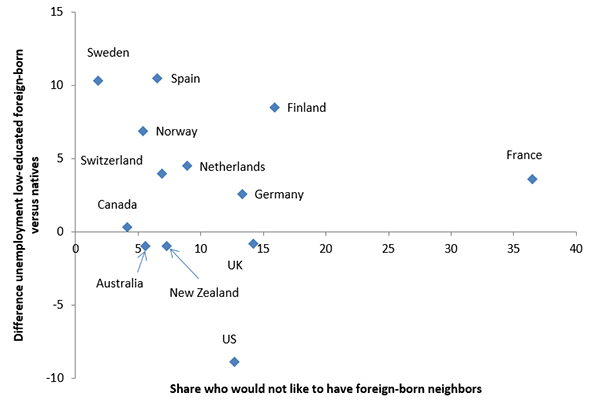
    Perhaps it is difficult to find a strong link since the number of countries included is so small. In order to broaden the sample, we can look at the 2005-2009 edition of the World Value Survey. In that survey the question relating to foreign-born neighbors, but not that of allocation of jobs, was asked. The graph below shows the relation between the share who would not like to have foreign-born neighbors on one hand, and the difference in unemployment on the other. 


    Source for attitudes towards foreign-born neighbors: World Value Survey 2005-2009. Source for difference in unemployment: OECD data over “Indicators of integration of immigrants and their children”, given for the years 2009-2010. 

    The relation between attitudes and employment prospects are not what one would expect. If anything, the countries in which fewest people do not want foreign-born neighbors are also those in which differences in unemployment are the highest. This does not necessarily mean that countries with the different attitude do better. Canada, Australia and New Zealand are nations where a relatively small share has anything against foreign-born neighbors. The same countries have good labor market outcomes for the foreign-born. In Australia and New Zealand, low-skilled individuals with a foreign-born background have slightly lower unemployment than similar natives. In Canada the difference is minute between the two groups.

    Given these outcomes it is difficult to conclusively say what factors that favor integration and what obstacles that stand in the way of integration. It could, for example, be argued that the people in countries such as Sweden are giving politically correct responses. These responses do not necessarily have to translate to the discrimination actually faced by immigrants on a daily basis. At the same time, it is clear that the Anglo-Saxon countries are succeeding in integration. This could be attributed to having English as their main language. It could also be attributed to market-based systems with strong incentives for work and relatively free labor markets. In short, attitudes, at least as reported by the World Value Survey, do not seem to explain the differences in integration. Although all enlightened countries should strive for the tolerant views expressed in countries such as Sweden, this does not guarantee well‑functioning integration.

    Dr. Nima sanandaji is a frequent writer for the New Geography. He is upcoming with the book "Renaissance for Reforms" for the Institute of Economic Affairs and Timbro, co-authored with Professor Stefan Fölster.

    Photo from BigStockPhoto.com.

  • In the Future We’ll All Be Renters: America’s Disappearing Middle Class

    An Excerpt from Joel Kotkin’s Forthcoming book The New Class Conflict available for pre-order now from Telos Press and in bookstores September, 2014.

    In ways not seen since the Gilded Age of the late nineteenth century, America is becoming a nation of increasingly sharply divided classes. Joel Kotkin’s The New Class Conflict breaks down these new divisions for the first time, focusing on the ascendency of two classes: the tech Oligarchy, based in Silicon Valley; and the Clerisy, which includes much of the nation’s policy, media, and academic elites.

    The Proleterianization of the Middle Class

    From early in its history, the United States rested on the notion of a large class of small proprietors and owners. “The small landholders,” Jefferson wrote to his fellow Virginian James Madison, “are the most precious part of a state.” To both Jefferson and Madison, both the widespread dispersion of property and limits on its concentration—“the possession of different degrees and kinds of property”—were necessary in a functioning republic.

    Jefferson, admitting that the “equal division of property” was “impractical,” also believed  “the consequences of this enormous inequality producing so much misery to the bulk of mankind” that “legislators cannot invent too many devices for subdividing property.” The notion of a dispersed base of ownership became the central principle which the Republic was, at least ostensibly, built around. As one delegate to the 1821 New York constitutional convention put it, property was “infinitely divided” and even laborers “expect soon to be freeholders” was a bulwark for the democratic order.

    This notion of American opportunity has ebbed and flowed, but generally gained ground well into the 1960s and 1970s.  The very fact that the United States was more demographically dynamic, notes Thomas Piketty, naturally reduced the role of inherited wealth compared to Europe, most notably in France,  where population growth was slower.  Mass prosperity hit a high point in America in the first decades after the Second World War, the period where the country achieved its highest share of world GDP at some forty percent.  By the mid-1950s the percentage of households earning middle incomes doubled to 60 percent compared with the boom years of the 1920s. By 1962 over 60 percent of Americans owned their own homes; the increase in homeownership, notes Stephanie Coontz, between 1946 and 1956 was greater than that achieved in the preceding century and a half.

    But today, after decades of expanding property ownership, the middle orders—what might be seen as the inheritors of Jefferson’s yeoman class—now appear in a secular retreat.  Homeownership, which peaked in 2002 at nearly 70 percent, has dropped, according to the U.S. Census, to 65 percent in 2013, the lowest in almost two decade.  Although some of this may be seen as a correction for the abuses of the housing bubble, rising costs, stagnant incomes and a drop off of younger first time buyers suggest that ownership may continue to fall in years ahead.

    The weakness of the property owning yeomanry comes at a time when other classes, notably the oligarchs and the Clerisy, have gained power and influence. Over twenty years ago Christopher Lasch argued that “the new class” was arising that “begins and ends with the knowledge industry.”  For this group, the rest of society, he suggested, exists only “as images and stereotypes.” Progressive theorists, such as Ruy Texerira, have suggested that, in the evolving class structure, the traditional middle and working class is of little importance compared to the rise of a mass “upper middle class” consisting largely of professionals, tech workers, academics, and high-end government bureaucrats.

    The Economic Decline of the Yeomanry

    All this suggests what could be seen as the proletarianization of the yeoman class. In the four decades since 1971 the percentage of those earning between two thirds and twice the national median income has shrunk, according to Pew, from over sixty to barely fifty percent of the population. While middle class incomes have fallen relative to the upper income groups, house prices and health insurance, utilities and college tuition costs have all soared.

    This reflects some very dramatic changes in the nature of the employment market. For over a decade, job gains have been concentrated largely in the low-wage service sector, such as in retail or hospitality, which alone accounted for nearly sixty percent of job gains; in contrast middle income positions actually have been declining. Meanwhile, taxes on corporate profits, which are at an all time high, have fallen to near historic lows.

    This trend has continued even in the recovery.  Between 2010 and 2012, the middle sixty percent of households, did worse not only than the wealthy, but even the poorest quintile between 2010 and 2012.  In the years of the recovery from the Great Recession the middle quintiles income dropped by 1.2 percent while those of the top five percent grew by over five percent. Overall the middle sixty percent have seen their share of the national pie fall from 53 percent in 1970 to barely 45 percent in 2012. Of roughly one in three people born into middle class households, those earning between the 30th and 70th percent of income now fall out of that status as adults.

    This decline, not surprisingly, has engendered a dour mood among much of the yeomanry. For many, according to a 2013 Bloomberg poll, the American dream seems increasingly out of reach; this opinion was held by a margin of two to one among all Americans, and three to one among those making under $50,000, but also a majority earning over $100,000 annually. By margins of more than two to one, more Americans believed they enjoy fewer economic opportunities than their parents, and will experience far less job security and disposable income. This pessimism is particularly intense among white working class voters, and large sections of the middle class.

    Many people who once had decent incomes, and may have owned or hoped to own a house or start a business have slipped to the lower rungs of the economy. In the past decade, the number of people working part-time and receiving such benefits as food stamps has expanded well beyond inner cities and impoverished rural hamlets.  Many of the long-term unemployed are older, and often somewhat well-educated workers, who have fallen from the middle class over the past decade. The curse of poverty has also expanded more into suburban locations; something widely cited by the urban-centric Clerisy, but further confirms the yeomanry’s stark decline.

    The Assault on Small Business

    Perhaps nothing reflects the descent of the yeomanry than the fading role of the ten million small businesses with under 20 employees, which currently employ upwards of forty million Americans. Long a key source of new jobs, small business start-ups have declined as a portion of all business growth from 50 percent in the early 1980s to 35% in 2010. Indeed, a 2014 Brookings report, revealed that small business “dynamism”,  measured by the growth of new firms compared with the closing of older ones, has declined significantly over the past decade, with more firms closing than starting for the first time in a quarter century.

    Instead of stemming from the grassroots, the recovery after the latest crash was led, unlike in previous expansions, by larger firms while small company hiring remained relatively paltry. Self-employment rose, but increasingly this took the form of sole proprietorships as opposed to expanding smaller companies with employees. By 2013, smaller firms with under one hundred employees added far fewer jobs than in the prior decade. Unlike prior post-war recoveries, since 2007, grassroots companies did not lead the way out of recession and continued to lose ground compared with larger companies that either could afford the costs or avoid the taxes imposed by, the Clerical regime.

    This decline in entrepreneurial activity marks a historic turnaround.  In 1977, SBA figures show, Americans started 563,325 businesses with employees. In 2009, they started barely 400,000 Business start-ups, long a key source of new jobs, have declined as a portion of all businesses from 50 percent in the early 1980s to 35% in 2010.

    There are many explanations for this decline, including the impact of offshoring, globalization and technology.  But some reflects the impact of the ever more powerful Clerical regime, whose expansive regulatory power undermines small firms. Indeed, according to a 2010 report by the Small Business Administration, federal regulations cost firms with less than 20 employees over $10,000 each year per employee, while bigger firms paid roughly $7,500 per employee.  The biggest hit to small business comes in the form of environmental regulations, which cost 364% per employee more for small firms than large ones. Small companies spend $4,101 per employee, compared to $1,294 at medium-sized companies (20 to 499 employees) and $883 at the largest companies, to meet these requirements.

    The nature of federal policy in regards to finance further worsened the situation for the small-scale entrepreneur.  The large “too big to fail” banks received huge bailouts, but have remained reluctant to loan to small business. The rapid decline of community banks, for example, down by half since 1990, particularly hurts small businesspeople that depended on loans from these institutions.

    The Descent of the Yeomanry, with Cheers from the Clerisy

    Despite America’s egalitarian roots, the prospect of mass downward mobility has been embraced widely by some business oligarchs and much of the Clerisy. The future being envisioned is one dominated by automated factories and computer-empowered service industries that will continue to pressure both jobs and wages in the future. In this scenario, productivity will rise, but wages may stagnate or decline. This leads some to propose that the American middle and working classes has become economically passé. Steve Case, founder of America Online, has even suggested that future labor needs can be filled not by current residents but by some thirty million immigrants.

    Arguably the first group to feel the downward pressure has been blue collar workers, whose lot has declined over the past few decades. After World War Two, as the United Autoworkers’ Walter Reuther noted, “the union contract became the passport to a better life” that was creating “a whole new middle class.” But with the shifting of industry overseas and the decline of private sector unions, the path for blue collar workers to enter the middle class has become more difficult.

    Although they often claim to defend the middle class, the political stance adapted by the Clerisy, as well as the tech oligarchs and the investors, tends to worsen this trajectory. Environmental concerns impose themselves most against basic industries such as fossil fuels, agriculture and much of manufacturing. These employ many in highly paid blue-collar fields, with average salaries of close to $100,000. In the last decade, top U.S. firms, notes the liberal Center for American Progress, have cut almost three million domestic jobs.  Automation also leads to the diminution of traditional white collar professions as well as the shift of high-end service jobs offshore.

    Overall, it has become increasingly common to regard the middle class as threatened and even doomed. Indeed, as early as1988 Time magazine featured a cover story on the “declining middle class,” which at that time was considerably more healthy than today. After the great recession, the American blue-collar worker has been pitied, but certainly not helped by the clerisy, which believes that there is no hope for manufacturing or similar outmoded jobs in an information age. Blue collar workers were described in major media as “bitter,” psychologically scarred” and even an “endangered species.” Americans, noted one economist, suffered a “recession” but those with blue collars endured a “depression.”

    This perspective extends across ideological lines.  Libertarian economist Tyler Cowen suggests that an “average” skilled worker can expect to subsist on little but rice and beans in the future U.S. economy. If they choose to live on the East or West Coast, they may never be able to buy a house, and will remain marginal renters for life. Left-leaning Slate in 2012 declared that manufacturing and construction jobs, sectors that powered the yeomanry’s upward mobility in the past, “aren’t coming back. Rather than a republic of yeoman, we could evolve instead, as one left-wing writer put it, living at the sufferance of our “robot overlords,” as well as those who program and manufacture them, likely using other robots to do so.

    Contempt for the middle class is often barely concealed among those most comfortably ensconced in the emerging class order. Financial Times columnist Richard Tomkins declared that the middle class, “after a good run” of some two centuries, now faces “relative decline” and even extinction. This historical shift towards mass downward mobility elicited only derision, not concern: “Classes come and classes go” and that when the middle orders disappears about the only ones that will be sorry to see them go might be the “middle classes themselves. Boo hoo.”

    The Rise of the Yeomanry

    This reversal in class mobility and the slowing diffusion of property ownership in America, if not addressed, threatens to undermine the country’s traditional role as beacon of opportunity. Equally important, the diminution of the middle orders threatens one of the historic sources of economic vitality and innovation.

    The roots of America’s middle class reflects the critical role such small holders have played throughout history.  Dynamic civilizations tend to produce more than their share of “new men.”  But nowhere was this middle class ascendency more dramatic than in Europe, first in Italy and later in northern Europe. 

    Initially, this was a comparatively small, outside group, with much of the activity conducted by outsiders such as Jews and, later, Christian dissenters. They were the driving force of the expanding capitalist  market, the creators of cities and among the primary beneficiaries of economic progress. Peter Hall quotes a historian of 15th Century Florence:

    Apprentices became masters, successful craftsmen
    became entrepreneurs, new men made fortunes in
    commerce and money-lending, merchants and bankers
    enlarged their business. The middle class waxed more
    and more prosperous in a seemingly inexhaustible boom.

    These “new men,” which included some landless peasants, gradually overthrew the old  artisan-like traders, eventually supplanted the aristocracy, and in some instances, the royal families as well. In most cases, their ascendency, although at times exploitative, generally promoted the expansion of both freedom and individual choice. They also were among the first commoners to seek out land, often in the periphery, in part as a business decision, but also to mimic the lifestyles of the traditional aristocracy.

    As occurs in every economic transition some benefited some at the expense of others. Some “new men” from peasant and artisan backgrounds rose, but many others became part of an impoverished proletariat. Many urban artisans lost their jobs to machines, but many others used their expertise to move into the middle class, often through technical innovations that, in the words of the French sociologist Marcel Mauss, constituted “a traditional action made effective, ”notably in agriculture, metallurgy and energy.

    As a colony of Britain, the Americans reflected that island’s rapid ascendancy  of small holders in the 17th and 18th Century, which linked liberation from feudalism with a less hierarchical order and the dispersion of ownership. The rise of the yeoman class in Britain was particularly critical in foreshadowing the evolution of America. These small landowners played a critical role in the overthrow of the monarchy under Cromwell, and consistently pushed for greater power for those outside the gentry. 

    Yet ultimately many paid a great price for liberal reform, allowing for enclosures of what had been communal pasture; in the process productivity rose.  Some benefited, becoming gentry themselves, while many smallholders lost their lands, and flowed into the towns where they joined the swelling proletariat. Others, notably large merchants, bought political influence and marriage into old families. By 1750, according to Marx, the Yeomanry had disappeared, a claim denied by some who believed this class persisted, albeit weakened, well into the 19th Century.

    The American Model

    Many of these displaced yeoman found a more opportune environment in America, where diffusion of ownership, as both Jefferson and Madison noted, remained central to the very concept of the nation.  Small holders served, in the words of economic historian Jonathan Hughes, as  “the seat of Republican government and democratic institutions.”

    America’s focus on dispersed ownership was further enhanced by government actions throughout the country’s history.  In contrast to their counterparts in Britain, the yeomanry in the United States enjoyed access to a greater, and still largely economically underutilized land mass, as well as a persistently growing economy. “In America,” de Tocqueville noted, “land costs little, and anyone can become a landowner.”

    The Homestead Act was signed by President Lincoln in 1862. By granting land to settlers across the Western states, Lincoln was extending the notion of what historian Henry Nash Smith described as a  “agrarian utopia” ever further into the continental frontier. Yet in reality the Homestead Act, which offered for a $.25 registration fee $1 per 160 acres proved more symbolic than effective, impacting perhaps at most two million people in a nation over 30 million. Railways, using their land grants, actually sold more land than the government gave away.

    The westward expansion of the Republic created huge opportunities for expansion of land ownership.  Jefferson wanted the land sold to the public to be a source of one-time revenue and a permanent holding for the buyer.  In many ways, at least until the 1890s, a far higher proportion of Americans owned land—almost 48%—than countries such as Britain where ownership was far more concentrated. These lands, not surprisingly, also became the source of often wild speculative booms and busts, both on the agricultural frontier and the burgeoning cities.

    Many factors ultimately undermined the first old agrarian Jeffersonian dream. Capitalist-led industrial growth shifted the proportion of the population living in cities. Only 5 percent in 1790, it rose to almost 20 percent in 1850, and nearly 40% by 1900. The new order, as in England, also weakened the position of the old artisanal professions, which often made up the ranks of the small scale owners; in many cases they were replaced by women, children and new migrants, from the countryside or from abroad. They became, as the British reformist paper The Morning Star wrote, “our white slaves, who are toiled onto the grave, for the most part silently pine and die.”

    The movement into cities, and the industrial economy, turned many workers from owners to renters. In the new industrial centers, it became far harder to start a business or own property. Even white collar workers often lost out as the instrumental economic rationality of capitalism displaced a more locally focused economy based on tradition, religion and small-scale production.

    In the United States, conditions were generally less gruesome than in Britain or the rest of Europe,  but this did not slow the tendency towards ever great concentration of ownership. The rise of great entrepreneurs like Morgan, Vanderbilt, and Carnegie drove parts of the economy into the hands of  a relative handful of people. This concentration of power and land ownership engendered a powerful protest in both rural and urban areas. Henry George’s influential Progress and Poverty, published in 1879, maintained that “the ownership of land” was the “fundamental fact” determining the social, political and “moral condition of a people.” Land, he asserted, should be owned by the public and government funded by rents.

    George’s approach appealed to a population that was seeing land ownership slipping from their grasp. Even on the land, as farming itself modernized, there was a gradual shift , as  farms mechanized and markets became more global, toward tenancy; by 1900 one in three American farmers were landless tenants. The concentration of property ownership continually grew from the 1870s on well into the 1920s.

    By the early 20th century, as the original rustic yeoman dream was weakening, there was increased pressure for change from the growing urban population. Much of the pressure came from  a middle and upper-middle class who felt threatened by the concentration of ownership and political power in the hands of the industrial and financial oligarchies.

    The Homeownership Revolution

    As the nation moved from its agricultural roots, the yeoman class interest in property would find a new main expression in the form of homeownership. This would represent an opportunity both to escape the crowded city or, for the migrant from rural areas, live in a less dense urban environment. This drive was supported by both conservatives and New Dealers, who promulgated legislation that expanded homeownership to record levels. “A nation of homeowners,” Franklin Roosevelt believed, “of people who own a real share in their land, is unconquerable.”

    The great social uplift that occurred then, coming to full flower after the Second World War, saw a working class—not only in America but in Europe and parts of east Asia—now enjoying benefits before available only to the affluent classes.  In 1966, author and New Yorker reporter John Brooks observed in his The Great Leap: The Past Twenty-Five Years in America, that, “The middle class was enlarging itself and ever encroaching on the two extremes—the very rich and the very poor.” Indeed, in the middle decades of the 20th Century, the share of income held by the middle class expanded while that of the wealthiest actually fell.

    New Deal legislation—the Housing Act of 1934, creation of the Federal Housing Administration (FHA) and the Federal National Mortgage Association, or Fannie Mae—set the stage for the great housing boom of the 1950s. This was further augmented by the GI bill, which also provided low-interest loans to returning veterans.  The success of the private financial and construction interests who benefited from this boom, suggests author Eric John Abrahamson, was largely fostered by what he describes as a “planned” economy that consciously sought to expand ownership both during the New Deal and particularly in ensuing decades. Almost half of suburban housing, notes historian Alan Wolfe, depended on some form of federal financing. This egalitarian impulse was in part driven by people returning from WW II and Korea, many of whom benefited from the GI Bill.

    This resulted in an unprecedented dispersion of property ownership. This process was aided by a strong economy and the expansion of automobile ownership, which greatly expanded the yeomanry’s mobility. Increasing numbers of the middle class and even working class people become homeowners, sparking an enormous surge in home building. By 1953, the number of Americans owning their own homes climbed to twenty-five million, up from eighteen million in 1948. A country of renters was transformed into a nation of owners. Between 1940 and 1960 non-farm homeownership rose from 43 percent to over 58 percent. It was an accomplishment of historic proportions, notes historian Abrahamson, of “a transformed Jeffersonian vision.”

    New Class Conflict Over the form and Nature of Growth

    In recent decades, this vision of widening prosperity and property ownership has become increasingly threatened, as most evidenced by the housing bust of 2007-8. It also has come under increased attack from among the ranks of the clerisy. To be sure, many of those who bought homes in the last decade were not economically prepared, as some analysts suggest. But in the wake of the housing bust, the attack on homeownership expanded to include not only planners and pundits, but even parts of the investment community have seen in the yeomanry’s decline an opportunity to expand the base of renters for their own developments.

    The ideal of homeownership, particularly in the suburbs, have long raised the ire of many  academics and intellectuals in particular . Some have sought to de-emphasize increased wealth and seek instead to embrace what they consider a more moral, even spiritual standard. This movement, not so far from old feudal concepts, had its earliest modern expression in E.F. Schumacher’s 1973 influential Small is Beautiful and the writings of London School of Economics’ E.J. Mishan.

    Both writers rightly criticized the sometimes cruelly mechanistic nature of much technological change, but also revealed a dislike of the very kind of expansive growth that has lifted so many into the yeoman class after the Second World War, not only in America but in Europe and parts of East Asia. “The single minded pursuit for individual advancement, the search for material success,” Mishan wrote, “may be exacting a fearful toll on human happiness.”

    In the search for an alternative, both writers looked not forward, but backwards.  Schumacher described “the good qualities of an earlier civilization”, that is, the old rural English society identified not so much with progressivism, or socialism, but the old Tory class order.

    More recently, many advocates of slow, or no growth are finding inspiration in even less enlightened settings than old England. Some point to the small Himalayan kingdom of  Bhutan, the site of a 2014 pilgrimage by Oregon Gov. John Kitzhaber . This  “happiness”  poster child makes an odd exemplar for the 21st century. In contrast to the praise heaped on the tiny nation by Kitzhaber, one Asian development expert recently described the country  as ”still mired by extreme poverty, chronic unemployment and economic stupor that paints a glaring irony of the ‘happiness’  the government wants to portray.” In this “happiest place on earth” one in four lives in poverty, nearly forty percent of the population is illiterate and the infant mortality rate is five times higher than in the United States. It also has a nasty civil rights record of expelling its Nepalese minority of the country.  

    Bhutan, of course, is a pastoral country, but some urbanists also increasingly apply their “happiness” ideal to cities, particularly poorer ones. Canadian academic Charles Montgomery, for example, celebrates  what he sees as  high levels of happiness in the city slums of developing countries. Montgomery points to impoverished Bogota, for example,  as “a happy city” that shows the way to urban development. If we can’t do a Bhutanese village, maybe we  can be compelled to evacuate suburbia for the pleasures of life in some thing that more reflects life in a crowded favela.  

    Although this emphasis on happiness certainly has its virtues, and should be a consideration in how a society grows, lack of economic growth, and low levels of affluence, seems an unlikely way to make  people more content. Recent research, in fact, finds that, for the most part, wealthier countries are not only richer but happier than those assaulted by poverty. Indeed the happiest countries are not impoverished at all, according to the Earth Institute, but highly affluent countries led by Denmark, Norway, Switzerland, the Netherlands and Sweden; the lowest ranked countries were all very low-income countries in Africa.

    The argument against growth  has  gained currency with the rise of environmentalism, long focused, often with justification, on the negative impacts of economic expansion. This has engendered an understandable search for an alternative standard to measure societal well-being. Climate change campaigners such as The Guardian’s George Monbiot  than “a battle to redefine humanity” , essentially ending the era of “expanders” with that of “restrainers.” Some economists, particularly in Europe, have embraced the  notion of what they call “de-growth,” that is a planned, ratcheting down of mass material prosperity. 

    Winners and Losers in the ‘Happiness’ Game

    In any conflict over the preferred shape of society, there are winners and losers. The shift from a focus on growth to one on what is fashioned as sustainability has proven a boon both for the public sector, particularly those working in regulatory agencies and politicians who now have new ways to elicit contributors, and those parts of the private sector that work most closely with government. Other beneficiaries include connected investors, including many who benefit from “green” energy subsidies that, particularly when measured by their production of energy, are considerably higher than those secured over the past century by oil and gas interests.

    The downsizing of growth, naturally, also appeals to many who already enjoy wealth, such as Ted Turner, who then promote anti-growth policies through their foundations, and, as a bonus,  get to feel very good about themselves. Other winners include the media Clerisy, notably in Hollywood–who propagandize such views while living in unimaginable luxury—as well as academics. The successful and well-compensated producer and director James Cameron complains about “ too many people making money out of the system” and warns that growth must stop to save the planet.

    So who loses in the new anti-growth regime? Certainly these include large parts of the working class—farmworkers, lumberjacks, factory operatives, oil field workers and their families—who work in extractive industries most subject to regulatory constraints and higher energy prices. Particularly hard hit may well be young families who, perhaps forsaking the “slacker” life, now find their aspirations of a house and decent job blocked by the generally older, and better off, advocates for “happiness.”

    Wall Street and “Progressives” find Common Ground

    The rise neo-Feudalism, and the decline of the yeomanry is best understood as the consolidation of ownership in ever fewer hands. This process has been greeted with enthusiasm by financial hegemons, who have stepped in with billions to buy foreclosed homes and then rent them; in some states this has accounted for upwards of twenty percent of all new house purchases. Having undermined the housing market with their “innovations,” notably backing subprime and zero down loans, they now look to profit from the middle orders’ decline by getting them to pay the investment classes’ mortgages through rents.

    In the wake of the housing bust, and the longer than expected weak economy following the Great Recession, many financial analysts have insisted that we were headed towards a “rentership society” as homeownership rates plunged from historic highs in the three years following the crash. Part of this shift has been exacerbated by the movement of large investment groups like Blackstone to buy up single family houses for rent, representing a kind of neo-feudalist landscape, where landlords replace owner occupiers, perhaps for the long-run.

    The impact of the investor move into housing has had a negative effect on middle and working class potential buyers who find themselves frequently outbid by large equity firms.” There is the possibility that Wall Street and the banks and the affluent 1 percent stand to gain the most from this,” said Jack McCabe, a real estate consultant based in Deerfield Beach, Fla. “Meanwhile, lower-income Americans will lose their opportunity for the American Dream of building wealth through owning a home.”

    But, however convenient these developments may prove to investors on Wall Street, for society and the future of the democracy, the concentration of ownership in fewer hands is highly problematical. Rather than the yeoman with his own place, and the social commitment that comes with it, we could be creating a vast, non-property owning lower class permanently forced to tip its hat—and empty its wallet—for the benefit of his economic betters.

    One would expect that this diminution of the middle class would offend those on the left, which historically supported both the expansion of ownership and the creation of a better life for the middle class. Yet some progressives, going back to the period before the Second World War, have disliked the very idea of dispersed ownership; many intellectuals, notes Christopher Lasch, found  a society of “small proprietors” and owners “narrow, provincial and reactionary.”

    Increasingly, the media and many urbanists, who see a new generation of permanent renters as part of their dream of a denser America, also embrace this vision as being more environmentally benign than traditional suburban sprawl.

    The very idea of homeownership is widely ridiculed in the media as a bad investment and many journalists, both left and right, deride the investment in homes as misplaced, and suggest people invest their resources on Wall Street, which, of course, would be of great benefit to the plutocracy. One New York Times writer even suggested that people should buy housing like food, largely ignoring the societal benefits associated with homeownership on children and the stability communities.  Traditional American notion of independence, permanency and identity with neighborhood are given short shrift in this approach.

    This odd alliance between the Clerisy and Wall Street works directly against the interest of the middle and aspiring working class. After all, the house is the primary asset of the middle orders, who have far less in terms of stocks and other financial assets than the highly affluent. Having deemed high-density housing and renting superior, the confluence of Clerical ideals and Wall Street money has the effect on creating an ever greater, and perhaps long-lasting, gap between the investor class and the yeomanry.

    This piece originally appeared at The Daily Beast.

    Joel Kotkin is executive editor of NewGeography.com and Distinguished Presidential Fellow in Urban Futures at Chapman University, and a member of the editorial board of the Orange County Register. His newest book, The New Class Conflict is now available for pre-order at Amazon and Telos Press. He is author of The City: A Global History and The Next Hundred Million: America in 2050. His most recent study, The Rise of Postfamilialism, has been widely discussed and distributed internationally. He lives in Los Angeles, CA.
  • Size is not the Answer: The Changing Face of the Global City

    This is an exerpt from a new report published by Civil Service College of Singapore, authored by Joel Kotkin with contributions from Wendell Cox, Ali Modarres, and Aaron M. Renn.
    Download the full report.

    As the world urbanises and more megacities are created, some smaller, focused urban regions are becoming truly critical global hubs, unlike most larger cities, which are simply tied to their national economies. In a new ranking of global cities, CSC Senior Visiting Fellow Joel Kotkin argues that the truly global city is one that is uniquely situated to navigate the global transition to an information-based economy since the influence of industries such as media, culture or technology are the ones that will determine economic power in future. Kotkin also examines the fundamental challenge faced by cities as they achieve global status: the need to balance two identities, a global and a local one. "The world beckons, and must be accommodated, but a city must be more than a fancy theme park, or a collection of elite headquarters and expensive residential towers", he asserts.

    In this urban age, much has been written and discussed about global cities.1 Yet, as the world urbanises and with more megacities (with populations of ten million or more) created, there is a growing need to re-evaluate which are truly significant global players and which are simply large places that are more tied to their national economies than critical global hubs. Similarly, it becomes more critical to consider the unique challenges faced by cities as they achieve world-wide status.

    The term “world city” has been in use since the time of Patrick Geddes in 1915. In 1966, Peter Hall published his seminal work “The World Cities”. Hall’s world cities were all predominant cities in existing key nation-states. Later, the concept of “global cities”, based largely on concentrations of business service firms, emerged as the primary terminology describing such international centres.

    Be it “world” or “global” cities, such cities have long based their pre-eminence on things such as cultural power, housing the world’s great universities, research laboratories, financial institutions, corporate headquarters, and existence of vast empires and their extended legacy. They also disproportionately attracted the rich, and served as centres of luxury shopping, dining, and entertainment. These world cities have exercised outsized global influence in a system dominated by nation-states.2

    As a result, the discussion of global cities has focused primarily on megacities such as New York, Paris, Los Angeles, and Tokyo. This is not surprising, since the population of the world’s largest city has grown nearly six-fold since 1900 (London, in 1900, compared to Tokyo, in 2014). Smaller cities, such as Dubai, Houston, or the San Francisco Bay Area, have not been ranked as highly as they may have deserved.

    Rethinking the Urban Hierarchy

    We believe the traditional approach has underestimated the overarching importance of a region’s role in technology, media or its dominance over a key global industry.

    This new appraisal also stems from the declining power of nation-states in a globalised economy. In 1900, the capitals of empire—London, Paris, Tokyo, Berlin and St. Petersburg—were also the largest cities, the predominant centres of world trade and the exchange of ideas. The exception was non-government anomaly, New York, which has remained North America’s premier city; in contrast, at least until recently, Washington was a relatively minor city.

    Today, we are in a period like that of the Renaissance and early modern Europe, where global activity gravitates towards small, more trade-oriented cities, for example, Tyre, early Carthage, Athens, Venice, Antwerp, and Amsterdam and the cities of the Hanseatic League (each home to less than 175,000 people). These cities, for which trade was a necessity, were tiny compared not only to Constantinople (700,000 people), but also London and Paris (more than twice as the trading cities). Similarly, the early trade hubs of Asia were often not larger imperial capitals—such as Kaifeng and later Beijing in China— but smaller cities such as Cambay (India), Melaka (Malaysia) and Zaitun (now Quanzhou in China).

    We are seeing smaller, focused urban regions that are achieving more than most larger cities. Compared to many of their larger counterparts, new and dynamic global cities, such as Singapore, Dubai, Houston and the San Francisco Bay Area, have become more influential in the world economy, as measured by critical factors like technology, media, culture, diversity, transportation access and degree of economic integration in the world economy. This “archipelago of technologically high developed city regions”, notes urban geographer Paul Knox, are replacing nation-states as emerging avenues of economic power and influence.

    These new global hubs thrive not primarily due to their size, but as a result of their greater efficiencies. This can be seen in the location of foreign subsidiaries. For example, compared to Tokyo, Singapore now has more than twice as many regional headquarters; Singapore and Hong Kong also perform far better in this respect than Asia’s numerous, much larger but less affluent megacities. Global hubs are helped by their facility with English—the world’s primary language of finance, culture, and, most critically, technology. English dominates the global economic system from New York and London to Hong Kong, Singapore and Dubai. This linguistic, digital and cultural2 congruence poses concerns for major competing cities, including those Russia and mainland China.

    Download the full report.

    Joel Kotkin is executive editor of NewGeography.com and Distinguished Presidential Fellow in Urban Futures at Chapman University, and a member of the editorial board of the Orange County Register. He is author of The City: A Global History and The Next Hundred Million: America in 2050. His most recent study, The Rise of Postfamilialism, has been widely discussed and distributed internationally. He lives in Los Angeles, CA.

  • Don’t be so Dense About Housing

    Southern California faces a crisis of confidence. A region that once imagined itself as a new model of urbanity – what the early 20th century minister and writer Dana Bartlett called “the better city” – is increasingly being told that, to succeed, it must abandon its old model and become something more akin to dense Eastern cities, or to Portland or San Francisco.

    This has touched off a “density craze,” in which developers and regulators work overtime to create a future dramatically different from the region’s past. This kind of social engineering appeals to many pundits, planners and developers, but may scare the dickens out of many residents. They may also be concerned that the political class, rather than investing in improving our neighborhoods, seems determined to use our dollars to subsidize densification and support vanity projects, like a new Downtown Los Angeles football stadium. At same time, policymakers seek to all but ban suburban building, a misguided and extraordinarily costly extension of their climate-change agenda.

    This effort works against the region’s basic DNA. Our Downtown, for all its promotion, is not a dominant business or cultural center. It accounts for barely 1/10th the share of regional employment that Manhattan – at more than 20 percent – provides for its region and less than one-sixth the share of regional jobs accounted for by San Francisco, less than one-third that of much-maligned, spread-out Houston.

    Some people contend that, by investing heavily in mass transit, we can re-engineer our region towards a more-19th century model, which Los Angeles, as a 20th century city, never had. Some, like economics and political blogger Matt Yglesias, suggest Los Angeles’ $8 billion-plus investment in rail is making it the “the next great transit city.”

    Well, after 30 years of relentless spending on subways and light rail, the share of transit commuters in the region (comprising Los Angeles and Orange counties, the Inland Empire and Ventura County) is about where it was in 1980 – roughly 5 percent – compared with greater New York’s 27 percent or Chicago’s 11 percent.

    Village people

    Transit has limited effect in Southern California because this region functions best as a network of “villages,” some more urban than others, connected primarily by freeways and an enviable arterial street system. Inside our villages, we can find the human scale and comfort that can be so elusive in a megacity. This arrangement allows many Southern Californians to live in a quiet neighborhood that also is within one of the world’s most diverse – and important – cities.

    These villages span all the vast diversity of Southern California. Some areas, like Downtown Los Angeles, increasingly appeal to young professionals who seek a version of dense urban living. They share a universe with cohorts found in many older cities: young hipsters, a small sample of empty nesters and a sizable population of homeless who live on the edges of the gentrification zone.

    But Downtown hardly provides a template for the rest of the region. Mostly we live in lower-density villages, many of which – in the San Gabriel Valley, East Los Angeles, Santa Ana, Westminster and L.A.’s Leimart Park, for example – reflect largely ethnic cultures with deeply established roots.

    Even newer areas, like Irvine – which still ranks among America’s fastest-growing cities – are now majority Asian and Latino. Irvine’s appeal is largely the much- dissed suburban virtues of clean streets, good parks and excellent schools.

    Some areas are almost insanely eclectic. My neighborhood in the San Fernando Valley – sometimes referred to as Valley Village or Valley Glen – includes many people in the film and television business, but is increasingly dominated by Orthodox Jews, Armenians and Israelis. In summer, barely clad acting folk pass Orthodox haredim dressed in impossibly warm black suits and hats.

    Walk one direction from my house, and you run into Armenian businesses, including alavash bakery and several kabob restaurants. Walk the other direction, and you enter akashrut world, with signs in both English and Hebrew; you even can get panhandled by an odd Jewish beggar, something you encounter in Israel and parts of Brooklyn but not too often in California.

    Outdoor living

    What holds these neighborhoods together is a desire for a particular quality of life, usually associated with the single-family home. These, along with modestly sized garden apartments, long have been the primary choice of Southern Californians. Such housing facilitates enjoying this region’s arguably greatest asset: its weather. Residents value a place for backyard barbecues, swimming pools, small soccer pitches for the kids and an element of seclusion.

    Unable to afford the pricier L.A. or O.C. neighborhoods, many Southern Californians, to the consternation of the urban planners and some developers, head for a newer village on the regional periphery. Indeed, more than 99 percent of the region’s growth has taken place far from central L.A. For every yuppie who moves Downtown, or into now-fashionable closer-in neighborhoods, a hundred or more move out to Rancho Cucamonga, Valencia, Mission Viejo or scores of other outlying communities.

    This article first appeared in the Orange County Register.

    Joel Kotkin is executive editor of NewGeography.com and Distinguished Presidential Fellow in Urban Futures at Chapman University, and a member of the editorial board of the Orange County Register. He is author of The City: A Global History and The Next Hundred Million: America in 2050. His most recent study, The Rise of Postfamilialism, has been widely discussed and distributed internationally. He lives in Los Angeles, CA.

  • Germany Also Having Big Problems Building Infrastructure

    Der Spiegel had an interesting article recently called “Angry Germans: Big Projects Face Growing Resistance.” The article (linked version is English) talks about how it is increasingly difficult to get infrastructure projects built in Germany.

    Wherever ambitious construction ventures loom on the horizon in Germany — from the cities to the countryside, from the coastlines in the north to the Black Forest in the south — opponents are taking to the streets…. As the public’s enthusiasm for constant innovation has lessened, so has the appeal of these sorts of projects, and, as a result, they now inevitably come accompanied by picketers. Germany’s graying society, it seems, is so cozy and settled that it resists anything threatening to upset the status quo. In the process, it has lost sight of the bigger picture.

    There are a lot of key points in this article that immediately raised parallels to the United States, where infrastructure projects are also under increasing siege. In fact, some of this reminded me of elements of the Tea Party movement. The protestors are uninterested in compromise. They are devoted, full time activists who are unrelentingly opposed to the projects in question:

    [Hartmut] Binner’s form of protest has a radical undercurrent: Well-informed, confrontational and devoid of respect for authority, he is typical of the new grassroots activism spreading across Germany.
    ….
    Binner’s entire life revolves around the campaign. He monitors the routes of departing and landing planes. He plays his self-designed noise simulator on market squares. He kicks off his court appearances by singing the Bavarian national anthem. “If you want to be heard as a member of the public, you need to push the envelope,” he shrugs.

    These days, he sees grassroots protests, activism and political responsibility from a different perspective. “The typical protesters are gray-haired, know-it-alls and very networked,” [Freiburg Mayor Dieter Salomon] says. “But they’re not remotely interested in consensus-building, political processes and pluralism.”

    Grassroots groups have become so livid, intransigent and single-minded that even the most respected politician in the country, Angela Merkel, is feeling their sting. In early May, hundreds of furious residents had gathered in central Ingolstadt to protest against the construction of a power line from Bad Lauchstädt in Sachsen-Anhalt to Meitingen in Bavaria.

    This certainly reminds me of the no-compromises view of the Tea Party. Also, a number of early American Tea Party activists were unemployed, and thus able to basically be full time activists. Even the singing of national anthem has echoes of the Tea Party and their tricorn hats. I don’t want to claim there’s a philosophical or other link between the Tea Partiers and Germany, however.

    Not everything lines up with the Tea Party, however. In Germany it seems to be disproportionately retirees who are the most engaged and militant:

    Germany’s graying society, it seems, is so cozy and settled that it resists anything threatening to upset the status quo. In the process, it has lost sight of the bigger picture.

    Many of the protestors are pensioners with no vested interest in Germany’s future. “It’s striking that the leader of the protests against the Munich runway is a 75-year-old and not someone in the middle of his working life,” [Munich Airport CEO Michael Kerkloh] points out.

    Salomon’s nemesis is Gerlinde Schrempp, a determined and argumentative 67-year-old retired teacher with attitude to spare. She’s the leader of the Freiburg Lebenswert movement, which translates roughly to “make Freiburg worth living in. The movement just got elected on to the district council and is first and foremost opposed to any new building in the city.

    There’s a stereotype out there of the average Republican voter as an old white guy. But the average Tea Party activist I’ve seen tends to be working age. I look at this one a bit differently. We need to see these types of controversies against the substrate of an aging population. Aging populations are not noted for dynamism, and older people’s self-interest is better served by starving investment for the future in order to save money and avoid uncomfortable change in the present. As a country whose population is projected to decline into the future thanks to this demographic inversion, we are seeing in Germany what’s likely a preview of coming attractions elsewhere around the world.

    Indeed, I’m reminded of what one analyst friend of mine in Indiana has said about the property tax caps there. He sees the push to cap property taxes as driven by an aging population in a stagnant state. Old people generally aren’t earning a lot of taxable income nor are they buying huge amounts of stuff, so they are disproportionately less affected by income and sales tax hikes, whereas they often own homes and are hit hard by property taxes. Thus property tax caps serve as another income transfer mechanism from young to old, holding revenue constant. They are in part an artifact of an aging society. Disinvestment in infrastructure can be seen in the same light.

    But there’s another part of this that shines a light on yet another group of opponents, namely the intelligentsia.

    The term “Wutbürger” (“enraged citizen”) was coined during the Stuttgart 21 fiasco to describe people like Hartmut Binner, and much has been written about them since. They often aren’t the “common man.” According to the Göttingen Institute for Democracy Studies, they tend to be highly educated people with steady incomes and white collar jobs. And while protests movements of the past were often steered by sociologists, today their leaders are more likely to stem from the technical professions, the researchers found.

    When we look at opposition to infrastructure in the United States, at least certain types of infrastructure, we see a similar profile of people (though not necessarily technical) behind it. It’s the leftist intelligentsia that oppose the Keystone Pipeline, suburban highway projects, fracking, and many other types of things, often with a militant unwillingness to compromise similar to the Tea Party.

    As with Germany, this opposition is enabled by environmental reviews and public participation laws that, while they serve important public purposes, make it easy to delay projects for years through repeated objections and scorched earth litigation. Traditionally environmental lawsuits were associated with the left, but conservatives have started saying, why not us too? Hence litigation against San Francisco’s regional plan. The Hollywood densification plan was recently overturned by lawsuits, and lawsuits have plagued California’s proposed high speed rail line as well.

    Whatever the project, it’s sure that somebody on the left and/or the right hates it, and thus will do everything in their power to kill it, which probably means years of delays and untold millions in increased costs.

    Also as with the United States, German governments have shot themselves in the foot with a series of financial debacles:

    Political and bureaucratic bodies are partly to blame for their own diminished authority. Every major venture seems to entail spiraling costs. Berlin’s new airport was supposed to cost €1.7 billion, a price tag that has shot up to well over €5 billion. Meanwhile, the €187 million earmarked for the Elbphilharmonie concert hall under construction in Hamburg is expected to exceed €865 million by the time the project is completed. Albig is well aware how bad this looks. “People see us as financially incompetent,” he says.

    Until politicians can convince the public they have a handle on this, the taxpayer will remain rightly skeptical of many major megaprojects. This is doubly true since it’s very clear, as has been documented by folks like Oxford professor Bent Flyvbjerg, that in many of these cases the politicians were simply lying all along about the real costs.

    I’m not sure what all the takeaways are, but there are clearly many forces operating on a global basis to inhibit the development of infrastructure in the West.

    Aaron M. Renn is an independent writer on urban affairs and the founder of Telestrian, a data analysis and mapping tool. He writes at The Urbanophile, where this piece originally appeared.

    MittlererSchlossgartenKundgebung 2010-10-01” by MussklprozzOwn work. Licensed under CC BY-SA 3.0 via Wikimedia Commons.

  • To Fight Inequality, Blue States Need To Shift Focus To Blue-Collar Jobs

    In the coming election, we will hear much, particularly from progressives, about inequality, poverty and racism. We already can see this in the pages of mainstream media, with increased calls for reparations for African-Americans, legalizing undocumented immigrants and a higher minimum wage.

    There’s no question that minorities’ economic wellbeing has deteriorated since the economy cratered in 2007. African-America youth unemployment is now twice that of whites, while the black middle class, once rapidly expanding, has essentially lost the gains made over the past 30 years,  says the Urban League.

    Conservatives may not have the answers but it’s clear that a progressive regime has not worked either.

    The net worth of blacks and Hispanics has declined relative to whites. The black poverty rate stood at 27.2% in 2012, and for Hispanics, 25.6%. At the same time as poor kids are flocking here from Central America, child poverty among Latinos has risen sharply, from 27.5% in 2007 to 33.7% percent in 2012.

    One would think these statistics would make someone question at least somewhat boilerplate progressive polices, which certainly have not worked better than standard brand conservatism. But often the common answer to these trends has been a call for more “progressive” social policies that would seek to redistribute wealth and to enforce racial equity in everything from housing to university admission. Given Republican control of the House, these racial and class politics are increasingly most keenly felt in the states and cities.

    There are numerous signs of this, including Seattle’s $15 an hour minimum wage and similar proposals in other cities. The thrust of New York Mayor Bill De Blasio’s administration seems to be to provide ever more succor to the city’s large, heavily minority, poor and working-class population through early childhood education and more subsidized housing.

    As an old Democrat, I am sympathetic to the concerns. But it’s dubious the deep blue cities have found a solution. Let’s start with the gap between rich and poor. For the most part the regions and states with the widest gap between the classes are overwhelmingly dominated by modern progressivism.

    The capital of blue America, New York City, has easily the worst levels of inequality in the country, with an income distribution that approaches that of South Africa under apartheid, notes demographer Wendell Cox.

    But New York is hardly the only progressive stronghold  with searing inequality. A recent Brookings report  found that of the regions with the greatest income disparity only one, Atlanta, is located in a red-leaning state. These include San Francisco, Miami, Boston, Washington, D.C., New York, Oakland, Chicago and Los Angeles. The lowest degree of inequality was found generally historically more conservative cities like Ft. Worth, Texas; Oklahoma City; Raleigh, N.C.; and Mesa, Ariz. Income inequality has risen most rapidly in the probably the most left-leaning big American city of luxury progressivism, San Francisco, where the wages of the poorest 20% of all households have actually declined amid the dot-com billions.

     Since most of the urban poor are minorities, these disparities are also reflected in racial terms. Among the nation’s 15 largest metropolitan statistical areas, according to an analysis by Praxis Strategy Group’s Mark Schill, the biggest gap between black and white incomes as of 2012 was also in San Francisco, where African-Americans made 49% of whites’ income. Chicago, Detroit and Philadelphia are a shade behind at 50% to 51%.

    In contrast, African-Americans score better in comparison with whites in less expensive, more suburban areas. In Riverside, Calif., black incomes are over 81% of whites, highest among the nation’s 15 largest metro areas; in the Phoenix region, black income is 73% of whites; in Houston, 65%. This is not a case of Democratic rule being the problem; the real issue is what kind of  Democrat. In cities like Phoenix, Riverside and Houston, Democratic mayors are usually very pro-business, and rarely engage in the kind of rhetoric one hears in places like New York or Seattle.

    A somewhat similar pattern can be seen among Latinos. The worst disparities – 50% to 54% of white income – are in greater Boston, Philadelphia and New York. Again, the lowest disparity was in Riverside, where Hispanic incomes were 84% of whites, followed at 81% by Miami – a city that is neither cheap nor sprawling, but has a population of generally more prosperous Cuban-Americans. In third place is Phoenix, at 73%, a city, that ironically, has been castigated as a capital of anti-Latino sentiment.

    Part of the difference is the strong growth of higher-paid, blue-collar jobs in places like Houston, Oklahoma City, Salt Lake and Dallas compared to rapidly de-industrializing locales such as New York, San Francisco, Chicago and Los Angeles. Even Richard Florida the guru of the “creative class,” has admitted that the strongest growth in mid-income jobs has been concentrated in red-state metros such as Salt Lake City, Houston, Dallas, Austin and Nashville. Some of this reflects a history of later industrialization but other policies — often mandated by the state — encourage mid-income growth, for example, by not imposing high energy prices with subsidies for renewables, or restricting housing growth in the periphery. Cities like Houston may seem blue in many ways but follow local policies largely indistinguishable from mainsteam Republicans elsewhere.

    Nowhere is this relationship between job growth and racial disparities clearer than in California, where regulations have slowed construction and industrial growth even as Silicon Valley has enjoyed a giddy boom. In Silicon Valley, Hispanic and African-American incomes have sagged, as manufacturing and many middle management positions have been reduced. But the real problems for poorer and minority residents can be seen in the state’s interior regions, where many communities still suffer close to double digit unemployment or worse.

    Part of the problem also lies with costs, particularly for housing. Simply put most working Americans, and most minorities, cannot earn enough to maintain a decent quality of life in most of America’s biggest cities. This is particularly true of big, diverse blue cities like New York and Los Angeles, where the average paycheck, adjusted for cost, ranks worst among the major metropolitan regions.

    High housing prices, notes economist Jed Kolko, are a key reason why even with a boom, population growth remains slow in the Bay Area. In contrast, Houston, which also is booming, has seen rapid population growth and in-migration. Since 2000, Houston’s population has grown 30%, three times as rapid as the Bay Area.

    One boomtown epitomizes opportunity while in the other growth has largely benefited the well-educated and well-placed. Between 2000 and 2012 income growth in Houston has been 53% while in San Francisco — despite the tech boom — it has been 35%.

    Minorities and, particularly, immigrants have been drawn to these sprawling, growing regions as the best places to improve their life. Over the past decade, the foreign-born populations of Houston and Dallas expanded roughly 50%; Atlanta saw nearly 70% growth. In contrast, immigration growth in New York, Chicago and San Francisco was under 20%.

    Immigrants are coming to these areas, in many cases, in order to buy a house. In Houston, according an analysis by demographer Wendell Cox, 52% of African Americans and 42% of Hispanics own their own homes. In Los Angeles, this percentage is in the 30s, and in New York and Boston, minority ownership is even smaller. The Atlantic may say the Sun Belt is where the “American dream goes to die” but an examination of the statistics suggests, these critics may need their compasses readjusted.

    Much the same can be said about progressive policies. Unlike some on the party-line right, I do not think that concerns about inequality and stunted upward mobility are fabrications by left-wing academics.

    The question is how to address the issue. We should consider that last time African-Americans made big strides in income were when the economy was booming under Presidents Reagan and Clinton, both of whom have been criticized for “trickle down” policies. They have done far worse under the present more conventionally progressive region.

    If they are honest, it’s time for progressives to deal with these trends with some sense of realism; you don’t have to be a conservative to favor good blue-collar growth. All too often progressive mouthpieces like the New Republic, while admitting black inequality is at the highest level in decades, emphasize such symbolic (and political unlikely) steps, as reparations and and expansion of means-tested subsidies that would help minorities and poor but leave out the middle class, and mostly white, majority.

    Such approaches will do little effectively, except to make some progressives feel even more self-righteous. But real progress on race and poverty requires a growing economy that provides opportunities for the broadest part of population. Clearly the regulatory and tax regimes that stunt middle- and working-class opportunities does not help. Blue-state progressive can whine about race, inequality and poverty with the best of them, but they would contribute far more if they started to address these issues with something other than well-rehearsed indignation and rhetoric.

    This story originally appeared at Forbes.

    Joel Kotkin is executive editor of NewGeography.com and Distinguished Presidential Fellow in Urban Futures at Chapman University, and a member of the editorial board of the Orange County Register. He is author of The City: A Global History and The Next Hundred Million: America in 2050. His most recent study, The Rise of Postfamilialism, has been widely discussed and distributed internationally. He lives in Los Angeles, CA.

    Unemployed woman photo by BigStockPhoto.com.

  • The New Extraterrestrial Geography

    This month marks forty-five years since men first left planet earth and set foot on another world. The last man to walk on the moon did so in December, 1972, over four decades ago. It’s a good moment to ponder what we haven’t done since.

    There were six successful landings on the moon, and, almost literally, they barely scratched the surface of that body. The later astronauts had “golf carts” that allowed them to travel short distances, but only a fraction of a percent of the Africa-sized area was directly investigated by humans. To say, as some do, that we shouldn’t go back, and should instead go on to Mars, would be like saying that, having touched shore in a half dozen places in the Americas, we should have then ignored those continents and gone on to Asia.

    It’s a misnomer, of course, to call this a new “geography.” That word is derived from the Greek “ge,” for earth. We probably should use something like ‘selenography’ for the moon, ‘venerography’ for Venus, and for Mars, either ‘areography,’ or my preferred fanciful ‘barsoomography’ (with a nod to Edgar Rice Burroughs). Each of these “ographies” are vastly different from each other and from earth.

    There’s a lot of interesting real estate out there, and all we’ve done so far is to briefly poke around on our own moon a few times, only to abandon the effort after a few years.

    We stopped because we have never, as a nation, made it a serious goal to open up the new lands of the solar system. Apollo wasn’t about exploration or science. It was a soft battle in a cold war; a demonstration of our technological prowess versus that of a brutal adversary. In order to win, we set up a state-socialist enterprise to rival that of our opponent, except our enterprise was democratic, whereas theirs was totalitarian. We had aerospace contractors; they had design bureaus.

    We won even before Apollo 11, with the circumlunar mission of Apollo 8 the previous year, about the same time that the Soviets started to pretend they’d never been racing. The human space program devolved into one of national pride and white-collar welfare in the states and districts of those on the Hill who funded it.

    Had it been our intent to develop and settle these new worlds, we would have gone about it very differently. For instance, we might not have acquiesced to the Outer Space Treaty in 1967. The partial goal there was to end the space race by putting the entire solar system beyond the reach of claims of national sovereignty. This is one reason why the US didn’t claim the moon when we landed. Instead, we came “in peace for all mankind”.

    This had the effect of rendering extraterrestrial private property claims themselves as somewhat problematic, even though it didn’t go as far as the Soviets wanted. Private enterprise in space was permitted. Otherwise, the communications and remote-sensing satellite industries might have been stillborn.

    If we had followed the tradition of free-enterprise America, we wouldn’t have rushed to the moon with an expensive giant rocket. Rather, we would have more methodically developed affordable space transportation, and created a competitive industry to continually drive down costs, as has occurred in other fields of transportation. We’d have developed the infrastructure in space, such as assembly facilities and propellant storage depots — the equivalent of gas stations on the Interstate — that would allow full reusability of vehicles to and from various locations.

    We are only now starting to do so, in the face of strong resistance from Congress, primarily because small, private industry doesn’t allow sufficient opportunities for graft in the way that large, sole-source NASA contracts do. Congress currently seems determined to repeat Apollo, with its giant rocket and capsule, and its missions costing billions per flight. As a result, it is likely to continue to keep us trapped in low earth orbit for the next few decades.

    Fortunately, the government is no longer the only source for the funding of human spaceflight. Several billionaires have expressed interest, including Elon Musk of SpaceX, Jeff Bezos of Amazon, Las Vegas hotelier Bob Bigelow, Microsoft co-founders Paul Allen and Charles Simonyi, and others. Musk has repeatedly stated that the ultimate purpose of his space company is to colonize Mars – he believes it’s important that we become a multi-planet species. He has already disrupted the expensive dinosaurs of the space industry with his low-cost rockets, which will become even lower cost if he succeeds, as seems likely, in developing the ability to reuse them rather than to throw them away.

    Bezos has also declared his interest, ultimately, in space colonization, whether as an insurance policy against having all of humanity’s eggs in a single basket, or perhaps to allow new social experiments like the one our own founders created in their own New World almost two hundred and forty years ago. And Peter Diamandis, author of the book Abundance and co-founder of Planetary Resources, an asteroid-mining venture, notes that the vast majority of resources available to humanity lie not on this tiny planet, but in the rest of the solar system, and ultimately the galaxy and universe beyond.

    These entrepreneurs and visionaries hold these beliefs, despite the obstacles. Planets in our solar system have a wide variety of different atmospheres, including (as with our moon) essentially none. None of them are presently breathable by humans, and won’t become so absent massive terraforming and/or radical genetic engineering (which at some point begs the question of the meaning of the word “human”).

    As for Mars, its atmosphere is far too thin to breathe, even if there were oxygen in it (it’s mostly carbon dioxide). But there is water there, and plants in greenhouses could manufacture oxygen from the atmosphere, using sunlight dimmed by its distance from our star. Rocket fuel could be produced, as well, to make access to and from the planet easier. It is full of iron and other minerals, unfortunately including the very toxic hexavalent chromium.

    Those who are simultaneously competing and conspiring to open up the solar system, with all of its new lands, are doing so not just for a handful of government civil servants, but potentially for thousands or millions of private adventurers and explorers, in a way that government cannot, and likely will not, absent a sudden burst of vision rarely seen in politicians. But with or without the government, the new lands look increasingly likely to be privately explored, settled, developed, and even created, opening up vast new wealth to humanity, and perhaps giving us the first trillionaire.

    Many today lament that they didn’t live in the excitement of the sixties, when “we” went to the moon. But the coming decades of the new “solography” promise to be vastly more exciting — not just vicariously, as Apollo was, but with the participation of the new pioneers.

    Rand Simberg has had many years of experience in aerospace engineering and project management at the Aerospace Corporation and Rockwell International Corporation in Los Angeles, and has been recognized as an expert in space transportation by the Office of Technology Assessment. He is author of the new book, Safe Is Not An Option, on how our risk aversion holds us back in human spaceflight. He blogs at Transterrestrial Musings.

    SpaceX Dragon Cargo Transfer at the SpaceX facility in McGregor, Texas. NASA Administrator Charles Bolden, left, and SpaceX CEO and Chief Designer Elon Musk, view the historic Dragon capsule that returned to Earth following the first successful mission by a private company to carry supplies to the International Space Station. Photo: NASA/Bill Ingalls.

  • Showing the Flag: The Transit Policy Failure

    David King has a point. In an article entitled "Why Public Transit Is Not Living Up to Its Social Contract: Too many agencies favor suburban commuters over inner-city riders," King, an assistant professor of urban planning in the Graduate School of Architecture, Planning and Preservation at Columbia University notes that transit spends an inordinate share of its resources on suburban riders, short changing the core city riders who cost transit agencies far less to serve and are also far more numerous. He rightly attributes this to reliance on regional (metropolitan area) funding initiatives. Many in transit think it is necessary to run near empty buses in the suburbs to justify the use of transit taxes to suburban voters (what I would refer to as "showing the transit flag")

    King asks: "So does public transit serve its social obligations?" He answers: "Increasingly the answer is no." King is rightly concerned about the disproportionate growth in spending on commuter rail lines that carry transit’s most affluent riders from deep in the suburbs to downtown. Transit policy has long been skewed in favor of the more affluent suburban dwellers in the United States.

    My Experience in Los Angeles

    I saw this first-hand as a member of the Los Angeles County Transportation Commission (LACTC). When we placed what was to become the first regional transit tax on the ballot (Proposition A in 1980), the shortage of transit service was critical in the highest demand, largely low-income areas of Los Angeles such as Los Angeles and East Los Angeles. I described the situation in a presentation to the annual conference of the American Public Transportation Association: "Often waiting passengers are passed at bus stops by full buses" Approximately 40 percent of the local bus services between the Santa Monica Mountains, Inglewood, Compton, Montebello and Santa Monica reached peak loads of 70 passengers, well above seating capacity

    At the same time, suburban area buses were usually less than half-full. In connection with this concern, I produced a policy paper, Distribution of Public Transit Subsidies in Los Angeles County, which was published in by the Transportation Research Board. The abstract follows: 

    "Public transit today is faced with the challenge of serving its clientele while subsidies are failing to keep pace with increasing operating costs. In Los Angeles County, there are service distribution inequalities–overcrowding and unmet demand in some areas and, at the same time, surplus capacity in other areas. To use subsidy resources efficiently requires that the effects of present subsidy allocation practices be understood–that is, how subsidies are translated into consumed service, both by type of service and by geographic sector within the urban area. An attempt is made to provide a preliminary understanding of that distribution in Los Angeles County. It is postulated that significantly more passengers are carried per dollar of subsidy in the central Los Angeles area than in other areas and local services require a lower subsidy per passenger than do express services. A number of policy issues are raised, the most important being the very purpose of public transit subsidies."

    Generally, transit operating subsidies per passenger were far higher in the suburbs than in the central area (where incomes are the lowest, and poverty rates the highest), and subsidies were much higher for commuter express services than for local bus services.

    I attempted to address this problem by proposing a "Mobility Policy" that would have reallocated service based on customer needs, giving precedence to areas where mobility was restricted due to limited automobile availability and lower incomes. Some colleagues whose constituents were disadvantaged by this inequity objected,  feeling compelled, it appeared, to rally about the “transit flag”

    On a Siding: Transit Policy in Recent Decades

    Since that time, Los Angeles and other major metropolitan areas have built expensive rail and busway systems. Despite the promises of attracting people out of their cars (routinely invoked during election campaigns for higher taxes), the reality is that single occupant commuting has risen from 64 percent in  1980 to 76 percent in 2012. Over the same period, transit’s share of urban travel has fallen, though stabilized in recent years at very low levels in most metropolitan areas. Indeed, when New York, Chicago, Philadelphia, Washington, Boston, and San Francisco are excluded (with their "transit legacy cities"), the 46 major metropolitan areas have a transit commute share of just three percent. Overall, more people work at home than commute by transit in 38 of these metropolitan areas and more people walk or cycle to work in 27, according to American Community Survey 2012 data.

    Yet the politically driven inequality in transit spending continues. Transit subsidies continue to be far higher for services that are patronized by more affluent riders. For example, subsidies (operating and capital expenditures minus fares) are three times as high for the commuter rail services, with their higher income riders, than for buses, with their lower income riders (Figure).

    The difference can be stark, as an example from the New York area indicates. A Fairfield County, Connecticut commuter rail rider with the median family income of $102,000 would be subsidized to the extent of $4,500 per year (assuming the national subsidy figure). By comparison a worker from the Bronx or Hudson County, New Jersey, with a poverty level family income of $18,500 per year (or less) would be subsidized only $1,500 per year. In fact, the bus subsidy would likely be even lower, because transit in lower income areas is much better patronized and thus less costly for the public. My Los Angeles research found inner city services to be subsidized approximately half below the average of all bus services (Note).

    Where Transit Works

    The functional urban cores contain the nation’s largest downtowns (central business districts). Their population densities are nearly five times that of the older suburbs and nine times that of the newer suburbs. The functional urban cores have transit market shares six times that of the older suburbs and 15 times that of the newer suburbs. Yet, it is in these poorer, denser areas where overcrowding is most acute and the need for more service is most acute. In Los Angeles, for example, the greatest potential for increasing transit ridership is where ridership is already highest.

    The vast majority of suburban drivers are not plausible candidates for transit, simply because it cannot compete well with automobiles, except, for example, for some trips to the downtowns of the six transit legacy cities (which account only one of seven jobs in their respective metropolitan areas).

    Where transit makes sense, people ride. Where it doesn’t, they don’t. Allocating resources inconsistent with this reality impairs the mobility of lower income residents, wastes resources and relegates transit to an inferior role in the city. Charging the affluent fares well below the cost of service compromises opportunities to serve more people in the community.

    Better allocation of transit resources would likely improve core area unemployment rates by increasing the number of jobs that can be accessed by lower income workers. Further, because the better used services would require lower subsidies, there would be funding available for additional service expansions.

    The principal fault is not that of transit management. It’s the politics.

    —–

    Note: These data (expenditures per boarding) are estimated from Federal Transit Administration and American Public Transportation Association data for 2012. Commercial revenues other than fares are excluded (the most important such source is advertising). Debt service is also excluded because it is not reported in the annual reports of either organization. The subsidy ratios between lower income and more affluent riders would be changed by including transfers (though the subsidies would still be considerably higher for the more affluent). Some low income riders use more than one bus or rail vehicle for their trip, while some commuter rail riders transfer to bus or rail services at one or both ends of their trips. No readily available data is available to make such an adjustment. The New York area example assumes 225 round trips per year.

    —–

    Wendell Cox is principal of Demographia, an international public policy and demographics firm. He is co-author of the “Demographia International Housing Affordability Survey” and author of “Demographia World Urban Areas” and “War on the Dream: How Anti-Sprawl Policy Threatens the Quality of Life.” He was appointed to three terms on the Los Angeles County Transportation Commission, where he served with the leading city and county leadership as the only non-elected member. He was appointed to the Amtrak Reform Council to fill the unexpired term of Governor Christine Todd Whitman and has served as a visiting professor at the Conservatoire National des Arts et Metiers, a national university in Paris.

    Photo: Bart A car Oakland Coliseum Station

  • Long Island Needs Regionalism

    Eric Alexander, the Executive Director of Vision Long Island, seems to be popping up everywhere on Long Island these days. He was recently quoted in The Corridor Magazine’s transportation and infrastructure issue as saying: “Academic conversations about regionalism is a 90s thing.” Similar to his condemnation on “academic” commentary concerning the downtown redevelopment trend, Alexander made it clear in the piece that he feels a local, downtown-centric approach is the way to go.

    Whether we like it or not, Long Island is a singular region.

    If Long Island’s developmental future is divided and segmented municipality-by-municipality, we, as a collective whole, will fail. The Village of Rockville Centre, one of Long Island’s much-touted “cool” downtown areas, shares the same aquifer system as Rocky Point. If a company abandons their corporate headquarters in Lake Success, residents in Suffolk feel the economic blow. Despite claims to the contrary by special interests and stakeholders, we are one Island. Our social, economic and environmental policies must reflect that fact.

    It is in the interest of builders, developers and stakeholders for Long Island’s developmental future to remain both segmented and divided under the guise of “localism”. Divide, and conquer, as the saying goes. When projects are looked at a regional level, they are more heavily scrutinized, and their impacts are more thoroughly explored.

    Here is a scenario:  A small village on Long Island is welcoming the economic windfall a particular development is slated to bring, while five miles north to the village, an unincorporated area fears their shops will wither thanks to the influx of shops proposed.  The Village does as they please, approving the development.  Now, the businesses in the unincorporated area lay stagnant thanks to the over-saturation of retail usage that the new development brought to the area.

    It’s Urban Planning 101: You don’t build what you don’t need. Much of the debate concerning Heartland, whose future lays with the Town of Islip, is that its impacts will resonate far beyond Islip.

    That’s the trouble with localism – it only benefits the locality, and often at the cost of other areas. Unfortunately for Mr. Alexander, some of Long Island’s issues are too big for the “locals know best” model he advocates for. Our fragile aquifer system transcends all geo-political borders, with poor land use decisions in one town impacting water quality in the next.

    Our Island is small enough for economic development policies to resonate far beyond the Village or Town level. While the Town of Babylon IDA and Town of Islip IDA squabble over wooing a manufacturing business, a lucky county in North Caroline will reap the rewards when they eventually steal them away from Long Island.  It’s one thing for a village to build more housing options, but successfully raising a new multifamily development isn’t the same thing as quantifying and addressing our marked regional need for different types of housing.

    Is it too “academic” to quantify our problems before taking the steps of addressing them? Is a protected aquifer system which supplies our region’s drinking water outdated like Zach Morris’ blocky cellphone or the Macarena?

    Localism at its worst puts immediate needs first, and Long Islanders as a collective second. Part of the challenge we face as a region is the segmented and fractured governmental systems that prevent us from significantly making any progress. The biggest public works and sweeping acts of environmental preservation in this region’s history were executed thanks to a solid foundation of regional thought. The Long Island Parkway System, LIRR and LIE weren’t built on the local scale. The preservation of 100,000 acres of Pine Barrens forest needed state legislation that trumped local zoning to be adequately protected. Suffolk County’s open space, water protection and farmland preservation programs weren’t locally-sourced, homegrown policies, but rather models emulated nationally thanks to their breadth and regional scale. 

    Regionalism at its worst is characterized by monolithic bureaucrats making decisions without any local input. This is why a balance must be struck between both approaches that blend our local sensibilities with a comprehensive regional approach. The commonalities between Long Island’s various towns, villages and even counties warrant regionalism with a local twist. Our common aquifer is the largest common tie, while our surface bodies of water constrain our physical space. Economically, Long Islanders in both counties work and commute to the Island’s employment centers, which are concentrated in a few distinct locations, while all municipalities share neighborhoods that span the socio-economic spectrum. Given the common traits, a regional approach undertaken by municipalities, helmed by non-biased professional planners would serve both the local and regional good. For too long, Long Island’s development future has been staked out by stakeholders and policymakers with something to gain by swaying in one direction or another.

    The best community planning efforts stem from public input, assessment of public needs and ample participation by the people who live and work in the area. The best environmental planning efforts use data and scientific study to advance the goals selected. A regional approach takes the best of both these approaches, and balances the needs of a region in a comprehensive manner. A local approach works under certain circumstances. When a neighborhood needs a community center, or seeks to improve their quality of life, the approach to development should be local. However, if the locality proposes development whose impacts resonate far beyond their municipal borders, a regional approach must be taken.

    There is a reason why conversations concerning Long Island’s future must be academic Mr. Alexander. We all feel the impacts of poor development choices. Sound regional planning isn’t something to dismiss as a “90s thing”, but rather, should be embraced for the betterment of Long Island’s future.  

    Richard Murdocco writes regularly on land use, planning and development issues for various publications. He has his BA in both Political Science and Urban Studies from Fordham University, and his MA in Public Policy from Stony Brook University, and studied planning under Dr. Lee Koppelman, Long Island’s veteran planner. You can follow Murdocco on Twitter @TheFoggiestIdea, Like The Foggiest Idea on Facebook, and read his collection of work on urban planning at TheFoggiestIdea.org.

    Long Island illustration by Wiki commons user Duffman.

  • Success and the City: Houston’s Pro-growth Policies Producing an Urban Powerhouse

    David Wolff and David Hightower are driving down the partially completed Grand Parkway around Houston. The vast road, when completed, will add a third freeway loop around this booming, 600-square-mile Texas metropolis. Urban aesthetes on the ocean coasts tend to have a low opinion of the flat Texas landscape—and of Houston, in particular, which they see as a little slice of Hades: a hot, humid, and featureless expanse of flood-prone grassland, punctuated only by drab office towers and suburban tract houses. But Messrs. Wolff and Hightower, major land developers on Houston’s outskirts for four decades, have a different outlook.

    “We may not have all the scenery of a place like California,” notes the 73-year-old Mr. Wolff, who is also part owner of the San Francisco Giants. “But growth makes up for a lot of imperfections.”

    A host of newcomers—immigrants and transplants from around the United States—agree. The city’s low cost of living and high rate of job growth have made Houston and its surrounding metro region attractive to young families. According to Pitney Bowes,PBI +2.11% Houston will enjoy the highest growth in new households of any major city between 2014 and 2017. A recent U.S. Council of Mayors study predicted that the American urban order will become increasingly Texan, with Houston and Dallas-Fort Worth both growing larger than Chicago by 2050.

    Houston’s economic success over the past 20 years—and, more remarkably, since the Great Recession and the weak national recovery—rivals the performance of any large metropolitan region in the U.S. For nearly a decade and a half, the city has added jobs at a furious pace—more than 600,000 since early 2000, and 263,000 since early 2008.

    The much more populous greater New York City area has added 103,000 jobs since 2008, and Los Angeles, Chicago, Phoenix, Atlanta and Philadelphia remain well below their 2008 levels in total jobs. Los Angeles and Chicago, like Detroit, have fewer jobs today than they did at the turn of the millennium.

    Many of Houston’s jobs pay well, too. Using Praxis Strategy Group calculations that factor in the cost of living as well as salaries, Houston now has among the highest, if not the highest, standard of living of any large city in the U.S. The average cost-of-living-adjusted salary in Houston is about $75,000, compared with around $50,000 in New York and $46,000 in Los Angeles.

    Since 2001, the energy industry has been directly responsible for an increase of 67,000 jobs in Houston, and it now employs more than 240,000 people in the area. These include many technical positions, one reason the region now boasts the highest concentration of engineers outside Silicon Valley. The jobs should keep coming: University of Houston economist Bill Gilmer estimates that $25 billion to $40 billion in new petrochemical facilities is on its way to Greater Houston.

    Houston also has seen a surge in mid-skills jobs (usually requiring a certificate or a two-year degree) in fields such as manufacturing, logistics and construction, as well as energy. Many of these jobs pay more than $100,000 a year. And according to calculations derived from the Bureau of Labor Statistics by the Praxis Strategy Group’s Mark Schill, since 2007 Houston has led the 52 major metropolitan areas in creating these jobs, at a rate of 6.6% annually. In contrast, mid-skills jobs have declined by more than 10% in New York, Los Angeles, Chicago, and San Francisco, which have not been friendly to such industries.

    Houston’s growth is more than oil-industry luck; it reflects a unique policy environment. The city and its unincorporated areas have no formal zoning, so land use is flexible and can readily meet demand. Getting building permits is simple and quick, with no arbitrary approval boards making development an interminable process. Neighborhoods can protect themselves with voluntary, opt-in deed restrictions or minimum lot sizes.

    The flexible planning regime is also partly responsible for keeping Houston’s housing prices relatively low. On a square-foot basis, according to Knight Frank, a London-based real-estate consultancy, the same amount of money buys almost seven times as much space in Houston as it does in San Francisco and more than four times as much as in New York. Houston has built a new kind of “self-organizing” urban model, notes architect and author Lars Lerup, one that he calls “a creature of the market.”

    Housing-market flexibility has also benefited some of the city’s historically neglected areas. The once-depopulating Fifth Ward has seen a surge of new housing—much of it for middle-income African-Americans, attracted by the area’s long-standing black cultural vibe and close access to downtown as well as the Texas Medical Center. Rather than worry about gentrification, many locals support the change in fortunes. “In Houston, we don’t like the idea of keeping an image of poverty for our neighborhood,” explained Rev. Harvey Clemons, chairman of the Fifth Ward Community Redevelopment Corporation. “We welcome renewal.”

    Houston’s explosive economic growth has engendered another kind of boom: a human one. Between 2000 and 2013, Greater Houston’s population expanded by 35%—while New York, Los Angeles, Boston, Philadelphia, and Chicago grew by 4% to 7%. According to a 2012 Rice University study, Greater Houston is now the most ethnically diverse metro region in America, as measured by the balance between four major groups: African-American, white, Asian and Hispanic. “This place is as diverse as California,” notes David Yi, a Korean-American energy trader who moved to Houston from Los Angeles in 2013. “But it is affordable, with good schools.”

    The growth-friendly attitude is what holds everything together in Houston, and it will be crucial whenever the next slowdown comes—when oil prices could drop, say, to below $100 a barrel. It remains to be seen whether a large influx of newcomers to Greater Houston from the ocean coasts will clamor, as they have elsewhere—notably, in Colorado—for a more controlled, high-regulation urban environment. For now, though, most Houstonians see the city as a place that works—for minorities and immigrants, for suburbanites and city dwellers—and few want to fix what isn’t broken.

    This article first appeared in the Wall Street Journal.

    Joel Kotkin is executive editor of NewGeography.com and Distinguished Presidential Fellow in Urban Futures at Chapman University, and a member of the editorial board of the Orange County Register. He is author of The City: A Global History and The Next Hundred Million: America in 2050. His most recent study, The Rise of Postfamilialism, has been widely discussed and distributed internationally. He lives in Los Angeles, CA.

    Tory Gattis is a Social Systems Architect, consultant and entrepreneur with a genuine love of his hometown Houston and its people. He covers a wide range of Houston topics at Houston Strategies – including transportation, transit, quality-of-life, city identity, and development and land-use regulations – and have published numerous Houston Chronicle op-eds on these topics.

    Houston photo by BigStockPhoto.com.