Category: Policy

  • The Ugly City Beautiful: A Policy Analysis

    When it comes to the future, Detroit and San Francisco act as poles in the continuum of American consciousness. Detroit is dead and will continue dying. San Francisco is the region sipping heartily from the fountain of youth. Such trajectories, according to experts, will go on indefinitely.

    Harvard economist Ed Glaeser has a grim outlook for the Rust Belt. “[P]eople and firms are leaving Buffalo for the Sunbelt because the Sunbelt is a warmer, more pleasant, and more productive area to live,” he writes in City Journal.

    Glaeser echoes this sentiment in a recent interview with International Business Times, saying “[s]mart people want to be around other smart people”, and the Rust Belt has a long slog ahead given that “post-industrial city migration is dominated by people moving to warmer climes”.

    But is this true? Is there a “brain drain” from the Rust Belt to the Sun Belt and Coasts? In a word: no. But Rust Belt leaders have bought this narrative hook line and sinker, and the subsequent hand-wringing has led to wasteful public investment.

    “Michigan’s cities must retain and attract more people, including young knowledge workers, to its cities by making them attractive, vibrant, and diverse places,” reads a 2003 memo from the National Governor’s Association about Michigan’s “Cool Cities” campaign.

    But the campaign struggled. “Government can’t mandate cool,” reflected Karen Gagnon, the former Cool Cities director. “As soon as government says something is cool, it’s not.”

    What’s worse, “cooling you city” with talent attraction expenditures can exacerbate economic disparities on the ground. Cities, like Chicago, are increasingly becoming bifurcated cities based on faulty assumptions that “trickle down urbanism” works. That said, the challenge of the day—for not only Rust Belt cities, but all cities—is not “brain drain”, but “brain waste”. Those cities who can best rebuild middle class communities tied to emerging markets will be the future of investment, like they were in the past.

    Through Rust-Colored Glasses

    When a people fall from grace, the sentiment of decline tends to stick. The Rust Belt’s demise is cemented. Meanwhile, the future is elsewhere. Like toward the sun. For instance, from 2000 to 2010, the Sun Belt metros of Houston, Dallas, Atlanta, Riverside, Las Vegas, Miami, Orlando, and Phoenix experienced the largest population growth. The biggest losers? It’s a “who’s who” of Rust Belt metros, led by Detroit, Cleveland, Pittsburgh, and Buffalo.

    America is a country governed by growth: big cars, big belt buckles, big houses, and big populations. Shrinkage is weakness. It is a sign of place failure. The problem here is that population growth is an ineffective, broad-brush measure when trying to understand regional underlying dynamics. A new study by Jessie Poon and Wei Yin in the journal Geography Compass called “Human Capital: A Comparison of Rustbelt and Sunbelt Cities” details exactly that.

    In it, the authors compare human capital levels between the Sunbelt metros in California (including San Francisco and L.A.), Nevada, New Mexico, and Arizona with Rust Belt metros in Michigan, Ohio, Indiana, Pennsylvania, and upstate New York. When it comes to share of population with a college degree, the authors find that the Rust Belt is experiencing a brain gain equal to their Sun Belt peers from 1980 to 2010. Poon and Wei also found that skill ratios of immigrants is higher in the Rust Belt than Sunbelt. The authors note that despite population decline, the Rust Belt continues “to be important sites of human capital accumulation”.

    The study coincides with recent work out of the Center for Population Dynamics that shows Greater Cleveland’s number of 25- to 34-year olds with a bachelor’s or higher increased by 23% from 2006 to 2012, as well as Pittsburgh economist Chris Briem’s work that shows the metros of Pittsburgh, Detroit, and Cleveland rank 1st,, 6th, 7th in the country respectively when it comes to the number of young adults in the labor force with a graduate or professional degree.

    Beyond human capital, the Rust Belt continues to produce and export wealth at a massive pace. The “Chi-Pitts” mega-region, which mirrors the Rust Belt boundaries with the addition of Minneapolis, generates $2.3 billion in economic output, second only to the “Bos-Wash” mega-region that makes up the Northeast Corridor.

    Also, using IRS migration data from the 2009-2010 period, a team of researchers led by Michal Migurski showed that Los Angeles County, New York County, and Cook County sent the most people and money to the rest of the United States. Detroit’s Wayne County was fourth. Cleveland’s Cuyahoga County was 9th, one spot ahead of San Francisco County. Speaking to Esquire, which published the work in a visual called “Where Does the Money Go”, Migurski explains the findings:

    "We realized that if you look at the biggest ‘losers,’ essentially what you’re looking at are the biggest cities in the U.S.," Migurski says. One of those losers: New York County, which lost $1,306,548,000 and 15,100 people. "But does that actually mean New York is a big loser?" Migurski asks. "One of our ideas was that, you’re not a loser if you’re losing money. You’re an exporter." The sort of exporter, he says, that boosts the rest of the U.S. economy. Traditional Sun Belt retirement areas comprise the gainers; areas like South Florida and Southern California in particular, create what Migurski calls "money sinks."

    Still, the notion of “loser” for Wayne and Cuyahoga County sticks, despite evidence to the contrary. But why? Why the constant “poor post-industrial people” sentiment, if not a low-grade captivation that comes with “ruin porn” rubbernecking?

    Well, if an ideal exists—you know, the experts beckon: be the “new” city, the “hot” city, the “creative” city—then a study in contrasts is necessary. The Rust Belt, with its connotations of smoke stacks and demographic decline, fits the bill.

    “[Richard] Florida suggests that Rustbelt cities’ high concentration of less creative blue-collar workers also produces unhappy residents,”Poon and Wei conclude in their Rust Belt/Sun Belt study. “We suggest that such a doom and gloom picture of urban and regional development for the uncool industrial Rustbelt needs to be tempered with a trend of brain gain that is growing across cities in the region.”

    But for this tempering to happen a clearer understanding of the importance of accumulating human capital needs to be ascertained. More exactly: Is it to put your city to work, or to “live-work-play”?

    Build it and they will…what?

    In his 1921 work Economy and Society, social scientist Max Weber details a city’s raison d’etre. Cities can be producer cities, wherein importance is derived from industries that demand national and international trade. Think Detroit and cars. Additionally, cities are consumer cities, in which growth is tied to how much is spent consuming goods and services in the local economy. Think eating, drinking, and buying houses.

    The cities that are the most economically robust have wealth generated from global production, which in turn enables local consumption. San Francisco’s tech economy drives it real estate market and artisanal toast scene. That is, if the question was “What came first, the farm-to-table chicken or the egghead?” The answer is “the egghead”, hands down.

    But this logic—i.e., in order to go to a restaurant, you need a job, and your job prospects are tied to the viability of your region’s global industries—is often turned on its head in economic development. Here, the goal is growth, no matter the rhyme or reason.

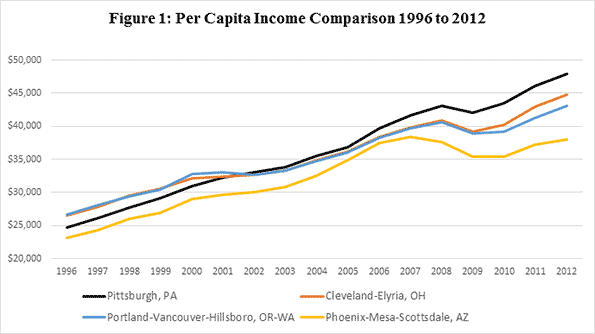
    “Like in many Sun Belt cities,” writes a Seattle Times columnist and Sun Belt expat, “Phoenix’s economic plan devolved into merely adding people, no matter the enormous long-term costs”. The columnist goes on to note that while the population has boomed, the city lags on most measures, such as per capita income (see Figure 1 below).
    Moreover, the Phoenixes of the world exist partly because of retired Baby Boomers and the disposable income that comes with it. The Sun Belt feeds off the legacy of production in the Northeast and Midwest. Other cities, like Portland, are fed by a not dissimilar dynamic. But it’s not the retired who come, rather the pre-retired.

    “The Portland metro area’s young college-educated white men are slackers when it comes to logging hours on the job,” lead’s a piece in the Oregonian about a study conducted last year, “and that’s one reason people here collectively earn $2.8 billion less a year than the national average.” Figure 1 demonstrates Portland’s sluggish income gains compared to Rust Belt peers Pittsburgh and Cleveland.

    Similarly, in a paper circulated by the Federal Reserve Bank of Atlanta, the author analyzed the top 86 “brain gain” metros in the nation to determine whether or not a region’s increase in human capital was paying off in terms of per capita income, labor force participation, poverty rate, and unemployment. The author found Portland was one of twelve metros that experienced zero economic outcomes. Pittsburgh scored 4 for 4. The authors suggest that talent attraction and retention—when untethered to production capacity—“may be largely inefficient, a kind of traditional economic development ‘buffalo hunting’”.

    Portland is perhaps America’s consummate lifestyle city. No doubt, the city has experienced a significant brain gain over the last decade. Portland is a talent attraction model. But it is not a talent producing or refining model. Rather, Portland is producing a scene that is run by the consumption of the scene’s aesthetic. Writes one young worker who left:

    “I can’t stay too long because I know if I stayed a day too long in Portland, I’d suddenly be happy to embrace the slow pace of the city and stop working… I’d end up getting sleeping real late every day, drink some coffee, maybe write some poetry on my porch (or not), and then find a part time job selling cigars like I had in college.”

    The lesson is that accumulating talent is not enough. There has to be something for the talent to do, or a context that fosters “doing”. It is also a warning for cities investing in the lifestyle game. Spending on creative class amenities ensures nothing. Creating a field of dreams won’t pay the bills. But it will run up the tab.

    The Ugly City Beautiful

    In 1998, the Chicago Sun-Times ran a piece called “Building the City Beautiful”. “The mayor of the city of Chicago, Richard M. Daley, is a big admirer of Martha Stewart,” it begins, before describing Daley’s plans to begin the "Martha Stewart-izing" of Chicago. The article goes on to quote a University of Illinois at Chicago professor who said Chicago is turning from a producer city to a consumer city. "The producer city was the industrial city — the smoke and the noise and the industrial jobs,” noted the professor. “The consumer city is the city of Starbucks, boutiques and so forth.”

    The professor was only partly right. By the 1990s, Chicago was indeed becoming brainier. But its emerging knowledge economy was an outgrowth of its “big shouldered” manufacturing base. Columbia University professor Saskia Sassen recently noted that pundits overlook this when examining the city’s transformation, with the bias being that “Chicago had to overcome its agro-industrial past, [and] that its economic history put it at a disadvantage”. Notes Sassen:

    [I]n my research I found that its past was not a disadvantage. In fact, it was one key source of its competitive advantage. The particular specialized corporate services that had to be developed to handle the needs of its agro-industrial regional economy gave Chicago a key component of its current specialized advantage in the global economy.

    Similar economic transformations from legacy cost to legacy asset are found throughout the whole of the Rust Belt. Pittsburgh, for instance, no longer provides the muscle for steel making, but it does act as the “brain center” for the world’s steel frame. How this came about is detailed in the article “Pittsburgh’s evolving steel legacy and the steel technology cluster”.

    With the arrival of the new economy also came “new economy” tastes. Sassen noted that when she arrived in to study in Chicago in the 90s she was greeted by “old lofts transformed into beautiful restaurants catering to a whole new type of high-income worker—hip, excited, alive.”

    In other words, local consumption patterns began setting up around the emergent worker demand. Going was the Italian Beef and arriving was pickled beets. This demand also impacted housing, with the attraction to urban living setting the stage for gentrification. This, in a nutshell, is the dynamic driving the transformation of urban neighborhoods nationwide: a new economy demands new workers which in turn demand a new kind of lifestyle. The problem, though, is that leaders have the causality backward, or that creating a new lifestyle will incur new worker supply and then poof: new industries. But as we see with Portland, it is not that easy. The industrial DNA and social history of your city matters more than the cosmetics atop the topography.

    Still, from a policy and strategy standpoint, it is easier just to make your city “cool”. And that’s exactly what Chicago has been doing at a significant pace. In a recent piece entitled “Well-healed in the Windy City”, author Aaron Renn details Mayor Rahm Emanuel’s policy of using tax-increment financing (TIF) to create geographic “winners” and “losers” across Chicagoland. “The true purpose of Chicago’s TIF districts—which now take in about $500 million per year,” writes Renn, “appears to be tending to high-end residents, businesses, and tourists, while insulating them from the poorer segments of the city.”

    The strategy was spelled out explicitly by Mayor Emanuel during a recent ribbon cutting for a bike path in Chicago’s Loop. Said Emanuel: “I expect not only to take all of their [Seattle and Portland’s] bikers but I also want all the jobs that come with this, all the economic growth that comes with this, all the opportunities of the future that come with this.”

    Notwithstanding the faulty logic in the strategy—e.g., if Portland lacks the jobs for its residents, how can it supply jobs for Chicagoans—the real problem is the costs associated with such bifurcated investment. In West and South Chicago, the byproducts of the City Beautiful approach are downright ugly. But they are not unexpected. They are the long-documented economic and social effects of concentrated poverty and segregation. Continues Renn:

    Safety levels in Chicago can no longer be plotted on a single bell-shaped curve for the entire city. Today, that curve is split into two—one distribution for the wealthy neighborhoods and one for the poor ones. A lack of resources is part of the problem: the police department is understaffed… While the city budget is tight, failing to increase police strength during a murder epidemic is a profound statement of civic priorities.

    Urban priorities flow from a perception of what is at stake. For long, the push for human capital accumulation has pitted city versus city amidst the backdrop of an urban popularity contest in which the “winner” is assured nothing outside of popularity. But victory in the vanity game is fleeting. The young and the restless are exactly that, and many people who come to New York or San Francisco, or for that matter Portland, leave as they get older and seek out affordable places to raise a family. What remains on the ground is the reality of brain waste. Without the prioritization of equitable, integrated middle-class neighborhoods a city’s progress will be always be disparate, if not illusory. Talent attraction is but part of a redevelopment process. So is talent refinement for those arriving and talent production for those in place. After all, neighborhoods are factories of human capital. Building people, not places, is what a successful city is all about.

    But to know this is to “know thyself”. The Rust Belt has been dying for some time now, so say the experts. The region has absorbed the projections, and given that desperate times call for desperate measures investment has been wasted. “[Creative class theory] is bad because it distracts from what’s important,” says Sean Stafford, author of Why the Garden Club Couldn’t Save Youngstown.

    Regaining focus entails removing the rust-colored glasses. Rust Belt leaders will see there are assets to work with, not to mention feel the freedom that comes with no longer being a study in contrast for those touting a future that really isn’t.

    Richey Piiparinen is Senior Research Associate at the Center for Population Dynamics at the Maxine Goodman Levin College of Urban Affairs at Cleveland State University. The Center for Population Dynamics at Cleveland State University’s Maxine Goodman Levin College of Urban Affairs aims to help partner organizations competitively position the region for economic and community development. It will do so through the lens of migration, applied demography, and culture.

    Lead photo courtesy of bctz Cleveland
  • Columbus, Know Thyself

    What Is Your Ambition?

    Columbus doesn’t have a powerful brand in the market outside of Ohio. Having said that, the city is growing rapidly in population and jobs, is extremely livable and improving day by day, and seems to make its residents very happy. Is there any reason the city has to be better nationally known in order to be complete or something?

    I say No.  It’s a valid choice to simply stay with the status quo.

    Many citizens may indeed feel that way, but much of the city’s leadership doesn’t. This was hammered home in a 2010 New York Times piece on the city’s rebranding efforts. That desire to be seen as a high caliber city at the national level clearly came through in my most recent trip, even from Mayor Coleman himself.

    I also tend to be personally biased towards high ambition, particularly in a place where it’s obvious that the ambition can be realized.  Columbus is that place, in contrast to long troubled regions  like Detroit and Cleveland are really struggling to rebound from severe problems. And no matter what they do, they will never recover the national stature they once enjoyed.   

    Columbus is both operating from a baseline of strength, and also at a point where it is still on the way up as a city.   Columbus has never been a larger, more important, more prominent city in the world than it is right now – and it has the potential to reach still higher  Not every city and not every generation is granted the opportunity that Columbus has right now.  

    Finding Columbus’ Mojo

    But assuming the answer is go for it, then what needs to be done? There is a need to go beyond the checklist.

    The first thing  is to really be committed to change and going after the brass ring. This is not an easy journey to make. Some of the things you are going to have to do are really, really hard because they involve looking  closely at civic insecurities, and also questioning perhaps your most fundamental and cherished truths, especially the truth about what you’re best at.

    It’s very hard for cities to admit where they are weak, but it can actually be even harder for them to admit where they are strong.

    One of the sayings of the Greek oracle was “Know Thyself.” Sage wisdom, indeed. Knowledge of yourself is often the most difficult to come by but valuable of commodities. Because as the saying goes, “Without awareness there is no choice.”

    Where does a city get knowledge of itself that’s useful for branding? I argue it very often comes from the past. Cities didn’t just take their present form overnight. They are the process of a long process of growth and change. In particular, the founding ethos of a place profoundly stamps its character, usually in a permanent way. The Dutch trading culture and spirit of openness of New Amsterdam is still present in contemporary New York, for example.

    When a new creative director comes in to revive a failing fashion house, what’s the first thing he does? He goes to the archives. He investigates the history of the house. What does this brand stand for? Who were the people who founded it? How did they become who they were? What happened along the journey of that house?

    To use a hackneyed phrase, that new creative director wants to understanding the “Brand DNA,” and the key to the brand DNA is in the past.

    I think that’s as true of Columbus as anyplace. Columbus certainly had good luck in getting where it is today, but I’d argue there’s more to it. One of their historical keys to success was a fateful decision in the 1950s to pursue an aggressive annexation strategy. You can say that was one mayor’s choice, but I believe the fact that it happened in Columbus and not elsewhere in Ohio signaled  that there was something different about the city. What is it?
    You need to start with an anthropological, archeological, historical deep dive into a city, its people and its culture. I’d suggest tapping into Ohio State’s cultural anthropology resources. There might even be a dissertation in it for someone.

    Aspirational Narrative

    One you have the mojo, you not only use it to build the future reality, you also sell it by telling the story of Columbus to the world. You need to create an aspirational narrative of the city that people can imagine themselves being a part of.

    Think of the story of New York. TV shows like Friends, Sienfield, and Sex and the City have created a contemporary positive narrative of life in New York. People know what it’s about. If you can make it there, etc. (This wasn’t always the case. Escape from New York, Death Wish, and Fort Apache the Bronx told quite a different narrative in a previous era). Portlandia tells a story about the place where young people go to retire. Think about the Bay Area, LA, Miami, etc. and the stories come to our heads without much thinking.

    What’s that story of life in Columbus? You create that story around the authentic mojo of the city.

    What’s on your rap sheet?

    Beyond finding the mojo, there’s another key task that goes along with the investigation. That’s finding the missing or defective genes in the civic DNA that could sabotage the city’s ambitions.

    Everybody’s got a rap sheet. The only question is whether or not we know what’s on ours. When I was working in corporate America I knew if I was getting nothing but glowing feedback from my boss, if Ihad nothing I need to get better at, I was dangerously blind. If not, why was I not the CEO of the company? Clearly, there’s a reason why I am where I am and not the President of the United States.

    So Columbus needs to understand not just checklist items it is missing like a major transit investment, but also cultural items that are holding the city back and what they are rooted in. Then it can attack them with a change program that can hopefully work, like the civic equivalent of therapy.

    On a related note though methodologically different, the city needs to be willing to take a hard look in the mirror and realistic assess its assets and accomplishments and how compelling they are in the market. The cold reality is that while Columbus is a great city in many ways and has lots of great stuff, what it has doesn’t add up to a nationally or globally compelling story. You need to take the marketing glasses off and ask how people who aren’t in or from the city   see things.

    That doesn’t necessarily mean you recategorize your assets as bad. But you have to understand that checklist items that lots of other cities are doing (e.g., bike infrastructure) are probably not going to set the city apart in the marketplace. If you don’t have it, you’re in trouble. But if you do, it doesn’t win the game. These things are just the new urban ante.

    Illustrative Applied Examples

    I want to give a quick examples – and let me stress this is provisional and speculative to some extent – illustrating these three points.

    On the mojo front, the city’s previous branding effort that identified “smart” and “open” as two key civic attributes is right on in my view. It’s a good start. But why is Columbus open? That is, why is it easier for newcomers to acclimate, penetrate networks, accomplish things, etc. in Columbus than in many other places?

    I speculate it’s rooted in being the state capital. I’ve seen a similar trait in other capitals. I speculate that because people from all over the state are coming to Columbus on political business, and because there’s always churn in elected office, civic networks don’t become closed and calcify in a sort of “Why the Garden Club Couldn’t Save Youngstown” effect.

    For the missing gene example, I think it’s very possible that one reason Columbus didn’t create a compelling, unique product in the market is that it it’s just not in the civic DNA. One local leader I talked to speculated that the city’s values were shaped by those of Ohio State football and Woody Hayes. That is, the secret to success is to work relentlessly at the fundamentals and always be pounding the ball ahead with the running game – “three yards and a cloud of dust.” Not exactly the West Coast Offense. This may be too facile, but it is clear that Columbus excels at the fundamentals, the blocking and tackling of city stuff, but hasn’t thrown the civic equivalent of the long bomb.  

    For the asset evaluation example, I think Columbus needs to be realistic about Ohio State’s stature. Ohio State is a great school, but it’s not Harvard or Stanford. I went to Indiana University and I’d say the same about them. Now, obviously you’d never come out in public and downplay Ohio State, which legitimately is a power house for the city. But you don’t want to mistakenly believe it’s doing to spawn the next Cambridge or Palo Alto without some major change either.

    It’s Cow Town, Jake

    To truly discover the secret of its mojo, Columbus needs to be willing to stare into the abyss of cow town.

    Talk to people in Columbus and you’ll hear them claim that they are not a “cow town” anymore or how people used to refer to them as a “cow town.” I have seen this as an analogy to the case of Indianapolis and “naptown.” I’ve always doubted that hardly anyone outside of Indianapolis itself ever used the term Naptown historically as an insult. No one would ever have cared enough about the city to even bother insulting it.

    Similarly, I’d never heard the term cow town until somebody from Columbus told me about it. I strongly doubt it’s ever really been a term of derision nationally, at least not outside Ohio. I know there’s a strain of Cincinnatian who loves heaping abuse on places like Columbus and Indy. As Columbus has grown while other cities in Ohio wandered in the wilderness, it’s easy for me to believe there’s been a lot of sniping. So while the market would never think of Columbus as cow town, there may be some legitimate in state reasons for them to be sensitive to the term.

    The impression I get, again provisional based on my limited experience, is that in an attempt to rid itself of the stigma of being a cow town, Columbus has sheared off its past, in effect repudiating everything that happened before 1990 or 2000.

    I observed to Mayor Coleman that Indianapolis in recent years has downplayed the 500 Mile Race. I asked him whether or not Columbus was similarly neglecting its greatest brand asset in the market by downplaying Ohio State football. He said, “No. There was a time in the 60s and 70s and the 80s, and even the 90s, where Columbus was nothing but Ohio State football. And I love the Buckeyes; I love the football team. It’s better than any professional team in the state of Ohio. And they’re still amateurs. That’s good. But having said that, Columbus is no longer just the Ohio State football team. We don’t view ourselves that way anymore [emphasis added].”

    This seems consistent with what I hear from other people. There’s an embedded idea here that there’s little to nothing of value in the city’s past and in fact that past is something to be embarrassed about or outgrown. I have never heard anyone from Columbus brag about their city for anything related to the past, apart from historic architecture.   For example, the mayor went on to talk about the importance of Ohio State in terms of its contemporary research impact. I’m not sure I’ve ever heard a city talk less about its heritage.  That lack of historic rooting may be one reason why the city can come across as somewhat generic.

    As I’ve noted before, this is normal for us to go through. When we go off to college, Mom puts our high school letter jacket up in the attic. We try as hard as we can to fit in at the new level, and treat the stuff we left behind as little kids stuff.

    But eventually we become comfortable in our own skin. We learn who we are and what we stand for, and we stop becoming so concerned about what other people think of us. Of course we are social creatures and will never stop caring about others’ perceptions of us. We find a healthier balance.

    The same is true of cities. Columbus is far enough along in its growth path to really be comfortable being itself, and acknowledging and embracing its past.

    This doesn’t mean Columbus should be or ever was a cow town. What it does mean is that things from its past that Columbus   are actually its strongest brand assets and things to be proud of and build its future on.

    Let’s give some examples. The Midwest has a history of local, low grade lager brands. Virtually all of these were abandoned and ceased production. The hip, cool thing to do was to drink microbrews, not even Bud or Miller Lite, to say nothing of Sterling (my dad’s brand).

    Then one day the hipsters on the coasts started drinking Pabst Blue Ribbon, and all of a sudden back in the Midwest, we started drinking it too and now are re-launching or re-embracing all those old blue collar brands (including Sterling). The same thing happened with workwear clothing, which is now selling for quite a premium in some places and very popular among the Bearded Ones.

    In effect, we had to re-import our own heritage after a bunch of other people elsewhere saw the value in it – the same heritage we rejected as “cow town.”

    The clearest example of this is agriculture. The Midwest is all about ag. Ohio State is a huge ag power house. Columbus could have owned urban agriculture, farm to table, organics, etc. But it didn’t. And now it’s doing them, but it’s doing them as the follower, not the leader.   

    This is one of the tragedies of the Midwest. We turned away from our heritage and a bunch of guys in Brooklyn bought it from a thrift store for a song.

    The South avoided this. Look at Nashville. Did they turn their back on country music as “cow town”? No, they embraced it as central to their identity past, present, and future. Of course they are more than country. But they kept it front and center. But they also updated it. It’s not the old AM radio country. It’s not Hee Haw. They respect those people and institutions and see them as in continuity with today, but they have evolved. Today’s it’s glitzier, “Nashvegas.” Think Carrie Underwood, not Minnie Pearl.

    This is what it means to know thyself and build the future out of the authentic mojo of the past. Columbus surely has many things in its past and in its historic civic character   of immense value. The question and the challenge to the city is being willing to find out what those are and own and embrace them and champion them as a key part of the mojo on which it will build its future reality and aspirational civic narrative.

    I believe the potential is right there. The question is whether the city is ready and willing to step up and grab it.

    Aaron M. Renn is an independent writer on urban affairs and the founder of Telestrian, a data analysis and mapping tool. He writes at The Urbanophile, where this piece originally appeared.

  • Are America’s Rich More Generous?

    In 2009, the two richest men in America organized a confidential dinner meeting of billionaires in New York City, hosted by David Rockefeller. Guests included George Soros, Michael Bloomberg, Ted Turner, and Oprah Winfrey. The topic of discussion was philanthropy. Each billionaire was asked to describe his philosophy of giving. CNN-founder Ted Turner told the story tale of how he had made a spur-of-the-moment decision to donate $1 billion, most of his future, to the United Nations. During this dinner, Bill Gates and Warren Buffet started the biggest fundraising drive in history. Setting examples though their own charity, Gates and Buffet initiated “The Giving Pledge”, a campaign encouraging billionaires to commit the majority of their wealth to philanthropic causes. So far around 113 billionaires have agreed to the pledge.

    Billionaires are targeted because Gates and Buffet believe that only they have sufficient funds to make a dent into the world’s major problems. The United States was initially chosen in part because the nation has a stronger culture of donating. The social contract in the United States puts stronger emphasize on giving back something to society by those fortunate enough to have acquired wealth. Bill Gates has already donated close to $30 billion dollars of his own wealth. He has further pledged to donate his remaining wealth of about $60 billion (leaving his three children $10 million each). Omaha billionaire Warren Buffett was inspired by his friend Gates’ example and also pledged all of wealth to charity. Leaving only a small endowment to his children, Buffet stating “I want to give my kids just enough so that they would feel that they could do anything, but not so much that they would feel like doing nothing”.

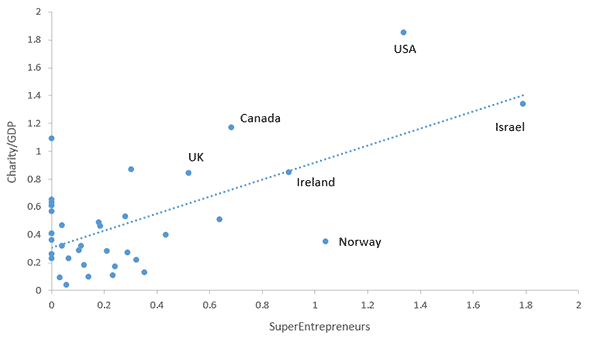
    On average, the wealthy in the United States tend to donate a higher share of assets to charity than those in other countries. There also appears to exist an international correlation between charitable donations and billionaire entrepreneurship. The Johns Hopkins Comparative Nonprofit Sector Project cites data about cross-country differences in charitable donations. The 2004 book “Global Civil Society: Dimensions of the Nonprofit Sector” contains charitable donations as a share of GDP in 36 countries. According to this source Americans donated 1.9% of GDP to charity, compared to 0.3% of GDP in continental Europe.

    In the publication “SuperEntrepreneurs – and how your country can get them” we recently examined the circa 1000 self-made men and women who have earned at least $1 billion dollars and who have appeared in Forbes magazine’s list of the world’s richest people between 1996 and 2010. There is a very strong correlation between the per capita number of SuperEntreprenures in different countries and donations to charity as a share of GDP. This relationship holds also when controlling for per capita GDP and tax rates. Other than the United States, countries with a high count of SuperEntreprenures and high charity as a share of GDP includes Israel (1.3 percent of GDP), Canada (1.2 percent) and the United Kingdom (0.8 percent). Several British Superentreprenurs have joined the Gates and Buffet Giving Pledge to donate half their wealth to charity, including Michael Anthony and Richard Branson.

    It may be that the strong correlation between charity and the number of SuperEntreprenurs is not causal and reflects cultural differences, such as Anglo-Saxon countries donating more to charity and having more entrepreneurship. To some extent, there may be an interplay between Anglo-Saxon capitalist culture and Anglo-Saxon prescription for charity, especially for the fortunate. Tocqueville has argued that Protestant norms such as industry, frugality, charity and humility were important for American development. The Calvinist Puritan settlers brought with them strong norms of charity from England, which also influenced Canada and Australia. Interestingly, a similar norm towards expectations of charity from the wealthy exists in Jewish culture, which may in part account for the high rate of charity in Israel. The lower rates of charitable giving is found in poorer countries such as Mexico (0.04 percent of GDP) and India (0.09 percent) but also in Germany (0.13 percent) Austria (0.17 percent), Korea (0.18 percent) and Japan (0.22 percent).

    American capitalism differs from other societies in its historical focus on both the creation of wealth and the reconstitution of wealth through philanthropy. In 1957, Historician Merle Curti argued that “philanthropy has been one of the major aspects of and keys to American social and cultural development”. The implicit social contract allows rich Americans to retain most of their wealth from taxation. In return, they voluntarily give much of it back to society, in projects of their choosing. The notion exists that wealth beyond a certain point should be invested back in society to expand opportunity for future generations. In this way John D. Rockefeller, the richest man in American history, gave back 95 percent of his wealth before he died.

    The legitimacy of American capitalism has in part been upheld through voluntary donations from the rich. Social norms regulating donations differ markedly between Europe and the United States, not only for the rich. In the United States, around 2 percent of GDP is donated to charity each year; about ten times higher the ratio of European countries. Based on tax data, Fortune Magazine estimates that the 400 highest earning Americans donate $15 billion to charity each year, or around ten percent of their annual income. Compared to other donors, wealthy Americans are more likely to donate to education and the arts but less likely to donate to religion.

    Much of the new wealth created historically has thus been given back to society. This has had several feed-back effects on capitalism. For one, the practice has limited the rise of new dynasties. Another positive feed-back mechanism is that the donations to research and higher education in particular has allowed new generations to become wealthy. In his lifetime, Rockefeller alone established many important institutions, including the University of Chicago, Spelman College, The General Education Board, National Bureau of Economic Research, Brookings Institution, and the Rockefeller Foundation. The University of Chicago is not the only great private research universities created through individual philanthropy. The same is true for Stanford, MIT, Johns Hopkins, Carnegie-Mellon, and Duke.

    Lastly the practice of philanthropy creates legitimacy for capitalism among the public. Bill Gates, the richest man in America, accumulated his wealth using famously sharp elbows. Yet his is one of the most popular people in the country. In one public Pew poll, he was viewed favorably by 69 percent and unfavorably by only 15 percent of the public, the best numbers of any public person polled. Similarly according to Gallup Bill Gates in the most admired man in America who is not a current or former President.

    Scholars Asc and Phillips have disused the “entrepreneurship-philanthropy nexus” at length, arguing that “[m]uch of the new wealth created historically has been given back to the community, to build up the great social institutions that have a positive feedback on future economic growth.” Asc and Phillips describe the importance of these norms in American economic history: “For Carnegie, the question was not only, ‘How to gain wealth?’ but, importantly, ‘What to do with it?’ The Gospel of Wealth suggested that millionaires, instead of bequeathing vast fortunes to heirs or making benevolent grants by will, should administer their wealth as a public trust during life”. Charitable instincts amongst highly successful entrepreneurs is relevant for economic development, in a time where there is global concern that rich dynasties will dominate capital ownership by investing inherited wealth. The combination of opportunities to create new wealth and philanthropy has so far ensured that Anglo-Saxon societies are characterized by new wealth, compared to countries such as France where inherited wealth plays an increasingly important part in the economy.

    Dr. Nima sanandaji is a frequent writer for the New Geography. Dr. Tino Sanandaji is a full-time researcher at the Research Institute of Industrial Economics (IFN) in Stockholm. They have co-authored “SuperEntrepreneurs – and how your country can get them” (Center for Policy Studies) which has received considerable media impact during recent weeks.

    Bill Gates photo by PauloHenrique. 


    Acs, Z.J., and R.J. Phillips (2002). “Entrepreneurship and philanthropy in American capitalism”. Small Business Economics, 19;3:189-204.

    Curti, M. (1957). "The History of American Philantropy as a Field of Research", The American Historical Review, 62;2:352-363. De Tocqueville, A. (1966), reprint from original 1835 publication. “Democracy in America”, New York, NY: HarperCollings.

    Fortune Magazine and CNN Money (2010). "The $600 billion challenge", 2010-06-16. Blog post availiable on http://features.blogs.fortune.cnn.com/2010/06/16/gates-buffett-600-billion-dollar-philanthropy-challenge/ when last checked 2013-12-31.

    Lester, S., W. Sokolowski and Associates (2004). “Global Civil Society: Dimensions of the Nonprofit Sector, Volume Two”, Bloomfield, CT: Kumarian Press.

  • Know Your City’s Marketplace Leverage

    I’ve noticed so often that urbanist policy suggestions or case studies are treated as universals. That is, with a presumption that a good idea or policy can be replicated pretty much anywhere. Clearly, there are a number of items like bike lanes and trails that would appear to be widely applicable, and for which the best practice standards would appear to work without much modification in most places. On the other hand, this isn’t true of everything.

    Where do most urban progressive policy ideas come from? From what I’ve seen, these tend to get wide currency when the come from one of the major urbanist citadels like London, New York, Washington, San Francisco, or Portland. This doesn’t always mean that was the place that came up with the idea, but it often is. But these cities are very different from your average, workaday type place.

    One problem with our analysis of these things is that they seldom take into account the amount of marketplace leverage a particular place has. Let’s take New York, for example. That’s a city with immense marketplace leverage, meaning that people and businesses are willing to put up with enormous cost and hassles to live, work, and do business there. In particular, the finance industry, which remains heavily centralized in New York as one of the two top global finance centers, generates tons and tons of cash. Most places don’t have that. It’s similar for tech in the Bay Area, government in Washington, DC, etc. These places have high value industries that are bound to the geography they are located and generate immense wealth and tax revenue. That means these places can get away with a lot of things other cities can’t. They’ve got a cash register that never stops ringing.

    One current case study is Seattle’s raising of the minimum wage to $15. First the small city of SeaTac raised its minimum wage to that level. SeaTac has 27,000 residents, but also includes SeaTac airport as the name implies. Airports employ a large service class who can benefit from a minimum wage increase. And most airport service businesses don’t have the luxury of moving off airport. That gave SeaTac marketplace leverage to raise the minimum wage significantly without huge risk to its employment base. SeaTac airport isn’t going anywhere.

    The city of Seattle itself has followed suit with a graduated increase to $15/hr. Again, Seattle is, like San Francisco, a city of the elite or on its way. The cost of doing business there is such that most businesses that are cost sensitive are already gone or on their way out the door. The coffee shops and other establishments with lower paid workforces mostly can’t move without losing their customer base. So in my view Seattle also has more leverage than your average city in setting this policy.

    It would be tempting to look at the Seattle case and say that other cities should raise their minimum wage. But for places without the concomitant marketplace leverage, it could prove to be economically disastrous.

    So understanding that degree of marketplace leverage you have is critical to evaluating local policies where the result could affect competitive positioning. Cities with greater marketplace leverage will have more flexibility to have local specific policies that might otherwise disadvantage them by raising costs, regulatory hurdles, etc. They can afford to be in the vanguard of policy experimentation.

    Places that fail to take stock of this do so at their peril. One place that has clearly done that is Rhode Island. It has basically acted like it’s entitled to put into place the same sorts of policies as next door Massachusetts and Connecticut, but without the captive high value industries to finance it. Massachusetts has the global power of greater Boston with its unmatched universities, tech, and biotech clusters. Connecticut has access to New York money. Rhode Island doesn’t have anything like this.

    Unfortunately for the Ocean State, it doesn’t seem to get it. I think in part that’s because the state’s intellectual elite – its cultural 1%, so to speak – live in a different reality. Many of them have lived and worked elsewhere like Manhattan and chose to move to Providence for lifestyle. Or they are affiliated with Brown or RISD, two atolls of actual competitive advantage in the state. They look around and see that they are in Rhode Island and they can compete at the global level, so they push for the same sorts of ideas that they used to have back when they actually did live in Manhattan or wherever, without realizing that the other 99% of Rhode Island can’t compete at that level.

    Back in early 2013, I summed it up like this:

    The basic problem of Providence (and by extension the rest of Rhode Island) becomes obvious: it is a small city, without an above average talent pool or assets, but with high costs and business-unfriendly regulation. Thus Providence will neither be competitive with elite talent centers like Boston, nor with smaller city peers like Nashville that are low cost and nearly “anything goes” from a regulatory perspective.

    One reason it’s unlikely they’ll escape from this dilemma is that in my view they aren’t ready to face up to the reality of where they stand in the market competitively.

    Acting like you have leverage when you don’t can be a serious problem, but you can also “leave money on the table” when you do have leverage and fail to take advantage of it. Just as one example, Indianapolis has a “beggar’s mentality” when it comes to development. It just so happens that because of the tourism/sports business and the locals penchant for chain dining that upscale national chains have some of their best locations anywhere in downtown Indianapolis. It’s literally one of the most profitable places in the country for that kind of business – not that you’d know it from the way the city treats them.

    As one example, a BW-3 was built on Washington St. downtown a couple years back. As it turned out, they built something contrary to their approved plans and which violated numerous design guidelines of the city. Did the city make them fix it? Nope. So BW-3′s insult to streetscape humanity was allowed to stand. The city had a lot of marketplace leverage in this case, but didn’t recognize it or wasn’t willing to use it.

    The lesson here is that you need to take stock of the amount of marketplace leverage you have, and tailor your approach accordingly. This is part of coming up with an urban solution set that is right for a specific place and not just a bunch of imported ideas from elsewhere pursued without thought.

    Also, cities should also be asking what they can do to add to their marketplace leverage. Hopefully over time as they continuously improve, their intrinsic attractiveness will go up, which will accrue leverage benefits right there.

    Aaron M. Renn is an independent writer on urban affairs and the founder of Telestrian, a data analysis and mapping tool. He writes at The Urbanophile, where this piece originally appeared.

    Top Photograph: Downtown Seattle from the Space Needle (by Wendell Cox)

  • Reversing American Decline

    Across broad ideological lines, Americans now foresee a dismal, downwardly mobile future for the country’s middle and working classes. While previous generations generally did far better than their predecessors, those in the current one, outside the very rich, are locked in a struggle to carve out the economic opportunities and access to property that had become accepted norms here over the past century.

    This deep-seated social change raises a profound dilemma for business: Either the private sector must find a way to boost economic opportunity, or political pressure seems likely to impose policies that will order redistribution from above. It is doubtful the majority of Americans will continue to support an economic system that seems to benefit only a relative few. Looking at our unequal landscape, one journalist recently asked: “Are the bread riots finally coming?”

    By 2020, according to the Economic Policy Institute, almost 30% of American workers are expected to hold low-wage jobs, with earnings that would put them below the poverty line to support a family of four. The combination of high debt and low wages has some projections suggesting millennials may have to work until their early 70s.

    But our new pessimism and widening class divide stems not only from the concentration of wealth and power, but from the persistence of weak economic growth.

    Neo-populist groups on the left and the right have risen to employ political pressure to try and assure a decent quality of life. Ideologically robust liberals, like New York Mayor Bill de Blasio, have emerged as national symbols of a movement in which cities have pushed strong moves like a $15 minimum wage (Seattle) and benefits for workers. Ironically, these are often the same places where wealth is most intensely concentrated and where the middle class has shrunk as a newly dominant, Obama-aligned Clerisy of public employee unions, government officials, academics and artists has gained the preponderance of political power.

    The same sense of limited opportunity that drives the new progressives also motivates the popularity of libertarian and Tea Party activism on the right. Instead of state intervention, these groups have been attracted to the notion that removing barriers to economic growth will increase social mobility more effectively than redistribution by political fiat.

    But these economic arguments that could generate more widespread support have been married with increasingly unpopular, often backward-looking social agendas that have allowed the Clerisy to portray them as fringe movements.

    This has allowed Obama, de Blasio and others shape a new conversation centered on inequality, rather than growth. Oddly enough, it’s a model that relies on Europe’s example even as the continent’s own economic prospects appear dismal, and mainstream political parties there are registering their lowest levels of popular support in decades.

    Though it can help some in the short run, there is little reason to think that more redistribution by the state would improve material conditions over the long term for our working and middle classes, let alone expand them. Rather, it might end up expanding our underclass of technological obsolete and economically superfluous dependents. The 50-year War on Poverty, for example, has achieved few gains since the 1960s despite fortunes spent. Instead, the only significant gains in poverty reduction, at least among those working, have come when both the economy and the job market expand, as they did during the Reagan and Clinton eras.

    Clearly, as both those Presidents recognized, the best antidote to poverty remains a robust job market.

    Yet even this progress has not helped the poorest of the poor, many of whom are marginally, if at all, connected to the workplace. Since 1980, the percentage of people living in “deep poverty”-with an income 50% below the official poverty line — has expanded dramatically. Despite now spending $750 billion annually on welfare programs, up 30% since 2008, a record 46 million Americans were in poverty in 2012.

    It is possible that, as Franklin Roosevelt warned, a system of unearned payments, no matter how well intended, can serve as “a narcotic, a subtle destroyer of the human spirit” and reduce incentives for recipients to better their own lives.

    The activist welfare-based philosophy, following the European model, would likely include not only historically poor populations, but part-time workers, perpetual students, and service employees living hand to mouth, who can make ends meet largely only if taxpayers underwrite their housing, transportation and other necessities. This trend towards an expansive welfare regime could be bolstered by our falling rates of labor participation — now at its lowest level in at least 25 years, and showing no signs of an immediate turnaround.

    And the European model shows little evidence of the benefits of redistribution given the persistently high rates of unemployment, particularly among the young, across most of the EU; indeed much of the continent’s youth are widely described as a “lost generation.” Pervasive inequality and limited social mobility have been well-documented in larger European countries, including France, which has one of the world’s most evolved welfare states. It is even true in Scandinavia, often held up as the ultimate exemplar of egalitarianism, but where the gap between the wealthy and other classes have increased in Sweden four times more rapidly than in the United States over the past 15 years.

    To be sure, progressive, or even ostensibly socialist approaches can ameliorate the worst impact of economic decline on lower-income people. But under left-wing governments — Socialists in France, New Labour in Britain and the Obama Administration in the U.S. — class chasms have increased markedly under leaders who insist their policies will reduce inequality. Much the same has occurred in countries with more conservative approaches.

    In the absence of a focus on growing economies more rapidly and broadly, both political philosophies fall short.

    But maintaining the prospect of upward mobility is central to the very idea of America. For generations, the surplus working class populations of the world have flocked here in search of opportunities unavailable in their home countries. In contrast, there remain few places for America’s aspirational classes to go.

    Fortunately, the capitalist system, particularly under democratic control, allows for the possibility of reform. Take Great Britain, the homeland of the industrial revolution. In response to mass poverty and serious public health challenges during the 19th century, social reform movements led by the clergy and a rising professional class organized to address the most obvious defects caused by economic change. It is one of history’s great ironies that at the very time that Karl Marx was composing Das Kapital in the library at the British museum, life was rapidly improving for the British working class. Far from having “exhausted its resources” and precipitating all-out class war, the inequality so evident in mid-19th Century Britain began to narrow through natural economic forces and the growing power of working-class organizations. The working-class revolution in Britain, which Friedrich Engels insisted “must come,” never did.

    Similarly, the Depression, brought on by what Keynes called “a crisis of abundance,” was addressed more by measures to spur mass demand than relying on redistribution. The New Deal, and then the Second World War, expanded government support for public works, education and housing, as well as infrastructure and research and development. Programs enacted then and after the war also encouraged widespread property ownership.

    This state expansion was generally aimed at increasing economic opportunity-for example, by developing technologies that could stimulate new industrial sectors, new firms, and create new wealth. Today’s, on the other hand, is simply transferring income from one group to another.

    Whatever criticisms can be made of mid-century America, during this period the nation transformed what had been a strongly unequal country into one where the blessings of prosperity were more broadly shared. In the 1950s, the bottom 90% held two-thirds of the wealth here. Today they barely claim half.

    Sparking beneficial economic growth requires a shift in priorities, and thus presents a challenge to the new class order dominated by Wall Street, the tech oligarchy and their partners in the Clerisy. It is not enough merely to blame the so-called 1%, but to shift the benefits of growth away from the current hegemons, notably in the very narrow finance and high-tech sectors, and towards those involved in a broad array of productive enterprise.

    The American economy’s capacity for renewal remains much greater than widely believed. Rather than a permanent condition of slow growth, the United States could be on the cusp of another period of broad-based expansion, spurred in part by its rapidly growing natural gas and oil production — a once-in-a-lifetime opportunity as cheap and abundant natural gas is luring investment from manufacturers from Europe and Asia, and providing good-paying American jobs.

    This, along with growth in manufacturing, could spark better times for the middle class, as would the re-igniting of single-family home construction.

    If America really wants to confront its growing class divide, it needs to spark such broad-based economic growth, rather than simply feathering the nests of the already rich, privileged and well-connected.

    This story originally appeared at New York Daily News..

    Joel Kotkin is executive editor of NewGeography.com and Distinguished Presidential Fellow in Urban Futures at Chapman University, and a member of the editorial board of the Orange County Register. He is author of The City: A Global History and The Next Hundred Million: America in 2050. His most recent study, The Rise of Postfamilialism, has been widely discussed and distributed internationally. He lives in Los Angeles, CA.

    Unemployed photo by BigStockPhoto.com.

  • Population Growth as the Cure for the Incredible Shrinking City?

    The 1957 sci-fi classic The Incredible Shrinking Man reads like a Rust Belt city script. In it, the lead actor is afflicted with the anti-natural: shrinkage in a world of growth. The rest becomes existential. From the movie review blog “Twenty Four Frames”:

    He hates being a scientific experiment and a spectacle for the media. He is no longer the everyday 1950′s image of the middle class, white picket fenced American man. Instead, he now fights for survival in his own house where everyday objects are now the enemy to his existence. Finally, he must face the biggest question of all. If he continues to shrink, will he eventually even exist?

    Such is the mood behind revitalization efforts in shrinking city America, particularly the Rust Belt. There, population decline has been occurring for decades. It still occurs. The Cleveland metro lost nearly 83,000 people from 2000 to 2012. The Pittsburgh metro lost over 67,000. This is in contrast to the region’s “greenfield economies”—defined as “the set of conditions that flow from building on new territory or exploiting new markets vs. the redevelopment of old places”. For example, the geographically-expanding Columbus metro added 260,000 people from 2000 to 2012. The top feeder region into Columbus was Greater Cleveland.

    The dynamics behind these demographic patterns are fairly intuitive. Population gains and losses are a factor of a region’s employment picture. Cleveland Fed economist Joel Elvery explains:

    Urban economists like to divide a regional economy into two sectors: tradable and nontradable. The tradable sector produces goods and services that are sold outside of the region; the nontradable sector produces goods and services for use in the region…If the industries that make up the tradable sector are growing nationally, then the region will most likely grow. If the tradable sector is struggling, eventually the region will also struggle.

    In the case of Cleveland, one of the region’s main tradable sectors is manufacturing. That said, technological advances in manufacturing means it takes less people to make a product. In the 1950s an auto worker made on average seven cars per year. A worker can make 28 today. The effect of the increased productivity is a loss of jobs. The effect of job loss is a declining population.

    Put a fork in the Rust Belt, right?

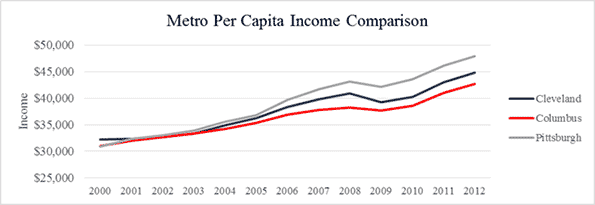
    Not exactly. Figure 1 shows the metro per capita income for Cleveland, Pittsburgh, and Columbus. The metros’ incomes were even around 2003, but then Pittsburgh and Cleveland began diverging from Columbus around 2005. Of importance here is that Pittsburgh and Cleveland have had higher per capita income growth than Columbus despite their declining population. This goes against the grain of traditional urban development thinking in which growth is god.

    Figure 1: Source, US Bureau of Economic Analysis via Telestrian

    Looking at real per capita income at purchasing power parity (PPP), or income adjusted for inflation and how far a dollar goes in a given metro, the trends hold. The map below shows the real per capita income (PPP) for all metros for the United States. Notice Greater Cleveland and Greater Pittsburgh stand out, with values at or above $42,000 a year. In fact, in ranking the nation’s largest metros (over 1 million people), the highest real per capita metros were Hartford, Boston, and San Francisco, followed by Pittsburgh 6th and Cleveland 11th. Not bad for “dying” metros. Columbus clocked in at 28th, while peer Rust Belt metro Detroit was 44th out of 51.

    Map: Map of real per capita personal income adjusted for inflation (in 2005 chained dollars) and regional purchasing power. In thousands of dollars (2011). Source, U.S. Bureau of Economic Analysis via Telestrian.

    Why is greater per capita income growth happening in the Rust Belt compared to Columbus? We have to keep in mind that a rising per capita income is not necessarily associated with a robust economy, particularly for regions that have flat or declining populations. Specifically, a metro, such as Cleveland, can gain in per capita income simply due to a significant out-migration of low- and middle-income workers. Such a scenario could prove problematic if the area’s total personal income is decreasing across time, because then the overall economy is contracting.

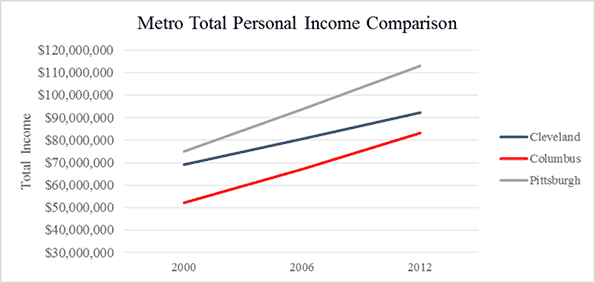
    But this is not the case. Figure 2 shows the total personal income for the three metros from 2000 to 2012. Both Cleveland’s and Pittsburgh’s total personal income levels increase despite declining populations. This effect has been called “growth without growth” by the Brookings Institution, and it occurs when a workforce is becoming more educated and productive at the same time overall population declines.

    Figure 2: Source, US Bureau of Economic Analysis

    This is what is happening in the Cleveland metro. Data from a new study I co-authored with Jim Russell out of the Center for Population Dynamics at Cleveland State University showed that from 2000 to 2012, Greater Cleveland gained over 63,000 educated residents, while simultaneously losing nearly 74,000 residents without a college degree. Over two-thirds of this brain gain occurred between 2006 and 2012. The fastest growing cohort was for college-educated Greater Clevelanders 65 and plus—a 30% increase. The number of Greater Clevelanders with a college degree aged 25 to 34 increased by 23%. Conversely, the vast majority of the out-migration was made by people aged 35 to 44 without a 4-year degree.

    This population dynamic is partly the result of Cleveland’s restructuring from a labor- into a knowledge-based economy. Specifically, growing tradable industries, like STEM and health care employment—which have driven job growth in Cleveland—are able to attract and retain skilled residents, whereas slower-growth industries are “pushing” less skilled workers elsewhere. Many of these non-degreed workers find a better return on investment in areas that are gaining in population, particularly if they are employed in the local consumer economy. Think laborers and much of the service class. This notion is supported by the fact that from 2000 to 2011, the average income of a person that moved from Greater Cleveland to Greater Columbus was $38,000 a year. Such a re-positioning of less-educated workers partly explains that while the Columbus metro is gaining on Greater Cleveland in total income, it is not the case with per capita income. Notes the Cleveland Fed: “Per capita income growth [in Columbus] is under increasing pressure to continue rising as population growth exceeds income growth”.

    So yes, Cleveland shrinks. But it is not about brain drain, but about rational choice theory. And while population loss is troubling for any city, it is in many respects a necessary demographic result as a region like Greater Cleveland transitions from brawn- to brain-intensive work.

    Think of this as a “one step at a time” approach to the existential plight that is the incredible shrinking city—meaning Cleveland’s migration needs are currently about quality, not quantity. This is because economic growth is not likely to be achieved through an increase in local consumption. Local jobs are created from emerging tradable industries, not vice versa—five service jobs are made for every new high-skill job in fact. And emerging industries are created via human capital, not consumer demand.

    “Consumer demand does not necessarily translate into increased employment,” writes John Papola in Forbes. “That’s because ‘consumers’ don’t employ people. Businesses do.”

    So where does Cleveland go from here?

    It needs to look to Pittsburgh. The sister Rust Belt city has had a human capital formation that has been nothing short of astonishing. University of Pittsburgh economist Chris Briem calculated that the metro ranked fifth in the nation when it came to the percentage of young adult workers with a bachelor’s degree, behind only Boston, San Francisco, D.C., and Austin. What’s more, Greater Pittsburgh ranked first for the highest concentration of young adult workers with a graduate or professional degree.

    “Change in the Pittsburgh economy is reflected in many ways,” writes Briem, “but probably no more profoundly than in the educational attainment of its workforce”.

    Greater Cleveland doesn’t perform too shabbily either, ranking 17th in the nation in the number of young adult workers with a bachelor’s degree, and 7th in the nation for young workers with a graduate or professional degree, ahead of knowledge hub darlings Seattle and Austin.

    In other words, Cleveland’s got something to build on: the quality of its young adult workforce. So instead of dumping money on brain drain boondoggles, or expending significant public expenditure on things like hotels and casinos that intend to drive economic growth from consumption on up, the region needs to pull out all the stops on growing a critical mass of talent. Because, as my colleague Jim Russell puts it, “talent is the new oil”.

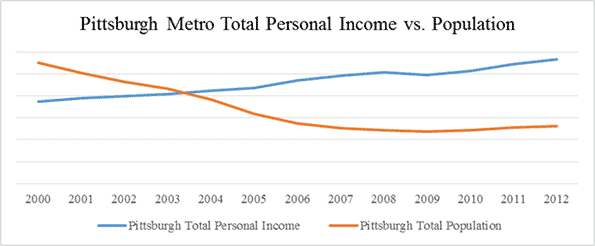
    Eventually, once the region’s new economy sectors are revved up, then job growth for both skilled and less skilled work will increase, making the region amenable to population gain. This is the case in Pittsburgh, where population loss has recently turned into a slight gain after decades of decline (See Figure 3).

    Figure 3: Source, American Community Survey, Bureau of Economic Analysis

    But until that growth happens the Rust Belt will be stubbornly mired in its existential crisis. Shrinking, struggling, and wishing on silver bullets and outdoor chandeliers. But maybe there is room for measured hope. More exactly, we shrink therefore we are?

    "I was continuing to shrink, to become… what? The infinitesimal? What was I? Still a human being?,” wonders the incredible shrinking man in the film’s closing monologue. “Or was I the man of the future?”

    Well, considering what the cost of living is doing to the coasts, maybe the notion of Pittsburgh as the city of the future isn’t so farfetched. The Clevelands of the world would be wise to wager so, and then model accordingly.

    Richey Piiparinen is a Senior Research Associate who leads the Center for Population Dynamics at the Levin College of Urban Affairs at Cleveland State University. His work focuses on regional economic development and urban revitalization.

    Top image: Courtesy of Universal Pictures

  • May the (Insidious) Force Be With You

    Google Earth pic to the left of the boundary between Detroit and suburban Grosse Pointe Park, MI. Alter Road (cutting from upper left to lower right) is the boundary between the two. Take note of the differences in vacant land between Detroit (on the left) and Grosse Pointe Park (on the right).

    Too many people think today’s “de facto” segregation in metro areas is the result of personal preferences expressed by individuals, when the fact is that public policy has created the conditions we live with today.  In fact, I see the demise of Jim Crow through the Civil Rights Act and the Voting Rights Act corresponding with the immediate rise of an insidious, “non-racist” racism that shapes our metros today.  Our metro areas have never dealt with this.

    In the aftermath of the Donald Sterling controversy (which, if you aren’t aware of, you truly are under a rock), the Atlantic’s Ta-Nehisi Coates posted an on-spot critique of how racism is viewed and how racism is really working in today’s society.  It is a truly beautiful piece on the perception of racism versus its realities — the perception being that racism is the purview of dunces like Sterling (and Cliven Bundy before him) who get caught making inelegant statements that shed light on their true feelings, and a reality that is far more insidious and receives far less attention.  Coates describes how “elegant racism”, that insidious force, shapes where we live, what jobs are available to us, how we’re educated, and who is incarcerated and who isn’t:

    “Elegant racism is invisible, supple, and enduring. It disguises itself in the national vocabulary, avoids epithets and didacticism. Grace is the singular marker of elegant racism. One should never underestimate the touch needed to, say, injure the voting rights of black people without ever saying their names. Elegant racism lives at the border of white shame. Elegant racism was the poll tax. Elegant racism is voter-ID laws.”

    And to better describe how “elegant racism” works, he cites Chicago as its key implementer:

    “Throughout the 20th century—and perhaps even in the 21st—there was no more practiced advocate of housing segregation than the city of Chicago. Its mayors and aldermen razed neighborhoods and segregated public housing. Its businessmen lobbied for racial zoning. Its realtors block-busted whole neighborhoods, flipping them from black to white and then pocketing the profit. Its white citizens embraced racial covenants—in the ’50s, no city had more covenants in place than Chicago.

    If you sought to advantage one group of Americans and disadvantage another, you could scarcely choose a more graceful method than housing discrimination. Housing determines access to transportation, green spaces, decent schools, decent food, decent jobs, and decent services. Housing affects your chances of being robbed and shot as well as your chances of being stopped and frisked. And housing discrimination is as quiet as it is deadly. It can be pursued through violence and terrorism, but it doesn’t need it. Housing discrimination is hard to detect, hard to prove, and hard to prosecute. Even today most people believe that Chicago is the work of organic sorting, as opposed segregationist social engineering. Housing segregation is the weapon that mortally injures, but does not bruise.”

    (Let’s parenthetically stop here for a second; the symbolism in that last sentence is incredible.  The implication is that victims of elegant racism “die” from internal injuries, which are often believed to be sustained from a lifetime of poor personal choices.  But elegant racism made those choices for them.  Absolutely incredible).

    I don’t know if Chicago was the innovator of this type of racism, but I do believe it was something created in Northern industrial cities — i.e., the Rust Belt.  I suspect it has its seeds in the antebellum North, whose cities had small African-American populations prior to the Civil War and immediately afterwards.  I imagine at that time, when blacks comprised maybe less than five percent of, say, Buffalo’s population, it was relatively easy to isolate blacks without necessarily singling them out, as in the Jim Crow South.

    But the Great Migration changed everything.  The need for industrial labor in the North, and rapidly declining conditions in the Jim Crow South, pushed African-Americans into Northern cities.  Once there they encountered competition for jobs and housing from both longtime “nativists” and more recent European immigrants.  The ten years from 1910-1920 were fraught with racial conflicts in Northern cities, culminating with the Red Summer of 1919.

    But Northern cities did something that Southern ones did not.  They sought to limit and stigmatize the places where blacks lived, instead of limiting or stigmatizing the people themselves.  Out of this a whole set of policies emerged.  Racial covenants.  Redlining emerges during the New Deal.  Blockbusting came about as a tool to clear room for a growing black population, accelerate suburban expansion, and enrich real estate speculators.  Public housing was concentrated where blacks lived, and infrastructure investments ground to a halt.  Investments in education fell behind that of suburban schools, or couldn’t keep up with growing social challenges.  “Tough-on-crime” measures like mandatory sentencing and the “War on Drugs” were effective in removing potential workers from the workforce, reducing competition.  Taken together, these “non-racist” racist policies, often grounded in sound, rational economic thinking, created deeply ingrained patterns within metros that shape them today.

    This position is further buffeted by research done by Nancy DiTomaso, a business professor at Rutgers University in New Jersey.  In her book, The American Non-Dilemma: Racial Inequality Without Racism, she says this:

    “Because whites disproportionately hold jobs with more authority, higher pay, more opportunities for skill development and training, and more links to other jobs, they can benefit from racial inequality without being racists and without discriminating against blacks and other nonwhites. In fact, I argue that the ultimate white privilege is the privilege not to be racist and still benefit from racial inequality.”

    There are other strong claims made by DiTomaso in that interview; it (and the book, which I loved) is worth your attention.

    In my opinion the practice was perfected in the Rust Belt but has spread everywhere.  Milwaukee Journal-Sentinel is doing a series on political segregation in southeastern Wisconsin, and found that its roots are in the state’s residential segregation legacy.  Lee Atwater’s famous quote about the abstraction of racial policies, uttered in 1981, possibly signaled to Southern metros that there was a way to accomplish the separation that Jim Crow had earlier provided.  I see a correlation between the number of blacks within a metro area, and the impact of insidious policies on residential and job patterns.  In some metros, the impact, while there, is not as strong (New York, Boston), because of lower relative numbers of blacks.  In some Sun Belt metros, Jim Crow likely enforced similar patterns but subsequent post-War growth and the new policies altered things a little (Atlanta, Charlotte, Nashville).  In other Sun Belt metros with more recent growth the numbers of blacks has hardly been enough for full-on “elegant racism” implementation (Phoenix, Las Vegas).  But insidious racism is a critical feature of today’s Rust Belt cities.

    This is in part why I’m skeptical of new calls from urbanists to increase affordable housing in cities, when I see vast neighborhoods that have suffered from policies that simply removed them from the consciousness of the majority of the housing market.  I’d prefer to address yesterday’s mistakes before creating new ones.

    Plus, I keep thinking about that saying that the only thing necessary for evil to prosper is for good people to do nothing…

    This post originally appeared in Corner Side Yard on May 9, 2014.

    Pete Saunders is a Detroit native who has worked as a public and private sector urban planner in the Chicago area for more than twenty years.  He is also the author of “The Corner Side Yard,” an urban planning blog that focuses on the redevelopment and revitalization of Rust Belt cities.

  • Ukraine Watch: Kiev in the Media Center Spotlight

    This spring I traveled from St. Petersburg to Kiev, by way of southern Russian and eastern Ukraine. The newspapers were filled with reports of American policymakers gushing over how mobs in Kiev deserved the inalienable rights of freedom fighters and self-determination. Mobs of Russian mercenaries in Eastern Ukraine, who set up automobile tire and sandbag roadblocks, were condemned for threatening world peace.

    I took trains and mini-vans, and crossed the Russian-Ukrainian border between Belgorod (Russia) and Kharkiv (Ukraine), where, at least in the Western press, there are large concentrations of Russian forces getting ready to pounce on Ukrainian independence (I did not see any).

    As I travelled (with my 18-year-old son), I came to view the crisis less in geopolitical terms and more as opportunities for what the Soviets used to call agitprop, from “agitation and propaganda.” Like the agitprop theatricals of the 1920s, this war serves as the extension of public relations by other means.

    Ukraine is tailor-made for show business: it’s a folk opera, one of those performances in native dress you have to endure on package tours around Europe. The storyboards of an evil Vladimir Putin play well, even to an American electorate unsure if Donbas is a region or a dress designer.

    From any microphone in the world, President Obama can threaten “additional sanctions” against the Russian oligarchy. Vice President Biden can jet into Kiev with messages about how “the American people stand with the people of Ukraine, ” while Secretary of State John Kerry intones high moral dudgeon.

    For Putin, saber-rattling over Ukraine is a better media opportunity than even the winter games. It’s a chance to dominate the world stage and be taken seriously without having to put up another Olympic village for $51 billion.

    Day-to-day in the Kremlin, Putin presides over an empire in decline. For Russian men — awash in tobacco and vodka — the average life expectancy is about 64, and Potemkin’s village is now the glitter around Moscow, covering up the grim reality of the provincial cities.

    Economically, Russia’s trade zone with Belarus and Kazakhstan cannot compete with Europe, and China’s economic boom makes Russia, by comparison, look like a collective farm. For that reason, it’s doubtful that Putin needs to annex another coal region with high unemployment, although he’s happy to claim it if local militants drop it in his sphere of influence.

    As the avenger of the 1854 Crimean War, Putin can, at least, lay claim to Empress Catherine-like greatness, although the word on the Moscow street is that he took Yalta and Sebastopol so that Russian oligarchs can cash in on the bourgeois pursuits of gambling and casinos.

    Even the provisional government in Kiev has an interest in using the crisis to promote its competency. It came to power not through elections, but from street demonstrations, which were funded by sources as diverse as local oligarchs, nascent political parties, foreign intelligence agencies, the Catholic church, and neo-fascist elements. Each tent represents a marker in the great game.

    The freedom fighters still encamped around Kiev’s main city square, Maidan, look less like Jeffersonian democrats exchanging copies of Montesquieu’s treatises and more like those second-amendment militias in Montana, to whom all governments are evil.

    Dozens of tents are pitched in the square. The occupants, many dressed in thrift shop army fatigues, have the angry, down-and-out look of the 1890s Coxey’s Army of the unemployed, rather than of delegates to the Continental Congress.

    The Kiev protesters overthrew one government and are standing by—chopping wood, grilling sausages, listening to music, stacking bricks—to see what happens in the May 25 presidential election. To be clear, the February martyrs of the Maidan (about 110 were killed), whose pictures line makeshift altars around the square, were not paid to give their lives in political opposition.

    They took to the streets against the government of Viktor Yanukovych, which they saw as corrupt, dictatorial and ready to consign Ukraine to a Putin revival of the Warsaw Pact and Comecon. But in the chess culture of Ukraine, knights and bishops go forward with different goals than pawns.

    The Kiev government is struggling and divided. About 20 candidates have declared for the presidency, and at least eight parties are represented in the parliament. What could be more uplifting for them than solidarity phone calls from President Obama or pep talks from the US vice-president?

    The problem with the American embrace is that it validates the Russian belief that NATO, the EU, and the United States want Ukraine in their sphere of influence. Otherwise, why would the director of the CIA have come to Kiev during the recent crisis? Imagine the American reaction if an interim government in, say, Quebec welcomed the head of the Russian secret service, the FSB.

    The extent to which the crisis is being waged by the media can be seen in Kiev’s Hotel Ukraine, a dreary Intourist relic of the Soviet era overlooking the Maidan that, during the street demonstrations, allegedly rented out rooms to government snipers. Now that tourists rarely visit Kiev, the hotel is headquarters for something called Ukraine Crisis Media Center, a slick public relations operation where journalists can stop by for a quick coffee and a quote.

    On paper, the group is staffed with patriotic volunteers, there to keep alive the martyrdom of the Maidan and to warn about the evils of Russian aggression. In practice, the “media center” has the look of serious American front money.

    The day I was there it featured short, introductory remarks by the US ambassador to Ukraine and a press conference from the ranking minority member of the Senate Committee on Foreign Relations, Bob Corker (R-Tennessee).

    For these thirty minutes, Ukrainians, like homespun Tennessee constituents, were simple, hardworking folks who needed American support to throw off the Russian yoke. Yes, there was the local problem of corruption, but that was “a remnant of the Soviet-era,” much like the plumbing, I guess.

    Corker explained that he had come to Kiev to “show support for the people of Ukraine” and to applaud their courageous right to “self-determination”. For its aggression, he said, Russia and its president needed to “pay a price.”

    At no point was any mention made of other causes of the current crisis: NATO designs to push its military frontiers to Ukraine and Georgia, despite earlier assurances from President Bush (Sr.) not to advance NATO east of a reunited Germany; the US seeing Ukraine as a fertile market, not just for its intelligence services, but for its gas exports and energy companies; Ukraine’s kleptocracy that has left the post-Soviet economy stillborn since 1991; and elements of the non-elected government having spoken with the same reverence about fascism that earlier citizens accorded their Nazi liberators in 1941.

    In Washington’s press releases, the masked men in the East are Russian proxies in a renewed Cold War. To Moscow, the encampments around the Maidan are the spiritual heirs of the army of the Bay of Pigs.

    My own view is that that the liberators of Eastern and Western Ukraine, despite having different ideological mentors, are the homegrown dissidents of a failing state, one with high employment, cornered markets, governments with Italian-like instabilities, and few profits that have trickled down to ordinary citizens.

    Before leaving Kiev, we thought about visiting the vacated house of the former President Yanukovych, who departed in a hurry for his Russian exile, leaving behind his gilded furniture and private zoo. We were told the house is being transformed into a Museum of Corruption. Admission costs 20 Ukrainian hryvnia, although you can also get in by paying 10 hryvnia to one of the guards.

    Matthew Stevenson, a contributing editor of Harper’s Magazine, is the author of Remembering the Twentieth Century Limited, a collection of historical travel essays. His new book, Whistle-Stopping America, was recently published. He first traveled to the former Soviet Union in 1975, and over the years has been to many of its then-constituent parts.

    Photo by the author: Tents in the Maidan.

  • The Hyping of “Big Data”

    Worship at the altar of what is labelled big data is rampant in both corporate and large not-for-profit settings. And while there is some general sense that big data arrives at warp-speed and involves huge datasets from very diverse sources and methodologies, there is no consensus and little discussion of what comprises meaningful and valid “big” datasets.

    It is part of the American DNA that that bigger means better, so the alchemy of big data can appear enticing. Moreover, big data naturally appeals to many data geeks, high-priced consulting firms, and IT professionals. These are the very people who have a vested interest in proffering big data solutions – even if they only have a shallow understanding of what the data represent. In those circles there is a tendency to think that if the data sets are large enough, sophisticated algorithms can somehow smooth out flaws in the data. Yet the old truism still holds: garbage in garbage out.

    Huge numbers, per se, may awe the innumerate and methodologically challenged, but honest social scientists have long recognized that quality and critical understanding are what really counts. For example, a relatively small scientific survey, a tight, well-designed experimental design, or a rigorous, clearly defined accounting process provide validity that a conglomeration of user reviews and click data cannot deliver. Why so?

    Let’s first look at what much of big data is based on. For sure, some data are obtained via valid techniques with clearly defined outcomes and caveats. Unfortunately, those methodologies can be expensive, so they are often supplanted by cheaper, less rigorous approaches. One such approach is what is known as a convenience or opt-in survey. Typically conducted online, these surveys appear in the form of a pop-up or as an embedding link.1

    These unscientific approaches typically lack basic validity. Rather, the findings reflect an amorphous aggregation of people who happen to be visiting a given web page at a particular time. Google surveys, for one, are very quick, inexpensive and beloved by techno geeks, but, in the end, you get what you pay. A legitimate sample should represent a given population based on sampling frame and response rate, which opt-in surveys cannot provide.

    The key here is to sample a representative audience, rather than people who happen to be on-line, or like to air their opinions or have an ax to grind. In addition, the response rates for pop-up surveys are absurdly low, so it’s hard to evaluate how representative their findings may be. As Butch said to Sundance, the client should ask their consultants, “Who ARE those guys?” Opt-in surveys, at best, may crudely identify major trends – providing that the client is willing to foot the bill for a tracking study – and also can also suggest there is a major issue worth exploring more rigorously.

    How about user reviews? Note that they are usually based on customer ratings elicited right after purchase. The most relevant issues of usability and product reliability are not even factored into the equation. The purchaser also is typically comparing a brand new product with a much older and often poorly performing model. (My new 42” Sanyo TV may seem great compared to my old six year old 34” Toshiba.) That is why product user reviews tend to be so positively skewed.  Finally, and this no small problem, many reviews are bogus, provided by outside firms for a fee. Vendors claim to scrutinize these reviews, but, like NSA’s protocols, one ultimately needs to take them at their word. User reviews sometimes provide the best data one can find (e.g., Trip Advisor for non-chain hotels or restaurant), but one may be safer viewing them for specific comments rather than for their summary ratings.

    Other metrics involve click data on a website, which may be more indicative of placement on a web site than anything else. If a link is prominently and explicitly featured, it will get more page hits. If a page requires complex navigation to reach, it will garner fewer hits, especially if the search tool is flawed. Here’s a real life example from my experience at Consumer Reports. Many non-product ratings (supermarkets, airlines, insurance, etc.) attained exceptionally high readership scores. On the website, ConsumerReports.org, these stories are buried and invisible to many potential readers. Note that when those stories briefly appeared on the home page they were extremely popular. Rather than look at the pattern analytically, the big data decision was to focus on IT-based metrics such as click data, which were seen as both “objective” and “real time” despite their obvious flaws.

    Another popular yet overrated methodology is the focus group, a moderated discussion among selected participants on a particular topic. Focus groups are usually comprised of people selected for some basic demographics and a roughly defined unifying theme such as in the market to buy a car or does online research on health care. Note that these are people have both the time and inclination to spend a couple of hours on a topic for a small fee and a meal. Second, unless the moderator is very adept, the prejudices of the moderator or highly opinionated participants often exercise undue influence. Clients often latch onto the opinions of participants with whom they agreed, thereby drawing suspect conclusions.2 One valid use of focus groups is to help clarify issues for later quantitative work. Another valid use of focus groups is when the participants possess true expertise or other qualifications. For example, I conducted a focus group with electric engineers on microchips and another among senior directors and VPs at commercial banks on issues involving online banking.

    Number crunching – a la big data – without appropriate history or solid methodology has very limited utility. Human behavior is not akin to physics, and numerical positivism is often fatally flawed. Too much analysis is largely ahistorical. “Real time data” is another data cliché much lauded today as the holy grail of research. Yes, up-to-date data are invaluable, but good data analysis requires thought and perspective. What does one make of the number of tweets or Face Book posts for Justin Bieber in March 2014?

    Even scientific survey research needs to acknowledge historical precedents. I recall an ongoing Gallup survey that asked were the biggest concerns Americans were facing.  Most of the time various economic issues were volunteered; however, when issues like drugs, HIV, or crime dominated the news, those issues which seemed paramount at the time quickly faded in the public’s eye. Thus “real time data” without context can be both shallow and misleading.   

    Another key point: Watch for bias. One reason that people highly rate expensive new purchases is that they don’t want to admit that they may have made a mistake (cognitive dissonance in social science parlance). Sometimes ideology obscures opinion. Careful question creation will avoid many of the pitfalls. Questions posed in terms of “consumer protection” will tell a different story than questions framed as “government regulation”. It is often assumed that “anyone can write a survey”, but such naiveté will provide bad results.

    Different data tell different stories. What are the strength and limitations of each dataset? Blind number crunching obscures reality, and no amount of sophisticated statistical techniques can produce valid conclusions unless the data collection methods are evaluated and found sound. If two different analyses tell different stories, the object is to see why. Are they measuring the same thing?

    At Consumer Reports we found sometimes a car model’s rating from lab tests did not jibe with the survey results. Both methods are valid, but the former are predicated on measurement of performance based on lab test while the survey reliability is based on respondents reporting that product broke within a given time frame. Both measures had strength and weaknesses. A product can perform very well, yet have undistinguished reliability, and vice versa. Both sets of data are presented, but not aggregated. Doing so may delight the wonks by providing a “simple” measure, to do so will obscure reality and will do the client/audience a major disservice.

    Another example: A number of years ago I was asked to represent Consumer Reports at a health care conference sponsored by Kaiser Family Foundation.  Most of the major health care research firms as well as several major employers attended. One of the goals was to ascertain whether a basic metric evaluating health care would be possible. The general consensus was that goal was illusory because the data were far too complex and multivariate to do so. In the most simplistic terms, you can’t have red and blue and say the answer is purple.  So while big data may contain reams of information, it cannot be boiled down to simplistic conclusions.

    So here’s my advice. All datasets, large and small, have strengths and limitations.  Bigger does not necessarily mean better. You will learn more from a well-constructed small set of data than from a less robust but large one. And while sloppy data analysis can obscure the value of even the best data, even the most sophisticated data analysis cannot rescue meaningless data. Statisticians and web wonks are not members of a priesthood. Don’t assume they have all the answers. Like the patient who is told that surgery is necessary, you may want to get a second opinion. After all, it’s your business and you should not hand over key decisions to number-crunchers who might have little understanding of your industry, its dynamics, or your customers.

    Mark Kotkin, PhD, retired from Consumer Reports after 27 years. He worked in their survey division, most recently as Director. He was responsible for all published survey-based content and served as a methodologist on several organizational teams. He managed the Annual Questionnaire, the largest US survey outside the Census.  Previously he had conducted market research on major corporations for a major research firm based in NYC. He currently consults for private clients.

    Photo by Fernanda B. Viégas

    1 Note that scientific surveys can be done online provided there is an appropriate methodology.  Consumer Reports and GfK are two organizations who have done so. 

    2 A related approach—in-depth interviews—avoids some of those pitfalls, but not the issue of representativeness.

  • Fracking, Youngstown and The Right to the City

    What happens when the Chamber of Commerce, labor leaders, and government officials, most of whom live outside the city, are pitted against a small yet influential group of community and university activists? That’s what’s going on right now in a debate over a ballot initiative that would prevent gas extraction by hydraulic fracturing — fracking — in Youngstown, Ohio. The proposed ordinance, Community Bill of Rights (CBR), is modeled on similar anti-drilling legislation in other Ohio communities that would largely block drilling, as well as shale gas extraction and injection wells, especially in urban areas.

    This is the third attempt during the last two years to pass such legislation in Youngstown, and the vote has become closer each time. In the most recent try, 45 per cent supported the ordinance and 55 per cent opposed it. Supporters hope to shift the balance this time.

    The underlying legal issue is whether local community restrictions can preempt Ohio’s legal framework for gas and oil drilling. Ohio is a home rule state where municipalities have authority “to exercise all powers of local self-government and to adopt and enforce within their limits such local police, sanitary and other similar regulations, as are not in conflict with general laws”. As proponents of the Youngstown ordinance point out, there is no exception in the Constitution for the oil and gas industry.

    The Constitution would seem to give Youngstown the right to regulate fracking on the local level, but in 2004, the Ohio legislature passed a bill HB 278 explicitly denying that right. The bill was largely written by the oil and gas industry, which recruited support for it by flooding both Republicans and Democrats with campaign contributions, according to former Ohio Attorney General Marc Dann. This happened before the industry expanded drilling in the Marcellus and Utica Shale regions of Eastern Ohio, suggesting that the industry knew it would encounter local resistance.

    Resistance to fracking reflects concerns about the well-documented relationship between fracking and earthquakes, both nationally and in Youngstown, and related health concerns. But what makes the Youngstown fight so remarkable is the setting: a community with a long history of economic struggle.

    Youngstown has been the poster child for deindustrialization and disinvestment since 1977. The city has lost over 30 per cent of its population in the last quarter century, and it has demolished over 3000 properties in the last five years. The average sale price for a home is $21,327. Other challenges include a median household income of $24,880 and a 36 per cent poverty rate. It’s also home to several prisons; one of every 20 residents is a prisoner. Alan Mallach, an urbanist and senior fellow of the National Housing Institute, notes that economic development efforts have not sufficiently addressed these problems, pointing out that “… factories or warehouses that the city has attracted usually move to the nearby suburbs, and four out of five jobs in the city are filled by people who commute from out of town.”

    Those opposing the Community Bill of Rights capitalize on these difficulties. They have spent large sums to set up phone banks in black urban churches, promoting the idea that fracking will create jobs. Yet there is very little evidence that African Americans have benefited from the fracking industry, except as precarious laborers.

    Many of those who are pushing for fracking don’t live in the city, and won’t have to live with its problems. These include Chamber members, labor unionists (especially the skilled trades), and city government employees who are exempted from local city residency requirements – a policy that contributed to the flight of middle-class white residents and the hollowing out of the city.

    The difference between the influence of these non-residents and the less well-financed voices of those who live in the city has not been lost on Community Bill of Rights supporters. CBR leaders Ray and Susie Beiersdorfer, city residents and Youngstown State University geologists, recognize that the blitz of advertising by the oil and natural gas industry, promising future jobs, appeals to the largely working-class, mostly black residents who are most affected by the city’s high levels of poverty and unemployment. But as a group of YSU academics noted in a letter to a Youngstown newspaper, “The same can be said for the manufacturing of cigarettes, alcohol, drones, high-range missiles, and nuclear warheads.”

    Youngstown, of course, is especially susceptible to the promise of jobs, even at the expense of the environment and health, and that has led some on the political left to either stay out of the fight or to oppose the CBR. Younger, environmentally-conscious city residents, including proponents of urban farming and sustainability, support the CBR. Other community groups think that the ban is too localized, and want to work on statewide fights. They argue that, because of the 2004 legislation, the local CBR is unenforceable and largely symbolic. Many local Democratic Party leaders also are visibly and vocally opposing the CBR. Democratic voters see their local leadership standing arm and arm with the many of same people who have attempted to undermine unionism and voting rights in Ohio.

    The proponents of the ban have been particularly troubled by the role of the city’s largest institution, Youngstown State University, and the resources it has accepted from the oil and gas industry. The impact of the university’s support of fracking has been powerful. YSU has downsized or abolished Humanities and Arts programs, while expanding its STEM (science, tech, engineering and math) college and trumpeting its training programs for promised oil and gas industry jobs that have yet to materialize in any significant degree. Some educators, like Deborah Mower, have argued that this should not be the role of the University: “Instead of merely responding to the industry need and ignoring the problems of fracking that have plagued the industry for decades, the university could create an epicenter for redressing their problems…. Perhaps lost in this discussion is the nature of education.”

    CBR proponents agree with that sentiment, but they might also point out that what is really at stake is, as the organizers of an upcoming international conference phrase it, the “right to the city” versus the influence of non-residents (disclosure: I’ll be speaking in May on so-called “smart shrinkage” at The Right to the City in an Era of Austerity (1973-2014) .

    The oil and gas industry has spent over $100,000 to defeat the CBR, and proponents have been sued to keep it off the ballot. Meanwhile, the Beiersdofers and other CBR organizers increasingly believe that public health, science and the ballot box are being overpowered by money. But they won’t let that happen in Youngstown without a fight.

    John Russo is a visiting research fellow at the Metropolitan Institute of Virginia Tech, and former co-director of the Center for Working-Class Studies / professor (emeritus) in the Williamson College of Business Administration at Youngstown State University. He is a board member of the Mahoning Valley Organizing Collaborative (MVOC) (Youngstown-Warren), and the co-author, with Sherry Linkon, of Steeltown U.S.A.: Work and Memory in Youngstown.

    Flickr photo by Don O’Brien, Red, White and Blue: In Ohio, 100-barrel tanks used to contain crude oil from gas wells.