Category: Policy

  • Why Some Nations Succeed

    Why is it that some nations, such as Switzerland, respond quickly to the need for reform – improving railroads, health care systems and schooling – even before the systems break down? And why do other nations, such as Italy and France, wait until major crises are upon them before introducing institutional change? Some, such as Daron Acemoglu and James Robinson, take a deterministic stance. The acclaimed writers of  Why Nations Fail  believe that cultural and geographical differences, or even historical accidents, put countries on to different trajectories of institutional development which are more or less conducive to growth. Although clearly relevant, this view is incomplete. There are often courageous individual leaders launch far reaching reforms that are initially unpopular, and gain acceptance first after they yield visible results.

    Take Canada as an example. The country was in very bad shape when a new left-liberal government took over power in 1993. Newly appointed Prime Minister Jean Chrétien and minister of finance Paul Martin worked on introducing an ambitious reform agenda. The administration made the difficult choice of market reforms, focusing on liberalizations and reduced spending through action such as abolishing transport subsidies for farmers. These measures were not popular amongst interest groups, the general public, or within the liberal party itself. The new government even introduced higher taxation initially, in order to deal with the deficit and massive public debt. Although each of these steps on their own were anything but popular, voters acknowledges that they would together benefit the country in the long term. The Liberal party was re-elected, and continued with reformist policies. In the coming years, reductions in government spending were used both to deal with the debt and to reduce the tax burden. After yet another successful re-election, Paul Martin took over the reins and won a fourth consecutive term. Later conservative governments have built upon the same policies. Canada is now North America’s new free market role model, but combines this with more generous and effective social policies than its larger neighbor country.

    In spite of ideological differences, experts often roughly agree on what reforms are needed to move forward. In Canada during the early 1990s, it was rather clear that a move towards more limited government and better business climate could boost job creation and entrepreneurship. At the same time it was also clear that similar changes were needed in countries such as Italy, France and Greece. Yet, only many years later, after experiencing stagnant growth and deep recessions, are the latter three countries grudgingly moving in this direction. One explanation might be that market reforms are less appealing in some nations than others due to ideological differences. Another is that structural changes overall are more difficult to introduce in some parts of the world. Jean-Claude Juncker, a likely candidate for the EU-presidency after two decades as Luxemburg’s Prime Minister, famously lamented “We all know what to do, we just don’t know how to get re-elected after we’ve done it.” What does it take for the general public to accept structural reforms, or even demand them?

    In our new book “Renaissance for Reforms” we discuss the concept of “reform threshold”, the point at which a people demand change in response to a perceived problem or challenge. Switzerland is clearly a country with a low reform threshold. Swiss governments have reformed continuously without the catalyst effect of deep crises. According to the reform barometer compiled by the think tank Avenir Suisse, Switzerland has reformed slightly more deeply than Germany since the turn of the century. Germany reformed extensively for a few years between 2002 and 2005 as a response to high unemployment, Switzerland, without such an outside stimulus, has reformed steadily and slowly, and always from a position of economic success.

    One example is that the Swiss made the unemployment insurance system stricter in order to incentivize people to find a new job. The reform in itself is not uncommon amongst developed countries. What sets Switzerland apart is that the change was introduced before dependency of unemployment insurance had reached high levels. In countries with a higher threshold for reforms, it would have been difficult to pass new rules in absence of an unemployment crisis. We believe that gradual and continuous reforms are in many ways a more advantageous approach, both from an economic and a social perspective, than major reforms following downturns. If the Swiss had opted to retain the previous system, a future crisis may have forced sudden and dramatic cut backs.

    Canadians, much like the Swiss, have shown an interest in reforms that can boost growth, although the two nations already have amongst the best business climates in the world. One explanation is that previous positive experience has raised the appetite for change. Focus is more on how to expand economic and social opportunities in society overall, compared to France, Italy and Greece where the debate centers on how existing resources can be distributed.

    Reducing the resistance to reform is easier said than done in most countries. What is needed is long-term commitment to change combined with an evidence-based approach where each reform is objectively studied by researchers in order to map its effects. Institutional competition is another key element. The Swiss test many ideas in their Cantons before introducing them on federal level. If the general public believes that changes are not introduces on a whim, but rather can be shown to have certain effects, support for change will likely increase. In the long-run, we believe that the low threshold for gradual institutional change that exists in Switzerland and Canada is a key for good governance. Perfect political systems are impossible to achieve, but it is still possible to adapt routinely to a changing world. And for each good policy, hopefully the threshold for introducing the next one can be lowered. 

    Dr. Nima Sanandaji is a frequent writer for the New Geography. Stefan Fölster is Professor of economics at the Royal Institute of Technology in Sweden and director of the Reform Institute. The authors are upcoming with the book ”Renaissance for Reforms” which is co-published by Timbro and the Institute of Economic Affairs.

  • Don’t make big-city mayors regional rulers

    Given the quality of leadership in Washington, it’s not surprising that many pundits are shifting focus to locally based solutions to pressing problems. This increasingly includes many progressives, who historically have embraced an ever-more expansive federal government.

    In many ways, this constitutes an extraordinarily positive development. Political decentralization is built into the very framework of American democracy, as Alexis de Tocqueville, among others, recognized. If Paris dominated France and London dominated England, in America, he noted, “intelligence and power is dispersed abroad.”

    Yet, there’s a problem with how the decentralist argument is taking shape. Increasingly, it is becoming a movement to create ever more powerful regional governments, which tend to be dominated by large cities, their mayors and their power blocs, whether unions, bureaucracies or politically connected developers. The notion of mayors running the world has been endorsed by writers such as Benjamin Barber, and has had the strong backing of Bruce Katz of Brookings, who appears to have lost sight of his long-held faith in the federal government.

    Not surprisingly, Katz and other have found a new way to press their agenda: regional governments as essentially extended cities. Like many progressive decentralists, he likes handing more power to big-city mayors, themselves generally presiding over one-party (Democratic) systems.

    This notion of mayors uber alles was recently celebrated at an event in Chicago where mayors such as Atlanta’s Karim Reed, Eric Garcetti of Los Angeles, New York’s Bill de Blasio and Chicago’s Rahm Emanuel claimed that big cities were the future and, where, as Reed put it, “the action is.”

    It’s hard to underestimate the hubris of this assessment. Despite the slowing down from the Great Recession, the vast majority of American demographic growth and job growth continues to go either into the suburban rings or to low-density sprawling regions, such as Houston, Phoenix and Dallas-Fort Worth, where urban areas and their peripheries are more similar than different.

    U.S. suburbs now account for 2.7 times the population of core cities. High-density migration, much-heralded by the urban decentralizers, remains a distinctly minority phenomena, while the largest outmigration tends to be from big, dense cities and to suburbs, less-dense and smaller cities and towns.

    Nor can we see in the mayors some sort of archetype for greater governance. Chicago, under Rahm Emanuel, is hardly an exemplar of efficiency or good fiscal management. The city’s credit rating is among the worst of any municipality, while the economy remains “sub-par,” as a recent bank analyst report shows. Chicago schools are almost bankrupt, and the city’s murder rate is higher than during the Prohibition years.

    In fact, the city, whose debt load is now the heaviest of any large American city other than Detroit, has now experienced repeated downgrades, and estimated debt now exceeds, by some estimates, more than $60,000 per household.

    Yet despite this, Emanuel is still hailed, most recently in a Financial Times profile, as “Mayor America” and even touted as a presidential candidate. Emanuel’s backers can note that many of these problems stem from the more than two-decade Daley regime. Yet, Emanuel was, and remains, part of the Daley machine, and even got his start as a Daley fundraiser. To consider him primarily a tough reformer – outside his often foul-mouthed manner – is patently ludicrous.

    Much the same can be said about L.A.’s Eric Garcetti, who, although certainly an upgrade from Antonio Villaraigosa, was a member, even president, of the same City Council that has driven the city to the brink of financial ruin.

    Much of the problem stems from union power: the city is spending 18 percent of its budget on pensions, three times the level a decade ago. Los Angeles has among the nation’s weakest urban economies – 28 percent of residents are considered poor – and its unemployment rate of roughly 10 percent is well above both the county and statewide averages and twice that of San Francisco.

    In many ways, Atlanta’s Reed is barely qualified to speak for his region, as his city constitutes not even 10 percent of the area’s population. Nor is it a particularly successful locale, suffering among the highest crime rates of any big city in the country and, according to one recent study, the most severe inequality of any U.S. core city.

    Generally speaking, big-city leaders chant a populist rap, but generally it’s the densest urbanized places – San Francisco, Washington D.C., Boston, New York, Miami and, sadly, Los Angeles – that are also the most unequal places.

    Perhaps the only real potential reformer in the group is New York City’s de Blasio, who took office a few months ago. While de Blasio wants to shake things up, his tendency seems to be making things worse. Certainly his attempt to shut down charter schools, which offer an alternative to traditional public schools, particularly for poorer families, hardly represents a step forward. He may be the people’s choice, but it’s likely he will serve, first and foremost, public employee interests, who have been his main political backers.

    This story originally appeared at The Orange County Register.

    Joel Kotkin is executive editor of NewGeography.com and Distinguished Presidential Fellow in Urban Futures at Chapman University, and a member of the editorial board of the Orange County Register. He is author of The City: A Global History and The Next Hundred Million: America in 2050. His most recent study, The Rise of Postfamilialism, has been widely discussed and distributed internationally. He lives in Los Angeles, CA.

    City Hall photo by Flickr user OZinOH.

  • Leadership and the Challenge of Making a City Visible

    Cities of varying sizes struggle with two related, but seemingly opposing, global and local forces. At one level, every city would like to benefit from the global flow of capital and the emerging landscapes of prosperity seen in “other” places. At another level, to be a recipient of such attention, a city has to offer something more than cheaper real estate and tax benefits.

    What cities need is a sense of uniqueness; something that separates them from other cities. Without uniqueness, a city can easily be made invisible in a world of cities. In other words, without defining the “local,” there is no “global.” Here is where identifying a coherent message about a place, based on its identity, becomes crucial. One of the major challenges facing many cities, small and large, is how to make themselves visible, and how to identify, activate, and communicate their place identity – their brand – through actions.

    The challenge of urban branding is that cities are not commodities. As such, urban branding is not the same as product or corporate-style branding. Cities are much more complex and contain multiple identity narratives; whatever the business and leadership says, there are other local voices that may challenge the accepted “script”. In fact, while city marketing may focus mainly on attracting capital through economic development and tourism, urban branding needs to move beyond the simply utilitarian, and consider   memories, urban experiences, and quality of life issues that affect those who live in a city. A brand does not exist outside the reality of a city. It is not an imported idea. It is an internally generated identity, rooted in the history and assets of a city.

    Catchy phrases, logos, shiny booklets, invented cultural events, or the latest urban design schemes are not the answer. Copying tactics from other cities won’t make a city recognizable; it will make it less visible and less unique. The challenge is, then, to ask what assets a city has that others do not possess; which of these assets can be seen as a city’s mark of achievement or recognizable characteristics; and how does one activate, elevate and sustain those characteristics?

    This search necessarily starts with residents, who are best suited to answer the first question. And who can respond to the second question better than the collective leadership of a city, including its public and private sectors? Leadership needs to be inclusive of all stakeholder groups, as should the voice of the residents, which must include gender, race, class, and age differences.

    At every step of the way, from collecting the diverse narratives to formulating and activating a brand, leadership and inclusive governance play central roles. But who are the leaders? As Robin Hambleton suggested at a recent Urban Studies Lecture at University of Washington Tacoma, leadership does not exclusively translate to political leaders, and governance is not the same as government. He identified four categories of leaders: political, managerial/professional, community, and business. He was careful to distinguish between predatory businesses that are typically place-less and care little about the future of a city, and producer businesses that are typically rooted and place-bound. His fourth category of leaders came from the latter and not the former group of businesses.

    Based on his international observation of various cities, many of which suffered a post-industrial condition (e.g. Malmo, Sweden and Melbourne, Australia) the convergence and collaboration of the four leadership categories created an innovation zone that allowed them to turn their cities around and adopt a way forward. The example of Freiburg in Germany, a city of slightly larger than 200,000 residents, is instructive. With the persistence of the Green political party, the mayor, community activists and an imaginative public servant (the Director of Planning and Building), Freiburg was able to enact a particular vision that elevated its status regionally, nationally and internationally. The city is recognized today as a leading European ‘eco-city;’ its history, geography and natural settings at the edge of the Black Forest in Germany allow Freiburg to incorporate this brand with ease. The four categories of leadership converged on this issue and their innovation paid off.

    The challenge before most post-industrial and mid-size cities is as follows: who are the leaders within each of these four sectors who can help convene, identify, and activate an urban brand, befitting of this urban region? Are these categories equally powerful? Do political and community leaders carry the same clout as the business and the managerial class? Most mid-size cities typically lack predatory businesses, but who are the producer businesses? More importantly, who are the leaders from that sector that could play an active role in the branding process? Is the leadership balance-sheet lopsided in favor of the managerial/professional class? With limited budget, can they carry forward a bold plan that could make this city visible?

    To make a city visible takes more than a logo. The future of a city region depends on a diversity of political, managerial, community and business leaders who will participate and sustain a process that will lead to an inclusively created brand, followed by actions that embrace it. Cities without articulated identities will remain invisible, lamenting at every historical turn the loss of yet another opportunity to be like their more successful neighbors.

    Ali Modarres is the Director of Urban Studies at University of Washington Tacoma.  He is a geographer and landscape architect, specializing in urban planning and policy. He has written extensively about social geography, transportation planning, and urban development issues in American cities.

    Photo by FLickr user belem

  • Crimea and Ukraine: What Putin Could Learn from Yugoslavia

    While American government officials respond to the Russian Anschluss in Crimea by mobilizing their Twitter feeds and making the rounds of the Sunday morning meetings of the press, the Moscow government of Vladimir Putin reinforced its occupation forces around Simferopol and Sebastopol, perhaps at some point passing out small Russian flags to local sympathizers, who can wave them gratefully when the symbolic gates between Russia and Crimea are thrown open.

    To paraphrase a quote that circulated in the 1930s: “The West likes to spend its weekends in the country, while the Russians prefer to take their countries in a weekend.”

    The reason the Russians have chosen this moment to move against Ukraine and its Western patrons is not difficult to reconstruct. Since the fall of the Soviet Union in the early 1990s, the United States, NATO, and most recently the European Union have treated Russia as little more than a Grand Duchy of Lithuania.

    The moment it could, when the Soviet Union was in liquidation and Russia was weak, NATO pushed its military frontiers into Poland, the Baltic States, Slovakia, and even Georgia. At international conferences such as the G7, it sat Russian presidents at the children’s tables. In the Middle East, the United States and its allies blew away Russia’s man in Baghdad — Saddam — and is now doing the same with Assad in Syria.

    In Libya, despite giving Russia assurances that the no-fly zone was there to protect citizens trudging to markets with their donkeys, it was expanded to justify killing Qaddafi and reserving the sweetheart oil contracts for western corporations. No wonder Russia had its doubts when the US and the EU started hinting that Ukraine’s president, Viktor Yushchenko, had stolen more than was necessary.

    More immediately, Putin felt humiliated when the Western press comically treated his Olympics as though he was Comrade Kane, staging a $51 billion snow opera for his girlfriend.

    Putin did not become president-for-life of Russia by giving fundraisers in Napa Valley or interviews to Esquire. By nature intensely competitive, he still smarts from the dissolution of the Soviet Union, especially the loss of Ukraine.

    Short of reviving the 1854 Crimean War coalition (Britain, France, and Turkey, with Austro-Hungary and Prussia neutral) and besieging Sebastopol, there isn’t much that the West can do, or will want to do, to evict Russian troops from Crimea. Will Russia now take up the fallen mantle of the Soviet empire? Will it work?

    By invading or partitioning the Ukraine, Russia sets itself up as the Yugoslavia of the 21st century—Russoslavia? Like Slobodan Milosevic before him, Putin is a former Communist war horse who champions the nationalist cause of disenfranchised Russians cut adrift after the dissolution of the Soviet Union — Yugoslavia on a grander scale, with the same hodgepodge ethnicity. Ukraine becomes the Bosnia of the 21st century.

    Yugoslavia was a 19th century political ideal, to pull together a number of smaller, vulnerable Balkan states from the encroachments of the Austro-Hungarian Empire to the north and the Ottomans to the south. It came into being at the end of World War I, although by that time neither the Austro-Hungarians nor the Turks were powers in southwest Europe.

    Almost immediately, without the common threats, the countries of the Yugoslav federation fell out, although the country lasted, officially anyway, until the 1990s. To be a Serb living in Bosnia or Croatia was fine until those republics went for the exits of Yugoslavia, when to be Serb became to be a symbol of a failed central government or, worse, a second-class citizen living in a new country.

    Russia’s role in the Soviet Union was not unlike the position of Serbia in Yugoslavia. It had the largest population, was the seat of the central government, and, later, had the most to lose when constituent states of the federation decided to secede and take with them large blocs of Russian citizens.

    With the Soviet devolution, Russians became a lost tribe of the Cold War, stranded with few rights and much contempt in places like Ukraine, Moldova, Kazakhstan, Uzbekistan, Belarus, and Latvia.

    When I have traveled in Russia or the ex-Soviet Union, I have met many who say, for example, “My father was from Moldova and my mother was Russian, but during the war we were moved to Uzbekistan, although later I went to school in Riga.”

    Putin is their archangel, much as the writer Aleksandr Solzhenitsyn was their philosopher-king, writing in 1995, “Russia has truly fallen into a torn state: 25 million have found themselves ‘abroad’ without moving anywhere, by staying on the lands of their fathers and grandfathers. Twenty-five million — the largest diaspora in the world by far; how dare we turn our back to it?? Especially since local nationalisms (which we have grown accustomed to view as quite understandable, forgivable, and ‘progressive’) are everywhere suppressing and maltreating our severed compatriots.”

    While there is a rationale for Putin speaking up for the lost rights of the Russian diaspora, the last thing he needs, in exchange for the liberation of Donetsk, is a Muslim Risorgimento in Tatarstan, Chechen agitation, a separatist movement in Siberia, or rebellion from the two million Ukrainians living inside Russia.

    Like Yugoslavia, Russia has a lot it can lose in playing the nationalist card, because it risks a series of border wars if it tries to impose Greater Russia not just on gleeful former citizens, but on less enthusiastic minorities, who want nothing to do with a Russian restoration.

    In its attempts to hang on to its cordon sanitaire in the past, Russia became the patron of bizarre breakaway republics, such as Transnistria (a Russian enclave between Ukraine and Moldova), Abkhazia and South Ossetia in Georgia, and Nagorno-Karabakh in Armenia. An Autonomous Republic of Crimea, run by shady commissars flitting around in SUVs, would fit well with these no-man’s lands, dressed up for the Kremlin masquerade.

    Most likely the Ukraine crisis will end with the same vagueness that has characterized so much of international diplomacy since the end of the Cold War. In most cases, Moscow has ended up as the guardian of a series of rump states, the latest of which might be Crimea.

    Matthew Stevenson, a contributing editor of Harper’s Magazine, is the author of Remembering the Twentieth Century Limited, a collection of historical travel essays. His new book, Whistle-Stopping America, was recently published. He first traveled to the former Soviet Union in 1975, and over the years has been to many of its then-constituent parts, usually by train.
    This post is a different version of a longer analysis at NYTimes eXaminer.

    Flickr photo by Alexxx Malev: Sevastopol 187

  • Freedom and its Fruits: Fertility Over Time in Estonia

    Estonians and Latvians are the only independent nations in Europe with fewer people now than at the beginning of the 20th century. It is written in The White Book, 2004, about losses inflicted on the Estonian nation by occupation regimes. During the whole period (1940-1991) nearly 90,000 citizens of the Republic of Estonia perished, and about the same number of people left their homeland forever. It happened in a nation with a population number of about one million. Another nation, through centuries, gradually perished and disappeared from this territory: the Livonians. Their leader, Caupo, in 1203 was received with honor by Roman Pope Innocent III. Interestingly, at least three regions in America are named after Livonians. They are Livonia in New York State, Livonia in Pennsylvania, and Livonia in the Michigan. Do the inhabitants of these Livonias have any connection to the Livonians at the Baltic Sea?!

    The growth of the number of Estonians in 45 postwar years till 1990 was about 100 thousand. This was caused by natural increase, decrease of mortality, return of ethnic Estonians from Russia. The fertility rate of Estonians was below the replacement level for 40 years, but from 1970 to 1990 was at or above the replacement level. At the same time, the foreign-born population experienced a rate of fertility beneath the replacement level: 1.64 – 1.72.

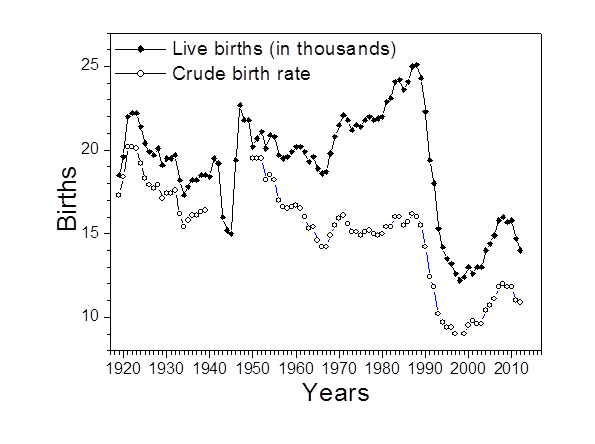
    The time between 1983 and 1988 was a positive period, with a crude birth rate (the number of births per 1000 people per year) of about 16.0. It is interesting that this situation arose during the so-called “stagnation era”. The stagnation period – life without radical changes – was probably fruitful for fertility growth. The same trend was noted for Russia. Perhaps this increase was caused by the decision of the Soviet government in 1981 to increase the birth rate “About Measures of Public Support to Families Having Children”. In 1989, the peak of fertility was over.

    The French demographer Adolphe Landry (1874-1956) defined genuine demographic revolution as the situation in which use of contraceptives and abortions by women becomes universal. This revolution detaches fertility from social control and transfers it to the interests of individuals. For Estonia, this period arrived at the beginning of nineties, when plenty of contraceptives became available, in addition to abortions continuing to be permitted.

    In 1991, the crude birth rate fell to 12.4, and the total fertility rate (number of children per woman during her lifetime, which characterize the necessary replacement level of 2.1) to 1.80. The year of 1991 was the first year of two decades of continuing decrease. Remarkably, fall of the birth rate at the beginning of nineties was much worse than it was during WW II. The population of about one million had 19.5 and 19.2 thousand births respectively in 1941 and 1942 during the war, but in 1993, when conditions were clearly better, only 15.3 thousand children were born to a population of one and a half million. The genuine demographic revolution had truly arrived!

    The reasons, in addition to the availability of contraceptives and abortions, were the decline of religion, economic uncertainty regarding the future, the opening of the world with a variety of lifestyle choices and career paths. Almost thirty decrees regarding the family benefits of the Soviet period that had been made by that government were cancelled in 1992. In the liberal market economy of the nineties, population policy was left largely to chance. Public attention to the issue was narrowly limited to family benefits and integration programs.

    The Parental Benefit Act passed in 2003 tried to attain the birth rate. According to the Act, persons have the right to receive parental benefits for 435 days from the day following the final day of maternity leave. The amount of the parental benefit received is calculated on the basis of the Social Tax paid during the previous year. If the parent didn’t work, the parental benefit is paid at the designated benefit base rate, which is 290 euros in 2013. The upper limit of the amount of the parental benefit is three times the average salary earned during the year before last, which – in 2013 – is 2,234 euros.

    If we take the birth rate of the years 2002 and 2003 – 13,000 births – as the plateau (base rate) and eliminate all other factors pertaining to reproductive behavior, then natality during the 2004-2012 period resulted in about 18 thousand additional births. This speaks to the effectiveness of the parental benefit. However, even this was insufficient for attaining positive natural increase. The total maximum fertility rate obtained was 1.65, but later, in 2011, it decreased to 1.52. In 28 countries of European Union the mean value of the total fertility rate was 1.58 in 2012, for euro area it was 1.56. However in France, which has perhaps the oldest experience in field of demography and demographic research, this indicator was 2.01. In contrast, Singapore’s total fertility rate steadily dropped from 1.6 in 2000 to a record low of 1.16 in 2010. It bounced back to 1.2 in 2011, and further to 1.29 in 2012, but last year slipped again to 1.19. 

    The government aims, by 2015, to achieve a birth rate that is higher than the death rate, meaning an increase of the total birth rate to 1.70. (Action Program of the Government of the Republic 2011-2015). This seems unattainable. Poverty and migration worsen the situation. The at-risk-of-poverty rate in Estonia in 2011 was 17.6% on the average. The parent benefit and family benefits together constituted 1,7% of GDP in 2011 ( the same figure in Sweden and Finland was 3%).  

    One key cause, ironically, is freedom to move that came with the fall of the Soviet Union. Handling the population decrease we described first of all the birth rate, but last years has been intensified external migration. Migration that took place in 2011 decreased the population of Estonia in 2012 by 6,600 inhabitants. The trend continued. In external migration, there was an increase in both immigration and emigration in 2012. Over 4,000 persons immigrated to and almost 11,000 persons emigrated from Estonia. The main destination countries for emigrants are Finland and the United Kingdom. Most of the immigrants are in fact returnees, mostly from Finland. The second place is held by Russia, but the immigrants from Russia are mainly new immigrants.

    Despite numerous attempts to boost birth rate, the years from 1991 to 2013 are characterized by a birth rate under the replacement level. The lowest point arrived in 1998, with a total fertility rate of 1.28. After that it began to rise, reaching 1.65 in the year of 2008, only to decrease again later. At the same time, the population figure decreased by 14%. Problems caused by decreasing population entail a threat to the survival of the Estonian national culture, issues with sustainable economic development and difficulties with the sustainability of the social infrastructure. 

    How to avoid the fate of Livonians? Is there a force majeure against the small nation? Or it is a problem of insufficient national steering without any specialized institution responsible on population?

    Jaak Uibu, a Phd. in human micro ecology, was former Deputy Minister of Health of Estonia and advisor to Minister of Population. 

    Oleviste photo by E. Kanash.

  • Era of the Migrant Moguls

    Southern California, once the center of one of the world’s most vibrant business communities, has seen its economic leadership become largely rudderless. Business interests have been losing power for decades, as organized labor, ethnic politicians, green activists, intrusive planners, crony developers and local NIMBYs have slowly supplanted the leaders of major corporations and industries, whose postures have become, at best, defensive.

    Increasingly, a search for inspiration about the region’s future must focus, first and foremost, on immigrants. As major companies disappear, merge or shift more of their operations elsewhere, the foreign-born represent a significant asset for our grass-roots economy. With many of the region’s legacy industries – from oil and gas to aerospace and entertainment – stagnating or declining, the area desperately needs new blood to avoid ending up like the older cities of the slow-growth Northeast or Midwest, albeit with much better weather.

    Amid a graying and, increasingly, marginal generation of regional business leaders, there have emerged new foreign-born dynamic figures. Some great examples: South African native and Tesla founder Elon Musk, who lives in Los Angeles and runs SpaceX, headquartered in Hawthorne and with more than 2,000 employees, and John Tu and David Sun, owners of Fountain Valley’s Kingston Technology, a leading independent memory-chip manufacturer founded in 1987 and now employing 4,000 people worldwide.

    Our new moguls increasingly are minted abroad. Pharmaceutical entrepreneur Patrick Soon-Shiong, the son of Chinese immigrants from South Africa, is now widely considered the richest man in Los Angeles, according to the Los Angeles Business Journal. But he’s not alone; five of the 13 richest people in the City of Angels are immigrants; in 1997 there was one, Australia’s Rupert Murdoch.

    Why are these immigrants so bright when much of our business leadership is dark grey? Part of it has to do with the nature of people who risk everything to migrate to another country. Overall they account for one out of every five U.S. business owners. They are three times as likely to start a new business than non-immigrants; in 2010 they accounted for almost one-in-three new firms, twice their share in 1995. Roughly 40 percent of the engineering-based firms started in Silicon Valley, notes the Kauffman Foundation, had at least one immigrant founder.

    Whether in high-tech, pharmaceuticals or running the local coffee shop, immigrants tend both to innovate and take risks. That’s because, as Kingston’s John Tu explained to me, they don’t have a choice. “The key thing about being an immigrant makes you flexible,” he said. “IBM, Apple and Compaq were inflexible. They told the memory customers to take it or leave it. We thought about the customer and the relationship with the employees. I guess we didn’t know any better.”

    Rise of the ethnoburb

    Most of the growth being generated by Southern California’s immigrants is taking place in suburban communities – what geographer Wei Li describes as ethnoburbs. Despite the hopes that more Southlanders can be lured into high-density, high-rise rental housing, immigrants, particularly Asians, here and elsewhere, continue to move further from the city core to areas where they can live with a degree of privacy and quiet virtually impossible in their homelands.

    This can be seen in the migration numbers. As foreign-born numbers have dropped in expensive and crowded Los Angeles and Orange County, the big growth has taken place in other areas, notably in fast-growing Texas cities such as Dallas and Houston, as well as numerous low-cost, pro-business states in the Southeast. The one Southland area that has continued to see a boom in foreign-born residents – the Inland Empire – has the lowest population density and house prices in the region.

    According to demographer Wendell Cox, the Inland Empire’s immigrant population has swelled by more than 50 percent, or more than 300,000 people, since 2000, roughly three times the increase in actual numbers seen in Los Angeles and Orange counties. Much of this growth is taking place not in the older cities such as Riverside and San Bernardino, as might be expected, but in generally more affluent, newer suburbs such as Rancho Cucamonga, whose foreign-born population soared a remarkable 61.6 percent over the past decade. Even Moreno Valley, on the edge of the urbanization, has more foreign-born residents than does San Bernardino.

    Even within the coastal counties, much of the growth in the Asian population, now the largest source of immigrants to the U.S., has been outside the densest, more-urbanized parts of the region. As the immigrant share of the population has declined in traditional immigrant strongholds such as the city of Los Angeles (down 5 percent) and Santa Ana (more than 11 percent), Cox notes, the immigrant population is shifting to more upscale suburbs. In Glendale, a major destination for both Armenian and Asian immigrants, more than 56 percent of the population is foreign-born, up 4 percent since 2000.

    Other popular immigrant destinations include once-heavily white suburban communities, such as Irvine, which is now more than 38 percent foreign-born, up almost 19 percent since 2000. Fullerton, like Irvine, favored largely by Asian migrants, saw its foreign-born population increase by 21 percent since 2000, now accounting for more than one-third of the city’s total.

    Other places that seem to be attracting immigrants include Santa Clarita, Palmdale and Lancaster, all communities further out on the periphery of the region.

    Harnessing entrepreneurial energy

    If Southern California’s future lies largely in the hands of newcomers and their offspring, how can we best respond to their needs? One way is by maintaining a large supply of single-family houses or townhomes. Today’s immigrants, particularly Asians, favor settling in ethnoburbs more than the dense Chinatowns, Little Indias and barrios that may strike many other Americans as somehow more colorful. Now, the best place to encounter immigrant food and culture is frequently at the strip malls of Monterey Park, the Hispanicized shopping complexes like Plaza Mexico, Irvine’s Diamond Jamboree Center or the amazing 626 Night Market at Santa Anita Park in Arcadia.

    Of course, immigrants are less interested in providing neighbohoods with local color than in moving to places with good schools, safe streets and parks – as most middle-class families prefer. This preference runs afoul of the kind of extreme land-use regimen being imposed on the region, including the Inland Empire, planning that seeks to promote the construction of high-density housing that, to be honest, many immigrants, particularly Asians, could enjoy at home, with far more amenities.

    Planners and some developers seem keen on this shift, thinking it will appeal to young childless couples and empty-nesters. What they ignore is that, without plentiful, and at least somewhat affordable, single-family houses, immigrants will continue to shift to other parts of the country, notably, the Southeast and Texas, where they can afford them.

    Perhaps even more important may be the economy. Immigrants are the ultimate canaries in the coalmine – they tend to gravitate toward opportunity. When Southern California’s economy was burgeoning in the 1970s and 1980s, immigrants also flocked here, buying homes and starting businesses. Few immigrant entrepreneurs reached the level of a John Tu or an Elon Musk, but many have launched small manufacturing firms that supported larger firms, engaged in international trade and started small service businesses.

    Unfortunately, the business climate in Southern California increasingly makes such enterprise ever more difficult, and may lead these entrepreneurs to relocate or expand where their efforts may be more appreciated. Not helping these businesses is an L.A. political climate dominated by a crony capitalist regime – not at all friendly to plucky startups of any kind – or by a Republican Party that still seems unable to make peace with the demographic realities of our region.

    The good news is, however, that these immigrants, and their kids, are still here. They have many reasons to stay, including the presence of ethnic media, churches, schools and shops not likely to be remotely as well-developed in places like Las Vegas, Phoenix, Atlanta or Nashville. But this does not mean they can be taken for granted. We need to recognize that they are our greatest asset, and, if we can appeal to their aspirations, they could help fashion a resurgence in this region.

    This story originally appeared at The Orange County Register.

    Joel Kotkin is executive editor of NewGeography.com and Distinguished Presidential Fellow in Urban Futures at Chapman University, and a member of the editorial board of the Orange County Register. He is author of The City: A Global History and The Next Hundred Million: America in 2050. His most recent study, The Rise of Postfamilialism, has been widely discussed and distributed internationally. He lives in Los Angeles, CA.

    Photo by LHOON

  • Where Inequality Is Worst In The United States

    Perhaps no issue looms over American politics more than worsening  inequality and the stunting of the road to upward mobility. However, inequality varies widely across America.

    Scholars of the geography of American inequality have different theses but on certain issues there seems to be broad agreement. An extensive examination by University of Washington geographer Richard Morrill found that the worst economic inequality is largely in the country’s biggest cities, as well as in isolated rural stretches in places like Appalachia, the Rio Grande Valley and parts of the desert Southwest.

    Morrill’s findings puncture the mythology espoused by some urban boosters that packing people together makes for a more productive and “creative” economy, as well as a better environment for upward mobility. A much-discussed report on social mobility in 2013 by Harvard researchers was cited by the New York Times, among others, as evidence of the superiority of the densest metropolitan areas, but it actually found the highest rates of upward mobility in more sprawling, transit-oriented metropolitan areas like Salt Lake City, small cities of the Great Plains such as Bismarck, N.D.; Yankton, S.D.; Pecos, Texas; and even Bakersfield, Calif., a place Columbia University urban planning professor David King  wryly labeled “a poster child for sprawl.”

    Demographer Wendell Cox pointed out that the Harvard research found that commuting zones (similar to metropolitan areas) with less than 100,000 population average have the highest average upward income mobility.

    The Luxury City

    Most studies agree that large urban centers, which were once meccas of upward mobility, consistently have the highest level of inequality. The modern “back to the city” movement is increasingly less about creating opportunity rather than what former New York Mayor Michael Bloomberg called “a luxury product” focused on tapping the trickle down from the very wealthy. Increasingly our most “successful cities” have become as journalist Simon Kuper puts it, “the vast gated communities where the one percent reproduces itself.”

    The most profound level of inequality and bifurcated class structure can be found in the densest and most influential urban environment in North America — Manhattan. In 1980 Manhattan ranked 17th among the nation’s counties in income inequality; it now ranks the worst among the country’s largest counties, something that some urbanists such as Ed Glaeser suggests Gothamites should actually celebrate.

    Maybe not. The most commonly used measure of inequality is the Gini index, which ranges between 0, which would be complete equality (everyone in a community has the same income), and 1, which is complete inequality (one person has all the income, all others none).  Manhattan’s Gini index stood at 0.596 in 2012, higher than that of South Africa before the Apartheid-ending 1994 election. (The U.S. average is 0.471.) If Manhattan were a country, it would rank sixth highest in income inequality in the world out of more than 130 for which the World Bank reports data. In 2009 New York’s wealthiest one percent earned a third of the entire municipality’s personal income — almost twice the proportion for the rest of the country.

    The same patterns can be seen, albeit to a lesser extent, in other major cities. A 2006 analysis by the Brookings Institution showed the percentage of middle income families declined precipitously in the 100 largest metro areas from 1970 to 2000.

    The role of costs is critical here. A 2014 Brookings study showed that the big cities with the most pronounced levels of inequality also have the highest costs: San Francisco, Miami, Boston, Washington, D.C., New York, Oakland, Chicago and Los Angeles. The one notable exception to this correlation is Atlanta. The lowest degree of inequality was found generally in smaller, less expensive cities like Ft. Worth, Texas; Oklahoma City; Raleigh, N.C.; and Mesa, Ariz. Income inequality has risen most rapidly in the bastion of luxury progressivism, San Francisco, where the wages of the 20th percentile of all households declined by $4,300 a year to $21,300 from 2007-12. Indeed when average urban incomes are adjusted for the higher rent and costs, the middle classes in metropolitan areas such as New York, Los Angeles, Portland, Miami and San Francisco have among the lowest real earnings of any metropolitan area.

    Rural Poverty

    But cities are not the only places suffering extreme inequality. Some of the nation’s worst poverty and inequality, notes Morrill, exist in rural areas. This is particularly true in places like Texas’ Rio Grande Valley, Appalachia and large parts of the Southwest.

    Perhaps no place is inequality more evident than in the rural reaches of California, the nation’s richest agricultural state. The Golden State is now home to 111 billionaires, by far the most of any state; California billionaires personally hold assets worth $485 billion, more than the entire GDP of all but 24 countries in the world. Yet the state also suffers the highest poverty rate in the country (adjusted for housing costs), above 23%, and a leviathan welfare state. As of 2012, with roughly 12% of the population, California accounted for roughly one-third of the nation’s welfare recipients.

    With the farm economy increasingly mechanized and industrial growth stifled largely by regulation, many rural Californians particularly Latinos, are downwardly mobile, and doing worse than their parents; native-born Latinos actually have shorter lifespans than their parents, according to a2011 report. Although unemployment remains high in many of the state’s largest urban counties, the highest unemployment is concentrated in the rural counties of the interior. Fresno was found in one study to have the least well-off Congressional district.

    The vast expanse of economic decline in the midst of unprecedented, but very narrow urban luxury has been characterized as “liberal apartheid. ” The well-heeled, largely white and Asian coastal denizens live in an economically inaccessible bubble insulated from the largely poor, working-class, heavily Latino communities in the eastern interior of the state.

    Another example of this dichotomy — perhaps best described as the dilemma of being a “red state” economy in a blue state — can be seen in upstate New York, where by virtually all the measurements of upward mobility — job growth, median income, income growth — the region ranked below long-impoverished southern Appalachia as of the mid-2000s. The prospect of developing the area’s considerable natural gas resources was welcomed by many impoverished small landowners, but it has been stymied by a coalition of environmentalists in local university towns and plutocrats and celebrities who have retired to the area or have second homes there, including many New York City-based “progressives.”

    Where Inequality Is Least Pronounced

    According to the progressive urbanist gospel, suburbs are doomed to be populated by poor families crowding into dilapidated, bargain-priced former McMansions in the new “suburban wastelands.” Suburbs, not inner cities, suggests such urban boosters as Brookings Chris Leinberger, will be the new epicenter of inequality, even though the percentage of poor people, as shown above, remained far higher in the urban core.

    Yet , according to geographer Morrill, in comparison with urban cores, suburban areas remain heavily middle class, with a high proportion of homeowners, something rare inside the ranks of core cities.The average poverty rate in the historical core municipalities in the 52 largest U.S. metro areas was 24.1% in 2012, more than double the 11.7% rate in suburban areas. Between 2000 and 2010, more than 80% of the new population.

    in America’s urban core communities lived below the poverty line compared with a third of the new population in suburban areas, although the majority of poor people lived there, in large part because they are also the home to the vast majority of metropolitan area residents.

    An analysis by demographer Wendell Cox of American Community Survey Data for 2012 indicates that suburban areas suffer considerably less household income inequality than the core cities. Among the 51 metropolitan areas with populations over 1 million, suburban areas were less unequal (measured by the Gini coefficient) than the core cities in 46 cases.

    The Racial Dynamic

    There is also a very clear correlation between high numbers of certain groups — notably African Americans but also Hispanics — and extreme inequality. Morrill’s analysis shows a huge confluence between states with the largest income gaps, largely in the South and Southwest, with the highest concentrations of these historically disadvantaged ethnic groups.

    In contrast, Morrill suggests, areas that are heavily homogeneous, notably the “Nordic belt” that cuts across the northern Great Lakes all the way to the Seattle area, have the least degree of poverty and inequality. Morrill suggests that those areas dominated by certain ethnic backgrounds — German, Scandinavian, Asian — may enjoy far more upward mobility and less poverty than others.

    Some, such as UC Davis’ Gregory Clark even suggest that parentage determines success more than anyone suspects — what the Economist has labeled “genetic determinism.” None of this is particularly pleasant but we need to understand the geography of inequality if we want to understand the root causes of why so many Americans remain stuck at the lower ends of the economic order.

    This story originally appeared at Forbes.com.

    Joel Kotkin is executive editor of NewGeography.com and Distinguished Presidential Fellow in Urban Futures at Chapman University, and a member of the editorial board of the Orange County Register. He is author of The City: A Global History and The Next Hundred Million: America in 2050. His most recent study, The Rise of Postfamilialism, has been widely discussed and distributed internationally. He lives in Los Angeles, CA.

  • The Great Skills Gap Myth

    One of the great memes out there in trying to diagnose persistently high unemployment and anemic job growth during what is still, I argue, the Great Recession is the so-called “skills gap”. The idea here is that the fact that there are millions of unfilled job openings at the same time millions of people can’t find work can be chalked up to a lack of a skills match between unemployed workers an open positions. To pick one random example out of many, here’s the way US News and World Report put it last year:

    Some 82 percent of manufacturers say they can’t find workers with the right skills. Even with so many people looking for jobs, we’re struggling to attract the next generation of workers. The message about the opportunities in manufacturing doesn’t seem to be reaching parents and counselors who help guide young people’s career ambitions.

    We face two major problems – a skills gap and a perception gap. Today’s modern, technology-driven manufacturing is not your grandparents’ manufacturing, yet for many, talk of the sector evokes images from the Industrial Revolution.

    What’s interesting about this is that the “skills gap” continues to have tremendous resonance in public policy discussions I come across although it’s very easy to find many mainstream press articles that challenge it. So I want to take my shot at the problem.

    Is there a skill gap? In select cases I’m sure there’s a mismatch in skill, but for the most part I don’t think so. I believe the purported inability of firms to find qualified workers is due largely to three factors: employer behaviors, limited geographic scope, and unemployability.

    Employer Behaviors

    Let’s be honest, it’s in the best interest of employers to claim there’s a skills gap. The existence of such a gap can be used as leverage to obtain public policy considerations or subsidies. So there’s a self-serving element.

    But beyond that, several behaviors of present day employers contribute to their inability to hire.

    1. Insufficient pay. If you can’t find qualified workers, that’s a powerful market signal that your salary on offer is too low. Higher wages will not only find you workers, they also send a signal that attracts newcomers into the industry. Richard Longworth covered this in 2012. He explains that companies have refused to adjust their wages due to competitive pressures:

    In other words, Davidson said, employers want high-tech skills but are only willing to pay low-tech wages. No wonder no one wants to work for them….So why doesn’t GenMet pay more? In other words, why doesn’t it respond to the law of supply and demand by offering starting wages above the burger-flipping level? Because GenMet is competing in the global economy. It can pay more than Chinese-level wages, but not that much more.

    In other words, this company in question doesn’t have a skill gap problem, they have a business model problem. They aren’t profitable if they have to pay market prices for their production inputs (in this case labor). It’s no surprise firms in this position would be seeking help with their “skill gap” problem – it’s a backdoor bailout request.

    2. Extremely picky hiring practices enforced by computer screening. If you’ve looked at any job postings lately, you’ll note the laundry list of skills and experience required. The New York Times summed it up as “With Positions to Fill, Employers Wait for Perfection.” Also, companies have chopped HR to the bone in many cases, and heavily rely on computer screening of applicants or offshore resume review. The result of this automated process combined with excessive requirements is that many candidates who actually could do that job can’t even get an interview. What’s more, in some cases the entire idea is not to find a qualified worker to help legally justify bringing in someone from offshore who can be paid less.

    3. Unwillingess to invest in training. In line with the above, companies no loner want to spend time and money training people like they used to. I strongly suspect most of those over 50 machinists and such we keep hearing about learned on the job. Why can’t companies simply train people in the skills they need? When I started work at Andersen Consulting in 1992, we weren’t expected to have any specific skill. Instead, they were looking for general aptitude and spent big to train us in what we needed to know. In a sense, outside of some professional services fields, today’s companies, despite their endless talk about talent, don’t actually recruit talent at all. They are recruiting people with specific skills and experience. That’s a very different mindset.

    4. Aesthetic hiring. This one I think is specific to select industries, but in some fields if you don’t have the right “look”, you’re going to find it difficult. For example, the NYT Magazine just today has a major piece called “Silicon Valley’s Youth Problem” talking about this very issue. Hip, cool startups see their working environment and culture as critical to success. And that’s true, but those cultures aren’t very inclusive, which is why many Silicon Valley firms are continuously under fire for various forms of discrimination. When they’re trying to be the hot new thing, the last thing an app startup wants is some 55 year old dude with a pocket protector cramping their style, no matter how much of a tech guru he might be.

    Limited Geographic Scope

    You frequently see the skills gap phrased in terms of specific geographies. For example, a state. Rhode Island has X number of unemployed people and Y number of unfilled jobs. So what do we do to match them up?

    This type of thinking is too limited. I attended an hour brainstorming session on the Rhode Island skills gap a while back and not once did anyone suggest anything that crossed the state boundary. One person mentioned these technical high schools in Boston that produce grads with exactly the skills the market is needing. His idea was that Rhode Island needed to create these types of institutions. Not a bad idea, but I was struck that nobody thought about sending these Rhode Island employers who can’t find workers on the one hour drive to Boston to go hire some of those grads directly out of Boston’s high schools. Problem solved. And maybe while bringing some young, fresh blood into the state to boot.

    Similarly, no one ever suggested that an unemployed person in Rhode Island might seek work out of state. Realistically, America has often solved unemployment problems through migration. People need to be willing to move to where the job opportunities are. In fact, if you look at the highly educated people who might say telling people to move in order to find work is evil awful, they are actually the most mobile people there are. Clearly the highly skilled see the value in pursuing opportunity through migration. We need to extend the same opportunity to those who are currently stuck in place.

    Unemployability

    A third problem is that a significant number of adults in this country are simply unemployable. If you’re a high school dropout, a drug user, etc. you are going to find it tough slogging to find work anywhere, regardless of skills required.

    Watching the Chicagoland documentary and seeing what kids in these inner city neighborhoods face, a lack of machine tool or coding skills is far from the problem. Similar problems are now hitting rural and working class white communities where the economic tide has receded. Heroin, meth, etc. were things that just didn’t exist in my rural hometown growing up – but they sure do now.

    These aren’t skill problems, they are human problems. And the answer isn’t simply job training. These problems are much, most more complex and they are incredibly difficult to solve. They need to be tackled by very different means than a job skills problem.

    If you want more info that documents that there is no skills gap, google around and find plenty of economists crunching the numbers to show that’s the case. But I hope this gives you a sense of some of the trends that explain why there can be persistent unemployment with many job openings without recourse to a skills gap to explain it.

    Aaron M. Renn is an independent writer on urban affairs and the founder of Telestrian, a data analysis and mapping tool. He writes at The Urbanophile, where this piece originally appeared.

    Auto manufacturing photo by BigStockPhoto.com.

  • Work Access in the Non-centered San Francisco Bay Area

    The San Francisco Bay Area (San Jose-San Francisco combined statistical area or CSA) has a superior access to work systems, including its important work at home element. The freeway system provides primary access between all points, importantly supplemented by arterial streets, and accounts for nearly 70 percent of all work trips. There are more types of transit than in other metropolitan regions (metro, street car, commuter rail, light rail, ferry, and cable car) and generally with a higher level of service. The Silicon Valley virtually defines information technology and is behind the huge increase in working at home, much of it telecommuting.

    The recently released American Community Survey five-year file provides the opportunity to examine state of employment access in all Bay Area municipalities

    Employment Access by Car

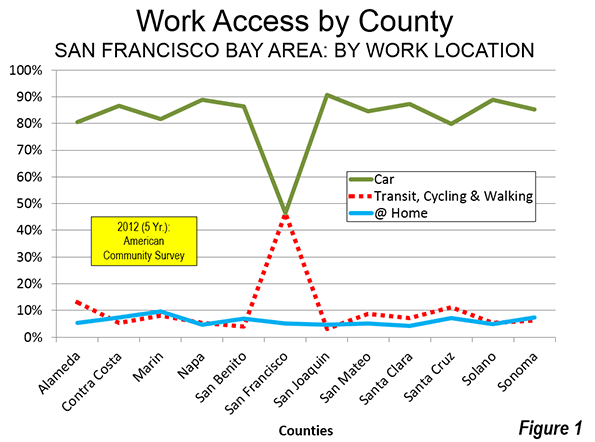
    Like every major metropolitan area in the United States, more people use cars or light trucks (for simplicity called "cars" in this article) to get to work than any other mode of transport. In the Bay Area, 68 percent of commuting is by car. Cars provide the overwhelming majority of work access to jobs in 11 of the Bay Area’s 12 counties. This ranges from 80 percent in Alameda County (secondary core municipality Oakland is the county seat) to 91 percent in San Joaquin County, which was recently added to the San Jose-San Francisco CSA (Figure 1). In the 12th county, San Francisco, cars provide work access for nearly equal to that of transit, walking and cycling combined (both approximately 46 percent).

    Employment Access from Home

    Working at home continues to grow and, to an even greater extent than car travel, is relatively evenly distributed throughout the 12 Bay Area counties. The highest percentage is in Marin County, at 9.6 percent. The combination of a technology friendly regional environment and horrific traffic on the primary commuting routes to most of the Bay Area (US-101 and the Golden Gate Bridge) probably drive this figure higher. Contra Costa County and Santa Cruz County also have a high work at home shares, at 7.3 percent and 7.1 percent respectively. This is than 50 percent above the national rate.

    Most surprisingly, however, the lowest work at home share in the Bay Area is in Santa Clara County, the very heart of Silicon Valley. This is slightly less than the national average. Another surprise is counties on the periphery of the Bay Area also have small work at home shares. Sonoma, Napa and San Joaquin counties have work at home shares of under 5.0 percent.

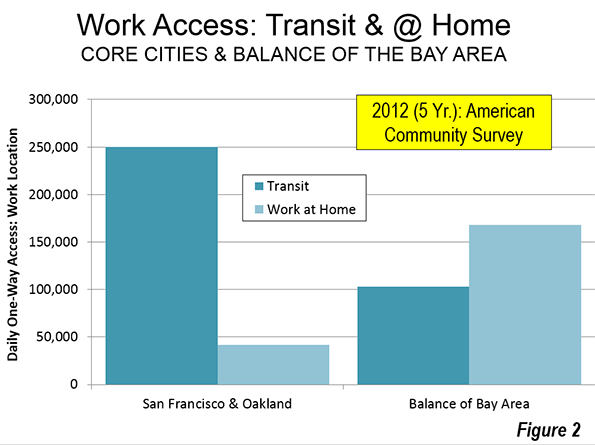
    Outside the core cities of San Francisco and Oakland, more than 1.5 times as many employees work at home (including telecommuting) than access work by transit (Figure 2).

    Employment Access by Transit

    The Bay Area remains monocentric only in aerial photographs and transit market share. San Francisco is served by one of the nation’s busiest metro (subway or underground) systems in the nation, Bay Area Rapid Transit (BART), which carries over 400,000 one-way rides daily. BART was the first of the major post-World War II rapid transit systems in the United States and was followed by other fully grade separated Metro systems in Washington and Atlanta and individual lines in Los Angeles.

    As we indicated in Transit Legacy Cities, most of the transit commuting (55 percent) in the United States is to just six core municipalities, New York, Chicago, Philadelphia, Boston, Washington, and San Francisco. Approximately 60 percent of commuting to those cities is to the downtown areas, which are also the largest in the United States. Yet these legacy cities, with a majority of the nation’s transit commuting, account for only six percent of the nation’s employment.

    Nearly two-thirds of Bay Area transit commuters work in the city of San Francisco and that figure rises to more than 70 percent, including the city of Oakland, with its strong downtown. Yet, these two core cities have only 21 percent of employment in the Bay Area. The downtowns of both core cities are well served by transit, including BART and radial surface transit systems. Buses serve downtown Oakland, while buses, trolley buses (electric buses), street cars and cable cars are focused on downtown San Francisco.

    The Non-Centered Metropolis

    Even with a regional Metro system, the Bay Area has developed in a strongly dispersed and polycentric form. Polycentricity is represented by edge cities (suburban office centers) such as Walnut Creek (with a BART station), the San Francisco Airport office area (not generally walkable from any rapid transit) and in the Silicon Valley (San Mateo and Santa Clara counties). Even more, however, employment is dispersed well beyond even these nodes.  Authors Robert Lang and Jennifer LeFurg have called this phenomenon "edgeless cities," though their other term, the "non-centered metropolis," says it better.

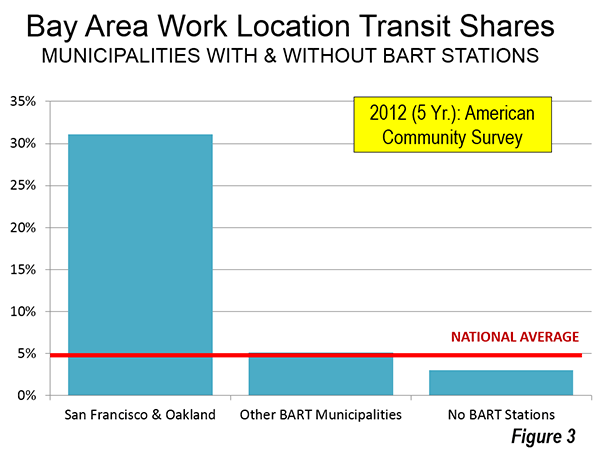
    Outside the San Francisco-Oakland core, the commuting pattern in the Bay Area is little different than in the rest of the nation (as is also the case in New York, outside the urban core). Nearly 80 percent of the Bay Area’s jobs are outside the cities of San Francisco and Oakland, however only 4.0 percent of commuters use transit to jobs located outside these cores. Among municipalities other than San Francisco and Oakland with BART stations, work access by transit is 5.1 percent, only slightly higher than the national average (which includes all urban and rural areas). Commuting by transit is even lower (3.0 percent) to jobs in outside municipalities with BART stations (Figure 3).

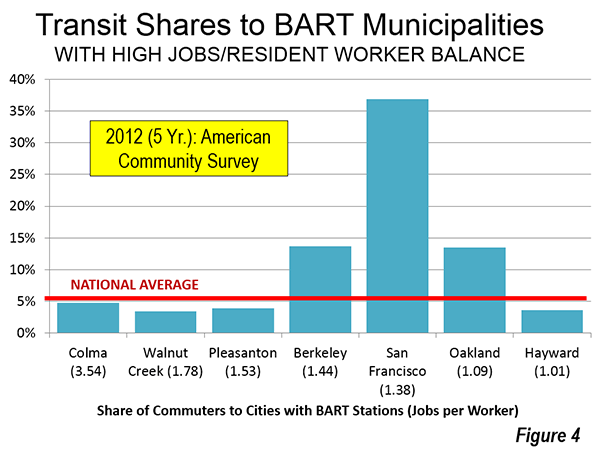
    Among the municipalities with BART stations and favorable "jobs-housing balances," only San Francisco, Oakland and Berkeley (home of the University of California) attract more transit commuters than the national average. Walnut Creek illustrates the problem of regional transit commuting to suburban locations. Walnut Creek has a strong suburban office center and a stronger jobs-housing balance than all BART municipalities but much smaller Colma. Yet, only 3.5 percent of commuters who work in Walnut Creek used transit to get to work (Figure 4).

    Overall, outside the core cities of San Francisco and Oakland, approximately 20 times as many people commute to jobs by car as by transit.

    The Illusion of Monocentricity

    With transit’s failure to carry large numbers of workers to jobs throughout the Bay Area (not just to the two older core municipalities), planners have switched strategies. Now the focus is on urban villages (transit oriented development), by which people and jobs will be located close together, reducing the need for long automobile commutes. The adopted regional plan, "Plan Bay Area" imagines people living in transit oriented developments and walking, cycling or using transit to get to employment. However, former principal planner of the World Bank Alain Bertaud says that this "urban village model exists only in the mind of urban planners" and worse, that "it contradicts the economic justification of large cities:  the efficiency of large labor markets." (see: Urban Planning 101) That means a lower standard of living and more poverty.

    The reality for the Bay Area and for metropolitan areas around the world is that transit is structurally incapable of replacing the automobile for the bulk of the workforce. The fundamental problem is that no transit system can attract drivers to jobs by offering travel times competitive with the automobile (Note). Transit can compete to some downtowns, but downtowns have only a small minority of employment. Outside of those, trip patterns are simply too dispersed for transit to serve as well as cars. Monocentric cities, to duplicate Bertaud’s logic, exist "only in the mind of urban planners."

    Wendell Cox is principal of Demographia, an international public policy and demographics firm. He is co-author of the "Demographia International Housing Affordability Survey" and author of "Demographia World Urban Areas" and "War on the Dream: How Anti-Sprawl Policy Threatens the Quality of Life." He was appointed to three terms on the Los Angeles County Transportation Commission, where he served with the leading city and county leadership as the only non-elected member. He was appointed to the Amtrak Reform Council to fill the unexpired term of Governor Christine Todd Whitman and has served as a visiting professor at the Conservatoire National des Arts et Metiers, a national university in Paris.

    ————–

    Note: In 2003, I issued a challenge to identify an existing or proposed transit system design that would achieve automobile competitiveness throughout a metropolitan area of more than 1,000,000 in Western Europe or the United States (see: Smart Growth Challenge: Transportation Choice for All, Not Just a Few [Automobile Competitiveness]). No complete responses were received. This is not surprising. In 2007, Professor Jean-Claude Ziv and I authored a paper for the 11th World Conference on Transport Research (2007 WCTRS) that estimated such a system could cost as much as the total gross domestic product of any such metropolitan area each year).

    Photo: Bart A car Oakland Coliseum Station

  • Welcome to Chicagoland

    As part of his plan to boost sagging ratings at the network, CNN chief Jeff Zucker commissioned an eight part reality series about Chicago and its mayor called Chicagoland that premiers tonight at 10pm ET. The show is produced by the same people who did the Brick City series about Newark Mayor Cory Booker, with support from mega-star executive producer Robert Redford.

    Rahm and the Media

    Given that Brick City seems to have only helped Booker’s reputation, cynics in Chicago have already noted the fact that show’s producers are represented by the William Morris Endeavor Agency, which just so happens to be the home of Chicago Mayor Rahm Emanuel’s brother Ari. This is as much because of as in spite of a well-publicized move by directors Marc Levin and Mark Benjamin to ask the agency to recuse themselves from representing them when it comes to the show.


    Trailer for CNN series “Chicagoland” – click here if the video does not display.

    One need not believe in such a conspiracy to see this show as yet another example of Rahm’s media power – and his fearlessness in pursuing high profile opportunities to get his message out even in venues where he’s not in complete control. Rahm has had significant success in getting high profile national and global attention – for example, a glowing profile from NYT columnist Thomas Friedman – since taking office. He didn’t shy away from getting out there even when a spike in murders made global headlines Chicago of the type Chicago didn’t want – a time when many mayors would have crawled into their bunkers. And although he’s been in office a while now, Rahm fatigue seems not to have set in. Sun-Times columnist Neil Steinberg has a lengthy piece on him in the March issue of Esquire with the colorful title of “And Now For the Further Adventures of Rahm the Imapler.” The Financial Times recently ran a mostly positive piece called “Rahm Emanuel: Mayor America.” It even includes a high production quality six and a half minute video that will give you a flavor of it (if the video doesn’t display, click here):


    With his ambition for Chicago as a global city, Rahm clearly sees global media as the ones that really count. Chicago’s status as a media center afterthought means few out of town reporters actually know that much about the city, hence Rahm has a huge opportunity to shape the message. This must infuriate the local media, which to a great extent Rahm is free to ignore because of his ability to go direct at the national and global level. Chicagoland should thus be seen as part of Rahm’s global media push, both for Chicago and for himself.

    Reality TV vs. Journalism

    The series is probably as good for Rahm and the city as it could possible get. Certainly the problems – high crime, poor schools, and labor troubles – are not glossed over. But given that they’ve been well publicized globally, it’s hard to imagine how they could be without sacrificing all credibility. Within the context of realism, this is a big win for the city.

    Whether it’s a big win for journalism is another story. Like most modern documentaries or reality TV shows, Chicagoland is non-fiction in a sense, but also heavily scripted and edited to provide a compelling narrative. This makes for great TV drama and characterizations, but whether it represents truth as a reporter would tell it is much more doubtful.

    Just as one example, the producers clearly had extensive access to Rahm and he’s frequently shown as concerned about crime, battling with unions, boosting the local economy, talking to school kids and even mentoring an inner city kid he brought on as an intern. But is that a fair representation of how Rahm Emanuel spends his time? The Chicago Reader did a two part series analyzing Rahm Emanuel’s schedule and published a two part series about it called “The Mayor’s Millionaire Club” (see part one and part two). They show that access to Rahm is heavily dependent on your wealth, influence, and donations. Yet that doesn’t come through in Chicagoland at all. Instead when the occasional powerful people are shown, they are always doing a good turn for the city, such as a group of tech executives donating products to schools.

    I’m not suggesting this series should have been a bulldog investigative piece. However, I strongly suspect that CNN’s actual journalists will be seething at seeing their network and its relatively strong reputation being used for what is clearly not the type of work they themselves would undertake. Right or wrong, the CNN brand carries an expectation of a certain type of journalistic standard that the Sundance Channel (where Brick City originally ran) doesn’t. Right now on CNN’s Chicagoland page there’s an ad for Anderson Cooper 360. Something tells me that were Anderson Cooper in charge of Chicagoland, it would look quite different.

    Compelling Drama and Characters

    However, taken on the terms of a Sundance series, Chicagoland succeeds, and my guess is that Rahm will be overall pleased. The show sets up the drama by structuring the series as battles between opposing forces. In the first couple episodes, this is the battle between Rahm and Chicago Public Schools leadership on the one hand, and the teachers union and some affected parent groups on the other over plans by CPS to shutter 50 schools. Frankly, I thought it overly portrayed Chicago as if it were Newark. The segments were introduced by short positive vignettes of some aspect of Chicago (like the Stanley Cup playoffs), followed by more extensive coverage of the school closing dispute, and educational and crime problems in Chicago’s impoverished South Side. It would be like doing a flyby of Times Square before doing a deep dive on some of the worst blocks in Newark. While I myself have written on the two Chicagos theme, I was feeling that Chicago was being unfairly stigmatized.

    I need not have worried. After the initial focus on the school closing dispute, the focus shifts. The drama is now between the good guys (basically every single person featured in the show) and the bad guys (gangsters and such who exist almost entirely offscreen, or so we’re led to believe). Almost without exception, the good guy characters are shown as 100% white knight types. Instead of positive vignettes followed by something Newarkesque, there’s a more balanced take in time allocation and the threads start merging across the two Chicagos. The show also starts laying the Chicago sales job on with a trowel. In Chicagoland’s coverage of things like the food scene, the music scene, the comedy clubs, or even footage of Rahm protesting a neo-Nazi march back in the 70s as a teenager, it’s hard to see how this could have been any more positive in its portrayal of the city if it had been produced directly by the Chicago Convention and Tourism Bureau. This is a huge win for the city.

    The show also manages to create several compelling characters. One of them is the surgeon who leads the trauma unit at Cook County Hospital, a job I certainly would not want. How that guy manages to balance family life in Roscoe Village (my old neighborhood) with the reality of what he deals with every night at his job is beyond me.

    But the star of the show is clearly Elizabeth Dozier, principal at Fenger High School in the South Side neighborhood at Roseland. She’s shown fighting not only to only educate her students, but keep them safe over the summer, and even invest in their lives after graduation when they get in trouble. (Dozier trying to help a former student who’s in jail for robbery realistically shows the need for “retail” 1:1 or N:1 investment in the lives of specific troubled people, not just programs, to make a real difference in a troubled person’s life – and even so the difficulty in seeing life change happen). Her obvious passion and dedication in the face of tough odds clearly come through. Yet even here there’s a sense of manufacture. Dozier is a young, attractive, stylish black professional who not only runs a South Side High School, but also gets personal face time with Rahm, knows Grant Achutz of Alinea, and hangs out with Billy Dec on his boat. How much of this A-list hob-nobbing was happening prior to Chicagoland coming to town I wonder? Regardless, it makes for compelling TV.

    While I have my quibbles, I think on the whole Chicagoland is an enjoyable watch that will end up being good for the city and the mayor. Just don’t go in expecting journalism. This is first and foremost reality TV style drama. With that caveat in mind, I recommend watching it.

    Takeaways From the Chicagoland

    Watching Chicagoland made me think again two bigger picture issues.

    First, in watching gangs take revenge on each other in an endless cycle of retaliation that literally stretches on for years and in which no one can actually recall the original offense, I was reminded of Hannah Arendt writing on the role of forgiveness:

    Forgiveness is the exact opposite of vengeance, which acts in the form of re-acting against an original trespassing, whereby far from putting an end to the consequences of the first misdeed, everybody remains bound to the process, permitting the chain reaction contained in every action to take its unhindered course. In contrast to revenge, which is a natural, automatic reaction to transgression and which because of the irreversibility of the action process can be expected and even calculated, the act of forgiving can never be predicted; it is the only reaction that acts in an unexpected way and thus retains, though being a reaction, something of the original character of action. Forgiving, in other words, is the only reaction which does not merely re-act but acts anew and unexpectedly, unconditioned by the act which provoked it and therefore freeing from its consequences both the one who forgives and the one who is forgiven. The freedom contained in Jesus’ teachings of forgiveness is the freedom from vengeance, which incloses both doer and sufferer in the relentless automatism of the action process, which by itself need never come to an end.

    Forgiveness is not the only way to put a stop to a cycle of revenge. Arendt posits official punishment as another. But forgiveness is clearly the fastest and surest route. Until either the police are able to impose order and mete out genuine justice, or the grieving family and aggrieved gang compatriots of these murder victims are able to forgive and forswear vengeance, the cycle is unlikely to ever end.

    I don’t want to judge too harshly teenagers in a ghetto living out the only life script they’ve ever known. But what’s our excuse? We too often live out in miniature the same process ourselves. How often do most of us forgive genuine wrong done against us, even of a much less consequential nature? Tune into the internet any day of the week and see untold amounts of shrieking over some offense or another, real or imagined. I suspect the vast majority of us would be behave no differently from those gangbangers in similar circumstances. We are blessed not to be there, however. But will we use that privileged position to end or perpetuate cycles of wrong in our own lives?

    Secondly, Chicagoland made me think about the bigger picture of leadership in our cities and the major problems they face. I voted for Rahm as mayor, for three reasons. 1) I saw him as like his mentor Bill Clinton, namely someone to whom getting elected and staying in power is more important than pushing any ideological agenda. In short, I saw him as a pragmatist, not an ideologue with a policy ax to grind like Bill de Blasio. 2) Rahm spent a lot of time outside of Chicago. He’s got a global perspective and a global network that’s critical in this era. He’s also got the gravitas to interact at the highest levels of power in America, which is something few mayors can say. 3) Rahm has no natural constituency in Chicago. So if he wants to be re-elected, he needs to perform. He clearly has future political ambitions, and flaming out as mayor wouldn’t be helpful in pursuing them.

    Looking back, while I’ve criticized Rahm for an excessive focus on the elite, I believe my judgment then was correct and on the whole I think he’s done a decent job in a very difficult situation. Apropos of point #3, if Chicago thinks differently, the popular and competent Cook County Board President Toni Preckwinkle is waiting in the wings. Whatever you think of his neoliberal policies, it’s clear Rahm is an actual leader, one with a ton of intelligence, drive, power, and the will to get things done.

    Yet watching Chicagoland, it’s evident that even leadership ability of Rahm’s caliber struggles mightily with the city’s huge challenges. Chicago has a massive fiscal hole, and a very serious problem with a two tier society that has left vast tracts of the city behind. It’s by no means certain that Rahm will be able to make Chicago soar in the way that Daley did in the 90s, or even get re-elected if a there’s any stumble and a credible candidate like Preckwinkle gets into the race.

    When I think about the difficulties in solving the problems in Chicago, which has not only Rahm’s leadership but a massively successful global city economy in the Loop and hundreds of thousands of well-heeled residents, it makes me pause. If Chicago struggles with its problems, how much more so other cities facing similar or worse problems but with much weaker leadership and no global city money and firepower? It really makes me wonder if a lot of places are simply going to die a slow death barring some lucky break from a change in the marketplace.

    This ultimately is what I’d challenge the residents of other cities to think about when watching this show. Look at Chicago and what it is dealing with. Think about your own problems and your resources for combating them vis-a-vis Chicago. If that doesn’t make you sober up, I’m not sure what will.

    Aaron M. Renn is an independent writer on urban affairs and the founder of Telestrian, a data analysis and mapping tool. He writes at The Urbanophile, where this piece originally appeared.