Category: Policy

  • Drought Stokes California’s Class War

    As all the Californians who celebrated the deluge of rain that fell the week before last know, it did not do much to ameliorate the state’s deep drought. We are likely to enter our traditionally dry spring, summer and fall in a crisis likely to exacerbate the ever greater estrangement between the state’s squabbling regions and classes.

    There are two prevailing views about how to deal with the drought. Farming interests in the Central Valley want the state to fund construction of additional water storage capacity so that the 700,000 acres of some of world’s richest farmland now fallowed by steep water cutbacks can be put back into production.

    The predominant view embraced by the media and ruling political class identifies the drought as yet another manifestation of relentless global warming, which means the focus should be on reducing greenhouse gas emissions. Greens balk at the idea of massive new spending on water storage for the agriculture sector, the state’s biggest water user, advocating instead for more conservation. New dams and reservoirs would have high environmental impacts, they argue, and their benefits may not justify the costs.

    Yet many believe more storage is precisely what the state needs, including Democratic Sen. Dianne Feinstein, and the state Assembly’s Democratic leadership, under pressure from Republicans and Central Valley Democrats, recently added $1 billion in funding for water storage projects to a draft water bond proposal.

    The southern part of the state, which tends to be drier than the north, has managed to avoid the worst of the drought by investing in its own storage facilities, something the more green-oriented north largely has avoided.

    “Pat Brown understood you had to build capacity and store a lot of water,” former Salinas Mayor Dennis Donahue, a lifelong Democrat and radicchio grower, told me. “As a state we have decided not to build capacity that we could have built. To make this a morality tale about climate change is an insult to the 40% of people who are unemployed in some of our rural towns.”

    California’s drought has become a national partisan issue, but storage is hardly a Tea Party or libertarian obsession. Hard-hit farming regions, in fact, are not calling so much for less government, but an expansion of water facilities largely owned and operated by state and federal agencies.

    Their strongest arguments are economic and, equally important, basic social justice. California produces upwards of of the nation’s fruits and vegetables, and the economy of the interior, and much of the central coast, revolves around agriculture. The interior region suffered the brunt of the Great Recession in California but now must endure the lost of some $5 billion in farm-related revenues; 11 of the 20 metropolitan areas with the highest unemployment in the countryare already located in the interior region of the Golden State.

    Not surprisingly many in the interior and rural parts of California see themselves as victims of wealthy coastal counties, whose economies have been bolstered by rising stock prices and absurd home valuations in Silicon Valley. These people regard high-priced water, like expensive energy, as a relatively minor inconvenience. San Francisco actually depends as much or more as any place in California on imported water, but rich urbanistas do not make their living from growing food, manufacturing or logistics. For them, high prices for resources is a kind of moral penance for lives that contribute to the threat of global warming.

    At the same time, the basic claim that California’s drought is an inevitable product of warmer temperatures seems a stretch. Anyone somewhat familiar with California water issues — as I have been for the better part of 40 years — knows that the state has a history of alternating wet and dry periods dating back hundreds of years. Indeed, while the most recent rains may not augur a new, wetter period, statewide precipitation has now rebounded to levels much closer to historic parameters.

    To be sure, human-caused environmental degradation is real and must be acknowledged, but it’s clear that  droughts have occurred, in California and elsewhere, for thousands of years. Some have lasted for a century or more. The worst dry periods, according to tree records, took place in the 1500s, somewhat before the first SUV hit the road. The 1860s saw massive rains and flooding throughout the state, followed by a severe drought that almost wiped out the state’s cattle industry.

    In the last century, California suffered from severe droughts in the 1920s, the late 1970s and again in the 1990s; all ended when rainfall resumed in subsequent years. Even over a period in which greenhouse gas concentrations were increasing dramatically, three California droughts began and ended in much the same way.

    More generally, the notion that the United States is entering an era of deep and abiding water shortage also remains dubious. A 2008 federal report on climate and drought concluded that the last decade was not as dry as either the 1930s or the 1950s.

    Just a few years ago climate activists were claiming that a major drought throughout the Southeast was a clear harbinger of howglobal warming would affect everyone. Similar claims have been made for a recent drought in the Midwest. According to the U.S. drought monitor map, neither the southeast nor the vast majority of the heartland suffers from serious drought conditions. Indeed over the last year, according to the U.S. Department of Agriculture, the percentage of the country suffering any drought at all has dropped from 66% to close to 50%.

    To be sure there needs to be more attention paid — in California and elsewhere — to water issues and conservation, as many greens suggest. But  that’s  no reason to abandon prudent water management, like storage, in the belief that massive desertification is inevitable. California’s Inland leaders are simply calling for  retrofitting and improving water facilities, many of which were built a half century ago, and create additional wet-period storage capacity. If it does not, a large part of the state’s heartland will return to a  desert more by fiat than climate, leaving behind a huge, largely unemployable, and predominately Latino underclass.

    Fortunately, not all is lost. For all his sometimes obsessive concern on climate change, Governor Jerry Brown has proposed major improvements in the state water system, much of which was built by his father. In this, he has been willing to challenge the green interests, who inevitably will try to block any new facilities. In the past, even Brown has found changing any of California’s complex environmental laws very difficult given the power of the green lobby, particularly within the courts and the regulatory agencies.

    Clearly the  more reasonable water conservation measures urged by the environmentalists should also be adopted. Vast lawns and golf courses watered from the Sierra make little sense in a state whose population and economic centers are totally dependent on imported H20. Yards consume more than half of California’s urban water supply; using more drought resistant plants — my family is replanting our front yard with desert cover — and expanding already available, highly treated recycled water for exterior irrigation are commonsense changes cities and towns throughout the southwest should pursue. Agriculture, which uses more that 75% of the state’s water supply, must also become more conservation-oriented.

    Water-hungry crops, like rice and perhaps even cotton, may need to be phased out. More use should be made of drip irrigation, which is employed extensively in other dry climates such as Israel. A greater emphasis on California’s unique advantages for specialty crops like nuts, green vegetables and fruits inherently makes more sense than growing water-hungry crops in competition with more water-rich locales.

    But unless Brown can fashion a compromise, the drought will continue to serve as propaganda fodder for the climate change community while promoting the demise of yet another basic industry, joining fossil fuel energy and, increasingly, manufacturing. This assault on tangible industries  devastates scores of poorer, less media-savvy communities. The social results of such an approach is already apparent in the state: the highest poverty rate in the nation and one-third of the nation’s welfare recipients. It may seem moral to link this drought to warming for the sophisticates who control California, but from here, the whole approach seems pretty cold indeed.

    This story originally appeared at Forbes.com.

    Joel Kotkin is executive editor of NewGeography.com and Distinguished Presidential Fellow in Urban Futures at Chapman University, and a member of the editorial board of the Orange County Register. He is author of The City: A Global History and The Next Hundred Million: America in 2050. His most recent study, The Rise of Postfamilialism, has been widely discussed and distributed internationally. He lives in Los Angeles, CA.

    Los Angeles aqueduct photo by BigStockPhoto.com.

  • Energy Running Out of California

    The recent decision by Occidental Petroleum to move its headquarters to Houston from Los Angeles, where it was founded over a half-century ago, confirms the futility and delusion embodied in California’s ultragreen energy policies. By embracing solar and wind as preferred sources of generating power, the state promotes an ever-widening gap between its declining middle- and working-class populations and a smaller, self-satisfied group of environmental campaigners and their corporate backers.

    Talk to people who work in the fossil-fuel industry, and they tell you they feel ostracized and even hated; to be an oil firm in California is like being a pork producer in an ultra-Orthodox section of Jerusalem. One top industry executive told me that many of his colleagues in California cringe at the prospect of being attacked by politicians and activists as something akin to war criminals. “I wouldn’t subject my kids to that environment,” the Gulf Coast-based oilman suggested.

    What matters here is not the hurt feelings of energy executives, but a massive lost opportunity to create loads of desperately needed jobs, particularly for blue-collar workers. The nation may be undergoing a massive “energy revolution,” based largely on new supplies of oil and, particularly, cleaner natural gas, but California so far has decided not to play.

    In all but forcing out fossil-fuel firms, California is shedding one of its historic core industries. Not long ago, California was home to a host of top 10 energy firms – ARCO, Getty Oil, Union Oil, Oxy and Chevron; in 1970, oil firms constituted the five largest industrial companies in the state. Now, only Chevron, which has been reducing its headcount in Northern California and is clearly shifting its emphasis to Texas, will remain.

    These are losses that California can not easily absorb. Despite all the hype about the ill-defined “green jobs” sector, the real growth engine remains fossil fuels, which have added a half-million jobs in the past five years. If you don’t believe it, just take a trip to Houston, where Occidental is moving. Houston now has more new office construction, some 9 million square feet, than any region in the country outside New York; Los Angeles barely has 1 million. Indeed, most of the office markets that have performed best in reducing vacancies since 2009 – Pittsburgh, Denver, Houston and Dallas – are all, to some degree, driven by energy.

    Everywhere you drive in Houston, now leading the nation in corporate expansions, one sees new office buildings. Last time I checked, I didn’t see much in the way of a Solyndra, Fisker or other green-business headquarters being constructed anywhere in our Golden State. Energy is driving Houston’s surge of some 50 new office buildings, led by ExxonMobil’s campus, the second-largest office complex under construction in the U.S. (after New York’s Freedom Tower).

    Chevron, once Standard Oil of California, has announced plans to construct a second tower for its downtown Houston campus, yet another signal of how that company is shifting emphasis from its roots in the Golden State to the Lone Star State. Relocating employees will have many people with whom to reminisce about old times; both Fluor and Calpine, major energy-related firms, have already made the Texas two-step.

    California clearly is squandering an opportunity to restart a large part of its economy. Texas energy has created some 200,000 new jobs over the past decade, while California has barely mustered 20,000. These energy jobs pay well, roughly $20,000 a year more than those in the information sector, according to EMSI. In 2011, this sector accounted for nearly 10 percent of all new jobs created in the nation. This has transformed much of the vast energy zone, from the Gulf to North Dakota. Houston, despite strong in-migration, now boasts an unemployment rate of 5.5 percent, almost four points below the jobless rate in Los Angeles.

    What about “green jobs”? Overall, California leads in green jobs, simply by dint of size; but on a per-capita basis, notes a recent Brookings study, California is about average. In wind energy, in fact, California is not even in first place; that honor goes to, of all places, Texas, which boasts twice California’s level of production.

    Ironically, one reason for this mediocre performance lies in environmental regulationsthat make California a tough place even for renewables. Even the New York Times has described Gov. Jerry Brown’s promise about creating a half-million new jobs as something of a “pipe dream.” Even though surviving solar firms are busy, in part to meet the state’s strict renewable mandates, solar firms acknowledge that they won’t be doing much of the manufacturing here, anyway.

    The would-be visionaries who manage the state are selling Californians a lot of pixie dust. Barely 700,000 Americans work in green energy, including building retrofits, compared with 9 million in fossil fuels. Nationwide employment in solar and wind, meanwhile, is well under 200,000. Overall, officials with fossil-fuel-related companies predict 1.4 million jobs in the sector by 2030.

    This predicament can’t be blamed on California running out of oil and gas; some estimates of the state’s oil and gas reserves as considerably larger than those of Texas. The Monterey Shale, located under the state’s economically struggling midsection, holds, according to federal Energy Department estimates, almost two-thirds of the nation’s total supply of shale oil. Tapping this source, notes a recent USC study, could bring as many as 500,000 new jobs to the state over the balance of this decade.

    Despite a bounty of fossil fuels, including along the coast, California’s oil production has continued to drop, and now ranks third among the states, behind No. 1 Texas, which has doubled its oil output in less than three years, and once-insignificant North Dakota. Californians have made a decision, based on green theology, that we don’t want to produce much of the stuff.

    Ordinary Californians bear the brunt of these policies, paying almost 40 percent above the national average for electricity. Rather than produce energy here, we appear set to import much of the oil and gas that, according to the state, still feeds well over 90 percent of California’s energy consumption.

    Particularly hard-hit has been California’s once-vibrant manufacturing sector, which has not mounted anything like the recovery being experienced in other parts of the country. From 2010-13, the country added 510,000 jobs, while California produced fewer than 8,000. Electricity prices are particularly uncompetitive, roughly twice as high in California, as those in prime competitors such Texas, Nevada, Arizona – as well as the hydro-powered Pacific Northwest.

    This has – discouraged manufacturers, such as Intel, from locating or expanding in the state. No surprise, then, that, just last week, it was revealed that the Lone Star State had also surpassed California in exports of high-tech goods.

    The worst impact of this deindustrialization is felt by blue-collar California. Even San Jose, the Central Valley’s traditional manufacturing hub, looks, as analyst Jim Russell suggests, more and more like a “rust-belt town.” Worse off still are the venerable agricultural and manufacturing regions, from the Central Valley to Los Angeles, where one person in five now lives in poverty. California’s green energy fixations, notes economist John Husing, are widening an ever-growing chasm based on “geography, class and race.”

    Despite these conditions, it’s hard to imagine a reversal of our current energy costs. The grip of green interests and their corporate allies in places like Silicon Valley suggests Californians will continue to endure ever-higher energy prices, lagging construction and manufacturing as a regular feature of the economy. This may make the green clerisy in the state happy, but is likely to have the opposite effect on the rest of us and on our economy as it becomes ever more narrowly based and fragile.

    This story originally appeared at The Orange County Register.

    Joel Kotkin is executive editor of NewGeography.com and Distinguished Presidential Fellow in Urban Futures at Chapman University, and a member of the editorial board of the Orange County Register. He is author of The City: A Global History and The Next Hundred Million: America in 2050. His most recent study, The Rise of Postfamilialism, has been widely discussed and distributed internationally. He lives in Los Angeles, CA.

    Oil well photo by BigStockPhoto.com.

  • Oregon’s Sad Focus on ‘Happiness’

    Oregon is a beautiful place, and, for many of the state’s well-heeled residents, including many refugees from equally beautiful but overpriced California, economic growth not only is unimportant but is even a negative. Rather than create opportunity, the real issue, according to Gov. John Kitzhaber, is making sure the state ranks high on “the happiness index.” Forget sweating the hard stuff, and cozy up with a hot soy latte.

    There’s a problem with this. Oregon’s unemployment rate remains above the national average and underemployment – the measure of people working part-time or well below their skill level – stands at nearly 17 percent, behind only Nevada and California. Since 2007, the state has lost over 3.4 percent of its jobs, a performance much worse than the national average and even California.

    “You have to wonder about the rhetoric of happiness,” suggests economist Bill Watkins, who predicts the state won’t be back to 2007 employment levels till next year. “You need jobs for people to be happy, you would think.”

    This dearth of opportunity extends even into Portland, the state’s dominant city. One recent study showed that earnings for educated male in the city are among the worst in the country. Portland, the land of Ph.D.’s driving cabs and working in coffee shops, notes geographer Jim Russell, “attracts talent for the sake of attracting talent” but does little with them once they arrive. No surprise then that the place has become widely described the “slacker capital of the world.”

    Indeed, notes economist Bill Watkins, Oregon over the past five years has lagged in job growth behind not only the nation, but, in particular, its demographic twin, Washington state. Seattle has emerged as the most potent competitor to Silicon Valley, while Oregon’s tech sector is largely propped up by Intel’s plant in suburban Hillsboro, itself a byproduct of California’s regulatory over-reach. There has been no widespread stirring of tech, or for that matter, any strong industry in Oregon.

    “The good news is all Intel,” said Watkins, who has studied the state’s economy for a decade. “The place is run by the complacent and the comfortable. It’s a place of consumption, not production. It’s a great place, though, to relax.”

    ‘small is beautiful’

    Oregon’s parallel-universe approach to economics persisted even during the worst of the 2007-09 recession, with the state tightening its regulatory vise while raising income taxes to the highest levels outside California and Hawaii. It seems hard to imagine why a tech entrepreneur from California or Taiwan would choose a hyper-regulated, high-tax home in Oregon when they can establish themselves in Washington state, which has no income tax but many of the same physical amenities, and access to Seattle’s world-class airport.

    Perhaps I am missing the point. Growth these days is for Neanderthals and conservatives. In the past, social democrats like the great auto union leader Walter Reuther, after World War II favored economic growth as a way to create “a whole new middle class.” Many of today’s progressives actually seem to want a quainter economy, dominated by homey small farms, trendy farm-to-table restaurants and artisan cheese stores.

    Although this approach is now cloaked in progressivism, it also mirrors the biases of traditional Tories, who were fierce opponents to suburban development and utterly dedicated to the preservation of the countryside. Old conservatives in Britain generally favor strict controls on suburban and new town development, which, notes film-maker Martin Durkin, have made British housing prices among the highest and least-affordable in the world. Keep the peasants, that thinking may go, in the apartment blocks, so the gentry can better enjoy the pleasures of the countryside.

    In his influential “Small is Beautiful” (1973), the British author E.F. Schumacher opposed economic growth and favored returning to “the good qualities of an earlier civilization.” This mantra has been increasingly adopted by what is considered the left side of the political spectrum, largely due to the rise of environmentalism. Indeed, there’s a growing movement, and not just in the United States and Britain, to embrace what some call“eco-economics,” which essentially favors steady state, “sustainable” slow growth that focuses on the metric of “happiness.”

    Bhutan, a small Himalayan kingdom of less than a million people and the site of a recent Kitzhaber pilgrimage, has emerged as the “happiness” poster child. And what a fine role model this country makes for Oregon and the rest of us. One Asian development expertrecently described the country as “still mired by extreme poverty, chronic unemployment and economic stupor that paints a glaring irony of the ‘happiness’ the government wants to portray.”

    In this other “happiest place on Earth” one in four people lives in poverty, nearly 40 percent of the population is illiterate, and the infant mortality rate is five times higher than in the United States. Bhutan also has a nasty civil-rights record from expelling members of its Nepalese minority from the country.

    Bhutan, of course, is a pastoral country, but progressive urbanists also increasingly apply their “happiness” ideal to cities. Canadian academic Charles Montgomery, for example, celebrates what he sees as high levels of happiness in the city slums of developing countries. Montgomery points to impoverished Bogota, Colombia, for example, as “a happy city” that shows the way to urban development. If we can’t do a Bhutanese village, we can all aspire to life in a favela.

    These ideas have gained currency among some climate-change campaigners, such as the Guardian’s George Monbiot, who acknowledges that his goal is nothing less than “a battle to redefine humanity” and replace the notion of growth with what is commonly referred to now as “degrowth” – a planned, ratcheting down of mass material prosperity.

    Not yet widely accepted in America, at least outside Oregon, Northern California, New York City’s upper West Side and, perhaps, Vermont, this approach is all the rage in slow-growing Europe. It already has its fans on college campuses and in the media.

    ‘Happiness’ Game winners, losers

    In every case of advocacy, however well-intentioned, there are clearly winners and losers. The “politics of happiness,” as one British author puts it, have proven a boon both for the public sector and those parts of the private sector that profit from work with government. Other beneficiaries include tech oligarchs, and other connected investors, who profit from renewables with the guarantee of public subsidies, and what can be called the Trustifarians, who promote anti-growth policies through their foundations and, as a bonus, get to feel very good about themselves.

    Other winners include the media clerisy, notably in Hollywood, who propagandize against economic growth while living in unimaginable luxury, as well as academics, notably politically compliant scientists, who can win grants to promote this ideology.

    So, who loses in the “politics of happiness”? Certainly, large parts of the working class – farm workers, lumberjacks, factory operatives, and their families – who don’t have much of a role in an economy divided between service providers and the wealthy. Also left out of the equation are young families, who, perhaps forsaking the “slacker” life, now find their aspirations for a house and decent job blocked by the generally older, and better off, advocates for “happiness.”

    Probably worst off are the poor, which in predominantly white (86 percent) Oregon are more likely not to be minorities. This is particularly true in the countryside, where economic conditions, according to one top state official, are “dire” and may be close to irreversibleUnemployment and underemployment in many rural Oregon counties reaches well into the double digits. People in the interior regions of the state, much like their counterparts in California, complain that Portland’s green obsessions over such things as energy and land-use policies makes economic development all but impossible.

    In the coming years, this conflict over economics, and the perceived politics of “happiness,” is likely to grow. Unable to prove that their policies have promoted growth, today’s progressives have found a way to deal with the economy – ignore it.

    This story originally appeared at The Orange County Register.

    Joel Kotkin is executive editor of NewGeography.com and Distinguished Presidential Fellow in Urban Futures at Chapman University, and a member of the editorial board of the Orange County Register. He is author of The City: A Global History and The Next Hundred Million: America in 2050. His most recent study, The Rise of Postfamilialism, has been widely discussed and distributed internationally. He lives in Los Angeles, CA.

    John Kitzhaber photo by S.MiRK

  • Post-Nagin, New Orleans Is On Way To Becoming A Model City

    Last week’s conviction of former New Orleans Mayor Ray Nagin on 20 charges of bribery and fraud marks the end of a tumultuous era in the city’s history, and perhaps also the beginning of a new era in American urban politics. Perhaps most remarkable was the almost total lack of protest in New Orleans over the downfall of Nagin, who had relied heavily on polarizing racial politics in his last five years in office.

    This is among the many hopeful signs in the Crescent City and its environs. Over the past year as I’ve put together a report on the future of New Orleans, I have seen a city once described by Joel Garreau in his Nine Nations of North America (1981)as a “marvelous collection of sleaziness and peeling paint,” clean up its politics, restart and diversify its economy, and begin the slow process of reducing its deep-seated crime problem.

    In the past, the “pay to play” politics and corruption epitomized by Nagin and former congressman William Jefferson were widely winked at in New Orleans as if it were just local color. “We like our politics like our rice — dirty,” a Katrina evacuee in Houston once told me with a knowing smile.

    Katrina changed that. The natural disaster was made far worse by the corruption and incompetence of virtually every key institution, starting with police and the levee boards. With the city largely underwater and much of its population forced to flee, some urban experts, such as Harvard’s Ed Glaeser, wondered if we would be better off to encourage people to leave the area permanently, perhaps with vouchers, to seek a better life elsewhere.

    Yet it is here that the real turnaround began. Business leaders, who had seen Nagin as an ally during his first term, realized he was not up to the extraordinary challenges posed by the disaster. The man who some called “Ray Reagan” for his business-friendly policies was morphing into the worst kind of racial demagogue, a kind of bayou version of Coleman Young or Sharpe James. His appeal to keep New Orleans a “chocolate city” and his now well-documented graft frustrated those who wanted to revive the city and its surrounding region.

    “When Nagin came in, he was seen as a reformer,” recalls Greg Rusovich, former chairman of the New Orleans Business Council, which includes 70 of the Crescent City’s largest businesses. “But after Katrina he really turned into a racial politician and surrounded himself with incompetents.”

    This incompetence, Rusovich suggests, slowed New Orleans’ recovery as Nagin proved unable to help direct the massive federal aid, and the many private donations, that came into the city. Eventually, voters tired of poor public services and began to demand a more competent regime.

    The current mayor, Mitch Landrieu, first elected in 2010 and easily re-electedwith strong black support this month, has brought a climate of technocratic competence to the city. With the active backing of business leaders, the city has attracted large-scale corporate investment, including a 300-person General Electric software development center, as well as a surge of videogame and entertainment companies.

    This growth was in large part sparked by a steady movement of young, educated people into the city. For decades, New Orleans’ “best and brightest” tended to move elsewhere; now the flows for the Crescent City have turned positive, including from the West Coast and the Northeast. By last year, theAtlantic Cities, the leading mouthpiece for “hip” urbanism, proclaimed New Orleans potentially the nation’s “next great innovation hub.”

    Yet for all the hoopla surrounding the growth in the information sector, it is unlikely to be enough to sustain the New Orleans region’s recovery. Not only are the total numbers of such jobs still small, in the realm of 2,600 for entertainment, STEM employment is lower than a decade ago due to cutbacks at the NASA facilities at Michoud as well as in aerospace. More important, the growth of tech and entertainment jobs will likely be insufficient to address the fundamental issues of race and poverty that have bedeviled the city throughout much of its history.

    Today, in part due to the return of evacuees, the poverty rate for the metro area stands at 19%, close to the pre-Katrina level and well above the national average of 15%. The differential between white and black incomes is some $6,000 per household above the national average and some observers, including many African-Americans, fear that the gentrification of parts of the city is reinforcing the class and racial divides that existed before the flood.

    Many African-Americans, notes city employee Lydia Cutrer, have “trust issues after many broken promises, and feel like outsiders are taking over.” Or, as Sherby Guillory, a health care worker who now lives in Houston, described the recovery efforts: “They want to build a shining city on a hill, but without the people.”

    Ultimately, to deal with these concerns, New Orleans needs to focus on the industries that drove its economy for much of its history: energy and trade. These are the primary providers of high-wage jobs, many of which are blue collar. The New Orleans area lost energy jobs from 2007-12, in part due to the Gulf drilling moratorium in the wake of the BP disaster, but activity is rising again and low natural gas prices have prompted a surge in chemical and refinery investment in south Louisiana.

    recent report by the Greater New Orleans Community Data Center concluded that over 10,000 energy, petrochemical and related advanced manufacturing jobs could be added in the region by 2020; in contrast the digital media sector was projected to expand by roughly 2,200 positions. Finding ways to accelerate this development, while using new revenues to shore up the fragile ecosystem, needs to become the primary focus of new development efforts.

    This vision for post-Katrina New Orleans will no doubt meet opposition from those who would like the city to evolve into a humid, southern version of San Francisco. Yet this makes little sense for a place whose history, location and ethnic heritage suggest a more economically diverse future. Having survived Katrina and Ray Nagin, the next task should be to see how to make sure that the recovery reaches into those neighborhoods that have historically been left behind. Rather than stand only as a charming artifact of its past, New Orleans can become a role model in showing how cities can not only survive, but create a prosperous future.

    This piece originally appeared at Forbes.

    Joel Kotkin is executive editor of NewGeography.com and Distinguished Presidential Fellow in Urban Futures at Chapman University, and a member of the editorial board of the Orange County Register. He is author of The City: A Global History and The Next Hundred Million: America in 2050. His most recent study, The Rise of Postfamilialism, has been widely discussed and distributed internationally. He lives in Los Angeles, CA.

    New Orleans photo courtesy of Jon Sullivan.

  • Sustaining Prosperity: A Long Term Vision for the New Orleans Region

    This is the executive summary from a new report Sustaining Prosperity: A Long Term Vision for the New Orleans Region, authored by Joel Kotkin for Greater New Orleans, Inc. Download the full report from GNO, Inc. here: gnoinc.org/sustainingprosperity

    The recovery of greater New Orleans represents one of the great urban achievements of our era. After decades of slow economic, political and social decline, hurricane Katrina seemed a kind of coup de grâce, smothering the last embers of the region’s vitality. In the fall of 2005 it was entirely logical to see New Orleans as just a potential exemplar of failed urbanization, much as we might see in Detroit1, Cleveland, and a host of other once great cities – for example Naples, Lisbon, Antwerp and Osaka – that have tumbled from their once great importance.2

    Yet in New Orleans’ case, disaster engendered not continued decline, but the revival of the en­tire region, its economy, and social and political institutions. Like Chicago after the great fire of 1871, San Francisco in the wake of the 1906 earthquake and fire, or New York following 9-ll, New Orleans has rebounded in ways that have defied expectations.

    Critical to making New Orleans a resilient city has been the transformation of the civic culture. This has much to do with the commitment of New Orleanians to their city – like Chicagoans, New Yorkers and San Franciscans in the past. “A city,” notes urban historian Kevin Lynch,” is hard to kill if it possesses unique cultural appeal, geographic assets and people who are determined to save the city they love.”3

    New Orleans resiliency since Katrina constitutes much more than improved levees or better evacuation procedures; more than new brick and mortar applied to what had been an aging, deterio­rating region. New Orleans has made enormous progress in cleaning up its famously corrupt political system, and also made huge strides in improving its educational infrastructure. Once considered one of the worst places to do business, the region, and the state of Louisiana, has undergone a marked improvement to its reputation. It has emerged as a good place for commerce – something of a “Cin­derella” in economic development terms.4 Allison Plyer of the Greater New Orleans Community Data Center put it, “Greater New Orleans is in some ways rebuilding better than before”.5

    Our analysis shows this progress in a host of indicators. Once a below-average job producer, the region has expanded its employment since the 2007 recession far faster than the national average. It recovered all the jobs lost in the recession by 2012 – and then some – while the nation remained three percent below its pre-recession level. Entrepreneurial activity also has grown faster than the national average by a wide margin.6

    More important still, the region finally began to reverse a demographic decline that, for a gen­eration or more, saw young, educated people and families depart for other locales to seek out a better life. The concentration of 25 to 35 year olds has increased far more quickly in the region than it has in the nation as a whole. Indeed since 2007, New Orleans region has experienced the fastest growth in educated population in the nation.7

    Many economic trends favor the region’s continued ascendency. These include the still nascent US energy boom, which represents arguably the greatest shift in global economic power since the end of the Cold War and the rise of China; the massive flow of investment, domestic and foreign, into lower-cost locales and most particularly into the Third Coast, the burgeoning region around the Gulf of Mexico; and finally the expansion of US trade with Latin America and the Caribbean basin.

    To these powerful forces we can also add demographic and social factors that work to the region’s advantage. One key is a relatively low cost of living, which, in effect, gives area residents and businesses a leg up on their East and West coast rivals. This is critical in attracting net migration from those regions, with their storehouse of educated residents and skilled workers.8 Another force is the breadth of skills that can be easily found in the region, including higher paid skilled professionals ex­perienced in transportation and material moving, installation, maintenance and repair, construction, manufacturing and energy.

    A future scenario can be constructed where greater New Orleans emerges as one of the bright­est spots in the North American economy. Not only does the region have natural advantages in terms of energy resources and transportation, it can claim primary sources of higher-wage employment. It also possesses a cultural cachet that attracts educated workers, but in a cost and regulatory environ­ment that appeals to business investors.

    This is most notable in the growth of the region’s rapidly evolving information industry, in­cluding software, videogames and an expanding film/television industry. Over the past five years, New Orleans has come to enjoy a locational concentration equal to that of New York, and has emerged as a major player in this sector.

    Challenges Ahead: Economic, Social and Environmental

    As the region moves further from the immediate post-Katrina crisis, the great momentum of the last five years is clearly slowing down. Job creation remains positive, but has gradually fallen towards national norms. Indeed, since 2010, after years of running ahead, the region’s job growth rate actually trailed the national average. This could be simply a sign that, after recovering more slowly, the rest of the country is now catching up. But the slowdown relative to other cities should be taken seriously, as it could represent a loss of critical momentum.

    “Concert Of Economic Forces” That Can Make Recovery Permanent

    To overcome its legacy of poverty and inequality, the New Orleans region needs to focus not on just one sector but on five critical ones. In a highly competitive national and global economy, re­gions need to work on their unique strengths, establishing advantages that can lead to more, and bet­ter, job creation. Most particularly, the region needs to develop a broad, but still highly selective, base of industries that can create the higher-wage jobs necessary for the uplift not of a few New Orleani­ans, but for the many.

    1. The first, and most evident, is the region’s cultural legacy, which serves as a major source of jobs for local people as well as a lure for talented people from elsewhere. This, of course, includes the still very important tourism industry, but also encompasses generally higher-wage professions in film, television, video game software and even medical research.

    The growth in information sector employment, something relatively new to the region, rep­resents a clear breakthrough. It allows the region to take advantage of its essential cultural assets, by attracting companies and highly skilled workers. Although it is unlikely that the New Orleans region will ever become as tech-dependent as, say, Silicon Valley — which may prove a good thing, given that industry’s volatility — New Orleans can look forward to a sustained increase in high-paying, and high-visibility, employment. Perhaps most critically, it has an excellent opportunity to make itself the cultural capital of the Third Coast, the burgeoning region around the Gulf, something the region desperately needs and a role that New Orleans is uniquely positioned to fulfill.

    Yet although these industries are important, they alone cannot sustain a long-term, broad recovery. Wages in the tourism industry and the arts tend to be low – one reason for the city’s per­sistently poor income distribution in the past – and higher-wage jobs, except in engineering services and entertainment, remain below national norms in total jobs and will take many years to reach true critical mass. Perhaps most critically, these industries alone cannot produce enough high-wage skilled jobs for the region’s working class population.9

    2. The river system. Its location at the shipping terminus of the Mississippi River, across the regions the region’s ports – New Orleans, South Louisiana, St. Bernard, Manchac, Plaquemines and Grand Isle Port – is the historic reason for the region’s existence and one of the key factors in its future success. The region needs to work to compete successfully with its Third Coast rivals, notably Houston, as well as Mobile and Tampa. Growing trade with the Caribbean and the completion of the Panama Canal expansion project increase the opportunities for expanded logistics and cargo han­dling. In addition, the river provides an ideal spur to new industrial production, such as the Nucor Steel plant in St. James Parish, which some see as the precursor of a new zone, akin to Germany’s Ruhr Valley, that could emerge between New Orleans and Baton Rouge.

    Given the devastation of the region’s unique ecological environment, the river presents unique challenges to be addressed. At the same time, the river offers the region new opportunities to develop yet another nascent sector: environmental remediation. The RESTORE Act funds will bring billions to the Gulf help alleviate the region’s own environmental issues, but could also support the unique expertise and skills related to the profound challenges of maintaining coastal regions. This can be seen already in the over $210 million that has flowed to expert Louisiana companies as a result of Hurricane Sandy.10

    3. The energy revolution. Perhaps no sector has more potential to generate higher wage jobs across the region, particularly for working class residents, than the current energy revolution. This is rapidly shifting economic power to North America, and it’s a shift for which the region has a front row seat. Louisiana and the greater New Orleans area boast enormous oil and gas reserves, but the region has not kept up with Houston or even smaller cities in terms of energy-related jobs. Yet there has been continued growth in many upstream services, such as petro-industrial development and exploration, even if headquarters employment has dropped. With the resolution of the BP disaster, it is hoped that the region will recover more employment in this high-wage sector.

    4. Environmental remediation. This is both a major challenge and an opportunity for economic development. Simply put, there is no long-term future for the region if the environment that sup­ports it collapses. Katrina, after all, was not the first ecological disaster to hit the region, and it won’t be the last. Finding ways to restore coastal wetlands and manage the river and other water resources in a sustainable manner not only preserves the environment that New Orleanians cherish, but could also create significant business opportunities down the road; More than 4% of Dutch GDP is related to water management, and more than 50% of that is related to international projects and the export of water expertise and services.11

    The region has already received $1.3 billion from various BP criminal settlements that will be applied to river diversion and barrier island restoration projects. Over $600 million is already budget­ed for projects being let in 2014 alone, signifying great potential to expand the region’s expertise and capacity in this sector.12

    5. The construction of infrastructure. New industries require new or improved roads, better freight and harbor access, reliable, inexpensive electricity, and improved air service. The region is moving ahead on many of these fronts, from the expansion of the airport to major port improvements and the development of a new biomedical district along the Canal Street corridor. A region that has historically lagged in forward-looking improvements is showing clear signs of determination to catch up with competitors in the country and around the world.13

    Yet all these efforts must be done in conjunction with a long-term commitment to preserve the very environment that New Orleanians treasure. This is the ultimate challenge to sustaining and expanding regional prosperity in the era ahead.

    This concert of economic forces is critical to driving down poverty rates and raising incomes across class and racial lines. This can only be realized if there is a conscious effort to promote broad-based, sustainable growth in a diversity of industries. This requires placing a greater emphasis, among other things, on higher education, particularly on engineering and the biosciences, and, per­haps even more, on community colleges, technical schools and certificate training. The area may now be attracting more college-educated workers, but it still lags behind the national average, reflecting a legacy of out-migration of skilled workers over the past few decades.14

    This is the executive summary from a new report Sustaining Prosperity: A Long Term Vision for the New Orleans Region, authored by Joel Kotkin for Greater New Orleans, Inc. Download the full report from GNO, Inc. here: gnoinc.org/sustainingprosperity

    Joel Kotkin is executive editor of NewGeography.com and Distinguished Presidential Fellow in Urban Futures at Chapman University, and a member of the editorial board of the Orange County Register. He is author of The City: A Global History and The Next Hundred Million: America in 2050. His most recent study, The Rise of Postfamilialism, has been widely discussed and distributed internationally. He lives in Los Angeles, CA.

    Endnotes
    1 http://www.newgeography.com/content/003897-root-causes-detroit-s-decline-should-not-go-ignored
    2 http://www.theatlantic.com/business/archive/2012/01/the-10-fastest-growing-and-fastest-declining-cities-in-the-world/251602/#slide16
    3 Lawrence J. Vale and Thomas J. Campanella, “Conclusion: Axioms of Resilience”, in The Resilient City, editors, Lawrence J. Vale and Thomas J. Campanella, Oxford University Press, (New York: 2005), pp.335-353
    4 http://chiefexecutive.net/best-worst-states-for-business-2012
    5 The New Orleans Index, by Allison Player, 2013
    6 Allison Plyer, Elaine Ortiz, Ben Horwitz and George Hobor, The New Orleans Index at Eight: Measuring Greater New Orleans Progress Towards Prosperity, Greater New Orleans Community Data Center August 13, 2013, p.6-7
    7 newgeography.com/content/002044-americas-biggest-brain-magnets
    8 http://www.newgeography.com/content/002950-the-cities-where-a-paycheck-stretches-the-furthest
    9 Author’s analysis of data from EMSI, Inc.
    10 http://www.bp.com/en/global/corporate/sustainability/environment/managing-our-impact-on-the-environ­ment/complying-with-regulations/clean-water-act-provision.html; http://www.restorethegulf.gov/council/about-gulf-coast-ecosystem-restoration-council
    11 Dale Morris, Senior Economist, Royal Netherlands Embassy
    12 http://www.nfwf.org/gulf/Pages/home.aspx;
    13 http://biodistrictneworleans.org/
    14 Plyer, etal, op. cit., p.12

  • Southern California has Aging Issues

    Back in the 1960s, and for well into the 1980s, California stood at the cutting edge of youth culture, the place where trends started and young people clustered. “The California teen, a white, middle-class version of the American dream” raised in a world of “suburbs, cars, and beaches,” notes historian Kirse Granat May, literally shaped the national image of youth, from the Beach Boys and Barbie to Gidget.

    In those times, California, particularly the Southland, was literally becoming ever younger, as more families and migrating 20-somethings moved in. The beaches of Southern California, so attractive to youth, evoked a care-free, athletic, somewhat hedonistic culture; California also was the place where young people, free from the traditional constraints of places East, felt free to innovate, in everything from music and board shorts to the earliest PCs.

    Yet today, you increasingly have to color California, particularly Orange and Los Angeles counties, a pale grey. Once evocative of youth, almost mythically so, these counties are aging far faster than the national average. From 2000-12, notes demographer Wendell Cox (www.demographia.com), the average median age of Los Angeles and Orange County residents rose by 10 percent, almost twice the national rate and well above the 6.6 percent rise for the state overall.

    This aging trend will continue, if current conditions remain in place. One recent USC study predicts that the Los Angeles area, due in large part to declining immigration, will continue aging rapidly. In the next two decades, the study projects, Los Angeles County will gain 867,000 senior citizens and have 630,000 fewer residents younger than 25.

    In contrast, the Bay Area – even rapidly aging Marin County – has been graying more gradually. In part, the Bay Area’s slower aging is less a reflection of rising birth rates, as was the case in California’s youthful heyday, than the movement of 20-somethings, particularly since 2007. Since then, the San Francisco area has led the nation in migration by the 20-34 age group. It does far worse as people get into prime child-bearing years, ranking 30th in migration among the 52 largest U.S. metropolitan areas.

    Not surprisingly, San Francisco – with 80,000 more dogs than kids – has the lowestpercentage of youngsters of any major American city. Even when more-suburban San Mateo County is added, the Bay Area ranks 40th in growth among people under age 4. San Jose-Santa Clara shows a very similar pattern, with people arriving in their 20s and leaving in their child-bearing years.

    Southern California right now is not experiencing much youth migration. Hollywood, great weather and the beaches are still all here – in a climate enhanced by a greater cultural diversity – but young people still are not moving here in droves. From 2007-12, this region ranked a mediocre 31st in migration by 20-somethings. Overall, we are losing millennials, while other regions, such as Washington, D.C., Houston, Denver and Austin, Texas, are luring them.

    Perhaps even more troubling, the region also ranks 47th for migrants in their prime child-bearing years and 32nd in terms of newborns. If not for the Inland Empire, which does markedly better with the 30- and 40-something groups, Southern California would be starting to look like a multicultural version of supergrey Japan. A recent report for theU.S. Conference of Mayors projected that, by 2042, Los Angeles will rank 58th of 70 U.S. regions for population growth, with the slowest growth of any major city in the South or West.

    This low youth migration combined with a steady erosion of the key parental cohorts, suggests that rapid aging could soon replace rambunctious youth as the region’s greatest demographic challenge. An ever-shrinking percentage of families and young workers is not good for the local economy. It deprives local companies of both new employees and an expanding customer base. Older people may be great for lower crime rates and filling hospitals, but not so much for the overall economy, as they often do not work and tend to consume less than younger people.

    Why is this occurring, and can anything be done to address this descent into regional senility? One answer lies in the region’s high housing prices. The L.A. area’s median multiple – the ratio of home price to a homeowner’s annual income – is now more thantwice that of more economically dynamic regions like Houston, Austin, Dallas, Atlanta, Nashville, Tenn., and Phoenix.

    This price pressure has sharply reduced opportunities for young couples to buy houses, while older residents, often working into their sixties, seventies or even eighties, stay in their homes, further reducing opportunities for the next generation. Mortgage applications have fallen dramatically in recent months, after some signs of resurgence. It’s now largely investors who are holding the market up.

    In Southern California, the combination of inflated house prices and weak job growth means not only that fewer young people are coming but, once here, they are having fewer babies, or will move once they take that plunge. This trend is spreading to the Inland Empire, the region’s primary nursery, where declining incomes and higher rents are making family formation an ever-more dicey proposition.

    Once a major lure for the parental age groups, the Inland area has dropped to 26th in attracting people in their 30s. This is not surprising given the toxic combination of a weak economy and rising costs; the percentage of Inland Empire households paying at least half their incomes in rent has risen from 20 percent to 30 percent since 2007, a reflection of rising rents amidst shrinking salaries. In Los Angeles, roughly a third of households see half their earnings go to rent.

    How can we address this decline? The response of many homebuilders, spurred by the planning agencies, is to reduce the size of houses, even in far-flung suburban areas. This may solve some problems in the eyes of density-obsessed planners but, is not likely to be attractive to families at a time when American house sizes, after a short period of contraction, are expanding again. Less space at higher prices in Southern California may not be so appealing to families who can get more, at lower cost, in a host of markets across the country.

    This leaves the Southland with the alternative, seen in the Bay Area, of attracting younger professionals who eventually may leave. But a torpid economy does not help in luring ambitious millennials, and building high-density housing in the absence of expanding incomes and opportunities seems something of a fool’s errand. If they can’t afford the urban-hipster enclaves of New York or San Francisco, the coveted member of the “creative class” may find themselves better off settling first in the burgeoning urban districts of less-expensive cities like Houston, Dallas or Nashville, places where they also can eventually hope to get a decent job and buy a home.

    Clearly, this region, with its still-impressive assets, should be attracting both new families as well as younger singles. But this cannot reliably be done unless we begin looking at ways to encourage older people to move out of their homes, perhaps by reforming Proposition 13 and providing other incentives. We could also start allowing builders again to construct the kind of housing families need and clearly want – detached homes where land is affordable. As for the 20-somethings, what they need most is not forced density or transit-oriented development but the whiff of opportunity, something a “smart” policy agenda seems best-suited to stifle.

    The premature aging of this region represents an existential challenge, a harbinger of further, long-term decline. Unless addressed by policies that reignite economic growth and expand opportunities, the youthfulness of this region will exist merely a cherished myth, seen in old sitcoms on Nickelodeon but increasingly not in our neighborhoods.

    This story originally appeared at The Orange County Register.

    Joel Kotkin is executive editor of NewGeography.com and Distinguished Presidential Fellow in Urban Futures at Chapman University, and a member of the editorial board of the Orange County Register. He is author of The City: A Global History and The Next Hundred Million: America in 2050. His most recent study, The Rise of Postfamilialism, has been widely discussed and distributed internationally. He lives in Los Angeles, CA.

  • The U.S. Middle Class Is Turning Proletarian

    The biggest issue facing the American economy, and our political system, is the gradual descent of the middle class into proletarian status. This process, which has been going on intermittently since the 1970s, has worsened considerably over the past five years, and threatens to turn this century into one marked by downward mobility.

    The decline has less to do with the power of the “one percent” per se than with the drying up of opportunity amid what is seen on Wall Street and in the White House as a sustained recovery. Despite President Obama’s rhetorical devotion to reducing inequality, it has widened significantly under his watch. Not only did the income of the middle 60% of households drop between 2010 and 2012 while that of the top 20% rose, the income of the middle 60% declined by a greater percentage than the poorest quintile. The middle 60% of earners’ share of the national pie has fallen from 53% in 1970 to 45% in 2012.

    This group, what I call the yeoman class — the small business owners, the suburban homeowners , the family farmers or skilled construction tradespeople– is increasingly endangered. Once the dominant class in America, it is clearly shrinking: In the four decades since 1971 the percentage of Americans earning between two-thirds and twice the national median income has dropped from 61% to 51% of the population, according to Pew.

    Roughly one in three people born into middle class-households , those between the 30th and 70th percentiles of income, now fall out of that status as adults.

    Neither party has a reasonable program to halt the decline of the middle class. Previous generations of liberals — say Walter Reuther, Hubert Humphrey, Harry Truman, Pat Brown — recognized broad-based economic growth was a necessary precursor to upward mobility and social justice. However, many in the new wave of progressives engage in fantastical economics built around such things as “urban density” and “green jobs,”  while adopting policies that restrict growth in manufacturing, energy and housing. When all else fails, some, like Oregon’s John Kitzhaber, try to change the topic by advocating shifting emphasis from measures of economic growth to “happiness.”

    Other more ideologically robust liberals, like New York Mayor Bill de Blasio, call for a strong policy of redistribution, something with particular appeal in a city with one of the highest levels of income inequality in the country. Over time a primarily redistributionist approach may improve some material conditions, but is likely to help create a permanent underclass of dependents, including part-time workers, perpetual students, and service employees living hand to mouth, who can make ends meet only if taxpayers subsidize their housing, transportation and other necessities.

    Given the challenge being mounted by de Blasio and hard left Democrats, one would imagine that business and conservative leaders would try to concoct a response. But for the most part, particularly at the national level, they offer little more than bromides about low taxes, particularly for the well-heeled investor and rentier classes, while some still bank on largely irrelevant positions on key social issues to divert the middle class from their worsening economic plight.

    The country’s rise to world preeminence and admiration stemmed from the fact that its prosperity was widely shared. In the first decades after the Second World War, when the percentage of households earning middle incomes doubled to 60%, it was no mirage, but a fundamental accomplishment of enlightened capitalism.

    In contrast, the current downgrading of the middle class undermines the appeal of the “democratic capitalism” that so many conservative intellectuals espouse. In reality, capitalism is becoming less democratic: stock ownership has become more concentrated, with the percentage of adult Americans owning stock the lowest since 1999 and a full 13 points less than 2007. The fact that poverty — reflected in such things as an expansion of food stamp use — has now spread beyond the cities to the suburbs, something much celebrated among urban-centric pundits, is further confirmation of the yeomanry’s stark decline.

    How our political leaders respond to this challenge of downward mobility will define the future of our Republic. Some see a future shaped by automation that would “permanently end” what one author calls “the age of mass human labor,” allowing productivity to rise without significant increases in wages. In this world, the current American middle and working class would be economically passé.

    One would hope business would have a better option that would restart upward mobility. Lower taxes on the investor class, less regulation of Wall Street, and the mass immigration of cheap workers — all the rage among investment bankers, tech oligarchs and those with inherited wealth — does not constitute a compelling program of middle-class uplift. Nor does resistance, particularly among the Tea Party, to make the human and physical infrastructure investment that could help restore strong economic growth.

    Fortunately history gives us hope that this decline can be turned around. The early decades of the Industrial Revolution saw a similar societal decline, as once independent artisans and farmers became fodder for the factory lines. Divorce and drunkenness grew as religious attendance failed. But a pattern of reform, in Britain, America and even Germany, helped restore labor’s place in the economy, and rapid growth provided the basis not only for the expansion of the middle class, but remarkably improvements in its well-being.

    A pro-growth program today could take several forms that defy the narrow logic of both left and right.  We can encourage the growth of high-wage, blue-collar industries such as construction, energy and manufacturing. We can also reform taxes so that the burdens fall less on employers and employees, as opposed to those who simply profit from asset inflation. And rather than impose huge tuitions on students who might not  finish with a degree that offers employment opportunities, let’s place new emphasis on practical skills training for both the new generation and those being left behind in this “recovery.” Most importantly, the benefits of capitalism need be more widely shared if business hopes to gain support from the middle class for their agenda.

    This story originally appeared at Forbes.com.

    Joel Kotkin is executive editor of NewGeography.com and Distinguished Presidential Fellow in Urban Futures at Chapman University, and a member of the editorial board of the Orange County Register. He is author of The City: A Global History and The Next Hundred Million: America in 2050. His most recent study, The Rise of Postfamilialism, has been widely discussed and distributed internationally. He lives in Los Angeles, CA.

  • Has Scott Walker Really Turned Around Wisconsin?

    I’ve seen a few pieces in the conservative press lately boasting about Scott Walker’s performance as governor of Wisconsin. For example, the American Spectator ran an article called “Wisconsin Thrives Under Scott Walker“:

    In 2011, Wisconsin had a whopping deficit of $3.6 billion dollars. But a cooperate tax cut and collective bargaining reforms invigorated the state economy. Now, the state is boasting a $911 million surplus, credited to “good stewardship of the taxpayers’ money.”

    And what will Walker do? Buy his wife a $19,000 dress? Increase his paycheck? Go on vacation? Nope. He’s proposing $800 million in tax cuts. “What do you do with a surplus? Give it back to the people who earned it. It’s your money,” Walker said.

    I find these articles revealing because they show how the Tea Party mindset has affected the definition of success in Republican circles generally. Why has Scott Walker been a success in their view? Because Wisconsin’s state government is financially healthy. The actual people of Wisconsin take a back seat to that. A friend of mine in Indiana summed up the mindset when she noted that many people today equate the financial health of government with the well-being of the people in the state.

    This I think is the Tea Party mindset writ large. As I’ve noted before, under Tea Party influence, Republicans have come to see government as purely a fiscal machine in which nearly the entirety of good policy consists in reducing the amount of money flowing through it. This is rooted in a single factor determinism view of economics. Much like Marxism, it has a base and a superstructure. The base in Tea Party thinking is government. If you shrink it, the theory goes, prosperity must inevitably follow.

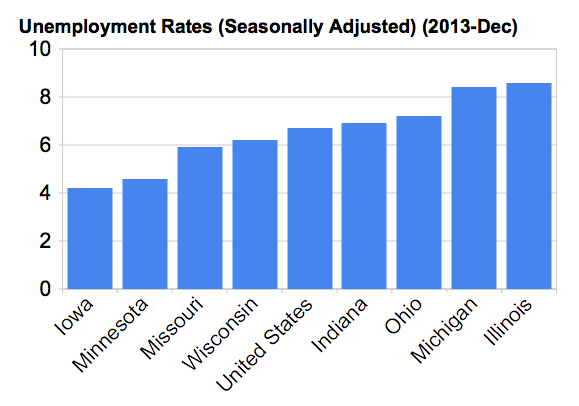
    The fiscal health of government is no doubt important. But to determine if Wisconsin is actually “thriving” you need to look at statistics that actually affect people. So let’s do that. Scott Walker took office in January 2011. So here is the percentage change in jobs in Midwest states between December 2010 and December 2013 from the Bureau of Labor Statistics:


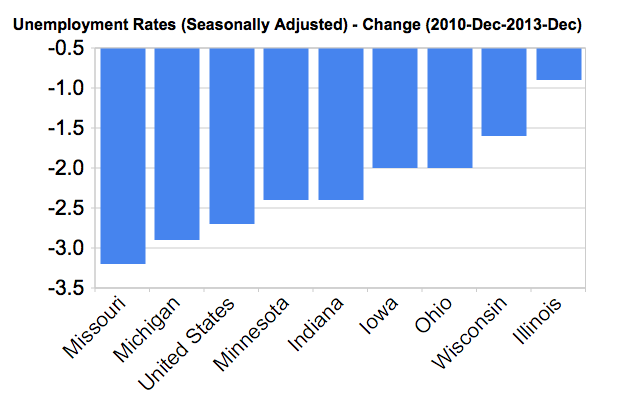
    Wisconsin actually doesn’t rank that well in job growth during Scott Walker’s administration, barely beating fiscal basket case Illinois. The state looks better in its unemployment rate:


    However, in part that’s because Wisconsin’s unemployment rate was already low on a relative basis when Walker took over. It ranks near the bottom in reducing its unemployment rate, though obviously reductions are harder to come by when you’re already lower. Michigan had nowhere to go but down.


    I actually support many of Scott Walker’s reforms. Public sector unions clearly need to be reigned in or even eliminated as they are a huge barrier to rational fiscal management and effective service delivery in addition to being an inherently corrupting political force. Items like allowing unions to force localities to buy health insurance through union affiliated firms at inflated rate were clearly abusive.

    It’s also early to judge, and this is monthly data that is fairly volatile, even though it’s seasonably adjusted and with a same month comparison. There just isn’t that much other data available.

    What I object to is declaring victory when the budget is balanced. The attitude exposed by this is profoundly revealing and shows everything that’s wrong with Tea Party type thinking. It’s obvious that people claiming Wisconsin has thrived under Walker didn’t even take a cursory look at the actual economic performance of the state.

    Wisconsin balanced its budget? Big deal. You’re supposed to balance the budget. That’s just doing your job. It shows how far we’ve come that you can receive plaudits simply for meeting what should have been the baseline expectation.

    The charts above should also cause a reconsideration of the notion that government finances are the primary determinant of business climate and economic growth. There are states on both the left and right of that issue that are both thriving and struggling. Part of it is that states have limited power in the modern economy. There’s only a limited amount they can do to make things better, whereas they can definitely screw it up.

    Also, the natural condition of a participant in a marketplace is failure. The vast majority of new businesses fail. Similarly, places can fail too, and having a budget surplus can’t necessarily stave that off.

    My view is that while state governments are weak actors and there’s a risk of screwing it up, the likelihood of failure in the marketplace is high enough that government does actually have to try to do things. By all means prudent finances and a good regulatory climate need to be maintained, but if you think that’s enough to save you, you’ve got another thing coming. Now that Scott Walker has repaired the budget, what’s his actual plan moving forward to try to build actual personal and marketplace success for Wisconsin residents and businesses? That’s what will determine his actual legacy. It’s in whether he boosts the fortunes of the state’s residents over the longer term, and manages to bend the curve of progress in a positive direction over time.

    Aaron M. Renn is an independent writer on urban affairs and the founder of Telestrian, a data analysis and mapping tool. He writes at The Urbanophile, where this piece originally appeared.

    Scott Walker photo by AndyLindgren.

  • Possible Sign of Trouble for Los Angeles

    A quarter century ago, the Los Angeles-Orange County area seemed on the verge of joining the first tier of global cities. As late as 2009, the veteran journalist James Flanigan could pen a quasiserious book, “Smile Southern California: You’re the Center of the Universe,” which maintained that L.A.’s port, diversity and creativity made it the natural center of the 21st century.

    A very different impression comes from a newer report, The Los Angeles 2020 Commission, which points out that, in reality, the region “is barely treading water while the rest of the world is moving forward.” The report, which focuses on the city of Los Angeles, points to many of the problems – growing poverty, a shrinking middle class, an unbalanced city budget, an underachieving economic and educational system – that have been building for decades.

    Sadly, “the 2020” report more accurately reflects L.A.’s current situation than Flanigan’s more optimistic view. All the more remarkable – and, perhaps, ironic – is that the signatures on the report come from many of the same political figures, union leaders and political advocates who have done so much to create this very sad situation. Disappointingly, the L.A. City Council already has started making its excuses, while the report’s authors, as the Daily News’ Rick Orlov notes, have already started “softening” their sometimes-harsh assessment.

    It is difficult, for example, to take seriously a report that, on the one hand, worries over pension costs but is signed, and supported, by the likes of County Labor Federation boss Maria Elena Durazo and L.A. Department of Water and Power union head Brian D’Arcy. For the most part, the commission was made up of lawyers and others who feed off the very pattern of insider deals and misdirected investment strategies that have so humbled a great city, and region. No surprise, then, that their biggest concrete recommendations were to speed up the pouring of concrete for their various pet projects, some of which make sense, while other don’t.

    Nevertheless, the report suggests that, perhaps, at last, even the most comfortably entrenched leaders are finally waking up to the predicament they and their colleagues have helped create. What they need now is a strategy that restores to Los Angeles the global status that is a prerequisite for progress.

    Why does being a global city matter so much? In large part, it is the best way to compete in a globalizing economy where the successful cities are defined not by size or population, but by the unique services they offer the world. In an ongoing study I am directing for the Chapman University Center for Demographics and Policy, with the assistance of the Singapore Civil Service College, we identified the leading world cities. We focused on such things as financial services, industrial specialization, media and culture.

    Size doesn’t always matter

    In the business of global cities, many of the biggest urban areas – in fact, all the largest ones, excluding Tokyo – failed to make the top 30. Instead, New York and London did best, along with such Asian cities as Tokyo, Hong Kong and Singapore. Perhaps our most surprising finding was that California’s two great metropolitan areas, the San Francisco Bay Area and Los Angeles, ranked sixth and seventh, respectively.

    Why, despite all its problems, is Southern California ranked so high? This is largely a reflection of several factors – notably, a still-sizeable tech sector, a huge port and strong cultural diversity – but, most importantly, because of Hollywood. Great global cities, by our calculations, are often what can be seen as “necessary cities.” They dominate economic niches to an extent that someone from outside the region is compelled to do business there.

    Hooray for Hollywood

    This is true, for example, for finance and media in New York and London, while the Bay Area dominates tech. Similarly, Hollywood is nearly synonymous with the American entertainment industry, which is by far the largest in terms of revenue and influence in the world. Last year, the industry enjoyed a trade surplus of roughly $12 billion; film and television industry exports totaled nearly $15 billion. Every major global movie studio in the world is located in Los Angeles, which is also a key hub of the music industry.

    So dominant is Los Angeles’ entertainment industry that many countries, trying to preserve their own cultural industries, have placed strict quotas on the number of English-language films that can be shown and songs that can be played on the radio. Los Angeles-Orange County once also enjoyed a dominant position in aerospace, but this industry has dramatically faltered, as the sector shrank by some 240,000 jobs as companies moved elsewhere, taking with them much of the region’s technical talent.

    The port of Los Angeles, another economic linchpin, remains somewhat dominant but the trade sector faces growing competition and suffers from the kind of institutional malaise that affects so much of business here. The region retains a foothold in the auto sector as the U.S. base for some Asian makers. Even here, however, there are clouds, as Nissan relocated to Nashville, Tenn., and Honda moved top executives to Ohio in order to be nearer to its manufacturing. More promising, the new Hyundai U.S. headquarters in Fountain Valley signals that global carmakers still see L.A.-Orange County as a “necessary” place.

    The region has held on to a leading, if somewhat smaller, share of entertainment, but L.A.’s other traditional industrial strengths, such as aerospace and defense, have badly eroded. One bright spot is technology. Somewhat surprisingly, the Startup Genome project ranked Los Angeles as having the second-strongest startup ecosystem in the United States. Yet, overall, L.A. has been losing ground in terms of employment, technology employment and net migration to other ascendant regions.

    Tech titans

    Perhaps the most critical factor affecting L.A.’s global status revolves around technology. It was shocking to me, at least, with L.A.’s focus on global ties, that the Bay Area has now slightly nosed out Southern California in our study’s rankings, largely due to that region’s technological preeminence. The region hosts the largest concentration of cutting-edge tech firms in the world. This fact alone allows the Bay Area to play a profound role in how globalization works, notes analyst Aaron Renn (www.urbanophile.com), particularly since innovations coming from that region arguably are a more primal enabler than advanced producer services. Indeed, according to one study, three Bay Area counties – San Francisco, San Mateo and Santa Clara – rank as the top three for concentration of tech jobs, and are among the leaders in growth.

    More serious still, Silicon Valley’s technological push is threatening to upend the structure of Hollywood and media. Over the past decade, Internet and software publishing, which are heavily centered in the Bay Area, have added close to 100,000 new jobs, while traditional media – based largely in New York and Los Angeles – have lost almost three times as many jobs.

    Google and Yahoo already are ranked among the largest media companies in the world. (Yahoo refers to itself as a digital media, rather than a technology, company.) Apple now has a great deal of control over consumer distribution of entertainment products like music and video. The entrance of Netflix, and other tech firms, into the television production business could further undermine L.A.’s entertainment dominance. To the new-tech oligarchs, older industries are prisoners to what one venture capitalist derisively called “the paper economy,” soon to be swept aside by the rising digital aristocracy.

    These issues, and challenges, are what the 2020 Commission people should be addressing in their search for solutions to the L.A. region’s relative decline. As our research indicates, Los Angeles-Orange County remains a major world city, but its upward trajectory is threatened by changes in technology and the rise of other regions in the U.S. and abroad. Now that members of the L.A. establishment have acknowledged “the truth,” perhaps it’s time for them to come up with ideas that can make the truth more pleasant.

    This story originally appeared at The Orange County Register.

    Joel Kotkin is executive editor of NewGeography.com and Distinguished Presidential Fellow in Urban Futures at Chapman University, and a member of the editorial board of the Orange County Register. He is author of The City: A Global History and The Next Hundred Million: America in 2050. His most recent study, The Rise of Postfamilialism, has been widely discussed and distributed internationally. He lives in Los Angeles, CA.

    Photograph: Downtown Los Angeles from Echo Park (by Wendell Cox)

  • How a Few Monster Tech Firms are Taking Over Everything from Media to Space Travel and What it Means for the Rest of Us

    The iconic view of tech companies almost invariably stress their roots in people’s garages, plucky individual entrepreneurs ready to challenge all comers. Yet increasingly the leading tech firms – Amazon, Apple, Facebook, Amazon and especially Google – have morphed into vast tech conglomerates, with hands in ever more numerous, and sometimes not obvious, fields of endeavor.

    Ironically, the very entrepreneurial form that defeated Japan’s bid for global technological dominance is morphing into an American version of the famed keiretsu that have long dominated the Japanese economy. The keiretsu,epitomized by such sprawling groups as Mitsubishi, Sumitomo and even Toyota, spread across a vast field of activities, leveraging their access to finance as a means to expand into an ever-increasing number of fields. The can best be understood, notes veteran Japan-based journalist Karel van Wolferen, as a series of “intertwined hierarchies.”

    Increasingly, American technology is dominated by a handful of companies allied to a small but powerful group of investors and serial entrepreneurs. These firms and individuals certainly compete but largely only with other members of their elite club. And while top executives and investors move from one firm to another, the big companies have constrained competition for those below the executive tier with gentleman’s agreements not to recruit each other’s top employees.

    At the top of the American keiretsu system stands a remarkably small group whose fortunes depend in part on monetizing invasions of privacy to use the Internet as a vehicle for advertising. These are not warm and cuddly competitors. Both Google and Microsoft have been accused of using anti-competitive practices to keep out rivals, in part by refusing to license technology acquiring of potential competitors.

    “Tech is something like the new Wall Street,” notes economist Umair Haque,“Mostly white mostly dudes getting rich by making stuff of limited social purpose and impact.”  

    Like their soul brothers on Wall Street , America’s elite tech firms – and their owners – have become fantastically cash rich.  Besides GE, a classic conglomerate, the largest cash hordes now belong to Apple, Microsoft, Cisco, Oracle and Google, all of whom sometimes have more dollars on hand than the US government.  Seven of the eight biggest individual winners from stock gains in 2013 were tech entrepreneurs, led by Jeff Bezos who added $12 billion to his paper wealth, Mark Zuckerberg who ranked in an additional $11.9 billion while Google founders, Sergey Brin and Larry Page, had their wallets expanded by roughly $9 billion.

    This wealth reflects in large part the oligopolistic nature of many key tech sectors, for example, the Apple-Google duopoly on mobile phone software, Microsoft’s dominant position in operating systems for PCs, Google’s utter control of search, and Facebook’s domination of social media. In most cases, these fields are controlled at levels of eighty percent or more.    

    America’s new gilded age giants are similar to Japan’s keiretsu but they also share a lineage with the early 20th Century trusts that controlled railroads, cotton, silver and other commodities. Those early fortunes helped provide the foundation for such banking firms as J.P. Morgan, Goldman Sachs, Oppenheimer, and Lehman Brothers, as well as the basis for the Rockefeller and Hearst empires. Their wealth, in the era before income taxes, was immense; by the 1880s the revenues of Cornelius Vanderbilt’s railroad empire were greater than those of the federal government.

    The control of immense resources by a small group of tech firms, like the oligopolies of the earlier industrial magnates, produces a steady cash-flow them to look further afield for new opportunities and expand into potentially huge new markets. But even more importantly, it gives them the opportunity to fail and still live to acquire another day.

    Google’s recent sale of Motorola’s mobile division, at a paper loss of nearly $10 billion, would have led to bankruptcy head-rolling at many firms but for Google it hardly left a scratch. A $10 billion failure barely threaten a company whose last quarterly revenues neared $17 billion, has cash on hand of over $56.5 billion and whose market cap is now nearly $380 billion.

    Indeed, if any of the tech powers on track to become a full-fledged keiretsu, it’s likely to be Google. Over the past year the company has ventured into a host of fields, such as robotics, energy, mapping, and driverless cars – fields that have great potential but are only tangentially related to their core business. The recentacquisition of Nest, a company founded by Apple alum Tony Fadell , brings Google into the “smart home” marketplace, part of the so-called “internet of things”. This gives these firms a new capacity to harvest ever greater information hauls from your once “dumb,” but at least private, household appliances.

    These investments and cross-industry ties are changing firms like Google in fundamental ways.  As industry veteran Michael Mace observes, Google has stopped being a “unified product company” and is turning instead into what he calls “a post-modern conglomerate.” Its goal, he notes, is no longer to dominate search, or even the internet, but to invest, and hopefully, control anything that uses information technology, including everything from logistics and medical devices to the most mundane household devices.

    By investing widely and eating up developing markets, the “the Gang of Four” internet companies—Microsoft, Apple, Facebook and Google—have two key advantages: almost unlimited capital resources, and tech expertise and credibility. Allied with venture firms, and a vast reservoir of technical experts, the tech oligarchies, for example, already  dominate such promising fields robotics, with Silicon Valley home to half of all venture invested in the field, over 70 percent of employees, and a whopping 90 percent of market cap.  

    Others are turning to space, a field once dominated by NASA, once a key contractor for the Valley. Headquartered in the old aerospace center of Los Angeles, Space X, the largest of the space startups, was founded by billionaire Elon Musk, who previously founded PayPal and Tesla. By 2013, Space’s X’s total employment, including contractors, topped 3800.

    Musk is not alone in the space game. Amazon CEO Jeff Bezos founded his own private space exploration company, Blue Origin, which has launched two vehicles into space, Charon and Goddard. It intends to build orbital space stations, and serves as a contractor for NASA. Like the nascent space industry’s third new player, Richard Branson’s ‘Virgin Galactic,’ these firms are all the pet projects of billionaires fascinated by space. If NASA continues to retreat from many areas of space exploration, it is likely that in the future the heavens too may end up belonging to the oligarchs.

    The Media power-shift

    A Google or Amazon space-ship may still be in the distant future, but we can already see the impact of the new keiretsu on information and culture. In the past, more hardware-oriented companies provided the “pipelines” through which traditional media disseminated their product. But increasingly, it’s the tech oligarchs who control the news and information industry.

    Google, by some estimates, already enjoys more advertising revenues than either the newspaper or magazine industry. And they’re positioned to take over the the hardware side by supplanting the traditional telecommunications companies with their own series of global pipelines.

    This big tech takeover also previews a geographic shift from traditional centers of power like New York and Los Angeles to the new seats of influence, most notably Silicon Valley, San Francisco and the Puget Sound area.

    The transitions of power and influence have come at heavy costs. 

    As the new software-based media expanded over the last decade, massive losses have pummeled newspapers, music, book and magazine publishing Since 200. The paper publishing industry, traditionally concentrated in the New York area, has lost some 250,000 jobs, while internet publishing and portals generated some 70,000 new positions, many in the Bay Area or Seattle.

    To the new oligarchs, the old media are just part of what one venture capitalist derisively called “the paper economy” destined to be swept away by the new digital aristocracy. As relatively young people who have already amassed fortunes, the tech giants have the time to disseminate their views to the public, both the mass and the influential higher echelons. Another $200 million new venture with a mission to support largely left of center investigative reporting, is being backed by eBay founder Pierre Omidyar.

    Buying up prestigious media outlets, an old tactic for consolidating influence that was previously used by gilded age moguls like William Randolph Hearst, has surfaced among the new tech giants, exemplified in the recent purchase of the venerable New Republic by Facebook co-founder, and Obama tech guru, Chris Hughes, who is reportedly worth $850 million.

    But perhaps more critical than buying old outlets will be the growth of their own oligarch controlled news media. Yahoo is now the #1 news sites in the U.S. with 110,000,000 monthly viewers, and Google News isn’t far behind at #4 with 65,000,000 users. The Valleyites are also moving into the culture business with both YouTube (owned by Google) and Netflix now creating original entertainment content.

    The tech firms control over media is likely to become even more pervasive as the millennial generation grows and the older cohorts begin to die off. Among those over 50 only 15 percent, according to a Pew report get their news over the internet; among those under 30, the number rises to 65 percent.   

    Impact on Innovation

    Is this concentration of tech power a good thing? To some extent, the country benefits from having a Google, Amazon, Microsoft or Apple at the forefront of such fields as healthcare, robotics and space. They possess the resources and the technical know-how to develop and market new product lines that smaller, more specialized start-ups might lack.

    Indeed the shift of resources from social media and advertising to robotics or space travel has to be considered a basically positive development. Unlike the social media revolution, which appears to have done relatively little to benefit the overall economy, the developments in space travel or driverless cars, may provide advantages that are more widely shared.

    Yet, there is also a major problem with over-rich and over-confident oligopolies. It’s a lesson demonstrated by Japan’s arc over the past two decades and in the story of the big three US automakers and their era of domination – both examples show how concentration of power can stifle innovation and positive growth. Already some economists see a slowing in the pace of technical breakthroughs. In the 1980s personal computer boom, scores of companies competing across a broad array of tech sectors resulted in few long-term winners but a rapid evolution of technology. In contrast, it is not easy to argue that Google’s search function or Microsoft’s code are any better today than they were three or even five years ago.

    As the tech firms move further from their entrepreneurial roots, one critic notes,many take on “a timid, bureaucratic spirit” that responds to the needs of investors and focuses on preserving already established business lines.

    Would we be better off with say, a garage-bound Steve Jobs developing the software for robotics, rather than having development managed in a corporate structure that answers the demands of Wall Street analysts? Trusting a small, often closely knit group of investors, to oversee critical industries of the future, does not seem to be the best strategy to maintain and deepen our technological lead.

    Digital innovation should be spurring the creation of new competitive companies. Yet,  instead it is fostering an American version of the Japanese keiretsu, where firms like Amazon, Google, Apple and Microsoft try to use their unfathomable riches to dominate the entire technological future. This is not a step forward but one that can limit Americans’ ability to renew the entrepreneurial genius at the heart of our national character.

    This story originally appeared at The Daily Beast.

    Joel Kotkin is executive editor of NewGeography.com and Distinguished Presidential Fellow in Urban Futures at Chapman University, and a member of the editorial board of the Orange County Register. He is author of The City: A Global History and The Next Hundred Million: America in 2050. His most recent study, The Rise of Postfamilialism, has been widely discussed and distributed internationally. He lives in Los Angeles, CA.

    Facebook photo by BigStockPhoto.com.