Category: Policy

  • Some Implications of Detroit’s Bankruptcy

    There’s been so much ink spilled over Detroit’s bankruptcy that I haven’t felt the need to add much to it. But this week the judge overseeing the case ruled that the city of Detroit is eligible for bankruptcy. He also went ahead and ruled that pensions can be cut for the city’s retirees. Meanwhile, the city has received an appraisal of less than $2 billion for the most famous paintings in the Detroit Institute of the Arts.

    A couple of thoughts on this:

    First, every city in America should be doing a strategic review of its assets, and moving everything it doesn’t want turned into de facto debt collateral into entities that can’t be touched by the courts. In the case of the DIA, the city owns the museum and the collection. Hence the question of whether or not art should be sold to satisfy debts. If it were typical separately chartered non-profit institution, this wouldn’t even be a question.

    At this point, I’d suggest cities ought to be taking a hard look at whether they own assets like museums, zoos, etc. that should be spun off into a separate non-profit entity. Keep in mind, the tax dollars that support the institutions can continue flowing to it. But this does protect the assets in the event of a bankruptcy.

    In the case of Detroit, it seems inevitable that at least some art work will be sold. Given that worker pensions are going to be cut, it would be pretty tough to say no to selling art. Assuming this is the case, post-sale the museum should be spun off as a separate entity to hopefully reboot its standing the museum world. As the trustees of the group that operates it have been adamantly opposed to any sale, one would hope other museums would not hold any violations of industry standards against them for, particularly if they acquire ownership of the building and artwork away from the city afterward. The city of Detroit doesn’t need to be in the museum business anyway. It has bigger fish to fry.

    Secondly, public sector employees will have to start rethinking their approach to retirement benefits. The current mindset has been to grab as much as you can anytime you can because the taxpayer will always be forced to cover the promises no matter what. As the actual results in Central Falls, RI and now this show, that’s no longer a good assumption.

    Detroit’s workers don’t have lavish pensions as these things go. But they weren’t shy about abusing the system either. They in effect looted their own pensions by taking out extra, unearned “13th checks”. They also used pensions funds to give a guaranteed 7.9% annual rate of return on supplemental savings accounts workers were allowed to establish. All told these “extra” payments drained about $2 billion out of the pension system.

    This was not something the city did through an arm’s length transaction. As the Detroit Free Press reported, Mayor Dennis Archer was alarmed by the practice and wanted to stop it. But “the city doesn’t control its pension funds, which have been largely administered by union officials serving on two independent pension boards.” So he tried to amend the city’s charter to stop the practice. According the Free Press, “Archer backed an effort to block the payments through a proposed new city charter, which actually passed in August 1996. Enraged, several city unions and a retiree group sued and won. Archer tried again to block payments through a ballot initiative, called Proposal T, but it failed.”

    The unions could brazenly loot their own pension plan because they felt rock-solid assurance that the taxpayers would ultimately be required to make them whole. This bankruptcy is showing that may not be the case after all. It should serve as a warning to unions everywhere not to get too aggressive with their shenanigans.

    They’ll of course appeal the judge’s ruling and may win. But the Michigan constitution says pensions are a contract right. The very definition of bankruptcy is that you can’t pay what you’re contractually obligated to. Bankruptcy is all about breaking contracts. The bondholders have contracts that are not supposed to be impaired too, after all. I’m a fan of local government autonomy as you know, but as Steve Eide rightly points out, any freedom worth its name is freedom to fail. If cities and their various constituencies don’t suffer the consequences of their mistakes, they should be heavily micromanaged from on high.

    When individuals fail, we have a safety net (unemployment insurance, for example). Plus we have personal bankruptcy to give people a fresh start. We don’t even worry about whether the person is at fault for their own position or not. We provide that backstop regardless. But that backstop doesn’t allow people to go on living like they did before as if nothing happened. Similarly, cities in trouble shouldn’t be abandoned, but they need to realize that there are genuine consequences for failure. A realization that failure has consequences for pension holders as well as the taxpayer should hopefully promote healthier decisions about how retirement benefits should be offered, funded, and administered.

    Aaron M. Renn is an independent writer on urban affairs and the founder of Telestrian, a data analysis and mapping tool. He writes at The Urbanophile, where this piece originally appeared.

  • Political, Economic Power Grow More Concentrated

    Generally speaking, we associate the quest for central government control to be very much a product of the extremes of left and right. But increasingly, the lobby for ever-greater concentration of power – both economically and politically – comes not from the fringes, but from established centers of both parties and media power.

    Recently, for example, an article by Francis Fukuyama, a conservative-leaning intellectual, called for greater consolidation of federal power, most particularly, the Executive Branch. Ironically, Fukuyama’s call for greater central power follows a line most often adopted by “progressive” Democrats, who seek to use federal power to enforce their views on a host of environmental, economic and social issues even on reluctant parts of the country.

    This rush to concentrate powers in Washington seems odd, given the awful rollout of the Affordable Care Act, which seems almost like a parody of a government-managed big program, overly complex and almost impossible to implement. ACA has led even some honest liberals, like the New York Times Tom Edsall, to wonder if “the federal government is capable of managing the provision of a fundamental service through an extraordinarily complex system?”

    To give the Left credit, many liberals would have preferred something less complex, perhaps like the single-payer system, that perhaps would be less amenable to confusion, and exemptions for privileged groups, like congressional staffs. But President Obama and his Democratic allies chose to work with many powerful interests, notably pharmaceutical companies and health insurers, who are in position to capitalize on this bizarre and, in many ways, inexplicably complicated, health care “reform.”

    Other cautionary tales of overcentralization of federal power abound. Recent scandals like NSA eavesdropping and IRS political targeting, would have offended progressive defenders of civil liberties. However, with a favorite Democrat in the Oval Office, and conservatives the primary victims of abuse, their response has been far more muted than if, say, Mitt Romney was president.

    Top-down economy

    Equally critically, many progressives also increasing favor a more centralized economy. With a few brave exceptions, notably Vermont’s feisty socialist Sen. Bernard Sanders and incorrigibles such as Ralph Nader, there have been too-few voices willing to challenge the growing corporatization of the Democratic Party and the ongoing concentration of power in ever-fewer hands.

    Historically, progressives made much about their objections to both government abuse and unrestrained corporate power. After all, progressives (as well as populists) pushed the earliest restraints on trusts and other large corporate combinations. But, now, the very people Theodore Roosevelt defined more than a century ago as the “malefactors of great wealth” have won powerful friends in the progressive camp.

    Take, for instance the growing concentration of banking assets. Over the past 40 years, the asset share of the top five banks has grown from 17 percent to more than 50 percent of the total. This, however, is not enough for some progressive thinkers. Liberal pundits, like Matt Yglesias and Steve Rattner, in fact, think it would be better if we got rid of most smaller financial institutions.

    Some of this is Washington-New York “we know best” elitism at its worst. These are the institutions and individuals that a studied corporatist and influence peddler like Rattnerwould identify with, naturally. Yglesias, for his part doesn’t like small banks in part because they are run by “less-bright and not-as-good guys” as the benevolent geniuses on Wall Street, who almost cracked up the world economy.

    This confluence of large government and big business can be seen in the flow of funds to the Center for American Progress, the Obama-friendly think tank whose head, John Podesta, was just named the president’s latest chief of staff. The center’s primary funders include a who’s who of big corporations, including Apple, AT&T, Bank of America, BMW of North America, Citigroup, Coca-Cola, Discovery, GE, Facebook, Google, Goldman Sachs, PepsiCo, PG&E, the Motion Picture Association of America, Samsung, Time Warner, T-Mobile, Toyota, Visa, Wal-Mart and Wells Fargo.

    These donations reflect a growing lurch of bigger businesses toward the corporatist Democrats; this is particularly true in such fields as media, telecommunications, high technology and health care, where looming environmental and labor reforms are perceived as less a threat than among smaller firms.

    Rise of regulators

    Most worrisome, the increased focus on bigness has engendered growing support for what amounts to government by administrative diktat. As Fukuyama and others argue, our present messy system, particularly Congress, seems incapable of meeting challenges facing the country. This leads to a notion that we need a new “top down” solution through the exercise of greater executive power.

    As is increasingly the case, any attempt to push back against centralization elicits a torrent of name-calling. Objecting to a more expansive federal government, suggests some, smacks of “neo-Confederate” ideology, a charge particularly loaded when the agglomeration of power in Washington is being led by our first African-American president.

    These assaults mask a more dangerous reality: a dismissal of democracy and embrace of authoritarian solutions. Former Obama budget adviser Peter Orszag and the New York Times’ Thomas Friedman have argued that power should shift from contentious, ideologically diverse elected bodies – subject to pressure from the lower orders – toward credentialed “experts” operating in Washington, Brussels or the United Nations. These worthies regard popular will as lacking in scientific judgment and societal wisdom.

    There is no adequate political response to this dangerous tendency. Republicans talk about abuse of power, but, when in office, seem more than willing to indulge in it (with the run-up to the Iraq war and with the Patriot Act). Similarly, few Republicans seem to understand that economic concentration – favored by their remaining friends on Wall Street and the corporate community – tends inevitably to lead to the political variety.

    So far, Republicans have been forced to choose between their own corporatists, who simply favor shifting government largesse to their favorite causes, such as defense or farm subsidies, and the Tea Party movement, whose members often oppose virtually any government initiative, for example, infrastructure improvement, even at the local level, something sure to limit their appeal to a wider electorate.

    Growing distrust

    Yet the situation is far from hopeless. Obama’s ineffective rule has done little to vouch for centralized government. Trust in governmental institutions – the White House, Congress, the courts – is at the lowest ebb in decades. The percentage of people who see the federal government as being too powerful, notes Galluphas surged from barely 50 percent, when President Obama took power, to well over 60 percent today, the highest level ever recorded.

    In such a climate, some thoughtful liberals, such as Yale’s Jacob Hacker, suggest that progressives should avoid embracing an authoritarian, top-down ruling philosophy. “The Democrats have the presidency now,” he suggests, “[but] they won’t hold it forever.” They are essentially “feeding a beast” that, at some date, may turn against them with a vengeance.

    This suspicion of “top down” solutions also extends even to one of the most critical parts of the Democratic base: the millennial generation. Although they have been a core constituency for Barack Obama, they appear to be drifting somewhat away from their lock-step support, with the presidential approval level, according to a recent study by the Harvard Institute of Politics, now under 50 percent.

    Much of the problem, notes generational chronicler Morley Winograd, lies with millennials’ experience with government, which to them often seems clunky and ineffective. The experience with the ACA is not likely to enhance this view, Winograd suspects. “Millennials,” he notes, “have come to expect the speed and responsiveness from any organization they interact with that today’s high tech makes possible. Government, on the other hand, is handcuffed by procurement rules and layers of decision-making, from deploying much of this technology to serve citizens. The result is experiences with government, from long lines at the DMV office to the botched website rollout for Obamacare, causes millennials to be suspicious of, if not downright hostile to, government bureaucracies.”

    It may be here, in the meshing of technology and public purpose, that we may find a new focus that is neither reflexively hostile (as some Tea Partiers appear) to government per se or simply interested in expanding the list of self-interested political clients. The key to future effective government lies not so much in its radical downsizing as in dispersing power to the local level, something that fits both into the mentality of the new generation and the decentralist traditions that have animated our history.

    This story originally appeared at The Orange County Register.

    Joel Kotkin is executive editor of NewGeography.com and Distinguished Presidential Fellow in Urban Futures at Chapman University, and a member of the editorial board of the Orange County Register. He is author of The City: A Global History and The Next Hundred Million: America in 2050. His most recent study, The Rise of Postfamilialism, has been widely discussed and distributed internationally. He lives in Los Angeles, CA.

    Barack Obama photo by Bigstock.

  • The Abuse of Art in Economic Development

    City building is an imperfect process. Poverty, segregation, and income disparities persist, or worsen, despite longstanding efforts to affect change. The unsightliness of these social failures are called “blight”. Blight is commonly thought to be the antithesis to beauty.

    Urban revitalization efforts have been infatuated with idea that removing blight creates the conditions for community good. Specifically, the field of aesthetics—or that branch of philosophy that deals with the principles of beauty and artistic taste—has for long been held up as a lens through which society can be ordered, with the thinking that beautification can “rehab” the masses.

    For instance, the early 20th-century upper crust framed the conditions of poverty this way: the deprived were laggards on the evolution toward modernity, and they needed aesthetic inspiration. So arose the City Beautiful Movement, whose premise, according to Julie Rose at the University of Virginia, “was the idea that beauty could be an effective social control device”.

    Put simply, outside pretty would arouse inside pretty, inspiring civic loyalty and morality in the impoverished.

    A line in the 1904 classic “Modern Civic Art, or The City Made Beautiful” puts it frankly: “[M]odern civic art can now hope to banish the slum thus to redeem the tenement and to make its own conquests thorough.”

    Cleveland tried its hand with this approach. Back in the early 1900s the city’s elites commissioned then-starchitect Daniel Burnham to create the Group Plan. The Plan called for a City Beautiful civic center, which involved demolishing downtown housing tenements and commercial structures deemed expendable, with a series of elegant Beaux Arts-style buildings eventually being constructed around a plaza-like green space, now known as the “Mall”. It was believed such a central source of civic beauty would radiate out into the city, curing ills of all types. The beauty would be timeless, without half-life—always anchoring Cleveland’s progression, like a compass of godliness.

    Courtesy of groupplan.dhellison.com

    It didn’t work. Today, Cleveland is wayward, with a poverty rate of over 30 percent, and more vacant houses than perhaps ever before. Such failures made plain the fact that impoverishment cannot be “prettied” out of the city.

    The use of aestheticism in city building has not gone away. In fact efforts have redoubled over the last decade. The idea is no longer about flushing impoverishment out of the city system, but rather using art—particularly the romanticization of the artist and the act of creation—to spark economic growth.

    In the article “Artists, Aestheticisation and the Field of Gentrification”, scholar David Ley discusses this strategy, whereby a neighborhood moves from “from junk to art and then on to commodity”, or form poor to reinvested in. The gist of the process—one with roots in 1960s France to present-day everywhere—goes something like this:

    Artists, as members of the bohemian vanguard, historically seek affordable, gritty locations. They do this out of necessity—most of the creative class is paid pittance—but also for creativeness.

    “Hardship was the price one paid for being in the thick of it,” wrote artist David Byrne in the article “Will Work for Inspiration”.

    Where artists cluster, so does the concept of anti-conformity and “cool”. Here, according to Ley, the space of the artist and the space of middle class youth overlap, bringing an era’s hipsters into a neighborhood’s fold. Things can turn quickly after that. Developers and entrepreneurs constantly sniff out the next big thing so as to buy lower and rent higher, with the scent pegged to “what the kids like”, hence the incessant “Millennial” fixation. Eventually, as gentrification continues, the artists and hipsters give way to professionals, until a landscape of wealth and conformity fills in the “starving artist” romanticism that greased its path.

    Notwithstanding which side of the gentrification debate one falls on, the fact of the matter is that this form of city revitalization—from junk, to art, to commodity—is rampant, becoming defacto neighborhood development. In Cleveland, the arts-fueled districts of Tremont, Detroit Shoreway, Collinwood, and St. Clair-Superior speaks to the popularity of this approach.

    This isn’t to say it inevitably works. There are only so many artists and hipsters to go around, and not everywhere is Portland, Austin, or Brooklyn. And so when Anywhere, USA does the art-as-development approach, things do not always go as planned.

    In the recent piece called the “Best of All Possible Worlds”, writer Mark Lane travels to Evansville, Indiana, where a public art contest sparked “a debate over class, race, and good taste”. The story details how the town’s arts district plan devolved into land-grabbing by a quasi-governmental agency whose attempt at subsidizing housing for artist attraction often turned into the demolition of stately structures, if only because getting artists to move to small town Indiana is hard.

    Courtesy of The Believer

    Courtesy of The Believer

    Beyond the wisdom of such a strategy, the piece examines the role of art as an aesthetic discipline, noting that the use of art in city revitalization is commonly not art for art’s sake, but is rather employed as a means to “fertilize” low-income neighborhoods for the arrival of the creative class.

    “It’s not about the art,” noted an Evansville city planner to Lane. “Art is just another tool for economic sustainability.”

    Such is a far cry from Picasso’s purpose of art, which is “washing the dust of daily life off our souls”.

    Curiously, you don’t hear much from the mouthpieces of the art establishment as to the way the discipline is being used: as a means to create commercial order. Historically, the beauty and need of civic art has been about allowing the brokenness of life to enter into the artist’s realm so that the pain and suffering of humanity could be recast through the value of creation. Here, the soul is the audience, with the ovation meant to reverberate into how we “do” community.

    But civic art as “junk, to art, to commodity” achieves something else. It turns the act of creation into the act of “creative classification”. And given our current economic inequalities and the erosion of the middle class, it is fair to wonder why a field that can heal the soul is being used to patch a system that adds dust to our daily living by the day.

    Richey Piiparinen is a writer and policy researcher based in Cleveland. He is co-editor of Rust Belt Chic: The Cleveland Anthology. Read more from him at his blog and at Rust Belt Chic.

    Top photo courtesy of aaronacker.com

  • Urban Planning For People

    The recent publication of the United States Department of Energy, Energy Information Administration’s (EIA) 2014 Annual Energy Outlook provides a good backdrop for examining the importance of current information in transportation and land-use planning. I have written about two recent cases in which urban plans were fatally flawed due to their reliance on outdated information. In one case, San Francisco’s Plan Bay Area, the planners are ignoring reality, and a court challenge is underway. In the other, a court invalidated the city of Los Angeles Hollywood Plan.

    Progress In Automobile CO2 Emissions

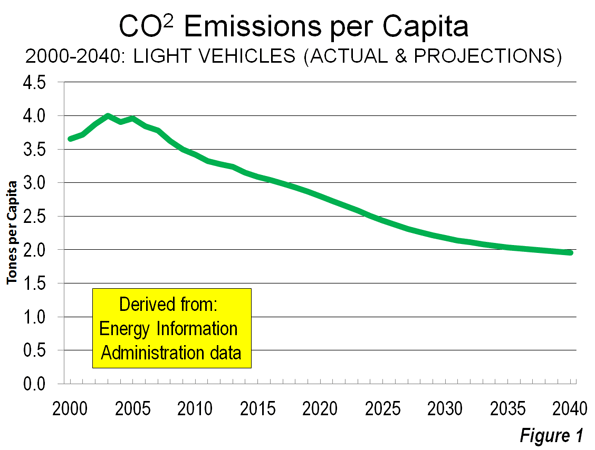
    The new Annual Energy Outlook forecasts continuing and material progress in improving energy efficiency, reducing fossil fuel consumption and reducing carbon dioxide emissions from cars and light trucks (light vehicles). Per capita carbon dioxide emissions from light vehicles are projected by EIA to fall to 51 percent below the peak year of 2003 (Figure 1).

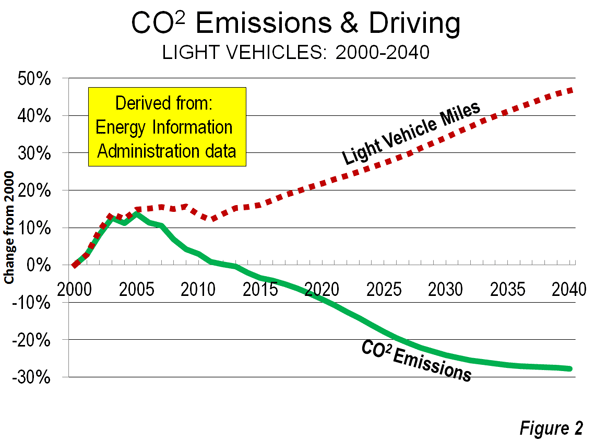
    The gross (not per capita) 2040 carbon dioxide reduction from light vehicles is projected to decline 28 percent in 2040 from 2003. Most significantly, the reduction is to occur as gross driving miles increases 29 percent (Figure 2). The actual 2040 emissions are likely to be even lower, because the 2014 Annual Energy Outlook assumes no vehicle fuel economy improvements after 2025. Improvements in vehicle technologies and cars using alternative fuels, and under government incentives, seem likely.

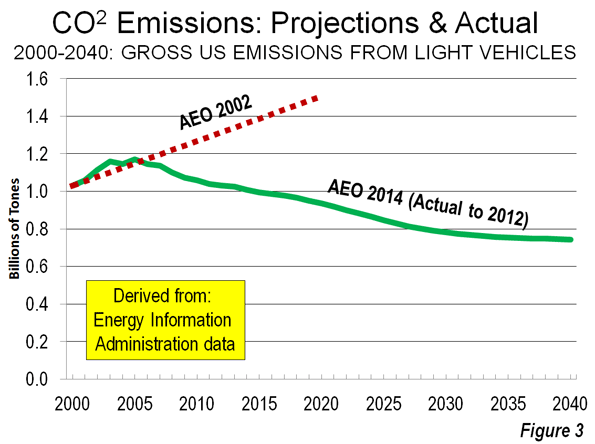
    The emissions forecast improvements have been stunning, to say the least. The 2002 Annual Energy Outlook had expected a 46 percent increase in carbon dioxide emissions from light vehicles between 2000 and 2020. The revised forecast – which takes into account what actually has occurred – says there will be a 9 percent decrease.

    This is the result of multiple factors. In 2002, EIA predicted a 55 percent increase in driving between 2000 and 2020. The 2014 Annual Energy Outlook revises that figure to 22 percent (Figure 3). Fuel economy is improving, which is being driven by stronger regulations as well as technological advances.  

    Driving is Down

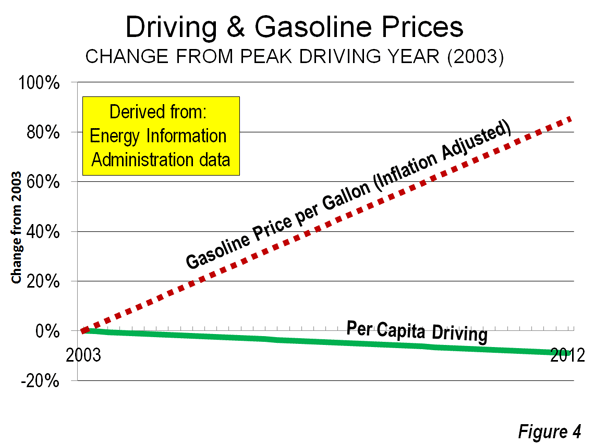
    Driving per capita fell nine percent from the peak year of 2003 to 2012. This decline is not surprising given the sorry state of the economy and high unemployment. Gas prices have risen 85 percent (inflation adjusted) over the same period. The decline in driving is modest compared to the increase in gas prices – a 0.9 percent reduction in driving per capita for each 10 percent increase in gasoline (Figure 4), inflation adjusted. This is half or less the reduction in transit ridership that would be expected if fares were raised by the same percentage.  

    Meanwhile, little of this reduction in driving has been transferred to transit. The increase in transit per passenger miles per capita captured less than one percent of the driving decline. Indeed, the daily increase in per capita transit use is less than the perimeter of a 20-to-the-acre townhouse lot.

    With fewer jobs, higher gas prices and the new reliance on social media, as well as a rise in people working at home, people may have become more efficient and selective in their driving patterns (such as by consolidating shopping trips). Certainly those with jobs use their cars for those trips above as much as before.

    Meanwhile, the EIA forecasts that driving per capita will rise gain, once the economy is released from intensive care. However, with the near universality of automobile ownership, the potential for substantial increases is very limited.

    Hiding Success?

    It might be thought that the planning community, with its emphasis on reducing greenhouse gas emissions, would be rushing to incorporate these into their plans and even to herald the improvements.

    Yet, this is not the case. San Francisco Bay Area planners hid behind over-reaching state directives to "pretend-it-was yesterday" and employed out of date forecasts for vehicle emissions. Data in Plan Bay Area documentation shows that 95 percent of the projected improvement in greenhouse gas emissions would be from energy efficiency improvements. These have nothing whatever to do with its intrusive land use and transport strategies. The additional five percent requires social engineering residents into "pack and stack" high density developments, virtually outlaw detached housing on plentiful urban fringe land and will likely cause even more intense traffic congestion.

    California’s high speed rail planners have made the same kind of mistake, using out-dated fuel economy data in their excessively optimistic greenhouse gas emissions reductions.

    The Illusion of Transit Mobility

    Part of the problem is an illusion that people in the modern metropolitan area can be forced out of their cars into transit, walking, and biking, without serious economic impacts (such as a lower standard of living and greater poverty).

    Transit is structurally incapable of providing automobile competitive mobility throughout the metropolitan area without consuming much or all of its personal income (of course, a practical impossibility). But there is no doubt of transit effectiveness and importance in providing mobility to the largest central business districts (downtowns) with their astronomic employment densities (Note 1). Yet, outside the relatively small dense cores, automobile use is dominant, whether in the United States, Canada, Australia, or Western Europe. The transit legacy cities (municipalities) of New York, Chicago, Philadelphia, San Francisco, Boston, and Washington, with the six largest downtown areas account for 55 percent of all transit commuting in the United States.

    The Delusion of Walking and Cycling as Substitutes for Driving

    Illusion becomes delusion when it comes to cycling and walking. Walking and cycling work well for some people for short single purpose trips, especially in agreeable weather. However, walking and cycling are inherently unable to provide the geographical mobility on which large metropolitan areas rely to produce economic growth. True, cycling does approximate transit commute shares in smaller metropolitan areas, like Amsterdam, Rotterdam, and Bremen, but still accounts for barely a third of commuting by car according to Eurostat data. Prud’homme and Lee at the University of Paris and others have shown in their research that the economic performance of metropolitan areas is better where more of an area’s employment can be reached within a specific period of time (such as 30 minutes). That leaves only a limited role for walking and cycling.

    Toward an A Non-Existent Nirvana?

    The "Nirvana" of a transit-, walking-, and cycling-oriented metropolitan area proves to be no Nirvana at all. We don’t need theory to prove this point. Take Hong Kong, for example, with its urban population density six times that of Paris, nine times that of Toronto, 10 times Los Angeles, 12 times New York nearly 20 times Portland, and nearly 40 times that of Atlanta.

    This vibrant, exciting metropolitan area cannot deliver on a standard of living that competes with Western Europe, much less the United States. Despite the high density, the overwhelming dominance of transit, walking, and cycling, Hong Kongers spend much longer traveling to and from work each day than their counterparts in all large US metropolitan areas, including New York and in most cases the difference is from more than 50 percent (as in Los Angeles) to nearly 100 percent.

    The problem goes beyond the time that could be used for more productive for rewarding activities. Housing costs are the highest among the major metropolitan areas in the eight nations covered by the Demographia International Housing Affordability Survey. Hong Kong’s housing costs relative to incomes are more than 1.5 times as high as in the San Francisco metropolitan area and almost five times as high as Dallas-Fort Worth. Meanwhile, the average new house in Hong Kong is less approximately 485 square feet (45 square meters), less than one-fifth the size of a new single family US American house (2,500 square feet or 230 square meters), though Hong Kong households, are larger (Note 2).

    When households are required to spend more of their income for housing, they have less discretionary income and necessarily a lower standard of living. This loss of discretionary income trickles down to people in poverty, whose numbers are swelled by higher than necessary housing costs.

    Planning is for People

    Contrary to the current conventional wisdom, the prime goal of planning should not be to achieve any particular urban form. What should matter most is the extent to which a metropolitan area facilitates a higher standard of living and less poverty.

    ——————

    Note 1: In 2000, employment densities in the nation’s six largest downtown areas (New York, Chicago, Washington, Boston, San Francisco and Philadelphia) was three times that of the downtowns in the balance of the 50 largest urban areas, and 14 times as dense as outside the downtown areas.

    Note 2: According to the 2011 census, the average household size in Hong Kong was 2.9 persons. This is more than 10 percent larger than the US figure of 2.6 from the 2010 census.

    ——-

    Wendell Cox is a Visiting Professor, Conservatoire National des Arts et Metiers, Paris and the author of “War on the Dream: How Anti-Sprawl Policy Threatens the Quality of Life.

    Photo: Prius photo by Bigstock.

  • NewGeography’s Top Stories of 2013

    A new year is upon us, here’s a look back at a handful of the most popular pieces on NewGeography from 2013. Thanks for reading, and happy New Year.

    12. Gentrification as an End Game, and the Rise of “Sub-Urbanity” In January Richey Piiparinen points out that gentrification driven by affluent young people moving back to the city might be creating “a ‘sub-urbanity’ that is emerging when the generalization of gentrification meets the gentrification of the mind.”

    11. The Cities Winning the Battle for the Biggest Growth Sector in the U.S. Joel and I put this index together to measure growth and concentration of the professional, technical, and scientific services sector among the nation’s largest metropolitan areas. As high-end services become easier to export, this sector is becoming a critical region-sustaining sector in many parts of the country. This piece also ran at Forbes.com.

    10. A Map of America’s Future: Where Growth will be Over the Next Decade Working with Forbes Magazine in September, Joel and I laid out seven regions and three city-states across the nation. Regional economic diversity is one of America’s most critical attributes.

    9.  The Dutch Rethink the Welfare State Nima Sanandaji outlines the trajectory of the social services culture in the Netherlands.

    8.  Suburb Hating is Anti-Child In this provocative, widely-discussed piece, Mike Lanza takes it to politicians and commentators who advocate against suburbs, pointing out that “we need to fix suburbs and the way families utilize them,” but “what we shouldn’t do is try to force families to live in dense city centers.”

    7.  Fixing California: The Green Gentry’s Class Warfare Joel Kotkin points out that many green policies are pro-gentry and anti-middle class, particularly in California. This piece originally appeared at U-T San Diego.

    6.  How Can We Be So Dense? Anti-Sprawl Policies Threaten America’s Future In this piece from Forbes, Joel Kotkin argues that high-density housing advocates should be open to a broader range of housing options because policies pushing high density often favor real estate investors over the middle class and the concept of upward mobility.

    5.  Class Warfare for Republicans Joel takes the Republican Party to task for ignoring the issue of class and small business growth in favor of rhetoric about social conservatism, gun control, and free market idealism. This piece originally ran in the Orange County Register.

    4.  Houston Rising: Why the Next Great American Cities Aren’t What you Think In this piece from The Daily Beast, Joel argues that a city’s most important quality is its ability to foster upward mobility and to sustain a middle class, not its urban form.

    3.  The New Power Class Who Will Profit from Obama’s Second Term Who stands to benefit most from the second Obama administration? Joel argues that it’s the plutocrats of Silicon Valley and new media industries and the clerisy of academia. This piece originally appeared at Forbes.com.

    2.  Why are there so Many Murders in Chicago? Aaron Renn lays out seven possible reasons contributing to violent crime in Chicago and calls for an adjustment in strategy to fight it.

    1.  Gentrification and its Discontents: Notes from New Orleans The most read piece of the year is this excellent expose of gentrification and its impact on the culture and age demographics of New Orleans by local geographer Richard Campanella.

    Mark Schill is a community strategist and analyst with Praxis Strategy Group and New Geography’s Managing Editor.

  • Public Engagement Miracle on 24th Street

    Confrontation and conflict are the favorite dispute resolution tools of Baby Boomers, who were born in the aftermath of WWII and grew up in the rebellious ‘60s. In stark contrast, members of the Millennial generation, born 1982-2003, bring a spirit of collaboration and consensus to solving any problem they encounter. A great example of the difference this generational distinction can be seen in the parents at the LA Unified School District’s 24th Street school, most of whom are Millennials in their twenties or early thirties, in how they resolved  the dispute over the school’s future.

    Located near the 10 freeway and Western Avenue in a predominantly Hispanic, hardscrabble neighborhood, the school appeared regularly on the District’s list of academic underperformers. Beyond poor learning outcomes, the parents at the school were upset by LAUSD’s apparent unwillingness to address their complaints about cleanliness and health issues in the schools including non-functioning bathrooms and dead animals on the premises.  They also felt the principal had a tendency  to use suspensions and a police presence as the way to enforce discipline. Before California’s Parent Trigger law gave parents the legal status to challenge incumbent administrators, the parents had organized a protest designed to remove the principal, but LAUSD failed to respond to their request.  

    So when organizers for the Parent Revolution non-profit that originally conceived of the Parent Trigger law contacted the school’s parents in May  2012, they found a group that was  prepared to spend long hours in the grinding work of organizing their peers into a cohesive and unified force that LAUSD would have to deal with. The parents knocked on doors and handed out flyers at the school inviting mothers to come to a nearby park where they met every Thursday after dropping off their kids at school. The “parent union” leaders surveyed all the other parents to determine what they liked or didn’t like about the school and encouraged those interested to attend the Public School Choice programs LAUSD ran to learn more about school reform options. Dissatisfied with what the District’s processes, the parents who came to the park elected a steering committee that met every Monday morning to organize the Thursday discussions.

    The discussions led to an emerging consensus on the changes the parents wanted to see at the school site.  They wanted to make sure that children with special needs had the right level of support services and the restoration of the preschool Early Education Center the district had eliminated due to budget cuts.  They demanded that dead animals, including gogs and rats, and other health hazards be addressed immediately. But the demand that brought about a real transformation of the conflict at the school and changed its culture in the most fundamental way was their insistence that everyone “play nice” together. They wanted LAUSD’s K-5 24th St. school and the Crown Prep charter school that ran a somewhat competing 5-8 charter school at the same site to embrace a spirit of collaboration addressing  the needs of the children, not necessarily their individual institutional interests.

    On January 17, 2013, about nine months after they were first contacted by Parent Revolution, the parents submitted a “parent trigger” petition to LAUSD, asking that the school be reconstituted under the federal No School Left Behind law’s guidelines for underperforming schools. Unlike other instances in California when such a petition has been presented to a school district’s board, LAUSD, under the guidance of its reform minded superintendent, John Deasy, responded positively to their request.  Eight Letters of Intent were presented to the parents from entities that wanted to take over its operations, including ones from Crown Prep and LAUSD.

    The parents formed a committee, which met every day from 8:30 AM until 2:30 PM, to review these proposals. They presented all the ideas to the parents at the weekly Thursday meetings and asked each bidder to come to the park and talk to them. On the day of LAUSD’s presentation it rained continuously, but Superintendent John Deasy stayed to talk to the parents about how to find common ground.

    Finally, the parents reached a consensus on how to restructure the school. They wanted to retain the college prep focus of the existing charter school, but they didn’t want an organization with little expertise in elementary education taking over K-4. So they asked LAUSD and Crown Prep to establish a collaboration on behalf of their children. If both entities would agree, a brand new LAUSD school with a new principal and new teachers would have responsibility for kindergarten through fourth grade on the campus and Crown Prep would have uncontested responsibility for grades 5-8.  Parents wanted both organizations to agree in writing that children would be on a college readiness track when they went to high school and that both organizations would share professional development of the 24th St. School teachers to ensure a seamless environment on the two school campus, including coordination of schedules. 

    Then a miracle happened. The two competing bidders found a way to agree with the parent’s unprecedented request. They signed an addendum to their bids acceding to the parents’ wishes. The parents voted their approval on April 10, 2013, just about one year after their organizing activities had begun.  A newly responsive LAUSD school board approved this innovative new concept one week later and parents became part of the committees that interviewed prospective principals and teachers for their school. The newly reconstituted school opened in the fall of 2013, with a new principal and a new set of teachers who, in the words of one of the parents, “have lots of new ideas and a strong desire to work on behalf of los niños.”   The early education center is scheduled to reopen in January, 2015.  

    When it came time for LAUSD to decide whether to retain the services of Superintendent Deasy, one of the most eloquent speeches on his behalf was delivered by a parent from the 24th St. School who recalled that day in the rain in the park as evidence of Deasy’s commitment to the children of Los Angeles. A school board riven by differences in personality and policy was taught a lesson about how to work in a more collaborative way by the Millennial parents who had embodied this new spirit in everything they did. As Boomers age and fade from their current leadership roles, perhaps more institutions will find a way to embrace Millennial values and behaviors that have already brought “a smile instead of tears” to the faces of the children of the 24th St. school in the City of Angels.

    Morley Winograd and Michael D. Hais are co-authors of the newly published Millennial Momentum: How a New Generation is Remaking America and Millennial Makeover: MySpace, YouTube, and the Future of American Politics and fellows of NDN and the New Policy Institute.

  • What is a City For?

    The attached report is derived from a speech given last spring in Singapore at the Singapore University of Technology and Design. The notion here is to lay out a new, more humanistic urban future, not one shaped primarily by large developers, speculators and transient global workers. Singapore was a particularly difficult case to look at since it has no room to spread out, something we still have in much of the rest of the world. Yet the city has been very innovative in the development of open space, and its public housing agency, the Housing Development Board, has worked hard to accommodate the needs of families. I have been struck by how people in different countries want the same things: safety, space, privacy, convenience, and affordable housing. The speech is a call to reconsider our urban priorities and make the city responsive to its denizens.

    Download the full .pdf document.

    Introduction

    What is a city for? In this urban age, it’s a question of crucial importance but one not often asked. Long ago, Aristotle reminded us that the city was a place where people came to live, and they remained there in order to live better, “a city comes into being for the sake of life, but exists for the sake of living well” (Mawr, 2013).

    However, what does “living well” mean? Is it about working 24/7? Is it about consuming amenities and collecting the most unique experiences? Is the city a way to reduce the impact of human beings on the environment? Is it to position the polis — the city — as an engine in the world economy, even if at the expense of the quality of life, most particularly for families?

    I start at a different place. I view “living well” as addressing the needs of future generations, as sustainability advocates rightfully state. This starts with focusing on those areas where new generations are likely to be raised rather than the current almost exclusive fixation on the individual. We must not forget that without families, children, and the neighbourhoods that sustain them, it would be impossible to imagine how we, as a society, would “live well.” This is the essence of what my colleague, Ali Modarres and I call the ‘Human City’.

    Living well should not be about where one lives, but how one lives, and for whom. Families can thrive in many places, but these bearers of the next generation are not the primary focus of much of the urbanist community. I am referring here to urban neighbourhoods like in Singapore or in the great American cities, as well as the country’s vast suburbs. These are not necessarily the abodes of the glittering rich, or the transitory urban nomadic class, who dominate our urban dialogue, but a vast swath of aspiring middle- and working- class people. They are not necessarily the places that hipsters gravitate to, or lure people thinking of a second or third house.

    Download the full .pdf document.

    Published by the Lee Kuan Yew Centre For Innovative Cities

    Joel Kotkin is executive editor of NewGeography.com and Distinguished Presidential Fellow in Urban Futures at Chapman University, and a member of the editorial board of the Orange County Register. He is author of The City: A Global History and The Next Hundred Million: America in 2050. His most recent study, The Rise of Postfamilialism, has been widely discussed and distributed internationally. He lives in Los Angeles, CA.

  • Downsizing the American Dream

    At this time of year, with Thanksgiving, Hanukkah and Christmas, there’s a tendency to look back at our lives and those of our families. We should be thankful for the blessings of living in an America where small dreams could be fulfilled.

    For many, this promise has been epitomized by owning a house, with a touch of green in the back and a taste of private paradise. Those most grateful for this opportunity were my mother’s generation, which grew up in the Great Depression. In her life, she was able to make the move from the tenements of Brownsville, Brooklyn, first to the garden apartments of Coney Island and Sheepshead Bay, and, eventually, to a mass-produced suburban house on Long Island.

    This basic American dream of upward mobility may not, according to the pundit class, planners and many developers, be readily available for my children. Indeed, in the years since the 2007 housing bust, there’s been a steady stream of commentary suggesting a future that resembles the past, where most people were renters and, in urban centers, lived chock-a-block in crowded apartment buildings.

    The advocates for a return to this not-so-great past are a diverse lot, spanning the ideological spectrum from the free-market Right to the green, regulation-loving Left. Many on the right, such as economist Tyler Cowen, suggest that the era of the “average” American is now past, and that most of us will have to dial down our expectations about how we live, particularly in costly places such as California. The blessed 15 percent might aspire to live high on the hog, and even in luxury, but for the rest of us it’s eating rice and beans, and living small. Goodbye, Levittown, and back to Brownsville.

    Some in the financial community also salivate at the possibilities contained in downgrading the American dream. The very people who rode the mortgage boom and left millions of homeowners to deal with the consequences, now hail the ushering of what Morgan Stanley’s Oliver Chang has dubbed a “rentership society.” Rather than purchasing a home, the middle class is now being downgraded into either renting a foreclosed home snatched by the Wall Street sharpies or being stuffed into small, multifamily housing.

    In either case, the financial hegemons win, since they, essentially, get to have someone else to pay their mortgages. As for society, it’s a losing proposition. Rather than the yeoman with his own place, and the social commitment that comes with it, we now have the prospect of a vast lower class permanently forced to tip its hat to – and empty its wallet for – its economic betters. This is the fate ardently hoped for by many urbanists, who see a generation of permanent renters as part of their dream of a denser America.

    One would expect that this diminution of the middle class would offend liberals, who historically supported both the expansion of ownership and the creation of a better life for the middle class. But today’s liberals – or progressives – share Wall Street’s enthusiasm, albeit for different reasons, for renting and ever-greater densities.

    This reverses the policies of the New Deal and its successors. Half of postwar suburban housing, notes historian Alan Wolfe, depended on some form of federal financing. In fact, the progressive position increasingly is worse than that of free-market conservatives and their Wall Street allies. The Right sees profit in densification and renting, but would likely support other options if they seemed advantageous. In contrast, the progressive Left increasingly sees the single-family home and ownership – what made middle-class people like my mother lifelong Democrats – as outdated, even destructive.

    This can be seen in the writings of progressive thinkers like Richard Florida, who, in the midst of the mortgage crisis, proclaimed homeownership as “overrated” and urged Americans to give up the dream of owning their own digs, particularly in the much-disrespected suburbs. In Florida’s “creative age,” the proper aspiration is to live in a dense, expensive city, such as San Francisco or Manhattan, where only a fraction of the population can conceivably own their residence.

    To accommodate this vision, we inevitably get back to a world that looks similar to that of the tenement era. Already, in part due to regulatory policies making new construction prohibitively expensive, there is severe overcrowding in New York, the Bay Area and throughout Southern California. According to the Center for Housing Policy and National Housing Conference, 39 percent of working households in the Los Angeles metropolitan area spend more than half their incomes on housing, along with 35 percent in the San Francisco metro area and 31 percent in the New York City area. The national rate is 24 percent, itself far from tolerable.

    What we are witnessing today is oddly reminiscent of the Brooklyn of my mother’s childhood. She and her four siblings generally lived in three or fewer rooms, sharing her bed with her sisters until she got married. Yet, over time my mother’s generation did well, and all my relatives were able to ascend into the middle class, or even better, by the late 1950s. Most bought homes on Long Island, although one purchased a co-op in Brooklyn.

    Today, our cognitive betters embrace a more déclassé vision, with fewer families, more singles and less focus on upward mobility. Indeed, some, particularly among the environmental community, actually embrace downward mobility. Millennials, by not buying homes and cars, and perhaps also not growing into family life, are portrayed by the green magazine Grist as “a hero generation” – one that will march willingly, even enthusiastically, to a downscale future.

    How will we live in this brave new America? It won’t be exactly a return to the tenements that housed Depression era families, but will involve much smaller, less-communal arrangements. To serve the hip and cool youthful urban crowd, planners embrace microunits of 200-300 square feet. These are either being built or planned in such cities as Seattle, New York, San Francisco, Santa Monica and Portland. Soon, they will become something every second-tier wannabe burg will want to duplicate in their often madcap drive to ape cool cities’ hip urbanism.

    Such units may make developers’ mouths water with anticipation of ever more profitable cramming. But in the process, they will be further encouraging the shift away from housing for married couples, not to mention, children. Families do not make up the prime market for dense housing; married couples with children constitute barely 10 percent of apartment residents, less than half the percentage for the overall population.

    And what if you can’t afford a trendy “pad” in a hip downtown? The urban advocates embrace another dismal back-to-the-future solution: the boarding house. It’s time, argues the Atlantic recently, to jettison our “middle-class norms of decency” governing housing and bring back the boarding house of the 19th and early 20th centuries.

    All said, this is a dismal future being dialed up for the next generation, largely by boomer ideologues and their developer allies. It’s not clear, fortunately, that the millennials will willingly go along. This gives us hope that, when families celebrate the holidays decades from now, they still will have as much to be thankful for as did my mother’s generation, or for that matter, my own.

    This story originally appeared at The Orange County Register.

    Joel Kotkin is executive editor of NewGeography.com and Distinguished Presidential Fellow in Urban Futures at Chapman University, and a member of the editorial board of the Orange County Register. He is author of The City: A Global History and The Next Hundred Million: America in 2050. His most recent study, The Rise of Postfamilialism, has been widely discussed and distributed internationally. He lives in Los Angeles, CA.

  • China Failing its Families

    China’s recent decision to reverse – at least in part – its policy limiting most couples to one child marks a watershed in thinking about demographics. Yet, this reversal of the 30-year policy may prove unavailing due to reasons – notably dense urbanization and high property prices – that work against people having more children.

    China already faces a demographic crisis unprecedented for a still-poor country. By 2050, China will have 60 million fewer people under 15 years of age, while the over-65 population grows by 190 million, approximately the population of Pakistan, the world’s sixth-most populous country. The U.S. Census Bureau estimates that China’s population will peak in 2026, and then will age faster than any country besides Japan; most of the world’s decline in children and workers ages 15-19 over the next two decades will take place in China.

    The shift in family-size policy acknowledges these looming demographic changes but may not be sufficient to address them. After all, similar problems have cropped up in other Asian countries, including such successful nations as Japan, Singapore, Taiwan and South Korea. All face tremendous fiscal crises from the prospect of a diminishing workforce insufficient to support swelling numbers of seniors. This “burden of support” crisis applies even in rich, thrifty countries like Singapore or Japan, but is potentially far more destabilizing in much poorer China.

    Perhaps the biggest force undermining both marriage and family – the core institutions of all Confucian societies – can be traced, at least in part, to changes in attitudes associated with urban life. Gavin Jones, a demographer at the National University of Singapore, estimates that up to a quarter of all East Asian women, following the example of women in Japan, will remain single by age 50, and up to a third will remain childless.

    “People’s lifestyles are more important, and their personal networks mean more than family,” notes Japanese sociologist Mika Toyota. “It’s now a choice. You can be single, self-satisfied and well. So why have kids? It’s better to go on great holidays, eat good food and have your hobbies. A family is no longer the key to the city life.”

    Urbanization threat

    Nowhere are these effects more profound, or important, as in China, where 270 million migrants, mostly from the countryside, have moved to the cities – nearly as many people as lived in the United States a decade ago. But once they arrive, many newcomers often live in poor, crowded conditions, that, along with lacking access to schooling, discourage child-rearing.

    The detrimental impact of dense urbanization on family formation is not limited to China, but is especially prevalent in East Asia, where Gavin Jones, Paulin Tay Straughan and Angelique Chan of the National University of Singapore report that “a housing and urban environment unfriendly to children” was a chief reason for women’s reluctance to have children (or more children).

    As China has urbanized, its fertility rate – the average number of births for each woman of childbearing age – has fallen to 1.55, considerably below the 2.1 “replacement rate” required to maintain the population level. But in the rest of East Asia, fertility rates are even lower. For example, Singapore’s fertility rate is 0.79, Taiwan’s is 1.11, and South Korea’s is 1.24 – even without one-child policies. Moreover, China’s fertility rate is elevated because of its higher share of rural population and can be expected to fall as rapid urbanization continues. The depressed urban fertility rates are epitomized by Beijing, at less than 1, and Shanghai, 0.70.

    Reforming the one-child policy alone won’t much change this reality. A host of pro-natalist policies in countries, including Japan and Singapore, have failed to boost birthrates. China-controlled Hong Kong, which now suffers one of the lowest fertility rates on the planet, was never subject to the one-child policy and has tried to encourage procreation, raising tax breaks to $100,000 per child. Yet these steps hardly off-set the high costs of raising childrenin this dense, bustling and expensive city. A recent Hang Seng Bank study estimates the cost of raising a child in Hong Kong at $515,000 U.S. dollars.

    Most damaging, East Asian cities have adopted an urban form almost guaranteed to suppress fertility. Most are usually dominated by skyscraping tower residential blocks and lower-rise residential buildings in which most units have no direct ground access. A 20th-floor balcony is not a substitute for a private yard to play in. Even in Western countries, where cities are usually less-dense, fertility rates are far lower in the urban cores than in the suburbs. Similarly, the birthrates in the urban core of Tokyo are well below those in the suburbs, where yards, though small by Western standards, often are available.

    Then there is the problem of affordability. Housing units in the tall residential blocks cost much more to build than ground-oriented dwellings. High costs, particularly for housing, are one reason nearly two in five Chinese, according to Weibo Sina, the country’s top social media site, feel the law change will not encourage them to consider having more children.

    Child-friendly zones?

    The Chinese government could take steps making it easier for people to have children. One would be to drive growth to less-expensive areas in the country’s vast interior. New government policy reforms have reinforced the commitment for development outside the East Coast, to the center, West and Northeast. Already, interior cities have been made more competitive for manufacturing by connection to the world’s longest interstate-type highway system, as well as the highest-volume trucking and freight rail systems.

    Spreading out development may help, but only if the form of the new housing shifts to a more family-friendly pattern. Building high-density areas, even in second-tier cities – a major source of wealth for local governments as well as developers – essentially exports Shanghai’s child-unfriendly environment to the interior. Instead, a new housing policy that stresses lower densities, more space and greater affordability is a prerequisite for encouraging new families.

    The solution could draw on some of China’s own marked policy successes. Under Deng Xiaoping, China established special economic zones, such as Shenzhen, to test liberal economic policies. Shenzhen’s reforms spread around China and have, literally, transformed the country . More recently, China embarked on a similar program to test financial liberalization, with the establishment of its first financial-services trade zone in Shanghai, and a recent announcement indicates that there will be more.

    These innovative policies could be adapted to address China’s demographic crisis. It could take the form of a few “special child-friendly zones,” established around midsize and large cities. These zones would allow for development of ground-oriented dwellings with yards and could include housing from single-family detached to multistory townhomes. New residents and existing residents could move to these dwellings, attracted by the improved environment for raising the second child.

    For its pilot program, the government could designate suburbs of Chongqing, an interior municipality directly governed from Beijing, as special child-friendly zones. Other interior cities such as Zhengzhou (Henan), Changsha (Hunan), or Xi’an (Shaanxi) could also accommodate similarly designated areas. In the West, including the United States and Northern Europe, birth rates are considerably higher – sometimes by as much as 50 percent – in the suburban periphery than in the city core.

    Some in the West may denounce this as a plan for sprawl, but these more humane, ground-oriented residences would not require substantial additional land. Well-designed neighborhoods of single-family houses on small lots and townhouses can be built at high densities. Further, these residential units are usually less-costly. In the United States, high-rise residential construction can cost more than double per square foot as ground-oriented housing.

    After initial success, child-friendly zones could be extended to other cities, just as the successful Shenzhen economic reforms gradually swept the nation. Of course, such an approach violates current Western doctrine on urban planning, which is obsessively focused on encouraging people to live in ever-higher densities. Yet these doctrines turn out to be expensive and unwise, and undermine the prospects for families. Reforming the one-child policy is a good first step, but China’s best chance to solve its demographic problem lies in developing policies that put families and children first.

    This story originally appeared at The Orange County Register.

    Joel Kotkin is executive editor of NewGeography.com and Distinguished Presidential Fellow in Urban Futures at Chapman University, and a member of the editorial board of the Orange County Register. He is author of The City: A Global History and The Next Hundred Million: America in 2050. His most recent study, The Rise of Postfamilialism, has been widely discussed and distributed internationally. He lives in Los Angeles, CA.

    Wendell Cox is a Visiting Professor, Conservatoire National des Arts et Metiers, Paris and the author of “War on the Dream: How Anti-Sprawl Policy Threatens the Quality of Life.

    Photo: Steve Webel

  • Manufacturing, Exports, and the R&D X-Factor

    A recent visit by President Obama to an Ohio steel mill underscored his promise to create 1 million manufacturing jobs. On the same day, Commerce Secretary Penny Pritzker announced her department’s commitment to exports, saying “Trade must become a bigger part of the DNA of our economy.”

    These two impulses — to reinvigorate manufacturing and to emphasize exports — are, or should be, joined at the hip. The U.S. needs an export strategy led by research and development, and it needs it now. A serious federal commitment to R&D would help arrest the long-term decline in manufacturing, and return America to its preeminent and competitive positions in high tech. At the same time, increasing sales of these once-key exports abroad would improve our also-declining balance of trade.

    It’s the best shot the U.S. has to energize its weak economic recovery. R&D investment in products sold in foreign markets would yield a greater contribution to economic growth than any other feasible approach today. It would raise GDP, lower unemployment, and rehabilitate production operations in ways that would reverberate worldwide.

    The Obama administration is proud of the 2012 increase of 4.4 percent in overall exports over 2011. But that rise hasn’t provided a major jolt to employment and growth rates, because our net exports — that is, exports minus imports — are languishing. Significantly, the U.S. is losing ground in the job-rich arena of exported manufactured goods with high-technology content. Once the world leader, we’ve now been surpassed by Germany.

    America’s economic health won’t be strong while its trade deficit stands close to a problematically high 3 percent of GDP (and widening). Up until the Reagan administration, we ran trade surpluses. Then, manufacturing and net exports began to shrink almost in tandem.

    Our past performance proves that we have plenty of room to grow crucial manufacturing exports, and even eliminate the trade gap. The rehabilitation should begin with a national commitment to basic research, which in turn boosts private sector technology investment. The resulting rise in GDP would be an important counterbalance to a slightly higher federal deficit.

    Just-completed Levy Economics Institute simulations measured how a change in the target of government spending could influence its effectiveness. The best outcomes came about when funds were used to stoke innovation specifically in those export-oriented industries that might yield new products or cost-saving production techniques. When a relatively small stimulus was directed towards, for example, R&D at high tech manufacturing exporters, its effects multiplied. The gains were even better than the projections for a lift to badly needed infrastructure, which was also considered.

    Economists haven’t yet pinpointed a percentage figure that reflects the added value of R&D, but there’s a strong consensus that it is significant. Despite the riskiness of each research-inspired experiment, R&D overall has proven to be a safe bet. Government-supported research tends to be pure rather than applied, but, even so, when aimed to complement manufacturing advances, small doses have a good track record.

    Recognition that R&D outlays bring quantifiable returns partly explains why the federal National Income and Product Accounts have recently been altered to conform with international standards. NIPA will now treat R&D spending as a form of fixed investment. This will be a powerful tool to help reliably gauge its aftermath.

    Private sector-based innovation has also proved to be far more likely to occur when it is catalyzed by a high level of public finance. (For amazing examples, check out this just-released Science Coalition report.) Contractors spend more once government has kicked in; productivity rises and prices drop.

    The prospect of a worldwide positive-sum game is far more realistic than the “currency wars” dynamic so often raised by the media. Overseas buyers experience lower prices and the advantages of novel products. Domestic consumers, meanwhile, enjoy higher incomes and more employment, with some of the earnings spent on imports.

    An export-oriented approach faces multiple barriers. Anemic economies across the globe could spell insufficient demand. Another challenge lies in the small absolute size of the America’s export sector.

    But the range of strategic policy options for the U.S. is limited. A rapid increase in research-based exports is the only way we see to simultaneously comply with today’s politically imposed budget restrictions and still promote strong job and GDP growth.

    Instead of stimulating tech-dependent producers, though, we’ve been allowing manufacturing to stagnate and competitiveness to erode. Public R&D spending as a percentage of GDP has dropped, and is scheduled for drastic cuts under the sequester.

    Sticking with the current plan means being caught up in weak growth and low employment for years. Jobs are being created at a snail’s pace, with falling unemployment rates largely a reflection of a shrinking workforce.

    For our R&D/export model, we posited a modest infusion of $160 billion per year — about 1 percent of GDP — until 2016. We saw unemployment fall to less than 5 percent by 2016, compared with CBO forecasts that unemployment will remain over 7 percent. Real GDP growth — instead of hovering around 3.5 percent, by CBO estimates, on the current path — gradually rose to near 5.5 percent by the end of the period.

    We need this boost. It’s urgent that we bring down joblessness and grow the economy. A change in fiscal policy biased towards R&D shows real promise as a viable way to help rescue the recovery.

    Dimitri Papadimitriou is president of the Levy Economics Institute of Bard College, a professor at Bard, and a widely published economist. His policy positions include a past vice-chairmanship of the Trade Deficit Review Commission of the U.S. Congress. This article originally appeared under the title “The U.S. Economy Needs an Exports-Led Boost,” at Reuters.Com.

    Photo by Lawrence Jackson: President Obama at the ArcelorMittal Steel factory in Cleveland, Ohio; November 2013.