Category: Policy

  • Are Millennials Turning Their Backs on the American Dream?

    In his classic 1893 essay, “The Significance of the Frontier in American History,” historian Frederick Jackson Turner spoke of “the expansive character of American life.” Even though the frontier was closing, Turner argued, the fundamental nature of Americans was still defined by their incessant probing for “a new field of opportunity.” Turner’s claim held true for at least a century—during that time, the American spirit generated relentless technological improvement, the gradual creation of a mass middle class, and the integration of ever more diverse immigrants into the national narrative.

    Yet today, many consider this modern period of “expansiveness” to be as doomed as the prairie frontier culture whose denouement Turner portrayed. Nothing makes this clearer than the perception of a majority of middle class Americans that their children will not do better than them, with as many as pessimistic about the future as are optimistic. Almost one-third of the public, according to Pew, consider themselves “lower” class , as opposed to middle class, up from barely one quarter in 2008.

    Are Young Americans Becoming Herbivores?

    To some, this dismal outlook is either inevitable, or even positive, as Americans shift from their historically “expansive” view and embrace a more modest déclassé future. Rather than seek new worlds to conquer, or even hope to retain the accomplishments of prior generations, contemporary young Americans seem destined to confront a world stamped by ever narrowing opportunity, class distinction, and societal stagnation. Once a nation of competitive omnivores and carnivores, America could be turning more docile—a country of content, grazing herbivores.

    Just such a diminished world view has already taken root in Japan, particularly among that country’s younger males. Growing up in a period of tepid economic growth, a declining labor market, and a loss of overall competitiveness, Japan’s male “herbivores” are more interested in comics, computer games, and Internet socializing than building a career or even the opposite sex. Marriage and family have increasingly little appeal to them, sentiments they share with most women their age.

    This devolved future is widely embraced by both left and right. Libertarian-leaning economist Tyler Cowen identifies a permanent upper class, essentially those who command machines and particularly the software that runs them, while the masses, something like 85 percent of the population, need to adjust to lower living standards, and a diet made up largely of beans and rice.

    This approach has appeal to the grandees of finance, who see in a diminishing American dream not only higher relative status for themselves but an opportunity to turn prospective property owners into rental serfs. Large equity funds have been particularly aggressive about buying foreclosed homes and renting them out, often at high rates, to economically distressed families.

    This “rentership” society, as first suggested by Morgan Stanley’s Oliver Chang, reflects, in this sense, an almost Marxian dialectic that sees ownership of property concentrating in ever fewer hands. Conservative theorists have little problem with this, since they naturally defend class privileges and are less committed to upward mobility than assuring the relentless triumph of market capitalism.

    But the most potent apologists for shrinking the American dream come from the very left which, in the past, once championed broad-based economic growth and upward mobility. Instead, progressives increasingly favor their own version of a “rentership society,” albeit one more regulated than the conservative version, but also accepting , and even encouraging, the proletarianization of the American middle class. (Turning them, in the process, into good, reliable clients of the Democratic Party). Goodbye Levittown, with its promise of property ownership and privacy, and back to the tenements of Brownsville, now dressed up as “hip and cool.”

    Some even have suggested getting rid of “middle class norms of decency” governing housing and bringing back the boarding house of the 19th and early 20th Century. The goal, of course, is to facilitate ever more densification of urban areas and to rein in the dreaded suburban “sprawl.”

    This tendency to force densification and downgrade ownership is deeply pronounced among urbanists and the green lobby, two groups with ample power in most blue states and regions. “Progressive” theorists such as Richard Florida see wealth transferring to a handful of “spiky” American cities, places such as San Francisco and Manhattan, where even the prospect of home ownership is inconceivable to the vast majority of the population.

    There are many others, farther out on the green urbanist track, who believe that the entire notion of middle class upward mobility is too consumption-oriented and, well, sort of in bad taste. They maintain that millennials will not only eschew home ownership but the ownership of automobiles and practically anything else bigger than their beloved electronic gadgets.

    Indeed, this transformation would be greeted with enthusiasm by many greens and traditional urbanists. The environmental magazine Grist even envisions “a hero generation” that will escape the material trap of suburban living and work that engulfed their parents. “We know the financial odds are stacked against us, and instead of trying to beat them, we’d rather give the finger to the whole rigged system,” the millennial author concludes.

    Are Americans Millennials Victims of Circumstance?

    Are young Americans ready to move off the competitive playing field and onto the herbivore pastureland? The economic stagnation certainly seems to have had a negative effect on everything from marriage to fertility rates, which are at their lowest levels in a quarter century. Much like their Japanese counterparts, young Americans increasingly avoid both marriage and having children, according to a recent Pew Foundation study. Despite a total rise in population of 27 million (PDF), there were actually fewer births in 2010 than there were ten years earlier.

    Is this a matter of preference or a reaction to hard times?  Hemmed in by college debt and a persistently weak economy, almost 40 percent of the unemployed are between 20 and 34. A smaller percentage of American males between 25 and 34—the key age for prospective families—are in the workforce than at any time since 1948.

    One reason some celebrate the rejection of marriage and family is that it undermines the suburban environments that overwhelmingly attract most families. Urban theorists such as Peter Katz maintain that millennials (the generation born after 1983) show little interest in “returning to the cul-de-sacs of their teenage years.” Manhattanite Leigh Gallagher, author of the predictable anti-burbs broadside The Death of Suburbs, asserts with certitude that that “millennials hate the suburbs” and prefer more eco-friendly, singleton-dominated urban environments.

    Another apparent casualty here may be entrepreneurship, the very thing that characterized both boomers and their successors, Generation X.  Entrepreneurship rates remain strong among older Americans , but start-up rates among young people look far weaker. Millennials’ experience with the economy makes them, according to generational chroniclers Morley Winograd and Mike Hais, “very risk averse,” particularly in comparison with previous generations.

    Can millennials recreate the “Expansive” culture in their own image?

    Winograd and Hais see millennial timidity as a mostly temporary phenomena. Far from rejecting suburbia, homeownership, and the American dream, millennials are simply seeking to recreate it in their own image. Contrary to the notions promoted by the Wall Street financiers, urban land speculators, and greens, most millennials, particularly those entering their 30s, express a strong desire to own a home, with three times as many eyeing the suburbs as the inner core.

    The recession, according to a recent Wilson Center study (PDF), did not kill the desire to own a home among younger people: more than 90 percent of those under 45 said they wanted to own their own residence.    Another survey by TD Bank found that 84 percent of renters aged 18 to 34 intend to purchase a home in the future. And a Better Homes and Gardenssurvey found that three in four sawhomeownership as “a key indicator of success.”

    Survey data also suggests that millennials are highly focused on getting married and being good parents. Nearly four in five millennials express a desire to have children. This will become more significant as millennials reach their 30s and early 40s, the prime age for family formation. Over the next decade, at least six million people will be entering their 30s, and that number is expected to keep expanding through 2050.

    None of this suggests that, as some social conservatives might hope, that the Ozzie and Harriet family is about to make a major comeback. For one thing, millennials will likely get hitched and have children later than previous generations. Their marriages also will probably be less traditional and male-centered. Hais and Winograd assert that millennials are a “female dominated” generation and have a less traditional view of sex roles—or for that matter, what constitutes a family, since they tend to be highly supportive of same sex marriage.

    But if they differ from past generations, most millennials clearly do not aspire to the ideal of singleness and childlessness embraced by more radical boomer enthusiasts. That said, they will not recreate the family or their residence in their parents’ image. They may, for example, be more willing to customize their residences for their own unique needs or for greater energy efficiency, and place greater emphasis on “technology capabilities” than on a larger kitchen, or some more traditional suburbanaccoutrements.

    As they get on with life, they will also make new demands on their bosses, warn Hais and Winograd. Companies will need to accommodate as well the new familial arrangements that Millennials are likely to seek out. This means firms will need to adopt policies that favor telecommuting, flexible hours, and maternity and paternity leave that will allow for a better balance between work and personal life.

    But in the long run, millennials, if given a chance, are likely to maintain the national ethos of aspiration despite the powerful headwinds they now face. As Turner suggested at the end of his famous essay, it would be “a rash prophet who would assert that the expansive character of American life has now entirely ceased.”

    The real issue here is not the declining validity of American aspiration, but overcoming the economic, political and social factors that threaten to suffocate it. Similar challenges—the concentration of wealth of the Gilded Age, the Great Depression, war, and environmental angst—have periodically appeared and were eventually addressed through technological innovation, and critical political and social changes. Rather than accept the shrinkage of the American prospect, we should seek ways to restore it for those who will inherit this republic.

    This story originally appeared at The Daily Beast.

    Joel Kotkin is executive editor of NewGeography.com and Distinguished Presidential Fellow in Urban Futures at Chapman University, and a member of the editorial board of the Orange County Register. He is author of The City: A Global History and The Next Hundred Million: America in 2050. His most recent study, The Rise of Postfamilialism, has been widely discussed and distributed internationally. He lives in Los Angeles, CA.


  • Long Island’s Flawed Housing Policy is the Real Brain Drain

    Affordable housing is Long Island’s greatest regional failure and the key to our success in the 21st century. Yet, for such an important topic, there is still a fundamental lack of understanding of the problem, and a marked lack of standardization in studying it. We don’t have a regional standard when it comes to affordability, nor do we have an accurate assessment of how many existing units can be considered “affordable.”

    Worse, the approach in which we’re addressing the problem is significantly flawed. This flawed approach is the byproduct of two larger trends in urban planning that I’ve seen on Long Island: shoehorning urban solutions onto suburban problems and allowing stakeholders to dominate the discussion of the issues.

    Recently, I attended a housing design forum hosted by a group that is spearheaded by a development firm that is actively working to “cultivate a spirit of community-driven visioning, entrepreneurship and local investment.”

    In general, I support any initiative that seeks to discuss and address Long Island’s regional issues, and think it’s an important effort. It is critical that the topics of housing, our economy and reversing suburban decline are discussed with the general public. I enjoy attending the events and participating in the discussion. Yet, time and time again, it’s been the same trend – stakeholders, be it developers, environmentalists or so on, all of which have “a dog in the fight” or something to lose or gain, dominate the conversation regarding our regional issues and push to benefit their own agendas.

    We get the policy we deserve

    The group I mentioned earlier has recently a launched a focused campaign to build attainably priced housing. The crux of their proposed solution is the creation of micro-unit apartments across Long Island’s downtown areas. These hypothetical micro-units range in size from 300- to 400-square-foot (roughly three times the size of the average prison cell) unit studios, up to two-bedroom units in the 800- to 900-square-foot range. The theory is that the smaller units, located in a transit-oriented development in the heart of a downtown area, will lead to a more efficient lifestyle. This efficiency will promote sustainable living that is the opposite of suburban waste, reduce energy consumption (because the units are so small) and so on.

    This is all well and good, but when it comes to dollars and cents, the plan makes no sense.

    DLI Pricing

    The hypothetical units, as proposed during a design forum, could rent for between $1,000 and $1,400 for 300- to 400-square foot units up to $2,000 to $2,500 for the 800- to 900-square-foot variants. These rents do not include utilities or cable/internet. To be fair though, the projected rents do not reflect any government subsidies either.

    Regardless, in what world is this considered “affordable?” Um… I mean… workforce. Or is it ”attainable” housing these days?

    Give me a break.

    Granted, these are hypothetical units, but the fact these were presented as a viable option to get excited about in an absolutely serious manner with a straight face, is insulting.

    This is what we get for allowing developers, not planners, economists and others detached from the process, to take the lead when it comes to addressing our regional housing issues. When developers helm the discussion we get proposals such as these.

    A mentor of mine raised a good point when we were discussing the issue. Can the real estate industry play a constructive role in the discussion of housing issues on Long Island? Can the goals of the real estate industry (make as much profit in as short a time frame as possible) harmonize with the goal of planners (to keep land use in balance with the socio-economic needs of residents and the environment)? Often, no; the goals of private industry conflict with the planning ideals.

    One could say, “Well, Mr. Know-it-all, Long Island’s young professionals need different options or they’ll leave. There is a brain drain you know.” The only brain drain I’ve seen is our approach to housing policy.

    If we are losing the young, why not focus on job creation that goes beyond low-wage retail. Stop advocating for mixed-use with integrated retail and create wealth and opportunity that will allow Long Island’s younger generations to stay, be single and eventually start a family. With each Target superstore built, we lose the opportunity to create a strong manufacturing, green or tech base. Land on an island is finite. We must ask ourselves, are we maximizing our open space? Are we creating a business climate that will appeal to startups and entrepreneurs?  What can be done to lower costs, drive up business and allow for a multitude of housing options?

    Enough is Enough

    Drop the buzzwords, drop the flowery language such as “attainable” or “workforce” and let’s actually start to tackle our problem.

    Here is a newsflash: A thousand bucks for a 300-square-foot closet will not fly with millennials raised in homes with bedrooms larger than that. Long Island’s young people are getting priced out of a restricted, stagnant housing market with high costs of living, high property taxes and a distinct lack of affordable housing. They can’t afford nicer living because our job opportunities stink, but don’t insult young islanders with shoe boxes priced astronomically high. If we wanted to live in a tight space, Manhattan is a train ride away.

    We Long Islanders have driven ourselves into a ditch and expect to build our way out of it. Well, you can’t build your way out of a recession. Maybe it’s time to enact a “fair-share” housing policy that requires each and every municipality on Long Island to create a quota of truly affordable development. Perhaps it’s time to stare our property tax problem in the eye, buck up and start looking into consolidation.

    Problems aren’t solved by tip-toeing around the issues and giving us gilded solutions that sit on a shelf and gather dust. The public, especially Long Island’s millennials, deserve better. Why is suburban growth stagnant? It’s because of the stakeholders and their stagnant solutions.

    This piece originally appeared on LIBN’s Young Island.

    Richard Murdocco is a digital marketing analyst for Teachers Federal Credit Union, although the views expressed in this post are Murdocco’s alone and not shared by TFCU. Follow him on Twitter @TheFoggiestIdea, visit thefoggiestidea.org or email him atrich.murdocco@gmail.com.

    Photo by cinderellasg.

  • The Tough Realities Facing Smaller Post-Industrial Cities

    A couple weeks ago the Economist ran a leader and an article on the plight of smaller post-industrial cities, noting that these days the worst urban decay is found not in big cities but in small ones. They observe:

    Partly, this reflects the extraordinary success of London and continuing deindustrialisation in the north of England. Areas such as Teesside have been struggling, on and off, since the first world war. But whereas over the past two decades England’s big cities have developed strong service-sector economies, its smaller industrial towns have continued their relative decline. Hartlepool is typical of Britain’s rust belt in that it has grown far more slowly than the region it is in. So too is Wolverhampton, a small city west of Birmingham, and Hull, a city in east Yorkshire.

    And even with growth, the most ambitious and best-educated people will still tend to leave places like Hull. Their size, location and demographics means that they will never offer the sorts of restaurants or shops that the middle classes like.

    Their editorial forthrightly embraces a policy of triage, saying “The fate of these once-confident places is sad. That so many well-intentioned people are trying so hard to save them suggests how much affection they still claim. The coalition is trying to help in its own way, by setting up ‘enterprise zones’ where taxes are low and broadband fast. But these kindly efforts are misguided. Governments should not try to rescue failing towns. Instead, they should support the people who live in them.”

    This same dynamic is clearly evident in the United States as well. Bigger cities have tended to weather industrial decline far better than smaller ones. There seems to be some threshold size below which it is difficult to support the infrastructure, the amenities, and the thick labor markets that attract the people and businesses in 21st century growth industries. My “Urbanophile Conjecture” heuristic suggests that you need to be a state capital with a population greater than 500,000 to be thriving. But even larger places that aren’t capitals and conventionally viewed as failures like Detroit retain powerful metro area economies and large concentrations of educated workers, especially in the suburbs. Conversely, smaller places like Youngstown, Ohio and Flint, Michigan face much bleaker circumstances.

    There are exceptions to the rule, including many delightful college towns or the occasional oddball like Columbus, Indiana, but for the most part smaller post-industrial cities have really struggled to reinvent themselves.

    In part this is because a rising tide hasn’t lifted all boats, only some of them. As economist Michael Hicks noted, “Almost all our local economic policies target business investment, and masquerade as job creation efforts. We abate taxes, apply TIF’s and woo businesses all over the state, but then the employees who receive middle class wages (say $18 an hour or more) choose the nicest place to live within a 40-mile radius. So, we bring a nice factory to Muncie, and the employees all commute from Noblesville.”

    In short, growth actually fuels divergence because a) the growth disproportionately accrues to the places that are doing well in the first place and b) even when struggling cities can attract jobs, people earning middle class wages frequently live elsewhere. Doug Masson likened this to Jesus’ statement that “For he that hath, to him shall be given: and he that hath not, from him shall be taken even that which he hath.” I think there’s a lot of evidence that for bigger cities a lot of activity is exhibiting a convergent or flattening effect. That’s why so many places today have decent startup scenes, quality food, agglomerations of talent, etc. But for smaller cities my observation is that it’s still a divergent world.

    You see this on full display in central Illinois, where the town of Danville (population 33,000) and Champaign-Urbana (combined population 124,000) are only about half an hour’s drive apart on I-74. Danville is one of the bleakest towns I’ve ever visited in the Rust Belt. When your Main Street is a STROAD, you know you’re in trouble. Champaign-Urbana by contrast, is a fairly healthy community. It’s home to the main campus of the University of Illinois, seems to be reasonably thriving, has many high quality residential streets, a direct rail connection to Chicago, etc. As a college town, it’s one of those “exception” smaller places.

    Anyone within reasonable driving distance with a choice would almost undoubtedly choose to live in Champaign over Danville, unless they had a family or personal connection to the latter. It’s an easy slam dunk decision. In effect, proximity to Champaign acts as kryptonite to Danville’s revitalization. Again, a rising tide only fuels this divergence.

    This sort of divide between communities mirrors the divide in society as well. The question is, what approach should be taken to address these disparities? One approach is to focus on the people, and leave the places to rot. Jim Russell has noted that “people develop, not places” thus most place based economic strategies are destined to fail. This approach has also been advocated by economist Ed Glaeser, who in an article title, “Can Buffalo Ever Come Back?” answered his own question by saying, “probably not—and government should stop bribing people to stay there.”

    This is obviously unpalatable to policy makers of either the left or the right, as no one has yet embraced it openly. How then have the left and right responded? The response of the left seems to be what Walter Russell Mead has labeled the “blue model” solution. His basic view is that the post-war economy was based around a policy consensus he labeled the blue social model (and which Urbanophile contributor Robert Munson has simply labeled the New Deal). This involved large corporations, powerful unions, extensive industrial regulation, and an expanding safety net. Those who wish to retain the model suggest allowing divergence to continue, but raising taxes on the wealthy and successful in order to redistribute them to sustain those at the bottom of the ladder (via an expanded welfare state), who are in effect seen as lost causes in the modern global knowledge economy, though few of them will openly say it. So the idea is to invest in success, and redistribute the harvest aggressively. That’s why you see lots of left advocacy in favor of tax increases on higher income earners and against food stamp and other benefit cuts, but a paucity of ideas for how to provide the left behinds with jobs and opportunity.

    Mead suggests there’s no such thing as the red social model, and perhaps he’s right in that there’s never been a national policy consensus we could label as such, but there’s certainly a red model response to current conditions and it’s called the Tea Party, or what Mead has labeled a “Red Dawn” in many places like KansasNorth Carolina, and New Mexico. This is a type of single factor determinism model. In these kinds of models, a single factor like education, transportation infrastructure, climate, etc is treated as overwhelmingly determinant in driving the economic structure and outcomes. The factor posited by the Red Dawn model is government, therefore the red model response is to slash and burn government (with the potential exception of highway spending) to lower costs, taxes, and regulatory barriers that are perceived to be holding the economy back. In other words, government is the base, and the economy and everything else is the superstructure. Fix the base and the superstructure will correct itself. That’s the theory.

    Broadly speaking, these are the paths that Illinois and Indiana have followed. Chicago’s size enables it and its values to political dominate the state in the modern era. With only a rump of a Republican Party, the Democrats are free to do what they like. Conversely, in Southern influenced Indiana it is the outstate areas that are numerically superior to the successful urban regions, thus the state follows their policy preference, and Republicans overwhelmingly dominate the state so there’s little real opposition to red model policies.

    What have the results been? Most obviously, Illinois is nearly bankrupt while Indiana is sitting on a AAA credit rating and a $2 billion surplus in the bank. (It has a pension deficit, but it’s manageable and there’s a funding strategy in place). Clearly Indiana has a more functional political system than Illinois, which somehow manages to remain gridlocked despite a “four horseman” style legislative system and overwhelming Democratic dominance. So score two for Indiana.

    Finances aside, what have the results been? Illinois has poured massive quantities of cash into building on success, with items like the O’Hare Modernization Program and Millennium Park. The successful side of the economy, epitomized by the global city portion of Chicago, has soared to incredible heights. This is a city that earned at seat at the table of the global elite. On the other hand, the overlooked areas like much of the south and west sides of Chicago and places like Danville, are in horrific shape. The goal of allowing divergence clearly worked. However, with the state’s finances in abysmal shape, the redistribution portion did not happen. Indeed, the social safety net and basic services depended on by the rest of Illinois are being shredded. Even if you believe that it’s viable to simply support a large lumpenproletariat in perpetuity on welfare – which is doubtful – financial extremis means Illinois isn’t even able to try.

    Meanwhile in Indiana, pretty much the entire state policy has been reoriented towards making the left behind areas attractive to lower wage businesses. Policies that would cater to higher end businesses in successful urban areas have been less popular. That’s not to say there’s been nothing. Gov. Pence recently agreed to subsidize a non-stop flight between Indianapolis and San Francisco to help the local tech industry, for example. And he’s supported efforts to boost the life sciences sector. But I think think it’s fair to say low costs and low taxes are the watchword, with right to work, light touch environmental regulation, mass transit skepticism, etc.

    However, most of Indiana’s left behind type places have not recovered. Overall the state has retained a stubbornly high unemployment rate significantly above the US average, and, even more worrying, incomes have been declining relative to the US. Metropolitan Indianapolis, Lafayette, Bloomington, and Columbus have done reasonably well. Much of the rest of the state has continued to struggle, particularly in adding jobs with middle class wages. As the recent commentary by Brian Howey, Michael Hicks, and Doug Masson shows, Indiana retains its “Noblesville-Muncie” divides mirroring Illinois’ “Champaign-Danville” ones.

    In short, the blue and the red model produced some success, albeit in different modes (think San Francisco vs. Houston, Chicago vs. Indianapolis), for the “haves” side of the equation but haven’t yet proven equal to the “have nots.” The Economist makes it clear the totaly different policy configurations of the UK haven’t made a dent in it either. Post-industrial blight in much of Europe tells a similar tale. This suggests that there are powerful macro forces at work that are extremely difficult if not impossible to overcome. It’s no surprise then that the Economist suggests giving up.

    Again, that’s not likely, so what should we do? I won’t pretend to have all the answers to a very difficult question. However, I’ll suggest a few possibilities:

    • Seek to stop the civic death spiral. This means getting ahead of the decline curve by seeking to halt the cycle of people and businesses leaving, leading to revenue declines and degraded quality of place, leading in turn to to service cuts and tax increases and disinvestment, which leads to more people and businesses leaving. This involves getting ahead of decline and restructuring government to a place where you can hold a defensible position on services and taxes from which you can seek to rebuild.
    • Integrate with metropolitan economies. Rather than Muncie trying to hold Noblesville/Metro Indy at bay, or Danville the same to Champaign, closer connectivity is the key. I’ve written on this before regarding Indiana. In the short term losing the highly paid employees to a nearby municipality is a good thing. Without those living options for the managers, etc. you’d never be in play for the plant in the first place. That connection expands your labor pool, provides trade opportunities, etc. Just the property taxes from the plant is valuable, and can be used in rebuilding. Fostering these connections would require decisions that seem counter-intuitive on the short run. For example, Ball State University in Muncie should clearly expand its downtown Indianapolis presence. That isn’t necessarily taking away from Muncie. It’s building new connections and opportunities for Muncie where they don’t exist today.
    • Find a claim to fame around which to rebuild. Carl Wohlt says that every commercial district needs to be known for at least one sure thing. Similarly, what’s Danville’s sure thing? Some towns like Warsaw or Elkhart already have it and need to build on it. Others need to find one. That’s not to say one thing is the only thing you’ll ever need or that you aren’t opportunistic around potentials deals that come your way. But you have to start somewhere. Where do you put your limited available civic funds?

    I’m not so naive as to think this it the complete answer. But if there’s to be a genuine attempt to rescue places, then new thinking is needed and a turnaround will take a long time. In the meantime in parallel, clearly people-centric solutions also need to be pursued, to give people the best opportunity to realize their potential and dreams in life, where ever that may take them. No city is a failure that does this for its citizens.

    Aaron M. Renn is an independent writer on urban affairs and the founder of Telestrian, a data analysis and mapping tool. He writes at The Urbanophile, where this piece originally appeared.

    Photo by Randy von Liski

  • Density, Unpacked: Is Creative Class Theory a Front for Real Estate Greed?

    “The heresy of heresies was common sense”—George Orwell

    The stories we tell affect the lives we lead. I do not mean to be abstract here. I mean, literally, the stories that are told make up a kind of meta-reality that soaks in us to form a “truth”. This “truth” affects policy, which affects investment, which affects bricks and mortar, pocketbooks, and power. Eventually, the “truth” trickles down into a more real reality that defines the lives of the powerless.

    The story du jour in urban policy is one of density. The arc of the story is that cities are places where “ideas come to have sex”. The lovechild is innovation. The mood lighting is creative placemaking.

    The Kama Sutra of density reads this way: creative people cluster in cities that are good at lifestyle manufacturing. The more people that are sardined the higher likelihood there will be “serendipitous” encounters. The more serendipity in a city the better chance the next “big thing” will occur. The next “big thing” will lead to a good start-up, which will lead to an agglomeration of start-ups, termed an “Innovation District”. Detroit becomes Detroit 2.0 then.

    The story of density is a seductive story. Society-making is sobering and full of harsh realities. The story of density is seamless, velvety. It is no wonder the story gets sold, implemented, and then told and re-told, despite the validity and logic of the story being pretty awful.

    Take the recent New York Times piece entitled “What It Takes to Create a Start-up Community”. In it, the writer interviews urbanist Richard Florida. “Population density, [Florida] said, allows for the serendipitous encounters that inspire creativity, innovation and collaboration,” reads one key passage in the piece.

    The story goes on to highlight the emerging tech hub of Boulder as the exemplar of the story of density. One problem: Boulder, a city of less than 100,000, isn’t dense, with a population per square mile of 3,948. The writer moves the goal posts a bit and says the city “is an unusual case of density”, before going on to question whether a start-up community can be created in a city like Detroit that “lacks density”. Yet Detroit, despite being a land mass comprised of one-third vacant land, is denser than Boulder, at 5,144 people per square mile. In all, Aristotle would have a field day with the piece.

    Such illogic peppers the story of density, particularly as it relates to the correlation—to say nothing of the causation—between household clustering and tech growth. For instance, in a recent analysis of America’s top “high tech hot spots” by the Progressive Policy Institute, the top 25 counties experiencing the highest percentage of tech job growth reads like a “Where’s Waldo” list, if Waldo was Thoreau-like. There’s Madison County in Alabama (417 people per sq. mile). Utah County in Utah (258 people per sq. mile). Denton County in Texas (754 people per sq. mile). Fayette County in Kentucky (1,043 people per sq. mile). Snohomish County in Washington (342 people per sq. mile).

    To be fair, also on the list are San Francisco, Boston, and New York. In the case of Boston and San Fran, the tech clustering is a legacy asset—including large venture capital funds — from decades prior, not the result of the story of density. New York, under Mayor Bloomberg, has supposedly gone whole hog on the “idea-sex in the city” script, yet tech is but a speck on the universe that is New York City’s economy.

    For example, Kings County, home to Brooklyn, numbers 25 on the list of places with highest percent of tech job growth, yet Brooklyn’s Job Index—calculated as new tech/information jobs between 2007 and 2012, as a share of 2007 total private sector employment—is just 0.4, meaning the number of new tech jobs in Brooklyn represents less than half a percent of total private employment. Given the information sector as a whole is hemorrhaging jobs according to a recent Harvard Business Review, the scaling of fledgling tech towns is unlikely. This is especially true for cities like New York that—while enriched with the chattering class buzz stoking the story of density—simply lacks the engineering talent of Boston, Silicon Valley, Houston and yes, Detroit , to make the “scene” something than just that: a scene.

    But let’s play along anyway, as that’s the power of the story of density: reality doesn’t bite. So, say Brooklyn can become the next Silicon Valley. This likelihood depends on two assumptions that define the story of density: “cooling” a city will draw top tech talent, and then packing them in to luxury condo towers and mixed use districts will form creativity incubators.

    First, the idea that manufacturing cool spurs a start-up scene is spurious at best. I mean, has this ever worked? Please don’t say Austin, or any number of college towns or state capitals or places with boutique streets that depend largely on transfers from taxpayers — and parents! — to their privileged burgs. Many of these place, like Austin and Raleigh, are themselves far from dense urban nodes, but are exceptionally spread out.

    What about Boulder? In the piece “How Boulder Grew Into a Hub for Start-Ups”, the writer questions venture capitalist Brad Feld, a huge player in the Boulder tech scene, about what brings entrepreneurs to communities like Boulder. Feld throws his hands in the air:

    “People want to live where they want to live. You should figure out where you want to be and build a life around it. Different geographies attract different people.”

    Why did Feld move to Boulder?

    Actually, I moved here in 1995 because Amy said "I’m moving to Boulder – you can come with me if you want." And I did.

    There are things that do appeal to innovators, however. Affordability is an appeal, so says a recent survey of London techies who are decamping from the capital, if only because outrageous rents prevent a “start-up” of anything.

    Over in Berlin, the tech scene is struggling despite the “Berlin geek chic” culture that unfolded. The city’s tech leaders think Berlin needs to be more conventional than cool. “[T]he jury is still out on whether [Berlin’s] a great place to truly grow that company into a mature startup," notes Marc Strigel, head of SoundCloud. "Both the authorities and startups could do much more in promoting Berlin for families, for these world-class talents we definitely need."

    The second assumption relates to the idea that sardining people will ultimately lead to serendipity and innovation. I smell underpants gnomes. Specifically, in an episode of South Park, creators Trey Parker and Matt Stone expose the blind loyalty attached to the façade of “expertise”. The episode goes like this: the characters need a presentation for class. One of the boys talks about a group of gnomes that inexplicably sneak into his house to steal underpants. There’s got to be a reason, right? They confront the gnomes who, claiming to be business experts, explain their business plan as thus: Step 1: Collect Underpants. Step 2: ?. Step 3: Profit.

    The story of density has the same logic gap. Step 1: Population density. Step 2: ?. Step 3: Innovation. Density gurus will claim Step 2 relates to serendipity. But serendipity is chance. How do you plan for chance? Even if you could, creative classification is largely a process of homogenization by class, age, and profession, which, according Rita King of Science House, erodes the possibility of meaningful chance encounters. “Artists bumping into other artists or business people bumping into other business people or Mormons bumping into other Mormons, etc., isn’t real serendipity,” notes King. San Francisco in many ways is more a monoculture than the highly diverse suburbs that surround it.

    Okay, so if the story of density really isn’t about innovation then what is it about? The answer can be found in a recent article entitled “Urban Prophet” in the real estate trade mag Property Week. The piece quotes Albert Ratner, chairman of US real estate firm Forest City Enterprises, on his reading of Florida’s The Rise of the Creative Classes, the first book in the story of density. “You have given real estate developers the playbook,” notes Ratner.

    Put simply, the point of sardining is to make as much money as possible for those who already  have the most . This is the raw truth that fuels the hype, and of course pays for it as well. But it’s a tough sell to neighborhoods and cities increasingly experiencing the negative effects of real estate wealth jamming, and more broadly wealth inequality. Enter the story of density to make another “truth”.

    In reality, the story of density is a fiction and it’s high time we start rewriting the book.

    Richey Piiparinen is a writer and policy researcher based in Cleveland. He is co-editor of Rust Belt Chic: The Cleveland Anthology. Read more from him at his blog and at Rust Belt Chic.

  • The Dutch Rethink the Welfare State

    When the Netherlands’ newly coronated king made his first annual appearance before parliament, he turned some heads when he addressed the deficiencies of the Dutch welfare state.   “Due to social developments such as globalisation and an ageing population, our labour market and public services are no longer suited to the demands of the times”, the king said in a speech written by Liberal prime minister Mark Ruttes cabinet. “The classical welfare state is slowly but surely evolving into a ‘participation society’”, Willem-Alexander continued. By this he meant that the public systems should start encouraging self-reliance over government dependency.

    It is worthwhile to reflect on the challenges faced by the Dutch welfare system. In a knowledge based economy, influenced by strong global competition and dynamic economic development, public policy must encourage thrift, education and build-up of social capital. Discouragingly high taxes and encouragingly high benefits are no way of doing so. Such policies are therefore likely to become even greater obstacles to social and economic development as they are today.

    Concern over the welfare state is not new in the Netherlands. 

    During the beginning of the 1980s the Netherlands ranked as a top spender in terms of welfare policy. Whilst the US and the UK allocated some 22 and 27 percent respectively of GDP to welfare spending, the Netherlands spent fully 40 percent – the same level as the famously generous Swedish public system.  But since then the pattern has been to reduce the welfare state. Indeed as most OECD-countries public spending rose significantly from the 1980s a  report from the OECD notes that the Netherlands, alongside Ireland, gradually scaled theirs down. A combination of economic growth, tightening of welfare state generosity and privatization of sick-pay led to a decline in public social spending in these two countries. In 1980 public social spending was 25 percent of GDP in the Netherlands, much higher than the OECD-average of 16 percent.

    In the beginning of the 2000s the average OECD-country had expanded its welfare state, so that public social expenditure had reached 21 percent of GDP – whilst the Netherlands had reduced its share to the same level. According to another study, benefit expenditure was reduced from 27 to 22 percent of GDP in the Netherland between 1980 and 2001, compared to the EU15 average which rose from 21 to 24 percent during the same period.

    Although the Netherlands does not lie in Scandinavia, there are significant similarities between this advanced European nation and the Nordic countries. The similarities go beyond the fact that the Dutch are tall and blond, and live in a small trade-dependent nation. Shared cultural traits and political beliefs can explain why the Dutch adapted similar welfare policies as the Nordic nations. Similarly to as in Denmark and Sweden, the Netherlands has with time reformed its system, for example by introducing legislation which increases employer’s responsibility for the provision of sickness benefits. In some ways the Dutch have been even keener to reform than the Nordic countries.

    Privatisation of social security and a shift from welfare to workfare have been coupled with the introduction of elaborate markets in the provision of health care and social protection. Not only other European welfare states, but in some regards even the US, can learn much from the Dutch policies of combining a universally compulsory Social health insurance scheme with market mechanisms. Netherlands has, similarly to Denmark, moved towards a “flexicurity” system where labour market regulations have been significantly liberalized within the frame of the welfare system. Taxes in the country peaked at 46 percent of GDP in the late 1980s, but have since fallen to ca. 38-39 percent. The Netherlands has moved from being a country with a large to a medium-sized welfare system, something that still cannot yet be said about culturally and politically similar Sweden and Denmark. The Dutch seem to have been earlier than their Nordic cousins in realizing that overly generous welfare systems and high taxes led to not only sluggish economic growth, but also exclusion of large groups from the labour market. 

    Societal challenges are not difficult to find in the Netherlands, at least not if we look at the difficulty to integrate foreign-born individuals and those with low skills. These problems are shared with other European welfare models, not least the Scandinavian ones. However, the Netherlands overall continues to rank highly  in terms of societal measures such as good school results, high life expectancy, strong civic participation and high life satisfaction. Reforming the welfare state to a smaller size, and introducing more market mechanism within the system, have clearly not lead to a social disaster as some would like to believe.

    The Dutch continue to support the welfare society. This does however not mean supporting an overly generous “cradle to grave” system, with demands that everybody have similar living standard regardless of their individual achievements. As shown in the book “Contested Welfare States: Welfare Attitudes in Europe and Beyond”, Netherlands ranks at second place, following closely after Switzerland, in having the most limited support for the idea that government should be responsible for peoples’ life prospects. A likely reason is that whilst the Dutch are in favor of welfare policies in general, they believe in fostering individual responsibility within the system. The “participation society” that the Dutch king recently spoke about has thus already gained ground.

    There is a strong case to be made that the Dutch can benefit in going further in reducing the size of the state, introducing market reforms and liberalizing the labour market. Such changes would indeed be in line with OECD recommendation. Recently even the IMF recommended the nation to continue structural reforms to enhance growth potential. In addition, considerable savings seem to be possible in the Dutch welfare state, in areas such as health care and education. Luckily, the country can rely on previous positive experience with reforms.

    There is a good chance that the Netherlands will continue on a long-term route towards smaller government and greater prosperity. This does not mean abandoning the idea of public welfare for its citizens but focusing more on enabling people to take care of themselves. The positive experience of past changes, coupled with the realization that change is needed, can catalyze change. If change indeed happens, it will likely not occur over-night. Continuous small steps towards change are more likely. The direction of European nations such as the Netherlands might not excite a US audience, but perhaps there is a lesson to be learned about the value of pragmatic and steady reforms? 

    Dr. Nima Sanandaji has written several books and reports in Sweden, Finland and the UK about subjects such as urban development, entrepreneurship and women’s career opportunities.

  • To Rebuild, the Midwest Must Face Its Real and Severe Problems

    Despite well-publicized problems that earned it the nickname of the “Rust Belt”, on paper the Midwest possesses some formidable strengths. These include the largest concentration of engineers in America, world class educational institutions, a plethora of headquarters of global champions ranging from Proctor and Gamble to Caterpillar to the Chicago Mercantile Exchange, the world’s greatest reserves of fresh water, and an expanding immigrant population.

    Yet with limited exceptions, these have been around for a while, but haven’t produced much growth across the region. Instead, outside of an archipelago of successful outliers (mostly select parts of major metros or college towns), the region has seen its population, job, and income growth badly trail the nation.  During the 2000s US population grew by 9.7%, the Midwest* 3.8%. For jobs, the US lost 1.5% but the Midwest 7.8%.

    Reversing this requires not just leveraging strengths and building on assets, but facing the very real and severe structural challenges that plague the region. However, most of the strategies out there remain outside the region’s essential DNA:

    • Economic clusters like high tech startups or water industries are in effect attempts to build new success enclaves outside the system.
    • Rebuilding downtowns into urban playgrounds for the upscale often takes place against a backdrop of vacant lots, abandoned structures, and depopulation – in other words, empty space.
    • The Rust Belt Chic movement suggests that many of the problems are actually the solution.  But while there are intriguing and important elements to this, it bypasses core issues.

    These are all good as far as they go, but they require little broad-based reform (as opposed to district or enclave based solutions) to structural problems and thus are limited in what they can achieve.

    What are these structural problems? Among the key ones are:

    1. Racism. The modern history of Midwest cities is enmeshed in the history of race relations, particularly between black and white. Places like Chicago and Milwaukee remain among the absolutely most segregated in America. Race riots have been defining feature of cities ranging from Detroit to Cincinnati (which had a race-influenced riot as recently as 2001). In all of these places, a large population of black residents live in segregated neighborhoods plagued with problems ranging from poor schools to low quality housing to a lack of jobs.  Significant social distress has resulted. 

    There are signs the Great Migration that brought blacks north in search of factory work is reversing, with black residents actually seeing more welcoming environments and better economic opportunities in Southern metro areas like Atlanta, Houston, and Charlotte. As well, historically it’s been the more ambitious who leave, not such a good thing for the people and places left behind.

    2. Corruption.  Midwest cities ranging from Chicago to Detroit to Cleveland are famous as cesspools of corruption and cronyism. Systems like Chicago’s “aldermanic privilege” tradition that gives city council members almost dictatorial control over their districts produce environments of almost required tacit corruption even if no laws are violated. In other cities, it’s well known that your approvals will go much faster if you hire the right wired-up subcontractors, lawyers, or lobbyists. While this type of environment exists at some level everywhere, it’s very bad in many Midwest cities and badly degrades an already challenged business climate.

    3. Closed Societies. Contrary to the assertions of Robert Putnam and Bowling Alone, a lot of Midwest places suffer from an excess of social capital. As Sean Safford noted in Why the Garden Club Couldn’t Save Youngstown, excessively dense social networks can create a hermetically sealed environment into which new ideas can’t penetrate or get a hearing.  There are many reports of newcomers to Midwest cities saying that they have difficult making friends and penetrating the social networks in places as diverse as Minneapolis and Cleveland. In Cincinnati and St. Louis expect that the first question you’ll be asked is “Where did you go to high school?” which tells you everything you need to know about those cities.  Immigration has ticked up in recent years, but overall the Midwest has done a poor job of attracting outsiders.

    4. Two-Tier Environment and Resulting Paralysis.  Despite the plethora of high end companies, educated workers, and top quality universities, the Midwest economy was traditionally based on moderately skilled labor in agriculture and industry. This forged a work force that places too low value on education and which can even be suspicious of people with too much of it. Today’s agriculture and manufacturing concerns, at least the ones with jobs that pay more than subsistence wages, require much higher levels of skills and education than in the past. What’s more, with the global macro-economy favorable to larger cities and talent based industries, larger metros have comparatively done well while most smaller towns have struggled. As a result, their quality of life and services have so badly degraded they are no longer attractive to “discretionary residents” (those with the means and opportunity to leave), which perpetuates a downward spiral as the educated flock to bigger cities. That’s why manufacturers complain they can’t find workers with skills, even if those skills are just passing and drug test and showing up to work everyday. This produces massive inequities, resentment, and policy confusion. What’s more, realistically many very poorly performing communities may never recover.

    Beyond these core issues, many places have aging infrastructure, massive blight issues, a regulatory environment not suited to the 21st century, and severe fiscal problems. All of these are extremely difficult problems to resolve, but that does not mean they don’t need to be faced, and overcome.

    Unsurprisingly, the Midwest has not been a particularly competitive region.  There will continue to be bright spots ranging Des Moines to Madison to the greater Chicago Loop to the fracking fields of western Pennsylvania, but until the region faces up to its problems don’t expect a major turnaround anytime soon.

    Aaron M. Renn is an independent writer on urban affairs and the founder of Telestrian, a data analysis and mapping tool. He writes at The Urbanophile.

  • New Report: Enterprising Cities – A Force for American Prosperity

    The inaugural edition of Enterprising Cities: A Force for Prosperity that was recently released examines best practices in municipalities taking proactive measures to support job creation and economic growth together with the private sector. The U.S. Chamber of Commerce Foundation’s Enterprising States and Cities program takes an in-depth look at the policies and programs being implemented to promote economic growth at the state and local levels.

    The cities highlighted in the Enterprising Cities report—Dayton, OH, Irving, TX, Memphis, TN, Minneapolis, MN, Salt Lake City, UT, San Antonio, TX, Sioux Falls, SD—each, in their own unique way, are examples of how enterprise-friendly leadership, strategies, and partnerships can be put into action to achieve meaningful results.

    Cities, both large and small, play a pivotal role as drivers of America’s economy by creating and sustaining the local ecosystem for innovation, competitiveness, and productivity through enterprise-friendly policies that create jobs, enhance economic development, and build prosperity. Pragmatic leaders at the city level can often take on the issues that Washington will not, or cannot, solve. Enterprise-friendly policies at the city level can indeed facilitate local economic growth by supporting entrepreneurs and mobilizing effective partnerships for improving the conditions for business and job growth. Working together with businesses, city leaders can bolster expansion into national markets and exports to reach global markets.

    City policies and practices that will help strengthen our free enterprise system—the system that has served as the foundation of America’s prosperity and the only system capable of creating the jobs we need for the long haul—are those that do the following:

    • Allow businesses to grow and thrive.
    • Free businesses from excessive taxes, unnecessary regulations, and onerous local government processes.
    • Focus government on the critical tasks that are the foundation of economic opportunity, such as infrastructure and protective services.
    • Help educate, cultivate, and equip the next generation of young entrepreneurs and the workforce of the future.

    Enterprising cities use policy inputs, well-designed community programs, and economic development best practices to create an environment where free enterprise creates jobs and prosperity. Economic prosperity creates fiscally sustainable local governments capable of supporting the infrastructure and workforce that free enterprise needs. 

    Is your city an enterprising city? The 2013 Enterprising Cities were selected based upon their approach to local governance, fiscal management, and program deployment. You can use the criteria upon which these seven cities were selected to assess your own city. 

    • Explicit involvement of the local business community, citizens, and local education institutions.
    • A sound approach to fiscal management and the deployment of government services, often based upon private sector best practices.
    • Strong leadership, communication, and cooperation from the mayor, chamber of commerce, or other civic entities.
    • A focus on metrics to measure outcomes.
    • Open communication between local residents and city leaders, and strong city response to citizen input.
    • Evidence of a plan of action or community strategy carried out by multiple public and private partners.
    • Recognition that local business activity drives the economy, providing the fiscal stability that allows local governments to focus on the safety, education, and infrastructure that the private sector needs to thrive.   

    Praxis Strategy Group is an economic research, policy, strategy and development company.  Praxis and its partner Joel Kotkin conducted the Enterprising Cities study and the four annual Enterprising States studies for the U.S. Chamber of Commerce Foundation.

  • Underemployment in America

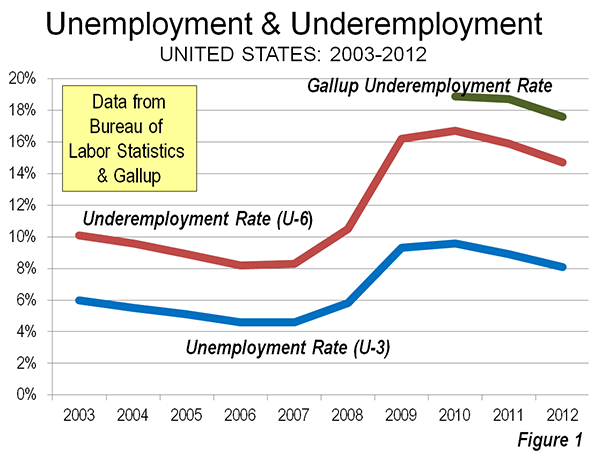
    The nation’s lackluster economic performance continues to be a concern. This is evident in stubbornly high unemployment rates (See: Suburban and Urban Core Poverty: 2012 Special Report),which continue to be well above historic norms. There is another indicator, which may be even more important – underemployment. This figure, 80 percent above the unemployment rate, can be used as a measure of the “output gap,” which a Congressional Research Service (CRS) report refers to as “the rate of actual output (economic) growth compared with the rate of potential output growth.” CRS continues: “Potential output is a measure of the economy’s capacity to produce goods and services when resources (e.g., labor) are fully utilized” (Note 1).

    Both rates are reported by the Department of Labor, Bureau of Labor Statistics (BLS). The national underemployment rate (BLS “U-6” labor underutilization measure) is far higher than the unemployment rate (BLS “U-3” labor underutilization measure). The 2012 underemployment rate was 14.7 percent, compared to the unemployment rate of 8.1 percent. The total unemployed population was 12.5 million in 2012, while the total underemployed population was 23.1 million.

    The difference between underemployment and unemployment comes by adding two groups: marginally attached workers and workers on part-time schedules for economic reasons. According to BLS, marginally attached workers are not counted as unemployed because they have not looked for work within the last four weeks, but they have sought work within the last year and are available for employment. Marginally attached workers include “discouraged” workers, who are not looking for work “because they believe there are no jobs available or there are none for which they would qualify.” In 2012, there were approximately 2.5 million marginally attached workers, including 900,000 “discouraged” workers.

    However, there was a much larger number of involuntary part time workers, at 8.1 million in 2012. This is nearly two-thirds of the 12.5 million workers unemployed in 2012.

    The number of underemployed may be higher. Gallup estimated the nation’s underemployment rate at 17.4 percent in August, well above the BLS August figure of 14.7 percent. The Gallup estimate would place underemployed workers at more than 27 million. This is approximately equal to all of the combined employment in the first and second largest states, California and Texas, as well as Colorado (Figure 1).

    Indeed, the number of underemployed could be higher yet. Economists Richard Vedder, Christopher Denhart, and Jonathan Robe at the Center for College Affordability and Productivity have estimated that 48 percent of employed college graduates hold jobs that do not require college degrees, using BLS data. None of these, as long as they are full time employees, would be included in the underemployment figures.

    Underemployment by State

    In addition to its monthly national estimates, BLS provides quarterly, year-on-year estimates by state, but only for Los Angeles County and New York City below the state level. Data is shown for 2006, the year of the best underemployment rate in the last decade, 2010, with the worst underemployment rate and the most recent year for which data is available, ending June 30, 2013 (Table).

    Underemployment Rates 
    by State, Los Angeles County & New York City
      2006 2010 2013q2* Rank
    United States 8.2% 16.7% 14.3%  
    Alabama 7.3% 17.3% 13.0% 22
    Alaska 11.8% 14.3% 12.4% 16
    Arizona 7.6% 18.4% 15.7% 42
    Arkansas 9.1% 14.5% 13.6% 25
    California 9.1% 22.1% 18.3% 50
    Colorado 7.9% 15.4% 13.8% 28
    Connecticut 7.8% 15.7% 14.6% 37
    Delaware 6.4% 14.3% 14.1% 30
    District of Columbia 9.8% 14.0% 14.1% 30
    Florida 6.2% 19.3% 15.1% 39
    Georgia 8.1% 17.9% 15.6% 40
    Hawaii 6.2% 16.9% 11.4% 12
    Idaho 6.9% 16.3% 13.6% 25
    Illinois 8.1% 17.5% 16.1% 47
    Indiana 8.1% 17.4% 14.5% 36
    Iowa 6.7% 11.6% 9.5% 5
    Kansas 7.4% 12.4% 10.9% 9
    Kentucky 9.3% 16.4% 14.3% 34
    Louisiana 8.1% 12.9% 12.5% 18
    Maine 8.2% 15.2% 14.2% 32
    Maryland 6.5% 13.0% 12.0% 15
    Massachusetts 8.2% 14.3% 13.3% 23
    Michigan 12.2% 21.0% 16.1% 47
    Minnesota 7.9% 13.8% 11.2% 11
    Mississippi 10.2% 17.6% 15.8% 45
    Missouri 8.0% 15.8% 12.4% 16
    Montana 6.9% 14.9% 12.7% 20
    Nebraska 6.1% 8.6% 8.7% 3
    Nevada 6.8% 23.6% 19.0% 51
    New Hampshire 6.1% 11.8% 11.1% 10
    New Jersey 7.8% 15.7% 15.7% 42
    New Mexico 7.5% 15.6% 13.7% 27
    New York 7.7% 14.8% 14.2% 32
    North Carolina 8.6% 17.4% 15.6% 40
    North Dakota 6.2% 7.4% 6.2% 1
    Ohio 9.7% 16.9% 13.5% 24
    Oklahoma 7.3% 11.4% 10.0% 6
    Oregon 10.4% 20.0% 16.9% 49
    Pennsylvania 8.0% 14.7% 13.8% 28
    Rhode Island 8.9% 19.2% 15.9% 46
    South Carolina 10.8% 18.1% 15.0% 38
    South Dakota 6.2% 9.7% 7.8% 2
    Tennessee 8.7% 16.6% 14.3% 34
    Texas 8.6% 14.4% 11.6% 13
    Utah 5.8% 15.1% 10.5% 7
    Vermont 6.4% 12.5% 10.5% 7
    Virginia 6.0% 12.9% 11.6% 13
    Washington 9.4% 18.4% 15.7% 42
    West Virginia 8.8% 14.0% 12.5% 18
    Wisconsin 8.1% 14.8% 12.9% 21
    Wyoming 5.8% 11.5% 9.0% 4
    Los Angeles County 9.1% 24.3% 20.5%
    New York City 8.7% 15.6% 15.1%
    Source: Bureau of Labor Statistics
    *2013q3: Year ended June 30, 2013


    Worst Performing States

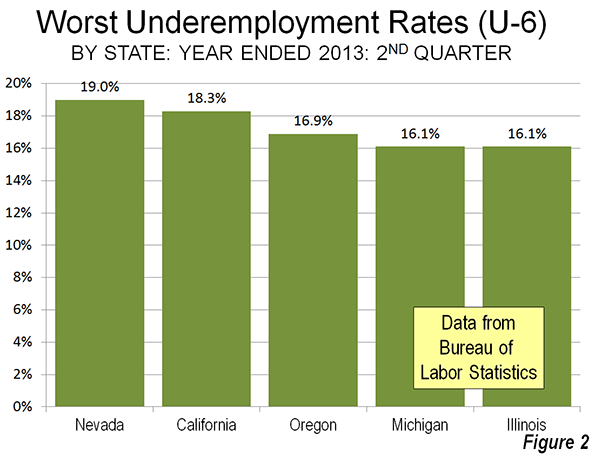
    Underemployment in the states is highest in some Western and Midwestern states. For the 12 months ended June 30, Nevada had the highest underemployment rate, at 20.3 percent. California was second, at 19.3 percent, while Oregon had the third highest underemployment rate, at 16.9 percent. Michigan and Illinois were tied for fourth highest, at 16.1 percent (Figure 2).

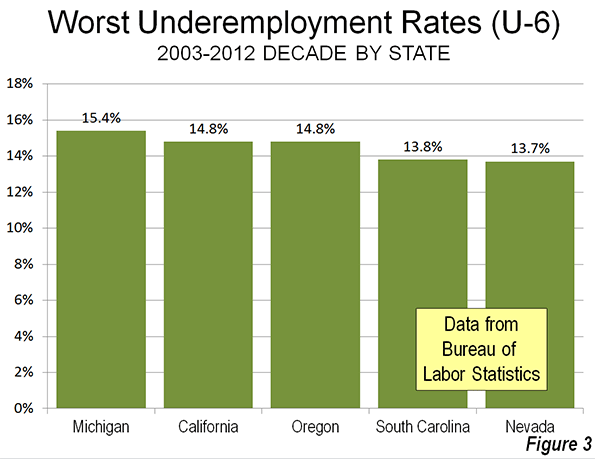
    Over the past decade (2003 through 2012), four of these states were among the five with the highest underemployment rates. Michigan, hard hit by manufacturing losses, had the highest average underemployment rate (15.6 percent), followed by California and Oregon (both at 14.8 percent), South Carolina (13.8 percent) and Nevada (13.7 percent). For the most part, underemployment has become intractable in these states. Only Nevada, with its precipitous decline from the housing crisis ranked better than 40th worst in underemployment in any year between 2003 and 2012 (Figure 3).

    Best Performing States

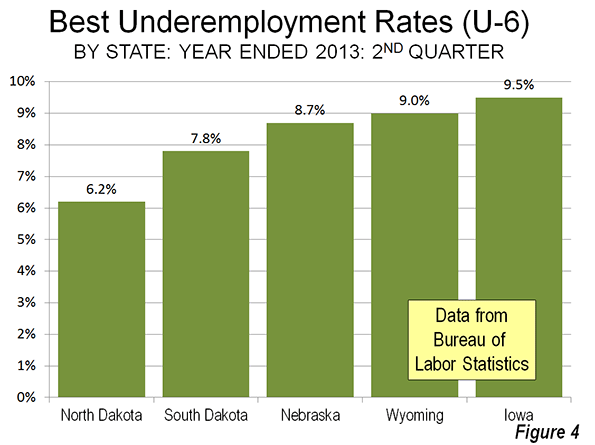
    The best underemployment rates were literally concentrated in five adjacent states with strong energy sector states, principally in the Great Plains. North Dakota led the nation for the year ended June 30, 2013, with an underemployment rate of 6.2 percent, less than one-half the national rate (14.7 percent) and less than one-third the rates of Nevada and California. North Dakota’s neighbor to the south, South Dakota had the second best rate, at 7.8 percent, while   Nebraska ranked third at 8.7 percent. On Nebraska’s western border, Wyoming, the only non-Plains state in the top five, ranked fourth with an underemployment rate of 9.0 percent. Nebraska’s eastern neighbor, Iowa, ranked fifth, at 9.5 percent (Figure 4).

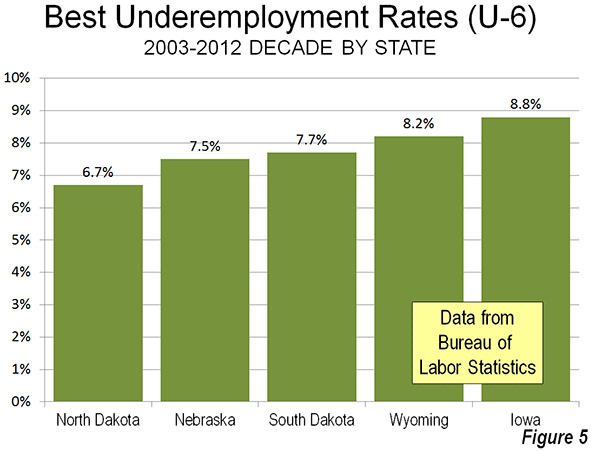
    As with the states with the worst underemployment rates over the last decade, those with the lowest  current figure also did best from 2003 and 2012. North Dakota is again number one, with an underemployment rate of 6.7 percent. Nebraska (7.5 percent), South Dakota (7.7 percent) and Wyoming (8.2 percent) follow, with New Hampshire ranking fifth best, at 8.8 percent (Figure 5).

    Underemployment in New York City and Los Angeles County

    For the year ended June 30, 2013, the city of New York had an underemployment rate of 15.1 percent, somewhat above the national rate of 14.3 percent. Over the past decade, the state of New York’s underemployment rate has been lower than that of the city in every year.  

    Los Angeles County is the largest county in the United States and if it were a state would rank eighth in population, between Ohio and Georgia. Further, it Los Angeles County were a state, it would have had the worst underemployment rate in every year from the 2008 to the present. For the year ended June 30 2013, Los Angeles County had an underemployment rate of 20.8 percent, nearly 1/2 higher than the national underemployment rate 14.7 percent and above the highest state rate of 20.3 percent in Nevada.

    Closing the Productivity Gap

    The productivity gap that results from underemployment constrains the US economy at a time of unusually severe financial challenges. College graduates face not only a grim employment market, but have student loan repayments that require good jobs. The nation continues to spend more than it collects in taxes. The inability of state and local governments to fund their government employee pension programs could lead, in the worst case, to much higher taxes or severe service cutbacks.

    Yet things could get worse. The soon to be implemented “Patient Protection and Affordable Care Act” (“Obamacare”) has a built-in incentives for employers to shift workers to part time status (weekly schedule of fewer than 30 hours of work per week). The law exempts them from providing health insurance for employees who work part time and so some establishments are shifting full time employees to part time status. Others establishments may substitute hiring part time employees instead of full time to reduce their expenses. This incentive is not just being executed by private companies seeking to maintain profitability. It extends to state and local government agencies, which unlike the federal government, must balance their books each year. According to a running of enterprises announcing shifts to part-time by Investors Business Daily, more than 75 percent are government agencies.

    All of this points to two important policy implications. The first is the necessity of focusing on the underemployment measure, the improvement of which is so crucial to maintaining and improving the standard of living and reducing poverty (by reducing the productivity gap). The second is that, with such a focus, policy makers from Washington to Sacramento, Lansing, and Carson City must pursue policies that encourage investment and employment.

    Wendell Cox is a Visiting Professor, Conservatoire National des Arts et Metiers, Paris and the author of “War on the Dream: How Anti-Sprawl Policy Threatens the Quality of Life.

    Note 1: A detailed comparison of the unemployment (U-3) and underemployment (U-6) rates is provided by economist Ed Dolan. A useful chart comparing the two indicators, with numbers from June 2012 will be found on qz.com.

    Note 2: Vedder, Denhart and Robe also suggest the possibility of “over-investment,” as more students may have been encouraged to higher education levels than there are likely to be correspondingly appropriate jobs. The extent of such over-investment is not known.

    Unemployed woman photo by BigStockPhoto.com.

  • Fixing California: The Green Gentry’s Class Warfare

    Historically, progressives were seen as partisans for the people, eager to help the working and middle classes achieve upward mobility even at expense of the ultrarich. But in California, and much of the country, progressivism has morphed into a political movement that, more often than not, effectively squelches the aspirations of the majority, in large part to serve the interests of the wealthiest.

    Primarily, this modern-day program of class warfare is carried out under the banner of green politics. The environmental movement has always been primarily dominated by the wealthy, and overwhelmingly white, donors and activists. But in the past, early progressives focused on such useful things as public parks and open space that enhance the lives of the middle and working classes. Today, green politics seem to be focused primarily on making life worse for these same people.

    In this sense, today’s green progressives, notes historian Fred Siegel, are most akin to late 19th century Tory radicals such as William Wordsworth, William Morris and John Ruskin, who objected to the ecological devastation of modern capitalism, and sought to preserve the glories of the British countryside. In the process, they also opposed the “leveling” effects of a market economy that sometimes allowed the less-educated, less well-bred to supplant the old aristocracies with their supposedly more enlightened tastes.

    The green gentry today often refer not to sentiment but science — notably climate change — to advance their agenda. But their effect on the lower orders is much the same. Particularly damaging are steps to impose mandates for renewable energy that have made electricity prices in California among the highest in the nation and others that make building the single-family housing preferred by most Californians either impossible or, anywhere remotely close to the coast, absurdly expensive.

    The gentry, of course, care little about artificially inflated housing prices in large part because they already own theirs — often the very large type they wish to curtail. But the story is less sanguine for minorities and the poor, who now must compete for space with middle-class families traditionally able to buy homes. Renters are particularly hard hit; according to one recent study, 39 percent of working households in the Los Angeles metropolitan area spend more than half their income on housing, as do 35 percent in the San Francisco metro area — well above the national rate of 24 percent.

    Similarly, high energy prices may not be much of a problem for the affluent gentry most heavily concentrated along the coast, where a temperate climate reduces the need for air-conditioning. In contrast, most working- and middle-class Californians who live further inland, where summers can often be extremely hot, and often dread their monthly energy bills.

    The gentry are also spared the consequences of policies that hit activities — manufacturing, logistics, agriculture, oil and gas — most directly impacted by higher energy prices. People with inherited money or Stanford degrees have not suffered much because since 2001 the state has created roughly half the number of mid-skilled jobs — those that generally require two years of training after high-school — as quickly as the national average and one-tenth as fast as similar jobs in archrival Texas.

    In the past, greens and industry battled over such matters, which led often to reasonable compromises preserving our valuable natural resources while allowing for broad-based economic expansion. During good economic times, the regulatory vise tended to tighten, as people worried more about the quality of their environment and less about jobs. But when things got tough — as in the early 1990s — efforts were made to loosen up in order to produce desperately needed economic growth.

    But in today’s gentry-dominated era, traditional industries are increasingly outspent and out maneuvered by the gentry and their allies. Even amid tough times in much of the state since the 2007 recession — we are still down nearly a half-million jobs — the gentry, and their allies, have been able to tighten regulations. Attempts even by Gov. Jerry Brown to reform the California Environmental Quality Act have floundered due in part to fierce gentry and green opposition.

    The green gentry’s power has been enhanced by changes in the state’s legendary tech sector. Traditional tech firms — manufacturers such as Intel and Hewlett-Packard — shared common concerns about infrastructure and energy costs with other industries. But today tech manufacturing has shrunk, and much of the action in the tech world has shifted away from building things, dependent on energy, to software-dominated social media, whose primary profits increasingly stem from selling off the private information of users. Servers critical to these operations — the one potential energy drain — can easily be placed in Utah, Oregon or Washington where energy costs are far lower.

    Even more critical, billionaires such as Google’s Eric Schmidt, hedge fund manager Thomas Steyer and venture firms like Kleiner Perkins have developed an economic stake in “green” energy policies. These interests have sought out cozy deals on renewable energy ventures dependent on regulations mandating their use and guaranteeing their prices.

    Most of these gentry no doubt think what they are doing is noble. Few concern themselves with the impact these policies have on more traditional industries, and the large numbers of working- and middle-class people dependent on them. Like their Tory predecessors, they are blithely unconcerned about the role these policies are playing in accelerating California’s devolution into an ever more feudal society, divided between the ultrarich and a rapidly shrinking middle class.

    Ironically, the biggest losers in this shift are the very ethnic minorities who also constitute a reliable voter block for Democratic greens. Even amid the current Silicon Valley boom, incomes for local Hispanics and African-Americans, who together account for one-third of the population, have actually declined — 18 percent for blacks and 5 percent for Latinos between 2009 and 2011, prompting one local booster to admit that “Silicon Valley is two valleys. There is a valley of haves, and a valley of have-nots.”

    Sadly, the opposition to these policies is very weak. The California Chamber of Commerce is a fading force and the state Republican Party has degenerated into a political rump. Business Democrats, tied to the traditional industrial and agricultural base, have become nearly extinct, as the social media oligarchs and other parts of the green gentry, along with the public employee lobby, increasingly dominate the party of the people. Some recent efforts to tighten the regulatory knot in Sacramento have been resisted, helped by the governor and assisted by the GOP, but the basic rule-making structure remains, and the government apparat remains highly committed to an ever more expansive planning regime.

    Due to the rise of the green gentry, California is becoming divided between a largely white and Asian affluent coast, and a rapidly proletarianized, heavily Hispanic and African-American interior. Palo Alto and Malibu may thrive under the current green regime, and feel good about themselves in the process, but south Los Angeles, Oakland, Fresno and the Inland Empire are threatened with becoming vast favelas.

    This may constitute an ideal green future — with lower emissions, population growth and family formation — for whose wealth and privilege allow them to place a bigger priority on nature than humanity. But it also means the effective end of the California dream that brought multitudes to our state, but who now may have to choose between permanent serfdom or leaving for less ideal, but more promising, pastures.

    Joel Kotkin is executive editor of NewGeography.com and Distinguished Presidential Fellow in Urban Futures at Chapman University, and a member of the editorial board of the Orange County Register. He is author of The City: A Global History and The Next Hundred Million: America in 2050. His most recent study, The Rise of Postfamilialism, has been widely discussed and distributed internationally. He lives in Los Angeles, CA.

    This piece originally appeared at U-T San Diego.


  • Bridges Boondoggle, Portland Edition

    A couple weeks ago I outlined how the Ohio River Bridges Project in Louisville had gone from tragedy to farce. Basically none of the traffic assumptions from the Environmental Impact Statements that got the project approved are true anymore. According to the investment grade toll study recently performed to set toll rates and sell bonds, total cross river traffic will be 78,000 cars (21.5%) less than projected in the original FEIS. What’s more, tolls badly distort the distribution of traffic that will come such that the I-65 downtown bridge, which is being doubled in capacity, will never carry just what the existing bridge carries right now anytime during the study period, and won’t exceed the design capacity even slightly until 2050. Meanwhile, the I-64 bridge that will remain free will grow in traffic by 55% by 2030, when it will be 34% over capacity.

    A nearly identical scenario is playing out in Portland with the $2.75 billion I-5 Columbia River Crossing. Joe Cortright of Impresa consulting unearthed the information through freedom of information requests looking into the investment grade toll study on that is being conducted for that bridge. You can see his report here (there’s also a summary available).

    I’ll highlight some of his truly eye-popping findings. Traffic forecasts are inflated, of course. The toll study is suggesting traffic increases of 1.1% to 1.2% per year when over the last decade traffic has actually declined by 0.2% per year on average even though there are no tolls. But it’s the addition of tolls that badly distort cross-river traffic and make a mockery out of the EIS. Here’s the money chart for the I-5 bridge itself:


    How is it possible that after building a gigantic multi-billion dollar bridge traffic declines? For the same reason as Louisville: tolling will cause huge amounts of traffic to divert to the I-205 free bridge. By 2016 traffic on I-205 would rise from 140,000 per day to 188,000 – and up to 210,000 by 2022 (full capacity).

    This is so eerily similar to the Louisville situation, that someone suggested, only half in jest I suspect, that they must be having “how to” training sessions on this stuff over at AASHTO HQ.

    Unlike Louisville, where a docile press is basically in cahoots with the state DOTs pushing the project, Portland’s media started asking questions. And one local paper even caught a civil engineering professor from Georgia serving on the independent review board for the project labeling the tolling scheme “stupid.” (Louisvillians take note).

    Oregon DOT director Matt Garrett released a letter in response in which he says, “This work is fundamentally different than the traffic analysis completed for the Final Environmental Impact Statement, and with very different goals in mind.” I agree. The FEIS was performed with the goal of getting this bridge the DOT wanted built approved. The toll study was designed to withstand financial scrutiny on Wall Street and be relied on in selling securities. I’ll let you be the judge of which is more likely to be closer to the truth. What’s more, Cortright addresses this very issue by saying in his report, “Neither federal highway regulations nor federal environmental regulations authorize or direct using multiple, conflicting forecasts for a single project, or using one set of traffic numbers for one purpose, and a different set for another.” I might also add that the DOTs in Louisville have not to the best of my knowledge made similar claims to explain away an identical discrepancy there. Nevertheless, the rest of Garrett’s letter acknowledges that I-5 will see a big traffic drop and there will be diversion from tolling. So he appears to just be doing the bureaucratic equivalent of “pay no attention to that man behind the curtain.”

    Again, want to know how it is that we spend so much money on transport infrastructure and get so little value? It’s because far too many of our highway dollars go into boondoggle mega-projects ginned up through political pressure (watch this space as I have another example coming soon) instead of into projects that make transportation sense. It may well be that there are legitimate problems with the existing I-5 river crossing, but these numbers give no confidence that the Oregon DOT has come up with a good or cost-effective plan for dealing with them. Unlike some, I do think we need to build more roads in America. Unfortunately our system is set up to ensure the survival of the unfittest instead of projects that make actual transportation and economic sense.

    Aaron M. Renn is an independent writer on urban affairs and the founder of Telestrian, a data analysis and mapping tool. He writes at The Urbanophile, where this piece originally appeared.

    Photo of current Columbia River crossing by Jonathan Caves.