Category: Policy

  • The Cities Creating The Most Middle-Class Jobs

    Perhaps nothing is as critical to America’s future as the trajectory of the middle class and improving the prospects for upward mobility. With middle-class incomes stagnant or falling, we need to find a way to generate jobs for Americans who, though eager to work and willing to be trained, lack the credentials required to enter many of the most lucrative professions.

    Mid-skilled jobs in areas such as manufacturing, construction and office administration — a category that pays between $14 and $21 an hour — can provide a decent standard of living, particularly if one has a spouse who also works, and even more so if a family lives in a relatively low-cost area. But mid-skilled employment is in secular decline, falling from 25% of the workforce in 1985 to barely 15% today. This is one reason why middle- and working-class incomes remain stagnant, well below pre-recession levels.

    Over the past three years, high-wage professions have accounted for 29% of new jobs created, while the lowest-paid jobs (under $13 an hour) have grown to encompass roughly half of all new jobs. Net worth-wise, as a recent Pew study notes, the wealthy — the top 7% — are thriving due to the rebound of the stock and bond markets; the bottom 93%, whose wealth is more tied up in their homes,  is still feeling the hangover from the cratering of housing prices in the recession.

    No surprise then that about a third of all Americans now consider themselves lower class, according to another Pew study, up from a quarter before the recession.

    But middle-income employment has not vanished everywhere.  An analysis of the distribution of new jobs since 2010 by Economic Modeling Specialists, Inc. found a wide disparity among the states. Between 34% and 45% of all new jobs have been mid-wage in Wyoming, Iowa, North Dakota, Michigan and Arizona. The worst performers: Mississippi where only 10% of new jobs have been middle-income, followed by New York, New Hampshire, New Jersey and Virginia, all with 14% or less. (Note: I use the terms “mid-skill” and “middle-income” interchangeably; recent research suggests pay is a reasonable proxy for skill.)

    Generally speaking mid-skilled employment is expanding the most in states with strong overall job growth, and less in high-cost, high-tax states, with the notable exception of Mississippi. The EMSI data also suggest that states with expanding heavy industries such as oil and manufacturing generate more positions for mid-level workers such as machinists, truck drivers, welders and oil roustabouts. At the same time, the states with a bifurcated combination of low-wage industries, like hospitality or retail, and high-paid professions, like software engineers or investment bankers, tend to have fewer opportunities for middle-income workers.

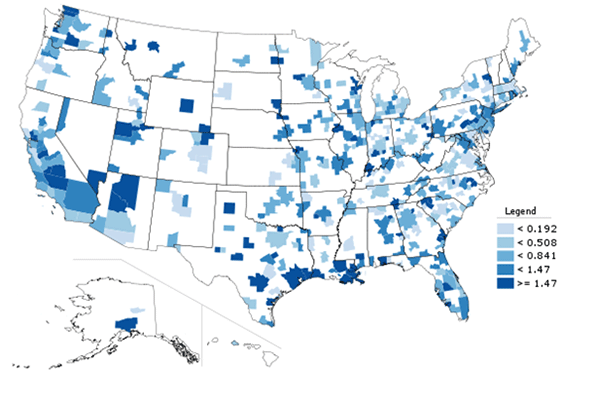
    This pattern becomes clearer if we look at metropolitan areas, the level at which most economic activity takes place. Mark Schill at the Praxis Strategy Group crunched the data for us on employment trends over the five years since the recession in the 51 metropolitan statistical areas with over 1 million people. It’s not a pretty picture. Three years since employment hit bottom, the U.S. still has 2 million fewer mid-income jobs than at the onset of the financial crisis in 2007; half of that deficit is in the largest metro areas.

    But the pain is not evenly distributed. There are eight metro areas that boast more mid-level jobs today than in 2007. The list is dominated by Texas cities, led by Austin-Round Rock-San Marcos, which has added 17,000 mid-skill jobs — an increase of 7.6%  – among the 95,000 new jobs generated in the region. The largest numeric increase is in Houston-Sugarland-Baytown, which has 60,810 more mid-skilled jobs, up 7.4%. The Houston metro area also has easily led the nation in overall job growth since 2007, adding a net 280,000 positions.

    Texas metro areas also come in third and fourth: in San Antonio-New Braunfels, middle-income employment rose 3.4%; in Dallas-Ft. Worth-Arlington , 3.1%. Nearby Oklahoma City comes in fifth with 2.1% growth in middle-income employment, sharing the merits of relatively low costs and a strong energy economy.

    The working class and  the endangered middle class may be favored topics of discussion in the deepest blue regions, but for the most part these metro areas have failed to bolster their middle-skilled labor forces. Los Angeles-Long Beach leads the league with the biggest net loss of mid-skilled jobs since 2007, down by 112,300, or 6.1%. Chicago had the second-largest numerical decline, some 102,100, or 7.6%, followed by New York, which lost 82,350 such jobs, 3.4% of its total in 2007. In contrast, notes economist Tyler Cowen, Texas has not only created the most middle-income jobs, but a remarkableone-third of all net high-wage jobs created over the past decade.

    The loss of manufacturing jobs is clearly part of the problem here; despite the recent resurgence in the industrial sector, the U.S. still has 740,000 fewer middle-skill manufacturing jobs than in 2007. Chicago and Los Angeles remain the nation’s largest industrial regions, but they are also among the most rapidly de-industrializing areas in the country. New York City, once among the world’s leading industrial centers, with roughly a million manufacturing workers in 1950, is down to around 75,000. In contrast, industrial employment has been expanding in the Houston, Seattle and Oklahoma City metro areas, and recently even Detroit.

    In contrast, New York, Chicago and L.A. have seen job gains in such low-wage areas as hospitality and retail, as well as a smaller surge in high-end employment — notably in information and business services. But the welcome growth in these positions is not enough to make up for the big hole in middle-class employment. Since the recession, for example, New York has lost manufacturing and construction jobs at a double-digit rate while hospitality employment grew 18% and retail 10%. Los Angeles and Chicago showed similar patterns, but actually did worse in higher-wage sectors, like professional business services.

    Another major area of lost middle-class jobs has been construction. The U.S. is still down 1.2 million middle-skill construction jobs since 2007 and 125,000 in real estate. These losses have inflicted the most pain in the boom towns that grew fastest in the early 2000s. The biggest loser of mid-skill jobs in percentage terms is Las Vegas-Paradise, Nev., which has suffered a staggering 16.1% loss in such jobs since 2007. It’s followed by Riverside-San Bernardino-Ontario, Calif. (-10.6%); Sacramento-Arden-Arcade-Roseville, Calif., (-10.4%); Tampa- St. Petersburg- Clearwater, Fla. (-9.7%); and Phoenix-Mesa- Scottsdale, Ariz. (-9.3%).

    Whether in the biggest cities, or Sun Belt boom towns, the issue of increasing middle-income employment should be as much of a priority for policymakers as attracting glamorous high-wage jobs or helping the poor. America’s identity has been built around the idea that hard work, particularly with some study for a particular skill, should be rewarded with decent pay. Boosting employment in mid-skill professions, from construction and manufacturing to logistics and energy, is critical to achieving this goal.

    If we fail to stem the erosion of middle-income jobs, we will be faced with a continued descent into a Latin American style society divided largely between an affluent elite and multitudes of the poor, with a thin layer in the middle. This promises miserable consequences for most Americans and the future of our democracy.

    Note: An early version of this table listed incorrect figures in the 2013 total jobs column.

    Middle-skill Employment in U.S. Metropolitan Areas
    Metropolitan Statistical Area Name 2013 Middle Skill Jobs 2007-2013 Change % Change % Change Rank 2013 Location Quotient 2013 LQ Rank
    Austin-Round Rock-San Marcos, TX 248,988 17,485 7.6% 1 0.93 41
    Houston-Sugar Land-Baytown, TX 878,038 60,810 7.4% 2 1.00 17
    San Antonio-New Braunfels, TX 310,920 10,316 3.4% 3 1.07 3
    Dallas-Fort Worth-Arlington, TX 959,326 29,178 3.1% 4 0.98 23
    Oklahoma City, OK 198,944 4,113 2.1% 5 1.05 8
    New Orleans-Metairie-Kenner, LA 177,207 2,676 1.5% 6 1.05 8
    Nashville-Davidson–Murfreesboro–Franklin, TN 263,022 2,309 0.9% 7 1.02 12
    Salt Lake City, UT 221,892 476 0.2% 8 1.07 3
    Denver-Aurora-Broomfield, CO 390,661  (2,824) -0.7% 9 0.96 31
    Indianapolis-Carmel, IN 274,996  (3,143) -1.1% 10 0.98 23
    Boston-Cambridge-Quincy, MA-NH 700,371  (9,683) -1.4% 11 0.90 46
    San Jose-Sunnyvale-Santa Clara, CA 233,796  (5,012) -2.1% 12 0.78 51
    Louisville/Jefferson County, KY-IN 199,292  (4,669) -2.3% 13 1.04 10
    Charlotte-Gastonia-Rock Hill, NC-SC 267,840  (6,888) -2.5% 14 0.98 23
    Pittsburgh, PA 358,823  (9,301) -2.5% 15 1.03 11
    Rochester, NY 147,269  (4,325) -2.9% 16 0.97 28
    Raleigh-Cary, NC 153,838  (4,854) -3.1% 17 0.93 41
    Baltimore-Towson, MD 391,208  (12,532) -3.1% 18 0.95 34
    Washington-Arlington-Alexandria, DC-VA-MD-WV 764,805  (25,078) -3.2% 19 0.80 50
    San Diego-Carlsbad-San Marcos, CA 492,724  (16,382) -3.2% 20 1.09 2
    New York-Northern New Jersey-Long Island, NY-NJ-PA 2,336,777  (82,350) -3.4% 21 0.88 48
    Columbus, OH 272,821  (9,829) -3.5% 22 0.95 34
    Buffalo-Niagara Falls, NY 159,658  (5,770) -3.5% 23 0.99 20
    Richmond, VA 193,104  (7,081) -3.5% 24 1.00 17
    San Francisco-Oakland-Fremont, CA 583,934  (21,618) -3.6% 25 0.87 49
    Seattle-Tacoma-Bellevue, WA 543,988  (21,651) -3.8% 26 0.97 28
    Minneapolis-St. Paul-Bloomington, MN-WI 507,261  (20,643) -3.9% 27 0.91 45
    Portland-Vancouver-Hillsboro, OR-WA 337,705  (19,386) -5.4% 28 1.02 12
    Hartford-West Hartford-East Hartford, CT 179,653  (10,578) -5.6% 29 0.95 34
    Philadelphia-Camden-Wilmington, PA-NJ-DE-MD 789,395  (49,105) -5.9% 30 0.95 34
    Atlanta-Sandy Springs-Marietta, GA 692,336  (44,530) -6.0% 31 0.95 34
    Los Angeles-Long Beach-Santa Ana, CA 1,731,419  (112,332) -6.1% 32 0.96 31
    St. Louis, MO-IL 393,900  (27,502) -6.5% 33 0.98 23
    Kansas City, MO-KS 302,025  (21,222) -6.6% 34 0.98 23
    Memphis, TN-MS-AR 192,693  (14,600) -7.0% 35 1.02 12
    Detroit-Warren-Livonia, MI 517,098  (39,268) -7.1% 36 0.93 41
    Orlando-Kissimmee-Sanford, FL 304,724  (23,533) -7.2% 37 0.95 34
    Cincinnati-Middletown, OH-KY-IN 302,932  (24,111) -7.4% 38 1.00 17
    Chicago-Joliet-Naperville, IL-IN-WI 1,249,263  (102,122) -7.6% 39 0.94 40
    Jacksonville, FL 200,324  (16,482) -7.6% 40 1.06 6
    Virginia Beach-Norfolk-Newport News, VA-NC 298,352  (25,147) -7.8% 41 1.19 1
    Miami-Fort Lauderdale-Pompano Beach, FL 706,788  (60,373) -7.9% 42 0.97 28
    Milwaukee-Waukesha-West Allis, WI 237,871  (20,489) -7.9% 43 0.96 31
    Cleveland-Elyria-Mentor, OH 304,167  (27,158) -8.2% 44 0.99 20
    Birmingham-Hoover, AL 162,440  (15,437) -8.7% 45 1.07 3
    Providence-New Bedford-Fall River, RI-MA 206,473  (20,670) -9.1% 46 0.99 20
    Phoenix-Mesa-Glendale, AZ 578,767  (59,101) -9.3% 47 1.02 12
    Tampa-St. Petersburg-Clearwater, FL 365,043  (39,371) -9.7% 48 1.02 12
    Sacramento–Arden-Arcade–Roseville, CA 259,792  (30,200) -10.4% 49 0.92 44
    Riverside-San Bernardino-Ontario, CA 431,892  (51,373) -10.6% 50 1.06 6
    Las Vegas-Paradise, NV 234,340  (44,849) -16.1% 51 0.89 47
    Total 23,210,895  (1,045,210) -4.3%      
    Source: EMSI Class of Worker – QCEW Employees + Non-QCEW Employees + Self-Employed
    Analysis by Mark Schill, Praxis Strategy Group

    This story originally appeared at Forbes.

    Joel Kotkin is executive editor of NewGeography.com and Distinguished Presidential Fellow in Urban Futures at Chapman University, and a member of the editorial board of the Orange County Register. He is author of The City: A Global History and The Next Hundred Million: America in 2050. His most recent study, The Rise of Postfamilialism, has been widely discussed and distributed internationally. He lives in Los Angeles, CA.

  • Cities and Sustainability: Is Intensification Good Policy?

    This post examines the idea that we can promote sustainability by increasing the densities of large cities around their centres.  This compact city paradigm presumes that we can reshape the consumption of citizens in environmentally benign ways by reshaping the cities they live in.  

    The sustainability challenge is the challenge of consumption: how much and what we consume drives our impact on the planet.  But presuming that by enforcing urban intensification we will transform ingrained patterns of consumption in favour of the environment may be a step too far.  Will obliging more citizens to live at higher densities in smaller dwellings around city centres really pave the way to environmental salvation?

    Some evidence of urban impacts

    The Australian Conservation Foundation is committed to ecological sustainability, tackling the social and economic causes of environmental problems.  Among other things, the Foundation publishes the onlineAustralian Consumption Atlas. This is a useful source for addressing the role of urbanisation and urban form.

    The Atlas is based on methodology which traces the direct and indirect demands on the environment of different goods and services.  Consumption patterns from Household Expenditure Surveys are related to household size and type, members’ age structure, incomes and education, and the statistical areas they live in. Using this information the environmental impacts of individuals living in different areas can be mapped. 

    Three indicators of impact are displayed in the atlas: tonnes of greenhouse gas emitted, litres of water consumed, and ecological footprint.  The latter estimates the area of resources required to support a person’s lifestyle.  You can read more about the methodology here.

    The data underlying the atlas is dated – based on the 2001 Census and 1999 Household Expenditure Survey, among other things.  But I do not expect the relativities it demonstrates, or the conclusions it supports, to have changed much.

    Cities don’t consume; people do

    Here is the authors’ key conclusion. Our urban planners, designers, and politicians should consider carefully:

    despite the lower environmental impacts associated with less car use, inner city households outstrip the rest of Australia in every other category of consumption. Even in the area of housing, the opportunities for relatively efficient, compact living appear to be overwhelmed by the energy and water demands of modern urban living, such as air conditioning, spa baths, down lighting and luxury electronics and appliances, as well as by a higher proportion of individuals living alone or in small households.

    In each state and territory, the centre of the capital city is the area with the highest environmental impacts, followed by the inner suburban areas. Rural and regional areas tend to have noticeably lower levels of consumption.

    (Consuming Australia: Main Findings, 2007, Australian Conservation Foundation, p.10)

    Looking inside Sydney

    I explored the indicators for different parts of Sydney.  Here are some results.

    Indicators of Environmental Impacts: Sydney Centre and Suburbs

    People in Inner Sydney generate 92% more greenhouse gas than the New South Wales Average, and well over twice as much as people in the lower income western suburbs, like Penrith and Blacktown. The levels are a bit higher for people in the more prosperous northern suburbs. Despite proximity to major employment centres, and an efficient commuter rail service, the consumption patterns of Willoughby and Ku-ring-gai residents generate high levels of air pollution. 

    Looking East to Sydney CBD
    (Source: www:freeaussiestock.com)

    A similar pattern is evident for water consumption – residents of the hot, dry, western suburbs account for the least consumption, Inner and North Sydney residents the most.  They also have the biggest ecological footprint.

    So what does this tell us?

    The lesson is not necessarily that location in the CBD is less sustainable; but that the lifestyle associated with it is. 

    I have discussed the potential inefficiency of small, multi-unit dwellings elsewhere.  Over and above that, the high cost of redevelopment in central locations calls for housing construction strategies that add little to sustainability.  

    One strategy is to build to modest standards.  This keeps the price down and rental yield up for investors; or creates opportunities for ownership by low income earners.  Another strategy is to adopt high standards of fit-out and install luxury appliances in favoured locations to make multi-unit dwellings attractive to wealthier households. 

    Neither option is particularly environmentally sympathetic.  

    Smaller is still better

    I also reviewed the indicators for smaller cities and towns in New South Wales.  (In some cases these included surrounding rural settlement).  

    Indicators of Environmental Impacts: New South Wales Towns and Small Cities

    This suggests that smaller towns hold the key to environmentally sustainable lifestyles, even more than city suburbs.  For example,  Coffs Harbour’s 73,000 residents generate greenhouse emissions at 88% of the state average, and just 46% of inner Sydney residents.  They consume water at 81% of the State rate (and 60% of North Sydney), and have an ecological footprint just 60% of their inner Sydney counterparts.  Similar patterns are evident in coastal settlements like Byron Bay (33,000 residents), Ballina (42,000), and Port Macquarie (77,000) and inland towns such as Griffith (26,000), Tamworth (60,000), and Wagga Wagga (64,000).

    What does it all add up to?

    A simple overview can be derived by summing the percentage deviations of each area from the New South Wales average across the three measures. Admittedly this is a course approach: it weights each indicator equally, and ignores differences in how much centres vary across each individually.  Nevertheless, it provides a sufficiently meaningful overview to confirm that towns and small cities are generally more sustainable than a large city, and that the suburbs perform better than the inner city. 

    Summary Index of the Environmental Impact of Urbanisation

    Explaining the sustainability dividend of small towns

    There can be any number of explanations for this, the obvious one being that it is all about income.  Perhaps the advantages of lifestyles outside Sydney simply reflect lower average incomes in smaller cities and towns.  As people become more affluent or seek more income, they migrate into the main cities taking their high consumption expectations with them; or by living in large cities they are more likely to earn – and consume – more. 

    Conversely, living in smaller cities and settlements may reflect lifestyle preferences which are intrinsically less environmentally intrusive.  At the same time. small settlements make less travel demands given the greater proximity to work, shopping, service, and recreation opportunities.  In addition, lower density housing may provide more opportunities for passive energy efficiency, directly reducing resource consumption for comparable activities.  

    Flawed policy

    Until we know more, however, we need to avoid the trap of determinism.  It would be short-sighted simply to invert the current paradigm, for example, and decide that policies to encourage people to live outside large cities and city centres will somehow enhance sustainability. 

    Ultimately, how we live is more important than where we live.  What the evidence here confirms, though, is that under current patterns of consumption promoting large scale urban consolidation is flawed as environmental as well as urban policy. 

    Phil McDermott is a Director of CityScope Consultants in Auckland, New Zealand, and Adjunct Professor of Regional and Urban Development at Auckland University of Technology.  He works in urban, economic and transport development throughout New Zealand and in Australia, Asia, and the Pacific.  He was formerly Head of the School of Resource and Environmental Planning at Massey University and General Manager of the Centre for Asia Pacific Aviation in Sydney. This piece originally appeared at is blog: Cities Matter.

    Aukland harbour photo by Bigstockphoto.com.

  • There’s Real Economic Development Gold in El Dorado—Arkansas

    For centuries, explorers searched for the legendary golden city of El Dorado, seeking instant wealth in the jungles of South America. But today’s treasure trove may be found much closer to home; cities like El Dorado, Arkansas, for example, that have successfully linked their economic development strategy to improving the educational attainment of their residents.

    El Dorado, a city of about 20,000 people that was at the heart of Arkansas’s oil boom in the 1920s has been hard pressed to reprise that economic growth experience in this century.  Instead of chasing after the fool’s gold of becoming cool, it has found a way to attract new residents and increase its economic vitality by promising its public school students a free college education if they graduate from high school with good grades. That promise has the potential to provide the critical glue in holding together a broad based economic recovery not just for cities such as El Dorado but for entire states or even the country.

    The El Dorado Promise is a scholarship program established and funded by Murphy Oil Corporation, the town’s largest employer. Modeled after a similar program in Kalamazoo, MI, It provides graduates of the city’s high school a scholarship covering tuition and mandatory fees that can be used at any accredited two- or four-year, public or private, educational institution in the US up to an amount equal to the highest annual resident tuition at an Arkansas public university.

    Since its inception in 2007, 1239 students have taken advantage of the offer. Over 90% of them have completed at least one year of college. The first high school class to enjoy this benefit has graduated after five years from college at a rate almost 40% greater than the state’s higher education student population. These gains in acquiring the skills necessary to be competitive in today’s global economy have been achieved by virtually all of the city’s high school students, over 90% of whom graduated from high school last year.

    Furthermore the culture of a college-bound student population is now permeating throughout the school district, with a recent study finding that students in grades three through eight in the city scored significantly higher than their matched peers in nearby school districts in both math and literacy. The greatest gains have come from those who were the youngest when the Promise was announced.

    The goal of the El Dorado Promise was not just greater educational attainment, however. The visionaries who established the program also wanted to use this program to improve the community’s economic vitality and quality of life. They have clearly done that.  Enrollment in the city’s schools was up 5% in just the first four years of the program’s existence. As the Promise website says, “the prospect of an increasingly educated workforce gives economic development leaders new tools to attract businesses to the region.”

    The first such Promise was made in Kalamazoo, Michigan in 2005 by still anonymous benefactors seeking to restore the reputation of a city made famous in 1942 by the Glenn Miller Orchestra’s hit tune about a “gal” who lived there. Rather than raise taxes to balance the city’s budget, those who established the Kalamazoo Promise offered a fully paid four-year scholarship to any public institution of higher education in Michigan to any student who went to the city’s high schools for all four years. Under the terms of the Kalamazoo Promise, students have no obligation to repay the money or even to reside in Kalamazoo after they graduate from college.

    The results are very similar to those of El Dorado. Kalamazoo’s student population is up 17.6% and dropout rates have been cut in half. Ninety percent of the city’s female African-American high school graduates have gone on to college. On the economic front, the proportion of residential construction in the city rose sharply from around 30% to nearly 50% of all permits issued in the greater Kalamazoo area. The community’s careful tracking of the results has identified 1600 families who say they are living in the city because of the Promise.

    The economic challenges that caused El Dorado and Kalamazoo to up their game in getting local residents to graduate from high school and go on to college are no different than the challenge facing the country as a whole  in trying to create a competitive workforce in today’s increasingly global and technology driven economy.  For example, the Georgetown University’s Center on Education and the Workforce estimates that 62% of the jobs in the United States by the year 2018 will require at least some college education – for example a certificate for a specific skill – and that more than half of those jobs will require a bachelor’s degree. Unless the nation wants to fill those jobs with immigrants from other countries, it will have to do a much better job of giving each American who graduates from high school a chance to pursue a two year skill certificate or a baccalaureate degree. 

    A promise that rewards good academic performance in high school with a scholarship that pays for four years of college tuition has demonstrated it can make a major difference in achieving our educational and economic goals. Now it’s time for the rest of the country to find the gold that Kalamazoo and El Dorado have already discovered. Just as the country, as part of its overall economic development strategy, once expanded access to a universal free education first for primary schools and later for high schools, it must now find ways to make these two pioneering cities’ promise to their young people America’s Promise to all of its youth.

    Morley Winograd and Michael D. Hais are co-authors of the newly published Millennial Momentum: How a New Generation is Remaking America and Millennial Makeover: MySpace, YouTube, and the Future of American Politics and fellows of NDN and the New Policy Institute.

    Graduation photo by Bigstock.

  • My Presence Is a Provocation

    The urbanist internet has been a ga ga over an article by artist and musician David Byrne (photo credit: Wikipedia) called “If the 1% stifles New York’s creative talent, I’m out of here.” Now David Byrne himself is at least a cultural 1%er, and at with a reported net worth of $45 million, isn’t exactly hurting for cash. In fairness to him, he forthrightly admits he’s rich. He also is bullish on the positive changes in New York in areas like public safety, transportation, and parks, and does not fall prey to romanticizing the bad old days of the 70s and 80s. However, in his assigning blame for New York’s affordability, he points the finger squarely at Wall Street, neglecting the role he himself played in bringing about the changes he decries, changes in which he was more than a passive participant.

    Back in the early 90s I liked to hang out in a neighborhood called Fountain Square in Indianapolis, a down at the heels commercial district near downtown largely populated by people from Appalachia. I enjoyed browsing the low end, marginal shops and eating at diners where the food was mediocre and the waitresses sassy but not all that attractive (not that I let that stop me from flirting with them). Today, Fountain Square is not exactly gentrified, but is seeing a lot of investment and new residential construction. It’s a long way from unaffordable, but it isn’t impossible to conceive of a day when it features almost entirely higher prices (by Indianapolis standards) in the way some other zones downtown do.

    About that time I also liked to drive around the city and take pictures of various neighborhoods in the inner city. One time I was on the East Side and was walking around taking snaps of streetscapes. I apparently pointed my camera too close in the direction of a white minivan whose owner took umbrage. The driver, who was white, long-haired, with a bit of a redneck air about him, circled the block and pulled up next to me to berate me in a semi-menacing way, alternately demanding to know why I was taking pictures of his van and warning me I should never do it again. (I generally take pains to try to avoid including people in my photographs when possible, and things like this are one reason why).

    I’m not going to claim there was any hidden agenda here other than this guy being directly suspicious of my pointing a camera his way. But I can’t help but wonder if subconsciously he was aware of a more subtle but potentially more dangerous threat that I posed to his neighborhood and way of life.

    I’m not taking credit or blame for neighborhood change in Indianapolis. But I do know that I’m part of the dynamic of the city I’m in. And when I guy like me walks into a neighborhood, my mere presence can be a provocation. Cities are inherently dynamic places, and we are agents of the forces of change whether we want to be or not. (Which is as true for the poor as for the one percent, we just label it “fair housing” when poor people move into rich neighborhoods, but “gentrification” when the reverse occurs).

    While I am a writer and observer on cities, I’m an endogenous not exogenous observer. All of us are players in the development of the places we live and visit, event if only bit players in some cases. And oftimes in the complex world of the city, our actions are part of forces or trends we are not event aware of, ones that may have consequences we would never have desired. That does not absolve us of our role.

    As for David Byrne, the role of artists and musicians in paving the way for gentrification is so well known as to be conventional wisdom. Similarly today the hipster. And what’s one of the original signature markers of the hipster? The fixed-gear bicycle.

    Just as reductions in crime obviously have an effect of dramatically raising property values (and thus rents) in a place as intrinsically attractive as New York, so do other quality of life improvements such as bicycle infrastructure. By making New York an even more desirable place to live, these improvements, wonderful as they may be and which I would heartily endorse, clearly attract more well-off residents and drive up prices.

    Byrne has even taken a direct role in this. He created a series of nine public art type back racks from the city, all but one of which is in Manhattan, and which even includes this delightful example from Wall Street:


    Photo Credit: Flickr/zombiete

    These racks and his activism with regards to bicycles are what give Bryne his standing an urban commentator.

    I for one am glad he made the bike racks as they are fantastic and I’m a fan of New York’s improved cycling infrastructure. But I also recognize that this sort of quality of life improvement contributes towards New York’s attractiveness to the wealthy. It’s just not realistic to think one can clean up the crime, the parks, improve infrastructure, etc. and then expect that prices will remain what they were back in the 70s when Bryne moved to the city. Rather than pointing the finger at the Other, the finance industry in this case, it would be more helpful if those of us who advocate for better urban environments would recognize the inevitable side effects many of our proposed policies would produce, and our own role in bringing them about.

    Aaron M. Renn is an independent writer on urban affairs and the founder of Telestrian, a data analysis and mapping tool. He writes at The Urbanophile, where this piece originally appeared.

  • Cashing in on So Cal Culture

    Southern California has always been an invented place. Without a major river, a natural port or even remotely adequate water, the region has always thrived on reinventing itself – from cow town to agricultural hub to oil city, Tinsel Town and the “Arsenal of Democracy.”

    Today, the need for the region to reinvent itself yet again has never been greater. Due in large part to regulatory pressures, as well as competitive forces both global and national, many industries that have driven the Southland economy – notably, aerospace, garments and oil – are under assault. A high cost of living, particularly for housing, stymies potential in-migration and motivates industries to look elsewhere to locate or expand.

    As a result, virtually every key Southern California industry has been either stagnating or losing ground to competitors. More important, the area in the past decade has lost much of its appeal as a destination for both immigrants and young people, drying up a huge source of potential innovation.

    To put it in vaudeville terms, Southern California needs a new shtick. We must look to leverage our natural advantages (beyond just our climate) into a new economic paradigm that can withstand competition from the rest of the world and the rest of the country. This opportunity is best seen as the commercialization of culture. These include, as one recent Los Angeles County Economic Development Corp. report stated, “businesses and individuals involved in producing cultural, artistic and design goods and services.”

    This is not largely a matter of museums or concert venues. When it comes to the “fine” arts, Southern California is an increasingly respectable player, but cannot compete on equal footing with London, Paris, New York or Chicago, locales with far older endowments and, arguably, more people with refined artistic tastes. There is also growing competition from cash-rich wannabe cities, from Houston and Dallas to Shanghai, Beijing or Singapore. Fine art has always been for sale to the highest bidder.

    Where Southern California retains a decisive edge is in the popular arts – from casual fashion and industrial design to movies, television and commercials – which could provide the basis for a broad-based economic revival. This requires political and business leadership to shift from their obsession with downtown Los Angeles and dense building projects to a focus on nurturing long-term, sustainable employment.

    This demands that we do everything to maintain the quality of life, largely a matter of our region’s spread-out neighborhoods, that has always been our primary calling card to creative talent. Los Angeles, in particular, boasts by far the largest concentration of artists in the country. Overall, the “creative industries” account, according to a recent Otis Institute study, for roughly 337,000 direct jobs in the Los Angeles-Orange County region. Adding indirect employment, the study estimated these industries employed more than 642,000 people, more than the total employment of the Sacramento area.

    Each of these economic drivers deserves a closer look:

    Fashion

    Over the past quarter century, Los Angeles, with roughly three times as many establishments, has replaced New York as the nation’s garment capital. Most of these companies are small, but, together, the fashion industry across the five-county Southland region employs more than 100,000 people.

    In recent years, apparel manufacturing has been in decline, losing some 40,000 jobs. But there has been growth in such areas as clothing design and merchandising. The region has become the de facto capital for “fast forward” fashion, paced by firms such as Forever 21 Inc., Wet Seal and Papaya. Orange County, capital of the surfwear industry, is home to firms such as Oakley, Volcom, Hurley, Gotcha International, O’Neill, Raj Manufacturing, Mossimo and Stussy.

    These firms, and the businesses serving them, are expected to experience more growth in the coming years, according to the U.S. Bureau of Labor Statistics. Aided by the “onshoring” trend – returning jobs from overseas – and a demand for quicker product turnaround, the Southern California apparel industry seems poised to solidify its hold over the country’s fashions over the coming years.

    Entertainment

    This fashion industry derives much of its success from a link with Hollywood and the rest of the entertainment world. Accounting for more than 40 percent of all creative industry jobs, the entertainment complex is increasingly critical to the region’s resurgence. Much concern has been raised about the future of this key industry, whose growth has slowed, due in part to massive tax incentives from other states and countries.

    Despite this, the industry has been on something of an upswing recently, adding more than 4,600 jobs last year, a gain of 3.7 percent. At 129,700 jobs, employment in the industry is now at its highest level in four years but still tantalizingly below its levels in 2004 (132,200 jobs) and 1999 (146,300 jobs). Growth derives not so much from studio employment but from the ranks of independent contractors, now more than 85,000, well above the prerecession level. Nearly 80 percent of all new entertainment jobs are from the ranks of independent proprietors.

    Digital Arts

    The stabilization, and hopefully resurgence, of the entertainment sector could boost other industries, like digital media, hoping to play off the region’s extraordinary concentration of artists, specialists and story-tellers. Historically, Southern California, in large part due to a relative shortage of venture capital, has been playing catch-up with the Bay Area, and to a lesser extent, Seattle.

    The key to the future is combining other assets besides Hollywood, such as having the largest number of engineers – 70,000 – of any area in the country. Much hope has been placed on the rise of the much-ballyhooed “Silicon Beach” that follows the coastline, largely in Los Angeles, which some people claim is becoming a real competitor to Silicon Valley.

    Yet this is not the first time we have heard this story. Similar growth took place in past digital media waves, only to see reductions as the inevitable cratering takes place during market shake-outs. But employing the strong ties to the Hollywood creative community, there is the real prospect for the region to achieve a critical mass that will allow digital entrepreneurs to remain comfortably here rather than head up to Silicon Valley.

    Industrial Design

    Even as manufacturing employment has declined over time, improving recently to a level of mere stagnation recently, Southern California has maintain a leading position in industrial design. This field is expected to grow, both nationally and in the Southland.

    The area has maintained its leadership as center of automotive design, with studios such as the BMW Design Works, in Ventura, and Mercedes Advanced Design, in Carlsbad, as well as GM’s Advance Design Studio in North Hollywood. The fact that many international firms – for example, Hyundai (Fountain Valley), Kia (Irvine), Honda and Toyota – maintain their North American headquarters in the Southland provides a critical link to the expanding global auto market.

    Primacy in industrial design also extends into other product lines, such as furniture and household furnishings. If this design edge can be combined with automation and the onshoring of jobs, Southern California could enjoy a broad-based resurgence more sustainable than those of more-narrowly based economies, such as in New York or the Bay Area.

    Design of Life

    As we have seen over the past decade, local industries such as entertainment – not to mention fields like fashion, digital and industrial design – are going to be subject to enormous pressure from both home and abroad. China, for example, is building a massive $8.2 billion film studio in a concerted drive to replace Hollywood as the center of the world entertainment industry.

    If we lose our stranglehold on entertainment and other creative industries, there is very little hope for a regional resurgence. We lack the deep digital bench and funding sources of the Bay Area, or New York’s financial industry and its ability to dominate the news media. We can never be as cheap, or business friendly, as our emerging cultural rivals in the South, such as New Orleans, Nashville, Tenn., Austin, Texas, or Dallas, nor can we offer the kind of bargain-basement deals that desperate places, such as Detroit or Las Vegas, might offer to creative types.

    This means we have to focus on preserving and improving those very things – our cultural legacy and a predominately low-rise and flexible-work lifestyle – that differentiates us from far more congested, structured and often far-less pleasant locales like New York – and, even more so, China. In the past, this region has won the “design wars” by being itself, not by trying to create a faux vision that seeks to mimic Manhattan or Shanghai. Ultimately, Southern California can win only by playing the same aces that for generations have led the creative and the questioning to settle in our sun-drenched metropolis.

    Joel Kotkin is executive editor of NewGeography.com and Distinguished Presidential Fellow in Urban Futures at Chapman University, and a member of the editorial board of the Orange County Register. He is author of The City: A Global History and The Next Hundred Million: America in 2050. His most recent study, The Rise of Postfamilialism, has been widely discussed and distributed internationally. He lives in Los Angeles, CA.

    This piece originally appeared at The Orange County Register.

  • Exporting Metros

    If there’s one thing that people of pretty much every political persuasion agree on, it’s the need to boost exports. This is true not just at the national level, but also the local one. The balance of world population and economic growth is outside the United States. McKinsey estimates that there will be an additional one billion people added to the global “consuming class” by 2025.  An economy focused solely on a domestic American or North American market is missing a huge part of the addressable market, dooming it to slower growth.

    Exports have also long been seen as a key part of economic growth in the city. Jane Jacobs noted how cities develop import substitutes. That is, cities develop replacements for goods and services they formerly imported, and subsequently start exporting these to other places. So exporting, both to domestic and to foreign destinations, is critical for cities.

    The US Department of Commerce recently released foreign export totals by metropolitan area for 2012. The data series goes back as far as 2005. A number of metro regions are exporting power houses.  There are 31 metro areas that export more than $10 billion in goods and services every year.  Here is the top ten:

    Rank

    Metro Area

    2012

    1

    Houston-Sugar Land-Baytown, TX

    110,297,753,116

    2

    New York-Northern New Jersey-Long Island, NY-NJ-PA

    102,298,029,869

    3

    Los Angeles-Long Beach-Santa Ana, CA

    75,007,521,224

    4

    Detroit-Warren-Livonia, MI

    55,387,305,415

    5

    Seattle-Tacoma-Bellevue, WA

    50,301,690,645

    6

    Miami-Fort Lauderdale-Pompano Beach, FL

    47,858,713,857

    7

    Chicago-Joliet-Naperville, IL-IN-WI

    40,567,953,537

    8

    Dallas-Fort Worth-Arlington, TX

    27,820,946,540

    9

    San Jose-Sunnyvale-Santa Clara, CA

    26,687,656,696

    10

    Minneapolis-St. Paul-Bloomington, MN-WI

    25,155,739,576

    Table 1: Dollar Value of Exports, 2012

    Unsurprisingly, bigger cities have more exports, but it’s not a perfect correlation. Energy and chemicals intensive Houston ranks #1, and places like #5 Seattle (home to Boeing and Microsoft) and #6 Miami (the hub of Latin American trade) punch above their weight.

    But perhaps a better measure of the export intensity of an economy is exports per capita. Here’s a map of US metro areas for that metric:


    Map 1: Export dollar value per capita, 2012.

    Here are the top ten metros in America among those with a population greater than one million:

    Rank

    Metro Area

    2012

    1

    New Orleans-Metairie-Kenner, LA

    20209.1

    2

    Houston-Sugar Land-Baytown, TX

    17778.0

    3

    Seattle-Tacoma-Bellevue, WA

    14160.9

    4

    San Jose-Sunnyvale-Santa Clara, CA

    14087.7

    5

    Salt Lake City, UT

    13764.1

    6

    Detroit-Warren-Livonia, MI

    12904.6

    7

    Cincinnati-Middletown, OH-KY-IN

    9312.0

    8

    Portland-Vancouver-Hillsboro, OR-WA

    8881.9

    9

    Memphis, TN-MS-AR

    8522.5

    10

    Miami-Fort Lauderdale-Pompano Beach, FL

    8304.9

    Table 2: Top Ten Large Metros, Dollar Value of Exports Per Capita, 2012

    Here we see that some top exporters like Houston, Seattle, and Miami continue to rank well.  But some smaller metros crack the list like #1 New Orleans (another major petroleum center) and #7 Cincinnati (which has a major GE aircraft engine plant).

    And lastly, here’s a look at the growth in total exports from metro areas over the time period for which data is available:


    Map 2: Percent change in total exports, 2005-2012.

    There was extremely wide variability in the growth rates of exports among metro areas. Here is the top 10 for large metro areas:

    Rank

    Metro Area

    2005

    2012

    Percent
    Change

    1

    San Antonio-New Braunfels, TX

    2,346,954,123

    14,010,234,128

    496.95%

    2

    New Orleans-Metairie-Kenner, LA

    4,857,754,172

    24,359,505,265

    401.46%

    3

    Salt Lake City, UT

    3,912,555,433

    15,989,999,420

    308.68%

    4

    Houston-Sugar Land-Baytown, TX

    41,747,920,224

    110,297,753,116

    164.20%

    5

    Las Vegas-Paradise, NV

    716,805,170

    1,811,480,065

    152.72%

    6

    Birmingham-Hoover, AL

    796,241,450

    1,939,217,017

    143.55%

    7

    Washington-Arlington-Alexandria, DC-VA-MD-WV

    6,058,364,485

    14,609,712,467

    141.15%

    8

    Raleigh-Cary, NC

    974,832,168

    2,308,052,342

    136.76%

    9

    Miami-Fort Lauderdale-Pompano Beach, FL

    20,382,947,257

    47,858,713,857

    134.80%

    10

    Providence-New Bedford-Fall River, RI-MA

    2,667,670,867

    5,830,785,377

    118.57%

    Table 3: Large metro top ten, Percent change in total exports, 2005-2012.

    San Antonio is the champion, but Houston and New Orleans score well again.  A few unexpected metro areas like Birmingham and Providence, traditionally viewed as economic laggards, appear on the list though these are growing admittedly from small bases. What this does show is that even long struggling metros have a major opportunity to improve themselves through focusing on export growth.

    While there’s a general nod of approval in the direction of boosting exports, few urban strategies seem to focus on it. Rather, sexier items like subsidized real estate development is generally front and center. But given the positive results even struggling cities like Providence have seen with exports, this type of more basic economic blocking and tackling would seem to be a better place to focus.

    Aaron M. Renn is an independent writer on urban affairs and the founder of Telestrian, a data analysis and mapping tool. He writes at The Urbanophile.

    Great Lakes Freighter photo by BigStockPhoto.com.

  • California’s New Feudalism Benefits a Few at the Expense of the Multitude

    California has been the source of much innovation, from agribusiness and oil to fashion and the digital world. Historically much richer than the rest of the country, it was also the birthplace, along with Levittown, of the mass-produced suburb, freeways, much of our modern entrepreneurial culture, and of course mass entertainment. For most of a century, for both better and worse, California has defined progress, not only for America but for the world.

    As late as the 80s, California was democratic in a fundamental sense, a place for outsiders and, increasingly, immigrants—roughly 60 percent of the population was considered middle class. Now, instead of a land of opportunity, California has become increasingly feudal. According to recent census estimates,  the state suffers some of the highest levels of inequality in the country. By some estimates, the state’s level of inequality compares with that of such global models as  the Dominican Republic, Gambia, and the Republic of the Congo.

    At the same time, the Golden State now suffers the highest level of poverty in the country—23.5 percent compared to 16 percent nationally—worse than long-term hard luck cases like Mississippi. It is also now home to roughly one-third of the nation’s welfare recipients, almost three times its proportion of the nation’s population.

    Like medieval serfs, increasing numbers of Californians are downwardly mobile, and doing worse than their parents: native born Latinos actually have shorter lifespans than their parents, according to one recent report. Nor are things expected to get better any time soon. According to a recent Hoover Institution survey, most Californians expect their incomes to stagnate in the coming six months, a sense widely shared among the young, whites, Latinos, females, and the less educated.

    Some of these trends can be found nationwide, but they have become pronounced and are metastasizing more quickly in the Golden State. As late as the 80s, the state was about as egalitarian as the rest of the country. Now, for the first time in decades, the middle class is a minority, according to the Public Policy Institute of California.

    The Role of the Tech Oligarchs.

    California produces more new billionaires than any place this side of oligarchic Russia or crony capitalist China. By some estimates the Golden State is home to one out of every nine of the world’s billionaires. In 2011 the state was home to 90 billionaires, 20 more than second place New York and more than twice as many as booming Texas.

    The state’s digital oligarchy, surely without intention, is increasingly driving the state’s lurch towards feudalism. Silicon Valley’s wealth reflects the fortunes of a handful of companies that dominate an information economy that itself is increasingly oligopolistic.  In contrast to the traditionally conservative or libertarian ethos of the entrepreneurial class, the oligarchy is increasingly allied with the nominally populist Democratic Party and its regulatory agenda. Along with the public sector, Hollywood, and their media claque, they present California as “the spiritual inspiration” for modern “progressives” across the country.

    Through their embrace of and financial support for the state’s regulatory regime, the oligarchs have made job creation in non tech-businesses—manufacturing, energy, agriculture—increasingly difficult through “green energy” initiatives that are also sure to boost already high utility costs. One critic, state Democratic Senator Roderick Wright from heavily minority Inglewood, compares the state’s regulatory regime to the “vig” or high interest charged by the Mafia, calling it a major reason for disinvestment in many industries.

    Yet even in Silicon Valley, the expansion of prosperity has been extraordinarily limited. Due to enormous losses suffered in the current tech bubble, tech job creation in Silicon Valley has barely reached its 2000 level. In contrast, previous tech booms, such as the one in the 90s, doubled the ranks of the tech community. Some, like UC Berkeley economist Enrico Moretti, advance the dubious claim that those jobs are more stable than those created in Texas. But even if we concede that point for the moment,  the Valley’s growth primarily benefits its denizens but not most Californians. Since the recession, California remains down something like 500,000 jobs, a 3.5 percent loss, while its Lone Star rival has boosted its employment by a remarkable 931,000, a gain of more than 9 percent.

    Much of this has to do with the changing nature of California’s increasingly elite-driven economy. Back in the 80s and even the 90s, the state’s tech sector produced industrial jobs that sparked prosperity not only in places like Palo Alto, but also in the more hardscrabble areas in San Jose and even inland cities such as Sacramento. The once huge California aerospace industry, centered in Los Angeles, employed hundreds of thousands, not only engineers but skilled technicians, assemblers, and administrators.

    This picture has changed over the past decade. California’s tech manufacturing sector has shrunk, and those employed in Silicon Valley are increasingly well-compensated programmers, engineers and marketers. There has been little growth in good-paying blue collar or even middle management jobs. Since 2001 state production of “middle skill” jobs—those that generally require two years of training after high-school—have grown roughly half as quickly as the national average and one-tenth as fast as similar jobs in arch-rival Texas.

    “The job creation has changed,” says Leslie Parks, a long-time San Jose economic development official. “We used to be the whole food chain and create all sorts of middle class jobs. Now, increasingly, we don’t design the future—we just think about it. That makes some people rich, but not many.”

    In the midst of the current Silicon Valley boom, incomes for local Hispanics and African-Americans, who together account for one third of the population, have actually declined—18 percent for blacks and 5 percent for Latinos between 2009 and 2011, prompting one local booster to admit that “Silicon Valley is two valleys. There is a valley of haves, and a valley of have-nots.”

    The Geography of Inequality

    Geography, caste, and land ownership increasingly distinguish California’s classes from one another. As Silicon Valley, San Francisco, and the wealthier suburbs in the Bay Area have enjoyed steady income growth during the current bubble, much of the state, notes economist Bill Watkins, endures Depression-like conditions, with stretches of poverty more reminiscent of a developing country than the epicenter of advanced capitalism.

    Once you get outside the Bay Area, unemployment in many of the state’s largest counties—Sacramento, Los Angeles, Riverside, San Bernardino, Fresno, and Oakland—soars into the double digits. Indeed, among the 20 American cities with the highest unemployment rates, a remarkable 11 are in California, led by Merced’s mind-boggling 22 percent rate.

    This amounts to what conservative commentator Victor Davis Hanson has labeled “liberal apartheid,” a sharp divide between a well-heeled, mostly white and Asian population located along the California coast, and a largely poor, heavily Latino working class in the interior. But the class divide is also evident within  the large metro areas, despite their huge concentrations of affluent individuals. Los Angeles, for example, has the third highest rate of inequality of the nation’s 51 largest metropolitan areas, and the Bay Area ranks seventh.

    The current surge of California triumphalism, trumpeted mostly by the ruling Democrats and their eastern media allies, seems to ignore the reality faced by residents in many parts of the state. The current surge of wealth among the coastal elites, boosted by rises in property, stock, and other assets, has staved off a much feared state bankruptcy. Yet the the state’s more intractible problems cannot be addressed if growth remains restricted to a handful of favored areas and industries. This will become increasingly clear when, as is inevitable, the current tech and property boom fades, depriving the state of the taxes paid by high income individuals.

    The gap between the oligarchic class and everyone else seems increasingly permanent. A critical component of assuring class mobility, California’s once widely admired public schools were recently ranked near the absolute bottom in the country. Think about this: despite the state’s huge tech sector, California eighth graders scored 47th out of the 51 states in science testing. No wonder Mark Zuckerberg and other oligarchs are so anxious to import “techno coolies” from abroad.

    As in medieval times, land ownership, particularly along the coast, has become increasingly difficult for those not in the upper class. In 2012, four California markets—San Jose, San Francisco, San Diego, and Los Angeles—ranked as the most unaffordable relative to income in the nation. The impact of these prices falls particularly on the poor. According to the Center for Housing Policy and National Housing Conference, 39 percent of working households in the Los Angeles metropolitan area spend more than half their income on housing, as do 35 percent in the San Francisco metro area—both higher than 31 percent in the New York area and well above the national rate of 24 percent. This is likely to get much worse given that California median housing prices rose 31 percent in the year ending May 2013. In the Bay Area the increase was an amazing 43 percent.

    Even skilled workers are affected by these prices. An analysis done for National Core, a major developer of low income housing, found that prices in such areas as Orange County are so high that even a biomedical engineer earning more than $100,000 a year could not afford to buy a home there. This, as well as the unbalanced economy, has weakened California’s hold on aspirational families, something that threatens the very dream that has attracted  millions to the state.

    This is a far cry from the 50s and 60s, when California abounded in new owner-occupied single family homes. Historian Sam Bass Warner suggested that this constituted “the glory of Los Angeles and an expression of its design for living.” Yet today the L.A. home ownership rate, like that of New York, stands at about half the national average of 65 percent. This is particularly true among working class and minority households. Atlanta’s African-American home ownership rate is approximately 40 percent above that of San Jose or Los Angeles, and approximately 50 percent higher than San Francisco.

    This feudalizing trend is likely to worsen due to draconian land regulations that will put the remaining stock of single family houses ever further out of reach, something that seems related to a reduction in child-bearing in the state. As the “Ozzie and Harriet” model erodes, many Californians end up as modern day land serfs, renting and paying someone else’s mortgage. If they seek to start a family, their tendency is to look elsewhere, ironically even in places such as Oklahoma and Texas, places that once sent eager migrants to the Golden State.

    Breaking Down the New Feudalism: The Emerging Class Structure

    The emerging class structure of neo-feudalism, like its European and Asian antecedents, is far more complex than simply a matter of the gilded “them” and the broad “us.” To work as a system, as we can now see in California, we need to understand the broader, more divergent class structure that is emerging.

    The Oligarchs: The swelling number of billionaires in the state, particularly in Silicon Valley, has enhanced power that is emerging into something like the old aristocratic French second estate. Through public advocacy and philanthropy, the oligarchs have tended to embrace California’s “green” agenda, with a very negative impact on traditional industries such as manufacturing, agriculture, energy, and construction. Like the aristocrats who saw all value in land, and dismissed other commerce as unworthy, they believe all value belongs to those who own the increasingly abstracted information revolution that has made them so fabulously rich.

    The  Clerisy: The Oligarchs may have the money, but by themselves they cannot control a huge state like California, much less America. Gentry domination requires allies with a broader social base and their own political power. In the Middle Ages, this role was played largely by the church; in today’s hyper-secular America, the job of shaping the masses has fallen to the government apparat, the professoriat, and the media, which together constitute our new Clerisy. The Clerisy generally defines societal priorities, defends “right-thinking” oligarchs, and chastises those, like traditional energy companies, that deviate from their theology.

    The New Serfs: If current trends continue, the fastest growing class will be the permanently property-less. This group includes welfare recipients and other government dependents but also the far more numerous working poor. In the past, the working poor had reasonable aspirations for a better life, epitomized by property ownership or better prospects for their children. Now, with increasingly little prospect of advancement, California’s serfs depend on the Clerisy to produce benefits making their permanent impoverishment less gruesome. This sad result remains inevitable as long as the state’s economy bifurcates between a small high-wage, tech-oriented sector, and an expanding number of lower wage jobs in hospitality, health services, and personal service jobs. As a result, the working class, stunted in their drive to achieve the California dream, now represents the largest portion of domestic migrants out of the state.

    The Yeomanry: In neo-feudalist California, the biggest losers tend to be the old private sector middle class. This includes largely small business owners, professionals, and skilled workers in traditional industries most targeted by regulatory shifts and higher taxes. Once catered to by both parties, the yeomanry have become increasingly irrelevant as California has evolved into a one-party state where the ruling Democrats have achieved a potentially permanent, sizable majority consisting largely of the clerisy and the serf class, and funded by the oligarchs. Unable to influence government and largely disdained by the clerisy, these middle income Californians are becoming a permanent outsider group, much like the old Third Estate in early medieval times, forced to pay ever higher taxes as well as soaring utility bills and required to follow regulations imposed by people who often have little use for their “middle class” suburban values.

    The Political Implications of Neo-Feudalism

    As Marx, among others, has suggested, class structures contain within them the seeds of their dissolution. In New York, a city that is arguably as feudal as anything in California, the  emergence of mayoral candidate Bill de Blasio reflected growing  antagonism—particularly among the remaining yeoman and serf class— towards the gentry urbanism epitomized by Mayor Michael “Luxury City” Bloomberg.

    Yet except for occasional rumbling from the left, neo-feudalism likely represents the future. Certainly in California, Gov. Jerry Brown, a former Jesuit with the intellectual and political skills needed to oversee a neo-feudal society, remains all but unassailable politically. If Brown, or his policies, are to be contested, the challenge will likely come from left-wing activists who find his policies insufficiently supportive of the spending demanded by the clerisy and the serfs or insufficiently zealous in their pursuit of environmental purity.

    The economy in California and elsewhere likely will determine the viability of neo-feudalism. If a weaker economy forces state and local government budget cutbacks, there could be a bruising conflict as the various classes fight over diminishing spoils. But it’s perhaps more likely that we will see enough slow growth so that Brown will be able to keep both the clerisy and the serfs sufficiently satisfied. If that is the case, the new feudal system could shape the evolution of the American class structure for decades to come.

    Joel Kotkin is executive editor of NewGeography.com and Distinguished Presidential Fellow in Urban Futures at Chapman University, and a member of the editorial board of the Orange County Register. He is author of The City: A Global History and The Next Hundred Million: America in 2050. His most recent study, The Rise of Postfamilialism, has been widely discussed and distributed internationally. He lives in Los Angeles, CA.

    This piece originally appeared at The Daily Beast.


  • You Say You Want A (Metropolitan) Revolution?

    [Book Review] The Metropolitan Revolution: How Cities and Metros Are Fixing Our Broken Politics and Fragile Economy, by Bruce Katz and Jennifer Bradley. 2013, Brookings Focus Book

    It’s now decades after deindustrialization, and several years since the Great Recession supposedly ended. Yet too many American cities are still struggling to recover from the losses of jobs, population, taxes, and identities. Detroit’s declaration of bankruptcy in July drew new attention to the problem, and it helped fuel the extensive marketing campaign for The Metropolitan Revolution: How Cities and Metros Are Fixing Our Broken Politics and Fragile Economy by Bruce Katz and Jennifer Bradley of the Brookings Institution, published just a few weeks earlier. The book quickly became a cause célèbre garnering high praise from various media outlets.

    Katz and Bradley highlight the emergence of “trading metros” with “innovation districts,” clusters of universities and local businesses, hospitals, museums, and advanced technology and manufacturing industries held together regionally with housing, retail and transit networks that seem to promise a better economic future. The book’s strength lies in its attention to metros, rather than cities, as the unit of urban settlement and economics. The authors encourage planners and government officials to develop new strategies based on “Emergent Metros” rather than “Legacy Cities.”

    This attention to metropolitan areas is welcome, but the book’s outline of the future is overly optimistic. Describing deindustrialization and disinvestment as part of an evolutionary process and a “revolution unleashed” is hyperbole reminiscent of Atlas Shrugged. More critically, The Metropolitan Revolution can be read as a neoliberal sales pitch. In fact, Katz and Bradley have “doubled down” on an approach that has not only dominated economic thought since the 1980s, but that has actually contributed to the urban crisis today.

    Neoliberal theory hypothesizes that small government, deregulation, global production networks, free trade agreements, labor market flexibility, abandonment of full employment policy, cost shifting, and capital mobility improve corporate competitiveness and unleash the entrepreneurial spirit, and increase productivity. These ideas have been applied to corporate restructuring over the last 30 years, informing changes like downsizing, outsourcing, and rightsizing. In another example, neoliberals argued that the housing bubble and the subsequent Great Recession resulted from federal government intervention in the housing market, which encouraged home ownership for the unqualified, and from a national liberal monetary policy. Even when neoliberal economic policies have failed, proponents have continued their unwavering critique of “big government” and regulations.

    Using the language of neoliberalism and corporate restructuring, Katz and Bradley write that the metropolitan revolution is “exploding the tired construct” about the role of the federal government. Now, they say, it is the cities and metro areas that “are becoming the leaders in the nation: experimenting, taking risks, making hard choices and asking for forgiveness not permission.” Their metropolitan revolution sees power relations being restructured, as metros and cities take greater responsibility for their economic growth, and as federal government power devolves: “The metropolitan revolution has only one logical conclusion: the inversion of the hierarchy of power in the US.” But, we should ask, inversion for whom? Their examples all seem to suggest shifts from elected government officials to unelected business and economic leaders and non-governmental organizations.

    Katz and Bradley borrow heavily from neoliberal architects who claimed that, in the corporate world, restructuring would result in greater local and regional cooperation and in independence for the new businesses on which future growth would be based. But corporate restructuring promised more than it delivered, as corporations were downsized, outsourced, and resource starved. Instead of cooperation, restructuring often led to an increase in internal predatory activity and greater control by corporate headquarters, under the rubric of the ‘survival of the fittest’.

    Much like the early supporters of corporate restructuring, Katz and Bradley make an overly optimistic case, citing cherry-picked metros that seem to have accepted current conditions and neoliberal strategies as part of the natural economic order. But, constrained by state and federal neoliberal defunding policy, cities that lie within metros, especially in the Rust Belt, are hoarding or fighting for resources in a zero sum game of economic and regional development. Just as in the corporate sector, local and regional collaborations are largely ineffective. As Harvard economist Stephan Marlin has suggested, it may be that thinking like an economist can undermine a real sense of community.

    Rather than Katz and Bradley’s view of metro areas as collaborative communities on which future growth could be based, we might better see them as urban archipelagos, autonomous islands of self-interest, and rational calculators in a neoliberal sea.

    Northeast Ohio, for example, is an area optimistically viewed by Katz and Bradley. It’s a place where community officials have historically ignored regional economic plans unless they were directly impacted by them. Instead, they pursued localized development efforts, often competing rather than cooperating within a metropolitan region. Greg LeRoy, director of the public policy group Good Jobs First, found that between 1996 and 2005 many small and medium sized firms received lucrative tax breaks to move to new locations… all within the Cleveland metro area. The average distance moved in this metro cannibalization was five miles. A new regional sustainability plan for Northeast Ohio has now been funded by a $4.25 million grant from the US Department of Housing and Urban Development and a consortium of regional foundations. But the plan has garnered only limited support among the 375 cities, townships, and regional agencies in the metro area. Most observers see little chance of the plan being adopted on any meaningful scale.

    Katz and Bradley’s book may end up being more of a distraction than a revolution for many metros. It dilutes the distinctly urban crisis. Racial and class polarization, and growing inequities in education, housing, health care, and infrastructure mark this urban crisis. The book essentially offers platitudes about economic growth for cities and first rings suburbs that have suffered from the neoliberal crisis, rather than offering suggestions for how to rebuild and reclaim urban neighborhoods and schools and prevent further decline. While praising sympathetic NGOs, Katz and Bradley fail to acknowledge the populist revolt in many metros, cities, and neighborhoods. In fact, they are contemptuous of grass-roots efforts such as the Occupy Movement. Their census-defined metropolitan revolution is “reasoned rather than emotional, leader driven rather than leaderless, born of pragmatism and optimism rather than despair or anger.” Despite claims to the contrary, the book is another indicator the economic divergence between Main Street and Wall Street.

    John Russo is a visiting research fellow at the Metropolitan Institute of Virginia Tech, a former co-director of the Center for Working-Class Studies, and professor (emeritus) in the Williamson College of Business Administration at Youngstown State University. He is a board member of the Mahoning Valley Organizing Collaborative (Youngstown-Warren), and the co-author, with Sherry Linkon, of Steeltown U.S.A.: Work and Memory in Youngstown.

  • The Unrise of the Creative Working Class

    Scarcity leads to creativity out of necessity. That’s the pop culture meme at least. Think “starving artist,” or the survivors in Survivor. The thinking has penetrated the business culture as well. For example, in the shadow of the 2008 recession, Google founder Sergey Brin, in a letter to his shareholders, writes: “I am optimistic about the future, because I believe scarcity breeds clarity: it focuses minds, forcing people to think creatively and rise to the challenge.”

    But a recent book, Scarcity: Why Having Too Little Means So Much, by Ivy League psychologists Sendhil Mullainathan and Eldar Shafir, states otherwise. Through years of investigative research, the authors found that people operating from a bandwidth of scarcity don’t have the luxury of preemptive thought. Rather, being in survivor mode saps a person’s cognitive reserve.

    “Think about being hungry,” says Shafir in a piece in Pacific Standard. “If you’re hungry, that’s what you think about. You don’t have to strain for years—the minute you’re hungry, that’s where your mind goes.” The mental preoccupation extends to unpaid utility bills, debt, or, more generally, anything that’s life-pressing, he adds. The effect drains resources from a person’s “proactive memory”.

    Think of the absence of scarcity, then, as the freedom to think, visualize, and create. The results of Mullainathan and Shafir’s findings have implications for cities. Specifically, it’s widely theorized that cities must innovate to survive, and it is a city’s creative reservoir—which is dependent on the size of its educated workforce—that will nurture innovation. This is how  a city of soot can evolve into a city of software, not unlike what has occurred in Pittsburgh.

    But what about  Rust Belt cities struggling with high rates of poverty? Over 36 percent of Detroit’s 700,000 plus are below the poverty line. In Cleveland, the poverty rate is 33 percent of nearly 400,000. The national poverty rate is 14 percent.  This is a ridiculous amount of brain capacity consumed by unforgiving reality.  No wonder Detroit inches to get a leg up. The feral dogs, abandoned houses, and creditors looking for money have eaten up the capability to envision. Hence, the collective exasperation, and the bankruptcy death spiral.

    What will save the Clevelands and Detroits? The most prescribed cure is to find a way to attract more educated people. This has led cities across the country to compete for the vaunted “creative class” professional demographic. To urban theorist Richard Florida, to get creative types a city must have “[an] indigenous street-level culture – a teeming blend of cafes, sidewalk musicians, and small galleries and bistros, where it is hard to draw the line between participant and observer or between creativity and its creators.”

    According to Florida, a city needs to know it is on stage,and compete for the attention of a select demographic. In theatre parlance, this is called “capturing the audience experience.”  In urban place-making parlance it is called  “principles of persuasion” that emphasize novelty, contrast, surprise, color, etc.

    Robin_Williams_779552

    In other words, cities must become the collective embodiment of Robin Williams.

    Then, once you get your audience, you just watch them go,  says Florida, as creativity is “a social process.”  Creativity is bred by “the presence of other creative people.”  The scarcity of creativity in a poor city hypothetically gets filled up by the big-bang spontaneity of two creative types talking, neurologically egged on, no doubt, by a festival performer on stilts in a clown suit sauntering before them.

    If this strategy sounds like an overly simplified way to change what ails Detroit and Cleveland, it’s because it is. In fact Florida himself acknowledged this, stating in Atlantic Cities that, “On close inspection, talent clustering provides little in the way of trickle-down benefits [to the poor].”  In fact, because housing costs rise, it  makes the lives of lower- and middle-income people worse.

    But cities keep revitalizing this way because it is a feel-good prescription that is politically palatable. Who hates art, carnivals, drinking, and eating?  Displays of abundance provide the incentive to look the other way. Writes Thomas Sewell, “The first lesson of economics is scarcity: There is never enough of anything to satisfy all those who want it. The first lesson of politics is to disregard the first lesson of economics”.

    Where does that leave the millions operating on the wrong side of scarcity? Florida’s answer is for cities to somehow convince corporate America to pay their service workers more. While admirable, I doubt Daniel Schwartz, CEO of Burger King, is listening.

    Another option would be refocusing the lens through which modern urban revitalization is viewed. The default setting is to compete for scarcity of the educated elite. Instead, we should alleviate the scarcity from the struggling.  But flipping this script requires cities to give up on the idea that there is some audience that will save them. It is a city’s people who ultimately ruin or save themselves.

    In the meantime, the urban play continues. Cleveland is directing $4 million dollars of its casino windfall profits into the creation of an outdoor chandelier  that will hang at an intersection outside of Playhouse Square, the city’s theater district. The design, evoked by chandeliers inside the Playhouse itself, is intended to blur the line between drama and reality, and will “add glittery outdoor glamour to a district that tends at times to look gray and lifeless,”  according to architecture critic Steven Litt–all the while making the intersection “feel like a giant theater lobby”.

    But the script on Cleveland’s streets is one of hardship, not glittery glamour. Here’s hoping the outdoor chandelier illuminates that scarcity to those walking beneath it.

    This piece was originally published in Belt Magazine.

    Richey Piiparinen is a writer and policy researcher based in Cleveland. He is co-editor of Rust Belt Chic: The Cleveland Anthology. Read more from him at his blog and at Rust Belt Chic.

    Lead photo by David Shvartsman.

  • Norway Breaks with Social Democracy

    Largely uncommented on in the US press, Europe’s long-standing social democratic tilt has changed. During recent years, almost all Western European nations have seen a dramatic fall in support for the traditional Social Democratic parties, which for so long have dominated the political landscapes. In response, the centre-left parties have morphed, moving towards greater emphasis on the benefits of free markets and individual responsibility. In several countries the former communist parties now claim that they fill the role of traditional Social Democrats. A new breed of modernized centre-left parties is likely to replace several centre‑right governments during coming years. The third consecutive loss for the German Social Democrats illustrates the continuing difficulties for Europe’s labor movements to gather the strong support that they previously almost took for granted.

    Until recently oil-rich Norway has remained unique, as the only nation where Social Democrats have resisted change to highly generous welfare benefits. In 1999 the former Swedish social democratic minister of business, Björn Rosengren, famously called Norway “the last Soviet state” due to the lack of willingness to adopt market policies. But now even Norway is shifting with the recent election of a centre‑right government formed by Erna Solberg. Making the transition from a full-scale welfare state to a system which consistently rewards work more than public handouts will be a difficult one for Norway. Hopefully, the newly elected government will draw inspiration from the neighbor to the east.
    Politicians in Norway for long admired the Swedish social system, seeing their larger neighbor as a pioneer of Social Democratic policies.

    Recently however, particularly the left has begun to emphasize the uniqueness of the Norwegian Welfare Model rather than the Scandinavian Welfare Model. Swedish policies have even been used in the recent election as deterrence by the left. It is easy to see why. The current centre-right government in Sweden, elected in 2006 and re‑elected in 2010, has focused on a broad reform agenda. The workfare policies introduced include: somewhat less generous benefits, tax reductions aimed particularly at those with lower incomes, liberalizations of the temporary employment contracts and a gate-keeping mechanism for receiving sick and disability benefits.

    The policies have successfully addressed the problem of overutilization of welfare benefits. The number of those on sick leave in Sweden has fallen from around 212,000 individuals in 2005 to 136,000 in 2012. At the same time, the number of individuals on early retirement has fallen from 557,000 to 378,000. If we look at the total share supported by various government benefits, we can see that this figure has been reduced from 25 to 16 percent of the working age population between 2005 and 2012 (adjusted to full‑time equivalents). Not a bad feat given that the period has been shaped by the global economic downturn.

    Until recently, Norway has continued on the path of very generous public handouts. Contrary to Sweden, overutilization of welfare systems has thus continued in Norway. Erna Solberg utilized this fact to criticize the Social Democratic policies during the recent election campaign. Solberg noted that the working age population which depends on welfare benefits has increased slightly from 31.2 percent in the beginning of 2006 to 31.7 percent in the beginning of 2013. After adjusting the figures to full‑time equivalents, and thus making them more comparable to the Swedish data given above, the Norwegian magazine Aftenposten calculates that the share has been stable around 20 percent of the population since 2005.

    By relying on workfare policies, Sweden has thus gone from having considerably more to quite less dependency on public handouts.  It should be noted that both countries are very healthy. The high share on sick benefits, disability benefits and early retirement is not a sign of bad health. Rather, it is a combination of overutilization of welfare systems by segments of the population at one hand, and of the willingness of politicians to hide the true unemployment by classifying individuals as outside the labor force on the other hand.

    The difference between the more work-fare oriented Sweden and the more welfare oriented Norway are also seen in the number of hours worked. Swedes on average spend 14 percent more hours working than their neighbors to the west. (In fact, as my brother has shown, in terms of hours worked per working age adult, Sweden has recently even outpaced the US). Particularly young Norwegians are considered to have a notoriously weak working ethic, while Swedish workers are highly praised in Norway. Interestingly, since Norway has such significant oil resources, the countries welfare state is supported by lower taxes than Sweden. Clearly, overly generous welfare systems will create welfare dependency even when combined with more moderate tax levels.

    Norway remains, in many regards, one of the most affluent nations in the world thanks to its oil‑wealth. But whilst Sweden and Denmark have introduced significant market reforms during recent decades (Denmark recently even ranked slightly above the US in the Heritage/WSJ index of economic freedom), Norway has resisted change. It is of course an exaggeration to call Norway “the last Soviet state”, although this notion remains popular in Sweden.

    A more nuanced perspective is that although Norway has yet to introduce market liberalizations which promote competition, reduce state involvement in the economy and promote workfare policies, it seems headed in this direction. Norwegians can continue to afford an overly generous welfare system. But they have good reasons to be concerned over the social and economic consequences that follow long‑term welfare dependency and deterioration of the work ethic. Like many other European systems, Norway has much to gain in bringing in more emphasis on individual responsibility and free markets in the traditional Social Democratic system.

    Dr. Nima Sanandaji has written two books about women’s carreer opportunities in Sweden, and has recently published the report “The Equality Dilemma” for Finnish think-tank Libera.


    Bergen Norway photo by Jim Trodel.