Category: Policy

  • Children and Cities

    Central cities are not likely to regain their former population. However, some of them may have reached an important inflection point—population growth has returned to at least some of the largest (and longest-declining) cities. For example, New York City’s population has increased by more than one million since 1990, after declining by about one million between 1950 and 1980. Over the past decade, nine of the ten largest (and 17 of the 20 largest) cities in the United States have gained population.

    Many observers attribute the population turnaround to changes in the residential attractiveness of the city, although cause and effect are blurry since new residents themselves have instigated many changes to the urban landscape.   Prominent urban researchers have described particular features of urban areas that have attracted households back to the core. These features include new housing in city centers, amenities such as specialized restaurants and night life, restoration of architectural gems, and myriad cultural activities. Such features are enticing increasing numbers of (mostly young) college-educated singles to call city centers home.

    If one goes back in time, studies on urban household location tended to focus on the tradeoff in the cost of commuting from suburban areas and the lower price of land and housing in suburban communities.  Research indicated that about half of the suburbanization in the post-World War II period was driven by higher income that increased the demand for suburban housing relative to city housing.  It is still the case that suburbanization is partly driven by the demand for larger, detached houses that are more prevalent in suburban communities.   

    To be sure, amenities alone do not explain recent trends. Other studies have documented the ability of urban cores to foster jobs and businesses characterized by intense information exchange and creativity, thereby attracting college-educated workers to live in nearby neighborhoods. In a recent study, we show that central cities are an increasingly important work site for the most highly educated workers in all of the metropolitan areas that we examined, even bankrupt Detroit.¹

    Income, education, and human capital are all important elements in city revival. In a recent study, Alan Ehrenhalt calls the return to city living the “great inversion” that reverses trends present in cities since the mid-twentieth century. He hypothesizes that some American metropolitan areas are beginning to resemble nineteenth century European cities, where the more affluent lived in city centers and households of more modest means lived in the suburbs. Some of the reasons that he offers for the heightened attractiveness of many central cities as a place to live are the decline of manufacturing in cities (making them more livable); lower crime rates; growth in the single, never-married population; lower fertility rates; and a bulging cohort of relatively affluent and educated seniors.

    Although many cities still have a disproportionately number of the poor, poverty has become more suburban over the past decade.  For example, the number of poor in suburbs of Chicago about doubled over the past decade.  Thus, although the poverty rate in cities such as Chicago remains much higher, it has declined relative to suburban areas.

    Conspicuously absent from recent discussion is the role and attractiveness of central cities for families with children. In the past, research and observation both indicated that suburbs provided families with cheaper land and housing, as well as safer neighborhoods and higher quality schools.

    In many MSAs, the central city’s share of college-educated adults approaches or exceeds the city’s share of all persons aged 25 and older, with the exception of some older industrial cities, such as Detroit, Milwaukee and Philadelphia (see table). But for educated adults with children, only Seattle and Charlotte buck the trend, or come close to it.                                  


    Percent of MSA residents aged 25 years and older living in central cities, 2009


    All Persons Age 25+


    All College- Educated


    Parents with School-Age Kids

    College-Educated Parents with School-Age Kids

    Baltimore

               17

               14

              17

                6

    Boston

               19

               20

              13

                8

    Charlotte

               31

               38

              28

              33

    Chicago

               30

               30

              27

              16

    Cincinnati

               13

               16

                 9

                7

    Detroit

               22

               12

              24

                9

    Milwaukee

               25

               19

              27

              11

    Minneapolis

               19

               22

              16

              13

    NYC

               49

               46

              47

              36

    Philadelphia

               33

               24

              30

              13

    Pittsburgh

               12

               14

                 8

                8

    Seattle

               24

               33

              14

              21

    St. Louis

               16

               14

              13

                7

    San Francisco

               22

               27

              14

              12

    Washington, D.C.

               14

               16

                 8

                5

    Source: American Community Survey 2009.


    Yet today, central cities undoubtedly have more to offer households with children. Many cities have made significant strides in improving their public safety, or they have simply benefitted from general trends toward lower criminal activity. However, with regard to public education, it is unclear whether most cities have achieved much traction in this regard, though efforts towards these ends are widespread.  In the case of the city of Chicago, more affluent and educated families with school-age children continue to migrate to suburban communities.  This has resulted in a 16.5% decline in the school-age population in the city of Chicago over the past decade.

    Urban school improvement initiatives range from a host of teacher pay-for-performance reforms, to “small schools” reconfiguration, to charter school choice and high-achieving academies.  In some instances, where highly educated parents with children have chosen to live in the city, parents have opted out of the public school system. For example, in Manhattan about 1 in 4 school-age children attend private schools. In the more affluent areas within Manhattan the percentage is much higher — about 1 in 2 children in families that live in either the Upper East Side or Upper West Side.

    As they aim to encourage further population growth in city centers, policy leaders would do well to understand the residential choices being made by affluent and educated households with children and work to provide the amenities and services important to these families. They represent a population segment that may be significant in attracting jobs and building a tax base to provide public services for all city residents.  Otherwise, working parents who must commute from suburb to city may demand higher wages as compensation for the additional time and cost of getting to work, thus having a negative effect on employment and investment in the city.

    The recent influx of young (mostly well-educated) adult singles represents an opportunity for central cities. These urban homesteaders begin with a preference for urban living; policymakers might want to consider ways to keep them in the city as they marry and raise children.

    In a current study, we are exploring the relationship between higher education, income, and the location of families with school-age children within a city-suburban area context for 15 large metropolitan areas in the United States, including Chicago, New York City, Philadelphia, and San Francisco.² In particular, we highlight the effects of various levels of higher education on household location and how education effects vary for different types of households. We compare our results with estimates for married respondents without school-age children and for never-married respondents without school-age children. Thus, we are able to highlight the heterogeneity in the effects of education on household location by household type and city-suburb location.

    A key variable in our study is whether adults have at least a bachelor’s degree. In about half of the metropolitan areas we examine, educational attainment levels of householders are higher in central cities than in suburban areas. In some cases, the differences are relatively large—for example, the share of population with a college degree is 15 percentage points higher in the city of Seattle than in the suburbs. However, the share is 18 percentage points higher in the suburbs of Detroit than in the city.

    But when it comes to college-educated parents, the apparent residential advantage of the city mostly evaporates. In most cases, college-educated parents with school-age children are far less concentrated in central cities relative to all parents with school-age children, with the exceptions of Charlotte, Pittsburgh, and Seattle. For example, 30 percent of college graduates in the Chicago MSA live in the city of Chicago, but only 16 percent of college-educated parents with school-age children live in the city. About half of these parents send their children to private schools.

    On the face of it, the key reason that parents live in central cities is the location of their work. A high percentage of parents who work in central cities also live there. For example, 59 percent of parents with school-age children who work in the city of Chicago also live there. This declines to 43 percent for college-educated parents with school-age kids.

    How do these numbers hold up to closer statistical scrutiny? To put them to the test, we conducted multivariate analyses with respect to individual household location in city versus suburb. We analyzed each of 15 city-suburb MSA pairs separately for the very recent past. Our study data are drawn from the Census Bureau’s American Community Survey for 2009. According to our results, the ongoing migration of educated, mostly young, adults into the city has not carried over into their child-raising years. Our findings are negative for higher education and income effects on living in a central city for families with school-age children for the largest cities within metropolitan areas in our sample, including Chicago, New York City, and Philadelphia. This contrasts with more positive higher education effects on living in cities for married and never-married respondents without school-age children.

    In most of our study MSAs, households with high educational attainment lead the way in living in central cities, but the presence of school-age children negates this effect. Overall, having either a bachelor’s degree or a master’s degree has a negative effect on families with school-age kids living in a city, although there are a few cases where the effect is positive. Having very high levels of educational attainment (a professional degree or a Ph.D.) is negatively associated with living in a city only in a few cases, suggesting that parents with the highest levels of educational attainment tend to have a greater preference for living in cities than other college-educated parents.

    To what extent should cities pursue households with children as a focus of strategic development? Clearly, the benefits of good schools and safe neighborhoods accrue to all population segments, so these are important goals for policy in any case. Social returns to education and safety are high; today’s children are tomorrow’s citizenry and work force. Now that more college-educated households are choosing to live in the city during their pre-child-raising years, city leaders may want to explore ways to entice more of them to remain in the city after they become parents.

    William Sander (Ph.D., Cornell University) is professor of economics at DePaul University in Chicago.  He has also taught at the University of Illinois at Urbana-Champaign and the University of the Philippines.

    William A. Testa (Ph.D., Ohio State University) is Vice President and Director of Regional Programs, Federal Reserve Bank of Chicago.  He has also taught at Tulane University.

    References:
    ¹William Sander and William A. Testa. 2013a. “Education and the Location of Work: A Continued Economic Role for Central Cities.” Annals of Regional Science.
    ²William Sander and William A. Testa. 2013b. “Parents’ Education, School-Age Children, and Household Location in American Cities.” Paper prepared for the European Regional Science Association Congress, Palermo, Italy.

    Crossing the street photo by Bigstock.
  • Mobility for the Poor: Car-Sharing, Car Loans, and the Limits of Public Transit

    Public transit systems intend to enhance local economies by linking people to their occupations. This presents problems for many  low-income families  dependent on transit for commuting. With rising prices at the gas pump, much hope has been placed on an influx of investment into public transit to help low-income households. But does public transit really help the poor? While the effect of transit access on job attainment is murky, several alternatives such as car loans and car-sharing programs have seen real results in closing the income gap. For Christina Hubbert, emancipation from public transit has been a change for the better. NBC News reports:

    A car means Hubbert no longer spends two hours each way to and from work in suburban Atlanta. It means spending more time with her 3-year-old daughter — and no longer having to wake her up at 5 every morning so she can be in the office by 8. It also means saving hundreds of dollars each week in day care late fees she incurred when she couldn’t get to the center before its 6:30 p.m. closing time.

    Research finds that car-ownership is positively correlated with job opportunities while no such relationship exists with access to transit stations. Furthermore, increased transit mobility has been proven to have no effect on employment outcomes for welfare recipients. The notion that newer and nearer public transit creates benefits for all is inaccurate; it only creates opportunities for those who live near the transit stations, and those opportunities are limited. A study by the Brookings Institute finds that, among the ten leading metropolitan areas in the US, less than 10% of jobs in a metropolitan area are within 45 minutes of travel by transit modes. Moreover, 36% of the entry-level jobs are completely inaccessible by public transit. This is not surprising given the fact that suburbia houses two-thirds of all new jobs.

    The mismatch between people and jobs can be reconciled in two ways: car loans and car-sharing services. Basic car-sharing involves several people using the same car or a fleet of cars, as with the ZipCar. The concept has branched out to on-demand car sharing services, such as Lyft, mobile apps which link riders with drivers.

    Car loans on the other hand have been around for a while and offer affordable financing for a car without a required down payment. Ways to Work, one of the largest loan providers in the U.S., includes courses on personal finance and credit counseling. By making vehicle travel more attractive, these two disruptive innovations threaten the expansion of public transit – and its powerful associated lobbies – in three ways:

    1. It’s more cost-efficient and time-efficient.

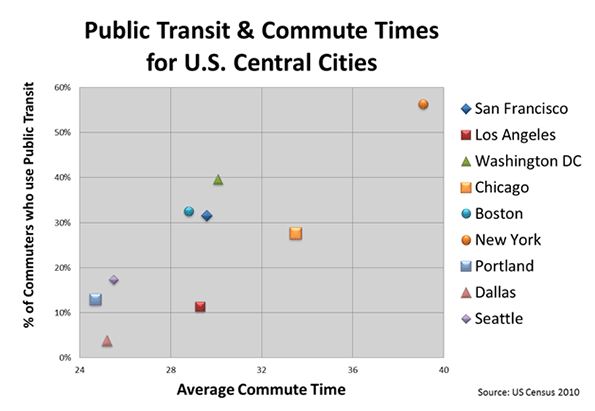
    To improve the way we move people, transit developments must save both time and money. Sadly, transit lines are notorious for their extraordinary costs and long delays. Data from the 2010 Census reveals that people living in central cities with a higher proportion of transit riders experience longer commutes. And since transit riders have more cumbersome commutes, they are much more likely to be tardy or absent from work.

    The hefty price tag of transit projects also triggers concern. For example, the cost per new passenger of the Washington Metro line to Dulles Airport was estimated at $15,000 annually. That’s about the same as the current poverty threshold for a household of two.

    Car-loan programs on the other hand are largely cost-efficient, producing real fiscal benefits to borrowers, employers, and taxpayers. A survey of 4,771 borrowers and their employers finds that borrowers have greater job security as a result of access to vehicles. With access to credit, borrowers increase their purchasing power by an average of $2,900 each year and save about $250 by avoiding payday loans and checks-for-cash outlets. Employers gain as well through cost savings due to increase retention and reduced absenteeism and tardiness, which amount to $817 and $1130 per borrower respectively. In large part, providing vehicle financing is a smart investment since it reduces the number of low-income families on social welfare – an annual cost savings of $2,900 for each borrower coming off public assistance.

    Given its clear advantages, car sharing is increasing. Recent reports find that shared-use vehicle organizations have been lucrative. Between August 2012 and July 2013, car-sharing ridership grew by 112 percent and the number of vehicles increased by 52 percent. And although car-sharing is not typically used to transport the poor, having on-demand car service makes it so that door-to-door access is more available and affordable. If car-sharing continues to grow at its current rate, it’s reasonable then to assume that these pseudo-taxi services will be eventually be affordable enough so that people would choose to be chauffeured rather than drive their own vehicles.

    2. Vehicle ownership provides greater access to jobs and economic opportunities.

    Instead of being limited to a few areas that are transit-oriented, families with cars have access to more jobs and economic opportunities. Public transit lines are limited in their geographical coverage and take time to make often numerous stops.  Transfers are inefficient and time-consuming, making much of that coverage impractical. Also regular transit riders have limited employment options since they’re only able to consider jobs in the vicinity of transit stops and stations.

    3. Travel by car  is responsive to current travel patterns

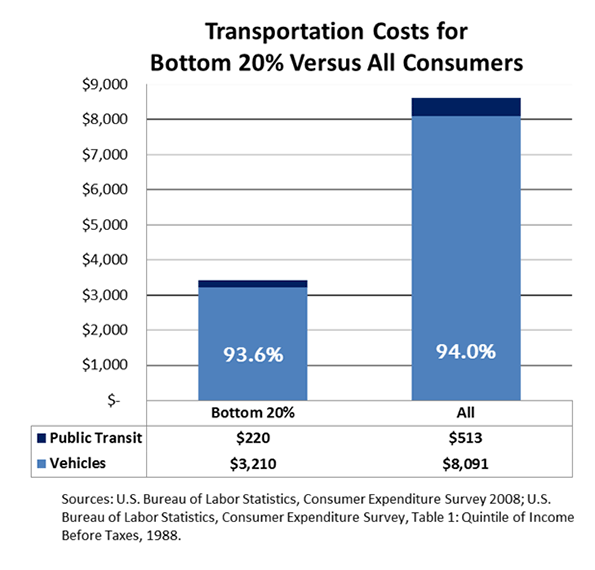
  • A common misperception is that low-income people do not have cars. In reality, 86% of the poor have cars, compared to 95% of the entire population. The high percentage of poor families with cars reveals how automobile culture has become fixed into American ideals of economic well-being and prosperity. And contrary to stereotypes, the poor and the rich similarly spend about 94% of their transportation costs on vehicle travel versus public transit, challenging the notion that low-income travel behavior is unlike that of the rest of the population. As such, providing the poor with cars dramatically levels the playing field as they are the ones who would gain the most from increased access to employment destinations and education facilities.

    A strong argument posited by public transit advocates is that as more cars use the road, congestion and pollution will intensify. And to be sure, public transit is more environmentally friendly than motor vehicles. The Amalgamated Transit Union (ATU), the largest union representing transit workers in North America, reports that one full bus eases the road of thirty-five cars, and that existing transit usage cuts national gasoline consumption by 1.4 billion gallons annually. Yet, on average, this result can only   be achieved if buses were always full, which they are not – authorities from the Los Angeles Metro estimate that their buses run at an average of 42% capacity.

    But is it equitable to ask the poor to forgo mobility and economic gain for the environment? Considering that most Americans experience some degree of social mobility via vehicle ownership, it’s far more reasonable to allow  low-income families greater access to opportunity. In addition, new fuel efficiency standards for cars set by the Obama administration will decrease overall GHG emissions substantially; according to forecasts by the Department of Energy, carbon emissions from light-duty vehicles will drop 21% between 2010 and 2040 in spite of a 40% increase in driving. This shows that, even with more cars on the road, environmental goals can be accomplished.

    Although the eligibility requirements are stricter in some areas than others, every state in the U.S. has a program for low-income residents to have access to car loans. Car-sharing is also rapidly expanding, but  marketing now is geared towards millennials on a budget rather than low-income families. Both innovations, however, respond to new demands faced by future workers, who are likely to find employment in dispersed locations and may make more trips per workday since many may have multiple part-time jobs. With more efficient ways of getting people to work, it’s time to challenge the assumption that the expansion of public transit is the best way to meet the needs of America’s hard-pressed working class.

    Jeff Khau graduated from Chapman University with a degree in business entrepreneurship. Currently, he resides in Los Angeles where he is pursuing his dual-masters in urban planning and public policy at the University of Southern California.

    Photo by Romana Klee, #113 zipcar.

  • What Detroit Has Really Taught America

    Nothing. Seriously. Not a damn thing.

    Oh, the occasion is being used to opine on our state of affairs, but nothing is structurally taking shape in America to prevent the next Detroit from occurring. In fact, Detroit is occurring every day inside most of us. We are all getting bankrupt in so many little ways.

    America is in a precarious position. Our economy is based on consumption. Our consumption is based on our livelihood. Our livelihood is based on our employment, and in our jobless “recovery”, there just aren’t many decent jobs. With technological advances, it is likely to get worse. Writes columnist Bill McClellan in the St. Louis Dispatch:

    [T]he day is coming when trucks will drive themselves. People in the trucking industry say it is inevitable. Within a decade or so, truck drivers will be obsolete. There are currently 5.7 million truck drivers.

    McLellan continues, discussing an email he received from a reader:

    Pat B. is a conservative businessman. He wrote, “Regarding the truck drivers, I think the bigger issue is how society is going to deal with nonproductive people vs. productive people. Automation will allow ‘productive’ people to be much, much more productive than the ‘nonproductive’ people. Theoretically, a very small segment of the population could produce almost everything. How will we deal with this?”

    Good question. Currently, Detroit is ground zero of it. So much busted there, so many poor, so many with blue- and white-collar skills in the new no-collar economy. Do we let the city die on the vine? Au revoir Rust Belt?

    Well, a consensus is becoming clear. We need to “First World” Detroit. Get it and other post-industrial cities on the right path.

    Enter New York.

    Courtesy of Smithsonian

    In the late 1970′s, New York City was in trouble: the threat of bankruptcy, and the Bronx was on fire, literally, with broadcaster Howard Cosell famously being attributed to saying “There it is ladies and gentleman, The Bronx is burning” as cameras panned to a fire in an abandoned elementary school during Game 2 of the 1977 World Series. Put simply, the 1970’s NYC was not unlike the modern day Detroit—insolvent fiscally, aesthetically, and, in many respects, sociologically. “Broken youth stumbling into the home of broken age,” wrote Frank Rose in the Village Voice.

    But with crisis comes opportunity, particularly for those who can afford to be opportunistic. Specifically, in the book by Paul Harvey entitled The Brief History of Neoliberalism, the crossroads of NYC’s late-70’s fiscal crisis gets center stage. Here, the groundwork for the city’s co-optation had been laid for some time, with the 1960’s urban crisis increasing municipal desperation. Financial institutions smelled blood, and they saw occasion. What happened dictates urban redevelopment to this day. Writes Harvey (h/t Cleveland Frowns):

    At first financial institutions were prepared to bridge the gap, but in 1975 a powerful cabal of investment bankers (led by Walter Wriston of Citibank) refused to roll over the debt and pushed the city into technical bankruptcy. The bail-out that followed entailed the construction of new institutions that took over the management of the city budget.

    Harvey states that the new budget strategy amounted to “a coup by the financial institutions against the democratically elected government”, one that would subsequently de-emphasize social and physical infrastructure for the priority of a “good business climate”. Harvey continues:

    But the New York investment bankers did not walk away from the city. They seized the opportunity to restructure it in ways that suited their agenda…This meant using public resources to build appropriate infrastructures for business…coupled with subsidies and tax incentives for capitalist enterprises…[T]he investment bankers reconstructed the city economy around financial activities, ancillary services such as legal services and the media…and diversified consumerism (with gentrification and neighborhood ‘restoration’ playing a prominent and profitable role). City government was more and more construed as entrepreneurial rather than a social democratic or even managerial entity.

    Fast forward to now and you can see how this framework has made modern day New York. A billionaire mayor. Impressive wealth accumulation. Lower crime. Gentrifying areas that are spreading into many parts of the city. The scene in the Bronx:

    The South Bronx is on the upswing and this new project proves it,” said Kathy Zamechansky, President of KZA Realty Group. “A gleaming new building is just what this area needs to add life and vitality to a neighborhood…

    All good, right?

    Not exactly. Commoditizing public welfare has come with very personal costs. Particularly, New York City’s economic sphere epitomizes the worsening two-tier system in America, with one study finding that “three of the four most [income] segregated metropolitan areas [in the country] are in the New York City region”. In the city itself, the income disparity rates from subway stop to subway stop are at Namibian levels. “Get off at Chambers St., and you’re averaging $205,192,” writes Fishbowl NY. “Hop off at Kingsbridge Rd., and you’re at $18,610”.

    Income Disparity New York

    There is cost to personal freedom as well, with Mayor Bloomberg’s “stop-and-frisk” tactics ruled as a violation to the constitutional rights of minorities. The increase in police stops have been significant since Bloomberg took office, going from 160,851 in 2003 to 685,724 in 2011. In a 195-page response just released, the federal judge wrote: “No one should live in fear of being stopped whenever he leaves his home to go about the activities of daily life”.

    Heck, there’s even consternation from the city’s creative types. Specifically, New York’s legacy of nurturing the next generation of thought is being homogenized by the fact that elites talking to elites creates for shitty cultural capital. Writes Gawker’s Hamiliton Nolan on how the influx of money is turning the city into “a game of urban Candy Crush”, “Everything is an orgy of destruction! Who’s hip now? Nobody!” Echoes creative class troubadour Lena Dunham:

    It’s news to no one that the middle class and up-and-coming talent struggle in this city. As a result, New York is seeing an exodus of its creative population. As Dunham says, “If they struggle for too long, they’re leaving New York for Seattle, Chicago, Austin, and in some cases, even Tampa. We can’t have our generation’s Patti Smith moving to Tampa. That’s going to seriously f*ck our shit up.

    But the bridge had been crossed. Not simply for the reasons Dunham fingers, but because New York City is the head of a teetering set of bones. Writes eminent economic scholar Joseph Stiglitz in a recent essay entitled “The Wrong Lesson from Detroit’s Bankruptcy”:

    Rather than deal purposefully with this changing economic landscape with useful policies encouraging the growth of other industries, our government spent decades papering over the growing weaknesses by allowing the financial sector to run amok, creating “growth” based on bubbles. We didn’t just let the market run its course. We made an active choice to embrace short-term profits and large-scale inefficiency.

    America does have an urban renewal program, but it is aimed more at restoring buildings and gentrification than at maintaining and restoring communities, and even at that, it is languishing.

    Which brings us back to Detroit. Consider it America’s “Back to the Future” moment. There is municipal bankruptcy. There is fiscal management being taken away from an elected government. There are financial institutions wreaking havoc on the middle class via a collective Alfred E. Neuman-like exasperation. There is the subsidy environment going full bore in the midst of economic trauma, with the Governor of Michigan giving the okay to Detroit billionaire Mitch Ilitch on his $650 million dollar publicly-subsidized hockey arena one day after signing off on the country’s largest city bankruptcy filing. And then there’s the gentrification-as-economic-development silver bullet, with real estate developer Dan Gilbert buying up downtown properties for the price of a song and then using the spatial grease of placemaking to fill his square feet with the rise of the creative class. “Stand up and gentrify: 7 days in Detroit” reads a series running in the The Windsor Star.


    “It was a face that didn’t have a care in the world, except mischief.” Quote from Mad editor Harvey Kurtzman.

    Taken together, the framework of Detroit’s progression is to simply go forth into who we are as a country—a group of people on a collision course with the inevitable failings of economic disparity, or more generally: a nation without good jobs.

    Should Detroiters be worried?

    Maybe. Reads the New York Observer: “Bloomberg Warns the Next Mayor Could Follow Detroit Into Bankruptcy”.

    Back to the future indeed.

    Richey Piiparinen is a writer and policy researcher based in Cleveland. He is co-editor of Rust Belt Chic: The Cleveland Anthology. Read more from him at his blog and at Rust Belt Chic.

    Lead photo courtesy of Vice.

  • Here’s a Way to Flood the US Housing Market with One Trillion Dollars

    Members of the millennial generation – born between 1982 and 2003 – carry a student debt burden of close to one trillion dollars. This is the group that includes many just entering the stage in life when people tend to settle down and start families. Even though Millennials are marrying later than previous generations, they would still be the prime market for sales of single family starter homes, if only they could afford them. As interest rates rise along with home  prices, the only way this key consumer segment will be able to afford to buy a house is if the nation, out of its own self-interest, finds a way to relieve Millennials of their crushing student loan obligations.

    Millennials are the first generation in American history that has been asked to self-finance the cost of the education needed for America to be economically successful. Shortly after the ratification of the Constitution, Congress passed legislation setting aside land in the new territories for the establishment of the iconic one room school houses to assure its newest citizens had the skills required to be good farmers and domestic servants. Even as the country was engaged in a devastating Civil War, a state-by-state movement to mandate universal and free primary education for every child swept the nation and became a permanent part of American society. Then, when the Industrial Revolution generated a demand for factory and office workers with a high school education, the nation expanded the concept to make such an education available equally to young men and women without any requirement to pay tuition.      

    The situation has changed, but the need for an educated young generation has not. The difference is that at least two years of post-secondary education has become a must-have ticket for a young generation seeking to make its way in the world. Yet we have suddenly yanked the universal, free education rug out from under them and asked them to pay for it by not only going into debt, but assuming a debt that is not even dischargeable in bankruptcy court.

    The result is a rising tide of student debt that threatens to undermine the economic vitality of the nation. According to the Federal Reserve, student debt rose by a factor of more than eight between 2001 and 2012, twice as fast as home loans and far in excess of the modest increases in other forms of indebtedness during the same time period. A recently released report by the Consumer Financial Protection Bureau indicates that about one in four student loans is now either in default or in programs designed to help borrowers in distress. This analysis looked only at loans made through the direct student loan program totaling about $570 million, not older ones that may have been offered by banks and other private sector lenders. If borrowers are unable to repay their loans in the long run, the federal government and taxpayers will have to absorb the losses. Why, then, not recognize the problem now and bail out the borrowers so that they can put the windfall to good use in an economy desperately needing a new boost in consumer spending?

    The Great Recession seriously disrupted household formation and consumer spending.  According to an analysis by Merrill Lynch, in the decade before the financial markets’ collapse in 2008, one-third of all housing turnovers came from homeowners older than  55, and about one-third of those sales were to buyers under 34. Since then sales of homes have fallen by about two million units, leaving the economy 2.5 million households below normal levels. Millennials represent about 22% of the US population and control $200 billion of direct purchasing power, not counting their influence on their parent’s spending decisions. Over the next five years, a quarter of Millennials will enter their peak spending years, making them the best hope for reviving the housing market.

    Millennials have expressed a strong preference for living in the type of suburban communities in which they grew up, especially when it’s time, as it is for many of them now, to raise a family. Their first home needn’t be “move in ready;” about a third of them say they would prefer a “fixer upper.” And more than 80% of the generation believe they would find a way to pay for the cost of any repairs themselves rather than borrow the money from their parents. A wave of new home buying would not only give a sharp boost to the durable goods industry that depends on new household formation for its growth, but would also provide a ready-made army to fix up some of the country’s declining, inner ring suburban housing stock.

    There are legitimate public policy issues about how to fix the problem of financing American higher education. Some might argue that we should tackle that problem before dealing with student loan debtors. But with the economic recovery still proceeding at too slow a pace for most middle class Americans, an equally good case can be made that the country should deal with student loan debt either first or as part of a comprehensive reform of  financing higher education. The economy could use the boost, as could the morale of America’s largest and most diverse generation.

    Morley Winograd and Michael D. Hais are co-authors of the newly published Millennial Momentum: How a New Generation is Remaking America and Millennial Makeover: MySpace, YouTube, and the Future of American Politics and fellows of NDN and the New Policy Institute.

    New home photo by BigStockPhoto.com.

  • Young Tech Tycoons Pushing Left Coast Ahead Of East In Democratic Power Structure

    There are two deep-blue regions that are critical to the Obama administration: the Northeast and the coastal region between San Jose and Seattle that truly deserves the moniker of the Left Coast. They dominate the Democratic donor list, and provide the administration with most of its appointees and much of its ideological moorings.

    Yet this common ground conceals a shift in the balance of power between these two blue strongholds. The power of the high-tech heavy Left Coast is waxing while the old Boston-to-Washington corridor is waning. Jeff Bezos’ purchase of The Washington Post simply confirms this movement of the political tectonic plates.

    The Rise of the Tech Oligarchs

    Wall Street was the star of the 1980s, but today, it’s the tech industry that offers “the same heady mix of mystery, power and money,” as Om Malik puts it. The Left Coast’s ascendency is based largely on its increased domination of this critical sector. Thirty years ago, East Coast giants such as ITT and Eastman Kodak ranked among the largest tech firms, with little representation from the Left Coast. Today the region accounts for seven of the top 10 tech companies.

    The Left Coast is also home to four of the world’s top seven software companies. The software for most of the world’s computers comes from either Microsoft in Seattle or Google and Apple in the Bay Area. Search is almost completely dominated by Google, social media by Facebook. Bezos’ Amazon overwhelms its e-tailing competitors.

    This has generated an enormous shift in the geography of American wealth. In 1990 most of the richest Americans lived in the Northeast or were part of the old energy/agriculture economy in the middle of the country. Today five of the nation’s 15 wealthiest people reside in the Bay Area or the Puget Sound; only two, Michael Bloomberg and George Soros, come from Wall Street. More importantly, the Left Coast oligarchs tend to be much younger than their East Coast counterparts; six of the world’s 29 billionaires under 40 hail from the Left Coast, three from Wall Street.

    Seizing the Means of Communications

    The best historical analogy can be found at the turn of the 20th century as entrepreneurs from America’s industrial expansion — John D. Rockefeller, Andrew Carnegie, E.H. Harriman and JP Morgan — moved to influence government and politics, first by buying political influence and later through foundations. Many of the great newspaper tycoons of the time, for example William Randolph Hearst, heir of a great Colorado mining fortune, also used their money in influence mass opinion, a pattern repeated, ironically in 1933, when Wall Street financier Eugene Meyer bought the moribund Washington Post, greatly enhancing his family’s influence for decades.

    But these newbies come with an extra media advantage: they dominate virtually all the emerging transmission systems for information. Google, Apple and Facebook all are emerging as major disseminators of entertainment as well. This shift promises to inflict collateral damage on both Hollywood and the Manhattan-centered advertising industry. The recent shotgun merger of Omnicom and Plublicis reflects the weakened position of traditional ad firms at a time that Google alone has more ad revenues than the entire print publishing industry combined.

    Reshaping the Political Landscape

    Once largely divorced or distant from politics, the Left Coasters such as Amazon, Apple, Facebook and Google have all greatly expanded their lobbying operations. Many tech firms, notably Facebook and Apple, pay minimal taxes, meaning they have a strong stake in defending their current privileges . They also have reason to work to make it difficult to protect the privacy of netizens since so much of their profit depends on selling personal information to corporations.

    This fluency with data has also made the Left Coasters critical contributors of campaign expertise for President Obama and other Democrats. Now they are starting to fund the next generation of pliable favorites, most recently Newark Mayor and senatorial aspirant Cory Booker.

    The rise of the Left Coast oligarchs will likely accelerate the extinction of the traditional working-class Democratic Party. Bezos and other Left Coasters tend to be progressive on social issues, but vehemently opposed to unions, here and abroad.

    Bezos and other online retailers will need to defend themselves against attacks on the job-destroying aspects of their shops; since 2003 there has been a loss of roughly 800,000 retail jobs while the electronic side of the industry has generated less than 180,000.

    Mark Zuckerberg and others leading the charge for immigration reform also have an interest in assuring a steady supply of lower cost, lower hassle “techno-coolies” for their software shops.

    This may not endear the oligarchs to a large part of American middle class who would prefer those jobs go to themselves, or their children. Left Coasters also embrace green policies that entail high energy prices, arguably more acceptable in the mild, if a bit, wet climate of the Left Coast but economically disadvantageous to far less temperate middle America.

    Conservatives, for their part, hope that the Left Coast moguls prove more libertarian than statist. But they may miss the fundamental law of oligarchy: when a company dominates a sector, they usually seek to use the government to consolidate their position. Google and other tech firms, for example, have been more than happy to feed off the crony capitalist trough — for example in backing renewable energy schemes — when opportunity strikes.

    What’s the Future?

    Demography is working against the East Coast, now the oldest part of the country, with the smallest population under 20. The region’s aging population will likely blunt innovation there. In contrast, despite high housing prices, the Left Coast’s population grew 10%  in the last decade compared to 6% for the Northeast; Census projections to 2023 suggest the Northeast will continue to lag as well over the next ten years.

    As urban analyst Aaron Renn has noted, Seattle, Portland and San Francisco also boast a very politically incorrect advantage. Despite their worship at the altar of diversity, these cities have smaller populations of African-Americans and Latinos, who tend to be more economically disadvantaged. The Northeast is three times as black as the Left Coast. In contrast, the Left Coast’s largely upwardly mobile Asians account for 15% of the local population, three times their proportion on the East Coast.

    The Left Coast also enjoys by far the highest concentration of people engaged in STEM jobs — roughly 50% higher the national average. Since 2005 STEM employment has expanded by double-digit percentages in Seattle, San Jose and San Francisco, compared to much more modest gains in New York and Boston. In some fields like e-tailing, the Left Coast, not surprisingly, dominates, with Seattle and San Jose leading the way.

    Given the current economic trajectory, more traditional East Coast dominated-industries — from brick and mortar retail to publishing and media — can be expected to crumble before the onslaught of the Bay Area and Seattle. The old cities of the East may hold their social prestige and legacy well into the current century, but the blue balance of power seems destined to keep tilting toward the Left Coast.

    Joel Kotkin is executive editor of NewGeography.com and Distinguished Presidential Fellow in Urban Futures at Chapman University, and a member of the editorial board of the Orange County Register. He is author of The City: A Global History and The Next Hundred Million: America in 2050. His most recent study, The Rise of Postfamilialism, has been widely discussed and distributed internationally. He lives in Los Angeles, CA.

    This piece originally appeared at Forbes.

    Facebook photo by BigStockPhoto.com.

  • The Childless City

    What is a city for? Ever since cities first emerged thousands of years ago, they have been places where families could congregate and flourish. The family hearth formed the core of the ancient Greek and Roman city, observed the nineteenth-century French historian Fustel de Coulanges. Family was likewise the foundation of the great ancient cities of China and the Middle East. As for modern European cities, the historian Philippe Ariès argued that the contemporary “concept of the family” itself originated in the urbanizing northern Europe shown in Rembrandt’s paintings of bourgeois life. Another historian, Simon Schama, described the seventeenth-century Dutch city as “the Republic of Children.” European immigrants carried the institution of the family-oriented city across the Atlantic to America. In the American city until the 1950s, urbanist Sam Bass Warner observed, the “basic custom” was “commitment to familialism.”

    But more recently, we have embarked on an experiment to rid our cities of children. In the 1960s, sociologist Herbert Gans identified a growing chasm between family-oriented suburbanites and people who favored city life—“the rich, the poor, the non-white as well as the unmarried and childless middle class.” Families abandoned cities for the suburbs, driven away by policies that failed to keep streets safe, allowed decent schools to decline, and made living spaces unaffordable. Even the partial rebirth of American cities since then hasn’t been enough to lure families back. The much-ballyhooed and self-celebrating “creative class”—a demographic group that includes not only single professionals but also well-heeled childless couples, empty nesters, and college students—occupies much of the urban space once filled by families. Increasingly, our great American cities, from New York and Chicago to Los Angeles and Seattle, are evolving into playgrounds for the rich, traps for the poor, and way stations for the ambitious young en route eventually to less congested places. The middle-class family has been pushed to the margins, breaking dramatically with urban history. The development raises at least two important questions: Are cities without children sustainable? And are they desirable?

    Best-selling urban booster Richard Florida, a pied piper for today’s city developers and planners, barely mentions families in his books, which focus instead on younger, primarily single populations. Eric Klinenberg, a New York University professor and author of the widely touted Going Solo, celebrates the fact that “cities create the conditions that make living alone a more social experience.” But perhaps the most cogent formulation of the post-family city comes from the sociologists Richard Lloyd and Terry Nichols Clark, who see the city, and particularly the urban core, as an “entertainment machine.” In their view, city residents “can experience their own urban location as if tourists, emphasizing aesthetic concerns.” Schools, churches, and neighborhood associations no longer form the city’s foundation. Instead, the city revolves around recreation, arts, culture, and restaurants—a system built for the newly liberated individual.

    Demographic trends seem to bear out this vision.Over the past two decades, the percentage of families that have children has fallen in most of the country, but nowhere more dramatically than in our largest, densest urban areas. In cities with populations greater than 500,000, the population of children aged 14 and younger actually declined between 2000 and 2010, according to U.S. Census data, with New York, Chicago, Los Angeles, and Detroit experiencing the largest numerical drop. Many urban school districts—such as Chicago, which has 145,000 fewer school-age children than it had a decade ago—have seen enrollments plummet and are busily closing schools. The 14-and-younger population increased in only about one-third of all census-designated places, with the greatest rate of growth occurring in smaller urban areas with fewer than 250,000 residents.

    Consider, too, the generation of Americans between the ages of 25 and 34 in 2000. By 2010, the core cities of the country’s 51 most populous metropolitan areas had lost, on average, 15 percent of that cohort, many of whom surely married and started having children during that period. While it’s not possible to determine where they went, note that suburbs saw an average 14 percent gain in that population during the same period.

    Of course, not all sections of our largest cities are equally bereft of children. Of Los Angeles County census tracts where less than 10 percent of the population was 14 and younger in 2010, a significant number were located downtown and along the coast. These are mostly high-density areas where housing is expensive. You’ll find a considerably higher proportion of children under 14 in low-income parts of South and East Los Angeles, and also in middle-class neighborhoods in the heart of the San Gabriel and San Fernando Valleys.

    Opinion polls confirm the impulse behind the child exodus. For example, in a recent survey for the Manhattan Institute by Zogby Analytics, 58 percent of people with children under 17 said that they would consider leaving New York City for better opportunities elsewhere; only 38 percent of those without children agreed. Part of the reason is surely the city’s density and cost, which make family life difficult. In Manhattan, where the average rent approaches $4,000 a month, it’s no surprise that families are waning.

    A more family-friendly city remains possible. The Brooklyn community of Flatbush—like Staten Island, Queens, and eastern portions of Brooklyn—was built in the first half of the twentieth century to appeal to families fleeing the congestion of New York’s core. Just as the suburbs do now, these new settlements revolted many urbanists, such as Lewis Mumford, who complained in 1921 that the “dissolute landscape” was “a no-man’s land which was neither town nor country.” But Flatbush’s tree-lined neighborhoods, such as Kensington and Ditmas Park, may be the city’s best hope for retaining middle-class families. These areas still have many single-family homes and low-rise apartments. And Cortelyou Road, a main drag in Ditmas Park, brims with family-friendly restaurants and shops, though it was fairly desolate just a decade ago. Young families are enthusiastic about the neighborhood. “It’s an amazing place,” says Kari Browne, co-owner of the Lark café on nearby Church Avenue. “But the key concern is: Can you afford to stay?”

    For many young families living in New York’s outer boroughs, the availability of space, particularly backyards, is deeply important. “The cost of space is the biggest issue in Brooklyn,” says resident Michael Milch, whose wife attends dental school at NYU. “The issue becomes: Can you get some personal green space?” Obviously, people who settle here are willing to make do with less space than those who, say, move to a far-flung exurb in Putnam County. But all are seeking space in communities more amenable to family life than are the contemporary city cores. Heightened family demand may be helping send housing prices steadily upward in New York’s boroughs, as young couples move from Manhattan to less dense neighborhoods. Jason Walker, a 45-year-old father of two, left Washington, D.C. (which may have the highest percentage of childless households in the nation), for Ditmas Park to escape “a culture dominated by childless people leery of the existence of kids.” The Walkers live in a two-bedroom apartment but are looking for a house in the area.

    Such opportunities exist elsewhere in America, too, in places where detached single-family homes—the preferred housing of 80 percent of American adults, according to a National Association of Realtors survey in 2011—are often just a short walk or ride from the urban core. With its broad streets and massive shopping centers, the California city of Irvine may lack the inner-ring charms of Flatbush. But families are drawn to Irvine’s amenities—especially its schools. “You really have to worry about the schools in New York,” says Walker, whose children are six and eight. “If you have to go to private schools, this makes it a struggle to stay here.” In Irvine, by contrast, “everything stems from education,” says resident Eveleen Liu. “The city draws people who are impassioned about their kids and their school. Everyone volunteers. It’s the glue that holds this place together.” Schools are particularly crucial in attracting Asians, now the country’s fastest-growing immigrant group. Safety is another big draw: Irvine consistently rates among the safest American cities with more than 100,000 residents.

    Families are also deeply attracted to open space. The great Frederick Law Olmsted–designed New York parks, including Prospect Park in Flatbush, are enormous assets for families without backyards. Irvine may lack stunning urban architecture and glorious cathedrals, but it has a magnificent park system that gives residents ideal settings for recreation, exercise, and family gatherings. “It’s an environment that is clean and nice and open to everyone,” says Veronika Kim, a mother of three and an apartment tenant in Woodbury, an Irvine neighborhood. “You can walk there with the kids and let them play. Even if you rent, you don’t feel like an outsider.” The parks are good not only for kids but for adults—for example, the members of the Woodbury Woodies, who play softball every week against teams from other neighborhoods. “There’s a deep sense of community here,” says Woody regular Julian Forniss. “Softball is part of that.” On the site of a former Marine Corps base, Irvine and Orange County are developing a “Great Park” that will be twice the size of New York’s 840-acre Central Park.

    Other family-friendly cities have embarked on ambitious park and open-space projects as well. In Raleigh, North Carolina, the nearly completed $30 million Neuse River Greenway Trail cuts through 28 miles of forest. Houston’s $480 million Bayou Greenways project will eventually add some 4,000 acres of green space across the city, from the downtown to the outer suburbs, including 300 miles of continuous hiking and bike trails. Houston’s rival, Dallas, is planning a vast 6,000-acre park.

    What families need is more affordable urban neighborhoods with decent schools, safe streets, adequate parks—and more housing space. As New York University’s Shlomo Angel points out, virtually all major cities worldwide are growing outward more than inward—and becoming less dense in the process—because density drives families away from urban cores and toward less dense peripheries. The lesson is clear: if cities want families, they should promote a mixture of density options.

    The solution is not to wage war on suburbia, as urbanists have been doing for years. Following the notions that Jane Jacobs advanced a half-century ago, contemporary urbanists argue that high density creates a stronger sense of community. (Jacobs once opined that raising children in the suburbs had to be difficult, somehow overlooking how families were flocking to those suburbs.) But that contention isn’t self-evident. The University of California’s Jan Breuckner and Ann Largey conducted 15,000 interviews across the country and found that for every 10 percent drop in population density, the likelihood of someone’s talking to his neighbor once a week went up 10 percent, regardless of race, income, education, marital status, or age.

    In California, particularly, state and local officials push policies that favor the development of apartments over single-family houses and town houses. But by trying to cram people into higher-density space, planners inadvertently help push up prices for the existing stock of family-friendly homes. Such policies have already been practiced for decades in the United Kingdom, making even provincial cities increasingly unaffordable, as British social commentator James Heartfield notes. London itself is among the least affordable cities in the world. Even middle-class residents have been known to live in garages, converted bathrooms, and garden sheds.

    A city that continues to be high-density and high-cost hasn’t necessarily signed its own death warrant. Manhattan, parts of Brooklyn, and much of San Francisco, Seattle, Boston, and other amenity-rich cities—what Tulane University geographer Richard Campanella calls “kiddie deserts”—continue to flourish. But other cities, such as Detroit, Cleveland, and Buffalo, can’t attract the same interest from young hipsters and the rich and are consequently less capable of withstanding the effects of family flight to the suburbs. Even in the most affluent cities, the dearth of families reinforces public policies incompatible with children, argues the Austrian demographer Wolfgang Lutz. For example, fewer middle-class families means less political pressure to reform education or support for tougher law enforcement.

    Ultimately, everything boils down to what purpose a city should serve. History has shown that rapid declines in childbearing—whether in ancient Rome, seventeenth-century Venice, or modern-day Tokyo—correlate with an erosion of cultural and economic vitality. The post-family city appeals only to a certain segment of the population, one that, however affluent, cannot ensure a prosperous future on its own. If cities want to nurture the next generation of urbanites and keep more of their younger adults, they will have to find a way to welcome back families, which have sustained cities for millennia and given the urban experience much of its humanity.

    Joel Kotkin is executive editor of NewGeography.com and Distinguished Presidential Fellow in Urban Futures at Chapman University, and a member of the editorial board of the Orange County Register. He is author of The City: A Global History and The Next Hundred Million: America in 2050. His most recent study, The Rise of Postfamilialism, has been widely discussed and distributed internationally. He lives in Los Angeles, CA.

    Ali Modarres is an urban geographer in Los Angeles and co-author of City and Environment.

    This piece originally appeared at The City Journal.

    Crossing the street photo by Bigstock.
  • Should Uncle Sam Chase a Scandinavian Model?

    When American progressives dream their future vision of America, no place entices them more than the sparsely populated countries of Scandinavia. After all, here are countries that remain strongly democratic and successfully capitalist, yet appear to have done so despite enormously pervasive welfare systems.

    Paul Krugman, the current high priest of progressive economics, approves of Sweden’s high level of spending on benefits as an unadulterated economic plus. He says that Sweden, unlike other European states like France, thrives despite its high tax rate and notes that, while half of all children are born out of wedlock, those children have far less poverty than American children. Progressive pundit Richard Florida, for his part, claims that Sweden is the most creative place on Earth, just ahead of the U.S.

    Some even suggest America should adopt wholesale the Scandinavian system as a policy imperative. The Washington Post praises Sweden as the “rock star” of the financial crisis and lists five ways the U.S. could learn from Sweden. ThinkProgress lauds Sweden’s ability to achieve the world’s highest rate of “social progress” despite a lower per capita income than the U.S. Writer David Dietz, contributor to PolicyMic, sees countries such as Sweden, Norway and Denmark as models that can guarantee both future economic growth and a way for America “to regain its global edge and cement its economic dominance.”

    But before we all go out drinking aquavit, shouting “skol” and dyeing our hair blonde, it makes sense to recognize that not only is relatively small, historically homogenous Scandinavia an ill-suited role mode for a megapower like the U.S., but that, in many ways, the Nordic system may be far more limited than its admirers here might acknowledge.

    Of course, it’s not that there’s not something to learn from these or other countries. Certainly Europe’s chilly corner seems in much better shape than the rest of the continental mess. Given today’s circumstances, recent books extolling the EU as a model such as Stephen Hill’s “Europe’s Promise” or Jeremy Rifkin’s “The European Dream” seem just slightly absurd.

    In truth, Scandinavian countries have performed better than the dismal continental norm in large part because, with the exception of recession-wracked Finland, they have stayed out of Euro currency.

    But even those outside the Euro-destruct zone are not doing as well as widely asserted. Overall unemployment in Sweden, at 8.4 percent, is also higher than that of the U.S.

    Even Norway is underperforming. The last quarter its GDP grew .3 percent, down from an expected .8 percent. As long as mainland Europe is gripped by negative growth and record unemployment, export-oriented Scandinavian countries will continue to struggle.

    In addition, not all the reasons for Scandinavia’s relative health are those that would warm the heart of U.S. progressives. These countries, led by Sweden, have reformed many aspects of their welfare state, including such things as labor laws, and reduced taxes in ways that make them more competitive – and far less egalitarian than in the past.

    Another positive factor for Scandinavia lies in their exploitation of resources, something many progressives, notably green policy aficionados, tend to view with disdain. Sweden exports loads of iron ore to drive its economy and employs massive dams to drive hydropower, which accounts for 42.8 percent of their energy. Norway benefits from a gusher of oil and gas that, producing nearly 2 million barrels of oil per day, making it the 14th largest oil producer in the world despite having a population of 5 million. If anything, Norway can be a model socialist economy because its economic base resembles the Nordic enclave of North Dakota. Overall, the tiny country produces nearly 15 times as much oil per person than the U.S.

    There’s also the matter of scale. Demographically, Scandinavia’s population is microscopic compared to our far vast multi-ethnic Republic. Taken together the four Scandinavian countries – Finland, Denmark, Sweden and Norway – are home to barely 26 million people, far fewer than California and about the same as Texas. These hardy souls are widely dispersed. The population density of Norway and Finland is roughly half that of the U.S., while that of Sweden is one-third less.

    Sweden, to put things in perspective, has fewer people than Los Angeles County. Norway and Finland are less populous than Minnesota, which is about the closest thing we have to Scandinavia. The Minneapolis-Saint Paul region, with 3.6 million residents, would be by far the biggest urban area in the region. Overall American Nordics, including those of mixed ancestry, total 11 million, more than the population of Sweden, by far the region’s largest country.

    Scandinavia’s greatest strength may lie in its least political correct asset: its Nordic culture. Scandinavians’ traditional interest in education, hard work and good governance serves them well both at home and abroad. It’s not socialism that is primarily responsible.

    After all, America’s Scandinavians, although largely the descendents of poor immigrants also are pretty successful, earning more on average than their counterparts back home.

    A Scandinavian economist, for example, once stated to Milton Friedman: “In Scandinavia, we have no poverty.” To which the caustic Nobel Prize winner replied: “That’s interesting, because in America among Scandinavians, we have no poverty, either.” Indeed, the poverty rate for Americans with Swedish ancestry is only 6.7 percent, half the U.S. average which is on par with the poverty rate at home.

    Yet these cultural attributes, notes Swedish based commentator Nima Sanandaji, now appear to be eroding in part because of rising immigration. Long highly homogeneous, the Nordic countries – notwithstanding their liberal kumbaya rhetoric – are facing huge problems absorbing immigrants. Despite populations that are more than 90 percent native, there is growing unease about concentrations of largely Muslim immigrants around large cities like Copenhagen, Malmo and Stockholm.

    These immigrants are not doing remotely as well as those counterparts in the U.S. or Canada. Unemployment rates can reach as high as 80 percent among African and Middle Eastern immigrants in Scandinavia.

    In May, there was a major riot in Stockholm’s heavily Muslim, dense and highly planned inner suburbs. Many immigrants do not seem to embrace the Scandinavian ethos that having strong welfare system available does not mean people should take undue advantage of it.

    More troubling still, notes Sanandaji, who is of Swedish-Kurdish ancestry, many young Scandinavians also seem to be rejecting the old Nordic social compact. Increasing numbers of people under 40 are retiring early, citing disabilities and sickness.

    These trends point to serious problems for countries whose birthrates, despite widely praised natalist policies, are dropping and generally are below ours. With immigration growing ever more unpopular, further demographic decline in the Nordic countries seems inevitable.

    As a result, the Scandinavian welfare state faces challenges arguably far worse than those here at home. The Bank of Finland, for example, warns that an aging population and large public debt would cause a “risk that Finland will drift onto a path of fading economic growth, persistently high unemployment and deteriorating public finance.”

    To be sure, America faces many of these same problems, but it seems silly to look for solutions in a region of the world that is not only fundamentally different but also faces equal, or even greater challenges. Rather than adopt solutions forged in the Nordic cold, American progressives would do better to hone their prescriptions to meet the illnesses of the very different patient here at home.

    Joel Kotkin is executive editor of NewGeography.com and Distinguished Presidential Fellow in Urban Futures at Chapman University, and a member of the editorial board of the Orange County Register. He is author of The City: A Global History and The Next Hundred Million: America in 2050. His most recent study, The Rise of Postfamilialism, has been widely discussed and distributed internationally. He lives in Los Angeles, CA.

    This piece originally appeared at The Orange County Register.

  • High Confidence Not Translating to High Math Scores for American and European Students

    Swedish fourth graders are leading the world in mathematics, followed closely by those in other developed European nations, at least if we look at students’ reported self-confidence in the subject. Fully 77% of Swedish students at fourth grade express a high level of confidence about their learning, compared to merely 5% who express a low level. In Austria, Germany, Denmark, and Norway seven out of ten students have high confidence about their mathematics knowledge. One in ten or fewer have low confidence. Self-confidence is somewhat less common amongst US fourth graders, where 67% believe that they perform highly in mathematics and 10% express the opposite view. Unfortunately, this confidence – in America and elsewhere – is not backed up by high achievement.

    As shown by the Trends in International Mathematics and Science Study, the average US student with high confidence only scored 551 on the test. This is just half a standard deviation from the average score of 500. The phenomenon where many students believe that they are doing well in mathematics – while they are in fact lagging behind other nations – is even more evident in several European nations. In Sweden the average score of the self-identified high achievers is only 514. The sureness of Swedish students seems to rise from a progressive school system. As more focus is put on promoting self-expression and raising self-esteem than on actual knowledge gathering and hard work, students with only slightly higher international scores identify themselves as being high achievers.

    When competing in the global marketplace, or applying for top universities, the self-identified high-achievers of Europe and the US are challenged by students from places such as Hong Kong and Singapore – where the school systems focus more on actual achievements and thrift. In Hong Kong and Singapore 46% of fourth graders identify themselves as high achievers. On average they score impressively 634 and 639 respectively on the international math test. Even the students who have a low self-confidence in Singapore score 544 on the international test. This is considerably higher than the values reached by those believing themselves to be high-achievers in Sweden and close to that of the same group in the US.

    Hong Kong’s self-identified low-achievers score on average 574. The students who believe themselves to have low math skills in Hong Kong thus outperform those who believe themselves to have high skills in the US. In an increasingly knowledge intensive society, policy leaders should ask themselves what this western complacency does with the urge to learn more?

    We should of course never blame the students, who simply react to the school system and the overall society created by their adults. It is the societies that are created by the adults who should consider changing. Encouraging high confidence in general is of course a good thing. But why not focus more on actually teaching out than focusing on self-esteem regardless of achievement?  

    Norway is Perhaps the most interesting nation in terms of the gap between self-perception and reality. This may in part due to the country’s oil wealth that has allowed it to remain the only European country yet to challenge a traditional social democratic model. In Norway, public handouts can be as generous as work income.

    Not surprisingly, the previously strong Nordic working ethic of the country seems to have plummeted while student perceptions of their own knowledge have strongly inflated. Fully 69% of Norwegian students have a high confidence regarding their math scores. On average this groups scores only 490 on the international test – below the international average.

    In the same study, standardized tests are also given to eighth graders. Again, the average global score is set to 500. We can see that as students grow up, their perceptions somewhat adapt to reality. Only 49% of eighth graders in Sweden have high confidence, scoring on average 528. Half of Norway’s eight graders share the same optimistic view, scoring slightly above the average global values (505). In the United States, 53% of students have high confidence regarding their mathematic learning, with an average score of 537. Hong Kong and Singapore   students also face a reality check. Only 30% of the eight graders in the former country and 41% in the latter country have high confidence relating to their math knowledge. However, even the eighth graders with low confidence in these two countries do better on average than those with high confidence in the US and many rich European nations.

    To be sure, mathematic scores are far from the only metrics of educational success. Mathematics is however interesting since it is a vital tool for logical reasoning and since skills in this subject can be readily compared amongst students from different cultures. Mathematics scores are deemed to be so important since they give a good expression of how much knowledge and analytical ability students in different nations have.

    The progressive elements in the school systems in Norway, Sweden and the US seem to foster inflated views about mathematic knowledge that is not backed up by actual knowledge. I am sure there is much good to say about the softer school systems in these countries compared to more knowledge-focused school systems in for example South East Asia. Studying in a soft school system, after all, leads to less stress.

    But at the same time, life is not always soft. The adults have a responsibility to create a system where as many students as possible are given good opportunities to further their knowledge, working-ethics and analytical ability. Without this human capital, many will face difficulties in the real world. Perhaps the school systems in rich European countries and the US could empower their students in the long-term by teaching the necessary knowledge, and making their students aware of their performance-gap in a global competition.

    Dr. Nima Sanandaji is a Swedish author of Kurdish-Iranian origin. He has written numerous books and reports about issues such as entrepreneurship, women’s career opportunities, integration, and welfare.

    School bus photo by BigStockPhoto.com.

  • Is the “Rust Belt” a Dirty Word?

    Many people hate the term “Rust Belt”. They dislike the aesthetics of the Rust Belt. For others, the term is less loaded, but rather a moniker denoting who we are. Consider me in the latter camp. But I often cross paths with those who loathe the term, or more exactly any notion of there being a Rust Belt culture.

    For instance, I recently ran into a top official for the City of Cleveland. We shook hands, discussed backgrounds, before the individual put a name to a book I co-edited called Rust Belt Chic: A Cleveland Anthology, which is a collection of stories detailing what it means to be a Clevelander, a Rust Belter. The official let on she didn’t care for the term “Rust Belt”, and in fact found the idea of celebrating a Rust Belt culture backwards and distasteful. I told the official there was a new generation taking ownership of having grown up in a post-industrial reality, and that make no apologies for it. The official insinuated those people are not in positions of power, so what does it matter. I responded in ten years many will be, and so it matters a lot.

    Anyway, the conversation stayed with me for a few weeks, if only because it was a living, breathing example of what needs to go in Cleveland, if not the whole of the Rust Belt; namely, shame and false pride. Both characteristics go together. Said philosopher Lao Tzu:

    Pride attaches undue importance to the superiority of one’s status in the eyes of others; And shame is fear of humiliation at one’s inferior status in the estimation of others. When one sets his heart on being highly esteemed, and achieves such rating, then he is automatically involved in fear of losing his status.

    Shame. It’s pretty thick in these parts, and it’s linked to the region’s nickname, “The Rust Belt”. After all, rust connotes disuse, or of being left behind. Yet we are only shameful because the region did have status. We were a proud region once, as our forefathers and foremothers built this country. They protected this country. They enabled the defeat of Hitler. No hyperbole on that last part.

    Specifically, before being the “Rust Belt” the region was the “Arsenal of Democracy”, which was a term coined by Detroiter Bill Knudsen in his conversation with a weary and worried President Roosevelt on the eve of WWII. At the time of the talk, May 28th, 1940, America had the 18th largest army in the world, and so what FDR needed from Knudsen was reassurance Detroit’s industrial infrastructure could produce weapons at a pace unimaginable. Knudsen replied Detroit’s manufacturing might could transform into the country’s “Arsenal of Democracy”, with term eventually gaining traction in an FDR fireside chat dated December 29, 1940. In it, the President states:

    We must be the great arsenal of democracy. For us this is an emergency as serious as war itself. We must apply ourselves to our task with the same resolution, the same sense of urgency, the same spirit of patriotism and sacrifice as we would show were we at war.

    Obviously, the area succeeded, with Pittsburgh having produced one-fifth of the Allied forces steel from 1940 to 1945 alone.


    Courtesy of Seeking Michigan

    Needless to say, the region has had a lot to be proud of. But then macroeconomic forces took hold. Things globalized, and thus the way we lived and the things we did became obsolete. Shit happened. Shit is still happening. Yet part of the reason this is so is because we cannot let go. Being proud turned into stubborn pride, particularly for the region’s leadership who is hanging on to the illusion that yesterday will happen as long as we adhere to the same thought processes and power structures that held tow during the region’s heyday. But then yesterday doesn’t happen. Year after year it doesn’t happen. The pride becomes desperation. The pride becomes false. Said William Blake:

    Shame is pride’s cloak.

    And so with the collective shame comes collective temptation and desperation. Casinos will save the cities. Convention centers will save the cities. If only the cities will beautify enough. If only we had an outdoor chandelier. Or a suburban-type downtown mall. Or a tech district. Or a critical mass of microbreweries and boutiques. Or whatever anyone else doing. Anyone else, but us.

    Meanwhile, such city transformations erode the region’s true competitive advantage, which is who we are, and the various potentials inherent in our ability to persevere, i.e., our “learned resilience”. Writes Erie, PA native and economic development blogger Jim Russell:

    What I mean is seeing opportunity hiding in a community struggling with survival. There’s just something about Youngstown that stirs passion in me. I’m not gawking at ruin porn or glossing over everything that is wrong. I love Rust Belt cities. I love Rust Belt culture. I’m proud to be from the Rust Belt. That’s what Rust Belt Chic now means to me. It’s personal. It’s who I am. For Pittsburgh, I could sense the tide turning. I see the same transformation taking place in other Rust Belt cities. A pejorative, Rust Belt-ness is an asset. It’s a starting point for moving forward, not a finish line or a civic booster campaign.

    There is indeed a growing movement of Rust Belt pride taking hold. Yet it is not a false pride, rather a pride that’s derived from an acceptance of having become rust. Such can be immeasurable for the psychogeography of the region. After all, says William James,

    Acceptance of what has happened is the first step to overcoming the consequences of any misfortune.

    Richey Piiparinen is a writer and policy researcher based in Cleveland. He is co-editor of Rust Belt Chic: The Cleveland Anthology. Read more from him at his blog and at Rust Belt Chic.

  • What Detroit’s Bankruptcy Teaches America

    As has long been expected, the city of Detroit has officially filed for bankruptcy.  While many will point to the sui generis nature of the city as a one-industry town with extreme racial polarization and other unique problems, Detroit’s bankruptcy in fact offers several lessons for other states and municipalities across America.

    The Day of Reckoning Can Take Much Longer Than We Think to Come

    What’s most surprising about Detroit’s bankruptcy is not that it happened, but how long it took to get there. In authorizing the bankruptcy filing Gov. Rick Snyder talked about “60 years of decline.” He’s not joking. It’s been widely known that Detroit has been in trouble for a very long time.

    Time Magazine ran a 1961 story called “Decline in Detroit.”  Jane Jacobs described its lack of vitality in her 1961 classic “The Death and Life of Great American Cities”:

    Researchers hunting the secrets of the social structure in a dull-gray district of Detroit came to the unexpected conclusion there was no social structure….Virtually all of Detroit is as weak on vitality and diversity as the Bronx. It is ring superimposed upon ring of gray belts. Even Detroit’s downtown itself cannot produce a respectable amount of diversity. It is dispirited and dull, and almost deserted by seven o’clock of an evening….Detroit today is composed of seemingly endless miles of low density failure.

    Moving from urban planning to economics. She wrote in 1969’s “The Economy of Cities”:

    This was the prosperous and diversifying economy from which the automobile industry emerged two decades later to produce the last of the important Detroit exports and, as it turned out, to bring the city’s economic development to a dead end.

    These are both well known, but the record of troubles in Detroit even predates this, going back at least to Life Magazine’s 1942 article “Detroit Is Dynamite” which gave a prescient warning to the city just a year before 1943’s race riot.

    For a city as uniquely troubled as Detroit to remain in serious decline for such an extended period of time before going bankrupt is a testament to the sheer resilience of cities. It also suggests that those predicting eminent doom for their own city unless it changes its ways are likely to end up as false prophets.

    Indeed, Detroit’s day of reckoning may not even yet be fully given that various challenges to the bankruptcy filing are expected. The fact that Detroit has limped along for so long suggests that cities may be able to survive nearly definitely as “zombie municipalities” similar to zombie banks. Though this may possibly end a Greek style crisis at some point, a very lengthy existence as the undead would seem to be possible.

    Decline Poisons Civic Culture and Sunders the Commonwealth

    Detroit also illustrates that once decline starts it sets in motion a toxic civic dynamic that makes the tough choices needed to turn things around nearly impossible. Just as growth begets growth, decline begets decline, and part of the reason is social dynamics.

    This comes about because in a city in decline – such as in late imperial Rome –people start thinking only about themselves and no longer come to see themselves as part of a greater enterprise or commonwealth. The city and suburbs, blacks and whites, taxpayers and unions no longer see their fortunes as linked. Rather than rising and falling together, it’s every man for himself.

    When the pie is growing, it’s easy to come to an agreement over how to divide it because everybody can get a bigger slice at the same time. But when the pie is stagnant or shrinking, zero-sum thinking takes over. To make a sacrifice is seen to in effect allow someone else to profit at your expense. Perhaps these dynamics were present latently before, but tough times bring out the real civic character.

    In Detroit’s case everyone from public employee unions who refuse to give up any of their benefits (and will no doubt fight to deny the bankruptcy filing) to suburban towns that would rather pretend the city does not exist have played a role in setting the disaster. With nobody willing to sacrifice for the greater good, prisoner’s dilemma logic results happen. You can see this playing out in nearly any troubled American city. By contrast, it seems to be healthier places like Denver that have managed to build stronger regional civic consensus. It’s simply easier in those places.

    Instead, Detroit chased conventional wisdom approaches and fad of the month type endeavors ranging from constructing the fortress-like Renaissance Center to the People Mover to former Gov. Jennifer Granholm’s “Cool Cities” program, none of which did anything but generate hype. What they all had in common is a transfusion of subsidies to the city (and taking on debt) rather than building a consensus around addressing the real issues.

    America Doesn’t Learn Lessons From the Past

    The last thing Detroit teaches us is that America too often doesn’t learn from its mistakes. Detroit’s troubles have been evident for quite some time, yet it’s hard to see that many other post industrial cities have managed to carve out a different path. Rather, they pretended that Detroit’s civic was somehow unique due to its auto industry dependence – and managed to ignore other failed cities as well – while embarking on the same turnaround strategy via conventional wisdom and silver bullets.

    They have even managed to ignore failures much closer to home. Booming new suburbs can look just 5-10 miles down the road to see yesterday’s hot spot now turned into a festering mess of dead and dying malls, declining schools, increasing poverty, and falling home prices. Yet most of them are simply replicating the same pattern that is destined to fail financially over the long term in any region without either severe building restrictions or very high population growth.

    Sadly, none of these augur favorably for change. Detroit may continue to garner special international attention as a train wreck people can’t stop watching, but less spectacular slow motion civic failures seem likely to remain commonplace unless somebody finds a way to overcome these forces.

    Aaron M. Renn is an independent writer on urban affairs and the founder of Telestrian, a data analysis and mapping tool. He writes at The Urbanophile.

    Photo by Kate Sumbler.