Category: Policy

  • Visions of the Rust Belt Future (Part 1)

    “Men often applaud an imitation and hiss the real thing”–Aesop

    There are interesting developments being played out in the Rust Belt. Some cities, like Detroit, seem to be embarking whole hog down the creative class path. Others, like Pittsburgh, have their own thing going on, a thing Economic Geographer Jim Russell has delineated as the “Rust Belt Chic” model of economic development, with no modest amount of success. How a given Rust Belt city reinvests will have a large say in its future.

    Part 1 of this series, below, examines the nascent creative classification of Detroit. Part 2 analyzes whether or not there is a new way forward for post-industrial cities, using the lessons from Pittsburgh and Cleveland as the building blocks to developing an alternative set of strategies for struggling cities.

    Detroit Rock (Ventures) City

    In Detroit, the scene is playing out as such: rampant disinvestment in the core and extreme poverty around it. To help fix this, ties between Rock Ventures head and real estate billionaire Dan Gilbert, urbanist Richard Florida, and the non-profit Project for Public Spaces have been initiated. The goal, laudable enough, is to reinvest in downtown. And while the renewal formula planned is not new, the extent that the milieu is a controlled environment for an urban experiment is perhaps ahistorical, if only because Detroit’s level of disinvestment has created a vacuum that, naturally, power abhors.

    To wit, a recent New York Time’s article entitled “A Missionary’s Quest to Remake Motor City” hints at the level Dan Gilbert—who  has bought $1 billion in downtown property in what has been called a “skyscraper sale”—and his advisors have been handed the keys:

    “My job,” said Dave Bing, the Detroit mayor and former National Basketball Association star, “is to knock down as many barriers as possible and get out of the way.”

    And:

    “Mr. Gilbert met in a conference room for his twice-a-month Detroit real estate meeting, with about a dozen people who work for him, plus a lawyer and leasing agent. If Detroit 2.0, as this group often calls the effort, has a planning committee, this is it.”

    And:

    “[H]e and his staff will apparently have a largely free hand.”

    Now, the plan, and how the plan for Detroit’s future came about.

    A wealthy investor, Dan Gilbert, buys downtown properties. That investor goes on the record as to the importance of reinvesting into the urban core. That investor moves his mortgage company’s employees from suburban office parks into his own downtown real estate. Then, the investor, taking cues from his consultants, throws in something about innovation, which, at its lowest common denominator, means designing your way to a “culture of innovation”. Thus, the investor encourages that Romper Room-style office setting complete with what some would say is tacky décor wholly out of line with the soul of “the D”, but yet which is said to fun-birth inspiration—i.e., “[A] karaoke machine sat in an aisle. Guys threw footballs to one another; one employee shot at colleagues with a Nerf gun”; and “A Quicken promotional video solidifies the company’s attempts at over-the-top marketing, prominently featuring the space’s inexplicable Pac-Man theme”—despite the fact that your primary product line, i.e., mortgages,  needs far less innovation than it does a modicum of conventionality and ethics. Nonetheless, the sentiment of creative destruction is there.
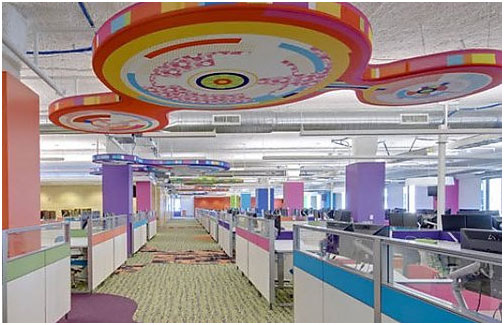

    This basic process, then, is multiplied out from the office setting into strategic urban space, particularly around Gilbert’s real estate. The idea here is to design space so as to create vibrancy so as to galvanize commerce so as to ignite broad economic growth.

    Enter the partnership with the Project for Public Spaces, who is working with Gilbert’s group to do a set of “Lighter, Quicker, Cheaper” placemaking interventions, including pop-up shops. The conceptual girth behind the plan, according to a recent article “Detroit Leads the Way on Place-Centered Revitalization”, is described as such:

    “We proposed developing a Placemaking vision for the major public spaces, and refining the plan through the Power of 10 concept,” says Meg Walker, a Vice President at PPS who worked on the project. “…A lot of developers aren’t as enlightened as Dan Gilbert…they wouldn’t necessarily think about the glue that’s holding this all together.”

    “The Power of 10 framework suggests that a great city needs at least ten great districts, each with at least ten great places, which in turn each have at least ten things to do. Great public spaces produce an energy and enthusiasm that spills over into surrounding areas…

    With the conceptual description as a guide, this is a classic case of the urbanists’ version of trickled-down economics, in which an influx of capital into finite corridors is meant to attract wealth that “spills over” into surrounding areas. Unfortunately, there is little by way of evidence that this works, as was recently admitted by Richard Florida himself. What it may do, however, is fill real estate supply by pursuing a select target market, as placemaking can act as a grease to create pockets of creative class demand to support condos or retail and office space. And while one can certainly argue it beats rampant core disinvestment, it’s not the path of a bold new way that will measurably change the trajectory of Detroit, so says U of M Professor Michael Gordon. In effect, it’s simply shifting people from one set of real estate to another, with nothing undertaken on a systemic level to tackle Detroit’s real problem: poverty and disenfranchisement in its neighborhoods. Worse, re-urbanization as such is likely to exacerbate class and race divides that have plagued Detroit for decades, thus worsening Detroit’s real problem: poverty and disenfranchisement in its neighborhoods.

    Besides, we have been here before. Michigan via its Cool Cities campaign had a plan based off the same Detroit 2.0 premise, switch out the window dressing. Design place, accrue vibrancy, growth wealth. Obviously, the multi-million dollar economic development initiative didn’t work. Neither have similar initiatives across the whole of the Rust Belt.

    So, where’s the beef? What makes Detroit 2.0 different?  

    Naturally, this is where the economic development buzzwords “start-up” and “tech district enter into the Detroit 2.0 lexicon; that is, creating dense city areas will nurture spontaneous interactions that will foster Detroit’s innovation community, putting it firmly on the path to be the “Silicon Valley of the Midwest”. But every city wants this (or at least they are informed they do)—e.g., “Miami Wants to Be the Next Big Start-Up City”—and so the effort ultimately comes off as anything but visionary, rather visionless, trying.

    Cue the Onion. From an article entitled “St. Louis Mayor Has Sad Little Plan For Turning City Into High-Tech Hub”:

    In what appears to be a completely earnest attempt to revitalize a sluggish local economy, St. Louis mayor Francis G. Slay unveiled Thursday a detailed, ambitious, and truly depressing plan to turn his city into a major technology hub. “We’re going to show America, and the rest of world, just how innovative and cutting-edge St. Louis can be,” said the mayor, who displayed genuine optimism as he outlined a desperate strategy to woo major players in the high-tech sector with a sad little series of subsidies and tax incentives his city cannot afford… The mayor ended his presentation by pleading with reporters to dub the hopelessly untenable project “St. Louis 2.0.”

    In all, the current Detroit economic development approach is copycat urbanism at its finest, as there is nothing inherently “Detroit” about it. Nothing that intrinsically builds off its only true competitive advantage: itself.

    For instance, Motor City is Motor City for a reason: it builds things. It designs things. Like, for instance, cars, which, by last count, are still being used, with over 254 million registered passenger vehicles in the US in 2009 alone. And while technology-based automation is increasing manufacturing output at the expense of jobs, production is still huge business in the Rust Belt, with automotive-related STEM jobs (i.e., science, technology, engineering and mathematics-related employment)—i.e., the creative class before the “creative class” became the “creative class”)—aiding Detroit’s regional resurgence, with its 10.5% STEM job growth leading the country from 2010 to 2012. And no, this is not to say Detroit will recoup manufacturing jobs lost from its heyday. But it’s absurd for Detroit to neglect training and flexing its muscle—or its legacy of concept, design, and production—for a future with no middle between start-ups and baristas. I mean, advanced manufacturing isn’t nostalgia. It exists.

    So, why this path? Why pretty Detroit? Why make it culturally less distinct? Why embark on a plan of hyper-modern ephemerality when your distinction is resilience, making things, and hard work? Why? Where is the evidence that this even works? What in the hell is even going on here?

    To get to the bottom of this you need to be aware of parallel events in Cleveland. There, Dan Gilbert has hands in that city’s Downtown redevelopment as well. But it is not what you think. And therein lies the problem.

    You see, if the Detroit Dan Gilbert is the urbanists’ Dr. Jekyll than in Cleveland he becomes the anti-urban Mr. Hyde. In fact, the Cleveland Dan literally embarks on nearly all the urbanists’ seven deadly sins, including owning and running a casino placed right beside the city’s iconic Public Square, demolishing historic buildings for the creation of a VIP valet center, planning to ruin the iconic Terminal Tower by connecting an enclosed pedestrian tunnel from a parking garage into its face—the Plain Dealer architecture critic stated it was akin to “poking a straw in Mona Lisa’s nose”—and, more generally, pissing off Millennials.

    From a recent Atlantic Cities piece entitled “If Other Cities Are Demolishing Skywalks, Why Does Cleveland Want a New One?”, the author, who omits Dan Gilbert’s name, writes:

    “In the last decades of the 20th century, many American cities built skywalks in a desperate attempt to seem modern, hoping to create a sanitized urban experience that would compete with the sanitized suburban experience of indoor malls.

    For the most part, it didn’t work, and now cities…are tearing down the skywalks…in an effort to return pedestrian life and vitality to the street.

    Meanwhile, in Cleveland, the owners of the year-old Horseshoe Casino downtown are planning to build a brand-new skywalk…For many of the young people moving to Cleveland in search of a 21st-century urban experience – pedestrian-friendly, with lots of people out and about – it seems like a step backward in time.”
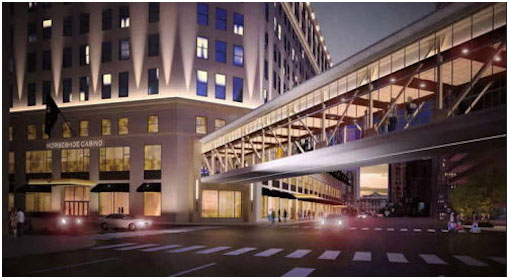

    Why is Gilbert going all anti-urban in Cleveland, then? In a word: money, as Moody’s just issued a report saying a walkway would help the casino reach predicted income streams, as it has been underperforming. Obviously casino ownership is a no frills money-making operation, as is real estate. With each: immediate financial return trumps the nurturing of human and community capital to support a vision of long-term economic growth.

    But Detroit Dan is different, right? He is a walkability guru’s guru. One of the “enlightened developers” as was stated above.

    Well, you be the judge. Here’s a blog post excerpt covering the recent Placemaking Leadership Council hosted in Detroit, with Detroit 2.0 taking center stage.

    Dan Gilbert, head of Rock Ventures and Quicken Loans, genuinely seemed to defer to Kent [the Project for Public Spaces head] when it came to his part of the presentation Thursday. Gilbert, who has millions of hours of public-speaking practice behind him, often turned to Kent to fill in the details on the upcoming renovations to Campus Martius, Cadillac Square, Capitol Park, Grand Circus Park and Paradise Valley.

    “Genuinely seemed to defer” is right. Or just bored as hell.

    And then there is this. This. Courtesy of a Curbed Detroit blog post called “Development In Downtown Detroit Is Playing Out Like A Huff Po Blog Post From 2009”. The referenced Huffington Post piece is by Detroiter Toby Barlow that is called “How a Billionaire Can Make a Billion Dollars”. The strategy? Buy Detroit, not “metaphorically” but “literally”, yet do it “very quietly, so as not to inflate any prices”. Then, according to Barlow, since a billionaire owns thing, he moves his employees to his buildings and gives them “incentives to live down near their work so that they’ll buy your residential property”. Barlow concludes:

    So, I don’t have to spell out the rest, do I? Real estate values will quickly soar as other companies, encouraged by your brazen move, make similar leaps into what will still be an incredibly affordable market. The momentum will build as the ever-frenzied media piles on.

    Yes, Detroit’s plan for the future pre-dated by a Huff Po blog entry from 2009.

    The big revelation here?

    Look, in the end, the Dan Gilbert’s of the world are in their line of work for one reason and one reason only: to make money. They will don whatever mask they need to play the part, be it the urban-loving Jekyll or the anti-urban Hyde. That’s the problem with creative class urbanism. It is dependent on developers who could care less. It is a means to an end for those who implement it.

    Too bad this end is not the beginning of a true path forward for a real Rust Belt recovery.

    Detroiters, like most Rust Belters, have been through enough. They deserve better.

    Richey Piiparinen is a writer and policy researcher based in Cleveland. He is co-editor of Rust Belt Chic: The Cleveland Anthology. Read more from him at his blog and at Rust Belt Chic.
  • Megacities And The Density Delusion: Why More People Doesn’t Equal More Wealth

    Perhaps no idea is more widely accepted among urban core theorists than the notion that higher population densities lead to more productivity and sustainable economic growth. Yet upon examination, there are less than compelling moorings for the beliefs of what Pittsburgh blogger Jim Russell calls “the density cult,” whose adherents include many planners and urban land speculators.

    Let’s start at the top of the urban food chain, the world’s 28 megacities of over 10 million people (which we are defining as areas of continuous urban development, incorporating suburbs and satellite communities). Is greater density the key to great prosperity? For the most part, the world’s densest megacities are the poorest. Take the densest, the Bangladeshi capital of Dhaka. Its 14 million residents are squeezed into an area of 125 square miles, making for a population density of 115,000 per square mile, as reported in the latest edition of Demographia World Urban Areas (which includes estimates for all known urban areas in the world with at least 500,000 residents). Dhaka’s per capita gross domestic product, $3,100, is the lowest of all the world’s megacities.

    Three other megacities — Mumbai, Karachi, Delhi — have population densities that are between three to seven times as high as the biggest megacity, Tokyo-Yokohama, which has a density of 11,000 per square mile. Tokyo is also much richer; the region’s per capita GDP tops $41,100, while the three ultra-crowded metropolises on the subcontinent have GDPs under $10,000 per capita. In contrast the two most spread out megacities, Los Angeles and New York, have population densities about half or less of Tokyo’s, but their per capita GDPs rank number rank first and third ($63,100 in New York and $54,400 in Los Angeles).

    Do any dense metropolitan areas boast higher GDPs? Seoul-Incheon, South Korea, packs more than 20 million people into an area roughly a quarter of Tokyo’s and at a density four times that of Los Angeles. Its per capita GDP, at $32,200, is the highest among the 10 most dense megacities. Paris, which is twice as dense as New York and 50% more dense than Los Angeles, stands at $53,900. (Yes, Los Angeles is denser than New York — despite its small central core, L.A. lacks the wide stretches of bucolic suburbia common in eastern cities).

    This imperfect, if not inverse, relationship between density and wealth is widely ignored by most urban core boosters, many of whom argue that packing people together is the true key to economic growth. But more often than not, notes Russell, the objective is aggrandizing the “creative class” — those who tend to settle in dense urban cores and also work in industries that do best there, but with little positive for everyone else.

    Many retro-urban theorists maintain that high density is the key to urban prosperity. These theorists often point for justification to Santa Fe Institute research that, they claim, links productivity with density. Yet in reality it does nothing of the kind. Instead the study emphasizes that population size, not compactness, is the decisive factor.

    Size does matter. A region is helped by the infrastructure that generally comes only with a large population, for example airports. But being big does not mean being dense. In fact the U.S. cities that made the largest gains in GDP  in 2011 — Houston, Dallas-Fort Worth and greater Detroit — are not dense cities at all.

    Some of the metropolitan regions that have the highest per capita GDPs in the world based on purchasing power are not particularly dense. The two regions at the top — Hartford, Conn. and San Jose, Calif., — are if anything largely suburban in character. Neither has a strong central core, and most of the jobs in the areas are on the periphery.

    These areas are marked by everything that density advocates detest: They have very low levels of transit ridership and are largely dominated by single-family homes. The most affluent, Hartford, has among the lowest urban population densities in the world. It turns out that our low-density, “sprawling” metropolitan areas do very well in terms of wealth creation. Of the top 10 urban regions in the world in terms of GDP per capita all but one — Abu Dhabi in the United Arab Emirates — are located inside the United States.

    There are many thriving American urban areas with densities below the U.S. average for large urban areas.This includes not only Hartford, but also Boston, Durham, Seattle and Houston. Indeed, smaller, low-density Des Moines nearly broke into the top 10 (13th), reflective of the economic gains being made in the Great Plains.

    We may think, for example, of Boston, which ranks fifth in the world in per capita GDP, as a tightly packed urban area. But once one gets behind the relatively small urban core, the overall density is barely 2,200 per square mile, less than half San Jose or Los Angeles, hardly a fifth that of Tokyo and not much more than Atlanta, the least dense major city in the world with more than 2.5 million residents.

    Why is this the case? One key reason is that cities, as they evolve, naturally spread out. As New York University’s Shlomo Angel has pointed out, virtually all major cities in the world are growing more outward than inward, and becoming less dense in the process. This is not only true in the United States, but also in Europe and, even more surprisingly developing countries as well. For example, over the past four decades, everyone’s favorite dense core city, Paris, has seen its urban land area expand 55%, while its population has risen only 21%. Today, the geographical extent of urban Paris is more than 25 times that of the ville de Paris, home to most of the familiar tourist attractions.

    In some ascendant countries, notably China, American-style suburbs are being duplicated; and when Chinese and other Asians immigrate, they tend to move to lower-density suburban areas. The only exceptions have been cities where development has been distorted by ideology, such as Moscow before the fall of the Soviet Union, notes Alain Bertaud, a former principal planner World Bank.

    The reason for moving outward may be lost on theorists and their real estate backers, but they remain compelling for many people, particularly families. A national association of realtors survey in 2011 found that roughly 8o% of adults prefer to live in detached single-family houses while only 8% preferred an apartment. It is thus not surprising that the suburbs, which abound in detached housing, contain nearly three-quarters of America’s major metropolitan population or that areas outside the urban core accounted for 99% of growth between 2000 and 2010.

    For the most part, this suggest the population, for the most part, will continue to seek out the periphery. This is not only true, as NYU’s Angel points out, in the United States or in similar countries such as Australia or Canada. As people seek out more affordable and larger housing, they tend to spread out from their historic cores. It happens most decisively in wealthy areas that are also land-rich.

    This is not to say that the higher-density enclaves of urban areas do not have an important place. In terms of culture, finance, media and certain other transaction-based industries, a number of dense urban cores remain unassailable in their efficiency and appeal. But in the United States, and much of the rest of the high-income world, this is accomplished by bringing residents from the periphery to the core — by car, train, bus and increasingly through telecommunications, even as most jobs are located elsewhere in the urban area.

    The future shape of the city is likely to continue expanding, even as some urban cores grow. Visit any burgeoning city in the developing world from Shanghai to Mexico City and the same reality emerges: as cities get larger, they spread out, as people begin to aspire, as best they can, for the quality of life that most North Americans and Europeans already take for granted.

    Joel Kotkin is executive editor of NewGeography.com and a distinguished presidential fellow in urban futures at Chapman University, and a member of the editorial board of the Orange County Register. He is author of The City: A Global History and The Next Hundred Million: America in 2050. His most recent study, The Rise of Postfamilialism, has been widely discussed and distributed internationally. He lives in Los Angeles, CA.

    This piece originally appeared at Forbes.com.

    Dhaka photo by wiki commons user BL2593.

  • Density Boondoggles

    Is it density or migration? Venture capitalist Brad Feld weighs in:

    The cities that have the most movement in and out of them are the most vibrant.

    The densest city in the world won’t be as vibrant as the city with the most talent churn. Yet planners and urbanists tout the former over the latter. We’ve reached the point of density for the sake of density. It is an end instead of a means to an end. The art of the density boondoggle:

    The following is the conversation held at every regional summit on Long Island:

    Advocate: Let’s keep our young people from leaving! There’s a…brain drain!

    Public: How do we stop it?

    Developer: Build denser housing! Let’s make it…affordable! Walkable! Let’s make it…mixed-use sustainable smart growth…with a downtown, pedestrian-friendly feel.

    Municipality: Development approved!

    What’s the question? Greater density is the answer. It will plug the brain drain. I promise. But plugging the brain drain will reduce talent churn. Long Island will be less vibrant.

    There is a name for the Cult of Density. It now has its very own -ism. All hail Vancouverism:

    Vancouverism is, at the root, a movement to go from low density, to higher density, to make Canadian and North American cities about people once again.

    Making cities all about people sounds great. All I hear is the chant of the Underpants Gnomes:

    Phase 1: Create a cool city.
    Phase 2: ?
    Phase 3: Retain talent.

    That will be $500,000. Thank you for your patronage, Memphis. Consulting is fun!

    Development approved. That’s the story line playing out in downtown Las Vegas with Zappos. Density is king. Don’t listen to Brad Feld. Talent churn doesn’t matter.

    If Vancouverism were harmless, then I wouldn’t blog about it. The misplaced emphasis on density has negative impacts. Vancouver is more about people, those who are young, single and college-educated:

    ‘Revitalizing,’ but leaving seniors behind

    Last July, Vancouver city council unanimously approved a three-year Chinatown Neighbourhood Plan and Economic Revitalization Strategy. More than a decade in the making, the plan focused on economic revitalization, after two-thirds of businesses surveyed in Vancouver’s original Chinatown reported declining revenues between 2008 and 2011 — blamed mainly on losses to newer Chinese-language communities in suburbs like Richmond.

    The revitalization plan envisions new residential development, "to connect with younger generations and reach out to people of all backgrounds to ensure Chinatown is increasingly relevant to a more multi-cultural Vancouver." At the same time, it acknowledged that in a neighborhood where 67 per cent of households are low-income — more than twice the City of Vancouver average — such redevelopment "can displace low-income residents." What is good for old Chinatown’s businesses, in short, may be less so for its poor and isolated elderly.

    S.U.C.C.E.S.S., Vancouver’s primary provider of culturally- and linguistically-supportive housing and services for Chinese seniors, is providing a partial answer. It operates a single multi-level care facility in old Chinatown for people with cognitive impairments or who require round-the-clock nursing. But its 103 beds, soon to be 113, are about one-tenth of what the UBC Centre for Urban Economics anticipates will be needed over the next 15 years to house Chinese seniors.

    Meanwhile, the support it offers seem a world away from Rosesari and her neighbours living in privately operated SROs like the May Wah Hotel. Yet the women are spirited and resilient. "I’m happy and I’m healthy," Rosesari told me through Pang’s interpretation. Both she and Lin say they like living in Chinatown. They feel at home here, where the language spoken is the one they know.

    They are also in their 90s. As time goes on, they and others may no longer be able to manage the May Wah’s staircases, its lack of mobility aids, and its communal bathing facilities. The alternatives available to them then are in terribly short supply.

    Welcome to the dark side of the obsession with wants and needs of the Creative Class. Vancouverism is boutique urbanism, catering to a specific demographic at the exclusion of all others. People are either displaced or fall into the cracks. Bike lanes and food trucks trump the needs of seniors.

    Jim Russell is a talent geographer with particular interest in the Rust Belt. Read his blog at Burgh Diaspora, where this piece originally appeared.

    Downtown Vancouver photo by runningclouds

  • CEO Bonuses: Who Pays the Price?

    Because so many chief executives of failed or mediocre companies have walked away with millions in bonuses and swag bags, both Switzerland and the European Union recently voted to put a cap on corporate bonuses, limiting them to a small multiple of base salary. What prompted the acceptance of the “Minder Initiative”—named after the independent parliamentarian who sponsored the referendum — is a string of stunning business losses that had no affect on the bonuses paid to the sitting executives.

    Swissair went bankrupt in 2001, although not before it could pay out a $10 million bonus to its grounded chairman. The chief executive of the Swiss pharmaceutical giant, Novartis, was recently offered a $78 million sendoff. The Swiss bank, UBS AG, appears regularly in the headlines as the poster-child of bad loans ($40 billion absorbed by the government), LIBOR rate rigging ($1.5 billion in fines), and other dim practices (a so-called rogue trader lost $2.3 billion in London), although the losses are never enough to drain the bonus pool.

    The architect that turned the once-staid UBS into an off-track betting parlor, chairman Marcel Ospel, regularly paid himself CHF (Swiss Francs) 24 million in annual salary, something that Swiss voters had in mind, along with the Novartis proposal, when casting their votes with Minder. After the vote, UBS quietly offered an incoming executive a $28 million sign-on bonus — something the law, when enacted, will prohibit.

    In the US, corporate activists and some regulators want shareholders to have a “say on pay” of the top CEOs, or for Congress to tax away paycheck windfalls. So far, most reforms have been non-binding.

    Members of the business community, nevertheless, resent the intrusion of state or federal bureaucracies into their corner offices. In their minds, salaries are best left to compensation committees and captive boards of directors, which are free to rain money on a handful of senior executives, some of whom are chairmen of the same boards that dole out their pay.

    According to the latest estimate, Fortune 500 CEOs have to scrape by with compensation that averages $12 million a year and that is 380 times the pay of the average worker. In 1965, this ratio stood at 24 times and in 1990 it was 71 times.

    Meanwhile, real American wages have been declining since 1974, and per capita average income in the country is about $27,000, just above the poverty line of $21,000. The median income for American households is about $50,000 a year. The reason most American corporations reward senior management and stiff the rest of the work force is because many public companies are little different from banana republics.

    In theory, the shareholders elect the board, and the board watches their interests, a mandate that includes signing off on the top salaries. In practice, shareholders, even big ones, have little say in who is put on the board, especially if the CEO is also chairman. In those cases, board members serve at the whim of the same CEO. Often such an approval rating depends on voting the prince a big salary, along with big bonuses and stock options.

    Under the new Swiss law and other corporate reform proposals, shareholders are given the right to approve the top pay packages in a company. This sounds democratic enough, except that most corporate proxy votes turn out results that would be familiar to commissars in the Soviet Union.

    One reason is that many mutual and pension funds, which own the large positions in many public companies, are required by charter to vote with management or, if they disagree, to sell the positions. It’s unusual for a large institutional shareholder to both hold on to a position and vote against management. So letting shareholders approve top compensation will not keep managers from pocketing $50 million pay envelopes.

    The usual justification for multimillion-dollar rewards is that the company has performed well “in the market” or “exceeded the budget forecasts.” Of course, meeting such a benchmark explains a bonus of $250,000, not necessarily one of $20 million. Yes, the CEO has responsibilities and “duties of care,” but if the board were to auction off the position of CEO in most companies, it’s likely that they would find many qualified takers for $1 million a year.

    The truism about salaries—“You don’t get what you deserve; you get what you negotiate”—does not apply to the C-suite, which gets what the board is dumb enough to give away almost blindly. They go along with the lavish payouts based on similar compensation paid by competitors.

    Because of this mutual-remuneration self-congratulatory circle, salaries have skyrocketed, even if stock prices have remained flat or plummeted. General Electric’s CEO has earned $54 million in the past five years, while the company’s stock went from $37 to $7 and back up to $23 a share. As the Death of Salesman line goes, “No man only needs a little salary.”

    Ex-Treasury Secretary Robert Rubin pulled down $126 million from 1999 to 2009 as a top Citigroup senior executive, but when it went bust said that he had no responsibility for the bank’s creditworthiness. He confessed, “My great regret is that I and so many of us who have been involved in this industry for so long did not recognize the serious possibility of the extreme circumstances that the financial system faces today.” But he didn’t give back any of the money. Rubin’s boss, Charles Prince, left the chairmanship of Citi with about $80 million in his pockets, even though the company went to the wall the moment he was out the door.

    The goal should not be just to limit CEO pay, but to increase average wages and salaries, and think of increasing the dividend, especially in companies eager to throw millions at the boss. Stock options and profit sharing could be allocated equally to all employees, and not simply reserved as corner-suite perks.

    Likewise, cumulative voting of board directors allows smaller blocks of shareholders to elect a representative (you put all of your votes on one candidate).

    Many top CEOs live in a bubble of private jets and pillowed suites, and are accountable to only a handful of cronies—certainly not the vote of the employees or the shareholders. They thrive in the cozy confines of oligopoly — think of a golf club lounge — in which a corporation’s success is due only to the top managers, not to the shareholders’ capital or to the workers.

    Why not have a companywide plebiscite on the chief executive every two years? The Greeks knew that war was too important to be left to the generals, and had their soldiers elect them.

    Employees, pensioners and shareholders all ought to have seats at the table. The Chinese garment workers in sweat shops who stitch together all those sailor suits that are sold at vast markups might be less inclined to pay Ralph Lauren $66 million a year than the board in New York would.

    Minder’s law and its clones in the EU or, were legislation to come about, in the US, won’t solve the problem on their own. Rather than passing legislation that sounds good in the headlines (The Economist: “Fixing the Fat Cats”) but achieves little reform at the office, the most significant recovery for the ransoms paid to many senior executives would be to overhaul how boards of directors are established and operated — to make them legally accountable for the company’s performance and representative of all stakeholders, including the work force. Keep in mind that when salesman Willy Loman asked for a golden parachute, he only needed fifty dollars “to set his table.”

    Flickr photo by World Affairs Council of Philadelphia: Former Citigroup Director and executive Robert Rubin. Is that the size of his bonus?

    Matthew Stevenson, a contributing editor of Harper’s Magazine, is the author of Remembering the Twentieth Century Limited, a collection of historical travel essays. His next book is Whistle-Stopping America.

  • U.S. Could be Courting Trouble in Europe

    One of the most fascinating aspects of Barack Obama’s presidency stems not so much from his racial background, but his status as America’s first clearly post-European, anti-colonialist leader. Yet, after announcing his historic "pivot" to vibrant Asia, the president, the son of an anti-British Kenyan activist, recently announced as his latest foreign policy initiative an economic alliance with, of all places, a declining, and increasingly decadent, Europe.

    Some analysts, such as Walter Russell Mead, suggest the possible "ratting out" of the new Asia focus could constitute "a mistake of historic proportions." In East Asia, leaders, from Vietnam and Singapore to Japan, have been counting on a strong U.S. presence to ward off Chinese hegemony in the region. The idea of a reduced naval presence and a weakening commitment to allies would undermine our influence in this increasingly critical economic region.

    At the same time, the president’s desire to integrate our economies more closely to that of Europe reflects a longtime prejudice within the Democratic Party favorable to the old Continent. The notion of a new trade tie to the European Union set longtime Eastern policy types, such as former Bill Clinton aide and onetime Woodrow Wilson School head Anne-Marie Slaughter into rhapsodies about an emerging new "Atlantic Century." Vice President Joe Biden, for his part, told a recent Munich security conference that Europe represents "the cornerstone of our engagement with the rest of the world."

    This is delusional, to say the least. Republicans have their faults, but at least they know how to tell historic time. In contrast, largely Democratic Europhiles simply want to relive the glorious past, and consume a legacy of affluence. And to be sure, generally it’s more pleasant to attend – as long as someone is paying the bill – a conference in London, Paris or Zurich than Beijing, Mumbai or Mexico City. Europe, as we know from the debates over compensation of EU bureaucrats, knows how to treat functionaries with the comfort to which they easily can become accustomed.

    Pumping for greater Euro-ties seems almost insane under current conditions. The Continent’s unemployment rate, nearly 12 percent among the 17 EU member countries, is already at record levels, and its younger generation suffers unemployment approaching 30 percent or higher in at least five EU countries, including Greece, Spain and France. In Portugal, 2 percent of the population has migrated just in the past two years, not only to Northern Europe but, amazingly, also to Portugal’s booming former African colonies.

    This does not seem to be setting up the prime conditions for Ms. Slaughter’s imagined new "Atlantic Century." Although North America retains the resources, demographics and innovative culture to compete with Asia and other rising powers, Europe is in a notably downward trajectory. Its share of the world economy has plummeted from nearly 40 percent in 1900 to 27 percent today and continues to shrink rapidly. By 2050, not only the United States, but China and the rest of the developing world, according to the European Commission, will have surpassed the total of the 27 countries in the EU.

    One has to be a cockeyed optimist not to see that the long-term prognosis, even without the current euro crisis, is not good. Manufacturing, long a Continental bastion, is weak and falling behind that of the U.S. as well as Asia. German engineering may still be first-class, but much of the production and design will be moving to Mexico, the U.S., Latin America and Asia.

    Energy may prove a particular vulnerability. Although the region has shale and other energy resources, greens are far more powerful in Europe than in America and hostile to the hydraulic fracking that has created the current U.S. boom in oil and gas. The combination of radical green policies favoring expensive, often unreliable renewables, as well the shuttering of the Continent’s once-strong nuclear industries, are creating both high prices and wobbly reliability of electricity supplies. (Ironically, the reluctance to maintain nuclear power and oppose fracking for natural gas has led to a rise in greenhouse gas emissions and even some increased use of coal.) Tulane’s Eric Smith suggests many of Germany’s manufacturing powers are intensifying efforts to shift operations, notably to the southern United States, for cheap electricity and lower overall costs.

    Demographics, however, may be Europe’s weakest suit. Although East Asia is now experiencing low fertility, Europe has been demographically stagnant for at least a generation longer. By 2050, Europe’s workforce is expected to decline by 25 percent from 2000 levels; the U.S. is expected to see expansion of upward of 40 percent.

    This phenomenon threatens Europe’s lone serious economic power, Germany. The country now produces fewer children than in 1900. Given the expansive welfare state, the fiscal burdens being faced in Germany and other EU countries will dwarf those of the United States; by 2050 Germany will have nearly twice as many retirees per active worker as America.

    Yet remarkably, for all its manifest failings, Europe remains a Mecca and role model for many American progressives, like Ms. Slaughter. The past decade has seen the publication of a spate of books, such as Jeremy Rifkin’s "The European Dream" and Steven Hill’s "Europe’s Promise," that see Europe’s regulation state and "soft power" an alluring alternative to America. Some hail the EU as the prototype of a benign "new kind of empire" based on culture and pacifism.

    If so, it’s an empire rapidly hurtling into its dotage. The great European historian Walter Lacquer has pointed out that such optimism about the Continent becoming "united and prosperous" is likely "misplaced." In policy terms, for the U.S. to follow Europe’s model is an almost sure recipe for our own decline. Even the usually pro-free-trade Wall Street Journal is concerned that any attempt to "harmonize" American policies with those of the "European model" will simply expand government power and bureaucratic hegemony.

    To be sure, there remain parts of Europe, particularly in the Northern rim, that are doing better. These countries – the Netherlands, Scandinavia and Germany – have enacted significant labor market reforms, retain some strong industries and have tried to be responsible fiscally. If they broke off from the EU and set up a modern-day Hanseatic League, it may make sense for us to embrace stronger ties with them. But that can’t be said of an alliance with the weak sisters of the EU’s southern and eastern fringes, or even dirigiste state-dominated France.

    In reality, the EU will never become a giant Sweden. Scandinavia possesses a unique history, shaped by massive outmigration in the past century and a largely homogeneous population; many of these countries possess great natural resources, such as oil, iron ore or hydroelectricity. In contrast, the eastern edge of the zone contains some of the most depopulating parts of the planet, as people seek opportunities in the more economically viable North. The comic political economy of Italy, the political violence of Greece and the mass disenchantment of Spain presage a European future that contrasts greatly with the relative prosperity and order of the North.

    None of this suggests that, if the political strings are not wound too tight, that a free-trading arrangement with Europe may prove useful. But if an agreement becomes a wedge for accelerating the adoption of Euro-style policies, it could allow us to squander an opportunity to maintain our pre-eminence in the post-colonial, and post-European-centered, world.

    Joel Kotkin is executive editor of NewGeography.com and a distinguished presidential fellow in urban futures at Chapman University, and a member of the editorial board of the Orange County Register. He is author of The City: A Global History and The Next Hundred Million: America in 2050. His most recent study, The Rise of Postfamilialism, has been widely discussed and distributed internationally. He lives in Los Angeles, CA.

    This piece originally appeared in the Orange County Register.

  • What Killed Downtown?

    What Killed Downtown?: Norristown, Pennsylvania, from Main Street to the Malls
    by Michael E. Tolle

    For those of us who have grown dyspeptic on the over-indulged topic of the collapse of the American city center, Michael Tolle’s What Killed Downtown? Norristown, Pennsylvania, from Main Street to the Malls earns much of its anodyne appeal by straying from a commonly accepted convention in urban studies—that an analysis of the socioeconomic decline of a community should draw heavily upon socioeconomic variables. Isn’t there another way to get the point across? And more importantly, aren’t there other contributing factors?

    This compassionate narrative of the 20th century rise and fall of an older Philadelphia suburb avoids graphs and charts for the most part, becoming much more engaging for its alternative approach. And likeability is exactly what it will need to win over skeptics, or the merely apathetic, because most people in the US probably have never heard of Norristown. In fact, it’s likely that quite a few people on the other side of the Keystone State aren’t familiar with it either. After all, the borough at its 1960 peak only had 39,000 inhabitants (the 2010 Census records a population of 34,000). But Norristown merits further observation, not so much because its downtown has declined in the mid-20th century—that happened everywhere, in municipalities of all sizes—but because Norristown sits squarely in the middle of Montgomery County, an expansive bedroom community of Philadelphia with 800,000 people and a median household income of over $78,000, placing it within the top 100 wealthiest counties in the nation. Meanwhile, Norristown’s median household income, according to the latest Census, is approximately $43,000 and its poverty level of 16.4% is almost triple that of the county’s 5.7%, and still a fair amount higher than the state’s rate of 12.6%. While Montgomery County boomed over the last half century, Norristown has not shared in that prosperity. It is by no means a devastated town—many old neighborhoods remain charming and fully intact—but the commercial heart of Norristown has never healed.

    The above paragraph contains a higher concentration of raw data than one should ever expect to encounter in Tolle’s new book. Rather than delving into the Bureau of Labor Statistics, the US Census Bureau, or rankings from Urban Land Institute or the Brookings Institution, Tolle manages to chronicle the rapid ascent of this suburban outpost, its 75-year dominion over commercial activity within the county, and its precipitous decline shortly after the Second World War—and he achieves it through a diligent perusal of old city directories, interviews with almost two dozen of Norristown’s older citizenry, and a vigorous exploration of the internal machinations of the Borough Council. He applies an anthropologist’s lens to a subject that sociologists have long overcrowded.

    While Norristown’s early history—first as a manor under one of William Penn’s initial surveys, followed by a subdivision into smaller farms by Isaac Norris in 1712—is clearly never the focal point for Tolle’s methodical dissection of downtown, he avoids glossing over it. Not surprisingly, Norristown emerged as the most desirable plot of land in the sprawling manor because of its accessibility: it abutted the “canoeable part of the Schuylkill” and the interconnected American Indian trails that allowed for easy fording of the river. By 1784, the Pennsylvania Assembly carved Montgomery County out of the existing Philadelphia County, and a subsequent deed conveyed lots reserved for county buildings at the intersection of two of the only extant roads at the time. Due to its advantageous location, it became a nearly self-sufficient Town of Norris within a few years, abiding by Penn’s “Town Model” for Philadelphia and other Pennsylvania cities, employing tightly organized, gridded streets that maximized uses of available space. The construction of some of the earliest turnpikes helped to stimulate the town’s steady growth and prepare it for its incorporation as a borough of 520 acres in 1812, followed shortly thereafter by the rail networks that galvanized further expansion.


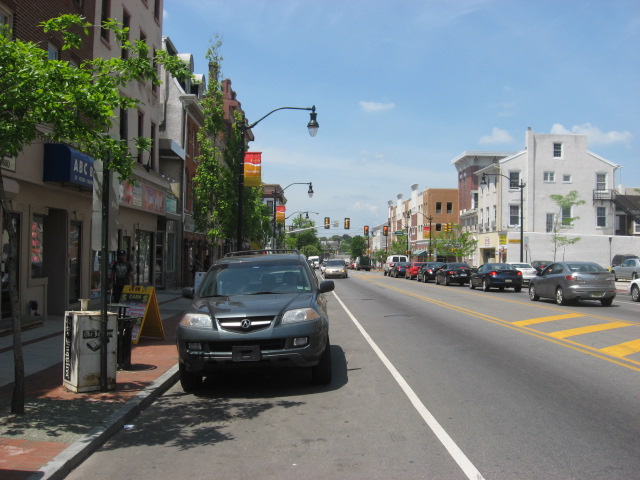
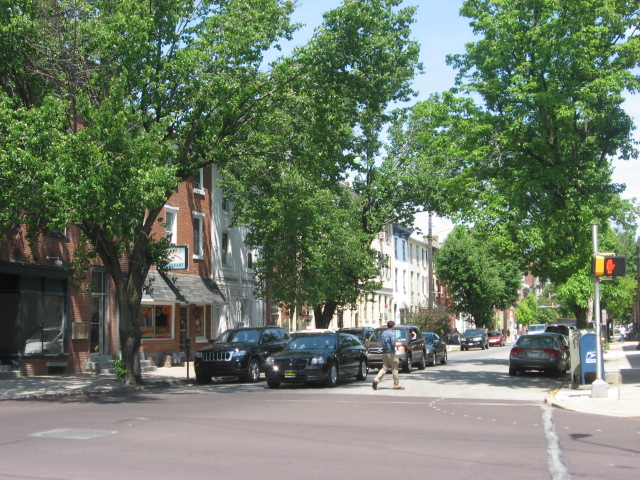
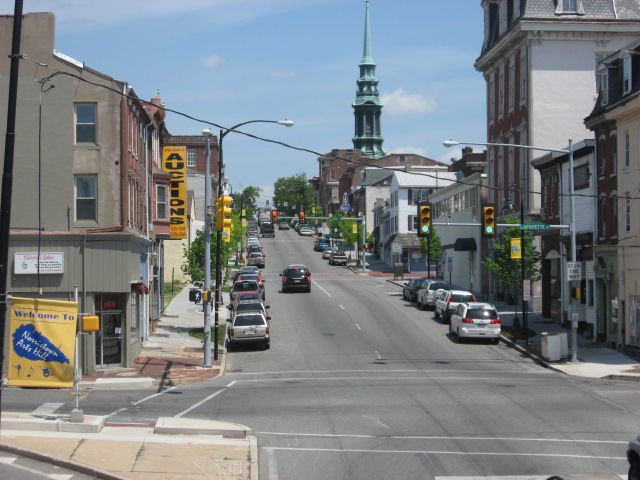
    Swede Street just north of Main Street, known by some as Lawyers’ Row. Photo from Spring 2011, courtesy of Matthew Edmond.

    The early chapters of the book may only provide a backdrop for Norristown’s 20th century rise and fall, but Tolle chronologically accounts for the factors that helped Norristown emerge as the primary urban center in Montgomery County. And unlike neighboring 19th century boomtowns that dot both the Delaware and Schuylkill Valleys, Norristown “lacked the characteristics that define similar towns of sufficient size and influence that could easily explain the downtown’s decline. . . [It] was never a one-company town. It was never dependent on [a] single employer whose corporate fate might have led it to a catastrophic domino effect; rather Norristown’s workforce has always been distributed among many workplaces.” It owed much of its steady growth to its fortuitous location 17 miles northwest of Philadelphia, the convergence of several modes of transportation, and its role as the administrative center of a large and increasingly prominent county.

    By the book’s twentieth page, Tolle reveals the real heart of his study: the bustling commercial core of Norristown’s six-block Main Street. At the borough’s Centennial Celebration, population approached 30,000, swelling largely from immigrants who arrived to work in various industries: first the northern European Protestants, then the Irish, then, in by far the highest concentration, the Italians, overwhelmingly from Sicily. Mennonites, Amish, and Jews (predominantly of German heritage) along with African Americans arrived in smaller numbers. While the population self-segregated along largely ethnic and economic lines (working and lower-middle class Protestants on the West End; the wealthy, Northern European original settlers in the North End and DeKalb Street; Italians and African Americans in the blue-collar East End), all the strata converged along Main Street’s densely commercialized blocks. Tolle explores the full week’s worth of celebratory activities, from the details of the floats in the Industrial Day parade to overhead weave of flags, bunting, and electrical wires. The pace of the narrative slows at this point, but Tolle employs a humanism that he retains across the ensuing pages. When he intermittently bogs down in relentless detail, he’s easily forgivable—even a little admirable for not shying away from his obsessions.


    A view of DeKalb Street, Norristown’s most affluent residential address, from its southern junction with Main Street. This was once the center of commercial activity in the borough. Tolle details the controversy of the implementation of the Comprehensive Plan to make DeKalb Street one-way northbound in 1951, a restriction which remains today. Photo from Spring 2011, courtesy of Matthew Edmond.

    The Directory of the Boroughs of Norristown and Bridgeport, Montgomery County, Pa, for the years 1860-1861 serves as the bedrock for his chronological exploration of the commercial health of downtown Norristown. For some of the most resilient businesses—Chatlin’s Department Store, Egolf’s Furniture, Zummo’s Hardware—Tolle offers vignettes on their immigrant backgrounds and the financial maneuvering necessary to start their trades. Interspersed with these brief accounts are updates from subsequent City Directories, chronicling the change in business composition over time. But Tolle generally eschews tables and charts—with few exceptions, he narrates the changing commercial landscape of Norristown by integrating the livelihoods of the proprietors with the demands of the consumers. Because the authorial voice depends so heavily on firsthand accounts of the business climate—articles from the Norristown Times Herald, advertisements (including misspellings and solecisms), and, in the later years, eyewitness accounts—the routine references to City Directory data never grow stuffy or monotonous.


    What Killed Downtown? is a concatenation of anecdotes. While such an indulgence in human-interest nostalgia could take a maudlin turn, Tolle again counterbalances these episodes with moments of acerbic subjectivity, as any conscientious anthropologist cannot help but do. My two favorite anecdotes feature a building and a person. The Valley Forge Hotel emerged in the roaring 1920s, purely driven by the local business community, who felt that the proud city demanded a first-class hotel. A stock subscription campaign raised enough to complete the massive six-story brick structure by November of 1925. Though it rarely made a profit, its size and relative opulence made it an icon for the city, and as an emblem of civic pride, it succeeded. The other great anecdote involves the detailed account of the life of the city’s most colorful politician, the recalcitrant Paul Santangelo. Lacking greater aspirations than borough administration, Santangelo earns more ink on these pages than any other civic leader, including the mayors. He fiercely defended the interests of the poorer Sicilian immigrants who comprised much of his district, voting ferociously in their favor but often—in Tolle’s opinion—at the expense of city progress as a whole.


    Norristown Main Street, west of Swede Street and looking westward. Photo from Spring 2011, courtesy of Matthew Edmond.

    Tolle’s account of Norristown’s Main Street after its 1950 apex avoids mind-numbing predictability even has he identifies the usual culprits contributing to its decline: growing dependence on the automobile, competition from suburban shopping plazas like the now-mammoth King of Prussia, shift of the population center toward the far-southern part of Montgomery County, construction of limited access highways outside of the borough’s limits. And of course, all these factors converge with the suburban amenity that wounds Norristown the most: “free, ample parking”—a mantra which Tolle repeats enough that it tacitly answers the question to his book’s title. Anyone with a scintilla of knowledge of American urbanism will know where this is headed. But by the1950s, Tolle reaches a point in time where procures firsthand accounts of Main Street’s changes. The worm’s-eye view continues, imbuing the narrative of Norristown’s saddest days—by the 1970s it is not safe to walk Main Street at night—with empathy and hope.


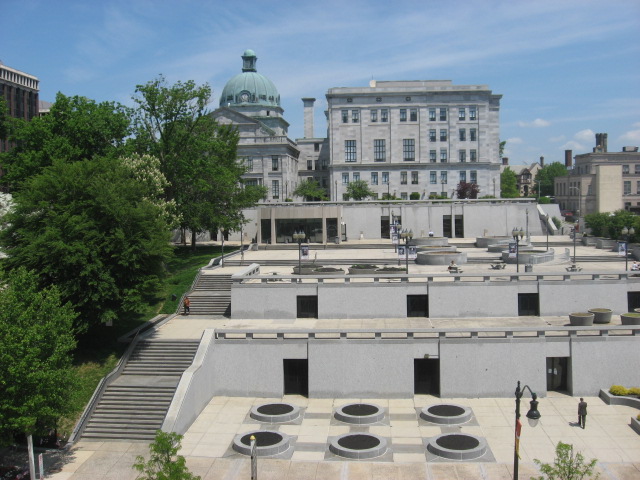
    Courthouse Plaza along Main Street, one of many mid-century projects that removed commercial buildings and replaced them with staid, largely unused civic space. Photo from Spring 2011, courtesy of Matthew Edmond.

    For a person as enamored by details as me, Tolle’s worm’s-eye view never really grows old, even when he’s a fussbudget over counts of shuttered storefronts from year to year. At the same time, this intricate approach to an already small subject could easily undermine the ability for What Killed Downtown? to find a broad audience. What happens to a little-known suburban city can hardly resonate as much as if he had explored the devolution of downtown Philadelphia—or even Allentown or Erie. The fixation on downtown storefronts—at the expense of geographic context—firmly ensconces the book in the “local interest” category. His 250-page narrative rarely explores impacts on Norristown Main Street outside of Montgomery County. From an early point in the book, he describes street intersections with specificity that would only mean anything to a local; then he only provides two referential maps.

    None of these cavils really amount to an inherent weakness of the book—after all, it might prove just the right medicine for Tolle’s fellow Norristowners. But the narrowness of scope does foretell an oversight as to the broader implications for this city’s decline, which could have made for a much bolder peroration than the one the book currently provides. The only atypical bogeyman contributing to downtown Norristown’s precipitous decline is the persistent political gridlock and resultant incompetence of the Borough Council, which he relates with the same humanist eye he applies to his wonderful vignettes of immigrant entrepreneurialism. But Tolle had the chance to make this story matter on a scale that could mean something to someone from Ashtabula or Waukegan, and he spurned the opportunity.

    My knowledge of Philadelphia, having lived there for a time, gives me an unfair advantage, but I can’t help but ask a few questions. Norristown, the seat of wealthy Montgomery County, declined and its main street is moribund to this day. But Media, the much smaller seat of neighboring Delaware County, boasts a flourishing main street of local shops and restaurants—all despite the fact that Delaware County, while equally urbanized, is much less affluent than Montgomery County. Meanwhile, cities like Chester (also in Delaware County) and Camden, New Jersey can claim a similar lifespan to Norristown, strong transportation access, and an industrial boom. But today these two cities are not only among the most devastated municipalities in their respective states, Chester and Camden are among the poorest cities in the country. Perhaps most interestingly, after several decades of population decline, Norristown began to trend upward again in the 2000 census, and by the 2010 Census the city grew virtually 10%–an unprecedented occurrence for a city that still has the reputation of being the poorest place in its respective county.

    What Killed Downtown? remains a welcome contrast to countless other chronicles of downtown decline whose narratives depend on sociological detachment. Recognizing that true objectivity is impossible, Tolle instead depicts the Norristown transformation from the perspective of people who experienced it. Because its vision is geographically precise and obscure to people outside southeast Pennsylvania, I suspect our author felt driven to write it even if it enjoyed a readership of zero. Such an endeavor could reek of self-indulgence, but Michael Tolle’s opus has way too much empathy for that. Hopefully Norristown’s coterie of model train owners and newspaper collectors will put this book on their to-do lists—and then recommend it to others.

    Eric McAfee is a licensed urban planner currently working in emergency management. Though he hails from Indianapolis, his professional field grants him a certain degree of itinerancy, which he uses to his advantage to write about and photograph landscapes across the country in his blog, American Dirt. He lived and worked as a military planner in northern Afghanistan from 2010 to 2012, letting him fudge on the “American” aspect of his blog a little bit. In the past, Eric’s writing has won him Outstanding Paper in Real Estate at the University of Pennsylvania, as well as an outstanding research on housing award from the Joint Center for Housing Studies at Harvard University.  Aside from American Dirt, he has featured his writing on Urban Indy.com, Streetsblog.net, and Urbanophile.com. 

  • The Value of a Liberal Arts Education in Landing a Job

    North Carolina Gov. Pat McCrory made waves when he said on syndicated radio that he wants to encourage the funding of four-year programs that align with the job market — not those, like gender studies, that do little to help a graduate’s employment prospects.

    This was covered in a pointed column for The Wall Street Journal by Jane Shaw, the president of the John William Pope Center of Higher Education Policy in Raleigh, N.C. Shaw supports McCrory’s attempt to roil the higher education establishment and get students — heaven forbid — thinking about job prospects when they pick a major:

    Referring specifically to North Carolina’s 16-campus state university system, Mr. McCrory wondered if state funding incentives should encourage areas of study that align with the job market. Other disciplines, such as gender studies, Mr. McCrory said, might be subsidized less. The funding formula, he said perhaps a bit indelicately, should not be based on the number of “butts in seats, but how many of those butts can get jobs.”

    The education establishment immediately went bonkers. The pundits piled on. But Mr. McCrory raised a legitimate concern. And the solution he proposed, sketchy as it is at this stage, is not a bad one.

    The truth is: Elite universities, such as the University of North Carolina at Chapel Hill, are doing a disservice when they lead students into majors with few, if any, job prospects. Stating such truths doesn’t mean you’re antagonistic to the liberal arts.

    This discussion — and the one we contributed to last year after Viriginia Postrel’s column for Bloomberg — got us thinking: just how valuable is a liberal arts education in landing a job and contributing in the business world? Because EMSI works with so many community and technical colleges, we’re all for matching educational programs to in-demand fields. (In fact, we’ve developed a tool, Career Coach, that does just that.) For schools that specialize in offering associate’s and certificate programs, data-driven program assessment makes sense — and it helps students, colleges, and the regions that colleges serve.

    But what about universities like the University of North Carolina, which McCrory chose to use an example? It’s much trickier to link gender studies, history, or some other liberal arts degree to an actual career. But these graduates — in theory — are getting a more well-rounded education than they would get at a vocational school, and they should have the critical thinking, analytical, and writing skills valuable in the marketplace.

    Or do they?

    In criticizing American higher education institutions, Shaw writes, “Many liberal-arts graduates, even from the best schools, aren’t getting jobs in large part because they didn’t learn much in school. They can’t write or speak well or intelligently analyze what they read.” If this is the case, these students are bound to get a poor education regardless of what they major in.

    However, as Postrel mentioned in her column last year, the students who flow into well-regarded schools and the majors that result in well-paying jobs, like some STEM degrees, “have the aptitudes, attitudes, values and interests that draw them to those fields (which themselves vary greatly in content and current job prospects).” And as Anthony Carnevale at Georgetown showed in a study last year, the unemployment rate for graduates of certain scientific or technical fields isn’t any better, and sometimes it’s worse, than the rate for graduates who major in education or the humanities (see above chart).

    We looked at completions data from the National Center for Education Statistics to get a sense of the top educational programs for graduates from 2003 to 2011 among all award levels. First, here’s the top 10 programs in the U.S. Liberal arts comes in second — just under 50,000 completions short of business administration — while psychology, cosmetology, and general studies are also hugely popular.

    But what’s striking is to look at the same chart for North Carolina. Notice the huge growth in liberal arts degrees — from 4,111 in 2003 to 8,778 in 2011. And since the recession, the rate of students graduating in liberal arts fields has picked up, not slowed down like you might think.

    Based on this data, perhaps McCrory has a point. North Carolina has far outpaced the nation in terms of the proportion of liberal arts degree it awards. But the real question in this debate is, what kind of education are these students getting? If it’s as lousy as Shaw depicts, and if they’re not aggressively pursuing internships and other career-advancing opportunities while in school, many of these graduates are in for a tough time no matter what.

    Joshua Wright is an editor at EMSI, an Idaho-based economics firm that provides data and analysis to workforce boards, economic development agencies, higher education institutions, and the private sector. He manages the EMSI blog and is a freelance journalist. Contact him here.

    Lead illustration by Mark Beauchamp.

  • The Psychology of the Creative Class: Not as Creative as You Think

    “Innovation distinguishes between a leader and a follower”
    –Steve Jobs

    Behind every sociological movement is a psychology. The ever-growing creative classification of America is no different. The following teases the psychology of the movement apart.

    Why do this?

    Because it is needed. The costs of blindly acquiescing to copycat community building are too great. These costs are not simply aesthetic, even economic, but are costs in the ability to distinguish creativity from repetition, and ultimately: truth from fiction.

    Be Creative or Die

    “Anxiety is the dizziness of freedom”
    –Kierkegaard

    You may think creative classification—or the commoditization of cities as products to be consumed by creative people with means in the name of economic growth—begins with happiness. It doesn’t. It begins with anxiety. Writes Richard Florida on page 12 in The Rise of the Creative Class:

    [T]he September 11, 2001, tragedy and subsequent terrorist threats have caused Americans, particularly those in the Creative Class, to ask sobering questions about what really matters in our lives. What we are witnessing in America and across the world extends far beyond high-tech industry or any so-called New Economy: It is the emergence of a new society and a new culture — indeed a whole new way of life. It is these shifts that will prove to be the most enduring developments of our time. And they thrust hard questions upon us. For now that forces have been unleashed that allow us to pursue our desires, the question for each of us becomes: What do we really want?

    By tapping the defining moment of a generation of young people—a moment, mind you, defined by terror, insecurity, and “what if”— Florida begins his path to individual and societal progress from a point common to thinkers since the beginning of time, i.e., what does it all mean?

    In fact, if I was going to start a galvanizing societal theory, I’d begin there too, as uncertainty, if not fear, is a great motivator and catalyzer. Fearing failure, loneliness, meaninglessness, regret—it’s all fuel in the search for meaning, for life. And while this intrapersonal battle is stoked inside the individual, it becomes actualized in the world around us, not least in that relationship between a person and a place.

    Hence, the creative class credo: if you want to “live” you need to go to where the “action” is, else succumb to missing out. Such existentially-fueled place-pedestaling is perhaps the driving tenant of creative class urbanism. Writes Frank Bures:

    I know now that this was Florida’s true genius: He took our anxiety about place and turned it into a product. He found a way to capitalize on our nagging sense that there is always somewhere out there more creative, more fun, more diverse, more gay, and just plain better than the one where we happen to be.


    Courtesy of kenfager.com

    Of course many of us in “flyover country” can identify with this: our cities “suck”, and the lights of aspiration shine brighter elsewhere, particularly on the coast. And it’s a kind of self-loathing grown particularly virulent in the Rust Belt—that bastion of decay and anti-vibrancy. Regardless of the validity, the mesofact is out there: the Rust Belt is dead, go away to really live. Take this 2002 article entitled (aptly) “Be creative—or die”. Here, Florida, in a interview, states:

    They [cool cities] created a lifestyle mentality, where Pittsburgh and Detroit were still trapped in that Protestant-ethic/bohemian-ethic split, where people were saying, “You can’t have fun!” or “What do you mean play in a rock band? Cut your hair and go to work, son. That’s what’s important.” Well, Austin was saying, “No, no, no, you’re a creative. You want to play in a rock band at night and do semiconductor work in the day? C’mon! And if you want to come in at 10 the next morning and you’re a little hung over or you’re smoking dope, that’s cool.” I went to the Continental Club — I was invited by Austin’s leading political officials — and we went to see Toni Price the singer-songwriter, and there were hippies smoking dope right there on the back porch.

    Florida’s advice to city leaders? If you are uncool be cool, because cool nurtures a vibrant city, and a vibrant city attracts the crème de la crème who are different, unique, and anxious to suck the marrow out of life—and they will eventually spit it out into insights and innovation.

    Freedom Can Be Frightening

    One does not become fully human painlessy–Rollo May, existential psychologist.

    Recently on Twitter, Florida brought out the virtual creative class conch to alert to his followers that Yahoo was yanking its work-at-home privileges due to concerns over worker productivity. In a series of Tweets that lasted most of two days, Florida lambasted the decision, in effect showing how the 10 am start time has been liberalized over the years to not having to come into the office at all:

    1. Working from home = focus. 2. Office =distraction. 3. Innovation more a product of “urban” interaction than in-office interaction.

    — Richard Florida (@Richard_Florida) February 25, 2013

    Yahoo end game … Stars leave. Slackers go to office where they distract others. Result: Reduced overall productivity.

    — Richard Florida (@Richard_Florida) February 26, 2013

    Yahoo’s decision goes against, according to writer Charles Shaw: “‘the élan vital of the Creative Class [which] is “take me as I am and facilitate the use of my unique skills, but don’t expect me to buy into some corporate culture that requires me to change who I am’”.

    Explicit in such discourse is the unusual levels of individuality that’s supposedly threaded in the DNA of the creative class. No doubt, the concept of “individuality” in creative class theory is important, as unique, free-thinking creative-types are said to be the engine of the innovation economy, with the thinking that such individuals aren’t saddle-bagged with conformity and convention in their pursuit for fresh ideas.

    But is this true? Is the creative class really beyond the bounds of social conformity?

    To examine this, we return to the building blocks of creative class theory; namely, fear and anxiety.

    In Erich Fromm’s 1942 classic Escape from Freedom, the author takes pains to emphasize that freeing oneself from societal conventions is not a fun process, as “freedom can be frightening”. While his delineation of the lineage of modern man’s loneliness is spelled out extensively in the book, it is enough here to say that while market capitalism enabled a freedom in the pursuit of happiness through technological and democratic innovations, it also chained us because “the self” had become a commodity. Writes Fromm:

    “Man does not only sell commodities, he sells himself and feels himself to be a commodity…If there is no use for the qualities a person offers, he has none…Thus, the self-confidence, the “feeling of self”, is merely an indication of what others think of the person…If he is sought after, he is somebody; if he is not popular, he is simply nobody. The dependence of self-esteem on the success of the “personality” is the reason why for modern man popularity has this tremendous importance.”

    Fromm was damn prescient, as today more than ever there’s a tremendous amount of pressure to create a “false self” if you are interested in successfully navigating established social structures. This false self accepts not what it wants, but what it is supposed to want. To buck the system—that is, to emphasize the components of the “true self” that often have little value in a hyper-competitive society in which avatars compete in a virtual 24/7 spit-off so as to game a personal brand—we must, according to Fromm, realize that to know what one wants is not easy “butone of the most difficult problems any human being has to solve”.


    Courtesy of Jeff Bullas

    Of course many don’t solve this. We know this. We live it. Struggle with it, including this author. Instead, individuality is commonly sacrificed for the comfort in conformity. Writes Fromm:

    “[We] become a part of a powerful whole outside of oneself, to submerge and participate in it…By becoming part of a power which is felt as unshakably strong, eternal, and glamorous, one participates in its strength and glory.”

    It says here that one of these “powerful wholes” is to be able to self-identify with membership in the creative class. This is not a leap. Instead, the evidence of creative class conformity is increasingly clear in cities where creative class enclaves are thickest.

    Uniquely Conforming and Creatively Monotononizing

    In a time of deceit telling the truth is a revolutionary act–George Orwell

    One of Florida’s greatest accomplishments was to imbue a sense of distinctiveness in the millions upon millions of individuals that make up the creative class. This in itself is a feat, as it involves convincing persons that it is their own uniqueness that makes them a special, if massive, group. Writes Florida (The Rise of the Creative Class, 2002, 315, 326) via Jamie Peck:

    [The creative class] needs to see that their economic function makes them the natural — indeed the only possible — leaders of twenty-first century society . . .

    …[W]e must harness all of our intelligence, our energy and most important our awareness. The task of building a truly creative society is not a game of solitaire. This game, we play as a team’.

    Yet while preaching uniqueness to the self-believers as a galvanizing gimmick is clever, the problem for Florida is that those actually greasing the rails of creative classification on the ground are developers (Forest City’s Albert Ratner called Florida’s book the “playbook” for developers), and the only individuality they care about is the marketing kind, or the “you-are-so-special-you-deserve-this-condo” kind. Here, “individuality” and “diversity” aren’t meant to be taken literally, but as words to coax want so as to placate the shitty feeling of being a conformer, with of course conforming only placating the shitty feeling of loneliness.

    From an article “How to Brand Your City”, which covered Forest City’s Alexa Arena’s recent presentation about her San Francisco development project called “5M”:

    She said cultural diversity is a key ingredient in shaping a hub for innovation. Some of the best ways to promote diversity are restaurants, trendy corner shops and community events — all staples of 5M’s plan.

    Courtesy of Bold Italic

    Courtesy of Bold Italic

    Of course uttering such nonsense is beyond laughable–somewhat terrifying even–and if Arena and her ilk really believe such then they got their vested heads in the sand, fantasizing about diversity while monotone forms around them.

    Regardless, for others watching reality as it really happens they see creative class gentrification for what it is: a process of homogenization. In fact the sheer number of creative class = vanilla articles popping up everywhere of late may indicate that the jig is up (see here, here, here, and here), and those who actually moved to Big City for “the real”, or who grew up in Big City when it was in fact diverse before planned diversification, well, they are getting snarly. Writes Charles Hurbert in the “Homogenization of San Francisco”:

    Take a walk down Valencia Street today and you’ll find yourself waiting in line at a Disneyland of pop-culture opulence. Oblivious of the stark irony, graphic designers and marketing managers frequent $50/seat old-time barbershops and shop at retail boutiques obsessed with the rugged appeal of working-class fashion. Simultaneously, the actual businesses and experiences the proprietors are emulating are unable to compete in the increased rental market. What we’re left with are stage props and costumes in an increasingly detached culture of disingenuous, blue-collar nostalgia.

    This is not to say that the creative class movement will go down without a fight. Part of the fight is to acknowledge creative classification’s faults, with Florida himself–the “Urban Prophet” as he was recently donned in Property Week–out front and center owning the solutions to the consequences of his own policy. For instance, there is the Atlantic Cities “Class-Divided Series” which vividly demonstrates the extent the creative class forms enclaves in Global City space, thus exacerbating disparity. And there is a recent NPR Morning Edition interview that states “Urban scholar Richard Florida has found a problem with the way our cities are evolving”, ignoring of course the work of scholars like Jamie Peck who have been “finding” problems for the past decade.

    And then there is the other part of the fight which simply means believing it doesn’t exist. Here, economic development types carry the pail largely through good, old-fashioned “nothing to see here” pieces that serve to obfuscate the truth. Like this one in the San Francisco Chronicle entitled “Gentrification is no longer a dirty word” that I just picked up from Florida’s Twitter feed, which basically smashes a happy face over the pain creative classification can make:

    “Young people with talent are the new movers and shakers in the city,” says [30-year real estate veteran] Thompson, who says the city sells itself. “Last weekend I had some clients who were looking in the Mission. We drove by Dolores Park, and it was packed. They said, ‘Is there a street fair?’ “

    Nope, just another afternoon in trendy town.

    Again, the creative class movement will not walk gently into the art-festival-lit night. There is too much at stake. Too much money, and too much psycho-sociological comfort in being able to believe your part of a privileged group that has both force and uniqueness: a kind of snowstorm in which no two creative class snowflakes are alike.

    Largely, this fight will be played out in a clash of ideas in which reality versus relativism takes center stage in a battle for meaning versus no meaning: an Orwellian sociological/psychological shit show to determine whether or not 2 plus 2 = 5, diversity = homogeneity, individuality = conformity, authenticity = fake, and a life of meaning = the deep existential loneliness occurring when the false self aches.

    Nothing less than the integrity of creativity is at stake.

    Richey Piiparinen is a writer and policy researcher based in Cleveland. He is co-editor of Rust Belt Chic: The Cleveland Anthology. Read more from him at his blog and at Rust Belt Chic.
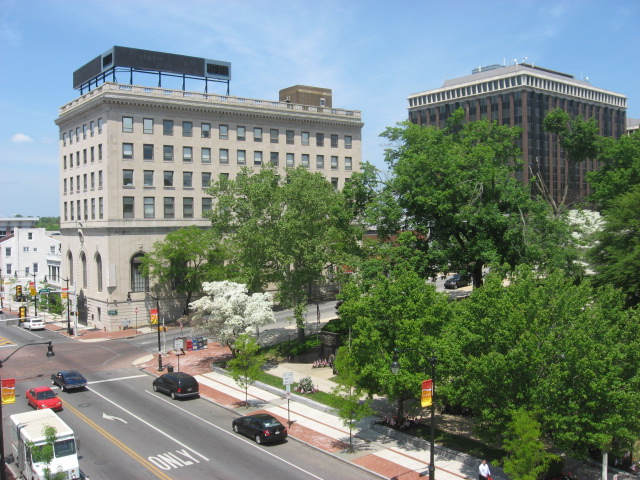
    Lead photo: The vibe in Cleveland. Courtesy of David Jurca

  • Gentrification and its Discontents: Notes from New Orleans

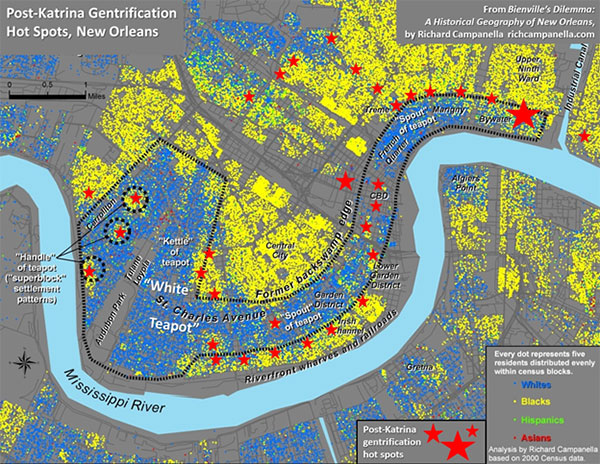
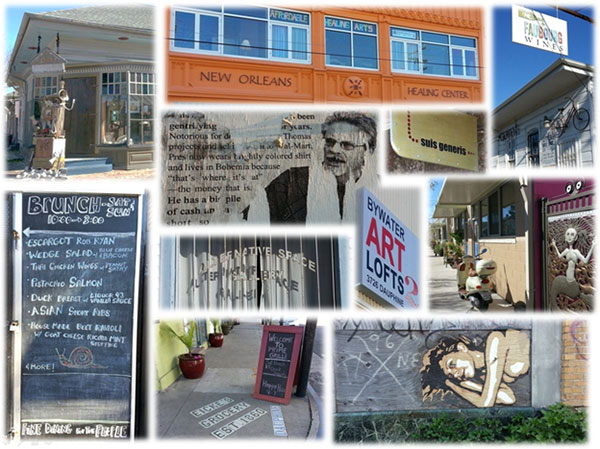
    Readers of this forum have probably heard rumors of gentrification in post-Katrina New Orleans. Residential shifts playing out in the Crescent City share many commonalities with those elsewhere, but also bear some distinctions and paradoxes. I offer these observations from the so-called Williamsburg of the South, a neighborhood called Bywater.

    Gentrification arrived rather early to New Orleans, a generation before the term was coined. Writers and artists settled in the French Quarter in the 1920s and 1930s, drawn by the appeal of its expatriated Mediterranean atmosphere, not to mention its cheap rent, good food, and abundant alcohol despite Prohibition. Initial restorations of historic structures ensued, although it was not until after World War II that wealthier, educated newcomers began steadily supplanting working-class Sicilian and black Creole natives.

    By the 1970s, the French Quarter was largely gentrified, and the process continued downriver into the adjacent Faubourg Marigny (a historical moniker revived by Francophile preservationists and savvy real estate agents) and upriver into the Lower Garden District (also a new toponym: gentrification has a vocabulary as well as a geography). It progressed through the 1980s-2000s but only modestly, slowed by the city’s abundant social problems and limited economic opportunity. New Orleans in this era ranked as the Sun Belt’s premier shrinking city, losing 170,000 residents between 1960 and 2005. The relatively few newcomers tended to be gentrifiers, and gentrifiers today are overwhelmingly transplants. I, for example, am both, and I use the terms interchangeably in this piece.

    One Storm, Two Waves

    Everything changed after August-September 2005, when the Hurricane Katrina deluge, amid all the tragedy, unexpectedly positioned New Orleans as a cause célèbre for a generation of idealistic millennials. A few thousand urbanists, environmentalists, and social workers—we called them “the brain gain;” they called themselves YURPS, or Young Urban Rebuilding Professionals—took leave from their graduate studies and nascent careers and headed South to be a part of something important.

    Many landed positions in planning and recovery efforts, or in an alphabet soup of new nonprofits; some parlayed their experiences into Ph.D. dissertations, many of which are coming out now in book form. This cohort, which I estimate in the low- to mid-four digits, largely moved on around 2008-2009, as recovery moneys petered out. Then a second wave began arriving, enticed by the relatively robust regional economy compared to the rest of the nation. These newcomers were greater in number (I estimate 15,000-20,000 and continuing), more specially skilled, and serious about planting domestic and economic roots here. Some today are new-media entrepreneurs; others work with Teach for America or within the highly charter-ized public school system (infused recently with a billion federal dollars), or in the booming tax-incentivized Louisiana film industry and other cultural-economy niches.

    Brushing shoulders with them are a fair number of newly arrived artists, musicians, and creative types who turned their backs on the Great Recession woes and resettled in what they perceived to be an undiscovered bohemia in the lower faubourgs of New Orleans—just as their predecessors did in the French Quarter 80 years prior. It is primarily these second-wave transplants who have accelerated gentrification patterns.

    Spatial and Social Structure of New Orleans Gentrification

    Gentrification in New Orleans is spatially regularized and predictable. Two underlying geographies must be in place before better-educated, more-moneyed transplants start to move into neighborhoods of working-class natives. First, the area must be historic. Most people who opt to move to New Orleans envision living in Creole quaintness or Classical splendor amidst nineteen-century cityscapes; they are not seeking mundane ranch houses or split-levels in subdivisions. That distinctive housing stock exists only in about half of New Orleans proper and one-quarter of the conurbation, mostly upon the higher terrain closer to the Mississippi River. The second factor is physical proximity to a neighborhood that has already gentrified, or that never economically declined in the first place, like the Garden District.

    Gentrification hot-spots today may be found along the fringes of what I have (somewhat jokingly) dubbed the “white teapot,” a relatively wealthy and well-educated majority-white area shaped like a kettle (see Figure 1) in uptown New Orleans, around Audubon Park and Tulane and Loyola universities, with a curving spout along the St. Charles Avenue/Magazine Street corridor through the French Quarter and into the Faubourg Marigny and Bywater. Comparing 2000 to 2010 census data, the teapot has broadened and internally whitened, and the changes mostly involve gentrification. The process has also progressed into the Faubourg Tremé (not coincidentally the subject of the HBO drama Tremé) and up Esplanade Avenue into Mid-City, which ranks just behind Bywater as a favored spot for post-Katrina transplants. All these areas were originally urbanized on higher terrain before 1900, all have historic housing stock, and all are coterminous to some degree.


    Figure 1. Hot spots (marked with red stars) of post-Katrina gentrification in New Orleans, shown with circa-2000 demographic data and a delineation of the “white teapot.” Bywater appears at right. Map and analysis by Richard Campanella.

    The frontiers of gentrification are “pioneered” by certain social cohorts who settle sequentially, usually over a period of five to twenty years. The four-phase cycle often begins with—forgive my tongue-in-cheek use of vernacular stereotypes: (1) “gutter punks” (their term), young transients with troubled backgrounds who bitterly reject societal norms and settle, squatter-like, in the roughest neighborhoods bordering bohemian or tourist districts, where they busk or beg in tattered attire.

    On their unshod heels come (2) hipsters, who, also fixated upon dissing the mainstream but better educated and obsessively self-aware, see these punk-infused neighborhoods as bastions of coolness.

    Their presence generates a certain funky vibe that appeals to the third phase of the gentrification sequence: (3) “bourgeois bohemians,” to use David Brooks’ term. Free-spirited but well-educated and willing to strike a bargain with middle-class normalcy, this group is skillfully employed, buys old houses and lovingly restores them, engages tirelessly in civic affairs, and can reliably be found at the Saturday morning farmers’ market. Usually childless, they often convert doubles to singles, which removes rentable housing stock from the neighborhood even as property values rise and lower-class renters find themselves priced out their own neighborhoods. (Gentrification in New Orleans tends to be more house-based than in northeastern cities, where renovated industrial or commercial buildings dominate the transformation).

    After the area attains full-blown “revived” status, the final cohort arrives: (4) bona fide gentry, including lawyers, doctors, moneyed retirees, and alpha-professionals from places like Manhattan or San Francisco. Real estate agents and developers are involved at every phase transition, sometimes leading, sometimes following, always profiting.

    Native tenants fare the worst in the process, often finding themselves unable to afford the rising rent and facing eviction. Those who own, however, might experience a windfall, their abodes now worth ten to fifty times more than their grandparents paid. Of the four-phase process, a neighborhood like St. Roch is currently between phases 1 and 2; the Irish Channel is 3-to-4 in the blocks closer to Magazine and 2-to-3 closer to Tchoupitoulas; Bywater is swiftly moving from 2 to 3 to 4; Marigny is nearing 4; and the French Quarter is post-4.

    Locavores in a Kiddie Wilderness

    Tensions abound among the four cohorts. The phase-1 and -2 folks openly regret their role in paving the way for phases 3 and 4, and see themselves as sharing the victimhood of their mostly black working-class renter neighbors. Skeptical of proposed amenities such as riverfront parks or the removal of an elevated expressway, they fear such “improvements” may foretell further rent hikes and threaten their claim to edgy urban authenticity. They decry phase-3 and -4 folks through “Die Yuppie Scum” graffiti, or via pasted denunciations of Pres Kabacoff (see Figure 2), a local developer specializing in historic restoration and mixed-income public housing.

    Phase-3 and -4 folks, meanwhile, look askance at the hipsters and the gutter punks, but otherwise wax ambivalent about gentrification and its effect on deep-rooted mostly African-American natives. They lament their role in ousting the very vessels of localism they came to savor, but also take pride in their spirited civic engagement and rescue of architectural treasures.

    Gentrifiers seem to stew in irreconcilable philosophical disequilibrium. Fortunately, they’ve created plenty of nice spaces to stew in. Bywater in the past few years has seen the opening of nearly ten retro-chic foodie/locavore-type restaurants, two new art-loft colonies, guerrilla galleries and performance spaces on grungy St. Claude Avenue, a “healing center” affiliated with Kabacoff and his Maine-born voodoo-priestess partner, yoga studios, a vinyl records store, and a smattering of coffee shops where one can overhear conversations about bioswales, tactical urbanism, the klezmer music scene, and every conceivable permutation of “sustainability” and “resilience.”

    It’s increasingly like living in a city of graduate students. Nothing wrong with that—except, what happens when they, well, graduate? Will a subsequent wave take their place? Or will the neighborhood be too pricey by then?

    Bywater’s elders, families, and inter-generational households, meanwhile, have gone from the norm to the exception. Racially, the black population, which tended to be highly family-based, declined by 64 percent between 2000 and 2010, while the white population increased by 22 percent, regaining the majority status it had prior to the white flight of the 1960s-1970s. It was the Katrina disruption and the accompanying closure of schools that initially drove out the mostly black households with children, more so than gentrification per se.1  Bywater ever since has become a kiddie wilderness; the 968 youngsters who lived here in 2000 numbered only 285 in 2010. When our son was born in 2012, he was the very first post-Katrina birth on our street, the sole child on a block that had eleven when we first arrived (as category-3 types, I suppose, sans the “bohemian”) from Mississippi in 2000.2

    Impact on New Orleans Culture

    Many predicted that the 2005 deluge would wash away New Orleans’ sui generis character. Paradoxically, post-Katrina gentrifiers are simultaneously distinguishing and homogenizing local culture vis-à-vis American norms, depending on how one defines culture. By the humanist’s notion, the newcomers are actually breathing new life into local customs and traditions. Transplants arrive endeavoring to be a part of the epic adventure of living here; thus, through the process of self-selection, they tend to be Orleaneophilic “super-natives.” They embrace Mardi Gras enthusiastically, going so far as to form their own krewes and walking clubs (though always with irony, winking in gentle mockery at old-line uptown krewes). They celebrate the city’s culinary legacy, though their tastes generally run away from fried okra and toward “house-made beet ravioli w/ goat cheese ricotta mint stuffing” (I’m citing a chalkboard menu at a new Bywater restaurant, revealingly named Suis Generis, “Fine Dining for the People;” see Figure 2). And they are universally enamored with local music and public festivity, to the point of enrolling in second-line dancing classes and taking it upon themselves to organize jazz funerals whenever a local icon dies.

    By the anthropologist’s notion, however, transplants are definitely changing New Orleans culture. They are much more secular, less fertile, more liberal, and less parochial than native-born New Orleanians. They see local conservatism as a problem calling for enlightenment rather than an opinion to be respected, and view the importation of national and global values as imperative to a sustainable and equitable recovery. Indeed, the entire scene in the new Bywater eateries—from the artisanal food on the menus to the statement art on the walls to the progressive worldview of the patrons—can be picked up and dropped seamlessly into Austin, Burlington, Portland, or Brooklyn.


    Figure 2. “Fine Dining for the People:” streetscapes of gentrification in Bywater. Montage by Richard Campanella.

    A Precedent and a Hobgoblin

    How will this all play out? History offers a precedent. After the Louisiana Purchase in 1803, better-educated English-speaking Anglos moved in large numbers into the parochial, mostly Catholic and Francophone Creole society of New Orleans. “The Americans [are] swarming in from the northern states,” lamented one departing French official, “invading Louisiana as the holy tribes invaded the land of Canaan, [each turning] over in his mind a little plan of speculation”—sentiments that might echo those of displaced natives today.3 What resulted from the Creole/Anglo intermingling was not gentrification—the two groups lived separately—but rather a complex, gradual cultural hybridization. Native Creoles and Anglo transplants intermarried, blended their legal systems, their architectural tastes and surveying methods, their civic traditions and foodways, and to some degree their languages. What resulted was the fascinating mélange that is modern-day Louisiana.

    Gentrifier culture is already hybridizing with native ways; post-Katrina transplants are opening restaurants, writing books, starting businesses and hiring natives, organizing festivals, and even running for public office, all the while introducing external ideas into local canon. What differs in the analogy is the fact that the nineteenth-century newcomers planted familial roots here and spawned multiple subsequent generations, each bringing new vitality to the city. Gentrifiers, on the other hand, usually have very low birth rates, and those few that do become parents oftentimes find themselves reluctantly departing the very inner-city neighborhoods they helped revive, for want of playmates and decent schools. By that time, exorbitant real estate precludes the next wave of dynamic twenty-somethings from moving in, and the same neighborhood that once flourished gradually grows gray, empty, and frozen in historically renovated time. Unless gentrified neighborhoods make themselves into affordable and agreeable places to raise and educate the next generation, they will morph into dour historical theme parks with price tags only aging one-percenters can afford.

    Lack of age diversity and a paucity of “kiddie capital”—good local schools, playmates next door, child-friendly services—are the hobgoblins of gentrification in a historically familial city like New Orleans. Yet their impacts seem to be lost on many gentrifiers. Some earthy contingents even expresses mock disgust at the sight of baby carriages—the height of uncool—not realizing that the infant inside might represent the neighborhood’s best hope of remaining down-to-earth.

    Need evidence of those impacts? Take a walk on a sunny Saturday through the lower French Quarter, the residential section of New Orleans’ original gentrified neighborhood. You will see spectacular architecture, dazzling cast-iron filigree, flowering gardens—and hardly a resident in sight, much less the next generation playing in the streets. Many of the antebellum townhouses have been subdivided into pied-à-terre condominiums vacant most of the year; others are home to peripatetic professionals or aging couples living in guarded privacy behind bolted-shut French doors. The historic streetscapes bear a museum-like stillness that would be eerie if they weren’t so beautiful.

    Richard Campanella, a geographer with the Tulane School of Architecture, is the author of Bienville’s Dilemma, Geographies of New Orleans, Delta Urbanism, Lincoln in New Orleans, and other books. He may be reached through richcampanella.com, rcampane@tulane.edu, and nolacampanella on Twitter.

    ——–

    1 The years-long displacement opened up time and space for the ensuing racial and socio-economic transformations to gain momentum, which thence increased housing prices and impeded working-class households with families from resettling, or settling anew.

    2 These Census Bureau race and age figures are drawn from what most residents perceive to be the main section of Bywater, from St. Claude Avenue to the Mississippi River, and from Press Street to the Industrial Canal. Other definitions of neighborhood boundaries exist, and needless to say, each would yield differing statistics.

    3 Pierre Clément de Laussat, Memoirs of My Life (Louisiana State University Press: Baton Rouge and New Orleans, 1978 translation of 1831 memoir), 103.

  • In California, Don’t Bash the ‘Burbs

    For the past century, California, particularly Southern California, nurtured and invented the suburban dream. The sun-drenched single-family house, often with a pool, on a tree-lined street was an image lovingly projected by television and the movies. Places like the San Fernando Valley – actual home to the "Brady Bunch" and scores of other TV family sitcoms – became, in author Kevin Roderick’s phrase, "America’s suburb."

    This dream, even a modernized, multicultural version of it, now is passé to California’s governing class. Even in his first administration, 1975-83, Gov. Jerry Brown disdained suburbs, promoting a city-first, pro-density policy. His feelings hardened during eight years (1999-2007) as mayor of Oakland, a city that, since he left, has fallen on hard times, although it has been treated with some love recently in the blue media.

    As state attorney general (2007-11) Brown took advantage of the state’s 2006 climate change legislation to move against suburban growth everywhere from Pleasanton to San Bernardino. Now back as governor, he can give full rein to his determination to limit access to the old California dream, curbing suburbia and forcing more of us and, even more so our successors, into small apartments nearby bus and rail stops. His successor as attorney general, former San Francisco D.A. Kamala Harris, is, if anything, more theologically committed to curbing suburban growth.

    Sadly, much of the state’s development "community" has enlisted itself into the densification jihad. An influential recent report from the Urban Land Institute, for example, sees a "new California dream," which predicts huge growth in high-density development based on underlying demographic trends – like shifts in housing tastes among millennials or empty-nesters rushing to downtown condos.

    Yet it’s not enough for the planners, and their developer allies, to watch the market shift and take advantage of it. That would be both logical and justified. But the planning clerisy are not content to leave suburbia die; it must, instead, be cauterized and prevented, like some plague, from spreading.

    Ironically, it turns out that the "new California dream" is more widely shared by planners and rent-seeking developers than by the consuming public. During the past decade, when pro-density sentiment has supposedly building, some 80 percent of the new construction in the state was single-family, a rate slightly above the national average. Over time, Californians continue to buy single-family houses, mostly in the suburban and exurban periphery. They do it because they are like most Americans, roughly four of five of whom prefer single-family houses, preferably closer to work but, if that proves unaffordable, further out.

    This includes both working-class and upper middle-class markets. The more-affluent, including many largely Asian immigrants, have been willing to buy high-priced homes closer to employment centers in places like Irvine or Cupertino, near San Jose. Meanwhile, the less-affluent of all ethnicities continue to move further out, to places like the Inland Empire or the further reaches of the Bay Area. These peripheral areas have continued to represent the vast majority of growth in both greater Los Angeles and around the Bay Area.

    Meanwhile, some of the urban-centric residential construction now being put up will, as occurred in the housing bust, may be fashionable but, in some cases, not so profitable over time. Construction is being driven mostly by tax breaks, Uncle Ben’s essentially ultralow-interest money for wealthy investors and, in some cases, subsidies. Overall, the Wall Street Journal notes, the rental market is beginning to "lose steam," as people again start looking into buying homes. This may suggest that new speculative building in places like downtown Los Angeles – where there’s good evidence that rents and occupancy levels are, if anything, getting weaker – may end up in tears.

    To date, the anti-suburb jihad has been somewhat constrained by the recession and the collapse of the housing bubble about five years ago. But now that there’s an incipient housing recovery in parts of the state, including Orange County, the constraints could be problematical, particularly for younger buyers about to start a family or for people migrating into the state.

    The impact may be felt first in Silicon Valley and its environs. The planners now dominating the Bay Area want only highly dense bus-stop- or train-oriented development in the valley. Yet, notes real estate consultant John Burns, this does not reflect market realities marked by what they describe "as a resilient and ongoing preference for single-family homes."

    Even more fanciful, they are promoting high density in areas, far distant from current employment centers, in dreary locales like Newark, south of Oakland, claiming workers there will take public transit to jobs in the Valley. The belief among planners and some gullible developers that aging millennials will choose to live in high density, far from costly San Francisco or Palo Alto, and commute to work by transit is somewhat north of absurd; today, a bare 3 percent of workers in Silicon Valley get to work by transit, and downtown San Jose, the logical terminus of any transit strategy, is home to barely 26,000 of the region’s 860,000 workers.

    Some tech workers may put up with a few years of high rents and shared apartments in San Francisco or Palo Alto, but not many will want to live in expensive towers far from both Silicon Valley’s primary employers and the amenities of the big city. Apple’s plans for a new headquarters in Cupertino has drawn criticism from green-minded urbanists precisely because they rest on the sensible presumption that Apple’s workforce will remain largely suburban and car-oriented. One can also wonder the effect on the start-up culture when workers have been forced to live in places lacking the proverbial garage or extra bedroom that historically have nurtured new firms.

    More important still, forced densification, by denying single-family alternatives, is likely, and in some places, already is, spiking prices, which are up $85,000 in Silicon Valley in a year. This, over time, will force millennials, as they age, to look for other locales to meet their longtime aspirations. Generational chroniclers Morley Winograd and Mike Hais, in their surveys, have found more than twice as many millennials prefer suburbs over dense cities as their "ideal place to live." The vast majority of 18-to-34-year-olds do not want to spend their lives as apartment renters; a study by TD Bank found that 84 percent of them hope to own a home.

    Much the same can be said of Asian immigrants, who are now driving much of the new-home sales, particularly in desirable places like Orange County or Silicon Valley. Nationwide, over the past decade, the Asian population in suburbs grew by almost 2.8 million, or 53 percent, while the Asian population of core cities grew 770,000, 28 percent. In greater Los Angeles, there are now three times as many Asian suburbanites as their inner-city counterparts.

    If California is not willing to meet the needs of its own emerging middle class, there’s no doubt that other states, from Arizona and Texas to Tennessee – although not as fundamentally alluring – will be, and are already, more than happy to oblige.

    Rather than seeking to destroy our suburbs, California leaders should expend their energy figuring out how to make them better. Rather than some retro-1900s urbanist vision, they need to embrace the multipolarity of our urban agglomerations. They could look to preserve open space nearby, when possible, or cultivate natural areas, parks, walking and biking trails that would appeal to families as well as to singles.

    Instead of attempting to force employment into the center city, it would make more sense to expand home-based and dispersed work in order to cut down or eliminate commuting times. These moves would create both healthier suburbs and reduce carbon emissions without devastating the natural aspirations of most California families.

    Joel Kotkin is executive editor of NewGeography.com and a distinguished presidential fellow in urban futures at Chapman University, and a member of the editorial board of the Orange County Register. He is author of The City: A Global History and The Next Hundred Million: America in 2050. His most recent study, The Rise of Postfamilialism, has been widely discussed and distributed internationally. He lives in Los Angeles, CA.

    This piece originally appeared in the Orange County Register.

    Suburb photo by BigStockPhoto.com.