Category: Policy

  • Churches and Parking

    A recent story over at Atlantic Cities got me thinking about a debate that’s heated up over the last few years: urban parking policy for churches.

    Per Atlantic Cities, San Francisco has decided to start charging for metered parking on Sundays. This is starting to happen across America. In San Francisco, as in Chicago and elsewhere, the driver (no pun intended) appears to be revenue raising, plain and simple.

    This has angered many attendees of local churches (who have in many cases now moved out of town and drive in for services). They seem to believe that they have a constitutional right to free parking on Sunday mornings. On the other side, of course, are bicycle advocates, who are positively gleeful. (Bicycle advocates are without a doubt the single most self-righteous advocacy group I know, which is why so many people who otherwise might support reasonable pro-bicycling policy can’t stand them).

    I think a more nuanced approach should be taken, based on neighborhood conditions and creating the right incentive structures. For example, in some places across the country (San Francisco and Chicago come to mind again), it’s traditional for church goers to park even in what would otherwise be illegal spots. In general, this isn’t a problem – at least from my personal observations in Chicago. Traffic is pretty light on Sunday mornings, and it doesn’t cause any problems.

    What’s more, enabling that temporary use of public space for a couple hours on a Sunday morning is exactly the sort of thing we need more of, not less. An institution like a church that has a single demand spike for parking during a generally low demand period is a great candidate for flexible uses of public space that would otherwise be underutilized. Liveable streets advocates are quick to decry the empty lanes off peak from oversized roads. So what’s the problem with putting a boulevard on a “road diet” on Sunday morning by using a lane for parking? Sounds like a winner to me. I’d be asking what other types of institutions or events could do similar things.

    And consider, what will happen if churches are banned from using these spots or otherwise have to pay? Well, it depends on the neighborhood, but it’s easy to see what organizations often do when they need parking: build parking lots. Do we really want churches acquiring private off street lots that will sit empty 166 out of 168 hours per week – and generate no property taxes? It makes no sense to me. Why would we want to create incentives for people to own parking lots just because some folks hate cars? We should be going exactly the other direction. There are way too many church parking lots already if you ask me. We should be trying to cut deals with them to open that land up for development by making temporary blocks of street parking available for a couple hours on Sundays.

    Now, in places where there is legitimately congestion and/or parking shortages on Sunday mornings (and San Francisco might be a case here – I don’t know for sure), implementing parking charges and restrictions would certainly be reasonable. The principal reason for allowing these church uses in the first place shouldn’t be some religious exemption per se, but rather enabling a local chronologically niche use to take advantage of underutilized public space. (Keep in mind that many other local users get truly special privileges based solely on their local presence: loading zones, valet zones, residential parking – and the latter is usually de facto free). If the space is over-subscribed, then feeding the meters to help rationalize demand is reasonable, and the churches should stop grumbling.

    In short, we should be basing this on some type of rational decision process based on neighborhood conditions, setting the right overall incentives, and balancing the needs of competing uses, not pandering to churches treating illegal spots as if they were some ancient feudal right, nor sanctimonious bicyclists behaving as if a double parked car on Sunday morning is a menace to the planet or to their own self-evident status as the most perfectly entitled form of urban transport.

    This piece first appeared at The Ubanophile.

  • U.S. Late to the Party on Latin America, Africa

    President Barack Obama’s proposed tilt of U.S. priorities toward the Pacific – and away from the historical link to Europe – represents one of the most encouraging aspects of his foreign policy. Although welcome, we should recognize that this shift comes about three decades too late and that it may miss the rising geopolitical centrality of sub-Saharan Africa and Latin America. The emergence of these longtime historically impoverished backwaters has been largely missed as American policy-makers and businesses are now obsessed with the challenges and opportunities posed by the emergence of China and, to a lesser extent, India. Sub-Saharan Africa, for example, over the past decade has produced six of the world’s 10 fastest-growing economies. Through 2011-15, according to the International Monetary Fund, seven of the fastest-growing countries will be African, and Africa as a whole will surpass the slowing growth rates in Asia, particularly China.

    This growth has caused the region’s poverty rates, still unacceptably high, to fall from 56.5 percent in 1990 to 47 percent today. Further growth will likely push poverty levels down further.

    Outgrowing U.S.

    With 600 million people, including a middle class of some 400 million, Latin America represents one of the world’s great growth markets. Over the past two years the growth rate in Latin America has been twice – and more in some countries – that in the United States, Europe and Japan. Latin America’s unemployment rate is reaching historic lows. A decade ago, it was 11 percent. Today it is 6.5 percent, well below levels in the U.S. or Europe.

    As in Africa, growth has worked to reduce Latin America’s historic high rate of poverty by 17 percent since 1990. Overall, Latin America’s combined gross domestic product is already larger than that of Russia and India combined – larger, in fact, than any nation or region besides the U.S., the E.U. and China.

    Demographic trends are likely to accelerate this process. Rapidly aging populations in Europe, Japan and East Asia threaten both workforce growth and fiscal stability. Today, people at least age 60 account for 13 percent of the population in China, 15 percent in east Asia, 32 percent in Japan and 22 percent in Europe, but barely one in 10 residents in Latin America; only 6 percent of Africa’s population is made up of seniors. By 2050, one-third of people in east Asia, Europe and China will be over 60, while Japan will pass 40 percent. In contrast, Latin America’s over-60 population will be 20 percent, and Africa’s half that.

    Indeed, over the next decade, Africa is slated to add more people than all of Asia, while Latin America’s growth will far exceed that of Europe, East Asia or North America. A surprising percentage of the residents in these regions will be middle class. From 2000-14, according to a McKinsey survey, the number of African households with annual incomes of at least $5,000 will grow from roughly 59 million to well over 106 million. Africa already has more middle-class households (defined as those with incomes of at least $20,000) than India.

    This demographic vibrancy is helping spark industrial growth, both for export and domestic consumption. Latin American countries, led by Brazil, have emerged as industrial centers while Mexico is rapidly replacing China as the preferred foreign manufacturing platform for American firms hailing from California to Texas. Manufacturing growth – particularly in textile and garments – has also begun to grow in parts of sub-Saharan Africa, following in many ways the patterns earlier seen in Japan, China, Southeast Asia and Bangladesh.

    Hunt for Resources

    But much of the importance of these regions lies with their enormous natural resources.

    Conventional wisdom in our chattering classes holds that, in the "information age," raw materials no longer represent an advantage for economic growth. Yet as the world’s population grows, and its middle class expands, there seems to be a cascading demand for raw materials, either for direct consumption or for use in manufactured goods. Energy consumption itself, according to the International Energy Agency, could rise as much as 50 percent by 2030, with more than 84 percent of that increase coming from fossil fuels.

    Increasingly the competition over Latin America and Africa reflects something of a reprise of what was once seen as "the great game," where European colonial powers struggled for control of resources and land masses in regions as diverse as Central Asia, Africa, South America and the Middle East. Today, this struggle includes many more protagonists, including Japan, Korea and, most powerfully, China, all of whom are targeting investments in the continent.

    One result has been growing interest in Africa, where foreign direct-investment projects grew by 27 percent in 2011 alone. American companies like Wal-mart and Google are expanding there, but much of the big investment comes from China. China’s former vice-minister of commerce, Wei Jianguo, recently told China Daily that Africa eventually will surpass the U.S. and the E.U. to become China’s largest trading partner. Last year, Latin America reaped a record $145 billion in FDI, an increasing share from China.

    Resource-hungry China has reason to focus on Africa and Latin America, which hold much of the world’s diminishing supply of not-yet-developed farmland, as well as tremendous reserves of precious minerals and energy. Africa, by current accounts, possesses 10 percent of the world’s reserves of oil, 40 percent of its gold, and 80 percent to 90 percent of the chromium and the platinum metal group.

    These supplies, notes a recent McKinsey report, may be grossly undercounted, since much of the continent has not been thoroughly explored. But, to date, Africa has a proven stock of $13 trillion to $14.5 trillion worth of energy resources (oil, coal, gas, uranium); South Africa alone is estimated to have $2.5 trillion in mineral wealth.

    Latin America, too, enjoys ample natural resources, to go with its rapidly developing industrial sector. Brazil is the world’s third-leading food exporter, and other Latin countries, such as Chile and Mexico, have been emerging as major producers of commodities.

    Latin America also seems well-positioned to benefit from the shift of world energy production from the Middle East and Russia to the Americas. Brazil has already made large strides in offshore oil development; possible future offshore oil finds in Mexico and Cuba create an energy boom through the entire Caribbean Basin.

    U.S. Needs to Shift

    Clearly, the rise of these two regions signals that we need to adjust our foreign policy priorities. American business is already becoming more engaged with these two continents; over the past decade trade growth there has more than tripled, compared with a doubling of trade with Asia and Europe. We need to move not only beyond our old strategic ties with Europe, and embroilment with the volatile Middle East, and look to engage in the places where our primary rivals, notably China, already see the future of the world economy.

    Will America, finally awakening from its European slumbers and no-win Middle Eastern involvements, get with the new program? It took three decades for the foreign policy establishment to acknowledge the reality of the Pacific era. Hopefully it won’t take nearly as long to acknowledge the growing influence of both our southern neighbors and emergent powerhouse that is Africa.

    Joel Kotkin is executive editor of NewGeography.com and a distinguished presidential fellow in urban futures at Chapman University, and a member of the editorial board of the Orange County Register. He is author of The City: A Global History and The Next Hundred Million: America in 2050. His most recent study, The Rise of Postfamilialism, has been widely discussed and distributed internationally. He lives in Los Angeles, CA.

    This piece originally appeared in the Orange County Register.

    World image by BigStockPhoto.com.

  • Natural Gas Boom: The “Janus” Effect

    The last five years have seen a revolution in terms of the amount of inexpensive U.S. natural gas made available for consumption in power plants, road fuels, and as a feedstock for new and expanded petrochemical plants. We are now even debating the advisability of large volume natural gas exports in the form of liquid natural gas (LNG).  

    This bonanza has created euphoria in the fossil energy and industrial communities, but has also created something of a “Janus effect” within the Environmental community.  To the Romans, Janus (the two faced god) provided a cohesive view of the present as well as an uncertain view of the future. In Rome, the temple to Janus was opened only when Rome was at war. During peace time, presumably because the future was more certain, the doors of the temple remained closed. They were last opened in AD 531 immediately prior to an invasion by the Goths. We all know how well that turned out.

    Environmentalists are reacting to the natural gas bonanza in three ways. The first group, which we may define as “pragmatists”, see a hopeful face based on solid evidence that natural gas helps with achieving multiple environmental goals by reducing particulate emissions, sulfur emissions, NOX levels and CO2 emissions.  They acknowledge natural gas fueled generators emit approximately 40% less CO2 per kilowatt hour than the older coal-fired units they are largely replacing. Although the aftermath of the recession has reduced the use of most other fuels, natural gas now rivals coal as the major fuel source for power generation in the US.

    A second group, the “environmental fatalists” are less impressed with the displacement effects on coal but appreciate that natural gas plants provide crucial support when mandated, for intermittent renewable power options, such as solar and wind. Once renewables represent approximately 10% of aggregate capacity, negative side effects of these “intermittent” sources become problematic; too much dependence on them can cause grid “instability” or, in a worse case, cascading power failures and massive blackouts. 

    Then there’s the third group, we’ll call the “ideologues.” Often the loudest, this group views natural gas as an implacable enemy for undermining the economic viability of renewable energy projects. They oppose the use of natural gas on principle and call for ever more restrictive regulations and production constraints on natural gas fueled power production. In their view, increasing the costs of generating electric power from natural gas will allow renewable generation finally to achieve cost parity. This “logic” explains at least some of the objections to fracking, an essential requirement for shale gas production, which, if restricted, would seriously undermine production and consumption of additional natural gas in the U.S.  

    The ideologues believe in “leveling the playing field” so that renewables such as solar and wind can be made economically viable. They see themselves fostering a new economy based on renewable energy. The rest of society’s role is to “shut up” and allow them unimpeded access to scarce and valuable assets (e.g. subsidized prices and preferential access to the grid) in order to wipe fossil fuels off the grid. 

    Natural gas based power generation represents the ideologue’s worst nightmare.  They know that increasing the use of natural gas for a generation undermines the economic value of renewable-based generating companies. It’s not hard to imagine that for those individuals and businesses profiting from renewable subsidies and mandates, natural gas represents a great threat. The argument therefore does make a certain amount of sense if you accept the initial premise.    

    Renewable mandates generally represent a commandment that “Thou shalt generate e.g. 10% of a given utility’s power output using approved renewable resources”, regardless of the costs to ultimate consumers.  Requiring utilities to purchase high priced renewable power under so called feed in tariffs results in those higher prices simply being “rolled in” to the aggregate cost of power delivered to all consumers and duly covered by an aggregate rate requirement.

    Such initiatives to support an artificial market for renewable power generation are politically vulnerable, since the public tends to reject mandates forcing investors in renewable energy projects to face bankruptcy as a distinctly possible outcome. Government-guaranteed loans supporting construction of the plants manufacturing new PV solar cells or wind turbines have already outraged a public forced to pay for their bankruptcies.  

    What is the future of America if the renewable mandate regime expands under state or federal programs? That future is now on display in Germany, a trailblazer in applying subsidies and preferential access to the grid to support the adoption of solar and wind power. The country has not only restricted the construction of new coal and nuclear power units, but also limited the operations of natural gas fueled generation by providing preferential prices and access to the grid for renewables. To be fair, the Germans are also groaning under the cost of imported natural gas supplies, primarily from Russia.

    Unfortunately, as a result Germany does not have adequate load following capacity to absorb the ups and downs of renewable power generation. The result is grid instability. These policies are creating potential dangers for an economy heavily dependent on power intensive manufactured exports.  Already German petrochemical manufacturers, such as BASF and Bayer, have warned that the country faces grave threats to its manufacturing base due to lower cost competition in the natural gas-rich US. Volkswagen has been equally blunt about their need to manufacture car parts outside of Germany. Remember that Germany’s job pool has roughly 24% of the work force engaged in export focused activity.

    The Germans avoid discussing their lack of enthusiasm for searching out low cost coal gas and shale gas deposits in the fatherland. The country now endures an aggregate price of 32 cents/kilowatt hour vs. a US price of about 10 cents/kwh. The bad news is that this already elevated German rate is slated to increase further in the next year, by another 50%, to a level of 48 cents/kwh.  

    To make it through Germany presumes the good will of neighboring countries which face their own energy challenges. Germany’s current power generation profile has approximately 20% of its power being provided by renewable sources, primarily wind and solar. Germany’s neighbors complain that the country is exporting the grid instability associated with its “green” policies. It’s gotten so bad that the country, which loathes nuclear power, is actually expanding the use of coal fired generation. In essence, coal fired generation is growing in Germany at the expense of higher cost natural gas generation. (The silver lining is that the U.S. is supplying the extra low cost coal required). Naturally, Germany’s CO2 and particulate targets are not being met, while the equivalent US targets are being met ahead of schedule.   

    Not surprisingly, the German government is now back tracking because their economy cannot support, from a technical or economic perspective, the current level of installed renewables. Angela Merkel has recently called for a more balanced approach to power generation. That will probably mean a policy of diverting subsidies and preferential treatment from solar and wind to natural gas and hydro.

    The Current Status in the US

    Back here in the US, we’ve managed to spend $97 billion or so on government funded wind and solar projects that certainly will not survive without operating subsidies, feed in tariffs, preferential access to the grid and production mandates.

    Fortunately, the US is upgrading our power generation fleet by building new, unsubsidized, gas-fired generation plants throughout the country. We are also seeing new pipeline and grid infrastructure coming to market along with significant expansions of our refining and petrochemical manufacturing facilities, exploiting nonconventional hydrocarbon resources. The bulk of this expenditure is being managed with minimal federal financial support.

    However, adverse government regulation of fracking could bring the shale gas band wagon to a sudden halt. (Beyond that, a measurable, multi-year slowdown in permits for new gas pipelines is also having a deleterious effect.)

    Recognizing the risks, shale gas proponents are taking another approach. Having apparently convinced the pragmatists and the fatalists of the benefits of natural gas, they are now beginning to spend significant sums in an effort to educate the general electorate and thereby isolate the diehard   ideologues.  

    Fortunately, the majority of the environmental community is not made up of latter day luddites bent on destroying western civilization, just as the majority of the oil and gas industry is not made up of barbarians seeking to plunder the environment. The majority of the population consistently supports measured progress on both the environmental and economic fronts.

    The challenge now is to grow support for  environmental compromises that produce favorable results for everyone. We still live in a democracy where everyone gets to vote and to have his or her say. However, we do not live in an “Alice and Wonderland” world where everyone can create his own reality. Germany is already facing the downside of listening to their ideological enthusiasts. Let’s take the German lesson to heart, and embrace a more pragmatic approach. It is after all, the American way.

    Eric Smith is a Professor of Practice at the A.B. Freeman School of Business at Tulane University. He serves as the Associate Director of the Tulane Energy Institute. He is a Chemical Engineer and has an MBA from the A. B. Freeman School at Tulane University. 

  • That Sucking Sound You Hear…Solutions to America’s Housing Crisis Are Needed

    There is a crisis in America that’s not being attended to. It is the housing crisis, and its tentacles reach deep into the decline of the American middle class. Particularly, the interlocking dynamics of foreclosure, abandonment, and blight are draining the net worth of millions of Americans. The solutions to date have been piecemeal and ineffective. One possible initiative on the radar—which will be explained further below—entails a federal investment in the strategic demolishing of thousands of “zombie properties” that are eroding equity and quality of life.

    This erosion is real. Writes Howie Kahn of his recent tour with a City of Detroit demolition crew:

    Old roofs half-collapse under the weight of snow, forcing the walls to bulge outward. Moisture eats away the insides. Mold spoils the walls, softens the floors. In the summer, the sun bakes it all to a high stink and turns it crisp as tinder. Nature takes over. Trees sprout through the dormers. Animals get comfortable. We see this everywhere we go…So many innocent onetime starter homes, built on credit and striving, now in foreclosure. The holding company writes it off as a loss. And unless some crusading neighborhood association acts as a sentry, no one’s watching the house anymore. In essence, it belongs to nobody—or to everybody. Because once a house becomes worthless and unwanted…it’s everybody’s problem. Everybody’s crime scene.

    As both a policy researcher and a Clevelander, I know these realities first hand. The city was home to over 40,000 vacant housing units in 2010, or nearly 20% of its stock. Several of these units were across a street from me, the result of a foreclosure on a rental investment purchased during housing inflation heights. Tenants were kicked out around 2009. The place sat empty, but I soon noticed people constantly disappearing into the back of the building. Drug activity I thought. Then one day I found a pile of hypodermic needles on my front lawn while cutting the grass. I have a child. The very real effect of blight acted as a drain on my property value, not to mention my quality of life.

    And while I stayed in the City of Cleveland, many don’t. Cleveland lost 17% of its population from 2000 to 2010. The population decline (which is a long-term trend)—combined with the subprime mortgage crisis—created for unprecedented amounts of oversupply. Often, with both banks and homeowners walking away, the vacant structure devolves into blight until it becomes “a disamentiy effect”, which in plain-speak simply means living near something nobody would want to, with the unappealing prospect monetized in the devaluation of the house’s market value.

    This disamentiy effect has been quantified. For instance, my colleague Nigel Griswold found that in Flint, MI each abandoned structure within 500 ft. reduced a home’s sales price by 2.27%. A study by Thomas Fitzpatrick of the Federal Reserve Bank of Cleveland showed an additional property within 500 ft. that is either delinquent or vacant reduces prices by 1.3%. In low-poverty areas the effect is greater: 4.6%.

    Of course the larger problem is the broader economic effect, as depreciation goes beyond a lower return on investment and gets at household net worth. Specifically, according to the Census Bureau, household net worth declined 20% from 2005 to 2010 (40% since 2007). Of this decline, 76% was attributed to a loss of home equity. Minorities were hardest hit, with average Black household equity falling from $70,000 to $50,000 and average Hispanic household equity falling $90,000 to $40,000.

    Such declines in net worth have swelled the number of Americans stuck in precarious economic conditions. A recent report called “Living on the Edge: Financial Insecurity and Policies to Rebuild Prosperity in America” found that nearly half of Americans are “liquid asset poor”, meaning “they lack the savings to cover basic expenses for three months if unemployment, a medical emergency or other crisis leads to a loss of stable income.”

    Vacant house in Detroit. Courtesy of Streetsblog

    Such economic figures are alarming, and they call for intensive solutions aimed at reconstituting the American middle class, if only to achieve a broader economic recovery outside of the investor class. One such solution could entail a large-scale strategic demolition of “zombie properties” in America’s hardest hit areas, such as the Rust Belt.

    Why demolition?

    It is simple, really: by removing the disamentiy effect you are giving the value of the surrounding houses a chance, and there is initial empirical proof that this does in fact occur. Specifically, in his examination of Flint, MI, Griswold found that Genesee County’s demolition investment was paying off, with $3.5 million of demolition activity producing $112 million in improved surrounding property values. Not a bad ROI, and it’s a return that positively affects homeowners, investors, and government alike.

    The question remains: why isn’t there a concerted effort to once and for all excise the hundreds of thousands “zombie properties” that are draining value from the American economy?

    The reasons are varied, but one in particular relates to a lack of empirical proof that demolition has a definitive monetary impact. One current study, spearheaded by Jim Rokakis of the Thriving Communities Institute, aims to fill the gap. The study, headed by Nigel Griswold, myself, and the Center on Urban Poverty and Community Development at Case Western Reserve University, was partly conceived out of a September 2012 interagency meeting on Residential Property Vacancy, Abandonment and Demolition in which—after hearing pleas from a largely Midwestern contingent—officials from Federal Treasury issued a challenge: show through robust empirical means that demolition (1) retains value on nearby properties, and (2) decreases the likelihood of future foreclosures. If the results prove definitive, Treasury suggested they could make a federal strategic demolition initiative a reality.

    Vacant houses in Buffalo. Courtesy of the NY Times.

    Of course the operative word here is “strategic”, as bulldozing for the sake of bulldozing does not a solution to a crisis make. As such, the intent of this research is also to help those on the ground ascertain where an investment in demolitions could pay off most. For example, there are properties—particularly architecturally-rich properties with high intrinsic value—that should be preserved and shuttled down another path. As well, there are areas in cities in which population decline is shifting ever so slightly. The area I had lived was one of them. And the house that was once vacant across from me has been renovated and is now home to a number of tenants. Thus, the authors of the study are cognizant of the contextualization that exists in various hardest hit cities, and so recommendations will be matched with an understanding as such.

    That said, the study is currently ongoing, and while the results are as yet unclear—and in fact may not be robust enough to convince D.C. to act—the effect of “zombie properties” on the financial and mental well-being of regular Americans is anything but uncertain.

    As a Clevelander, I know this all too well.

    Richey Piiparinen is a writer and policy researcher based in Cleveland. He is co-editor of Rust Belt Chic: The Cleveland Anthology. Read more from him at his blog and at Rust Belt Chic.

    Vacant Cleveland house photo by Flickr user edkohler.

  • Blue States Double Down On Suicide Strategy

    Whatever President Obama proposes in his State of the Union for the economy, it is likely to fall victim to the predictable Washington gridlock. But a far more significant economic policy debate in America is taking place among the states, and the likely outcome may determine the country’s course in the post-Obama era.

    On one side are the blue states, who believe that higher taxes are not only just, but also the road to stronger economic growth. This is somewhat ironic, since, as we pointed out earlier, higher taxes on the “rich” would seem to hurt their economies more, given their high concentration of high-income earners. However, showing themselves to be gluttons for punishment, many of these states have decided to double down on high taxes, raising their rates to unprecedented levels.

    This cascade of higher income taxes started in 2011 when Illinois, arguably the big state with the weakest economy, and the lowest bond ratings, raised income taxes by 66% and business taxes by 46%. Over the past year several other Democratic state governments have pushed through income tax increases, notably California, which raised the tax rate on people with annual income over $1 million to 13.3%, the highest in the nation. And now it appears that Massachusetts and Minnesota are about to raise their taxes as well.

    This is happening at the same time that some red states — notably Kansas and Louisiana — are looking at lowering income tax rates by shifting to rely more on consumption or sales tax revenues. Some red states don’t have income taxes — notably Florida, Texas and Tennessee — and most of those who do are holding the line. Red state leaders, most notably Louisiana’s Bobby Jindal, are placing their bets on  expanding their economies, which would create new taxpayers, boost consumer spending and expand collections of sales taxes.

    The contrast with the blue states — not so much those who voted for Obama, but those controlled totally by Democrats — could not be clearer. They appear to have chosen an economic path that essentially penalizes their own middle and upper-middle class residents, believing that keeping up public spending, including on public employee pensions, represents the best way to boost their economy.

    Yet the gambit of raising state income taxes could not be coming at a worse time. The president’s adopted tax reforms have eliminated write-offs for state taxes for those individuals with incomes over $250,000 and families earning over $300,000. As a result, the affluent residents of these states — California, New York, New Jersey and Illinois alone count for 40% of these deductions nationally — now can expect to get whacked coming and going.

    So which strategy is likely to work best? Most conservatives would assert that the red state approach will prove more effective. But in the short run at least, the free-money policies of the Federal Reserve are supporting many blue-state economies. Plastering institutional investors with low-interest greenbacks raises the price of assets — notably stocks and real estate — creating high incomes for wealthy taxpayers that can then fill the coffers of these states.

    This particularly benefits New York, which depends heavily on Wall Street earnings. (Residents of New York City, which has a city-level income tax on top of high state rates, have the highest overall tax burden in the country.) States such as Massachusetts, Minnesota and even Illinois also have larger than average pockets of wealthy investors; if they do well, higher income taxes could, in the short run at least, bring substantial returns to their state coffers.

    Perhaps the most obvious short-term beneficiary of the new high-tax policy may be my adopted home state of California. Given the higher share of the tax burden borne by the wealthy, a rising stock market tends to send gushers of funds into state coffers, particularly when Silicon Valley is enjoying one of its periodic bubbles. Equally important, increases in real estate prices — up some 25% in Orange County alone — also drives up capital gains and income taxes. This growth is driven not by higher salaries for Californians but is largely investor driven. A remarkable one in three California home purchasers paid with cash in 2012, up from 27% from the previous year. Home prices are climbing rapidly in the Bay Area, where the economy is performing better, and could reach 2007 pre-crash levels within the next year or two, if the current tech bubble continues.

    In the short run, asset inflation combined with higher levels of taxation could solve California’s perennial budget problems, at least temporarily. The state is expected to move into surplus over the coming year. Gov. Jerry Brown sees this convergence as justification for his current “victory lap” in the state and national media. Brown, argues progressive analysts such as Harold Meyerson, has become very much the model of a modern blue state leader.

    Yet, in the longer run, it’s dubious that higher income taxes will make states like California any more competitive or stable fiscally. During the property bubble in the mid-2000s, California also balanced the budget; in 2007 Gov. Arnold Schwarzenegger started comparing the Golden State to ancient Athens and blithely initiated draconian laws on climate change as well as expansion of the social safety net. All things seemed possible until the bubble burst, and with it the windfall from a relative handful of taxpayers. As revenues fell, the state went through five years of huge deficits, a major loss of jobs and growing impoverishment.

    This is likely to happen again, once there’s a downturn in the housing or stock markets. In a sense  higher income taxes serve as an equivalent to what economist Suzanne Trimbath calls “fiscal crack.” For a short period there’s euphoria, as tax revenues flow in and the economy seems to recover. Yet the real problems, such as inadequate private-sector job growth, are never addressed, and as the high fades, the state again faces a loss of jobs and people.

    Perhaps most troubling, states with high income taxes tend to lose people, particularly in the middle class. Over the past 20 years the four biggest net losers of population were high tax states: California, New York, New Jersey and Illinois. Between them they lost roughly a net 8 million out-migrants. The two big net winners, Texas and Florida, had no such taxes, and most of the other big gainers were relatively low-tax states.

    Of course, not everyone is so concerned with income taxes. The ultra-wealthy like David Geffen seem gleeful to pay higher taxes, perhaps because this class, as Mitt Romney showed, have lots of ways to reduce their tax burdens, and after all, don’t have to worry about personal cash flow to keep the business going.

    But enthusiasm for higher taxes historically has been less marked among the much larger group who, although affluent, are far from billionaires. Between 2006 and 2009, California lost a net 45,000 taxpayers earning between $5 million and $300,000 a year, according to the State Department of Finance.

    To be sure, the outward movement slowed during the recession, but more recently the pattern has reasserted itself. Last year, all ten of the leading states gaining domestic migrants were low-tax states including five with no income tax: Texas, Florida, Tennessee, Washington and Nevada. In contrast high-tax New Jersey, New York, Illinois and California suffered the highest rates of out-migration.

    Given these realities, raising already high income taxes has to qualify as somewhat self-destructive over the long run. But so great are the pressures in the blue states to fund expansive welfare programs and public employee pensions that there’s little chance the rising tax tide will soon abate. Sadly, there’s no hotline that seems capable of persuading them to rethink their latest suicidal lurch.

    Joel Kotkin is executive editor of NewGeography.com and a distinguished presidential fellow in urban futures at Chapman University, and a member of the editorial board of the Orange County Register . He is author of The City: A Global History and The Next Hundred Million: America in 2050. His most recent study, The Rise of Postfamilialism, has been widely discussed and distributed internationally. He lives in Los Angeles, CA.

    This piece originally appeared at Forbes.com.

    Income tax photo by Bigstock.

  • This is Your Government on Crack

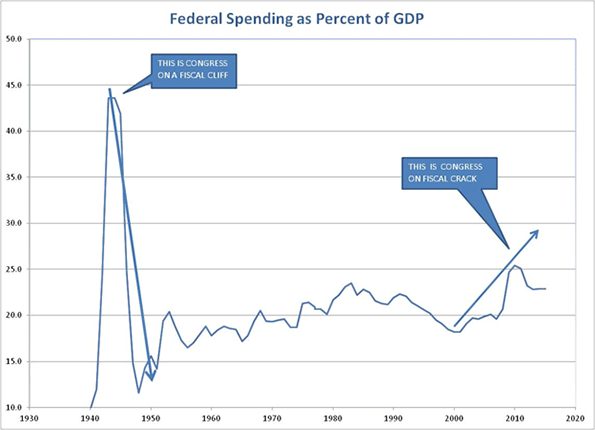
    Forget about a fiscal cliff or the threat of sequestrations. Bernanke’s use of the term “cliff” in 2012 is based on the erroneous analogy that fiscal policy had been moving along some level road for a period of time and was just now approaching an “end” or “falling-off” point. The reality is that federal spending has been rising rapidly since the federal government 1) absorbed the cost of repairing the damage done by the terrorist attacks of 2001, 2) decided to support wars on multiple fronts in the Middle East, 3) bailed out the Wall Street Banks, and 4) failed to pass a budget but 5) decided to continue spending as if nothing had happened. So called “sequestration” – which in this case basically means reducing spending and increasing revenue – would simply be a return to reality, coming down to earth, getting our feet back under us. Unfortunately, we the people appear co-dependents in this addiction.

    This year started with Congress succeeding at its favorite athletic event: kicking the can down the road. The January inauguration of the President and installation of their new members provided the excuse. The fact remains that Congress has not passed a real federal budget since 1997 (“the first balanced budget in a generation”.) An “omnibus spending bill” was passed in April of 2009 but that is not technically a budget.

    Congressional inaction has left the federal government running on extensions (“Continuing Resolutions”) of a budget that was passed when Bill Gates was still CEO of Microsoft, NASA landed the first spacecraft on Mars, and Google was working out of a garage. The last federal budget is from the time before iPods and iPads, before SPAM e-mail exceeded legitimate email, before Facebook, YouTube and Twitter – and before the global financial crisis that sent the world into recession and US federal spending into the stratosphere.

    In lieu of doing anything meaningful, three senators – Kelly Ayotte (R-NH), Ron Johnson (R-WI) and Marco Rubio (R-FL), all in office since 2011 – took the time to write and introduce an amendment to the 1974 Budget Act that would require a macroeconomic analysis of the impact of new legislation. This monumental act of denial was such a complete waste of time that GovTrack.us gave it only a 9% chance of getting out of committee and a 1% chance of being enacted. In fact, from 2011 to 2013, while we were paying these three senators and hundreds more people in Congress, only 12% of the bills introduced in the Senate made it out of committee (11% in the House) and only 14% of those were enacted (24% in the House)! Having passed just a few more than 200 bills, the 112th Congress will go down in history as even less productive than President Harry Truman’s "Do-Nothing Congress" (the 80th, 1947-1948) which nevertheless managed to get 906 bills enacted.

    In the 2012 election, openings were available for 1 new president, 33 new senators and 435 new representatives. Instead, Americans re-elected the same President, 19 of the same senators (58%) and 351 of the same representatives (81%). As a result, the 113th congress looks a lot like the 112th.

    Recently, President Obama signed an executive order to lift the 2009 freeze on federal employee salaries – including the salaries for all members of Congress. When Congress voted to rescind the executive order – they have to vote to prevent an automatic annual pay increase – they did it not just for themselves but for all federal employees. Then they kicked the can (of the “sequestration” spending cuts) down the road two more months.

    Their final act in January was suspending the debt limit “at least until May 19”. H.R. 325 may turn out to be the bright spot in this whole mess despite the fact that it gives Geithner’s, now Lew’s, Treasury carte blanche for financing profligate spending. The “No Budget, No Pay Act” was written on Thursday January 3, 2013; introduced in the House on January 21st by Rep. Dave Camp (R-MI since 1991) and cosponsor Rep. Candice S. Miller (R-MI since 2003); passed in the House on January 23rd by a vote of 285-144; passed in the Senate on January 31st by a vote of 64 to 34.

    According to the bill, if Congress does not pass a real budget by April 15, the salaries of the members of the chamber unable to agree to the budget will be held in escrow until either they pass a budget or the last day of the 113th Congress. All the new Democrat senators voted “aye”; all the new Republican senators voted “nay”. The new House members were mixed. The bill goes to President Obama this week for signature.

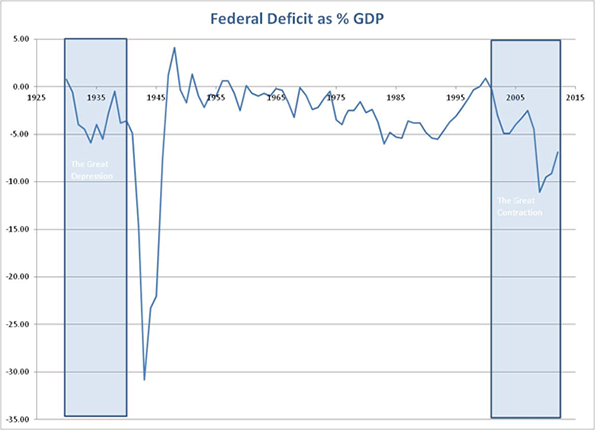
    Assuming he signs it, H.R. 325 allows the federal government to borrow money beyond the record $16.4 trillion debt we already owe. That debt is 104.5% of 2012’s $15.7 trillion GDP. The budget deficit – which has to be covered by borrowing – is running over $1 trillion each year or about 7% of GDP. The deficit alone is 44% of federal receipts. In other words, the government is spending over 40% more than it earns! That’s your government on crack.

    It is like living with a drug addict:

    “Waiting for the problem to resolve itself will get you nowhere. What you are seeing now, if it isn’t already completely out of control, will get completely out of control.”

    The difference is that we, the taxpayers and our children and our children’s children, have to shoulder the burden – something the families of addicts are advised not to do. In a democracy, the majority rules and the majority decided to continue to live with these fiscal crack addicts. For the rest of us, our choice has to be to try to remain optimistic – take the good news where you can find it. There are no “fiscal therapists” or “family support groups” for disgruntled voters. We must seek out the venues where we can talk about the problem openly, don’t be fooled when the fourth estate hides the crack vials to gain favor with the Washington and Wall Street elites and take care of ourselves.

    Susanne Trimbath, Ph.D. is CEO and Chief Economist of STP Advisory Services. Dr. Trimbath’s credits include appearances on national television and radio programs and the Emmy® Award nominated Bloomberg report Phantom Shares. She appears in four documentaries on the financial crisis, including Stock Shock: the Rise of Sirius XM and Collapse of Wall Street Ethics and the newly released Wall Street Conspiracy. Dr. Trimbath was formerly Senior Research Economist at the Milken Institute. She served as Senior Advisor on United States Agency for International Development capital markets projects in Russia, Romania and Ukraine. Dr. Trimbath teaches graduate and undergraduate finance and economics.

    Lead photo: Marion Barry smoking crack, screenshot from FBI surveillance video footage in 1990 via Wikipedia Commons.

  • California Becoming Less Family-Friendly

    For all of human history, family has underpinned the rise, and decline, of nations. This may also prove true for the United States, as demographics, economics and policies divide the nation into what may be seen as child-friendly and increasingly child-free zones.

    Where California falls in this division also may tell us much about our state’s future. Indeed, in his semi-triumphalist budget statement, our 74-year-old governor acknowledged California’s rapid aging as one of the more looming threats for our still fiscally challenged state.

    Gov. Jerry Brown, unsurprisingly, did not acknowledge or address the many factors driving the aging trend that include his own favored policy prescriptions. Whatever their intent, the usual "progressive" basket of policies have had regressive results: a tougher time for both the poor and middle class, and a set of density-oriented policies that are likely to drive up housing prices, particularly for the single-family houses largely preferred by people with children.

    These policies have helped turn California into a state that looks less Sunbelt and more like the long-aging centers of the Northeast and the Midwest. It also mirrors declines in fertility and marriage rates in the most-rapidly aging parts of Europe and east Asia. These regions are shifting toward what Chapman University’s recent report, in cooperation with the Civil Service College of Singapore, characterized as post-familialism. Released this past fall in Singapore, the report will be presented in Orange County this week.

    We believe that the rapid decline of marriage and fertility rates in many advanced countries inevitably leads to economic decline, reduced workforces and, likely, an inevitable fiscal disaster. This may be becoming now more true in the United States, a country which once boasted the most vibrant demographics in the high-income world but since the 2007-09 recession has seen a rapid drop in both its marriage rate and fertility rates to well below 2.1 children per female, what is generally referred to as "the replacement rate."

    Just as it differs by country, the degree of post-familialism varies among countries, but it also does among states and regions. Some states, notes a recent Packard Foundation study, such as Texas, Utah and North Carolina, have seen double-digit gains in their child populations over the past decade while California’s has dropped by over 3 percent. Some urban regions like Raleigh, Austin, Houston, Charlotte, Dallas-Fort Worth and Atlanta have also seen rises in their number of children, with population between ages 5 and 17 growing by 20 percent or more over the past decade.

    Historically, California and its regions stood among these family magnets, but no more. Like the states of the Northeast and upper Midwest, the Golden State is becoming rapidly geriatric, as families opt out, and immigration, the primary source of our growth in younger people, declines in an economy ill-suited to migrants with aspirations for a better life.

    Southern California, where immigration has dropped by roughly a third over the past decade, has shared in this decline.

    All three major regions of greater Los Angeles – the San Bernardino-Riverside area, Orange and Los Angeles counties – have seen a sharp drop in their percentages of children. Only the Inland Empire remains still relatively youthful overall, with some 26 percent of its population under 15, well above the national average. In contrast, Los Angeles and Orange counties experienced a 15.6 decline in under-15 population, highest among the nation’s metropolitan areas. Meanwhile, the over 60 population grew by 21 percent.

    One clear indicator can be seen in our declining school populations. Despite massive expenditures for new construction, over the past decade the Los Angeles Unified School District has seen enrollment drop by 7.5 percent. In that period, the student count fell by over 50,000, the largest numerical drop in the nation.

    What is leading to this exodus of families? Sacramento politicians and their media enablers blame insufficient investment in education or simply national aging trends as the root causes. But then, why are other states, including our key competitors, gaining families and children?

    Sacramento lawmakers of both parties share some responsibility. The dominant progressives’ regulatory and tax agenda continues to reduce economic prospects for younger Californians, leading many young families to exit the state. In contrast, older Anglos, the bulwark of the now largely irrelevant GOP, are committed to massive property tax breaks because of Proposition 13. Add good weather and the general inertia of age, and it’s not surprising that families might flee as seniors stay.

    Other factors work against parents, prospective or otherwise. The knee-jerk progressive response to our demographic problems usually entails more money be sent to the schools.

    But they rarely include the student-oriented reform measures such as those enacted in New Orleans (where I am working as a consultant). The poor performance of public education, clear from miserable test results and dropout rates, makes raising children in California either highly problematic or, factoring the cost of private education, extremely expensive.

    If you think Proposition 30’s higher sales and income taxes will change anything, think again.

    Much of that money will end up, almost inevitably, going toward pensions of teachers and other state workers. The hegemonic teacher unions have as their primary goal protecting the system at all costs and resisting change.

    Equally critical, the state’s "enlightened" planning policies also work to discourage families. California’s new climate-change-mandated housing regime – preferring apartments over houses – does not specifically target families, but the case for greater density is often predicated on an ever-declining number of families and an undemonstrated growing preference for density. "Singles and childless couples are the emerging household type of the future," suggests developer and smart growth guru Chris Leinberger.

    These post-familial trends have been incorporated into the influential report, "The New California Dream," widely accepted as gospel by many in our state’s development community.

    The author, the University of Utah’s Chris Nelson, interpreted early 2000s public opinion surveys to suggest a growing preference for smaller lot sizes and apartments, though the data indicate no change over the past 10 years. Developers assume that as singles, empty-nesters and childless couples become as the state’s primary market, this likely misperceived preference will gain even greater strength

    So what would a post-familial future mean for California? You don’t need a crystal ball to figure this one out. Just look at what is happening in other rapidly aging economies, especially Japan, but also much of Europe.

    Dense housing, high taxes and lack of space (such as back yards) tend to discourage family formation. Slower population and labor-force growth then slows the economic engine, which, in turn, creates a greater imbalance between workers and pensioners. The result, ultimately, could be a kind of fiscal Armageddon.

    Fortunately, none of this is inevitable. States such as Utah, Texas and North Carolina continue to attract families, bringing with them new workers, companies and customers. As their economies grow, they can generate broadly based revenue, unlike California, which is increasingly reliant on housing or stock-price bubbles that benefit the already affluent and older populations.

    It is not our karma, Gov. Brown, to submit to a Japanese-like demographic demise. But revitalizing California will require a radical reevaluation of priorities and reconsideration of policy impacts on families.

    Joel Kotkin is executive editor of NewGeography.com and a distinguished presidential fellow in urban futures at Chapman University, and a member of the editorial board of the Orange County Register. He is author of The City: A Global History and The Next Hundred Million: America in 2050. His most recent study, The Rise of Postfamilialism, has been widely discussed and distributed internationally. He lives in Los Angeles, CA.

    This piece originally appeared in the Orange County Register.

    Childhood kids photo by BigStockPhoto.com.

  • Is Urbanism the New Trickle-Down Economics?

    The pejoratively named “trickle-down economics” was the idea that by giving tax breaks to the wealthy and big business, this would spur economic growth that would benefit those further down the ladder. I guess we all know how that worked out.

    But while progressives would clearly mock this policy, modern day urbanism often resembles nothing so much as trickle-down economics, though this time mostly advocated by those who would self-identify as being from the left. The idea is that through investments catering to the fickle and mobile educated elite and the high end businesses that employ and entertain them, cities can be rejuvenated in a way that somehow magically benefits everybody and is socially fair.

    Trickle down economics type policies failed both because while they contained a great deal of truth – tax rates do matter in economic development – they were a reductionist oversimplification, and perhaps more importantly were self-interested recommendations of the very class that would benefit from them. The tax breaks for the wealthy and big business were in fact the real goals, not primarily policies intended for socially beneficial consequences it was said would result from them.

    As it turns out, urbanism in its current form appears to suffer from the exact same problems, as Richard Florida has just documented in an article over at Atlantic Cities called “More Losers Than Winners in America’s New Economic Geography.”

    A key question remains: Who benefits and who loses from this talent clustering process? Does it confer broad benefits in the form of higher wages and salaries to workers across the board or do the benefits accrue mainly to smaller group of knowledge, technology, and professional workers?

    The University of California, Berkeley’s Enrico Moretti suggests a trickle-down effect, arguing that higher-skill regions benefit all workers by generating higher wages for all workers. Others contend that this new economic geography is at least partially to blame for rising economic inequality.
    ….
    I’ve been examining the winners and losers from this talent clustering process in ongoing research with Charlotta Mellander and our Martin Prosperity Institute team….Our main takeaway: On close inspection, talent clustering provides little in the way of trickle-down benefits. Its benefits flow disproportionately to more highly-skilled knowledge, professional and creative workers whose higher wages and salaries are more than sufficient to cover more expensive housing in these locations. While less-skilled service and blue-collar workers also earn more money in knowledge-based metros, those gains disappear once their higher housing costs are taken into account.

    In short, there’s no flow through to people who aren’t directly tapped into the knowledge economy itself. I might add that this probably does include a number of service sector workers like celebrity chefs and personal trainers who cater to the luxury end of services. But the majority of residents are missing out.

    To put it in political speak, the creative class doesn’t have much in the way of coattails.

    These findings also foot to the implications of Saskia Sassen’s global city theories, in which the global city functions of a region comprise a sort of “city within a city” which has little in common with the rest of the metro region as thus perhaps little impact on it. Indeed, we might even view the two economic geographies as being in conflict.

    Florida and Sassen are academics and so can’t necessarily be seen as advocates for the phenomena they describe. They are describing what is, not what should be. The question is, what have policy makers done with this information?

    As with the tax rate example, there really is an importance to attracting educated people to your city. College degree attainment explains almost everything about per capita income in a region. (Though as Florida notes, per capita values, as means, can be misleading and median is a better way to do analysis where it’s available).

    Have urbanists used this as a call to arms to put all of their energy into helping those left behind in the knowledge/creative class economy? No. Instead, urban advocates have gone the other direction, locking onto this in a reductionist way to develop a set of policies I call “Starbucks urbanism.” That is, the focus is on an exclusively high end, sanitized version of city life that caters to the needs of the elite with the claim that this will somehow “revitalize” the city if they are attracted there.

    As with trickle-down economics, this a) doesn’t work and b) is being promoted by the self-interested.

    Firstly, it doesn’t work because it more or less operates on the basis of displacement. So it might revitalize certain select districts, but only as physical geographies not human ones. This is exactly because of the phenomenon Florida identified: there are few trickle down benefits to be had. Also, this only works in a handful of districts or in cities that are so small that you can plausibly gentrify the entire thing. The area left behind in these places, as the in the violence stricken neighborhoods of Chicago that are making national news, receive virtually no benefit. And as Bill Frey of Brookings once said, “There aren’t enough yuppies to go around to save Detroit.” Thus only a comparatively small number of cities benefit from talent concentrations anyway. (Indeed, the notion of “concentration” is inherently a relative one).

    Secondly, and here I go beyond Florida’s article, urban advocates are a largely self-interested class. Everybody knows that a hedge fund plutocrat is looking out for number one and has a class interest, but if we were honest with ourselves, most of us probably do the same at some different level. For example, it’s easy to cry nepotism when a politician’s relative gets put on the payroll, but if a man gets his son on at the ironworkers union, it generally flies under the radar. I don’t claim to be exempt from this myself.

    The people most aggressively pushing urbanist policies like bike lanes, public art, high end mixed use developments, high tech startups, swank boutiques and restaurants, greening the city policies, etc. are disproportionately those who want to live that lifestyle themselves, or hope to someday. Like me in other words. The fact that you’re a Millennial who rides around to microbreweries on your fixie without necessarily having a high paying job yourself (yet) doesn’t matter. You are still advocating for your own preferred milieu, and that of others who think like yourself.

    I have observed that when challenged on this, urbanists grow indignant, talking about their commitment to the planet or how transit benefits the poor, etc. But ultimately as with the tax cut advocates, that’s just a self-justification. With some notable exceptions, you don’t see social justice and equity issues front and center in the urbanists discussions outside of old-school community organizing/activism circles, groups that are almost totally distinct from Atlantic Cities style urbanism.

    Most urbanists I know are quick to advocate tax increases for the 1% but fail to see how their own policies contribute to a widening of the income gap and class divide in their own cities. Even if they are genuinely motivated to help the entire civic commonwealth, hopefully they recognize that they at least have the same conflict of interest situation they would be quick to highlight in a businessman or politician.

    The answer isn’t to junk urbanism. Just as class warfare rhetoric that demonizes the wealthy and business and wants to tax the daylights out of them isn’t the solution to what ails our economy, neither is abandoning many of the principles of urbanism. After all, tax rates do matter for economic growth. Similarly, liveable streets and such are indeed very important to urban revitalization.

    What’s needed is a new orientation of these ideas so that we don’t end up with an explicitly elitist policy rationale and policy set that caters to the already privileged at the expense of the poor and middle classes of our cities. We need to be asking the question of what exactly we are doing to benefit the people without college degrees beyond assuring them that if we attract more people with college degrees everything will be looking up for them. We need to sell ideas like transit in a way that isn’t totally dependent on items like “enabling us to attract the talent we need for the 21st century economy.” If I read half as much about providing economic opportunity and facilitating upward social mobility for the poor and middle classes as I do about green this, that, or the other thing, we’d be getting somewhere. (Observe Robert Munson’s recent call to broaden the practical definition of green as one example of starting to think this way). I need to do this as much as anyone.

    It’s easy to see why people default to trickle-down type theories even beyond class interest. Both sets of prescriptions – tax cuts for the elite and urbanism for the elite – took place against a backdrop of globalization and deindustrialization that eviscerated the engines of traditional working and middle class prosperity. The answers to how to fix this core problem aren’t obvious. Richard Longworth recently put together a compilation of views on middle class malaise and it is sobering reading.

    In a sense, elite boosting policies have “worked” because they’ve successfully boosted the elite – a reasonably tractable problem in the new economy. But they’ve had few benefits to anyone else and have fueled huge class-based resentments that threaten civic cohesion. But just because the problem of opportunity for the poor and middle classes isn’t easy, doesn’t mean it doesn’t need to be solved. Indeed, rebuilding an engine of broad-based prosperity and upward mobility is the signature challenge of our age, and one to which urbanists should be encouraged to apply their fullest efforts.

    Aaron M. Renn is an independent writer on urban affairs and the founder of Telestrian, a data analysis and mapping tool. He writes at The Urbanophile, where this piece originally appeared.

    Chicago skyline photo by Bigstock.

  • How Green Are Millennials?

    Besides his history-making embrace of full equality for gays and lesbians, the most surprising part of President Barack Obama’s Second Inaugural Address may have been the emphasis placed on dealing with the challenge of climate change. The president devoted almost three whole paragraphs, more than for any other single issue, to the topic. His remarks suggested that America’s economic future depended on the country leading the transition to sustainable energy sources and that “the failure to do so would betray our children and future generations.”

    Different generations reacted differently to the speech. The President’s rhetoric seemed like standard liberal fare to many Baby Boomers (born 1945-1965), who either vehemently agreed or disagreed with what Obama had to say depending on their political ideology. But members of the Millennial Generation (born 1982-2003) were in almost unanimous agreement with the way the President defined the context of this challenge. It was as if he was channeling the thinking of Millennials such as David Weinberger at the Roosevelt Institute’s Campus Network (RICN) who wrote, almost a year ago, “Millennials view environmental protection more as a value to be incorporated into all policymaking than as its own, isolated discipline. We are concerned with economic growth, job creation, enhancing public health, bolstering educational achievement, and national security and diplomacy. Young people recognize that each of these concerns is inextricably tied to the environment.”

    President Obama was also right, from a Millennials’ perspective, to emphasize the need for America to become a leader in sustainable energy technologies. Seventy-one percent of Millennials believe America’s energy policy should focus on developing “alternative sources of energy such as wind, solar and hydrogen technology; only a quarter believes that it should focus on “expanding exploration and production of oil, coal and natural gas.” Similarly, the RICN’s “Blueprint for a Millennial America,” a report prepared by thousands of Millennials who participated in their “Think 2040” project, placed the development and usage of renewable sources of energy at the top of all other environmental initiatives.

    The participants’ proposed solutions to the challenge, however, were not focused on the kind of top-down change so common to Boomers. .Instead the proposals  emphasized taking action at the community level. No one, the RICN blueprint said , should be asked to “make sacrifices without fully considering the cost to communities” whose “texture” is most likely to be impacted dealing with the challenge.

    Many politicians fail to notice this unique Millennial perspective. Members of the generation disagree sharply with their elders on the best way to address environmental challenges, preferring to tackle them through individual initiative and grassroots action rather than a heavy-handed top down bureaucratic approach.

    Of course,  Millennials are the most environmentally conscious generation in the nation’s history. Almost two-thirds of Millennials believe global warming is real and 43% of them think that it is caused by human activity, levels much higher than among all other generations. But, as Weinberger also wrote, “While environmentalists of years past were primarily aiming to bring clean air and clean water concerns into the national policymaking calculus, environmentalists today are far more worried about solving global problems like climate change by using local environmental solutions.”

    Adapting a Millennial approach to dealing with global warming would mark a major change for the Administration. All four of Obama’s first term environmental policy heavyweights were Boomers, whose preference for top down dictates was evident in almost every decision they made. Secretary of the Interior Ken Salazar established new controls on off shore oil drilling that satisfied neither side. Secretary of Energy Stephen Chu tried to jump start the development of renewable energy technologies in the United States by funding startups with dubious chances of marketplace success. And most conspicuously   EPA Administrator Lisa Jackson’s plans for regulating smog were rejected by the President. Fortunately ,  all of them have  announced plans to leave their posts. They will follow in the footsteps of environmental czar, Carol Browner, who left two years ago after a less than stellar performance during the Horizon Deepwater drilling disaster.

    There is talk within the administration of subtle changes in policy.   The departure of this quartet of ideologically-driven Boomers gives the President an excellent opportunity to appoint a new team to execute his vision for meeting the environmental challenges of our time.

    President Obama’s  new team will have to continue to link the need to develop U.S. energy production to both environmental concerns and economic development. It will need to couch the call for progress on reducing carbon dioxide emissions in the context of strengthening, not weakening, local communities and preserving the nation’s natural resources. Just who the president  finds to take on this politically nuanced task will say a great deal about his sensitivity to his Millennial Generation supporters’ attitudes and beliefs. It will also foretell a great deal about how successful he will be in matching the lofty rhetoric of his Second Inaugural Address with today’s political realities during his final term in office.

    Morley Winograd and Michael D. Hais are co-authors of the newly published Millennial Momentum: How a New Generation is Remaking America and Millennial Makeover: MySpace, YouTube, and the Future of American Politics and fellows of NDN and the New Policy Institute.

    Photo by gfpeck

  • Why Are There So Many Murders in Chicago?

    After over 500 murders in Chicago in 2012, the Windy City’s violence epidemic continues – 2013 saw the deadliest January in over a decade – and continues to make national news.  The New York Times, for example, ran a recent piece noting how Chicago’s strict gun laws can’t stem the tide of violence.

    The NYT piece predictably spurred much debate over gun policy, but that distracts from the real question: why exactly does Chicago have so many murders?  Chicago had 512 murders in 2012. New York City – with three times Chicago’s population – had only 418 murders, the lowest since record keeping began in the 1960s.  Los Angeles, with over a million more people than Chicago, had only 298 murders.  These other cities can’t be accused of lax gun laws or somehow being immune to guns being brought in illegally from more lenient jurisdictions. So what’s different about Chicago?

    It’s impossible to say for certain what is causing Chicago’s unique murder problem, but a few possibilities suggest themselves.

    1. The number of police officers.  Depending on the report, Chicago’s police department is about 1,000 officers short of authorized strength and is facing a large number of looming retirements while few new recruits are brought in due to budget constraints. This clearly has had an impact. However, NYPD has also seen a decline in the number of officers without this effect.
    1. Police tactics. New York has made headlines with controversial, but apparently effective, tactics like the so-called “stop and frisk” policy.  The city hasn’t hesitated to defend these, even in the face of enormous negative press and lawsuits. Los Angeles has made huge strides in moving past its Detective Mark Furhman era reputation to build bridges to minority communities while Chicago has spent years and millions of dollars ignoring and defending officers who used torture to extract confessions. New York and Los Angeles also have more experience with statistically driven policing than Chicago.
    1. Politically controlled policing.  Mayor Daley hired Jody Weis from the FBI as police superintendent, but neutered his ability to run the department by assigning a political operative as Weis’ chief of staff.  Similarly, Rahm Emanuel, a fan of centralized control, has been heavily involved in driving major decisions like disbanding the anti-gang strike forces. It’s not clear whether police decisions have been driven by purely professional crime fighting concerns or, as in likely given the city’s culture, political considerations.
    1. William Bratton. Both New York and Los Angeles saw the start of their major successes against crime under the leadership of William Bratton. Los Angeles in particular was extremely smart to go hire him after his success in New York. While other cities have experienced murder declines, often with similar strategies, they are not places of the same scale, demographic diversity and political complexity of New York and LA. Perhaps Chicago should have spent whatever it took to get Bratton as police superintendent, though whether Bratton would have been willing to come into a place with such a history of political meddling with the police is uncertain.
    1. Gang fragmentation. Local and federal officials had great success taking out the leadership of many of the city’s gangs. The result has been significant gang fragmentation and a lack of hierarchical control over the rank and file that some have blamed for contributing to the violence epidemic.
    1. Depopulation. Few analyses of Chicago’s murder problem focus on the city’s very poor demographic performance.  New York City and Los Angeles are at all time population highs. Other urban areas like Boston and Washington, DC have started rebounding from population losses. However, Chicago lost a stunning 200,000 people in the 2000s and now has a population rolled back to levels not seen since 1910.  Loss of population in many neighborhoods has had many pernicious effects, including a loss of social capital (notably middle class families), loss of businesses due to loss of customers, and a diminished tax base.  It’s hard to maintain social cohesion in the face of both extreme poverty and population decline.  Similarly, the Chicago region had the worst jobs performance of any large metro in the US during the 2000s, which couldn’t have helped.
    1. Public housing demolitions. Chicago’s high rise projects like Cabrini-Green and the Robert Taylor Homes were yesterday’s national shame as hotbeds of crime and the killing of youths. Chicago was one of the most aggressive demolishers of these, with all of the high rises effectively destroyed. While this perhaps reduced localized crime, it destroyed the only homes many people had ever known, and, like depopulation, destroyed significant social capital and possibly simply redistributed and dispersed crime, as some research in other cities has suggested.  New York’s public housing is hardly problem free, but NYC  took a very different approach, investing in the high-rises rather than destroying them.  It’s hard not to speculate on what this has meant to the trajectory of crime in those two cities.

    Whatever the actual answer may be, Chicago’s murder epidemic continues to ravage families and neighborhoods. Given the results in January, it would appear the city is no nearer to getting a handle on it than it was a year ago. A reconsideration of the differences between Chicago and other large cities, and a resulting adjustment in strategy, would seem to be long overdue.

    Aaron M. Renn is an independent writer on urban affairs and the founder of Telestrian, a data analysis and mapping tool. He writes at The Urbanophile.

    Chicago photo by Bigstock.