Category: Policy

  • Central Banking’s Hogwarts Syndrome

    Central banks—the US Federal Reserve is one—come with the mystique of Oz. While the Fed fiercely denies that it is powerful enough to cure recessions with a click of the heels, there are those who believe it’s true. If, however, you look behind the velvet curtains and columned lobbies, you will find good men, but bad wizards. In mid-December, the bank’s Open Market committee pledged $85 billion a month until unemployment drops below 6.5 percent. Such policies are a long way from Kansas and prudent finance.

    Around the world central banks have become convenient instruments of public and private bailouts, accommodating lenders when citizens reject tax hikes and governments need a few trillion to bail out Greece or prop up the housing market. It helps that they are shrouded in mystery and give the impression that they hold their meetings at Hogwarts, perhaps with Albus Dumbledore presiding.

    The reason that the Federal Reserve, like many of its European counterparts, looks like a failing credit union is that its balance sheet numbers don’t add up. On November 12, 2012, the Fed showed a assets of $2.9 trillion against equity of $69 billion. In other words, the bank’s leverage is 42 times its capital. At its peak, Lehman was geared 36 times; a prudent limit might be eight times. At this time next year, its assets (which would more properly be considered, liabilities) will be $4 trillion.

    $1.6 trillion on the Fed’s book is held in US Treasury securities, although, I can assure you that money has been spent, perhaps on that swell new $3.4 billion “campus” for the Department of Homeland Security.

    Before 2008, the Fed’s balance sheet was less than $900 billion, and assets were short-term interbank loans and Treasury securities. Now the balance sheet is $2.9 trillion, and mixed in with the gold at Fort Knox is $886 billion in mortgage-backed securities, making the Federal Reserve the nation’s Savings & Loan. (Imagine the toasters given away to build up such a loan book.)

    One reason that the Fed’s balance sheet is not available for a congressional audit is that it might scare world markets to death to discover that the US central bank is awash with non-performing assets, not British gilts or J.P. Morgan’s gold bars. As lenders of last resort, many central banks now have vaults that are crammed with junk bonds, subprime exposure, unwound credit default swaps, out-of-the-money options, and sovereign debt issued by governments that have long since vanished.

    Take the European Central Bank. After the 2008 crisis it encouraged banking groups to load up on sovereign credits, hoping that this would prevent further collapse and stimulate local economies.

    The same practice of offloading substandard loans to the Federal Reserve governed the stimulus programs of the Bush and Obama administrations, which “stimulated” the economy by moving bad loans off Wall Street and into the Fed.

    Another definition for quantitative easing (QE3 in its last rendition) might be “government payday loans.” Together, the central banks of the United States and Europe are holding more than $6 trillion as “assets” on their balance sheets, which if they were accurate might read: “Advances against street demonstrations.”

    How did we get to these diminishing returns? In their modern incarnation, central banks replaced market makers and robber barons that got tired of business cycles and having to bail out commercial banks and stock jobbers that had hit the skids.

    In the US, the panic of 1907 (which J.P. Morgan mitigated, although to his own ends) pushed the country to later enact legislation creating the Federal Reserve System that, in the future, would provide liquidity during periods of recession; its current dual mandate is to fight inflation and maximize employment.

    Given that economics was deemed a science of predictions, the presence of strong central banks in North America and Europe was supposed to mean the end of sharp volatility, even though it has been convincingly argued that the Federal Reserve has made little difference in the many recessions since 1913, notably in the Great Depression, when it restricted the money supply.

    In his history of central banking, Lords of Finance: The Bankers Who Broke the World, Liaquat Ahamed makes the point that the leading central banks in and after World War I—those of England, France, the United States, and Germany—routinely made bad decisions when it came to issuing currency, propping up the money supply, or regulating the amounts of credit and bonds in various banking systems.

    The biggest problem with central banks is that they are mortgaged to the political classes and have become the funding arm of various get-elected-quick schemes rather than sticking to their job of fiddling with the money supply. The Fed’s evolution into a casino cashier window started sometime after 1996 and continued into the administration of George W. Bush, when the equity in American homes became just another chip for Wall Street croupiers to sweep into their aprons.

    Under patriotic banners proclaiming that home ownership was a democratic rite of passage, both Congress and the Fed made it easy for banks to grant mortgages based on little, if any, collateral (remember “liar loans?” I bet Alan Greenspan does). They also looked the other way when the administration decided to pay for its wars and tax cuts by using home equity to keep consumer markets irrationally exuberant. Why? Prosperity has a lot to do with reelecting incumbents, and it was those officials who regulated the regulators. Furthermore, member commercial banks, not the US government, own the Fed, even if the US President appoints the chairman.

    What might hasten a reckoning of these wobbly accounts is that central bankers are finding it harder to agree that their temples of finance are ministries of magic. A few, like the German and Swiss central banks, dread inflation and take a dim view of speculators. Those attitudes find little sympathy in Italy, Spain, or Greece—should we add California?—which need to kite checks to pay state pensions.

    The US isn’t sufficiently flush to help bail out the European Union. Alas, not even the Fed has deep enough pockets to fund trillion dollar annual deficits. Nor should anyone think that the US government is a likely candidate to bail out the Fed, as right now it is the Fed that is bailing out America.

    Flickr photo by Lance McCord: Federal Reserve Bank of Atlanta Eagle: Eagle sitting atop a decorative (though once-structural) column outside the Federal Reserve Bank of Atlanta on Peachtree Street; it dates from an earlier incarnation of the Atlanta Fed’s home.

    Matthew Stevenson, a contributing editor of Harper’s Magazine, is the author of Remembering the Twentieth Century Limited, a collection of historical travel essays. His next book is Whistle-Stopping America.

  • The Gun Control Debate That Went MIA

    Intellectually — despite the events in Newtown, Connecticut — I can appreciate that the “right to bear arms” is a fundamental constitutional guarantee, inherited from both the Glorious (1688) and American revolutions. I still wonder, though, whether it applies to a society in which most people live in suburban condos and tract houses, which are largely absent of Redcoats or the Hole in the Wall gang. Why have guns in our lives? We know the status quo ante of the 18th century Second Amendment isn’t working. The issues surrounding guns failed to make even a cameo appearance in the recent election, and, when they have been raised in the recent past they certainly did not elicit the same tears that they did at the Newtown press conferences.

    Americans own 300 million guns, which kill about 30,000 people each year; about half of the deaths are suicides. Teenagers are involved in a disproportionate number of the shootings and deaths in the violent exchanges, and teens and children are at high risk from all gun violence, which in 2007 and 2008 claimed the lives of 5,740 young victims across the United States (that’s almost three “Newtowns” a week). What has become of the original intent of gun rights, if in those years firearms wounded 34,387 teens and children?

    Ironically, gun legislation is not much of a deterrent to loss of life from gunshot wounds. In 2008, shooting deaths per thousand in Vermont, with few gun laws, were about the same as those in nearby Massachusetts, which has some of the most strict gun-control laws in the country. The gun laws in the District of Columbia do little to prevent criminals from carrying them into the capital from nearby Virginia or Maryland.

    On average about 24 Americans are murdered every day with a gun, and since 9/11 some 300,000 have been gunned down. I came to many of these statistics and reflections while reading Craig Whitney’s Living with Guns: A Liberal’s Case for the Second Amendment, which searches for the middle ground between the National Rifle Association “standing its ground,” and those that would wish away the 300 million firearms that are in American hands.

    I had turned to the book hoping to find an argument that the gun right of the Second Amendment was tied to militia enlistment, and that without a call to arms at Lexington or Concord few outside of law enforcement officers needed firearms. What I got instead was a well-reasoned argument for gun ownership, provided that the firearms are handled, bought and sold with care.

    Whitney, a former New York Times editor, argues that guns are synonymous with the founding of the American republic, and that the only way to reduce gun violence is to see that firearms, like the equally deadly automobile, are only used in safe hands and in a responsible manner. He believes strict laws that prevent ordinary citizens from having guns to ward off intruders and attackers are unproductive and unconstitutional.

    Among his suggestions for ways to keep guns out of the hands of those that would open fire in malls and schools are tighter background checks for buyers and sellers, including at gun shows; nationwide standards to teach responsible gun handling and the issuance of permits for owners who complete rigorous courses; better data bases to trace missing or stolen guns; harsher penalties for illegal gun use; and easier methods to trace bullets and handguns discharged in a criminal act.

    My own view of guns is that they scare me. Before moving to Europe in 1991, we lived in New York City. One evening, standing on the doorstep of our Flatbush brownstone, I heard the firing from an automatic weapon on a nearby block and decided that maybe there were other places to raise my children.

    Living in Brooklyn didn’t give me much sympathy for the NRA, given that the borough has more liquor stores than deer, and that most local weapons are used during open seasons on shop owners. I constantly had in mind a newspaper report about teenagers carrying concealed weapons on the subway. A police detective interviewed for the story said, “I can’t say that every fourteen-year-old on the subway is carrying a gun. But I can say that every other kid has one.”

    Part of the reason I react so negatively to guns is because I came of age between the assassinations of John and Robert Kennedy in, respectively, 1963 and 1968. By chance, I saw each one in person just before he was killed, so the image of their head wounds (from cheap mail-order or pawn shop guns) contrasted vividly with my recent memories of their thick, wavy hair and broad smiles.

    Like many, I only think about guns after hearing about shootings like those at Sandy Hook Elementary, or that a madman went berserk at Virginia Tech or at the movies in Colorado, sacrificing dozens of innocent lives on an altar that is later covered with flowering clichés from the Second Amendment (“If only the Batman moviegoers had been armed…”). Does a linebacker for the Kansas City Chiefs really need nine guns for protection, especially when he is only hunting down his girlfriend?

    Despite these negative feelings, I listened carefully to Whitney’s arguments that gun control has little effect on preventing murders or crimes, and that guns are in America to stay, whatever the consequences. I found myself uncomfortably weighing his long interview with a gun advocate who believes that the only deterrence to gun violence is to have everyone packing heat. Could he be right?

    Although I can accept hunting rifles over the hearth and even registered handguns for home defense, I have a harder time with “the right to bear arms” when I think how easy it is anywhere in the country for a lunatic to buy an automatic weapon and use it on school kids or postal coworkers. Better registration procedures and tracking of guns might keep them away from the likes of Tucson’s Jared Lee Loughner. But do we really want the dress code at places like Sandy Hook elementary to include full metal jackets?

    Flickr photo: Newtown, Connecticut, Bus Arriving by AskJoanne.

    Matthew Stevenson, a contributing editor of Harper’s Magazine, is the author of Remembering the Twentieth Century Limited, a collection of historical travel essays. His next book is Whistle-Stopping America.

  • Born Into Ruin: How the Young are Changing Cleveland

    It’s true. I am not happy all the time living in Cleveland. But I don’t want to be happy all the time. That’s unnatural. Said Nietzsche:

    “Sometimes, struggles are exactly what we need in our life. If we were to go through our life without any obstacles, we would be crippled. We would not be as strong as what we could have been.”

    Cleveland is a struggle. But that is how I know it. That is how many Clevelanders in their 20’s to 40’s know it. We didn’t know the city of Mr. Jingeling and Bob Hope—the city of a near million—the “Best Location in Nation”. No, we knew Cleveland on its knees. We knew Cleveland praying. But being born into post-industry is a good first lesson. Life is an obstacle. Cleveland prepares you.

    For what?

    Bullshit, or at least the proclivity of it.

    Aspirations abound now. If you were only creative enough, rich enough, worldly and knowledgeable enough, then: you can become something, a star—evolved from your basic beginnings. Fine. But it’s this ambition-before-all-else mindset that has also extended our eyes from our feet, or our aspirations from our selves, and so for long the country has left its principles behind to build castles in the air with no foundation. Consequently, our culture—our sense of being from somewhere, of bleeding the aesthetic of someplace—has taken a hit. It’s no surprise, then, that our castles keep falling down into a pile of broken promises that never seem to be able to feed, clothe, or employ us properly.

    To hell with it. Time to be proud in the gift of being grounded. It is the only way up.

    Grounded. It’s how we are grown here in the Rust Belt. For you see it everywhere: the reality of things. You see it in the cracked sidewalks, and in the seriousness on the faces of the people all around you. You see it in the empty brownfields behind chain link fences. Yet there is a comfort in the Rust Belt aesthetic, one tied to the fact there’s little pretentiously precious. From the bodies we are built with to the handshakes we make to the food we eat to the buildings we see, shit is heavy here. And it’s a ritual you learn simply by living on Rust Belt ground.

    I am watching this unfold first hand with my 2-year old daughter. You see, I have a place near the rail ties, and each time the train rides through my girl runs to the window to see the power of the “choo choo”. I watch her with a smile as she watches with awe as the force of the box cars enter our bodies through the vibrations coming up from the ground. She is becoming Rust Belt, I think. I do this every time this happens.

    But this groundedness, this Rust Belt-ness, it’s not a settling or a lack of aspiration, but rather—for Clevelanders populating the city that never knew its heights— a chance to look around and see nothing but work to do, and an opportunity to do it. There are a lot of fresh eyes around. The city psychology is changing. And I think this may save Cleveland, because people are no longer waiting for Cleveland to save us.

    This is happening all across the Rust Belt. For instance, Detroit native Bill Morris recently wrote about his trip back to Motown to “see that Detroiters had stopped waiting for salvation from above – a new auto factory, a new government program, a new housing development – because they were too busy saving themselves down at street level.”

    Morris goes on to interview Jack Kushigan, a Detroiter who grew up working in the family’s machine shop before moving to San Francisco and then back. He writes of Kushigan:

    I met him in the woodworking shop he’d set up in a church basement on the city’s hard-hit East Side, where he was teaching neighborhood people how to make furniture out of wood harvested from abandoned buildings, a virtually limitless source of raw materials. “Detroit for years, during its decline, has been hoping for a Messiah,” Kushigian told me. “Detroit has finally given up on that. A lot of people in Detroit have a fire burning inside them that I don’t see anywhere else. My feeling is that the Messiah is us.”

    I feel the same thing is happening in Cleveland. The work the young people are doing. The fact they are entering the broken dreams of past generations with no illusions, little skeletons, but with a determination that comes with being grounded. And it is this kind of collective turn-the-page energy that will end the endless recent history of our decline.

    Call it the benefit of struggle, or of not having your castles yet crumble because you’d been born into the ruin.

    This piece originally appeared on Cool Cleveland.

    Richey Piiparinen is a writer and policy researcher based in Cleveland. He is co-editor of Rust Belt Chic: The Cleveland Anthology. Read more from him at his blog and at Rust Belt Chic.

  • Obama’s Energy Dilemma: Back Energy-Fueled Growth or Please Green Lobby

    Talk all you want about the fiscal cliff, but more important still will be how the Obama administration deals with a potential growth-inducing energy boom. With America about to join the ranks of major natural gas exporters and with the nation’s rising oil production reducing imports, the energy boom seems poised to both  boost our global competitiveness and drive economic growth well above today’s paltry levels.

    This puts President Obama in a dilemma. To please his core green constituency, he can strangle the incipient energy-led boom in its cradle through dictates of federal regulators. On the other hand, he can choose to take credit for an economic expansion that could not only improve the lives of millions of middle- and working-class Americans, but also could assure Democratic political dominance for a decade or more.

    Stronger economic growth remains the only way to solve our nation’s fundamental fiscal problems other than either huge tax hikes or crippling austerity. As economist Bret Swanson has pointed out, the best way to raise revenues and reduce expenditures, particularly for such things as welfare and unemployment, would be to increase overall growth from the current pathetic 2 percent rate to something closer to 3 or 4 percent.

    Swanson suggests in a few simple charts (PDF) that a 4 percent growth rate would drive output to levels that would cover even our current projected spending levels. Even at 3 percent, the additional revenue would be enough, for example, to fill in Medicare’s looming $24.6 billion liability that is projected to 2050. The effects of higher growth are likely far greater than either any anticipated bonanza by raising taxes on the “rich” or enacting the most extreme austerity.

    The energy revolution presents Obama with the clearest path to drive this critical boost to greater economic growth. New technologies for finding and tapping resources, such as fracking and other new technologies to tap older oil fields, could make America potentially the largest oil and gas producer by 2020, according to the International Energy Agency.

    Equally important, an increasingly energy self-sufficient America would enjoy significantly greater independence from pressure from the often hoary influence of such unattractive regimes as Saudi Arabia, Venezuela, and Russia. Approval of the controversial Keystone pipeline from Canada to Texas would cement what would effectively be a North American energy community utterly independent of these trouble spots.

    Those that have embraced the energy revolution have already created a gusher in energy jobs, which pay wages on average higher (roughly $100,000 annually )  than those paid by information, professional services, or manufacturing . The six fastest-growing jobs for 2010-11, according to Economic Modeling Specialists International, are related to oil and gas extraction. In total, nine of the top 11 fast-growing jobs in the nation over the past two years are tied in one way or another to oil and gas extraction.

    Over the decade, the energy sector has created nearly 200,000 jobs in Texas, as well as 40,000 in Oklahoma, and more than 20,000 in Colorado. Growth on a percentage basis is even higher in North Dakota, which saw a 400 percent increase in these jobs, as well as Pennsylvania, where jobs increased by 20,000.

    In contrast California, whose Monterey Formation alone is estimated to be four times larger than North Dakota’s Bakken reserve, has chosen, in its irrepressible quest for ever greater greenness, to sharply limit its fossil-fuel industry As a result, it has generated barely one-tenth the new fossil fuel jobs generated in archrival Texas. Not surprisingly, California and other green-oriented states have lagged behind in GDP and income growth while the energy states have for the most part enjoyed the strongest gains.

    In addition, domestic energy growth directly spurs the construction of new, as well as the rehabilitation of old, industrial facilities. This already is occurring across a vast swath of America, from revived steel mills in Ohio and Pennsylvania to massive new petrochemical plants being planned along the Gulf Coast. Further development of energy resources, according to a study by Price Waterhouse Coopers, could create upwards of a million industrial jobs over the next few years.

    For Obama, getting behind energy boom presents both enormous opportunities as well a serious political dilemma. In terms of cutting emissions, the rising use of natural gas has been a huge boon, allowing the U.S. to make greater cuts than any other major country over the past four years. Yet, the green lobby, once sympathetic to this relatively clean fuel, has turned decisively against any new gas development.

    As a major component of Obama’s wide-ranging  coalition of grievance holders, environmentalists expect  to exercise greater influence in the second Obama term. Hollywood, now virtually an adjunct to the “progressive” coalition, will soon weigh in with Promised Land, a predictably anti-fracking movie, starring Matt Damon. Living up to Hollywood’s tradition of serving as what Lenin called “useful idiots”, the movie is financed in large part  by investors from the United Arab Emirates, whose profits would be threatened by the growth of American energy production.

    The ideological stakes for the green movement are tremendous . Greatly expanded American fossil-fuel production violates the “peak oil” mantra that has underpinned environmental thinking for decades, and undermines some of the core rationale for subsidizing expensive renewables such as solar and wind.

    Geography also may play a major role here. Outside of Colorado, the industrial Midwest and western Pennsylvania, where the shale boom is widely seen as boosting local economies, the vast majority of energy-producing states tilt strongly to the GOP. In contrast, Obama’s strongest support comes from green-oriented coastal residents whose familiarity with energy production starts and ends with turning on a light or switching on an Ipad.

    Obama’s financial base—in contrast to that enjoyed by the Republicans—relies little on the energy industry. The president’s corporate support comes largely from the entertainment, media, and software industries. Many of Obama’s strongest business backers, particularly in Silicon Valley, have become entangled financially with “renewable energy” schemes, many of which can only survive with massive subsidies in the form of tax credits, loans, and surcharges on energy consumers.

    Yet the president has good political reasons not to undermine the energy boom tht can deliver on his promise to deliver high-wage jobs and prosperity to the beleaguered middle class and working classes. In the campaign, the president wisely and openly sublimated his inner green, even taking credit for the expansion of fossil-fuel production. As the campaign came to a close, as Walter Russell Mead observed, “the less we hear about green and the more we hear about brown, about oil and gas drilling.”

    As in so many areas, Obama’s political judgments were on target. His “brown” shift helped deprive the GOP of a key issue in critical swing states such as Colorado, Ohio, and Pennsylvania. Seeming moderation on energy also helped keep Democratic Senate seats in such key producing states as West Virginia, North Dakota, and Montana. A sharp turn back to a hard green position, particularly a ban on fracking, would leave these and other energy-state Democratic miracle babies isolated and vulnerable .

    Right now, the administration’s energy policy seems a bit muddled, as the Obama team emerges from the fog of the campaign wars. On the one hand, there are signs that the Bureau of Land Management may take upwards of 1.5 million acres of western lands off the table for energy production. Yet at the same time, the bureau has announced plans to open 20 million acres off the Gulf Coast for exploration.

    One can understand Obama’s ambivalence on the issue. Embracing the energy boom, and the ensuing economic expansion, could create an economic bonanza while continuing to reduce carbon emissions. This can be further enhanced by backing efforts by natural-gas producers to expand more into the bus, heavy equipment and truck market. On the other hand, this tack will risk the ire of rent-seeking renewable-energy firms and greens,  as well as their media and Hollywood claques.

    Rather than divide the country into green and brown camps, the Breakthrough Institute’s Ted Nordhaus and Michael Shellenberger suggest, the administration should seek “a rapprochement” between the natural gas industry and the environmental movement. Dirtier energy sources, notably coal, could be jettisoned while the country shifts, at least for the medium and short run, toward a greater reliance on cleaner gas energy.

    Ultimately, the decision whether to embrace an energy-led growth strategy may well determine whether President Obama can improve middle-class prospects. In the coming months, he will need to choose between pleasing the green purists around him and generating a long boom that would elevate him to Mount Rushmore levels, and assure his party’s political dominion for a generation.

    Joel Kotkin is executive editor of NewGeography.com and is a distinguished presidential fellow in urban futures at Chapman University, and contributing editor to the City Journal in New York. He is author of The City: A Global History. His newest book is The Next Hundred Million: America in 2050, released in February, 2010.

    This piece originally appeared at The Daily Beast.

    Midwest drilling rig photo by Bigstock.

  • No Reservations Cleveland

    There is a new video out marketing Cleveland and a new slogan: “Downtown Cleveland: It’s here”. Now, I struggle with critiquing it. One the one hand, I get its energy and optimism: the energy in Downtown is palpable, real—there is a bit of a youth movement to the core—and hence the compilation of images, sounds, and narratives that are trying to capitalize and communicate what is going down.

    On the other hand, I see it as another missed opportunity. The message reads blasé. Tastes like a spoon of new car smell. In fact it could be about anywhere—Nashville, Cincinnati, Tampa, etc.; that is, instead of exposing what Cleveland really is and what’s unique about it, it’s distinctiveness as an attraction is buried in amenity-driven microphone-ing that screams we have sports teams and a casino and restaurants and the yet-spoiled exuberance of the young. But when you think about Cleveland—I mean honestly think about Cleveland: about its guts and soul and heart and people—is this the kind of stuff that comes to mind?

    Of course not. So why do it?

    Firstly, it speaks to a larger method of city revitalization that has been running America for some time. Here, the creative classification method entails imposing a rather homogenous, universal cool over a given city topography. Glitz, glamor, glass condos, and sports heroes. Bike paths and food trucks. Millennium Park Jr.’s. Etc. But with this whitewashing comes the chipping away at Cleveland’s Rust Belt soul. And it is this soul, mind you, that is a real attraction. After all, what is so hot about going everywhere when you can go somewhere?

    And yes: Cleveland is a somewhere and has a something. This thing is part cultural, part aesthetic, part historical, and part a consequence of having to go on in the face of adversity. It is part wit, part ironic, part self-deprecating, but also part stand your ground in the defense of where you came from. And it’s all real, not ephemeral: our distinctiveness arising less from donning another city’s success than stripping naked and showing our nuts and bolts. Our warts. Our knuckles and heart.

    Secondly, and this speaks to the marketing machine in general, but outfits that produce messaging at this level just cannot get beyond the culture of the boardroom from which the message emerges. Corporatism repels risk. And this not only relates to branding professionals but also to the customers seeking the brand. It’s like everyone knows their audience and their audience is everyone. It’s all about that one type we want, they say, and we want thousands of them. It is a safe strategy, riskless. But Cleveland doesn’t need safe. Playing it conservative has just kept us secure in our knowledge that we are always revitalizing. Instead, step outside, show your face to the world, as branding is and always has been about differentiation. But to do that you need to be aware and secure in knowing what makes you different.

    It is alright. People will like you. And if they don’t, so be it. The coolest will. Said Anthony Bourdain in his “No Reservations: Cleveland” trip:

    I think that troubled cities often tragically misinterpret what’s coolest about themselves. They scramble for cure-alls, something that will “attract business”, always one convention center, one pedestrian mall or restaurant district away from revival. They miss their biggest, best and probably most marketable asset: their unique and slightly off-center character. Few people go to New Orleans because it’s a “normal” city — or a “perfect” or “safe” one. They go because it’s crazy, borderline dysfunctional, permissive, shabby, alcoholic and bat shit crazy — and because it looks like nowhere else. Cleveland is one of my favorite cities. I don’t arrive there with a smile on my face every time because of the Cleveland Philharmonic.

    A friend recently commented to me that authenticity and grit can’t be marketed. Well, check this new video out from Memphis. They got it. I get a feel for who they are. And it makes me want to check the city out.

    Richey Piiparinen is a writer and policy researcher based in Cleveland. He is co-editor of Rust Belt Chic: The Cleveland Anthology. Read more from him at his blog and at Rust Belt Chic, where this piece originally appeared.

    Cleveland nuts photo by Flickr user The Cleveland Kid.

  • Higher Gas Tax Unlikely to Gain Support in Congress

    Although some infrastructure advocates are hoping to use the current budget negotiations to win support for an increase in the federal gasoline tax, the idea is unlikely to gain support in Congress or the Administration.  While  the 2010 Simpson-Bowles deficit-reduction commission proposed raising the federal gas tax by 15 cents/gallon as part of a broad deficit-reduction plan, neither House Speaker John Boehner (R-OH) nor Senate Majority Leader Harry Reid (D-NV) have endorsed the idea.  Nor is an increase in the federal gasoline tax popular among  the rank-and-file.  Most lawmakers see the pressure to raise it as coming only from a narow coalition of liberal advocacy groups and transportation stakeholders that stand to benefit from increased federal transportation spending.

    Nor is the Obama administration eager to advocate a gas tax increase whose burden would fall most severely on the middle class —precisely the constituency it  wishes to protect from the pain of any further tax increases.  Given this perception, it is almost certain that a federal gas tax increase will remain off the table in the current fiscal cliff negotiations  and probably throughout the next session of Congress as well.

    Look instead for the states to assume a larger share of responsibility for funding their transportation needs. An early harbinger may be the state of Arkansas whose voters recently approved a half-cent statewide sales tax increase to back a $1.3 billion bond issue to fund highway construction over the next ten years. The measure has been called "the largest infusion of new tax dollars into a state transportation system in recent history." Local  referenda supporting public transportation also have appeared on the ballot in numerous states.  According to the Center for Transportation Excellence,  last November voters approved 70 percent of such initiatives.

    In addition to greater local financial participation, look for a shift in emphasis from federal funding to public and private financing of large infrastructure projects. The shift will be fueled by a vastly expanded TIFIA lending authority —by more than 600 percent, from $122 million in FY 2012 to $750 million in FY 2013—and by a large reservoir of equity in pension funds and private infrastructure investment funds looking for attractive investment opportunities. (TIFIA stands for the Transportation Infrastructure Financing and Innovation Act).

    This means an expanded role for tolling, for TIFIA and private sources of capital can only be used to finance facilities that are backed by a dedicated stream of revenue to cover interest payments on the loan and the loan repayment itself.   Tolls are viewed by many as a fairer way to pay for new and reconstructed highways and bridges because, unlike the gas tax,  they are paid only by the users of the particular tolled facility. In other words, drivers in Montana will not be required to pay for a road or bridge built for and benefiting mainly  the residents of say, Texas.  

    The likely prospect that  financing will replace stagnant or dwindling federal funding, dominated discussion among financial practitioners at ARTBA’s Public-Private Partnership Conference in Washington on October 10-11. Participants were encouraged to hear that 19 projects worth $27.5 billion have already submitted letters of interest for TIFIA loans in the past three months. Four more projects totaling $1.9 billion have been announced since October.  More applications are certain to follow as it becomes clear that the Highway Trust Fund no longer can continue to serve as a source of investment capital for transportation infrastructure.


    In sum, rather than hoping for an increase in the gas tax, the transportation community should look forward to three new trends as the most likely response to the perceived inadequacy of current  transportation revenue:  greater financial participation by state and local taxpayers,  a shift in emphasis from federal funding to private and public financing, and an expanded use of tolling.

  • Detroit: America’s Whipping Boy Needs a Second Chance

    Every so often, Detroit seems to pop up in our popular consciousness in a negative way.  Ever since the ’67 riots, a steady stream of bad press has altered the national perception of the Motor City.  Right now the city’s efforts to prevent state takeover because of its fiscal problems seems to shape discussion about Detroit.  The most recent demonstration of this is the State of Michigan’s proposal to make Detroit’s Belle Isle Park, the jewel of the city’s park system, into a state park through an extended lease agreement. 

    But I’ve had a rather counterintuitive thought for some time – Detroit is our nation’s urban “boogeyman”, our poster child for urban decline, and we are the ones who prevent the city’s revitalization because we won’t let that image go.  America needs Detroit to be our national whipping boy. 

    Whipping boys came into prevalence in 15th Century England.  I think Wikipedia’s entry on the subject captures it well:

    They were created because of the idea of the divine right of kings, which stated that kings were appointed by God, and implied that no one but the king was worthy of punishing the king’s son. Since the king was rarely around to punish his son when necessary, tutors to the young prince found it extremely difficult to enforce rules or learning.

    Whipping boys were generally of high status, and were educated with the prince from birth. Because the prince and whipping boy grew up together they usually formed a strong emotional bond, especially since the prince usually did not have playmates as other children would have had. The strong bond that developed between a prince and his whipping boy dramatically increased the effectiveness of using a whipping boy as a form of punishment for a prince. The idea of the whipping boys was that seeing a friend being whipped or beaten for something that he had done wrong would be likely to ensure that the prince would not make the same mistake again (emphasis added).

    If that doesn’t accurately describe Detroit’s position in our nation’s collective conscience, I don’t know what does.

    I grew up in Detroit.  Like so many others, I’ve long since moved away (been gone for 30 years), but I occasionally come back to visit family.  I left the city as a teen, but I remain an avid fan of the city’s sports teams.  I regularly read about events and happenings in the city via the Internet.  And, if given a chance, I could still navigate pretty easily throughout the city.  I heartily root for the city’s revitalization.

    I sincerely believe that growing up in 1970s Detroit contributed to my ultimate career path.  As a kid, I remember news reports of people leaving the city for the suburbs or any number of Sun Belt cities – Houston, Dallas, Atlanta, Phoenix.  I remember reports of arson fires to abandoned buildings.  I remember Mayor Coleman Young taking such a defiant political stance on most issues that he may have urged (if not necessarily directly so) continued “white flight” and suburban expansion.  And, of course, I remember the tag that dug deep – “Murder Capital of the World”.  That kind of environment might prompt – did prompt – many people to just give up on cities in general and Detroit in particular, but I always had the vague notion that someone should stick around and try to make the city better.  I was first exposed to the field of urban planning during an eighth-grade career fair, and I later made it my career choice.

    It was clear, however, that most people did not react to Detroit’s decline as I did.  The city’s decline allowed it to be pushed into the recesses of the American mindscape.  It was only to be recalled as a foreboding reminder of the evils of cities.

    In my mind, four films from the last fifteen years seem to capture the general national image of Detroit and continue to shape our perceptions.  The 1997 film Gridlock’d features Tupac Shakur and Tim Roth as heroin addicts traversing a bleak urban environment, trying without success to get the help they need to drop the habit.  The much more celebrated 2002 Eminem film 8 Mile takes place in the same stark physical environment and details the visceral world of MC battling.  The 2005 film Four Brothers covers yet again the same desolate setting as four adopted young men seek to avenge the senseless murder of their mother.  And 2008’s Gran Torino, featuring Clint Eastwood, put a different spin on the meme by putting an elderly white widower into the same gritty landscape, full of resentment toward the people around him who represent the city’s demise. 

    Of course, we don’t need films to tell us what to think about Detroit.  Journalists, business leaders, artists, and others are more than happy to report on a physical environment that is a gray and gritty, post-industrial collection of smokestacks, abandoned buildings.  Everyone knows that Detroit is a city with huge swaths of vacant land and substandard housing.   Time Magazine famously purchased a house in Detroit to provide a launching pad for reporters to chronicle the city’s collapse.  On more than one occasion I’ve heard people suggest that Detroit is undergoing a “slow-motion Hurricane Katrina”.  The image of the city’s people is one of, at best, ordinary blue-collar, hockey-loving, working-class slugs, holding on but facing inevitable economic obsolescence because of an inability to compete in today’s bottom-line global economy.  At worst, they are poorly educated and isolated miscreants who relish burning buildings every October 30th (“Devil’s Night”), and causing mayhem when one of the local sports teams actually wins a championship.

    There are aspects of this in virtually every large city in America.  You can find Detroit in Cleveland, St. Louis, Buffalo, Milwaukee, Baltimore and Philadelphia.  You can find it in Indianapolis, Minneapolis, Cincinnati, Columbus and Louisville.  You can find it in Atlanta, Miami, Houston, Dallas and Phoenix.  You can find it in Las Vegas, Seattle, San Francisco and Portland.  And yes, you can definitely find it in New York, Chicago, Los Angeles and Washington, DC.  You can find elements of the Detroit Dystopia Meme ™ in every major city in the country.  Yet Detroit is the only one that owns it and shoulders the burden for all of them.

    Why is Detroit our national whipping boy?

    The image of Detroit serves as a constant reminder to cities of what not to become. This is the real Boogeyman syndrome right here.  City leaders around the nation can always refer to Detroit as the quintessential urban dystopia, invoking images of crime and crumbling infrastructure.  By doing this they can garner support for (or just as likely, against) a local project, because if this project does or doesn’t happen, you know what could happen to our fair city?  We could become like Detroit!

    The image of Detroit allows the rest of the nation’s cities to avoid facing their own issues – urban and suburban. As long as Detroit’s negative image remains prominent in people’s minds, they can forget about trying to improve what may be just as bad, or even worse, in their own communities.  I remember visiting Las Vegas about twelve years ago, and was astounded by the amount of homelessness I saw, away from the Strip.  No one immediately associates homelessness with Las Vegas, but such an issue would be completely understandable for discussion to the average guy when talking about Detroit.  Cities like Miami and New Orleans have long histories of high crime rates, but that perception rarely registers like Detroit’s because they have other assets like South Beaches and French Quarters to mitigate it.  Cities like Memphis and Baltimore have a violent crime profile similar to Detroit’s, but they fail to excite in the way Detroit does.

    The image of Detroit allows the rest of the nation to maintain a smug arrogance and sense of superiority. I imagine a nation pointing its collective finger at Detroit and saying its situation is the result of its own bad decisions.  Shame on Detroit, they say, for going all in on auto manufacturing.  Shame on Detroit for aligning itself so closely with labor unions.  Or the Big Three.  Shame on Detroit for not dealing with its racial matters.  Shame on Detroit for its political failures and corruption.  And I imagine this being said without the slightest bit of irony by the American people.  We are not you, they say, because we made better choices.  But the truth is dozens of cities made the same choices but escaped a similar impact, or had other physical or economic assets that could conceal the negatives.  This is a conceit that prevents not only Detroit’s revitalization, but that of former industrial cities around the nation.

    Detroit needs a reprieve.  It needs a second chance.  Motown needs our nation to let go of its past and allow it to move on into the future.  There are millions of people who have had troubled lives in the past, but do we continually hold that against them?  There are corporations that betray the public trust, but we go back to buying their products.  There are Hollywood actors who make atrocious movies, but we go back to see their latest flick.  There are politicians who’ve been disgraced out of office, and even they are able to come back.  Detroit needs to be allowed to move into its next act.

    More importantly, we must recognize that Detroit’s story is not unique.  It is the story of every American former industrial city, just writ large.  America is the land of second chances – we need to let go of our “at-least-we’re-not-Detroit” smugness and support this city.  Detroit has paid its dues, and it is long past time for the city to cash in.

    By allowing Detroit to move on, we’ll find that it will free up other communities across the nation to actually focus on their own problems.  There’s a checklist of activities that require urban leadership.  Dealing with foreclosures.   Crushing income inequality and economic disparities.  Mind-numbing traffic congestion on our roads.  Crumbling infrastructure.  Unsustainable sprawl development.  The impact of global climate change on water availability in the Sun Belt.  That represents just the tip of the iceberg. Certainly, other cities certainly have their fair share of problems.

    But I look at Detroit like this.  To paraphrase Frank Sinatra in his song “New York, New York” – if it can be fixed there, it can be fixed anywhere.

    Pete Saunders is a Detroit native who has worked as a public and private sector urban planner in the Chicago area for more than twenty years.  He is also the author of "The Corner Side Yard," an urban planning blog that focuses on the redevelopment and revitalization of Rust Belt cities.

    Photo: The “Detroit” we’ve all come to love — and expect

  • Faking It: The Happy Messaging of Placemaking

    Picasso said “Art is a lie that tells the truth”. Nowadays, there’s less truth to that, as the creative process is increasingly about prettying up and papering over what’s broke.

    More on that shortly, but first, about the breakage: it’s legitimate. Said Nobel laureate Joseph E. Stiglitz in a recent NY Times piece that plain-talks our economic conditions: “Increasing inequality means a weaker economy, which means increasing inequality, which means a weaker economy.”

    That assessment—from a very smart man studying the problem—isn’t good. But in the American feel-good milieu you wouldn’t know it: “We’re coming out if it.” “Tomorrow is forever.” “Start-ups will save the U.S.” Etc. And while tone deaf, this kind of brushing off of problems isn’t new, but part of what social critic Barbara Ehrenreich refers to as America’s “cult of cheerfulness”, and it’s a “cult” that has spawned a longstanding and growing American feel-good industry.

    Recently, researcher Jeff Faux—in his book The Servant Economy: Where America’s Elite is Sending the Middle Class—says the feel-good industry has disarmed social urgency and unrest with “cheerful denial”, particularly as it relates to declining standards of living. Faux writes:

    [T]he positive-thinking industry has gone from publishing self-improvement books and training sales people to smile even when they don’t feel like it to loosely constructed system of social engineering that distracts and discourages Americans from dealing with what is happening to their society.

    This form of social control is wide and far-reaching, ranging from the smiley face Wal-Mart logo to motivational seminars for laid off workers that spoon feed a “can do” attitude like it’s castor oil, regardless if it is the context that really “can’t.” Increasingly, cheerful denial has become the purview of artists and designers; that is, instead of using aesthetics to tear down—like did Picasso, Duchamp, and Matta-Clark—we use aesthetics to prop up.

    Enter placemaking, or that medium of developing “place” in our cities through shared efforts of artists and designers alike.

    Placemaking does a lot of good. Parks, festivals, and various urban design interventions can create for a myriad of positive attributes related to happiness, worth, and reinvestment. But placemaking in its pervasive search for vibrancy can often come off as Pollyannaish, or yet another means at happy messaging. At its worst, placemaking not only distracts from pressing concerns if only to provide a place to collectively clap, but—when done in exceedingly high rent spots continuously immune to economic downturns—can also serve to reinforce the bubble mentality of the elite.

    One needs to go no further than America’s cultural capital, New York City, to see this operating. For instance, in a recent article called the “How Rust Became the New Urban Luxury Item”, the author talks about how the aesthetic of rust is being remade from a reality into a motif. The new billion-dollar Barclays Center was made rusty on purpose, and a new section of the High Line—the park made from an abandoned rail line—will most certainly retain its wear, with its decay polished if need be.


    Courtesy of Techcat

    Why is this occurring? The author writes:

    [R]ust has become fashionable. It’s a sign of street cred, kind of like the pre-fab holes in a pair of $500 designer jeans…

    …The kind of rust you find on the Barclays Center and in the refurbished High Line park is a luxury item. In places like Cleveland and Detroit and the parts of New York without corporate sponsorship, rust is still just rust.

    There is a lot of truth there: rust is still just rust in places that have come to exist in post-industrialization, but for others: rust is luxury, rust is christened from the landscape of one’s hard times up to the decor of the powerful’s play areas.

    On one hand, there is nothing new here. Beautification efforts to attend to social ills is a longstanding method of inflicting good feelings over hard realities. There was the City Beautiful Movement, the Urban Renewal Movement, etc. But what’s rarer is the fact that the aesthetics of disinvestment—in this case rust, and its “hard time” connotations—are being brought in to “dirty” the pretty up. In other words, by “street cred-ing” spaces for the elite, design is used to legitimize the extravagant via images of the honest-to-god consequences of the all-too every day.

    The problem of course is that it elevates how things look and feel in places like the Rust Belt into a luxury status. But in reality, the Rust Belt has been anything but. And while rust is a genuine and pulsating aesthetic in post-industrial America, it is more so akin to the look of a scar: or a character-molding image of resilience that’s now part of the culture’s flesh, and as such can come off as lame when it’s fabricated to make the appearance of something look “harder” than what is.


    Courtesy of Vagabondish

    Of course this adopting of the Rust Belt aesthetic is but part of a cultural authenticity movement that has been going on for some time. People are tiring of the flighty, ephemeral, and the rootless. People want reminders of where America came from and the fight it has in it. But designing for authenticity, according to scholar Jeanne Liedtka, is not only foolhardy—“the authentic emerges; it is not summoned…”—but yet another indication that America is spending more energy on faking it then fixing it.

    Richey Piiparinen is a writer and policy researcher based in Cleveland. He is co-editor of Rust Belt Chic: The Cleveland Anthology. This piece originally appeared at his blog.

    Happy smiley photo by Bigstock.

  • A Housing Preference Sea Change? Not in California

    For some time, many in the urban planning community have been proclaiming a “sea-change” in household preferences away from suburban housing in the United States.

    Perhaps no one is more identified with the "sea-change" thesis than Arthur C. Nelson, Presidential Professor, City & Metropolitan Planning, University of Utah. Professor Nelson has provided detailed modeled market estimates for California in a paper published by the Urban Land Institute, entitled The New California Dream: How Demographic and Economic Trends May Shape the Housing Market: A Land Use Scenario for 2020 and 2035 (He had made generally similar points in a Journal of the American Planning Association article in 2006).

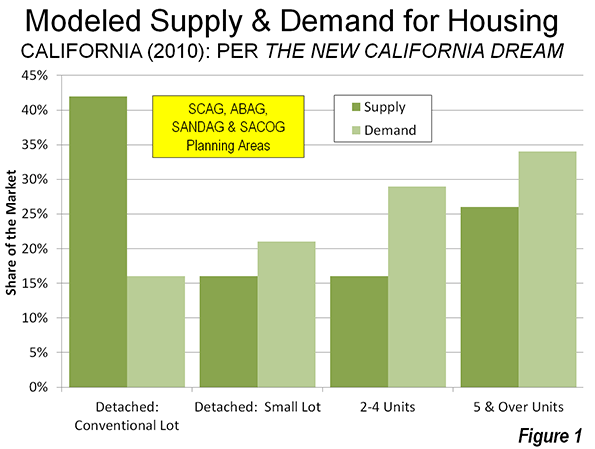
    Professor Nelson says that the supply of detached housing on what he defines as conventional sized lots (more than 1/8 acre) is far greater than the demand in California (Note 1). He further finds that the demand of detached housing on smaller lots is far greater than the supply. Professor Nelson’s conclusions are principally modeled from stated preference surveys, which can mislead if people act differently when they make choices in the real world.

    The Modeled Demand Estimates

    Nelson models the demand for housing types in California’s largest four planning regions (Southern California Association of Governments for the Los Angeles area, and the Bay Area Association of Governments for the San Francisco-San Jose area, the San Diego Association of Governments and the Sacramento Area Council of Governments). He estimates 2010 both supply and demand. His demand estimates rely strongly on data from three early 2000s stated preference surveys conducted by the Public Policy Institute of California (PPIC).

    • Nelson’s data indicates a strong preference for multi-family housing, which he places at 62% of demand in 2010, compared to the 2000 supply of 42%. Thus, the demand for multi-family housing is suggested to be one half above the supply.
    • The most stunning conclusion, however, is an over-supply of detached housing on conventional lots that Nelson estimates. Compared to a 2000 supply of 42% of the market, Nelson estimates the demand to be only 16%. This would indicate the supply of such housing to be more than 2.5 times the demand as is indicated in Figure 1.

    Nelson’s findings on conventional lot detached housing have obtained the most attention. He surmises that virtually all of the demand over the next 25 years can be met by the existing stock of conventional lot detached housing. This is music to the ears of many urban planners, who have for decades demonized  the suburbanization that has been preferred by the overwhelming majority of Californians (and Americans, and people elsewhere in the world where they can afford them).

    Actual Demand: Revealed Preferences: 2000-2008

    To perform a similar analysis, we used revealed preference data: the actual change in housing by type from the 2000 Census data to the latest American Community Survey (ACS) 2006-2010 data at the census tract level (Note 2).  

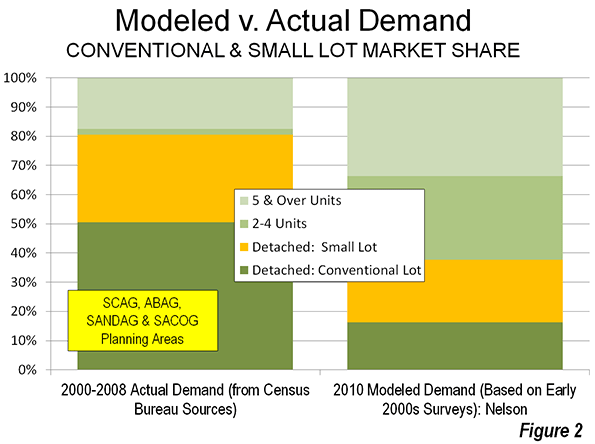
    In contrast to Professor Nelson’s estimates, the demand data indicates a strong continuing preference among Californians for detached housing on conventional lots. From 2000 to 2008 (the middle year for the 2006-2010 data), 51 percent of the new occupied housing in the four planning areas is estimated to have been detached on conventional lots (Figure 2). This is more than three times the 16% demand estimate in Professor Nelson’s data. In fact, the actual demand was higher than the 2000 supply (42%), indicating that the demand for detached houses on conventional lots has increased.

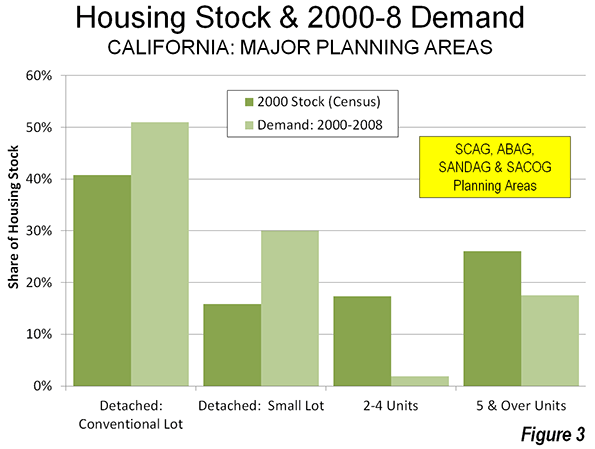
    If there is a sea change, it would appear to be in multi-family housing. In contrast with the 62% share for multi-family dwellings modeled by Nelson, the actual demand indicated in the census tract data was two-thirds less, at 19% (Figure 3), well below the supply of 43 percent in 2000. This suggests a tanking of demand for multi-family housing, even as builders, in California and elsewhere, put more product on the market.

    Why Accounts for the Difference

    Various factors appear likely to contribute to the difference between the modeled demand and the actual demand.

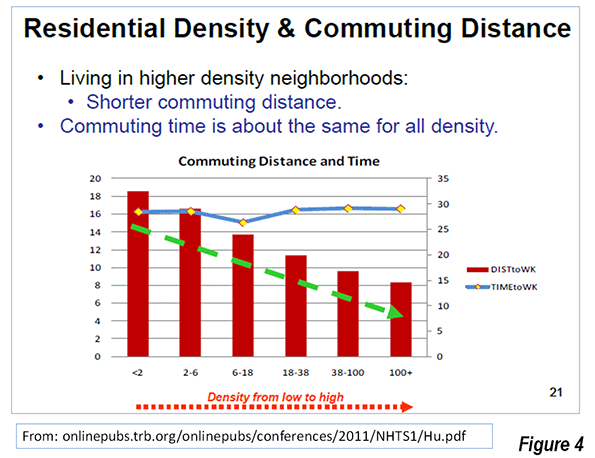
    Smaller Lots and Higher Density Do Not Mean Shorter Commutes: The PPIC survey questions implied a connection between larger lots (lower density) and longer commutes. This is the broadly shared perception, but in reality houses on smaller lots (necessarily in higher density neighborhoods) do not mean shorter commutes. This is illustrated in a chart by Southern California Association of Governments (SCAG) researchers on page 62 of The New California Dream. In the original SCAG document, the authors note that "commuting time is about the same for all density" (Figure 4).  This is not surprising, since higher densities are associated with more intense traffic congestion and with greater transit use, both of which lengthen commutes (Note 3).

    The "higher density means shorter commute" myth is rooted in the obsolete mono-centric conception of the city. Almost all US urban areas have become poly-centric with job locations highly-dispersed, as jobs have followed people to the suburbs. Gordon and Lee (Note 4) have shown that work trip travel times in the United States are shorter to dispersed employment locations than to central business districts or secondary business centers (such as "Edge Cities").  

    Invalid Perceptions of Transit Mobility: Professor Nelson also stresses stated preference responses showing that many people would prefer to live near transit service. All things being equal, who wouldn’t?

    But all things are not equal. Living near transit does not mean practical transit access to most of the urban area. In most cases, only a car can provide that. Transit systems are necessarily focused on downtown areas (central business districts), which contain, on average, only 8% of employment in the four planning regions. , Travel to other destinations is usually inconvenient, because of time-consuming transfers, or   not available at all.

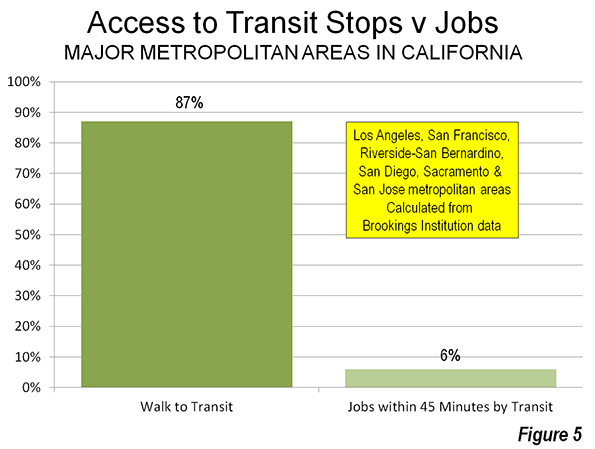
    A Brookings Institution report indicated that 87 percent of people in California’s major metropolitan areas (Los Angeles, San Francisco, Riverside-San Bernardino, San Diego and Sacramento) live within walking distance of transit. Yet, the average employee can reach only 6% of the jobs in their respective metropolitan area in 45 minutes (Figure 5). By contrast, the average work trip travel time ranges from 25 minutes to under 30 minutes in the four planning regions .

    Households thinking about a move to higher density could have been, upon more serious examination, deterred by transit’s severe mobility limitations. 

    Data Insufficiently Robust for the Modeling: There is also the potential that the PPIC surveys, with their general questions, were not of sufficient robustness to support Professor Nelson’s assertions. For example, PPIC did not define the size of small lots.

    Planning and Reality

    If households were so eager to move from detached houses on conventional lots to smaller lots, 2000 to 2008 would have been the ideal time. The mortgage industry was literally falling over itself to fund home purchases. Urban core wannabes could have flooded the market pursuing their smaller lot "stated preferences." The actual, revealed preference data says they did not, which is also indicated by the continuing strength of suburban growth relative to central city growth (Note 5).

    Thus, the modeled demand estimates in The New California Dream appear to be at substantial odds with the actual demand.This is much more than an academic issue. The conclusions of The New California Dream have achieved the status of sacred text in the canon of urban planning and are mouthed unquestioningly by organizations like the Urban Land Institute.

    Worse, demand estimates from The New California Dream are being relied upon in regional transportation plans being developed by California’s metropolitan planning organizations (MPOs). This is particularly risky because these same MPOs have been granted greater power over housing under California’s Senate Bill 375, goaded on by a sue-happy state Attorney General’s office. The attempt by MPOs to impose their housing plans and regulations on consumers could well backfire, for investors in condominium and multifamily housing.  This would not be a first time that   developers followed urban planning illusions like lemmings over a cliff, to which huge losses in the last decade attest. The more destructive effects, however, are likely to be paid by households and the economies of California’s metropolitan areas.

    ———

    Note 1: More than 70% of the detached housing stock was on conventional lots in 2000.

    Note 2: There is no census tract data on detached house lot size. We scaled the detached housing data from the 2000 census to match Professor Nelson’s distribution of detached housing supply by lot size, using population density. Nelson’s method and ours were sufficiently similar that the results should have been roughly comparable. As the text indicates, they were not.

    Note 3: In each of the three PPIC surveys, respondents are asked to choose between housing alternatives that are high in the questions to commute "lengths." From the description and survey instruments in the PPIC reports, there is no indication that respondents were given any idea what commute "length" means. There are two way to judge commute "length." One is distance or miles, while the other is time. Based upon the PPIC survey instrument, it cannot be known which definition was perceived by the respondents.

    Even so, it seems more likely that the term "commute length" was perceived by respondents in time rather than in distance by respondents. Each day, people have only so many hours and minutes available. However, distance is not so constrained, depending upon the speed of the commute. Further, the extensive research on commuting often refers to "travel budgets," which are expressed in time, not distance.

    Note 4: Reference: Gordon, P. and B. Lee (2012), "Spatial Structure and Travel: Trends in Commuting and Non-Commuting Travels in US Metropolitan Areas," draft chapter for the International Handbook on Transport and Development edited by Robin Hickman, David Bonilla, Moshe Givoni and David Banister.

    Note 5: The most recent year (2010-2011), for which the Census Bureau had issued invalid municipal population estimates, indicated a continued the trend toward suburban rather than urban core growth, as has been shown by Trulia Chief Economist Jed Kolko (see: Even After the Housing Bust, Americans Still Love the Suburbs).

    =======

    Photograph: Suburban San Diego

    Wendell Cox is a Visiting Professor, Conservatoire National des Arts et Metiers, Paris and the author of “War on the Dream: How Anti-Sprawl Policy Threatens the Quality of Life.”

  • Uniting a Fractured Republic: Innovation, Pragmatism, and the Natural Gas Revolution

    Over the last four years, emissions in the United States declined more than in any other country in the world. Coal plants and coal mines are being shuttered. That’s not from increased use of solar panels and wind turbines, as laudable as those technologies are. Rather it’s due, in large measure, to the technological revolution allowing for the cheap extraction of natural gas from shale. By contrast, Europe, with its cap and trade program, and price on carbon, is returning to coal-burning.

    Could President Obama, during his second term in office, turn this homegrown success story into paradigm-shifting climate strategy? In a speech we gave to the Colorado Oil and Gas Association yesterday, we argue that, after a season of ugly ideological polarization, politicians, environmentalists, and the gas industry have a chance to hit the reset button on energy politics. 

    This will require the natural gas industry to clean up its act, accepting better regulations, cracking down on bad actors, and preventing the leakage of methane, a potent greenhouse gas. It will require environmentalists to consider whether there might be a different path to significant emissions reductions from the one they have pursued over the last 20 years. And it will require Left and Right to put a halt to the tribalism that has characterized the national debate over climate and energy. 

    — Michael and Ted

    Uniting a Fractured Republic

    Innovation, Pragmatism, and the Natural Gas Revolution

    by Ted Nordhaus and Michael Shellenberger

    In 1981, George Mitchell, an independent Texas natural gas entrepreneur, realized that his shallow gas wells in the Barnett were running dry. He had millions of sunk investment in equipment and was looking for a way to generate more return on it. Mitchell was then a relatively small player in an industry that by its own reckoning was in decline. Conventional gas reserves were limited and were getting increasingly played out.

    As he considered how he might save his operation, Mitchell turned his attention to shale. Drillers had been drilling shale since the early 19th Century, but mostly they drilled right through it to get to limestone and other formations. Dan Jarvey, a consultant to Mitchell at the time, told us, "When you look at a [gas drilling] log from the 1930s or 1950s or 1970s it is noted as a ‘gas kick’ or ‘shale gas kick.’ Most categorized it as ‘It’s just a shale gas kick’ – as in, ‘to be expected, but to be ignored.’"

    As Mitchell embarked on his 20-year quest to crack the shale gas code, most of his colleagues in the gas industry thought he was crazy. But Mitchell persisted and his efforts would ultimately culminate in today’s natural gas revolution.

    In doing so, Mitchell upended longstanding assumptions about the future of energy. Just a few years ago, the convention wisdom was that no source of electricity could be cheaper than coal. Today, in the U.S., natural gas is cheaper. As a result, coal’s share as a percentage of electricity generated went from over 50 percent in 2005 to 36 percent in 2012. While global coal use continues to rise, the U.S. is at present leaving much of it in the ground. Meanwhile, estimates of recoverable natural gas results in the United States have nearly doubled, growing from 200 trillion cubic feet in 2005 to 350 trillion cubic feet today.

    The implications for those of us concerned about climate change are also significant. Leaving coal in the ground has been the longstanding goal of those of us concerned about global warming. Natural gas releases emits 45 percent fewer carbon emissions. In large part due to the glut of natural gas, U.S. carbon dioxide emissions will have declined more in the United States than in any other country in the world between 2008 and 2012 — an astonishing 500 million metric tons out of 6 billion, according to the Energy Information Administration.

    While we don’t imagine that any of this is news to most of you in this audience, there is another part of the story that might be. That is the story of the ways in which both the gas industry and the federal government helped Mitchell along the way. In these intensely polarized times, when it seems that almost everyone imagines that either government or corporations are the enemy, and it seems impossible to imagine that the two might actually work together to further the public interest, there are important lessons here too.

    1.
    As Mitchell considered trying his hand at shale, he cast about to see what was known at the time about how to get gas out of shale. A geophysicist who worked with Mitchell recalled telling him that, "It looks similar to the Devonian [shale back east], and the government’s done all this work on the Devonian."

    The work Mitchell’s geophysicist was referring to was the Eastern Gas Shales Project, which was started in 1976 by President Ford. The Shales Project was just one of several aggressive government-led efforts to accelerate technology innovation to increase oil and gas production. Already in 1974 the Bureau of Mines was funding the study of underground fracture formations, enhanced recovery of oil through fluid injection, and the recovery of oil from tar sands. One year later, the government funded the first massive hydofracking at test sites in California, Wyoming and West Virginia, as well as "directionally deviated well-drilling techniques" for both oil and gas drilling.

    The mandate from Congress was for government scientists and engineers to hire private contractors rather than do the work in-house. This was consistent with the tradition of the Bureau of Mines, which would set up trailers around the country to support oil, coal and gas entrepreneurs. This strategy contrasted with the government’s nuclear energy R&D work, which had been hierarchical since its birth in the military’s Manhattan project. This decentralization proved wise, as it ensured that the information would rapidly reach entrepreneurs in the field and not gather dust inside of a federal bureaucracy.

    From early on, Mitchell and his team relied heavily on information coming out of the Eastern Gas Shales project. "We were all reading the DOE papers trying to figure out what the DOE had found in the Eastern Gas Shales," Mitchell geologist Dan Steward told us, "and it wasn’t until 1986 that we concluded that we don’t have open fractures, and that we were making production out of tight shales."

    Through the 1980s, Mitchell didn’t want to ask the government – or the Gas Research Institute, which was funded by a fee on gas pipeline shipments to coordinate government research with experiments being conducted by entrepreneurs in the field – for help because he worried that he wouldn’t be able to take full advantage of the investment he was making in innovation.

    But by the early 1990s Mitchell had concluded that he needed the government’s help, and turned to DOE and the publicly-funded Gas Research Institute for technical assistance. The Gas Research Institute, which had worked with other industry partners to demonstrate the first horizontal fracks, subsidized Mitchell’s first horizontal well. Sandia National Labs provided high-tech underground mapping and supercomputers and a team to help Mitchell interpret the results. Mitchell’s twenty-year quest was also made possible by a $10 billion, 20-year tax credit provided by Congress to subsidize unconventional gas, which was too expensive and risky for most private firms to experiment with otherwise.

    By 2000, the combination of technologies to cheaply frack shale were firmly in place. The final piece of the puzzle was the sale of Mitchell Energy to Devon Energy, which scaled up the use of horizontal wells. Over the next ten years the use of this combination of technologies would spread across the country, resulting in today’s natural gas glut.

    Though the collaboration between Mitchell and the government was one of the most fruitful public-private partnerships in American history, it was mostly unknown until we started interviewing the key players involved around this time last year.

    After our findings were verified by other researches and reporters, including the New York Times and the Associated Press, some in the oil and gas industry, like T. Boone Pickens, have tried to downplay the government’s role.

    But the pioneers of this technology have been forthright. "I’m conservative as hell," Mitchell’s former Vice President Dan Steward told us, but DOE "did a hell of a lot of work and I can’t give them enough credit… You cannot diminish DOE’s involvement." Fred Julander said, “The Department of Energy was there with research funding when no one else was interested and today we are all reaping the benefits." 

    2.
    Today marks the end of one of the most divisive chapters in American political history. There is more partisan polarization in Congress than at any time since Reconstruction. There are vanishingly few swing voters. And the ideological divide between liberals and conservatives at times appears unbridgeable.

    One of the most insidious aspects of today’s political polarization is the way gross exaggerations turn into ossified caricatures. Left and Right view the other as ignorant, insane, or immoral.
    From the Right we have heard that President Obama is taking the country to socialism, and that Big Government is destroying the American dream. From the Left we have heard that Governor Romney would have exported all our jobs to China, and turn Congress over to Big Business. Where this downward spiral takes us is to the conclusion that America is fundamentally broken. The two great institutions of American life — business and government — are viewed by one side or the other as corrupt and nefarious.

    Few issues have become more polarizing than energy. Both sides have taken ever more extreme positions. Prominent conservatives have exaggerated both the size of Obama’s clean energy investments and the number of bankruptcies. They have described global warming and other environmental problems as either not happening or not worth worrying about. Some environmentalists have taken the opposite tack, exaggerating the negative impacts of gas drilling, downplaying the benefits, and accusing anyone who disagrees with them of being on the take.

    As we say in California — everyone needs to chill out. There is too much at stake for America, our environment, and our economy, for such hyper-partisanship to continue.

    In our rush to point fingers and interpret everything in catastrophic terms, we have lost sight of the fact that we are the richest nation on earth, and one with improving environmental quality, precisely because the private sector and the government have worked so well together. The failures of Big Business and Big Government should be put in their appropriate historical context.

    When the Colorado Oil and Gas Association asked us to give this speech at its conference the day after the election, we agreed on two conditions: that we pay our own way and that COGA invite local environmental and elected leaders to attend. We are glad to see them in the audience, because we need a common dialogue.

    As two individuals who came out of the environmental movement, where we spent most of our careers, we are best known for our writings calling for reform and renovation of green politics. In particular, we have advocated that environmentalists drop their apocalyptic rhetoric, which is self-defeating and obscures the very real environmental problems we face.

    And we have argued that environmentalists have been overly focused on regulations, when our focus should also be on revolutionary technological innovation, which is needed to make clean energy and other environmental technologies much cheaper, so that all seven going on 10 billion humans can live modern, prosperous lives on an ecologically vibrant planet.

    But our work has also focused on reminding private investors and corporate executives of the critical role played by the government in creating our national wealth. While economists have long recognized that innovation is responsible for most of our economic growth, few realize that many of our world-changing innovations would have been unlikely to occur without government support. A short list of recognizable technological innovations includes interchangeable parts, computers, the Internet, jet engines, nuclear power and every other major energy technology.

    Consider the information revolution. The government funded the R&D and bought 80 percent of the first microchips. The Internet started out as a federally funded program to connect networks of computers of government. Every major technology in the iPhone can be traced to some connection with government funding. The driver-less robot car that Google has invented relies on technologies that come out of government innovation programs.

    While high tech executives who are our age or younger are unaware of the government roots of the IT revolution, the old-timers of Silicon Valley do, and frequently expresses their gratitude for it.

    While interviewing the participants of the shale gas revolution, we were struck by how much respect and deference each side gave to the other. In many cases the government scientists and engineers acted as consultants to private firms like Mitchell’s — "We never forgot who the customer was," said Alex Crawley, who ran the DOE’s fossil innovation program for many years.

    As environmentalists, we were taught to be suspicious of such cozy relationships between industry and government workers, that government could not simultaneously promote industry while also attempting to regulate it. But when it comes to technology innovation, those cozy relationships, and the revolving door between government agencies, whether DoD or DoE, and private companies like Mitchell Energy, are absolutely essential to allowing knowledge to rapidly spillover and flow throughout the sector.

    And yet, there is also an important role for regulation, not only to protect the public from accidents and environmental degradation, but also to improve technologies and promote better practices throughout the industry. Wise regulation in the long run promotes, rather than hinders, the spread of new technologies and new industries, and this has never been more true than in the case of fracking. While US gas production has taken off, many European nations banned fracking for fear of the local environmental impacts and have started to return to burning coal.

    Last August, George Mitchell and New York Mayor Michael Bloomberg announced they would fund a large effort by the states to establish better fracking practices. They called for stronger control of methane leaks and other air pollution, the disclosure of chemicals used in fracking, optimizing rules for well construction, minimizing water use and properly disposing of waste water, and reducing the impact of gas on communities, roads, and the environment.

    You would be hard pressed to find very many Americans who would call those reforms unreasonable. They are the kinds of things that die-hard anti-fracking activists and much of the natural gas industry could agree to. And indeed, states like Colorado, and environmental groups like the Environmental Defense Fund, deserve credit for bringing regulators and the gas industry together to improve practices. By squarely addressing the methane leakage problem, and reducing the local environmental impacts, the government and the industry can make natural gas an even more obviously better alternative to coal.

    And the good news is that reducing methane leakage is something the industry already knows how to do. Little innovation is required to make sure that old pipelines are not leaking, and that new cement jobs are done properly. Similarly, responsible disposal of fracking fluids is not rocket science, it is something that the oil and gas industry does routinely in other contexts. Promising efforts are also underway to develop more environmentally sound fracking fluids and to further minimize water usage.

    There are costs, of course, associated with all of these efforts. But if the history of fracking proves anything, it is that costs will come down quickly. Indeed, if history is any guide, we will see great improvements to fracking technologies and techniques over the next 30 years that will be mutually beneficial to the industry, the public, and the environment, for the history of the shale gas revolution has been a history of incremental improvements to the technology. The water intensity of fracking, for instance, was originally not an environmental problem for drillers but an economic one. Only once Mitchell and others developed methods that required vastly less water to crack the shale did fracking become economically viable.

    For all of these reasons, we should both regulate fracking fairly and effectively, and also continue to support innovation to improve unconventional gas technologies. Doing so will help assure a future for gas beyond the precincts in which it is already well established. We also need to support innovation in new gas technologies well beyond fracking practices to include carbon capture and storage, which is more viable economically and technologically for gas than for coal, because gas plants are more efficient, and the emissions stream much purer. In a world in which there may remain significant obstacles to moving entirely away from fossil fuels, gas CCS looks much more viable than coal CCS. As such, we need government and the gas industry to work together to demonstrate carbon capture technologies at sites around the country, similar to how we conducted the Eastern Gas Shales Project.

    And the gas industry should support innovation beyond natural gas to include support for innovation in renewables, nuclear and other environmentally important technologies. Championing energy innovation more broadly would do more for the industry than the millions it is currently spending on slick 30-second TV ads and will remind Americans that supporting gas as well as renewables is not a zero sum proposition. Getting our energy from a diversity of sources is in the national interest and gas will thrive for a long time regardless of the energy mix. Moreover, until we have cheap utility scale storage, renewables need cheap gas for backup.

    For all of this to happen, the gas industry and environmentalists alike must change their posture toward regulation. While it is the goal of a small number of us to rid the world of particular practices, whether shale-fracking or atom-splitting, most of the rest of us want to improve them.

    Over the last 10 years, our message to the environmental movement has been that it must change its attitude toward technological innovation. Technologies are not essentially good or bad but rather in a process of continuous improvement. But there is another side to that story that industry must remember. Regulations that are often bitterly opposed sometimes end up being a boon for industry, paving the way for the broad acceptance of new technologies and pushing firms to improve those technologies in ways that make them more economical as well as more environmental.

    In closing we’d like to invoke the title essay of our last e-book, “Love Your Monsters,” which was written by one of our Senior Fellows, a well-known French anthropologist named Bruno Latour. In the essay, Latour monkey-wrenches the Frankenstein fable. The sin of Dr. Frankenstein, according to Latour, was not creating the monster, but rather abandoning him when he turned out to be flawed. We must learn to love our technologies as we do our children, he concluded, constantly helping and improving them. In so doing, we too become all the wiser.

    As we consider the implications of the gas revolution for the future of both our energy economy and our environment, we should commit ourselves to the larger effort of improving our technological creations. In so doing, the gas industry and the environmental movement might together update the concept of sustainability for the 21st Century. We should seek not to put limits on the aspirations of 1.5 billion people who still lack access to electricity, nor on the billions more yearning for enough to power washing machines and refrigerators. Nor should we want to sustain today’s energy technologies to be used in perpetuity. Rather, we should embrace technological innovation as the key to creating cleaner and better substitutes to today’s energy and non-energy resources alike so that we might sustain human civilization far into the future.