Category: Policy

  • Superstorm Sandy & The Beachfront Bailout

    Deadline reporters, especially in weather broadcasts from the surf line, have been wailing about “this enormous storm” or “the unfolding tragedy.” What they might also say is that hurricanes are a munificent windfall for newspapers, television stations, the federal government, construction unions, and politicians seeking reelection. In addition to classifying storms from one to five on the Saffir-Simpson scale, going forward it might also be possible to grade hurricanes as profit centers, or by the surge levels that they generate in reelection campaigns.

    By all (usually breathless) accounts, Hurricane Sandy delivered a wide band of damage and destruction to areas stretching from North Carolina to Maine. Along with a death toll now approaching 50, a 13 foot storm surge in New York harbor inundated parts of lower Manhattan and Brooklyn, and millions of residents around New York, New Jersey, Maryland, and Pennsylvania lost power in their homes. The aftermath, unlike the legacy of Hurricane Katrina, however, is that the waters which flooded Manhattan’s streets, tunnels and subways are receding with ebb tides, although the damage from surging waves and fallen trees is widespread, especially across New Jersey.

    Although the storm will have cost the Mid-Atlantic region some $45 billion in cleanup costs, not to mention the loss of work days for many, even this perfect storm not seen in “a millennium” did not rack up the apocalypse that was predicted as Sandy “barreled” up the coast on its “rendezvous with destiny” in Atlantic City. From the teeth of the storm in New Jersey, my sister reported only an epic loss of cable and Internet.

    The reasons storms rarely appear as they are cast on television is because, instead of acts of nature with a lot of wind and rain, hurricanes are now best understood as political spectacles, somewhere between nominating conventions and state lotteries.

    Take the federalization of the disaster business. Previously storm damage and the costs of clean up were the responsibilities of states and municipalities, who in the first place made the decisions to allow homeowners to build houses and businesses on barrier islands, sand dunes, and low-lying waterfront property.

    For much of the twentieth century, insurance companies refused to write flood or hurricane policies for stilted houses perched precariously on Cape Hatteras or wherever, which angered wealthy political donors, who equate their life successes with owning beachfront property.

    Enter the federal government into the realm of disaster indemnification, when Congress passed the National Flood Insurance Program in 1968, to mandate that vulnerable home owners in potential flood zones purchase adequate insurance that private companies were refusing to cover. Think of it as Obamacare for beachfront homes.

    Although the legislation was designed to cover the undue risks of shore properties, it also gave the political parties a mechanism that would allow (for all those waterfront contributors) a building boom on hurricane-exposed barrier islands.

    At a time when global warming has increased the intensity and frequency of major storms and hurricanes (which are nature’s teapots blowing off steam), we are living with the fallout of an earlier era, when the federal government doubled down by writing insurance for beachfront condos from Maine to Texas.

    After the 2000 recount election came the transformation of Florida into a swing state in presidential elections, insuring that claim adjusters would reach hurricane damage zones as fast as FEMA’s first responders. Before the 2004 election arrived, four more hurricanes had passed over Florida. In their wake came billions in federal aid relief, just to insure that neither awnings nor chads would be floating in the wind.

    As powerful as hurricanes may be, they are no match for the construction lobbies, something I learned in the 1980s when writing about the National Hurricane Center in Coral Gables, Florida.

    The then-director, Neil Frank, a man of ebullience and integrity, showed me a slide show on the back of his office door, explaining that it was folly to allow construction on Gulf and Atlantic barrier islands. That was thirty years ago, and since then cities of flimsy beachside construction have risen along the dunes.

    What I admired about Frank was his passion for hurricane preparedness. He had walked the beaches of Biloxi, Mississippi in 1969, after Hurricane Camille, and measured that surge at 25 feet—something he then extrapolated to other beaches around the United States, including Atlantic City. But in urging a ban on beachfront buildings, he was shouting into an ill wind.

    Not only was the federal government complicit in allowing places like Myrtle Beach to become housing projects (the poet Robert Watson called it “white Harlem by the sea”), it also assumed that its job performance could be measured by the number of blankets and water bottles that reached those crazy enough to “ride out” a major storm in their seaside mobile homes.

    No doubt this is the Katrina Effect in American politics: The truism that if a big storm hits, the best place for the president probably isn’t dockside in San Diego, playing Otis Redding tunes on a guitar. Nevertheless, it means that the federal government (not exactly a profit center these days) is on the hook for the rescues, the clean up, and the insurance claims.

    The sad reality of Hurricane Sandy is that, despite all the Weather Channel epithets that it was “the storm of the century,” a lot of it was ordinary. It wasn’t even technically a hurricane when it came ashore near Atlantic City. What made it destructive was its size, and that it arrived late in the hurricane season and, by chance, merged with other Atlantic and Canadian storm systems. Imagine, however, if it had been one of Neil Frank’s dreaded Category 4 storms?

    Undoubtedly, President Obama would love to turn Hurricane Sandy into a backdrop for reelection spots that show him compassionate to his fellow Americans in times of need. The problem is that neither Wall Street underwater nor the flooded roulette tables in Atlantic City makes an ideal photo op or headline (“President Vows: We Will Not Let This Stop Us From Gambling!”). And I doubt he wants to campaign as the Claims-Adjustor-in-Chief.

    Photo: MTA New York City Transit, Bus on the Move. Morningside Heights, 125th and Broadway, October 28, 2012, as Hurricane Sandy approached New York City.

    Matthew Stevenson, a contributing editor of Harper’s Magazine, is the author of Remembering the Twentieth Century Limited, a collection of historical travel essays. His next book is “Whistle-Stopping America”.

  • The GOP’s Hispanic Political Malpractice

    One of the more curious developments in American politics over the last two decades is the political malpractice of Republicans in dealing with Hispanic-Americans.  Indeed, it now appears that the 2012 election may well be determined by the share of the Latino vote that Governor Mitt Romney is able to keep from falling into President Barack Obama’s column.

    According to the Investor’s Business Daily tracking poll, Hispanics prefer Barack Obama by a greater than 2:1 margin (61% to 29% on October 25).  Hispanic-Americans have tilted toward the Democrats for decades, so it is hard to blame the Republican Party’s current predicament on just the political tactics of this year’s campaign.

    But unlike the African-American vote since the 1960s, which has remained rock solid Democratic, history indicates that on occasion the GOP has competed for and won a significant share of the Latino vote.  Hispanics tend to be family oriented and somewhat entrepreneurial, which should make them potential Republicans.

    But deliberate, conscious decisions by Republican leaders focused on the short run gains from immigrant bashing have done severe damage to the long term health of their party. Attacks on immigrants have caused Hispanics to desert the GOP in droves, particularly in the two most recent presidential elections. And, because the Latino population is relatively youthful, if this concern is not dealt with, it may become even more acute for the Republican Party in the years ahead. Among Millennials, America’s youngest adult generation, about one in five is Latino as compared with about one in ten among Baby Boomers and one in twenty among seniors. Among the even younger Pluralist generation (children 10 years old and younger) between a quarter and 30% are Hispanic. Between these two up-and-coming generations, it’s likely that Hispanics will represent nearly 30% of the nation’s population within the next few decades. This suggests that the Republican Party has little hope of winning national elections in the future unless it reverses its current policies to bring them more in alignment with the attitudes and beliefs of this key voter group.   

    Some have estimated that Ronald Reagan won 37% of the Hispanic vote in his successful 1984 re-election campaign.  Since then the presence of Hispanic voters in the electorate has grown by 400%, but the Republican share of their votes has risen above the level at which Latinos supported Reagan only once. That occurred in 2004 when Karl Rove’s strategic focus on Latinos enabled President George W. Bush’s re-election effort to win upwards of 40% of the Hispanic vote. In every other presidential election since 1984, Republicans have struggled to win the votes of even one out of three Hispanics.  

    Recent data from Pew Research demonstrates that the Hispanic rejection of the GOP was not pre-ordained. Their recent survey  showed 70% of Hispanics now identify themselves as Democrats,  but that this percentage falls to just 52% among Evangelical Hispanics, a fast growing  group whose cultural attitudes are more conservative than those of the overall Hispanic population. In 2004, President Bush actually won a majority of the Hispanic Protestant vote even as his support among Catholic Hispanics failed to improve from his showing in 2000.   

    Catholic Hispanics, who comprise about 60% of all Latinos, are more likely to vote based on perceived loyalties to their social-economic class than their attitudes on social issues. Bertha Gallegos, who is Catholic, pro-life and the Vice President of the Colorado Society of Hispanic Genealogy, a nonprofit and nonpartisan organization that researches the state’s Latino history, typifies the attitude among members of her faith toward the Republican Party. “I still don’t get how Hispanics can be Republicans. The only time they’re nice to us is when they want our vote. Republicans work to make the rich richer. They don’t care about the poor.”   

    Since the virulently anti-immigrant campaign in favor of Proposition 187 in California that attempted to bar immigrant access to basic social services the Republicans have continued to play exactly the wrong tune for Hispanics.  In this year’s Republican primary, there was much emphasis on removing undocumented immigrants from American soil through self-deportation or other more draconian means, Republicans have allowed economic resentment and cultural fears to get in the way of positive voter outreach to America’s fastest growing minority population. After all, many Latino legal residents and citizens also have relatives and friends who are undocumented.

    Yet studies as far back as the 2000 presidential election have shown that when properly engaged, Hispanics have an open mind on which party deserves their support. Latinos in that election were statistically more likely to support Bush over Gore if they were contacted by Latino rather than Anglo Republicans. Clearly the election in 2010 of Latino Republican governors, Susana Martinez of New Mexico and Brian Sandoval of Nevada, suggests that the community remains open to such appeals in the future.

    Before such efforts can be successful however, Republicans will have to reverse course on their attitudes toward comprehensive immigration reform, a cause which traces its historical lineage to Ronald Reagan and which was a key part of Karl Rove’s re-election strategy for George W. Bush. Only when the Republican Party’s message changes will their messengers deserve and be able to gain a respectful hearing from America’s Hispanics.   

    Morley Winograd and Michael D. Hais are co-authors of the newly published Millennial Momentum: How a New Generation is Remaking America and Millennial Makeover: MySpace, YouTube, and the Future of American Politics and fellows of NDN and the New Policy Institute.

    Polling place photo by BigStockPhoto.com.

  • The Rise of the Great Plains: Regional Opportunity in the 21st Century

    This is the introduction to a new report on the future of the American Great Plains released today by Texas Tech University (TTU). The report was authored by Joel Kotkin; Delore Zimmerman, Mark Schill, and Matthew Leiphon of Praxis Strategy Group; and Kevin Mulligan of TTU. Visit TTU’s page to download the full report, read the online version, or to check out the interactive online atlas of the region containing economic, demographic, and geographic data.

    For much of the past century, the vast expanse known as the Great Plains has been largely written off as a bit player on the American stage. As the nation has urbanized, and turned increasingly into a service and technology-based economy, the semi-arid area between the Mississippi Valley and the Rockies has been described as little more than a mistaken misadventure best left undone.

    Much of the media portray the Great Plains as a desiccated, lost world of emptying towns, meth labs, and Native Americans about to reclaim a place best left to the forces of nature. “Much of North Dakota has a ghostly feel to it," wrote Tim Egan in the New York Times in 2006. This picture of the region has been a consistent theme in media coverage for much of the past few decades.

    In a call for a reversal of national policy that had for two centuries promoted growth, two New Jersey academics, Frank J. Popper and Deborah Popper, proposed that Washington accelerate the depopulation of the Plains and create “the ultimate national park.” They suggested the government return the land and communities to a “buffalo commons,” claiming that development of The Plains constitutes, “the largest, longest-running agricultural and environmental miscalculation in American history.” They predicted the region will “become almost totally depopulated.”

    Our research shows that the Great Plains, far from dying, is in the midst of a historic recovery. While the area we have studied encompasses portions of thirteen states, our focus here is on ten core locations: North Dakota, South Dakota, Nebraska, Kansas, Oklahoma, Texas, New Mexico, Colorado, Wyoming, and Montana.

    Rather than decline, over the past decade the area has surpassed the national norms in everything from population increase to income and job growth. After generations of net out-migration, the entire region now enjoys a net in-migration from other states, as well as increased immigration from around the world. Remarkably, for an area long suffering from aging, the bulk of this new migration consists largely of younger families and their offspring.

    No less striking has been a rapid improvement in the region’s economy. Paced by strong growth in agriculture, manufacturing and energy — as well as a growing tech sector — the Great Plains now boasts the lowest unemployment rate of any region. North Dakota, South Dakota and Nebraska are the only states with a jobless rate of around 4 percent; Kansas, Montana, Oklahoma and Texas all have unemployment rates below the national average.

    A map of areas with the most rapid job growth over the past decade and through the Great Recession would show a swath of prosperity extending across the high plains of Texas to the Canada/North Dakota border. Rises in wage income during the past ten years follow a similar pattern. The Plains now boasts some of the healthiest economies in terms of job growth and unemployment on the North American continent.

    Of course, this tide of prosperity has not lifted all boats. Large areas have been left behind — rural small towns, deserted mining settlements, Native American reservations — and continue to suffer widespread poverty, low wages and, in many cases, demographic decline.

    In addition, the region faces formidable environmental and infrastructural challenges. Most prominent is the continuing issue of adequate water supplies, particularly in the southern plains. The large-scale increase in both farming and fossil fuel production, particularly the use of hydraulic fracking, could, if not approached carefully, exacerbate this situation in the not so distant future.

    Inadequate infrastructure, particularly air connections, still leaves much of the area distressingly cut off from the larger urban economy. The area’s industrial economy and rich resources are subject to a lack of sufficient road, rail and port connections to markets around the world. Yet despite these challenges, we believe that three critical factors will propel the region’s future.

    First, with its vast resources, the Great Plains is in an excellent position to take advantage of worldwide increases in demand for food, fiber and fuel. This growth is driven primarily by markets overseas, particularly in the developing countries of east and south Asia, and Latin America.

    As these countries have added hundreds of millions of middle class consumers, the price and value of commodities has continued to rise and seem likely to remain strong, with some short-term market corrections, over time.

    Second, the rapid evolution and adoption of new technologies has enhanced the development of resources, notably oil and gas previously considered impractical to tap. At the same time, the internet and advanced communications have reduced many of the traditional barriers — economic, cultural and social — that have cut off rural regions from the rest of country and the world.

    Third, and perhaps most important, are demographic changes. The late Soichiro Honda once noted that “more important than gold or diamonds are people.” The reversal of outmigration in the region suggests that it is once again becoming attractive to people with ambition and talent. This is particularly true of the region’s leading cities — Omaha, Oklahoma City, Tulsa, Kansas City, Sioux Falls, Greeley, Wichita, Lubbock, and Dallas-Fort Worth — many of which now enjoy positive net migration not only from their own hinterlands, but from leading metropolitan areas such as Los Angeles, the San Francisco Bay Area, New York and Chicago. Of the 40 metropolitan areas in the region, 32 show positive average net domestic migration since 2008.

    Together these factors — resources, information technology and changing demographics — augur well for the future of the Great Plains. Once forlorn and seemingly soon-to-be abandoned, the Great Plains enters the 21st century with a prairie wind at its back.

    Visit TTU’s page to download the full report, read the online version, or to check out the interactive online atlas of the region containing economic, demographic, and geographic data.

    Praxis Strategy Group is an economic research, analysis, and strategic planning firm. Joel Kotkin is executive editor of NewGeography.com and author of The Next Hundred Million: America in 2050. Kevin Mulligan is Associate Professor of Geography at Texas Tech University and Director of TTU’s Center for Geospatial Technology.

  • Decline Of The Asian Family: Drop In Births Threatens Economic Ascendancy

    In the last half century, East Asia emerged as the uber-performer on the global economic stage. The various countries in the region found success with substantially different systems: state-led capitalism in South Korea, Singapore and Japan; wild and wooly, competitive, entrepreneur-led growth in Taiwan and Hong Kong; and more recently, what Deng Xiaoping once described as “socialism with Chinese characteristics.”

    But these countries shared one common element: a strong Confucian family ethos. Three of Confucianism’s five key relationships are familial, led by the all-important father-son tie. In East Asia, business has often been driven by familial concerns. Hard-driving “tiger Moms” or workaholic Dads sacrificed all for the benefit of the next generation. But now that foundation is beginning to crumble, and if the trend is not reduced, the 50-year-long ascendency of the region could be threatened.

    The signs of an emerging Asian malaise can be seen in slowing economies — in Japan’s case an almost two-decade-long stagnation. South Korea and Singapore may grow this year at levels approaching that of the United States — mediocre by their historic standards. The notion of assured further progress is fading, as populations age and domestic markets seem unlikely to expand much.

    This malaise is reflect in declining birthrates, which now rival southern Europe for the world’s lowest, as demonstrated in a new report by myself and colleagues at the Singapore Civil Service College. Equally troubling, up to a quarter of all East Asian women, estimates the National University of Singapore’s Gavin Jones, will remain single by age 50, and up to a third will remain childless. Since few Asian women, unlike their North American or northern European counterparts, have children out of wedlock, the overall effect on already poor demographics could be catastrophic.

    The reasons for this decline in marriage and family are complex. Demographers such as Austria’s Wolfgang Lutz see a reinforcing pattern in which singleness becomes normative and child-rearing more difficult, and less widely supported by society. This creates, as my Singaporean colleague Anuradha Schoff puts it, “an ecosystem where childlessness is the preferred option.”

    Interviews and survey data from various East Asian countries show that part of the problem is extremely high housing costs — roughly twice or more as a percentage of income as in the United States, according to demographer Wendell Cox — and often pitiably small space. No surprise, then, that Asians coming to the United States flock to suburbs, increasingly in the more affordable parts of the country.

    The extremely competitive work environment, which now includes growing numbers of well-educated females, is having a negative impact on birth rates. In 1970, less than half of women in Japan and Korea were working, and only one-fifth in Singapore. By 2004, that number had increased to three-quarters in Japan, and roughly three in five in South Korea and Singapore, notes NUS’ Gavin Jones. As one researcher in Singapore explained, how could it be possible for her to start a family when she has to compete with other women who are not so encumbered? It made no sense to her to have children, even if the state provided her with as much as a million dollars.

    Huge time commitments at work, notes demographer Phil Longman, often work against potential parents. “As modern societies demand more and more investment in human capital,” he suggests” this demand threatens its own supply.”

    Then there are distinctly cultural issues, such as the perceived unwillingness of many East Asian men to share child-raising duties with their wives. And among parents, the much-celebrated obsession with achievement and education — also generally favored by Mandarins around the region — tends to make child-bearing seem ever more onerous and expensive. In this sense, the Confucian ethic on education undermines its paramount familialistic values.

    Japan represents the cutting edge of this lurch into what may in a decade be the general East Asian pattern. By 2010, a third of Japanese women entering their 30s were single, as were roughly one in five of those entering their 40s. That is roughly eight times the percentage in 1960, and twice as many as in 2000. By 2030, according to sociologist Mika Toyota, almost one in three Japanese males may be unmarried by age 50.

    Lacking the innovative energy of new entrants into the workplace and the economic stimulus of expanding households, Japan’s economy has become ever more stagnant and inward looking. And most Japanese view the future as far from bright; the Japanese, according to Gallup, are now among the most pessimistic people on the planet. Not too far behind them are, surprisingly, the Singaporeans.

    In Japan, the demographic clock is already ticking toward a kind of demographic doomsday. It’s been over two decades since the number of Japanese over 65 exceeded the number of those under 15, and the trajectory points to a time — by 2050 – when Japan will have 3.7 times as many people 65 and older as 15 and under, according to U.N. estimates. In 2050, the number of people over 80 will be 10% greater than the 15 and under population.

    Even Tokyo faces Japan’s emerging demographic winter. Given current trends away from family formation, Tokyo, now the world’s most populous metropolitan area, may see its population drop from its current 35 million to roughly half that in 2100. By then Japan’s overall population could fall to 48 million, according to Japan’s National Institute of Population and Social Security Research. And what will be left of the Japanese will be very urban, very old, and at some point, probably well before, bereft of savings.

    The other East Asian countries could face a similar fate, albeit a decade or two later. In Taiwan, 30% of women aged between 30 and 34 are single; only 30 years ago, just 2% of women were. In three decades, “remaining single and childless” merged from a rarity to a commonplace, and appears to be picking up momentum. In a 2011 poll of Taiwanese women under 50, a huge majority claimed they did not want children.

    For its part, Singapore has been able to keep itself going largely by importing talent from abroad. But the mass migration of newcomers, who have increased tremendously as a portion of the population, has also sparked widespread resentment among Singaporeans faced with ever greater congestion, crowding, high property prices and ever-greater competition for good jobs.

    Unlike intrinsically multicultural Singapore, Korea, Taiwan and China will struggle with the notion of tapping immigration to forestall their problems. As China progresses and urbanises, its demography increasingly mimics that of the Tigers, just as they now resemble Japan. Most of the world’s decline in children and young workers between 15 and 19 will take place in China; the People’s Republic will lose 60 million people under 15 years of age by 2050, approximately Italy’s population. It will gain nearly 190 million people 65 and over, approximately the population of Pakistan, which is the world’s fourth most populous country.

    In the longer run, these countries will have to reconsider their priorities. In order to restore a sense of a prosperous future, they must first consider what factors would encourage families and child-bearing in their societies. This may, among other things, require “tiger Moms” and workaholic Dads, as well as the bureaucracy, to change their ways. As my Japanese mentor Jiro Tokuyama used to say, East Asia will have to unlearn the secrets of its past success.

    Joel Kotkin is executive editor of NewGeography.com and is a distinguished presidential fellow in urban futures at Chapman University, and contributing editor to the City Journal in New York. He is author of The City: A Global History. His newest book is The Next Hundred Million: America in 2050, released in February, 2010.

    This piece originally appeared in Forbes.

    Happy Baby Photo by Bigstock.

  • Is College Worth It?

    Is college worth it? The question almost seems ludicrous on its face.  The unemployment rate for people with a college degree is only 4.2% versus 9.1% for people without a college degree and 13.0% for people with less than a high school education. In this economy, that should be an open and shut case.

    Yet in an uncertain world, many are questioning the value of college. There’s significant talk of a “higher education bubble.”  Skyrocketing tuition rates and the correspondingly high levels of student debt has driven a lot of this. Tuition has been rising at a much faster rate than inflation overall. Total student loan debt is now at $1 trillion. And unlike other forms of debt, student loans can’t be easily discharged in bankruptcy.

    In many ways college finance does mirror the housing bubble. You’ve got an asset everyone believes will only go up in value, a multi-party transaction, a situation where the seller of the product (the college) gets their money up front and so is indifferent   to the student’s ability to repay, third parties  insured against loss by the federal government, a non-transparent market where each student is in effect charged a unique price, young and unsophisticated consumers who are told they “have to get” a college degree, financial products without any income requirements, and even worse the asset (a degree) doesn’t have a secondary market.

    All of these factors create a situation ripe for exploitation and abuse. Indeed, it isn’t hard to see that the massive increases in tuition cost are heavily driven by the ability of students to get huge loans with few questions asked. And as with the housing crisis, outright fraud by educational institutions is likely more widespread than commonly believed.  The University of Illinois law school falsified its admissions data, for example, by inflating its students LSAT scores. The “cockroach theory” (if you see one, there’s probably a lot more you don’t see) suggests that this type of behavior is probably rampant.

    Students and their parents are starting to wise up to the game, and the amount of student loan debt they think appropriate is plummeting. For example, in 2011 only 21% of people felt $20,000 in college debt was too much. Just a year later that percentage increased to 42%. In 2008, 81% of adults thought a college degree was a good investment. In 2012 that had dropped to 57%.  That’s a stunning decline in the number of people who think college is worthwhile, though it might suggest that the problem is less with the value of a degree itself than in how much is paid for it. But there are anecdotes to suggest that some feel college (especially graduate school) isn’t worth what it used to be.

    Why is that? In part it is surely the economy. Though degreed adults as a whole have lower unemployment, youth unemployment and probably more important underemployment remains high for college grads. A shocking 53% of recent graduates are jobless or underemployed. This has fed through into popular culture, with student loan debt relief being part of the grab bag of demands made by the various “Occupy” movements.  When you graduate from college with huge, non-dischargeable debts, and you can’t find a job, particularly in your chosen field, you no doubt complain loudly about this to your friends.

    But there’s also good reason to believe college is worth less today in many cases. Back in the 1980s and 90s the value of college was clear. Manufacturing was in decline. If you didn’t have a degree, you would probably struggle. In contrast, a college degree was like a golden ticket to success.

    Today, in the age of globalization, it’s not so simple. Those without degrees are still hurting, but so are plenty of people with degrees. The emerging new separation is not between those with degrees and without, but those in jobs that are subject to international competition (tradeable) vs. those that aren’t (non-tradeable). High skill, white collar workers like computer programmers suddenly found themselves in competition with much lower paid people in places like India. This upended that entire job market.  Today you might be better off as an ironworker or welder whose job has to be done on site than as an accounting manager whose entire department can be sent to the Philippines. A college degree is no longer a guaranteed passport to prosperity.

    Also, today’s technology driven world is changing so rapidly that skills learned in college can prove obsolete by graduation.  At the same time, open source frameworks and cloud computing have dropped the cost of starting a tech business to almost literally zero. In the dot com era, it took millions of dollars to buy servers and database licenses if you wanted to start a company. Today anybody can start a technology business in his bedroom.

    So if you’ve got a good idea, why wait around for graduation to get started? The role models here are Bill Gates and Mark Zuckerberg, who dropped out of Harvard but both got rich starting companies.  This dropping out of college to start companies is actively being encouraged by some folks like Peter Thiel, who is actually paying people to do it.

    What these modern day Timothy Learys overlook is what Bill Gates and Mark Zuckerberg already had in common. Namely, they had already gotten in to Harvard. If you make it to Harvard, you already probably come from a privileged background. Thus you’ve got a family safety net in place if things go south. Those from working class backgrounds aren’t so lucky. Indeed, I’m struck that many suggesting that college isn’t the answer are presently an upper-middle class or better situations.

    For a limited number of people, dropping out of or skipping school to start a business might make sense. But trend setters may manage to convince a significant numbers of kids from marginal backgrounds to forgo the college education —perhaps in a needed skill — that would provide necessary credentials and culturally acclimate them to the new economy world. Many of those kids don’t have a family cushion to fall back on.  For them, turn on, tune in, drop out is not the answer.

    The real answer isn’t to skip education, but to be more judicious about the decisions being made. Racking up large amounts of debt probably isn’t the right answer. The marketing promises of especially for-profit colleges should be heavily discounted. For some, getting education through going into a skilled trade may be a good choice. College majors that don’t deliver skills in demand in the marketplace or that aren’t considered valuable credentials by employers ought to be scrutinized. But getting an education remains one of the single best decisions any person can make.

    Aaron M. Renn is an independent writer on urban affairs and the founder of Telestrian, a data analysis and mapping tool. He writes at The Urbanophile.

    Graduation photo by Bigstock.

  • The Land Premium That’s Punishing Property

    High land prices have all but killed the Australian housing industry.

    Lower housing starts has led to lower GST revenues (house construction attracts full GST) and lower stamp duty receipts are crippling state budgets and cruelling the chances of low and middle income earners to get a start in the housing market.

    What has caused this slump in housing starts? Land prices.

    Raw land for new housing developments should be close to its agricultural value – in other words, around $10,000 per hectare. But land released for residential development fetches up to $1 million per hectare – 100 times the agricultural price.

    Government land management agencies and private land developers may well argue a lot of land has been released for residential development, but clearly it is not enough.

    Only when urban growth boundaries are removed will we know a piece of land’s true value. It will then be a trade-off between price and distance. People may be prepared to travel another 10 or 15 minutes by car (10 to 20km) to get a cheaper block.

    To highlight the “‘X’ years supply of land available” argument, I heard a state bureaucrat say recently that the government had released enough land for 15 years supply. I raised my hand and asked “15 years supply – at what price?” He didn’t know what I meant. I said “at $200,000 a block it may well take 15 years to sell. So why don’t you double the price and then you’ll have 30 years supply?”

    These points highlight the fact that, as with most central planning, housing planning is based on a fundamental flaw – that price does not matter. But as we know, price does matter. Imagine the demand for housing if land was $100,000 per block cheaper. Think LCD, LED and plasma TVs over the past five years.

    Australia does not have, and never has had, a housing affordability problem, it has a land affordability problem. The cost of building a new house has hardly moved in 20 years. Land prices however have skyrocketed. By restricting the amount of land available on the urban fringes of our cities, state governments have sent the price of entry-level housing through the roof.

    The reasons state governments give for these restrictions all centre on urban planning. They have persisted with their policies of urban densification (squeezing more and more people into existing suburbs), an idea that has failed all over the world.

    Whether it’s traffic congestion, air pollution, the destruction of bio-diversity or the unsustainable pressure on electricity, water, sewage or stormwater infrastructure, urban densification has been a disaster. The evidence is overwhelming; urban densification is not good for the environment, it does not save water, it does not lead to a reduction in motor vehicle use, it does not result in nicer neighbourhoods, it does not stem the loss of agricultural land, it does not save on infrastructure costs for government and, worst of all, it puts home ownership out of the reach of those on low and middle incomes.

    State governments use urban planning laws to restrict the amount of fringe land available and then drip feed it through their land management agencies to a land- starved housing industry at inflated prices. Hmmm. After a change of state government a few years ago, a former cabinet minister was asked why her government didn’t release more land to kick-start the housing industry. She replied: “We needed the money.” So much for urban planning.

    And of course land developers with massive land banks on their books urge state governments to maintain the scarcity to maintain the ‘value’ of the developers’ inventory. Developers would be better off if they supported the removal of urban growth boundaries and allowed more broadacre land to come onto the market which they could buy at greatly reduced prices. With land prices significantly lower than they are today it wouldn’t take long for the industry to recover. Until land prices fall, there will be no recovery.

    The Australian housing industry is building 40,000 fewer homes a year than it should be. That’s more than $10 billion worth of work a year the industry is missing out on. That’s a lot of bricks, concrete, timber, tiles, steel and, of course, labour.

    Governments and industry associations have known for years this was coming but just played footsies with each other – read US economist George Stigler’s book Regulatory Capture to understand how and why this happens.

    Australia’s economy has been seriously distorted due to a massive overinvestment in household debt. We have a housing industry on its knees. Getting all this back into alignment with reality will take time but it is a realignment that is necessary.

    We cannot continue to deny the next generation a home of their own merely to satisfy the indulgences of urban planners and state government treasury officials.

    This piece originally appeared in Business Spectator.

    Bob Day AO is managing director of national homebuilder Home Australia.

    Brighton Beach bathing box photo by Bigstock.

  • A Planet of People: Angel’s Planet of Cities

    Professor Shlomo Angel’s new book, Planet of Cities, seems likely to command a place on the authoritative bookshelf of urbanization between Tertius Chandler’s Four Thousand Years of Urban Growthand Sir Peter Hall’s Cities and Civilization and The Containment of Urban England. Chandler produced the definitive volume of gross population figures for urban areas (cities) over millennia. Angel, takes the subject much further, describing detail how urban areas have grown over the last two centuries, both in population and continuous urban land area. The book focuses principally on population growth,  urban spatial expanse, and density. Moreover, Professor Angel develops both a statistical and analytic framework that complements the voluminous work of Peter Hall. Planet of Cities is liberally illustrated, which greatly aids understanding the trends.

    Urban Population, Land Area & Density Evolution from 1800

    Planet of Cities looks at the urbanization trend from various dimensions. A sample of 30 urban areas was used to gauge urban expansion and density changes from 1800 to 2000.

    At the same time, he describes the well documented urban density declines in the United States as well as the similar trends in Western European urban areas  often been missed by analysts who imagine that spatial expansion is limited to America.

    He goes further, showing that the rapidly growing urban areas of the developing world are also declining in urban density, with spatial expansion rates far exceeding those of population growth. This has been evident in New Geography’s  Evolving Urban Areas series (such as Mumbai, Jakarta, Manila, Ho Chi Minh City and others).

    Angel uses examples, such as Cairo and Accra, Ghana to illustrate both longer term and recent expansions of urban land area and the consequent drastic declines in urban density. In Cairo, the urban land area increased 16 times from 1938 to 2000, well in excess of the approximately 10 times population increase. In Accra, a 50 percent population increase from 1985 to 2000 was dwarfed by a 150 percent increase in urban land area.

    The analysis also includes a larger number (3600) with populations greater than 100,000. He estimates that all of the world’s urbanization covers no more than 0.5 percent of the world’s land. Angel suggests that the world the urban footprint could double or triple in the next few decades. However, he concludes that, even with this expansion, there are "adequate reserves of cultivatable land sufficient to feed the planet in perpetuity."

    Taking note of the slow growth or even population declines in the more developed world, he reminds readers that that nearly all of future population growth will occur in the urban areas of the less developed world. Angel strongly contends that this urban expansion is necessary. This, of course, places him "swimming upstream" against the prevailing doctrines of urban planning. The title of his first chapter "Coming to Terms with Urban Expansion" gives fair warning of his challenge to current planning doctrines. Throughout the volume, Angel expresses the view that declining urban densities are "inevitable," based upon his historic analysis, review of current trends and perceptions of the future.


    A Mumbai slum

    The Prime Concern: Housing

    Angel’s "primary policy concern" as "that in the absence of ample and accessible land for expansion on the urban periphery, artificial shortages of residential land will quickly extinguish any hope that housing will remain affordable, especially for the urban poor…"

    Angel expresses concern that the urban containment policies that so dominate American and Western European planning could be damaging to less developed nations, cancelling out much of the economic rewards of rapid urbanization. He expresses surprise that the attempt to impose Western planning models on the developing world raises so little objection (see China Should Send the Western Planners Home).

    Consistent with his "primary policy concern," Angel offers a "decent housing proposition," countering the present one-dimensional focus on environmental issues. In contrast, Angel suggests a more rounded approach to urban planning. He surmises \ the very purpose of cities:  to improve the economic lot of those who are attracted there. People are not generally attracted to cities because of the quality of their planning or the uniqueness of their architecture. In short, as he puts it, "few move to the city for its fountains." Unless they perform their economic task, cities stagnate or die, as so often happened before the modern age. The near exclusive draw of cities is household economics. Beyond the unprecedented value of the quantitative data and analysis provided, Planet of Cities is rooted in the reality of that   measure.

    At the same time, Angel is himself is unabashedly a planner. He is an adjunct professor of urban planning at the Robert F. Wagner School of Public Service at New York University, a lecturer at the Woodrow Wilson School at Princeton University and a senior research scholar at the urbanization project at the Stern School of Business at New York University.

    Restoring a Genuine Focus to Planning

    Angel expresses a strong interest in the most fundamental of planning issues: the provision of infrastructure that allows the urban area to better serve its residents and those it attracts. He is thus simultaneously for both more and less planning. He would curb the excesses of intervention in land markets that are now rife because they compromise the ability of cities to perform their primary function of improving affluence. He would expand the focus of planning to facilitate the organic urban expansion associated with growing cities.  This means that sufficient available land must be available for development without materially increasing land and house prices. It also requires making provision for the basic infrastructure such as an arterial grid of dirt roads on the expanding fringes of developing world cities.

    Abandoning Destructive Planning Doctrines

    Angel calls for abandonment of artificial limits on urban expansion and population growth (such as urban growth boundaries and housing moratoria) and instead seeks economic development and improvements in the quality of life.

    Professor Angel does not mince words about the consequences of relying of urban containment policy ("smart growth," "growth management," "compact cities,") as a strategy for reducing greenhouse gas emissions. The consequence would be that the "protection of our planet would likely come at the expense of the poor." He adds that strict measures to protect the natural environment by blocking urban expansion   could "choke the supplies of affordable lands on the fringes of cities and limit the abilities of ordinary people the house themselves."  He decries the notion that "cities should simply be contained and enclosed by greenbelts or impenetrable urban growth boundaries as "uninformed and utopian" because it makes sustainability "an absolute end that justifies all means to attain it." This policy approach sacrifices such imperatives as the quality of life and full employment.  

    A Planet of People

    Angel’s treatment is consistent with the urban scaling research of West et al at the Santa Fe Institute, which found that as cities increased in population they become more productive (As we indicated in a previous article, the Santa Fe Institute research did not deal with urban densities, despite misconceptions of some analysts).

    Angel’s concern about the impact on low income households is consistent with the focus of the international sustainability movement, which , declared at the recent Rio +20 conference:

    Eradicating poverty is the greatest global challenge facing the world today and an
    indispensable requirement for sustainable development. In this regard we are committed to
    free humanity from poverty and hunger as a matter of urgency.

    Angel’s Planet of Cities is about urban areas that serve their residents instead of theoretical, often utopian notions.

    Wendell Cox is a Visiting Professor, Conservatoire National des Arts et Metiers, Paris and the author of “War on the Dream: How Anti-Sprawl Policy Threatens the Quality of Life.”

    —–

    Publication information:
    Shlomo Angel, Planet of Cities (2012) Lincoln Institute of Land Policy

    Photo: Cover: Planet of Cities.  http://www.lincolninst.edu/pubs/images/2094_Planet_of_Cities_Cover_web.jpg

  • Warnings of an “infrastructure Crisis” are Meeting with Skepticism

    Is the "infrastructure crisis" a myth or a reality? Many  within the transportation community firmly believe that the crisis is real. They point out that many of our roads, bridges and transit systems are approaching the end of their useful life and are badly in need of repair, reconstruction and modernization. They are convinced that without an ambitious program of investment —beyond the billions that already are being spent—the transportation infrastructure will continue to deteriorate, rendering great harm to the nation’s economy. They find it difficult to understand why politicians and the public do not necessarily share the same sense of urgency. They tend to blame themselves for doing a poor job of "educating" the public about the catastrophic consequences of inaction.

    Even though the new two-year transportation bill has barely gone into effect (on October 1), activists already are strategizing  how better, i.e. more convincingly,  to present  the case for higher transportation spending in the next transportation bill.  As an AASHTO spokesman reminded us recently, "it is never too early to consider your strategy for making the case that the United States should continue to invest in its transportation infrastructure." "We can’t afford to relax," echoed Pete Ruane, president of the American Road and Transportation Builders Association (ARTBA). "We’re in a very serious struggle over the future of federal investment in transportation." Similar sentiments have been voiced in various transportation-related meetings over the past several months..   

    But proponents of greater spending ignore the political realities. With mounting deficits and the shadow of a $16 trillion debt hovering over all fiscal decisions, Congress is not about to vastly increase spending on transportation. Concern about deteriorating infrastructure has failed to resonate with the electorate during the election campaign.  Nor did  the presidential condidates care to mention transportation in their recent debate on domestic priorities, despite pleas by stakeholder groups to include infrastructure on the political agenda.

    Infrastructure crisis believers decry this supposed "indifference" or "short-sightedness" on the part of the politicians and the public. But their anger is misplaced. People recognize and acknowledge the need to modernize and expand the nation’s infrastructure.  They simply are not convinced by the "sky is falling" rhetoric employed by the alarmists—dire warnings of collapsing bridges and crumbling roads if  government does not greatly increase spending on infrastructure. 

    As the Washington Post editorialized no too long ago, people see no signs of  "crumbling infrastructure." They trust their own eyes more than they trust the unverified claims of  the experts —and what they see is highways and transit networks that are well maintained and functioning smoothly and reliably most of the time. They suspect that  warnings of catastrophic consequences if spending on infrastructure is not boosted, are overblown, self-serving, and more often than not inspired by liberal advocacy groups, lobbyists and industry spokesmen who have a financial stake in pushing for more federal spending.  As one senior congressional aide confided to us, "I don’t see our constituents lobbying to raise the gas tax in order to spend more money on transportation."

    Moreover, the public is not sure that all of the billions of dollars that the federal government already devotes to  transportation ($114 billion in FY 2012) are spent  wisely, nor that more money will make the transportation system perform any better (e.g. reduce congestion).  They believe that the desire to greatly increase investment in infrastructure must be tempered by the overriding  imperative to get the nation’s fiscal house in order.

    Beyond MAP-21 
    The fiscal and political climate in the next few years will make the job of convincing the skeptical electorate to support higher transportation spending even harder. Funding constraints will continue to make it difficult if not downright impossible for Congress to commit hundreds of billions of federal dollars in a single legislative package, regardless of which party controls the purse strings. Unwilling to raise fuel taxes, Congress is likely to embrace short-term bills as a convenient way out of the dilemma.  Short-term authorizations such as MAP-21 will require only modest transfers from the general fund —especially if states are willing to step in with increased contributions of their own. On the other hand, a six-year bill would require an injection of nearly $90 billion in general revenue.  

    To be sure, some in the stakeholder community will contend that longer-term (i.e. five- or six-year) authorizations are necessary to allow for orderly planning and implementation of capital projects. They will argue that short-term bills will not provide the kind of funding certainty that major public works require. But to the extent that large capital investments still figure on State DOTs’ and transit authorities’ agendas, private capital, tolling, and credit instruments such as TIFIA and state infrastructure banks, will provide adequate alternatives to the funding stability that long-term congressional  authorizations offered in years past.

    The bottom line: regardless of the outcome of the November elections, do not expect a boost in federal transportation spending. Indeed, minor reductions in discretionary programs (TIGER, New Starts) are possible if automatic year-end spending cuts under sequestration are not avoided.

  • Where Do You Live?

    I recently moved to Providence, Rhode Island, where I live in the town of West Warwick. I’ve been learning the place more and soaking in New England culture (and seafood). This area has a Rust Belt type profile: declining population, post-industrial economic landscape, high unemployment, etc. So I’ve been trying to get a handle on conditions and think a bit about what the opportunities are.

    I have been really struck by the way people here seem to think about their geographic identity. All of us have various layers of identity. Some of these are more primary than others. But let’s consider three possibilities in trying to answer the basic question “Where do you live?” Those are your state, your metro, or your town. Which of these forms the most important basis of identity?

    My observation so far is that most people here think of themselves first as Rhode Islanders, and secondly as residents of their town. Providence, possibly because at 178,000 people it’s fairly small, is sort of seen as just another town. (Southern Massachusetts is maybe seen as a type of Canadian province with its own collection of towns).

    So what? you might ask. Unit recently I probably would have said that it doesn’t matter that much. But now I see that it has a profound effect on creating the lens through which people process the world. Here are some local implications.

    First, it leads people to exaggerate the uniqueness here. Rhode Island is geographically the smallest state, and also quite small in population. I heard people say that only in Rhode Island can you get pretty much every leader in the place to show up for a conference on the state’s economic future. If your worldview is the state, that may be true. But if your worldview is metro area, I think there are many similar sized regions that could pull this off. There are many things that appear unique if your lens is Rhode Island that are not if your lens is Metro Providence. It may be that there’s uniqueness in the small geography of Rhode Island from the standpoint of state policy, but if I may be so bold, this is hardly its strong suit. (But for a positive example of how this can work in a place like Rhode Island where it’s more difficult elsewhere, see the example of pension reform).

    Second, the economic geography of the new economy is metro regions. When you look state first, you are missing the bigger picture. If you doubt that the metro area is the primary economic unit, I suggest spending some time perusing material over at the Brookings Institution. States are more or less irrelevant economically, except that they can screw things up for the metro and non-metro regions they contain.

    Third, Providence is a bi-state metro area that includes Southern Massachusetts. You can also see Providence as an extended node in the Greater Boston economy. If you look primarily at the state, you miss this, or even see Massachusetts as the competition. You also lose about 60% of the population scale you have to work with.

    Fourth, when you look state first, your natural inclination is to compare yourself against other states. In Rhode Island’s case, there really aren’t many similar places, so the default is other New England states. On the other hand, one can imagine many similar Rust Belt type metros to compare Providence too. Places like Buffalo, Pittsburgh, and Cleveland come to mind. Of course these aren’t exactly the same, but they’ve been grappling with the legacy of de-industrialization seriously for a really long time. There have got to be many things that could be learned by studying and networking with these areas. There’s a lot of pan-Rust Belt discussion going on these days, but Providence isn’t part of it. This is part of that new economic geography of cities I was talking about.

    In short, I think treating state identity as primary has problems. Rhode Island is most certainly not the only place where this crops up, but it is noticeable here and perhaps more important here since the state is a subset of a metro geography instead of a superset.

    Aaron M. Renn is an independent writer on urban affairs and the founder of Telestrian, a data analysis and mapping tool. He writes at The Urbanophile, where this piece originally appeared.

    Downtown Providence photo by Bigstock.

  • Here’s Why People Don’t Think We’re in a Recovery

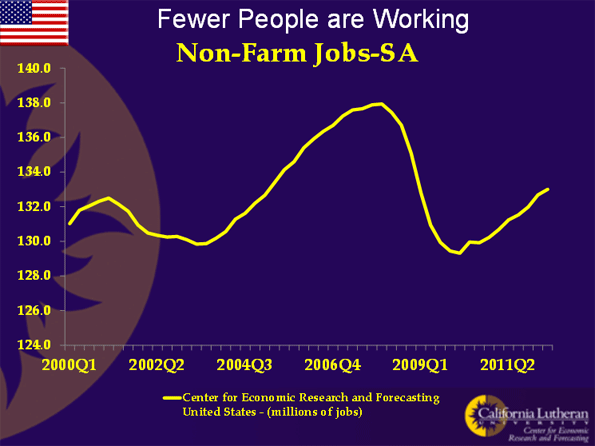
    The most recent jobs report was again below consensus.  With fewer than 100,000 new jobs, unemployment fell only because people continue to leave the labor force in huge numbers.  People are discouraged, and many don’t believe we are in a recovery.  Why would they think that we aren’t in a recovery?  After all, GDP is above its pre-recession high, and we hear all the time about how many jobs have been created over the past couple of years.

    People think we’re still in a recession because fewer of them have jobs than prior to the recession.  Below is a chart showing total non-farm U.S. jobs since 2000.  Today, we have millions fewer working than we did in 2007:

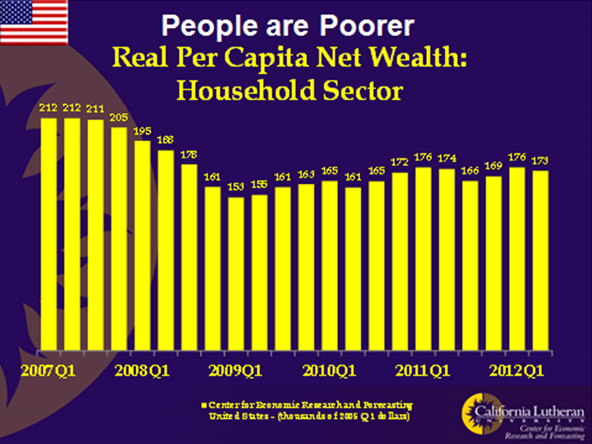
    People think that we are in a recession because they are poorer than they were prior to the recession.  As the following chart shows, Americans’ wealth is down a lot.  The average American’s wealth is down $39,000 or about 16 percent from its pre-recession high in 2005 dollars.  That is on average every man, woman, and child is $39,000 poorer than they were at the beginning of the recession.  An average family of four is $156,000 poorer than it was just a few years ago.

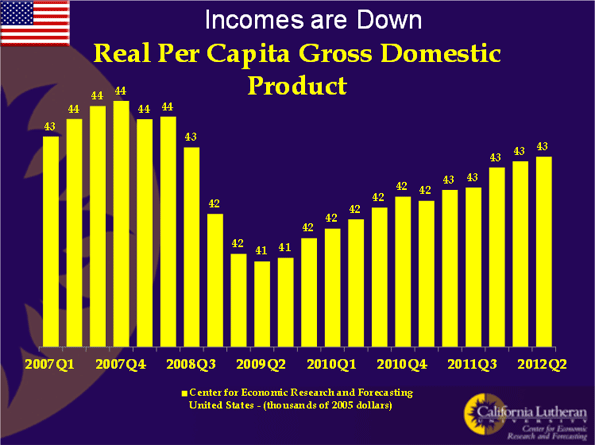
    Not only are Americans poorer than they were at the beginning of the recession, their income is down too.  Real (inflation adjusted) GDP may be climbing, but all of those gains are a result of increased population.  Real-per-capita GDP (the source of income) is still down more than $1,000 in 2005 dollars.

    Americans are poorer than they were, and their income is lower, and they are out of work or they know someone who is out of work.  Of course they don’t believe we are in a recovery.  The real question is that why, when things are this bad, does the chattering class spend its time debating trivial topics, such as which of the presidential candidates mistreats dogs the most?

    I think the answer is that the chattering class isn’t out of work, and they don’t know anyone who is out of work.  Maybe they know a banker who lost her job, but being a banker, she was probably evil.  So, no worries.

    This recession has hit sectors like construction and manufacturing disproportionally hard, and people who work in these sectors are not well represented in the chattering class.  Small businesses have also been badly hurt, and they too are poorly represented in the chattering class. 

    Other sectors have been hurt far less.  Education, healthcare, government, and professional services have each faced challenges, but these sectors’ job losses have been small compared to the most hard-hit sectors.

    One result of the different patterns of job losses across sectors is that we’ve seen an increase in income inequality.  Even worse, the increased inequality may be accompanied by declining upward mobility.  Income inequality without upward mobility is prescription for social trouble and slower economic growth.  Calls for income redistribution are only the beginning.

    Huge numbers of young people have failed to find jobs.  Many are living with their parents at ages far beyond what was normal just a few years ago.  Unemployed and disillusioned young people are another prescription for social trouble.

    What are our leaders doing?  Not much.  Congress is gridlocked and the President is campaigning.  The republicans call for tax cuts and spending cuts.  The democrats call for increased spending and tax increases.  Neither plan will work.

    The FED is trying to help.  It has instituted QE3, promising to purchase $40 billion in mortgage backed securities every month until economic conditions improve, whatever that means.  This will not do anything.  The FED has run out of bullets.  Policy now is all about convincing themselves and everyone else that they are doing something.

    Our deficit is huge.  It’s so large that if we were to cut all defense spending and cut all social security spending, we would just about eliminate the deficit.  But at what a cost!  We’d get rid of every soldier, gun, ship, and airplane.  We’d cut Granny off from her monthly check.

    We’re not going to do that.  We’re not going to cut the budget enough to get rid of the deficit.  So, give it up.  Budget battles on this scale are disastrous for democracies.  Best not to do it.

    Government spending is a problem.  That’s for sure, but you can’t fix it by cutting the spending.  That sounds wrong, I know, but the dynamics of democracy won’t let it work.

    Tax policy won’t do it either.  You can’t tax yourself to prosperity, and cutting taxes won’t help without a whole slew of complementary policies.  Increased spending won’t help.  The problem is that government is already too big relative to the economy. 

    Government at all levels is now about 37 percent of the economy.  This is higher than it was during World War Two.  It needs to become smaller as a percentage of the economy, but not by cutting.

    What we have to do is cap government spending on a real-per-capita basis.  We just keep spending what we’re spending per person, even after adjustment for inflation.  That way, there are no losers.  It should be relatively easy to gain support for a simple cap.

    Then, you grow your economy.  How to do that is another big topic.  But, we know the outlines:  Increase immigration.  Evaluate regulations for efficiency and economic impact.  Restructure the tax code to maintain productive incentives.  Restructure the safety net to improve incentives.  Restore incentives to education.  Remove barriers to trade.

    That is a big task, but it is a lot easier than cutting the budget as much as would be required.  It’s also a lot easier than suffering through a decade of anemic growth.  The benefits would be big too.  We’d be setting the stage for persistent prosperity.

    Bill Watkins is a professor at California Lutheran University and runs the Center for Economic Research and Forecasting, which can be found at clucerf.org.

    Unemployment photo by BigStockPhoto.com.